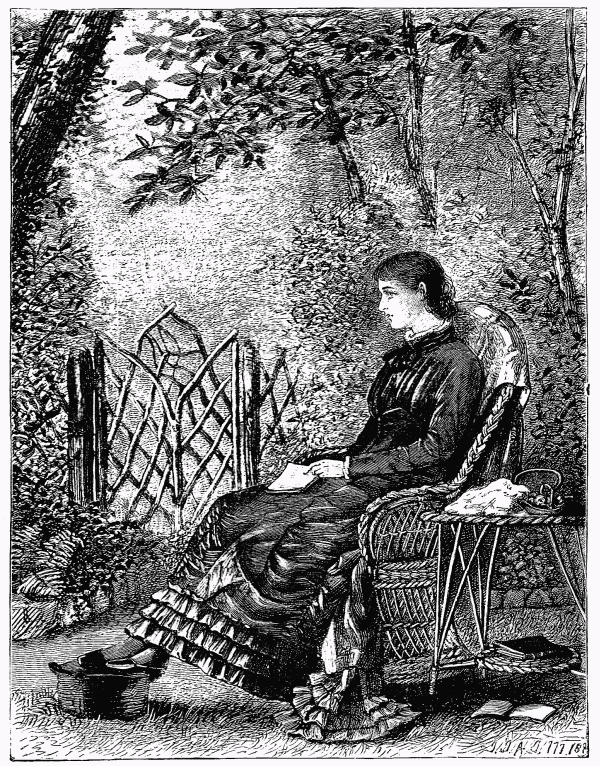
 "LILACS AND LABURNUM TREES BLOOM ABUNDANTLY AROUND."
Yet the recollection of that book
is helping to soften Hazel. There
is a tender bit of writing at the
close of the lecture which can
hardly fail to reach any woman's
heart, unless it be wholly hardened;
and Hazel's is not a hard heart.
So she muses on it, growing gradually
calmer and happier. After
all, she might be of some use in the
world if she were to try, and if One
Divine would be with her.
She stoops down to throw some
coal on the fire. She is too much
exhausted physically to make it up
carefully; but with an effort piles
on large blocks and small indiscriminately,
then throws in a handful
of matches from a box within
reach. What strange chaos there
seems to be in the grate after a
little while! One after another
the matches go off with a phiz
and short-lived flare, and each
seems to light up a more curious
scene than the last. From being
mere piled-up blocks of coal in a
grate, they grow to be a half
blocked up entrance to some unknown
place. There is a large
shining black portal, half ruined,
surrounded with débris. By degrees
Hazel's languid curiosity is
excited, and she wonders whither
it leads. Why should she not
explore?... The next
match which takes fire lights up
the slight form leaning far back in
the big chair, with the soft, golden
brown hair half loosened, and the
dark, shadowed eyes fast closed.
And Hazel has passed through
the dark gateway, and is in a
wonderful world.
What a strange black gateway to have led
into so fair a garden! Hazel pauses at the
entrance, her eyes glistening, her breath
taken away with delight at the beauty of the
scene before her. A paradise of fresh green
shade and exquisite light and colouring.
Wide-spreading chestnuts, graceful, feathery
birches, and a hundred other trees, clothed
and robed in their tender young leaves,
mingle with a glory of pink and white spring
blossom, which seems to fill the air like a
snowstorm in the clear, blue sky. The
South wind blows and fans Hazel's cheek, and
wafts delicious breath of flowers and sweet-brier
around her. Beneath the shower of
snowy blossom stretches smooth, green
grass, and masses of brilliant flowers glow,
expanding their petals up towards the sun.
After a while Hazel wanders forward in a
dreamy intoxication of delight, every moment
discovering fresh beauties. She finds a
beautiful grotto, where are large rocks and
cascades and running streams and fountains.
She enters by a low archway of stone, covered
with drooping ferns, and there, right before
her, is a large clear pool at the foot of a huge
rock. She flushes with the prettiest of shy
pleasure and frank admiration at sight of her
own reflection.
How beautiful! A girl in a long, white
robe, with a sweet, dark-eyed face, which she
knows to be her own. She is leaning slightly
forward, and the eyes—so often heavy and
weary—are brimming with happiness, the
lips parted in a smile. Her hair, with its
pretty, sunny ripples, is unbound, and the
wind blows it slightly back from her shoulders.
And, most wonderful and striking of all, a
circlet of pure gold rests upon the shapely
head, and a second circlet is clasped round
the waist. Then she is a queen? No doubt
of it. And then comes, to the joy of admiration
of all she has seen, the added joy of
certainty that all is her own. This is a
queen's garden, and she is the happy
queen!
More and more dawns gradually upon her.
There are those near at hand dear to her, to
whom she is also dear, whose queen she is.
Oh the joy of it all! She clasps her hands in
ecstasy, and the pretty reflection in the pool
is more than ever lovely, only she has forgotten
it now.
A serious thought must have come into
Hazel's mind, for suddenly a different
expression appears in her eyes; a look of
perplexity and shade of sorrow. The consciousness
in her new life is growing, and,
alas! it is not unmixed with pain. This
garden is not all the world, then? She puts
her hand to her brow, trying to recall something.
Slowly it comes back to her in words,
noble words, spoken by one whose face is a
darkness to her. And she listens—
"It is you queens only who can feel the
depths of pain, and conceive the way to its
healing."
Ah! that is enough. She has lost her
desire to recall more. She would fain turn
back to the former delight and forget the
existence of pain. But the steady voice
persists, and will not be quenched.
"Instead of trying to do this, you turn
away from it; you shut yourselves within
your park walls and garden gates; and you
are content to know that there is beyond
them a whole world in wilderness, a world of
secrets which you dare not penetrate, and of
suffering which you dare not conceive."
Hazel looks round on the garden. How
pleasant it is! Why should she leave it?
Why should she concern herself with what
may lie outside this home-kingdom of hers?
She tries again to banish the voice, yet she
knows in her heart, if she would only look for
its knowledge, that, outside of that little rose-covered
wall, the wild grass, to the horizon, is
torn up by the agony of men, and beat level
by the drift of their life-blood.
Yes, it is useless; there is no escaping the
truth the voice tells. So Hazel yields herself
to listen as it goes on.
"I knew you would like that to be true;
you would think it a pleasant magic if you
could flush your flowers into brighter bloom
by a kind look upon them; nay, more, if your
look had the power, not only to cheer, but to
guard.... This you would think a great
thing! And do you not think it a greater
thing that all this (and how much more than
this) you can do for fairer flowers than these,
flowers that could bless you for having blessed
them, and will love you for having loved
them; flowers that have thoughts like yours,
and lives like yours, and which, once saved,
you save for ever? Is this only a little
power? Far among the moorlands and the
rocks, far in the darkness of the terrible
streets, these feeble florets are lying, with all
their fresh leaves torn and their stems broken;
will you never go down to them, nor set them
in order in their little fragrant beds, nor fence
them, in their trembling, from the fierce
wind?"
Engrossed with the voice, Hazel has been
walking on, little heeding whither she goes,
when, as its tones die away, a groan startles
her. How terrible its sound; how incongruous,
interrupting the soft harmonious chorus of
the soaring, singing birds! So painfully
near it seemed, too, it could but have been a
very little distance off outside that gate which
she sees before her. Her first impulse is to
draw back and retire, shuddering, far into the
garden. But, behold! the gate swings back
of its own accord, and in the face of that fact,
and with the remembrance of the words she
has heard, she dare not do other than pass
through the open way.
What a strange, wide world, and how
dreary! A great, mad battle is raging; the
grass, sloping up to the horizon, is scorched
with the heat of the sun—the sun which only
made a pleasant warmth in the shady garden.
There is the fierce galloping of horses, and
wrestling and fighting of men. Shouts and
groans fill the air and drown the song of the
birds. There are heaps of dying and wounded.
Ah! there is one man not a stone's throw
from her; his must have been the voice that
reached her within her gates. How remarkable
that she should have heard nothing
before of all the great din. Another groan,
followed by some inaudible words, causes
Hazel timidly to approach the wounded man.
He is evidently one of the very poorest of the
"common" soldiers; and there is a look in
his face which speaks the word death with a
shudder in the girl's heart. A gleam lightens
the agony in the man's eyes as he sees the
white form and gentle face above him. He
gazes steadily a moment, as though to make
sure his vision is not a passing illusion; then
Hazel catches the words, "Were you sent to
me?"
Very quietly she tells him in whose name
she comes. Then, with a long, struggling
sigh of satisfaction, without a shadow of
further questioning in the dying eyes or voice,
he whispers—"Hope even for me in Him,
then, since He sent you!"
So the low, flickering flame of life, set free,
leaps up to its source; and the forsaken
home rests in unbroken peace.
Saddened, and yet peaceful, too, Hazel turns
slowly away from the battle-field, and walks
on, not noticing whither she goes. Jarring
sounds recall her, and she finds herself in a
narrow valley, surrounded by noisy children
and brawling women. No one seems conscious
of her presence. A lot of men are
lounging against the wall of a public-house.
The low building is conspicuous by its being
in good repair, while its neighbours are all in
a shattered condition. The window-frames
are painted and varnished, and the open
entrance discloses a smart interior. A few
doors beyond this the houses reach the
climax of desolate disorder. The whole place
is tumbling down; the window is broken;
the battered door is off its hinges, propped
up against the wall. A cripple girl is sitting
on a broken box, turned upside down,
immediately outside this miserable hovel.
Her face is a greater shock to Hazel than any
of the other wretchedness around. There
is a desperation of bitterness in that set,
white face, with its hollow eyes and cheeks,
which is absolutely appalling. Hazel had
always imagined that suffering must of
necessity, by its own inherent nature, bring
with it a patience which would be reflected in
a sweet face. Slowly, as she scans those
immovable features, full of pain, and still
more full of dogged rebellion, this idea has to
be abandoned. Here obviously is a human
being in the midst of a noisy squalor, whose
physical disease and torture is unlightened by
one softening ray of hope; whose misery is
too sullen and dull to rise even to the hope of
putting an end to itself.
One moment and the deformed girl starts
apprehensively. A sob has sounded in her
ear, and some one, unlike any she has ever
seen heretofore, stands beside her, taking her
hand in mute, unspeakable compassion. She
cowers back against the wall and drags away
her hand; Hazel's purity and loveliness raises
in her only a shrinking dislike and dread of
contact.
It is long before the pleading, loving voice
gains any hearing; but at last, before the
two part, some faint expression of intelligent
thought has dawned on the lame girl's brow;
and in her mind a question has been raised,
"Can it be that there is one who loves me
and has need of me?"
The evening sunlight is falling through the
birches in the beautiful garden; the air is full
of fragrance and harmony; the queen is
returning. Wearily she opens the gate to
enter. She is filled with pain, for the many
sadnesses to which she has drawn near have
touched her own soul with the shadow of
suffering.
Suddenly, in the chequered shade of the
trees at the entrance of the garden, she stops
and turns round, for a bright radiance
envelops her. And, lo! there stands One, in
glorious light—One in whose Divine face
love is shining. Hazel bows down, her
whole soul overwhelmed with reverent awe.
Then her hand is taken and held with a touch
which thrills her with exquisite rapture, and a
voice in her ears says—
"Come, see with Me My garden."
And the air, which is filled with light,
grows buoyant, and, while her hand is still
clasped by the Divine Guide, she is wafted upwards.
Stretched out below, the hills and vales of
the earth are one vast garden. All is indistinct
at first; expanses of misty colour and
tint; but by degrees the scene resolves itself
into more definite form. The whole is intersected
and watered with streams, more or
less clear and pure, which arise and are
replenished from a bright vapour, the Spirit
of Life, which shines, issuing forth from an
empty tomb in a rock in the East. There are
banks of wild violets and primroses, and
woods filled with anemones and hyacinths—myriads
of beautiful flowers, reaching over all
the world.
Hazel has hardly taken in anything of the
wonder of the scene, when her attention is
attracted by an arch of white mist above the
earth, and, as it seems, but a few paces from
her. Gradually this path of mist grows clear
as crystal, and the colours glancing in it take
shape, and form a clear, transparent picture.
A cornfield on a summer evening, filled
with blossoms of poppies and corn-flowers. A
wild storm sweeps over the field; the corn is
broken down; the flowers are crushed beneath
its weight, draggled and withered. A poppy,
torn up by its roots, is whirled through the air.
A mist sweeps over the crystalline cloud,
and where it grows clear again the scene is
changed to a wild hill-side. Scarlet and blue
flowers intermingle in the distance; in the
foreground lies a single poppy, withered and
dying. Slowly, beside it a lily grows up;
as it grows the fading poppy is stirred,
touched by its leaves; and the tiny bells
waving over it inspire new life and vigour,
till at length, grown whole and fresh, it is
loosened from the brown uptorn roots, and
floats upwards, to bloom more beautiful in
Paradise.
Again the mist passes over the light
picture and changes it. A woodland scene is
painted there now. Amid the fern and moss
and twigs under the trees, wild flowers are
blowing. A pathway intersects the little
wood, and across it shadows of the trees fall,
with sunlight between. In the foremost
patch of sunshine, at the edge of the path, is
a sprinkling of anemone leaves. And there
amongst them a delicate blossom, half
crushed by the superincumbent weight of
moss, the fallen leaves of last year, and tiny,
lichen-covered twigs. The white, transparent
petals are soiled and deformed, thrust down to
the earth. As Hazel looks, regretting that
she has not the power to stretch forth her
hand and clear away the destructive weight,
the leaves and twigs tremble, and are uplifted,
and fall away from the slender plant,
for close beside it a hardy little fern frond
slowly uncurls itself and arises. The frail
blossom stirs slightly, released from the overwhelming
pressure; but has no strength to
do more. Oh, for water to revive it! And,
lo! from the fair green fern drops of dew
embosomed there are shed and scattered over
the downcast head. They are drunk in, and
by degrees the drooping cup is raised to the
friendly fern. And then, the straight young
frond, itself ever growing, waves aside in a
natural, graceful sweep, and allows the sunshine
in all its strong radiance and reviving
force to fall full on the flower. And the half-closed
bell joyously expanding, grows white
and strong and beautiful.
And so the crystal pictures change and
change, till Hazel's every helpful act has been
set forth. Then, as the last fades, and the
arch of storied light itself dissolves and melts,
with one all-absorbing passion of eternal
devotion flooding her whole being, Hazel
turns to Him who has kept her beside Him
throughout, her hand retained in His. For
one moment she beholds Him, the Unutterable
One; and in His Sacred Face she reads, amid
ineffable love and infinite majesty, a look of
gratitude. And once more the Divine accents
fall on her ear, saying—
"'Inasmuch as thou didst it unto one of
these My brethren, even these least, thou
didst it unto Me.'
"Let not those, the queens of the earth, to
whom I have given the priceless gifts of life
and leisure, hold either lightly. Life, with
its sorrows and its joys, is but the education
time fitting them to live for ever with Me.
The leisure I have bestowed may be used for
Me, in doing work in My garden—work
which I have prepared for them to do, and
which I long to see done. Let them see to
it that they waste not the opportunity in
fretful discontent and idleness—'And whosoever
shall give to drink unto one of these little
ones, a cup of cold water only, in the name
of a disciple, verily I say unto you, she shall
in no wise lose her reward.'"
Hazel awoke. The moon was streaming in
through the window. The grate was filled
with shining blocks of coal, and a few half-burnt
matches. Aching all over, and shivering
with cold, she closed her eyes once more, and
a period of insensibility followed.
Many days and nights of feverish illness
ensued—days and nights in which Hazel had
much to suffer, and was only from time to
time conscious of the loving, unceasing care
which watched over her. In those intervals
when her mind was not dazed and confused,
she saw a face, old and plain and wrinkled,
which was to her as the face of an angel, for
Miss Bright tended and watched her with all
the self-sacrifice of a noble, true woman.
At length, after a weary, weary time of
pain, Hazel fell asleep once more. Her
dream came back to her, for she thought she
was resting in the warm sunshine on a bed
of lilies in the same beautiful garden. And
when she opened her eyes she found her room
was really bright and warm with a fire and
sunshine, and fresh and sweet with the
fragrance of lilies of the valley, a large
bunch of them standing beside her, and more
lying on the white coverlid of her bed. Her
eyes filled and her heart swelled with
gratitude. Softly she whispered, as though
she spoke to someone close beside her,
"Dear Lord, I am so thankful to Thee for
making me better. I so longed to live a
little while more to do some work for Thee in
Thy garden. I bless Thee so!"
The door opened, and Brightie came in.
The brave old woman broke down as she
clasped Hazel in her joy at the improvement
in her. The two cried together for a little
while; there was so very much to be glad
about that the gladness was too great for
self-control.
A few days later, a girl with a white but
radiantly happy face is resting in a cane armchair,
her feet supported by a footstool, in the
garden of a pretty country house at Fridorf.
The sunshine is hot, but she is shaded from
it by a trellis work of young-leaved creepers
overhead. Lilacs and laburnum trees bloom
abundantly around. The lawn before her is
smooth and green, and beyond is the sea.
"How wonderful God's love is!" the girl
says, presently, reaching out her hand to an
old woman with a peaceful face who shortly
joins her, and who clasps and retains the hand
with an answering look more eloquent than
speech.
THE END