 THE BROOK AND ITS BANKS.
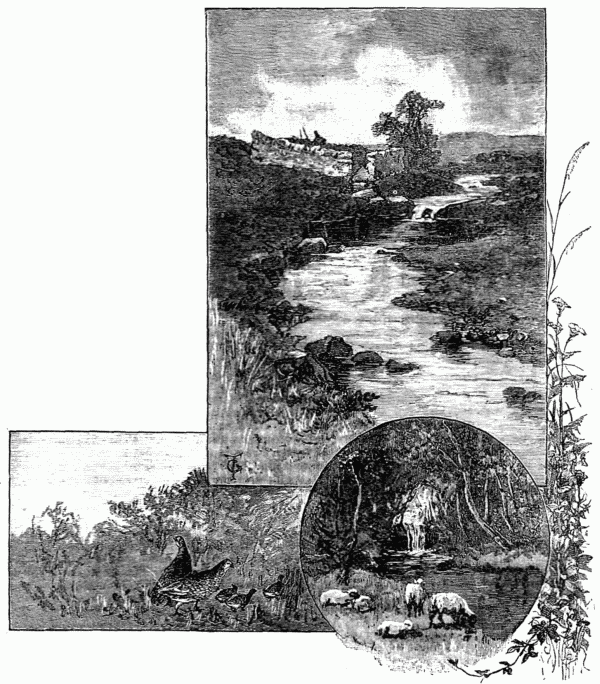
"Whyles owre a linn the burnie plays,
As through the glen it dimpl't;
Whyles round a rocky scaur it strays;
Whyles in a weil it dimpl't;
Whyles glittered to the nightly rays,
Wi' bickering, dancing dazzle;
Whyles cookit underneath the braes
Below the spreading hazel."
Burns: "Halloween."
The many aspects of a brook—The eye sees only that which it is
capable of seeing—Individuality of brooks and their banks—The rippling
"burnie" of the hills—The gently-flowing brooks of low-lying districts—Individualities
even of such brooks—The fresh-water brooks of Oxford
and the tidal brooks of the Kentish marshes—The swarming life in
which they abound—An afternoon's walk—Ditches versus hedges and
walls—A brook in Cannock Chase—Its sudden changes of aspect—The
brooks of the Wiltshire Downs and of Derbyshire.
A brook has many points of view.
In the first place, scarcely any two spectators see it in the same light.
To the rustic it is seldom more than a convenient water-tank, or, at
most, as affording some sport to boys in fishing. To its picturesque
beauties his eyes are blind, and to him the brook is, like Peter Bell's
primrose, a brook and nothing more.
Then there are some who only view a brook as affording variety to the
pursuit of the fox, and who pride themselves on their knowledge of the
spots at which it can be most successfully leaped.
Others, again, who are of a geographical turn of mind, can only see in
a brook a necessary portion of the water-shed of the district.
To children it is for a time dear as a playground, possessing the inestimable
advantage of enabling them to
fall into it and wet their clothes from
head to foot.
Then there are some who are keenly
alive to its changing beauties, and are
gifted with artistic spirit and power of
appreciation, even if they should not
have been able to cultivate the technical
skill which would enable them to
transfer to paper or canvas the scene
which pleased them. Yet they can
only see the surface, and take little,
if any, heed of the wealth of animated
life with which the brook and its banks
are peopled, or of the sounds with
which the air is filled.
Happy are those in whom are fortunately
combined the appreciation of
art and the gift (for it is a gift as much
as an eye for art or an ear for music) of
observing animal life. To them the
brook is all that it is to others, and much
besides. To them the tiniest brook is a perpetual
joy, and of such a nature I hope are
those who read these pages.
Not only does a brook assume different
aspects, according to the individuality of the
spectator, but every brook has its individuality,
and so have its banks.
Often the brook "plays many parts," as in
Burns' delightful stanza, which seems to have
rippled from the poet's brain as spontaneously
as its subject.
Sometimes, however, as near Oxford, it flows
silently onwards with scarcely a dimple on its
unruffled surface. Over its still waters the
gnats rise and fall in their ceaseless dance.
The swift-winged dragon-flies, blue, green, and
red, swoop upon them like so many falcons
on their prey; or, in the earlier year, the
mayflies flutter above the stream, leaving their
shed skins, like ghostly images of themselves,
sticking on every tree trunk near the brook.
On the surface of the brook are seen the
shadow-like water-gnats, drifting with apparent
aimlessness over the surface, but
having in view a definite and deadly purpose,
as many a half drowned insect will find to its
cost.
Under the shade of the willows that overhang
its banks the whirligig beetles will gather,
sociably circling round and round in their
mazy dance, bumping against each other in
their swift course, but glancing off unhurt
from the collision, protected from injury by
the stout coats of mail which they wear.
They really look like unskilful dancers
practising their "figures" for the first time.
They, however, are not engaged in mere
amusement, but, like the water-gnats, are
absorbed in the business of life. The naturalist
knows, when he sees these creatures, that they
do not form the hundredth part of those which
are hidden from human eyes below the
surface of the little brook, and that the whole
of the stream is as instinct with life, as if it
had been haunted by the Nipens, the Undines,
and the host of fairy beings with whom the
old legends peopled every river and its tributaries.
They are just as wonderful, though clad in
material forms, as any water spirit that ever
was evolved from the poet's brain, and have
the inestimable merit of being always within
reach whenever we need them.
I will venture to assert that no fairy tales,
not even excepting those of the "Arabian
Nights," can surpass in marvel the true life-history
of the mayfly, the frog, the newt, and
the dragon-fly, as will be narrated in the course
of these pages. I may go even farther, and
assert that there is no inhabitant of the brook
and its banks whose biography and structure
are not full of absorbing interest, and will not
occupy the longest life, if only an attempt be
made to study them thoroughly.
An almost typical example of slow-flowing
brooks is to be found in the remarkable
channels which intersect the country between
Minster and Sandwich, and which, on the
ordnance map, look almost like the threads of
a spider's web. In that flat district, the
fields are not divided by hedges, as in most
parts of England, or by stone walls—"dykes,"
as they are termed in Ireland—such as are
employed in Derbyshire and several other
stony localities, but by channels, which have a
strong individuality of their own.
Even the smallest of these brooks is influenced
by the tide, so that at the two
periods of slack water there is no perceptible
stream.
Yesterday afternoon, having an hour or so
to spare at Minster, I examined slightly
several of these streams and their banks.
The contrast between them and the corresponding
brooklets of Oxford, also a low-lying
district, was very strongly marked.
In the first place, the willow, which forms
so characteristic an ornament of the brooks
and rivers of Oxford, is wholly absent. Most
of the streamlets are entirely destitute of even
a bush by which their course can be marked;
so that when, as is often the case, a heavy
white fog overhangs the entire district, looking
from a distance as if the land had been
sunk in an ocean of milk, no one who is not
familiarly acquainted with every yard of
ground could make his way over the fields
without falling into the watery boundaries
which surround them.
Some of them, however, are distinguished
by hawthorns, which take the place of
the willows, and thrive so luxuriantly that
they may lay claim to the title of forest trees.
Blackberries, too, are exuberant in their
growth, and in many spots the hawthorn and
blackberry on opposite sides of the brook
have intertwined their branches across it and
have completely hidden the water from sight.
On these blackberries, the fruit of which was
in its green state, the drone-flies and hawk-flies
simply swarmed, telling the naturalist of
their multitudinous successors, who at present
are in the preliminary stages of their existence.
Among the blackberries the scarlet fruit
of the woody nightshade (a first cousin of
the potato) hung in tempting clusters, and
I could not help wondering whether they
would endanger the health of the young
Minsterians.
In some places the common frog-bit had
grown with such luxuriance that it had
completely hidden the water, the leaves overlapping
each other as if the overcrowded
plants were trying to shoulder each other out
of the way.
In most of these streamlets the conspicuous
bur-reed (Spargánium ramósum) grew thickly,
its singular fruit being here and there visible
among the sword-like leaves. I cannot but
think that the mediæval weapon called the
"morning star" (or "morgen-stern") was
derived from the globular, spiked fruit-cluster
of the bur-reed.
A few of the streams were full of the fine
plant which is popularly known by the name
of bull-rush, or bulrush (Typha latifólia), but
which ought by rights to be called the "cat's-tail"
or "reed-mace." Of this plant it is said
that a little girl, on seeing it growing, exclaimed
that she never knew before that
sausages grew on sticks. The teasel (Dipsacus)
was abundant, as were also several of
the true thistles.
In some places one of these streams becomes
too deep for the bur-reed, and its surface
is only diversified by the half-floating
leaves of one or two aquatic plants.
On approaching one of these places, I find
the water to be apparently without inmates.
They had only been alarmed by my approach,
which, as I had but little time to spare, was
not as cautious as it ought to have been.
However, I remained perfectly still, and presently
a little fish appeared from below. It
was soon followed by a second and a third, and
before long a whole shoal of fish were floating
almost on the surface, looking out for insects
which had fallen into the water.
The day being hot, and with scarcely a breath
of wind, the fish soon became quite bold. They
did not move beyond the small spot in which
they had appeared, but they all had their tails
in slight movement, and their heads in one direction,
thus showing that although the water
appeared to be perfectly motionless, there must
be a current of some sort, fish always lying with
their heads up the stream, so as to allow the
water to enter their mouths and pass over their
gills.
If then these sluggish streams were unlike
those of Oxford, where the ground is low, and
nearly level, how utterly distinct must they be
from those of hilly and especially of rocky
localities!
In the earlier part of the present year I was
cursorily examining a brook in Cannock Chase,
in Staffordshire. Unfortunately, the day was
singularly inauspicious, as the sun was invisible,
the atmosphere murky, and a fierce north-east
wind was blowing, a wind which affects animals,
etc., especially the insect races, even more
severely than it does man. Even the birds
remain under shelter as long as they can, and
not an insect will show itself. Neither, in consequence,
will the fish be "on the feed."
On a previous visit, we had been more fortunate,
trout, crayfish, etc., testifying to the
prolific character of the brook, which in one
place is only four or five feet in width, and yet,
within fifty yards, it has formed itself into a
wide and treacherous marsh, which can only
be crossed by jumping from one tussock of
grass to another; and yet, again, it suddenly
spreads out into a broad and shallow torrent,
the water leaping and rippling over the stony
bed. Scarcely a bush marks its course, and
within a few yards it is quite invisible.
As we shall presently see, the brooks of the
chalk downs of Wiltshire, and of the regular
mixture of rock and level ground, which are
characteristic of Derbyshire, have also their
own separate individualities.
We shall, however, find many allusions to
them in the course of the work, and we will
therefore suppose ourselves to be approaching
the bank of any brook that is but little disturbed
by man. What will be likely to happen
to us will be told in the following chapters.
Life-history of the water-rat—No science
can stand alone—What is a water-rat?—The
voles of the land and water—Their remarkable
teeth—The rodents and their incisor teeth—The
tooth and the chisel—The skate "iron"—Chewing
the cud—Teeth of the elephant—Feet
of the water-vole—A false accusation—Water-voles
in gardens—Winter stores—Cats
and water-voles—Subterranean pioneering—Mental
character of the water-vole—Standing
fire—Its mode of eating.
Plop!
A water-rat has taken alarm, and has leaped
into the brook.
A common animal enough, but none the
less worthy of notice because it is common.
Indeed, it is in many respects a very remarkable
creature, and we may think ourselves
fortunate that we have the opportunity of
studying its habits and structure.
There is much more in the animal than
meets the eye, and we cannot examine its life-history
without at the same time touching upon
that of several other creatures. No science
stands alone, neither does any animal, however
insignificant it may appear to be; and we
shall find that before we have done with the
water-rat, we shall have had something to
say of comparative anatomy, ornithology,
ichthyology, entomology and botany, beside
treating of the connection which exists between
man and the lower animals, and the
reciprocal influence of civilisation and animal
life.
In the first place, let us define our animal.
What is a water-rat, and where is its place
in zoological systems of the present day? Its
name in science is Arvícola amphíbius. This
title tells its own story.
Though popularly called a rat, the animal
has no right to the name, although, like the
true rat, it is a rodent, and much resembles
the rat in size and in the length and colour of
its fur. The likeness, however, extends no
further.
The rats are long-nosed and sharp-snouted
animals, whereas the water-rat has a short,
blunt nose. Then, the ears of the rats are
large and stand out boldly from the head,
while those of the water-rat are small, short,
and rounded. Again, the tail of the rat is
long and slender, while that of the water-rat
is comparatively short. Place the two
animals side by side, and you will wonder how
anyone could mistake the one for the other.
The teeth, too, are quite different.
Instead of being white, like those of the rat,
the incisor teeth are orange-yellow, like those
of the beaver. Indeed, the water-rat
possesses so many beaver-like characteristics,
that it was ranked near the beaver in the
systematic lists.
Now, however, the Voles, as these creatures
ought rightly to be called, are thought to be
of sufficient importance to be placed by themselves,
and separated from the true beavers.
The voles constitute quite a large group of
rodents, including several animals which are
popularly ranked among the mice.
One very remarkable characteristic of the
voles is the structure of their molar teeth.
Being rodents, they can have but two
incisor teeth in each jaw, these teeth being
rootless, and so set in their sockets that they
are incessantly worn away in front, and as
incessantly grow from the base, take the
curved form of their sockets, and act much
like shears which have the inestimable property
of self-sharpening when blunted, and
self-renewal when chipped or actually broken
off by coming against any hard substance.
Were the teeth to be without this power, the
animal would run a great risk of dying from
hunger, the injured tooth not being able
either to do its own work, or to aid its companion
of the opposite jaw. Either tooth
alone would be as useless as a single blade of
a pair of scissors.
There is another notable characteristic of
these incisor teeth. If you will examine the
incisors of any rodent, whether it be a rat, a
mouse, a rabbit, or a beaver, you will see that
the tips are "bevelled" off just like the edge
of a chisel. This shape is absolutely necessary
to keep the tooth in working order. How is
this object to be attained?
In the solution of this problem we may see
one of the many links which connect art and
nature.
Should our readers know anything of carpentering,
let them examine the structure of
their chisels. They are not made wholly of hard
steel, as in that case they would be liable to
snap, just as does the blade of a foil when
undue pressure is brought to bear upon it.
Moreover, the operation of sharpening would
be extremely difficult.
So the blade of the chisel is merely faced
with a thin plate of hardened steel, the remainder
being of softer material.
Now, it is not at all likely that the unknown
inventor of the modern chisel was aware of
the analogy between art and nature, and would
probably have been very much surprised if
anyone had stated that he had borrowed his
idea from the incisor teeth of the water-rat.
Yet he might have done so, for these teeth
are almost wholly formed of ordinary tooth
matter, and are faced with a thin plate of hard
enamel, which exactly corresponds with the
hardened steel facing of a chisel.
Any of my readers who possess skates will
find, on examination, that the greater part of
the blade is, in reality, soft iron, the steel,
which comes upon the ice, being scarcely a
fifth of an inch in length. The hardened
steel allows the blade to take the necessary
edge, while the soft iron preserves the steel
from snapping.
Should the skate have been neglected and
allowed to become a little rusty, the line of
demarcation between the steel and the iron
can be distinctly seen. Similarly, in the
beaver and the water-rat, the orange-yellow
colour of the enamel facing causes it to be
easily distinguished from the rest of the tooth.
In most of the rodents the enamel is white,
and the line of demarcation is scarcely visible.
Now we have to treat of a question of
mechanics.
If two substances of different degrees of
hardness be subjected to the same amount of
friction, it follows that the softer will be worn
away long before the harder. It is owing to
this principle that the edges of the rodent
teeth preserve their chisel-like form. Being
continually employed in nibbling, the softer
backing of the teeth is rapidly worn away,
while the hard plate of enamel upon the front
of the tooth is but slightly worn, the result
being the bevelled shape which is so characteristic
of these teeth.
As all know, who have kept rabbits or white
mice, the animals are always engaged in gnawing
anything which will yield to their teeth,
and unless the edges of their feeding troughs
be protected by metal, will nibble them to
pieces in a few days. Indeed, so strong is
this instinct, that the health of the animals is
greatly improved by putting pieces of wood
into their cages, merely for the purpose of
allowing them to exercise their chisel-edged
teeth. Even when they have nothing to
gnaw, the animals will move their jaws incessantly,
just as if they were eating, a movement
which gave rise to the idea that they
chewed the cud.
It is worthy of remark that other animals,
which, though not rodents, need to possess
chisel-edged incisor teeth, have a similar habit.
Such is the hippopotamus, and such is the
hyrax, the remarkable rock-haunting animal,
which in the authorised translation of the
Scriptures is called the "coney," and which in
the Revised Version is allowed in the margin
to retain its Hebrew name, "shaphan."
The enamel also has an important part to
play in the structure of the molar teeth. Each
tooth is surrounded with the enamel plate,
which is so intricately folded that the tooth
looks as if it were made of a series of enamel
triangles, each enclosing the tooth matter.
This structure is common to all the
members of the group to which the water-rat
belongs. It is the more remarkable because
we find a somewhat similar structure in the
molar teeth of the elephants, which, like the
rodents, have the incisor teeth largely developed
and widely separated from the
molars.
There is nothing in the appearance of the
water-rat which gives any indication of its
aquatic habits.
For example, we naturally expect to find that
the feet of swimming animals are webbed. The
water-loving capybara of South America, the
largest existing rodent, has its hoof-like toes
partially united by webs, so that its aquatic
habits might easily be inferred even by those
who were unacquainted with the animal. Even
the otter, which propels itself through the
water mostly by means of its long and powerful
tail, has the feet furnished with webs. So
has the aquatic Yapock opossum of Australia,
while the feet of the duck-bill are even more
boldly webbed than those of the bird from
which it takes its popular name. The water-shrews
(whom we shall presently meet) are
furnished with a fringe of stiff hair round the
toes which answers the same purpose as the
web.
But the structure of the water-rat gives no
indication of its habits, so that no one who
was unacquainted with the animal would even
suspect its swimming and diving powers.
Watch it as long as you like, and I do not
believe that you will see it eating anything of
an animal nature.
I mention this fact because it is often held
up to blame as a mischievous animal, especially
deserving the wrath of anglers by devouring
the eggs and young of fish.
As is often the case in the life-history of
animals as well as of men, the blame is laid
on the wrong shoulders. If the destruction of
fish be a crime, there are many criminals, the
worst and most persistent of which are the
fish themselves, which not only eat the eggs
and young of other fish, but, Saturn-like, have
not the least scruple in devouring their own
offspring.
Scarcely less destructive in its own insidious
way is the common house-rat, which eats
everything which according to our ideas is
edible, and a good many which we might
think incapable of affording sustenance even
to a rat. In the summer time it often abandons
for a time the house, the farm, the barn,
and seeks for a change of diet by the brook.
These water-haunting creatures are naturally
mistaken for the vegetable-feeding water-vole,
and so the latter has to bear the blame of their
misdoings.
There are lesser inhabitants of the brook
which are injurious both to the eggs and
young of fish. Among them are several of
the larger water-beetles, some of which are so
large and powerful that, when placed in an
aquarium with golden carp, they have made
havoc among the fish, always attacking them
from below. Although they cannot kill and
devour the fish at once, they inflict such
serious injuries that the creature is sure to die
shortly.
I do not mean to assert that the water-vole
is never injurious to man. Civilisation disturbs
for a time the balance of Nature, and
when man ploughs or digs the ground which
had previously been untouched by plough or
spade, and sows the seeds of herbs and cereals
in land which has previously produced nothing
but wild plants, he must expect that the animals
to whom the soil had been hitherto left will
fail to understand that they can no more consider
themselves as the owners, and will in
consequence do some damage to the crops.
Moreover, even putting their food aside,
their habits often render them obnoxious to
civilised man. The mole, for example, useful
as it really is in a field, does very great harm
in a garden or lawn, although it eats none of
the produce.
The water-vole, however, is doubly injurious
when the field or garden happens to be near
the water-side. It is a mighty burrower,
driving its tunnels to great distances. Sometimes
it manages to burrow into a kitchen-garden,
and feeds quite impartially on the different
crops. It has even been seen to venture
to a considerable distance from water,
crossing a large field, making its way into a
garden, and carrying off several pods of the
French bean.
In the winter time, when other food fails,
the water-vole, like the hare and rabbit, will
eat turnips, mangold-wurzel, the bark of young
trees, and similar food. Its natural food,
however, is to be found among the various
aquatic plants, as I have often seen, and the
harm which it does to the crops is so infinitesimally
small when compared with the area
of cultivated ground, that it is not worthy of
notice.
Still, although the harm which it does to
civilised man in the aggregate is but small,
even its most friendly advocate cannot deny
that there are cases where it has been extremely
troublesome to the individual cultivator,
especially if he be an amateur.
There are many hard men of business, who
are obliged to spend the greater part of the
day in their London offices, and who find their
best relaxation in amateur gardening; those
who grow vegetables, regarding their peas,
beans, potatoes, and celery with as much affection
as is felt by floriculturists for their roses or
tulips.
Nothing is more annoying to such men
than to find, when the toils of business are
over, and they have settled themselves comfortably
into their gardening suits, that some
marauder has carried off the very vegetables on
which they had prided themselves.
The water-vole has been detected in the act
of climbing up a ladder which had been left
standing against a plum tree, and attacking
the fruit. Bunches of grapes on outdoor vines
are sometimes nipped off the branches by the
teeth of the water-vole, and the animal has
been seen to climb beans and peas, split the
pods, and devour the contents.
Although not a hibernating animal, it
lays up a store of food in the autumn. Mr.
Groom Napier has the following description
of the contents of a water-rat's storehouse:—
"Early in the spring of 1855, I dug out the
burrow of a water-vole, and was surprised to
find at the further extremity a cavity of about
a foot in diameter, containing a quantity of
fragments of carrots and potatoes, sufficient to
fill a peck measure. This was undoubtedly a
part of its winter store of provisions. This
food had been gathered from a large potato
and carrot bed in the vicinity.
"On pointing out my discovery to the owner
of the garden, he said that his losses had been
very serious that winter owing to the ravages
of these animals, and said that he had brought
both dogs and cats down to the stream
to hunt for them; but they were too wary to
be often caught."
I do not think that the owner of the garden
knew very much about the characters either of
the cat or water-vole.
Every one who is practically acquainted with
cats knows that it is next to impossible to
point out an object to a cat as we can to a dog.
She looks at your finger, but can never direct
her gaze to the object at which you are pointing.
In fact, I believe that pussy's eyes are not
made for detecting objects at a distance.
If we throw a piece of biscuit to a dog, and
he does not see where it has fallen, we can
direct him by means of voice and finger. But,
if a piece of meat should fall only a foot or two
from a cat, all the pointing in the world will
not enable her to discover it, and it is necessary
to pick her up and put her nose close to the
meat before she can find it.
So, even, if a water-vole should be seen by
the master, the attention of the cat could not
be directed to it, her instinct teaching her to
take prey in quite a different manner.
The dogs, supposing that they happened to be
of the right breed, would have a better chance of
securing the robber, providing that they intercepted
its retreat to the water. But if the
water-vole should succeed in gaining its burrow,
or in plunging into the stream, I doubt whether
any dog would be able to catch it.
Moreover, the water-vole is so clever in tunnelling,
that when it drives its burrows into
cultivated ground, it almost invariably conceals
the entrance under a heap of stones, a
wood pile, or some similar object.
How it is enabled to direct the course of
its burrow we cannot even conjecture, except
by attributing the faculty to that "most
excellent gift" which we call by the convenient
name of "instinct."
Man has no such power, but when he wishes
to drive a tunnel in any given direction he is
obliged to avail himself of levels, compasses,
plumb-lines, and all the paraphernalia of the
engineer. Yet, with nothing to direct it
except instinct, the water-vole can, though
working in darkness, drive its burrow in any
direction and emerge from the ground exactly
at the spot which it has selected.
The mole can do the same, and by means
equally mysterious.
I may casually mention that the water-vole
is one of the aquatic animals which, when
zoological knowledge was not so universal as
it is at the present day, were reckoned as fish,
and might be eaten on fast days. I believe
that in some parts of France this idea still
prevails.
With all its wariness, the water-vole is a
strangely nervous creature, being for a time
almost paralysed by a sudden shock. This
trait of character I discovered quite unexpectedly.
Many, many years ago, when I was a young
lad, and consequently of a destructive nature,
I possessed a pistol, of which I was
rather proud. It certainly was an excellent
weapon, and I thought myself tolerably certain
of hitting a small apple at twelve yards
distance.
One day, while walking along the bank of
the Cherwell River, I saw a water-vole on the
opposite bank. The animal was sitting on a
small stump close to the water's edge. Having,
of course, the pistol with me, and wanting to
dissect a water-vole, I proceeded to aim at the animal.
This was not so easy as it looked.
A water-vole crouching upon a stump presents
no point at which to aim, the brown fur of the
animal and the brown surface of the old
weather-beaten stump seeming to form a
single object without any distinct outline;
moreover, it is very difficult to calculate distances
over water. However, I fired, and
missed.
I naturally expected the animal to plunge
into the river and escape. To my astonishment,
it remained in the same position.
Finding that it did not stir, I reloaded, and
again fired and missed. Four times did I fire
at that water-vole, and after the last shot the
animal slowly crawled off the stump, slid into
the river, and made off.
Now in those days revolvers and breech-loaders
did not exist, so that the process of
loading a pistol with ball was rather a long
and complicated one.
First, the powder had to be carefully measured
from the flask; then a circular patch of
greased linen had to be laid on the muzzle of
the weapon, and a ball laid on it and hammered
into the barrel with a leaden or wooden
mallet; then it had to be driven into its place
with a ramrod (often requiring the aid of the
mallet), and, lastly, there was a new cap to be
fitted. Yet although so much time was occupied
between the shots, the animal remained
as motionless as a stuffed figure.
When I crossed the river and examined the stump
I found all the four bullets close together
just below the spot on which the animal
had been sitting, and neither of them
two inches from its body. Although the balls
had missed the water-vole, they must
have sharply jarred the stump.
I was afterwards informed that this semi-paralysis
from sudden fear is a known characteristic
of the animal. It seems to be shared
by others of the same genus, as will be seen
when we come to treat of the field mice.
In its mode of eating it much resembles the
squirrels, sitting on its haunches and holding
the food in its forepaws, as if they were
hands. I am not aware that it even eats
worms or insects, and it may be absolutely
acquitted from any imputation of doing harm
to any of the fish tribe.
(To be continued.)