Yes, it is true that I am blind (it was not always thus),
But oft it comes into my mind how God can comfort us.
For if of some good gift bereft, we bend before His will,
He ever has a blessing left which should our sorrow still.
This very morn I found it so; scarce had the day begun,
Ere with small pattering, restless feet that hither swiftly run,
The children came in joyous mood, and shouted, “Spring is here!”
And when they led me through the wood, I knew that she was near.
I felt her breath upon my cheek, and while we walked along,
A thousand times I heard her speak the rustling leaves among,
In tones as though a harp had thrilled beneath an angel’s touch,
And all my soul with rapture filled; yet when I said as much,
The others laughed and whispered low, “Nay, nay, it is the wind!”
To them, perhaps, it might be so; but ah! if folks are blind,
They learn in every sound that floats around their pathway dark—
The breeze, the brook, the glad bird-notes—some hidden voice to mark.
Therefore when spring begins to don her garments fresh and gay,
Because I cannot look upon her beauty day by day,
Nor see the pointed crocus flame above the garden mould,
Nor watch the snowy tips that frame the daisy’s heart of gold;
Because unto my longing eyes may never be displayed
The changeful glory of the skies, warm shine and soothing shade,
Nor the great sun’s far reaching rays which crown the day with light,
Nor yet the star-lit purple haze that comes before the night;
She breathes the tender tale to me, in accents clear and plain,
Until I nearly rend the veil and see it all again.
And though I’m blind, I know quite well, when to the woods we go,
The place to find the wild bluebell, and where the lilies blow;
Shy violets tell me, as I pass, their buds are at my feet,
And through the lengthening meadow grass run murmurs soft and sweet.
Oh! I thank God that He doth bring such daily joy to me,
For even I can welcome spring, like happy girls who see.
MERLE’S CRUSADE. — CHAPTER XXII.
By ROSA NOUCHETTE CAREY, Author of “Aunt Diana,” “For Lilias,” etc.
UNCLE KEITH.
I had been obliged to defer my visit to
Aunt Agatha for more than a fortnight,
and it was not until an early day in
October that I could find a leisure afternoon.
I believe that only very busy and
hard worked people really enjoy a holiday—listless
and half occupied lives know
nothing of the real holiday feeling and
the joyousness of putting one’s work
aside for a few hours of complete idleness.
I felt almost as buoyant and light-hearted
as a child when I caught sight
of the old bridge and the grey towers of
All Saints. The river looked blue and
clear in the October sunshine; there
were barges floating idly down the
stream; a small steamer had just
started from the tiny pier; two or three
clumsy-looking boats with heavy brown
sails were moored to the shore; there
was a man in a red cap in one of the
boats; two or three bare-legged urchins
were wading in the water. There was a
line of purple shadow in the distance,
little sparkles of sunlight everywhere,
yellow and red leaves streaming, a little
skiff with a man in white flannel coming
rapidly into sight, omnibuses, cabs,
heavy waggons clattering over the
bridge. Beyond the white arches of the
new bridge the busy hum of workers, the
heaving of great cranes, the toil and
strain of human activity.
The sight always fascinated me, and I
stood aside with others to watch until
a well-known figure in the distance
recalled me with a start. Surely that
was Aunt Agatha crossing the road by
the bridge; no one else walked in that
way—that quick, straightforward walk,
that never seemed to linger or hesitate,
that could only belong to her. Yes, it
was she, for there was the dear woman
holding out her hands to me, with the
old kind smile breaking over her face.
“I came to meet you, Merle; I did
not want to lose one minute of your company,
but I was a little late after all,
dear child. What a stranger you are,
all these months that we have not
met!”
“It has seemed a long time to me,
Aunt Agatha, so much seems to have
happened since I was last here.”
“You may well say so,” she returned,
gravely; “we have both much for which
to be thankful. Your accident, Merle,
which might have had such grave results,
and——” here she checked herself,
but something in her manner seemed
strange to me.
“We need not walk quite so fast,
surely,” I remonstrated. “How these
people jostle one, and I want to talk to
you so.”
“And I to you. Never mind, we shall
find a quiet corner under the shadow of
St. Mary’s.” And as she spoke we turned
into the narrow flagged path skirting
the church, with the tombs and grey old
headstones gleaming here and there.
There were fewer people here.
“Are you sure you are quite well?” I
began, rather anxiously. “You are looking
paler than usual, Aunt Agatha, and,
if it be not my fancy, a little thinner.”
“Yes, and older, and perhaps a trifle
graver,” she returned, rather briskly;
but I thought her cheerfulness a little
forced. “We have not yet learnt how
to grow younger, child. Well, if you
must know, and this is why I came to
meet you, that we might have our little
talk together. I have not been without
my troubles; your uncle has been very
ill, Merle, so ill that, at one time, I
feared I might lose him; but Providence
has been good to me and spared my
dear husband.” And here Aunt Agatha’s
voice trembled and her eyes grew misty.
I was almost too shocked to answer,
but my first words were to reproach her
for keeping me in ignorance.
“You must not blame me, Merle,”
she replied, gently. “I wanted you
dreadfully; I felt quite sore with the
longing to see you, but I knew you could
not come to me. Mrs. Morton was in
Scotland; you were in sole charge of
those children. Unless things grew
worse I knew I had no right to summon
you. Thank God I was spared that
necessity; the danger only lasted forty-eight
hours; after that he only required
all the nursing I could give him.”
“Aunt Agatha, it was not right; you
ought to have told me.”
“I thought differently, Merle; I put
myself in your place—you could not
desert your post, and you would only
have grown restless with the longing to
come and help me—the same feeling
that made you hide your accident from
me led me to suppress my trouble. I
should only have burthened your kind
heart, Merle, and spoiled your present
enjoyment. I said to myself, ‘Let the
child be happy; she will only fret herself
into a fever to help me, and she must do
her duty to her employers.’ If Ezra had
got worse I must have written; when he
grew better I preferred telling you nothing
until we met.”
“I shall never trust you again,” I
burst out, for this reticence wounded me
sorely. “How am I to know if things
are well with you if you are always keeping
me in the dark?”
“It will not happen again, Merle;
indeed, my dear, I can promise you that
it shall never happen. If you had been
at Prince’s Gate I should have summoned
you at once, but, in your position, how
could I ask you to desert your post,
Merle, when those who placed you there
were hundreds of miles away?”
I saw what she meant, and I could not
deny that she had kept me in ignorance
for my own peace of mind. It was just
her unselfishness, for I knew how she
must have longed for me; we were so
much to each other, we were so sure of
mutual sympathy and help. Aunt
Agatha cried a little when she saw how
hurt I was, and then, of course, I tried
to comfort her, and I very soon succeeded.
I never could bear to see her unhappy,
and I knew it was only her goodness to
me.
I begged her to tell me about Uncle
Keith’s illness, and she soon put me in
possession of the salient points. He had
worked a little too hard, and then had
got wet in a thunderstorm, and a sharp
attack of inflammation had been the
result.
“He considers himself well now,” she
continued, “but he is still very weak,
and will not be able to resume work for
another week or two. His employers
have been very kind; they seem to value
him highly. Oh! he has been so patient,
Merle, it has been quite a privilege to
nurse him; not a complaint, not an
irritable word. I always knew he was a
good man, but illness is such a test of
character.”
“But you have worn yourself out,” I
grumbled; “you do not look well.” But
she interrupted me.
“Do not notice my looks before
your uncle,” she said, pleadingly; “he
is so anxious about me; but indeed, I
am only a little tired; I shall be better
now I have told you and got it over.
You have been on my mind, Merle, and
then that horrid accident.” But I would
not let her dwell upon that. We had
reached the cottage by this time, and
Patience was watching for us; she
looked prettier and rosier than ever.
I found Uncle Keith sitting pillowed
up in an armchair by the drawing-room
fire. I thought he looked shrunken, and
there was a pinched look about his
features. He had not grown younger
and handsomer to my eyes, but as he
turned his prominent brown eyes on me
with a kind look of welcome, and held
out his thin hand, I kissed him with real
affection, and my eyes were a little
wet.
“Hir-rumph, my dear, I am pleased
to see you—there, there, never mind my
stupid illness; I am quite a giant now,
eh, Agatha? It is worth being ill,
Merle, to be nursed by your aunt; oh,
quite a luxury I assure you! Hir-rumph.”
And here Uncle Keith cleared his throat
in his usual fashion, and stirred the fire
rather loudly, though he looked a little
paler after the exercise.
“But I am so dreadfully sorry, Uncle
Keith,” I said, when Aunt Agatha had
taken the poker from him and bustled
out of the room to fetch him some jelly,
“to think I never knew how ill you
were.”
“That was all the better, child,” he
returned, cheerfully. “Agatha was a
wise woman not to tell you; but there
are not many people in the world,
Merle, who would come up to your aunt,
not many,” rubbing his hands together.
“No indeed, Uncle Keith.”
“How do you think she looks?” he
continued, turning round rather sharply.
“Have I tired her out, eh?”
“She looks a little tired certainly.”
“Hir-rumph, I thought so. Agatha,
my dear,” as she re-entered with the
jelly, “I do not want all this waiting
on now; it is my turn to wait on you!
I must not wear out such a good wife,
must I, Merle?” And though we both
laughed at that, and Aunt Agatha pretended
that he was only in fun, it was
almost pathetic to see how he watched
her busy movements about the room,
and how he begged her again and again
to sit down and not tire herself, and yet
she loved to do it. I think we both of us
knew that. I was not disposed to pity
Aunt Agatha as I had done in former
years. Perhaps I had grown older and
more womanly in those eight months of
service, and less disposed to be critical
on quiet, matter-of-fact lives. On the
contrary, I began to understand in a
vague sort of way that Aunt Agatha was
garnering in much happiness in her
useful middle age, in her honest, single-eyed
service. Love had come to her in
a sober guise, and without pretension,
but it was the right sort of love after all,
no doubt. To youthful eyes, Uncle
Keith was not much of a hero; but a
plain honest man, even though he has
fewer inches than his fellows, may have
merit enough to fill one woman’s heart,
and I ceased to wonder at Aunt Agatha’s
infatuation in believing herself a happy
woman.
We had not much talk apart that day.
Aunt Agatha could not leave Uncle
Keith, but I never felt him less in the
way. I talked quite openly about things;
he was as much interested as Aunt
Agatha in listening to my description of
Marshlands and Wheeler’s Farm, and
had not a dissenting word when I
praised Gay Cheriton in my old enthusiastic
way, and only a soft “hir-rumph”
interrupted my account of
Reggie’s accident.
It was Aunt Agatha who walked back
with me over the bridge in the soft
October twilight. Tired as she was, she
refused to part with me until the last
minute.
“You must come again soon, Merle,”
she said, as we parted; “Ezra and I are
not young people now, and a bright face
does us both good, and your face has
grown a very bright one, Merle.”
Was Aunt Agatha right, I wondered?
Had I really grown happier outwardly?
Had the inward peace of satisfied conscience
and a heart at rest cast its
reflection of brightness? I was certainly
very happy just then; my life was growing
wider, friends were coming round
me, interests were thickening, there
was meaning and purpose in each opening
day. I no longer thought so much
of myself and my own feelings; the
activities of life, the needs and joys of
others seemed to press and crush out all
morbid ideas. I had so many to love and
so many who seemed to need me and
care for me.
I went more than once to Putney
during the next two or three weeks.
My mistress was far too sympathising
and unselfish to keep me from my own
people when they needed me; on the
contrary, she was always full of contrivances
that I should be spared.
November passed very pleasantly.
Mrs. Morton was recovering strength
slowly but surely; she was no longer a
prisoner to her dressing-room, but could
spend the greater part of the day in the
drawing-room or in her husband’s
library.
But she still continued her invalid
habits and saw few people. I still sat
with her in the afternoon, and either
Joyce or Reggie played about the room.
When Mr. Morton was absent I came
down to her in the evening, and read or
talked to her. I prized these hours, for
in them I learned to know my sweet
mistress more intimately and to love her
more dearly.
At the beginning of December Gay
came to us. I was looking forward to
her visit with some eagerness, though
I knew my evenings would then be spent
in the nursery, as Mrs. Morton would
only need her sister’s society; but, to my
great surprise, I was summoned to the
drawing-room on the evening of her
arrival. She had come just in time to
dress for dinner, and we had not yet
seen her. I could scarcely credit Travers’
message when she delivered it.
“Will you please go down to the
little drawing-room, Miss Fenton? Miss
Gay wants to see you, and my mistress
does not care to be left alone.”
She started up and came to meet me
with outstretched hands. She looked
prettier than ever, and her eyes were
shining with happiness.
“I am so glad to see you, Merle. I
wanted to come up to the nursery, but
this spoiled woman—how you have all
spoilt her!—refused to be left. She said
Hannah would be there, and that we
could not talk comfortably.”
“Yes, but there was another reason,”
returned my mistress, smiling; and Gay
blushed and cast down her eyes.
“I wanted to tell you the news myself,
because I knew you would be interested.
Sit down, Merle, in your usual
place, and guess what has happened.”
I did not need to guess; the first look
at Gay’s happy face had told me, and
then I had glanced at a certain finger.
Opals tell their own tales.
“Guess,” continued my mistress,
mischievously. “Who was the guest
who came oftenest to Marshlands?”
“There were two who came most frequently,”
I returned, looking steadily
into Gay’s blushing face, “Mr. Hawtry
and Mr. Rossiter, but I do not need to
be told it is Mr. Rossiter.” And Gay
jumped up and kissed me in her impulsive
way.
I could see that she was pleased I
had guessed it.
“I told you it would be no news to
her, Vi,” she said, breathlessly. “Do
you remember our talk in the orchard,
Merle, when I told you I was afraid of
poverty?”
“Yes, but I knew you magnified your
fears, Miss Gay.” But she shook her
head at that.
“I hate it just as much as ever. I
tell Walter I am the worst possible person
for a poor man’s wife, and if you
ask Violet she will agree with me, but
I was obliged to have him, poverty and
all; he would not take ‘No’ for an
answer.”
“I think Walter was very sensible,”
returned her sister. “I should have
despised him for giving it up.”
“He would never have done that,”
replied Gay, with decision, “until I
had married somebody else, and there
was no chance of that. You are grave,
Merle; do you mean to forbid the banns?
Why do you not congratulate me?”
“I do congratulate you with all my
heart; will that content you?”
“To be sure; but what then, Merle?”
“I ought not to say, perhaps, if you
have made up your mind. I like Mr.
Rossiter. He is young, but he seems very
good. But do you remember what I
said to you that evening, Miss Gay,
when we were watching the moon rise
over Squire Hawtry’s cornfields, that
your environment just suited you; I
can’t realise Marshlands without you.”
I saw the sisters exchange a meaning
look, and then Gay said, in a low voice,
“What should you say, Merle, if I am
not to leave Marshlands—if my father
refuses to part with me?”
“I do not think that would answer.
Mrs. Markham would be mistress, and
you have told me so often that she does
not like Mr. Rossiter.”
“There are to be changes at Marshlands,
Merle,” broke in my mistress;
she had been listening to us with much
interest, and I wished Mr. Morton
could have seen her with that bright
animated look on her face. “Adelaide
will be mistress there no longer. A
young cousin of ours, Mrs. Austin, who
was with Adelaide in Calcutta, has just
lost her husband. She is an invalid, is
very rich, and very helpless, and has no
one except ourselves belonging to her.
She is very fond of Adelaide, and she
has begged her to live with her, and
superintend her establishment. She has
a large house at Chislehurst, and so
Adelaide and Rolf and Judson are to
take up their abode with her.”
“Things have not been very pleasant
lately, Merle,” observed Gay, gravely.
“Adelaide has set her face against
my marrying Walter, and she has worried
father and tormented me, and made
things rather difficult for all of us. It
is quite true, as she says, that Walter is
poor, and has no present prospects,”
continued Gay, “and she has dinned
his poverty so incessantly into father’s
ear that he has got frightened about it,
and has made up his mind that he will
not part with me at all—that Walter
must make his home with us. There
was a terrible scene when Adelaide
heard this; she declared she would not
stop in the house under these conditions.
And then Amy’s letter came, and she
announced her resolution of living at
Chislehurst. I do not like the idea of
driving Addie away, but,” finished Gay,
with an odd little laugh, “I think father
and I will manage very well without
her.”
We talked a little more on the subject
until I was dismissed, and I had plenty
of food for my thoughts when I went
back to the quiet nursery.
(To be continued.)
EASTER TIDE. — A PRAYER. — EASTER EGGS.
EASTER TIDE
Lord, by the stripes which wounded Thee,
From death’s dread sting Thy servants free,
That we may live and sing to Thee Alleluia!
The origin of the practice of
connecting eggs with our Easter
festival is, I believe, lost
in antiquity; but they are said
to have been used by the Jews
at the Feast of Passover. In
some Eastern countries there is
a very old custom, which still prevails,
of presenting eggs at this
season of the year—some say because
the egg is an emblem of creation,
or recreation, there being
a tradition that the world was
created in the spring. In parts of
Russia people present eggs to one
another on Easter day, saying,
“Jesus Christ is risen,” being
answered, “It is so of a truth,” or
“Yes, He is risen.” The Russians
also serve red eggs on that day,
symbolising at the same time the resurrection
and the blood of the Saviour.
At the time of Edward the First the
eggs to be given to the members of the royal
household on Easter day formed an item in
the expenses. Over four hundred eggs, which
cost about one shilling and sixpence, were,
we learn, distributed on that day. Eggs used
to be blessed by the Pope for allotment
throughout the Christian world, and the service
of Pope Paul the Fifth contains the
following curious form of consecration:—
“Bless, Lord, we beseech Thee, this Thy
creature of eggs that it may become a wholesome
sustenance to Thy faithful servants,
eating it in thankfulness to Thee, on account
of the resurrection of our Lord.”
In some parts of the north of England,
particularly parts of Cumberland, decorated
Pasch or Pace eggs are still sent to children,
so that the present fancy for ornamenting
eggs is but the revival of a very old custom.
Some young readers of The Girl’s Own
Paper may be disposed to try what they can
do in this way. I will, therefore, tell them
some of the methods employed; but first let
me mention that all eggs to be decorated
must be perfectly clean, for the least spot of
grease where it was not wanted would spoil
the effect aimed at; and they should be boiled
hard.
To simply colour the eggs they need only
be dipped in water, then placed in a decoction
of logwood for the various shades of
purple; of cochineal for red, or boiled with
onion peelings, or in an onion, for amber,
or coloured with spinach juice for green. But
superior to these simple colourings are Judson’s
dyes, which may be obtained of any
colour, and can be used as paints on the
shells as
well as dyes.
The eggs are
dipped in water before
being put in the dye,
to make them take the
colour evenly. If it is
desired to keep part of
the shell white—for instance,
to have a name
or motto in white on
a red ground—proceed
thus: When the egg is
warm after boiling take
a small piece of mutton
suet, which, being
hard, you can cut to a
point almost like a pencil. With
this draw or write what you wish
on the warm egg, which you can
then place in the dye. The part
greased will not take the colour,
but when dry the fat is easily removed,
and the white design can be
left or filled in with another colour,
or with a little gold or silver paint.
A pretty way is to grease a delicate
piece of moss, a fine fern leaf, or
a skeleton leaf, to roll either round
a warm egg so as to leave a greasy
print on it, and then put it in the
colour; but great care must be taken in handling
the work not to blur the design. An
egg spotted with grease then put in a yellow
dye, the grease removed, and then a pale
blue dye used, produces an effect that would
puzzle a naturalist. Brown and blue dyes
answer, used in the same way.
Eggs may be also simply treated by having
small leaves or little bits of moss bound on to
them with various coloured wools, or ribbons
(not fast-coloured ones), before they are
boiled, the wool or ribbons being removed
when they are dry again; the effect is often
very good, but there is great doubt about the
results in this way of colouring.
A neater and much better way than greasing
the design, for those who do not mind the
trouble, is to dye the egg all over, and then
to scratch out the motto, or whatever is
required white, with a penknife. This is, of
course, a much more difficult process, and
requires great care.
Eggs dyed pale blue, and a little cloud and
sea with a tiny boat painted on them, or dyed
yellow and turned into a little sunset picture,
with a tree added, are very pretty. They can
be done in oil or water colours.
I have seen cupids and like subjects
painted on them, but they are quite unsuited
for Easter eggs, which are not, and should
not be used as, adjuncts of Valentine’s day.
For more elaborate work, the eggs, having
been boiled hard, can be painted over with
gold size, and then covered with gold, or any
metal leaf, which maybe again painted on with
oil paints, or by using a medium and body
colours, with water colours.
A gilt egg, with a white lily on it, or a
silvered one with a daffodil, looks very pretty;
violets and primroses, emblems of spring, are
also appropriate, while eggs with butterflies
or small birds bearing mottoes painted on
them, are much appreciated by children.
When painted in water colours, the eggs can
easily be varnished. On Easter day I once
saw the breakfast eggs which the cook had
boiled, some with red and some with blue dye
in the water, sent to table in a nest of green
moss lined with a little white wool; the eggs
were only cooked the usual time, and were
greatly relished by the younger members of
the family.
I would recommend the use of Easter
eggs to those girls who take Sunday-school
classes; they are very good mediums for
giving precepts or words of advice; a
judiciously chosen motto or text may often
do a great deal in helping a child or person
to correct a fault, and a motto is more
attractive on an ornamental egg than in a
book.
I remember a little German book called
“Ostereier” (Easter eggs), in which a
charming account is given of an Easter
festival, when motto eggs were distributed to
a number of children. Some of the rhymes
given are very pretty; they lose in translation,
but are such as “Goodness, not gold, wins
love and trust,” “For meat and drink the
giver thank,” “A good conscience makes a
soft pillow.”
Such sentences as these do for quite
small children, but a short verse from a
hymn or a text can easily be written on an
egg. They look very well coloured pale blue or
mottled green and blue, as directed above,
and the words written on after with red, or
blue ink of a darker colour, and a little
ornamentation round. For school-children
water colours should not be used in painting
the eggs, for the warm and often moist hands
of the recipients of these little gifts would
smear the paint.
We must now come to another kind of egg
I have found much appreciated, as it is
eatable, though imitation only. It is
prepared thus: Procure some half egg shells
which you can colour or not, as you please,
but you must cut the edges as smooth as you
can with a pair of small, sharp scissors; next
take one pound of ground almonds (they can
be bought ready prepared), mix with the
beaten whites of three, or if small, four eggs,
add a teaspoonful of orange flower water, or a
little more, if needed, make into a paste, and
stir in one pound of fine sifted loaf sugar, and
work with a wooden spoon into a smooth
paste; next shake a little icing sugar into the
half shells, and fill them with the almond
paste, scoop a piece out of the centre of each
half, and as you put the two halves together
insert a preserved apricot (dried) without a
stone; if the apricots are too large use half
ones, but whether large or small they must be
pressed into suitable shapes before they are
used, as they have to represent the yolks of
the eggs.
When the parts are joined together, a strip
of tissue paper should be fastened round the
junction with white of egg, and then a ribbon
or ornamental paper put round and the shells
decorated with a little water colour paint. If
preferred, the shells can be used as moulds
only, and removed as soon as the paste is dry,
but if this is to be done the two edges of the
almond paste must be moistened with white
of egg before they are put together, or they
would come apart when the shells were
removed.
The almond eggs must be put in a warm,
dry place as soon as made; a very cool oven
will do to dry them.
If you remove the shells, cover the almond
paste with icing sugar that has been well
worked with a little white of egg and lemon
juice; this is not an easy operation, but if the
sugar is well worked before using, it will
cover the paste more neatly than if used
quickly; if sufficient smoothness is attained
the sugar can be decorated afterwards with
some harmless colouring, such as saffron or
cochineal.
To make sugar eggs, mix one ounce of raw
arrowroot with one pound of icing sugar, add
the beaten whites of three or four eggs,
according to size, and a teaspoonful of lemon
juice; work the mixture well; use the egg
shells as moulds and proceed as with almond
paste, putting anything that is liked in the
centre, and joining the halves together with
white of egg; dry thoroughly, in some place
not warm enough to melt the sugar, before
you remove the shells. It is easier to take
the halves off if they are slightly oiled before
the sugar is sifted into them.
NOTES FOR APRIL.
It is very interesting in the spring to watch
the gradual development of a frog from the
egg, through the tadpole stage of its existence,
till at last it assumes its final form.
The old frogs emerge from their winter
hiding places in the mud, early in the spring,
and during March their eggs may be found
floating on almost every stagnant pond. A
group of these eggs in their early stages of development
looks like a mass of clear white
jelly, containing numbers of black specks,
each of which is really the germ of the future
tadpole.
In order to watch the development, a
group of the eggs should be taken and put in
a shallow vessel of water, which, if kept in the
house, should have a bell-glass, or some other
covering over it, to keep out the dust.
The jelly-like mass which envelopes the
future tadpole is so clear that all its changes
can be easily watched. First the head appears,
then a flat tail, and in course of time
the nostrils, mouth, and large eyes, till at
length the completed tadpole bursts open its
gelatinous covering, and apparently not in the
least embarrassed by its new surroundings, begins
swimming briskly about, looking for
something to eat. The time occupied in
hatching varies in different countries, according
to the climate, from four days to a month. In
England the tadpole does not often appear
till towards the end of April.
The following stages are even more interesting,
especially for those who can take advantage
of the transparency of the parts to watch
the circulation of the blood through a microscope.
The body of the tadpole gradually gets
broader, while the tail gets thinner and thinner,
till it finally disappears altogether; but before
that happens its place has been taken by two
hind legs, which first appear under the skin
and then gradually push their way through.
The fore legs next appear, and so on through
all the stages of development, till in a longer
or shorter time, according to the amount of
warmth, light, and food it can obtain, the
complete frog appears.
But woe betide the unfortunate tadpole
which, first of the shoal, attains to the dignity
of possessing limbs, for so ferocious are the
later ones, and so jealous of their precocious
little brother, that they almost always fall
upon him, and, not content with killing, never
rest till every morsel of him is eaten. And
unless several of the tadpoles assume their
final change about the same time, this proceeding
is repeated till their numbers are very
considerably diminished, or, as sometimes
happens, till only one survivor is left, who,
having helped to eat all his brethren, instead
of meeting with his deserts, is allowed to live
on in peace, till some day in the course of his
walks abroad, he, in his turn, is snapped up as
a delicate morsel by some hungry snake or
waterfowl.
Insects and flowers are much more closely
connected with one another than we sometimes
think.
Not only do many insects depend upon
flowers for their food, but many flowers also
depend upon the visits of insects to carry their
pollen from one flower to another and so continue
the life of their species.
There are some flowers, however, whose
pollen is carried by the wind instead of by
insects, and which are therefore an exception
to this general rule. These, not needing to
attract insects, are small and insignificant,
with neither scent nor honey, but with a very
large quantity of pollen. They generally
flower early in spring, before the leaves are out,
as these would catch the pollen as it is blown
along by the wind, and prevent it reaching the
flowers for which it is intended. Notice, for
example, the flower of the oak, elm, ash, and
Scotch fir.
April is a busy month in the garden. Auriculas
and polyanthuses in bloom should be
watered often, and shaded if the sun is very
bright, and sheltered when the weather is
cold; tulips also must be sheltered from
severe cold, though they may safely be encouraged
to grow now.
Seeds of perennials and biennials for flowering
next year should be sown now, such as
wallflowers, carnations, and pinks. Heartsease
for autumn flowering should also be sown, and
cuttings taken from old plants. Hardy
annuals should be sown not later than the
middle of April. Give them good soil, and do
not cover the seeds too deeply with earth (some
of the smallest kinds should only be sprinkled
on the top), and when they begin to shoot up
thin out the young plants vigorously; amateur
gardeners almost always leave them too close
together, but the more room they have the
better and stronger they will grow.
If there is no greenhouse, or “heat,” half
hardy annuals may be sown out in the open
garden towards the end of April, and if
diligently cared for they will grow well and
thrive.
After a warm day, evergreens are benefited
by syringing. Ivy that is wished to grow
close should be clipped all over; and grass
should be cut about once a week, and often
rolled. It should not be allowed to get long
before cutting the first time, or it will be
troublesome to get into order again.
April is the month in which we welcome
most of our spring bird visitors. The nightingale
and cuckoo have already come and
begun their song; the swallow and house-martin
will arrive about the middle of the
month, and are soon busy making new nests,
or patching up old ones. The whitethroat
appears towards the end of the month.
During the April showers the whole air
seems full of song. Walking through woods
ringing with bird music, we are once more
reminded of the problem which so puzzled
Daines Barrington. “Do the birds all sing in
one key? And if not, why do the songs
harmonise instead of producing unpleasant
discords?” Perhaps it is the distance which
lends enchantment and softens the discords.
No doubt if all the songsters were in one room,
the result would not be quite so happy.
Many eggs, larvæ and cocoons of butterflies
and moths may be found this month among
heaps of dry leaves, on low bushes, or trunks
of trees. Grasses and rushes shelter several of
the early species, which are already flying
about, and some rare insects may be found
now which cannot be obtained later in the
season.
THE ROMANCE OF THE BANK OF ENGLAND. OR, THE OLD LADY OF THREADNEEDLE STREET. — CHAPTER VI.
By EMMA BREWER.
It is a true saying, that when mothers begin to
talk of their children they never know when
to stop; and the children, who might otherwise
have found favour, are thereby made to
appear as uninteresting and vexatious bores.
I will try to avoid falling into this error,
and only tell you enough to enable you to
understand the peculiarities of mine.
You may have noticed how great a variety
exists in the characters and dispositions of
the members of every large family, and will
not be surprised to hear that the same individuality
of character shows itself in the family
of Funds and Stocks.
In introducing you to the steadiest and most
reliable of my children, I feel that I am putting
you in the way of deriving real advantage. If,
however, you prefer the less worthy, the more
daring and speculative, I shall feel that no
blame attaches to me.
Have you ever remarked, in your round of
visits among your friends, that it is almost
possible to tell the character of host and
hostess by the people you meet there, and
even by the servants who wait upon you—all
seem to take the tone of the house? I notice
this specially among my children. For example,
my “Three per Cent. Consols” and my
“New Three’s,” whom I select as specially
suited to be your friends, have the most
courteous, kindly, sober and religious class of
visitors; on the faces of all, old and young,
clergy and laity, there is an expression of
repose and security and “well-to-doism”
which is charming; while, on the other hand,
the faces and manners of those who visit some
of my other children are so wild, so haggard,
so restless, that you cannot help wishing that
some good fairy would give them a soothing
syrup, or else insist on their choosing safer
friends; but if you ever pay me a visit, and
use your eyes, you will see more of this than,
as a mother, I can tell you.
Against one thing, however, I am, as your
friend, bound to warn you. Listen to no one
who proposes to let you have money at a very
cheap rate, while at the same time he offers to
pay you large interest on it. More I cannot
say at present.
Closely connected with me, and in my
neighbourhood, stands a most mysterious
building, known as the Stock Exchange. Its
chief entrance is in Capel-court, Bartholomew-lane.
None may pass within its portals but those
specially privileged, still I may tell you something
about it without breaking through any
of the barriers which the inhabitants have set
up between the public and themselves.
This Stock Exchange is an association of
about two thousand persons, all men, of
course, who meet together in Capel-court, and
who agree to be governed by a committee of
thirty, chosen from among themselves.
To the outside world, all the members are
known by the name of “stockbrokers,” but
inside the mysterious building they divide
themselves into two classes—“stockjobbers”
and “stockbrokers.”
Whether they be one or the other, their
lives, occupations, fortunes and reputations
are bound up with the Stocks and Funds.
They live for them and they live on them.
They determine their value, they study every
shade of temper exhibited by the family, they
decide their rise and fall, they are their
interpreters and mouthpieces, they act also as
their bodyguard: none can approach but
through them.
These two classes, jobbers and brokers,
have a distinct work, which I will try to make
clear to you.
To start with, the stockjobber does not
deal with the public, but the stockbroker
does.
You see stocks and shares are marketable
commodities; you can buy them, sell them,
or transfer them, and the stockjobber is, as
it were, the wholesale merchant, and the
stockbroker the retail dealer. Let me
explain. If you required twenty yards of
black silk, you would probably go to Marshall
and Snelgrove or to Peter Robinson for it.
You certainly would not think of going to a
wholesale house in the City for it; and if you
did, the article would not be supplied to you
in this way—it is contrary to the etiquette of
trade.
Just in the same manner, if you wanted to
buy some stock, you would go to a stockbroker
for it, and not to a stockjobber—the
stockbroker occupying the same position as
Marshall and Snelgrove, while the stockjobber
stands in the place of the wholesale
house in the City.
The stockjobber, or wholesale merchant, is
always ready both to buy and sell with the
broker. If you give an order to the latter, he
darts into the Stock Exchange, and without
disclosing the nature of his order to the
jobber, inquires of him the price of the
particular stock which you wish to deal in.
The jobber names two prices: one at which he
is prepared to buy (the lowest price, of course),
the other at which he is willing to sell (the
highest price).
Thus, if the price of Consols was given by
him as 100¼ to 100½, it would mean that if
you wanted him to take some stock of you he
would give you £100 5s. for each £100 of
stock; and that if you desired to buy some
stock of him, you must pay him £100 10s. for
each £100.
These prices are the limits which the
jobber sets himself. He is often ready to
give more or to sell for less than the prices he
at first names, according to what is known as
the state of the market.
The profits of the jobber and the broker
are not of the same kind; the jobber makes
his money out of the difference between the
price at which he buys the stock of you and
sells it to someone else.
The broker charges you a small percentage
on the cost of the stock by way of commission
for his services in the matter; this does not
include stamp duty or fee, but otherwise he
undertakes any incidental service which may
be necessary to give you the full proprietorship
of the stock.
Stockjobbers, or wholesale stock merchants,
are, as you see, very necessary, for brokers
could not at all times accommodate their
customers; it might be that one would want
to sell at a moment when there was no one to
buy; as it is, however, all is made easy by the
jobbers, who are at all times ready both to
buy and sell, and to almost any amount.
It does sometimes happen that they
promise to sell more than they possess, and
then they have to borrow and pay for the use
of it on their clearing day, which takes place
once a month for Consols and similar
securities, and once a fortnight for other
stocks within the Exchange. It would never
do for members of the Stock Exchange to fall
short of their obligations.
The mystery that has always hung about
this building has greatly increased since it has
been in combination with the Exchange Telegraph
Company of London, with all its scientific
developments and its electric currents.
Between this bureau and the Stock Exchange
ghostly, silent messages pass the livelong
day concerning the health, the value, the
rise and the fall of the various stocks and
funds, and in a few seconds these mysterious
messages are wafted through the length and
breadth of the land.
I am a curious, inquisitive old lady, and as
there were many points in these mysterious
proceedings I could not understand, I went to
the bureau a short time back, and begged Mr.
Wilfred King, the courteous and clever secretary
of the company, to make them clear
to me.
I was very interested in what he said about
the rapidity with which the messages are
transmitted. He assured me that the result
of the last Derby was known all over London
before the horses had had time to stop after
they had passed the winning-post; and, again,
that during the last Parliamentary session
the debates, by means of this company, were
known at the Crystal Palace before they
reached the smoking-room of the House of
Commons.
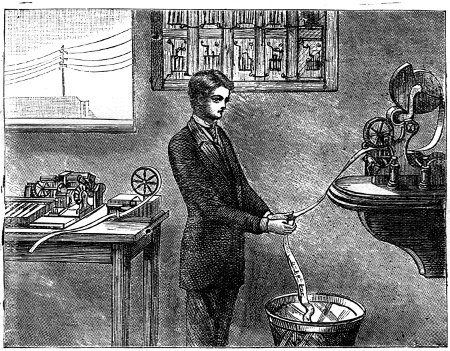
As I stood watching the clever instrument
pouring out silently and persistently its yards
of tape messages, I asked as a favour that
Mr. King would cut off a piece, that I might
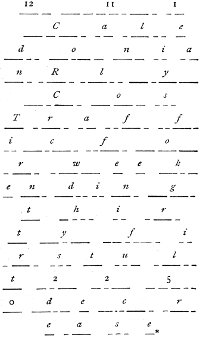
show it to you. You will see that the language
is conveyed by means of simple lines,
over which he was so kind as to write the
letters so represented—
The following little sketch will give you
some idea of the instrument and its working:—
I should like you to know more of this
wonderful place; but it belongs to my life
only inasmuch as it carries my messages so
silently and rapidly that people hundreds of
miles away can do business with me in the
same hour, and the result is that many thousands
of pounds pass through my hands in a
day, which might otherwise have remained
idle.
You will possibly feel surprised to hear that
on an average six millions of pounds[2] are
daily passed in London, without a single coin
being used, and without any inconvenience or
fatigue; whereas such a sum as this, if paid in
gold or silver, would necessitate the carrying
backward and forward over many miles some
hundred tons weight.
Like many other gigantic transactions, it is
brought about in an insignificant building in
a court leading out of Lombard-street, and
therefore close to my residence.
It is not a mysterious place like the Stock
Exchange, but its power of working is so
wonderful as to be quite beyond the power of
woman to take in.
It transfers more
money in one week
than the whole
quantity of gold
coin in the kingdom
amounts to;
and not the least
wonderful thing
about it is that
the entire work is
performed by about
thirty well trained
clerks, in the most
exact, regular, and
simple manner.
The place I am
speaking of is the
Bankers’ Clearing
House—not to be
confounded with
that in the Stock
Exchange. It was
established in 1775
by bankers who
desired a central
place where they
might conduct
their clearing, or
balancing, and
their needs led
them to the invention
of a simple
and ingenious
method of economising
the use of
money. Almost all
their payments are
in the form of
cheques upon bankers.
The system of clearing is quite as important
in money matters as division of labour is in
manufactures, and deserves a much more
thorough explanation than I can give here;
and my only excuse for mentioning it at all is
to show you how wonderfully different my
position is now, strengthened as it is by the
development of science, knowledge, and
experience, from what it was in my early days.
While my transactions have increased a
thousandfold, money, labour, and time have
in an equal degree been economised.
I thought myself very rich formerly with a
fortune of £1,200,000, and I considered that
I and my household had a great deal to do in
the management of it, and the work which
fell to my lot. Dear me! I can call back the
picture of even a hundred and twenty years
ago. My own house was so small that passers-by
could scarcely recognise it; the population
of London was only half a million, and there
was but one bridge over the Thames connecting
my side of the City with Southwark;
and as to that mysterious building, the Stock
Exchange, it did not exist. You know, also,
for I have told you, that my directors only
employed fifty-four secretaries and clerks, and
that their united salaries did not exceed
£4,350. The contrast between then and now
is marvellous even to me.
Only look at it. The proprietors’ capital
is now fourteen millions and a half instead of
£1,200,000; I am the Banker of the Government;
I receive the Public Revenue; I pay
the National Debt; I receive and register
transfers of stock from one public creditor to
another, and I make the quarterly payment of
the dividends. I have undertaken also the
management of the Indian Debt, as well as
the Funded Debt of the Metropolitan Board
of Works. What do you think of that for a
woman old as I am in years? You must own
that, notwithstanding my age, I am young and
vigorous in thought, in action, and in organisation,
otherwise how could I get through my
work as I do?
“GHOSTLY, SILENT MESSAGES.”
My profits, too, are, when compared with
those in my young days, enormous. You
wanted to know, if I remember rightly, how I
lived, and how I obtained the money to pay
you your dividends; and whether, in this respect,
I was worthy of your trust.
Well, I will tell you a few of the ways in
which I make money. I obtain large sums by
discounting Exchequer Bills; then there is the
interest upon the capital stock in the hands of
the Government; I receive, also, an allowance
for managing the Public Debt. Up to 1786
I used to get £562 10s. for every million; it
was then reduced to £450 a million; and since
1808 I get £300 per million up to 600 millions,
and £150 per million beyond—a nice little
sum for you to work out.
A further source of income is interest on
loans, on mortgages, profit on purchase of
bullion, and many other small matters. I am
careful, you see, not to have all my eggs in
one basket.
For help in all this work I employ between
eight and nine hundred officers and servants,
whose salaries exceed £210,000 a year.
I think I am a good mistress. I am sure I
do my best to take care of all my people, and
I am acquainted with every one of them, even
with those who perform what is called menial
service (I don’t like that word; every service
is honourable, if well performed); but I do
confess that I am extremely strict and particular
and I am intolerant of mistakes, from
whatever cause they arise, because they dim
the lustre of my honour.
I think on the whole I have reason to be
proud of my servants. Indeed, I have a firm
belief that no lady in the land is served better
or more faithfully.
I think you will like to hear a little about
the way I manage my people.
First of all, I make every increase of salary
to depend upon punctuality in the morning,
knowing as I do its importance. I am equally
particular that those living within the house
shall keep good
hours at night.
Then I do not
mind giving occasional
leave of absence,
if urgently
required; but I
don’t allow anyone
to take what is
called “French
leave” without
paying a fine for
each day’s absence.
When my people
get too old for service,
I like to feel
that they will not
suffer want; so I
give them a pension
in proportion
to the salary they
are receiving at
the time they retire.
I spend about
£40,000 in this way—a
spending which
has nothing but
pleasure in it for
me.
I started a library
some time
ago for the younger
members of my
household, by giving
them a large
room and £500 for
books. It has since
been kept going by
themselves, each
subscriber paying eight shillings a year. Between
three and eight on certain days in the
week you may see numbers of them making
their way thither for reading and recreation.
Those who prefer it may have books to take
home. One of my representatives is always
present during these hours, just to show our
interest in their recreation.
The kind feeling, however, is not at all one-sided,
as I have had frequent opportunities of
judging. Times of trouble, panic, and sickness
never fail to show me the love and devotion
of my people, and that they have not
hesitated to sacrifice their lives for my safety
is a matter of history.
During the hours of the night, when I take
my well-earned sleep, I am watched over by
my faithful servants, who take it in turn, two
at the time, to keep watch, in which loving
duty they are assisted by a company of Foot
Guards.
So you see on the whole I am a happy
woman, a very busy one, and I think a safe
one for you to trust.
(To be continued.)
OUR TOUR IN NORTH ITALY.
By TWO LONDON BACHELORS.
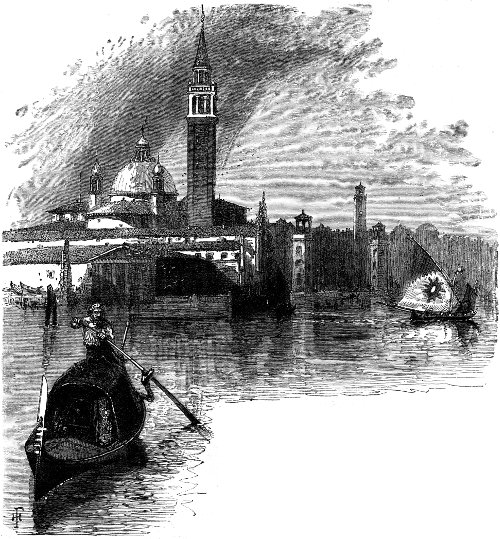
ST. GIORGIO, MAGGIORE.
Our longing expectations were fulfilled, and
we were vouchsafed a lovely evening for our
entrance into Venice. By the time the train
reached Mæstre all traces of the storm had
disappeared, the sky was dark blue, and glittered
with innumerable stars and a full moon—just
such an ideal night as one would choose
for getting one’s first impressions of the
most poetical city in the world.
From Padua to Mæstre there is nothing
remarkable; the same seemingly eternal plain
has to be traversed; but as the train draws
near to the last-named city one begins to
realise that one is really approaching the
Queen of the Adriatic.
At Mæstre we began to feel the sea breezes,
and as the train rushed on to St. Giuliana we
caught glimpses of the far-off lights of Venice
reflected in the water. And now commences
the vast bridge which takes the train over the
lagune. This bridge is between
three and four miles in
length, and contains 222
arches.
Our excitement was great
when we reached the lagune,
and the train seemed actually
rushing through the water.
At first the buildings of the distant city
looked like huge black rocks, though the hundreds
of lights reflected in the water told one
of the approach to habitation. But as we
drew near, the churches, towers, campanili,
and palaces became almost distinguishable,
telling out black against the starlit sky, and
seemingly rising from the middle of the sea—an
exquisitely poetical scene, with which no
one could be disappointed.
Of course, we can understand that approaching
Venice by day is quite another
matter. Then the shallowness of the lagune
(the water is sometimes not more than three
feet deep) is realised; then all the ruin, shabby
detail, bad restoration, and bizarre Gothic work
of the city are seen at a glance. The beautiful
moonlight night, however, told us of none of
these defects, but emphasised the strange
poetry of this singular city, with its wonderful
history and associations, built in the middle of
the sea.
The approach to Venice by gondola in former
times must have been even more romantic,
as the puffing and the screeching of
a steam-engine brings one’s mind back to the
nineteenth century. Though, at the same
time, rushing across the lagune in a railway-train
at night produces a somewhat remarkable
sensation.
The train took about nine minutes to cross
the bridge, and then glided quietly into the
railway station at Venice. There were only
about half a dozen passengers besides ourselves,
and there was none of that noise and
bustle which is usually so great a nuisance in
terminal stations. On alighting from our
railway carriage a porter, with true Italian
politeness, asked us the name of our hotel,
and, conducting us to the side of the canal,
handed us over to a gondolier.
Everything helped to make the scene as
poetical as possible. The night kept glorious,
and there was not a sound to be heard. Our
gondolier, a tall, dark man with a thick black
beard, was a beau ideal of his class, and the
hearse-like gondola being drawn up to the landing-stage, the
bachelors determined to see a little of Venice by moonlight
before going to their hotel.
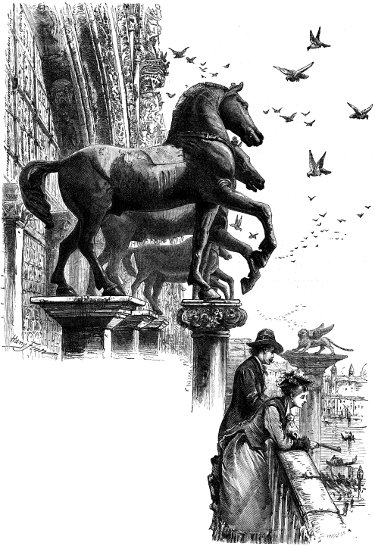
THE BRONZE HORSES—ST. MARK’S.
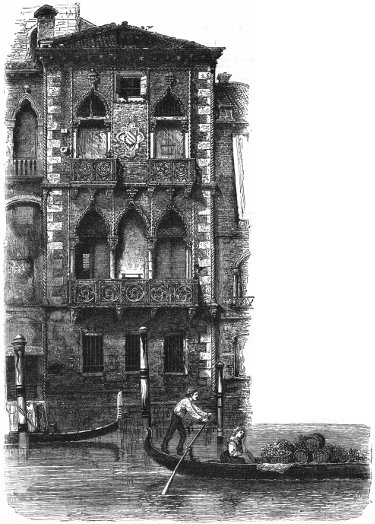
In a few minutes we found ourselves in the Grand Canal—the
great marble palaces rising on either bank, brilliantly illuminated
here and there by the beams of a full moon, and the lights from
the graceful Gothic windows reflected in the still water in long streams of
light; the domes and campanili of the almost innumerable churches piercing
the sky, and looking gigantic, from their details being shrouded in the
deep shadows of night; while their outlines were made still more prominent
and more distinctly defined by the clear, sharp moonlight.
One of these great campanili had an almost startling effect as the gondola
passed it. It seemed to interpose itself between the moon and ourselves.
We never saw any building which, for the moment, seemed so gigantic.
On we went—past the opening of many a narrow canal, looking on one
side into impenetrable gloom, and on the other into almost magical light.
Here and there was some exquisitely traceried window, illuminated like
burnished silver. The plash of the oar and the ripple of the water against
the gondola added to the charm of the scene, and before long the strains of
distant music enhanced the poetry of that most lovely night.
A huge arch soon came in sight, spanning the great canal. Need we
say that this was the Rialto? The gondola shot beneath it, and
wound its way along past a sharp curve in the canal through another
bridge, and on our right the Church of the Salute came in sight,
and we soon emerged on to the
broad and lake-like water of the Giudecca.
To our left was a garden, and a little behind
it rose the group of domes and the lofty
isolated campanili of St. Mark. We knew it
was St. Mark’s, and were therefore not surprised
at its exquisite beauty, though, owing
to the intervening buildings, we could only
see its domes and campanile. The Ducal
Palace, strange to say, did not present so
striking an appearance by moonlight, owing
to its somewhat box-like outline. But still
the deep gloom of its arcades somewhat
repaid the mind for the disappointment
experienced in its general aspect.
Of course, we looked out for the Bridge of
Sighs, which was buried, as it should be, in
profound gloom. It was appropriate that this
tragic structure should be hidden in the
deepest shadow of our first view of Venice,
just as we recollect the dome of the Salute
forming its greatest light. On the one side
was typified human suffering, human woe,
tyranny, cruelty, and oppression, and on the
other the salvation which came to us through
the Healer, whose purity is rightly symbolled
in the clear white dome of the church.
These two buildings, so typical of human
life, are rightly placed. The one at the
junction of the two great canals, where they
expand almost into a lake, lifts its marble
dome, soaring up to the skies, and everyone
asks as they come in sight of it, “What is
that?” The answer is, “That is the Salute”
(Salvation). Happy omen for a city where
such a sign is always visible amidst the surrounding
gloom! The other building, half
concealed, and skulking away over a gloomy
canal, like secret sin deep buried in the
human heart. We know it is there, and that
its loathsome presence will be found when
sought for, and though the gloom of night
may for a time conceal it, yet with the daylight
it will be visible, carrying with it condemnation.
More mundane thoughts, however, filled
our minds, and we began to realise the fact
that in ordering our gondolier to take us a
“bit of a round of Venice” before landing us
at our hotel, we were running serious risk of
going to bed supperless, if not of being shut
out altogether. So we directed him to retrace—we
can’t say his steps, but let us say his
course—and, after passing down one or two
narrow canals, we found ourselves at the steps
of our hotel.
It was not, however, without a sigh and a
kind of feeling almost approaching to dread
that we left the bright moonlight of the Grand
Canal to penetrate the dark, silent, and gloomy
little streams that run between the high walls
of the houses. Gloomy they are at all times,
these narrow quayless canals, but how infinitely
more so in the night, and how their lugubrious
aspect impresses itself upon one after emerging
from the beautiful scenes which we have
just attempted to describe.
The first thing we did on arriving at our
hotel was to see whether any of our friends
had written to us, and we were pleased to find
quite a goodly pile of letters awaiting us.
How pleasant it is to hear from our friends
when abroad, and how doubly dear those friends
seem to us when hundreds of miles separate
us from them.
A rather doubtful compliment this. But is
it not always true that “distance lends enchantment?”
When absent from those we
like, we are inclined to think over their good
qualities and those characteristics that we
admire, and to forget all those differences of
opinion and little waywardnesses that are so
irritating to us when we are with them. Of
course, it is different with those we really
love; even then, however, absence intensifies
the affection, but from a different reason,
arising from an almost nervous anxiety for
their health, happiness, and prosperity.
After reading our letters, we began to
discuss our first sight of Venice, and we both
agreed that, up to the present, our fondest
expectations had been more than realised.
Little did we think that the morrow would
bring its disappointments—that in the short
space of twenty-four hours we should underrate
Venice, as much as we now exaggerated its
beauties—and that we should not gain a
correct and “lasting” impression of its
peculiar and unique character, until many days
had passed away. In fact, one does not
entirely form one’s impression of Venice until
it has been left, thought over, and compared
with other places.
From the city itself we called to our
memory the wonderful history of Venice, at
one time the first maritime power in Europe,
and so like our own country in many ways.
Our girls may remember the importance of
Milan and Verona during the periods that the
Viscontis and Sforzas ruled the former city,
and the Scaligers the latter. The history of
these two cities, however, is simply insignificant
when compared with that of the
great republic of the Doges.
Venice is said to have been founded about
the year A.D. 450, by the inhabitants of
Aquileia, Padua, Altinum, &c., who were
driven out of their cities, and their homes
utterly destroyed by the cruel Attila, who was
at this time overrunning Italy. The persecuted
inhabitants flying before the barbarians, as a
last resource crossed the lagune and built a
town on the islets which had formed in the
Adriatic.
Goethe says, “It was no idle fancy their
colonists fled to these islands; it was no mere
whim which impelled those who followed to
combine with them; necessity taught them to
look for security in a highly disadvantageous
situation, which afterwards became most
advantageous, enduing them with talent, when
the whole of the Northern world was
immersed in gloom. Their increase and their
wealth were the necessary consequence. New
dwellings arose close against dwellings, rocks
took the place of sand and marsh, houses
sought the sky, being forced, like trees
enclosed in a narrow compass, to seek in
height what was denied to them in breadth.
Being niggard of every inch of ground, as
having been from the outset compressed into
a narrow compass, they allowed no more room
for the streets than was absolutely necessary
for separating one row of houses from another,
and affording a narrow way for passengers.
Moreover, water was at once street, square,
and promenade. The Venetian was forced to
become a new creature, and Venice can only
be compared with itself.”
The colonists, under the protection of the
Byzantine Empire, must have grown in
importance and prosperity, though their early
history is very obscure, and it was not until
the commencement of the ninth century that
Venice became a really important city.
The exact date of the election of the first Dux
or Doge (Paulucius Anafestus) is not known,
but it must have been either at the end of the
sixth or the commencement of the seventh
century. The year A.D. 809 was important for
Venice, as the colonists in that year defended
themselves against Pepin, the son of
Charlemagne, and throwing over all foreign
influence, they commenced their career of
independence.
The next important event was the bringing
of the body of St. Mark to Venice in A.D. 828.
The evangelist was thenceforth made the
patron saint of the city, and his emblem,
the lion, became the arms of the republic.
The Venetians had not as yet made
foreign conquests, but the great Doge, Enrico
Dandolo, who went to the Fourth Crusade,
conquered Constantinople in 1204, and commenced
the grand era of Venice. The breaking
up of the Byzantine Empire was a great
opportunity for Venice, the republic gaining
possession of several islands in the Greek
Archipelago, together with numerous cities
on the Adriatic.
As can well be imagined, the growing power
of the republic was watched with jealous eyes
by the other Italian States, especially by
Genoa, at this time very powerful. The
rivalry between the last-named city and Venice
caused innumerable wars and misery to both
combatants. At first Genoa was successful,
but the Doge Andrea Dandolo completely defeated
the Genoese in 1352, an event which
made Venice the most powerful city in
Northern Italy.
The successor to Doge Andrea Dandolo,
Marino Falieri, by secret means endeavoured
to upset the government of Venice and make
himself king. His plot was discovered, however,
and he was beheaded on the Giants’
Stairs in the Palace of the Doges.
The Genoese were at war again with the
republic in 1379; but a lasting peace was
concluded in 1381. From this year until about
1450 Venice carried everything before it;
Verona, Padua, Vicenza, and numerous other
North Italian cities, were added to the republic,
and by the year 1420 the whole of the
east coast of Italy surrendered to the power
of Venice. But perhaps the grandest victories
were those gained over the Turks, as in
these wars Venice undoubtedly saved Italy
the calamity of a Mohammedan invasion.
It was during the years 1370 and 1450 that
Venice was building up her commercial prosperity,
which at the latter date had made her
the greatest maritime and commercial city in
the world.
But as in individuals, so in countries. We
go on increasing in health and strength up to
a certain age, after which comes the inevitable
decline. “First from age to age we ripe and
ripe, and then from age to age we rot and
rot.” The decline of Venice is soon told.
The capture of Constantinople by the Turks
in 1453, and the discovery of the new Indian
sea-routes were terrible blows to the republic,
from which, indeed, it never recovered. The
Turks, with whom the Venetians were always
at war, proved in the end victorious, and took
possession of the eastern colonies of the republic.
And then came the great shame of Venice’s
history—the alliance with the Turk against
the Christian powers, the sacrifice of Rhodes,
and the selfish abandonment of that great
Christian hero, Lisle Adam; while, as a
modern writer says, “the Venetians and other
merchants were trafficking their goods and
their souls at the same time with the enemies
of the Church, and dishonouring their Christian
calling.” A sad Nemesis was, however, in
store for Venice, and, notwithstanding her
crimes, we cannot read unmoved of the last
Doge embracing the banner of St. Mark and
then flinging it into a grave over which a
solemn funeral ceremony was performed. Napoleon,
who regarded neither art, poetry, nor
history, when they stood in the way of his ambition,
was approaching Venice. Resistance
was impossible, and the banner which had led
the Venetians to so many victories must not
fall into the hands of the invader, so, with
tears and sighs, it was reverently placed in the
grave.
(To be continued.)
UNCLE JASPER. — CHAPTER III.
By ALICE KING.
made my way forward
as quickly as I could,
endeavouring, as I
went, to make believe
in my own
mind that I was not
much frightened, and
did not very much
dislike the whole
situation—in fact, that it was rather an amusing
and interesting one. But, after all, it was an
extremely poor, thin make-belief indeed. The
darkness grew thicker and thicker, the outlines
of surrounding objects more and more indistinct;
the wind rose higher and higher, and
went sweeping by with a wild, dreary wail; the
rain began to stream down as if a couple of
rivers or more were being emptied from the
sky on to the earth. I had brought no waterproof
with me, I had only on a mantle of light
summer cloth, and, as well may be supposed,
I was soon enjoying the comfortable certainty
that I was getting wet through as rapidly as
I could. Yes, there was no denying it; it
would decidedly be better to be in bed than
here, even if I was expecting next morning
the arrival of the ugliest ogre uncle that ever
appeared in a fairy tale.
I felt a most real and lively inclination to
sit down and cry; but as there were some
small shreds of heroism still hanging about
me, I did not do it—I persevered onward, instead.
Things were, however, becoming most
uncompromisingly worse and worse. Hitherto
there had been at the side of the road fences
of some kind, the dim outlines of which had
been, in a certain degree, a guide to me; but
now I had got out on to an open common,
where there was nothing round me save an
expanse of what seemed immeasurable darkness,
and where the wind and the rain beat
upon me more violently and pitilessly than
ever. I soon became aware, too, of another
very unpleasant fact: I had evidently got off
the road, for I could feel the damp, spongy-ground
of the common underneath my feet.
I tried to find my way back to it, but
all in vain; I seemed only to get into wetter
and less solid ground.
It was so dark now, I was so completely
enveloped in thickest blackness, that I could
not have seen even a stone wall had it
been in front of me; but it would have been
some consolation, some reassurance, only to
have felt it when I stretched out my hand
before me; instead of that, however, when I
extended my arm it went groping about helplessly
in illimitable space. The storm appeared
to be finding a cruel pleasure in playing me all
sorts of unkind tricks, for now it flung the
folds of my mantle over my head, and now it
poured a waterspout down my back. The
ground under my feet was growing every
minute more swampy, and sometimes I sank
in ankle deep; two or three times I found
that, by way of a little change, I had stepped
into a gutter, which caused a refreshing shower
of muddy water to come splashing upward to
meet and mingle in friendly amity with the
raindrops that pelted down from above. The
sprites of earth and air may possibly have found
much satisfaction in this meeting, but most
decidedly I did not, nor did my luckless petticoats
and stockings.
All at once I found myself making a most
undignified descent from an upright position;
I had stumbled over some object which was
lying in my way. There was no saving my
untrustworthy feet; the next instant I was
lying prostrate on the dripping grass, with my
head in what seemed to be a shallow puddle.
I was going to try to pick myself up again as
quickly as I could, when there rose around
me a series of long-drawn-out, horrid, incomprehensible
sounds, each of which appeared
to strike a rough note in a discordant gamut,
while in among them there was a tumultuous,
confused jangle of bells, as if a hundred tambourines
were ringing together. Then there
came a sensation of having my face swept
with a drenched mop that was composed of
very long, shaggy hair, and was passed and
re-passed over my cheeks and forehead, and
used my eyes and mouth in a most unpleasantly
free-and-easy fashion, and after that I
was trampled upon by a succession of small,
but by no means airy feet—a process which it
is far more agreeable to describe than to feel.
This over, there followed a noise of scampering
and rushing and hurrying across the common,
until footsteps and bells all died away
in the far distance, mingling with the chorus
of the storm.
My head was so dizzy and bewildered after
this adventure that I lay still for two or three
minutes, utterly oblivious of all Miss Dolly’s
well-instilled principles with regard to damp
ground and rheumatism. When, however, I
had recovered myself sufficiently slowly to
rise to my feet, I began to realise what had
happened. I had fallen in with one of the
numerous herds of goats which we had often
seen in our drives, and which, no doubt, frequented
the common. I must have stumbled
over one member of the flock as they lay
huddled together, and this must have startled
and aroused the whole band. Yes, it was all
plain enough now. It was a horribly prosaic,
unromantic incident, and a horribly uncomfortable
one at the same time.
If ever a young lady made vows never again
to run away from any of her relations—no, not
even from a forty-seventh cousin—it was I,
Beatrice Warmington, that night. On I went,
wading through the heavy, marshy ground,
shivering with external cold, yet at intervals
hot with inward fear. There seemed no possible
way out of my self-incurred difficulties.
The darkness was as dense as ever, the storm
as unrelenting. I had completely broken
down, and was sobbing bitterly. What was
to become of me? And the wind answered
mockingly, “What?”
My situation appeared to me, in truth, to
be growing one of real danger. I was becoming
so weary that I did not think I could
drag my tired limbs much further; a half-stupor
was creeping over my brain, and my
senses were beginning to be partially numbed
and blunted with terror and fatigue. It
seemed to me that I must soon sink down and
glide into unconsciousness. I heard in the
wind the voice of Lily calling me, half sadly,
half reproachfully; and with the thought of
Lily came the thought of prayer. But prayer
had never been to me what it was to Lily; I
could not lean on it as she would have done
in my situation. I strove to get hold of
words which would tell of my sorrow for my
rebellious wilfulness, which would be a cry
to my Father above; but they slipped away
from my lips, and would not come when I
wanted them, as they would have come like
helpful angels to Lily.
I was now evidently beginning to descend
a slope of some sort; I could tell that from
the feeling of the ground as I trod it. The
earth I was walking upon appeared to be less
swampy than it had hitherto been, but it was
more slippery. Before long this slipperiness
became something that there was no contending
against; my feet lost all power of stopping
themselves; I was sliding swiftly downward,
as if I was upon ice. Whither was I
going? The question flashed confusedly
through my bewildered brain in the midst of
the storm and the darkness, and still I flew
forward at always increasing speed. All my
senses began to float into a dim whirlpool, and
I could scarcely take firm hold of any distinct
idea.
Suddenly there was a sensation of extreme
coldness up as high as my waist, and at the
same time a consciousness that my involuntary
downward flight had ceased; I was standing
still again at last, but where was I standing?
I stretched out my hand, and bent forward; I
could feel water round me. Now that I was
at last still, I could collect in some measure
my shattered intelligence; I reflected for
some moments, and came to the conclusion
that I must have slid down the sloping side of
the common, rendered especially slippery by
the rain, and must have landed in some stream
which ran at the bottom of the declivity.
I was wet up to my waist, but at least I was
off the common at last; I groped about
cautiously with my hands, keeping my feet
firm where they stood. I soon found the
bank of the stream, which must, I felt certain,
be but a shallow and a narrow one; I made a
spring in the direction in which my hands had
gone, and was quickly, with a great feeling of
thankfulness which thrilled from heart to brain,
standing once more on solid ground that was
neither swampy nor slippery.
I had apparently now reached again some
road; it was still too dark for me to distinguish
anything, but the wind and the rain were less
violent here than they had been on the open
common. This made a small improvement in
my condition, but still there seemed no more
hope than there had been before, of my getting
out of my difficulties. I moved onward, it is
true, but it was quite without there being any
distinct notion in my mind of any end or
object in my proceeding forward. However,
anything was better than standing shivering
there by the stream; movement would, at
least, keep me warm.
ON THE GRAND CANAL, VENICE.
I had advanced thus some little distance,
when my further course was impeded by some
object in front of me. I extended my hand,
and what it touched was a cold iron bar; I
moved my arm from side to side, and still it
was iron bars with which my inquiring fingers
came in contact. It must be an iron paling of
some kind, I thought, and then began, while
I lent wearily against the bars, to ask myself
vaguely what kind of places are generally
enclosed within such a fence.
While these questions passed through my
mind, the bars suddenly began to give way
before the pressure of my whole weight, which
I was supporting upon them; the circumstance
nearly caused me another fall, but I
saved myself just in time. Then I made a
discovery that sent a gleam of indistinct hope
flashing through me; what I had been
leaning against was an iron gate, I could feel
its fastening now quite clearly, and hear the
little click it made as I moved it up and down
with my finger. Did not the existence of such
a gate warrant the notion that some house
must be near at hand? The gates into fields
are not generally like this gate, I argued.
I advanced some steps, and then I became
aware of another fact; I was certainly
standing underneath trees; I could hear the
wind in their branches, could feel the raindrops
that dripped from them. I was pausing
in doubt and new uncertainty, considering
what I might infer from this, when, borne on
the wind, there reached me a sound which
was like the sound of voices. My heart gave
a great leap, all my senses went into the sense
of hearing; I listened as eagerly as if I had
been catching the rarest notes of music; yes,
voices were decidedly drawing nearer and
nearer to me, and with the voices there
approached a glimmer of light.
“If we can’t get in by the glass door, we
shall by the store-room window.”
Such were the words that reached my ears,
spoken in a man’s voice in French.
“We’ll get in quick enough if we can only
reach the house,” said another man’s voice, in
the same language, and a very rough, harsh
voice it was this time, too.
“We must be very quiet and silent in our
movements,” rejoined the first speaker.
“Not even the old dog shall catch a sound
of us—no, not even if he is sleeping with one
eye open,” replied the other.
“There must be a house, then, close in this
neighbourhood,” I thought, “and this must
be the way up to it, and surely, surely,” and
now a great terror seized me, “these must be
burglars who are going to break into it.”
An agony of fear, worse than any by far
that I had experienced on the lonely common,
now took possession of me, as I heard the
steps of the two men drawing nearer and
nearer. I went on one side and held my
breath, hoping that, in the darkness, they
would pass me unnoticed; but I must have
made some sound that betrayed me, for the
next instant a hand was on my arm, and I
heard a voice in my ear.
(To be concluded.)
“SHE COULDN’T BOIL A POTATO;” OR, THE IGNORANT HOUSEKEEPER, AND HOW SHE ACQUIRED KNOWLEDGE.
By DORA HOPE.
wo very happy
events happened
in Ella’s
household at
the beginning of
this month; her
father came to
see her, and
her aunt came
downstairs for
the first time.
Mrs. Hastings had been feeling rather
anxious about her daughter for some time.
The young housekeeper had had a good deal of
worry and anxiety, and her letters had quite
unconsciously betrayed the fact that she felt
in low spirits. Her depression soon disappeared,
however, when her father came, and
his strong common sense and masculine way
of ignoring the little trials of housekeeping
were as good a tonic to her mind as the sharp
walks he took her were invigorating to her
body.
Thinking her looking pale and languid, Mr.
Hastings inquired as to her daily exercise,
and found that on many days she did not go
out at all, except to feed the fowls, or gather
a few flowers from the garden, as her household
duties took her so long that she felt she
had no time for walks. Mr. Hastings considered
that this quite explained her want of
colour and appetite, and insisted that it must
be altered. In vain Ella pleaded that it was
impossible for her to go out always, and would
be still more so when the nurse left. Mr.
Hastings was quite unmoved by all her arguments,
and insisted on her promising to take
some open air exercise every day, even if it
were only a quarter of an hour’s run up and
down the quiet lane behind the house.
He also planned in his own mind to send
Ella’s two brothers, Robin and Norman, to
Hapsleigh for their Easter holidays. They
were good boys, who would not make unnecessary
noise in the house, and they would
supply a complete change of thought for
their sister.
Nor was this the only alteration Mr. Hastings
urged in Ella’s daily routine. In her
restless anxiety about her aunt and the housekeeping,
she had entirely omitted all her own
studies. The piano was rarely opened, and all
the useful books her mother had packed up
for her still lay untouched at the bottom of
her trunk. Mr. Hastings strongly disapproved
of this, and pointed out to Ella that
not only was it a great pity for her to lose the
knowledge she had spent so many years in
acquiring, but that it was very bad for her
health, both bodily and mental, to give up all
interests in life, save the cares of a household;
nor would she be an agreeable companion for
her aunt or their visitors if she had no topics
of conversation more interesting than the
difficulties of servants, or the best food for
fowls; it was quite imperative, therefore, that
she should set apart a certain time every day
for reading and music.
Mr. Hastings was quite ready to acknowledge
that Ella would find it difficult to
manage, especially at first, for her inexperience
in household matters made her twice as long
over them as she would otherwise have been;
but she felt she could do it if she made effort,
and a little conversation with her father soon
convinced her that it was well worth exerting
herself for.
In order to make her studies as easy as
possible to her, before leaving Hapsleigh Mr.
Hastings went through the library with Ella
and chose out a selection of books which
he thought she would find interesting as well
as instructive, for he held very strongly the
theory that unless a book interests us, it is
waste of time to read it, for though we may
imagine ourselves to be getting a great deal
of information, if the facts do not take sufficient
hold upon the mind to interest it, the knowledge
is as soon forgotten as acquired. He
was very careful, therefore, in advising a
course of reading for Ella, to consult her taste,
and to select only those books which she would
really enjoy reading.
Nor was this the end of Mr. Hastings’s suggestions,
for Kate had commissioned her father
to explain a new enterprise of her own. She
had joined a water-colour sketching club, and,
without waiting to consult her, had proposed
her sister’s name also as a member. Each
member was expected to send in an original
sketch once a month, the subject being proposed
by each in turn. The sketches having
all been sent in to the secretary, they were
then submitted to a professional artist, who
put his initials on the back of the one he considered
the best, and wrote a short criticism
on each. The portfolio was then sent the
round of the members, who each in the same
way marked the one they liked best.
Kate had sent a supply of all the necessary
materials by her father, with an injunction to
Ella to be sure to send in a trial sketch in
time for the next month.
Mr. Hastings’s visit came to an end all too
soon, but not till his loving counsel had done
Ella good in every way. His experience
smoothed over all her difficulties with an ease
which seemed to her almost marvellous, while
she was encouraged to fresh exertions by the
unstinted praise he gave her for the manner
in which she fulfilled the duties of
hostess.
To Ella’s surprise, when her aunt heard of
these new schemes for study she took a deep
interest in them, and suggested that Ella
should read her instructive books aloud to
her. The fresh subjects of interest quite
roused the invalid, and Ella had the great
satisfaction of finding that the little mental
stimulus they produced not only helped to
soothe the irritability and restlessness which
troubled her, but that as the mind naturally
re-acts upon the body, she was actually better
in health for it; while, for her own part, Ella
found that her aunt’s sharp intelligent remarks
often cleared up points which would otherwise
have been a difficulty to her.
In the sketching, too, her aunt took a great
interest, and once, when Ella was lamenting
over an effect she could not catch, abruptly
asked why she did not get Mr. Dudley to
help her.
Ella felt shy of asking him; but shyness had
no chance of thriving in her aunt’s presence,
and Sarah was despatched to ask if he would
have half an hour to spare that afternoon.
He soon showed Ella where she was wrong,
and henceforward was always ready to give
her just the advice she needed; and as the
weather grew warmer, and made outdoor
occupations possible, she was surprised at the
many charming “bits” he found for her to
sketch in the flat, uninteresting country in
which Hapsleigh was situated.
Soon after Mrs. Wilson’s new servants
arrived, Mrs. Moore, the widow woman whom
Ella had engaged as cook, asked her if she
might “make so bold as to say, could she not
have family prayers for them in the morning;
for, not being a very good scholar herself, she
could never manage to read her Bible, and
Sarah, though a nice steady girl, was not so
fond of her Bible as to care to sit and read
it to her.”
Ella was a good deal dismayed at this suggestion,
but promised to think it over and
consult her aunt. This was a mere matter of
form, for she was sure that her aunt would
approve of the suggestion, so that the decision
really rested with herself. She felt sure it was
the right thing to do; but she was really very
bashful, though she dared not say much about
it at Hapsleigh, and this seemed to her taking
so much upon herself. And what should she
read? and when?
A very short reflection decided her that it
must be done somehow, and for the rest she
had no choice but to consult her aunt.
Mrs. Wilson warmly approved of the idea,
but seriously added to Ellen’s discomfiture by
remarking—
“You had better begin to-morrow, my
dear. I wonder we none of us had the sense
to think of it before; and, nurse, if you will
begin from to-morrow to give me my breakfast
punctually, we will have prayers here in my
bedroom directly afterwards. Yes, my dear,”
she went on, in reply to an exclamation of
dismay which Ella could not altogether
repress, “it is so long since I have attended
a service I feel a perfect heathen, and need to
be read to quite as much as Mrs. Moore.”
And having once taken the idea into her
head, nothing would induce Mrs. Wilson to
give it up; though, on nurse’s advice, she
agreed that they should meet in the evening
instead of the morning, as being a more convenient
time for an invalid.
Mrs. Wilson had one or two books of
prayers in the house, but as they were old
and most of them rather too long, she told
Ella to look through the books beforehand,
and select a prayer each day, marking with a
pencil which portions to omit. At the same
time she talked over with her the most suitable
portions of the Bible to select for
reading.
“You know, Ella, that, as St. Paul tells
us, the whole Bible is given us for our instruction,
yet some portions are not easily understood
unless a rather long passage is read at
a time, and as that cannot be managed at
daily prayers, it needs care to choose a portion
which gives a complete thought in a small
compass, so that those who, like Mrs. Moore,
get no other reading during the day, have
something definite to carry away with them.”
It was with considerable inward trepidation
and a trembling of voice she could not altogether
control that Ella made her first
attempt at conducting the family prayers the
next evening; but she struggled to forget
herself, and as she went on her voice grew
steadier, till, when they all repeated the Lord’s
Prayer together in closing, she was able to
join in the spirit of the prayer as simply as
anyone present.
It was with sincere pleasure that, a few
days afterwards, Ella helped her aunt downstairs
for the first time; but her delight that
her patient had advanced so far towards
recovery was mingled with a certain
amount of nervousness lest she should find
anything to disapprove of in the rooms, which
she had not seen since she was first taken ill.
For several days the servants had been expending
a good deal of hard work on polishing
the furniture and rearranging all the ornaments
of the sitting-rooms, and Ella had
exercised all her skill in arranging flowers to
make the rooms look bright to welcome the
invalid, so that Mrs. Wilson could not but be
pleased, and she expressed her approval with
a warmth which greatly gratified Ella, and
which sent Sarah into the kitchen with a
beaming face to tell Mrs. Moore that—
“Missis do seem pleased like, and she says
to me, ‘Sarah,’ she says, ‘I never saw that
bookcase look so bright before; why, you must
have got a patent polisher.’”
This well-earned praise was very gratifying
to all the household, and spurred them on to
fresh exertions.
Ella’s interests just now were chiefly
centred in the fowls. She took the greatest
care of the sitting hens, and brought her aunt
each day a minute report of their welfare.
When the time drew near for the chickens to
appear, her eagerness became so great that
she would have disturbed them a dozen times
in the day to see how they were getting on
but for the exhortations of her aunt.
The hens were allowed to remain on the
nests the whole of the day before the chickens
were due, but were well fed, and had a plentiful
supply of water given them. When the
day for hatching came, Mrs. Moore refused to
go near the nests till late in the afternoon, but
at last when she and Ella approached them
very quietly, so as not to disturb the hens, a
gentle peeping sound announced that some
chickens had already broken their way into the
outer world. They found, indeed, that one
hen had hatched all her chickens, but the
other had still two eggs unbroken. Mrs.
Moore removed the hen which had finished
her work, and while Ella went into ecstasies
over the fluffy round balls, she made the
mother dust herself well with the ashes
sprinkled about, and then escort her lively
children to a clean new nest, while the old one
was burnt and the box which had contained
it was put into the open air to sweeten.
The mother hen was given a good meal of
barley and plenty of water, but no food was
given to the chickens.
In answer to Ella’s remonstrances, Mrs.
Moore explained that chickens need no food
for from twelve to twenty-four hours after they
are hatched, and, indeed, are much better
without anything.
Mrs. Moore then brought a basin of warm
water (heated to 105 degrees), and placing it
near the other nest, deftly removed the two
still unhatched eggs without disturbing the
hen, and put them in the water. In a few
minutes one of the eggs began to bob
about in a curious manner, whereupon Mrs.
Moore took it out and returned it to the hen.
The other one remaining still, she held it close
to Ella’s ear, and shook it for her to hear the
fluid contents shaking about, proving that the
egg was useless.
The shells of the hatched eggs were then
removed, and Ella was much interested
in noticing that the two ends of each
shell had been laid one inside the other, so as
to take up the least possible space; but Mrs.
Moore could not answer her questions as to
whether it is the chicken or the hen who does
this, whether it is done deliberately, or as the
result of the chicken’s struggles to free itself
from the shell.
The next morning the last egg was hatched,
and the two “hen-wives” congratulated each
other on having fifteen eggs hatched out of
sixteen set.
For the first day or two the chickens were
fed on hard-boiled eggs, chopped up and
mixed with breadcrumbs or oatmeal; and
for a time they needed such constant feeding
that Ella’s generous mind was quite satisfied,
and the chickens soon knew her so well that
when she appeared they would come running
to meet her, and flutter up all over her dress
and into her lap.
The hens were put into coops and brought
into the garden, and as long as they were too
young to do mischief, the chickens were left
loose to run about where they liked near the
mother’s coop.
It was in the midst of these cares and
pleasures that Ella’s two brothers, Robin and
Norman, came for their ten days’ visit.
Robin was nearly sixteen, and Norman fourteen,
and, considering their ages, they were
good, considerate boys. For the first night
and day after their arrival they were extremely
subdued, and afraid of disturbing their aunt,
but this unnatural quietness soon wore off,
and Ella found her powers of mind and body
fully exercised in supplying them with amusements
which would not excite or tire her aunt
too much.
Happily the weather was fine, and the boys
delighted in long excursions into the country
after mythical rare ferns, herons’ nests, or
other treasures. Frequently Ella went with
them, and she told Mrs. Mobberly, much to
that lady’s amusement, that they made her
feel like a child again.
Mrs. Mobberly, being very anxious to encourage
the feeling in Ella, that although she
had reached the mature age of eighteen her
youth was not quite a thing of the past, came
in several time to spend a few hours with Mrs.
Wilson, so that Ella was set free for a long
day’s excursion with her brothers.
(To be continued.)
VARIETIES.
Hints for Travellers.
Take one-fourth more money than your estimated
expenses, and have a good supply of
small change.
Acquaint yourself with the geography of
the route and region of travel.
Arrange, if possible, to have but a single
article of luggage to look after.
Dress substantially. Better be too hot for
two or three hours at noon than be cold for
the remainder of the twenty-four.
Arrange, under all circumstances, to be at
the place of starting fifteen or twenty minutes
before the time, thus allowing for unavoidable
or unanticipated detention by the way.
Do not commence a day’s travel before
breakfast, even if it has to be eaten at daybreak.
Dinner or supper, or both, can be
more healthily dispensed with than a good
warm breakfast.
A sandwich eaten leisurely in the carriage
is better than a whole dinner bolted at a
railway station.
Take with you a month’s supply of patience,
and always think thirteen times before you
reply once to any supposed rudeness, insult,
or inattention.
Do not suppose yourself specially and designedly
neglected if waiters at hotels do not
bring what you call for in double-quick time.
Nothing so distinctly marks the well-bred as
waiting on such occasions.
Comply cheerfully and gracefully with the
customs of the conveyances in which you
travel, and of the places where you stop.
Respect yourself by exhibiting the manners
of a lady, if you wish to be treated as such,
and then you will receive the respect of
others.
Travel is a great leveller; take the position
which others assign you from your conduct
rather than your pretensions.
Good Reasons for Learning Singing.
The following eight reasons why everyone
should learn to sing are given by Byrd in his
“Psalms, Sonnets, and Songs,” etc., published
in 1588:—
1. It is a knowledge easily taught and
quickly learned, where there is a good master
and an apt scholar.
2. The exercise of singing is delightful to
nature, and good to preserve the health of
man.
3. It doth strengthen all parts of the breast,
and doth open the pipes.
4. It is a singularly good remedy for a
stuttering and stammering in the speech.
5. It is the best means to procure a perfect
pronunciation and to make a good orator.
6. It is the only way to know where nature
has bestowed a good voice ... and in
many that excellent gift is lost because they
want art to express nature.
7. There is not any music of instruments
whatsoever comparable to that which is made
of the voices of men, where the voices are
good, and the same well sorted and ordered.
8. The better the voice is, the meeter it is
to honour and serve God therewith; and the
voice of man is chiefly to be employed to that
end.
“Since singing is so good a thing,
I wish all men would learn to sing.”
An Antipathy to Cats.—People who
have a strong antipathy to cats detect their
presence by the odour, in circumstances which
would be thought impossible. A lady in my
study, one day, suddenly remarked, “There is
a cat in the room.” On my assuring her there
was none, she replied, “Then there is one in
the passage.” I went out, to satisfy her.
There was no cat in the passage, but on
the first landing, looking through the railings,
there, sure enough, was the cat.—G. H.
Lewes.
DR. ZIMMERMAN’S DAUGHTER.
he name of Zimmerman
has been familiar
to me almost from
my first being able
to read. In catalogues
of libraries, or
of books for sale,
the last entry is
usually “Zimmerman
on Solitude.” I do
not like solitude,
and I always fancied
that a book about it must be very dull;
so I never knew anything about Zimmerman
and his book beyond the title.
But I have lately found, in an old book
published at York in 1810, an account of
Zimmerman’s daughter, which I have read
with much interest. The title of this book is
“True Stories and Anecdotes of Young
Persons; Designed, through the Medium of
Example, to Inculcate Principles of Virtue
and Piety.” In fact, it is a little book of
Christian biography, and among the examples
of virtuous and pious young persons is the
daughter of Dr. Zimmerman. The page is
headed, “A Tribute of Paternal Affection,”
and this tribute proves that, whatever else
Dr. Zimmerman may have been, he was a
most fond and devoted father. It seems that
he lost this only and beloved daughter, a very
amiable, accomplished girl, in the summer of
1781, when she was twenty-five years of age.
Here is what her father says of her, a record
well worth reproducing for the benefit of others,
even now after more than a century has passed.
“May I be permitted,” says the sorrowing
father, “to give a short account of one whose
memory I am anxious to preserve? The world
was unacquainted with her excellence; she
was known to those only whom she has left
behind to bewail her loss. Her sole pleasures
were those which a retired and virtuous life
affords. She was active, always gentle, and
compassionate to the miseries of others. Diffident
of her own powers, she relied with perfect
confidence on the goodness of God, and
listened attentively to the precepts of her fond
parent. Though naturally timid and reserved,
she disclosed the feelings of her soul with all
the warmth of filial tenderness. For me she
entertained the most ardent affection, and
convinced me, not by her professions, but by
actions, of her sincerity. Willingly would I
have resigned my life to save hers, and I am
satisfied she would as willingly have given up
her own to preserve mine. One of my greatest
pleasures was to please her, and my endeavours
for that purpose were most gratefully
returned.
“From her early childhood she had been the
victim of ill-health; but, though of weak
frame of body, and deeply afflicted, she bore
her sufferings with steady fortitude and pious
resignation to her heavenly Father’s will.
Soon after our leaving Switzerland for Hanover
she fell into a deep decline, which too soon
deprived me of the comfort of this beloved
child. From the knowledge I had of her constitution,
I apprehended that the disorder
would prove mortal. How frequently did my
wounded, bleeding heart bend me on my knees
before God to supplicate for her recovery!
But I concealed my anxiety from her observation.
“Although sensible of her danger, she never
discovered the least apprehension. Smiles
played around her pallid cheeks whenever I
entered the room. Even when worn by the
fatal disease, and under most afflicting pains,
she made no complaint. Her decay became
evident to the eye, but to the last hours of
her life she preserved a serenity correspondent
to the purity and composure of her mind.
Thus I beheld my dear, my only daughter,
at the age of twenty-five, after a tedious
suffering of nine long months, expire in my
arms.
“During our short residence in Hanover,
where she was much respected and beloved,
she composed some religious pieces, which
were afterwards found among her papers.
About the same period she also wrote many
letters, which were always affecting, and frequently
sublime in the expressions of her
feelings. The last words that my dear excellent
child uttered were these: ‘To-day I shall
taste the joys of heaven!’”
Such is the memorial tribute. The love of
a father and daughter is always beautiful, and
in this case is unusually touching. The perusal
of what the good man wrote has made me
think of him with softened feeling. I know
nothing about his life or history, save what
appears in this account of his daughter, after
reading which I could even look at his book
on solitude with complacency!
ANSWERS TO CORRESPONDENTS. — EDUCATIONAL. — HOUSEKEEPING. — MISCELLANEOUS.
B. Ignoramus.—You cannot say, “No one knew I
was here but her,” because you are speaking in the
nominative case, which answers to the question
“who”—viz., “Who was there?” “She was;” not
“her was.” In the accusative case the personal
pronoun “her” is employed—viz., “Of whom did
you borrow it?” “Of her;” not “of she;” the
accusative answering the word “whom.”
A. R. B.—A visitor requested us some time since to
draw attention to the Training Home for Governesses,
81, Mildmay-grove, N., at which the fee for
board, lodging, and laundry for three months is only
£6. We think this might suit you, especially as the
foundress undertakes to find situations for the
students. The Kindergarten system is included in
the course of training. Address the directress.
Molly M.—Friendless and homeless girls and others
needing a short training in the ordinary work of a
general servant are received at a payment of 5s. a
week, at Breydon House, North Quay, Great Yarmouth.
Address the lady superintendent, Mrs. H.
E. Buxton. Every effort is made to place the girls
in suitable situations on leaving the institution. They
cannot remain there after the training is over.
Dorothy.—We fear there is nothing to be done, if you
cannot spell, but to purchase a little dictionary, and
always look out every word of which you have the
least doubt. We are glad you find our dress articles
so useful.
Beeahudhu and Innistore.—The action of the rays of
the sun does put out a fire by rarefying the air, and
so causing it to flow more slowly towards the fire.
The air which really does reach the fire at the time
also affords no nourishment, because rarefied air contains
less oxygen than the same quantity of condensed
air. We should imagine the steel chain
would have no effect unless you were struck by
lightning.
Purple Clematis should write to the secretary of the
College of Preceptors, 42, Queen-square, Bloomsbury,
W.C.
A Country Lassie.—The 12th February, 1886, was a
Friday. We do not know the school you mention.
It is probably a private one. Why not write yourself
direct?
Anxious.—Perhaps a Kindergarten school would suit
you better.
Glan Menai.—1. Kinder is one word in German, and
garten is another, so the word is “Kindergarten.”
2. Tancredi is an Italian name. The most famous
bearer of it was Tancred, son of Marquis Odo the
Good, of Sicily, born 1078. He assumed the cross
in the First Crusade, 1098, was created Prince of
Galilee, and died of a wound at Antioch, 1112. He
was “a very perfect, gentle knight,” and in him was
embodied the chivalrous spirit of the Crusades.
F. E. N. (Bishop’s Stortford).—There is a good arithmetic
society, including algebra, for particulars of
which write to Miss Frances Mason, hon. secretary,
care of Mr. Horwood, 62, Green Lanes, London, N.
French and English correspondence is likewise
undertaken by this society. We thank F. E. N. for
information respecting her Pledgdon Bible-class
Society, to which we gladly draw the attention of
our readers.
Violet and Rose.—Put a little turpentine on the spots
of paint; or if that be not successful, try benzine
colas.
Sidney R.—We can only advise you to hang curtains
between the pillars in your drawing-room. With
some flowing draperies they will look less stiff.
Blue-eyed Burkie.—Hominy porridge would be quite
as nutritious as any other, and would provide a
change from oatmeal. You could also try polenta,
made from Indian meal or maize in the same manner
as oatmeal porridge.
Irene.—It is still the fashion to hang curtains over
looking-glasses, as you describe. The curtains should
match those in the windows or the trimmings of the
dressing-table.
Madge.—To take rust from steel ornaments we should
advise you to cover them with sweet oil, well rubbed
in, and after 48 hours to use finely-powdered unslacked
lime. Rub in until the rust disappears.
F. O. writes to us to say that spots of mildew on the
leather covers of books that have been kept in a damp
room may be removed by rubbing them with dry
crusts of bread.
Devonia has only to set the milk in clean pans for the
cream to rise. Once a week is the usual time for
churning, and every two or three days the pans are
skimmed. The cream need not be sour to churn
into butter.
Jim’s Darling.—Your mother should see that the two
children obey you, and if they need punishment she
should inflict it, not you. Your spelling and writing
are both very defective.
Red Berrie.—“Genius” appears to us to mean
originality and creative power; talent does not
imply originality. We generally apply the word to
those who ably interpret the ideas and carry out
the discoveries of others.
Janet Moreton.—Stopped teeth sometimes last for
years if well done. If the stopping should come out,
it ought to be at once replaced.
Daisy Naomi seems to need a tonic. We advise her
to read the articles by “Medicus.” Cod-liver oil
would probably be of service to her. Naomi needs a
doctor’s advice as to her digestion.
Alys and Mabelle.—“Nigel” is pronounced as it is
spelt; the last syllable as the first in “gelatine.”
K. M. W. is anxious that others who, like herself, have
lost their voices, should know how much she has
benefited from the treatment by the electric battery,
which she obtained at St. Thomas’s Hospital. She
hopes not only to recover her voice completely for
speaking, but also for singing.
Mona.—The lines, “Break, break, break! On thy cold
grey stones, O Sea!” are by Lord Tennyson. They
have been several times set to music, and you can
obtain the songs at any music-seller’s.
Fair Rosamond.—When you first observed that the
strange man made a habit of occupying the same
seat as yourself, you should have gone elsewhere.
Now you have habitually sanctioned the liberty he
took, seeing you without a chaperon or companion,
and this has made your case difficult. You can only
say that you acted indiscreetly in the first instance in
allowing yourself to be drawn into conversing with a
perfect stranger, and that you regret that you must
withdraw from further intercourse, unless properly
introduced and suitable references be given. Even
were he thoroughly respectable, he may be in no
position to pay his addresses to you in point of
fortune.
Four Maidens.—Young ladies in England have their
names put on their mothers’ visiting cards, unless
under peculiar circumstances. If they have no
mother, their names would appear together—i.e.,
Miss Smith—Miss Belinda Smith.
Sarnia.—Your school children, whom you train to sing
in the choir of your church, would be rendered more
efficient were they to sing through a few ordinary
scales for a few minutes previously to practising the
chants and hymns. It would only extend the time
some five or ten minutes beyond the hour hitherto
devoted to the lesson once weekly. There would be
no necessity for consulting them on the subject, nor
even drawing attention to the brief prolongation of
the time. Were you to propose an extra day for
practising, they might grumble or find difficulty in
attending.
Mignonette.—The 20th of April, 1868, was a Monday.
Many thanks for your nice letter.
D. E. S.—Messrs. Cassell publish a “Guide to Female
Employment in Government Offices.”
Maude must make inquiries, and try to find some
writing, copying, or needlework. She gives us no
indications of what she can do, so is evidently not a
practical young person.
Alice Rockhampton.—1. The words, Ricordo di
Napoli, mean “a remembrance, or memento, of
Naples.” 2. We should think lemonade a very good
summer drink.
H. S. G. H.—The 28th August, 1852, was a Saturday,
and the 5th January, 1864, was a Tuesday.
Scotch Lassie.—We should advise you to take a
situation as cook-housekeeper. Your writing does
not seem good enough for a clerk.
Natalie Metz.—In writing such articles, a doctor
makes use of his acquired knowledge, of course.
How do you suppose a doctor could prescribe with
success if he did not know about every portion of
the human organism and its use and functions?
Phyllis H.—You may use the tweezers, but we do
not think you should try anything else.
Thistle sends us a letter of inquiry as to how she can
earn her own living. She says, “I have no special
talent for anything; I am no musician, I have no
accomplishments, I am a bad writer, I dislike teaching,
also nursing, and I cannot learn languages.”
We see nothing left but domestic service or matrimony,
and Thistle had better begin to learn cooking
and housekeeping, so as to be prepared for either
position.
An Anxious One would do well to try the Dental
Hospital and have advice about her teeth.
Maude C.—Felt hats, if good enough, can be re-dyed
and blocked without much expense. The 4th Feb.,
1869, was a Thursday.
Nesta.—The 15th March, 1871, was a Wednesday;
and the 28th February, 1874, was a Saturday.
Audrey Gallop.—The German Auf Wiedersehn means
the same as the French au revoir. We have no
similar idiom in English, the meaning being, “a wish
for our next meeting.”
A June Rose.—Most young girls if short-sighted
prefer eyeglasses to spectacles, but it is quite a matter
of individual preference.
Busy Bee must go through the usual course of submitting
her story to the various publishers. There is
no royal road to literary success.
Makie.—We could not give space for such a quantity
of statistics. Buy a “Whitaker’s Almanack.” The
story you mention about the Queen has been recently
contradicted, we believe.
Emmeline Kennedy.—1. The distance from Rydal to
Ambleside is given differently in guides and gazetteers—viz.,
as two miles, a mile and a quarter, and a
mile and a half. You say it is a “short mile,” but
you will allow it is not a matter of very vital importance.
A quarter of a mile from the shores of
any lake may be very truly described as being on or
near the banks of that lake. You will understand
that we are not called upon to visit each locality and
test the correctness of gazetteers and guides, so we
are quite willing to believe your statement correct.
2. The poet Wordsworth had, as you say, an only
daughter, Dora; married to Mr. Quillinan. She
died in 1847, leaving no family. Mr. Quillinan had,
however, two daughters by his first wife, who was a
daughter of Sir Egerton Bridges. This poor lady
was burnt to death. Mr. Quillinan himself died
suddenly in 1857.
Cecil.—The lines you quote are from a short poem by
Lord Byron.
Constant Reader.—Colour-blindness is, unfortunately,
very common, and more especially among
men. It is rare among women. Red and green are
the colours which, through some defect in the eyes,
are the more generally confounded. Sailors and
soldiers have to be carefully examined to ascertain
their ability to distinguish signals, and engine-drivers
likewise.
Nora, the Anxious.—You had better apply to Mrs.
Houston Smith respecting situations as mother’s
help; office, 409, Oxford-street, W.
A. M. B.—We quite understand your difficulty in
understanding our Lord’s statement (St. Mark xiii.
30, and St. Luke xxi. 32). It may be explained in
more than one way. If He referred to His Second
Advent, you must remember that the term “generation”
is sometimes employed to denote the nation as
a whole, and in this sense this is true, as we see in
reference to the Jewish people, who exist to this day,
notwithstanding the cruel exterminating persecutions
to which, through all the subsequent centuries, they
have been subjected. If the statement referred to
the destruction of Jerusalem, the term “generation”
bore the signification which we put on that term, for
those standing by (very many of them) lived to see
that prophecy fulfilled. Our Lord’s discourse referred
to both events, although the two prophecies are rather
unaccountably run together by the evangelists in
their record of them.
Marrow Bones repeats an old query, which we have
ceased to answer. Read “The Art of Letter-writing,”
vol. i, page 237.
Sandown.—The few holidays accorded to the banks
include Christmas Day and Good Friday, and though
national, they are properly called bank holidays also.
Christmas Day was a great festival of the ancient
Romans, but the day was observed by Christians to
commemorate a very different event.
Sarah.—The man who made use of such an expression
as that to which you refer is certainly very profane,
and wanting in the feelings of a gentleman towards
those in whose presence he spoke. It is a species of
swearing of a very low class and horrible kind. If
these girls allowed such language to be used without
denouncing its gross profanity and the personal insult
to themselves, as listeners, they showed want of
common self-respect, not to speak of reverent feeling.
Ellennette.—Perhaps it would be of some service to
have the old boards planed, then well saturated with
turpentine, and, when dry, painted thickly with two
or three coats of paint. The vermin will scarcely be
able to penetrate this, if any survive the turpentine
bath. We have not tried this plan, but should do so
under the same distressing circumstances. Some have
found the use of a kettle of boiling water very
effectual. We should use this first, then the turpentine,
and then the paint.
Incognito.—The Ides in the Ancient Roman Calendar
were eight days in each month. The first, denominated
the Idus, fell on the 15th of March, May,
July, and October, and on the 13th of the other
months. The Ides came between the Calends and
the Nones, and were reckoned backwards. Thus,
the 14th of March, May, July, and October, and
the 12th of the other months, was called “the day
before the Ides.” In the calendar of the “Breviary,”
and in the Chancery of Rome, this needlessly complicated
mode of reckoning is still retained.
A Cheshire Cat.—When the reflecting surface is
concave the contiguous reflected rays themselves
intersect, and as we pass along any line on the surface—say
the line of intersection, by a given plane—the
reflected rays by their ultimate intersections form
a plane curve. By varying the plane of section an
indefinite number of such curves result, and these
all lie upon the surface known as the caustic, to which
every reflected ray is a tangent. A concave lens
must of necessity render originally parallel rays divergent.
The principal focus of the convex lens is the
point at which the rays which pass through it, near
and parallel to its axis, converge. The science of
optics is one that needs to be taught.
Bunch of Grapes.—1. We do not hold ourselves bound
to inform our readers of the why and wherefore
respecting our plan of conducting our paper. 2. If the
terra-cotta be very dirty, sponge with turpentine,
and then with soap and water.
M. S. O.—No further continuation of the article on
“Paper Boxes” was given in the G. O. P. “My
Work Basket” is continued at intervals as space will
permit.
Particular.—From Angus’s “Handbook of the
English Tongue,” we quote the following with
reference to your query:—“In old writers, and
occasionally in modern print, ‘an’ is sometimes
erroneously placed before semi-vowels or vocal ‘h,’
as ‘an usurpation,’ ‘an historical account.’” Thus,
you see that “a historical account” was right. You
should get the book in question; it is published at
56, Paternoster-row, E.C.