TINNED MEATS: THEIR VALUE TO HOUSEKEEPERS. — PART III.
By A. G. PAYNE, Author of “Common-sense Cookery,” “Choice Dishes at Small Cost,” “The Housekeeper’s Guide,” &c.
There is no doubt that in this country the
present generation is far more luxurious than
the one that preceded it. Living is to a great
extent a question of habit. At the present
moment a Russian soldier is paid at the rate
of a shilling a month, and his only ration
is rye-bread baked into biscuit, washed
down with a draught of water. The British
workman of the day requires a hot meat
dinner, cooked from fresh meat expressly for
him alone. Were his wife to supply him
with cold meat, he would probably grumble.
In the last century a labourer was content
with a piece of fat pork boiled on Sunday.
Possibly in the next century we shall have
our soup kitchens for the poor altered into
turtle soup kitchens; for it is a fact that the
luxuries of one century become the necessities
of the next.
It is a question worthy of consideration
whether this country has not reached that
pitch of luxury and self-indulgence which all
history teaches us is the turning-point in a
nation’s greatness. Ananius, Azarius, and
Misael have told us that we thrive better on
pulse and water than on the king’s meat.
Let us hope as a nation that, unlike the king
in question, seven times may not pass over us
to cure us of our luxury and pride.
I will not enter into a description of the
various uses of the more expensive luxuries
now sold in tins. I refer to truffles, cocks’
combs, fina cière, ragout, foie gras, etc.
Mushrooms, however, are exceptions. They
seem like gifts of nature, and, like the manna
of old, they require us to rise early and
gather in our harvest fresh, not forgetting that,
like manna, they will not properly keep till
the morrow. It is, however in cases like this,
when the food is of a perishable nature, that
the invention of preserving in tins is so useful.
There are probably few of what may be called
accessories to food more useful or more delicious
than mushrooms. Mushrooms are preserved
in tins in two forms, by far the most
common one being quite plain in water.
Were I to give a list of all the various dishes
in the composition of which mushrooms enter,
I should require as many volumes as I am
allowed columns. I would, however, remind
housekeepers that small tins of mushrooms
can now be obtained at sixpence each from all
respectable grocers.
I will give one or two simple cases to illustrate
the various uses to which mushrooms
can be applied.
First, mushroom sauce.
You can have brown mushroom sauce and
white mushroom sauce.
To make brown mushroom sauce from tinned
mushrooms, open the tin of mushrooms and
add the contents, liquid and all, to about an
equal quantity of good, thick, rich, brown
gravy. The mushrooms should be chopped
small, and served in the gravy just as they
are.
White mushroom sauce, which is so delicious
with boiled fowl, can be made by adding
a tin of mushrooms to some good béchamel
sauce. Béchamel sauce is some very strong
stock, mixed with some boiling milk, or, still
better, boiling cream, thickened with a little
butter and flour. When the tin of mushrooms
is added to the white sauce, the whole should
be rubbed through a wire sieve with a wooden
spoon. This helps to thicken the sauce, and
greatly adds to the flavour.
Another simple instance of the use of mushrooms
is some kind of fish au gratin. Take,
for instance, a sole. Dry it, flour it, and egg
and breadcrumb it in the usual manner. Next
take a sixpenny tin of mushrooms, strain off
the liquor, and chop up the mushrooms finely
with a piece of onion as big as the top of
the thumb down to the bottom of the nail, a
piece of lemon peel, say about the size of the
thumbnail and as thick; that is, you only use
the yellow part, and not the white. Add also
sufficient chopped parsley to fill a teaspoon, as
well as a little pepper and salt. Fry all these
in a frying-pan with some butter for a few
minutes, and when it is partially cooked place
about half of it in a tin sufficiently long to
hold the sole. Place the sole on the top of
these chopped ingredients, and place the remainder
on the top of the sole. Pour all the
butter in the frying-pan on it, and, if necessary,
add a little more butter, so as to keep
the sole moist, and bake it in the oven till the
sole is done. Of course the time for baking
varies with the size of the sole and the fierceness
of the oven. When it is finished, a little
finely-grated Parmesan cheese may be shaken
over the whole. Parmesan cheese can now
be obtained in bottles, the price of a small
bottle being about eightpence or ninepence.
The Parmesan cheese is, however, not absolutely
necessary. Also a few bread raspings
shaken over the whole gives it a finished
appearance. This dish looks a great deal
better if the tin is the same shape as the sole,
and the fish served in the tin in which it is
baked. Long oval tins are sold on purpose.
Almost any kind of fish can be served in this
way, such as lemon soles, fresh haddock,
filleted brill, filleted plaice, etc. Just before
the sole au gratin is sent to table many persons
add about a teaspoonful of sherry to the
sauce by which it is surrounded. To my
mind it is a doubtful improvement.
Another very excellent form of preserved
mushrooms of which I cannot speak too
highly, is what is known as black Leicestershire
mushrooms, preserved in gravy. These
are quite different from the ones usually sold
in tins. They are round and flat in shape,
and are much more like the ordinary
mushrooms that we are accustomed to gather
in the country, being white on one side and
black on the other. The way to use them is
to make the tin hot in boiling water, and then
add the contents to either a well cooked
steak or chop, taking care that the red gravy
that runs out of the steak or chop is added
to the gravy in the mushrooms. It is an
improvement if you have some good thick
gravy, to add a little of it to the gravy in the
tin. One of these tins very greatly improves
the flavour of a dish of hash or stewed steak.
I would strongly recommend you to try the
experiment of using one of these tins the next
time you have a chop or steak. They can be
served just as they are, after being made hot,
in a sauce tureen, and will be found far
superior to any mushroom sauce generally
met with, even when made from freshly
gathered mushrooms. The cost of a small
tin of these excellent mushrooms preserved in
gravy is about sevenpence.
We will now consider tomatoes in tins.
Fresh tomatoes are now preserved whole,
and will often be found very useful. Suppose,
for instance, as we mentioned in our first
article, that we are taken by surprise in a
country house far away from all shops, and we
want a delicious little entrée in a hurry. We
will suppose the store cupboard to contain a
tin of tomatoes preserved whole, and also a
tin of mushrooms. The dish we are going to
send to table is called tomatoes au gratin.
We will suppose the larder to contain a piece
of cold boiled bacon, but raw bacon would
serve our purpose equally well. Take the
piece of cold boiled bacon, and with a blunt
knife scrape off about two or three tablespoonfuls
of fat. Chop up very finely a tin of
mushrooms with a piece of onion, lemon peel
and parsley, exactly as if we were making a
sole au gratin. Add a small saltspoonful of
dried thyme. If the thyme is fresh, less
than half that quantity will be ample. Fry all
these ingredients in a frying-pan with the fat
bacon, and then add sufficient bread-crumbs to
make the whole into the consistency of a
pudding. Now take the tomatoes very carefully
out of the tin without breaking them,
and I would warn you that they require very
delicate handling. Give the tomatoes a gentle
squeeze so as to get rid of any of the pips inside.
Then with a teaspoon carefully fill the
tomatoes with the mixture we have just made.
The more mixture you can get into each
tomato the better. Next pour a very little
salad oil into a tin—oiled butter will do—and
place the tomatoes one by one on the tin
without breaking them, and bake them in the
oven. When they are hot through, they may
be served. In taking them out of the tin and
placing them on the dish, use a slice similar
to that for taking out fried eggs.
The only difficulty I know of in making this
delicious dish is to avoid breaking the tomatoes,
which are more liable to give way when
they are hot than when they were first taken
out of the tin. Shake a few bread-raspings
over the top of each tomato before serving—that
is, cover the top of the mushroom mixture
with the bread raspings to make it a nice
brown, but do not shake the bread raspings
over the tomato itself. If the tomatoes are
placed in a silver dish and surrounded with a
little bright-green fried parsley, it has a very
pretty appearance. If you have some good
brown gravy in the house, the tomatoes can
be served in a little gravy; only do not pour
the gravy over the tomatoes, as it would
utterly spoil their appearance, but pour a little
gravy into the dish first, and then place the
stuffed tomatoes carefully in it. The gravy
should be rich, thick, and of a good brown
colour; otherwise the tomatoes au gratin are
best served as they are.
Tomatoes preserved whole will be found
useful to ornament a large variety of dishes,
such as tête de veau en tortue, poulet à la
Marengo, etc. For instance, a simple dish,
but very bright-looking, can be made as follows:—From
the remains of some cold boiled
potatoes make some ordinary mashed potatoes;
and if you live in the country, where cream
is cheap, remember a very little boiling cream
added is a very great improvement, both in
appearance and flavour. Mashed potatoes, to
be really good, should be rubbed through a
wire sieve. Pile the mashed potatoes up in
the middle of a vegetable dish, and place
round the outside alternately a mutton cutlet
and a whole tomato. The cutlets can be
cooked perfectly plain—that is, simply grilled
on the gridiron like a mutton chop—or they
can be fried after being egged and bread-crumbed.
The tomatoes simply want being
made hot by being placed on a greasy tin and
warmed up in the oven. Place the cutlets
round the mashed potatoes, first leaving room
for the tomatoes between each. Then take
out the tomatoes with a slice, and make a bed
in the mashed potatoes, in which they can
quietly repose; otherwise they are apt to
smash and run, and make the dish look
untidy.
We will next consider the best way of
utilising the various vegetables that can be
obtained in tins, such as asparagus, green
peas, French beans, and last, but not least,
macédoines.
First with regard to asparagus. Of all the
vegetables preserved in tins I think this is the
best. It requires no preparation whatever.
Make a piece of toast, and place it at the
bottom of a vegetable dish; then make the
asparagus hot in the tin, and when the water
in which the tin has been placed has boiled for
some four or five minutes the tin can be taken
out and opened. In opening a tin of asparagus,
cut the tin right round the edge, so
that the sticks of asparagus can be taken out
without breaking them, and take out any tops
that may be left in the tin, and add them to
the rest. Strain off the liquid, and place the
asparagus on the toast, the white part resting
on the edge of the dish. The asparagus should
therefore be divided into two parts, so that
the green parts meet on the toast and half
the white sticks rest on one end of the vegetable
dish and half on the other. A little
ordinary melted butter or white sauce is generally
served with them. For my part, I prefer
the asparagus quite plain.
Tinned asparagus differs in one respect from
ordinary asparagus, inasmuch as you can
nearly eat the whole of it. Asparagus can be
eaten cold as a salad, and a very delicious
salad it makes. Open a tin just as it is, strain
off the contents, dry the asparagus on a cloth,
and place it as I have described before on a
dish, but without any toast. Now make a
little sauce to pour over the tips as follows:—Take,
say, a couple of ounces of butter, and
dissolve it in the oven in a teacup till it runs
to oil. Now take it out, and add to it three
brimming teaspoonfuls of freshly-made mustard,
a dessertspoonful of vinegar, and a saltspoonful
of pepper and another of salt. Stir
this up with the oiled butter. As the butter
begins to get cold the sauce commences to
get thick, and as soon as it has got into that
state in which it resembles custard, pour it over
the asparagus, of course leaving the ends of
each stick free from the sauce, as it is now
customary to eat asparagus with the fingers.
This sauce, to be good, requires real
butter, which is a substance now rarely met
with, even at respectable grocers, the adulteration
of butter with fat being almost universal—this
universal adulteration being the chief
cause of the depression of trade throughout
the country. The salad should not be served
till the sauce is quite cold and sticks to the
asparagus.
Green peas are now to be had preserved in
tins, not only very good but very cheap.
Good preserved peas should be small and of a
light green. When the peas are large and
high coloured, they are inferior. The fact is
that the former are young and the latter old.
Preserved peas are best served in a course by
themselves, though, of course, they can be
handed round with ordinary joints. The art
of sending preserved peas to table is to make
them look and taste as much as possible like
green peas freshly gathered. For this purpose
you should act as follows:—Make the peas
hot in the tin and take, say, a dozen fresh
mint leaves and scald them in the water in
which the tin is being made hot. Next take
these hot mint leaves and put them in a
vegetable dish. Open the tin of peas, strain
off the liquor, and pour the peas on to the
mint leaves. Now add a small saltspoonful of
powdered sugar, half a saltspoonful of salt,
and a small pat of butter as big as a five-shilling
piece. Toss the peas for a minute or
so lightly together, so that the butter is
dissolved and the sugar and salt melted, and
the fresh mint leaves brought to the surface.
Now send the dish to table. The fresh mint
leaves help to convey the idea that the peas
are fresh. In everything we eat and drink
imagination goes a long way. Who, for
instance, would care to drink port wine out of
the spout of a teapot, even if the teapot were
solid silver?
I might here mention in passing that a
small sixpenny tin of peas will be found very
useful in ornamenting a boiled leg of mutton.
If you want to make a boiled leg of mutton
look really nice, proceed as follows:—Of
course you have boiled turnips and carrots
with it. Boil the turnips whole, and when
they are tender take them out of the water
and cut each turnip in half and scoop out the
centre, so as to make it like a cup. Now take
the outside part of the carrot, which is a
brighter red than the inside part, and chop it
up into small pieces. Place the leg of mutton
in the centre of the dish, and pour over it
either some of the water in which it is boiled
or some thick caper sauce. Now fill up these
cups made out of the scooped turnips cut in
half with a tablespoonful of green peas and a
tablespoonful of chopped-up carrot alternately.
It is a very simple garnish, and gives but
little trouble; but what a difference it makes
in the appearance!
We will next take French beans, or, as they
are properly called, haricots verts. I think
these deserve to be served in a course by
themselves, even more than peas. If they are
served with a joint they must simply be made
hot in a tin, then drained and allowed to dry,
and handed round just as they are. French
beans go best with a haunch of venison or
roast mutton. If, however, you serve the
beans as a course by themselves, you must,
after making them hot and draining off the
liquid, add a couple of tablespoonfuls of good
white sauce, that is béchamel sauce, or if you
have none, add to a tin of beans about enough
fresh butter to fill a dessertspoon; add also
about a saltspoonful of finely chopped fresh
parsley, a little pepper and salt, and about a
teaspoonful or rather more of lemon-juice, as
well as a little powdered sugar. The beans
should be tossed lightly together until the
butter is dissolved, and then served.
Last, but not least, come macédoines.
Macédoines in tins are simply mixed preserved
vegetables, the chief ingredients being green
peas, chopped carrot, and turnip.
Macédoines are one of the most useful kind
of tinned goods to have in the house, as you
can always make a pretty dish at a few
moments’ notice. A spoonful of macédoines
will turn some clear soup into a bright-looking
spring soup. A tin of macédoines made hot
and placed in the centre of a dish of mutton
cutlets always has a bright and appetising
appearance. Macédoines can also be added to
the remains of some cold potatoes, and used
to make a German salad; while, with a few
hard-boiled eggs and a small pot of caviare,
we can make with their assistance that
excellent supper dish known as a Russian
salad.
(To be continued.)
THE BROOK AND ITS BANKS. — CHAPTER V.
By the Rev. J. G. WOOD, M.A., Author of “The Handy Natural History.”
The bank-vole—A long-tailed field mouse—Its
varied diet—Insect-eating—Robbing a
moth-hunter—Treacles and their visitors—The
voles as climbers—The water-shrew—Signification
of its name—Habits of the water-shrew—Its
activity and grace in the water—Teeth
of the shrews—Structure of its ears—Mode
of swimming—The flattened body—Colour
of the water-shrew—Its food—The
shrew and the rat—An unfounded accusation—Burrow
of the water-shrew—Superstitions
regarding the shrews—The shrew ash—Land-shrews—The
shrew-mouse—Distinctive
structures—Mortality among shrews—Killing
shrews with shovels—The pigmy shrew—Our
smallest mammal.
As might be expected from its name, the
BANK-VOLE (Arvícola glaréolus) is to be sought
upon the banks of our brook. As its tail is
nearly as long as that of the common mouse,
it is often called the “long-tailed field mouse,”
and it may easily be distinguished from a true
mouse which does inhabit the country by the
shortness of its ears, the bluntness of its snout,
and the white colour of its paws.
It has many of the habits of the campagnol,
but its diet is more diversified, including
insects, worms and snails, and it is accused of
eating young birds.
A rather startling incident, showing its
insect-eating proclivities, was witnessed by my
son, Theodore Wood, some years ago.
In those days he was an enthusiastic
lepidopterist, and was in the habit of going
out at night “treacling” for moths. This
process is simple in principle, though rather
difficult in practice. Many moths are
irresistibly attracted by the odour of treacle
mixed with the newest and coarsest rum. The
moth-hunter, therefore, mixes treacle and
rum, and at night paints with the mixture the
trunks of suitable trees. Attracted by the
odour, the moths fly to the bait, swallow the
sweet mixture greedily, and become so
intoxicated that they either fall or can be
picked off the tree with the fingers.
Now, the “treacler” has many enemies.
Slugs of the most portentous dimensions
descend from their hiding places in the tree,
and absorb the treacle just as if they were so
many hungry leeches fastening on a plump
and thin-skinned patient. Toads sit in a row
round the trunk of the tree, waiting to snap
up any moth that falls. The bats soon learn
the value of a treacled tree, and sweep rapidly
by it, whipping off the pre-occupied moths as
they pass by.
On one occasion my son caught sight of a
bank-vole, which had climbed up the tree and
was taking its share of the spoil.
All the voles are admirable climbers, as
indeed is necessary, in order to enable them to
gather the corn and fruit of the hawthorn and
wild rose. Their paws grasp the corn stems
or tree twigs as if they were hands like those
of the monkey, and they run about the
slender branches of the hedges and shrubs that
line the banks like monkeys among the trees
of their native forests.
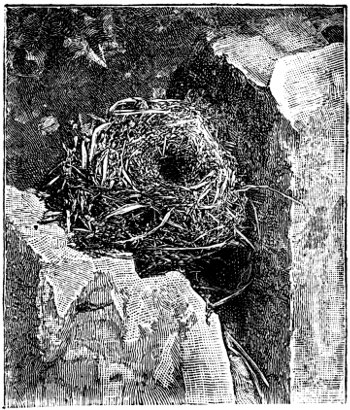
Like the campagnol, they make globular
nests of grass, which may be found among the
herbage of the bank by those who know where
and how to look for them.
Just as the ordinary farmer lumps together
half-a-dozen species or so of small birds,
under the comprehensive title of “sparrows,”
so do most people consider that every
animal which labours under the misfortune of
being small in dimensions, brown in colour,
and having a tail appended to its body, must be
either a rat or a mouse, according to its
size.
No one can be familiar with the banks of
any brook without being acquainted with the
pretty little WATER-SHREWS, which, like their
relatives of the land, are almost invariably
considered as mice, although, as we shall presently
see, they are not connected in any way
with the creatures which they superficially
resemble.
If the observer will pick out some spot
where he can be tolerably screened, and where
the water of the brook is clear and rather
shallow, he will be very likely to come upon
the water-shrew (Cróssopus fódiens). Both of
these names are very appropriate. The first,
or generic, name is of Greek origin (as all
generic names ought to be), and signifies
“fringe-footed.” The name is due to the
fringe of stiff hairs with which the feet are
edged. A similar fringe is found on the
lower surface of the tail. As these fringes
are white, they are very conspicuous. Their
object will presently be seen.
The second, or specific, title is (as all specific
titles ought to be) derived from the Latin,
and refers to the habits of the species. It
signifies a digger or burrower, and alludes to
its custom of digging burrows in the banks of
the brook in which it loves to disport itself,
and where it obtains much of its food.
As with other creatures, absolute stillness and
silence is required on the part of the observer
before the water-shrew will even show itself.
Though there may be plenty of the little
animals within a few yards, not one will be
visible. But in ten minutes or thereabouts
the silence will reassure them, and they will
make their appearance on the bank.
I have seen them playing with each other
on the bank of a rivulet which at that time
was so dried up by want of rain that the
water was scarcely a foot in width. They
were almost within reach of my hand, and
could easily have killed one or two with a
stick. But as I prefer watching the habits of
animals to killing them, they continued their
pretty and graceful evolutions undisturbed.
Being sociable little creatures, a single
water-shrew is seldom seen, and, if the observer
should detect one of the animals, he
may be tolerably certain that it will presently
be joined by others. They are as playful as
kittens, and, in their way, quite as graceful,
their lithe bodies and active limbs being able
to assume as many varied attitudes as may be
seen in a family of kittens at play.
They chase each other over the bank, pretend
to fight fiercely, squeaking the while as if
wounded to death, just as puppies will do
when playing and making believe to be hurt.
Then one will jump into the water, and dive,
as if to escape, while one or two others will
pop in after it, and chase it under water.
Indeed, on the occasion which I have just
mentioned, the whole proceedings reminded
me forcibly of the games in which the boy
swimmers of Oxford were wont to indulge for
the best part of a summer’s day.
One of our favourite games was for one to
dive into the Cherwell (mostly from the top
of a pollard willow), and then for the rest to
dive after him, and try to catch him under
water before he had swum a certain distance.
We used to shriek in our sport quite as much,
and as loudly in proportion to our size, as the water-shrew
squeaks, and I cannot but think
that if any being as much superior to man as
man is to the shrew could have watched us,
we should have amused him much in the same way
that the shrew amuses us.
In his admirable work on the British mammals,
Mr. Bell states that the water-shrew will
dive into a shallow, rippling stream, and
run over the stones, pushing its long snout
under them, and turning them over, should
they be small, for the sake of dislodging and
capturing the fresh-water shrimp (Gammarus),
and then carrying it off to the bank and eating
it with an audible, crunching sound.
I have not personally observed the creature
engaged in this sub-aquatic hunt, though I
have often seen it dive, and have been near
enough to note its singularly beautiful aspect
as it wriggles its irregular way under the
surface.
Air is largely entangled among the hairs of
its body, the imprisoned bubbles looking just
like globules of shining silver. The water-spider,
which is also a common though unsuspected
inmate of the brook, is adorned in
a similar manner when it dives.
No one can watch these pretty little creatures
without being interested and amused.
But amusement ought not to be our sole
object in observing the inhabitants of a brook.
Let us catch one of the animals and keep it
long enough to examine it. There is little
difficulty in capturing a water-shrew, as the
little animals are so fearless when they think
themselves unobserved that a small hand-net
can easily be slipped over them in their gambols.
We need not keep our captive long,
and, after inspecting the characteristic fringe
of the feet and tail, we will examine its head
and jaws.
A mere glance at the head ought to tell us
that it cannot be a mouse, no mouse having
a long, pointed snout, which projects far
beyond the lower jaw. On opening its mouth
and examining its teeth, we not only see that
it cannot be a mouse, but that it is not even a
rodent. It is, in fact, much more nearly related
to the hedgehog than to the mouse.
All its teeth are sharply pointed, and the
lower incisors project almost horizontally forwards.
The animal must, therefore, be predacious
in character, and a comparison with
the structure of other animals shows that it
belongs to the important though not very
numerous group of the insectivora, or insect-eaters,
of which the mole is the generally
accepted type. There are, however, some
systematic zoologists who hold that the
shrews, and not the moles, ought to be the
typical representatives of the insectivora. This,
however, is a matter of opinion, and its discussion
does not come within the scope of our
present undertaking.
Before we release our captive, we will examine
its ears.
These are small, as are those of all water-inhabiting
mammals, but there is a peculiarity
in their structure which is worthy of notice.
They are furnished with three small valves,
which, being made on the same principle as
those of the heart, are closed by the pressure
of the water as soon as the animal dives below
the surface, and open by their own elasticity
when it emerges.
Now, we will allow it to escape into the
water, and take note of it as it swims away.
I have already casually referred to the irregular
course which it pursues in swimming.
This is due to the fact that the water-shrew
drives itself along by alternate strokes with
the fringed hind feet, so that its progress
reminds the observer of that of a boat propelled
by two unskilful rowers, who have not
learned to keep time. Still, its pace is tolerably
rapid, though it lacks the steady directness
which characterises that of the water-vole.
Another remarkable point in its swimming
is that the outstretched legs cause the skin of
the flanks to be widened and flattened in a
way that reminds the observer of the flying
squirrel when passing through the air. Although
in the water-shrew the skin is not
nearly as much flattened as in the squirrel, it
is expanded sufficiently to alter the shape of
the creature in a notable manner.
Supposing the observer to be tolerably
familiar with the terrestrial shrews, he must
have been struck by the blackness of the fur
of the back, and the contrasting whiteness of
the under-surface. So strongly, indeed, is
the contrast marked, that an exceptionally
dark variety was long considered as a distinct
species, and called the “oared shrew.”
Like the insectivora in general, the water-shrew
is not at all particular in its diet, providing
it be of an animal nature. As most of
us know, the hedgehog, although its normal
food consists of insects, snails, and the like,
will feed on frogs, toads, mice, and even snakes
and blindworms. So will the water-shrew, if
it can be fortunate enough to find the dead
bodies of any of these creatures, for it is
not sufficiently powerful to kill them for
itself.
In Mr. Bell’s work, to which reference has
already been made, there is an interesting
notice of the carnivorous habits of the water-shrew.
An ordinary rat had been caught and killed
in a steel trap, and upon the body of the rat
was perched a little black creature, which
proved on examination to be a water-shrew,
which was trying to make a meal upon the
rat. It had already bored a hole in the side
of the rat, and was so absorbed in its task that
it suffered itself to be touched with a stick
without being alarmed.
This little animal does not restrict itself to
the neighbourhood of water, but is often
found at some distance inland. It has been
accused, and I believe with justice, of devouring
the eggs of river fish, a crime which, as I
have already mentioned, is wrongly attributed
to the water-vole.
Although we may see the water-shrew swim
away and disappear below the surface of the
water, we may watch in vain for its reappearance.
As is done by the duckbill of Australia,
the animal always makes several entrances to
its burrow, one of them being on the side of
the bank, below the surface of the water. It
can, therefore, enter or leave the brook without
being observed.
All the shrews, whether of the land or
water, were at one time the objects of universal
dread, and even the toad and blindworm could
scarcely be more feared.
As one old writer remarks, in his sweeping
condemnation of the animal, “It beareth a
cruel minde, desiring to hurt anything, neither
is there any creature that it loveth, or it loveth
him, because it is feared of all.”
It was held to be the special foe of cattle,
biting their hoofs while in the stall and running
over their bodies as they lay chewing
the cud in the field. A cow over which a
shrew had run was said to be “shrew-struck,”
and to fall straightway into a sort of consumption,
accompanied with swellings of the
skin.
The disease, being caused by the shrew,
could only be cured by the shrew, the usual
mode of treatment being to burn the animal
alive and rub the cow with the ashes. As, however,
a shrew might not always be at
hand when a cow was taken ill, the ingenuity
of our forefathers devised a
plan of having essence of shrew always
within reach.
A shrew was caught alive, and a
hole bored into the trunk of an ash
tree. The shrew, which must be
still living, was put into the hole, the
entrance to which was then closed
with a wooden plug. As the body
of the shrew decayed, its virtues were
supposed to be absorbed into the tree,
so that a branch of a “shrew ash,” or
even a few leaves, were supposed to
be an effectual cure if laid upon the
suffering animal.
The tail of a shrew, when burned
and powdered, was considered as a
certain remedy for the bite of a dog;
only the tail must be cut from a living
shrew.
I have already made casual mention
of the shrews of the land.
Two species of land-shrews are recognised
as inhabitants of England.
One is the common SHREW, or SHREW-MOUSE
(Sorex vulgáris), which for a
long time was thought to be identical
with the water-shrew. The
fringed feet and tail, however, afford
sufficient indications that it is a distinct
species.
Towards the end of autumn there seems to
be quite a mortality among the shrews, their
bodies being plentifully strewn about the
roadways and paths across fields. Why this
should be so no one can tell, though many conjectures
have been offered, one absurd theory
being that man and the shrew are so antagonistic
to each other, that when a shrew tries
to cross a pathway made and used by man it
dies from sheer antipathy.
This fact was known to Pliny, and Topsel,
the old writer who has already been quoted,
is of opinion that when a shrew dies in a cart-rut,
the finder should not fail to secure so
valuable a prize.
“The shrew which by falling by chance
into a cart road or track doth die upon the
same, being burned and afterwards beaten or
dissolved into dust, and mingled with goose-grease,
being rubbed or anointed upon those
who are troubled with the swelling coming by
the cause of some inflammation, doth bring
into them a wonderful and most admirable
cure and remedy.”
The same author mentions its predacious
habits, and states that it is especially fond of
the putrid flesh of the raven, the French using
it as a bait, and killing numbers of shrews as
they are feasting on the dead bird. He is
especially careful to mention that the deluded
shrews are killed with shovels.
The third species of British shrew is the
PIGMY-SHREW (Sorex pygmæus), which is
even smaller than the harvest mouse, and is
the smallest of all the British mammals.
I have mentioned the three species, because
until quite recently much confusion reigned
concerning them and their habits, and much
difficulty has been found in disentangling
them.
For example, no distinction had been recognised
between the common shrew and the
water-shrew, while the pigmy-shrew was
thought to be the young of the common or
erd-shrew, and an exceptionally large specimen
of the water-shrew was supposed to be a
separate species, and distinguished by the
name of oared-shrew.
So, by means of carrying out our study of
the water-shrew we have not only found much
that is interesting and amusing, but have
added something to our knowledge of animal
physiology.
(To be continued.)
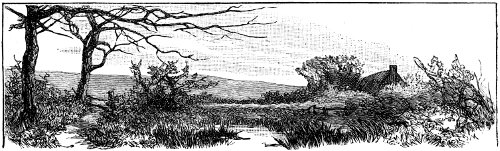
NEST OF THE CAMPAGNOL.
HISTORICAL SKETCHES OF MUSICAL FORMS. — Sketch IV.—Madrigals and Secular Part Music. — Glee. — Part Song.
By MYLES B. FOSTER, Organist of the Foundling Hospital.
n my last sketch
I endeavoured to
show you, as briefly
as I could, the historical
aspect of
sacred concerted
music in some of
its vocal forms,
with and without
instrumental accompaniment.
We will
now, for a short space, consider
vocal concerted music
as adapted to secular uses.
Prominent here above its fellows stands
the Madrigal, claiming precedence not only
for its antiquity, but also for its lofty style,
and, in most cases, learned and elaborate
development.
Once again the name for our subject is
veiled in a certain amount of doubt and speculation.
There are at least five different
theories in reference to the derivation of
“Madrigal,” not one of which seems altogether
suitable. All disputants agree on one
point, at any rate, that “Madrigal” was
originally the term given to poems founded
upon a motto or theme, and was afterwards
transferred to the music to which such poems
were wedded.
From the rarity of MSS. in early times, one
is led to believe that the Troubadours extemporised
the discant[1] which they added to
their secular melodies, and which was as undoubtedly
the origin of the madrigal as the
combination of plain chant and discant was
the fount from which sprang the motett. The
connection of the term with a poem of a
popular character certainly existed as early as
the fourteenth century, and perhaps earlier.
There appear to have been three classes of
secular composition, for which madrigal became
the general term—viz., madrigals for
one voice, with accompaniment; madrigals
for several voices, in parts and unaccompanied;
and, lastly, madrigals accompanied by many
instruments, and sometimes described as “apt
for viols and voices.” The English writers
preferred the second class, and excelled in it.
In the fifteenth century the madrigal was
well known in the Low Countries, being at that
time invariably constructed according to the
ancient ecclesiastical modes, and sometimes
containing great features of elaboration. I
complained, when speaking of the history of
the mass, that musical subjects originally
associated with profane words were introduced
as canti fermi, but we find in the case of the
madrigal that the reverse happened, and that
passages of plain chant were used in connection
with some light secular counter-subject.
Petrucci, before mentioned as the inventor
of movable music types, was the first to publish
these works, composed by such representatives
of the early Flemish madrigal
school as Okenheim, Tinctor, Josquin des
Prés, Agricola, and several others. I should
like once again to quote that learned writer
on music, Mr. Rockstro, who considers this
first period “no less interesting than instructive
to the critical student, for it is here that
we first find science and popular melody working
together for a common end.”
From 1530 to the end of the sixteenth century
a great advance was taking place in art
generally. Appropriate treatment of words,
and, if it were necessary, simplicity itself,
restrained that desire to show contrapuntal
complexity and other conceits at the selfish
expense of truth and honesty.
This advance in the right direction was
supported by the last composers of the old
Flemish school, Archadelt, De Wert, Waelrant,
and that great writer Orlando di Lasso,
at whose death the madrigal school of the
Netherlands ended; but not so the madrigal
itself, which long ere this had been transplanted
into other countries, and had commenced
to grow most healthily in Italy. In
fact, Archadelt’s first collection of madrigals
was published in Venice in 1538, and was
speedily followed by five other sets, in some
of which we find specimens by the first really
good Italian madrigal writer, Costanzo Festa.
In his work, and until Palestrina, vestiges
remain of the Flemish style; but gradually
the Roman or Italian element destroyed all
foreign character and influence, and alone
remained.
Palestrina wrote madrigals with equal
facility and merit in all styles; he named two
of his volumes “Madrigali Spirituali,” sacred
music, but intended rather for the chamber
than the church, for which latter the motetts
were written. He varies every passage according
to the sentiment of the words, and
above all his contrapuntal learning, places his
noble sincerity and purity of style and expression.
Would that our modern work
possessed such simple nobility!
Succeeding him, Felice Anerio produced,
and in 1585 published, three volumes of
Madrigali spirituali, and, soon after the year
1600, two volumes of secular madrigals; there
were besides fine madrigals by Giovanelli
Nanini, Francesco Anerio, and last but not
least, Luca Marenzio. These and others
formed the great Roman school, but there
existed a school in Venice also, founded by
Willaert the Netherlander, from which
sprang the works of the two Gabrielis, Leo
Hasler, Gastoldi and Croce. In Florence
also madrigals were very popular for a short
time, until the craving of the Florentines for
instrumental accompaniment destroyed their
early affection for purely vocal music.
In Naples a lighter form (villanella) existed,
but in France and Germany it found no
home, where the chanson and volkslied held
their respective sway.
In England a national school was formed
which took firm root, and developed into fully
as healthy a tree as any of the rival foreign
growths. First of all Italian madrigals were
introduced and printed in England, but by
the end of the sixteenth century Byrd and
Morley had published original specimens, and
the madrigal was fast becoming an English
institution, supported by such excellent composers
as Weelkes, Edwardes, Kirby, Dowland,
Wilbye, Ford, Benet, Michael Este, and
others. We may call special attention to
Morley’s collection in honour of the virgin
Queen Elizabeth, named the “Triumphes of
Oriana,” including madrigals by many of the
above-named writers. It was published in
1601. Only a few years later Orlando Gibbons
brought out a volume of “Madrigals and
Motets,” and just a hundred years after the
earliest publication in England of such works,
appeared a book of madrigals collected by
Martin Pierson. Madrigals they undoubtedly
were, though he called them “mottects.”
Ambros, in his “Geschichte der Musik,”
speaks in the highest praise of our great
madrigal school, and names it “one of the
most pleasing flowers of that Elizabethan
soil,” a soil teeming with great scholars, poets,
and dramatists.
To conclude, the madrigal is generally
interpreted by many voices to each part, and
as a rule is the more effective in proportion to
the number of singers employed. Whereas
the glee, into which the madrigal gradually
changed, and of which we are about to speak,
is intended to be sung by a single representative
of each part. Other differences,
more important than this, we shall have
occasion to note later on.
At the beginning of the seventeenth century
the madrigal, properly so called, disappeared
from amongst the compositions of both English
and foreign musicians. The word glee
is the Anglo-Saxon “gligg”—music, and has
no special reference to joyfulness; in fact, it
is as common to find the title “serious glee,”
as it is to see “cheerful glee.” A glee is
unaccompanied, and is written for at least
three solo voices, most frequently men. The
chief differences between the glee and the
older form of madrigal are the natural results
of evolution in harmony, and the wedding
of words to expressive music, even in defiance
of ancient and mechanical rules. The tonality
of the former is modern, the subjects are
constantly changing, and are seldom developed,
leaving an unsatisfactory feeling of
restless abundance, inability to make the best
use of the rich resources, and a consequently
frequent complete cadence, which in many
cases gives a detached, hesitating feeling to
the work. Continuity seems to be the best
test of great ideas; having something to say,
and if worth saying, saying that something
thoroughly and logically.
Our best glee writers, living from 1740 to
the early part of this century, were Samuel
Webbe, Dr. Callcott, his son-in-law, William
Horsley, Sir H. R. Bishop, and Sir John
Goss. If you go back to the commencement of
the glee period, by a careful study of the
works of Weelkes and Gibbons, you will find
in the latter’s compositions many striking
novelties in harmonic progression, and in
those of the former equally powerful and
novel contrasts in movement and expression,
and in the masterpieces of both great independence
of thought, in which combined advances
we trace the transition from the madrigal
to the glee, the latter being essentially
English.
Later in the seventeenth century, during
and after the Commonwealth, meetings for
the singing of glees and catches were generally
held in inns and taverns, the musicians
being forbidden the theatres, previous to the
restoration of King Charles II.
Glees were first published in the collection
by John Playford, called the “Musical Companion.”
Catches, canons, and rounds took
the place of the old glee after this: and even
these, according to Dr. Greene, were seldom
sung about the middle of the eighteenth century.
Amongst excellent writers of catches
and canons we find Henry Purcell, Dr. Croft,
Dr. Blow, and many others. Shortly after
Dr. Greene’s lament—that is, in 1760—a
catch club was started for the resuscitation of
glee and catch singing, and since then unto
our own times clubs and societies have flourished
for this purpose, and have encouraged
English composition in these forms.
It is thought by some writers that Sir
Henry Bishop’s glees are not properly so
called, because they have independent accompaniments.
Their form, however, is generally
that of the best glees.
A canon is a species of imitation, the most
strict and exact of all imitations, written according
to rule (καυώυ), the idea being that
one voice shall start a melody and some other
voice follow with the same melody a few beats
later on, imitating the first voice note for note,
and usually interval for interval, either at the
unison, the octave, or some other distance.
At one period canons were made musical puzzles,
by the composer writing only the first
part (called the “dux,” or leader), and then,
by some sign over one of the bars, indicating
at what point the following voice (or
“comes”) should come in, the latter singer
having to guess the correct interval at which
he was expected to enter. However ingenious
such riddles may be, they do not help art.
A catch at first greatly resembled the round,
where a complete continuous melody was
written out, and when one singer had reached
a certain point in this melody, another singer
had to begin, and catch up his part in time—the
difference between catch and canon being
that in the former each part imitates at the
same pitch; in the latter the imitation may be
at any interval from the original voice. Besides,
many canons are connected with sacred
words, and introduced into our cathedral services,
whereas the catch, in the reign of that
dissolute monarch, Charles II., degenerated
into an improper play upon words, assisted by
music. At a later date, in the eighteenth and
at the beginning of this century, this idea of the
singers “catching at each other’s words,” so
as to alter the meaning of those words, was
cleverly used by S. Webbe, Dr. Callcott, and
others. A well-known example by the latter
will best explain the effect produced:—
“Ah! how, Sophia, could you leave
Your lover, and of hope bereave?”
“Go, fetch the Indian’s borrowed plume,
Though richer far than that you bloom.”
“I’m but a lodger in her heart,
Where more than me, I fear, have part.”
The result of one voice entering after
another is, that the first seems to be shouting,
“A house a-fire!” the second excitedly
answers, “Go, fetch the engines!” whilst the
third excuses himself by saying, “I’m but a
lodger!” After all, these could only be considered
ingenious trifles, and most of the
singing clubs have turned their attention to
the more interesting and higher forms of
madrigal, glee, and part song, which, as a
later development, we will now speak of.
A part song is most likely to prove itself a
melody harmonised, in three, four, or more
parts—that is to say, there will be but little
contrapuntal or imitative writing about it. It
is of German origin; but it has been imported
into our country, and our native composers
have written some very beautiful specimens.
Part songs have been written either for
sopranos, altos, tenors, and basses, or for male
or female voices only. Many are in the ballad
form, in which the same music is repeated to
any number of verses; others are more elaborate,
and contain portions allotted to solo
voices, or to a single voice accompanied by a
chorus. Part songs may be set to either secular
or sacred poems. Schubert’s, Weber’s, and
Mendelssohn’s contributions to this form of
music are of great value and of wonderful
variety.
Those of the latter helped to revive the
taste for part music in England, and assisted
in the foundation of the many classes and
smaller choral societies which nowadays are in
existence all over the country, from Penzance
to the north of Scotland, and the formation of
which creates the demand in our country for
composition of this kind. Amongst modern
English writers may be named Henry Smart,
Sullivan, Samuel Reay, Barnby, Macfarren,
Miss Macirone, Eaton Faning, and last and
greatest, J. L. Hatton. I might add to this
list many names, for the making of part songs
is without end.
Whether in two, three, or more parts, the
part song should be sung by a number of
voices, the proportion, of course, being carefully
balanced. I must tell you before I finish
that there are also many duets, trios, and
quartets which do not come within the
range of the part song, it being intended that
they shall be rendered by a single representative
of each part, but many of these are extracted
from works in which each part is
taken by one of the dramatis personæ. Such
excerpts we cannot include in our consideration
of complete works. In my next sketch
I hope to conclude the subject of vocal forms,
and to turn your attention to instrumental
varieties.
(To be continued.)
VARIETIES.
Music run Mad.
“Yes,” says Heine, writing of the piano,
“the piano is the instrument of martyrdom
whereby the present elegant world is racked
and tortured for all its affectations. If only
the innocent had not to endure it with them!
(Alas! my neighbours next door, two young
daughters of Albion, are at this moment practising
a brilliant study for two left hands.)
“These sharp, rattling tones, without a
natural ‘dying fall’—these heartless, whirling
tumults—this archi-prosaic rumbling and
tinkling—this pianoforte mania kills all
thought and feeling, and we grow stupid, insensible,
and imbecile. This hand-over-hand
dexterity of the piano—these triumphal processions
of piano virtuosi—are characteristic
of our time, and prove utterly the triumph of
mechanical power over the soul. Technical
ability, the precision of an automaton, identification
with the wire-strung wooden machine—this
sounding instrumentification of humanity,
is now lauded and exalted as the
highest attainment of man.”
Endless Labour.
“Some respite to husbands the weather may send;
But housewives’ affairs have never an end.”
—Tusser.
An Anagram.—“The best anagram,”
says Chevreau, “I have met with is one which
was shown me by the Duchess de la Tremouille.
She was the sister of the Duc de Bouillon
and of Marshal Turenne, and her name
was Marie de la Tour—in Spanish, Maria de
la Torre—which a Spanish anagrammatist
found to be exactly ‘Amor de la Tierra.’”
Our Wants.—We are ruined, not by
what we really want, but by what we think we
want; it is wise therefore never to go abroad
in search of our wants.
Working Wonders.—“Time works
wonders,” said a young man of twenty-seven,
when he returned home and found his elder
sister only eighteen.
To the Editor of The Girl’s Own Paper.
Sir,—Will you kindly allow me space to
express my warm thanks for the numerous
parcels of old Christmas cards, scrapbooks,
and dolls for Indian children, which I have
received in response to my appeal in your
December number?
I have acknowledged most of these gifts
direct to the friendly donors; but some were
sent anonymously, and I am glad to take this
opportunity of thanking all who contributed.
The “Two Little English Girls” (S. and
N. H.) and “A Young Domestic Servant”
are among those who gave no address, and
their parcels were very welcome. I was able
to send off the cards that arrived just after
Christmas Day at once to Madras in a case
that had been packed. The others I will
transmit very shortly, mostly to Madras, but
some to a school at Poona, the lady superintendent
of which has asked me to let her have
some pictures for her little scholars. Miss
Govindarajulu, the Deputy-Inspector at Madras,
wrote to me lately that the head master
of a girls’ school had begged for a second
supply of cards, as he had found the attendance
of the children so much improved in consequence
of his having had some for distribution
last March. She says that sometimes
Mrs. Brander lets the children choose which
cards they like best, and they always take
those with the brightest colours. This leads
me to tell your readers that a very pretty
effect is produced by pasting or gumming
Christmas cards, each separately, on to a piece
of gay-coloured calico. A little margin of
calico should be left round the card, and this
should be snipped, so as to form a fringe.
Mrs. Brander has been continuing her inspection
tours, travelling from one place to
another to examine the girls’ schools. She
went lately from a town called Salem, which
she reached by railway, to a small place thirty-one
miles distant—Atur. The road is so
frequented by thieves that she was advised to
engage drivers for her procession of carts
belonging to the caste of those very thieves,
so as to ensure not being attacked. This was
done, and they proved “most polite and excellent
drivers.” The school at Atur contained
only forty children; but Mrs. Brander
felt that she did good by visiting it. The
prizes that she had brought were distributed,
and the little girls were delighted to receive
them. An important native gentleman of the
place who came to the ceremony made a good
speech in the Tamil language, and altogether
Mrs. Brander’s arrival was felt to be an encouraging
incident in the life of that far-off
place.
I shall be glad after a while to tell your
readers how their kind presents were used;
and I may add that I shall still be grateful for
more.
E. A. Manning.
35, Blomfield-road, Maida-hill, January 18.
DRESS: IN SEASON AND IN REASON.
By
A LADY DRESSMAKER.
ON THE MEER.
Just at the present writing we are in the
middle of the sales, which now seem to be
carried on far into the month of February, at
many of the shops, and certainly appear to
offer each year more and more benefits to the
purchaser of goods. But it must be understood
that the said purchaser have her wits
about her, and know what she wants. This
last is the case with very few women who
are not very methodical in their purchases of
dress, and very rarely make their plans far
ahead. This is explained, first, by their
slavish adherence to the ephemeral fashions of
the day, and also by their being led so much
by the eye, and buying things they fancy, not
the things that are really suitable or needful
to them. There are few women who dress on
any plan of what is most becoming to their
individual style, or most lasting, with a view
to their particular purses; and the longer I
live the more convinced I am that it needs
special qualifications to be a “shopper” of
any ability; the greatest requisite of all
being a cool, calm head; and, if you have
children to cater for besides yourself, the
power to make a plan and stick to it. It is
wonderful how much you find to help you
when you once do this, or how easily everything
arranges itself.
“But,” says someone, helplessly, “how am
I to know what to wear or what my style is?
Where am I to find rules to guide me?” In
the present day we seem to have two rules,
both of which are comparatively easy. The
first is that the complexion is to be the guide
as to the colours worn, while the second is
that the eyes shall perform that office for us.
Where there is a poor complexion, the first
rule may be followed, but where the eyes are
good, I think the last is decidedly the best. For
instance, the many women who possess good
eyes of a greenish or decidedly green hue will
look best in olive, bottle, or very dark Tyrolese
green—called sometimes a “hunter’s green,”
having much blue in it; and the large army
of women with yellowish-brown eyes look
best in shades of yellowish-brown. The same
may be said of blue eyes, which are changed
into a hue like spring violets by a judiciously-chosen
blue of a dark shade. Grey eyes which
verge on blue may also wear blue; but the
blue must be of the shade called “royal,” as
a blue with no reflections will not answer.
For very dark women and girls with good
clear skins, there is a large amount of choice
in colour—red, orange, and yellows, as well as
black, grey, and navy blue. But if the skin
be sallow and dull, she may use dark and
light reds—no blues nor greens. White and
primrose-colour are likewise generally becoming
to them. Fair-skinned people may wear
browns, blues, and pinks, as well as green.
But after all, the great thing, it seems to
me, is to be able to choose for one’s self; and
thus to avoid either the extreme of fashion or
the fear of dowdiness; and the taste of the
Englishwoman seems generally to turn to
quiet, neat styles. It is to her good taste and
sense that we owe most of the best fashions of
the day—the tailor-made, neat dress of tweed
cheviot or woollen material; the sensible
coloured under-petticoat, dark stockings, and
the comfortable ulster.
So far as hygienic dress is concerned, the
rules of that are fairly fixed now, and most
women and girls have decided in favour of the
tight-fitting, elastic woollen combinations,
either of Dr. Jæger’s make, or of some
English firm. Add to that the divided skirt,
made of black cashmere or serge, and lined
with flannel for winter use, as the sole
needful under-garments for the cold weather.
As to the stays, they may be the new knitted
ones of Jæger’s make; the low riding-corsets,
or else a boned bodice made of jean, and
modelled like the dress-bodice, to fit without
squeezing or tightening in. So long as the
divided skirt is used as an under-skirt, no
objection can be taken to it, as it does not
show at all. The dress above should be made
short enough not to require lifting, however
muddy the roads and pavements; and it is
decidedly the most comfortable garment ever
invented in that capacity.
GIRLS’ WINTER DRESSES IN WOOLLEN MATERIALS.
Of course, as the sales are going on, there
is little that is novel to chronicle. Indeed, the
winter events, where all that is pretty in dress
are seen, are the private views of the two
great picture galleries—the Royal Academy
and the Grosvenor Gallery. At these two
places all the élite and the famous in literature,
art, and society congregate; and generally
wear their prettiest clothes, I think. Of
course, some æsthetic ladies are to be seen.
One of them had on a pelisse of moss-green
velvet, made very short-waisted at the back,
with a small round cape, the skirt hanging
long, straight, and full; in short, much like a
“Kate Greenaway figure,” and very peculiar
was the effect. One lady wore a brown
cashmere, with pea-green trimmings, and
flowing ribbons of pea-green, which, I
suppose, must have been an artistic fancy.
The great difference between the artistic and
æsthetic dressing is in the way the dress is
cut at the neck. The artistic portion bares its
throat bravely, at any and every age, and cuts
its dresses well down on the collar-bone;
while the general public wear high neck-bands,
and try to reach the tips of their ears;
assisted by big beads and ruchings of satin.
At present neither class affects collars, unless
the falling lace of the æsthetic lady can be
mentioned in that category.
There was a great deal of brown worn, relieved
by yellow, and also much green in
various shades, the most popular being moss-green
and a new hue called “jade.” There
was also a good deal of heliotrope, and that
always in woollen materials; so I should not
be surprised if we found this hue in vogue in
the spring. It is extremely becoming to many
people. Black jackets and mantles are worn
with it, and also black bonnets with heliotrope
trimmings. Black plush is the most popular
material for small or large mantles, and it
seems, in any case, to be very much trimmed
all over—shoulders especially. Amongst these
artistic ladies the bonnet-strings are usually
tied very loosely, resting on the throat, while
everyone else in the “Philistine” world—as,
I believe, it is nick-named—still wears theirs
tightly tied under the chin, with short ends,
and the bows tied under the chin, and so much
pulled out as nearly to touch the ears, one
loop being ornamented by a brooch or pin,
generally jewelled.
Red in all shades was also much worn. In
some cases it was quite a bright scarlet; but
I did not think the idea a happy one. I
looked very carefully at the numberless so-called
tailor-made suits, and, after all, admired
the wearers—neat, trim and tidy—the
most. They were of all materials—ladies’
cloth, cheviot, homespun, and undyed Shetland
cloth. Many of them were suitable for
any season of the year, as, indeed, the true
tailor-made gown should always be. The
newest thing in them that I saw was a skirt
put on in three immense box-pleats, so big
that one formed the front, and the two others
were enough for the back and sides, the skirt
itself being quite plain and free from any ornament
whatever. The newest muffs seemed
to be those made of the material of the dress.
The trimming was of fur, plush, or jet passementerie.
Amongst the few changes in fashions I must
mention that the basques to bodices for everyday
wear seem to be longer, and in some
cases they are put on separately to the bodice.
Polonaises also are becoming very general,
and, no doubt, in the spring we may see a
great return to them—certainly the most becoming
and useful of any of our dresses. The
polonaise that was illustrated in our dress
article with the pleated bodice will be much
in vogue, and also a smockfrock polonaise that
is very pretty and becoming, but, of course,
would need the smocking performed in the
first style of that difficult art. This makes it
rather expensive, and the houses who make a
speciality of the work find it far from easy to
get good workers, and, consequently, these
smocks are expensive.
This winter there has been so much choice
in the matter of styles and shapes that
nothing can be called “old-fashioned,” and
I am looking forward with hope to the long
wished-for day when our own individual
thought will, in a great measure, rule our
fashions, and make us much happier in
having less to worry ourselves with, if our
gowns prove not exactly like Mrs. A.’s or
Mrs. B.’s; and that they bear the mark of
last year, or even of the year before. So long
as they suit us personally, it really ought not
to matter.
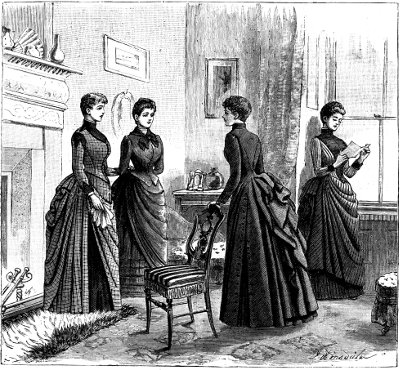
PRINCESS DRESSING GOWN.
This year mantles have been either very
large or very small, and bonnets have been
both remarkably high and almost hoodlike in
shape. Hats, too, have been small and close-fitting,
or large and spreading. As to our
dresses, we have worn polonaises, pointed
bodices, and jacket-bodices quite indiscriminately.
Norfolk blouses have been also much
worn, and they promise also to continue in
favour, as they are most useful for young and
old. The same may be said of the jersey
bodice, and the so-called garibaldi skirts. In
regard to out-of-door jackets, I should think
the same tight-fitting, jaunty-looking jackets
will rule such as we have worn for the last two
seasons. They are too useful to be discarded
as permanent occupants of our wardrobes.
In our sketch of “girls’ winter dresses in
woollen materials,” I have carefully given
every method of draping the skirts and
making the bodices that has been worn this
winter; and I consider most of them will be
continued on until the spring, as the “wrapping
style” of which the drapery hangs in
straight folds, and as if wrapped round us, is
very popular with everyone; and people seem
to have grown tired of the skirts which were
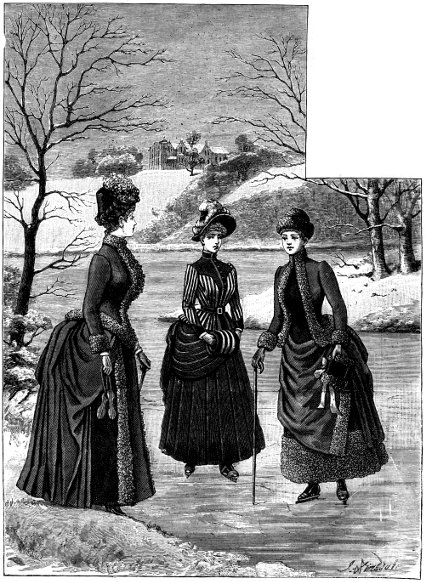
made of pieces of material. The skating
picture, too, shows the general effect of out-of-door
dresses during the cold weather; and
the way in which fur was used by the best
dressmakers and tailors. The dresses are
more graceful, and less heavy-looking than
usual, when trimmed in that manner. We do
not often have such a cold winter as the
present has been hitherto, and I hope my
readers have applied themselves to learn the
lessons of sensible and hygienic clothing
which I am constantly preaching to them.
Armed by it, they would have successfully
resisted the cold, and escaped unharmed. I
am more and more convinced that most of the
illnesses and deaths of our winters arise from
want of sensible clothing, and from the fact,
too, that we are all accustomed to regard
England as a temperate climate, when in
reality the cold is more felt here, on account
of its dampness, than in severer latitudes.
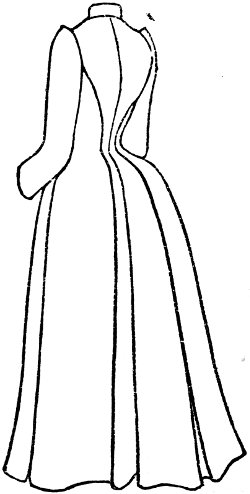
So many of our girls have begged that a
plain and simple shape for a dressing-gown
should be added to our paper patterns, that,
after looking about me for some time, I have
decided to select a princess shape, as one that
could be made at home by anyone with little
difficulty, either in flannel or any other material
selected. The pattern will be quite suitable
for a dress, if required, as many servants
prefer that shape to any other. Indeed, when
made up in a blue and white striped Galatea,
I do not know any dress in which a girl looks
better or is more becomingly attired for going
about her morning duties. I must confess I
like my maidens to look their best and happiest
while under my roof, and nothing but
the most exquisite neatness will content me;
and I have found a plain girl grow quite pretty
after a few months of care in the ordinary
matters of the toilet. The weekly bath is a
thing that every mistress can see that her servants
have, and also a few hours for attending
to and making and mending their own
clothes.
The princess dressing-gown, or dress, consists
of seven pieces, and may be made of
either eight or ten yards of material, according
to the width. The half of the back and the
half of the fronts are given, and the fronts
may be cut in one, if the pattern be intended
for a dress. Price of paper pattern, 1s.
All paper patterns are of medium size—viz.,
36 inches round the chest—and only one size
is prepared for sale. Each of the patterns
may be had of “The Lady Dressmaker,” care
of Mr. H. G. Davis, 73, Ludgate-hill, E.C.,
price 1s. each. It is requested that the addresses
be clearly given, not omitting the
county, and that postal notes crossed only
to go through a bank may be sent, as so
many losses have recently occurred. The patterns
already issued may always be obtained,
as “The Lady Dressmaker” only issues patterns
likely to be of constant use in home dressmaking
and altering; and she is particularly
careful to give all the new patterns of hygienic
underclothing, both for children and young
and old ladies, so that her readers may be
aware of the best method of dressing.
The following is a list of those already
issued, price 1s. each.
January, 1886, princess under-dress (under-linen,
under-bodice and underskirt combined);
February, polonaise, with waterfall back;
March, new spring bodice; April, divided
skirt and Bernhardt mantle, with sling
sleeves; May, Early English bodice and yoke
bodice for summer dress; June, dressing
jacket, princess frock, and Normandy cap
for a child of four years; July, Princess of
Wales’ jacket-bodice and waistcoat, for
tailor-made gown; August, bodice with
guimpe; September, mantle with stole ends
and hood; October, pyjama, or night-dress
combination, with full back; November, new
winter bodice; December, patterns of Norfolk
blouses, one with a yoke, and one with pleats
only; January, 1887, blouse-polonaise, with
pleats at back and front; February, princess
dressing-gown.
MERLE’S CRUSADE. — CHAPTER XIX.
By ROSA NOUCHETTE CAREY, Author of “Aunt Diana,” “For Lilias,” etc.
A CATASTROPHE.
bout three weeks
after my mistress’s
visit something
very terrible happened.
I wish
the history of that
day would get itself
told without
the pain of telling
it. My life has
been a happy one, thank God! I
have been “led by paths that I
have not known,” but even now I never
look back upon that day without a
shudder. Oh, Reggie, my darling! But
God was good to us, and the danger
passed; still, it will be only in heaven
that we may bear to look back on past
perils without dimness of eyes and failing
of heart!
I had never left Rolf alone with the
children for a moment since Judson
had told me of his mischievous propensities.
I had grown fond of Rolf,
and he was certainly very much improved;
but I always felt he was not
to be trusted, and either Hannah or I
kept a strict guard over him. He was
never permitted to enter the nursery in
the morning; if we went out, he joined
us, as a matter of course; but more than
once when he begged for admittance I
had refused it decidedly. Hannah was
always busy in the morning, and the
children slept for an hour, and if there
were time I liked to take Joyce to her
lessons, or to set her some baby-task of
needlework, and Rolf always made her
so rough.
On a rainy afternoon or in the evening
she would be allowed to romp with
Rolf, and they always played together
on the beach. Rolf was more in his
element out of doors. Judson had been
very unwell for some days; she was a
sickly sort of body, and was often
ailing; but just then she had a threatening
of quinsy, and seemed very feverish
and suffering.
Her room was close to the nursery,
and it was only sheer humanity for
Hannah or myself to go in now and then
and see what we could do for her. I
had got it into my head that she was
somewhat neglected by the other servants.
I know Gay thought so, for she
asked me to do what I could for her.
She had been ordered some linseed
poultices that morning, and Mrs. Markham
had come up to the nursery and
asked me very civilly if I would apply
them, as the upper housemaid was away,
and Susan was very clumsy and helpless.
“I will stay with the children,” she
said, quite graciously, for her; “and
Hannah is here.” And as I knew Rolf
was in the garden with his aunt, I could
not find a loophole for excuse. I do not
think I was wrong now, for how could I
have refused such a request? But the
fates were against me. That is a foolish
and untrue expression, but I will let it
stand.
The poultices were far from hot, and
poor Judson, who seemed in great pain
and very nervous about herself, begged
me to go down to the housekeeper’s
room and make some more. “It is no
use Susan making them, and Mrs.
Rumble is always so busy,” she whispered;
“do go yourself, Miss Fenton,
and then I shall be more sure of hot
ones.”
The housekeeper’s room lay at the
end of a long passage leading from the
hall, shut in with red baize doors. These
swing doors deadened sound, and that
was why I did not hear Rolf come in
from the garden and scamper upstairs.
The front-door bell rang immediately
afterwards, and some visitors were asked
into the drawing-room. I knew Gay
was about the premises, and the idea
never crossed my mind that Mrs. Markham
would desert her post and leave the
three children alone in the nursery; but
I heard afterwards that this was the
case. An old Indian friend had called,
and Mrs. Markham had desired Rolf to
summon Hannah from the night nursery;
but Rolf, who was seldom obedient to
his mother, had simply ignored the
order.
I was some little time in the housekeeper’s
room. The kettle did not boil,
and I was compelled to wait. I was
rather impatient at the delay. As I
stood talking to Mrs. Rumble, I saw
Mr. Hawtry ride up to the front door.
I succeeded at last in making the
poultices. Judson was very grateful to
me, and thanked me warmly as I put
them on. I had just covered her over
comfortably and taken from her the red
woollen shawl in which she had wrapped
herself, when a sudden report, as though
from a toy cannon, and then a piercing
scream from the nursery, made me start
as though I had been shot, for the scream
was from Joyce.
The next instant I was in the nursery,
but, oh, merciful heavens! the sight
that met my eyes. Hannah had just
opened the door. Rolf and Joyce were
huddled together on the window seat,
beside themselves with terror, and there
stood Reggie in the middle of the room
with his pinafore and white frock in
flames! I must have uttered a scream
that roused the house, and then it
seemed to me as though I knew nothing,
and felt nothing except the smarting
pains in my arm and shoulder. I had
thrown the child on the floor and covered
him with my body, and the woollen
shawl was between us, and I was crushing
the dear life almost out of him with
that terrible pressure.
I seemed to know instinctively that
nothing else could save him. Happily, I
wore a stuff dress, for there was no rug
or carpet in the nursery, and, with the
open door and windows, another moment
would have been too late. I could hear
Reggie’s piteous cries, but I dare not
release him; I must crush and smother
the flames. There was the terrible smell
of burning, the singeing of stuff, a
sudden uproar round me, confused voices
and exclamations. I seemed to hear
Gay’s voice crying, “Oh, Merle! you
will smother the child!” And then
strong arms lifted me off Reggie. I
knew it was Mr. Hawtry; no one else
could have done it. His grasp gave
me intense agony, and I tried to free
myself.
“Let me go; I must see if he is hurt.”
But Gay had him already in her lap, and
I knelt down beside her and examined
him carefully.
His frock and pinafore were hanging
in blackened shreds around him, but
there was only a large hole burnt in his
flannel petticoat, and one of his dear
little legs was scorched; not a curl of his
hair was singed, and only one hand had
sustained a slight injury. They said
there were bruises on him that I had
caused by my violence, but that was all,
Mrs. Markham assured me; there were
tears in her eyes, and her face was as
white as death as she said it.
“The little fellow will soon be all
right,” observed Mr. Hawtry, kindly;
“he has been frightened and hurt that
makes him cry so. But now it is time
your wounds should be dressed, Miss
Fenton.”
I looked at him as though I failed to
comprehend his meaning, but he pointed
to my arms with such a pitying
expression on his face, that I looked
too. My sleeves were hanging in
shreds like Reggie’s frock, and
there were large burns on each arm;
my right shoulder felt painful, too; a
faint sickening sensation seemed creeping
over me. I must have got my arms
under him or I should not have been so
badly burnt, and some of my hair was
singed. When Gay touched me gently
I shuddered with pain, and they all
looked at me very gravely.
“We must have Dr. Staples, Roger,”
observed Mrs. Markham; “her arms
must be properly dressed.”
“I will go for him at once,” returned
Mr. Hawtry, “but I advise you to give
her a little wine or brandy; she looks
faint with pain.” And then he went
away, and we could hear him galloping
down the avenue and along the road.
I drank what they gave me, but I refused
to lie down until Reggie had been
undressed. I would not be persuaded
without the evidence of my own eyes
that he had sustained no serious injury.
I suppose his scorched leg pained him,
for he still cried incessantly and beat
us off in his usual fashion, but when
Hannah had dressed him in his nice
clean frock, he grew pacified at the
sight of his blue ribbons, and only said,
‘Poor, poor,’ as he pointed to me. He
wanted to come on my lap, but when I
tried to take him I turned so faint, that
Gay looked frightened and snatched him
away.
I wanted to know what had become of
Rolf, but Mrs. Markham said, sternly,
and her lips were still very pale, that
she had sent him to his room. “Tell
me how it happened, Joyce,” she continued,
drawing the child to her. “I
told Rolf to fetch Hannah; did she not
come to you?”
“Rolf didn’t fetch her, Aunt Adda;
he said he was a big boy, and would
take care of us. Poor Rolf did not
mean to be naughty, did he, nurse?”
“Rolf must be severely punished for
his disobedience; he has nearly killed
your little brother, Joyce. Tell me what
Rolf did after that.”
“He asked me if I would not like to
see his dear little cannon that went pop
when he told it,” went on Joyce, looking
extremely frightened. “I did not know
cannons were wicked things, and I said
yes, and Rolf showed us the cannon,
and told us to get out of the way, for it
would kill us dead, and I runned, and
baby clapped his hands and runned the
wrong way, and Rolf had fire in his
hand, like Hannah lights the candles
with, and baby’s pinafore got on fire,
and I screamed as hard as I could for
nurse.”
It must have been just as Joyce said,
for the toy cannon was on the floor, and
a box of matches beside it. Probably
Rolf had not seen Reggie beside him,
and had thrown the lighted match
aside in his excitement. Mrs. Markham
sighed deeply as she listened. She had
sustained a severe shock; her face
looked very dark and rigid as she left
the room. I was afraid she meant to
punish Rolf severely, and begged Gay
to follow her and plead for mercy.
“Rolf has had a fright that will last
him for life; his terror has been punishment
enough.” But Gay shook her
head.
“It is no use interfering with Adelaide;
she will take her own way. I am
sorry for Rolf; but he deserves any
punishment he gets. Reggie would
have been burnt to death but for your
presence of mind, Merle; none of us
could have reached the nursery in time.
Mr. Hawtry said so at once.”
Reggie burnt to death! and then my
mistress would have died, too; she could
not have survived the horror of that
shock. I begged Gay faintly not to say
such things; the bare mention of it
turned me sick. I suppose she was
alarmed by my ghastly look, for she
kissed me, and said, soothingly, that I
must not distress myself so; we could
only be thankful that Reggie was safe.
Dr. Staples came soon after that. He
was a benevolent-looking old man, and
was very kind and gentle. He said one
of my arms, the left one, was severely
burnt, and that it would be some little
time before it was healed. “These
things depend a great deal on constitution;
but you seem strong and healthy,
Miss Fenton, so I hope you will soon be
right again; but you must not expect
to lose the scars.”
I was sorry to hear that, for I knew
the scars would remind me of a terrible
hour in my life. The dressing was very
painful, and when it was finished I was
compelled to follow Dr. Staples’s advice
and go to bed. I was suffering from the
shock, and I knew my arms would be
useless to me for a week to come. I felt
shaken and sick, and unable to bear the
childish voices.
Gay followed me into the night nursery
and gave me all the help she could, and
she did not leave me until my head was
on the lavender-scented pillow. In spite
of pain and dizziness, it was nice to lie
there and hear the birds twittering under
the eaves and the bees humming about
the flowers, and to look out on the sunshine
and feel a great mercy had been
vouchsafed to me, that I had not been
suffered to fail in the hour of peril.
Gay hung up her cage of canaries in
the window to divert my mind, and laid
a bunch of dark clove carnations, with a
late rose or two among them, on the
quilt.
“Mr. Hawtry is still here, Merle; he
is very anxious to know if you are in less
pain, and whether there is anything he
can do for you. He seems quite grieved
because Dr. Staples says your arm is
badly burnt.”
I sent a civil message of thanks to
Mr. Hawtry, and then I detained Gay a
moment.
“Miss Gay, you must write to Mr.
Morton yourself. I have promised your
sister to tell her everything; but it will
shock her too much, and I think Mr.
Morton should know first.”
Gay looked distressed.
“Need we tell them, Merle? Violet
is not at all well; Alick said so in his
letter this morning. Scotland does not
seem to suit her, and he thinks they will
soon come home.”
“And they have not been away a
month yet,” I observed, regretfully;
“not more than three weeks and two
days, and Mr. Morton is so fond of
Scotland.”
“Alick thinks more of Vi than deer-stalking.
If she be not well he will bring
her home without a word of grumbling.
In some respects Alick is a very good
husband. Why need we say anything
about the accident, Merle? Reggie is
scarcely hurt at all; his scorched leg
will soon get right.”
“It is not fair to keep anything from
them. I promised I would tell everything,
and my mistress must know I am
invalided and cannot do my duty.”
“You need not fret about that,” she
returned, cheerfully. “Susan shall help
Hannah, and I will be here as much as
possible. I am a famous nurse. We
will make Mrs. Rumble wait on Judson.
Very well, Merle, I will write to Alick;
but I would much rather not.”
I had forgotten poor Judson, but I did
not forget Rolf; I asked several times
after him, but Gay had not seen him.
Rolf was in disgrace, and a close
prisoner to his room. He had had his
dinner sent up to him; but Adelaide
was lying down in her own room all the
afternoon with a bad headache, and, as
Rolf’s communicated with hers, no one
could visit him unperceived.
I wondered if Mrs. Markham’s eyes
were at last opened to the danger of
Rolf’s disobedience and her own faulty
management. She was to blame as
much as the child. She had given me
her word to remain in the nursery, and
no visitors should have tempted her from
her post. It was no surprise to me to
hear she was ill with worry; her conscience
must have reproached her for
her breach of trust. If Reggie had been
killed, his death would have been owing
to her carelessness. Later on in the
evening, just as it was getting dusk,
Gay came to me for a minute with a
plate of fine fruit in her hand. They
had tempted me all day long with
delicacies, but I had felt too ill to eat.
The fruit just suited me, for I was
feverish with pain.
“Adelaide has just come downstairs,”
she said, with a droll little laugh. “Mr.
Rossiter had heard of the accident, and
had dropped in to inquire, so father kept
him to dinner. When Adelaide heard
that, she came down as soon as possible,
and there she sits, looking like a ghost,
until Mr. Rossiter takes his departure.”
“And Rolf?”
“Oh, I suppose Rolf is asleep,” she
returned, carelessly; and as she was
evidently in a hurry to return to the
drawing-room, I would not keep her;
but as soon as she had closed the door
a sudden idea came into my head. I
would go and see Rolf myself; I was
not easy about him. I knew his mother
could be too severe even with her idolised
boy on occasions, but I never could bear
a child to be long unhappy. I rose very
quietly, so as not to disturb the children,
and threw on my dressing-gown. I was
rather afraid my white face and bandaged
arms would frighten Rolf, until I
remembered it was dusk, and he could
not see me distinctly.
Mrs. Markham’s suite of rooms lay in
the west corridor. I knew no one would
be about; poor Judson was in bed, so I
reached Rolf’s room without interruption.
I thought I heard him sobbing softly to
himself as I opened the door. When I
spoke to him, making my way through
the summer twilight to his little bed, he
started up and held out his arms.
“Oh, Fenny, is that really you, dear
Fenny? Do come close and let me feel
you. I have been thinking of such
horrid things.”
I told him gently that I was in great
pain, and that he must not touch me,
but that I would sit down for a little
while beside him and talk to him.
“But I may hold your hand,” he
pleaded. “Is your hand burnt too,
Fenny, or don’t you like to touch me
because I am such a wicked boy, as
mother says, and very nearly killed poor
little Reggie?”
My heart melted at his pitiful tone,
and I stooped over him and kissed his
hot face.
“You may hold my hand, Rolf, dear,
if you like; it is only my arms that are
hurt; there, we are comfortable now.
Tell me, have you had a very miserable
day?”
“Oh, so miserable!” and there were
tears in Rolf’s voice. “Mother has been
so angry; she shut me up in this room
though it was such a fine day, and
would not let anyone speak to me, and I
could not get her to answer although I
said over and over again that I was
sorry and would not have hurt Reggie
for the world, he is such a dear little
fellow, you know. Oh! I am so fond of
him. But mother said no, she would not
listen; I had disobeyed her, and nearly
killed Reggie, and that Aunt Violet
would never speak to me again.”
“Oh, yes she will, Rolf.”
“But if Reggie had been really burnt,
you know,” and here Rolf shivered; his
hand was quite cold though his face was
burning. He was a nervous, excitable
child, and no doubt this long summer’s day
had been a martyrdom to him. He had
conjured up all sorts of horrible fancies
to haunt his dreams. Yes, he had been
sufficiently punished, I was sure of that.
“Tell me how it happened, dear,” I
said, quietly.
“I was firing my cannon to please
Joyce. I know mother told me never to
take it in the nursery, and that she did
not like my lighting it unless Judson
had the matchbox, but I forgot.”
“Did you really forget, Rolf?”
“Yes, really I did; I never do remember
things, you know. I was only thinking
how Joyce would scream when the
cannon popped. I told them to get out
of the way, only Reggie, poor little
fellow, ran against me and knocked the
match out of my hand—it was alight,
you know—and then Joyce did scream,
and,” but here Rolf buried his head in
the pillow; the recollection was evidently
too painful. “You will all hate me,” he
sobbed, “because I nearly killed Reggie—you
and Aunt Violet, and I do love
Aunt Violet, because she is so pretty.”
“No one will hate you, my poor child;
we are only sorry that the son of a brave
soldier like Colonel Markham should be
such a coward as to disobey his mother.
Your mother told you to fetch Hannah.
Did you forget that too, Rolf?”
“No,” in a conscience-stricken voice,
“I did not forget, Fenny, but I thought
it would be fun to take care of the
children.”
“But it was disobedience, Rolf, just
as much as your coming into the
nursery at that time you took advantage
of my absence first, and then of your
mother’s. I think a brave soldier like
your father would call that cowardly.
Now, I want you to listen to a story
about the bravest boy of whom I ever
heard.” And as I stroked his rough head
I told him the story of Casabianca and
the burning ship.
(To be continued.)
— Novello, Ewer and Co. — Stanley Lucas and Co. — J. B. Cramer and Co. — Hutchings and Co. — J. and J. Hopkinson. — Edwin Ashdown. — Marriott and Williams. — F. Pitman. — W. J. Willcocks and Co. — T. H. Barnett.
Concone’s Lessons. Fifty Lessons for the
Medium Part of the Voice, and Forty Lessons
for Contralto, or for Bass and Baritone.—It
is needless for us to recommend sterling
works like these, the value of which has been
acknowledged for so long a time; but we may
call special attention to this admirable new
edition, containing, as it does, a completed
system of phrasing and expression marks, a
correction of the breathing points, and a careful
revision at the hands of Mr. Randegger,
the well-known professor of singing at the
Royal Academy of Music.
The Return of May, a choral trio for
female voices, is a very clever piece of three-part
writing, with an interesting independent
accompaniment. It is by Amy Elise Horrocks,
and the words are those of Mrs.
Hemans.
Fly, little Song, to my Love.—A most
charming ballad by Alfred Cellier, whose
writings are always graceful in melody and
uncommon in harmony. The constant repetition
of the initial phrase becomes a little
tiring, beautiful though the phrase undoubtedly
is.
Violets.—A sweet, simple song addressed
to some flowers plucked to cheer a poor invalid
in the “great, dim, smoky city.” Poetry
by Ellis Walton. Music by R. B. Addison.
Four Songs for Tenor. Composed by
Whewall Bowling.—A good present for tenors
who sing something greater and better than
the drawing-room ditty of commerce. The
accompaniments are beautiful, and need good
playing.
(a) Four Sonnets by Shakespeare. The
German version by Bodenstedt. (b) English
Lyrics. Second set. Words by Shakespeare.
Composed by C. Hubert H. Parry.—Of these,
the sonnets will be above the comprehension of
the average singer. They are very fine and
wonderfully thought out and wedded to the sentiment
and expression of Shakespeare’s powerfully
expressive words. The lyrics from
Shakespeare’s plays are more easily grasped,
and cannot fail to give enjoyment. In No. 5,
“When icicles hang by the wall,” there is a
funny introduction of the song “We won’t go
home till morning” in the accompaniment!
Characteristic Tunes of the British Isles.
(Books 1, 2.) Selected and arranged for four
hands by C. Hubert H. Parry.—Very original
duet arrangements of our well-known national
songs. “Three Blind Mice” is treated in a
very droll manner. For perfect beauty we think
you will agree that “The Pearl of the White
Breast,” an Irish air, bears the palm. The
Scotch tune, “The Flowers of the Forest,” is
not the form of that song best known to modern
singers.
Larghetto and Allegro. For violin and
piano. By John Christian Mantel, who in
1730 was organist of South Benfleet, in Essex,
and who appears by his writing to be an admirer
of Handel’s.—The edition is by Otto
Peiniger, at whose recitals these old English
violin pieces have been played.
The Silent City, by Cotsford Dick, may
be recommended as a Sunday song. Effective
and easy, and of moderate compass.
O Loved and Lost. Song. Written and
composed by Lord Henry Somerset. Published
in F and A. The former key suitable
for basses and contraltos, and the latter key
for sopranos and tenors.—Full of delicate sentiment
and graceful treatment of what are
sometimes rather trite expressions in melody.
At the Concert. Humorous song. By
Henry Pontet.—Will amuse, if it does not
point an obvious moral to concert-goers, who
attend those entertainments in the body, but
in spirit (and conversation, alas!) are far, far
away.
A June Song, by Mary Carmichael, is,
what it should be, suggestive of the “odour
of hay:” “full of the scent and the glow and
the passion of June,” as the pretty words
tell us.
The Wreck of the Hesperus is set by C. H.
Lewis as a cantata for female voices, and
merits the attention of ladies’ choirs.
The Long White Seam. Song by Jean
Ingelow. Set to music by Wilfred Bendall.—A
song of more than average excellence by
this rising composer.
The Evening Farewell. A four-part song.
Composed by Sir G. A. Macfarren, to words
by his father.—Presenting nothing uncommon
about it, this little part-song runs smoothly,
and may be easily performed. Singers will
enjoy the soft effect of the minor common
chord on B flat, immediately following and, as
it were, qualifying the major chord upon the
same root. If proof were needed as to which
should be in reality the relative minor to any
major scale, the scale possessing the same
signature to start with, but contradicting
that signature in practice, or the scale having
the same dominant and the same leading note,
this little passage alone would decide us in
favour of the latter.
Broken Heart, An Old Tale, and May Song.—Piano
pieces, good in their form, songs without
words, but very suggestive of their titles,
and carefully written, by John Urich.
Alla Tarantella. Caprice for piano. By
Joseph L. Roeckel.—Characteristic and well
worked up to the necessary pitch of mad fury.
Danses Sclave. Pianoforte duets. By J.
C. Bridge, M.A., Mus.Doc.—Rather a mild
notion of the impetuous Slavonic dance, with
its strange accents and brusque uncouthness,
combined with its many charming and sad
quaintnesses. You should learn these duets,
though; for even if they prove that a man
writes best in accordance with his environment,
they will also prove themselves interesting,
pleasant tasks for young pianists.
In Elementary Music, Book I. of a complete
school, by Alfred Gilbert, M.R.A.M., it
seems to us that the arrangement made is
likely to prove rather confusing than otherwise.
Too much is said. One of the statements,
at least, will be a source of trouble,
viz., that “the white keys of the pianoforte
are called naturals.” What will the little
student do about E♯, F×, G×, C♭, B♯,
E♭♭, etc., etc.? The contradiction of the
above statement occurs naturally enough in
the music provided later on, but only in the
music. [Transcriber’s note—the multiplication sign, x,
has been used in the paragraph above in place of the double
sharp symbol and two flat symbols in place of the double
flat symbol.]
In Dreamland City. By Theo. Bonheur.—A
pretty song, with a graceful, taking refrain.
Bonnie Face. Words by the late Hugh
Conway. Music by A. H. Behrend.—Another
sad invitation from either a grannie, or an
auntie, or an unclie to a little childie to keep
its spirits up, and, if possible, remain a little
child for ever, as the opportunities for enjoyment,
or, at any rate, for laughter, become
limited when we learn to read and write.
Enough to damp the ardour of any healthy,
growing child.
La Zingara, for piano, by Michael Watson,
is named by him “Morceau alla Tarantella.”—The
bite of the tarantula seems in
this case to be rather pleasant than otherwise;
it would be better styled “A Gipsy Dance.”
Mirage.—An expressive, powerfully-written
song, by Edith Marriott, who shows great
progress in her various compositions.
There’s a Bower of Roses.—A charmingly
simple setting of these lovely words of Thomas
Moore.
The Christmas double number of the Violin
Soloist is a marvellous twopennyworth, containing
twelve well-known pieces. They are
fingered and bowed thoroughly, and the whole
number is well printed and got up.
Verviers is the name of a bright, sparkling
air de ballet, written for the piano by Ivan
Caryll.
Three Sketches, by Edward L. Hopkins,
are quiet Sunday scenes expressed on the
pianoforte.
Saltarello in A minor. By R. J. Thompson.—A
bright little movement for players of
moderate capacity and ready fingers.
A DAUGHTER OF SORROWS. — CHAPTER IV.
LAST DAYS.
t might have seemed
now that Marie Thérèse
of France had
endured enough of
sorrow, and that her
days might be allowed
to flow on
evenly—not, indeed,
joyfully, but in a
calm content. For
a year or two it
seemed as if this
would be the case, but there were still other
storms to be encountered before the life history
was to be complete.
Five years after the second Restoration the
Duc de Berri was assassinated at the Opéra.
The Duchess of Angoulême was one of those
immediately summoned to the ante-room of
the Opera House, where her brother-in-law
lay dying. Her husband, fearing some danger,
would have restrained her from accompanying
him, but she felt her place was there.
“What,” exclaims Châteaubriand, “were
dangers to her, who was accustomed to look
revolution in the face!” Herself overcome
with grief, she paid a noble tribute to the
fortitude of the Duchesse de Berri. “She is
sublime,” she said more than once; and,
bending over the dying man, she said, “Courage,
brother; and if God calls you hence, ask
my father there to pray for France and for
us.”
When, six months after his father’s death,
the only son of the Duc and Duchesse de Berri
was born, it was the Duchess of Angoulême,
to whom the blessing of children had been
denied, who showed the infant to the people
assembled before the palace windows with
every sign of joy and delight.
The death of Louis XVIII. in 1824 made
the Duchess of Angoulême Dauphine of
France. But her life continued as retired as
ever, and she spent much of her time in
watching over the early years of her little
nephew, the Duc de Bordeaux. After six
comparatively uneventful years the storm
broke which doomed her to a final exile. The
duchess was at Dijon when a hostile reception
at the theatre announced to her that there was
once more a revolution. Travelling all night
with one or two attendants to Versailles, she
made her way in the disguise of a peasant to
St. Cloud, only to find that the King was at
Rambouillet. “Can you forgive me?” cried
Charles X. as he met his niece. Her answer
was an embrace. “I trust,” she said, “we
are now united for ever.” The King abdicated,
and the Duc d’Angoulême surrendered
his claims in favour of the little Duc de Bordeaux,
while Louis Philippe of Orleans was to
be Lieutenant-General during the prince’s
minority. But the Chamber of Deputies declared
for Louis Philippe. After some little
hesitation, he consented to become “King of
the French,” and there was nothing left for
Charles X. but to depart. Escorted by the
commissioners sent by the new king for the
purpose, the royal family passed with slow
stateliness on their way to the sea coast, taking
a fortnight in reaching Cherbourg. The last
pageant of the departing dynasty was witnessed
for the most part with silent respect.
The little Duc de Bordeaux and his sister,
ignorant of the meaning of it all, stood at the
carriage windows, bowing and kissing their
hands in their childish way to the people, and
the sight of the children made the tears start
to many eyes. The Duchess of Angoulême
sat in one of the carriages, silent and alone,
save for a lady-in-waiting. It seemed a hard
fate that condemned her once more to exile.
It was the 16th of August, 1830, when they
embarked for England, and it was characteristic
of the duchess that she lingered
longest on the deck, watching the shores of
France as they receded for the last time from
her sight.
The exiles landed at Weymouth, and spent
two months under the hospitable roof of
Cardinal Weld at Lulworth Castle. Thence
they repaired to Edinburgh, where they
occupied the palace of Holyrood. Thence, in
the end of the year 1832, they returned to the
Continent, and took up their residence in the
old Hradschin palace at Prague. From
Prague they removed to Goritz, and here, in
the winter of 1836, Charles X. died. Eight
years later the Duchess of Angoulême was
left a widow.
The last years of her life were spent at
Frohsdorf, a plain, somewhat uninteresting
house near Neustadt, commanding a prospect
over the plain which extends to the borders
of Styria, which had been purchased for her
from Caroline Murat, the ex-Queen of Naples,
and to which she retired after her husband’s
death. The Duc de Bordeaux (better known
to modern readers as the Comte de
Chambord) and his sister, afterwards Duchess
of Parma, resided with her, and old
and faithful courtiers and servants—all of
whom were French—formed her household.
Distinguished Frenchmen often visited
Frohsdorf, and were always received
graciously and kindly. In 1848 the news
was brought to the duchess of the fall of
Louis Philippe. “It is enough,” she said,
as the story brought vividly before her the
memory of another fall eighteen years before,
“I dare not listen any more; we are too
completely avenged.”
It was a sorrow to her that her nephew
seemed content to let opportunities slip past
him, and she had at last to acknowledge that
he was unlikely to regain the throne of his
ancestors. His training had been of a
narrowing character, and he lacked the energy
and the decision which, if exercised at the
right time, might have led to great results.
The end came to the Duchess of Angoulême
at Frohsdorf, in the autumn of 1851. Her
illness lasted only two days, and she died
on the 16th of October, the fifty-eighth
anniversary of her mother’s execution. We
may not doubt that the happiest day of her
long, eventful life was that which marked its
close, and re-united her at last to all those she
loved. “I do not fear death,” she wrote, in
her last will, “and, lacking merit of my own,
I place all my trust in the mercy of God....
After the example of my parents, I pardon
with my entire soul, and without exception,
all those who have injured or offended me;
sincerely praying God to extend to them His
mercy, and to me also for the pardon of my
sins. I pray God to shower down His
blessings upon France—France, that I have
never ceased to love under my bitterest
affliction.”
She was buried, in accordance with her
expressed wish, in the vault of the Franciscan
Convent at Goritz, between her husband and
the King, her father-in-law. In the same
vault there now rest the two children over
whose early years she had watched with
tender care—Henri Duc de Bordeaux and
Comte de Chambord, and Louise Marie
Thérèse Duchess of Parma.
A few words which form the close of an
article on the Duchess of Angoulême, which
appeared in the Gentleman’s Magazine at the
time of her death, sum up her life history so
concisely, that I append them here by way of
conclusion:—
“Of the seventy-three years of her life, she
passed eight (the best of her youth) in
restraint or in a dungeon, and thirty-eight in
exile, and yet she died acknowledging the
mercies and the glory of God. Let us who
have not known affliction, or who have been
but lightly visited, derive wisdom from the
instruction offered us by the pious daughter of
Louis Seize and Marie Antoinette.”
R. W. R.
[THE END.]
A GERMAN NUPTIAL EVE.
By ONE WHO WAS PRESENT.
It is an old custom in Germany, and one
which we may hope will never die out, to have
a gathering of friends on the nuptial eve,
either at the house of the bride elect, or, when
this is too small, in a hotel. Most of the
guests are expected to appear in some character,
and give a recitation or song, if possible,
composed for the occasion, and referring in
some way to the bride and bridegroom. It is
a cheerful, pleasant custom, and helps to make
the last evening in the old home a happy and
joyous one, by surrounding the bride with the
friends of her youth who come to wish her
God speed in the new life about to open up.
It seems in many ways much better than
having a party after the wedding, when the
bride and bridegroom are no longer among
the guests, and it is pleasanter to remember
that the last festivities in the old home were
brightened by their company.
Let me give a sketch of a nuptial eve,
or, as our German cousins call it, a “Polter
Abend” gathering, at which I was present,
held at the house of the bride, and for that
reason more homelike than if it had been
held in a hotel. In former times it was
common among all classes, but now chiefly
among the poorer, for the guests to bring
old crockery and smash it before the door
of the house, so that next morning, if it had
been a large party, the unfortunate father
had to employ a man and cart to carry away
the fragments. I was unable to discover the
origin of this, but it seems like our throwing
an old shoe after the bride as she leaves home.
Has it anything to do with the German
custom of giving the baby a shilling when he
breaks his first plate? Most people appear
to be not altogether sorry that this marriage
custom is dying out.
Without any crockery, but with a little inward
fear and trembling, owing to my slender
knowledge of the language, I stood, one evening
last September, at the house of my friend,
waiting for the door to open to introduce me
into the midst of the excitement. Glad I
was to find several who could speak English,
and I was tempted to talk more English than
German.
The programme of the evening commenced
by Fräulein and a young medical student
singing a very humorous duet together, containing
some warnings to the bride and bridegroom,
who, however, seemed to enjoy it as
much as anyone. In accordance with a time-honoured
custom, which is also observed when
moving into a new house, a little girl went up
to the bride, and, after reciting a poem, gave
her a stand containing salt and a bread-basket,
in order that the newly married couple, on commencing
housekeeping, might have something
with which to begin and keep them from starvation.
Perhaps the salt may also be meant for
a warning against ever letting any bitter words
pass between the two who are now so loving
to each other, and the bread may also signify
contentment with the simpler things of life,
coupled with the rich delicacy of love.
After the bride had received this present, a
dwarf with a long white beard, described by
Scheffer, the German poet, as Perkeo, dwarf
of Heidelberg Castle, came forth, and sang a
song of his own composition. It narrated
several events in the lives of the bride and
bridegroom in a very amusing manner. The
dwarf was personated by the medical student,
a younger brother of the bridegroom, and he
told how, in the earlier days of courtship, they
used to send him away to play with other
boys, in order to be alone together, and how,
having wisely learnt English, they would tease
him by speaking in that language, which he,
poor fellow! did not understand. But now
that is all forgotten, and he is quite ready to
forgive them for all their misdeeds in the past,
ending by wishing them a very happy and
joyous future.
While we were having some refreshments, a
peasant girl from Southern Germany appeared,
dressed in the pretty costume peculiar to the
district, and with a basket upon her back such
as is seen in all pictures of German market-women.
It contained crockery. Addressing
the bride, and after praising up her wares, and
saying how impossible they were to break, she
carelessly let fall an already broken cup, but
in such a manner as to make it appear as if it
broke in falling. She quickly atoned for her
stupidity by presenting the bride with a beautiful
china tea and coffee set painted by her
mother, and which she was very careful not to
break. Very heartily she was received, and
continued to receive the congratulations of
her friends until no less a person than the
self-appointed ambassador of her most gracious
Majesty Queen Victoria and of the President
of the United States is announced. He came
as a joint ambassador of the two nations, partly
because he had himself lived some years in
England, and partly because the bride had
lived in America, so that it was fitting that
someone should represent these nations. The
manner in which he was received showed the
cordial relationship existing between Germany
and these countries. He finished, after mentioning
the recent marriage of the President,
by conveying united congratulations to the
bride, who was delighted with the voice from
the old country, and who, by the way, had
placed a small American flag above a large
German one.
The young Englishman having finished,
a lady decorated the bride with the bridal
wreath, reciting a poem composed by herself.
A pretty custom usually takes place at this
moment. All the young people present form
a circle round the bride, who stands blindfolded
in the centre and places the wreath
upon someone’s head, showing who will be
the next to be married. Unfortunately, it
was omitted on this evening, so we did not
know on whom the lot would fall, much as we
should have liked to, and the question remains
unanswered.
When the bride had received the wreath,
the bridegroom’s father recited a poem, and
gave the bride a box containing the rare
meerschaum powder, brought from Ruhla, a
great seat of the meerschaum pipe trade in the
Thuringer Wald. The German wives are
noted for being good hausfraus (housekeepers),
and frequently a girl will go into a pension to
learn housekeeping before she is married. This
powder is for cleaning purposes, and serves as
a reminder of what is expected from the
bride.
The evening finished by one more very clever
speech from the student, who made some
capital jokes about the partnership of the two
names, which were, both in German and in
English, names of very common businesses,
without which we could not live, and certainly,
if they did not go hand in hand with
each other, a general failure would be the
result. And with everyone in good humour,
we bid adieu at half-past eleven, we English
almost thinking that we might take a lesson
from the Germans, and very much increase
the pleasures of a wedding by instituting a
“Polter Abend” in England.
Beattie.—You do not say where you reside. You
should write for all such information to the special
college under whose training you will find it the
most convenient to place yourself. Address the
secretary.
G. M. H. should read all our answers to correspondents
under the above heading, as her questions
have been answered over and over again in our
volumes. In one of the early volumes there was an
article entitled “How to Earn One’s Living.”
A. Mc.—You should write to the secretary of the Holloway
College for Women direct, and obtain their
prospectus, stating your wishes and all the particulars
of the case.
E. T. G.—The Latin motto, Virtus semper viridis, is
that of three families—i.e., Corry, Green, and Lowry,
and means, “Virtue is always flourishing.”
C. M. should write direct to the secretary of the
College of Preceptors, 42, Queen-square, Bloomsbury,
W.C. 2. We give you the same advice; you
had better read and judge for yourself.
Pollie.—Write to the secretary of the Civil Service
Commissioners, Cannon-row, S.W., and obtain the
printed prospectus of rules respecting the clerkships
of the telegraph department. If you look through
our answers under the above heading, you will see
scores of replies to this question.
C. Kershaw.—There is a training home for domestic
servants, The Guild of Aid, at Zeals, near Bath,
Somerset, and one at 19, Romney-place, Maidstone;
matron, Miss Kemp. Also St. John’s Training
School for Girls, Westbourne-park, W.; matron,
Miss McEwen.
Zillah.—If the medium known as Florentine is used
when painting upon silk, it is not necessary to prepare
the foundation.
Mars.—In mirror painting it is necessary to use one of
the many mediums advertised, or the oil paints are
easily removable with turpentine or a penknife.
The Lady of Aroostock.—It is extremely difficult
to sell original drawings, and much more so to sell
mere copies. So we fear that we could not help you.
Shew’s mounting medium for photographs is the
best to employ.
Ivy.—The safest manner of cleaning photographs is to
immerse them in pure clean tepid water, and then
wipe them dry with a soft silk rag.
A Mother is thanked for the recipe she kindly gives
for a description of embroidery, especially her own:—For
the foundation, prepare as proposed for crazy
work in our part for November, 1886. Get artificial
flowers of velvet, old or new, the brighter
the better, and of all varieties. Tack them on the
sprays, large or small, or grouped; then use buttonhole-stitch
to fasten down every flower in coarse
crewel silk, of the respective colours required by the
flowers, finishing round the larger flowers and
leaves with gold tinsel cord, and using small yellow
beads for flower seeds. The stems should be made
in shaded greens with crewel-stitch, and the whole
effect is very brilliant.
Teetee.—With reference to your helping to support
your mother and yourselves by dressmaking, no
friends worth keeping would cast you off on that
account. No disgrace is attached to honest work,
but you would show consideration for the feelings of
others by working under Christian names, a common
practice amongst dressmakers and milliners; and this
little act of delicacy for your relatives’ sake will be
appreciated by them, supposing the family name be
one of any distinction—a common one would not
matter. We advise you to get some lessons in fitting
from a good tailor, as women dressmakers fail
signally on this point, as a general and almost
universal rule.
SPRING
“MARCH WINDS,
APRIL SHOWERS,
BRING FORTH
MAY FLOWERS.”
Lover of the G.O.P.—On no account take any
notice of such a note. It was a most intrusive and
impertinent act on the part of a strange man to drop
it into your lap in the railway carriage. It showed
that he mistook you for a girl lacking grievously in
self-respect and in any knowledge of propriety.
Fidelis.—We have advised our correspondents very
many times against such advertisements, which are
almost all catchpennies, and intended to delude and
swindle the foolish and unwary. We have no knowledge
of each separate advertisement, and we speak
only as a general rule, of course.
E. H. E. K.—The best cotton to use for knitting a
quilt is No. 6, with No. 12 needles. In asking how
much cotton you would require, you never mention
the size of the quilt which you mean to make, but
after knitting one of the diamonds you will know how
much you have used, and also the number of diamonds
you will require, and you can calculate from
that. If you keep to one maker you can always
match the cotton exactly.
An Irish Doctor’s Wife.—To make a stitch, put
the thread before the needle. A slipped stitch means
one that is passed from one needle to the other without
knitting it. We think you would find it easier
to induce some experienced knitter to give you a few
instructions.
Kascheu.—1. The cracker nightdress case may be
made in plush. This case resembles a cracker in
shape, the two ends being secured with drawstrings
about four inches from the edge, and this frilled part
is lined with satin. The nightdress is placed in the
centre, where the bonbon of a real cracker is secured.
2. For plush embroidery, coarse silks are used, and
the patterns are worked in outlines. The material
presents such difficulties that the embroidery is
never very elaborate. The watch pockets to match
the cracker nightdress case are shaped like half a
cracker, and are placed upon the foundation upright.
The watch pockets are hung up by a ribbon,
and are gathered at the top.
Vida.—It is only in convents that women take vows of
celebacy. Remember also that there is a Divine
rule for guidance in reference to sacred vows, which
must include every description outside the simple and
imperative obligation to serve God humbly and
faithfully in your ordinary daily life and conversation,
and in the inner sanctuary of your own heart,
for which Divine rule see Numbers xxx. 3, 4, 5.
Srixo.—In no case should a hostess go in first to her
own dining-room; every guest should precede her,
excepting the guest that escorts herself, or vice versa.
If a cake be presented to a girl on her birthday
(which is by no means de rigueur, and like the ever-provided
wedding cake) it may be placed either at
the top, bottom, or side of the table, as the mistress
of the house may please.
Constant Reader.—We are very glad that you see
your past errors, and are endeavouring to act as shall
be pleasing to your Heavenly Master in your daily
life, and as ever in His sight. Ask for the help of the
Holy Spirit so to do. The Odd Minutes Society
might meet your wishes in trying to do some little
extra work for Him in His poor. Write to Miss
J. Powel, Luctons, Buckhurst-hill, Essex, for her
prospectus. You might get some fingering wool, and
crochet or knit for them in odd minutes.
Lichen.—You should pay a visit to a florist’s, and ask
for the species you name and examine for yourself.
If anything be worth knowing it is worth taking a
little trouble to obtain information. Our girls are too
lazy and continually ask us to hunt through the
indexes supplied for their own use. When you have
made a full inspection of the flowers for yourself, you
can get direct special information from the florist.
Duchess.—The verse you quote is not taken from any
of the canonical books. It is apocryphal.
Inquirer does not appear to be at all acquainted with
the Holy Gospel according to St. John, or she would
know where to find the text quoted. She ought to
feel ashamed of such ignorance, and we recommend
her to read that Gospel through, and commit some of
our Lord’s discourses to memory. We also advise
her and all our girls to obtain a concordance of the
Holy Bible at our office, as soon as they can afford to
buy one.
Nil Desperandum should obtain medical advice.
We can only make general statements, which may
or may not be correctly applied to individual cases.
Batty.—If the glaze be produced by the wearing-away
of the nap of the cloth, there is no cure for it.
Perhaps you could turn it with advantage.
Ape and Donkey (New South Wales).—Lads of nineteen
are certainly too young to choose partners for
life, and no girl would be wise in binding herself to
marry a young fellow who could not know his own
mind. A man should be at least twenty-five before
he asks any girl to risk her happiness in giving him
a promise of marriage. If an escort from church
on a Sunday evening be desirable, you should make
due arrangement for it before venturing to go. Impromptu
accidental offers of escort are very inexpedient.
In such cases you should have another girl
with you likewise.
Sphinx.—Accept our thanks for your kind letter. We
cannot decipher it all, but see no question to be
answered.
Business Woman.—We have given a long series of
articles on the subject of Good Breeding, and also of
Etiquette, of an exhaustive character. Some are
entitled “Duties,” etc. Look for them in the
indexes, and you will learn all you require to know
under any circumstance in which you may be
placed.
Browny.—To become talkative would be most objectionable.
Read our two articles on “The Art of
Conversing Agreeably.” We thank you for your
prescription against sea sickness, viz.—2 grains of
bromide of sodium taken three times a day, two
days before going on board, and night and morning
while on board. But we have not tried it, and so
must advise anyone wishing to experiment on the
dose, to consult her own doctor before so doing.
A Dublin Lassie.—The 18th December, 1871, was a
Monday. In reply to your second question, see our
answer to “Browny.”
Susie M.—Our blessed Lord was tempted in all points,
like as we all are. Read the other passages in connection
with this distinct and positive statement.
A Parlour-maid writes, “What will remove black
spots from silver?” and she goes on in the next
sentence to say, “when the plate is cleaned they go
away.” What more does she wish to know? Clean,
the plate, and do so frequently and regularly.
Popsey.—September 5th, 1856, fell on a Friday. Conversion
to God may be sudden, but is more generally
a gradual and growing conviction of sin and apprehension
of the way of salvation, a gentle process of
drawing to Christ by feelings of gratitude for mercies
received, and through hearing and reading of His
love. This appears to be a more reliable and satisfactory
process than sudden convictions with an
assurance of faith. Still, such conversions as the
latter do occur. There are many godly people, also,
who have never known any change since their early
childhood, but who always feared God and trusted
in His atonement.
A. Payne.—You are doing a very rash thing in trying
to thin yourself by taking carbonate of soda in
daily doses. You will thus thin your blood, and
thinness of blood often results in dropsy, spots, and
boils, etc. Your being stout is a great advantage, if
not excessive. You have some substance to waste
safely in case of illness. Do you wish to look like
the poor scarecrows with pipe-stopper waists? Your
hand is scarcely formed, and you should use a softer
pen.
Heliotrope (New Zealand).—1. We read your letter
with interest, although the answer to it be so late.
You are very right in the views you express about
marriage. Young girls are too apt to take its
responsibilities upon themselves without counting the
cost, or their own suitability. 2. Changing the key
of a song seldom improves it. But, at all events, if
the key were unsuitable for your voice, your singing
would be more agreeable than it would have been in
the original key. Accept our thanks and best wishes.
M. Wright (New South Wales).—We thank you for
so kind a letter, and assure you, as we did “Heliotrope,”
that such as you have both written, have
encouraged us in our work. We may also add that,
if you have not had the benefit of a good education,
you have profited by what you had far better than
many girls who had that advantage. We wish you
God-speed.
The Vicar’s Daughter (Victoria).—We cannot
answer your question exactly in the form you wish,
but may, at least, say that you might procure what
you want through the Messrs Trübner, Ludgate-hill,
London, E.C. Accept our best thanks and good
wishes.
Minnehaha.—Dr. Samuel Johnson died on the 13th
of December, 1784. The name Helena ought to be
pronounced with the accent on the first syllable, i.e.,
Hel-e-na, although the island of that name is pronounced
otherwise, the accent being placed on the
second syllable, and divided thus, St. He-le-na.
Perplexity.—We recommend any unbeliever to read
the Rev. Joseph Cook’s “Monday Lectures,” first
and second series, “God and the Conscience,” and
“Life and the Soul,” sold by Messrs. Ward and Lock,
Dorset Buildings, Salisbury-square, London, E.C.
Well-wisher Elsie.—Your hand is rather a poor
one, but it is legible, and is at any rate preferable to
the coarse Stonehenge type affected by so many
girls. We suppose the phrenologist meant to say
that you could if you tried so to do, pass a good
examination in the science and art of music.
Evelyn B.—The papers written by Miss Caulfeild on
etiquette, good manners, and duties have extended
through most of our volumes, beginning
with vol. i. and ii., and one and all are valuable
authority on all such points.
Ever Hopeful.—The best way to get the information
would be to write to the vicar, enclosing a stamped
envelope, and ask whether he can supply it from the
registers of his church, and if so, what the fees will
be. Then, on his answer, you can remit the fees
asked.