lthough the subject
I have chosen
for this month’s
paper might seem
to some an uninteresting
one, I
feel I should be
casting a slur upon
the good sense of
the readers of The
Girl’s Own if I
doubted for a moment
their willingness
to hear what I
have to say.
I confess to you,
however, that I
would far rather discourse
to you in pleasant
language of perfumes distilled
from flowers, of
health-giving rambles by
moorland, mount, or sea,
of the ozone-laden air that
gladdens the heart, or
the sweet sunshine that
warms and thickens the blood,
than of rheums and aches and
pains. But, was it not Solomon
himself who said there is a time
for all things? Yes, and the spring months
in this country are fraught with a deal of
little disagreeablenesses, which prudence and
a modicum of care might enable us to avoid.
Perhaps the state of the weather to-day
may have something to do with the production
of this article. My minimum thermometer
has been down to 31° during the night,
and winter not yet ended. As I write a
wild east wind is roaring through the trees,
bending the poplars as if they were fishing-rods,
tearing the brown leaves from the
elms, and whirling them high over the chimneys.
Determined not to have fires in
my study, I am fain, nevertheless, to envelop
myself in my ulster, and thus I sit defiant; the
surging, sea-like roar of the storm cannot disturb
my equanimity, nor eke the swaying
creepers that tap at the windows like dead
men’s fingers.
Winter will last with us far into April,
and on the wings of east winds are borne along
many of the seeds of illnesses we would do
well to be prepared for.
I was looking at a lime or linden tree last
autumn, when the sun was shining brightly,
and ere the leaves had commenced to turn
from green to yellow. All know the graceful
and beautiful linden tree, with its wealth of
heart-shaped leaves, so close and thick that if
a man climbs but half-way up, he is hidden in
a cloudland of verdure, and might consider
himself a hundred miles from the earth for all
he can see of it. And the linden is a spreading
tree, its lower branches stretch far outwards,
and their tips almost touch the ground,
so that once beneath it you are in a kind of
fairy alcove or bower, into which even rain
cannot find its way. The tree I was looking
at was covered with myriads of its strange,
wee flowers, the perfume from which had attracted
bees in countless thousands. As I
stood beneath its shade I was delighted with
the fragrance of the wee flowerets, and charmed
with the drowsy music of the little artisans,
that were so busy gathering honey therefrom—the
sweetest and best honey in the world, by
the way; but I could not help wondering
when I thought of the tens of millions of
seeds, which, in a few weeks, would be scattered
broadcast upon the earth, not one of
which from this particular tree I have ever
known to take root and grow. And why
not? Listen, because the answer to the
question has a bearing upon the subject I
have under consideration. The reason why
the seeds do not germinate, lies in the fact
that the ground on which they fall resists
their efforts to take root and grow.
As the air is full after a time of the seeds
of the linden tree, when the south wind blows,
and, as the earth beneath is bedded with
them, so, when the chill, cold breezes of
spring are blowing, is the sky filled with seeds
of illness, which fall on the lungs of those
breathing them, and it depends upon the
state of one’s blood and constitution, whether
those seeds shall take root and develop
coughs and colds, and aches and pains and
rheums of every kind, or be repelled and do
nought of harm.
From this we may learn a lesson. For it is
strange but true enough, that so great is the
struggle for existence in this world—I do not
mean among human beings, but among the
living though invisible germs which—everywhere
and at all times surround us in clouds,
that no sooner does the health of anyone of
the higher forms of animal life fall below par,
than it is attacked by these, and if the weakness
is extreme he falls a victim, and severe
illness, that may even end fatally, is the
result.
It is a well-known fact, established long,
long ago, that all such plagues as cholera, for
instance, or typhoid fever, are caused by
germs of disease afloat in the air, or in the
water, and through these media introduced
into the human system. These germs are
ferments so strong, poisons so powerful, that
if they once succeed in gaining ingress to the
blood, hardly can all the skill of medicine destroy
them or render them innocuous. Yet we
daily hear of medical men and nurses walking
about in the midst of plague and pestilence,
but coming through the outbreak all unscathed.
We can only account for this by
believing that these individuals have well-kept
up systems, that the lungs are constantly
so healthy, and the surface of their bronchial
tubes so smooth and pure, that the disease
germs can find neither food nor foothold
therein or thereon.
Now the two great enemies to the health of
the delicate during the spring months are cold
and damp, and just as often as not they both
attack one at the same time. Nor is it the
delicate in constitution alone who have to fear
the evil influence of these foes to life and comfort,
for strong men and women, too, must be
careful.
If I were to ask any of my older readers
what she considered the cold and damp of
spring were most likely to give rise to in the
shape of illnesses, the answer would almost
certainly be, “Colds and coughs.” So far
she would be right, but there is another ailment
very prevalent at this time, and too
often the result of exposure to the weather,
namely, fits of indigestion. The sufferer feels
chilly and not over well in the evening; perhaps
she retires early, has a restless night,
and awakens in the morning with disagreeable
headache and complete loss of appetite. There
may even be nausea and sickness.
These symptoms are generally put down to a
chill caught, or to a bilious attack, and the
patient—for patient she must be now for a
few days at all events—tries to think back
what she has been eating. This kind of self-examination
is usually somewhat unsatisfactory,
and it would be better were she to ask
herself, “Where and when did I expose myself
to cold and damp on an empty stomach?”
You notice I have italicised the last words,
because I want you to get a firm grasp of the
fact that when the system is, for the time
being, weak and below par, with no food
pouring into the blood, it is ten times more
liable just then to become the victim of unhealthful
influences.
A little attack like that which I have mentioned
is best got rid of by confinement for a
day or two to the house, on a sofa, in an easy
chair, but not in bed if possible, by diet of an
easily-digested and nourishing kind, by a mild
aperient and warm bath at bedtime, with, if
it be deemed needful, about ten grains of
Dover’s powder, while before being again exposed
to this weather, a warmer woollen garment
should be worn next to the skin.
In the spring months the delicate, who
would avoid aches and rheums, must be careful
to keep the body well-nourished.
Beware, however, I pray you, of that deluding
sentence, which is the cause of so much
human misery, “Keep up the strength.” To
do this some people resort to the madness
and folly of constantly cramming—I can use
no milder verb—the body with all kinds of
nourishing food and drink, till the liver and
other internal organs are gorged with blood,
and this blood itself is poisoned with bile and
acid, and the stomach is utterly prostrated
with the efforts it has to make, and the unusual
strain put upon it. In this heated,
half-fevered condition of system, if a person
be exposed to cold wind or to damp, can she
wonder that illness is the result? And this
illness will take the form of rheumatism in
the joints in one, muscular pains and stiffness
in another, chest complaint in a third, and so
on through every scale of trouble.
The corollary from the above may be
summed up in these words: in spring time
get up soon in the morning, and after a
pleasant bath and a breath or two of fresh
air, sit down to a quiet breakfast of a palatable,
but not over rich nature. Ring the
changes, day after day, on eggs, cold fowl or
game, fish (white), mild bacon, etc., and
toast—invariably toast—with sweetest of
butter, and either good tea, coffee, or
cocoatina. Fruit should be eaten before
breakfast, or the juice of oranges in sugar
and water may be drank. Be moderate in
eating, and if hungry at midday take a biscuit
with a cup of cocoatina. Let luncheon and
dinner be all partaken of under the same
restrictions, and exclude stimulants and cordials
as you value your health. At bedtime,
if a bad sleeper, a tumblerful of sodawater
may be drank with ten grains of bicarbonate
of soda dissolved therein.
This system of living is the only true way
to keep up the system in spring, and to
guard against its cold winds and the troubles
that fly on the wings thereof.
But there are other rules to be attended
to if one would have perfect health at this
season.
Exercise must not be forgotten, to keep the
skin acting freely; nor recreation, to keep the
mind from becoming dulled and low.
Depend upon it that exercise and real
healthful recreation go very far to keep sickness
at bay.
Older people often suffer from cold in
spring. They will not do so if they take the
following advice. Sleep in a comfortable,
well-ventilated room. Very great pains must
be taken with the ventilation; it must be
scientifically done by door and windows, and
probably by chimney. I may dwell at some
length another day about this; meanwhile,
remember that a draught is not to be tolerated,
and that this can easily be avoided by
using perforated zinc, which can be painted
most ornamentally, the little holes being
afterwards freed with a long needle.
Too heavy or too hot bedclothing should
not be used, and if a fire is lit it should be
so banked before retiring that it will smoulder
away all night. All kind of stimulating cordials
should be avoided, but cod-liver oil
should be taken.
About clothing for spring I have spoken
before, and always do speak in favour of wool
for young or old. I have also many times
raised a warning voice against the dangers
from wearing mackintoshes.
The following is from a medical contemporary,
and although it refers to topcoats, it is
equally àpropos of any extra over-garment.
“The general effect is well enough while the
overcoat is kept on, but the moment it is
removed evaporation recommences, and the
body is placed in a ‘cooler,’ constructed on
the principle adopted when a damp cloth is
wrapped round a butter-dish—the vapour passing
off, abstracting the heat, and leaving the
contents of the cooler refrigerated. The point
to make clear is that the overcoat, let it be
fashioned and ventilated as it may, does not
prevent the underclothing from being saturated
with moisture, but actually tends to
make the moisture accumulate therein. This
is proved by the sense of genial warmth felt
while the overcoat is worn, and the evidences
of perspiration easily perceived, under the
arms and at the sides of the chest particularly,
after the overcoat has been removed.
Moreover, we take off the coat when we
enter a warm house, and precisely at the
moment when muscular activity is suspended.
A very little consideration will suffice to convince
the common-sense thinker that nothing
can well be worse managed than this process,
both as regards its nature and the time and
condition of its operation. It is opposed to
all the canons of health to allow the clothing
to become saturated with perspiration, and
then to take off the external covering and
suffer rapid cooling by evaporation; while if
it were designed to do this at the worst possible
time, probably none worse could be
found than when muscular exercise has been
discontinued. The suggestion we (Lancet)
have to offer is that it would be far better
policy to wear only one coat at a time, and
to make whatever change may be necessary
by removing a thin coat and replacing it
by a thicker one when going out of doors,
and the reverse when coming in. If, instead
of wearing overcoats, people would wear coats
of different thicknesses, according to the
weather and conditions generally, they would
avoid the danger of cooling by evaporation;
the garments saturated with moisture would
be removed, and dry off the body instead of
on it. We believe no inconsiderable portion
of the ‘colds,’ attacks of lumbago, and even
more formidable results of what are popularly
called ‘chills,’ may be traced to the practice
of wearing overcoats, which arrest the ordinary
process of evaporation, cause the clothing
within to be saturated with accumulated perspiration,
and are then removed, when rapid
cooling takes place. The avoidance of this
peril is to be attained by such change of coats
as the conditions require.”
A DAUGHTER OF SORROWS. — CHAPTER III.
EXILE AND RESTORATION.
t was midnight on the
19th of December,
her seventeenth
birthday, when Madame
Royale left
the Temple. M.
Benezech, the Minister
of the Interior,
escorted her to the
Porte St. Martin, where the
travelling carriage provided
for her journey to Vienna
was in waiting. There went
with her the Marchioness
de Soucy, sub-governess to the children
of France, an officer of the
gendarmerie, and M. Gomin, one of
the commissaries of the Temple.
Hué joined her at Huningen, which
she reached on Christmas Eve.
Although all precautions were taken
to prevent her being known, the
princess was frequently recognised, and greeted
with silent respect, in the course of her journey.
She stayed over the 25th at the sign of
the “Crow” at Huningen, and set out for
Basle on the next day. As she left her room
the innkeeper fell at her feet and asked her
blessing. Tears stood in her eyes as she
entered the carriage. “I leave France with
regret,” she said, “and shall never cease to
regard it as my country.”
At Basle the exchange was effected, and
Madame Royale left on the night of the 26th,
accompanied by Madame de Soucy and escorted
by the Prince de Gavres, who had
been appointed by the Austrian Emperor for
the purpose. At Lauffenbourg she stayed a
day to celebrate a service in memory of her
parents, and at Innspruck she remained two
days to visit her aunt, the Archduchess Elizabeth.
She arrived in Vienna on the 9th of
January, 1796.
Warmly received by the Emperor and
Empress, with a household appointed for her
in accordance with her rank, Madame Royale
took her place at the Austrian Court, and
here she spent the next four years. But amid
the glitter of the Court of Vienna she was,
perhaps, more truly lonely than she had been
in the Tower of the Temple. Her heart was
in the graves of those she loved, and the
mourning garments which she wore told truly
that she lived in the past. The Archduke
Charles sought her hand, and the Emperor
and Empress urged, and even insisted, that
she should accept him. But Madame Royale
steadily declined. She had no heart to give a
lover; but the wish of her father and mother
pointed out the path she was to take, and if
she must wed it could only be her cousin, the
Duc d’Angoulême. Her refusal drew down
on her the Imperial displeasure, which was
augmented by her careful avoidance of various
political schemes into which it was sought to
entangle her.
It was a great relief, therefore, to the
princess when this anomalous position was
put an end to in the spring of 1799 by a
demand on the part of the Emperor of Russia,
made at the request of Louis XVIII., in
terms which allowed no refusal, that Madame
Royale should be permitted to join her uncle
and the other members of her father’s family
at Mittau, in Courland, where they were then
residing.
The princess gladly set out from Vienna in
May, and on the 4th of June she was met at
the gates of Mittau by Louis XVIII., his wife,
and the Duc d’Angoulême. It was a touching
meeting, memories of the past crowding
up and dimming the happiness of the present,
while rendering it more sacred. Not only her
relatives, but loyal nobles of France and
faithful servants of her father received Madame
Royale at Mittau. Of these the most
notable was the Abbé Edgeworth, who had
attended Louis XVI. on the scaffold. The
princess was, at her own request, left alone
with the abbé, that she might learn from him
the details of her father’s last moments. She
ever cherished for the good man the warmest
regard, and when, some years after, a dangerous
fever broke out at Mittau and numbered
him among its victims, it was Madame
Royale who took her place by his bedside,
closed his dying eyes, and followed his remains
to the grave.
The thought that lay uppermost in the
minds of all when the first emotions of meeting
were over, was the permanent union of
Madame Royale to her family by her
marriage with the Duc d’Angoulême. Where
the wishes of all parties were at one, there
was no need for delay. On the 10th of June,
six days after the princess’s arrival, the
marriage ceremony took place in the gallery
of the ducal castle. Loving hands had decked
the altar with branches of lilac and summer
flowers, and here, in a strange land, in the
presence of the little court of Louis XVIII.,
the prince and princess plighted their troth.
It was the fulfilment of a vow rather than the
consummation of a love match, and the faith
was plighted to the dead as much as to the
living.
We have lingered so long over Madame
Royale’s early life that we have no space to
do more than glance at the years which
immediately followed her marriage. In 1801
the exiles were obliged, through the caprice of
the Czar, to quit Mittau in the depth of a
severe winter. They appealed to the King of
Prussia for a refuge, and he appointed
Warsaw, where they remained some years.
In 1805 they were again at Mittau. In 1808
they came to England. Here for two years
they resided at Gosfield Hall, a seat of the
Marquis of Buckingham in Essex, and here, in
November, 1810, Louis XVIII. lost his
Queen.
They then removed to Hartwell Hall, a
fine Elizabethan house between Oxford and
Aylesbury, which they occupied until the
year 1814.
Some memories of the Duchess of
Angoulême at Hartwell have been preserved.
She is described as reserved and sad, and
averse to the notice or attention of strangers.
But she would often be seen standing in the
porch of the little church a silent spectator of
the Protestant service, and she expressed to
the minister her pleasure at the reverence and
fitness which characterised the English mode
of worship.
When the events of 1814 drove Napoleon
into exile, and brought back Louis XVIII. to
the throne, the Duchess of Angoulême was at
Hartwell with her uncle. It was on the 25th
of March that the news reached them of the
proclamation of Louis XVIII. at Bordeaux.
A month later they set out on their return to
France. The Prince Regent accompanied
them to Dover, the Duke of Clarence escorted
them across the Channel. From Calais to
Paris their progress was one long triumphal
procession.
The state entry of the King into Paris took
place on the 3rd of May. Seated in an open
carriage drawn by eight white horses, Louis
XVIII. had on his left hand the “daughter
of the last King.” It was on her that all
eyes were turned, and to her that the warmest
tribute of welcome was paid. Dressed wholly
in white, there was on her countenance a kind
of grave joy which struck all beholders.
What strangely mingled thoughts were
passing through her mind may well be
imagined. Tears which she could not
restrain fell frequently from her eyes. When
she reached the Tuileries, which she had not
seen since the fatal day when her parents had
left it to take refuge in the Assembly twenty-two
years before, the thronging memories of
the past were too much for nature to bear, and
she was carried into the palace in a swoon.
There had reached Madame Royale, year
by year during her exile, a bunch of flowers
gathered from her mother’s grave. A faithful
old Royalist, M. Descloseaux, had bought the
ground in which the King and Queen,
amongst many other victims of the Reign of
Terror, had been interred, and to keep it
sacred had converted it into an orchard and
planted it with flowers. To this sacred spot
the Duchess of Angoulême bent her steps the
day after her entry into Paris, and there, as
she thanked M. Descloseaux in a voice broken
by emotion, the loyal old man made over to
her the ground he had been preserving for her
for the past seventeen years.
Public rejoicings followed the restoration
in abundance. At the opera “Edipus at
Colonos” was presented, and at the passage
where Edipus recounts the tender care of
Antigone, Louis XVIII. turned to the
Duchess of Angoulême and kissed her hand.
Crowds came to the Tuileries to be presented
to the duchess. She received twelve
at a time, and the ladies so presented all wore
white, with coronets of fleur-de-lys. The likeness
which the duchess bore to her mother
was much remarked; but it has been called
“the resemblance of cold marble to animated
flesh and blood,” and young débutantes were
apt to look upon the reserve and self-repression
of the princess as austerity or want of
sympathy. The terrible past was too deeply
impressed on her mind for her to shake it off.
The blessing of children, whose care and
training might have brought her new hopes
and new associations, had been denied her,
and her thoughts went back constantly to the
days of her youth and to the loved ones who
had been so cruelly torn from her.
Within the year of the Restoration the
Duchess of Angoulême found new work to her
hand. Ten months after Louis XVIII.’s
entry into Paris came the tidings that Napoleon
had escaped from Elba, and once more
landed on French soil. The hearts of the
French people, never aroused to enthusiasm
for Louis XVIII., turned instinctively to the
Emperor. The Duchess of Angoulême was at
Bordeaux when the news reached her. The
men of the city were loyal to the monarchy,
but the soldiers of the line awaited the course
of events in silence. It was to win these that
the duchess bent all her energy. Mounted on
horseback, she reviewed the troops day after
day, and sought earnestly to make them declare
for the King. She met with little or no
support, and when, on the 1st of April, the
Imperial forces, under General Clauzel, arrived
before the city, it was evident that all
their sympathies were with the Emperor.
Perceiving this, the duchess addressed herself
to the National Guard and the citizen
volunteers. These, regardless of personal
danger, she reviewed in face of the enemy,
whose loaded guns on the other side of the
river commanded the position. General
Clauzel, in the true spirit of chivalry, kept his
men from firing. His first duty, he said, was
to respect the courage of the duchess. He
could not order her to be fired upon when she
was providing material for the noblest page
in her history. The Duchess of Angoulême
did not forget General Clauzel’s chivalrous
conduct. When he afterwards fell a prisoner
into the hands of the Royalists, she interceded
with the King and saved his life.
But it was too evident that the duchess’s
efforts were in vain. With tears in her eyes
she thanked the National Guard for what they
had done, and begged them, as a last favour,
to lay down their arms and so avoid bloodshed.
Then, with a sad heart, she set out for
Pouillac, where she embarked for Spain. As
she once more quitted the shore of France as
an exile, she turned to the people who were
assembled to witness her departure, and distributed
amongst them the plume of white
feathers which she wore in her hair. “Bring
them back to me with better days,” she said,
“and Marie Thérèse will show you she has a
good memory, and has not forgotten her
friends at Bordeaux.”
The King had fled already, and the Duc
d’Angoulême was temporarily a prisoner.
But who does not know the story of the
Hundred Days? It was on the 3rd of April
that the Duchess of Angoulême left France;
on the 18th of June Napoleon staked and lost
all on the field of Waterloo. Five weeks later
the duchess was once more on her way to
Paris, her path strewn with flowers and the
air rent with shouts of welcome. Louis XVIII.
was already there, and as she rejoined her
uncle at the Tuileries, it might have seemed
that the cries of the populace were but the
echoes of those of the year before, which time
had not yet allowed to die away.
But the orphan of the Temple—the filia
dolorosa of France—had had bitter experience
of the fickle, easily-swayed French people.
Was it matter for wonder if she withdrew
more than ever into herself, and appeared
more than ever cold and austere? Taking as
little part as possible in Court festivities, she
led a simple, retired life. Rising early in the
morning, she lit her fire and made her early
breakfast with her own hands. At seven
o’clock she went to mass in the chapel of the
palace. The day passed in simple routine; no
sumptuous dinners or late hours were known
in her household. But her charity flowed
forth freely to all who were in need, although
it was wisely administered so as to reach only
the really deserving. The anniversaries of her
parents’ deaths were always kept by her in
strictest seclusion, and it was noticed that in
her daily drives her carriage always made a
wide detour, rather than pass the fatal spot
where they had perished on the scaffold.
(To be concluded.)
VARIETIES.
A Broad Hint.
A prudent and parsimonious old lady, who
lived in one of the Western Isles of Scotland,
took the following method to get rid of the
visitors and strangers who came to her house.
Having set before her guests an ample Highland
breakfast, she said, towards the conclusion
of the meal:—
“Pray, take a good breakfast; there is no
saying where you may get your dinner.”
A Faithful Dog.—The following
instance of canine fidelity has seldom if ever
been surpassed. When nearing Montreal the
engine-driver of a train quite recently saw a
dog standing on the track and barking
furiously. The driver blew his whistle; yet
the hound did not budge, but crouching low
was struck by the locomotive and killed.
Some pieces of white muslin on the engine
attracted the driver’s notice; he stopped the
train and went back. Beside the dead dog
was a dead child, which it is supposed had
wandered on the track and gone to sleep.
The poor watchful guardian had given its
signal for the train to stop; but unheeded
had died at its post, a victim to duty.
Avarice.—Extreme avarice almost always
makes mistakes. There is no passion that
oftener misses its aim; nor on which the
present has so much influence, in prejudice of
the future.—Rochefoucauld.
A Good Beginning.
When children first leave their mother’s
room they must, according to an old superstition,
“go upstairs before they go downstairs,
otherwise they will never rise in the
world.”
Of course it frequently happens that there
is no “upstairs,” that the mother’s room is
the highest in the house. In this case the
difficulty is met by the nurse setting a chair
and stepping upon that with the child in her
arms as she leaves the room.
How to Play at Sight.—To play at
sight the following conditions are necessary:
First, a good grounding in technical
execution; secondly, a regular and systematic
knowledge of fingering; thirdly, a cheerful
and ready disposition; and fourthly, undivided
attention and concentration of the
mind on the work in hand.—Ernst Pauer.
Good Counsel Thrown Away.—A
draught of milk to serpents does nothing but
increase their poison. Good counsel bestowed
upon fools does rather provoke than satisfy
them.—From the Sanskrit.
In Peril.—Women are safer in perilous
situations and emergencies than men, and
might be still more so if they trusted themselves
more confidingly to the chivalry of
manhood.—Hawthorne.
Degrees of Lightness.
Pray, what is lighter than a feather?
Dust, my friend, in driest weather.
What’s lighter than that dust, I pray?
The wind that sweeps it far away.
Then what is lighter than the wind?
The lightness of a woman’s mind.
And what is lighter than the last?
Now, now, good friend, you have me fast.
On a Moonlight Night.—An insane
author, once placed in confinement, employed
most of his time in writing. One night, being
thus engaged by the aid of a bright moon, a
slight cloud passed over the luminary. In an
impetuous manner the author called out—“Arise,
Jupiter, and snuff the moon!” The
cloud became thicker, and he exclaimed,
“The stupid! he has snuffed it out.”
Be Satisfied.—I say to thee, be thou
satisfied. It is recorded of the hares that with
a general consent they went to drown themselves,
out of a feeling of their misery; but
when they saw a company of frogs more
fearful than they were, they began to take
courage and comfort again. Compare thine
estate with that of others.—Robert Burton.
Undeserved Praise.—The shame that
arises from praise which we do not deserve
often makes us do things we should never
otherwise have attempted.—Rochefoucauld.
ADVERTISING SWINDLES.
By THE HOME PHILOSOPHER.
Now, girls, I want
you to take the Home
Philosopher very much
into your confidence,
though I am going to
begin by warning you
to be very careful
whom you trust. I
have lived a good many
years longer than any
of you, and I have suffered
in many ways
that I am anxious to
show you how to avoid,
by not acting rashly on
the spur of the moment,
as, alas! I have so often
done.
Many of you would,
no doubt, be glad to
earn a little additional
pocket money, even if
you are in no way
obliged to get your
own living. In our
day, nobody seems to
be ashamed to make a
little money; on the
contrary, they show a
great deal of honest
pride if they are fortunate
enough to be
able to do so; and in
my experience—and
depend upon it, girls,
it will be yours too, no
money is so sweet in
the spending as that
which is earned.
But few things that
are very good, or very
pleasant, are to be procured
without trouble.
Competition is so keen
now, that it is no easy
matter to make a few
pounds, or even a few
shillings, without some
special talent, or, better
still, some special training.
Moreover, caution
is necessary, or the unwary
and inexperienced
fall an easy prey to the
rogues, ever on the
alert to make their
want his or her opportunity;
for, worse luck,
there are female as well
as male rogues. One
of their most successful
modes of proceeding
is the insertion of specious
advertisements in
newspapers.
When one’s eyes are
open it is easy to wonder
how other folks can
be so readily taken in—this,
by-the-bye, generally
after we ourselves
have suffered.
Years ago the writer
of the following advertisement
made quite a
large sum, and I daresay
you and I think his victims must have been
very gullible.
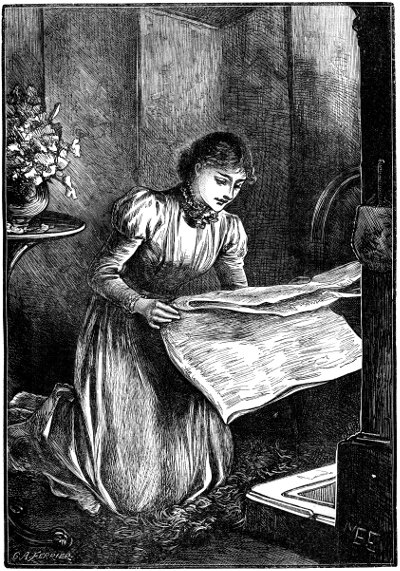
READING THE ADVERTISEMENTS.
“Music.—An extra opportunity for being
instructed in music, either in town or
country. The advertiser has found out a
method by which he teaches to play on either
the piano, violin, or guitar, in the completest
manner, by only the practice of one single
lesson, which he does on the most reasonable
terms.”
Imagine anyone thinking they could learn
the use of an instrument in a lesson! Yet it is
not one whit more absurd than the many employments
offered and advertised, “without
any previous knowledge being necessary,”
even if it be merely colouring photographs. I
have seen such an announcement with regard
to painting on china, a palpable absurdity, for
the very nature of the work demands a certain
facility in manipulating colours and mediums,
even if no skill in drawing be needed, and
without this it must be very rudimentary
painting indeed.
As a rule, the more tempting such advertisements
are, the more likely they are to be
catchpennies, though, of course, among the
many there are a few that are bonâ fide. I
was myself a victim to a well-known fraud,
which is a good example of many others.
Lucrative employment in the form of lace,
church work, etc., was offered to ladies in
their own houses. Like hundreds of others,
I applied by letter to M. D., Fern House,
West Croydon, and in reply received a printed
letter, in which constant employment was
offered, all work to be paid for on delivery, if
properly executed, and materials would be
sent on receipt of one guinea. I rashly sent
a guinea I could ill afford, and duly received
materials and instructions for making lace for
washing dresses. The lace I returned when
the work was done, and was sent an acknowledgment
for the same, but no money.
While I was meditating what steps to take to
regain my guinea, M. D., who proved to be a
Mrs. Margaret Dellair, was brought up at the
Surrey Sessions, “for obtaining divers sums
of money and certain valuable securities by
means of false pretences, with intent to cheat
and defraud.” She had received over 200
post office orders for a guinea, but none of the
many ladies who appeared against her had had
payment of any sort. She was sentenced to
five years’ penal servitude, her husband at the
time undergoing a like sentence for the same
class of offence. It was proved that the woman
had no connection with any leading firms from
whom she told her dupes she had constant
orders; and I tell you this because I would
advise you, whenever it is possible, to go to
the fountain-head yourself. There are many
good firms who will give orders for articles
which girls could do at their own homes, if—but
the if is all important—the work is done
in the best possible manner, and the whole
transaction carried out on business principles
and with business exactness. Punctuality is a
most necessary part of the agreement. Work
must be done to time if you wish to have the
orders renewed.
It is a pretty safe rule that whenever a
demand is made for money over and above
the value of goods sent, there is a necessity
for being on the alert. A rascal used to take
in a number of poor women by advertising for
ladies to copy sermons at twopence per hundred
words. Applicants were, as a preliminary,
required to deposit half-a-crown, which was
said to be returned if no work was sent, but
before that could be done another seven and
sixpence was demanded “to avoid any possibility
of unscrupulous persons obtaining valuable
sermons on pretence of copying.” Neither
the half-crown nor seven and sixpence were
ever returned, and in time the advertiser paid
for his ingenuity by twelve months’ imprisonment
with hard labour.
There is no doubt many women have
answered the advertisements which offer to
teach a system of dressmaking, or give employment
in painting lace, or painting Christmas
cards, or turning the use of a knitting-machine
to account, and have profited thereby;
but you may be quite sure that if these lead to
any good results the proceedings did not begin
by the applicants being mulcted of shillings,
half-crowns, half-sovereigns, or larger sums.
Girls, if you want to earn money, draw your
purse-strings tight.
I have made many inquiries respecting
societies and associations professing to be
established with the benevolent object of
assisting ladies to dispose of their handiwork,
either artistic or needlework, and I have come
to the conclusion that, however well such
advertisements may read, they are to be
accepted with caution. I should advise none
of you to send any article or to put down any
annual subscription to any such societies unless
they have a working committee of people
whose names carry weight and issue a properly-audited
balance-sheet annually. Many
of these sort of things are stated, perhaps
without any intention of fraud, but without
the power of commanding a sale or sufficient
means in the background to find the rent and
other expenses, or perhaps lacking the necessary
business aptitude on the part of the
promoters. They go on for a while, and then
too often suddenly collapse. The goods, if
returned at all, are mostly much the worse for
wear, and, as a matter of course, the entrance
fee is sacrificed.
But perhaps some of you girls have literary
talents, and desire to publish tales or essays,
poems, or whatever else you are able to produce.
If so, send them to well-established
periodicals or country newspapers. Do not
be discouraged by failure. Many a good
article rejected over and over again has
appeared in print and laid the foundation for
a literary career. Let your copy be clear,
carefully written on one side of the paper only,
and the matter something about which you
have some specific knowledge. Few well-established
publications need to advertise for
contributors, and it certainly is not necessary
for you, a tyro in the art, to subscribe towards
the publishing of a magazine in which your
productions are to appear. Few such publications
would have the faintest chance of success
under such auspices.
It might, under exceptional circumstances,
when needlework is ordered, be necessary to
deposit a few shillings as a guarantee that the
materials sent to you will be duly returned or
paid for; but if your writings require a
deposit of any kind to get them read or published,
the waste-paper basket is the best
place for them, however highly you may yourself
value them. Literature, after all, is a
very open market, and fresh blood is always
needed, though it may be a difficult matter to
get your first step on the ladder. “Try, and
if you don’t succeed, try, try, try again,” is
the very best advice, but don’t subscribe to
any association which offers even the most
tempting terms to publish in any magazine
issued by the joint subscriptions of amateur
authors. Nor do not be tempted by offers of
introductions to publishers for a consideration.
Attack the publishers yourself, without
any intermediary. No paid one will help you.
I was asked to subscribe to something of the
kind not long ago, and among the advantages
the subscription was to give me was the
power to try for the acrostic and other prizes
offered by a well-known weekly paper, which
was open to everybody.
If as much ingenuity were employed in
securing honest work as we find in these bogus
advertisements, the perpetrators, I think,
would be much better off. The addresses
change so frequently, applicants are so deluged
with printed testimonials, that they are
the more easily gulled. Sometimes the advertisers
are obliged at last to send something in
return for the money. One Everett May, for
example, who for eighteenpence undertook to
teach how to earn four guineas a week. For
a time he would declare that the packet was
posted, and must have been lost in transit,
but after a long correspondence and constant
demands for more money, if very hard pressed,
something arrived, as, in one case, a last, a
small boot for a child, and a few pieces of
leather, from which it would be impossible to
make a fellow boot, and a note concluding
with, “As soon as we receive from you a
specimen equal to pattern we shall be glad
to afford you constant employment.” Another
advertisement offered to gentlemen in a
respectable circle of acquaintance the means
of increasing their incomes, and on receipt of
thirty stamps advised the purchase of a cwt.
of potatoes for 4s., a basket, and 2s. worth of
flannel, to have half the quantity of potatoes
baked nightly, put them in the basket well
wrapped in flannel, sell them at a 1d. each,
and so earn £2 a week.
Perhaps some of you girls may be attracted
by the advertisements which seek for a depôt
where some everyday article may be sold, and
if you are in a position in which such a sale at
home is possible you may, perhaps with a good
deal of trouble, make a little money in that
way. Such advertisements are far more bonâ
fide, I expect, than £2 and upwards offered
by certain firms to persons of either sex without
hindrance to present occupation. To any
girls about to have recourse to these, my advice
would be like that of Albert Smith to
those about to marry—“Don’t.”
Just now the word competitions occupy
many advertisements in the newspapers. I
counted fourteen different addresses in one
number. The amount offered in prizes is
tempting, and those of my friends who have
competed have found the promoters apparently
fair dealing. But it is not easy to obtain a
prize, and the shilling paid by each competitor
is, I expect, the most important point to the
advertiser.
One other class of advertisement I am about
to touch upon, viz., the fortune-telling ones.
Seeing the penalties the advertisers lay themselves
open to, it is wonderful that they appear
at all. If any of you send your shilling in the
hope of obtaining your horoscope or any revelation
as to your future life, based on the
information you furnish as to your height,
colour of hair, eyes, and date of birth, even
supposing you receive any reply at all, you
will very surely have wasted your money.
None of these folks know any more of your
future than The Home Philosopher, and if I
could tell the future, I should know what
stocks were going to rise, and what horse will
win the next Derby, and thereby make more
money in a week than the fortune-tellers, if
they had ten lives. Depend on it, if they
could they would do the same.
Ardern Holt.
THE ROMANCE OF THE BANK OF ENGLAND; OR, THE OLD LADY OF THREADNEEDLE STREET. — CHAPTER V.
By EMMA BREWER.
In our last interview you saw me firmly and
proudly established in my new home in
Threadneedle[1]-street.
By this move I became a parishioner of St.
Christopher le Stocks, whose church and
burial-ground were quite close to my new
house.
It was but a small parish of ninety-two
houses at the time of my entering it.
The church was old, for mention is made of
it as early as 1368. I cannot give you many
particulars about it except that it was rebuilt
or renovated in 1462, and that it was slightly
injured by the Great Fire in 1666.
It had a certain sort of melancholy interest
for me, for it was the burial-place of many who
had been my early friends, among others, the
Houblon family.
The living, which was in the gift of the
bishops of London, was worth only £120 per
annum; not a very rich one, you will say.
To save returning to the subject of this
parish again, I will tell you now how it is that
at the present moment you see neither church
nor churchyard, neither parish nor parishioner
of St. Christopher le Stocks.
The increase in my duties and the variety of
work put upon me, rendered the size of my
house wholly insufficient for the purpose,
therefore, from time to time, as opportunity
offered, I purchased houses in the parish,
power to do so being granted me by Acts of
Parliament, and so rapidly were my purchases
made that in fifty years from the time of my
settling in Threadneedle-street, I owned the
whole parish of St. Christopher le Stocks,
save and except seven houses on the west
side of Princes-street and the church and
burial ground. And of the rates and taxes of
the parish I paid five-sixths of the whole.
Even with this extension of room I could
not get on, and an Act was passed vesting the
glebe land and parsonage belonging to the
rector of the parish in the governor and
directors of the Bank of England.
Nor was this all; I wish it were. The riot
of 1780, which I will tell you about a little
later, suggested that the church might prove a
dangerous fortress for rioters in case of any
attack made on my cellars, and after long consultations
I and my directors entered into an
agreement with the patrons and rector, with
the sanction of Government of course, that the
church and churchyard should be ours.
On this site, therefore, the west wing of my
residence is built, upon a plan designed by Sir
Robert Taylor.
I am glad to get over this point in my story,
for the demolition of the church caused such
pain to those who had friends and relatives
buried there, that I would not witness it again
for any consideration.
Even at this distance of time, when I look
out from my parlour on to the churchyard,
which is now full of flowers, and is, in fact,
my garden, my conscience is troubled, and I
should have been happier if a building devoted
to God’s service had not been destroyed
to increase my domain.
It is a painful subject with me, and so I am
sure you will excuse my referring to it when
the years come under review in which they
took place.
Should any of you wish to see memorials of
the Church of St. Christopher, you will find
one or two in St. Margaret’s, Lothbury, with
which parish that of St. Christopher’s was
united. They consist of two flat figures
placed in niches on either side of the altar,
and a metal bust inscribed to Petrus le Maire,
1631, which stands at the west end of the
church.
And now to go on with my story.
You may not be aware of it, but I have
several children of various ages, each with distinct
characteristics and purposes, and if you
are ever to gain any advantage through your
introduction to me it must be by means of one
or more of these.
They differ from other people’s children in
many respects, and yet I would not have them
other than they are.
They bear a high character throughout the
world, and are, I may say, blindly trusted, for
those who place implicit confidence in them
know little or nothing of their daily life and
character, which are known thoroughly only
by their own circle, and would, I think, be
puzzled to give a reason for their trust.
They speak a language peculiarly their own,
a language which not one in a thousand of
their admirers can understand, yet it is one
which, with a little attention, might be taught
in our public schools with as much ease as
French or Latin, and would richly repay the
trouble of learning.
The remark of a man known as Captain
Cuttle illustrates the want of education I refer
to. He says, “I feel bound to read quotations
of the funds every day, though I am
unable to make out on any principle of navigation
what the figures mean, and could very
well dispense with the fractions.”
An equal ignorance is observable in reference
to their servants or bodyguard. A
comparatively small number of people know
anything of their office and its duties, and it
has become the fashion to speak of them with
contempt, but I think most unreasonably.
I am no friend to ignorance, and will endeavour,
while telling you my story, to throw
some light upon these points. If I remember
rightly, this will be in accordance with your
wish conveyed to me in your introduction.
I do not think it would be easy to find a
family whose health is such a matter of public
solicitation and anxiety as mine. At rapid
intervals during the day their pulse is felt,
their temperature tested, the figures registered
and posted up to public gaze. No sooner do
they meet the eye of the anxious crowd than
telegraphs and telephones are set to work to
carry the announcement far and wide, and according
to the knowledge possessed of these
figures fortunes are made and fortunes are lost.
They are, as a rule, healthy children, but
unfortunately they are dreadfully sensitive,
rushing up madly to high spirits on the
slightest of good news, and sinking into a
state of depression at the very suggestion of a
war or even a change of government. I have
known even after-dinner speeches at the
Mansion House and Guildhall affect them.
Unless the state of their feelings were registered
you would almost doubt the possibility
of trusted creatures being so uncertain
in their disposition.
I know that this morbid sensibility is as
bad for my children as for those of any other
parent, for do I not see advantage taken of it
every day?
When their pulses run up to fever height in
the morning there is no knowing how low
their purses may be before night, for everyone
who has studied their language and understands
the state of their health by its means
takes the opportunity of coming to them for
money. The livelong day the plea is for
money, which is never refused while my
children have a penny.
Of course I am bound to acknowledge that
there is another side to the picture, viz., that
whenever through bad news they become so
low and depressed that you think it impossible
they can rally, help comes, and in a way you
would not expect.
People no sooner read the bulletin, “Very
low to-day,” than they empty their purses,
collect their savings, write cheques for their
balance at the bankers, and come and lay all
at the feet of my children. It is a strange
world, and I have a strange family, but so it is.
You might suppose they were my step-children,
as they do not bear the family name
of Bank or Banks, but you would be wrong
in your supposition. They are my very own,
their name of Stocks or Funds having been
assumed to denote the exact part they play in
the world.
You will please to bear in mind that Stocks
or Funds are nothing more nor less than debts
which the nation owes to the people whose
names stand in my books. By doing this much
will be clear to you which otherwise would be
difficult of comprehension.
We have all experienced that a personal
introduction is much more effective than
writing, and therefore, without loss of time,
permit me to introduce you to my eldest born,
Three per Cents. Consols.
Three per Cents. was born in Grocers’ Hall
in 1731, and was a baby in arms when I
moved into Threadneedle-street.
The circumstances attending her birth were
simple. The king, as usual, wanted money,
and I managed to obtain it for him by means
of a lottery. The money so obtained and lent
received the name of Three per Cent. Stocks,
by which name it was called until 1752, when,
by consent of Parliament, my child was united
to a balance of annuities granted by George I.,
or rather, I should say, consolidated with the
annuities, and henceforth was known to the
world as Three per Cent. Consols.
Of this child I could say much. She has
never given me uneasiness; on the contrary,
she is one of the steadiest and most reliable of
my children. She is less liable to high flights
and deep depression, and it is in her favour I
think that old people, widows and orphans,
prefer her to the rest of my family.
The next Stock, or, as she is called, Government
Stock, to whom I would introduce
you, is Three per Cent. Reduced, a curious name,
and one which might lead you to think of her
as poorer than her sisters—as, in fact, reduced
in circumstances. She derived her name in
this wise. Originally she was a fund or stock
lent to the Government upon condition that
those who contributed to it should receive
four per cent. for their money, and up to the
year 1750 was known as Four per Cent.
Government Stock; but circumstances which
I need not go into here reduced the interest
to three and a half per cent. in that year,
at which it remained until 1757, when it was
again reduced to three per cent., and henceforth
known in society as Three per Cent.
Reduced.
A thorough acquaintance with these two
members of my family, the way to approach
them, to deal with them, and to profit by
them, will enable you to understand the
whole family of Stocks, and this will save me
time and protect you from an old woman’s
prosing about her children. All this I hope
to do when next we meet. Till then adieu.
(To be continued.)
OUR TOUR IN NORTH ITALY.
By TWO LONDON BACHELORS.
It will be remembered that on arriving at
Verona the two bachelors wandered about the
city, merely glancing at its many beauties, in
order to get a general impression, reserving
for the next day the task of examining its
buildings.
Our hotel at Verona was most picturesque;
it had a courtyard in the middle, on to which
all the principal rooms looked. There was a
fountain in this courtyard, surrounded by dark
green shrubs, which had a very cooling and
refreshing appearance. The few English and
Americans at the hotel were as usual the
most pleasant of the guests; in fact, we have
always liked those of our countrymen whom
we have met abroad, and we venture to think
that John Bull on the Continent has been
maligned and abused far more than he
deserves. We found the English at the
places we visited quiet, companionable, and
always well-behaved at table. Our satirists a
generation back were never tired of depicting
the narrowminded prejudices of the English
abroad, but we cannot help thinking that
many of these prejudices have disappeared,
and this seems to be borne out by the
undoubted increase of friendly feeling shown
to our countrymen when travelling on the
Continent, notwithstanding that in many
cases we have not so much money to spend
as our travelling forefathers had.
We rose early on the day after our arrival
at Verona, as we were anxious to see as much
as possible of the city before going on to
Padua and Venice. As early as nine o’clock
we had finished our breakfast and were
starting out to see if, on second sight, Verona
would delight us as much as its first impression
had.
After about five minutes’ walk from our
hotel we found ourselves in the Piazza delle
Erbe, the fruit-market of Verona. This fine
open square was completely filled with stalls,
with funny old white umbrellas covering
them. On one side of these stalls were little
stools about six or seven inches high, on which
were seated the oldest of old women, generally
knitting. How very ancient these women
looked, how wrinkled and furrowed were
their countenances! Indeed, we could almost
have imagined that these crones were in
existence when the palaces and tower of the
piazza were being built, and that they have
been perched on their stools selling their
wares during the centuries that have crumbled
the buildings, and reduced the fortunes of
Verona, formerly one of the most brilliant
cities of Italy, the abode of Dante, Sammicheli
the architect, and Paul Cagliari, or Veronese,
the last great genius of the North Italian
school of painting.
We were anxious to see how these women conducted
business, and going up to a particularly
old one we asked the price of some oranges.
As we could not understand her patois (of
which there are over a hundred in Italy—the
country of a confusion of tongues!) the older
bachelor took up a franc, in exchange for which
she was about to present him with two oranges!
Fancy this old creature, who had probably
lived all her life amidst the beautiful buildings
of Verona, and who was at least eighty years
of age, attempting to swindle two (as she
thought) unwary foreigners. We were walking
away disgusted when the woman shouted
after us, offering three oranges for the franc;
and seeing we were still discontented, she
offered four, then five, then six oranges, which
last we took, much to the delight of the
woman, who even then had probably got
double the value of her wares.
Strolling out of the Piazza delle Erbe, we
entered the Piazza dei Signori, where there
was much to interest us. On one side is the
Palazzo del Consiglio, the grandest in Verona.
It is built in the early Renaissance style of
the fifteenth-century, and is covered with
rich and exquisite detail. Near to this palace
is the fine marble statue of Dante, erected in
1865. The poet is standing, with his head
resting on his right hand. The features are
extremely intellectual, but rather stern, such
as one would expect in the writer of the
“Divina Commedia.”
After the Piazza dei Signori we visited for
the second time the tombs of the Scaligers.
Our girls will remember from our last
article what a very important part the families
of the Visconti and Sforza took in the history
of Milan. Now, an almost equally important
position was occupied for nearly a century and
a half by the Scaligers, or della Scalas, in
Verona.
It was about the year 1260 that Mastino
della Scala, their first historical character, was
elected “captain of the people.” To him succeeded
others of the family, like him distinguished
as wise rulers, patrons of art, and in
every way excellent princes. As time went on
the Scaliger family added several other important
North Italian towns to their rule,
including Lucca, Parma, Brescia, Vicenza,
and others. But a little after the middle of
the fourteenth century the family began to
lose all those excellent qualities which had
raised them to fame and power, and from the
years 1359 to 1405 the history of the Scaligers
is a record of barbarous murder and unprincipled
corruption. With their leaders so degraded,
it was certain that the Veronese
would sooner or later be conquered, either by
the Dukes of Milan or the Republic of Venice,
and, to put an end to the difficulty, they
threw over the rule of the Scaligers, and gave
themselves up to the Doge of Venice in 1405.
Repeatedly in Verona one comes across
delicately-carved little ladders. These are
the arms of the Scaligers (della Scala means
“of the ladder”), and they serve to show how
great an influence this family exercised for a
number of years.
Continuing our walk, we went again to see
St. Anastasia, noticing near the entrance the
beautiful tomb of Count Castelbarco. This
is very like the monument to the Scaligers,
and, with the façade of the church, makes a
very picturesque subject. The church of St.
Anastasia has always been considered as an
ideal of Italian Gothic architecture. Street
and other experts are never tired of describing
its beautiful colour and wonderful symmetry.
To the left of the choir is the huge tomb to
General Sarego, which has given rise to some
controversy. Of the magnificence of the
monument there can be no doubt; but it may
be questioned whether its gigantic scale does
really injure the effect of this fine interior.
From St. Anastasia we went straight across
the city to the church of St. Zeno. Our object
in doing so was to see, in as short a time
as possible from one another, the finest example
of Italian Gothic (St. Anastasia), and
the church of Zeno, probably the most magnificent
Lombardic-Romanesque work in
existence.
St. Zeno stands at the far west of the city,
almost alone; its magnificent brick and marble
campanile standing quite apart from the church.
The nave is twelfth-century work, and the choir
thirteenth century; internally the latter is
raised up upon a crypt which is visible from
the nave. The church is supported by alternate
piers and columns, shafts of the former
being carried up to the roof, thereby breaking
the monotony of the vast amount of
blank wall between the semicircular arches and
the roof. The general effect of the interior is
one of extraordinary solidity, but the proportions
being so fine, there is no “heaviness” of
effect. In the choir is a very curious statue of
St. Zeno, sitting most uncomfortably in a
chair. He is painted a rich brown colour,
holding his episcopal staff, from which is
hanging a fish. There are several opinions
about this; some describe it as a symbol of
baptism, others to the bishop being a famous
fisherman. St. Zeno, Bishop of Verona, was
an African martyred by Julian the Apostate
in the fourth century.
We bachelors, humbly be it said, were not
carried away into violent admiration about
either St. Anastasia or St. Zeno. To our
mind the lofty, clustered columns of Westminster
Abbey are far more beautiful than the
heavy, round pillars of St. Anastasia; and the
magnificent Norman naves of Durham or
Norwich Cathedral, with their open triforia
and superb vaulting, seem infinitely more
splendid than the nave of St. Zeno with the
blank wall-spaces over its arches and its heavy
timber roof.
After leaving St. Zeno we visited the
cathedral, a fine Gothic church not very unlike
St. Anastasia, but much larger; St. Fermo
Maggiore, a very interesting church containing
a monument of the last branches of the Dante
family; and Santa Maria in Organo, remarkable
amongst other things for its choir stalls
and the intarsia work in its sacristy.
It was getting towards evening when we
found ourselves again at the old Roman
Arena; and we mounted the steps of the
latter in order to take one last look at the
ancient city. The sun was setting behind
the St. Gothard Alps, which glittered like
silver, while nearer were the lesser mountains,
spurs of the Alps, telling out dark blue; and
gathered under our feet were the numberless
red brick buildings, churches, towers, and old
walls of Verona. It was a beautiful sight,
and rendered doubly romantic by the solemn
stillness. In these old Italian cities there is
often a quiet and absolute silence, which is
almost startling to our bustling ears—partly
accounted for by the Italians, or North
Italians, at any rate never descending to that
vulgar rowdyism which the lower classes in
our cities take so much delight in.
We got back to our hotel quite late in the
evening, after one of the most pleasant days
of the whole tour. Notwithstanding our
fatigue, however, we could scarcely sleep, so
great was our excitement at the idea that
to-morrow we should be in Venice—that wonderful
city which the older bachelor, at all
events, was more anxious to see than any
place in the world.
We were, however, to see Padua first, and
as the train started early in the morning for
that city, we had scarcely had enough sleep,
when we were awakened by the femme de
chambre, who informed us that the breakfast
was ready.
The day on which we left Verona was broiling
hot, and the two bachelors, being still tired,
went soundly to sleep in the railway carriage.
Now, this was a mistake, for Padua is not
very far from Verona, and we had only just
time to get into a comfortable sleep when we
were awakened by the train stopping, and had
to rush about the station to look after our
luggage, which, after a great deal of trouble,
we were able to leave with a porter for the
few hours we had to see the city.
Immediately on leaving the station we were
much worried by a tout, whom we found
almost impossible to get rid of. This and our
being awakened from our sleep threw us into a
very bad temper, and caused us to express
very qualified views as to each other’s intellects
and characters. One of the bachelors
declares that the other threw mud at him—but
this must be only taken in a figurative
sense; and one of them (we won’t say which)
began to express views respecting the ancient
buildings and monuments of Padua something
in the style of Mark Twain.
As before stated, it was a broiling day, and
we scarcely remember anything more delightful
than the delicious coolness of the church of
the Eremitani, the first we visited in Padua.
This huge church would not be particularly
remarkable if it were not for its fine frescoes
adjoining the right transept. The best of
these are by Andrea Mantegna, a great
Paduan master of the end of the fifteenth
century, celebrated for his “lifelike”
work. But the interest attached to these
frescoes sinks into insignificance when compared
with those by Giotto in the Arena
chapel close to the church of the Eremitani, the
importance of which can scarcely be overrated.
Our girls may remember that, when speaking
about the Brera Gallery, we mentioned the
name of Giotto, and as this painter exercised
such a great influence over art, it may not be
out of place to take this opportunity of saying
a few words about him.
Giotto di Bondoni, born in 1276, has been
called the father of modern Italian art, a title
given to him on account of the vast progress
his pictures show over those of any of his
predecessors or contemporaries. Let anyone
compare the pictures of Giotto with those of
Cimabue, his master, and the most famous
representative of the earlier school, and they
will see this. Note the bright colour and
infinitely greater expression in the former;
also the movement, and the less conventional
attitudes of the figures. Giotto was also the
first to introduce anything approaching to
dramatic effect in the art of painting, for
which and other reasons he made a reputation
far greater than had yet been made in
painting—so great, in fact, that it was not
surpassed until the age of Leonardo da Vinci,
Raphael, and Michel Angelo, the great trio of
Italian artists, who may be said to have
perfected that style of painting of which
Giotto was the first representative.
The little Arena chapel at Padua is completely
covered by frescoes of Giotto, which
are amongst the finest examples of his work to
be found out of Florence. The subjects
represent the history of Christ and of the
Virgin, the former being much more admirable;
indeed, some of the subjects, especially
the Crucifixion and the Pietá, will compare
with any of the master’s work. The two
bachelors were a long time looking at and
admiring these frescoes, and that they were
allowed to do so alone added not a little
to their enjoyment. One pays a fee for seeing
the Arena chapel, and is given a plan and
description of the paintings. This is a great
advantage, for it renders the attendance of a
guide superfluous, and one is excused the attendance
of a dirty little garlic-smelling man, who
keeps up an incessant chattering in bad
French or execrable English, half of which
one does not understand, and the other half
Bædeker tells far better.
Having but a short time to see Padua, we
tried to find our way at once to the famous
church of St. Antonio, known as “Il Santo”;
we, however, took about three hours to do so,
during which time we saw many interesting
churches, some containing frescoes.
The two great painters of this city were the
before-mentioned Mantegna, and Squarcione,
the founder of the Paduan school. The work
of both these painters is remarkable for its
scholarly character, to be accounted for from
the fact of Padua being the seat of a great
university (founded as early as 1238), which
attracted learned men from all parts of Europe;
and naturally the school of art was influenced
by the conflux of scholars and scientific men,
which made Padua so important a city in the
Middle Ages.
Nearly all the streets in Padua are flanked
with arcades, which add much to the picturesqueness
of its thoroughfares. We, of
course, sought out Il Salone, the palace celebrated
for its huge hall, said to be the largest
unsupported by columns in the world. The
walls of this hall are completely covered with
frescoes, nearly 400 in number, more remarkable
for their strange subjects than their value
as works of art. At one end of the hall is a
huge wooden horse; very ugly, the bachelors
thought, though it was designed by the great
Florentine, Donatello.
After seeing Il Salone the bachelors wandered
about for an hour or so, and at last
came in sight of the monstrous church of St.
Antonio. As this is the work of the greatest
architect of the Gothic period in Italy, Nicolo
Pisano, we suppose that we ought to have
been much struck by it; but we confess that
we were not, at any rate by its exterior. The
domes, seven in number, bear a most unfortunate
resemblance to so many dish-covers,
and the kind of circular drums or towers on
which they are placed have a kind of truncated
look, as if they have been cut short, and were
intended to have been much higher.
The west front, though adorned with Gothic
arcades, has a bald, sprawling look about it,
and does not seem to “fit” the church properly.
The sides of the building, moreover,
are positively ugly, and there is only one point
from which it really looks well, and that is a
garden near the east end, where the domes
are seen rising up over a group of trees.
The first impression of the interior is rather
one of baldness, but when one arrives halfway
up the church, and the exquisite chapel of St.
Antonio in one of the transepts, a most lovely
work by Sansovino, and the very beautiful
Gothic altar and screen in the opposite transept
are opened out to the view, the first
impression is at once corrected.
Perhaps in the whole of Italy there is not to
be found a more perfect example of the Renaissance
than the exquisite chapel of St.
Antonio. It opens from the transept by five
arches, the detail and proportion of which
are simply perfect. On the opposite wall are
five similarly-treated blank arches, filled in
with extremely elaborate bas-reliefs, beneath
the centre of which is the altar. A semicircular
barrelled vault, adorned with detail,
perfectly bewildering from its intricacy and
delicacy, covers the space between the two
arcades. It is certainly a matter for regret
that the Renaissance architecture of Italy did
not stand still at this beautiful epoch, instead
of developing into the wildness and eccentricity
of the later school.
On emerging from St. Antonio the bachelors
were astonished to find the sky overcast,
and to notice the suspicious gusts of wind which
generally precede a storm. The latter, however,
did not approach Padua, but contented
itself by grumbling about in the distant Alps.
We were only too glad to be spared its visitation,
especially as we were anxious to have a
moonlight night by which to form our first
impression of Venice.
Scarcely any Englishman ever visits Italy
without bothering his friends about his first
impression of Venice. But in all probability
these first impressions are not formed
from the place itself, but from photographs
purchased in Oxford-street.
It has always been a question whether the
enjoyment which one experiences in seeing a
place of great interest about which one knows
nothing from pictorial representations, or that
experienced upon arriving at one of which
every street—nay, almost every stone—has
been made familiar by representations, is the
greater. Some people have asserted that it is
almost impossible not to feel a kind of disappointment
upon seeing any place about which
one has read very much and has seen very
frequently represented. If this be the case,
Venice ought to be a disappointment, because
no city has been more described, painted, engraved,
and photographed. Yet, does it disappoint?
Our grandfathers were perhaps in
one way fortunate in the fact that Venice must
have appeared to them more strange, more
wonderful, and more poetical than it can ever
appear to us. It is true they must often in
fancy have stood upon the Bridge of Sighs—“A
palace and a prison on each hand.” They
must in fancy have wandered over the Rialto,
and have dreamed of marble palaces, their
steps washed by the Adriatic. But with them
it must have been a mere dream, without
form or shape. With us, however, Venice is a
thorough reality before we see it. The Campanile
of St. Mark, the Doge’s Palace, the white
domes of the Salute are almost as well known
to those who have never been to Venice as to
those who have lived in the place. Consequently,
the great element of surprise must to
a great extent be wanting to all those who
now visit this city.
There are no two places in the world the
approach to which excites one so much as
Rome and Venice. Rome, according to all
account, and notwithstanding the stupendous
remains of its ancient monuments and the
wonders of its churches, seems always to disappoint.
Even a man who approached it with
the feelings of Cardinal Newman does not disguise
the fact that, pictorially, at any rate, it
in no way realises his preconceived notions;
and Charles Dickens compares the first appearance
of it to London, and seems almost
to hesitate whether he would not give the
palm to the latter city. But with Venice who
shall say? The mind of man can call up
palaces which are more beautiful than hands
have ever raised. The imagination can raise
up air-built structures which no architect,
however able, or builder, however skilful,
can execute: and, therefore, every city about
which one has thought much must be to a
certain extent disappointing at first, and it
requires a touch of reality to restore the mind
to its proper equilibrium; and it is after this
has been done that one must judge of the true
impression made upon it by any place, scene,
or building. Perhaps the old-fashioned saying
that “second thoughts are best” may
convey our meaning, and one must not judge
from one’s first impression of such a city as
Venice, or be astonished that one’s first feeling
is one of disappointment. Though when
the mind has become sobered sufficiently to
take in all the various beauties of this matchless
place, then one should ask oneself the
question, “Is it disappointing?” Whether
it proved so to the two bachelors our readers
will see in our next chapter.
(To be continued.)
“SILENCE IS GOLDEN,” BUT “A SOFT ANSWER TURNETH AWAY WRATH.”
“Cissy Weller never answers back. You
may say the spitefullest things to her, and
they disappear like a wave on the sand.”
It was a lovely May afternoon, and Mabel
Bruce was returning home between two of
her schoolfellows. The three girls had been
sauntering leisurely along in the shades of some
tall trees, but as Mabel said these words they
turned aside to take a nearer cut across some
fields, and, the weather being unusually warm
for the time of year, they stopped to rest for a
few minutes before striking through the broad
sunlight, perching themselves in various attitudes
upon the stile.
“No; Cissy never answers back,” repeated
Mabel, poking in the hawthorn-bush with her
sunshade and then bending over her books to
readjust the strap in which she was carrying
them; “she would be easier to deal with if
she did. She’s a splendid sample of Christian
patience,” she added, with a sneer.
“‘Patience on a monument, smiling at
grief,’” jeered Merry. “She wears a sour
enough face over it. For my own part, I hate
dumb people. One might as well have to do
with posts!”
“Perhaps it is a virtue to be a ‘post,’ sometimes,”
suggested the other girl—Eva Daventry,
by name. “You wouldn’t care to have a
post start up and strike you on the head if you
chanced to run into it. That’s what smart-tongued
people do. ‘Speech is silvern,’ sometimes;
but ‘Silence is golden.’”
Eva Daventry was a more gentle-faced girl
than the others, and was often ridiculed for
her sentimental, poetic way of viewing things.
Even as she said this, she was looking out
towards the distant hills, as though her
thoughts were far beyond the level of her
companions’ comprehension—as indeed they
were; for Eva had begun to enter upon a
higher life, of which, as yet, neither Mabel
nor Merry knew anything.
“Just like one of Eva’s sayings,” cried the
latter, with a careless laugh. “I wonder
what dried-up old sage invented that absurd
axiom! One might as well talk about a cypher
being of more value than a unit. Why
weren’t we all born dumb?”
“I know who wasn’t!” exclaimed a voice
that seemed for the moment to come out of
the sky itself; and almost before the girls
could turn, Hubert Daventry had swung himself
down from one of the larger boughs, and
was descending the trunk.
Mabel and Merry sprang to the ground with
a startled air, but Eva kept her seat, looking
up into her brother’s face with an admiring
glance. They were “only” brother and sister,
and thought a great deal of each other.
“Now, I’ve got something worth looking
at in my pocket,” said Hubert, eyeing the
girls with an expression of amusement as he
reached terra firma, “and I’ll vouchsafe the
first peep to the one who knows how to give
‘the smartest answer.’ Girls have all got
tongues, you know. That’s a settled question,
so there’s no crying off; it’s simply a matter
of competition. Come, now!”
But neither Mabel nor Merry responded to
the challenge. It was evident that Hubert
had overheard their remarks about Cissy, and
it is a speaking fact that, however much girls
may indulge in backbiting when by themselves,
they inevitably “feel small” if they
chance to be caught at it by their boy friends.
They know that it is small, and they are
ashamed of it. Mabel glanced at Merry, and
Merry at Mabel, and both looked down and
were silent. Hubert occupied the interval in
brushing the green from his clothes.
“Come, now!” repeated he, “the prize is
to be fairly won! I can’t in honesty include
Eva in the competition after her last remark.
When people affect contempt for any particular
gift, you may make pretty sure they
don’t possess it. It lies between you two.”
“I, for one, don’t want to examine the
lining of your pockets!” exclaimed Mabel,
saucily.
“I assure you, I didn’t contemplate turning
them inside out for inspection,” returned
Hubert, mischievously. “What’s in will
come out without such strong measures.”
“Of course!” exclaimed Merry. “He has
been robbing a nest. I wouldn’t see the poor
little creatures for the world. They must be
nearly suffocated. It’s cruel, horrible, inhuman,
to tear them from their mother just
for the sake of torturing them to death!”
“How sharp some people’s ears are!”
laughed Hubert, provokingly. “When little
birds do take to singing for their supper they
make a good deal of noise; but perhaps I’m
a trifle deaf. Do you hear them, ’Va?”
“Oh, you are a teaze!” exclaimed Eva,
jumping down. “I don’t believe it’s anything
alive at all. But it’s high time we pursued
our ‘winding way.’ Which direction are you
going to take, Hu?”
“I propose doing myself the honour to
constitute myself your protector,” returned
Hubert, with mock ceremony, “in case you
should have rough work with any ‘animated
posts’ by the way.”
Mabel and Merry inwardly objected to this
arrangement, fearful of Hubert’s sarcastic
mood. They could see that he despised their
littleness, and they were both dreadfully uncomfortable.
But it was too late to go round
by the road after delaying so long, so there
was no help, and the four went up the field
together, Hubert teasing rather unmercifully
all the way, until their path divided, when he
drew from his pocket and exhibited two insignificant-looking
eggs, which he had secured
for his collection.
“What’s the matter with Cissy Weller?”
he asked, as he walked on with Eva, after
calling a parting injunction to the other girls
to fight shy of “animated posts.”
“Oh. Cissy is always getting into hot
water with the girls,” explained Eva; “through
sheer blundering, you know, for she’s a good
creature at heart; only she has always had a
governess at home, and doesn’t understand
the ways of school life, some of which are
decidedly unchristian, to my thinking,” added
Eva, confidentially. “Then the girls get regularly
mad, and do all they can to lash her into
a fury. But it is of no use, as they said just
now; Cissy never answers back, and it generally
ends in her getting sent to Coventry.
Poor Cissy! that hurts her more than anything,
I believe; she looks so miserable over
it. And the strange part of the whole thing
is, that if she were to ‘show spirit,’ one or
two battles would settle the matter, and they
would learn to ‘respect’ her. Hubert, if
hot words can do so much, why is silence
‘golden?’”
“Because, in scriptural phrase, angry
words ‘stir up strife,’” replied Hubert.
“Why weren’t we all ‘born dumb,’ then?”
quoted Eva. “Oh, Hubert, I do wish I could
answer them when they say things like that!
You could silence them in a minute; but my
thoughts travel so slowly. I know it is more
Christian not to retort; but I ought to be able
to give a reason for what I believe, when
other people say such odd things. After all,
what use is there in having tongues, if we
mayn’t use them in self-defence?”
“In order that we may use them for a
better purpose,” answered Hubert, after a few
minutes’ reflection. “I thought you had
floored me, but I see it now. ‘Speech is
silvern,’ and ‘silence is golden;’ but ‘a soft
answer turneth away wrath.’ Although Cissy
might gain apparent victories by retorting, she
would in reality only draw upon herself greater
antagonism, whilst, on the other hand, her
silence both irritates them and makes them
think her craven-spirited. If she were great
enough to show her superiority by explaining,
or apologising for her blunders, she would
very soon put to rout all their hostility and
win their hearts: that is, unless girls are
made of very different stuff from boys. But
this sort of greatness is only to be arrived at
in one way,” he added, gravely. “Perhaps
you could help her to find out how.”
Eva understood her brother’s meaning, for
they often had these confidential talks on
serious subjects.
“‘Take my yoke upon you and learn of
me,’” she repeated, softly. “I had not
thought of trying to help her.”
Hubert was right. An angry retort often
provokes the bitterest enmity and does irreparable
harm, and silence irritates by its likeness
to contempt, but a gentle word is like oil
on troubled waters. It is the coin by means
of which we may purchase that which neither
silver nor gold can buy—the love of an enemy;
and more, by thus driving the demon from a
human heart we may be the means, in God’s
hands, of converting a sinner from the error of
his ways. “And if,” said Christ, “he hear
thee, thou hast gained thy brother.”
F. E. Burch.
HOW TO TAKE CARE OF A VIOLIN.
The first lady performer on the violin that I ever
heard, which was some forty years ago, was Madame
Philipowics, a Polish lady, neither young nor beautiful.
And it so happened that she was engaged to perform
at an oratorio in Bradford, where I also was engaged
to sing the bass solos. So between the acts of the
oratorio she was advertised to play an air with
variations on the violin, the novelty of the performance
of which created a perfect furore, and the applause
far exceeded all that was given to the singers
of the oratorio. But her execution, although considered
wonderful, was not equal to that which
Theresa Millanollo produced some time afterwards
in the metropolis. “The most dangerous things for
our piano-playing scholars to hear,” says Gustave
Schilling, in his work on teaching,
“are the more productive stringed
instruments. One of my scholars,”
he continues—“a young lady with whom
I had taken special pains, and who was
really clever, and had made much progress
towards perfection as a pianist—after hearing
Theresa Millanollo play the violin, declared
that she would give up the piano, and take
to that instrument, even though she should be
able to play the violin but a little. And I
had the greatest difficulty to get her to relinquish
her intention, and to excite anew her
interest and her former enthusiasm for the
continued practice of the piano. But I at last
succeeded in convincing her of the folly of her
desire to change instruments, and she became,
as I predicted, an extraordinary pianist.”
Most students manifest a peculiar liking for
some particular instrument at the outset of
their career, and if they persevere in their
determination to practise it, they often become
eminent in its performance.
Good teachers will not fail to take every
means in their power to induce their pupils to
take pains to arrive at a perfect knowledge of
their art. I knew an old country professor,
some fifty years ago, who was excessively fond
of Haydn’s Symphonies, arranged as quintets
for two violins, viola, violoncello, and flute;
but he could not often get together the performers
where he resided; so, having four
grown-up daughters, he taught them to play
these instruments in first-rate style, and thereby
found no difficulty in indulging his hobby.
And they were very particular in keeping their
instruments in good order.
In the preservation of a good violin it is
requisite that it should be kept, when not in
use, in a wooden case, lined with cloth or
flannel; and as it is subject to damage from
the sudden changes of the weather, the
greatest care should be taken to keep it from
damp. Too great heat, however, will often
render the wood brittle, and make it difficult
to produce the tone with the best effect, as
the strings are apt to become dry, so that it is
not easy to bring out that delicacy of tone
which is one of the charms of the instrument.
To carry the violin to any distance from
home in cold weather, it should always
be put into its case, or else it is apt to condense
moisture when brought into a warm
room, and to cause dust to accumulate both
inside and outside of it. And it should never
be left out of its case in the summer, as the
flies are almost certain to get into the f holes,
and leave their filth in it, much to the detriment
of its tone. It is also absolutely necessary
to keep the violin perfectly clean; and
the resin-dust should be carefully wiped off
with a soft linen cloth before and after using
it. It is a good plan to insert a handful of
warm barley into the interior, through the
f holes, and by shaking it well the dust will
attach itself to the seed, and will be brought
out with the barley through the f holes. This
process should be performed twice a year, and
the instrument will be better preserved for it.
To keep the strings on the instrument in good
order for any length of time, take a small piece
of taffeta and moisten it with almond oil, and
rub it lightly over the strings, from the bridge
to the nut, after using the violin, and before
putting it into its case. And when you want
to use it again, wipe off the oil with a piece of
fine linen. This plan is especially beneficial to
the fourth or G string, which, however much
it may be stretched before being covered with
wire, is apt to shrink in summer, when the
wire gets loose if the string is not subjected to
the oiling. The advantage of adhering to this
plan will be that the strings will not become
dry, and will retain a smoothness of tone, and
keep the moisture from the fingers from being
detrimental to the strings, and prevent their
producing a false tone, or that grating or
whistling so common in the use of the resin
from the bow. This treatment of the instrument
was communicated to Ernst by Otto, and
Ernst mentioned it frequently to the professors
and amateurs, who readily adopted it and
found considerable advantage therefrom. The
proper means of preserving strings not in immediate
use is stated to be the moistening
them with the best almond oil, putting them
into a piece of calves’ or pig’s bladder, and
enclosing them in a tin box. Most violin
players know where to procure the best
strings. Another important thing connected
with the violin is its having a paper
bridge fitted for it, which should be specially
adapted to the instrument. If the
performer has a good violin, there will be no
difficulty in procuring a good and proper
bridge for it when it is required. And the
next thing to having a good bridge is that of
having a good set of pegs for tuning the violin.
In Germany girls are taught to play the
cornet, the French horn, and various other
wind instruments; but whether it would be
decorous for our females to imitate such examples
is rather doubtful. It is by constant
use, and not by age only, that a violin becomes
mellow in tone; but a great deal depends on
the maker. It is true that Cremonas and other
violins which have been in constant use for
many years have acquired a character for
superiority beyond most others, consequently
they often fetch a larger price—more, perhaps,
from having been in the possession of first-rate
performers than from any intrinsic value
in the instruments themselves. It is not our
intention, however, to give any account of the
manufacture of the violin—those who are
curious in such matters may consult a thousand
other works on the subject, which are to
be obtained of the music publishers, both
foreign and English.
C. H. P.
THE SHEPHERD’S FAIRY. — CHAPTER XIX.
A PASTORALE.
By DARLEY DALE, Author of “Fair Katherine,” etc.
CHATEAU DE THORENS AGAIN.
ighteen years
have, of course,
made a great
many changes in
Château de Thorens.
The old
baroness is long
since at rest, she
died a few years
after her son Léon
was drowned; and Père Yvon, though
still alive, is very old and infirm, and
lives in daily expectation that the
summons will come for him to follow his
late patroness to her last home. The
baron is stouter than he was when he
ran down the spiral staircase with his
infant daughter in his arms that midsummer
evening, whose work he would
have given the rest of his life to undo,
so bitterly had he repented of it. His
hair, too, is turning white, though he is
under five and forty still, and there is a
settled melancholy look in his brown
eyes, which not all the jokes of his three
sons can ever wholly chase away. The
young baroness is no longer known by
that name since the old baroness died,
yet she still looks very young to be the
mother of those three great boys, the
eldest of whom, a tall handsome youth
of sixteen, named Léon, after his poor
uncle, to whom he bears a striking
resemblance, is now hanging over her
and trying to persuade her to ride with
him before dinner this September evening.
“Oh! Léon, I can’t! It is much too
hot!”
“Nonsense, mother, it will do you
good; you are getting much too stout,”
said Léon, mischievously; for he knew
his mother prided herself on her figure,
which was slight and almost girlish.
“Léon, you dreadful boy! I am sure
it is not true! I will ask your father;
and I certainly won’t ride with you now,
to punish you for your impertinence.
Besides Rex de Courcy came back
yesterday, and I am sure he will be here
later to see me.”
“Ah! now we have got at the real
reason. Of course, if Rex is coming I
have not a chance,” said Léon, half in
earnest, half in fun, for he was rather
jealous of his mother’s friendship for
Rex de Courcy.
“Don’t be silly, Léon; I have not
seen Rex for two months, and I am
longing to hear all about his visit to
England. Besides, I never can forget
what a comfort Rex was to me before
any of you boys were born; he always
seems to me almost like one of my own
sons. Go and get your father to ride
with you; it will do him good; and tell
the other boys Père Yvon is expecting
them in the study,” replied the
baroness.
These three boys were the only children
she had, and though she worshipped
them, and had long since ceased
to grieve for her little baby daughter,
yet the baron, proud as he was of his
sons, never forgot the little girl he had
got rid of so much more thoroughly than
he had ever intended to do. He never
spoke of the child even to his wife, and
all the boys knew of her was that they
once had a little sister who was drowned
with their Uncle Léon; and yet a day
never passed on which the baron did
not think of her, and in his secret heart
he cherished a hope, vain and futile as
he knew that hope to be, that, after all,
perhaps she had not perished with Léon,
and he might yet live to hold her in his
arms. Perhaps if he had had another
daughter to take the place of the lost
one he might not have hankered after
the sleeping baby he had so ruthlessly
torn from its luxurious home to be cast
upon the waves of a wicked world. But
no other daughter had come, and,
though her three fine boys satisfied the
baroness’s heart, there always remained
an empty place in her husband’s.
As the baroness had said, Reginald
de Courcy had been a great comfort to
her in those sad days when she believed
her own baby to have perished with
Léon. From the day when she went to
stay at Parc de Courcy, while her
husband and M. de Courcy were in
England inquiring into the loss of the
Hirondelle, until her own Léon was born,
the baroness thought a day lost unless
she had half an hour of the pretty little
Rex’s society; and ever since, though
he was too old to be a companion for
her boys, Reginald had been a constant
visitor at Château de Thorens, which he
looked upon as a second home, and
came and went as he pleased.
It was now two months since he went
on a visit to Oafham Park, a visit spent,
as we know, in winning Fairy’s heart;
and the baroness, who had heard
rumours of some love affair which had
occupied Rex in England, was expecting
him to call this evening, feeling sure he
would make her his confidante. And in
this she was not disappointed, for when
Rex appeared, as he did a little later in
the afternoon, she found he was quite as
anxious to talk of his late experiences
in England as she was to hear.
Like all lovers, Rex felt the next best
thing to being with his beloved was to
be with someone to whom he could
openly discourse upon her perfections;
moreover, he had great hopes of winning
the baroness to take his part in the
matter, in which case perhaps she might
be prevailed upon to invite Fairy to come
and stay at Château de Thorens, and he
felt confident if his people could only see
her apart from her foster family, they
could not in reason object to her as a
daughter-in-law.
“And you are really engaged, Rex?”
asked the baroness, when Rex had
paused to take breath in the midst of
an eloquent panegyric on Fairy’s beauty
and many virtues.
“Of course I am, and what is more I
mean to marry her as soon as she is of
age, in spite of all my people may say to
the contrary, and at present I don’t see
a chance of their giving their consent.”
“But why not? I thought your mother
had always declared she would let you
choose your wife in the English fashion;
and surely she would rather you married
an English girl and a Protestant, would
she not?”
“Yes; but, ahem! you see there are
some insuperable difficulties, which, at
present, I don’t see any way to overcoming.”
“Why, isn’t your fiancée a lady?”
“A lady, baroness! why, she is an
angel!” indignantly exclaimed Reginald.
“Oh! of course, we always are until
we are wives; but who is she?” said the
baroness, beginning to suspect there
was a great deal more to be confessed
yet.
“Well, you see, that is the very thing,
I don’t know who she is; she does not
know herself; in fact, nobody knows.”
“Nobody knows who she is! My dear
Rex, this is very odd; pray explain
yourself. Who is she?”
“She is the dearest, prettiest,
sweetest, most elegant little creature
you ever saw in your life. Her hair——”
began Rex.
“Oh, but you have told me all about
her hair and her wonderful eyes and her
exquisite complexion before; I want to
know her name, and where she lives,
and what her father is, and all about
her.”
“She has not a father; in fact, she
has no relations. She was found by her
foster father when she was a baby, and
the people all believe the fairies brought
her, and they call her the fairies’
child.”
“But, my dear Rex, there are no such
things as fairies; surely you can’t believe
what those ignorant English
peasants say. Who is her foster father
then?”
“Well, that is the unfortunate part;
he is only a shepherd, and yet Fairy,
that is her only name, is as perfect a
lady as my mother or Lady Oafham.”
“Oh, but my dear Rex, it is impossible,
brought up in a shepherd’s
cottage!” said the baroness.
“Do you mean to say I don’t know
a lady when I see one?” asked Rex,
angrily.
“On the contrary, I don’t know a
better judge, but in this case, Rex,
don’t you think it is possible you are
biassed by your feelings; don’t look so
black at me; you know I always tell you
exactly what I think, and if you begin
to quarrel with me about this wonderful
Fairy, I shan’t like her.”
“I am not going to quarrel, only I
want you to believe me, though, of
course, it must sound incredible. She
has been educated like a lady with the
rector’s daughters, she speaks French
better than any English person, except
my mother, I have ever met; she paints
and sings charmingly, and the Leslies—Mr.
Leslie is the rector and a friend
of the Oafhams—are as fond of her as
of their own children, and she often
stays with them, and nearly always
spends her mornings at the rectory, and
the Leslies think there is no doubt she is
a lady by birth, though they have
never been able to trace her parentage.
They know no more about her origin
than I do, namely that she was found
by the shepherd on his doorstep one
summer evening.”
“And does your mother know all
this?”
“No, my people know nothing at
present unless the Oafhams have ferretted
it out.”
“Then what made you tear yourself
away? I thought you were to stay in
England for some Protestant carnival in
November?”
“So I was to have done, but Mr.
Leslie persuaded me to go away because
the shepherd would not allow me
to see her any more unless I had my
father’s consent to our engagement, and
at present I know it would be worse than
useless to ask for it. But the Leslies
and I have made a little plan by which I
hope to win it. If I tell you the plot you
will promise not to breathe it to anyone,
not even the baron; if it fails, I give you
leave to tell him; and if it succeeds, of
course everyone will know. Will you
promise?”
The baroness nodded assent, and Rex
continued—
“Well, you know, my father is going
over to this carnival, which takes place
at Lewes on the 5th of November. It
is a grand sight, some people say, only
second to the Carnival at Rome; some
say it is better. The Leslies are going
to invite Fairy to spend a week with
them. They will bring her to the carnival
and introduce father to her. He is
sure to be charmed with her, and will
go and call on the Leslies, where he will
see she is like one of the family, and
then I hope to win his consent to our
marriage before he finds out her foster-parents,
or perhaps in spite of it, for
Fairy is sure to captivate him.
“I don’t think anyone could resist
her. Even her foster-father was obliged
to consent to this plan when she asked
him, though he wanted to put a stop to
our engagement at once and get me
packed off here for good. I must say
the man behaved uncommonly well,
though, about it, and acted with the
feelings of a gentleman, though he is
only a peasant. He said he knew it
would be exceedingly disagreeable to
me to have to discuss the subject of my
marriage with a poor man like him, so
he went to Mr. Leslie and put the matter
in his hands, asking him to speak to
me, and so the very day after I was
engaged to Fairy I had a letter from
Leslie, asking me to call on him the
next morning. I went, little dreaming
what he wanted to see me about, and
there I was closeted with him the whole
morning, and a nice state of mind I
was in when I heard I was never to
see my Fairy again unless my father
consented to our marriage. However,
Leslie I soon found, though at first he
was on stilts, was on my side, and we
arranged the little conspiracy I have
just told you, for he thinks with me if
my father can only see her apart from
her foster-parents, he will be so favourably
impressed with her that he will
eventually give his consent. But Leslie
would only promise to help me on condition
I left England at once; he would
not even agree to my seeing Fairy again,
though he promised to go and tell her
at once what we had planned, and he consented
to my writing to her once a week.
“I went back to Oafham, intending to
return home at the end of the week
without seeing Fairy again, though I
did not know how to keep away from
her. But, to my joy, Mr. Leslie walked
over the next morning, and told me I
might go that afternoon and say good-bye,
for Fairy had spent the whole of
the previous day in crying and saying,
‘I want my Rex,’ ‘I will have my Rex,’
‘I don’t care what John says, I will have
my Rex;’ so when the shepherd came
home that evening he went to Leslie at
once, before he had his supper, and said
he could not bear to see his little sunbeam
in tears, and I might go and bid
her good-bye. So I went, and found
her as bright as ever, and Mrs. Shelley
laughing at her and saying she wished
everyone’s sorrows were as shortlived as
Fairy’s, who cried for her lover for a
whole day, as if she were crying for a
doll, like the child she was; and then the
shepherd, who had always spoilt her,
sent for me, and gave his wife a good
scolding for letting me go to the house in
the first instance. But I shall tire you
out with my tales of Fairy. I could talk
of her all day long and all night, too,”
said Rex.
“Well, you must stop and dine with
us. Arnaud will be glad to see you
again. You won’t tell him about it, I
suppose?”
“No, certainly not. Please don’t tell
him a word, will you? My mother would
not like it if she knew I had told you;
but, you see, it would never do for me
to tell my people under present circumstances.”
The baroness promised not to mention
it to her husband, little thinking that the
Fairy in question was no other than her
long-lost and now forgotten daughter.
It never for one moment occurred to her
that such a thing could be possible, for
she had never doubted that the child had
perished in the Hirondelle with Léon.
Nor was she at all aware that her husband
doubted this, and cherished a
secret hope that one day he might find
his long-lost treasure. Perhaps had she
known this she might have begged Rex’s
permission to mention this mysterious
love of his to Arnaud; and one thing is
certain, had she done so the baron would
not have rested until he had been to
Lewes and made every inquiry, and in
all probability he would have discovered
the truth.
On such trifles as we count them does
the whole course of our lives turn. One
word from the baroness to her husband,
and that word might—and in all probability
would—have led to the recovery of
their child; but that word was not
spoken, and Fairy remained at the
shepherd’s.
Very slowly indeed did those two
months of September and October pass
for Rex, and as the baroness was his
only confidante, it was natural that he
should spend a great deal of his time at
Château de Thorens; and when the
baron and his sons were present, since
he could not talk of Fairy, he was never
tired of talking of the Lewes carnival, to
which he looked forward with such
impatience. Indeed, he so fired the
imagination of the baron with his
description of the wonderful doings
which were to take place, that there was
at one time some talk of the baron going
over with M. de Courcy and Rex; but
Père Yvon put his foot on this arrangement,
by objecting to Arnaud’s being
present at a demonstration against
Roman Catholics; and as Rex could not
deny that he believed part of the proceedings
consisted in mobbing the
Roman Catholics of the town, and in
travestying some of their sacred rites,
the baron abandoned his scheme, for he
was a devout Romanist, and submitted
to Père Yvon’s authority in all spiritual
matters.
At last the first of November dawned,
and that day Rex and his father crossed
the Channel, hoping to reach Oafham
in due time for the wild revels of the
fifth.
Admirer of Merle’s Crusade.—You are too young
to enter a hospital for training. You might, however,
prepare for so doing by attending ambulance
classes, where practical bandaging is performed.
Also get a shilling manual, which we have often
recommended, “Sick Nursing at Home.” (Gill,
170, Strand, W.C.)
Annie B. C.—There is an amateur girls’ society,
called the Arithmetic Society, which includes
algebra, and to which instructive correspondence in
English and French is added. As usual, the fee is
little more than nominal, and prizes are given
annually. Secretary, Miss Frances Mason, care of
Mr. Horwood, 62, Green-lanes, London, N.
Regular Subscriber.—We do not understand your
question about crewel work, but as you have our
paper, you will easily find articles on it to give you
the special information you need.
Feathery Flakes.—A dark green velveteen bodice
would look the best with a dark green serge skirt.
It should be made quite plain, with a pointed front
and a coat-tail back.
Nancy Till.—Slate, or a pretty light brown, or a
grey cashmere, would all be pretty colours for a
serviceable wedding gown. The bonnet should
match, unless you preferred a white one, which
would be more suitable to a wedding, but less useful.
We wish you much happiness and God’s blessing on
your union.
A. J. D. H.—We should not advise you to expend ten
shillings on any such advertisement; they are generally
mere catchpennies, and the money is wasted.
May.—You can procure the special instruction books
that you require at the Bazaar office, 170, Strand,
W.C.
Sailor.—We judge from your specimen that you have
some taste for painting, and we should recommend a
course at the nearest school of art, where you might
join an evening class. If, however, you still wish to
join one of the girls’ societies in which the members’
specimens are sent for criticism, you must consult
the “Directory of Girls’ Clubs,” by Miss Caulfeild,
price one shilling and sixpence, published by Griffith
and Farran.
A. Williams.—The varnish applied to mirror painting
is used for the purpose of preserving the oil-colours,
and bringing up their most brilliant tones. A white
surface as a commencement is not absolutely
necessary, but if not used, flake white should be
mixed with the first tints of each colour.
A. H.—The stillroom-maid of the present day has
charge of the housekeeper’s room, and waits upon her
and on those of the household who dine with her.
She assists the housekeeper in her preparations for
second courses and desserts, and looks after linen and
the reserved stores of glass and china.
Katie will find that a raw potato, cut into small
pieces, with a little water, well shaken up and
allowed to stand for a few hours, will clean decanters
and glass jugs and bottles beautifully.
Alexandra.—Enamelled saucepans may be cleaned
with a little chloride of lime with water. Let it
stand for a time, and rub well with a cloth. This
will restore its whiteness to the enamel. When
burnt, boil some soda and water in them.
Llanthony.—The washing should be done at home
by the servant, and you will have to help in the
house yourself. The butcher’s bill must not exceed
10s. a week, which ought to be enough, with care.
You do not say where you live, so we cannot give
you much help.
F. W. M.—There are many recipes for making polish
for furniture, but none better than the old-fashioned
turpentine and beeswax. Making polish is an expense
and waste of time now, for most chemists keep
good polish at a moderate price. To apply the
polish, make a wad of old cloth, put some on it, and
apply to the furniture, rubbing it in very well till
quite dry. Then finish with an old silk rag. The
wood must of course be perfectly clean first, and if
not so use a little vinegar and oil to clean the surface.
It would be impossible to tell you how long to rub;
your own sense must be your guide. Do not rub a
hole in the table, for instance, nor rub your fingers to
the bone; and you will find it to your advantage not
to leave the polish in pools on the table.
Daphne and Muriel.—You had better make your
own selection amongst those named in the “Directory
of Girls’ Clubs,” (Griffith and Farran, St. Paul’s-churchyard,
E.C.) The rules, fees, and prizes
differ in the various societies respectively, so you
should be acquainted with them. Any stationer
would procure a copy for you, or you could write
direct; price one shilling and sixpence. 2. A very
little salad oil applied with a scrap of flannel, and
rubbed dry with a chamois leather, would suit the
black furniture.
Anxious Inquirer.—We thank you for your offer of
articles; but our staff of experienced writers and
authors is very ample, and we have no means of
assisting you in this way. Good wood engravings
sell well, but the competition is considerable.
Adelheid von Döring.—1. The word “anomalous”
means irregular, deviation from ordinary rules, abnormal.
2. Pierre, in the line of Byron’s “Childe
Harold”—
“Shylock and the Moor,
And Pierre cannot be swept or worn away,”
was a conspirator in Otway’s tragedy of Venice
Preserved. He dies, stabbed by Jaffer.
Nest Bird.—The Castle of Hurstmonceux is Norman.
Waleran de Monçeau, first lord of the district,
gave his name to it. From an heiress of this family,
it passed to Sir John de Fienes, whose descendants,
the Lords Dacre, held it till 1708. An ancient manor-house
existed on the site of the castle. This was
built, temp. Henry VI., by Sir Roger de Fienes,
entirely of brick. The interior, having fallen into
decay, was demolished by Wyatt (architect), and
used for enlarging the present mansion, Hurstmonceux
Place, at one side of the park. The shell
of the castle remains—half fortress, half mansion.
The moat was drained, temp. Elizabeth. The flanking
towers are eighty-four feet high, and capped by
watch turrets. The shield of the Fienes, with their
supporters, the alannes, or wolf-dog, figured in most
of the windows, and over the porter’s lodge was a
room called “The Drummer’s Hall,” in which,
tradition says, a treasure chest was concealed and
guarded by a supernatural drummer, whose drum
was occasionally heard at midnight.
Tomboy.—Has your mother provided a leather (calfskin)
suit for you of the “bloomer” or bathing-dress
style? If not, how about the dresses she gives you?
Surely they are very unsuitable for the “climbing of
trees”? You may enjoy plenty of good exercise, in
a great variety of ways, that will not injure your
clothes. Of course, if a mad dog or ferocious bull
were racing after you, no one could object to your
climbing either a tree or a wall, and you might
prepare for such an event by some lessons in gymnastic
exercises.
Birne seems injudicious in her attempt to take high
notes. She risks the over-straining of her voice, and
in so doing may lose it altogether. One hour’s
practice daily is quite sufficient, if not preparing as a
professional, in which case the period allotted for it
should be divided; and you should not attempt to
sing after taking outdoor exercise.
High-school Girl.—1. Playing such games with your
brothers under the circumstances you name could
not be at all objectionable. 2. Your verses need counting
through, and the beat or emphasis placed on the
proper syllable, as on the corresponding one in its
corresponding line. The verses have, otherwise,
some merit.
White Rosebud.—The old brass coin which you
describe appears to be only a token, and of no value.
Thomas D.—The
story of
the Barmecide Feast
is given in the “Arabian
Nights,” in the tale of the
“Barber’s Sixth Brother.” Schacabac,
the hare-lipped, a poor man in
the greatest distress, called one day on the
rich Barmecide, who, in merry jest, asked him
to dine with him. Barmecide first washed in hypothetical
water, Schacabac following his example;
Barmecide then pretended to eat of various
dainties; Schacabac did the same, and praised them
highly, and so the feast was carried on to its
close; Barmecide was so pleased that Schacabac
had the good taste and temper to enter into the
spirit of the joke without resentment that he ordered
a real banquet, at which he made Schacabac a welcome
guest. Thus, a Barmecide feast is a dream
feast, an illusion, a “castle in the air.”
C. B. D.—1. We cannot quite make out whether you
intended to hoax us or have been imposed on yourself
by some would-be funny person. No such person
as John Yarrow appears in “Alibone,” nor in any
such book as a poet or elocutionist, nor as having
refused the Poet Laureateship before it was offered
to Tennyson. 2. What the “gold key of Windsor” is
you must ask your informant to explain. Perhaps it
is what the Irishman called “the kay to stay out”
when he was ordered from the house!
Soldier’s Daughter.—A “drumhead” court-martial
was a military court held on the spot, and the trial
concluded without further meeting. The word originated
from the fact that the big drum was placed on
the three smaller ones for a table, and the court
formed round it, the regiment being “in square” to
witness the proceedings.
Scotch Lassie.—Your very gratifying letter deserves
our warm acknowledgments. The wishes you express
for us we heartily return on your behalf.
Mayflower (Halifax).—By some accident your
flower has fallen out of your letter, and we regret
our inability to enlighten you upon it.
Glasgow Lassie.—Sponge the leaves of the plant
with tobacco-juice. We think that will free it from
the vermin.
Dolly R.—1. Your verses have more merit than the
majority sent to us. We could not promise their
insertion, and in any case they were not certified
according to our rule. 2. Read our article on the
care of the hair, and consult our indexes for answers
given on the same subject.
Ragged Robin.—You should procure an old almanack
of the year 1857 for the information you require; likewise
one for 1860.
Ralph Roister Doister.—The House of Parliament
is spoken of as a whole, not as separate individuals.
Thus you say “the House is,” “the House
was,” not “the House are,” nor “the House were.”
See “The Handbook of the English Tongue,” by
Dr. Angus.
Tall Girl.—Provided that your intimacy with this
man and the fact of his alluding to your eventual
marriage be known to your parents and approved of,
the next time he makes such an allusion, ask him
about the wishes of his own family in respect to it,
and say that you could not consent to any clandestine
engagement; on your own part all was open
and satisfactory, and you required that all should be
equally so on his. An introduction to his parents
should be arranged for without any further delay,
and they and your own parents should have an interview
together to settle all business matters on behalf
of yourself and any future family.
Pop.—We could not say that to dye the hair is wrong;
it is unwise and unbecoming. Some people’s hair
turns grey in separate streaks and patches, and has
a magpie effect, which forms some excuse for temporary
dyeing. But it is a very silly, vain thing for
a young girl to dye her eyebrows, especially as the
attempt at deception of such a kind is so complete a
failure. That no one knows your secret is a mere
delusion. Your “no ones” must be remarkably
“blind buzzards.”
Gumpot had better send her dress to a dyer’s, as she
has made such a failure herself. Home-dyeing is
usually so.
Wee-wo.—It is perfectly inadmissible to pick any
description of bones in the fingers in any polite
society. It is a dirty habit, which obtains amongst
third or fourth class foreigners. Possibly you might
see an old and decrepid person or invalid of the
upper circles of society breaking through all acknowledged
rules of good breeding when in the privacy
of home, and do many little things which they would
certainly not have done in former times. They take
a special licence, as it were, in view of the infirmities
of health or age; but no such liberty could be
accorded to younger or stronger persons.
Miss Biggs.—If you look through one or two of our
recent numbers you will find a long answer on the
subject of phosphorescent plants, etc.
Leamingtonian.—1. We thank you warmly for your
gratifying letter. We can quite understand that our
answers, like the arrow “drawn at a venture,” will
often strike where unknown to us, and carry, as you
say, regarding yourself, “a message specially for
me.” 2. The celebrated “White Horse of Wantage”
(Berkshire), cut out of the chalk hills, commemorates
a great victory gained by Alfred over the Danes
during the reign of his then reigning brother, Ethelred
I. It is called the Battle of Æscesdun (Ashtree-hill).
The length of the horse is 384 feet, and it is
visible at a distance of fifteen miles.
A Lady Student of Music.—We have read your
letter with much distress; it reveals a state of things
which should not exist. Professors in musical
colleges should treat their young lady students with
the same respect they would be obliged to show if
they were giving lessons under their fathers’ roof.
They should certainly not call them by their
Christian names. We hope your letter is exaggerated;
but we should, in any case, advise the
authorities of such institutions to keep a sharper lookout,
and, if need be, establish a duenna in each room,
who should be empowered to keep these exuberant
and presuming professors in order. There is nothing
to prevent any girl from saying that she prefers being
called Miss So-and-so to the use of her Christian
name by strangers.
Ivy Leaf.—We believe that Lullington Church, in
Sussex, is the smallest church in England; it is
sixteen feet square; but, judging from some ruins on
the exterior, it formed only part of a larger building,
of which the present church may have been only the
chancel. Tilham Church, near Gainsborough, is
twenty-six feet long and seventeen feet wide.
There are also small churches at Culborne, near
Minehead, Chilcomb-grove, in Buckinghamshire,
and St. Lawrence, in the Isle of Wight.
Matty.—We think, if your egg-eating hen be of little
value, you had better have her killed at once; but
the fault usually begins through lack of lime, which
hens should always be able to get. Some people
keep a box of old mortar and lime rubbish in a
corner of the hen-house.
Mizpah.—Get a concordance, make a note of all the
passages in which the term occurs, and draw your
own conclusions. It is often the case that the accessories
connected with certain acts—the company,
hours, expenses, etc.—are alone to be condemned as
more or less objectionable; not the mere act itself.
Change these, and the latter may be good in itself.
But we have no liberty to judge our neighbours in
such matters. Every man must be “fully persuaded
in his own mind.” “To his own Master he standeth
or falleth.”
Spider.—It never was etiquette to wear gloves at
dinner. Mittens may be worn. Sweetbreads are
eaten with a fork; a knife is not necessary.
Emily Day.—How disgusting your description! To
neglect brushing the teeth and cleansing the mouth
brings its well-deserved and bitter punishment. A
visit to a dentist is now essential, and you should
make a bargain with him for doing all that is necessary
after he has examined all the teeth.
G. Todd.—Consult our indexes, and send your gloves
to a cleaner.
FOOTNOTES:
[1] More probably Threeneedle-street, from the fact of
the Merchant Taylors’ Hall being situated in it.
[Transcriber’s Note—the following changes have been made to this text.
Page 323: Augoulême to Angoulême—“Angoulême at Hartwell”.
Augoulême to Angoulême—“marriage with the Duc d’Angoulême”.
Page 330: Bordoni to Bondoni—“Giotto di Bondoni”.]