A DAUGHTER OF SORROWS. — CHAPTER II.
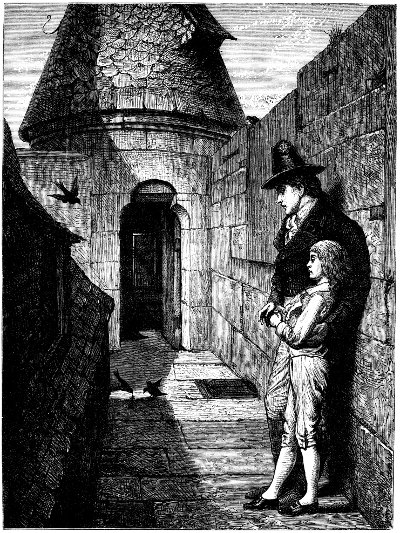
THE DAUPHIN IN THE TEMPLE.
All rights reserved.]
THE ORPHAN OF THE TEMPLE.
Those who would follow the story of
the dark days in the Temple, can do
so best by the perusal of the record
left by Madame Royale herself.
Written with an almost naive simplicity,
it is touching in the highest
degree, while incidentally it affords
graphic pictures of the various members
of the royal family.
Here, for instance, is Marie Antoinette
sketched to the life. “Her
calm contempt and her dignified air
generally struck them (the municipal
officers) with respect. They seldom
ventured to speak to her.”
“We passed the entire day together,”
writes the princess. “My
father gave a lesson in geography to
my brother; my mother made him
read some pages of history, and learn
some verses, and my aunt gave him
a lesson in arithmetic. My father
was so fortunate as to find a library
which gave him occupation; my mother
employed her time in working
embroidery.... My aunt spent
the greater part of her time in praying,
and always read the prayers of
the day. She read a great number
of books of piety, which my mother
frequently requested her to read
aloud.”
Every day exposed the prisoners
to fresh insults.
“Antoinette pretends to be
proud,” said Rocher, one of their
guards, “but I have brought her
pride down. She, her daughter,
and Elizabeth bow as they pass me,
in spite of themselves. They must
bend to me, for I keep the wicket
low. Every night I puff my smoke
into the eyes of Elizabeth as she
passes.” “Ca ira” was sung under the
King’s windows, and he was openly
threatened from time to time with
death. After the end of September
he was separated from his family,
and they were only allowed to meet
at meals. At these times they were
only permitted to converse in a loud
tone, and in French, and Madame
Elizabeth was severely rebuked by
one of the guards because she spoke
to her brother in a low voice.
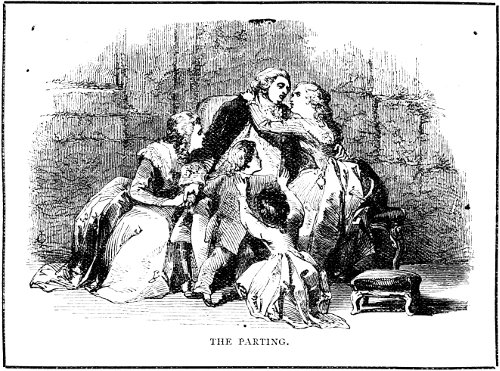
In December and January came the King’s
trial and condemnation. The agony of these
days of suspense to the Queen, her sister, and
her children, cannot be described. When the
fatal sentence was pronounced, they were
allowed one parting interview. The story of
that farewell has often been told. It lasted
for nearly two hours and a half. When the
moment of separation came, Madame Royale
swooned at her father’s feet, and had to be
borne away by the faithful Cléry, from whom
she was snatched by one of the municipal
officers, who carried her roughly to her room.
All the night she fell from one swoon to
another, and her aunt only left her to
prostrate herself before the crucifix in an
agony of prayer.
“The Queen had scarcely strength sufficient
left to undress my brother and put him to
bed. She herself lay down in her clothes,
and all night long we could hear her shivering
with cold and anguish.” The King had
promised to see them again in the morning,
but he deemed it better not to expose them
to the further ordeal. The beat of the drums
and the shouts of the people told them that all
was over.
“Nothing succeeded in calming the anguish
of my mother,” writes Madame Royale; “life
or death had become indifferent to her. She
sometimes gazed at us with a piteously
forlorn air that made us shudder. Happily my
own illness was increased by sorrow, and this
gave my poor mother some occupation.”
Marie Antoinette was unwilling to walk in
the garden of the Temple after her husband’s
death, for in so doing she was obliged to pass
the door of the room where he had been
confined. Afraid, however, that the want of
air would tell on her children’s health, she
obtained leave to walk with them on the top
of the Tower. The platform was, however,
surrounded with lattice work, and the air-holes
were carefully stopped. The Queen asked to
have a door opened between her room and
that of Madame Elizabeth, but this request,
after being referred to the Council General,
was refused. At all hours—sometimes in the
dead of night—their rooms were invaded by
the municipals, or by commissaries of the
convention, often intoxicated, who rudely
searched every corner, and took away whatever
little trifles they could find. “They
searched even beneath our mattresses,” says
Madame Royale, on one occasion; “my poor
brother was sleeping. They tore him roughly
from his bed that they might search it, and
my mother held him in her arms, quite
benumbed with cold.”
In the beginning of July the Convention
ordered that the Dauphin should be separated
from his mother, and committed to the guardianship
of Simon, the shoemaker, in another
part of the Tower. A terrible scene ensued
when this decree was communicated to the
hapless prisoners. The poor boy—he was
only eight years old—threw himself with cries
of terror into his mother’s arms for protection,
and Marie Antoinette for more than an hour
defended the bed on which she laid him
against the municipal officers, protesting
that they should kill her before they should
take away her child. “At length they
grew enraged, and threatened so positively
to kill both him and me, that her love
for us once more compelled her to yield. My
aunt and I took my brother out of bed, as my
mother herself had no strength left; and, as
soon as he was dressed, she took him in her
arms, and, after bathing him in her tears,
which were the more bitter as she foresaw that
it was the last time she should ever see him,
she placed him herself in the hands of the
municipal officers.”
The mother’s cup of sorrows was nearly full.
Madame Royale thus pictures the days that
followed:—
“We ascended to the top of the Tower
very frequently, because my brother also
walked there at his side of the building, and
the only pleasure my mother now had was to
get an occasional distant glimpse of him
through a small slit in the division wall. She
used to remain there for entire hours, watching
the moment when she could see her child.
This was her only desire, her only solace, and
her only occupation.”
A month later Marie Antoinette’s own
turn came, and she was removed to the Conciergerie.
She rose up, and submitted herself
in silence.
“My mother, having first tenderly embraced
me and exhorted me to take courage, to pay
every attention to my aunt, and to obey her
as a second mother, repeated to me the religious
instructions I had before received from
my father, and then, throwing herself into the
arms of my aunt, she recommended her children
to her care. I could not utter a word in
reply, so overwhelmed was I at the thought
that it might be the last time I should see
her. My aunt said a few words to her in a
low voice of anguish and despair. My mother
then hastened from the room without casting
another look towards us, fearful, no doubt,
lest her firmness should desert her. She was
stopped for some time at the bottom of the
stairs while the municipal officers drew up a
procès verbal for the keeper of the prison as a
discharge for her person. In passing through
the prison gate she struck her head against
the wicket, her thoughts being so occupied
that she forgot to stoop. She was asked if
she had hurt herself. ‘Oh, no,’ said she;
‘nothing now can hurt me.’”
Madame Royale and her aunt were now
left alone. Inconsolable at the loss of the
Queen, they made constant and urgent inquiries
concerning her, and begged earnestly
to be reunited to her. They were only told,
however, in the vaguest terms that no harm
would come to her. In September the rigour
of their imprisonment was increased. They
were confined to one room, and no longer
allowed a servant to do the coarse work.
“We made our beds ourselves, and were
obliged to sweep the room, which took us a
long time to do at first, until we got accustomed
to it.” They were not allowed to walk
on the Tower, for fear they should attempt to
escape, although the windows were all barred.
Anything that could tend in any way to their
comfort or convenience was taken away.
Madame Elizabeth asked for something instead
of meat on fast days. She was told that
under the new rules of equality there was no
difference between the days. When she asked
another time, she was told, “No one but fools
believe now in all that nonsense.” In spite of
these refusals, however, she managed to keep
Lent strictly when it came. She took no
breakfast, and reserved the coffee then provided
for her dinner, while at night she only
took bread. She wisely, however, forbade
Madame Royale following her example, and
urged her to eat whatever was brought, saying
she had not yet come to an age which required
her to abstain. In the winter evenings
she taught her niece tric-trac, which they
played together, “as a sort of distraction to
our grief.” As the days began to get longer,
however, they were not allowed any more
candles, and had to go to bed as soon as it
was dark.
The beautiful prayer composed by Madame
Elizabeth, which the aunt and niece used
daily, shows us the pure influence which was
helping to mould Madame Royale’s character,
and the spirit in which days of dreariness and
grief were met and conquered:—
“What may befall me this day, O God! I
know not; but I do know that nothing can
happen to me which Thou hast not foreseen,
ruled, willed, and ordained from all eternity;
and that suffices me. I adore Thy eternal and
inscrutable designs. I submit to them with
all my heart, through love to Thee. I accept
all; I make unto Thee a sacrifice of all; and
to this poor sacrifice I add that of my Divine
Saviour. In His name, and for the sake of
His infinite merits, I ask of Thee that I may
be endowed with patience under suffering, and
with the perfect submission which is due to
all which Thou willest or permittest.”
All this time they remained ignorant of the
fate of the Queen. They had, indeed, heard
the street hawkers crying the sentence of
death under their windows; but, though their
hearts misgave them at times, they refused to
believe that the sentence could have been actually
carried out, and so hoped against hope.
Whether from callous indifference or because
no one had the heart to tell them, the fatal
news never reached their ears, and it was
eighteen months before Madame Royale knew
of her mother’s death.
Thus the days passed until the 9th of May,
1794. The day had been spent as usual, and
the prisoners were just going to bed, when
loud and continued knocking at the door and
demands for immediate admission warned
them of some new evil. The summons was
for Madame Elizabeth. “Citizen, will you accompany
us downstairs?” “And my niece?”
“She shall be taken care of afterwards.”
Madame Elizabeth embraced her niece, and
told her, by way of reassuring her, that she
would soon return. “No, citizen,” said the
ruffians; “you will not return. Put on your
bonnet and go downstairs.” “She bore it all
with patience,” says Madame Royale, “put
on her bonnet, embraced me once more, and
told me to take courage and be firm, to place
my hope in God, to live in the good principles
of religion which my parents had taught me,
and to keep constantly in my mind the last
advice of my father and mother. She then
departed.”
The young girl of fifteen was thus left, as
she herself expresses it, “in an utter state of
desolation.” She “passed a cruel night”;
but, though filled with fears, she could not
believe that serious harm could be intended
to one who was so saintly and pure, and who
could never be accused of taking any share in
the Government or of any political offence.
She was told the next day, in answer to her
inquiries, that her aunt had been to take the
air. She little thought that Madame Elizabeth
had even then travelled her last journey
and reached her long home.
Madame Royale’s health did not sink under
these accumulated sorrows, heavy and bitter
though they were. Hué, her father’s faithful
attendant, writes of her:—“She had attained
an age in which sorrows are keenly felt, but
had learned by great examples to show herself
superior to adversity. Left entirely by
herself in the Tower of the Temple, God being
her only adviser and support, she increased in
grace and virtue, and grew like the lily which
the tempest spared.” The loving foresight of
her aunt doubtless contributed in great measure
to the preservation of her health. She
had planned out the days for her, appointing
set times for prayer, reading, work, and the
care of her room. She had taught her to do
everything for herself, showed her how to
freshen the air of the room by sprinkling
water, and had made her take regular exercise
by walking rapidly, watch in hand, for
an hour at a time. She saw no one except
the municipal officers, who continued to search
her room at frequent intervals, and the persons
who brought her meals. To the latter she
never spoke; to the former only to answer
briefly a direct question. Madame Elizabeth
had impressed on her that if ever she were left
alone, she should immediately ask to have a
woman to live with her. She felt obliged to
obey her aunt’s wish, but feared that if her
request were granted, some uncongenial person
would be given her for a companion. It
was, however, refused, and the princess confesses
that she was very glad.
So the long summer days passed away, and
the autumn came and went. Day followed
day in a dreary sameness of solitude. The
Princess of France grew to be thankful for
very small mercies. “I continued at least to
keep myself clean,” she writes. “I had soap
and water, and I swept my room every day....
I was not allowed any light; but in the
long days I did not much feel this privation.
They refused to give me any other books;
those I had were books of piety and travels,
which I had read over and over a thousand
times. I also had a knitting machine, of
which I was completely tired.”
The appointment of a fresh commissary of
the Convention, named Laurent, to take
charge of the princess and her brother,
brought some little relief. The unhappy
Dauphin, after enduring
six months’ brutal
treatment from Simon,
had been left six
months unattended
and alone, and was
reduced to the last
degree of misery.
Laurent, who seems
to have been a kind-hearted
man, did what
he could for him, and
treated Madame Royale
with civility and
consideration. She
ventured to ask for
news of her mother
and her aunt, and
asked him to use his
influence to have her
restored to her mother,
but “he replied
with an evident air of
embarrassment and
pain, that these were
matters with which he
had no concern.”
“The winter passed
with tolerable tranquillity,”
writes the princess,
“and I had reason
to be satisfied
with the civility of my
keepers. They offered to make my fire, and
allowed me as much wood as I wished, which
was a source of great comfort to me. They
also brought me the books I asked for; Laurent
had already procured me some. The greatest
distress I had was in not being able to learn
anything respecting my mother or my aunt.”
The course of the spring of 1795 was
marked only by the gradual fading away of
the Dauphin. The Committee of General
Safety sent physicians at last, and fresh
keepers strove by their kindness to compensate
in some feeble measure for the past
cruelties he had endured, but it was too late.
He grew weaker and weaker, then fever set
in, which he had no strength to resist, and he
died on the 9th of June. The poor child was
only a little over ten years old.
With the death of her brother, Madame
Royale’s memoirs come to a conclusion, but
we learn from other sources what followed.
The Government seem to have felt they had
gone too far. A feeling of pity for “the
daughter of the last King” began to be
awakened. A petition was presented from
the City of Orleans, urging that she should be
restored to freedom, and negotiations were
set on foot which had in view an exchange of
the princess for some prisoners in the custody
of the Austrian Government. Meanwhile
Madame Royale was treated with much
greater consideration, and a lady, Madame de
Chantereine, was appointed to attend on her.
Above all her old friends, Madame de
Tourzel, and her daughter, Pauline, and
Madame de Mackan, former sub-governess to
the children of France, were, after some
difficulty, allowed to visit the Temple.
Madame de Tourzel, in her memoirs, has left
us many details of their first meeting.
They had left the princess feeble and
delicate, and were surprised to find her
beautiful, tall, and strong, and with that air
of distinction which was her peculiar
characteristic, while they traced in her the
features of the King, the Queen, and even of
Madame Elizabeth. She had much to tell
them of all three, and they drew from her
many touching particulars of her solitary
captivity. She confessed she had grown so
weary of her profound solitude, that she had
said to herself that she should not be able to
keep from loving any companion they might
give her short of a monster. When Madame
de Tourzel expressed a hope that she might
be allowed to leave France, Madame Royale
answered sadly “that she still found some
comfort in dwelling in a country which held
the ashes of those who had been dearest to
her in the world.” And, she added with a
burst of tears, that “she would have been
much happier if she could have shared their
fate instead of being condemned to weep for
them.” No single expression of bitterness,
however, escaped from her.
The good Marquise was considerably
shocked at the freedom with which Madame
de Chantereine treated the princess, and the
airs of authority which she assumed over her.
The Marquise and her daughter endeavoured
to make her see this by the great respect which
they themselves showed Madame Royale, but
is was to no purpose. Madame Royale, however,
had attached herself to the lady, and did
not resent her familiarity. Any companion
who showed her kindness was welcome to her,
and Madame de Chantereine was an educated
person, could speak Italian, of which the
princess was fond, and gave her lessons in
embroidery, at which she was very skilful.
Madame Royale was allowed once more to
walk in the garden of the Temple. The
faithful Hué hired a room in a house overlooking
the garden, and ventured to sing in
her hearing a ballad which foretold that her
captivity would soon be over. More than
this, he contrived to have conveyed to the
princess a letter, with which he had been
entrusted by her uncle,
Louis XVIII., and to
obtain her reply. From
Madame de Tourzel
Madame Royale learnt
that it was the wish of
her uncle, as it had
been that of her parents,
that she should
wed her cousin, the
Duc d’Angoulême. It
was the first time she
had heard this, and
she expressed surprise
that her father and
mother had never
spoken to her on the
subject, but Madame
de Tourzel explained
that they had probably
refrained on account
of her youth,
and for fear of distracting
her attention
from her studies. The
thought of being able
to carry out what had
been her parents’
wish made a great impression
on the princess,
and with a fresh
interest thus awakened
she asked Madame de
Tourzel many questions respecting the Duke.
The discovery, however, of a supposed
Royalist plot, and, later on, the application
of the Tuscan Envoy to be allowed to salute
the princess, caused her to be again more
closely confined and debarred from the society
of her friends. But her captivity was now to
be only of short duration, and at the end of
November the following order opened the
gates of the Temple:—
“The Executive Directory resolve that the
Ministers of the Interior and Foreign Relations
are charged to take the measures necessary to
accelerate the exchange of the daughter of the
last King for the Citizens Camus, Quinette,
and other deputies or agents of the Republic;
to appoint a proper officer of the gendarmerie,
fit for the purpose, to accompany the daughter
of the last King as far as Basle; and to allow
her to take with her such persons engaged in
her education as she likes best.”
(To be continued.)
EVERY GIRL A BUSINESS WOMAN. — PART IV.
A PRACTICAL GUIDE TO THE WORLD OF INDUSTRY AND THRIFT.
By JAMES MASON.
t the end of our
last article we
were speaking
of the Post
Office as a
banking establishment,
and we did not
finish all there
was to say on
the subject.
Being both
bankers and
letter-carriers,
the postal authorities
offer
unusual facilities
to the
public for sending money to different places,
either in the United Kingdom, or in the
colonies, or in foreign countries. This department
of their business is divided into two
branches—that dealing with Money Orders,
which are an old institution, and that occupied
with Postal Orders, which only came
into use in 1880.
Money orders were first started in 1792 by
three Post Office clerks, with the idea that
they would be of service for sending
small sums safely to soldiers and sailors. The
business gradually extended, and in 1838 was
taken over by the Government.
The charge for remitting was at first eightpence
in the pound; but it has been reduced
from time to time, the last reduction being
made only a few months ago. It now stands
as follows:—To remit to any place in the
United Kingdom any sum not exceeding a
pound costs 2d.; from one pound and not exceeding
two pounds costs 3d.; from two
pounds and not exceeding four pounds costs
4d.; from four pounds and not exceeding
seven pounds costs 5d.; and from seven
pounds to ten pounds you have to pay 6d.
No single order is issued for more than ten
pounds; but if you have to remit, say, thirty
pounds, it is an easy matter to get three
orders.
To get a money order, the first thing you
have to do is to fill up an “application form,”
to be had gratuitously at all money order
offices. All post offices, by the way, are not
money order offices. Here is a form filled
up:—
Money Order Required
For £9 2s. 3d.
Payable at Pepperness.
To Miss Flora Sprat.
Sent by Esmeralda B. G. Constable.
Residing at Grumblethorpe.
The amount of the order required, along
with the commission—the total in this case
would be £9 2s. 9d.—is handed over with the
form to the postmaster, or whoever is acting
for him. No order may contain a fractional
part of a penny. To make an order more secure,
it may be “crossed,” just as we mentioned
could be done with cheques. In that
case it is payable only through a bank.
When a money order is to be paid in London,
or in any other town where there are
more money order offices than one, the sender
should say at what particular office she wishes
it to be paid. Should she not do so, and only
say, “Payable at London,” or “Manchester,”
or “Edinburgh,” the receiver of the order will
get payment at the head office in the town
only.
As a precaution against dishonest people,
it is recommended that when the sender of the
order is well known to the receiver, the letter
enclosing it should be signed with initials only.
When she is not well known, safety may be
given to the order by making it payable ten
days after date, or by having it crossed like a
cheque, or by registering the letter containing
it; or the name of the sender may be sent in
a separate letter from that containing the
money order. If ever you make a money
order payable ten days after date, you must
on obtaining it affix to it, in the presence of
the postmaster, a penny adhesive stamp, and
write your signature across the stamp.
When an order is presented for payment,
the person presenting it is asked “Who sent
this order?” and if this question is correctly
answered, and the order is properly receipted,
the sum is at once handed over, “unless the
postmaster have good reason for believing
that the applicant is neither the rightful
claimant, nor deputed by him or her.”
Money orders are not only to be obtained
for places in the United Kingdom. They are
also issued on France, Belgium, Switzerland,
Germany, Italy, Holland, Denmark, Norway,
Sweden, the United States, and several other
foreign countries, and on most of the British
colonies and foreign possessions. The rates
of commission charged for these foreign money
orders are—For sums not exceeding two
pounds, 6d.; from two pounds to five pounds,
1s.; from five pounds to seven pounds, 1s. 6d.;
and from seven pounds to ten pounds, the
highest limit of a single order—2s. The regulations
affecting foreign money orders may
be seen in the useful Postal Guide, which is
published, as we mentioned in our first article,
once every quarter.
There has been a considerable falling-off
of recent years in the number of inland money
orders issued, colonial and foreign orders
having, however, on the other hand, increased
in number. The decrease has been brought
about by the introduction of postal orders, as
they are called, which have been found much
more convenient in some respects, not to
speak of their being, for small sums, decidedly
cheaper.
These postal orders, payable on presentation
without previous notice, are issued for fixed
sums from a shilling up to a pound, and are to
be obtained at all money order offices in the
United Kingdom, as well as at Malta,
Gibraltar, and Constantinople. Here are the
amounts for which they are issued, together
with the “poundage” payable on each order:
There are orders for 1s. and 1s. 6d., on which
the charge is ½d.; then there are orders for
2s., 2s. 6d., 3s., 3s. 6d., 4s., 4s. 6d., 5s., 7s. 6d.,
10s., and 10s. 6d., which cost 1d. each; and,
last of all, there are orders for 15s. and 20s.,
on which one has to pay 1½d. A postal order
is in the following form:—
To the Postmaster in charge of the Money
Order Office at.....................
Pay to........................., at any time within
Three Calendar Months from the last day of
the month of issue, the sum of Ten Shillings,
on account of Her Majesty’s Postmaster-General.
When one has to remit broken amounts,
say 4s. 2½d., or 8s. 3d., or 10s. 9½d., postage
stamps may be affixed to the face of the
orders; but the stamps used in this way on
any one order must not exceed fivepence in
value.
Every postal order issued has this regulation
printed on it:—“The person to whom
this order is issued must, before parting with
it, fill in the name of the person to whom the
amount is to be paid, and may fill in the name
of the money order office at which the amount
is to be paid.” The word must is underlined
in the Postal Guide; but the public having
discovered that postal orders are a very convenient
form of small currency, have never taken
the regulation seriously. In fact, postal orders
are coming more and more to be passed from
hand to hand like coin, the blank spaces in
the order being only filled in when it comes to
the last holder.
When circulating in this way, however,
postal orders have an inconvenience: they
must be cashed within three calendar months
from the last day of the month when they
were issued, otherwise a sum equal in amount
to the original “poundage” is charged for
every additional three months that passes before
the order is presented for payment.
Suppose a postal order kept on circulating, it
would fall in value every three months. A
shilling postal order at the end of a year would
only be worth 10½d.; at the end of two years
its value would be 8½d.; and suppose it
remained uncashed for six years, all you would
get for it would be ½d.
Before a postal order is paid, the blank
spaces must be filled in, and the receiver of
the money must sign her name at the foot.
Should a postal order be “crossed” like a
cheque, payment will only be made through a
banker.
Leaving money and postal orders—which
we have spoken about fully because they are
such everyday documents—we come now to
speak of Insurance. And this is a subject
about which all prudent people should know
something.
The object for which insurance exists is to
guard against certain accidents to which we
are all liable, such as the destruction of property
by fire, or the loss of future earnings by
disablement or death. An agreement is
entered into by which one party, known as
the insurer or assurer, agrees to pay to
another, called the insured or assured, a
certain sum in the event of the particular
event insured against happening.
The document which states the conditions
of this agreement is called the policy, and the
payment made on account of the insurance is
known as the premium.
Insurance of houses and goods against fire
began in London in 1667, the year after the
Great Fire, in which the citizens had so
terrible an experience of the character of the
all-devouring element. The business has now
attained gigantic proportions, the insurance
companies of our own day being as a rule
very wealthy and profitable concerns.
The rates charged for insurance are calculated
at so much per cent.—or so much for
every hundred pounds—of the sum insured.
They vary in amount according to the nature
of the risk. If there is little danger under
ordinary circumstances—as in a dwelling-house—of
the property being destroyed by
fire, the sum to be paid is low; if, on the
other hand, the danger is considerable—as in
a sugar refinery—the charge is high.
Risks may be divided into three classes—common,
hazardous, and doubly hazardous.
Common insurances are charged 1s. 6d. to 2s.
per cent. per annum, with certain exceptions;
hazardous insurances are charged 2s. 6d. to
3s. 6d. per cent. per annum, with certain
exceptions; and doubly hazardous insurances
are charged 4s. 6d. to 5s. per cent. per annum,
with certain exceptions; and in the case of
the exceptions the rate may run to 10s., 15s.,
or even more per cent.
In describing the property to be insured,
you must be careful to tell the whole truth
about it, so that the company may know what
risk they are running in insuring it. Suppose,
too, after the insurance has been effected the
risk should become greater—say by the
erection of a stove—you must not fail to keep
yourself safe by communicating with the company.
There are some kinds of property, such
as ready money, books of accounts (their value
as documents), bank-notes, stamps, bills,
bonds, and other written securities, which
insurance companies will not undertake to
insure on any terms.
Insurance premiums are usually paid once a
year at one or other of the four quarter-days.
Fifteen days of grace are allowed after the
expiry of annual policies, and if the premium
is not paid before the end of these fifteen
days, the insurance company holds itself free
from all risk. All policies, however, are not
annual ones. You may insure for any length
of time. No days of grace are allowed on
“short-time policies”—that is, on policies for
less than twelve months.
If one has any property to speak of, it is
always well to insure, for accidents will
happen. Perhaps, after paying for many
years without a disaster, one may be inclined
to lament having insured at all, and wish that
all the money paid in premiums were in her
own pocket; but this is not the right way of
looking at it. The money sunk in premiums is
well spent in buying ease of mind. A person
insured can sleep in comfort, knowing that
if fire should overtake her property she will
recover full value; whilst one uninsured may
pass many sleepless hours thinking, If I am
burned out, what will become of me?
Life Insurance is quite as useful an institution
as insurance against fire; indeed, it has
been called “one of the greatest blessings of
modern times.” In it, by means of an annual
payment, varying according to the age of the
person whose life is insured, a sum is secured
in the event of death. A girl may not have
any necessity for benefiting survivors in this
way, but she should know something about
the matter for all that.
In insuring one’s life the applicant is
required to furnish information as to her own
health and habits of life, and some particulars
as to her family history. If the application
should be rejected on the ground of ill-health
or a tendency to hereditary disease, you must
just try elsewhere: offices are to be found
that will insure unsound lives, the charge
being, of course, proportioned to the risk.
The cost of life insurance is based on the
expectation of life at different ages. The
expectation of life, for example, of a girl of
ten years of age is about 48 years; at fifteen
about 44 years; at twenty about 40 years, and
so on, decreasing year by year, till at last it
dwindles down to nothing at all.
A period of grace, most commonly thirty
days, is allowed after each life premium falls
due. If it is not paid within that time, the
conclusion is come to that the policy-holder
intends to drop the contract.
It is a matter of great importance to be
insured in a good office, and the most careful
inquiry should be made on the subject before
taking out a policy. “Safety,” says one
writer, “ought to be the first consideration,
and economy the second; but really, economy
ought to be put first, for there is no economy
in insuring in an unsound office, however low
its premium may be.”
Life insurances on a small scale can be
effected better, perhaps, through the Post
Office than through any other channel. The
Postmaster-General is authorised by an Act
of Parliament to insure the lives of persons
of either sex. The lives of children under
eight years of age cannot be insured; from
eight to fourteen they can be insured for not
more than £5; and from fourteen to sixty-five
they can be insured for any amount not less
than £5 or more than £100. The security for
the payment of the money at the proper time
is the best in the world.
Forms of proposal for the insurance of
lives are to be obtained at any Post Office
Savings Bank, and anyone can see there the
tables of the premiums to be charged, and
obtain all other necessary particulars. As examples
of the various ways in which insurance
through the Post Office can be effected, take
the following:—The life of a girl between
fifteen and sixteen years old may be insured
for £10 by an annual payment through life of
3s. 10d., or by an annual payment to the age
of sixty of 4s., or by a single payment of
£3 17s. Or she can assure £10 at the age of
sixty years, after the payment of the final
premium, or at death, should death occur
before that age, by an annual payment of
4s. 6d., or by a single payment of £4 7s.
There are some companies which insure
lives by the payment of a small sum weekly or
fortnightly, a collector calling for the payments
when they become due. This is a dear
system; no more profitable than the purchase
of tea half an ounce at a time. In these days
of savings banks it is no excuse that it suits
scantily filled purses. Instead of adopting it,
it would be far better for their own interest if
people of small means would lodge the sums
they would otherwise have paid the collector
in the Post Office Savings Bank, and at the
end of the year direct that the amount be
applied to the payment of an insurance
premium.
Besides the two forms we have mentioned
there are other varieties of insurance. You
can insure plate glass against breakage, boilers
against bursting, and crops against hailstorms.
The lives of horses and cattle can be insured,
and pig insurance companies are not unknown.
Insurance against accidents is another
useful variety. It dates back from 1849,
when a company was started to insure against
the consequences of railway accidents. In
return for a payment of 3d., 2d. or 1d. made
by first, second, or third class passengers
respectively, for insurance during a single
journey, it undertook to pay £1,000, £500 or
£200 in case of death by such an accident, or
a certain weekly allowance in respect of
personal injury not resulting in death. A few
years later the business was extended, and
people can now insure against accidents of all
kinds by a yearly payment proportioned to
the degree of risk supposed to attach to
various occupations or other conditions of life.
There is another kind of insurance worth
knowing about: Fidelity Guarantee Insurance,
it is called. By means of it employers are
guaranteed against the dishonesty or
insolvency of their servants. Previously,
people in positions of trust often got others to
be surety for them, but the system of private
suretyship led to many hardships. Solomon
was right, and let all wise girls take note of it:
“He that is surety for a stranger shall smart
for it; and he that hateth suretyship is sure.”
The guarantee of a company, given as a pure
matter of business, and for an annual payment,
is now generally preferred. Of course, before
giving a guarantee the company makes very
particular inquiry regarding the character of
the person and the checks to be used by
the employer. Some companies insure only
against embezzlement, whilst others protect
the employer against any failure to make good
the sums entrusted to the employé. The
premiums to be paid annually range from 10s.
to 60s. per cent. of the sum guaranteed.
Annuities are our next subject. An annuity
is a periodical payment made either for a fixed
number of years or whilst a given life lasts.
It may be paid yearly, quarterly, weekly, or
otherwise. It may come to one as a gift, or
be left as a legacy, but it can also be purchased
through an insurance company by the payment
of a certain sum of money supposed to be its
equivalent in value. Annuities bought in this
way may be either immediate—that is to say,
the payment of them beginning at once—or
deferred; in other words, the enjoyment of
them postponed till after a certain number of
years have elapsed. If, say, £100 is to be received
each year by anyone, he or she is said
to have “an annuity of £100.”
For young people, with all the chances of
life before them, the purchase of an annuity is
seldom wise. The sum, observe, sunk in this
way can never be had back again, even though
an opportunity should occur for making a
much more profitable use of it. But when
people grow up, it is often the best way to
make the most of a small capital, and to prevent
their becoming, perhaps, a little later in
life, a burden on their friends. The great
thing, in settling whether to invest money
thus, is to discuss the matter with common
sense, and to ask, “What should I do, so as
to be most useful to myself and to others?”
Annuities, both immediate and deferred,
are granted by the Post Office for any amount
not less than £1 or more than £100 to any
person not under the age of five years. Forms
of proposal for purchasing them are to be had
at any Post Office Savings Bank. The sum
charged varies with the age and sex of the
person on whose life the annuity is to depend,
and, in the case of deferred annuities, with
the number of years which are to elapse before
the commencement of the annuity.
The payment of a deferred annuity may be
made in one sum, or it may be broken up into
a number of small payments at regular intervals.
You can, by a slight increase on the
payment for a deferred annuity, secure the
return of the purchase-money to your representatives
in the event of your death before
the commencement of the annuity, or to yourself,
should you for any reason wish to be out
of the bargain.
A word of advice is given by a sensible
writer to all who are life annuitants. “They
should bear in mind,” she says, “to live well
within their income, as generally the whole of
their money is one of life interest, and there
will be no fund to fall back upon to pay
funeral expenses, doctors’ bills, wages, etc.,
when they die, but their savings.”
Fire insurance, life insurance, and the
purchase of annuities are amongst the sensible
transactions of prudent and saving people.
But sometimes the prudent and saving, quite
through innocent misfortune, come down in
the world, and have a difficulty in making
both ends meet for the present, let alone
providing for the future. Under these
circumstances people without much experience,
and especially women who are not business
women, are very apt to fall a prey to the
wiles of the professional money-lender. To
the artful ways of the money-lending fraternity
we shall devote what remains of this article.
If anyone is in want of a little ready money
she has only to turn over the morning papers,
and she will there see a score of advertisements
headed “Money,” and all offering “loans on
easy terms.” How is she to know, unless she
has been told, that these petty money-lenders
are one of the most serious evils of our present
state of society, and that there are hundreds of
them preying on the ignorance, the impulsiveness,
and the necessities of their fellow-creatures?
“There is considerable variety,” says a
writer in the Leisure Hour, “in the bait used
by these angling money-lenders, but great
sameness in the general form of the cruel hook
by which poor silly fish are caught. Some of
the advertisements are from ‘loan offices,’
others from ‘private gentlemen’ who are
‘willing to advance money’ and who have
‘no connection with loan offices.’ They all
seem to have unlimited resources, from £2 to
£1,000 being at the disposal of every
borrower. The invitations are to respectable
persons, male or female, in town or country;
distance no object; personal application
preferred, but not necessary. ‘Strict secrecy
and prompt despatch’ are usually promised;
answers to application ‘by return of post’
and money sent ‘at a day’s notice.’ So
obliging are these gentlemen, ‘forms will be
sent gratis,’ and in some cases the borrower is
assured there are ‘no law costs’ and ‘no
office fees.’ More convenient still there are
‘no securities required.’ To borrow is an
easy matter after all.
“But of course there must be securities of
some sort. Well, the borrower’s ‘note of
hand’ is sufficient, with deposit of deeds,
leases, life policies, or, if preferred, a bill of
sale on furniture or other goods ‘without
removal’ (i.e. at the time of borrowing). Then
the repayment may be by ‘easy instalments.’”
How accommodating!
Many of these assertions the needy borrower
will find abundant reason to doubt before the
loan is completed. On application she will
be puzzled to reconcile the terms named to
her with those in the alluring advertisement,
and will find the rate of interest to be
truly “five per cent. and upwards,” fifty per
cent. being no uncommon demand, in addition
to expenses connected with and deducted from
the loan. Should she complain about the
expenses, she is usually told that they are
rendered necessary by the existence of some
special risk in her particular case.
The writer whom we have just quoted tells
a sad story of a poor widow lady, who, being
pressed for her rent, saw a money-lender’s
advertisement and answered it. The money-lender
came, and obtained the lease of the
house as a security, “only a form, you know.”
He was such a polite, kind man; and interest,
she understood, was to be only £5 per cent.
Soon after the widow had an offer for her
house and furniture, so she went to redeem
the lease held in security by the money-lender.
The poor woman, who had signed the papers
presented to her, either without reading them
or without thoroughly understanding them,
then learned for the first time that “£5 per
cent.” did not mean £5 a year for the loan
of a hundred pounds. The money-lender’s
advertisement did not say “£5 per cent. per
annum.” He lent his money at £5 per cent.
per month, or £60 for a year for £100,
besides various fees and charges. The moral
of the story is that it is very foolish to have
anything to do with money-lenders, and that
it is still more foolish to go into any transaction
without making perfectly certain as to the
exact amount for which one is liable.
There are some money-lenders who only
pretend to lend: as a matter of fact, they
never do. Their profits are derived solely
from booking fees, office expenses, and
charges for the sham “inquiry,” which
always is of so unsatisfactory a nature that
the loan cannot be granted. It is true the
advertisements of these gentry often state that
no preliminary fees or office expenses of any
kind are charged. The borrower, however, is
in such cases informed that these payments
are dispensed with only in the cases of certain
classes, in none of which, we need hardly say
is she fortunate enough to find herself.
(To be continued.)