THE HOUSE WITH THE VERANDAH. — CHAPTER XXII.
By ISABELLA FYVIE MAYO, Author of “Other People’s Stairs,” “Her Object in Life,” etc.
A GREAT MYSTERY.
verybody, not to say
every householder, is
alive to the acute
dangers of escaping
gas. Every other
thought was suspended
for the moment.
The hall
door was left open,
watched over by little
Hugh, and everybody,
even the stranger,
Mrs. Grant,
rushed to open some
window. The next
thing was to find out
the peccant burner.
Clementina called from the kitchen
that the gas there was properly turned
off, save one light still burning. It was
the same in hall and dining-room;
what was not alight was duly turned off.
Miss Latimer, coming downstairs at the
moment, reported that there was no
odour of escaping gas in the higher
regions.
“Well, there’s only my bedroom left,”
said Tom, “and I’m certain I turned off
mine.”
But as he opened his chamber door
his face lengthened. There was no
doubt now as to the source of the
danger. No light was there, but the
cock of the gas-bracket stood “full on.”
The mischief was swiftly remedied,
though the room was so saturated with
effluvia that it would take a prolonged
airing to free it from the fumes. But
Tom was terribly perturbed by the
discovery.
“I could have made affidavit that I
turned off the gas,” he declared. “I
had it burning to dress by its light, and
if I didn’t turn it off, how came the light
to be out?”
“You must have forgotten it wasn’t
a candle, and you must have blown it
out, Tom,” said Miss Latimer.
“Well, then, I’m getting about as
bad as my old landlady’s servant girls,”
decided Tom. “I can’t believe it of
myself. Henceforth, I’ll never feel
sure of having done anything!”
“Perhaps you did turn it out, and
then gave it an accidental knock which
turned the cock back again,” suggested
Miss Latimer; “such things will happen
sometimes.”
Tom shook his head.
“The cock is very stiff,” he said.
“You must remember you were in
haste. We are all rather put about
just now,” Miss Latimer went on.
“But you must not dwell on it. All is
well that ends well.”
Still Tom remained dissatisfied and
unconvinced, and took no part in the
eager discussion which had already
begun between the two anxious wives
seated at the breakfast table.
“I think I know how I’ll manage,”
said the Captain’s wife. “I’ll go to
the shipping offices myself. No”—she
interrupted herself as Lucy made a hasty
movement—“you mustn’t think of
coming with me. With your face, my
dear, you’d never get anything out of
them while there was the faintest chance
of their being able to hold it back. But
perhaps,” she added turning to Tom,
“this young gentleman will come with
me to show me the way, and to take
care of me over those busy City crossings,
for I recollect that when I once went
with the Captain to the office, there
was some clever steering to be done
ere we got there!”
Up to this point nobody had remembered
that Mrs. Grant did not know
Tom. Now Lucy recollected herself
and introduced the boy as an employee
in Charlie’s office, and at present a
member of the Challoner household.
Mrs. Grant beamed on him.
“This is most fortunate,” said she.
“For I’m sure your masters will give
you an off day to help me find out
whether there’s any news of their Mr.
Challoner—and of my Captain!”
“I’m sure they will!” cried Tom.
“The chiefs are always asking whether
we have heard anything. Still I’ll have
to go to the office first to tell them why
I’m wanting leave of absence.” He
suited the action to the word, bustling
away, saying, “Wait till I come back—and
I’ll be back as fast as I can fly!”
When he was gone, Mrs. Grant and
Lucy had time for a little quiet talk.
It was very easy for Mrs. Grant to say
that on the platform she had recognised
Lucy from her old photograph, but
she did not add that she was shocked
at the change visible in her, the manifold
signs of nerve strain and exhaustion.
“If she has much more waiting, she’ll
set sail herself for a far-off shore,”
thought the good woman. Yet when
she found that Lucy had regular duties at
the Institute, she would not allow Lucy to
dream of absenting herself for her sake.
“No, no,” she said. “I did not
come here to upset your regular ways.
For one thing, if you begin to change
those, people will realise how anxious
you are, and then they’ll pull long faces
to you, and that will make everything
still harder and worse to bear. It’s
wise to keep a still sough, as we say
in the North. You just go about your
usual day’s work, and when you come
home, you’ll find me and the young
gentleman returned and waiting, and
whatever we have heard, you shall hear
it all—honour bright, I promise you.”
Lucy had her full share of the sweet
womanly instinct of obedience. It is
an instinct which is often strong in
proportion to the strength of the whole
nature. It works so naturally and
grows so strong in the fortunate daughter
and the happy wife, that it adds
terribly to the sense of disaster when
the props to which it twines are withdrawn
and it is left trailing on the
ground. Lucy was quite ready to
succumb to the genial domination of
this wholesome kindly woman, already
her sister in suspense and who might
so soon be also her sister in sorrow.
She went upstairs before she went away,
and came down saying that poor Tom’s
mischance with his gas-burner had made
her so nervous that she had carefully
tested all the upstairs burners.
“Somebody else might have made a
similar mistake,” said she, “but they
are all right.” So she went off, taking
Hugh to the Kindergarten on her way.
“Let her keep regularly to her teaching,”
Mrs. Grant confided to Miss
Latimer. “Keep her up to that, I beg
you. While we wait, and when waiting
ends—as it may—there’s nothing helps
us as work does. It’s the blessed will
of God that what most of us have to do
for our bread is exactly what is good for
our souls. The wash-tub and the scrubbing
brush have done lots for many a
poor body who is left behind. I’ve
often seen that. It’s not for any widow’s
having to work that I’m ever sorry, but
because her work is often so ill-paid, that
do what she may, she can’t keep her
head above water. But, I say,” she
added, sniffing, “don’t you smell the
gas very strong again?”
“Oh, it is only the remains of the
accident in the boy’s bedroom,” answered
Miss Latimer. “The breeze
through the back windows is driving
it more to the front of the house.”
Just at that moment Tom’s key was
heard turning in the front door, and
directly he entered the house he cried—
“Why, the smell of gas is worse than
ever!”
“So I think,” observed Mrs. Grant.
Tom rushed to his own bedroom.
“There’s something at the bottom of
all this,” he said. “I’m as positive
that I turned it off the first time as we
all are that it was turned off afterwards.”
He stamped about the chamber, exclaiming,
“It’s all right here now, the gas
is turned off, and there’s no smell inside
here. The mischief is somewhere else.”
“Mrs. Challoner examined all the
burners upstairs, and saw that they
were right before she went out,” said
Miss Latimer. “Perhaps you notice
the smell more because you’ve just
come in from the fresh air, Tom.”
“But I’ve been in the house all the
time,” persisted Mrs. Grant.
Tom sprang upstairs.
“There!” he shouted. “Here’s the
staircase burner turned full on, and it’s
the same here—and here—and here,”
he cried, rushing from chamber to
chamber, turning off burners and
throwing open windows. “Yes,” he
reiterated, as he came downstairs
again, “every burner upstairs was
started—the only ones turned off are
that in my room where the mischief
began and in the dining-room where
you were sitting.”
“They are all right downstairs,” remarked
Clementina from the back of the
hall. But Tom went down and made
a re-examination before he would be
satisfied on that point.
Mrs. Grant and Miss Latimer looked
at each other bewildered.
“I’ve not been upstairs to do up the
rooms yet,” observed Clementina. “The
only room I’ve tidied yet is Mr. Tom’s.
I heard the mistress say to you, ma’am,
as she went out, that she’d just been
over all the burners, and that they were
right.”
“Poor dear lady,” said Mrs. Grant;
“she has been so flurried and put about
that when she tried the handles, she
must have turned the gas on and never
noticed that she did it!”
“That must have been so, I suppose,”
Miss Latimer reluctantly admitted;
“but it’s hard to believe. Lucy is so
wonderfully careful. However much she
suffers herself, none of her duties
suffer!”
“Ah, but that’s different,” Mrs. Grant
replied. “She thought she was thoroughly
doing her duty now; only her
mind slipped off, and she did it the
other way about.”
“I don’t believe it,” said Clementina
energetically.
“What don’t you believe?” asked
Tom.
“I don’t believe my mistress made
any mistake. I never knew anybody so
careful as she is.”
“But what other explanation can we
offer?” inquired Miss Latimer.
Clementina answered solemnly, “I
believe there is an evil spirit in this
house just now.” Then, as if to give
emphasis to her words, she turned and
marched from the room.
“She is very superstitious,” Miss
Latimer observed to Mrs. Grant. “If
she gets this sort of thing into her head,
as I’ve felt she was doing for some
time, she’ll go off, and her departure
just now will be a great trial. Are many
people in the north superstitious?” she
asked.
Mrs. Grant laughed. “Human nature
is much the same everywhere,” she
answered. “That’s what the Captain
always said. He’s known folks black,
and brown, and yellow, and every shade
that they call white, but he says there
are only two differences among them,
and that’s goodness and badness, and
that you find both everywhere. All the
qualities, he says, are sprinkled over the
world, pretty fairly divided. As for
superstitions, what does the word mean?
I believe in evil spirits, of course, but
they work through ourselves.”
“Well, I’m very glad I am not going
to my pupils this morning,” observed
Miss Latimer, “and as I shall spend
most of my time supervising the gas-burners,
I think you may rely that you
will not find the house blown up when
you return from your quest.”
Mrs. Grant and Tom started off for
the shipping office. As they went, she
confided to him her plan of operations.
“I shall send you in first,” she said.
“Men often won’t tell a woman the
worst, though they know she’s got to
hear it. They put off the hard job on
somebody else. It’s a cruel sort of kindness.
Very likely they’ll tell you plainly
what they would gloss over to Mrs.
Challoner or me.”
“But they’ll ask who sent me?”
suggested Tom.
“Don’t wait till they ask the question,”
she answered. “What’s the
name of the firm you work for?”
“Patrick, Elsum, and Challoner,” he
replied. “That’s the proper name; but
as Mr. Challoner only newly got into the
firm, his name is often not added. I
don’t think it is in the Directory.”
“Then say straight out that you are a
clerk at Patrick and Elsum’s, and that
you want to know everything they have
heard of the Slains Castle. Don’t seem
any more anxious than you would be if
it was a matter of some client’s cargo.
As soon as you come out and tell me all
they say, I’ll go in myself with you and
have it all cleared up.”
She had to wait rather longer than she
had thought, and when Tom came out
and advanced towards her, she saw that
his face was very grave indeed.
“Well?” she said, quite sharply.
“There is something known,” Tom
answered in a low and solemn voice.
“They say that a spar and a piece of
sail, with Slains Castle painted on them,
have been picked up by a Pacific liner.”
Mrs. Grant stood still, and caught her
breath.
“I’m going straight into the office,”
she said, “to ask why they could not
write that to me, instead of bringing me
up here to have to get it out of them by
guile! And it’s not such a wonderful
thing that they need keep it to themselves.
One knew something must have
happened, and this only shows how
something has gone wrong, and how
they’ve had to take to the boats and get
into any port they could. That’s how
I’m going to look at it, and so must
Mrs. Challoner.”
Her interview in the office was not very
long. As she walked back with Tom,
Mrs. Grant’s thoughts seemed of Lucy
rather than of herself.
“You see all this trouble has come
into her life by an accident, as it were,”
she said; “it’s like happening to get
shot the first time you handle a gun.
But this is the ill wind that I’ve always
watched to bring my trials. I laid that
to my soul when I married the Captain.”
“I’m so glad that you’ll be with my
poor friend,” remarked Tom, himself
immensely relieved by this vigorous
presence.
“But, my dear boy, I must go straight
home by the night train. If any mischance
has befallen the Captain, there’s
but the more reason for the mate to be
at her post. Mrs. Challoner has got
Miss Latimer and you to look after her;
she couldn’t have kinder people.”
All the little household had gathered
in before Lucy came. They had the fire
blazing, and the tea set for her return.
They could not lighten the falling blow,
but they could surround her with loving
kindliness.
Lucy heard the news very quietly indeed.
She lifted Hugh upon her knee
and kissed him two or three times.
Then she said she was afraid they would
all take cold through wandering about
in such disagreeable weather. She put
Hugh down, rose, and went out of the
room, leading him by the hand.
Mrs. Grant shook her head. “If our
husbands are really gone,” she said,
“she won’t stay long after them.”
“Oh, yes, she will,” asserted Miss
Latimer; “the source of all strength is
open to my Lucy, and she will be found
ready to do the next thing.”
“I know there’s a great deal in that,”
Mrs. Grant admitted. “Grief does not
kill according to the greatness of itself,
or of the love behind it, only according to
the weakness of the constitution; but she
looks little more than a spirit already.”
A postman’s knock came to the door.
Tom ran to see what had arrived. He
did not come straightway back to the
parlour, and when he did, he threw Miss
Latimer a significant glance.
“I think I’d better run round to the
office,” he said, “and let them know
what we have heard. And I think I’ll
look in also on Mr. Somerset. I’ll be
back in good time to see Mrs. Grant to
the station, as she is quite determined
to go to-night.”
By the time Tom reached the office,
his principals had departed. Tom did
not choose to tell his melancholy news
to any of the underlings; but he was
only too anxious to disburden himself to
Mr. Somerset.
That gentleman was deeply moved by
the tidings of the Slains Castle—so
ominous of the true significance of the
long silence. Yet he allowed himself to
see that there might be some force in
Mrs. Grant’s arguments, when Tom
repeated them to him.
But Tom had more news. He had to
show Mr. Somerset what had arrived by
post only the minute before he started to
visit him—what indeed had been the
controlling cause of that visit.
It was a letter with a black edge so
deep that it scarcely left room for the
ill-written, ill-spelled direction—
To the Peple
at No. — Pellum Street.
“It is the same handwriting as was
on the envelope of the blank sheet that
Mrs. Challoner got before Christmas,”
said Tom. “Don’t you remember that
envelope was torn up at first, but that I
got the pieces out of the waste-paper
basket and kept them? Directly I saw
this I compared the two; it’s the same
handwriting, only this is worse.”
Mr. Somerset turned it over and over
in his hand. “Did you tell Mrs. Challoner
about this?” he asked.
“No,” answered Tom emphatically;
“I did not. It would have been too
cruel to show it to her to-day—I couldn’t.
Besides, it is not addressed to her.”
“You have done rightly,” said Mr.
Somerset; “even if it be nothing but
the circular of a mourning warehouse, it
is not a thing for her to see to-day.
Its coming to-day is a very strange
coincidence!”
“Is it a mere coincidence?” questioned
Tom.
“Well, as you say, it is not addressed
to Mrs. Challoner. You are one of ‘the
peple’ as much as she is. You have a
perfect right to open it, and when we
see its contents we can the better judge
of its significance.”
The contents were a sheet of thick
paper with heavy black borders, between
which, on all four sides, was a long
“screed,” which seemed to the most
careful scrutiny to be nothing but pot-hooks
and hangers, dotted i’s, and
crossed t’s, making not one intelligible
word among them all!
“It is evident to me,” said Mr. Somerset,
“that the blank letter and the
‘knocks’ and this letter all emanate
from somebody who wishes to annoy and
to give pain. I can’t see why they
should do so. It is probably the work
of some of the servants who have given
Mrs. Challoner so much trouble, or of
some of their friends. At any rate, the
matter is not one in which we can readily
move; and to-day we will not call Mrs.
Challoner’s attention to it. She has but
too much trouble already!”
“Yes, indeed!” sighed Tom. “We’ve
all been terribly upset since yesterday.
We scarcely know what we are doing.
I left my gas turned on this morning,
and not alight, and Mrs. Challoner got
so nervous that she tried if all the other
burners were right, and turned them on
by mistake!”
Mr. Somerset did not pay much heed
to these domestic catastrophes. He was
preparing to accompany Tom back to
Pelham Street. He wanted to see Mrs.
Grant himself. He did not forget that
the Challoners’ woe involved hers, and
like their true friend, as he was, he
wished to show all the attention and
hospitality which he knew they would
have desired to tender to a woman under
such anxiety.
He found Lucy, as Mrs. Grant whispered,
“holding on bravely.” She was
even preparing to accompany her guest
to the railway station, to see her off on
her homeward journey. But she was not
reluctant to yield to Mr. Somerset’s request
that she would delegate this duty
to him—a proposal which Mrs. Grant
backed with much urgency.
“Keep her to her work, all you good
friends of hers,” whispered that worthy
woman. “Never mind her getting tired.
For the rest, let her be quiet when she
wishes it. Spare her from all the little
squalid worries you can; I don’t mean
keep them from her, but stand between her
and them; let her get them, as it were,
passed through you first. Ah, I know!”
added Mrs. Grant; “for as I’m a sailor’s
wife, so am I a sailor’s daughter, and
what we’re bearing to-day, I’ve seen my
mother live through thrice—once for her
husband, and twice for her sons.”
As their cab drew up at the station, it
had to wait a second while a carriage
drove off.
“Dr. Ivery’s carriage,” whispered
sharp Tom to Mr. Somerset. “So I
suppose he is in the station.”
True enough, as they passed through
the booking-office, there was Dr. Ivery
taking his ticket. Mr. Somerset knew
him, having met him several times during
Mr. Challoner’s illness. They greeted
each other, Mrs. Grant and Tom passing
on. Mrs. Grant’s train was already in
the station, but would not start for
another quarter of an hour.
Tom turned to look at his friend and
the physician. He saw that they were
in close conversation, and Mr. Somerset
had actually produced the black-edged
letter! The doctor was carefully examining
it under a lamp. He handed it
back with a few emphatic words, which
Mr. Somerset received with a gesture of
surprise and interrogation. Then they
both looked at it together, the doctor
pointing to details in the superscription,
Mr. Somerset eagerly following his
words, and alternately watching his
finger and looking into his face. Finally,
he re-took the letter, and both gentlemen
shook their heads, the doctor extending
both his hands as though to say that his
words opened wide issues. Then, as
Mrs. Grant’s train was just starting,
they hastily shook hands, and Mr. Somerset
hastened back to give the good lady
his parting words as she went off.
“Tom,” said Mr. Somerset, grasping
the lad’s arm as they re-entered the cab,
which Mr. Somerset had retained to
drive them back to Pelham Street, “Dr.
Ivery is truly concerned about the news
I gave him. He has much admiration
for Mrs. Challoner’s pluck and determination.
Then I thought I would tell
him about the little worry of these letters;
and, Tom, he has a most startling theory
on the subject—indeed, it is no theory,
he regards it as a scientific fact.”
“What is it?” Tom asked eagerly.
“He says these letters are written by
some demented person; that such things
are a well known phase of mental failure;
that the very caligraphy is characteristic,
the way the letters and lines run into each
other, the bad spelling—everything!”
“I don’t see that the doctor’s opinion
helps us much,” remarked Tom, almost
irritably. “Who is the lunatic? and
why is the lunatic concerned with our
household?”
“Those questions remain unanswered,”
said Mr. Somerset. “There is no need
to ask ‘why’ where lunacy is concerned.
It is precisely without reason
that it acts, and there is little organic
unity in its actions.”
They found Miss Latimer sitting alone
in the parlour. Lucy had retired.
“Sorrow is sometimes sleepy,” said
Miss Latimer, “and it is God’s medicine
when it is.” But Lucy had left behind
kind “good nights” for Mr. Somerset
and Tom, and exhortations that the
former was not to think of going home
without having his supper.
It was a dreary little meal. While
Clementina set or removed the dishes,
they did not check their conversation
about the general position.
“If these strange freaks be really the
work of a lunatic,” said Mr. Somerset,
“of course the poor creature cannot be
blamed; but none the less we must try
that he or she be in some way restrained,
as soon as discovered, for nobody knows
what they may do next.”
“Those that get called mad are sometimes
not so mad as folks think, sir,”
Clementina put in, in her civil, sad way.
“It’s strange to discover that we seem
to know as little of what is going on
beside us, as we do of what is happening
to Mr. Challoner at the other side of the
world,” remarked Tom.
“Oh, we are badly in want of a sixth
sense, such as some of your old Highland
seers claimed, Clementina,” said
Miss Latimer.
“Aye, but they did not claim it, they
had it,” said Clementina confidently;
“yet it wrought them little good. They
could not use it when they wished, they
had to wait for it, and it came only when
it listed; often it would not come, and
it would never bide.”
“Yet some people claim that these
mysterious faculties are being slowly
brought into light and order,” observed
Mr. Somerset, turning to Miss Latimer.
“I do not know anything of the subject
myself, and I find it hard to believe.
There are people who profess so much
of this modern magic that if you gave
them Charlie’s last letter, they would
pretend to tell you where he is, and
what he is doing.”
“The Brahan Seer did that, nigh two
hundred years ago,” said Clementina
eagerly. “He told the proud Lady
Seaforth what was keeping her husband
in France, and he got himself burned
for his pains.”
“I should think it was bordering on
sin to make any such inquiry,” said
Miss Latimer. “If there are any mysterious
faculties only half developed in
human nature, we should not hasten to
mix them up with the solemn and sacred
things of our lives. We know enough
to be sure that many spiritual dangers
lie that way. To venture our peace of
mind among such risks, is like going
into a laboratory and tasting everything,
not knowing which is poisonous.”
“Yet, to use your simile, there must
be laboratories, and tests, and fit occasions
for working among such things,”
said Mr. Somerset. “Still I agree with
you absolutely in the necessity of keeping
the treasures of our hearts and lives
out of so tainted and be-fogged an
atmosphere.”
“Well, I’m sure these silly letters
are not sacred treasures,” said Tom.
“Suppose we give one of them to a
detective to-morrow, and take him with
us to put it into the hand of a psychometric
or clairvoyant, or whatever they
call the modern wizard or witch, and
allow them to clairvoyantly perceive—isn’t
that the cant?—the person who
sent it. It would be a good test if this
did give us a clue, and if it didn’t, or
if it misled us, why there would be no
harm done—it wouldn’t matter a bit—we
should be just where we are.”
Clementina had removed the supper-tray
while he was speaking. Mr. Somerset
rose up to go. He did not reply to
Tom’s suggestion, not taking it seriously,
but said “good night,” promising to
come back very soon, possibly next day.
In the morning Tom woke rather
lazily, but he jumped up in a great
fright, seeing that his watch already
pointed to half-past eight! “I must
have slept very heavily,” he thought,
“to have heard no knock nor bell, nor
anything!”
And he dressed in great haste.
(To be continued.)
GIRLS AS I HAVE KNOWN THEM. — PART VII.
By ELSA D’ESTERRE-KEELING, Author of “Old Maids and Young.”
THE OLD-FASHIONED GIRL.
“Modest as morn, as midday bright,
Gentle as evening.”
(A girl described by the poet Andrew Marvell.)
By the old-fashioned girl
is not here meant the girl
of a type extinct, but the
girl of a type still existing,
if in less numbers than of
old. I have a sheaf of
letters by this girl beside
me. None of these letters
bears date earlier than 1893.
One of them, written on
Christmas morning of that
year, begins—
“To-day is just like a
beautiful Spring morning,
the crocuses and buds
showing above ground,
and all the buds forward.”
A week later, the writer announces—
“The weather is so open that Eva was able
to pick some rosebuds on Christmas Day.”
Under date February 12th, 1894, there is
the following—
“The kitten Sixpenny is getting plump on
bullfinches which the gardener shoots. They
do a lot of damage to the fruit-buds.”
The same letter contains this communication—
“The violets and camellias are backward
this year, but all the crocuses and snowdrops
are now at their best, and we daily examine
daffodil buds.”
“Jacob, a jackdaw,” is mentioned in a
subsequent letter, where the reference to him
runs—
“Jacob, a jackdaw, has been lately acquired.
He resides in a big aviary, and sometimes
has a rabbit put in with him to get
change of air.”
A girl who writes letters like that is a girl
who would have been after the heart of
Gilbert White of Selborne.
The old-fashioned girl is sentimental in so
far as to be sentimental is to have a tender
and susceptible heart, for her sentimentality is
not of that order the other name of which is
mawkishness. In fact, it is of a kind that
justifies the singular assertion made by gentle
William Shenstone: “The French use the
word naïve in such a sense as to be explainable
by no English word, unless we will
submit to restrain ourselves in the application
of the word sentimental.”
This sentimentality, the other name of which
is naïveté of feeling,
in the old-fashioned
girl led
her to say the
other day to a
woman whom she
loved, “I wonderfully
admire
you,” and naïveté
of feeling it is
that inspires
phrasing so
charming as this,
which I cite from
the letter (date
May 1st, 1894) of
an old-fashioned girl: “It is four years since
I have seen you, my friend, except by letters.”
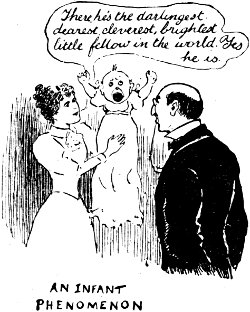
An Infant
Phenomenon
There he’s the darlingest
dearest cleverest, brightest
little fellow in the world. Yes
he is.
It has been said in the foregoing that the
old-fashioned girl exists in less numbers to-day
than in days gone by; so far is she, however,
from being as uncommon as the great auk,
that I who write this have only to shut my
eyes to see a long procession of old-fashioned
girls pass before me.
First passes Ann (in her own explanatory
phrasing, “plain A-double-N”), who always
brings her letters to a close with “believe
me,” and uses a nominative of address in
writing a postcard.
Next pass Elizabeth, Betsy, Bessy and Bess—no
Elsie, mark you.
Elizabeth wears boots with toe-caps, and is,
we who know her believe, the last girl who
will use the phrase, “canons of good taste.”
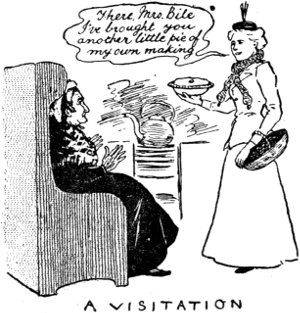
A VISITATION
There Mrs. Bile
I’ve brought you
another little pie of
my own making
Betsy wears in winter a crotcheted muffler
and Ringwood gloves. She always says at a
visit’s end, “Now I must be going,” and
generally says that she has “paid a visitation.”
This makes new-fashioned people
smile, and, as Betsy only says it when in
merry pin, this pleases her. Betsy is a wag
in her old-fashioned way. Thus she always
counts her cherry-stones, and affects distress if
they come to never. This also makes new-fashioned
people smile.
Bessy we call “the quotation girl.” To
Bessy, coffee is “the fragrant juice of Mocha’s
berry brown,” and Bessy at the tea-table
refers to “the cups that cheer, but not inebriate.”
Bessy will herself only be described
in a quotation—
“Old-fashioned poetry, but choicely good.”
Bess uses what we others call “dictionary
words”—such words as pusillanimity and
titillation. Bess—does this need telling?—hails
from beyond Tweed.
Next passes Susan, who says, “Papa and
mamma,” when she does not say “Father
and mother.” The new-fashioned girl says
“papa and mother.” Susan, too, prefers the
word “lady” to “woman,” and “gentleman”
to “man.” In fact, she has somewhat
aristocratic leanings; but condescension is no
part of her manner, for she knows that politeness
levels up.
Next pass the Marys, some of whom are
Pollys.
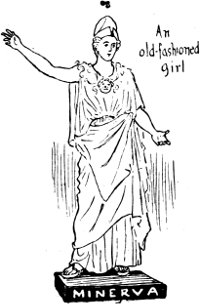
An
old-fashioned
girl
MINERVA
Polly, number one, combines a love of
cookery with a love
of bookery, to phrase
the matter as a certain
poet would have
phrased it, and to
these loves she adds
a third, the love of
needlework. If you
should tell her that
a good needlewoman
makes a bad
student, she will tell
you in reply that
Minerva beat
Arachne in the art
of needlework. She
is so far from being a bad student that it is
only part of her knowledge to know that.
Polly, number two, is not learned at all,
but is of marvellous dexterity with her fingers.
She should have lived in the days of spears
and spindles, some people say. These people
are of those who have nothing in their heads
but a tongue.
Of the Marys called Mary, there passes
first that Mary to whom, albeit her home is
London, a Monday Popular Concert is not “a
Pop,” and to whom a photograph is not a
photo.
Next passes the Mary to whom an Ellen
said—
“You must have been born grown-up, like
a fly, Mary.”
To whom Mary: “What do you mean?”
“Why, don’t you know, goose, that flies
don’t grow, that they—let me think of the
way it’s put in the books—emerge from the
larva in a perfect state?”
To which Mary, dreamily: “Do they?
That’s very interesting.”
A less old-fashioned Mary might not have
found a fact conveyed as that fact was conveyed
in a primary degree “interesting.”
The old-fashioned girl is not always handled
tenderly by the new-fashioned girl. “Here’s
a description of you,” so sneers one Muriel,
and reads aloud from a book, “A young lady
in the possession of all the virtues which adorn
the most amiable of her sex.”
To which the Mary sneered at answers, “No,
no; that flatters me.”
Lastly, there passes Emma, the old-fashioned
girl who heard lately with amazement that (so
the new-fashioned girl phrased the matter) “cut
glass is vulgar.”
“How can,” said Emma, “glass be
vulgar?”
Emma lives in a world in which not only is
cut glass still in estimation, but in which the
word “vulgar” is used in a sense in which it
is inapplicable to glass.
Emma is very fastidious in regard to phrasing.
She is never caught using the form
“different to,” and she follows the rule which
prescribes the use of “better,” where the ungrammatical
say “best.” Of her adjectives,
which are few and carefully chosen, a favourite
one is “elegant,” which she uses elegantly.
Her spelling has an old-fashioned look. Thus
she writes shew, sew, ribband and bason. She
prefers carven to “carved,” and, in regard to
another past participle, she is open to the
gentle satire of the Cornhill essayist, who
wrote in 1885 of “very young ladies” what
follows—
“They write first, ‘his health was drunk,’
and then, alarmed at the apparent inebriety of
that harmless past participle, alter it incontinently
to ‘his health was drank.’”
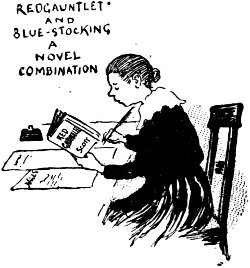
REDGAUNTLET
AND
BLUE-STOCKING
A
NOVEL
COMBINATION
Emma prefers the sound of “his health was
drank” to that of “his health was drunk.”
Such archaisms as to pen for to write, and a
braid of hair for a
plait of hair, are
also in favour with
Emma, though her
notions in style
have undergone
some modification
since she wrote
her first English
composition,
which began, “I
sit down to write
an essay.” Emma
is at present engaged
upon writing a novel in letter form,
modelled on Sir Walter Scott’s Redgauntlet.
That is a secret. Emma has many secrets.
New-fashioned girls are said to have none.
Never believe it!
Perhaps the old-fashioned girl is seen to
least advantage in a new-fashioned school.
The modern system of examination perplexes
her. It was not quite a dunce, but merely a
bewildered old-fashioned girl who wrote what
follows in obedience to the injunction, “Comment
on the grammatical peculiarity in the
sentence—‘Cromwell was by far our remarkablest
governor.’”
“Carlyle did not know better English, or
perhaps he wanted to make a joke.”
Not that the old-fashioned girl is not sometimes
a frank ignoramus. This must be
allowed to be the case when she defines—I
cite here from authentic documents—phenomenon
as “a very bad-tempered person,”
and emolument as “great flattery.”
In dialogue with the new-fashioned girl the
old-fashioned girl does not always come off
best, but once and again she scores, if only by
the utterance of a bold paradox. Take the
following.
“I wish,” said the new-fashioned girl, “I
was dead.”
“You are always wishing something impossible,
Evelyn,” answered the old-fashioned
girl. “The moment you are dead you will be
wishing you were alive.”
Paradox of a kind less mordant and less
moribund is contained in the following, which
I set down as the favourite exclamation of an
old-fashioned girl born blind—
“Ah, I see it all now!”
Sometimes the sorrows of the old-fashioned
girl are of a kind calculated to rouse the
amusement of those who are of a newer
fashion. This is surely the case in the matter
of one Ada, who writes—
“I have contracted the miserable habit of
writing short words backwards, putting ‘dab’
for ‘bad,’ and much more dreadful things than
that. I feel that in writing my own name I
write it backwards, and that it is only by
happy accident that it reads all right. This
comes from a game which we have been
playing, and which consists of naming words
that make sense spelt backwards. The boys
like it (this will shock you), because of the
word mad.”
Useless were it to tell this Ada that the
word which
“mad” spells
backwards is
one in which
“the boys”
may fairly
take delight,
meaning
merely, as it
does, “a bank
to confine
water.” The
stricken Ada
knows boys
better.
(To be continued.)
IN THE TWILIGHT SIDE BY SIDE. — PART XI.
By RUTH LAMB.
THE LITTLE ONES OF THE FAMILY AND THE GLORY
OF MOTHERHOOD.
“A joyful mother of children.”—Psa. cxiii. 9.
I called the subject of our two last talks all-important,
because I could hardly imagine
one possessing wider interest for you. But
when I introduced it, I alluded to you, my
dear girl friends, not only as the wives, but
as the mothers of the future. Marriage and
motherhood are alike sacred subjects—the
latter certainly not less so than the former.
Before the day arrives when the sweet but
solemn responsibility of motherhood comes to
the young wife, girls who are members of
large families have mostly shared in the toil,
anxiety, and, let us hope, also in the joy and
brightness that the little ones bring into the
world with them.
It makes me glad as I call to mind many
beautiful pictures of sisters who have been
second only to the real mother in their loving
care of, and tender sympathy with, the younger
members of the family.
Many a delicate ailing mother has been
aided on the path to renewed health by the
thought that the children, about whom she
would otherwise be painfully anxious, are
being lovingly watched over by an elder
sister. As she has lain, so willing yet so
unable to fulfil her maternal duties, her
heart has been full of joy, and her thoughts
have gone up in praise to God for the gift of
the precious daughter who is cheerfully carrying
the weight under which she, unaided,
must have sunk.
There are, thank God, many girls who are
little mothers almost from their cradles. We
can find them in rich homes and poor ones.
In courts and slums where the direst poverty
prevails, the baby, often unwelcome to the
elders, is passed over to the ceaseless care of
one who is only a few years past babyhood
herself.
From the very first the little deputy-mother
deems it her baby, her choicest treasure, and
finds beauties and charms in it which are
invisible to other eyes. Its increasing size
and weight may cause her greater weariness,
but they are none the less sources of pride and
joy, and make her forget her own aching back.
She would go hungry that it might be well
fed; cold, that it might be warmly bundled
up in the shawl that ought to do duty as
covering for both of them. Her baby may
be but a caricature of the pink and white
loveliness of another infant clad in silk and
lace and with two nurses to watch its every
movement; but let a ragged dweller in the
same court disparage the looks of her darling,
and she would fight the slanderer as stubbornly
as ever knight of old did in defence of the
charms of his ladye love.
I must not dwell on this picture. Long
ago when the “G. O. P.”[1] was itself a baby
under two years old, I wrote with heartfelt
respect of “Little Nurses.” I had studied
them in many places, and the sight of their
devotion had inspired my admiration and
loving sympathy.
Turning from the baby devotee of the slums,
and not for a moment forgetting sweet pictures
of sisterly devotion which I have seen in other
ranks of life, I am going to indulge in a little
croak about the decay of the maternal spirit
in many of the girls of to-day.
I was journeying northward some three years
ago, and during part of the time I had only one
companion. She was past girlhood, probably
some years over thirty, and in the course of
conversation she spoke of her old happy
home and the gradual scattering of its
inmates, until she found herself the last one
left. Her parents had died not long after
each other, and brothers’ and sisters’ homes
were far apart. That there had been true
family union and affection amongst them I
felt sure, for my companion could not speak
of the good father and mother without a
trembling of the voice and tears which she
turned away to hide.
Later the talk turned on children. I suppose,
as an old mother, I must have expressed
my deep love for them, and I was almost
horrified when my companion exclaimed—
“I loathe children. I cannot bear even to
touch a child.”
The expression on her face proved her
sincerity.
Need I tell you, dear girls, that a barrier
seemed to rise up between my companion and
myself, as I heard these unwomanly, nay, I
may say, inhuman words? Only a short time
before, the girl had been moved to tears as she
spoke of the loving devotion of which she had
been an object, both as a child and from her
youth up. Yet her memories of her own
home life and of the parents she mourned, had
not awakened in her cold heart one spark of
tenderness for the helpless little creatures who
are so dependent on those around them.
A truly feminine nature, with its motherly
instincts fostered as they ought to be, instead
of being crushed down and stifled, regards
every child with tenderness, and would make
the surroundings of all the little ones
brighter, purer, and holier if it were possible
to do so.
It happened on that same journey that a
comely Scotchwoman got into our carriage
at a country station. At the door she held
out one of the loveliest year-old babies I ever
saw, and addressing my companion, said,
“Here, tak the bairn, please, whiles I lift in
the others,” for there were two more
youngsters on the platform just a step above
each other in size.
My companion fairly shrank into her corner
and kept her hands firmly clasped, whilst her
face expressed disgust and vexation at the
unceremonious request. The mother’s astonishment
was almost ludicrous, but I
promptly said, “Give me the bairn. I’m
used to bairns, you see, and this lady is not.”
It was a delight to hold the bonny smiling
darling in my arms. Her beautiful clothing
and the pretty neat garments of the elder
children were eloquent of loving care. And
the mother was eloquent too about the object
of the half-hour’s journey which was to show
the children to “my ain guid mither, who is
just wearyin’ for a look at them,” I was told.
I heard about five older ones at home, and
how they had to go, two at a time and the
baby, to see the grandmother, with many
particulars which brought this comparatively
young mother into fullest sympathy with me,
the old one.
I was quite sorry to give up my pretty
charge when parting time came. Sorry, too,
that my other travelling companion, who sat
silent in her corner with averted eyes, could
not appreciate the charms of childhood, or
care to impress on her memory the beautiful
picture of motherly self-devotion and industry
furnished by that sample batch from the flock
of eight. How each bright healthy face, each
spotless tasteful garment would appeal to the
grandmother! How glad and proud she
would be to see the fruits of her own training,
as she looked at her matronly daughter and
those “bonny bairns” of another generation!
Yet how kind was my first companion to
me, when the others had left us alone again!
We parted at the next stopping-place, but
during the waiting interval she was like a
good daughter in her care of me. I think
that in paying me sweet attentions she
thought of the mother of her girlhood whom
she had lost. The pity of it was that memory
did not take her further back, so that, in
thinking of the needs of infancy and her own
childhood, she might have been stirred to
sympathy with other helpless little ones of
the human family.
Another girl, whom I know to be really
warm-hearted and affectionate, said of her
sister’s baby, “She’s a horrid little creature,
more like a skinned rabbit than anything else.
I cannot bear to look at her, and I would not
touch her for the world.”
We know that newly-born babies are not
always beautiful to look upon, but how soon
the redness of their faces tones down to lovely
pink and white, and the puckered skin fills
out and becomes soft as satin to the touch.
That girl’s heart must be unwomanly indeed
for which a baby’s smile and outstretched
arms have not an irresistible charm.
Putting aside the fascination of external
beauty, we should bear in mind the great fact
that the frailest, least attractive infant that
comes into the world is the home of an
immortal soul. It brings with it a burden of
sweet but solemn responsibility to be borne,
first of all by the parents, but shared in a less
degree by all whose companionship must
influence it for good or evil.
I am not going to imagine that amongst you,
my dear girl friends and twilight companions,
any can be found who have no warm comers
in their hearts for helpless little ones, or who
are insensible to the glory and responsibility of
motherhood. So, having given vent to the little
croak suggested by the sayings of sundry girls
whom I have met elsewhere, let us talk about
the children over whom we have, or may have
in the future, the strongest influence of all.
Strongest and best also; if we are only true
to our divinely-given instincts, and alive to the
vastness of the responsibilities of motherhood.
I cannot help thinking that the study of child
life and character should form part of every
girl’s education. Surely no branch of natural
history can be equally interesting.
There can hardly be a more fascinating
subject than natural history in all its branches,
and we can admire and sympathise with the
earnest student who spends the best part of a
lifetime in observing the ways of an insignificant
insect. Every secret of structure or habit
thus revealed is another proof of the goodness
and power of God, and adds to His glory in
the eyes of His believing children, who exclaim
in the words of the Psalmist, “O Lord, how
manifold are thy works! in wisdom hast Thou
made them all: the earth is full of thy riches.”
The Revised Version gives the word “creatures,”
instead of riches, and truly when you and
I, my dear ones, call to mind the little we know
about these wondrous minute organisms that
scientific research has revealed of late, we are
struck with the fitness of the change. It is
hard to grasp the idea alike of the vastness
and the minuteness of God’s works.
If I had time I could quote many passages of
His Word which prove that some of the best
men of old were close observers of nature, and
to be such is quite in accordance with its
teachings. I would plead with all nature
students, but, above all, with girls, who will be
the mothers of the future, to give the closest,
most prayerful study to the young human
beings on whose right training so much
depends.
Lovers of horses, dogs or cats are generally
eloquent about their pets, and can indicate
every point of excellence in them, or allude
regretfully to the smallest blemish. They
spend money lavishly in order to acquire
perfect specimens, and are careful to maintain
them in health and more than comfort.
These costly pets are so much living capital,
and it is safe to say that many a parent could
tell more about the disposition and doings of
a favourite horse or dog, than of the dispositions
of the children who call them father
or mother.
It is often said that the baby brings a vast
heritage of love with it into the world, and I
believe in the truth of this. But sometimes
the love gets into the wrong heart, if I may
use such an expression, instead of filling that
of the mother, who, regarding the helpless
creature as a hindrance to what she calls
“pleasure,” is willing to relinquish the privilege
of caring for her child to other hands. If
these are truly womanly hands, and the nurse
has in her a motherly heart, the child may
lose little by the change during its first years.
Later on, Nature asserts herself and only a
mother’s love can satisfy a child’s yearnings.
On this subject of motherhood, as in all that
you and I, my dear girl friends, have talked
about together, we need to look into the Book
of books for light and guidance.
Motherhood is part of Nature’s—or should
I not rather say of God’s—plan for womanhood.
Let us look back together at the
earliest chapter of human history, and note how
children were regarded then.
Eve, so named because she was “the mother
of all living,” or “life,” as the Revised Version
gives it, clasped her first-born to her breast
and cried in her exultant joy, “I have gotten
a man from the Lord.” She looked upon
her babe as the direct gift of God. She, like
many a mother in after days, could not foresee
the sin and the sorrow that would shadow his
manhood and her own heart. But in holding
her infant treasure to her breast, she would
have a present joy and sense of riches that
words cannot describe. She, the only human
mother, with the only human infant in the
wondrous new world which was to be peopled
by her children, must have had sensations
which none of her descendants could possibly
repeat.
And yet, believe me, every loving mother
who is worthy of the name, has a like feeling
of riches, when she can say, “This is my
child, my very own. This wonderful little
body is given me to feed, clothe and guard.
It is my privilege to see that it is fed with food
convenient for it, that the tender frame is
shielded from too great heat or biting cold,
that it is kept from places and things which
might injure its health, or prevent its growth
into sturdy boyhood or girlhood.” The true
mother was proud of her name in the old days
of Bible history, and to be childless was to be
a sad and dissatisfied woman.
When Seth was born, after Abel had been
slain by his brother, the joyful thought of Eve
was that the vacant place in her motherly
heart was filled again, and she cried, “God
hath appointed me another seed instead of
Abel whom Cain slew.”
She had sons and daughters, we know not
how many, during the ages which followed,
but there is no detailed history of them. Still
it gladdens our hearts to know of the joy of
that first mother, when Seth was given to her
in place of the good son who “was not.”
Pass with me down the ages and look into
the tent of Sarah, when she held in her arms
the child of promise, so long hoped for, even
against hope as it seemed. “And Sarah said,
‘God hath made me to laugh; everyone that
heareth will laugh with me.’”
Childless Rachel bemoaned her hard fate
and cried, “Give me children, or else I die.”
Then when Joseph was born she gave him the
name which meant “added,” and said, “The
Lord add to me another son.”
Yet another picture for us to look at
together, my dear ones. It is that of Jacob
as he met his brother Esau. After the
brothers had embraced and kissed each other,
Esau “lifted up his eyes and saw the women
and the children, and said, ‘Who are these
with thee?’ And he said, ‘The children
which God hath graciously given thy servant.’”
Why are we studying all these Bible
pictures, and glancing at the domestic stories
which they illustrate? Is it not that we may
all realise more fully the glory of motherhood,
the value set upon children by the mothers of
old, and the universal acknowledgment that
a child was a precious gift from God?
Ah, there was no talk of loathing children
then! No shrinking from the touch of a fair,
innocent, helpless babe! No talking lightly
or contemptuously of the little ones. The
Psalmist calls children “the heritage of the
Lord—His reward,” and says that “He
makes the barren women to keep house” (or
to dwell in a house) “and to be a joyful mother
of children.”
Motherhood conferred dignity and made the
woman mistress of a home and the head of a
household. Ever and always the presence of
a child or children added to the sense of
riches, being regarded as the special gift of
God and a token of His favour.
It is not easy to exhaust Scripture on this
beautiful subject, for one Bible mother seems
to rise after another and claim our attention
and admiration. We see Hannah appearing
in the house of the Lord, first pleading that
she too may know the glory and joy of motherhood,
and then, taking her weaned child to
dedicate him to the lifelong service of the
Giver. “For this child I prayed, and the
Lord hath given me my petition which I asked
of Him, therefore also I have lent him to the
Lord; as long as he liveth he shall be lent to
the Lord.”
How self-sacrificing, how sublime was this
act on the part of the mother! Just when
her little Samuel had twined himself round
her heart by the imperishable cords of love;
as each day witnessed some new growth and
charm in the boy; and the parting must have
become almost too great a trial for the tender
mother to contemplate, for “the child was
young.” Hannah brought him to Shiloh and
left him there.
Hers was no temporary sacrifice. She
renewed it year by year, rejoicing that her son,
God’s gift, was accepted by Him in turn as she
gave him back, “and was in favour both with
the Lord and with men.”
We have passed by the mother of Moses
and her plan to save, if possible, the life of her
infant, and other Bible mothers, around whom
we might well pause. We must, however,
glance for a moment at the Virgin Mother and
her Babe lying in His lowly manger-bed, the
infant Saviour, “Christ the Lord.”
Stretching across the years, we see Jesus in
His manhood taking the little ones in His
kind arms, blessing them and saying, “Suffer
the little children to come unto Me, and forbid
them not, for of such is the kingdom of
Heaven.”
Now, my dear girl friends, what impression
has this talk left on your minds? Has it
not elevated your ideas of motherhood, and
taught you how it was regarded amongst
the men and women of the Bible? Is it
not a sacred and glorious trust as well as a
joyful one?
Are not the little ones, of whom some girls
of to-day speak slightingly and worse, to be
regarded as God’s good and precious gifts to
be nursed for the Lord, fitted for and
dedicated to His service?
(To be concluded.)
THREE GIRL-CHUMS, AND THEIR LIFE IN LONDON ROOMS. — CHAPTER VIII.
By FLORENCE SOPHIE DAVSON.
THE WATER-PARTY.
“How did you enjoy yourself last evening,
Marion?” asked Ada, on the morning after
Marion had paid her promised visit to Mrs.
Holden.
“Very much indeed.”
“Was it a regular dinner-party?”
“Oh, no, only just ourselves, you know—and
Mr. Scott!”
Jane looked very wise.
“Madge made a delightful suggestion,”
went on Marion quickly. “How should you
like a water-party, Jenny?”
“The most delightful thing for this fine
weather, but who would row?”
“Mr. Holden and Mr. Scott are both
thoroughly accustomed to it.”
“Jenny and I can take turns,” said Ada;
“we have always been accustomed to it, but
you never went in for it, did you?”
“No, I can only steer,” said Marion,
laughing. “I told Madge that we would bring
half the lunch and half the crockery. We can
get tea at a cottage that they know of.”
“But you have not told us yet where we are
going,” said Jane.
“Oh, I forgot. Madge and her party will
meet us at West End Lane Station, and we
will take the 9.20 train to Richmond; catch
the one that goes on to Twickenham, row to
Teddington, land on the bank and have lunch,
and have tea at the cottage I spoke of.”
“Just the very thing to brush the cobwebs
out of our brains,” cried Ada enthusiastically,
“is it not, Jenny? We all want a treat, and
we are all rather fagged out. Is it to be this
next Saturday?”
“Yes, if we can arrange it in time.”
“Well, there is very little to arrange, when
one comes to think of it,” said Ada meditatively,
“unless Mrs. Holden thinks of inviting
a big party.”
“No, just themselves and ourselves.”
“Did she say what part of the lunch she
would prefer to bring?”
“She suggested the meat and also the
drinks.”
“Ah!” laughed Jane, “she thinks it wise
to ensure something solid for her husband and
brother! And we are to bring the sweets,
and so on? Then do have a tomato salad; it
is the most delightfully cooling thing you can
have on a hot day.”
“My good girl, how in the world can we
pack it? I suppose you mean to take the
tomatoes and make it as it is wanted; but that
is rather a nuisance. My experience of water-parties
is that you never land for lunch until
you are so famished that to make a salad is
the last thing anyone wishes, and any materials
of that sort are thankfully despatched in the
raw!”
“But we can,” urged Jane. “How can an
old person like you be supposed to understand
the latest contrivances of the age? We can
slice the tomatoes and put them in layers in a
jam pot with the oil, vinegar, chopped parsley
and onion, and tie the whole down. It will
stand up quite well in a corner of the hamper,
and will not upset.”
“Bravo, Jenny, we will certainly have one.
Is that your own idea?”
“It is my own idea, and I intend to patent
it,” said Jane, with dignity, “so please see
that you do not infringe my rights. Now one
of you can suggest a suitable sweet.”
“It is rather difficult,” said Marion.
“Shapes pack so badly, and pastry is apt to
crumble. Jelly has an unfortunate habit of
turning into soup just when it is wanted.”
“Perhaps it will be better to stick to fresh
fruit,” said Ada.
“We must have something else,” said
Marion meditatively. “How would it be if
we took the materials for a Cicely pudding?
It only takes a few minutes to make.”
This suggestion met with warm approval
from the two others, for the Cicely pudding
was an old favourite, the brilliant invention of
a mutual friend in the country; but for the
recipe thereof the gentle reader must be
content to wait awhile.
“Very well,” said Jenny, “Marion shall
make the Cicely pudding, and I will make the
tomato salad. What will Ada do?”
“Make the sandwiches,” said Ada promptly.
“There must be sandwiches, some of anchovy
and hard-boiled egg, and some of cucumber.”
“Shall I order a sandwich loaf?” asked
Marion.
“No, I think not. I prefer ‘Florentines,’
they are handier in every way.”
“Florentines” are little long-shaped milk
rolls, something the shape of sponge fingers,
but rather larger, and as they only require to
be split and spread, much time is saved, and
so it was settled.
On Friday evening, whilst Ada was making
the sandwiches, Marion made up and looked
over the weekly accounts up to that evening.
She knew there would be no time on Saturday,
as they would be late back. A box of fresh
eggs had been sent from her country home
on the Monday previous, and this had served
famously for the week’s breakfasts.
This is the dinner list:—
Sunday.
- Fried Mutton Cutlets.
- Potatoes.
- Green Peas.
- Gooseberry Shape.
Monday.
- Leek Soup.
- Veal Cutlets (cooked in the oven).
- Potatoes.
- Macaroni Cheese.
Tuesday.
- Veal and Ham Patties.
- Poached Eggs on Endive.
Wednesday.
- Boiled Neck of Mutton and Vegetables.
- Steamed Ground Rice Pudding and Jam.
Thursday.
- Potato Soup.
- Fried Cauliflower in Batter.
- Bread and Fruit Pudding (cold).
Friday.
- Cauliflower Soup.
- Grilled Mackerel.
- Stewed Gooseberries.
The food account was as follows:—
|
£ |
s. |
d. |
| 1½ lb. neck of mutton (cutlets) |
0 |
1 |
0 |
| 1 lb. veal cutlet |
0 |
0 |
10 |
| 1½ qrts. gooseberries |
0 |
0 |
9 |
| 1 lb. cheese |
0 |
0 |
7 |
| ½ lb. macaroni |
0 |
0 |
2 |
| Leeks |
0 |
0 |
2 |
| Flavouring vegetables |
0 |
0 |
3 |
| Endive |
0 |
0 |
2 |
| Potatoes |
0 |
0 |
8 |
| 1½ lb. neck of mutton (for boiling) |
0 |
0 |
10½ |
| 2 cauliflowers |
0 |
0 |
5 |
| 2 mackerel |
0 |
0 |
10 |
| 8 loaves |
0 |
2 |
4 |
| Milk |
0 |
1 |
9 |
| ½ lb. tea |
0 |
0 |
10 |
| 1½ lb. Demerara |
0 |
0 |
3 |
| ½ lb. loaf |
0 |
0 |
1 |
| Sponge cakes |
0 |
0 |
6 |
| Jug of thick cream |
0 |
1 |
0 |
| Small jar of greengage jam |
0 |
0 |
6 |
| 2 punnets of strawberries |
0 |
1 |
4 |
| Tin of anchovy paste |
0 |
0 |
3½ |
| Florentines |
0 |
3 |
0 |
| 1 lb. tomatoes |
0 |
0 |
8 |
|
£0 |
19 |
3 |
“Where are the strawberries?” asked Jane
as she looked over Marion’s shoulder. “I
have not seen them.”
“We are to call for them at the greengrocer’s
the first thing, and have them directly
they come from market. I was afraid to have
them in overnight for fear of their getting too
juicy.”
Early next morning the sunshine streamed
into Marion’s room and awoke her with the
promise of a happy day. She rose and dressed
quickly and was down the first, looking delightfully
cool and fresh in a white coat and skirt.
She busied herself with packing the hamper,
and as she set to work down came Jane,
resplendent in blue. She got out the
tomatoes, sliced them quickly and arranged
them in layers in a large jam pot, sprinkling
oil, vinegar, chopped parsley and onion in
between. Then she tied a new jam cover
over, and put her chef d’œuvre carefully in
the hamper.
“You two busy bees make me feel so
disgracefully lazy,” cried Ada as she ran in
a few minutes later. “I quite intended to be
the first to-day. I will get you some breakfast
to make amends,” so saying she quickly laid
the table in the sitting-room, and made the
tea. As soon as the hamper was packed, they
sat down to a hasty meal. As they were
finishing there was a ring at the bell.
“I declare I had forgotten all about the
post!” cried Jane. “A letter without a
stamp, I suppose. I hear Abigail speaking to
him.”
But it was not the post, for the door opened,
and Mr. Tom Scott was shown in.
“I hope you will excuse me, Miss Thomas,”
he said to Marion as he shook hands and was
introduced to the other two. “I was so
afraid that you might find the hamper with
the crockery too heavy to carry, and my sister
said she thought I might venture to call and
see if I could be of any assistance.”
“We are just coming,” said Marion,
smiling. “Thank you; I don’t think we should
have found the hamper too heavy.”
Ada and Jane disappeared to make the
final preparations; Marion picked up her hat
from off the little side-table and pinned it on,
listening to Mr. Scott as he discussed the day’s
proceedings. Soon Jane came back bearing
the hamper in triumph, of which Mr. Scott
immediately took possession, and so the party
set out.
On the way they called for the strawberries
as arranged. They got to the station just in
time to meet Mrs. Holden and her husband,
who had just arrived, having taken the next
train after Tom Scott. They had only a few
minutes to wait for the Richmond train.
Marion was just going to get the tickets for
her party, but she was prevented by her friend
Madge, who explained that the railway-tickets
represented her husband’s share of the
entertainment and the boat her brother’s, so it
was no good protesting. So, as Jane afterwards
described it (with a sigh of content at
the recollection), “they went to Twickenham
like dukes and duchesses in first-class carriages,”
adding sagely, “Being a working
woman has one great advantage, for one certainly
knows how to appreciate the good things
of existence when they fall to one’s share.”
The day was glorious; a deep blue sky
scarcely flecked with clouds, brilliant sunshine,
not a breath of wind. The train was very
full, and there were many other merry parties
besides their own. Everyone seemed taking
a holiday. At Richmond they had to run
quickly over the bridge for the Twickenham
train, which they just managed to catch; as
they caught a glimpse of the river and saw
how crowded and covered with boats it was
just there, they all felt glad that they had
arranged to start a little higher up, where they
would have more space. At Twickenham
they got out and walked through the hot
streets of the quaint old town to the water’s
edge, where under the trees the boat was
ready for them.
So they all got in—Mr. Holden and Tom
Scott rowing, Jane and Ada comfortably
reclining in the bow, Mrs. Holden and Marion
in the stern. The boat glided gently along.
Marion had never seen this part of the river
before, as she had had little leisure for
pleasure parties since she came to live in
town, and she was delighted with the beauty
of the scene. Tom Scott showed her Pope’s
Villa and other places of interest. In spite
of the heat, Jane seemed blessed with a superabundance
of energy, and after a time she
took Mr. Holden’s oar and rowed so well that
he declared himself surpassed. Now they
neared the towers of Hampton Court, and
finding a suitable little island shaded by
willows, they moored to a tree and prepared
for lunch, for which they all had excellent
appetites.
“We have to make our pudding, you
know,” said Marion, laughing.
“Going to do cooking out of doors?” asked
Mr. Scott. “Shall I make a field oven?”
“No, we don’t need to do any cooking,
and it will all be ready in five minutes,” she
answered, and set to work.
She brought out the sponge cakes, split
them in half, and put half of them at the
bottom of a large pie-dish that she had
brought with her; this she spread with a
thick layer of greengage jam, then she put
another layer of sponge cake. “Now, Jenny,
the strawberries,” she said; but Jenny had
already got them out and was busy picking
off the stalks. When this was done, she
arranged them on the cake in a thick layer,
sprinkled them thickly with castor sugar, and
lastly spread thick cream, which she had
brought in its own brown jar, over the whole.
As a last touch, a few “hundreds and thousands”
were quickly sprinkled over the top,
and the dish was finished, amidst the admiring
plaudits of Madge and her party.
Jane’s tomato salad went excellently with
the cold lamb which Mrs. Holden had provided,
and the whole repast went off well.
Ada’s sandwiches kept perfectly fresh, as
they were wrapped in a damp cloth before
being packed, and they were much liked.
After lunch the indefatigable Jane washed
up, Mrs. Holden and Ada helping her, and repacked
the hamper. They then rowed across
the river to the Palace. Marion suggested
looking at the pictures, and Tom Scott
offered to conduct her, with an alacrity that
was quite surprising, considering that he had
been expressing his absolute ignorance of the
subject about five minutes before.
“Will you come, too, Madge?”
No; Madge preferred to be lazy and sit out
of doors, admiring the orange trees—Mr.
Holden also, and Ada. Jane thought she
would like to go, and so the three started off.
The cool shade of the great rooms was a
delightful change after the glare of the
gardens, and they sauntered through, admiring
the pictures and carving and the beautiful
views seen through the open windows. Jane
was very much amused with an old Dutch
picture representing a street scene with no
sky; the perspective was so odd that she
declared the people were walking on the wall
like flies. She ran back to the other two to
tell them to come and look at it, but they
seemed so deeply engaged in conversation
that she did not disturb them.
“You can’t think how delightful it all is
after the lonely life I have been leading for
three years,” she heard.
When they went out again to the others,
the afternoon was growing cooler. They all
went back to the boat, for they were now to
row a little way in the direction of Twickenham
and to land at a cottage, where tea was
ordered beforehand.
Jane rowed again, and by the time the
cottage was reached was quite willing to let
the old woman in charge make the tea as she
was getting just a little tired. She did
justice, however, as they all did, to the good
things provided—the honey, which the old
woman’s bees had made, the strawberries
from the cottage garden, the home-made
bread and delicious country butter.
In the cool of the evening our merry party
started to row back to Twickenham, Marion
steering under Mr. Scott’s direction, who was
rowing just in front of her. They just caught
the train at Twickenham, and so ended a very
happy day.
(To be continued.)
SHEILA’S COUSIN EFFIE. — CHAPTER XXI.
A STORY FOR GIRLS.
By EVELYN EVERETT-GREEN, Author of “Greyfriars,” “Half-a-dozen Sisters,” etc.
BROTHERLY COUNSEL.
scar, now that we are
alone, now that nobody
can interrupt us, I want
to talk to you about my
plan.”
Sheila’s face was
flushed, her big eyes
were sparkling. She looked
less the child, Oscar thought,
and more the woman than
when he had seen her last.
He had been struck by this when he first
saw her on board the boat. He had
thought the same thing many times that
day as the thundering express bore them
from Plymouth to London. Now they
were alone in Sheila’s room in the hotel
where they were to spend the night. A
big fire blazed on the hearth. The curtains
were drawn, and brother and sister
were alone together. The rumble in
the streets below made a ceaseless
murmur, but it was different from the
rattle and roar of the train. They
could talk at their ease now.
On the way up to town Sheila had
poured her whole history into Oscar’s
ears, and had heard the story of his
own trouble at home, and the shadow
which rested upon him. She had not
said much, there had been no excited
outburst such as he had expected.
Perhaps the presence of other people
in the carriage was a check upon
her, or perhaps she had learned something
of the lesson of self-control and
reticence.
Anyway she had been unwontedly
quiet during the last hours of the journey,
and Oscar, who had felt very weary
after his long hasty night journey down
to Plymouth, had dozed in his corner.
But now, after their arrival here, after
their substantial meal below, they had
come upstairs for a confidential talk
which had been impossible before.
“Oscar, I have thought it all out.
It came to me first on ship-board, even
before I knew anything about you and
what had happened in the office. (Why
didn’t you tell me in your letters?) I
made up my mind then and there that
I would never, never, never live at Cossart
Place again. Aunt Cossart has
behaved infamously to me. She has
tried to spoil my life and make me
always wretched and miserable. I will
never forgive her. I will never see her
again!”
Oscar looked straight at his sister,
but said nothing, for Sheila was proceeding
with her old impetuosity.
“You can’t understand what it was
like there. Even Mrs. Reid understood
and was indignant. Oh, yes, I know
she was, by the little things she said,
though, of course, she would not say
much. Everybody knew. I feel as
though I could never bear to see any
of them again. She is a hateful woman.
The Barretts told me how furious people
were with her when they knew she was
going to send me home. Everybody
guessed why—that was the horridest
part of it. And I had been so happy.
Everybody was so kind, and I had to
go without even saying good-bye, but
I felt I couldn’t—I couldn’t! The
Barrett girls declared they believed
everybody would cut them for it. I’m
sure I hope they will! Oh, I can’t
help being angry—I can’t indeed!”
“Sheila dear, don’t get excited,”
said Oscar soothingly. “I can understand
that it was very hard. It is very
hard to be misunderstood, and to have
things put down to us that we know we
have not done, but we have talked over
all that before. Tell me about this plan
of yours.”
“Oh, yes. Oscar, you will be twenty-one
soon, won’t you?”
“Yes. What has that to do with it?”
“Everything, for you will have command
over our money then.”
“Yes; at least over my half, anyway,
perhaps over it all. But it is not much,
Sheila.”
“I know it is not; but it is enough to
make us a little home. Now listen,
Oscar, for I have it all planned out.
You shall go on at the office if you must,
because it’s something to do, and Uncle
Tom has been kind in a way, though if
he suspects you—however, we won’t talk
any more about that. But we won’t go
on living with the Cossarts any more,
I’m quite determined on that. We shall
have enough to have a little home of our
own, even if it’s only a lodging; and
you will go to the office, and I’ll try
and get some music pupils, or little
children to teach in the mornings, or
something to help. And I’ll keep our
home as nice as possible, and we’ll
have cosy evenings together, and we’ll
have nothing to do with the people who
have behaved so badly to us. Oh, I
don’t mean that we’ll cut them or anything,
but we won’t go on living with
them and eating their bread. I couldn’t
possibly dream of going back to Cossart
Place ever; and they don’t want me at
Uncle Tom’s, and besides, how could
I go on living in the same house with
that Cyril? I can’t think how you can
do it, Oscar, I really can’t.”
Sheila leant forward with flushed
cheeks and shining eyes. Oscar was
leaning back in his chair, his face a
little in the shadow. Sheila had been
struck on first seeing him with the
sharpened look of his features, and the
tired expression in his eyes; the same
thing struck her again more forcibly at
this moment, although she spoke no
word of it.
“Say you think it a nice plan, Oscar,
for I’m sure you do!” she cried eagerly.
“No, Sheila, I don’t think it would
do,” he said slowly.
“Oh, Oscar, what do you mean?
I’m sure it would. We should be so
happy together, you and I. And it’s
often so horrid being with people who
misunderstand us. I think we’ve had
enough of that. Oh, don’t say you
won’t think of it!”
“I am thinking of it, Sheila, I’m
thinking hard, for I hate to thwart you;
but I don’t think it would do, and you
would find that living in a very small
way, and trying to earn something
yourself, are two very difficult matters
for people brought up as we have been.”
“But, Oscar, we should belong to
ourselves and each other. We should
be free from those horrid things that
happen in other people’s houses.”
“But we should have other troubles
and worries to face, Sheila. And do
you know, I think it would not only be
very ungrateful to our relations to take
ourselves off like that, but I think it
would be very bad for us ourselves.”
“Bad for us? I don’t understand.”
“I think it is always bad for people
to rebel too much against the life which—well—which
God seems to have
arranged for them. Sheila, don’t you
think that in the old days you and I
had rather too much of our own way?”
“I never thought about it—did we?”
“I think so. Everything was made
so smooth for us, and we had so few
battles to fight. I sometimes think it
might have been better for us if we had
had more. Sheila, take my case; it is
true I know nothing about this lost
money, but in one sense the fault is
mine. I always did the thing that
was the easiest and pleasantest at the
moment, though North warned me
again and again that my easy-going
ways were slovenly, and might lead to
confusion and worse. I never quite
believed him, and never seriously tried
to conquer my tendencies, and you see
what has happened. Whoever is to
blame, the thing could not have been
but for my fault.”
“Well, I think that’s a very hard way
of looking at it; but what then?”
“I have not quite finished, Sheila; I
want to talk about your case. It has
been something the same with you, little
sister. You have always liked to drift
along easily with the current, doing
what was pleasantest at the moment.
If people were kind and made you
welcome, you responded to all their
overtures, without always stopping to
think what Aunt Cossart would like, or
if it were quite considerate to Effie.
They were quite small things, but little
by little they made trouble; and then
came this great storm which has made
you so miserable. You were not to
blame, as I was; I don’t think you were
ever warned, and it was difficult for you
to see from day to day how things were
going; but I think perhaps, Sheila, we
have both been selfish in our own way,
and have not thought enough——”
“You’re not selfish, you’re not careless,”
cried Sheila interrupting excitedly.
“I only wish I were one quarter as
good. Oh, Oscar, I do believe I have
been selfish, though I never meant it.
I never thought of such a thing. We
have always been used to being happy—to
have people like us. It seemed so
natural. I didn’t mean any harm.”
“No, Sheila, I am sure you didn’t;
but you know life is not given to us just
to enjoy for ourselves. We must try
and think of other people too, to put
them first. It is harder for you than
for some, because father always spoiled
you; and everybody likes you, and you
are so pretty and fascinating.”
But Sheila jumped up and put her
hand upon his lips.
“Don’t, Oscar! I don’t want to be
praised; I begin to feel that I have been
rather naughty and selfish, though I
wouldn’t believe it when my conscience
pricked now and then. I was wrong
to be so furious with Aunt Cossart.
Sometimes it made me a little frightened—when
I wanted to say my prayers—and
didn’t know how to get out ‘Forgive
us our trespasses, as we forgive—’
Oh, Oscar, I don’t think I’ve forgiven
Aunt Cossart yet. Suppose there had
been a storm, and the vessel had sunk!
How dreadful that would have been!”
“You will forgive everything, Sheila,
when you think about it a little more.
When we begin to understand how many
faults we have ourselves, we see that we
must forgive, we can’t help it. Everything
seems to sink out of sight except
the thought of His forgiveness of us, and
what it cost to win it.”
Sheila suddenly fell upon her knees
before Oscar, and looked anxiously into
his face. It was seldom indeed he had
spoken to her quite so openly. A quick
thrill of anxiety ran through her.
“Oscar, have you forgiven Cyril?”
“Yes,” he answered in a low voice.
“Indeed, sometimes I think it is he who
has to forgive me more than I him. For
remember, Sheila, it was my carelessness
that put in his way the opportunity—suggested,
perhaps, the temptation.
When I think of that, I feel that it is I
who need the forgiveness.”
Sheila looked awed at the thought
suggested—that terrible thought so
often overlooked and set aside, that not
alone to ourselves do we sin and do
amiss; but that in some way or other
our comrades and friends may become
involved in our wrong-doing.
“‘Sic vos non vobis,’” quoted Oscar
in a dreamy fashion. “I begin to understand
those words, Sheila, as I never did
before.”
“But it is rather dreadful, Oscar; it
makes it seem as though our sins went
on and on so!”
“Yes, that is what I want to understand
better. Our sins are forgiven, but
the effects of them so often go on and
on. We must think of that, too, Sheila;
it will help to make our faults hateful to
us. It will make us more patient when
we have to bear blame that we do not
quite merit; for how much more blame
do we deserve than we ever get!”
Sheila was silent a long time, looking
up into Oscar’s face.
“And my plan?” she asked
tentatively.
“Would be a selfish one,” answered
Oscar quickly, “for it would hurt the
feelings of our relations; and I think it
would be a shirking of the discipline of
life, which we both stand in so much
need of, Sheila!”
“You don’t.”
“Yes, I do. It would be very much
pleasanter for us to have a little independent
crib of our own, where we
should be able to indulge ourselves and
each other, and get away from all the
little frictions of life in a family where
things are not done quite in the way we
have been used to. But it would be like
running away from what seems to have
been given us to bear; and I expect
we should find we soon had a big
new crop of worries and bothers, quite
as big as the old ones. So I think,
Sheila, we will not force things ourselves.
We will go back to Uncle
Tom’s, and wait and see what turns up.
We will both try and be patient, and do
what is right, never minding whether or
not it is what we like best ourselves.
We must try and learn the lesson of not
pleasing ourselves always. You know
Who set us the example of that?”
Sheila subsided upon the floor, and
laid her head on Oscar’s knee, taking
his hand between hers.
“You are getting so good, Oscar,”
she said, “I am almost afraid of you.
You are not ill, are you?”
“Ill? No. Why do you ask?”
“Because you don’t look well, and
when people are so very very good, one
sometimes fancies they are——”
Sheila paused, and Oscar said with a
little tone of mirth in his quiet voice—
“I am not going to die of goodness
yet, Sheila! You need not be afraid on
that score.”
It was with a good deal of shrinking
that Sheila prepared to face the Cossarts
on the morrow. She knew that they
would by this time have received the
letter her aunt must have written, and
that Mrs. Cossart would not have drawn
her picture with a very strict regard to
truth. She would have thought more of
justifying her precipitate action than of
anything else; and Sheila was terribly
sensitive where Ronald Dumaresq was
concerned, and felt as though any
mention of his name would be worse
than the cut of a whip. And her
cousins were not sensitive on these
points. They would be almost certain
to cross-question her and make a joke of
everything.
It needed all her courage and resolution
to face the meeting; but when
they drew up at the door and were met
by Ray in the passage, it was not of
Sheila’s sudden return that the whole
house was thinking. Indeed Ray only
gave her a rather hurried kiss, warm
and sisterly, but distinctly hasty, and
then turned to Oscar and took him by
the shoulders, bringing him into the
strong light of the window.
“Oscar, how are you? Are you sure
you feel well?”
“Y—yes, all right, just a little tired
with all the travelling, you know. But
what do you ask for?”
“Oh, we are in such a fright.
Typhoid fever has broken out in the
town. The little office-boy you have
been visiting so often has it; and everybody
was saying that you were looking
ill. Five cases are reported to-day, and
they say there will be more. You are
quite sure you are well, Oscar? Sheila,
did he eat his breakfast this morning?”
“He hardly ate anything either last
night or to-day,” cried Sheila, in sudden
anxiety. “He has a bad headache. We
thought it was from the long journey.”
The girls stood looking at each other
in dismay. The same fear was in both
hearts. Oscar turned from them and
began climbing the stairs with a strange
languor in his movements.
“I think I’ll go to my room,” he said,
“but don’t bother, I shall be all right
there.”
“He’s got it!” cried Ray, under her
breath; and Sheila turned white to the
lips.
(To be continued.)
ANSWERS TO CORRESPONDENTS. — GIRLS’ EMPLOYMENTS. — MEDICAL. — STUDY AND STUDIO. — INTERNATIONAL CORRESPONDENCE. — MISCELLANEOUS.
Mary H. C. (Stewardess).—The position of stewardess
is not easy for a girl to obtain who has no connection
with steamship companies. The companies
usually prefer for these appointments the widows
or daughters of employees. It is not also a position
for which quite a young girl would be thought
eligible. We think your parents are very wise in
desiring you to know a trade, as an employment of
this kind can always be practised; but there is, as
you say, the difficulty that many trades which girls
can adopt are of a sedentary character, and might
not suit you for that reason. How would you like
dairy-work? This is a good business to know, as
girls who can take charge of dairies or teach dairy-work
are often wanted. You could be well taught
in the Reading Agricultural College (where you
might also learn poultry and bee-keeping), at the
County Council Dairy Institute, Worleston, near
Nantwich, Cheshire, or at the Midland Dairy
Institute, Kingston, Notts. Laundry-work also is
a most remunerative business to anyone who has
been trained for the post of manageress in a steam
laundry; but as you are not very strong, this might
not prove a desirable occupation for you.
Blackamoor (Companion, etc.).—1. You are one of
our quite young readers, we divine, and so perhaps
will not take it amiss if we observe that your
spelling is a trifle weak; but as you write carefully
this will doubtless soon be improved. When you
are older, we think you will give up the idea of
becoming a lady’s companion, and think it rather
a poor employment. Some girls make themselves
valued in this capacity, but they are young women
who understand household duties thoroughly, and
can, as the expression goes, turn their hand to
anything. But we should like you to try in preference
to do some one thing well, in particular,
as this is the more useful faculty nowadays.—2.
Your second question shows that you have the
laudable ambition of a true Scottish girl to become
well educated. You aspire to obtain a “bursary,”
or, as we call it in England, a “scholarship,” at
some school whence you could eventually proceed
to Girton. The St. Leonard’s School at St. Andrew’s
is a particularly good one. We advise you
to write to the Principal, asking her whether any
bursaries are offered by the school for which you
could compete. You could also obtain some useful
preliminary instruction through the St. George’s
Oral and Correspondence Classes, of which the
secretary is Miss S. E. Murray, 5, Melville Street,
Edinburgh. Pupils are helped in home study
through these classes, and also prepared for the
Edinburgh Local Examinations.
K. L. (Journalistic Work in China or Japan).—China
would offer no field for journalistic employment
to girls of nineteen, and is almost the last
country to select. Japan would be much safer, but
we doubt whether it would offer much field for
journalistic work. If you wish to become a journalist,
surely, as your home is in Canada, it would
be much wiser to try the United States. You could
at all events obtain journalistic experience there,
and a few years later you would be in a better
position to judge whether the East could offer you
congenial employment. No doubt if you did not
require to earn money, it might be quite possible to
gratify your wish for Oriental travel; but as this
is not the case you would only be encountering
insuperable obstacles by trying at your age to
introduce Western ideas concerning girls’ employment
into the East.
Dolly Varden (Telephone Clerkship).—You wish
to know at what age girls can be received into a
telephone office. The National Telephone Company
accepts girls between the ages of seventeen
and nineteen. Their height, it is stipulated, must
be not less than 5 feet 3 inches. They must bring
with them two letters of recommendation and a
doctor’s certificate. Good education and pronunciation
are also demanded. Clerks are engaged
on a monthly agreement, and are received at first
on probation without payment, and afterwards at
5s. a week for half-time, namely four hours a day.
When engaged for full time, that is, eight hours a
day, less time for luncheon and tea, they are paid
5s. a week, rising by 1s. a week yearly to 15s.
Promotion to higher and better paid work is accorded
to suitable girls in order of seniority. We
rather fear that the complaint from which you have
suffered might prove to be an obstacle in your way,
as the duties of a telephone clerk entail much
standing.
May Désirée (Telephone Clerkship).—See reply to
“Dolly Varden,” in which we have dealt with this
employment fully.
Topsy (Stewardess, etc.).—1. Positions as stewardess
are only to be obtained through the steamship
companies; but would it not be wiser, Topsy, to
remain a dairy-maid as you are at present? A girl
who knows dairy-work is useful in all parts of the
country and colonies, and has a far better chance
of earning her living, if she loses a situation, than
a stewardess out of place.—2. Used postage stamps
have no value.
Felicitas.—You cannot be too careful about the
baby’s bottle. We suppose the bottle is of value,
but it is responsible for so much suffering and illness
of infants that we really doubt whether we would
not be better without it. There are two forms of
baby’s bottles, the old-fashioned torpedo-shaped
bottle, clumsy, troublesome, and inconvenient, but
withal possible to clean, and necessitating careful
feeding, and the newer “Alexandra” bottle, convenient,
no trouble, æsthetic, but impossible to
keep clean, and allowing carelessness in feeding
the infant. Never use the new bottle—it is quite
impossible to clean india-rubber; the bottle gets
dirty, sour milk collects in the tube, the child gets
dyspepsia, and may die simply from a dirty bottle.
You must not let a child suck at the bottle at all
hours of the day and night, “just to keep it quiet
and allow its mother a little rest.” Children must
be fed regularly. The habit of giving children
things to eat or suck to keep them quiet is responsible
for a vast number of deaths and lives of
misery and uselessness. Indeed, it is not too much
to say that this pernicious practice of giving babies
something to eat or drink to prevent them from
crying is more fatal to infants than all the infectious
diseases from which they suffer put together. You
must keep the bottle clean, and immediately after
use rinse it out with boiling water, and keep it
soaking in boracic acid solution, and again rinse
it out with hot water before using it.
Bonnie.—1. The reason why it is easy for you to
breathe through your nose during the day, but difficult
to do so at night, is that the recumbent position
causes the mucous membrane of the nose to
become congested. The nose always becomes
congested when the person is lying down, but the
amount of obstruction varies very greatly even in
health. Of course, in the absolutely healthy condition,
the congestion is never sufficient to prevent
breathing through the nose. But a very slight
cause may make nose-breathing quite impossible
at night. The best treatment for such conditions is
an extra pillow and a nasal spray of menthol in
paraleine (1 in 8). Even in health it is the rule to
breathe through the nose and the mouth after severe
exertions.—2. A hair-wash of quinine, rosemary,
and cantharides, is a good preparation to prevent
the hair from falling out, that is, it is as good as
any other hair-wash. Of course, nothing whatever
applied to the hair itself can have the slightest
influence on its growth. The remedy must be
applied either through the blood or to the hair roots
in order to be effective. Quinine often causes
headache if taken internally; applied externally it
would not have this action. It would not darken
the hair. Try borax or very dilute carbolic acid
(1 in 1000) to wash your hair with.
Molly.—By the “eye tooth” is usually meant the
canine or “dog tooth,” the third in order from the
middle line of the mouth. By some persons the
first molar or first double tooth in the upper jaw,
or the sixth from the middle line, is called the
“eye tooth,” and with greater reason than the
canine, for the first molar is more connected with
the eye than is the canine. Extracting the canine
tooth is of no more danger than extracting any
other tooth, but as its root is rather long, it is a
little more difficult. There are thirty-two teeth in
the adult jaw, eight on each side of both upper and
lower jaws.
Hester.—You object to our statement that eczema
is a local disease, and is not usually dependent upon
the state of the blood, because you feel ill when
you have an acute attack of eczema and are
relieved by internal treatment. But this does not
affect our statement that eczema is a local disease
due to a local inoculation, and is not due to
disease of the blood. We suppose you will
admit that a severe burn is a local injury, and that
that, at least, is not due to “something in the
blood.” Well, often in a severe burn the constitutional
symptoms are desperate. We may have
to confine all our attention to the heart and
nervous system at first when treating a severe burn.
But still we maintain that the burn is a local
injury, and by local means alone can the burn be
made to heal. And so with eczema. Here is a
local disease, but the constitutional symptoms may
be, although they very rarely are, severe. And
occasionally they do need internal treatment. But
no internal treatment will cause the eczema to heal
without external aid. The treatment for all local
disease must be local, although internal medication
may be required as well.
A Country Lass.—Wild honey is often poisonous.
That made by bumble-bees is usually harmful,
giving rise to severe headache, purging, and
vomiting. Xenophon, in his Anabasis, accurately
describes the effects produced upon his soldiers by
eating wild honey, probably made by bees from the
Pontic azalea.
E. F. T.—Try an ointment of ichthiol (2 per cent.),
and a wash of carbolic acid (1 in 100). You must
be very careful that the carbolic acid does not get
into your eyes and mouth.
⁂ We may remind our subscribers that there are in
connection with the Royal Academy of Music,
Tenterden Street, Hanover Square, London, W.,
twenty-one exhibitions and scholarships, which in
most cases entitle the winners to three years’ free
instruction at the Academy. The next election for
the Henry Smart Scholarship is for female candidates,
and will take place at the Royal Academy
of Music on Monday, September 25th, 1899. The
subjects of examination will be organ-playing and
composition. The John Thomas Welsh Scholarship
will be competed for on Friday, September
22nd, 1899. Full particulars of these and other
scholarships can be obtained of the Secretary,
Royal Academy of Music.
Sea-Foam (Chefoo, N. China).—Many thanks for
your modest and interesting letter. We regret the
delay in offering criticism upon your poems, but
can now say that they are very thoughtful, and are
not marked by any of the blemishes in construction
which we have often to point out to our correspondents.
Blank verse, however, is a difficult
medium for the novice, and we think “The Rainbow”
is your most successful effort. The idea
expressed in “Influence” is very good. On p. 2
you use “e’en yet” and “still” together. Only
one of the expressions is necessary. You also use
“lives” and “endeth” with the same nominative.
You should either say “liveth” and “endeth,” or
“lives” and “ends.” Never let your words be
obviously shaped by the length of a line. “An
unspoken thought” is striking. We should advise
you to study the laws of versification, and to persevere,
selecting some other metre, to begin with,
than the ambitious blank verse.
One by One.—We repeat our apology to you. Your
sketch of Teddie is pathetic, but shows, as you
yourself observe, that you have not studied the laws
of composition. On the first page there are far too
many “ands,” and it is better not to write of “the
joyous little birdies with their bright plumage and
their sweet, sweet notes.” (We do not think that
the English song-birds are remarkable for gay
plumage.) You should procure Dr. Abbot’s little
book How to Write Clearly, and read a good deal
of good prose and poetry.
Louisa Gregory.—You need to study writing and
spelling before you attempt to compose stories.
We advise you daily to copy some extract for the
sake of learning to spell, and also to practise
writing in a copy-book, to teach you to form your
letters correctly.
Mariquita, aged 14, wishes to correspond with a
French girl about her own age, each writing in the
other’s language; the letters would be corrected
and returned. Address, 33, Hawthorn Bank,
Marslands Road, Sale, near Manchester.
A Bush Girl, Queensland, Australia, would like
to correspond with “An Anxious One” and
“Armenian Sweet Seventeen,” Smyrna. Will
they forward us their addresses for “A Bush Girl”
to see?
Miss Gertrude Dickson, King Street, Bangalore,
Mysore, India, will be glad to correspond with
Miss François. We published the latter’s address,
so Miss Dickson might have written direct. She
is a collector of stamps; and, if Miss François has
found a correspondent—which is probable—would
be glad to hear in English from any other reader of
The Girl’s Own Paper.
A Propinquer, who collects foreign view post-cards,
would be very glad to exchange some with “O
Mimosa San,” if she will send her address.
Miss Queenie Clarke, Hillside House, Rawtenstall,
Manchester, would like to correspond in
French with Miss Gigia Ricciardi (March).
Lizzie van Rees, aged 17, Hilversum, Holland,
wishes to correspond with Grete Fromberg,
Berlin, and with an English girl of her own age.
Miss Edith Wogaman, Curra Creek, viâ Wellington,
New South Wales (19), wishes to correspond with
“Miss Inquisitive” or another “nice girl.”
Miss Kate Prout, Bolarum, Deccan, India (19)
would like an English girl to write to her at once,
and “hopes they will be great friends.”
Miss Beatrice Miller, 2, Talbot Villas, Prince’s
Road, Buckhurst Hill, Essex, would like to
correspond with a French girl. She is fond of
painting, but backward in French. Letters should
be corrected and returned.
Janet and Grace Couper, aged 16 and 14, would
like to correspond and exchange stamps with girls
in the West Indies, India, Holland, and Central
America. Address, Te Waikaha, Havelock,
Hawkes Bay, New Zealand.
Miss Daisy Bouverie (18) would like to correspond
with an American young lady. Address, 514,
Commercial Road, Landport, Portsmouth.
Miss Nicholls, Laburnum Villa, Leamington, would
be pleased to correspond with an Italian lady
interested in art, science, or literature—both writing
in Italian.
Insecto.—The beetles have been so crushed that it
is not easy to say absolutely what they are. But
we think there can be very little doubt that they are
Anobium domesticum, a wood-boring beetle very
common in old houses. The boring is, of course,
the work of the larvæ, which are believed to take
often three years to come to perfection and change
into the pupæ—the little round holes being the
open ends of their galleries. Canon Fowler says,
“They may, to a great extent, be got rid of by the
application of benzine, with which a small quantity
of carbolic acid has been mixed;” if they have
bored into furniture which is delicately polished,
“the benzine had better be applied alone. Unpolished
furniture would be best freed from the
pest by immersion in boiling water, if the articles
are not too unwieldy to admit of such treatment.
Moderately strong carbolic acid will at once destroy
both grubs, eggs, and perfect insects, but the
furniture to which it is applied will require
re-polishing.” As the query is as to the destruction
of floor-boards, we should think the carbolic acid
would not be difficult.
An Impoverished One.—We know of nothing to
remove the black marks, unless French chalk may
answer the purpose. Scrape a little on them at the
back and try.
Dolly.—The smoking of your lamp may be prevented
by a little more effort at thorough cleanliness.
Take out the wick, soak it in vinegar, dry it well,
and cut it exactly straight. Wash the lamp in
soda-water, and when you fill it with oil, put a few
little pieces of camphor in the latter, as this will
improve the light. To whiten the dirty-looking
boards, use newly-slaked lime—one part—and three
parts of white sand. Another method is to apply
moistened fuller’s earth thickly over the stains,
and, after about twenty-four hours, rub it in
gently, and then clear it off. A third plan is to lay
chloride of lime on the boards, damp it frequently,
and then wash them well with soda-water.
Birdy.—We quite sympathise with you in the feeling
of indignation aroused at seeing the quantity of
little skylarks that cover the counters of poulterers
in London. Much is said, and great efforts are
made, with reference to the slaughter of birds for
bonnet decoration. But women’s vanity is not
alone to be censured for the destruction of birds
with beautiful plumage. The larks and thrushes
and other singing birds find a market to supply the
tables of men’s clubs. It was calculated some time
ago that upwards of 40,000 skylarks were sent up
from the country every day during the season, and
before long, at this rate, the little bird which called
forth the genius of Shelley, Wordsworth, and others
of our poets, and inspired such exquisite odes, will
become a rare specimen amongst our native songsters.
The law should be a stringent one against
the destruction of any songster.
M. G. G.—Return the withdrawal order to the Head
Office in London if you wish it to be cancelled.
Address the letter “Savings Bank, G. P. O.,
London,” unstamped, saying you wish it to be
cancelled. Many thanks to the Parochial Nurse.
Harmony.—We should think that a daily paper would
be the best for your advertisement. That is where
people usually look, we believe. Very few take an
exclusively musical journal unless extremely interested
in the subject.
J. Nelson.—We see no reason why you should not
give your clergyman a parting present, though it is
difficult to say what it should be, unless we knew to
what part of the world he was going. Something
simple and useful is generally the best. Hairbrushes
in a case, a box of nice soap, some handkerchiefs,
an old-fashioned housewife well filled, half-a-dozen
bedroom towels marked in embroidery; all
of these would be useful. But you could ask some
intimate friend to tell you exactly what he needed,
and you might get a good suggestion in that way.
Curious.—The observation you have made respecting
the retreat of the glacier at Grindelwald is quite
correct. Some years ago the distance to be
ascended to reach it was not nearly so great as it
now is. But this is not an isolated case. The
gradual retreat of the glacier is general, and in
proportion the higher limit of vegetation is coming
down. The rhododendron, which formerly ranged
up to 2,350 metres some twenty years ago, now
reaches only to 2,000. M. Martin ascribes this
change to the fact that there is less snow, and less
protection against the cold in winter, and less
moisture during the heat of summer. The vines do
not grow as high as formerly. The mountaineers
do not reside at such altitudes as they once did.
A. R.—The stork is a fatal enemy to snakes, and
indeed so are all the birds of the marshes, for they
check their prodigious multiplication. It is true
that snakes may be perhaps a little repulsive in
appearance, but they perform great services in the
economy of nature, for they make incessant war on
the worms and insects which abound in the slimy
mud of the swamps in which they generally make
their abode. The storks always make their nests
on roofs and chimneys.
F. Q. M. J. E.—When a widow marries again, she
certainly requires wedding-cards, and she would
put the name she bore during her first marriage on
her cards, and not her maiden name, unless under
peculiar and exceptional circumstances.