Ada Nicoli was just
eighteen when my story
opens. She was the
daughter of a wealthy
New York stock-broker,
who took little thought
of the welfare of his
wife and children. Indeed,
he had little time
to devote to anything
outside the interests of
Wall Street. He went
to business early in
the morning before his
family were down, and
returned in the evening
just in time for dinner,
so weary and exhausted
that very often he dined
alone in his study to save
the necessity of changing
his business suit for
evening dress.
Ada was a beautiful
girl who had been indulged
in a way which
would seem almost impossible
in the eyes of
an English child. Before
she was twelve
years old she had as
many jewels in her
jewel-case as a wealthy
English girl might hope
to have at her wedding.
She had a little pony
phaeton of her own,
drawn by a pair of perfectly-trained
ponies,
and guarded by a small
nigger page in buttons.
Ada Nicoli was the envy of all the other children of her
acquaintance. She had been brought up by her doting
mother to think of little else but her own pleasure and
beauty. She had two sisters, a good many years younger
than herself, who did not share the devotion of her mother.
Marjory and Sadie were entirely superfluous commodities in Mrs.
Nicoli’s eyes. “She had no use of them,” in her poor shallow life,
for her lovely Ada was a sufficient companion and amusement. Ada
Nicoli, compared with other American girls of her position, had received
a very poor education. She had been well trained, it is true, in all
the social etiquette necessary for the daughter of an American
millionaire. In her mother’s eyes she was
destined to be the wife of some Englishman
of scant income but ancient pedigree, and her
father had little time to interfere with his
child’s up-bringing. His wife had had but a
meagre education herself, and yet she managed
to hold her own amongst the society hostesses
of New York. It was pure selfishness on the
part of Mrs. Nicoli that her child was thus
deprived of the most valuable possession a
woman can have, a highly-cultivated mind, for
Ada was a bright intelligent girl, but her
mother could not bear the sorrow of parting
with her by sending her to a boarding-school,
and her lessons at the day-school where she
attended were so constantly interrupted by
Mrs. Nicoli’s calling to take her daughter out
with her in her carriage that the exasperated
mistress soon learned that Ada’s education
was a matter of little account in her parent’s
eyes, and treated her accordingly.
Poor pretty Ada little knew, in these
luxurious days of fine carriages and finer
dresses, how bitterly she would one day regret
her willingness to leave her lessons and the
strict discipline of the schoolroom for the
bright sunshine and pleasing admiration of the
fashionable world in Central Park. It was so
pleasant to sit by her pretty, delicate mother
in the softly-cushioned carriage and drive
through the beautiful green park, where the
wisteria arbours were purple with long-tasselled
flowers that scented the soft spring day. How
she pitied the other girls in the schoolroom,
who spent their cents as she spent dollars.
What a dull life they had, and how badly
their mothers chose their dresses! She was
glad her mother liked her always to be dressed
in white, it was so much prettier than anything
else.
And so the pretty doll-child grew up into
womanhood, conscious only of the rich luxurious
world in which she was sheltered by her
foolishly-indulgent mother. If you looked into
Ada’s rose-tinted face there was no expression
there to indicate the girl’s true character.
Ada Nicoli’s soul lay dormant. At the age of
eighteen she was merely a pretty human
machine that seldom went wrong, for she had
excellent health and a sweet temper.
On the afternoon when my story opens,
Ada had been driving as usual with her
mother in Central Park. It was a brilliant
early summer day, and the whole world in
Ada’s eyes was more than usually beautiful,
but for once her gentle and affectionate
mother was in an irritable humour. It seemed
to Ada as if she were suffering from some
suppressed excitement, and as though some
cruel blow had suddenly shattered her nerves
and blighted the beauty of her pretty soulless
face. That drive was the only unhappy hour
Ada could ever remember having spent with
her mother. When they got home Mrs.
Nicoli retired to her room, and then a message
was brought to Ada that her mother was too
unwell to come down to dinner. It was a
silent, miserable dinner that night, for Mr.
Nicoli was in one of his most self-absorbed
humours, and Ada knew her father too well
to try and break the silence with forced conversation.
She noticed too that his tired face
was even paler than usual, and that his dark,
quickly-moving eyes were more restless than
before. This was the first little shadow of a
cloud in Ada’s gay young life. She spent that
evening with the children in the schoolroom,
longing for bedtime. Before retiring to bed
she knocked at her mother’s bedroom door.
Her father came out and motioned to her to
be quiet. “Your mother has a nervous headache,”
he said, “and you must not ask to see
her.” And with an abrupt good-night he
turned and left his daughter.
The next day Ada was astonished to see
two trained nurses coming and going from her
mother’s room. She was not told what was
the matter with her mother, and there was a
horrible air of mystery about the house. Ada
resented being treated like a child, and forbidden
to enter her mother’s room. And in
the afternoon of that dreadful day she waylaid
a nurse coming out of the sick-room and
demanded an answer to her question—
“What is the matter with mumma?” she
said, with such a look of misery on her young
face that the nurse could not put her aside.
“If her illness is not infectious, why may I
not see her?”
“Your poor mumma has had some shock,”
replied the nurse, “which has upset her
nerves.”
“What shock?” Ada asked. “She did
not tell me, and mumma tells me everything.”
“That’s what the doctor can’t find out, but
there now, I must go back. Nurse Hatch
can’t manage her alone.”
“Can’t manage her alone,” Ada repeated.
“Oh, do let me go to her. I know I could
soothe her. When mumma has a headache
she likes me to be with her.”
But the bedroom door was shut on Ada’s
last words, and she heard the lock turned from
inside. She was listening to her mother’s
excited voice when her father came along the
corridor. He stopped beside Ada, and spoke
abruptly to her.
“I want you to take the children for a drive
in Central Park this afternoon, and on your
way tell the coachman to drive up and down
Fourth Avenue. Put on your own and the
children’s smartest dresses, and stop and
speak to anyone you know. Say that your
mother has got a bad headache, and
don’t go showing the world that miserable
face.”
Ada looked at him in surprise.
“But I am miserable,” she said, “because
mumma is ill; two trained nurses are not
necessary for a nervous headache. What is
the matter with my mother? What shock
has she had? I have a right to know.”
It was her father’s turn to look at his
daughter in surprise. Was this his mild,
gentle Ada, whose very beauty suggested a
weakness of character which her strong little
chin contradicted.
“Who said she had had a shock?” he said
nervously. “It is your duty to do what I tell
you, and not to ask questions.”
“I have always asked questions, poppa,
and have always had them answered. One
of the nurses told me mother had had a
shock.”
“Then I will tell her to hold her tongue.
Now, do what I tell you; go to any ‘at
home’ you have been asked to; get some
friend to chaperone you, and laugh, and talk,
and look your prettiest. You can do this for
your father’s sake, surely.”
He looked at her angrily. Ada had never
done anything because she loved her father.
She had always feared and avoided him, and
so the first bitter lesson of life this poor
indulged girl had to learn was one of the
cruellest of all and one which it takes an older
and more expert hand to play—to wear a
smiling face to hide an aching heart.
Marjorie and Sadie were so delighted to go
for a drive with their pretty elegant sister in
mumma’s big carriage that their tongues
rattled on unceasingly.
“When I’m a big lady like mumma,” little
Sadie said, “I’ll have four horses in my
carriage, like that one over there, Ada,” and
Sadie pointed to a fine four-in-hand coach
driven by a well-known leader of New York
fashionable world; “and I’ll buy lots of little
babies of my very own, that I can wash and
dress three or four times a day, but I won’t
buy them a horrid cross poppa like our
poppa, I’ll buy them a nice kind one, that
plays with them, like Sissie Brown’s poppa.
Why doesn’t mumma buy a new poppa,
Ada?”
“Hush, dear,” Ada said; “you can’t buy
poppas.”
“Then where do they come from?” Sadie
asked, with a look of wonder in her eyes.
“God gave you yours,” Ada answered
absently, for her thoughts were with her
mother, who was lying sick in her big luxurious
room, watched over by two strange
women. The fight Ada was making to appear
cheerful was, I am afraid, a very pitiful affair,
and more than one pair of eyes were turned
curiously upon her.
“If God sends poppas I suppose we must
just be contented with His choice, but I wish
He’d asked me what kind I liked,” Sadie
said softly. Meanwhile Ada was throwing a
watery little smile on some friend who was
eagerly bowing to her, a partner at some dance
a few nights ago. Responding to a bow first
on this side, and then on that, a good many
of the mothers in New York who knew
Mrs. Nicoli thought she had brought up her
daughter in a very foolish way, but one and
all of them agreed that it was evident that the
girl’s natural disposition was too simple and
good to spoil. She had such gentle, engaging
manners, and such sweet blue eyes, no one
could help loving her.
The next day passed in a very similar
manner. Mrs. Nicoli’s condition did not
mend. And Ada was still kept in ignorance
as to the real character of her complaint. On
the afternoon of the third day, when she returned
from her drive with the children, she
found her mother’s room was empty. The
patient and the nurses had both disappeared.
When her father came in from business, Ada
ran to him and asked for an explanation.
Something had prevented her questioning the
servants as to where her mother had been
taken.
“Your mother has gone to a private asylum,”
her father answered, with a break in his voice.
“You need not tell the children. For the
present it was necessary to put her under
supervision. Don’t ask me any more questions,”
he said impatiently, as Ada, trembling
with fear, held on to his coat-sleeve to detain
him. “Women like your mother are no use
at all at a crisis,” he continued. “The one
moment of her married life when I wished for
her help she has failed me. You are so like
her you would do the same, I suppose.” Mr.
Nicoli saw the carnation colour fade out of
Ada’s lips and cheeks, but her blue eyes never
shrank from his piercing scrutiny of her face.
“I have some of your blood in me, too,”
she said haughtily. “It may be for my good,
or for my evil, time will prove, but at least it
has given me a stronger constitution than my
poor mother’s. Can you not trust me a
little?”
“There is nothing to confide,” he said,
with the lie choking his throat as he spoke.
“Your mother has nervous prostration,” he
said.
“You are in trouble yourself,” the girl said
timidly. “Could I not take my mother’s place
and help you.”
“What makes you think I am in trouble?”
he replied impatiently. “Yes, you can easily
fill your mother’s place by looking pretty and
spending money.” He took out his pocket-book
and drew from it a thick bundle of notes.
“Take these and spend them on chiffons and
candies, and don’t talk nonsense.”
Ada pushed away the money. “Women
care for something dollars can’t buy, poppa.
I’m tired of money and all it is worth.”
Her father laughed harshly. “I’m glad to
hear it,” he said. “Fate may humour your
new craze sooner than you think.”
Ada pondered over his words. What did
they mean?
(To be continued.)
MRS. EWING AND HER BOOKS.
ery few persons
will
now be inclined
to
question
that Mrs.
Ewing is
the premier
story-teller
for children of this
generation. No
library for young
people can be considered
complete
without most of her
books. A few of her writings may appeal
more fully to older readers; but the majority
afford immense delight when placed in the
hands of boys and girls. Happily all can now
be obtained at low prices.
Though Mrs. Ewing wrote no book of great
length, the number and variety of her output
are considerable. Her stories range from fairy
tales with a purpose to books of adventure and
domestic incident of all kinds. We get such
sketches as The Brownies, where two little
lads act on the happy suggestion to serve as
elfish helpers of their widowed and burdened
father, and set to work to brighten the house,
not without soon learning that “there is no
such cure for untidiness as clearing up after
other people; one sees so clearly where the
fault lies.” We have such tales as Timothy’s
Shoes, with the magic shoes which make
every step like a galvanic shock when the feet
are turned into wrong paths. We have books
specifically for older boys and girls: We and
the World is full of thrilling adventure; Six to
Sixteen embodies a good deal of Mrs. Ewing’s
views on education; it traces the quiet
development of a girl’s life and thought, and
though perhaps the interest flags a little in
parts, it will always be popular on account
of its description of military life during a
cholera epidemic and its charming pictures
of Yorkshire hospitality. A girl cannot fail
to be the better for reading it. Indeed, there
is not one of Mrs. Ewing’s numerous books
that does not impart the consciousness of a
tenderly sympathetic heart; with her we feel
that
No simplest duty is forgot;
Life hath no dim and lowly spot
That doth not in her sunshine share.
Even when she describes spoiled children and
domestic discord, as in A Very Ill-Tempered
Family, we get an attractive portrait of Isobel,
who becomes the peace-maker and is herself
helped in her time of struggle by passages
from Thomas à Kempis and the petitions of the
“Te Deum,” and who is enabled to conciliate
and save her hot-tempered brother. This
sketch and the companion one of A Great
Emergency are full of quaint wit and wisdom,
though with fewer verbal quips than the
earlier tales. Mrs. Ewing has the art of
wrapping up her advice in a fascinating story,
and does not make her pills with eight
corners. The felicitously chosen titles, often
reminding us of John Bunyan, by no means
disappoint the reader.
Many may think that Lob Lie by the Fire is
her completest work of art; and certainly it
is a skilfully constructed composition, with a
fragrance as of Cranford in its earlier scenes.
But it is in the trilogy of her last years that
her powers culminated. Between 1879 and
1882 Mrs. Ewing produced the three works
most widely popular—Jackanapes, Daddy
Darwin’s Dovecot, and The Story of a Short
Life. These constitute an imperishable
memorial to her genius, and have sold in
enormous numbers, reaching to one hundred
and fifty thousand in the case of Jackanapes.
In these books every sentence is carefully
chosen; no superfluous word is to be found;
we get pen pictures of rarest excellence.
In Jackanapes we have the high ideal of
soldierly self-sacrifice, and in The Story of a
Short Life the application of military habits
and endurance to a crippled and stunted life.
In Daddy Darwin’s Dovecot we have a sweet
idyll of village life. The lad, John March, on
emerging from the workhouse school, has the
double ambition to be a choir-boy and to take
care of doves. We delight to trace his fidelity
and diligence; his master soon sees and says
that “he’s no vagrant.” “He’s fettling up
all along. Jack’s the sort that if he finds a
key he’ll look for the lock; if ye give him a
knife-blade, he’ll fashion a heft.” And in the
peaceful close of the story we listen to the
master, with his last strength, saying to his
adopted son, “’Twas that sweet voice o’
thine took me back again to public worship,
and it’s not the least of all I owe thee, Jack
March. A poor reason, lad, for taking up
with a neglected duty—a poor reason—but the
Lord is a God of mercy, or there’d be small
chance for most of us.” As the old man died
“his lips were trembling with the smile of
acutest joy.”
In most of her books Mrs. Ewing traces the
progress of children from youth to manhood
and gives us an insight into the development
of their character. Thus in Lob Lie by the
Fire, for example, we have the foundling
christened John Broom; we see him adopted
by Miss Betty and Miss Kitty in spite of the
warnings of the cautious lawyer, but under
the guidance of the good clergyman who,
while feeling he may be encouraging them in
grave indiscretion, feels impelled to say, “I
do know that he has a Father Whose image is
also to be found in His children—not quite
effaced in any of them—and Whose care of
this one will last when yours may seem to
have been in vain.” We journey with him in
all his difficult training; we are with him in his
chivalrous devotion to McAlister, the Highlander,
whose honour he saves and whose last
hour he comforts. We watch him, as the
beneficent “brownie” in his village home, as
he brings luck to Lingborough, and works for
others. In this tale, as in so many others,
we feel that sustained personal interest which
belongs to a biography.
But it is in connection with The Story of a
Short Life that interest has recently been
rekindled in Mrs. Ewing in many quarters, on
account of the remarkable development of the
“Guild of the Brave Poor Things,” which has
sprung into existence as the direct outcome of
this tale. As Sir Walter Besant built the
“People’s Palace” by the picture painted in
his novel, so Mrs. Ewing has done an equally
important work, though not herself permitted
to live to see the results of her suggestions.
In the work of this guild gatherings of
afflicted people—blind, deaf, paralysed, or
otherwise incapacitated for the full activity of
ordinary life and work—are held at regular
intervals in London and other centres. Classes
suitable to their varied needs are conducted;
companies of the brave who suffer, often
with infinite heroism, are inspirited by being
assembled for bright meetings, in which all
that the suggestion of the atmosphere and
colour of military habit can impart, is used to
make prominent the fact that the members
are as truly soldiers as the veterans of the
“tented field,” that the “courage to bear and
the courage to dare are really one and the
same.” Thus the schoolrooms are decked
with banners, while the roll-call of members
and the singing of the tug-of-war hymn
(Bishop Heber’s “The Son of God goes forth
to war”) are looked forward to eagerly by
the sufferers, young and old, who are banded
together in this comradeship of affliction. It
is almost startling to find walls emblazoned
with the motto “Lætus sorte meâ,” and to
learn that many people, innocent of any
language but their mother-tongue, have become
intelligently proud of the words which
bid them be happy in their lot.[1]
The whole of this movement, now spreading
rapidly, has come from Mrs. Ewing’s sweetly
pathetic story, which appeared under its
familiar title of A Story of a Short Life only
four days before the death of its author in
1885. Some three years previously it had
been issued in magazine form under the
forbidding Latin title of its motto. An
Irishman, who was a Dorsetshire parson,
came with a present of magnificent climbing
roses to Mrs. Ewing a short time afterwards.
When he was thanked for his gift, he said
rather grumpily, “You’ve given me pleasure
enough—and to lots of others.” Then he
suddenly chirped up and said, “Lætus cost
me 2s. 6d. though. My wife bet me 2s. 6d. I
couldn’t read it aloud without crying. I
thought I could. But after a page or two I
put my hand in my pocket. I said, ‘There—take
your half-crown, and let me cry comfortably
when I want to!’”[2]
We understand that this tale is based largely
on life; certainly it enshrines much of the surroundings
of Aldershot, where Major and Mrs.
Ewing lived for eight years. In it we have the
life-history of the lad Leonard, and trace how
this high-spirited and spoiled child conquers his
peevishness and triumphs over the limitations
of his lot as a cripple. For a time after his
accident his violent and irritable temper carries
all before it; his very crutches become “implements
of impatience”; but he is subdued,
and eventually transfigured by intercourse with
a gallant officer wearing the Victoria Cross,
who teaches him that he, too, may be a happy
warrior, and, though “doomed to go in company
with pain,” may “turn his necessity to
glorious gain,” and count himself as true a
soldier as any wounded on the battle-field.
Leonard not only becomes brave and patient,
but he forms a book or register of “Poor
Things,” that is, of people who, like the blind
organ-tuner, manage almost as well in spite
of their troubles. In this roll of honour he
inscribes the names of those who
“argue not
Against Heaven’s hand or will, nor bate one jot
Or heart or hope, but still bear up and steer
Right onward.”
Hence the name of the guild, which is
itself a beautiful posthumous memorial to the
genius and sympathy of its creator. And
here it is pleasing to record an incident of
Mrs. Ewing’s last illness. In one of her
paroxysms of pain she expressed a fear to the
doctor that she had been impatient. He
answered, “Indeed you are not. I think
you deserve a Victoria Cross for the way in
which you bear it.” This afforded her intense
satisfaction, as it was known that the doctor
had not read A Story of a Short Life itself.
Mrs. Ewing died when she was only forty-four
years old. Her comparatively brief life
was throughout heavily streaked with periods
of much pain, endured with amazing fortitude
and cheerfulness. From her earliest days she
found her chief happiness in sacrificing for
others. In the exquisite little memoir which
her sister (Mrs. Eden) has published, we
have a personal interpretation supplied to
some of her writings. We learn that in
the sketch of Madam Liberality we have
reminiscences of her own doings: “Here
she has painted a picture of her own character
that can never be surpassed.” With such a
testimony we turn to peruse its pages with
redoubled interest. In the first sentences of
this sketch we find it recorded of Madam
Liberality:
“It was not her real name: it was given to
her by her brothers and sister. People with
very marked qualities of character do sometimes
get such distinctive titles to rectify the
indefiniteness of those they inherit and those
they receive in baptism. The ruling peculiarity
of a character is apt to show itself early in
life, and it showed itself in Madam Liberality
when she was a little child.”
And then we have the account of the
pleasure the child derived from saving the
plums from her cake, and how “she could
‘do without’ anything if the wherewithal to
be hospitable was left to her.” Her liberality
was the outcome of continuous and rigid self-denial,
and in sharp contrast to that of her
brother Tom.
“It may seem strange that Madam Liberality
should even have been accused of meanness,
and yet her eldest brother did once
shake his head at her and say, ‘You’re the
most meanest and generoustest person I ever
knew.’
“And Madam Liberality wept over the accusation,
although her brother was then too
young to form either his words or his opinions
correctly. But it was the touch of truth in
it which made Madam Liberality cry. To
the end of their lives Tom and she were alike
and yet different in this matter. Madam
Liberality saved and pinched and planned and
then gave away, and Tom gave away without
the pinching and the saving. This sounds
much handsomer, and it was poor Tom’s misfortune
that he always believed it to be so,
though he gave away what did not belong to
him, and fell back for the supply of his own
pretty numerous wants upon other people,
not forgetting Madam Liberality.”
Mrs. Eden tells us of the thoughtful kindness
shown to herself and other members of
her family by her sister who, out of her
literary earnings, planned delightful holidays
for them, often adding to the pleasure by
letting the patient choose her own route
according to her fancy.
In this same sketch we get an insight into
the courage of Madam Liberality, “like little
body with a mighty heart.” Often tortured
by headache, toothache, and quinsy, “no
sufferings abated her energy for fresh exploits
or quenched the hope that cold and damp and
fatigue could not hurt her ‘this time.’” Of
Mrs. Ewing it is stated that “she was always
coughing” as a girl, but her weakness never
seemed to affect her vivacity. We read how
Madam Liberality went alone to the dentist’s
and allowed him to extract a horribly difficult
tooth without flinching; she well merited the
praise, “You’re the bravest little lady I ever
knew.” This incident finds its counterpart in
Mrs. Ewing’s life when she went alone to a
London surgeon for an operation on her throat
in order that no friend might be present at so
unpleasant a scene.
On the “ever-glorious first of June” in the
year 1867 Juliana Gatty was married to Alexander
Ewing, A.P.D. After two years spent in
New Brunswick she returned to England with
her husband, who for eight years was stationed
at Aldershot. Here she acquired her close
familiarity with military habits and the high
appreciation of soldierly virtues which have made
her later books both pathetic and stimulating.
Of fragile frame herself, she has immortalised
the famous south country camp.
Not long after the final removal of Major
Ewing from Aldershot the health of his wife
began steadily to fail. She was compelled to
remain in England when he had to serve in
India, and she had to bear many crushed
hopes during the last six years of her life.
But her “lamp of zeal and high desire” continued
to burn brightly.
In the early part of 1885 she was seized
with an attack of blood-poisoning. After a
short period of physical and mental darkness
she said truly that she would be “more patient
than before.” At her request her sisters made
a calendar for the week with the text above,
“In your patience possess ye your souls.”
Each day the date was struck through with
a pencil. For another week she had the text,
“Be strong and of a good courage,” and later
still, when nights of suffering were added to
days of pain, “The day is Thine; the night
also is Thine.” Her brave life was closed on
May 13th, so far as her visible presence in
this life is concerned; but who can fail to
appreciate the words from the Newcomes,
which are the last entry made in Mrs. Ewing’s
commonplace book, “If we still love those
we lose, can we altogether lose those we
love?”
Whilst herself a devoted member of the
Anglican Church, Mrs. Ewing was well able
to appreciate the point of view of others; thus
we get sympathetic pen portraits of devout
Presbyterians, and her writings are free from
sectarian suggestions. In the realm of philanthropy
we owe much to both Mrs. Gatty and
her daughter. Both bring us into close touch
with nature and inculcate a tenderer sympathy
with all created beings and objects. No one
can read Mrs. Gatty’s Parables from Nature
without gaining some spiritual insight and a
fuller conception of God’s care and love.
F. W. Newland, M.A.
LETTERS FROM A LAWYER. — PART X.
The Temple.
My dear Dorothy,—You say that Aunt
Anne is in a great state of mind because she
has lost her copy of Uncle John’s will. She
sent it to her solicitors to have their opinion
on one of the clauses in the will, and they
declare that the will was returned to her, and
that it is not in their possession.
There is no need for Aunt Anne to distress
herself, even if her copy of the will is lost;
she can easily procure another copy by applying
to Somerset House. If she only wishes to
read over the will again with the opinion she
has received from her lawyers, she had better
go down to Somerset House, which is in the
Strand, not very far from Wellington Street,
on the right hand side going towards the City
from Charing Cross, and there they will let
her read the will on payment of, I think, a
shilling, and they will supply her with a certified,
or an ordinary, copy of the will on payment
of so much per folio, the exact amount
she can learn on inquiry.
The part of Somerset House where the wills
are kept is exactly opposite the archway,
straight across the courtyard—she cannot
mistake it. Inside she will find several
polite minor officials, who will show her what
forms to fill up, fetch the books for her and
render her every possible assistance; the men
who fetch the books expect a small tip for
their trouble.
At Somerset House, Aunt Anne will find
all sorts of people reading not only the wills
of their friends and relatives, but also wills
under which they can take no pecuniary
interest, such as the wills of public men in no
way related to them; anyone can read anybody’s
will on payment of the usual fee. To
make a copy of a will for oneself is not permitted,
but you may take a short note of its
contents.
Somerset House, like most of the public
offices, closes at four o’clock, so it is advisable
to go not after half-past three at the
latest. If Aunt Anne can put off her visit till
next week, I shall be happy to accompany her
if she desires it. This week all my time is
fully occupied with an unusually large sessions,
which means that your affectionate cousin will
have the chance of scooping in a guinea or
two by the prosecution of some unfortunate
prisoner. This is what we call getting “soup.”
A curious name, is it not? I do not know
the origin of the term, which is certainly a
suggestive one. A good many of us never get
beyond the “soup,” I am afraid, much as we
should like to assist at the carving up of the
joints.
After which poetical digression, let us return
to our muttons. It is very annoying to lose a
business appointment on account of a train
being late. Gerald has my sympathy, but I
can offer him no consolation, it being a
generally established rule that damages
cannot be obtained for the loss of a business
engagement, nor can damages be obtained
for the annoyance experienced by the
traveller.
You see the railway companies say that
“every attention will be paid to ensure
punctuality,” and to recover damages you
would have to prove that the lateness of the
train was due to their neglect to pay the
“every attention” promised, a difficult thing
to do. Supposing the weather was foggy, or
there had been a break-down on the line, or
some other reason for the train being late, the
company would declare that their failure to
keep to the time advertised on their time-tables
was unavoidable, and due to causes
beyond their control.
There have been one or two cases where
travellers have recovered damages from railway
companies on account of the lateness of a
train, but in all these cases there were special
circumstances which rendered the companies
liable; but Gerald’s case was not an exceptional
one; in fact, if he were a suburban
season ticket holder, he would find the lateness
of trains arriving in the morning a very common
occurrence.
If a train is advertised to stop at a certain
station, and you get carried beyond your
destination, you would probably be successful
in obtaining damages for personal inconvenience,
supposing you were obliged to walk
back, and you would certainly be entitled to
drive back and charge the expense of carriage
hire to the company; or, supposing that no
conveyance was procurable and it was too far
or too wet or too late for you to return on
foot, you would be justified in going to a
hotel and making the company reimburse you
for the expenses of the night. It would have
to be an exceptional case which would justify
you in the ordering of a special train, a
course of action not recommended by
Your affectionate cousin, Bob Briefless.
GIRLS AS I HAVE KNOWN THEM. — PART VIII.
By ELSA D’ESTERRE-KEELING, Author of “Old Maids and Young.”
THE BEAUTIFUL GIRL.
“Onely man,” says Sir Philip Sidney
quaintly, meaning by “man” what we term
a human creature, for there is here no sex
limitation, “onely man, and no beast, hath
that gift, to discerne beauty.”
When “that gift” is of generous proportions,
as happens once in a while, there is
given the further ability to discern “something
than beauty dearer.” That phrase is a poet’s.
Beauty has been from of old a theme of poets,
and the poets of this country, from Chaucer
to Browning, have made beautiful girls their
theme. Chaucer has good and bad to tell of
them. The good may be read in many a tale,
and the bad will be best left unread. Browning
has good and bad to tell of them. There
is good told of “beautiful Evelyn Hope—sixteen
years old when she died,” and there is
bad told of “the beautiful girl, too white, who
lived at Pornic by the sea,” the girl who
hoarded gold.
Browning, perhaps better than any English
poet who ever lived, could describe a beautiful
girl’s face and incidentally point out a thing
in it detracting from its beauty. He does this
with remarkable directness in his poem called
“A Face,” which opens—
“If one could have that little head of hers
Painted upon a background of pale gold,
Such as the Tuscan’s early art prefers!
No shade encroaching on the matchless mould
Of those two lips, which should be opening soft
In the pure profile; not as when she laughs,
For that spoils all.”
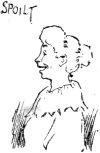
SPOILT
How did that girl laugh?
Probably as too many an English
girl laughs—riotously. Of such
an one was said a little while
hence: “When she laughs, there
seems no room left in the world
for any other sound.”
The loose use of the word
“beautiful” in English is largely
commented on by foreign visitors to this
country. The many English faces that are
lovely in colour must strike everyone, but that
only a minority of these are lovely in line is
undeniable. Now a face to be beautiful must
be lovely in colour and in line.
“Health and mirth make beauty,” says a
Spanish proverb wrongly. They do not so,
though they make what is by many deemed a
better thing than beauty, being that lovely and
pleasant thing named comeliness.
The following is a question put by a girl—
“Can a girl with a bad nose be called
beautiful?”
That is a question which one is tempted to
meet with the counter-question—
What is a bad nose?
A bad man—and even, alas! a bad woman—is
a thing conceivable; but—a bad nose—No.
The thing meant by this girl, it has transpired,
is an unbeautiful nose. Certainly a girl
with such a nose, suppose it to take the form
of a tip-tilted nose, cannot be called beautiful.
For her consolation, let her be told that she
can fairly be called pleasing, the actual fact, it
would seem, being that a tip-tilted nose sets a
girl in one matter at an advantage. A London
journalist some little time ago gave his
readers this piece of information—
“One of those statisticians who find out what
others cannot find out asserts that girls with
retroussé noses marry
sooner than young ladies
with Greek and Roman
noses.”
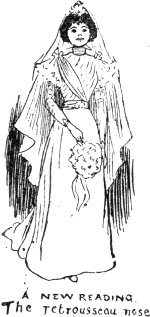
A NEW READING.
The retrousseau nose
That is a remarkable
assertion, not the least remarkable
thing about it
being the phrasing of it—“girls
with retroussé
noses,” “young ladies with
Greek and Roman noses.”
Welladay!
If it be conceded, as I
think it must be, that
classical outline is an essential
part of beauty, “young
ladies” with Greek and Roman noses are
not without one feature essentially beautiful.
In the case of those with Greek noses,
there are commonly other features satisfying
the severest exactions in regard to beauty.
This fact notwithstanding, the faces in question
may be so far from pleasing to those who
look, as the poet did, for something than
beauty dearer, as to bring upon themselves
the censure contained in certain words by
Shakespeare—
“This is a strange repose, to be asleep
With eyes wide open; standing, speaking, moving,
And yet so fast asleep.”
Beautiful faces too often lack animation.
As a natural consequence, beautiful faces
lack another thing. A young face to be
pleasing must hold out a promise, just as
an older face to be pleasing must tell a story.
Now there are more unbeautiful young faces
that hold out a promise than there are beautiful
young faces that do this, just as there are
more unbeautiful older faces that tell a story
than there are beautiful older faces that do this.
In like manner, the regularity of line that
is a main part of beauty is often attended by
defects in another direction, calculated to
arouse comment such as the following, being
a speech made in reference to a woman of
great beauty—
“Her profile is delicious, but her full face
is an empty face.”
The woman in question lacked somewhat in
intellectuality. A beautiful woman—so fairly
on the whole are gifts distributed—is rarely
a clever woman, and a beautiful girl is often a
goose. Thus it was a beautiful girl of not ten
but twenty years of age, who put to paper this
account of Spain—
“That is where the Inquisition was, and
there are bull-fights there, and the ladies wear
black on their heads, and Westward Ho! was
there.”
It was a beautiful girl who asked lately—
“Has a cow horns?”
To which the counter-query put by an unbeautiful
girl was—
“Did you ever hear of the nursery rhyme of
‘the cow with the crumpled horn’?”
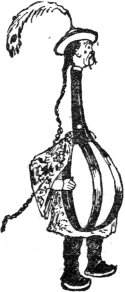
It was a beautiful girl who
wrote of a sailor as unfurling
the anchor, who spoke of the
dress of a Chinese mandoline,
who answered the question put
by a Frenchwoman, “What is
the English for raison d’être?”
in the words, “Raison d’être
is English,” and who formed
one in a dialogue which took
the following turn—
He: “What are dead languages.”
She: “The languages which
were spoken by the dead Romans and
Greeks.”
He: “But how could the dead Romans
and Greeks speak?”
She: “Silly!”
He: “‘Silly’ yourself!”
Not only do beauty and stupidity often go
hand in hand, but beauty and commonplace
affections often do this.
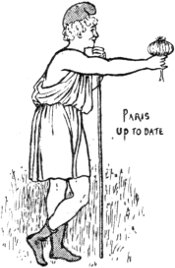
Butterflies love the flavour
of cabbage, and some
beautiful girls—by their
own confession—“love”
onions. It is no crime
to like onions, but to
“love” them is to waste
sweetness.
PARIS
UP TO DATE
That vanity, as a whole,
is less often met with in
beautiful girls than in unbeautiful
ones is a well-known
fact, and it is a
fact which I am so little
inclined to challenge that I give the following
cases as being to my full belief exceptions to
the rule.
A beautiful girl, known to me, while really
very young poses as being very much younger.
Her age is seventeen or thereabouts, and she
poses as being fourteen. If her age were forty
or thereabouts, and she posed as being seventeen,
one would more easily forgive her. She
will derive the benefit of this mental bias some
twenty years hence.
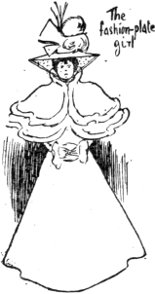
The
fashion-plate
girl
In the case of another beautiful girl known
to me, so much of her is
dress that her appearance
seems to warrant what
once seemed to me an
unwarrantable piece of
English, being the following
extract from a society
paper of the year 1887—
“Among the younger
ladies was a pretty white
tulle with marguerites and
a white satin bodice.”
At first reading of that
I asked myself, “What
sort of a young lady is a
pretty white tulle with
marguerites and a white satin bodice?”
I do not ask myself that question now.
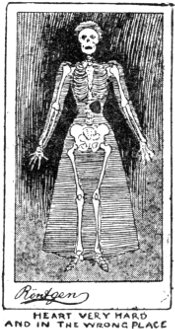
HEART VERY HARD
AND IN THE WRONG PLACE
Thirdly, a beautiful girl of my acquaintance
has a face with what her
enemy calls “Inspection
invited” all over it.
That is unbeautiful
phrasing, but the charge
thus levelled is not without
foundation in fact.
One hopes that some
day there may happen
to this girl what there
happened once to a
beautiful girl. She
looked in the glass to
see her face, and she
saw her heart, and that
day all vanity left her.
As a picture of a
beautiful girl I give in
conclusion the following:—
The Girl with the Face, described by one
who knew her.
She used to pass my windows.
She had a face of quite perfect loveliness,
the mouth and eyes very merry, and flashing
brown hair that hung open to her waist.
She was slightly deformed, her figure being
thrown on one side, like the leaf of a begonia.
I never liked the leaf of a begonia until I came
to see her.
In all I may have seen her a hundred times,
then she ceased passing my windows, and
after a while they brought me news that she
was dead. By special favour, they let me
see her lying in her coffin, and this is how she
looked:—Her mouth, that had always been very
merry, was quite grave, and her hands were
folded on her breast. They had put a rose in
one of them, and it laid its soft round cheek
against her breast. Some of them—this vexes
me still as I write it—had tried to lay her hair
about her so as to hide that slight deformity
that made her lie like a begonia leaf.
This girl was in death, as she had been in
life, the most beautiful girl I ever saw.
(To be concluded.)
SHEILA’S COUSIN EFFIE. — CHAPTER XXII.
A STORY FOR GIRLS.
By EVELYN EVERETT-GREEN, Author of “Greyfriars,” “Half-a-dozen Sisters,” etc.
IN SUSPENSE.
yphoid fever!”
The doctor
had come and
gone, and that
had been his
unhesitating
verdict.
“I may nurse
him? You will
not be so cruel
to keep me
away?” Sheila had
pleaded, her eyes
full of tears.
The doctor had
looked her all over,
asked a few questions
as to her
health and general
condition, and had
then made answer—
“If you will be
sensible and take
the proper precautions, you may help in
the nursing. Typhoid ought not to be
passed from patient to nurse, though it
sometimes is. But a person in good
health, acting under direction, ought to
escape. I will try and obtain a nurse
for you, but we have had to send for a
good many already. Under her you
may help, and you also, Miss Ray, since
you wish it so much. But remember
that you must be reasonable and
obedient, or I shall send you both
packing in double quick time!”
And so when North came back from
an anxious day in the town, during
which time he had found that nearly a
dozen of their people had sickened or
were sickening with the insidious fever,
he returned home to find grave faces
awaiting him, together with the news
that Oscar had come back with pronounced
symptoms of the malady, and
that Sheila was with him upstairs, a
nurse being expected from London in
the course of the evening.
North went straight up to his cousin’s
room. Sheila sprang up, thinking it
was the doctor’s step. He took both
her hands in his and gave her a cousinly
kiss of sympathy. It was the first time
he had offered her such a salute, and
somehow it brought the tears to Sheila’s
eyes. She felt that it was a mark of
sympathy she scarcely expected from
the undemonstrative North.
“What a good thing that you are here,
Sheila!” he said.
“Oh, I am so thankful!” said the
girl. “I should not have known how
to bear it out there!” and she suddenly
felt a wonderful illumination of spirit,
as she realised the Fatherly guiding in
all this trouble, as she had thought it,
which had ended by bringing her to her
brother’s side, just when he needed her
most.
“I will try never to be angry and
rebellious again!” she said in her
heart, and turned to the fire to dash
the tears from her eyes.
North went over to the bed and took
Oscar’s hot hand in his. The listlessness
of fever was upon the patient, but
his eyes lighted at sight of his cousin.
“How’s little Tom? Have you heard
of him?”
“Yes, I’ve been to see him. He’s
got all he wants—except your visit.
Hunt does not think his will be a bad
case. But we have a good many down
with it in that alley. It is thought to
be the state of the drainage. You
must have picked up the poison during
some of your peregrinations there, but
away from it all you ought to get on
like a house on fire.”
North spoke cheerfully, nor was he
unduly anxious about Oscar at this
juncture; but he knew enough of the
fever to be aware that it ran a
tedious course, and that Oscar had a
long bout of sickness before him. He
was half surprised himself how much
he had missed the boy at the office and
about the works the past two days, and
how little he relished the thought that
he must learn to do without him for
some weeks to come. They had got
into the way of walking to and fro
in company, or working together in the
evenings, and discussing together a
great many plans with regard to the
business itself and the people in the
employ of the firm.
“He has got this fever poking about
amongst the work-people,” North mused
to himself, “and it was my doing to a
great extent that he took up with that.
I ought to have been more careful, for
we have been told often enough that
the town is not healthy, and that a new
drainage scheme is badly wanted. I
suppose now we shall have something
done. I only hope we are not in for a
regular epidemic! Perhaps my father
and I ought to have agitated more, but
it was not exactly our business, and
our hands always seem pretty full.
Well, well, one must hope for the best,
but I wish Oscar had not been one of
the victims. He never seems to have
much stamina. If it had been myself,
I should soon have battled through.”
North went down to the drawing-room,
where there was a family discussion
going on.
“I don’t see that I am any good
here,” Cyril was saying, “and you will
want all the room you can get, with
Sheila back and this nurse expected.
So I’ll just go off straight to London,
and take up my quarters there. I can
really read better if it comes to that,
and I shall be out of the way.”
The mother was about to give an
assent to this scheme. Cyril was very
precious in her sight, and having one
invalid already on her hands, she was
naturally anxious about the rest. But
she saw that North’s face looked hard
and cold, and she glanced across towards
her husband.
Mr. Tom’s eyes were fixed upon the
glowing fire; he seemed to be pondering
deeply.
“Raby has gone to the Bensons, you
say?”
“Yes, they sent for her immediately
upon hearing the rumour of Oscar’s
illness. Her room will be useful for
the nurse; but as Ray and Sheila share
Ray’s room, there is no need for Cyril
to leave unless we think it better. Perhaps
we should be more comfortable
with fewer at home. There is always
the chance of infection, whatever precautions
we may take.”
“Just so,” said Cyril, “and then I
should only be another worry and bother.
The London plan would be much the
best. I suppose you would provide the
funds, dad?”
Cyril spoke with the ease and assurance
of a favoured son. He was the
only one who ever spoke to his father
by that familiar title. Mr. Tom did not
take his eyes from the fire.
“You have your own allowance, and
we have only reached half quarter yet.
You must have plenty in hand.”
Cyril coloured and then tried to laugh
easily.
“What keeps one at home scarcely
goes as far in London.”
“That allowance was fixed when you
went to Oxford and has never been
changed. Many a man has less on
which to bring up a family. It should
stand the strain of a few weeks in town.”
Cyril was silent, biting his lips. He
was not accustomed to be denied
anything.
“Well, I need not go, I suppose,” he
said rather sullenly. “I can stay here
and take my chance, of course.”
“Yes, and help in the press of work
which this outbreak will entail upon us
all,” said his father rather sternly.
“That is a thing which had never
occurred to you, I suppose.”
They were all rather surprised by the
tone taken by the father towards Cyril,
nobody more so than the young man
himself. A thrill of dismay began to
run through him. Something must have
happened to change his father’s manner
so completely.
“Of course if I can be of any use——”
he began nervously.
“Well, that remains to be proved.
You have not been much use in the
world so far; but I think it is time
your days of idling came to an end.
Perhaps this emergency will give you
your chance. Let us see during these
next weeks the stuff of which you are
made. Perhaps you will be able to
make up for the purposelessness and
shortcomings of the past year.”
His father looked straight at him then,
and Cyril cowered as under a blow.
Then Mr. Tom rose and walked out of
the room, followed by North, whilst
Cyril turned anxiously to his mother and
exclaimed—
“What can he mean by that?”
But the mother did not know. Her
husband had said nothing to her that
could explain his rather mysterious
words. Had Cyril heard what passed
between father and son in the study he
would have some reason to tremble in
earnest.
“Have you discovered anything fresh,
sir?” asked North, as they stood by the
hearth.
“Yes; the report of the detective
came in during your absence this
morning. Every note has at last been
traced, and each one to Cyril. He
passed one through young Lawrence, as
you found out some time ago; another was
cashed in London some time later; the
third was a long while in being traced,
but it was paid at last by a small cigar
dealer in Romford. And it was elicited
upon close inquiry that it had been
presented by a man exactly answering
to the description of Cyril, who had
made a rather considerable purchase
there, and had given the note in
payment. Some of the boxes with this
man’s stamp on them have been found
in our rubbish bin. The case is complete
in my estimation.”
“And what are you going to do?”
“Give him a chance to rouse himself
from his selfish apathy during these
next weeks, and to win for himself
something of a good name. Of course,
when Oscar recovers, the whole truth
must be told. Meantime it will rest
between you and me; and we will see if
there is not still something behind that
lazy, self-seeking exterior. I fear we
have spoiled Cyril, and that this is the
outcome. But some men will rise to an
emergency, who otherwise drift along
with the current all too easily.”
It was the father’s hope that the
crisis they feared in the town would stir
up Cyril to exertions and self-sacrifice,
which would do something to obliterate
the bitter remembrances of the past.
Perhaps Mr. Tom forgot to bear in mind
that whilst repentance for past sins may
be a stepping-stone to better things, a
concealed and unrepented act of wickedness
is like a millstone about the neck,
dragging the soul downwards, and
raising a barrier between it and those
promptings of the Spirit whereby alone
men can rise to true nobility and self-forgetfulness.
And now a time of stress and keen
anxiety arose within the little town of
Isingford. The epidemic was restricted
to a certain area, and was easily traced
to the defective drainage of that part of
the town; but its victims were very many
within that area; and there were several
isolated cases, like Oscar’s, which,
however, were generally traced to poison
germs inhaled in the infested locality.
Oscar did not appear at first to be
very ill, and Sheila was quite certain
that he was going to have it mildly, and
would soon be better. The nurse was
capable and kindly, and Oscar liked
her. He always said he was comfortable,
only too lazy to talk; and it was
difficult to get him to take the food and
medicine prescribed. He seemed to
turn against everything except iced
water, and yet they must keep the
furnace going somehow.
In the town doctors and nurses were
hard at work, together with a band of
amateur workers, hastily organised, who
went round to the infected houses daily,
bringing those things which the doctors
had ordered for the poorer patients, and
in cases where nurses were not to be had,
performing little offices for the sick,
which they could not otherwise have
obtained.
North and Ray were amongst the
most devoted of these workers, learning
much from the case at home how to
treat others. But from Cyril there was
little efficient help to be got. He had
professed willingness to join in the work
of personal ministration, but he shirked
any actual contact with the sick. He
would fetch supplies, and make a show
of devotion, but there was no real heart
for the task in hand. He loathed the
close, crowded alleys and the sick-rooms.
He could not make up his mind to enter
them. He saw his brother and sister
going about. He saw the clergymen,
whose tasks he had so glibly spoken
once of undertaking, toiling daily
amongst the sick, taking the message
of salvation to those who longed to hear
it, and seeking to point the way above
to such as had never been willing before
to listen. He saw all this, but he could
not do as those did. He would make
his way with a sort of shuddering horror
to some pleasanter place, away from the
sights and sounds which disgusted him,
and try to forget his father’s words, or
his own vague misgivings as to coming
trouble.
Nor was Isingford alone troubled by
this outbreak. The outlying families
amongst the gentry came forward with
money and help of other kinds. May
Lawrence drove in almost daily with
supplies of good things from dairy and
larder; and gladly would she have been
one of the band of workers, but her
mother could not bring her mind to
sanction it. Nevertheless the girl was
to be constantly seen driving through
the poor streets, and leaving her doles,
with bright and cheering words, at the
doors of the poor houses; and North
and Ray, who saw her so often, declared
that she was like a sunbeam in those
dismal places.
She always stopped to ask for Oscar,
and at first got encouraging replies.
Later, however, a different tone crept
into the answering voices, and the reply
would be gravely spoken.
“He does not get on. The fever
keeps so persistent, and we can see no
change for the better. It is always slow
in typhoid, but Oscar’s case is not
running in the usual lines. It puzzles
the doctors and makes us all uneasy.”
May was sincerely grieved. She
liked Oscar; she was truly fond of
Sheila; and she had come to identify
herself, in a fashion, with the household
in River Street. She heard of their
work, and saw it with her own eyes.
The admiration she had always felt for
North was increasing daily.
But Oscar?
Sheila scarcely left him now except
when the nurse drove her away to take
the needful rest, whether she could sleep
or not. It seemed to her as though her
whole life had been passed in watching
that dear, wasted face. Everything else
was so shadowy and indistinct; it seemed
like scenes from another life.
Her past life used sometimes again
to flash vividly before her, and at such
times she would feel a strange sense
of its emptiness and worthlessness.
Suppose it were she who had been called
upon to lie there, with death so very
near! What sort of a record would she
have to give of the talents and advantages
entrusted to her. Great waves of
humiliation and self-distrust would sweep
over her, and she began to understand
that there was only one thing worth
having in all the world, and that was
the life of the Lord within our own—the
power to dwell in Him, as He has ever
promised to dwell by the Spirit in us.
And when that sudden illumination
had come into Sheila’s heart, all else
was forgotten—merged in the sudden
blinding light. All bitterness, anger,
selfishness, seemed to shrivel up to
nothing, and she was even able to throw
herself on her knees beside the bed on
which Oscar lay, and to say from the
bottom of her heart—
“Thy will be done.”
(To be continued.)
MY MOTHER.
yes, in whose welling depths would I
With wonder ofttimes gaze,
And gazing smile, I scarce knew why,
In those long-vanished days;
Hand, that of old my pillow smoothed
When fever burnt my brow,
And all my infant sorrows soothed
With love—where are ye now?
Hushed is the voice whose accents soft
Would cradle me to sleep;
The eyes that lighted up so oft
No longer laugh—nor weep;
The hand, before whose touch so deft
Sickness and care would flee,
Is gone, and naught, alas! is left
Save memory to me.
G. K. M.
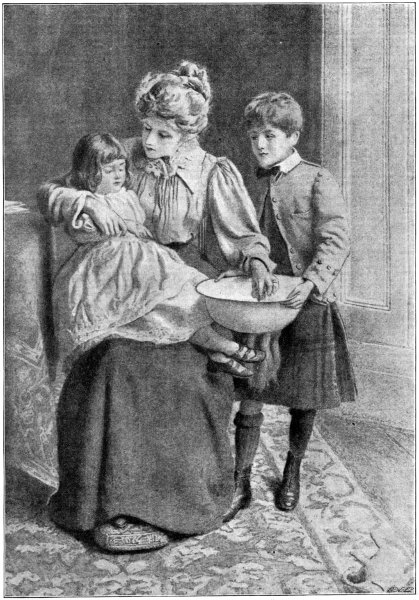
“ALL MY INFANT SORROWS SOOTHED.”
FROM LONDON TO DAMASCUS. — PART V.
THE END OF OUR PILGRIMAGE.
On the 4th of April we left Jerusalem for
Hebron, travelling in an ancient vehicle driven
by a merry bright-eyed youth, who at intervals
would put his head under the hood of the
carriage, and inquire, “Are you happy, O
ladies?” On this journey we dispensed with
the services of our dragoman, Miss B. kindly
undertaking for us the distracting business of
payments and bargaining, for the coinage of
Palestine is as perplexing as its language.
You can never be sure of the value of
Turkish money in this country. Every village,
though circulating the same coins, puts a
different value on them; this is most
embarrassing to the European. I do not
remember meeting either a native or an
English resident, who could give you off-hand
the accurate cost of a few trifling purchases.
Before you can get near it, mysterious calculations
have to be worked out on paper; these
must be illustrated by pieces of English,
French and Turkish money, accompanied by
such profuse explanations that you soon begin
to doubt your own sanity. Lucky indeed is the
English traveller who survives, and goes forth
with a serene countenance, believing that he
comprehends the system of accounts as
practised in Palestine.
On the road we passed long caravans of
Russian and other pilgrims going up to
Jerusalem to keep Easter. They saluted us
courteously, but showed unmistakable surprise
at our travelling in an opposite direction to
the Holy City.
Half-way to Hebron we stopped at a khân,
and were presented with tiny cups of coffee.
We returned the compliment by offering a
backsheesh to the khân-keeper.
In the remoter parts of Palestine buying
and selling is reduced to a fine art. As a
matter of fact you don’t buy anything, you
merely exchange presents. You wish to
purchase something and ask the price; the
owner immediately gives you the article, and
with a grand air places his hand on his heart
and exclaims—
“Take it, my brother; what is that between
thee and me?”
If you are foolish enough to accept his
words literally, he will be grievously disappointed,
and by the exercise of much
cunning would, without fail, get his gift back
again. No, the correct way is to utter polite
protests against such generosity, to which your
would-be benefactor again fervently remarks—
“Think not of that, O my brother, it is a
trifle.”
You go on playing at cup and ball until he
deprecatingly yields to your scruples, and
names a price out of all proportion to the value
of the article. At this point the game
becomes exciting. If you are wise, you turn
on your heel in disgust, after throwing out
contemptuous hints on the worthlessness of
the “present.” This causes the merchant to
reflect; his respect for you is growing; finally
he relents and proposes a more reasonable
price. The exchange is then made, and you
part with mutual expressions of good-will.
While we were sipping our coffee, our
driver and a friend washed their hands,
carefully removed their shoes from their feet,
and turning towards Mecca they solemnly
prayed and recited portions of the Korân,
bowing their heads and performing the
prescribed genuflexions. When this duty was
finished, they promptly fell out over some
trifle, and said things to each other in what
Miss B. described as highly pictorial language.
Just as we expected them to come to blows,
they embraced, climbed into their places on
the box-seat (for the friend turned out to be a
fourth passenger), and we resumed our journey,
though not before our Jehu had thrust his
head under the hood of the carriage with the
artless inquiry, “Are you happy, O beautiful
ladies?” To which Miss B. replied—
“Transcendently happy, O son of the
Prophet!”
In acknowledgment of this compliment to
his powers of pleasing, we were entertained
with an improvised air, to which he sang in
praise of our loveliness and amiability of
character. Such is the Arab!
In a couple of hours we were entering
Hebron by the narrow valley whose vine-clad
hills have immortalised the Vale of Eshchol.
We alighted at the door of the English
Hospital, which is outside the town, and were
warmly welcomed by the ladies, whose guests
we were to be for the next two days.
Under the guidance of Dr. Patterson, the
medical missionary, we visited the famous
Mosque, but were only allowed to ascend the
five outer steps. This even excited the anger
of the wild boys and girls, who spat at us
and cursed us as Pagan Franks. From one
of the prayer holes in the marvellous outer
wall which surrounds the cave of Machpelah
we took out a paper, which had been placed
there that morning by a Jewish mother. On
it was written in a curious Judeo-Arabic dialect
a prayer “to our Father Abraham that he
would look upon her affliction and intercede
with the Lord of Hosts that He would give
her sons instead of daughters.” This desire
for male children is common throughout
Syria. As soon as the first son is born, the
father drops his own name and is henceforward
known as Abou Yusef—the father of
Joseph—as the case may be, while the mother
gains the respect and love of her husband in
proportion to the number of sons she bears
him. Daughters, as a rule, are of no account.
We looked with reverence and awe upon
the ancestral burial-place of the Patriarchs.
True, we could only gaze at the polished
outer wall, but we knew that therein “was
the one spot of earth which Abraham could
call his own.” The pledge which he left of
the perpetuity of his interest in “the land
wherein he was a stranger” was the sepulchre
which he bought with four hundred shekels
of silver from Ephron the Hittite. Round
this venerable cave the reverence of successive
ages and religions has now raised a series of
edifices which, whilst they preserve its identity,
conceal it entirely from view. But there it
still remains. Within the Mussulman mosque,
within the Christian church, within the massive
stone enclosure built by the kings of Judah, is,
beyond any reasonable question, the last
resting-place of Abraham and Sarah, of
Isaac and Rebecca, “and there Jacob buried
Leah,” and thither, with all the pomp of
funeral state, his own embalmed body was
brought from the palaces of Egypt.[3]
Hebron is a Moslem city containing about
18,000 inhabitants. About 600 Jews dwell in
the lower end of the town. Fierce and wild,
it is their boast that no Pagan Frank has built
his house within their walls nor desecrated their
holy shrine with his presence. Whether this
bigotry will give place to tolerance under the
softening influences exercised by the medical
missionaries has yet to be proved. We were
told that the people were becoming gradually
gentler. To us they seemed fanatical and
dangerous. There is no hotel in Hebron for
travellers.
Thanks to our good friends the missionaries
we were able to visit most of the places of
interest round about. The neighbourhood
abounds in traditions. To the north, a cave
is pointed out as having been the abode of
Adam and Eve for more than a hundred years.
Farther south is the spot where Cain killed
Abel, and there in the “Vale of Tears” Adam
mourned for his murdered son, and close by
the Father of all living was buried.
The history of Hebron, or El-Kalleel (the
Friend of God), is particularly interesting. It
is one of the oldest cities in the world, having
been built seven years before Zoan or Memphis
in Egypt (Num. xiii. 22). “Abram removed
his tent, and came and dwelt in the plain of
Mamre, which is in Hebron, and built there
an altar to the Lord” (Gen. xiii. 18). Later
on Joshua smote it with the edge of the sword
and destroyed it utterly; afterwards he gave
it to Caleb for an inheritance, “because that
he wholly followed the Lord God of Israel.”
David reigned here seven years and a half.
The murderers of Ishbosheth were hanged by
the pool, which is still in existence. Rebellious
Absalom made the city his headquarters.
Centuries later it was taken from the Edomites
by Judas Maccabees, but since 1187 it has been
in the hands of the Moslems. To-day it is a
picturesque stone town, the centre of commerce
for the southern Arabs, who bring their wool
and camels’ hair to the market. They also
trade extensively in glass beads and leathern
water-buckets.
We were sorry when our two days had
expired, but alas! we had to say good-bye to
our hospitable English friends, for time pressed;
so waving a last farewell to the groups of
deaconesses and servants, who had gathered
at the door of the mission house, we turned
our faces again towards Jerusalem. A couple
of days in David’s city followed and then to
Jericho, where we bathed in the mysterious
Dead Sea, and in consequence were covered
with salt crystals. Starting before sunrise, we
were back again in Jerusalem at 9 A.M., and
late in the same afternoon our little cavalcade,
comprising Ameen, Bon Jour, Elizabeth and
myself, rode out of the city on our way north.
For the next six days we lived almost
entirely in the saddle from sunrise to sunset,
sleeping at native hotels or convents, which
had been previously arranged for by our
faithful dragoman, whose careful attention to
our needs cannot be too highly spoken of.
Although the sun was hot, the roads rough,
and even a shady nook could not always be
found for our midday meal, we thoroughly
enjoyed these long days in the drowsy air.
Every hill and valley, plain and pool we
passed on our route had been the scene of
some more or less remarkable event recorded
in the Scriptures, and as Ameen was well
posted up in Bible history, and eager to
impart his knowledge, we missed no place of
interest. Travelling thus day by day, seldom
meeting any human being, except an occasional
shepherd or country woman, we had ample
time for reflection, and it was easy enough to
give the reins to one’s imagination, and ride
with Joshua’s army through these silent vales,
or watch the impetuous rush of the warriors
up those bleak rocky hills, as with all the
confidence of victory they stormed the cities
which once stood there. Again from out of the
past we could hear the blessings and curses
thundered forth, and see the huge mass of
people gathered together, as we galloped
through the narrow valley with the towering
sentinels, Gerizim and Ebal on either side.
Or as we sat on Jacob’s well we could listen
to the sweet voice of the Saviour talking to
the poor woman of Samaria.
On we went through Nablous until we
reached Mount Tabor, where on the top, in
the Latin convent, we rested a couple of days.
Thence to Tiberias, where we dismissed our
faithful escort. Here we stayed with our
friends Dr. and Mrs. Torrance, of the Free
Church of Scotland Mission. Their house
and hospital are built on the shores of the
Lake of Galilee, and amid its charming scenery
we passed a fortnight. One of our excursions
took us to Gadara. Our tents were pitched
on a green knoll in the midst of wild beetling
crags, volcanic mountains, and tropical vegetation.
We bathed by moonlight in one of
the great natural sulphur springs hidden by
immense hedges of oleanders. Striking our
tents at five in the morning, we rode hard till
twelve o’clock, when we reached one of the
ancient giant cities. Here Dr. Torrance held
an open-air medical mission. The poor
people soon crowded round the Hakeem and
were patiently examined, and medicines dispensed
to those who needed them. It was a
picturesque and pathetic scene, the kindly
face of the white doctor, with the almost
black natives, and hideously tatooed women
and girls waiting anxiously for his verdict,
firmly believing that his touch and medicines
had miraculous power. As we rode through
the city we were deeply impressed by its
mighty ruins, which testified to the strength
and culture of its founders. From Tiberias
we went to Nazareth, staying a few days at
the Protestant Orphanage; and then engaging
two muleteers we set forth again, crossed
Carmel, stayed the night in the comfortable
German hotel built at its foot, then along the
coast to Beyrout, stopping at Acre, Tyre, and
Sidon—a five days’ journey. This route I
should not recommend to those who dislike
solitude and Eastern travel without the
slightest Western comfort. Dr. and Mrs.
Eddy, of the American Presbyterian Mission,
received us very kindly at Sidon, as there
turned out to be no hotel, though this town
was by far the most flourishing we had seen.
A large industrial school for boys, worked by
the missionaries, was well attended, all kinds
of trades were taught, the pupils eagerly and
intelligently learning, and eventually going
out well equipped to fight the battle of life.
We rested a few days at Beyrout (the Paris
of Syria) under the shadow of the purple
Lebanons. Here we dismissed our muleteers,
for we were now in the region of railways and
civilisation. Very early on a Monday morning
we got into the train which was to take us to
Damascus. The journey lasted ten hours, but
it seemed like two, for the railroad is cut
through the Lebanons, and the most exquisite
scenery meets the eye the whole way.
Towards four o’clock the train rushed screaming
through the valley of the Barada (the
Abana of Scripture), past smiling gardens, and
drew up in the station of Damascus. It was
a glowing afternoon, but the lovely green of
the trees and the plash, plash, of the rapid
rivers softened the glare of the domes and
roofs of the houses, and gave relief from the
dusty roads. In the evening we went up to
the top of a hill overlooking “the mother of
cities,” and sat down to enjoy the scene.
How dreamlike it looked in the soft sunset!
The brown bare mountains on one side, the
pathless desert all round. Damascus, like an
exquisite pearl set in a crown of emeralds,
nestled surrounded by miles of waving green
trees. No wonder that to the sun-baked
Bedouin of the desert it is a paradise, or that
Mahomet in first beholding it, turned back,
saying, “I am not fit to enter.”
The bazaars of Damascus are famous in the
East. Each set of merchants has its own
quarters, so that there is no difficulty in
finding the wares you require. There are
long straight arcades, and winding, twisting
arcades, all aglow with light and colour.
But there is no time to linger or describe
the beauties of this truly beautiful city. We
spent a week amid its wonders and fell more
in love with it day by day. I might mention
that the hotels are fairly good, and English
travellers are well cared for.
And now our journeyings are nearly over.
A week at Baalbec, where the famous ruins
of the temples of Jupiter and the Sun are the
astonishment of all beholders; thence to
Beyrout, from which port we embarked for
Constantinople, another delightful five days’
journey, and we steamed into the Bosphorus.
A week crammed with more wonders in the
way of sight-seeing, and then late on Monday
afternoon we stepped into the Oriental Express
and were whirled homewards, and on Thursday
afternoon we were in dear smoky London once
more, after an absence of nearly four months.
It may interest my readers to know that
our joint expenses for this trip were £170,
including £39 for railway tickets from Constantinople
to London. This sum took in
every item of expenditure except the presents
which we bought for our home friends. Of
course we could not possibly have seen so
much, nor travelled so comfortably and
economically if it had not been for the
kindness and hospitality of our many missionary
friends, who had looked forward to
our visit, and who made everything easy and
delightful for us. If any of the girl readers
of The Girl’s Own Paper set out on such
a tour, I hope they will return with as many
pleasant recollections as we did. And now
farewell.
S. E. Bell.
VARIETIES.
Lasting a Lifetime.
Mrs. Crabshaw: “What do you mean by
cheating me like this? You said this chain I
bought here would last a lifetime, and here is
all the plating worn off in a month.”
Goldskin: “Madam, I said dot shain
vould last you a lifetime pecause when you
puy it you look so sick I didn’t t’ink you vould
live der veek oudt.”
Life is Short.
As shadows cast by cloud and sun
Flit o’er the summer grass,
So in Thy sight, Almighty One,
Earth’s generations pass;
And as the years, an endless host,
Come swiftly pressing on,
The brightest names that earth can boast
Just glisten and are gone.—Bryant.
Absurd Names.
Amongst absurd names which have been
recorded at Somerset House within recent
years, we have the following, of which few
people would like to be the bearers:—
“That’s it, who’d have thought it?”
“Is it Maria?” “Bovril,” “Sardine,”
“Ananias,” “Judas Iscariot,” and “Man
Friday.”
THE HOUSE WITH THE VERANDAH. — CHAPTER XXIII.
By ISABELLA FYVIE MAYO, Author of “Other People’s Stairs,” “Her Object in Life,” etc.
A STRANGE DISAPPEARANCE.
om hurried
wildly
through his
boyish
toilet and
rushed into
the dining-room,
expecting
to
find the
breakfast
party round
the table.
He pulled
himself up
with an
astonished
whistle, for
the room
stood
empty, the
table unspread,
the
fire unlit,
while everything wore that indescribable
air of desertion and neglect which rooms
seem to bear each morning till human life
has again passed through them with the
new day.
“Something must have gone wrong
with my ticker,” was Tom’s natural conclusion.
But no, the watch was honestly
at work, having now advanced to a
quarter to nine. Besides, the daylight
of the February morning assured him
that it could not be much earlier.
“Clementina has ‘slept in’ herself,”
he decided, “and everything will go
wrong together.”
By way of making a move in the right
direction, he went into the hall and
performed vigorously on a little gong
which stood there. Clementina usually
did this twice—a wakening peal and
a breakfast peal, with an interval of
half an hour. To warn everybody that
things were not going on us usual, Tom
promptly repeated his performance.
It did not bring Clementina upon the
scene, dishevelled and in deep self-humiliation.
The first appearance
was Miss Latimer, who came downstairs,
her usual prim self, saying—
“What is the matter? I have been
up for a while, but I had forgotten to
wind my watch, and the house was so
quiet that I thought I had mistaken
the time, and in hope Mrs. Challoner
is resting I did not wish to rouse her.”
“I don’t think Clementina can be up
herself,” said Tom.
Miss Latimer glanced round the
dining-room.
“Perhaps she is ill,” she said. “She
looked rather pale last night. She
seems a very sympathetic person.”
Miss Latimer called down the kitchen
stair, but there was no answer save that
the cat came forward, mewing in the
appealing fashion common to cats when
they feel themselves unfairly deprived of
human society.
“Clementina must be still in her
room,” said the old lady, and she
bustled up to the topmost storey, Tom
following at her heels.
One or two vigorous knocks produced
no effect, so they tried the door. It was
locked, and the key was evidently not
in the lock on either side.
Miss Latimer and Tom looked at each
other aghast.
“We must go downstairs at once and
set the house going,” decided the old
lady, “and we must not make any
noise nor fuss till we have seen Mrs.
Challoner.”
As they passed downstairs, Lucy came
out of her room, with the white, deeply
graven face which tells of restless vigil.
After a sleepless night she had slept
heavily towards morning, and had only
awakened with the sound of Tom’s gong.
“We are all rather behind-hand,”
Miss Latimer said, “and something is
the matter with Clementina.” That was
the utmost she would say until she and
Tom had lit the fires.
They found time to exchange a few
whispered cogitations as they bustled
about in the kitchen, into which they
would not allow Lucy to intrude.
“I don’t believe Clementina is in her
room,” said Miss Latimer, “and I hope
not, for it means something bad if
she is.”
“I do believe she has got frightened
over our talk last night and has run
away!” Tom remarked. “Who would
have thought she would make tracks
like this?”
“Where can she be?” asked Miss
Latimer. “I remember Lucy saying
she was so sorry for her because she
knew nobody here, and didn’t seem
inclined to make friends.”
“I hope she hasn’t committed
suicide,” said Tom.
“Why should she commit suicide?”
asked Miss Latimer quite sharply. It
was her own fear.
“People do sometimes, though nobody
knows why,” Tom said. And he
went and took a nervous peep into the
cellar and scullery, which revealed
nothing worse than the general air of
desertion which hung over all the
premises.
Of course, such a development could
not be long concealed from the mistress
of the house. As soon as Lucy had
drunk a cup of tea and a faint shade of
colour had come into her face, they told
her that Clementina was nowhere to be
found. Lucy was not flurried nor worried
as she would have been a few weeks
before. At present her soul had withdrawn
into that sacred pavilion of sorrow
where the petty clash of common troubles
scarcely sounds. If things had gone
wrong with Charlie, why wonder that
everything else went wrong? Rather
it seemed natural and just what might
be expected!
It was useless to call in outside aid
till they had thoroughly explored the
house. They went carefully through
every room and closet, leaving Clementina’s
locked chamber till last, as it had
to be broken into, though its door offered
very little resistance to Tom’s strong
young arm.
Miss Latimer was right. The room
was empty! The bed had not been
slept in. Clementina’s box stood in
its accustomed place. It was locked,
but the key was left in the lock.
Lucy opened a little hanging cupboard.
“She has gone away in all her best
clothes,” she said. But why had she
gone? And where?
“Is anything missing?” asked Miss
Latimer.
Of course that could not be ascertained
in a moment. Lucy felt little misgiving
on this matter.
“Whatever this means,” she said,
“we know that Clementina comes of
respectable folk—Mrs. Bray’s Rachel
answers for that.”
It was now impossible for Lucy to go
to her class. It was equally necessary
that Tom should present himself at the
office, though he hoped that, when “the
governors” heard about the sad news of
yesterday and the trial of to-day, they
might speedily release him. He undertook
to conduct little Hugh to the
Kindergarten, and to convey Mrs.
Challoner’s excuses to the Institute,
which last commission he accomplished
with such simple directness that Lucy
presently received a kindly hand-delivered
note from the Principal, bidding
her not to return to her duties till she
felt fully equal to them—they would
secure a satisfactory proxy.
The two ladies’ investigations had
bewildering results—quite of a piece
with the bedroom key being taken
away, and the keys left in the trunk.
The tiny store of household silver was
safe, and Lucy, running her eye over other
household gods, missed nothing. The
domestic arrangements had apparently
been in good order until very near the
end. But such movements as Clementina
must have made during the previous
day were most unaccountable. She had
put butter among the loaf sugar, and
had placed the saucepans on the dresser
shelves! There was not a single potato
in the house, though the day before she
had asked for money to buy a week’s
supply. The nice clean damask tablecloth
and napkins which had been used
at supper the night before were found
crumpled up and thrust away with the
blacking brushes. The bellows was in
the bread-basket!
“One would think she had gone out
of her mind!” ejaculated Miss Latimer.
And then a thought flashed upon her.
She paused. She would not at once
give it utterance.
Tom got back, breathless, by noon.
The principals of the firm were shocked
to hear of the uncertainty of their young
partner’s fate, and deeply sympathetic
with the poor wife, who might so well
be “widow.” They bade Tom give her
all the help he could, and come to them
for any service they might be able to render.
On his way back Tom had looked in
at Mr. Somerset’s lodgings to bid him not
fail them, for they were in new trouble.
He could only get a word or two with Mr.
Somerset then, for there was fresh affliction
there too, though it was but simple
affliction. Mr. Somerset’s old landlord
had passed quietly away in the
night.
Tom found Lucy and Miss Latimer
wrapped in big aprons, with dresses
tucked up, busily getting things into
their accustomed routine. His appearance
reminded them of the expediency
of dinner—a necessity which women
are too apt to forget for themselves.
Mrs. Challoner commissioned him to go
and “order” some steak, but Tom said
he should bring it, to make sure of it,
and armed himself with a black leather
bag.
The butcher greeted him cheerily.
“Fine morning, sir. There, that’s a
capital cut, just what Mrs. Challoner
will like. Take it yourself, did you say,
sir? Well, as you please.” And then
the butcher gave his head a knowing
wag, and said, “Guess there’s trouble
with that servant of yours? I reckoned
there would be. She was a queer one,
that. A little off her chump, I should
say.”
“She’s run away,” said Tom, “but
what did you ever see queer about
her?”
The butcher laughed.
“I thought at first that she was a real
old sort. Prime cut, as one might say.
And when she used to be a little faddy, I
thought it was just her particular goodness.
She was always ready enough to
pass the time of day, and her and me
were good friends—though I do
remember she did once ask me why I
came knocking at her kitchen door and
running away, but I was busy that day,
and let it pass as, maybe, her sort of
joke. But about a week ago, she asked
me why I made faces at her; and my
missus spoke quite sharp to her, telling
her not to put such stories about. But
last night, sir, I thought it was turning
serious. For she came into the shop
and said I was a-putting poison on
the meat—she believed I had rubbed
lucifer matches on it. I wasn’t here at
the time, and my missus was glad to say
anything to pacify her, thinking she’d
been drinking—though she doesn’t look
one of that sort.”
Tom stood aghast! Here, then, when
and where nobody had thought of looking
for it, the whole mystery stood explained.
Clementina was the demented
person who had sent the blank letter
and the black-edged letter. She had
imagined the runaway knocks, and what
else? Might not the smashed china
and the escaped gas be traced to the
doings of the same wild hand?
“If I were in your place,” went on the
butcher, “I should be thankful she has
taken herself away. It’s my belief she
is mad. There’s many a one who,
in the end, kills somebody, who has
shown no more signs of it beforehand.
It ought to be somebody’s public duty
to look after such before they do
mischief, if there’s nobody of their own
that cares enough for them to keep them
out of harm’s way.”
Tom went home full of this news. It
was very astonishing to Lucy, but Miss
Latimer was in a measure prepared
for it, as she owned the idea had already
crossed her mind, though she little
expected it would have such swift
corroboration.
Lucy’s first thought was an immense
thankfulness that Hugh’s life had been
preserved from all risks; her second, a
remembrance of the child’s instinctive
shrinking from Clementina; her third, a
wave of pity for this disordered mind,
for there could be no lingering doubt
that Dr. Ivery’s diagnosis was correct.
“If she is insane,” said Lucy, “it is
no blame of hers. We must think only
of what has become of her, and of how
we should act on her behalf. Knowing
of her through Rachel, and hearing of
her as a lonely woman with no near
relatives, I don’t know with whom to
communicate, except Rachel. Rachel
may know something more. We must
telegraph to her at Bath.”
Rachel’s answer came quickly.
“Astonished. Gillespie, brother lives
at Inverslain, Sutherland. Relations in
Hull, address unknown. My mistress
very ill.”
There did not seem much help there.
Presently Tom, glancing round the
dining-room, exclaimed—
“I do miss something! I miss the
railway time-table which Mrs. Grant
left behind her. It was on the mantelshelf
last night. Clementina has taken
it with her. She has gone somewhere
by train!”
“Let us hope she has gone straight
back to her own village,” said Miss
Latimer.
“We must at once telegraph to the
brother,” insisted Lucy. “‘Gillespie,
Inverslain,’ does not seem much of an
address to Londoners; but I daresay it is
a little place, and that he is known there.”
“There’s no Inverslain on any railway
line,” Tom discovered, busily turning
over an old “Bradshaw.” Thereupon
Lucy gave him a sovereign and
despatched him to the post office to
discover how a sufficiently lucid message
could best reach a remote Highland
hamlet, bidding him not grudge any
charge which might be made for
porterage.
He brought her back her change,
having had to make a liberal deduction
from the sovereign, since “Inverslain”
was reported to be a tiny Highland
“clachan,” twelve miles from any
telegraph office.
Tom had also bought an evening
paper, and had privately scanned its
columns with great care to see whether
they might contain any item which could
possibly refer to the hapless Clementina.
He found none. But he found something
he did not expect, to wit, a paragraph
relating the finding of the spar and sail
of the absentee Slains Castle. The
sad suggestion had now become public
property.
Mr. Somerset had arrived in Pelham
Street while Tom was at the telegraph
office. He and the two ladies discussed
the conversation which had
gone on the evening before, and the
probabilities of Clementina having taken
alarm at Tom’s idle suggestion that some
of the “professors” of “clairvoyance”
should have a chance to cover themselves
with glory by discovering the origin of
the mysteries. Of course, the Highland
woman’s own faith in second-sight and
prenatural powers would make such
an idea very terrible to her, since she
knew the mysteries were of her own
making.
“But if she be mad, could she realise
this?” asked Lucy.
“Oh, dear, yes,” said Mr. Somerset.
“You must remember that madness
seldom attacks the whole of the brain at
once. Generally it leaves part in
perfect working order for awhile, so
that those in ignorance of the peculiar
groove taken by the disease might
long remain unwitting of it. Generally,
of course, the malady slowly increases
its conquest, though its progress may
be very slow, and maybe occasionally
arrested at special stages. It is quite
probable that Clementina may not
remember all she has done, and also
that she may believe her actions to have
been quite intelligible and praiseworthy.
Dr. Ivery explained all this to me yesterday,
when we had little idea where the
trouble lay.”
They were sitting dismally enough
taking their tea when a telegram
arrived. It was far too soon for it to
be a possible response to Lucy’s
message to Inverslain. It was addressed
to “Mrs. Challoner,” and by
the sudden flash of light and life across
her face, the watchers could see that a
wild hope sprung up within her that it
might concern the great anxiety and
sorrow which she was holding in such
resolute silence. But no. The light
and life died out. Yet she said with a
sigh of relief, “Let us be thankful for
this,” and handed the telegram to Mr.
Somerset who read aloud—
“‘Clementina Gillespie here. Very
unwell. Will write to-morrow about
box and wages.—Micklewrath, Dock
Street, Hull.’”
“Then she is safe with those relations
of whom Rachel telegraphed,” said
Miss Latimer, drawing a long breath.
“At any rate, the terrible responsibility
is removed from us.”
Lucy had already risen from the table
and gone to her desk.
“I must now write an explanatory
note to the people at Inverslain and tell
where their sister is,” she said. “It
will still be in time to catch the night
mail, so it will follow hard after the
telegram.”
“She is thinking of the relatives’
anxiety and distress; these Hull people
are thinking only of a ‘box’ and
‘wages,’” whispered Tom aside to Mr.
Somerset.
“Well,” whispered Mr. Somerset,
“what would you have? It’s hard that
everybody is not like her, that’s all.
We would not wish her to be as so
many are.”
“It is so good of the Institute people
to let me stay away awhile,” said Lucy.
“How could I have gone there to-morrow
with nobody at home to do
anything for us? Now I shall be free to
do my own work till I can get some
arrangement made.”
She did not speak of relief from labour
because of the aching yearning of her
heart. That would not have kept her
from work. She would have asked,
“Why should it?” If Charlie were
really gone, then her toil was more
needed than ever, and if she stopped it
to mourn for him, when would she begin
again, for when would she cease to
mourn? When would she be able to
draw a line and say, “Henceforth I
can endure”? No, her endurance
must begin at once. She did not feel
this in herself as strength, she thought
rather this was a weakness that dared
not pause lest it should never be able to
recommence!
“We will go on together, my dear,”
Miss Latimer assured her. “We
women, who have known the great
common bond of working for our bread,
will surely stand by each other.”
“I wish Charlie was here to thank
you,” she answered. Her face was
calm and her voice was sweet, but
no tears nor lamentations could have
conveyed such an impression of agony.
“I know now how the martyrs smiled
on the rack,” said Tom, as he walked
home with Mr. Somerset.
“I never thought that I should wish
to see a woman cry,” answered that
gentleman, “but I am sure that tears
would be a blessing to Mrs. Challoner
now.”
(To be continued.)
USEFUL CANTATAS AND OPERETTAS FOR GIRLS.
nce upon a
time, at the
midnight hour,
it is supposed
that the denizens
of the
doll’s house,
including the
lady doll,
“Lady Angelina
de Montmorency,”
the
gentleman doll,
“Lord Jennings,”
the Vivandière,
little Bo-peep, the
wooden Soldier, and
Mr. Noah, all woke up
and aired their experiences
and grievances in song and
speeches of a merry character,
which were at once
taken down by Mr. W.
Yardley and Mr. Cotsford
Dick, and transmitted to posterity under the
title of “Our Toys” (J. Williams), libretto,
6d., and vocal score, 1s. 6d.
This is really a very amusing “fairy vision
in one peep,” and likely to suit any brothers
home from school as well as big and little
sisters.
Here is a specimen of its wit, treating of
the wooden Soldier—
“His wooden stand which bore him well
Was broken in a fight,
And so he like a soldier fell,
As he couldn’t stand upright.
They laid the vet’ran on the shelf,
Secure from further knocks,
And he’s got his company all to himself,
For he is the last of the box.”
The dressing of the characters of this airy
little piece might be very bright and effective,
and not difficult to manage at all.
A musical play for young girls, easily acted
in a room, is “Elsa’s Fairy,” by Myles B.
Foster (Boosey, 1s.). Pleasant singable solos
are interspersed with as attractive choruses,
No. 1, in nine-eight time, being especially
pretty. The prose part has a little plot of
interest to small girls, and the pianoforte accompaniments
and pleasing interludes are
simple and good, making the whole a very
useful little piece indeed. Ordinary dress only
is required.
“A Spring Morning,” composed of a three-part
chorus, trio, soprano solo, chorus, and a
chorus “Epilogue” is a most artistic short
idyll, by A. E. Horrocks (J. Williams), well
calculated to suit sweet and refined voices for
drawing-room performance. Little power is
required, but all must be gracefully rendered,
and a result may be secured which is happy in
the extreme. The introduction prepares our
minds suitably for the words of May Byron
(May Gillington of yore), whose name, together
with that of another of our best
versifiers, Helen Marion Burnside, is a
guarantee of all that is good for girls to sing
or read.
The choral dances (in 1s. book) of “Prince
Sprite,” a fairy operetta, by Florence A.
Marshall, makes a remarkably bright, cheery
suite, consisting of melodious minuet, waltzes,
and galop, in two-part choruses.
The plot of “Thyra” is laid on the sea-coast
of Norway, amidst fisher-girls and spirits
of good and spirits of evil. It is a more intricate
operetta-cantata in one act, by Algernon
H. Lindo (Willcocks), and it boasts of duettinos,
trio, and recitatives of an operatic description,
in addition to solos and choruses.
Then there are two cantatas treating of fairy
folk (both with two-part choruses), namely,
“A Woodland Dream,” by J. A. Moonie
(2s., Novello), which is exceedingly pretty
throughout, with a very pleasing opening
chorus and epilogue, elegant little dances and
nice accompaniments, which can also be had
for a small orchestra. This admits of the
assistance of numbers of fays, gnomes, and
fairies, who have nothing much to do but to
look pretty; only two soprano soloists and
one mezzo or contralto are required.
The other one is “In Dreamland,”
by Clement Locknane (Houghton, 2s. 6d.),
the opening chorus also being especially
melodious; soloists, three soprani and one
mezzo. It has dances, too, and orchestral
parts.
A more ambitious cantata, requiring eight
soloists, is “The Marsh King’s Daughter”
(Cocks, 2s. 6d.); the words adapted poetically
from Hans Andersen’s tale by May Gillington,
set to music of a suitable and romantic character
by Angelo Mascheroni. This is a very
interesting little composition indeed, and well
worth working at thoroughly by older girls.
It is full of abundant possibilities of pleasing
an audience.
A cantata by Arthur Page, called “The
Snow Queen” (Forsyth), is very clearly printed
and prettily bound for 1s. 6d. only. This is
much easier and for much younger girls; the
libretto, by Bernard Page, is suggested by another
story of Hans Andersen’s, and the
characters are two children, Gerda and Kay,
the Snow Queen, White Rose, Red Rose,
and chorus of Snowflakes and Roses, all
pretty and simple to dress effectively. These
choruses are so bright and lively. We could
weave long stories of the plots and descriptive
music of these recent little works, but space
only permits of our pointing out some of the
best, which any girls wanting to find a special
kind for performance, could ask to look at and
try over from their music-sellers.
Mary Augusta Salmond.
THREE GIRL-CHUMS, AND THEIR LIFE IN LONDON ROOMS. — CHAPTER IX.
By FLORENCE SOPHIE DAVSON.
THE PROSPECT OF A CHANGE.
week before
Jane and Ada
returned to
town, a letter
came from
Marion which
filled Jane
with dismay
and showed
Ada’s prognostications
to
be true. In
this letter
Marion announced
her
engagement
to Mr. Tom
Scott and the
consequent breaking
up of the household
of “The Rowans.”
Mr. Scott
was returning to
India in November
and Marion was to
accompany him.
In the meanwhile
she was with Mrs.
Holden at Oban;
in the course of a
week or two she
was to go to her own home until her marriage,
which was to take place the last week in
October.
“Dear Marion, how we shall miss her!
Jennie, how will you and I get on without
her?” said Ada.
“I don’t know,” said Jane tearfully. “I
don’t want to be selfish, but I can’t imagine
how we will manage. I suppose we shall
have to live on aerated dainties or go to a
boarding-house. Oh dear, oh dear! just as
we were so happy,” and Jane’s usually cheerful
face got very woe-begone and lugubrious.
Ada seemed to take the matter more
calmly. She had been looking very handsome
of late and seemed wonderfully contented
with things in general. As she wrote
to Marion when congratulating her on her
approaching marriage, “it is delightful to be
amongst one’s friends new and old.” She was
very much sought after at the tennis parties
and picnics which were so plentiful in the
Foxholme neighbourhood at this season of the
year, but she was rather difficult of approach
and kept most of her admirers at a distance;
at least, so the rector remarked to Jane on the
day after a certain little outing.
“I wish that Mr. Redfern would keep his
distance then,” returned Jane vindictively; at
which the rector looked thoughtful.
One day Mrs. Oldham found poor Jane
sobbing in the schoolroom, leaning her head
disconsolately on a pile of Miss Edgeworth’s
Moral Tales.
“My darling child, whatever is the
matter?”
“Oh, Aunt Joan, I am so miserable, I
don’t know what I shall do.”
By degrees Mrs. Oldham calmed her and
induced her to tell her what was the matter.
“I was in the kitchen-garden just now,”
said Jane, sobbing, “and Ada came along the
other side of the wall, and Mr. Redfern was
walking with her. She did not see me,
neither did he, and I did not stay a minute;
but I am quite sure from the way he was
speaking that he had been asking her to marry
him, and she—oh, I don’t believe she said she
wouldn’t!”
Mrs. Oldham could hardly help laughing,
but managed to refrain.
“But, my dear, why should she say she
would not? Mr. Redfern is very nice and so
are all his family. I have known them for
some time. I always thought dear Ada just
suited to become a clergyman’s wife. He has
a nice little private income of his own, so there
will be no need for a long engagement, which
is always rather trying, I think. You, poor
thing, of course, you feel the idea of losing
both Ada and Marion Thomas, but we shall
look after you. Uncle and I will arrange
something nice. Don’t be afraid that we shall
let you live in a boarding-house by yourself,”
and she patted Jane’s hands and dried her
eyes and kissed her.
In the course of a day or two her uncle
called her into the study, an old wainscoted
room that looked on to the kitchen-garden.
He made her sit down in the rocking-chair
while he discussed the plan that he and
Mrs. Oldham had contrived.
“I have been wanting to have cooking
taught in my schools for some time,” he
began; “but there was a difficulty about
getting a teacher. At last I have got four or
five other villages to join with me, and by
using the old brewhouse as a kitchen and
making our village the centre, I think we shall
manage very well. We shall be quite ready
to begin at Christmas. You will live here. Of
course, we shall be delighted to have you,
whereas there would have been a difficulty
about putting up a stranger. You will not
earn quite as much as you earned in town, but
on the other hand your expenses will be very
much less, as you will have no boarding
expenses to pay.”
Jane was overjoyed at this arrangement, and
after thanking the kind rector warmly, flew to
tell Ada, who was most thankful to hear of it,
for Jane’s future had been weighing on her
mind ever since her own engagement.
“Of course, you will always spend your
holidays with us, darling,” she said, and in
this she was warmly seconded by Mr. Redfern.
So Jane recovered her spirits, and lest the
household should think her a “Niobe—all
tears,” turned her interest with energy to the
housekeeping, and at Mrs. Oldham’s request
arranged the meals for a week, choosing all
the dishes and helping to prepare several
herself. Here is the list of dinners. She said
she found it a most delightful change not to
have to be very economical over the eggs.
Sunday.
Jardinière Soup.
Braised Leg of Mutton (cold).
Salad.
Plum Tart.
Curd Cheesecakes.
Monday.
Hash in Piquante Sauce.
Boiled Chicken and Cucumber Sauce.
Curd Cheesecakes.
Rice Pudding.
Tuesday.
Curry Soup.
Roast Bullock’s Heart.
Boiled Roly Poly.
Wednesday.
Hake with Brown Sauce.
Mince.
Veal Cutlets.
Pancakes with Chocolate Sauce.
Thursday.
Roast Ribs of Beef.
Artichokes and Cheese Sauce.
Boiled Fruit Pudding.
Friday.
Tomato Soup.
Cold Beef.
Baked Potatoes.
Beans à la Flamande.
Bakewell Pudding.
Saturday.
Roast Mutton.
Rice Snow.
Here are the recipes for some of the dishes.
The jardinière soup and the braised mutton
were one dish divided into two parts, and were
cooked on the previous day. We give the
recipe for both dishes in one.
Braised Leg of Mutton.—Take a large
lettuce, two carrots, one turnip, two onions,
two tomatoes, a blade of mace, two bay-leaves,
a small piece of cinnamon, a teaspoonful
of celery seed tied in muslin, a dessertspoonful
of salt, and twelve peppercorns.
Wash and slice the vegetables and arrange
them in layers with the herbs and spices at
the bottom of a large fish-kettle. Lay the leg
of mutton on this bed of vegetables and pour
two quarts of water over. Put on the lid and
set the fish-kettle by the side of the stove for
seven hours, turning the meat over when half
done and basting it with the liquor from time
to time. Do not let it boil. Remove the leg
of mutton without sticking a fork in it, put it
on a dish and let it get cold. Strain off the
liquor in which the mutton was cooked into a
basin, and when it cools skim off the fat.
Shred a few slices of carrot, onion, and turnip
and cook them separately. Re-heat the
liquor and add them when it is hot. Serve
the liquor and the freshly-cooked vegetables
as jardinière soup, and the leg of mutton cold
with a salad.
Hash with Piquante Sauce.—Slice an onion
and put it in a small saucepan with two tablespoonfuls
of vinegar and one of mushroom
ketchup; put on the lid and simmer by the
side of the stove until the onion is tender;
pour in half a pint of stock and half a teaspoonful
of salt; thicken with an ounce of
brown thickening, add a teaspoonful of red
currant jelly and one of chutney; put in a
sufficient number of slices of cold meat and let
them heat gently for an hour in the sauce.
Serve very hot.
Cucumber Sauce for Boiled Chicken.—Pare
and slice a large cucumber and remove the
seeds; cook until tender in a pint of milk with
a pinch of salt and four white peppercorns,
and then rub through a hair sieve. Return to
the saucepan, add a piece of butter rubbed in
as much flour as it will take up, and stir until
it boils.
Curd Cheesecakes.—Line some patty pans
with good flaky pastry. Boil half a pint of
milk with two ounces of castor sugar. Drain
away the whey and beat the curd in a basin
with three large eggs and an ounce of butter.
Put some currants in each patty pan and a
spoonful of the mixture on the top; bake
twenty minutes in a good oven. The whey
can be used to flavour custards.
Roast Bullock’s Heart.—Well wash the
heart in warm water and salt. Cut away the
pipes and trim away most of the fat; cut the
thick wall that divides the middle of the heart.
Put the heart in a saucepan of cold water,
bring this slowly to the boil and throw the
water away; this is to blanch it. Make a
stuffing of half a pound of breadcrumbs, two
tablespoonfuls of chopped parsley, a teaspoonful
of chopped mint and marjoram, a small
onion chopped, and two ounces of finely-chopped
suet; bind this all together with
beaten egg and a little good gravy; season
well with pepper and salt, and stuff the heart
with it. Lay it on a dripping-tin and put
plenty of dripping on the top; lay a piece of
greased paper over and roast in a rather slow
oven for an hour and a half; heat the oven
and cook for another half-hour to brown well.
If cooked quickly all the while, the heart
will be hard. When done put on a hot dish;
pour off the dripping and pour half a pint of
stock into the tin; add an ounce of brown
thickening and a dessertspoonful of ketchup
and boil up. Pour this gravy round the heart.
Chocolate Sauce for Pancakes.—Make some
pancakes in the usual way, and before each
one is rolled up, spread a spoonful of the
following sauce on each:—
Put two ounces of chocolate on a tin in the
oven to get soft, and then stir it into half a
pint of warm milk. The chocolate used must
be of the best quality; beat until smooth.
Mix a tablespoonful of cornflour with a little
cold milk; bring the chocolate and milk to
the boil, stir in the cornflour and let the sauce
thicken; add a very little brown colouring, and
use.
Artichokes with Cheese Sauce.—Well wash
some globe artichokes; cut off the coarse
outer leaves and boil them for three hours
until the leaves come out easily. It is best to
float a plate over them to keep them under
water. Drain and serve with the following
sauce handed in a sauceboat:—
Cheese Sauce.—Boil half a pink of milk with
an ounce of butter; mix an ounce of flour with
a little cold milk and stir it in; stir in by
degrees two ounces of grated cheese; stir and
boil well.
Beans à la Flamande.—Shred some French
beans and cook them in weak stock with the
lid off the saucepan and a sprig of mint with
them. When tender, drain off the stock.
Put a small piece of fresh butter in the saucepan,
with a dessertspoonful of chopped onion
and one of chopped and blanched parsley.
Toss the whole well together and serve very
hot.
Rice Snow.—Boil a teacupful of rice very
gently in a pint of milk until the rice has
absorbed all the milk. Separate the whites
and yolks of two eggs. Take the rice off the
fire and beat in the two yolks; add two
tablespoonfuls of castor sugar and a few drops
of vanilla. Pour into a buttered pie dish;
whip up the whites of the eggs with a little
castor sugar and pile on the top of the
pudding; put in a moderate oven for twenty
minutes. Eat hot or cold.
When the Orlingburys got back to town,
they found “The Rowans” a very changed
place without Marion. She was not coming
back there at all, so they had to make their
daily plans as they best could without her.
They found it simpler, now that there were
only two of them, to give up the late dinner
and have early dinner out in the middle of the
day. This Jane could easily arrange at her
cookery school. It was the easiest thing in
the world to cook a chop, or, selecting a nice
clean little girl who took a great interest in
her lessons, to put her to make a diminutive
pie or a steak pudding, and to cook a small
quantity of vegetables. Ada took her dinner
at a “Lyon’s” shop or some similar establishment
near to the office. They both had a
good high tea when they returned at about
half-past six, and our old friend Abigail was
by this time sufficiently experienced to prepare
this for them. On Saturdays Jane generally
cooked a piece of gammon of bacon, ham, or
pickled pork to last for breakfasts for the
week. Mrs. Oldham kept them well supplied
with eggs.
For the high tea they had one dish only
that needed cooking. Jane was always able
and willing to bring any cakes or scones that
were required back from the cookery school.
(To be concluded.)
ANSWERS TO CORRESPONDENTS. — GIRLS’ EMPLOYMENTS. — MEDICAL. — MISCELLANEOUS.
An Anxious Waiter (Bank Clerkship).—In the
Bank of England, and in one or two other banks in
London, girls are employed as clerks, but in each
case it is necessary for the would-be clerk to obtain
a director’s nomination. If you have any relations
or friends employed at the Bank of England, or at
Messrs. Rothschild’s or Baring’s banks, it would
be advisable to make your wish known to them,
and to ask whether they could give you an introduction
to a director. You write a neat clear
hand, which is an important advantage for clerical
work. Should you fail in these quarters, you might
apply to the Prudential Life Assurance Company,
High Holborn. Otherwise we recommend you to
work hard at shorthand, type-writing, and book-keeping,
as, if you could make yourself really
competent in these three branches of work, you
would have no difficulty at present in obtaining
employment, notwithstanding the melancholy accounts
that clerks give of the “overcrowdedness”
of their business. The majority of unsuccessful
clerks either possess none of the accomplishments
we have enumerated, or only possess one or two of
them imperfectly.
Yellow Crocus (Qualifications of a Clerk or Secretary).—These
are, a clear neat handwriting—yours,
by the way, though excellent in other respects,
covers rather too much space—impeccable type-writing,
rapid shorthand, and, if possible, some
knowledge of a modern language. A good general
English education ought to be indispensable, and
though we cannot say that it is so, it makes the
difference between a permanently low salary and
promotion. From your letter we infer that you
have had a good education; it therefore only remains
to study the subjects we have mentioned.
Many thanks for your kindly expressed wishes for
the future of the “G. O. P.” It is interesting to
learn that you, in common with so many of our
readers, have derived pleasure from The Girl’s
Own Paper since its first appearance.
S. B. F. (Laundry Manageress).—We are glad to see
that you corroborate the advice we constantly give
to girls to learn the laundry business in all its
branches. The vacancy you mention you might try
to fill by applying to the Central Bureau for the
Employment of Women, 60, Chancery Lane,
though it is not always easy, as you know, to
find girls possessed of the requisite trade experience.
For the benefit of some of our readers we
will quote a passage from your letter—“I can
assure you on behalf of my colleagues in the trade
that there is a great demand for women of fair
education, who are sober, trustworthy, and able to
take the oversight of the work in laundries. The
great failings of nearly all capable laundry manageresses
are drink and a low standard of morals,
especially as regards honesty; and if a woman of
superiority went in for the work, she would never
lack a good berth, as all the hard work in
laundries is now done by men.” We quote what
you tell us with the more satisfaction in view of
the statement sometimes made by ill-informed
persons that girls are likely to be ousted by men
from the laundry trade. The demand for expert
and honest laundresses and manageresses was
manifestly never greater than it is at present.
Ida (Book-keeping).—If you wish to learn book-keeping
by double entry in a thorough manner, you
should attend classes at some technical institute in
your neighbourhood. Were you living in London,
we should advise you to join the Birkbeck Institute,
Bream’s Buildings, Chancery Lane, or the Regent
Street Polytechnic. Many excellent handbooks have
been published on the subject, by the aid of which
every determined and persevering girl could master
the subject alone; but, of course, lessons in class make
the difficulties much more readily surmountable.
Fatherless Lassie (Additional Work).—As your
present work consists in taking orders for a business
firm, would it not be wiser to increase your utility
in this line of work than to supplement your earnings
with your needle, as you suggest? In these
days it is almost always best to specialise, that is to
say, to become peculiarly efficient in some one department
of work. Now, if you could make yourself
a thoroughly capable clerk, and could master as
much about the coal trade, in which you are
engaged, as it is in your power to learn, you would
have the preference over an inexperienced girl for
any better post in a coal order office later. Work
hard at book-keeping and type-writing, and attend
any good business classes that may be held in your
neighbourhood.
Olive (Laundry-Work, etc.).—It appears doubtful
from what you say concerning your health whether
you would be strong enough for laundry-work; but
it is quite certain that intellectual work is too
severe for you, and it would be wise to give up the
latter at once. We know too many teachers who
break down under the strain in middle life to advise
any girl to persevere who has already found the
profession so trying as you have done. If you
attempt laundry-work, you might take a year’s
training at some large steam-laundry (such as the
London and Provincial Steam-Laundry, Battersea
Park Road, S.W.), and afterwards try to start a
hand-laundry, or to join someone in such an
enterprise. But we fear the regular business of a
steam-laundry would prove fully as trying to you
as teaching. Consequently the best posts in the
laundry business might always be beyond your
reach. Dairy-work seems more likely to suit you,
together perhaps with some other forms of country
occupation, such as the care of poultry. It would
be worth considering whether you should not go
to the Agricultural College, Reading, unless you
could obtain good instruction in some County
Council classes in your own part of England.
Muriel (Dressmaking, etc.).—1. Unless you have
friends in Paris with whom you could stay, we
should not advise you to try to enter a dressmaking
firm in that city. It is possible that the Secretary
of the Foreign Registry, Girls’ Friendly Society,
10, Holbein Place, Sloane Square, S.W., could
advise you in the matter; but probably the best
firms might have no vacancy for an English girl,
and the less good might prove to be extremely
undesirable. It would be far wiser, in our opinion,
to apprentice yourself to a London firm, concerning
which your relations and friends could make the
requisite inquiries.—2. On the subject of voice-production
you should inquire of some large bookseller
whether a volume was not published by the
late M. Emile Behnke, who was a great authority.
We think you will find that such a book exists.
Another Anxious Mother (Dispensing).—This
occupation offers fair chances of a livelihood to a girl,
as not only are medical men often willing to employ
a woman as dispenser in their private dispensaries,
but various hospitals have women dispensers, and
there are many localities in which women might
establish dispensaries of their own. The Pharmacy
Act requires that a pupil should study for three
years. The time may be spent either in working
under a qualified chemist, or in the dispensary of
some institution. Several lady chemists and dispensers
now take pupils, and addresses of these
could be obtained by applying to the Secretary of
the Pharmaceutical Society, 17, Bloomsbury Square,
London, or to the Secretary, London School of
Medicine for Women, Arundel Street, W.C. The
total expense of the course, including apprenticeship
and examination fees ranges from £100 to
£130. In this estimate board and lodging are not,
of course, included. Your daughter would probably
be advised to wait a year or two before
beginning the course, as she is still so young.
M. J. Gray.—We discussed the question of the best
hydropathic establishments for rheumatism a few
weeks ago. In England, Harrowgate, with its
sulphurous waters, is the most generally useful.
But living at any of the hydropathic stations is
expensive, and the English ones are about the most
expensive of all. It is rather difficult for us to
answer your question because we never advise any
person to go “to take waters” unless her income
is above the average, so we cannot tell you (at all
events, not in this column), what a stay at any of
the stations would cost. Aix-la-Chapelle, Barèges,
Harrowgate, Kissingen, Carlsbad, Contrèxeville,
Homburg, Marienbad, Selters, Vais and Vichy,
are the springs most generally used. If you cannot
afford a stay at one of these places, you may
derive some benefit from taking the waters at home.
Nowadays all these waters are exported. But
the benefit of taking the waters at home is not
comparable with the value of a stay at the place
where they came from, probably not because the
waters degenerate, but because the strict regimen
and the good effects of travel are absent.
Fifteen Stone.—The latest thing for excessive
obesity is extract of the thyroid gland. The preparation
chiefly used is “thyroglandin,” and is
made from the thyroid gland of the sheep. We
cannot say at present whether this treatment is
going to be of any value, but we are investigating
its action. Like all animal extracts, thyroid is a
very powerful drug, and sometimes gives rise to
very alarming symptoms. If it is going to be
valuable, it will only be used for very marked cases
of obesity.
Simple Susan.—Certainly round shoulders can be
remedied by gymnastic exercises. The best of
these are the dumb-bells or clubs—but light bells
and light clubs. Half an hour’s exercise or less
every morning before breakfast. Dumb-bells should
not weigh more than two pounds apiece.
Grandmamma.—Eczema is exceedingly common on
the legs where varicose veins are present. The
treatment is mainly that of the veins. Locally
calamine ointment is very useful.
Another Anxious One.—1. Yes. Follow the advice
that we gave to “Mary Noble.” We fear there is
not much prospect of cure in your case. We have
never found the chloride of ammonia inhaler of any
value; now we never use it.—2. Wash your feet in
warm water and borax every evening, and look to
your boots. Almost every complaint of the feet is
due to misshapen boots.
Matron.—A jagged tooth in the jaws of a woman
aged fifty is a most undesirable thing. The “white
patch” upon your tongue is caused, as you know,
by the tooth. If you let the tooth remain in your
head, that “white patch” will become a cancer.
Go to a dentist and have the tooth out at once.
Do not delay, for in a short time it will be too
late.
Miriam.—Obviously your toothache is due to the
decayed teeth. You must have these thoroughly
seen to, either stopped or else removed, according
to their condition. Toothache is an inflammation
of the pulp of the tooth; the pain is due to pressure
upon the nerves. The reason why pain is so severe
in inflammation of a tooth is because the pulp
cavity is an unyielding structure, and so the nerves
are compressed between the “matter” formed by
the inflammation and the wall of the cavity.
Uvula.—We discussed the causes of bad breath at
some length a short while ago. Your trouble is doubtless
due to the double cause of bad teeth and an
unhealthy condition of the nose. As you are going to
do the right thing and have your teeth seen to, we need
not say much about this. But as regards your nose,
you have a condition which is unfortunately exceedingly
common among young women. It is a most
difficult disease to eradicate, but with care can be
kept in check, and the offensive smell altogether
banished. Use as a spray or wash, and also as a
gargle, four times a day, the following lotion:—bicarbonate
of soda, 200 grains; carbolic acid, 30
grains; glycerine, one ounce, and water to the
pint. Use the lotion warm. Afterwards apply to
the interior of the nose, with the little finger,
benzoated zinc ointment, and apply this ointment
many other times a day.
Uvea.—Enlarged uvula is a common complaint. It
gives rise to cough and other signs of throat irritation.
Rarely is the uvula enlarged without other
parts of the throat being unhealthy. The best
treatment for an enlarged uvula is to have part of
it cut away. Failing this, painting the uvula with
menthol in paraleine, or better, with glycerine of
tannic acid, will reduce its size.
“THE BRIDE.” (Gladiolus Colvillei Alba.)
Edie.—We prefer not to give recommendations as to
the use of cosmetics. Unless analytical chemists,
we could not say of what they are composed; unless
skin-doctors, we could not pronounce of their
efficacy, nor even their harmlessness; and unless
we were personally acquainted with you, we could
form no idea of what would suit your individual case.
A recipe of the Empress Josephine’s has been found,
and it appears that she used to pour boiling
milk over a basinful of violets, with which she
bathed her face and neck every morning. This
very simple bath is used by French ladies to this
day, from the time they discovered the treatment
adopted by the Empress, so beautiful in complexion,
and an enormous trade in this flower,
and for this purpose, is carried on in Paris at this
present time. We think it wrong to waste so
much milk.
Irene.—Situations of this kind, as nurse or maid
for the one voyage, are generally obtained by
advertisement in a daily paper, or perhaps in
one of the weeklies which deal with the subject,
such as the Queen. No remuneration perhaps
in some cases, or very little. This would be,
of course, a subject for personal agreement.
But there are many people who
advertise themselves as willing to give
their services, their passage-money being
paid.
Goosie Gander.—1. If an assumed name or
pseudonym be sent with a manuscript, the
sender should also include his or her real
name and address.—2. The length of stories
is in accordance with what the Editor needs,
and a story should not be difficult to shorten,
or, in the reverse case, to lengthen, if
required.
Omenica.—Jackets are all worn short this
year in England, as well as elsewhere.
Our personal opinion is that the constant
use of files, knives, and all steel instruments
to the nails is very detrimental to their
beauty. The habit of pushing down the
quick round the nail with an instrument,
or even cutting it away, is a very bad one.
It should be gently pushed down with the
wet towel when the hands are washed.
Indeed most of the cleaning can be done
in this way. The nails should be cut in
a rounded form, and should never be
permitted to extend beyond the top
of the finger itself; and filing them at
the sides would be foolish and unnecessary
too.
Ungraceful Pigeon and Others.—Judging
from your letters, you each and all need a
course of gymnastics. This would probably
make “Pigeon” grow a little also. There
are five systems of gymnastic exercises—the
German, Swedish, military, English,
and those of Miss Chreiman. Gymnastic
classes are held in London at Board schools,
polytechnics, Young Women’s Christian
Associations, High schools, and at many
other places; so, by inquiry, you can very
easily find a place. Then there is swimming,
which is a capital exercise, the
training for which can be had in many
places in London. You might like that
better perhaps. The terms are very
moderate.
Jessica.—Write a separate answer for those
of your party who refuse the invitation.
If not a very special one, where the
number would make a difference, or if
uncertain, accept for all on one card, and
apologise for those absent as you enter and
greet your hostess.
Gladys.—We suppose you know the glass
bottles that are sold for fly-catching. In
America what is known as the feverfew,
queen’s daisy, or pyrethrum, is thought to
keep flies away. You might try a few pots
of that. It may be either grown from seed,
or can be obtained at a nurseryman’s.
Darkness is one of the best remedies against
flies, and so the more shaded you can keep
your windows the better and the darker the
shop on a bright day.
Sister Edith.—Not admitted under twenty-one
years of age, we should think; but we
can find no limit of age. Deaconesses must
be under thirty-five years of age when
admitted.
Ignorant One.—1. For a seed cake the
following, from a well-known cookery book,
is excellent and cheap. Rub six ounces of
butter into three-quarters of a pound of flour,
add a pinch of salt, five ounces of the best
moist sugar, and a dessertspoonful of caraway
seed. Dissolve half a small teaspoonful
of soda in a teaspoonful of hot milk. Beat
up this with two eggs, already well beaten,
and stir the whole into the cake. Put the
mixture into a buttered tin, and bake in a
moderately-heated oven—from thirty to
forty minutes will suffice.—2. Hyacinth
bulbs deteriorate after the first year, and
would not do for water after planting in the
ground.
FOOTNOTES:
[1] Full particulars of the Guild can be obtained
from its founder, Sister Grace (Mrs. Kimmins) at the
Bermondsey Settlement, where its headquarters are.
[2]Life and Letters of Mrs. Ewing, p. 283 (S.P.C.K.).