THE SUBJECT OF OUR NEXT COMPETITION IS TO BE The Notable Women of the reign of Queen Victoria.
Of these, each competitor will make out a list
for herself, and regarding those whom she
selects, she will be required to state, briefly
and clearly, who they were, when and where
they were born, and when and where they
died—if they be dead—and to give such particulars
about what they have done as will
prove their right to the title of notable women.
Eleven prizes will be given, one to the
most successful competitor of every age from
thirteen to twenty-three, inclusive. Thus, a
girl thirteen years old has a chance of obtaining
the prize awarded to girls between thirteen
and fourteen; a girl of fourteen may prove
the winner of the prize given to those between
fourteen and fifteen: and so on, up to the age
of twenty-three.
Each prize will consist of
A Gold Medal-Brooch
To be especially struck by the Editor in
honour of Her Majesty’s Jubilee. These
medals will be cast in the form of brooches,
with a pin at the back for more convenient
use. They have been specially designed
for The Girl’s Own Paper, and will bear
on the reverse of the medal the name of
the owner. The front side of the medal will
bear the design, conventionally treated, of the
heading to every weekly number of this
magazine.
Certificates of merit will also be given—first,
second, and third class—and these will
be awarded to girls of any age who gain the
necessary number of marks.
A special prize of a Gold Medal-Brooch
will be given—for the first time in our series of
competitions—to
Foreign and Colonial Competitors of All
Ages.
We have long recognised the fact that those
who live abroad labour, as a rule, under considerable
disadvantages in competing with the majority of
girls who stay at home, and we are glad to show, by the offer
of this special prize, our appreciation of the painstaking
efforts of many readers in distant places.
Foreign and Colonial competitors will on this occasion
have longer time allowed them for sending in their
papers.
All readers, everywhere, are invited to enter for this
competition, which,
in view of the approaching Jubilee of Her Majesty,
has a special interest. The testimony of many who have
taken part in previous competitions is that they proved sources
not only of considerable enjoyment, but of great intellectual
profit. The present one has features as valuable as any competition
that has ever been started. To engage in it can
hardly fail to widen our sympathies and increase our interest
in the world around us and in the age in which we live.
Even those who fail to obtain either a prize or a
certificate will not have spent their time uselessly. Let them
keep in mind that:
“No endeavour is in vain,
Its reward is in the doing;
And the rapture of pursuing
Is the prize the vanquished gain.”
The Notable Women dealt with must all be British
subjects: foreigners will not count. It is not necessary that
they should have been born after Queen Victoria came to the
throne. All may be included who have lived any part of
their lives in the reign of Her Majesty.
They must be distinguished on account of some worthy
quality. They may be famous for learning; noted as authors,
musicians, or painters; remarkable as philanthropists and
public benefactors—in fact, no one will come amiss who can
be said to have in any considerable degree attracted attention
by either her virtues or her abilities.
The number treated of may be what every competitor
finds time and inclination for. The more comprehensive the
paper, of course the better chance there will be of a prize or
a certificate: in everything, as is well-known, “if little labour
little are our gains.” The most important thing, however, is
quality, not quantity.
The notice of each notable woman is in no case to
exceed one hundred and twenty words, exclusive of the name
and the place and date of birth and death.
The arrangement of their papers to be followed by
competitors is the order of birth, not the order of death.
What we intend should be sent in will be readily
understood, perhaps, by the following examples, in which we
have given two characters who, as they are purely imaginary,
need not be looked for in any Biographical Dictionary.
Arabella G. Cunningham,
Born at Edinburgh, 20th May, 1812.
Died at Tunbridge Wells, 7th December, 1856.
Of an old Scotch family. First attracted attention in
1835 by the publication of her “Turns of Fortune,” a
tale of which seventy thousand copies were sold within
three days. Encouraged by this success she gave
herself up to the pursuit of literature. Her most popular
works, besides that just named, are “At the Sign of the
Spread Eagle,” “The Court of Lions,” “Hammer and
Tongs,” “Lady Bettina,” and “The Hero of the White
Shield.” Inherited a large fortune from her father, and being
herself the best paid authoress of her time, and of an
exceedingly saving turn, she died worth an immense sum.
Gertrude Williams.
Born at Harlech (North Wales), 12th July, 1855.
Still living.
Began the study of the violin at the age of six. Appeared
as a musical prodigy at Chester in 1864. Studied from 1865-1868
at the Conservatorium at Leipzig. Made her début in
London in April, 1870, when the beauty of her playing at
once ensured her a brilliant success. Has now for many
years been recognised as the greatest of British violinists, and
is much respected for her devotion to the higher forms of
musical art. Exhibits a marked tendency towards a
wandering life, and has visited professionally not only all the
European capitals, but the chief towns of the American
Continent. Is a small lively person with dark brown hair and
extraordinarily bright eyes.
Competitors must write on one side of the paper only,
and, before sending in their papers, they must number the
leaves and stitch them together at the left-hand top corner.
On the back of the last leaf each paper must bear
the full name, age, and address of the competitor, and underneath
the following must be written by father, mother, minister,
or teacher:—
“I hereby certify that this paper is the sole work and in the
handwriting of (competitor’s full name is again to be
written), and that her age and address are correctly stated.”
(Signature and address of the parent, minister, or teacher.)
The last day for receiving papers connected with
this competition will be Monday, April 25.
Except in the case of Colonial competitors, who
will be allowed till Saturday, June 25.
Each paper must be sent by book post—and without a
letter—addressed to the Editor, The Girl’s Own Paper,
56, Paternoster-row, London, E.C., and the words “Queen’s
Jubilee Competition” must be clearly written in the left-hand
corner.
The result of the Competition, so far as home readers
are concerned, will be published in the Summer Number of
The Girl’s Own Paper.
THE INHERITANCE OF A GOOD NAME. — CHAPTER IV.
By LOUISA MENZIES.
TOWN OR COUNTRY.
letter with
the London
post mark,
mamma,”
said Eveline,
“and not
from Mark.”
“I hope
Mark is
well,” said
Mrs. Fenner,
taking the
letter with
some trepidation.
“It
is Mr. Echlin’s
writing.
What a long
letter!”
As Mrs. Fenner’s eyes ran along the lines
traced by the firm hand of her cousin, her
colour rose, a smile broke on her lips, and as
she laid down the letter the tears stood in her
eyes.
“Nothing is wrong with Mark, mamma?”
said Eveline, inquiringly.
“Nothing, dear; quite the contrary. But
you had better read the letter; it concerns
you quite as much as me.” And Mrs. Fenner
held the letter to her daughter.
“Oh, mamma, how nice of him!” exclaimed
Eveline, with sparkling eyes. “I
knew he must love Mark. How could he help
it? But to think of his wanting us to go and
live in London with him and Mark—to make
his house like home, he says! What will you
do, mother? What will you do?”
“What do you say, Eveline? What do
you wish?”
“I? Of course I like to do what you like.”
“It is very kind of Miles.”
“I should think it was. And he puts it so
prettily; as if all the favour were on our side.”
“But, dear, I don’t know how you would
like to live in a great city, you who have
always been used to open air and country
life; Manchester-square has no Sunbridge
Woods within reach.”
“But it has Mark, mother; and Mark is
better than Sunbridge Woods—better than
Blyfield Park. Why, mother, you know that
we’d both of us rather be with him where he
is, than in the Gardens of the Hesperides! I
suppose we couldn’t keep the cottage, and
just run down to it now and then, could
we?”
“I don’t think we ought to propose such
an arrangement; it would be a half-hearted
acceptance of my cousin’s offer; we must
either go or stay. But I will take the letter
up to the rectory; I must know what your
aunt and uncle think of it. Don’t say anything
to Elga, just for a little.”
“As you think best, mother,” said Eveline,
and went out, as one in a dream, to perform
her morning household duties. No sooner did
she appear in the yard with her apron full of
grain, than the fowls came running, flying,
flustering to her feet; the pigeons, who were
on the watch on the low roof of the tool-house,
spread their blue wings and dropped
down among them; while Eveline’s body-guardsman,
the snow-white fox-terrier, Boz,
stood gravely on the watch to preserve order,
himself the very personification of cleanliness
and decorum—his bushy tail curling over his
back, every hair of his coat erect and in its
proper place, glancing with his brown eyes
from his mistress to her noisy pensioners, and
keeping his little black nose well raised, with
a slight suggestion of superiority.
“Ah, Boz,” said Eveline, when the edge
was a little taken off the appetite of her
feathered guests, “you little think what is
hanging over you! I wonder how you’ll like
it! Who will keep old Bulbo in order, if you
go away, old dog?”
Old Bulbo was a rather aggressive Poland
cock, who had been handsome, but whose
digestion had become impaired, his top-knot
floppy, and his tail-feathers ragged, while he
was easily exasperated at the frivolous impertinence
of the younger generations, who
stole choice morsels under his very bill,
and generally managed to escape his vengeance,
when he, like an old bully as he was,
would turn to vent his spite on the faithful
partner of his roost; on which occasions Boz
started into activity, and compelled the old
tyrant to keep the peace.
Boz wagged his tail in answer to his
mistress’s tone rather than to her words, and
waited attentively while she gathered the
pretty brown or white eggs, swept the hen-house,
making it sweet and fresh with
sprinkled lime, and ended by filling the large
brown pan with clear water which the fowls
immediately muddied.
The poultry-yard settled, Boz conducted
his mistress to the vegetable garden, where
Eveline gathered a basket of peas for dinner,
some currants and raspberries for dessert,
quietly wondering who would gather the fruit
from those bushes next year. As she stood
among the raspberry bushes her mother came
out and went down the garden to the rectory
gate. A sharp pain shot through Eveline’s
heart.
“What will Uncle James say and Aunt
Elgitha? Will they persuade mother not to
go? I’m sure Uncle James will miss us, and
poor Githa!” and the ready tears welled into
Eveline’s eyes. “But Mark—to live with
Mark, to see him every day—to live in
London, to hear beautiful music, to see
beautiful pictures, to go to Westminster
Abbey, to the Temple, to St. Paul’s!”
Eveline sat down among the roses, fairly
dazed with the thick-coming thoughts, while the
bees hummed, the grasshoppers chirped, and
the roses slowly swayed in the west wind that
came to them charged with the fragrance of
the mignonette.
The earth was so fair, the sky so blue, the
wind so sweet, what need was there to think
of anything but the beauty and the colour and
the perfume?
Just then a chill wind blew from the north,
the leaves shivered, the murmur of the grasshoppers
died away under the grass as over the
church a huge black cloud came sweeping,
while another, jagged and angry, met it from
the south, and there came a sound of rolling
thunder. Eveline looked in wonder from her
bower, the storm had burst so suddenly. Was
it an answer to her thought, a warning not to
trust in the perishable, not to make pleasure
the law of life, but to aim at the imperishable,
the eternal? It shot through Eveline’s mind
that she might at least take such teaching
from it, that if she could grasp the blessings
of family love and sisterhood it would be
worse than folly to magnify the blessings she
must give up for them; but she was glad that
the burden of the choice did not lie with her,
and making her way into the house, she
occupied herself in her usual studies.
Mrs. Fenner meanwhile had laid Miles
Echlin’s letter before the rector and his wife,
not without certain misgivings as to how the
contents would strike them. Lady Elgitha at
once saw the importance of the question, and
quickly set herself to consider how it might
affect her own household. She was personally
attached to Margaret, as far at least as she
could be attached to anyone unconnected with
the great house of Manners, and she had
always felt that it was respectable to have her
husband’s widowed sister living, as it were,
under the shelter of the rectory, especially as
she was the widow of a man who must have
been a general and a K.C.B. at the very
least, if he had lived. Mark, too, had by a
certain natural joyousness of temper unconsciously
maintained himself in her good
graces, but Eveline was already rather a
difficulty to Lady Elgitha. She was decidedly
so much prettier than Elgitha that it had
sometimes struck the rector’s wife of late that
it was unfortunate to have to introduce as her
niece a girl who must be more attractive than
her own daughter; it would be well at least
that Eveline should be withdrawn before
Elgitha came out. These thoughts shot
through Lady Elgitha’s brain while the rector
was taking in the idea that a great piece of
good fortune had befallen his sister, which
must entail nothing but loss and bereavement
on him.
“We shall miss you, Margaret,” he said,
while the tears rose to his eyes.
“We shall miss each other, James,”
replied his sister, softly. “But what do you
and Elgitha think? It is very kind of Miles,
and the prettiest compliment he could have
paid dear Mark; but we need not accept it,
you know, if you think——”
“Of course you must accept it, Margaret,”
said Lady Elgitha, and there was a touch of
east wind in her voice which made the brother
and sister shrink and feel ashamed; “it
would be flying in the face of Providence not
to accept such an offer. What is to become
of Eveline if you die? You can’t depend even
on a pretty girl’s marrying nowadays, if she
has no fortune.”
“Yes, I think it would certainly be good
for Eveline, and it would be so nice for Mark.
I am sure Miles deserves all we can do for
him.”
“Of course; and when you’re tired of
London, you can always run down here, and I
daresay Eveline will be glad to have Elgitha up
for a week or two in the season. It would be a
good opportunity for her to have some lessons.
I’m sure, Margaret, you have much to be
thankful for—Mark so well provided for, and
such an opening for you and Eveline.”
And Lady Elgitha sighed, for she caught
sight of her son coming up the path with his
hat at the back of his head and his hands in
the pocket of his loose shooting-coat, looking
the picture of idleness.
The poor rector had much ado to congratulate
his sister. Fortunately, he had a way of
looking at events as they affected other people
rather than himself; so that the pleasure he
felt in the honour done to his sister’s son, and
in the advantages which would accrue to her
and her daughter, occupied him more than the
loss and desolation to himself.
When Elgitha heard the news, she was in
blank despair. Rosenhurst would be unendurable
without Aunt Margaret and Eveline.
No one else should live in the cottage. She
would go to school; she would be trained for
a nurse, and go to a hospital; she must do
something, or she should die of dulness, with
only father and mother, and Gilbert always
loafing about.
But the end of it was that Margaret wrote
to Mr. Echlin, thanking him, and promising
to spend the winter in Manchester-square, that
they might see how they liked each other, and
to come at the beginning of October. Mr.
Echlin replied that he was perfectly satisfied
with the arrangement, but begged as a favour
that they would say nothing about the matter
to Mark.
This was a hard condition to keep when
Mark came down for his summer holiday, and
led to some amusing complications. Mark
was full of the goodness and generosity of his
cousin. He did not believe he had a single
fault; and though he had had great sorrows,
he was so cheerful that you forgot he was old.
“I suppose cheerfulness runs in the family,”
said the lad, with a loving look at his mother.
“What paragons grandmamma and grandpapa
must have been!”
“There is much to be thankful for in the
inheritance of a cheerful temper, no doubt,”
said his mother; “and I think all the Echlins
I have known have been disposed to look on
the bright side of things.”
“You yourself, mother,” said Eveline, admiringly,
“who have had trouble enough to
break a woman’s heart, Aunt Elgitha says.”
“But it seemed God’s own hand, Eva,”
replied Mrs. Fenner, softly; “and who was
I that I should murmur? Did He not know
best?”
“And very narrow means, mother.”
“And two good children, who never fretted
for what they could not have. Your cousin
Miles has had more grievous sorrow than I;
he has lost his wife and lost his son, who,
everyone says, was all a father could wish, and
he has no child left him.”
“Do you know, mother,” said Mark, very
confidentially, “I have a notion that he has
found someone whom he thinks of bringing
home? You have no notion how the house is
being brisked up. He has said nothing to me.
Of course, I could not expect to be always in
such comfortable quarters.”
“Of course not, my dear. And you would
be sorry to have to leave Manchester-square?”
“Naturally. Why, I am lodged like a
prince. I suppose Mr. Echlin must be nearly
sixty; but many men of fifty look older.
There is no reason why he shouldn’t—is there,
mother?”
“Shouldn’t what, Mark?”
“Marry again, mother. Of course second
marriages are not like first marriages; but
when a man has a big house, and is all alone.
He hasn’t said a word to me; but the best
bedroom is to be done up—for he asked me
to help him choose the paper—and one of the
drawing-rooms, Mrs. Cotton said, is to be refurnished
as a morning room.”
“That looks suspicious, doesn’t it,
mother?” said Eveline, with saucy gravity.
“I hope,” said Mark, following out the
train of his own thoughts, “it will not be too
young a lady. It doesn’t look nice to see a
man with a bald head with a girl who might
be his daughter for a wife.”
“It would be a pity,” assented Mrs. Fenner.
“I wonder why men always consider
themselves so young when they marry. I
remember John Brattlebury, a cousin of your
father’s, as nice a man as ever lived, to whom
it never occurred to marry until he was well
past forty. Your father innocently suggested
to him the name of a lady of about five-and-thirty,
who we knew liked him, and to whom
the position he was able to offer her would
have been a decided gain. You’d hardly believe
it, but he was almost offended, went
down into Cumberland, and came home with
a wife of eighteen, who knew no more of his
tastes and occupations than he of hers.”
“But, mother,” said Eveline, “what was
the girl thinking of?”
“Of getting a change, my dear—being
mistress in a house instead of number two or
three in a string of daughters. Time is apt to
seem long at eighteen, and a middle-aged
bachelor, when he comes to woo, has many
advantages. If she cannot admire the brightness
of his eyes or the elegance of his figure,
she may esteem him for his experience and
intelligence, and diamonds and knicknacks
are powerful persuasors to some natures.”
“And really, mamma, if you think of it,
it may not be so bad, after all. Shakespeare
says—
‘Let still woman take
An elder than herself, so wears she to him,
So sways she level in her husband’s heart.’
Don’t you remember? we read it last night.”
“I remember that Shakespeare makes Duke
Orsino say so. Perhaps, as Shakespeare had
married a woman older than himself, he might
set value on the opposite qualification; but it
is not fair to make him answerable for the
opinions of his characters. But now, Eva,
you must go and dress, or Aunt Elgitha will
not be able to start her tennis.”
And so the pleasant August days went by,
and Mark visited his old friends, the farmers,
enjoying the gathering-in of the harvest, the
golden lights of the sun, the heavy whispering
of the trees, and all the harmonies of country
life, a thousand times the more for the contrast
with the city life he had been leading
for the last nine months. There was but one
thing in which he was disappointed—he
wanted to spend a large part of his handsome
salary in the decoration of his mother’s cottage;
but both his mother and Eveline were
unaccountably indifferent to it, and Mrs. Fenner
at last put him past the idea by saying that if
there should be changes in Manchester-square,
it might be desirable, for Eveline’s sake, that
she should go to town for a few months, and
then he could come and stay with them.
So Mark went back to town refreshed and
happy. He was too much engrossed with
his work to note all that was being done at
Manchester-square, and too modest to ask
questions; but the conviction of impending
change grew on him.
So September passed, and October, with its
bracing days and shortened evenings, was
come. It was already the fifth, and Mark,
after a rather hasty breakfast, was about to
start for town, when Mr. Echlin said—
“Mark, you’ll be sure to be home in time
to dress for dinner. I expect some friends—ladies.”
“Certainly, sir,” said Mark, and went his
way, thinking that now it was coming, and
wondering that he had not heard from his
mother for nearly a week.
Business, which had been slack in August
and September, was very brisk again.
Mark’s work was increasing in interest and
importance; he had several important proofs
to read and a long journey to take in the afternoon.
It was already a quarter to six as he
let himself in at Manchester-square. He
glanced into the dining-room; all looked
bright and cosy, and a crisp fire sent out a
rosy, joyous, frolicsome radiance, that was very
pleasant to see. The table was laid for four.
Mark was hungry enough to regard even the
dinner rolls with satisfaction, and to eye the
mats with a vague wonder as to what dishes
were to be set on them—a warm odour of
roasting meat rose from the culinary region.
“Is Mr. Echlin in, Martin?” he inquired
of the butler, who was putting a finishing touch
to his table.
“Yes, sir, dinner at six sharp. The ladies
are dressing.”
“Oh, indeed; they have come then?”
“Yes, sir, we druv to meet ’em at four
o’clock; the train was five minutes late.”
“Hullo! Mark, only just in,” called Mr.
Echlin over the banisters. “Make haste, lad,
we’re as hungry as hunters.” And Mark ran
up three stairs at a time and plunged into the
work of the toilette, too busy to wonder who
the ladies might be.
The clock struck six as he left his room. As
he ran downstairs the unwonted sound of
music struck his ear; someone was playing a
Lied ohne Worte, one that Eveline often
played in the twilight at home. Mark was
glad that one of the ladies played, and played
softly, but Martin’s inexorable gong began to
boom, and he must go in.
Miles Echlin had never used the drawing-room,
and when Mark opened the door, and
the great chandeliers were reflected from
mirror to mirror, he started back dazzled. Two
ladies rose at his entrance and came towards
him; both called him by his name. What did
it mean? Were they in very truth his own
mother and sister, the ladies dearest in the
world to his loyal heart?
The wonder of it almost took away his
breath, and he gave a great gasp as he uttered
their names.
“Mother! Eveline!”
“Forgive me, Mark,” said Mr. Echlin,
taking his hand, “it was selfish of me to take
you so by surprise, I ought to have told you.”
“Oh, sir, are they come to stay?” asked
Mark, looking from one to the other, still
incredulous.
“To stay, to live with us if we can make
the old house homelike enough for them, or
rather if they will make it homelike for me and
my adopted son.”
“Oh, sir, how good you are to me.”
“And are you not good to me? Ever since
you came to me, have you not thought,
worked, and cared for me? My own dear son
was taken from me, he who must ever be
first in my heart, but do not think that I
cannot love and honour loyalty and worth,
that I cannot thank God for cheering me with
such a friend as you! But there is old Martin
pounding away at his gong! You all know
what I would say. Come, Margaret, Mark
will bring his sister.”
He led Mrs. Fenner down with old-fashioned
courtesy, and placed her in the seat
which his wife had once filled, then motioned
to Eveline to sit at his right while Mark took
his customary seat on his left. There were
many larger parties in the square that night,
but not one where there were more grateful
hearts, and of the silent covenant made that
night no one of the four ever repented.
With the presence of those good women,
all that was happy and homelike came back
to the big house. Music and soft laughter
filled its chambers—Mr. Echlin loved to have
it so. The portraits of his wife and of his son
hang where they used to hang, and some
beautiful landscapes now adorn the walls,
and in Mrs. Echlin’s pretty sitting-room the
grave, sweet face of Michael Fenner looks
down on the children to whom he bequeathed
the best possession, THE INHERITANCE OF A
GOOD NAME.
[THE END.]
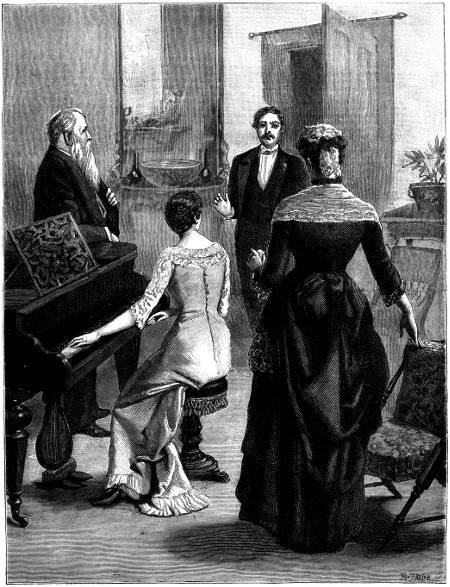
“HE STARTED BACK, DAZZLED.”
HISTORICAL SKETCHES OF MUSICAL FORMS. — Cantata. — Motett and Anthem. — Mass. Cathedral Service.
Sketch III.—Cantatas and Church Music.
By MYLES B. FOSTER, Organist of the Foundling Hospital.
form belonging
equally to sacred
and secular music,
viz., the cantata, in
all probability first
emanated from
desire to possess in
chamber music the
recitative, invented
by Peri and others,
and supposed by
themselves and their
admirers to be a revival
of Greek art. You will best judge of the
primitive nature of the earliest cantatas, and understand
the difference between them and the
compositions which have since appeared under
the same title, when I tell you that they were
short dramatic stories, declaimed or recited
by one voice to the accompaniment of a single
instrument. In the seventeenth century this
simple form was extended, by the insertion, at
various intervals, of an air, the repetition of
which gave the cantata the appearance of a
rondo. The Italian school of that period,
already mentioned in connection with the
opera, did much to perfect this style of composition.
Foremost amongst these masters
stands Carissimi, who is credited with first
adapting the cantata to church purposes.
Amongst his secular cantatas there is one
written to commemorate the death of Mary
Queen of Scots. About the same time, Marcello,
Cesti, and Lotti wrote in this form, and
Alessandro Scarlatti contributed very many
specimens, in which the accompaniments were
elaborate and difficult. Some of Marcello’s
are published for soprano and contralto, with
clavecin accompaniment.
In the early part of the next century Domenico
Scarlatti, the son of the Alessandro above
named, considerably extended the form by
making use of various movements in the one
work. Pergolesi (1710-36) also wrote several
cantatas, introducing important developments.
A well-known one of his was Orfeo ed Euridice,
written shortly before his death. Handel
wrote several for the single voice, either with
clavier or orchestral accompaniment, mostly
for oboes and stringed instruments. In the
life of Handel, published soon after his death
(in 1760), the number is put down as two
hundred; but this total will include his
Church cantatas, a much more advanced form
of composition, although composed when he
was quite a young man.
The modern name for the primitive form of
cantata is undoubtedly “Concert aria,” or
“Scena,” into which it has merged. Under
the latter titles we have splendid examples by
Mozart, such as “Misero, O sogno?” “Bella
mia fiamma,” “Misera dove son!” and “Non
temer,” and single specimens by Beethoven,
“Ah, perfido,” and by Mendelssohn, “Infelice.”
The most important and valuable
Church cantatas are those composed by John
Sebastian Bach, consisting of five sets for
every Sunday and holy day in the year, besides
many single ones, such as “God’s time
is the best,” and a sort of requiem ode for the
Electress of Saxony. These Church cantatas
are for four voices and full orchestra, and have
from four to seven various movements. Bach
wrote many secular cantatas as well, two of
them being comic ones. His works abound
in contrapuntal skill, and contain great beauties.
It remains to be said that in our times the
word cantata is used as a title to choral works
which, if sacred and written in oratorio style,
are too short for that title or have no dramatis
personæ; or, if secular, such as lyric dramas
set to music, are not intended to be acted.
Sir Sterndale Bennett’s May Queen is a good
specimen of the latter, which may be said to
bear the same relationship to opera that the
sacred cantata of the present day does to
oratorio.
Winterfeld, a German writer on musical
matters, derives the word motett from “mot,”
the French for “a word,” referring to the verse
of Holy Scripture which constitutes a motett;
whilst other learned men connect it with the
Latin verb “movere,” indicative of the livelier
motion and the briskness it possesses, when
compared with the Cantus Fermus; and there
is yet a third derivation from “mutare,” to
change—a reference to the changing sentiments
and emotional characteristics of these
musical settings, a noticeable feature in such
stiff and formal times.
At one time the motett was made up of a
theme and its treatment in different variations,
after the manner of the Spanish “moto” in
poetry. Motetts were also set to profane words
in the early periods of their history, and they
were forbidden to be used in church in the
thirteenth and fourteenth centuries.
Dr. Stainer, in his “Dictionary of Musical
Terms,” mentions the term “motett” as
being synonymous with “pulpitre” in the
fifteenth century, but for the last three hundred
years the term has meant a piece of sacred
music adapted to Latin words, and to be sung
at high mass in the Roman Catholic Church,
either instead of or as an addition to the offertory,
which was to be set to the music of the
plainsong. Motetts by Philip of Vitrisco
date back as far as the year 1300. At the
commencement of that century the motett
became a much more living form, when represented
by such composers as our English
John Dunstable, the Flemish Du Fay, and
others. Following these composers came the
Netherlanders of Okenheim’s school, in the
latter half of the fifteenth century, and they
more definitely separated their motetts from
the style of the masses in vogue.
In the latter there is a painful striving
apparent, consequent on the feeling, almost
of duty, that severe contrapuntal exhibitions
must be displayed, whereas in the former
there is breadth of style and general fitness of
things, untrammelled by this artificiality.
In the sixteenth century the Flemish writers,
headed by Josquin des Prés, made great moves
onward, and gained the leading position in
musical Europe by earnest work and pure
and noble endeavours. They chose passages
from the Gospels and the Book of Canticles
for their motetts, and imbued them with
characteristic individuality. At the same period
the Lamentations of Jeremiah were largely
drawn upon for subjects. In this and the
fifteenth centuries we find a large collection
of funeral motetts, named nœniæ, very reverent
and beautiful. One by Josquin des
Prés, founded on plain chant, and written in
memory of his friend Okenheim (who was
also his master), is very fine.
Petrucci, the father of type music printing,
gave most of the earliest nœniæ to the world,
many of which may be seen in the British
Museum. In the middle of the sixteenth
century motetts were, perhaps, influenced for
good by the wonderful progress of the madrigal,
but each part was written with a different
text, and this confusion became an
abuse. However, towards the latter part of the
century that bright genius, Palestrina, proved
himself to be as great a writer of motetts as
he was of masses. He composed over three
hundred to our knowledge, and in all probability
there are more than that which have
been lost. Cotemporary with this great light
we find, in Italy, Morales, Anesio, Luca Marenzio,
and, above all, Vittoria, who was
almost as great a motett composer as Palestrina
himself; in the Netherlands, Orlando
di Lasso; in Venice, Willaert, and, later,
Croce and the two Gabrielis.
Our English writers, Tallis and Byrd, whom
we shall refer to again immediately, wrote as
fine motetts as any produced by the foreign
schools, under the title, “Cantiones Sacræ.”
Dr. Tye, Dr. Fairfax, and others also added
specimens to the English list. These motetts,
as we shall see, became (after the Reformation)
full anthems, which were in musical form
motetts, but were set to English words. In
some cases the English words are translations
from the Latin. It is curious to find that
Orlando Gibbons, in the seventeenth century,
writing anthems for the church, christened his
secular part-music “Madrigals and Motets,”
thereby reverting to the old use of the term
in connection with secular words only.
In the seventeenth century the motett still
flourished in the Roman Church, but not for
long, according to its old form. Mr. Rockstro
attributes the downfall of the old motett
to the invention, by Monteverde, of dominant
unprepared dissonances, which “sapped the
foundation of the Polyphonic School.”
Thus, after 1660 the motett was a composition
in modern tonality and with orchestral
accompaniments. Amongst composers in
this style we find Scarlatti, Pergolesi, Durante,
and others, followed later on by Keiser in
Germany and Sebastian Bach, and then
Graun, Hasse, and Hiller. Handel wrote
motetts in his earlier years. In modern
times, as I have had reason to point out to you
in other forms, titles are appended to works
which are, to say the least, inappropriate, and
the only claim these have to the name motett
is that they were originally intended to be
sung at High Mass. Such are the “Insanæ
et vanæ curæ” of Haydn, “Splendente te
Deus” of Mozart, and the “O Salutaris” of
Cherubini. The term “motetus,” given in
early times to the medius or middle voice
part, is probably in no way connected with
the derivation of the word motett.
The motett form appears in Church music
of Queen Elizabeth’s time, and although the
anthem was gradually substituted, some of
the earliest anthems after the Reformation
were in motett style, especially those of Tallis
and Byrd.
About the derivation of “anthem” there is
as much dispute as there is over the word
“motett.” Some consider it to be derived
from “ant-hymn,” a kind of antiphony,
though the very ancient custom of choir responding
to choir, or choir to priest, has
entirely disappeared in the modern form of
anthem. This responsive or antiphonal singing
may, in a highly-developed form, yet
become the anthem of the future, at any rate
in churches and cathedrals where the voices
at disposal are good and in large numbers.
By some writers “anthem” is derived from
ανατιθημι, to set up (as an offering), and by
some from ανθημα, a flower, the anthem being
considered the flower of the service. It is
regrettable to find that the idea of attending
service for the sake of the anthem alone is not
yet extinct.
The anthem is thoroughly English; it supplied
the attraction to our Reformed Church,
which the church cantatas and passion music
did for the Lutheran Church. Nearly all
our eminent musicians have written numbers
of them, many examples containing the finest
of English composition. From early in the
sixteenth century the anthem was permitted
as a part of Divine service, but it is not until
the revision of the Prayer Book in 1662 that
we find the rubric, “In choirs and places
where they sing, here followeth the anthem,”
which retains its place to this day.
The first writers of note were Dr. Christopher
Tye, who appears as a verse-writer
also, having translated the Acts of the
Apostles “into Englyshe meter”; Thomas
Tallis, to whom our Church owes so much;
and William Byrd, joint organist with Tallis
of the Chapels Royal. By this period, that is,
near the end of the sixteenth century, Church
music was beginning to free itself from the
fetters of vague tonality and old modes, and
was gradually being clothed in clear and
expressive harmonies, and this improvement
becomes most marked in the works of our
“English Palestrina,” as Orlando Gibbons
has been appropriately named. He was
born in Queen Elizabeth’s reign, but most of
his grand Church compositions date from the
commencement of the next century and the
reign of James I. Though some of his anthems
are “verse” and have solos in them, we
may well classify this early period as that of
the “full anthem.” Viols were used as accompaniments
to the verse parts, and the
organ was only added for the full choruses.
I must remind you that the organ was a very
different affair to our modern instrument. It
had one advantage in its smallness, viz., that
it could be carried about, being known as the
portative organ, as opposed to the fixed or
positive, and could therefore be placed close
to wherever the singers were, to support their
voices.
Passing to the latter half of the seventeenth
century, we have come through the strongest
period of the history of English music. The
great madrigal school has flourished for nearly
a century, and now we find Pelham Humphrey
or Humfrey, born 1647, studying in Paris
under Lulli, and under his influence helping
to create a new era in anthem composition.
He died very young. Then there was
Michael Wise, and Dr. John Blow, private
musician to King James II.; Dr. William
Croft, his pupil, whose anthems are so grand
and solemn, and to whom, we may mention in
passing, we owe the introduction of music
engraving on pewter plates. We must also
name Jeremiah Clarke, another pupil of
Blow’s, and Weldon. Anthems by all these
men are still sung in our churches.
Towering above them all stands Henry
Purcell, whose earnest, devotional Church
music puts to shame much of the frivolous
composition which is nowadays devoted to that
high purpose. In this age which follows the
period of the early “full anthem” writers, we
have the “solo” and “verse” anthem brought
to the front. Purcell’s knowledge of the
singer’s requirements and his gift of beautiful
melody enabled him to perfect the solo
anthem.
Instrumental accompaniments became more
important at the hands of these composers,
and at the end of the seventeenth century the
organ was becoming a more perfect instrument,
through the workmanship of
Father Schmidt and Renatus Harris, and
others.
The anthems written by Handel, such as
the Chandos Anthems, were scored for larger
orchestras, and were more like a combination
of the German church cantata and motett
than the anthem strictly so called. But this
increase in the size of the church orchestra
led to a full band in Attwood’s Anthem
for the Coronation of George IV., who, as
Prince of Wales, had been his warm-hearted
patron.
In the latter half of the eighteenth century
we have a few good anthem-writers, such as Dr.
Greene, who wrote over forty anthems; Dr.
Boyce, his articled pupil, whose “Cathedral
Music” is a most valuable collection of church
compositions. There were also Jonathan Battishill,
Dr. William Hayes, his son Dr. Philip
Hayes, the two Walmisleys, and Attwood. Dr.
T. F. Walmisley only died in 1866, and therefore
some of these compositions almost belong
to our own times.
This fragmentary sketch brings us to the
present form of anthem; but before we speak
of this we must mention in passing the masterly
double psalms and anthems by Mendelssohn,
several of them being composed to
English words.
The country that owns such anthem-writers
as Dr. S. S. Wesley, Sir John Goss, Sir G.
Elvey, Dr. Hopkins, Dr. Stainer, and Rev.
Sir F. Gore Ouseley has just reason to be
proud. Many other names could be added to
this list, and the outlook seems to be most
hopeful.
We are bound to notice an excrescence,
going by the name of anthem, which has been
largely introduced into our cathedral services.
We allude to those arrangements of portions
of masses, etc., coupled to words totally different
in sentiment to those for which the music
was originally composed, and which are strung
together, like so many beads on a string, as
Dr. Monk aptly says (in Sir George Grove’s
Dictionary), “for the sake of pretty phrases
or showy passages.”
Such adaptations would almost point to a
scarceness of the genuine anthem; and yet
how opposite to this is the fact, and how few
of the really fine anthems of the best period of
our great English school receive the amount
of hearing to which they are justly entitled!
To verify this, you have but to peruse Novello’s
Catalogue of Sacred Music with English
words.
The mass, or missa (“missa est,” the congregation
is dismissed), has been used, in part,
at any rate, from the very earliest times, and
has been sung to most impressive and solemn
music. St. Ambrose and St. Gregory appear
as the earliest compilators of the mass music.
When counterpoint was invented, Church
composers clothed the early plain-song tunes
with its artistic embroideries, and polyphonic
masses arose, gradually brought by the great
schools of the sixteenth century to such a
pitch of excellence that they have never since
been equalled. The mass then consisted, as
it does now, of six movements, viz., the
Kyrie, Gloria, Credo, Sanctus, Benedictus, and
Agnus Dei. The masses were named after the
plain-song melody upon which they were developed;
but occasionally the melody used was
a profane one, so that a mass would be named
after its secular melody, as, for instance,
“L’homme armée,” an old French lovesong!
and the masses founded upon an original
theme were rare, and known as “Missa sine
nomine.” The tenor Du Fay, already named
in connection with the motett, wrote many
of a very devotional but unmelodious character.
At the end of the fifteenth century
Josquin des Prés, also mentioned previously,
wrote many masses, in which, strange to say,
a great want of reverence is most evident from
time to time. A purer style will be found
later on in the masses of Goudimel, Morales,
and notably in those of Festa. But about
this period the abuse spoken of in treating of
the motett had crept into the mass, and the
device was to give different sets of words to
each singer! Even Morales is guilty of this,
mixing up, as he does, the text of the Liturgy
and an Ave Maria. Devotional feeling was
sacrificed to a desire to puzzle, and masses
were esteemed according to the difficulty of
the solution of the canons employed in
them.
At the Council of Trent (1562) these abuses
were condemned, and polyphonic music would
have been forbidden a place in the Church,
but for one great, earnest man, and that man
was Palestrina. His now celebrated “Missa
Papæ Marcelli” decided the fate and fixed the
style of Church music. In it he demonstrated
that these intricacies and learned forms might
be well and devotionally used as a means to
the highest end, but not as a substitute for
that great end itself. He wrote nearly a
hundred masses, and greatly influenced the
future of Church music.
William Byrd wrote a mass for five voices
of great interest. Vittoria, Orlando di Lasso,
Gabrieli—each represented their different
schools and advanced their Church music on
Palestrina’s great model.
After Allegri, at the end of the seventeenth
century, the old mediæval style died out, and
Durante, Scarlatti, and others of that school
appear as a link between the old and new.
After them, with their strong tendencies
towards elaboration of the instrumental accompaniment,
comes Bach, whose mass in B
minor, now familiar to us, thanks to Mr.
Goldschmidt and the Bach Choir, stands
alone. It is not only free from ancient ecclesiastical
tradition, but it is actually prophetic
in its marvellous harmonic changes and combinations.
It is also in style almost an oratorio.
Later on we have magnificent masses
by Haydn, Mozart, and Beethoven, but more
like sacred cantatas than masses. To quote
Mr. Rockstro, he rightly says, “Their style
has steadily kept pace, step by step, with the
progress of modern music, borrowing elasticity
from the freedom of its melodies, and
richness from the variety of its instrumentation;
clothing itself in new and unexpected
forms of beauty at every turn; yet never
aiming at the expression of a higher kind of
beauty than that pertaining to earthly things,
or venturing to utter the language of devotion
in preference to that of passion.” The italics
are my own, and I suppose that it is owing to
the fact that this individuality and frequent
dramatic realism of the composer usurped
the abstract sense of the words used, and
the devotional idealism of the old schools,
that not one note of any of them has ever
been heard within the Sistine Chapel at
Rome.
The general distribution of the movements
of the mass are, strange to say, the same
to-day that it was in Palestrina’s time.
A mass for the dead, called Requiem, is composed
of different numbers, viz., “Requiem
æternam dona eis,” “Kyrie,” the grand
hymn, “Dies iræ,” “Domini Jesu Christo,”
Sanctus and Benedictus, Agnus, and “Lux
æterna.”
Of the more modern specimens, those of
Cherubini and Mozart, and of the most modern,
that by Verdi, are all fine examples, the work
by Mozart standing high above all the others.
It was, as you will remember, mostly written
on his deathbed. At the Reformation the
mass disappeared from the English Church,
and from then until 1840 no choral communions
were written. Since the latter date,
however, the English versions of the Sanctus,
Kyrie, Creed, and Gloria have been used and
set to music by most of the writers of Church
music already named in connection with the
anthem.
A SERIOUS DISCUSSION.
DRESS: IN SEASON AND IN REASON.
By A LADY DRESSMAKER.
As a rule there are not many changes of dress
or cut to be chronicled this month. Everyone is
thinking of the sales, and the truly wise and
economical (of which there are a great many
in these days) are more occupied in making
the fashions subservient to their purchases, to
either inventing or thinking of new designs in
dress. We were never so rich in the way of
materials as we are this year, though the most
popular of all effects in woollen is the serge-weaving,
which is mixed with everything—crossbars,
and lines of velvet, silk cording,
fancy braids, and borders which resemble
patchwork in monotone, or inlaid wood
flooring, or parqueterie. The serge with
velvet crossbars and lines on black serge are
very effective and handsome. Indeed, serge
seems to have taken the place of cashmere,
and is infinitely more becoming in wear.
Ladies’ cloth is also much worn in both dark
and light colours. On these a selvedge of a
different colour is left, which is sometimes
pinked-out, or edged with a cord. These are
trimmed with facings, cuffs, and collars of
velvet, plush, and moiré, which is now much
used for trimmings. Besides this, there are
vicuna and camels’ hair, and a large selection
of Darlington serges, and others in plain and
in stripes, which are at once cheap, ladylike,
and extremely durable in wear.
Nun’s cloth is still used with velvet trimmings,
and a material called “wool crépon” is
used as well for evening frocks for girls, and
is trimmed profusely with woollen lace. Velveteen
is not seen as composing entire dresses,
though so largely mixed with woollens of all
descriptions.
In colours worn by well-dressed people,
heliotrope is still in great favour, and is really
lovely in silks, satins, and the handsome cut
velvets and frisés—dark sapphire blues, carbuncle,
red brown, and a mossy green, with
an earthy brown and a stone-colour, which
are both useful, well-wearing colours.
Now that people are beginning to wear
more colour than they formerly did, it is needful
to consider harmony in colour more than
we did. For young people this is everything.
In wearing brown, for instance, it should be
harmonised by a little yellow or a lighter
shade of brown. In the same way dark-red
must be harmonised with pink, and both
shades must be seen together, so as to be
quite sure that they will not “swear at each
other,” as the French funnily express it.
With grey a little pale blue must be put in
somewhere in the bonnet. Stone-colour will
harmonise with a pink, and heliotrope with
a paler shade of itself. With grey, blue, and
slate silver ornaments look best; but with
brown, red, and green shades gold ornaments
give the required harmony in colouring.
All very bright hues should be kept away
from the face, as only the best of complexions
can stand them near the skin. A portrait-painter
once told me that the colour of the
hair or the hue of the eyes should always be
repeated in some part of the dress. But I
fancy it may answer for painting, but not to
be exemplified in everyday life and habiliments.
AN AFTERNOON VISIT.
Now that belts are coming in again, or rather
have come in, it is well to remember that
when the waist exceeds twenty-five inches round
bands are not becoming, and pointed bodices
should be resorted to, and if the front darts
be cut very much bowed-in, an effect of slenderness
is given to the waist which does not
really belong to it. Frills at the neck and wrists
are most becoming to thin people with long
necks. Short-necked and stout people look
best with plain bands of muslin or lace. High
shoulders do not consort well with fur capes
nor wide fur collars at the neck. The long
paletôts or pelisses are very suitable to short
people, as the straight lines add to their apparent
height. But even in giving these few
directions towards helping my readers to
becoming and tasteful dress, I fully realise
the fact that very few people take the trouble
to ascertain what they look like, and perhaps
would be grievously offended if they were to
be told where the faults of their appearance
really lay.
NEW BLOUSE POLONAISE.
Mantles, as I have frequently said, are all
short, none of them coming more than a few
inches below the waist at the back, though all
are long in front. They are, many of them,
much trimmed, though not too much. There
are braces to the shoulders, or a kind of yoke
of beading, or flat bands of beaded passementerie,
laid on. Plush seems to be the great
material for these mantles, and will be worn
not only in the winter, but late in the spring.
Some of these plush mantles are coloured, but
very few. Sapphire blue, carbuncle red, and
a dark mossy green are the most popular
colours. They are trimmed with black jet—not
a very satisfactory trimming, nor very
elegant.
Hoods are seen on jackets and pelisses more
than on small mantles. The new shape of
sling mantelette is called “Pelerine,” and is
nearly a cape in being all round of the same
length; but the edges are turned under all
round, and in front the linings show, which
are of some pale, contrasting colour. The
fronts are quite of the sling shape, and if a
hood be worn with them it is lined to match.
The newest hoods are square, and of the
monk order—not gathered up in any way, to
make them bunchy at the back. The newest
shape of paletôt we now call a “pelisse,” but
it is really nothing but a long paletôt, or tight-fitting
jacket lengthened to the edge of the
skirt. The newest cloaks of this kind brought
out this winter have hanging sleeves, and a
hood or fur facing, which wraps across at the
waist, one end of the fur crossing the other
end. The side of the skirt is often opened
and then laced together with thick cords, but
it may be also edged with fur. Very long
cloaks are worn as wraps for carriage use, but
only in that way; and for travelling, small
mantles are much more fashionable at present.
Jackets are worn as much as ever by young
ladies, and are universally plain and rather
severe in cut. They are of two kinds, the
first with a fur trimming, wide round the neck
and shoulders and on the chest, but pointed
at the waist, and tight-fitting both at the back
and front. The other jacket has a tight back
and loose-fitting front, and is either simply
stitched round with the machine or bound
with galloon or leather—the last the newest
and most recherché of bindings. Pilot cloth
is used for jackets, as well as Cheviot homespuns,
also corduroy, Melton of various
kinds, and numbers of fancy cloths under different
names. The Irish Claddagh cloth, introduced
by Mrs. Ernest Hart, and to be
obtained in all colours at the depôt of the
Donegal Industrial Fund, is becoming more
popular for large wrap-cloaks, little children’s
ulsters, and babies’ pelisses. Plush has been
adopted as a lining for thin mantles of silk
and wool, instead of wadded silk. It is far
less clumsy, and quite as warm. In this way
many ladies have made use of their handsome
summer mantles, and made them warm enough
for winter. On mild days no jacket nor
mantle is used, but the long boa, or Victorine,
or else one of the new large handkerchiefs,
knotted on the chest and spread out over the
shoulders. These large handkerchiefs are even
to be seen worn on the outside of the small
tight-fitting jackets.
I have mentioned leather bindings on
jackets. They are also used for trimming
dresses by the first ladies’ tailors. The colour
of the bands or bindings is usually of the
lightest shade of the cloth used. Polonaises
are growing in popularity every day, and the
spring will probably see them well established
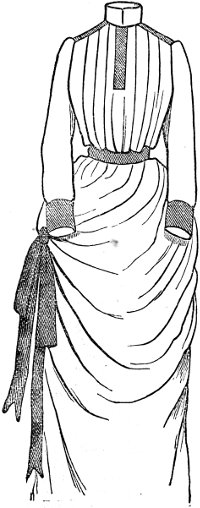
in favour. The idea of blouse-jackets has
produced the blouse-polonaise, which I have
selected for the paper pattern of the month.
It is draped at the side, but some of the new
polonaises are draped at both sides. The
edges may be lined with a light harmonising
colour which will show when the wearer moves
about. Thus a pale grey vicuna would have
pale rose-pink linings. Polonaises are becoming
fashionable for evening and dinner
dress, and have high Marie Stuart collars and
long angel sleeves. The neck-bands of dresses
are as wide and fit as tightly as ever. They
are generally of velvet, and the cuffs also, the
latter being only as wide as the collar.
The bodices of ordinary gowns show no
change in shape. The favourite front-trimming
which has taken the place of waistcoats
is a long revers front, the point of the
waist to the neck. In fur-trimmed dresses
this revers is of fur; also the cuffs, neck band,
and a band round the skirt. Many dresses
for wear in the house have ruches round the
hem; but they are not suitable for wear out
of doors, as they are perfect traps for dust. A
new style is to put a dépassant (the modern
name for a balayeuse frill) round the edge of the
dress. This is about an inch and a-half in
width, and is pleated in small single box-pleats,
and is generally of silk of the same
colour as the dress.
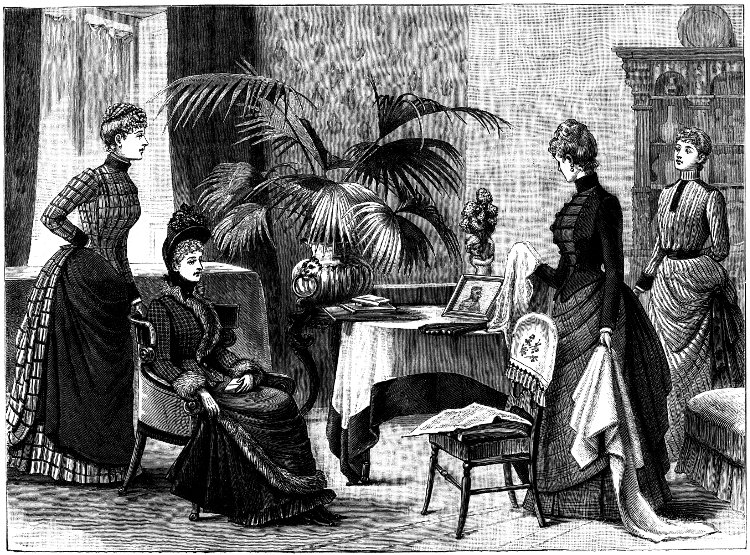
The sketch, under the name of “An Afternoon
Visit,” shows one of the new polonaises,
which buttons across the front. It is of grey
cloth, over a petticoat of very dark crimson.
The young lady in the hat wears a walking-gown,
trimmed with fur, which is put on with
plain bands; the material is “ladies’ cloth.”
Of the two figures in indoor costume one
shows the method of making-up striped
materials, and also the new “catogan knot,”
with a puff of hair and a curled front. The
other dress has a tucked bodice, with a draped
front, which simulates a polonaise; the collar
and cuffs being of velvet.
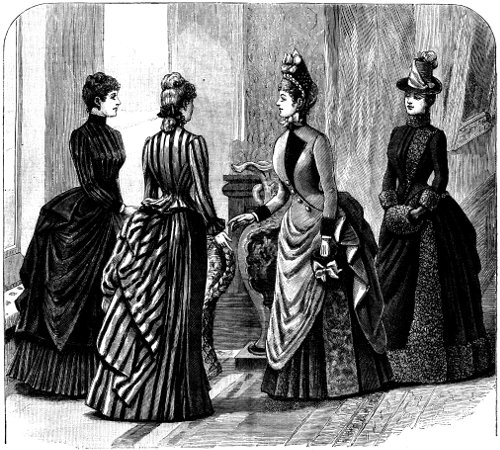
In “The Serious Discussion” we have
several dresses, one for out-of-doors, trimmed
with fur, and showing the method of trimming
a short jacket which I have before described.
The other dresses are plaids, and show the
way in which plain materials are mixed with
them. The bodice is of plain material, with a
waistcoat-front, and cords and buttons. The
figure at the back is an illustration of this
month’s paper pattern, the new “blouse
polonaise,” which is a very charming adaptation
of the “Norfolk” or pleated blouse, now
so much worn; it is both easily made and
cut out, and is a very useful garment. It may
be cut long enough to reach to the edge of
the underskirt, and thus follows the fashions
of the long lines now in vogue. In this way
it is more graceful, but it may be cut shorter,
and in this case the skirt must have the box-pleated
frill at the edge, which is now called
a dépassant. The material of which our
illustration is made is one of the rough, hairy
“vicuna serges,” of a light grey tone, with a
darker grey stripe. The bands of the
shoulders, front, waist, and collar and cuffs
are of this dark grey, in velvet or plush; the
first being the most becoming. The ribbon-bow
is of the same hue of silk and velvet
reversible ribbon. The hem of the polonaise
is quite plain, and is machine-hemmed. The
paper pattern consists of nine pieces, i.e., two
sleeve pieces, back, front, cuffs, collar,
shoulder-piece, and front-strap. The polonaise
will require about ten yards of thirty inch
material, and about half a yard of velvet and
three yards of ribbon.
All paper patterns supplied by “The Lady
Dressmaker” are of medium size—viz., 36
inches round the chest—and only one size is
prepared for sale. No turnings are allowed in
any of them. Each pattern may be had of
“The Lady Dressmaker,” care of Mr. H. G.
Davis, 73, Ludgate-hill, E.C., price 1s. each.
It is requested that the addresses be clearly
given, and that postal notes may be crossed
“& Co.,” to go through a bank, as so many
losses have recently occurred. The patterns
already issued are always kept in stock, as
“The Lady Dressmaker” only issues patterns
likely to be of constant use in home-dressmaking
and altering; and she is particularly
careful to give all the new patterns of hygienic
underclothing, both for children and old and
young ladies, so that no reader of the “G.O.P.”
may be ignorant of the best methods of dressing.
The following is a list of the patterns already
issued, price 1s. each.
April, 1885, braided loose-fronted jacket;
May, velvet bodice; June, Swiss belt and full
bodice with plain sleeves; July, mantle; Aug.,
Norfolk or pleated jacket; September, housemaid’s
or plain skirt; October, combination-garment
(under-linen), with long sleeves; November,
double-breasted jacket; December,
Zouave jacket and bodice; January, 1886,
Princess under-dress (under-linen, under-bodice
and underskirt combined); February,
polonaise, with waterfall back; March, new
spring bodice; April, divided skirt and
Bernhardt mantle, with sling sleeves; May,
Early English bodice and yoke bodice
for summer dress; June, dressing jacket
and Princess frock, with Normandy
bonnet for a child of four years old;
July, Princess of Wales’s jacket, bodice,
and waistcoat, for tailor-made gown; August,
bodice with guimpe; September, mantle with
stole ends; October, Pyjama, or night-dress
combination, with full back; November, new
winter bodice; December, patterns of Norfolk
blouses, one with a yoke, and one with pleats
only; January, 1887, blouse-polonaise, with
pleats at back and front.
THE BROOK AND ITS BANKS. — CHAPTER IV.
By the Rev. J. G. WOOD, M.A., Author of “The Handy Natural History.”
Another enemy of the water-vole—The
pike—Pike in brooks—The Oxford giant pike—A
sad failure—An ignominious end—The pike
and the eel—The pike and the duck—Links in
Nature—Cousins of the water-vole—The
campagnol, or short-tailed field mouse—Damage
which it works—Its natural enemies—the
kestrel and the owls—How to detect
and catch a campagnol—The kestrel—Its
peculiar mode of flight—Altering the focus of
the eye—The nest of the campagnol—Beans
and the mouse—The humble-bee and wasp—More
connecting links—Store chambers of the
campagnol—Its bird-purveyors—The blackbird,
thrush, and campagnol—The winter and
summer nests—A beautiful specimen and remarkable
locality—Mode of eating.
We have not yet completed the life-history of
the water-vole, which, as I remarked on page
34, involves that of several other creatures.
One of its two worst foes has just been
described, and we now come to the second—i.e.,
the PIKE, OR JACK (Esox lucius). N.B.—The
latter name may perhaps recall to the
reader the ancient family of the Lucys, of
Charlcote Hall, Warwickshire, so mercilessly
satirised by Shakspeare. They bore upon
their shield the “luce”—i.e., the pike, the
coat of arms being a good example of “canting”
heraldry—i.e., in which the blazonry of
the shield contains a play upon the name of
the bearer.
There is no more inveterate foe of the water-vole
than the pike. In the stomach of a single
pike were found the remains of three water-voles
and some bird, which was probably a
duck.
It might be imagined that a pike large
enough to swallow a water-vole would not be
likely to venture into a brook, and would
restrict itself to the river where it would have
plenty of room. But experience has shown
that a very large pike will sometimes make its
way into a very small brook, partly for the
sake of food, but sometimes through sheer
cunning, in the hope of evading its enemies.
By the time that a pike has attained the
weight of twelve or fifteen pounds, he has had
to face many and varied dangers, and escape
from many foes.
While he is young and small his worst foes
are those of his own species. Anglers know
that there is scarcely any bait so attractive to
an old pike as a small pike. All the earlier
part of his life is spent in perpetual watchfulness,
he having to be always on the look-out
for prey by which he can still his insatiable
hunger; while he has to be equally on guard
lest a larger pike should satisfy its hunger with
him.
No pike, therefore, can attain to a large size
without developing a considerable amount of
cunning, and anyone who sets himself the task
of catching such a fish will find that he must
employ all his resources of intellect, aided by
experience, before he can delude the fish even
into touching the bait. In spite of its large
size, the fish manages to elude observation in
a most puzzling manner, and it is no easy
matter to make sure of its position. An old
fox or old rat is scarcely more cunning and full
of devices than an old pike.
The largest pike that I ever saw at liberty
was in a small tributary streamlet of the Cherwell
river, near Oxford.
A pike of enormous dimensions had for some
time been reported as having been seen in
various parts of the Cherwell, the general
rumours giving its weight as at least thirty
pounds. All the anglers of the neighbourhood
had tried to capture this mighty prize,
but had failed. Contrary to the habit of most
large pike, it did not seem to have established
itself in any particular spot, but roamed about
from place to place.
Now, the Cherwell itself is but a very small
river, so that the locality of a large fish might
appear easily discoverable. But it is a very
“weedy” river, and its banks are edged with
willows, whose long, red, plume-shaped roots
hang into the water from the banks, and form
admirable hiding-places for the fish.
One day I was trying my fortune at trolling
in the Cherwell, with a six-inch gudgeon for
bait, and, on coming to a tributary stream,
walked along the bank until I could find a
spot narrow enough to be jumped.
Coming to a deep-looking pool, I dropped
in the bait, by way of not wasting time, and
almost immediately felt the bait taken by a
pike. Following the golden rule then, and
perhaps now, in force among anglers, I sat
down on the bank, watch in hand, in order to
wait through the weary ten minutes prescribed
by custom, and which almost seem to drag
themselves out into as many centuries.
Barely half the time had elapsed when a
huge head rose to the surface, and the bait was
blown out, as it seemed, into the water, the
head sinking with a swirl of water where
it disappeared. On examining the rejected
bait, which had naturally been seized crosswise,
I found that it was pierced from head
to tail with the teeth of the pike.
I learned that the big fish was afterwards
ignominiously taken with a net in one of these
tributary brooks, so that its cunning was
baffled at last. I also learned that the fish
had repeatedly treated other anglers as it
treated me, holding the bait for a short time
in its mouth and then rejecting it.
So it is clear that the water-vole will by
no means be safe from the pike when it is the
inhabitant of the brook instead of the river.
Moreover, it does not need a very large
pike to devour a full-grown water-vole. The
pike can swallow an animal which seems quite
disproportionate to its size. A young pike
of barely five inches in length was seen
swimming about with the tail of a gudgeon
projecting from its mouth. The gudgeon was
quite as long as its captor, and there is no
doubt that if the fish had been let alone the
pike would soon have digested the gudgeon
sufficiently to swallow it entirely.
The late Frank Buckland mentions that a
pike weighing eight pounds was caught in the
River Itchen. After it was taken out of the
water it disgorged a trout of a pound weight.
This must have been a sore disappointment
for the captor, who would think himself defrauded
of a pound weight in his angling
record.
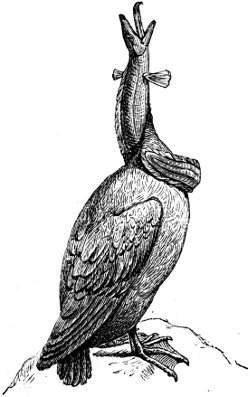
The reader will remember that a heron and
a cormorant lost their lives by capturing an
eel which was too large for them, and it is a
remarkable fact that a pike has been known
to suffer a similar fate. It can easily be understood
that an eel, twisting itself about convulsively
in the struggle for life, should coil
itself round a bird’s neck long enough to
cause its death by strangulation; but it seems
almost impossible that a pike, being a fish,
and therefore breathing by gills, should be
suffocated while in the water by an eel.
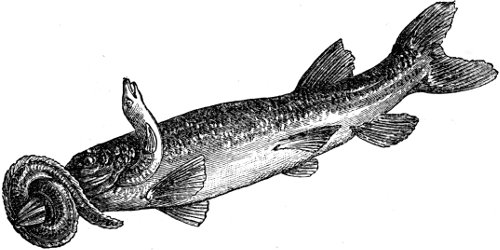
Yet in the Fisheries Exhibition of 1883
there were two very remarkable stuffed groups,
illustrating the voracity of the pike. In one
of them a pike weighing ten pounds had
attacked an eel weighing only one pound less.
Now, an eel of nine pounds weight is a very
large one, lithe, active, and muscular as a
snake, and by no means a despicable antagonist.
The pike had begun to swallow the
eel, but the latter in its struggles forced its
way out of the mouth through the gills, and
thence into the water beneath the right gill-cover.
But it could go no farther, the
teeth of the pike having almost met through
its body.
The result was fatal to both. The body
of the eel having been forced beneath the gill-cover,
the gills could not perform their office,
and so the pike was as effectually suffocated
for want of breath as were the heron and the
cormorant. The dead bodies of the pike and
eel were found on the bank of the River Bure
in October, 1882.
The second group consisted of a pike and a
duck. The pike had attacked the duck as the
bird was diving, and had tried to swallow it.
It succeeded in getting the head, neck, and
part of the breast down its throat; but the
duck, in its struggles for life, had naturally
spread its wings. These formed an insurmountable
obstacle to the fish, and the result
was that the duck was drowned and the pike
suffocated, both having died for lack of respiration.
So the “plop” of the water-vole into the
brook from the bank has not been to us the
mere splash of a frightened animal into the
stream. It has opened for us many trains of
thought, and taken us into several sciences.
It has shown us something of the links which
connect it with man, birds, and fishes, and so
has led us into ornithology and ichthyology.
It has shown how the inventions of man have
their prototypes in the animal kingdom.
Comparative anatomy and physiology have
also been shown to form portions of the life-history
of the familiar animal, and have demonstrated
the truth of the axiom enunciated
on page 34, that no animal and no branch of
science can stand alone.
Like other beings, the water-vole has its
relatives, two of whom will come within the
range of our subject. Being small creatures,
they go by the popular name of mice, just as
their larger relative is popularly called a rat.
These are the FIELD-VOLE and the BANK-VOLE,
both of which we may expect to find on the
banks of our brook, especially when the banks
are clothed with shrubs. The former of these
animals is a very old acquaintance of mine,
and when I was a lad I could go into a field
and make almost certain of catching a field-vole
(Arvícola agrestis) within about ten
minutes.
A CORMORANT STRANGLED BY AN EEL.
This little animal looks very much like a
water-vole seen through the wrong end of an
opera-glass, except that the fur is redder and
the ears are longer in proportion to the size of
the head. The tail is only about one-third as
long as the body—a peculiarity which has
earned for it the popular name of “short-tailed
field-mouse.” A more appropriate
name for it is “campagnol.”
Even in this country the campagnol is apt
to be one of the worst foes of the agriculturist,
especially at harvest and seed time.
Not only does it devour the ripe corn in the
field, but it makes its way into ricks and barns,
and eats large quantities of the gathered corn.
Moreover, just after the seed-corn has been
sown it digs the grains out of the ground,
thus doing mischief which is often attributed
to the sparrow and other small birds. In
France, however, where not a kestrel, or, indeed,
any unprotected bird, can be seen, the
campagnol can carry out his depredations
without hindrance, and consequently increases
until it becomes an actual plague. In the
Department of Aisne alone a few years ago
the fields were honeycombed with the burrows
of the animal, and the farmers spent some
seventy thousand pounds in ridding their
fields of the nuisance. First poison was
laid down; but so many hares and rabbits
were killed that another plan had to be tried.
Stacks of hay and straw were then made, containing
quantities of poisoned carrots, turnips,
and beetroot. The agriculturists, therefore,
had to pay heavily for doing that which the
kestrel would have done to a great degree, if
they had suffered it to live and carry out its
appointed work in preserving the balance of
Nature.
The owls, again, are determined enemies of
the campagnol, more than half the food on
which they and their young live being composed
of these mischievous little animals.
Fortunately for the owls, their nocturnal habits
save them from the destruction which would
have befallen them had they sought their food
in the light of day.
If we wish to see this pretty little creature,
we have only to watch carefully the field
through which our brook runs, and we shall
be almost certain to find it. But we must
know where to look and how to look.
The favourite locality of the campagnol
has already been mentioned; but the detection
of the little animal requires some practice. A
novice in the art may traverse a low-lying
field, and hunt along the banks of the brook
from daybreak to dewy eve, and never catch a
glimpse of a campagnol. Another will go
into the same field, and in a quarter of an
hour will produce several specimens.
Those who wish to catch it must know its
ways. It is not of the least use to hunt up
and down the field in chase of the campagnol,
and those who wish to see it must reverse the
old aphorism about Mahomet and the mountain.
They cannot go to the campagnol, for
it will keep out of their way; but if they will
wait patiently, the campagnol will come to
them.
The secret for catching the campagnol is as
follows:—
Go into any field which is bounded by a
brook, and lie down, taking care that the sun
faces you; otherwise your shadow will be
thrown on the grass, rendering the detection
of the animal extremely difficult.
When you have arranged yourself in an
easy posture, keep your eyes on the ground,
and try to look between the green blades,
so as to see the colour of the soil. On a first
trial you may probably wait until your patience
is exhausted, and yet see nothing. But
do not be disheartened, and try again, as
nothing but practice will give the needful
skill.
Only a small portion of ground can come
under your observation as you recline on your
arm, and a few minutes ought to make you
acquainted with the colour of every inch of
the soil. Presently you will become aware
that a little patch of soil is redder than it was
a minute or two ago. Bring your free hand
down smartly on the spot, and you will find a
campagnol in your grasp.
Immediately afterwards you will find that
the campagnol has teeth, and knows how to
use them. But if you understand the animal’s
ways, you will seize it without danger of being
bitten, just as if you know the nettle’s ways
you can grasp it without danger of being
stung.
Like its larger relative, the campagnol,
when suddenly startled, loses its presence of
mind, and remains for a moment or two without
motion. During that moment of consternation,
shift your grasp so that the body
of the animal rests in the palm of the
hand, while the finger and thumb seize the
sides of the head, so that the creature cannot
turn its head to bite. The knack is soon
learned, though perhaps at the expense of a
bite or two, and the shifting of the grasp becomes
instinctive.
Want of practice soon causes the eyes to
become slow to detect the creature which
steals so silently among the grass-blades, and
the ready knack of the fingers is equally apt
to fail just when it is wanted. However, a
little practice soon restores the keenness of
sight and deftness of touch, and in a short
time the campagnol will be unable to pass
under the observer’s eyes without detection,
or to escape the grasp of his fingers without
capture.
So stealthily does the campagnol glide
among the grass stems, that the field may be
swarming with them, and yet their presence will
not even be suspected by man. This fact
brings us to another illustration of the assertion
that the life-history of one animal always
involves that of others.
The natural food of the KESTREL (Tinnúnculus
alaudârius) largely consists of the campagnol,
so that where the one is seen the other will
probably be at no great distance. High in air
the kestrel hovers with quivering wings, its
bright eyes directed downwards, and scanning
the field below. Suddenly it drops down to
the ground, rises with something in its claws,
and flies away. It has seen and caught a field-vole,
and is carrying it home to its young.
From its custom of balancing itself in the air
with its head to the wind, it is often known
by the name of “windhover.”
With what astonishing sight must not the
kestrel be gifted to perform such a feat! It
is difficult enough for a human being to watch
a square yard of ground so carefully that a
field-vole shall be seen as it glides among the
grass. How wonderful, therefore, must be
the powers of vision which enable the bird to
watch a large field, to detect from that height
the little, dusky animal, and pounce down
upon it with unerring swoop!
How astonishing must be the optical
mechanism of those eyes which at so great a
distance from the prey can act like telescopes,
and yet can alter their range so rapidly that
in the few seconds which are consumed in
making the stoop, they have accommodated
themselves to an entirely different focus.
In his “At Last,” C. Kingsley mentions
that in passing through a tropical forest the
traveller is frequently checked by some creeper
which hangs in the path, and which is not
seen because the eye cannot focus itself with
sufficient rapidity. Yet the traveller is only
proceeding at a walking pace, whereas the
stoop of the kestrel on its prey is swift as the
fall of a stone through the air, and in a second
or two the eye has to accommodate itself
from a range of many yards to that of a few
inches.
The value of the kestrel in keeping down
the numbers of the field-vole, and so aiding in
preserving the balance of Nature, can hardly
be over-estimated.
There have been cases where the field-voles
had increased to such a degree that pitfalls had
to be dug for their capture, and they had to be
destroyed artificially, because the kestrels and
other predacious birds and animals had been
almost extirpated.
Other enemies to agriculture are also destroyed
by the kestrel. Mr. Johns mentions
an instance where the stomach of a kestrel was
opened, and was found to contain, beside a
field-vole, nearly eighty caterpillars, twenty-four
beetles, and a leech!
Now, we will return to our field-vole. Like
the squirrel and several other rodents, it makes
two nests, one for the winter and the other for
the summer.
The winter nest is mostly made at some
distance from water, is formed at the end of a
burrow, and seldom reaches more than a few
inches below the surface of the ground. It is
to this winter nest that the poet Burns refers
in his exquisite stanzas addressed to a mouse
whose nest had been destroyed by his ploughshare,
and beginning,
“Wee, sleekit, cow’rin’, tim’rous beastie.”
Such, indeed, is the fate of many a winter
nest. Supposing, however, that the creature
should be snapped up by the kestrel while out
in search of food, the nest will be deserted,
but it will not be wasted. There are always
beings who are glad to find a ready-made
burrow which will save them the trouble of
excavating one for themselves. Among them
are several species of wasp and humble-bee,
most of whose nests are made in the deserted
burrow of the campagnol.
Here, again, is an example of the manner in
which the life-histories of dissimilar animals
are linked together. Few persons would think
that there could be any connection between
the wasp and the kestrel, and yet our walk
along the banks of our brook has shown us
that such is the case, and that the connecting
link is the campagnol.
Like the water-vole, the campagnol lays up
a store of winter provisions, not in its living-room,
but in a chamber excavated for the
purpose. The treasure-house sometimes contains
a very miscellaneous store, the fruit of
the hawthorn and wild rose being the staple.
Cherry-stones mostly form a large proportion
of the stores, as many as three hundred
having been found in a single chamber. The
mode in which the campagnol obtains the
cherry-stones would hardly be suspected except
by those who are in the habit of watching
the varied phases of animal life.
The chief purveyors of cherry-stones are the
blackbird and thrush.
Both these birds are exceedingly destructive
among the cherry crops, as I know from personal
experience. My study overlooks a
number of fine cherry-trees, one of them being
so close to the house that by leaning out of
the window I can touch the fruit with an
ordinary walking-stick. As soon as the fruit
ripens, the thrush and blackbird hold high
festival, eating the cherries from the branches
and feeding their young with the ripe fruit.
It is really amusing to watch the proceedings
of the birds, especially the unmerciful
manner in which the young birds peck their
parents when they considered that they are
not fed fast enough. Neither young nor
parent is in the least afraid of me as I sit at
the open window, so that I can see every
movement.
Sometimes the entire cherry is pulled off the
branch, but when the fruit is very ripe the soft
portion only is eaten, the stone still being
attached to the stalk. In either case, the
stone will be sure, sooner or later, to fall to
the ground, whence it is picked up by the
campagnol and added to its store for the
coming winter.
Here, again, is a link connecting together
the life-histories of the blackbird, thrush, and
campagnol. Furthermore, it affords an example
of the care that is taken that nothing
on the earth shall be wasted.
Whenever a living being has no further use
for anything which once was connected with
its life-history, there is sure to be some other
animal which wants it and is waiting for it.
We have already seen how the abandoned
winter nest of the campagnol is utilised
by the wasp or humble-bee, and we now see
that when the blackbird and thrush have
abandoned the cherry-stones as useless to
them, there is the campagnol waiting for them
and ready to carry them off to the store-chamber
which it has previously prepared.
A PIKE STRANGLED BY AN EEL.
Beside the winter nest, there is the summer
nest, which is primarily intended for the reception
and nurture of the young. This, like
the corresponding nest of the squirrel, is made
of slight materials and loose structure, so that
the air is freely admitted. It is generally
composed of grass blades, which have been
torn in strips by the campagnol. It is
globular in shape, and is mostly placed on the
ground, amid concealing grass or herbage.
There is, however, before me a photograph
of the nest of a campagnol, which was discovered
in a very remarkable position, and
made of very unusual materials. It was found
in a garden store-house at Castle Carey, by the
Rev. W. Smith-Tomkins, Vicar of Durstow.
He kindly sent me a copy of the photograph,
together with the following description—
“Bedford Villa, “The Shrubbery, “Weston-super-Mare.
“August 8th, 1886.
“This nest of the short-tailed field-mouse
was found by me a few years ago on a
heap of barley straw, which was used
to cover a small store of potatoes.
Its chief interest to the finder, in
addition to its beauty, consists in this. It was
all manufactured out of one kind of raw
material, namely, the leaves of the barley
straw, which the maker shred up into thin
threads according to her taste, so as to suit
the different parts of the structure. There
was no other material available for use.
“The mouse had found its way into the
storehouse through a hole under the wall. I
am sorry to say that she was killed when
found, and before the nest had been used for
its proper purpose. Two or three weeks
before I had looked over the place, and she
had not commenced operations.
“On referring to ‘Homes without Hands,’ I
find it stated by Mr. J. J. Briggs that he could
never find an entrance to the interior (the
nests being closed up, as you say is the case
with the nest of the harvest mouse). I infer
from this, that it is due to its incompleteness
that the entrance in this case is open and
visible, and that its structure is therefore so
open to inspection.”
With the description and photograph Mr.
Tomkins sent a few portions of the nest, some
of the barley leaves being of their original
width, and others split up into fibres as fine as
ordinary sewing cotton. In a subsequent
letter he states that the hole through which
the campagnol made her entrance into the
house opened into the stable yard of a neighbour.
Its mode of eating the provisions which it
stores is rather remarkable. It would naturally
be supposed that, as other beings (including
man) do, it would eat the thick, soft, and
sweet exterior of the “hip” or fruit of the
wild rose, and reject the hard, small seeds,
with their fluffy envelope. But it does just
the contrary, eating the seeds and rejecting
the exterior.
When in America in 1884, I saw a flock of
pine grosbeaks busily feeding upon the berries
of the mountain ash at Worcester. Very
pretty they looked, the rosy plumage of the
two or three males contrasting boldly with the
dark, sombre green of the many females. I
should not have noticed them but for their
mode of feeding.
It was at the beginning of February—the
very depth of a New England winter. I had
to make my way up a rather steep hill, and
over paths which, by reason of constant
traffic over snow, were as slippery as ice.
Many persons are in the habit of scattering
sand or pulverised brick on the paths, and
seeing, as I fondly thought, a few yards of
the latter material, I gladly made my way
towards it. To my disappointment—on that
ground at least—I found that the red material
was not brick, but the soft, external part of
the mountain ash berry, the birds only eating
the seeds, and allowing the rest of the fruit to
fall to the ground.
Then, the campagnol has a remarkable way
of eating the cherry stones.
When the squirrel eats a nut, it nibbles off
a little piece of the sharp end, inserts the
edges of its incisor teeth in wedge fashion,
and splits the nut in two. The campagnol
begins like the squirrel, but when it has
bitten off the end of the cherry-stone, it does
not split the shell asunder, but in some way of
its own contrives to get the kernel out.
(To be continued.)
MERLE’S CRUSADE. — CHAPTER XVI.
By ROSA NOUCHETTE CAREY, Author of “Aunt Diana,” “For Lilias,” etc.
MOLLY.
One afternoon, much to Hannah’s delight,
I took the children to Wheeler’s
Farm. Rolf did not accompany us;
Mrs. Markham had sent up word to the
nursery that morning that he was to
drive with her into Orton. He had
complied with this order rather sulkily,
after extracting from me a promise that
I would play soldiers with him in the
evening.
It was rather a hot July afternoon, but
we put Joyce in the perambulator, and
Hannah and I carried Reggie by turns,
and in spite of the heat we all enjoyed
the walk, for there was a lark singing
so deliciously above the cornfields, and
the hedgerows of Cherry-tree-lane were
gay with wild flowers, and every few
minutes we came to a peep of the sea.
I recognised Hannah’s description
when we came in sight of the old black-timbered
house; there was the pear tree
in the courtyard, and the mossy trough;
a turkey cock Gobbler, of course, was
strutting about in the sunny road, and
from the farmyard came the cackling
of ducks and the hissing of snow-white
geese. Just then a little side gate
opened, and a robust-looking woman in
a sun-bonnet came out, balancing two
pails of water with her strong bare arms.
Hannah exclaimed, “Well, Molly!”
and Molly set down her pails and came
to meet us.
She kissed Hannah heartily with,
“Glad to see thee, lass,” and then
shook hands with me.
“Come in, come in, and bring the
children out of the sun,” she said, in
a kind, cheerful voice. “Father is
smoking his pipe in the kitchen, and
will be fine and glad to see you all.
Eh, but I am pleased to have you at
Wheeler’s Farm, Miss Fenton. Hannah
says she has a deal to be grateful to you
for, and so have we all for being good to
our girl.”
I disclaimed this, and sang Hannah’s
praises all the time we were crossing
the courtyard to the porch.
Molly shook her head, and said,
“Nay, she is none too clever,” but
looked gratified all the same.
She was a plain, homely-looking
woman, as Hannah said, with high
cheek bones and reddish hair, but she
looked kindly at the children and me,
and I think we all liked her directly.
“Look whom I am bringing, father,”
she exclaimed, proudly, and Michael
Sowerby put down his pipe and stared
at us.
He was a blue-eyed, ruddy old man,
with beautiful snow-white hair, much
handsomer than his daughter, and I
was not surprised to see Hannah, in her
love and reverence, take the white head
between her hands and kiss it.
“You will excuse our bad manners, I
hope,” he said, pushing Hannah gently
away, and getting up from his elbow
chair. “So these are Squire Cheriton’s
grandchildren. He is fine and proud
of them, is the squire. Deary me, I
remember as if it were yesterday the
squire (he was a young man then)
bringing in their mother, Miss Violet,
to see me when she wasn’t bigger than
little miss there, and Molly (mother I
mean) said she was as beautiful as an
angel.”
“Mother is beautifuller now,” struck
in Joyce, who had been listening to
this.
The old farmer chuckled and rubbed
his hands.
“Beautifuller, is she? Well, she
was always like a picture to look at,
was Miss Violet, a deal handsomer and
sweeter than Madam, as we call her.
Eh, what do you say, my woman?” for
Molly was nudging him at this point.
“Well, sit ye down, all of you, and
Molly will brew us some tea.”
“There is Luke crossing the farmyard,”
observed Molly, in a peculiar
tone, and Hannah took the hint and
vanished.
I sat quietly by the window with
Reggie on my lap, talking to Michael
Sowerby and glancing between the pots
of fuchsias and geraniums at a brood of
young turkeys that had found their way
into the courtyard.
Joyce was making friends with a
tabby cat and her kittens, while Molly,
still in her white sun-bonnet and tucked
up sleeves, set out the tea-table and
opened the oven door, from which proceeded
a delicious smell of hot bread.
She buttered a pile of smoking cakes
presently, talking to us by snatches,
and then went off to the dairy, returning
with a great yellow jug of milk thick
with cream, and some new laid eggs
for the children.
I did not wonder at Hannah’s love for
her home when I looked round the old
kitchen. It was low, and the rafters
were smoke-dried and discoloured, but
it looked so bright and cheery this hot
July afternoon, with its red tiles and
well-scrubbed tables, and rocking chairs
black with age and polish. The sunshine
stole in at the open door, and the
fire threw ruddy reflections on the brass
utensils and bright-coloured china. A
sick chicken in a straw basket occupied
the hearth with the tabby cat; a large
shaggy dog stretched himself across
the doorway, and regarded us from
between his paws.
“It is Luke’s dog, Rover; he is as
sensible as a human being,” observed
Molly, and before we commenced tea
she fetched him a plate of broken meat
from the larder, her hospitality extending
even to the dumb creatures.
A wooden screen shut us off from the
fire. From my place at the table I had
a good view of the inner kitchen and a
smaller courtyard with a well in it; a
pleasant breeze came through the open
door.
As soon as the children were helped,
Hannah came back looking rather
shamefaced but extremely happy, and
followed by Luke Armstrong. He
greeted us rather shyly, but seated himself
at Molly’s bidding. He was a
short, sturdy-looking young fellow, with
crisp, curling hair and an honest, good-tempered
face. He seemed intelligent
and well-mannered, and I was disposed
to be pleased with Hannah’s sweetheart.
I found afterwards from Molly when
she took me into the dairy that Michael
Sowerby had consented to recognise the
engagement, and that it was looked
upon as a settled thing in the household.
“Hannah is the youngest of us girls,
and a bit spoiled,” observed Molly,
apologetically. “I told father it was
all nonsense, and Hannah was only a
chit, but it seemed he had no mind to
cross her. The folks at Scroggin’s Mill
is not much to our taste, but Luke is the
best of the bunch, and a good, steady
lad with a head on his shoulders. He
was for going to London to seek his
fortune,” continued Molly, “for Miller
Armstrong is a poor sort of father to
him, and Martin elbows him out of all
chances of getting any of the money;
but Squire Hawtry, of the Red Farm,
where Lydia lives as dairymaid, has
just lost his head man, and he offered
Luke the place. That is what he has
been telling Hannah this afternoon in
the farmyard; so if Hannah is a good
girl, as I tell her, and saves her bit of
money, and Luke works his best, Squire
Hawtry will be letting them have one of
the new cottages he has built for the
farm servants, and a year or two may
see them settled in it to begin life together.”
And here Molly drew a hard
work-roughened hand across her eyes
as though her own words touched her.
“I am very glad for Hannah’s sake,”
I returned. “She is a good girl, and
deserves to be happy.”
“Ah, they are all good girls,” replied
Molly. “Hannah is no better than the
rest, though we have a bit spoiled her,
being the youngest, and mother dead.
There’s Martin at Scroggin’s Mill wants
Lydia, but Lyddy is too sensible to be
listening to the likes of him. ‘No, no,
Lyddy,’ I say, ‘whatever you do, never
marry a man who makes an idol of his
money; he will love his guineas more
than his wife; better be doing work all
your life and die single as I shall, than
be mistress of Scroggin’s Mill if Martin
is to be master.’”
“You give your sisters very good
advice,” I returned.
“I have not much else to give them,”
was the abrupt answer; “but they are
good girls, and know I mean well. The
boys are rather a handful, especially
Dan, who is always bird-catching on
Sunday, and won’t see the sin of it.
But there, one must take boys as one
finds them, and not put ourselves in the
place of Providence. They want a deal
of patience, and patience is not in my
nature, and if Dan comes to a bad end
with his lame leg and bird-traps, nobody
must blame me, who has always a
scolding ready for him if he will take
it.”
I saw Dan presently under rather disadvantageous
circumstances, for as we
came out of the dairy who should come
riding under the great pear tree but Mr.
Hawtry, with a red-headed boy sitting
behind him, with a pair of dirty hands
grasping his coat. I never saw such a
freckled face nor such red hair in my
life, and he looked at Molly so roguishly
from under Mr. Hawtry’s shoulder,
there was no mistaking that this was
the family scapegrace.
“Good-evening, Molly,” called out
Mr. Hawtry, cheerfully; “I am carrying
home Dan in pillion fashion,
because the rogue has dropped his
crutch into the mill dam, and he could
not manage with the other. I found
him in difficulties, sitting under the mill
hedge, very tired and hungry. You will
let him have his tea, Molly, as it was
accident and not mischief. I forgot to
say the other crutch is lying in the road
broken; it broke itself—didn’t it, Dan?—in
its attempt to get him home?” and
here Mr. Hawtry’s eyes twinkled, but he
could not be induced, neither could
Dan, to explain the mystery of the
broken crutch.
“You will come to a bad end, Dan,”
remarked Molly, severely, as she lifted
down the boy, not over gently; but she
forbore to shake him, as he was wholly
in her power—a piece of magnanimity
on Molly’s part.
Mr. Hawtry dismounted, perhaps to
see that Dan had merciful treatment;
but he need not have been afraid, Molly
had too large a heart to be hard on a
crippled boy, and one who was her
special torment and pet. Molly could
not have starved a dog, and certainly
not red-headed Dan.
He was soon established in his special
chair, with a thick wedge of cold
buttered cake in his hand. Scolding
did not hurt as long as Molly saw to his
comforts, and Dan looked as happy as a
king in spite of his lost crutches.
Mr. Hawtry came into the kitchen,
and when he saw us I thought he started
a little as though he were surprised, and
he came up to me at once.
“Good-evening, Miss Fenton; I did
not expect to see you here, and my
little friend, too,” as Joyce as usual ran
up to him. “What a lovely evening you
have for your walk home! You did not
bring Miss Cheriton with you?”
“No; she has visitors this afternoon;
the children and I have had our tea
here, and now it is Reggie’s bed-time.”
“Shall I call Hannah?” he returned,
hastily, for I was putting Reggie in his
perambulator. “I saw her walking
down the orchard with Luke Armstrong
and Matthew.” And as I thanked him
he bade Molly good-bye, and, putting
his arm through his horse’s bridle, in
another moment we could hear a clear
whistle.
Hannah came at once; she looked
happy and rosy, and whispered to Molly
as we went down the courtyard together.
Mr. Hawtry was at the horse-block; as
he mounted he called me by name, and
asked if the little girl would like a ride.
I knew he would be careful, but all
the same I longed to refuse, only Joyce
looked disappointed and ready to cry.
“Oh, nurse, do let me,” she implored,
in such a coaxing voice.
“My horse is as quiet as a lamb.
You may safely trust her, Miss Fenton,”
he said so persuasively I let myself be
over-ruled. It was very pretty to see
Joyce as he held her before him and
rode down the lane. She had such a
nice colour, and her eyes were bright
and sparkling as she laughed back at me.
It was very kind of Mr. Hawtry. It
seemed to me he never lost any opportunity
of giving children pleasure.
But I was glad when the ride ended,
and I lifted Joyce to the ground.
She clasped me tightly in her glee.
“It was so nice, so werry nice, nursey
dear,” she exclaimed.
As I looked up and thanked Mr.
Hawtry, I found that he was watching
us, smiling.
“I am afraid your faith was not equal
to Joyce’s,” he said, rather mischievously.
“I would not let Peter canter,
out of pity for your fears.”
“I beg your pardon,” I stammered,
rather distressed by this, “but I cannot
help being afraid of everything. You
see the children are entrusted to me.”
“I was only joking,” he returned, and
he spoke so gently. “You are quite
right, and one cannot be too careful over
children; but I knew I could trust old
Peter,” and then he lifted his hat and
cantered down the lane. He could not
have spoken more courteously; his
manner pleased me.
It caused me a little revulsion when
Mrs. Markham met us at the gate with
a displeased countenance. She motioned
to Hannah to take the children
on to the house, and detained me with a
haughty gesture.
“Nurse,” she said, harshly, “I am
extremely surprised at the liberty you
take in my sister’s absence. I am quite
sure she would be excessively angry at
your taking the children to Wheeler’s
Farm without even informing me of your
intention.”
“I mentioned it to Miss Cheriton,” I
returned, somewhat nettled at this, for
Gay had warmly approved of our little
excursion.
“Miss Cheriton is not the mistress of
the house,” she replied, in the same
galling tone. “If you had consulted
me, I should certainly not have given
my consent. I think a servant’s relatives
are not proper companions for my
little niece, and, indeed, I rather wonder
at your choosing to associate with them
yourself,” with a concealed sneer hidden
under a polished manner.
“Mrs. Markham,” I returned, speaking
as quietly as I could, “I should certainly
not have taken the children to
Wheeler’s Farm without my mistress’s
sanction. I had her free permission to
do so; she knew the Sowerbys were
highly respectable, and, for my own
part, I wished to give pleasure to
Hannah, as I take a great interest in
her.”
“I shall certainly write to my sister
on the subject,” was her answer to this.
“You must have entirely mistaken her
meaning, and I owe it to her to watch
over her children.”
My temper was decidedly rising.
“You need not trouble yourself,” I
replied, coldly, “my mistress knows
everything I do. I should have written
to her myself to-night; she has perfect
confidence in me, and I have never
acted against her wishes; my conscience
is quite clear about this afternoon,
but I should not have taken Rolf
without your permission.”
“I should hope not,” still more
haughtily, but I would not listen to any
more; I was not her servant—I could
not have served that hard mistress. I
found nothing to reverence in her cold,
self-absorbed nature, and without reverence,
service would be bitter drudgery.
As I passed down the avenue a little
sadly, I came upon a pretty scene; a
tea-table had been set under one of the
elms, and Gay had evidently been presiding
over it, but the feast had been
long over. She was standing by the
table now, crumbling sweet cake for the
peacock. Lion was sitting on his
haunches watching her, and Fidgets
was barking furiously, and a little behind
her stood Mr. Rossiter.
Mrs. Markham swept up to them, and
I could hear her say in a frosty voice
that showed evident ill-temper, “Why
has not Benson removed the things? It
is nearly seven, and we must go in to
dress for dinner; you know Mr. Hawtry
is coming.”
“I was not aware of it, Adelaide”—how
well I knew that careless voice!—“but
it is of no consequence, that I can
see; Mr. Hawtry is always here.”
“He cannot come too often,” in a
pointed manner. “We all think highly
of Mr. Hawtry, I know.”
“Oh, are you going, Mr. Rossiter?
Well, perhaps it is rather late.”
“What are you doing, Gay?” so
sharply that though I had reached the
house I heard her, and turned my head
to look.
Benson and the under-footman were
coming out of the side door, but Mrs.
Markham stood alone under the trees.
Gay was sauntering down the avenue
with the young curate still at her side,
and Lion was following them, and I
wondered if Mrs. Markham saw her stop
and pick that rose.
I went up to the nursery rather
thoughtfully after that. I knew girls
were odd and contrary sometimes. Mr.
Rossiter was very nice; he was a good,
earnest young man, and I liked his
sermons; but was it possible that Gay
could seriously prefer him to Mr. Hawtry,
or was she just flirting with him
pour passer le temps, after that odious
custom of some girls? But I could not
believe it somehow of Gay Cheriton;
she was so simple, so unselfish, so free
from vanity. It needed a coarser nature
than hers to play this sort of unfeeling
game. “We shall see,” I said to myself,
as I put Reggie into his cot, and
then I sat down and wrote to Mrs.
Morton.
(To be continued.)
ANSWERS TO CORRESPONDENTS. — EDUCATIONAL. — ART. — MISCELLANEOUS.
Daughter of Gentleman Farmer.—The book for
which you inquire is “The Englishwoman’s Year-Book,”
published by Hatchard, Piccadilly, London,
W. We believe it may be had in parts. The yearly
volume is about half-a-crown.
Josie.—We advise you to write to the London School
of Medicine, 30, Henrietta-street, Brunswick-square,
London, W.C., for all information you require on the
subject of your letter. You should state the fact of
your having passed the College of Preceptors, the
senior local Cambridge and Oxford examinations,
and the science subjects (elementary) set by the
South Kensington authorities; also name your age,
and address the dean of the school, Mrs. Elizabeth
Garrett-Anderson, M.D. This school is in connection
with the Royal Free Hospital, Gray’s Inn-road,
W.C.
Spotted Crash.—We think you are mistaken as to
the origin of the name Billingsgate. The name
“Billing” belongs to an old Teutonic tribe or clan,
whose traditions are old enough to be mythical. It
is probable that some of its members may have been
amongst those Low German adventurers who conquered
Britain and made it England. This conjecture
explains many names beginning with Billing
in this country, besides Billingsgate.
Heather Bell.—We regret that we cannot help you
in your quest in any way.
Cinderella.—It would depend upon what examination
you went in for, of course. Girton College is at Cambridge.
It is for women over eighteen years of age.
The entrance examinations are in March and June.
The address of the secretary is 22, Gloucester-place,
Hyde Park, London, W.
Mizpah.—We should advise you, as you are so young,
to go in for teaching as a profession, and to study at
a training college, or at the College of the Home and
Colonial School Society, Gray’s Inn-road, W.C., or
else at the Teachers’ Training Society, Training
College, Fitzroy-street, W. Governesses’ situations
are yearly more and more difficult to obtain, and
it is better to be trained so as to command school
situations of a high class.
K. B.—1. The ancient name of Constantinople was
Byzantium. The present city occupies its site, but
was named after Constantine the Great, who built
it. 2. Cardinal Wolsey erected Christ Church
College, Oxford, Ipswich, and also Hampton Court.
A Life of King Robert “the Bruce” was written
by the Scottish poet, Barbour, in a poem called the
“Brus.”
A Tomato.—See article in Silver Sails (Summer
Number for 1881) on crystoleum painting. The
12th of April, 1873, was a Saturday.
Jane.—If you really wish to learn drawing and painting,
buy a shilling manual on perspective and study
from natural objects. Begin with some simple object,
such as a village pump or wayside stile, but do not
attempt such composite subjects as that sent for our
opinion until you can accomplish the former subjects
fairly well.
Cloe.—As a rule, if a girl shows any taste for using
her pencil, in however trivial a way, she imagines
that she could make money by it; but she forgets,
like the swarms of verse-writers, that ideality to a
very considerable degree is requisite for both the
poet and painter. If you have a gift for designing,
as well as the practical skill, you might find an
opening amongst the lace manufacturers of Nottingham
and other places, amongst the cotton printers
at Manchester, or the silk manufactories at Macclesfield.
It could be available for wall-paper printers,
for carpet weaving, and for pottery. Turn your
attention to one of these openings.
Miss Fiennes, of Castle-hill, Reading, Berkshire,
conducts a girls’ club, called the Daub Society, to
which members (amateur beginners) send an original
painting or drawing every month. The annual subscription
is one shilling, and the members adopt fancy
names.
J. W. must accept our best thanks for her kind letter
and the assurance that the “girls’ own mothers”
take as much delight in our paper as the girls themselves.
Kartoffel.—“What is the best thing to do if anything
is seen in a haunted house?” Shut your eyes,
and don’t see it.
Swetsche.—To invent “a cure for sleeplessness”
would be to become a millionaire. If we were so
fortunate we could not promise to take you into
partnership, but would advertise our decoction
widely.
Cousin.—You have fallen into a careless and injurious
mode of walking. You should plant your feet
straight on the ground, and might also have a little
brass or iron heel put on those of your shoes. If
your blue serge dress be so soiled with dust, you had
better get it re-dipped by a dyer. They can do so
without your unpicking the dress.
Firefly.—You seem to have overtaxed your brain-power
during these examinations, and you need rest;
change of air, good diet, early retirement to bed at
night, and late rising (say at 8 a.m.) might in time
restore the powers of memory. At the same time,
you should obtain the advice of an experienced
physician.
Millicent Thornton.—The quotation commencing—
“Absence of occupation is not rest,”
is taken from Cowper’s poem “Retirement,” line 623.
You will probably find the other poem in some
popular reciter. You write well for your age.
E. M. Searle.—The Latin words, Nocturna versate
manu, versate diurno, mean, “Turn (them) over with
nightly hand, turn (them) over by day.” The words
are from Horace. The word “them,” which is understood,
refers to examples of Grecian style.
TEMPTATION.
Potts.—Your brother’s “eating dinner enough for
two” does not thereby give evidence of a fine constitution.
Some lean folks eat enormously, but, as
the Scotch express it, “put their food into an ill
skin;” they do not assimilate it, and it does them
but little good, and so they are always craving for
more. There are other reasons for voracious eating,
for which a doctor’s advice would be most desirable.
It is a disgusting sight, in any case, to see anyone
eating double what others do, and it should be
checked, not gratified, in youth, if not attributable to
disease, in which case recourse should be had to
medicine.
Moses.—The Psalms, as given in the Book of Common
Prayer, were not altered, but only a different version
from the translation used in our Bibles was employed,
called the Vulgate or Latin version, attributed to St.
Jerome, about 384. There was an older version of
the Holy Scriptures called the Italic, said to have
been made in the beginning of the second century,
little more than one hundred years after Christ. Gutenberg
and Fust were the first who printed the Vulgate
translation, probably about 1455, and that by Fust
and Schœffer in 1462.
Mary Elizabeth T.—The evil thoughts that seem
forced into your mind against your will, of which
you are ashamed, over which you grieve, and against
the recurrence of which you pray, are temptations of
the devil and his wicked ministers. They are clearly
not your own; they are, as it were, whispered in
your ears. So long as you pray to be delivered from
them, and heartily strive to drive them away, their
guilt does not lie at your door. Ask for deliverance,
and humbly claim it in the name of the Lord Jesus,
and “He is faithful that promised.” See St. John
xiv. 12, 13, 14, and xvi. 23, 24.
A Gardener.—Sow the hardy annual’s seeds in
February, and in March all the perennials and
biennials, and the half hardy annuals in a hot-bed.
There are several varieties of honeysuckle, and all of
them may be propagated by cuttings.
Blank had better write for the directory to the matron,
London National Training School for Cookery, Exhibition-road,
South Kensington, S.W. The fee for
the training for the post of cookery instructor is
twenty-one guineas for the full course of twenty
weeks; plain cookery, eight guineas for fourteen
weeks. The Edinburgh School of Cookery, 6, Sandwick-place;
hon. secretary, Miss Guthrie Wright;
also trains teachers in cookery for a fee of fifteen
guineas the course, from November to April.
An Anxious One.—You do not give sufficient information
for us to judge what you are fit for, and you
had better read the series of articles in vol. v., entitled
“Work for All.”
Tarentelle.—Twopenny-piece, 1797 (weighing 2 oz.
av.), worth 1s. to 5s.; penny, same date (1 oz. av.),
1s. to 2s. 6d. The other coins are worth from 6d.
to 2s.
Pompey.—The “Heaven-sent Minister” was William
Pitt, 1759-1806.
Catherine A. M.—We think the tale about the tramcar
tickets, and the getting of a deaf and dumb
child into an asylum or home by means of a collection
of 10,000 of them, must be placed by the side of
many other such figments of the imagination. The
pity is that sensible people like yourself should be
misled by them. Tramcar tickets can be made over,
and there is a special machine for performing the
nefarious work.
Dunedin.—Many thanks for your kind letter. There
does not seem to be anything to answer in it, however,
so we merely acknowledge its kindly expressions.
C. S. L.—The idea is a good one, but we fear we could
not impose such a weight on our own over-burdened
shoulders. As a rule, you may depend on the catalogues
of the Religious Tract Society, the Christian
Knowledge Society, and others of the kind. Would
they not help you if you wrote for them?
Ray.—If she have asked to have you taken to see her,
waive all ceremony and go. Mutual family interchanges
of visiting will follow. It would be in better
taste on your part to call yourself Mrs. John B——,
rather than cause a jealous feeling or one of injury on
the part of a mother-in-law. Do all things “that
make for peace,” “in honour preferring one another.”
You write fairly well.
Guilda.—The second “h” is mute in the word
“height,” but not in the word “width.” We congratulate
you on gaining a certificate.
Ruby.—Sometimes old copies of bound magazines may
be had at secondhand or reduced prices at booksellers’
stalls. You should study the rules of metrical
composition before you attempt to write verses.
A Troubled Mother.—It is a difficult matter upon
which to advise you, and you do not say where you
live. The first thing to do is to give the girl a good
education, and also to include music and singing.
As she grows older she may forget her youthful ideas.
You might write for advice to Mr. C. E. Todd,
Macready Mission House, Henrietta-street, Covent
Garden; or, if in London, you might go and see him,
perhaps.
A Sufferer might try mustard oil to rub on for her
rheumatism. It sometimes does wonders for it, and
is to be got at any chemist’s, and is sold by the
ounce. Rub on with the palm of the hand, round
and round.
Daisy.—Dandriff may be cured by using a wash of
one pint of water and half an ounce of glycerine. Rub
well into the skin of the head twice a day (this can
be done with a sponge), without wetting the head too
much. Another wash is composed of one pint of
water and one ounce of borax, used in the same
manner. Dandriff is considered to be caused by
digestive troubles, especially when accompanied by
watering of the eyes, nose, or mouth.
Swygs.—We thank you for the kind feeling that
prompted the giving of your advice for the benefit
of sufferers. But for certain reasons, into which we
cannot enter, we must decline to make our paper a
means of advocating mesmerism. You write a good
hand.
⁂ The Editor regrets to say that the
poem entitled “The Beggar’s Christmas,”
which appeared in Feathery Flakes, was
copied from Little Folks for January, 1886,
and sent to him by J. H. A. Hicks, as his
own original composition. The copyright belongs
to Messrs. Cassell and Co., and to them
apologies for this unwarrantable reproduction
are due.
[Transcriber’s Note—the following changes have been made to this text.
Page 276: miror to mirror—“mirror to mirror”.
Page 279: aud to and—“and this improvement”.
Page 288: Gutenburg to Gutenberg—“Gutenberg and Fust”.