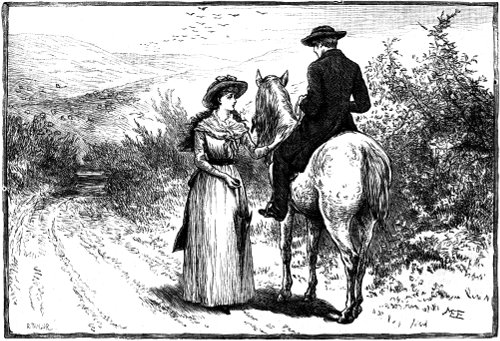
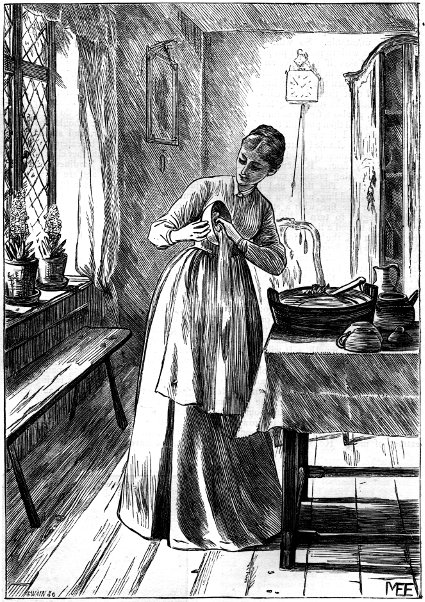
“HE STOPPED AND WANTED TO KNOW WHERE SHE WAS GOING.”
All rights reserved.]
CONCERNING A HORSESHOE.
The greater part of the majority of lives
is passed in a groove. Sometimes a great
crash comes, and all the machinery is
put out of gear, but then the life is resumed,
and all goes on quietly again—not
as before, the change was too violent
for that, but in another groove, in
which it moves until another crisis
comes. These crises come to all, even
the most uneventful lives, but they come
oftener to some than to others, and when
they do come they invariably come suddenly
and in the most unexpected way.
Let the road of life be ever so long and
straight and dull and monotonous, it is
sure to lead to a turning some day,
though, perhaps, the new road on which
we enter with such hope and zest may
be longer and duller and rougher than
the first. And, after all, monotonous
lives are often the happiest, though the
young are very sceptical on this point,
until their own lives have been upset by
one or two of the great changes which
come sooner or later to everyone.
Jack’s sudden departure was such a
crisis in his life, and, indeed, it affected
the whole family, though after he was
gone they settled down again into the
old quiet daily routine. It was not the
same as before; it never is. This is really
the sad part of it; not that life is monotonous,
as people often complain, but
that after a great change, no matter
how brief—a few minutes may be long
enough to effect such a change—but after
such a change the life can never go on
again exactly the same as it was before;
it may be happier or the reverse. One
thing is certain, it will never be the same
again. And the older we grow the
more sad does it seem that the good old
times are gone for ever—they can never
come back any more.
Our children grow up and are both a
blessing and a comfort to our fading
lives, but the days are gone for ever
when the curly-headed cherub, now a
man of six feet high, awoke us at unearthly
hours for a romp, before a sepulchral
voice outside announced that his
bath was ready, to our intense relief.
He has cherubs of his own now, and
can sympathise with our feelings, when
the nurse’s knock was heard, and the
time will come when he too, like us, will
wish in vain for those happy days to
return.
The Shelleys’ change had been so
sudden; in a few hours it was all settled,
and Jack gone to America, who, earlier
in the day, had been shearing sheep,
as though that was to be the only anxiety
in his shepherd’s life. After he was
gone they were at first so occupied with
nursing Charlie they had scarcely time
to realise all that had happened on that
June morning; but in a few weeks Charlie
was quite well again, and then they resumed
their former lives. But it was
all different now; Charlie took Jack’s
place as under-shepherd, and went with
his father to the downs every day instead
of Jack. Fairy spent a great deal
of her time at the rectory, for now Jack
was gone she felt her anomalous position,
for, fond as she was of the shepherd
and his wife and of Charlie, she
could not help feeling there was a gulf
between them and her, which, in Jack’s
case, did not exist, for intellectually he
was her superior.
As she grew older, Fairy began to
realise that there was another difference
between her and her foster parents,
besides the difference of education,
for she was a lady in thought and
feeling as well as by birth, and,
thanks to Mr. Leslie, by education.
Not that there was anything to jar upon
her feelings in John Shelley or his wife;
for simple, honest folk as they were, there
was nothing vulgar about them; and it
is vulgarity which jars against a refined
mind; but all the same there was a
difference between them and her, a
difference she had not felt as a child,
but which, now she was growing into a
woman, pressed upon her.
She felt this difference more with
Charlie than the others, for John
Shelley’s piety made her look up to him
with reverence; and Mrs. Shelley’s
sound common sense and true motherly
kindness had won her respect and affection;
but Charlie, fond as she was of him,
was rather a trial to Fairy. His thick
hobnailed shoes which he persisted in
wearing in the house, his smock-frock,
to which, on the shepherd, Fairy had no
objection, for, as she often said, he
looked like one of the old patriarchs in
it, but Charlie’s smock was by no means
becoming; he looked what he was—a
clodhopping youth in it; his dirty
stained hands, which no amount of
washing could ever make clean, his
broad, Sussex brogue, and his habit of
chucking at his forelock if he met Mr.
Leslie, were thorns in the flesh to Fairy,
as they had been to Jack; and certainly
there was no danger of her ever feeling
or evincing more than a sisterly affection
for the bucolic Charlie. No wonder
if Fairy, feeling lonely when Jack was
gone, took to remaining oftener at the
rectory, after her lesson hours were over,
than she had done when he was at home,
particularly as she was a great favourite
there, not only with the young people,
who could do nothing without Fairy, but
with Mr. and Mrs. Leslie also, both of
whom had come to be very fond of her.
They pitied her, too, knowing well the
difficulties of her position, though Fairy
was much too loyal to the Shelleys to
speak of them; and they were anxious
to help her as far as lay in their power.
At present all they were able to do was
to give her the same advantages of
education as they bestowed on their own
four plain daughters. Unluckily, Fairy
did not show any great fondness for
study, though she readily learnt French
and music, and any accomplishments,
for she was very clever with her fingers,
and both painted and played very well,
for those days.
What was to become of Fairy in the
future was a problem which often exercised
Mr. and Mrs. Leslie’s brains, and the
only solution they could arrive at was
that Jack must make his fortune in
America, and come back and marry her,
since it was quite clear she could not
live for ever with the shepherd; neither
was she fitted to be a governess; and
there was no other way of well-educated
women earning their living in those
days, and there would be some insurmountable
obstacles to marrying her to
any one else. A gentleman would hesitate
at marrying a girl brought up in a
peasant’s cottage, and it was quite certain
Fairy would not marry anyone but
a gentleman, unless, indeed, she took
Jack; so, after due consideration, Mr. and
Mrs. Leslie settled there was no other
future open to her.
Meanwhile there was plenty of time
before Fairy need want to fly away from
the shepherd’s sheltering roof, for if
Jack came back at the end of two years
she would only then be eighteen. And
as time went on the accounts of Jack
were very satisfactory. Not only did his
own letters lead his friends to gather
that he was making his way, but Mr.
Leslie occasionally received glowing
accounts from his friend the banker of
the very promising young man he had
sent out to him, and there seemed very
little doubt that Jack would do uncommonly
well for himself.
He wrote every mail, either to his
mother or Fairy; indeed, his letters
were the chief incidents in their lives,
and were eagerly looked for, for little
occurred to vary the monotony of the
daily routine, except, in due course, the
sheep-fairs, lambing-time, the sheep-washing
and shearing, and the White
Ram, until, in the spring of the second
year after Jack went away, a disease
broke out among the flocks, which gave
John Shelley a great deal of anxiety,
although hitherto his sheep had escaped.
Indeed, he had been very fortunate since
Jack left, and at the time of his third
White Ram his flock was in a most
prosperous condition. Charlie had developed
into an excellent shepherd; his
heart was as much in his work now as
his father’s; he knew and loved all his
sheep, and he was by no means above
going to the fairs with them; on the
contrary, he was very proud of his
position of under-shepherd, and then he
had no scruples, like Jack, about snareing
wheatears. He made quite a little
fortune in this way during the summer
months, and in winter he trapped moles
and sold them for so much a dozen; in
the autumn he gathered mushrooms and
sold them—indeed, all was fish that came
to Charlie’s net; and in one way he was
as observant as Jack, though while Jack
pursued his observations from a pure
love of natural history, Charlie always
had an eye on the main chance.
He cared nothing for the beauty of the
scenery—probably he saw none, although
Ray, the naturalist, thought the South
Downs equal to any scenery in Europe.
All Charlie saw was an expanse of short
crisp turf, excellent pasturage for his
sheep. He never brought Fairy home a
bunch of flowers, as Jack had been wont
to do every day except in the depth of
winter, and when she asked him to get
her some bee orchises from Mount
Caburn, Charlie either did not know
where they grew or else had not time to
gather them; and then Fairy would go
to John Shelley, and beg him to get her
some orchids before they were all over,
and, busy as he might be, John never
refused.
One hot July day when John Shelley’s
White Ram was already a thing of the
past, he came home unexpectedly about
ten in the morning, looking so very
grave that Fairy, who was painting on
the kitchen table, asked what was the
matter. John often looked grave now;
indeed, he had never been quite the
same since Jack had struck that unlucky
blow; the suspense and anxiety
he endured then, and the narrow escape
he felt they had had of a terrible
tragedy being enacted in the midst of
their happy home circle, and then the
loss of his eldest son, which he felt
exceedingly, for he was very proud of
clever, handsome Jack; all had saddened
him. Perhaps, too, the knowledge
that he had attained the goal of
his earthly ambition, to be captain of the
Lewes shearing company, and had
nothing more to hope for in this world,
made him grave; at any rate, though he
had always lived for the future—for the life
beyond the grave, he did so more than
ever now; and though he was too good
a man and too busy to indulge in any
morbid thoughts, yet he set very little
store on this life, and often longed for
the time to come when he should lay his
burden down and cross the dark river
which leads to those fields of light where
the wicked cease from troubling and the
weary are at rest.
For Fairy the shepherd had ever a
smile; she was the light of his home,
the poetry of his life; one glance at her
delicate, bright little face, crowned with
its wealth of golden hair, was sufficient
to chase all gloom from his brow; and
now, though he looked unusually grave,
he smiled at her.
“Where is mother, little one?”
“She is lying down with one of her
bad headaches; she would clean up the
house first, but at last I persuaded her
to let me cook the dinner, so I am going
to; surely, it is not time yet. Why have
you come home so soon, John?”
“Mother ill! That is bad. ‘It never
rains but it pours,’ as they say. What
am I to do?”
“Why, John; what is the matter?
Has anything happened to Charlie?”
“No, child, no, not that I know of;
but my sheep have got it.”
No need for Fairy to ask what the
sheep had got, for this disease had been
Charlie’s sole topic of conversation ever
since it had broken out, so, to tell the
truth, she was rather weary of it; but for
John’s sheep to have it was a serious
matter she knew; moreover, she always
took special interest in “our sheep,”
as she called them.
“Oh, John, have our sheep got it?
Oh, I am sorry! I thought you would be
sure to escape. How many are ill?”
“Only ten at present; but though I
have taken them away from the others,
it is so infectious I am afraid they will
all get it.”
“Did you come home to tell
mother?” asked Fairy.
“No, I came back to ask her to go to
Lewes and tell Hobbs, the veterinary,
to come and see them as soon as possible,
while I take those who are all
right to the downs, and go on to look at
Charlie’s flock; he may not have noticed
the first symptoms. Perhaps I can find
someone in the village to go, as mother
is ill.”
“Nonsense, John, I will go; I shall
like the walk this lovely day. I don’t
mind the sun a bit; I love it; besides, I
shall be back before the heat of the day.
Tell me where I am to go, and what I
am to say.”
“But, my pretty one, mother does not
like you to go to Lewes alone, does
she?”
“In a case like this she would not
mind; it is great nonsense at all, I think,
for the Leslie girls go in alone, one or
other of them, every day.”
John smiled, partly at the way in
which Fairy identified herself with the
Leslie girls, as if they were in the same
position as herself, and partly at her
naivety in not seeing that it was one
thing for a plain girl like Maud Leslie
to walk about Lewes alone, and quite
another for the shepherd’s pretty dainty
little foster daughter. However, he was
very anxious about his sheep, and
wanted the veterinary fetched as quickly
as possible, and he knew he could trust
Fairy to go far better than a boy in the
village, so he accepted her offer, and
gave her the necessary directions.
Fairy ran upstairs to tell Mrs. Shelley
where she was going and to fetch her
hat, and then set off in high glee, very
much enjoying the novelty of going to
Lewes alone, though Mrs. Shelley, as
she first bent and kissed her before
starting, grumbled at John’s imprudence
in allowing it. And certainly
there was something to be said on Mrs.
Shelley’s side of the question, for Fairy
was a girl who could not walk out without
attracting attention; not that she
was so exceedingly beautiful, but there
was such a brilliancy in her beauty,
which was of the pocket-Venus type,
such a freshness and brightness about
her, that everyone who saw her involuntarily
turned to look after this little sunbeam
who had just shed a ray of light
across his path. She was dressed in a
very simple white dress, with a large
straw hat, with a piece of blue ribbon
round it on her head. Fairy was very
fond of white dresses, and very extravagant,
for she never would wear a
soiled one, and good Mrs. Shelley, who
took a great pride in the girl’s appearance,
washed and starched and ironed
them for her without complaining.
Fairy’s way lay down the lane and
across some fields, by a kind of drift,
to the Winter-bourne, now a mere tiny
brook, which you could easily step over,
and then down a road with fields on one
side and the Priory grounds on the
other, to the town.
She met no one till she reached the
bourne, and she tripped along quickly,
resolutely denying herself the pleasure of
gathering all the wild roses she came
across, partly because, she told herself,
she must make haste on her important
errand, partly because it would soil her
dress.
“I must gather all I can as I come
back,” said Fairy, with a longing glance
at the fence, covered with the lovely
wild roses, pink and white and cream-coloured,
the loveliest of all our wild
flowers—the “rose of all the roses.”
But when she came back that golden
head was too full of other thoughts to
remember the roses.
At the bourne Fairy met Mr. Leslie
on horseback. He stopped and wanted
to know where she was going.
“To Lewes, on business, very important
business, for John,” said Fairy,
grandly.
“Indeed! I wish my mare were not
so tired, that I might come with you,
but I am just back from Brighton, and
I expect, as the poor people here say,
the fairies got into my stable and rode
her about all last night, for she is far
from fresh this morning. But I must
not keep you. Good-bye; don’t let
anyone pick you up and run off with
you before Jack comes back. I heard
from him this morning; he talks of
coming home at the end of this year.”
“So soon? Mother will be glad.
Good-bye,” said Fairy, her bright little
face lighting up with pleasure, though
she did not blush or look conscious;
facts Mr. Leslie noticed, and went home
to tell his wife Fairy was too much of a
child to be in love, and he was sure she
had no thought of Jack as a husband.
In this he was right; Fairy had no
thought of Jack nor of anyone else as a
husband just then; she was fancy-free
as she disappeared down the road
which led to the picturesque old town,
lying before her in its amphitheatre of
hills, whose white chalk patches looked
strangely cold and repellent on this
warm July morning. But those chalk
hills often give one a chill at first. Fairy
was too much accustomed to them to
notice or feel it any more than she
noticed or felt the cold, blunt, downright,
and, at first, repelling manner of the
Sussex peasant, who probably derives
some of his characteristics from the country
in which he is born and bred, and lives
and moves and has his being, for it is
certain that scenery influences character
to a much greater extent than is commonly
supposed. Fairy knew that this
was only one phase of the Sussex downs;
another time those hills—by the way,
the word “down” is derived from an old
Saxon word, meaning “hill”—another
time those hills would look soft, and
warm, and sweet, and attractive, just as
the Sussex peasant, on better acquaintance,
proves himself honest and true and
kind-hearted, in spite of his uncouth
manners.
(To be continued.)
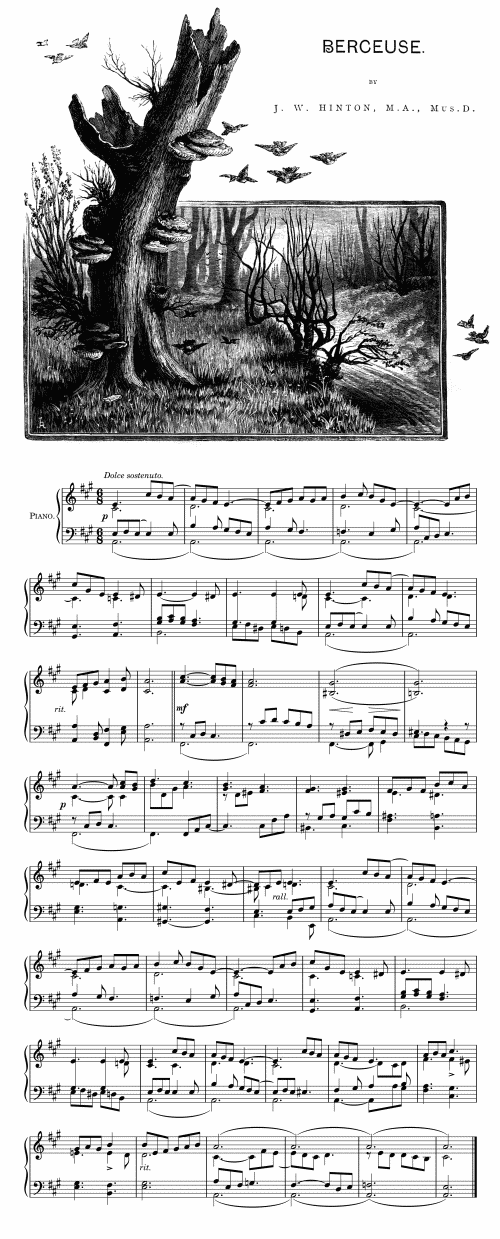
BERCEUSE.
BY
J. W. HINTON, M.A., Mus.D.
MERLE’S CRUSADE. — CHAPTER XIV.
By ROSA NOUCHETTE CAREY, Author of “Aunt Diana,” “For Lilias,” etc.
“BREAD AND SALT.”
thought Mrs.
Markham looked
somewhat
displeased.
“We must
ask your
mother’s permission,
Master
Rolf;” then,
turning to her,
“I hope you will allow him to go with
us this afternoon,” for, in spite of his
rude ways, I felt full of pity for the
lonely little boy; he seemed to have no
playfellows except poor Judson, who was
a low-spirited, overworked young woman.
It must have been dreary for him to be in
a household of grown-up people, who all
voted him a plague and took no trouble
to amuse him. Spoilt children are
seldom happy ones; and it did not need
a second look at Rolf’s pale, sickly face
to read the lines of discontent and
peevishness.
“I am rather surprised that Miss
Fenton should make such a request after
her treatment of my boy yesterday,”
returned Mrs. Markham, ungraciously.
I think if she had dared to contradict
Rolf she would not have given her consent,
but a sulky look was already
clouding his face.
“Never mind about that,” he said,
impatiently; “Miss Fenton is going to
make the tail for my kite; and I am
going out with her this afternoon, and I
shall and will go.”
“Master Rolf, that is not the way to
answer your mother.”
“You may leave me to rebuke my own
child,” she observed, coldly. “Very
well, Rolf; you may go, but you need
not be so cross about it. I came to
see about the children, Miss Fenton; I
think it is too hot for them to go on the
beach this afternoon.”
“Joyce will wear her sun-bonnet; and
there is a nice breeze,” I returned,
somewhat ruffled by this interference. I
fancy she did it to aggravate me, for
there was no fault to be found with the
weather, and I knew my mistress
always left these things to me.
She remained for a few minutes
making little suggestions about the ventilation
and the nursery arrangements,
which I bore as patiently as I could,
though the harsh, metallic voice irritated
me dreadfully. I did not wish to be disrespectful
to Mrs. Markham, but I did
not feel bound to obey her orders, and I
knew I should tell her so if any grave
dispute arose between us. I was rather
relieved when she left the room at last,
taking Rolf with her; but a few minutes
afterwards Judson glided in on tiptoe.
“Oh, Miss Fenton,” she said, in a
pathetic voice, “I am so grateful to you
for promising to take charge of Master
Rolf this afternoon; I thought there
would be such a piece of work; Master
Rolf thought he was going out in the
carriage, and Mrs. Markham has friends
and cannot find room for him; and what
I should have done with him I hardly
know, all the afternoon.”
“If Rolf is good I have no objection
to take charge of him; I am very fond
of children, only they must be obedient.”
“Obedience is an unknown word to
Master Rolf,” returned Judson, lugubriously;
“times out of number that
boy has got me into trouble, just because
he would not mind a word I said.
Why, he got the colonel’s sword out of his
mother’s wardrobe one day and nearly
killed himself, and another morning
he fired off his grandfather’s gun, that
had been loaded by mistake, and shot
poor old Pincher, not that he meant to
do it; he was aiming at one of the
pheasants.”
This was not pleasant to hear, and I
inwardly resolved not to trust the
children out of my sight; for who could
tell what unforeseen accident might arise
from Rolf’s recklessness?
“Mrs. Markham blames me for all
that happens,” went on Judson, “and
Master Rolf knows that, and there is
no checking him; he is not nearly so
mischievous when his mother is near,
because she loses patience, and has
more than once boxed his ears soundly.
She spoils him dreadfully, and he takes
liberties with her as no child ought to
take with a parent; but now and then,
when he has aggravated her past
bearing, I have known her punish him
pretty sharply.”
This was sad; injudicious indulgence,
and injudicious severity. Who could
wonder if the results were unsatisfactory?
“No one dares to say a word to him
except his mother,” went on Judson;
“it is just her temper when she flies out
at him; but she worships the very
ground he walks on. If his finger aches
she thinks he is going to die, and the
house is in an uproar; and yet when he
is ill he is as contrary as possible, and
will not take a thing from her, for all her
petting and coaxing.”
It seemed a relief to Judson to pour
out her woes, and I could hardly refuse
to listen to her. She was evidently
attached to her mistress, with whom she
had lived since her marriage; but she
was one of those helpless beings who
are made the butt of other people’s wills
and passions; she had no dignity of
mind to repel even childish impertinence;
her nervous, vacillating ways would only
increase Rolf’s tyrannical nature.
I could understand how a high-spirited
boy would resist any command enforced
by that plaintive voice. A few quick
concise words would influence him more
than a torrent of feeble reproaches from
Judson. He was not without generous
impulses—what English boy is?—he had
grasped at once my meaning when I
rebuked him for his want of gentlemanly
honour, but he was precocious and over-bearing,
and had lived too much in the
society of grown-up people.
My knowledge of the world was not
great, but I know how deficient in
reticence many grown-up people are in
the presence of children; the stream of
talk that is poured into the little pitchers
is often defiled with low conventional
views of duty, and painfully uncharitable
remarks; the pure mirror of a child’s
mind—and how pure that mind often is!—is
frequently sullied by some unchristian
observations from lips that to the child
are half divine. “See how ye offend
one of these little ones,” was the
Master’s warning; and yet if we could
look into one of these young minds, we
should often see its placid serenity broken
up and ruffled by some unthinking speech,
flung like a pitiless pebble into its
brightness.
After all, we spent a pleasant afternoon
on the beach, and I do not believe
the children enjoyed themselves more
than Hannah and I.
It was not a long walk to the shore if
we had followed the direct route; but I
wanted to see the pretty village of
Netherton more closely; so we walked
past the church and down the main
street, and turned off by the row of
bungalows that skirted the cliff, and,
crossing the cornfields, made our way
down a narrow cutting to a little strip of
shingly beach, with its border of yellow
sands washed by the summer surf. I
would willingly have sat under the
breakwater all the afternoon, watching
the baby waves lapping upon the sands,
and laying driblets of brown and green
seaweed on the shore, while Reggie
brought me wet pebbles and little dried
up crabs and empty mussel shells, but
Rolf wanted me to help with his sand
castle; indeed, we were all pressed into
the service; even Reggie dug up tiny
dabs of sand and flung it at us, under
the belief that he was helping too.
What a pretty scene it was, when the
castle was finished, and its ramparts
adorned with long green festoons and
pennants of brown ribbons; and Reggie
sat at the top kicking his little bare legs
with delight, while Rolf dug the trench
down to the sea, which filled and
bubbled over in a miniature lake, in
which disported the luckless crabs and
jelly fish which he had collected for his
aquarium.
There is something sad in the transitoriness
of children’s play on the shore;
they are so eager to build up their sand
towers and mounds. When the feeble
structure is finished the little workpeople
give a cry of joy, as though some great
task were accomplished. Then the
waves creep up stealthily; there is a
little cold lisping outside the outworks,
as though the treacherous foes were
lurking around; in a few seconds the
toy castle is in ruins. The children look
at the grey pool that has engulfed
their treasure with wide, disappointed
eyes.
“Oh, the greedy sea,” they say, “it
has destroyed our castle!” But to-morrow
they will come again with beautiful
childish faith and build another, and
still another, until some new game is
proposed, or they are weary of play.
It was quite late in the afternoon when
we turned our faces homeward. Joyce
was tired, so we put her in the perambulator,
and I carried Reggie. Rolf hung
behind rather sulkily; fatigue evidently
made him cross; but he brightened up
in an instant when the sound of horses’
hoofs struck on our ears, and in another
moment a little cavalcade came in
sight—Miss Cheriton mounted on her
pretty brown mare Brownie, and her
father and Mr. Hawtry on each side of
her.
She smiled and waved her hand to us,
and Mr. Hawtry raised his hat slightly.
They would have passed on, but Rolf
exclaimed, “Oh, do take me up for a
ride, Mr. Hawtry, I am so tired!” and
Mr. Hawtry looked at Miss Cheriton,
and pulled up at once.
“Put your foot on my boot, then, and
I can reach you,” he returned; and as
Hannah lifted him up, not without difficulty,
he threw his arm round him, and
kept him steady. “Now, then, hold
tight; we must overtake the others,” I
heard him say, and they were soon out
of sight.
“It must be werry nice to be Rolf,”
sighed Joyce, enviously, as Hannah
wheeled her up the dusty road.
I think we were all glad when we had
reached the cool nursery, and found a
plentiful tea spread on the round table.
The children were so sleepy that we
were obliged to put them to bed as
soon as they had finished their tea.
Rolf did not make his appearance
until later, and then he burst into the
room with his arms full of paper and
string, and we were very soon hard at
work on the window-seat, constructing
the tail for his kite.
He was in high spirits, and talked
volubly all the time.
“I told mother about bread and salt,”
he began, “and she liked the idea very
much. She made me repeat it again to
grandpapa, and he patted me on the
head, and gave me half-a-crown. When
grandpapa is pleased about anything
he always gives people half-a-crown. I
think he ought to give you one, Fenny.
Do you mind my calling you Fenny? it
sounds so nice, rather like funny, and
you are so funny sometimes.”
“It sounds much more like Fanny,”
I returned.
“Oh, do you think so? I will ask
Aunt Gay what she thinks. Aunt Gay
is so fond of you, she told me so to-day,
only she said it was a secret, so you
must keep it. I told Mr. Hawtry the
story about the robber servant this evening
after dinner, and he said that he
was a plucky fellow, in spite of his being
a robber; and so I think. Do you like
Mr. Hawtry, Fenny?”
“I do not know him, dear.”
“Oh, no, of course, you are only a
nurse, and so you don’t come in the
drawing-room like other people; you
would not know how to behave, would
you? Mr. Hawtry said something about
you this evening. Mother was talking
to him, you know how, only I can’t tell
you—bread and salt, you know,” and
here Rolf looked excessively solemn;
“and Mr. Hawtry said—no, don’t stop
me, it is nothing bad, nothing like
mother; oh, dear, it will come out, I
know—he only said, ‘She seems a very
quiet, well-conducted young person,
and not at all above her duties,’ for you
were carrying Reggie, you know.”
“Oh, Rolf, do hold your tongue,” I
exclaimed, crossly, for this was too
much for my forbearance. What business
had Mrs. Markham to talk me over
with strangers? I ought to have stopped
Rolf, but my curiosity was too strong at
that moment. “A quiet, well-conducted
young person,” indeed. I felt in a
fever of indignation.
Rolf looked up from his kite with
some surprise.
“Does talking disturb you? We are
getting on beautifully. What a lovely
tail my kite will have!” Then, as
though a thought struck him, “Are
you ever cross, Fenny; really cross,
I mean?”
“Yes, very often, Rolf,” for being a
fairly conscientious person, I could not
deny my faults of temper.
“Oh!” with a peculiar intonation, “I
wonder if Aunt Gay knows that. Do
you remember any anecdotes about
crossness, Fenny?”
I am afraid of what my answer
might have been, for I was considerably
nettled at Rolf’s malicious tone, but
happily Judson came at that moment
with a message from Mrs. Markham
that even Rolf did not dare to disobey,
for he ran off at once, without bidding
me good-night, and leaving all his tackle
strewn over the floor for Judson to clear.
As soon as I was left in solitude, I
went to the open window. It was clear
moonlight again. There were the tree-shadows,
and the long, silvery path
across the meadows; a warm radiance
from the drawing-room was flung across
the terrace. The same sweet bird-like
voice that I had heard in the orchard
that morning was singing an old-fashioned
ballad—
“My mother bids me bind my hair.”
Someone clapped their hands and
said “Bravo!” when it was finished.
“What a lovely evening! Do come
into the garden, Adelaide; it is quite
warm and balmy.” And then there was
a rustle and movement underneath me,
a sweep of dark drapery, followed by
the whisk of a white gown, as Gay ran
down the steps, pursued by Rolf. Two
gentlemen sauntered down the terrace;
one of them was Mr. Hawtry; I could
hear his voice quite plainly.
“This is a capital cigarette, squire.
When a man is not much of a smoker,
he will not put up with an inferior article.
I have some cigars by me now——” The
remainder of the interesting sentence
was lost in the distance.
Men are rather satirical on the subject
of women’s talk. They quiz us
dreadfully, and insist that our main
topic is bonnets, but I am not sure that
we could not retaliate with equal force.
Bonnets can be treated as works of art,
but could anything be more trivial and
worthless than a cigar?
They were still talking about the
odious things when they returned, only
I was too disgusted to listen any more.
I was in a bad humour, that was certain—one
of those moods when only a
real tough piece of work can relieve one.
I closed the window and drew down the
blind, and then armed myself with my
pocket dictionary. I would write a long
letter to my mistress, and tell her about
our afternoon on the beach, and I would
pick out the hardest and most difficult
words—those that I generally eschewed.
I heard afterwards I had written a
beautiful letter, without a single mistake,
and that my mistress read it over
and over again—that is, that she considered
it beautiful, because it was all
about the children.
“Nonsense, Merle, it was a sweet
letter, and I showed it to my husband.”
I was in a better humour when I had
finished it, and called Hannah.
“Hannah, we shall go on the beach
to-morrow morning, and so I shall be
able to spare you in the afternoon; I
shall not take the children farther than
the garden. You can go and have tea
with your sister, if you like, and you
need not hurry home. I am growing
far too idle, and I have not half enough
to do,” for I wanted to check any expression
of gratitude on the girl’s part,
but a tap at the door silenced us both.
It was only Miss Cheriton come to
wish me good-night. She had a basket
of fruit and a dainty little bunch of roses
in her hand.
“I saw the light in your window, and
thought of the poor prisoner behind it,
and I thought this would cheer you up,”
laying her pretty offerings on the table.
“I am going to take you all for a drive
to-morrow through Orton-on-Sea; the
children will like to see the shops and
jetty. Well, good-night; I am dreadfully
sleepy; to-morrow we will have another
long talk.” And then she left me alone
with the roses.
(To be continued.)
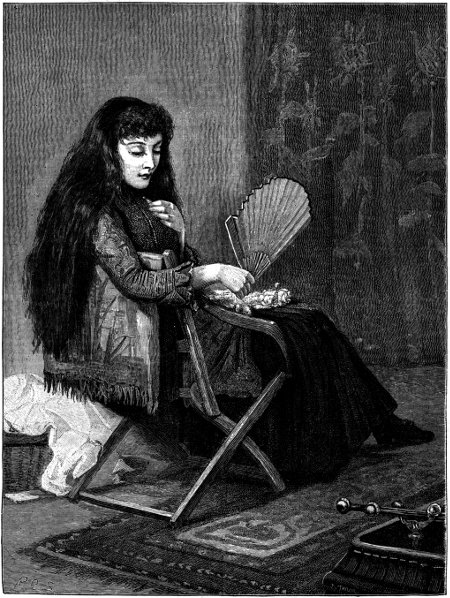
“SHE SAT ALONE BY THE FIRE ONE DAY.”
FAITH AND UNFAITH.
By SARAH DOUDNEY.
“Faith and unfaith can ne’er be equal powers.”—Tennyson.
She sat alone by the fire one day;
The winds were sobbing outside the pane,
And over the meadows and hillsides grey
The clouds hung heavy with rain.
But down in the garden-paths she knew
Last summer’s leaves were lingering yet,
Leaves that had taken the sun and the dew
Of days she would fain forget.
She sat alone, and the firelight gleamed
On a little golden ring she wore,
And her tears fell fast for the hopes that beamed
In the years that come no more.
She drew the ring from her hand, and said,
“Why should I cling to the outward sign
Of a love that now in his heart lies dead,
Though it lives and burns in mine?”
But a voice said, “Silence is not death;
Wait on in patience and bear your pain;
You may dim the gold by a single breath,
But it shines out bright again!
“Love is not love if it cannot trust,
And faith should shine like the virgin gold,
A treasure unsullied by moth or rust,
That never is bought and sold.”
THE INHERITANCE OF A GOOD NAME. — CHAPTER II.
By LOUISA MENZIES.
VENUS’S FLY-TRAP.
ark, will you come
to Sunbridge
Woods and look
for Venus’s fly-trap?”[1]
“With all my
heart, Sorella; but
what will mother
do?”
“Oh, mother
will be quite happy
in the garden under your tent. She cannot
walk in the heat, you know; but perhaps
she’ll come and meet us if she does not
drive with auntie.”
“Let us go and ask her,” said Mark; and
led the way to the cool little parlour, where
their mother was engaged in some parish
writing for her brother, her writing-table so
placed that she could look up from time to
time at her husband’s portrait, which seemed
to her, simple soul that she was! to look down
on her with tender care and encouragement.
Margaret never told her thoughts even to her
daughter, but both Mark and Eva knew why
their mother loved that place better than any
other.
Mark propounded Eva’s scheme, which met
with no opposition from their mother, who
was well content to know that they were happy
and together.
“Will you not take Elgitha?” she asked.
“She loves to get a walk in the woods.”
Eva would rather have had her brother all
to herself, but a suggestion from her mother
was law to her; so Mark ran up to the rectory
to see if Elgitha might come with them, while
Eveline put on her walking dress and prepared
her basket, scissors, etc.
Elgitha was now a big girl of thirteen.
Small and delicate as she had been in her
infancy, she was now developing a rather
large frame, and was at that awkward age
when a girl seems all angles, and does not know
what to do with her hands and feet. Being an
ugly likeness of her father, and in character
more resembling the Echlins than the Manners,
she in no way dimmed the lustre of Gilbert’s
glory in her mother’s eyes, and was on all
occasions extremely glad to escape to her aunt
and cousins at the cottage.
The idea of a walk in the woods with Mark
and Eveline was enchanting, a delightful
relief to the tedium of a tête-à-tête drive with
her mother in the phaeton, and Elgitha
floundered into her walking gear with all
possible speed. They met Eva at the garden
gate, and, after she had put her cousin’s dress
to rights with a few judicious touches, the
three set off across the fields in the direction
of Sunbridge. They crossed cornfields just
ripening into yellow, spotted here and there
with nodding poppies and blue cornflowers,
and Elgitha sought counsel, as to the weather
from the shepherd’s weather-glass, white or
red, or, as to the time, from the seeding dandelion.
The sun was high in the heavens,
and blinding in his majesty, so that it was
with a sense of exquisite relief that they gained
the shelter of the woods, laden with full summer
foliage, and whispering sweetly in the
gentle wind. At Eva’s wish they sat down to
rest under a lime just bursting into blossom.
It was a day when to be alive was pleasure,
and Mark lay on his back gazing up into the
world of tender green, dreaming deliciously;
but Elgitha had not reached the dreamy age,
and, having sat for five minutes, pulling to
pieces a bunch of poppies which she had
gathered, and watching their tender leaves
float in the wind, she suddenly started up at
the sight of a horseman riding along the high
road, where it skirted the wood some two
hundred paces distant.
“Hullo!” she shouted. “Gilbert, I wonder
where he is going. Hullo! stop; where are
you going?” And plunging through moss and
bracken, she managed to make a right angle,
and, climbing a five-barred gate, stood in
front of her brother, as he came riding slowly
along the road.
Gilbert was startled, but the horse knew
Elgitha, whinnied, and stopped.
“How on earth did you come here?” said
Gilbert, not in the most amiable manner.
“Oh! Mark and Eva are here,” explained
Elgitha; “we have come out for a walk.”
“Then why do you tear along like a lunatic
Meg Merrilies?”
“What a good idea!” laughed Elgitha;
“you are Mr. Bertram riding from Ellangowan,
and I am Meg; but I ought to be
standing on the top of the gate to tell you
your doom.”
“Nonsense, child; let the horse’s head
free,” for Elgitha was fondling her father’s old
favourite.
“The horse! Just as if the dear old thing
hadn’t got a name! Poor darling old Dusty,
who has carried you, man and boy, for these
fifteen years. I’m ashamed of you, Gil.”
“I’m ashamed of him!” replied Gilbert,
“the stupid old beast; he hasn’t a bit of
spunk left in him, if he ever had any. A nice
specimen, isn’t he, Mark?” for Mark and
Eveline had not joined them. “What would
St. Maur or Tullietudlem say to him? They’d
hardly think him fit for dogs’ meat at Cambridge,
would they?”
Mark patted the neck of the old horse, who
had carried the rector for over twenty years.
“Dusty prefers Sunbridge to Cambridge;
he’s quick enough for the rector, and can get
over a quantity of ground if need be.”
“He and the rector suit each other,
I’ve no doubt; but I wish the rector
would keep something a little more up to
the mark for his friends. It makes a fellow
look such an owl to be astride of such a
Rosinante. Mrs. Alderman Jacobson and
those black-browed girls of hers passed me ten
minutes ago in a splendid barouche with a
couple of thoroughbreds—such beauties, Eva,
that dark mottled grey that you love so,
matched to an inch with silver-plated harness
that positively dazzled me. It is scandalous;
his grandfather, old Nat Jacobson, used to
peregrinate the metropolis in search of cast-off
wearing apparel with a black bag and a pyramid
of old beavers on his patriarchal head.”
“Oh, Gil, how can you?” remonstrated
Elgitha; “it is a case of industry rewarded.
If our grandfathers had toiled as Nat Jacobson
toiled, and accepted as fish whatever came into
their nets, they might have added barn to
barn and acre to acre, and left us the wherewithal
to skim through the world in barouches
drawn by silver-harnessed dappled greys.”
“True enough, most wise maid of Sunbridge,
but I don’t think I should ever acquire
a taste for making money; people in our position
are not fitted for making money; but if our pater
instead of being a model curate, had spent his
energies on a good milk walk, you wouldn’t
have to plod about on foot all your days, and
I shouldn’t have had the confounded nuisance
of choosing a profession.”
“Pity him—only pity him!” exclaimed
Eva, laughing; “the poor young man has to
make up his mind within the next twelve
months whether he will be a lawyer or a
clergyman. There’s yet a doctor, Gilbert.
Why don’t you try medicine?”
“Pah! nasty messy work! Do you think
I’d be at the call of every hysterical girl or
hypochondriac old bachelor, pottering about
from one stuffy room to another, with nothing
to relieve the tedium but an occasional dish
of scandal?”
“Have a care!” cried Mark; “the day may
come when you shall need the help of Æsculapius
yourself. For my part, I think no one
more admirable than the true doctor, who often
in the exercise of his art can ‘minister to the
mind diseased,’ and, when all other hope is
gone, can point the way to hope in heaven.”
“I believe, Mark,” said Gilbert, in disgust,
“that you would find something to say in
favour of an undertaker.”
“Perhaps I could; but as neither of us is
called to weigh the pros and cons of that
extremely useful calling, I confess I have not
given it due consideration. You have the
choice of the Church and the Bar, I of the
Church or the Civil Service. I suppose, whichever
we choose, we are neither of us to be
pitied?”
“Bother your optimism! I believe it is
your horrible contentedness that drives me into
pessimism! I believe you would have me
think that you enjoy dragging along through
these woods at the heels of a couple of
girls!”
“You can think what you please, Gilbert,
it will not affect my comfort. I shouldn’t
enjoy dragging at the heels of St. Maur or
Tullietudlem, so let us agree to differ and wish
each other a good morning. The woods at
least are cooler than the high road, and as
Eva is bent on having a specimen of Dame
Venus’s fly-trap, we may have far to go.”
“And, pray, what may Venus’s fly-trap
be?” said Gilbert, who never had any particular
taste for his own company.
“I’ll show you, if we are lucky enough to
find one,” cried Eva, following her brother
into the wood. Elgitha stopped to give Dusty
a farewell hug, then plunged after them, and
Gilbert was left to his own devices. He slowly
resumed his way, the sweetness of his temper
not increased by the encounter, for though he
affected to despise the company of girls, it
was not pleasant to find them indifferent to
him, and, sneer at Mark as he would, his
frank, happy face filled him with envy.
Mark, of course, must decide on his calling
before long. Whatever his decision, he must
make his own way; his mother could give him
no artificial support; it was very wise of him
to make the best of it. Of course, if his pater
had lived, things would have been very different,
and Mark would have been—well, probably
just like his present self, and would have
found everything a “confounded bore.” And
so post equitem sedet atra cura, and the lad of
nineteen is handicapped with a heavy heart,
in spite of his good father, his high-born and
doting mother—in spite of his most expensive
education and a moderate fortune in prospect.
The botanisers meanwhile threaded the
mazes of the leafy trees with many a gay
laugh and many a simple joke, and with much
admiration of the multiform beauties spread
before their eyes, until they came to a damp
hollow, carpetted with moss of an emerald
green brightness, which Eveline immediately
recognised as the favourite habitat of the
dainty moss which they were seeking.
They separated, each taking a division,
and many lovely things, insect and vegetable,
were presented to their eyes—tiny beetles,
scarcely the size of a pin’s head, harnessed in
green and gold, tiny flies with lustrous bodies
floating on gauzy wings, mosses with dainty
blossoms, scarce distinguishable in colour from
the plant itself, often covering a treacherous
ooze, and over all the whispering trees and the
occasional coo of the woodpigeon—but the
prize they sought still eluded them. Mark expressed
it as his opinion that it only existed
in Eveline’s imagination, and Eveline was,
sorrowfully, about to give up the search, when
Elgitha raised a loud shout of triumph, and
there was a great leap, a splash, and a
tumble.
“What are you doing?” exclaimed Mark,
hastening to the help of his floundering
cousin.
“Don’t mind me! don’t mind me! Here it
is! I’ve found it, Lina, I’ve found it!”
“Let me look!” cried Eva, almost equally
excited.
“Come round this way,” said Mark, guiding
his sister on firm ground to the edge of the
swamp. “If Elgitha had not been so impatient
she might have won her prize with
dry feet!”
“Veni, vidi, vici!” exclaimed the victorious
Elgitha, holding aloft her prize; and,
glancing at her soaking feet and stained dress,
she continued, “When Julius Cæsar wrote that
you don’t suppose he looked spick and span
as when he went to dine with Pompeius
Magnus.”
“Elgitha thinks the prize well worth the
cost,” said Eva, admiring the lovely growth;
“look at its delicate fan-like leaves, pale
green, with tiny rosy spikes—dangerous
beauties, too; look at these poor bodies of
slain flies, here, ensnared by this leaf—and
these new ones just unfolding their spikes,
how innocent they look!”
“Nature’s coquettes!” laughed Mark.
“Strange, is it not, to see the traps that are
everywhere set for silly flies? But come, girls,
we had best be getting home. We have accomplished
the object of our expedition, taken
our Pergama, as Elgitha would say, and the
sooner we get our victorious maid home the
better. It would be an ignominious catastrophe
to have the discoverer of Venus’s fly-trap
in bed for a week with mustard poultices
and water gruel.”
Elgitha, elated with her success, protested,
but in vain, for Eveline agreed with Mark,
and observed that even if they had not been
successful it was time that they should be
getting home again.
The walk back was accomplished with
sedater spirits, and as they neared home the
brother and sister insensibly fell into grave
discourse, while Elgitha, now rather tired,
dragged a little behind.
The course of their future life was what
they talked about, and Mark explained the
reasons that made him hesitate to go into the
Church, the course which his college successes
seemed to indicate.
“It seems to me imperative,” said Mark,
“that I should be no burden on my mother’s
slender resources. I should dearly like to be
able to make a home for you both.”
“But if Gilbert decides against taking
orders there’s Bigglethwaite. I’m sure Aunt
Elgitha would rather have you there than
anyone else—better even than Gilbert, I
think.”
“We must not think of Bigglethwaite, Lina;
might as well fix on Rosenhurst itself. Failing
Gilbert, the earl has someone no doubt in
view, but I believe that it will end in Gilbert’s
taking orders.”
“But he will never be fit,” remonstrated
Eva.
“That is a hard thing to say. I don’t
suppose that he will find the Bar pay, but I
would rather not hang about waiting for his
determination. I will make up my mind
before October.”
“And you don’t know whether to be a
clergyman, a schoolmaster, or to try for the
Civil Service.”
“That is exactly how matters stand, Dilecta,
so you see I am more perplexed than
Gilbert; his choice lies between two; I am
distracted by three.”
“And in all probability an accident will
decide at last.”
“Probably, if, indeed, there be such a thing
as accident.”
“My mother would like you to be a clergyman,
I think.”
“I think she would, and what would my
sister prefer?”
“I don’t know; I don’t think I very much
care, for you will always be my own dear
brother. Whichever will let me see most of
you, I think.”
“You don’t ask me which I prefer,” pouted
Elgitha, coming up behind.
“I didn’t know you were listening, goosie,”
said Mark, drawing her arm through his,
“But, come now, favour us with your
opinion.”
“Well, Mark, my honest and true opinion
is that you, if you don’t get away from stupid
old Rosenhurst as soon as ever you can, you
will be a goose of the first feather.”
“And wherefore, O most profound Sybilla?”
“Because there is nothing on earth to do;
one day is just exactly like another, and as to
being a parson, it just takes an angel like
father to put up with it.”
“You naughty girl; what do you mean?”
“Why, isn’t he at everybody’s beck and
call from Sunday morning to Saturday night?
If Farmer Baynes quarrels with his son,
father has to hear both sides, and to try and
make them hear reason; if Widow Marvel’s
ten babies are down with typhoid fever, because
she will not keep the place decently
clean, he has to supplement the work of the
doctor, and go in and out of the filthy hole as
if he liked it. Nobody is in any trouble, no
one does any sin, but it all comes back upon
father. Don’t you know that that’s what
makes him look so white—that and Gilbert
together?”
“Elgitha,” said Mark, gravely, “your father
is one of God’s saints, and of such as he is
the kingdom of heaven. Do not grudge him
to the work; his reward is ready. But why
would you have me leave Rosenhurst? Do
you think sin and sorrow are not as frequent
elsewhere?”
“Perhaps; but at any rate other places
cannot be as stupid.”
“And yet, child, if you go away, before a
year is out you will be looking back to these
stupid days with fond regret, and will remember
nothing of Rosenhurst but its roses and
lilies.”
“I’d wager you something to the contrary,
only I know you wouldn’t bet; but here we are
home again. Don’t open the gate, please;
I’m going round at the back. Mother’ll be
in an awful fume if she sees this frock; Mary’ll
get it cleaned for me. Here, Lina, take Aunt
Margaret this trophy,” holding out a dainty
specimen of the fly-trap, snugly packed in moss.
“Nay, dear, that is the prettiest piece of all;
take it to Aunt Elgitha.”
“Oh, she wouldn’t care for it; she’d forget
to put it in water, and so should I. Aunt
Margaret will love it, and know just what it
wants, and keep it alive for weeks, and paint
it and learn it by heart. Good-bye for the
present; I suppose you will be coming in for
a little music by-and-by?”
“That is as the superior powers may have
determined,” said Mark, holding the gate for
her to enter, and so the expedition ended.
(To be continued.)
VARIETIES.
O Nanny, wilt thou gang wi’ me?
Some time ago, in The Girl’s Own Paper,
there appeared an interesting sketch of the
“Reliques of Ancient English Poetry,” with
some facts of the life of Bishop Percy. In the
account given, no mention is made of the
once popular ballad, “O Nanny, wilt thou
gang wi’ me?” or the event that gave rise to
its production. The circumstances, however,
were of such an unusual character, that they
will certainly bear telling once more.
It was in 1771, about six years after the
publication of the “Reliques,” and at the very
height of Percy’s literary fame, that Mrs.
Percy was summoned to the Court of
George III. and appointed nurse to the infant
Prince Edward, afterwards Duke of Kent,
and ultimately the father of our present good
and most gracious sovereign Queen Victoria.
Mrs. Percy is said to have been a very
amiable and excellent woman. Miss M. L.
Hawkins, in writing of the occurrence, says:
“His Royal Highness Prince Edward’s
temper, as a private gentleman, did not discredit
his nurse, for his humanity was conspicuous.”
It was when Mrs. Percy had fulfilled the
duties of her high position as personal
attendant to the young prince, and on her
return to the quiet Northamptonshire vicarage
of Easton Mandit, that Dr. Percy greeted his
long absent wife with the following verses:—
“O Nanny, wilt thou gang with me,
Nor sigh to leave the flaunting town?
Can silent glens have charms for thee,
The lowly cot, and russet gown?
No longer dressed in silken sheen,
No longer decked with jewels rare;
Say, canst thou quit each courtly scene,
Where thou wert fairest of the fair?
“O Nanny, when thou’rt far away,
Wilt thou not cast a wish behind?
Say, canst thou face the parching ray,
Nor shrink before the wintry wind?
Oh, can that soft and gentle mien
Extremes of hardship learn to bear,
Nor, sad, regret each courtly scene,
Where thou wert fairest of the fair?
“O Nanny, canst thou love so true,
Through perils keen with me to go?
Or, when thy swain mishap shall rue,
To share with him the pang of woe?
Say, should disease or pain befall,
Wilt thou assume the nurse’s care,
Nor, wistful, those gay scenes recall
Where thou wert fairest of the fair?
“And when at last thy love shall die,
Wilt thou receive his parting breath?
Wilt thou repress each struggling sigh,
And cheer with smiles the bed of death?
And wilt thou o’er his breathless clay
Strew flowers and drop the tender tear,
Nor then regret those scenes so gay,
Where thou wert fairest of the fair?”
When the ballad was first published it is
said to have been exceedingly popular, and
greatly enhanced the reputation of its author.
The Gentleman’s Magazine for 1780 speaks of
it as being “not undeservedly” regarded as
“the most beautiful song in the English
language.”
Mrs. Percy was a native of Northamptonshire,
and the daughter of Barton Gutteridge,
Esq., of Desborough. Her union with Dr.
Percy proved to be a very happy one, though
clouded over on several occasions with grief
and sorrow at the loss of some of their children,
particularly at the death of their only son Henry,
a promising young man of twenty years of age.
The greatest affection existed between husband
and wife, and continued to the end of their
days. A very pleasing illustration of this fact
is given in Pickford’s Life of Percy. The
incident occurred in Ireland when Percy held
the see of Dromore. On one occasion, when
the bishop was from home, a violent storm
came on in the evening, and was of such a
character that the friends with whom he was
staying earnestly entreated him to remain for
the night, but the companionship of the
“Nanny of his Muse” was a more powerful
magnet than the pleading of kind friends or
shelter from the tempest, so he ventured forth
heedless of the howling winds and drenching
rain. Subsequently he commemorated the
event by writing the following lines, which
were first published in 1867:—
“Deep howls the storm with chilling blast,
Fast falls the snow and rain,
Down rush the floods with headlong haste,
And deluge all the plain.
“Yet all in vain the tempests roar,
And whirls the drifted snow;
In vain the torrents scorn the shore,
To Delia I must go.
“In vain the shades of evening fall,
And horrid dangers threat;
What can the lover’s heart appal,
Or check his eager feet?
“The darksome vale the fearless tries,
And winds its trackless wood,
High o’er the cliff’s dread summit flies,
And rushes through the flood.
“Love bids achieve the hardy task
And act the wondrous part,
He wings the feet with eagle speed,
And lends the lion-heart.
“Then led by thee, all-powerful boy,
I’ll dare the hideous night,
Thy dart shall guard me from annoy,
Thy torch my footsteps light.
“The cheerful blaze, the social hour,
The friends—all plead in vain;
Love calls—I brave each adverse power
Of peril and of pain.”
Mrs. Percy died on the 31st December, 1806.
Her remains were interred within the Cathedral
of Dromore. Several poems were
published on her decease in the Gentleman’s
Magazine at that time. One of them, descriptive
of the graces of this excellent lady, reads
thus:—
“Within the precincts of this silent cell
Distinguished Percy’s sacred relicks dwell;
Whose youthful charms adorn’d the courtly scene,
And won the favour of a British Queen
Whose moral excellence, and virtues rare,
Shone as conspicuous as her face was fair.
By none throughout a long and happy life
Was she surpassed as mother, friend, or wife.
Alike from ostentation free, and pride,
Humanity her motive, sense her guide.
Her charity with constant current flowed,
And its best gifts so usefully bestowed,
That ere her spirit reached its native sphere,
Her goodness marked her as an angel here.”
Dr. Percy lived on for five years longer,
passing away on September 30th, 1811,
revered and beloved for his piety, liberality,
benevolence, and hospitality, by persons of
every rank and religious denomination.
Leisure Hour.
A Doubtful Advantage.—A young
working man was being shown the advantages
of having a home of his own instead of
knocking about in lodgings. “I don’t see,”
said he, “the good of giving some woman
half my victuals to get t’other half cooked.”
Content.
Sweet are the thoughts that savour of content;
The quiet mind is richer than a crown.
Sweet are the nights in careless slumber spent;
The poor estate scorns fortune’s angry frown.
Such sweet content, such minds, such sleep, such bliss,
Beggars enjoy which princes often miss.
—Greene.
Woman’s Sphere.
They talk about a woman’s sphere
As though it had no limit.
There’s not a place in earth or heaven,
There’s not a task to mankind given,
There’s not a blessing or a woe,
There’s not a whispered yes or no,
There’s not a life, or death, or birth
That has a feather’s weight of worth,
Without a woman in it.
A Miserable Young Woman.—To those
who, without any real knowledge of music,
make the air around them hideous by their
everlasting strumming on a piano, the following
passage in Carlyle’s life may prove instructive:—“The
miserable young woman in
the next house to me spends all her young
bright days, not in learning to darn stockings,
sew shirts, bake pastry, or any art, mystery,
or business that will profit herself or others;
not even in amusing herself or skipping on
the grass plots with laughter of her mates;
but simply and solely in raging from dawn
to dark, to night and midnight, on a hapless
piano, which, it is evident, she will never in
this world render more musical than a pair
of barn clappers! The miserable young
female!”
A Sweeping Argument.—“That is a
sweeping argument,” remarked the husband,
whose wife used a broom to convince him that
he ought to have been home several hours
previously.
The Great Art of Life.—It is the great
art and philosophy of life to make the best of
the present, whether it be good or bad; to
bear the bad with resignation and patience,
and to enjoy the good with thankfulness and
moderation.
Beautiful Hands.—A white hand is a
very desirable ornament, and a hand can
never be white unless it be kept clean; nor
is this all, for if a young lady excels her companions
in this respect, she must keep her
hands in constant motion, which will cause the
blood to circulate freely and have a wonderful
effect. The motion recommended is working
at her needle, brightening her house and
making herself as useful as possible in the
performance of all domestic duties.—Mrs.
Jamieson.
MORE ABOUT Y.W.C.A.; “GIRL’S OWN PAPER” BRANCH.
By the Hon. GERTRUDE KINNAIRD.
About three years ago a paper appeared
in the pages of this magazine entitled
“Y.W.C.A.” It will be interesting to trace
the growth of the seed then sown, and to
see whether it found any ground where it
could take root and grow. That some soil
was prepared to receive it appeared evident
from the very first, for letters flowed in to the
writer of that paper from many parts of the
country.
Some of these letters were from girls living
in the neighbourhoods where the Young Women’s
Christian Association had established
branches, but about which they knew nothing,
although its benefits were just what they
needed. They had not even heard of the
existence of an association in which provision
is made for the social, intellectual,
moral, and spiritual welfare of young women.
These girls were at once put into communication
with the local secretary, who received
them with a hearty welcome, and it is pleasant
to record the eagerness displayed by
our new members in availing themselves of
the opportunity afforded to them by our Association
to become allied with the great band
of young women now encircling the globe
who desire to live godly, righteous, and sober
lives in this present evil world.
On the other hand, a large number of letters
came from those who lived at a greater or less
distance from any existing branch, and it
became necessary to find some link by which
these young people could be joined together.
They were therefore formed into the “Girl’s
Own Paper Branch,” a name which has since
been abbreviated to “Girl’s Own Branch”;
and a very efficient Secretary was found in
Miss Violet Tweedy, who was somewhat
unwilling to undertake this work, but now
writes, “I love the work, and would not give
up my girls for anything; it is one of my
greatest pleasures writing and receiving letters
from them.”
It is extremely important to observe the
words “Scattered Members’ Branch,” and
we will pause to consider this striking feature
of the work of the Y.W.C.A., enabling it to
extend its influence into places where no
Institute or Home has found its way, and
among those who cannot avail themselves of
their special advantages.
Of such branches some of the most
prominent are, the “Art Students’ Branch,”
with this aim—to bring together in Christian,
social intercourse, those who are studying art
in our great centres of population, and the
Secretary of this branch will be glad to receive
the names of any students likely to be in
London; the “Hospital Nurses’ Branch,”
started for the purpose of uniting in sympathy
those who are labouring to alleviate pain and
suffering; the “Restaurant Girls’ Branch;”
the “Rural Servants’ Branches,” etc., etc.
Let us now return to the history of our “Girl’s
Own Branch.” The duty of the Secretary was
to correspond with the members, supply them
with the Monthly Letter, and induce them to
take in one of the Association magazines. It
was only about three years ago that our branch
first saw the light, and during that period it
has proved to have a healthy and vigorous
life. In all 82 have joined, of whom a great
many have been transferred to other branches,
two have married, two have been removed by
death, leaving 40 now in constant correspondence
with the secretary.
That the individual members are alive may
be judged from these facts:—
One member has a Saturday evening Bible
class of twenty factory girls, whom she helps
in many ways.
Another collected £1 for the Shaftesbury
Memorial Fund, and a third collected for the
Old Ford Institute; and all have helped in
the special Christmas collections.
One of the members is an inmate of an incurable
hospital, and is most helpful to the
secretary by specially remembering in prayer
any of her fellow-members who may desire
to be thus aided.
We will now ask you to listen to the testimonies
of the members by quoting a few passages
from their letters, to which many more
might be added:—
“I never thought seriously till I joined the
Association,” writes one, “and now I am a
totally different girl—so happy. I was confirmed
last week, and shall always look back
to the day with joy.”
“I think it seems so kind and good of
ladies,” writes another, “to take such an interest
in us poor girls. You little know half
the good you do us or what our lives really
are. I sometimes feel ready to give up in
despair, when everything seems to go wrong,
and at those times your letters seem sent of
God to cheer me up and help me to go on
again. They are read and re-read again and
again, and I thank you for them much.”
A young member writes:—“Thank you
very much for writing to me. I do enjoy your
letters. I quite feel as though I knew you;
but I should like to see you ever so much.”
Yet another:—“You have granted me
such a privilege by asking me to write to you,
which I shall be pleased to do.”
The last extract is from a girl of seventeen,
who, after describing her life, adds:—“I have
ordered, may I say, our Association papers....
I must now close, longing to have one
of your ever welcome letters soon.”
Surely there is no need to question the usefulness
of the Association. These letters tell
their own story by the simple, unaffected
manner in which the writers assert that they
have received positive benefits through linking
themselves to it.
It will not be out of place to add a word
or two as to the objects of the Y.W.C.A. for
the benefit of those who have not seen the
article referred to, besides other notices which
have appeared from time to time.
The products of nature are not valued in
proportion to their size or outward appearance,
but more generally with reference to
their use for the sustaining of life. The
spreading cedar is far more magnificent and
beautiful than the little potato-plant, and yet
the cedar would be less missed than the
potato.
The rosy-cheeked, shining apple makes
more show than the little seed-corn, and yet
there is no comparison as to which we could
most easily spare. The apple we could dispense
with; it would be difficult to dispense
with what has been aptly termed “the staff
of life.”
So with the Y.W.C.A. It does not assume
to itself a great place in the way of presenting
you with a magnificent appearance; but nevertheless
its work is sure, and it is steadily
making its influence felt through the length
and breadth of the land. If anyone should
wish to feel this influence, they must
join the Association, follow it in its work,
watch its effects, and the verdict must be
favourable.
The Association is writing its name ineffaceably
in the changed lives, enlarged hopes,
higher aims, and nobler motives of many of
its members.
Another point sometimes forgotten is that
the object of the Association is to build up
character, remembering that “it depends upon
what we are as to what the world is like.”
“Dark is the world to thee;
Thyself the reason why.”
Its aim is not to bring the members out of
the spheres in which they have been placed,
but to help them to do their duty better in
that station of life where God Has placed
them.
Its aim is to lead them to see that it does
make a vast difference how they fulfil those
duties, and that if they are actuated by high
Christian motives, they will find this the way
to ennoble all work.
Its aim is to teach its members who have
the talent, or leisure, or education, or artistic
training, to use this for the common weal, and
save them from the selfish narrowness of a
useless life.
Thus the Y.W.C.A. does its quiet work
day by day. Sometimes it offers its protection
to a girl who sets foot in London or some
other large town for the first time, the Stations
Visitor sent out by the Travellers’ Aid Department
(Office, 16A, Old Cavendish-street,
W.), meeting her at the Station or Wharf.
Sometimes it saves a girl from falling into the
snares, now so often laid for them in advertisements
offering high wages and little work,
which means ruin and degradation. Any girl
may apply to the Employment Agency, 17,
Old Cavendish-street, or to the Business
Agency, 316, Regent-street, for a safe situation,
or for information concerning registries
and advertisements. Sometimes it gives occupation
for the leisure hours when tired fingers
and weary brain need relaxation and change.
There are 40 institutes and homes in London
alone, and 125 branches, and similar work is
carried on all over the country.
The Association has thus proved itself indispensable
to many a lonely, tempted girl.
Thank God for the Young Women’s Christian
Association! The London Association has
published four reasons why every girl should
join.
Y.W.C.A. Why Should I Join?
Because every young woman should identify
herself with an Association which is pre-eminently
her own, and thus support it by her
influence and example.
Because if you yourself do not need the
special advantages of our Association, remember
the thousands of our sisters who do;
therefore, enrol yourself as a member, and
encourage every one whom you may come
across to do the same.
Because, if you desire to work for God, here
is a delightful sphere for all the time and
talents you have to spare, as almost all our
local branches are needing helpers.
Because, by joining, and also influencing
others to join, you may be the means of
bringing many in who will by-and-by say,
“Thank God I ever came in here!”
Enough has been said to prove that the
seed sown in The Girl’s Own Paper three
years ago has taken root and flourished, and
we would ask every young reader to join their
own branch at once. They may join as Associates
or Prayer Union Members, paying 1s. a
year, or as Working Members, 2s. 6d. a year,
or as Honorary Associates, 5s. a year, by writing
to Miss V. Tweedy, Widmore House, Bromley,
Kent; or, if they prefer, to the Secretary, at
the Central Office, 17, Old Cavendish-street,
W. Subscriptions in aid of the work will be
thankfully received by the Hon. Secretaries—Mrs.
H. Arbuthnot, 15, Craven-hill-gardens,
London, W., and the Hon. Emily Kinnaird,
2, Pall Mall East, S.W.
TINNED MEATS; THEIR VALUE TO HOUSEKEEPERS — PART II.
By A. G. PAYNE, Author of “Common-sense Cookery,” “Choice Dishes at Small Cost,” “The Housekeeper’s Guide,” &c.
In my last article on tinned meats I described
how to give a nice little dinner at a short
notice, supposing the larder only contained a
cold shoulder of mutton. I will now give a
few hints on the general management of tinned
meats. I will also fulfil my promise of describing
how to make that most useful article
in cooking, brown roux, which in my opinion
is absolutely essential should we wish to make
our tinned thick soups a success.
First let us consider the best way of managing
tins, the contents of which are generally
eaten cold, and do not require warming
up.
Perhaps the two most common examples of
tinned provisions are sardines and tinned
lobster. For very many years sardines have
been a popular breakfast dish, and the plan
has been to open the tin of sardines, and leave
the sardines in the tin till all are finished.
Tinned lobster is a more modern invention,
and inexperienced housekeepers, from habit,
have treated the lobster exactly as they have
the sardines, viz., they have opened the tin
and left the lobster in the tin. I would warn
you that this method of dealing with tinned
lobster is not merely wrong, but absolutely
dangerous. From time to time reports have
arisen on the danger of eating tinned goods,
and every now and then we hear of cases of
persons being ill, who date the origin of their
illness from eating some species of preserved
provision. You would do well to bear in mind
that the persons to blame are not the makers
of the tinned goods, but the housekeeper who
opens them and then fails to exercise her
common sense. Probably every housekeeper
is aware of the fact that if you make soup it
is necessary to turn the soup out in a basin
before going to bed. Every cookery book
teaches us the fact that if we leave the soup in
the saucepan all night long it spoils. Why?
Why should soup get bad in a metallic vessel,
where it would not get bad in a porcelain
one? The answer is very simple—on account
of the metal being acted on by the air.
If you leave a moist knife in the kitchen, in
two or three days it becomes rusty. Why,
then, should we expect meat or fish or food
of any kind whatever to keep good in a tin,
when we know it would not keep good in a
tin saucepan? The fact is, we have never
thought about it at all. But I do not think
I need enlarge upon the subject, as, if you
have any common sense, a hint will be sufficient,
and if you have no common sense, it is
useless to attempt to reason with you. Therefore
bear this one most important point in mind—whenever
you open any kind of tinned provision,
turn it out of the tin directly the tin
is opened; otherwise it will instantly commence
to undergo a chemical change, which
becomes stronger the longer it is opened.
Some persons, perhaps, will say, How is it
that we have been in the habit for years, perhaps,
of opening sardines, and have never
experienced any inconvenience whatever? The
simple reason is that the sardines are preserved
in oil, and that the oil prevents the action of
the air on the metal. To explain my meaning,
you may try the following experiment:—Take
two bright knives; dip one in water and the
other in thick oil. Leave the two knives for
three or four days. The one dipped in water
will be covered with rust, owing to the action
of the air on the metal (perhaps some of you
are sufficiently acquainted with chemistry to
know what I mean by saying that the metal
oxidises); the knife that has been dipped in
oil, on being wiped, will be found as bright as
it was before, owing to the action of the air
being prevented on the metal by the oil.
Space will not allow of my giving a list of
all the nice little delicacies that are now
preserved in tins, but I will mention a few—potted
beef, ham, tongue, chicken, turkey,
etc. Then there are pork patties in tins,
savoury patties, Oxford brawn, while, if you
wish to have what may be termed higher
class delicacies, there is paté de foie gras, as
well as truffled woodcock, lark, snipe, plover,
partridges, quails, etc., all of which are sold in
tins, the tins being rather more than half-a-crown
a piece. If we take one of these tins
and open it in the ordinary manner, leaving
the tin half on as a lid, it is by no means an
elegant-looking dish, whereas if we cut the tin
entirely round the edge and take the top off,
then make a little hole the other side in order
to let the air get in, we can turn the whole of
the contents of the tin out in a shape exactly
as we could turn jelly out of a copper mould.
The tin of potted beef, if that is what we have,
can be turned out on an ornamental piece of
paper placed in the middle of a dish. The
dish can then be ornamented with a little
bright green parsley, and a little cut lemon,
and can be made to look really appetising. In
fact, there is no more excuse for sending
potted meat to table in the tin than there
would be for sending a mould of jelly to table
in the mould. What would you say if you
were asked out to a dinner were the man to
hand round the mould of jelly in the mould,
and you were to scoop it out with a spoon?
and yet this is what you have virtually done
over and over again at breakfast.
IN THE KITCHEN.
I will now give you a list of the different
kinds of soups that can be obtained in tins,
and will explain how to make brown roux,
which is used for improving every kind of
thick soup, and also show how thin soups may
be improved. The following soups may be
obtained in tins: real turtle soup, game,
grouse, oyster, hare, chicken broth, giblet,
hotch potch, kidney, mulligatawny, mock
turtle, ox cheek, ox tail (thick and clear),
tomato, cressy, gravy, green pea, julienne,
mutton broth, Palestine, bouilli, vegetable,
venison, and vermicelli.
Brown roux is simply flour fried brown in
butter. Probably most cooks have heard of
the ordinary method of thickening soups with
flour. The result is that the soup has a gruelly
taste. If, however, the flour is fried a light
brown before it is used for thickening the
soup, it produces quite a different effect. In
fact, in one case the flour is cooked, and in the
other case it is raw, and the difference in the
flavour is as great as that between a dish of
pastry before it is put in the oven to be baked,
and afterwards. You all know what a nice
thing a rich piece of pie-crust is, especially if
it be made from puff paste. Of course before
it was put in the oven to be baked it would be
absolutely uneatable. So with our brown
roux. If you wish to make it properly proceed
as follows: Take, if possible, an enamelled
stewpan, and place in it half a pound of butter
and melt it. When the butter has run to oil
you will find that there is a sediment at the
bottom, which looks something like milk, as,
indeed, it is, as also a frothy scum at the top;
skim this off, and then pour off the oiled butter
into a basin and throw away the sediment.
Now add to this clarified butter, which should
have the appearance of good salad oil, half a
pound of dry flour. Remember that you
cannot fry anything properly unless it be first
thoroughly dry. The flour and butter will
form a sort of pudding, and you must stir this
pudding over the fire with a spoon until the
pudding begins to turn a light brown. As
soon as it is turned a light brown colour, take
the stewpan off the fire, but go on stirring.
As the stewpan keeps hot a long time the
flour will go on cooking for quite a quarter of
an hour after it has been taken off the fire.
You can if you like slacken the heat by
throwing in a piece of onion. Of course, the
onion will very soon turn brown itself. When
the brown flour or roux has got comparatively
cool, put it into a basin or small jar,
and put it by for use. You will find it most
convenient to make this in sufficient quantity
to last, say, for a month. It will keep good
for almost any length of time.
Every kind of thick soup sold in tins
will be greatly improved by a good dessertspoonful
of this brown roux being added
to each pint of soup after the tin has
been opened and the contents poured into
a small saucepan. In addition to brown roux
you must add a good-sized teaspoonful of
extract of meat. Recollect the brown roux
should be crumbled into the soup, and the
soup should be allowed to boil for a few
minutes in order that it may get thick.
Of course we cannot use brown roux for
clear soups. Now these clear soups are
undoubtedly, as a rule, very poor. I would
suggest the following means of improving
them. Add first of all a brimming teaspoonful
of extract of meat, then to every pint of clear
soup take a teaspoonful of cornflour. Mix
the cornflour with a little cold water in a cup,
say a dessertspoonful of cold water, or a little
more, and while the soup is boiling in the
saucepan, add the cornflour to it. You do
not wish to make the soup thick, as could be
done by adding a large quantity of cornflour,
but by adding a small quantity you give it
what may be called a consistency. The soup,
instead of being as thin as water, is more like
milk, and although the soup is not in reality
any richer, it conveys the idea of being
exceedingly good. Another method of
improving clear tinned soups in flavour is by
the addition of celery. If you have a head of
celery in the house, take a small stick, and
with a knife cut it into very thin slices indeed.
Boil this in the soup, and you will find that it
will improve the flavour very considerably,
that is, if the soup contains other kinds of
vegetables. Another method is to boil a
couple of beads of garlic in the clear soup,
but then many persons object to the flavour of
garlic. Still, if garlic is used with care it is
not nearly so objectionable as many people
think. There is a strong prejudice against the
use of garlic in this country, but I believe
this prejudice is brought about by the fact
that English cooks as a rule do not understand
how to use it. Garlic should be used to
impart a slight flavour, and should rarely if
ever be chopped up to be eaten.
I will now go on to another class of preserved
provisions, viz., fish. Sardines and pilchards
are preserved in oil, and are very nice eaten
just as they are, only bear in mind that cut
lemon and cayenne pepper is a very great
improvement to them in their natural state.
A very simple method of having a nice dish
in a hurry for breakfast or for dinner can be
made as follows:—Open a tin of sardines or a
tin of pilchards, pour the oil of the tin into a
frying-pan, and add to it a brimming teaspoonful
or more of curry powder, moistened
in a little water. Add a teaspoonful of
cornflour, also moistened in a little water.
Stir the whole for a time till you get a thick,
oily gravy. Now add the fish, either sardines
or pilchards, and gradually make them hot in
this quickly-made curry sauce, and with a
spoon keep pouring the sauce over the fish.
You must be careful not to break the fish. As
soon as the fish are thoroughly hot through,
take them out of the frying pan with a slice
similar to that you use for taking out fried
eggs, place them on a hot dish, and scrape all
the oily curry gravy over the top.
Some few years ago great things were expected
from what was called the Australian
meat in tins. Since the introduction of frozen
meat, we have heard a great deal less about
meat in tins. Still these tins are very useful
to persons living in out-of-the-way places in
the country, where frozen meat would be just
as difficult to obtain as ordinary butchers’
meat. Australian meat differs very much in
quality. As a rule you will find that unless
the meat is surrounded by a good deal of jelly
it is not worth having at all. When the Australian
meat has plenty of jelly with it, and
you can turn it out in a solid lump, I am not
sure but what the best method is to have it as
it is—cold. It wants cutting with a very
sharp knife indeed. It is very light of digestion.
You can send it to table just as it is,
surrounded with the white part of a lettuce,
placed alternately with beetroot. Australian
meat can, however, be sent to table hot, and
there are several ways of doing it. One method
is to make it into an Irish stew. Warm
the tin just sufficiently to melt the jelly, pour
off all the jelly into a saucepan, and slice up
half-a-dozen good-sized onions and boil them
in the jelly. Boil, say, an equal weight of
potatoes to meat, also separately, in some
water. Then place the hot cooked potatoes,
the tender-boiled onions, and gravy with
the meat in a saucepan, and as soon as the
meat is hot through send it to table. The
reason why we proceed this way is that the
drawback to Australian meat is that it is
already over-cooked; consequently, you must
avoid cooking it more than can be helped.
Tinned meat can also be made into curry
in a similar way—that is, after you have melted
the jelly you pour it off and use it to make
some strong, rich curry sauce. The meat
should then be placed in the curry sauce and
served as soon as it is hot through. The
meat should be shredded with a couple of
silver forks, so that the curry can be eaten
with a fork.
Australian meat can also be used for making
a meat pie. To make a good meat pie, you
must melt the jelly, pour it into a saucepan,
and boil with it six beads of garlic, and also add
some gelatine to make the jelly when cold nice
and firm. In fact, it should be quite as firm
as an ordinary mould of jelly. Now place the
Australian meat in a piedish, pour the gravy
over it, and place a few very thin slices of
bacon on the top. You can also mix with the
pie a teaspoonful of chopped parsley, and be
sure to add plenty of black pepper. Few cooks
realise what a large amount of black pepper
is required for a meat pie. You can also add
to the pie half-a-dozen hard-boiled eggs cut in
halves. Now cover the piedish over with the
crust, and bake it in the oven. As soon as
the pastry is done, the pie is done; the meat,
as I have said before, is already over-cooked.
Try and manage to keep by you a little of the
gravy, and when the pie is cold, add the remainder.
Pour this gravy into the pie through
the top, and fill the gravy up so that it reaches
the crust. Remember, this pie can only be
eaten cold. If you use garlic in a meat pie,
you cannot cut the pie while it is hot. The
gravy should be poured in when it is nearly set.
(To be continued.)
A “PRINCESS OF THULE” IN THE SIXTEENTH CENTURY.
By Rev. THOMAS B. WILLSON, M.A.
Away in the far, far West of Ireland, the
great Clew Bay indents the coast of the
County of Mayo. At the northern entrance
of this bay rise the mighty cliffs of Achill,
against which the long Atlantic rollers dash
themselves, in all weathers, with unceasing
spray, and after a storm with terrific fury. On
the south the promontory of Old Head, near
Lewisburg, rises abruptly from the sea, but with
less striking cliffs than on the northern side.
The bay is surrounded by hills and mountains,
bare for the most part of trees, but clad
in the richest purple by the heather in the
summer-time. Conspicuous among the mountains
is the wondrous cone-shaped Croagh
Patrick, towering in an almost perpendicular
mass on the southern shore, above the ruined
abbey of Murrisk. From the top of it St.
Patrick, according to popular legend, expelled
the serpents for ever from Ireland, and it is
regarded as a specially holy place by the
people, who in great numbers make an annual
pilgrimage to the top.
Many are the islands which dot the surface
of the bay, some large, some very minute.
There are said to be no less than three hundred
and sixty-five of them, one for every day in the
year, and if one looks upon the wondrous
archipelago from a neighbouring height, they
can well believe the number to be not much
exaggerated. The little town of Westport is
the only place of any importance on the bay,
the terminus of the railway from Dublin, a
spot which has seen better days, its large
empty warehouses on the quay telling the sad
tale of long-departed commerce.
Gorgeous are the sunsets to be seen in summer
over this bay; and a conspicuous object,
as the sun sinks into his “watery bed” in the
Atlantic, bringing a new day to our brethren
beyond the seas, is the great Clare Island,
which forms a sort of natural breakwater at
the entrance of the bay, restraining the full
sweep of the great Atlantic rollers. Deep
purple look the mountains and cliffs of the
island as the sun sinks lower and lower, and
the bare rugged cliffs and smaller adjacent
islands seem transformed as if by magic, until
they almost appear to be the Laureate’s
“Summer isles of Eden lying in dark purple spheres of sea.”
This rugged island in the sixteenth century
was the home of a very remarkable woman,
who may not unfitly be called a “Princess of
Thule”—one very different indeed from Mr.
Black’s charming heroine, cast in a much
sterner and rougher mould—but a princess,
nevertheless, and one undoubtedly from
“Ultima Thule.”
Here lived and died the celebrated Grana
Uaile, whose name in its Anglicised form we
know as Grace O’Maley. She was the
daughter of Breanhaun Crone O’Maille, or
O’Maley, the Chief of Murrisk and of the
Isles of O’Maley, of which Clare was the
most important. The O’Maleys were a
powerful clan, and had fought bravely in
many of the local struggles. Breanhaun
O’Maley died when his daughter had just
grown to womanhood, leaving behind him a
son, who was quite a child, and the one
daughter, Grace. The laws of succession
were not firmly established in those days and
in that part of Ireland, and the strong-minded
woman found little difficulty in setting aside
the claim of the boy, and establishing herself
as Chieftainess of the clan or sept of O’Maley.
She soon gathered together a number of
followers, who were ready to support this
dauntless woman in those very unsettled days
for Ireland, when the Virgin Queen sat upon
the throne of England.
Quickly she became famous as the head of a
powerful clan, and as a leader of rare courage
and intrepidity. The Lord Deputy Sidney,
writing of her in 1576, says, “O’Maley is
powerful in galleys and seamen.” It is not
curious that the matrimonial affairs of this
remarkable woman were somewhat peculiar.
She was twice married. First, to one of the
O’Flahertys of Connemara. They were a
powerful clan in the county of Galway, and
had a stronghold called Krishlane-na-Kirca,
or the Hens’ Castle, on the shores of Lough
Corrib, the remains of which are still to be
seen. The O’Flahertys were a wild and turbulent
race in those days, the terror of the
merchants of the then prosperous city of
Galway, who commonly inserted in the prayers
in their churches a petition to be delivered
“from the ferocious O’Flahertys.” On his
death she married Sir William Burke, a man
of English race, who, however, had cast off
allegiance to the English Crown, and was
better known as the MacWilliam Eighter. It
was a curious union, as Grana Uaile would
only agree to it “for a year certain.” At the
end of that period she disowned him, but did
not attempt to contract any further alliance.
She sided, however, with Sir Richard Bingham
against these Bourkes, and they were
defeated in a battle, a result largely achieved
by the followers of Grana Uaile.
As a return for this timely aid, Queen Elizabeth
invited this western princess to pay her a
visit in London. The invitation was accepted
by her, and she set sail from her castle in
Clare Island for Chester, the usual port of
arrival from Ireland in those days. Before
reaching Chester she gave birth to a son, the
only child of her curious second marriage, and
named him Tobaduah-na-Lung, or Toby of the
Ship. From Chester she proceeded to
London, to her interview with Elizabeth.
The Queen was at that time residing at Hampton
Court, and thither Grace made her way.
It must have been a curious scene, the meeting
of these two women. The haughty Tudor
Queen, and the wild, half-savage Chieftainess
of the far West. The contrast in their dress,
too, must have been very striking. We are
all familiar with the pictures of the great
Queen of England, adorned with her enormous
ruff and elaborate dresses; it certainly
must have looked curious beside Grace
O’Maley, who, we are told, was attired in
“thirty yards of yellow linen, and a mantle of
red frieze”! Grana was little ready to fall into
the subservient ways of courtiers. She shook
hands with Elizabeth, and treated her in every
way as an equal, regarding herself (and rightly
enough, too) as an independent princess. The
offer of a lap-dog the head of the sept of
O’Maley rejected with scorn. Afterwards
Elizabeth offered to create her a countess, but
this honour she declined, on the ground that
she was the head of her own people; but was
willing that a dignity should be bestowed on
her infant son.
Many have been the strange visitors received
by English monarchs, but few more curious
scenes have been witnessed than the reception
of Grana Uaile by Queen Elizabeth at Hampton
Court.
On the voyage home from England a very
striking and romantic incident occurred, which
gives some idea of the state of society in those
days (it was 1575), and of the character of the
Princess of Clare Island. On leaving the
English coast severe weather was encountered,
and instead of sailing at once north-west for
her island home, Grana was driven across the
Channel to the coast of the county Dublin.
On the northern shore of the beautiful Dublin
Bay the peninsula of Howth runs out into the
sea, at the extremity of which was in ancient
times a fortress often used by the Northmen,
whose name for the promontory, Hoved, or
head, has been corrupted into Howth. The
Hill of Howth, as it is called, came into the
possession of the family of St. Lawrence in
the early times after the English conquest of
Ireland; or rather its partial conquest, for it
was not until after the reign of Elizabeth that
the English authority was anything more than
nominal, except along the eastern coast, in the
part known as the English pale. The family
of St. Lawrence were Barons (now Earls) of
Howth, and had built their castle on the
north-western slope of the hill, facing the
mainland, and close to the isthmus which
unites the hill to the main part of the county
of Dublin. To the shelter afforded by the
Hill of Howth, Grana Uaile and her ships
were driven. She sought hospitality at the
Castle, but on reaching it found the gates
closed. The family were at dinner. Full
of anger at this, she turned again to
her ships, and on the way she chanced
to find the heir of the St. Lawrences,
then a little child, playing by the seashore.
Here was a chance of revenge for the insult
she had met with, and one which Grana would
not be slow to avail herself of. The boy was
captured by her retainers, placed on board her
ship, and with this precious booty she made
haste to reach her island home.
Great, we may well believe, was the anger
and consternation of the family to find themselves
robbed of their son and heir. There
was not much use in appealing to the English
Government, for the Queen’s writ could hardly
be said to “run” in Western Mayo in the
days of Elizabeth, any more than it sometimes
does now in Kerry or Galway, so recourse had
to be had to negotiation. After a considerable
delay, Grana consented to release her captive,
and this curious condition was attached to a
substantial sum of money paid as ransom:—Whenever
the family went to dinner, the
gates of the Castle were to be thrown wide
open, and a place was to be laid for one more
guest than was expected! In making this
provision, she clearly intended that no subsequent
wayfarer should go hungry or empty
away from Howth Castle. This curious
custom was, I believe, continued in the family
down to quite recent times.
This was the last striking exploit of Grana
Uaile. She lived on in her island home, and
died there at last, and was buried on the
island, in the ancient Carmelite Abbey founded
in 1224, the ruins of which are still to be seen,
as well as the island fortress of this remarkable
woman. A good many years ago a skull,
which local tradition represented as hers, used
to be shown to the rare tourists who visited
Clare Island, but it is said to have disappeared.
Those whose summer wanderings lead them
to the remote parts of the West of Ireland,
and who do not mind, if need be, a good
tossing on an often rough sea, might well
spend a pleasant day in visiting Clare Island,
and seeing for themselves the ruins of the
Castle where our “Princess of Thule” lived
and died in the days of “Good Queen Bess.”
ANSWERS TO CORRESPONDENTS — WORK. — MISCELLANEOUS.
Daisy Green.—Your
bridesmaids
should wear
white gloves, and
so should you. The
best man has nothing
to do with the bride.
He has to bring the bridegroom
to the church, stand
by him at the altar, and see
that he does not run away;
also, he has to attend to the accommodation
of all the guests in
their respective carriages, and to devote
himself specially to the bridesmaids,
for whom he has to return thanks,
should their health be drunk. The bride
drives to the church with her father, or whoever
gives her away, and sits facing the horses.
If you have but one carriage, send it back for your
bridesmaids, as your parents must drive with you to
the church. The men of your family can walk. If
they can hire a cab, it would be the more economical
plan in rainy weather.
Dotty.—1. Send the macramé lace to a cleaner. Their
appliances are better than private home ones, and
the price of cleaning is low. 2. In the name Helen, of
course the “h” is aspirated, otherwise the name
would be Ellen. It would be acting like a Cockney
to drop it and confound the two names. Pronounce
Mozart “Mo-zart.”
Louise.—We do not think there is any sale in England
for cocoons; it costs so much to reel the silk off. If
you have a large number you might perhaps do
something with them in America, where the address
of the Women’s Silk Culture Association is 1,328,
Chesnut-street, Philadelphia. Women are largely
interested there in sericulture.
Mary
E. M.—1.
Your fawn-coloured
gown will
look well for winter
wear if dyed a rich dark
red. Before ordering the dyeing,
go to the dyer and ascertain
from him whether your material will take
the colour you desire satisfactorily, because
some pale colours will not do so, and should be
seen by an experienced workman. 2. With reference
to the training of your voice, the first thing to be
done is to effect the cure of your deafness; then
take a few lessons from a good teacher—an Italian,
if possible. Bad tricks are formed by untaught
singers, such as singing through closed teeth, taking
notes in a wrong voice, or commencing with the
letter “n.” A gentleman we once knew used to distract
us by saying, “‘N,’ as it fell upon a day,”
etc.
An Eldest Daughter.—One of the best methods of
making use of scraps of cloth is to cut them into
pieces the size of a penny, taking a penny as a model,
and sew them on, overlapping each other, on a piece
of thick canvas for a foundation, for the hearthrug.
If you mark out a pattern on this, such as a large
diamond in the centre and a small diamond on either
side, you can carry them out in colours, making the
foundation black. Rub the ivory with whiting,
slightly moistened.
Nina Kaselti may clean the zephyr woollen shawl
with tinsel mixed in it in hot bran. She should rub
very gently, just as if washing it in the bran. Flour
would answer equally well.
A Young Mother.—Shilling knitting books are to
be obtained at nearly every fancy shop. You can
also get the little combinations in Germany ready
made without trouble. We have seen them.
A Poor Country Lassie.—We should think you
would be very wise to learn millinery, as it is a very
nice, pleasant business, and you would not suffer
from fatigue.
Unhappy Cis.—The subject of drunkenness seems a
very hopeless one. Of course, people can cure
themselves with God’s help and their own determination.
We should advise your mother to seek
legal advice and get protection for herself and her
children. Such a step might bring him to reason.
In America we hear that drunkards who wish to
cure themselves are put on a vegetable diet. You
have our warmest sympathy.
Kitten should use a drying wash for her hair. The
best is composed of a quart of hot water, in which
a piece of carbonate of soda is dissolved and a
piece of lump ammonia, each the size of a large
walnut. Use the water warm, and dry the hair
well.
Iolanthe.—The possession of a Queen Anne farthing
is, alas! not equivalent to that of Miss Miggs’s
annual gold mine, nor will Iolanthe be “found in tea
and sugar” by securing a purchaser for it! Perhaps
some friend might be induced to give a halfpenny for
it in exchange.
Annie
Laurie.—1.
If
the books
be much
stained they
should be taken
to pieces
and placed in
a decoction of
alum and hot
water. This may
remove the discolourment;
but
the book should be
passed again through
a thin solution of size
after such a bath to
give body and firmness
to the paper. Although
telling you what
should be done, we by
no means advise you to
attempt so delicate a process
yourself, and recommend
you to place the
volume in the hands of an
experienced binder. 2. The
origin of women adopting
their husbands’ names is to
be found amongst the ancient
Romans. They were distinguished
as “Julia of Pompey,”
and so forth. We omit the “of.”
Gertrude Temperly.—Your little
suggestion for awakening a greater
feeling of sympathy between our
rough, uneducated, and even depraved
fellow-creatures and the respectable
classes, who would endeavour
to raise their moral condition, is
certainly well meaning; but, in reference
to a young girl of those respectable
classes, mothers would be very
wrong to allow their young daughters
to visit the fallen and depraved, and
to elevate them by shaking hands with
them, by the (magnetic?) influence of
“the touch of their hands.”
Mary B.—We could not take the responsibility
of recommending a winter residence if there is any
complication of disease; but we advise you to procure
the Leisure Hour for October, 1886, and read
the advice given at page 714, in the article entitled
“Winter Migration.”
Pickwick Club.—You should tell us from what cause
your headaches arise, and then we might suggest a
palliative, if not a means of cure. Our correspondents
forget that we are perfectly unacquainted with their
respective constitutions, occupations, manner of
living, description of residence, remedies already
tried, and complications of complaints. Could we
possibly do more than speak in very general terms
in reply?
Autumn.—The style of address employed to old or
young ladies depends on the position in life of the
person who addresses them. A shop attendant should
say “madam,” a domestic servant or poor person
should say “ma’am.” Equals in position amongst
the gentry of the upper classes never employ either
word to each other. The Emperor Napoleon III.
and his son, the young Prince Imperial, were buried
at Chislehurst.
A Bootle Girl.—We recommend you to apply to the
Colonial Emigration Society, the Manchester branch
of which is under the direction of Miss Emily Faithfull.
The office is at 9, Albert-square Manchester.
The office is open from 11 a.m. to 2 p.m., Saturdays
excepted; also on Monday evenings from 7 till 8.
Both free and assisted passages are given under
certain circumstances, and the best advice given
also.
Snowdrop and Ivyleaf should first consult a doctor
and next a dentist. 2. Old stamps are of no value
whatever to anyone. 3. We think Handel or Haydn
was the writer.
Polly Perkins.—1. Cold green tea is the best thing
to use for the eyelids in case of styes; but you
would do well to consult a doctor. 2. You must
advertise for such a situation.
Seaweed.—The duties of a stewardess are to wait on
the lady passengers, help to dress them, and bring
them the basin or their food if too ill to rise from
their berths. The salary seems to vary with different
lines of steamers.
FOOTNOTES:
[1] Eveline would be botanically more correct if she
called the beautiful English plant “sundew.” It is
of the same order as the foreign “Venus’s fly-trap,”
and also attracts and kills small flies.
[Transcriber’s Note—the following changes have been made to this text.
Page 247: out to our—“turned our faces”.
Page 250: flytrap to fly-trap—“specimen of the fly-trap”.]
Read The Girl’s Own Paper by Various — Full Text Online Free | Open Old Books