As Dan went through the halls of the Carlton
on his way to his rooms that same
evening, the porter gave him two notes, which
Dan went down into the smoking-room to read.
He tore open the note bearing the Hotel Savoy
on the envelope, and read:
“Dear Boy: Will you come around to-night
and see me about five o’clock? Don’t let anything
keep you.” (Letty Lane had the habit of
scratching out phrases to insert others, and
there was something scratched out.) “I want to
talk to you about something very important.
Come sure. L. L.”
Dan looked at the clock; it was after nine,
and she would be at the Gaiety going on with
her performance.
The other note, which he opened more slowly,
136
was from Ruggles, and it began in just the
same way as the dancer’s had begun:
“Dear Boy: I have been suddenly called back
to the United States. As I didn’t know how to
get at you, I couldn’t. I had a cable that takes
me right back. I get the Lusitania at Liverpool
and you can send me a Marconi. Better make the
first boat you can and come over.
“Joshua Ruggles.”
Ruggles left no word of advice, and unconscious
of this master stroke on the part of the
old man, whose heart yearned for him as for
his own son, Dan folded the note up and thought
no more about Ruggles.
When an hour later he came out of the Carlton
he was prepared for the life of the evening.
He stopped at the telephone desk and sent a
telegram to Ruggles on the Lusitania:
“Can’t come yet a while; am engaged to be
married to the Duchess of Breakwater.”
He wrote this out in full and the man at the
Marconi “sat up” and smiled as he wrote. With
Letty Lane’s badly written note in his pocket,
and wondering very much at her summons of
him, Dan drove to the Gaiety, and at the end of
the third act went back of the scenes. There
were several people in her dressing-room. Higgins
was lacing her into a white bodice and Miss
Lane, before her glass, was putting the rouge
on her lips.
“Hello, you,” she nodded to Dan.
“I am awfully sorry not to have shown up at
five. Just got your note. Just got in at the
hotel; been out of town all day.”
Dan saw that none of the people in the room
was familiar to him, and that they were out of
place in the pretty brocaded nest. One of them
was a Jew, a small man with a glass eye, whose
fixed stare rested on Miss Lane. He had kept
on his overcoat, and his derby hat hung on the
back of his head.
“Give Mr. Cohen the box, Higgins,” Miss
138
Lane directed, and bending forward, brought
her small face close to the glass, and her hands
trembled as she handled the rouge stick.
Mr. Cohen in one hand held a string of pearls
that fell through his fat fingers, as if eager to
escape from them. Higgins obediently placed
a small box in his hand.
“Take it and get out of here,” she ordered
Cohen. “Miss Lane has only got five minutes.”
Cohen turned the stub of his cigar in his
mouth unpleasantly without taking the trouble
to remove it. “I’ll take the box,” he said rapidly,
“and when I get good and ready I’ll get
out of here, but not before.”
“Now see here,” Blair began, but Miss Lane,
who had finished her task, motioned him to be
quiet.
“Please go out, Mr. Blair,” she said. “Please
go out. Mr. Cohen is here on business and I
really can’t see anybody just now.”
Behind the Jew Higgins looked up at
Dan and he understood—but he didn’t heed her
139
warning; nothing would have induced him to
leave Letty Lane like this.
“I’m not going, though, Miss Lane,” he said
frankly. “I’ve got an appointment with you
and I’m going to stay.”
As he did so the other people in the room
took form for him: a blind beggar with a stick
in his hand, and by his side a small child wrapped
in a shawl. With relief Dan saw that Poniotowsky
was absent from the party.
Cohen opened the box, took its contents out
and held up the jewels. “This,” he said, indicating
a string of pearls, “is all right, Miss
Lane, and the ear-drops. The rest is no good.
I’ll take or leave them, as you like.”
She was plainly annoyed and excited, and, as
Higgins tried to lace her, moved from her dressing-table
to the sofa in a state of agitation.
“Take them or leave them, as you like,” she
said, “but give me the money and go.”
The Jew took from his wallet a roll of banknotes
and counted them.
140
“Six,” he began, but she waved him back.
“Don’t tell me how much it is. I don’t want
to know.”
“Let the other lady count it,” the Jew said.
“I don’t do business that way.”
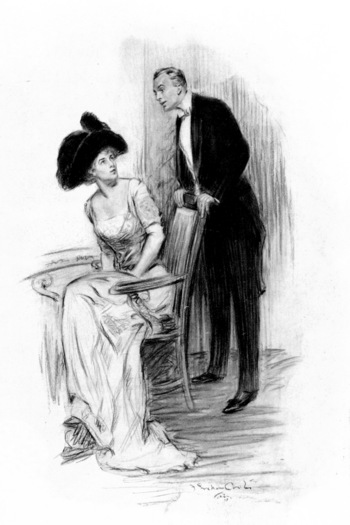
Dan, who had laid down his overcoat and hat
on a chair, came quietly forward, his hands
in his pockets, and standing in front of the
Jew, he said again:
“Now you look here—”
Letty Lane threw the money down on the
dressing-table. “Please,” she cried to Dan, “let
me have the pleasure of sending this man out of
my room. You can go, Cohen, and go in a
hurry, too.”
The Jew stuffed the pearls in his pocket and
went by Dan hurriedly, as though he feared the
young man intended to help him. But Dan
stopped him:
“Before this deal goes through I want you to
tell me why you are—”
Miss Lane broke in: “My gracious Heavens!
141
Can’t I even sell my jewels without being
bossed? What business is it of yours, Mr.
Blair? Let this man go, and go all of you—all
of you. Higgins, send them out.”
The blind man and the child stirred, too, at
this outburst. The little girl wore a miserable
hat, a wreck of a hat, in which shook a feather
like a broken mast. The rest of her garments
seemed made of the elements—of dirt and mud—mere
flags of distress, and the odor of the poor
filled the room: over the perfume and scent and
smell of stage properties, this miserable smell
held its own.
“Come, Daddy,” whispered the child timidly,
“come along.”
“Oh, no, not you, not you,” Letty Lane said.
Job Cohen crawled out with ten thousand
pounds’ worth of pearls in his pockets, and as
soon as the door had closed the actress took up
the roll of notes.
“Come here,” she said to the child. “Now
you can take your father to the home I told you
142
of. It is nice and comfortable—they will treat
his eyes there.”
“Miss Lane—Miss Lane!” called the page
boy.
“Never mind that,” said the actress, “it is a
long wait this act. I don’t go on yet.”
Higgins went to the door and opened it and
stood a moment, then disappeared into the side
scenes.
Letty Lane ruffled the pile of banknotes and
without looking drew out two or three bills, putting
them into the child’s hands. “Don’t you
lose them; stuff them down; this will keep you
and your father for a couple of years. Take
care of it. You are quite rich now. Don’t get
robbed.”
The child tremblingly folded the notes and
hid them among her rags. The tears of happiness
were straggling over her face. She said
finally, finding no place to stow away her riches,
“I expect I’d best put them in daddy’s pocket.”
And Dan came to her aid; taking the notes
143
from her, he folded and put them inside the
clothes of the old beggar.
“Miss Lane,” said Higgins, who had come in,
“it is time you went on.”
“I’ll see your friends out of the theater,”
Blair offered. And as he did so, for the first
time she looked at him, and he saw the fever in
her brilliant eyes.
“Thanks awfully,” she accepted. “It is perfectly
crazy to give them so much money at
once. Will you look after it like a good boy and
see something or other about them?”
He thought of her, however, and caught up
a great soft shawl from the chair, wrapped it
around her tenderly, and she flitted out, Higgins
after her, leaving the rest of the money
scattered on her dressing-table.
“Come along,” said Blair kindly to the two
who stood awaiting his orders with the docility
of the poor, the obedience of those who have no
right to plan or suggest until told to move on.
“Come, I’ll see you home.” And he didn’t leave
144
them until he had taken them in a cab to their
destination—until he had persuaded the girl to
let him have the money, look after it for her,
come to see her the next day and tell her what
to do.
Then he went back to the theater and stood
up in the rear, for the house was crowded, to
hear Letty sing. It was souvenir night; there
were post-cards and little coral caps with feathers
as bonbonnières. They called her out before the
curtain a dozen times, and each time Dan wanted
to cry “Mercy” for her. He felt as though
this little act had established a friendship between
them; and his hands clenched as he
thought of Poniotowsky, and he tried to recall
that he was an engaged man. He had an idea
that Letty Lane was looking for him through
the performance. She finished in a storm of applause,
and flowers were strewn upon her, and
Dan found himself, in spite of his resolution,
going back into the wings.
This time two or three cards were sent in.
145
One by one he saw the visitors refused, and Dan,
without any formality, himself knocked at Letty
Lane’s small door, which Higgins opened, looked
back over her shoulder to give his name to her
mistress, and said to Dan confidently, “Wait,
sir; just wait a bit.” Her lips were affable. And
in a few moments, to Dan’s astonished delight,
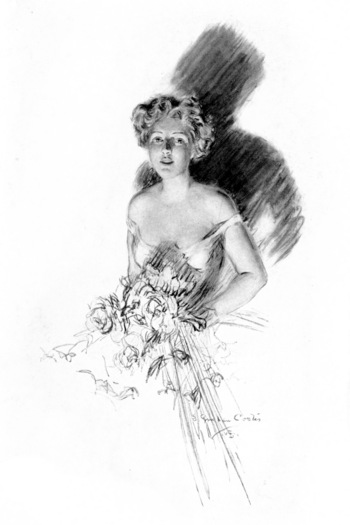
the actress herself appeared, a big scarf over
her head and her body enveloped in her snowy
cloak, and he understood with a leap of his heart
that she had singled him out to take her home.
She went before him through the wings to the
stage entrance, which he opened for her, and she
passed out before him into the fog and the mist.
For the first time Blair followed her through the
crowd, which was a big one on this night. On
the one side waited the poor, who wished her
many blessings, and on the other side her admirers,
whose thoughts were quite different.
Something of this flashed through Dan’s mind,—and
in that moment he touched the serious part
of life for the first time.
146
In Letty Lane’s motor, the small electric light
lit over their heads and the flower vase empty,
he sat beside the fragrant human creature whom
London adored, and knew his place would have
been envied by many a man.
“I took your friends to their place all right,”
he told her, “and I’m going to see them myself
to-morrow. I advised the girl not to get married
for her money. Say, this is awfully nice
of you to let me take you home!”
She seemed small in her corner. “You were
great to-night,” Dan went on, “simply great!
Wasn’t the crowd crazy about you, though!
How does it feel to stand there and hear them
clap like a thunderstorm and call your name?”
She replied with effort. “It was a nice audience,
wasn’t it? Oh, I don’t know how it feels.
It is rather stimulating. How’s the other boy?”
she asked abruptly, and when Dan had said that
Ruggles had left him alone in London, she
turned and laughed a little.
Dan asked her why she had sent for him to-day. “I’m
147
mighty sorry I was out of town,” he
said warmly. “Just to think you should have
wanted me to do something for you and I didn’t
turn up. You know I would be glad to do anything.
What was it? Won’t you tell me what
it was?”
“The Jew did it for me.”
And Dan exclaimed: “It made me simply sick
to see that animal in your room. I would have
kicked him out if I hadn’t thought that it would
make an unpleasant scene for you. We have
passed the Savoy.” He looked out of the window,
and Letty Lane replied:
“I told the driver to go to the Carlton first.”
She was taking him home then!
“Well, you’ve got to come in and have some
supper with me in that case,” he cried eagerly,
and she told him that she had taken him home
because she knew that Mr. Ruggles would approve.
“Not much you won’t,” he said, and put his
hand on the speaking tube, but she stopped him.
148
“Don’t give any orders in my motor, Mr.
Blair. You sit still where you are.”
“Do you think that I am such a simple youth
that I—”
Letty Lane with a gesture of supreme ennui
said to him impatiently:
“Oh, I just think I am pretty nearly tired to
death; don’t bother me. I want my own way.”
Her voice and her gesture, her beauty and her
indifference, her sort of vague lack of interest
in him and in everything, put the boy, full of
life as he was, out of ease, but he ventured, after
a second:
“Won’t you please tell me what you wanted
me to do this afternoon?”
“Why, I was hard up, that’s all. I have used
all my salary for two months and I couldn’t
pay my bill at the Savoy.”
“Lord!” he said fervently, “why didn’t
you—”
“I did. Like a fool I sent for you the first
149
thing, but I was awfully glad when five o’clock
came you didn’t turn up. Please don’t bother or
speak of it again.”
And burning with curiosity as to what part
Poniotowsky played in her life, Dan sat quiet,
not venturing to put to her any more questions.
She seemed so tired and so overcome by her own
thoughts. When they had turned down toward
the hotel, however, he decided that he must in
honor tell her his news.
“Got some news to tell you,” he exclaimed
abruptly. “Want you to congratulate me. I’m
engaged to be married to the Duchess of Breakwater.
She happens to be a great admirer of
your voice.”
The actress turned sharply to him and in the
dark he could see her little, white face. The
covering over her head fell back and she exclaimed:
“Heavens!” and impulsively put her hands
out over his. “Do you really mean what you
say?”
150
“Yes.” He nodded surprisedly. “What do
you look like that for?”
Letty Lane arranged her scarf and then drew
back from him and laughed.
“Oh, dear, dear, dear,” she exclaimed, “and I ... and I have been....”
She looked up at him swiftly as though she
fancied she might detect some new quality in him
which she had not observed before, but she saw
only his clear, kind eyes, his charming smile and
his beautiful, young ignorance, and said softly
to him:
“No use to cry, little boy, if it’s true! But
that woman isn’t half good enough for you—not
half, and I guess you think it funny enough to
hear me say so! What does the other boy from
Montana say?”
“Don’t know,” Dan answered indifferently.
“Marconied him; didn’t tell him about it before
he left. You see he doesn’t understand England—doesn’t
like it.”
A little dazed by the way each of the two
151
women took the mention of the other, he asked
timidly:
“You don’t like the Duchess of Breakwater,
then?”
And she laughed again.
“Goodness gracious, I don’t know her; actresses
don’t sit around with duchesses.” Then
abruptly, her beautiful eyes, under their curled
dark lashes, full on him, she asked:
“Do you like her?”
“You bet!” he said ardently. “Of course I
do. I am crazy about her.” Yet he realized, as
he replied, that he didn’t have any inclination to
begin to talk about his fiancée.
They had reached the Carlton and the door of
Letty Lane’s motor was held open.
“Better get out,” he urged, “and have something
to eat.”
And she, leaning a little way toward him,
laughed.
“Crazy! Your engagement would be broken
off to-morrow.” And she further said: “If I
152
really thought it would, why I’d come like a
shot.”
As she leaned forward, her cloak slipping
from her neck, revealing her throat above the
dark collar of the simple dress she wore, he looked
in her dove-gray eyes, and murmured:
“Oh, say, do come along and risk it. I’m
game, all right.”
She hesitated, then bade him good night languidly,
slipping back into her old attitude of indifference.
“I am going home to rest. Good night. I
don’t think the duchess would let you go, no
matter what you did!”
Dan, standing there at her motor door, this
beautiful, well-known woman bantering him,
leaning toward him, was conscious of her alone,
all snowy and small and divine in her enveloping
scarf, lost in the corner of her big car.
“I hate to have you go back alone to the
Savoy. I really do. Please let me—”
But she shook her head. “Tell the man the
153
Savoy,” and as Dan, carrying out her instructions,
closed the door, he said: “I don’t like that
empty vase in there. Would you be very good
and put some flowers in it if they came?”
She wouldn’t promise, and he went on:
“Will you put only my flowers in that vase
always hereafter?”
Then, “Why, of course not, goose,” she said
shortly. “Will you please let me close the door
and go home?”
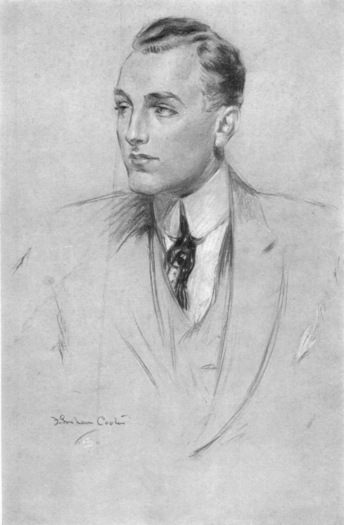
Dan walked into the Carlton when her bright
motor had slipped away, his evening coat long
and black flying its wings behind him, his hat on
the back of his blond head, light of foot and
step, a gay young figure among the late lingering
crowd.
He went to his apartments and missed Ruggles
in the lonely quiet of the sitting-room, but as the
night before Ruggles had done, Dan in his bedroom
window stood looking out at the mist and
fog through which before his eyes the things
he had lately seen passed and repassed, specter-like,
154
winglike, across the gloom. Finally, in
spite of the fact that he was an engaged man
with the responsibilities of marriage before him,
he could think of but one thing to take with
him when he finally turned to sleep. The face
of the woman he was engaged to marry eluded
him, but the face under the white hood of Letty
Lane was in his dreams, and in his troubled visions
he saw her shining, dovelike eyes.