"Life is pleasant here," said Brett. "Pleasant, and indolent. It does
not make for progress, but it is happiness—and I'm beginning to wonder
if that is not best, after all."
We were sitting in an arcaded passage on the roof of the home where
Brett lived. Crescent archways opened to the roof, where stood banks
of vivid flowers, with a vista of the city beyond. The building seemed
of baked earth, rough like adobe, and of dull orange color. It was a
two-storied, crescent-shaped structure, set upon a wide street-corner
near the edge of the city. The home of Leela's father. I had never
forgotten Leela—the girl Brett and Martt had rescued from the giant on
their first visit here. Brett had fallen in love with her. It was she
whom tonight he was to marry. And this was her father's home—Greedo,
the old musician.
"I have lived here with them six months," Brett said.
Martt exclaimed, "Six months! Why Brett, you have been gone four years!"
We had miscalculated the Time-change of the vehicle. Our purpose had
been to strike this realm of the Inner Surface at a point in Time which
to Brett would be four years. But now we found it six months only.
Brett smiled. "I'm glad you didn't postpone your arrival. You've no
idea how pleased I am to have you—tonight of all nights."
We had not yet seen Leela, or her father. Brett said that Leela would
be up presently to greet us. The city was excited over our coming. A
crowd was gathered in the street before the house; Brett had made them
a brief speech; Frannie, Martt and I had stood at the parapet and waved
to them.
Then Brett had spoken of a younger sister of Leela's. Her name was
Zelea—they called her Zee.
Martt sat up at this. "Where was she when we were here before?"
"Away," said Brett. "She was too young to meet a man then. Only now has
she come to be sixteen. You'll like her, Martt. I want you to like her."
"I will," said Martt enthusiastically, "if she's anything like Leela."
"You were telling us about the life here," I suggested. "We always
called this land the Inner Surface——"
"Yes," he agreed. "It is concave, like the inner shell of some great,
hollow globe. Within the space it encloses——" He gestured to where,
through the arcade, a segment of purple, star-filled sky was visible.
"All that which we of Earth called the Celestial Universe is enclosed
by this concave shell. You would think that this must be a gigantic
region——" He smiled again. "It is not. Compared to our present
enormous size, I imagine the circumference of this Inner Surface is
not unduly great. I don't know. These people have not explored very
far. They are not wanderers—they are too indolent, too contented, to
wander."
He paused to drink from a shallow receptacle which stood before us, and
offered Martt and me what appeared to be arrant cylinders to smoke.
"I have learned a little of the language. Proper names are impossible
to translate. But the meaning of their word for this land, I call
in English. Romantica. The romantic land. It is, I fancy, about
five hundred miles square. Beyond it lie forests and mountains. No
one here has ever penetrated them. There are wild beasts, birds,
insect life—and fish and reptiles in the water. But they are not
dangerous—not aggressive. It is not because of them that these people
avoid exploration. It is—just indolence."
"I don't wonder," I said. "This is very peaceful here—I have no
desire to do anything in particular." From the city streets a drone of
activity floated up to us; but it was almost somnolent.
"It's always like this," said Brett. "Almost no change of seasons—the
light always the same. There is no disease here—or very little.
Food—grains, and what we would call vegetables, grow abundantly in
this rich soil. The trees give milk—even the bark and pulp of them are
edible. Life is easy. There is nothing to struggle against.
"Through generations, it has made the people kindly. There is little
crime. No struggle for land, or food or clothing. Crimes involving
sex——" He gestured. "Wherever humans exist there will be crimes of
that origin. But our women here are very sensible, and when a woman
does what is right—well, you know, don't you, that most deeds of
violence into which men plunge over women have a woman's wrong actions
at the bottom of them? There is little of that here, for the women take
care that there shall not be.
"So they call their country Romantica. They are not a scientific
people. They do not struggle for advancement. Art has taken the place
of science. Painting. Sculpture. Music. They have developed music
very far. It has a soul here. It speaks—it sings—it seems a living
entity. It is—what music ought to be, but seldom is—the pure voice
of love, of romance. . . . I was telling you about our country. Most
of its population live in villages, and in individual dwellings
strewn about the hills. There are but two large cities. This one—the
largest—they call Crescent. Or at least their word for it suggests the
shape of the lake. The other city is about fifty miles from here"—he
gestured again—"off there where you see the line of mountains. They
call it Reaf. It's a quaint city. Built largely over the water—rivers
there—hot, subterranean rivers which rush underground—under the
mountains. They go—who knows where? No one has ever been down them.
The mountains are honeycombed with caves, tunnels, passages leading
within, and up. Always up. But into them no one has ever penetrated.
Legends tell fabulous tales of a great world up there. The giants, we
think——"
When Brett and Martt had first come here, giants had appeared.
Dwindling giants—strange, savage beings of half-human aspect. They
had appeared—no one knew from where. Growing smaller until they were
normal size to this realm. Not many had been seen. Some had kept on
dwindling; they had grown so small, when attacked, that they had become
invisible. At the thought, I moved my foot involuntarily with a shudder
of uneasiness. Here on the floor beside me now, men like beasts might
be lurking, so small I could not see them. Yet in a moment they might
grow to a stature greater than my own. . . .
Men like beasts! . . . And I remembered that, with size gigantic, they
had destroyed the third city of Romantica.
Upon Brett's face lay a cloud of apprehension. "We have never heard
from them since. It is thought—I think myself—that they came from
the subterranean rivers, or through the underground passages of the
mountains. I conceive this concave surface upon which we're living
to be the inner surface of a shell. It may not be very thick—there
at Reaf. Above it—beyond it—up or down are mere comparative
terms—beyond it must lie some vastly greater outside world. This whole
realm is doubtless within an atom of that greater world. It would be a
convex surface up there—with a sky and stars beyond. . . .
"We have never seen the giants since that time when Martt and I rescued
Leela. Everyone here seems to have forgotten them——" Brett's voice
was heavy with apprehension. "These people are so trustful! They forget
so quickly! No one worries. Our rulers here—a venerable man and woman
long past the age when death is expected—are so gentle, kindly, that
they can not imagine harm coming to their people. They have forgotten
the Hill City which the giants destroyed. Trampled upon it! Six or
eight giants—they must have been several hundred feet tall—stamping,
kicking the building! I've been there—I've seen the ruins—strewn for
miles—and with buildings, colonnades and terraces mashed into the
ground! There were no more than half a thousand people surviving that
destruction of the Hill City—and thousands died. But everyone says
now, 'The giants are gone. We are safe.'"
Brett's voice had risen to a swift vehemence. "It's been like living
on a volcano to me, all these months. There are no weapons here. My
own few flash-cylinders—of what use would a tiny flash of lightning
be against beings so gigantic? We've got to do something. For if those
giants come again——"
A step sounded in the oval doorway near at hand. Leela stood
smilingly, deprecatingly before us.
II
Brett said, "Come here, Leela. This is my sister, and my friend, Frank
Elgon. And here's Martt."
Leela advanced hesitantly, her face a wave of color as she met our
gazes. She was smaller, and even slighter than Frannie, her figure
adorned and revealed by its single, simple garment—more like a short,
glistening veil than a dress. Her hair was long and dark, caught by
a band at her neck, and flowing free beneath. Her arms and legs were
bare. At her wrists, gray-blue bands with small tassels; on her feet,
queerly high-heeled wooden sandals, with tasseled thongs crossing on
her ankles. The sandals clacked as she walked; her step was mincing,
with a suggestion of the Orientals of our Earth.
Brett eyed the sandals with a humorous twinkle. "For why are those,
Leela?"
Her blush heightened. "In honor of our guests. I thought you would like
them."
With a swift gesture, she stooped, untied the thongs and cast the
sandals off. Her feet were very white, small and delicately formed,
with rounded, polished nails stained pink. She stood untrammeled, lithe
and graceful as a faun.
"I am glad to meet Brett's sister—and his friend. And you, Martt—I
am glad to see you again." Her voice was soft as a Latin's. She shook
hands with Martt and with me, and returned Frannie's affectionate
embrace.
As I saw them together—these two girls of different worlds—I was
struck with the dissimilarity of them. Pert, vivacious little Frannie,
blue-eyed, fair of hair—brown-skinned from the outdoor life she loved.
And Leela—smooth, white skin, dark hair and luminous eyes, a fragile
grace to her every movement. None of my words are adequate. There was
about her an aura of romance; a strange wild spirit of something for
which every man in his soul has a longing; a beauty with a quality
ethereal—half human, but half divine.
A twinge of conscience came to me that I—Frank Elgon—could think such
thoughts and see such beauty in any girl who was not Frannie.
Leela was saying, "My father would have you come down soon. And Zee is
down there—Zee is very much excited, Brett. There is so much to do
before tonight——"
Brett's arm was around her. "And you—of course you're not excited, are
you, Leela?"
She returned his caress, embarrassed further by his teasing. He added,
"We will be down presently."
"Yes," she said; and with a pretty gesture, she left us.
The sandals lay discarded on the floor. Brett gathered them up,
regarding them tenderly. "She is so easy to tease, I love to do it. But
if you try that with Zee——"
"You shouldn't tease her," said Frannie. "She's a darling. I love her
already."
Brett's wedding day! For all his quiet, whimsical teasing of Leela,
the love he bore her enveloped him like a shining cloak. Yet his
father whom he loved so dearly was dead, and Brett did not know it. I
whispered to Martt about it later.
"I think we should not tell him," said Martt. "Not—until we have to."
And we did not. Looking back on it now, how much was to happen to
Brett—to Martt, to us all! What fearsome things—danger, desperation,
despair—were to be our allotted portion before we even thought again
of old Dr. Gryce who was dead!
III
Brett was to be married that evening—a public festival and ceremony
over which the whole city was in an anticipatory fever.
"The festival of lights and music," said Brett. "They hold it at
periodic times. It is a wonderful sight. It generally includes a
marriage—girls find it romantic. Leela selected it for us. Greedo
is in charge of it—Leela and Zee always take part in its music. We
must go down—they are waiting for us—there is so much for them to do
between now and this evening."
"I'll help," said Frannie. "Come on, Martt—I guess you want to meet
Zee, don't you?"
IV
We found Leela's father to be a grave, black-robed, kind-faced old man
of an age indeterminate. Sixty, or eighty, I could not have told. In
vigorous health, evidently. His figure was spare, straight, but not
tall. His thick, gray-black hair he wore long to the base of the neck.
He greeted us quietly, with an admirable dignity commanding immediate
respect.
"You are a musician," I said, after we had been talking for a time.
"Brett has told us something about your music here. It must be very
beautiful."
He smiled. "Music is a wonderful thing. It ennobles. There is in it
a touch of something beyond our poor human understanding. A touch
of—what you call Divinity."
"You speak our language very well," I exclaimed.
"A language is not difficult. All minds are similar—that is why music
can make so universal an appeal." His voice was earnest, his eyes
sparkling. It was the subject most absorbing to him.
I said, "You teach music——"
He raised a deprecating hand. "Yes. But that is nothing. I teach the
fundamentals"—he struck his breast—"the rest comes from within. For
myself, I am a mere retailer of sound. A peddler of something someone
else has made. The composer—he is the real artist. I have hoped that
some day Leela will compose. Brett has promised that he will urge
her. . . . Just now, she sings." He twinkled at Leela. "I fear she
thinks she sings very well. Pouf! It is nothing! She, too, is only a
sound-peddler."
With a burst, Zee entered the room. A smaller replica of Leela. Yet how
different! She came like a mountain torrent tumbling from the hillside.
Her short, dull-red draperies whirled about her elfin figure. Her dark
eyes were blazing. Black hair, flying over her shoulders with her
tumultuous entrance.
"Father! That is not so!" She stamped one of her bare feet, then rose
on strong, supple toes and whirled half around. The muscles stood out
beneath the smooth satin skin of her calves. "Leela, why do you let him
say such a thing? You sing beautifully." She whirled back. "And what am
I, then?"
The old man was wholly unperturbed. "You, Zee? Why, you are a peddler
of movement. Very swift, tempestuous movement, generally." He added to
me, "She thinks she is an artist. She is not. She is only a dancer."
V
It was what on Earth would have been termed late evening when we
started for the festival. Greedo, with his two daughters, had left half
an hour before.
We were dressed now in the fashion of the country. Brett had suggested
it; Martt had insisted upon it. I remembered with what a jaunty
swagger Martt had worn his clothes upon his return to Earth that
other time. He was dressed similarly now. A cloth shirt of glaring
green, with a high, rolling collar in front, and low in the back;
short trousers very wide and flapping at the knee. The trousers were
a lighter green, with dark green stripes; his stockings were tan; and
his green shoes were long and pointed. Over his shirt was a short tan
jacket, wide-shouldered and with puffed sleeves, and bangles dangling
from elbows and wrists. And there was a skirt to the jacket, rolling
upward at the waist.
My own costume was in the same fashion; and though it was a sober gray,
befitting my more mature years, I felt for a time awkward and foolish
in it. But when in the crowded city streets I found that no one seemed
particularly to remark me, I soon forgot it.
Brett wore a long cloak; I did not see how he was dressed. Frannie also
wore a cloak. Just before leaving she tossed it aside, and stood before
me, waiting for my admiration, with her characteristic twinkle, and her
pert upflung face daring me to disapprove. Even by contrast with Leela
and Zee, to my eyes at least Frannie was very pretty. She wore the
single draped garment with silver cords crossed at her breasts to shape
her figure; and with banded wrists, and tasseled bands above the knees.
Her blond curls were tied with flowing tassels. The whole costume, a
gray and blue, with a single deep-blue flower in her hair. And thin,
flexible sandals on her little feet.
She eyed me. "Do you like me, Frank?"
"I—why, why—Frannie——" I would have told her then that I loved her,
as I had very nearly told her myriad times in ten years past. But who
was I to ask the love of any girl? A sorter of planetary messages, poor
as a towerman in the lower traffic! "I—why yes, Frannie. Of course I
like you. You're—beautiful."
She had a quaint little circular hat, stiff and round, with a dull-red
plume and a tassel. We men wore hats of a solidly wooden aspect—low,
round crowns and triangular brims. Martt's was sea-green, with tassels
all around its brim. But mine and Brett's were sober gray, and
unadorned.
We started on foot. The city streets were dim in the luminous twilight.
Overhead, the sky with its thin-strewn stars was cloudless. A holiday
aspect was everywhere. Crowds of people were in the streets. Young men
and girls, gay with laughter. Most of them were cloaked. A vehicle,
with runners like a sleigh gliding over the grassy pavement, drawn by a
squat, four-legged animal, went by us. It was jammed with girls; one of
them leaned out and waved at me. Her slim white arm came down; her hand
twitched off my hat, sent it spinning. I caught a glimpse of her face;
dark, laughing eyes, a mouth with mocking lips stained red. . . .
The sleigh passed on.
With Brett leading us we turned toward the lake. Most of the crowd
seemed to be heading that way. Occasionally we were recognized. Stares
of interest at us, the strangers, and cheers for Brett.
He said to me, "They're all very happy, Frank. Like children." I
fancied that he sighed—he, for whom this night of all nights should
have been his happiest.
In a group, with the swirling merrymakers about us, we made our way
to the lake shore. The water was rippled by a gentle night breeze;
the stars gleamed on the water surface with tiny silver paths. Boats
were here—double canoes with outriders; and a few sailboats, small,
single-masted, with triangular and crescent sails.
We found a small canoe; Brett sculled it with a broad-bladed paddle.
Other boats were around us. A long canoe with a dozen sweeping
paddles shot by us with the racing strokes of its men, and with
shouts from its laughing girls. Another, smaller, turned over. Its
men swam, and righted it. They climbed aboard, hauling up the girls.
The wet draperies clung to them; they came up like dripping, gleeful
water-sprites, tossing their black hair. . . . A barge went slowly
along, drawn by two canoes. A lighted canopy was over its occupants—a
huge, woven garland of flowers. The canopy gleamed with spots of
vivid-colored lights.
"The luminous flowers," said Brett. And I saw that the large purple
blossoms were gleaming with a purple light—a phosphorescence inherent
in them; and red blossoms, like crimson lanterns; and others orange,
and green. Music floated upward from the barge, soft and sweet over
the water. The tinkle of strings—the voices of girls singing, and men
humming with a deeper background of harmony. . . .
A night for love-making. The night romantic. Brett's wedding night—and
yet, he had sighed. I knew why, for upon my own heart lay a weight
of apprehension, heavier because it was so incongruous. Martt quite
evidently did not feel it—he was shouting and laughing constantly
with his pleasure. A girl from a neighboring boat tossed him a large,
blood-red, glowing blossom. It fell short, went into the water and
slowly sank, staining the water with its red light. Martt all but
turned us over trying to rescue it.
Frannie, too, seemed gay. I tried to smile; but I felt that it was
forced. The depression upon me would not be shaken off. It grew to
seem almost sinister. The very atmosphere of happiness around me seemed
to intensify it. These merrymakers—in the midst of life. . . . At such
a moment as this, death could choose to strike. . . .
"Look!" shouted Martt. "The lights off there—is that where we're
going?"
A patch of gay-colored lights gleamed from over the water ahead. "Yes,"
said Brett. "An island there, where they hold the festival. It's not
far."
It was an irregular circular island, a mile perhaps in extent. The lake
waters indented it with a hundred tiny bays, inlets, and narrow, placid
waterways. We ascended one of them. The surface of the island was
gently undulating, and wooded, with mossy dells—nooks arched with the
luminous flowers. Nooks for love-making.
The whole island was strewn thick with the flowers; they grew upon
tall, single stems—gay-colored lanterns nodding in the breeze. Beneath
them were laughing couples; some hidden, sought and found by groups of
marauding girls, to seize the man and laughingly whisk him away. And
everywhere was music, soft as an echo. . . .
We ascended the narrow waterways, came to a lagoon with a glassy
surface wherein a thousand spots of the lantern-flowers were
mirrored like colored stars. Near the shore here, beyond a dock at
which we landed, was a broad enclosed space with an arcade of the
lantern-flowers arching over it. Brilliant with their light. Most of
the crowd seemed congregated there—a milling throng on the level floor
inside, with liquid strains of music mingling with the shouts and
laughter.
"We'll go in there," said Brett. "I'll find seats for you—then I must
leave, to join Leela and her father. There is to be a musical program.
But first—just Greedo, Zee and Leela, and our marriage. Most of the
music comes afterward."
Within the arcade the lights blended into a kaleidoscope of color. All
the cloaks were discarded now. Costumes vividly splashed as a painter's
palette. Heavy perfumes. And that soft, echoing music. I could not tell
its source.
At one end of the room was a raised, canopied platform, with doors
behind it. Most of the crowd were choosing low seats, like stools
ranged in rows. Brett got us settled.
"I'll leave you now—and meet you over there by the right-hand end of
the platform, afterward."
He left us. With Frannie between us, Martt and I sat quiet, watching
and listening. We had not long to wait. The light around us began to
dim; sliding curtains were obscuring the flowers over us. A hush fell
upon the crowd. The soft music was stilled. A hush of expectancy.
The arcade was in gloom. The light on the platform intensified. A
deep-red glow, with a single spot focused upon a small, raised dais.
Into the red glow came Greedo, robed unobtrusively in black. He was
carrying a crescent frame of strings. He seated himself, and in the
silence swept his hands across the strings. His fingers plucked them
like a harp; and then his other hand slid upon them. The staccato
notes rippled clear as a mountain rill, soft, muted to seem an echo of
music. And blended with them was a low, crying melody—a fragment, then
silence.
Leela had appeared. She crossed through the red glow, mounted the
dais, and stood in the silver light—Leela, robed to her feet in a
misty silver veil through which her figure vaguely was outlined. She
stood there drooping—a Naiad veiled in the fountain mist. . . . Then
Greedo's music sounded. And Leela sang.
It was like nothing I had ever heard before. Music, toned strangely,
with strange intervals to make it neither major nor minor. Not
happiness, nor yet sadness. A wistfulness. A longing. But with the
promise of fulfilment.
I listened, breathlessly; and the arcade around me faded. Greedo's
figure in the shadow was forgotten. There was only the white figure of
Leela; her face, the purity of girlhood, her eyes half closed, her lips
parted with the song. Nothing else—save myself. I stood in a void,
stretching out my arms to Romance. All that I had ever dreamed, and
vaguely longed for without understanding what it meant, was upon me.
All that woman could mean to man—the spirit of the ideal never to be
attained in mortal flesh—seemed suddenly attained. Romance—that thing
elusive—intangible as a thought in the vaguest of dreams. It was mine!
The song ended. Applause rang out. Leela was gone.
Martt breathed beside me, "Frank! Wasn't that—wonderful! It was
like——Look, here comes Zee!"
Zee was on the platform—a whirlwind of veils, stained by the red
light, white limbs flashing as she whirled. Greedo's music was faster
now. Snapping staccato, with a thrum of melody. The lights changed to
a mingled riot of color within which Zee was dancing. An elf. A sprite
of the woodland, with tossing hair and fluttering arms; and a laughing
face. . . . A figure in the fairy-tale of a child. . . .
But only for a moment. Then the dance slowed. Maturity came suddenly.
Zee mounted the dais, and the light there was abruptly green. She stood
in an attitude of terror, her eyes wide, hands before her, posturing
with horror.
It made my heart leap. For an instant I fancied it had been real. But
the light turned silver. The horror faded into a passion of love,
her white arms extended, her breasts rising and falling beneath the
veils, her red lips parted with passionate longing. The abandonment
of youth—so young, with newly awakened passion as yet but half
understood. Then again she was whirling around the platform, leaping on
her bare toes, light as a faun. . . .
Behind me, suddenly a woman screamed! The reality of a long scream
of terror! Greedo's music ceased. The lights wavered. Zee was gone.
A scream from the audience; then another. A chaos of mingled cries.
Clattering of feet. Stools overturned. . . . Someone fell against me. I
went down, recovered and climbed upright. The audience was in a panic.
I heard Martt shout, "Look, Frank! Look there over the water!"
People were pushing me—surging to escape from the arcade. Shouting.
Calling to one another. And the woman behind me was still screaming.
I saw it then. Through the open side of the arcade, out a mile or
more over the water, the great giant figure of a man was standing,
waist-deep in the lake, his naked torso towering a hundred feet above
it. A giant, wading in the lake, his face grotesque, malevolently
grinning in the starlight!
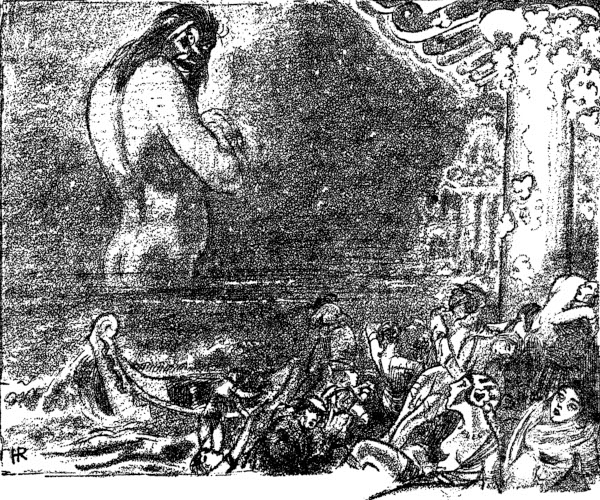
"The giant grinned malevolently in the starlight."
VI
The crowd within the arcade was in a wild panic of terror. I was pushed
and shoved, knocked down by heedless, rushing figures. Everyone was
trying to get outside. In a moment I was swept away. I could not get
back to where I was sitting, or even tell where the spot had been.
Martt and Frannie I could not see; the place was all a dim chaos of
disheveled, panic-stricken figures. A moment before they had been so
gay and jaunty! . . .
A girl rushed past me. The veiling had been torn from her shoulders.
Her eyes for an instant met mine, as she searched my face hoping to
recognize in me the companion from whom she had been separated. Her
dark eyes were wide, red-rimmed with fear. Her face, with all the
beauty of youth gone from it, was chalk-white.
She turned and rushed away from me. I thought again, "In the midst of
life . . . why, this is horrible!" That giant off there—he could wade
to the island in a few moments. . . .
I fought my way out of the arcade, out under the trees by the edge
of the lagoon. There was more room out there. In the starlight I
could see figures rushing aimlessly away, scattering under the
lantern-flowers . . . others hurriedly crowding the boats. One boat was
overturned. I wondered vaguely if the struggling figures in the water
would be drowned.
Back near the wall of the arcade I saw a girl's figure running. It
seemed familiar. Was it Frannie? I dashed after her. But people running
in between us blocked me. I lost sight of her; saw her momentarily as
she seemed to dart around the farther arcade corner. But when I got
there, she was not in sight. Was it Frannie? Had she gone this way? Or
into that door, back into the rear of the arcade?
I stood in doubt. Then I saw Brett, running past me, out under the
lantern-flowers some fifty feet away. His cloak was discarded; he was
bare-headed. Brett in his marriage robe! Black and white, with golden
tassels gayly dangling from the rolled skirt of his jacket. He was
disheveled; as he ran, I saw him tear off the jacket impatiently and
toss it away.
"Brett! Oh, Brett!"
He stopped; whirled toward me. "Frank! Where's Frannie—and Martt?"
"I do not know," I said. "I lost them. That giant——"
"The giant is wading the other way now." He pulled me past a thicket,
and pointed. I could see the back of the giant's naked shoulders,
towering up against the stars. He was going the other way—wading
toward the far-distant opposite lake shore. And now against the
island's banks, the waves the giant made were beginning to pound.
Brett said: "I don't know where Leela is. I was in there with her—and
with Zee. I rushed out when the alarm came—when I went back they were
gone." He stood irresolute. "We must find them, Frank. And get back
home." He drew a long breath. "It has come, you see, as I feared."
"I thought I saw Frannie," I said. "Running—that way. But I'm not
sure. I lost sight of her——"
From behind the pavilion came a scream. The scream of a girl.
Familiar. . . . The blood drained from Brett's face. "Leela!"
And then I heard Frannie screaming from there also. We ran. The two
girls were standing there clinging to each other. They seemed unharmed.
But they were trembling, shuddering, arms gripping one another.
"Leela! What is it?" Brett held her off, regarding her. "You're not
hurt, are you? What is it?"
We four seemed alone here beside the arcade. Lantern-flowers were over
us; a thicket was near by. Frannie's arms were around me.
"Frank—oh——" She choked; she seemed struggling to tell me something.
I held her close. "You're not hurt, Frannie. Just frightened. What
became of Martt?"
Oh, horrible! What gruesome, horrible thing was this! Within my arms I
could feel her sensibly shrinking! Her shoulders within my encircling
arm, melting . . . palpably dwindling.
Horrible! And there was a great cry from Brett. "Leela! My God,
Leela——"
At the horror of it, Brett and I stood dumbly staring; and again the
girls clung together. They seemed dizzy; they swayed, almost fell, then
steadied themselves.
Visibly smaller now, like beautifully formed little children, clinging
together, no taller than my waist.
Dwindling!
Then Frannie pointed to the thicket. Two small human figures stood
there—a foot high, no more. A grinning gnomelike man, with black
matted hair on his naked chest; and a woman—a woman thick and
shapeless. A foot in height. But they were shrinking very fast. And
beside them were four small animals with horns—grotesque like a dream
mingling dog and horse and moose. The animals, too, were dwindling.
Brett saw them; but neither he nor I made a move. At our feet Frannie
and Leela, no higher than our ankles now, were gazing up at us, with
tiny upraised arms, pleading.
"Leela! Frannie!" We knelt by them. Then Brett in an agony of terror
lifted Leela in his hand. "Leela! Don't—don't get any smaller!"
Then he put her down. She ran, half fell the distance of my foot to
reach Frannie. And I heard Frannie's tiny voice calling up to us in
gasps, "We're going! He—that man there with the woman—caught us.
Forced—down our throats—a drug. We—going——"
Smaller than my finger. Then so small we knelt to see them. They were
huddled against the side of a pebble. Then they seemed struggling
toward the pebble. Behind it. Under it. Under its curve. . . .
Brett cried, "Don't move, Frank! My God, we might trample on them!
Don't move!"
The figures in the thicket had vanished. By the pebble which Brett
guarded so carefully I thought I saw Leela and Frannie. Saw a movement,
as though an ant were there, hiding under the pebble.
Then—they were not visible. We did not dare look too closely. They
were gone! Still there within a foot of our straining eyes—but so
immeasurably distant! Lost! Gone! Stolen into smallness!