I will now endeavour to describe a typical morning’s tarpon fishing in
the Pass, and one such morning will, with varying results, be found much
as another. The tides of Boca Grand are erratic, yet the guides must
have an accurate knowledge of their vagaries, since on them depends the
duration of the fishing-time. Only in slack water can tarpon be fished
for with any comfort. The tide is, in fact, slacking, as four and twenty
boats drift rapidly down through the Pass and out towards the Gulf, to
row back close in shore and out of the current, and repeat the process.
Presently, as the tide is all but done, some one gets a strike; up comes
a hundred-pounder a second or two later, eight feet in the air, shaking
his head in fury until his gills rattle loudly, then, with a plainly
audible grunt, shaking free first the leads, then the bait, and finally
the hook, all in about a second of time. This performance, however
disturbing to the novice, barely attracts the notice of the old hand,
for he is well accustomed to such treatment, and does not regard his
hook as fast until the fish has made its second jump in vain. Still, the
sight of the fish acts like a magnet on the other boats, which are now
being rowed towards the favoured spot with all the strength of their
guides, who well know that, like most of the herring tribe, tarpon feed
in shoals.
And now I see that the lady-angler who yesterday landed four tarpon, is
fast into another. Up it comes and dashes straight into old “Orange
Blossom’s” boat, all but knocking the old man overboard, and wetting him
through and leaving abundance of slime and scales on his coat; then,
with a couple of kicks that break an oar and knock a crack in the boat,
the tarpon flounders over the side. She must have lost it! No; it is
still on, and there is no doubt about its being well hooked. The guide
is now making frantic efforts to get his boat out of the press and
towards the shore.
Meanwhile there have been two other strikes; one of the fish got away at
the first jump, the other is playing the deuce all round, and now it is
steering straight for “Dibbler’s” boat. “Reel up!” yells the guide, but
that is more than “Dibbler” can do, for is he not fast in his customary
jewfish? About three of these great fish “Dibbler” hooks every day, and
always in the same spot, losing them all with unfailing regularity
through
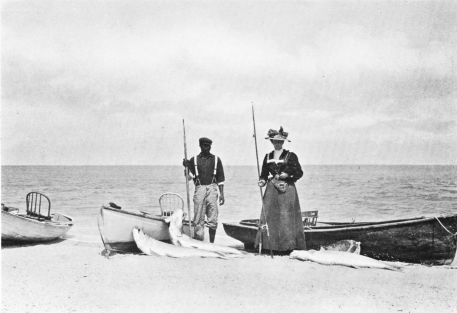
A GOOD CATCH OF TARPON FOR A LADY.
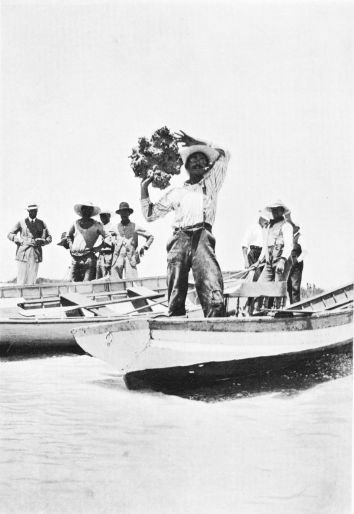
A HOOKED PIECE OF CORAL WHICH WAS MISTAKEN FOR A
JEWFISH.
breakage. It is futile to try and persuade him that just at that spot
the rock rises about fifteen feet higher than on the rest of the reef:
nothing will induce him to keep clear of the rock, and he has his daily
exciting struggles with his impassive and unmoved antagonists.
“Keep away!” he shouts, now “I am going to land this jewfish, whatever
happens!” Yet who can keep a hooked tarpon clear of a given spot?
Already the lady’s tarpon has fouled poor “Dibbler’s” line, and he, all
unconscious, and with a radiant face that beams with anticipation,
shouts out to us the inspiring intelligence that he is moving it at
last, and will certainly land the record jewfish very shortly. Alas! the
tarpon soon cuts through his frayed line, leaving him to float
disconsolately onward and reel in, bemoaning the loss of yet another
jewfish, and just as he was getting the best of it too!
Sometimes one of the lumps of coral is detached, and the novice, and on
occasion even the old hand, will play it for the best part of an hour,
for it may easily be mistaken for a jewfish, a sulky monster that may
weigh up to 300 lb. The deceptive effect is heightened by the drifting
of the boat, and altogether there is much excuse for the error.
It is wonderful, too, how deceptive some of the bolder biting fishes
are. I recollect on one occasion seeing a novice strike, as he thought,
a tarpon, throw himself backwards and play it as he supposed right; his
guide, who also seemed to think it was a tarpon, manœuvred in the
orthodox way, and presently a pound-grouper flew into the boat!
There have now been some seven strikes, with only two tarpon landed, and
sport is somewhat slack. A fair angler carelessly trailing her bait over
the side is suddenly startled by the magnificent leap of a thirty-pound
kingfish, a mighty mackerel, which all but wrenches the rod from her
hands. Away it dashes, taking out line at an appalling pace, foul-hooked
in the eye, but unable to free itself, and at last duly brought to gaff.
What a handsome fish! Particularly noticeable are the knife-edged,
conical teeth, that can cut baits just below the hook as with scissors,
and the small proportion of its fin to its swimming power.
The kingfish is one of the swiftest swimmers in those seas, and the
Spaniards recognise this by calling it “cavalla,” or the horse. I have
shown two figures of kingfish, the one chasing a skipjack, its favourite
food, below the surface, the other leaping in the air and throwing up a
newly-hunted skipjack, an almost invariable habit. Indeed, a kingfish
breaking water always appears to have a skipjack in readiness to throw
up, and this, its next meal, accompanies it for about a third of its
flight. Although the skipjack appears to be knocked out of the water by
the kingfish, and sometimes shows bleeding rents in its sides, it may be
that the leap is a voluntary one to avoid capture, for it is
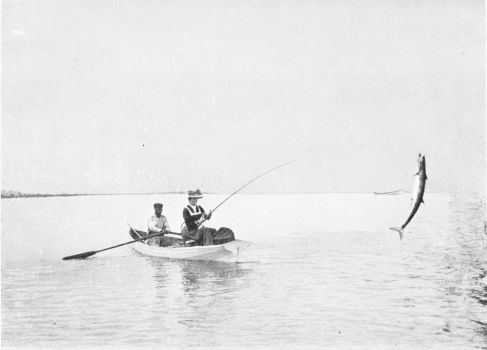
A KING ACCIDENTALLY FOUL-HOOKED.
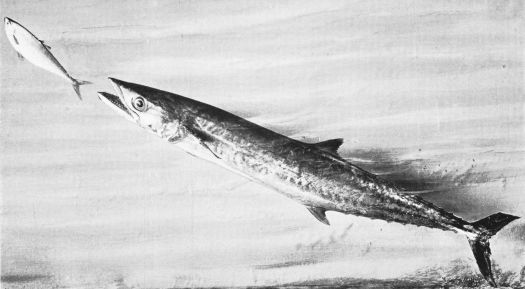
WITH LIGHTNING SPEED THE KING FISH CHASED THE LIVELY
SKIPJACK.
difficult to imagine the object of the kingfish in throwing its prey
into the air. These skipjacks often skip into boats, and exceedingly
beautiful little fish they are, with the steely blue sheen on their
burnished silver coats, and their amber fins and sharply-forked tail.
The damaged tail-fin of the swimming kingfish figured opposite struck me
the moment I caught it, and I came to the conclusion at the time that
the tail-fin had been bitten by a prowling shark that the kingfish was,
thanks to its lightning speed, able to baulk of a more substantial meal.
Of the sharks that infest this coast I shall have something to say later
on. They are numerous and ravenous, and spare nothing, great or small.
And now the tarpon are biting again. There are two, three, four strikes;
three fish have jumped, two are fairly hooked. The excitement grows.
“Hi, you, sir! reel up there. Can’t you see you have fouled that lady’s
line? Cut your line—tell you you have no fish on at all—just cut your
line!”
“Pull like hell!” shouts some one to his guide, as his tarpon rushes in
towards him.
“Pick up that chair, Bill,” cries the guide, a minute later. “My gent’s
fallen out—got to tow him ashore. There goes a rod broken at the butt.”
“Lend us an oar, Sam; mine’s smashed.”
“Come and get it yourself,” sings out the courteous Sam.
“Can’t; got a fish on.”
“Look out! There’s a shark after your tarpon. Where’s your gun?”
“Now, then, you there; where are you shooting?”
And so on, and so on. Six mad tarpon, six mad fishers, six mad guides,
and six quite unmanageable boats dashing about in confusion among near a
score of others. This it is that makes tarpon fishing so fascinating
once you get the true spirit of the thing. In those two hours that we
have been out just nineteen fish were landed out of fifty or sixty
strikes, and more than one boat never got a touch.
As soon as the tide runs too strong boat after boat is pulled ashore,
and every one seeks a shady nook for luncheon, generally under the
lighthouse. Here in the cool we munch our sandwiches and talk tarpon,
every other subject being tabooed at Boca Grand. And how wonderfully has
that big fish of yesterday increased in the night! It was really a fine
fish, scaling, as a matter of fact, 171 lb., and needed no editing. Yet
the man who weighed it called 181 lb. The fortunate angler added a
matter of 10 lb. for loss of weight in transport to the scales. This
somewhat generous allowance for wear and tear brought its already
respectable weight up to 191 lb. That was last night. To-day he speaks
of it as “close on 200 lb.,” and we can infer what that will mean as
soon as he gets back home.
Then, as to its measurements, he left it hanging out last night, and
measured it alone this morning. It hung by one
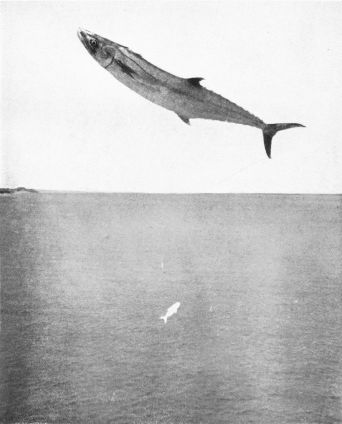
THE KING FISH LEAPT SOME 20 FEET INTO THE AIR, AND UP
WITH HIM CAME A SKIPJACK DEEPLY GASHED ALONG THE SIDE.
jaw, and its own weight must have stretched it by at least three inches.
He is not, however, content with measuring it with the mouth open; he
must needs add another four inches “for luck.” This is only a fair
example of the manufacture of long and heavy fish, and a little study of
such cases will go far to explain not merely the extraordinary shrinkage
in the hands of the taxidermist, but also the otherwise incomprehensible
fact of some sportsmen getting so large a percentage of the heavy fish,
while others score only the average.