A GHOST never makes the mistake of appearing
before more than one person at a time.
There may be much logic in this, for the element
of mystery, which is one of the essential attributes
to comfortable ghostly existence, would be destroyed if
that existence should be established at some one time
and place by a preponderance of unimpeachable testimony.
There is a ghost in my friend Jacobs’ water tower
over in Michigan, or at least there was one there last
Christmas eve. To me he was visible most of the time
during a long interview I had with him, and to me he
had all of the elements of reality. Nobody who reads
this narrative will be in a position to dispute his existence,
for, so far as I know, he and I were the only occupants
of the tower at the time. If my nebulous friend
should choose to make himself known to somebody
else, it may furnish material for discussion and comparison
of experiences in the future, but in the meantime
controversy is quite useless.
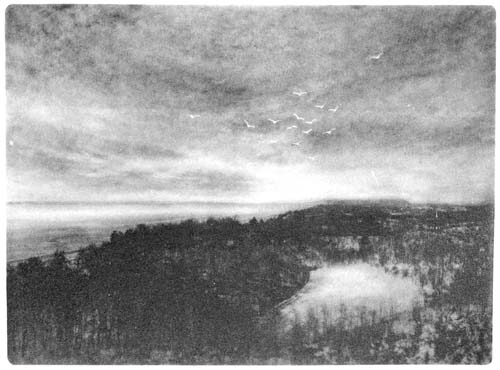
To those who do not live in the world of romance
and errant fancy, the winter landscapes along the eastern
shore of Lake Michigan offer few allurements.
The sweeping miles of piled and broken ice, the bleak
and desolate bluffs, with their pale brows—fringed
with naked trees—in moody relief against the dull
skies, that are flecked with the white forms of the roving
winter gulls, seem to repel every thought except that
of hoped for creature comforts in some human habitation
beyond. If it were not for these distant aureoles
of hope—mirages though they often are—how gray
and dreary the world would be.
Notwithstanding a love of Nature in her sterner
moods, it was not for this that I journeyed to my
friend’s country retreat in the winter time. I knew
that warm hearted hospitality awaited me in the little
farm house, nestled among the knolls back of the bluffs.
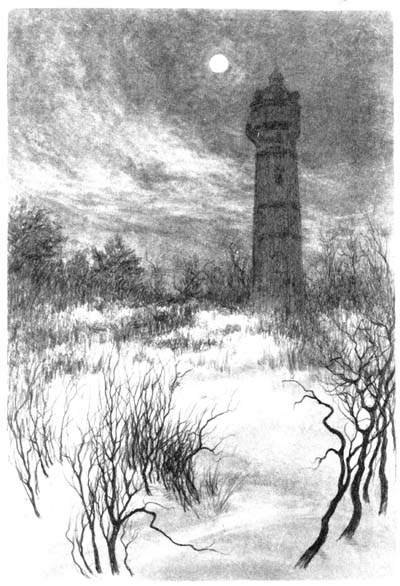
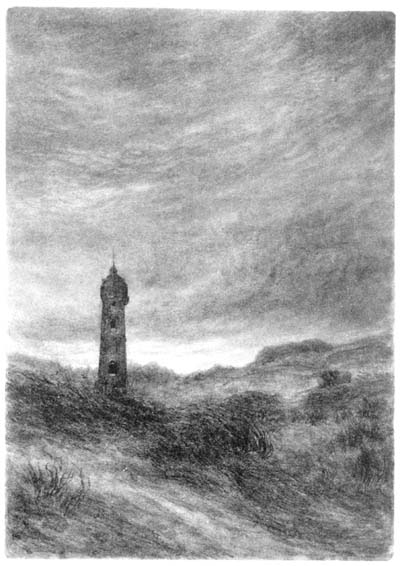
High up on one of the hills of “Jacobia,” the tower
bares its lofty brow to the blasts of the gales. The
huge structure seems calmly to defy the winter winds
whistling through its upper casements and pounding
against its sturdy sides. The swirling snows envelop
its weather scarred top in the darkness, and an atmosphere
of loneliness and isolation seems to pervade
the great bulk, silhouetted against the flying legions
of shredded and angry clouds, scudding across the
gloomy and storm embattled skies at night.
The storm that had lasted all day subsided during
the evening, and the skies cleared, although a mournful
wind still moved over the drifted snows. The genial
glow of the Yule Tide spirit was in the little farm
house. The small evergreen tree that stood in the
front room had been cut on the bluffs and brought
through the storm during the day. Its candle-lighted
branches had been divested of the conventional gauze
bags of popcorn, nuts and candy, much of which was
now scattered over the floors, and the little ones, in
whose hearts lived the happy illusions of childhood, had
hung long stockings about in places where they thought
that the expected Patron Saint would be most apt to
find them. Their melodious saxophone band had become
silent, and their tired loving mother had got
them off to bed.
Melancholy reflections, that sometimes creep into
older minds with Christmas memories of years that
are gone, led me out over the moon-silvered hills for a
walk.
There was a weird charm in the cold shadowed
forest and the strange stillness of the sheltered hillsides.
A subtle witchery brooded over the familiar landscapes
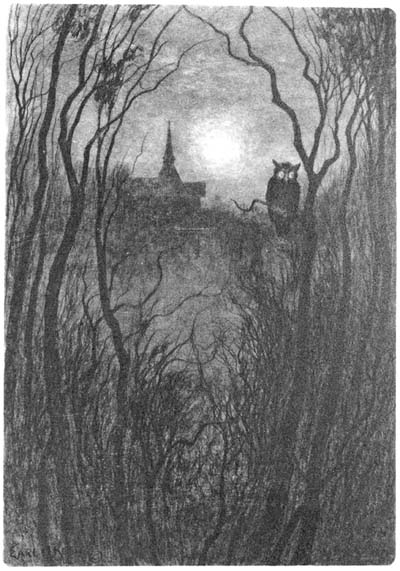
in their robes of white. I spent some time in a dark
nook listening to a sad old owl, located somewhere up
among the grapevine tangles and sassafras trees on a
hill about a quarter of a mile away. Periodically he
sent forth his loud and dismal wail into the darkness.
Like a wild cry of mockery to the world of a soul in
torment, the sepulchral notes echoed through the woods
and mingled with the low moanings of the wind rhythms
among the dead clinging leaves and bare branches.
It was nearly midnight when I approached the
tower on my way back. Many times during my visits
the thought had occurred to me that it was an ideal
habitation for a ghost. The maze of timbers, water
pipes, wires, and open winding stairways that led up to
various landings in the successive octagonal rooms, on
the way to the upper chamber of the tall edifice, seemed
to provide a perfect environment for a discriminating
specter. There was every facility for concealment, and
for sudden and vivid apparition when desired. The
height of the vast interior would permit of majestic
upward sweeps of a wraithy shape into the darkness
above, and dissolution into the overhanging gloom.
The arrangement of the stairways would enable a
phantom to await the coming of whoever was to be
haunted, upon any one of the floors, without being
visible from the one above or below it.
Architects have probably never studied construction
with reference to the needs and convenience of ghosts,
but if the builder of the tower had considered these
things carefully he could not have designed arrangements
more satisfactory from a spectral standpoint.
THE SAD OLD OWL
I found the door leading into the big room on the
ground floor unfastened and it was creaking sadly on
its hinges. I opened it, stepped inside to light my
pipe, and had just thrown the match aside when I
noticed a tiny ascending wisp of something that looked
like smoke at the base of one of the large wall stanchions
near the first stairway. Thinking that it probably
came from the dropped match I went toward it to
make sure that it was quite extinguished. To my surprise
the little wisp of vapor increased in volume as it
ascended. There was a patch of moonlight on the floor,
and a dim diffused light in the room that enabled me to
make out various objects. The rising vapor seemed
faintly luminous. I could not account for its strange
visibility by the direction of the moonlight entering
through the high window. The pale misty wreaths
were slowly expanding in wavy convolutions and disappearing
through the open steps of the stairway
along the opposite wall that led to the floor above.
There was something uncanny in this and while I
had often joked with my friend Jacobs about a possible
ghost in the tower, and had read many thrilling tales
of specters, both benignant and malign, I never had an
idea that I would ever be confronted with a situation
that would suggest the actual presence of anything of
the kind. I had always prided myself upon freedom
from superstition, but I distinctly felt a cold chill
between my shoulder blades, as if an icy hand had
suddenly been placed there, and was conscious of a
slight nervous flutter and a clammy feeling. Just then
something dropped on one of the upper floors and rolled
across it. It had probably been displaced by a gust
of wind somewhere far up in the tower but this inference
did not help matters any, and, although I knew of no
reason for it, I concluded that my nerves must have got
into difficulties among themselves and refused to continue
their normal functions.
I began to consider the advisability of a cautious
retirement from the scene, thinking that a good night’s
rest would probably correct the state of mind that made
such a medley of unpleasant sensations possible.
Just as I was about to leave I distinctly heard the
words, “Good Evening!” uttered in a thin, quiet
voice. I looked around the room but could see nobody.
“Here I am, up here,” continued the voice. I
saw what appeared to be the face of a very pleasant
and dignified old man, who seemed to be sitting on
the stairs near the top of the room, just above the
wreaths of disappearing vapor. The smoky waves
apparently continued through the stairway and enveloped
all of him except the head—or rather he seemed
gradually to materialize out of the wreaths, for the
head was the only part of the apparition that bore any
semblance to reality. There were misty forms suggesting
the shoulders, but they faded off down into the
cloudy lines, which now seemed to have ceased rising
and were slowly waving to and fro, as if they were suspended
from something above and were being gently
swayed by a current of air.
“Good evening,” I replied, not without some trepidation.
“I hope I have not intruded. I had no idea
that there was anybody here when I came in.”
“There isn’t anybody here but you,” continued the
strange voice, “for according to your standards I am
nobody at all; I am a ghost, but you needn’t be at all
alarmed. If you’ll go over and make yourself comfortable
on that empty box near the other wall we can
have a nice little visit. I have not appeared to a mortal
for a long time and it’s a relief to have somebody to
talk to. Since I’ve been haunting this tower I’ve
stayed in a little crypt I have down under it. I ooze
up through that small hole that you see near the base
of that stanchion, and I was just coming up when you
happened in. It takes me some little time to get
properly settled up here, or I would have made my
presence known before. I am not quite settled yet, but
as you evidently intended to leave I thought I had better
make myself known before it was too late. Otherwise
I would have had to wait until some other Christmas
eve, for that’s the only time I ever visualize. I’ll
tell you the reason of this later. Just remain quiet
where you are and excuse me. I won’t be gone more than
a few minutes.”
With that the nebulous shape above the stairs
changed somewhat. It became a little lighter and
the face was more distinct. The wraithy vapor lengthened
out and all of it, with the head at its upper end,
drifted silently up through the stairway hole into the
gloom above as gently and softly as the smoke from a
pipe.
Naturally I was now much interested. The clammy
and creepy feeling, that had come over me at first,
had entirely ceased. I was enmeshed in what seemed a
supernatural web that presented fascinating possibilities.
I looked at my watch which I held in the bright
moonbeam from the window and saw that it was exactly
midnight. At that moment I heard an unearthly
sound that I judged was issuing from the top of the
tower. It was a loud prolonged wail that ended in
a dismal shriek and a high treble, and was repeated
three times. I repressed a slight return of the creepy
feeling, resumed my seat on the box, and patiently
awaited further developments. Heavy thumping noises
became audible from the big water pipes in the tower
and reverberated away through the underground routes
of the smaller pipes. It occurred to me that the ghost
might have decided to take a plunge in the large tank
in the upper part of the structure, or was preparing to
pull it all down, or something of that kind, and I did not
feel that I wanted to be among the debris. To use a
favorite expression of one of my English friends, all
this was “getting a bit thick.” I was again apprehensive
and was tempted to slip quietly away, but was
somewhat reassured when I saw the vapory wisps stealing
back through the stairway opening. I was surprised
to see them trail on down, becoming fainter and
thinner, and disappear into the little hole at the base
of the stanchion.
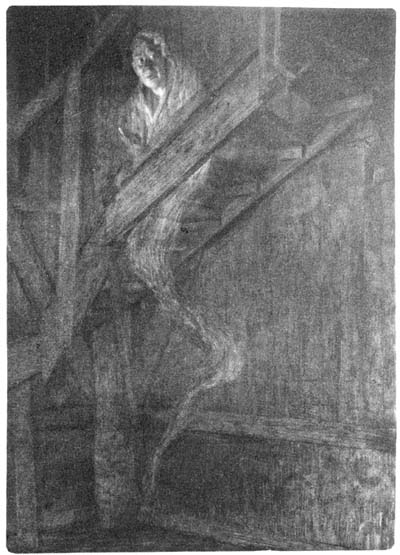
“THERE WAS A SORT OF INDEFINABLE
REMOTENESS AND ALOOFNESS
ABOUT HIM”
In the course of a few minutes the wraithy waves
reappeared and I soon saw the kindly old face peering
over at me from above the high stairway rail.
There was a sort of indefinable remoteness and
aloofness about him—something abstract and far away—that
seemed to discourage any familiarity, and I
waited for him to speak first, as I felt embarrassed and
in doubt as to how further conversation was to be
conducted.
“I am very sorry if you have had any unpleasant
sensations after what has just happened,” he began,
after a few vague vibrations of the cloudy veil, that
might have been shifted slightly to insure comfort on
the stairway, “but it was necessary for me to float to
the top of the tower at exactly midnight for a manifestation,
and I retired into the crypt below for a moment
afterwards to partake of a light draught from a
phantom flagon that I keep there. Like the widow’s
cruse of oil mentioned in the scriptures, my
flagon is always full, and you will at once perceive that
in my immaterial state I enjoy some priceless advantages.
My flagon affords me much consolation.
The contents might seem a little musty to you if you
were down there, but I assure you that the liquid was
once of the very highest quality. I found it here when
I came. Evidently something was once kept in that
flagon that had highly reactive qualities—something
like the kick of a mad bull—but this element had long
been latent when I found it. I hope that you are perfectly
comfortable down there. If you feel cold I can
easily warm you up with some sensations that you
probably have never experienced.”
I assured him that I was quite contented and did
not require any more sensations than I was having,
and begged him not to worry about me at all.
“You probably would like to know something
about me and how I happen to be haunting this tower,”
he continued. “It’s quite a long story, but I think
you’ll enjoy it. If there are any points in the narration
that appear obscure to you, or any that you
wish particularly to discuss, please don’t hesitate to
interrupt me, as it’s no trouble to talk about my experiences,
and there’s plenty of time, as long as we
finish before daylight. If we should forget ourselves,
and too much light should come, I may fade away
quietly and become silent, but don’t be surprised or
offended in any way, for if circumstances permit we can
easily meet again and continue our little talk.
“My earthly name was Emric Szapolyai, and I died
in Hungary in 1489. Measured by your standards that
was a long time ago, but among the spirit fraternity
time does not cut any particular figure, so, as far as my
relationships in the abstract world are concerned, I
might just as well have died hundreds of years before
that or hundreds of years later.
“You may have difficulty at first in pronouncing my
last name correctly, but if you sneeze slightly and try to
say ‘Apollonaris’ while you are doing it, you will probably
get it. I notice that a great many people in the
material world are doing this now. Sometimes they
get it and sometimes they don’t.”
“But how is it,” I asked, “that you speak modern
English so fluently, if you were a Hungarian and died
so long ago, before we had any modern English?”
“Oh, don’t worry about that,” he replied. “One
of the great advantages of a spiritual existence is the
ability of perfect adaptation to any language that is
used by the person to whom a visualization is accorded.
You have undoubtedly seen instances of this at seances
conducted by spiritual mediums. While they are mostly
ignorant fakes and their methods entirely irregular,
you have no doubt observed that Julius Caesar, who
only talked Latin when he was alive, and Napoleon,
who only talked Corsican and bad French, always speak
the language or dialect peculiar to the region in which
the seance is conducted.
“Up to three or four years ago probably no two
spirits were more popular or more imposed upon. They
were called on hundreds of times every night by mediums
all over the world. They used every known tongue from
Choctaw to Chinese, and the funny part of it was that
they seemed to like it.
“They talked with a pronounced Scotch dialect in
Glasgow, their tongues became thick in Cork, and down
among the negro spiritualists in Alabama you would
think that they were both born in Dahomy and died in
Mobile.
“They have been latent now for some time. The
recent war in Europe has clouded them over and rendered
them quite obsolete. Nobody will have to listen
to the stories of their exploits when they were alive for
a good many years. The mediums are now invoking
an entirely new class of spirits, and they are beseeching
such peaceful shades as Charles Dickens, Victor Hugo
and Edgar Allen Poe to come forth, and lots of people
are asking for the late Czar of Russia. They all want
to know what really happened to him. Even the spiritual
fraternity has become very tired of Caesar and
Napoleon. I know both of these shades well and have
no more trouble in communicating with them than I
have with you. Don’t give yourself any further uneasiness
regarding spirit language.
“I hope you will pardon my digression. We must
get back to Hungary. I was one of the Magyar generals
who fought in the wars of King Mathias Corvinus.
For many years I was a baron, but afterwards I became
a duke and had special privileges over quite a large
domain. It will interest you to know that I happen to
haunt this tower for the reason that its builder used
my old baronial tower in Hungary as a model, and I will
tell you later how I happened to discover it. It looked
so familiar and so much like home that I concluded to
make it my headquarters as long as it stands.
“It was my custom to keep sentinels posted in the
top of my old tower who watched for small parties of
travelers and single wayfarers on the roads crossing my
lands. When they appeared my horsemen would go
out and relieve them of two thirds of the money and
other valuables that they happened to have with them.
They would then be provided with a token which they
could show to the minions of neighboring vassals of the
king, over whose lands they might have occasion to pass,
and these tokens would insure immunity from further
high financing—to use a modern expression. We always
respected these tokens from other domains, so you
see the system enabled the traveling public to retain
quite a decent portion of gold and worldly goods, considering
the opportunities offered to business enterprise.
We were called robber barons at that time, and
the term may sound a little harsh, but we were universally
respected throughout the country. Nowadays
our practices would be called mild profiteering, and
leaving the wayfarers a third of their pelf when there
was a chance to get it all would be considered magnanimous
charity.
“In return for these privileges from the crown it was
my custom to send a wagon load of Turk’s heads to
the King about once a month, and this was a source of
great gratification to him. I was enabled to collect the
trophies by frequent sorties with my forces against
small bodies of Turks that were constantly hovering
along our frontiers and making sudden forays into our
territory.
“After King Mathias defeated Frederick of Austria,
who had had the impudence to proclaim himself King
of Hungary, and who intended to exterminate all of us
if he was successful, Mathias moved his army against
the Turks. This war was successful, and after the capture
of Jaicza in Bosnia by assault, I was placed in
charge of the conquered districts and made a duke.
After this we had another war with Frederick and I was
one of the generals commanding the army that captured
Vienna after a short siege in 1487.
“The Magyars were a wonderful people. There was
a man named Kinisi in our army when we were attacked
by the Turks under Ali Bey. In the heat of the battle
he rushed among the enemy and rescued a fallen friend.
We were getting badly worsted in this battle, but this
signal act of bravery inspired the Magyars and the
Turks were almost annihilated. In the midst of the rejoicing
over the victory, Kinisi was seen holding the
body of a Turk by his teeth, and two others in his arms,
and executing the Hungarian national dance. I mention
this as a sample of his hardihood and originality
for the reason that I have asked his shade to visit me
in this tower, and it may happen that he will appear to
you if conditions permit. Kinisi was what the world
calls an honest man—that is to say he would never pick
up anything that was too hot to hold, or take anything
that was out of his reach. My reason for inviting my
spiritual confrère here may seem a little queer to you.
“Although our mutual friend Henry Jacobs, who
owns this tower, does not know me at all, and I have
never appeared to him, I have had a great liking for
him, and have much appreciated his unconscious hospitality.
All unbeknown I have accompanied him on
many of his business trips to various places, particularly
to the Island of Manhattan that I happen to know
a great deal about, as will appear later, and am quite
familiar with his affairs. While he is perfectly able to
take care of himself, I feel that under the circumstances
I have a sort of spiritual responsibility, so to speak.
“I confess that, although I am a ghost, and loneliness
might naturally be considered my specialty, I am at
times a little too lonely and it would be nice and sociable
to have an old ghostly friend with me. We might
think it best for Kinisi to go out after somebody we
didn’t like sometime, and you may depend upon it,
that if he starts, he will not come back alone. There
will be other shades with him. He is one of the best
terrifiers I ever knew. I have known him to frighten
people so that they have jumped off the tops of high
buildings, and he has caused many sudden exits from
the material world.
LOOKING NORTH FROM THE TOWER TOP
IN JACOBIA
“I have been sensible of this moral obligation and
this is one of the reasons why I wanted to talk with you
tonight. I am sorry that our friend Jacobs has never
happened to be up here at an opportune time. I always
make it a point to be somewhere up stairs in the tower
during the night before Christmas. Perhaps you might
mention this to him and I may have the pleasure of
talking with him next year, unless for some reason I
should be called away.”
“But what happened after the victory over the
Turks?” I asked, seeing that my pale friend was somewhat
inclined to wander in his narrative.
“Oh yes, excuse me. After our triumph over Ali
Bey we had no serious trouble with the Turks for some
time, but one night when I was asleep in my tower a
bloody gang of these dogs came and I was hacked into
pieces with a dozen scimitars. It is the custom of spirits
to wear a semblance of their earthly apparel at the time
of passing into the immaterial sphere—merely as a
recognition of absurd human conventions—and that
accounts for what appears to you to be a night cap on
my head. The light, wavy lines leading away from my
face suggest the gown I was wearing when my mortal
remains were tossed into the depression back of my
tower. All this happened on Christmas eve. It is a
rule with many of the spiritual fraternity to visualize
but once a year. I usually select this anniversary for
such few appearances as I care to make, unless the
occasion is something very special.
“I haunted Ali Bey for a long time after that little
episode at the tower, and with the help of Kinisi, who
subsequently joined me, we put him in the way of meeting
a very unpleasant end. We scared him out of bed
and into a big mosque for religious protection one
night. Women were not allowed in mosques, as Mohammedan
females were supposed to have no souls,
but we knew that one of the members of Ali Bey’s
harem was in there, who had fled in disguise the day
before, and she got him with a knife that she had carried
for use in case she was caught. I often talked with him
after he became a shade, and eventually we became
quite good friends. He wanted to go back after the
girl but Kinisi and I persuaded him to let her alone.
“After we left Ali Bey I returned and haunted my
tower for some years, but there was so much going on
there I didn’t approve of, that I got tired of it after
a while and went over into Dalmatia, and from there to
the Adriatic. I established myself on board a ship
that lay in the harbor and haunted the forecastle for
over two years. I moved to the Captain’s cabin after
that, and was on the upper deck at night much of the
time. The captain was a very agreeable sort of a fellow
although he was a bloody pirate, but I never liked the
first mate. I chased him and four offensive members
of the crew into the sea one night in a gale off the coast
of Barbary. I visualized to them separately, and as
they were very superstitious they went easily.
“We roved over the Mediterranean and captured
considerable booty. We were making new shades constantly.
After the victims were thrown overboard, or
had walked the plank, they would generally ooze back
in the bilge water seepage in the hold so as to enable
them to haunt the crew, which they did with a vengeance.
They were mostly Spaniards and as a rule I
found them quite pleasant.
“I was with the Mediterranean corsairs several
years. I visualized before Sidi ben Musa on board a
large brigantine that he had just captured with his
galleys off the coast of Naples, and I was with him
during the rest of his earthly career. He conducted
numerous important enterprises. He once organized
an expedition to capture the pope that would have been
successful were it not for the fact that his men did not
know the pope by sight and bundled a cardinal into
their boat instead. This happened on the outskirts
of the little village of Piano d’Orno not far from Rome.
Sidi was one of the great terrors of the sea and wielded
a baneful power on the Mediterranean during his lifetime.
After he became a shade my association with
him beguiled many dull periods.
“After Sidi’s time there was a celebrated sea robber
on the Ægean who was called Red Beard. Sidi and
I were with him four years. He was thick set and
bullet headed. His heavy jutting lips, cruel eyes, and
long fiery red whiskers gave him a rough and wild look.
He was an excellent and formidable pirate. Wherever
there was wealth to loot, involving wholesale massacre,
he was always equal to the situation. It was
estimated that he and his men killed over three thousand
people and captured over four tons of gold during
his lifetime. He had a most profitable career, but he
finally came to grief and was captured by a war vessel of
the Knights of Rhodes. He was rushed down a scuttle
into the hold of the Christian ship, where he was subjected
to misery and abuse with others of his crew. The
ship was fighting its way in the teeth of a howling gale
to the lee of some island and it was a wild night on
board. The roaring and whistling of the wind, the
howls and curses of the prisoners, the creaking of timbers
and cordage, and the piercing shrieks of the galley slaves
as the knotted thongs bit into their flesh to spur them to
greater effort, naturally made conditions extremely unpleasant
for those who were alive. The ship finally
anchored. Red Beard succeeded in twisting out of his
manacles and escaped into the sea. We went with him
to the shore about a mile away, where he crept up to a
fishing hut and recuperated. In a few days he set out
for Egypt in a merchant ship as a common sailor. He
became a shade in a brawl in Alexandria and Sidi and
I met him soon afterwards. He joined us and we went
to my tower for a long rest.
“Red Beard informed us, after he was translated,
that during his earthly existence he had led a double
life. There were long periods during which his professional
activities were suspended. He had a castle
on an island in the Ægean Sea where he lived in great
splendor and was known as the ‘Freckled Duke of
Patmos.’ Nobody there suspected that he was Red
Beard the pirate.
“We found Kinisi waiting for us at my tower and we
remained there for many years. The place acquired a
bad reputation among mortals. Nobody who was
alive was allowed to be there more than one night, and
after several years visits to it were considered foolhardy
and were entirely discontinued. When anybody tried
to sleep there Red Beard and Sidi would appear before
them and brandish big smoky knives and hop up and
down, I would wave long white things in the background,
and Kinisi would fly toward them with a rush
and suddenly fade. The invaders were never able to
stand much of this and would usually jump through the
windows into the gully in the rear, so after a while we
had peace and privacy there.
“I hope I am not boring you with this long recital,
but in order that you may understand and appreciate
some points that I intend to bring out later it is necessary
to go into all this historical data.”
“You are not boring me at all. On the contrary
your story is of the greatest interest,” I replied, “but
why did you spend practically all of your time with that
swaggering Turk eater and those two pirates when one
of your evident talents could have undoubtedly found
more respectable society?”
“It does seem funny to you, don’t it? Kinisi and
I were special friends in life and naturally the intimacy
continued afterwards. As to the pirates, that was
just a little fantasy of mine. I always had a penchant
for making new acquaintances, and, until lately, I
always liked the sea. It happened that, outside of the
land wars that were generally going on, the pirates were
in those times producing more shades than anybody
else, not only from among themselves, but from the sea faring
public, and I found that by remaining with them
I could constantly mingle with new specters that were
congenial. I was stationed at the ‘port of entry’—so
to speak, and could select my new associates as my fancy
dictated. I consorted with a lot of other pirates in a
spiritual way, as you will hear later on. You see my
experiences in conducting the affairs of my tower when
I was alive naturally predisposed me to association with
those of that ilk in my disembodied state.
“I am inclined, if you will pardon me, to resent politely
your implication that pirates were not respectable
society. The live ones are much thicker now than they
were then; they move in the very best circles, and sit at
highly polished desks, instead of going out into the
storms, fighting and killing clean for what they want.
In our days a pirate was a gentleman adventurer, and
everybody he hadn’t robbed thought well of him until
he was captured and in chains, or killed, just as in the
present day a pirate may be a ‘shrewd operator’ and
a ‘successful business man’ until they get him, but we
shall not discuss the ethics of piracy just now, for I am
afraid our time will be exhausted before we get to what I
would really like to talk about. With your permission
I now return to the little company in my tower.
“For the sake of brevity I shall omit details of our
stay there and many important incidents of piratical
history with which I and my incorporeal friends were
more or less identified. We sojourned for awhile in
Algiers and other places along the North African coasts,
where the pirate nests were numerous. These financial
centers were in a flourishing state of prosperity. The
Mediterranean yielded rich harvests to skilfully conducted
enterprises at that time, mostly from Spanish
sources.
“In 1643, I think it was, we all drifted into the forecastle
of a ship that was bound for the West Indies.
The Spanish Main was the paradise of the bloody buccaneers,
and the home of the far famed ‘Jolly Roger,’
that floated in congenial airs from the masts of sinister
looking ships that roved the wide waters and gathered
their fruitful spoils. We anticipated a long period of
ghostly entertainment.
“We amused ourselves on the way over by keeping
the captain and crew in a turmoil of apprehension. We
muddled the compass, made phantom marlin spikes
dance on the deck, and rattled the ropes at night when
there was no wind. We made all sorts of bewildering
noises on board, but were careful not to terrify anybody
to such an extent as to cause a shortage in the crew.
There was plenty of rum on the ship and the uncanny
episodes were attributed to other spirits than us. We
remained latent most of the time, but Kinisi insisted
on visualizing in the captain’s cabin several nights just
after eight bells struck, and he came very near causing
the ship to be turned back. The tough old skipper
didn’t care how many spooks infested the forcastle but
he didn’t fancy them in his part of the vessel.
“These things may all appear childish to you, but
you must remember that we of the spirit world have a
superfluity of time on our hands and that we look at
everything from a standpoint entirely our own. All
folly is dependent upon the point of view.
“When we arrived at Tortugas we found the whole
island aflame with excitement over the exploit of a prominent
buccaneer named Pierre le Grand, who had just
bagged a big Spanish galleon containing fifty thousand
pieces-of-eight, and was being overwhelmed with congratulations.
“We drifted among many famous freebooters at
Tortugas and Barbados—Alvarez, Hooper, Lolonais
and others—all of whom were hunting noble quarry and
doing a profitable business. The treasure laden galleons
bound for Spain were rich picking. Tons of
bullion and millions of pieces-of-eight were garnered
from the highways of the sea. The proceeds were spent
in riotous dissipation and orgies by the merry buccaneers
on shore and the rum dealers eventually acquired
the greater part of the spoils.
“The folds of the black flag rose and fell on the long
oily swells, and the West Indian sea floors were littered
with sunken timbers and Spanish skeletons. Those
were days of frenzied finance on the Caribbean.
“At Jamaica we had the pleasure of falling in with
Captain Henry Morgan, who was one of the most renowned
sea financiers of the seventeenth century, and
we all settled on board his ship.
“While Captain Morgan had to endure much opprobium
from the world I know him to have been a gentleman
and a perfectly honest man, for he always divided
the profits of his expeditions with fairness and exactitude
among his associates. This is something that is
seldom done now days, except as a matter of policy, or
under compulsion, and I think it is worth while to note it.
“We went with Morgan and his fleet on his famous
expedition for the capture of Panama. We weighed
anchor off the cape of Tibur on December 16th, 1670, and
came to the island of St. Catherine three days later.
The island was taken with little loss. We found few
pieces-of-eight, but a much needed supply of powder.
On the night of the 24th I visualized before Captain
Morgan in his cabin. We had a long conversation,
and I was able to give him much valuable advice and
information which he deeply appreciated. I faded when
seven bells struck just before dawn, and after he became
a shade some years later he told me he had always
considered that interview a most pleasurable experience.
“I shall not consume time by describing the toilsome
ascent of the Chagres river in small boats, the historic
march overland, the final victorious battle, and the
capture and sack of the rich Spanish city, for all this is
embalmed in the annals of heroic achievement in which
the world records its worship of success.
“We left Panama February 24th, 1671 with one hundred
and seventy-five beasts of burden, carrying the
profits of the enterprise, consisting of gold, silver, and
valuable merchandise. We had six hundred prisoners
to be held for ransom, and this brought forth much
wealth that had been secreted when the city was taken.
Notwithstanding the necessary misery and lamentations
of these hostages, it was a merry throng of adventurers
that wound in triumph through the forest
pathways back to the headwaters of the Chagres.
“The Captain left the prisoners and a rebellious
portion of his followers at the mouth of the river and we
sailed to Jamaica, where he settled down to the life of a
quiet gentleman. As he was wealthy he commanded
respect and nobody questioned his record. Upon his
transition into the immaterial state a few years afterward
we had the good fortune to have him join our
party, and we found him in every way delightful.
“Our ghostly little company was later augmented
by the addition of Captain Teach, and no more blood-thirsty
sea rover ever scuttled a ship, cut a throat, or
blew open a treasure safe. He was of the roaring,
ranting type that gives the tinge of the melodramatic
to piratical annals. He had a black beard of inordinate
length that reached from up around his eyes to his
waist, and he used to twist it into tails with bits of
ribbon and fix it up around his ears.
“We were all with him on board his big ship, the
‘Great Allen’ mounting forty guns, the name of which
he afterwards changed to the ‘Queen Anne’s Revenge.’
He was a hard drinker and we agreed that we had never
seen a more turbulent and desperate character. For
years he terrorized the sea from the Carolinas to Trinidad.
“One night we witnessed the capture of a Yankee
vessel bound from New York to Jamaica, under command
of a Captain Taylor. The pirates streamed over
the larboard quarter of the fated ship, but they met
with unexpected resistance. The attackers were nearly
all disembodied when suddenly, with blood curdling
shrieks, Teach bounded over the side on to the deck
into the midst of the pirates, and Taylor’s shade told
us afterwards that he had never seen a more horrible
object. Lighted tapers hung from the rim of his broad
black hat that revealed the whites of the gleaming eyes,
the gnashing teeth, frightful red mouth, and flying
masses of black whiskers. He waved a huge cutlass
and a brace of pistols hung on his breast. With demonic
howls and yells this fiendish figure plunged
among the Yankees. Encouraged by this sudden apparition
the pirates rallied and the ship was soon theirs.
The dead were heaved overboard. From them we soon
learned all of the particulars of the fight, and they were
most dramatic. Teach used to burn pots of brimstone
in his cabin to make his crew think he was the devil,
and many of them believed it. He kept a big green
parrot in a cage on the deck of his ship. In the midst
of the smoke and din of battle the raucous voice of the
ill-omened bird would be heard above the roar of the
conflict, yelling, ‘Go it!—Go it!—Pieces-of-Eight!—Pieces-of-Eight!’
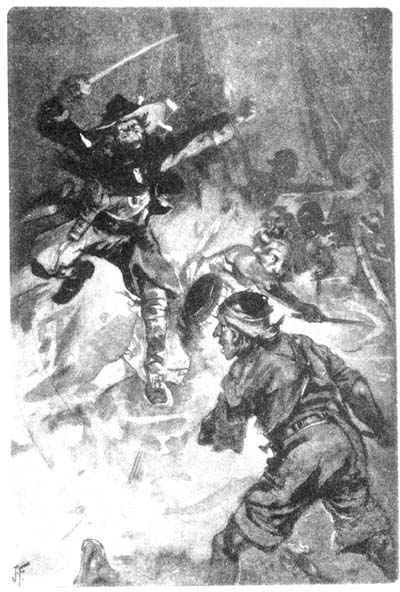
“WITH DEMONIC HOWLS AND YELLS THIS
FIENDISH FIGURE PLUNGED AMONG
THE YANKEES”
(From “The Book of Pirates”)
“Teach once marooned a lot of his men, after an
unusually rich capture, so as to avoid paying their
share of the profits. He put them on a small desert
island and, with loud curses and imprecations, sailed
away. Some of them were subsequently rescued and
accomplished his transition. When we met him afterwards
he was much subdued but eager to square accounts
with his old enemies—another illustration of
the survival of a ruling passion under conditions that
would seem to discourage its activity.
“Our party now consisted of Kinisi, Sidi ben Musa,
Red Beard, Morgan, Teach and myself, and you will
admit that this was quite a formidable troop of specters.
We spent many years together which I shall pass over,
as there were no events of especial interest—merely a
long lapse of spiritual quiet.
“In 1818 we were all in New York and had the honor
of meeting the shade of Captain William Kidd one
night on the steps of the sub-treasury. The Captain
had been hanged in England as a pirate in 1701 and for
over forty years his bones had rattled in an iron cage,
suspended from a gibbet near the Thames. He informed
us that he at one time buried considerable
treasure in the neighborhood of the Island of Manhattan,
and his object in staying in the vicinity was to
haunt people who were constantly digging to find his
gold.
“He seemed exceedingly good natured and charitable
in his ideas. He wanted somebody to find the money
who would devote it to some great benevolent use, that
in a way would wipe out the foul stains of its acquirement.
Doubtless you have noticed that nowadays
many senile and repentant, successful and therefore
honorable gentlemen are heaving great masses of gold
into public benefactions to ease similar pangs of avenging
conscience.
“We all assured Kidd that it was foolish to think
of such things—that conscience was only a form of
fear—that no stains were as fleeting as those upon gold,
and that there was no odor in the world that could
cling to it, not even that of sanctity.
“IN THE MIDST OF THAT WEB OF BELIAL
WAS A CHRISTIAN SPIRE”
“For years we helped Kidd guard his idle capital.
All sorts of men came after it. Several times Kinisi
and Kidd visualized when the wrong people were getting
too close to the big iron chests. They could of course
only do this at night. In the day time all we could do
was to keep the dirt falling back into the hole until it
became dark. Teach wanted to let the diggers get
the hole well opened and then tumble them in and cover
them up, the way he used to do when he had somebody
help him dig a treasure hole. He always shot the digger
and left him in there with the chest so as to insure
future secrecy. Many business secrets are made safe
now on the same principle but the method is more indirect.
“The years rolled on and there were many changes
on the lower end of the island. Clusters of robber baron
towers projected into the sky. The narrow streets became
deep canyons through which ran streams of gold,
and among them were congregated the mad hordes of
avarice, including some of the most expert malefactors
in the world.
“At the head of the principal canyon the tall steeple
of Trinity Church stood like a monolith to the memory
of Christianity, for in the midst of that web of Belial
was a Christian spire. The money changers had engulfed
the temple and its mission had become a mockery.
“We met many interesting spirits in the church
yard. Countless suicide shades flocked to the island
from all over the country, for it was here that the tentacles
of the octopi centered that had felled them. In
life they had been tortured, crushed and driven to despair
by organized rapacity and chicanery. Feeble salutes
from among the sunken timbers of long lost galleons
may greet these gray files as they drift away into time’s
obscurities.
“We kept our little party well together and we had
to be somewhat exclusive. There were many lady
shades. They seemed fascinated with Teach and
floated after him wherever he went. He had a peculiarly
devilish and swashbuckling air about him, and a subtle
suggestion of original sin that lured them on.
“The shade of an old money shark, who used to
burn his warehouses and send out rotten ships to stormy
seas for the insurance, and who had once sold his grandmother
to a medical college, kindly offered us the hospitality
of his crypt during the day time, provided we
would agree that it would in some way benefit him later.
He complained that just before he was translated he
had been ‘trimmed’ and ‘ironed out,’ as he expressed it.
Some skunks had high financed him and had filched
practically all his gold by what he considered ‘dishonorable
methods.’ We extended our heartfelt sympathy
and moved in.
“At night we usually congregated in the belfry of
Trinity, or down the street in the sub-treasury. We
enjoyed being there, and Red Beard and Teach liked to
float through the small crevices and air pipes into the
big steel vaults and fondle the gold. The vast piles of
bonds and paper money did not seem to interest them.
“One night when we were out on the steps back of
the Washington statue we saw a shade drifting up and
down Wall street in a hazy, dreamy, uncertain sort of
way. He looked queer. Evidently he had been portly,
and had worn a gray suit, a mess of side whiskers and a
straw hat when he had passed into the immaterial
world. We made ourselves known to him. We learned
that he had been translated early that afternoon and he
was trying to find out what the market had done since.
“His name had been Waters and he had been shot
by a woman for some reason that he did not explain.
We invited him up into the sub-treasury, and while he
seemed even more anxious than Red Beard and Teach
to get his hands on the gold, he floated blissfully back
and forth among the currency and bond stacks so long
that we had difficulty in getting him out through one
of the pipes and over to the church yard before dawn.
We were only able to do this by assuring him that he
could go in and mingle with the money every night
forever, if it lasted that long, and he replied that he
never had suspected that heaven was so fine as all that.
We thought that anybody who could regard that
neighborhood as heaven was an abnormal optimist,
and in the material world he would need immediate
medical attention, but then you know some people are
that way. After we had heard Water’s history we
knew that there was no heaven anywhere that he could
ever break into.
“The second night after it had happened, he took us
up to what had been his office in one of the robber baron
towers on Broad street, in which he had been shot.
We found his partner there, a man named Rivetts, who
was looting the safe and fixing the accounts so that
Waters’ estate would come out at the small end of the
horn. Waters visualized and haunted Rivetts so effectually
that he jumped through the nineteenth story
window into the street, to the great delight of Teach
who regarded it as one of the best jokes he had ever
known.
“Waters told us that when he was translated he was
long a big block of U. S. Steel and short a lot of Reading,
and some hyenas were trying to shake him out of the
Steel and run him in on the Reading. He pulled over
and studied with feverish avidity a basket full of paper
tape, from what he called a ticker in the corner, and
declared that if he had lived another two days he would
have had all their hides on his back yard fence. You
may know what some of these expressions mean. To
us they seemed technical and confusing, but we gathered
that death had deprived Waters of a ship load of pieces-of-eight
and we felt very sorry for him.
“After that he took us around to dozens of offices at
night. We saw the daylight haunts of swivel chair
buccaneers, whose quarter decks were mahogany desks,
and who preyed upon the vitals of the country of their
birth, and the nests of merciless super-piratical combinations
that mulcted mankind by impounding the
necessities of life. We went to a building on lower
Broadway where Waters said there were huge vaults full
of the products of the most highly refined rascality in
existence. He took us to the vaults of several food
trusts, corporation attorneys, and banks, and showed
us various documents and other evidence of wholesale
plunder and remorseless nation-wide robbery that
would have taken our breaths away if we had had any.
It was a sort of a travelogue—a sight seeing tour in a
region of unbelievable iniquity. We were indeed in
shark infested waters.
“It occurs to you no doubt that the word buccaneers
and other sea terms that I am using, pertain, properly
speaking, to nautical financeering only, but it is not
out of place to apply them to similar professional activities
on land, for it really makes little difference to a
genuine pirate, or to those he despoils, whether he
stands on a wooden deck or on an oriental office rug.
“After these nocturnal rounds among the robbers’
roosts it was our custom to assemble in the belfry,
where Waters would deliver thrilling talks on the methods
of the ‘Wizards of Finance’ and the ‘Kings of the
Street’, as he called them. These meetings were necessarily
open, and many stranger shades often hovered
about and listened. Hosts of evil spirits moved in the
surrounding gloom and mocked with sepulchral and
mephitic laughter when Walters dilated upon famous
financial atrocities in which some of them had been
participants.
“We naturally had a professional interest in Waters’
tales of present day freebooting, and for several nights
he held us spell bound.”
At this point I asked my shadowy friend on the
stairway if he didn’t think it rather incongruous, or at
least in bad taste, for the shades of such a malodorous
bevy of professional villains as he had with him, to
hold spiritual convocations in a church belfry.
“Not at all! Not at all!” he replied. “We found
after spending a few nights with Waters that we were as
a small flock of babbling goslings, or like little twittering
snow birds on a limb, so to speak, compared to
the voracious human hawks and grand larceny specialists
in the neighboring towers, from the tops of which
no Jolly Rogers flew—they were too smooth for that.
The church was quite the appropriate retreat for our
party, considering the character of the neighborhood,
and it might not be out of place to suggest that we
would not have been safe even there if we had had money.
The gold of a stranger in these parts would disappear
like autumn leaves before the wind. A doubloon
dropped anywhere in the vicinity in the day time would
scarcely have got to the sidewalk and might have caused
instantaneous bloodshed. It would be like tossing a
yellow canary bird into a cage of wild cats.
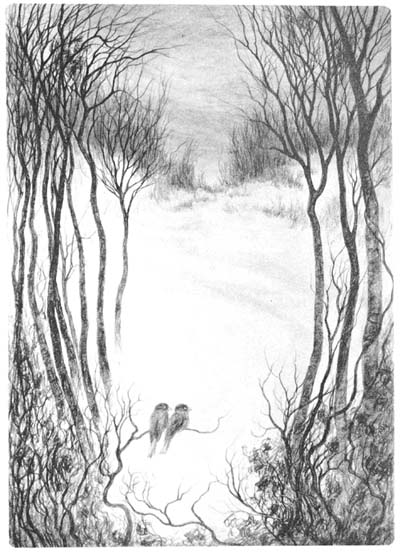
“LIKE LITTLE TWITTERING SNOW BIRDS
ON A LIMB”
“Waters said that the Savior would not have been
admitted to Trinity Church on Sunday on account of
his clothes, and if he should appear and stand at the
corner of Broad and Wall for two minutes somebody
would take away his halo, his sandals and his robe.
He would be divested of everything that was his and
be cast adrift in the darkness when the day was done.
“I may say, parenthetically, there was one Spirit
we never met in the neighborhood. In fact none of our
party ever seemed to have been in its presence at any time.
“At night we saw troops of sinister and ravenous
shades prowling among the gloomy evil hives in this
lair of Mammon like famished wolves upon ground
where they had once killed.
“Waters continued his revelations, with few interruptions,
for a month or more, for it took a long time
to communicate his extensive knowledge of the inner
workings of the up-to-date methods of gold accumulation.
When he had finished I must admit that we shuddered
at the damnable realities he portrayed. At one
point we who had head coverings removed them reverently
and bowed to Waters. Teach threw his semblance
of a black wide brimmed hat into the air, with a hollow
ghastly yell that brought many curious, pale peering
faces up from among the old crumbling stones in the
church yard.
“Captain Morgan observed that all these operations
were evidently conducted without bodily risk—in other
words, without the exercise of personal courage—and
the necessary murder involved was accomplished by
slow drawn out processes that inflicted needless suffering
and misery on entirely too many people. The cutlass,
the plank walking, and the ‘Long Tom’, loaded
with grape-shot, were much more merciful, although
less effective as profit producers. He made the point
that old fashioned piracy was to a certain extent redeemed
by the individual valor of the pirates. They
took brave men’s chances and carried their lives in
their hands, and that, at least, was one feature of their
business that was entitled to respect. He considered
on the whole that, from an ethical standpoint, modern
methods were much more reprehensible than the old.
“Waters’ continued narrations were like tales from
the Arabian Nights. They made all of us feel so insignificant
that after a while we concluded that we didn’t
like him. Somehow we didn’t feel very prominent when
he was about, and we began to avoid him. We spent
much of our time in the sub-treasury and bank vaults
watching new shades vainly clutching at the money
stacks with their pale fingers.
“The insane strife of the hordes of mortals to see
who can die beside the biggest gold pile has always been
considered a rich joke in the spirit world, for when they
come among us they are unable to bring any of it with
them. The accumulation in the sub-treasury is very
convenient for them to gloat over and it continues their
worldly illusions perfectly. As a matter of fact it is
just as consistent for them to gloat over this vaulted
gold in their spiritual state as it was for them to strut
and swell with pride over the earthly wealth on which
they had their short leases during life.
“You might be interested in knowing something of
the present state of a few well known shades. Washington,
Lincoln, and many other translated statesmen are
no longer here. Most of the mighty dead were men of
settled convictions. Long ago a lot of these potent and
highly respected phantoms became disgusted with political
developments and with mundane conditions generally.
They left the earth’s atmosphere and are now flocking
about on the moon, where there are no politics
whatever and plenty of big holes and extinct craters to
crawl into when perfect seclusion is desired.
“Since Pharaoh left the Red Sea he has been on
Mars. Many of those who became famous in the world
for murdering on a large scale are now there. They
find the redness of that planet most congenial. Napoleon
still remains in the earth’s atmosphere for he still
hopes that some day he will come back. Socrates, Sir
Isaac Newton, Columbus, and numerous other worthy
shades, are on one of the satellites of Jupiter where finally
they are beyond the reach of hostile criticism. Nebuchadnezzar,
who built and worshipped an image of gold,
and who was dethroned by the Lord and sent into the
fields to eat grass, is now at the North Pole. In that
frigid silence there is no grass or gold and there will he
stay forever.
“This reminds me that great multitudes of shades
are waiting eagerly for Bill Hohenzollern. While it is
true that, in your modern and expressive slang, he is
what might be called a ‘dead one’, he has not yet been
actually translated.
“In suggesting the proper disposition of a particularly
offensive public malefactor, one of your American
orators once advised casting him out of the universe
through ‘the hole in the sky’. This hole in the sky,
astronomers tell us, is somewhere off down near the
Southern Cross. It is a vast void in the firmament in
which there is no planet, star or other heavenly body.
No starry worlds, in their eternal orbits, ever intersect
that awful abyss. No stellar lights ever twinkle there—no
meteors ever stream through that Stygian darkness,
where creation has left an appalling and dismal
blank. When William Hohenzollern comes among us
there will be a gala event in the spirit world. He will
be rolled up into a misty wad, loaded into a long pale
tube with millions of feet of poison gas, and shot out of
the cosmos through that awful hiatus among the constellations—that
frightful chasm in the universe, where
he will forever be beyond infinity itself—and where even
the Almighty, whom he once claimed as his partner,
may never again be able to find him for consultation.
He will be beyond the limits of communication,
and even the music of the spheres can never reach him.
It’s the hole in the sky for Bloody Bill, and we are all
looking forward in pleasurable anticipation to a day
of great spiritual exaltation and rarefied enjoyment.
“During his eruptive period he probably acted no
worse than a great many other humans would with
the same opportunities—he was one of the results of a
bad system—the point of a much aggravated protuberance
that had to be lanced. We all realize that
history has finally demonstrated that autocracy is
wrong. We greatly envy you who live in an age that is
beholding the dawn of cohesive democracy, and the
passing of conditions that have made it possible for one
man to hold the destiny of millions in the hollow of his
hand. Bill will be forgiven—but after he is projected.
“One night Kinisi and I were alone in the belfry.
Out in the moonlight we saw Sidi ben Musa, Red
Beard, Morgan, Teach and Kidd, lined up among
the tombstones in the church yard. They appeared to
be making unfamiliar movements. I asked Kinisi what
he thought they were doing and he replied that they
seemed to be kicking themselves, and that they had
been acting that way every night for a week. He
thought that, like the robins in autumn, they had
flocked and were preparing to migrate.
“These shades, who, in life, had been relentless
highwaymen of the seas—blood bespattered, remorseless,
steeped in murder, arson, theft and unnamable
crimes—the heels of whose boots had dripped with
human gore on a thousand decks—held their spectral
hands aloft and were aghast when they realized the
pitiful inconsequence and puny achievement of their
futile careers.
“MY OLD TOWER IN HUNGARY”
“There was a big storm one night and we never saw
them again. The valiant and hardy little band may
have drifted out over the sea with the heavy off-shore
wind and rolling mists, and may now be peacefully
haunting the scenes of their former tame profiteering
and modest killings, where spiritual life is not as strenuous
as we found it in the twentieth century Gomorrah
that we contemplated from the belfry of Trinity.
“Kinisi wanted to stay with Waters for a while longer,
but I had had enough of modern money centers.
I left one night in a freight car that was loaded with
light wines and moving westward. Although it was
marked for Atchison, Kansas, I had no difficulty in
turning it up into Michigan, to where I seemed impelled
by some unaccountable instinct. I may say incidentally
that many wandering freight cars with spirits on
board are now being diverted over strange routes by
ghostly direction, and much of the present freight confusion
is due to that cause. That was several years
ago, and, so far as I know, the car is still at Benton
Harbor.
“I drifted along the lake shore and around in the
hills for some time, and one night I was amazed to see
what looked like my old tower in Hungary. I promptly
decided to haunt this place, after I had investigated it,
on account of the old associations it brought to mind.
It was impossible for me to go back to my old tower, for
things have changed so much in Hungary that I would
take no comfort there, so you see I have turned over a
new leaf and here I am.
“A little while after you came in you were doubtless
surprised, and possibly startled, by certain sounds that
it was necessary for me to make in the top of the tower.
I was communicating with Kinisi, who at that moment
was in the belfry of Trinity, and I have no doubt that
he got my message and will be here before long. You
see that in the spiritual world we have always used the
Hertzian waves. You have only recently found them
with your wireless telegraphy and telephony. By certain
peculiar sound modulations, properly keyed, we
are enabled to utilize the waves in a way that your
modern science has not yet discovered. I imagine such
communications might properly be called phantograms.
Before many years you will be able to talk
to friends in New York—if you have any—by simply
raising a third story window and pitching your tones
into the exact harmonic, as you heard me do tonight.
It’s all quite simple when you know how.
That heavy thumping in the pipes was just a local
manifestation and it had nothing to do with the
message to Kinisi.
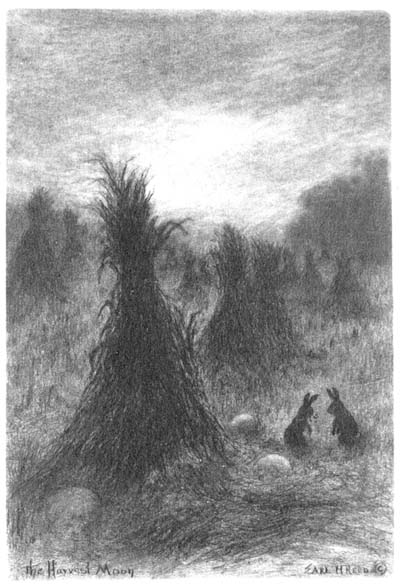
THE CORNFIELDS IN OCTOBER
“Any spiritual sound or demonstration, in which
ghostly noise of any kind is produced, is known among
us as a ‘skreek’. Skreeks have a wide range of utility.
They may be vibrated over vast distances, as I just
exemplified from the tower top, or used in a merely
local way, like the expression in the pipes.
“In the summer time you often hear funny squeaky
noises and loud thumps in the water pipes that connect
with the guest tents on the bluff. Well, that’s me.
While I am among the tents a great deal in the summer,
I play the pipes from the tower, so whenever you hear
these skreeks after this you will understand the cause.
I tried the main pipes tonight just to see if they were
keeping their tonality in cold weather.
“Since I’ve been here I’ve greatly enjoyed myself. I
take much pleasure in wandering about the farm at
night. I spend considerable time in our friend’s cornfields
during the warm summer nights where I meet
many Indian shades. They are among the stalks in
the dark, cracking the joints to make them grow faster.
In October they stay in the shocks and rustle the dry
leaves at night. They used to live all over these bluffs
in their little wigwams. Sometimes I spend hours in the
farm house between the walls, listening to our friend
Jacobs and his guests. A lot of friends come to see him
who interest me, and some of them I would like to meet
in the way I have met you tonight. Please remember
me to Professor Dientsbach, who has charge of the children’s
saxophone band, when you see him, and get him
up here some Christmas eve if you can. He has had the
band in the tower on several occasions, and it afforded
me much pleasure. Give my regards to the small boy
you call the ‘Hot Spot’, and assure him and his little
sister Gertie that there is nothing at all in the tower for
them to be afraid of, and I am always glad to have them
come up here and play.
“Sometimes I go up to Thunder Knob, the big sand
dune north of here. The shades of an Indian hunter
and a large sand bear have been fighting inside of this
dune off and on for many years. When they are quiet
too long I go in and stir them up.
“I often visit the little chapel on the next hill during
winter nights, and sit there until early morning—in
fact it is one of my favorite haunts when I am outside
of the tower. I also find much diversion in drifting
about in the dark through the winter woods and along
the lake shore when everything is frozen up. This
winter I have spent several nights in the deserted pavilion
on the beach, amusing myself with the phonograph
records in the corner. Sometime they will learn to can
heat and cold as they do sound. The winds down there
in the winter are very wheezy and I like it.”
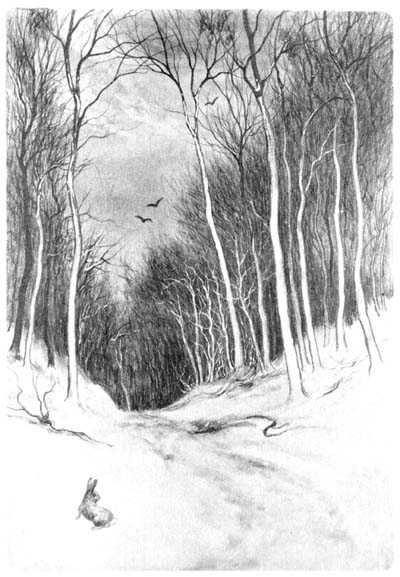
THE ROAD THROUGH THE WINTER WOODS
There was a long silence after this. I changed my
position on the box against the wall and thought
possibly that I must have dozed for a few minutes and
missed part of the story, but was not sure of it. I
looked up on the stairway, but apparently my ghost was
not there. Evidently he had faded with the first gray
morning light that was now stealing into the tower, and
had taken his long lingering thirst down below to his
phantom flagon of musty wine.
I waited for some time, but remembering what he
had said about a possible sudden disappearance, I
concluded that it was useless to remain longer.
I arrived at the farm house just in time for breakfast,
and, immediately afterward I began this tale of
what I had seen and heard in the tower, while the facts
were still fresh in my mind.
Up to that memorable Christmas eve I was entirely
unfamiliar with Hungarian history, and did not know
whether anybody by the name of Emric Szapolyia had
ever lived or not. Naturally I was very curious on the
subject and anxious to convince myself that I had not
been dreaming in the tower.
I obtained a copy of Godkin’s “History of Hungary
and the Magyars,” and succeeded in locating my ghostly
friend in a chapter devoted to the career of King
Mathias Corvinus, who reigned between 1457 and 1480.
The account given of him coincided with what he had
told me as far as it went. While he was referred to as a
general and duke, it did not mention his tower, or the
fact that he had ever been a “robber baron,” but the
omission of such trifling details in a brief summary of
his period was to be expected. He was mentioned as
“an able and experienced officer, never at a loss for an
expedient in the midst of the most unpromising circumstances,
always cool and collected.”
His friend Paul Kinisi was alluded to as “the Murat
of the Magyar army—fiery, brilliant, ostentatious,
galloping to the charge with flashing sabre and in
splendid costume.” I also found confirmation of Kinisi’s
exploit with the three Turks, related by the ghost.
As the historical allusions in his narrative corresponded
with such authentic fragments as I was able to find
concerning him and his friend Kinisi, I assumed that
the rest of his story was equally reliable. While I was
unable to verify all of his statements, any doubts as to
the reality of the interview were dissipated.
I carefully searched such piratical lore as I had access
to and found that there was nothing in the tale in the
tower that was inconsistent with recorded facts relating
to piracy on the high seas from Szapolyia’s time on
earth down to that of the sojourn of the ghostly crew on
the Island of Manhattan. In “The Book of Pirates”
I found the life stories of nearly all of the sea faring
Wizards of Finance with whom he stated that he had
associated. There appears to be no record of any of
them having been haunted at any time, but the
haunter was of course much better qualified to tell of
this than some skeptical, and perhaps careless, historian
who was not there at the time.
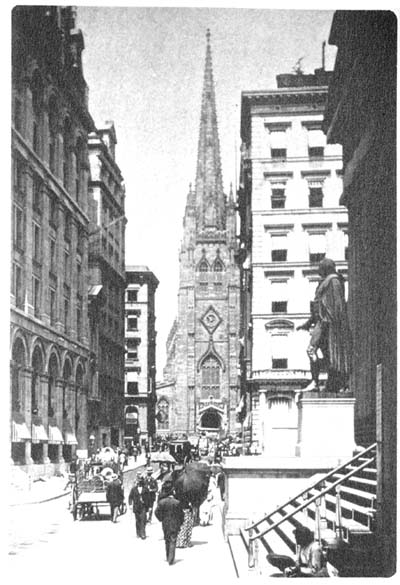
One of our illustrations is from an old photograph
of Wall Street and Trinity Church, probably taken
some time before the ghost left New York. It is unfortunate
that it could not have been made at night
and possibly have revealed at least some of the filmy
forms of the piratical crew on the sub-treasury steps.
It would then be a welcome bit of corroborative evidence
in case the specter’s veracity should ever be
questioned.
I thought that some of the strictures and comparisons
made by my phantom friend were somewhat
severe, but I have included them in this chronicle for
the sake of accuracy. We all have different points of
view, and I suppose, from his standpoint, the elucidation
of present day business methods by the shade of
the case-hardened Mr. Waters, did make that spectral
little band of freebooters feel rather cheap and disgruntled.
The contrasts between their times and ours
of course shocked them, but they should have remembered
that in an age of progress everything must advance,
and human villainy would naturally be deeper
and greater now than during their periods. I thought
that Waters might have been a little more tactful and
considerate. He should have revealed the situation in a
way that would not have humiliated the gentle little
crew in the belfry by making them feel that they had
been out classed and, that if they had been alive, they
would have been without professional distinction.