TRANSLATED AND CONDENSED BY MARION D. LEARNED, PH.D.
Professor of Germanic Languages and Literatures, University of Pennsylvania.
The weather had grown more inclement as
evening came on. On the forward deck groups
of laborers on their way to the new railroad
at Sundin were huddled more closely together
between the high tiers of casks, chests, and
boxes; from the rear deck the passengers, with few exceptions,
had disappeared. Two elderly gentlemen, who had
chatted much together during the journey, stood on the
starboard looking and pointing toward the island around
the south end of which the ship had to pass. The flat coast
of the island, rising in a wide circuit to the promontory,
became more distinct with each second.
"So that is Warnow?"
"Your pardon, Mr. President—Ahlbeck, a fishing village;
to be sure, on Warnow ground. Warnow itself lies further
inland; the church tower is just visible above the outlines
of the dunes."
The President let fall the eye-glasses through which he
had tried in vain to see the point of the church tower.
"What sharp eyes you have, General, and how quickly you
get your bearings!"
"It is true I have been there only once," replied the
General; "but since then I have had only too much time to
study this bit of coast on the map."
The President smiled. "Yes, yes, it is classic soil," said
he; "there has been much contention over it—much and to
no purpose."
"I am convinced that it was fortunate that the contention
was fruitless—at least had only a negative result," said
the General.
"I am not sure that the strife will not be renewed again,"
replied the President; "Count Golm and his associates
have been making the greatest efforts of late."
"Since they have so signally proved that the road would
be unprofitable?"
"Just as you have shown the futility of a naval station
here!"
"Pardon, Mr. President, I had not the deciding voice; or,
more correctly, I had declined it. The only place at all
adapted for the harbor would have been there in the
southern corner of the bay, under cover of Wissow Point,
that is on Warnow domain. To be sure, I have only the
guardianship of the property of my sister——"
"I know, I know," interrupted the President; "old Prussian
honesty, which amounts to scrupulousness. Count
Golm and his associates are less scrupulous."
"So much the worse for them," replied the General.
The gentlemen then turned and joined a young girl who
was seated in a sheltered spot in front of the cabin, passing
the time as well as she could by reading or drawing in a
small album.
"You would like to remain on deck, of course, Else?"
asked the General.
"Do the gentlemen wish to go to the cabin?" queried
the young girl in reply, looking up from her book. "I
think it is terrible below; but, of course, it is certainly too
rough for you, Mr. President!"
"It is, indeed, unusually rough," replied the President,
rolling up the collar of his overcoat and casting a glance
at the heavens; "I believe we shall have rain before sundown.
You should really come with us, Miss Else! Do
you not think so, General?"
"Else is weatherproof," replied the General with a
smile; "but you might put a shawl or something of the
kind about you. May I fetch you something?"
"Thank you, Papa! I have everything here that is
necessary," replied Else, pointing to her roll of blankets
and wraps; "I shall protect myself if it is necessary. Au
revoir!"
She bowed gracefully to the President, cast a pleasant
glance at her father, and took up her book again, while
the gentlemen went around the corner to a small passage
between the cabin and the railing.
She read a few minutes and then looked up and watched
the cloud of smoke which was rising from the funnel in
thick, dark gray puffs, and rolling over the ship just as
before. The man at the helm also stood as he had been
standing, letting the wheel run now to the right, now to
the left, and then holding it steady in his rough hands.
And, sure enough, there too was the gentleman again, who
with untiring endurance strode up and down the deck from
helm to bowsprit and back from bowsprit to helm, with a
steadiness of gait which Else had repeatedly tried to imitate
during the day—to be sure with only doubtful success.
"Otherwise," thought Else, "he hasn't much that
especially distinguishes him;" and Else said to herself that
she would scarcely have noticed the man in a larger company,
certainly would not have observed him, perhaps not
so much as seen him, and that if she had looked at him
today countless times and actually studied him, this could
only be because there had not been much to see, observe,
or study.
Her sketch-book, which she was just glancing through,
showed it. That was intended to be a bit of the harbor of
Stettin. "It requires much imagination to make it out,"
thought Else. "Here is a sketch that came out better: the
low meadows, the cows, the light-buoy—beyond, the
smooth water with a few sails, again a strip of meadow—finally,
in the distance, the sea. The man at the helm is not
bad; he held still enough. But 'The Indefatigable' is
awfully out of drawing—a downright caricature! That
comes from the constant motion! At last! Again! Only
five minutes, Mr. So-and-so! That may really be good—the
position is splendid!"
The position was indeed simple enough. The gentleman
was leaning against a seat with his hands in his pockets,
and was looking directly westward into the sea; his face
was in a bright light, although the sun had gone behind a
cloud, and in addition he stood in sharp profile, which
Else always especially liked. "Really a pretty profile,"
thought Else; "although the prettiest part, the large blue
kindly eyes, did not come out well. But, as compensation,
the dark full beard promises to be so much the better; I
am always successful with beards. The hands in the pockets
are very fortunate; the left leg is entirely concealed by
the right—not especially picturesque, but extremely convenient
for the artist. Now the seat—a bit of the railing—and
'The Indefatigable' is finished!"
She held the book at some distance, so as to view the
sketch as a picture; she was highly pleased. "That shows
that I can accomplish something when I work with interest,"
she said to herself; and then she wrote below the
picture: "The Indefatigable One. With Devotion. August
26th, '72. E. von W...."
While the young lady was so eagerly trying to sketch the
features and figure of the young man, her image had likewise
impressed itself on his mind. It was all the same
whether he shut his eyes or kept them open; she appeared
to him with the same clearness, grace, and charm—now at
the moment of departure from Stettin, when her father
presented her to the President, and she bowed so gracefully;
then, while she was breakfasting with the two gentlemen,
and laughing so gaily, and lifting the glass to her lips;
again, as she stood on the bridge with the captain, and
the wind pressed her garments close to her figure and
blew her veil like a pennant behind her; as she spoke with
the steerage woman sitting on a coil of rope on the forward
deck, quieting her youngest child wrapped in a shawl, then
bending down, raising the shawl for a moment, and looking
at the hidden treasure with a smile; as she, a minute later,
went past him, inquiring with a stern glance of her brown
eyes whether he had not at last presumed to observe her;
or as she now sat next to the cabin and read, and drew,
and read again, and then looked up at the cloud of smoke
or at the sailors at the rudder! It was very astonishing
how her image had stamped itself so firmly in this short
time—but then he had seen nothing above him but the
sky and nothing below him but the water, for a year!
Thus it may be easily understood how the first beautiful,
charming girl whom he beheld after so long a privation
should make such a deep and thrilling impression upon
him.
"And besides," said the young man to himself, "in three
hours we shall be in Sundin, and then—farewell, farewell,
never to meet again! But what are they thinking about?
You don't intend, certainly," raising his voice, "to go over
the Ostersand with this depth of water?" With the last
words he had turned to the man at the helm.
"You see, Captain, the matter is this way," replied the
man, shifting his quid of tobacco from one cheek to the
other; "I was wondering, too, how we should hold our
helm! But the Captain thinks——"
The young man did not wait for him to finish. He had
taken the same journey repeatedly in former years; only
a few days before he had passed the place for which they
were steering, and had been alarmed to find only twelve
feet of water where formerly there had been a depth of
fifteen feet. Today, after the brisk west wind had driven
so much water seaward, there could not be ten feet here,
and the steamer drew eight feet! And under these circumstances
no diminution of speed, no sounding, not a single
one of the required precautions! Was the Captain crazy?
The young man ran past Else with such swiftness, and
his eyes had such a peculiar expression as they glanced
at her, that she involuntarily rose and looked after him.
The next moment he was on the bridge with the old, fat
Captain, speaking to him long and earnestly, at last, as
it appeared, impatiently, and repeatedly pointing all the
while toward a particular spot in the direction in which
the ship was moving.
A strange sense of anxiety, not felt before on the whole
journey, took possession of Else. It could not be a trifling
circumstance which threw this quiet, unruffled man into
such a state of excitement! And now, what she had supposed
several times was clear to her—that he was a seaman,
and, without doubt, an able one, who was certainly
right, even though the old, fat Captain phlegmatically
shrugged his shoulders and pointed likewise in the same
direction, and looked through his glass, and again shrugged
his shoulders, while the other rushed down the steps from
the bridge to the deck, and came straight up to her as if
he were about to speak to her.
Yet he did not do so at first, for he hurried past her,
although his glance met hers; then, as he had undoubtedly
read the silent question in her eyes and upon her lips, he
hesitated for a moment and—sure enough, he turned back
and was now close behind her!
"Pardon me!"
Her heart beat as if it would burst; she turned around.
"Pardon me," he repeated; "I suppose it is not right to
alarm you, perhaps without cause. But it is not impossible,
I consider it even quite probable, that we shall run aground
within five minutes; I mean strike bottom——"
"For Heaven's sake!" exclaimed Else.
"I do not think it will be serious," continued the young
man. "If the Captain—there! We now have only half
steam—half speed, you know. But he should reverse the
engines, and it is now probably too late for that."
"Can't he be compelled to do it?"
"On board his ship the captain is supreme," replied the
young man, smiling in spite of his indignation. "I myself
am a seaman, and would just as little brook interference
in such a case." He lifted his cap and bowed, took a step
and stopped again. A bright sparkle shone in his blue
eyes, and his clear, firm voice quivered a bit as he went
on, "It is not a question of real danger. The coast lies
before us and the sea is comparatively quiet; I only wished
that the moment should not surprise you. Pardon my presumption!"
He had bowed again and was quickly withdrawing as if
he wished to avoid further questions. "There is no danger,"
muttered Else; "too bad! I wanted so much to have
him rescue me. But father must know it. We ought to
prepare the President, too, of course—he is more in need
of warning than I am."
She turned toward the cabin; but the retarded movement
of the ship, slowing up still more in the last half minute,
had already attracted the attention of the passengers, who
stood in a group. Her father and the President were already
coming up the stairs.
"What's the matter?" cried the General.
"We can't possibly be in Prora already?" questioned
the President.
At that instant all were struck as by an electric shock, as
a peculiar, hollow, grinding sound grated harshly on their
ears. The keel had scraped over the sand-bank without
grounding. A shrill signal, a breathless stillness for a
few seconds, then a mighty quake through the whole frame
of the ship, and the powerful action of the screw working
with reversed engine!
The precaution which a few minutes before would have
prevented the accident was now too late. The ship was
obliged to go back over the same sand-bank which it had
just passed with such difficulty. A heavier swell, in receding,
had driven the stern a few inches deeper. The screw
was working continuously, and the ship listed a little but
did not move.
"What in the devil does that mean?" cried the General.
"There is no real danger," said Else with a flash.
"For Heaven's sake, my dear young lady!" interjected
the President, who had grown very pale.
"The shore is clearly in sight, and the sea is comparatively
quiet," replied Else.
"Oh, what do you know about it!" exclaimed the General;
"the sea is not to be trifled with!"
"I am not trifling at all, Papa," said Else.
Bustling, running, shouting, which was suddenly heard
from all quarters, the strangely uncanny listing of the ship—all
proved conclusively that the prediction of "The Indefatigable"
had come true, and that the steamer was
aground.
All efforts to float the ship had proved unavailing, but
it was fortunate that, in the perilous task required of it,
the screw had not broken; moreover, the listing of the
hull had not increased. "If the night was not stormy they
would lie there quietly till the next morning, when, in case
they should not get afloat by that time (and they might get
afloat any minute), a passing craft could take off the passengers
and carry them to the next port." So spoke the
Captain, who was not to be disconcerted by the misfortune
which his own stubbornness had caused. He declared that
it was clearly noted upon the maps by which he and every
other captain had to sail that there were fifteen feet of
water at this place; the gentlemen of the government should
wake up and see that better charts or at least suitable
buoys were provided. And if other captains had avoided
the bank and preferred to sail around it for some years, he
had meanwhile steered over the same place a hundred
times—indeed only day before yesterday. But he had no
objections to having the long-boat launched and the passengers
set ashore, whence God knows how they were to
continue their journey.
"The man is drunk or crazy," said the President, when
the Captain had turned his broad back and gone back to
his post. "It is a sin and shame that such a man is allowed
to command a ship, even if it is only a tug; I shall start a
rigid investigation, and he shall be punished in an exemplary
manner."
The President, through all his long, thin body, shook with
wrath, anxiety, and cold; the General shrugged his shoulders.
"That's all very good, my dear Mr. President," said
he, "but it comes a little too late to help us out of our
unhappy plight. I refrain on principle from interfering
with things I do not understand; but I wish we had somebody
on board who could give advice. One must not ask
the sailors—that would be undermining the discipline!
What is it, Else?" Else had given him a meaning look,
and he stepped toward her and repeated the question.
"Inquire of that gentleman!" said Else.
"Of what gentleman?"
"The one yonder. He's a seaman; he can certainly give
you the best advice."
The General fixed his sharp eye upon the person designated.
"Ah, that one?" asked he. "Really looks so."
"Doesn't he?" replied Else. "He had already told me
that we were going to run aground."
"He's not one of the officers of the ship, of course?"
"O no! That is—I believe—but just speak to him!"
The General went up to "The Indefatigable." "Beg
your pardon, Sir! I hear you are a seaman?"
"At your service."
"Captain?"
"Captain of a merchantman—Reinhold Schmidt."
"My name is General von Werben. You would oblige
me, Captain, if you would give me a technical explanation
of our situation—privately, of course, and in confidence.
I should not like to ask you to say anything against a
comrade, or to do anything that would shake his authority,
which we may possibly yet need to make use of. Is the
Captain responsible, in your opinion, for our accident?"
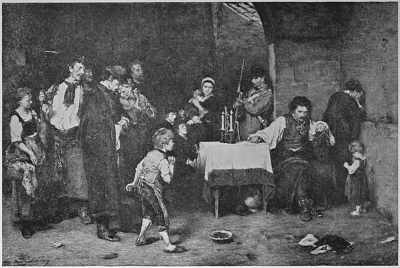
THE LAST DAY OF A CONDEMNED MAN
Permission Ch. Sedelmeyer, Paris
Michael von Munkacsy
"Yes, and no, General. No, for the sea charts, by which
we are directed to steer, record this place as navigable.
The charts were correct, too, until a few years ago; since
that time heavy sand deposits have been made here, and,
besides, the water has fallen continually in consequence
of the west wind which has prevailed for some weeks. The
more prudent, therefore, avoid this place. I myself should
have avoided it."
"Very well! And now what do you think of the situation?
Are we in danger, or likely to be?"
"I think not. The ship lies almost upright, and on clear,
smooth sand. It may lie thus for a very long time, if
nothing intervenes."
"The Captain is right in keeping us on board, then?"
"Yes, I think so—the more so as the wind, for the first
time in three days, appears about to shift to the east, and,
if it does, we shall probably be afloat again in a few hours.
Meanwhile——"
"Meanwhile?"
"To err is human, General. If the wind—we now have
south-southeast—it is not probable, but yet possible—should
again shift to the west and become stronger, perhaps
very strong, a serious situation might, of course,
confront us."
"Then we should take advantage of the Captain's permission
to leave the ship?"
"As the passage is easy and entirely safe, I can at least
say nothing against it. But, in that case, it ought to be
done while it is still sufficiently light—best of all, at once."
"And you? You would remain, as a matter of course?"
"As a matter of course, General."
"I thank you."
The General touched his cap with a slight nod of his
head; Reinhold lifted his with a quick movement, returning
the nod with a stiff bow.
"Well?" queried Else, as her father came up to her
again.
"The man must have been a soldier," replied the General.
"Why so?" asked the President.
"Because I could wish that I might always have such
clear, accurate reports from my officers. The situation,
then, is this——"
He repeated what he had just heard from Reinhold, and
closed by saying that he would recommend to the Captain
that the passengers who wished to do so should be disembarked
at once. "I, for my part, do not think of submitting
to this inconvenience, which it would seem, moreover,
is unnecessary; except that Else——"
"I, Papa!" exclaimed Else; "I don't think of it for a
moment!"
The President was greatly embarrassed. He had, to be
sure, only this morning renewed a very slight former
personal acquaintance with General von Werben, after the
departure from Stettin; but now that he had chatted with
him the entire day and played the knight to the young lady
on countless occasions, he could not help explaining, with
a twitch of the lips which was intended to be a smile, that
he wished now to share with his companions the discomforts
of the journey as he had, up to this time, the comforts;
the Prussian ministry would be able to console
itself, if worse comes to worst, for the loss of a President
who, as the father of six young hopefuls, has, besides, a
succession of his own, and accordingly neither has nor
makes claims to the sympathy of his own generation.
Notwithstanding his resignation, the heart of the worthy
official was much troubled. Secretly he cursed his own
boundless folly in coming home a day earlier, in having
intrusted himself to a tug instead of waiting for a coast
steamer, due the next morning, and in inviting the "stupid
confidence" of the General and the coquettish manœuvrings
of the young lady; and when the long-boat was really
launched a few minutes later, and in what seemed to him
an incredibly short time was filled with passengers from
the foredeck, fortunately not many in number, together
with a few ladies and gentlemen from the first cabin, and
was now being propelled by the strokes of the heavy oars,
and soon afterwards with hoisted sails was hastily moving
toward the shore, he heaved a deep sigh and determined at
any price—even that of the scornful smile on the lips of
the young lady—to leave the ship, too, before nightfall.
And night came on only too quickly for the anxious man.
The evening glow on the western horizon was fading every
minute, while from the east—from the open sea—it was
growing darker and darker. How long would it be till the
land, which appeared through the evening mist only as an
indistinct streak to the near-sighted man, would vanish
from his sight entirely? And yet it was certain that the
waves were rising higher every minute, and here and there
white caps were appearing and breaking with increasing
force upon the unfortunate ship—something that had not
happened during the entire day! Then were heard the
horrible creaking of the rigging, the uncanny whistling of
the tackle, the nerve-racking boiling and hissing of the
steam, which was escaping almost incessantly from the
overheated boiler. Finally the boiler burst, and the torn
limbs of a man, who had been just buttoning up his overcoat,
were hurled in every direction through the air. The
President grew so excited at this catastrophe that he unbuttoned
his overcoat, but buttoned it up again because the
wind was blowing with icy coldness. "It is insufferable!"
he muttered.
Else had noticed for some time how uncomfortable it
was for the President to stay upon the ship—a course
which he had evidently decided upon, against his will, out
of consideration for his traveling-companions. Her love
of mischief had found satisfaction in this embarrassing
situation, which he tried to conceal; but now her good
nature gained the upper hand, for he was after all an
elderly, apparently feeble gentleman, and a civilian. One
could, of course, not expect of him the unflinching courage
or the sturdiness of her father, who had not even once
buttoned his cloak, and was now taking his accustomed
evening walk to and fro upon the deck. But her father had
decided to remain; it would be entirely hopeless now to
induce him to leave the boat. "He must find a solution to
the problem," she said to herself.
Reinhold had vanished after his last conversation with
her father, and was not now on the rear deck; so she went
forward, and there he sat on a great box, looking through
a pocket telescope toward the land—so absorbed that she
had come right up to him before he noticed her. He sprang
hastily to his feet, and turned to her.
"How far are they?" asked Else.
"They are about to land," replied he. "Would you like
to look?"
He handed her the instrument. The glass, when she
touched it, still had a trace of the warmth of the hand from
which it came, which would have been, under other circumstances,
by no means an unpleasant sensation to her,
but this time she scarcely noticed it, thinking of it only for
an instant, while she was trying to bring into the focus
of the glass the point which he indicated. She did not
succeed; she saw nothing but an indistinct, shimmering
gray. "I prefer to use my eyes!" she exclaimed, putting
down the instrument. "I see the boat quite distinctly
there, close to the land—in the white streak! What is it?"
"The surf."
"Where is the sail?"
"They let it down so as not to strike too hard. But,
really, you have the eye of a seaman!" Else smiled at the
compliment, and Reinhold smiled. Their glances met for
a minute.
"I have a request to make of you," said Else, without
dropping her eyes.
"I was just about to make one of you," he replied, looking
straight into her brown eyes, which beamed upon him;
"I was about to ask you to allow yourself to be put ashore
also. We shall be afloat in another hour, but the night is
growing stormy, and as soon as we have passed Wissow
Hook"—he pointed to the promontory—"we shall have to
cast anchor. That is at best not a very pleasant situation,
at the worst a very unpleasant one. I should like to save
you from both."
"I thank you," said Else; "and now my request is no
longer necessary"—and she told Reinhold why she had
come.
"That's a happy coincidence!" he said, "but there is
not a moment to lose. I am going to speak to your father
at once. We must be off without delay."
"We?"
"I shall, with your permission, take you ashore myself."
"I thank you," said Else again with a deep breath. She
had held out her hand; he took the little tender hand in
his, and again their glances met.
"One can trust that hand," thought Else; "and those
eyes, too!" And she said aloud, "But you must not think
that I should have been afraid to remain here! It's really
for the sake of the poor President."
She had withdrawn her hand and was hastening away
to meet her father, who, wondering why she had remained
away so long, had come to look for her.
When he was about to follow her, Reinhold saw lying at
his feet a little blue-gray glove. She must have just slipped
it off as she was adjusting the telescope. He stooped down
quickly, picked it up, and put it in his pocket.
"She will not get that again," he said to himself.
Reinhold was right; there had been no time to lose.
While the little boat which he steered cut through the
foaming waves, the sky became more and more overcast
with dark clouds which threatened soon to extinguish even
the last trace of the evening glow in the west. In addition,
the strong wind had suddenly shifted from the south to
the north, and because of this (to insure a more speedy
return of the boat to the ship) they were unable to land
at the place where the long-boat, which was already coming
back, had discharged its passengers—viz., near the little
fishing village, Ahlbeck, at the head of the bay, immediately
below Wissow Hook. They had to steer more directly
to the north, against the wind, where there was scarcely
room upon the narrow beach of bare dunes for a single
hut, much less for a fishing village; and Reinhold could
consider himself fortunate when, with a bold manœuvre,
he brought the little boat so near the shore that the disembarkment
of the company and the few pieces of baggage
which they had taken from the ship could be accomplished
without great difficulty.
"I fear we have jumped out of the frying-pan into the
fire," said the President gloomily.
"It is a consolation to me that we were not the cause
of it," replied the General, not without a certain sharpness
in the tone of his strong voice.
"No, no, certainly not!" acknowledged the President,
"Mea maxima culpa! My fault alone, my dear young
lady. But, admit it—the situation is hopeless, absolutely
hopeless!"
"I don't know," replied Else; "it is all delightful to
me."
"Well, I congratulate you heartily," said the President;
"for my part I should rather have an open fire, a chicken
wing, and half a bottle of St. Julien; but if it is a consolation
to have companions in misery, then, it ought to be
doubly so to know that what appears as very real misery to
the pensive wisdom of one is a romantic adventure to the
youthful imagination of another."
The President, while intending to banter, had hit upon
the right word. To Else the whole affair appeared a "romantic
adventure," in which she felt a genuine hearty
delight. When Reinhold brought her the first intimation
of the impending danger, she was, indeed, startled; but she
had not felt fear for a moment—not even when the abusive
men, crying women, and screaming children hurried from
the ship, which seemed doomed to sink, into the long-boat
which rocked up and down upon the gray waves, while
night came over the open sea, dark and foreboding. The
tall seaman, with the clear blue eyes, had said that there
was no danger; he must know; why should she be afraid?
And even if the situation should become dangerous he was
the man to do the right thing at the right moment and to
meet danger! This sense of security had not abandoned
her when into the surf they steered the skiff, rocked like
a nut-shell in the foaming waves. The President, deathly
pale, cried out again and again, "For God's sake!" and
a cloud of concern appeared even on the earnest face of
her father. She had just cast a glance at the man at the
helm, and his blue eyes had gleamed as brightly as before,
even more brightly in the smile with which he answered
her questioning glance. And then when the boat had
touched the shore, and the sailors were carrying the President,
her father, and the three servants to land, and she
herself stood in the bow, ready to take a bold leap, she
felt herself suddenly surrounded by a pair of strong arms,
and was thus half carried, half swung, to the shore without
wetting her foot—she herself knew not how.
And there she stood now, a few steps distant from the
men, who were consulting, wrapped in her raincoat, in
the full consciousness of a rapture such as she never felt
before. Was it not then really fine! Before her the gray,
surging, thundering, endless sea, above which dark threatening
night was gathering; right and left in an unbroken
line the white foaming breakers! She herself with the
glorious moist wind blowing about her, rattling in her ears,
wrapping her garments around her, and driving flecks of
spray into her face! Behind her the bald spectral dunes,
upon which the long dune grass, just visible against the
faintly brighter western sky, beckoned and nodded—whither?
On into the happy splendid adventure which
was not yet at an end, could not be at an end, must not
be at an end—for that would be a wretched shame!
The gentlemen approached her. "We have decided,
Else," said the General, "to make an expedition over the
dunes into the country. The fishing village at which the
long-boat landed is nearly a quarter of a mile distant, and
the road in the deep sand would probably be too difficult
for our honored President. Besides, we should scarcely
find shelter there."
"If only we don't get lost in the dunes," sighed the
President.
"The Captain's knowledge of the locality will be guarantee
for that," said the General.
"I can scarcely speak of a knowledge of the place, General,"
replied Reinhold. "Only once, and that six years ago,
have I cast a glance from the top of these dunes into the
country; but I remember clearly that I saw a small tenant-farm,
or something of the kind, in that direction. I can
promise to find the house. How it will be about quarters
I cannot say in advance."
"In any case we cannot spend the night here," exclaimed
the General. "So, en avant! Do you wish my arm, Else?"
"Thank you, Papa, I can get up."
And Else leaped upon the dune, following Reinhold, who,
hurrying on ahead, had already reached the top, while the
General and the President followed more slowly, and the
two servants with the effects closed the procession.
"Well!" exclaimed Else with delight as, a little out of
breath, she came up to Reinhold. "Are we also at the
end of our tether, like the President?"
"Make fun of me if you like, young lady," replied Reinhold;
"I don't feel at all jolly over the responsibility
which I have undertaken. Yonder"—and he pointed over
the lower dunes into the country, in which evening and mist
made everything indistinct—"it must be there."
"'Must be,' if you were right! But 'must' you be
right?"
As if answering the mocking question of the girl, a light
suddenly shot up exactly in the direction in which Reinhold's
arm had pointed. A strange shudder shot through
Else.
"Pardon me!" she said.
Reinhold did not know what this exclamation meant. At
that moment the others reached the top of the rather steep
dune.
"Per aspera ad astra," puffed the President.
"I take my hat off to you, Captain," said the General.
"It was great luck," replied Reinhold modestly.
"And we must have luck," exclaimed Else, who had
quickly overcome that strange emotion and had now returned
to her bubbling good humor.
The little company strode on through the dunes; Reinhold
going on ahead again, while Else remained with the
other gentlemen.
"It is strange enough," said the General, "that the
mishap had to strike us just at this point of the coast.
It really seems as if we were being punished for our opposition.
Even if my opinion that a naval station can be
of no use here is not shaken, yet, now that we have almost
suffered shipwreck here ourselves, a harbor appears to
me——"
"A consummation devoutly to be wished!" exclaimed
the President. "Heaven knows! And when I think of the
severe cold which I shall take from this night's promenade
in the abominably wet sand, and that, instead of this, I
might now be sitting in a comfortable coupé and tonight
be sleeping in my bed, then I repent every word I have
spoken against the railroad, about which I have put myself
at odds with all our magnates—and not the least with
Count Golm, whose friendship would just now be very opportune
for us."
"How so?" asked the General.
"Golm Castle lies, according to my calculation, at the
most a mile from here; the hunting lodge on Golmberg——"
"I remember it," interrupted the General; "the second
highest promontory on the shore to the north—to our
right. We can be scarcely half a mile away."
"Now, see," said the President; "that would be so convenient,
and the Count is probably there. Frankly, I have
secretly counted on his hospitality in case, as I only too
much fear, a hospitable shelter is not to be found in the
tenant-house, and you do not give up your disinclination
to knock at the door in Warnow, which would, indeed, be
the simplest and most convenient thing to do."
The President, who had spoken panting, and with many
intermissions, had stopped; the General replied with a
sullen voice, "You know that I am entirely at outs with
my sister."
"But you said the Baroness was in Italy?"
"Yet she must be coming back at this time, has perhaps
already returned; and, if she were not, I would not go to
Warnow, even if it were but ten paces from here. Let us
hurry to get under shelter, Mr. President, or we shall be
thoroughly drenched in addition to all we have already
passed through."
In fact, scattered drops had been falling for some time
from the low-moving clouds, and hastening their steps, they
had just entered the farmyard and were groping their way
between barns and stables over a very uneven courtyard
to the house in whose window they had seen the light, when
the rain, which had long been threatening, poured down in
full force.
[Pölitz receives his guests with apologies for the accommodations
and his wife's absence from the room. His
manner is just a bit forced; Else, noticing it, goes out to
look for Mrs. Pölitz, and brings the report that the children
are sick. The President suggests that they go on to Golmberg.
Pölitz will not hear of it, but Else has made arrangements—makeshifts
though they are—for the trip, and
insists upon leaving, even in the face of the storm. A messenger
is to be sent ahead to announce them—Reinhold included,
upon Else's insistence. Else goes into the kitchen,
where Mrs. Pölitz pours out her soul to her—the hardheartedness
of the Count, who has never married, and her
vain labors to keep their little home in Swantow. It sets
her thinking, first about the Count, then about Reinhold—was
he married or not? Wouldn't any girl be proud of
him—even herself! But then there would be disinheritance!
Yet she keeps on thinking of him. How would
"Mrs. Schmidt" sound! She laughs, and then grows serious;
tears come into her eyes; she puts her hand into her
pocket and feels the compass which Reinhold had given her.
It is faithful. "If I ever love, I too shall be faithful," she
says to herself.
Reinhold, going out to look for the boat, wonders why
he left it to accompany the others to Pölitz's house; but
fortunately he finds it safe. Now his duty to the General
and Else is fulfilled; he will never see her again, probably.
Yet he hastens back—and meets them just on the point of
leaving for Golmberg.
The President has been waiting for the storm to blow
over, he says. Else is fidgety, yet without knowing why;
she wonders what has become of Reinhold. The President
sounds Pölitz on the subject of the railway—the nearest
doctor living so far away that they cannot afford to have
him come. But Pölitz says that they do not want a railway—a
decent wagon road would be enough, and they could
have that if only the Count would help a little. A naval
station? So far as they are concerned, a simple break-water
would do, he tells the President. The latter, while
Pölitz is out looking for the messenger, discusses with the
General the condition of the Count's tenants, in the midst
of which the Count himself arrives with his own carriages
to take them over to Golmberg.
A chorus of greetings follows. The Count had met the
General in Versailles on the day the German Emperor was
proclaimed, the General had not forgotten. The company
now lacks only Reinhold, and the Count, thinking that he
must have lost his way, is about to send a searching
party, when Else tells him that she has already done so.
The Count smiles. She hates him for it, and outside, a
moment later, rebukes herself for not controlling her temper.
Reinhold meets her there. She commands him to
accompany them. As they are leaving Else makes a remark
about the doctor, which is overheard, as she intended,
by the Count, who promises to send for the doctor himself.
They proceed to Golmberg. Conversation in the servants'
carriage is lively, turning on the relative merits of
their respective masters—how liberal the Count is; how
strict, yet not so bad, the General; while a bottle of brandy
passes around. In the first carriage, where Else, the President,
and the General are riding, the conversation is of
the Count's family and of old families in general, then of
the project before them—the railroad and the naval station.
The President drops that subject, finding the General
not kindly disposed to it. He and Else are both thinking
of her indirect request to the Count to send for the
doctor. Then Else's thoughts turn again to Reinhold—his
long absence—what he would think of her command to
accompany them. The Count and Reinhold in the second
carriage speak hardly a dozen words. Reinhold's thoughts
are of Else—how hopelessly far above him she is—how he
would like to run away. They arrive at Golmberg.]
The President had dropped the remark in his note that
the absence of a hostess in the castle would be somewhat
embarrassing for the young lady in their company, but
as it was not so easily to be remedied he would apologize
for him in advance. The Count had dispatched a messenger
forthwith to his neighbor, von Strummin, with the urgent
request that he should come with his wife and daughter
to Golmberg, prepared to spend the night there. The
Strummins were glad to render this neighborly service,
and Madame and Miss von Strummin had already received
Else in the hall, and conducted her to the room set apart
for her, adjoining their own rooms.
The President rubbed his thin white hands contentedly
before the fire in his own comfortable room, and murmured,
as John put the baggage in order, "Delightful; very delightful!
I think this will fully reconcile the young lady
to her misfortune and restore her grouchy father to a sociable
frame of mind."
Else was fully reconciled. To be released from the close,
jolting prison of a landau and introduced into a brightly
lighted castle in the midst of the forest, where servants
stood with torches at the portal; to be most heartily welcomed
in the ancient hall, with its strangely ornamented
columns, by two ladies who approached from among the
arms and armor with which the walls and columns were
hung and surrounded, and conducted into the snuggest of
all the apartments; to enjoy a flickering open fire, brightly
burning wax tapers before a tall mirror in a rich rococo
frame, velvet carpets of a marvelous design which was
repeated in every possible variation upon the heavy hangings
before the deeply recessed windows, on the portières
of the high gilded doors, and the curtains of the antique
bed—all this was so fitting, so charming, so exactly as it
should be in an adventure! Else shook the hand of the
matronly Madame von Strummin, thanked her for her
kindness, and kissed the pretty little Marie, with the mischievous
brown eyes, and asked permission to call her
"Meta," or "Mieting," just as her mother did, who had
just left the room. Mieting returned the embrace with the
greatest fervor and declared that nothing more delightful
in the world could have come to her than the invitation for
this evening. She, with her Mamma, felt so bored at
Strummin!—it was horribly monotonous in the country!—and
in the midst of it this letter from the Count! She was
fond of coming to Golmberg, anyhow—the forest was so
beautiful, and the view from the platform of the tower,
from the summit of Golmberg beyond the forest over the
sea—that was really charming; to be sure, the opportunity
but seldom! Her mother was a little indolent, and
the gentlemen thought of their hunting, their horses, and
generally only of themselves. Thus she had not been a
little surprised, too, at the haste of the Count today in procuring
company for the strange young lady, just as if he
had already known beforehand how fair and lovely the
strange young lady was, and how great the pleasure of
being with her, and of chattering so much nonsense; if
she might say "thou" to her, then they could chatter twice
as pleasantly.
The permission gladly given and sealed with a kiss threw
the frolicsome girl into the greatest ecstasy. "You must
never go away again!" she exclaimed; "or, if you do, only
to return in the autumn! He will not marry me, in any
case; I have nothing, and he has nothing in spite of his
entail, and Papa says that we shall all be bankrupt here
if we don't get the railroad and the harbor. And your
Papa and the President have the whole matter in hand,
Papa said as we drove over; and if you marry him, your
Papa will give the concession, as a matter of course—I
believe that's what it's called, isn't it? And you are really
already interested in it as it is; for the harbor, Papa says,
can be laid out only on the estates which belong to your
aunt, and you and your brother—you inherit it from your
aunt—are already coheirs? It is a strange will, Papa says,
and he would like to know how the matter really is. Don't
you know? Please do tell me! I promise not to tell anyone."
"I really don't know," replied Else. "I only know that
we are very poor, and that you may go on and marry your
Count for all me."
"I should be glad to do so," said the little lady seriously,
"but I'm not pretty enough for him, with my insignificant
figure and my pug nose. I shall marry a rich burgher some
day, who is impressed by our nobility—for the Strummins
are as old as the island, you know—a Mr. Schulze, or
Müller, or Schmidt. What's the name of the captain who
came with you?"
"Schmidt, Reinhold Schmidt."
"No, you're joking!"
"Indeed, I'm not; but he's not a captain."
"Not a Captain! What then?"
"A sea captain."
"Of the Marine?"
"A simple sea captain."
"Oh, dear me!"
That came out so comically, and Mieting clapped her
hands with such a naïve surprise, that Else had to laugh,
and the more so as she could thus best conceal the blush
of embarrassment which flushed her face.
"Then he will not even take supper with us!" exclaimed
Mieting.
"Why not?" asked Else, who had suddenly become very
serious again.
"A simple captain!" repeated Mieting; "too bad! He's
such a handsome man! I had picked him out for myself!
But a simple sea captain!"
Madame von Strummin entered the room to escort the
ladies to supper. Mieting rushed toward her mother to
tell her her great discovery. "Everything is already arranged,"
replied her mother. "The Count asked your
father and the President whether they wished the captain
to join the company. Both of the gentlemen were in favor
of it, and so he too will appear at supper. And then, too,
he seems so far to be a very respectable man," concluded
Madame von Strummin.
"I'm really curious," said Mieting.
Else did not say anything; but when at the entrance of
the corridor she met her father, who had just come from
his room, she whispered to him, "Thank you!"
"One must keep a cheerful face in a losing game," replied
the General in the same tone.
Else was a bit surprised; she had not believed that he
would so seriously regard the question of etiquette, which
he had just decided as she wished. She did not reflect that
her father could not understand her remark without
special explanation, and did not know that he had given to
it an entirely different meaning. He had been annoyed
and had allowed his displeasure to be noticed, even at the
reception in the hall. He supposed that Else had observed
this, and was now glad that he had meanwhile resolved to
submit quietly and coolly to the inevitable, and in this
frame of mind he had met her with a smile. It was only
the Count's question that reminded him again of the young
sea captain. He had attached no significance either to the
question or to his answer, that he did not know why the
Count should not invite the captain to supper.
Happily for Reinhold, he had not had even a suspicion of
the possibility that his appearance or non-appearance at
supper could be seriously debated by the company.
"In for a penny, in for a pound," he said to himself,
arranging his suit as well as he could with the aid of the
things which he had brought along in his bag from the
ship for emergencies. "And now to the dickens with the
sulks! If I have run aground in my stupidity, I shall get
afloat again. To hang my head or to lose it would not be
correcting the mistake, but only making it worse—and it
is already bad enough. But now where are my shoes?"
In the last moment on board he had exchanged the shoes
which he had been wearing for a pair of high waterproof
boots. They had done him excellent service in the water
and rain, in the wet sand of the shore, and on the way to
the tenant-farm—but now! Where were the shoes? Certainly
not in the traveling bag, into which he thought he
had thrown them, but in which they refused to be found,
although he finally, in his despair, turned the whole contents
out and spread them about him. And this article of
clothing here, which he had already taken up a dozen times
and dropped again—the shirt bosoms were wanting! It
was not the blue overcoat! It was the black evening coat,
the most precious article of his wardrobe, which he was
accustomed to wear only to dinners at the ship-owners',
the consul's, and other formal occasions! Reinhold sprang
for the bell—the rotten cord broke in his hand. He jerked
the door open and peered into the hall—no servant was to
be seen; he called first softly and then more loudly—no
servant answered. And yet—what was to be done! The
coarse woolen jacket which he had worn under his raincoat,
and had, notwithstanding, got wet in places had been
taken away by the servant to dry. "In a quarter of an
hour," the man had said, "the Count will ask you to
supper." Twenty minutes had already passed; he had
heard distinctly that the President, who was quartered a
few doors from his room, had passed through the hall to
go downstairs; he would have to remain here in the most
ridiculous imprisonment, or appear downstairs before the
company in the most bizarre costume—water-boots and
black dress suit—before the eyes of the President, whose
long, lean figure, from the top of his small shapely head
to his patent-leather tips, which he had worn even on board
ship, was the image of the most painful precision—before
the rigorous General, in his closely buttoned undress uniform—before
the Count, who had already betrayed an
inclination to doubt his social eligibility—before the ladies!—before
her—before her mischievous brown eyes! "Very
well," he concluded, "if I have been fool enough to follow
the glances of these eyes then this shall be my punishment,
I will now do penance—in a black dress coat and water-boots."
With a jerk he pulled on the boots which he still held in
his rigid left hand, regarding them from time to time with
horror, and opened the door again, this time to go down
the broad stairway, and with a steady step along the hall
into the dining-room, the location of which he had already
learned from the servant.
Meanwhile the rest of the company had assembled. The
two young ladies had appeared arm in arm and did not
allow themselves to be separated, although the Count, who
approached them with animation, addressed his words
to Else alone. He dutifully hastened to inform the young
lady that the carriage had been sent off to Prora for the
doctor a quarter of an hour before. He asked Else
whether she was interested in painting, and if she would
allow him to call her attention hastily to some of the more
important things which he had brought from the gallery
in Castle Golm to Golmberg to decorate the dining-room,
which seemed to him altogether too bare: here a Watteau,
bought by his great-grandfather himself in Paris; over
there, a cluster of fruit, called "Da Frutti," by the Italian
Gobbo, a pupil of Annibale Carracci; yonder, the large
still-life by the Netherlander Jacob van Ness. This flower
piece would interest the young lady especially, as it is by a
lady, Rachel Ruysch, a Netherlander of course, whose pictures
are greatly in demand. Here on the étagère, the
service of Meissen porcelain, once in the possession of
August the Strong, which his great-grandfather, who was
for some years Swedish minister at the Dresden Court, had
received in exchange for a pair of reindeer—the first that
had been seen on the continent; here the no less beautiful
Sèvres service, which he himself had in previous years
admired in the castle of a nobleman in France, who had
presented it to him, in recognition of his fortunate efforts
to preserve the castle, which he had turned into a hospital.
"You are not interested in old porcelain?" queried the
Count, who thought he noticed that the dark eyes of the
young lady glanced only very superficially over his treasures.
"I have seen so few such things," said Else, "I do not
know how to appreciate their beauty."
"And then, too, we are a bit hungry," put in Mieting—"at
least I am. We dine at home at eight o'clock, and now
it is eleven."
"Hasn't the Captain been called?" asked the Count of
the butler.
"Certainly, your Grace; a quarter of an hour ago."
"Then we will not wait any longer. The etiquette of
kings does not appear to be that of sea captains. May I
accompany you, Miss Else?"
He offered Else his arm; hesitatingly she rested the tips
of her fingers upon it. She would have liked to spare the
Captain the embarrassment of finding the company already
at the table, but her father had offered his arm to Mieting's
mother, and the gallant President his to Mieting. The
three couples proceeded to the table, which stood between
them and the door, when the door opened and the strange
figure of a bearded man in black suit and high water-boots
appeared, in which Else, to her horror, recognized the
Captain. But in the next moment she had to laugh like
the others. Mieting dropped the arm of the President and
fled to a corner of the hall to smother in her handkerchief
the convulsive laughter which had seized her at the unexpected
sight.
"I must apologize," said Reinhold, "but the haste with
which we left the ship today was not favorable to a strict
selection from my wardrobe, as I have unfortunately just
now noticed."
"And, as this haste has turned out to our advantage, we
least of all have reason to lay any greater stress upon the
trivial mishap than it deserves," said the President very
graciously.
"Why didn't you call on my valet?" asked the Count
with gentle reproof.
"I find the costume very becoming," said Else, with a
desperate effort to be serious again and with a reproving
glance at Mieting, who had come out of her corner but did
not yet dare to take the handkerchief from her face.
"That is much more than I had dared to hope," said
Reinhold.
They had taken their places at the table—Reinhold
diagonally opposite Else and directly across from the
Count; at his left, Miss Mieting, and, at his right, von
Strummin, a broad-shouldered gentleman with a wide red
face covered on the lower part by a big red beard; he was
possessed of a tremendously loud voice which was the
more unpleasant to Reinhold as it continually smothered
the low merry chatter of the young lady at his left. The
good-natured child had determined to make Reinhold forget
her improper behavior of a few minutes before, and
the execution of this resolution was made easier for her as,
now that the tablecloth graciously covered the ridiculous
water-boots, she verified what she thought she had discovered
at the first glance—that the Captain, with his
great, bright, blue eyes, his brown face, and his curly
brown beard, was a handsome man, a very handsome man.
After she had tried to communicate to Else this important
discovery by significant glances and explanatory gestures,
and to her delight had had it corroborated by a smile and
nod, she yielded to the pleasure of conversation with the
handsome man, the more eagerly because she was sure that
this fervor would not pass unnoticed by the Count. For
she knew from experience that it would not please him,
that he would even feel it a kind of personal offense when
ladies, whose favor he did not seek, bestowed special attention
upon other gentlemen in his presence! And the fact
that this was a simple sea captain, whose social status had
been discussed shortly before, made the matter more
amusing and spicy in her merry eyes; besides, the conversation
was entertaining enough without that. "The
Captain has so many stories to tell! And he tells them so
simply and frankly! You can't believe, Else, how interesting
it is!" she shouted across the table; "I could listen
to him all night!"
"The child is not very discriminating in her taste," said
the Count to Else.
"I am sorry," said Else, "she has just chosen me as
her friend, as you have heard."
"That is another matter," said the Count.
The conversation between them could not get under way;
the Count found himself repeatedly left to talk to Madame
von Strummin, with whom he then conversed also—not to
be altogether silent; while Else turned to her neighbor on
the other side, the President. And more than once, when
Madame von Strummin was again conversing with the
General, the Count had to sit and look on in silence and
see how well the conversation at his table could go on
without him. To fill out these forced pauses, he drank one
glass of wine after another without improving his humor,
which he vented on the servants because he had nobody
else. It would have been most agreeable to him, to be
sure, to use the Captain for this purpose, but he found him
extremely odious—everything about him, his appearance,
his attitude, his manners, his expression, his voice! It
was the irony of fate that he himself had brought the man
to his house in his own wagon! If only he had not asked
the man to supper, but had left him in his room! He said
to himself that it was ridiculous to be angry about the
man, and yet he was angry—angry again because he could
not control his feeling. He must, at any price, make the
conversation general, to release himself from a state of
mind which had become quite intolerable to him.
Opposite him von Strummin was shouting into the ear
of the General, who seemed to listen only against his will,
his views about the railroad and the naval station. The
Count, for his part, had determined not to touch upon the
delicate theme while at table; now any theme was agreeable
to him.
"Pardon, my friend," said he, raising his voice; "I have
heard a snatch of what you have just been telling the
General about our favorite project. You say continually
'we' and 'us,' but you know that our views differ in essential
points; I should like, therefore, to ask you, if you must
speak of the matter now, to do so only in your own name."
"Ho, ho!" exclaimed von Strummin. "Wherein do we
differ so seriously? In one point, I wish a station at
Strummin just as much as you do at Golm."
"But we can't all have a station," said the Count with
a patronizing shrug of the shoulders.
"Certainly not; but I must, or the whole project is not
worth a red cent to me," exclaimed the other. "What!
Am I to haul my corn half a mile, as before, and an hour
later let the train whizz past my nose! In that case I shall
prefer to vote at the Diet for the highway which the government
offers; that will run right behind my new barn;
I can push the wagon from the barn floor to the road.
Isn't that true, Mr. President?"
"Whether the highway will run directly behind your
barn or not, von Strummin, I really do not know," said the
President. "In any case it will come through your property;
as for the rest, my views have been long known to
the gentlemen;" and he turned to Else again, to continue
with her the conversation which had been interrupted.
The Count was angry at the reproof which these last
words seemed to convey, the more so as he was conscious
that he had not deserved it. He had not begun the discussion!
Now it might and must be carried still further!
"You see," continued he, turning to von Strummin,
"what a bad turn you have done us—I must say 'us,' now—by
this continual, disagreeable intrusion of personal
interests. Of course we want our profit from it—what
sensible man does not want that! But that is a secondary
matter. First the State, then the other things. So I think,
at least, and so does the General here."
"Certainly I think so," said the General; "but how is it
that you bring me into it?"
"Because no one would profit more by the execution of
the project than your sister—or whoever may be in possession
of Warnow, Gristow, and Damerow."
"I shall never possess a foot of those estates," said the
General knitting his eyebrows. "Besides, I have had absolutely
nothing to do with the matter, as you yourself know,
Count; I have not once expressed an opinion, and so am
not in a position to accept the compliment you paid me."
He turned again to Madame von Strummin. The Count's
face flushed.
"The views of a man in your position, General," he said
with a skilful semblance of composure, "can no more be
concealed than the most official declaration of our honored
President, even if he give them no official form."
The General knitted his brows still more sternly.
"Very well, Count," exclaimed the General, "be it so, but
I confess myself openly to be the most determined opponent
of your project! I consider it strategically useless,
and technically impossible of execution."
"Two reasons, either of which would be crushing if it
were valid," rejoined the Count with an ironical smile.
"As to the first, I submit, of course, to such an authority
as you are—though we could not always have war with
France and her weak navy, but might occasionally have it
with Russia with her strong navy, and in that case a harbor
facing the enemy might be very necessary. But the
impracticability of the project, General! On this point I
think that I, with my amphibian character as a country
gentleman living by the sea, may with all deference say
a word. Our sand, difficult as it makes the construction
of roads, to the great regret of ourselves and our President,
is excellent material for a railroad embankment, and
will prove itself a good site for the foundation of our
harbor walls."
"Except those places where we should have to become
lake-dwellers again," said the President, who for the sake
of the General could no longer keep silent.
"There may be such places," exclaimed the Count, who,
in spite of the exasperating contradictions by both of the
gentlemen, now had the satisfaction at least of knowing
that all other conversation had ceased and that for the
moment he alone was speaking; "I grant it. But what else
would that prove than that the building of the harbor will
last a few months or years longer and cost a few hundred
thousands or even a few millions more? And what will
they say of an undertaking which, once completed, is an
invincible bulwark against any enemy attacking from the
east?"
"Except one!" said Reinhold.
The Count had not thought that this person could join
the conversation. His face flushed with anger; he cast a
black look at the new opponent, and asked in a sharp
defiant tone:
"And that is?"
"A storm flood," replied Reinhold.
"We here in this country are too much accustomed to
storms and floods to be afraid of either," said the Count,
with forced composure.
"Yes, I know," replied Reinhold; "but I am not speaking
of ordinary atmospheric and marine adjustments and
disturbances, but of an event which I am convinced has
been coming for years and only waits for an opportune
occasion, which will not be wanting, to break forth with a
violence of which the boldest imagination can form no
conception."
"Are we still in the realm of reality, or already in the
sphere of the imagination?" asked the Count.
"We are in the domain of possibility," replied Reinhold;
"of a possibility which a glance at the map will show
us has already been more than once realized and will in
all human probability be repeated at no very distant future
time."
"You make us extremely curious," said the Count.
He had said it ironically; but he had only given expression
to the feelings of the company. The eyes of all were
fixed upon Reinhold.
"I am afraid I shall tire the ladies with these things,"
said Reinhold.
"Not in the least," said Else.
"I just revel in everything connected with the sea," said
Mieting, with a mischievous glance at Else.
"You would really oblige me," said the President.
"Please continue!" added the General.
"I shall be as brief as possible," said Reinhold, glancing
first at the General and then at the President, as if he
were addressing them alone. "The Baltic appears to have
remained a world to itself after its formation by revolutions
of the most violent nature. It has no ebb and flow,
it contains less salt than the North Sea, and the percentage
of salt diminishes toward the east, so that the flora and
fauna——"
"What's that?" interrupted Mieting.
"The vegetable and animal world, Miss Mieting—of the
Gulf of Finland are almost those of fresh water. Nevertheless
there is a constant interaction between the gulf
and the ocean, as the two are still visibly connected—an
ebb and flow from the latter to the former, and vice versa,
with a highly complicated coincident combination of the
most varied causes, one of which I must emphasize, because
it is just that one of which I have to speak. It is the
regularity with which the winds blow from west to east
and from east to west, that accompanies and assists in a
friendly manner, as it were, the ebb and flow of the water
in its submarine channels. The mariner relied upon these
winds with almost the same certainty with which one calculates
the appearance of well established natural phenomena,
and he was justified in doing so; for no considerable
change had taken place within the memory of man,
until, a few years ago, suddenly an east wind, which usually
began to blow in the second half of August and prevailed
until the middle of October, disappeared and has never
reappeared."
"Well, and the effect of that?" asked the President, who
had listened with rapt attention.
"The result is, Mr. President, that in the course of these
years enormous masses of water have accumulated in the
Baltic, attracting our attention the less because, as a matter
of course, they tend to distribute themselves evenly in
all directions, and the main force is continually increasing
eastward, so that in the spring of last year at Nystad, in
South Finland, a rise of four feet of water above the
normal, at Wasa, two degrees further north, a rise of six
feet, and at Torneo, in the northernmost end of the Bay
of Bothnia, a rise of eight feet was registered. The gradual
rise of the water and the uniformly high banks protected
the inhabitants of those regions to a certain extent
against the greatest calamity. But for us who have an
almost uniformly flat shore, a sudden reversal of this
current, which has for years set eastward without interruption,
would be disastrous. But the reversed current must
set in with a heavy storm from the northeast or east, particularly
one that lasts for days. The water, forced westward
by the violent storm, will seek in vain an outlet
through the narrow passages of the Belt and of the Sound
into the Kattegat and Skagger-Rak to the ocean, and, like
a hunted beast of prey rushing over the hurdles, will surge
over our coasts, rolling for miles inland, carrying with it
everything that opposes its blind rage, covering fields and
meadows with sand and boulders, and causing a devastation
which our children and children's children will recount
with horror."
While Reinhold was thus speaking the Count had not
failed to notice that the President and General repeatedly
exchanged knowing and corroborative glances, that von
Strummin's broad face had lengthened with astonishment
and horror, and, what vexed him most of all, the ladies had
listened with as much attention as if it had been an account
of a ball. He was determined at least not to allow Reinhold
the last word.
"But this marvelous storm flood is at best—I mean, in
the most favorable case for you—a hypothesis!" he exclaimed.
"Only for such as are not convinced of its inevitableness,
as I am," replied Reinhold.
"Very well," said the Count; "I will assume for once
that the gentleman is not alone in his conviction—yes, even
more, that he is right, that the storm flood will come today,
or tomorrow, or some time; yet it appears that it does not
come every day, but only once in centuries. Now, gentlemen,
I have the profoundest respect for the solicitude of
our authorities, which looks far into the future; but such
century-long perspectives of even the most solicitous
would seem beyond calculation, at any rate not induce them
to neglect what the moment demands."
As the last words of the Count were directed evidently
to the General and the President, not to him, Reinhold
thought he should refrain from answering. But neither of
the two gentlemen replied; the rest, too, were silent; an
embarrassing pause followed. Finally the President
coughed into his slender white hand, and said:
"Strange! While the Captain here prophesies with a
tone of conviction itself a storm flood, which our amiable
host, who would be closest to it—as our Fritz Reuter says—would
like to relegate to fable land, I have had to think
at every word of another storm flood——"
"Still another!" exclaimed Mieting.
"Of a different storm flood, Miss Mieting, in another
entirely different region; I need not tell the gentlemen in
what region. Here too the usual course of things has been
interrupted in the most unexpected manner, and here too
a damming up of the floods has taken place, which have
rushed in from west to east in an enormous stream—a
stream of gold, ladies. Here, too, the wise predict that
such unnatural conditions cannot last, that their consummation
is imminent, that a reverse current must set in, a
reaction, a storm flood, which, to keep the figure that so
well fits the case, like that other flood will rush upon us
with destruction and desolation, and will cover with its
turbulent barren waters the places in which men believed
that they had established their rule and dominion firmly
and for all time."
In his zeal to give a different turn to the conversation
and in his delight and satisfaction with the happy comparison,
the President had not reflected that he was really
continuing the subject and that the theme in this new form
must be still more uncomfortable for the Count than in
the first. He became aware of his thoughtlessness when
the Count, in a tone reflecting his emotion, exclaimed:
"I hope, Mr. President, you will not associate our idea,
dictated, I may be permitted to say, by the purest patriotism,
with those financial bubbles so popular these days,
which have usually no other source than the most ordinary
thirst for gain."
"For Heaven's sake, Count! How can you impute to
me such a thing as would not even enter my dreams!" exclaimed
the President.
The Count bowed. "I thank you," said he, "for I confess
nothing would have been more offensive to my feelings.
I have, of course, always considered it a political
necessity, and a proof of his eminent statesmanship, that
Prince Bismarck in the execution of his great ideas made
use of certain means which he would certainly have done
better not to have employed, because he thus could not
avoid too close contact with persons, dealings with whom
were formerly very odious to him at least. I considered it
also a necessary consequence of this unfortunate policy
that he inaugurated, was forced to inaugurate, by means of
these nefarious millions, the new era of haggling and immoderate
lust for gain. However——"
"Pardon me for interrupting you," said the General; "I
consider this bargaining of the Prince with those persons,
parties, strata of the population, classes of society—call it
what you will—as you do, Count, as of course an unfortunate
policy but by no means a necessary one. Quite the
contrary! The rocher de bronze, upon which the Prussian
throne is established—a loyal nobility, a zealous officialdom,
a faithful army—they were strong enough to bear the
German Imperial dignity, even though it had to be a German
and not a Prussian, or not an imperial dignity at all."
"Yes, General, it had to be an imperial dignity, and a
German one too," said Reinhold.
The General shot a lowering glance from under his
bushy brows at the young man; but he had just listened
with satisfaction to his explanations, and he felt that he
must now, even though Reinhold opposed him, let him
speak. "Why do you think so?" he asked.
"I only follow my own feelings," replied Reinhold; "but
I am sure that they are the feelings of all who have ever
lived much abroad, away from home, as I have—those who
have experienced, as I have, what it means to belong to a
people that is not a nation, and, because it is not a nation,
is not considered complete by the other nations with which
we have intercourse, nay, is even despised outright; what
it means in difficult situations into which the mariner so
easily comes, to be left to one's own resources, or, what is
still worse, to ask for the assistance or the protection of
others who unwillingly render it or prefer not to help at
all. I have experienced and endured all this, as thousands
and thousands of others have done, and to all this injustice
and wrong have had silently to clench my fist in my pocket.
And now I have been abroad again since the war, until a few
weeks ago, and found that I no longer needed to dance attendance
and stand aside, that I could enter with as firm
step as the others; and thus, my friends, I thanked God
from the bottom of my heart that we have an Emperor—a
German Emperor; for nothing less than a German Emperor
it had to be, if we were to demonstrate to the Englishman,
the American, the Chinese and Japanese, ad oculos, that
they henceforth no longer carry on trade and form treaties
with Hamburgers, Bremers, with Oldenburgers and Mecklinburgers,
or even with Prussians, but with Germans, who
sail under one and the same flag—a flag which has the will
and the power to protect and defend the least and the poorest
who shares the honor and the fortune of being a
German."
The General, to whom the last words were addressed,
stared straight ahead—evidently a sympathetic chord in
his heart had been touched. The President had put on his
eye-glasses, which he had not used the whole evening; the
ladies scarcely took their eyes from the man who spoke
with such feeling and loyalty—the Count seeing and noting
everything; his dislike for the man grew with every word
that came from his mouth; he felt he must silence the
wretched chatterer.
"I confess," he said, "that I should regret the noble
blood shed upon so many battlefields, if it were for no
other purpose than to put more securely into the pockets
of the men who speculate in cotton and sugar, or export
our laborers, their petty profits."
"I did not say that it was for no other purpose," rejoined
Reinhold.
"To be sure," continued the Count, with a pretense of
ignoring the interruption; "the further out of gunshot
the better! And it is very pleasant to bask in the glory and
honor which others have won for us."
The General frowned, the President dropped his eye-glasses,
the two young ladies exchanged terrified glances.
"I doubt not," said Reinhold, "that the Count has his
full share of German glory; I, for my part, am content with
the honor of not having been out of gunshot."
"Where were you on the day of Gravelotte, Captain?"
"At Gravelotte, Count."
The General raised his eyebrows, the President put on
his eye-glasses, the young ladies glanced at each other
again—Else this time with a thrill of delight, while Mieting
almost broke out into unrestrained laughter at the puzzled
expression of the Count.
"That is, to be accurate," continued Reinhold, whose
cheeks were flushed by the attention which his last word
had excited, as he turned to the General; "on the morning
of that day I was on the march from Rezonville to St.
Marie. Then, when it was learned, as the General knows,
that the enemy was not retreating along the northern road,
and the second army had executed the great flank movement
to the right toward Berneville and Amanvilliers, we—the
eighteenth division—came under fire at half-past eleven
in the morning in the neighborhood of Berneville. Our
division had the honor of opening the battle, as the General
will recall."
Reinhold passed his hand over his brow. The dreadful
scenes of those fateful days again came to his mind. He
had forgotten the offensive scorn which had been couched
in the Count's question, and which he wished to resent by
his account of his participation in the battle.
"Did you go through the whole campaign?" asked the
General; and there was a peculiar, almost tender tone in
his deep voice.
"I did, General, if I may include the two weeks from
the eighteenth of July to the first of August, when I was
drilling in Coblenz. As a native Hamburger and a seaman
I had not had the good fortune of thoroughly learning the
military discipline in my youth."
"How did you happen to enter the campaign?"
"It is a short story, and I will tell it briefly. On the
fifteenth of July I lay with my ship at the Roads of Southampton,
destined for Bombay—captain of a full-rigged
ship for the first time. On the evening of the sixteenth
we were to sail. But on the morning of the sixteenth
the news came that war had been declared; at noon, having
already secured a suitable substitute, I severed my
connection with the ship-owners and with my ship; in the
evening I was in London; during the nights of the sixteenth
and seventeenth on the way to Ostende by way of Brussels,
down the Rhine to Coblenz, where I offered myself as a
volunteer, was accepted, drilled a little, sent on, and—I
don't know how it happened—assigned to the Ninth Corps,
Eighteenth Division, —— Regiment, in which I went
through the campaign."
"Were you promoted?"
"To the rank of Corporal at Gravelotte; on the first of
September, the day after the great sally of Bazaine, to
the rank of Vice-Sergeant-Major; on the fourth of September——"
"That was the day of Orléans?"
"Yes, General—on the day of the battle of Orléans I
received my commission as officer."
"My congratulations on your rapid advancement!" said
the General with a smile; but his face darkened again.
"Why didn't you introduce yourself to me as comrade?"
"The sea captain apologizes for the Reserve Lieutenant,
General."
"Did you receive a decoration?"
"At your service! I received the Cross with my commission."
"And you don't wear the decoration?"
"My dress is a little disordered today," replied Reinhold.
Mieting burst into laughter, in which Reinhold freely
joined; and the others smiled—polite, approving, flattering
smiles, as it seemed to the Count.
"I fear we have taxed the patience of the ladies too
long," he said with a significant gesture.
[Mieting and Else are alone in their room. Mieting declares
her love for the captain, declaring he is just her
ideal of a man. She then unbraids her long hair, which
reaches to her feet, tells Else all her little love stories,
kisses her and runs off to bed.
The gentlemen likewise prepare to retire. Reinhold
excuses himself very formally, declines the Count's offer
of a carriage for his journey in the early morning, and is
also about to retire, when the butler knocks on his door
and tells him that the President wishes to speak to him.
The President assures him of his personal interest, and
asks him to look over certain papers relating to the railway
and naval project and tell him whether he would be willing
to work with him in the capacity of chief pilot at Wissow
to succeed the old chief, soon to be pensioned. Reinhold
is quite overcome by this confidence on the part of the
stranger. The President invites him to dinner at his house,
when he is to give his answer. Reinhold considers the
proposal—to give up all his plans—his command of a ship
plying between South America and China for the great
Hamburg firm, his North Pole expedition, in which he had
interested many people—to give up all for this desert coast
and—he had to confess it—to be near Else, though his
social position was hopelessly inferior; he would be but a
fool, he knew. Which course should he take? He looks
out of the window and sees Venus, the star of love, shining
through a rift of the clouds. He decides to accept the
President's proposal. It is dawn, and he lies down for an
hour's sleep.
Else lies awake for a long time thinking of the day's
happenings. When she does fall asleep, she dreams wildly
of searching for Reinhold, and of wrestling with Mieting,
by whom she is finally awakened just before sunrise. Mieting
helps Else dress and they both go out to watch the
sunrise from a height overlooking the sea. Reinhold comes
upon them there. He sees the ship and hastens away with
a word for Mieting and a glance for Else, who returns the
glance and sends him on his way with a joyous heart.
On the train to Berlin Reinhold is in the same compartment
with Ottomar von Werben, Else's brother, and the
two recognize each other. Reinhold tells of his adventures
in hunting buffaloes and tapirs, in contrast with which
Ottomar describes his tiresome occupation as an officer
since the close of the war. In the conversation Ottomar
tells Reinhold that he lives next door to Reinhold's uncle,
and offers to help him find his uncle when they arrive,
since Reinhold has not seen him for ten years. While
Ottomar is looking through the crowd Reinhold recognizes
his uncle, who gives him an affectionate greeting, and Ferdinande,
his uncle's daughter, now a young lady of twenty-four.
Reinhold introduces Ottomar to Ferdinande, but she
is in a hurry to be off, and whispers in Reinhold's ear that
her father and Ottomar's father have been enemies
since '48.
Reinhold, on entering his uncle's luxurious home, feels
that it lacks real comfort, but thinks this may be due to
the fact that he is a stranger. Then he thinks of Else—she
lives next door! Aunt Rikchen greets him with hugs
and kisses when he comes in. At dinner he asks about his
cousin Philip, and learns that Philip almost never comes
home. The question seems to have opened an old sore, as
Philip is at odds with his father—an unfortunate beginning
for the evening meal, Reinhold thinks.]
Meanwhile it appeared that his fears were fortunately
not to be justified. To be sure, Aunt Rikchen could not
open her mouth without having the thread of her discourse
abruptly cut off by Uncle Ernst, and Ferdinande took little
part in the conversation; but that signified little in the
beginning, or was easily explained, as Uncle Ernst asked
Reinhold first of all for a detailed account of his adventures
and experiences during the long years since they had
seen each other, and listened with an attentiveness which
brooked no interruption. Now Reinhold had an opportunity
to admire the very unusual fullness and accuracy
of Uncle Ernst's knowledge. He could not mention a city,
however distant, with whose location, history, and mercantile
relations his uncle was not fully acquainted. He
expressed to his uncle his astonishment and admiration.
"What do you expect?" answered Uncle Ernst. "If one
is born a poor devil and has not the good fortune, like you,
to roam around professionally through the world, but as a
boy, a youth, and a man, has been bound to the soil and to
hard work to gain his daily bread, until he has become an
old fellow and can now no longer travel as one otherwise
might do—what remains for him but to study the maps
and nose through books to find out how grand and beautiful
God has made His world."
While Uncle Ernst thus spoke, all the roughness and
bitterness vanished from his voice, all sullenness from his
rigid features, but only for a moment; then the dark cloud
again gathered over his brow and eyes, like gray mists
about the snows of a mountain range, which had just
gleamed in the sunlight.
Reinhold could not take his eyes from the fine old face,
whose expression constantly changed but never showed the
slightest trace of shallowness or commonplace, remaining
always dignified and strong, nor from the splendid head
which, now that his abundant curly hair and bushy beard
had grown quite gray, appeared more stately, more majestic
than in former years. And at the same time he was
compelled to think constantly of another face, opposite
which he had sat but a few evenings before—that of General
von Werben, with features likewise fine and sturdy,
to be sure, but more composed, more concentrated, without
the glowing fervor which, in Uncle Ernst, shone out in a
splendid flash, or again, with threatening gleam, as if
from beneath an ashy covering. Reinhold had said to himself
from the beginning that it might not be long before
he should have proof that this inner, scarcely subdued glow
was threatening, and needed only an occasion to break
forth with stormy violence; and he was not deceived.
In the narration of his journeys and wanderings he had
come to the day, when, in Southampton, he received news
of the outbreak of the war, and severed all his connections,
gave up his other occupations and habits, and returned to
Germany to fulfil his duty toward his native land which
was in peril.—"The enthusiasm," he explained, "dictated
my determination; with full devotion and the use of
all my intellectual and physical powers, I carried it out
from beginning to end, without—I may be permitted to
say so—even once growing weary, flagging, or doubting
for a moment that the cause to which I had consecrated
myself was a holy one, however unholy the horrible bloody
vestments in which it had to be enveloped. Then when
the great object was attained, in a greater, better, fuller
sense than I and indeed all who had gone into the battle
with me had thought, had imagined, had desired, had intended—then
I returned to my old occupation without
delay, steered my ship again over the sea, in the silent
happy consciousness of having done my duty; in the assurance
of finding in the shadow of the German flag a bit of
home everywhere, wherever the changing fate of the mariner
might lead me; in the happy confidence that you in the
fair Fatherland would never let the hard-won victory be
lost, but would employ the precious time in filling out and
completing the work so nobly planned, so vigorously begun,
and that if I returned home it would be to a land full of
joy and peace and sunshine in the hearts and countenances
of all.
"I must confess that during the few days of my stay in
my native land I have had many experiences which appeared
to mock my hopes; but I have not been willing to
believe that I saw aright. On the contrary, I am convinced
that chance only has brought me repeatedly into contact
with people who are discontented with the state of things
purely for this or that personal reason, or are not entirely
satisfied at least with the present conditions, as some of the
gentlemen whom I met at Count Golm's. I have not been
restrained from voicing my opinion of the upper aristocracy,
even as late as yesterday, in the presence of the skeptical
President in Sundin, but have rather given strong and
open expression to my views. And now even here—in the
bosom of my family—at your table, Uncle Ernst, who have
fought so often and suffered so much for the honor and
welfare of the Fatherland—this silence can no longer be
fully maintained; but I can surely expect a hearty understanding
and unconditional approval."
Uncle Ernst had listened in silence, with his head resting
on his hand; now he suddenly lifted his head, and said with
a voice that boded nothing good, "Pardon me for interrupting
you to call your attention to the fact that I, too,
agree not in the least with what you say. It is always well
for the speaker to know that he does not have the listener
on his side."
There was an unusually sullen expression in his searching
eyes. Reinhold was well aware of it; he considered for
a moment whether he should be silent or continue. But
even if he remained but a few days this theme would still
have to be discussed frequently, and if his uncle were still
of a different opinion, as could no longer be doubted, it
would be worth while to hear the views of such a man.
So he went on, "I am very sorry, dear uncle, on account of
the theme, and—pardon me for saying so—on your
account."
"I don't understand you."
"I mean the question is so great and so weighty that it
requires every pair of strong shoulders to move it; and
it is so worthy and so holy that I am sorry for him who
will not or cannot with full conviction participate in
council and action."
"Or 'cannot'!" exclaimed Uncle Ernst; "quite right!
Did I not take part in counsel and action as long as I
could—on the barricades, in those March days, in the national
convention, and everywhere and at all times when it
was within human possibility—I mean when it was possible
for an honorable man to put his shoulder to the wheel, as
you said? I will not mention the fact that I pushed my
shoulders sore in so doing—more than once; that they
tricked me and molested me, dragged me from one penitential
stool to another, and occasionally, too, clapped me into
prison—that belonged to the game, and better people than
I fared no better, but even worse, much worse. In a word,
it was a struggle—a hopeless struggle, with very unequal
weapons, if you will, but still a struggle! But how is it
now? It is a fair, an old-clothes shop, where they dicker
to and fro over the counter, and auction off one tatter after
another of our proud old banner of freedom to the man
who carries them all in his pocket, and who, they know,
carries them all in his pocket."
The cloud on his brow grew more lowering, his dark
brown eyes flashed, his deep voice grew sullen—a storm
was coming; Reinhold thought it advisable to reef a few
sails.
"I am not a politician, Uncle," he said. "I believe I
have precious little talent for politics, and have at least
had no time to cultivate such talent as I may possess. So
I cannot contradict you when you say it is not altogether
as it should be in this country. But then, too, you will grant
me, as the aristocrats had to grant, that the question,
viewed from the other side—I mean from abroad, from
aboard ship, from a foreign harbor beyond the sea—makes
a very different and much better impression; and I think
you cannot blame me for thinking more favorably of the
man—to put it flatly, for having a respect for him to whom
we owe respect in the last analysis, a respect which the
German name now enjoys throughout the world."
"I know the song!" said Uncle Ernst. "He sang it often
enough, the sly old fowler, and still sings it every time
when the bullfinches won't go into his net: 'Who is responsible
for 1864, for 1866, for 1870? I! I!! I!!!'"
"And isn't he right, Uncle?"
"No, and a thousand times no!" exclaimed Uncle Ernst.
"Has one man sole claim to the treasure which others have
dug up and unearthed from the depths of the earth with
unspeakable toil and labor, simply because he removed the
last shovelful of earth? Schleswig-Holstein would still be
Danish today if the noblemen had conquered it; Germany
would still be torn into a thousand shreds if the noblemen
had had to patch it together; the ravens would still flutter
about the Kyffhäuser, if thousands and thousands of patriotic
hearts had not dreamed of German unity, had not
thought of Germany's greatness day and night—the hearts
and heads of men who were not rewarded for their services
with lands and the title of Count and Prince, and were not
pardoned."
"I tell you, Uncle," said Reinhold, "I think it is with
German unity as with other great things. Many fared in
their imagination westward to the East Indies; in reality
only one finally did it, and he discovered—America."
"I thought," said Uncle Ernst solemnly, "that the man
who discovered it was called Columbus, and he is said to
have been thrown into prison in gratitude for it, and to
have died in obscurity. The one who came after and pocketed
the glory, and for whom the land was named, was a
wretched rascal not worthy to unloose the latchet of the
discoverer's shoes."
"Well, really!" exclaimed Reinhold, laughing in spite
of himself—"I believe no other man on the whole globe
would speak in that way of Bismarck."
"Quite possible!" replied Uncle Ernst; "and I do not
believe another man on the globe hates him as I do."
Uncle Ernst drained at one draught the glass he had just
filled. It occurred to Reinhold that his uncle had tipped
the bottle freely, and he thought he noticed that the hand
which raised the glass to his mouth trembled a little, and
that the hitherto steady gleam of his great eyes was
dimmed and flickered ominously.
"That is the result of my obstinacy," said Reinhold to
himself; "why excite the anger of the old graybeard?
Every one has a right to look at things in his own way!
You should have changed the course of the conversation."
On their way through the city he had given a brief
account of the stranding of the steamer and the events that
followed, so he could now without apparent effort resume
the thread of his story there, and tell further how he had
been kindly received by the President in Sundin and what
prospects the President had held out to him. He described
the manner of the man—how he at one time enveloped himself
in clouds of diplomacy and, at another, spoke of men
and things with the greatest frankness, while at the same
time, in spite of his apparent tacking, keeping his goal
clearly in view.
"You haven't drawn a bad portrait of the man," said
Uncle Ernst. "I know him very well, ever since 1847,
when he sat at the extreme right in the General Assembly.
Now he belongs to the opposition—I mean to the concealed
opposition of the old solid Bureaucracy, which bears a
grudge toward the all-powerful Major Domus and would
like, rather, to put an end to his clever economy, the sooner
the better. He is not one of the worst; and yet I could
wish that you hadn't gone quite so far with him."
"I have not yet committed myself," said Reinhold, "and
I shall not do so until I have convinced myself that I shall
find in the position offered to me a sphere of action in
keeping with my powers and qualifications. But, if that
should be the case, then I should have to accept it."
"Should 'have to'? Why?"
"Because I have sworn to serve my country on land and
sea," replied Reinhold, with a smile. "The land service I
have completed; now I should like to try the sea service."
"It appears that 'service' has become a necessity with
you," said Uncle Ernst with a grim smile. It was intended
as scorn—so Reinhold felt it; but he was determined not
to yield to his opponent on a point which concerned, not
himself, but his most personal views and convictions.
ARRESTED VAGABONDS
Permission Ch. Sedelmeyer, Paris
Michael von Munkacsy
"Why should I deny," he questioned, "that the rigid
Prussian military discipline has made a very profound impression
on me? With us, in a small Republican community,
everything is a little lax; no one understands rightly the art
of commanding, and no one will submit to commands.
Then we go on board ship, where one alone commands and
the others must obey. But no one has learned what he is
now to do; the officers lack, only too often, the proper
attitude; they proceed at random with abuse and noise,
where a calm firm word would be more in place; another
time they let things go at sixes and sevens, and give free
rein when they should keep a tight rein. The men, for their
part, are the less able to endure such irregular treatment,
as they are mostly rough fellows, only waiting for the
opportunity to throw off restraint, which chafes them. So
things do not move without friction of all sorts, and one
may thank God if things don't come to a worse pass, and
even to the worst, as indeed they unfortunately do, frequently
enough, and as has happened to me more than
once. And if one has been able to maintain authority without
mishap during a long voyage and has finally established
order and discipline among the men, by that time
one is again in harbor; and on the next voyage the dance
begins again. In the army none of this is to be found.
Every one knows in advance that unconditional obedience
is his first and last duty; indeed, what is still more important,
every one, even the roughest, feels that disobedience
is not simply a misdemeanor but folly, which, if it were
permitted in even the slightest case, would of necessity
destroy the whole organization—that our enormous,
strangely complicated mechanism, which we call the Army,
can work only when every one of the smallest wheels, and
every one of the smallest cogs in the smallest wheel, performs
in its place and time exactly what is prescribed."
"For example, people who think differently about what
benefits the country—those shot down in the trenches of
Rastatt, and so forth," said Uncle Ernst.
Reinhold made no answer. What reply should he make?
How could he hope to come to an understanding with a man
whose views about everything were diametrically opposed
to his own, who pushed his opinions to the last extremity,
never making a concession even to a guest who, only an
hour before, had been received with such cordiality as a
father displays toward his own son returning from abroad?
"Perhaps you have caused a rupture with him for all
time," thought Reinhold. "It is too bad; but you cannot
yield, bound hand and foot, unconditionally, to the old
tyrant! If you cannot possibly touch chords which awaken
a friendly response in his hard soul, let the ladies try to
do so—and indeed that is their office."
Aunt Rikchen had evidently read the thought from his
face. She answered his silent appeal with one of her
sharp, swift, furtive glances, and with light shrugs of her
shoulders, as if to say—"He's always so! It can't be
helped." Ferdinande seemed not to notice the interruption.
She continued to gaze straight ahead, as she had
done during the entire meal, with a strange, distracted,
gloomy expression, and did not now stir as her aunt, bending
toward her, said a few words in a low tone. Uncle
Ernst, who was just about to fill his empty glass again, set
down the bottle he had raised.
"I have asked you a thousand times, Rike, to stop that
abominable whispering. What is the matter now?"
A swift flush of anger passed over Aunt Rikchen's
wrinkled old-maidish face, as the distasteful name "Rike"
fell upon her ear; but she answered in a tone of resigned
indifference, in which she was accustomed to reply to the
reprimand of her brother, "Nothing at all! I only asked
Ferdinande if Justus was not coming this evening."
"Who is Justus?" asked Reinhold, glad that some other
subject had been broached.
"Rike is fond of speaking of people in the most familiar
way," said Uncle Ernst.
"When they half belong to the family, why not?" retorted
Aunt Rikchen, who seemed determined not to be intimidated
this time. "Justus, or, as Uncle Ernst will have
it, Mr. Anders, is a young sculptor——"
"Of thirty and more years," said Uncle Ernst.
"Of thirty and more years, then," continued Aunt Rikchen;
"more exactly, thirty-three. He has been living, who
knows how long, with us——"
"Don't you know, Ferdinande?" asked Uncle Ernst.
"Ferdinande is his pupil, you know," continued Aunt
Rikchen.
"Oh!" said Reinhold; "my compliments."
"It isn't worth mentioning," said Ferdinande.
"His best pupil!" exclaimed Aunt Rikchen; "he told me
so himself yesterday, and that your 'Shepherd Boy' pleased
the Commission very much. Ferdinande has a 'Shepherd
Boy' at the exposition, you know, suggested by Schiller's
poem——"
"Uhland's poem, Aunt!"
"I beg pardon—I haven't had the good fortune of an
academic education, as others have!—I don't know now
what I was about to say——"
"I guess it won't make much difference," growled Uncle
Ernst.
"You were speaking of Ferdinande's 'Shepherd Boy,'
Aunt," said Reinhold, coming to her aid.
Aunt Rikchen cast a grateful glance at him, but, before
she could answer, the bell rang in the hall and a clear voice
asked, "Are the family still at the table?"
"It's Justus!" cried Aunt Rikchen. "I thought it was
you! Have you had supper?"
[Justus blows in like a fresh breeze just in time for tea.
He has a cheery word for each member of the family, and
a hearty greeting for Reinhold. He tells Reinhold that
Berlin is becoming a great metropolis, "famös und
famöser" every day. He tells Aunt Rikchen he has a new
commission for a monument. Uncle Ernst interjects that
Justus sets a new head on an old figure to make a Victoria
or a Germania. Uncle Ernst thinks this a good symbol of
German unity. Justus assures Reinhold that this is Uncle
Ernst's way; he is only envious; envy is his passion. He
envies God for having made the world so beautiful! Justus
then proceeds, eating and drinking everything in sight between
the words, to describe his new monument—Germania
on a stove mounted on a granite pedestal. On the fundament
are to be reliefs, which Justus extemporizes on the
spot, making Reinhold a national guardsman with the
wrinkles of the old servant Grollmann; Uncle Ernst is to be
the burgomaster, and Ferdinande the prettiest girl; General
von Werben extends his hand to the burgomaster on
entering the city. This awakens Uncle Ernst's protest, as
he hates the General. Ferdinande falls in a faint, and
Uncle Ernst shows the effects of his wine. Ferdinande
goes into the garden, and Justus and Reinhold leave the
room to retire.
At breakfast Reinhold has a confidential talk with Aunt
Rikchen and learns many of the secrets of the family, especially
the breach between Uncle Ernst and Philip. Aunt
Rikchen thinks Philip can't be so bad after all, when he
stops his poor old aunt on the street and asks her if she
wants any money.
Reinhold goes out of the house, with its gloomy associations,
into the glorious sunshine. He sees Cilli, the blind
daughter of Kreisel, Uncle Ernst's head bookkeeper, feeling
her way along the iron fence, and notices that she has
caught her apron in a thorn-bush. He comes to her relief
and converses with her about the light, which she cannot
see, and about the world, which she can only feel and hear.
Her face is an animated ray of sunlight.
Reinhold starts out to find Uncle Ernst in his establishment.
He passes Ferdinande's studio and inquires of the
young Italian, Antonio, whether Miss Schmidt is in. Antonio
makes an indifferent and rather impolite reply, that
he doesn't know. After passing from one department to
another, Reinhold finally finds Uncle Ernst confronted by a
group of socialistic strikers, and takes a stand close by his
side. "We are all socialists," cries a voice from the group.
His uncle, in his rage, orders the men to go and get their
pay, and discharges them, as he declares that might goes
before right and revolution has become permanent. He
then sends Reinhold to accompany Ferdinande to the Exhibition.]
The young man in shirt-sleeves, who had given a rather
discourteous answer to Reinhold, after closing the door
shook his fist, muttering a strong oath in his native tongue
between his sharp white teeth. Then he stepped back into
the inclosure and stole with noiseless tread to the door
which separated this studio from the adjoining one. He
put his ear to the door and listened a few minutes. A smile
of satisfaction lighted up his dark face; straightening up,
he drew a deep breath and then, as noiselessly as a cat,
stole up the iron steps of the winding staircase which led
to the little room whence he had descended a few minutes
before to answer Reinhold's knock.
After some minutes he came down the stairs again, this
time without artfully concealing the noise, but stepping
more heavily than was necessary and whistling a tune. He
now had his coat and vest on, and wore patent-leather shoes
on his narrow feet, at which he cast satisfied glances as he
descended. Downstairs he stepped quickly before the
Venetian mirror and repeatedly scanned his entire figure
with the closest scrutiny, adjusted his blue cravat, pressed
one of the gold buttons more firmly into his shirt front,
and passed a fine comb through his blue-black curls, which
shone like raven plumes. His whistling became softer and
softer, and finally ceased. He turned away from the mirror,
noisily moving one object after another, till he came
directly up to the door at which he had listened shortly
before. He reached out and seized a footstool, which he
had placed against the wall at arm's length for the purpose,
and now stepped upon it and put his eye to the door,
as he had his ear a while before—very close; for he had
with great pains bored a hole with the smallest auger, and
had experienced great difficulty in learning to see through
it into the adjoining room, or the place where she was
accustomed to work. The blood flushed his dark cheeks as
he peeped through. "Oh, bellissima!" he whispered to
himself, pressing a fervent kiss upon the wood.
All at once he jumped away—noiselessly as a cat; the
seat stood again by the wall, and he himself stood before
the half-finished statue of a female figure of heroic size,
as a knock was heard at the door on the other side—"Signor
Antonio!"
"Signora?" called the young man from where he sat.
He had taken up his mallet and chisel, evidently only better
to play the rôle of one surprised.
"Can you come in a moment, Signer Antonio? Fatemi
il piacere!"
"Si, Signora!"
He threw down the tools and ran to the door, the bolt of
which was already shoved back. Notwithstanding the
request, he knocked before opening it.
"Ma—entrate!—How finely you have fixed yourself up,
Signor Antonio!"
Antonio dropped his eyelashes, and his glance glided
down his slender figure to the points of his patent-leather
shoes—but only for a moment. The next instant his black
eyes were fastened with a melancholy, passionate expression
upon the beautiful girl, who stood before him in her
simple dark house-dress and her work-apron, holding the
modeling tool in her hand.
"You do not need to make yourself beautiful. You are
always beautiful."
He said this in German. He was proud of his German,
since she had praised his accent repeatedly during the
Italian lessons he had given her, and had said that every
word sounded to her, when he uttered it, new and precious,
like an acquaintance one meets in a foreign land.
"I think I am anything but beautiful, this morning,"
said Ferdinande. "But I need your help. My model did
not come; I wanted to work on the eyes today. You have
prettier eyes than your countrywomen, Antonio; do pose
for me—only a few minutes."
A proud smile of satisfaction passed over the beautiful
face of the youth. He took the same attitude toward
Ferdinande that she had given her statue.
"Fine!" she said. "One never knows whether you are
greater as actor or as sculptor."
"Un povero abbozzatore!" he muttered.
"You are not a workingman!" said Ferdinande. "You
know you are an artist."
"I am an artist as you are a princess!"
"What do you mean by that?"
"I was born to be an artist and yet am not one, as you
were born to be a princess and yet are not one."
"You are crazy!"
It was not a tone of irritation in which she said this;
there was something like acquiescence in it, which did not
escape the ear of the Italian.
"And now you know it," he added.
She made no reply, and kept on with her work, but only
mechanically. "She called you to tell you something," said
Antonio to himself.
"Where were you last evening, Antonio?" she asked
after a pause.
"In my club, Signora."
"When did you come home?"
"Late."
"But when?"
"At one o'clock, ma perchè?"
She had turned around to her little table on which lay
her tools, which she was fingering.
"I only asked the question. We did not go to bed till
late at night. We had a visitor—a cousin of mine—there
was much talking and smoking—I got a fearful headache,
and spent an hour in the garden. Will you pose again?
Or shall we give it up? It is hard for you; I think you
look tired."
"No, no!" he muttered.
He took the pose again, but less gracefully than before.
Strange thoughts whirled through his brain, and made his
heart throb.—"When did you come home?"—"I was in the
garden for an hour."—Was it possible—but no, no, it was
impossible, it was chance! But if he had met her alone in
the garden, alone, late at night—what would he have said,
what would he have done?
His eyes swam—he pressed his hands, which he should
have held to his brow, to his eyes.
"What is the matter?" exclaimed Ferdinande.
His hand dropped; his eyes, which were fixed upon her,
were aflame.
"What is the matter with me?" he muttered. "What is
the matter with me?—Ho—non lo so neppur io: una febbre
che mi divora, ho, che il sangue mi abbrucia, che il cervello
mi si spezza; ho in fine, che non ne posso più, che sono
stanco di questa vita!"
Ferdinande had tried to resist the outbreak, but without
success. She shook from head to foot; from his flaming
eyes a spark had shot into her own heart, and her voice
trembled as she now replied with as much composure as she
could command, "You know I do not understand you when
you speak so wildly and fast."
"You did understand me," muttered the youth.
"I understood nothing but what I could see without all
that—that 'a fever consumes you, that your blood chokes
you, that your brain is about to burst, that you are tired of
this life'—in German; that 'you sat too late at your club
last night, and raved too much about fair Italy, and drank
too much fiery Italian wine.'"
The blue veins appeared on his fine white brow; a hoarse
sound like the cry of a wild beast came from his throat.
He reached toward his breast, where he usually carried his
stiletto—the side pocket was empty—his eyes glanced
about as if he were looking for a weapon.
"Do you mean to murder me?"
His right hand, which was still clutching his breast, relaxed
and sank; his left also dropped, his fingers were
interlocked, a stream of tears burst from his eyes, extinguishing
their glow; he fell on his knees and sobbed:
"Pardonatemi! Ferdinanda, l'ho amata dal primo giorno
che l'ho veduta, ed adesso—ah! adesso——"
"I know it, poor Antonio," said Ferdinande, "and that
is why I pardon you—once more—for the last time! If
this scene is repeated I shall tell my father, and you will
have to go. And now, Signor Antonio, stand up!"
She extended her hand, which he, still kneeling, pressed
to his lips and his forehead.
"Antonio! Antonio!" echoed the voice of Justus outside;
immediately there was a rap upon the door which led
to the court. Antonio sprang to his feet.
"Is Antonio here, Miss Ferdinande?"
Ferdinande went herself to open the door.
"Are you still at work?" inquired Justus, coming in.—"But
I thought we were going with your cousin to the
Exhibition?"
"I am waiting for him; he has not yet appeared; just
go on ahead with Antonio; we shall meet in the sculpture
gallery."
"As you say!—What you have done today on the eyes is
not worth anything—an entirely false expression! You
have been working without your model again; when will
you come to see that we are helpless without a model!—Andiamo,
Antonio! If you are not ashamed to cross the
street with me!"
He had taken a position by the side of the Italian as if
he wished to give Ferdinande the pleasure he found in contrasting
his short stout figure, in the worn velvet coat and
light trousers of doubtful newness, with the elegant, slender,
handsome youth, his assistant. But Ferdinande had
already turned away, and only said once more, "in the
sculpture gallery, then!"
"Dunque—andiamo!" cried Justus; "a rivederci!"
[Ferdinande says Antonio is the only one, after all, who
understands her. She then reads a letter which she has
received from Ottomar over the garden wall. Ottomar
speaks only of meeting her, but says nothing of seeing
her father, or of more serious purposes. Reinhold knocks
on her studio door, enters, and sees how the artists live in
a world of their own. Ferdinande says her father does
not care what she does so long as she can have her own
way. Reinhold inspects her work and the studio.]
"But now I am afraid you will spoil me so thoroughly
that I shall find it difficult to get back into my simple life,"
said Reinhold, as he sped on at the side of Ferdinande in
his uncle's equipage through the Thiergartenstrasse to the
Brandenburgerthor.
"Why do we have horses and a carriage if we are not
to use them?" inquired Ferdinande.
She had leaned back against the cushions, just touching
the front seat with the point of one of her shoes. Reinhold's
glance glided almost shyly along the beautiful figure,
whose splendid lines were brought out advantageously by
an elegant autumn costume. He thought he had just discovered
for the first time how beautiful his cousin was, and
he considered it very natural that she should attract the
attention of the motley throng with which the promenade
teemed, and that many a cavalier who dashed by them
turned in his saddle to look back at her. Ferdinande
seemed not to take any notice of it; her large eyes looked
down, or straight ahead, or glanced up with a dreamy,
languid expression to the tops of the trees, which, likewise
dreamy and languid, appeared to drink in the mild warmth
of the autumn sun without stirring. Perhaps it was this
association of ideas that caused Reinhold to ask himself
how old the beautiful girl was; and he was a little astonished
when he calculated that she could not be far from
twenty-four. In his recollection she had always appeared
as a tall, somewhat lank young thing, that was just about
to unfold into a flower—but, to be sure, ten years had gone
since that. Cousin Philip—at that time likewise a tall, thin
young fellow—must already be in the beginning of his
thirties.
A two-wheeled cabriolet came up behind them and passed
them. On the high front seat sat a tall, stately, broad-shouldered
gentleman, clad with most precise and somewhat
studied elegance, as it appeared to Reinhold, who,
with hands encased in light kid gloves, drove a fine high-stepping
black steed, while the small groom with folded
arms sat in the low rear seat. The gentleman had just
been obliged to turn out for a carriage coming from the
opposite direction, and his attention had been directed to
the other side; now—at the distance of some carriage
lengths—he turned upon his seat and waved a cordial
greeting with his hand and whip, while Ferdinande, in her
careless way, answered with a nod of her head.
"Who was that gentleman?" asked Reinhold.
"My brother Philip."
"How strange!"
"Why so?"
"I was just thinking of him."
"That happens so often—and particularly in a large
city, and at an hour when everybody is on the go. I shall
not be surprised if we meet him again at the Exhibition.
Philip is a great lover of pictures, and is not bad himself
at drawing and painting. There, he is stopping—I thought
he would—Philip understands the proprieties."
At the next moment they were side by side with the
cabriolet.
"Good morning, Ferdinande! Good morning, Reinhold!
Stunning hit that I strike you on the first day! Wretched
pun, Ferdinande—eh? Looks fine, our cousin, with his
brown face and beard—but he doesn't need to be ashamed
of the lady at his side—eh? Where are you going—to the
Exhibition? That's fine! We'll meet there.—My nag acts
like crazy today.—Au revoir!"
With the tip of his whip he touched the black horse,
which was already beginning to rear in the traces, and sped
off, nodding back once more over his broad shoulders.
"I should not have recognized Philip again," said Reinhold.
"He doesn't resemble you—I mean Uncle and you—at
all."
In fact, a greater contrast is scarcely conceivable than
that between the broad, ruddy, beardless, clean-shaven face
of the young man, with his closely clipped hair, and the
splendid face of Uncle Ernst, with its deep furrows and
heavy growth of gray hair and beard, or the stately pallor
and aristocratic beauty of Ferdinande.
"Lucky for him!" cried Ferdinande.
"Lucky?"
"He is, as he appears, a man of his time; we are
medieval ghosts. For that reason he moves about as a
ghost among us—but it is not his fault."
"Then you are on his side in the rupture between him
and Uncle?"
"The rest of us at home are never asked for our opinion;
you must take note of that for the future."
"Also for the present," thought Reinhold, as Ferdinande
sank back among the cushions.
"Ghosts are never one's favorite company, much less on
such a beautiful sunny day. There are so many good
happy people—sweet little Cilli, for example—and—of
whom one thinks, him he meets!" As if wishing to make
up in all haste for what he had foolishly neglected in the
morning, he now tried to direct his thoughts to her whose
image he believed he had forever in his soul, but which
would not now appear.—"The throng is to blame for it,"
he said impatiently.
They were in the worst of the jam now, to be sure. A
regiment was marching down Friedrichstrasse across the
Linden with the band playing. The throng of pedestrians
pressed back on both sides, particularly on that from which
they came; in the midst of them mounted and unmounted
policemen were striving with persuasion and force to
maintain order and keep back the throng which now and
then gave audible expression to their indignation.
The annoying delay seemed to make Ferdinande impatient,
too; she looked at her watch.—"Already half-past
twelve—we are losing the best part of the time." At last
the rear of the battalion came along, while the van of the
next battalion, with the band playing, came out of Friedrichstrasse
again, and the throng of people pressed on
with a rush through the small space in wild confusion.—"On!
On! Johann!" cried Ferdinande, with an impatience
which Reinhold could explain only by the anxiety
which she felt. They got out of one crowd only to get into
another.
In the first large square room of the Exhibition—the so-called
clock room—a throng of spectators stood so closely
jammed together that Reinhold, who had Ferdinande's
arm, saw no possibility of advance. "There are not so
many people in the side rooms," said Ferdinande, "but we
must stand it a little while here; there are always good pictures
here; let us separate—we can then move more freely.
What do you think of this beautiful Andreas Achenbach?
Isn't it charming, wonderful! In his best and noblest
style! Sky and sea—all in gray, and yet—how sharply
the individual details are brought out! And how well
he knows how to enliven the apparent monotony by means
of the red flag there on the mast at the stern of the steamer,
and by the flickering lights on the planks of the bridge wet
with spray here at the bow—masterful! Simply masterful!"
Reinhold had listened with great pleasure to Ferdinande's
enthusiastic description. "Here she can speak!"
he thought; "well, to be sure, she is an artist! You can see
all that too, but not its significance, and you wouldn't be
able to explain why it is so beautiful."
He stood there, wrapped in contemplation of the picture.—"What
manœuvre would the captain make next? He
would doubtless have to tack again to get before the wind,
but for that he was already a ship's length or so too near
the bridge—a devilish ticklish manœuvre."
He turned to communicate his observation to Ferdinande,
and just missed addressing a fat little old lady, who
had taken Ferdinande's place and was eagerly gazing
through her lorgnette, in company with a score of other
ladies and gentlemen standing closely together in a semicircle.
Reinhold made a few vain efforts to escape this imprisonment
and to get to Ferdinande, whom he saw at a distance
speaking with some ladies, so absorbed that she did
not turn even once, and had evidently forgotten him.—Another
advantage of freedom of movement—you can also
make use of that!—A picture nearby had attracted his
attention—another sea view by Hans Gude, as the catalogue
said—which pleased him almost better than the other. To
the left, where the sea was open, lay a large steamer at anchor.
On the shore, which curved around in a large bend, in
the distance among the dunes, were a few fisher huts, with
smoke rising from the chimneys. Between the village and
the ship a boat was passing, while another, almost entirely
in the foreground, was sailing toward the shore. The
evening sky above the dunes was covered with such thick
clouds that the smoke could hardly be distinguished from
the sky; only on the extreme western horizon, above the
wide open sea, appeared a narrow muddy streak. The
night was likely to be stormy, and even now a stiff breeze
was blowing; the flags of the steamer were fluttering
straight out and there was a heavy surf on the bare
beach in the foreground. Reinhold could not take his
eyes from the picture. Thus it was, almost exactly,
on that evening when he steered the boat from
the steamer to the shore. There in the bow lay
the two servants, huddled together; here sat the President,
with one hand on the gunwale of the boat and the
other clutching the seat, not daring to pull up the
blanket which had slipped from his knees; here the General
with the collar of his mantle turned up, his cap pulled down
over his face, staring gloomily into the distance; and here,
close by the man at the helm, she sat—looking out so boldly
over the green waste of water, and the surf breaking before
them; looking up so freely and joyously with her dear
brown eyes at the man at the helm!—Reinhold no longer
thought of the pressing throng about him, he had forgotten
Ferdinande, he no longer saw the picture; he saw only the
dear brown eyes!
"Do you think they will get to shore without a compass,
Captain?" asked a voice at his side.
The brown eyes looked up at him, as he had just seen
them in his dream; free and glad; glad, too, was the smile
that dimpled her cheeks and played about her delicate lips
as she extended her hand to him, without reserve, as to an
old friend.
"When did you come?"
"Last evening."
"Then of course you haven't had time to ask after us and
get your compass. Am I not the soul of honesty?"
"And what do you want of it?"
"Who knows? You thought I had great nautical talent;
but let us get out of the jam and look for my brother, whom
I just lost here. Are you alone?"
"With my cousin."
"You must introduce me to her. I have seen her 'Shepherd
Boy' down stairs—charming! I have just learned
from my brother that your cousin did it, and that we are
neighbors, and all that.—Where is she?"
"I have been looking around for her, but can't find her."
"Well, that's jolly! Two children lost in this forest of
people! I am really afraid."
She wasn't afraid.—Reinhold saw that she wasn't; she
was at home here; it was her world—one with which she
was thoroughly acquainted, as he was with the sea. How
skilfully and gracefully she worked her way through a
group of ladies who were not disposed to move! How unconcernedly
she nodded to the towering officer, who bowed
to her from the farthest corner of the room, above the
heads of several hundred people! How she could talk over
her shoulder with him, who followed her only with difficulty,
when he was at her side, until they reached the long narrow
passage in which the engravings and water colors were
exhibited.
"I saw my brother go in here," she said. "There—no,
that was von Saldern! Let us give him up! I shall find
him soon—and you your cousin."
"Not here, either."
"It doesn't make any difference; she will not lack companions,
any more than we. Let's chat a little until we
find them; or do you want to look at pictures? There are
a few excellent Passinis here."
"I prefer to chat."
"There is no better place to chat than at an exhibition,
in the first days. One comes really to chat, to see one's
acquaintances after the long summer when everybody is
away, to scan the newest fashions which the banker's wife
and daughters have brought back from Paris—we ladies of
the officers don't play any rôle—one has an awful lot to
do, and the pictures won't run away. You are going to
spend the winter with us, my brother says?"
"A few weeks at least."
"Then you'll remain longer. You can't believe how interesting
Berlin is in winter! And for you, too, who have
the entrée into so many circles! Your uncle entertains in
grand style, my brother says, from whom I have all my
wisdom; artists go and come—as a matter of course, when
the daughter herself is an artist, and pretty besides! Is
she really so pretty? I'm so curious! At our house it's
more quiet, and a little monotonous—always the same people—officers—but
there are some fine men among them
who will appeal to you, and among the ladies a few lovely,
beautiful women and girls. This is familiar talk. And
then Miss von Strummin is coming—Mieting! She promised
me to do so at Golmberg, with a thousand pledges, and
has already written half a dozen letters on the subject—she
writes every day—sometimes two letters a day; the
last one was entirely about you."
"That makes me curious."
"I believe it; but I shall take care not to tell you what
was in it; you men are already vain enough. Papa, too,
is very fond of you; did you know that?"
"No, I did not know it; but I don't know of anything
that would make me prouder."
"He said—only yesterday evening, when Ottomar told
us about meeting you, and that he had met you in Orléans—it
was too bad that you didn't remain in the army; you
would have had an easy time of it. You could still reënter
any moment."
"Very kind! I thought of it myself during the campaign,
and, if the campaign had lasted longer, who knows!
But in time of peace! A second lieutenant at thirty years—that
wouldn't do!"
"Of course, of course! But how would it be with the
marine? That could certainly be arranged, and you could
remain in your profession."
"I should be glad to remain in that, of course," answered
Reinhold, "and I am just revolving in my mind
a proposal which President von Sunden has made me
recently, and which would advance me at once to the rank
of commander."
"To the rank of commander!" exclaimed Else with wondering
eyes.
"To the rank of Pilot Commander."
"Oh!"
There was disappointment in the exclamation, which did
not escape Reinhold, and he continued with a smile: "That
is, the command of a few dozen rough, seasoned, seaworthy
men, and of a dozen capable, seaworthy, fast sailing craft,
among them, I hope, also one or two life-boats—a modest
position but yet one not without honor, and certainly full
of dangers; all in all, a position of sufficient importance to
justify any one who does not make any great claims on
life, but is willing to exercise his capabilities in the service
of the world, in devoting to it and risking for it, his powers
and abilities and whatever else he has to give. And I—I
should incidentally remain in my profession."
They stood at a window, a little apart from the throng
of people which was surging just now up and down the
long corridor with particular vivacity. Else, leaning gently
against the window-sill, was looking with fixed eyes toward
the street. Reinhold almost doubted whether she had
heard what he said, when, suddenly lifting her head, she
answered with the cheerful face of a few minutes before,
"You are right—that is your real calling. Accepting the
proposal which the dear old man has made to you, you have
friends in all circles. Is it a question of some particular
position, if I may ask?"
"Yes, I should have my post at Wissow."
"At Wissow?"
She clapped her hands and laughed. "At our Wissow?
No, but that is too delightful! Then we should be half
neighbors from Warnow and also from Strummin, when
I make my promised visit to Mieting! Then we shall come,
and you shall go sailing with us—but far, far out! Will
you do it?"
"As far as you wish!"
"Done! And now we must continue our journey of discovery.
Good gracious! Princess Heinrich August, with
the princesses! The unfortunate Passinis! She has certainly
seen me—she sees everything at a glance; I can't
get away now.—But——"
"I am going!" said Reinhold.
"Yes, do; it is better! Here—give me your hand!
Good-by!" She extended her hand which Reinhold held
for a second; her eyes were turned again to the princess.
He went down the corridor. When he turned again for a
moment at the end of the corridor, he saw Else just making
a deep curtsy to the princess. The noble lady had stopped
and was speaking to Else.
"How will she get out of it," thought Reinhold. "She
cannot say she has been in the bay window speaking with
a pilot commander in spe."
Ferdinande had talked with her friends so long in the
clock room that she thought she noticed that Reinhold,
who had repeatedly looked around for her, now having
dismissed her from his mind for the moment, was fully
occupied in examining the pictures. Then, bowing to the
ladies, she moved on with the crowd, which pressed toward
the side room, stopping a few moments at the entrance to
make sure that Reinhold was not following her; then,
with quick steps and wearing the expression of a lady
looking for her lost companion, giving only a quick nod to
passing acquaintances, she went on through this room, the
sky-light room, and the fourth room, from there turning
into the long series of small rooms which extended along
the larger, and into which but few visitors came, even in
the first days of the exhibition.
Today it was comparatively empty, although here and
there scattered visitors strolled past, scanning the pictures
with hasty, feverish curiosity, not stopping long anywhere,
but occasionally casting a glance of admiration at an
officer who appeared to be absorbed in a few medieval landscapes.
Now his interest seemed satisfied; he walked
quickly up the passageway, until a picture at the far end
again attracted his attention; it was the same one at which
Ferdinande had been looking. The light fell so unfavorably
upon the picture that it could be seen to advantage
only from one place, and the officer had to approach very
close to the lady—brushing her gown in doing so. "Pardon!"
he said aloud, and then in a low tone, which reached
her ear alone, "Don't turn round till I tell you to do so!
Speak toward the corner; no one can notice it. First,
thank you!"
"For what?"
"For coming."
"I only came to tell you that I can't bear it any longer."
"Do I have nothing to bear?"
"No—in comparison with me."
"I love you, as you do me."
"Prove it!"
"How?"
"By actions, not questions!"
"But if my hands are bound."
"Break the bonds!"
"I cannot."
"Farewell!"
She turned toward the entrance through which she had
come; he forgot all rules of propriety and stepped in front
of her. They stood face to face, looking into each other's
eyes.
"Ferdinande!"
"I wish to proceed!"
"You must hear me! For Heaven's sake, Ferdinande,
such an opportunity will not come again—perhaps for
weeks."
She laughed scoffingly. "We have time enough!"
Again she tried to pass him; again he stopped her.
"Ferdinande!"
"Once more: Let me pass! You need an opportunity?
Such a good one to get rid of me may never come again."
He stepped aside with a bow; she might have gone unhindered,
but did not do so; hot tears filled her large eyes;
she did not dare to go into the throng, but turned again
toward the picture, while he took the same discreet pose
as before.
"Be gracious, Ferdinande! I looked forward eagerly to
this moment—why do you embitter for both of us the
precious minutes? You know, you must know, that I am
resolved upon the last extremity, if it must be. But we
cannot take the final step without considering everything."
"We have considered for six months."
"Over the garden wall, in words which were only half
understood; in letters, which never say what we mean
to say. That is nothing. You must give me an appointment,
for which I have so often asked. Shall my hand
never rest in yours, my lips never touch yours? And you
ask for proofs of my love!"
She looked at him with a side glance, gazed into his
beautiful, light-brown, nervous eyes. Two more beautiful,
two darker eyes, had looked at her an hour before with
passionate fervor; she had resisted them, but she did not
resist these. Her eyelids dropped. "I cannot do it," she
stammered.
"Say: 'I do not wish to do it.' I have made countless
proposals. I asked to be presented to your brother at
the club, recently. He was delighted to make my acquaintance—gave
me a pressing invitation to call upon him—to
see his pictures. How easily we could meet there!"
"I am not allowed to visit my brother—have not been
allowed to do so for a long time—and now, since last
evening!"
"Then your cousin! He will surely come to see us; I
shall return his call—your father certainly cannot show
me the door!"
"I have thought of that, and prepared him for it. It
would, in any case, be only a few minutes."
"Then I shall consider farther; if I only know that you
wish it, I shall find a way and write you, or rather tell you
as soon as you give the sign."
"I no longer dare to do it."
"Why not?"
"Some one is watching me at every step; I am not secure
in his presence for a moment—Antonio—I told you about
it; I am afraid."
"Yes, you are always afraid."
He made a quick, uneasy movement toward the recess of
the window near which he was standing. At the same moment
a strikingly handsome, well-dressed young man vanished
through the door at the other end of the gallery, in
which he had been standing for some time, so concealed
that, by bending a little to the left, he viewed the recess of
the window and the strange couple there with his falcon-like
black eyes, without running great risk of being detected.
In an emergency he needed only to spring into the throng
which filled the larger side rooms. He had seen enough,
and darted back.
When Ottomar, after looking out of the window a few
seconds, turned to speak to Ferdinande a conciliatory word
which was on his lips and in his heart, the place was empty.
Ferdinande had not been able to do otherwise. Her lady
friends, with whom she had conversed a little while before,
had just passed the door of the side room next to which
she stood, fortunately without noticing her. But they had
stopped close to the door—the dress of one of them was
still in sight.
[While viewing the pictures, Madame von Wallbach asks
her husband, Edward, who the striking figure is coming
toward them. It is Count Golm, who is presented and converses
with them about Italy and Paris. Else and Ottomar
are referred to. Golm asks who Ottomar is. In the course
of the conversation Carla intimates her relations with Ottomar,
whom Golm wishes to meet. Princess Heinrich
August comes along with her suite, speaking with Else,
and, recognizing Golm, inquires about his island.
Philip comes upon Reinhold at the exhibition and converses
with him in a friendly way, mentioning Bismarck
as his great hero, much to Reinhold's delight. He then
refers to his father in severe words and points out a
nouveau riche, who but two years ago was a dabbler, and
is today thrice a millionaire. Philip says that he himself
is rich and is expecting large dividends soon. He asks
Reinhold to share with him, but Reinhold declines, having
saved a small sum himself. They step aside as the princess
comes along with Else, Golm, and her suite. Philip
meets Ferdinande again and talks with her. Ottomar is
in the crowd, also talking to Carla, in close proximity to
Ferdinande. Antonio is spying on Ferdinande and Ottomar,
with curses on his lips.
Count Golm and Privy Councilor Schieler are at the
Hotel Royal discussing the new projects for a north or an
east harbor of the Sundin-Wissow railroad. The Count
wants the east harbor; Schieler says he is no longer an
official and has no influence. The Count speaks of his debts—fifty
thousand thaler, due in October, and his account
not particularly good with Lübbener. Schieler tells him
he should marry a rich woman; suggests Else von Werben,
mentioning the fact that Wallbach, a director of the railroad,
is also trustee of the Warnow estates, and that Ottomar
is engaged to Wallbach's clever sister, Carla. Wallbach
calculates that half of the estate, if sold to the railroad,
would be worth three or four times as much as the
whole of it is now, but he hesitates to give advice in the
matter. The Count proposes to buy the property at a
lower rate and to sell it to the railroad. But they are reckoning
without their host, Valerie, Baroness Warnow, who
has, with her fifty years, acquired the right of a voice in
administering the affairs of the estates; but Giraldi, her
chamberlain, companion, and what not, is the power behind
her. Schieler then tells Golm the history of Valerie,
gives him an account of the will of her husband, and convinces
the Count that the interests of the railroad and of
Golm are identical. Schieler and Golm then go to call on
Philip Schmidt, the general promoter of the railroad.
Schieler has prepared Philip for the visit, and told him
that Golm must be won over. Philip shows Schieler and
Golm his pictures. The Count is pleased and flattered,
and offers Philip the hospitality of Golmberg. Golm
learns how Philip, a plain master mason, has come up by
his intelligence, inventive genius, energy, and speculation,
especially as promoter of the railroad scheme. Lübbener,
previously notified by Schieler, drops in at Philip's to see
Golm. Refreshments are served, and Philip, as a bluff, pretends
to banish business. Victorine, a mezzo-soprano, and
Bertalde, a dancing girl, and, later, Ottomar come in, and
make a breezy scene. The company, as a jest, constitutes
itself a committee of promoters.
General von Werben is at work in his study, Aunt Sidonie
is working on her book on Court Etiquette, Ottomar
has not returned from drill, Else is reading Mieting's letters—one
saying that Mieting will fall in love with Reinhold
if Else does not want him, and that she is coming to
make conquest; the second that Mieting has misunderstood
Else's letter at the first reading, and having re-read it,
is not coming. Sidonie and Else discuss the question of
inviting Reinhold to the ball, and decide that Ottomar is
to deliver the invitation in person. Else is worried at Ottomar's
disturbed state of mind, and charges him with not
loving Carla. Ottomar admits that he intends to marry
Carla for her five thousand income, and taunts Else with
having acquired her wisdom in love matters from Count
Golm. Else resents this, and then tells Ottomar that his
father wishes him to deliver the invitation. Ottomar demurs,
and, going to his room, finds a letter on the table
from his father, saying that he has paid twelve hundred
thaler of Ottomar's debts—the last he will pay.
Reinhold tries to change Uncle Ernst's attitude toward
his socialistic workmen. Kreisel comes in to tell Uncle
Ernst that he is going to his own funeral, and to ask for
his discharge, for he too is a socialist. Philip interviews
his father in the interests of the railroad, offering to buy
out his plant, but, meeting with a rebuff, goes away.
Cilli asks Reinhold how Uncle Ernst received her father's
resignation, and then gives Reinhold an account of her
blindness. Philip finds Reinhold with Cilli and accuses him
with strengthening Uncle Ernst's prejudice against the
railroad. Ottomar comes in to give Reinhold the invitation
to the ball, and then views the work in the studio. Philip
tells Justus that he will have half a street to his credit for
his sculpture. Ottomar seizes an opportunity to kiss Ferdinande
and make an appointment with her in the Bellevue
Garden at eight o'clock. Antonio enters and takes in the
situation.
Ferdinande tells Aunt Rikchen that she is to take supper
with Miss Marfolk, a painter, to meet Professor Seefeld
of Karlsruhe. Reinhold prepares to go to the Werben
ball. Aunt Rikchen suggests to Ferdinande that she marry
Reinhold herself, greatly to her astonishment. Antonio
heightens the embarrassment by coming to give Ferdinande
the lesson, which was to come on the following morning.
Ferdinande sends him off, takes a cab to the Grosser Stern,
while Antonio follows her in another cab. Ottomar, clad
as a civilian, meets Ferdinande at the Grosser Stern.]
Meanwhile the cab had gone only a short distance, as
far as the entrance to Bellevue Garden. "It is entirely
safe here, I swear it is," Ottomar whispered, as he helped
Ferdinande alight. The cabman put his dollar contentedly
into his pocket and drove off; Ottomar took Ferdinande's
arm and led the confused, anxious, dazed girl into the
garden; he heard plainly her deep breathing. "I swear it
is safe here," he repeated.
"Swear that you love me! That's all I ask!"
Instead of answering he placed his arm about her; she
embraced him with both arms; their lips touched with a
quiver and a long ardent kiss. Then they hurried hand in
hand further into the park till shrubbery and trees inclosed
them in darkness, and they sank into each other's arms,
exchanging fervent kisses and stammering love vows—drunk
with a bliss which they had so long, long dreamed,
but which was now more precious than all their happy
dreams.
So felt Ferdinande, at least, and so she said, while her
lips met his again and again, and so said Ottomar; and
yet in the same moment in which he returned her fervent
kisses there was a feeling that he had never before known—a
shuddering fear of the fever in his heart and hers, a
feeling as of fainting in contrast to the passion which surrounded
and oppressed him with the violence of a storm.
He had sported with women before, considered his easy
victories as triumphs, accepted the silent worship of beautiful
eyes, the flattering words of loving lips, as a tribute
which was due him and which he pocketed without thanks—but
here—for the first time—he was the weaker one. He
was not willing to confess it, but knew, as a practised
wrestler knows after the first grip, that he has found his
master and that he will be overcome if chance does not
come to the rescue. Indeed, Ottomar was already looking
for this chance—any event that might intervene, any circumstance
which might serve to his advantage; and then
he blushed for himself, for his cowardice, this base ingratitude
toward the beautiful, precious creature who had
thrown herself into his arms with such confidence, such
devotion, such self-forgetfulness; and he redoubled the tenderness
of his caresses and the sweet flattery of words
of love.
And then—that anxious feeling might be a delusion; but
she, who had done what he so often, so beseechingly asked,
had at last granted him the meeting in which he wished to
set forth his plans for the future—she had a right, she
must expect, that he would finally unfold the plan for that
future with which he seemed to have labored so long, and
which was just as hazy to him as ever. He did not believe,
what she declared to be true, that she wished nothing but
to love him, to be loved by him, that everything of which
he spoke—his father—her father—circumstances which
must be considered—difficulties which must be overcome—everything,
everything, was only a mist which vanishes
before the rays of the sun, trifles not worth mentioning,
causing them to waste even a moment of the precious time,
even a breath of it! He did not believe it; but he was only
too willing to take her at her word, already releasing himself
silently from the responsibility of results, which such
neglect of the simplest rules of caution and prudence might
have, must have.
And then he forgot the flying moment, and had to be
reminded by her that his time was up, that they were expecting
him at home, that he must not reach the company
too late.
"Or will you take me along?" she asked. "Will you
enter the reception-room arm in arm with me and present
me to the company as your betrothed? You shall not have
cause to be ashamed of me; there are not likely to be many
of your friends whom I cannot look down upon, and I
have always found that to be able to look down on others
is to be half noble. To you I shall ever have to look up; tall
as I am, I must still reach up to you and your sweet lips."
There was a strange proud grace in the jest, and tenderest
love in the kiss, which her smiling lips breathed upon
his; he was enchanted, intoxicated by this lovely grace, this
proud love; he said to himself that she was right—he said
so to her—and that she could compare with any queen in
the world; that she deserved to be a queen—and yet, and
yet! If it had not been a jest, if she had demanded it seriously,
what—yet she some time would demand it!
"That was the last kiss," said Ferdinande; "I must be
the more prudent one, because I am so. And now give me
your arm and conduct me to the nearest cab, and then you
will go straight home and be very fine and charming this
evening, and break a few more hearts in addition to those
you have already broken, and afterwards lie at my feet
in gratitude for my heart, which is larger than all theirs
together."
It was almost dark when they left the silent park. The
sky was all covered with clouds from which heavy drops
of rain were beginning to fall. Fortunately an empty cab
came along which Ferdinande could take to the Brandenburgerthor,
there to step into another and thus obliterate
every trace of the way she had gone. Ottomar could throw
a kiss to her once more as he lifted her into the cab. And
she leaned back into the seat, closed her eyes, and dreamed
the blissful hour over again. Ottomar looked after the cab.
It was a wretched nag, a wretched cab; and as they disappeared
in the dark through the faint light of the few street
lamps, a strange feeling of awe and aversion came over
him. "It looks like a hearse," he said to himself; "I could
hardly take hold of the wet doorhandle; I should not have
had the courage to ride in the rig—the affair puts one into
a strangely uncomfortable situation, indeed. The road
home is no joke, either—it is nearly nine o'clock—and besides
it is beginning to rain very hard."
He turned into the Grosser-Stern-Allee, the shortest way
home. It was already growing dark so fast among the
great tree trunks that he could distinguish only the hard
walk upon which he was moving with hurried steps; on the
other side of the broad bridle-path, where a narrow foot-path
ran, the trunks of the trees were scarcely distinguishable
from the blackness of the forest. He had ridden up
and down this beautiful avenue countless times—alone, with
his comrades, in the brilliant company of ladies and gentlemen—how
often with Carla! Else was right! Carla was
a skilful horse-woman, the best, perhaps, of all ladies, and
certainly the most graceful. They had both so often been
seen and spoken of together—it was, in fact, quite impossible
to sever their relationship now; it would make a
fearful fuss.
Ottomar stopped. He had gone too fast; the perspiration
rolled from his brow; his bosom was so oppressed that
he tore open his coat and vest. He had never known the
sensation of physical fear before, but now he was terrified
to hear a slight noise behind him, and his eyes peered
anxiously into the dark—it was probably a twig which
broke and fell. "I feel as if I had murder on my soul, or
as if I myself were to be murdered the next moment," he
said to himself, as he continued his way almost at a run.
He did not imagine that he owed his life to the breaking
of that twig.
Antonio had lain in wait all this time at the entrance
to the avenue as if bound by magic, now sitting on the iron
railing between the foot-path and the bridle-path, now going
to and fro, leaning against the trunk of a tree, continually
engrossed in the same dark thoughts, projecting plans
for revenge, exulting in imagining the tortures which he
was to inflict upon her and upon him as soon as he had
them in his power, directing his glance from time to time
across the open place to the entrance of the other avenue
into which the cab had disappeared with the two people,
as if they must appear there again, as if his revengeful
soul had the power to force them to come this way. He
could have spent the whole night like a beast of prey that
lies sullenly in his lair in spite of gnawing hunger, raging
over his lost spoil.
And what was that? There he was, coming across the
place, right toward him! His eye, accustomed to the darkness,
recognized him clearly as if it had been bright day.
Would the beast have the stupidity to come into the avenue—to
deliver himself into his hand? Per bacco! It was so
and not otherwise; then—after a short hesitation—he
turned into the avenue—to the other side, to be sure; but
it was all right; he could thus follow him on his side so
much the more safely; then there was only the bridle-path
to leap across, in the deep sand in which his first steps
would certainly not be heard, and then—with a few springs,
the stiletto in his neck, or, if he should turn, under the
seventh rib up to the hilt!
And his hand clutched the hilt as if hand and hilt were
one, and with the finger of the other hand he tested over
and over the needle-point, while he stole along from tree
to tree in long strides—softly, softly—the soft claws of a
tiger could not have risen and fallen more softly.
Now half of the avenue was passed; the darkness could
not become more dense now; it was just light enough to
see the blade of the stiletto. One moment yet to convince
himself that they were alone in the park; he over there,
and himself—and now, crouching, over across the soft sand
behind the thick trunk of a tree which he had already selected
as the place!
But quickly as the passage was made, the other had now
won a handicap of perhaps twenty paces. That was too
much; the distance would have to be diminished by half.
And it could not be so difficult; he still had the soft sand of
the bridle-path to the right of the trees, while the other one
was going to the left on the hard foot-path, where his footsteps
would drown any slight noise. There! Maledetto di
Dio—a dry twig broke with a crack under his stealthy foot.
He crouched behind the tree—he could not be seen; but the
other must have heard it; he stopped—listened, perhaps
expecting his antagonist—in any case now no longer unprepared—who
knows?—a brave man, an officer—turning
about, offering his front to his antagonist. So much the
better! Then there would be only a leap from behind the
tree! And—he was coming!
The Italian's heart throbbed in his throat as he now,
advancing his left foot, held himself ready to leap; but the
murderous desire had dulled his otherwise sharp senses; the
sound of the steps was not toward him but toward the opposite
side! When he became aware of his mistake the distance
had increased at least twofold—and threefold before
he could determine in his amazement what was to be done.
To give up the chase! Nothing else remained. The beast
was now almost running, and then a belated cab rattled
down the street which intersected the avenue, and beyond
the street were crossways to the right and left. It was not
safe to do the deed; there was no certainty of escape afterwards—the
moment was lost—for this time! But next
time!—Antonio muttered a fearful curse as he put his
stiletto back into its sheath and concealed it in his coat-pocket.
THE LOAN-OFFICE
From the Painting by Michael von Munkacsy
PERMISSION CH. SEDELMEYER, PARIS
The other had vanished; Antonio followed slowly along
the same road, out of the park across the Thiergartenstrasse
into the Springbrunnenstrasse to the front of the
house in which the hated one lived. The windows were
brightly illuminated. An equipage came up; an officer and
richly gowned ladies, wrapped in their shawls, alighted;
a second equipage followed—he was laughing and reveling
up there now, and whispering into the ear of one of the
fair ladies who had alighted what he had whispered ten
minutes before to Ferdinande. If only he could inspire
her with the poisonous jealousy which consumed his own
heart! If he could bring about something between her and
him which would be insurmountable! If he could betray
the whole thing to the grim signor, her father, or to the
proud general, his father, or to both——
"Hello!"
A man coming along the pavement had run into him as
he leaned on the iron railing of a front yard, arms folded,
and had uttered the exclamation in a harsh voice.
"Scusi!" said the Italian, lifting his hat. "Beg your
pardon!"
"Hello!" repeated the man. "Is it you, Antonio?"
"O Signor Roller! Mr. Inspector!"
"Signor Roller! Mr. Inspector! That's enough Signoring
and Inspectoring," said the man, with a loud laugh—"for
the present, at least, till we have given it to the old
man—to him and his nephew and his whole brood! If I
could only get at the throat of all of them—could only play
them a real trick! I'd be willing to pay something for it!
Only I have no money! It's all up!"
The man laughed again; he was evidently half drunk.
"I have money," said Antonio quickly, "and——"
"Then we'll take a drink, Signor Italiano," exclaimed
the other, slapping him on the shoulder. "Una bottiglia—capisci?
Ha! ha! I have not entirely forgotten my
Italian! Carrara—marble oxen—capisci?—capisci?"
"Eccomi tutto a voi," said the Italian, taking the man's
arm. "Whither?"
"To business, to the devil, to the cellar!" exclaimed Roller,
laughingly pointing to the red lantern above the saloon
at the corner of the Springbrunnenstrasse.
[The three upper rooms of the General's villa are arranged
for a ball. Else appears in a blue gown, but is
quite displeased with herself. All looks blue. It is Ottomar's
fault, as usual; he has gone out and not returned.
And then Wallbach doesn't love Luise, nor Luise him. The
men spend so much money. Ottomar is deep in debt; Wartenberg
can't get along with his twenty thousand, and
Clemda with his fifty thousand spends twice that much
every year. Aunt Sidonie comes in, and is charmed with
Else's tarletan; she tells Else she looks just like her princess
in the book she is writing, and then refers to Count
Golm as a good match for Else. Else is infuriated, says
she would not marry Golm if he laid a crown at her feet.
The General comes in and Schieler enters and gives the
General an account of the railroad project, touching upon
the sale of Valerie's estates to Golm, and suggests Golm
as a prospective husband for Else.]
The Count had entered a few minutes before in his provincial
uniform with the order of St. John. The reception-room
had become almost filled with guests meanwhile, and
it was with some difficulty that he made his way to the
hostesses. Else had not spared him this trouble, to be
sure; at this moment, when he caught sight of her at the
door, she was eagerly continuing the conversation, which
she had begun with Captain von Schönau, so eagerly that
the Count, having spoken to Sidonie, stood behind her for
half a minute without being noticed, till Schönau finally
thought it his duty to draw her attention to the new guest
with a gesture, and the words, "I think, Miss Else——"
"I think myself fortunate," said the Count.
"Oh! Count Golm!" said Else, with a well feigned surprise.
"Pardon me for not seeing you at once! I was so
absorbed. May I make the gentlemen acquainted: Captain
von Schönau of the General Staff—a good friend of
our family—Count von Golm. Have you seen Papa, Count?
He is in the other room. Then, dear Schönau——"
The Count stepped back with a bow.
"That was a bit severe, Miss Else," said Schönau.
"What?"
Schönau laughed.
"You know, Miss Else, if I were not a most modest man
I should have all sorts of possible and impossible silly notions
in my head."
"How so?"
"Why, my heavens, didn't you see that the Count was
on the point of extending his hand and stepped back with
a face as red as my collar? Such things a young lady like
Miss Else von Werben overlooks only when she wishes to
do so, which is hardly the case, or if she—I shall not venture
to finish the sentence. Who is that?"
"Who?"
"The officer there—yonder to the left, next to the Baroness
Kniebreche—see, at the right!—who is speaking to your
father, a stately man—has a cross, too. How did he get
here?"
Else had to decide now to see Reinhold, though her heart
throbbed quickly and she was vexed at it. She was already
vexed that, in her conduct toward the Count, she had exposed
and almost betrayed herself to the sharp eyes of
Schönau; now it was to happen again!
"A Mr. Schmidt," she said, pressing more firmly the
rosebud in her hair. "Sea captain. We made his acquaintance
on the journey; Papa was greatly pleased with
him——"
"Really a fine looking man," repeated Schönau. "Splendid
manly face, such as I like to see, and not without carriage;
and yet one recognizes the officer of the reserve at
the first glance."
"By what?" asked Else, as her heart began to throb
again.
"That you should know as well and better than I, as you
associate more with the Guard than I do! Compare him
with Ottomar, who seems to have been late again and wishes
to atone for his sins by being doubly amiable! Just see
with what perfect form he kisses the hand of old Baroness
Kniebreche, and now turns on his heel and bows to Countess
Fischbach with a grace which the great Vestris himself
might envy! Allons, mon fils, montrez votre talent.
And now he converses with Sattelstädt—not a line too little,
not one too much! To be sure, it is a little unfair to compare
the gentlemen of the reserve with the model of all
knightly form. Don't you think so?"
Else gazed straight ahead. Schönau was right; there
was a difference! She would have preferred to see him
as he strode up and down the deck in his woolen jacket;
then she had envied him the steadiness and freedom of his
movements—and when afterwards he sat at the helm of
the boat, and steered it as calmly as the rider his rearing
steed! If only he hadn't come just at this time!
Then Reinhold, who had been conversing with her father,
excused himself with a friendly nod, and catching sight of
Else, turned about and came straight toward her. Else
trembled so that she had to steady herself with her left
hand against the arm of the chair, for she wished to remain
entirely cool and unconscious; but as he stepped up
to her, his beautiful honest eyes still aglow from the gracious
greeting accorded him by her father, and a certain
shyness in his open manly face, which seemed to ask, "Shall
I be welcomed by you, too?"—her heart grew warm and
kind; even though her hand remained on the arm of the
chair, she extended to him the other at full length; her dark
eyes sparkled, her red lips laughed, and she said, as heartily
and frankly as if there had not been a fairer name in the
world—"Welcome to our house, dear Mr. Schmidt!"
He had grasped her hand and said a few words which she
only half heard. She turned around to Schönau; the Captain
had vanished; a flush came to her cheeks. "It doesn't
matter," she muttered.
"What does not matter, Miss Else?"
"I shall tell you later, when there is to be some dancing
after dinner; to be sure I don't know——"
"Whether I dance? Indeed I am passionately fond of
it."
"The Rhinelander, too?"
"The Rhinelander, too! And, in spite of your incredulous
smile, not so badly that Miss von Werben should not
give me the honor."
"The Rhinelander, then! All the rest I have declined.
Now I must mingle with the company."
She gave a friendly nod and turned away, but turned
quickly again.
"Do you like my brother?"
"Very much!"
"I wish so much that you might become intimate with
each other. Do make a little effort. Will you?"
"Gladly."
She was now really much occupied. Reinhold, too, mingled
with the company, without any of the misgivings which
he had felt upon entering the brilliant circle of strangers.
For he had now been received by the hostess as a dear
friend of the family! Even the eyes of her stately aunt had
glanced at him with a certain good-natured curiosity, formal
as her bow had been; on the other hand, her father had
shaken his hand so heartily and after the first words of
welcome, drawing him aside with evident confidence, said
to him: "I must first of all make you acquainted with
Colonel von Sattelstädt and Captain von Schönau, both
of the General Staff. The gentlemen will be eager to hear.
Please express yourself with entire freedom—I consider
that important. I have yet a special request in the matter,
which I wish to communicate to you as soon as I get that
far. Then I shall see you later!"
"That was already flattering enough for the simple Lieutenant
of the Reserve," Reinhold had thought to himself,
as he went up to Else. And she! her kindness, her graciousness!
He felt like a Homeric hero, who hoped, silently
indeed, that the goddess to whom he prayed would be
gracious to him, and to whom the divinity appears in person,
in the tumult of battle, beckoning with immortal eyes
and words which his ear alone hears. What mattered it to
him now that the gold lorgnette of old Baroness Kniebreche
was turned upon him so long with such an unnecessary
stare, and then let drop with a movement which only
too plainly said, "That was worth the effort!" What did
he care that Count Golm looked past him as long as it was
possible, and, when the manœuvre once utterly failed,
slipped by him with an angry, snarling, "O, O, Captain—Very
happy!" That the bow of young Prince Clemda
might have been a little less indifferent when he was introduced!
What difference did it make to him? And those
were the only signs of unfriendly feeling which he had encountered
in a quite numerous company during the hour
just passed. Otherwise, amiable, natural friendliness on
the part of the ladies, and polite comradeship on the part
of the gentlemen, officers almost without exception, had
been the rule throughout; even Prince Clemda seemed to
wish to atone for his coolness, suddenly coming up to him
and speaking through his nose a few phrases from which
Reinhold heard with some clearness: "Werben—Orléans—Vierzon—Devil
of a ride—sorry——"
The acquaintance of von Sattelstädt and von Schönau
was the most agreeable to him. They came up to him almost
at the same time and asked him if he was inclined to
give them his views concerning the practicability and value
of constructing a naval station north of Wissow Hook.
"We both know the locality very well," said the Colonel;
"are also both—the Captain a little more than I—opposed
to the project. We have conferred frequently with the
gentlemen of the Ministry, of course; but nevertheless, or,
rather, now in particular, it would be of the greatest interest
and most decided importance to hear the view of an
intelligent, entirely unprejudiced and unbiased seaman,
who is fully acquainted with the conditions—if he has in
addition, as you have, Captain, the military eye of a campaign
officer. Let us sit down in this little room—there is
another chair, Schönau! And now, I think it is best that
you allow us to ask questions; we shall come most easily
and clearly to the point in that way. We do not wish to
tax you long."
"I am at the service of the gentlemen!" said Reinhold.
The gentlemen intended to make only the most modest
use of the permission thus granted; but as Reinhold had
to go more into detail at times in order to answer the
questions put to him, the conversation lasted much longer
than anyone had intended, and, as it appeared, than he
himself had realized. Flattering as was the respectful attention
with which the two officers listened to his explanations,
sincerely as he admired the keenness, the exactness,
and the extent of the information exhibited by each of their
questions, each word—nevertheless he could not resist casting
a glance through the door of the room into the reception-room
where the company was still mingling freely in
the accustomed manner; and through the reception-room
into the smaller room on the other side of the reception-room,
in which a group of younger ladies and gentlemen
had collected, among whom Reinhold noticed Ottomar and
the lady who had been pointed out to him at the exhibition
as Miss von Wallbach, and Count Golm, and, finally, Else
too. A lively discussion was going on there, so that one
could hear it across the reception-room, although only an
occasional word could be understood. And Schönau's attention
also was finally attracted to it. "I'll wager," he
said, "that they are disputing about Wagner; when Miss
von Wallbach is presiding, Wagner must be the subject of
discussion. I would give something, if I could hear what
ideas she is bringing forward today."
"That is to say, dear Schönau, if I am not mistaken, 'I
would give something, if Sattelstädt would finally stop,'"
said the Colonel with a smile. "Well, to be sure, we have
tried the patience of our comrade longer than was right
or proper."
He rose and extended his hand to Reinhold, Schönau protested;
he had thought least of all of that which the Colonel
imputed to him. The Colonel shook his finger. "Shame
on you, Schönau, to betray your mistress! That is, you
must know, comrade, the noble Dame Musica—for her he
goes through fire and flood, and lets the naval station go to
the dickens! March, march, Schönau!" And off they went.
Schönau laughed, but left, taking with him Reinhold, who
followed without reluctance, as he would thus have the
best opportunity of coming into the presence of Else and
Ottomar, the latter of whom he had seen and saluted hastily
a few minutes before.
[Ottomar returns and quite outdoes himself in his attentions
to the ladies, much to the disquietude of Baroness
Kniebreche and Carla. The Baroness finally brings Ottomar
and Carla together, and delivers a little homily to
them but without improving their relations. Ottomar
thinks to himself that the four charming girls with whom he
is talking would not make one Ferdinande from whom he
has just parted. And suppose he did have a hostile encounter
with Wallbach, it would only be the fourth in four
years; and if the bullet did hit him, it would only be the
end of his debts and his amours! Ottomar is asked to
introduce his friend Reinhold. Clemda tells Ottomar that
he is to marry Antonie in a month, and that they wish
Carla to be a bridesmaid. Colonel von Bohl tells Ottomar
that he can hardly begin his furlough before spring, as
Clemda's time is to be extended, and then speaks of a
possible post at St. Petersburg for Ottomar. Ottomar is
embarrassed and runs into a group of ladies gathered
around Carla, who is discoursing about Wagner. Count
Golm is shrewd enough not to express his opinion about
Wagner as a great musician, but Ottomar, to the great
confusion of the Baroness and Carla, says he thinks the
whole Wagner business is a humbug!
Supper is announced. Else implores Ottomar to take
Carla to supper and repair the injury he has done, but
Carla has taken Golm's arm. Else urges Ottomar not to
let Golm beat him out. The polka starts. The General, seeing
Reinhold disengaged, asks him whether he dances?
Reinhold says he does, but is waiting for the chat which
the General had requested. The General proceeds to unfold
the railroad scheme, and elicits Reinhold's opinion.
At the close of the ball, the General finds a letter telling of
Ottomar's escapade with Ferdinande.]
The last carriage had rolled away; the servants were
cleaning up the rooms under the direction of Sidonie; Else,
who had usually relieved her aunt of the duties of the
house, had withdrawn with the excuse that she felt a little
tired, in order to allow the pleasant echo of the delightful
evening to pass through her thoughts again while she sat in
the quiet of her room, undisturbed by the clatter of chairs
and tables. It would not have been at all necessary for
him to dance the Rhinelander with such grace; she would
have given him in the waltz, also, the great flaming favor
which she had placed at the bottom of the basket, and
which she drew, luckily, with a bold grab, when it came
her turn to fasten it with her trembling hands next to the
iron cross on his breast. Yes, her hands had trembled and
her heart had throbbed as she accomplished the great work
and now looked up into his beaming eyes; but it was for
joy, for pure joy and bliss. And it was joy and bliss also
which now let her fall asleep, after she had laid her greatest
treasures, the sketch-book with his picture and the little
compass, upon her dressing-table, and put out the light—but
again lighted it to cast a glance at the compass-box and
assure herself that "it was always true" and "sought its
master," and then opened the sketch-book at the place
where it always opened of itself, to look at his picture once
more—no, not the picture—it was horrible!—but at the
signature: "With love!" Secretly, very secretly to impress
a kiss upon it, and then quickly, very quickly, to put
out the light, to press her head into her pillow, and, in her
dreams, to look for him to whom she was ever true, dreaming
or waking—who, she knew, would ever be true to her,
waking or dreaming.
Ottomar, too, had taken leave of the ladies, as the last
guests left, with a hasty, "Good-night! I'm tired enough
to drop! Where is Father?" and had gone downstairs
without waiting for an answer to his question. In the hall
which led to his room he had to pass his father's room.
He had stopped a moment. His father, who had gone down
a few minutes before, was certainly still up, and Ottomar
had, on such occasions, always knocked and said at least,
through the open door, "Good night!" This time he did
not do it. "I am tired enough to drop," he repeated, as if
he wished to excuse himself for the violation of a family
custom. But, on reaching his room, he did not think of
going to bed. It would not have been any use as long as
the blood was raging through his veins "as if I were
crazy," said Ottomar, opening his uniform covered with
cotillion favors, and throwing it down. He opened his vest
and collar, and got into the first piece of clothing that came
to his hand—his hunting jacket—and seated himself with
a cigar at the open window. The night was perceptibly
cool, but the cool air was grateful to him; lightning flashed
from the black clouds, but he took no notice of it; and thus
he sat looking out on the black autumn night, puffing his
cigar—revolving his confused thoughts in his perturbed
mind, and not hearing, because of the throbbing of his
pulse in his temples and the rustling of the wind in the
branches, that there had twice been a knock at his door;
shrinking like a criminal, as now the voice sounded close
in his ear. It was August.
"I beg your pardon, Lieutenant! I have already
knocked several times."
"What do you want?"
"The General requests the Lieutenant to come to him
at once."
"Is Father sick?"
August shook his head. "The General is still in his uniform
and doesn't look sick, only a little——"
"Only a little what?"
The man ran his fingers through his hair. "A little
strange, Lieutenant! I think, Lieutenant, the General——"
"The devil! Will you speak?"
August came a step nearer, and said in a whisper, "I
think the General received a bad letter a while ago—it may
have been half-past eleven. I didn't see the one who
brought it, and Friedrich didn't know him, and he probably
went away immediately. But I had to take the letter
to the General myself, and the General made a curious face
as he read the letter——"
"From a lady?"
August could not suppress a smile in spite of the genuine
concern which he felt for his young master. "I—he said—they
looked differently—one will get over that in time—a
highly important letter——"
"These damned Manichæans!" muttered Ottomar. He
did not understand the connection; the next note was not
due for eight days—but what else could it be? His father
would make another beautiful scene for him! Oh, pshaw!
He would get engaged a few days earlier, if he must get
engaged, if it were only finally to put an end to the disgraceful
worries from which he had no rest at night in
his room, and couldn't smoke his cigar in peace!
He threw his cigar out of the window; August had taken
his uniform and removed the cotillion favors. "What's
that for?"
"Does the Lieutenant prefer to put on his uniform?"
asked August.
"Nonsense!" said Ottomar. "That was just lacking
to——"
He broke off; for he could not tell August—to make the
tedious story still more tedious and more serious. "I shall
simply explain to Papa that in the future I do not intend
to molest him further with such things, and prefer to have
my affairs finally arranged by Wallbach," he said to himself,
while August went on ahead with the light—the gas
lights in the hall were already extinguished—down the hall,
and now stopped at his father's door.
"You may put the light on the table there, and as far
as I am concerned, go to bed, and tell Friedrich to wake
me at six o'clock in the morning."
He had spoken these words more loudly than was necessary,
and he noticed that his voice had a strange sound—as
if it were not his own voice. It was, of course, only because
everything was so still in the house—so still that he
now heard the blood coursing in his temples and his heart
beating.
"The damned Manichæans!" he muttered again through
his teeth, as he knocked at the door.
"Come in!"
His father stood at his desk, above which a hanging lamp
was burning. And the lamps were still burning on the
brackets before the mirror, there was an uncanny brightness
in the room, and an uncanny order, although it was
just exactly as Ottomar had seen it as long as he could
remember. He ought really to have put on his uniform
after all.
"I beg pardon, Papa, for coming in négligé. I was
just about to go to bed, and August was so insistent——"
His father still stood at the desk, resting one hand on
it, turning his back to him without answering. The silence
of his father lay like a mountain on Ottomar's soul. He
shook off with a violent effort the sullen hesitation. "What
do you want, Papa?"
"First, to ask you to read this letter," said the General,
turning around slowly and pointing with his finger to a
sheet which lay open before him on his desk.
"A letter to me!"
"Then I should not have read it; but I have read it."
He had stepped back from the desk, and was going up
and down the room with a slow, steady step, his hands
behind him, while Ottomar, in the same place where his
father had stood without taking the sheet in his hands—the
handwriting was clear enough—read:
"Highly Honored and Respected General:
"Your Honor will graciously excuse the undersigned for
venturing to call your Honor's attention to an affair which
threatens most seriously to imperil the welfare of your
worthy family. The matter concerns a relationship which
your son, Lieutenant von Werben, has had for some time
with the daughter of your neighbor, Mr. Schmidt, the proprietor
of the marble works. Your Honor will excuse the
undersigned from going into details, which might better
be kept in that silence in which the participants—to be
sure, in vain—strive to preserve them, although he is in a
position to do so; and if the undersigned requests you to
ask your son where he was this evening between eight and
nine o'clock, and with whom he had a rendezvous, it is only
to indicate to your Honor how far the aforementioned relationship
has already progressed.
"It would be as foolish as impermissible to assume that
your Honor is informed of all this and has winked at it,
so to speak, when your son is on the point of engaging himself
to the daughter of an ultraradical Democrat; on the
contrary the undersigned can picture to himself in advance
the painful surprise which your Honor must feel on reading
these lines; but, your Honor, the undersigned has also
been a soldier and knows what a soldier's honor is—as he
for his part has respected honor his whole life long—and
he could no longer look on and see this mischievous machination
carried on behind the back of such a brave and
deserving officer by him, who more than any other, appears
to be called to be the guardian of this honor.
"The undersigned believes that, after the above, there
is no need of a special assurance of the high esteem with
which he is to your Honor and your Honor's entire family
"A most faithful devotee."
The General allowed his son some minutes; now that
Ottomar still stared motionless before him—only his teeth
bit nervously against his pale lower lip—he remained standing,
separated by the width of the room, and asked: "Have
you an idea who wrote this letter?"
"No."
"Have you the least suspicion who is the lady in question——?"
"For Heaven's sake!" exclaimed Ottomar in anguish.
"I beg pardon; but I am in the painful situation of having
to ask, since you seem inclined not to give the information
which I expected."
"What shall I explain in the matter?" asked Ottomar
with bitter scorn. "It is as it is."
"Brief and to the point," replied the General, "only not
just so clear. There still remain some points which are
obscure—to me, at least. Have you anything to object to
the lady—I may so express myself?"
"I should have to request you to do so otherwise."
"Then have you anything, even the slightest thing—excepting
external circumstances, and of that later—which
would prevent you from bringing her into Else's company?
On your honor!"
"On my honor, no!"
"Do you know anything at all, even the slightest, concerning
her family, excepting external circumstances, which
would and must prevent another officer, who is not in your
exceptional position, from connecting himself with the
family? On your honor!"
Ottomar hesitated a moment before answering. He knew
absolutely nothing touching Philip's honor; he maintained
toward him the native instinct of a gentleman who, in his
eyes, was not a gentleman; but it seemed to him cowardice
to wish to conceal himself behind this feeling.
"No!" said he solemnly.
"Have you acquainted the lady with your circumstances?"
"In a general way, yes."
"Among other things, that you are disinherited as soon
as you marry a lady who is not of noble family?"
"No."
"That was a little imprudent; nevertheless I understand
it. But in general, you said, she does understand the difficulties
which will accompany a union between her and you
in the most favorable case? Did you have her understand
that you neither wish nor are in a position to remove the
difficulties?"
"No."
"But led her to believe, perhaps assured her, that you
could and would remove them?"
"Yes."
"Then you will marry the lady?"
Ottomar quivered like a steed when his rider drives the
spurs into its flanks. He knew that would be, must be, the
outcome of it; nevertheless, now that it was put into words,
his pride revolted against any one forcing his heart, even
his father. Was he to be the weaker one throughout—to
follow where he did not wish to go—to allow his path to
be prescribed by others?
"Not by any means!" he exclaimed.
"How? Not by any means?" returned the General. "I
surely have not to do here with an obstinate boy, who
breaks up his plaything because it does not amuse him any
longer, but with a man of honor, an officer, who has the
habit of keeping his word promptly?"
Ottomar felt that he must offer a reason—the shadow
of a reason—something or other.
"I think," he said, "that I cannot decide to take a step in
a direction which would put me into the position of necessarily
doing an injustice in another direction."
"I think I understand your position," said the General.
"It is not pleasant; but when one is so many sided he
should be prepared for such things. Besides, I owe you
the justice to declare that I am beginning to inform myself,
now, at least, as to your conduct toward Miss von Wallbach,
and I fail to find the consistency in that conduct which, to
be sure, you have unfortunately never led me to expect.
According to my conception, it was your duty to retire,
once for all, the moment your heart was seriously engaged
in another direction. In our close relations with the Wallbachs
it would, indeed, have been very difficult and unpleasant,
but a finality; one may be deceived in his feelings, and
society accepts such changes of heart and their practical
consequences if all is done at the right time and in the
right manner. How you will make this retreat now without
more serious embarrassment I do not know; I only know
that it must be done. Or would you have pursued the wrong
to the limit, and bound yourself in this case as you did
in that?"
"I am not bound to Miss von Wallbach in any way except
as everybody has seen, by no word which everybody
has not heard, or at least might have heard; and my attachment
for her has been so wavering from the first moment
on——"
"Like your conduct. Let us not speak of it further, then;
let us consider, rather, the situation into which you have
brought yourself and consider the consequences. The first
is that you have forfeited your diplomatic career—with a
burgher woman as your wife, you cannot appear at St.
Petersburg or any other court; the second is that you must
have yourself transferred to another regiment, as you could
not avoid the most objectionable conflicts and collisions in
your own regiment, with a Miss Schmidt as your wife;
third, that if the lady doesn't bring you property, or, at
least, a very considerable sum, the arrangement of your
external life in the future must be essentially different
from what it has been heretofore, and, I fear, one that
may be little in accord with your taste; the fourth consequence
is that you by this union—even though it should
be as honorable in a burgher moral sense as I wish and
hope—by the simple letter of the will lose your claim to
your inheritance—I mention this here once more only for
the sake of completeness."
Ottomar knew that his father had not said everything,
that he had generously kept silent about the twenty-five
thousand thalers of debts which he had paid for him in the
course of the last few years—that is, his entire private
fortune except a very small residue—and that he could
not pay back this money to his father in the near future as
he had intended to do, perhaps would never be able to pay
it back. His father was now dependent upon his salary,
ultimately upon his pension; and he had repeatedly spoken
recently of wishing to retire from the service!
His glance, which had been directed in his confusion toward
the floor, now passed shyly over to his father, who
was pacing slowly to and fro through the room. Was it the
light? Was it that he saw him differently today? His
father appeared to him to be ten years older—for the first
time seemed to him an old man. With the feeling of love
and reverence, which he had always cherished for him, was
mingled one almost of pity; he wanted to fall at his feet,
embrace his knees and exclaim, "Forgive me for the mistakes
I have made!" But he felt riveted to the spot; his
limbs would not move; his tongue clove to the roof of his
mouth; he could say nothing but—"You still have Else."
The General had stopped in front of the life-size portraits
of his father and mother, which hung on the wall—a
superior officer in the uniform of the Wars of the Liberation,
and a lady, still young, in the dress of the time, whom
Else strikingly resembled about the forehead and eyes.
"Who knows?" he said.
He passed his hand over his forehead.
"It is late in the night, two o'clock, and the morrow will
have its troubles, too. Will you be good enough to put out
the gas lights above you? Have you a light out there?"
"Yes, Papa."
"Very well! Good-night!"
He had extinguished one of the lamps in front of the
mirror, and taken the other.
"Can you find the door?"
Ottomar wished to exclaim, "Give me thy hand!" but he
did not venture to do so, and went toward the door saying,
"Good-night!"—which had a sound of resentment, because
he had almost broken into tears. His father stood at the
door of his bedroom. "One thing more! I forgot to say
that I reserve the right to take the next step myself. As
you have so long hesitated to take the initiative, you will
have to grant me this favor. I shall keep you informed, of
course. I beg you to take no further step without my
knowledge. We must act in conjunction, now that we understand
each other."
He had said the last words with a melancholy smile that
cut Ottomar to the heart. He could bear it no longer, and
rushed out of the room.
The General, too, already had his hand on the latch; but
as Ottomar had now vanished he drew it back, took the
lamp to the writing-desk, a drawer of which he unlocked,
and drew out, where, among other ornaments of little value
belonging to his deceased wife and mother, he kept also the
iron rings of his father and mother from the Wars of the
Liberation.
He took the rings.
"Another time has come," he muttered, "not a better
one! Whither, alas! have they vanished? And your piety,
your fidelity to duty, your modest simplicity, your holy
resignation? I have honestly endeavored to emulate you,
to be a worthy son of a race which knew no other glory
than the bravery of its men and the virtue of its women.
What have I done that it should be visited on me?"
He kissed the rings and laid them back into the box, and
from the several miniatures on ivory took that of a beautiful
brown-haired, brown-eyed boy of perhaps six years.
He looked at it for a long time, motionless.
"The family of Werben will die out with him, and—he
was my favorite. Perhaps I am to be punished because I
was unspeakably proud of him prematurely."
[Old Grollmann, the servant, finds a similar letter directed
to Uncle Ernst, and delivers it. Uncle Ernst reads it,
drinks a bottle of wine, and falls asleep, after having rung
for his afternoon coffee. He is found in this condition by
Grollmann. Reinhold has been casting longing glances
toward the Werben house over the wall. The General calls
to speak with Uncle Ernst about the letter.
The General gives Uncle Ernst a brief story of his life
and his social point of view, so far as they touch the family
of von Werben, disclosing his aristocratic attitude. Uncle
Ernst replies that he has no family history to relate, but
gives a brief sketch of his own life, recalling vividly the
incident in which he spared the General before the barricade,
and was taken captive by him in return, and shut up
in Spandau. It is a struggle between the aristocrat and
the democrat of '48; a sullen silence prevails between the
two men. The General finally asks, in the name of Ottomar,
for the hand of Ferdinande. Uncle Ernst starts back in
amazement.]
The night had had no terrors and the morning no gloom
for Ferdinande. In her soul it was bright daylight for the
first time in many months—yes, as she thought, for the
first time since she knew what a passionate, proud, imperious
heart throbbed in her bosom. They had told her so, so
often—in earlier years her mother, later her aunt, her girl
friends, all—that it would some time be her undoing, and
that pride goes before a fall; and she had always answered
with resentment: "Then I will be undone, I will fall, if
happiness is to be had only as the niggardly reward of
humility, which always writhes in the dust before Fate,
and sings hymns of thanks because the wheels of grim
Envy only passed over it but did not crush it! I am not a
Justus, I am not a Cilli!"
And she had been unhappy even in the hours when enthusiastic
artists, Justus' friends, had worshipped, in extravagant
words, the splendid blooming beauty of the young
girl; when these men praised and aided her talents, and told
her that she was on the right path to becoming an artist at
last—that she was an artist, a true artist. She did not believe
them; and, if she were a real artist—there were much
greater ones! Even Justus' hand could reach so much
higher and farther than hers; he plucked fruits with a smile
and apparently without effort for which she had to strive
with unprecedented efforts and which would ever remain
unattainable to her, as she had secretly confessed to herself.
She had expressed her misgivings to that great French
painter upon whom her beauty had made such an overwhelming
impression. He had evaded her with polite
smiles and words; then he finally told her seriously:
"Mademoiselle, there is only one supreme happiness for
woman—that is love; and she has only one gift of genius
in which no man can equal her—that again is love."—The
word had crushed her; her art life was thus a childish
dream, and love!—Yes, she knew that she could love, and
boundlessly! But her eye was yet to see the man who could
kindle this love to the heavenly flame, and woe to her if she
found him! He would not understand her love, not comprehend,
and most certainly not be able to return it; would
shrink back, perhaps, from its glow, and she would be more
unhappy than before.
TWO FAMILIES
Permission Ch. Sedelmeyer, Paris
Michael von Munkacsy
And had not this dismal foreboding already been most
sadly fulfilled? Had she not felt herself unspeakably unhappy
in her love for him who had met her as if the Immortals
had sent him, as if he were himself an Immortal? Had
she not declared countless times in writhing despair, with
tears in her eyes and bitter scorn, that he did not comprehend
her love, did not understand it—would never comprehend
or understand it? Had she not seen clearly that he
shrank back, shuddered—not before the perils which threatened
along the dark way of love—he was as bold as any
other and more agile—but before love itself, before all-powerful
but insatiate love, love demanding everything!
So she had felt even yesterday—even the moment after
the blissful one, when she felt and returned his first kiss!
And today! Today she smiled, with tears of joy, at her
dejection. Today, in her imagination, she begged her
lover's pardon for all the harshness and bitterness which,
in thought and expression, she had entertained toward him,
but now, with a thousand glowing kisses pressed upon his
fair forehead, his loving eyes, his sweet mouth, would never
again think, never again express!
She had wished to work, to put the last touches on her
"Woman with the Sickle." Her hand had been as awkward
and helpless as in the period of her first apprenticeship,
and it had occurred to her, not without a shudder,
that she had sworn not to finish the work. It was a fortunate
oath, though she knew it not. What should she do
with this hopeless figure of jealous vengeance? How foolish
this whole elaborate apparatus for her work appeared—this
room with high ceiling, these easels, these mallets,
these rasps, these modeling tools, these coats-of-arms,
hands, feet, these heads, these busts, after the originals of
the Masters, her own sketches, outlines, finished works—childish
gropings with bandaged eyes after a happiness
not to be found here—to be found only in love, the one true
original talent of woman—her talent which she felt was
her only one, that outshone everything which men had
hitherto felt and called love!
She could not endure the room this morning; now her
studio had become too small for her. She went out into the
garden, and passed along the walks between the foliage,
under the trees, from whose rustling boughs drops of rain
from the night before fell down upon her. How often the
bright sunshine and the blue sky had offended her, seeming
to mock her pain! She looked up triumphantly to the
gray canopy of clouds, which moved slowly and darkly over
her head; why did she need the sunshine and the light—she,
in whose heart all was pure light and brightness! The
drizzling mist which now began to fall would only cool a
bit the inner fire that threatened to consume her! Moving
clouds and drizzling mist, rustling trees and bushes, the
damp dark earth itself—it was all strangely beautiful in
the reflection of her love!
She went in again and seated herself at the place where
he had kissed her, and dreamed on, while in the next room
they hammered and knocked and alternately chatted and
whistled.—She dreamed that her dream had the power to
bring him back, who now slowly and gently opened the
door and—it was only a dream—came up to her with a
happy smile on his sweet lips, and a bright gleam in his
dark eyes, till suddenly the smile vanished from his lips
and only his eyes still gleamed—no longer with that fervid
glow, but with the dismal melancholy penetration of her
father's eyes. And now it was not only her father's eyes;
it became more and more—her father, great God!
She had started out of her dream, but sank back into her
seat and grew rigid again. She had seen, with half-opened
eyes, from the look in his eyes and the letter which he held
in his hand, why he had come. So in half-waking, confused,
passionate words, she told him. He bowed his head but
did not contradict her; he only replied, "My poor child!"
"I am no longer your poor child, if you treat me so."
"I fear you never have been my child at heart."
"And if I have never been, who is to blame for it but
you? Did you ever show me the love which a child is
justified in demanding of a father? Have you ever done
anything to make the life you gave me worth while? Did
my industry ever wrest from you a word of praise? Did
what I accomplished ever draw from you a word of recognition?
Did you not rather do everything to humiliate me
in my own eyes, to make me smaller than I really was, to
make me dislike my art, to make me feel that in your eyes
I was not and never could be an artist? Am I to blame
that you never considered all this anything better than a
big play house, which you bought for me to dally and play
away my useless time in? And now—now you come to
wrest from me my love, simply because your pride demands
it, simply because it offends you that such a useless, lowly
creature can ever have a will of its own, can wish something
different from what you wish? But you are mistaken,
Father! I am, in spite of all that, your daughter.
You can cast me off, you can drive me into misery as you
can crush me with a hammer, because you are the stronger;
my love you cannot tear away from me!"
"I can, and I will!"
"Try it!"
"The attempt and success are one. Do you wish to become
the mistress of Lieutenant von Werben?"
"What has that question to do with my love?"
"Then I will put it in another form: Have you the
courage to wish to be like those wretched foolish creatures
who give themselves up to a man, out of wedlock or in
wedlock—for wedlock does not change matters—for any
other prize than the love which they take in exchange for
their love? Von Werben has nothing to give in exchange;
von Werben does not love you."
Ferdinande laughed with scorn.—"And he came to you,
knowing that you hated him and his whole family with a
blind hatred, in order to tell you this?"
"He could not come; his father had to do the difficult
errand for him, for which he had not the courage, for which
his father had to enforce the permission of his son."
"That is——"
"It is not a lie! By my oath! And still more: He did
not even go of his own will to his father; he would not have
done it today, he would perchance never have done it, if
his father had been content with asking him whether it was
true, what the sparrows chatter from the roof and the
blackmailers wrote to the unsuspecting father anonymously,
that Lieutenant von Werben has a sweetheart
beyond the garden-wall or—how do I know!"
"Show me the letters!"
"Here is one of them; the General will be glad to let you
have the other, no doubt; I do not think the son will lay
claim to it."
Ferdinande read the letter.
She had considered it certain that Antonio alone could
have been the betrayer; but this letter was not by Antonio—could
not be by him. Then other eyes than the passionate
jealous eyes of the Italian had looked into the
secret. Her cheeks, still pale, flared with outraged modesty.—"Who
wrote the letter?"
"Roller; he has not even disguised his hand to the
General."
She gave the letter back to her father quickly, and
pressed her forehead as if she wished to remove the
traces of emotion. "Oh, the disgrace, the disgrace!" she
muttered; "oh, the disgust! the disgust!"
The dismissed inspector had taken up his residence in
her family till Ferdinande had noticed that he was audaciously
beginning to pay attention to her; she had made
use of a pretense of a disagreement, which he had had with
her father, first to strain the social relations, then to drop
them. And the bold repulsive eyes of the man—"Oh, the
disgrace! oh, the disgrace! oh, the disgust!" she muttered
continually.
She paced with long strides up and down, then went hurriedly
to the writing-desk which stood at one end of the
large room, wrote hastily a few lines, and then took the
sheet to her father, who had remained standing motionless
in the same spot. "Read!"
And he read:
My father wishes to make a sacrifice of his convictions
for me, and consents to my union with Lieutenant von
Werben. But, for reasons which my pride forbids me to
record, I renounce this union once for all, as a moral impossibility,
and release Lieutenant von Werben from all responsibility
which he may consider he has toward me. This
decision, which I have reached with full freedom, is irrevocable;
I shall consider any attempt on the part of Lieutenant
von Werben to change it as an insult.
Signed, Ferdinande Schmidt.
"Is that correct?"
He nodded. "Shall I send him this?"
"In my name."
She turned away from him and, seizing a modeling stick,
went to her work. Her father folded the sheet and went
toward the door. Then he stopped. She did not look up,
apparently entirely absorbed in her work. His eyes rested
upon her with deep pain—"And yet!" he murmured—"Yet!"
He had closed the door behind him and was walking
slowly across the court through whose broad empty space
the rain-storm howled.
"Empty and desolate!" he murmured.—"All is empty
and desolate! That is the end of the story for me and for
her!"
"Uncle!"
He started from his sullen brooding; Reinhold was
hastily coming from the house toward him, bareheaded,
excited.
"Uncle, for Heaven's sake!—The General has just left
me—I know all.—What did you decide?"
"What we had to."
"It will be the death of Ferdinande!"
"Better that than a dishonorable life!"
He strode past Reinhold into the house. Reinhold did
not dare to follow him; he knew it would be useless.
[Giraldi and Valerie have just returned from Rome and
put up at the Hotel Royal in Berlin. Valerie writes her
brother, the General, a note, which Else answers. Valerie
thinks the friendly answer a trap. Giraldi has another
interview with Privy Councilor Schieler, "the wonderworker,"
about the Warnow estates and about enlisting
the interests of Count Golm. The Count snaps eagerly at
the bait held out by the company—namely, the sale of the
Warnow estates through him to the company. Giraldi
plans to have Golm get Else's part of the estate by marrying
her. Giraldi discovers that Antonio is the original of
the "Shepherd Boy" in the exhibition, and identifies him
as the son of himself and Valerie. Justus had discovered
Antonio in Italy and brought him home with him to Berlin.
Antonio remains with Justus to be near Ferdinande. Jealousy
leads Antonio to the discovery of the relation between
Ferdinande and Ottomar. Ottomar's betrothal to Carla
and Else's relations with Reinhold are touched upon.
Giraldi goes out to receive His Excellency, tossing a few
sweet phrases to Valerie, enough to show her that she is
still in his grip, and that she will never be able to break
his spell over her. Else calls and finds her in this frame
of mind.
Aunt Sidonie calls to see Valerie and chatters long about
the family and the betrothal of Ottomar and Carla. Else
has thus been able to reestablish friendly relations between
Valerie and her father's family.]
Giraldi had not intended to stay away so long. It was
to have been only a formal call, a return of the one he
had made on His Excellency yesterday morning—but that
loquacious gentleman still had much to say about the things
they thought they had settled yesterday—much to add—even
when he was standing at the door with one hand on
the knob, and the other, which held his hat, passing before
his half-blinded eyes, covered by gray spectacles, in an
effort to shield them from the light that came in too
brightly from the window opposite.
"It seems foolish to try to warn the wisest of men,"
said he with a cynical smile which, on his strange face,
turned into a tragic grimace.
"Especially when the warning comes from the most
courageous of men," answered Giraldi.
"And yet," continued His Excellency, "even he is wise—you
underestimate his wisdom; even he is courageous—almost
to foolhardiness. He gives proof of it every day.
People like him, I think, cannot be appreciated par distance
at all; at least half of the charm which they have for their
associates is in their personality. You have to be close
to them, personally—come into contact with them in the
same room—see them going to a Court soirée, to understand
why the other beasts grovel in the dust before such
lions, and, even when they wish to oppose, can do no more
than swish their tails. Believe me, honored friend, separation
in space is just as unfavorable to the appreciation
of such truly historic greatness as is separation in time.
You Romans think you can explain by the logic of facts
everything that depends solely upon overpowering personality,
just as our all-wise historians construe the marvelous
deeds of an Alexander or a Cæsar, even to the dotting
of an "i," all very coldly, as necessarily following the
bare situations in the case, just as though the situations
were a machine that turns out its product, whether master
or menial set it going."
Giraldi smiled. "Thanks, Your Excellency, in the name
of His Holiness; for you probably intended that brilliant
little sermon for him anyway. It is a good thing, too, for
His Holiness to be shown the other side of the medal once
in a while, so that he may not forget fear, which is the
foundation of all wisdom, and may remain mindful of the
necessity of our advice and support. Only, at this moment,
when the shadows of clouds that threaten all around our
horizon lie dark on his soul, I would rather not represent
the case to him as more troublesome, nor the man in the
case more dangerous, than we ourselves see them from
our knowledge of them. That is why I diligently used
my very last interview to raise his dejected spirits a little.
May I give Your Excellency an instance to show how
very necessary that was? Very well! His Holiness was
speaking in almost the same words of the demoniac power
of the arch-enemy of our most Holy Church; he calls him
a robber, a Briareus, a murderer, a colossus, that plants
his feet on two hemispheres, as the one at Rhodes did on
the two arms of the harbor. This, Your Excellency, was
my answer to His Holiness—that I could see even now
the stone falling from on high, the stone which would crush
the feet of the colossus. His eyes gleamed, his lips moved;
he repeated the words to himself; soon he will proclaim it
urbi et orbi, as he does everything with which we stuff him.
Our enemies will laugh, but it will reassure the weak hearts
among us as it visibly reassured that poor old man."
"I would it were as true as it is reassuring," said His
Excellency.
"And isn't it true?" cried Giraldi. "Doesn't the colossus
really stand on feet of masonry? What good is all this
bloated boasting of the power and the majesty and the cultural
mission of the German Empire? The end of the
whole story, which he carefully avoids mentioning—or at
most has added very obscurely—is ever the strong Prussian
kingdom. What good can it do him to change restlessly
from one rôle to another, and proclaim today the
universal right of suffrage, to thunder against socialism
tomorrow, day after tomorrow, in turn, to censure the
bourgeoisie as though they were rude schoolboys. He is,
and will always be, the major domus of the Hohenzollerns,
whether he will or not, in moments of impatience at his
most gracious lord's wise hesitation on some point, of
anger at the intrigues of the court camarilla, or whatever
else may stir up his haughty soul. Believe me, Your Excellency,
this man, in spite of the liberalism which he
wears most diligently for appearances' sake, is an aristocrat
from head to foot, and, in spite of his oft-vaunted
broad-mindedness, is full of medieval, romantic cobwebs;
he can at heart never desire anything, and will never desire
anything, but a kingdom by divine right, and, while desiring
a kingdom by divine right, he works away at one by
the people's right. Or what else is it, when he uproots
respect for the clergy in the people—not only for the Catholic
clergy!—The interests of all sects have always been
common, and the sympathy which a maltreated Catholic
clergy awakens in the Protestant will soon enough come
to light. But without clerics there will be no God, and no
king by divine right—that is to say, he cuts off the branch
to which he clings. Now if he were not to take the thing
nearly as seriously as he does, if he were to be—which is incredible
to me—so narrow-minded and frivolous as to regard
it all only in the light of a question of etiquette, a dispute
over precedence of the major domus and grandees in
the state of his own creation, which he wishes to justify in
the eyes of the church, then history would lead him back ad
absurdum, for it teaches on every page that a priest never
accepts this subordination; at the most, he endures it if he
must. We are what we always have been, and always shall
be. And, Your Excellency, that is his Achilles' heel—not
to understand this, to believe that he can intimidate us by
threats and frights, and make us into creatures of his
will. When he sees that he will not get anywhere that
way—and I hope he will not see it very soon—he will try
to compromise with us, and compromise again and again,
and be driven step by step into the camp of the reactionaries;
he will be forced to express more and more
openly the contradiction of his purpose—the kingdom by
divine right and his methods which he has borrowed from
the arsenal of the revolution; and this contradiction into
which he is hopelessly driving, and from which the revolution
must come—for no people will long endure a self-contradictory
régime—is the stone which is already rolling,
and will let loose the avalanche and crush the colossus."
"Serve him right, and good luck to him!" said His Excellency
with a sarcastic smile, and then—after a little
pause—"I am only afraid sometimes that we too shall take
the salto mortale with him, and——"
"And stand firmer than ever on our feet," interrupted
Giraldi quickly. "What have we to fear from the revolution,
the people? Nothing, absolutely nothing! If people
dance around the golden calf today, they will grovel so
much the lower in the dust before Jehovah tomorrow. If
today they enthrone the Goddess of Reason, tomorrow
they will flee, like a child that has frightened itself, back
to the bosom of the Mother Church. And if, as you said,
Darwinism is really to be the religion of the future for
Germany—very well; then we shall be Darwinians par
excellence and proclaim the new doctrine with holy zeal
from the rostra of the universities; we know well enough
that Nature wraps herself the more closely in her veil the
more impatiently the inquisitive pupil pulls at it, and then,
when he has looked into the hollow eyes of nothing, and lies
crushed on the ground, we come and raise up the poor
knave and comfort him with the admonition, 'Go thy way
and sin no more'; and he goes his way and sins henceforth
no more in the foolish thirst for knowledge, for the
burden of ignorance is lighter and her yoke is easier—quod
erat demonstrandum."
The corners of His Excellency's mouth were drawn apart
as far as possible. Even Giraldi was smiling.
"I wish I had you here always," said His Excellency.
"To tell Your Excellency things which you have long
worn off on the soles of your shoes with which you mount
the rostrum."
"I generally speak from my place."
"And ever at the right place."
"It's often enough nothing but sound, and no one knows
that better than I myself. One has to consider how things
sound."
"And not for naught. To us across the mountain the
little silver bell is the huge bell of the cathedral, whose
bronze voice calls the tardy to their duty and spurs on the
brave to fiercer fight."
"And that reminds me that I myself am a tardy one this
moment, and that a fierce fight awaits me today in the
Chamber."
"His Excellency will not forget my little commission,"
said Giraldi.
"How could I!" exclaimed His Excellency. "I hope,
indeed, to have a chance before the day is over to mention
the matter. Of course they won't do it without a little
baksheesh—they don't do anything there for the love of
God; fortunately we always have such stuff on hand. The
promise to drive the screw one turn less tight in Alsace-Lorraine
and not to disturb rudely the childish pleasure
of the old Catholic gentlemen in Cologne, and not to beat
the drum quite so loudly in the coming discussion about
the brave Bishop of Ermeland—every single one of these
kindnesses is worth a General, especially if he has such
antediluvian, unpractical ideas concerning the state, society
and the family."
"And such a thing passes without éclat?"
"Absolutely without éclat. Oh, my honored friend, you
must not consider us any longer the honest barbarians of
Tacitus; we really have learned something since that time!—God
help you!"
"Will Your Excellency permit me to accompany you to
your carriage?"
"Under no circumstances; my body-servant is waiting
for me in the hall; have him come in, please."
"Grant, Your Excellency, that now, as ever, I be your
humble servant."
Giraldi was about to offer his arm to the half-blinded
man, when a new caller was announced.
"Who is it?" asked His Excellency with some anxiety;
"you know I must not be seen here by every one."
"It is Privy Councilor Schieler, Your Excellency."
"Oh, he!—By the way, don't trust that old sneak any
more than is necessary! He is a box that contains many
good wares, but is to be handled with care. Above all
things, don't trust him in the matter in question; it is quite
unnecessary; his high protector can do nothing about it."
"That is why I took the liberty to turn to Your Excellency."
"One is always too late with his advice to you. Another
thing: In this little clan war, as you have to carry it on
here with the North German centaurs, you need what is
known to be thrice necessary in real war. Are you sufficiently
provided with that?"
"I was ever of the opinion that war must sustain war.
Besides, I can draw on Brussels at any time for any
amount, if it should be necessary."
"Perhaps it will be necessary. In any case, keep the
party in hand. There is, in spite of your sanguine hopes
for the future, which I, by the way, share fully, a period of
lean years ahead of us first. We shall have to lead the
life of a church mouse, and church-mouse precaution behooves
us now more than ever. You will keep me au
courant?"
"In my own interest, Your Excellency."
The Privy Councilor had entered; His Excellency extended
him his hand. "You come as I am leaving—that's
too bad. You know that there is no one with whom I would
rather chat than with you. Which way does the wind blow
today in Wilhelmstrasse? Did they sleep well? Did they
get out of bed with the right foot or the left first? Nerves
faint or firm? Is country air in demand or not? Good
Heavens! Don't let me die of unsatisfied curiosity!" His
Excellency did not wait for the smiling Privy Councilor
to answer, but shook hands again with both gentlemen, and,
leaning on the arm of his body-servant, who meanwhile
had come in, left the room.
"Isn't it wonderful," said the Privy Councilor,—"this
prodigious versatility, this marvelous ready wit, this quickness
in attack, this security in retreat. A Moltke of guerilla
warfare. What an enviable treasure your party has in
this man!"
"Our party, my dear sir? Pardon me, I really must first
stop and think each time that you don't belong to us.
Won't you sit down?"
"Thank you, no. I haven't a moment to spare, and I
can only tell you the most essential part in flying haste.
First, in the Department of Commerce they are beside
themselves over a just reported vote of the great General
Staff on the Harbor matter which, as a colleague has informed
me—I myself have not been able to get a look at it—is
as much as a veto. The finished report is by a certain
Captain von Schönau—but the mind behind it—it is an
unheard of thing—is there, right in the War Department,
and is, of course, none other than our friend the General.
That sets us back again I don't know how far or for how
long. I am beside myself, and the more so because I am
absolutely at a loss in the face of this obstruction. Good
Heavens! A man may have influence and could use this
influence if he had to, even against an old friend, but he
surely would not do that sort of thing except in the last
extremity. Now what is your advice?"
"The purity of our cause is not to be clouded by intermingling
with such repugnant personalities," replied
Giraldi.—"If you think that you must spare an old friend,
then there is, as you know, an old feud between the General
and myself, and everything which I personally might do
against him, or cause to be done, would properly seem to
every one to be an act of common revenge—which may God
Almighty forbid! If he will, he can have some incident
occur which will disarm our enemy, and which doesn't need
to be an accident because people call it so."
"You mean if he should die?" questioned the Privy
Councilor with a shifty look.
"I don't mean anything definite at all, and certainly not
his death. As far as I am concerned he may live long."
"That is a very noble sentiment, a very Christian sentiment,"
replied the Privy Councilor, rubbing his long nose.—"And
it is my heart's wish, of course; and yet his opposition
is and always will be a stumbling block. I wish
that were our only obstacle! But Count Golm tells me now—I
have just come from him—he will give himself the
honor immediately after me—I have just hurried on ahead
of him because I have another little bit of information
about him to give you, which I'll tell you in a moment—Count
Golm tells me that his efforts with the President in
Sundin—he had come over in his semi-official capacity as
president of the board of directors in spe—that they had
been fruitless, quite fruitless; that he had been convinced,
and unalterably, much as he would like to do it for the
Count, for a thousand reasons—regard for a fellow countryman,
and personal friendship, and so on. Golm, who,
between you and me, is crafty enough and by no means a
fool, finally hinted at the great sacrifices which we had decided
to make—but all in vain. In fact, Golm says that he
rather made matters worse than better by that."
"As ever when one does things by halves," said Giraldi.
"By halves, my dear sir! How do you mean that? What
did they offer him?"
"Fifty thousand thalers as compensation, and the first
position as director of the new road, with six thousand
a year fixed salary, besides customary office rent, traveling
expenses, and so forth."
"Well then, that, I suppose, is just half of what the man
demanded himself!"
"He didn't demand anything."
"One doesn't demand such things; one has them offered
him. Authorize the Count to propose twice as much, and
I'll wager the deal is closed."
"We can't go as far as that," replied the Privy Councilor,
scratching his close-cropped hair.—"We haven't the
means to permit that; and the rest of us, too—and then, for
the present, Count Golm is satisfied with fifty thousand;
we could not offer the President twice as much without
insulting Golm. He is already not so very kindly disposed
toward us, and that is the point that I should like to settle
with you before he gets here. Is it really impossible for
you to—I mean for us: the Board of Trustees of Warnow—to
sell directly to us: I mean the corporation?"
"Over the Count's head?" cried Giraldi.—"Goodness,
Privy Councilor, I think that you are bound by the most
definite promises, so far as the Count is concerned, in this
respect!"
"Of course, of course, unfortunately. But then even
Lübbener—our financier, and at the same time——"
"The Count's banker—I know——"
"You know everything!—Even Lübbener thinks that one
could get a little assistance from a man who, like the Count,
falls from one dilemma into another, and is always inclined
or compelled to sell his birthright for a mess of pottage.
Only we do not wish or intend to act contrary to your plans,
and if you insist upon it——"
"I insist upon nothing, Sir," replied Giraldi; "I simply
follow the wishes of my mistress, which, on this point, are
identical with those of von Wallbach."
"Good Lord," exclaimed the Privy Councilor impatiently,
"I quite understand that, to keep up appearances,
one would rather sell to an equal in rank than to a committee,
even though the man concerned be a member of
this very committee; but you ought not to forget, too, that
we should have to pay direct to you just as much, or about
as much, as we shall hereafter have to pay the Count."
"The Count will not get off so cheaply as you say,
either——"
"He will sell to us so much the higher," said the Privy
Councilor. "Matters will only be worse for us thereby."
"And yet I must, to my great regret, hereby refuse my
support," replied Giraldi decidedly.
The Privy Councilor made a very wry face. "It will be
best," he said grumblingly, "if he can't find the money—not
even the hundred thousand, to say nothing of the million,
or whatever sum we may agree upon in family council
as the price of the estates. For he has to yield to us; I
do not know any one else in the world who would advance
him so much, at once or in instalments. I can say in advance,
of course, without being Merlin the Wise, that he
will not get the money from us cheaply, and so it will be
evened up again at the end.—But now, my honored patron,
I must give place to the Count, and take leave of you. My
regards to Madame, whom I have not had the pleasure, unfortunately,
of meeting, but for whom I have felt the profoundest
respect and have gallantly shattered many a lance,
after the manner of a knight. Not in vain, for this family
visit—I met Miss Sidonie down in the hall; Miss Else had
already gone on ahead—is a concession which I, without
immodesty, may consider the fruits of my persuasive art.
Apropos, my dear old friend Sidonie—she wanted to know
yesterday what had really been the deciding element in the
matter of the engagement, which had broken Ottomar's
stubborn resistance."
"Well?" asked Giraldi with unfeigned curiosity.
"I do not know," said the Privy Councilor, laying his
finger on his long nose—"that is to say, my dear friend
knows nothing, or she would have told me. From what the
servant says—that was all she could tell me—an interview
took place the night before between father and son. I
have every reason to think the subject was by no means a
romantic one—on the contrary, one as prosaic as it is inexhaustible,
that of Ottomar's debts.—Farewell, my dear,
honored patron; you will keep me informed, will you not?"
"Be assured of that!"
The Privy Councilor had gone; Giraldi kept his dark
eyes fixed on the door, a smile of profoundest contempt
played about his lips. "Buffone!" he muttered.
[Wallbachs and Ottomar call on Valerie. Giraldi asks
François about the interview between Valerie, Sidonie and
Else. Count Golm is announced, and speaks with Giraldi in
the outer room about the advance of the loan, and the
impossible conditions which Lübbener, the banker, has
made him, and mentions his visit to Philip. Giraldi confuses
Philip with Reinhold, to the disgust of Golm, who
informs Giraldi that Philip is a promoter of the Sundin-Berlin
railroad; that he is to build the road, and is, besides,
a graceful, companionable, immensely rich man. Giraldi
offers Golm half a million as advance loan for a four per
cent. mortgage, under promise of secrecy, telling him it is
the hand of a friend, not of a usurer, that is extended to
him. The Count then goes into the other room to meet
the ladies.
Carla is eager to make the acquaintance of Giraldi, but
Ottomar conceives a dislike for the Count, and is alarmed
at the power of Giraldi; but Giraldi wins his confidence by
flatteries and assurances of friendship. During the conversation
Valerie compares the studied manner of Carla with
the naturalness and ease of Else, and is convinced that
Carla is not suited to Ottomar. The company departs, and
a scene follows between Giraldi and Valerie.
The General speaks frankly with Reinhold about Ferdinande
and wishes that her father would relent as he has,
but Uncle Ernst is still obdurate. Justus and Reinhold
converse about Uncle Ernst, and Justus asks Reinhold to
sit as model for one of his reliefs. The conversation turns
upon love, which Justus declares is a strange drop in the
artist's blood; Reinhold begs Justus not to express his
opinions of love in Cilli's hearing.
Cilli's father speculates in the railroad stocks on the
sly. Cilli is to be modeled by Justus, and tells Reinhold
how her friends look, although she cannot see them. She
asks Reinhold if he loves Else, and when he confesses he
does, Cilli tells him that she was afraid at first that he was
in love with Ferdinande. Reinhold tells Cilli that he thinks
Else unattainable; Cilli replies that love is always a miracle,
and that Reinhold must be himself if he would win
Else. Reinhold goes away greatly encouraged, and finds in
his room a letter from the President telling him that his appointment
as Pilot Commander has been ratified, and that
he shall appear at the ministry at his earliest convenience.
Mieting comes unannounced to visit Else, and makes conquest
of the entire circle of Else's friends; even the stern
old General and Baroness Kniebreche are captivated by
her spritely, impulsive personality; but Mieting is not
pleased with Carla as Ottomar's prospective bride. Mieting
refers to the evening at Golmberg, and tries to find out
Else's relations to Reinhold. She finally discovers the
compass in one of Else's gowns, and finds, in conversation
with Else, that she and Reinhold are in love. Justus models
Mieting, who describes the meaning of artistic terms to
Else in her own naïve way. She tells Else that Justus
has made a model of Reinhold, which Else is to wear in the
form of a medallion as big as a cart-wheel.]
Mieting followed her hero without allowing herself to be
deterred by anything, even Aunt Rikchen's spectacles.—"And
that is not a matter for jest," said Mieting, as she
related that evening the experiences of the session; "I
would rather face the lorgnette of Baroness Kniebreche.
For behind that is nothing but a pair of dimmed eyes, for
which I feel anything but fear; but when Aunt Rikchen lets
her spectacles slip down to the point of her nose, she only
begins to see clearly, so that one might become anxious and
uneasy if one had not a good conscience—and you know,
Else, something unusual must have happened between you
and the Schmidts, has it not? It is, to be sure, still mysterious,
for the good lady mixes up everything, like cabbage
and turnips; but she had nothing good to say of the Werbens,
like my Papa about the Griebens, who continually dig
away his line, he says; and you have dug away something
from the Schmidts, and that, you will find, is the reason
why Reinhold has become distant. We shall not learn it
from him, but Aunt Rikchen can't keep anything secret,
and we are already the best of friends. I am a good girl,
she says, and can't help being so; and the dove that brought
the olive branch to the earth did not know what it had in
its beak, and I saw that Reinhold, who was in the studio,
winked at her, and Mr. Anders also made a really wry face
and looked at Reinhold—the three know something; that
much is clear, and I mean to find it out, depend upon it!"
But Mieting did not find it out, and could not, for Aunt
Rikchen herself did not know the real situation and the
others did not let her into the secret. Mieting's communications
contributed by no means to Else's pacification, even
though Else had at least had the pleasure during the first
few days of hearing about Reinhold through Mieting—how
he had come into the studio and kept them company
for a while, and how he had looked; but even this source
of consolation flowed less freely and appeared gradually to
dry up entirely. One day he had been there scarcely five
minutes; another day he had only gone through the studio;
a third, Mieting had not seen him at all; on the fourth she
did not know whether she had seen him or not. Else supposed
she knew what to think of this apparent indifference—that
Mieting had learned something which she did not
wish to tell her, or had convinced herself otherwise of the
hopelessness of her love, and that the detailed account
which she gave of her other experiences and observations,
in the studio, were only to serve to conceal her embarrassment.
It was, accordingly, with only divided interest that Else
listened to these accounts—how Mieting rose daily in the
favor of Aunt Rikchen, who was really a fine old lady and
had her heart in the right place, even if her spectacles did
always sit crooked on the point of her nose; and how the
kind old woman had something specially touching for her,
for she too would look like that in fifty years. But a
pretty young blind girl, who came every day, had touched
her still more deeply, because Mr. Anders wanted to model
them side by side on the same relief; when she spoke, it
was just as if a lark sang high, high up in the blue air on
a Sunday morning, when all is quiet in the fields; and
Justus said that Nature had never but once brought forth
a contrast like her and Cilli, and if he succeeded in reproducing
that, people would be permitted to speak to him
only with their hats in their hands.—There was another,
next to Justus' studio, which aroused her curiosity, because
the occupant never showed herself, and she could
form no idea of a lady who kneaded clay, or hammered
around on marble—least of all of a marvelously beautiful,
elegant lady, such as Justus says Miss Schmidt is.—"For
you know, Else, a sculptor differs in appearance from a
baker only in that he has clay instead of dough in his
fingers, and is powdered with marble-dust instead of flour,
so that one can hardly consider such a queer human child
as a decent gentleman, much less as an artist, and the only
one who always looks so clean and neat, in spite of his
working jacket, and is more wonderfully handsome than
any one I have ever seen in my life—that one is not
an artist, Justus says, for he cannot do anything but point
and carve—but you, poor child, possibly do not know at
all what pointing means? Pointing, you know, is that
which one does with a bill-stork or a stork-bill——"
And now followed a very long and confused explanation,
from which Else understood nothing but Mieting's wish to
talk of anything but what was engrossing her heart.—"The
work will be finished," said Else to herself, "and the entire
success of the beautiful plan will consist in my not being
able to consider Reinhold's reserve as accidental."
But the work seemed not likely to be finished.—Such a
face he had never seen, said Justus; one might just as well
model clouds in springtime, which changed their form every
moment.—And, again, when the relief was done—"you
can't believe how horrible I look, Else, like a Chinese girl!"—Justus
had set himself to finish his "Ready to Help,"
and—"then I cannot leave the poor fellow in the lurch,
who tortures himself so; for you know, Else, it is not
simply a question of the head, but of the whole figure—the
posture, gestures—of new motives, you know—but I
think you, poor child, do not know at all what a motive is.
Motive is when one does not know what to do, and suddenly
sees something, in which, in reality, there is nothing to see—let
us say, a cat or a washtub——"
It was the longest, and also the last, explanation which
Mieting drew from the abundance of her newly acquired
wisdom for her friend. During the next few days Else had
more to do about the house than usual, and another matter
urgently claimed her attention. After two months of negotiation
the final conference was held at her father's
house to consider the future management of the Warnow
estates, in which, with the three votes of von Wallbach,
Privy Councilor Schieler, and Giraldi, against the vote of
the General, who had his dissenting view with his reasons
recorded in the minutes, it was decided that the whole complex
should be sold as soon as possible, and Count Golm
be accepted as purchaser, in case the conditions of the sale
arranged by the family council were agreed upon.
He came from the council pale and exhausted as Else had
never before seen him. "They carried it through, Else,"
he said. "The Warnow estates, which have been in the possession
of the family for two hundred years, will be sacrificed
and bartered.—Your Aunt Valerie may answer for it
if she can. For she, and she alone, is to blame for letting
an old respected family ignominiously perish. If she had
been a good and true wife to my friend—what is the use
of lamenting about things that are passed! It is foolish
even in my eyes, not to say in the eyes of those to whom
the present is everything. And I must admit they acted
quite in the spirit of our time—wisely, reasonably, in the
interest of all of you. You will all be at least twice as
rich as you are, if the sale turns out as favorably as the
Privy Councilor prophesies. It is very unlike a father,
Else, but I hope he may triumph too soon. The Count,
whom he mentions as purchaser, can only pay the silly
price—for the actual total value of the estates is scarcely
half a million, much less a whole million—in case he is sure
they will take the enormous burden from his shoulders
immediately—that is, if the scandalous project, the perilous
folly of which for the State I so clearly demonstrated
with the aid of the General Staff and Captain Schmidt,
should go through. If it did go through, if the concession
were made, still it would be a violation of the little bit of
authority to which I lay claim, and I should regard it as if
I had been passed over in the recent advancements. I
should ask for my discharge at once. The decision is
pending. For Golm it is a vital question; he will either
be ruined or a Crœsus; and I shall be an Excellency or a
poor pensioner—quite in the spirit of the times, which
plays va banque everywhere. Well, as God wills it! I can
only gain, not lose, for the highest and best; my clear conscience,
the consciousness of having stood by the old flag,
of having acted as a Werben must act, nothing and no one
can take from me."
So Else's father spoke to her, in a state of agitation
which appeared in every word, in the vibrant tone of his
deep voice, although he sought to compose himself. It was
the first time he had thus taken her into his personal confidence,
and made her the witness of a strife which he formerly
would have fought out himself in his proud silent
soul. Was it chance, or was it intended? Had the vessel,
already too full, only run over? Or did her father have
an intimation—did he know her secret? Did he wish to
say to her: "Such a decision will perhaps confront you; I
wish, I hope, that you, too, will remain true to the flag
which is sacred to me—that you will be a Werben?"
That was in the forenoon; Mieting had accepted an invitation
for dinner, by way of exception, from a friend of her
mother, after she had had her sitting. She would not
return before evening. For the first time Else did not miss
her friend; she was glad to be alone, silent, busy with her
own thoughts. They were not cheerful—these thoughts;
but she felt it her duty to work them out to the last particular,
to become clear in her own mind, if it were possible.
She thought that it would be possible, and felt, in consequence,
a silent satisfaction, which, to be sure, as she said
to herself, would be the sole compensation for all that she
had secretly given up.
And in this spirit of resignation she received with calm
composure the news which Mieting brought to her when
she came home, and which would have filled her with sadness
under other circumstances—Mieting had to go away;
she had found a letter from her Mama at the house of the
lady from whom she came, in which her Mama so bitterly
complained of her long absence that she could not do
otherwise than leave at once—that is, early in the morning.
How she felt about it she would not and could not say.
It was a strange state of mind in any case; while she
seemed one moment about to burst into tears, the next she
broke into laughter which she tried in vain to suppress,
until the laughter turned to tears again. And so she went
on the rest of the evening. The next morning the feeling
had reached such a height that Else was seriously concerned
about the strange girl, and urged her to put off the journey
until she should be quieted to some extent. But Mieting
remained firm; she had decided, and Else would agree with
her if she knew all, and she should know all—but by letter;
she couldn't tell her verbally without laughing herself to
death, and she mustn't die just now for reasons which she
again could not give without laughing herself to death.
And so she went on until she got into the carriage in
which August was to take her to the station. She had declined
all other company most positively—"for reasons,
Else, you know, which—well! You will read it all in the
letter, you know, which—Good-by, dear, sweet, my only
Else!"
With that Mieting drove off.
In the evening August, not without some formality,
handed Else a letter which Miss Mieting had given him at
the last moment before her departure with the express
direction that he should deliver it promptly at the stroke
of nine in the evening, twelve hours later. It was a letter
in Mieting's most confused hand, from which Else deciphered
the following with some difficulty:
Six o'clock in the afternoon.
Dear Else!
Don't believe a word of all that I told you when I came
home.—Oh, that won't help you any! You first read this
letter—I am writing it right here at Madame von Randow's
in order to lose no time—August is to give it to you when
I am gone—thus, not a bit of it is true; my mother hadn't
written at all; I lied; I have been lying to you and deceiving
you most monstrously for a week, for I have not been
going there during that time on your account, and that
would have been the most injudicious procedure, as I am
convinced that your Reinhold has long since noticed how
matters stand with us and has kept out of the way even before
we had an idea of it, and you may believe, Else, that
two such men, when they are such good friends, stand by
each other in such matters in a way that we girls couldn't
improve upon. And for dear, blind Cilli we thought
we needed to have no further concern, because she always
smiled so cheerfully when we teased each other, and then,
too, she couldn't see, and the eyes play such an important
part in a matter of that kind, you know! Indeed, it began
with the eyes, for up to that time all went well. But when
he came to them he said: "At this point I shall have to determine
what the color of your eyes really is; and I was
puzzling my brain about that all those days." I declared
they were yellow; Aunt Rikchen thought they were green;
he himself thought they were brown—and Cilli, who was to
decide the matter, said she was convinced that they were
blue; she was so cheerful, and cheerful people must have
blue eyes. So we jested to and fro and each day he began
again with my eyes and, because one can't speak of eyes
very well without looking into them, I looked into his eyes
while he looked into mine, and I don't know whether you
have ever had the same experience, Else—when one has
done that a few days, one begins to see more clearly what is
going on back of the eyes—very curious things. I tell you
that a shudder goes over one; one doesn't know sometimes
whether to laugh at the one who is looking, and give him a
snip on the nose, or to take to crying and fall on his neck.
So I had felt a few times, and this noon again—only a
little worse than before. The assistants were off at dinner,
and Aunt Rikchen had gone to look after the house; only
he and I and Cilli were there, and Justus wanted to work
on, if we were willing, to finish the work. But he didn't
work industriously, as was his custom, and I noticed that,
and didn't sit as quietly as usual, and we—that is, he and I—played
all sorts of pranks with Lesto, who had to pretend
that he was dead, and bark at me as if he were mad, and
I pretended to want to hit his master, and other nonsense,
till suddenly we heard the door which leads into the garden
close and—Heavens! Else! how shall I describe it to you—Cilli
had gone away without our noticing it; we must
thus have been a bit boisterous, and for that reason became
quiet now, still as mice, so that one could have heard a pin
drop, if one had dropped, and I was so embarrassed, Else,
so embarrassed, you know! And still more embarrassed
when all of a sudden he kneeled close before me—I had
seated myself, because my knees were shaking—and then
looked me again in the eyes, and I looked at him, you
know I had to, Else!—and asked, but very gently, what that
meant. That means, he said—but also very gently—that
you must once for all declare yourself. I'll give you a snip
on the nose if you don't get up, said I, but still more softly—I'll
get up—but so close to my ear that I could not
strike his nose, but had to fall in all seriousness upon his
neck, whereat Lesto, who thought the life of his master was
at stake, began to bark dreadfully, and I, to pacify Lesto
and to get Justus up from his knees, said yes to everything
he wished, that I loved him, that I'd be his wife, and whatever
else one says at such a dreadful moment.
And now, just think, Else!—When we had spent five minutes
in pacifying Lesto, and were about to leave—for I
said I had sworn to be sensible, and to be a credit to you,
and not to remain a second with such a dangerous man in
such a lonesome spot, with all the horrible marble figures—and
we went to the rear arm in arm—suddenly, Cilli came
toward us from among the marble figures, as white as
marble herself, but with a heavenly smile on her face, and
said that we must not be angry, that the door had shut and
she could not get it open, and she had heard everything—she
heard so easily—and it sounded so loud in the studio.
Oh, Else! I was so ashamed that I could have sunk into
the floor, for I'm sure we didn't stop with words, but the
heavenly creature blushed as if she had been able to see,
took me by the hand, and said I should not be ashamed—one
need not be ashamed—of an honorable, true love, and
I didn't know at all how happy I was, and how proud I
should be, but I would gradually find it out, and should be
thankful for my proud joy, and love Justus very much, for
an artist needs love very much more than other people.
Then she took Justus' hand and said, "And you, Justus,
you will love her as much as the sunshine without which
you cannot live!" And, as she said that, the sunbeam fell
from the high window of the studio directly upon the sweet
girl, and she looked transfigured—so supernaturally beautiful,
with her poor blind eyes turned upward, that at last
I couldn't keep from weeping, and had great difficulty in
composing myself. And she said, "You mustn't stay here
in this disturbed condition; you must go home at once and
tell your mother about it, and no one else before her; for
the fact that I know it is an accident, for which you are not
to blame." And I promised her everything that she asked
of me, and I now realize that the angel was perfectly right,
for I am entirely out of my senses with joy, and can't talk
anything but nonsense for very joy, and that I don't dare
to do, because I have sworn to be sensible, and to do credit
to you. Tomorrow morning I leave—tomorrow evening at
eight o'clock I shall be home, at half-past eight I shall have
told my mama, and at nine o'clock August will give you
this letter, for after Mama you come next, of course. That
I told Cilli outright, and she agreed to it, and her last word
was: Ask God that your friend may be as happy as you
are now. That I will do, Else, depend upon it, and depend
in every other respect, too, upon your friend, who loves you
above all else.
Your sensible Miete.
P. S. In "all," "he" is of course excepted! I'm dreadfully
sorry, but it can't be helped, you know!
"The dear, foolish child!" exclaimed Else with a deep
sigh, when she had finished the letter—"I grant it with all
my heart." And as she thus sat and thought about it—how
wonderfully it had all come about, and how happy the
two would be in their love—her eyes became more set, her
breathing more difficult, and then she pressed her hands to
her eyes, bowed her head upon Mieting's letter, and wept
bitterly.
[It is the day of the sale of the Warnow estates to Count
Golm, Giraldi is busy with letters, business papers, political
matters from Paris and London, and church affairs
from Cologne and Brussels. The papers are in English,
French, Italian and German, and he makes his comments
on each document in the language in which it is written.
Among the letters is one from a priest in Tivoli, referring
to his child. Bertalde is announced, and says she is tired
of having Ottomar in her arms yearning for Ferdinande.
She tells Ferdinande of Ottomar's love. Giraldi assures
her of his good will toward Ottomar, to whom he has given
a hundred thalers. She caresses and kisses Giraldi for it.
Antonio is announced, Bertalde is led out by François,
but in the confusion Antonio recognizes the girl as the lady
in black, whom he had seen in Ferdinande's studio. Antonio
gives Giraldi a letter from Justus' desk, which Giraldi
notes and returns, asking him to show him other such letters.
Giraldi impresses Antonio with his marvelous power
to accomplish what he wishes.]
"You shall see, Carla, he won't come today, either," said
Madame von Wallbach, trying to get a more comfortable
position in her armchair.
"Je le plains! Je le blâme, mais——"
Carla, who sat on the right, shrugged her shoulders, and
made a pianissimo gesture with her right hand.
"Miss von Strummin has left, too, without making us a
farewell call."
"The silly little thing!" said Carla, making the return
motion with her hand.
"And Else has not even been here to excuse this rudeness."
"So much the worse for her," said Carla.
"I wash my hands in innocence," said Madame von Wallbach,
rising slowly and going into the reception room,
which one of the dinner guests had entered.
Carla was also just about to rise, but remained seated
when she heard that it was a lady, and one, too, of little
importance. She dropped her hands into her lap and
looked down thoughtfully.
"He's not half so clever; sometimes he doesn't understand
at all what I say.—I even believe he's un peu bête;
but he—worships me. Why should I renounce all my admirers
for the sake of a betrothed who does not trouble
himself about me? Of late he has scared them all away."
The door into the vestibule opened behind her; only more
intimate friends entered this room, her room, when there
were small parties; the one who entered must be either
Ottomar or the Count. She had not heard anything, but,
as the steps approached over the rug, she passed her fingers
dreamily over the piano: "The Grail is already sending
for the tardy one——"
"My dear Miss Carla!"
"O dear Count!" said Carla, glancing up and extending
her left hand half over her shoulder to the Count, while
her right played "My Dear Swan." "Don't you want to
say good-day to Luise? She is with Madame von Arnfeld
in the reception room."
The Count had drawn the hand extended to him so carelessly
to his lips.—"And then?" asked he.
"You may come back here—I have something to tell you."
The Count came back in half a minute.
"Bring up your chair—not so near—so—and don't be
disturbed by my drumming.—Do you know, dear Count,
that you are a dangerous man?"
"But, my dear lady!" exclaimed the Count, twirling the
ends of his mustache.
"You must be, if Luise thinks so. She has just given me
a most charming curtain lecture."
"Great Heavens! What shall I do! Everybody worships
you! Why shouldn't I be allowed to do what everybody
does?"
"Because you are not everybody, because"—Carla
raised her eyes; the Count was always as if intoxicated
when he was permitted, unhindered by the lorgnette, to
look into those blue eyes, beneath whose languid drooping
lids a mysterious world of tenderness and coyness seemed
to be hidden.
"Because I came too late?" he whispered passionately.
"One must not come too late, dear Count; that is the
worst mistake in war, politics, everywhere. You must bear
the consequences of this mistake—voilà tout!"
She played: "Only one year at thy side could I have
wished to be, as witness of thy joy."—The Count gazed before
him in silence.—"He is taking that seriously," thought
Carla; "I must give him a little encouragement again."
"Why shouldn't we be friends?" she asked, extending
her left hand while the right intoned: "Come dwell with
me! Let me teach thee how sweet is the bliss of purest
love!"
"Gladly, gladly!" exclaimed the Count, pressing a long,
fervent kiss upon the extended hand. "Why shouldn't we
be friends!"
"Isn't it true?—'Friendship of pure souls is so sweet!'
But the world is not pure; it likes to besmirch that which
shines; it demands, guarantees; give it the only possible
lead in this case; get married!"
"And you advise me to do that?"
"I do; I shall have an incalculable advantage from it; I
shall not lose you altogether. I cannot ask more; I do not
ask more."
And Carla played with both hands: "Let thyself be
made to believe there is a joy that hath no pang!"
"Great Heavens, Carla—my dear lady, do you know that
something like that, in almost the same words——"
"You have just heard from Mr. Giraldi," said Carla, as
the Count grew embarrassingly silent. "Just express it
frankly; it will not offend me; he is the wisest of men, from
whom you can conceal no secrets even if you would and—I
don't wish to; you—should not wish to, either. He loves
you very much; he wishes the best for you.—Believe me!
Trust him!"
"I believe it," said the Count—"and I should trust him
unconditionally if the union in question had not also a
little bit of business flavor in it. You know I bought the
Warnow estate today. I should hardly have been able to
assume such a great risk, should not have assumed it at
all, if they had not intimated that I should have at least
half of the purchase price in the form of a dowry."
"Fi donc!" said Carla.
"For Heaven's sake, dear lady, don't misunderstand
me!" exclaimed the Count. "It is understood, of course,
that this intimation could have come from no one else in the
world but Mr. Giraldi, as attorney of the Baroness——"
THE LITTLE THIEF
Permission Ch. Sedelmeyer, Paris
Michael von Munkacsy
"Spare me such things, dear Count!" exclaimed Carla;
"I don't understand anything at all about them! I only
know that my sister-in-law is a charming creature, and
that you are a terribly blasé man, before whom every honorable
girl must shudder. And now let us go into the reception
room. I hear Baroness Kniebreche; she would never
forgive you if you did not kiss her hand within the first
five minutes!"
"Give me courage for the execution," whispered the
Count.
"How?"
The Count did not answer, but took her hand from the
keys of the piano, pressed a few passionate kisses upon it,
and, with a movement half feigned and half real, hastened
into the other room.
"But he is such a fool!" whispered Carla, looking after
him over her shoulder with her lorgnette as he hastened
out.
"That he is," said a voice near her.
"Mon Dieu! Signor Giraldi!"
"As ever, at your service!"
"As ever, at the proper moment! You have not yet
been in the reception room? Of course not! Come! Let
us chat a few minutes longer. A tête-à-tête with you is a
much envied distinction, which even Baroness Kniebreche
appreciates."
"And, besides, this respectable tête-à-tête is not so dangerous
as the preceding," said Giraldi, taking a seat on the
sofa by Carla at the far end of the room, under a cluster of
lights.—"Have you spoken to him?"
"Just now!"
"And what did he answer?"
"He understands everything, except——"
"Not all, then?"
"Stop that ironical smile; he is really not so insignificant.
He is clever enough, for example, to inquire what
special interest you can have in his union with Else."
"Don't be angry if I smile a little bit longer," said
Giraldi.—"What did you say! The Count inquired what
interest I have in the matter—he, upon whose side the
entire advantage lies. Very well, I grant that the sale
would have been long delayed, as the General, from pure
obstinacy, and your brother, for reasons of propriety, are
not willing to sell directly to a committee of speculators,
and demand a go-between; I admit, further, that the Count
is not only the most convenient and appropriate, but also,
for us, the most profitable person, because as a neighbor
he can really pay more than anybody else. But that is an
advantage for us which we can most profitably equalize
by other advantages which we concede to him, and with
the details of which I do not wish to trouble you. Believe
me, Miss Carla, the Count knows all this as well
as I do; and he is only pretending to be ignorant, and consequently
to be hesitating for reasons which I shall mention
in order: First, it is always well that one should not see
the hand which tosses fortune into one's lap—one can
then be, on occasion, as ungrateful as one wishes; second,
he is in love, and—who could blame him—doesn't yet
consider the matter entirely hopeless, so long as you are
unmarried; third, he is not at all certain that Miss von
Werben will accept him, and for this uncertainty he has
well-founded reasons, which his philosophy and vanity can
easily fabricate."
"You have already repeatedly referred to the fondness
which Else was supposed to have for the handsome sea
captain. Much as I admire your penetration, dear Giraldi—this
is the limit of my credulity."
"And if I produce indisputable proofs—if I have it in
black and white, by the hand of Else's most intimate girl
friend, that little Miss von Strummin, who left so unceremoniously
in order to surprise us from the security of her
island with the news of her engagement to the sculptor,
Justus Anders? Please do not laugh; all that I tell you is
positively true. Mr. Justus Anders, however, is the most
intimate friend of the Captain; the two pairs of friends,
it appears, have no secrets between them; anyhow, Miss
von Strummin keeps none from her betrothed, and to him
she wrote in a letter, which arrived this morning, literally——"
Giraldi had taken out of the pocket of his dress coat a
dainty portfolio, and out of this a paper, which he unfolded.—
"If anybody should come, it is a letter from Enrico
Braga, the sculptor, in Milan—thus writes literally as
follows:
"One thing more, beloved artist, at which Lesto would
bark himself to death with delight if he could understand
it, and you will be as delighted as a child, which you are:
My Else loves your Reinhold with all her heart and soul,
and that means something, for one who knows, as I do, that
she is all heart, and has the most heavenly soul in the
world. I have not the permission, and least of all the commission,
to tell you this; but we must no longer play hide
and seek with each other, you know; and must also encourage
our poor friends, which can be best done by telling
them hourly that he, or in your case, she, loves you! I
have at least found it successful with Else. Oh, beloved
artist! we ought really to be ashamed to be as happy as
we are, when we remember how unhappy our friends are,
and simply because of these abominable circumstances. If
I knew the one who invented these conditions, I should
like to tell him a thing or two, you bet."
"That is indeed wonderfully interesting, and will interest
the Count immensely!"
"No doubt," said Giraldi, putting the sheet back in his
portfolio.—"By the way, what a noble soul you are, indeed,
not to ask from whom I got the letter! But I think we
will not make it known till we are sure of one thing."
"Of what?"
Giraldi leaned over to Carla and looked straight into her
eyes.—
"That you would not finally prefer to make Count Axel
von Golm happy by offering your hand to him instead of
to Ottomar von Werben."
"You are horrible, Signor Giraldi, do you know it?"
said Carla, striking Giraldi's hands with her handkerchief.
"If you say so!—For see, dear lady; that communication
of Else's maritime affections and relations would finally
induce the Count to give up his suit, and hitherto we have
been of the opinion that it would be most convenient for
all parties concerned to marry him to Else. If you want
him yourself—and so it appears—now it can be brought
about; only I should not be overhasty in your case. We
can prolong the game as long as we wish. And why should
you not wish to drain the sweetness of the betrothal period
to the last drop—the more as Ottomar—the truth does not
offend noble souls—hardly knows how to appreciate the
true worth of the happiness which awaits him in the arms
of the most charming and gifted of women."
"That is to say, if I am not mistaken," said Carla,
"Ottomar must do as you wish; you have him in your
power. Now, dear friend, I know how powerful your
hand is; but I confess I do not understand where the
power lies in this case. That Ottomar has had mistresses,
presumably still has—well, I, too, have read my Schopenhauer,
who says nothing of monogamy, because he was
never able to discover it; and I do not wish to be the woman
who finds her lover less interesting because he is interesting
to other women. His debts? Grands Dieux! Tell me one
who has none! And my brother says it is really not so bad.
My brother insists upon hastening our wedding, and now
my sister-in-law does, too. The General himself is, as you
know, uncomfortably persistent in the pursuance of his
plans, and society would be beside itself if we were not on
our bridal tour by the beginning of March; on the fifteenth
Ottomar is to take up his appointment in St. Petersburg."
"If we agree in other things, let us make our arrangements
accordingly," replied Giraldi; "by the middle of
February you will find that your delicately sensitive nature
is no longer equal to the demands of the season, that you
needs must have, before entering upon the new chapter of
your life, composure and quiet which the city cannot give
you, which you can find only in the seclusion of the country.
And it fortunately so happens now that, at the same time,
my dear friend, the Baroness, impelled by need of rest, is
seeking quiet in the seclusion of Warnow. I have reserved
the castle and park of the Count, who is the owner of the
estates since this morning, for the months of February and
March, expressly for this purpose. He will be delighted to
learn that Miss von Wallbach wishes to share the retirement
of the aunt of her betrothed. Not alone! The
Baroness will be accompanied, at her urgent request, by
Miss Else. Note that! The Count, whose business at this
time—of first importance, the building of the harbor at
Warnow—will make it necessary for him to sojourn in the
country, will do all in his power to enliven the loneliness of
the ladies. Your brother—I myself—we shall come and
go. What a spectacle, to observe the awakening of spring
in the country, on the shore of the sea, perhaps also dear
Else's silent fondness for the man of her choice, who, in
his new position—he has been for some days Pilot Commander—I
believe that is what they call it—in Wissow,
will be just as far from Warnow as the Count is from the
castle! What do you think of my little plan?"
"Charming!" said Carla—"À deux mains! But can it
be carried out?"
"Let that be my concern. Only give me your two pretty
hands to assure me that you will support me."
"Here they are!"
"And I press upon both of them my lips as a seal of ratification."
"Now I must venture to interrupt your tête-à-tête," said
von Wallbach, entering from the reception room.—"The
company is complete; only Ottomar, whose companionship
we must forego, and the Baroness are wanting."
"I forgot to state," said Giraldi, greeting von Wallbach,
"the Baroness wishes me to excuse her—an indisposition—her
overwrought nerves——"
"Oh!" said von Wallbach, "what a pity! Would you
have the kindness, Carla, to tell Luise? It will make no
further disturbance, as I was to conduct the Baroness;
you, Mr. Giraldi, Baroness Kniebreche has requested to
accompany her."
Giraldi bowed; Carla went out.
"One moment," whispered von Wallbach, drawing
Giraldi back by the arm, "I am glad, very glad, that the
Baroness is not coming. This is a day of surprises. This
morning, Golm, to the unspeakable astonishment of all
of us—Lübbener can't compose himself yet—paid down in
one lump the half million; the concession, for whose publication
we should have had to wait weeks, as there was
always a question of the security, will be printed tomorrow
in the Staatsanzeiger—yes, yes, my dear Sir, you may depend
upon it! I have it with absolute certainty from Privy
Councilor von Strumm, who only begs that we shall not
betray him.—It is to be a delightful surprise for us, coming
from the Minister; and—and—dear friend!—I am not easily
disconcerted, but c'est plus fort que moi—from the same
absolutely reliable source I learn that the General does not
appear in the Army promotions, which are likewise to be
published tomorrow."
"That means?" asked Giraldi.
"That means that he has been passed over, that he—according
to our notions—must retire for the sake of appearances."
"How strange!" said Giraldi.
"So it is, and can't be otherwise," continued von Wallbach
with emotion; "I should be able to understand the
step, indeed, the necessity of it, if only by removing him
our matter could be put through; as it is, however, as we
have the concession in our pocket without that——"
"An unnecessary cruelty," said Giraldi.
"Isn't it? And one that will have other consequences.
I prophesy that Ottomar will not go to St. Petersburg."
"That would be more than cruel—that would be ridiculous,"
said Giraldi.
"You don't understand our conditions; our people are
very consistent in such things."
Giraldi was spared the answer. In the door of the reception
room appeared, leaning on Carla's arm, the bent form
of an old lady, who moved to and fro a gigantic black fan,
and exclaimed with a loud metallic voice: "If Mr. Giraldi
doesn't come to old Kniebreche, old Kniebreche must come
to Mr. Giraldi."
"I come on wings!" said Giraldi.
[Reinhold comes to take leave of the Werbens, hears the
news that the General has not been promoted, finds Else
depressed. Else pours out her heart concerning Ferdinande,
her father and Ottomar, and his betrothal to Carla.
Reinhold declares he loves her, and holds her in his embrace.
Else kisses her compass, her talisman, and slips it
back into her pocket.
Reinhold starts for Sundin to report and take his post
at Wissow. At the railroad station Justus tells Reinhold
of his betrothal to Mieting, but fears that Mieting's father
may change his mind. Reinhold assures Justus that there
is no danger of Strummin getting rich from the concession,
that the railroad must be a failure, and Strummin
will be glad enough to have him as a son-in-law. Justus
declares that he has produced nothing worth while since
he has been in love—"Oh! this love, this love!" Uncle
Ernst has been elected to the city council and will be elected
next year to the Reichstag. Reinhold's train moves off.
Ottomar is on board, and expects to be the guest of Golm
in the spring. The President enters the coupé where Reinhold
is. He is much excited, having been in Berlin protesting
against the concession. The whole railroad situation
is ventilated. The President recalls Reinhold's first
prophecy of the storm flood.
Madame and Miss von Wallbach, Else and Golm, are at
dinner at Castle Warnow as the guests of Valerie. Golm's
advances to Else are repelled, and he makes slighting remarks
about Reinhold. Else defends Reinhold and leaves
the room in disgust. Golm protests to Madame von Wallbach
that Reinhold will probably object even to the removal
of the dunes, because they are necessary for protection.
Madame von Wallbach is disgusted at the failure
of the match between Golm and Else, and threatens to go
home. Golm now turns his attentions to Carla, asks her to
take a ride, and steals a kiss. Carla and Else have an altercation
about Ottomar and Golm, Carla having learned from
Giraldi of Ottomar's relations to Ferdinande. Madame
von Wallbach tells Carla she need not object to Ottomar's
mistresses, for all men have them, nor to his debts, for
Golm has debts too. Strummin asks Golm for the money
he had loaned him, which is now needed to set up Mieting.
Golm and Carla ride off alone.
Else, fatigued and disturbed, starts out for a walk in
the open, while her aunt Valerie lies in a sleepy stupor in
her room. Else comes through the portière just in time to
see Golm kiss Carla. She now considers the bond between
Carla and Ottomar broken. She contrasts their relations
with her own to Reinhold, and longs to see Reinhold. She
goes into the park whose regular lines oppress her. She
wanders on till she comes to the Pölitz house, where she
learns that little Karl, who was sick when she was there
before, has died. The Pölitz family is in a bad plight, reflecting
the evil character of the Count. Else listens to
the sad stories of Mrs. Pölitz and her sister-in-law, Marie,
whom Golm has seduced, and hurries on to Wissow Hook
to see Reinhold.]
Mrs. Pölitz had said it was an hour's walk to Wissow
Hook, but it seemed to Else as if the very winding way
would never end. And yet she walked so fast that she left
the little empty hay wagon just as far behind her as it was
ahead of her at the start. The wretched vehicle was the
only sign of human activity; otherwise the brown plain
lay as bare as a desert as far as the eye could reach; not
a single large tree was to be seen, only here and there a
few scattered willows and tangled shrubbery on the ditches,
which ran this way and that, and a broader, slowly flowing
brook constantly widening, which she crossed on an unsafe
wooden bridge, without a railing. The brook must have
come from the range of hills to the right, at the base of
which Else saw, in striking contrast, the buildings of the
other two Warnow estates, Gristow and Damerow. Swinging
around in a great bend, she gradually ascended to
Wissow Hook, which lay directly before her, while the
plain to the left extended without the least undulation to the
lower dunes, lifting their white crests here and there above
the edge of the heath. Only once a leaden gray streak,
which must be the sea, although Else could scarcely distinguish
it from the sky, appeared for a few minutes in an
opening through which the brook may have had its source.
For the sky above her too was a leaden gray, except that
it seemed somewhat darker above the sea. In the east,
then above the hills toward the west, and along the leaden
gray vault here and there, scattered white spots floated,
like powder smoke, motionless in the still air. Not the
slightest breeze was stirring, and yet from time to time a
strange whisper crept through the waste as if the brown
heath were trying to rouse itself from deep sleep, and a
soft, long continued sound of sadness could be heard
through the heavy murky air, and then again a boundless
stillness, when Else thought she could hear her heart beat.
But almost more terrible than the silence of the waste
was the cry of a flock of gulls, which she had scared up
from one of the many hollows of the heath, and which now,
flying to and fro in the gray air, with the points of their
bills turned downward, followed her for a long time, as
if in raging anger at the intruder on their domain.
Nevertheless she walked on and on, faster and faster,
following an impulse that admitted no opposition to her
determination, which was even stronger than the horror
which seemed to come over her from the sky and ground,
like the breath of spirits threatening and warning with
demon voices.—And then yet another terrible dread! Even
from the far distance—at the foot of the mountain promontory,
rising higher—she had noticed dark, moving points,
as she convinced herself, now that they were coming nearer—laborers,
several hundred, who were carting dirt and
filling in an apparently endless dam, which had already
reached a considerable height. She could not avoid crossing
the dam, and if she did not wish to make a détour she
must intersect the long line of carters. This she did with
a friendly greeting to those nearest to her. The men, who
were already sufficiently bothered, stopped their carts and
glared at her without returning her salutation. When she
had gone a short distance further, shouts and coarse laughter
resounded behind her. Turning involuntarily, she saw
that a few of the band had followed her and did not stop
until she turned—checked, perhaps, only by the noise which
the others made. She continued her way almost running.
There was now only a narrow path over the short parched
grass and across the broad strips of sand with which the
ascending slope of the promontory was covered. Else said
to herself that she could be seen by the men until she
reached the top, might be followed by them at any moment,
or if she turned back—the twilight had settled about her,
the men perhaps had stopped work for the day, and there
was no overseer to hold their coarseness in check, the rude
men having the whole endless plain as far as Warnow to
insult, scare and annoy her—should she turn about at once
while there was time, ask for an overseer to accompany
her, perhaps try to have the hay wagon, which she had
overtaken a while before and was now nearing the laborers,
carry her on, or another wagon which from her elevation
she discovered far in the distance and which must have followed
her!—There was only the one way over the heath.
While Else was thus considering, as if drawn by magic
she hastened with beating heart up the slope, the upper
edge of which was clearly distinguishable from the vault
of the sky by an even line rising toward the sea. With
every step the sea and the chains of dunes extended farther
to the left; now her glance swept out to where the misty
sky met the misty sea, and beyond the beautifully arched
curve of the coast to wooded Golmberg, which had a threatening
look against the blue-black background. Above the
tree-tops, huddled in a vague mass, loomed the tower of the
castle. Between Golmberg yonder and the height on which
she stood—inhospitable as the sea itself, from which she
was separated only by the yellow border of the dunes—the
brown plain she was traversing; the only habitation of
man—the fisher village of Ahlbeck, which now, hard by
the foot of the promontory, lay almost at her feet. Yonder
too, on the broad beach between the houses and the sea,
extended long moving lines of workmen up to the two moles
which, with their ends pointing toward each other, extended
far into the sea. At the moles were a few large craft which
seemed to be unloading, while a fleet of fishing-boats all
moved in the same direction toward the shore. They had
reefed their sails, and were being propelled only by oars.
The even position of the brown sails and the uniform motion
of the oars of the fishing boats were in strange contrast
with the confused disorder of the white gulls, which
a while ago had circled above her and now flew ceaselessly
at half the elevation between her and the shore.
All this she saw, however, with the keen eye of a falcon,
as a traveler on the train mechanically observes the details
of the landscape he is passing, while his thoughts have
long been at home, tasting the joys he will experience at
sight of the loved ones from whom he has so long been
separated. She dared not hope to look into his dear eyes,
to grasp his dear hands in hers, to hear the sound of his
strong, yet gentle voice. She wished only to see the place
where he lived.
And even this slight consolation, she thought, should be
guarded. She had already gone in the same cross direction,
some distance on the ridge of the hills, without obtaining
a view of the other side where Wissow must be located—only
a view over the edge of the plateau, a leaden gray.
Perhaps if she followed the broader road which she was
now approaching, and which, coming from the right, led to
a pile of great boulders, whence a tall signal staff arose,
and which must have been built on the top of the ridge—presumably
also on the extreme edge of the promontory——!
As a matter of fact, as she ascended higher and higher a
pale streak appeared over to the right—the coast of the
continent—then again the leaden gray surface of the sea,
upon which a sail could be discerned here and there; finally,
on this side, immediately below her, a white point of dunes,
which gradually grew wider in the shape of a wedge toward
the promontory, till it became a small flat peninsula, in
the middle of which a dozen small houses lay on the brown
heath among the dunes—that was Wissow! That must be
Wissow!
And now that she stood on the point which she had striven
with all her physical and mental strength to reach, and,
however longingly she extended her arms, the goal of her
longing still lay so far, so unattainably far from her—now
for the first time she thought she understood the silent
dreadful speech of the waste, the loneliness about her, the
rustling whisper of the heath, the voices of spirits wailing
in the air: Alone! Alone! Unspeakable sorrow arose in
her heart; her knees shook, she sank near the boulders
upon a stone, covered her eyes with her hands and broke
into loud crying, like a helpless, abandoned child.
She did not see a man, who was leaning against the signal
staff observing the sea, startled by the strange sound near
him, come from behind the boulders; she did not hear him
coming up to her with hurried steps across the narrow
grass plot.——
"Else!"
She started up with a stifled shriek.
"Else!"
And then she cried aloud—a cry of wild joy, which echoed
strangely through the noiseless stillness—and she lay on
his breast, clung to him, as one drowning.
"Reinhold! My Reinhold!"
She wept, she laughed, she cried again and again, "My
Reinhold!"
Speechless for joy and astonishment at the precious miracle,
he drew her to him upon the rock on which she had
sat; she pressed her head upon his breast.
"I so longed for you!"
"Else, dear Else!"
"I had to come, I could not do otherwise; I was drawn
hither by spirit hands. And now I have you, you! O never
leave me again! Take me with you down to your house
yonder. There is my home! With you! With you! Do
not thrust me out again into the dreary, loveless, false
world there behind me! Only with you is joy, rest, peace,
truth, fidelity! O your dear, true heart, how it beats; I
feel it! It loves me as I do you! It has yearned for me
as my poor shattered heart has for you, for you!"
"Yes, my Else, it has yearned for you, unspeakably,
beyond measure. I climbed up here, because it had no
peace; I only wished to cast a glance out there where I
knew you to be—a last look, before——"
"Before? For Heaven's sake!"
He had led her the few steps to the boulders and now
stood, throwing his arm about her, close to the edge of the
promontory, whose sullen front was so steep that she
seemed to be floating in the air above the gray sea.
"See, Else, that is the storm! I hear it, I see it, as if it
were already let loose! Hours may yet pass, but it will
come, it must come—as all signs indicate—with fearful violence.
The metallic surface there below us, stirred into
raging waves, will dash its foam up to this height! Woe
to the ships which have not sought shelter in the harbor,
perchance there to be secure against its wild fury! Woe
to the lowlands down there below us! I wished to write to
you about it this morning, for I saw it even yesterday, and
tell you it would be better for you to leave Warnow; but you
would not have gone if I had."
"Never! I am too proud that you trust me, that you
have told me this! And when the storm breaks loose, and
I know that your precious life is exposed to danger—I will
not tremble; and, if I fear, surely I will not despair. I
will say all the time: 'He could not fail to do his duty, or
to be the brave man whom I love; what if he thought that
I were weeping and wringing my hands, while he has to
command and steer as on that evening!' Do you know,
my love, do you know that I loved you then? And do you
know that you said to me that I had eyes like a seaman?
O how well I remember every word; every look! And how
happy I was that I did not have to give the compass back
to you at once; I did not wish to keep it, you were to have
it back again——"
"Then you were more honorable than I, dear! I was
determined not to give the glove back to you. You had
taken it off when you looked through my telescope; it lay
on the deck. I picked it up; it has accompanied me so
faithfully ever since—do you see? It has been my talisman!
Seamen are superstitious; I swore not to part with
it till I held your hand in mine forever, instead of the
glove." He kissed the little blue-gray glove before he put
it back into his breast-pocket.
They had again seated themselves upon the rock, caressing,
whispering fond words, jesting in happy phrases,
pressing heart to heart and lips to lips, forgetful of the
desolate waste in the blissful paradise of their young love,
forgetful of the darkness which became more dense, forgetful
of the storm which was brewing in the leadlike air over
the leadlike sea, like the angel of destruction brooding over
a world which he finally hopes to destroy forever and to
hurl back into primeval chaos.
A sullen, rolling, trembling sound in the distance caused
them to stop and listen; suddenly a roaring sound penetrated
the air, without their noticing, even at this elevation,
any motion, and this was again followed by an absolute
stillness. Reinhold jumped up.
"It is coming faster than I thought; we have not a moment
to lose."
"What are you going to do?"
"Take you back."
"That you must not do; you must remain at your post
of duty; on that account you did not go to Warnow today;
how could you now go so far, when the peril is so much
nearer? No, no, dear; do not look at me with such concern!
I must learn to live without fear, and I am going
to do it; I have determined to do it. No more fear from
this moment on, not even of men! I can no longer live
without you, and you can no longer live without me. If I
did not know it before, I know it now; and, believe me, my
noble father is the first that will understand it. Indeed,
he must have felt it when he told me what he wrote to you:
'I place your fate in your own hands.' Ottomar and your
aunt share my inheritance; my proud father would not
take anything from me, and you—you take me as I am, and
lead me down there forever! One more glimpse of my
paradise, and one more kiss! And now, farewell, farewell!"
He embraced her fondly, and was about to let her go;
but he held her hand fast in his.
"It is impossible, Else; it is growing dark up here; in
half an hour it will be night down there. You are not safe
on the road, which cannot be distinguished from the heath,
and the heath is full of deep moors—it is simply impossible,
Else!"
"It must be possible! I should despise myself if I kept
you from your duty; and how could you love me and not
feel your love a burden if I did so? How do you know
that you will not be very soon, perhaps are even now,
needed down below? And the people are standing helpless,
looking for their commander! Reinhold, my love, am
I right or not?"
"You are indeed right; but——"
"No but, dear; we must part."
Thus speaking, they went hand in hand, with hasty steps,
down the path by which Else had ascended, and stood now
at the cross-path which led in both directions—to the Warnow
heath over here, and to the Wissow peninsula over
there.
"Only to the foot of the hill, till I know you are on the
right road," said Reinhold.
"Not a step farther! Hark! What was that?"
He, too, had heard it—a noise like that of horses' hoofs,
which struck in swiftest pace upon the hard ground behind
the hill rising in their rear and making impossible a further
view of the ridge of the promontory, which sloped more
rapidly at that point. The next moment a rider came in
sight over the hill. He was now at the top, stopped his
horse, stood up in his stirrups and appeared to be looking
about him.
"It is the Count!" said Else.
A deep flush came into her face. "Now, you will have to
accompany me for a little distance," said she. "Come!"
She took his arm. At that moment the Count, who had
looked beyond them, to the hill, turning his eyes downward,
saw them both. He gave his horse the spurs, and, galloping
down the slope, was with them in an instant. He had already
seen Reinhold, doubtless, but as he checked his horse
and lifted his hat his face did not show the slightest trace
of astonishment or wonder; he seemed rather not to notice
Reinhold at all, as if he had met Else alone.
"That I call good fortune, Miss Else! How your aunt
will rejoice! She is waiting over there; the carriage
couldn't go farther——"
He pointed with the butt of his whip over the hill.
"My Heavens, Miss Else! Even if you look at me twice
as astonished! Your aunt is worried because you have
been away so long.—Messengers in the neighborhood
heard of Pölitz that you had come hither—strange notion,
Miss Else, by Heavens!—your aunt insisted upon coming
herself—stayed behind with Miss von Wallbach—offered to
accompany her—most despairing—astounding luck! Beg
permission to accompany you to the carriage, not two hundred
paces."
He leaped from the saddle and took his horse by the
bridle-rein.
Reinhold looked Else straight in the eye; she understood
and answered the look.
"We're very grateful to you, Count," said he, "but
shouldn't like to try your kindness a moment longer than
is necessary. I shall accompany my betrothed myself to
the Baroness."
"Oh!" exclaimed the Count.
He had rejoiced in advance over the utter confusion
which, in his opinion, the discovered lovers must have felt
in his presence, and which would shock the Baroness if he
could tell her in whose company he had the good fortune
to find her niece. For, that the fellow would traipse down
to Wissow with an expression of stammering embarrassment,
he assumed as a matter of course, now that he had
gone so far. And now! He thought he had not heard
aright, he could hardly believe his eyes, when Else and the
fellow, turning their backs upon him as if he were not
there, walked on arm in arm. With a leap he was back in
the saddle.
"Then allow me, at least, to announce the happy event
to the Baroness!" he exclaimed ironically, lifting his hat
as he passed, and hurrying ahead of them up the hill,
beyond which he soon vanished.
"The wretch!" cried Else. "I thank you, Reinhold, that
you understood, that you have freed me forever from him,
from all of them! You cannot imagine how thankful I am
and why I am so thankful to you! I will not now burden
you, dear heart, with the hateful things which I have experienced;
I shall tell you another time. Come what may, I am
yours and you are mine! This joy is so great—everything
else is small and insignificant compared with it!"
An open carriage was standing a short distance from
them and by it a rider. They thought it was the Count, but
coming nearer they saw that it was a servant. The Count
had vanished with a scornful laugh, after communicating
the great discovery to the Baroness, and receiving only
the answer, "I thank you, Count, for your escort thus far!"
The two last words had been spoken with special emphasis
and, lifting his hat again, he rode off at a gallop from
the road over the hills.
The Baroness left the carriage and came to meet the
lovers. Else released Reinhold's arm and hastened to meet
her aunt; she told all that was necessary by impulsively
embracing her. As Reinhold came up the Baroness extended
her hand to him and said in a voice full of emotion,
"You bring me the dear child and—yourself! Then have
double thanks!"
Reinhold kissed the trembling hand.—"It is not a time
for many words, Baroness," said he, "and what I feel your
kind heart knows. God's blessing upon you!"
"And upon thee, my Reinhold!" exclaimed Else, embracing
him; "God's blessing! And joy and happiness!"
He helped the ladies into the carriage; one clasp of her
dear hand, and the company was off, the servant riding
ahead.
Notwithstanding the hilly ground, as the road was good
and the ground firm, they could ride sufficiently fast even
here upon the hill, and Reinhold had urged all possible
haste. Only a few minutes had passed when the carriage
had vanished from his sight behind the hills; when it
reached the plain below, and became visible again, half an
hour had elapsed. He had not time to wait for that; he
must not lose a minute more.
Down in Wissow the beacons were already lighted; at
this moment the signal for a pilot blazed up from the sea.
They would answer promptly—he knew they would; but a
new situation might come any moment which would require
his presence; and it would take him a quarter of an hour
at a full run to get down there.
He ran down the hill in long bounds, when a rider appeared
right before him in a hollow of the ground, which
extended to the right in a deep depression along the length
of the promontory, and stood on the path. It happened so
suddenly that Reinhold almost ran into the horse.
"You seem to be in a very great hurry, now," said the
Count.
"I am in a great hurry," replied Reinhold, breathless
from his rapid running—and was about to go past the head
of the horse; but the Count pulled the horse around so that
his head was toward Reinhold.
"Make room!" exclaimed Reinhold.
"I am on my own ground," replied the Count. "The
road is free, and you are for freedom of all sorts."
"Once more—Make room!"
"If I wish to do so."
Reinhold seized the bridle of the horse, which reared high
from the sharp spurs in his flank; Reinhold reeled backward.
The next moment he drew his long knife, which as
a seaman he always carried with him.
"I should be sorry for the horse," he exclaimed, "but if
you will not have it otherwise——"
"I only wished to say 'Good evening, Commander'—I
forgot it a while ago; Good evening!"
The Count lifted his hat with scornful laughter, turned
his horse about again, and rode off to one side of the valley
from whence he had come.
"That kind won't learn anything," muttered Reinhold,
shutting his knife again. It was a word that he had often
heard from his Uncle Ernst. As he felt now, so must Uncle
Ernst have felt in that moment when the dagger came down
upon him—the dagger of her father. "Great Heavens!"
he reflected. "Is it true then that the sins of the father
are visited upon the children? That this combat, handed
down from generations, was to continue forever? That we
ourselves, who are guiltless, must renew it against our will
and our convictions?"
A sound of thunder, still in the distance, but clear, louder
and more threatening than before, rolled through the heavy
air; and again a gust of wind followed it—this time no
longer in the upper air, but raging along the hill and the
slopes of the promontory, echoing with screeches and
groans in the ravines. The next gust might strike the sea,
letting loose the storm which would bring the flood.
There was another storm for which human machinations
appear as child's play, and human hate as an offense, but
one feeling remains victorious—love! That Reinhold felt
in the depth of his heart, as he hastened downward to redeem
the minutes which had been foolishly lost, to risk
his life if it must be, in spite of it all, for the lives of other
men.
[Valerie having heard of the reason for Else's absence
starts out to look for her. Golm discovers Else and Reinhold
and spreads the news of their betrothal. Else writes
a hasty note to her father, telling him all. Upon Else's
return, Valerie expresses her sympathy, and tells her the
long sad story of her life. Valerie had loved her deceased
husband with a boundless love, but was carried away by a
passion for Signor Giraldi, before she was married to von
Warnow. The early years of her married life had been
spent largely in travel; but still her heart was ill at ease.
On their journeys they came to Rome, where Valerie met
Giraldi again, coming hopelessly under the spell of his
magic power. In the midst of it all her husband dies, leaving
a strange, complicated will, which disinherited the
children of the General, her brother, in case they should
marry outside of the nobility. After her husband's death
she had Giraldi as counselor and companion, and manager
of her affairs.
The storm has raged all day through the streets of
Berlin, and a financial storm, still more fierce, has been
raging in the Exchange, shaking many a proud countinghouse
to its foundations by the wild speculation in stocks.
The Berlin-Sundin railway has been the storm centre, and
Philip Schmidt, the great promoter, has been making full
use of the French proverb, sauve qui peut. It is the evening
of the ball at Philip's new house; guests, many and mighty,
throng the burgher palace of the young promoter, whose
democratic motto is to bring together poets and kings,
artists and speculators. Even the venerable Baroness
Kniebreche was all curiosity to see the luxury and the
motley throng. The Wallbachs, the Werbens, Golm, Lübbener,
Justus and Mieting, Krethe and Plethe, all are there.
Toasts are drunk, speeches are made, wine flows freely, and
spirits run high. The air is charged with financial and
social gossip. Giraldi expects Ottomar's engagement with
Carla to be broken. A duel between Ottomar and Wallbach
is impending. If Valerie consents on the morrow to
Giraldi's plans, there will not be left one stone of the
Werben fortune upon another—dallying, temporizing, diplomatizing
are the order of the day. Antonio watches
Ottomar and disturbs Giraldi's mind. Schieler declares
Golm a ruined man, and engages with Lübbener, who is pale
with concern, in conversation about Philip. Giraldi has
just drawn the last fifty thousand from Haselow, making
it impossible for Haselow to help Lübbener.
Philip excuses himself to Baroness Kniebreche for a few
minutes, to move around among the guests. He comes
upon Lübbener and Schieler in a corner, addresses Lübbener
as "Dear Hugo," and tells him that this splendor is
all due to him. At the close of a laudatory speech in honor
of Philip, an officer, whom Lübbener has ordered, comes in
to arrest Philip. Philip seizes Lübbener by the wrist, telling
him he shall pay for it. Philip and the officer, Müller,
leave the company and go upstairs, that Philip may change
his clothes. They pass through one room after another
until they reach Philip's bedroom. While Philip changes
the officer sits and waits; he hears a rustle, but suddenly
all is quiet. The time grows long. He goes to the door,
only to find Philip gone and himself a prisoner. It is announced
that Philip has had a stroke. The police rescue the
officer. The ball breaks up. Ottomar quarrels with Wallbach,
and is to give notice in the morning. Antonio is in
evidence and threatens to stab Ottomar, but Bertalde interposes.
Von Wallbach writes to the General that he cannot accept
Ottomar's challenge to a duel until Ottomar can clear his
record of the reported scandal. Captain von Schönau offers
to help the General pay Ottomar's debts, but Colonel
von Bohl comes to inform the General that Ottomar's notes
are all forged, that Giraldi had been paying Ottomar's
notes as they came due, and promised to pay the twenty
thousand, but had drawn the half million from the bank,
and left during the night for Warnow. The General, instead
of signing the order to pay Ottomar's debts, tears
it up, sends Ottomar one of his brace of pistols, and loads
the other to shoot the devil who lured his son into shame.
Ottomar is at the lodging of Bertalde, who goes to fetch
Ferdinande. Ottomar plans to go to America, which
Bertalde says is all nonsense. She declares Ottomar is
not going to leave her room, and that Ferdinande shall
stay with him—"these men act like children with their silly
honor." Ferdinande writes a note to her father, and gives
it to Cilli to deliver.
Cilli finds Uncle Ernst in a bad state of mind, but his
heart warms as he sees the blind girl, who delivers the letter
and pleads for Ferdinande. She starts home by way
of the studio, and kneels down before Justus' statue of
Mieting.
Justus and Mieting are looking for furniture to set up
housekeeping, and find a bargain at Isaac Lobstein's. On
the way back they chat of all sorts of things, and speak of
Cilli, for whom, Mieting says, they must provide, because
Justus would have married her if she hadn't been blind and
he so ugly! They return to the studio and find Cilli dead
before Mieting's bust.
The General is at the station to take the train for Sundin
on the way to Warnow. The storm has interfered with
traffic, and the General is frantic. Uncle Ernst is likewise
waiting for a train to Sundin. He has engaged a special,
and invites the General to ride with him. Uncle Ernst
pours out his soul to the General, and pleads for the children;
but the General replies that all are biased by tradition
in judging their fellowmen. The special train for
Uncle Ernst is announced. A message from Else is handed
to the General: "Come by the next train. Fearful storm.
Shall perhaps have to go to Reinhold. Aunt will then be
left alone with the terrible man. Come for my sake, for
Ottomar's sake, for Aunt's sake, who has thrown herself
on our protection. Everything is at stake. Else."
Madame von Wallbach insists upon going home, as Carla
is committed to Golm, and they can no longer be the guests
of Ottomar's friends. But Valerie cannot send them, because
she wishes to accompany Else to Wissow Hook. The
tenant, Damberg, repeats Reinhold's statement that "if the
wind comes from the east there will be a bad storm flood."
Valerie starts for Wissow. As they hear the surf breaking
on the dunes, Else shrinks at the thought of Reinhold being
in such peril. Valerie comforts her.
Giraldi arrives at Warnow, much the worse for the
stormy journey. Madame von Wallbach tells him what he
is, and what she thinks of him, and informs him that
Valerie is going to look out for Else and Ottomar and will
them her property. He is disconcerted by the calm disclosure
of his schemes by what he has hitherto thought an
insignificant woman. He bribes François to spy for him
secretly, and sends him to Valerie in Wissow with a letter,
charging her with having fled from him, and demanding
that she return by six o'clock. Giraldi rages about the
weather, "made for barbarians," while the storm shakes
the castle. Count Golm sends back his jockey to get a
handkerchief for Carla, while he and Carla ride on over
the dunes toward the sea. The jockey declares that
they will not be heard from before tomorrow, as he knows
the Count and his wiles.
As the jockey rides back the Count begins his game,
kisses Carla, and disarranges her hat; he excuses his conduct,
as this is the first time he has been alone with the
prettiest girl in the world. Carla is intoxicated with delight,
and, as the Count suggests they may have to remain
alone, she replies: "An eternity—with you!" She makes
him swear that he will declare their engagement in the
presence of Valerie, Else, and Giraldi, and will marry her
within four weeks. He swears, with reservation, by his
honor, but begins to ponder the bargain. Carla throws herself
impulsively into his arms exclaiming: "With you.
With you! Take me, take me! I am yours, yours, yours!"
The Count is now bent on the boldest plunge of all; he
rides for the inn at Ahlbeck, where they can spend the
night. As they reach the village, all is confusion in the
streets. The people are rushing from the houses, crying,
howling, raging. The Count rides over a woman; the mob
rush after him with curses, clubs, sticks, and knives, while
Carla rides on over the dune. When the Count finally
reaches her she has discovered his character, and is silent.
They seek shelter at the house of Pölitz, who shouts to the
Count—"Away with your butchery!" Carla finally falls
to the ground and cries—"Wretch! Go away with your
butchery!" The Count is undone, and weeps like a child.]
"It is half-past four o'clock," said Else; "we must go.
Stay here! I am not sure that Father has arrived yet; even
if he left by the noon train, he can't be in Warnow yet; but
that dreadful man is certainly there, waiting for you, will
perhaps go away again without waiting for your return—"
"I must speak with him," muttered Valerie.
"And you must speak with him alone, though I don't
wish you to do so; and so we must go——"
"Without taking along any consolation for you, poor
child!"
"I am consoled; I am quite calm.—You must know that
from the way I talk and look."
Else bent down to her aunt and kissed her pale lips.
They were sitting at the window of Reinhold's study, to
the right of the entrance of the one-storied house—a rather
large one in comparison with the other houses. Else had
been in almost all of them—in the houses of the two chief
pilots, and in five or six of the twelve houses occupied
by the other twenty-four pilots; and she would have gone
into the houses of the other pilots, also, and the fisher-houses,
of which there might have been several dozen,
but it was not necessary, because the people were
standing in the doors and stretching out their hands wherever
she came—wrinkled hairy hands of a few worn-out
tars, who had crept out from behind the warm stove; brown
strong hands of brown strong women; small hard hands of
rough, flaxen-haired children, who looked up with blue
eyes to the beautiful lady and did not believe their mothers
when they said that she was not a princess, but the Commander's
betrothed, who was to live here always, and was
so happy about it! And the Commander would come back,
the women said, even if it were a worse storm, the worst
which Claus Rickmann had ever seen—and he was ninety-two
years old, so his word must mean something! The
Commander understood his business, and had six with him
who also understood their business, and he had already
been out three times in the new life-boat without once upsetting,
so it would not upset today, especially since his
dear betrothed herself had come to meet him on his return.
So the women spoke, one after another, almost the same
words, as if they had previously arranged what they should
say; and then they had all said so many good things about
the Commander, to the effect that he was better than the
old commander, though he, too, had been a good man; and
they had all said the same thing over again, one after the
other, almost in the same words, with the same frank
expression, and in the same tone; but Else could have
heard it a thousand times more, and thanked each one
individually, as if she heard it for the first time and as
if it were a message from Heaven.
And then a whole host of women and girls, with a still
larger number of children running beside them and after
them, accompanied her to the place near the end of the
peninsula, where signal-staffs and great light-buoys were
placed on a high dune; and behind the dune, which offered
at least some protection, a dense mass of men, in
high wading boots and strange oilskin hats reaching far
down behind, were looking out upon the raging sea; and,
as the young lady slipped into their midst, they raised
their oilskin hats, and left it to Claus Janssen, the oldest
of them, to answer the young lady's questions, and listened
and nodded eagerly, and, when they turned away to
spy out over the sea, were careful that it was to the leeward.
And Claus Janssen related that, in the early morning,
when it had grown light enough, a yacht, now anchored,
had run in and brought the news that a ship was aground
at the Gruenwald Oie, and was flying a signal of distress.
There was such a high surf at that point that they could see
only the masts and occasionally the hull and that there
were people on it, hanging to the riggings. The ship—a
small Dutch schooner—seemed to be well built, and could
hold out a few hours or so, as it was on smooth sand,
if the waves didn't wash the men overboard in the meantime.
From the Oie no one could get to the ship—an ordinary
boat would capsize immediately in the surf; half an
hour later the life-boat was launched by the Commander,
and they could follow it for three hours as it held its
course against the storm, and they had finally seen it in the
surf off the Oie. But the surf must have been very heavy,
and the fog too dense, for they had lost sight of it then—even
from the crow's nest, with the strongest glass—and
they didn't know whether the Commander had got aboard—it
was certainly a hard bit of work, because it had lasted
so long; but the Commander—he would pull through. And
now the young lady should go in and have Mrs. Rickmann
make her a cup of tea; they would give her notice when
the boat was in sight, and so far as the others were concerned
the young lady should be quite at ease; the Commander
understood his business, and the six who were with
him understood their business, too!
And Else smiled, but not because the man said the same
thing over again in the same words that the women had
said, but because, after the assurance from the mouths of
experienced men, a sweet peace came into her heart! she
shook the hands of the speakers, the others, and then returned
home with the escort of women and children, and
repeated to herself, while she spoke to them in words which
the storm for the most part dissipated—"He understands
his business, and the six who are with him, they understand
their business, too!"—as if it were a petition which
she dared not express, and a song of joy which she was
ashamed to sing aloud.
Then she had been in the house which was soon to be
her home; had drunk tea with her aunt and pacified the
exhausted creature in a room where they heard as little as
possible of the storm, and had gone through the entire
house with a throbbing heart, like a child led by its mother
to the Christmas dinner, accompanied by Mrs. Rickmann—the
granddaughter, no longer young—of old Claus Rickmann,
a pilot's childless widow, who kept house for Reinhold.
It was a modest house and modestly furnished; but
she marveled at it all, as if she were wandering through
an enchanted castle. And how orderly and neat it was!
And how tasteful, where Mrs. Rickmann's domain in the
kitchen and rooms stopped and that of the Commander
began; the furniture, as if she had been asked for advice
in the selection of each piece! And the great study table
covered with books and carefully arranged documents and
papers, and the large bookcases with glass doors, full of
beautifully bound books, and another case filled with mysterious
nautical instruments, and a third with beautiful
shells, corals, and stuffed birds! And then Mrs. Rickmann
opened a little room adjoining the study of the Commander,
and Else almost shouted aloud! It was her room, next to
the great salon—the same carpet, the same blue rep covering
of the same sofa, the same chair, the same high wall-mirror,
with gilded mantel! And it had only one window,
too, in which a small armchair stood, and a sewing-table
before the chair—so pretty! And Else had to sit down in
the chair, because her knees shook, and lay her head on the
table to weep a few tears of joy and give the table a kiss
for him whose gentle concern enveloped her here as in a
soft mantle, and who was now being tossed about out there
on the raging sea, of which one had a full view from the
window, risking his precious life for the lives of others!
Meanwhile the clock had struck four—although it was
already as dark as if it had been six—and Mrs. Rickmann
thought it was high time to get dinner for the Commander,
if the ladies would not take anything but tea and zwieback.
She spoke as calmly as if the Commander had been a little
belated in his row-boat on a smooth sea, instead of hearing
the storm raging more violently than ever at that moment
and shaking the little house to its foundations. Aunt Valerie,
not having slept a wink, came terrified from her
room, to learn from Mrs. Rickmann that there was no reason
to fear, as the house could withstand such a shock
and that Wissow Hook broke the worst of it; and, as for
the flood, the house lay like the others, forty feet higher
than the sea, and they would wait to see if the flood could
rise that high! Then Mrs. Rickmann went out into the
kitchen, after paying her respects to the ladies in the
Commander's study, and here they sat at the window,
which also looked out on the sea, each trying to direct her
thoughts upon the subject that each knew was agitating
the heart of the other, exchanging from time to time a
cheering word or pressure of the hand, till Else, noticing
the increasing uneasiness in the face of her aunt, insisted
upon immediate departure, because the darkness was rapidly
thickening and they could not possibly find their dangerous
way home by night.
Mrs. Rickmann came in with her frank face red from
the kitchen fire, and took a modest part in the discussion.
The ladies could still wait another short hour, it would not
be any darker before sunset, and the Commander must
return at any moment, if his dinner was not to burn.
Mrs. Rickmann had hardly said this when a heavy hand
rapped on the window, and a harsh voice cried, "Boat in
sight!"
And now Else ran, as if in a confused happy dream,
to the strand by the side of a man in high wading boots
and a queer hat, who told her all sorts of things which
she did not understand, and then was at the place where
she had been on her arrival, and now up on the dune, upon
which the beacons flickered in the evening air, in the midst
of many other men in wading boots and queer hats, who
pointed toward the sea, and addressed her, though she did
not understand a word, and one of whom threw a woolen
jacket around her shoulders, although she did not ask him
for it, nor thank him. Then suddenly she saw the boat
quite close, which she had looked for somewhere in the
thick atmosphere, God knows where, and which was then at
quite another place, where the shore was flat and the surf
did not rage so furiously; then she saw the boat again,
looking twice as large as before, rise with its entire keel
out of the white foam, and sink again in the foam and
rise again, while some dozen men ran into the white foam
which broke above their heads. And then one of them
came through the rolling swell, in high wading boots, with
such a queer hat on his head, and she gave a cry of joy
and rushed toward him and clung to him, and he lifted
her up and carried her a short distance till she could again
set her foot on the sand; but whether he carried her farther,
or they flew together, or walked, she did not know,
and did not really see him till he had changed his clothes
and was sitting at the dinner table, and was laughing because
she filled for him one glass of port wine after another,
while her aunt sat by smiling, and Mrs. Rickmann
came and went, bringing mutton chops, steaming potatoes,
scrambled eggs, and ham; and he, without taking his eyes
from her, devouring it all with the hunger of one who had
not eaten a morsel since seven o'clock in the morning.
There had been no time to eat; it was hard work to get to
the stranded ship; still harder to bring the poor sailors
from the midst of the breakers; but it had been accomplished;
they were all rescued, all eight of them. He had
to put them ashore at Grünwald, which, too, was a difficult
feat, and detained him long; but nothing else was to be
done, as the poor sailors, who had hung in the rigging
all night, were in a wretched condition; but they would
survive.
Intoxicated as by the blissful fragrance of a marvelous,
beautiful flower which they had plucked from the edge of
an abyss, they only now noticed that Aunt Valerie had
left them. Else, who kept no secret from her Reinhold,
told him in hasty words what was the matter with the most
miserable woman, and how they must now not lose a
moment in taking the bad road homeward.
"Not a moment!" exclaimed Reinhold, rising from the
table; "I shall make the necessary arrangements at once."
MILTON AND HIS DAUGHTERS
From the Painting by Michael von Munkacsy
PERMISSION CH. SEDELMEYER, PARIS
"It is already arranged," said Valerie, who had overheard
the last words as she entered; "the carriage is at
the door."
The happy lovers had not heard the noise of wheels in
the deep sand, nor had they heard the hoofs of the horse
of the rider whom Aunt Valerie had seen through the window,
and whose message she had gone out of the room to
receive.
He was there; he had commanded her to come!—She
knew it, before she opened the letter which François
handed her. She read the letter in the little room to the
left, standing at the open window, while François stood
outside, and then in the inclosure, and she had laughed
aloud as she read it, and torn the sheet to pieces and hurled
them out of the window into the storm, which carried them
away in an instant.
"Madame laughs," François had said—in French, as
usual when he wanted to speak emphatically.—"But I assure
Madame that it is not a laughing matter, and that if
Madame is not at the castle by six o'clock it will be a
great misfortune."
"I shall come."
François bowed, mounted his horse again—he still held
his bridle in his hand—and, giving his horse the spurs and
bowing almost to the saddle, hurried away to the breathless
astonishment of the children of the pilots, who had
been attracted by the unusual spectacle of a horseman—while
Valerie asked Mrs. Rickmann to have the carriage
brought from the stable of the chief pilot in the village,
and then—with heavy heart—went to separate the happy
lovers. But she decided upon the last meeting with the
detestable despised man, only because of those she loved
and for whom she wished to save, in the impending catastrophe,
what remained to be saved! It would not be much—she
knew his avarice full well—but yet perhaps enough
to secure the future for Else and free poor Ottomar from
his embarrassments. And she smiled as she thought that
even Else could believe that all this was for her sake, for
her future!—Great God!
Else was ready at once, and Reinhold did not try to
detain her with a word or a look. He would have been so
glad to accompany them, but that was not to be thought
of. He could not now leave his post an hour; duty might
call him any moment!
And Else hadn't her wrap on when a pilot came in,
bringing news of a boat which had gone out at two o'clock
to a steamer signaled from Wissow Hook and flying the
signals of distress. They were launched in ten minutes,
and in half an hour were past the Hook, but they hadn't
found the steamer, which had reached the open sea around
Golmberg, as they had seen after passing there on their
return—it was half-past four; they had been terrified at
the surf, which had risen along the dunes between the Hook
and Golmberg, and held to as long as possible to ascertain
whether the sea had broken through as Reinhold had predicted.
They were not able to determine that at first
because of the heavy surf; but as they came nearer, in
order to be sure about it, Claus Lachmund first, and then
the others, saw two persons on the White Dune, one apparently
a woman, who did not stir, the other a man who
made a sign. But, in spite of all efforts, they had not
been able to get over there—indeed they were lucky to get
afloat again after sailing so close to the White Dune—and
had then seen that the breach had been made by the
sea—certainly to the north and south of the White Dune,
and possibly at other places—for they had seen nothing
but water landward—how far they could not say—the
fog was too dense. It must be bad in Ahlbeck, too; but
they did not approach nearer, because those there, with the
Hook near by, could not be in peril; but the situation
of the two on the White Dune would be very serious if
they were not rescued before night.
"Who can the unfortunate ones be?" asked Valerie.
"Shipwrecked sailors, Madame—who else!" replied
Reinhold.
"Farewell, my Reinhold," said Else; and then with her
arms around his neck, half laughing, half crying—"Take
six men again who know their business!"
"And promise me," said Reinhold, "that the carriage
shall not go down from the village to the castle unless you
can see the road clearly through the hollow when you are
on the height!"
The ladies had gone; Reinhold prepared for his second
trip. It was not really his duty—any more than it had
been in the morning; but none of the sailors—even the
best of them—quite understood how to manage the new
life-boat.
The two people on the Dune—he did not wish to tell
Else about it—were certainly not shipwrecked, because a
ship, if stranded, would have long since been signaled from
the Hook. They could hardly be from Pölitz's house, although
that was nearby, because Mrs. Rickmann had told
him, when he went to change his clothes, that Pölitz had
sent back word by the messenger that he was dispatching
little Ernst and the men with the stock to Warnow; that
he himself could not leave, nor could Marie, and least of
all his wife, who during the night had given birth to a
boy; and that it probably wouldn't be very bad, after all.
But now it had become serious, very serious; and even
though the chief pilot, Bonsak, might have exaggerated a
little, as he sometimes did on such occasions, in any case,
there was peril—peril for the poor Pölitz family, whom
the most sacred duties confined to the house; greater peril
for the two of whom he knew nothing except that they
were people who must be lost unless he rescued them.
In the great bar-room of the inn at Warnow, filled with
the smoke of bad tobacco and the foul odor of spilt beer
and brandy, were the boisterous carters who had come that
morning, and a few cattle traders who had joined them in
the course of the afternoon, and who were now bent upon
remaining. The innkeeper stood near them, trimming the
tallow candles, and was talking more boisterously than his
guests, for he must know better than anybody else whether
a railroad direct from Golm past Wissow Hook to Ahlbeck,
rather than by way of Warnow, was nonsense or not.
And the Count, who had ridden out himself in the afternoon,
would open his eyes when he saw the fine kettle of
fish; but if one is determined not to hear, he must learn to
feel. In Ahlbeck there is said to be a horrible state of
things, and murder and slaughter, too; that didn't matter to
the Ahlbeckers; they had lately put on airs enough with
their shore railroad station, naval post. Now they would
have to creep back into their hole again!
The innkeeper spoke so loud and heatedly that he did
not see his wife come in and take the keys of the guest-chamber
from the board by the door, while the maid took
the two brass candle-sticks out of the wall cupboard, put
two candles in them, lighted them, and followed her mistress.
He did not turn around until some one tapped him
on the shoulder and asked him where he should put his
horses; the servant had said there was no more room.
"And there isn't any," said the innkeeper. "Where did
you come from?"
"From Neuenfähr; the guests whom I brought are already
upstairs."
"Who are the guests?" asked the innkeeper.
"Don't know. A young gentleman and a lady—persons
of quality I think. I couldn't drive fast enough for them;
how is one to drive fast in such weather, step by step, two
mares or one—it didn't matter! A one-horse rig that
came up behind me could have passed me very easily; it
must have been somebody from Warnow; he turned off to
the right before reaching the village."
"Jochen Katzenow was in Neuenfähr this morning,"
said the innkeeper; "he has a devil of a mare! Now come
along; we will see; don't believe it is possible."
The man from Neuenfähr followed the innkeeper into
the court, where they met the gentleman whom he had
brought. The gentleman took the innkeeper aside and
spoke to him in a low tone.
"That may take some time," thought the man from
Neuenfähr. He went out of the door, unhitched his horses
from the carriage, led them under the protecting roof of
a shed, where they were protected from the worst of the
storm, and left the carriage, a light, open Holsteiner, standing
outside.
He had just thrown the blankets over the steaming
horses, when the gentleman stepped out of the house and
came up to him.
"It is possible that I shall not remain here long," said
the gentleman; "perhaps only an hour. We shall then
go on."
"Whither, sir?"
"To Prora, or back to Neuenfähr; I don't know yet."
"That isn't possible, sir!"
"Why not?"
"The horses cannot stand it."
"I know better what horses can stand; I shall tell you
later."
The man from Neuenfähr was vexed at the domineering
tone in which the gentleman spoke to him, but did not reply.
The gentleman, who now had on a great-coat with white
buttons—on the way he had worn an overcoat—rolled up
his collar as he now went around the shed toward the street.
The light from the bar-room shone brightly upon his
figure.
"Aha!" cried the man from Neuenfähr; "I thought so!
One gets to be a bully when he has been in the Reserves a
while. Let the devil drive the Lieutenant's carriage."
Ottomar had obtained exact information from the innkeeper;
the road which led directly through the village
was not to be mistaken. He walked slowly and stopped
repeatedly—a few times because the storm which was
blowing directly in his face prevented him from proceeding,
and again because he had to ask himself what business
he had in the castle. His brain was so dazed by the
long journey in the open carriage through the dreadful
storm, and then his heart was so disturbed; it seemed to
him as if he no longer had the strength to call him a rascal
to his face. And then—it had to be, must be, in the presence
of his aunt, if the wretched man was not afterward
to deny everything and entangle his aunt further in his
web of lies, as he had entangled them all. Or was this all
a preconcerted game between him and his aunt? It was,
indeed, very suspicious that she had left the castle this
very day so early to call the rascal to account, when they
were expecting him to come. With Else, to be sure. But
could not the love which she seemed to cherish for Else
secretly—as everything was done in secret—could it not
also be love after Giraldi's prescription; the aunt had
undertaken to entice and deceive Else, just as Giraldi had
deceived him. And they had both gone into the net, and
the sly bird-catchers were laughing at the stupids. Poor
Else—who must certainly have depended upon the fair
promises, and must now contrive how she could get along
as the wife of a pilot commander with a few hundred
thalers, over there somewhere in that wretched fishing
hamlet! That was not the cradle-song to which she listened!—These—that
was to be our inheritance—the castle
by the sea, as we called it, when we described our future
to each other. We would occupy it together—you one
wing, I the other; and, when you married the prince and
I the princess, we would draw lots to see who should have
it all—we couldn't both occupy it longer, because of the
great retinue. And now, dearest, best of maidens, you are
so far from me, awaiting your lover, who, perchance, has
gone out into the storm to rescue the precious lives of a
few herring fishermen, and I——
He sat down upon a rock where the road, passing by the
first houses of the village, descended into a narrow ravine,
and then rose again through the depression to the castle.
The rock on which he sat was on the extreme edge of the
ravine, above the depression. It was held firm in its socket
by the roots of a fine stately fir-tree, which must once have
stood further back from the edge and now bent backward,
groaning and creaking under the force of the storm, as if it
would avoid falling into the abyss.
"There is no help for either of us," said Ottomar.—"It
has gradually crumbled away, and we stand like trees with
their roots in the air. The rock which would gladly have
held us cannot do so. On the contrary—one more heavy
storm like this, and we shall both be lying down below!
I wish to Heaven we were lying there, and that you had
broken my skull in falling, and that the flood had come
and washed us out to sea, and no one knew what had become
of us!"
And she—she, whom he had just left in the wretched,
squalid room of the inn, whose kisses he still felt on his
lips, and who, as he went out of the room—she thought
surely he would not see it—threw herself upon the sofa,
buried her face in her hands, weeping! About what?
About her wretched lot, which bound her to one who was
weaker than she. She had the power; she would hold out
through it come what might, but what could come for her?
She had told him a hundred times on the way that he
should not worry about the wretched money, that her father
was much too proud to deny her request, the first that she
had made of him so far as she could remember, the last
that she should ever make of him.
And thus she had written to her father from Neuenfähr,
where they had to wait half an hour for the carriage.
"The matter is all settled," she said, brushing the hair
from his brow as a mother from her son who had played
pranks while in school.
She was stronger; but what did she lose? Her father?—She
appeared never to have truly loved him! Her
pleasant life in the beautiful luxurious house?—What does
a girl know what and how much belongs to life? Her art?—She
took that everywhere with her; she had said with a
smile—It is enough for both of us. Of course, she would
now have to support him, the dismissed lieutenant!
The fir-tree against which he was leaning creaked and
groaned like a tortured beast; Ottomar saw how the roots
rose and strained, and the marl wore away the steep slope,
while the wind whistled and howled through the cracked
branches, like shot and bullets, and a roll of thunder came
from the sea as from a ceaseless volley of batteries.
"I had it so easy then!" mused Ottomar. "My father
would have paid the few debts I had and would have been
proud of me, instead of now sending me a pistol, as if I
didn't know as well as he that it is all over with Ottomar
von Werben; and Else had spoken often and fondly of her
brother, who fell at Vionville. Dear Else, how I should
like to see her once more!"
He had heard from the innkeeper that the carriage with
the ladies must pass here, along the only still passable
road, if they came back in the evening as the coachman
had said they would; the shorter way down through the
lowlands was no longer intact. Ottomar wondered what
the man could have meant by the lowlands. The situation
was so entirely different, as he knew it, from the description;
the sea appeared to break immediately behind the
castle, even though he could no longer distinguish particular
objects in the wet gray mist which beat upon him.
The castle itself, which certainly lay close below him,
seemed to be a quarter of an hour distant; he would hardly
have seen it at times if lights had not continually flickered
from the windows. Also among the indistinguishable mass
of buildings to the left of the castle, which were probably
in the court, lights flashed up occasionally, changing their
position as when men run to and fro with lanterns. A few
times it seemed to him as if he heard human cries and the
lowing of cattle. It might all be a delusion of the senses,
which began to fail the longer he sat unprotected in the
raging storm that froze the marrow in his bones. He must
be off if he would not perish here like a highwayman by
the roadside!
And yet he remained; but the visions passed in greater
confusion through his benumbed brain. There was a
Christmas tree with glittering candles, and he and Else
went in at the door hand in hand, and his father and mother
stood at the table upon which were dolls for Else, and
helmet and sabre and cartridge-boxes for him; and he
rushed with joy into the arms of his father, who lifted him
up and kissed him. Then the Christmas tree became a tall
fir, and its crown a gleaming candelabrum beneath which
he danced with Carla, scorning the Count, who looked on
with anger, while the 'cello hummed and the violins played,
and the couples whirled in and out—Tettritz with Amelia
von Fischbach, tall Wartenberg with little Miss von Strummin;
and then followed the bivouac fires, and the trumpets
of Vionville, which sounded the assault upon the batteries
thundering a reply, and he called to Tettritz and Wartenberg,
laughing—"Now, gentlemen, the bullet through the
breast or the cross upon the breast!" and gave his steed the
spurs; the horse reared in his onset with wild neighing.——
Ottomar started up and looked, dazed, about him. Where
was he? At his feet roared and hissed a wide whirling
stream; and now he heard a neighing quite clearly, very
close to him—in the deep road on the edge of which he
stood, a carriage, pushed backward against the side of the
road by backing horses. With one leap he was in the rear
of the carriage and at the coachman's side, up to the snorting
horses, to help the man turn them about, there was just
room.
"Where are the ladies?"
He saw that the carriage was empty.
"They got out—up above—were in such a hurry—over
the path in the lowlands, toward the park—Good Heavens!
Good Heavens! If only they got over! Good Lord!" A
wave of the stream which had broken through between the
hills and the castle, and into which the coachman had
almost driven, broke into the deep road and leaped up
under the feet of the horses, which would no longer stand
still, and dashed up the road, with the coachman, who had
fortunately caught the lines and was trying to stop the
animals, at their side.
Ottomar had only understood this much from the coachman's
words, which the storm had drowned for the most
part, that Else was in dire peril. What sort of a path
was it? Where was the path?
He ran after the coachman, calling and shouting. The
man did not hear.
[Else and Valerie return from Wissow Hook and reach
the terrace of Golmberg. Giraldi, who has wandered out
to look for them, seizes Valerie by the hand and rescues
her, leaving Else on the terrace at the mercy of the storm.]
Ferdinande sprang up as Ottomar's step was heard
across the hall down the creaking stair, and paced to and
fro in the little room a few times, wringing her hands;
then she threw herself upon the sofa again, when she finally
saw Ottomar, resting her head in her hands on the arm
of the sofa. But she had not been weeping, and she was not
weeping now; she had no tears. She no longer had any
hope, any wish but to be allowed to die for him, as she
could not live for him, and as her life would be another
burden, another torture, for him.
If she had only believed the officer with the smooth brow
and the wide sympathetic eyes, when he said: "You deceive
yourself, young lady; your flight with Ottomar is not a
solution, it is only another complication, and the worst one
of all! The difficulty for Ottomar lies in his wretchedly
compromised honor as an officer. The appearance of things
here at least, must be saved, and that is in accordance with
the preliminaries which I have arranged. His life will
be at the best a life in death, and I don't know whether he
will be able to endure it; indeed, I doubt it; but in cases
like this it is permissible to silence one's better convictions.
But there is no doubt that, if you fly with him now and the
affair becomes known, as it must, for us his friends there
remains no possibility of saving appearances. An officer
who must resign his position because of debts, whose engagement
is annulled in consequence, who, in this critical
predicament, gives up also the right to call to account slanderers
and tale-bearers—that can happen, unfortunately
happens only too often. But thus—pardon the expression—free
course is given to scandal. The man who, in such
a moment, can think of anything but saving from shipwreck
as much of his honor as he can, or, if nothing more
is left to be saved, does not at least resign with dignity,
perhaps—perhaps even to give up his life—who, instead of
this, involves another being in this shipwreck, whom he declares
he loves—an innocent girl, a respectable lady—that
man has lost all claim to interest or sympathy. Ottomar
himself must see that sooner or later. This journey of his
to Warnow has, to my mind, absolutely no point. What
will he do there? Call Giraldi to account? The Italian
will answer him: You are not a child; you were not a
child; you must have known what you were doing.—Challenge
the Count? For what, when he accompanies you?
Well, let him go; but alone—not with you! I entreat you,
not with you! Believe me!—Love in whose omnipotence
you so firmly believe, which is to help Ottomar over all
difficulties as with a divine hand—it will prove itself absolutely
impotent—yes, worse than that; it will completely
shatter the little strength that Ottomar might have summoned.
For his sake—if you will not think of yourself—do
not go with him!"
Strange! While he was speaking to her with hurried yet
clear words—drawing her aside even in the last moment
while Ottomar and Bertalde were arranging a few things
in the next room—it all passed over her like an empty
sound—she scarcely knew what he was talking about. And
now it all came back to her mind—word for word—it had
all been fulfilled—word for word!
All-powerful Love! Great Heavens! It was a mockery!
What else had he for the visions of the future, which she
had painted to him in glowing terms fresh from her overflowing
breast, than a melancholy, dismal smile, dispirited
monosyllabic replies, which he only made in order to say
something while his heart was weighed down by the thought
of his angry father, his sympathetic or scoffing comrades,
or the question whether he would be able after all to force
von Wallbach to fight a duel. His caresses even, when she
held him in her arms with her heart full of untold anxiety,
as a mother who rescued her child from the flames—she
shuddered when she thought of them: as if she were a girl
in love whom one must humor—a mistress whom one takes
along on a journey and whom one must not allow to feel
that she is a burden at the first station.
She, she—who once had dreamed that her love was an
inexhaustible fount, and had reproached herself for having
been so niggardly with it, for having turned her lover from
her door, for having left him out in the dreary waste of
life, where he must perish in anguish and despair! She,
who was so haughty because she knew that she had all the
world to give; that her love was like the storm which surges
on, overriding everything that is not stronger than itself—like
a flood which rolls on, destroying everything that
does not rise into the clouds.
That had been her fear all along; he too—even he would
not understand her entirely; there would be a yawning
breach between her ideal and the reality, and she must not
on that account sacrifice her ideal, even though her heart
throbbed with even greater longing and the blood coursed
through her veins even more imperiously. She had only
this one greatest thing to lose in order to be poorer when
it was lost than the poorest beggar—she whose implacable
mind destroyed once and forever the fair dream of many
years of being a true artist!
How she had fought! How she had struggled through
so many dreary days, so many wakeful nights, in gloomy
brooding and racking despair to the horror of which, strong
though she was, she would long ago have succumbed, had
not his dear illusive image flitted through her morning
dreams, luring her on to other dreary days, to other nights
of torture.
Now it was no longer his image; it was he himself—illusive
no longer, and yet still dear! Oh, how deeply she
had loved—more than ever, infinitely more in his helpless
misery, than in the days of his prosperity!
If she could help him! For herself she had no wish, no
longer any desire. God was her witness! And if she rested
tonight in his arms, he in hers—she could think of it without
feeling her pulses quicken, and without feeling that the
despair which depressed her heart had vanished even for a
moment. He will not draw any new strength or fresh
courage from your embraces, your kisses, she said to herself.
He will arise from the couch of love—a broken man,
weary of life. How should she keep her strength and
courage to live—no longer for herself alone—now for both
of them? If not strength and courage to live—then to die!
If she could die for him! Dying for him could say:
"Behold, death is a joy and a feast for me if I may hope
that you will despise life from this moment on, and, because
you despise it, will live nobly and well, as one who lives
only to die nobly and well!" But for his weak soul even
that would be no spur, no support—only one dark shadow
more to add to the other dark shadows which had fallen
upon his path; and he would continue to waver upon the
steady path, inactive, inglorious, to an early inglorious
grave!——
Thus she lay there, deep in the abyss of her woe, not
regarding the howling of the storm which shook the house
continually from garret to cellar, not hearing the boisterous
tumult of the drunken guests directly below her room,
scarcely raising her head when the innkeeper's wife came
into the room.
The latter had intended to ask the young lady, as the
guests would now certainly remain for the night, how she
wished to have the beds arranged in the room; but, at the
strange expression of the beautiful pale face which rose
from the arm of the sofa and gazed at her with strange
looks, the question had died on her lips and she had only
asked the other question—if she might not make the young
lady a cup of tea. The young lady had not appeared to
understand her; at least she made no reply, and the innkeeper's
wife thought: She will doubtless ring if she
wishes anything. So she went with the light in her hand
into the adjoining room, and left the door, which was hard
to close, slightly ajar, in order not to disturb the young
lady further, and then turned with her candle to the windows
to see if they were closed; the upper bolt had stuck,
and as she loosened the lower one, the storm, coming
through the narrow opening, blew out the candle which
she had placed upon the window-sill.
"I can find my way," the landlady murmured, and turned
toward the beds in the dusk, but stopped as she heard the
door adjoining open and the young lady utter a slight
scream. "Good Heavens!" thought she, "people of quality
are almost worse off than we are"—for the gentleman who
had returned had begun at once to speak in a tone not
exactly loud, but evidently excited. What could be the
trouble between the two young people? thought she, slipping
on tiptoe to the door. But she could not understand
anything of all the gentleman was saying, nor the few
words which the lady interjected; and then it seemed to
the landlady as if it was not the clear voice of the gentleman
and as if the two were not speaking German. She
peeped through the crack and saw, to her astonishment and
terror, a wild strange man in the room with the young lady,
from whose shoulders a brown coat fell to the floor as she
looked in; but he did not pick it up, though continuing to
gesticulate and to speak more rapidly and loudly in his
unintelligible gibberish like a crazy man, as the terrified
landlady thought.
"I will not go back again!" cried Antonio, "after having
run half the way like a dog behind his mistress, whom
a robber has kidnapped, and ridden the other half cramped
up in straw in a wagon, like an animal taken to market by
the butcher. I don't intend to be a dog, worse than a
beast, any longer, and I will no longer endure it. I now
know everything, everything, everything!—How he has betrayed
you, the infamous coward, to run after another, and
again from her to you, and has lain before your door whining
for favor, while those inside have been making a
match for him. His wench and that infernal Giraldi, whom
I intend to throttle whenever and wherever I meet him,
as truly as my name is Antonio Michele! I know everything,
everything, everything—and that you will yield your
person to him tonight, as you have already yielded your
soul to him!"
The desperate man could not understand the half contemptuous,
half melancholy smile which played about the
proud lips of the beautiful girl.
"Don't laugh, or I'll kill you!"
And then as she arose—not from fear, but only to ward
off the furious man——
"Pardon, oh! pardon me—I kill you, you—you, who are
everything to me, the light and joy of my life, for whom
I would let myself be torn in pieces, limb by limb! I will
give every drop of my heart's blood if you will only let
me kiss the hem of your garment—kiss the ground upon
which you tread! How often, how often, have I done it
without your knowing it—in your studio—the place where
your beautiful feet have rested, the implements which your
hand has touched! And I demand so little! I am willing
to wait—for years—as I have already waited for years;
I shall not grow tired of serving you, of worshiping you
as the Holy Madonna, till the day comes when you will
hear my prayers."
He dropped to his knees where he stood, lifting his wild
eyes and twitching hands to her.
"Arise!" she said; "you do not know what you say, and
do not know to whom you speak. I can give you nothing.
I have nothing to give; I am so poor, so poor—much poorer
than you!"
She went about the room, wringing her hands; passed
him still kneeling, and, when her garments touched his
glowing face, he sprang to his feet as though touched by an
electric current.
"I am not poor," he cried; "I am the son of a prince—I
am more than a prince; I am Michelangelo! I am more
than Michelangelo! I see them coming in pilgrim troops,
singing songs in praise of immortal Antonio, bearing flowers,
waving wreaths to decorate the marvelous works of the
divine Antonio! Do you hear! Do you hear? There,
there!"
Up the broad village street came a confused cry of many
voices, of people terrified by the news of the flood, which
had broken through the dikes, and running down to the
scene of the disaster. From the tower of the church nearby
the tones of the bell resounded, now threateningly near,
now quavering in the distance, as the storm surged to
and fro.
"Do you hear?" cried the madman—"Do you hear?"
He stood with outstretched arms, smiling with his dazed
eyes fixed as in blissful triumph on Ferdinande, who gazed
at him with horror. Suddenly the smile changed to a terrible
grimace; his eyes sparkled with deadly hate, his outstretched
arm drew back abruptly, his hand clutched his
breast, as now, directly under the window, a voice in commanding
tone sounded clear above the cries of the multitude,
through the raging storm—"A rope—a strong rope,
the strongest rope you have, and small cords, as many as
possible.—There are some below already! I shall be down
there before you are!" A hasty step, then three or four
steps at a time, came up the stairs. The madman laughed
aloud.
The landlady likewise had heard the clear voice below,
and the hastening step upon the stair. There would be
trouble if the young gentleman should come in while the
strange, uncanny man was with the young lady. She
rushed into the room at the moment when the gentleman
from the other side threw open the door.
Uttering a cry of rage, with lifted stiletto Antonio rushed
toward him—but Ferdinande threw herself between them,
before Ottomar could pass the threshold, covering her lover
with her outstretched arms, offering her own breast to the
impending blow, collapsing without a sound of complaint in
Ottomar's arms, while the murderer, the assassin, at the
sight of the deed which he had not intended, and which, like
a gleaming flash of lightning, rent the darkness of his insanity,
rushed past them in cowardly, confused flight, down
the stairs, through the midst of the multitude, which the
tolling of the storm-bell and the cries of those passing by
had frightened from the bar-room and the houses and
which shrank back in terror at the strange man with his
black hair waving in the wind and a bloody dagger in his
hand—up the village street, running, crying, screaming,
over everything that came in his way, into the howling
darkness.
And—"Murder! Murder! Seize him! Stop him! Stop
the murderer!" they shouted from the house.
[The driver from Neuenfähr is trying to find stable room
for his horses in Warnow. A man in great haste rushes
up to him and asks to be driven to Neuenfähr, offering
whatever he may ask, while the mob clamors for the murderer
of Ferdinande. The driver starts in the face of the
flood and the storm. He is terrified and wishes to turn
back. The passenger offers him five thalers, twenty thalers,
a hundred thalers—anything—and tells him to drive
on—anywhere to get away from the place. The driver
wonders who the raving man can be—a tramp! The murderer
of Ferdinande, or the devil? The horses plunge on
through the flood; the driver curses, and then prays. Instead
of one passenger there are now two, grappling like
fiends at each other's throats. The horses are swimming.
The driver unhitches them, mounts one of them, and leaves
his uncanny passengers to perish in the flood, reaching at
last the little village of Faschwitz.]
"That won't do," cried the Burgess. "Take it in
again!" "Ho! Ho, heave ho!" cried the thirty who held
the cable—"Ho, heave ho!"
In their haste they had constructed a kind of raft by tying
together a few boards and doors from the nearest houses,
and had now tentatively let it into the stream. The flood
carried it away instantly and turned it upon end! the thirty
had all they could do to get it back on shore again.
For the brow of the hill had become a shore by the
stream which in its fury had dashed over it! And upon
the brow of the hill half the village had assembled, and
people still came running in breathless haste. The village
was in no danger; the nearest houses were ten to fifteen
feet above water; it did not seem possible that the water
could rise much more, especially as it had dropped a foot
during the last few minutes. The storm had gone somewhat
to the north; the inrushing flood must flow in the
direction of the Hook. It had also grown a little brighter,
although the storm still raged on with unabating force.
Those who had arrived first did not need to show the others
coming up the scene of the calamity; every one could
discern the white terrace over there and the female figures
in black—at one time two, and now again only one, as before,
who continually signaled with a handkerchief, and sat
crouching in a corner as if she had given up hope and
expected and awaited her fate.
And yet it appeared as if the rescue must be accomplished.
The space was so narrow; one could throw a
stone across. The best throwers had tried it, foolishly—with
a thin cord attached to a stone; but the stone did not
go ten feet, and blew away with the line like a spider-web.
And now the huge wave rolled on into the park, dashing
over the terrace, spending its force in the stream, in spite
of the fact that it had washed up to the edge of the shore.
The women cried aloud; the men looked at one another with
serious, troubled expressions.
"Nothing can be done, children," said the Burgess; "before
we can bring the raft around, the building over there
will be broken to pieces. One more such wave, and it will
break into a thousand bits—I know it will; the pillars are
not six inches thick, and the wood is worm-eaten."
"And if we can get the raft over and move up toward it,
we shall break it in two and upset ourselves," said Jochen
Becker, the smith.
"There are ten lying in the water instead of two!" exclaimed
Carl Peters, the carpenter.
"That doesn't help any," said the Burgess; "we can't
let them drown before our very eyes. We will try to get
twenty feet further up with the raft, and put the people
right on it; I'll go along myself. Take hold, children, take
hold!"
"Ho, heave ho! Ho, heave ho!"
A hundred hands were ready to draw the raft up stream,
but thirty paces would not accomplish it; it must be twice
that far. The half hundred brave men had been found
ready to make the attempt; the Burgess would stay by—who
else should command them that held the rope?—That
was the important thing!
They stood on the raft with long poles.
"Ready!"
The raft shot from the shore into the stream like an
arrow.
"Hurrah!" cried those on the shore. They thought they
had reached the goal; they were already afraid that the
raft would drive over into the park and upset against the
trees. But it did not go any farther—not a foot; it danced
upon the stream so that the six on the raft had to throw
themselves flat and hold fast, and so go down the stream
again, like an arrow, toward the shore on this side to the
place where they were before. Only with the greatest exertion
were the fifty able to hold it; only with the greatest
difficulty and evident peril had the six come down again
from the raft to the steep shore.
"That won't do, children," said the Burgess. "If only
the Lieutenant would come back—they are his near kinsmen!
First he chases us down here, and now he won't
come himself."
The faint brightness which had appeared when the foaming
spray had withdrawn a little had again vanished.
While hitherto only the leaden gray sky and the dense
storm had turned the evening into night, the real night
now came on. Only the sharpest eyes could still see the
black form on the terrace, though the terrace itself could
still be descried by every one, and at the same time the
wind was evidently growing worse and had shifted again
from northeast to southeast. The water was rising fast
in consequence of the counter-current setting in the direction
of Wissow Hook. That would have aided them as the
swiftness of the current diminished; but no one any longer
had the courage to renew the hopeless attempt. If there
were no way of getting a rope over and fastening it there,
so that some of them could slip over the swaying bridge
from here to the terrace, no rescue was possible.
So the Burgess thought, so thought the others, and so
they shouted it into one another's ears; but in the dreadful
tumult no one could understand a word that was said.
Suddenly Ottomar stood in their midst. He had taken in
the whole situation at a glance.—"Give me the line," he
cried, "and make a light!—The willows there!"
CHRIST BEFORE PILATE
From the Painting by Michael von Munkacsy
PERMISSION CH. SEDELMEYER, PARIS
They understood him instantly.—The four old, hollow
willows, right there on the edge—they were to set fire to
them! The village would be in danger, to be sure, if it
could be done; but none thought of that. They hurried to
the nearest houses, they brought back pieces of oakum and
resinous wood by the armful and stuffed it all into the hollow
trunks, which fortunately were turned toward the west.
A few fruitless attempts—and then it flamed up—sparkling,
flashing—now flaring and again subsiding—casting
strange, shifting lights upon the hundreds of pale faces
which were all directed toward the man with the line
around his breast, struggling against the stream.—Would
he hold out?
More than one pair of callous hands were clasped in
prayer; women were on their knees, sobbing, moaning,
pressing their nails into the flesh, tearing their hair,
screaming as if mad, when another dreadful wave rolled
up and on over him, and he vanished in the swell.—But
there he was again! It had cast him back half the distance
he had traversed; but a minute later he had retrieved the
lost ground. He had been driven quite a distance down
stream, but had chosen well his starting point; the terrace
was still far below him. It seemed a miracle that he came
through the stream!
And now he was in the middle of it! It was the worst
place—they knew it from their previous experience!
He seemed not to advance, but, instead, gradually to lose
headway.—But the terrace was still below him; if he overcame
the middle of the current, he could, he must succeed!—And
now he was gaining ground perceptibly—nearer and
nearer, foot by foot—in a diagonal curved line toward the
terrace!—
Rough, quarrelsome fellows who had been enemies all
their lives, had clasped hands; women fell sighing into each
other's arms. A gentleman with short gray hair and heavy
gray mustache, who had just run up from the village, taking
his stand close by the burning willows, almost enveloped
by their flames, had followed the swimmer with steady gaze
and with fervent prayers and promises—that everything,
everything, should be forgiven and forgotten, if only he
should have him back again, his dear, heroic son!—He now
cried out aloud—a terrible cry which the storm carried
away and hurled down upon the shore where the men were
standing who held the line, shouting to them to pull back—back—back!—It
was too late!
Then down came the mighty fir-tree, at the foot of which
the swimmer had sat an hour before—torn loose by the
storm, hurled into the flood, rolling on in the whirlpool of
the stream, like a giant emerging from the deep, now turning
up its mighty roots which still held the rock in their
grasp, and now the top; now rising erect as it had once
stood in the light of the sun, and in the next moment crashing
down upon the swimmer—then plunging with its top
into the foaming currents and turning its roots upward
as it hurried out of the light into the darker night.
They drew him back, as, strangely enough, the thin line
had not broken—a dead man, at whose side, as he lay
stretched out upon the shore (he had only a wide, gaping
wound above his brow, like one who had died an honorable
cavalryman's death) the old man with the gray mustache
knelt down, kissed him upon the beautiful, pale lips, and
then rose up.—"Now give me the line! It was my son!
And over there is my daughter!"
It seemed madness! The young man—they had seen how
he struggled!—But the old man!—Though he was old, he
was nevertheless a large man, with broad high chest. He
threw off his coat and vest.
"If you find, General, that you cannot hold out, give us
the sign at the right time," said the Burgess.
And now something like a miracle appeared to those
who, in this short hour, had passed through such strange,
horrible, fearful experiences!
The willow torches, which were all blazing at once from
the roots to the spreading branches, cast a brightness
almost like that of day upon the shore, upon the multitude,
the stream, the terrace beyond—far into the flooded park,
up to the castle, the windows of which here and there
flashed red in the reflection of the fire.
In this light, along the narrow stream upon the bottom
of which the village children had formerly played, rolling
like balls from the edge of the slope to the bottom—along
this foaming water-course down which the spreading fir-tree
was still tossing like a monster of the sea; seizing its
prey with a hundred arms, sped a slender beautiful boat,
which had disembarked a strange cargo at the rear landing-place
of the castle, as at a dock. There they had heard
how matters stood, and the man at the helm had said:
"Children, it is my betrothed!" And the six with him
had cried: "Hurrah for the Commander!" and "Hurrah
for his betrothed!" So they now shot past with lowered
mast, while the six seamen held the oars in place as in a
flag-boat which brings an admiral to shore. And the flag
fluttered behind the man at the helm, as with the gentle
pressure of his strong hand he steered the obedient craft
through the mighty swells to the point which his clear
unfailing eyes kept in view, as an eagle does his prey,
although his courageous heart was beating furiously in his
breast.
And they shot past—on, past the multitude, which gazed
breathlessly at the miracle, on, by the terrace—but only a
short distance; for the man at the helm brought the boat
about like an eagle in its flight, and the six seamen dipped
their oars all at one stroke—and then—Hurrah! Hurrah!
Hurrah!—the oars shot up again, and the boat lay alongside
the terrace, over which and the boat a gigantic wave
rolled its foaming comb toward the shore, and there, subsiding,
dashed the foam into the burning trees, enveloping
the breathless observers on the shore in a cloud of spray;
and, as the cloud dissipated, they saw, in the dim light of
the extinguished fire, no longer the terrace—and the boat
only as it were a shadow, which disappeared to the right
in the darkness.
Then they breathed freely again, as from a single troubled
soul, relieved from its anxiety; and "Hurrah! Hurrah!
Hurrah!" was heard as from a single throat, so
that it sounded above the howling storm. The boat might
vanish in the dark! But they knew that the man at the
helm understood his business, and the six at the oars understood
their business, too; it would come back again, bringing
with it those rescued from the storm and flood!
The setting sun was just above the hills. In its magic
light gleamed the surface of the water which covered the
great semicircle between Golmberg and Wissow Hook.
The slanting golden rays sent their blinding light into the
eyes of Reinhold, who was just steering his boat from the
sea into the bay, close past the White Dune, upon the steep
side of which the long in-rolling wave was curling, while
the boat swept past by its broad crest, and the points of
the uniformly rising and falling oars almost touched the
edge. The glances of the men who plied the oars were
directed toward the Dune as they glided on, and the scene
of rescue on the night of the storm was surely in the minds
of all; but not one of them said a word.
Not because it was against discipline. They knew that
the Commander allowed a modest word at the right time,
even when he was, as today, in full uniform, and wore the
iron cross on his breast; but he had drawn the three-cornered
hat far down over his face, and, if he lifted his eyes
quickly once more to examine the course, they did not look
threatening today; they had not yet seen threats in his
eyes, any more than they had heard harsh words from his
lips—but lips serious and sad. They did not wish to disturb
the Commander in his thoughts—more serious and
sad than the brave men might entertain or could comprehend.
What were the two people to them whom they had
rescued from the peril of death on this Dune, with unspeakable
effort and hundredfold mortal peril to each one of
them—what were the few people to them whom they had
rescued because it was their duty, or the others whom
they had already rescued during the day! How the Count
and the noble lady got there, what relation the two sustained
to each other—why should they ask about that?
But he!
What a shudder went through him when he found the
brilliant Carla von Wallbach, whom he had seen dancing
and coquetting a few days before, under the light of the
candelabra, through the reception room at Warnow—now
a picture of extreme misery, her clothes drenched with
water, her delicate limbs trembling from the icy cold, with
half dazed senses, curled up in a heap scarcely like a human
form, and bore her to the boat; with horror he recalled
the moment when he laid her down in the boat—how she,
awaking from her stupor and recognizing him, had cried
out as if mad, "Save me from him, from him!"—and held
him, the strange man, anxiously in her grasp, as a child
its mother, so that he had to release himself by force!
And when the Count, who was in a scarcely less lamentable
condition, having been carried by two pilots into the boat
and placed near Carla, suddenly staggered up again at the
risk of falling overboard, tottered to the bow of the boat
and there sat brooding in sullen disdain, disregarding
everything that went on about him, until they worked their
way to the Pölitz premises and made ready to bring the
wretched people through the window of the garret to which
they had fled, into the boat—then he sprang up and
shrieked like a madman that he did not wish to be packed
in with those people, that he would not have it so!—And he
belabored those about him until he was deterred by the
threat that they would bind him if he did not obey the orders
of the Commander—at which he covered his face with
his hands, and sullenly swallowed his wrath.
There was the garret, and there was the window opening—they
had torn out the window and knocked out a piece
of the wall to make room—and Reinhold remembered that
he himself had succeeded in rescuing wretched people from
this dreadful desolation, that he had been able to carry
frail human forms through the storm and blackness into
the safe port of the castle, where all danger was over.
The passage from the inundated court to the castle lasted
only a few minutes—the storm had hurled the boat before
it like a snowflake—but those had been the only moments
when his own heart trembled, not with fear, but with tender
solicitude. His eyes grew moist as he now recalled it all—the
mother who lay in the boat with her little one at her
breast, her head upon the knees of her husband, while poor
Marie, full of compassion, held the fainting Carla in her
arms. How must the wretched man in the bow of the boat
have felt at this sight if he once raised his eyes! The
raging haste with which he jumped out and rushed away
when they touched the landing of the castle to conceal himself
somewhere in the darkness—it was Cain fleeing from
the dead body of his slain brother.
And Reinhold's thoughts grew still more sad. He had
succeeded in the greatest effort of all; he had been permitted
to rescue his betrothed from certain death—and
with her the unfortunate woman who loved them both, as
if they had been her children and whom both loved and
honored as a mother. It was indeed such a supreme joy—and
yet, yet——?
How dearly this joy had been bought! Was there other
joy which must be bought just as dearly? Was there everywhere
happiness, with unhappiness so near at hand in its
pitiless form, like the blue-black shadows yonder between
the turrets and the battlements of the castle, bordered on
the brightly illuminated surface? Did not even the apparently
firmest ground shake, as here the wave undulates
above the fields through which the ploughman formerly
drove his plough, over the pasture upon which the shepherd
formerly drove his flocks? Did they have to die so young,
so beautiful, so richly endowed with the most splendid gifts
and talents? And if they had to die because they could no
longer live, no longer wished to live, death was for them
only a release from inevitable destruction. What a questionable
good did life appear to be, when with it is born
the possibility of such a horrible fate? How could the two
fathers bear it?—With fortitude no doubt—and yet, and
yet——?
They had rowed around the castle in the park, and approached
the shore where the willows had burned that
night, the charred ends of which still rose from the sands.
Several larger as well as smaller boats already lay there,
which had come from Ahlbeck, and even from the distant
villages along the coast. From every direction—from
miles around—they had come, for in every quarter the
tragic story of the youth and maiden who loved each other,
who both had fled from home and found neither happiness
nor a happy star, and now had died and were to be buried
today, had passed from mouth to mouth.
Reinhold turned from the shore and went to the village.
The President had written him that he would arrive at
Warnow at a certain hour, and wished to speak to him
before he presented himself to the family. Reinhold was
well aware of the punctual habits of the worthy man, and
had scarcely reached the place in front of the inn, where a
barricade of vehicles had already assembled, when an
equipage rolled up from which the President descended,
and, seeing him, at once came to meet him with outstretched
hand. There was something almost paternal in
the silent greeting, for the President was too much moved
to venture speech until they had stepped aside a few paces.
He then began, with a melancholy smile:
"Prophets to the right, and prophets to the left! Yes,
yes, my dear young friend! What would we give, indeed,
if we had all proved to be false prophets, and our storm
floods had not come! But they have come; yours has subsided
quickly enough, thank God; mine will yet long rage
on, Heaven pity me! Would that such brave St. Georges
might appear in this case, to charge so boldly at the
body of the dragon, and wrest from him his victims!
I am proud of you, dear friend; there are not many who
can truly rejoice in such splendid deeds as you have been
permitted to perform with the help of a gracious God.
To rescue so many lives, even if your betrothed had not
been among them—how happy you must be! It will not
add to your joy, I think; it will not increase the bliss which
fills your heart; but it is right and proper that such noble,
divinely inspired conduct find recognition also in the eyes
of the world. Your treatise, which at the time aroused
bad feelings, has not been forgotten; if your counsel had
been followed the unfortunate military port would at least
never have been begun, and millions and millions would
have been saved for our country, not to speak further of
the disgrace. Such minds should not celebrate, the Minister
thinks; in answer to my report of events here, he
has sent an order by telegraph to confer upon you a medal
for bravery, with a ribbon, in the name of His Majesty,
and to ask you, in his own name, whether you are inclined
to enter his Ministry in some capacity to be agreed upon
in a personal interview with him—as reporting member to
the ministry, I suppose, or even the marine ministry—it
appears that the two gentlemen are competing for you. I
think I know what you will answer me—that you prefer
to remain here for the present. I should not like to lose
you just now; but keep your future open in any case; you
owe it to the general weal, and you owe it to yourself.
Am I right?"
"Certainly, Mr. President," replied Reinhold; "it is my
ardent desire and my firm determination to serve my King
and country by land and sea whenever and however I can.
Every call which comes to me will find me ready, although
I will not deny that I should leave here reluctantly, very
reluctantly."
"I can easily imagine so," said the President. "A man
like you puts his soul into everything, devotes himself to
the fulfilment of his duty, be it great or small; and that one
can perform great things in a comparatively small sphere
you have shown. Nevertheless the matter has also a sentimental
side which it would be false heroism to overlook.
The high recognition which your services have received
from the King will be a pleasing satisfaction for your so
sorely tried father-in-law, and he would feel himself quite
lonely in Berlin without the presence of his daughter."
"How kind you are!" said Reinhold, with emotion.
"How you think of everything!"
"Isn't it so?" rejoined the President, returning the pressure
of Reinhold's hand with a friendly grip. "It is admirable!
Have I not the honor to be a friend of the family?
And did you not recognize me in that capacity when you
communicated everything privately to me in your official
report of the events of the days of the storm flood? What
concerned you and the family to whom you now belong?
I feel myself honored by your confidence; I do not
need to tell you that it is all buried in my breast. But
you are right—in such complicated circumstances one
must not depend upon himself, one must call to his aid experience,
the wisdom of his friends. And who would be
better able than I to offer assistance in this case? I have
considered everything, I have made it all clear to myself,
indeed have even laid some few first lines, and have found
most ready response from every quarter. We will discuss
that in detail when you come to Sundin in the next few
days, as you will do, I hope. For today—I must go back
to the funeral at once—only this much: I am sure that the
estates of your aunt, the Baroness, are intact; inasmuch as
both Golm and the Society are bankrupt and must be content
with any condition, even if it be only moderately acceptable.
I shall not make any that are favorable to the
parties, you may be sure of that! These people who have
brought such unspeakable disaster upon thousands deserve
no pardon. To be sure, there will remain then, at the best,
only fragments of the proud fortune, for the greater part
of it, I fear, has forever disappeared with that horrible
man, Giraldi. Or do you think not?"
"Most certainly, Mr. President," said Reinhold. "I assumed
it from the beginning, and the report of the man
who drove for him and with whom I afterward spoke in
detail myself and cross-questioned, confirmed my assumption.
The inundation between Wissow Hook and Fachwich
came with such fearful violence that the first water must
have been washed out more than once by that coming in
from the bay, which was formed as from a bowl, together
with everything in its current. Then the water which was
forced out formed a monstrous stream, which surged between
the continent and the island, westward into the open
sea, and if the corpses are ever driven ashore after weeks,
perhaps after months, anywhere——"
"Too bad, too bad!" sighed the President. "The proud,
proud fortune—according to my estimation and accounts—which
the dreadful man made in his last interview with the
Baroness, a whole million! How much good could have
been done with that! And in your hands, too! Nevertheless,
on the other hand—it is a dreadful thought—such an
inheritance, and now even the Baroness! Are you acquainted
with the horrible details?"
"She knows that Antonio was the assassin of my poor
cousin; she knows, also, that the two Italians were together
in their flight, that they perished together. I hope the
unspeakable horror which the man's report contains for us
will ever remain a secret."
"She doesn't believe in the son?"
"Not at all! It is as if God in his mercy had blinded
in this direction her otherwise clear vision. She considers
the whole matter a fabrication, a downright lie of Giraldi's.
You can imagine, Mr. President, that we uphold her in her
belief, and are grateful to fate even for that reason which
swallows up in its depths what should never have seen
the light of day."
"Of course, of course!" said the President; "that is a
consolation withal. The unhappy woman has really already
suffered enough. Toward your poor uncle fate has been
less gracious. It is dreadful to lose such a daughter, so
fair and so highly endowed. But for a man such as your
uncle must be, to judge from all I have heard of his generosity,
his sense of honor, to be pursued by the ghost
of a son who is followed wherever he goes by warrants and
bailiffs—against that, I think, no magnanimity and no
philosophy can avail—that is pitilessly horrible, without
the slightest breath of atonement! Such suffering, even
time, which is almighty in other things, cannot diminish;
here death alone can bring relief—but the man will take
good care not to die."
"I don't know," said Reinhold. "He is from a family
which does not fear death; however differently the unfortunate
man may look at life, I can easily imagine that even
to him the question comes in a form which he understands,
and that he will then not hesitate a moment in forming
his decision."
The fugitive ripple of an ironical smile played about the
lips of the President; he was about to say, in a happy turn
of phrase, that he could understand the pride of family,
even when, as in this case, it overshot the mark; but a loud
cry in a heavy voice in the immediate neighborhood prevented
him. The one who shouted was von Strummin, who
came down the short cross street leading from the main
street of the village to the parsonage in such haste that
Reinhold, who had already heard of the arrival of his
friend in the early morning, had no time to tell the President
of the relation of the two men. On the other hand,
von Strummin shouted, before he extended his hand to the
President—"I have the honor, Mr. President, to present
to you my son-in-law, Mr. Justus Anders, renowned sculptor—the
grand gold medal, Mr. President!—came this
morning with my daughter from Berlin, accompanied by
your aunt, Commander—he took the arrangements in hand
at once, as your aunt wished it so—had the whole lower
floor cleared out—looks now like the church in Strummin!
Yes, my honored President! Such an artist! The rest of
us must all stand with open mouths.—And now just think,
Mr. President—the pastor cannot, or rather will not,
preach the funeral sermon—declines at the last moment!
We—my son-in-law and I—have just seen him—didn't even
receive us—can't see any one—can't speak at all—beautifully
hoarse. The parish of Golm, which the Count has
promised him, still sticking in his throat!"
"Pardon, Strummin," said Reinhold, interrupting the
zealous man, "I differ widely from the pastor in his belief,
but here I must take his part. He is really ill, very ill,
and his illness has a justifiable cause. I know it; for my
men, and, as it happened, I myself—we have had the feeble
old man with us everywhere as a volunteer wherever there
was need of giving help or consolation, and you know that
was the case on not a few occasions."
"Well, if you say so!" exclaimed von Strummin; "and
it may be, too, that I have become suspicious, if I think I
scent only a trail of our fine Count. But the Parish of
Golm——"
"Dear von Strummin," whispered the President, "why
all that so loud!—And you have heard——"
"Well, for all I care!" cried Strummin; "I am only saying
that the Parish of Golm——"
The two friends could not hear what Strummin, now
lowering his voice at the repeated request of the President,
said further in support of his theory. They remained
some distance behind, shaking hands repeatedly, while
tears stood in their eyes.
"Yesterday at this time we buried Cilli," said Justus.—Ferdinande's
Pietà, which I am finishing, will stand over
her grave, and declare to the world what a treasure of
goodness and love and mercy lies buried there; and to
these two here I will erect a monument—I showed Mieting
a plan of it on the way.—She says it will be great; but how
gladly I would break stone, literally, for the rest of my
life, as my father-in-law said, if I could thereby awake the
good, noble, brave souls to life again!—The naval uniform
is very becoming to you, Reinhold! I should have modeled
you that way; we must try it again—the big gold epaulettes
are fine for modeling!—And who is going to preach the
funeral sermon? The General and Uncle Ernst have directed
that they shall both be buried in one grave. I find
that beautiful and right, and the objection that they were
not even publicly betrothed entirely without basis and
genuinely philistine. And here it occurs to me—Uncle
Ernst must speak at the grave; he speaks so well, and it
will do him good to express his thoughts!—And the General,
too; they both stand together, now, like brothers. A
dispatch came a while ago for Uncle Ernst; I was present
when he opened it, and saw how he winced; I am convinced
that it is about poor Philip; they probably caught him; it
is horrible that Uncle Ernst must bear that, too—on a day
like this! But he didn't tell any one except the General. I
saw how they went aside, and he showed the General the
dispatch, and they conversed together for a long time, and
then shook hands.—Uncle Ernst! who swore that the hand
which he should extend to the General would shrivel up,
and who asked me, half a dozen times today, whether I
thought Ottomar's comrades, who had said they were coming,
would really come; it was for that reason we set the
funeral so late—it would be very painful for the General
if they didn't come!—As if he had no sorrows of his own!
He is a heroic soul!—But your Else, too, is admirable.
How she loved this brother, and how quietly and calmly
she orders everything now, and has a willing ear and a
cheerful kindly word for every one! 'That's more than I
could do, you know,' said Mieting; 'there's only one Else,
you know.'—Of course I know that! But there's also only
one Mieting! Am I not right?"
"My dear son-in-law!" said Strummin, turning away.
"He has called me that two hundred times today," said
Justus with a sigh, lengthening and quickening his steps.
They had reached the upper end of the deep narrow cut,
where they saw the castle directly before them. A strange
sight for the President, who was very well acquainted with
the situation from former days, and whom Reinhold had
led a few steps up to the now very steep slope. For the
stream had washed away and carried off the slope to such
an extent that here and there the edge projected, and Reinhold
was enabled to find and show to the President the
place where the fir-tree had stood, whose fall had been so
disastrous to Ottomar. Below them, between the steep
slope and the castle, a stream still surged—no longer in
the foaming waves and roaring whirlpools of that night of
terror, but in quiet, smooth eddies, which merged to form
new ones and to splash up against the keels of five large
boats across which the wide temporary bridge had been
made from the mouth of the ravine to the ancient stone
gate of the court.
The turrets of the gate, down to the great coat-of-arms
of the Warnows above the opening, gleamed in the evening
sheen, and so, too, glittered the round tower of the castle
and the roofs above it down to the sharply defined line
of the blue-gray shadows, which the hill cast over the
lower land. And farther on to the right gleamed the tree-tops
of the flooded park, and beyond castle and park the
still waters that entirely filled the great inlet and seemed
to merge into the open sea beyond. Before the slanting,
shimmering sunbeams even Reinhold's sharp eyes could not
distinguish the few tops of the dunes which still towered
above the water; he could scarcely make out the roofs of
the Pölitz premises, or here and there on the wide surface
a clump of willows on the banks of the dikes.
The President stood absorbed in deep thought; he
seemed to have forgotten even Reinhold's presence.—"Some
time the daylight will come," Reinhold heard him
mutter.
They walked over the pontoon bridge—the water gurgling
and splashing against the sharp keels; out of the
wide opening of the gate came a sullen murmur. Entering
the gate they saw for the first time why the village had
looked so deserted. The very large court, particularly the
part next to the castle, was filled with a multitude of perhaps
a thousand people, who were huddled together in
dense groups, and made room, with respectful greeting, for
the gentlemen as they approached the portal. They curiously
scanned the newcomers, making observations, in low
tones, after they had passed. "The man who walked with
the Commander was the President!" they who knew him
remarked (and there were many) to the others.—"If the
President—who is the chief official in the whole district,
and, besides being a kind gentleman, is well disposed to
every one—would come and be present at the funeral, then
the Count might stay at home, Heaven willing!"—"And if
the Count wants to play the rôle of gentleman among them—they
would make him sorry for it."—"But Mr. Damberg
says that is not to be thought of; the Count may be thankful
if they spare his life, and, in any case, he would be
ostracized."
The gentlemen entered the castle. A still larger and
more brilliant group now appeared upon the bridge, and
drew the attention of the throng thither. It was a group
of officers in full dress uniform, followed at some distance
by a larger number of subalterns—from the regiment of
von Werben, said they who had served, and had seen Ottomar
in the casket.—And the Colonel in the front was, of
course, the commander of the regiment!—That he could
command, those who had served in France could tell by his
eyes and nose. And the Captain, who marched at his side,
had been sent by the General Staff by Field-Marshal von
Moltke himself; and the tall Lieutenant, also in the uniform
of von Werben's regiment, was young von Wartenberg, of
the von Wartenbergs of Bolswitz; and as for the old families
of von Bolswitz—they had come over an hour before
in their equipage, with an outrider, from their castle, three
miles away. And the idea that a word of all that stupid
talk about young von Werben could be true, that they
didn't take him to Berlin because he couldn't have an honorable
burial there, and that they came all the way from
Berlin to help bury him!
Justus, who had undertaken the direction of the funeral
ceremonies with the greatest willingness, and had seen the
officers come across the courtyard, waited in the vestibule
until he could receive them and conduct them into the room
on the right, where the company was assembled. Then he
beckoned to Reinhold to follow him, and led him to the
door at the end of the hall, which he quietly opened and
immediately closed behind him. No one else would be
allowed to enter, he declared,—"What do you say, Reinhold?"
The high magnificent rooms, with windows all closed,
were flooded with soft light from countless tapers, hung
from the walls and ceiling; and among baskets of evergreen
plants and young fir-trees which stood in a beautiful
ellipse, opening toward the door, rested the two caskets
upon an elevated platform, covered with tapestries and
flowers. The walls were decorated with old arms which
Justus had taken from the armory of the castle—beautiful
casts of antiques, and even originals, which a former art-loving
occupant of the castle had collected, and which
Justus had brought from the halls and rooms, and groups
of ornamental plants and evergreens—with lighted candles
among them.
"Haven't I made it look beautiful!" he whispered; "and
all in the few morning hours. They would both be delighted
with it—he with the arms, and she with the sculptures.
But they themselves are the most beautiful of all! I must
now call the family, Reinhold, before we close the caskets;
meanwhile, take your last look. You haven't had as much
opportunity as the others."
Justus vanished through the door leading to the apartments.
Reinhold ascended the steps and went between the
caskets in which the two were sleeping their eternal sleep.
Yes, they were beautiful—more beautiful than they had
been in life. Death appeared to have removed every trace
of earth from them, so that noble Nature might reveal herself
in all her splendor. How fair, how noble, the face of
this girl, and how beautiful the face of the youth, as if
their souls had been truly united in death, and each had
fondly given to the other what was fairest in life! So,
around their lips, once so proud, a sweet, blissful, meek
smile rested, for, along with the restless shifting of the
nervous eyes and the impatient trembling of the fine mouth,
death had blotted out all that was incomplete, imperfect,
from the young man's clear features, and had left nothing
but the expression of heroic will with which he had gone to
his death, and of which the broad red wound on his white
brow was the awful seal.
There was a slight noise in the firs behind him; he turned
and opened his arms to Else. She laid her head on his
breast, weeping. "Only for a moment can I feel your dear
heart beating, and know that you are still left me—you, my
sweet solace, my unfailing treasure!"
She arose. "Farewell, farewell, for the last time, farewell,
dear brother, farewell! Fair, proud sister, how I
would have loved you!" She kissed the pale lips of the
two corpses; Reinhold took her in his arms and led her
from the platform, down to where he saw Justus and Mieting
standing, hand in hand, at a respectful distance, among
the shrubbery; while, following the General, Valerie and
Sidonie, Uncle Ernst and Aunt Rikchen appeared upon the
platform to take leave of the dead.
Solemn, yet nerve-racking moments, the details of which
Reinhold's tearful eyes could not grasp nor retain! But to
Justus' keen artist's eye, one touchingly beautiful picture
followed another—but, none more touching or beautiful
for him, who knew these persons and their relations so well,
than the last—the General almost carrying the exhausted
Valerie down the steps, her head shrouded in a heavy veil
of lace—she had come down from her sick room only for
this occasion; while Uncle Ernst's strong form, still standing
there, bent over to kind little Aunt Rikchen, and, to
quiet her, stroked with his strong hand her pale, troubled,
tear-stained face.
"Do you know," whispered Mieting; "they now feel
what we felt when we stood before the dead angel—that
they must love each other, you know."
Half an hour later the funeral procession moved out of
the castle gate, from one of whose turrets a large German
flag, and from the other a black one, fluttered in the evening
breeze; over the bridge of boats it passed, up the deep
road, turning to the right along the gently sloping road to
the cemetery which extended from the highest point to the
chain of hills that formed the shore, a few hundred steps
distant from the village—a long solemn procession!
The village children, strewing the way with evergreen,
went on before the caskets—before the one decked with
palms, where lay the maidenly form of the beautiful heroic
girl, borne by strong pilots and fishermen who would not
surrender the honor of carrying their Commander's kinswoman
to her last resting place; before that of the man,
decorated with emblems of war, for whom she had died,
and whom a kindly fate had allowed to die as a brave man,
worthy of the decorations which he had won in battle, and
which the Sergeant-Major of the company bore on a silk
cushion after him—worthy he, that the trim warriors who
had seen him in the days of his glory should lift him now
on their shoulders, so often touched by his friendly hand in
the hot hour of battle, and by the flaming bivouac-fire on
the wearisome march to the great rendezvous.
After the caskets, the two fathers; then Reinhold with
Else, and Justus with Mieting—Sidonie and Aunt Rikchen
remaining with Valerie; the President and Colonel von
Bohl, Schönau and the brilliant company of the other officers,
and neighboring noblemen with their ladies; von
Strummin and his spouse, the Wartenbergs, the Griebens,
the Boltenhagens, the Warnekows, and the rest, the descendants
of the old hereditary families; the endless train
of country folk and sea folk, with the heroic form of brave
Pölitz, and the stout figure of the chief pilot, Bonsack, at
their head.
A long, silent procession it was, accompanied step by
step by the monotonous cadences of the rising and falling
waves along the steep shore, and now and then by the shrill
cry of a sea-gull, which, soaring above the gleaming water,
might have regarded the strange spectacle with wonder,
or by a word whispered from neighbor to neighbor, which
those immediately preceding and following did not hear.
Thus were uttered the low words which the General spoke
to Uncle Ernst as the head of the procession reached the
cemetery—"Do you feel yourself equal to the task?" And
Uncle Ernst's answer was—"Not until now have I felt
myself equal to it." Even Reinhold and Else, who walked
behind them, would not have understood it if they had
heard, nor had Uncle Ernst shown to any one but the General
the dispatch of which Justus had spoken. The dispatch
of serious content in the dry, matter-of-fact style of
the police: Philip Schmidt recognized tonight when about
to embark on the steamer Hansa, bound from Bremerhafen
to Chile, shot himself with a revolver in his stateroom,
leaving the embezzled money untouched; will be interred
tomorrow evening at six o'clock.
There, under the broad hand which he slipped under his
overcoat, lay the paper, and his great heart beat against it—beat
again truly strong and truly proud, now that he
could say to himself that his unfortunate son did not belong
to the cowards to whom life is everything; that for him, too,
there was a measure of disgrace which must not overflow,
because in that moment he drained the beaker of life—a
draught too insipid and loathsome even for his unhallowed
lips.
The caskets were lowered into a common grave. At its
head stood Uncle Ernst, bareheaded, and, before him in
a wide semicircle, the throng, bareheaded, silent, looking
up to the powerful man whose almost gigantic figure towered
above the hills against the ruddy evening sky. Now
he raised his piercing eyes, which seemed to take in at a
glance the whole assemblage: and now his deep voice
sounded, its clear tones making every word distinct, even
to the outer edge of the circle.
"My friends, one and all—I may call you so, for in the
presence of such a great misfortune, such a fearful catastrophe,
all are friends who have human faces.
"My friends! This—it had to be! It had to be! It
had to be, because we had so basely, so utterly forgotten
love; because we had lived on so long through the hopeless
years, in barren selfishness, drowning the longing cry of
our hearts with the empty sound of our iron conceit,
ceaselessly keeping up the vain struggle for mine and thine—the
fierce, wild struggle—without a blush and without
mercy, wishing no peace, giving no pardon, regarding no
right but that of the victor, who scornfully treads the vanquished
under foot.
"Yes, my friends: it had to be, it had to be, that we
should learn again to love one another! It is this certainty—this,
and this alone it is—which can soothe our sorrow
for the dear ones whom we now commit to the sacred lap
of Earth; the tender blossoms which the storm has broken.
"The storm! The fearful storm, which raged through
German hearts and minds and through German lands,
breaking so many hearts, darkening so many minds, covering
so many fields of young green crops with the horrors of
destruction, filling the air with poisonous mists, so that
even the brave man might ask—Has the bright German
sun set forever! But no! It shines upon us again! It
sends us, as it sets, its last golden beams, promising a new,
bright day, full of honest toil and true, golden harvest!
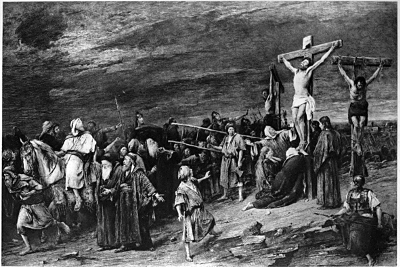
GOLGATHA
From the Painting by Michael von Munkacsy
PERMISSION CH. SEDELMEYER, PARIS
"Oh; thou, serene light of Heaven, and thou, Sacred Sea,
and thou, life-giving Earth—I call you to witness the vow
which we make at the graves of these who parted from us
all too soon: To put from us, from now on, all that is small
and common, to live in the future in the light of truth, to
love one another with all our hearts! May the God of truth
and love grant that to the honor of humanity, and to the
glory of the German name!"
The voice of the speaker ceased. But the echo of his
words quivered in the hearts of his hearers, as they silently
stepped forward to show the last honors to the dead. The
rays of the setting sun spread over the sky, lighting up the
scene, and the sky lovingly reflected them back to earth.
THE LIFE OF THEODOR STORM
By Ewald Eiserhardt, Ph.D.
Assistant Professor of German, University of Rochester, N.Y.
Hans Theodor Woldsen Storm was
born on the fourteenth of September, 1817, in
the little town of Husum on the west coast of
Schleswig-Holstein. His paternal forefathers
were Low Germans; his mother's family,
named Woldsen, was of Friesian origin. For many generations
the Storms had been hereditary tenants of the mill in
Westermühlen near Husum; for centuries the Woldsens
had belonged to the aristocracy of Husum, composed of
prominent merchants from whose ranks the burgomasters
and senators rose. Theodor Storm's father was an attorney
in Husum and commanded universal respect on account
of his unselfishness, punctilious sense of honor, and clear-sightedness
in juristic matters. The poet's mother is described
as a woman of graceful and attractive appearance,
distinguished by an unaffected emotional nature and keen
mental penetration. Eduard Mörike spoke of her personality
as being "so clear, so luminous, so provocative of
love."
The Storms were not rich, but their home was permeated
with that sense of solid comfort, based on the consciousness
of efficiency and pride of ancestry, so often found in the
burgher circles of Germany. Of particular importance to
the children was the presence in the family of their maternal
grandmother. She was full of overflowing kindness
toward her grandchildren, and hence to them the home possessed
the magic of a spot where, as in fairy tales, all
wishes might be fulfilled, a veritable refuge in all times of
need. She succeeded, moreover, in awakening in them
strong family feeling; for she loved to tell about her own
youth, her parents and brothers and sisters whose portraits
and silhouettes, in old-fashioned costumes and with
quaint cues, hung on the walls. It was owing mainly to his
mother's family that the poet, even in his early youth, was
brought into somewhat close touch in his native place with
all the different classes of people and many kinds of characters;
for on the vessels, in the factories, and in the
houses of the Woldsens and Feddersens—Storm's maternal
grandmother was a Feddersen—numbers of the inhabitants
of the little town had employment, and their
relations with these families were not entirely of a business
nature but were rooted in mutual confidence.
Of equal importance for his development were the scenes
with which the boy became familiar through his father's
family. His paternal relatives were settled on considerable
estates in the neighborhood, the family mill in Westermühlen
being managed by his father's eldest brother.
There the boy found an Eldorado in the holidays. There,
while wandering through the woods and over the heath, he
first held converse with nature; there, where another spirit
rested on house and garden than in the town, he first
vaguely felt the atmosphere peculiar to certain places;
there, where he saw men now favored, now threatened, by
external powers and always dependent upon them, his eyes
were first opened to the relations between man and nature
in all their many-sidedness.
Compared with what his home and family offered him,
all that school could give the future poet was of no significance.
Until the autumn of 1835 he attended the preparatory
school of the town and was then sent to the Gymnasium
in Lübeck for a year and a half. After leaving there
he devoted himself to the study of law, first in Kiel, which
he left only to return after three terms spent in Berlin;
and it was in the former place that he concluded his studies
and passed his final juristic examination in the autumn
of 1842.
At that time Storm had already made several efforts to
express himself in lyric poetry. At the age of nine he had
written his first poem, and it is characteristic that the
occasion of it was the death of a dearly loved sister. Later,
during his school-days in Husum and Lübeck, he filled two
small books with poems, and even made a vain attempt to
reach the public with his The Building of St. Mary's at
Lübeck. His poetical talent was most deeply stirred, however,
while he was in Kiel for the second time, when he
became intimate with the historian Theodor Mommsen
and his brother Tycho. As a result of this inspiring friendship
the three young men published, in 1843, the Songs by
Three Friends. Our poet's contributions to it were chiefly
in the sphere in which throughout his whole life he was to
show himself a master—namely, in love lyrics; and even
these early poems sound, in common with many of his
later writings, the note of resignation. Doubtless this
quality was largely innate in his nature, but it was also
nursed and fed by an experience through which he passed
in his youth. As a young student Storm loved a child,
Berta von Buchau, and, while she was still a young girl,
asked her hand in marriage, only, however, to meet with a
refusal. The poems dedicated to this love are rich and
varied in tone; they range from the ironic and humorous to
the exuberant and graceful, make the lover find gratification
in the service of his love, are prompted by doubt,
raise lamentations and accusations, pray for the lost love's
happiness and ask her to bear him in remembrance, and
finally they die away in grief and sadness. The most artistically
finished poem of this group and the one that gives
deepest utterance to Storm's peculiar poetical talent is
Twilight. It avoids all extremes in feeling, seeks to produce
the single, deeply felt mood that created it, and gives
in a few apparently chance touches a clear and definite
situation.
In February, 1843, Storm established himself as an attorney
in Husum, and with this step his happiest years began.
He was once more in his home, away from which there had
never been any real happiness for him; his parents were
both still vigorous and he was surrounded by loving brothers
and sisters. In the social life of the place, which seems
to have centred in his father's house, he was a favorite,
and his influence on the spirit of the little town was felt
when he founded and conducted a musical society, which
soon was able to appear successfully in public. His happiness
reached its climax when, in the autumn of 1846, he
married his cousin Konstanze Esmarch.
Konstanze was a really beautiful woman of fine and generous
proportions, with large yet delicately modeled features
and fresh youthful vigor. Storm himself is described
as a man of scarcely medium height, slender and of a
somewhat stooping carriage. His appearance can have
been impressive only by reason of his bright blue eyes
and the high forehead beneath his abundant blond hair.
Less irritable than her husband, less passionate and eager
in her desires, Konstanze met life more evenly, firmly, and
clearly, and thus, though lacking talent of any kind, she
exerted a far-reaching and beneficial influence on the poet's
nature. "When she came into the room it always seemed
to me as if it grew lighter," he once said of her.
For some years, during which three sons were born to
them, they lived most happily in Husum until the shadow
of political events fell across their house. After a vain
struggle for freedom, the dukedoms of Schleswig and Holstein
were subdued by Denmark; and as Storm, even after
their subjection, continued openly to proclaim his German
sentiments he finally found himself obliged, in 1853, to
leave his home.
During the ten years spent in Husum Storm's lyric talent
came to full and characteristic development. The influence
of Heine's Book of Songs, so apparent in the poems of his
school and student days, is hardly seen any more. Eichendorff's
poems and his novel, Poets and Their Disciples,
do indeed still echo strongly, and we feel the influence of
Mörike's lyrics in this period more clearly than before.
But all this is insignificant in comparison with Storm's own
creative power and the wealth that flowed to him out of his
own life. As he was particularly happy at that time, it is
natural that qualities should appear in his work which
are too often overlooked in forming an estimate of his
character and which were more strongly developed in this
period than in any other. It is true that we still hear sad
tones, even complaints of lost love and of love's suffering
and loneliness, but the majority and the best poems are
written in a contented, confident, energetic, even jubilant
key. It is his love for his wife, of whom he sang so much,
that transfigures life to the poet. Beneath her hand pain
is stilled, in her arms life and death are overcome, and
her presence turns the alien place into home. Separated
from the world and from the day nothing can surpass
the moments when he receives from her love's last and
highest gifts. To the sound of clear bells on moonlight
nights peace on earth and good-will to men seem to descend
upon the little family circle over which God himself keeps
watch. It was in those days, too, that the poet succeeded in
writing his song of "the gray town by the sea" which
nature has treated so slightingly and yet so singularly, and
to which his whole heart goes out; for it is, after all,
his mother town. Indeed, he hails with rejoicing the world,
the beautiful, imperishable world, and every true heart
that does not allow itself to be subdued but enjoys the
golden days and has learned to gild the gray ones. He is
even full of hope as regards the fate of his home country.
In spite of all defeats, in spite of all disgrace and distress,
he prophesies a new spring for her and calls the poet
blessed who may then win for her "the jewel of poetry."
It is only when he actually has to leave his home and move
away with his wife and children that he begins to doubt
as to his own return; then his hope changes into the prayer
that at least his sons may once be able to go back, for "no
man thrives without a fatherland."
In 1853 Storm had entered the Prussian service, and for
three years held the position of assistant judge in the
circuit court in Potsdam. There he was not content, in
spite of the cordiality with which he was received, especially
by Berlin poets, artists, and lovers of art. If we
understand him aright, he was oppressed by the feeling
that in the society of Potsdam the worth of the individual
was determined by the office he held and by his descent,
and that the human being in that State was sacrificed to
the citizen and the official, the man to the soldier. During
those years Storm's poetical production faltered, and it
was fortunate for him that in the autumn of 1856 he was
transferred as a circuit judge to Heiligenstadt in Central
Germany. This cozy little town in the mountains appealed
exceedingly to his nature, and on the whole he was able to
live there much as he had been accustomed to in Husum.
In addition, the improvement in his financial condition and
the lesser burden of his professional work undoubtedly
contributed to the re-awakening in him of the poet.
He was not so productive in lyric poetry as during the
years in Husum, but, as regards artistic value, the poems
of this period certainly do not stand below those of the
earlier one. He tries his hand at folk-poetry and succeeds
in striking its key of heartiness, simplicity, and spontaneity.
He clothes the popular theme of the enamoured
miller's daughter in a garment of artistic form, and yet, by
means of roguish humor and naïve frankness, manages to
sound the note of the folk-song. He employs one of the
most telling means for lyric effect by drawing parallels
between the conditions in nature and those in men, and in
doing this he awakens the most delicate harmonies by portraying
both conditions without pointing out the relation
between them, or by placing an individual in the midst of a
somewhat minutely described landscape and leading us to
imagine him in a state that corresponds with that of nature.
But in contrast to those just mentioned the greater number
of his poems are of a subjective kind. Again the poet
writes of his wife, from whom after all comes every joy
that he experiences away from home, and he only draws her
all the closer to his heart since the passing years have
imprinted the first signs of age on her gentle features.
His love is mixed with yearning for the time when they
were both young and—for his home. The yearning for
home is at one time expressed in almost classically pure
words, "nach drüben ist sein Auge stets gewandt" (his
eye is ever roaming toward the other land); at another
it merely underlies and glimmers through the devotion with
which he paints a scene from home; at still another the
poet's blood surges high and "fury and longing for home
wrestle for his heart." At last he can no longer stifle his
indignation; he calls upon the very dead to arise and to
battle again, and in ringing words shouts to the world
"die deutschen Gräber sind ein Spott der Feinde" (the
German graves are mocked by enemies).
Even more strongly than in his political poems the specifically
manly quality in Storm's poetry appears in what
we may call his confessional lyrics. There he gives us his
thoughts about immortality: that, in common with all creation,
man too rebels against dissolution, and that the belief
in immortality is only the final, refined, and spiritualized
form of this rebellion. But the true man stands above his
own fate and will not sacrifice reason even to the most
seductive promises. The church stands opposed to such
high development of the individual; Storm thinks poorly
of it, and forbids the priest to attend at his grave.
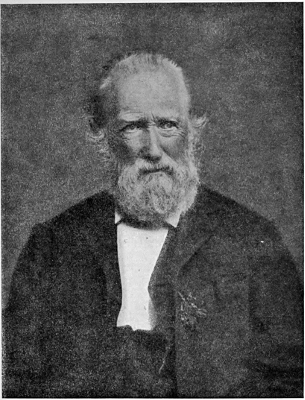
THEODOR STORM
Permission Berlin Photo. Co., New York
As in the realm of the mind the poet opposes the church,
so in the social sphere he attacks feudalism and the bureaucracy.
Those whose national feeling is not deep and
comprehensive enough to allow them to feel at one with
the people he stigmatizes as the drop of poison in German
blood. He holds up to ridicule those who need the pretentiousness
of power in order to be happy and would like
to gain it at the cost of the people's liberty. But in pithy
words Storm advises his sons to keep to the truth uncompromisingly,
to despise outward success, but to spare no
pains in striving for true worth, not to sacrifice self-respect
to consideration for others but always to remember that in
this life, after all, every one can stand only on his own
feet.
The years in Heiligenstadt are of special importance in
Storm's whole artistic activity, inasmuch as poetry is gradually
pushed into the second place by his prose works.
At that time Storm was known to the greater public hardly
at all by his lyrics but only by Immensee (1849) and similar
tales. Hence he was recognized as the author of lyric
stories expressive chiefly of "transfigured resignation."
This characterization, however, is only partially justified,
for resignation finally disappears from Storm's stories and
the share that the lyric element has in his tales changes
entirely in the course of time. Of a number of his earlier
narratives and sketches it can actually be said that they
were written less for the sake of the tale than on account
of the mood they express. And, in Heiligenstadt, Storm,
who in all spheres sought untiringly for pure form, finally
reached that kind of prose in which feeling and imagination
have the widest scope, the "Märchen." He writes The
Rain-Witch, perhaps the most perfect artistic fairy tale of
German literature, in which he not only surpasses Goethe
and the Romanticists but also himself. For, in Storm's
own words, his Hinzelmeier is only a "fantastic-allegorical
creation," Bulemann's House, written in the style of E. T. A.
Hoffmann, "an odd story," while The Mirror of Cyprianus
appears rather "in the elegant robe of the saga."
The last of these works was not finished in Heiligenstadt,
but when Storm was back in his old home again. For
in March, 1864, he had returned to Husum, where he was
given the office of "Landvogt" (district magistrate), to
which were attached authority in police matters and the
administration of justice.
In taking this step he had followed the call of his fellow-citizens,
for the death of Frederick VII. of Denmark had
once more awakened in the Duchies the hope of freedom.
The longed-for happiness of his return, however, was
marred; for, instead of becoming independent, Schleswig-Holstein
was finally made a Prussian province, and he was
still more deeply stricken by a loss in his family. In May,
1865, his wife Konstanze died after the birth of her seventh
child. Storm did indeed marry again—his second wife
Dorothea Jensen was a friend and relative of his and
Konstanze's, and this marriage too was happy—but his
further poems bear witness to what he lost in Konstanze.
One of his stories, also, Viola Tricolor (1873), deals with
the problem how a man can cultivate the memory of his
dead wife without doing injury to his love for the living
one; he called it a "Selbstbefreiung" (self-justification).
The evening of Storm's life was not spent in Husum,
where memories threatened to engulf him, but in the village
of Hademarschen nearby, whither he moved in 1880, when
he retired from office. Here he was destined still to develop
abundant artistic activity as a novelist until his death on
the fourth of July, 1888.
After the completion of his imaginative writings a decided
change in Storm's prose style began to take place.
Formerly the lyrical element lay like a haze over and about
objects and persons, and even now it does not disappear.
Yet it no longer blurs and obliterates the outlines and connections,
but rather streams out of the objects represented,
as a fragrance rises from a flower. The first beginnings of
this style are already noticeable in At the Castle (1861), in
which the problems of class differences and of enlightenment
form to a certain extent the backbone of the narrative,
and in At the University (1862), which for a story
of Storm's at that period contains a great wealth of incidents.
But it was in such works as In the Village on the
Heath and At Cousin Christian's that the poet first attained
a purely objective narrative style. That he himself realized
this is clear from his correspondence. On the twenty-fourth
of January, 1873, he writes to Hebbel's biographer
Kuh with reference to In the Village on the Heath: "I
think I have shown by this that I can also write a story
without the atmosphere of a distinct mood (Dunstkreis
einer bestimmten Stimmung). I do not mean a mood which
is spontaneously developed during the reading from the
facts given, but a mood furnished a priori by the author."
Hand in hand with the development of this "epic" style
goes the transition to realism which we find also in Storm's
poems. In prose it is best represented by works like
Eekenhof and Der Herr Etatsrat, or Hans and Heinz Kirch
and Two-Souled. Here the poet shrinks from no harshness.
We find striking portraits the lines of which
are drawn with a sharp, unflattering touch. Psychic conditions
of the most brutal kind are portrayed and are made
the more telling because it is almost only their effects that
are given. In the same way the external world stands
chiefly before us in its appearances while the conditions
that have led to these appearances are neglected. Finally,
Storm endeavors to step beyond the bounds of pure narrative.
He seizes upon material of a dramatic nature and
seeks to retain—nay more, to bring out—its dramatic character,
even in the epic form. In one of his letters he calls
the "Novelle" the epic sister of the drama, and goes on to
say that it treats of the deepest problems of human life and
requires for its perfection to be centred about some conflict.
Such are works like The Sons of the Senator, where
individual will is pitted against individual will; Renate or
At the Brewer's, where individuals struggle against a multitude
who are sunk in error and superstition; and, above
all, The Rider of the White Horse, where the individual
wrestles with the mass, the man with the most elementary
forces of nature.
The Rider of the White Horse is Storm's last complete
work and also, as we believe, the one that best reflects the
whole man, as far as that is possible with a poet of such
varied development. The scene is laid in his home, which
is characterized with vividness and grandeur in its setting
of marsh and sea. Like the stories of his youth it glorifies
love, the love of two beings who are faithful to each other
unto death, and at the same time it touches themes which
deeply occupied Storm in his age, such as the problem of
heredity in Karsten Kurator, or the relation between father
and son in Hans and Heinz Kirch or in Basch the Cooper.
The charm of youth, to which our poet was always most
susceptible, invests the chief characters, and they have that
chaste reserve that holds all internal life sacred. Happiness
is won, but it ends in tragedy, the tragedy which has
taken the place of the resignation of his youthful works
and which, after all, was more deeply rooted in Storm than
the joyfulness that is sounded in Psyche. It is a man of
sober intellect who tells the whole story and yet, like human
life itself, it stands out against a mystic background. Remembrance
of long ago has clarified everything, loving
comprehension fills everything with deepest sympathy. It
was granted to Storm to stand on a pinnacle of art at the
end of his life, a pinnacle which he had to leave, but from
which he did not need to descend.
THE RIDER OF THE WHITE HORSE (1888)
TRANSLATED BY MURIEL ALMON
The story that I have to tell came to my knowledge
more than half a century ago in the
house of my great-grandmother, the wife of
Senator Feddersen, when, sitting close up to
her armchair one day, I was busy reading a
number of some magazine bound in blue cardboard, either
the Leipziger or Pappes Hamburger Lesefrüchte, I have
forgotten which. I still recall with a tremor how the old
lady of more than eighty years would now and then pass
her soft hand caressingly over her great-grandchild's hair.
She herself, and that day, have long been buried and I
have sought in vain for those old pages, so I can just as
little vouch for the truth of the facts as defend them if
anyone should question them. Only one thing I can affirm,
that although no outward circumstance has since revived
them in my mind they have never vanished from my
memory.
On an October afternoon, in the third decade of our
century—thus the narrator began his tale—I was riding in
very bad weather along a dike in northern Friesland. For
more than an hour I had been passing, on the left, a bleak
marsh from which all the cattle had already gone, and, on
the right, uncomfortably near, the marsh of the North
Sea. A traveler along the dike was supposed to be able
to see islets and islands; I saw nothing however but the
yellow-gray waves that dashed unceasingly against the dike
with what seemed like roars of fury, sometimes splashing
me and the horse with dirty foam; in the background eerie
twilight in which earth could not be distinguished from
sky, for the moon, which had risen and was now in its
second quarter, was covered most of the time by driving
clouds. It was icy cold. My benumbed hands could scarcely
hold the reins and I did not blame the crows and gulls
that, cawing and shrieking, allowed themselves to be borne
inland by the storm. Night had begun to fall and I could
no longer distinguish my horse's hoofs with certainty; not
a soul had met me; I heard nothing but the screaming of
the birds, as their long wings almost brushed against me or
my faithful mare, and the raging of wind and water. I
do not deny that at times I wished myself in some secure
shelter.
It was the third day of the storm and I had allowed
myself to be detained longer than I should have by a particularly
dear relative at his farm in one of the northern
parishes. But at last I had to leave. Business was
calling me in the town which probably still lay a few hours'
ride ahead of me, to the south, and in the afternoon I had
ridden away in spite of all my cousin and his kind wife
could do to persuade me, and in spite of the splendid
home-grown Perinette and Grand Richard apples which
were yet to be tried. "Just wait till you get out by the
sea," he had called after me from the door, "you will turn
back then; we will keep your room ready for you!"
And really, for a moment, as a dark layer of clouds made
it grow black as pitch around me and at the same time a
roaring gust threatened to sweep both me and my horse
away, the thought did flash through my head: "Don't be
a fool! Turn back and sit down in comfort with your
friends." But then it occurred to me that the way back
was longer than the one to my journey's end, and so, drawing
the collar of my cloak closer about my ears, I
trotted on.
But now something was coming along the dike towards
me. I heard nothing, but I thought I could distinguish
more and more clearly, as a glimmer fell from the young
moon, a dark figure, and soon, when it came nearer, I saw
that it was riding a long-legged, lean white horse. A dark
cloak fluttered about the figure's shoulders and as it flew
past two burning eyes looked at me from a pale countenance.
Who was it? Why was it here? And now I remembered
that I had heard no sound of hoofs nor of the animal's
breathing, and yet horse and rider had passed close
beside me.
Wondering about this I rode on. But I had not much
time to wonder; it was already passing me again from
behind. It seemed to me as if the flying cloak brushed
against me and the apparition shot by as noiselessly as
before. Then I saw it farther and farther ahead of me and
suddenly it seemed to me as if its shadow was suddenly
descending the land-side of the dike.
With some hesitation I followed. When I reached the
spot where the figure had disappeared I could see close to
the dike, below it and on the land-side, the glistening of
water in one of those water-holes which the high tides bore
in the earth during a storm and which then usually remain
as small but deep-bottomed pools.
The water was remarkably still, even stiller than the
protection of the dike would account for. The rider could
not have disturbed it; I saw nothing more of him. But I
did see something else that I greeted with joy; below me,
on the reclaimed land, a number of scattered lights shone.
They seemed to come from the long, narrow Friesian
houses that stood singly on mounds of different heights;
while close before me, halfway up the inside of the dike,
stood a large house of the same sort. All its windows on
the south side, to the right of the door, were illuminated;
behind them I could see people and even thought I could
hear them, in spite of the storm. My horse had already
turned of its own accord onto the path down the side of the
dike that would lead me to the house. It was evidently a
public house, for in front of the windows I could see the
beams, resting on two posts and provided with iron rings,
to which the cattle and horses that stopped there were tied.
I fastened mine to one of the rings and then commended
it to the care of the hostler who came to meet me as I
stepped into the hall. "Is there a meeting here?" I asked
him, hearing distinctly the sound of voices and the clatter
of glasses through the open door of the room.
"Something of the kind," he replied in Low German,
and I learnt later that this dialect in the place had been
current, together with the Friesian, for over a hundred
years. "The dikegrave and commissioners and some of
the others interested! It's on account of the high water!"
Entering I saw about a dozen men sitting at a table
which ran along under the windows; on it stood a bowl of
punch over which a particularly stately man seemed to
preside.
I bowed and asked to be allowed to sit down with them,
which request was readily granted. "You are keeping
watch here, I suppose," I said, turning to the stately man;
"it is dirty weather outside; the dikes will have all they
can do!"
"Yes, indeed," he replied; "but we here, on the east
side, think we are out of danger now; it is only over on
the other side that they are not safe. The dikes there are
built, for the most part, after the old pattern; our main
dike was moved and rebuilt as long ago as in the last century.
We got chilled out there a little while ago, and you
are certainly cold too," he added, "but we must stand it
here for a few hours longer; we have our trustworthy
men out there who come and report to us." And before
I could give the publican my order a steaming glass was
pushed towards me.
I soon learnt that my friendly neighbor was the dikegrave.
We got into conversation and I began to tell him
my singular experience on the dike. He grew attentive
and I suddenly noticed that the conversation all around us
had ceased. "The rider of the white horse!" exclaimed
one of the company and all the rest started.
The dikegrave rose. "You need not be afraid," he said
across the table; "that does not concern us alone. In the
year '17 too it was meant for those on the other side; we'll
hope that they are prepared for anything!"
Now the shudder ran through me that should properly
have assailed me out on the dike. "Pardon me," I said,
"who and what is this rider of the white horse?"
Apart from the rest, behind the stove, sat a little lean
man in a scant and shabby black coat. He was somewhat
bent and one of his shoulders seemed to be a little crooked.
He had taken no part whatever in the conversation of the
others, but his eyes, which in spite of his sparse gray hair
were still shaded by dark lashes, showed clearly that he
was not sitting there merely to nod off to sleep.
The dikegrave stretched out his hand towards him.
"Our schoolmaster," he said, raising his voice, "will be
able to tell you that better than any of the rest of us here—only
in his own way, to be sure, and not as correctly as
Antje Vollmers, my old housekeeper at home, would do it."
"You're joking, Dikegrave," came the somewhat thin
voice of the schoolmaster from behind the stove, "to put
your stupid dragon on an equality with me!"
"Yes, yes, Schoolmaster!" returned the other; "but tales
of that kind you know are said to be best preserved among
the dragons!"
"To be sure," said the little man. "We are not quite
of the same opinion in this matter," and a smile of superiority
passed over his delicately formed face.
"You see," the dikegrave whispered in my ear, "he is
still a little haughty. He studied theology once, in his
youth, and stuck here in his home as schoolmaster only on
account of an unfortunate betrothal."
In the meantime the schoolmaster had come forward
out of his corner and seated himself beside me at the long
table. "Go on Schoolmaster, let us have the story," called
a few of the younger ones in the party.
"To be sure," said the old man turning to me, "I am
glad to oblige you; but there is much superstition interwoven
with it and it requires art to tell the tale without
including that."
"Please don't leave that out," I replied, "trust me to
separate the chaff from the wheat myself."
The old man looked at me with a smile of understanding.
"Well, then," he said, "in the middle of the last century,
or rather, to be more exact, before and after the middle,
there was a dikegrave here who understood more about
dikes, drains and sluices than peasants and farmers usually
do; yet even so it seems hardly to have been enough, for
he had read but little of what learned experts have written
about such things, and had only thought out his own knowledge
for himself from the time he was a little child. You
have probably heard, sir, that the Friesians are good at
figures and undoubtedly you have heard some talk too about
our Hans Mommsen of Fahretoft, who was a peasant and
yet could make compasses and chronometers, telescopes
and organs. Well, the father of this dikegrave was a bit
like that too; only a bit, to be sure. He had a few fields in
the fens where he planted rape and beans, and where a
cow grazed. Sometimes in autumn and spring he went out
surveying, and in winter when the northwester came and
shook his shutters, he sat at home sketching and engraving.
His boy generally sat there with him and looked up from
his reader or his Bible at his father measuring and calculating,
and buried his hand in his blond hair. And one
evening he asked his father why that which he had just
written had to be just like that and not otherwise, and
gave his own opinion about it." But his father, who did not
know what answer to give, shook his head and said: "I
can't tell you why, it is enough that it is so; and you yourself
are mistaken. If you want to know more go up to the
attic tomorrow and hunt for a book in the box up there.
The man who wrote it was called Euclid; you can find out
from that book."
The next day the boy did go up to the attic and soon
found the book, for there were not many in the whole
house; but his father laughed when the boy laid it down
before him on the table. It was a Dutch Euclid, and Dutch,
although after all it is half German, was beyond them both.
"Yes, yes," he said, "the book was my father's, he understood
it. Isn't there a German one there?"
The boy, who was a child of few words, looked quietly at
his father and only said: "May I keep it? There is no
German one there."
And when the old man nodded he showed him a second
little volume, half torn. "This one too?" he asked again.
"Take them both," said Tede Haien; "they won't do you
much good."
But the second book was a little Dutch grammar, and
as most of the winter was still to come it did help the lad
enough so that finally when the time came for the gooseberries
to bloom in the garden he was able to understand
nearly all of the Euclid, then very much in vogue.
"I am not unaware, Sir," the narrator interrupted himself,
"that this same incident is told of Hans Mommsen;
but, here with us, people used to tell it of Hauke Haien—that
was the boy's name—before Mommsen was born. You
know how it is, when a greater man arises, he is credited
with everything that his predecessors may have done, in
earnest or in fun."
When the old man saw that the lad cared nothing about
cows or sheep and scarcely even noticed when the beans
were in blossom—which after all is the joy of every man
from the marshlands—and that his little place might indeed
get on with a peasant and a boy, but not with a semi-scholar
and a servant, and also because he himself had
failed of prosperity, he sent his big boy to the dike, where
from Easter till Martinmas he was to wheel his barrow of
earth with the other laborers. "That will cure him of
Euclid!" he said to himself.
And the lad pushed his wheelbarrow, but he kept the
Euclid in his pocket all the time, and when the workmen
ate their lunch or stopped for a bite in the late afternoon
he sat on the bottom of a wheelbarrow with the book in his
hand. And in autumn when the tides began to be higher,
and the work had sometimes to be stopped he did not go
home with the others, but stayed, and sat on the slope of
the dike, his hands clasped round his knee, and watched
for hours how the gray waves of the North Sea dashed up
higher and higher towards the grass-line of the dike. Not
until the water came in over his feet and the foam spattered
in his face did he move up a few feet higher and then sit on
there. He heard neither the splashing of the water nor the
screaming of the gulls and shore-birds that flew above and
around him, almost touching him with their wings, and
flashing their black eyes into his; nor did he see how
night came and enveloped the broad, wild desert of water
in front of him. All that he saw was the hem of the water
outlined by the surf which, when the tide was in, struck
again and again with its heavy beat on the same spot in
the dike and washed away the grass-line on its steep side
before his very eyes.
After staring at it long he sometimes nodded his head
slowly, or, without looking up, drew a soft line in the air
with his hand as if he would thus give the dike a gentler
slope. When it grew so dark that all earthly things vanished
from his sight and only the tide continued to thunder
in his ears, he got up and trotted home half wet through.
One evening when he came home in this state, his father,
who was cleaning his measuring instruments, looked up and
turned on him. "What have you been doing out there so
long? You might have been drowned; the water is eating
right into the dike today."
Hauke looked at him stubbornly.
"Don't you hear what I say? You might have been
drowned."
"Yes," said Hauke; "but I didn't get drowned."
"No," replied the old man after a time and looked at
him absent-mindedly—"not this time."
"But," went on Hauke, "our dikes are no good!"
"What's that, boy?"
"The dikes, I say!"
"What about the dikes?"
"They're no good, Father."
The old man laughed in his face. "Is that so, boy? I
suppose you are the child prodigy of Lübeck!"
But the lad would not allow himself to be confused.
"The water-side is too steep," he said; "if it should happen
again as it has already happened more than once we
may all drown in here, behind the dike too."
The old man pulled his tobacco out of his pocket, twisted
off a piece and pushed it in behind his teeth. "And how
many barrows did you wheel today?" he asked crossly, for
he saw that working at the dike could not cure the boy of
working with his mind.
"I don't know, Father; about the same as the others;
perhaps half a dozen more. But—the dikes must be built
different."
"Good," said his father with a laugh; "you may get
to be dikegrave; then, build them different."
"Yes, Father," returned the boy.
The old man looked at him and swallowed once or twice;
then he went out. He did not know what answer to give
the lad.
When, at the end of October, work on the dike came to
an end Hauke Haien still continued to find more pleasure
in a walk out towards the north, to the sea, than in anything
else. Just as the children of today look forward to
Christmas, he looked forward to All Saints' Day, when the
equinoctial gales burst over the land, an occasion for lamentation
in Friesland. In spite of wind and weather he was
certain to be found at the time of the high spring tides
lying out on the dike all by himself; and when the gulls
shrieked, when the waves dashed high against the dike,
and in rolling back washed out whole pieces of sod into the
sea, Hauke's angry laughter was something worth hearing.
"You can't do anything right," he shouted out into the
noise, "just as people don't know how to do anything!"
And at last, often when it was quite dark, he would turn
away from the broad, bleak expanse and trot home along the
dike till he reached the low door under his father's thatch,
and his tall, overgrown figure slipped through and into the
little room beyond.
Sometimes he brought a handful of clay with him. Then
he sat down beside his father who had begun to let him
go his own way, and, by the light of the thin tallow candle,
kneaded all kinds of dike-models, laid them in a shallow
dish of water and tried to imitate the way in which the
waves washed out the bank. Or he took his slate and drew
on it profiles of dikes on the water-side as he thought they
ought to be.
It never entered his head to associate with the boys who
had been his companions in school, and apparently they
cared nothing about such a dreamer. When it came winter
again and the frost had taken hold he wandered out along
the dike farther than he had ever been before to where the
ice-covered surface of the shoals stretched before him as
far as the eye could reach.
In February, during continuous frost, dead bodies were
found washed up on the shore; they had lain out by the
open sea on the frozen shoals. A young woman who had
seen them being carried into the village stood and chattered
to old Haien: "Don't think that they looked like
people," she exclaimed, "no, they looked like sea-devils!
Big heads like this," and she held up her hands with the
fingers stretched out, far apart from each other, "black
and wrinkled and shiny like freshly baked bread! And the
crabs had nibbled them; the children screamed when they
saw them."
Such a description was not exactly new to old Haien.
"They have probably been washing about in the sea since
November," he said indifferently.
Hauke stood beside them in silence. But as soon as he
could he crept away out to the dike; no one could say
whether he wanted to hunt for more corpses or whether
the horror that still hung about the now deserted spots
where the others had been found attracted him. He ran on
farther and farther till he stood all alone in the bleakness
where only the winds swept across the dike and where there
was nothing but the plaintive voices of the great birds as
they wheeled quickly by. On his left lay the wide empty
marsh, on the other side the never-ending shore with the
great expanse of shoals now glistening with ice; it seemed
as if the whole world lay in white death.
Hauke remained standing on the dike and his keen
eyes glanced far in all directions; but there were no more
dead to be seen; only where the invisible currents moved
under it the ice field rose and sank like a stream.
He ran home; but on one of the following evenings he
was out there again. The ice was now broken in places:
clouds of smoke seemed to rise out of the cracks and above
the whole surface of the shallows was spread a net of
steam and fog that combined strangely with the dusk of the
evening. Hauke gazed at it with fixed eyes, for dark figures
moved up and down in the fog, and as he watched them they
seemed to be as large as men. There, far away on the edge
of the smoking fissures, they walked back and forth, full of
dignity but with long noses and necks and odd, terrifying
gestures; suddenly they began to jump up and down in an
uncanny way, like imps, the big ones over the little ones
and the little ones towards the others; then they spread
out and lost all form.
"What of them? Are they the spirits of those who were
drowned?" thought Hauke. "Ahoy!" he shouted loudly
into the night; but the forms heeded him not, merely continued
their strange doings.
Then he suddenly thought of the fearful Norwegian sea-ghosts
about whom an old captain had once told him, who
instead of a head and face had only a tuft of sea-grass
on their necks; he did not run away however, but dug the
heels of his boots deep into the clay of the dike and gazed
at the weird antics that went on before his eyes in the growing
dusk. "Are you here with us too?" he asked in a hard
voice. "You shall not drive me away."
Not till the darkness had covered everything did he start
for home, walking with a stiff, slow step. But from behind
him there seemed to come the whirring of wings and resounding
laughter. He did not look round, neither did he
quicken his step, and it was late when he reached home,
but he is said never to have spoken to his father or anyone
else of this experience. Only many years later, after God
Almighty had laid the burden of an half-witted child upon
him, he took the girl out on the dike with him at the same
time of day and of the year and the same thing is said to
have happened again out on the shallows. But he told her
not to be afraid, those creatures were only herons and
crows that looked so big and dreadful in the fog as they
caught fish in the open cracks.
"God knows, Sir!" the schoolmaster interrupted himself;
"there are all kinds of things in the world that may
confuse an honest Christian's heart; but Hauke was neither
a fool nor a dunce."
As I did not reply he was about to go on, but suddenly
there was a stir among the other guests who hitherto had
listened in silence, only filling the low room with dense
tobacco smoke. First one or two, then nearly all of them
turned towards the window. Outside—we could see through
the uncurtained windows—the wind was driving the clouds,
and light and darkness were madly intermingled; but it
seemed to me, too, as if I had seen the haggard rider shoot
by on his white horse.
"Wait a bit, Schoolmaster," said the dikegrave softly.
"You need not be afraid, Dikegrave," replied the little
story-teller. "I have not slandered him and have no reason
to do so," and he looked up at him with his wise little eyes.
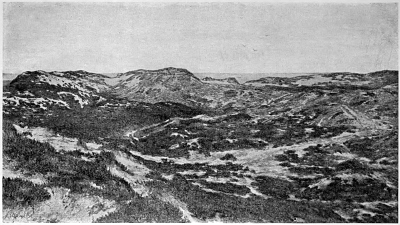
DUNES ON THE NORTH SEA
Jacob Alberts
"Well, well," said the other, "just let me fill your glass
again." And after that had been done and the listeners,
most of them with disconcerted faces, had turned to him
again the schoolmaster continued:
"Thus keeping to himself and loving best to live only
with the wind and water and the images that solitude
brings, Hauke grew up to be a tall, lean fellow. He had
been confirmed for more than a year when things began to
change with him, and that was owing to the old white
Angora tom-cat which had been brought home from a
Spanish sea voyage to old Trien' Jans by her son, who later
perished on the flats. Trien' lived a good distance out on
the dike in a little cottage and when she was working about
in her house this monster of a cat used to sit in front of
the door and blink out at the summer day, and the lapwings
that flew by. When Hauke passed the cat mewed
at him and Hauke nodded; they both knew what was going
on between them."
Once, it was spring, and Hauke often lay out on the
dike as was his habit, farther down nearer the water, among
the shore-pinks and the sweet-smelling sea-wormwood, and
let the sun, which was already strong, shine down on him.
The day before, when he was on the uplands, he had filled
his pockets with pebbles and when the low tide had laid
bare the flats and the little gray sand-pipers hopped over
them, piping as they went, he suddenly took a stone out of
his pocket and threw it at the birds. He had practised this
from childhood and generally managed to bring one down;
but just as often it was impossible to go out on the mud
after it; Hauke had often thought of bringing the cat with
him and teaching it to retrieve. Here and there, however,
there were firm spots in the mud or sandbanks and then
he could run out and fetch his plunder himself. If the cat
was still sitting in front of the door as he passed on his
way home it mewed wild with rapacity until Hauke threw
it one of the birds he had killed.
On this particular day as he went home, his jacket on
his shoulder, he only had one bird, of a kind unknown to
him but which was covered with beautiful plumage that
looked like variegated silk and burnished metal. The cat
looked at him and begged loudly as usual. But this time
Hauke did not want to give up his prey—it may have been
a kingfisher—and paid no attention to the animal's desire.
"Turn and turn about," he called to him, "my turn today,
yours tomorrow; this is no food for a tom-cat!" But the
cat crept up cautiously towards him; Hauke stood and
looked at him, the bird hanging from his hand and the cat
stopped with its paw raised. But Hauke seems not to have
understood his friend thoroughly, for, as he turned his
back on him and prepared to go on his way he felt his
plunder torn from his grasp with a jerk, and at the same
time a sharp claw dug into his flesh. A sudden fury like
that of a beast of prey surged in the young fellow's blood;
he grabbed madly about him and had the robber by the
neck in a moment. Holding up the powerful creature in
his fist he strangled it till its eyes obtruded from the rough
hair, not heeding the strong hind claws that were tearing
the flesh from his arm. "Ho, ho!" he shouted and gripped
it still tighter; "we'll see which of us can stand it longest!"
Suddenly the hind legs of the great cat dropped lifelessly
from his arm and Hauke went back a few steps and threw
it towards the cottage of the old woman. As the cat did
not move he turned and continued his way home.
But the Angora cat had been its mistress's treasure; it
was her companion and the only thing that her son, the
sailor, had left her when he came to his sudden end on
the coast hard by, while trying to help his mother catch
prawns in a storm. Hauke had scarcely taken a hundred
steps, sopping up the blood from his wounds with a cloth as
he went, when a loud outcry and lamentation from the
direction of the cottage struck on his ear. He turned and
saw the old woman lying on the ground in front of it while
the wind blew her gray hair about the red handkerchief
that covered her head. "Dead!" she shrieked, "dead!"
and stretched out her thin arm threateningly towards him:
"you shall be cursed! You killed him, you useless vagabond;
you weren't worthy to stroke his tail." She threw
herself on the animal and gently wiped away with her
apron the blood that flowed from its nose and mouth. Then
she again began her loud lamentation.
"Will you soon be through?" called Hauke to her, "then
let me tell you this: I will get you a tom-cat that is satisfied
with the blood of rats and mice!"
With this he went on his way, not apparently paying heed
to anything. But the dead cat must have confused his head
all the same, for when he came to the village he went on
past his father's house and all the others too, out a long
way on the dike towards the south, where the town lies.
In the meantime Trien' Jans too wandered out in the
same direction; she carried a burden in her arms wrapped
in an old blue-checked pillow slip, holding it carefully as if
it had been a child; and her gray hair blew about in the
gentle spring breeze. "What are you carrying there,
Trina?" asked a peasant who met her. "More than your
house and home," she replied and went on eagerly. When
she came near to old Haien's house, which stood down
below, she turned down the "Akt" as we call the cattle-paths
and footways that run up or down the side of the
dike.
Old Tede Haien was just standing out in front of the
door looking at the weather. "Well, Trien'!" he said as
she stood before him, panting and digging the point of her
stick into the ground. "What have you got new in your
bag?"
"First let me come in, Tede Haien! Then I'll show you,"
she said with an odd gleam in her eyes.
"Come in then," said the old man. Why should he
bother about the foolish woman's eyes?
And when they were both inside she went on: "Take the
old tobacco box and writing things away from the table—what
do you want to be always writing for? There! And
now wipe it off nice and clean!" And the old man, who
was beginning to be curious, did everything that she told
him. Then she took the blue pillow slip by the corners and
shook the body of the great cat out on the table. "There
you have him," she cried, "your Hauke has killed him."
Whereupon she began to cry bitterly. She stroked the thick
fur of the dead animal, laid its paws together, bowed her
long nose over its head and whispered indistinct words of
endearment into its ear.
Tede Haien watched the scene. "So," he said, "Hauke
killed him?" He did not know what to do with the blubbering
woman.
She nodded grimly: "Yes, by God, he did it!" and she
wiped away the tears from her eyes with her gnarled gouty
hand. "No child, nothing alive any more!" she sobbed.
"And you know yourself how it is with us old ones, after
All Saints' Day's over our legs freeze at night in bed and
instead of sleeping we listen to the northwester rattling
at the shutters. I don't like to hear it, Tede Haien, it
comes from where my lad went down in the mud."
Tede Haien nodded and the old woman stroked her dead
cat's coat. "And this one here," she began again, "in the
winter when I sat at my work and the spinning wheel and
hummed he sat beside me and hummed too and looked at
me with his green eyes! And when I was cold and crept
into bed—it was not long before he sprang up too and laid
himself on my shivering legs and then we slept warm together!"
And the old woman looked at the old man standing
beside her at the table with smouldering eyes as if she
wanted his assent to this memory.
But Tede Haien said slowly: "I know a way to help you,
Trien' Jans." He went to his strong box and took a silver
coin out of the drawer. "You say that Hauke has robbed
you of your pet and I know that you don't lie; but here is a
crownpiece of Christian IV.; go and buy yourself a dressed
lambskin to keep your legs warm. Besides, our cat will
soon have kittens and you may pick out the largest of them.
The two together ought to make up for an Angora tom-cat
that is weak with old age. And now take the creature and
carry it into town to the knacker, for aught I care, and
hold your tongue about its having lain here on my respectable
table!"
While he was speaking the woman had taken the crown
and hidden it in a little bag that she wore under her skirts;
then she stuffed the cat back into the pillow-case, wiped the
spots of blood from the table with her apron and stumped
out of the door. "Don't forget about the young kitten,"
she called back as she went.
Some time later, as old Haien was walking up and down
in the little room, Hauke came in and threw his bright bird
onto the table; but when he saw the blood-stains which were
still recognizable on its white, scoured top he asked with
apparent carelessness, "What's that?"
His father stood still. "That is the blood that you
shed!"
The boy flushed hotly. "Oh, has Trien' Jans been here
with her cat?"
The old man nodded. "Why did you kill it?"
Hauke bared his torn arm. "That's why," he said; "he
snatched my bird away from me."
The old man said nothing. He began to walk up and
down again for some time; then he stopped in front of his
son and looked at him absently. "I have settled the matter
of the cat," he said after a moment, "but you see Hauke,
this cottage is too small; two masters can't hold it—it is
time now, you must get yourself something to do."
"Yes, Father," replied Hauke; "I have thought the
same myself."
"Why?" asked the old man.
"Well, a fellow boils within, if he has not enough to do
to work it off."
"So," said the old man, "and that's why you killed the
Angora? That might easily lead to something worse!"
"You may be right, Father; but the dikegrave has sent
his servant-boy off; I could do that work."
The old man began to walk up and down again and
squirted a stream of black tobacco-juice from his mouth.
"The dikegrave is a dunce, as stupid as an owl! He is only
dikegrave because his father and grandfather were dikegraves
before him and because of his twenty-nine fens.
When Martinmas comes round and the dike and sluice accounts
have to be made up he feeds the schoolmaster on
roast goose and mead and wheat-cracknels, and just sits
there and nods when the other man runs over the columns
of figures and says: "Yes, indeed, Schoolmaster, may God
reward you! What a man you are at figures!" But if at
any time the schoolmaster can't or won't, then he has to
do it himself and he sits and writes and crosses out again,
and his big stupid head grows red and hot and his eyes
stand out like glass balls as if what little brain he has was
trying to get out there."
The boy stood up straight before his father and was
amazed that he could make such a speech; he had never
heard him talk like that before. "Yes, he is stupid enough,
God knows," he said; "but his daughter Elke, she can
figure!"
The old man looked at him sharply. "Oh ho, Hauke!" he
exclaimed, "what do you know of Elke Volkerts?"
"Nothing, Father; only the schoolmaster told me so."
The old man made no answer to this; he merely shifted
his tobacco quid slowly from one cheek to the other. "And
you think," he said then, "that when you're there you will
be able to help figure too."
"Oh, yes, Father, I could do that all right," answered
the son and his mouth quivered with earnestness.
The old man shook his head: "Well, as far as I am
concerned, you may try your luck!"
"Thank you, Father!" said Hauke, and went up to the
attic where he slept. There he seated himself on the side
of the bed and thought and wondered why his father had
questioned him about Elke Volkerts. He knew her of
course, the slender eighteen-year-old girl with the narrow,
brown-skinned face and the dark brows that met above the
defiant eyes and narrow nose; but he had scarcely spoken
a word to her till now. Well, if he should go to work for
old Tede Volkerts he would look at her more closely to
see what kind of a girl she was. And he would go right
away so that no one else should get the place ahead of
him, for it was still quite early in the evening. And so he
put on his Sunday suit and best boots and started on his
way in good spirits.
The long low house of the dikegrave could be seen from
far away, for it stood on a high mound, and the highest tree
in the village, a mighty ash, stood near it. In his youth the
grandfather of the present dikegrave, the first one in the
family, had planted such a tree to the east of the front
door; but the first two saplings died and so, on his wedding
morning, he had planted this tree which with its ever
wider-spreading top still murmured in the unceasing wind,
as it seemed, of by-gone days.
When, some time later, Hauke's tall, overgrown form
ascended the high mound, the sides of which were planted
with turnips and cabbages, he saw above him, standing
beside the low door, the daughter of the master of the house.
One of her somewhat thin arms hung loosely at her side, her
other hand seemed to be feeling behind her for an iron ring,
two of which were fastened to the wall, one on either side of
the door, so that a rider coming to the house could tie up his
horse. She seemed to be looking out over the dike to the
sea where, in the still of evening, the sun was just sinking
into the water and sending its last ray to gild the brown-skinned
girl who stood there watching.
Hauke slackened his steps and thought to himself: "She
does not look half bad that way!" And then he had already
reached the top. "Good evening," he said going up to her,
"what are your big eyes looking at now, Jungfer Elke?"
"At something that happens here every evening," she
replied, "but which cannot always be seen every evening."
She let the ring drop from her hand so that it fell back
clanging against the wall. "What do you want, Hauke
Haien?" she asked.
"Something that I hope won't displease you," he said.
"Your father has turned out his servant-boy so I thought I
might get the place."
She looked him over from head to foot. "You still look
rather too slight to be strong, Hauke," she said, "but two
good eyes would serve us better than two good arms." She
looked at him with an almost lowering glance as she spoke,
but Hauke did not falter. "Come along then," she went
on, "the master is in the house, let us go in."
The next day Tede Haien and his son entered the large
room of the dikegrave. The walls were covered with glazed
tiles on which to please the eye, there was here a ship
under full sail or an anchor on the shore, there a recumbent
ox before a peasant's house. This durable wall-covering
was broken by an immense wall-bed, the doors of which
were now closed, and a cupboard through the glass doors
of which all sorts of china and silverware might be seen.
Beside the door leading into the adjoining parlor a Dutch
clock was let into the wall behind glass.
The stout, somewhat apoplectic, master of the house sat
in an armchair on a bright-colored woolen cushion at the
end of a table that had been scoured until it shone. His
hands were folded over his stomach and his round eyes were
contentedly fixed on the skeleton of a fat duck; knife and
fork lay on a plate in front of him.
"Good day, Dikegrave," said Haien and the dikegrave
slowly turned his head and eyes towards him. "Is it you,
Tede?" he replied, and the fat duck he had just eaten had
had its effect on his voice. "Sit down, it's a long way over
here from your house to mine!"
"I've come," said Tede Haien, sitting down at right
angles to the dikegrave on a bench that ran along the wall.
"You've had trouble with your servant-boy and have
agreed to take my boy in his place!"
The dikegrave nodded: "Yes, yes, Tede; but—what do
you mean by trouble? We people from the marsh have
something to take for that, thank God!" And he picked up
the knife that lay before him and tapped the skeleton of
the poor duck caressingly. "That was my favorite bird,"
he added with a comfortable laugh; "it would eat out of
my hand!"
"I thought," said old Haien not hearing the last words,
"that the fellow did a lot of mischief in the stable."
"Mischief? Yes, Tede; mischief enough, to be sure! The
lazy mutton-head had not watered the calves, but he lay
dead drunk in the hayloft and the creatures mooed with
thirst the whole night, so that I had to lie in bed till noon
to make up my sleep. No farm can go on that way!"
"No, Dikegrave, but there is no danger of that where
my son is concerned."
Hauke stood against the door-post with his hands in his
side pockets; he had thrown his head back and was studying
the window casing opposite him.
The dikegrave raised his eyes and nodded to him: "No,
no, Tede," and now he nodded to the old man too, "your
Hauke will not disturb my night's rest; the schoolmaster
has already told me that he would rather sit before a slate
and reckon than over a glass of spirits."
Hauke did not listen to this speech of encouragement for
Elke had come into the room and was clearing away the
remains of the food from the table with her light, quick
hands, glancing at him furtively with her dark eyes, as she
did so. Now his glance too fell upon her. "By God," he
said to himself, "she does not look half bad that way
either."
The girl had left the room. "You know, Tede," the
dikegrave began again, "God has denied me a son."
"Yes, Dikegrave, but do not let that trouble you," answered
the other. "For the brains of a family are said to
come to an end in the third generation; your grandfather,
as we all still know today, was the man who protected the
land!"
After thinking for some moments the dikegrave looked
almost puzzled. "How do you mean that, Tede Haien?"
he asked, and sat upright in his armchair; "I am in the
third generation myself."
"Oh, that's so! No offence, Dikegrave; that's just what
people say." And Tede Haien with his lean form looked
at the old dignitary with somewhat mischievous eyes.
The latter went on unconcernedly: "You must not let
old women's talk put such foolishness as that into your
head, Tede Haien; you don't know my daughter, she can
figure two or three times as well as I myself! I only wanted
to say that besides his work in the field your Hauke can
gain considerable here in my room with pen or pencil and
that won't do him any harm!"
"Yes, indeed, Dikegrave, that he will; there you're quite
right!" said old Haien and began to arrange for several
benefits to be included in his son's contract which had not
occurred to the boy the evening before. Thus besides the
linen shirts that Hauke was to receive in the autumn in
addition to his wages, he was also to have eight pairs of
woolen stockings; then he was to help his father with the
work at home for a week in the spring and so on. The dikegrave
agreed to everything; Hauke Haien seemed to be
just the right man for him.
"Well, God have mercy on you, my boy," said the old
man as soon as they left the house, "if you are to learn
from him how the world goes!"
But Hauke answered quietly: "Let it be, Father; everything
will turn out all right."
And Hauke was not wrong; the world, or what the world
meant to him, did grow clearer to him the longer he stayed
in that house. This was more the case perhaps, the less a
superior judgment came to his aid, and the more he was
obliged to depend on his own strength, on which he had been
accustomed to rely from the beginning. There was one
person in the house to be sure whom he did not suit at all
and that was Ole Peters, the head man, a capable workman
but a fellow with a very ready tongue. The former lazy
and stupid but stocky second man on whose back he had
been able to load a whole barrel of oats and whom he could
knock about as he chose had been more to his liking. He
could not get at Hauke, who was much quieter and mentally
far superior to him, in this way; for Hauke had such a very
peculiar way of looking at him. Nevertheless he managed
to find work for him which might have been dangerous to
his body as it was not yet firmly knit, and when he said:
"You should have seen fat Niss; it was all play to him!"
Hauke took hold with all his strength and managed to do
the job even though he had to overexert himself. It was
fortunate for him that Elke was generally able to countermand
such orders either herself or through her father. We
may well ask ourselves what it is that sometimes binds perfect
strangers to each other; perhaps—they were both born
mathematicians and the girl could not bear to see her comrade
ruined by doing rough work.
The breach between the head man and his subordinate
did not grow better in winter when, after Martinmas, the
different dike accounts came in to be examined.
It was on a May evening, but the weather was like November;
inside the house the surf could be heard thundering
out beyond the dike. "Here, Hauke," said the master of
the house, "come in here; now you can show whether you
can figure!"
"I have got to feed the yearlings first, Master," replied
Hauke.
"Elke," called the dikegrave, "where are you, Elke? Go
to Ole and tell him to feed the yearlings; Hauke must come
and figure!"
And Elke hurried to the stable and gave the order to the
head man, who was just occupied in putting away the harness
that had been used that day.
Ole Peters took a snaffle and struck a post near which he
was standing as if he would smash it to bits: "The devil
take the damned scribbling farm-hand!" She overheard
the words as she closed the stable-door behind her.
"Well?" asked her father as she came back into the
room.
"Ole is going to do it," she answered biting her lips a
little, and sat down opposite Hauke on a coarsely carved
wooden chair such as at that time the people here used to
make in their own homes during the winter evenings. She
took out of a drawer a white stocking with a red-bird pattern
on it and went on knitting; the long-legged creatures
in the pattern might have been herons or storks. Hauke sat
opposite her deep in his calculations, the dikegrave himself
rested in his armchair, blinking now and then sleepily at
Hauke's pen. As always in the dikegrave's house, two
tallow-candles burned on the table and in front of the
windows with their leaded glass the shutters were closed
outside and screwed tight from within; the wind might
bluster as it would. At times Hauke raised his head from
his work and glanced for a moment at the stockings with
the birds on them or at the narrow, quiet face of the girl.
All at once a loud snore came from the armchair and a
glance and a smile flew back and forth between the two
young people; then followed gradually quieter breathing;
one might have begun a little conversation, only Hauke did
not know how. But as she stretched out her knitting and
the birds became visible in their entirety he whispered
across the table:
"Where did you learn that, Elke?"
"Learn what?" the girl asked back.
"To knit birds?" asked Hauke.
"Oh, that? From Trien' Jans, out at the dike, she can
do all sorts of things; she served here once in my grandfather's
time."
"But you weren't born then, were you?" asked Hauke.
"No, I hardly think I was; but she often came to the
house afterwards."
"Is she so fond of birds? I thought she only liked cats."
Elke shook her head. "She raises ducks, you know, and
sells them; but last spring after you killed her Angora, the
rats got at the ducks in the back of the duckhouse. Now
she wants to build another one at the front of the house."
"Oh!" said Hauke and gave a low whistle, drawing his
breath in through his teeth, "That is why she has dragged
all that clay and stone down from the upland. But if she
does that she will build on the road on the inside of the
dike; has she got a permit?"
"I don't know," said Elke; but Hauke had spoken the
last word so loud that the dikegrave started up out of his
slumber. "What permit?" he asked and looked almost
wildly from one to the other. "What is the permit for?"
But when Hauke had explained the matter to him he
tapped him on the shoulder laughing. "Well, well, the inside
road is wide enough; God have mercy on the dikegrave
if he has got to bother about every duckhouse as
well!"
It made Hauke's heart heavy to think that he had been
the means of delivering the old woman's ducklings up to
the rats and he allowed himself to let the dikegrave's excuse
stand. "But Master," he began again, "there are some
that would be better off for just a little nip and if you
don't want to do it yourself just give the commissioner a
nudge who is supposed to see that the dike regulations are
carried out."
"How, what's the lad saying?" and the dikegrave sat
perfectly upright while Elke let her elaborate stocking fall
and listened.
"Yes, Master," Hauke went on, "you have already had
the spring inspection; but all the same Peter Jansen has
not harrowed out the weeds on his piece till today. In summer
the goldfinches will play merrily about the red thistle-blossoms
there! And close beside it there's another piece—I
don't know whom it belongs to—but there's a regular
hollow in the dike on the outside. When the weather's
fine its always full of little children who roll about in it,
but—God preserve us from high water!"
The old dikegrave's eyes had grown steadily bigger.
"And then," began Hauke again.
"Well, and what else, young man?" asked the dikegrave;
"haven't you done yet?" and his voice sounded as if his
second man had already said too much to please him.
"Yes, and then, Master," went on Hauke, "you know
that fat girl Vollina, the daughter of Harders, the commissioner,
who always fetches her father's horses home
from the fens,—once she's up on the old yellow mare with
her fat legs then it's: 'Cluck, cluck! Get up!' And
that's the way she always rides, right up the slope of the
dike!"
Not till this moment did Hauke notice that Elke's wise
eyes were fixed on him and that she was shaking her head
gently.
He stopped, but the blow that the old man gave the table
with his fist thundered in his ears. "The devil take it!" he
roared, and Hauke was almost frightened at the bellow that
filled the room. "She shall be fined! Make a note of it,
Hauke, that the fat wench is to be fined! Last summer the
hussy caught three of my young ducks! Go on, make a
note of it," he repeated when Hauke hesitated; "I think
she really got four!"
"Oh, come, Father," said Elke, "don't you think it was
the otter that took the young ducks?"
"A giant otter!" the old man shouted snorting. "I think
I know that fat Vollina from an otter! No, no, it was four
ducks, Hauke. But as for the other things you've chattered
about, last spring the chief dikegrave and I lunched
together here in my house and then we went out and drove
past your weeds and your hollow and we didn't see anything
of the sort. But you two," and he nodded significantly
towards his daughter and Hauke, "may well thank God that
you are not a dikegrave! A man's only got two eyes and
he's supposed to use a hundred. Just run through the
accounts of the straw work on the dike, Hauke; those fellows'
figures are often altogether too careless."
Then he lay back again in his chair, settled his heavy
body once or twice and soon fell into a contented sleep.
Similar scenes took place on many an evening. Hauke
had keen eyes and when he and the dikegrave were sitting
together he did not fail to report this or that transgression
or omission in matters relating to the dike, and as his
master was not always able to shut his eyes, the management
gradually became more active before anyone was
aware of it, and those persons who formerly had kept on in
their accustomed sinful rut, and now unexpectedly received
a stroke across their mischievous or lazy fingers, turned
round annoyed and surprised to see where it came from.
And Ole, the head man, did not fail to spread the information
far and near and thus to turn those circles against
Hauke and his father, who, of course, was also responsible;
but the others, on whom no hand descended or who were
actually anxious to see the thing done, laughed and rejoiced
that the young man had succeeded in poking the old one
up a bit. "It is only a pity," they said, "that the fellow
hasn't the necessary clay under his feet; then later on he'd
make a dikegrave like those that we used to have; but the
couple of acres that his father has would never be enough!"
When in the following autumn the chief dikegrave, who
was also the magistrate for the district, came to inspect, he
looked old Tede Volkerts over from top to toe while the
latter begged him to sit down to lunch. "Upon my word,
Dikegrave," he said, "it's just as I expected, you've grown
ten years younger; you've kept me busy this time with all
your proposals; if only we can get done with them all
today!"
"We'll manage, we'll manage, your Worship," returned
the old man with a smirk; "this roast goose here will give
us strength; yes, thank God, I am always brisk and lively
still!" He looked round the room to see if Hauke might
not perhaps be somewhere about; then he added with dignity;
"and I hope to God to be spared to exercise my office
a few years longer."
"And to that, my dear Dikegrave," replied his superior
rising, "let us drink this glass together!"
Elke, who had arranged the lunch, was just going out
of the room door with a soft laugh as the two men clinked
their glasses together. Then she fetched a dish of scraps
from the kitchen and went through the stable to throw
them to the fowls in front of the outside door. In the stable
she found Hauke Haien just pitching hay into the cows'
cribs, for the cattle had already been brought in for the
winter owing to the bad weather. When he saw the girl
coming he let his pitchfork rest on the ground. "Well,
Elke!" he said.
She stopped and nodded to him. "Oh, Hauke, you ought
to have been in there just now!"
"Should I? Why Elke?"
"The chief dikegrave was praising the master!"
"The master? What has that got to do with me?"
"Well, of course, he praised the dikegrave!"
A deep red spread over the young man's face. "I know
what you are driving at," he said.
"You needn't blush, Hauke; after all it was you whom
the chief dikegrave praised!"
Hauke looked at her half smiling. "But it was you too,
Elke," he said.
But she shook her head. "No, Hauke; when I was the
only one that helped he didn't praise us. And all I can
do is to figure; but you see everything outside that the dikegrave
ought to see himself; you have cut me out!"
"I didn't mean to, you least of all," said Hauke shyly,
pushing aside one of the cows' heads. "Come, Spotty,
don't eat up my fork; I'll give you all you want!"
"Don't think that I am sorry," said the girl after thinking
a minute; "after all it's a man's business!"
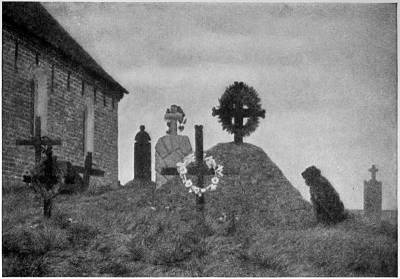
CHURCHYARD ON A NORTH SEA ISLAND
Jacob Alberts
Hauke stretched out his arm towards her. "Give me
your hand on it, Elke."
A deep scarlet shot up under the girl's dark brows.
"Why? I don't lie," she cried.
Hauke was about to answer, but she was already out of
the stable, and standing with the pitchfork in his hand he
could only hear the ducks and hens outside quacking and
cackling around her.
It was in January of the third year of Hauke's service
that a winter festival was to be held. "Eisboseln" (winter
golf) they call it here. There had been no wind along the
coast and a steady frost had covered all the ditches between
the fens with a firm, smooth crystal surface so that the
divided pieces of land now formed an extensive course over
which the little wooden balls filled with lead, with which the
goal was to be reached, could be thrown. A light northeast
breeze blew day after day. Everything was ready.
The uplanders from the village lying to the east across the
marsh and in which stood the church of the district, who
had won the previous year, had been challenged and had
accepted. Nine players had been picked out on each side.
The umpire and the spokesmen had also been chosen. The
latter, who had to discuss disputed points when a doubtful
throw was in question, were generally men who knew how
to present their case in the best light, usually fellows who
had a ready tongue as well as common sense. First among
these was Ole Peters, the dikegrave's head man. "See that
you throw like devils," he said, "I'll do the talking for
nothing."
It was towards evening of the day before the festival. A
number of the players had gathered in the inside room of
the parish tavern on the uplands, to decide whether or not
a few applicants who had come at the last minute should
be accepted. Hauke Haien was among the latter. At first
he had decided not to try, although he knew that his arms
were well trained in throwing. He feared that Ole Peters,
who held a post of honor in the game, would succeed in
having him rejected and he hoped to spare himself such a
defeat. But Elke had changed his mind at the eleventh
hour. "He wouldn't dare to, Hauke," she said; "he is
the son of a day laborer; your father has a horse and cow
of his own and is the wisest man in the village as well."
"Yes, but what if he should do it in spite of that?"
She looked at him half smiling with her dark eyes.
"Then," she said, "he'll get turned down when he wants
to dance with his master's daughter in the evening."
Thereupon Hauke had nodded to her with spirit.
Outside the tavern the young people, who still wanted to
enter the game, were standing in the cold, stamping their
feet and looking up at the top of the church-tower, which
was built of stone and stood beside the public-house. The
pastor's pigeons, which fed in summer on the fields of the
village, were just coming back from the peasants' yards
and barns where they had sought their grain and were now
disappearing into their nests under the eaves of the tower.
In the west, above the sea, hung a glowing evening crimson.
"It'll be good weather tomorrow!" said one of the young
fellows walking up and down stamping, "but cold, cold!"
Another, after he had seen the last pigeon disappear, went
into the house and stood listening at the door of the room
through which there now came the sound of lively conversation;
the dikegrave's second man came and stood beside
him. "Listen, Hauke, now they're shouting about you,"
and within they could distinctly hear Ole Peters' grating
voice saying, "Second men and boys don't belong in it."
"Come," said the other boy and taking Hauke by the
sleeve he tried to pull him up to the door. "Now you can
hear what they think of you."
But Hauke pulled himself away and went outside the
house again. "They didn't lock us out so that we should
hear what they said," he called back.
The third applicant was standing in front of the house.
"I'm afraid I shan't be taken without a hitch," he called
to Hauke, "I am hardly eighteen years old; if only they
don't ask for my baptismal certificate! Your head man will
talk you up all right, Hauke!"
"Yes, up and out!" growled Hauke and kicked a stone
across the way, "but not in."
The noise inside increased; then gradually it grew still;
those outside could hear again the gentle northeast wind
as it swept by the top of the church tower. The boy who
had been listening came back to the others. "Who were
they talking about in there?" asked the eighteen-year-old
boy.
"Him," the other answered and pointed to Hauke; "Ole
Peters tried to make out he was still a boy, but they were
all against that. And Jess Hansen said, 'and his father
has land and cattle.' 'Yes, land,' said Ole Peters, 'land
that could be carted away on thirteen barrows!' Finally
Ole Hensen began to speak: 'Keep still there,' he called,
'I'll put you straight; tell me, who is the first man in the
village?' They were all quiet a minute and seemed to be
thinking, then someone said 'I suppose it's the dikegrave!'
And all the others shouted, 'Well, yes; it must be the dikegrave!'
'And who is the dikegrave?' asked Ole Hensen
again; 'and now think carefully!' Then one of them
began to laugh softly and then another until at last the
whole room was just full of laughter. 'Well, go call him
then,' said Ole Hensen; 'you surely don't want to turn
away the dikegrave from your door!' I think they're still
laughing; but you can't hear Ole Peters' voice any more!"
the boy finished his report.
Almost at that moment the door of the room inside was
flung open and loud, merry cries of "Hauke! Hauke
Haien!" rang out into the cold night.
So Hauke went into the house and did not stop to hear
who the dikegrave was; what had been going on in his head
during these moments nobody ever knew.
When, some time later, he approached his master's house
he saw Elke standing down at the gate of the carriage-drive.
The moonlight glistened over the immeasurable
white-frosted pasture-land. "Are you standing here,
Elke?" he asked.
She only nodded: "What happened?" she said. "Did
he dare?"
"What would he not do?"
"Well, and?"
"It's all right, Elke. I can try tomorrow."
"Good-night, Hauke!" and she ran lightly up the mound
and disappeared into the house.
Hauke followed her slowly.
On the following afternoon a dark mass of people was
seen on the broad pasture-land that ran along towards the
east on the land side of the dike. Sometimes the mass stood
still, then, after a wooden ball had twice flown from it over
the ground which the sun had now freed from frost, it
moved gradually forward away from the long, low houses
that lay behind it. The two parties of winter golfers were
in the middle, surrounded by all the young and old who were
living or staying either in these houses or on the uplands.
The older men were in long coats, smoking their short pipes
with deliberation, the women in shawls and jackets, some
of them leading children by the hand or carrying them in
their arms. Out of the frozen ditches which were crossed
one after another the pale shine of the noonday sun sparkled
through the sharp points of the reeds; it was freezing
hard. But the game went on uninterruptedly, and all eyes
followed again and again the flying wooden ball, for the
whole village felt that on it hung the honor of the day.
The spokesman of the home side carried a white staff with
an iron point, that of the upland party a black one.
Wherever the ball ceased rolling this staff was driven into
the frozen ground amid the quiet admiration or the mocking
laughter of the opposing party and whoever first
reached the goal with his ball won the game for his side.
There was very little conversation in the crowd; only
when a capital cast was made the young men or women
sometimes broke into a cheer, or one of the old men took
his pipe out of his mouth and tapped the thrower with it
on the shoulder, saying, "That was a throw, said Zacharias,
and threw his wife out of the attic window," or "That's
how your father used to throw, may God have mercy on
his soul!" or some other pleasant words.
The first time he cast luck had not been with Hauke;
just as he threw his arm out behind him to hurl the ball a
cloud which had covered the sun till then passed away
from it and the dazzling rays struck him full in the eyes;
his cast was too short, the ball fell on a ditch and stuck in
the uneven ice.
"That doesn't count! That doesn't count! Throw
again, Hauke!" shouted his partners.
But the uplanders' spokesman objected: "It must
count. What's cast is cast."
"Ole! Ole Peters!" shouted the men from the marsh.
"Where is Ole? Where the devil can he be?"
But he was there already. "Don't shout so! Is there
something wrong with Hauke? That's just how I thought
it would be."
"Oh, nonsense! Hauke must throw again; now show
that you've got your mouth in the right place."
"I certainly have that!" shouted Ole, and he went up
to the other spokesman and made a long harangue. But
the sharp cuts and witty points that usually filled his speech
were lacking this time. At his side stood the girl with the
enigmatical brows and watched him sharply with angry
eyes; but she might not speak for the women had no voice
in the game.
"You're talking nonsense," shouted the other spokesman,
"because reason is not on your side. Sun, moon and
stars treat us all alike and are in the sky all the time;
it was a clumsy cast and all clumsy casts count!"
Thus they talked at each other for a while, but the end
of it was that, according to the umpire's decision, Hauke
was not allowed to repeat his cast.
"Forward!" cried the uplanders and their spokesman
pulled the black staff out of the ground and the next player
took his stand there when his number was called and
hurled the ball forward. In order to see the throw the
dikegrave's head man was obliged to pass Elke Volkerts.
"For whose sake did you leave your brains at home today?"
she whispered to him.
He looked at her almost fiercely and all trace of fun
disappeared from his broad face. "For your sake," he
said, "for you have forgotten yours too."
"Oh, come! I know you, Ole Peters!" answered the girl
drawing herself up, but he turned his head away and pretended
not to hear.
And the game and the black staff and the white one went
on. When Hauke's turn to throw came again his ball flew
so far that the goal, a large whitewashed hogshead, came
plainly into sight. He was now a solidly built young fellow
and mathematics and throwing had occupied him daily
since he was a boy. "Oh ho! Hauke!" the crowd shouted;
"the archangel Michael could not have done better himself!"
An old woman with cakes and brandy made her
way through the crowd to him; she poured out a glass
and offered it to him: "Come," she said, "let us be
friends; you are doing better today than when you killed
my cat!" As he looked at her he saw that it was Trien'
Jans. "Thank you, Mother," he said; "but I don't drink
that stuff." He felt in his pockets and pressed a newly
coined mark-piece into her hand. "Take that and drink
this glass yourself, Trien'; then we shall be friends
again!"
"You're right, Hauke!" returned the old woman obeying
him. "You're right; it is better for an old woman like me
than for you!"
"How are you getting on with your ducks?" he called
after her as she was going away with her basket; but she
only shook her head without turning round and clapped her
old hands in the air. "It's no good, Hauke; there are too
many rats in your ditches; God have mercy on me! I must
find some other way of earning my bread." And with this
she pushed her way into the crowd again, offering her
spirits and honey-cakes as she went.
At last the sun had sunk behind the dike and in its place
had left a reddish violet glow that flamed up into the sky;
now and then black crows flew by and seemed for the
moment to be of gold; it was evening. On the fields however
the dark crowd of people kept on moving farther and
farther away from the black houses in the distance behind
them towards the hogshead; an exceptionally good cast
might reach it now. It was the marsh party's turn and
Hauke was to throw.
The chalky hogshead stood out white in the broad
shadows that now fell from the dyke across the course.
"You'll have to leave it to us, this time!" cried one of the
uplanders, for the contest was hot and they were at least
ten feet in advance.
Hauke's tall, lean figure stepped out of the crowd; the
gray eyes in his long Friesian face were fixed on the hogshead;
his hand, which hung at his side, held the ball.
"The bird's too big for you, eh?" came the grating
voice of Ole Peters close to his ear, "shall we exchange it
for a gray pot?"
Hauke turned and looked at him steadily. "I'm throwing
for the marsh," he said. "Where do you belong?"
"To the marsh too, I imagine; but you are throwing
for Elke Volkerts, eh?"
"Stand aside!" shouted Hauke and took his position
again. But Ole pressed forward with his head still nearer
to him. Then suddenly, before Hauke himself could do
anything, a hand gripped the intruder and pulled him
backwards so that he stumbled against his laughing comrades.
It was not a large hand that did so, for as Hauke
hastily turned his head he saw Elke Volkerts beside him
pulling her sleeve to rights, and her dark brows were
drawn angrily across her hot face.
The power of steel shot into Hauke's arm; he bent forward
a little, weighed the ball in his hand once or twice,
then he drew his arm back and a dead silence fell on both
sides; all eyes followed the flying ball, it could be heard
whistling through the air; suddenly, far away from the
spot where it was thrown, the silver wings of a gull hid it
as, shrieking, the bird flew across from the dike. But at
the same moment it was heard in the distance striking
against the hogshead. "Hurrah for Hauke!" shouted the
marshlanders and the news ran loudly through the crowd:
"Hauke! Hauke Haien has won the game!"
But Hauke himself as they all crowded about him had
only felt for a hand at his side and even when they called
again: "What are you waiting for, Hauke? Your ball is
lying in the hogshead!" he only nodded and did not move
from the spot; not until he felt the little hand clasp his
firmly did he say: "I believe you're right; I think I've
won!"
Then the whole crowd streamed back and Elke and
Hauke were separated and swept along by the crowd
towards the tavern on the road that turned up by the dikegrave's
mound towards the uplands. But here they both
escaped and while Elke went up to her room Hauke stood
at the back, in front of the stable door and watched the
dark mass of people wandering up to the tavern, where a
room was ready for the dancers. Night gradually fell over
the open country; it grew stiller and stiller about him, only
behind him he could hear the cattle moving in the stable; he
fancied he could already catch the sound of the clarinets in
the tavern on the uplands. All at once he heard the rustle
of a gown round the corner of the house and firm little
steps went down the footway that led through the fens up
onto the uplands. Now, in the dusk, he could see the figure
swinging along and he knew that it was Elke; she too was
going to the dance in the tavern. The blood rushed up
into his throat; should he not run after her and go with
her? But Hauke was no hero where women were concerned;
weighing this question he remained standing till
she had disappeared from his sight in the dark.
Then, when the danger of overtaking her had passed, he
too went the same way till he reached the tavern up by the
church, and the talking and shouting of the crowd before
the house and in the passage, and the shrill tones of the
violins and clarinets within, surrounded him with a deafening
noise. Unnoticed he made his way into the "guildhall."
It was not large and was so full that he could
scarcely see a step in front of him. In silence he stood
leaning against the door-jamb and watched the moving
throng; the people seemed to him like fools; he did not need
to fear either that anyone would think of the struggle in
the afternoon or of who had won the game an hour ago.
Each man had eyes only for his girl and turned round and
round with her in a circle. He was seeking for one only
and at last—there she was! She was dancing with her
cousin, the young dike commissioner—but she had already
disappeared again and he could see only other girls from
the marsh and the uplands for whom he cared nothing.
Then suddenly the violins and the clarinets ceased and the
dance was at an end; but already another was beginning.
The thought passed through Hauke's mind whether Elke
would really keep her word, if she might not dance past
him with Ole Peters. He almost screamed at the idea; then—well,
what would he do then? But she did not seem to
be dancing this dance at all and at last it came to an end
and another, a two-step, which was just beginning to be
popular then, followed. The music started with a mad
flourish, the young fellows rushed up to the girls, the lights
on the walls flared. Hauke nearly dislocated his neck trying
to distinguish the dancers; and there, the third couple,
was Ole Peters and—but who was the girl? A broad fellow
from the marsh stood in front of her and hid her face.
But the dance went on madly and Ole and his partner circled
out where he could see them. "Vollina! Vollina
Harders!" Hauke almost shouted aloud and gave a sigh of
relief. But where was Elke? Had she no partner or had
she refused them all because she did not want to dance
with Ole? The music stopped again and then a new dance
began but still he did not see her. There was Ole, still
with his fat Vollina in his arms! "Well," said Hauke to
himself, "it looks as if Jess Harders with his twenty-five
acres would soon have to retire! But where is Elke?"
He left the door and pushed his way further into the
room; suddenly he found himself standing before her as
she sat with an older friend in a corner. "Hauke!" she
exclaimed, raising her narrow face to look at him; "are
you here? I didn't see you dancing!"
"I haven't danced," he replied.
"Why not, Hauke?" and half rising she added: "Will
you dance with me? I wouldn't with Ole Peters; he won't
come again!"
But Hauke made no move to begin. "Thank you, Elke,"
he said, "but I don't know how well enough; they might
laugh at you; and then * * *" he broke off suddenly and
looked at her with feeling in his gray eyes as if he must
leave it to them to finish what he would say.
"What do you mean, Hauke?" she asked softly.
"I mean, Elke, that the day can have no happier ending
for me than it has had already."
"Yes," she said, "you won the game."
"Elke!" he said with scarcely audible reproach.
A hot red flamed up into her face. "There!" she said,
"what do you want?" and dropped her eyes.
A partner now came and claimed her friend and after
she had gone Hauke spoke louder. "I thought I had won
something better, Elke!"
Her eyes searched the floor a few seconds longer; then
she raised them slowly and a glance, filled with the quiet
strength of her being, met his and ran through him like
summer warmth. "Do as your feeling tells you, Hauke,"
she said; "we ought to know each other!"
Elke did not dance again that evening and when they
went home they went hand in hand; from the sky above the
stars sparkled over the silent marsh; a light east wind blew
and made the cold severe, but the two walked on without
many wraps as if spring had suddenly come.
Hauke had thought of something, to be used perhaps
only in the uncertain future, but with which he hoped to
celebrate a secret festival. Accordingly he went to town
the next Sunday to the old goldsmith Andersen and ordered
a thick gold ring. "Stretch out your finger till I measure
it," said the old man and took hold of Hauke's third finger.
"It's not as big as most of you people have," he went on.
But Hauke said: "I'd rather you measured my little
finger," and he held it out to him.
The goldsmith looked at him somewhat puzzled; but what
did he care what the whim of a young peasant might be.
"We'll probably find one among the ladies' rings," he
said, and the blood mounted into Hauke's cheeks. But
the ring fitted his little finger and he took it hastily and
paid for it with bright silver. Then, with his heart beating
loudly and as if it were a solemn act, he put it into
his waistcoat pocket. And from then on he carried it there
day by day with a restless yet proud feeling, as if his
waistcoat pocket were made only to carry a ring in.
So he carried it for years, in fact, the ring had to leave
that pocket for a new one; no opportunity to escape presented
itself. It had indeed passed through Hauke's head
to go straight to his master; after all, his father belonged
in the village and held land there. But in his calmer
moments he knew well that the old dikegrave would have
laughed at his second man. And so he and the dikegrave's
daughter lived on side by side, she in girlish silence, and
yet both as if they walked hand in hand.
A year after the winter festival Ole Peters had left the
dikegrave's service and married Vollina Harders; Hauke
had been right; the old man had retired and instead of his
fat daughter his brisk son-in-law now rode the yellow mare
to the fens and on his way back, it was said, always up the
side of the dike. Hauke was now head man and a younger
fellow had taken his former place. At first the dikegrave
had not wanted to advance him. "He's better as second
man," he had growled, "I need him here with my books!"
But Elke had said, "Then Hauke would leave, Father!"
That frightened the old man and Hauke had been made
head man but he still kept on as before helping in the
administration of the dike.
After another year had passed he began to talk to Elke
about his father's growing feeble, and explained that the
few days that the master allowed him in summer in which
to help at home were no longer enough; the old man was
overworking himself and he, Hauke, could not stand by and
see it go on. It was a summer evening; the two were standing
in the twilight under the great ash in front of the door
of the house. For a time the girl looked up in silence at
the bough of the tree; then she answered, "I did not want
to say it, Hauke; I thought you would find the right thing
to do yourself."
"Then I must go away out of your house," he said, "and
cannot come again."
They were silent for a time and watched the sunset glow
that was just sinking into the sea over behind the dike.
"You must know best," she said; "I was at your father's
this morning and found him asleep in his armchair; he
had a drawing-pen in his hand and the drawing-board with
a half finished drawing lay before him on the table. Afterwards
he woke and talked to me for a quarter of an hour
but only with difficulty, and then, when I was going, he
clung to my hand as if he were afraid that it was for the
last time; but * * *."
"But what, Elke?" asked Hauke, as she hesitated to
go on.
A few tears ran down over the girl's cheeks. "I was
only thinking of my father," she said; "believe me, it will
be hard for him to lose you." And with an effort she
added: "It often seems to me as if he too were preparing
for his end."
Hauke did not answer; it seemed to him as if the ring
in his pocket suddenly moved but before he could suppress
his indignation at this involuntary stir Elke went on: "No,
don't be angry, Hauke! I trust and believe that even so
you will not forsake us!"
At that he seized her hand eagerly and she did not draw
it away. For some time longer the two stood there together
in the growing dusk till their hands slipped apart and they
went their different ways. A gust of wind struck the ash-tree
and rustled through its leaves, rattling the shutters
on the front of the house; but gradually the night fell and
silence lay over the vast plain.
The old dikegrave yielded to Elke's persuasion and allowed
Hauke to leave his service although the latter had
not given notice at the proper time. Two new men had
since been engaged. A few months later Tede Haien died,
but before he died he called his son to his bed: "Sit down
here beside me, child," he said in a feeble voice, "close beside
me! You need not be afraid; the one who is with me
is only the dark angel of the Lord who has come to call
me."
And the grief-stricken son sat down close to the dark
wall-bed: "Speak, Father, tell me all that you still have to
say!"
"Yes, my son, there is still something," said the old
man and stretched out his hands on the counterpane.
"When you, only a half-grown boy, went into the dikegrave's
service you had it in your mind to be a dikegrave
yourself some day. You infected me with the idea and
gradually I too came to think that you were the right
man for that. But your inheritance was too small for you
to hold such an office. I have lived frugally during the
time you were in service. I thought to increase it."
Hauke pressed his father's hands warmly and the old
man tried to sit up so that he could see him. "Yes, my
son," he said, "the paper is there in the top drawer of the
strong chest. You know, old Antje Wohlers had a field of
five and a half acres; but in her crippled old age she could
not get on with the rent from it alone; so every Martinmas
I gave the poor creature a certain sum and more too,
when I had it; and for that she made over the field to me;
it is all legally arranged. Now she too is lying at the point
of death; the disease of our marshes, cancer, has overtaken
her; you will not have anything more to pay!"
He closed his eyes for a time; then he added: "It isn't
much; but still you will have more than you were accustomed
to with me. May it serve you for your life in this
world!"
Listening to his son's thanks the old man fell asleep. He
had nothing more to attend to, and a few days later the
angel of the Lord had closed his eyes forever, and Hauke
came into his paternal inheritance.
On the day after the funeral Elke came to his house.
"Thank you for looking in, Elke!" was Hauke's greeting.
But she answered: "I am not just looking in; I want to
tidy the house a little so that you can live in comfort.
With all his figures and drawings your father had not time
to look about him much and death too brings confusion;
I'll make it a little homelike for you again!"
He looked at her with his gray eyes full of trust: "Tidy
up, then," he said; "I like it better too."
And so she began to clear up the room. The drawing-board
which still lay there was dusted and put away in the
attic. Drawing-pens, pencils and chalk were carefully
locked away in a drawer of the strong chest. Then the
young servant was called in and helped to move the furniture
of the whole room into a different and better position
so that there seemed to be more light and space.
"Only we women can do that," said Elke, smiling, and
Hauke, in spite of his grief for his father, looked on with
happy eyes and helped too when it was necessary.
And when, towards twilight—it was at the beginning of
September—everything was as she wanted it for him, she
took his hand and nodded to him with her dark eyes. "Now
come and have supper with us; I had to promise my father
to bring you back with me; then when you come home later
everything will be ready for you."
When they entered the spacious living-room of the dikegrave,
where the shutters were already closed and the two
lights burning on the table, the old man started to get up
out of his armchair but his heavy body sank back again
and he contented himself with calling out to his former
servant: "That's right, Hauke, I'm glad you've come to
look up your old friends again! Just come nearer, nearer!"
And when Hauke came up to his chair he took his hand in
both his podgy ones and said: "Well, well, my boy, don't
grieve too much, for we must all die and your father was
not one of the worst! But, come, Elke, bring the roast in;
we need to strengthen ourselves! There is a lot of work
ahead of us, Hauke! The autumn inspection is coming on;
the dike and sluice accounts are piled as high as the house;
then there's the recent damage to the dike on the western
koog—I don't know which way to turn my head; but yours,
thank God, is a good bit younger; you are a good lad,
Hauke!"
And after this long speech in which the old man had laid
bare his whole heart, he fell back in his chair and blinked
longingly at the door through which Elke was just entering
with the roast. Hauke stood beside him smiling. "Now
sit down," said the dikegrave; "we mustn't waste time;
this dish doesn't taste good cold."
And Hauke sat down; it seemed to him a matter of course
that he should share in Elke's father's work. And when
later the autumn inspection came and a few months more
had been added to the year, he had really done the greater
part of it.
The narrator stopped and looked about him. The shriek
of a gull had struck the window and outside in the entrance
the stamping of feet was heard as if someone were shaking
off the clay from his heavy boots.
The dikegrave and the commissioners turned their heads
towards the door. "What is it?" exclaimed the former.
A stout man with a sou'wester on his head entered.
"Sir," he announced, "we both saw it, Hans Nickels and I:
the rider of the white horse has thrown himself into the
water-hole!"
"Where did you see that?" asked the dikegrave.
"There is only the one hole; in Jansen's fen where the
Hauke Haien Koog begins."
"Did you only see it once?"
"Only once; and it only looked like a shadow; but that
doesn't mean that it was the first time."
The dikegrave had risen. "You will excuse me," he
said, turning to me, "we must go out and see where the
mischief is brewing." He went out with the messenger
and the rest of the company rose too and followed him.
I was left alone with the schoolmaster in the large bare
room; we now had a clear view through the uncurtained
windows which were no longer hidden by people sitting in
front of them, and could see how the wind was driving the
dark clouds across the sky. The old man still sat in his
place, a superior, almost compassionate smile on his lips.
"It has grown too empty here," he said, "will you come
upstairs with me to my room? I live here in the house,
and, believe me, I know the weather here near the dike;
we have nothing to fear for ourselves."
COMMUNION SERVICE ON A NORTH SEA ISLAND
From the Painting by Jacob Alberts
PERMISSION PHOTOGRAPHISCHE GESEILSCHAFT BERLIN
I accepted gratefully; for I too was beginning to feel
chilly there, and after taking a light we climbed the stairs
to an attic-room which did indeed look towards the west
like the other, but whose windows were now covered with
dark woolen hangings. In a bookcase I saw a small collection
of books and beside it the portraits of two old
professors; in front of a table stood a large easy-chair.
"Make yourself at home," said my friendly host and threw
a few pieces of peat into the still faintly burning stove,
on the top of which stood a tin kettle. "Just a few minutes!
It will soon begin to sing and then I will brew a
glass of grog for us; that will keep you awake."
"I don't need that," I answered; "I don't grow sleepy
following your Hauke on his way through life."
"Really?" and he nodded to me with his wise eyes after
I had been comfortably settled in his easy chair. "Let me
see, where were we?——Oh yes, I know. Well then!"
Hauke had come into his paternal inheritance, and as old
Antje Wohlers had also succumbed to her illness, her field
had increased it. But since the death, or, rather, since the
last words of his father, something had grown up in him,
the seed of which he had carried in his heart since his boyhood;
more than often enough he repeated to himself that
he was the right man when there should have to be a new
dikegrave. That was it. His father who surely understood
it, who, in fact, had been the wisest man in the village, had,
as it were, added these words to his inheritance as a final
gift; Antje Wohlers' field, which he also owed to him,
should form the first stepping-stone to this height. For, to
be sure, a dikegrave must be able to point to far more
extensive property than this alone. But his father had
lived frugally for lonely years and had bought this new
possession with the money thus saved; he could do that too,
he could do more than that; for his father's strength had
been gone, while he could still do the hardest work for
years to come. Of course, even if he did succeed in that
way, yet the keen edge that he had put on his old master's
administration had not made friends for him in the village,
and Ole Peters, his old antagonist, had lately come into an
inheritance and was beginning to be a well-to-do man. A
number of faces passed before his inward vision and they
all looked at him with unfriendly eyes; then wrath against
these people took hold of him and he stretched out his arms
as if he would seize them; for they wanted to keep him
from the office to which he alone was suited. And these
thoughts did not leave him; they were always there and so
side by side with honor and love there grew up ambition
and hatred in his young heart. But he hid them deep
within him; even Elke did not suspect their existence.
With the coming of the New Year there was a wedding.
The bride was a relative of the Haiens, and Hauke and
Elke were both there as invited guests; in fact they sat
side by side at the wedding breakfast owing to the failure
of a nearer relative to come. Only the smile that passed
over both their faces betrayed their joy at this. But Elke
sat listless in the noise of the conversation and the clatter
of glasses that went on about them.
"Is there something the matter?" asked Hauke.
"Oh, no, not really; there are only too many people here
for me."
"But you look so sad!"
She shook her head; then they were both silent again.
Gradually a feeling as if he were jealous because of her
silence grew in him and he took her hand secretly under
cover of the tablecloth; it did not start but closed confidingly
round his. Had a feeling of loneliness taken hold of
her as she watched her father growing older and weaker
day by day? Hauke did not think of putting this question
to himself but he ceased to breathe now as he drew the gold
ring from his pocket. "Will you leave it there?" he asked,
trembling as he slipped it onto the third finger of her
slender hand.
The pastor's wife was sitting opposite them at the table;
suddenly she laid down her fork and turned to her neighbor:
"Good gracious, look at that girl!" she exclaimed,
"she's pale as death!"
But the blood was already coming back into Elke's face.
"Can you wait, Hauke?" she asked softly.
The prudent Friesian stopped to think for a moment.
"For what?" he said then.
"You know well; I don't need to tell you."
"You are right," he said; "yes, Elke, I can wait—if only
the time's within reason!"
"Oh God, I'm afraid it's near! Don't speak like that,
Hauke, you are talking of my father's death!" She laid
the other hand on her breast: "Till then," she said, "I
will wear the ring here; never fear, you will never get it
back as long as I live."
Then they both smiled and his hand pressed hers so that
at any other time the girl would have screamed aloud.
During this time the pastor's wife had been looking
steadily at Elke's eyes which now burned as with dark
fire beneath the lace edging of her little gold-brocaded cap.
But the increasing noise at the table had prevented the
older woman from understanding anything that was said;
she did not turn to her neighbor again either, for budding
marriages—and that is what this looked like to her—even
if it were only because of the fee that budded for her husband
at the same time, she was not in the habit of disturbing.
Elke's premonition had come true. One morning after
Easter the dikegrave Tede Volkerts had been found dead
in his bed; his countenance bore witness to a peaceful end.
He had often spoken in the previous months of being tired
of life and had had no appetite for his favorite dish, a roast
joint, or even for a young duck.
And now there was a great funeral in the village. In
the burying ground about the church on the upland, lying
towards the west, was a lot surrounded by an iron fence.
In it the broad, blue grave-stone had been lifted up and was
now leaning against a weeping ash. A figure of Death
with a very full and prominent set of teeth had been
chiseled on the stone and below stood in large letters:
Dat is de Dot, de allens fritt,
Nimmt Kunst un Wetenschop di mit;
De kloke Mann is nu vergån
Gott gäw em selik Uperstån.
This is Death who eats up all,
Art and science go at his call;
The clever man has left us forlorn
God raise him on resurrection morn!
This was the resting place of the former dikegrave,
Volkert Tedsen. Now a new grave had been dug in which
his son, the dikegrave Tede Volkerts, was to be laid. The
funeral procession was already coming up from the marsh
below, a throng of carriages from all the villages in the
parish; the one at the head bore the heavy coffin, the two
glossy black horses from the dikegrave's stables were
already drawing it up the sandy slope to the uplands; the
horses' manes and tails waved in the brisk spring breeze.
The churchyard was filled to the walls with people, even
on top of the brick gate boys squatted with little children
in their arms; all were anxious to see the burying.
In the house down on the marsh Elke had prepared the
funeral repast in the living-room and the adjoining parlor;
old wine stood at every place; there was a bottle of Langkork
for the chief dikegrave—for he too had not failed to
come to the ceremony—and another for the pastor. When
everything was ready she went through the stable out to
the back door; she met no one on her way; the men had
gone with the carriages to the funeral. There she stood, her
mourning clothes fluttering in the spring breeze, and looked
across to the village where the last carriages were just
driving up to the church. After a while there was a commotion
there and then followed a dead silence. Elke folded
her hands; now they were probably lowering the coffin into
the grave: "And to dust thou shalt return!" Involuntarily,
softly, as if she could hear them from the churchyard
she repeated the words; then her eyes filled with tears,
her hands which were folded across her breast sank into
her lap; "Our Father, who art in heaven!" she prayed with
fervor. And when she had finished the Lord's prayer she
stood there long, immovable, she, from now on the owner
of this large lowland farm; and thoughts of death and of
life began to strive within her.
A distant rumble roused her. When she opened her eyes
she saw again one carriage following the other in rapid
succession, driving down from the marsh and coming towards
her farm. She stood upright, looked out once more
with a keen glance and then went back, as she had come,
through the stable and into the solemnly prepared living
rooms. There was no one here either, only through the
wall she could hear the bustle of the maids in the kitchen.
The banquet table looked so still and lonely; the mirror
between the windows was covered with white cloth, so were
the brass knobs of the warming-oven; there was nothing to
shine in the room any more. Elke noticed that the doors
of the wall-bed in which her father had slept for the last
time were open and she went over and closed them tight;
absently she read the words painted on them in gold letters
among the roses and pinks:
"Hest du din Dågwerk richtig dan
Da kommt de Slåp von sülvst heran."
If you have done your day's work right
Sleep will come of itself at night.
That was from her grandfather's time! She glanced at
the cupboard; it was almost empty but through the glass-doors
she could see the cut-glass goblet which, as he had
been fond of telling, her father had won once in his youth
tilting in the ring. She took it out and stood it at the
chief dikegrave's place. Then she went to the window, for
already she could hear the carriages coming up the drive.
One after another stopped in front of the house, and, more
cheerful than when they first came, the guests now sprang
down from their seats to the ground. Rubbing their hands
and talking, they all crowded into the room; it was not long
before they had all taken their places at the festive table on
which the well-cooked dishes were steaming, the chief dikegrave
and the pastor in the parlor; noise and loud conversation
ran along the table as if the dreadful silence of death
had never hovered here. Silently, her eyes on her guests,
Elke went round with the maids among the tables to see
that nothing was missing. Hauke Haien too sat in the
living-room besides Ole Peters and other small landowners.
After the meal was over the white clay pipes were fetched
out of the corner and lighted and Elke was busy again
passing the coffee cups to her guests, for she did not spare
with that either today. In the living-room, at her father's
desk, the chief dikegrave was standing in conversation with
the pastor and the white-haired dike commissioner Jewe
Manners. "It is all very well, Gentlemen," said the former,
"we have laid the old dikegrave to rest with honors;
but where shall we find a new one? I think, Manners, you
will have to take the dignity upon you!"
Smiling, the old man raised the black velvet cap from
his white hair: "The game would be too short, Sir," he
said; "when the deceased Tede Volkerts was made dikegrave,
I was made commissioner and I have been it now
for forty years!"
"That is no fault, Manners; you know the dike affairs so
much the better and will have no trouble with them!"
But the old man shook his head: "No, no, your Grace,
leave me where I am and I can keep on in the game for
another few years yet!"
The pastor came to his aid. "Why," he said, "do we
not put into office the man who has really exercised it in
the last years?"
The chief dikegrave looked at him. "I don't understand
you, pastor."
The pastor pointed into the parlor where Hauke seemed
to be explaining something to two older men in a slow
earnest way. "There he stands," he said, "the tall
Friesian figure with the clever gray eyes beside his lean
nose and the two bumps in his forehead above them! He
was the old man's servant and now has a little piece of his
own; of course, he is still rather young!"
"He seems to be in the thirties," said the chief dikegrave,
measuring Hauke with his eyes.
"He is scarcely twenty-four," returned Commissioner
Manners; "but the pastor is right; all the good proposals
for the dike and drain work and so on that have come from
the dikegrave's office during the last years have come from
him; after all, the old man didn't amount to much towards
the end."
"Indeed?" said the chief dikegrave; "and you think
that he would be the man now to move up into his old master's
place?"
"He would be the man," answered Jewe Manners; "but
he lacks what we call here 'clay under his feet'; his father
had about fifteen, he may have a good twenty acres; but
no one here has ever been made dikegrave on that."
The pastor opened his mouth as if he were about to speak,
when Elke Volkerts, who had been in the room for some
little time, suddenly came up to them. "Will your Grace
allow me a word?" she said to the chief officer, "it is only
so that an error may not lead to a wrong!"
"Speak out, Miss Elke!" he answered; "wisdom always
sounds well from a pretty girl's mouth."
"—It is not wisdom, your Grace; I only want to tell the
truth."
"We ought to be able to listen to that too, Jungfer
Elke."
The girl's dark eyes glanced aside again as if she wanted
to reassure herself that no superfluous ears were near.
"Your Grace," she began then, and her breast rose with
strong emotion, "my godfather, Jewe Manners, told you
that Hauke Haien only possesses about twenty acres, and
that is true for the moment; but as soon as is necessary
Hauke will have as many more acres as there are in my
father's farm which is now mine; this with what he now has
ought to be * * *."
Old Manners stretched his white head towards her as if
he were looking to see who it was that spoke. "What's
that?" he said, "what are you saying, child?"
Elke drew a little black ribbon out of her bodice with a
shining gold ring on the end of it. "I am engaged, Godfather,"
she said; "here is the ring, and Hauke Haien is
my betrothed."
"And when—I suppose I may ask since I held you at the
font, Elke Volkerts—when did this happen?"
"It was some time ago, but I was of age, Godfather
Manners," she said; "my father was already growing
feeble and, as I knew him, I did not want to trouble him
with it; now that he is with God he will see that his child
is well cared for with this man. I should have said nothing
about it till my year of mourning was over, but now, for
Hauke's sake and on account of the koog, I have had to
speak." And turning to the chief dikegrave she added:
"Your Grace will pardon me, I hope!"
The three men looked at one another. The pastor
laughed, the old commissioner contented himself with murmuring
"Hum, hum!" while the chief dikegrave rubbed
his forehead as if he were concerned with an important
decision. "Yes, my dear girl," he said at last, "but how is
it with the matrimonial property rights here? I must confess
I am not thoroughly at home in these complicated
matters."
"That is not necessary, your Grace," answered the dikegrave's
daughter, "I will transfer the property to Hauke
before the marriage. I have my own little pride," she
added, smiling; "I want to marry the richest man in the
village!"
"Well, Manners," said the pastor, "I suppose that you,
as godfather, will have no objection when I unite the young
dikegrave and the daughter of the old one in marriage!"
The old man shook his head gently. "May God give them
his blessing!" he said, devoutly.
But the chief dikegrave held out his hand to the girl.
"You have spoken truly and wisely, Elke Volkerts; I thank
you for your forceful explanations and I hope also in the
future and on more joyous occasions than this to be the
guest of your house; but—the most wonderful thing about it
all is that a dikegrave should be made by such a young
woman."
"Your Grace," replied Elke, who looked at his kindly
face again with her serious eyes, "the right man may well
be helped by his wife!" Then she went into the adjoining
parlor and silently laid her hand in Hauke Haien's.
It was several years later. Tede Haien's little house
was now occupied by an active workman with his wife and
children. The young dikegrave Hauke Haien lived with his
wife in what had been her father's house. In summer the
mighty ash rustled in front of the house as before; but on
the bench which now stood beneath it generally only the
young wife was to be seen in the evening sitting alone with
her sewing or some other piece of work. There was still no
child in this home and Hauke had something else to do than
to spend a leisure evening in front of the house, for in spite
of the help he had given the old dikegrave the latter had
bequeathed to him a number of unsettled matters pertaining
to the dike, matters with which Hauke had not liked to
meddle before; but now they must all gradually be cleared
up and he swept with a strong broom. Then came the
management and work of the farm itself, increased as it
was by the addition of his own property, and moreover
he was trying to do without a servant boy. And so it happened
that, except on Sunday when they went to church,
he and Elke saw each other only at dinner, when Hauke
was generally hurried, and at the beginning and end of the
day; it was a life of continuous work and yet a contented
one.
And then the tongues of the busy-bodies disturbed the
peace. One Sunday after church a somewhat noisy gang
of the younger landowners in the marsh and upland districts
were sitting drinking in the tavern on the uplands.
Over the fourth or fifth glass they began to talk, not indeed
about the king and the government—no one went so high
in those days—but about the municipal officials and their
superiors and above all about the municipal taxes and
assessments, and the longer they talked the less they were
satisfied with them, least of all with the new dike assessments;
all the drains and sluices which had hitherto been
all right now needed repairs; new places were always
being found in the dike that needed hundreds of barrows
of earth; the devil take it all!
"That's your clever dikegrave's doing," shouted one of
the uplanders, "who always goes about thinking and then
puts a finger into every pie."
"Yes, Marten," said Ole Peters, who sat opposite the
speaker; "you're right, he's tricky and is always trying to
get into the chief dikegrave's good books; but we've got
him now."
"Why did you let them load him onto you?" said the
other; "now you've got to pay for it."
Ole Peters laughed. "Yes, Marten Fedders, that's the
way it goes with us here and there's nothing to be done.
The old dikegrave got the office on his father's account;
the new one on his wife's." The laughter that greeted
this sally showed how it pleased the company.
But it was said at a public house table and it did not
stop there; soon it went the rounds on the uplands as well
as down on the marshes; thus it came to Hauke's ears too.
And again all the malicious faces passed before his inward
eye and when he thought of the laughter at the tavern
table it sounded more mocking than it had been in reality.
"The dogs!" he shouted and looked wrathfully to one side
as if he would have had them thrashed.
At that Elke laid her hand on his arm: "Never mind
them! They would all like to be what you are!"
"That's just it," he answered rancorously.
"And," she went on, "did not Ole Peters himself marry
money?"
"That he did, Elke; but what he got when he married
Vollina was not enough to make him dikegrave!"
"Say rather; he was not enough himself to become dikegrave!"
And Elke turned her husband round so that he
looked at himself in the mirror, for they were standing
between the windows in their room. "There stands the
dikegrave," she said; "now look at him; only he who can
exercise an office holds one!"
"You are not wrong there," he answered, thinking, "and
yet * * * Well, Elke, I must go on to the eastern sluice;
the gates don't lock again."
She pressed his hand. "Come, look at me a minute
first! What is the matter with you, your eyes look so
far away?"
"Nothing, Elke; you're right."
He went; but he had not been gone long when he had
forgotten all about the repairs to the sluice. Another idea
which he had half thought out and had carried about with
him for years, but which had been pushed into the background
by urgent official duties, now took possession of
him anew and more powerfully than before as if suddenly
it had grown wings.
Hardly realizing where he was going he found himself
up on the seaward dike, a good distance to the south,
towards the town; the village that lay out in this direction
had long disappeared on his left; still he went on, his gaze
turned towards the water-side and fixed steadily on the
broad stretch of land in front of the dikes; anyone with
him could not have helped seeing what absorbing mental
work was going on behind those eyes. At last he stopped;
there the foreland narrowed down to a little strip along
the dike. "It must be possible," he said to himself.
"Seven years in office! they shan't say again that I am
dikegrave only on my wife's account!"
Still he stood and his keen glance swept carefully over
the green foreland in all directions; then he went back to
where another small strip of green pasture-land took the
place of the broad expanse lying before him. Close to the
dike however a strong sea current ran through this expanse
separating nearly the whole outland from the mainland and
making it into an island; a rough wooden bridge led across
to it so that cattle or hay and grain carts could pass over.
The tide was low and the golden September sun glistened
on the bare strip of mud, perhaps a hundred feet wide, and
on the deep water-course in the middle of it through which
the sea was even now running. "That could be dammed,"
said Hauke to himself after watching it for some time.
Then he looked up and, in imagination, drew a line from
the dike on which he stood, across the water-course, along
the edge of the island, round towards the south and back
again in an easterly direction across the water-course and
up to the dike. And this invisible line which he now drew
was a new dike, new too in the construction of its profile
which till now had existed only in his head.
"That would give us about a thousand acres more of
reclaimed land," he said, smiling to himself; "not exactly a
great stretch, but still——"
Another calculation absorbed him. The outland here belonged
to the community, its members each holding a number
of shares according to the size of their property in the
parish or by having legally acquired them in some other
way. He began to count up how many shares he had received
from his own, how many from Elke's father and how
many he had bought himself since his marriage, partly with
an indistinct idea of benefit to be derived in the future,
partly when he increased his flocks of sheep. Altogether
he held a considerable number of shares; for he had bought
from Ole Peters all that he had as well, when the latter
became so disgusted at losing his best ram in a partial
inundation that he decided to sell. But that was a rare
accident, for as far back as Hauke could remember only
the edges were flooded even when the tides were unusually
high. What splendid pasture and grain land it would make
and how valuable it would be when it was all surrounded
by his new dike! A kind of intoxication came over him
as he thought of it, but he dug his nails into the palms of
his hands and forced his eyes to look clearly and soberly
at what lay before him. There was this great dike-less area
on the extreme edge of which a flock of dirty sheep now
wandered grazing slowly; who knew what storms and tides
might do to it even within the next few years; and for him
it would mean a lot of work, struggle, and annoyance.
Nevertheless, as he went down from the dike and along the
foot-path across the fens towards his mound, he felt as if
he were bringing a great treasure home with him.
Elke met him in the hall; "How did you find the sluice?"
she asked.
He looked down at her with a mysterious smile: "We
shall soon need another sluice," he said, "and drains and a
new dike!"
"I don't understand," replied Elke as they went into
the room. "What is it that you want, Hauke?"
"I want," he said slowly and stopped a moment. "I
want to have the big stretch of outland that begins opposite
our place and then runs towards the west, all diked in and
a well-drained koog made out of it. The high tides have left
us in peace for nearly a generation, but if one of the really
bad ones should come again and destroy the new growth,
everything might be ruined at one blow; only the old slip-shod
way of doing things could have let it go on like that
so long."
She looked at him in amazement. "Then you blame
yourself!" she said.
"Yes, I do, Elke; but there has always been so much else
to do."
"I know, Hauke; you have done enough!"
He had seated himself in the old dikegrave's easy-chair
and his hands gripped both arms of it firmly.
"Have you the courage to do it?" asked his wife.
"Indeed I have, Elke," he said hastily.
"Don't go too fast, Hauke; that is an undertaking of
life and death and they will nearly all be against you; you
will get no thanks for all your trouble and care!"
He nodded: "I know!" he said.
"And suppose it doesn't succeed!" she exclaimed again;
"ever since I was a child I have heard that that water-course
could not be stopped and therefore it must never be
touched."
"That is simply a lazy man's excuse," said Hauke;
"why should it be impossible to stop it?"
"I never heard why; perhaps because it flows through
so straight; the washout is too strong." Suddenly a memory
came back to her and an almost roguish smile dawned
in her serious eyes. "When I was a child," she said, "I
heard the hired men talking about it once; they said that
the only way to build a dam there that would hold was to
bury something alive in it while it was being made; when
they were building a dike on the other side—it must have
been a hundred years ago—a gypsy child that they bought
from its mother at a high price had been thrown into it
and buried alive; but now probably no one would sell her
child."
Hauke shook his head. "Then it is just as well that we
have none, or they would probably require it of us!"
"They wouldn't get it!" said Elke, and threw her arms
across her own body as if in fear.
And Hauke smiled; but she went on to another question:
"And the tremendous expense! Have you thought of
that?"
"Indeed I have, Elke; we shall gain in land much more
than the expense of building the dike, and then too the
cost of maintaining the old dike will be much less; we shall
work ourselves and we have more than eighty teams in the
parish and no lack of young hands. At least you will not
have made me dikegrave for nothing, Elke; I will show
them that I am one."
She had crouched down in front of him and was looking
at him anxiously; now she rose with a sigh. "I must go on
with my day's work," she said slowly stroking his cheek;
"you do yours, Hauke."
"Amen, Elke," he said with an earnest smile; "there is
work here for both of us!"
And there was work enough for both, though now the
husband's burden became even heavier. On Sunday afternoons
and often late in the evening Hauke and a capable
surveyor sat together, deep in calculations, drawings and
plans; it was the same when Hauke was alone and he often
did not finish till long after midnight. Then he crept into
his and Elke's bedroom, for they no longer used the stuffy
wall-beds in the living-room, and so that he might at last
get some rest, his wife lay with closed eyes as if asleep
although she had been waiting for him with a beating heart.
Then he sometimes kissed her brow, whispering a word of
endearment, and laid himself down to wait for the sleep
which often did not come to him till cock-crow. During the
winter tempests he would go out on the dike with paper
and pencil in his hand and stand there drawing and making
notes while a gust of wind tore his cap from his head and
his long tawny hair blew across his hot face. As long as
the ice did not prevent it he would take one of the men-servants
and go out in the boat to the shallows and measure
the depth of the currents there with a rod and plumb-line,
whenever he was in doubt. Elke often trembled for him,
but the only sign she showed of it when he came home again
was the firmness of her hand-clasp or the gleaming light in
her usually quiet eyes. "Have patience, Elke," he said
once when it seemed to him that his wife did not want to
let him go; "I must be perfectly clear about it myself before
I make my proposal." At that she nodded and let him go.
His rides into town to the chief dikegrave were no trifle
either, and they and all the work of managing the house
and farm were always followed by work on his papers late
into the night. He almost ceased to associate with other
people except in his work and business; he even saw less
of his wife from day to day. "It is a hard time and it will
last a long while yet," said Elke to herself and went about
her work.
At last, when the sun and spring winds had broken up
the ice everywhere the preparatory work came to an end.
The petition to the chief dikegrave to be recommended to
a higher department was ready. It contained the proposal
for a dike to surround the foreland mentioned, for the
benefit of the public welfare, especially of the koog and not
less of the Sovereign's exchequer as, in a few years, the
latter would profit by taxes from about one thousand acres.
The whole was neatly copied, packed in a strong tubular
case, together with plans and drawings of all the localities
as they were at present and as planned, of sluices and
drains and everything else in question, and was provided
with the dikegrave's official seal.
"Here it is, Elke," said the young dikegrave, "now give
it your blessing."
Elke laid her hand in his: "We will hold fast to each
other," she said.
"That we will."
Then the petition was sent into town by a messenger on
horseback.
"You will notice, my dear sir," the schoolmaster interrupted
his tale as he looked at me with kindness in his
expressive eyes, "that what I have told you up to now I
have gathered during nearly forty years of activity in this
district from reliable accounts from what has been told me
by the grandchildren and great-grandchildren of enlightened
families. Now in order that you may bring this into
harmony with the final course of events I have to tell you
that the rest of my story was at the time and still is the
gossip of the whole marsh village when, about All Saints'
Day, the spinning wheels begin to whirr."
A NORTH SEA ISLANDER'S CONGREGATION
Jacob Alberts
About five or six hundred feet north of the dikegrave's
farm, as one stood on the dike, one could see a few thousand
feet out in the shallows and, somewhat farther from
the opposite bank, a little islet called "Jeverssand" or
"Jevershallig." It had been used by the grandfathers of
that day as a sheep pasture, for at that time it had been
covered with grass; but even that had ceased because several
times the low islet had been flooded by the sea, especially
in midsummer, and the grass had been damaged and
made unfit for the sheep. So it happened that, except for
the gulls and other birds that fly along the shore, and perhaps
an occasional fishhawk, nothing visited it any more;
and on moonlight evenings, looking out from the dike, only
the foggy mists could be seen as they hung lightly or heavily
above it. When the moon shone from the east on the
islet people also thought they could distinguish a few
bleached skeletons of drowned sheep and the skeleton of a
horse, though how the latter had come there no one could
explain.
Once, towards the end of March, late in the evening, the
day-laborer who lived in Tede Haien's house and the young
dikegrave's man Iven Johns stood together at that spot
and gazed out fixedly at the islet, which could scarcely be
distinguished in the misty moonlight; apparently something
unusual had caught their attention and kept them standing
there. The day laborer stuck his hands in his pockets and
shook himself. "Come on, Iven," he said, "that's nothing
good; let us go home!"
The other one laughed, but a shudder could be heard
through his laughter. "Oh, nonsense! It's a living creature,
a big one! Who in the devil's name could have driven
it out there onto that piece of mud! Look! Now it's
stretching its head over towards us! No, it's lowering its
head, it's eating! I thought there was no grass there!
Whatever can it be?"
"What business is that of ours?" answered the other.
"Good night, Iven, if you won't go along; I'm going home."
"Good-night then," the day laborer called back as he
trotted home along the dike. The servant looked round
after him a few times, but the desire to see something
uncanny kept him where he was. Then a dark, stocky figure
came along the dike from the village towards him; it was
the dikegrave's stable boy. "What do you want, Karsten?"
the man called out to him.
"I?—nothing," answered the boy; "but the master
wants to speak to you, Iven Johns."
The man had his eyes fixed on the islet again. "All
right; I'm coming in a minute," he said.
"What are you looking at?" asked the boy.
The man raised his arm and pointed to the islet in
silence. "Oh ho!" whispered the boy; "there's a horse—a
white horse—it must be the devil who rides it—how does
a horse get out there on Jevershallig?"
"Don't know, Karsten; if only it's a real horse!"
"Oh, yes, Iven; look, it's grazing just like a horse! But
who took it out there; there isn't a boat big enough in the
whole village! Perhaps after all it's only a sheep; Peter
Ohm says, in the moonlight ten stocks of peat look like a
whole village. No, look! Now it's jumping—it must be a
horse!"
The two stood for a time in silence, their eyes fixed on
what they could see but indistinctly over there. The moon
was high in the sky and shone down on the broad shallow
sea whose rising tide was just beginning to wash over the
glistening stretches of mud; no sound of any animal was
to be heard all around, nothing but the gentle noise of the
water; the marsh too, behind the dike, was empty; cows
and oxen were all still in their stalls. Nothing was moving;
the only thing that seemed to be alive was what they
took to be a horse, a white horse, out on Jevershallig. "It's
growing lighter," said the man breaking the silence; "I
can see the white sheep bones shining clearly."
"So can I," said the boy, stretching his neck; then, as if
an idea had suddenly struck him, he pulled at the man's
sleeve. "Iven," he whispered, "the horse's skeleton that
always used to lie there, where is it? I can't see it!"
"I don't see it either, that's queer!" said the man.
"Not so very queer, Iven! Sometimes, I don't know in
what nights, the bones are said to rise up and act as if they
were alive."
"So?" said the man; "that's old wives' superstition!"
"May be, Iven," said the boy.
"Well, I thought you came to fetch me; come on, we must
go home. There's nothing new to see here."
The boy would not move till the man had turned him
round by force and pulled him onto the path. "Listen,
Karsten," he said when the ghostly island was already a
good bit behind them, "they say you're a fellow that's
ready for anything; I believe you'd like best to investigate
that yourself."
"Yes," replied Karsten, shuddering a little at the recollection,
"yes, I'd like to, Iven."
"Are you in earnest?" asked the man after Karsten had
given him his hand on it. "Well then, tomorrow evening
we'll take our boat; you can go over to Jeverssand and I'll
wait for you on the dike."
"Yes," replied the boy, "we can do that. I'll take my
whip with me."
"Yes, do!"
In silence they went up the high mound to their master's
house.
The same time the following evening the man was sitting
on the big stone in front of the stable door as the boy came
up to him cracking his whip. "That makes an odd whistle!"
said Iven.
"To be sure, look out for yourself," answered the boy;
"I have plaited nails into the lash."
"Come along then," said the other.
As on the day before the moon was in the eastern sky and
shone down clearly from its height. Soon they were both
out on the dike and looking over at Jevershallig that stood
like a spot of fog in the water. "There it is again," said
the man; "I was here after dinner and it wasn't there,
but I could distinctly see the white skeleton of the horse
lying there."
The boy stretched his neck. "It isn't there now, Iven,"
he whispered.
"Well, Karsten, how is it?" asked the man. "Are you
still itching to row over there?"
Karsten thought for a moment; then he cracked his whip
in the air. "Undo the boat, Iven!"
Over on the island it looked as if whatever was walking
there raised its head and stretched it out towards the mainland.
They did not see it any longer; they were already
walking down the dike and to the place where the boat lay.
"Now, get in," said the man after he had untied it. "I'll
wait till you come back. You must head for the east shore,
there was always a good landing there." The lad nodded
silently and then rowed out, with his whip, into the moon-lit
night. The man wandered along the dike back to the
place where they had stood before. Soon he saw the boat
ground near a steep dark spot on the other side to which a
broad water-course flowed, and a short, thickset figure
sprang ashore. Wasn't that the boy cracking his whip?
Or it might be the sound of the rising tide. Several hundred
feet to the north he saw what they had taken to be a
white horse, and now—yes, the figure of the boy was going
straight towards it. Now it raised its head as if startled
and the boy—he could hear it plainly—snapped his whip.
But—what could he be thinking of? He had turned round
and was walking back along the way he had gone. The creature
on the other side seemed to go on grazing steadily, he
had not heard it neigh; at times white stripes of water
seemed to pass across the apparition. The man watched it
as if spellbound.
Then he heard the grounding of the boat on the side on
which he stood and soon he saw the boy coming out of the
dusk and towards him up the side of the dike. "Well,
Karsten," he said, "what was it?"
The boy shook his head. "It wasn't anything," he said.
"Just before I landed I saw it from the boat and then,
when I was once on the island—the devil knows where the
beast went, the moon was shining brightly enough; but
when I came to the place there was nothing there but the
bleached bones of half a dozen sheep and a little farther on
lay the horse's skeleton with its long, white skull and the
moon was shining into its empty eye-sockets!"
"Hmm!" said the man; "did you look carefully?"
"Yes, Iven, I stood close up to it; a God-forsaken lapwing
that had gone to sleep behind the bones flew up
shrieking and startled me so that I cracked my whip after
it a few times."
"And that was all?"
"Yes, Iven, I didn't see anything else."
"And it's enough," said the man, pulling the boy towards
him by the arm and pointing across to the islet. "Do
you see anything over there, Karsten?"
"As I live, there it is again!"
"Again?" said the man; "I was looking over there the
whole time and it never went away; you went right towards
the uncanny thing."
The boy stared at him; a look of horror that did not
escape the man appeared on his usually saucy face.
"Come," said the latter, "let us go home; seen from here
it is alive and over there it is only bones—that is more than
you and I can understand. Keep your mouth shut about it;
things like that must not be questioned."
So they turned and the boy trotted along beside him;
they did not speak and the marsh lay in unbroken silence
at their side.
But after the moon had declined and the nights had
grown dark something else happened.
Hauke Haien had ridden into town at the time the horse-fair
was going on, without however having anything to do
with that. Nevertheless towards evening when he came
home he brought a second horse with him; but its coat was
rough and it was so thin that its ribs could be counted and
its eyes lay dull and sunken in their sockets. Elke had gone
out in front of the door to meet her husband. "For
heaven's sake!" she exclaimed, "what's the old white
horse for?" For as Hauke came riding up in front of the
house and drew rein under the ash she saw that the poor
creature was lame too.
But the young dikegrave sprang laughing from his brown
gelding. "Never mind, Elke, it didn't cost much."
"You know that the cheapest thing is usually the dearest,"
his wise wife answered.
"Not always, Elke; this animal is four years old at the
most; look at him more carefully! He has been starved and
abused; our oats will do him good and I will take care of
him myself so that he shan't be overfed."
During this conversation the animal stood with his head
lowered; his mane hung down long over his neck. While
her husband was calling the men Elke walked round the
horse looking him over, but she shook her head: "We
never had such a nag as this in our stable!"
When the stable boy came round the corner of the house
he suddenly stopped with terror-stricken eyes. "Well,
Karsten," said the dikegrave, "what's the matter with
you? Don't you like my white horse?"
"Yes—Oh, yes, master, why not?"
"Well, then, take both the horses into the stable but
don't feed them; I am coming over there in a minute
myself."
Cautiously the boy took hold of the white horse's halter
and then hastily, as if to protect himself, he seized the rein
of the gelding which had also been trusted to his care.
Hauke went into the house with his wife; she had warm
beer ready for him and bread and butter were also at
hand.
He was soon satisfied and, rising began to walk up and
down the room with his wife. "Now let me tell you,
Elke," he said, while the evening glow shone on the tiles in
the walls, "how I happened to get the animal. I stayed
at the chief dikegrave's about an hour; he had good news
for me—some changes will undoubtedly have to be made
in my plans; but the main thing, my profile, has been
accepted and the order to begin work on the new dike may
get here any day now."
Elke sighed involuntarily: "Then it is to be done after
all!" she said apprehensively.
"Yes, wife," replied Hauke; "it's going to be uphill
work but that is why God brought us together, I think.
Our farm is in such good order now that you can take a
good part of it on your shoulders; think ten years ahead—then
our property will have greatly increased!"
At his first words she had pressed her husband's hand
assuringly in hers, but his last remark brought her no joy.
"Who will the place be for?" she said. "Unless you take
another wife instead of me; I cannot bear you any children."
Tears rushed to her eyes; but he drew her close and
held her tight in his arms: "Let us leave that to God,"
he said; "but now, and even then, we shall be young enough
to enjoy the fruits of our labor ourselves."
She looked at him long with her dark eyes while he held
her thus. "Forgive me, Hauke," she said, "at times I am
a despondent woman."
He bent his face to hers and kissed her. "You are my
wife and I am your husband, Elke! And nothing can
change that."
At that she put her arms close round his neck. "You are
right, Hauke, and whatever comes will come to us both."
Then, blushing, she drew away from his arms. "You were
going to tell me about the white horse," she said softly.
"Yes, I will, Elke. I've already told you that I was in
high spirits over the good news that the chief dikegrave had
given me; and just as I was riding out of the town, there,
on the dam, behind the harbor, I met a ragged fellow; I
didn't know whether he was a vagabond or a tinker or what.
He was pulling the white horse on the halter after him and
the animal raised its head and looked at me with pleading
eyes, as if it were begging me for something; and at the
moment I was certainly rich enough. 'Hello, fellow!' I
shouted, 'where are you going with the old nag?'
"He stopped and the white horse stopped too. 'Going to
sell it,' he said and nodded to me with cunning in his eyes.
"'To anyone else, but not to me!' I said merrily.
"'Why not?' he answered; 'it's a fine horse and well
worth a hundred thalers.'
"I laughed in his face.
"'Oh, you needn't laugh,' he said; 'you needn't pay me
that! But I can't use the beast; it would starve with me.
It would soon look different if you had it a little while.'
"So I jumped down from my gelding and looked at the
animal's mouth and saw that it was still young. 'How
much do you want for it?' I asked, for the horse was looking
at me again as if begging.
"'Take it for thirty thalers, sir,' said the fellow, 'and
I'll throw in the halter.'
"And so, Elke, I took the brown, clawlike hand that the
lad offered me and it was a bargain. So we have the white
horse, and cheap enough too, I think. Only it was curious;
as I rode away with the horse I heard laughing behind me
and when I turned my head I saw the Slovak standing
there, his legs apart, his arms behind his back, laughing
like the devil."
"Phew!" exclaimed Elke; "if only the white horse
doesn't bring you anything from his old master! I hope
he'll thrive for you, Hauke."
"He shall thrive for his own sake, at least as far as I
can manage it!" And with that the dikegrave went out to
the stable as he had told the boy he would.
But this was not the only evening on which he fed the
horse; from then on he always did it himself and kept it
under his eye all the time; he wanted to show that he had
made a good bargain and at least the horse should have
every chance. And it was only a few weeks before the
animal began to hold up its head; gradually the rough hair
disappeared, a smooth, blue-mottled coat began to show and
when, one day, he led it about the yard, it stepped out
daintily with its strong, slender legs. Hauke thought of
the tattered, adventurous fellow who had sold it: "The
chap was a fool, or a scoundrel who had stolen it!" he murmured
to himself. Soon, whenever the horse heard his step
in the stable it would throw its head round and whinny
to him, and then Hauke saw that its face was covered with
hair as the Arabs like to have it while its brown eyes flashed
fire. Then he led it out of the stall and put a light saddle
on it, but he was hardly on its back before a whinny of joy
broke from the animal and off it flew with him, down the
mound onto the road and then towards the dike; but the
rider sat tight and once they were on top the horse quieted
down and stepped lightly, as if dancing, while it tossed its
head towards the sea. Hauke patted and stroked its smooth
neck but the caress was no longer necessary; the horse
seemed to be entirely one with its rider and after he had
ridden out a bit on the dike towards the north he turned it
easily and rode back to the yard.
The men were standing below at the entrance to the
driveway, waiting for their master to come back. "There,
John," the latter called, as he sprang from his horse, "take
him and ride him down to the fen, to the others; he carries
you as if you were in a cradle!"
The horse tossed his head and whinnied loudly out into
the sunny open country, while the man unbuckled the saddle
and the boy carried it off to the harness-room; then he laid
his head on his master's shoulder and suffered himself to be
caressed. But when the man tried to swing himself up
onto his back he sprang suddenly and sharply aside and
then stood quiet again, his beautiful eyes fixed on his
master. "Oh ho, Iven!" cried the latter, "did he hurt
you?" and tried to help his man onto his feet.
Iven rubbed his hip hard. "No, master, it's not so bad;
but the devil can ride the white horse!"
"And so will I!" added Hauke, laughing. "Take the
rein and lead him to the fen, then."
And when the man, somewhat ashamed of himself, obeyed,
the white horse quietly allowed himself to be led.
A few evenings later the man and the stable-boy were
standing together at the stable door; behind the dike the
evening glow had paled, and on the inner side the koog
lay in deep dusk; occasionally the lowing of some startled
cow came from the distance or the shriek of a lark as a
weasel or water rat put an end to its life. The man was
leaning against the door-post smoking a short pipe, the
smoke of which he could no longer see; he and the boy had
not yet spoken to each other. The latter had something
on his mind, but he did not know how to approach the
silent man with it. "Look, Iven," he said at last. "You
know the horse's skeleton on Iverssand?"
"What about it?" asked the man.
"It isn't there any more; not in the daytime nor by
moonlight; I've been out on the dike at least twenty
times."
"I suppose the old bones have fallen apart!" said Iven,
and went on smoking calmly.
"But I was out there by moonlight too; there's nothing
walking about over on Jeverssand!"
"Well," said the man, "if the bones have fallen to pieces
I suppose it can't get up any more."
"Don't joke, Iven! I know now; I can tell you where
it is."
The man turned towards him with a start. "Well, where
is it then?"
"Where?" the boy repeated impressively. "It's standing
in our stable. It's been standing there ever since it
has not been on the islet. It's not for nothing that the
master always feeds it himself. I know what I'm talking
about, Iven."
The man puffed away violently for a while. "You're a
bit off, Karsten," he said at last; "our white horse? If
ever a horse was alive it's he. How can a bright lad like
you believe in such an old woman's tale!"
But the boy could not be convinced: if the devil was in
the horse why shouldn't it be alive? On the contrary, so
much the more for that! He started every time that he
went into the stable towards evening, where even in summer
the animal was sometimes bedded, when he saw it toss its
fiery head towards him so sharply. "The devil take it!" he
would murmur, then, "we shan't be together much longer."
So he began to look about him secretly for a new place,
gave notice, and on All Saints' Day entered Ole Peters'
service. There he found attentive listeners to his story of
the dikegrave's devil-horse. Ole's fat wife, Vollina, and
her stupid father, the former dike commissioner Jess
Harders, listened to it with pleasurable shuddering, and
later repeated it to everyone who had a spite against the
dikegrave or who enjoyed tales of that kind.
In the meantime towards the end of March the order
to begin work on the new dike had been received through
the chief dikegrave. Hauke's first step was to call together
the dike commissioners and they all assembled one day in
the tavern up by the church and listened while he read the
main points to them from the various documents: from his
petition, from the report of the chief dikegrave, finally
from the decision in which, above all, the profile that he
had proposed was accepted, so that the new dike would not
be steep like the other but slope gradually on the water-side;
but they did not listen with cheerful or even satisfied
faces.
"Yes, yes," said an old commissioner, "we are in for it
now and no protests can help us, for the chief dikegrave is
backing up our dikegrave."
"You're right enough, Dethlev Wiens," said another;
"the spring work is at the door and now we've got to
make miles of dike, so of course we must drop everything
else."
"You can finish all that this year," said Hauke; "things
won't move as fast as that."
Few of them were ready to admit it. "And your profile!"
said a third, bringing up a new subject; "on the outside,
towards the water, the dike will be wider than Lawrenz's
child was long! Where are we to get the material?
When will the work be done?"
"If not this year, then next; that will depend mainly on
ourselves," said Hauke.
A laugh of annoyance passed through the company.
"But why all this useless work? The dike is not to be any
higher than the old one," shouted a new voice; "and that's
been standing for more than thirty years I think!"
"That's right," said Hauke; "the old dike broke thirty
years ago, then thirty-five years before that and again
forty-five years before that; since then, although it still
stands there steep and contrary to reason, the highest tides
have spared us. But in spite of such tides the new dike
will stand for a hundred and then another hundred years;
it will not be broken through because the gentle slope
towards the water offers no point of attack to the waves
and so you will gain for yourselves and your children a safe
and certain land, and that is why our sovereign and the
chief dikegrave are backing me up; and it is that, too, that
you ought to be able to see yourselves, for it is to your own
advantage."
As no one seemed anxious to give an immediate answer to
this an old white-haired man rose from his chair with difficulty.
It was Elke's godfather, Jewe Manners, who still
held office as commissioner at Hauke's request. "Dikegrave
Hauke Haien," he said, "you are putting us to a
great deal of trouble and expense and I wish you had
waited for that till God had called me home; but—you are
right, no one with reason can fail to see that. We ought
to thank God every day that, in spite of our laziness, he has
preserved that valuable piece of foreland from storm and
water for us; but now it is the eleventh hour when we ourselves
must take hold and try with all our knowledge and
ability to save it for ourselves without depending any more
on God's long-suffering. I am an old man, my friends;
I have seen dikes built and broken; but the dike that Hauke
Haien has projected, by virtue of the understanding that
God has given him, and that he has succeeded in getting
our sovereign to grant—that dike no one of you who are
alive here today will ever see break; and if you yourselves
will not thank him your grandchildren will one day not be
able to refuse him the crown of honor that is his!"
Jewe Manners sat down again, took his blue handkerchief
from his pocket and wiped a few drops from his forehead.
The old man was still known for his thoroughness and inviolable
uprightness, and as those assembled were not ready
to agree with him they continued their silence. But Hauke
Haien took the floor and they all saw how pale he had
grown. "I thank you, Jewe Manners," he said, "for being
here and for speaking as you have spoken; the rest of you,
gentlemen, will please regard the new dike, for which indeed
I am responsible, at least as something which cannot be
changed now. Let us accordingly decide what is to be
done next!"
"Speak," said one of the commissioners. Hauke spread
the plan of the new dike out on the table. "A few minutes
ago," he said, "one of you asked where we should get all
the necessary earth. You see here that as far as the foreland
extends out into the shallows there is a strip of land
left free outside the line of the dike; we can take the earth
from there and from the foreland that runs along the dike,
north and south from the new koog. If we only have a good
thick layer of clay on the water side, we can fill in, on the
inside or in the middle, with sand. But now we must find a
surveyor to stake out the line of the new dike on the foreland.
The one who helped me to work out the plan will
probably suit us best. Further, we must make contracts
with several cartwrights for single tip-carts in which to haul
the clay and other material. In damming up the water-course
and on the inner sides, where we may have to do with
sand, we shall need, I can't say now how many hundred
loads of straw, perhaps more than we shall be able to spare
here in the marsh. Let us consider then, how all this is to
be obtained and arranged; and later we shall also want a
capable carpenter to make the new sluice here on the west
side towards the water."
The commissioners had gathered round the table, looked
indifferently at the map and now gradually began to speak,
but, as it seemed, more for the sake of saying something.
When they came to discuss the engaging of a surveyor one
of the younger ones said: "You have thought it out, dikegrave;
you must know who would be best fitted for the
work."
But Hauke replied: "As you are all under oath you must
speak your own, not my opinion, Jacob Meyen; and if you
can do better I will let my proposal drop."
"Oh well, it will be right enough," said Jacob Meyen.
But one of the older men did not think so. He had a
nephew who was a surveyor, such a surveyor as had never
been seen here in the marsh country; he was said to know
even more than the dikegrave's blessed father, Tede Haien!
So the merits of both surveyors were discussed and it was
finally decided to give the work to them both together. It
was the same thing when they came to consider the tip-carts,
the straw supply, and everything else, and Hauke
arrived home late and almost exhausted, on the gelding
which he still rode at that time. But he had no sooner sat
down in the old easy chair which had belonged to his predecessor,
who, though more ponderous, had lived more lightly,
than his wife was at his side. "You look so tired, Hauke,"
she said, stroking the hair away from his forehead with her
slender hand.
"I am, a little," he answered.
"And how is it going?"
"Oh, it's going," he said with a bitter smile; "but I must
turn the wheels myself and I can be glad if somebody else
does not hold them back."
"But they don't all do that, do they?"
"No, Elke; your godfather, Jewe Manners, is a good
man; I wish he were thirty years younger."
A few weeks later, after the dike-line had been staked out
and most of the tip-carts delivered, the dikegrave called a
meeting in the parish tavern of all those who had shares in
the koog which was to be surrounded by the new dike, and
also of the owners of land that lay behind the old dike. His
object was to lay before them a plan for the distribution
of labor and expense, and to hear any objections they might
have to make. The latter class of owners would have to do
their part, too, inasmuch as the new dike and the new drains
would diminish the cost of maintenance of the older ones.
This plan had been a difficult piece of work for Hauke, and
if, through the kind offices of the chief dikegrave, a dike
messenger and a dike clerk had not been assigned to him
he would not have finished it so soon, although every day
for some time he had been working late into the night.
Then, when, tired out, he sought his couch, he did not find
his wife waiting for him in pretended sleep as formerly;
she too had now such a full measure of daily work that at
night she lay in imperturbable slumber as if at the bottom
of a deep well.
When Hauke had read his plan and spread out again on
the table the papers which had already lain in the tavern
for three days so that they might be examined, it appeared
that there were serious men present who regarded this conscientious
diligence with deference, and after calm deliberation
submitted to the dikegrave's just demands. Others,
however, whose shares in the new territory had been sold
either by themselves or their fathers or other former possessors,
protested against being made to bear part of the
cost of the new koog, in which they no longer had any interest,
without considering that the new works would gradually
disburden the old territory. And others again who were
blessed with shares in the new koog shouted that they
wanted to sell them, that they would let them go at a low
price; for on account of the unjust demands made of them
they could not afford to hold them. But Ole Peters, who
was leaning against the door-post with wrath in his face,
called out: "Think it over first and then trust to our dikegrave!
He knows how to figure! After he already had
most of the shares he persuaded me to sell him mine, and
as soon as he had them he decided to build a dike around
this new koog."
After he had spoken there was dead silence in the meeting
for a moment. The dikegrave stood at the table on which
he had spread out his papers before; he raised his head
and looked at Ole Peters. "You know well, Ole Peters,"
he said, "that you slander me; you do it nevertheless because
you know, as well, that a good deal of the mud with
which you pelt me will stick! The truth is that you wanted
to get rid of your shares and that I needed them at that time
for sheep breeding; and, if you want to know more, I can tell
you that it was the abusive words that you used in the tavern,
when you said that I was only the dikegrave on my
wife's account, that aroused me; I wanted to show you all
that I could be a dikegrave on my own account, and so, Ole
Peters, I have done what the dikegrave before me should
have done long ago. And if you bear me a grudge because
at that time your shares became mine—you hear yourself
that there are men enough here who are offering theirs at a
low price now, merely because this is more work than they
want to do."
A murmur of applause broke from a small part of the
men assembled and old Jewe Manners, who stood among
them, shouted: "Bravo, Hauke Haien! God will give you
success in your undertaking."
They were not able to finish, however, although Ole
Peters was silent, and they did not disperse till supper
time. A second meeting was necessary before everything
could be arranged, and then only because Hauke took it
upon himself to provide four teams for the following
month instead of the three that would properly have fallen
to his lot.
LIVING ROOM IN A FRISIAN FARMHOUSE
Jacob Alberts
Finally when the bells were all ringing through the
country for Whitsuntide the work had been begun. Unceasingly
the tip-carts moved from the foreland to the dike-line
where they dumped their loads of clay, while an equal
number were already making the return trip to the foreland
for new loads. At the dike-line itself stood men with
shovels and spades to shovel the clay into place and level
it; tremendous wagons of straw were brought and unloaded;
the latter was used not only to cover the lighter
material such as the sand and loose earth on the inside of
the dike, but also, when portions of the dike had been
finished and covered with sod, a firm coat of straw was laid
over that to protect it from the gnawing waves; overseers
were appointed who walked hither and yon, and, in time of
storm, stood with wide-open mouths shouting their orders
through the wind and weather. Among them rode the dikegrave
on his white horse, which he now used exclusively,
and the animal flew here and there with its rider as he gave
his short, dry orders, praised the laborers or, as sometimes
happened, dismissed a lazy or incompetent man without
mercy. "It's no use!" he would say at such times; "we
can't have the dike spoiled on account of your laziness!"
While he was still far away as he rode up out of the koog
they heard his horse snorting and all hands began to work
with a better will: "Look alive! Here comes the rider of
the white horse!"
While the workmen were stretched off on the ground in
groups eating their lunch Hauke rode along the deserted
works and his eyes were keen to discover spots where
careless hands had handled the spade. If, however, he
rode up to the men and explained to them how the work
must be done, they did indeed look up and went on chewing
their bread patiently, but he never heard a word of agreement
or any other remark from them. Once at that hour,
it was already late, when he found a place in the dike where
the work had been particularly well done; he rode up to
the next group of lunchers, sprang from his horse, and
asked pleasantly who had done such good work there, but
they merely looked at him shyly and sullenly and named
slowly a few men as if they did it against their will. The
man whom he had asked to hold his horse, which was
standing as quiet as a lamb, held it with both hands and
looked, as if in fear, at the animal's beautiful eyes which,
as usual, were fixed on its master.
"Well, Marten," said Hauke; "why do you stand as if
you had been struck by lightning?"
"Your horse is as quiet, sir, as if it were thinking of
some mischief."
Hauke laughed and took hold of the rein himself, when
the horse at once began to rub its head caressingly against
his shoulder. A few of the workmen looked fearfully over
at horse and rider; others, as if all that did not concern
them, continued to eat their lunch in silence, now and then
throwing a crumb to the gulls which had remembered this
feeding-place, and, balancing on their slender wings, tipped
forward almost onto their heads. The dikegrave stood for
a while, absently watching the begging birds as they caught
the pieces thrown to them in their bills; then he sprang
into the saddle and rode away without looking round at the
men; the few words which they now spoke sounded to him
almost like mockery. "What is it?" he said to himself;
"was Elke right when she said they were all against me?
Even these servants and small owners for many of whom
my new dike means added prosperity?"
He spurred his horse so that it flew down to the koog
like mad. He himself knew nothing, to be sure, of the
uncanny nimbus that his former stable-boy had thrown
about the rider of the white horse; but if only the people
had seen him then as he galloped along, his eyes staring out
of his lean face, and his horse's red nostrils cracking!
Summer and autumn had passed by; the work had gone
on till near the end of November; then frost and snow had
called a halt; the men had not been able to finish and it
was decided to leave the koog lying open. Eight feet the
dike rose above the level of the ground; only to the west
towards the water where the sluice was to be laid a gap
had been left; also above, in front of the old dike, the water-course
was still untouched. Thus, as for the last thirty
years, the tide could flow into the koog without doing much
damage there or to the new dike. And so the work of
men's hands was consigned to the great God above, and
placed under his protection until the spring sun should
make its completion possible.
In the meantime preparations had been made in the
dikegrave's house for a happy event; in the ninth year of
their married life a child was born to him and his wife.
It was red and shriveled and weighed its seven pounds as
new-born children should when, like this one, they belong
to the female sex; only, its cry had been strangely muffled
and did not please the midwife. But the worst was that on
the third day Elke lay in a high fever, wandered in her
speech and did not know either her husband or the old
nurse. The wild joy that had seized upon Hauke at the
sight of his child had turned into tribulation. The doctor
had been fetched from the town; he sat beside the bed,
felt Elke's pulse, wrote prescriptions and looked helplessly
about him. Hauke shook his head; "He can't help; only
God can help!" He had figured out a kind of Christianity
for himself; but there was something that prevented his
praying. When the old doctor had driven away he stood
at the window staring out into the winter day and, while
the patient screamed aloud in her delirium, he clasped his
hands together tightly; he did not know himself whether
it was an act of devotion or due to his tremendous fear of
losing control of himself.
"Water! The water!" whimpered the sick woman.
"Hold me!" she screamed; "hold me, Hauke!" Then her
voice died down; it sounded as if she were crying; "into
the sea, out into the ocean? O, dear God, I'll never see
him again!"
At that he turned and pushed the nurse away from the
bed. He dropped on his knees, put his arms round his
wife and held her close: "Elke! Elke! Oh, know me,
Elke, I am right here with you!"
But she only opened wide her eyes burning with fever
and looked about her as if helplessly lost.
He laid her back on her pillows; then, twisting his hands
together, he cried: "Oh Lord, my God, do not take her
from me! Thou knowest I cannot be without her!" Then
he seemed to recollect himself and added softly: "I know,
indeed, Thou canst not always do as Thou wouldst, not
even Thou; Thou art all-wise; Thou must do according to
thy wisdom—Oh Lord, speak to me if only by a breath!"
It was as if a sudden stillness had fallen; he heard nothing
but gentle breathing; when he turned to the bed his
wife lay there in calm slumber; only the nurse looked at
him with horrified eyes. He heard the door move: "Who
was that?" he asked.
"The maid, Ann Grete, went out, sir; she came to bring
the child-bed basket."
"Why do you look at me so confusedly, Mrs. Levke?"
"I? I was frightened at your prayer; such a prayer will
never save anyone from death!"
Hauke looked at her with penetrating eyes: "Do you
too, like Ann Grete, go to the conventicle where the Dutch
jobbing tailor Jantje is?"
"Yes, sir; we both hold the living faith!"
Hauke did not answer her. The dissenting conventicle
movement which was in great vogue at that time had also
put forth blossoms among the Friesians; artisans who had
come down in the world, or schoolmasters who had been
dismissed for drunkenness, played the chief part in it, and
girls, young and old women, loafers and lonely people
assiduously attended the secret meetings in which anyone
could play the priest. Of the dikegrave's household Ann
Grete and the stable-boy, who was in love with her, spent
their free evenings there. Elke, to be sure, had not failed
to express her misgivings about this to Hauke; but it had
been his opinion that no one should interfere in matters
of faith; the conventicle would not hurt anyone and it was
at least better than the tavern!
So it had gone on, and therefore too he had kept silence
this time. But others did not keep silent about him! The
words of his prayer circulated from house to house; he
had denied God's omnipotence, and what was a God without
omnipotence? He was an atheist; perhaps the affair
of the devil-horse might be true, after all!
Hauke heard nothing of this; in those days he had eyes
and ears only for his wife; even the child had vanished
from his mind.
The old doctor came again, came every day, sometimes
twice, then he stayed all night, wrote another prescription,
and the man, Iven Johns, galloped off to the apothecary's
with it. And then his face lost something of its seriousness,
he nodded confidentially to the dikegrave: "We'll
pull through! With God's help!" And one day—was it
that his art had triumphed over the disease or, after Hauke
had prayed, had God been able to find another way out
after all—when the doctor was alone with the patient he
spoke to her and the old man's eyes beamed: "Mrs. Haien,
now I can tell you confidently, today the doctor has his
holiday; things were bad with you, but now you belong to
us again, to the living!"
At that a flood of joy broke from her dark eyes: "Hauke,
Hauke, where are you?" she cried, and when in response to
her clear call he rushed into the room and up to her bed,
she threw her arms around his neck: "Hauke, my husband,
I'm saved! I'm going to stay with you!"
The old doctor drew his silk handkerchief from his
pocket, passed it over his forehead and cheeks and went out
of the room nodding his head.
On the third evening after this day a pious orator—it
was a slipper-maker who had been dismissed from work
by the dikegrave—preached in the conventicle at the Dutch
tailor's, and explained to his hearers God's qualities:
"But whoever denies God's omnipotence, whoever says:
'I know Thou canst not do as Thou wouldst'—we all know
the wretched one; he lies like a stone upon the community—he
has fallen away from God and seeks the enemy of
God, the lover of sins, to be his comforter; for man must
reach out for some staff. But you, beware of him who
prays thus; his prayer is a curse!"
This too was carried about from house to house. What
is not in a small community? And it also came to Hauke's
ears. He did not speak of it, not even to his wife; only
at times he embraced her vehemently and held her close:
"Be true to me, Elke! Be true to me!" Then her eyes
looked up at him full of astonishment: "True to you?
To whom else should I be true?" But after a little while
the meaning of his words came to her: "Yes, Hauke, we
are true to each other, not only because we need each
other." And then he went about his work and she about
hers.
So far that would have been well; but in spite of all his
absorbing work there was a feeling of loneliness round
him, and defiance and reserve towards others crept into his
heart; only towards his wife did he always remain the
same, and morning and evening he knelt by his child's
cradle as if that were the place of his eternal salvation.
With the servants and laborers however he grew stricter;
the awkward and careless whom formerly he had reproved
quietly were now startled by the sudden harshness of his
rebuke and Elke sometimes had to go softly and put things
right.
When spring approached work on the dike began again;
the gap in the western line of the dike was now closed by
a cofferdam dike, in the form of a half-moon both towards
the inside and towards the outside, in order to protect the
sluice which was now about to be built. And, like the sluice,
the main dike grew gradually to its height, which had to be
attained by more and more rapid labor. The dikegrave,
who was directing the work, did not find it easier; for in
place of Jewe Manners, who had died during the winter,
Ole Peters had been appointed dike commissioner. Hauke
had not wanted to try to prevent it; but, instead of the
encouraging words and affectionate slaps on his left shoulder
that went with them, which he had so often received
from his wife's old godfather, he met with secret resistance
and unnecessary objections from his successor, which had
to be battered down with unnecessary reasons; for Ole did
indeed belong to the men of consequence but, as far as
dike matters were concerned, not to the wise men; and
moreover the "scribbling farm-hand" of before was still
in his way.
The most brilliant sky again spread out over sea and
marsh, and the koog grew gay with strong cattle whose
lowing from time to time interrupted the wide stillness;
high in the air the larks sang unceasingly; one did not
hear it till, for the length of a breath, the song was silent.
No bad weather disturbed the work and the sluice already
stood with its unpainted timber-structure without having
needed the protection of the temporary dike even for one
night; God seemed to favor the new work. Frau Elke's
eyes also laughed to her husband when he came riding
home from the dike on his white horse; "You've grown to
be a good horse, after all," she would say and pat the
animal's smooth neck. But Hauke, when she held the child,
would spring down and let the tiny little thing dance in
his arms; and when the white horse fixed its brown eyes
on the child he would say perhaps, "Come here, you shall
have the honor too!" Then he would put little Wienke—for
so she had been christened—on his saddle and lead the
horse round in a circle on the mound. Even the old ash-tree
sometimes had the honor; he would seat the child on
a springy bough and let it swing. The mother stood with
laughing eyes in the door of the house, but the child did
not laugh. Its eyes, on either side of a delicate little nose,
looked rather dully out into the distance, and the tiny hands
did not reach for the little stick that her father held out to
her. Hauke did not notice it and of course he knew nothing
of such little children; only Elke, when she saw the bright-eyed
girl on the arm of her work-woman whose child had
been born at the same time as hers, sometimes said sorrowfully:
"My baby isn't as far along as yours, Stina!"
and the woman, shaking the sturdy boy whom she held by
the hand, with rough love, would answer: "Oh, well, children
are different; this one here stole the apples out of
the pantry before he had passed his second year!" And
Elke stroked the curly hair out of the fat little boy's eyes
and then secretly pressed her own quiet child to her
heart.
By the time October was coming on the new sluices on
the west side stood firm in the main dike, which closed on
both sides, and now, with the exception of the gaps at the
water-course, fell away with its sloping profile all round
towards the water sides and rose fifteen feet above the
ordinary tide. From its northwest corner there was an
unobstructed view out past Ievers Islet to the shallows; but
the winds here cut in more sharply; they blew one's hair
about and anyone who wanted to look out from here had to
have his cap firmly on his head.
At the end of November, when wind and rain had set in,
there only remained the opening close up to the old dike to
be stopped, on the bottom of which, on the north side, the
sea-water shot through the water-course into the new koog.
On both sides stood the walls of the dike: the gulf between
them had now to be closed. Dry summer weather would
undoubtedly have made the work easier but it had to be
done now in any case, for if a storm broke the whole construction
might be endangered. And Hauke did his utmost
to carry the thing to a finish now. The rain streamed
down, the wind whistled; but his haggard form on the fiery
white horse appeared, now here, now there, out of the
black mass of men who were working above as well as
below, on the north side of the dike, beside the opening.
Now he was seen down by the tip-carts which already
had to bring the clay from far out on the foreland, and of
which a compact body was just reaching the water-course
and sought to dump its load there. Through the splashing
of the rain and the blustering of the wind were heard from
time to time the sharp orders of the dikegrave, who wanted
to be the sole commander there that day; he called up the
carts according to their numbers and ordered those who
pushed forward back; "halt" sounded from his lips and
the work below ceased. "Straw, a load of straw down
here!" he called to those above, and from one of the carts
on the top a load of straw plunged down onto the wet clay.
Below, men jumped into it, tore it apart and called to those
above not to bury them. And then new carts came and
Hauke was already above once more, and looked down
from his white horse into the gulf, and watched them
shoveling and dumping; then he turned his eyes out to
the sea. It was blowing hard and he saw how the fringe
of water crept farther and farther up the dike and how the
waves rose higher and higher; he saw too how the men
were dripping and could scarcely breathe at their hard
work for the wind, which cut off the air at their mouths,
and for the cold rain that streamed down over them.
"Stick to it, men! Stick to it!" he shouted down to them.
"Only one foot higher, then it's enough for this tide!"
And through all the din of the storm the noise of the workmen
could be heard; the thud of the masses of clay as they
were dumped, the rattling of the carts and the rustling of
the straw as it slid down from above went on unceasingly.
Now and then the whining of a little yellow dog became
audible, that was knocked about among the men and teams,
shivering and as if lost; but suddenly there sounded a
piteous howl from the little creature, from down below in
the gulf. Hauke looked down; he had seen it being thrown
into the opening from above; an angry flush shot up into
his face. "Stop! Hold on!" he shouted down to the carts,
for the wet clay was being poured on without interruption.
"Why?" a rough voice from below called up to him;
"surely not on account of the wretched beast of a dog?"
"Stop! I say," shouted Hauke again; "Bring me the
dog! Our work shall not be stained by any outrage!"
But not a hand moved; only a few shovels of sticky clay
still flew down beside the howling animal. Thereupon he
put spurs to his horse, so that it shrieked aloud and
dashed down the dike, and all stood back before him.
"The dog!" he shouted; "I want the dog!"
A hand slapped him gently on the shoulder as if it were
the hand of old Jewe Manners; but when he looked round
it was only a friend of the old man's. "Take care, dikegrave!"
he whispered to Hauke. "You have no friends
among these men; let the dog be!"
The wind whistled, the rain streamed; the men had stuck
their spades into the ground, some of them had thrown
them down. Hauke bent down to the old man: "Will you
hold my horse, Harke Jens?" he asked; and the man had
scarcely got the reins into his hand before Hauke had
jumped into the chasm and was holding the little whining
creature in his arms; and almost in the same instant he
was up again in the saddle and galloping back up the dike.
His eyes traveled over the men who were standing by the
wagons. "Who was it?" he called. "Who threw the
creature down?"
For a moment they were all silent; for anger flashed
from the dikegrave's haggard face and they had superstitious
fear of him. From one of the teams a bull-necked
fellow stepped up to him. "I did not do it, dikegrave,"
he said and biting a little end off a roll of chewing tobacco
he calmly stuffed that into his mouth before he went on;
"but whoever did it did right; if your dike is to hold,
something living must go into it!"
"Something living? In what catechism did you learn
that?"
"In none, sir," replied the fellow and an insolent laugh
came from his throat; "even our grandfathers knew that,
who could certainly have measured themselves with you in
Christianity! A child is still better; if that can't be had,
a dog probably does instead!"
"Be silent with your heathenish doctrines!" Hauke
shouted at him; "it would fill it up better if you were
thrown in!"
"Oh ho!" The shout rang out from a dozen throats and
the dikegrave found himself surrounded by wrathful faces
and clenched fists; he saw that these were indeed no friends;
the thought of his dike came over him with a shock; what
should he do if they should all throw down their shovels
now? And as he looked down he saw again old Jewe Manners'
friend going about among the workmen, speaking
to this one and that, laughing to one, tapping another on
the shoulder with a friendly smile, and one after the other
took hold of his spade again; a few moments more and the
work was once more in full swing. What more did he
want? The water-course would have to be closed and he
hid the dog securely enough in the folds of his cloak. With
sudden decision he turned his white horse towards the
nearest wagon: "Straw to the edge!" he shouted commandingly
and mechanically the teamster obeyed; soon it
rustled down into the depths and on all sides the work
stirred anew and all hands took hold busily.
The work had gone on thus for another hour; it was
after six o'clock and already deep dusk was descending;
the rain had ceased. Hauke called the superintendents to
him as he sat on his horse: "Tomorrow morning at four
o'clock," he said, "every man must be at his place; the
moon will still be up; with God's help we shall be able to
finish then! And one more thing," he called as they were
about to go. "Do you know this dog?" and he took the
trembling animal out of his cloak.
They replied in the negative; only one of them said:
"He's been running about begging in the village for days;
he doesn't belong to anyone!"
"Then he is mine," said the dikegrave. "Don't forget—tomorrow
morning at four o'clock!" and rode away.
When he got home Ann Grete was just coming out of
the door; she was cleanly and neatly dressed and it passed
through his mind that she was just on her way to the tailor
in the conventicle: "Lift up your apron!" he called to her
and as she involuntarily obeyed he threw the little dog,
covered with clay as he was, into it. "Take him to little
Wienke; he shall be her little playfellow! But wash and
warm him first, thus you will be doing a deed that is pleasing
to God, for the creature is almost benumbed."
And Ann Grete could not refuse to obey her master, and
so on that evening she did not get to the conventicle.
And on the following day the last touch of a spade was
put to the new dike; the wind had gone down; now and
again the gulls and avocets hovered above the land and
water in graceful flight; from Jevershallig resounded the
thousand-voiced honking of the barnacle geese that even
at that time of year were enjoying themselves on the coast
of the North Sea, and out of the morning mist, which hid
the broad expanse of marsh, a golden autumn day gradually
rose and illumined the new work of men's hands.
A few weeks later the chief dikegrave came with the
government commissioners to inspect it. A great banquet,
the first since the funeral repast at the time of old Tede
Volkerts' death, was given in the dikegrave's house. All
the dike commissioners and the men having the largest
holdings of land in the new koog were invited. After
dinner the dikegrave's carriage and all those of the guests
were got ready. The chief dikegrave put Elke into the gig,
before which the brown gelding stood stamping; then he
jumped in himself and took the reins; he wanted to drive
his dikegrave's clever wife himself. So they drove off
merrily from the mound and out into the road, up the way
to the new dike and along the top of that round, recently
reclaimed koog. In the meantime a light northwest wind
had sprung up and the tide was driven up on the north
and west sides of the new dike; but it could not fail to be
noticed that the gentle slope broke the force of the waves.
The government commissioners were loud in their praise
of the dikegrave, soon drowning the doubts that the local
commissioners now and then hesitatingly uttered.
This occasion too passed by; but there was still another
satisfaction in store for the dikegrave one day when he
was riding along the new dike sunk in quiet self-congratulatory
thought. The question might well occur to him why
the koog, which never would have been there but for him
and in which the sweat of his brow and his sleepless nights
were buried, had now been named "the new Caroline
Koog," after one of the princesses of the ruling house; but
it certainly was so: in all the documents pertaining to it
that was the name used, in some of them it was even written
in red Gothic letters. At that point he looked up and saw
two laborers with their farm implements coming towards
him, one some twenty paces behind the other: "Wait for
me, then," he heard the one that was following call; but the
other, who was just standing at the path that led down into
the koog, called back: "Some other time, Jens! It's late;
I've got to dig clay here!"
"Where?"
"Why here, in the Hauke-Haien-Koog!"
He called it aloud as he ran down the path as if he wanted
the whole marsh that lay below to hear. But to Hauke it
was as if he heard his fame proclaimed; he rose in his
saddle, put spurs to his horse and looked with steady eyes
across the broad scene that lay at his left. "Hauke-Haien-Koog!"
he repeated softly; that sounded as if it could
never be called anything else. Let them be as obstinate as
they would, his name could not be downed; the princess'
name—would it not soon exist only in mouldy old documents?
The white horse galloped on proudly and in
Hauke's ears the words continued to ring: "Hauke-Haien-Koog!
Hauke-Haien-Koog!" In his thoughts the new dike
almost grew to be an eighth wonder of the world; in all
Friesland there was none to equal it! And he let the white
horse dance; he felt as if he stood in the midst of all Friesians;
he towered above them by a head and his keen glance
swept over them with pity.
Gradually three years had passed since the building of
the new dike; the latter had proved successful and the expense
of repairs had been but slight. In the koog white
clover was now blooming nearly everywhere and when you
walked across the protected pastures the summer breeze
wafted a whole cloud of sweet scent towards you. It had
been necessary to replace the nominal shares with real ones
and to assign permanent holdings to each of the men interested.
Hauke had not been slow in acquiring a few new
ones himself, before that; Ole Peters had held back stubbornly;
no part of the new koog belonged to him. Even
so it had not been possible to make the division without
vexation and dispute; but it had been done nevertheless,
and this day too lay behind the dikegrave.
From then on he lived a lonely life, devoting himself to
his duties as a farmer and a dikegrave, and to his immediate
family; his old friends were no longer alive and he
was not fitted to make new ones. But under his roof was
peace which even his quiet child did not disturb; it spoke
little; the continual questioning that is peculiar to brighter
children seldom came from its lips and when it did it was
usually in such a way that it was difficult to answer; but
the dear, simple little face almost always wore an expression
of content. The little girl had two playfellows and that
was all she wanted: when she wandered about the mound
the little yellow dog that Hauke had saved always accompanied
her, jumping and springing, and whenever the dog
appeared little Wienke was not far away either. The dog
was called "Perle" and her second comrade, a peewit-gull,
was "Klaus."
It was a hoary old woman who had installed Klaus at the
farm; the eighty-year-old Trien' Jans had no longer been
able to make a living in her cottage on the outside dike, and
Elke had thought that the worn-out servant of her grandfather
might still find with them a few peaceful hours at
the end of her life and a comfortable place to die. So half
by force she and Hauke had fetched the old body to the
farm and settled her in the little northwest room of the
new barn, which the dikegrave had been obliged to build
when he enlarged his place a few years before. A few of
the maids had been given their rooms next to hers so that
they could look after her at night. All round the walls
she had her old household goods; a strong box made of red
cedar, above which hung two colored pictures of the prodigal
son, a spinning wheel which had long since been laid
aside and a very clean four-post bed in front of which stood
a clumsy footstool covered with the white skin of the deceased
Angora cat. But she also still had something
living, and had brought it with her: this was the gull Klaus
that had stuck to her for years and been fed by her; when
winter came, to be sure, it flew south with the other gulls
and did not come again till the wormwood exhaled its
sweet odor along the shore.
The barn lay somewhat farther down the mound; from
her window the old woman could not see out over the dike
to the sea. "You've got me here like a prisoner," she
murmured one day when Hauke came in, and pointed with
her gnarled finger to the fens which lay spread out below.
"Where is Jeverssand? Out there above the red or above
the black ox?"
"What do you want with Jeverssand?" asked Hauke.
"Oh, never mind Jeverssand," grumbled the old woman.
"But I want to see where, long ago, my lad went to God!"
"If you want to see that," replied Hauke, "you must go
and sit up under the ash-tree; from there you can look well
out over the sea."
"Yes," said the old woman; "yes, if I had your young
legs, dikegrave!"
For a long time such were the thanks for the aid that
the dikegrave and his wife had given her; then all at once
there was a change. One morning Wienke's little head
peeped in at her through the half-open door. "Well!"
called the old woman, who was sitting on her wooden chair
with her hands clasped, "what message have you got to
tell me?"
But the child came silently nearer and looked at her unceasingly
with indifferent eyes.
"Are you the dikegrave's child?" asked Trien' Jans, and,
as the child lowered her head as if nodding, she continued:
"Sit down here on my footstool then! It was an Angora
tom-cat—as big as that! But your father killed him. If
he were still alive you could ride on him."
Wienke looked at the white skin dumbly; then she knelt
down and began to stroke it with her little hands as children
do a living cat or dog. "Poor Tomcat!" she said, and continued
her caresses.
"There," exclaimed the old woman after a while, "now
it's enough; and you can still sit on him today; perhaps
your father only killed him for that!" Then she lifted the
child up by both arms and set her down roughly on the
stool. But as Wienke sat there silent and immovable, only
looking at her all the time, she began to shake her head:
"Thou art punishing him, Lord God! Yes, yes, Thou art
punishing him!" she murmured; but pity for the child
seemed to come over her after all: she put out her bony
hand and stroked the little girl's sparse hair and an expression
came into the child's eyes as if she liked the touch.
A QUIET CORNER
Jacob Alberts
From now on Wienke came to see the old woman in her
room daily. Soon she sat down of her own accord on the
Angora footstool and Trien' Jans gave her little pieces of
meat or bread of which she always kept some on hand, and
let her throw them on the floor; then the gull shot out of
some corner, screeching, with outstretched wings, and fell
upon them. At first the child used to be frightened and
screamed at the big flapping bird; but soon it was like a
game they had learnt, and as soon as she stuck even her
head through the crack of the door the bird shot out
towards her and lighted on her head or shoulder till the old
woman came to her aid and the feeding could begin. Trien'
Jans, who in general could not bear even to have anyone
stretch out his hand towards her Klaus, now looked on patiently
while the child gradually won the bird entirely away
from her. It let Wienke catch it willingly; she carried it
about and wrapped it in her apron, and, when, on the
mound, the little yellow dog sometimes sprang about her
and jumped jealously at the bird, she would cry out: "Not
you, not you, Perle!" and would lift the gull so high in her
little arms that it would free itself and fly away shrieking
across the mound, and the dog would try to secure its place
in her arms by jumping and rubbing against his little
mistress.
When Hauke's or Elke's eyes chanced to fall on this odd
group, like four leaves all held fast on one stem by only a
common lack, a tender glance would indeed fly towards
their child; when they turned away there remained in their
faces only pain which each bore for himself, for they had
never yet unburdened their hearts to each other about the
child. One summer morning as Wienke was sitting with the
old woman and the two animals on the big stone in front of
the barn door, her parents, the dikegrave with his white
horse behind him, the reins over his arm, passed by; he
was going out on the dike and had fetched his horse from
the fens himself; on the mound his wife had slipped her
arm through his. The sun shone down warmly; it was almost
sultry, and now and then there came a puff of wind
from the south-southeast. The child must have found it
tiresome where she was: "Wienke wants to go," she
called, shook the gull from her lap, and reached for her
father's hand.
"Come along then," he said.
But Elke exclaimed: "In this wind? She'll be blown
away!"
"I'll hold on to her; and the air is warm today and the
water merry; she can see it dance."
So Elke ran into the house and fetched a little shawl
and a cap for her child. "But there's going to be bad
weather," she said; "see that you hurry and go and get
back again soon."
Hauke laughed: "That won't catch us!" and lifted the
child up to his saddle in front of him. Elke remained out
on the mound for a while and, shading her eyes with her
hand, watched the two trotting out on the road and over
to the dike; Trien' Jans sat on the stone and mumbled
something incomprehensible with her faded lips.
The child lay without moving in her father's arm; and it
seemed as if, oppressed by the thundery air, she were
breathing with difficulty. He bent his head to her: "Well,
Wienke?" he asked.
The child looked at him for a while. "Father," she said,
"you can surely do that! Can't you do everything?"
"What ought I to be able to do, Wienke?"
But she was silent; she seemed not to have understood
her own question.
It was high tide; when they came up on the dike the reflection
of the sun on the great expanse of water shone in her
eyes, a whirlwind drove the waves up high in an eddy, and
others followed and beat splashingly against the shore;
she clasped her little hands so fearfully about her father's
fist in which he held the reins that the white horse bounded
to one side. Her pale blue eyes looked up in confused terror
to Hauke: "The water, Father, the water!" she cried.
But he freed himself gently and said: "Be quiet, child,
you are with your father; the water won't hurt you!"
She smoothed the pale blonde hair away from her forehead
and ventured to look out at the sea again. "It won't
hurt me," she said trembling; "no, tell it not to hurt us;
you can do that and then it won't hurt us."
"I can't do that, child," replied Hauke seriously; "but
the dike on which we're riding protects us and it was your
father who thought that out and had it built."
Her eyes looked at him as if she did not quite understand
that; then she hid her strikingly small head in her father's
loose coat.
"Why do you hide yourself, Wienke?" he whispered to
her; "are you still frightened?" And a trembling voice
came from the folds of his coat: "Wienke doesn't want to
see; but you can do everything, can't you, Father?"
A distant clap of thunder rolled up against the wind.
"Oh ho!" exclaimed Hauke, "there it comes!" and turned
his horse to go back. "Now we'll go home to Mother."
The child drew a deep breath, but not until they had
reached the mound and the house did she raise her little
head from her father's breast. Then in the room when Elke
had taken off the little shawl and the cap she remained
standing like a little dumb ninepin in front of her mother.
"Well, Wienke," said the latter and shook the little girl
gently, "do you like the great water?"
But the child opened her eyes wide: "It speaks," she
said; "Wienke is frightened."
"It doesn't speak; it only roars and surges."
The child looked off into the distance. "Has it legs?"
she asked again; "can it come over the dike?"
"No, Wienke, your father takes care of that, he is a
dikegrave."
"Yes," said the child and clapped her hands with an
idiotic smile; "Father can do everything—everything."
Then suddenly, turning away from her mother, she cried:
"Let Wienke go to Trien' Jans, she has red apples!"
And Elke opened the door and let the child out. After
she had shut it again she looked up at her husband, and an
expression of the deepest sorrow lay in the eyes which
hitherto had always brought consolation and courage to
his aid.
He held out his hand and pressed hers as if there were
no need of any further word between them; but she said
softly: "No, Hauke, let me speak: the child that I have
borne to you after waiting for years will always remain a
child. O, dear God! She is feeble-minded; I must say it
before you once."
"I have known it a long time," said Hauke, and held tight
the hand that his wife wanted to draw away from him.
"And so we are still alone after all," she said.
But Hauke shook his head: "I love her and she throws
her little arms around me and presses herself close against
my breast; I would not do without that for any treasure!"
The woman looked darkly ahead of her: "But why?"
she said; "What have I, poor mother, done to deserve it?"
"Yes, Elke, I too have asked that, asked Him who alone
can know; but, as we both know, the Almighty gives men
no answer—perhaps because we should not understand it."
He had taken his wife's other hand and drew her gently
to him: "Don't let yourself grow disturbed and be hindered
in loving your child, as you do; you can be sure she
understands that."
At that Elke threw herself on her husband's breast and
wept her fill and was no longer alone with her sorrow.
Then suddenly she smiled at him; after pressing his hand
vehemently she ran out and fetched her child from old
Trien' Jans' room, and took her on her lap and fondled
and kissed her till the little girl said stammeringly:
"Mother, my dear Mother!"
Thus the people on the dikegrave's farm lived quietly
together; if the child had not been there much would have
been lacking.
Gradually the summer went by; the birds of passage had
passed through, the air was empty of the song of the larks;
only in front of the barns where they picked up grains of
corn, while the threshing was going on, occasionally one
or two could be heard as they flew away screeching; everything
was already hard frozen. In the kitchen of the main
house old Trien' Jans sat one afternoon on the wooden
step of a stairway that led up from beside the range to
the attic. During the last few weeks it seemed as if she
had returned to life; she came gladly into the kitchen sometimes,
and saw Elke at work there; there could no longer be
any question of her legs not being able to carry her there,
since one day when little Wienke had pulled her up there
by her apron. Now the child knelt at her side and looked
with her quiet eyes into the flames that flickered up out of
the stove-hole. One of her little hands clasped the sleeve
of the old woman, the other lay in her own pale blonde
hair. Trien' Jans was telling a story: "You know," she
said, "I was in your great grandfather's service as a housemaid
and then I had to feed the pigs; he was cleverer than
them all—then, it is terribly long ago, but one evening, the
moon was shining and they closed the outer sluice and she
could not get back into the sea. Oh, how she screamed and
tore her hard shaggy hair with her little fish-hands! Yes,
child, I saw it and heard her screaming myself! The
ditches between the fens were all full of water and the
moon shining on them made them sparkle like silver and
she swam from one ditch into the other and lifted her arms
and struck what were her hands together so that you could
hear it a long way off, as if she wanted to pray; but, child,
those creatures cannot pray. I was sitting in front of the
door on a few beams that had been brought up there to be
used in building, and looking far out across the fens; and
the water-woman still swam in the ditches, and when she
raised her arms they too glittered like silver and diamonds.
At last I did not see her any more and the wild geese and
gulls that I had not heard the whole time began to fly
through the air again, hissing and cackling."
The old woman ceased; the child had caught up one word.
"Could not pray?" she asked. "What do you say? Who
was it?"
"Child," said the old woman, "it was the water-woman;
those are accursed creatures who can never be saved."
"Never be saved," repeated the child and her little breast
heaved with a deep sigh as if she had understood that.
"Trien' Jans," came a deep voice from the kitchen door
and she started slightly. It was the dikegrave Hauke Haien
who was leaning there against the post. "What are you
saying to the child? Haven't I told you to keep your
legends to yourself or to tell them to the geese and hens?"
The old woman looked at him with an angry glance and
pushed the little girl away from her: "Those are no
legends," she murmured half to herself, "my great-uncle
told me that."
"Your great-uncle, Trien'? Why just now you said you
had experienced it yourself!"
"It's all the same," said the old woman; "but you don't
believe, Hauke Haien; I suppose you want to make my
great-uncle out a liar." Then she drew nearer to the range
and stretched her hands out over the flames in the grate.
The dikegrave threw a glance towards the window; it
was scarcely dusk as yet outside. "Come, Wienke," he said
and drew his feeble-minded child to him; "come with me;
I want to show you something from out on the dike! Only
we shall have to walk; the white horse is at the blacksmith's."
Then he went with her into the living-room and
Elke tied thick woolen shawls about the little girl's throat
and shoulders; soon after her father took her out on the
old dike towards the northwest, past Jeverssand, to where
the flats lay broad before them almost farther than the
eye could reach.
Part of the time he carried her, part of the time he led
her by the hand; the twilight deepened gradually; in the
distance everything disappeared in mist and vapor. But
there, where one could still see, the invisibly swelling currents
of the shallows had broken the ice, and, as Hauke
had once seen it in his youth, smoking fog now rose from
the cracks along which the uncanny, impish figures were
once more to be seen hopping towards one another and bowing
and suddenly stretching out wide, in a terrible fashion.
The child clung to her father in fear and covered her
little face with his hand: "The sea-devils!" she whispered
tremblingly between his fingers; "the sea-devils!"
He shook his head: "No, Wienke, neither water-women
nor sea-devils; there are no such things; who told you about
them?"
She looked up at him dully but did not answer. He
stroked her cheeks tenderly: "Just look again," he said;
"those are only poor hungry birds. Just see how the big
one spreads his wings now; they are catching the fish that
come into the steaming cracks."
"Fish," repeated Wienke.
"Yes, child, all those creatures are alive like us, there is
nothing else. But God is everywhere!"
Little Wienke had fixed her eyes on the ground and held
her breath; she looked as if she were gazing into an abyss
terrified. Perhaps it only seemed so; her father looked at
her long; he bent down and looked into her little face, but
no feeling of her imprisoned soul was visible in it. He
lifted her in his arms and stuck her benumbed hands into
one of his thick woolen gloves: "there, my little Wienke,"
and the child probably did not hear the tone of intense tenderness
in his words—"there, warm yourself close to me!
You are our child after all, our only one. You love us——"
The man's voice broke, but the little girl pressed her head
tenderly into his rough beard.
Thus they went home full of peace.
After the New Year, trouble once more entered into the
house; the dikegrave was seized with a marsh fever; it
went hard with him too, and when, under Elke's nursing
and care, he recovered, he scarcely seemed to be the same
man. The languor of his body also lay upon his mind, and
Elke was worried to see how easily content he was at all
times. Nevertheless towards the end of March he was
moved to mount his white horse and ride out again for the
first time along the top of his dike. It was on an afternoon
and the sun, which had been shining earlier in the day, had
long since been concealed by the haze.
A few times during the winter there had been high tides
but they had done no serious damage; only over on the
other bank a herd of sheep on an islet had been drowned
and a bit of the foreland had been washed away; here on
this side and in the new koog no harm worth mentioning
had been done. But in the previous night a stronger gale
had raged and now the dikegrave himself had to ride out
and inspect everything with his own eyes. He had already
ridden all along the new dike, beginning below at the southeast
corner, and everything was in good condition, but as
he came towards the northeast corner where the new dike
ran up to the old one, the former was indeed uninjured, but
where before the water-course had reached the old one
and flowed along beside it, he saw that a great strip of the
grass-line had been destroyed and washed away, and a
hollow had been eaten in the body of the dike by the tide,
which moreover, had thus laid bare a whole maze of mouse-passages.
Hauke dismounted and inspected the damage
from nearby: the destructive mouse-passages seemed unmistakably
to continue on beyond where they could be
seen.
He was seriously frightened; all this should have been
thought of and prevented at the time the new dike was
built; as it had been overlooked then it must be taken care
of now! The cattle were not yet out on the fens, the grass
was unusually backward; in whatever direction he glanced
it all looked bleak and empty. He mounted his horse and
rode back and forth along the bank: the tide was low and
he did not fail to perceive that the current from outside
had bored a new bed for itself in the mud and had come
from the northwest against the old dike: the new one however,
as far as it was involved, had been able to withstand
the onslaught of the waves owing to its gentler profile.
A new mountain of annoyance and work rose before the
dikegrave's mental vision: not only would the old dike have
to be strengthened here but its profile would also have to be
approximated to the new one; above all, the water-course,
from which danger now threatened again, would have to
be diverted by new dams or brush hedges. Once more he
rode along the new dike to the extreme northwest corner
and then back again, his eyes fixed on the newly channeled
bed of the water-course, which was plainly to be seen at
his side in the bared mud. The white horse fretted to go
on, and snorted and pawed the ground, but Hauke held him
back; he wanted to ride slowly and he wanted also to
master the inner disquietude which was fermenting and
seething within him with ever-increasing strength.
If a storm should come bringing with it high tides—such
a one as in 1655, when men and property were swallowed
up uncounted—if it should come again as it had already
come several times!—a hot shudder trickled over the rider—the
old dike, it could never stand the violent attack that
would be made on it! What, what could be done then?
There would be one way, and one way only, to save perhaps
the old koog, and the property and life in it. Hauke
felt his heart stand still, his usually strong head whirl; he
did not speak it aloud, but within him it was spoken clearly
enough: your koog, the Hauke-Haien-Koog, would have to
be sacrificed and the new dike broken through.
Already he saw in imagination the rushing flood breaking
in and covering grass and clover with its salt seething
froth. His spur gashed into the white horse's flank, and
with a cry it flew forward along the dike and down the
path that led to the dikegrave's mound.
His head full of inward alarm and confused plans, he
came home. He threw himself into his armchair and when
Elke entered the room with their daughter he stood up
again, lifted the child up and kissed her; then he drove the
little yellow dog away from him with a few light blows.
"I've got to go up to the tavern again!" he said and took
his cap from the peg on the door, where he had only just
hung it.
His wife looked at him troubled: "What do you want
to do there? It's already growing dark, Hauke."
"Dike affairs," he murmured. "I'll meet some of the
commissioners there."
She followed him and pressed his hand, for by the time
he had finished speaking he was already outside the door.
Hauke Haien, who hitherto had made all his decisions alone,
now felt anxious to hear a word from those whose opinions
he had formerly regarded as scarcely worth considering.
In the inn he found Ole Peters sitting at the card table
with two of the commissioners and a man who lived in the
koog. "You've come from out on the dike, I suppose, dikegrave,"
said the former picking up the half-dealt cards and
throwing them down again.
"Yes, Ole," replied Hauke; "I was out there; it looks
bad."
"Bad? Well, it will cost a few hundred sods and some
straw work I suppose; I was out there too this afternoon."
"We shan't get off as cheap as that, Ole," answered the
dikegrave. "The water-course is there again and even if it
doesn't strike against the old dike from the north now, it
does from the northwest."
"You ought to have left it where you found it," said Ole
dryly.
"That means," replied Hauke, "you're not concerned in
the new koog and therefore it should not exist. That is
your own fault. But if we have to plant brush hedges to
protect the old dike the green clover behind the new one
will more than make up for that."
"What do you say, dikegrave?" cried the commissioners;
"hedges? How many? You like to do everything the most
expensive way!"
The cards lay on the table untouched. "I'll tell you,
dikegrave," said Ole Peters leaning his arms on the table,
"your new koog that you've foisted on us is eating us up.
Everyone is still suffering under the cost of your broad
dike; now it's consuming the old dike too and you want us
to renew that! Fortunately it's not so bad; it held this
time and will continue to do so. Just mount your white
horse again tomorrow and look at it once more."
Hauke had come to the tavern out of the peace of his
home. Behind the words he had just heard, which after
all were fairly moderate, there lay—he could not fail to
recognize it—an obstinate resistance. It seemed to him
that he lacked the strength he had formerly had to cope
with it. "I'll do as you advise, Ole," he said: "only I'm
afraid I shall find it as I saw it today."
A restless night followed this day; Hauke tossed sleeplessly
about on his pillow. "What is the matter?" asked
Elke, kept awake by worry about her husband; "if there
is anything on your mind tell it to me; we have always
done that."
"It is not of any consequence, Elke," he replied; "there
are some repairs to be made to the dike, to the sluices;
you know that I always have to think such things out in
my mind at night." He said nothing further; he wanted
to keep himself free to act as he chose. Without his being
conscious of it his wife's clear insight and strong mind
were an obstacle to him in his present weakness and involuntarily
he avoided it.
On the following morning as he came out onto the dike
he saw a different world from the one he had found the
day before; it was indeed low tide again but the day was
growing and the rays from the bright spring sun fell almost
perpendicularly on the shallows which extended as far as
the eye could reach; the white gulls glided calmly hither
and thither and, invisible above them, high under the azure
sky the larks sang their eternal melody. Hauke, who did
not know how nature can deceive us with her charm, stood
on the northwest corner of the dike and sought the new
bed of the water-course which had given him such a shock
the day before; but with the sunlight darting directly down
from the zenith he could not even find it at first; not until
he shaded his eyes with his hand from the dazzling rays
did it show itself unmistakably. Nevertheless the shadows
in the dusk of the evening before must have deceived him;
it was outlined but very weakly now; the mouse-passages
that had been laid bare must have been more responsible
for the damage done to the dike than the tide. To be sure,
it must be changed; but by careful digging and, as Ole
Peters had said, by fresh sodding and a few rods of straw
work the damage could be repaired.
"It wasn't so bad, after all," he said to himself with
relief, "you made a fool of yourself yesterday!" He called
the commissioners together and the work was decided upon,
for the first time without any objection being raised. The
dikegrave thought he felt a strengthening calm spreading
through his still weakened body; and in a few weeks everything
was neatly carried out.
The year went on but the older it grew the more clearly
the newly laid grass shot up green through its covering
of straw, with the more agitation did Hauke walk
or ride past this spot. He turned away his eyes, he rode
close along the inside of the dike; several times when he
would have had to pass the place and his horse was ready
saddled for him to start he had it led back into the stable;
then again, when he had nothing to do there, he would suddenly
hurry out there on foot just so as to get away quickly
and unseen from his mound; sometimes too he had turned
back, he had not been able to trust himself to examine the
dismal place anew; and finally he had felt as if he would
like to tear everything open again with his hands; for this
bit of the dike lay before his eyes like a prick of conscience
that had taken form outside of him. And yet his hand
could not touch it again and he could speak of it to no one,
not even to his wife. Thus September had come; in the
night a moderate wind had raged and finally had shifted
to the northwest. On the following dull morning, when the
tide was low, Hauke rode out on the dike and a start ran
through him as he let his eyes rove over the shallows;
there, coming from the northwest he suddenly saw it again
and cut through more sharply and deeply, the new spectral
bed of the water-course; exert his eyes as he might, it
refused to disappear.
When he came home Elke took his hand; "What is the
matter, Hauke?" she asked, looking into his gloomy face;
"surely there is no new misfortune? We are so happy
now; I feel as if you were at peace with them all."
In the face of these words he could not express his confused
fear.
"No, Elke," he said, "no one makes an enemy of me;
only it is a responsible office to protect the community
from God's sea."
He freed himself so as to avoid further questioning from
the wife that he loved. He went into the stable and shed
as if he had to inspect everything; but he saw nothing
around him; he was only intent on quieting his prick of
conscience, on trying to convince himself that it was a
morbidly exaggerated fear.
"The year of which I am telling you," said my host, the
schoolmaster, after a while, "was the year 1756, which
will never be forgotten about here; in Hauke Haien's house
it brought with it a death. At the end of September the
almost ninety-year-old Trien' Jans was found dying in the
room which had been given up to her in the barn. According
to her desire she had been propped up against her
pillows and her eyes looked through the little leaded panes
into the distance; there must have been a thinner over a
denser layer of air lying there along the sky for at this
moment there was a clear mirage and the sea was reflected
like a glistening strip of silver above the edge of the dike
so that it shone dazzlingly into the room; the south end of
Jeverssand too was visible."
At the foot of the bed crouched little Wienke and held
her father's hand tightly in one of hers as he stood close
by. Death was just engraving the Hippocratic face on the
dying woman and the child stared breathlessly at the uncanny,
incomprehensible change in the plain countenance
with which she was so familiar. "What is she doing?
What is it, Father?" she whispered fearfully and dug her
finger nails into her father's hand.
"She is dying," said the dikegrave.
"Dying," repeated the child and seemed to fall into confused
thought.
But the old woman moved her lips once more: "Jins!
Jins!" a shrill cry of distress broke from her and she
stretched out her bony arms towards the reflection of the
sea that glistened outside: "Help me! Help me! You
are above the water. * * * God have mercy on the others!"
Her arms sank, there was a slight cracking of the bedstead;
she had ceased to live.
The child drew a deep sigh and raised her pale eyes
to her father: "Is she still dying?" she asked.
"She has finished!" said the dikegrave, and took the
child in his arms. "She is far away from us now, with
God."
"With God," repeated the child and was silent for a
while as if she were thinking over the words. "Is it good
to be with God?"
"Yes, best of all." But in Hauke's heart the dying
woman's last words tolled heavily. "God have mercy on
the others!"—the words sounded softly within him. What
did the old witch mean? Can the dying prophesy?
Soon, after Trien' Jans had been buried up by the church,
there began to be ever louder talk of all kinds of misfortune
and curious vermin that were said to have frightened the
people in northern Friesland. And it was certain that on
the Sunday in Mid-Lent the golden cock had been thrown
down from the top of the tower by a whirlwind; and it was
true too that in midsummer a shower of large insects fell
from heaven like snow so that it was impossible to open
one's eyes and they lay nearly as high as a hand on the
fens and no one had ever seen anything like it. But after
the end of September when the head-man and the maid Ann
Grete came back from town where they had driven with
grain and butter for the market, they climbed down from
their wagon with faces pale with fear. "What is it?
What is the matter with you?" cried the other maids, who
had come running out when they heard the sound of the
wagon.
Ann Grete in her traveling dress stepped breathlessly
into the roomy kitchen. "Oh, hurry up and tell us!" called
the girls again, "where is the misfortune?"
"Oh, may our dear Jesus protect us!" cried Ann Grete.
"You know from the other side, across the water, that old
Molly from Siegelhof—we always stand together with our
butter at the corner near the apothecary's—she told me
about it and Iven Johns said too, 'that means a misfortune,'
he said, 'a misfortune for the whole of northern
Friesland; believe me Ann Grete!' And"—she lowered her
voice—"perhaps after all it's not all right with the dikegrave's
white horse."
"Ssh! Ssh!" said the other maids.
"Yes, yes; what does it matter to me! But over there,
on the other side, it's going on worse than with us! Not
only flies and vermin, blood too has fallen like rain from
heaven; and on the Sunday morning after that when the
pastor went to his washbasin there were five death's-heads,
the size of peas, in it, and they all came to see it; in the
month of August horrible red-headed caterpillars went
through the land and ate up the grain and flour and bread
and whatever they could find and no fire was able to destroy
them!"
Ann Grete suddenly ceased; none of the maids had noticed
that their mistress had come into the kitchen. "What
tales are you telling there?" she asked. "Don't let your
master hear that!" And as they all wanted to begin to
tell her she went on, "It's not necessary; I heard enough
of it; go about your work, that will do you more good!"
Then she took Ann Grete with her into the sitting-room to
go through her market accounts with her.
So in the dikegrave's house none of the family paid any
attention to the superstitious gossip that was going about;
but it was different in the other houses and the longer the
evenings grew the more easily did it find its way in.
Everyone lived as if in an oppressive atmosphere and secretly
people said to themselves that a misfortune, and a
heavy one, would fall on northern Friesland.
It was in October, before All Saints' Day. A strong wind
had blown from the southwest all day; in the evening the
crescent moon was in the sky, dark brown clouds drove
past and a medley of shade and dull light flew across the
earth; the storm was growing. In the dikegrave's room the
empty supper table still stood; the men had been sent into
the stable to look after the cattle; the maids were busy in
the house and in the attics seeing that the doors and windows
were securely fastened so that the storm should not
gain an entrance and do damage. Hauke stood beside his
wife at the window; he had just swallowed down his supper;
he had been out on the dike. He had gone there on
foot early in the afternoon; here and there, where the dike
looked weak, he had had pointed stakes and sacks of clay
or earth piled up; everywhere he had left men to drive
in the stakes and make dams with the sacks in front as soon
as the tide should begin to damage the dike. The largest
number he had placed at the corner towards the northwest
at the intersection of the old and new dikes; their instructions
were not to leave the places assigned to them except
in case of necessity. That was what he had left behind
him and then, scarcely a quarter of an hour ago, he had
come back to the house wet and disheveled and now, his ear
fixed on the gusts of winds that rattled the leaded panes, he
gazed out absently into the wild night; the clock behind the
pane of glass in the wall was just striking eight. The
child, who was standing beside her mother, started and
buried her head in her mother's dress. "Klaus!" she
called, crying, "where is my Klaus?"
She might well ask, for this year, as indeed the year before,
the gull had not flown away for the winter. Her
father did not heed the question, but her mother lifted the
child in her arms. "Your Klaus is in the barn," she said,
"he has a warm place there."
"Warm?" said Wienke, "is that good?"
"Yes, that's good."
The master still stood at the window. "It won't do any
longer, Elke," he said; "call one of the girls, the storm
will break in the panes; the shutters must be screwed on!"
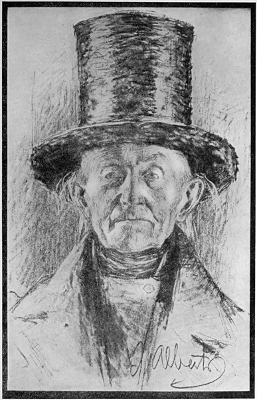
A GENTLEMAN OF THE OLD SCHOOL
Jacob Alberts
At her mistress's word the maid had run out; they could
see from the room how her skirts were blown about; but
when she unfastened the catch the wind tore the shutter
out of her hand and threw it against the window so that a
few broken panes flew into the room and one of the lights
flared and went out. Hauke himself had to go out to help
and it was only with great difficulty that the shutters were
at last got into place. When they opened the door again
to come into the house a gust of wind followed them that
made the glass and silver in the cupboard shake and clatter;
upstairs in the house above their heads the beams
trembled and cracked as if the gale were trying to tear
the roof off the walls. But Hauke did not come back into
the room. Elke heard him walking across the floor towards
the stable. "The white horse! The white horse, John;
quick!" She heard him call the order; then he came into
the room, his hair tumbled but his gray eyes sparkling.
"The wind has shifted!" he cried, "to the northwest, at
half spring-tide! No wind; we have never experienced
such a storm!"
Elke had grown as pale as death: "And you must go
out there again?"
He seized both her hands and pressed them convulsively:
"That I must, Elke."
Slowly she raised her dark eyes to his and for a few
seconds they looked at each other; but it was like an eternity.
"Yes, Hauke," answered the woman; "I know well
that you must!"
There was a sound of trotting before the front door.
She flung herself on Hauke's neck and for a moment it
seemed as if she could not let him go; but that too was only
for a second. "This is our fight," said Hauke; "you are
safe here, no tide has ever come up to this house. And pray
to God to be with me too!"
Hauke wrapped himself in his cloak and Elke took a scarf
and wound it carefully round his neck; she wanted to say
a word, but her trembling lips refused to utter it.
Outside the white horse neighed so that it sounded like
a trumpet in the howling storm. Elke went out with her
husband; the old ash creaked as if it were being split
asunder. "Mount, master," called the man, "the white
horse is as if mad; the rein might break." Hauke threw
his arms round his wife: "I shall be here again at sunrise!"
Already he had leapt onto his horse; the animal reared;
then, like a war-horse rushing into battle, it charged down
the mound with its rider out into the night and the howling
of the storm. "Father, my Father!" cried a child's plaintive
voice after him: "my dear Father!"
Wienke had run out after them in the dark; but she had
not gone more than a hundred steps before she stumbled
against a heap of earth and fell.
The man Johns brought the crying child back to her
mother; the latter was leaning against the trunk of the
ash, the boughs of which lashed the air above her, staring
out absently into the night in which her husband had disappeared;
when the roaring of the gale and the distant
thunder of the sea ceased for a moment she started as if
frightened; she felt as if everything was trying just to
destroy him and would be dumb instantly when it had got
him. Her knees trembled, the wind had blown her hair
down and now played with it at will. "Here is the child!"
John shouted to her; "hold her tight!" and he pressed the
little girl into her mother's arms.
"The child? I'd forgotten you, Wienke!" she exclaimed;
"God forgive me." Then she hugged her to her
breast as closely as only love can and dropped on her
knees: "Lord God, and Thou, my Jesus, let us not become
widow and orphan! Protect him, Oh dear God; only Thou
and I, we alone know him!" And there was no more interruption
to the gale; it resounded and thundered as if the
whole world were coming to an end in one vast reverberation
of sound.
"Go into the house, Missis!" said Johns; "come!" And
he helped them and led the two into the house and into the
sitting-room.
The dikegrave, Hauke Haien, flew forward on his white
horse towards the dike. The narrow path was like a mire,
for excessively heavy rain had fallen in the preceding
days; nevertheless the wet sticky clay did not seem to hold
the horse's hoofs, it moved as if treading on a firm dry
road. The clouds drove across the sky in a mad chase;
below, the wide marsh lay like an unrecognizable desert
filled with agitated shades; from the water behind the dike
came an ever-increasing dull roar as if it must swallow up
everything else. "Forward, my white horse!" cried
Hauke; "we're riding our worst ride!"
At that moment a sound like a death cry came from
under his mount's hoofs. He pulled up and looked round;
at his side, close above the ground, screeching mockingly
as they went, moved a flock of white gulls, half flying, half
tossed by the gale; they were seeking protection on shore.
One of them—the moon shone fleetingly through the clouds—lay
crushed on the path: it seemed to the rider as if a
red ribbon fluttered from its neck. "Klaus!" he cried.
"Poor Klaus!"
Was it his child's bird? Had it recognized horse and
rider and tried to seek shelter with them? He did not know.
"Forward!" he cried again, and the white horse had already
lifted his hoofs for a new race when suddenly there
was a pause in the storm and a deathlike silence took its
place; it lasted but an instant, then the gale returned with
renewed fury; but in the meantime the rider's ear had
caught the sound of men's voices and the faint barking of
dogs and when he turned his head back towards the village
he distinguished, in the moonlight that broke forth, people
on the mounds and in front of the houses busy about wagons
that were loaded high; he saw, as if in flight, still other
wagons driving hurriedly towards the upland; the lowing
of cattle being driven up there out of their warm stables,
met his ear. "Thank God, they are saving themselves and
their cattle!" his heart cried; and then came an inward
shriek of terror: "My wife! My child! No. No; the
water will not come up to our mound!"
But it was only for a moment; everything flew by him
like a vision.
A fearful squall came roaring up from the sea and into
its face horse and rider stormed up the narrow path to the
dike. Once on top Hauke halted his steed with force. But
where was the sea? Where Jeverssand? Where lay the
opposite shore? Nothing but mountains of water faced
him, rising up threateningly against the night sky, seeking
to overtop one another in the dreadful dusk, and beating,
one over the next, on the shore. They came forward with
white crests, howling, as if the roar of all the terrible beasts
of prey in the wilderness were in them. The white horse
pawed the ground and snorted out into the din; but it came
over the rider as if here all human power were at an end;
as if night, death, chaos must now set in.
Still he considered: after all it was a storm-tide; only he
himself had never seen such a one as that; his wife, his
child, they were safe on the high mound, in the solid house;
but his dike—and pride shot through his heart—the Hauke-Haien-Dike,
as the people called it; now was the time for it
to prove how dikes must be built!
But—what was this? He was at the angle between the
two dikes; where were the men whom he had ordered here,
whose work it was to watch this spot? He looked north
up the old dike; for he had sent a few up there too. Neither
here nor there could he see a soul; he rode out a piece;
but still he was alone: only the soughing of the storm and
the surging of the sea that filled the air to an immeasurable
distance smote deafeningly on his ear. He turned his horse
back; he came again to the deserted corner and let his eyes
pass along the line of the new dike; he saw distinctly, the
waves rolled up here more slowly, less violently; it almost
seemed as if there were other water there. "It will stand,
all right!" he murmured and felt a laugh rise within him.
But his inclination to laugh soon passed as his eyes
glanced farther along the line of his dike: on the northwest
corner—what was that? He saw a dark swarm of
moving beings; he saw how industriously they stirred and
hurried—there could be no doubt, they were men! What
were they trying to do, what work were they doing on his
dike now! And already his spurs were in the white horse's
flanks and the animal was flying with him thither; the gale
came from the broad side, at times the gusts came with such
force that they were almost swept down from the dike into
the new koog; but horse and rider knew where they were
riding. Hauke already perceived that probably a few
dozen men were working industriously there together and
already he saw distinctly that a gutter was cut right across
through the new dike. Violently he reined in his horse.
"Stop!" he cried, "stop! What devil's work are you
doing here?"
The men had ceased shoveling with a start when they
suddenly perceived the dikegrave among them; the wind
had carried his words to them and he saw that several were
trying to answer him; but he only caught their vehement
gestures, for they all stood at his left and what they said
was carried away by the gale which was so violent out
here that it hurled them against one another so that they
were obliged to crowd together. Hauke measured with his
quick eyes the gutter that had been dug and the height of
the water which, in spite of the new profile, dashed up
almost to the top of the dike and spattered horse and rider.
Only ten minutes more work and then—he saw it distinctly—then
the high tide would break through the gutter and
the Hauke-Haien Koog would be buried by the sea!
The dikegrave beckoned one of the laborers to the other
side of his horse. "Now, speak," he shouted, "what are
you doing here, what is the meaning of this?"
And the man shouted back: "We've got to break through
the new dike, sir! So that the old dike doesn't break."
"What have you got to do?"
"Break through the new dike!"
"And flood the koog? What devil ordered you to do
that?"
"No, sir, no devil; the commissioner Ole Peters has been
here; he gave the order!"
Anger flamed up into the rider's eyes: "Do you know
me?" he shouted. "Where I am Ole Peters has no orders
to give! Away with you! Back to your places where I
left you."
And as they hesitated he dashed into the group with
his horse: "Away, to your own or the devil's grandmother!"
"Be careful, sir," shouted one of the group and struck
at the madly careering animal with his spade; but a kick
from the horse knocked the spade from his hand, another
fell to the ground. At that moment there suddenly arose a
shriek from the rest of the group, a shriek such as only
deathly terror wrests from the human throat; for a moment
all, even the dikegrave and the horse, stood as if paralyzed;
only one of the laborers had extended his arm like a sign-post;
he pointed to the northwest corner of the two dikes,
where the new one ran up to the old one. Only the raging
of the wind and the surging of the water could be heard.
Hauke turned in his saddle: what was that there? His
eyes grew large: "By God! A breach! A breach in the
old dike!"
"Your fault, dikegrave," shouted a voice from the group.
"Your fault! Take it with you before God's throne!"
Hauke's face, first red with anger, had grown pale as
death; the moon which shone on it could not make it whiter;
his arms hung limp, he scarcely knew that he held the rein.
But that too only lasted for a second; already he drew
himself up, a hard groan broke from his mouth; then
dumbly he turned his horse and with a snort it raced away
with him to the east along the dike. The rider's glance
flew sharply in all directions; thoughts were whirling in his
head: What blame had he to bear before God's throne?
The break through the new dike—perhaps they would have
accomplished it if he had not called "stop!" But—there
was another thing and his heart grew hot, he knew it only
too well—the summer before, if only Ole Peters' evil mouth
had not held him back then—that was where it lay! He
alone had recognized the weakness of the old dike; he
should have pushed on the new work in spite of everything:
"Lord God, I confess it," he cried out suddenly
aloud into the storm. "I have discharged my office badly."
At his left, close to his horse's hoofs, raged the sea; before
him, now in complete darkness, lay the old koog with
its mounds and homes; the moon's pale light on the sky
had disappeared entirely; only at one spot did light shine
through the darkness. And something like comfort crept
into the man's heart; it must be shining over from his own
house, it seemed to him like a message from his wife and
child. Thank God, they were safe on the high mound!
The others, certainly, they were already in the upland
village; more light glimmered from there than he had ever
seen before; yes, even high up in the air, probably from
the church-tower, light shone out into the night. "They
will all have gone away," said Hauke to himself; "to be
sure, on more than one mound a house will lie in ruins, bad
years will come for the flooded fens; drains and sluices to
be repaired! We must bear it and I will help, those too
who have done me harm; only, Lord, my God, be merciful
to us men!"
He turned his eyes to the side, towards the new koog;
about it foamed the sea; but in it lay the peace of night.
Involuntarily triumphant rejoicing rose in the rider's
breast: "The Hauke-Haien-Dike, it must stand; it will
hold after more than a hundred years!"
A roar like thunder at his feet roused him from these
dreams; the white horse did not want to go on. What was
that? The horse jumped back and he felt how a piece of
the dike in front of him plunged down into the depths. He
opened his eyes wide and shook off all meditation: he had
stopped close to the old dike, the horse's front feet had
been on it. Involuntarily he jerked the horse back; at
that moment the last veiling of clouds swept from the moon
and the mild planet illumined the horror that seething and
hissing rushed down before him into the old koog.
Hauke stared at it senselessly; it was a deluge, come to
swallow up man and beast. Then a light shone again into
his eyes; it was the same one that he had seen before; it
was still burning on his mound; and now as, encouraged,
he looked down into the koog he perceived that behind the
confusing whirl that dashed down clamorously before him,
only a breadth of about a hundred feet was inundated;
beyond that he could clearly distinguish the way that led
up from the koog. He saw still more: a carriage, no, a
two-wheeled gig came driving madly up towards the dike;
a woman, yes, and a child too, were sitting in it. And now—was
not that the shrill bark of a little dog that was borne
by on the wind? Almighty God! It was his wife, his
child! They were already coming quite close and the
foaming mass of water was rushing towards them. A
shriek, a shriek of desperation broke from the rider's
breast: "Elke!" he shouted; "Elke! Back! Back!"
But wind and sea were not merciful, their raging tossed
his words away; only the wind had caught his cloak and
nearly flung him from his horse; and the approaching vehicle
flew on steadily towards the rushing flood. As he
looked he saw his wife stretch out her arms as if up towards
him: had she recognized him? Had longing, had deathly
anxiety about him driven her out of her secure house? And
now—was she shouting a last word to him? These questions
shot through his mind; they remained unanswered:
all words from her to him, from him to her were lost; only
an uproar as if the world were coming to an end filled their
ears and excluded all other sounds.
"My child! Oh Elke, Oh faithful Elke!" cried Hauke
out into the storm. Another large piece of the dike in front
of him gave way and thunderingly the sea plunged in after
it; once more he saw below the horse's head the wheels
of the conveyance rise up out of the chaotic horror and
then disappear in a whirl. The fixed eyes of the rider who
stood so solitary on the dike saw nothing further. "The
end!" he said softly to himself; then he rode to the edge
of the abyss where, below him, the waters rushing uncannily
were beginning to flood his home village; he still
saw the light shining from his house; he felt that the soul
had gone out of it. He raised himself high in the saddle
and drove his spurs into the white horse's flanks; the
animal reared and nearly fell over backwards; but the
man's strength forced it down again. "Forward!" he
cried once more as he had so often urged it on to a steady
ride. "Take me, God; spare the others!"
Another pressure of the spurs; a shriek from the white
horse that rose above the gale and the roar of the waves;
then from the plunging stream below a dull splash, a brief
struggle.
The moon looked down from above and illumined the
scene; but on the dike beneath there was no longer any life
save that of the savage waters which soon had almost completely
covered the old koog. But still the mound where
stood Hauke Haien's home rose up out of the swelling flood,
the light still shone from there; and from the upland where
the houses gradually grew dark, the solitary light from the
church steeple threw its wavering beams across the seething
waves.
The narrator ceased; I reached out for the filled glass
that had long been standing before me; but I did not put
it to my mouth; my hand remained lying on the table.
"That is the story of Hauke Haien," my host began
again, "as I had to tell it according to my best knowledge.
Our dikegrave's housekeeper, of course, would have made
another tale; for this too people have to report: after the
flood the white skeleton of the horse was to be seen again
in the moonlight on Jevershallig as before; everyone in the
village believed he saw it. So much is certain: Hauke
Haien with his wife and child went down in that flood; I
have not been able to find even their graves up in the
churchyard; the dead bodies were undoubtedly carried
back through the breach by the receding water out to sea,
at the bottom of which they gradually were dissolved into
their original component parts—thus they had peace from
men. But the Hauke Haien Dike still stands now after a
hundred years, and tomorrow if you ride to town and don't
mind going half an hour out of your way you will have it
beneath your horse's hoofs.
"The thanks Jewe Manners once promised the builder
that the grandchildren should give have not come, as you
have seen; for thus it is, sir: they gave Socrates poison to
drink and our Lord Jesus Christ they nailed to the cross! It
is not so easy to do such things as that any longer; but—to
make a saint of a man of violence or a malicious bull-necked
priest, or to make a ghost or a phantom of night of an
able fellow just because he is a whole head above the rest
of us—that can be done any day."
When the earnest little man had said that he got up and
listened at the window. "It is different out there now,"
he said, and drew the woolen curtain back; it was bright
moonlight. "See," he continued, "there are the commissioners
coming back, but they are separating, they are going
home; there must have been a break over on the other side;
the water has fallen."
I looked out beside him; the windows upstairs, where we
were, lay above the edge of the dike; it was as he had said.
I took my glass and finished it: "I thank you for this
evening," I said; "I think we can sleep in peace!"
"That we can," replied the little man; "I wish you a
good night's sleep from my heart!"
In going down I met the dikegrave below in the hall;
he wanted to take home with him a map that he had left
in the tap-room. "It's all over," he said. "But our
schoolmaster has told you a story of his own, I suppose;
he belongs to the rationalists!"
"He seems to be a sensible man."
"Oh yes, certainly; but you can't mistrust your own eyes
after all. And over on the other side, just as I said it would
be, the dike is broken!"
I shrugged my shoulders: "We will have to take counsel
with our pillows about that! Good night, dikegrave!"
He laughed. "Good night!"
The next morning, in the most golden of sunlights, which
had risen on a wide devastation, I rode along the Hauke
Haien Dike down to the town.