LONDON:
GILBERT AND RIVINGTON, PRINTERS,
ST. JOHN’S SQUARE.
CONTENTS.
PAGE
Introduction.—Preliminary Observations.—Object and Plan of
the Expedition.—Victualling of the Ships.—Compact between
the Captains.—Instructions for the Second German Arctic
Expedition of 1869, 1870. By Dr. A. Petermann
Chapter V.—From the blocking up of the Hansa to the Settlement
upon the Floe. 7th September to end of October. By Captain
Hegemann, Professor Laube, and others
Chapter VIII.—Journey along the Coast of Greenland, from
Illuidlek to Friedrichsthal. June, 1870. By Captain Hegemann,
with the assistance of Professor Laube and W. Bade
Chapter I.—Continuation of the Voyage of the Germania after
Separation from the Hansa.—Landing of the Germania in
East Greenland. From 21st July to 5th August, 1869. By
Captain Koldewey and Dr. Pansch
Chapter V.—Sledge-Journey to the Fligely Fjord.—Discovery
of Coal strata on Kuhn Island. 14th to 21st September,
1869. By Captain Koldewey and Lieutenant Payer
Chapter VII.—Sledge-Journey to Clavering Island, and Discovery
of the Tirol Fjord. 27th October to 4th November, 1869. By First-Lieutenant Payer,
with additions by Captain Koldewey
Chapter X.—Long Sledge-Journey on the Coast Northwards.—Discovery
of King William’s Island. 8th March to 27th April, 1870. By Lieutenant Payer
and Captain Koldewey
Chapter XVI.—Coast Voyage of the Germania towards South.
Jackson Island.—Cape Broer Ruys.—Boat-Journey.—Discovery
of Francis-Joseph’s Fjord. By Captain Koldewey
Chapter XVII.—Sailing into the Fjord.—Ascent of Payer’s
Peak.—Discovery of Petermann’s Peak.—Homeward Voyage decided on.
By Captain Koldewey, Lieutenant Payer, and Dr. Pansch
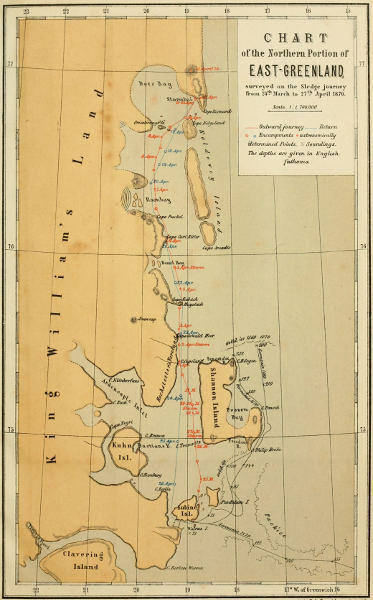
Chart of the Northern Portion of East Greenland surveyed on the
Sledge-Journey, from 24th March to 27th April, 1870.
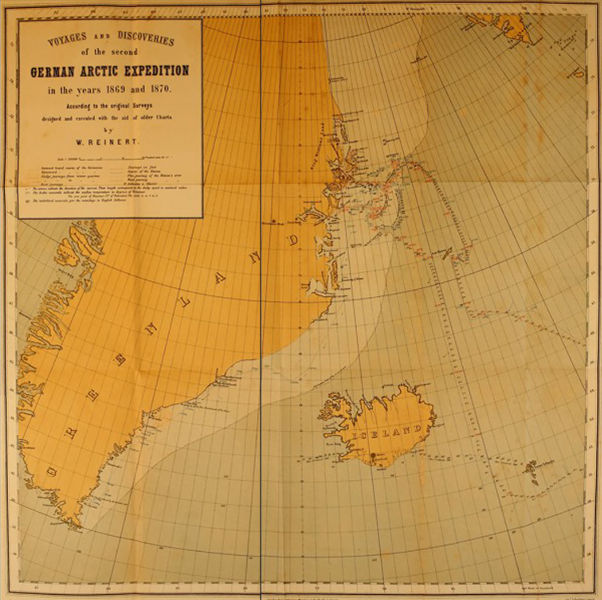
Chart of the Voyage and Discoveries of the Second German Arctic
Expedition, with the aid of previous Charts.
INTRODUCTION.
First suggestion of the undertaking at a festival given
at Bremen in honour of Dr. Petermann and the First German
Arctic Expedition.—Dr. Petermann’s plan of the 30th of
October, 1868.—Dr. Petermann consents to the building of
the Germania from the remaining funds of the Expedition of
1868.—His programme of the 8th of March, 1869.—Exploration
of the Central Arctic region with the east coast of
Greenland as a basis.—Captain Koldewey’s circuit through
the provinces.—Statement of the project.—Forming of
committees in different German towns for the support of the
undertaking.—Assistance of the Newspaper Press.—Formation
of the Bremen Committee.—Opposition to the choice of
the yacht Greenland as the second ship.—The Hamburg
Committee.—Further action.—Definitive resolutions.—Appeal
of the 10th of May.—The commander and the scientific
staff of the expedition.—The steamer Germania.—Fitting
the Hansa for the Arctic voyage.—Outfit.—Scientific
instruments.—Captain Koldewey’s audience in Bremen previous
to departure.—Instructions for the Second German Arctic
Expedition.—Activity of the Bremen Committee in raising funds
to cover the cost of the expedition.
On the 24th of October, 1868, a number of gentlemen were assembled
at Bremen, to celebrate the happy return of the members of the First
German Arctic Expedition, including their commander Captain Karl
Koldewey, and its scientific originator, Dr. A. Petermann. It was on
this occasion that expression was first given to the idea of another
expedition to this inhospitable region. Preliminary conferences took
place between Dr. Petermann, Captain Koldewey, Dr. Breusing, and
Messrs. Meier and Rosenthal, the result of which was that the despatch
of a new expedition became only a question of ways and means. The
“Rough sketch of a plan for the German Arctic Expedition of 1869,”
with maps, from Dr. Petermann, was not long wanting. According to
his suggestion, the expedition was to consist of two parts, so as to
endeavour to solve two problems at the same time. A steamer was to land
on East Greenland, and taking it as the basis of the winter operations,
should try to penetrate into the heart of the Polar region; a second
steamer should, at any point between Greenland and Nova Zembla, strive
to reach the highest latitude possible. For the carrying out of this
plan two steamers were considered necessary. But the preparations
soon reached a critical point. It was with but small results for his
trouble that Koldewey, whose enthusiasm and self-sacrifice in the cause
became daily more apparent, strove to keep up the interest in it by
repeated consultations in influential quarters. Dr. Petermann then
decided that, in order to render the carrying out of the exploration
practicable that year, he would, with the money still in hand from the
first expedition, commission the building of a steamer, the dimensions
of which should both meet the requirements of an Arctic voyage, and
keep within the compass of their straitened means. It became necessary
for the promoters to drop one part of Dr. Petermann’s original plan,
and confine themselves either to exploring the Central Arctic region,
with the coast of Greenland for a basis, or to advancing towards the
North Pole by the open sea between Nova Zembla and Spitzbergen. Captain
Koldewey declared for the former course, and also for retaining the
programme of the Expedition of 1868; taking this view of the case,
viz., that it must be a condition sine qua non to make the
coast, in which case they would have a far greater prospect, even under
the most difficult and adverse circumstances, of making discoveries and
scientific investigations, than by advancing on the high sea towards
the Pole.
Dr. Petermann acknowledged the force of this argument, and agreed that
East Greenland must be the point to keep in sight.
A communication dated from Gotha, 8th March, 1869, brought these
proceedings to the knowledge of the friends of the undertaking. The
plan was now nearly as follows: “That the expedition should consist
of a newly-built screw steamer and of the sailing-yacht ‘Greenland,’
a ship of the pioneer journey of 1868; that the end and aim of the
same should be discovery and exploration in the Central Arctic region,
from 74° N.L. upwards, the East Greenland coast being the basis. The
‘Greenland,’ acting as consort and transport-ship, should return in
the autumn of the same year; but the return of the chief ship should
not take place until late in the autumn of 1870, after their intended
wintering. That the aim of the expedition should be scientific, as
well as nautical; the latter department being under the command of
Captain Karl Koldewey, who the year before had proved himself so able
in every respect, and whose character for courage, perseverance, and
self-sacrifice in the cause, called for unhesitating confidence.” The
scientific staff had already been partly chosen. To awaken interest in
this new undertaking, no trouble was thought too great either by Dr.
Petermann or Captain Koldewey, the latter undertaking circuits through
Germany and delivering lectures in several places, which were sometimes
followed by profitable results, and sometimes gave expectation of the
same. At the same time he circulated a confident, independent, and
well drawn up pamphlet, giving the nautical view of the question, in
one respect differing slightly from Dr. Petermann’s original plan,
namely, that if the coast of East Greenland was not reached until the
middle of August, then the eastern coast of Spitzbergen and Gillisland
should be the object of investigation. These explanations found their
way into the daily press, exciting great interest. Dr. Petermann,
though not quite agreeing with Koldewey’s proceedings, acted with great
zeal in trying to bring the undertaking to a successful issue. At his
suggestion Dr. Bastian in Berlin, and Professor Arendts in Munich,
formed committees for receiving subscriptions. The Berlin Committee was
chosen from members of the Berlin Geographical Society, amongst whom
were renowned representatives of science, who published on the 3rd of
April an energetic appeal for subscriptions. In this appeal attention
was particularly drawn to the scientific and great national importance
of the undertaking. Berlin, as the metropolis of the North German
Confederation, the centre of her national efforts, was called upon, now
that an important object for knowledge and action offered itself, to
issue the first appeal. The sum still wanting was certain to be soon
made up; and if Berlin with cheerful self-sacrifice once led the way,
other towns would not be left behind. The appeal to the inhabitants
of Munich (dated May) was issued by the Geographical Society, and
signed by Professor Dr. Jolly as director, and Professor Dr. Arendts
as secretary. Accordingly, collections were set on foot throughout the
whole of Bavaria. In Bremen, where the preparations for the undertaking
were to be carried out, and where it would probably find its best
support, people were very favourable to the project. In a succession
of communications in the daily press, and the Weser-Zeitung
particularly, in an explanatory light article of the 4th of April,
the national, nautical, and scientific importance of the undertaking
were dwelt upon. Essays of the same kind soon appeared in the other
different German papers. We must not forget to mention here, that
the first favourable notice of the expedition came from the Marine
Society Concordia, at Elsfleth. The chief towns throughout
the whole of the North-Sea and Baltic coasts, beginning at Bremen,
were actively interested in the cause. Before the formation of the
committee at Bremen, Mr. G. Albrecht was induced by the Consul, H. H.
Meier, with Dr. Petermann’s concurrence, to undertake the management
of the accounts. When Consul Meier afterwards withdrew, Mr. A. G.
Mosle undertook the presidency, offered to him by Mr. G. Albrecht and
M. Lindeman, in order that a committee might be organized. With this
view the first meeting took place on the 9th of April in the house
of Messrs. Schütting. It was composed of Captain Koldewey, Mosle,
Albrecht, C. H. Noltenius, director of the pilot-school in Bremen, Dr.
A. Breusing, D. H. Wätjen, jun., Ship-builder F. Tecklenborg, sen., the
Recorder of the Commercial Board H. A. Schumacher, Captain Gutkese
from Bremerhaven, and M. Lindeman, reporter. Captain Karl Koldewey laid
the plan of the undertaking before them, and the choice of the steamer
as expedition-ship and the “Greenland” as transport-ship. Director
Breusing declared that to enable them to accomplish any great result,
two steamers with outfits for three or four years would be necessary.
Some gentlemen were of opinion that, if possible, a larger ship should
be chosen in the place of the small confined sailing-yacht “Greenland,”
which might be richly stored with coals and provisions, so as to put
them in a position to pass more than one winter, if necessary, and
thus, if possible, carry their investigation further northward. In
the next sitting they agreed that Dr. Petermann and Captain Koldewey
being really the originators of the undertaking, it devolved upon the
committee to support the efforts of these gentlemen to the utmost
of their power. The meeting styled themselves “The Bremen Committee
for the Second North Arctic Expedition,” and chose A. G. Mosle as
president, G. Albrecht as treasurer, and M. Lindeman as secretary. The
committee, to which Messrs. R. Fritze, W. Nielsen, and Captain Ludwig
Geerken were added, published on the 17th of April an appeal to their
fellow-townsmen for subscriptions, which, among other things, contained
the following:—“The scientific and maritime importance of the
undertaking is everywhere admitted, and everywhere the highest interest
evinced in it. Bremen will not be behind in promoting this national
work. It rests for German inquiry to open up new domains, in order to
show that German sailors are as qualified, as bold, and as persevering
as those of other nations.”
The discussion with Dr. Petermann as to whether a larger transport-ship
should be chosen or not, led to no satisfactory conclusion. For
practical as well as financial reasons he decided in the negative.
But on the other side were voices of weight and influence in nautical
circles of the North Sea and Baltic coasts, and which must be heard.
People thought it right to raise serious objections to the insufficient
size of the ship. These, with very great exaggeration, found expression
in the daily press, so much so that Captain Koldewey was obliged to
interfere by letter to the newspapers. In Hamburg one of the prime
movers in the undertaking, the director of the North German Marine
Observatory, W. v. Freeden, had resolved to form a committee. A number
of representatives of respectable firms, the directors of the Marine
and Astronomical Observatories, formed themselves into the “Hamburg
Committee for the Northern Expedition of 1869.” On the 23rd of April
an appeal followed, in which it was represented that Hamburg had
always shown a lively interest in all national questions, and with
regard to this undertaking felt it incumbent upon it, remembering
its antecedents, to guard its position as the leading seaport of
Germany. The Hamburg Committee also declared, in a sitting at which
Dr. Petermann and Captain Koldewey were present, for Dr. Petermann’s
published plan of the 8th of March. By degrees the interest of the
nation and the whole of the country began to warm more and more. New
committees were formed in Oldenburg, Emden, and Leer, in Rheinhessen
(Worms and Oppenheim), at Karlsruhe, Lübeck, Königsberg, and Rostock.
The committee of Bremen, in a letter of the 2nd of May addressed to
the Berlin Committee, thus defined its position with regard to the
carrying out of the expedition:—“After a lengthy conference between
the seafaring men belonging to our committee, and the whale fishermen
of the Weser-fleet, and others of the profession, we have decided that
our direct influence must be directed and confined to the way and
manner of carrying out the following points:—To keep in view that the
ships shall be as good as possible, and to carefully see to the supply
of provisions and coal. Every other nautical question coming under
our consideration we have laid, and will continue to lay before the
commander of the expedition, and thoroughly enter into it with him,
still, however, not considering it our business to interfere.” A larger
ship than the “Greenland” having been proposed, and this proposal
approved of by Captain Koldewey, as well as by Captain Hegemann, who,
being familiar with the Arctic waters, was to take the command of the
second ship, it was agreed to. Amongst other reasons advanced for
this was, that besides the thirty tons of coal required for heating
in winter, the Germania could at the utmost only carry forty tons for
feeding the engines. On this head alone the choice of a larger ship
was desirable—namely, that the expedition was to be supplied with
provisions for a longer time than was originally intended. The pending
question as to procuring a larger ship instead of the “Greenland” was
solved at a sitting of the Bremen Committee on the 8th of May, at which
Dr. Petermann, Director W. v. Freeden from Hamburg, and three other
scientific men interested in the expedition, were present—viz., that a
number of Bremen merchants should be security for the purchase-money
for a larger companion vessel to the amount of £1500. Dr. Petermann
now declared decidedly for choosing a larger ship instead of the
“Greenland,” and that a sailing ship, on the ground that a suitable
steamer was not easily procurable, and that two scientific men should
be attached to the ship. The following resolution was drawn up by Dr.
Petermann and signed by all present at the meeting:—
“On the 7th of next month, the Second German Arctic Expedition,
under Captain Karl Koldewey, shall put to sea. This is the
unanimous resolution of the friends of the undertaking,
assembled from far and near, for the final settlement of the
plan, at Bremen, on the 8th of May.
“It is our unanimous endeavour to render every part of the
equipment as perfect as possible. After strict trial and
inspection, the steamer Germania, the newly-built chief ship
of the expedition, fulfils every expectation, as well as the
sailors who conduct it and the men of science who accompany it.
The steamer, like the convoy which accompanies her, will be
equipped for two years.
“The Germania’s size is expressly adapted for ice-navigation;
the accompanying ship, the Hansa, of nearly the same size,
will also be expressly adapted for the same purpose, and will
be under the command of Captain Fr. Hegemann, of Oldenburg. If
possible, the two ships will remain with each other, both on the
outward journey, through the winter, and also on the return.
Regard to the greatest possible security of the expedition has
led to this extension of the plan.
“The plan of the originator of the undertaking, Dr. Petermann,
of Gotha, which makes the eastern coast of Greenland the basis
for advancing into the centre of the Arctic region, is to remain
the first aim of this expedition.
“The Bremen Committee have become security for the necessary
means (£1500) for providing the second ship. We hope that in
other parts of Germany the friends of the undertaking will show
the same determination, as the enlarged plan requires greater
means.
“The naval and scientific importance of the expedition is
everywhere acknowledged; the means for speedily and fully
carrying it out, the interests of the German navy and of German
science demand.
“Bremen, 10th of May, 1869.
“Dr. A. Petermann,
A. G. Mosle,
Capt. K. Koldewey,
G. Albrecht,
Capt. Fr. Hegemann,
C. H. Noltenius,
W. v. Freeden,
Richard Fritze,
Dr. Börgen,
D. H. Wätjen,
Dr. Copeland,
W. Nielsen,
Dr. Med. Pansch,
Capt. L. Geerken,
M. Lindeman,
Capt. W. Gutkese,
H. H. Meier,
Synd. Dr. Schumacher.”
Thus a firm foundation was laid for the whole undertaking, and the
Bremen Committee could undisturbed make the numberless preparations and
give all their attention and trouble to raising the money—a care which
fell exclusively upon it, and was by no means small. Dr. Petermann had
acted in the same way for the Expedition of 1868. The committee issued
some thousands of circulars to raise money to meet the expense,
which was now estimated at £10,500.
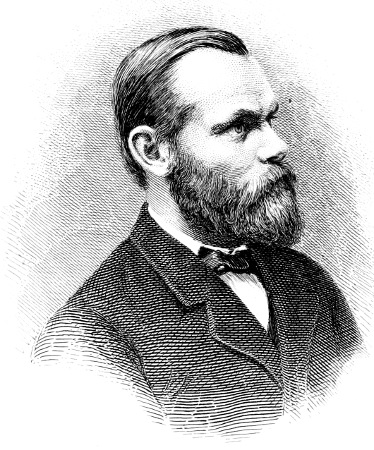
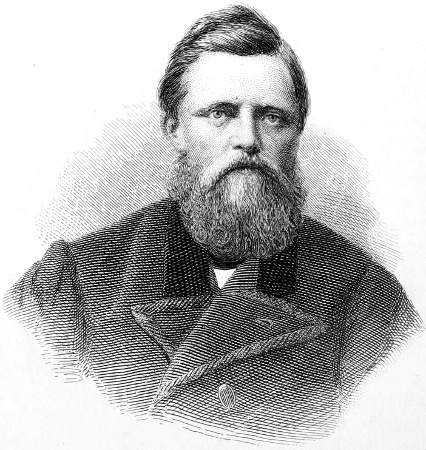
Karl Koldewey
Captain of the Germania.
The scientific staff for the Germania were, partly on Captain
Koldewey’s proposal, chosen and appointed by Dr. Petermann.
The commander of the whole expedition was Captain Koldewey, of Bucken,
near Hoya, in the province of Hanover. He was in the thirty-second
year of his age. Brought up in the Pilot School at Bremen, he had been
a sailor sixteen years, that is from 1853. Giving up his practical
business for a time, Koldewey, in order to improve himself, attended
the Polytechnic School in Hanover, and in the winter of 1867 and 1868
the University of Göttingen, where he studied physics and astronomy,
which after his return from the first Arctic expedition, as far as the
completion of his Report of it would allow, he took up again.
The scientific members of the expedition, to ship in the Germania were
the following:—
1st. Dr. Karl N. J. Börgen, born in Schleswig on the 1st of October,
1843. He attended the cathedral school in that place; was drafted in
1863 to the University of Copenhagen, in 1864 to the University of
Kiel, and in 1865 to that of Göttingen. In 1866, he was assistant in
the observatory of that place; served as a volunteer in the army of
the North German Alliance from January 15th, 1867, to 1868. Obtaining
leave of absence for two years, he received on that occasion from the
Prussian Ministry of Public Instruction a subsidy of £75.
2nd. Dr. R. Copeland, born the 3rd of September, 1837, at Woodplumpton
in Lancashire, England. Acquired a scientific education in his own
country, travelled in foreign countries, and in 1865–67 studied
astronomy in Göttingen. Since 1867 he had worked as voluntary assistant
in the observatory of that place. In the spring of 1869 Dr. Börgen and
himself published jointly a large astronomical work, together with
“The History of Arctic Winterings.” In the present expedition they had
undertaken both astronomical and physical science as well as geodesy.
3rd. Julius Payer, first lieutenant of infantry in the Imperial
Austrian army, twenty-seven years, old, was born at Teplitz, in
Bohemia, where his father was captain of a regiment of lancers. His
education and training he received in the Neustadt Military Academy,
from which he received his commission as an officer in the army
in 1859, followed by a garrison life in Mainz, Frankfort, Verona,
Venice, and Jägerndorf. In Verona, excited by the neighbourhood of
the Alps, Payer began his studies. There appeared in Justus Perthes’
Geographische Mittheilungen several scientific papers from his
pen on the Gross-Glockner, the Adamell group, and the Ortler Alps. Of
his other works, a treatise on the Bocca di Brenta is deserving of
mention. In 1866 Payer took part in the Italian war, and received the
cross of merit at Custozza; in 1868 he was recalled by the Minister of
War and was commissioned to the survey of the inhospitable region of
the mountainous district of Austria. The request for leave to accompany
the Arctic expedition was granted most graciously by the Minister
of War, together with a supply of fire-arms, a considerable store
of gunpowder, and various scientific instruments. Payer joined the
expedition with the prestige of his previous reputation for activity in
the cause of science.
4th. Adolphus Pansch, M.D., surgeon to the Germania, to whom
were assigned the departments of zoology, botany, ethnology, and
anthropology, was twenty-eight years old, and studied medicine and
physical science in Berlin, 1860; in 1861, at Heidelberg, physiology
and geology; travelled through Switzerland, attended the clinical
lectures in Berlin and Halle; and later on passed the prescribed
examination in Oldenburg as a practical physician, and was made
demonstrator of anatomy in July, 1865. In 1866 he acted as private
tutor at the University of Kiel. Pansch had written several scientific
treatises, from amongst which we should specify, from its practical
bearings and its extensive research, a pamphlet upon the “Flora of the
Seas.” Dr. Pansch received permission from the government to join the
expedition.
The scientific men on board the Hansa were the two following:—
1st. Dr. Buchholz, M.D., and surgeon to the Hansa, represented the
departments of zoology, ethnology, and anthropology. Whilst serving
as tutor at the University of Greifswald, he received leave to join
the expedition, with a grant from the Minister of Public Instruction
and the University of £75 for his outfit. Dr. Buchholz was born at
Frankfort-on-the-Oder in 1837, studied in Königsberg and Berlin, and in
the Bohemian campaign of 1866 was assistant-surgeon in a hospital of
the Prussian army.
2nd. Dr. Gustavus Laube, Vienna, professor of zoology and lecturer to
the University and Polytechnic School in Vienna, thirty years old,
was born in Teplitz, and studied in Prague, Munich, and Tübingen. He
was afterwards assistant to Professor Hochstetter, in Vienna, who
recommended him warmly for the expedition.
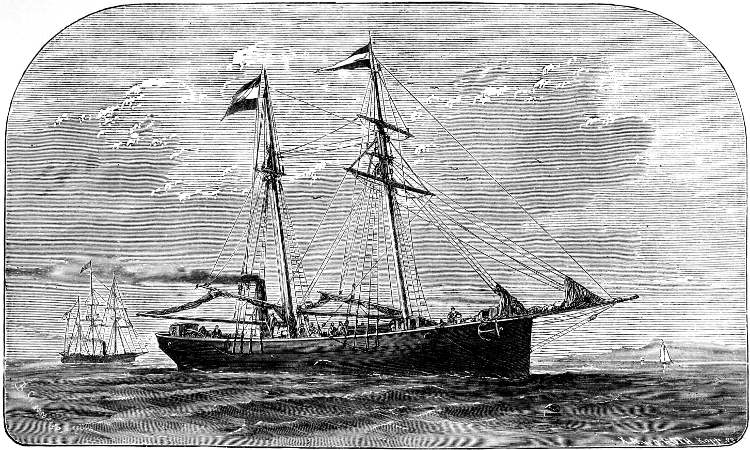
The Germania, the chief ship of the expedition, was laid on the slips
for building on the 10th of March, 1869, by Joh. C. Tecklenborg, of
Bremerhaven, and was launched on the 16th of April. On the 9th of
May, Captain Koldewey and Dr. Petermann went on board, accompanied by
various members of the Bremen Committee, the director of the North
German Marine Observatory, W. v. Freeden, and other friends (amongst
whom were several experienced seamen). The ship was thoroughly
inspected in all parts. W. v. Freeden’s report of this inspection, will
form the best description of the ship. He says, that upon measuring
the Germania she was ninety feet long, twenty-two and a half broad,
eleven feet deep, and 143 tons burden: this size, a few years ago,
was considered the highest standard for the best West Indian fruit or
Brazilian coffee schooners. Of course the steamer was built stronger
than required for such purposes as the above; and the ordinary planking
was coated with a hand-thick sheathing, thus protecting the stem, and
in a ship of 600 tons undiscernible below the water-line. Over this
iron sheathing, which is bolted and riveted, not simply nailed on,
is fastened a layer of sheet-iron. Thus double provision was made in
order that the ice fretting at the ship’s sides should not force the
oakum out of the seams, so causing a leakage. Over the iron sheathing,
by the bow, heavy iron rods were laid crossways, close together.
Notwithstanding this armour, the ship’s lines were pleasing to the eye,
and, on account of her sharp build, she proved an excellent sailer.
In the interior also, the strength of her build was striking, even
to landsmen. Such strong beams ’tween decks are seldom seen in vessels
of 400 tons. They are only to be found in large barques and full-rigged
ships. The knees were alternately of wood and iron; vertical supports
above and below the middle deck protected it, together with bands
of the strongest iron clamps, from any side pressure of masses of
ice against the ship’s sides, so that neither keel or deck could be
displaced. The sharp build of the ship would rather have the effect of
raising her on to the ice, than of allowing her to be nipped by it.
The compact machinery was mounted, and the axis tested in position;
the double-flanged screw could be lifted in and out without trouble. A
reserve screw was also taken. As the ship was to be completely fitted
with sails, the machinery was only to be used amongst the ice, or when
she was obliged to beat against the wind.
The masts furnished were of that sort that no pressure on the sails
nor heavy shock could dismast her. A topsail on the foremast rendered
veering and backing easy, and her depth in the water was from nine
to ten feet. As the ship’s course would lie along the eastern coast
of Greenland, between the land and the not far distant ice-pack, a
deeper draught would have been dangerous; neither could she have been
much larger, for a larger vessel must have been flat-bottomed, to
prevent her drawing too much water. This was satisfactorily proved
on the voyage. Flat-bottomed vessels are very dangerous amongst the
ice. Certainly the ship would have turned more easily, if she had been
two feet broader; but her capability of threading the narrow channels
between the ice would have been weakened in corresponding degree.
Including the machinery and ship’s fittings, the Germania cost the
round sum of £3150.
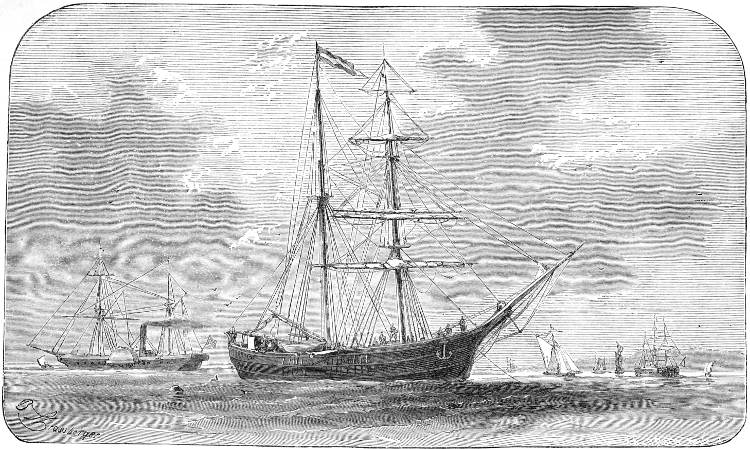
The second ship, the purchase-money of which, as we have already
remarked, had been previously guaranteed by some merchants belonging
to the Bremen Committee, was the Prussian schooner Fulton, built on
the Weser in 1864, of 76¾ tons burden. She received the name of the
“Hansa,” and was laid on the slips by F. W. Wenke and Co. (Rosenthal).
A difficult and important part of the preparations was the victualling
the ships. The only precedents of use were supplied by the experience
of those who had been engaged in the Greenland trade from the Weser.
Certainly the eastward journey of the “Greenland,” in 1868, constituted
somewhat of a guide. But never yet had a German ship sailed from
the German coast with the intention of passing a winter in Arctic
latitudes. On that account the experience of Englishmen, Americans,
and Russians was carefully considered in the outfitting. Above all,
attention was particularly paid to completeness and plentiful supply,
as well as to the good quality of every article. The honourable
character of the contractors, the eagerness shown on their side to
further a national undertaking, and their wish on this occasion to
keep up their reputation, stood the undertaking in good stead. On
their departure, the members of the expedition particularly thanked
them for the consideration they had shown to all their wishes with
regard to the stores, and expressed their satisfaction with everything.
Parsimony could not for a moment be considered at such a time; it would
have been misplaced, inhuman, and destructive of the very aim of the
expedition, had any niggardliness been shown. A complete outfit for
both ships for two whole years was above all things a necessity, and
indeed a point of honour.
The contract for the victualling of the Germania was given to D.
Cordes and Co., of Bremen, and that for the Hansa to H. Richers of
Hamburg. Neither ship carried much dried or salted meat, but a great
quantity of preserved meats in tins; also a good supply of drinks,
which are so necessary on an Arctic voyage, besides many presents of
wine; and lastly, a corresponding quantity of clothing for all who
were taking part in the expedition. Both ships had a similar allowance
of everything needful; and the Berlin Committee were of very great
assistance in providing scientific apparatus and instruments, some of
the most important of which were kindly lent by various persons and
institutions.
On the 28th of May, Captain Koldewey had an audience of his Majesty
King William at Babelsberg. His Majesty allowed Captain Koldewey to
explain his plan by aid of a map. He expressed his satisfaction that a
man had been found willing to carry out the undertaking, and fixed his
visit to the vessels for his future intended journey to Bremen.
The time of starting was settled for the middle of June; and from March
to that time every exertion was brought to bear upon the work that all
might be complete. The equipment in every respect was accomplished in
good time; and when all was ready for departure, a joint committee
was called together to consider, at the last moment, what had been
accomplished, and what remained to be decided on, in the case of
certain eventualities. The scientific men were first greeted with the
warmest thanks for their courageous resolution, and the hope expressed
that it would be followed by rich results. It was then decided by the
committee that the expedition should sail from Bremerhaven on the 15th
of June at noon. A telegram addressed to Captain Koldewey confirmed
the interest which King William had already shown in the undertaking,
stating that on the 15th he would be in Bremerhaven and Geestemünde.
All was then to be prepared for the king’s visit and for immediate
departure. An elaborate form was drawn up by Dr. Petermann on the
7th of June under the title of “Instructions for the Second German
Arctic Expedition of 1869–70.” On all the chief points both captains
and scientific men were agreed, though some seemed to require earnest
consideration; but there was now no time for further discussions.
However, they agreed to make some unimportant alterations regarding
the official reports of the expedition, and the ownership of the notes
made by the scientific members during the voyage, as well as regarding
the form and address of any communications to be sent home. They were
all to be sent to Dr. Petermann. On the return of the expedition a
preliminary report was to be drawn up, and the whole given up to a
commission composed of the captains and scientific men belonging to the
expedition, and the supporters and leaders of the undertaking, as well
as scientific authorities. Dr. Petermann informed them of his agreement
to these alterations by telegraph.
The most important part of the proceedings of the joint committee lay
in the last consultation, namely, how and when tidings of the men
belonging to the expedition were to be gained in case their return
should be too long delayed, and they should require assistance, or if
their death should take place on the ice-fields of Greenland. It was
resolved:—
“That the expedition should, on the coast or islands, as nearly as
possible under each degree of latitude or longitude, build up a heap
of stones, or some other erection; that the burying of documents
detailing the events and condition of the undertaking should not be
within this sign, but at a distance of twenty metres due north of it
(not magnetic). And if from the nature of the ground no such
distance could be taken, the documents were still to be deposited to
the northward. The monuments were, if possible, to be erected on a
declivity; and as the Esquimaux greatly venerate all graves, so, in
case of death, tidings of the expedition were to be placed under the
body.” At the same spot also all notices of the German Arctic voyage
were to be sought if they themselves were unable to give information.
This decision was telegraphed to Dr. Petermann, who returned his assent.
Then followed a solemn oath taken by all those belonging to the
expedition; the two captains, as well as the scientific men, promising
that both by word and deed, and under all circumstances, they would
strive with all their might to reach the goal set before them.
The instructions contained thirty-one paragraphs; in Sects. 1 and 2 the
aim and object of the expedition was declared to be the discovery and
scientific investigation of the Central Arctic region from 75° N.L. and
upwards, taking the eastern coast of Greenland as a basis. This object
included two tasks: 1st, the solving of the so-called Arctic question;
2nd, the discovery, surveying, and investigation of East Greenland;
thence northwards towards Behring’s Straits, including all intermediate
countries, islands, and stretch of sea; the measuring of degrees in
East Greenland, and ascents of the glaciers in the interior, &c., &c.
In the third, the “Arctic question,” with special regard to the late
Swedish, Russian, and English voyages of discovery, was discussed. For
the better investigation of the Polar Sea, and for reaching the North
Pole itself, the following of the coast-line was strictly enjoined, as
experience had shown that land is the soonest free from ice, and that
along the coast is formed the so-called land water; the navigation too
has a chance of commencing earlier, is comparatively safe, and promises
the largest results, as really important scientific discoveries can
scarcely be expected without the solid basis of land.
The Second German Arctic Expedition would therefore make East Greenland
their basis of operations. Even under the greatest difficulties, the
results from an investigation of East Greenland, and an extended
knowledge of that still unknown coast, might be expected to mark an
epoch in the history of science.
Sect. 6 ordered that both ships under the command of Captain Karl
Koldewey should make direct for the floating ice of East Greenland
in about 74½° N.L., and as soon as possible reach Sabine Island,
lying on the east coast in that latitude, and then deliberate on the
accessibility of the coast from 70° to 79°.
Sects. 7 and 8 decided as follows: if in 74½° N.L. immediate access to
the coast was not possible on account of the ice and the state of the
weather, and there was no prospect of being able to reach it in a short
time, the attempt must be made farther northward as far as 80°; if
still unsuccessful, to go as low down as 70°, and take advantage of any
opening lying between 70° and 80° N.L. If the coast of East Greenland
in 74½° is reached, or any other point between 70° and 80° N.L., and it
is found (as in the course of things might be expected) that there is
open water, so, without more delay than is necessary for observing and
surveying the newly-discovered land about 75° 14 N.L., to press forward
to the north, and to go as far along the coast as circumstances will
allow.
Sect. 9 pointed out as the chief task of the expedition, the
geographical one of penetrating into the still unknown heart of the
Arctic regions, and stated that every other consideration was to give
place to the solution of this question.
Sects. 10 and 11 enlarged upon the scientific work, and the different
course to be taken by the expedition in case they should find open sea
in the region of the Polar circle.
By Sect. 12, they were enjoined to winter at the most northerly
point they could reach—if possible at the North Pole itself, but in
any case it was hoped in not less than 80° of lat. Of the remaining
instructions, we must draw attention to the Sects. 15, 16, 22, 24, 27,
and 28. The two first-mentioned decided as follows:—The return of
the expedition was to be managed so that both vessels should, at the
latest, arrive at Bremerhaven together about the 1st of November, 1870.
If the Hansa should be unable to keep up with the steamer Germania,
either on account of the ice or want of fair wind, the steamer should
without any delay proceed on her course, leaving the Hansa to follow
as soon as possible. In case of separation, the point each ship was
to make for was 74½° N.L. outside the floating ice, though along the
coast. By this Sabine Island was meant.
Sect. 22 consisted of the special instructions drawn up by various
German savans, and communicated through Dr. Petermann.
In Sect. 24 particular reference was made to the importance of the
ascent of glaciers, to be undertaken by Lieut. Payer.
Sects. 27 and 28 contained further orders concerning the naming of
the newly-discovered lands, which for the most part was to be left
until the completion of the general map at home; also regarding the
value and the use to be made of the collections brought home, and the
apportionment of the work resulting therefrom. All these provisions
could only be seriously considered on the return of the expedition, and
would then serve as rules for the guidance of the Bremen Committee.
With this the complicated preparations were ended, and the day of
departure drew near.
The Bremen Committee might now look upon that part of their task which
related to the support of these preparations as finished. Another
part which, as has been already remarked, devolved entirely upon
them, was that of raising the considerable amount still required to
defray the cost of the undertaking. At the time of starting, not half
the cost of the expedition had been raised, and the Bremen Committee
were, in this task, busily occupied for more than a year. Invitations
for subscriptions were published and sent to private individuals as
well as to corporations, to the representatives of Germany in foreign
countries, and also to the magistrates of many German towns.[1] An
account of the position of the undertaking was spread over the whole
of Germany by thousands of circulars, and even among the Germans
in foreign towns and in Transatlantic lands; the summons being a
printed communication entitled,—“The Despatch of the Second German
Arctic Expedition.” And, lastly, by the generous coming forward of an
eminent German publisher, Mr. George Westermann, in Brunswick, the
entire public was provided with a pamphlet containing some excellent
wood engravings drawn to scale, entitled, “The Second German Arctic
Expedition: Official Communication of the Bremen Committee,” in
which more distinct information was given as to the aim, means, and
importance of the undertaking. This agitation, which kept alive the
interest in it, was followed by the best results. Donations[2] poured
in from all sides from Germans in foreign lands, even from Honolulu and
Tahiti, South America, the East Indies, and China.
The debts incurred by the expedition were paid off, and even after its
return new and pressing expenses were met. The Bremen Committee were
also freed from the insurance money of the Hansa, and some of Captain
Koldewey’s men had extra wages given to them.
Whether and to what extent the Second German Arctic Expedition
fulfilled the promised expectations, what and how much it was allowed
to perform and to attain, with a full and true report of the same, is
the task and aim of the work now before us.
CHAPTER I. VOYAGE OF THE GERMANIA AND HANSA FROM THE 15TH JUNE TO THE 4TH JULY, 1869.
First evening at sea.—Life on board.—The first
storm.—Cabin life.—In 57° N.L.—Dutch fishing-boat.—Visits
exchanged.—Fresh storm and fog.—Entrance to the North Sea.—A
clear night.—Animal life.
The departure of the expedition from Bremerhaven took place on the 15th
of June, 1869, in the presence of his Majesty the King of Prussia,
whose warm interest in this great national undertaking showed itself
in this solemn hour in a manner never to be forgotten. Amongst the
numerous gentlemen in attendance on his Majesty were his Royal Highness
the Grand Duke of Mecklenburg Schwerin, Count Bismarck, the Minister
of War and Marine, von Roon, General von Moltke, and Vice-Admiral
Jachman. The ships lay at the entrance of the new harbour just outside
the sluice. The king having been introduced to the scientific gentlemen
and the commander of the expedition, and having greeted them with a
hearty shake of the hand, the President of the Bremen Committee, Herr
A. G. Mosle, requested his Majesty’s permission to speak a few parting
words; and in an earnest and impressive manner the speaker referred
to the greatness and importance of the object, the self-denial,
difficulties, and dangers which lay before them, but which they all
willingly braved for the honour of their native land, for the honour of
the German navy and of German science. That the Second German Arctic
Expedition should put to sea under the eyes of his Majesty, would, he
was sure, be looked upon by all present as a happy omen; and all might
with good reason join in cheering the august Monarch of their country,
whose mighty representative and protector he was, as well as those on
board the two vessels, who were about to sail under the national flag
lent by his Majesty, to unknown lands in search of knowledge. Cheers
from a thousand voices then rent the air, after which the king once
more shook hands with those belonging to the expedition, at the same
time expressing hearty good wishes for their safe return. The king then
passed on to the Germania at the head of his suite, and inspected the
now finished preparations with great attention. But the decisive moment
had arrived; cannon roared; three more cheers rose from either side,
and the Germania towed by the steam-tug Simson, and the Hansa by the
Vulcan, made for the mouth of the Weser, the king watching the ships to
the very mouth of the harbour. It was an exciting time, as we glided
over the quiet liquid mirror alongside of the quay—the banks decked
with the fresh green of spring-time and enlivened by a gaily-dressed
crowd, and the flags flying from the ships, large and small,—and took
our last view of the houses and towers of the town.
With heads uncovered and handkerchiefs waving, our friends sent their
last farewell. But with these feelings of pleasure were mixed thoughts
regarding the future. Would it be permitted to us some day to return
home? How many of us might be missing, sick, or infirm? How should we
find our country? Would it still be, as now, enjoying the blessings of
peace, and its grey-headed king still be living?
But we were not yet quite parted from it. Besides the pilot, two
staunch friends, who would not be deprived of the pleasure of
accompanying us to sea, were still on board. One was the director of
the North German Marine Observatory, Mr. von Freeden, and the other the
director of the Observatory of Göttingen, Professor Klinkerfues, who
wished to take his last farewell of his pupils on the sea.
The town was now fast disappearing from our eyes; the flat green banks
on either side, with their solitary houses and church towers, were
receding; and the lighthouse, visible for a long distance, was looming
nearer and nearer.
In the meantime the crew had not been idle on deck. Everything that had
come on board in the hurry of the last hour had either been put in its
proper place or made fast, and everywhere the last touch put. But in
the cabin, where a magnificent bouquet had been placed by some loving
hand, accompanied by a few appropriate poetical words of farewell,
a most pleasing surprise to us, we sat with our friends over a good
glass of wine, once more renewing every kind wish and hope for the
future. One was hurriedly scribbling a last good-bye to relations and
friends, another entrusting his money to those who were about to return
(for in such an expedition it would have been comparatively useless),
a third had only a greeting and a commission to send. Once more the
glasses clinked over wishes for success and a happy return; and then
we went on deck, for the increased motion of the ship reminded us that
we were nearing the sea. Indeed, we had already left the lighthouse
and fire-ship far behind us, and passed the last sea-mark, the
“Schlüsseltonne.” The tug stopped, the hawser was cast off, a boat came
off from the pilot-cutter close by, and the pilot left us. Immediately
afterwards a boat came alongside, and we were obliged to take leave of
our friends. A hearty shake of the hand said more than words could. A
last nod, and they too set off, not to reach the harbour until a late
hour. By this time the Hansa had reached us and dismissed her tug. At
first starting, she had had the misfortune to break her towing cable,
from which circumstance, had we been superstitious, we should have
drawn a bad augury. But this weakness, so much indulged in by seamen of
all nations, was wanting in our community.
We were now fairly left to ourselves, and with a cheerful song
the sailors set one sail after another; and thus, with a light
south-westerly breeze, which had just sprung up, under full sail
for the north we left our native land, to meet an uncertain future.
The prevailing frame of mind was serious; every man of us knew what
depended individually upon himself, and what was expected of us; that
the whole world of letters was watching the undertaking; but still we
had full confidence in the cause, and were fully determined to return
to our native shore only with honour.
The ships sailed pretty well together, though the light breeze gave the
Hansa a little advantage, the mainsail of the Germania not being large
enough for such a wind. Under these circumstances, we had no difficulty
in keeping company.
Below, there was still enough to do to get things in order. Our chests
were already unpacked, and the cabin, whither most of our effects had
been brought, somewhat cleared, that we might at least have room for
ourselves. At eight o’clock the two captains met once more to have
a necessary consultation as to the course they should now take. We
then, for the first time, took our tea and supper all together at a
modestly-laid table, took one more walk on the deck of the ship, now
gaily sailing northward, sent one more long earnest look, many a wish,
back to our now no longer visible country, and then, tired and worn out
with the noise and excitement of the day, sought an early rest in our
berths.
The wind remained in the same quarter during the night, so that about
midnight we passed the beacon off Heligoland.
The daily ship’s life, that is, the occupation of the community on the
Germania while at sea, was, of course, like that on any other ship:
and the gentlemen in the cabin did their best to divide their time as
follows:—“We are” (writes one of them) “awakened at half-past six,
dress, and take our turns in the small washing-room, finish our toilet,
and go on deck to enjoy the fresh morning air, and look after the
weather, which at sea is a much more important object than on land.
In the cabin, meanwhile, where cleaning has been begun quite early,
the table is laid, and punctually at seven o’clock we sit down to
breakfast, to which, besides bread and butter, is added cold meat of
some kind or other, to which we were unaccustomed. The captain takes
his meals with us, so that, as one officer is obliged to be on deck,
we are seven. After breakfast, we generally stay a short time on deck,
either sitting on the bulwarks or walking up and down, whistling a
tune or smoking a morning cigar. Before dinner, we generally have
some work to do in the cabin, though at first, in the dry weather,
nothing much comes of it. At twelve, the work-table is changed into the
dining-table, and with hungry stomachs we sit down to steaming soup.
After dinner, we take a nap in the cabin, or (which is more agreeable)
in fine weather on deck, where a sail or one of our airing counterpanes
serves as a couch. Then another cigar; and about four o’clock we have
coffee, which we frequently take in the open air. In the afternoon
each goes to his own work or amusement; and, punctually at seven,
the evening meal is on the table, tea with bread and butter and cold
meat. The evening finds us at different occupations, either above or
below; some playing chess or cards, smoking, and trying, in mutual
reminiscences of home and talk of future plans, to divert our thoughts,
which, under the scouted name of home-sickness, will creep in now and
then, particularly when we are out on a moonlight night. Between ten
and twelve o’clock, we climb into our berths, and enjoy (except on
stormy nights) a sound and healthy sleep. Over the smoking in the cabin
there soon arose a lively debate. We found that amongst us, a thing
very common in Germany, three were inveterate smokers; that three were
decidedly the contrary, and that the seventh was neutral. On account
of the smallness of the cabin, this was a decided difficulty. At last
we came to an agreement, that there should be perfect liberty to smoke
in the cabin from twelve until an hour before the evening meal; for
the rest of the day it was forbidden. Should this interdict prove too
burdensome for any one, he must have recourse to the deck; and he who
at any time would not miss this enjoyment, could at least fall back
upon a ‘deck cigar.’”
In the first part of the time the want of longer walks was much felt,
particularly in a rough sea, when it was impossible even to walk up
and down. For this reason we often helped to furl the sails, or take
the helm for an hour. Dr. Pansch even took part in the watches for a
certain time, partly for amusement and the interest he took in sea
life, which he had learnt in his native seaport town, and partly to
become acquainted with the ship and the character of the men, which,
in case of accidents, might be of great advantage. On the second day
of our voyage the sea began to make itself seriously felt. The wind
had veered to the north-west, and rose to a miniature storm, so it was
no wonder that the greater part of us had to sacrifice to Neptune. The
beginning of seasickness (writes one) was decidedly partly brought on
by the fact that everything on board was new; the smell of paint
and varnish was mixed with the vapour of woollen coverings; and this
atmosphere found no vent, the door as well as the skylight being kept
closely shut on account of the sea. And, as is often the case on board
a new vessel, the seams were not perfectly caulked, so that water was
constantly dropping into the cabin, and even into the berths on the
sleepers. Besides that which ran down the stairs and was brought in
with the clothes, a great deal collected under the matting, so that we
lived in a very moist and vapoury atmosphere. If such inconveniences
were not quite agreeable to experienced seamen, upon us, some of whom
had come from the interior, and had never even smelt sea-water, they
made a very disagreeable impression. Then the narrow space in which we
were cramped, the very greasy food, and the impossibility of finding
any work to occupy us, all acted greatly on both mind and stomach. But
we got accustomed to it in time; and the day comes when a man is able
to look at such disagreeables in a brighter light. Droll accidents,
however, sometimes came to enliven the dulness of our situation. We
scientific men found ourselves badly enough off in our berths. Like
bedsteads, they were provided with a board that the occupants should
not be thrown out. But as we had packed the greater part of our books,
clothes, and small instruments under the mattresses, that means of
protection answered no longer; and those lying on the leeward side were
obliged every evening to prop it up with heaps of books. Even then,
it often happened, if the ship rolled heavily, that one of us would
be pitched from the upper berth into the middle of the cabin near the
stove, and there lie in a state of astonishment.
The stay on deck, too, was not always very agreeable, for boxes and
packages of all kinds lessened the already narrow space to a painful
degree. In a high rolling sea the ship was nearly always on her
leeside, and more often took water on both sides, so that it was really
only aft that we could keep our feet dry, or indeed move at all.
The stormy weather of the 17th and 18th of June brought on a heavy
sea, so that, in order not to get too far from each other the Hansa
was obliged to keep more to leeward, but towards evening neared us
again. The first look and the first words upon coming on deck naturally
related to the Hansa, and so the oft-repeated question came to be a
by-word, “Where is the Hansa?” “To leeward!”
On the 19th, it was calm with fine weather, and a slight sea-roll
to windward from the north. We took this opportunity of trying our
machinery, and endeavoured to tow the Hansa. We succeeded beyond our
expectations. With a steam pressure of only forty pounds we were able
to bring the Hansa along at the rate of two and a half knots against
the breeze, which seemed quite enough for our purpose. In the afternoon
a light breeze from the north-east got up; the boiler was therefore
dispensed with, the cable hauled in, and sail set, which gave us about
eighty-eight nautical miles for the day’s run.[3] Then followed more
than a week of almost uninterrupted violent north-west wind, which for
many days kept us in 57° N.L.
This long stand-still was very unsatisfactory, and tried our patience
sorely. With every fresh morning did we hope for a change in the wind.
The scientific men were particularly impatient, as the constant rolling
of the ship prevented them from doing anything but read and read again.
The zoologists were the only persons fortunate enough to find work in
their department, although on board the Germania it seemed to result in
nothing more than angling either on the surface or in deep water. Dr.
Buchholz on the Hansa was busy with his task, helped by Dr. Laube, the
geologist, with all his might, as well as by the whole of the sailors.
As often as the weather permitted nets were thrown out, then drawn in
from time to time, and emptied of their contents. The only good gained
by this involuntary delay (so writes Dr. Pansch on board the Germania)
was that we thoroughly learnt all the qualities of our vessel. The
captain was delighted to find that she not only tacked well and easily,
but that she worked well off the wind.
The Hansa in this respect was far behind us, and we were often obliged
to stand before the wind, that she might come up with us.
The sailors on both ships soon showed their good qualities, and between
them and the learned part of the ship’s company there was very soon a
good understanding.
The 26th of June formed a salutary pause in this stormy week; the wind,
which had been fitful since the afternoon before, died quite away in
the night, and the ship on the following morning was gently rolling
with the now diminished breeze. This morning, in 57° N.L. and 2° 43′
E.L., we came up with a small vessel, which our sailors had already
recognized as a fishing-smack. On approaching nearer this was confirmed
by the fish hung up to dry in the rigging; and immediately a lively
longing awoke within us to have some cheap and fresh-caught members
of the “scaly tribe” for our table. With this aim in view, one of our
company hailed the northmen with a loud cry of, “Ship ahoy! have you
any fish on board?” “Yes.” “Fresh fish?” “Yes.” “Come on board!” The
small vessel was at once full of life; a boat was lowered, and in a
short time was alongside of us, and two young sailors, looking like
Dutchmen, came up with a basket of the finest kinds of large turbot
and soles. In the jargon which all seafaring frequenters of the North
Sea soon learn, be their native language Low Dutch, Flemish, Danish,
Norwegian, Swedish, or English, we managed to negotiate with them, and
with bright faces the fishermen took back as the price a piece of salt
meat and bacon, together with a flask of brandy. They then asked if
we had a doctor on board, and begged of him to go with them, as their
“captain was sick.” For such an adventure, and unexpected extension of
his practice, Dr. Pansch did not want a second invitation. He paid a
visit to the worthy old Dutchman, and with the help of a limited stock
of Dutch once gained in Holland, he succeeded in holding a conversation
in the national gibberish with the honest fisher-people, giving his
best advice to the “captain,” who had been struck with a bar on the
breast, and also to an old sailor ill with scurvy, promising to send
something to do them good. As a fee he brought back with him a second
basketful of fish, and thus we had the pleasure of knowing that the
whole of the ship, or as the sailors expressed it “all hands,” both
at noon and in the evening could participate in the dainty food. When
the sailors mentioned the direction of our voyage, the Dutchmen took
us for whale-fishers; but on really understanding the unusual task
that had been allotted to our ship, instead of opening their mouths
wide with, perhaps, unintelligible pity, their eyes brightened. “Oh,
new discoveries in Greenland!” they exclaimed, and became at once
quite at home with us. It seemed as if the proud remembrance of a
time long past, when Dutch ships made millions every year by the
northern fisheries, and Dutch seamen enriched geography by the grandest
discoveries, was still alive in the minds of these people. They now
looked upon the ship with heightened interest, put many intelligent
questions with regard to our wintering, and took leave of us with
such repeated and hearty good wishes that many of our seamen at
home, who thought fit to look upon our voyage with indifference or
derision, would have been thoroughly put to shame by these simple Dutch
fishermen. And the captain did not forget, immediately upon running
his craft into the harbour, to enter his meeting with the Germania
in the Shipping News; this notice being the first news of the
expedition seen in the papers.
Paul Friedrich August Hegemann
Captain of the Hansa.
These fishermen, with their old-fashioned craft, hang about the banks
of the North Sea for weeks together. They fish with the line and the
net, and catch turbot, soles, and cod more particularly. These are at
once cleaned, cut into suitable pieces, salted in barrels, and then
packed. When they have a good cargo they run into harbour, unload,
and run out again. This practice they carry on as long as the weather
will allow. For many years their captains and their steersmen have
been familiar with the neighbourhood of the North Sea, and often, from
hard-earned experience, know better than the most learned seaman how to
take their bearings. Nautical instruments they do not use; they do not
even understand them. According to the depth of the line and the nature
of the matter brought up from the bottom by the lead, they know their
whereabouts.
With a light breeze rising, we continued our course, and about noon our
sister-ship joined us. Captain Hegemann and Dr. Laube came on board,
while Mr. Sengstacke and Dr. Pansch went over to the Hansa to shake
hands with their friends once more.
“It was interesting” (writes Dr. Pansch) “to see, from another ship,
the Germania under sail, with her peculiar build, strong masts, and
black body without any streaks. The peculiar pleasure one naturally
feels at being stationed on the chief ship, and that a steamer, was to
a certain degree corrected. What we Germania people had to bear from
deprivations and want of room we fully realized, now that we saw the
complete, and well-ordered space on the Hansa. In the handsome bright
cabin (he continues) there were only five people. Dr. Buchholz showed
me his nice cabin, which he enjoyed all to himself. In front of his
bunk was room enough for chests and boxes, not piled one on another,
but placed so that they could be got at; and besides that, a place
for a writing-table, where he could work quietly and undisturbed. The
deck-space was not encroached upon by all sorts of stores, and even now
seemed to offer accommodation for working upon large animals, without
being in the way of the sailors. There was room enough for a zoologist
in cold and windy weather to put up his table there. We pictured to
ourselves our united activity in the brightest colours; we agreed upon
the plan of attack, and carrying out of our future work amongst the
ice Fauna; we supplemented our literature by changing some books; in
short, we lived entirely in the delightful contemplation of our great
task. Fate had, however, ordered our future far otherwise. Besides
this, every one on board both ships was overjoyed at last by a sunny
day, and all tried their best to dry all their wet things. On board the
Hansa this seemed particularly necessary, for lying in the sun on the
quarter-deck were some thousands of cigars which in the storm had made
too intimate an acquaintance with the sea-water. At noon each party
returned to their own ship.”
Then followed a two-days’ gale, which blew stubbornly from the
north-west. It flooded the deck and cabin once more with water; but
these days were the last to bring us any sad remembrance of the German
Ocean. Upon nearing 59° N.L., exactly a fortnight after our departure,
the influence of the north wind came to an end, and it came on to blow
from the south.
This last storm ended on the 28th of June, and the next day we went
slowly forward. It was a clear, warm day, so that we opened and aired
every place, and all dampness was once more got rid of. The deck, too,
was perfectly dry; so it was cleared, and in some places caulked by the
carpenter.
In the last days of June the freshening north wind brought us another
hindrance, which was to follow us for many days. As long as the
temperature stood at 50° F. a fog rose about noon, which in the evening
grew so dense, that for fear of being separated from the Hansa each
ship was obliged to blow the fog-horn alternately for sixteen hours,
the broken tones of which sounded most melancholy through the troubled
atmosphere.
Slowly but surely we cruised onwards, so that on the evening of the
1st of July we had the pleasure of finding ourselves in 61° N.L., and
of passing the entrance between Norway and the Shetland Isles. With
that, the German Ocean was left behind and the open sea reached, which
already made itself felt by the peculiar “Atlantic swell.” We now
found ourselves in that part of the Atlantic known to Germans as the
“Nordmeer.”
For this first part of our voyage, which a ship with a fair wind would
have made in about two days and a half, we had taken sixteen days. From
the clear space before us we might now hope for greater progress, the
more so, as the Norwegian coast here runs somewhat to the north-east,
and we of course, even in a continuous north-west wind, could still
make, on the starboard tack, some northward progress.
On account of this continuous northerly wind, and the easterly-setting
Gulf Stream, we came so near the Norwegian coast, that one evening we
thought we could see it from the top. It was not until we reached the
latitude of Drontheim that we were able to return to our north-westerly
course.
The darkness of the nights had in the meantime visibly diminished;
and at midnight between the 1st and 2nd of July, when the sun left us
at about a quarter past ten, lamplight on deck, even by the binnacle,
was unnecessary. We could read the finest print comfortably. As a
glance at the map will show, we were now in a neighbourhood frequented
comparatively by few ships, except those going to the northern
Norwegian harbours or visiting the Arctic region proper. Whilst in the
North Sea, one or more sail might generally be seen on the horizon,
or in the distance the smoke of a steamer. Now we found ourselves
alone upon the broad surface, which to some offers only a picture of
boundless void and lasting sameness, but in others excites a deep
feeling of the might and sublimity of boundless Nature.
Animal life, too, now prevailed to a remarkable degree, which is in
a great measure, at least as far as birds are concerned, connected
with the neighbourhood of land. The ship was surrounded nearly the
whole day by the three-toed sea-gull (Larus tridactylus, L.) in
flocks of from twenty to fifty, with the swiftness and lightness of
wing peculiar to this small gull, following the ship with manifold
unwearying windings and turnings, spying for prey in the dead-water,
and then darting like lightning upon some little crab tossed in the
current; or sitting sociably some short distance from the ship’s side
upon the smooth or even strongly-heaving water, sunning themselves,
trimming their plumage, or fishing. They also liked to whirl round
the mast, accompanying the truck in all its waving to and fro, and
sometimes settling upon it. If we mounted into the top, the birds were
not at all shy, but hovered about with fluttering wings, apparently
standing still, and from time to time shooting nearer to the observer,
who might almost fancy that he could clasp them easily in his hand,
thus having a good opportunity of observing this really handsome bird
at his leisure. The round head, with the knowing dark eyes, turns
backwards and forwards upon the short neck, the wings move in graceful
lines, the small black feet are drawn tight under the tail. The whole
under part of the bird is a pure white, whilst the upper part is bluish
grey. But what strikes the eye the most is that the tips of the slender
wings and the fan-shaped tail are jet black. In rather lighter black,
differing according to the age and time of year, are marks on the head
and neck, one in particular looking like a collar. In spite of all
this outward beauty (in which property they are far surpassed by the
ivory gull) there remains an ugly peculiarity common to this species,
namely, their ever harsh and grating cry. In fair or foul weather, in
slow and in swift flight, the sharp “ih, ih, ha, ha,” is ever heard
without intermission and in every possible cadence. These are the same
gulls that in northern neighbourhoods flock together in thousands, make
their nests in the rocks, and thus form the so-called “gull mountains”
of which Fr. Boie, Faber, Brehm, and other travellers cannot relate
enough. These creatures are, upon the whole, known to be very sociable
and gentle, so their cry only expresses contentment and liveliness. Now
and then, however, our attention would be aroused when those tones were
quicker, more decided, and fell heavily on the ear. We naturally looked
round for the cause, and saw three of them flying terror-stricken,
followed by another bird with darker plumage, longer wings, and a
quicker, stronger flight. It is the robber gull (Lestris); and
now an odd spectacle is presented to our sight. One of our small gulls
has just caught a little fish which, prompted by curiosity, had come
to the surface, and flies hurriedly forward anxious to devour it. His
plundering dark cousin, not far off, roving apparently purposeless
above the waves, scarce has time to espy this, when he darts swiftly
down, catches the flying gull, and sets upon it unmercifully, until
bursting into this scream of terror, it opens its beak and lets the
booty fall. The robber having now gained his end, quits the chase,
and rushes after the falling fish which, with incredible agility, he
catches half-way. In the next moment we see the bird again quietly
circling above the waves as if nothing had happened, or sailing slowly
in the distance, bent upon robbing other gulls of their hard-earned
meal.
Besides the gulls, we saw in stormy weather a small bird known to all
sailors as the stormy petrel (Thalassidroma pelagica, L.). It
is almost entirely dark brown, and is chiefly seen in violent stormy
weather, when it seems to run unwearily on the water, seldom rising
higher. To old sailors it is an unlucky bird; they believe that its
appearance denotes storm, putting, as is usually the case, the cause
for the effect. The old idea, from which they are called “Mother
Carey’s Chickens,” is at least poetical.
We chased the gulls but little; only once a calm sea rendered it
possible to secure our booty, and this chance was very nearly the cause
of a misfortune on board the Germania.
It was the 4th of July about noon. Several gulls had been circling over
the after part of the ship, followed with longing eyes by the doctor,
who was far too ready to make a nearer inspection of one of them with
his knife. Dr. Copeland caught up a gun, and soon one bird lost its
life, and fell into the water close to the ship’s side. The men hurried
forward to hook it out. This, however, failed, and the ship glided
quietly onwards. To let down the boat would have taken too much time,
as during the storm it had been lashed with several ropes. A sailor
passing by, without thinking and certainly most rashly, wishing to
pick up the floating bird, before any one thought or could prevent it,
jumped dressed as he was into the water, and swam with well practised
and strong arms towards it. In the meantime, the vessel glided onwards,
and (as we now noticed) with great speed. This must soon have been
apparent to our sailor, whose chest would be cramped by the low
temperature of the water (47½° F.), so that he must soon have realized
his critical position. He reached the goal, and then in a weak voice
called for the boat. Meanwhile, Mr. Tramnitz had called together the
rest of the watch, turned the ship’s head to the wind, and thrown out
the life-buoy. Quickly two men climbed into the boat. Loosening the
ropes was not to be thought of; they fell under the heavy gashes of an
ever-ready knife; it rattled down; another cut or two and it was free,
and flying under the strong and long drawn strokes. Those were long and
fearful moments as we stood silently and with bated breath following
with our eyes the little craft, and for the first time realizing how
great the distance was.
Would the attempt to save him prove successful? or would this act of
youthful thoughtlessness be punished? No! we saw the boat reach its
mark, we saw them rest on their oars, and one lean over; and now the
drowning man is drawn in alive. Then the gull and the life-buoy had
to be got in, and they pulled hurriedly back to the vessel. Like a
drowned poodle the sinner soon stood once more amongst us, receiving as
a reward a sound lecture from the captain, followed by a good draught
of brandy. But the doctor took the corpus delicti (the gull) in
hand. On this occasion we unfortunately lost a basket containing some
fine flower bulbs, which had been given us by some friendly hand with
the hope that, if successful, they might cheer our long Arctic winter
with their blossom, and had been placed in the boat as being a dry airy
position.
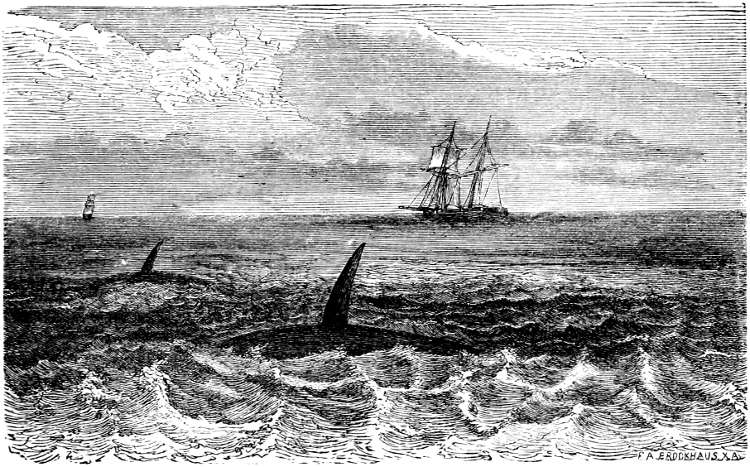
“KILLER” DOLPHINS.
In the North Sea we had already seen some spouting dolphins; now they
often came up close to us. In the beginning of July, they came so
near, that our zoologist had the great satisfaction of taking an exact
drawing of the back. It was the species well known to all sailors, the
“Nordkaper” or “Killer” (Delphinus orca, Fabr.), one of the
largest kind in the whale family, being sometimes twenty-five feet
long. It is distinguished, and for the same reason easily recognized
at a great distance, by the small, long, and sharp upright back-fin,
which has also earned for it the name of “sword fish.” These enormous
creatures come to the surface to take breath, and mostly move in
zig-zag windings along the top of the water, so they may be seen from
three to half-a-dozen times, though only the upper part of their
shining black bodies. First the snout is to be seen, and from the
“blow-hole” is forced the breath and spray; then the fins and the
hinder parts of the back make their appearance. The tail is only to be
seen when the creature dives under, when it is sometimes straight out
of the water. The name “Nordkaper” by which our sailors call it, was
received long ago, when it frequented the North Cape in droves. The
Americans call it “Killer,” and the Norwegians “Whale-catcher,” from a
circumstance which for a long time was considered a fable, but is now
confirmed by the least prejudiced whalers of the present day, namely,
that they are the whale’s greatest enemies, following and attacking it
in large droves.
Besides the “Nordkapers,” one day (the 10th of July), we observed
another kind of dolphin, three or four of which played under our bows.
They were quite brown, without any upright back-fin, having a thick
head and steep forehead. It was a strange and fascinating sight to
watch these boorish, uncouth cetacea of nearly fifteen feet long,
playing in the water so peaceably and securely and yet so nimbly.
Unfortunately the disturbing hand of man, in the attempt to make use
of the breech-loader, startled these peaceful creatures. Before we
were prepared for it shots were heard, and the dolphins hurriedly
withdrew from the further observation of the “lords of the creation.”
For the sake of the zoologist and his science, it was to be wished that
such a creature should be killed and examined. But the Germania was
wanting both in the apparatus and means for taking it, as well as in
accommodation for working.
We also saw, though only in the distance, the blowing of some rorquals.
Meanwhile a number of soundings had been taken on the Hansa, which
gave the following result: 1st of July, in 60° 45′ North lat. and 2°
4′ 3″ East long., a depth of 65 fathoms, with stony ground, Norwegian
granite; 7th of July, in 68° 18′ North lat. and 7° 14′ East long., 700
fathoms, hard sand.
A series of other soundings gave no decided result. The temperature of
the sea was taken daily.
CHAPTER II. CONTINUED VOYAGE OF THE TWO SHIPS UNTIL REACHING ICE. [4] MIDDLE OF JULY.
Second meeting with the Hansa.—Neptune and the Arctic
christening.—Entrance into the Arctic Sea.—Zoological
matters.—Jan Mayen.—Nearing the ice.—Seals.—Separation of
the vessels.
The 4th of July, Sunday, brought us a fine, clear morning: the wind
died quite away; the sea, even in the far, far distance, was glossy and
smooth. The sleeping sails swung to and fro with the gaffs; the gearing
rattled; the ship swung without answering the helm; in short, it was
that sort of calm so disagreeable to a sailor, and particularly so to
us after our three weeks’ voyage. Every eye looked longingly for a
rising breeze. In the course of the morning it rippled the surface with
beautiful blue lines here and there, and then dropped again.
The Hansa was far astern, and presently a dark spot appeared on the
water in the distance. It scarcely moved; but the telescope showed us
that it must be a boat. Perhaps a post from the Hansa! Now the mainsail
was set, and then we knew for certain that it was Captain Hegemann’s
fine whale-boat that was approaching. We lay to, and welcomed heartily
on board Messrs. Hegemann, Hildebrandt, Buchholz, and Laube. Engaged
in an improvised hunting party, they were fortunate enough to bag some
gulls. For the second time we all sat together in the cabin, confiding
our hopes and plans to each other. Meanwhile, on the eastern horizon,
there rose a well-known dark line; and soon a light, quick breeze
filled the sails, and gave our ship steerage way. Slowly she began to
move, and took a nor’-nor’-westerly course, direct to the island of Jan
Mayen.
The wind now blew stronger; the Hansa had already reached us, and thus
a speedy end was put to our meeting. Our friends took leave and were
soon on board their own ship.
The next day it blew fresh from the E.N.E., so that we nearly always
made two degrees N. as our day’s work, a highly desirable progress,
which raised all our hopes afresh. Already, on the evening of the 5th
of July, at fifty minutes past eleven, we had passed the Arctic circle
(66° 33′), and that nearly under the meridian of Greenwich (0° 15′
W.L.).
A violent wind was blowing; and with a speed of nine knots we entered
the Arctic Ocean, which was to be our quarters for a whole year. The
Hansa was some miles in advance of us, and was the first to unfurl
the North German flag; at the same time firing one gun. We followed.
Conformably to the custom, as on crossing the equator, Neptune came
on board to welcome us, and wish us success on our voyage; of course
not without all those who had not yet crossed the Arctic circle having
to undergo the rather rough shaving and christening customary on such
occasions. The ceremony closed (as is usual on such occasions) with a
good glass of wine, to wash away the evil effects of the cold water.
With us, Peter Iversen and Peter Ellinger undertook the parts of
Neptune and the barber, and carried out with great earnestness the
soaping and the very mild christening. At the next meal in the cabin we
were surprised by a poetical composition by Neptune.
On board the Hansa the proceeding was carried out much more
scrupulously. Neptune came on board with two followers, and addressed
Captain Hegemann with the question, “Any green hands on board?” At the
answer, “Yes,” there began a sharp examination of the “green ones,”
Drs. Buchholz and Laube, as well as the sailors Max Schmidt and Konrad
Gierke. Afterwards came the christening. Dr. Laube writes thus:—
“We entered into the spirit of the fun willingly, knowing that our
sailors were decent fellows, and would not carry things too far, even
had we not entered on the ship’s books with them in Bremen, and become
seamen. Our carpenter went about the whole day with a sly, laughing
face, and towards evening had quite lost his usual chattiness. We
ourselves kept in the cabin, so as not to witness the preparations.
At midnight, we were called on deck. A gun was fired; and as its
thunder died away we heard the well-known cry, ‘Ship ahoy!’ Three
wonderful figures climbed over the bowsprit; Neptune first, in an
Esquimaux’s dress, with a great white cotton beard, a seven-pronged
dolphin harpoon for a trident in one hand, and a speaking-trumpet in
the other. A tarpaulin was spread on the quarter-deck, and a stool
placed upon it. It looked like a judge’s bench. Here each of us was
seated with eyes bound, while the masked followers of the northern
Ruler went through the customary proceedings. I was soaped and shaved;
god Neptune was most favourable to me; he knows what good cigars are,
and has great respect for those to whom they belong. Then came the
christening, which in this case was not applied to the head (as is
usual), but to the throat and stomach. Neptune put some questions to me
through his speaking-trumpet, desiring me to answer. I saw his object,
answered with a short ‘Yes,’ and then closed my lips. The mischievous
waterfall rattled over me, causing universal merriment. They then
took the bandage from my eyes, that I might see my handsome face in
the glass; but instead of a looking-glass, it was the combing of the
wooden hatchway, which with great gravity was held before my face by
the barber’s assistant. I was now absolved, and could laugh with the
others, whilst seeing my comrades obliged to go through the same course
one after the other.”
Universal grog on board both ships brought the time-honoured and merry
ceremony to a close.
But with ever-growing impatience did we now long for a nearer
acquaintance with the ice. As we before mentioned, the favourable wind
first met us outside the Arctic circle. Later on it blew more faintly,
though, on the whole, keeping in the good quarter from the east, so
that on the morning of the 9th of July we came in sight of the island
of Jan Mayen.
The midnight hours had now grown visibly lighter; even in the cabin
we no longer wanted a lamp; at twelve o’clock at night we could read
and write without difficulty. The very first night we reached the
latitude in which it was possible to be seen, we were allowed to enjoy
the wonderful sight of the midnight sun. The thick clouds, which the
whole day had covered the heavens, drew somewhat together towards the
north just at that time; and over the edge of the endless sea, hovered
the sun, like a red ball, visible almost in its entire circumference,
surrounded by gold and purple-violet clouds. But unfortunately this
majestic spectacle was of short duration; the cloudy curtain closed
again, and we had to wait many weeks before we again saw the midnight
sun.
The temperature of the air fell steadily. From the 6th to the 7th
of July there was a sudden fall, as shown by our table of daily
temperatures.
This was accompanied, on the 7th of July, by snow, and on the
8th the fog began its rule of terror, from which we suffered,
except at short intervals, for four weeks, that is, until we landed.[5]
The swarms of birds were countless, and at a glance we could see that
those frequenting the icy sea were quite different from any other
sorts. There were the well-known Auk,[6] and other aquatic species of
various genera.[7] But there was no possibility of exactly knowing
each kind, as we did not succeed in bringing any down; and only seeing
them in the distance in their hurried flight and the dim atmosphere,
they were very difficult to distinguish. They generally flew from two
to four together; sometimes one would strike out with a short flap of
the wings, and fly at a uniform height over the smooth water, when,
according to its uniform custom, it would circle two or three times
at some distance round the ship, and either settle down once more, or
totally disappear. Besides these, we frequently saw the grey petrel
(Procellaria glacialis, L.), which until that time had been
rare. They strike the observer at once by their long, grey, straight
wings hovering almost motionless over the water. Like all northern
travellers, we soon learnt to know among the ice the peculiar bird
called the Mallemock.
With the crossing of the Arctic circle we found ourselves in our own
broad field of action; for if our chief task was to follow the coast of
East Greenland as far as possible to the north, our expedition was also
one of general knowledge, and therefore the exploring of the whole of
the North Arctic region was incumbent upon us. So that, although still
far from the ice, regular, and, when possible, searching investigation
was made, not the ordinary observations on board ship, regarding
the direction of the wind, barometrical pressure, and so forth, but
inquiries into subjects relating to the physical geography of the
sea. The temperature of the surface water, as during the whole of the
voyage, was taken every two hours, and that of greater depths, ever
since the 1st of July (61° N.L.), four times every day. In connexion
with this Drs. Börgen and Copeland began a series of experiments
relating to the quantity of salt contained in the surface water and in
the depths. Notice was also taken of the colour of the sea, as well
as of the wood met with. Soundings were taken every six hours, and
everything brought up by the apparatus was carefully preserved.
These observations were of no small interest, as we were in that part
of the somewhat changing boundary where the warm (so called) Gulf
Stream coming up from the south and the cold Arctic current coming
down from the north just meet. This Gulf Stream is known not only by
its relative warmth, but by the greater saltness and deep blue colour
of its waters. The beautiful blueness of the sea struck us as soon as
we left the North Sea. But from this time until we reached the ice the
colours changed continually, and sometimes very quickly, from dirty
blue, light blue, greenish blue, bluish green, clear and transparent
green, greyish green, and so on, so that our attempts at representing
a series of these colours became a failure.[8] Sharp limits between
green and blue water, such as have been often observed, not only in the
Atlantic but also in the Arctic Ocean, we never met with.[9] As regards
temperature, the blue water certainly was the warmest; but even here
sudden and considerable differences were almost imperceptible.
With our advance towards the north-west the warmth of the water
gradually decreased. Exactly corresponding to the isotherm for May,
which we found in 1868, we registered on the 6th of July at noon 42.12°
Fahr., and the next day, at the same time, it was already two degrees
lower. On the other hand we first found the temperature at zero, or
below zero, in the neighbourhood of the ice, whilst in May, 1868, it
was as low as that at 200 (nautical) miles distant from it. As regards
the observations made on the true currents,[10] as well as on the
aræometrical reading of the quantity of salt held in solution in them,
it is not our province to enter upon their discussion here. Regarding
the former, however, we soon had lively witnesses in the shape of
drift-wood, small pieces of which passed us on the evening of the 6th
of July; and two days later we saw a large knotted tree; but on the
high sea it was impossible to make ourselves masters of it.
In order to gain more exact information regarding the surface-currents,
it has long been the custom to throw out a corked bottle containing
a piece of paper, on which is written the exact time and place of
immersion. If a seaman sees this bottle in the water, he picks it
up, noticing the time and place, and forwards the paper to the place
mentioned. With this view we threw out bottles from time to time.
The soundings, from the period of our leaving the remarkable
shallowness of the North Sea, showed a tolerably uniform descent in the
bottom of the sea as far as the island of Jan Mayen, and farther on to
the borders of the ice. From eighty fathoms it went on to 180 and 270
(2nd July), 406 fathoms (3rd July), 569 on the 4th, and 1066 fathoms on
the 7th of July.
Whilst the Physicists were thus making a commencement of their labours,
and the crew were pretty well occupied with soundings, the Zoologists
found many opportunities for collecting and observing. From the bird
world they were compelled now to descend to lower creatures; and if
unfavourable circumstances did not allow them to use the drag-net
to bring subjects from the depths of the sea, still much that was
interesting was to be found on the surface. Dr. Pansch constructed a
bag-shaped net out of some gauze, and through the circular opening
passed two long, narrow boards, so that when put into the water, one
half was under and one above; this net was fastened to the hind part
of the ship on the leeside, and as we sailed slowly forwards, took in
every creature lying on the surface. In this manner the calm nights
of the 7th and 8th brought us a rich booty; there were the Calanus
hyperboræus, small tender creatures with white transparent bodies,
articulated red-tipped tails, and long, fine, beautiful red feelers,
with which they jerked themselves forward. Next came a number of small
yellow red-spotted crabs (Themisto libellula, Mandt) with great
oval-shaped black eyes, which like the rest of its family, as we had
already seen, lay upon their side and swam along the surface in search
of food.
The low side and bulwarks of our vessel made it easy, if we saw a
large creature of any kind, to catch it with a long pole-net. The
brown-violet fibrous medusæ (Cyanea capillata, L.), which
we had often seen in the North Sea, seemed entirely wanting here.
Nevertheless, zoological work in the open air was now decidedly
disagreeable. For if it was tolerably warm in the evening, towards
morning, particularly when a damp fog and cold wind got up, and the
warming influence of the evening meal had long since disappeared, it
was painfully cold; but just the night-time was best for catching. And
even with spirits and water we could only work when, sailor fashion,
we constantly beat our arms across our breast. Still more difficult is
it to skin birds, seek for entozoa and such like, work which cannot
always be carried on in the cabin, but which makes little progress with
cold, stiff fingers.
As already mentioned, we sighted the island of Jan Mayen on the 9th
of July. The Hansa passed it at about one and a half German miles to
the eastward. Had the weather been clear, we should long since have
been able to see the highest point of the island, the Beerenberg. The
atmosphere was, however, heavy and gloomy, and was as little inclined
to grant the beautiful sight to us as it is to other sailors. Just at
dawn we caught a glimpse of streaks of glaciers; the knowledge that
land, and that of so interesting a nature, was so near, caused great
excitement amongst the scientific part of the community; and it was
no wonder that, after such long inaction and crossing of our wishes,
the question of attempting a landing on Jan Mayen was more eagerly
discussed than ever. But, even if, setting aside the strict letter of
our instructions, we had consented to this interesting attempt, the
ever-thickening fog and the windward sea-roll on the eastern side of
the island would have rendered it impossible; and on the western side
it would only have been possible with great loss of time. Meanwhile, we
kept near to land, that we might at least have a view of its wonders
as long as possible. At last, just before breakfast, our expectations
seemed likely to be fulfilled; the fog lifted a little, and at some
miles’ distance we saw a tolerable stretch of broken, rocky and rugged
coast. It must have been the north-east side of the island, that is,
the foot of the Beerenberg, dark rocks interspersed with long stripes
of glacier ice reaching to the water. But the whole was indistinct and
misty, so that the general appearance had somewhat of a weird look
about it. All hurried on deck, trying to put the wondrous picture on
paper; but there was scarcely time for that; the impervious veil of fog
covered it once more, and that so thick that we had no hope of another
glimpse.[11] Unsatisfied and disappointed, we eat our breakfast,
picturing to ourselves how delightful a bright, sunny day must be on
Jan Mayen. We read the accounts given by previous travellers, and found
for our consolation that this island had almost always been seen under
disadvantageous circumstances.
According to a Dutchman of that name who discovered it in the year
1611, the island of Jan Mayen lies lonely in the middle of the wide,
deep sea between Norway and Greenland, Iceland and Spitzbergen; and is
distant about sixty geographical miles from the coast of Greenland.
It is nine miles in length and one in breadth, and so thoroughly
mountainous, mostly with rugged rocks reaching down to the sea, that it
has really only at two spots a flat beach and so-called landing-places.
The north-east part rises to a height of 6863 feet, in the lofty
Beerenberg, which has a large crater, and indeed the whole island is of
volcanic origin. In the year 1732, Burgomaster Anderson, of Hamburg,
reported a decided eruption from a small side crater, which had been
observed by a seaman; and in the year 1818, Scoresby and another
captain saw great pillars of smoke rising from the same place.
Surrounded by floating ice the whole winter through, and often for a
longer period, Jan Mayen lies in the spring-time and early summer so
near the edge of the ice-fields, that from 1612 to 1640 it afforded to
the English and Dutch whale-fishers a comfortable and much sought after
station for their booty and train-oil preparation. It is said that a
single ship, in one year, then brought home from Jan Mayen 196,000
gallons of oil.
Wishing to make an attempt at colonizing, in 1633–34 seven Dutch
sailors passed the winter here.
“The small community outlived the severity of the winter without much
danger to their lives, until the scurvy broke out amongst them; and as
they could not procure the necessary fresh nourishment, the sickness
made rapid strides. The first died on the 16th of April; and all the
others shared the same fate one month later. Their diary ended with
the 30th. When, on the 4th of June, the Dutch fleet appeared off the
island, they were all found dead in their huts.”[12]
Scoresby visited the island in August, 1817, and gave the first
reliable account of it. The interest excited by this account led to
two other visits. Lord Dufferin landed on the north side of Jan Mayen
in 1856, but what with fog and floating ice, could only stay one hour.
More good fortune and success attended that in 1861, undertaken by
Dr. Berna, of Frankfort, and described by Karl Vogt as one of those
interested in the “Arctic Expedition.” He succeeded in landing at two
places, and the weather allowed of two days’ interesting investigation;
then the fog returned, and they were obliged to set sail.
The same envious fog made our landing impossible in 1869, and the
strong rising sea-breeze and the high sea rendered it unadvisable
to go too near the land. We tacked, therefore, and sailed in an
east-south-easterly direction from it, so as to go round the east side
of the island, and at midnight resume our northerly course. The fog
was continually getting thicker, so that our two ships could scarcely
see each other; and in order to keep together at all were obliged to
use the horn. A fine rain fell at the same time, and it was about 2½
degrees warmer, though, on the whole, most disagreeable weather. We
could now thoroughly enjoy the Arctic fog “as pictured in books,”
and we felt the perfect truth and the full meaning of the excellent
descriptions given of it.
We thought of the “sea-lungs” of Pytheas, that impenetrable mixture
encountered beyond Thule, which is neither land, nor sea, nor
atmosphere; of that bit of Horace,—
“Quod latus mundi nebula malusque
Jupiter urget.”
We thought of the troublous gloominess with which the northern legends
enveloped the unknown ice region; and indeed began to believe in the
influence which a long sojourn in such a climate would have upon mind
and body.
Indeed, there can be nothing more melancholy than this everlasting grey
veil; even the sea, as far as one can see, is sad and grey. An auk
or a diver, now and again flying before the ship, is the only thing
presented to the wandering eye. Occasionally the gloom lightens so
much, that one can just make out where the sun is; but it is seldom
so far visible as to afford us an observation for latitude, or the
sight of a fogbow: but every hope of a change which might rise at
such a moment was at once destroyed by fresh mist rolling up thicker
than ever. One glance over the different diaries at this particular
time will best show the depressing influence of such continual foggy
weather. As in the North Sea over the constant north wind, so here over
the new enemy, the everlasting complaint was,—“Fog! thick fog!” And
if it would stop at that! But now the small vesicles condense and fall
first like fine spray, and then like a heavy shower, though without
bringing any relief from the fog. The sails flap, the running-gear
droops; and, added to this, is a fresh cold breeze, with the ship
swinging to and fro. At such a time every one appears on deck in the
excellent oilskin clothes, with high boots and serviceable sou’westers.
With wide and cautious steps, we walk up and down on the ever wet and
slippery deck, our eyes, as if open sea lay before us, constantly
sweeping the horizon and turning doubly disappointed away. The sight
of the swaying masts and the rustle of the untiring wavelets against
the ship’s side, at length bring the comfortless impression of all
surroundings to rest. The mind turns inwards upon itself; and amidst
all the thoughts of the serious and yet eagerly looked-for future, the
remembrance of the past and home stand vividly before us. We think of
the last time we were on land, of that wonderfully beautiful and warm
summer day at Eutin, with all the brightness of the rose-blossom and
the song of the nightingale. We see ourselves once more united with our
loved ones at home, and, flying from the heat of the day, wandering in
the high arched forest, or in familiar conversation enjoying the peace
and quiet of the garden. We see the stars twinkling in the heavens,
and the dark red moon rise over the distant woods—when a heavy wave
strikes us, sending the ship on to its side. We are pitched heavily
against the boat, the cold water splashes in our faces, and rushes in
a torrent over the deck and over our feet. The beautiful dream of the
pleasant summer is over, and the cold reality of an Arctic, foggy day
resumes its sway. With perhaps an unheard sigh, but in every case a
smiling face, we shake off the water and continue our walk. We know
that very soon we shall have much greater trials to bear.
Beyond the regular aræometrical readings of the water, and the constant
zoological work, there was little to gain outside in the way of
knowledge. We therefore tried to make it as comfortable as possible
below, which was certainly not easy, for even here the wet penetrates
and is brought down with boots and clothes; so that the air is often
heavy and damp. With the near prospect of the all-absorbing work on
the ice and also on land before us, we once more looked up all our
things,—instruments, and so on,—and put them in order, filling up
the rest of the time with reading, studying, and playing. We studied
Scoresby’s works, read the Swedish Expedition, or Lindeman’s “Arctic
Fisheries of the German Sea-port Towns,” or turned over the leaves
of Kane’s and Parry’s standard works. When comfortably seated at the
chess-board, or at a rubber of whist, or engaged in a sharp argument,
we now began to feel quite at home. We were accustomed to the cabin,
and had learnt to know each other better. We found that it was not so
difficult to live in such a confined space in peace and quietness,
if we only to some extent considered each other and learned to take
quietly such disagreeables as would naturally turn up.
And they soon did turn up. Our store of water had already greatly
decreased, and we were obliged to submit to great restrictions. We
could only have one glassful daily to wash in, but as compensation we
found on deck a fresh-drawn bucket of salt water. As it had become
somewhat muddy in the tanks, our filter stood us in good stead. The
rye-bread had already disappeared on the 8th of July, but we still had
a store of potatoes.
Since the midnight of the 9th to the 10th of July, we had sailed with
a fresh easterly breeze direct for the ice, and early in the morning
had already lost sight of the Hansa; the fog-horn no longer found
an echo. Presently with the wind from the distance there rolled the
thunder of a cannon-shot; a second followed, and we joyfully returned
the greeting of the sister-ship. At noon we fired again, and received
no answer; we were for the time separated from the Hansa. The following
five days brought no change in the weather; day after day passed with
the interesting variations of—fog, thicker fog, thickest fog. The
temperature was about 36° Fahr.; only once rose to 39½°, and fell to
33.80°. The only comfort was that no obstacle stopped our progress, as
on the open sea the ship can find her way with the help of the compass
in the darkest night as easily as in broad daylight. A collision was
not to be feared here, so we had no feeling of insecurity, as one has
in a thick fog near land.
The bird world did not change much; the stormy petrel, however,
preponderated. On the other hand, we saw far more frequently a
creature peculiar to the Arctic regions, the Greenland seal (Phoca
Grönlandica, Müll.). They stretched their black, flat heads out of
the water with great curiosity, but immediately disappeared, setting at
defiance every attempt to reach them with the deadly shot.
The appearance of these seals reminded us that we were now in the
neighbourhood of the seal-catchers, that is, in that part of the
northern icy sea where, from the end of March to the end of April, the
seals come in thousands to the smooth floating ice to cast their young
ones. These “seal-coasts” change their position somewhat every year,
and range between 68° and 74° N. Lat. and from 2° to 16° W. Long. It is
a highly interesting sight to see the seals assembled from all quarters
at this time. It is said that they not only come from the coasts of
Spitzbergen and Greenland, but even swim in flocks from Nova Zembla.
The whitish-coloured young stay on the ice the first few days, and are
then killed with clubs by the parties of seal-hunters. The skin with
its underlying fat is brought on board. The skin and fat of a young
seal are worth from 7s. 6d. to 9s.; besides which
they catch many old seals. The number caught by a single Bremen ship
now sometimes amounts to from 8 to 10,000 seals; and one may form some
idea of the war of destruction waged against these harmless creatures
by man, when we hear that of European ships in 1868, five German, five
Danish, fifteen Norwegian, and twenty-two British, which were in
company in West Greenland, obtained 237,000. On the “Jan Mayen ice”
besides the Greenland seal there is another kind found, called the
crested seal (Cystophora cristata, Nilss.), seldom the bearded
seal (Phoca barbata, Müll.) only.
The expected meeting with the ice necessitated a peculiar provision
on the ship, the “crow’s-nest,” so as to have a clear and commanding
prospect over the labyrinth of flakes and floes, and to enable us to
steer through all, and when possible find the best road, as the range
of sight over the water from the deck was no longer sufficient. The
commander, therefore, has to look for the highest possible steady
stand-point, and this is easily found in the “top” of the masts, to
which the shrouds give easy access. A long sojourn in this airy region
is not very agreeable at any time; one must be careful to protect
the body somewhat against the wind, and this object is attained by
a suitably formed barrel. A good telescope is hung constantly up
here, and a little straw is placed at the bottom. This necessary
“crow’s-nest,” already well known from Scoresby’s and the late Swedish
expeditions, was on the 12th, with much merriment and many good and
bad jokes called forth by its peculiar appellation, hoisted up the
mainmast, and fastened by the carpenter to the crosstrees, between the
top and the top-shrouds.
The view attained by this means at a height of thirty-eight feet, gave
us the survey over a circle the radius of which was seven and a quarter
nautical miles.
About eleven at night in the thick fog an unusually white spot was
seen, and this we discovered to be the first piece of ice. At the so
long looked-for announcement of “Ice!” every one was on deck, and
hurrying to the fore. Every eye rested with interest on the small
rocking scrap which was at the most quite an isolated, far-washed
piece. With intense attention and impatience, during the night and
following day (the 13th), the sailors were to be seen on the watch, and
from time to time the cap of one of the inmates of the cabin diving
into the thick fog; but gaily as we advanced, no ice appeared!
On the 14th, there was a calm the whole day, so we went about in
the boat fishing up the drift-wood, hunting the gulls and sketching
them. Sometimes it brightened, and we could see a little farther; but
still no trace of the Hansa. But we had another intimation of the
nearness of the ice. We could see in the west or north-west over the
horizon, a white or yellowish glistening, which must spring from the
ice, and which is known as the “Ice-sky,” yet essentially differing
from the “Ice-blink.” Besides this, we saw the ivory gull (Larus
eburneus), a bird never found far from the ice.
CHAPTER III. TO THE SEPARATION OF THE SHIPS ON THE 20TH JULY.
The ice in the Arctic Ocean, particularly off East
Greenland.—The border of the ice reached on the 15th of
July.—Further voyage of the Germania.—Position and nature of
the ice.—Arctic birds.—Meeting of the vessels once more.
The Polar circle is termed the boundary of the Arctic or Northern Icy
Sea. For that term there is a physical reason, as at every spot within
this circle the sun does not rise in winter for a certain number of
days together, and its influence being thus so circumscribed, the
“everlasting” ice is enabled to form. But the Polar circle is the
boundary also in a geographical point of view, as it cuts directly
through Behring’s Straits, and the narrowest part of Davis’s Straits,
besides stretching over both the old and the new worlds, so that the
whole of the enclosed (so-called) Polar basin is contained within it.
This has but one broad approach, and that lies between Scandinavia and
Greenland. Here the Polar circle is least satisfactory as a boundary;
for here, as in every case in which the shackles of art are imposed
upon nature, the arbitrary line is overstepped by the irregularities
of nature, and nowhere more so than in the present case. From the west
coast of Norway to far beyond the North Cape rush the waves of the
Atlantic, which are never covered with ice; while on the east coast of
Greenland, down to its most southerly point, presses from one year’s
end to another a powerful mass of heavy ice. The boundary of the icy
sea (as a sea covered with ice) may now upon the whole be settled by a
line drawn from Cape Farewell to Iceland, from thence to Spitzbergen,
and lastly to Nova Zembla. The cause of this appearance lies really
in the existence of two important sea-currents. From the coast of
Norway up to Spitzbergen and Nova Zembla stretches the north-easterly
branch of the Gulf Stream, driving back all floating ice, and from the
comparative warmth of its waters conducing to the melting of the same
all along the ice boundary.
On the other hand, on the east coast of Greenland runs the Polar
current in a south-westerly direction to a great distance, carrying
with it the heavy ice formed in the extreme north, and picking up on
its way all the younger ice frozen during the winter; while, from
the coldness of its waters, it prevents the melting of the same in
a remarkable degree. Thus it is explained how from Davis’ Straits
also must flow towards the south just such another cold, ice-burdened
stream, and how on the voyage from Germany to New York are often seen
one or more drifting pieces of ice, or even icebergs. This Greenland
ice-current forms the main outlet for the removal of the Polar ice, and
we may very reasonably liken it to a floating glacier whose farthest
domain is the Polar basin.
Upon the nature of the ice in this Polar current, the following
preliminary remarks may throw some light. At the beginning of the
current, in the same latitude as Spitzbergen, and much nearer to the
coast, as far down as Iceland, the largest fields of ice are to be
found; tracts of enormous extent and sometimes more than fifty feet
in thickness. Between these, and originating from them in the course
of time, by their breaking up, are smaller fields called ice-floes;
and these, increased by thawing, by the surrounding driving and
pressing, as well as by the waves, break up in small pieces, the real
hummocks which prevail at the eastern boundary of the current, at the
“ice-line,” as well as at the most southerly end. As a last remains of
the disturbing process, huge hummocks float about, or cover the broken
ice or the wide expanse of sea with small brashes. Real icebergs seem
almost peculiar to the southern part of the coasts; such an iceberg is
not formed in the sea, but is a broken piece of glacier moving with its
lower part in the sea, and from which at different times large pieces
have been broken off by the pressure of the water, and carried onward
by the current.
The breadth of this ice-current, and also the position of the ice-line
is, as may be imagined, very different at different times of the year.
Whilst in spring-time it runs about the middle of Iceland past Jan
Mayen to the southern point of Spitzbergen, in summer it retreats
nearer to the coast, and stretches somewhat in the direction of the
west-end of Iceland to the north of Spitzbergen. Some pieces of ice,
under peculiar circumstances, naturally float very far from this
boundary towards the south-east; sometimes even reaching the Faroes.
But even at corresponding times of the year, the ice-line may occupy
very different positions; much depending upon the compactness of the
labyrinth of fields, floes, and drifts, and also of the prevailing
winds.
As all ice rises out of the water, and from its irregular form offers
to the wind an easy object of attack, so it is often drawn from the
course of the water-current by a strong air-current, and either hurried
onward or retarded in its progress. An easterly and south-easterly
wind must drive the ice westward, and press the masses closer than
ever; whilst a westerly and north-westerly wind drives the icy dominion
farther eastward, dividing the masses, and thereby rendering the
ice-stream more navigable.
This ice-current, or ice-zone, in the outer part of which the
whale-fishers mostly catch their prey, was what we were now about to
sail across. That this task was certainly not so easy and simple as
many think who have not seen for themselves, we knew from experience
in the yacht “Greenland” in 1868. This time our steam power gave us
greater hope. If we could only reach the vicinity of land we thought
that in the much-talked-of “Land-water” we should at least be able to
move with ease, and thereby obtain good results.
On the 15th of July we reached the ice-line. After a foggy day a light
southerly breeze got up, the sails filled, the ship answered the helm
once more, and we moved in a north-westerly course between small floes
and brashes. A practised ear might now notice a peculiar distant roar,
which seemed to come nearer by degrees. It was the sea surging against
the still hidden ice. However unwelcome and equivocal this surging
might sound to the ears of sailors far from any harbour (and it has
a wonderfully paralyzing effect as one approaches), to-day it was
listened to with unmistakable pleasure. The object of our longing is
then at last reached, and if the ice should prove a blockade to us, we
could at least remain comfortably in the Germania in its neighbourhood
to inspect it.
Nearer and nearer comes the rushing noise. Every man is on deck; when,
as with the touch of a magic wand, the mist divides, and a few hundred
yards before us lies the ice, in long lines like a deep indented rocky
coast, with walls glittering blue in the sun, and the foam of the waves
mounting high, with the top covered with blinding white snow. The eyes
of all rested with amazement on this grand panorama: it was a glorious
but a serious moment, stirred as we were by new thoughts and feelings,
by hopes and doubts, by bold and far-reaching expectations.
The mist closed again almost immediately; but this short moment and a
glimpse from the crow’s-nest sufficed to show us the absolute thickness
of the masses of ice. Here, even had it been our intention, we could
never have broken through, and if any of us had formed a mistaken idea
of ice-navigation, this must prove to the most inexperienced that such
an obstacle could neither be overcome by the most powerful ironclad
ship, nor by gunpowder. Our duty bade us first seek the Hansa in 75°
N.L.; but, besides the fact that an easterly wind had been blowing for
some days, making it anything but a favourable moment for forcing the
icy range, it became necessary to wait another opportunity for making
an energetic attempt.
The spot where the Germania struck the ice was in 74° 47′ N. Lat., and
11° 50′ W. Long., and the edge stretched almost due north and south.
The Hansa reached the ice-line the same day in 74° 57′ N. Lat., and
9° 41′ W. Long. The log-book of the Germania says, “Heard the rushing
of the water against the ice, but unfortunately could see nothing on
account of the fog. Temperature of the sea’s surface 32° Fahr., a
sure sign that we were near the ice; tacked therefore, and ran with
a south-westerly wind some miles to the north-west, until the floes
became so dense that we were obliged to turn. Steered in the fog along
the ice northward. At four in the afternoon a point was passed, from
which the line seemed to stretch more westward. Accordingly we sailed
in that direction, and about seven came again to compact ice, which
obliged us to turn and lie to. The fog was now so dense that we could
only make out the pieces nearest to us. To judge by the breakers, the
ice here stretched again to the north. On the morning of the 16th of
July, the atmosphere lightened a little; when we set all sail and
made for the ice, which was soon in sight. Towards the north and
north-north-east lay a long chain of closely packed pieces; to the west
and north-west opened a large bay, into which we sailed, that we might
inspect nearer the position of the ice. By eleven we reached what was
to all appearance the end of this bay, namely, a chain of drift ice,
behind which, to westward, some open water showed itself, surrounded
with ice. As it was not our intention to make any serious attempt to
advance until we fell in with the Hansa, once more we lay to, in order
to wait for clearer weather.” The first excitement and restlessness had
by this time subsided, and we could observe surrounding nature more
at our leisure. When the mist shifted a little, the view from the
crow’s-nest was very beautiful; first the icy boundary, and then behind
the endless labyrinth of floes. One was also able exactly to trace how
the light and dark parts of the clouds lying over the horizon, as well
as the light and dark stripes in them, reflected a true picture of the
ice on the sea, and to study attentively this important appearance
known as the “Ice and water sky.”
The chase brought us a new bird to-day, a handsome black guillemot
(Uria grylle, L.), with its greenish shining plumage; the white
band on its wings, and the red beak and wings looked wonderfully
pretty. Our interest was, however, more aroused by a young crested
seal which was killed in the night (Cystophora cristata),
with shining black back, and whitish yellow belly. Of the peculiar
blistery formation on the nose, from which they take their name, and
which characterizes the grown-up male, there was yet no sign: but the
creature was unmistakable from the form of its head; the well-defined
snout of the common seals had entirely disappeared; but the strongest
zoological mark lay in the teeth. We filled a wine-barrel half full of
its fat, and the rest fell into the hands of the zoologist.
On the 17th we cruised about in the thick fog with a south-westerly
breeze. We had no sooner tacked than we came upon ice, and were obliged
to tack once more. It seemed as if we lay in a bay, surrounded by
floating ice. At the same time many small loose floes were drifting
around us, and were covered on the surface with the decomposing ice
like white snow. We took up some shovelsful to melt, with a view to
renewing our store of water. The mischievous fog played us many a trick
in our tacking backwards and forwards. It is almost incredible how
much larger the ice-floes appear in the fog. We seem, for instance,
to be driving at a hill, forty-five to fifty feet high; and when we
arrive there, it is a small floe with a hummock of about ten feet! This
delusion we had subsequently often to experience, though at first it
afforded us great ground for amusement. The ice had in the thick fog
something altogether spectral and gloomy in appearance; but as to real
danger to the ship in this floating ice, where there are no icebergs,
there is none, except in a heavy sea, with storms or calm. Towards
evening the ice pressed closer and closer around, so that to prevent
ourselves being enclosed, we had to keep more eastward. At two in the
morning we broke through the current, that is the outer chain of floes,
and saw at once by the windward roll that we were once more in the open
sea, where we had to lie by in expectation of better weather.
The floes lay so thick at the border, that with the faint breeze the
ship could not get through, and for the first time we had to employ the
long ice-hooks to push aside those lying directly under our bow, or
when very large, to work the ship round them. It was a most agreeable
night; and as it was the first time that the ship, in the true sense
of the word, had really come in contact with the ice, all on deck
willingly took a hand in the work and made it a pleasure to get rid of
the obstinate companions that impeded the progress of our Germania.
Here we had the best opportunity of studying the configuration of
the floes somewhat more nearly. They were mostly flat, and of the
most varied form. We could see at once, that warmth, air, sun, and
wave-friction had been at work upon them for some time past. From the
rushing of the water the edges were rounded and hollowed; they ranged
from four to twelve inches out of the water, whilst the mass under the
water was about four times as great. On the surface, as we have already
mentioned, they were covered with the melting ice like snow some inches
high; and on the larger ones small pools of water were found, which
generally make their appearance about the beginning of July, and about
the beginning of August are again covered with a crust of ice. Remove
the snow and we come once more to the glistening blue ice. Between the
floes are hummocks, miniature mountains so to speak, which rise in
various forms, now elegant, now bold, and from the crevices and shaded
plains shed the most beautiful blue light. This blue changes sometimes
to a green; indeed, one is often surprised to see a most lovely emerald
green. Taking also into consideration that this almost always quiet
water reflects the clearest pictures, one can imagine how great a
charm this ice scenery must have for a novice. But it is not only the
beautiful and majestic which has such an effect, but all sorts of
fantastic shapes which delight the beholder by their wonderful variety.
For instance, the small or large ice-blocks, from melting and the
washing of the water, frequently assume the most peculiar forms. Here
rides a stately swan, there an eagle spreads its mighty wings; here a
staring seal stretches its head out of the water, and there stands an
elegant marble table.
At home, when wishing to picture such things out of the clouds, or
the ice-trees on the windows, one must exercise a certain amount
of imagination; here they are forced upon the least enthusiastic
observer, and we could not help giving our unqualified assent to
Scoresby’s description, which until then we had thought a little
exaggerated. “Arctic birds” (so it runs in the Hansa’s Journal at
this time) “such as the stormy petrel, gulls, robber-gulls, auks,
and puffins surrounded the ship. For want of something else to do,
we caught a number of them by angling, and then gave them their
liberty after fastening a small piece of metal to them by a silken
band with the name Hansa and the latitude (73° N.) engraved upon it.
Procellaria glacialis were swimming like ducks in our wake, and
biting one another with loud chattering for the pieces of bacon thrown
to them almost under the stern.”
On the morning of the 18th, the atmosphere brightened with a light
southerly wind; and for the first time since we left Jan Mayen, on
the 9th of July, it was bright and clear. We now saw that we were in
a large ice bay, opening towards the south-east. It was a wonderfully
beautiful (one might almost say a festive) Sunday morning. The eye
refreshed itself with the deep blue of the softly rippling and
lightly moving sea, and rested quietly upon the wide semicircle of
the glittering ice-bank. The sun once more sent a friendly beam from
the clear sky, and seemed to show us that even here he could provide
what we had so long needed—warmth and dryness. With what pleasure we
enjoyed those morning hours, and drew in the clear fresh air! How we
once more learned to realize what sun and sunshine are to mankind!
But, wonderful to relate, with all this, the recollections of our
own country receded more and more. We stood and felt that we were
at the entrance of a new world, whose whole enchantment had thus
burst upon us. At first, there was an imperceptible struggle with
the mighty powers of nature; but now we were thoroughly prepared for
anything that might turn up, and looked forward with impatience to
our advancing westward. One after the other mounted to the topmast or
the “crow’s-nest,” and gazed out upon the masses of ice: we could not
satiate ourselves with the panorama. A way for the Germania must and
should be found.
But there was another and more important object which the sharpest eyes
could not succeed in finding, our lost sister-ship, the Hansa, which we
had not seen since leaving Jan Mayen. It was impossible that she could
be far away, for we were quite near the appointed place of rendezvous,
75° N.L., and we must in any case find her now before the fog should
surround us once more. The prize of a bottle of wine was therefore
set upon the discovery of the Hansa, though we scarcely required this
incitement, so keen and so deep was our interest in the fate of our
beloved comrades.
Soon after breakfast, to the great joy of all, a sail was discovered
from the topmast far away in the ice in E.N.E. It was a schooner, and
as the whale-fishers do not use such craft, it must be the Hansa, which
by a seaman’s eye was soon verified by her peculiar rig. The Hansa
was under full sail; certainly she must have already seen us, and was
trying her best to reach us through the apparently thick ice which
surrounded her. We ourselves hoped that we should be able at once to
advance farther westward together; so the boiler was heated without
delay, and everything prepared for getting up steam, so as to unite the
two vessels before the fog returned. Meanwhile, it was four o’clock in
the afternoon ere we could move, as, in fitting the screw, something
had been overlooked, which took us some hours to rectify. The Hansa had
in the meantime worked herself some miles nearer to us, and now lay in
the floating ice. The weather was beautiful and clear, and there was
a dead calm; so that with the speed of 5¼ knots, which we made with
a 50lb. pressure, we reached our friends at about eight o’clock. The
ice-spikes which encircled our bay to the north-east, stretching far to
the east, and towards which we were driving, resolved themselves as we
approached into small, and very small, brashes, between which the ship
easily made her way or forced it, though not without some gratings and
slight working of the steam. Our farther advance was unimpeded. The
ice-strewn sea now presented a peculiarly interesting spectacle. It had
assumed by the reflection of the sky, which had been heavily-clouded
for some hours, an almost black hue, in strong contrast with the colour
of the ice, whilst the north-westerly horizon shone with the brightest
yellow tints. At eight we were near the Hansa; both ships hoisted their
flags. The Hansa gave expression to her joy by firing her guns; but we,
not being prepared, had to return the salute with our fowling-pieces.
Greetings re-echoed from one side to the other, as we went round the
Hansa, and universal joy reigned on board both ships.
We then took her in tow, and steered back the same way by which we had
come, until some slight disorder in the machinery obliged us to stop,
when both ships were again put under sail.
Meanwhile Captain Hegemann, Dr. Buchholz, and Dr. Laube had come on
board, and the captains consulted together regarding the next steps to
be taken. The Hansa had, like ourselves, been several days in the ice.
Indeed, a glance at the logs showed that since their separation the
two vessels had never been far from one another, that they had sailed
in the same course to the ice, and had also sighted it the same day,
and that nothing but continued fog had prevented us from sighting each
other sooner. Captain Hegemann reported that farther north a larger
bay penetrated to the westward. We, however, preferred trying the
southerly one. We further agreed, conformably with our instructions,
that in case of a separation among the ice, the next place of meeting
should be Sabine Island, as it was plainly loss of time to return to
74½° N.L., to the line of heavy ice, if we had each found an opening;
besides which, the attempt ought not to be given up before the middle
of September, and we hoped to get through much sooner, as the position
of the ice, in comparison with that of 1868, seemed more favourable.
Meanwhile, the gentlemen sat in the cabin over their wine, exchanging
the experiences and results of the last few days. The zoologists, it
is true, were the only men who were particularly satisfied, as both in
the higher and lower classes of animals they had already an interesting
collection. Of birds there were several “Mallemucke” shot and properly
prepared; also one of the robber-gulls with the two peculiar elongated
middle tail feathers (Lestris crepidata, Brehm). Several
seals (Phoca Greenlandica, L.) had also fallen a sacrifice
to science. But the lower animals had yielded the richest harvest,
and besides different species of Calanus, Lysianassa,
Gammarus, and so forth, several specimens of the beautiful
Beroë had been obtained. Pity that these wonderful creatures,
with transparent cucumber-shaped bodies, long rosy-red tentacles, and
their eight rows of glittering, many-coloured leaf-like processes, with
which they move slowly forward, cannot be preserved in their original
beauty.
But in other respects also we had not been altogether inactive. The
soundings—this difficult and time-consuming work—had here on the
ice boundary shown an important deepening of the bottom of the sea;
whilst on the 14th we had touched ground at 930 fathoms, on the 15th we
could no longer do so with 1230 fathoms. Here the unsettled state of
the weather prevented us from finishing this work with satisfaction to
ourselves.
The mean temperature of these four days was 35° Fahr. It did not rise
above 40°, and once, early on the 16th, sank to below 32°. The water on
the surface was of much the same temperature; it oscillated between 34°
and 33½°. The colour of the water was mostly clear blue.
In the exchange of such observations and merry and free conversation,
it was now midnight. At this time we were obliged to stop, as the
axle-bed was heated and required cooling. A rising fog and a coming
breeze decided us; so we gave up steam entirely, and let the two ships
separate once more and proceed under sail.
Full of joy and confident hope for the future, we shook hands at
parting, and the gentlemen from the Hansa returned to their ship.
In sisterly harmony the two vessels sailed along, and many a joyous
greeting and joke resounded from the one to the other.
Who on this evening would have thought that this was the last time we
should be together? that we should never again see our sister-ship,
and our comrades only after fourteen months’ time, and then so
wonderfully preserved from drowning? Our happy feelings did not allow
such unwholesome thoughts to arise.
Our present object was now to follow the ice boundary farther
southward, at the same time looking for an opening by which we might
push on to the west. In tacking in contrary winds, we came against
several sharp prominences of the thick ice-line, which here stretched
in a west-south-westerly direction.
On the afternoon of the 19th of July the breeze freshened; we made good
way, and as much open water was before us, we soon noticed the now
unusual swell. The weather was tolerable, the fog came and went, so
that we kept the Hansa mostly in sight.
This day brought us something new. The first white bear was seen, and
that swimming, and for the first time an Arctic dish appeared on our
table. At breakfast the cook astonished us with a very delicate and
tender seal liver, and in the evening a very savoury stew of the flesh;
we were glad to get a little fresh meat, and soon lost the excusable
repugnance to the “oily” seal.
We sailed farther along the ice-line towards the south-west.
On the night of the 19th and 20th we fell in with ice, seemingly a
part of the closely-packed floes driven from the great mass. The swell
had entirely disappeared, and we moved amongst loose floating ice to
the south-west. It was mostly thick fog at night, though it cleared
somewhat about eight in the morning. The wind was S.S.W. In the
south-west we still found compact floating ice, and at eleven turned
again to westward. The Hansa was a few miles to windward of us; and
as both captains wished to consult together once more, and, if the
weather allowed, to take coals on board the Germania, the approach
signal was hoisted. The Hansa misunderstood this,[13] set more sail,
and disappeared in the now thickly-rising fog before we could succeed
in following her. Thus a fatal misunderstanding separated the two
ships, and that for ever. We will now leave the Germania, under Captain
Koldewey’s command, to her further course, and hear Captain Hegemann
and his companions’ report as to how the Hansa fared.
CHAPTER IV. FURTHER VOYAGE OF THE HANSA UNTIL HER BLOCKADE IN THE COAST ICE OF EAST GREENLAND. 20TH JULY TO 7TH SEPT.
Final separation of both ships.—The Germania’s signal
misunderstood by the Hansa.—The Hansa photographed in the
ice.—Snow blindness.—Difficulties of making way through
the ice.—Animal life.—The rocky coast of Greenland visible
for the first time.—The Hansa steers once more out of the
ice.—Two ships in sight to seaward.—The Hansa’s struggle
with the ice.—Fall of snow on the 3rd of August.—Southerly
currents.—Second attempt of the Hansa to reach Sabine
Island.—The Hansa sails to the north.—Countless seals.—Steer
to the north-west.—Circumstances particularly unfavourable
to further progress.—By towing the ship open water at last
reached.—Hemmed in once more.—Reverses, trouble, and dangers,
until the blocking up of the Hansa.—Changeable frame of mind
on board.—Soundings.—Trial with the dredge.—Journey in the
boat in the direction of land.—Sabine and Pendulum Islands in
sight.—Meal on the ice.—The Captain’s birthday.—Poverty of
animal life on the sea near the coast.—Hunting.
Morning of the 20th, strong W.S.W. wind blowing. At eight o’clock spoke
the Germania. Captain Koldewey signalled to keep farther from the ice
on account of bad weather. We therefore steered eastward for some
time, but found that, instead of getting looser, the ice had become
more dense; we therefore lay close hauled on the port tack, and at ten
o’clock were obliged to steer to N.W. Meanwhile, the water improved,
and after sailing through a stream of floating ice, we saw open
water in a westerly direction. So for westward! Captain Koldewey
gave us a signal, which, through the hazy weather, we unfortunately
misunderstood. We thought we read, “Long stay a-peak,” which Captain
Hegemann interpreted that the ship should sail as far westward as
possible. The signal, however, really meant, “Come within hail.” The
misunderstanding was fatal; the Hansa pushed on to westward, lost sight
of the Germania on the 20th of July, and never saw her again.
It is, however, tolerably certain, and it is also confirmed by both
captains’ statements, that, on account of the Arctic weather, it would
have been very, very difficult for the two ships to have remained
together, and it would have made landing doubly difficult. And in the
course of this account, it will be seen that the Hansa on her side of
the coast could have reached another point, had she not been prevented
by the letter of her instructions.
Before noon on the 21st of July, as we lay quietly in the pack, Mr.
Hildebrandt, who had brought his photographic apparatus on the ice,
succeeded in taking a good photograph of the Hansa. The dazzling
snow in the sunshine produced snow-blindness for the first time in
one of the sailors, Philip Heine, and snow spectacles were at once
distributed. Seals and narwhals were seen near the ship, some of which
we killed at first. An attempt to draw out the ice-bears by a fire lit
on a block of ice, and fed with seal-blubber, failed. Nevertheless, our
mid-day table was enriched with seal-meat, regarding the palatableness
of which opinions differed. The continually falling fog enveloped
everything, shrouds, masts, rigging, with a thick crust of ice, so that
some one had to be sent up to beat it down; and pieces were constantly
falling, covering the deck with broken ice. With great trouble the
ship moved slowly forwards, sometimes towed and pushed by the men,
sometimes sailing through a little water. Nevertheless, we were
quite aware that the wind and currents were driving us far from our
destination towards the south, and indeed, the leeway amounted in seven
days (from the 21st to the 28th July) to about seventy-two nautical
miles. For awhile we had comparatively low temperature, on the 24th
July, for example, 31° Fahr.
CAPE BROER RUYS.
Of birds, the Lestris and Procellaria were mostly seen,
and the ivory gull daily. Of Radiata, Dr. Buchholz mentions a beautiful
ribbed Medusa, with vermilion ribs and fringes.
On the 28th of July, we found ourselves in 72° 56′ N.L. and 16° 54′
W.L. On that day we caught sight of the dark, rocky coast of East
Greenland for the first time, from Cape Broer Ruys to Cape James.
CAPE JAMES.
Dr. Laube remarks:—“I know now what is meant by making an expedition
to the North Pole, and what weighty difficulties lie between East
Greenland and Spitzbergen. Scoresby found it easier; he broke through
to the coast just where he found a good place: and we shall evidently
have to proceed in the same manner, for it does not seem difficult to
reach the Liverpool coast; Clavering and Sabine, also, easily found an
opportunity of getting to Pendulum Island; but it is difficult, indeed
almost impracticable, for us to land at that place. The decision is
easier on the map than in the Arctic Sea, as circumstances there arise
which cannot be anticipated.” As we could no longer continue the same
course, there remained nothing for us but to act up to the letter of
our instructions, and steer once more in an easterly direction out of
the ice; and having once reached the edge, begin afresh. On the 29th
and 30th of July, we sighted two vessels, tacking with a north-east
wind, about twelve sea miles distant. As we afterwards learned, one
was the steamer Bienenkorb, Captain Hagens, from the Weser, which,
on the 29th of July, farther northwards, spoke with the (to us)
still invisible Germania; and on her return to Bremen on the 2nd of
September, reported thus:—“Spoke the Germania on the 29th of July,
in about 73° 2′ N.L. and 15° 50′ W.L.; she was steering northwards
along the border of the ice to rejoin the Hansa. The Bienenkorb took
a south-westerly course along the ice, and about noon, in 72° 38′ N.L.
saw the Hansa beset about eight miles within the pack.”
Blocked in we were not really yet, though nearing the coast at once was
not to be thought of, on account of the compactness of the floes. On
the 31st of July, the vessels had disappeared. The following day, the
1st of August, they appeared once more, though possibly only in the way
caused by refraction. The Hansa struggled heavily through the ice. At
one o’clock in the afternoon (says the captain’s log-book) we sailed
under bare poles, merely by the pressure of the wind on the masts and
rigging E.N.E. with a strong west-sou’-west wind. At two o’clock we
broke through two gigantic floes. At the first shock against them, the
forepart of the ship rose two feet on to the ice, and quivered as if
the keel had struck the bottom. Masts and shrouds trembled and swayed
under the powerful shock, but, as we might have expected, the Hansa
bore it well.
3rd of August: a fine fall of snow.
On the 5th (the same day on which the Germania anchored off Sabine
Island) the Hansa was once more in open water. Eight days previously,
before we had resolved to sail eastward, we were in 72° 55·6′ N.L. and
16° 54′ W.L. Now, on the 5th of August, we were in 72° 29′ N.L. and 13°
48′ W.L. The current had carried us in this time twenty-six nautical
miles to the southwards. The direction and strength of the southerly
drift current could not be accurately determined, as in going backwards
and forwards through the ice, no control could be kept over our course.
In spite of the many shocks, and the pressure of the ice, the ship had
not suffered.
We now made a second attempt at following the instructions to penetrate
to the coast in latitude 75°.
From the 5th to the 11th of August we had, with the exception of slight
fogs, good weather, the reading of the thermometer ranging from 27° to
36° F.
We sailed northwards along the ice boundary with a good southerly wind,
until the 10th of August. Seals were numerous, swimming in troops of
from ten to twenty. They were very lively, often springing with the
whole of their body out of the water, a sign that it was pairing time.
At eight o’clock we fancied we saw a vessel, and the hope of finding
the Germania once more arose within us, but a thick fog set in, and our
signal-gun remained unanswered.
9th August: in 74° 14·6′ N.L. and 11° 2′ W.L. Froze in the night,
between the 10th and 11th, the ice being an inch and a half thick. We
steered in a north-westerly direction, and at seven in the morning were
twenty-five nautical miles nearer the coast, in 74° 58½′ N.L. and 11°
16·5’ W.L., the thickness of the ice preventing us from making further
use of the favourable south-west wind.
For the next few days our task was an unusually heavy one. The wind
was unfavourable, so the attempt to sail through the opposing ice was
impracticable. But twelve hours’ work of dragging the ship along by
means of a small anchor fastened to a rope, through the icy barrier,
resulted in our reaching navigable water on the 13th.
But we were again disappointed! After sailing westward one night,
we saw ourselves, on the morning of the 14th, hemmed in once more
on all sides; fresh ice formed between the floes, besides filling
up every passage, so that the Hansa was fast again. From this time
forward until the complete blocking up of the Hansa, the captain’s
log-book unfolds a succession of reverses, troubles, and dangers.
August 14th, fast; shot a Polar bear; stream south-west ½° W.; made
thirteen nautical miles in forty-eight hours: 15th, we are nearer the
coast than we have yet been. Shannon I. distant forty-eight nautical
miles, Pendulum, fifty-nine; thick ice. 16th, thermometer, 25° Fahr.;
fine weather. Stuck fast to the floe, drifting steadily southward.
Warping quite useless. 18th and 19th warped again. Made some few ship’s
lengths. Open water to the north-west, which we reached on the 23rd,
hoping to sail farther westward.
Evening, fast again in 74° 36·4′ N.L. and 15° 49·1′ W.L. For zoological
observation there was much to interest. The body of a Phoca
Greenlandica had drawn numerous ivory gulls together. Two birds
(Strepsilas interpres) were observable on the new ice; and the
dredge produced us many beautiful star-fishes and molluscs.
August 24th: a boat excursion to the land; captain, two officers, Dr.
Laube, and two sailors. We left the ship at two o’clock, and pressed
forward to within sixteen nautical miles of the land. Passed a peculiar
icy formation, which we named the “Flower-basket.” Saw the coast very
distinctly from a tall hummock, which we climbed, and hoisted the
German flag upon it. Further we could not go, as the ice was too close,
and a late return to the ship, which was ever drifting southwards,
would be very difficult in a possibly rising fog. Return journey began
quarter past seven in the evening. On board once more by half-past
twelve at night. The position of the ice was much altered, and a dense
fog came up, so that we could scarcely find our way, and were often
obliged to haul the boat over the floes. W. Bade’s diary describes with
genuine sailor’s humour the frugal evening meal under the open sky
upon the ice during their excursion. In the hurry, only hard bread and
some cocoa had been brought with us, and a few bottles of sherry and
brandy. Cigars never failed. “At first, owing to the lowness of the
temperature, we could not succeed in boiling the water; and in order to
concentrate the heat had to lay our sou’-westers over the machine—a
very questionable proceeding, inasmuch as these oilskin coverings were
with great difficulty saved from the flames, which readily caught
them.” On the 25th we towed the ship in a calm towards the coast.
To-day the Hansa reached its nearest to Sabine Island. The vessel lay
due west ¼° N., thirty-five nautical miles off, in 74° 30′ N.L. and 16°
40′ 5″ W.L. On the 25th and 27th the ship underwent pressure by the
ice, but remained undamaged. According to the report of the Germania’s
voyage, she anchored after a journey to Shannon Island on the 27th of
August in the evening, and was at Little Pendulum at eleven o’clock.
At this time we were in about 74° 20′ N.L. and 16° 50′ W.L.; so that
at the utmost the ships were not more than thirty-four nautical miles
distant from each other! Much colder these last few days: 23° to 16° F.
August 28th: the first and only time we had a brisk north-west wind;
drifted with a large ice-field considerably southward.
Taking into consideration the strong ice pressure to which the ship
was continually subject, we made ready the boats and divided the fur
clothing. We saw before us the imminent prospect of being obliged to
pass the winter off the coast. We began seriously to talk of using
our coal-bricks to build a house on the ice to which we might fly for
refuge in case the ship were lost. September 2nd: rain and storm from
the south-east. Morning of the 5th, fine weather, light south-east
wind; sailed twenty nautical miles in a north-westerly direction,
partly by the side of an ice-field fifteen nautical miles long, until
eight in the evening, when calm, fog, and ice brought us once more to a
stand. This was our last sail. Had we had steam we should most likely
have reached the open water, which we saw along the coast.
The next day we laid the Hansa between two promontories of a large
ice-field, which eventually proved a raft of deliverance. Now began
the complete blockade of our ship in the ice.
These occurrences and the changing state of mind on board up to this
time is plainly perceivable in the diaries. Dr. Laube writes thus on
the 13th of August:—“As towards morning the wind was more favourable,
we heaved up the anchor and tried to get free. Vain effort! Although
we towed from one floe to the other, with all our strength, we were
none the nearer. Scarcely were we free from one floe than another
immediately drifted into its place. It seems bewitched. At noon,
our faces were very long, and we came to look upon our mission as
a failure. Open water seemed nearer again, but we were faster than
ever in the ice. In spite of all our trouble the ship had not moved
an inch from the floe, which is in reality an immense ice-field on
our lee, whilst on our weather-side lay some large blocks. At last,
after fourteen hours’ heavy labour, the ship got free. The floes broke
asunder, a passage opened, and we sailed into it with a fair wind. The
canal gets broader and broader. Beyond, the sea seems almost free from
ice. Right and left it receded to the horizon. It was as if we were
on a great lake; some floes swimming about like islands. As a heavy
fog shut out the sun, we could not see where the open water ended.
We hovered between hope and fear. Ten minutes before six o’clock we
got under weigh; seven, eight, nine o’clock, no end to be seen! Ten
o’clock, open water still before us. Unfortunately the breeze dropped
entirely. I asked Mr. Bade how long we could still sail. He thought the
whole night through. We could not go to rest yet. Our hearts beat from
excitement, and however deep hope had sunk at noon, it rose now higher
every minute. Eleven o’clock, still sailing! but very slowly, till the
wind died away entirely.”
The 14th of August, in 74° 45.4′ N.L., and 13° 56·5′ “W.L. At nine in
the evening soundings were taken, and a depth of 120 fathoms found. The
ground was mud; the dredging-nets were full of sponges, polythalamias,
and so forth. Another on the 16th in 74° 38′ N.L. and 14° 34′ W.L.,
at noon gave 100 fathoms; the ground was brown slime. In the evening
several attempts were made with the dredge. The first brought up a
beautiful sponge, in the cavities of which were many fine and beautiful
amphipoda; besides a great deal of sand and fine slime, in which by
sifting we found countless bivalves and snails, (Terebratulæ,
Serpulariæ); and some beautiful polythalamias, &c. A second and
third attempt was followed by no result.”
It freezes visibly, and the fresh ice uniting the floes is already so
thick that it can bear a man. “We remained,” says Dr. Laube, “with
every sail set between the great, thick ice-packs, having advanced upon
the whole three ship’s-lengths westward. In the evening we distinctly
saw land towering above the ice; the refraction showing us a solid
barrier to the north. To the east the ice lies just as thickly packed.
Two-thirds of the way happily lay behind us, but the last third seemed
to be beset by insurmountable difficulties. To what purpose was all
our labour? I thought of those at home, who only admit imaginary
difficulties in the ice, and who, perhaps, doubt our good will, our
self-sacrifice, and our sincere endeavours. I did not go to rest that
night with the best and quietest of thoughts. We were in the ice, but
whether or how we should ever come out again, God only knew.”
Several photographs of the ship were taken from the neighbouring floes
by the first officer, Mr. Hildebrandt. The frost and the reflection
of the ice were very troublesome, but some succeeded very well.
Unfortunately, this trouble was also in vain. Neither the apparatus nor
the plates could be saved at the going down of the Hansa. On the 20th,
fifty nautical miles from the coast, two small land-birds were seen
picking up food on the ice.
The boat journey to the longed-for land was undertaken by the captain,
the second officer, and two sailors, as well as Dr. Laube. “We sailed,”
says the latter in his diary, “at two o’clock, and made a rapid course
through a long, wide canal. The vessel was soon lost to sight, as the
floes were very high. The ice-field along which the Hansa lay, was
nearly four miles long. Passing through a cross channel, we came into
some more open water, so that at five o’clock we were about seven to
eight nautical miles distant from the ship, and consequently so many
miles nearer land. We lay to by a large floe, and from its top looked
around us. The ice before us was ‘Pack-ice.’ We saw the islands of
Pendulum and Sabine surrounded by a streak of light which we took for
open coast water.[14]
“We spread our oilskin coats on the floe, encamped there, and made our
cocoa, enjoyed the fine sunny day, and rejoiced over the glimpse of
land. We then crossed another and a larger tract of ice, and climbed
a wall which rose straight out of the water. On this, our farthest
point, we planted the flag. As we noticed that the ice was once more
in motion, from the fact that the small harbour in which our boat
lay was entirely filled up, we resolved to return. The home journey
was considerably more difficult than the outward one; the canal was
closed up, and it was not easy to find the right opening. We were
often obliged to get out and survey from some high spot; and often
to push the boat over the ice. As the wind had quite dropped we were
compelled to row. In some places the fresh ice prevented us from making
any way; and after sunset a dense fog rose, which might in so far
be disagreeable, as to compel us to pass the night on the floe. We,
however, eventually succeeded in reaching the Hansa, which we had left
in open water, and now found jammed between two hummocks, so that we
could scarcely get near her. But we at least brought the hope with us
that it was not impossible to reach the coast.”
The 25th of August was the captain’s birthday, and was kept by firing a
gun, the hoisting of the ship’s flag, and a huge cake, made with great
art by our cook. At breakfast, the hero of the fête found upon
his plate a pretty poem by Dr. Laube, in which the good wishes of all
were heartily expressed. A part of our community amused themselves by
skating. On the afternoon of the 29th we saw a magnificent phenomenon.
Two coloured coronas formed round the sun, in which were conspicuous,
by their greater brightness, three spots. One stood vertically over
the sun, and was the spring of an arch, which touched one corona, and
the convex side of which was turned to the sun. This was not really
a mock sun, like those on each side, but a concentration of
brightness at the point of contact of the two bows, thus giving the
impression that it stood across the vertical spot. The two side mock
suns, to the right and left of the sun, were united by an elliptical
arch, passing through it, and were elongated, presenting the colours of
the rainbow, and emitting a bright steel-grey pyramid or cone. The red
colour spread over the sun.
Marine animal life was strikingly poor near the coast. Cydippe
and Beroë were not rare, but on the other hand gammarus and
amphipoda, which we noticed on the outer ice boundary, were quite
wanting. On the 15th of August the dredge brought up some very fine
Comatulæ and Antedon Sarsii. Larus eburneus, the
ivory gull, was often fed from the ship, and caught by angling. Some
birds we let fly again, with a brass coin with “Hansa” upon it fastened
round their throats. At the beginning of September Mergulus alle
was common. We often saw ravens. The hunting-expeditions from the 10th
of August to the blockading of the ship yielded nine seals, amongst
which were two crested seals, and one young polar bear.
Sunday, August 29th: steadily drifting forward in a southerly
direction. Of land we shall soon see nothing more, and the ice is so
dense on all sides that it is in vain to look for an opening even from
the crow’s-nest. Our position is growing every moment more serious; but
in case of the worst, the boats are completely fitted and victualled,
on the deck, so that at a moment’s notice they can be lowered.
CHAPTER V. FROM THE BLOCKING UP OF THE HANSA TO OUR SETTLEMENT ON THE FLOE. 7TH SEPT. TO END OF OCT.
Fresh attempt to reach the coast.—Open water to westwards.—The
Hansa completely frozen in by Sept. 14th.—Pressure of the
floes against the ship.—A she-bear and her cub.—The bear
killed.—Wintering on the ice off the coast unavoidable.—Our
prospects for the future.—We build a house in which to
pass the winter.—The boats clear.—The Hansa in a struggle
with the ice.—Breaking up of the keel.—The ship has to be
abandoned.—Extrication of the chief necessaries from the
ship.—First night in the Hansa-house on the floe.—Wreck
of the Hansa.—Favourable weather during the period of the
catastrophe.—Sinking of the wreck.—Completion of the
arrangements in our hut.—Hoisting of the North German flag.—We
steadily drift to the southwards.
On the 7th of September the hope of reaching the coast fluttered
once more in our breasts. In the afternoon, with clear weather and a
temperature of 20° Fahr., the coast-line was clearly to be seen about
thirty-five nautical miles distant. To the west of the ice-field,
on the east side of which the Hansa lay blocked up, could be seen a
large, open, navigable, white-crested water which seemed to reach to
the coast. We took an excursion over the ice-field along the southern
border towards the west, in order to ascertain whether the channel
there was navigable all the way through, so that by means of it we
might reach the open water. Wading through deep and superficially
frozen snow, we reached a high block of ice, which we named the
“Devil’s Thumb,” from the top of which a wider view could be obtained.
Sitting astride or lying on this, we refreshed the inner man with a
little “caraways,” which Bade had brought with him as a strengthener.
Two other colossal masses of ice, between which lay a picturesque
narrow pass, we called the “Brandenburg Gate.” One of them we succeeded
in climbing, by mounting on one another’s shoulders and then cutting
steps with a knife in the ice wall. Hildebrandt sketched the little
scene. Unfortunately the channel proved too narrow to admit the vessel
and soon the ice in it and on the other side of the field set firmer
together. The next day we had frosty weather, 23° to 5° Fahr., and
on the 14th of September, the Hansa was completely frozen up in 73°
25·7′ N.L., and 18° 39·5′ W.L. The south-westerly drift combined with
the continual wind blowing from the north drove the ship in the ice
steadily southwards, so that from the 12th to the 14th (for example) we
had drifted thirteen nautical miles to the south.
THE DEVIL’S THUMB.
THE “BRANDENBURG GATE.”
On the 9th, a large floe drifted into the mouth of the bay in which the
Hansa lay. This we made fast with hawsers, in order to protect us from
the floating ice. Some days later, a storm from the N.N.E. broke the
hawsers and set the floe drifting once more. The ice thrust our ship
into the field, at the same time raising the Hansa a foot and a half.
On a neighbouring field we saw a she-bear with her cub. A boat at once
put off to hunt them.
HUNTING THE POLAR BEAR.
The pair soon espied us, and tramped to the edge of the ice near the
boat, the old one gnashing her teeth and licking her chaps. We fired as
soon as we could take a steady aim, and the bear fell dead in the snow.
Over the young one, which remained by her side licking and caressing
her in the most affecting way, we repeatedly cast a noose, which,
however, it always eluded, and at last ran away howling and lamenting;
so we lost it in spite of a shot which wounded it.
POLAR BEAR AS A WATCHDOG.
ICE-FORMATIONS.
SKATING ON “SINAI.”
At ten p.m. we saw in a westerly direction towards the south some
gleams of the northern lights. They were short, bright, glittering
sheaves and phosphorescent spots, which lengthened out towards the
zenith, but soon disappeared. At the same time, we heard the young bear
howling dismally on the spot where its mother had been killed. The
fresh bear’s-meat came most opportunely, and tasted excellent either
as a roast joint or in chops. On the 12th, from the east as before,
leaving the land behind them, came another couple of bears. The old one
met the same fate as her forerunner; the young one was caught, escaped
again, was brought back swimming, and lastly chained to the ice-anchor.
It was very frightened, but eagerly devoured its mother’s flesh which
we threw to it. We built it a snow-house, and offered it a couch of
shavings, which, however, the young bear, as a genuine inhabitant of
the Arctic seas, despised, and preferred camping in the snow. Some days
later, it had disappeared, together with the chain, which must have
become loosened from the anchor. From the weight of the iron alone the
poor creature must soon have sunk. Other Arctic guests visited the
Hansa. With a brisk wind came two white foxes from the coast close to
the ship, a certain proof that the ice, either in fields or young
ice, must extend to the coast. With tails high in the air they shot
over the ice-fields like small craft sailing before the wind. For the
first moment it seemed as if the wind had caught up a couple of large
semicircles of whitish yellow paper, and was wafting them along. One
of the creatures was shot from on board by Mr. Hildebrandt, and the
next day gave us a very well-flavoured joint of fox. The idle time we
did our best to fill up with all sorts of occupations. In the course
of frequent walks, we observed the forms which the ice assumed, and
some particularly strange and striking ones we gave names to. A short
half-hour’s walk from the ship lay “Sinai,” an ice mass thirty-nine
feet high, composed of fragments and mighty blocks, and the highest
jagged point of which looked in the distance like the finger of an
outspread hand; then somewhat farther on stood the already mentioned
“Brandenburg Gate,” two pieces of ice standing near each other like a
gateway fifteen feet thick and twenty high; and lastly, between some
neighbouring floes, the “Devil’s Thumb.” We managed to skate on the
rough ice, and in fine weather we strengthened our constitution by
gymnastic games. The men, for example, amused themselves thoroughly
with ball-play; which in twenty-seven degrees of cold and bright
sunshine covered their foreheads with beads of perspiration. You should
have seen our carpenter, how light-footed he ran with his fur cap over
his ears, his great thick jacket, and coarse heavy boots!
Towards the end of September, the necessity of wintering on the
floating ice off the coast, with or without the ship, was decided upon;
and the serious question forced itself upon us, as to what chances
we had to count upon in our favour, or how to prepare against the
possibility which lay before us that with the ship, though possibly
under many dangers, we might drift southwards, and in February emerge
from the ice not far from Iceland. Certainly, the experience of many
former Greenland captains, who had got on to the ice on the Greenland
coast, told us that their vessels had gone to the bottom, and the
men had been sometimes lost, and sometimes saved in the boats, after
frightful difficulties and dangers, by reaching an Esquimaux settlement
on the south-west coast. In Lindeman’s “Arctic Fishery” (p. 37), for
example, it is related that this happened in the year 1777 to several
ships; amongst others, the Wilhelmine; from Texel. On the other side,
there floated before our eyes the equally dangerous circumstances
of the journey carried out by the Fox, blocked up in the ice under
MacClintock, as well as Kane’s first voyage. Our ship was provided with
every improvement which could make an Arctic expedition in the present
day less dangerous than formerly. It would have been unwise on our
part to rest content with these facts; indeed, in the second part of
September, the more frequent pressure of the ice warned us that we must
prepare for the worst, namely the loss of the ship.
A winter passed in the boats on the ice with only sail-roofs was
conceivable; but apparently, both in regard of health and life, it
would be in the highest degree dangerous. How protect oneself from the
storms, the cold, and the increasing down-whirling masses of snow,
which sometimes last for weeks together? How provide the indispensable
warm nourishment? The erection of a winter-house on the ice must be
taken into consideration. Immediately the building of the aforesaid
coal-house was clamoured for. Bricks were already there in the shape
of coal-tiles, an excellent building material, which would absorb
the damp and keep the warmth in the room. Water and snow formed the
mortar. For the roof, in case of a real settlement on the ice-field on
account of the loss of the ship, we purposed taking the snow roofing
of the deck of the Hansa. Before anything else was done the boats were
cleared out, and two of them, the Hope and the Bismarck, covered with
the snow roof. For each of these, provisions were kept ready on deck.
Captain Hegemann sketched the plan for the building. The length was 20
feet, the breadth 14 feet, and the height 6½ feet in the gable, the
side walls being only 4 feet 8 inches high. A firm spot, free from any
fracture, was chosen about 450 paces from the ship; and we had no cause
to fear that the floe might soon break from friction with any other
drifting ice-field. Had the house been a greater distance from the
ship, the difficulty of bringing up the heavy materials would have been
greater, and thus have retarded the progress of the building. The work
began on the 27th of September with the foundations, which here were
more ready to hand than on land. With snow-axes and ballast-shovels we
then cleared away from the firm mass of ice about a foot and a half of
snow. We had intended to raise the walls with a double row of stones;
but unfortunately had overrated our stock, and were therefore obliged
to economize, and only use the 9-inch broad stones up to about two
feet, and after that lay them singly. A brook which we had dug in the
ice hard by, and which gave us the sweetest of water, also afforded
the most excellent cement. Whilst wall-building on land has to be
given up in frosty weather, our building on the contrary progressed
the more rapidly. We only needed to strew finely-powdered snow between
the grooves and cracks, pour water upon it, and in ten minutes all was
frozen to a strong compact mass, from which one single stone would with
difficulty have been extracted! The roof, for the present, was composed
of sail-cloth and some matting, which had by chance been left on the
Hansa after her last West Indian voyage. (This was made of reeds, and
was laid down in the cabin when company was expected.) The rafters
were made out of the spars and staves of tubs; the first-named were
laid crossways upon the latter. On this framework the sail-cloth and
matting were nailed; and in order to give this somewhat airy building
more solidity and firmness, snow was thrown upon the top. A double
door two feet and a half wide we made on board; the floor we filled
in with coal blocks; and thus in seven days, namely on the 3rd of
October, we began to provide the finished house with provisions for two
months—about 400 lbs. of bread, two dozen tins of preserved meat, a
side of bacon, some coffee and brandy; afterwards fuel, and some boxes
of coal. At the same time the plank roofing, in case of wintering on
board, was erected. This wooden roof, covered with felt, rested on the
one side on the mast and on the other on the bulwarks. It reached from
the mainmast to the after part of the ship. Amidships and to the fore,
sails were stretched. The whole work was favoured by fine weather and a
medium temperature of 20° to 9° Fahr.
On the 7th the young ice broke in front of us once more. The men were
just busy sweeping the excellent skating-ground which they had found
there, when a peculiar rustling and a violent movement of the thick
ice betokened a storm from the north. Immediately it bulged and burst,
forcing up each floe on its edge. This breaking up, heaving, and
pressing, lasted about an hour, during which we watched it from the
safe observatory of our field.
On the 8th of October, shortly after the completion of the coal-house,
such bad weather set in, with drifting snow, that would have made
the continuation of it perfectly impossible, and in five days have
completely destroyed both house and ship. On the middle and after part
of the deck such drifts of snow had collected that it was difficult
to get from the cabin to the lodging. The young ice surrounding the
Hansa was so heavily laden with the snowfall, that it gave way,
loosening itself from the ship, and causing the sea-water to penetrate
between the ice and the snow. At the same time it blew violently from
the north; the thermometer stood at 9½° Fahr., and suddenly the wind
with a rushing noise hurled the ship over to starboard, so that, owing
to the impossibility of seeing farther than a few paces, we feared
lest she might be driven from the field. The ropes were therefore with
much trouble made fast to the ice-anchor, a work which took all the
men more than an hour to accomplish. By the 13th, the storm had spent
itself; it was once more clear, quiet weather, and we found ourselves
sixteen nautical miles north-east from the Liverpool coast. It looked
like a steep, jagged mountain chain, sparingly covered with snow.
Greater quantities only appeared in the valleys and ravines. We could
distinctly see the northern point, Cape Gladstone, and the outlying
islands of Murray and Reynolds, as also a great part of the far distant
southerly-stretching coast, which, according to the astronomical
observations of the 14th to the 15th, lies in reality ten nautical
miles more to the south than is given on Scoresby’s chart. The drift
current on those days, from the 5th to the 14th of October, was very
powerful. In this time we left seventy-two nautical miles behind us
to south-south-west. The nights were remarkably cold, sometimes 4° F.
below zero. The only sign of animal life was the frequent appearance of
ravens (Corvus corax) in the neighbourhood of the ship, which
doubtless were wintering on the coast. Once we saw a gull and a falcon;
and now and then we were made aware of the proximity of narwahls in
the frozen channel by their blowing.
On the 17th, in clear weather, three men, the carpenter Böwe, and the
sailors Büttner and Heyne, undertook to reach the land, which was about
ten nautical miles distant. They started at seven in the morning in a
calm and 0° Fahr. After crossing many dangerous places in the young
ice, some fields lay before them, over which they pressed forward to
within four nautical miles from land. After three hours’ wandering,
however, they had to halt, as a strip of water two nautical miles
broad, and about the same breadth of land-ice running along the coast,
blocked their way. At one o’clock, with a north wind and drifting snow,
they started back to the ship, where we were already uneasy about them.
On the 18th of October early, again clear and still frosty weather; but
already at half-past eight a.m. the ice began to thrust and press round
the ship. This unpleasant noise lasted until the afternoon. At regular
intervals underneath, the ice, like a succession of waves, groaned and
cracked, squashed and puffed; now sounding like the banging of doors,
now like many human voices raised one against the other, and lastly,
like a drag on the wheel of a railway engine. The evident immediate
cause of this crushing was that our field had turned in drifting, and
was now pressed closer to the coast-ice. The two floes of ice lying
before the vessel received the hardest pressure, so that for a time
the Hansa was spared, though trembling violently. The masts often
swayed so much that it seemed as though some one was climbing them.
At the same time our field sustained long and deep fissures, by which
the whale-boat seemed so endangered, that we thought it necessary for
its safety to bring it alongside the ship. Towards evening the weather
cleared again; but our fear that this day was only a forerunner of
worse proved itself on the following day too well grounded. We were,
however, busy with preparations for either case, viz., the wintering
in the coal-house, supposing the ship should be lost, or remaining
on board the ship itself. The store in the house was augmented by a
barrel of bread and fuel (particularly wood); our fur clothing was
rolled together and taken on deck from the winter lodging, where it
had previously lain with other articles. This was soon to be used
after fitting up our still missing berths. On moving the provisions,
numbers of rats were found which had not yet deserted the ship. We
little thought how much our preservation depended upon the fact that
the following day the provisions had not yet been moved to their
destination, the summer lodging, which had again to be emptied. By the
evening the pressure had ceased; the air was quiet, but not clear;
around the full moon, which cast a troubled uncertain light upon the
fields and icebergs, a halo had formed; and in the cabin, as well as in
the lodging, we sought to divert ourselves by playing at cards.
The morning of the 19th dawned, foretelling mischief with a N.N.W.
storm of snow[15] and ice pressure. The air was gloomy and thick, and
the coast, which was a little more than four miles distant, not to be
seen. The first heavy pressure followed at ten a.m., though not before
noon did our position become serious. At this time, the constantly
nearing, piled-up masses of young ice (about four feet thick) had
broken up on the starboard side of the vessel, and pressed heavily on
the outer side. The fore part of the ship rose somewhat, and would have
risen more, had not the high ice-blocks prevented it; it had therefore
to bear the whole weight of the pressure. A trial of the pumps in the
meantime showed that she was still water-tight. Shortly before one
o’clock, the deck-seams amidship sprang, but still she seemed tight.
After this strong pressure followed a short pause, which we employed
in taking our mid-day meal on deck. Below it was very uncomfortable.
But soon some mighty blocks of ice pushed themselves under the bow of
the vessel, and although they were crushed by it, they forced it up,
slowly at first, then quicker, until it was raised 17 feet out of its
former position upon the ice. This movement we tried to ease as much
as possible by shovelling away the ice and snow from the larboard
side. The rising of the ship was an extraordinary and awful, yet
splendid spectacle, of which the whole crew were witnesses from the
ice. In all haste the clothing, nautical instruments, journals, and
cards were taken over the landing-bridge. The after part of the ship,
unfortunately, would not rise; and therefore the stern-post had to bear
the most frightful pressure, and the conviction that the ship must soon
break up forced itself upon our minds.
About five o’clock there was again a pause in the pressure of the
ice-floes, and the raised ice retreated, so that in the course of an
hour the ship, lying on her starboard side, glided into more open
water. The hawsers, which had been cast loose, so as not to stop her
from rising, were again made fast; after which we went to the pumps,
and found that there were seventeen inches of water in the hold. We
set them working at once, and about seven o’clock had the pleasure of
finding them run more slowly. We now allowed ourselves time for our
evening meal, for we might entertain the hope that, in spite of the
frightful pressure she had sustained, our ship was not very leaky. But
in a quarter of an hour’s time, we found to our terror, that there
was again two feet of water in the pumps. Even admitting that part of
this water had penetrated slowly from the after part, the ship must be
dreadfully leaky. Again we set to work at the pumps, determined to do
all in our power to rid our vessel of the water. A half-hour’s work,
however, showed that all exertions were vain; the depth of the water
in the cabin was increasing steadily, though slowly. The most careful
investigation of the ship, however, did not reveal the position of the
leak. In vain did both captain and steersman listen for the sound of
water dripping. Evidently this was taking place at some part of the
ship’s bottom, under the coal. Besides the leak in the stern-post, the
keel must have sustained a fracture; perhaps even the ship’s sides near
the floor-heads had been forced in. Enough! the fate of the Hansa was
sealed; our good ship must go to the bottom! Calmly, though much moved,
we faced this hard fact. The house of coal on the southward drifting
ice-fields was destined now to be, through the long Arctic winter, our
only place of refuge—perhaps too, our grave! There was not a minute’s
time to be lost. The work went steadily forward. By nine p.m. the fall
of snow had ceased; a clear, starry heaven shone down upon us, and
the moon shed her light over the dreary ice-field. Now and again the
northern lights shot upwards in ever-changing colours. At the same time
it was freezing sharply, the thermometer marking in the night -13° F.
One half of the men stayed by the pumps; the others were busily engaged
until midnight, in bringing the most necessary articles from the vessel
on to the floe. “As to sleep,” writes Dr. Buchholz in his day-book,
“that was not to be thought of, as the idea of our dreadful position
was whirling through my head in the wildest manner. What would become
of us when winter really set in, if it already announced its approach
with such bitter cold? In vain did I try to think of any means of
preservation. An attempt to reach the land could not be entertained
for a moment. It might be possible to make our way through great
dangers over the floes and fields to the coast; but at the uttermost
we could only provide ourselves with nourishment for a few days.
Esquimaux settlements, according to Scoresby’s experience, were not to
be expected; so that the idea of dying of hunger seemed very near us.
There remained, then, nothing for it, but to try and hold out in the
coal-hut on the southward-drifting field. If it held together, we might
hope to reach a South Greenland Esquimaux settlement in the spring, or
(which was very unlikely) get across the icy belt to Iceland.”
One great evil with the pumps was, that the water streaming on the deck
could not, owing to the uneven position of the vessel, run off through
the scuppers, which were filled up with ice; and thus it froze between
the provision-chests. Soon the whole of the after-deck was full of
ice; the water which was pumped up stood round the pumps, and the men
who worked them had to stand in tubs in order to keep dry. To make
a way for it to escape, we had to make holes in the bulwarks; though
without any particular result, as from the intense cold the water came
out quite in a half-frozen state. At the same time the ice settled so
over the cabin skylight, that the water penetrated through the chinks.
The night allowed our exhausted men some hours of refreshing sleep;
then all gladly drained a cup of hot coffee, and set to work again.
But the catastrophe was near! At eight a.m. the men who were busy in
the fore-peak getting out firewood came with anxious faces, with the
news that the wood was already floating below. When the captain had
ascertained the truth of this intelligence, he ordered the pumping to
cease. It was evident that the ship was sinking, and that it must be
abandoned.
The first thing to be done was to bring all necessary and useful
things from the ’tween decks on to the ice; bedding, clothing, more
provisions, and coal. Silently were all the heavy chests and barrels
pushed over the hatchway. First comes the weighty iron galley, then
the two stoves are happily hoisted over; their possession ensures us
the enjoyment of warm food, the heating of our coal-house, and other
matters indispensable for a wintering on the floe. At three o’clock,
the water in the cabin had reached the table, and all movable articles
were floating. The fear that we should not have enough fuel made us
grasp at every loose piece of wood and throw it on to the ice. The
sinking of the vessel was now almost imperceptible, it must have found
support on a tongue of ice or some promontory of our field. There was
still a small medicine chest, and a few other things, which, in our
future position, would be great treasures,—such as the cabin-lamp,
books, cigars, boxes of games, &c. The snow-roof, too, and the sails
were brought on to the ice; but still all necessary work was not yet
accomplished. Round about the ship lay a chaotic mass of heterogeneous
articles, and groups of feeble rats struggling with death, and
trembling with the cold! All articles, for greater safety, must be
conveyed over a fissure to about thirty paces farther inland. The
galley we at once took on a sledge to the house, as we should want it
to give us warm coffee in the evening. We then looked after the sailor
Max Schmidt, who was suffering from frost bite, and brought him on
planks under the fur covering to the coal-house. By nine a.m. all were
in the new asylum, which was lit by the cabin-lamp, and looked like
a dreary tomb. Pleased with the completion of our heavy day’s work,
though full of trouble for the future, we prepared our couch. A number
of planks were laid upon the ground, and sail-cloth spread over them.
Upon these we lay down, rolled in our furs. A man remained to watch
the stove, as the temperature in the room had risen from 2° Fahr, to
27½° F. It was a hard, cold bed; but sleep soon fell upon our weary
over-worked limbs. On the morning of the 21st we went again to the ship
to get more fuel. The coal-hole was, however, under water. We therefore
chopped down the masts, and hauled them, with the whole of the tackle,
on to the ice, a work which took us nearly the whole day. At eleven,
the foremast fell; at three, the mainmast followed, and now the Hansa
really looked a complete, comfortless wreck. For the last time, the
captain and steersman went on deck, and about six o’clock loosed the
ropes, which, by means of the ice-anchor, held the ship to the field,
as we feared that our floe, which bore all our treasures, being so
near the sinking vessel, might break. All, even the two scientific men,
were instinctively bent on the means for our preservation, so that the
collections, contained in bottles, boxes, and chests, as well as the
photographic apparatus, together with all the finished photographs
belonging to the first officer, Mr. Hildebrandt, were sacrificed! This
loss often troubled us; but from the great difficulty of transport on
the boat journey in the spring, we must have left the greater part
behind. Our work of self-preservation was wonderfully favoured by the
weather; for from the evening of the 19th to the 20th it was calm and
clear. On the night of the 21st to the 22nd, the wreck sank in 70° 52´
N. Lat. and 21° W. Long. about six miles from the Liverpool coast. We
distinctly saw its cliffs and mountains, which, according to Dr. Laube,
resembled the Chalky Alps near Munich. We recognized Halloway Bay
and Glasgow Island, but nowhere a way through the icy labyrinth! The
jolly-boat, King William, stood loose upon the deck; so that, by the
sinking of the Hansa, it remained above water, and as the weather was
still fine, we drew this third means of preservation on to the ice near
the coal-house.
The next few days we set zealously to work to make our black house
somewhat more habitable. The increased heat of the house caused the
sail-cloth roof to leak, from the quantity of snow lying upon it, and
we therefore passed a bad night. We rectified that, however, by a
plank roofing covered with more sail-cloth. In order to satisfy our
urgent need for light and air, we made a dormer-window in the roof, and
later on a second. In spite of all this, we could not do without the
light of the lamp for the greater part of the day. Along the whole
length on both sides of the room, we raised a bed of boards to sleep
upon, and laid the sacks of straw upon it. It was six inches above the
floor, and we then put boards down the middle. To prevent the pillows
from freezing to the wall, we had to make a wooden lining along that
part. The cooking-stove had its place behind, a smaller one stood
more forward. Along the walls, which were covered with sail-cloth,
shelves were placed, on which we laid our books, instruments, and
cooking vessels. The ship’s chests at the foot of the sleeping places
along the passage, served both as tables and stools. The gilt-framed
looking-glass from the cabin adorned the back wall, underneath which
hung a costly barometer, and the accustomed ticking of the clock was to
be heard. By all these orderly arrangements, the comfort of our stay
in the coal-house would be greatly enhanced. A healthy sleep refreshed
us more than anything else; and, thanks to our excellent preserves, we
could strengthen ourselves with the meat soup which the cook prepared.
The dread of immediate danger to life had departed; we breathed more
freely, we felt once more at liberty, and even remembered many comical
scenes from our experiences on the 19th, with laughter and joking. In
the evening we had the usual whist, and as we had no table, played on a
volume of the ship’s journal.
The greater part of the provisions and fuel, together with the boats,
lay not far from the shipwreck. These were conveyed up for the most
part on sledges, and took several days to accomplish. All was then
stacked near the house. As the depth of snow reached up to the walls,
we dug a four-feet-broad walk round the house, covering it with
sail-cloth, and strewing the snow upon it to make it more solid. This
walk was our larder, and held nearly all our provisions; whilst the
remainder (enough for about two months) was carefully placed in the
boats. The small firewood which we chopped up from the masts and spars
was set up in piles; the boats, first in one place and then in another,
as after digging them out of the snow we had to put them in a more
sheltered spot.
The hatchway we put up to catch the wind before the door of the
coal-house. A man-rope served for descending into the house, so that
it was more like a fox’s hole with its roof scarcely rising above the
level of the snow than anything else.
The large flag was saved too. At the rear of the house, on a snow-hill,
we put up the topgallant mast as a flagstaff; and in fine weather
hoisted it for our pleasure as well as for the possible chance of
attracting the notice of any Esquimaux settlement on the coast.
At last, by degrees, order gained the upper hand. The confused heap
of individual belongings had each found their owner. The warming
arrangement was good, for in an atmospheric temperature of -13° Fahr.
we could in our hut, with the protection of the snow surrounding us,
get a warmth of 72½°. Often the firing necessary for preparing the
meals was sufficient also for heating; and therefore, to spare the
wood, we hardly ever used the second stove. The damp was remarkably
diminished, for it easily escaped through the dormer-window, which also
let in fresh air.
CHAPTER VI. DRIFTING TO THE SOUTH. CHRISTMAS. A HARD JANUARY. NOVEMBER, 1869, TO THE END OF JANUARY, 1870.
View of the coast.—Settling the daily order of our life on the
floe.—Good health of all.—Revolving of our ice-field.—We
come within four miles of the coast (Egede’s Land).—Christmas
festival.—An iceberg passes us.—Danger of the breaking up of
the floe.—Preparations for decamping.—Portions of the floe
destroyed.—The dangerous bay.—Coast scenery.—Impossibility
of reaching the coast.—The Arctic night.—Catastrophes of
the days 11th to 15th of January.—Destruction of the Hansa
house.—Escape in the boats, and passing the night in the
same.—Comfortless quarters.—Erection of new habitations.—In
the channel between Iceland and Greenland.—Snow-wall on the
floe.—Hope of reaching the settlements of West Greenland.
Slowly but steadily our ice-field drifted to the south. By the 3rd of
November we had passed the Liverpool coast, and had reached Scoresby’s
Sound, sometimes being near the firm land ice, and sometimes far from
it, a movement which would no doubt originate in the ebb and flow
off this large, deep sound. We could distinctly see the picturesque
formation of the rocky coast; and in two plains lying between two
rugged mountain-tops we thought we could distinguish glaciers covered
with snow. Since the ship had sunk fourteen days before, the ice had
closed in upon us, and even the blocks which had broken away from our
field had frozen to it again. Our eyes often rested with sorrow on
the spot where the Hansa went down. Now there was room enough for her
between the field and the land-ice!
At the end of October the sun rose at half-past nine a.m., and set
behind the rocky coast at three p.m. In the coal-house we could only
see to read and write under the dormer-windows for a few hours each
day. We grew more and more accustomed to the daily round of things,
which so much resembled that on board. The last night-watch woke us
at seven. We rose, threw on our woollen clothing, washed in melted
snow, and enjoyed our morning coffee with hard bread. Then we all
betook ourselves to the ever-plentiful stock of work; the finishing
of all sorts of useful and still wanting furniture, sail-sewing,
wood-chopping, replacing clothes from the clothes-store, keeping the
diaries, and study. In clear weather astronomical observations were
taken, and all necessary calculations recorded. At one we dined. Strong
meat-soup formed the substantial part of this meal; and as we were in
no want of preserved vegetables, we had plenty of changes prepared for
us. Of salt meat and bacon we eat little. Of all spirits we had to
be very sparing, only allowing ourselves one glass of strengthening
port-wine on Sundays. Our state of health all through the winter
was good. Except the sailor Schmidt’s attack of fever when the ship
went down, which was soon over, and a frost-bitten toe of the sailor
Büttner, we had no sickness or other bodily discomfort. We were always
actively employed, and daily order and regularity were rigidly kept up.
Our floe was by degrees thoroughly investigated in every quarter. We
cleared roads, and set up marks for short tours. The mass of ice
was about seven nautical miles in circumference, and seemed in all
directions to have a diameter of about a little more than two miles.
An excellent picture of the monotony of the landscape which surrounded
us at the end of the year (end of December and January), can be formed
by imagining a uniform plain, or field, covered with snow. The term
“field” indicates the size of a connected floating mass of ice.
Smaller pieces are called “floes,” and still smaller ones “drifts.” The
ice-raft, on which (as Dr. Laube aptly remarked) “we were as the Lord’s
passengers,” drifting for months together between the sea and the
coast, was a solid field composed of these drifts and floes compacted
together. The average thickness of this was about five feet above the
water; a fact which, according to experience, would allow a submergence
of at least forty feet. Soundings from the edge of the ice were not
possible, as the line was lost in the shipwreck. The piled-up snow,
which was often eight feet high, had at this time, the beginning of
January, filled up every hole and crack on the field; so that, without
one single resting-point, the eye wandered over the wearying uniform
white desert. If we were at any distance from the hut, so deeply buried
in the snow, every visible sign had disappeared except the dark spot
or line of the chimney, the boats, and the staff with the fluttering
flag, which after every whirlwind of snow was again unfurled. Later
in the spring, when the greater part of our field had disappeared,
the plain looked, owing to the pushed-up pieces of ice and snow-wall,
almost like animated blocks of ice. Upon closer inspection these
“ramparts” seemed to be the fragments of the pushed-up walls of small
ice-masses, to which our field had been knitted by the frost. Here and
there were snow-mounds, which the change from thawing weather to frost
had almost turned into glaciers, forming a firm massive whole. The side
of our field lying to the west and north-west presented a wild and
discouraging view. The grating and pressing of the driving ice-floes
had there heaped up walls ten feet high, the snow-crystals glittering
in the sun like millions of diamonds. The morning and evening Aurora
turned the white flakes to pale green. The nights were beautifully
light, the light streaming downwards from the heavens; and the snow,
with its receptive and reflective powers glittered so radiantly, that
one could read the finest writing without trouble, and see far out
into the distance. Amongst other things, on such nights, we always
saw the Aurora borealis. As an instance, on the 5th of December, it
shone so intensely that the starlight waned, and objects on our field
cast shadows. The coast, according as it was near or far away, was
recognizable now as a dark streak of fog, and now as a rocky form in
all its details.
A SNOW SPHINX.
Our settlement at the beginning of November, when we were not yet
snowed up, might be seen from the most distant point of our field. Near
the chief building lay two snow-houses, which served for washing and
drying ourselves. Boats, heaps of wood, barrels containing coals and
bacon, surrounded this heart of our colony.
To prevent the entrance of the snow and wind into our coal-house, we
built an entrance-hall with a winding path, and a roof constructed in
the same way as that of the house.
At the beginning of November we observed two strange natural phenomena.
We were about eight nautical miles from the Liverpool coast, when, as
we were walking along, a number of small willow-like leaves whirled
around us, which had evidently been carried from the land by the wind;
at another place the snow was, for a considerable distance, covered
with a red-stone dust. Dr. Laube thought it must be of volcanic origin,
and that it had been carried through the air from Iceland, which was
about 180 nautical miles distant.
In November, upon a neighbouring floe, separated from us by a small
piece of frozen water, we saw the shapeless body of a large walrus
lying motionless as a rock. The steersmen, Hildebrandt and Bade, with
some others, started for the chase as soon as the boat could be got
into the water, which was done with much trouble, they being obliged
to carry it for some distance over the young ice. Here, too, the
needle-gun proved its value, the ball passing through the monster’s
inch-thick hide. A few shots killed him, after being badly wounded, and
in a fury trying to smash the young ice on which the hunters stood, and
seize them when once in the water. The further moving of the colossal
carcass for our own purposes was, besides, no small matter. With the
united strength of ten men and the help of a powerful pulley, it was
several hours before we got the walrus out of the water on to the ice.
Skinning the specimen, too, was dreadfully difficult, for it soon froze
in a cold of -20° Fahr. to a hard, stony mass, over which we had no
power. Under the skin lay a coating three inches thick of fat, which
afforded us very acceptable fuel. The tongue was excellent; indeed,
amongst the whale-fishers of the Behring’s Straits, salted walrus
tongues are a favourite dish. Late that same evening a white bear, the
first of our winter campaign, was attracted to the house by the smell
of our walrus’ fat. Three shots greeted him, the effect of which could
not be seen until the following morning. About 100 yards distant lay
the bear, hit in the side by the bullet, as if asleep, though quite
dead, upon the snow. It was a fine, handsome beast; its well-developed
head lay upon its front paws; the red drops of blood stood sharply
out against the clean white snow: a gift from heaven in our present
position, as an addition of fresh meat was greatly to be desired.
The four hams, weighing 200 lbs., would form a delicate roast for a
succession of Sundays; at the same time that the skin was a further
protection for the still sometimes leaking roof. Some days later we had
another visit from master “Bruin.” As we left the house on the 23rd of
November, we noticed several traces of his presence; he had been at the
boat Bismarck, and standing on his hind feet had sniffed the provisions
lying there, when he had met with the misfortune of falling through
the tightly-spread, stiffly-frozen sail-cloth. Terrified by this from
the investigation of the contents of the boat, he had turned to the
house, at the entrance of which we found his marks. The brightness
of the lamp, always burning in the snow path, had then (we supposed)
frightened him.
In the beginning of November our drifting was considerable; from the
5th to the 13th of November it amounted daily to eight nautical miles;
from 70° N.L. and 21° W.L. to 69° 4·5′ N.L. and 22° 44′ W.L. At this
time the bright northern lights afforded us daily an agreeable matter
for conversation. The dazzling-coloured rays stretched perpendicularly
over the whole horizon, sometimes undulating like the folds of a giant
curtain set in motion by the wind. The down-shooting colours seemed to
touch our field, emitting such a blinding light that our shadows were
sharply defined, and the light of the stars greatly weakened. When,
as was oftentimes the case, the beautiful appearance was suddenly
manifested, it went slowly through different forms to the height of its
glory.
The rotatory motion of our field was, up to the 22nd of November,
rather slow, as from the 10th it had only turned once round. The
quicker drift-current had been more effectual in its working, and had
brought about this revolution in the short space of four days.
Moreover, until the beginning of January our ice-mass had experienced
no damage. On the 14th of November we passed in our southward journey
the most southerly point, according to Scoresby, of this stretch of
coast, Cape Barclay, lying in 69° 14′ N.L. and 24° 30′ W.L. From
this time to the most northerly point of Graah’s coast-journey, Cape
Dan, lying in 65° 37′ N.L. and 37° 20′ W.L., we saw an unknown land,
the so-called “Egede’s Land.” We succeeded at least in determining
some points of this coast, which we approached within four miles.
Unfortunately the very time we found ourselves nearest to it our lives
were in great danger, our ill fate following us here, and we were
obliged to allow the favourable moment for serving science to pass by
unheeded.
From the 2nd to the 4th of November we floated past Scoresby’s Sound.
The discoverer of this rather considerable Fjord relates that by the
strength of a submarine current icebergs are frequently driven from it.
And, indeed, whilst up to this time we had been unable to catch sight
of one, we saw on the 5th (after having evidently passed through the
current and out of the Sound, being about ten to fifteen nautical miles
from the coast some days later) for the first time a great iceberg in
the north-west towards Scoresby’s Sound, about four nautical miles from
us.
Icebergs are known to be broken portions of glaciers. That seen by us
was rather long but not high, allowing us to conclude that the original
had considerable breadth but no great height.
The temperature in November and December showed great variations:
6th November, -20° Fahr., fine weather with a west wind; 20th, 32°
Fahr. with driving snow to the south-west, and, later, fine rain;
evening of the 1st December, 32.2° Fahr.; 3rd December, 35° Fahr., our
snow-buildings began to thaw; 18th December, -20° Fahr. with a light
sou’-wester, and the lowest temperature we ever had, being then in 67½°
N.L.
On the 16th of December, we greeted a white Arctic fox as a messenger
from land. Its appearance was indisputable evidence that the ice
reached to the coast. The fox, white with a black-tipped tail, was
particularly confiding, even bold. He scratched up the bear’s flesh
buried in the snow, and had carried it off to eat as we approached him.
He then quite unconstrainedly took a walk on the roof of our house,
and through the small window convinced himself as to what was going on
within. Should we shoot it? No! It was a long time since we had seen
such a fearless creature. At times we placed nets with a meat-bait
to teaze him; but he always managed to get clear of them at the
right time. November and December passed without anything particular
happening. On the 13th of December strong northern lights. On the
18th the full moon and spring tide occurred, and with them, the usual
ice pressure which, in the night of the 20th to the 21st, destroyed
“Sinai,” the locality of one of our walks. On the afternoon of the 6th,
a small white bear showed himself near our house. We fired, and it fled
over the young ice, leaving traces of blood behind it.
Thus we had passed the shortest day without any serious danger.
Christmas, that beautiful domestic festival, drew near, and we felt
inclined, as we were all in good health, to keep it right festively in
the proper spirit. During the last few days we had had violent storms.
On Christmas Eve there was a heavy fall of snow which buried our house
so completely, that in the morning we could walk over the roof as over
a flat surface. In the night from the first to the second day of the
holiday, showers of rain fell, followed by a south-westerly breeze.
Then another whirlwind of snow. The mass of falling snow whirled over
the field by the rushing wind was so great, that in the open air we
could scarcely keep our eyes open, and in spite of our exertions, it
was impossible to keep the front of our house clear.
In the afternoon, whilst we went for a walk, the steersmen put up
the Christmas-tree; and on our return the lonely coal-hut shone with
wonderful brightness. Keeping Christmas on a Greenland floe! Made of
pinewood and birchbroom, the tree was artistically put together. For
the lights, Dr. Laube had saved some wax candles. Paper-chains and
home-baked gingerbread were not wanting. The men had made a knapsack
and a revolver case for the captain; we opened the leaden box of
Christmas gifts from Professor Hochstetter, and the other from the
Geological Reichsanstalt, which caused much merriment. Then we had a
glass of port-wine, and fell upon the old newspapers in the boxes, and
distributed the gifts, which consisted of small musical instruments,
such as whistles, Jew’s-harps, and trumpets, also little puppets and
games of roulette, cracker bonbons, &c. In the evening, chocolate and
gingerbread-nuts. “In quiet devotion” (says Dr. Laube in his day-book),
“the festival passed by; the thoughts which passed through our minds
(they were much alike with all), I will not put down. If this should be
the last Christmas we were to see, it was at least bright enough. If,
however, we are destined for a happy return home, the next will be a
brighter one; may God grant it!”
Early on the 26th, we were awoke by a shout from the sailor on the
watch. We were drifting to land! an island straight ahead of us! Amid
universal consternation, all rushed out. The air was not clear, but
about three nautical miles distant we could distinguish a dark mass,
which looked like an island. The steersmen went somewhat in advance to
reconnoitre the distance, and the nature of the appearance. The mass
gave no indication whatever, and we soon made out that what we saw was
an enormous iceberg. The next day we passed the drifting mass, moving
much slower than our field, and soon lost sight of it. Saint Sylvester
we kept up exactly as they do at home, with salvos of fire-arms and
punch; and at midnight we did not forget mutual good wishes for the
“New Year,” with the loud clink of the glasses.
These good wishes, so often nothing but a polite formula, came here
from the heart. Wonderful as our preservation in great dangers had been
up to this time, we each felt how greatly we needed God’s support for
the future, in strength, endurance, and health.
The new year, at 16° Fahr., brought us the first clear, fine weather we
had had for a long while. The land between north-east and south-west,
was beautifully in sight; high sharp mountains and small glaciers. In
the west-sou’-west we saw the dark outline of an island, the position
of which was about 66° 14′ N.L. and 33° 45, W.L. as near as could be
determined. The 2nd of January brought frightfully bad weather; storm
from the northnor’-east and continual driving snow at 16° to 14° Fahr.
In the morning, we thought we heard a peculiar rustling noise as if
some one was shuffling his feet on the floor; but as it was soon over
we took no further notice. In the afternoon, as we were resting after
dinner, we suddenly heard the same rustle, but much louder. It was a
scraping, blustering, crackling, sawing, grating, and jarring sound, as
if some unhappy ghost was wandering under our floe. Perplexed we all
jumped up, and went out; we thought that our store-house had fallen in.
Some of the sailors going in front with the lamp carefully searched
the path to it. But in whatever direction the light fell on the
sparkling and glittering ice-walls, we saw nothing. Immovable hung the
rigid icicles often a foot long; evidently nothing was amiss here. We
rummaged in the snow-path before the house. Although completely snowed
up (indeed, the whole house was buried more than a foot deep in ice),
we all rushed out, but of course we could not see more than ten steps,
nor hear anything but the howling of the storm. Still, between whiles,
we could detect the same rubbing and grinding. For a change, we laid
ourselves flat down with our ears to the floor, and could then hear a
rustling like the singing of ice when closely jammed, and as if water
was running under our great floe. There could be no doubt but that it
stood in great danger of being smashed to pieces, either from drifting
over sunken rocks and bursting up, or breaking against the ice border;
perhaps both at once.
We packed our furs, and filled our knapsacks with provisions. Our
position, if the floe should be destroyed, seemed hopeless. Certainly
ropes were fastened from the house to the boats lying about fifteen
steps from us, so that, in case of a catastrophe, we might be able
to reach them. But the driving snow was so terrible, that we could
not have moved them from the spot, and we should no doubt, soon have
sunk in the depths. At eight, we set a sharp watch of two men in the
pathway. The remainder stretched themselves on the sacks to sleep, as
the unearthly rustling was no longer heard. It was a long, stormy,
fearful night, allowing no one to sleep. At nine the longed-for
twilight appeared and an hour later the wind abated a little. Some of
us went out in the direction of the quay; for thus we had christened
the spot, 500 steps from the house, where the sunken Hansa lay. They
there found a new wall of ice, and recognized to their horror that this
wall was now the boundary of our floe, whilst on all sides of it large
pieces had been broken off, and rose in dark shapeless masses out of
the drifted snow. The bad weather lasted with undiminished violence
till two in the afternoon. On the morning of the 4th of January it had
completely worn itself out; the air was clear, and allowed an open view
over the ice-field to the coast. Our floe had lost considerably in
circumference, and changed its round form into a long one. The diameter
which before was two nautical miles, was now at the utmost but one. On
three sides, our house was only 200 steps from the edge of the floe.
On the fourth it was about 1000 where before it had been 3000. The
distance to the coast amounted to scarcely two nautical miles. Besides
the island seen on the 1st of January, we caught a glimpse of several
others with different pyramidically rising cliffs in the north-west. We
named them the “New Year’s Islands,” as we had seen the first on the
1st of January. They lay near the east cape of a deep bay which, from
the never-to-be-forgotten danger we had passed through, we christened
“Bay of Horrors.” In the background rose snow-covered mountains,
which by the rising sun were lit up with a beautiful Alpine glow, and
here and there in the bay were small glaciers visible. The extreme
land to the south-west stood out as a steep cape, which we called
Cape Buchholz; another to the west (Hildebrandt) was close to us,
only two nautical miles off; that is the nearest land. We thus found
ourselves in the mouth of the bay. After the dangers gone through, and
as our ice-raft seemed to afford us less security than formerly, it
was proposed that we should make an attempt to get to the coast with
the boats, and sufficient provisions, so as to have some prospect of
reaching the inhabited part of Greenland, the south-westerly side, in
the mild time of year. But unfortunately, we found that we could get no
further than the edge of our field. Short broken fragments succeeded,
so covered over with snow, that one could see neither the gaps or
crevasses. To get to the coast from here seemed impracticable, and, as
before, our ice-field was our only means of deliverance.
The following days were pretty good. We got the boats out of the snow,
dug out the firewood, and made swimming jackets and snow-shoes out of
cork, to prevent ourselves sinking up to the hips as we used to do.
As we had already observed, and it now was confirmed, the pressing
and the quick drifting of the ice depended on the spring-tides, which
happen here from ten to fifteen hours after the new and full moon.
On the 8th of January, we once more obtained an observation for
position, and found we were in 66° 47·2′ N.L., and 34° 1·5′ W.L.,
so that from the 27th of December, that is in twelve days, we had
travelled 52½ nautical miles south-west to west three-quarter west. As
we lay almost still in the bay, great and small icebergs floated out to
sea coming from the north, on the highway from East Greenland to the
south.
On the 9th of January one of the sailors writes thus in his day-book:—
“Thursday, 9th of January, 1870. Northern Hotel.
“The weather in the past night was calm and clear. The moon
shone brilliantly; the northern lights and the stars glittered
upon the dead beauty of a landscape of ice and snow. Listening
at night, a strange, clear-sounding tone strikes the ear, then
again a sound as of some one drawing near with slow and measured
steps. We listen—who is it? All still! not a breath stirring!
Once more it sounds like a lamentation or a groan. It is the
ice; and now it is still, still as the grave, and from the pale
glance of the moon the ghastly-outlined coast is seen, from
which the giant rocks are looking over to us. Ice, rocks, and
thousands of glittering stars. O thou wonderfully ghost-like
night of the north!”
The days from the 11th to the 15th of January were destined to bring
us new horrors. On the 11th, heavy storm from the north-east with
driving snow. At six in the morning Hildebrandt, who happened to
have the watch, burst in with the alarm, “All hands turn out!” An
indescribable tumult was heard without. With furs and knapsacks all
rushed out. But the outer entrance was snowed up; so to gain the
outside quickly we broke through the snow-roof of the front hall. The
tumult of the elements which met us there was beyond anything we had
already experienced. Scarcely able to leave the spot, we stood huddled
together for protection from the bad weather. Suddenly we heard, “Water
on the floe close by!” The floe surrounding us split up; a heavy sea
arose. Our field again began to break on all sides. On the spot between
our house and the piled-up store of wood which was about twenty-five
paces distant, there suddenly opened a huge gap. Washed by the powerful
waves, it seemed as if the piece just broken off was about to fall
upon us; and at the same time we felt the rising and falling of our
now greatly reduced floe. All seemed lost. From our split-up ice-field
all the firewood was drifting into the raging sea. And in like manner
we had nearly lost our boat Bismarck; even the whale-boat was obliged
to be brought for safety into the middle of the floe. The large boat,
being too heavy to handle, we were obliged to give up entirely. All
this in a temp. of -9½°, and a heavy storm, was an arduous piece of
work. The community were divided into two parts. We bade each other
good-bye with a farewell shake of the hands, for the next moment we
might go down. Deep despondency had taken hold of our scientific
friends; the crew were still and quiet. Thus we stood or cowered by our
boats the whole day, the fine pricking snow penetrating through the
clothes to the skin. It was a miracle that just that part of the floe
on which we stood should from its soundness keep together. Our floe,
now only 150 feet in diameter, was the 35 to 40 feet nucleus of the
formerly extensive field to which we had entrusted our preservation.
Towards evening the masses of ice became closely packed again. At
the same time the heavy sea had subsided and immediate danger seemed
past. Relieved, we partook of something in the house and lay down,
after setting a good watch. It was past midnight, when we were roused
from our sleep by a cry of terror; the voice of the sailor on watch
exclaiming, “Turn out; we are drifting on to a high iceberg!” All
rushed to the entrance; dressed we always were; we had no time to run
through the long snow passage, but burst open the roof, climbed on to
the door, and so out. What a sight! Close upon us, as if hanging over
our heads, towered a huge mass of ice, of giant proportions. “It is
past,” said the captain. Was it really an iceberg, or the mirage of
one, or the high coast? We could not decide the question. Owing to the
swiftness of the drift, the ghastly object had disappeared the next
moment.
On the 12th and 13th, the weather was good. The boats, now that the
masts and sails were thrown out, so that we could move them more
easily, were put in order, and the snow shovelled up. On the 12th,
we were able to ascertain our latitude by a lunar altitude. We found
ourselves in 65° 50·7′ N.L., so that in four days we had drifted
fifty-six miles southward.
It was on the evening of the 14th of January, at ten o’clock; outside
blew a frightful storm; the watch came in with news that the ice was
once more in motion. In the immediate neighbourhood of the house, our
floe burst; and the broken ice flew high around us. It was high time
to bring the boat Bismarck and the whale-boat more into the middle.
This we did; but they were far too heavily laden to bring further.
On this account, furs, sacks of bread, and clothing were taken out
and packed on two sledges, which were, however, soon completely
snowed up. All our labour was rendered heavier by the storm, which
made it almost impossible to breathe. About eleven we experienced a
sudden fissure which threatened to tear our house asunder; with a
thundering noise an event took place, the consequences of which, in
the first moments, deranged all calculations. God only knows how it
happened that, in our flight into the open, none came to harm. But
there in the most fearful weather we all stood roofless on the ice,
waiting for daylight, which was still ten hours off. The boat King
William lay on the edge of the floe, and might have floated away at any
moment. Fortunately the fissure did not get larger. As it was somewhat
quieter at midnight, most of the men crept into the captain’s boat,
when the thickest sail we had was drawn over them; some took refuge
in the house. But there, as the door had fallen in, they entered by
the skylight, and in the hurry broke the panes of glass, so that it
was soon full of snow. This night was the most dreadful one of our
adventurous voyage on the floe. The cold was -9½° Fahr. Real sleep, at
least in the boat, was not to be thought of; it was but a confused,
unquiet, half-slumber, which overpowered us from utter weariness, and
our limbs quivered convulsively as we lay packed like herrings in our
furs. The cook had, in spite of all, found energy enough in the morning
to make the coffee in the house, and never had the delicious drink
awakened more exhausted creatures to life. The bad weather raged the
whole day. We lay in the boat, half in water, half in snow, shivering
with the frost, and wet to the skin. We also passed the night of the
15th to the 16th, in the same comfortless position, and only on the
morning of the 16th did the weather begin to mend, allowing us to
leave the shelter of our asylum.
At four in the morning, the second officer, to whom a longer stay in
the boat was painful, caught sight of a star, and with a thankful
heart brought us news of the good sign. The driving snow had not quite
left off, but one could at least take breath. Our first steps were
directed to the boat King William, which lay on the other side of the
half-foot-broad fissure running through the house. It was brought to
the flagstaff near the two other boats, which were fast frozen in,
in spite of all the storm. We provided this conveyance with a roof
of boards, covered with sail-cloth, and six of the men made it their
sleeping apartment, whilst the house was cleared from the snow.
For five nights we slept in the boats. The days to the 19th were
employed, it being tolerable weather, in raising our settlement from
its ruins, and laying the foundations of a necessary and satisfactory
abode. Soon a wooden kitchen was built. A new dwelling-house, exactly
like the one destroyed, but only half as big (14 feet long, 10 broad,
6½ high in the middle), was built, with all requisite arrangements,
store room, wooden beds, stove and window, and so on. Unfortunately the
first night we moved in being stormy weather, the roof flew off; the
inside was at once filled with snow, and we had to migrate to the boats
once more. The mischief was repaired on the following day. As there
was only sleeping room in our new house for six men, the rest from
this time had to sleep in the boats. Throughout all the discomfort,
want, hardship, danger of all kinds, the frame of mind among the men
was good, undaunted, and exalted. The cook kept a right seamanlike
humour, even in the most critical moments. As long as he had tobacco
he made no trouble of anything. On the 3rd of January, during the
frightful pressure of the ice which destroyed our floe, and threatened
every minute to sink our house, the cook happened to be repairing the
coffee-kettle. “If the floe would only hold together until he had
finished his kettle! he wished so to make the evening tea in it, so
that, before our departure, we might have something warm.”
Toilet and cleanliness have long since become uncertain ideas with
us. Washing is a luxury, which at the uttermost we can only allow
ourselves twice a week, and which the scientific men have quite given
up. The coal-walls of our house, smoke from the lamp, and dust from
the stove have so blackened us, that we might be taken for some of the
choicest Esquimaux. Hair and beard were intact from the time we left
Bremen. Weeks have passed since the clothes have left our bodies. The
temperature in the first three weeks of the new year, so pregnant with
interest for us, may on the whole be thus characterized:—that, with
northerly and north-easterly winds, which were generally accompanied
by violently drifting snow, it was tolerably mild, between 23° F. and
9° F., whilst the few clear days with a south and west wind brought
us zero and 6° below. One of the weightiest causes of the powerful
ice-pressure we had undergone, seemed to be, together with the
temporary influence of the spring-tides, the fact that at this time we
were in the narrow sea-passage between Iceland and Greenland, where
the ice, carried on by the current (chiefly on account of the numerous
prominent capes on the east coast of Greenland), must necessarily be
pressed close. This movement, in its greatest strength, reached as far
as Cape Dan, where the coast falls considerably backwards to the west;
and on the east the boundary of Iceland recedes, thus causing the ice
stoppage to cease. Later we met, farther southward from Cape Dan, a
whole chain of icebergs drifting in a southerly direction. These had
evidently been affected by the advance of successive masses of ice.
On the 23rd, we could distinguish a hawk and a raven which flew over
us, greeting them as messengers of our return to life. A remarkable
phenomenon appeared about the end of January, in the snow-walls which
rose around our floe. During the calm, the floating ice had become
loosened, and the fissures and openings had been filled up with snow
as fine as sand, in gigantic masses “like sheaves;” and when, on the
25th, another close pressure of the ice began, the masses of snow rose
in walls of from twenty to twenty-five feet high, changing the whole
face of our settlement into that of a ravine. Of course, these snow
enclosures were but of short duration; they broke up on the 1st of
February, as soon as the spring-tide set the ice once more in motion,
and soon melted quite away. On this occasion, a piece of our floe,
which had been divided by a great fissure, broke off and drifted
slowly away. We could then pretty well estimate the strength of it, as
the water was very transparent, and the shining ice was perceptible
at thirty to thirty-five feet deep. So we might hope, unless another
crisis overtook us, that our floe’s firmness might last until it
brought us into a latitude from which, by the boat, we might be able to
reach the nearest West Greenland settlement.
CHAPTER VII. POST NUBILA PHŒBUS. ABANDONMENT OF THE FLOE AND BOAT JOURNEY TO THE ISLAND OF ILLUIDLEK. FEB. TO JUNE 4, 1870. [16]
A Fox near the Hansa-house.—Rapid drift of our floe.—Open
water westwards.—Changed aspect of the coast.—A family of
seals.—Numerous glaciers on the coast.—Threatened danger from
an iceberg.—In the latitude of Nukarbik.—Linnets.—Carpenter
attacked by scurvy.—Keeping Easter Festival.—Considerable
advance of our floe in its southward drift.—Attractive
aspect of the coast.—The Puisortok glacier.—Walruses.—Bird
life.—Open water in the direction of land.—Determination
to quit the floe and take to the boats.—Preparations
therefor.—Departure.—Storm from the north.—Huge appetites
and scanty rations.—Excessive heat.—A fly.—Dragging
the boats towards the coast.—Excursion to the island
of Illuidlek.—Difficulty in dragging the boats over
the ice.—Anniversary of our departure from Bremen
harbour.—Prospects for the future.—Great exertions to
escape.—Landing on the island of Illuidlek on 4th June.
On the 1st of February we caught a glimpse of some seals, the first
we had seen for a long time; also a raven, and some various kinds of
sea-gulls. The former came from the land, the latter from the sea. One
morning, too, a fox appeared before our house. He stayed many days, and
became so bold at last, that he would fetch the meat which had been
thrown from the galley, and allow himself to be stroked. The creature
caused us much fun. It never entered our heads to capture him.
At four p.m. we passed Cape Dan, but the coast was too far distant for
us to discern its outline distinctly.
For the next few days we drifted at the speed of one nautical mile an
hour, passing numerous huge icebergs, some more than 100 feet high,
without receiving any injury to our floe. Before such a mountain the
currents of course divided, the water rushing on either side. With
this current our floe regularly went from twenty to twenty-five paces
either to the right or left of the monster, and thus happily passed it.
Bade and Hildebrandt made an attempt to climb one of these icebergs,
but under ever increasing difficulties only succeeded in getting half
way up. “Then the smooth, white walls rose so steep, that we might
just as well have tried to climb the bare outer wall of a church
tower.” Fragments of the mighty glaciers of Greenland forced out to sea
“calves” of the same, these icebergs resemble huge basaltic rocks in
all shades of white and blue.
On the 6th of February, according to our reckoning, we ought to be near
Dan Island. As, however, we could not see it, we naturally concluded
that it had no existence, and that the marking of it on Graah’s chart
must rest upon the fact that, icebergs being so numerous here, they
must have mistaken one for an island.
ICEBERG WITH REFRACTION NEAR CAPE LÖWENÖRN.
February passed quietly; the weather throughout was fine. Floating
ice and icebergs, which were more numerous than ever, left our floe
undiminished; we supplemented many of our arrangements, and above all
gained more confidence in our future. With regard to our possessions
and effects, we have become very indifferent. The most costly books are
torn up for the most trifling purposes. The gilded frame of our cabin
looking-glass has long since been used as firewood, and the glass
thrown on one side. Streams of petroleum and brandy flow in the course
of heating the stove; packets of tobacco furnish a welcome means of
warmth. Why is gunpowder of no use to us? We like letting it off in
fireworks for our pleasure, and to pass away the time! Only one event,
which happened about the beginning of March, grieved us sadly; our
Dr. Buchholz, who until now had shown himself courageous and resolute
in all moments of danger, became melancholy, and a nervous disorder
developed itself, which he never lost until he returned home. Of course
we did all we could for him; but our position on the floe, and later
in the boats, without medical advice, was of that kind that we were
unable to follow up any means of cure whatever.
Middle of February, in 64° 40′ N.L., and about twenty nautical miles
from land, we saw, in a westerly direction, and running parallel with
the coast for about eight nautical miles, a strip of open water. It
was evidently of considerable breadth, and seemed to reach nearly to
the land, for with a westerly wind came up a strong swell. With an
east wind, on the contrary, it remained calm; and we might therefore
conclude that towards the east the ice lay densely packed. The coast
landscape has become less wild; it looks as though people might be
living there. The sun, which now stands seventeen degrees high on the
meridian, begins to have some power. It begins to feel quite like
summer. Off with the furs, and the cramped up sleeves! the men now go
about with bare throats and chests.
Beautiful northern lights brighten the night. Like the leaves of a fan
or a flower, the sheaves of light unroll themselves over the heavens.
Its pole seems to lie exactly over our house.
March brought abundant snow, and gave us but few cheerful days. Once
we drifted within a short distance of a small iceberg about sixty feet
high, on the top plateau of which we could see a seal family. The
wife had evidently in this retirement made her lying-in bed; At four
p.m. on the distant horizon, owing to the glistening ice-blink, the
“Kolberger-Heide” glacier became visible twenty-five nautical miles
from us. On approaching it we could see from there, as far down as Cape
Moesting, one uninterrupted row of glaciers, which seemed to reach down
to the sea. The intervening towering rocks were about 3000 feet high.
In the neighbourhood were countless icebergs, some of which were fast
to the ground. We passed through the middle of them; and on the 19th,
drifting swiftly along within six nautical miles from land, we nearly
ran on to one. When, however, we were within twenty-five paces from the
monster, the ice-current stopped, and for three hours we lay completely
still. Then the ice loosened once more, and the journey began quicker
than before. A collision, perhaps the total destruction of our floe,
seemed imminent; for twenty minutes we were in the greatest danger,
and looked on at the grand spectacle with breathless attention. The
nearest part of the berg was a firm, connected mass. Farther on its
build, under the combined influence of sun and water, had been worn
into magnificent cliffs and gateways. On the south side was an aperture
which seemed broad and high enough to hold a ship as large as the
Hansa. As we came nearer the mass, we suddenly saw directly above
us numerous points and jagged spikes; one projecting angle indeed
we could grasp. “We are lost!” such was the thought of each of us.
But—wonderful! our floe was unshaken; it did not even graze it. Small
pieces of floating ice which surrounded it served both as “fender” and
protector to our raft from this fatal collision. The berg once behind
us, we drifted for some time in open water, which had collected itself
here as in the wake of a ship.
On the 18th of March, in latitude 64° 2′, we took our longitude. By the
chronometer it was 40° 44′ W. According to the Coast Survey, however,
it was 40° O′ W. So that the land on Graah’s chart is carried 44′ too
far to the east.
On the 29th of March, to our great joy, we found ourselves in the
latitude of Nukarbik. Was it on this island that Graah wintered from
the 3rd of September, 1829, to the 5th of April, 1830; and where his
troublesome and dangerous boat journey to the north was broken off? We
had long nourished the hope of starting from here on a boat voyage to
Friedrichsthal, the most southerly settlement on the western coast,
though the ice lay so thick that two sailors asked permission to go
on land. Fortunately the captain refused his consent; for a few hours
later a change set in, which would have rendered it fearfully difficult
for the men to have reached us again. On the evening of the 29th of
March we thought we saw a fire on shore, and conjectured that it came
from an Esquimaux settlement. We therefore sent up some rockets, and
the next day hoisted our flag; but eventually we saw nothing but some
snow-buntings and ravens. The latter came regularly every morning from
the land to the sea, and returned at sunset. In the Bight of Nukarbik
we had an unwilling stay of four weeks. We found ourselves two to
three nautical miles from land. Whilst farther out the ice drifted
southward without interruption, our floe tacked now to the south, now
to the north. This was caused by the course of the current which ran
close under the coast. The wind did not affect it, for we sometimes
drove right against it. The coast is here deeply indented by three
important Fjords. At the flood these land openings exert great strength
of attraction, and our floe neared them. The ebb drew us back again;
the next tide renewed the forward motion, and thus for weeks together
we were the sport of the currents. At this time the spring flood of
the 3rd of April passed over without any remarkable effect. The 12th
being a bright day, the opportunity presented itself of observing the
ebb and tide. We lay near an iceberg, which measured 120 feet high, was
estimated at 180 in breadth and 200 in length. From ten a.m. until four
p.m. the current set us slowly towards an iceberg surrounded by a strip
of water, sometimes so near that we tried to push ourselves from it by
poles. During this time we observed that the flood had risen two feet
to the easily discernible high-water mark on the berg. At four p.m.
the water again began to sink, and we floated back. We could hear the
hissing and thundering of the ice floes falling after the ebb headlong
from the banks. Small flights of linnets and snow-buntings visited us.
We threw them some oat-groats, which they greedily devoured; at the
same time being so tame, that we could catch them with the hand. In the
middle of April a slight attack of scurvy attacked one of our men, the
carpenter, whose leg was much swollen. We applied some simple remedies,
made him take plenty of exercise, and he was soon restored.
The Easter Festival fell at the time we lay floating backwards and
forwards in the Bay of Nukarbik. We spent it cheerfully, in health,
and full of hope of eventual preservation out of all danger and want;
to us it was indeed a real Resurrection Festival. Had we not often
had death before our eyes in its most threatening form? Nature, too,
began to show signs of approaching spring; the air was considerably
milder, the lowest temperature in the night 23° Fahr.; in the sunshine,
which we often enjoyed while stretched upon the sails of the boats,
the thermometer rose to 54½° Fahr. On the first festival day (17th
of April) we had a good meal, preserved meat made into soup, ham,
kidney beans, peas, and a bottle of sherry, which we had carefully
kept until this day. On the second, we were to be released from our
unwelcome position between the steep reddish-brown retreating cliffs
of Cape Moltke and the low island of Nukarbik. A storm from the north
gave to the motion of our floe a seaward direction, and we once more
floated southward. The next three weeks brought us a long way forward,
for this part of our voyage began on the 18th in 63° 30′ N.L., and on
the 6th of May we found ourselves in 61° 4′, almost in the latitude
of Bergen. During this stage, as speedy as it was free from danger,
the evolutions of the ice-floes afforded us much interest, and our
spirits rose immensely. The coast, with its many branching mountain
chains, which on the southern side were mostly free from snow, its
Fjords, creeks, islands, and capes formed a highly pleasing prospect.
Grand was the appearance of the “Puisortok” glacier, a mighty ice-field
extending thirty nautical miles along the coast, from which protruded
the yellowish rocky masses of Cape Steen Bille. On the 25th, we saw a
seal, lying on a floe, whilst from the land a bear with stealthy steps
was nearing it; but the seal soon detected the threatened danger, and
quickly disappeared. Linnets and snow-buntings are no longer rare.
Fearless and confiding, these small birds seem to like the approach of
men. “Some of them,” so says Bade’s day-book, “will almost perch upon
our noses, and in five minutes allowed themselves to be caught three
times.”
Still no open water! During the first days of May it rained heavily;
the snow melting, the path to our house became a ruin; its roof leaked
like a sieve, and the house itself, which formerly stood in a valley,
was now upon a hill! We were obliged to prop it up. From the continued
thaw a heap of things came to light which we thought were lost. Among
them was the carpenter’s chest.
Even on the 6th of May we had no idea that we should be able to leave
our floe on the following day, much less meet with all sorts of
provisions, which would be useful to our frail settlement destined to
destruction. After the continued rain of the last few days, we broke
up the remainder of the snow-path round the house entirely, and tried
to give additional firmness to our falling dwelling with the laths and
supports which were thereby set at liberty. These we drove into the
floe on the outer side of the house, and bound together high above it
with ropes, so that it was thoroughly laced in. Between these supports
and the house wall we stuffed sail-cloth to keep out the draught and
rain. The galley, which was fastened to the flagstaff, had lost its
bottom through the thaw, and slanted sideways in the air. We loosened
it from this aimless connexion and stood it once more on the snow.
AN ICEBERG.
HUNTING THE POLAR BEAR.
On the morning of the 7th we were agreeably surprised to see open
water in the direction of land. A stiff south-easter had cleared the
sky during the night, and in the grey morning the watch heard through
the fog a rushing and roaring sound, which could be nothing but the
sea. The thought had now to be seriously entertained as to whether the
time had not come for our release from the floe. And it had come. Wind
and weather remained favourable. The strip of water in the south-west
came nearer and nearer, the wind separating masses of small floes
and driving them northwards. At half-past twelve the captain, after
having uninterruptedly observed the ice and the weather for some time,
decided, with the agreement of all the officers, that according to his
opinion, the moment had come when they should leave the floe and try to
save themselves by reaching the coast in the boats. But he did not wish
to bear the entire responsibility of such an important step, believing
that if the abandonment of the floe and the taking to the boats were
decided upon with unanimous consent, or at least with that of the
majority of his comrades, their prospect of ultimate preservation
would be greatly enhanced by increased individual exertions. How well
founded this opinion was, time would prove. It was also found that
this day’s observations gave a latitude of 61° 12′; more northerly
than that of yesterday, as on the 6th we were in 61° 4′. This view of
the captain’s therefore received unlimited approbation, Dr. Laube only
showing some hesitation, which was overruled. Our decision stood firm.
After a hasty mid-day meal we at once began to clear the boats. This
was troublesome work. First we took out all the provisions, clothing,
sails, masts, oars, instruments, and so forth, so that the boats
might be hauled empty over three floes; and the whole of the contents
were carried after them, partly on sledges and partly on the back,
and they were again reladen. In feverish haste and impatience this
work was accomplished, and in three hours all was ready. We took one
last thankful look at our faithful floe; through numerous dangers and
calamities, from the region of terror and death, it had borne us here
in 200 days, into a more hospitable latitude; and now filled with fresh
courage we might hope for a speedy release.
THE BOAT BISMARCK.
It was about four p.m. as with three hearty cheers we set sail.
The community were divided amongst the boats in the following
manner:—The whale-boat, which was commanded by Captain Hegemann,
took the two scientific men, the cook, and the sailors Philipp Heine
and Bernhard Gätjen. The boat Bismarck was commanded by the first
officer, Hildebrandt; under him were the two sailors Paul Tilly and
Heinrich Büttner. The large boat King William was commanded by the
second officer, Bade; and the carpenter, Wilhelm Böwe, Fritz Kewell,
Max Schmidt, and Conrad Gierke constituted the crew. We sailed until
nine p.m., at first slowly, but after we had stowed away better, more
rapidly; so that upon hauling the boat up on a floe, we had left seven
nautical miles behind us. This hauling up was a hard bit of work. After
finding a low spot and first emptying the boat, we lifted it on to the
floe by swinging it backwards and forwards, and then when it came up
the third time, with a strong pull at the painter a part was raised on
to the ice, and afterwards the whole was hauled up. The provisions and
other equipments of each boat were stacked up close by, and covered
over with the oilskin. The missing sail-roof of the boat King William
had to be replaced by the insufficient protection afforded by the
boat-sail. Some hours sped by at this work. The evening meal consisted
of hard bread and coffee, which the men prepared in the boats by means
of the spirit-lamp. At length, at half-past twelve, we laid down on
our furs to sleep; and at half-past five the next morning, we got
up again. Sailing in a westerly direction brought us to within four
nautical miles from the land. At twelve at noon, however, the ice was
so dense that we were obliged to pull up at a floe. On this piece of
ice, drifting slowly southward, we rested in our boats until five p.m.
The sun’s warm rays did us good, but they also produced that painful
evil, snow-blindness. Besides which, from the constant looking-out
against the wind for the chance of seeing the entrance to a channel,
the eyes were so affected that they could not bear the blinding white
of the light upon the glistening ice-fields. First a great weariness is
felt, and then a burning in the eye, which soon mounts to unbearable
pain. The eye waters violently, and the head is affected. There is
then little else to do but to wait patiently, and fasten a cloth over
the eyes to keep out every ray of light. After one and a half to two
days the suffering is over, but one must be careful of a relapse.
This sickness shows itself in many different forms. Some people
suffer often and most violently from it, others only find their eyes
slightly affected. Later, we tried to guard ourselves by making the
green shading-glasses of the telescope into snow-spectacles. By this
sensible improvised help, and others which we found, we were able to
provide each with this, for an Arctic voyage, most necessary article.
Our sailing journey, which at first was through dense ice, had brought
us by the evening one and a half nautical miles nearer, when suddenly
there fell a calm, and the floes before us had packed themselves into
an impenetrable mass. The above-described work of hauling up the boats
exhausted our strength again considerably; and after enjoying some
coffee and bread, we fell into a deep sleep, dead tired. Bad weather,
fall of snow and storm, kept us fixed six days more to the floe. The
temperature changed from 36½° Fahr. by day, to 21° Fahr. by night.
AN ICEBERG.
Yesterday, the 10th of May, in the afternoon, we played our usual game
at whist in the whale-boat. Our boat-sail (that belonging to the King
William), which serves as a roof during the night, from its lightness
and transparency keeps but little of the wet off; the rain has dropped
gently upon us for now nearly twenty-four hours, as from the rose of
a watering-pot. The other boats are better off in this respect, as
they have oil-cloth sail coverings. The day ended, Mr. Hildebrandt
and his people came to us in the large boat, for company and also for
any alcohol and provisions that we could spare, with which we were
better provided. There were therefore eight men to feed in the large
boat. In the morning we boiled a kettle of coffee, and ate a piece of
dry bread with it. The mid-day meal consisted of a portion of soup,
and the meat boiled in it. In the evening a drink of cocoa refreshed
us, of course without either milk or sugar. We had to be economical
with our provisions; for if we had to lie quiet much longer, hunger
would knock sharper at the door. Our appetite is extraordinary, but
easily accounted for, as the diet of fresh meat and fat, which is
indispensable to this climate, had to be sparingly weighed out in
scales which we manufactured for the occasion. The store of bacon is
reckoned at 6 lbs. per head; besides which, there are two hams.
At last, on the 14th, the bad weather broke up, the ice opened towards
the evening for a short distance southwards, and we rowed to an
iceberg; when, however, close under its walls, the cold was so intense
that we tried to row round it. As we could not succeed, we retreated
as fast as possible from this uncomfortable neighbour; and that just
at the right time, for the open water closed behind us once more, and
again we saw ourselves condemned to another five days’ existence on the
floe. Our latitude was 61° 1′.
“Up to yesterday morning, 29th of May” (so it runs in the pilot Bade’s
day-book), “uninterrupted storm from the north with snow; ice dense,
land not often discernible, temperature not under 32° Fahr., mostly
32.5° to 41° Fahr.; not moved from the spot; very wearisome; banished
to the boat, as we must not get wet. Each one passes the time as well
as he can. Mr. Hildebrandt makes sketches of our boats on and between
the ice; Fritz, as cook of the large boat, makes experiments on his
fire apparatus in order to insure the greatest economy; Konrad composes
poems; the carpenter relates Vegesack stories, and how as captain
of a gunboat he sailed by the help of a chart of the Mediterranean
from Bremen to Hull, and how by means of soundings he found himself
at Ramsgate; I studied Heine’s poems, or carved boats, and so on;
Max tried his hand at drawing. Yesterday it gave over snowing; we
reviewed our provisions and divided them equally. We have about 27
lbs. of bread per man, 5 lbs. of bacon, some coffee and cocoa, which
we hope will last us quite a month. Our appetite is boundless, and
the scanty rations to which we are restricted, prevent us from ever
feeling satisfied. I have made a small pair of scales, in which I
weigh the bread to my crew; the bacon I cut by my eye in pretty equal
pieces, which is then given out by call to the men. This is always an
exciting moment; all eyes brighten at the sight of the bacon, and a
piece of bread is looked upon as tenderly as the finest confection.
Fritz pretends to have discovered that one feels much more satisfied by
bolting the little one eats, and not biting it much: it seems to last
longer! We almost look our eyes out after a seal. Oil and fresh meat
would be a delicious addition to our provisions. It is a peculiar and
very mixed feeling, to think that in six weeks we shall have nothing to
eat; if then we have not reached the land, we must drop off one after
the other; but serious as is the thought, there are times when it seems
irresistibly comical. Of tobacco we have plenty, and a good portion
is consumed every day. Fritz is making himself a new pipe. To-day,
the 19th of May, is again lovely weather. Whilst I am writing this at
half-past nine a.m., the warmth is 72½° Fahr. The heat is oppressive,
the wind calm, the ice quite dense. In such weather it ought soon go
to pieces. With the telescope we can see the torrents falling from the
steep overhanging rocks on land; fresh water we find everywhere on the
floe. Melting the snow is, thank God, over now. Our health is good,
only Dr. Buchholz is still suffering. Our eyes have improved these
last few days by sparing their use. The temperature of the sea-water
is 31° Fahr., that of the fresh water on the floe 32° Fahr. At this
moment, I am hearing much astonishment expressed over a fly which has
settled on the sails; in reality, a welcome sign. The month of May is,
however, no month of delight to us here. Setting aside the mild
temperature and the brightness, it differs but little from January,
resembling it in the continued northern storms. Real nights we have now
no longer; the sun rises at three o’clock and sets shortly before nine;
the intermediate period is half twilight. The time must be near for
the birds to choose their quarters and lay their eggs. This east coast
of Greenland is, indeed, a dead, deserted neighbourhood; and one may
judge how difficult it is to get at, as, had our lives depended upon
it, we could not once have reached it with the boats.” As no change
took place in the position of the ice, we resolved to drag our boats to
the Island of Illuidlek, about three miles distant,[17] which we were
obliged to admit was hard work. We began on the evening of the 20th.
The tow-line which we had made for the purpose during the winter, was
made fast through the thole-holes; and we harnessed ourselves to it by
a band round the shoulders. Only 300 steps did we advance. Snow fell
plentifully, but soon turned to water, so that in our night-quarters
in the boat we suffered much from the damp. On the afternoon of the
21st, the weather cleared. The captain and Mr. Hildebrandt undertook a
ramble in the direction of land. They found the ice but little adapted
for our purpose, nothing but burst fragments, high towering floes, and
huge blocks; there were but few fields, and those not more than 100
paces in extent. It seemed almost impossible to pull the boats through
these labyrinths of ice to the land; and we were obliged to agree to
wait for the working of the spring-floods, which would take place in
a few days. The time seemed dreadfully long. Some sailors practised
wood-carving. We amused ourselves with the chess-board and carving the
pieces; Bade worked at a king in robes and crown; others turned to some
useful employment, such as twisting fishing-lines eighty fathoms long,
in the hope of hauling up a cod fish wherewith to enrich our pitiful
meals.
The 24th of May was glorious weather. The sun shone on us from a
cloudless sky, and where its rays fell the thermometer was 96° Fahr. It
was a welcome opportunity of drying our washing and clothes thoroughly,
which had been in a chronic state of wet, and we eagerly embraced it.
The boats, too, were laid open, and steamed under the heat of the sun.
All the men turned out. Mr. Bade, the purser, mindful of his duty, was
with some of the men hunting for something for dinner. But, alas! seals
would not show themselves, fishes would not take the bacon-bait, and
the stupid northern-divers were at all events clever enough to keep
beyond the reach of shot. A successful attempt to reach the Island of
Illuidlek, which was about three miles distant, and lay from 140 to
150 yards high, was made by Mr. Hildebrandt and the sailors Philipp
and Paul. After three hours’ exertion, at about one o’clock, they set
foot on firm ground. They were with us again by four o’clock. Their
return was quicker. In the sailor Heine’s day-book it says:—“The fine
weather has lasted. Mr. Hildebrandt, Paul, and I tried to get to land;
we succeeded with great difficulty. We ran more than we walked, and
sometimes sank deep in the snow. We perspired all over, and the water
ran into our boots, so that we had to empty them continually and wring
our stockings. The island showed no signs of vegetation, fell steep
and often perpendicularly down, and had many fissures and gaps. The
southern part seemed more accessible, but we had to hurry our return,
and were therefore obliged to give up further investigation.” Heine
further reports, as we were led to expect from Graah’s observations,
that a small strip of water ran along the land, formed by the torrents
falling from the coast. On this swam a few divers. They succeeded
in passing this water by standing on a floe, and by means of the
boat-hooks pushed themselves from one piece of ice to the other.
The desert, rocky Island of Illuidlek is about ten nautical miles
in circumference. They landed on the north-east side at a spot from
which, by the help of the boats, they could easily reach the south
coast, where we might hope to find protection from the wind and ice
drift. There also seemed a prospect of increasing our provisions by
hunting sea-birds. This, on the whole favourable report, was given in
the captain’s boat, in the presence of the officers and Dr. Laube, and
it served to strengthen our resolution to try with all our might for
a temporary refuge on this lonely island. No sooner said than done.
As the warmth of the sun was already very fatiguing when we were at
work, and as in addition to that most of us had not yet recovered from
snow-blindness, we agreed, weather permitting, to drag the boats by
night and rest by day. In this way we hoped to be on land in eight
days. Observations of the 24th of May gave 60° 59.8′ N.L.
Double altitude of the sun’s limb, 86° 25′ 40″. Chronometer, 12h.
21m. 15s. p.m.; reading of the chronometer, 13m. 30.6s., giving the
longitude 43° 10.1′ W. According to Graah’s chart, however, it should
be 42° 20′ W., resulting in an error in the latter of about 50m.[18] A
later comparison of our chronometer with that of the royal Danish brig
Constance, gave an error to us of—35.4s., whereby our longitudinal
observation would require nine minutes more. The first night with
great exertion we advanced 530 paces; seven a.m. fall of snow; rested
until eight p.m. Mr. Hildebrandt and Max had a severe attack of
snow-blindness, and were obliged to remain quiet in the boat while we
pulled it. We were doubtful whether it would not be better to leave the
heavy boat King William behind, but we still dragged it on with us, as
we hoped to find it of great use on our journey by water.
The 28th was a clear day. We were able to dry our things once more,
and find a path for our dragging the next night. By seven a.m. we had
gained 700 paces, when it again began to snow. Dragging is fearfully
tiring work, and makes but slow progress, particularly when the boats
have to be hauled now over high lumps of ice, now over places where the
water is only covered with loose snow, on which occasions it does not
give merely wet feet, but an entire bath. Dr. Laube is very fortunate
that way. I have but one pair of boots, which are so torn with the ice,
that the water runs unhindered in and out. Having once reached our
goal, stockings and shoes are off at once, and the naked feet put into
the fur sleeping-sack, where they soon get warm. Fortunately, each of
us has about three pairs of stockings to change; though in this damp
weather they dry badly, and often enough we can only wring them and put
them on again stone cold as they are. We have borne it well up to this
time, but I fear for the consequences. The temperature is seldom below
32° Fahr.
The 27th was Konrad’s birthday. To raise their spirits somewhat, I
gave my men a glass of sherry—a festive luxury in our poverty, as our
whole store consisted of one bottle of sherry and one of rum. That we
might sit dry, we borrowed the oilskin coats from the “Hope,” and hung
them up under our sail, which is very thin and lets the rain through,
so that we are much better off. The carpenter, thank God, is recovered
from his scurvy. Our neighbour, the iceberg, has also changed its form.
In the night one side of it fell with a thundering crash. When all is
quiet, we can hear from the land the splitting of the perpendicular
walls. The nights are light; real darkness we have none, and the
twilight, which breaks about twelve, resembles that of our own summer
evenings at half-past nine. Water for cooking and drinking we find
plentifully on the floe after the rain, and this is acceptable, as our
brandy would soon come to an end if we had to melt the snow. “To-day we
have been on our way with the boats twenty-one days, and to-day it is
exactly a year since I left home; what may have happened there since
then? Will the next news be sad or joyful? What have we accomplished in
this time? what endured? When shall we again see our beloved country?
We all naturally hope for a return.” (Bade’s day-book.)
The work is getting more difficult. First the boats have to be
emptied, and pulled to the spot where our next day’s rest is to be
taken, while we frequently have to go over walls of ice, the slipping
downwards being often more difficult than the pulling up. Then the
boats tip over in the snow, or get caught behind a piece of ice, when
it costs us untold trouble to get them free again. Then, again, we have
to go over rifts in the ice, and weary ourselves over places where it
has fallen in. When this difficult manœuvre is happily accomplished,
all the things must be put in again. At this work each has to carry
from 100 to 105 lbs. weight; and one can imagine that, as with this
burden we now sink deep into snow or snow-water, and now have to
climb over closely-packed fragments of floes, all that is not really
necessary is left behind. On the night of the 30th to the 31st of May,
we left the longest distance behind us yet accomplished, viz. 1200
paces. As we had drawn two boats to their destination, the captain,
who had been leading and energetic the whole night, and also active in
dragging the boats, fainted.
In all this galling work hunger tormented us; and if night gave us
sweet dreams of tables richly provided with food, on awaking, our
murmuring, grumbling stomachs soon brought us back to reality.
Beginning of June, uninterrupted storms from the north, and fall of
rain as from a bowl since the last three days and nights. Our bad,
thin sail can scarcely stand the drops which fall like lead upon
it. Truly we in the King William are not to be envied. Our rations,
too, are getting scantier than ever! As there is not even a distant
prospect of increasing our provisions, our meals are reduced to two in
twenty-four hours; and every morning at nine I give each a quarter of
a pound of bread and a small bit of bacon, and at six in the evening
the same weight of bread, and to all a half-ration of cold soup with
meat in it. In the morning we could still have a drink of coffee; but
in the evening cocoa only. Our brandy disappeared rapidly; if we did
not soon kill a seal, to supply oil for fuel, we should be obliged
to give up warm food. Thus one can imagine that we are plagued with
a continual and never-satisfied wolf’s craving. The bread-bag and
remainder of the bacon I have always by my side for safety’s sake. The
conversation turns upon nothing but eating. Max only wishes he was in
the Exchange Restaurant at Bremen; Konrad would be contented with a
juicy beefsteak with some eggs, and maintains that he could at once
demolish twenty-five eggs with one pound of butter and sixpennyworth of
bread; at the same time, the eye falls upon the clock and counts the
hours which must still pass before the scanty meal will recur.
And how quietly and devotedly is the meal then taken! how busy is each
trying to stifle the gnawing hunger, if only for a short time! If one
could only get rid of the burdensome feeling by sleep! But scarcely
does sleep come than the water leaks on to our faces, or one of the
coats on the roof glides from the edge of the boat, scattering the
whole of its watery contents upon us.
Konrad was quite sad this morning; in his sleep he had consumed a
portion of ham and some poached eggs one after the other, but on waking
felt so dreadfully hollow within. The wet cold air of 39° Fahr. in
the boat is very disagreeable; we shiver unceasingly. It is really
wonderful that we are so well, though we feel that our strength is
diminishing. When will open water, either to sail or row in, appear
before us? Shall we even now, after so many dangers and difficulties
overcome, be destined to a miserable end? Before yesterday the ice
pushed and got into motion, probably on account of the spring-tide and
the storm, but it packed itself closer than ever, and did not open
again. It is to be hoped we shall soon have better weather. We have
moved somewhat nearer the island, whether to our advantage or not we do
not know.
At length, on the 4th of June, we succeeded in landing on Illuidlek.
This day we dragged the boats 2000 paces in thirteen hours, and at
eight p.m. we were able to launch them.
CHAPTER VIII. JOURNEY ALONG THE COAST OF GREENLAND FROM ILLUIDLEK TO FRIEDRICHSTHAL. JUNE, 1870. [19]
Description of the Island.—Arrival in the Bay of “Hansa
Haven.”—Departure for Friedrichsthal.—Desert appearance of
the coast.—The cliffs near Cape Hvidtfeldt.—Vegetation and
landscape scenery.—Excursion to the Island of Sedlevik.—A
Swiss landscape in Greenland.—The Bay of Friedrichsthal.—Men
upon the shore.—The Moravian Mission-colony of
Friedrichsthal.—Dwelling-houses in Friedrichsthal.—Hospitable
reception.—The natives.—Preparations for returning
home.—Commercial dealings with Denmark.—Travelling in
Greenland.—The Esquimaux village.—East-Greenlander
frightened.—West-Greenlander.—Beer in Greenland.
The small Island of Illuidlek extends in its longer axis from
south-east to north-west. A dome-shaped, steep declivity to the
north-west, to the south-east a sloping mountain, form centres round
which cluster a crowd of wild rugged cliffs. A small strait separates
the island from the smaller Ivimiut lying before it, and Cape
Discord.[20] Inland extends a long chain of rocks, a very quickset
hedge, the innermost end of which forms a small low island, which we
took for that called Omenarsuk on Graah’s map. Naked and bare of all
vegetation, these grotesque rocks rise into the air. The inhabitants
of the island, a pair of lonely gulls, watched with evident curiosity
from a rift in the rocks the arrival of the strange visitors, and some
guillemots fluttered piping around the open water of the strait. It was
between the south-east point of the island, Cape Discord, and the small
Island of Ivimiut. About ten o’clock we lay in a bay protected from
the north wind, and surrounded by high rocks, which we called “Hansa
Haven.” Here we wished to pass the night, and had already brought our
things to shore with that intention, when the tide fell and our boat
grounded; we therefore left the bay at about twelve at night, pulling
up at a piece of ice lying not far from the land. It was now exactly
four weeks since our departure from the floe, which we had left with
such confident hope of reaching the neighbouring shore in a few days.
Whitsunday, glorious weather! Messrs. Hildebrandt and Bade went hunting
in the boat Bismarck. They brought home a small bag of twenty-two
divers, the flesh of which, prepared as a stew, provided us with two
excellent mid-day meals. This, however, only helped for the moment;
and we had, at the utmost, only provisions for fourteen days! The
hunters had been in the upper part of the island. They saw along the
southern coast a small strip of water. “Everywhere we find nothing but
bare barren cliffs, the higher the wilder, sparingly clothed with moss
and stunted willows. But no trace of human inhabitants!” Illuidlek,
where Graah fell in with some natives,[21] seems to have been long
uninhabited.
On the second day, the 6th of June, we started again. Our aim
was Friedrichsthal, the nearest colony on the south-west coast of
Greenland. But we reckoned upon soon meeting one or the other of the
Esquimaux seal-boats searching the Fjord. We worked, pushing and
rowing laboriously, up the Kangerdleck Fjord, then struck straight
across, and rowed and cruised about from six o’clock, at which time the
ice loosened a little, until eleven in the evening, against a hard,
south-west wind. The Island of Omenarsuk scarcely rises 125 feet above
the sea, and yet on its north side shows a spot only a few square feet
in size, which is covered with fresh-water ice, and looks exactly
like a diminutive glacier. From its position it could not possibly be
an ice-block hurled there; besides, it was fresh water, ice from the
snow which had been frozen in the ravines of the island. This inland
ice-formation in such small masses against the neighbouring powerful
ice-current, is an interesting phenomenon. Some nautical miles from
the south point of the above-mentioned Fjord, which we christened
“Pfingstkap,” we hauled up the boats on to the firm, even coast ice.
The following sketch will explain the situation:—
The next day, 7th June, was delightful weather. We sailed pleasantly
past “Pfingstkap,” the highest rocky point of which rises boldly in
the air, stretching along the steep coast southwards. Its aspect was
barren and dreary. The darkness of the rocks was broken here and there
by small strips of snow, reaching about half way up; some of which
looked grass-green from the scanty moss growing on the stones. On
a low island, which on Graah’s map bears the name of Kutek Island,
we took our mid-day meal. In the depths of the rocks we found some
beautifully-tasting water, and for once we drank as much as we wanted.
The rocks of Kutek Island must often have come in hard contact with the
ice drifting from the north; many places distinctly showed that they
had been polished by the ice and worn quite flat. On many rocks, which
were partly covered by the tide, lay the glistening blue fragments of
pieces washed up, and of crushed ice-floes. In the evening we hauled
up our boats five miles north of Cape Vallöe, for the first time on
the rocks of the continent of Greenland. For the first time, now that
we had no longer the crowding ice to fear, did we give ourselves
completely and quietly up to rest. The light of another bright sunshiny
dawn showed us some signs of vegetation inland. There were sorrel,
dandelion, and cinquefoil, which we sought for eagerly in the fissures
and rents of the rocky ground, and with which, with the help of some
pickle, we improvised a salad with the remainder of the divers; got
once more under sail, and in the evening had left twenty miles behind
us. Our quarters this night were close to the south end of Greenland
(60° 34′ N.L.), in front of the Fjord of Lindenow (marked by Graah
under the unpronounceable name of Kangerdlurksoeitsiak).
On the following day we passed the grandly-formed pyramidical Cape of
Hvidtfeldt (Kaningesekasik), more than a thousand feet high. Before
it lay a group of cliffs, at one of which we pulled up, in order to
find the best channel. On this occasion granite was found amongst
the rocks. Dr Laube reports:—“We pulled up to one of the rocks for a
short rest, and for our meal. It was a huge block of granite, and that
of the beautiful large grained kind, the pegmatite, which is known to
come from Siberia and other northern lands. Besides this, it contained
a great number of garnets and carnelians mixed up together; and from
its bosom the waves had washed a lovely block of rose quartz. I had
made no secret of the presence of sapphires and garnets, and so came
to grief through it, as we all wanted to capture a large sapphire.
Hammer and chisel, which I had always to borrow, as my case went
down with the Hansa, were scarcely to be obtained, and only with the
sacrifice of my daily meal did I at length succeed in quieting my
geologico-mineralogical mind by the acquisition of some fragments, when
we at once said good-bye to the rock and its treasures, and went on
our way. My mineralogico-geological mind! How often on the way did it
rise in an excitement of longing to get hold of this or that spot, to
climb up, and laden with stones return to the boat! but I must suppress
such longings. If, as is well known, one cannot study well upon a
full stomach, I can certify that a craving, gnawing stomach, does
not incline one to work. But, even had I overcome this, a half-hour
spent on such an excursion might have brought the lives of my waiting
companions into danger. For this I would not be responsible. So that I
only allowed my wishes to prevail when the occasion was warranted by
circumstances.”
The colour of the mountains, beginning from Cape Hvidtfeldt, was quite
different from those seen hitherto; they looked like melted copper.
That explains at once the brown colour so often borne by naked rocks;
it may also arise from the weather-beaten stratum of the peculiar
granite of which they are built.[22] The blue atmosphere, in which the
rocks rise, enhances the picturesque appearance of this richly-coloured
coast scenery.
The rocks lying almost under Kaningesekasik, are washed perfectly
round; they lie like giant ice-breakers, smooth and polished on all
sides. Waves and ice have done their work. These cupola and dome-shaped
rocks we now met constantly on our coasting journey; thousands of
them lay scattered along the mainland, a stony outwork against the
onward-pressing ice.
Our further voyage showed us a more pleasant landscape. To the north
of the promontory of Igalalik appeared, extending for some distance,
green tracts clothed with short grass. Unfortunately it was very foggy
weather, and the clusters of islands, amid which we were now steering
to find the entrance to Prince Christian Sound, caused us to miss this
mark. The weather had become bad, and the south-east wind setting
straight in on to shore drove us to seek protection in the first
suitable of the many opening bights. After sailing in it for some time,
the water became smoother; we were evidently in a strait, and that
the one we wanted, viz. Prince Christian Sound. Lazily we rowed until
two a.m. A flat piece of granite, sloping gently down to the water,
afforded us a capital resting-place. Soon the boats were placed in the
usual way, prepared as a tent couch.
More quietly than usual could we give ourselves up to sleep. The
southern point of Greenland was, we thought, happily reached; in a
few days we must be in Friedrichsthal. That horrible spectre which
had martyred us for a long four weeks, the prospect of starvation,
vanished; and we set valiantly to work upon the side of bacon and
the ham. One must not, however, think, says Dr. Laube, that, on
that account, we were careless of our provisions. Captain Hegemann
providently kept the bread basket somewhat high. It might still happen
that by the ice or some other hindrance we might be delayed, and with
our store of provisions have to prolong our lives for a longer time.
The long-missing feeling of satiety, and the joyful knowledge that soon
this lingering, troublesome work of deliverance would be successful,
helped to put us in the happiest frame of mind. It was already late
in the morning, when the voice of the careful cook awoke us out of a
refreshing sleep with the cry of ‘Schaffen! schaffen!’[23]
“The next thing was to try, if possible, to ascertain our exact
position; the further journey was, therefore, put off until after
the mid-day rest. When the accustomed morning toilette had been gone
through (a brook leaping from the mountains gave an opportunity for a
thorough cleansing), I employed the time in climbing the overhanging
rocks to look about a little and see what was here offered to the eye.
How different the ground already looked here! No longer those bare
masses of rock alternating with everlasting ice! green moss spread
itself around; dwarf birches, creeping willows showed young shoots,
though even here the snow seemed not long to have disappeared. Indeed,
we had no need to climb very high above the valley to find the winter
carpet still spread. The straits here had more the character of a lake.
From our resting-place straight to the south opened another in the
distance, bordered by an island. In the east, from whence we had come,
rose long-backed ridges; whilst westward, where the straits disappeared
behind a rocky promontory, rose high mountains. Still and deserted it
was on all sides; scarcely a white gull fluttered over the water, or
a snow-bunting piped its simple song. About mid-day I returned to the
camp. On the broad granite flat the captain and the pilot had erected a
temporary observatory. Observations gave us 60° 4′ N.L., according to
which we were not in Prince Christian Sound, but some nautical miles
more to the south. Graah’s chart, which had generally given the run
of the coast pretty exactly, had disappointed us more than once with
regard to our geographical position. With a fresh breeze we sailed
about twelve miles over the supposed Sound, then found it surrounded
by rocks, and after climbing some heights were convinced that we were
in a Fjord and not in a sea-strait, so we were obliged to row back
again. The scenery on both sides was wildly picturesque, and grand dark
rocky walls, covered on the top with snow, rose more than a thousand
feet high; torrents of the melted snow rushed from the clefts and
fell foaming in the Fjord. In some places, a sickly mossy covering
was perceptible. Birds were often visible. At six in the evening, we
were once more at the entrance; allowed ourselves no rest, however,
but sailed until midnight in a south-westerly direction, four miles
further, where in a small safe harbour we landed. On the shore were
many signs that here had passed or lived some human beings, and (to
judge from the bones of the seals) not very long ago some Esquimaux.
Small stones were laid on the top of each other in the shape of a
quadrangle: fragments of earthenware and seals’ bones lay strewn
around. In this bight, too, the scenery was indescribably grand. To
the left it was bounded by a hilly chain clothed in green moss. To the
right rose a mighty wall 1200 feet high. A rocky pyramid towered in the
air, and broad cataracts shot over the slopes, the waters collecting
at the bottom, and the overflow being borne to the sea. The background
was picturesquely surrounded by mountains, the waters of whose glaciers
fell over a mountain terrace in a mighty torrent thundering to the
sea. I thought of the ‘Traunfall’ in Upper Austria. No words are
equal to the description of this majestic scenery; it wants a vivid
water-colour drawing to convey that impression to the reader which
this picture landscape made upon me. Pity that the journey to this
region is so uninviting! If such were not the case, an artist might
not be indisposed to undertake it, in order to bring home to the world
full and glorious sketches and views of an unknown land abounding in
nature’s beauty.
At eleven in the morning, with a fresh north wind, we sailed on. At
noon we passed the point of Christian IV. Island, and from thence rowed
between the high island lying north of Cape Farewell, to the important
Island of Sedlevik with its many far-stretching arms, where we passed
the night and the following day. Now, indeed, we had the certainty of
knowing that we were near Friedrichsthal, and might give ourselves
up to the joyful hope of soon being once more among men. Strangely
enough, up to this time, we had not had a glimpse of an Esquimaux,
though we might reasonably conclude that they were now busy in these
waters catching the seals. Later we learnt that this (which is for the
Greenlander a weighty business) was carried on to the south of Cape
Farewell. The bank rises from the spot where we were, in an oblique
direction, about 320 feet, forming a wide hilly plateau inland, on the
soft, elastic, mossy carpet of which we stretched ourselves in the
noonday sun and enjoyed some hours of long-wanted rest. Here and there,
half hidden in the moss, were small blue flowers. Some of our party
went hunting, but shot nothing but a few birds.
In the afternoon came the tide, which rose eight feet, and with a
pretty strong north-east wind made such breakers that would have been
dangerous to us, if some of the men had not been on the spot at the
time, and held the boat, which was driving on to the shore, with the
oars. Towards evening, the water retreated, the boats lay still, and
we laid ourselves down with the conviction that the next night we
should pass under a roof in Friedrichsthal. The glaciers which hung
every where on the rocks of the island, now like birds’-nests between
the needles and the rocky pinnacles, now of considerable strength,
stretching down the declivities, no longer reached (so Dr. Laube
affirmed) down to the sea, though in some places they protruded their
moraines low down, and some of the broken ice getting loose fell over
this dam into the sea. The temperature of the air seemed considerably
warmer, and the land bore a far fresher green; whilst the islands
around Cape Farewell formed a connected, high towering, tattered rocky
block. The northerly Island of Sedlevik, which we had now reached,
showed a level shore; only in the middle did a high, steep massive
mountain rise. Everywhere the bank rose so high above the sea, that we
had to search for some time before we could find a place suitable for
pulling up the boats; and this on account of the steepness of the rough
rocks was hard work, though it at last succeeded.
One week had passed since we reached Illuidlek; more happily than we
had ventured to hope had our journey sped since then; and now we might
once more allow ourselves a day of rest. Sunday, the 12th of June, we
passed on Sedlevik. Although it blew hard from the north-west, the day
was beautifully clear, and we could scan the land around us at our
leisure. A party went hunting. “Less bloodhirsty” (writes Dr. Laube)
“was my excursion; armed with the carpenter’s hammer, and accompanied
by Philipp and Konrad, I undertook an excursion through the island.
How different it was over the soft, swelling, mossy carpet, in which
the feet often sank up to the ankles, to the hard stony rocks which
we had trodden up to this time! Under the high mountains of the
island, Spring’s first children had been born to her; amongst blooming
willows and birch bushes, which rose in their succulent green sprays
from the mossy ground like embroidery, the kidney-leaved sorrel and
sweet-smelling angelica, finely indented fan-like ferns, waved in the
air, and on the hanging rocks the low-lying Sibbaldia spread
its violet flower-bed. Below, at our feet, lay the light blue straits;
branching off here and there, and forming deep Fjords stretching into
the mountains, which with the glittering glaciers and bluish ravines
bounded the distant view. I thought of the glorious Lake of the four
Cantons! The small icebergs drifting on the water, gave life to the
picture, looking like a fleet of blinding white sails; but instead of
the smiling banks which delight the eye on that Swiss lake, it fell
upon a desert shore. And yet what a different impression the landscape
made upon me now to what it did a short time ago, when we were so
uncertain as to our fate, and scarcely ventured to look up, much less
give our souls to the great beauty of a northern landscape!”
June 13, started at four in the morning. We crossed between floes,
until we had gone round the north point of the island, ran before the
wind through the Straits of Torsukatek, and then took our course as a
calm fell, rowing westward, remaining as near as possible to the coast,
looking sharply in the direction of Friedrichsthal. There suddenly,
after rounding a low promontory, the longed-for bay lay before us! It
was a never-to-be-forgotten moment. The wind was now favourable, so we
at once set sail, and hoisted our flag. A few hundred steps from the
shore, on the green ground, stood a rather spacious red house, topped
by a small tower. It was the mission-house. More to the side, and
somewhat nearer to the bank, stood a similar smaller building, near
which lay a dark mass of stony heaps; these we conjectured were the
Esquimaux houses. Further on to the left opened a broad Fjord running
from the north. High mountains framed this pleasant landscape picture,
which was closed in the background by dim bluish mountain chains.
Friedrichsthal (so says Dr. Laube) is one of the younger mission
stations of the Moravian confraternity. It was established in the year
1827, and lies in 60° N.L., and is, excepting Pamiädluk (which lies
some miles to the south of Cape Farewell, and is the residence of a
Danish petty trader) the most southerly place in Greenland inhabited by
Europeans. The community of Friedrichsthal, which also includes some of
the scattered squatters of Esquimaux in the neighbourhood, contains 437
inhabitants. The natives call the mission “Narsak,” that is, level
land; definite enough for the conditions of land in Greenland.
Plains are so rare there, that they answer well for defining places.
But one’s expectations with regard to this European colony must not
be too high. On a green meadow-land, which rises gently from the sea,
stands the mission-house. On either side high mountains stretch inland
to the north; the chain to the left is separated from Friedrichsthal by
a parallel-running Fjord, the Narksamiut. From the high ridge to the
right springs a merry brook, called by the Missionaries “Königsbach.”
The generally flat shores of the bay juts out on the left into a
natural mole, a prominent granite rock, the “Look-out” hill. To the
left again of this rock is the entrance to the Narksamiut, a Fjord
running deep into the land, from the waters of which Cape Igikait rises
proud and steep. For some distance, about an English mile, one may
follow the flat land lying along Narksamiut; then the cliffs and rocks
crowd closer together; and only to those who are practised in climbing
is it possible to penetrate a step further, when they may reach a rock
which suggests nothing but a retreat or a giddy fall.
This green flat spot of land the Moravian Brotherhood have chosen for
their most southerly mission station. The Northmen had already lived
here. As the brothers’ house was being built, traces were found of
their old settlement in the ground. Friedrichsthal is, indeed, one of
the most lovely spots in Greenland. Open and pleasantly situated on
the grassy sward, and enclosed in a wide semicircle of high mountains,
it makes a good impression on all comers; how much more so on us,
comparatively raised from the dead!
“Hurrah! hurrah! European houses, Friedrichsthal!” Indeed, there lay
before us two low, red-painted houses. At this moment sprang up a
most welcome breeze, and from our flagstaff the German flag fluttered
lustily. I sat behind, with the glass to my eye, viewing the land. At
the door of the mission-house a blue dress was visible for a moment,
and then disappeared; now came a whole company from the house down to
the strand; they had seen us. The rocks of the look-out hill, too,
were alive. A European strode up and down, like an official guardian
of order. Was it possible that in Greenland were already to be found
harbour-masters and other government officers? What I had at first
conjectured to be a heap of stones now stood upright. It was a group of
oddly dressed human beings, natives, who crouching close together, with
their skin clothes and fawn-coloured faces, could not be distinguished
from the cliffs. Now the boats neared the shore. Even the water was
alive. A man approached us in a canoe, but when he saw us would have
turned quickly back again. The call of the Europeans to him from the
cliff made him bolder; he came towards us, greeted us, and nodding
pleasantly accompanied us into the harbour.
GROUP OF ESQUIMAUX.
Still it was uncertain whether the missionaries were Danish, but we
heard,—“That is the German flag! They are our people! Welcome, welcome
to Greenland!” Germans, Germans in Greenland! The first word after so
long a time heard from strange lips was German; the first sound, our
dear German mother-tongue; and their people the first to offer us help
and refreshment—who can describe our wonder and delight?
The land reached, each wanted to be first on the bank. I sprang into
shallow water. We almost forgot the boats; the men could not finish
the work quickly enough. What hand-shaking and grasping on all sides.
Words died away in the throat, and the voice trembled. The man from
the cliffs, too, and the natives had come up to greet us. The supposed
guardian of public security was Mr. Starick, the missionary, who with
Mr. Gericke superintended the Mission. The good people opened their
eyes when they heard some short details of our voyage! But this was
Germany. As a token, we have Mr. Gericke’s command:—“Wives, go and
get ready at once some good coffee; in the meantime, we men will drink
a bottle of wine as a welcome.” No sooner said than done. Whilst the
men on the strand were busy making fast and unloading the boats,
we followed the missionaries to the house, relating and listening
alternately.
The mission-house is a small one-storied building. Like most of the
European houses in Greenland, it was made in Denmark, brought piecemeal
from the ship to this place, and at last set up there. It is not
larger than the houses in the Erzgebirge, or the Harz; and from the
red paint resembles the Swedish peasant-houses. The foundation is a
rocky site covered with moss. The building of that, as well as of the
unadorned wooden church, cost more trouble than the building of many a
palace in Germany. Tediously must every piece have been brought from
Julianeshaab, nearly eighty miles distant, in the small umiaks
or women’s boats.
The dwelling-houses are small, and not adapted for a numerous
family. Some rooms, such as the dining-room and the kitchen, are used
jointly by the missionaries. The room in which we first were, was the
sitting-room of Mr. Gericke, the superintendent of the community. It
was plainly furnished; a sofa with cushions, a table, and some stuffed
chairs, formed the whole of the furniture. The walls were decorated
with photographs of missionaries. Homely and comfortable the room
looked to us, however! It was painted with oil paint, and all looked
clean and orderly. The long dispensed-with European cleanliness, and
the feeling that we were once more in a circle where a German matron
could exercise her beneficient activity, acted like a charm upon us.
Even in Greenland, amongst everlasting ice, the German wife, we now
found, had managed to provide a souvenir of her own country. Some
flowers in the windows supplied a necessity which the coldness of the
climate refused outside; for the garden before the house, the surface
of which, as well as that before the Esquimaux dwellings and other
favourable spots, had been ploughed, looked sad and dreary enough.
Turnips, which alone thrive here, scarcely showed their first green.
Entering the house, after crossing a stone hall, we reached the
sitting-room of Mr. Gericke, which lay to the left. To the right lay
Mr. Starick’s room. Another door led to the kitchen.
Soon we sat in Mr. Gericke’s room at table, giving an account of our
experiences, to the great astonishment of our hearers. Mr. Starick is
a big, thin man, in his thirtieth year, a Lusatian, dressed partly in
Greenland fashion (seal stockings and shoes). He is very talkative,
though throughout the friendly conversation, his long pipe seldom went
out. His young wife came from one of the West Indian islands; she was
sent to him by the mission. Mr. Gericke, a man of about fifty, had a
European wife who was born in Greenland, and had been brought up at
Gnadau, near Magdeburg. Their marriage is blessed with three children,
from two to six years old. Not long did we have to wait for the women
of the house. A white cloth flew over the table; a heaped-up dish of
rusks had the place of honour, and near it appeared some beautiful
shining butter. Then the amiable housewives brought in a mighty can of
coffee. And for us—we set to work upon the good things of this life
with an appetite which defies all description. We sat, talked, drank
and eat. To our no little dismay, the contents of the dish of rusks had
disappeared in an indecorously short space of time. We looked at one
another with signs of astonishment, when lo! another stood before us.
Captain Hegemann could not help saying something regarding modesty,
and so on. But our hosts would not hear of it; on the contrary, begged
us to set to work again, which friendly invitation a still unfortunate
grumbling in the stomach made us willingly follow. With some apology,
the contents of the second dish disappeared. How the good people
rejoiced over our blessed appetites! I thought it would frighten them
to think how much fourteen famished stomachs could contain! But not
we alone, the men, too, sat in the church-room at a cheerful meal,
and the Schonroggen (ship’s biscuits made of sifted rye-flour)
disappeared there no less quickly. The good, good missionaries! What
they possessed they brought out to help us. They offered us linen and
clothes, but we had enough of them; what we greatly needed was a
washing-day. As regards covering for the feet, we were badly off. But
that want was speedily remedied. The store of shoes was brought out,
and soon our pairs of feet were decked with rough Kamiken (Esquimaux
boots made of seal leather).
In a small room, near the church, in the school, we made our
resting-place on the school forms, all packed close together. The
church is really nothing but a bedroom; a black covered table marks the
spot from whence the preacher speaks. Near the table is an harmonium.
The men remained in the boats under the sail-roofing.
In the Greenland village of Friedrichsthal no one was at home; men,
women, and children were out on the island on the seal-hunt, or
at the Fjord for the herring-fishing; only the female portion of
the missionaries’ household was there. They had received us on the
cliff with the others. The first impression made upon us by the
natives was not unfavourable. Certainly these expressionless and
plain physiognomies, with their broad flat faces, small, black, and
somewhat crooked eyes, little stunted noses, and great swelling
mouths, all set in black strips of hair, were not inviting; but the
striking harmlessness and good nature of these half-wild people soon
earned our fullest favour. As soon as they saw that we were friendly
people, indeed the countrymen of their beloved missionaries, they were
confiding towards us. The man who met us had brought the post; he
was the overseer of a Greenland village, Igalorsoeitsiak, near Cape
Farewell, and was named Jonathan. The missionaries praised him as a
capital seal-hunter and an excellent man; he was very open-hearted and
a great drinker. What was meant by open-heartedness, which,
oddly enough, is also (it seems) to be met with in Greenland, I will
not enter into, but the inclination for drink can certainly only refer
to coffee; Jonathan was therefore, at least in our sense of the word,
no “soaker.” Before anything else, we now wanted a pilot to guide us
from Friedrichsthal further on our way. No one seemed more suited to
this than Jonathan himself, and for this post he declared himself
ready, only begging to be allowed first to settle his affairs at home.
The permission was willingly granted. Jonathan hurried home. Had he
not also to take the weighty news of our arrival to his people? and no
true Greenlander could have foregone such an opportunity of showing his
importance.
Our friendly hosts would not hear of our immediate departure; but
when we learnt that a royal Danish colonial ship, the brig Constance,
Captain Bang, was expected in Julianeshaab every moment, and that we
could not reckon upon any other opportunity this year of returning
to Europe, unless the later coming Peru should take us, or that we
should travel northwards thirty German miles to Ivikät, the place
where cryolite is shipped, we determined to hasten to Julianeshaab,
and if possible make our home voyage in the Constance. We had thought
the ships running from Denmark to Greenland stopped at every European
settlement along the coast to Cape Farewell, and had so understood the
notice in Maury’s sailing directions. Here in Friedrichsthal, however,
we learned better. A large vessel had never, on account of the ice,
come any further than Julianeshaab. The southern trading-places and
missions, Sudpröven, Lichtenau, Igdlopait, Nennortalik, Ostpröven,
Friedrichsthal, and Pamiädluk had to fetch all their necessaries
in small sailing-boats from Julianeshaab or in the Greenland
women’s boats. Remembering that Julianeshaab is eighty miles from
Friedrichsthal, and that the light, fragile hide-boats can only be used
in fine weather, one can easily see that it is no easy matter for the
poor Friedrichsthalers to provide their yearly stock of provisions.
We further learned that, for the moment, the missionaries, on account
of the non-arrival of the provision transports the year before, had
but little to spare. The German mission in Greenland is provided with
all and everything they want for the support of life from Copenhagen,
by the Moravian Mission Society. Every year one of the ships takes the
goods, and in the summer visits once both South and North Greenland,
from whence the parties concerned provide means of further transport.
The often unfavourable situation of the ice, and sometimes the loss of
the ship, prevents the cargo from always falling into the hands of the
rightful owner. To meet such an emergency, the stations have mostly a
year’s store in advance.
Our friends the Friedrichsthalers, might well find that, on account of
the ice, they could not reach Julianeshaab; we ought, therefore, not to
make too great a hole in their provisions. So we resolved that, as soon
as Jonathan returned, we would travel on. For to-morrow and the next
day we would stay where we were.
About three o’clock, an excellent meal was served up, upon which we
set to work valiantly. This is the menu: wine-soup, roast kid,
with a mess of potatoes (dried potatoes); then pancakes and pickled
gherkins, with light white wine.
In the afternoon, curiosity moved me to pay another visit to the
Esquimaux village. All the houses stood empty; the windows were taken
out, the inside was stiff with dirt. The huge dung-heap, which here
never fails at any Greenland dwelling, spreads a pestilential odour,
and it is not to be wondered at that millions of flies crawl in and
around, setting the heaps perfectly in motion. In the absence of men,
some goats received us; and as I seated myself at the other end of the
village, to take a sketch of the mission, the horned fourfooted beasts
took me for some exotic dainty, and nibbled at me so all over, that I
was at last obliged to go away, followed by a herd of them.
And now it was time for the evening meal—a large dish of milk-soup,
and a mountain of excellent egg-cakes. The missionaries have chickens,
which in the summer, when the village is deserted, find plenty of
nourishment. Over this, of course, much was asked and related.
Strangely enough, we now learned that, quite unintentionally, we had
found the best way from East Greenland. Prince Christian Sound was,
according to the missionaries, quite blocked with ice and difficult to
cross, being filled up with earth as we thought it was not; and our
Fjord was a discovery. We were also enlightened as to why we had not
seen any inhabitants. All Greenlanders have a great dread of the men
who live high up in the north on the east side, and who, according
to their ideas, are cannibals. (See, too, Graah’s communications on
this head.) This idea may be an echo of the old Norse traditions.
Imagine us, therefore, in our three boats, things never before seen
coming from the north along the coast! Must we not have filled the
faint-hearted, superstitious Greenlanders with indescribable terror,
and wherever they saw us, put them to a hurried flight? We may have
sailed close under their villages; it is even possible that, at
Sedlevik, we passed the night close to one of them. But the low,
oven-shaped, grass-overgrown huts can only be seen and recognized when
close against them, or when the eye is familiar with their appearance;
besides which, the Eastlanders go between the islands to catch the
seals. The greater part of them were, therefore, absent.[24] Of
their condition the missionaries knew little. In former times, some
intercourse had been kept up with them, and on Alluk Island there was
every year a sort of exchange market between East and West Greenland.
This had long since been given up. Visits from the east side were very
rare.[25] The people are, it is said, finer and stronger than those of
West Greenland, and have light and brown hair. Does not this remind
us of the old Northmen? If it happens that East Greenlanders settle
in the west, they must first be acclimatized; they must go through a
skin disease, which the missionaries call “Eskimokrätze.” It is not
contagious, and the natives of the west coast never suffer from it.
Amongst the inhabitants of Friedrichsthal, was a woman from the east;
she and her children formed the only family unbaptized; all the others
were Christians. Thus we had much to talk about; and it was getting
late when we retired to our couch in the schoolroom. The latter, with
the bedroom (the church), forms an additional building to the mission
house. How wonderful it seemed to us that, for the first time since
the 2nd of January, we could take off our clothes ere we lay down to
rest! How free from care we could give ourselves up to sleep! How many
anxious terrible nights lay behind us!—now, all was happily passed! We
had already finished our night toilet when the door opened, and there
in his never-ending goodness came Mr. Starick, laden with beer, in case
we should be thirsty in the night. Beer! What German could withstand
that! The bottles were uncorked, and soon the foaming drink filled the
tankard, doing all honour to its Greenland brewer.
It was late when sleep overtook us, tired out! Once more did the
picture of the past vividly recur to our minds, from the tragedy of our
shipwreck, to the happy moment which brought us to Friedrichsthal; and
in our inmost hearts we all ejaculated, “God be thanked!”
CHAPTER IX. FURTHER STAY IN FRIEDRICHSTHAL. JOURNEY VIÂ IGIKAIT TO NENNORTALIK. [26]
Occurrences and impressions in Friedrichsthal.—Intercourse
with the natives.—Matrons and maidens.—Provision
cellars in Greenland.—Good qualities and quickness of
the Greenlander.—Delay of our departure.—Fishery in
Narksamiut.—Presents at parting.—Burying-places near
Friedrichsthal.—Farewell and departure from Friedrichsthal.—A
European recluse at Igikait.—The Danish settlers.
Early the next morning friend Starick appeared with a bountiful
breakfast. The yesterday’s demolition of biscuits was repeated, only
quicker, as we were alone. Then we set to work upon our morning
toilet; one after the other turned out as much cleansed and “got-up”
as possible. Our men had done the same, particularly Philipp, who
looked quite grand. No wonder that he at once made himself master of
a Greenland maiden’s heart. Outside, meanwhile, the women had been
washing the linen we had taken off.
We had not to wait long for new scenes and impressions of the strangest
kind. Already some canoes had come in, and their conductors had
approached our boats quite confidingly. These small, black little
fellows, I took for boys of fourteen, but was told that they were
married people and fathers of families. Of course, everything that
was given to them was useful, and they were soon good friends with
our men. Not a little proudly did each one bring out his rifle and
powder-horn from his canoe; but when our men took the “needle-guns” and
fired rapidly, they were dumb with astonishment, and stood with their
mouths wide open. The musical-box which we had with us caused little
less wonderment. It was too ridiculous to see the amazement of the
little men, as well as the women, at the tinkling box. I think if Mr.
Starick himself had not been there, their thoughts would have turned
to the long-forgotten “Tornik,”[27] their evil genius, and we should
have been taken for enchanters; but their friendship was heartier than
ever. The missionary and our pilots were shooting at the target on the
strand, and the natives kept watch, while others visited the servants
in their houses, who were busy making shoes for those of us who needed
them. I presented each one with a sewing-needle, and earned a friendly
“Kojunok” (I thank you much for it), which was the first Greenland word
I learnt. I cannot affirm that the Greenland ladies are bashful, for
during our stay in the women’s house the cook Luise came in, and quite
coolly in our presence made the most critical alterations in her dress.
The girls and women looked goodnatured and dull; there were eight of
them, as I tried to draw them in my pocket-book; and Eva, whom I fully
portrayed, was not a little vain. We also allowed them to write their
names in our note-books, whereat the fair Greenlanders displayed the
same naive coyness and affectation as our lovely ones at home. What a
tittering and whispering, what turning and twisting! At last they all
stood on the page; even the honoured fifty-year old Miss Sybilla had,
with much bashfulness, entered her name. When we went away they thanked
us for our visit.
But a curiosity was still to be seen this morning in the shape of a
Greenland cellar or store-house. The respected reader must not think
of a similar locality in our country. The Greenlanders are contented
in this respect with an excavation in the overhanging rock, which they
build up with a stone wall like a swallow’s nest. In this, without
any choice, is heaped all that is good for winter use—dried fish,
seal-bacon, and meat—until the place is full, when the last hole is
blocked up with a stone. Such cellars the Greenlanders like to have
away from their houses. Accustomed to live from hand to mouth, they are
no friends to saving. They eat as long as there is anything there, or
they see anything. When, however, the cellar with its store is not near
them, and cannot provoke their appetite, then, in the long winter-time,
when there would often be poor fare, they have something to fall back
upon. It never enters their heads to injure the possessions of another;
so they need never fear that their neighbour will empty their cellar.
The missionaries praised their converts particularly for their honesty,
and assured us that nothing but the bitterest hunger would occasionally
tempt any of them to take anything eatable from their neighbour.
Even in this respect we had nothing to complain of but something more I
can say to the honour of the good Greenlanders. There was scarcely one
who could not write his own name; and it is really astonishing what
fine regular handwriting is to be met with. Even a poor little boy, too
weak to paddle a canoe, who worked in the mission as a day-labourer for
his meals, could write his name well and distinctly. I can also call
the Greenlanders a musical community, in spite of compassionate smiles.
The horn-music in their church they provide themselves; the organ,
too, is superintended by a sleek Greenlander; and more than that, he
writes hymns and composes music himself. Observe also the artistic way
in which the Greenland women ornament leather. With what trouble and
patience they make the finest mosaic of different coloured leathers no
bigger than the head of a pin, sewing them together to adorn shoes and
such like things; and how, under good guidance, they acquire a taste
for clean and well-ordered households.
Good guidance is, however, very necessary. The Greenland men and women
whom we saw later, were as different from those of the mission of
Friedrichsthal as night is from day, and the real specific Greenland
household, we could only learn to know by degrees.
At table to-day our host told us that he had been informed by the
natives that, a few days before, they had heard from the neighbours
that some people were coming from the east, and that they had been much
frightened about it, but were composed now, as we were the expected
arrival. From the first it may be that the news of our coming had
spread among the natives, owing to our having been seen in the distance
among the islands. But the Greenlanders have the evil propensity of
speaking contrary to the truth to please one.
Thus, later on, we heard that our floe had been met with, and that,
if we liked, we might satisfy ourselves that such was the case. They
also related how that they had seen the Germania at full steam near
Cape Farewell; they had begged them to pilot them to Friedrichsthal, or
anywhere to land; but they had not listened to them, and the steamer
had at once sailed from the coast northwards. Strange it always seemed
to us; but the missionaries assured us that they certainly expected to
see some one from the German expedition. Shortly before our arrival
they had said, “Now they must soon come.” They had mentioned it to the
natives, and when they saw us and prepared to fly, Starick composed
them by the words, “They are our countrymen, who we told you would
come.” They had also rightly concluded that, from the condition of the
ice around Friedrichsthal, we should have much difficulty in reaching
the coast. As during the summer months but little ice had shown itself
at Cape Farewell, all the more must have remained above. At the same
time, it was so thick at the end of September, that the missionaries
were obliged to give up their official journey. This setting of the ice
southward we not long afterwards traced to the accelerated speed of the
drift.
In the afternoon Jonathan’s brother, Esra, came to visit his friends.
We had just retreated to the schoolroom, when he peeped curiously in
at the window, and we signed to him to come in. He did not wait to be
asked twice. How just seemed his claim to a gift! A handful of tobacco
went straight to the mouth, but his sharp eye had lit upon another
dainty morsel, the worth of which we certainly underrated. In the
fireplace lay the end of a cigar; Esra picked it up, and asked if he
might have it. We then found several pieces for him about the room.
But a number of these stumps disappeared at once. I could not conceive
where, and told him so; when he grinningly opened his wide mouth,
pointing to either side, where, between teeth and cheeks, lay a store.
Hence the reason that the Greenland men have such great swellings in
the lower jaw.
We gave up our intention of starting the next day, at the special
request of our hosts. They affirmed that by Cape Egede, which we must
pass, there was a great deal of ice, and gave it as their opinion
that the north wind now blowing would in a day or two open up a path.
In the evening, Missionary Starick and Mr. Hildebrandt rowed up the
Narksamiut. They went to a place in the centre of the Fjord, where
about eighty women and children were busy with the herring fishery. The
Greenland herrings, the “Angmaksätten” as the natives call them, are
for them as important as the seal; they form their chief nourishment.
If the draught is bad, famine is at hand. Like our herrings, these
small smelt-like fishes (Mallotus arcticus, Fabr.) rush into the
Fjords in great numbers in the evening, and are taken out of the water
in sack-nets by women and children. Without either cleaning or opening
they are then simply laid on the grass until the sun has dried them
sufficiently; they are then collected into an old skin sack, or stowed
in any other way for the winter, and eventually consumed after being
dipped in oil. As they became aware of the presence of the boats, the
women broke into a howl of terror; some even fled to the tent. At last
they saw their friend Starick, and became somewhat calmer, soon quite
confiding; and the boys paddled their canoes in emulation round the
boats. They promised the home-returning ones some fresh “Angmaksätten”
early the next day, and they kept their word. Two great tubs of fish
arrived the next morning, and prepared by the careful hand of our
hostess came on table for breakfast. We did them justice, for they were
excellent.
To-day, too, some canoes came to visit us; and amongst our sailors were
soon some to be found, who wished to try a voyage in these light craft,
which certainly for an unpractised man are very difficult to manage.
The reader, unversed in the customs and usages of the Greenlanders,
must know that they have two different sorts of boats, the “Kajak,” and
the “Umiak.” The Kajak, or canoe, is about eighteen feet long, very
narrow and low, the thin ribs of which are covered with seal’s leather.
In the middle of this skin-covered boat is a circular opening, large
enough for the body of a man. Here sits the paddler. He must sit with
his legs stretched out straight before him, to keep his balance, and
work his way forward by means of the double stroke of the paddle. On
the deck before him the Greenlander has his hunting tackle, bird and
seal harpoons, lances and slings, and on a particular table some rolled
up harpoon-thongs made of sealskin. Behind him the canoe bears, besides
provisions and booty, an inflated sealskin, which, attached to the
harpoon, prevents the seal just shot from sinking.
The canoe is the men’s exclusive vehicle; boys of twelve years old have
their canoes, and make good practice with them. It is in any case their
chief possession, and is as important to them as the flint is to our
hunter. In the community of the Moravian missionaries, where the native
poor are recognized as a class, the men and children receive a canoe
fitted up as a means of subsistence. At the same time, any man who is
not too old and too feeble, thinks it beneath his dignity to sit in a
Umiak. These boats are used by the women, and are called women’s boats.
A Umiak is about thirty feet long and very narrow. Like the Kajak it
is built of light ribs of deal, covered over with seal’s leather. The
Umiak is flat-bottomed, constructed the same both fore and aft; the
rim on both sides, with the inward-turned fork, extends somewhat over
the body of the boat. The cavity thus formed by the fork serves for
the attachment of tow-ropes, as well as to make fast the boats when
they are pulled out of the water. For this purpose they use besides
heavy stones, as, in spite of their size, these skin-boats are so
light that a storm will carry them through the air. From six to eight
women, who sit on small seats in the after-part, set them in motion
with a shovel-shaped oar, by springing from their seats, and after
three strokes stopping for a time. The large well-to-do families have
each their Umiak, but smaller and poor ones have one in common. In
every Mission, too, some are to be met with; for however fragile these
vessels seem to be, and at first, from the water oozing through the
sealskin, very uncomfortable, they are generally, even by Europeans,
admitted to be the most desirable means of conveyance. The missionaries
use them on their coast voyages, which extend more than 120 miles.
Certainly they can stand neither rough sea nor ice, and in unfavourable
weather have to lie on shore for days together; on the other hand,
they are light to carry, and in spite of their fragile appearance are
wonderfully firm and capacious. Such a skin-boat can carry a weight of
thirty Danish tons. A Umiak, however, never travels alone—a man in
a Kajak (the Kajalik) always accompanies it. Either it is the owner
himself, or some other native (as for example is customary with the
travelling missionaries), hired for the purpose. At certain times,
namely in summer, when the Greenlanders move from place to place, whole
fleets of these vessels may be met with, which on such occasions are
generally lively enough.
The bacon-face of old Sybilla, who had taken such a fancy to Philipp,
or “Bilik” as she called him, beamed with delight as she saw her
darling travelling round the harbour in a canoe. But it was not so easy
to keep above water, and no easy task for an inexperienced person to
keep the legs stretched out so straight. The natives, however, greeted
this first attempt with joyful grins. They were already on the best of
footing with our men, and a small exchange of civilities took place in
the most peaceful and satisfactory way. Even the female servants at the
mission were soon sociable and trustful. Konrad had installed himself
precentor, and made the girls sing some choruses; and we were surprised
to hear how true and correctly these people sang. Certainly they
drawled every melody frightfully; and the execution of the hymn, “We
had built a stately house,” to which they had adapted Greenland words,
sounded in most wonderful fashion from the lips of the native ladies.
We had already gone to rest, when two Umiaks with women and children
arrived from the Fjord, and at once encamped by our boats, carrying on
such a loud conversation through the night, that no one could sleep.
As we came down to the strand the next morning, it was alive with men,
women, and children, who from their dirty appearance showed to great
disadvantage compared with the people of the mission. For the last time
we sat in the hospitable circle of the Friedrichsthalers at breakfast:
we then took our departure. The few days we had spent here had served
to attach us so sincerely to the inhabitants of the Mission, that
parting was painful; with much emotion we spoke our thanks to our dear
kind hosts. We took leave of the women on the shore who had remained
behind, and also of the natives who had come to see us. The good
Friedrichsthalers had provided us plentifully with food—fresh baked
bread, butter, sugar and coffee. With three cheers we set to at the
oars, and soon the “Look-out” mountain hid the friendly Friedrichsthal
from our eyes.
We were accompanied in state. Mr. Gericke and his little daughter
conducted us in the Umiak, which was also filled with the whole
household, as far as the next station; and twelve natives in canoes
formed our escort. On the other side of the Narksamiut, under the
before-mentioned high towering cape, lies Igikait, the Herjulfsnäs of
the old Norsemen. There is but little of the walls left as evidence
of former European dwellings; but some years ago it is said that
the waters of the Narksamiut washed up a coffin with the body of
an ordained priest. At this day there lives in the long-abandoned
settlement an old European, who has learnt to renounce the world,
and as a free man with little means leads a life of liberty. This
inhabitant of Igikait is named Hagen, a tough, hospitable Dane, in his
fiftieth year, who came into the country as a subordinate official,
and married a half-caste woman, a “Blanding,”[28] and now with the
permission of the Government lives a sort of improvised idyl at
Igikait. His whole wealth consists of a large herd of goats, which in
summer find plenty of nourishment on the green coast. He and his family
live in a house constructed exactly like the Greenlanders’, but more
roomy, and it differed in the interior by being clean and airy. His
wife and daughter, like all the people here, except Europeans, wear the
Greenland women’s dress; the difference, however, is favourably seen in
those of European descent, and struck us in these women, for up to this
time we had only seen full-blooded Greenlanders. Indeed, Hagen’s slim
daughter, with her delicate complexion and dreamy northern features,
did not look amiss. A son of Mr. Hagen’s had a situation in Jvigtuk
as trader in the service of the Danish Company. The youngest son was
to accompany us in his canoe to Nennortalik, where he was going to be
confirmed.
After our greeting, we did not stay long at Igikait. Hagen had spread
his treasures on the shore; that is, he had prepared a row of tubs
full of fresh milk, and invited us in an idiom, composed of Danish,
Greenlandish, and broken German to partake of them. Those who wanted
any took moderately, and in order to put the poor man to no further
trouble, we took a hasty leave. Mr. Gericke remained behind with the
people of the mission. It was really a hard moment when we shook hands
with him and his for the last time. The good girls could not help
weeping, and gave us their hands over and over again. As we sat in the
boats and pushed from the shore, they called and nodded after us. We
journeyed on; the neighbourhood of Friedrichsthal soon disappeared
from our sight; our convoy had also diminished; some canoes had
remained in Igikait, and some had gone back. We were now alone with
Jonathan, Hagen’s son (whom we were to take to Nennortalik), and a
volunteer, who having just had a son born to him begged Mr. Hildebrandt
to be godfather to it. We had thrown a rope to Jonathan, who as pilot
tugged with all his might at the flotilla, while our volunteer made all
kinds of artistic strokes with his weapons.
Although the ice on our way reached pretty close to the land, we came
across no hindrance; only that, as the wind was against us, we had to
lay upon our oars. Wild mountain chains formed with their sharply cut
contours a most lovely distant view. About noon we caught sight of a
high Greenland mountain; like an obelisk, the thin rocky peak rises
boldly into the clouds.[29] Cape Egede, too, of evil repute on account
of the piled-up ice, came in sight. At a small island (which bore the
high-sounding though not easily pronounced name “Kikertarsoeitsiak”)
we landed for a short rest. Some ptarmigan provoked the bloodthirsty
appetites of our hunters at once; and even our Greenland godfather
could not allow this opportunity of showing his dexterity in
fire-arms to pass, without availing himself of it. Once more we were
all together, and the cold cakes from Friedrichsthal were very
acceptable. Even for the natives who, lying on the rocks, were watching
our movements with longing eyes, we laid out two good portions; for
Mr. Starick told us that we were to give our pilot Jonathan something,
if we did not wish to wound his feelings; indeed he would have felt
it so deeply, that very little would have made him turn back and go
home. There was, therefore, nothing left for us to do, but leave the
godfather’s empty stomach unsupplied. But Jonathan was a good fellow;
as he received his share, he divided it good-naturedly with his
countryman, and both chewed with full cheeks as for a wager.
About four o’clock, we reached the vicinity of Nennortalik—in German,
“Bear Island.” Here is a small Danish store, or provision depôt; this
was the end of this day’s journey, and was about half way to Lichtenau.
Over against this island lie others, which rise into rather high steep
mountains. Not until the harbour is reached, do the few houses of the
place come in sight. We had been already seen from the land; soon we
were surrounded by a whole fleet of canoes; and Jonathan, who had
fastened his up, and now sat with us in the boat, thought not a little
of this new honour. As we neared the island, some of our companions
left us and hurried forwards; and not long afterwards loud salvos were
heard, as if the destruction of a fortress were determined on, the
surrounding mountains re-echoing the sound two and threefold. For a
festive reception from the Danes we were not in the least prepared;
there was no end to the firing. As we turned the last rocky promontory,
which had hidden Nennortalik from our view, we saw that the banks of
the harbour were crowded with people, from the midst of whom shots
rose in the air every now and then. Again and again the crowd broke
into howls of delight. More than three hundred natives—men, women,
and children—waited our arrival. We had hoisted our flag. As a return
greeting, the Danish colours fluttered from the station-house. We had
some difficulty in preventing the people, in their willingness to
serve us, from pulling us to land in the boats. The men really tore
each other, in order to lay their hands on the painter. At length the
figure of a European pushed through the crowd; it was the merchant, Mr.
Rosing, who now welcomed us, and invited us to accept his hospitality.
The ceremonious politeness of the man left us in doubt as to whether he
had provided this festive reception for us; but he soon enlightened us
himself. He admitted openly, that for his part he would not have wasted
so much powder upon us; besides which, it was Esra who had gone from
one island to the other, relating our story, and had thus caused all
the natives to assemble from all parts to receive us in this alarming
manner. I had already seen Esra’s friendly face in the crowd and
nodded to him; that his countrymen should be assembled in such numbers
seemed to make him very happy. Shortly after our landing, the natives
dispersed in their “Umiaks” and “Kajaks.” It had not escaped me that
the type of population at Nennortalik differed essentially from that
of Friedrichsthal. What we afterwards remarked in all Danish colonies
and outlying towns we here noticed for the first time, namely, the
preponderance of European features, even amongst the Greenland natives.
Indeed, those who wish to know the genuine unmixed Greenlanders, will
only find them at the Moravian mission-villages in South Greenland;
the people of the Danish settlements and their neighbourhood, are for
the most part “Blandings,” amongst whom the European stamp prevails.
Even in Nennortalik we saw girls with flaxen hair, blue eyes, and
delicate white complexions; the men’s physiognomies, too, were far
more intelligent than in the full-blooded Greenlander; here and there
we saw beards, though very scanty ones. Owing to the thinly-scattered
population of Greenland, one must not be astonished at the striking
mixture of the European race which everywhere prevails; and still less
so, when one takes into consideration that, owing to circumstances,
an intermingling of the natives with the Europeans must occur; the
missionaries and the higher civil officers of the Danish colonies have
European wives, and their children are brought up in Europe. Again,
the lower servants—coopers, carpenters, oil-melters, and so on—from
their scanty earnings, are not in a position to keep their families in
European style: circumstances compel them, accordingly, to marry in
Greenland. The issue of these marriages never have the opportunity of
being educated in Europe. In some cases they are engaged by the Danish
Government, or some relations in their own country take them; but, as
I said before, few are so fortunate; the greater number remain in the
country, adopting its customs, language, dress, and manners of living,
and retaining but little signs of their descent beyond the features. I
had the opportunity of making acquaintance with the fourth generation
of a Danish family which had become entirely Greenlandish. Considering
this change in so short a time, we can no longer wonder that, on
his arrival in Greenland, Hans Egede found no trace of his Norse
countrymen who had settled there hundreds of years before. The remains
of them had been absorbed amongst the natives.
Mr. Rosing, who welcomed us kindly to his house, informed us that he
had authentic news that the brig Constance had reached Julianeshaab.
He regretted at the same time that he had not heard of us before, as
shortly before our arrival he had sent a boat to Julianeshaab, which
could have announced our arrival there. Now, he maintained, there was
little prospect that the Constance would take us with her; for having
a second Greenland journey to make this summer, she would only unload
and put to sea again; that she had been much hindered by the ice, and
therefore her stay in Julianeshaab would consist of only a few days.
Further, Mr. Rosing affirmed that we could not reach the colony in time
to accompany her. He consoled us with the prospect of Ivikät, a station
lying sixteen miles north from Julianeshaab in the Arsut Fjord, where
generally in summer several ships come to load with Kryolite.[30] The
prospect of a long boat voyage, however, did not please us. What should
we do now? After a short consultation, we formed our resolutions. As
the boat had already left Nennortalik, we had to look out for another,
naturally our eyes fell upon Jonathan. At the same time we begged
Mr. Rosing to write to the superintendent of the colony, and ask him
to assure us a passage in the Constance. Mr. Rosing was willing, and
Jonathan was soon won over. We should stay in Lichtenau for the answer.
After dinner, while Mr. Rosing was writing the letter, we took a walk
round the neighbourhood.
Nennortalik belongs to the superior class of settlements in Greenland.
The dwelling-houses of the merchants, painted black, with white
window-frames and peaceful-looking gardens, make a pleasing impression;
but the houses of the natives are built of stone and turf, some having
a roof made of planks nailed together. The fittings of the interior
were thoroughly Greenlandish. A narrow low passage leads to a room
of very modest dimensions, with a wainscoting all round. The greater
part of this room is taken up with the wooden benches, which form the
sleeping-place of all the inhabitants. The walls are decorated with
gaudy lithographs, sometimes even gilt-framed looking-glasses. Next to
the window, as a luxury, stands a small table; and instead of chairs,
one or two chests.
To a European, a stay in such a house is a difficult matter. The
evaporation from its occupants, the train-oil lamps, the half-putrid
food, the state of corruption of the skin-clothing, poison the
atmosphere to such a degree that it is almost impossible to breathe.
There are means of airing the dwellings, in the large window which
takes up the whole south side of the wall, but it is so besmeared, that
the daylight only comes in thick and gloomy; still it never enters the
heads of the people to open it. The island itself is wild and rather
flat, strewn with erratic boulders; and on the west side it rises to a
high mountain ridge, the outer promontory of which forms the well-known
Cape Egede. Mosses, lichens, cranberries, and bilberries, form of
their kind a luxuriant vegetation, if the term “luxuriant” is not
inappropriately applied to these waste rocks.
Jonathan was soon ready for the journey, but begged, as he received
the letter, that he might have a few hours’ rest; as he feared that,
if not, he should be overtaken by sleep and so not arrive at the right
time; promising to hurry afterwards and bring the answer to Lichtenau
without delay. This was willingly granted to the good fellow. The
evening we spent with our kind host; at night a small house sheltered
us, which is set apart by the colony for strange travellers; for
whoever travels in Greenland must be beholden to hospitality, as there
are no inns. Our room was, of course, not fitted up with too much
comfort; but our sleep was, nevertheless, a blessed one.
CHAPTER X. LICHTENAU. EXCURSION TO THE ISLAND OF UNARTOK. JOURNEY TO JULIANESHAAB. [31]
Departure from Nennortalik.—Igdlopait.—Mission in
Igdlopait.—Arrival in Lichtenau.—Greenland women.—Mode of
Life in Lichtenau.—Message from Julianeshaab.—Determination
to remain still in Lichtenau.—Evening service.—Excursion to
the Island of Unartok.—Warm springs there.—Another message
from Julianeshaab.—Prospect of returning home.—Parting
presents.—Departure from Lichtenau.—Arrival in Julianeshaab.
Cheerfully we started the next morning, with a favourable breeze. The
straits between the island Sermesok were rapidly passed through, past
Tessermiut and Unartok Fjords as they are all called. By noon we had
reached Igdlopait. This island is a branch of the Lichtenau mission. A
missionary with wife and children lives here amongst eighty natives. As
our boat neared the island, the shore became alive with people; here
no one had an idea of our visit. Mr. Starick related our story to the
crowd assembled on the banks in a few words, and went before us up to
the mission. Mr. Starick’s speech raised the people’s interest in us.
An old grey-headed Greenlander held out his hand to me, saying, “I
thank God with you that He saved you so wonderfully, and brought you to
us.” Igdlopait, the youngest of the mission stations under the care of
Mr. Warmow, is in a lonely situation on an island. The inhabitants are
dirty and filthy to a degree. The men’s skin-clothes were torn, and the
women were going about with wild unkempt hair.
The mission-house, neat and attractive, with a grey slate roof,
seemed to invite us hospitably. A smooth road led from the village to
the dwelling of the missionary, Mr. Hilbig. He was not at home, but
had gone with his colleague from Lichtenau to the Fjord, to collect
wood for the winter. His wife, a friendly countrywoman, welcomed us
heartily. Not less amiable was Mrs. Warmow from Lichtenau, who happened
to be on a visit to her. In order to provide for our unexpected
quartering, Mrs. Warmow decided to return at once with us. We were
really sorry to leave Mrs. Hilbig alone in Igdlopait. What a task,
what deprivations does the wife of a Greenland missionary take upon
herself one may imagine, by picturing the loneliness which surrounds
a missionary’s family on a barren island in the Arctic Sea, bare of
trees and shrubs, among a rough people but little susceptible of
civilization, natives whose culture and salvation they unceasingly
sacrifice themselves to promote. A few goats and hens form her only
companionship. Even the blossom and fruit of family life the poor
settlers dare only half enjoy, for custom and order demand that, when
the missionaries’ children are about seven years old, they shall be
sent to Europe to be brought up in a school of the fraternity. They
do not see their parents again for many years, when they have become
comparative strangers to them.
LICHTENAU, MISSION-STATION IN SOUTH-WEST GREENLAND.
We would not stay longer than was necessary; and as Mrs. Warmow could
not be dissuaded from accompanying us, we started in the boats at four
in the afternoon. Without a guide it would have been impossible to
have gone any distance, as a thick fog had fallen, which in Greenland
happens invariably with the north wind.
In about three hours we had reached Lichtenau. This is the oldest South
Greenland German Mission (it was founded in 1772), and lies four miles
inwards in the Lichtenau Fjord, which stretches thirty-two miles beyond
it. On a small half-island, crowned with a rocky plateau, stands the
mission and the native village, the huts of which are grouped around
the rocks in the form of an amphitheatre.
The mission-house of Lichtenau is the largest we have seen. Three
missionaries work here: Mr. Warmow (as superintendent), and Messrs.
Spindler and Kögel. Like that of Friedrichsthal, it is made of wood,
and is only one story high. On the ground-floor is a large schoolroom,
kitchen, store-room, and guest-room; up one flight of stairs the
friendly and comfortable dwelling of the missionary. A small vegetable
garden lies in front of the house. On one side of the road stands the
old decaying church, and on the other storehouses and stables. The
harbour is very comfortable, and allows the boats to lie steady on the
soft sand. As we neared Lichtenau we were at once seen, as the fog had
rolled on to the land, and every one ran down to the strand to see the
strangers from far distant Europe. Although the greater part of the
inhabitants of Lichtenau were out at the seal fishery, there were more
at home than there were at Friedrichsthal; and we were soon convinced
that the Greenlander, left to himself, would never appreciate the
comfort and advantage of German cleanliness. We were filled with horror
at the sight of some old crones, whom curiosity had allured from
their huts. The features of the young girls and women are, according
to our æsthetic opinions, far below the level of the agreeable, and
the bodily mien is more repulsive than attractive. The dress of the
Greenland women differs little from that of the men. They wear boots
covered with gaudy leather embroidery, which reach to the knee; short
drawers of sealskin, which without straps are hung around the hips,
fitting closely to the body; and the coat-of-mail shaped “Natzek,”
pointed before and behind, which proceeds from the fur round the body.
The narrow drawers compel them to walk with bent knees and body bent
forward, shuffling one foot before the other, giving them somewhat the
appearance of apes. If this in itself is not nice, imagine a pair of
old crones, with all the burden and deformity of old age; and added to
that, broad, wrinkled faces, with noses smeared thickly with snuff,
and bleared eyes, surrounded with disordered fluttering grey hair! I
made as large a détour as possible, to avoid the crowd, in advancing to
meet the approaching missionary, Mr. Spindler, and his kind wife, who
welcomed us heartily, and expressed their pleasure in receiving such
an unexpected visit from countrymen. Mr. Spindler, a very intelligent
and learned man, who gave us much information on Greenland affairs,
is in the prime of life, and seems not yet to be quite acclimatized.
Mrs. Spindler, a lively talkative woman, provided for us as well as
she could. The mission-house shelters three missionaries and their
families. Only Mr. Spindler was at home, his two colleagues having
gone to fetch wood from the Lichtenau Fjord: whilst the northern lying
coast, namely the neighbourhood of Lichtenfels, receives every year
a considerable quantity of drift-wood from the Arctic current, the
missionaries in the south are obliged to bring all necessary firing,
partly from Europe, partly from the inside of the Fjord, and often
from a great distance. The birch[32] and willow[33] are seldom seen
on the outlying islands, and on the shore of the mainland are very
scant of growth; but the farther one gets into the Fjord they become
stranger and stouter, and the banks of inlets are often covered with a
considerable quantity of brushwood as high as a man. This in the summer
months is gathered, and often conveyed many days’ journey; for the
source of supply is yearly more and more distant, owing to the slowness
of the growth. European coals have long since had to help, as the moss
here and there met with cannot be used.
Like the firewood, the winter fodder for the live stock (Lichtenau
possesses three oxen and some goats) has to be fetched with difficulty
from a distance. The few small grass plats, which give a scanty crop of
hay, lie miles apart, and often just as far from the mission. All this
business is attended to by the missionaries and their wives; and during
the short summer they are absent weeks together. Mr. Spindler wished
at once to send for his colleague from the Fjord; but as we intended
leaving the next day, in order to reach Julianeshaab in time to find
the ship, we of course did not consent.
Jonathan reappeared at last. He had, as the missionaries had premised,
made all speed; but he had been delayed by the fog. His answer by
word of mouth from the captain of the Danish ship was, that we were
to come, and he would take us all with him. He also brought a letter
from the Governor of the colony, which was very laconic: “The German
Arctic Explorers could not sail in the Constance, as she must start at
once, having to make another voyage to Greenland.” It further said,
that we had better go on to Ivikät; that there we might meet with a
vessel which would take us up. Of the possibility of the next expected
ship, the Peru, granting us a passage, there was not one word. There
we sat, but little edified by the amiability of the Danish official,
consulting as to what we should do. In about three weeks the Peru
might arrive; but the missionaries were of opinion that, from national
considerations, we had less chance of a passage by this ship. But in
any case, to travel to Ivikät by the boats would be very difficult;
added to which, according to our calculations, it would take us at
least ten days, supposing that the favourable weather we had previously
had should still accompany us. And now the further question arose,
should we, above all, find a ship there, which would take us? and, if
so, what sort of one? Long we consulted. At last we decided, that as in
any case we must now claim help from the mission-station, the head of
the house should be called in from the Fjord, and as he should advise,
so we would act.
Again Mr. Starick and Mr. Hildebrandt undertook the boat journey.
Dr. Laube would this time have liked to have been of the party, but
for a long time past he had felt too unwell, and preferred remaining
at home. That same evening some young fellows arrived in a boat from
Julianeshaab on their way to Nennortalik. They thought they could not
allow the opportunity to pass without obtaining at least a handful
of tobacco, and, if possible, something to eat. As they had heard
from Jonathan on the way of us and his mission, they improvised the
message—we were to come to Julianeshaab at once, and take ship in the
Constance.
Their object, however, they did not attain, for the missionaries knew
the men too well not to know what such a message was worth.
The next morning the boat brought back Mr. Warmow and the messengers.
The “Isersarnak,” or wind of the Fjord, which always blows inward,
had helped him much on the outward journey, but had made the homeward
much more difficult. Directly after breakfast we held a consultation.
Mr. Warmow thought it better to waste no more words on the Dane, but
try and take passage in a Kryolite ship from Ivikät.[34] The journey
to that place he admitted to be very difficult, and he thought it
unadvisable to begin it at once. He suggested that we should have a
good rest at Lichtenau, and in about eight days start for Ivikät. Mr.
Warmow’s kind proposition pleased us. We consented all the more readily
as he promised to accompany us, Mr. Starick being compelled by time and
circumstances to begin his return journey to Friedrichsthal as soon as
possible. The proposal was therefore agreed to.
And now I hoped to have an opportunity of scouring the neighbourhood.
An excursion for the next day to the Island of Unartok and the Unartok
Fjord, with a lodging at Igdlopait, was agreed upon. To-day (it was
Sunday) we remained at home. As the greater part of the population were
away, there was no early morning prayer; but evening united us all in
the schoolroom for a short service.
It was a very strange spectacle that we here witnessed. In the old,
decaying, plain-looking room, which might have been taken for a barn,
if the small organ, some wind instruments, the benches, and a green
covered table had not stamped it as something else, we sat with the
missionaries’ wives on either side of the preacher; before us, on the
benches, the native men and women, and our people. Near the preacher
and ourselves stood the children. The service began with a Greenland
hymn, which was sung by those present in the usual drawling manner, but
otherwise very nicely. Then a sermon in their native tongue. The adult
natives followed the discourse very devoutly; the children seemed but
little impressed, and passed the time in amusing themselves. After the
Greenland sermon followed a German hymn, which we sang badly enough
without accompaniment, and then the preacher addressed a few earnest
words to us which did not fail of their effect. In simple words, he
thanked the Most High for our preservation; then a hymn, and it was
over.
The excursion was carried out the next day. The Island of Unartok,
which is about twelve miles from Lichtenau, particularly interested
us, because of the warm spring there. It had been mentioned by Ivar
Bardsen, the ancient Northman chronicler, who wrote in the beginning
of the fifteenth century upon the Norse settlements in Greenland.
According to his account, a Benedictine nunnery stood in the
neighbourhood; and the spring, which in winter was much hotter than in
summer (it may have steamed more in the chilly atmosphere) was then
much used by the colonists as a bath. By noon we had reached the
island. Some natives, who met us on the way, had, doubtless to the
neglect of their daily labour, preferred following us.
The island, like the rest of Greenland, is entirely barren and
desolate, rather flat towards the north-east, but rising in a hilly
chain to the south-west. Nowhere could we discover any trace of a
building. One would scarcely fancy that a monastery, according to our
notions, could in the course of time so utterly and entirely disappear
from the face of the earth. Only the supposition that the ancient
Northmen erected their buildings similarly to the missionaries of the
present day, of wood, and that when deserted by the inhabitants the
natives broke them up when necessary and carried them elsewhere, could,
give the statement of the Northman chronicler any semblance of truth.
The warm spring is, however, there. On the western strand, scarce a
gunshot from the shore, is a shallow basin twenty feet in diameter and
three feet deep, covered with fine granitic sand. The water issues
from the ground in three places, emitting, at the same time, an
odourless gas. The temperature of the spring, according to my spirit
bulb thermometer, was 93° 87′ Fahr. About twenty paces westward, and
somewhat higher, lies a second smaller spring, which is deeper and full
of stones. The whole surface is covered thickly with a slimy, yellowish
brown deposit, evidently of vegetable origin. The temperature of this
spring I found to be 102° 87′ Fahr. The water had a slightly alkaline
taste, and left a white precipitate. The higher temperature of the
soil, caused by the springs, is shown by the fresh vegetation which
in a small circle surrounds both basins, forming a pleasant contrast
to the dead aspect of the other part. The green land is a spot
which reminds us of our native meadows. Watercresses, orchids, wild
buttercups, and other meadow flowers showed their gay heads, and on the
edges of the spring basin grew a species of reed which reminded us of
our pond-reed at home.
At the present day the spring is but little used as a bath. The
natives, of course, never think of giving their persons the benefit
of a bath, and the missionaries seldom visit this outlying island.
Besides, the draught of cold air towards the basin deprives one of
all pleasure in bathing. After supplying myself with a sample of the
water and some pieces of rock, which to the natives seemed a strange
proceeding, we left the island, to make another visit to Unartok to
see the so-called “soft-stone” rock mineral. This stone (veegsteen)
is a species of talc, of great importance in a Greenland household,
and formerly still more so. Before pottery was known, “soft-stone” was
the only material out of which they carved their household vessels;
and even now, although Danish ore provides iron and copper utensils,
they make pans and saucepans from it. Above all, it is necessary
for the construction of their lamps. This lamp is a crescent-shaped
stone, hollowed out and fastened to a low three-legged wooden stand.
The shallow depth is filled with train oil, which is furnished in the
following manner:—the person who prepares the lamp takes a piece of
seal blubber in his mouth, and with wonderful dexterity sucks out all
the oil, and squirts it into the lamp. Then some dry moss is strewn
over as a wick, and pressed tight to the concave edge and lighted.
This lamp, which gives both light and heat (for they even prepare
their meals by it) is, of course, to be found in every house, and is
(so to speak) the symbol of Greenland family-life, for all gather
round it. Weights for angling are also cut out of “soft-stone,” and
it is interesting to know that the Northmen made similar use of this
material. The stone, however, is not common; somewhat plentiful in
North Greenland, it is seldom met with in the southern districts, and
is often brought from the north. East Greenland is not quite wanting
in it, as the name of an island under the Kolbergerheide Glacier
proves; it is called Okusiksak, which in the Greenland tongue means
“soft-stone.”
This Fjord, not so deep as its neighbours, is surrounded by a beautiful
panorama. At its end opens a ravine which allows a wide prospect. By
keeping a straight course along this narrow valley one could reach
Friedrichsthal, but from the necessity of climbing over numerous fallen
rocks and other difficulties, the way by water is preferred.
Scarcely had our boat entered the Fjord than the apparently desert
shore became alive. Inhabitants of Lichtenau and Igdlopait were here,
stationed on the herring fishery; and as just at that time there were
none to catch, the whole community were idling in their accustomed
manner. Our arrival brought them to their feet, and soon they were at
the shore calling and screaming against one another, and first one
and then another wanting to show us a good landing-place. It was with
much trouble that we could keep them from the boat, as they wished to
drag it, with us in it, along the stony rugged strand. Of course all
of them followed us on our way to the “soft-stone” rock, except a few
old crones, who, being no longer able to walk over the rough ground,
set themselves to prepare a dainty meal of herrings for us. At the
“soft-stone” rock itself there was little to be seen, for the natives
had long since so cut away the block that it scarcely rose above the
ground; and so we thought it better to travel onwards without waiting
for the dainty meal prepared for us by the old women, who, however,
were not at all offended, but eat it themselves. Not so easy was
it to leave the Fjord as to enter it. The Isersarnak blew strongly
against us, and it took many strokes of the oars and much time ere we
saw Igdlopait. We decided to spend the whole of the next day on the
island, and enjoy once more the hospitality of Mrs. Hilbig. Amongst
other things, Mrs. Hilbig set before us at the evening meal a dish
peculiar to Greenland: young shoots of the Angelica steeped in vinegar
and sugar. This piquant aromatic food, which would do honour to any
great table, had our full appreciation, and the good beer no less,
which awaited us once more on this desert rocky island. Our amiable
hostess rejoiced in our blessed hunger and thirst; but the times
of Friedrichsthal were happily over, so without being brought into
difficulties by too great a hunger, we sought our nightly couch, which
we prepared by placing side by side the forms in the church.
Of Igdlopait and its hospitable mission-house, however, we were to see
no more. As we were at breakfast the following morning, a Kajak post
arrived from Lichtenau. We were to go thither immediately. A message
had arrived from Julianeshaab that the Constance was waiting for us,
and would take us all! What could now tempt us to remain a moment?
We departed at once. Filled with thankfulness, we bade good-bye to
our kind hostess, who participated in our joy. With tearful eyes
she sent her greetings to those at home, whither her heart so often
turned from this desert strand. Returned to Lichtenau, our people
were in an excited state of mind. The news forwarded to Igdlopait had
been overtaken by a fresh message from Julianeshaab, by which Captain
Bang informed us that, being detained by the ice, he had only reached
Pardleet, an island near Julianeshaab, where he at first thought
of waiting for us, but had now gone on to Julianeshaab to take in
provisions, and by unloading some oil make room for us. What kissing
and rejoicing there was amongst us, as the glad tidings spread that now
we should soon have started on our homeward journey. Whilst our good
hostess was busy preparing a plentiful meal in the kitchen, Mr. Warmow
was looking after provisions for the boat; and that we might never
forget our stay in Lichtenau, there was placed before us quite a number
of beautiful little souvenirs, to remind us of our kind entertainers.
We returned these kindnesses as well as we could; and as, when once
having reached Julianeshaab and the Constance we no longer needed our
boats, we gave one to the missionaries of Lichtenau. Several of the
musical-boxes, too, which, in spite of many hard knocks, were still
sound, we divided among the missionaries; and those of our weapons,
too, which we did not want, we left to our kind, hospitable friends.
It was high noon when we took leave of our hosts. Again the whole
population were on the strand: the men did not cease firing their guns,
and others sat in their canoes ready to give us their escort. Amidst
hurrahs and farewell greetings, the travellers began their journey.
Once more we were to be terrified by the malice of an iceberg. Before
the harbour of Lichtenau lay some small, malicious, jagged bergs.
Some were so weak that the natives’ shooting put them in danger of
demolition, but one in its last moments would fain commit a crime,
which, fortunately for us, did not succeed. Ourselves in the whale-boat
had just passed it; the small boat, with the native crew and Mr.
Hildebrandt, was following us; the large one was farther behind, when
the berg burst, falling with a rustling and cracking over the craft
beneath. It did not, however, touch it, but the masses of ice fell
close to it in the water, which rose in huge waves, hurling the boat
far away. For one moment we looked with horror at the spectacle; but
our horror changed at once to joy, as we saw the little craft dancing
on the water, and the natives, wet as poodle dogs from the spurting of
the water, spitting, and spluttering, and drying their faces, which for
a long time had never been free from dirt.
In a short time Lichtenau had for ever disappeared from our sight. At
the entrance of the Fjord is a small outlying town, Südpröven. Here we
rested a moment to greet the merchant and his wife once more. Here our
convoy took leave of us, and the three boats made the last portion of
the road to the colony alone. In the evening we reached the Island of
Karsok. The natives, who at first hid themselves, came forward when
they saw Mr. Warmow, and received bread and meat with delight. They
lived high above the strand on a cliff, the house rather large and in
good order. Our people, who followed them into it, were immediately
regaled with coffee, which they praised.
Through channels and straits, between a labyrinth of islands, we
continued our journey. This night (it was the 21st to the 22nd) it was
scarcely dark at midnight; but the fog, which in the evening had lain
around the tops of the mountains, grew thicker and thicker, and towards
morning fell in a soft rain. After midnight we passed the Island of
Omarsuk and a great heart-shaped mountain, which the Greenlanders on
that account call the Mountain of the World, and neared the district
of Julianeshaab. Towards five in the morning we reached the entrance
of the Fjord. Here on a cliff we took a little rest. The heavy work
on this long boat journey, on which we could not once use the sail,
had told greatly upon our men, and added to that was the damp, cold
weather, from which we were quite unprotected. But the hot strong
coffee, which soon ran into the mugs from the faithful old kettle, and
a good portion of bread and meat, helped us considerably. Actively
we went on. Soon we were between the islands which stretch before
the colony, the largest of which, right in front of Julianeshaab,
is called Storö. Two hours more, and the end of our last journey in
Greenland—Julianeshaab—was reached.
CHAPTER XI. IN JULIANESHAAB. EXCURSION TO IGALLIKO. [35]
Julianeshaab.—Unfriendly behaviour of the Governor of
the Colony.—Missionary Dräxler.—Shelter on board the
Constance.—Visit to Dr. Gundlack.—Greenland leather-work.—A
ball.—Excursion up the Igalliko-Fjord.—Northman ruins.—The
Egede family in Igalliko.—Peculiar customs.—Inspection
of the plan of the Northman buildings.—Geological
observations.—Return.—Pastor Anton.—Lake near
Julianeshaab.—On the Storefjeld.
Julianeshaab is situated in 60° 43′ N.L. and 46° 1′ W.L. (Greenwich);
a group of islands, some of larger, some of smaller circumference,
lies in front of the real continent. The colony lies in a small
Fjord, and you are only aware of its existence when you are near to
it. Julianeshaab is the most southerly Danish colony, as well as the
most southerly point which can be reached by large vessels. The small
outlying towns—Nennortalik, South and East Pröven, and so on—are only
visited by small coasting vessels. Founded about the end of the last
century, Julianeshaab first rose in the present one to be a colony.
From the term colony, in regard to Julianeshaab, one must not
form too great expectations. On either bank of a stream, the outlet of
a lake which lies half an English mile inland, the settlement is built
along the harbour on the slope of a mountain. The centre is occupied
by the residence of the superintendent of the colony, which is close
to the harbour; next to that lives the doctor; on the other side of
the stream stands what, for Greenland, is a stately church, and the
dwelling of the preacher. The house of the clerks of the colony, some
stores, and a small house for strangers, are the only buildings built
in the European style; they are all painted black, but look quite
neat with their white window-frames. The remaining houses, inhabited
by the natives, are partly the old turf huts, and partly a mixture
of Greenland and European, as indeed the inhabitants are, too, being
mostly half-breeds. These huts have a slanting plank roof; their
interior fittings and their whole appearance are Greenlandish: even
the dung-heaps are not wanting, though there are exceptions. A high,
round-topped mountain, the Starefjeld, overtops the whole, whilst the
lower highland (the Harefjeld) juts out as a cape into the sea. The
harbour is large and roomy. It is, as a rule, only visited by one ship
in a year.
Long before we had rounded the Harefjeld cliffs we had looked eagerly
for the longed-for journey’s end. At last, as we rounded the last
of them, the colony lay close before us, with the trim brig, the
Constance. Our boat’s flag was of course hoisted, and it was not long
before the Danish colours fluttered from the Constance. Our first
visit was to the vessel on whose hospitable deck we were to begin
our homeward journey. A happy feeling came over us as, after so long
a time, we once more felt the planks of a good ship under our feet.
We were received most heartily on board, and the seamen showed much
interest in our sad story.
After having stowed our luggage on and between decks, the question
rose where should we stow ourselves? The captain, officers, and Dr.
Buchholz found shelter in the cabin, but the men had still to be cared
for, as the room for their reception was not yet prepared. We hoped to
find a sheltering roof for them in the colony in the meantime; that was
really necessary, as it still rained fast. And now we would at once pay
a visit to the governor.
He received us with cold ceremony, seemed to think it unnecessary to
offer us a seat, and allowed himself very unwillingly to be drawn into
conversation. This conversation gave us more the idea of an examination
than a conference. To our narrative the governor replied, now and
then, by a short but very decided, “That I do not think.” The question
then followed as to whether we had enough provisions for the homeward
journey. Upon the captain’s answer, that in that respect we must trust
to the goodness of our hospitable friends, and that we hoped to supply
ourselves with much that was necessary in the colony, his worship
merely answered, “If you have good Danish thalers in your pocket, you
can buy all you want of me.” For manners’ sake, and as there were other
guests present, we were offered a glass of wine. At length we asked
about a lodging for our comrades who were out in the rain. Upon this
point, too, the answer was rough and short, “For them I have no room;
they must stay in the boats, or raise a tent and stay there.” Upon our
remarking that in rainy weather a stay in the boats was not exactly the
thing, his worship said, half-sneeringly, “If you really have borne so
much, a little rain will not kill you.” With this answer we left.[36]
In Julianeshaab we had unexpectedly met a countryman and his family,
Mr. Dräxler, who had been acting as missionary at Lichtenau, and was
now going to Friedrichsthal to free our friend Starick, who was to go
to Lichtenfels. According to the custom of Greenland, he travelled
with two “Women’s” boats. His people he had housed under a tent, but
a traveller has to obtain a lodging on shore. To him we complained of
the wants of our men, and he at once offered to take them into his own
tent. Brave Captain Bang then came to the rescue. He learnt our trouble
and gave his advice. The schoolmaster was fetched, the schoolroom
opened, the forms removed, and our men were placed at once under dry
shelter.
Somewhat less imposing did the governor of the colony look, when later
we saw him in his shop taking small coin from the natives for sugar and
coffee. After seeking the doctor of the colony, who received us very
kindly, on behalf of our sick comrade, we returned on board to arrange
our things more comfortably.
The room was scanty enough; and as only two berths were provided in the
cabin, and one we wanted for the sick man, the pilots preferred, as
they would not go with the men, to make their lodging in the hold.
We now, for the first time, experienced the disagreeableness of a
Greenland summer; for when it did not rain, the dreadful swarm of gnats
destroyed all peace in the open air. We visited our countrymen in the
colony, and our men made acquaintance with the natives. The shyness
of the people, who yesterday were gaping in crowds at the strangers,
had vanished; and they seemed, on the contrary, to take much pleasure
in the intercourse with our people. We, too, were introduced to the
society of Julianeshaab. Dr. Gundlack invited us to coffee. Our kind
host, who during the day had trudged about in heavy wooden shoes and
long fur-lined coat, with a long pipe and a broad flop-hat, through
the colony to his patients, or visiting friends, seemed not at all
put out at our primitive dress. There we sat in a motley row, with
three European ladies (a very silent elderly one and two young ones),
and kept up a conversation. That same day Captain Hegemann signed the
passage-contract with the Danish official, and now there seemed no
obstacle in the way of our homeward journey.
But the weather would not change. An ashy grey fog enveloped the
mountains, and the rain poured down without intermission. We had,
therefore, nothing to do but to get rid of the time. The German
missionaries were still there, and with them we passed some pleasant
hours. But the next day separated us. The weather improved, and our
friend hastened to his destination. The small fleet, with men, women,
and children, and all the baggage, pulled up by the Constance once
more, and our dear countrymen parted from us, sending many greetings to
those at home. We much wanted to take some Greenland products home with
us. The people in Julianeshaab were much more accessible to trading
than the southern settlers, and also we had more time and opportunity
to get acquainted with them; so we soon found a woman, who, for a
certain sum, was ready to sew us some shoes. The dwelling of this woman
and her daughter differed advantageously from the surrounding Greenland
houses. The sitting-room, which was japanned with white varnish, was
kept very clean, and ornamented with pictures, and the never-failing
looking-glass; the window-panes were transparent, which is a great
matter in Greenland. The inhabitants, now busied eagerly for us, were
in their own persons laudable exceptions to the rule. Very elaborate
is the finishing and ornamenting of shoes with the customary leather
mosaic in Greenland. With untiring patience the women sew on little
beads of leather in stripes, with thread made of seals’ sinews. The
preparation of this thread caused us some merriment. The tail-sinews
are dried, then cut into filaments. As these filaments are not smooth
and fit to sew with, they must first be prepared; this is done by the
sewer rolling the thread quickly under her hand over her cheek shining
with grease. The price of the work was, of course, not high, and we
were soon possessors of it. Our people, however, had become much more
intimate with the natives. In the evening we went again on land. From
the store resounded dance-music and merriment.
Let the respected reader imagine a low square room, not very large,
feebly lit by the rays of an oil lamp hanging from the centre. In one
corner stands an empty oil tub, on which two Greenlanders have taken
their stand, and are working with great delight at their fiddles.
The melody and the manner of dancing which it elicits sounds very
strange. According to the time of this music, the couple whirl round
each other under the oil lamp. Man and woman crack and stamp with
their feet, and clap with the hands, at which the lady dancer in an
opportune moment tickles her partner under the nose with a tuft of
hair. The couple now form chains and circles. After a short rest the
dance begins again. Over the scene hangs a thick cloud of dust and
smoke from the oil lamp, which only allows one to see the outlines
of the native youths leaning against the walls. For the amusement of
the guests, they gave themselves up to the pleasures of the dance.
Our men disported themselves bravely, and the Greenlanders showed
themselves agile dancers. Pleasure shone in their eyes, and one
could plainly see that, on the other side of the Arctic circle, the
young folk dance as passionately as on this. Many of the ladies had
dressed for the occasion; but others, relying on their native charms,
ventured contentedly into the ball-room in their everyday dress. The
winding up of the festival consisted in a general coffee-drinking
in a neighbouring house. Such dancing entertainments were of course
repeated, and one was so noisy as to disturb the governor of the
colony, who lived close by, from his slumbers. Driven from the store,
the company withdrew to the Harefjeld, where, upon a somewhat swampy
meadow, they kept it up till early morning.
This fondness for dancing is moreover peculiar to the full-blooded
Greenlander, but the strict customs of the Moravian fraternity do not
permit this amusement, and the missionaries have, therefore, declaimed
against it. In the southern mission stations, where the intercourse of
the community of the Moravian mission is less brisk, this is easily
prevented. In the north, however, it is more difficult; in Gotthaab,
for instance, where the inhabitants rejoice in unbridled dissoluteness.
The neighbouring relatives come, too, to join in the revels. Two
kinds of dances are customary in Greenland. The one is a social dance,
resembling French quadrilles. Here, too, circles are made and groups
formed. The step is peculiar. The foot is dragged and stamped according
to the rhythm, and then again quickly brought up in time. The other is
danced by two persons, and reminds me of the Hungarian “csardas.” It
is an ever seizing and escaping, a quick twisting, now together, now
separately. Both dances are pretty, and show the goodnatured, as well
as the wild expression of the national character perfectly. Moreover,
the Greenlander dances the customary European dances quite as well
as we do. The national dance-music does not enrich its treasures by
teaching; a sailor learned in the accordion brings this instrument with
its new tunes over the sea, and the musically gifted Greenlander soon
fiddles it after him. The Greenlanders’ treasures of melody have now
been enriched with some German tunes by our men.
By degrees, our stay in the colony grew very wearisome. In vain we
waited for a fair wind to run us out of the harbour. At last, after
long rain, fine weather set in. But in the meantime, as the Constance
could not run out, the fine days must be turned to account, and I found
an opportunity for an excursion to the Fjord of Igalliko.
On the boat voyage from Friedrichsthal to Julianeshaab, I had
everywhere sought for traces of the ancient Norse buildings, which,
according to the chart of the Archæological Society of Copenhagen,
were to be found in many places; but, except the small remains of
Härjulfsnäs, the Igikait of the Greenlander of the present day, had not
yet seen any. The district of Julianeshaab, however, was rich in them.
In all probability, the deep Fjord in the neighbourhood of this colony,
had been, in the time of the Northman settlers, thickly peopled. In
Julianeshaab itself, the Danish officials could tell us a good deal;
for they pride themselves much on these monuments of their ancestors,
and repeatedly offered to show us the ruins of the Church of Kakorlok
near Kakorlok Fjord, though in the meantime they did not at all help
us to profit by their invitation. We had, therefore, to ask for a boat
and provisions. From the moment we went on board the Constance, we had
given up all claim to our own, the possession of which had in reality
gone over to the Danes. It was very hard for us to ask our hosts
for anything they did not offer, and thus the Norse ruins remained
unvisited. From the Harefjeld, however, I examined them with the
telescope, and eventually I had an opportunity of making acquaintance
with this ancient monument.
A store of fresh meat is not easily obtained in Greenland; and some we
wanted for the voyage. In the Igalliko Fjord, on the very spot where
Erick Rauda’s (the first Northman settler’s) house is said to have
stood, there now lived a Greenland family, which—the only one in the
country—bred cattle. There, according to Captain Bang’s opinion, we
might hope to get some meat.
A boat journey must, therefore, be made to it. The Danish sailors had
very little desire to pull a good forty miles to Igalliko; our people
on the contrary were ready enough to take to their oars for another day
or two; so the crew was soon fixed upon, and I accompanied the party.
The weather was lovely; merrily the boat flew over the smooth surface
of the water; soon we were out of the Julianeshaab Fjord, and sailing
between the island and the continent. A deep sea bay, overlooked by
gloomy mountains, opened to our left. This was the Kakorlok Fjord,
on the inner coast of which lay the ruins of a Northman house, known
by the name of the Cathedral of Kakorlok. Straight across the Fjord,
and round Storö, did the road to Igalliko take us. The Fjord itself
from its entrance to its end is thirty-two miles long. The overhanging
rocks to the left as you sail inwards are very steep. Along the whole
length, from beginning to end, there is scarcely a place to be found
fit to haul the boat in; and in many places it is utterly impossible,
owing to the steepness of the rocks. The rocky masses which encircle
the Fjord on this side belong to the mountain chain of Redekam, which
runs between the two great Fjords north and south from Julianeshaab up
into the land. The opposite bank is in many places flatter, the ground
rises more gradually, and between the distant lying rocks shines here
and there the inland ice. The landscape here is decidedly much more
pleasing. About the middle the Fjord sends out a short southerly arm.
There once settled the Northmen, and the place was called Gammelgard;
at this day the Greenlander calls the ruined town Kaksiarsuk.
On the road hither, one naturally asks oneself how is it possible to
breed cattle here? At the time when the ancient settlers were here,
it might have worn a somewhat more habitable aspect; but to-day the
eye sees nothing but the Greenland stereotyped plots of moss, with
a few willow bushes and bare masses of rocks, in whose rifts the
dear sun has enticed a flower out here and there. As to the view, the
neighbourhood is beautiful; but a fruitful appearance it certainly has
not. Indeed, provender must be some days’ journey from this spot, and
fetched with much trouble; for the places overgrown with sweet grass
are sparse and very far apart; and only when quite within the Fjord
can one understand how cattle, at all events Greenland cattle, that is
animals not pampered with fodder, can be reared.
Here another kind of landscape spreads before us. The high overhanging
downs open out by degrees into a smooth table-land, shut in by a
rampart of red rocky wall, opening in one spot by a pass to the
neighbouring Fjord. This is covered with vegetation; though not the
usual velvety green mat of moss, but the real juicy fresh-coloured
domestic meadow. Here it is, indeed, more habitable; but here, too,
the traveller misses, as he does everywhere in Greenland, tree and
shrub. Further inland there is a continuation of willow bushes about
the height of a man. On the meadow-land one sees from far stones of
large extent laid in long rows; this is the first trace of man’s energy
having once ruled here.
Before this, the journey had become laborious; not to me indeed, for
I sat near the steersman, and had nothing to do but to smoke my pipe,
survey the neighbourhood, now and then let loose a rope, and help
bravely with the meals. But from the entrance into the Fjord, the wind
had dropped; our poor fellows had, therefore, to work hard. It was late
in the night, when we at length found ourselves under the low cliffs of
Igalliko. Twilight was scarcely worth mentioning. The air was agreeably
mild. With united efforts we hauled the boat up on to the strand; and
while the men were busy unloading the craft, I went with the steersman
to wake the inhabitants of Igalliko, who in spite of our shouts had as
yet taken no notice of our arrival.
The honest Greenland cattle-breeder had spread his store of
Angmaksätten and Owak (Gadus ovac, Rhd.) on the grass and
cliffs, and the drying fish emitted a pestilential odour, which
fortunately later on dispersed a little. From a low rocky pinnacle we
could overlook the whole settlement. The houses were larger than those
usually erected by the natives, and strikingly better built. From the
distance the building materials looked like brick, or artificially-hewn
stone.
We passed over a hillock, and came to the flat top of a rock, which
seemed to be surrounded by a number of regular blocks. Close by,
however, they seemed to possess more and more order; and the first
Norse remains lay before us. The ancient builders had, in the erection
of this house, made use of the steep rock as a wall. The building
materials were huge blocks of stone. To all appearances it was rather
a low building. The rocky wall was about six feet and a half high,
one foot broad, and deeply hollowed out, which plainly had the effect
of limiting the upper part of the room; and it seemed to me from this
simple grooving, that the closing up was performed by large stone
slabs, which, later on, I saw applied to other buildings, of which the
neighbourhood of Igalliko has many.
At last we reached the house. There, in spite of all shouting, the
inhabitants gave no sign of life, so there remained nothing for it
but to knock them up. From the mildness of the air, it did not seem
strange that the cattle were out all night.
The present inhabitants of Igalliko were not originally Greenlanders;
they are rather European, and wandered into Greenland scarcely a
hundred years ago. The family ancestor was called Olsen; he was the
first merchant in Julianeshaab. His descendants have dropped the name
of Olsen, and taken that of the beloved Greenland apostle, Egede. This
family is a striking example how by degrees a tribe settling here may
become naturalized into natives. Except the features, I could discover
nothing in the inhabitants of Igalliko which now remained to them from
their European ancestors. Language, customs, and manner of living, all
have they taken from the Greenlanders. We now entered the house of
young Sörn Egede. After going happily round the dung-heaps, and several
muddy puddles, we reached the utricular building, in which the door
of the dwelling-room was found. No movement was to be heard in the
half-darkened room. Only when the steersman called, did Sörn spring
from the wooden bed common to all, in a highly primitive toilette. He
forthwith recognized the visitors. But now the skin coverlet of the
bedstead became alive underneath. Children’s voices in every different
tone were heard; and from the dark mass soon peeped out here and there
a head. Near Sörn, his wife Annie had rested, who now, anything but put
out by nature’s costume in which she was, viewed us attentively, and in
spite of the prevailing darkness, read the letter which the steersman
had brought. She then turned gracefully round and suckled her youngest
child. At the sight of the dirty figures, maids, and shepherdboys, who
now appeared from under the fur covering, it dawned upon me that we had
better sleep somewhere else. So after waking Sörn’s family, we went
into the next building, where Sörn’s father, Paul Egede, lived with
his wife and his youngest son, who was also married. Paul Egede was a
feeble, grey-headed old man, in whom the flame of life barely seemed to
flicker. His brown wife, nevertheless, seemed to have a good quantity
of Greenland blood in her veins; she was younger than he, and quite
active. Paul Egede was luxuriously clad in a shirt. Madame found this
superfluous while sleeping. Awakened from slumber, she at first seemed
to think of putting on such an article of clothing; soon, however, she
relinquished the idea, and stared at us vacantly.
Old Paul spoke Danish. We greeted him, and went back to the boats with
his sons, which we finally hauled on land. We met, too, with some
preparations for our stay.
Sörn’s dwelling was, according to Greenlandish ideas, very roomy, and
betrayed the certain well-to-do position of the owner. Gold-framed
looking-glasses and large lithographs of English origin decorated
the walls, even a “Dutch” clock was not wanting. The greater part of
the room was taken up by the one common bedstead. Sörn himself was a
robust young man with the typical Danish face, tolerably clean; his
wife Annie, a blonde, had once been a pretty girl, but now that she
had been married a little while, she seemed to us somewhat faded, and
not free from the vice of uncleanness peculiar to all Greenland women.
I say purposely women, for though I do not mean to assert that
the Greenland girls are so thoroughly clean that they wash themselves
at least once a day, and that even amongst the grown up daughters of
the land one does not see many unclean faces, still the young girls
are not wanting in a certain innate desire to please, which can even
rise to vanity and love of finery. After marriage, however, this all
vanishes; then the Greenland women take but little care of their
outward appearance, particularly when a family comes on. Exceptions
are not often met with. Annie brought us some tea which we had given
her to make, and china cups to drink out of, which were decorated with
gold rims and gaudy flowers. Our friendly hosts looked at us quite
delighted, and Sörn and Annie felt much honoured and very happy, when
we handed back a rye loaf with butter. The others, too, had some bread,
but dry. The remainder of the tea, and some candied sugar, we also
presented to the Greenland company, who immediately made the most of
the strange drink, and gulped it down speedily.
For our sleeping apartment we chose the fodder-house. The Egedes at
once conducted us there. The small building served as a store-room
for all sorts of things, and greatly needed air. They offered us
some milk in a washing-basin, but we preferred drinking it out of an
unsuspicious-looking stone dish. Meanwhile, a window had been made in
the room; that is, Sörn had simply pushed out a stone in the wall, and
through the opening now flew all superfluous objects; a calf’s head,
old shoes, dried fish, calves’ entrails, and divers other things in no
way belonging to each other. At last the atmosphere became endurable;
fresh hay was spread, and we lay down on our sacks to sleep.
The next morning we had undisputed proof of the twofold use of the
dish, which had at first been offered us as a washing-basin; it now
appeared full of coffee and milk. Sörn’s kindly invitation to help
ourselves, we were still less able to accept from the fact that the
children took an innocent pleasure in dipping their cups in the dish,
by which proceeding their unwashed arms dived up to the elbow in the
milk.
RUINS OF ERICK RAUDA’S HOUSE.
Sörn, the steersman, the cook, and some of our men then went to kill
the oxen, and I turned towards the ruins.
On the spot where Igalliko now stands, the oldest Norse settlement once
stood—Brattelid, Erick Rauda’s, the first emigrant’s, house, when
Igalliko Fjord was known as Eimar Fjord, and the arm of the sea to the
northern end of Julianeshaab, which is not far distant overland from
Brattelid, was called Erik Fjord. What degree of value this statement
deserves, Archæologists must determine. Norse ruins exist, and to a
rather large extent. Next appears a large room, forming a square on
one side enclosed by a re-entering angle, with huge stones. The blocks
lie close together and are not joined with mortar. In former times,
doubtless, there were more rows lying one on the other; now there is
but one; though the stones lying around may have fallen down. In the
re-entering angle of this court lie the ruins of a house, which, if
a dwelling-house, indicates but small dimensions. I will here give a
hasty sketch. The extent of space enclosed by walls was from about
twenty-six to thirty feet long, and ten paces broad. Here, too, the
walls were made of low blocks of stone, and, exactly like the Cyclopean
walls of the south of Europe, not set in mortar. None of the blocks
were hewn; the hewn portion of the stone formed the smooth side. The
holes were filled up with small stones. In that part of the building
facing the south were two entrances. This, too, reminded one of
those ancient buildings; for the sides of the door, built of stones,
inclined inwards towards the top, and were closed by giant stone-slabs
laid over them, and therefore exactly resembled the entrances in the
Cyclopean walls of Greece. Both doors were in full preservation. One
room was transformed by the Egedes into a store-house, the door of
the other was open. They were at the utmost six feet high; a big man,
so it seemed, could not have gone through the doorway upright. On the
stone slab which covered the door lay some earth; grass grew upon it,
and as this layer of earth was pretty thick, and as, according to all
circumstances in Greenland, this can arise neither from the course of
time, vegetation, or decay, we may assume that this is the remainder of
the old roof, and that the builder, like his descendants in Iceland,
covered his house with sods. The space in the enclosure of the stone
circle is covered with pieces of rock. If time has not set its teeth
quite in vain upon the old walls, the population of Greenland have at
all events done their best to destroy them; for all the stones, with
which the inhabitants of Igalliko build their houses in the present
day, have been hewn by Northman hands so beautifully even, that they
make splendid building materials. A Greenlander would not give himself
such trouble, but takes it from the Norse buildings, only allowing
those to remain which require great strength to move.
Some hundred steps off lie the ruins of another seemingly smaller
building, unenclosed. Still further on, a plain stone wall is to be
seen. On the grass, too, towards the end of the Fjord, lay heaped-up
masses of stone, which apparently can only have been the work of human
hands. On a small low island, too, in the Fjord, facing the harbour,
the foundations of some Norse buildings exist. Perhaps these were used
partly as dwellings for the servants, partly for magazines; that on the
island was possibly a place of refuge in time of threatened danger.
The ancient settlers had their building materials very near at hand.
Immediately behind Igalliko, which itself stands upon a steep slope
rising from the sea, is a terrace-shaped row of red rocks. This stone,
which has many perpendicular clefts, and forms as steep declivities,
is a red sedimentary kind of sandstone which in its under strata is
harder, has more quartz in it, and is lighter; but towards the surface
is unequal, and in its red masses contains white flint stones. This
stone splits easily in its strata into slabs, and was therefore very
serviceable in building, such as I have never met with in any other
part of Greenland. Very interesting to me was one other appearance
which I noticed on that sandstone rock. Even from below, at a height
of about 300 feet above the sea, a heap of débris had struck me from
its peculiar appearance. At first I fancied it was artificially built,
and strewn with stones. Upon closer investigation, however, it seemed
that this débris must have floated there. The loose blocks of stone
had been broken off by the tide, and lay in such masses that it would
have been impossible for the hand of man to have brought them there.
From above, I noticed on the shore a very low spot, where things were
rolled up on a lower terrace in the same way. It is not easy to imagine
that storm-floods, however high, could roll such masses over the ground
and carry them up here. Rather would the assumption of an ancient
coast-line be justified, and that the inner part of the Igalliko Fjord
had later on been raised, certainly at a time when Norse settlements
were unknown. I was sorry that I had not the leisure to investigate
this phenomenon, as well as the surrounding neighbourhood. Scarcely
had I finished some hasty sketches, when our people were ready for
departure. With my sleeping-sack across my shoulder, I said good-bye to
Sörn, his Annie, and the whole household.
On our return journey we enjoyed the most lovely weather: at noon we
rested on a cliff, where we found willow-bushes enough to boil the
kettle. Unwashed and unmolested, however, we were not to return home.
As we were half-way in the Fjord the sky clouded over, and it began
to rain, and also the boat very decidedly to rock; and the idea of
stopping at some place on the bank, roofless and unprotected, having
to wait for better weather, was seriously entertained. But it cleared
again; and, after a fourteen hours’ journey, we pulled up alongside the
Constance. We found her in the harbour quite blocked up with ice, which
had come in with the current, being a bad omen for our speedy release.
The day after my return from Igalliko Fjord, I had an opportunity of
making the acquaintance of a very amiable man. He was, too, the only
Dane who of his own accord offered us help and support, Pastor Anton.
He had just returned to Julianashaab from an official circuit. As this
included every Danish settlement in South Greenland to Cape Farewell,
and northwards to Cape Kaksimiut, it could not be effected under some
weeks. In the smaller settlements of Greenland there is now a certain
degree of order and management in the matter of religious worship. A
catechist, a native, who has received his education at the seminary
at Gotthaab, looks after the native school and devotional services:
Europeans generally attend to their own families. At the best part of
the year the pastor arrives; and during his stay children are baptized,
weddings blessed, the Holy Communion administered, the grown up youth
are prepared for confirmation, and admitted in the religious community;
graves, too, are not forgotten by this shepherd of souls. All outlying
places are visited, and then he returns to his own station. The return
journey in the hide-boat, often in unfavourable weather, is difficult
enough. Pastor Anton had greeted all belonging to us on board heartily,
as already said, and most kindly offered his help in any way that
could be useful. We were to ask him for anything we wanted; he would
give it willingly. These offers we received with the warmest thanks,
but we were nevertheless able to decline them, as we were already
provided with all that was most necessary. He invited us to his house
for the afternoon, where we passed some hours chatting pleasantly with
the chief people of Julianeshaab. It was quite a political chat, and
interested us greatly. The Danish gentlemen could not help showing how
deeply they still felt the loss of Schleswig and Holstein, and made no
secret of their hope that France would take upon herself the office
of avenger. Greatly astonished were they when I informed them that we
Germans in Austria had long since calmed ourselves with regard to the
events of 1866, and that no sensible man amongst us would ever dream of
entering into an alliance with France against Germany. Who thought then
that the dénouement was so near? that at home things were happening,
which in a short time would lead to war,—to a war from which Germany
would, in an unlooked-for manner, come forth united, conqueror, and
mighty, and France punished, crushed, and humbled!
We sat long with the pastor. It was home-like and comfortable there;
and in his little study there came over me once more a great longing
for home. Without raged a violent storm from the south-east; we could
scarcely stand; though it was clear, and the air, for Greenland,
particularly warm. The thermometer showed 27° Fahr. This temperature
lasted the whole night. Towards morning it fell somewhat lower. I
accompanied Captain Bang in a walk to the Harefjeld, where he wished
to survey the condition of the ice. The sea seemed quiet, but broad
stripes of ice lay before us, and above and below the Islands Akkia and
Storö, the straits were full. That did not look like soon getting away!
In the evening I was invited alone to the house of the governor of the
colony. There I met the pastor and the doctor. If my host thought that
I should reveal myself as a thorough Austrian, he had an opportunity of
undeceiving himself.
The walk to the lake near Julianeshaab is as pleasant as it is
instructive. Huge cliffs, from which a foaming torrent after a short
course falls into the sea, hem it in, towards the colony. In the
background rise picturesque rocks, reflecting their bald high tops in
the clear quiet waters. On the banks lie soft moss cushions, in which
the feet sink up to the ankles. The majestic peace of the far north
lies over the landscape, and particularly over the sea. How utterly
different is the character of our own Alpine scenery. “We are strongly
reminded of that hidden sea basin, which no one seeks, and which
touches the feet of the glaciers.
The Storefjeld, too, a high mountain of 1200 feet, the highest anywhere
near the colony, was climbed. To the dome-shaped top we made our way
over cliffs and through ravines; it was climbing the Alps in miniature;
one could once more use ones limbs properly, if only the abominable
Greenland summer plague, the gnats, had not been there. These small
tormentors followed us at every step; no beating about helped one,
and no tobacco smoke; they swarmed in the valley as on the heights,
and the body was covered over and over with them. Even if their sting
on our hardened bodies did not have quite the same effect as those
bloodthirsty gnats have upon the tender skin of our ladies at home,
still this continual worrying was in the highest degree irritating.
The view from the summit of the mountain is extensive and beautiful.
Over the bald mountain chain, strewn with giant rocks, and its
neighbours beyond (which remind one of the Brockenfeld of the Hartz),
the eye strays, until the far distant mountains of the inland with
their glaciers set the last boundaries. At our feet the lake shimmered
blue, and on the other side of the island and strait the eye met the
glistening sea with its icebergs and floes. It was an excursion well
rewarded; deep in the contemplation of this grand scenery, one could
even forget the gnats’ stings. The steersmen were not particularly
edified by the sight of the ice in the sea. Did it mean longer waiting?
The bay of Julianeshaab seemed very rich in fish. A boat sent out
by the Constance dorse-fishing, returned to the ship after a short
absence with a rich booty. The fish were split up and salted, and, in
angling, a dog-fish nine feet long was pulled up. Immediately a whole
body of natives received the sea-hyæna, brought it to the shore, there
dissected it, and quite close to the dung-pits before their houses
buried it, in order, according to their ideas, to improve the taste of
the meat. For the next day, which was Sunday, another pleasant dance
was in prospect. The men, too, now wished to be of the party. Sixty
ladies, after the last ball, had escorted those who were returning on
board, and the shouting and noise was heard in the lower deck of the
ship. Still greater enjoyment did this Sunday promise; a “Women’s” boat
had already arrived from some distance; but it was destined to turn out
otherwise.
CHAPTER XII. KAKSIMIUT. FREDERICKSHAAB. RETURN VOYAGE TO EUROPE. [37]
Farewell and departure.—Visit to the Island of
Pardleet.—In Peru harbour.—Hollanderöe.—Festive
days in Kaksimiut.—Continuation of the
voyage.—Frederickshaab.—Copenhagen.
The 3rd of July was a fine day; and to my astonishment I heard that
Captain Bang had decided upon running out. I had still something to
look after on shore, but it had to be quickly done. Indeed, the captain
and other gentlemen soon followed to say good-bye to the inhabitants
of Julianeshaab. Presently the capstan choked with the raising of the
anchor. Now we were off in earnest. We took leave of the European
ladies of the colony who came down to the harbour, and nodded farewell
to the natives. At eleven o’clock the Constance unfurled her sails,
and glided slowly out of the harbour. The governor of the colony, the
doctor, and the pastor escorted us. Above, on the cliffs of the shore,
sat the maidens of Julianeshaab, in company dress, but sad; they nodded
farewell to us in their Greenland fashion. They had been shamefully
disappointed of their pleasure. Our sudden departure had struck the
poor things like a thunderbolt. And as for our men—well, it struck me,
too, that they would willingly have waited another day; but we had
entered upon our homeward path, and on the whole, we were all heartily
glad to be on the road home. Outside in the street, running along the
harbour, the gentlemen of the colony wished us a prosperous voyage.
We cruised nearly the whole afternoon, in a complete calm, between
Akkia and the continent, having the ship in tow. At last, at ten p.m.,
the outer harbour of Julianeshaab, on the island of Pardleet, about
one German mile distant, was reached, where, in expectation of more
favourable weather, we dropped anchor once more.
We had really made a great mistake in becoming so soon tired of
Julianeshaab; for, in the main, there was life about us there, and
that was at least a change. What weariness really is we had now to
learn. Pardleet is a completely desert island. The low rocky masses
are clothed with scanty vegetation. Whortleberries, the marsh lystus,
stunted willows, and birch brushwood are not wanting here either: but a
never-ending loneliness rests upon the island, which is poor in animal
life, and but seldom visited by birds. In former times, a Greenland
family lived here; the ruins of their dwelling are still visible. The
small celandine and grasses thrive upon this spot luxuriantly, and this
green spot seemed like an oasis in the desert. I and our men roamed
over the whole island. For want of other amusement, they collected
mussels,[38] which exist here in clusters in the shallows in shore.
They had all learned from the natives to eat them raw. We took a number
of these mussels on board, and when pickled I myself found them very
palatable. We lay in Pardleet harbour until the following day at noon,
when we weighed anchor, in order to continue our voyage at least as far
as Hollanderöe. The Constance, however, could not quit the spot, as the
wind was contrary, and we were unable to tack owing to the narrowness
of the straits between the islands. Nothing, therefore, remained but to
bring out the hawser once more; and that evening, about ten p.m., we
landed in Peru harbour, on the island of Kingitok.
On the map of West Greenland, a great many harbours are marked along
the coast, the Aurora harbour, Gray’s, and others. The uninitiated
imagine, although incorrectly, that these are inhabited by natives.
Greenland captains are often compelled to stay against their will close
in shore, owing to calms, or contrary winds, or ice. Then nothing
remains for them but to have recourse to one of these harbours, where
they can at least ride in safety and wait for favourable weather.
Peru harbour lies in a narrow strait over against Hollanderöe. As we
saw no prospect of leaving on the following day, and the weather was
fine, we undertook an excursion to this island. On the west it slopes
gently down, but towards the east rises into two lofty cliffs, which
form a deep ravine, separating them from one another, as well as from
the remaining part of the island. As we descended into this defile,
in order to reach the steep top on the other side, the stair-shaped
bottom of the valley covered with rubbish struck me at once, as well
as the steep walls, which showed pretty distinct furrows along them.
This roused the conjecture in my mind, that here had once been a
glacier, and that we were now completely in its bed. The top of the
rock afforded a splendid view on every side over the sea, which fora
long way was covered with ice, which the south-east storm had closely
crushed together, both towards the north and also towards the rocks
of the mainland. But the gnats here, too, plagued us frightfully, and
soon drove us altogether away. From above I could now see that the
rift in the valley opened into a broad gateway to the sea, confirming
my former conjecture as to its geological nature. No doubt remained
in our minds when we reached the upper part of the ravine. There the
bare rocky masses showed the finest unequivocal naked alpine formation,
which in no other way could be accounted for but by glacier-ice. These
observations, which I made also later in a ravine resembling this
at Kaksimiut and in the neighbourhood of Frederickshaab, raised the
opinion that there must have been a time when Greenland was much more
covered with ice than it now is. That this was previous to historical
times, indeed was most probably coeval with the glacial period of the
northern hemisphere of the earth, notwithstanding that all visible
traces have not yet disappeared, can be easily accounted for by the
slight decay of the rocks, and from the low state of vegetation in the
country. Moreover, to this very day, it seems to assert its favourable
position for a glacier; as in one spot, and that in no way high above
the surface of the sea, lays a huge mass of unmelted snow, which, under
similar circumstances during our stay in West Greenland, we had not
noticed.
Peru harbour would not let us depart so soon; we lay there from the
6th to the 11th of July. Excursions to land were rendered tormentingly
difficult by the importunate swarms of gnats. A small hunting party,
at the utmost, might venture out in the evening to kill a ptarmigan.
Besides, the dreary cliffs in their horrible sameness offered little
or no inducement for excursions. The only change was caused by the
natives, who knew how to find us even here; exchanging some birds or
fish for a piece of bread, and then lying half the day near the ship,
or on it, and sometimes being persuaded to show their tricks in the
Kajaks, by sitting in them and turning over, so that the bottom of the
boat became uppermost, they having their head in the water, and then
cleverly turning up again without any assistance. Once, a whole fleet
came, six Kajaks and three Umiaks. We hoped to find amongst them our
friend Starick, who ought to have begun his journey to Lichtenfels by
this time; but they were only natives, returning from seal-catching or
merely wandering about. Of course they could not miss the opportunity
of satisfying their curiosity. They came alongside, and some men
stepped on board, the women meanwhile remaining in their Umiaks. The
latter were but lightly clad. The work had made them warm, and they had
thrown everything off that was a burden; but they thought nothing of
arranging and completing their toilette before our ship’s crew.
At last, on the 11th of July, at noon, we left Peru harbour with a
favourable wind, hoping now to reach Kaksimiut. But, unfortunately,
when about eight miles from the goal, a calm brought us to a
stand-still, forcing us to find a suitable anchorage under the shore.
The harbour where we lay for some days had no name; Captain Bang said
he visited it now for the first time. Unfavourable wind, fog, and rain
rendered our abode remarkably disagreeable. On the 14th, a boat came
from Kaksimiut with a letter. The contents were not comforting. Beyond
there lay much ice (so it ran), and an English Kryolite ship, which had
run out of Ivikät the week before, had suffered greatly, was obliged to
return, and now lay a wreck in the harbour. Upon this we rejoiced that
we were in the Constance; for had we gone to Ivikät instead, we should
no doubt have taken shelter on board this ship, as at the time none
other lay ready for departure. Thus it might still have happened that
we might be once more banished by the ice to Greenland.
On the 15th of July, another attempt to run out was made. At first
it seemed as if we should soon reach the island of Kaksimiut, but
unfortunately a calm fell when half-way; indeed, we saw ourselves
driven a good way back by the storm. Towards evening the wind changed,
and we at last reached the latitude of the island. Company was soon
found. The youth of the place paddled about, and made a noise in their
Kajaks around the ship. The chasing and raillery of the merry crowd
knew no end; at the same time vying with each other in paddling and
throwing the harpoon, in which they exhibited great proficiency. As
it got dark the swarm returned to land. It was midnight before we got
into the harbour; and the darkness rendered it more difficult to find
a good place for dropping anchor. The following afternoon we resolved
to go on shore. Our only comfort in weariness (tobacco!), was it not
vanishing? and now our last penny must be expended in its purchase.
Kaksimiut is a provision depôt. The Danish government have here erected
a small dwelling-house, a still smaller warehouse, and an oil-store.
Around these buildings are grouped some dozen Greenland huts and other
appurtenances. The island, like all those on this coast, is rocky,
though rather low. Large stony plains slope gently towards the sea,
so that at high water it is partly flooded. On these plateaux the
inhabitants lay their hunting stores. The sea is the street-cleaner,
the tide carrying away all refuse.
After taking in at a glance the advantages of our position, and
becoming a little more familiar with them, we made the acquaintance of
the merchant, Mr. Motzfeld, a man of sixty-seven years of age, with a
friendly red face and bright eyes, whose age it was not easy to guess.
He was singularly vigorous, active, and chatty. His store of tobacco
was at once placed at our service; and he had no hesitation, upon the
faith of our honest faces, to supply us with a sufficient quantity
until we should reach Denmark. Thus, at least for a time, this need
was overcome; and full of joy the men withdrew with the beloved weed
on board. Motzfeld took us to his house. The government building he
did not live in; he kept it, however, for particular occasions to
receive company; for instance, he opened it and showed us all sorts of
rarities and curiosities which he had collected. Then he led the way
to his dwelling. Motzfeld was married, and the father of (actually!)
nineteen legitimate children. His wife (after the death of his first he
had ventured on a second) was a full-blooded Greenlander. A European
house did not suit her, she preferred living in a building of the kind
peculiar to the country. Her husband at once provided her with one
which, after his death, she could claim as a widow’s portion. There
he lived with the younger part of his family; the youngest member of
which was about a year old, whilst many of the elder ones had already
children; so that in this old man might be seen the head of a family
which would spread all over South Greenland. We had met with some
belonging to him in Nennortalik, Julianeshaab, and Igalliko, and some
lived here in Kaksimiut. The wife looked like every other Greenlander,
neither prettier nor cleaner: one must really, like her husband, who
sprang from a good Danish family, become altogether Greenlandized
before one can feel at home amid such surroundings.
Friend Motzfeld was in high spirits. He rattled on with all sorts of
fun, of course in Danish, which we could only now and then understand.
“Yes, German he could not speak,” he said, “but sing it he could;”
and then he sang, “Zachäus was a brave man,” and “I take my glass in
my hand,” and so on. Meanwhile his eyes twinkled, and he accompanied
his song with corresponding actions. The accordion, too, must make its
notes heard; and when the concert was over, we took our leave well
contented, and returned on board. In honour of our arrival, Motzfeld
had killed a goat, and sent by his son the half of it on board, wrapped
in a really clean cloth. The youth had cleaned and adorned himself,
wore a washed Anorak[39] and handsomely stitched shoes. We had
noticed him some days before amongst the crowd of receivers for his
superior agility. Judging by his friendly, intelligent face, he seemed
a good youth. Later in the day his father came on board, joining our
evening meal. He had all the talk to himself, the others being scarcely
able to get a word in. But who would blame the settler for gladdening
his heart with gossip, and giving scope to his tongue one day in the
year.
The following day was Sunday. With the Greenlanders, to whom every
day is Sunday, that does not mean much; but the men of the Constance
thought of one particular pleasure. Here, too, through the Danes, our
sailors soon became intimate with the inhabitants; and the festival
of Julianeshaab had to be repeated. For this there was the more
opportunity, as the merry Motzfeld would certainly put no hindrance in
the way. In the afternoon he came on board. He had donned his holiday
suit, a velvet frock and a high silk round hat, which in Greenland
means something. The two captains and myself he invited to dinner. At
first, remembering his Greenland domestic economy, I gave no direct
consent; besides which, we were sorry to be a burden to a man not over
richly stocked with European provisions. But Captain Bang persuaded us
to accompany him, assuring us that only roasted meat, and no boiled,
would appear at table; moreover, that Motzfeld was so well off, that he
could afford to give us a glass of wine: so we accepted the invitation.
This time we were received in the European house, our host’s wife and
widowed daughter, Agatha, doing the honours; they had adorned their
persons in order to receive us, had combed their hair, and washed
their faces. Motzfeld experienced “the noble pride of hospitality,”
and offered all that his desert island had to offer; the other half
of the goat sent to us roasted, stewed fruits, bread and butter, wine
and grog. In drinking he took the lead, and scolded us because we
did not properly respond. Meanwhile matters had become lively in the
other room. The fiddles squeaked, the accordion drawled, and the feet
shuffled and stamped in tune. The ball was opened. As we came out, the
same sight met us as at Julianeshaab in the stores. In a cloud of dust,
redolent of the fumes of the oil-lamps, heads were spinning round each
other; and here, too, the tuft of hair belonging to some fair one came
in very close contact with the face of the partner or spectator. The
conversation was highly interesting, and it was not long before our
old host had grasped a jolly maiden, and was swinging round with the
others. He could not understand that neither myself, nor the steersmen,
who now came in, would know anything of the dance.
Much too early, according to his idea, did we leave his hospitable
roof, and much too little honour had we done to his rum. He could
not reproach himself in that respect, for, even after our departure,
he continued to probe the contents of the bottle in quiet solitude,
eventually giving unmistakable proofs to the still active company in
the ball-room of the effect produced by a somewhat excessive enjoyment
of spirituous liquors.
The morning of the 18th of July brought more life than usual into our
neighbourhood. A small coasting vessel, bound to Julianeshaab, had,
on her return journey, put into Kaksimiut harbour in order to land
some goods and take in oil. She brought the news that the Peru, on
her way to Julianeshaab, would that day pass Kaksimiut. For Motzfeld,
besides various other things, they had brought a barrel of liquor. The
receiver had at once proved both quality and quantity, and found them
excellent, which accounted for his spirits being of the best order when
he came on board that morning. Not long after that, we saw him pull
out of the bay in holiday costume, in an Umiak (from which waved the
Danish flag) to pay a visit to the Peru. Only the cylinder hat had he
taken the precaution to leave at home. From the Constance, too, a boat
went to the Peru. Myself and several other officers, with some of the
men, went on shore. Agatha (it was ten a.m.) had not yet had time to
wash herself since yesterday, and on the faces of several other young
ladies were evident traces of yesterday’s exertions in the ball-room.
Mrs. Motzfeld sat in her house in her new Natzek. On the bench, by the
window, which was provided with a crane, stood the liquor-cask, and
close by a full-drawn bottle and a large glass. This day the merchant’s
house seemed to have a great attraction for the people of Kaksimiut;
for they spoke oftener than usual, and did not go away without
something to strengthen them. The old Greenland captain came from the
schooner, the catechist came; indeed, every one came who had time, and
as often as he had time. The cause of this unusual frequency it is easy
to guess. When we returned on board we learned the news as to what
the Peru had brought with her, and also that Mr. Motzfeld, faithful
as ever, without further consideration, had started in the Peru for
Julianeshaab. Kaksimiut was, therefore, bereft of its head. Indeed, as
I came on shore in the afternoon for a ramble through the island it lay
deserted and still. Through many cross-roads and by-ways, I returned to
the settlement. Not a creature was to be seen. At last some of our men
turned up, who at this unusual hour were returning on board. “Well,”
said I, “is Kaksimiut dead to-day?” “No, not that,” they answered, “but
they are all drunk.” And so they were. They lay in the huts, young and
old, men and women, under the influence of liquor, no longer masters
of themselves. Motzfeld’s wife was no exception to the rule, and even
her offspring were in high spirits. They had got possession of the
emblem of their father’s pride and dignity, the cylinder hat, and were
quarrelling over it to their hearts’ content, as, sitting on the roof
of the house, they played with it as prettily as an ape or a cat might.
Only two of the whole number of the inhabitants were really sober,
Hans, Motzfeld’s son, and a young girl named Concordia, who was a
praiseworthy exception to the rest of her countrywomen. In the evening
they brought the crane back to the ship. How much, or rather how
little, of his liquor Mr. Motzfeld found left on his return, what heavy
punishment he awarded to the culprits who had drunk it, and with what
joy he saw his cylinder hat once more—of all this I was unfortunately
not an eyewitness; but the respected reader can, without much trouble,
picture it for himself. The next morning brought a thick fog, which,
however, cleared at noon, and the wind was fair; we, therefore, weighed
anchor, and bade adieu to Kaksimiut. Above, on the rocks, sat the
maidens of the place; they had soon formed a fervent friendship for our
people on board, and, as they saw the whole establishment departing,
waved a sad farewell to us; indeed, some of them were wiping their
eyes. So rare and entertaining a visit, and of such short duration!
In and out among the islands, we now floated northwards. Soon the
steep fall of the giant Serminalik, the most southerly moraine in West
Greenland lay before us. A powerful broad belt here forced the inner
ice over the berg into the sea. Since we had left East Greenland we had
not seen a glacier so near to us. On the east side, too, under the
same latitude, there are some huge ones; but there the belt of moraines
reaches down to 60° of lat., whilst this most southerly one lies quite
alone in 61°. After a long open space to the north of Frederickshaab is
another large one, the Iisblink, with its feet dipping in the sea.
Soon we had the island of Tunarsoit, and the wild, jagged rocks of the
high Malenefjelds, in sight. We hoped to be in Arsut the following
morning, but in the straits between Nunarsoit and the continent
the wind changed, and we had to ride at anchor. This was the more
necessary, as it presently became more violent, and at noon a regular
storm burst; so we lay once more bound to a deserted strand. The
weather would not even allow of any further excursion, as the wind
brought up heavy masses of fog, rendering any ramble unsafe. It did
not last long, however. On the morning of the 22nd of July I noticed
with joy, from the rolling of the ship, that we must be at sea, and I
was right. With a favourable wind we had weighed anchor at half-past
four a.m., and going through the straits of Torsukatek, were at sea.
Already far to the south, when I came on deck, lay the rocky pinnacles
of Malenefjeld, and on that side of the shore they showed me the
entrance to a Fjord; that was the Arsut Fjord, close to which the
Kryolite layers are found, which would, of course, be very interesting
to me. If one leaves Rome without having seen the Pope, it is a sad
misfortune; still perhaps one may see him the next time one comes.
But when a geologist has so much and for so long traversed Greenland,
and now, when near one of the most interesting spots, is recklessly
carried past it, his misfortune is very much greater. It could not be
helped, however. We left it further and further behind. In the warm,
bright sunshine a troop of fin-back whales were playing round us,
which, in their security, swam with astonishing boldness so close to
the ship that they dashed the water all over the deck. The gambols of
these colossal creatures were wonderfully interesting. It was like an
explosion under the sea, when two or more of these whales leaped at
the same time out of the water, and rested on the surface, beating it
with their flappers, until the sound was like that of great guns. The
natives had left us, and now these giants of the Arctic seas had become
our escort.
In the evening, unfortunately, the wind died away, and the next morning
we had not advanced much farther, namely, still in the latitude
of Frederickshaab. It was not long before the people noticed us.
Natives approached, and later a boat came alongside with the colonial
officials. At first Captain Bang did not seem to wish to cast anchor
again; but at length several different circumstances induced him to do
so, and thus we were once more to go on shore.
Frederickshaab lies in 62° Lat. and 50° 1′ Long. The colony has not
the extent of Julianeshaab. The district lies at the extremity of a
Fjord-arm, into which a small stream flows. It is not protected by
islands, and offers a safe harbour for any ship running in; but the
Greenland captains avoid lying-to in Frederickshaab, as they are often
prevented for weeks together, by fog and contrary winds, from running
out again. The houses lie on a plateau between three mountains; to the
right and left rise two round-headed granite peaks and a wild jagged
rock, the Kotenfjeld, which shuts in the prospect. From any of these
summits one has a most pleasant view of the colony. By the harbour
lie the magazines. The governor’s house scarcely differs from the
others, and, owing to its surroundings, appears very low. Some other
buildings, the clergyman’s and the assistant’s dwellings, stand in
the same row. A cleanly-kept broad foot-way, and an open space before
the chief building paved with gravel, look well against the green
plots within the colony. The church stands at the upper end of the
settlement, and is surrounded by a grave-yard hedged in with stakes.
Between this and the houses of the officials stand the huts of the
natives, which throughout are supplied with plank roofs. Seen from a
distance, Frederickshaab seems an exception to the general rule in
Greenland; but when you go into the district itself, there is the same
disorder and the same intolerable stench as there is everywhere else.
The church-yard, which at a distance looks quite decent, really reminds
one more of a place where the flayer does his work; for on the graves
and on the sward lie bones brought by the dogs; whale bones, birds,
and fish in a state of putridity, lie all around, and nothing but the
stakes separated this place from that lying in the same state between
the houses, which is still more disfigured by the inevitable dung-heaps.
Besides the governor, his assistant, and a pastor, no Europeans live
here. Nevertheless, the natives, who are without exception half-breeds,
have a strikingly European cast of countenance, the men as well as the
women. Besides this, Ivikät being in the neighbourhood, from whence
the Kryolite ships frequently have to put into Frederickshaab, they
are accustomed to intercourse with Europeans. I even saw some native
girls going about in European dress, though evidently without the
necessary under-clothes; and comical enough they looked, as they
slid down hill-slopes with the rest of their tribe. The population
is, moreover, not at all numerous, and exceeds but little that of
Kaksimiut. The object of our stay in Frederickshaab was entirely that
of baking bread and brewing beer. Brewing beer is in Greenland, in
the mission-stations as well as in the colonies, a business, and the
beverage produced is very agreeable. The German missionaries brew white
beer, the Danes their much-loved brown beer. Of course, the malt is
brought from Europe. A very primitively-erected brewing place is found
in every large district, as well as a kneading trough, and both were
found here. Brewing and baking were done with most industrious haste;
and so it happened that the bread failed, and the beer turned sour,
though through the whole sea voyage both would have to be used. We
did not try to make any acquaintances in Frederickshaab, though our
own men were soon friendly with the natives, and the customary dance
easily arranged; but they did not seem to be so comfortable as in
Julianeshaab. We were invited, through Captain Bang, to the governor’s,
but did not go, as subsequently there was a death in the house.
Mr. Hildebrandt had an opportunity of greatly astonishing the natives
by his cleverness in canoe paddling. As everywhere else, so in the
harbour of Frederickshaab, the Constance was continually surrounded by
visitors, who, by their odd ways, whiled away the time.
Matters, however, did not always go so smoothly with the Kajak; and
they often had an opportunity of making acquaintance with the watery
element. Thus it happened to the aforesaid gentleman, who got upset
with the Kajak, and came on board wet as a poodle. But, when close
to the man-rope he turned round, sprang into the water, and swam
in the bitterly cold stream around the Constance. Such a thing the
Greenlanders had never before seen; and although they are, as it were,
part of their Kajaks, they can none of them swim: the bitter cold of
the element of itself forbids it. Their astonishment found vent in all
sorts of exclamations, when Mr. Hildebrandt returned on board. Whenever
they saw him afterwards, they begged him to repeat the trick once more.
Patiently they waited the whole day by the ship, but the artistic
swimmer did not satisfy their curiosity.
The neighbourhood of Frederickshaab offered but little that was
interesting. We passed the time in aimless rambles, and viewing the
prospects from the heights which, at last, rewarded us with a lovely
distant view. We could not, however, count upon our stay here; for
already, on the evening of the 24th, our business on shore was nearly
ended, so that we might hope to put to sea the following day. But not
until early on the 25th of July could the anchor be weighed for our
homeward voyage, when, for the last time, we trod on Greenland soil.
The dense ice out at sea forced the Constance still to keep a northward
course. Wind and weather favoured us. By the evening we had the great
Ice-blink near Fiskernäss, the second great glacier of South Greenland,
close to us. The huge masses of ice showed the gateways and arches in
a greenish light; and now louder, now fainter, we heard the washing of
the water. A lovely evening closed the day. Once more did we see that
magic light, which we had already learnt to recognize on the other
side of the ice, and of which in our homely latitudes, we can form no
idea. But the burning red clouds boded no good; and, indeed, we tacked
the next day in a pretty strong wind and thick fog.
As it cleared on the 29th of July, we could see far away the bergs of
the Greenland coast. On the 30th, the Constance took a westerly course.
Towards evening, the well-known rushing of breakers on the ice struck
our ears. Soon the barrier was before us, but the floes lay far apart;
and how different they looked! Jagged and crumbling, small, and to our
eyes insignificant, they drifted about, the sport of the waves. Once
more we heard the well-known command on the ice, “floe upon floe, keep
back!” Herds of seals which lay upon them lifted their heads curiously.
They should not want a farewell greeting; and soon the needle-gun
resounded, sending death to the harmless creatures, for the last time
on our voyage.
Behind us lay the ice, which closed up, forming a blinding white strip;
and the Greenland icebergs, gilded with the setting sun, sent us their
parting greeting. They sank deeper and deeper; the veil of night spread
over all; and when we came on deck the following day, we were in
latitude 65° 11′, on the high sea in Davis Straits. “31st July. No more
ice! Set southwards, and—O heavenly music of the word—homewards!”
This is the last note in my day-book. I write it with feelings too deep
for expression. A few weeks more, and all we have gone through will lie
behind us, and all that we have suffered (if God will) be at an end!
But how long will this trial of our patience last?
After nearly a month’s voyage across the lonely North Atlantic Ocean,
the Shetland Isles at last hove in sight. Soon they were reached,
and a fresh wind drove us into the German Ocean. In all directions
did we scour the broad plain with our glasses to discover the first
German vessel, which, perhaps, taking the direct way to our country,
might hurry on with the news of our return. But none were to be seen.
On the great Doggerbank were none but Dutch and Moravian fishermen.
The entrance of the Kattegat was now reached; the sea around us was
animated. In the latitude of Skagen there lay with us 300 ships, whose
destination was the Baltic Sea. But still no German sail showed itself!
What did it mean? Had the German nation given up seafaring since our
departure? Then the pilot came on board, and brought the news of the
great events which had taken place in Europe in the interval. Now
for the first time did we learn how that the long-impending war with
our old enemy had broken out; and how that the Danes themselves must
in truth confess that hitherto the German arms had been crowned with
victory. Now all was cleared up. Now we understood why we had met with
no German vessels, why hundreds of German ships lay at anchor in the
roads of Helsingör. How it flew from mouth to mouth! We were not yet on
our home soil, and all the younger ones were eager to be off to France;
they only feared “it might be over before they reached it in time to
have a brush with the French.”
On the 1st of September we at length reached Copenhagen. The handsome
pleasant town, with its beautiful beech-groves, made a doubly
satisfactory impression on us strangers. How different the landscape
appeared here in comparison with the waste shores of Greenland! With
pleasure, even in the Sound, did our eyes roam over the banks; and with
joy did we greet the neat suburbs and the green trees, which we had not
seen for so long. Here, in Copenhagen, were we restored to civilized
society; the two captains had gone on shore together; we remained on
board. The Constance was laid up in the Train-oil dock.
It now entered our heads that it was necessary to pay some attention
to our outward appearance; and our ragged community had a hearty laugh
at one another. In our present condition we could not leave the ship,
at least not by day, or we should certainly have been compromised
with the police. Some in sealskin caps, some in “kamiken,”[40] others
in sea-boots, from which the toes protruded, with ragged trousers,
and threadbare coats, or Iceland shirts; thus we returned home. At
last Captain Hegemann fetched us away in a fly in the twilight. Our
first visit was to a clothing warehouse; and one cannot blame the
owner for trying to protect his goods from us until he had received a
certificate from the Consul, which gave him a little more confidence.
Then essentially improved in appearance, we drove to the hotel; even
the host seemed surprised at the sight of such unusual guests; but we
were changed for the better, and could walk through the streets of
Copenhagen without fear of making acquaintance with the police through
outward appearance.
Thanks to the telegraph, the news of our happy return spread from one
end to the other of our country, and soon more and more distinct
tidings followed. On the 3rd of September, the same day that through
the home provinces, indeed through the whole of Europe, the news of
the night battle of Sedan flew, we trod on German soil, coming through
Friedericia in Schleswig. Flags were everywhere displayed. In the
evening, every suburb we reached was illuminated, until we entered
Hamburg in time to witness the great illumination in celebration of the
victories, and thus greeted our country, as it were, in triumph.
Thus we all stood again on native soil; and after so much distress and
danger, we had the happiness, scarcely hoped for in many weary hours,
of shaking hands with relations and friends. We should certainly have
preferred it, had we, like the Germania later on, been able to run into
Bremen harbour with our good ship, instead of coming into Bremen in an
express car by the east gate from Hamburg; but it was so destined. And
now that all is done, and our fate accomplished by a higher power, may
all murmuring as to the right or wrong be far from us.
As the consciousness of honourably fulfilling one’s duty is comforting,
so we Hansa men will quietly await the judgment of our contemporaries.
We cannot flatter ourselves that we have greatly increased the
knowledge of Greenland; but we have shown what man’s nature can bear,
and what man’s strength and perseverance can accomplish.
The narrator closes this account with the hope that he has succeeded in
rendering these extraordinary adventures, which must always be unique
in their kind, interesting to the reader.
CHAPTER I. CONTINUATION OF THE VOYAGE OF THE GERMANIA, AFTER HER SEPARATION FROM THE HANSA. LANDING OF THE GERMANIA ON EAST GREENLAND. FROM 21ST JULY TO 5TH AUGUST, 1869.
PART II.
Meeting with the whaler Bienenkorb.—Visit on board.—Small
prospect of reaching the coast.—Advantage of steam in
ice-voyages.—Animal life.—Wonderful effect of the Arctic
climate on health.—Ice scenery.—Among the ice-packs.—First
sight of land.—The Bienenkorb and Hudson in sight.—Visit from
the former.—A mirage.—Nearing the coast.—Pendulum Island in
sight.—Open water westwards.
Thus on the 20th July, an event took place, as unlooked for as it was
fatal in its consequences for the success of our undertaking, without
raising gloomy forebodings in any of us. To be separated for a short
time from our sister ship under existing circumstances caused no
uneasiness; at noon, therefore, on the day that the Hansa disappeared
in the fog we set all sail, but at two o’clock we struck upon the ice
and were obliged to turn. We afterwards found that this was a tongue of
ice which the Hansa had passed to windward of, to enable her to advance
further westward. On account of the thick fog we laid our topsail
aback. At five o’clock the atmosphere cleared a little, but though we
watched eagerly, the Hansa was no longer to be seen; to the south-west
we saw a whaler in the drift-ice. We had already seen this ship in
the morning, and, as it was our last chance of sending news home, had
hastened to finish our letters. It was a curious sight; everywhere and
in every possible position we were busy writing; the ship might have
been taken for an academy of science in which all were working out
a difficult problem. As we approached we saw that it was a steamer,
and from its red and white flag, must be the Bienenkorb, Captain
Hagen, belonging to Mr. Rosenthal of Bremerhaven. Dr. Dorst of Jülich
was on this vessel taking meteorological, astronomical and magnetic
observations. We crossed to her, taking with us a whole packet of
letters. It was indeed a pleasure to us to be once more amongst other
men, and doubtless those of the Bienenkorb thought the same. This ship
was five times as big as the Germania, a somewhat old-fashioned craft,
full rigged, and had only had machinery within the last few years. On
deck in a large cage was a bear and her two cubs; fortunately for them,
on board a whaler they were not likely to want for food.
One would think that a creature so powerful and active could never
be taken alive, but on its hunting expeditions among the drift-ice
it frequently trusts itself to the water, and here in spite of its
endurance, man is more active and clever, and with a well managed boat,
a lucky cast of the noose generally falls on the neck of the swimming
bear, when half dragged and half swimming he is hoisted on deck like
any other animal, the noose round its neck, being a guarantee for
its peaceful behaviour. On their return they are generally sold to
some menagerie or Zoological Garden, the price of a full-grown animal
being 100 or 150 thalers; sometimes they are killed and skinned, the
skin being salted, and afterwards sold for 15 or 20 thalers. Looking
beyond the ship we saw the tail fins of some narwhals (Monodon
monoceros, L.). These creatures are common here, but are seldom
harpooned as they are uncommonly quick in their movements. We then
went down into the cabin to enjoy the usual bottle of sherry. Captain
Hagen’s report of the condition of the ice was most unfavourable. Since
the beginning of June easterly winds had prevailed, on account of
which the ice was now dense and closely packed for some miles. These
observations were afterwards confirmed by the Hansa, which about this
time was blockaded by the ice. We also learnt that there were several
ships further south, amongst which we hoped to meet with Captain Gray,
commander of the Eclipse from Peterhead (Scotland). Dr. Dorst showed
us some interesting drawings of the narwhal and several views of Jan
Mayen, which island the Bienenkorb was fortunate enough to see in a
clear atmosphere. We returned to the Germania about midnight. Meanwhile
the wind had freshened, but there was a thick fog; so we had to remain
under sail amongst the block. The following day at noon (21st) the
weather brightened, and we saw that we were more or less surrounded
with drift-ice; and with a light south-west breeze it was useless to
attempt any advance westward. We therefore lay-to, and as there was a
large floe close to us, with several pools of water upon it, we landed
in order to renew our store of fresh water, which was nearly exhausted.
This was the first time during the voyage that we had set foot on the
ice, and the opportunity of closely observing it was not lost. Besides
this, the deep blue light proceeding from the cavity of an ice block
was subjected to an analysis by the spectroscope.
When our scientific observations were over we joined the row of
water-bearers, forming two lines along which the full and empty buckets
were merrily passed, but it was midnight before our task was done and
we retired to rest.
At two a.m. we made an attempt to advance, but the fog was still too
thick.
ICE-DRIFT FORMATIONS.
In the night a seal was killed: it was a small young thing and was
brought on deck alive, when it looked boldly around and seemed ready to
fall upon its enemies. Soon afterwards we obtained a good specimen of
the large petrel (Uria brunnichii). Until the 23rd the weather
remained foggy: we kept tacking in the loose drift-ice and along the
edge of the heavy ice which seemed everywhere closed. To the north of
74° we found it so solid and huge that the captain determined, if he
could find an opening, to go south of 74°, instead of beyond it.
The 24th July was very cold, and we had a fire in the cabin. Towards
evening we again saw the Bienenkorb to the north of us, and in 73° 40′
lat. we thought that our efforts might be successful; accordingly on
Sunday the 25th July at nine a.m. steam was got up and we forced our
way westward through the ice; at first it was pretty thick, so that,
occasionally, we could only make a way through the floes by boring
with high steam pressure and full sail. At noon, after making sixteen
miles in a westerly direction, we reached open water; but after a few
miles the ice closed again. We then went more southward and, later on,
somewhat eastward, still steaming along the dense pack-ice; the weather
was gloomy and rainy, and at eight p.m. it was so foggy that we had to
lay by a large floe, that we might not run into a “cul-de-sac,” and be
blocked up by the ice.
The great advantage we possessed in our steam can scarcely be
overrated, for during the foggy weather we could with our heated
machinery remain quiet on one spot. If the ice closed upon us, we could
steam to another suitable spot, and in clear weather could in a few
hours inspect several miles of the icy edge for an opening. Besides
the determination of the ship’s position, and the usual meteorological
observations, soundings were made when possible, magnetic observations
taken, photographing, fishing, and so on.
Of the lower class of animals there was little that was new, and we
tried in vain for the Clio borealis, the chief food of the
whale: seals we saw frequently.
The bird world remained the same, but was poorly represented. Solitary
mallemuckes were seldom wanting, besides which were snow buntings
(Larus eburneus) and robber gulls (Lestris), and between
the floes swam small groups of divers and black guillemots (Uria
grylle).
In the neighbourhood of much ice we found that the temperature sank
considerably, from 31.52° Fahr. to 30.20° Fahr., but the most striking
fact was the small difference between the heat of the day and night.
This was at the most only one degree, and frequently less than that.
Such an unusual state of things must have some effect on the human
frame. Such an equal climate is not possible in the temperate and
torrid zones, and only in the Arctic latitudes among the ice; of course
this must be as beneficial to the skin as to the respiratory organs.
Indeed we were all in the best of health, and this was astonishing,
considering the low temperature, fog, and other damp we had to
encounter: not one of us suffering from catarrh. But we must not lose
sight of the fact that our acclimatization was gradual, we were not
suddenly set down in the ice, but approached it gradually.
On the 27th of July, at noon, according to astronomical calculations,
we were in 73° 7′ N. Lat., and 16° 4′ W. Long. from Greenwich. The
weather was fine, with a light south wind; we steamed some nautical
miles westward, and again came upon densely packed ice, without a sign
of water anywhere; and the channel by which we had just come began to
close, so that we were obliged to steam back to prevent ourselves from
being blocked. At eleven p.m. the atmosphere cleared entirely, and we
had the first sight of the midnight sun. Of open water we could see but
little, though to the north it seemed pretty free.
The floe by which we lay was, like many more around us, very large and
wild and jagged in appearance, resembling a miniature mountain range.
In some places the surface was slightly arched, falling gently to the
water; yonder were steep ridges, broken by a ravine, through which ran
a small brook. On one spot lay blocks of different sizes thrown one
upon another; and at another spot the ice rose like steep rocky
masses, or solitary columns, points, and peaks, to a height of from
twenty to thirty feet. Forcing our way through this labyrinth, we were
astonished at the sight of a fine broad sea of clear, light green
water. The snow, changed into ice, covered these floes so thickly that
we often sank as if in soft snow-drifts to the depth of from two to
four feet.
We were particularly interested in watching the small creatures in
the sea, which we did by lying flat upon the ice and looking over
the edge of the floe: the stickleback (Calanus hyperboreus,
K.) were turning summersaults up to the surface, their red feelers
coming into strong relief against the blue background; then came a
yellow spot, gradually increasing until we recognized a small crawfish
(Lysianassa) hurriedly wending its way to the surface, and then
laying itself in a niche, or on a tongue of ice to rest, nothing but
the constant motion of its webbed feet showing that the creature lived.
Now and again in the depths, a fine Beroë might be seen moving slowly
on its way.
It was a fine, still midnight, too wonderfully solemn and grand to be
easily forgotten. The fog had almost entirely disappeared, and lay to
the east, like a bank over the water. The sea was perfectly calm, so
that the ice was clearly reflected, and where the water was visible
it had taken different colours; under the clouds it lay dark, and
from blackish brown to yellowish; and where the atmosphere was clear
it glistened a transparent green. Even to the brush of an experienced
artist, it would be no light task to render the different colours and
lights truly; this soft red of the sun upon the ice; on the shady side
of the blocks, the softest blue and violet; and between, the deepest,
coldest shadow. Effects such as these can only be produced in all
their beauty by the midnight sun in a region of ice; indeed, to fully
appreciate the peculiar beauty of such a scene, one must see it with
one’s own eyes.
All had long since been hushed on board, but we felt no fatigue. This
wonderful repose of nature, without either motion or life, overcomes
one with a feeling of boundless desolation and solitude. Now and again
the stillness is broken by a thundering and cracking, softened by the
distance, and suddenly a rushing of water is heard, accompanied by a
groaning and blowing; it is a herd of narwhals coming to the surface
for breath. But the hours of night are fast running out, and with one
more look we descend to our cabin.
FIRST APPEARANCE OF LAND.
About four a.m., as we were about to start again, a dense fog rolled
up; some hours later, however, it dispersed, and we steamed in a
northerly direction, as from that quarter we should most probably
sooner see open water. At half-past eight the fog cleared completely,
and we forced our way through a chain of connected floes, when in a
north-westerly direction we found comparatively open water; and after
making about sixteen nautical miles, at one a.m. on the 29th saw land
distinctly. From our position, this must have been Cape Broer Ruys. By
four a.m., we had advanced so far, that only to the east did there seem
to be any loose ice; we therefore stopped at a brash to fill our boiler
with fresh water, and wait for a change. The only living thing we were
likely to see here was a bear; but although our hunters looked eagerly
around, his shining yellow coat was nowhere to be seen.
As the atmosphere was so clear in the morning, we made some
observations on the degrees of the sun’s heat. A blackened-bulb
thermometer rose to nearly 99.50° Fahr. A common instrument, just above
the snow, showed 50° Fahr.
On the 29th of July, our observations at noon gave our position as
73° 2′ N. Lat., and 16° 19′ W. Long., which compared with the log
reckoning, showed us to have made twenty-seven nautical miles more
southwards in two days’ work. This we partly attributed to the north
wind, which had caused a rapid drift of ice.
The attempts of the last few days showed that in this latitude it was
impossible to get through; so, after being driven back to 73°, the
captain determined to keep clear of the ice and to try again in 74°, as
he thought that the north wind might have made an opening. Accordingly
we steamed eastward, partly through thick drifting ice. Here we saw
two ships, which turned out to be the Bienenkorb and the Hudson; we
advanced to meet the former, and Captain Hagen and Dr. Dorst came on
board. The captain was disheartened at not having caught a single
whale; he considered it impossible to reach the coast this year, and
determined to begin his homeward journey in a few days. Of the Hansa,
during the last nine days, he had seen nothing. At ten p.m. on the 29th
of July, we took leave of the Bienenkorb, and steered in a northerly
direction to try and reach the coast in 74° N. Lat.
The weather was clear and still, and we had a good opportunity of
observing the refraction of light and the mirage. The whole atmosphere
was quivering with a kind of wavy motion, so that the exact outline of
the object was often so distorted as to be unrecognizable. It may be
imagined that pictures of things far beyond our range of sight could
thus be seen. Scoresby relates, and it was afterwards proved true, that
he once saw and recognized his father’s ship, perfectly, in the mirage
when it was thirty miles distant.
The effects of this phenomenon on the distant ice was wonderful;
sometimes it appeared like a mighty wall, and sometimes like a town
rich in towers and castles.
On the 30th of July the weather was fine, and the wind, to our joy,
westerly; the ice was, however, so impassable that we had to steam
still further north, as the captain found that within the last eight
days the ice barrier had shifted some degrees to the east, and he had
hopes of finding a large opening in the pack-ice.
On the 31st of July, at four p.m., we were in 73° 59′ N. Lat., and 13°
3′ W. Long., when we saw a great deal of loose ice, and forcing our way
through, steered in a westerly direction. Towards evening the wind died
away, and we got up steam, the floes lying loosely scattered around
us. Here, as on other occasions, steam stood us in good stead, and we
threaded our way easily amongst them.
By ten a.m., on the 1st of August, we had steamed without interruption
thirty-six miles, and were of course so much nearer the coast; here
a dense barrier prevented our farther advance. Land was in sight
(Pendulum Island), which by a strong refraction seemed much raised and
transfigured. The same refraction also showed us what appeared to be
open water westwards. Mr. Sengstacke was of opinion that it was only
a few nautical miles distant, but he soon saw his mistake. That there
was open water under the land, there was scarcely a doubt; but it was
separated from us by an icy barrier, several German miles broad. Under
these circumstances, the captain thought it better to keep our post and
wait for a change in the position of the ice.[41]
Ross himself lays great stress upon the fact that, in the ice, a little
judgment and a little patience go farther than advancing headlong, and
often save much danger. Here we increased our zoological collection by
a fine reddish Clio; the dredging net was also let down at 224 fathoms,
but brought up nothing but stones.
Universal interest was raised by the mallemuckes (Mergulus
alle), which for some days had followed us in flocks. Voraciousness
is the chief characteristic of these birds; and if a large solid piece
of bacon is thrown into the water, which they cannot swallow at a gulp,
a dreadful battle ensues; sometimes two or three begin upon it at
different ends, working both with beak and claw. We often fastened a
piece of bacon to a string or hook, and easily caught one and brought
it on deck. The bird is not ugly; its colour is variable; the young
ones are greyish, whilst the old ones are, with the exception of the
wings, almost always white; its head is the most peculiar looking part
of it, being highly arched; its strong bluish beak is high and bent
like a hook.
On the night of the 2nd of August a thick fog came on, lasting the
whole day, and to prevent our impatience from gaining the mastery we
all had recourse to the ropes.
On the 3rd it was clear; the ice had indeed changed its position: we
were more surrounded than ever by floes, and to the east still less
water could be seen. We, however, broke through the ice, and steamed in
a north-westerly direction. The floes became larger and larger; and at
last the endless brashes and boundless ice-fields came in sight. At ten
p.m. we anchored by a large field, on account of the fog; we sounded
155 fathoms, nothing but mud. We were in 74° 18′ N. Lat. and 16° 6′ W.
Long.
On the 4th, at a quarter-past eight a.m., we started westward once
more; the air was thick with snow; to the west we saw a dark water sky,
and steered between the brashes and fields in that direction. At nine
we came into a large piece of open water, with a few floes drifting. At
noon we anchored, principally on account of the boiler, which had to be
cleared from the salt. We were in 74° 19′ N. Lat. and 16° 59′ W. Long.,
not more than thirty-one nautical miles from Sabine Island.
On these fields we first saw the bears; there were two watching our
ship with great curiosity. Our first shot missed, and they hurriedly
took to flight.
At ten p.m. fog gradually came on, and we were not more than five
German miles from the coast; but at half-past ten it cleared again, and
the whole group of islands lay clear and distinct before us. The water
was open, and we made straight for Griper Roads.
We were all greatly excited, and, in spite of the severe cold, remained
nearly the whole night on deck. In the early morning we had a fall of
snow, giving the ship a thick white covering. A few miles from land a
large brash lay direct in our course; this we sailed round, and at last
anchored in a small bay, which was afterwards our winter harbour.
On the 5th of August we dropped anchor on Greenland soil, and a loud
“hurrah!” arose as we planted our flag, which also waved proudly from
the mainmast.
In the day-book we find that at the beginning of our voyage strong
north-westerly winds prevailed, which of course delayed us. We all
noticed the increase of temperature, both in the atmosphere and the
water, from the coast of Norway until the latitude of the Shetland
Islands, and then a decrease in both after crossing the Arctic circle.
The influence of the warm gulf-stream was unmistakable, and was
observed by both ships.
During the first part of the month of July easterly winds prevailed,
driving the ice up to the borders, and making it impossible to break
through. In the second part of July northerly and southerly winds
alternated without bringing any great change in the ice; but at the
beginning of August strong westerly winds set in, so loosening it that
we easily made our way through. A glance at the ship’s course on the
chart will show distinctly how the ice shifted in the beginning of
August. Before this time it had been impossible to reach the coast.
CHAPTER II. PENDULUM ISLAND. STATE OF THE ICE NORTHWARDS. LANDING ON SHANNON ISLAND.
Accident to Dr. Pansch.—Boat voyage to the
mainland.—Scientific operations.—Attempt of the Germania to
advance northwards.—Musk-oxen.
The group of islands known under the name of Pendulum Islands were
first discovered and appropriated by Clavering in the year 1823. He
anchored his ship, the Griper, on the south side of the largest island,
between it and the mainland. On this side of the island is good anchor
ground; several glacier streams debouche here, bringing with them soil
and mud, and the roads are protected from heavy ice by a small island
lying in front, which, from the number of walrus seen there, we called
Walrus Island.
According to our instructions, the position of Sabine’s Observatory
was to be sought for and newly marked, after which we were to advance
northward; this, of course, caused a stay of some days. The astronomers
brought out their instruments to determine our exact position, and
settling the magnetic constants on land, especially towards the tongue
of land eastward from our harbour (Cairn Point), where we conjectured
Sabine’s Observatory to have been, but of which, with all our seeking,
we could find not the slightest trace, nor of anything else which
might show that Europeans had ever visited the spot. First Lieutenant
Payer made preparations for surveying the island; and Dr. Pansch roamed
through it as explorer and naturalist, inspecting the remains of the
Esquimaux huts found by Sabine on the tongue of land to the west of our
stand-point.
In the afternoon the weather, which on our arrival had been unfriendly
and snowy, became fine and clear, with a perfect calm and a temperature
of 41° Fahr. From the plateau of the neighbouring mountains, the
barometrical height of which was 1040 feet, we had an extensive view
over the sea from the north-east round to the south, as well as over
the surrounding land, and along the coast to the north.
The condition of the ice was here first distinctly seen. The straits
between Sabine Island and the mainland, and also between the two
largest islands, were completely blocked with apparently old land ice.
Farther north, between Shannon Island and the mainland, as far as the
eye could reach, the ice was firm, and, from its whole position, we
might well conclude that there would be no breaking up that year. Along
the coast, therefore, we could not advance further north; the only
possible way remaining was by the eastern side of Shannon Island. This
island was distinctly seen, and seemed to be quite surrounded with ice;
though to the south side, and also to the east side of Pendulum Island,
there was open water, only covered with drift-ice. The pack-ice to the
east was very broad, stretching at least twelve nautical miles from
the coast, but farther southward it made a considerable curve inward
towards the land, and lay so dense that in 74°, and even more south
than that, we should with difficulty have been able to penetrate it.
Along the coast to the south there was also much open water, and
Gael Hamkes Bay appeared to be free from ice. For the next few days
scientific work kept us fully employed. In the evening Dr. Pansch
unfortunately shot himself in the arm while following a reindeer, and
had to be brought on board; we found, however, that the ball had only
gone through the muscles, and that no bone had been injured; but it
healed very slowly, and through the whole of the autumn, Dr. Pansch
could take but a small share in all our scientific explorations.
On the 6th it was slightly foggy, with a south wind; but the sun seemed
bright and clear, and the work suffered no interruption. Lieutenant
Payer roamed all over the island, topographically interested as well as
bent upon hunting.
We found many traces of reindeer, and saw a few without being fortunate
enough to kill one, though we killed several walrus which stopped in
our neighbourhood. The fat of these creatures was mostly thrown into
the coal bunk for fuel, in case the Hansa did not join us again.
On the 7th we made a boat excursion to the mainland, and took the
opportunity of sounding the straits. In the middle, at eighty-one
fathoms, it was muddy; towards Sabine Island and Cape Wynn the bottom
was analogous to the character of the land. Indeed the soundings
along the coast, as far as the Germania sailed, were uniform, and the
character of the depths mostly indicated by the land. Shallows in any
way dangerous did not exist along the coast that we sailed by.
On our boat excursion we had a combat with a large walrus and her young
one; the young one was killed easily, but the other escaped severely
wounded. We found it in the afternoon dead upon a floe, and brought it
on board.
We climbed Cape Wynn, which was rather steep but not very high, and
found on the top a plateau of several miles in circumference, quite
free from snow, but scantily covered with vegetation. Farther inland we
came to a valley watered by a glacier stream, and showing moss, grass,
and many green spots. Behind this valley the mountains rose to a height
of more than 1850 feet, but, even here, the summits were perfectly free
from snow, which was only collected in the rifts. The snow-beds and the
falls of snow in East Greenland are much smaller than we expected to
find, and even less than in Spitzbergen, which lies so near.
During our whole stay on this coast we only once, and that in June
1870, saw the land with an entire covering of snow.
The view to the north was bright and clear; in 75½° N. Lat. we could
distinctly see the land edged with firm ice. Over the sea lay a thick
fog, which spread over all by degrees. We went hunting for a reindeer,
but missed it, and had to content ourselves with a white hare. We
returned on board in the evening. In the night ice formed in the bay,
which is also the case in summer during a calm with a clear sky, though
about the beginning of August it disappears in the daytime. The heavy
ice in the straits had these last few days drifted out to sea, and the
land ice was more broken up.
Thanks to the continued fine weather, work was finished by the 10th
of August; the instruments brought on board, and all made ready to
sail, which we did after piling a heap of stones on the eastern point
of land, and, about 100 to 104 feet to the north of it, depositing a
document containing the chief dates of our voyage.
At six on the following morning we weighed anchor, and steered out of
the harbour, with a light southerly breeze, northwards. We passed the
low cliff at eight, and steamed along the firm ice, which at first
stretched to the north and afterwards to the north-east.
The land ice bordered the whole south side of Shannon Island, and also
Cape Philip Broke, which was its most south-easterly point. We doubled
it at noon, and found to the east of the island along the land ice,
which has here an average breadth of from three to four nautical miles
from the coast, a channel of from two to three miles broad, though in
some places so blocked with ice that only by the help of both steam and
sail could we make way through. The border of the land ice was pretty
high; in many places the blocks lay piled up from forty to fifty feet
high.
At three p.m. we broke through a chain of brashes, on the other side of
which was again open water. Here the pack-ice had retreated quite four
nautical miles. As the wind was still south, steam was let off, and we
set all sail to save our coals.
At six p.m. we sighted more ice to the north, which seemed very thick.
The wind shifted to the west and a dense fog came up, hiding everything
from our sight; we therefore halted until the morning.
We were now upon the most northerly point reached by Captain Clavering,
but still Shannon Island stretched further to the north—much further
than is given on the old charts. At first we thought there must be
some mistake in the log’s reckoning, so, as a calm had fallen we
lay-to. Our observations gave 75° 17′ Lat., and 17° 22′ W. Long. from
Greenwich by our chronometer, the stand-point of which was on Sabine
Island. Later on we ascertained that the position of the north-east
cape of the island was 75° 26′ N. Lat., and 18° 0′ W. Long.
The correctness of our reckoning we proved beyond a doubt, and we were
therefore obliged to conclude that it was impossible for Clavering to
have reached the spot indicated by Dr. Petermann on the chart at 75°
14′ N.W. of the frozen bay, and that most likely the whole boat journey
rested upon some misunderstanding; and later, upon going through
Sabine’s and Clavering’s original reports, we found that this supposed
journey had never actually taken place.
We stayed by the ice all that day (12th August), partly to take more
observations, and partly because there was so much ice in the north
which could only be penetrated by a favourable wind or steam.
In the afternoon the current set the ice strong to the south, at a
speed of one and a quarter nautical miles an hour in a perfect calm;
but from four to ten p.m. it stopped completely, when it began to drift
again. It seemed, therefore, as if there was ebb and flood, but that
the current to the south decidedly prevailed.[42] And with all our late
observations we could not prove a decided ebb and flood, although the
tidal wave could regularly be seen along the coast.
In an ice-covered sea it is especially difficult to arrive at any right
conclusion with regard to the currents. Those on the coast of East
Greenland we most carefully noticed. Putting the experience of both
ships together, and that of the floe on which the crew of the Hansa
passed the winter, the following remarks are probably correct.
Along the outer border of the ice, and among the drift-ice even as far
as the fields themselves, which extend a long way within the barrier,
there exists between the latitudes 76° and 72° a south-westerly
current, the average speed of which is from eight to ten nautical miles
in twenty-four hours. The direction taken by this current greatly
depends upon the prevailing winds, and therefore often turns the
foremost portion of the drift considerably to the east or west.
Immediately under the coast, according to our observations, a southerly
motion of both ice and water is not to be denied, but it is far
weaker than that on the outer border; and in summer, when south winds
prevail, it stops altogether, so that at times the ice fields are
stationary, or only move up and down. In winter the drifting is much
more considerable, owing to the prevailing north winds and storms.
Regular ebb and tidal currents the Germania did not meet with in the
latitudes through which she passed, but only a rising and falling
of the water. In the autumn it seems certain that there is always
a setting of the heavy pack-ice to the coast, and what is termed
land-water disappears more and more; indeed, the question as regards
the continuation of this land-water along the coast the whole of the
summer cannot be entertained for a moment; its appearance depends more
upon the formation of the coast, the prevailing winds, and other local
influences, than on the running off of melted water.
The ice in its drift southwards had turned somewhat to the east, thus
leaving more and more open water behind it to the north.
We therefore set sail on the 13th of August, and steered, with a light
south wind, along the border of the firm land ice without meeting with
any great difficulties. A fog bank rose in the south, which soon spread
over Shannon, and the channel which we were following northward was
becoming narrower and narrower; to the east lay boundless fields thick
together, and to the north we soon saw more firm ice, so as the evening
drew on, we lay-to.
On the morning of the 14th the atmosphere was quite clear, and we saw
with dismay that our further advance northward had come to a sudden
halt.
Some nautical miles ahead of us lay a monster ice field, stretching
eastward as far as the eye could see, and apparently joining the land
ice in the west. Far, far to the north-east behind the fields there
seemed to be, judging from a small dark spot in the heavens, more
water; further advance, however, was not possible until the field was
set in motion and separated from the land ice.
The weather was fine and clear; we therefore took some observations,
which gave the latitude 75° 30′ 5″ and 17° 30′ W. Long.; the
declination of the compass, taking the mean of several azimuths, 45°
24′ W.
At night there was mostly a calm, with bright weather. To the north
and north-west there was a very strong refraction, which showed us
that unless a steady wind set the sluggish masses in motion, further
advance to the north would be amongst the impossibilities.
We were all of opinion that in order to avoid the dangerous pressure of
the ice fields, we should withdraw at once to the south side of Shannon
Island, investigate it scientifically, and from the hills watch for a
favourable opportunity of advancing.
As a light breeze from the north-west sprang up on the morning of the
15th, we set sail to carry out our plan; but in order to be sure that
there was no opening to the north, we sailed along the northern border
of the ice as far as the closely-packed end in the east, but without
finding a way through.[43]
At about ten p.m. we were once more to the east of the island, and
the mean height of the firm ice above the water was from two to five
feet, and large blocks of from thirty to forty feet were piled upon the
shore in all directions—proof of the enormous force of the pressure
of the fields in their revolving motion to the south. Our strait was
very narrow in many places, and we sailed round Cape Philip Broke
at half-past eleven a.m. on the 16th of August, and anchored on the
south side in six fathoms of water, between some stranded blocks of
ice. Everything was at once prepared for the land expedition, and the
captain and Lieutenant Payer started first to reconnoitre.
We found the remains of some Esquimaux summer-huts on the shore, with
a great deal of moss and weeds. We climbed a height of about 230 feet,
and were busy fixing a point for observation and building a cairn,
when in the distance we saw a remarkable-looking animal which could be
neither bear nor reindeer. Of musk-oxen we never thought for a moment,
and, when at length we discovered that such was the creature before us,
we were indeed surprised. It was hunted down, however, and killed by
Peter Iversen.
We afterwards found that the whole of the coast up to 77° was
frequented by these ruminating creatures, but that to the south their
numbers decreased. With the reindeer the opposite seemed to prevail;
north of 75½° we did not see a single one.
In the evening calm. Ice formed everywhere, but disappeared again upon
the rising of a southerly breeze.
The following day, on the 17th of August, the land expedition started.
First-Lieutenant Payer received as helpmates—Mr. Sengstacke, Peter
Iversen, and Peter Ellinger; and the two astronomers took Theodor
Klentzer. They were provided with six days’ provisions, and ordered to
return without delay when they saw the flag wave from the Cape.
CHAPTER III. SHANNON ISLAND, WITH THE TELL-PLATTE AND KLEIN-PENDULUM.
Situation, extent, and character of Shannon Island.—Freeden
Bay.—Exploration and measurement of Shannon Island.—Basaltic
columns.—Arctic fox.—Esquimaux dwellings.—Unsuspected
neighbourhood of the Hansa.—Sledge journey of Lieutenant
Payer to the Tell-Platte.—A polar bear.—Difficulty in
advancing.—Ascent of the Tell-Platte.—Beautiful prospect
of the Greenland Coast.—Low temperature.—Return of Dr.
Börgen’s excursion to Klein-Pendulum.—Esquimaux utensils.—The
Stufenberg.
Shannon Island, which, according to our reckoning, stretches from 74°
56′ to 75° 26′ N. Lat., is the lowest of all the large islands within
the range of our coasting. In the north it reaches the considerable
height of 305.2 metres, equal to 972 Rhenish feet[44] (barometrical
measurement). To the east and south, however, the hills scarcely exceed
500 feet; and the remaining portion of the island rises but a few feet
above the level of the sea. On the south side is a somewhat important
creek, which we named Freeden Bay; whilst in the north-east is a still
deeper Fjord, stretching so far into the interior of the island as
almost to reach Freeden Bay, so that the island is divided into two
very unequal parts. Upon the whole, the shores of these bays are very
low, and, as far as we can judge, they are seldom free from an icy
covering; thus one can easily see how difficult it must be to give
their exact limit. In some neighbourhoods it was no easy task to decide
whether we were on land or ice.
In summer time the low-lying lands, when not covered with snow, are
mostly changed into a muddy swamp. The whole island, with the exception
of the northern part between Cape Copeland and Cape Börgen, where it
consists of fine syenite, is of volcanic origin. The party to which
I belonged consisted of three, Dr. Börgen, the sailor Klentzer, and
myself. Our task was to explore the ground, if possible, completely,
and also with regard to the possibility of measuring a base in such a
position as to start from, and, if necessary, triangulate along the
whole coast. We soon ascertained, however, that it was not possible
here to get a good triangle for the purpose of measuring.
The 18th of August was at first foggy, but it afterwards cleared, and
we raised a row of stone heaps on the best spots of ground we could
find. One of these spots, in the north of the peninsula, is a small
basaltic dome, and although only 250 Rhenish feet high, gave us a fine
distant view into the interior of Shannon.
On the 19th we had fog for breakfast again, but in the afternoon we
continued our explorations in a north-easterly direction. Close to
the coast we were astonished at the sight of a fine group of basaltic
columns; they were the first we had seen of so regular and distinct a
form. The largest must have been quite twenty feet high.
From here we marched for an hour and a quarter over to East Shannon.
The land resembled that by Cape Philip Broke, but the high levels were
more extensive, and covered with several low, muddy spots. As we were
taking our measurements we saw a musk-ox, which we shot; we took some
of the flesh, and reached the tent by half-past three.
The 20th of August found us active on the east coast, in the
neighbourhood of the basaltic columns.
For a long time we had seen a large bear in the distance, investigating
the row of hummocks, which showed the edge of the land-ice, but it did
not seem advisable to follow him. On our return road we saw some snow
of a pale reddish colour; it seemed to be formed of a mixture of red
clay or sandstone dust.[45]
On the 21st, as we were exploring more to the south and east, we
came upon a small, deep ravine; it ran close down to the shore, and
seemed to be a collecting place for the drift-wood. One tree, which
was certainly broken in many places, was at least forty feet long.
Under the drift-wood lay the skull of a fine bear, and by the side a
jaw-bone, which now was likely to grace some European museum. In the
evening we returned on board, as the next day was Sunday. It was not,
however, to be a day of rest, as Captain Koldewey had decided upon
sailing to Cape Desbrowe, from this height to study the state of the
ice, and look out for the Hansa. We, as well as Lieutenant Payer,
Sengstacke, and two sailors, were therefore again set on shore and
left to our fate. The night before, Klentzer, who had slept alone in
the tent, had suffered from the intrusion of a fox; it had fled in to
him, and not until after several vain attempts to kill his guest with a
bayonet did the creature seek safety in flight.
In the afternoon we took a pleasant walk along the west coast, and
discovered a number of “Tent-rings,” or circles, and other traces of
inhabitants long since disappeared.
On the 23rd of August a cold wind blew, with wet fog, covering
everything with rime. The fox visited us again, and again escaped from
our attempt at murder. We passed our time in fetching drift-wood from
the east coast, whilst Payer conveyed a basaltic column from the north
end of the peninsula to our anchor-ground.
Upon continuing our work on the south end of the peninsula on the 24th,
we found everywhere traces of very old Esquimaux huts and graves. The
huts were not the usual underground winter-dwellings, but were built of
stones on the flat earth, a block of rock being taken as the back wall.
The largest of these peculiar dwellings was ten feet in diameter and
six feet in height.
In the night Payer, Sengstacke, and two sailors went to south-west
Shannon (Tellplatte), and the next morning nothing was to be seen
either of them or the Germania. Now we know that at this time the Hansa
lay at no great distance in the ice, and that a part of her gallant
crew had advanced in the boat to within a short distance of Cape
Desbrowe.
Close by the west point of Cape Philip Broke lay a strange object on
the land-ice. The light grey and whitish colour at first made us think
that it was a bear, but afterwards we found it to be an old walrus; it
lay close to a hole in the ice. We approached it stealthily, and the
first shot took effect. It was about ten feet long and nine feet in
circumference near the fore-fins. We were glad of this capture, as in
case the voyage should be hindered, we were at least supplied with
meat and fuel for some weeks.
We now collected our apparatus and brought them down to the Cape,
together with the tent. At nine p.m. we had the pleasure of seeing
the little Germania sailing slowly towards us, though still at some
considerable distance. At midnight it was pretty dark, but we could
see to read in the tent. At one a.m. I went out; the ship was nearer,
and a column of smoke showed that she was under steam. I went far out
on to the ice to speak privately to the captain, but I might have
saved myself the trouble, for those on shore heard every word of the
conversation, the air was so still and clear. The ship was worked
chiefly at low pressure on account of the young ice, although it was
not more than one-half to three-quarters of an inch thick; but with
each motion of the ship the ice was pushed layer upon layer, until at
last she was brought to a stand-still, and only by backing and running
ahead did they at length reach the anchor-ground. The rest of the day
was passed in measuring and skinning the walrus. Near the Esquimaux
huts we saw a block of quartz, two feet and a half in diameter, the
surface of which was wonderfully worn and polished. Had it been used as
a sharpening stone, or for what other purpose?
On this day our attention was first drawn to the peculiar unearthly
moaning and groaning of the ice-floes as they were forced against the
land by the tide, and as I was coming from the ship over the ice to
land unarmed, I cannot deny that a feeling of terror seized me, and I
looked round to see the unknown animal from whence the sound proceeded.
I afterwards discovered the true cause, however.
On the 27th Payer and his party returned full of the wonders of the
Tellplatte; their tour had been most satisfactory.
We now held a consultation, and all agreed that for the moment there
was no prospect of getting further northward; so at four p.m. we
steamed for Klein-Pendulum, which we reached at half-past eleven p.m.
Since the 12th of August the sun had again risen and set for us, and at
midnight it was already twilight, so that for the first time for two
months we could see the bright stars, and at midnight on deck we could
see to read the smallest print.
These uniform and uneventful days on Shannon Island were useful to us,
in so far that they showed us the capabilities as well as deficiencies
in our tents, coverings, cooking apparatus, and so on.
So much for Dr. Copeland and his party. We will now give some account
of Lieutenant Payer’s first sledge journey to the Tellplatte.
On the 16th of August, on the plateau north of Cape Philip Broke, Payer
had measured a base 1600 fathoms long, and in order to conclude this
work he on the 25th started on a small sledge journey, accompanied
by Sengstacke, Ellinger, and Iversen, to the south-west of Shannon,
called the Tellplatte. They pulled a small sledge, without either tent
or sleeping-sack, across the monotonous snow-fields of Freeden Bay. A
layer of fog hung over it only a few fathoms high, disguising the real
distance from the travellers. Suddenly icebergs emerged like ghosts
from the surrounding fog, apparently far off, yet close at hand; then
a yellowish spot began to move, and a bear stood a few steps from
the sledgedrawers. To halt and fire was the work of a moment, and,
after a vain attempt to rise again, the bear died at the feet of the
travellers. Gradually the sun broke through the fog, and the terraces
of the Tellplatte looked like a violet silhouette.
The further they advanced the more impractible the ice became, being
perforated by numerous springs. With some trouble they at length
reached the lowlands to the west of the bay; here the sledge remained
behind as the land was perfectly free from snow. And after dividing the
baggage the wanderers continued their ascent, when after fifteen hours’
march they reached the highest point of the Tellplatte (670 ft. above
the sea).
“Here on the broad mountain top were masses of rubbish of gneiss
formation resembling those on Pendulum Island. We were also astonished
by the sight of a large flat promontory (south of Haystack), which is
not distinctly marked on Clavering’s charts. The view of the front
coast of Greenland was full of majestic beauty.”
Brown and blue lines of mountains with their sharp pinnacles rose in
the warmth of the midnight sun on the other side of a snow desert some
miles broad, long shadows lying on those parts turned from the sun.
Whilst for six hours Payer was busy with measure and theodolite, his
companions had discovered a herd of musk-oxen and killed two of them.
Heavily laden they returned to the sledge at midnight. The sun had
gone down some hours. The mountain country had taken those fantastic
hues of deep red and violet, even to the coldest, palest toning of the
snow; in the zenith shone a faint whitish blue; to the south a lively
greyish blue; and the newly-risen copper-coloured moon, distorted
by refraction, shone in every little mirrored surface of the young
ice. The temperature of the snow had fallen to 20° Fahr., so that
the travellers in their thin shoes were on the point of freezing. A
drowsiness crept over them, Cape Philip Broke seemed unattainable;
at last they reached the place where the dead bear lay, and, after
thirty-three hours’ absence, Cape Philip Broke (seven German miles). On
the same day (26th August), the Germania returned from Pendulum Island,
but only to start again on the 27th for the same place with the whole
community.
Dr. Börgen gives the following description of the excursion to
Klein-Pendulum, from the 27th to the 31st of August.
Whilst Lieut. Payer surveyed the land and roamed through the island, we
were chained to the shore by astronomical and magnetic observations.
But we did not altogether miss interesting things; we were much amused
by the confidence of the sand-pipers, with their melancholy “tut-tut”
coming close to us. The ducks, however, were more shy, who with their
young ones were evidently on an excursion (as they do not nest on
Pendulum).
Near the place where we had pitched our tent we found some winter huts,
the digging up of which brought much to light that was useful for our
collection.
Even Dr. Pansch, whose wound was beginning to heal, would not remain
inactive, and spent the sunny day in looking for botanical specimens.
The wind was rough, and, though the Stufenberg protected us, on the
whole, from the north wind, it sometimes rushed down the steep sides
and slopes like a whirlwind, against which our little tent could make
no resistance. We were, therefore, obliged to lay it down, to prevent
its being torn in pieces; and Pansch, who had to be careful of catching
cold in his wound, and had lain down to rest, was completely wound up
in the violently-blowing canvas, much to our amusement and his own
discomfiture.
At last, on the 31st of August, when our work was finished, we started
to view the island, making an excursion to ascertain the barometrical
height of some of the tops. The Stufenberg was our first destination;
on the top we found a large plateau, narrowing towards the north, and
also sinking to rise on the other side into a similar though smaller
plateau, separated from the Stufenberg by a great valley. From this
second high plateau run several small ridges, which again rise to small
low summits, leaving valleys between, more or less broad in extent.
From here we went through the above-mentioned valley, and then over
the south-easterly declivity of the Stufenberg plateau to the south
shore, which we reached at two o’clock. The height of the Stufenberg
was 1512 feet, and that of the highest mountain, 1985 feet. Such was
the scientific knowledge acquired on this tour. But the kitchen, too,
profited by this excursion, for we brought home four hares and some
ducks!
CHAPTER IV. FURTHER COASTING VOYAGE OF THE GERMANIA. 17TH AUGUST TO 13TH SEPTEMBER, 1869. [46]
The Germania anchored on the south side of the island of
Klein-Pendulum.—Still open water to the south.—Return
to Shannon Island.—Arrival near Cape Philip Broke.—The
Germania anchors near the Stufenberg.—Journey to
Sabine Island.—Fruitless attempt to cruise towards the
north.—Storm.—The Germania steers southwards.—Ascent of
3000 feet up the Sattelberg by First Lieutenant Payer, Dr.
Copeland, and P. Ellinger.—Glimpse into the interior of the
Fjord from the top of the Sattelberg.—Tracks of Lemmings
on the top.—Remains of an Esquimaux summer hut.—Return to
winter-quarters under Sabine Island.—Results obtained.
We now resume our narrative on board the Germania, August 17. The
following day a fresh southerly breeze was blowing, raising the sea
and bringing up much ice, compelling us to veer away the cable, and
keep everything in readiness for a move in case of need. The ice,
which, on account of the roughness of the sea, was constantly breaking
away from the pack, kept coming up from the west. At times we were so
completely surrounded by it, that we had to hoist up the boats, and
were so prevented from landing. The sky, during this southerly wind,
was obscured by continual fogs—the average temperature being not many
degrees above freezing point.
On the evening of the 19th of August the wind dropped, the ice opened
again, and we were soon lying in open water, and able to keep up
communication with the shore.
We made observations on the current the next day, and sent men on shore
to hunt for food; they returned with some musk-oxen which they had
killed. Payer also came on board.
August 21. Weather warm and foggy. Snowfall in the afternoon with
a light wind from the north-east, in consequence of which we were
prevented from continuing our labours on shore. Meanwhile we made
preparations for further excursions on the island, and for a stay of
some days for our scientific staff, as our captain intended to sail
westward in order to ascertain the condition of the land-ice, and gain
a general view of the ice from the high mountains on Klein-Pendulum.
There was no prospect as yet of getting further north from the eastward
of Shannon. The passage had, in fact, become narrowed; and from the
east the pack had begun to settle nearer in to shore.
After landing the scientific staff with the necessary crew, and a boat
in case of necessity, at noon on the 22nd, with a light north wind,
we steered westward along the solid land-ice. Somewhat broken in the
edges, the ice here slightly changed its aspect and showed signs of
breaking-up. On the eastern side of Klein-Pendulum the ice remained
solidly firm, and it was only on the southern side that we found open
water for anchorage.
Next day a fresh breeze sprang up from the north, with a cloudy sky.
The weather being in other respects fair, the captain ascended a
mountain, 1990 feet high, in order to survey the ice; but so thick a
fog prevailed that he was compelled to return on board without having
accomplished his object. The next day the sky cleared, although a fresh
breeze still blew from the north, and it became possible to obtain
a clear view from the top of the mountain, which, however, was not
encouraging for further progress northwards. The line of the land-ice
was still almost the same, and what lay between Shannon Island and the
mainland was quite solid. We could see Haystack and the high promontory
to the west quite distinctly, but entirely surrounded with solid ice.
North and west of Shannon Island immense fields were visible, mostly
close packed; and even the open space between it and the mainland,
which a week ago was quite clear, was now filled with large fields.
Only in the south-east, and along the coast towards the south, was
open water still to be descried. Eastwards, Gael Hamkes Bay appeared
to be open, but close round Cape James and the adjacent island the ice
was again thick. There was, consequently, little hope this year of
penetrating further north. Besides, Captain Koldewey hardly expected
that it would be possible for the Hansa to reach the coast, as the pack
had apparently again become closer, and the open water under the coast
had become narrower.
In the afternoon the weather cleared, enabling us to make correct
surveys and soundings of the coast-line. The soundings gave us a
fine and safe anchorage under the lofty mountain, afterwards named
Stufenberg. The bottom shelved gradually, and it became possible to
anchor in a soft clay in four fathoms close under the mountain. The
night was calm, and during it a quantity of new ice formed round us;
which, however, broke up under the influence of a stiff southerly
breeze. We availed ourselves of this breeze to return to Shannon
Island, as we feared being cut off it by the approaching pack. About
half-past four p.m. we sailed round the northern cape of the island,
steering along the land-ice, as we could not take the direct route to
Cape Philip Broke on account of the large fields. Towards six p.m. we
came upon new ice, which during the late calm had formed between the
fields. This we broke through easily at first, but presently stood
still, owing to the breeze dying out. We broke through this ice, and
got out hawsers to tow the ship through, as at a mile to the N.W. open
water was in sight. The fields, however, united, and so piled up the
ice that it became impossible to advance. We had no resource left,
therefore, but to get up steam, which enabled us to break through. At
times it was so thick that we had to charge it repeatedly with full
steam, in order to force a passage. At length, at twelve (midnight),
we anchored under Cape Philip Broke. The night was calm, and the sky
cloudless. The temperature fell to 22° Fahr., and new ice rapidly
formed. Dr. Copeland, who had observed our progress from land, informed
us that Payer was still on the southern hill some miles away from
anchorage. Their tents, however, had been pitched quite close to us.
The captain requested Dr. Copeland to hoist a flag as a signal for
Lieut. Payer to return on board immediately. The anchorage by Cape
Philip Broke appeared to be no longer tenable, as large fields
continued drifting towards us from the east, filling up the bay between
Shannon and Pendulum islands. According to our astronomers, who had
been constantly watching the ice from the eastern hill, there remained
only one open channel to the east of Shannon. As far as they could
judge, the ice to the north had not begun to move yet. Under these
circumstances, our chances of further explorations to the north this
autumn became fainter and fainter.
On the return of Lieutenant Payer and his men on the morning of the
29th, the captain summoned a council of the scientific staff and
officers, to obtain their opinions as to the feasibility of penetrating
further. Taking into consideration all circumstances, the utter
improbability of our being able to advance further north, the danger
of our present anchorage, and the non-arrival of the Hansa, which we
had now given up altogether, it was unanimously resolved, as being most
in accordance with the object of the Expedition; to return to the safe
anchorage on the south side of Klein-Pendulum, there to complete the
survey of the surrounding country; and, if possible, to undertake a
sledge-expedition to the mainland.
We had on that island the additional advantage of the mountain, whence
we were enabled to observe the movements of the ice, and at once avail
ourselves of any favourable opportunity. We still hoped that the
autumnal storms would bring about a general breaking-up.
August 27, at four p.m., we raised anchor and steered southwards. The
sea was now everywhere frozen over, and mostly covered with inch-ice,
through which we could only force a passage with full steam power up.
We found open water only near Bass Rock, and could sail freely and
quickly round the island. We anchored at eleven p.m. under Stufenberg,
in four fathoms.
On the following days the weather was fine and clear, with light north
and west winds, so that the labours of the astronomers in determining
our locality, as well as observations regarding the magnetic influences
and current, together with Lieutenant Payer’s work, made good and rapid
progress. Dr. Pansch, whose arm was now almost well, had resumed his
active labours in the cause of science, and examined the remains of
the Esquimaux huts which were discovered under the Stufenberg, and
formed botanical collections. The island, partly barren, and clothed
with scanty vegetation, was explored in all directions. Whenever time
allowed we went out shooting, but, with the exception of a few Arctic
hares, brought back no game. The position of the ice was constantly
watched from the mountains, and on the 13th of August Payer reported
that, upon the whole, its position had not altered; also that the young
ice between Shannon and Pendulum Islands had not disappeared; and that
that lying to the north-east of Shannon was quite firm.
Accordingly, when the work on Klein-Pendulum was finished, we sailed on
the 1st of September to the small harbour on the south side of Sabine
Island, in order to start on a lengthy excursion to the mainland. The
nights were now growing darker and darker, the formation of the young
ice proceeded rapidly, so much so that nothing but a strong wind could
break it. The weather, which during the whole of our stay on the coast
had been particularly tranquil and fine, began now to be unsettled and
stormy. On the night of the 2nd of September the first violent storm
burst from the N.N.W., accompanied by a heavy fall of snow. The wind
came down in gusts from the mountains, and we had to let go our second
anchor and pay out much cable, which kept us secure. As on this coast
all violent winds blow from the north, anchorage is very insecure on
the north side, particularly in spring-time, when, on account of the
stronger motion of the ice, it is extremely dangerous.
At last, on the morning of the 7th, the air cleared and a fresh wind
blew from the north. From the deck we could see the heavy pack-ice
drifting rapidly past our harbour southwards; the young ice, too, was
loosened and parted from the land, so that we were once more in open
water. Looking from the mountain, the pack-ice in the east formed a
complete block; only about our island and to the south of the island of
Shannon was there open water. On the eastern side from Klein-Pendulum,
too, a large field had been pushed forward and pressed close to the
land, so that even the road to Shannon was no longer open. In the
night another heavy storm burst, which obliged us to let go the
second anchor. The weather-side of the ship, and the bow, even under
the bowsprit, were covered over with a thick coating of ice from the
washing of the water. At midnight, under a clear sky, a calm of several
hours’ duration fell suddenly; but in the morning the wind again blew
from the north, sometimes assuming the force of a storm, as we could
see from the quick motion of the heavy pieces of ice. We hoped that
this continuous north wind would sweep a clear path for us, and thus
be favourable to a last attempt at gaining the north. Accordingly, at
nine a.m., although it was still blowing freshly, we set sail, tacking
northwards towards Klein-Pendulum. However, we were not able to go far,
for we were met by a violent downfall of snow; the wind once more rose
to a storm, and we were again compelled to anchor under the protection
of Klein-Pendulum. In the afternoon another heavy storm broke with
hurricane gusts from the mountains, the air being thick with snow; so
that we had to ride by both anchors, and were unable to do any sort of
work in the open air.
The next morning (the 10th of September), as the wind was still blowing
hard, Captain Koldewey climbed the highest summit of the island, in
order to obtain a good look-out over the ice. The air was clear; not
a bit of fog, so that on all sides we had a wide prospect, which,
unfortunately, showed us that any advance with the ship at this time
of the year was impossible. The ice between Shannon and the mainland,
and further along the coast towards the north, lay unchangeably solid,
exactly the same as on our arrival; and the land-ice in the creek
between Shannon and Pendulum islands was only slightly broken. The
pack-ice to the east was completely closed up, having large fields
which were pressed close to the land under Klein-Pendulum, shutting
up the access to the Shannon, under which island, however, there was
an open channel. To the east of Shannon Island a small strip of water
showed itself now and then, but, most probably, the large fields were
revolving in the immediate neighbourhood of the land-ice, preventing
any continued sailing, even had we been mad enough to venture between
these grinding masses. Along the coast to the south appeared a small
strip of open water, and the captain decided upon availing himself of
the north wind for exploring this in the interests of the undertaking.
On the 10th of September we therefore weighed anchor at one p.m., and
steered southwards with a moderate north breeze. A field lay between
Walrus and Sabine Island; but close under the latter, we found in four
fathoms of water a small passage to the south. We could no longer sail
round Walrus Island, which lay to the east.
At six p.m. we found ourselves over against a creek, at the egress of a
valley, through which ran a stream from the glaciers, which we called
“Königin-Augusta Thal.”[47] As this creek was very shallow, we called
it “Flache Bay.” We dropped anchor here, as southwards so much ice was
pushed close to the coast that it was impossible to sail round Cape
Borlase Warren. The glacier stream had accumulated such an amount of
rubbish, that even at the mouth with a boat one could not land, and at
low water the greater part of the bay was dry. Only under the steep
mountains to the south could we land at all.
The night was fine and starlight, the temperature 29.5° Fahr. The
astronomers availed themselves of this opportunity to determine the
exact Polar latitude with the sextant, which gave the lat. at 74° 24′
3″. The next morning First Lieutenant Payer and Dr. Copeland climbed
the “Sattelberg,” more than 3700 feet high, one of the loftiest peaks
of this peninsula. Payer reported the following:—
“Our intention of inspecting the interior of ‘Gael Hamkes Bay,’ and
the branches of the Fjord to westward, had led us towards Flache Bay.
From thence a two-hours’ boat journey to Cape Borlase Warren convinced
us that it was impossible to penetrate into the interior by means of
the ship, on account of the numerous icebergs and floes which were
stranded at the entrance. There remained, therefore, but one means to
gain our end—the climbing of a high overlooking mountain. The only one
we could see fit for this purpose was the Sattelberg, 3700 feet high,
which formed the highest point to the north of Gael Hamkes Bay, and was
easily reached from our anchorage by going through ‘Königin-Augusta
Thal.’
“Thus on the 11th of September, at eight a.m., Payer and Ellinger left
the ship, provided with theodolite and barometer, and wandered up the
dreary, gently-rising valley. Here Dr. Copeland joined them. A tiring,
monotonous road led us up and down the mountains and slopes covered
with scanty vegetation, through rough water-rifts, and, lastly, over
a small, steep glacier on to the Dolerite-crest of the Sattelberg. A
violent north wind made the moderate cold of 14° Fahr. particularly
painful to the travellers during their stay on the summit, especially
whilst carrying on their work.
“The view westward was unimpeded, and afforded a most interesting
glimpse of the interior of the Greenland Fjord, the exploration of
which, by means of extensive sledge-journeys (for which the time of
year was most favourable), seemed desirable. The opposite view, too, of
a broad, smooth, icy sea losing itself in the distance, and the wild,
imposing, rocky land to the west and north was, in a purely landscape
point of view, most beautiful.
“And where was the so-called coast water? It was a small channel close
to the south of Pendulum Island.
“Here we observed, as upon all mountains previously, and upon others
since, the freedom from snow even on the high-lying lands, and
the fact that the snow-fields seemed exclusively to form a distant
background to the glaciers; drifts, and the more or less accidental
gatherings in clefts, and so forth, of course excepted.
“We left the top after an hour’s observation, and made some coffee on
our way down in a rift in the glacier, returning to the ship by a most
glorious aurora, after four hours and a half absence.”
So far First Lieutenant Payer’s account. At the same time a
boat-journey along the coast towards the south was carried out and the
coast surveyed. It is here particularly free from shallows, and the
depth so regular that the lead was a sure guide for the approach of
the ship to land. The mountains on the shore are from 450 to 550 feet
high, and mostly rise rather abruptly. On a tongue of land between
Flache Bay and Cape Borlase Warren we found the remains of some
Esquimaux huts, and near them some graves, which we inspected, and
found all sorts of curious vessels. The graves were old and decayed,
and probably no living Esquimaux, had been on the spot for a very
long time, Gael Hamkes Bay was so filled with ice, and the blocks and
floes so heaped up at the cape, that even with the boat we could not
get round, and therefore could not reach Clavering Island. It was
often necessary to drag the boat for some nautical miles over the
ice-blocks—a gigantic Work, bearing no proportion to the small results
to be expected. We therefore contented ourselves with inspecting the
immediate neighbourhood more closely, especially the graves. Vegetation
was more plentiful than on Pendulum Island; even some grass plats were
to be found. We also saw numerous traces of the reindeer in a valley
running westward from the cape, and gradually rising to the mountain
chain, though we only saw one single living specimen, which, although
eagerly hunted, escaped our shots. We returned late in the evening to
the Germania.
The report regarding the ice of First Lieutenant Payer, who returned
with Dr. Copeland about eleven p.m., was as unfavourable as the
description of the above excursion. The pack-ice, as far as one could
see to the eastward, was completely blocked. Northwards from the
Shannon nothing but ice to be seen. It was clear to all that the time
for ship cruising was over, and that we must think of placing our
vessel in some secure winter harbour before we were cut off from her,
and thus be exposed to certain destruction. The only fit harbour, as
already mentioned, was under Sabine Island, the one in which we had
anchored for the first time on the 5th of August. Although the captain
would willingly have wintered more northwards, about Shannon Island,
in order to hold a more advanced position, no more secure position
offered itself here; and upon the security of the ship, particularly
as the Hansa had failed in reaching the coast, hung the whole success
of the expedition. It may here be mentioned that in Arctic regions,
when wintering upon a coast, which is not always free from ice even in
summer, if circumstances, or, above all, choice permit, the harbour
should be chosen opening to the south, having land to the north; also
a creek into which falls a glacier stream, as such a harbour is, in
the course of the summer, most likely to become free from ice. In any
case it must be protected from the heavy pack-ice. The small bay on
the south-east side of Sabine Island combined all these advantages in
a high degree, but, on account of its little depth, is only safe for
ships drawing less than ten feet of water, and which can lie inside the
straight line which unites the two land points in the east and west.
As our ship could effect nothing further in a southerly direction, and
our anchorage was now insecure from the pressure of the ice and the
violent north wind, we steamed out at half-past ten a.m. on the 13th
of September, after having made another geological excursion to Sabine
Island, to the harbour which, for ten months, was to be our home.
In looking back upon the summer’s enterprise and summing up the
results, we had cause, in spite of all failures and disappointed hopes,
to be thankful for what we had attained. If we had not succeeded in
advancing northwards, and our separation from the Hansa, and her
continued non-appearance, limited our investigations in a great
measure, the fact remained (the condition sine quâ non of the
whole undertaking) that we had reached the coast with the Germania
quite safely, and had already made some important discoveries, which,
the winter happily over, might result in a rich store of knowledge,
however unfavourable the condition of the ice might be. We found
ourselves in a field (which, scientifically, was almost unknown), on a
coast respecting which the most unreliable and contradictory reports
obtained, and nearly all our discoveries and observations seemed new,
thus affording important contributions to the knowledge of the Arctic
region. Events proved that Captain Koldewey was right in choosing the
coast of East Greenland for the basis of Arctic exploration, instead
of Dr. Petermann’s suggestion of advancing between Nova-Zembla and
Spitzbergen to the North Pole. Captain Koldewey was convinced, and is
now more so than ever, that in that quarter any considerable advance
by ship to the north would be as impossible as from the north of
Spitzbergen. “Under the most favourable circumstances,” so says Captain
Koldewey, “we could only make some explorations in Nova-Zembla, and
take some hydrographical observations which, however unimportant they
might be, would bear no proportion to the cost of the undertaking;
whilst on the coast of East Greenland, if even the conjecture of
open coast water to the north should not prove true, we might, after
breaking through the icy belt, make some important and satisfactory
discoveries.”
That the Hansa had not been able to reach the coast was unfortunate,
as it weakened our community; but from that circumstance we found
ourselves deprived of a larger supply of coal so necessary for our
boilers; and not knowing how much fuel we might want during the winter,
we were obliged to use the utmost economy, and only employ steam power
on urgent occasions. Had the Hansa been with us, nothing would have
prevented us, after the first failure, in the attempt to reach the
north in the middle of August, from steaming at once southward with
the Germania. Our sister ship could have remained at Shannon Island.
Eight days would have sufficed us to explore the whole land of Gael
Hamkes Bay, which at this time was free from ice, and then return to
the north; whilst, in the meantime, the Hansa would have begun and
finished the exploration of Shannon Island. The coming spring proved
still more what a pity it was that the Hansa did not reach the coast.
We were really too feeble, even with our greatest exertions, to master
the amount of work. Captain Koldewey is convinced that we might have
advanced two degrees further north had he had sufficient men. It is,
therefore, unjust to draw the conclusion (as has been done in many
parts by inland people) from the events which have taken place, that
taking the Hansa as a sister ship was a mistake. To maintain that,
because, the Hansa was lost in the ice, she was therefore superfluous,
is scarcely a logical conclusion.
CHAPTER V. JOURNEY BY SLEDGE TO THE FLIGELY FJORD. DISCOVERY OF COAL LAYERS ON KUHN ISLAND. 14TH TO 21ST SEPT., 1869. [48]
Our outfittings.—Departure on 14th September.—First night
under tents.—Passage of Clavering Straits in sledges.—Cape
Hamburg.—A Polar bear shot.—The Fligely Fjord.—Ascent of a
mountain-peak 4050 feet high.—The prospect therefrom.—The
Fligely Fjord connected with Ardencaple Bay.—Scientific
labours of Lieutenant Payer.—Return to the tent.—An Arctic
night.—Back to the ship.—Discovery of coal strata on Kuhn
Island by Lieutenant Payer.—Arrival at the ship on 21st
September.
The temperature was now settled at one degree below freezing point,
and although in the neighbourhood of Pendulum Island the young ice
was destroyed by the wind as soon as formed, the ground on land was
frozen hard, and the watery pools on the firm land-ice were already
covered with a coating of ice, so thick as to be able to bear the
weight of sledges and men. Now was the fittest time for our proposed
sledge-journey to the west; and on the same day, the 13th, all
necessary preparations were made. It was the first of any importance
that we had undertaken, and though, from works on the Arctic regions,
we understood something of the ways and means of carrying it out,
none of us had any practical experience, so that our arrangements
eventually proved to be somewhat deficient. As, on our departure from
home, the prevailing idea was that the greatest and most substantial
discoveries must be made with the ship, our instructions spoke only of
probable glacier excursions to the interior of the country, and not of
extensive sledge journeys along the coast and the banks of the Fjord.
At the outfitting in Bremen there was, therefore, no provision made for
these, and our sledge apparatus (tents, coverings, and so on) was not
quite what it ought to have been.
TENT FOR SLEDGE-JOURNEYING.
During the summer we had learnt from experience that the round tent
with a pole in the centre, which we had brought from Bremen, was not
practically useful; it was, therefore, changed into a four-cornered
one, and provided with a roof. At each corner a pole was placed,
perpendicularly, and fastened by ropes, held and propped up with
stones. In stretching the roof also ropes had to be made fast to the
ground. This tent answered our purpose on the whole, and proved
serviceable. The supports were, however, weak and unsatisfactory, and
constantly requiring alteration and strengthening to enable it to
bear up against the storms. This took place in the beginning of the
winter. Our further apparatus consisted of necessary woollen coverings
(fur we had not yet taken to), provisions for eight days, and of
instruments—theodolite, barometer, and thermometer.
We began our journey on the afternoon of the 14th of September, in
fine quiet weather, and under a cloudless sky. The night previous,
in a temperature of 23° Fahr., a thin ice-crust had formed from our
harbour over the whole of Clavering Straits to the old land-ice, the
extent of which was two nautical miles from the south-west cape of the
island, and therefore four nautical miles from our harbour, through
which we had to force our way with much trouble, with the boats laden
with the sledges and baggage on to the old ice. After three hours’ work
we reached it, and now the sledge journey may be said to have begun.
The sledges, which carried about six cwt., were drawn by six men, the
Captain, First Lieutenant Payer, Tramnitz, Kranschner, Klentzer, and
Ellinger, travelling with comparative ease over the almost snowless
ice; but a short distance past the south-west cape of the island, the
road became rough and uneven from the half-melted and again frozen
snow-drifts, so that it required all our strength to get along.
In order not to tire the men too much on the first day, we halted
about eight p.m. on a tongue of land running from the Kronenberg of
Sabine Island, and raised our tent. Not being yet practised in such
travelling, and in all the management of our hands, so necessary in
raising tents and cooking food, we were an hour and a half before we
could roll ourselves in our blankets and go to rest. The narrow and
cramped position in which we lay in the small tent (nine feet long and
six feet broad) on the hard frozen ground, prevented us from enjoying
a good night’s rest, although we were quite warm enough; and we had
plenty of time in which to consider how far superior a soft bed was.
Although bears were numerous round about us, and we met some almost
every day, we had not as yet set any watch during the night, and
had only taken a loaded gun and revolver into the tent with us as a
precaution. The time for rest on a sledge-journey, if one wishes to
press forward, is necessarily of the shortest, and setting watch would,
from the unavoidable loss of rest, be very prejudicial, or cause us to
lose many hours of very precious time. One must also consider the wary
nature of bears, and that they would always have to destroy the tent
before getting at us. But, indeed, in all our sledge-journeys during
sleeping time we were spared the visits of such combative companions.
Either the bears preferred making no further acquaintance with us, or
they came at a time when we could best greet them with a shot.
The next morning, the 15th, we started at a quarter to six, after a
good breakfast, taking a north-westerly direction obliquely across
Clavering Straits, in order to reach the mainland; the temperature
was 20.5° Fahr., the weather fine, the wind quiet, and we brought the
sledge along over the hard snow with comparative ease. We reached
Cape Berlin after a six hours’ journey. After a mid-day rest we
pulled on through snow deserts of ever-increasing depth towards the
mainland. This surrounded a broad bay stretching to the south, and was
intersected by a Fjord of, as yet, undecided extent to the west of our
road. The exploration of this Fjord was our aim.
We thought from the imposing walls of gneiss at its point of debouche
(Cape Hamburg) that we should be able to reach it in a few hours, far
under-rating the actual distance, which is often the case in Arctic
regions. In the bright clear air, the land looked so near that we
fancied we could see every crack in the rocks, and even every stone,
distinctly enough to grasp it with the hand; but the further we walked,
the further the land seemed to recede, and as the journey in the not
quite frozen snow was trying enough without this, there was a great
amount of ill-humour over the constant disappointment. But everything
has an end, and at last it was real land, and a real mountain-chain
which lay before us. In Arctic regions one is so subject to illusions,
that you cannot swear to having land before you, until your feet are
actually upon it. This happened with us in the evening at dusk, and we
pitched our tent on a smooth spot. This second night’s rest was better
than the first, and after such a trying day’s work we slept the sleep
of the just.
On the 16th of September, as we were at breakfast, a white fox rushed
almost into the midst of us, wishing to share it, but he paid for his
boldness with his life.
We also saw a bear in the distance; he did not venture near, however,
but shuffled, first, comfortably along to our encampment, which we had
long since left. A saucepan cover, which we afterwards missed, served
him as a ball; and as Bruin found nothing to eat, he followed on our
track, and, as he drew nearer, had to pay for his murderous intentions
by a well-aimed shot from Mr. Tramnitz. We took one of his hams with
us as an addition to our stock of provisions; the beautiful skin, and
the remainder of the flesh we left for the ravens and the foxes. At
the mouth of the Fjord, where Cape Hamburg bends round to the west, we
halted for our mid-day meal, as well as for the purpose of making some
necessary measurements.
In the meantime we had discovered, to our great surprise, that the
Fligely Fjord was covered with an uninterrupted coating of ice. Sorry
we were that we had brought no skates, by which our journey would
have been much hastened. We pushed ourselves along the ice with the
alpenstocks; the sledge followed easily, almost by the influence of the
wind. The ice in the Fjord[49], evidently only formed in September, was
at first from three to four inches thick, then three-quarters of an
inch, so that our steps were accompanied by an uninterrupted cracking.
Large cracks formed, and we kept near the land, so that in case of
falling in we might find a bottom.
With one thrust of the iron point of the alpenstock, we broke the icy
covering, and drank eagerly of the up-springing water. This, being
immediately under the ice, was but little salt, and quite drinkable.
The shore of the Fjord was surrounded by beautiful mountain-chains—to
the north gneiss—and granite cliffs, at the foot of which were slopes
covered with soft grassy vegetation; to the south rose ice-crowned
rocks, the highest of which (we will call it Domberg) was certainly
more than 3900 feet high. Reindeer came from all sides of the strand
in a state of wonder; but this time we withstood the desire to hunt,
in order to lose no time. Only once was the journey interrupted by a
slight topographical incident. A bear which came near us, we frightened
away by shouting, after which, Klentzer fell through the ice; he was
pulled out, and had to cross a long broad breach. The ice had now
become so thin that it began to break dangerously; we might, therefore,
think ourselves fortunate, when in the darkness, after a seven hours’
march of eighteen (English) miles, and after crossing a small field
of snow, we arrived safely at the west side of the Fjord, which bent
sharply to the north. It suddenly struck us that the sound in which
we had landed was connected with the Ardencaple Inlet; we therefore
altered our original plan of ascending the Domberg, and followed the
Fjord northwards in order to climb one of those overlooking summits
from which we might expect to solve this question. On the morning of
the 17th of September, therefore (28° Fahr.), the sledge was left in
the care of Tramnitz (who this day killed a reindeer), Kranschner, and
Klentzer, whilst Captain Koldewey, Ellinger, and Payer hurried along
for two hours in a northerly direction over the smooth ice, carefully
jumping over the fragments broken by the tide, till at length they
stood on the land at the foot of the mountain they wished to climb.
Everywhere we were met by chilly glacier-streams, buried deep in a
sedimentary crystalline formation. Our way led off over a precipitous
declivity. Above a lovely valley containing a lake, we went, step by
step, over large boulders; then over a small ice-field to the summit,
which had taken us six hours and a half to reach. Nowhere was the
boundary of vegetable life so marked as in our own Alps, which may
arise from the fact that, owing to the length of the Arctic day,
elevation above the sea less sensibly affects vegetation than with us.
The view from the top was beyond description beautiful. It stretched
over Hochstetter’s Foreland and Shannon, as far as Pendulum Island. We
were at once convinced of the impregnable solidity of the pack-ice, as
well as that the Fligely Fjord (as we had conjectured) did really open
into Ardencaple Bay. Only to the west the horizon was entirely closed
by massive peaks about twenty miles off.
Several readings of the quicksilver barometer gave the height of our
mountain as a little over 4050 feet. After three hours’ measuring,
Payer had finished with the panorama, by which time the temperature of
31.8° Fahr. was most unpleasant.
In the meantime Captain Koldewey had gone back in a westerly direction
on an excursion to the shoulders of a mountain, upon which he thus
remarks in his day-book:—The mountain was nearly the highest in the
neighbourhood, and as the weather was particularly fine and clear, we
had a fine wide prospect. I went some nautical miles further westward
along the ridge, in order to gain a better glimpse of the interior.
Towards the south-west, the mountain fell precipitously in a deep
ravine; beyond this the land was undulatory, and the outer horizon
seemed bounded by a mountain chain running north and south. Towards
the north was a long valley stretching east and west, and also to the
south lay a deep basin with rugged sides. This basin was particularly
free from snow, only the highest peaks being partly covered. Large
glaciers were nowhere to be seen. Towards the east only, over Shannon,
and Hochstetter’s Foreland, were some connected tracts of ice, but no
trace of open water. Besides this, the ice-fields to the north-east of
Shannon were not yet in motion, and the faint hope of advancing further
north with the ship in the spring (which until now Captain Koldewey
had nourished), disappeared at this sight. Wintering on Sabine Island
had now become a certainty, and we retraced our way over ice and naked
rocks. In vain did we try, in the now increasing darkness, to find a
weapon which we had left behind, and just as fruitless was the search
for a draught in the chilly glacier streams with which to quench our
burning thirst. As we could no longer feel our way over the smooth
ice along the strand, we ran quickly on. It was a glorious night; a
perfect calm and a cloudless sky. A whitish northern light, which we
saw to the south of us, together with the lights of the stars, shed a
feeble glimmer over the icy landscape round us, and the ice-crowned
tops of the surrounding mountains were distinctly to be seen. Nowhere
does Nature show herself with greater power and expression than in the
Arctic regions; and on such a September night as this it was truly
majestic.
About midnight we reached the tent. The men were already wrapped in
their blankets, and the fire made of drift-wood and reindeer fat was
nearly out. It was again brought to a flame, and soon we had a basin of
strong reindeer soup, and some delicious steaks before us, which did
us good. With a pipe we enjoyed the beauty of the night a little time
longer, then wrapped ourselves in our blankets for a good sleep.
On the 18th of September (20° Fahr.) a grey foggy curtain hung over
Fligely Fjord. Tramnitz and Ellinger went to look for the missing
weapon; others collected drift-wood on the shore, whilst Payer
completed the materials for the chart, and the geological collection.
At four p.m. we started on our return to the ship, as unfortunately our
provisions forbade a longer stay. Further investigation of so important
a discovery as Ardencaple Inlet, and that of the Fjord opening into it,
could have been easily carried on under any other circumstances.
The already-mentioned broad fissure in the road over the Fjord, brought
us this time into an unpleasant position, for Klentzer broke through
with the sledge. He succeeded in working himself up on to a stronger
piece of ice; but as the water soaked through the baggage, the sledge
sunk deeper and deeper. As it was impossible to pull it out on to the
thin ice without unloading, we cut the ropes and brought the goods,
one by one, on to the ice, and lastly the sledge also. Both of the
barometers fell victims to this mishap, and from the theodolite-case
the water spurted as if it had been touched by Moses’ wand.
We were now forced to encamp at once on the shore, in order to dry our
blankets, &c., by a fire of Andromeda.[50] That this was not quite a
success may be believed, at a temperature of 18° Fahr.
The saturated and frozen tent we could with difficulty raise at all;
the folds were like lead. We suffered not a little from the cold that
night; the weather at the same time becoming damp and inclement.
The sky was cloudy, and in the afternoon there was a fall of snow,
though without the customary accompaniment of wind. Meteorological
observations on board indicated at the same time a storm from the
north, which broke over Sabine Island and its neighbourhood on the
afternoon of the 18th and the night of the 19th. The interior of the
Fjord is evidently not so exposed to the devastation of the northern
storms, which sweep the outer coast for nine months in the year, as it
is to the deep loose snow which in the spring effectually prevents any
advance into it. Nearly everywhere on the outer coast the snow was hard
and firm.
On the morning of the 19th a herd of musk-oxen approached to within
about sixty paces of us, while some reindeer came very near us. We
left them unharmed however, as we still had a store of that killed
two days before. As we were starting on our way (14° Fahr.), Payer
noticed a stone of strikingly light colour, which, on the south side
of Kuhn Island, formed solid overhanging crystals, to at least 2000
feet high. He therefore left the sledge, and to his great astonishment
stumbled upon an enormous layer of coal, alternating with sandstone;
this was most likely Lias coal, from three-quarters to eighteen inches
thick. The fact that Payer was not armed, and that therefore—as he
was heavily laden with coal and other minerals—he must be careful in
this neighbourhood so overrun with bears, and had better return to the
sledge, prevented any further investigation for the moment, of this
interesting geological discovery.
In the afternoon we reached Cape Hamburg (eight miles and a half). The
following morning (20th September, 5° Fahr.) Payer, Tramnitz, and
Ellinger, took the three hours’ walk back to the coal strata, to find,
if possible, any petrifactions and imbedded substances. Their trouble
was richly rewarded.
The discovery of a coal layer is, for the future investigation of
Greenland, of the greatest importance, as, of all the necessaries of
life, want of fuel is that which would most prevent any long stay
inland.
Another interesting discovery was the trace of former glaciers. There
were smooth rocks, 170 feet above the sea, and that in a valley
perfectly free from ice,—central and lateral moraines, with the sharp,
characteristic, longitudinal ridge,—and the mounds of débris and
peculiar stone-dust. Unfortunately, in sledge journeys, hunger is a
permanent discomfort; and although we ate plentifully and often of the
reindeer, we were never thoroughly satisfied, in consequence of the
difficulty of respiration.
On the 21st of September we pulled, in 18° Fahr. and through violently
drifting snow, over the snowy desert to Cape Berlin. After a short
mid-day rest, and three more hours of travelling, we neared the
northern entrance of Falsche Bay, where we passed the night.
On the following day (21st September) we went on foot over the young
ice, to our winter quarters on board ship, having travelled 133½ miles
in all.
CHAPTER VI. PREPARATIONS FOR WINTERING. 13TH SEPTEMBER TO 7TH NOVEMBER, 1869. [51]
Hunting.—Supplying the ship with water for the
winter.—Forewarnings of winter.—Frost.—Habits of birds
of passage.—Return of the discoverers of the Fligely
Fjord.—Laying up of the ship for the winter.—State of
the Germania’s winter harbour.—Need of a good harbour for
Arctic wintering.—Heaving up anchor.—Laying up of the
ship.—Evening on the ice.—Skating.—Securing the hull
against the winter cold.—Wall of ice-blocks round the
ship.—Fine autumnal weather.—Storm.—Sun disappears the 6th
November.—Vegetation.—Scurvy-grass.—Visit from a bear.—A
bear-hunter.—A black fox.—Dredging.
The Germania, as we have seen, had anchored once more under Sabine
Island on the 13th of September; having thus performed a voyage of five
weeks and a half; a space of time in which much might be done with
steam, if only one had open water; instead of which we could only run
along the coast by small stretches, as both in the north and the south,
and also in the creeks to westward, solid masses of ice met the ship,
which it was impossible to overcome. Attempts had therefore to be made
to explore the land, independently of the ship. Accordingly, on the
following day, the 14th, a journey was undertaken to Falsche Bay.
Wintering under Sabine Island in the small “Germania Harbour,” where
on the 5th of August we had first cast anchor, now seemed an absolute
necessity; and Mr. Sengstacke was commissioned by the captain, in his
absence to make all necessary arrangements.
It was a fine, clear spring day, the 14th of September, at two p.m.,
when, with high hopes, we saw the well-packed boat take its way through
the young ice and disappear behind the tongue of land. The day before,
Dr. Copeland and Sengstacke had gone hunting, and had fired at a
reindeer, when the practised eye of the former saw a dark moving mass
high on the Hasenberg, which could be nothing else than musk-oxen. This
discovery set all in joyful excitement. We now knew that this creature
visited our island, and we therefore had the prospect of successfully
hunting some, which would form a treasured store of meat for the
winter. As it was already late, the hunt had to be put off until the
morning. Fortunately, the next day was just as fine and cloudless, and
Dr. Copeland started early, accompanied by Louis Wagner, the stoker.
Let us hear the events of this day:—
“On the morning of the 13th of September, 1869, Sengstacke and I,
accompanied by the stoker, started to follow the track of a reindeer
which had been wounded the evening before. The weather was clear
and fine; and as we had the whole day before us, we hoped certainly
to find the object of our search,—provided, of course, that it had
not left the island. After half an hour’s walking, we came to the
plateau between Hasenberg and Germaniaberg, and soon found traces of
the wounded creature. We followed them for some time when we became
suddenly aware of the very desirable presence of three musk-oxen—two
bulls and a cow—which were quietly grazing at a little distance. Until
now we had not met with any of these animals on Pendulum Island; and
our delight at the sight of these wild, interesting creatures may be
imagined. Sengstacke and Wagner made a circuit towards the interior, to
prevent them from flying to the hills in the interior of the island,
whilst I remained on the coast, protected from their sight by a small
hilly ridge running parallel with the shore, Sengstacke was the first
to get within shooting distance, when, all at once, the oxen began
to snort, which with them is a sign either of fear or of anger; and
all three started at full speed straight to the Hasenberg, when they
rapidly disappeared in the ravine at its foot. We now separated further
still from one another, as we hoped to find them again in one of the
deep ravines, when we suddenly saw them once more, hurrying up a steep
declivity of loose stones. It was really a fine sight to see them
leaping with such astonishing agility, where man would have had great
trouble in even setting his foot. They kept close to each other, as
all animals do that go in herds. Had they done otherwise, those far
behind would have been under a perfect hail of stones from those which,
in their eagerness, had hurried forward. This was the last we saw of
them that day; for, although we scoured the whole of the southern slope
of the Hasenberg, making a circuit into the interior, the creatures
remained invisible. Chiefly from the wish to bag something, we shot
some hares; but our whole thoughts were on the musk-oxen. As we
returned I saw, as I had done in the morning, some eider-drakes. I
mention this fact because we had seen a great number of ducks since we
had landed, but only mothers with their little ones, tending
them until they were able to undertake the long journey to the south.
“The next day Mr. Sengstacke, as acting officer of the ship, could
not, unfortunately, accompany us. Wagner and I, therefore, started
alone in quest of the oxen. As we neared the Hasenberg, we saw our
friends, by the help of a pocket telescope, peacefully resting on the
snow, at a height of from 1050 to 1200 feet above us, on the side of
the mountain looking landwards. We climbed as quickly as possible, and
after about an hour’s time found ourselves near them. But although we
tried on every side to get close to them, we could not succeed without
their seeing us. At last we were obliged to agree to try with less
circumspection. At first they seemed quite contented with their work
of chewing, not dreaming of any threatened danger, but suddenly, with
a bound, they were off. I was so beyond myself at this mishap, that,
from sheer desperation, I sent some shots after them, of course without
any result. If their great speed and agility had astonished us the day
before, our wonder was greater to-day, as we saw them bound up the
acclivity, which was as steep as basalt fragments could possibly be. At
the utmost, they were not more than three or four minutes reaching the
height of 450 feet, which the top of the mountain appeared to reach.
We followed slowly after them, and really the ascent was so difficult
that it took us quite half an hour to do what the oxen had done in a
few minutes. We found a slight trace of blood, thereby concluding that
the chance shot had not been without its effect. Upon reaching the
summit, we saw that they had climbed to a steep snow furrow on the
outer slope of the roof-shaped mountain. As we knew that by following
them we should only hasten their flight, we sat down and took some
refreshment. It did not escape us, however, that the oxen had ceased
to mount, and had withdrawn to the north-west side of the mountain.
Here the ground was very uneven; deep rifts, alternating with stony
hills. We now distinctly saw that one of the bulls was less active than
the other, and as the unharmed one seemed resolved not to leave his
comrade, they went but slowly forward. We waited until they were out of
our sight behind the hills, and then followed as quickly as the stony
nature of the ground permitted. We now passed quickly, but cautiously,
one hilly range after another, and, at every open spot where the oxen
might perceive us, we looked carefully to see if they were not in the
next hollow. Thus we had passed several hills, and had begun to fear
that our prey had escaped us again, when at that moment we espied the
back of one. It was grazing, and coming straight towards us. I fell
back at once, and, after drawing Wagner’s attention, dropped upon hands
and knees, and thus approached the unsuspecting beast. Before they
suspected anything, we were alongside of all three. Wagner’s Austrian
breech-loader and my double-barrelled gun made it possible to give them
the three shots in as many seconds; one of the oxen was quite incapable
of combat. Wagner looked after the other, with which it seemed that he
would have enough to do. The poor terror-stricken cow tried to blunder
down the slope, and I ran after her. In two or three minutes I stood
but a few steps from her and fired, aiming at the head. It was the
first and last time that I tried this shot upon a musk ox. I struck
the cow exactly in the middle of the forehead, about an inch above the
eyes; she scarcely seemed to shrink, and I was glad to be able to give
her another in the shoulder immediately, as she seemed inclined to try
what she could do with her short, crooked horns in self-defence. Wagner
in the meantime had finished his part of the work, so that, after
cutting their throats, we rolled them some hundred feet down the deep,
steep slope, where they rested upon a comparatively smooth snow-heap.
Then followed the less agreeable but necessary work of skinning them.
Wagner was willing enough and strong enough; but as this sort of work
was new to him, the greater part of course fell to my share. As the
animals were so near the ship, I much wished to so skin them as to put
them in our collection; and at last, after the lapse of two hours,
we had the pleasure of taking off the skin of the third ox, with its
head and feet attached. Whilst thus busied, we kept a sharp look-out
for less agreeable guests; for a bear, attracted by the smell of the
dead animals, might visit us; but at first nothing happened. Excited
by the happy results of our hunt, we were about returning, when Wagner
suddenly saw a huge bear very near to us. He was a magnificent fellow.
Standing on the back of the neighbouring height, he twisted his long
neck from right to left, sniffing the air with every sign of caution
and mistrust; he showed to advantage as he stood with his powerful
broad breast presented to us; his huge paws firm upon the ground, or
sometimes raised when he stood on his hind feet to sniff the air more
effectually. As soon as we saw him, we ducked between the stones, and
examined whether we had cartridges enough. I being more practised in
shooting than Wagner, took his breech-loader, which for this case was
the best weapon. Carefully did I pick the spot in the silvery shining
fur of Bruin where the heart ought to be, and fired. With a fearful
howl he disappeared behind the hill. We followed him as fast as our
legs could carry us, and found the huge beast about twenty paces from
the spot where he had been standing mortally wounded. We gave him an
extra shot to make sure, and then opened the jugular vein. I think
this was the largest specimen of Ursus maritimus that we saw
during our stay in the Arctic regions. He was very fat, proving that
though his teeth were gone, the experience of age had taught him how to
supply all necessaries. Our united exertions could not turn him round,
so, for the present, we had to leave him. Our comrades on board were
delighted at the prospect of being so richly provided with fresh meat;
and on the following morning, at half-past two, we started with seven
men, two boats, and a light sledge. At two p.m. we returned laden with
the carcases, heads, and skins of our three oxen, and the head and
skin of the great bear, besides some foxes which we surprised at our
meat store. One of them seemed fond of liver, and was making off with
a large piece when a shot brought him down. At dinner, when the liver
came on the table, some shot in the piece which had fallen to my lot,
showed that I had shared the unlucky fox’s last morsel. Our careful
sailors were of opinion that no gift of God’s should be lost, so they
had brought it away and found it useful for the cabin table.” So far
Dr. Copeland’s account.
Frost had now set in, and we could not tell how soon real winter,
with cold, storm, and snow, would overtake us. Our first duty was the
ship’s safety and preparations for passing the winter.
Orders were then given that all the ship’s crew should once more enjoy
the sweet water from the neighbouring brook, as we wished to avoid as
long as possible the use of melted snow. In spite of the difficulty
of fetching water in the boat, we had just finished in time; as on
the 17th the earth was frozen on the surface, and the streams showed
but little water, and in the course of a day or two ceased running
altogether.
And now ever more menacingly did the harbinger of winter warn us.
Boreas, with his sudden and violent rising, and the heavy squalls
under Pendulum Island, which we soon learnt to know, burst no fewer
than three times over the ship this week. On the 16th the storm was so
strong that we had to drop the second anchor.
The next day was again a fine, still autumn day. On the 18th the almost
inch-thick covering of ice burst into several floes, so that we were
able to tow our ship further into the harbour.
That evening and night we had another storm from the north, which,
however, did no harm to the ship, but broke up all the ice afresh and
drifted it away, so that the Germania was once more free in the water;
but it was for the last time.
The coming Sunday broke still and clear, though the temperature even at
noon was not above 19° Fahr. rising to 46°. A new icy covering formed,
increasing in thickness so quickly that in the night of the 20th and
21st, the rising storm in the creek, with its hurricane gusts, could
not break it. All possibility of going out with the boat was now quite
at an end. It was on this Sunday (19th), the same day on which the
Hansa, on the floe 120 miles further south, found that she was frozen
in; but what a difference in circumstances there and here!
It was interesting for us at this time to observe the life and ways of
some of those birds of passage whose existence depends upon open water.
There were from thirteen to fifteen eider-ducks in the harbour, four
of which were old ones, swimming in two groups. During the following
days we had frequent opportunities, in the open fissures and holes at
the entrance of the creek, particularly near the peninsula, where the
observatory stood, to watch the short flights of these birds. They also
flew round the ship and the bay, and then disappeared. On the 20th
these water-holes had disappeared, and with them the ducks. Only one
young thing was left behind, which timidly waddled by on the slippery
ice, and dead-tired was at last shot out of pity. When later, from the
cutting through of the ship on the 24th, a channel of open water was
formed, ducks again appeared, and several were killed. The attempt to
keep one alive on board did not, however, succeed.
As in the course of the 21st the weather cleared, and our comrades
had been absent seven days, we began to be uneasy about them; we
anticipated all sorts of mishaps, and finally determined to go and meet
them the next day with some provisions.
On the 22nd, therefore, Mr. Sengstacke started early with two men, to
beat the south side of the island. For the first time they succeeded in
getting to land on foot across the ice, it having frozen so sharply the
last few nights. Our uneasiness was fortunately quite unnecessary. The
travellers returned to the island in good spirits, and Mr. Sengstacke
and his companions had the unexpected good fortune to kill two reindeer.
Thus we were all together once more, and were able seriously to set
to work upon our winter preparations. It was indeed high time. The
thermometer at night was already below 14° Fahr., and we could expect
nothing but an increase of cold.
The first requisite was to find a secure position for the ship. It
ought not to come in contact with drifting ice, but remain quietly
on the spot where it was frozen in, until summer should free it from
its icy fetters. The experience of former Arctic explorers had proved
that the most serious dangers and difficulties might arise under
unfavourable circumstances. The eminent Arctic explorer Kane was in
his first voyage blocked in the pack-ice for nearly nine months; and
on the second he was obliged to leave the frozen-in brig in Rensselaer
harbour, and make a most difficult journey with the boats.
For ourselves, according to human calculations, we might look forward
to future events without any misgiving. Our ship had run at the right
time into the finest winter harbour that we could desire. It seemed as
if nature had made it for the Germania.
Almost circular, with a peculiarly narrow entrance, it lay on the
south-east point of the island. To the north, the far-spreading land
and a mountain chain of more than 900 feet high formed a continual
protection against the devastating northern storms, as well as from
the rushing current of the pack-ice; and Walrus Island, lying to the
south-east, protected the harbour from the strong pressing and pushing
of the ice, which, drifting by the sea-breeze or the currents against
the neighbouring open coast, was sometimes followed by frightful
results.
This creek was named “Germania Harbour.” Koldewey would willingly have
wintered farther north, in order to have a more advanced starting-point
for the sledge journeys in the spring, but no safer harbour or
anchorage existed under Shannon Island or Klein-Pendulum; and we had
cause to be thankful that we were not obliged to seek shelter farther
south, somewhere about Gael Hamkes Bay.
On the 24th of September, the ship was brought to the chosen spot, 300
paces from the western point of land. For this purpose we had to cut a
channel in the now three-inch-thick ice. The cutting of the ice, and
the song of the sailors as they towed the ship along, sounded cheerful
on this fine winter morning; and before noon the work was completed.
The Germania now lay for 290 days condemned to inactivity, with her bow
N.N.W., in order, as much as possible, to break the force of the storm.
The next morning the command, “Heave anchor!” sounding so peculiar to
every voyager, was heard for the last time, followed by the regular
rattling of the windlass. The anchor was stowed away on board, as we
had no further use for it; and the ship, until it should freeze in
position, was made fast with ropes to the ice and the neighbouring rock.
She had now to be entirely unfitted, down to the lower masts and the
shrouds, and everything brought on land that would not be required
during the winter. Thus, on one side, the ship was disburdened, and on
the other we gained considerable space both on deck and in the cabin,
which in every respect was, in winter, of the greatest importance.
First, the sails were taken down and rolled together, then the yards
and the maintopmast, and the sails and all the rigging dismantled. The
foretopmast we purposely left standing, that we might have a lofty
point, which, in the course of time, might be useful for observing
the air-currents and electricity. Then the deck was cleared, and the
long-boat hoisted from its place. The spare spars and all utensils
and chests were brought to shore. The same thing was done with all
provisions which the frost could not destroy, except, of course, what
we needed for use during the half-year. The two largest boats we laid
with the yards, &c., on the flat shore at the end of the harbour.
For the provisions, however, we erected a “depôt,” half way to the
observatory on the peninsula. On a layer of planks we closely packed
our chests and vessels, covering them with sails, the edges of which
were kept down by heavy stones. Thus buried, our belongings seemed able
to defy both storms and bears. But other things remained to be done.
One or two men had to help build the stone houses; and the engineer and
the stoker were busy taking the machinery to pieces. One of these stone
houses was intended for an observatory. It was built on the corner of
land lying near to the ship, upon the steep edge of the bank; for the
other, as a magnetical observatory, a more north-west position seemed
preferable.
The glorious evenings on the ice during these last September weeks, the
first of our winter stay, will ever be remembered by all.
Seamen and scientific men worked valiantly in the sweat of their
faces the whole day long; and when the longed-for evening meal was
over, there remained one or two hours of enjoyment in each other’s
society, which we generally passed in skating. If the ice had not that
mirror-face which our own fresh-water lakes present, still it had its
charms. We then settled down to friendly conversation, as we were
accustomed to do in our own country, some adepts, others novices, but
all eager to learn the art.
The fate of the Hansa, too, troubled us, giving us constant room for
conjecture, though having but little real fear for her. For comforting
circumstances greatly preponderated, and it would have been unnatural
with such, if we had not believed in the lucky stars of our comrades
and their tried captain. Added to this, the present had such constant
claims upon us that we had no time for moping. To keep out the snow
and wind, and also to keep in the warmth, a tent of strong sail-cloth
was stretched over the ship; and finally a three-inch-thick layer of
moss was spread over the deck. The tent-roof had been prepared before
our departure, so it had only to be put up. Where it was bolted we
placed upright supports, so that even there we might walk upright,
and from these the roof rose almost obliquely to the top, which was
composed of the mainboom and the mizzenboom placed longitudinally. From
the foremast it descended to the forestays, and with that down to the
bows, ending over the stern with a more perpendicular gable.
As has already been said, this was composed of the strongest
sail-cloth; and the different parts were so firmly put together that we
dared to hope it would resist the storm; and the more so as the sharp
front lay towards the north wind. At the back, looking towards the
observatory, was the exit, the only opening in the tent, which could
be closed by a trap-board. Through this small hole we slipped in and
out on to some wooden steps by which we reached the ice. The favourable
weather was also taken advantage of to tar the ship’s sides.
Whilst the outside was thus putting on its winter clothing, many
alterations were made within. The question here was not only the
greatest protection from cold, but the making it really habitable and
home-like. We already found that the warmest half was the fore-cabin,
just abaft the forecastle, and which was built like a cage in the
middle of the hold, which surrounded it on all four sides. Hereupon a
winter cabin for the captain had to be made, as the former, from its
isolated position in the after-part of the ship, required too much coal
to warm it.
As it was further desirable, both for work and amusement during the
long winter, to have more room, the back wall of the cabin was set
back three quarters of a yard; and on a line with this a new room of
forty-three inches in depth was built, connected by an opening, but
with no door. The wooden walls of the cabin were then covered on the
outside with felt, and on the inside with thick woollen stuff, called
“coating.” The floor was partly covered with a carpet, and partly
also with felt and sail-cloth nailed over it. The iron stove had then
to change its place and go into the farthest corner, from whence it
could most effectually warm all parts. The ceiling was likewise set up
inside, and it was intended by-and-by to cover the roof with snow for
protection. The skylight, too, could not be allowed to remain open;
so we covered it, both out and inside, except in the brightest hours
of the day; and in order that we might enjoy the light as long as
possible, the back part of the tent roof on the forepart of the ship
was always rolled back until the 9th of October, when lamps were burnt
all day long. Our stove proved excellent. While outside the temperature
stood at from O° to 4° Fahr., in the cabin we were able to keep up an
agreeable warmth with about ten pounds of coal.
But, besides the cold, the European wintering in the North has another
enemy awaiting him, which often brings on illness; this enemy is
the damp. The wateriness of the atmosphere, rising from all parts,
penetrates into the rooms, settling naturally upon every relatively
cold object. These are particularly the walls and ceiling of the cabin.
And even with continual airing we did not succeed in keeping the damp
really out of the cabin. In order, therefore, to accomplish this, we
bored large holes, after Ross’s example, of two inches diameter through
the deck, turning over it a large hollow iron vessel covered with snow,
on the very cold inner surface of which the watery contents of the
atmosphere soon condensed, forming a crust of ice, which was removed
from time to time. Two of these condensers we placed over the cabin,
two over the forecastle, and one over the captain’s cabin.
In the forecastle, as may be supposed, no further heating was necessary
than that caused by the daily cooking in the caboose. Indeed, at
meal-time the heat was so great that the door had to be opened and the
condensing holes left uncovered for a long time; by these means the
damp was more easily got rid of.
Another contrivance we made for melting the snow. In the chimney of the
caboose we constructed a receiver, from the bottom of which a pipe ran
through the deck into a barrel, and all snow thrown into the receiver,
being melted by the warmth of the chimney, fell into it.
During all these preparations in September and October the days had
become visibly shorter and the air colder. As, however, it had not
snowed yet, we agreed for the time to surround the ship with a wall of
ice-blocks. This we did on the 11th of October. A row of blocks were
brought in a line from the stern of the ship to the small bridge near
the observatory leading to the land. They were soon frozen fast, and
from them a rope was drawn to the land. This erection, already tried
by Parry, was also intended to show us the way to the ship in gloomy
and snowy weather. We did not then dream of what great service this
improvised fence would be to us. Our jolly-boat, too, would more than
once have been carried away by the storm had it not found a check to
its wild course.
On the 2nd of November so great a quantity of snow fell that the ship
was completely enveloped, and also a thick layer over the moss on deck.
And now, when the winter night should come, we were prepared to receive
it; but we had to wait some time longer.
The whole of October and some part of November we enjoyed the finest
autumn weather. We called this, with good reason, late autumn:
real winter it was not yet to us. “Fine clear weather with
calm,”—such was the ever-repeated entry in the ship’s log, and we
had, indeed, “over East Greenland an ever-smiling heaven.” Besides
the storms of the 19th and 20th, until the 21st of September, we had
three more. On the 7th they blew the fiercest, lasting seventeen hours,
and bringing much snow with them. These were followed by the others
on the 13th and 30th. During these storms the roof of the observatory
was completely torn off, and scattered in portions wide over the ice,
so that we had to construct a new and stronger one. Fortunately we
had delayed putting in the instruments, or they would have suffered
terribly.
On the 12th of October we began hourly meteorological readings. Besides
the thermometers hanging in their cases in the observatory, some were
posted up between the ship and the land, and by them was hoisted a
black white and red flag, partly for ornament and partly to show the
direction of the wind. At the stern of the ship an ingenious apparatus
was erected, by which the rising and falling of the tide could be
observed. The hole in the ice, through which the pole protruded for
some distance (“Flutloch”[52] we named it), served the cook for getting
out the water wanted, and in case of fire was our only means of
preservation. To keep this free from ice and of uniform dimensions was
our daily care.
In the course of October the cold increased sensibly, though not so
much as we expected. Whilst at the end of September the mean daily
temperature was still 14° Fahr., it fell by the 19th of October, with
few exceptions, to 12°, which was its minimum, whilst its maximum was
25°. The temperature of the water under the ice was 34°, and remained
at that point during the whole winter.
For a long time we noticed a peculiar appearance, which, at the first
glance, seemed to contradict all known facts. At first the surface of
the young ice in the harbour was smooth and firm, but soon we found it
damp and slippery, even at 13° to 18° of cold. We now found that this
damp coating was strongly saline, and that in places, as, for example,
quite in the inside of the creek, where an overflow of water from the
shore, or from cracks or holes, was not to be thought of. Later on,
after a storm, we found on the surface of the newly-formed ice in front
of the creek, a white covering of salt; more than this, we all found
from experience that the snow lying on the ice, even at a great depth,
was more or less brackish, so that what was wanted for melting had to
be brought from land. As it is now a known fact that in the freezing
of sea-water the salt is expelled, and nothing but pure water is found
in the ice when formed, the appearance of salt on the surface puzzled
us. The same appearance has already been noticed by Wrangell. It is
difficult to account for this in any way but the following, viz.,
that part of the salt water concentrated under the ice being hard to
freeze, it is by some power or other forced through the pores of the
ice to the surface. The ice in the harbour itself retained its smooth
surface and its first appearance, though in front of it the young ice,
soon after its formation, was repeatedly, and often to a large extent,
thrown one piece upon another, and that frequently in sharp detached
corner fragments. To the south of the harbour, and the east of Walrus
Island, this appearance was most perceptible. The cause of this, as
well as of the fractures in the ice, is to be found in the crowding
together of heavy masses, which are set in motion either by the current
or the wind. In the same way the young crowded ice, when the coast lies
before it, is pushed on to it; or, if the bank is steep, is crushed
against it and heaped up in wild confusion. This heaping up the bank
is considerably increased by the ebb-tide, and if the difference only
amounts to about three feet, still at each sinking of the water the
ice will break away from the bank, and during the flow press slowly
but steadily again towards it. In this way, in contrast to the real
icy covering of the sea, is formed a more or less seamless wall on the
bank, which is called “ice-foot.” This pushing up of the ice was but
slight in the harbour, but on the south end of Walrus Island we noticed
that it rose to the height of 30 feet. Another phenomenon of the moving
ice was the formation of “hummocks,” which we could not properly
observe in our neighbourhood, as the ice either lay harmless or was
torn away by the storm.
All these movements of the ice—the gradual crowding and pressing,
bending and pushing, the breaking of the masses of snow lying at the
“ice-foot”—do not go on noiselessly, but are generally accompanied by
certain sounds, which are called the “voices” of the ice. Now we hear
a low singing, splashing, or grumbling, alternating with various other
noises, cracking and snapping; now it sounds irregularly from a great
distance, like a confusion of human voices, like the changing din of a
train or a sledging party; or you fancy you hear the steps and voices
of all sorts of animals. There is a peculiar charm in listening to
these sounds on a still moonlight night, and often at first we were
greatly deceived.
All belonging to the real heavy ice masses we watched the whole autumn
through, at ever-varying distances from the coast. Like a boundless,
continuous, uneven white mass lay the pack-ice to the north, joining
the land-ice at Shannon Island, reaching in the south past Gael Hamkes
Bay to the coast. Seldom did we see even the smallest streak of water;
and if this did happen, it was soon again covered with ice and snow.
Moreover, that this pack-ice was no firm connected mass we convinced
ourselves; and, more than that, we saw distinctly that it slowly but
steadily drifted southward. In stormy weather (from the north) this
drift was greatly increased, and the few fields and flakes were more
separated from one another.
As the winter drew on, and the sun described a smaller and smaller
circle each day as the cold increased, and snow as well as ice covered
everything, we were beginning our really winter life, the commencement
of which we set at the 6th of November, the day the sun disappeared. On
some excursions in the neighbourhood of Germaniaberg, Hasenberg, Hansa
Bay, and Walrus Island, the ground being free from snow afforded us
continual opportunities for botanical research, which were not without
result.
On a clear sunny day, for instance, the surface of the earth got warm,
so that by noon, at two inches deep, it was 37° to 39° Fahr.; but the
night frosts were so sharp, and the temperature of the air so low, that
by the middle of September the plants had already run their yearly
course, and were prepared for a nine months’ winter rest. Only two
there were that differed from the rest by retaining their green leaves
to deck the earth, boldly facing the cold winter day, and even bearing
well-preserved blossom; these were the mouse-ear chickweed (Cerastum
alpinum, L.) and the spoon-wort (Cochlearia fenestrata, R.
Br.). The first-mentioned resembles our well-known pimpernel, which
in the autumn distributes amongst the dead plants the green-white
soft leaves of the young shoots, sometimes retaining its blossoms or
buds quite fresh in spite of the frost, and, later on, when covered
with snow, still remaining unchanged, and with the beginning of the
new year, as soon as the warmth has penetrated to its roots, the nine
months’ interrupted growth continues without any perceptible change in
the plant. These interesting circumstances, which one would scarcely
expect to meet in the far North, only happens with the mouse-ear
chickweed upon favourable spots, as, for instance, on the heights of
Walrus Island. Much more distinctly and constantly does it appear with
the spoon-wort. This plant, many species of which grow on our German
coasts, is pretty general in the far North; and by old seafarers its
green succulent leaves are eaten as a specific against scurvy. If at
the present day they have no longer this virtue, as a salad it is both
a wholesome and agreeable dish. We scarcely made use of it, partly
because it was scarce and partly because we had an abundant supply of
preserved vegetables. The spoon-wort we really only found in great
quantities during the whole of our journeys, in two places at the end
of the peninsula, where the observatory stood, and on the cliffs of
Walrus Island. But here it does not seek the damp salt earth as in
our country, but the highest parts of these places; the thick rosette
of leaves, either large or small, lying between the stones, often
inclosing in its centre the differently-developed, thickly-knotted
buds. Thus, whilst the long outer leaves fall a quick sacrifice to the
frost, this stout juicy heart braves it valiantly. At a cold of 4° to
9° Fahr. we saw no effect produced upon it; and, perhaps, this hardy
growth could stand still more.
Of annuals which flourish in more temperate climates, the Arctic Flora
possesses few. We found in reality none, though one might consider
a sort of saxifrage (Saxifraga flagellaris, Willd.) amongst
them which propagates itself by layers, and is called by the English
most appropriately “spider-wort.” This plant, with its strong rosette
of leaves and coarse, handsome, yellow flowers, we had seen blooming
in numbers on the low grounds in August. On the reddish stalks, from
one to three inches long, we saw buds about the size of a small pea,
generally from three to eight in a circle. These buds form roots at
their bases, which were even then beginning to sink into the ground.
Now, at the end of September, we found the parent plant dead. It was
easily pulled from the earth, and even the tendrils broke short off,
so that the young plant stood alone ready to unfold its blossoms next
year. In spite of all our searches we found no fruit, not even any
partly developed. Thus we have an example of a plant being only able to
propagate itself by its seed in favourable years. The preservation of
this sort of plant is quite independent of climate. All other plants
are evergreen shrubs, each individual having the power of ripening seed
unnecessarily every year. Upon this also we made some observations.
The bilberry (Vaccinium uliginosum, L.), which we found growing
in low, weak bushes on the eastern declivity of the Hasenberg, and
lower down near the shore, showed no sign whatever of having bloomed
the year before. The same was the case with the Andromeda on the
southern declivity of Germaniaberg; whilst this plant, on the warm
southern slope of the Hasenberg, not only grew strong, but still bore
the withered blossoms of this and the former year. But we found no
formation of fruit.
Overtaken by the autumnal frost while in its bloom was another species
of saxifrage, the Saxifraga hirculus (L.), and often some
specimens of the yellow-blooming poppy (Papaver nudicaule);
whilst other plants, as the Silene acaulis (L.), Lychnis
apetala, mostly Cruciferæ, the Ranunculus,
Cinquefoil, and the beautiful Polemonium humile, the
seed of which had long since ripened, and was partly scattered. The
Polemonium I saw for the first time on the southern declivity
of the Hasenberg—a strong, large-leaved plant in the otherwise so
sterile, stony ground. The Cinquefoil grew here to half a foot high.
Moreover, we found nearly everywhere and on every plant this year’s
leaves, and very often those of the former year. In September
this was seen mostly in the willow-leaves (and the catkins), though
many had been torn away by the storm, and heaped up in the hollows and
on the slopes. Thus in the snow furrows between the low land and the
great valley had formed, as far as one could see, a dark horizontal
line, which we afterwards proved consisted of nothing but dry
willow-leaves.
We were also able to study the important influence which storms exert
over the different kinds of vegetation. The storm of the 9th and 10th
of October afforded us a good opportunity for our observations, which
were confirmed the following year.
To a much less extent, unfortunately, were we able to learn the flora
of the sea. We succeeded in pulling up some florideæ at a depth of from
twenty-six fathoms and five fathoms. It was also striking how, nearly
everywhere in the neighbourhood of the coast, either under or amongst
the ice, where pieces of algæ were torn up, they proved to be the
large yellow-green Laminaria phyllitis and the many-branching,
greyish-green Desmarestia aculeata, mostly uprooted by the
walrus, and, when rising to the surface, eventually frozen in.
If the land presented all that was interesting to a botanist, the
zoologists found it quite the reverse. The lower grade of animal life
had, since the first regular night-frosts (that is on land, for on
the banks it froze much sooner), run its course; and of birds, most
had taken their departure; still, on the 5th of October, we saw two
snow-buntings. The day after the great storm (October 10th) we killed a
ptarmigan at the foot of the Hasenberg in full winter feather. Besides
the ravens, which we saw frequently, we were visited at the end of
September by some grey-backed sea-mews; three hawks circled one day
round our ship, and once we saw a white eagle.
The capture of a lemming[53] was interesting to us, one of those
insignificant rodentia, different species of which are to be found
in all Arctic countries. On the west coast they are not yet known to
any extent; from the east coast one of these animals was brought by
Scoresby. They were lemmings which we saw on the 5th of August while
digging among the Esquimaux huts, though we did not succeed in killing
one. This specimen, the first and the last we ever captured, was killed
on the open field running among the stones. A peculiar creature, in
its thick, unshaped head and body, without ears or tail, it somewhat
resembles the mole; the short, long-haired feet were armed with strong
claws, and the thick fur was of a greyish-brown colour.
Lemmings do not seem rare here. Independently of the masses of filth in
the entrance of those huts, we had seen earth-holes in several places,
which must have belonged to them, and particularly in the neighbourhood
of the harbour and Walrus Island. On the latter, on the freshly-fallen
snow, in the middle of October were unmistakable tracks of them; and
that they are often welcome food to the fox we concluded from finding
the dung of these beasts of prey, consisting of nothing but the hair
and bones of lemmings. Some tracks, as we have already said, we
followed from the south corner of the island over to Walrus Island,
which shows that they move late in the year, and also to some distance.
Besides these, we saw foxes and reindeer; hunting the latter was all
the more our particular pleasure, that it promised a further supply of
fresh meat to our larder. The reindeer, moreover, never appeared in our
neighbourhood except by ones or twos, were very shy, and were easily
driven away by nearing them incautiously. We saw no more of musk-oxen;
on the other hand, on the 20th of October the Germania received the
first visit from a polar bear.
As Dr. Börgen in the twilight was about reading off the depth by the
sounding-pole at seven p.m. he suddenly saw a bear about thirty paces
from him coming slowly along, most likely attracted by the smell of
a dead reindeer which lay by the ship. Unarmed as he was, he hastily
returned to the ship, and now, of course, all were on deck with guns
ready. But the bear, either from the disturbance or the unusual sight
of the ship, hesitated somewhat, making a large circle round it,
often standing still, and tossing its snout in the air. As he seemed
inclined to go to land, and take no further notice of us, we tried to
entice him by a savoury-smelling fire of bacon, but in vain. At last,
after some time, we discovered him again by the observatory, fumbling
over all sorts of offal placed there as a bait for foxes, ravens, &c.
Armed with guns and ammunition, we approached him cautiously from two
sides. The combat began, and, hit in the leg, the bleeding animal
turned to bolt with mighty strides sheer across the land, but was soon
forced to rest; our hunters rushed across the stones towards him, and
once more shots rattled round him. The bear gathered himself up and
made for the ice, and was given up for lost by his pursuers, when he
suddenly fell. Hurrah! But it was nine o’clock, and we had no time to
lose, for at a temperature of 0° Fahr. he must be quickly skinned.
This not very agreeable work in the cold and twilight was undertaken
by Messrs. Copeland, Pansch, and Iversen, whilst others went on board
for a sledge. On this the carcase and the skin were laid. Dr. Pansch,
however, would not leave the preparation of the bones, which he already
mentally saw gracing some German museum. His gun lay ready beside him,
for it was very likely that a second bear, drawn by the smell of flesh,
might come to help at the work. But nothing happened, and about two
o’clock the skeleton lay upon the ice.
The beginning of November the first black fox was brought in; it was
caught in a trap, and was a fine creature. Thus for the zoologists
there was instructive work enough on land. But the question always
rose over and over again, Could there be no investigation of the fauna
of the seas, which, unfortunately, during the voyage had to remain in
abeyance? Could not something be done now?
On the 11th of October, from the cutting of the ice-blocks, there was
left a channel, and from it, with the help of the dredging-net, we
brought up different crustacea, particularly amphipoda, and several
species of worms. But it was difficult to classify them, as the cold in
the evening was over 2.5° Fahr., so that the contents of the net froze
rapidly.
As, on the 25th of October, Captain Koldewey went far to the east
across the ice to take soundings, he saw that several small, fresh
cracks had taken place. This seemed a favourable opportunity for
dredging, promising the greater success, as the depth of the water
was here twenty-five to twenty-eight fathoms. On two of the following
days this was carried out; a sledge was laden with the necessary
articles, and about ten o’clock Dr. Pansch and two men set to work;
as soon as the thin ice was removed, forming a fresh gap, two holes,
at appropriate distances from it, were made large enough to let down
the net and pull it up again. When it reached the ground, the strong
rope was drawn in the whole length of the gap to the other hole,
then, running over a smooth stick, was held at the end by four strong
hands, and slowly in the direction of the gap drawn further on until
the net appeared at the hole, when it was taken out and emptied on to
the sledge. Besides different kinds of cockles and shell-fish, crabs
and worms, there were a great number of sea-urchins (Toxopneuster
neglectus), and several long-armed ophiuri.
On the 1st of November we succeeded in dredging once more from the edge
of the old ice. With that this geological work was also brought to
an end, as the days were growing darker and shorter, and storms were
breaking out again. The scrupulous, minute record of meteorological
calculations from hour to hour (so sneered at by the uninitiated) had
begun, and was now part of our daily work, and was carried on through
the whole of the winter without intermission.
Besides this it was desirable (and was also mentioned in the
instructions) that longer journeys should be taken into the interior.
These were to have chiefly a geographical aim, and, as far as the
necessary care for our safety allowed, Koldewey endeavoured to carry
these out.
In the beginning of October, therefore, a sledge journey was planned,
first in a westerly direction, in order to ascertain if in the
interior of Flache Bay there might be a stratum of coal; and then
southwards towards Cape Wynn to Clavering Island, to find whether the
Esquimaux settlement seen by Clavering in the year 1823 still existed.
Preparations were made for this excursion, and on the evening of the
7th of October the party started (Captain Koldewey, First Lieutenant
Payer, Dr. Copeland, Peter Ellinger, Peter Iversen, and George
Herzberg). The air was heavy, but otherwise fine weather, and the
travellers reached Flache Bay the same day, raising their tent under a
mountain to the north.
The next morning the weather was gloomy and foggy, with some snow
falling. We could, therefore, only make a hasty geological excursion to
the mountain which lay near. We found coal-formation and petrifactions,
without coming upon real coal. Fog and snow prevented further
investigation, so that, in a geographical point of view, nothing could
be done. As the weather was so unfavourable, we thought it better to
return and husband our strength for another enterprise to the south.
On the 12th and 13th violent snow-storms raged, which broke all the
ice around Cape Wynn. First Lieutenant Payer, however, wished much to
close the year, if possible, with one good discovery. Thus, on the 27th
of October, a sledge expedition started under his superintendence with
the intention of exploring the land to the south of Flache Bay. He
was accompanied by Dr. Copeland and the sailors Iversen, Wagner, and
Herzberg. They returned on the 4th of November at half-past nine p.m.
The account of this journey will be given in the next chapter.
ARCTIC FOX AT A TRAP.
CHAPTER VII. RETURN BY SLEDGES TO CLAVERING ISLAND, AND DISCOVERY OF THE TIROLER FJORD. 27TH OCTOBER TO 4TH NOVEMBER, 1869.
Autumn the best time for sledge excursions.—Skating
journey.—Dr. Copeland’s bear adventure.—Walrus.—Cape
Borlase Warren.—East side of Clavering Island.—Tiroler
Fjord discovered on 29th October.—Splendid Aurora
Borealis.—Night-quarters on an Arctic journey.—Glaciers.—Rich
vegetation.—On Clavering Island.—Remarkable glacier
movement.—Erratic ice-blocks.—The Greenland
glacier-ice.—Return to quarters of 28th October.—Chased by a
walrus.—Return to ship on 4th November, 1869.
No more exciting situation can be imagined than that of an explorer in
unknown lands, more especially when nature seems to have surrounded
them with an impenetrable wall, and the earth is as yet untrodden by
the foot of man. The Arctic pioneers of England and America have, in
their voyages of discovery, nearly always come in contact with mankind,
if only those of the lowest grade of civilization. The fast dog-sledges
of the Esquimaux—this slowly-dying-out people (often most incorrectly
classed with the Mogul race)—seem to form, in the account of these
explorers, as great a factotum of life as the art of their conjurers
or the cleverness of their hunters. For ourselves, this longing for
companionship was left unsatisfied, for the Esquimaux have either
entirely deserted the eastern coast of Greenland or have become extinct.
We found that sledge journeys could only be undertaken across the
frozen sea or the Fjord in the autumn; the temperature ranging at that
time (in the latitude in which we were) between 21° Fahr. and -11°; the
weather was now perfectly clear and settled; and, lastly, the Fjords
were mostly covered with smooth ice. Again, the moderate cold of this
time of the year, when comparatively light clothing is sufficient, is
preferable to the sharper cold of the early spring. Plenty of woollen
clothes can then supply the place of heavy fur. Masks, hoods, and so
on, are still unnecessary; and, when wanted, leather boots can be
used instead of those made of sail-cloth. Even snow spectacles are
not needed in the autumn, except after freshly-fallen snow or under a
cloudy sky, as the land with its dark masses affords rest enough to the
eye.
A small tent served us as a sleeping apartment. The general
sleeping-sack, which in our spring journey to the north we were obliged
to use, did not yet exist; each had his own peculiar one. A lamp for
cooking, twelve bottles of spirit as our only fuel, two breech-loaders
with cartridges, skates, mountain-shoes, an aneroid barometer, a
theodolite, and mathematical instruments; bacon, salt, suet, pemmican,
extract of meat, coffee, Cognac, cocoa, and hard bread, formed our
store,—a load for five men during a nine days’ sledge journey, which
we (Copeland, Iversen, Herzberg, Wagner, and myself) undertook late in
the autumn of 1869, for the purpose of investigating the passage from
Clavering Island to the conjectured opening into Gael Hamkes Bay, to
the north of the first-named island, and to penetrate further in the
direction of Jordan Hill.
On the 27th of October (the day of our leaving the ship) we had daily
but four hours’ sun; and in a few days this must entirely disappear
for three long months. We took a southerly direction, traversing half
the way on skates, until we reached Cape Wynn, whose dark rocky face
we could distinguish in the darkest Arctic night. The south wind now
blew stronger; and as we could not get at our warmer clothing for
the moment, we suffered so much from the moderate cold of 0° Fahr.,
that, in the beginning of the journey, some of us were in great danger
of being frozen to death. A group of dolerite pillars on the shore
southward from Flache Bay, behind which we sheltered ourselves from the
icy wind after a run of thirteen nautical miles, formed an acceptable
place of refuge. We crouched in the rifts of the rocks for protection,
and then pitched our tent,—no easy matter, owing to the difficulty of
obtaining the stones with which to make it firm. At four p.m. we lay
down to rest, in order to begin the journey earlier the next day, and
by forced marches make up for this day’s loss. Towards morning the wind
dropped, the icy influence of which could be disagreeably felt through
the tent.
On the 28th of October, at three a.m., favoured by moonlight and calm,
we continued our journey (5° Fahr.). After two hours we came upon an
ever-thickening complication of small icebergs and hummocks, which
forced us to make several détours; and at last left us but with one
opening to the east, far from our projected goal.
Meanwhile, daylight appeared, and climbing an iceberg we surveyed
the east. Presently we heard Copeland at no great distance exclaim
in a voice of alarm, “A bear! a bear!” We hurried forward, and found
our companion behind a group of high ice-cliffs, in such a state
of excitement as a hand-to-hand encounter with a bear might well
warrant. He informed us that he was surprised by it at about fifty
paces’ distance, that it had broken from a barrier of hummocks and
had galloped up to within five paces, had then raised itself, and had
struck him down with both fore-paws. Copeland had had no time to load
his gun; but as the creature caught his clothes, he swung the butt-end
of it across its snout. This (and perhaps the noise of our approach)
had the unexpected effect of putting Master Bruin to flight; and we saw
the monster a hundred paces off in the swinging gallop peculiar to him,
looking round every now and then.
This experience served as a lesson to us to keep our weapons loaded
on the sledge for the future, and to be watchful, especially with a
circumscribed horizon of view.
In spite of all our efforts to keep to our southerly course, the
constantly increasing collection of the ice masses forced us to the
eastward; and at eight a.m., in the latitude of Cape Borlase Warren,
we stopped at the entrance of Gael Hamkes Bay. We found ourselves
nearly five miles from the coast in a perfect forest of high jagged
ice-cliffs, the boundary of which we could not see even from a high
stand-point. Round about us rose ice-barriers on every side; evidently
the pack-ice of the previous summer had drifted direct into the bay,
and had there increased to bergs. They were the same masses which a
month before had prevented the ship from advancing.
Some nautical miles to the east a bright smooth surface glittered, to
all appearance an inviting road; which, however, we could only hope
to reach by carrying our baggage piecemeal over the chaotic masses;
besides this, we were not at all sure of being able to reach our goal
this new way. We were already preparing to undertake this troublesome
work, when we suddenly heard the grunting and puffing of walruses, and
saw their sphynx-like bodies emerge from the supposed icy surface—in
reality a watery mirror. There remained, therefore, nothing for us but
to retrace our steps for two hours, and seek an outlet along the coast.
In this we succeeded: the coast offered much that was geologically
interesting; a scanty intermediate stratum of coal, probably of lias
formation, and some petrified wood in dolerite may be mentioned.
We proceeded along the shore over slippery ice thrown up by the tide.
Arrived at the promontory of Borlase Warren, which is a sharp advancing
group of rocks, we came upon a number of stranded icebergs, amongst
which we had much trouble in finding a road. We followed the coast,
which curved sharply to the west and was covered with the remains of
Esquimaux dwellings, until it became more open, though more and more
covered with snow; and after a march of twenty nautical miles, we
encamped for the night at the foot of a mountain north of Cape Mary.
On the 29th of October, at half-past seven a.m., we continued our
journey westward; the weather was lovely (14° Fahr.). Nothing
interrupted our march, but an occasional topographical survey. The
easterly mountain-range of Clavering Island, with precipitous masses
covered with ice, 3250 to 4875 feet high, lay before us. Even from the
distance the geological character of this island was unmistakeable. Its
rocks of granite and gneiss, which also seem to prevail in the interior
of Greenland, were interspersed to the north with numerous dark streaks
of basalt, which struck one, even in the distance, by their regularity
of form and dark colour. Up to the last moment the existence of the
Fjord which we were seeking seemed doubtful; but as we turned a
promontory to the south-west of Sattelberg peninsula, we came upon it.
It stretched in a northerly direction, and then bent to westward, and
was enclosed, cell-like, by glorious mountain domes.
Our great desire to extend our journey as much as possible could now
be carried out, if, on the one hand, we made the most of our limited
time, and, on the other, our not less limited provisions,
by agreeing to short rations; we therefore gave up our regular mid-day
meal. As our stock of spirit was far too small to allow of our melting
ice for drinking purposes, our thirst became exceedingly troublesome.
The layer of snow on the thick ice we found interspersed with smooth
spots, which we crossed upon skates.
Later on, we continually came across parts where the frozen sea-water
had formed a saline deposit upon the surface of the ice, which made
our advance much more difficult. It was now dark; and when at five
o’clock, after marching twenty-two nautical miles in a temperature
of 9° Fahr., we encamped at the foot of a stony hillock, we were
delighted by the sight of a lovely Aurora—violet, green, and yellow.
In unusual intensity it passed from west to east through our zenith.
It appeared like one single beam, so that involuntarily we were drawn
to the conclusion that the appearance resembled a flattened lens, or a
ring, in the centre of which we were exactly placed. Night had spread
its wings over the comfortless dreariness. The surrounding mountains
appeared like black, shadowy masses.
The sledge is now freed from its burden,—a much more complicated
affair than might be supposed; for, though we had only taken the
merest necessaries, we had to be very careful of the instruments,
cooking apparatus, climbing-poles, lamp, &c., also the barometer and
thermometer to read off.
In Europe we generally undress to go to rest. In Arctic regions, on
the contrary, we generally dress. Each one frees his long beard from
the clusters of ice which had settled upon it, and brings out his
reserve stockings or his bear-skin shoes. The feet are thrust into
the sleeping-sack, and the body follows. The space is so narrow, and
the party so closely packed, that the pulling-off of boots can only
be accomplished by sitting on one’s neighbour, and every one must
inevitably step over or on another at the least movement, and seeking
for one’s fur gloves necessitates kneeling either upon the face or
the shins of some one else, thus causing an indignant remonstrance.
From the spot where the knee rests issues a howl; you start back
unsuspiciously—knock over the lamp (an uncovered tin dish filled with
bears’-grease which hung from the gable of the tent by a wire); a flood
of oil ensues—but who cares for that? But it is dangerous when the
tent gets on fire—an accident which happened twice on our journey. In
a moment several square feet of covering, on which the burning spirit
had been spilt, was in flames; we burnt fur hoods and gloves in trying
to put it out. The sufferers then drew fur stockings over their hands.
TENT-QUARTERS.
The cooking apparatus, filled either with ice or snow, is in full
activity; the temperature rises rapidly; heavy clouds of smoke fill
the tent, so that one cannot see one’s hand; a burning candle has
the appearance of a halo round a moon; a light rain falls from the
thoroughly wet walls of the tent, which, after becoming steam, at once
freezes—the dampness of clothes and covering thus augmenting daily.
The satisfying of thirst (that great torment of Arctic sledge journeys)
by melted ice, and the preparation of the evening meal—cocoa or
coffee, with a little bread and bacon—had occupied the spirit-lamp
three-quarters of an hour, causing an atmosphere most trying to the
eyes, and, from its daily recurrence, creating perfect torture.
The evening meal over (not one would give it up for all the treasures
of the world), we took a short siesta, the only pleasant time of the
day. We smoke—the sailors that dreadful shrub called “Camel’s-hair.”
The day’s events, new discoveries, as well as possible eventualities,
are discussed; the day-book is closed, and those suffering from
dysentery take some opium. Then from a locked tin box is taken a bottle
of rum or brandy, from which we each have two or three spoonfuls. For
a few minutes conversation brightens, then the pipe is emptied, and we
bury ourselves in our sleeping-sack.
About nine o’clock on the 30th of October we found ourselves ready to
start again. We bent our steps westward into the cell-like windings
of the Sound, which, from its grand scenery, we named the “Tiroler
Fjord,” the breadth of which was at first seven nautical miles, but
narrowed suddenly to one nautical mile and a half. Numerous cliffs and
close-lying ice-fields here caused us much hindrance.
A large promontory of Clavering Island, somewhat resembling the
“Eiger” in Switzerland, the steep wall of which fell sheer into the
Fjord, was our next aim; but before we reached it, imposing fields of
glaciers were visible. We now found ourselves more to the north side
of Clavering Island. The chief glacier of this valley, the farther end
of which might be 800 feet above the level of the sea, showed the most
perfect lateral and central moraines. The height of the tide in the
Fjord at this spot was from two to three feet.
Our road here was a perfect rocky street, leading us now over a field
of snow some miles in extent, and then over smooth ice, interspersed
with spots of snow, which we crossed on skates. After a while this
became impracticable. We went on in the increasing darkness along the
north-west strand of the island, and, after travelling twenty nautical
miles, halted at six p.m. The object of our journey had now been
proved, and, more than that, we found that the Sound opened into two
arms running westward.
The west side, which from here we had almost entirely overlooked,
consisted of the coarse-grained, greyish-yellow granite which had been
washed from the heights, crumbling easily, and thoroughly percolated by
the streams running down from the glaciers, at some distance giving one
the impression of weather-beaten sandstone. This sedimentary formation
fell five degrees towards the west. The surface was covered with a
thick growth of birches and willows, and grasses of a few inches high.
This spot was the richest in vegetation of any I had seen in Greenland;
and we might therefore count upon the presence of reindeer, which was
all the more welcome, as the continuation of our journey depended upon
the success of our hunters.
London. Sampson Low, Marston, Low & Searle. 188 Fleet Street
TIROL FJORD.
Whilst Herzberg and Iversen hunted, and Wagner remained to guard the
tents, Copeland and I started for the middle of the fork, which was
here from three to five nautical miles broad, in order to find a spot,
if possible, from which we could get a favourable view of the branches.
Ice-cliffs in numbers filled it, their light colour striking with a
glare against the steel-green of the smooth ice-covering of the Fjord.
To the north and west brown walls, 3000 feet high, rose in imposing
forms in giant rows, as a background to the glaciers of the Tiroler
Fjord.
The gentle slopes of Clavering Island were covered with a light green,
and over it hung long icy tongues and frozen torrents, surmounted
by the snow-capped main ridge, 4200 to 5250 feet high; and in a
south-westerly direction, in another arm of the Fjord, we could see a
rocky island with glaciers about 4200 feet high; this had been landed
upon from another side by Clavering, and named “Jordan Hill.”
On this journey a dark layer of a variety of conglomerate drew us
nearly five miles out of our way towards Jordan Hill. From the colour
we had hoped to find a stratum of coal. After discovering our mistake,
and retracing our steps, we found that our hunters were busy cutting up
two nearly white reindeer. We were so hungry that we ate some of the
meat raw, and carried the legs away to the sledge.
It was half-past three p.m. before we left our resting-place, and, from
the unexpected increase of our provisions, we determined to sacrifice
another day in order to explore the background of the Tiroler Fjord.
On the strand of Clavering Island we had collected a quantity of
drift-wood, and on the south side Clavering had met with Esquimaux; but
from the presence of the drift-wood we concluded that they were not
there, as they would have carefully collected it.
On the 1st of November, at half-past six a.m., in the darkness when
we started for the background of Tiroler Fjord, it was still lovely
weather (8.5° Fahr.); the end of the Fjord, however, was not visible,
and for a time we thought that it was connected with Fligely Fjord,
when a much shorter route would be opened for our return to the ship.
By nine o’clock (6.8° Fahr.) we had reached the mid-length of the
Fjord, and stood upon its west bank opposite a beautiful semicircle of
glaciers, in the centre of which rose a mighty granite colossus. The
lower end of these glaciers might be about 300 feet above the level of
the sea.
A dead-white barrier, which from our standing-point appeared to close
in the Fjord a mile to the north of us, and which in the early dawn of
the morning we could not understand, we now discovered to be the mighty
wall of the termination of a glacier. Natural as this discovery was, we
were taken by surprise, though even in the distance we recognized these
glaciers as of primary formation.
After an hour and a half’s walking over the smooth surface of the
Fjord, we came upon an isolated conical rock, surrounded by gigantic
walls 300 feet high, and upon the opposite bank was a similar isolated
screen. Behind the same, separated merely by a large bed of rubbish,
lay a colossal terminal moraine, and over this rose the icy front of
wildly-shaped glaciers. Scarcely anywhere can the traces of glacier
formation be so strikingly followed out as on this spot. The surface of
this rock was perfectly polished, and cut with parallel furrow-shaped
cavities, with an inclination of eight degrees southward, where a
local deviation in the rock, agreeing with the inclination of the
neighbouring glacier, formed a prominency. Parallel with the cavities
above described ran small furrows an inch deep; thus these polished
cavities of larger dimensions seem to show us that the glaciers at
different epochs, and with different degrees of force, flowed down,
passing lightly in some places over the surface of the rocks, and at
last resting unevenly on one level, leaving everywhere traces of its
presence. Lastly, these small rifts and furrows are known to have been
formed from blocks which the streaming glacier had forced against the
walls. Remarkable, too, is the upward tendency of the cavities in some
places as well as the smaller furrows. The same thing is observable in
those spots where the tenacious bulk of the forward-driving masses of
the upper portions of the glacier have been hemmed in by projections,
or rather when, for a short space, it was forced to go upwards. Where
the smaller inclination of the surface of the rocky cone admitted of
it, we found it strewn with erratic blocks of a cubic yard in size.
They were upright, and situated often in the most peculiar places; the
summit of the rocky cone was also covered with them. At the foot of
the Fjord walls lay lateral moraines, placed terrace-wise one above
another. Evidently the large glaciers had long since left these spots.
Over the frozen road covered with rubbish we reached the terminal
moraine, 150 feet high, over which the glacier torrents now hung,
turned to icy giant cataracts. What water-floods must have hurried
onward to the Fjord when the sun shone bright!
From the height of the terminal moraine ridge the slope of rubbish
fell forty-six feet over the outer edge of the glacier. The icy stream,
from its azure colour and its transparency, we named “Pasterze,”
and the heights above, which, to carry out the analogy, we called
“Grossglockner,” rose in confused towering groups; though we missed the
characteristic feature of our Alps, the sharpness of the ice edges.
This circumstance may be explained by the fact that the ice of the
Greenland glaciers is not so solid and glassy as ours. It resembles
more last year’s ice, and for this reason cracks and fissures are not
so frequent as with us; for a long time the edges, from thaws and
evaporations, have rounded off; and, lastly, the very formation of the
ice is not so sharp and defined as in our glaciers. We found the ice so
smooth that it was with difficulty we reached the heights.
To a certain extent it was from here that we first really overlooked
the glacier. It was formed from five great tributaries, which were
partly engulfed on the high plateaus of the mountain range, and sinking
between the steep walls of the Fjord. Perhaps these gigantic breaches
in the walls of the Fjord might be partly the result of thousands of
years’ erosion. More distinctly than anything else, however, did the
glorious polish on the Hornblend-gneiss and the walls, composed of
epidote granite, entitle us to assume that at one time the whole of the
Fjord must have been filled with this Greenland “Pasterze;” for in the
background it reaches to 720 feet above the level of the sea, and sinks
towards the exit of the Sound down to 520 feet.
In our Alps primary glaciers end as soon as they come into the region
of 41° Fahr. mean temperature (Schlagintweit, Physikalische Geographie
der Alpen); in Greenland, on the contrary, this isothermal line
nowhere exists, and the reaching the level of the sea and the extent of
the ice is their only limit.
Furthermore, in our Alps the slightest covering of snow on the summit
of the glaciers does not fall until the the beginning of September. In
Greenland, again, this does not happen until a month and a half later.
Some nautical miles upwards from the mouth of the glacier streams
in the Fjord the ice was strikingly transparent, light blue, and
peculiarly smooth. This was evidently fresh-water ice from the falling
torrents, and turned by degrees into the steel-green saltwater ice.
We now found ourselves 3½° west of the ship; and, in spite of the great
circuit we had made to the south, we were again in its latitude, as
shown by an astronomical calculation of Copeland’s. Our provisions now
consisted mainly of reindeer’s flesh, which caused a dysentery that not
even opium could assuage. We had, therefore, no choice but to return,
which we did at four p.m. We took our course from Cape Giesecke, which
we reached, after a thirteen nautical miles’ tramp, at seven p.m.
(1° Fahr.) Here we enjoyed the sight of a lovely meteor. For several
seconds the whole of the Fjord was bathed in one intense carmine light.
On this day the sun set for us, from our circumscribed horizon, shortly
before noon, so that it was perfectly dark, when at 7½ p.m. we reached
our resting-place of the 29th of October (0° Fahr.).
On the 3rd of November, at 7¾ a.m., we continued our journey in a
southerly direction, from the mouth of the Tiroler Fjord, over a
monotonous desert of fresh-fallen snow. The temperature had fallen to
-9° Fahr., by which the working with the theodolite was rendered very
difficult, for we could scarcely approach it without causing the lenses
to become coated with moisture. At six p.m., after retracing eighteen
nautical miles, we reached the halting-place of the 28th of October
(-11° Fahr.). That night we were kept awake by storm and drifting snow.
We started again on the 4th of November at six a.m. with a light west
wind (-13° Fahr.), and, after three hours’ march, reached Cape Borlase
Warren, when, after passing the dense ice-groups, it became daylight.
The sun did not appear quite above the horizon this day. We rested
for an hour; the remainder of the spirits provided us with a soup,
and then we entered the icy labyrinth. In the neighbourhood of Flache
Bay, however, we found it very unsafe, the last northern storm having
broken up all the ice, and opened up broad streams of water, which
were partly again covered with thin ice, that bent under our weight
like leather. In the meantime it was quite dark; even open water we
could only distinguish by sounding with the alpenstock. We soon found
it very difficult to drag the sledge; so we left it behind in a secure
place on the coast, only taking with us our books and instruments. We
then followed the line of the coast, but there we met with complicated
and impassable masses of ice, so we had to return to the treacherous
ice-field. As with difficulty we were following the road, we were
suddenly startled by a walrus breaking through the ice close to us.
We fled as quickly as we could, for any attempt to defend ourselves
would have been madness. But the walrus swam as quickly under the ice
after us, breaking through it near us, evidently intending to swim
in our company. We dispersed as much as possible, springing over the
ice-crust, through which the alpenstock constantly broke, followed by
the rustling and flapping caused by the monster. Had any one fallen
in, it would have been impossible to have pulled him out again.
Fortunately, near Cape Wynn, a screen of old ice relieved us of our
pursuer. These creatures can break through ice six inches thick, and
strike the exact spot where they last saw their enemy.
YOUNG WALRUS.
From here to the ship (five to six nautical miles) the ice, being
thicker, had not suffered from the storm, whilst an intense yellow
Aurora covered the greater part of the heavens, its brightness
resembling that of the moon in her first quarter. We reached the winter
harbour at nine p.m., having traversed twenty-six nautical miles, just
as they were about to send a sledge after us, being uneasy as to our
fate.
Two days after the sun set, not to rise again until the spring, and
frightful snow-storms began.
The passage conjectured by Clavering to exist to the north of the
island of the same name, the discovery of some Fjords, the enlargement
of our geographical knowledge of the neighbourhood, the completion of
its chart, and, lastly, the highly interesting study of the Greenland
glaciers, were the fruits of this difficult journey of over 200 miles,
reckoning the distance out and in.
CHAPTER VIII. WINTER NIGHT. NOVEMBER, 1869, TO NEW YEAR’S DAY, 1870. [54]
Storm and snow-drift.—Boisterous night.—Damage to the
observatory.—Snow-wall on the ship.—The cold.—Tidings
from East Greenland.—Stormy weather again.—Increase of
darkness.—Establishment of a school of navigation.—Fresh
storm.—The shortest day.—Damage during the storm.—Force
and velocity of the wind.—Magnetic periods.—Celebration of
Christmas.—Singing and dancing on Christmas-eve.
The sun, that source of all light and life, had left us. The three
months’ Arctic night had begun. There was enough daylight, however,
to allow of our working in the open air; the cold too was not very
great, so that we did not feel the transition much. On the 7th and 8th
a storm raged surpassing any that we had hitherto felt; but after our
experience it did not terrify us.
As the men seemed inclined to treat this change in our position too
lightly, we, estimating the seriousness of the case more justly,
thought it our duty to notice it in some way, and thus our entrance
into this winter night was made somewhat solemnly. An arrangement was
then made by Captain Koldewey settling the daily order of things, and
on some points giving more stringent directions. Moreover, it was
fortunate that Mr. Sengstacke had, on the 5th of November, returned
on board with the sledge left behind by Payer; for the whole of the
following days there were storms from the north, with thick drifting
snow, thus putting a stop to all business in the open air. During
the night the force of the squall seemed to increase, so that by
the morning it was no longer possible to go on shore; but we hung a
thermometer against the mainmast, in a place where no local influence
could be brought to bear upon it, and during the storm it showed
exactly the same temperature on land as on the ice.
Thus began Sunday, the 7th of November; but the prevailing quiet on
board from the cessation of all work made the raging of the storm
without more noticeable. Boreas did not acknowledge the day of rest,
but gained strength hour by hour, and howled round us without the
slightest intermission. From time to time there were perfect hurricane
gusts, causing the ice-bound ship to quiver throughout: such weather we
had never before experienced. If we ventured beyond the closely-shut
hatchways on to the deck, we were nearly deafened by the blustering,
roaring, and crashing with which the wind broke upon the ship and
howled round it. Conversation was not to be thought of, for the loudest
word of command could not be heard over the whole ship.
Looking through the rifts of the tightly-closed opening, one could see
nothing but the everlasting softly-falling thick masses of fine snowy
particles. No trace of land; indeed, one could scarcely distinguish
the next block of ice. It was no wonder, from the increasing violence
of the storm, that our thoughts, too, should become stormy. What if
the ship should break away from the ice? Could we then remain on the
same spot? Land had apparently disappeared. A dreadful squall drove
the sharp snow in our faces, and, shuddering, we quickly retreated
under the tent-roof, which bent inwards more and more, the fastenings
seeming to slacken. The chimney shook; even the mast above, which we
could see through a slit in the roof, swayed. We feared the tent would
split up if the storm lasted much longer. And then? then the whole of
the deck would be swept clean, and we must resign ourselves to remain
below until the storm had spent itself, and allowed us to make good all
damage done. And on land? how could we tell whether this furious storm
had not demolished our provision depôt, torn off the roof, or destroyed
the chests, &c., and rolled them into the sea?
As we paced the deck on that Sunday morning we were grave, but still
of good heart; we had done all that lay in our power. On deck it
looked interesting enough. Through all existing or freshly-made holes,
through the smallest breaks or rents, and even through the sail-cloth
itself, the snow had forced its way; the atmosphere was filled with the
smallest grains and needle-points, which fell on everything on deck,
soon, in spite of all our trouble, forming a thick covering of snow.
The after-part of the ship presented the worst appearance: here was a
perfect snow landscape. And in order to get at the provisions we were
obliged every time to use the shovel, and at the wheel-house the drift
was from six to seven feet high.
Later, the storm seemed to abate a little, allowing Mr. Sengstacke and
Dr. Copeland to work their way with much difficulty through the still
drifting snow to land. The observatory and its roof were still there,
but they were both, as well as the thermometer-case, full of snow. It
would have been most interesting could we have ascertained the actual
force of the storm, as Robinson’s anemometer would give it. But what a
disaster! the wings had been blown off. Breathless, without any result,
and most picturesquely snowed over, did the gentlemen return,—and only
just in time, for the storm rose again with undiminished strength;
indeed, from nine a.m. until eleven p.m. it seemed trying to outdo
itself.
We turned up our collars, and waded in our fur boots through the snow,
looking carefully round on all sides. Everything was fast as yet. But
the storm seemed to know no end, and at short intervals squall upon
squall thundered down on to the ship: one could feel the deck quiver
under one’s feet.
Attentively we listen to the raging concerts, to see if we can
catch any signs of abatement. Every fresh squall seems to be the
last, as it rumbles and dies away in the distance. We listen
anxiously—one—two—three minutes! but again we can distinguish in the
regular blustering and grumbling another tone, and before we have time
to consider a fresh, and stronger tempest howls and roars, around us.
With anxious glances at the threatened tent-roof we leave the deck and
go below, seat ourselves at the table, and take a book. But reading is
impossible. It is already late in the evening, and we can take refuge
in our berths. But sleep will not come. Everything, about us is in a
constant tremble; the stone and glasses clatter, and now and then a
stronger shock rouses us from our half-slumber; until at length, as
the storm lulls by degrees, fatigue conquers, and helps the weary one
to rest. We commend ourselves to heaven, and sleep.
The following morning (8th November) we convince ourselves, to our
great joy, that the tent is not split. The heavy squalls had ceased at
midnight, but a violent storm was still raging; and, though lasting
more than two whole days, seemed not yet likely to drop, although
the barometer was rising energetically. Directly after coffee, every
man goes to work with broom and shovel to get rid of the masses of
snow that had gathered on deck. The cold is zero (F.), but after the
inactivity of yesterday we find the air most agreeable.
Not until four p.m. did the snow cease and the storm give over; and by
six o’clock a most unearthly stillness reigned, and the foul weather
was over. We felt exactly as one does after standing for a long time
by a waterfall or a glacier torrent, and then suddenly turning a rocky
projection, when the roaring is no longer heard—so wonderfully still
and quiet lay all around us.
The barometer had now reached the unusual height of 30.8 inches. During
the night the equilibrium of the atmosphere was quite restored, and
nature lay still and quiet as before; the veil of clouds parted, and
with the same feelings as at home we greet the rainbow after a heavy
storm, we watched the red rays of the Northern Lights shoot up in the
southern sky.
The next day there was plenty of work; our greatest trouble was the
observatory. Here melancholy discoveries awaited the astronomers.
The whole interior of the building was filled with dense masses
of snow. Carefully we press through it to the stone on which the
theodolite stood, covered over: the stone is empty! That was a severe
blow. But we soon discovered the costly instrument lying on the floor
quite unharmed. The telescope stand, too, was overturned. We were
fortunate enough to find Robinson’s wings again; they had not suffered
much, and Wagner’s clever hands soon succeeded in restoring the useful
instrument.
The next days were calm, with a clear or slightly clouded atmosphere.
The outline of the fog to the south was interesting, betokening open
water, whilst before noon a thin veil hid the southern mainland. Later
on, stretched at the same height a fog bank, from Walrus Island into
Clavering Straits, which after a time disappeared. In this expanse
Captain Koldewey saw open water, when at ten o’clock he went to the
Germaniaberg to survey the condition of the ice. The line in which the
ice had been torn asunder went from the south end of Walrus Island,
through Clavering Straits to the west, past the small island to Cape
Wynn; from the north end of Walrus Island to Cairn Point, then up the
shore of our island to the south-east end of Klein Pendulum. South of
Shannon, however, the old ice lay unaltered. Here we again recognized
the great importance of Walrus Island, as affording a secure harbour.
In the neighbourhood of land there was but little snow on the ice; and
on the mountains but little more than formerly. The condition of the
vegetation had previously led us to the conclusion, which seemed to be
correct, that the snowfall in winter was but small.
We were now able to make use of the large quantity of fallen snow, as
it had hardened in the storm and the cold. Where the snow-drifts were
deep enough, square pieces were cut out and brought to the ship. With
these a high wall was built adjoining the ice-blocks, the space between
being filled in with fragments.
From similar snow-stones a screen was built in front of the ventilator
to keep out the cold. At the exit of the back path, which was twelve
feet long, and higher than a man’s height, we put the door of the
wheel-house, thus causing the warmth to be sometimes so intense that
the snow began to melt and the walls to shrink.
By the second week of November the cold had increased to a mean daily
temperature of from -2° Fahr. to -13°, reaching a minimum of -16°, a
temperature which agreed with us in every respect.
This may be attributed to the force of habit; besides which, the cold
was much more easily borne in a still atmosphere. Our bodies required
no greater protection than the usual winter clothing; even this was a
great deal too warm if we were busied in any active work.
In the cabin we mostly took off our coats, and yet we did not require
fifteen pounds of coal a day to heat our Meidinger stove. Indeed, at
first, the heat of this stove was our greatest trouble, and it required
some experience and great care not to allow the temperature to rise
beyond 68° Fahr.
On the 13th the first large wash was held, and the men were examined
by the doctor from head to foot, when none of them showed the least
sign of disease. After this proceeding the expedition clothing (coats,
trowsers, waistcoats, and woollen underclothing) was given out.
The next day, the first really quiet Sunday, brought a slight
interruption to the monotony of our daily life. The first number of
the “East Greenland Gazette” appeared.
We thought that on this point too we ought to follow the example
of our predecessors, although our prevailing state of mind had as
yet in no way required such cheering and refreshing. Materials for
the publication of such a number every fourteen days could never
be wanting. Unfortunately, a small printing press, given by the
printing-house at Bremerhaven, had not followed us on board. In order,
therefore, to have two copies, one for the cabin and one for the
forecastle, we had to take the trouble to write it. Already on the 10th
had appeared “Invitation to assist in the publication.” Dr. Pansch was
appointed editor, and a locked box was hung up, in which every one
dropped his contribution anonymously.
At last, on Sunday at noon, the first number appeared “with a
supplement,” sixteen pages in the whole. It contained all sorts of fun,
some poems, “official proclamations,” and an address to the men by the
doctor.
That afternoon merriment reigned in both rooms, and in the fore-cabin
the well known “Volkslieder” were heard in the evening. Well might we
enjoy this fine still day.
On the 15th, just eight days after the last catastrophe, it again began
to blow a storm from the north, and that crescendo. The storm
howled and sobbed, the squall crashed and thundered, the tent bent,
and the poles cracked; dense, wildly-drifting snow without, and fine
powdery drifts on deck. It is the same mighty spectacle of northern
nature that we so vividly remembered the week before. And it raged thus
unabated for quite eighty-one hours; as far as we could ascertain, the
fall of snow lasted forty-five hours.
Of course the effects were misfortune upon misfortune. The snow walls
of the observatory were for the most part blown away, and the interior
snowed up. The snow walls of the ship had suffered too. Worse than
all was the loss of the “Robinson,” which had again disappeared; and
this time, in spite of all our search, was not to be found. From the
direction of the snow-drifts we found that the storm came from the same
quarter as before.
One thing was very plain to us, namely, that had our ship been larger,
we could not have hauled it into the creek, and would most likely have
had to stop on the same spot where Captain Clavering had anchored with
the Griper, on the south side of the island, near the Esquimaux huts.
In that case we must inevitably have been torn away with the ice by the
storm and been destroyed.
We must mention that the temperature rose on the 18th to 16° Fahr.;
the consequence of which was, that the screen on deck began to thaw
considerably, sending much wet into the cabin. The following day,
too, the temperature remained moderate, and even rose to 11.75°. To
our feelings this “warmth” was anything but agreeable; it forced us,
hardened as we were, when working in the snow, to relieve ourselves of
nearly all clothing but our shirts.
On the 21st (Sunday) the second number of our paper appeared, as
rich in contents, and with much that was interesting and funny. The
following is an example of the official part:—
Reward!!!
Whoever finds the body of Robinson (Crusoe), who has
disappeared from his island, shall receive a reward of one
bottle of wine and one dozen of cigars. Many may compete for
this prize at the same time.
Given from our winter quarters, Clavering Straits, Nov. 10.
C. Koldewey.
The fine weather of the next days facilitated repairs of the damage
done by the storm. The observatories received a new and thicker coating
of snow, which sloped up to the roof, by which the whole obtained a
uniform appearance; over this we poured water, which formed a crust of
ice, apparently strong enough to defy any storm.
Noteworthy now was the increase of darkness. On the 22nd of November,
at noon, all thermometers had to be read by the lamp; and on the 23rd,
at noon, stars of the second magnitude (for example, the polar-star)
could be distinctly seen. The whole morning the southern horizon
from Walrus Island to Cape Borlase Warren was yellowish-red; and
this twilight showed strong against the black line of open water. At
the same time there was a strong refraction of the rays, and in the
atmosphere appeared a glimmering undulating motion from west to east.
The evenings and nights too were beautiful; the moon shone without
setting from the 19th to the 25th. At noon we still saw its pale light,
and at night it was frequently surrounded with a halo, accompanied by a
paraselene or mock moon.
The Northern Lights again appeared in all their beauty, and when the
magnetic observatory was in order, observations upon the fluctuation
of the declination of the pole were made in connexion with notices upon
the rapidly changing appearance of the Aurora. This work, upon which,
and more especially upon the scientific work during the winter, a
glance will be taken in the next chapters, was often difficult enough,
as it had to be written down in the open air by the light of a lamp for
hours together. The captain made use of the clear evenings to take a
number of lunar calculations. The temperature and the thickness of the
ice were also measured. The latter, at some distance from the ship, was
thirty-six and a half English inches.
Thus our daily life passed pretty regularly, one day being much as
another. Scientific work we had in plenty. Our leisure hours were spent
agreeably in reading, playing at chess, and conversation.
One great evil we still had to contend with was the small room, and
especially the small table, which we had to share. In any great
zoological work, this was so considerable that Dr. Pansch had to make
use of the night hours, when all but the watch had gone to rest.
A decided change had now taken place in the life of the men by the
introduction of a navigation school. The captain’s suggestion for this
object was received with great approbation; indeed, every one wanted
to take a part in it. But on the 25th the school was opened with four
scholars: P. Iversen, P. Ellinger, Th. Klentzer, and G. Herzberg.
The captain taught navigation, Dr. Börgen undertook geography and
astronomy, Dr. Copeland natural science.
An hour was given every day, and the men had enough to do to get
through the work and impress it upon their minds; but they did it with
great eagerness, and seldom in a forecastle was so much heard of plus
and minus, of squares and square roots as with us on the Germania.
Christmas month was approaching, and the first week passed without any
particular occurrence. The mean daily temperature remained moderate,
14° to -4° Fahr. The wind frequently blew violently from the north, and
on the 4th brought heavy drifting snow. To the south and south-east we
heard from time to time crashing and roaring, as of water and ice, but
we were spared a real storm.
On the 3rd of December, in the afternoon, we were suddenly alarmed by
a loud and violent breaking and cracking the whole length of the ship,
followed by a slight shock. Hurrying out to see the cause, we soon
found that the snow-wall on the port side had loosened itself from the
ship and had sunk some inches against it, in consequence of which it
was forced to the starboard side, and this crooked position increased
later, and was at once perceptible in the cabin. The ice behind it
showed some cracks and fissures, one of which reached to the land. The
stern-post, however, of the Germania seemed not to have suffered; the
rudder and the rudder-pin were uninjured. It seemed that the colossal
burden of the snow masses heaped on the starboard side had caused the
ice to sink, and, giving way, had loosened the wall from the ship.
Weeks passed without any unusual interruption. Everything went its
usual way, the increasing darkness of the days turning our thoughts to
Christmas and the new year.
But not very considerately did the old one intend to take leave of us.
After some days of unsettled weather, on the 10th of December came an
unsteady north wind, alternating with drifting snow, now rising to a
storm, and now quite dying away. At the same time one could hear the
mighty roaring and howling of the water and ice. From the 8th to the
15th it raged thus continually, when the mean force of the wind was
thirty miles an hour. Without, little could be done; and at noon, even
on deck, nothing could be distinctly seen without a lamp.
On the 16th it began suddenly to rage from the north so violently that
in from three to four hours the “Robinson” had marked no less than
sixty-three English miles. And this was the beginning of the worst and
most lasting storm experienced. On the evening of the 16th it abated a
little, so that the next morning we could with some trouble return to
observations on land; but in the evening the wind roared with redoubled
fury. In the later hours its speed was from sixty-five to sixty-seven
English miles, and that of the real storm of course much greater.
It was Dr. Börgen who took these two readings at the observatory; and
indeed that was no trifle. On land he was once taken bodily up and
thrown at least ten paces forward, and not without great exertion did
he reach the guiding rope, and then on his way to the ship he was
lifted up several times and thrown aside. Our greatest help, indeed
our actual preservation in such cases, was the row of ice-blocks with
the rope stretched along it; for while the heavy drifting snow hid
everything within a few paces, the rushing wind stopped the play of
the lungs, and seemed to paralyze the brain, and all the attention and
muscular power had to be directed to the keeping of one’s feet. Then it
is almost impossible for the lonely wanderer to keep in one decided
direction. Beaten and overpowered by the storm, the strongest man will
soon in such a case be lost. Two of our men, having strayed far to the
north, we should probably never have seen again had they not struck
upon the ship’s anchor and thus retraced their steps.
Besides, such attempts were never carried to rashness. On the following
stormy days, three different times we felt our way to land by the rope,
but from the thickness of the falling snow dared not venture to let
it go and mount. The danger of going the wrong way was so imminent in
such cases that we always stood on the steps, in order to help, if
necessary, as far as was possible. With the lantern in hand we tapped
around on deck in the deep snow. The hurricane raged round the tent, so
that the props cracked and the cordage creaked; mighty fiends seemed
let loose upon us, and at one time we were seriously afraid for the
preservation of our tent-roof.
The 18th dawned and ended: the storm raged on, and squall upon squall
rushed over the ship without intermission or abatement; the falling
snow being so dense that we could not see six steps before us.
The 19th was the same—the storm howled and raged unchanged, but
we still lay firm in the ice. But for how long—who could tell?
Destruction might be near, and perhaps the open water already splashing
beneath us.
The long inactivity began to tell upon us. The food no longer tasted as
usual, we had no heart to work, and here and there were signs of bad
temper. In the forecastle something had happened. The snow-wall must
have become relaxed, for on one side the cold wind whistled through
the cracks of the planks, covering the cabin walls with ice. It cost us
a whole day’s work to shut out the unwelcome guest.
To get some little motion we paced the deck by the melancholy light of
a lantern; but that did not last long. The everlasting rushing noise
deafened one, and the tent seemed to crush us, though spanned to its
uttermost. In a few minutes we were thickly covered with snow, and had
to be scraped down so as not to carry too much wet below.
On the 20th matters somewhat improved. The astronomers were in despair;
for the 21st was a magnetic period, and the whole twenty-four hours
must be passed in the observatory. But everything has an end, even an
East Greenland winter’s storm. Towards evening we could get to land
comfortably without danger, and the astronomers were able to arrange
the instruments and the observatory to their satisfaction.
The icy case had lasted well this time; only through a few small holes
had the snow penetrated. In the observatory, however, there was more.
The “Robinson” was again wingless; the bar on which the wings worked
was much worn and bent to the south. The provision depôt was unharmed.
We, however, found the flood-pole broken and frozen firm in the thick
ice, and the snow-walls of the ship were partly blown away, and partly
eaten away, and riddled with holes.
But how had the storm dealt with the ice? this we must ascertain next.
And soon, through the pale twilight, to the south we saw a dark strip
shining—the open water. It must have come nearer to us than the last
time; that was evident. We were, however, astonished to find that it
was no longer 300 paces distant from the ship. It reached nearly to
the observatory, and, upon trying to get to Cairn Point, we could not
reach it; the ice was here torn into loose fragments. How about the
ice-dam by Walrus Island, so important for our safety? We could not
distinctly see whether it had been broken through, or whether it was
still standing.
It was with peculiar feelings that on the 21st—both the shortest and
the darkest day—we walked about on the ice and on the neighbouring
land. At home, after such a convulsion of nature, everything bears the
stamp of destruction; here nothing showed traces of the fury of the
elements but the large and small snow-drifts. White and still all lay
around, the polished walls of rock rising dark above them; gloomy and
almost foggy was the atmosphere. After the nearly ten days’ roar of the
storm this quiet had in it something refreshing; but, in spite of that,
we this day felt the deep melancholy impress of the Arctic night. In
troubled, unsteady twilight lay the landscape, so that we could only
see a few steps before us, and could scarcely see to read fine print. A
faint light under the dark clouds in the south was the only sign of day.
In looking back upon the storm, and reckoning the dates, we first
realized what a mighty effort of nature it had been. Without reckoning
the forerunners, the real storm had raged 103 hours, blowing with
a mean strength on Beaufort’s scale[55] of more than 9. If we take
the rate during these 103 hours to be sixty miles (= fifteen German
miles[56]) per hour, and if it had continued straight in a southerly
direction, this storm would not only have reached the equator, but have
gone far beyond it even to the latitude of the south point of Africa;
thus traversing more than a quarter of the earth’s circumference.
Another peculiarity of this storm was, that, contrary to the sudden
rising of the former, it seemed to increase by long preparatory stages.
The barometer fell slowly, though not unusually low. The sky, too, at
the beginning was perfectly clear; but most striking was the fact that
the temperature remained low, -4° to -11° Fahr., until the end of the
storm, when it rose by degrees.
The 21st of December, as has been said, was a magnetic period. The
astronomers had prepared the room and the instruments at the right
time, and the twenty-four hours of minute observation began. Two hours’
relief was allowed. The going backwards and forwards, the eating and
drinking through the night, and the hot can of coffee on the stove all
night was a welcome change from the uniformity of our life.
Thus Christmas-time drew near. That the beautiful festival should
be kept was understood, small gifts being prepared on all sides for
the purpose. We were the first Germans who had wintered here, and so
it was clear to all that the Christmas-tree must not be wanting on
the Germania. This was an unavailing wish, for fir-trees do not grow
in Greenland. But Nature seemed to take pity on us in our distress;
sparing as her growth is, she offered us a helping hand and some fresh
green for our Christmas-tree. The stalks of the Andromeda retain their
leaves in winter, which, although of a dark greenish-brown, are still
fresh. The carpenter made a pedestal, on which stood a three-feet stem,
with the chief branches representing a fir-tree. These were covered
with the shoots of the Andromeda, and smaller sticks were fastened on
to resemble the natural branches. In this way we obtained a “fir-tree”
far surpassing our expectations. The overhanging slope of Germaniaberg
was one of the few spots where the plant grew plentifully; our botanist
knew how to find the spot under the snow, and in the dark noontide hour
the plants were raked up and brought home triumphantly.
The after-cabin was warmed, and here the fir-tree was put together.
The men persevered with the work, and there was not one among them but
put some finishing touches to it; small wax-lights and golden-nuts
were not wanting. We sat in the small room by a dimly-burning lamp;
cheerful conversation went round, and pleasanter Christmas enjoyment
than we had could not well be found. At four o’clock every one was to
leave the cabin. The walls were decorated with flags, near the sofa
the finest foxes’ skins were hung up, and the table by the help of
some chests lengthened as far as the mast. By six all was ready. The
ship’s bell gave the summons; under the ventilator was a small coloured
transparency, and from the forecastle a Christmas hymn rose. Then all
entered the cabin and ranged themselves round the table.
German Christmas in East Greenland ice! There stood the powerful forms
of big “children,” serious but cheerful, and the finest Christmas-tree
rose on deck, glittering with lights and gold and silver; and on the
fresh white table-cloth lay the plates with the gifts upon them; they
were but trifling things, but they gave much pleasure: small books,
letter-cases, and so on. Near the tree lay a large harmonica “for the
men;” this, with some balls of cord, in which were enclosed different
small things, was a present from the ladies of Kiel. On the other side
stood the complete model of a full-rigged ship, just finished by P.
Iversen.
Somewhat later followed a hot supper, in which the cook astonished us
with some delightful cakes. Healths were drunk in foaming wine of the
Neckar, and at dessert a large chest, which had taken its place in the
cabin since yesterday, was opened. It contained a valuable present
from Mainz: a number of bottles of excellent Rhine wine. You should
have seen the men of the Germania! Heart and mind were in a glow, they
joked and chattered, speeches were made and healths drunk, and the ship
resounded with many a hearty cheer. We thought of our loved ones at
home, our brothers on the Hansa, and our ever dear country!
But we still wanted a song. Each one had his songbook, a gift from the
publisher, G. Westermann, and—were we not Germans, “Vereint zur frohen
Stunde”? So it was not long before we had a song. Was it a warning that
the “Wacht am Rhein” should resound in the Arctic night?
As it was a wonderfully warm, soft air, the suggestion of a dance on
the ice received universal approbation. Soon we were dancing merrily
on the white snow, whilst the boatman, wrapped in a reindeer’s skin,
played the new harmonica with an artist’s hand.
More bottles were opened, more healths drunk, and midnight had passed
before we retired to rest.
The last week in the year passed without any particular event. Twice
Boreas visited us again, but he seemed to have lost his energy, for
he dropped after about ten hours, causing no further disturbance. The
temperature remained high the whole time, and on the 27th even reached
28° Fahr.
Thus the year came to an end, and with brighter expectations could we
look forward to the future.
St. Silvester’s Eve[57] passed in the usual manner; we sat cheerfully
together over our wine, amusing ourselves with the innocent game of
pouring the lead, and so on, while awaiting the twelfth hour, when
with the clinking of the glasses we expressed reciprocal wishes for
the fulfilment of our hopes and for the success of our expedition.
The astronomers had calculated when the midnight hour would reach the
different places in Germany; so each individual had a particular touch
of the glasses, and “To what we love best” at home. The kind givers
were not forgotten, nor our comrades of the Hansa, whom we believed had
long since run into the Weser.
Quickly the hours passed, and one after the other sought his hard
couch.
CHAPTER IX. FIRST MONTH OF THE YEAR 1870. [58]
Lethargy.—The Arctic winter.—Mid-day twilight.—Meteorological
observations.—Plans for spring travelling.—Fur
dresses.—Klentzer pursued by a bear.—The ship on
fire.—Snowdrift.—Promise of the sun’s reappearance.—Sunrise
on 3rd February.—Northern Lights.—Hunting.—The days
lengthen.—Low temperature.—Spring-tide.—The ship
aground.—Börgen wounded by a bear.
The new year had now begun, and we had greeted it with new thoughts,
new plans and hopes. Nearly six months had we already spent on the
coast—a short time judging from results—but long enough, with the
help of the experience gained, to prepare for the promised excursions
in the coming summer. Half of the dreaded Arctic night was over,
without either body or mind being materially influenced by it; and if
the coldest time still lay before us, it had lost its terrors.
The holidays were faithfully kept as a period of rest. The whole of
us experienced great weariness, and, upon giving way to it, we could
plainly see, what every one knew long since, that in Arctic regions one
can take any amount of sleep.
On the other hand, everything went on regularly. A new number of the
paper appeared on Sunday, which, by its diminutive size, showed the
decrease of material.
Mr. Tramnitz and Dr. Copeland went hunting, and brought home four
ptarmigan, objects as welcome to the unaccustomed stomach as to the
long-idle hands of the zoologists. The collection was increased by a
few skins, and examinations made as to the food of these native birds
of the extreme north. The crops of all were full, and were about the
size of a boy’s fist. The contents consisted chiefly of young willow
shoots, only here and there by chance was a little moss, or a few
leaves and dry sprouts of a species of saxifrage and other shrubs. Thus
while in summer, as we have seen, the ptarmigan feeds on fresh herbs
and seeds, which it finds on the mountains, in winter time it confines
itself to the willow, which is easily obtainable.
The 3rd of January was still a dark, foggy day; truly there is
something very solemn in this universal silence, this unbroken sleep
of organic nature. “The stillness of an Arctic winter,” writes First
Lieutenant Payer, “has something awful about it; the gloomy shade under
which life passes, without one charm, is burdensome to the spirit.
Every sound of creation is silenced; the whispering and gurgling of the
springs and brooks have died away; the breaking of the waves is mute;
the waterfall stands motionless against the cold wall of rock; the
plants, choked under their covering of snow, seem for ever destroyed.
Animals that had migrated, either to the outer edge of the pack-ice
or to milder latitudes, have withdrawn to the interior or begun their
winter sleep. No faint sunshine colours the heights, shedding its beams
on the glistening masses of ice on the golden mirror of the sea. Forms
and colours are tinged with gloom; a universal winding-sheet enwraps
every form of nature, over which broods the icy night; the stars,
twinkling brightly, shed their cold light; ghost-like stand out the
shadowy snowy walls of the mountains from the black edge of the rock;
sullenly rise the crested rocks in the night; snow-flakes glide in
noiseless monotony on to the still cold earth, and on to the ice-deck,
which has bound our ship for months. The deck is laden with snow; masts
and yards stretch their coal-black arms to heaven; frost hangs to the
ropes in tender crystal webs; the helm is buried under blocks of ice.”
We easily lose ourselves in a feeling of utter desertion in the midst
of these lifeless surroundings, and the heavy leaden-grey of the sky
is reflected in our painfully-oppressed spirits. One must be more than
mortal not to be occasionally overcome by such feelings, though with us
they were but of short duration; besides which, the time of perpetual
darkness was quickly drawing to a close. That we proved the next day,
when in -22° we were surrounded by a bright light sky, with numerous
and beautiful pictures of Arctic light. The noonday twilight was so
strong that for an hour we fancied it was really daylight, and on the
10th, at seven a.m., the beginning of dawn in the eastern sky proved
it to be correct. This fine, clear weather lasted to the 16th, and was
highly acceptable to the astronomers: the cold, however, increased, and
the thermometer sank to -26.50° Fahr.
It was already settled that, as soon as practicable—we thought about
the beginning of March—our great journey should begin, geography
being its main object, by following the coast-line northward, thus
accomplishing our chief task, in the instructions of the expedition,
on the ice, as with the ship it had been proved to be unsuccessful.
For this journey, which it need not be said was under Captain
Koldewey’s direction, eight men were necessary. We considered that we
might dispense with the necessity of establishing provision-stores,
and therefore decided that a second sledge, under Mr. Sengstacke’s
direction, should accompany them for some days on their journey, and
somewhat later the circuit of the astronomers would begin, having
geodetical measurements for their object, and not until after the
return from the north should any more sledge journeys be arranged for
the exploration of the interior of Greenland. The great difficulty
of all these undertakings we could not disguise from ourselves. Not
only was the want of dogs greatly felt, but numbers of other matters
necessary for winter sledging.
On the ship, as has been already said, reigned cheerfulness and
unwearied activity; there was tailoring and shoemaking, carpentering
and smiths’ work going on from morning till night. We next went
to work upon the clothing. For the degree of cold we had hitherto
experienced, nothing was better than the woollen things we had, but
only when the air was quiet; for in a high wind the body, in spite
of all motion, became stiff and cold in a very short time. On our
contemplated journey, however, we must be in a position to brave all
weathers, so out came the fur. As the long fur-coats, reaching to the
feet, were quite useless, they were taken to pieces, and fresh, short,
tight-fitting coats lined with wool were made. The fur hoods remained
unaltered; the boots, however, were thrown aside, as they so soon get
hard and uncomfortable. These were replaced by an irregular manufacture
composed of sail-cloth lined with woollen stuff, with leathern soles,
which we had on board. Then the tent must be worked at and enlarged in
proportion; the fur sacks also and coverings for our sleeping-place
had to be sewn. We need scarcely say that the school of navigation was
carried on as industriously as ever.
On the 10th, as in the morning twilight our engineer, who was entrusted
with the melting apparatus, was returning alone with the sledge,
heavily burdened with snow, from the Germaniaberg to the ship—he
looked round him, and suddenly saw, at a little distance, a bear
slowly following him. Struck with terror, he hastily left the sledge
and hurried forward to the ship, the creature following him for some
distance, and then turning back. Scarcely had the fact transpired when,
in a moment, all were in motion, and soon a number of well-armed forms
were hurrying in all directions to the land—the irresistible charm of
bear-hunting urging them on. But Bruin did not seem inclined to face
our heroes, and, after a short hour, the hunters returned disappointed.
Thus this bear adventure ended as happily as all former ones had
done. But much more serious was the position into which, a short time
afterwards, one of our sailors was betrayed. On the morning of the
13th, Theodor Klentzer, during the time the men were busied without,
or were obliged to take their daily walk, climbed the Germaniaberg
to view the landscape in the increasing mid-day light. Reaching the
top, he seated himself on a rock, and sang a song in the still air.
As he looked behind him, however, he saw, not many steps off, a huge
bear, which with great gravity was watching the stranger. Now to our
“Theodor,” who was as quiet and decided a man as he was powerful,
this would, under other circumstances, have been nothing; for the bear
stood wonderfully well for a shot, and could not easily be missed, but
Klentzer was totally unarmed; not having even a knife! Incredible! is
it not? But as Lieut. Payer writes, “the bears always come when one has
forgotten all about them.”
Thus Klentzer saw himself unarmed and alone, far from his companions,
and close to the bear. Flight is the only, though a doubtful, chance
of safety, and the audacious thought struck him of plunging down the
steep side of the glacier; but he chose the softer side-slope, and
began to hurry down the mountain. Upon looking back, after a time, he
perceived the great bear trotting behind him at a little distance,
like a great dog. Thus they descended the mountain for some time. If
Klentzer halted, so did the bear; when he went on, the bear followed
slowly; if he began to run, the bear did the same. Thus the two had
gone some distance, and Klentzer thought seriously of saving himself,
as the bear, finding the chase somewhat wearisome, might press close
upon his heels. He therefore uttered a loud shout, but the bear, only
disconcerted for a moment, seemed to get more angry and approached
quicker, so that he seemed to feel the hot breath of the monster. At
this dreadful moment—and it was most likely his preservation—he
remembered the stories he had heard, and, while running, pulled off his
jacket, throwing it behind him. And see! the trick answers: the bear
stops and begins to examine the jacket. Klentzer gains courage, rushes
on down the mountain, sending out a shout for help, which resounds
through the silent region. But soon the bear is again at his heels, and
he must throw away cap and waistcoat, by which he gains a little. Now
Klentzer sees help approaching—several friends hurrying over the ice.
Collecting his last strength, he shouts and runs on. But help seems in
vain, for the pursuer hurries too, and he is obliged to take the last
thing he has, his shawl, which he throws exactly over the monster’s
snout, who, more excited still by renewed shouting, throws it back
again contemptuously with a toss of the head, and presses forward upon
the defenceless man, who feels his cold black snout touch his hand.
Klentzer now gave himself up for lost; he could do no more; but the
wonderful thought struck him of fastening up the bear’s throat with
the leathern belt which he wore round his body. Fixedly he stared into
the merciless eyes of the beast—one short moment of doubt—the bear
was startled, his attention seemed drawn aside, and the next moment
he was off at a gallop. The shouts of the many hurrying to the rescue
had evidently frightened him. Klentzer was saved by a miracle. We had
all hurried out just as we sat below, without coats or caps—indeed,
some were in their stockings. The terrified creature fled on to the
ice, where he received a cross-fire, then turned hither and thither,
and made for Cairn Point. Some of the bullets must have struck him,
for he collapsed, and we thought it was all over. But he rallied the
next moment, and climbed the steep bank with huge strides, and, leaving
traces of blood on the open ice, hurried to the sea. Glad and thankful,
our full number were soon seated at the mid-day meal, praising a good
Providence who had saved our brave companion from death. From the
effects of this day several suffered slightly from pains in the chest,
and Mr. Sengstacke and P. Iversen had large frost-blisters on their
feet. No wonder, when they had run about in stockinged feet for a whole
hour and a half!
But a danger of quite another sort threatened us—fire on board!
On the 11th, when, as usual, all were in the cabin engaged in reading
and smoking, some having already sought their berths, about a quarter
to nine a slight smell of burning at the lower end of the cabin was
perceived. It seemed to spring from the stove, in the fender of which
things often fell and smouldered. But as Dr. Copeland went at nine
o’clock to the meteorological reading, he noticed a stronger smell
and smoke upon the stairs, and, hurrying on deck, was met by a thick
vapour. There could no longer be any doubt; there was fire somewhere,
and the fireplace in the after-cabin must be the place, as it had been
heated for the tailoring. Quickly all hands were to the fore; buckets
and vessels of all kinds were brought out; and while some fetched water
from the tide-hole, others pulled off the top and saw at once the white
flames quivering through the smoke. Some few pails of water soon put
it out, and in about a quarter of an hour all was over. Deck-beams and
deck-planks were burnt, and charts were smoking; had not help come so
speedily, the fire would have burnt through to the coal-bunkers.
After this interruption, everything resumed its usual course, and on
the 18th the travelling-tent was raised for trial. The weather remained
pretty steady to the end of the month. Clear skies alternated with
cloudy atmospheres, and from time to time Boreas sought us, though only
for a short spell of fury. On the 17th a great deal of snow fell with
stormy weather, so that for the first time the land was quite white,
and the astronomers had the great pleasure of once more clearing the
observatory. The 27th was the same, when a raging snow-storm lasted
several hours. It was a good thing for us that we could tell the
approach of such storms beforehand; the quick over-casting of the
heavens, the light south wind, the rising of the thermometer, and the
falling of the barometer, never left us in doubt as to what to expect,
and we always had time for preparations.
An observation which we had made several times in snow-drifting
deserves to be mentioned. For instance, when out in such strong
snow-drifts, one feels completely suffocated, as if the snow held back
the breath by force, and pierced deep into the lungs. This feeling is
of course stronger when facing the wind; it is even sensibly felt when
the wind is at the back. Wind without snow-drift has not this effect.
So striking was this that it was often and on all sides remarked.
Through these almost uninterrupted storms our scientific work was
still carried on as far as possible. This was mainly astronomical
and magnetic; but others, too, were begun; for instance—experiments
upon the speed of sound. The thickness of the ice at this time (20th
January) measured fifty-three English inches. The zoological collection
obtained an increase from some small crabs (Copepodæ), which
were caught in the tide-hole, and were found to be the source of the
shining we had so often observed. This was indeed an interesting
appearance. When the ice in the tide-hole was removed, it glistened in
many places like phosphorus, and then slowly disappeared. These small
crabs were tumbling about in water one degree below the freezing-point,
nearly under the much colder ice, and when they were taken out with the
surrounding ice, and it was melted in the cabin, they soon died.
Thus the month of January drew to a close. The daylight grew longer
and more intense. The great epoch of the reappearing of the sun, the
3rd of February (as the astronomers had calculated), came nearer and
nearer, and our expectation rose from day to day.
Since the 30th of January the astronomers had gone daily to the
Hasenberg to convince themselves whether their calculations were
correct, or whether, perhaps, a particularly strong refraction, owing
to the state of the atmosphere, would hasten the appearance of the sun
by some days.
At last the 3rd of February had arrived, and long before noon all were
on the look-out. Dr. Börgen was in the observatory, and Dr. Copeland
and Captain Koldewey had climbed the Germaniaberg. It was with very
solemn feelings that we awaited the appearance of the sun. Our thoughts
flew over the sunless three months, as we contemplated the shadowless
objects around, but our eyes turned again instinctively to the south,
where it was ever getting lighter and lighter. To our great joy the
horizon here was quite clear; only a few clouds stood in the heavens.
These added to the beauty of the scene, for they were of the brightest
red and yellow.
The noontide hour approached. Full of expectation and curiosity, the
men appeared from time to time on the stairs to look for the sun; some
mounted the topmast, to enjoy the pleasure somewhat sooner. Attentively
we looked around, for at such a time nothing should escape one. The
southern horizon grew ever brighter, and at last, almost blinded, we
had to turn away our eyes; but the glance rests in the south-west
at first, doubtful and questioning, and then in joyous certainty we
shout to one another, “There it is!” The Sattelberg already lies in
the sunshine! And indeed in faint reddish, but unmistakable sunshine
does this height glitter above the other deeply-shaded mountains. More
decided grows the light now, and in a short time the same beautiful
spectacle is repeated on the Hasenberg and the other chief heights of
the island, and from them it descends to the plains; and as we look
around, the resuscitated orb of day shines full upon us.
Moved to the depths of our hearts, we thought to look our full upon
the sun, but the long-unseen light was blinding, the eyes could not
bear it, and we were compelled to have protecting-glasses before we
could tell whether the sun’s disc was as yet really above the horizon.
Nevertheless, its influence was strong enough, as we turned our backs
to it, to show the whole island and the near mainland in complete
daylight. It was a joyous and a glorious sight. Invigorating were
the effects of its first rays as they fell upon us, as were also the
effects upon the landscape. For as, until now, the whole mountain
panorama lay in one uniform coloured dark mass, except now and then, in
the bright moonlight, when some glaring lights and shades stood out,
and even the brightest twilight could scarcely individualize an object,
now every part and outline of the mountain-chain stood prominently
forward; the projections were elevated, and the distant points receded;
and this now beautiful living landscape was flooded with the softest
colours—red, violet, blue, and green in all shades—according to
the strength of the light, the kind of ground, and the nature of the
surroundings. But our pleasure was destined to be of short duration,
for the sun soon disappeared again behind the jagged horizon of ice,
and the gloomy uniform greyish-blue shadows descended one after the
other on the wintry landscape.
We must not forget to mention that the first reappearance of the sun
was accompanied by two very faint and not easily detected parhelia.
What would most strike a scientific mind was the wonderful prismatic
colours of the clouds, the easternmost of which, lying towards that
side of Walrus Island, rose above the very highest of its peaks. It was
peculiar that, however distinctly we could see these parhelia, a person
looking directly above another’s head could not with all his endeavours
perceive them. The air, which at seven a.m. was this day -8.95°, cooled
considerably later, and at noon the thermometer fell to -22.67°.
The new sunshine afforded us for the first time an uninterrupted
view over the icy sea. From Germaniaberg one could see how during
this winter the ice had been loosened almost close to the coast from
Klein-Pendulum to Flache Bay. To the extent of from one to three
nautical miles along the land lay the young ice, which might be torn
up by the first storm. Beyond lay the pack-ice—a broad, unbounded,
snow-covered mass, separated, as far as the eye could reach, by neither
fissure nor interval.
A few fine, bright days now followed one another with a temperature of
from -4° to -22° Fahr. We enjoyed the light of the newly-risen sun. The
twilight really lengthened the days, and through the period of darkness
the Northern Lights shot athwart the heavens, displaying in the clear
atmosphere a spectacle of rare beauty. But this peaceful scene could
not last, and on the 5th there were distinct signs of the waking of
Boreas. Over the ice lay a slight fog, and the sky clouded quickly
from the south. More distinctly than ever did the well-known roaring
reach us, and rising along the stretch of the sea were thick columns
and clouds of frosty vapour, showing that the icy covering was already
broken. This was a particularly interesting sight. Dr. Copeland, who
was on a high mountain on the island at this time, saw the ice by
Klein-Pendulum break up and drift away. Caught on the heights by the
north wind, he was obliged to make the best of his way back on account
of the intense cold, whilst below in the harbour a calm reigned for
a long time, or a light breeze blew from the south or south-west.
About noon a few gusts came through from the north, where it had been
raging since early morning—at first in a clear sky, then in a thick
atmosphere and snow-drift. This storm, too, which blew violently by the
hour together, lasted a long time, quite fifty hours, until suddenly,
as if by a higher command, it fell, and there was a perfect calm. The
raging of the ice, however, continued, and on the morning of the 9th
was another six hours’ storm. Then followed days in which wind and
storm alternated, though work in the open air was not disturbed by it.
The astronomers had enough to do to bring their geodetical work to a
satisfactory conclusion during this year. The ground on which the basis
was to be measured was reconnoitred, the direction and extreme point
settled upon, and in different places signals were raised, so that,
later on, the spots from which to measure the triangle would be fixed
at once. Dr. Pansch undertook the meteorological observations for those
absent.
Tramnitz frequently went hunting, and shot hares and ptarmigan. On
the first bright days the hares gambolled upon the southern slopes
of the Hasenberg, as if they had never suffered from the long night
and snow-storms. They, like the ptarmigan, had chosen the tender
willow-shoots for their food.
The men now prepared eagerly for the intended sledge journey. By the
middle of February the tent, coverings, furs, and other necessaries,
were so far finished that they could be laid by the side of the sledge,
which was already put together. The latter was then laden and tried. It
was our intention to begin the journey at the commencement of March.
We expected no real hindrance from the cold, and we lived in the hope
of happily being able to reach 80° N.L.; we also made a successful
attempt to sail the sledge. The astronomers had forwarded their work
so energetically that they hoped to begin their geodetical journey
about the middle of March. For this all was prepared. The sledges
caused us the chief trouble, for, except one large one, the others were
so constructed that for long and difficult journeys they were very
insufficient. We decided upon building one that should answer every
purpose.
The weather in the second half of February remained changeable—now
fine and clear, now gloomy skies and some falls of snow. The Northern
Lights shone the whole night through in the loveliest of colours,
unimpeded by the light of the moon, which often emitted a halo. At
the same time, light breezes blew from all directions, and only a
few storms of short duration disturbed our work in the open air.
Encouraging now was the rapid lengthening of the days. In the middle
of the month, about five a.m., the first dusky twilight might be seen
in the eastern sky, and an hour later a faint trace of daylight spread
over the country.
On the last of February, at three a.m., it began to brighten in
the north-east, and at four o’clock the darkness disappeared; the
temperature of the atmosphere was -13° Fahr.
This degree of cold had reached a settled point, which we had never as
yet observed. Excepting stormy weather, the temperature seldom rose
above 13° Fahr., and sank more than once below -27° and -31° Fahr. On
the evening of the 21st of February the thermometer reached its lowest
point with -40°, which, however, lasted but one hour. This is exactly
the stage at which quicksilver begins to freeze; but, unfortunately, we
were not allowed to witness this interesting phenomenon.
A cold of more than -26.50° in a calm was, moreover, quite bearable,
and we never found any evil effects produced by it. Here again we found
that, in a still atmosphere, the woollen clothing was best for keeping
in the warmth of the body; whilst in a cold wind, even many times
double, it seemed as if we had no clothes on. Under such circumstances,
fur was the last resource. Also on the throat and lungs the breathing
of the coldest air seemed to have no evil effect, just as when eating
frozen things one feels the cold deeper down. We could, coming straight
from the caboose, breathe with impunity, although the temperature of
the air varied in one minute from 90° above, to 40° below zero; that
is a difference of 130 degrees, and yet this is not the extreme by a
long way. In passing out from the heated dwellings of the Esquimaux, at
99.50° Fahr., into the cold air of -58° Reaumur, there is a difference
of quite 157°, and this not only can the Esquimaux stand, but all
Europeans who visit these parts.
Although in such a temperature the ship itself was fearfully cold, we
succeeded as easily as before in keeping warmth in the cabin, and only
on stormy days did the quantity of coal used exceed 20lbs. or a little
more. At the cracks of the cabin door so much ice collected that it had
to be removed once every day, and where the cold wind blew directly on
the cabin-wall, constant attention was necessary to keep the mattresses
free from ice and dry.
Some of the observations of temperature at this time are perhaps worth
noting, as giving the different degrees of cold at different heights.
On the 22nd Dr. Copeland observed, on a mountain 918 feet high, -25.37°
Fahr., whilst below it was about 28½°. Above, a strong north wind was
blowing, of which below we had no sign. Still more interesting is the
fact that, on the 15th, the astronomers, at a height of more than 1960
feet, found only 27°, so that from the exertion of climbing they were
bathed in perspiration. Below, at the same time, it was nearly zero.
On the 16th an event happened which, under the circumstances, might
have endangered the safety of the ship. It was spring-tide; and at the
lowest ebb the ship grounded. As the ice and the snow wall adhered to
the ship, we could see the water sink in the tide-hole; and the weight
of the ice forcing down the vessel was enormous; and had the ground
been uneven, the stern-post or the rudder must have been damaged. The
ice was at this time fifty-seven English inches thick.
On the 21st, the regular meeting was again held for magnetic readings.
The next few days passed rapidly in preparations for our sledge journey
to the north, which was settled for the 7th of March. The provisions
were stowed in sacks, the tent made ready, and the sledge laden for
a trial trip, which resulted satisfactorily, and the sledge-party
photographed in different groups, but with indifferent success. During
this time the usual scientific work was continued; on the 3rd of March
the astronomers measured the base for their geodetical observations,
and on the 4th a magnetic meeting was held. On March 6th an incident
occurred which threw everything else into the shade.
“We were sitting (writes Lieut. Payer) fortunately silent in the cabin,
when Koldewey suddenly heard a faint cry for help. We all hurriedly
tumbled up the companion-ladder to the deck, when an exclamation from
Börgen, ‘A bear is carrying me off!’ struck painfully on our ears.
“It was quite dark; we could scarcely see anything, but we made
directly for the quarter whence the cry proceeded, armed with poles,
weapons, &c., over hummocks and drifts, when an alarm-shot, which
we fired in the air, seemed to make some little impression, as the
bear dropped his prey, and ran forward a few paces. He turned again,
however, dragging his victim over the broken shore-ice, close to a
field which stretched in a southerly direction. All depended upon our
coming up with him before he should reach this field, as he would
carry his prey over the open plain with the speed of a horse, and thus
escape. We succeeded. The bear turned upon us for a moment, and then,
scared by our continuous fire, let fall his prey.
“We lifted our poor comrade up on to the ice, to bear him to his
cabin—a task which was rendered somewhat difficult by the slippery
and uneven surface of the ice. But after we had gone a little way,
Börgen implored us to make as much haste as possible. On procuring a
light, the coldest nature would have been shocked at the spectacle
which poor Börgen presented. The bear had torn his scalp in several
places, and he had received several injuries in other parts of his
body. His clothes and hair were saturated with blood. We improvised a
couch for him in the rear of our own cabin, as his own was not large
enough.
“The first operation was performed upon him on the cabin table. And
here we may briefly notice the singular fact that, although he had
been carried more than 100 paces with his skull almost laid bare, at
a temperature of -13° Fahr., his scalp healed so perfectly that not a
single portion was missing.” So far Lieut. Payer.
But let us hear what Börgen has to say for himself upon the
subject:—“About a quarter before nine p.m. I had gone out to observe
the occultation of a star, which was to take place about that time,
and also to take the meteorological readings. As I was in the act of
getting on shore, Capt. Koldewey came on to the ice. We spoke for a few
moments, when I went on shore, while he returned to the cabin. On my
return from the observatory, about fifty steps from the vessel, I heard
a rustling noise to the left, and became aware of the proximity of a
bear. There was no time to think, or use my gun. The grip was so sudden
and rapid, that I am unable to say how it was done; whether the bear
rose and struck me down with his fore-paws, or whether he ran me down.
But from the character of the injuries I have sustained (contusions and
a deep cut on the left ear), I conclude that the former must have been
the case. The next thing I felt was the tearing of my scalp, which was
only protected by a skull-cap. This is their mode of attacking seals,
but, owing to the slipperiness of their skulls, the teeth glide off.
The cry for help which I uttered frightened the animal for a moment;
but he turned again and bit me several times on the head.[59] The
alarm had meanwhile been heard by the captain, who had not yet reached
the cabin. He hurried on deck, convinced himself that it was really
an alarm, roused up the crew and hastened on to the ice, bringing
assistance to his struggling comrade. The noise evidently frightened
the bear, and he trotted off with his prey, which he dragged by the
head. A shot fired to frighten the creature effected its purpose,
inasmuch as he dropped me, and sprang a few steps aside; but he
immediately seized me by the arm, and, his hold proving insufficient,
he seized me by the right hand, on which was a fur glove,[60] and this
gave the pursuers time to come up with the brute, which had by its
great speed left them far behind. He was now making for the shore,
and would certainly have escaped with his prey, had he succeeded in
climbing the bank. However, as he came to the edge of the ice, he
turned along the coast side, continuing on the rough and broken ice,
which greatly retarded his speed, and thus allowed his pursuers upon
the ice to gain rapidly upon him. After being dragged in this way
for about 300 paces, almost strangled by my shawl, which the bear had
seized at the same time, he dropped me, and immediately afterwards
Koldewey was bending over me with the words, ‘Thank God! he is still
alive!’ The bear stood a few paces on one side, evidently undecided
what course to pursue, until a bullet gave him a hint that it was high
time to take himself off.
“No one thought of pursuing him, for their first care was to carry
the wounded man on board, whither the doctor and Herr Tramnitz had
gone in order to prepare the requisites for binding up the wounds. The
main injuries were in the head, where, amongst numerous other wounds
from the bites, two especially from four to six inches long ran along
the scalp, the edges of which hung loose, leaving the skull bare for
one-third to two-fifths of an inch. The other wounds, about twenty
in number, were in part caused by striking against the fragments and
rough broken edges of the ice. It is worth while mentioning that,
neither during the act of receiving the wounds nor during the process
of healing, which progressed favourably, did I experience the smallest
pain.[61] The next day, upon the ice, at some distance from the scene
of the accident, the chronometer[62] and the gun were found, showing
the force of the blow, and also the sail-cloth boots, which had dropped
off while crossing the ice.
“This accident was an additional proof how dangerous it was ever to go
out alone in the dark; for weapons are but of little avail if one is
not aware of the approach of the animal. This precaution, which was,
as a rule, strictly observed, was in my case neglected simply because
the next day the whole crew were to start on a sledge expedition to the
north, which had now to be postponed for a day.”[63]
CHAPTER X. LONG SLEDGE JOURNEY ALONG THE COAST NORTHWARDS—DISCOVERY OF KING WILLIAM’S ISLAND—MARCH 8TH TO APRIL 27TH, 1870. [64]
Object and result of these sledge journeys.—Equipment and
clothing.—Tent.—Departure.—Provisions.—Discipline on the
march.—Hardships.—Refraction.—Parhelia.—Difficulties of
sledge-dragging.—Tent-pitching.—Snow-blindness.—Return
to the ship.—Second start.—Return of the companion
sledge.—Hochstetter’s Foreland.—Geological excursion.—Cape
Oswald Heer.—Ascent of the Haystack.—Bear-hunting.—Reaching
of 76° N. Lat—Cape Carl Ritter.—Remains of Esquimaux
summer-huts.—Cape Peschel.—Roon Bay.—Icebergs.—The Devil’s
Cape.—Parhelia in Roon Bay.—Desert of snow.—Eastern
Island.—Dove Bay.—Mountain-chain and glaciers on the
west of it.—Erratic blocks on Eastern Island.—Cape
Heligoland.—Storm Bay.—Passion-week.—Violent storm.—77°
N. Lat. passed.—Virgin soil.—Erection of a cairn on
the northernmost point reached.—Depositing a document
therein.—Want of necessaries.—Want remedied by killing two
musk-oxen.—Snow-storm.—The midnight sun.—Difficulties of
Arctic sledge journeys.—Geological formation of the Island at
Cape Peschel.—Peter Ellinger taken ill.—Payer and Ellinger
on forwards.—First salutation of spring.—Return to the
ship.—Results of the journey.
Sledge journeys, particularly in spring-time, are attended by great
expenditure of strength and troubles of all kinds. A day’s progress
by ship would take a week in a sledge; indeed, sometimes with almost
superhuman strength, not more than a few hundred paces can be made in
a day.
Such journeys must also always be made on the frozen sea or on the
Fjords. Overland sledge journeys are impossible in East Greenland, on
account of the unevenness of the ground and the insufficiency of snow.
The most favourable time is the autumn. In winter, the long Arctic
night effectually frustrates every excursion. In spring they are made
more difficult by the intensity of the cold, and for at least three
parts of the time by terrific snow-storms, and in the beginning of
summer the changing of the snow into water, or snow-bog.
For nine months and a half our ship, surrounded and fast bound by the
ice, was the only place of refuge for such expeditions, during which
we could not rely upon any means of subsistence from land, but only
on the chance good fortune of the hunt. Everything had therefore to
be taken with us; and the heavily-laden sledge was indeed the ship of
the desert, the loss of which would carry all with it. The quantity of
provisions to be taken also set a limit upon our excursions, as well as
the knowledge that each man, even under favourable circumstances, could
only carry two hundred weight.
The north-east coast of Greenland is so completely uninhabited, that it
was impossible to obtain dog-sledges; so we had to drag them ourselves,
which we did on five journeys which occupied three months, and in which
we traversed nearly a thousand nautical miles. Clothing and outfit also
requires great care, as on these expeditions the explorer has for weeks
together to brave a temperature sometimes below -24° Fahr. Snow-hoods,
masks, coats of sealskin, boots of sail-cloth (leathern boots are not
pliable, and crack in the frost) lined with flannel, stockings soled
with flannel, were prepared, and every precaution taken.
Each man had two woollen shirts (the under one having a piece of skin
with the hair inside sewn to it), trousers lined with fur, a thick
vest with sleeves, two pairs of woollen drawers, three pairs of warm
stockings, a water-tight sealskin coat—the hair outside, and by many
drawn over the head, with only the hole at the throat, to keep out the
wind and cold. Besides this, each wore a knitted hood, fitting close,
to which was fastened the flannel mask, with small openings for the
eyes and mouth, and the nose protected; over this a large fur hood,
only showing a small portion of the face; a pair of knitted woollen
gloves, inside of which were fur gloves; and, lastly, a shawl—all this
as protection against the cold.
The clothing is provided with large sail-cloth pockets, the one in the
coat being always filled with cartridges. Snow spectacles were worn on
the march, those of a smoky grey colour being the best.[65] Our tent
was of light sail-cloth, the weight of which we had brought down to
forty pounds, and was quite filled with the general sleeping-sack of
sheepskin. For preparing our meals we had a cooking apparatus and a
saucepan, with sixty bottles of spirit as fuel,—wood or coal being too
heavy.
The necessary quantity of provisions for each week was divided into
sacks, each containing coffee, chocolate, boiled beef, ham, butter,
suet, salt, dry black bread, pemmican extract of meat, beans, lentils,
peas, barley, flour mixed with melted butter, and twenty bottles of
brandy. The pulse was cooked on board, left on deck to freeze, then
chopped in pieces, and thrown into the sack. Our medicine-chest only
provided for three diseases, frost-bite, dysentery, and bad eyes; five
pounds of private luggage were allowed for each man, and the three
guns, with 200 cartridges, formed what may be termed the dead weight.
Well, it is the 8th of March. Some days before we had made a trial
trip, and it had proved most satisfactory; there seemed no prospect of
change in the temperature, which was the lowest we ever observed in
East Greenland, being 24° to 35.50° Fahr. below zero, and, still less
hope of the cessation of those time-thieving, indescribably dreadful
snow-storms. But time is too precious; we have already ten hours’
daylight; the sledge is packed, and we begin the journey.
The weather is lovely. A moderate wind blows from the north over the
hard snowy covering, along which the sledge glides, now with hoarse
and now with ringing tones. At the next rocky projection, beyond which
the ship can no longer be seen, our companions, who have given us the
customary escort, return; and we continue our journey alone.
The eye soon gets weary of the brightness of the white surface and the
uniformity of the landscape. Chains of mountains, stretching along the
coast from ten to fifteen nautical miles off, are seen day after day.
From insignificant elevations there rise, in the course of a few hours,
over the endless snowy surface, stately icebergs, behind which huge
snow-drifts have accumulated. A short stay in the dry cold air causes
a painful dryness in the larynx and mouth, whilst the very cold but
slightly damp air is exhaled with perfect comfort.
It is very difficult to keep a straight course when the snowy surface
is covered with a peculiar layer of low fog, which, however, seldom
happens in the spring, as in a violent fall of snow nothing can be done
but by the compass, and this tiring way of proceeding can often only be
employed when an iceberg is for a moment visible, as offering a direct
object of sight.
The great inequality in the warmth of the atmosphere, or unequal
thickness of the atmospheric layers above the ice, produces the
strangest distortions of the land, by means of refraction, causing
objects still below the horizon to be distinctly seen.
During our voyage in the pack-ice in 1869, we saw some most astonishing
phenomena—column-shaped groups of ice towering aloft, often resembling
the ruins of a town; basins of water shut in by the ice, all of which
were below the edge of the horizon; and once a vessel, which seemed to
stand as four, one above another.
Still more interesting is the effect upon a land picture. Now appears
a high, remote island, without any disfiguration of its contour,
apparently set up on a plinth at least 900 feet high; or a completely
dome-shaped mountain is turned into a square, the outlines of the ridge
assuming a dreadfully wild character, every top threatening to fall
over; or the distorted picture acquires a rapid motion, growing as
high again; or creating the delusive picture of a land which certainly
existed, but not where we expected to find it (Fata Morgana).
Thus, in Lat. 77° we for a whole day were advancing to a land, the
individual features of which—such as snow-furrows and rocks—were
incontestably seen by all; but upon leaving our tents in the evening it
had all disappeared.
Nearly resembling this, in a physical point of view, we frequently
observed, during our spring sledge-journey, parhelia, or mock suns,
caused by the refraction of the sun’s light by the ice-crystals
floating in the upper strata of air. These mock suns sometimes form a
double circle round the sun, with a coloured bow beyond, and horizontal
stripes of light emanating from the sun itself. The inner part of this
bow is always red, the outer shading off into pale green and a very
light sky-blue. The first circle is bright yellow within; the second
of a yellowish grey. This phenomenon only takes place in a yellow,
vapourish atmosphere, with horizontal strata, and a somewhat cloudy sky.
It was, however, too dangerous to give our undivided attention to
this wonderful phenomenon of nature to the neglect of all surrounding
objects; for, though these appearances are frequent, bears are more
frequent still. Indeed, bear-hunting took its turn in our hunting-roll,
and some of us more than once narrowly escaped being torn to pieces.
Amongst other disagreeables of an Arctic sledge-journey is its
monotony. The ideas and wishes contained within the limited horizon of
life in the Arctic-world pass as quickly away as the eye is wearied by
the monotony of the landscape.
Conversation carried on by men straining at the traces can certainly
not be very animated. The frost prevents smoking, for the pipes freeze.
There is a continued conflict against the loss of warmth; and the cold
penetrates in a hundred different ways. Now the chin is numbed, a
painful straining of the forehead sets in, or a violent pricking of
the nostrils, which are exposed to the wind. Sometimes one stands in
danger of the heels, the toes, or the hands being frost-bitten. The
hair of the face, and even the eyelashes, get hoar with frost—indeed,
the eyes are often completely closed—and every frozen spot on the body
must at once be rubbed with lumps of snow resembling pumice-stone,
until a warm, pricking glow succeeds. When, as in the case of many of
our party, the frozen hands or feet were not rubbed with snow until
too late, it led to numerous blisters. The fingers swelled up into
lumps, and became quite numbed; but the noses (the whole eight of
which were frozen) were more fortunate; they emerged from a white into
a red stage of enlarged dimensions, were eventually covered with a
parchment-like skin, remaining for some time most sensitive, and by
slow degrees regained their normal condition, so that by the time we
landed in Europe they were all right again. The heat of our bodies,
which we did our best to retain by warm woollen clothes, was carried
away in a moment by the slightest wind; and if it increased, the cold
crept between every button of our sealskin clothing; the penetrating
icy wind was felt at every stitch, the arms hung down like lead, deadly
cold, and no one dared to walk without a mask. If the wind rose still
more, curtains of penetrating snow-crystals rose with it from the
ground; then a snow-storm, which always comes from the north, might be
expected, announcing itself by a lofty white appearance in the south,
the violet colour and close proximity of the mountains, and low-hanging
clouds. But still we risk the march forward against the thickening
snow, until painful breathing and stiffening limbs warn us to pitch
our tent.
Under ordinary circumstances this was done about six or seven p.m.,
on a smooth surface. A hole was quickly dug with shovels, on which
the tent was erected, and the dugout blocks of snow laid round it for
safety against the storm, and the sledge placed as a shield to the
north. The tent was kept upright by means of four long poles, each
crossed at the top, stretched by ropes fastened to axes or piles driven
into the ground. When the sleeping-sack had been laid down in the tent,
our personal baggage settled, the kettle filled with blocks of snow by
the cook, the lamp lit, and the rations given out, our comrades, who,
owing to the increased cold since the setting of the sun, had meanwhile
been running and jumping to keep themselves warm, were allowed to enter.
During our last half-hour’s march, each man had been busy thawing his
beard with his hands, for it had been changed into a lump of ice, so
that it might not melt whilst the cooking was going on, and so wet
their clothes and coverings. As soon as all were in their places in the
tent the aperture was closed, and preparations made for passing the
night.
The stiff sail-cloth boots, fast frozen to the stockings which were to
form our pillows, were thawed between the hands, and with difficulty
taken off; the stockings, thick with rimy snow, were scraped, then
wrung and laid upon the breast, to dry by our only available means—our
bodily heat—so as to prepare them for the following day’s work.
At last all have wriggled themselves into the sleeping-sack, each one
lying partly on his neighbour, and in this modest space waiting for the
evening meal.
The first hour is spent in melting the snow, the second in preparing
the meal, which is devoured eagerly, and as cool as possible. The
development of steam during the cooking (which in the very cold weather
consumed one bottle of spirit, or 1 lb.) put us into such a vapour-bath
that we could not even see our next neighbour; the tent walls were
completely wet through, and the temperature, which had been 35° Fahr.,
rose to 36°. The dampness of the coverings and clothes, from the
condensation of the steam on the rime, of course increased, and the
opening of the tent-door occasioned a fall of snow within, so that by
the time the cooking was over, all was covered with a thick coating of
ice or crust of snow.
It is about eight or nine o’clock; the small rations of boiled
beef, soup, and vegetables, are no longer enough to allay the daily
increasing hunger; but sleep buries that, as well as our burning
thirst, in oblivion. Only occasionally did our sparing supply of
spirits allow us to prepare an extra quantity of water.
During the march each one carried an india-rubber or tin bottle, full
of snow, on his bare body, turned as much as possible to the sun,
and often after many hours only a few spare spoonfuls (and sometimes
nothing) could be obtained from it.
Last of all, the cook, after cleaning out the kettle, also fights his
way into the sleeping-sack, which thus attains its proper complement. A
side position is the only one possible—to-night all lie to the left,
to-morrow all to the right. Comfortable positions, such as stretching
on one’s back for example, meet with a miserable protest, as well as
any other after-movement; and when at length silence falls upon all,
the eight men form one single lump.
The nose acts no longer merely as a condenser, as on the spring
journey; it now becomes a cold-pole, and leaving it outside the rimy
and icy covering is preferable to burying it in the questionable
atmosphere of the sack. The mouth, as the only outlet of exhalation,
must remain open, but the teeth get so cold that they feel like
icicles, and the mask, which it is necessary to wear in the night
freezes to the long beard.
Happy were those who, during the lowest temperature within the first
fourteen days of our journey, could really lose themselves during the
hours of rest, if only for a short time, for they were generally passed
in a painful waiting for a happy release, by—dragging!
This general wakefulness made it unnecessary to set a special watch for
bears and foxes, which occasionally made a bold raid upon the stores in
the sledge, for they had never yet succeeded in approaching us quite
noiselessly.
In spite of all efforts to the contrary, the cutting cold too soon
penetrated the sleeping-sack; within the tent the temperature sinks
from 60° or 65°, to below zero, and the body has to be again refreshed
with artificial warmth, by motion and hot food.
The natural consequences of this state of temperature is a continually
increasing sensation of freezing until the morning. During the day the
sack has got thoroughly cold on the sledge, and must again be warmed
by bodily heat, being frozen into thick folds as hard as iron. Whoever
lies upon these seems to be lying on laths, which towards morning begin
to lose their sharpness. One or the other we keep a bottle of snow
about us. All are shivering, scarcely any sleep. For hours together we
are in a state of suffocation, the pressure on either side causing a
feeling as though the collar-bone was being forced into the chest, and
the shoulders crushed. Each lies upon his arm (which of course goes to
sleep), and is often prevented from breathing by the smell of train-oil
proceeding from his neighbour’s sealskin. The breath condenses over the
face and upon the sloping tent-side, in long snow webs, which fall at
the slightest movement.
The misery of tent life reaches its maximum during an uninterrupted
snow-storm of sometimes three days’ duration. So long as this assumes
the form of a hurricane, no one can leave the tent without danger of
either being suffocated or blown away. These Greenland snow-storms,
which carry small stones with them, greatly resemble West Indian
hurricanes, only that the sun is completely darkened by the rush of
snow.
Of course our tents would soon have been blown over, if some
precautions had not been taken. Great distress reigned within. The wind
greatly lessened the already small space by pressing in the walls.
Through the canvas, through every stitch or smallest opening, spurts
a small flood of the finest snow, like flour out of a flour-mill, or
collects itself on the inner surface, where its ever-increasing weight
at length brings it down like small avalanches. As long as the storm
rages the cold is alleviated from the equalization of warm air over the
sea, though it seldom allows any heat to remain in the tent, so that we
were still in a cold of from 14° to 5° Fahr.
By degrees a covering of snow at least an inch thick lies on the sack,
under which we must patiently wait till the storm ceases. We scrape it
away with the knife, but it soon returns again. On some occasions this
snow began to melt, and penetrate the clothes, making us look like
seals coming up out of the water.
In a steadily rising temperature, too, the snow on which we lay would
melt, and the sack get wet underneath, not to dry again till the
summer, but freeze on the sledge in those hard folds we dreaded so
much. We repeatedly felt the want of india-rubber coverings.
This state of things often lasted from two to three days, and we
waited with an indifference bordering on stupidity, sitting squeezed,
with numbed hands, mending the gloves or stockings, almost freezing,
masked; beards full of ice, stuffed up with a chaos of frozen clothes
and boots, and, worst of all, fasting. The duration of the journey, as
well as the extent of country to be explored, depended upon the use of
the provisions. If, therefore, some part of the time was lost through
storms, this loss, in spite of hunger, thirst, and loss of strength,
could only be regained by reduced rations, which often only consisted
of a thin soup.
The saucepan has become leaky, a small sea has formed on the sack,
the spirit-lamp runs, and repeatedly threatens to destroy the tent by
fire, which, during the storm, would be the work of a moment. The cook
grumbles, burns his fingers to-day which were frozen yesterday;—urged
on by hunger, his cooking is subject to sharp criticism, as each is
waiting for the eventful moment when the meal shall be ready.
All food was frozen—even brandy began to freeze one night—meat in the
tins or ham had to be chopped with the axe; butter could, without any
fear, be carried in the waistcoat-pocket, to be enjoyed on the march.
Woe to the unfortunate man who, in a lull of the storm, goes into
the open air. He is almost torn to pieces, stifled by the snow-filled
air, betrayed into snow-drifts, and yet not daring to open his eyes.
Numbed with cold, white as a miller, he returns to the tent. Here he
is a subject of horror to his neighbours in the sack, whom he intends
robbing of their warmth to thaw himself. The snow-powder blown in upon
the opening of the tent-door has penetrated through all the clothes,
and the skin has to be scraped, and any frost-bites that may have
set in have to be dispersed by rubbing. Indeed, the disturbance and
excitement consequent upon a walk in the open air does not subside for
some hours.
But the snow-blind suffer the most from such a state of things. Out of
consideration to them smoking was dropped.
The irritation caused by the white snow-flakes, which with us are
easily beaten aside, causes great suffering in Greenland, from the
inflamed state of the eyes and the thick heavy atmosphere, to those who
may have been unfortunate enough to break their snow-spectacles.
Beating them off while on the march is impossible, for the damp cloth
freezes at once to a lump of ice, making the eyes insupportably cold.
The simple bandage, on the other hand, does not save one from the
steady burning pain, which acts like needle-pricks. Opening the eye
for a moment is not to be thought of. The blind are obliged to pull
with the others, as the laden sledge cannot be moved but by our united
strength.
As a rule, we break up about five a.m. The thin black coffee is taken
with some ice-cold bread dust,[66] which effectually destroys all
its warming properties, mixed into it like a mash, and then follows
laborious packing up of the clothes, in order to be prepared for all
weathers. The frozen boots must first be thawed with the hands, and the
folds taken out, the tent freed from snow, and beaten until pliable.
The sleeping-sack receives the same treatment, which, as a sign of our
disgust and its daily-increasing weight from the ice, we named “the
Walrus.”
The soaked sealskin clothing freezes at once in the air, and damp
condenses on the hair in frost-blossoms. One or the other rubs his face
with scraped snow to refresh his eyes—a novel kind of washing, in
default of water, though with the slightest breath of wind his hands
are in danger of freezing. After every snow-storm, tent and sledge has
to be dug out, and the contents cleaned with difficulty.
All this business occupies about two hours, when the traces are taken
up with great satisfaction, as a long-looked-for release from the pain
of the nightly couch. The sledge is loosened from its frozen position,
and the journey continued, which, after twenty-three days, brought us
to 77° of Lat., the most northerly point ever reached on the east coast
of Greenland.
But we will now give an account of this expedition. It ought really
to have begun on the 7th of March; but an accident happened to one of
our comrades, who, on the evening of the 6th, had been attacked in the
darkness by a bear, and severely injured. This occasioned some delay,
and we started on the morning of the 8th of March.
We had two sledges and ten men. The smaller of the two was harnessed to
four men, and was to accompany us for a week, providing us with food,
and after laying a depôt on the east coast of Hochstetter’s Promontory,
was to return to the ship.
We judged that our journey would last fifty or sixty days. The
first day our advance was rendered so difficult by the hard, rough,
sharp-edged snow-drifts, that we could only get the sledges along half
laden, thus having to go over the road three times, and we only reached
the north end of Sabine Island.
The next day, finding the obstacles insurmountable, we thought to
better ourselves by enlarging the tent, in spite of the fearful cold on
the open field, and taking eight men with us instead of six, the other
two returning to the ship; but even up to the 10th of March no change
for the better set in.
Only with great trouble and in constant danger of destruction could
we get the sledge over the masses of snow: signs of a heavy storm
were also visible; so, not to expend our time and strength in vain,
we determined to return to the ship, and await a more favourable
opportunity for our undertaking. Upon reaching it, we saw a hunter
chasing a bear, which, with the agility of a cat, was climbing the
slopes of Germania mountain. He and his companion had besieged the ship
for some time.
On the 12th of March we fetched back the sledge from the north end of
Sabine Island, and on this occasion erected a provision depôt. The
dreadful snow-storm of the next few days made us bewail the loss of
time, but showed us how fruitless the continuation of our journey would
have been.
At last, on the 24th of March, circumstances had, we thought, taken
a more favourable turn; so we left the vessel at nine a.m. for the
second time. Six men—Ellinger, Herzberg, Mieders, Klentzer, Wagner,
the carpenter, and our commander, Koldewey, and Payer—dragged
the large one; four men—Sengstacke, Krauschner, Iversen, and the
boatswain—managed the convoy. As before, we realized the mildness of
the temperature in the harbour compared with the snowy waste to the
north of Sabine Island.
The whole of Sengstacke’s right foot was frost-bitten the first day,
and rubbing with snow during the whole of the night was of no use; so
the convoy sledge had to return the following day, which was a great
loss for us. We increased our store of provisions by taking that from
the other sledge, and continued our journey; but on the 27th of March
a snow-storm kept us in the tent, and on the afternoon of the 28th the
sledge broke down one of the curved irons which supported it. With much
trouble this was repaired, but the violence of the storm raging on the
29th and 30th prevented us from leaving the tent.
On the 31st of March, after a night of torment, we pulled through the
straits between Shannon Island (from which a herd of musk oxen watched
us with astonishment) and Hochstetter’s Promontory. Upon reaching
a large iceberg to the south-east of the latter, we took advantage
of the sunny weather to shake out our ice-encumbered sleeping-sack.
Unfortunately this brought no relief for the next night, as the low
temperature robbed every one of sleep. The coast-edge of Hochstetter’s
Promontory (stretching direct north and south), we passed near enough
to allow of a fruitless raid upon a herd of musk oxen. As soon as
the hunter was within 200 steps of them, the animals formed their
accustomed square, and, placing the young ones in the centre, they
all take to flight, reversing these tactics whenever they are pursued.
A geological excursion to the small clefts in the valley of the
basin-shaped land, which rose a few hundred feet, would have been
well worth the trouble. The completely horizontal strata of micaceous
sandstone (containing fossil bivalves), belonging to the mesozoic[67]
epoch, contained layers of lias coal, dark and sometimes syenitic
gneiss, and a reddish degenerate kind of the same.
In the evening the island of Koldewey, many hundred feet high, came
above the horizon, distorted by the refraction into wild forms. Against
the ever-increasing wind we sought to warm ourselves by pulling hard
at the sledge; but noses, feet, and hands were all endangered. The
distance travelled lately amounted to from ten to fifteen English miles
daily. We had gone over the north end of Shannon, and saw icebergs in
increasing numbers before us.
On the 2nd of April a snow-storm again kept us in the tent. On the
3rd we reached the north end of Hochstetter’s Promontory, formed by
Cape Oswald Heer, next to the most northerly boundary of the explored
country in East Greenland. The peninsula of Haystack, miscalled by
Clavering an island, forms this boundary with a pyramidal summit of
from 600 to 700 feet high.
Near to this mountain our sledge broke down in the evening for the
second time; this, however, caused no loss of time, as the ascent of
Mount Haystack, a point so important for the determination of our
positions, could upon no account be left undone. The mountain is, as it
were, sprinkled with erratic blocks, belonging partly to a very recent
formation, and, like the high ridge of the coast consists chiefly of
gneiss, with alternate layers of red felspar. The scanty vegetation
already showed signs of budding. From the point one perceives a large
bay (Bessel Bay) to the north, with the mouth of several fjords; to
the east nothing was to be seen but ice and the north end of Shannon,
with its soft undulating mountains. The rosy sloping masses of Koldewey
Island, in the north-east, looked in the splendour of the setting sun
like fairy-land. An endless snowy waste of bluish-grey shadows lay
between it and us. Half we had already traversed.
Near us rose the high, wild, Alpine front of the geologically
interesting island of Kuhn; to the west lay a rough mountainous
district, the interior of which had never yet been trodden by the
foot of man, and in which Clavering mistakenly makes a fjord (called
Roseneath Inlet) penetrate, which really never existed.
From Cape Heer to Cape Seebach (west of Haystack) ran a beautiful
bay, opening to the south, which, from its position, one would be
inclined to say would form a perfect harbour for the winter. But what
irreparable danger we should have run if, in the previous summer, we
had found this bay free from ice, and had taken possession of it,
instead of that to the south of Sabine Island! Now it was blocked with
ice—perhaps had been for a decade—certainly for some years. Even the
deep pools south of Haystack lay upon ice several years old.
In the course of the afternoon’s march we had a bear-hunt, though an
unsuccessful one. A she-bear and her two cubs—the latter very like
poodles, and from their dirty yellow colour and black noses perceptible
for a long distance—were making quickly towards us, but when within
about 400 paces, our firing drove them back.
SURPRISED BY A BEAR.
On the morning of the 4th of April another bear attacked us in the
tent, but paid for his temerity with his life, giving us a can of fat
(which served as fuel for four days) and a good deal of meat, which
we immediately enjoyed raw. For the first time drowsiness overcame us
all, and first one and then another closed his eyes. In the afternoon
snow again drifted from the north, against which we marched for some
hours, but were eventually obliged to put up the tent. This lasted
to the 5th, and kept us prisoners. A sudden and unexpected increase
of temperature, although only lasting some hours, made the snow
melt inside our tent, placing us in a most uncomfortable state. On
the 6th of April we crossed the 76° of Lat., and reached the level
mountain-foot of a cape called Karl Ritter, which was bounded to the
north by the beautiful bay of Bessel (named after the great German
astronomer), so rich in fjords. The shore consisted of mica gneiss,
alternating with amphibolite, and a very coarse-grained granite,
with red orthoclase, green oligoclase, and black mica. To our great
astonishment, on the south side of the cape, amongst some remains of
bones of sea animals, we came upon some Esquimaux dwellings. They were
summer tents, marked by a circle of stones, the hide being held down,
and kept upright by a centre pole.
Our road, in the meantime, had assumed a totally different character.
It consisted of lumps of ice rounded by evaporation, amongst which
we lost our can of bear’s-grease. Nevertheless, the same evening we
reached the southern exit of a second very large bay (Roon Bay), north
of Cape Peschel, which was marked by the wildest mountain character.
The icebergs here increased everywhere both in size and numbers. They
are successors of the glaciers, and are distinguished by their light
green colour, their sharp, craggy formation, and more particularly
the layers, which differ from the bluish and less dense ice of the
sea-formed ice-floe. The appearance of these icebergs on the open sea
is very irregular, as the icing of the bays stops all communication of
the Fjord with the Arctic currents often for a decade of years, and
the icebergs grow together with the flat ice into masses, until a
steady increase of temperature and spring storms open the latter and
release the former. It is also possible that the released fragments of
East-Greenland glaciers may be carried to the west coast by a connexion
of the different fjords and currents, or that by interior channels they
arrive in Scoresby’s or Davis’ Strait.
Straight to the north of us rose an imposing wall, 3280 feet high.
Its banks of gneiss, with their varied colours, sloped at an angle of
15° southwards. We named this reddish wall the “Devil’s Cape,” and
were inclined to believe that behind it the Greenland coast, trending
towards the north-west, was probably connected with Smith Sound.
Towards evening, in the far distance to the north, appeared fresh
monstrous mountain chains, with outlying islands. We could not now
tell whether we had to do with an entirely insular opening or with an
enormous bay, as we were not in a position to give a decided opinion.
Under such circumstances, our orders were to keep to the outer edge of
the coast, from which we were already separated by the far-advancing
land of Koldewey Island. So we continued our course in a north-easterly
direction.
On such a voyage of discovery, it may be laid down as a useful rule
to keep at least from five to ten English miles from the coast,
occasionally landing to climb some high look-out. Circuitous routes are
thus saved, projecting points only being touched without hugging the
coast-line: wrong roads are in this way avoided; and, above all, by
these means the land-survey is correctly and quickly completed.
The nearer one goes to the coast, the narrower will the horizon
become, as much from cliffs as from low undulating shores.
Our new course brought us, still on the 7th of April, into a huge waste
of loose snow, of ever increasing depth, which stopped our further
advance. Mock suns, with double circles, which hung with wonderful
effect in the afternoon over the colossal rocks of Roon Bay, warned us
of the approach of unfavourable weather.
On the 8th, we continued our journey during a raging snow-storm. The
“Devil’s” Cape, only one German mile distant, appeared with a faint
outline, as if seen through a thick curtain. The snow, in which, in
spite of the intense cold, we sank deeper and deeper, hindered us so
much that, even with judicious alterations in the pulling, we were six
hours making five English miles, and the slides of the sledge acted
as a perfect plough. From increasing dysentery, the loss of the opium
bottle was much felt.
On the night of the 8th to the 9th some foxes attacked the remains of
the frozen bear’s meat on the sledge.
On the evening of the 9th, after a wearying march, we reached an island
group (East Island) 650 feet high, in the middle of the large bay (Dove
Bay), of which we climbed the highest summit, to inspect the nature of
the land and explore our future course.
The view from the heights showed us that, besides the one entrance,
there was no other means of egress to the coast but by the narrow
straits to the north of Koldewey Island; but still, in another point
of view, the ascent of this height was of great interest; for we found
that the westerly background of Dove Bay, which is filled with numerous
moderately high-lying islands, formed a high mountainous country,
separated by a large Fjord, and extending for sixty miles with glaciers
and mountain tops, which we estimated at 6500 feet high. From the
direction of some of these fjords, we conjectured that the one at the
back of Ardencaple Bay communicated with the sounds of Bessel and Dove
Bays.
On all sides the chain was of wonderful beauty. Glacier cascades, more
than a mile broad, fell from a snow plateau 4800 feet high, in the
north-west. Icebergs of monstrous height, which on that very account we
mistook for islands, were iced up in the interior of the bays.
The rocks of East Island were polished to the summit, and cast in the
most picturesque forms, and often, supported only by a small stone,
huge erratic blocks rested on the ridges. These blocks had evidently
fallen in the place and spot, and had not rolled there. Once, perhaps,
they had been borne by ice-floes, dropped to the bottom of the sea, and
this, in the course of time, had risen, or else the level of the sea
might have sunk. At least, this seemed the only feasible explanation of
their erratic appearance on the summit itself.
Several hours’ drawing and work with the theodolite had completely
numbed me by the time we left the mountain, the snowy slopes of which
bore traces of bears and ptarmigan.
On the 10th of April we kept in an easterly direction, towards the
north end of the most northerly of the Koldewey Islands. Violently
drifting snow, with heavy atmosphere, increased snow-blindness, and
drowsiness paralyzed all of us. Nearly the whole day long did we take
a picture produced by the Fata Morgana for real land. Cape Heligoland,
the north-west corner of the rocky island, which we reached in the
evening, consists of very thin layers of hornblende-schist, with
distinct traces of glacial detritus. For the first time, in spite of
the lowness of the temperature, we saw the snow melt on the rocks, from
the now increasing power of the sun.
On the morning of the 11th of April we had again 27° Fahr. below zero.
In an almost northerly direction, and after that, by reconnoitring, we
had fully convinced ourselves that any attempt to reach the outer coast
edge would be attended with great loss of time, we continued our way
along the inner part of Dove Bay, and reached the end of our actual
sledge journey in a bay bounded by an easterly-lying plateau, 975 feet
high. This we called Storm Bay, and not without a cause. The cape
bounding Dove Bay, to the east, we named Cape Bismarck (76° 47′).
On the 12th we climbed to this plateau during a violent snow-storm,
which effectually prevented any great geographical acquisition.
Returning to the tent, a raging storm broke over us, and a fresh flood
of snow fell, lasting three days. During this time we ate almost
nothing, as our store of provisions threatened to disappear altogether.
Scarcely ever was the fast of Passion week (14th April) more strictly
observed than it was by us.
Not until the 15th could we leave the tent. The three days of
inactivity had diminished our strength; faint, hungry, and thirsty,
we started upon our last stretch of journey to the north, leaving the
tent behind us, and taking only a covering. Want of provisions, which
necessitated our returning, forbade our extending the journey further.
Some musk oxen, which we came upon unexpectedly, were clever enough
not to prove the range of the rifle, and out-manœuvred Ellinger, who,
after making a wide circuit, thought to come close upon them. In deep
snow we accomplished the thirty miles there and back to a mountain more
than 1080 feet high, which rose above the plateau stretching along the
coast.
We had crossed the 77th degree of latitude! Like so many of our
predecessors, we, too, longed to lift the veil hanging over the whole
of the Arctic world, so opposed to the mandate, “Thus far shalt thou
go, and no further;” and, like so many others, found that our object
gained fell far short of our bold flights of fancy; and that, resting
after endless troubles at the end of our journey, we still looked in
vain for the solution of the many riddles which science expected of
us. The conjecture, once broached, of an open Arctic Sea, we could,
from our stand-point, only reject as idle. To the furthest point of the
horizon the sea was covered with a solid covering of ice, over which,
had it not been for the want of provisions, we could have continued our
sledge journey. The outer coast-line stretched in an almost northerly
direction; to the north-west, the prospect was closed in by lofty
ice-covered mountains, only a few miles distant.
The question, in which direction Greenland now extended, had thus far
found no solution. The great number of inland maritime districts, the
everywhere striking division of land which, in a favourable bright
evening, stood out so plainly, gave room to the conjecture that the
chief mass of land (if this should be a continent), probably trended
off to the north-west, in 76° Lat., and that we as yet had only to do
with outlying islands; this, at least, appeared as likely as a north
and south continuation of the coast, as arbitrarily represented on
charts for many years past.
A feeling of awe steals over the most thoughtless when his feet stands
on virgin ground, and there lies before him a world on which, from the
beginning of time, no European eye has ever rested.
The North-German and Austrian flags fluttered in a light north wind
peaceably side by side. We erected a cairn, which will doubtless remain
unmoved, though perhaps never again seen to the end of time, and placed
inside it a box containing a short account of our voyage. The document
ran thus: “This spot, which lies in 77° 1′ North Lat. and 18° 50′ West
Long. from Greenwich, was reached by the German Arctic Expedition in
sledges (the last three German miles on foot) starting from the winter
harbour by Sabine Island, after an absence from the ship of twenty-two
days.”
The storms, which for eight days kept us in the tent, and partly the
great difficulties of the journey, as well as the want of provisions,
prevented us from advancing further. The coast which falls off rugged
to the east stretches into a plateau for about 1500 feet further to
the north. The sea, as far as the eye could reach (about seventy-five
miles) offered one continuous surface of ice. The land ice, which is
perfectly free from lumps, and is and has to all appearances been fast
for years, stretches at least ten miles from the coast. The weather was
very clear at sea, particularly to the east, in which not a sign of
water was perceptible.
Good Friday, 15th April, 1870.
Karl Koldewey, Commander of the Expedition; Julius Payer,
first-lieutenant; Thomas Klentzer, Peter Ellinger, sailors. Captain
Koldewey remarks: “We put up the telescope of the theodolite on a
distant ice-block, and let it stand for some time, in order to prove
the motion of the ice, if there was any; but the ice-block remained
stationary, as we fully expected, as the heavy sea ice seemed to be
closely joined to the land ice. Fully convinced that perhaps never, or
at least only in very particularly favourable, years, could any ship
advance along this coast, we set out on our return journey; the ice
gave one the impression of a rampart built for eternity. With sledges
it is possible, if the equipment is adequate, and the strength of the
Expedition is concentrated upon them, to go considerably beyond 80°
Lat. This is greatly facilitated by the quantity of game, by which, to
a certain extent, the stock of provisions may be renewed.
We got nine shots, and at half-past three p.m. began our return to the
tent.
Captain Koldewey had finished his study of the situation of the ice
in the east, and Payer his work of land surveying, and had collected
some mosses, lichen, saxifrage, and some specimens of granite, syenite,
and hornblende-gneiss. The greater part of our return journey was
made under increasing snow falls; and soon after reaching the tent,
completely exhausted, the roaring north wind began, interrupted by
short periods of calm, until it rose to a regular storm.
From our critical position with regard to provisions for our return
journey to the ship we were in the meantime happily freed. Those who
had been left behind in the tent had succeeded in killing two musk
oxen, which on our return they triumphantly exhibited. Some willow,
gathered under difficulties, gave us plenty of fuel—and this we might
thank for enabling us to obtain water—which with the meat formed
a luxurious meal. Merely the flesh was cut from the creatures, and
together with the hams packed on the sledge. This, together with a bear
which we killed a few days later, lasted until we reached the ship.
By degrees we had accustomed ourselves to eat reindeer, walrus, seal,
bear, and musk oxen raw, and indeed fresh killed, for the nourishment
contained in the fresh meat overcame the disagreeable taste of
train-oil, and the great decrease of our stock of spirit compelled us
to do so.
Only at first did we object: tufts of hair, wool from our coverlids,
with coffee, bread dust, pepper, and juniper-berries (the contents
of the sacks had become partly mixed), the remains of bears’ grease,
frozen butter, and the rest of the soup left at the last meal; we were
only too glad to swallow all when at last necessity compelled.
The snow-storm lasted till the 16th April, and the temperature suddenly
rose for a few hours to 17° Fahr., which caused the tiresome thawing
of the snow in the tent. Not till five p.m., when we started, was the
atmosphere still; some feet of fresh snow had fallen, and still the
storm raged; the clouds lay close to the earth—only occasionally for
a moment could we see the long wall of Devil’s Cape in bluish colours
far to the south-west. The road back to Cape Heligoland was traversed
slowly and silently. Beyond that was the large snowy waste south of
Dove Bay. We waded through it during Easter time, as step by step we
sank up to the thighs through the crusted surface, and in spite of the
greatest exertions could only make a short day’s journey. Panting and
almost bent double we tugged at the traces; with struggles the sledge
followed, sinking deep into the snow-dust, almost as much swimming as
gliding.
We did not now depend much upon the daylight, as the sun only remained
a short time below the horizon. We slept in the day, marched during
the night, and at midnight had a short rest in the tent, rendered very
painful by the frost.
Shortly after midnight the sun rose blood-red above the faint violet
silhouette of the mountain ridge of the most northerly discovered land
(King William’s Land), and brightly shone the rocky front of Cape
Peschel towering in the waste. Radiant lay the endless snow-fields in a
yellowish rosy shimmer, over which the wind rolls thick veils of snow,
resembling in effect of colour, from the illumination of the low-lying
sun, an undulating flow of molten steel,[68] driving away over the
diamond-sparkling road, and the long bluish shadows of the men breaking
through the snowy masses as they knocked against each other in their
violent and unequal motion, a spectacle and a work for the cursed,
which Dante might have held up to the coryphees of his infernal regions.
During the short rests on our return journey we employed ourselves by
splitting the frozen flesh into strips—as hard as oak—to put into the
kettle with the soup or coffee, that we might the better enjoy it.
Only by enduring the extremes of hunger and thirst, and enjoying the
smallest possible quantity of sleep, is the Arctic traveller enabled to
reach high latitudes. After a few weeks his strength greatly decreases,
his rations steadily lessen, the baggage he has to draw seems to
increase, the nightly chills, the disturbed digestion from insufficient
nourishment, the cold, and so on, lead to depression or sickness,
particularly to dysentery. The tongue is often covered with blisters
from taking the food boiling hot. The constant change from wet to frost
leads to wounds in the limbs, to the utter rotting and destruction of
clothes, as well as to other internal evils, at last we went about in
little else than torn stockings. Upon leaving the tent after several
days’ snow-storm one felt all the feebleness of convalescence. With
gnawing hunger drowsiness was combined, which so overcame some of our
party that they dragged with closed eyes, only half awake, and between
the short pauses sank at once to sleep. Of course they had to be
awakened immediately.
As we struck our tent at six a.m. on the 17th of April, the light-lying
snow was four feet deep. On the 18th the cold again reached 13° Fahr.,
the daily distance made under the greatest exertions attendant upon
great exhaustion, was but a few nautical miles. For hours together
icebergs already passed seemed unchanged in point of distance. Not
until the 19th did our road improve, when we slept better than we had
done for a long time. One single sunny morning with moderate cold, how
it raised the spirits and quieted the nerves!
Everywhere from the direction of the snow-drifts could we tell the
local change of the prevailing wind. On the 20th, south of Devil’s
Cape, we killed a bear which was on the point of attacking us in the
tent; its fat freed us for some time (from the increasing want of
fuel to melt the snow) from the fatiguing and precarious task of
willow-seeking on the neighbouring coast, as well as from the further
destruction of our sledge which had already been stripped of every
available piece of wood.
A short visit to Peschel Island, which lies over against the cape
of the same name, during the journey of the 21st, convinced me once
more of the great identity of the geological structure with the old
crystal line formation belonging to the East Greenland coast. The
island consisted of alternate strata of amphibolite and gneiss.
Everywhere were to be seen large blocks of thirty-three cubic feet
of hornblende-rock, and glacial detritus, which attained a maximum
elevation of 229 feet.
On the 22nd a bear attacked us while dragging, and was killed. A piece
of his skin was taken with us and the head laid with the remainder.
We then had to put up with drifting snow exactly resembling a storm,
though it did not prevent us from advancing, as we had the wind at our
backs and had made a sail of the empty sacks, which greatly lightened
our load; indeed, so much so for some distance, that the sledge ran
with but very moderate pulling. During such snow-drifting it often
happened that we had not the slightest idea where the land lay.
The snow-drifting lasted through the 23rd, its numbing influence being
increased by some hours’ unsheltered stay on the peninsula of Haystack,
where we tried in vain to sever the head of a bear, killed some time
before, to take with us.
A troop of foxes, which for weeks had been gnawing at the frozen flesh,
would scarcely be driven away, and then were constantly returning.
The temperature of the last few days had risen to 3° Fahr.; but on the
24th and 25th April it fell again to -13°.
One of the sailors, a Frankfort man, Peter Ellinger (called Hans), the
heartiest companion and the most difficult to replace, had greatly
suffered[69] from excessive exertion and the frost; and as a great deal
depended upon his being with us in the expedition for exploring the
great Fjords to the north-west of Ardencaple Bay in the next sledge
journey (which we were to begin after eight days’ rest, and which would
last for four weeks), Payer and he left the sledge, in order to reach
the ship and the doctor as soon as possible.
On the 26th they helped to drag the sledge from twelve p.m. to
half-past eight a.m., when they started alone with some provisions and
melted water, which however soon froze on their bodies, across the
snow-fields to the south, the sledge following slowly. The snow soon
began to lose its hardness, and the nearer we came to land the looser
and deeper it became from the drifts. The sight of the well-known walls
and capes which had become our home, gave to our wishes and hopes a
quiet security.
But our quarter-master had not accomplished the day’s march of forty
miles to the rocky coast of Sabine Island, on the south-east shore of
which the winter harbour lay, when the dreaded signs of a storm arose.
The curtains of snow began to rise from the ground, causing them to
regret the furs they had left behind; and as they could neither reach
the sledge nor the ship in time, they were placed in a somewhat serious
predicament.
However the storm subsided, the sun came out and shone brightly
over the land as we set foot on the shore of the island, whilst the
softening of the snow compelled us to raise the tent earlier than
usual, and to take our last disposable meal. We slept at the foot of a
cliff in Clavering Straits. Ellinger laid down on the rugged edge of
the coast, and Payer sat beside to watch, the gun lying cocked by his
side.
With what delight could one enjoy the bright sunshine in this wild
scenery. The strand ice began to whisper and to crack with the
tide—the recollection of awakening spring at home lay alluringly near.
Hans slept softly: it was a pity to have to wake him in a few minutes,
which we must do for fear he should freeze.
Then a bird’s note sounded from the walls above, the first greeting
of the awakening spring! After Payer had also rested, the journey was
continued, avoiding the long road along the shore; and, though in
stockings, they had to traverse sharp rocky slopes, blocks, and lumps
of snow over high chains of mountains; and from the summit of the last
they looked down upon the winter harbour.
There lay the ship still surrounded with ice. The coast-land, which
we had left in its winter dress, had again donned its characteristic
brown, and looked quite strange.
Payer and Ellinger descended from the mountain. Full of joyful
expectation did they approach the ship, which struck them (as it did
us afterwards) as being wonderfully large and stately. It was midnight
when the travellers reached it, after a march of twenty-one hours and
a half. A black face looked up astonished from the engine-room. It
was that of the engineer Krauschner, who was busily cleaning all up
for the summer cruise. The unusual footsteps on deck called Copeland,
Börgen, and Pansch up armed, and the meeting was attended with as much
excitement as if they had been separated for years.
At Captain Koldewey’s desire, Sengstacke immediately came back to
meet us with provisions, and on the following day (27th April) we all
reached the ship together.
After such an expedition there is great danger in entering suddenly
under a warm roof. Upon reaching the cabin, the blood rushed
immediately to the surface.
What a wonder the ship seemed to us! A cabin—which had now been turned
into a carpenter’s shop—in which one could stand upright; boxes on
which we could sit. Here, after five weeks, we could once more undress
ourselves; here a berth, with mattress and coverings, invited us
instead of the sleeping-sack.
Our exceptional circumstances caused the cook to wink at the
consumption of his melted snow-water, to which we applied ourselves
unmolested: to satisfy ourselves was really hard work. For four hours
we ate, without intermission, of everything that came in our way: large
pieces of roasted bears’ flesh (they had been visited by bears in our
absence, and had killed some), bacon, vegetables, ship’s biscuit,
bread, butter, cheese, wine, chocolate, black coffee, and so on.
The change to rest was with some the beginning or the climax of ailing
symptoms, such as relaxation, rheumatic affections, cramp, dysentery,
and gastric ailments. But we were not allowed much time for repose, for
a few days after we started to explore Ardencaple Inlet.
This account of one of our five sledge journeys, which occupied three
months on the whole, will naturally raise the question whether, after
all these privations, science was in any way the gainer? Such was
the case. The discovery of a land stretching over several degrees of
latitude and longitude; the reaching the most northerly point ever yet
trodden in East Greenland; the conviction that the land was wonderfully
broken up and might possibly resolve itself into a group of islands;
the certainty from our geodetical work that a future measurement of
degrees would meet with no hindrance from climate, configuration of
ground, or atmospheric condition; the enriching of the geological
knowledge of our terrestrial globe; the confirmation of the conjecture
that the most recent geological formations were certainly not wanting
in the far north (as people were at one time inclined to believe); the
discovery of enormous glaciers, the surroundings of which perfectly
agreed with Peschel’s theory of the origin of fjords; the proof that
the Esquimaux must long since have deserted the north-east coast,[70]
and that the land is completely uninhabited; observations upon the
diffusion of certain plants and animals; upon the almost exclusive
dominions of the north wind; and lastly, the experience that the
navigability of the so-called coast water suffers great interruption
from the ice masses in the Arctic current, amongst the local
islands,—surely these may be considered as somewhat valuable results.
The following Table gives, the observations of temperature during
Captain Koldewey’s journey as compared with those taken at the same
time at the winter quarters on Sabine Island. The readings took place
from a thermometer agreeing with the standard instrument on board,
and noting the time at three and four periods during the day, from
which the simple mean was taken. For Sabine Island the daily mean was
reckoned from the same hours.
Long Sledge Journey Northwards. Discovery of King William’s
Island.
[71] In degrees of Fahrenheit reduced from Reaumur’s Scale.
(Tr.)
The mean temperature on the sledge journey was therefore 4·95 degrees
lower than it was at the same time at Sabine Island. Hence we concluded
that the temperature decreases towards the north, although the
protected position of the winter harbour was partly the cause of its
greater warmth.
CHAPTER XI. SLEDGE JOURNEY TO ARDENCAPLE INLET, FROM 8TH TO 29TH MAY, 1870. [72]
Fitting out.—High temperature.—Bad prospects for
the journey.—Great difficulty of progress in deep
snow.—Bears.—Impossibility of passing Fligely Fjord.—March
to the eastern side of Kuhn Island.—Geological
excursion.—Shooting of plants, and animal life.—Mieders
snow-blind.—Bastian Bay passed.—Anchoring by Cape
Bremen.—Ascent of Cape Bremen (3080 feet) by Lieut. Payer,
in company with Herzberg and Wagner.—Alteration in plan of
journey.—Exploration of Kuhn Island.—Erection of a Cairn on
the Peak of Cape Bremen.—Return march commenced.—Geology of
Kuhn Island.—Ascent of 3670 feet up the Black Wall on Kuhn
Island by Lieut. Payer, with Herzberg and Wagner.—Running
water.—Determination of the height of the Black Wall.—Cape
Berlin reached.—Arrival at the ship.
Returning from our sledge journey on the 27th April, we found the ship
lying as we had left her, there being still seven feet thickness of
ice in the harbour. Before the middle of July we could not expect our
release from the ice, and then our exploring expeditions would begin.
The interim could not be better employed than by repeated sledge
journeys. The investigation of Ardencaple Inlet and the fjords opening
into it, and then, too, the possible connexion of this bay with the
sounds lying north-west of Kuhn Island, formed a most interesting
object of investigation, and that at no great distance. But above all
things speed was indispensable; for had we not in prospect the dreadful
state of the snowy waste which must inevitably attend the rapid thaw of
an Arctic midsummer?
After ten days’ rest those who had been suffering from dysentery,
cramp, and rheumatism (the effects of the previous journey), had
somewhat recovered; a further reason for avoiding longer delay,
although we were unfortunately obliged to leave Klentzer and our brave
Ellinger behind.
The hope of finding the ice in Fligely Fjord free from snow, as in the
previous autumn, decided us in choosing this road to Ardencaple Inlet.
The dread of a repetition of our late sufferings from want of food made
us burden ourselves with all we could take, but the dead-weight was
lightened as much as possible by the general sleeping-sack being made
of light woollen stuff, and by reducing the size of the tent.
Our weapons consisted of three breech-loaders and a hundred cartridges;
our instruments, of a theodolite, aneroid, and thermometer. We also
took thirty bottles of spirits, sixty lbs. of melted walrus and bear’s
fat for fuel, and nine bottles of ginger in a tin can. Our clothes were
lighter, as we had relieved ourselves of the fur. In case the loosening
of the coast ice should prevent our reaching the ship, we laid down a
provision depôt at Cape Berlin.
Journeys at the end of the spring time are very different from those
at the beginning. In the first instance, one has to suffer from the
frost, and in the second, from the glowing summer heat, although in the
shade the thermometer is still below freezing-point. Very troublesome,
too, is the reflected sunlight on the snow-fields on this journey:
the temperature rose in the tent during the day, on the 9th May, 53°
Fahr.; on the 10th, 65° Fahr.; and on the 26th, to 77° Fahr., we were
in a steam resembling a pot on the fire. The stony snow-fields change
into pools of water at the end of May and the beginning of June, making
the crossing, at all times troublesome, still more difficult by the
overflowing tide. In the first days of May the cold decreased; the
temperature rose from 50° to 68° Fahr.; the sun did not set; and the
storms had suddenly ceased.
So far we could not wish for more favourable conditions for travelling,
as we started five strong, on the 8th May (Tramnitz, Herzberg, Wagner,
Mieders, and Payer), the others accompanying us as far as the next cape.
Snow had fallen some days before; but, besides this, the quantity of
baggage (14 cwt.) delayed our progress, so that we were four hours
reaching the south-west point of Sabine Island. A small isthmus covered
with snow, which we had to cross here in order to avoid a wide circuit,
showed us the great difficulty of dragging the sledge over even a small
bit of land. Places quite free from snow would prevent it entirely. It
must, therefore, be understood that journeys of this kind can only take
place on an ice-covered sea.
We now travelled independent of daylight, as the sun never sets, so
that on the morning of the 9th of May (2° Fahr.), after reaching the
west coast of Sabine Island, separated from the mainland by Clavering
Straits, we pitched our tents opposite the Kronenberg.
Signs of bad weather increased from the north; grey and vapourish lay
the heavens above us. We slept during the day, and travelled in the
afternoon. The snow became deeper and deeper, and it was with great
difficulty that we could bring the sledge along; completely exhausted,
we rested some hours by Cape Berlin. On the 10th of May, after four
hours’ march, we had scarcely made half a German mile (two miles and a
half English), and in this distance had sunk deep in the snow at every
step; only by “Aussingen,”[73] with jerks, could one get the sledge
along—a most depressing and fatiguing expedient. But the prospect in
the Fjord, beyond a snow waste, two German miles and a half broad,
which we still had to cross, was somewhat more favourable, and greatly
raised our hopes; and, indeed, we did find a good road, as on the
evening of the 10th of May (19° Fahr.) we started for Cape Hamburg, at
the mouth of the Fligely Fjord. As a rule, we could now make more than
260 steps within five minutes; and as on the morning of the 11th (19°
Fahr.) we stopped, the reddish gneiss wall of this promontory, with its
winding strata and masses of granite, was only one nautical mile and a
half distant. At its foot we hoped to find some smooth ice.
In order to lighten the sledge as much as possible, we proposed
erecting a depôt here, so that all articles of clothing that could be
dispensed with, as well as all provisions for the return journey, were
placed in a sack.
In the evening we started again (19.5° Fahr.), but at the very next
step the difficulties increased to such a pitch that we were almost in
despair. From seventy steps a minute it fell to twenty, and at last we
stood still. The sledge sank in softened snow, and was scarcely to be
moved, even by our taking circuits of a wide radius. We ourselves,
during the last three days of great exertion, had sunk step by step up
to our knees. That, under such circumstances, it was no easy matter
to get the sledge along, need be hardly said. For days together the
monotonous rhythm of the “Yo! heave, oh!” might be heard at the foot of
the walls.
The bright light of the white flakes worked the exhausted travellers
almost to madness. Only the third part or half of the baggage could be
carried at a time; we were, therefore, obliged to go over the same bit
of road three and sometimes five times. Every ten steps the sledge had
to be formally dug out; indeed, the bit passed over was like a hollow
way, and as the snow became softer, and the tide rose from the edge of
the coast, penetrating the under layers, it became like a perfect bog,
and we could do nothing but kneel and pull along in the snow. As by
this means one could only advance a few hundred steps daily, and that
our last night’s encampment was still within gunshot, it seemed almost
impossible for us ever to reach the land, although we had approached
the coast within half a nautical mile.
Thus the 11th and 12th of May passed; the snow-storms of the last few
days had lost their terrific character of the earlier months, and
offered no serious hindrance. The continued jerking forward of the
sledge had given us all a violent headache, the throbbing of which was
most painful. We had carried the greater part of the baggage 800 paces
forward—our whole day’s march—and had returned to fetch the tent and
the remainder, but, before taking it down, we rested for half an hour,
when, upon going out, we saw three bears inspecting it, the result of
which might prove its total destruction. Quickly we fired some alarm
shots. This succeeded: but we feared that they had already had time to
do much damage. I was particularly anxious about my large work, for in
it was the whole material of the geographical discoveries of the four
sledge journeys, and its destruction would have been an irreparable
loss.
Nothing could have impressed us more with the astonishing strength
possessed by this creature than the incredible agility with which it
escaped, although sinking deeply into the bottomless snow; we, on
the other hand, were a long time reaching the place of apprehended
destruction. The straps of my theodolite case had been torn off, and
it had received several bites; the bears had devoured a piece of sugar
and a pound and a half of cheese, our whole store of these luxuries, as
well as every stearine candle, and had scattered the bread; but they
had only bitten the mouth of the can of ginger flat, before throwing
it away, and had only pulled out the cork of the spirit-can. Had not
the latter, by some lucky chance, kept upright, the whole of our store
would have been lost. Even the india-rubber bottles were either cut
in pieces or totally eaten up; one corner was bitten out of a packet
of tobacco, but evidently spat out again. The climbing-pole had been
carried some distance by the young bear, no doubt as a plaything; we
found it again, but without the straps, which had been eaten. My book
was probably too tough; they had only gnawed it.
Our further advance was not easier on the 13th of May; the thoroughly
softened snow-drifts fell with a rush as we neared them. The transport
of the different lots took place under endless difficulties; at noon
the temperature only rose to 21° Fahr., but owing to the directness of
the sun’s rays, it caused a glowing heat.
As at last we arrived at the hummocks of coast ice, broken by the
tide, and also at the foot of the wall, and had conveyed the sledge
with much trouble over ice barriers and water-pools, we discovered to
our horror that the Fligely Fjord, instead of being covered, as we had
conjectured, with smooth ice, was filled with endless snow. Still we
need not give up all hope; it was just possible that the depth of snow
might decrease towards the back of the Fjord. Again we started on a
weary road between the ice barriers and the rocky shore, and at last
landed on a somewhat higher snow surface—a horrible prospect! Did we
not know the difficulties hidden under this seeming smoothness?
The mountains round the Fjord were, with the exception of the steep
walls, perfectly white; the winter storms, in conjunction with much
heavier falls than we had had in our winter harbour, seemed to have
borne the masses of snow along with them, and dropped them on the front
of the mountains, and sprinkled the Fjord at the same time. Nowhere
could we see that stripe coming from the north caused by the storm, and
always so striking on the snow-fields of the outer coast.
Snow-buntings twittered cheerfully in our neighbourhood, a raven
croaked from the heights, and we were not a little astonished at the
sight of a musk-ox looking down at us from a steep overhanging rock
several hundred feet high. We had left the sledge behind, and whilst
Wagner had wandered in a southerly direction towards the middle of
the Fjord, Tramnitz and Payer went along the shore, to investigate
the possibility of further advance. But, as far as we could judge
from a good height, as well as from the great depth of the snow which
lay on all sides, we were convinced of the impossibility of reaching
Ardencaple Inlet through Fligely Sound; so, after many hours’ fruitless
march, we returned to our tent.
There remained, therefore, nothing for it but to return by the
difficult road, and seek to reach our goal by going round the east side
of Kuhn Island. But the exertions of the last few days had so weakened
us that we agreed to take a short rest before starting, but we had
scarcely done so when we were surprised by a spring-tide, and we had to
pack the sledge and start again, with divided luggage, at three a.m. on
the 14th of May.
Fortunately the sky had clouded in the mean time, and the temperature
had sunk to 10.5° Fahr. The snow-bog dried, the snow hardened, and
we broke through but seldom, and in three hours we reached the
camping-place which we had left some days before on the border of the
snow waste. At one stroke our spirits rose so, that after a short sleep
we made another long stretch that same day, and pitched our tent on the
15th of May, at seven a.m. (5.5° Fahr.)
On the soft easterly hanging slopes of Kuhn Island we saw twenty
head of musk oxen, about 2000 paces from us. Tramnitz, our cleverest
hunter, managed to creep near them by circuitous ways, whilst Payer
and Herzberg undertook a geological excursion to a deep ravine on the
coast, and made the interesting discovery that the gneiss granite
ridge, which towered in such beautiful forms above the east coast of
the island, was rich in extraordinary petrifactions, in strata of
fuller’s clay, coal loam, and sandstone. The same formation leading
to coal we had seen the previous summer on the south side of the
island. Tramnitz was less fortunate; he returned empty-handed, with
a broken gun and torn clothing, informing us that he had been thrown
down by a musk-ox and trampled on. In a hunting expedition with Wagner,
somewhat later, one of them was killed.
The rise of the mean temperature, and uninterrupted daylight had in the
meanwhile entirely altered the physiognomy of the land. Organic life
woke once more in the few plants peculiar to the Arctic climate; under
the snow bridges and ice vaults might be heard the whisper of trickling
water; long trains of eider ducks came from the south; light-grey
lemmings rushed terrified over the stony rubbish; yellowish brown
caterpillars crawled with fruitless industry over the same; white hares
revelled amongst the young shoots of moss; slender reindeer frequented
the deep furrows of the glacier streams; and over the sunny surface of
the water, although some distance from us, rose the curious head of the
seal.
Meanwhile we had lost so much time that the success of our undertaking
depended greatly upon a steady favourable road for the future, and
above all whether the snow-fields over which our return road lay were
accessible. At last we were entirely dependent upon hunting; for before
the musk-ox was killed, which gave us fifty-six pounds of meat, our
provisions had consisted chiefly of coffee and hard bread.
Mieders had become snow-blind; so upon starting in the evening we put
him in the midst of us to drag the sledge. The application of wet
bandages during the march, (which a month before had been impossible,)
relieved him in the course of a week from this painful evil. The
nights were foggy and sultry, and Tramnitz, who until now had attended
to the observations of temperature, was also snow-blind.[74]
The snow was now soft again; and again began the horrible “Aussingen,”
and forward jerking of the sledge, and though we lightened it by
leaving a sack behind a block of rock, we scarcely moved from the
spot, and were obliged to encamp sooner than we intended from sheer
exhaustion.
On the 16th of May the temperature of the snow rose to 25.5° Fahr.;
thick fog, and a heavy fall of snow prevented us starting again until
the evening, and during the whole of that night’s march we could not
see ten steps before us, we were constantly losing our course and were
obliged at last to have recourse to the compass.
On the 17th (14° Fahr.) despite a violent snow-storm we pressed
onward, passed the mouth of the romantic Bay of Bastian, and arrived
on the morning of the 18th at the foot of Cape Bremen, which forms the
south-easterly corner of Ardencaple Inlet.
The depth of the snow had confined our progress during the last few
days to from three-quarters to one and a quarter German miles; and our
strength from the exertion of pulling the sledge had greatly decreased.
Icebergs only at a little distance seemed inaccessible.
The period for successful sledge journeys was now quite over, and we
had to climb half-way up to an horizontal stretching mass of dolerite,
in order to decide whether it would be desirable either to advance
through Ardencaple Inlet or undertake a geological examination of Kuhn
Island and finish our trigonometrical survey.
On the 19th therefore Payer, with Herzberg and Wagner climbed to a
steep snow-field, then over a mountain steep which with rugged walls
of gneiss fell in a mountain ridge towards Ardencaple Bay, the highest
point of which we reached after a three and a half hour’s march.
Clear weather favoured the extensive and highly interesting view from
the Sattelberg and the Pendulum Island, as far as the northern edge
of Koldewey Island. For eight hours we were able to sketch the whole
of the panorama, and complete the triangle of our trigonometrical
measurement. Ardencaple Inlet, far below us, was as well as Fligely
Fjord covered with an uninterrupted sheet of snow, the nature and
depth of which Tramnitz had undertaken to investigate; the large Fjord
opening in the north-west corner of Ardencaple Bay we could follow from
our standing point for at least fifty miles; it then seemed to curve
inwards to the west, but thus far it lay as if sketched upon a map. At
its exit west from the imposing and evidently crystalline mountain mass
of Cape Klinkerfues, the Wildspitze, and the Matterhorns, lay countless
icebergs enclosed. The existence of large glaciers in this Fjord could
not be doubted, though few were visible.
The snow surfaces between Kuhn and Shannon Islands were divided
into two parts by a sharp line, the nearer one distinguished by its
smoothness, and the further one by its undulatory character. But
appearances were deceitful; for the smooth surface consisted of
perfectly soft snow.
The increasing difficulties of advancing, the decrease of our
provisions, and lastly the advanced time of year, all warned us to
return to the ship within a week. During that time it would have been
impossible even under the most favourable condition of the snow, to
investigate the Fjord to any extent, as from our elevated standing
point we could see. We therefore decided to alter our plans on the spot
and to give all the time we possibly could to the exploration of Kuhn
Island. Events showed that we had made a happy choice.
DEPÔT ON KUHN ISLAND.
After raising a trigonometrical signal on the top, about six feet high,
in the shape of a massive stone cone, we returned to our tent, which
had been guarded by Mieders who was still snow-blind. An attempt to
measure the height of the mountain by the aneroid had failed from its
being disturbed.
On the 20th May (17.5° Fahr.) we began our return march, the deserted
camp forming as usual a deep hole in the snow.
On the 21st (10° Fahr.) we reached the middle of a segmental projection
on the east side of Kuhn Island which rose in undulations to a height
of 1020 feet. This projection consisted of layers of slaty sandstone
and marl, the petrifactions showing that this deposit was of the
secondary formation, lying like a cloak on the westerly rising of
crystalline stone. The surface of this formation was covered with an
erratic covering of rubbish of the last-named stone.
On the 22nd and 23rd we explored the individual strata of the
formation; they showed a perfect agreement with those on the south side
of Kuhn Island, a westerly incline of 7°, coal clay, petrifactions
(Inocerames, Ammonites, Belemnites, &c.), bluish-grey fuller’s clay,
thin stratas of marl, and rather coarse-grained granite alternated with
each other.
Coal-beds were nowhere to be seen. But about under the summit of the
“black wall” we found some sandstone and small pieces of coal.
Several masses of dolerite ran horizontally through the upper bank of
the sedimentary layers.
Hochstetter’s Promontory bore the same geological character, so that
both these spots possibly belong to the later secondary sedimentary
rocks, only interrupted by the sinking of Ardencaple Inlet.
Much damage did our stay here cause amongst a herd of musk-oxen. On the
21st Tramnitz shot a cow; on the 22nd Wagner surprised the whole herd
while sleeping, and killed a bull; and on the following day another
fell by Payer’s hand, who at once sketched the beast as it lay; and
lastly Tramnitz brought home a calf and a hare.
On the 24th, shortly before midnight, Payer, Herzberg, and Wagner
started to climb the “black wall,” to convert this favourable position
of the highest (3675 feet) mountain on the island into use for
surveying purposes. The way led first through a high-lying valley
enclosed between beautiful walls, from the ice basin of which ran
slopes of snow at an inclination of 45°, interrupted at intervals
by projecting rocks; then over some syenite gneiss and brown coal
sandstone to the summit, after five hours’ march.
This consists of a rugged mass about 155 feet high, in the shape of a
dome, surrounded by slender dolerite columns. This sort of stone forms
here, and in many other parts of Kuhn Island, a sort of causeway on the
mountain ridge, frequently in connexion with dolerite amygdaloia.
The climbing of this mountain was rendered particularly important by
the discovery of a new sound, which seemed to connect the south-west
corner of Fligely Fjord with Ardencaple Inlet. The pack-ice outside
reached to the outer horizon, though there were several navigable
channels to be seen.
Payer finished his work in six hours; and, after erecting one massive
stone cairn, we started for the tent, which we reached in four hours
and a half.
Not far from this now ran a rushing stream down a deep cleft filled
with snow. It was the first time since September that we had water
without melting, water to the full; it was also the first time that we
were able to wash ourselves, and drink as much as we wanted.
On the 25th of May the temperature rose to 32.9° Fahr. The dispersion
of the snow went on quickly, and as we were constantly sinking in it a
base was measured on the surface of the sea-ice, by the help of which
we took the altitude of the Black Wall. Whilst we slept during the day
the temperature rose in the tent to 73.5° Fahr.; we therefore now slept
outside instead of inside the sleeping sack. Flies sunned themselves on
the tent-walls, and the heat was as overpowering as under the leaden
roofs of Venice. Rheumatism, pains in the loins, and similar affections
now made their appearance, as for two months we had slept on the snow,
without interruption, and it now melted under us from the warmth of the
body and completely wetted us through.
On the 25th, after the last geological excursion had been made, we
began our return to the ship. The sledge was now as heavy as when we
started, from the collection of petrifactions, musk-ox horns, minerals,
skins, &c.
On the 27th we reached Cape Berlin, after great exertion, and a slow
march lastly through drifting snow over the snowy waste at the exit of
Fligely Fjord.
The deep snow-drifts at the foot of Cape Berlin had in the meanwhile
changed into kind of teeth, from the warmth and a resisting paste which
stuck to the sledge, making it very heavy. Once more did we suffer
(28th May, 43° Fahr.) the already-described infliction of divided
baggage and the deep sinking in the snow.
Not until Clavering Straits did the road improve; when near the mouth
of Falschen Bay we passed the night, in order to be ready the next
day for the trigonometrical and topographical survey of a mountain
more than 2275 feet high, remarkable for its craggy formation. Thick
fog, however, frustrated this intention for the time, and we began our
return to the ship on the 29th of May.
We reached it after an absence of twenty-one days. The pool-covered ice
of our winter harbour we found in an advanced stage of melting, which
the rain of the next few days hastened.
The sky soon cleared, and within a few days the ever-increasing
temperature enticed out of the lately frozen soil of Greenland the
first-fruits of a scanty Flora.
CHAPTER XII. HUNTING AND ANIMAL LIFE IN EAST GREENLAND. [75]
The Polar bear.—Its aliment.—Migration of the bears.—Natural
History notes on the Polar bear.—Its curiosity.—Precautions
to be adopted in bear-hunting.—Their powerful vital
energy.—Sundry matters.—Arctic foxes.—Their natural
history.—The reindeer.—The musk-ox.—The walrus.—The
seal.—The Arctic hare.—Birds.—Sea animals, &c.
Hunting often begins in Greenland, where it ends with us—in
self-defence; but it possesses scientific interest for the zoologist,
and the food obtained by it enables the explorer to remain longer away
from the ship.
There is the zoological, the geographical, and the pleasure hunt; the
latter is of the least frequent occurrence.
Hunting the bear or the walrus is attended with considerable danger;
that of the musk-ox, reindeer, fox, birds, and sea-animals affords only
amusement.
The polar bear,[76] which, with his yellowish-white shaggy skin and
black nose, forms a sharp contrast against the snow-fields at a
long distance off, weighs from ten to twelve hundredweight, and far
surpasses in size those specimens in zoological gardens or menageries
(which are brought over young, and developed under such unfavourable
circumstances); it is surpassed by neither the lion nor the tiger in
point of strength, and is quite as dangerous. But the cold zone in
which it lives[77] cools its blood; it is wary and mistrustful. The
contradictory reports of their courage shows that one must never judge
one specimen by another, but that each individual is guided by its need
of food at the moment.
It lives chiefly on seals, watching for them through the ice-fissures,
and falls upon them whilst sunning themselves, with all the cunning of
the tiger, and the same stealthy step. It also pursues the seal even
when diving, for it is a powerful swimmer, and only the reindeer excels
it in speed. Over jagged rocky declivities it climbs with cat-like
dexterity. The roughness of its soles, its claws, and hairy paws,
insure its safety equally on smooth or sloping ice-surfaces. Payer
skinned the hind-feet of a bear we had killed, carefully cleaned them
from all fat, rubbed them with alum, and wore them himself—they were
beautiful warm stockings, for the bear had good soles. Unfortunately
they were lost in a fire on board during the winter.
As the seals remain chiefly among the pack-ice, or on its outer edge,
so also the bear during the summer is a frequent visitor. It follows
the seal-hunters step for step, in order to devour the skinned animals,
or when revelling in excess swims to the carcase of a whale. The bear
kills its prey before eating it, although it likes to play with it
first. It rides on the floes in the Arctic current down to Iceland. It
is often seen miles from land, and swims towards boats or ships, until
driven back by shots. When glutted with the enjoyment of fat seals it
varies its diet by ducks’ eggs, and a few hours is quite enough for it
to clear a small island entirely.
It is certainly hard for the Arctic traveller to be exposed to the
tender mercies of a bear’s two-inch incisors; but a gun, and a pocket
filled with cartridges, are a much more simple process than dragging a
dead seal about after one. If you are unarmed, the slightest movement
disquiets the bear, and provokes him to action. But it is a much more
serious matter to meet him in the darkness, and be mistaken for a seal,
a mistake only cleared up when it is too late. If you are armed, the
coolness of his adversary inspires the bear with a certain amount of
respect.
But the bear also deserves our compassion. His life is one continued
pursuit of food, although he is protected from the cold by a layer of
fat several inches thick. Once we found in the stomach of one that had
belonged to a besieging corps (which during the whole of the winter and
spring had watched the frozen ship closely, and had forced us to be
wonderfully cautious), nothing but a flannel lappet, which our tailor
had thrown away, and in the case of many others it was quite empty.
Sometimes the stomach of a dead bear contains nothing but water, and
large pieces of sea-weed (Laminaria), so that hunger compels
it to eat herbs. It is certainly no trifle in this world of frost,
cold, and darkness, with its horrible snow-storms, that mountains only
can offer sufficient obstacles to his wanderings for food amidst the
chaotic crowding and towering ice-fields, surrounded by fissures, or
floating out to sea on an ice-floe. Certainly its brown cousin in
Europe lives in luxury compared with him, and is comparatively to be
envied.
In the early part of the year the layer of fat, which lies under the
skin in the summer and autumn, quite fails. A large male bear, killed
near the ship on the 1st of April, 1870, was dreadfully lean; while a
female bear, shot on Sabine Island, the 7th of July, 1870, was rather
fat.
With regard to the much agitated question as to whether the bear
hybernates, we could make no direct observation. But we can say at what
time of year we saw them. On the 10th of January, 1870, one came to the
ship, and we hunted him, but he escaped; on the 13th of January, 1870,
Theodore Klentzer was pursued by one; on the 6th of March, Dr. Börgen
was attacked by another; afterwards they visited us daily. When I add
that Copeland fought with one near Cape Borlase Warren, on the 28th of
October, 1869, one may easily see that their winter sleep, if they have
any, must either be very short or very disturbed. On the 9th of March
we saw a bear in a storm, wandering about with powerful strides, and
seeming to think nothing of the bad weather, although a man, protected
by the best of clothes, could scarcely have moved from the spot.
The bear which we shot on the 1st of April, about 300 steps from the
ship, cost us the greatest exertions to drag away against the north
wind.
The smell of burnt fat draws the creatures from miles round. In their
wanderings they climb high groups of ice, and one can sometimes see
them looking far out, with their snouts in the air, smelling for food.
The Esquimaux often catch them by it,—a manœuvre, which requires
cleverness and self-possession: and many of them bear marks of the
battle fought under such circumstances. Head wounds excepted, a shot
will sometimes take away all power of resistance in the strangest
manner. Meetings with bears are attended by very different results.
It often happens that a party of sledge travellers, under peculiar
circumstances, and with but little time to spare, pass one, or more of
them, sometimes but a few steps off, when they cause no other feeling
than that of curiosity and astonishment.
Krauschner, the engineer, was the snow-purveyor for the kitchen, and
had to go twice a day with his sledge to the neighbouring glacier.
Once a bear attached himself to him. He walked with dignified steps as
an escort behind the sledge, and not until the engineer had reached
the ship did our shout of alarm make him aware of the presence of his
somewhat doubtful friend.
On the whole, the flesh of the bear (particularly that of the old
animals) is far inferior to that of the brown bear. It is coarse and
tough, and tastes more or less of train oil. Barentz and many others
maintain that the liver is prejudicial to health. The flesh, however,
we have always found wholesome, and the Esquimaux west of Davis Straits
give it to their dogs.
Sometimes, on our sledge journeys, we were surprised in the tent; but
we never set a thorough watch, chiefly because we none of us really
slept, and a large creature like that could not approach without a
slight rustle.
A tent is to a bear thoroughly unintelligible, and an object alike
of mistrust and curiosity. One of Kane’s companions, who was roused
by the growling of a bear and the appearance of its head through the
aperture of the tent, had the presence of mind to put a lighted box
of lucifer-matches under his nose, an insult which he magnanimously
forgave, and disappeared at once.
Our first meeting with one was on the 4th of August, among the
pack-ice, the day before we landed in Greenland. We had laid to by a
large ice-floe, when about 300 steps from us we saw two bears. The
burning of seals’ fat had drawn their attention, for their black
nozzles were high in the air, though they were shy of approaching the
ship. Copeland, Sengstacke, and Payer got into the boat, and under
cover of the steep floe, rowed towards them; but the newly-formed ice,
which filled a creek in the floe, only admitted of Payer’s landing.
He shot hurriedly and missed, and they at once disappeared among the
hummocks.
It is not advisable to approach such a powerful enemy, unless he is
completely disabled. We met with bears which stood as firm as a rock
against the shot, although at every bullet they quivered violently, and
streams of blood flowed from them.[78]
Void of all fat, and hungry, these beasts of prey haunted the coast,
until upon discovering the ship, the movements of the men at once drew
their attention, and they never left the neighbourhood of Griper Roads
(the name of the winter harbour). Whoever went into the open air,
though only a few steps from the ship, during the long polar night,
required his gun at half-cock. One night the engineer, as he came on
deck, heard a great rustle; and in the morning footprints showed that
a bear had advanced over the snow to the tent.
These besiegers also paid repeated visits to our provisions on land;
but they played our astronomers the worst trick, for they carried
off the measuring apparatus for deciding the length of the base. The
greatest evil for sledge-travellers is, that however important a depôt
they may make for provisions, they can never leave it secure from
these feræ of the ice. The best way is to hang a sack upon an
inaccessible wall of rock. The strength which the bears possess in
digging out anything that is buried is astonishing. Covering over with
frozen sand and water is better than the heaviest stone, because it
blunts the bear’s claws.
In spite of their great numbers seldom more than three (and that a
family) are ever seen together.[79] It is always well understood that
the old ones must be killed first, for a she-bear deprived of her cubs
is a terrible adversary. If they are only wounded, she pushes them
before her or defends them with her own body, though a cub will never
hesitate to devour the flesh of its mother.
The ice-fields of its native home are pleasant to the bear, and it will
not willingly part from them.
The whaler “Bienenkorb,” which we visited in 1869, had one in a cage on
deck; and when, from the strong motion of the ship, it caught sight of
the ice, it began to howl dismally. Indeed, the sight of the drift-ice
worked so powerfully on the creature, that they were at last obliged
to hang a veil of sail-cloth before the cage.
On the 23rd of August, on our return voyage, we saw through the
pack-ice, half hidden by the fog, the three last bears, and as it fell
they seemed to be taking leave of us in a stage tableau.
The Arctic fox (Canis lagopus, L.[80]) is a very interesting
species of its genus. It is either (and that irrespective of the time
of year) bluish white or grey.[81] Its coat, which is wonderfully
soft, forms an article of commerce with the Hudson’s Bay Company. It
is considerably smaller in bulk than the polar hare, which, when grown
up, generally weighs eight pounds and three-quarters. Its flesh is no
delicacy. Barentz, and since him several other Arctic travellers, have,
however, found it enjoyable, and we (Pansch and Copeland) did our best
to eat it.
The Arctic fox has, with but few exceptions, none of the cunning
attributed to our own Reynard. At least our recollections of it (except
in one or two cases) are of a most harmless character. During the
winter we succeeded in catching some after the manner of the Esquimaux.
Once one was taken out of the trap and laid down for dead, but after a
time it sprang up and rushed away. For the young ducks, for which it
has a great weakness, the fox is a bitter enemy. It lives upon anything
it can get in winter, even shell-fish and other saltwater produce which
is brought by the tide on to the strand-ice. In the summer lemmings
seem to be its chief food.
Nearly the whole of the winter and spring we kept some prisoners in
the engine-room; in such close proximity to the coals they all turned
black. Two of them died of tubercles on the lungs. A beautiful grey fox
had to be garotted in the cabin for refractoriness; another was set
free, and the last deserted the cage that we had made it and put upon
the ice near the ship. This desertion, which was brought about by the
melting and falling down of the block of ice on which the cage stood,
and which we all witnessed from the deck, had something particularly
comical about it. The fox, which had almost waned away to a skeleton,
began to stretch himself, then to stick out his bushy tail like a
broom, wriggled his lanky body into a pool of water, and lastly, as
elegantly as a dancing-master and as if longing for liberty, started
off, without deigning to cast another look at the ship.
The European fox shuns mankind, but the Greenland fox seeks his society
in perfect innocence, and without any suspicion, for it hopes to
profit by him. It is the first, after a fortunate day’s hunting, to
show its astonishment, and also hasten to enjoy the spoil, as well as
steal a reindeer ham from the sledge in the night, and carry it away.
It accompanies him on hunting and sledge journeys at a respectful
distance, and employs his time of rest in visiting, opening, and
plundering the sack of provisions. An ice-bound ship it watches with
great favour, for there is always some lucky chance bringing him chance
of profit, and things which can easily be carried away. Indeed, it is
so accustomed to spunging upon others that it is often difficult to
make him ashamed of himself.
If, after hours of constant gnawing, or, when in company with others,
his envious snarling, one goes out of the tent to stop his tugging
at the ropes, instead of going away humbly, he looks boldly into his
benefactor’s face, barks at the firing, and goes off reluctantly.
At other times they come curiously trotting along, not allowing
themselves to be frightened by the firing, and a piece of bacon-rind
will entice them to follow the sledge for miles. It is a troublesome
piece of work to skin a fox newly killed, in the icy cold; its warm
skin forming a warmer neck-tie on that account.
The Greenland reindeer (Tarandus rangifer, L., var.
Groenlandicus) differs at least from the American, Laplandish,
and Spitzbergen species. Its horns are not shovelled at the tips, like
theirs; they are also more upright. It carries its head and neck high;
its whole build is elegant, and reminds one, in every respect, of the
European deer. Kane and Hayes also met with them in the most northerly
parts of West Greenland. Our excursions taught us that they increase
in numbers towards the interior of the country; indeed, at the back of
Kaiser Franz-Joseph Fjord, in the neighbourhood of a glacier remarkable
for its luxuriant vegetation, we came upon a tolerably good footpath
trodden by the reindeer.
The musk-ox,[82] properly speaking, the sheep-ox (Ovibos
moschatus, Blainv.), is somewhat smaller than the European ox. Its
threatening appearance is quite in contrast to its harmless nature;
its colour is black; its hair long, and falling in rough manes, though
on its back is some wool, not to be surpassed in fineness.[83] Payer
pulled out the wool of three that were killed, on Kuhn Island, to wrap
up a number of fossils in, for transportation, and took a careful
sketch of one of the most stately. Its eyes are particularly small.
As the name implies, the creature is distinguished according to its
age, some more, some less, by the smell of musk in its flesh and fat;
to which, however, one can as easily accustom oneself as to the smell
of train oil. Its flesh, upon the whole, greatly resembles that of
our own ox.[84] The first we saw and killed was on Shannon Island,
in August, 1869. As we did not then know this animal, we made the
strangest guesses, comparing it to a gnu.
Like the reindeer, it lives on vegetable food, which is scanty enough
here.
Scarcely anywhere in Greenland does the Flora suffice to change the
face of the soil; at the utmost, it only serves to shade it. Moss,
lichen, greyish-green grasses, ranunculus, saxifrage, &c., form meagre
solitary patches amongst the weather-beaten stone heaps. Here and
there the plains are covered with birch bushes, a few inches high (the
stems of which are often no thicker than a lucifer-match), also with
bilberry-bushes, but more often with sallows, creeping along the ground.
Almost every species of the Flora of the plain, especially the
garden-poppy, did we find on mountains from 1625 to 3250 feet high. On
the summit of a rock 7495 feet high grew, near the well-known black
and yellow lichen, known everywhere in the European Alps as the last
representative of vegetation, a long, fibrous kind of moss.
The greater summer warmth of the rocky interior of the country insures
there a more varied Flora. Former Esquimaux settlements, if only
covering a few square fathoms, were at once recognizable from their
light green colour, caused by constant manuring. Meadows, in our sense
of the term, were nowhere to be seen.
How far north the musk-ox and the reindeer are found we can scarcely
decide. The first we met in 77° N. Lat., and the last only in 75°. The
scanty means of existence afforded by the soil compel them to constant
wanderings.
Both animals are almost always met with in herds, sometimes of from
twenty to thirty head. The greatest number of reindeer we ever saw were
about 100 to 200 head, on a hilly ground to the west of Cape Broer
Ruys; and the greatest number of musk-oxen in the brown-coal district
of Kuhn Island. To the former we gave battle.
Their behaviour towards the hunter is in no way similar. The reindeer
approaches him at a brisk trot, full of curiosity, to within a few
steps; indeed, sometimes they come quite close to him. The musk-ox
remains as if rooted to the spot, staring at the strange, unknown
enemy, and arrives very slowly at a resolution.
At Cape Philip-Broke four of them most humbly condescended to play
with Payer by pretending to carry off his portable table. Older animals
stand fire most coolly, even after being wounded, and amuse themselves
by defending the most exposed part by putting down their heads, which
is their invulnerable part. One of them once received a shot from
a Wanzl-gun on his mailed forehead without showing the slightest
annoyance. The ball fell a flattened disc on to the ground!
If a family, or a herd with young ones, are surprised, they either form
a square (the young being in the centre, and the old outside, with
their heads down), or else the bull, placed as a sentinel, takes to
flight, and the others follow closely, the placing of their outposts
being astonishing. They are also excellent climbers. A retreating
herd climbed a snow-path at an incline of not less than 45° on a high
mountain near our winter harbour, and to our great astonishment we
saw one looking down upon us from between the craggy walls of Cape
Hamburg.[85] At the first shot a herd of approaching reindeer will make
a spring and then stand terrified; the next shot, or the fall of one
of them, puts them to flight. It costs something thus to dispel their
innocent confidence.
Once a reindeer ran hurriedly over the land to a boat that was landing.
It stood close to us on the shore, with its head stretched out, and its
large soft eyes watching us confidingly. One of us sprang hastily on
shore, and it ran off. Another time a number of them came close to the
tent. But a scene took place, which many of our hunting friends would
envy us, in a herd near Cape Bennet, in August, 1870. We had just left
our boat, which we were going to load with seven carcasses which we had
killed some days before and left behind; but unfortunately they had
all turned bad, as we had neglected to open them. Suddenly there came
from twenty to thirty head over the mountain-slope, and upon reaching a
snow-field all lay down, enticed by the refreshing coolness and our own
example, as we had just done the same thing. As, however, we started to
continue our journey, the front guard of the reindeer rose to do the
same; but it happened that one of them—evidently the leader—seemed
displeased that the greater number took no notice of the movement, as
they desired to have a little more rest; so it stopped the others,
turned back, and went to each animal separately, pushing it with its
horns, until they all stood up and began their march together to a new
grazing-place. The flesh of the reindeer is good, though somewhat soft
and spongy.
It is plain that these creatures were very useful to us, and that
without them we should often have been in a sad predicament.
Unfortunately, our furthest and most productive hunt took place shortly
before we left Greenland, and over against the island Jan-Mayen. We
had to throw more than a thousand pounds of reindeer and musk-oxen
flesh overboard, as the rising of the temperature beyond the pack-ice,
together with the damp, turned it all bad.
If any creature deserves the name of monster, it is the walrus. It is
from 9 feet 6 inches to 16 feet 6 inches long, weighs about 20 cwt.,
and its skin is 3½ inches thick (a sort of massive coat of mail), with
a head of infinite ugliness, rather large eyes, and tusks sometimes 30
inches long (of a sort of ivory), which helps the creature to obtain
his food (chiefly mussels) from the bottom of the sea, and, together
with the breast-fins, help him to climb on to the floating ice to a
place of rest. Round his jaws are long cat-like bristles, as thick as a
large darning-needle. Demoniacal as his appearance is, his voice is as
bad—a jerking, imitative scream, lowing and puffing, often repeated,
and in which it seems to delight. Walruses and seals, from their
richness in train-oil, are highly estimated in the Arctic fishery, and
are invaluable to the Esquimaux—indeed, in many cases when, either
from the blocking up of the coast with ice or the retreating of the
herd, they have been unable to catch any, they have almost died of
hunger. One way the Esquimaux have of killing the seals is to approach
them by degrees with a white screen, behind which they crouch, and
another by lying in ambush amongst the ice and harpooning them.
One of the largest walruses that we saw was killed on the ice, near
Shannon, on the 27th of August, 1869, by Dr. Copeland. It measured 9
feet 11 inches in length. The skin is particularly flexible and soft,
and the leather we used for straps for the machinery.
The time it remains under water depends (I think) upon the time the
creature has had for preparation. If a walrus is suddenly hunted
from his sleep into the water, it must rise again immediately to the
surface. Now it takes a deep breath. If it is again hunted, it comes up
again; if this is repeated five or six times, the walrus then seems to
be provided with a store, for now it dives in reality, and is seldom
seen again.
Walrus-hunting is very dangerous, for in its fury this animal can break
through ice six inches thick. If, therefore, it is not met with on
strong old ice, it is necessary to change one’s place very quickly, for
(as is the case with all mammals) the walrus is obliged to come to the
surface of cracks, or ice-holes, kept open for the purpose, in order
to breathe every ten minutes. The animals notice exactly the direction
and the distance of their enemy, and emerge at the spot to meet and
destroy him. Returning from the sledge journey from Tiroler Fjord, we
had abundant opportunity of proving this.
Contrasted with its ferocity in the water there is nothing more
innocent and harmless than a herd of walruses sunning themselves on
an ice-floe or the shore, or, indeed, sleeping on the water; but
unfortunately the comparison with a torpedo (which, for fear of some
accident, one dares not touch) is only too well founded. A single
ice-floe often bears twenty and sometimes a much larger number of these
creatures, their dark, sphynx-like bodies lying close together; the
head, from their long tusks, leaning sideways or upon one another;
and thus they sleep away the greater part of their existence in the
sun, lulled by the rushing and roaring of the breakers. The walrus,
surprised on shore or on an ice-field, is utterly helpless; and
although it strikes furiously on all sides with its teeth, is just as
harmless as it is terrible when its anger is roused in the water. One
peculiarity, which under some circumstances may be very dangerous, is
its great curiosity.
Should one of these monsters see a boat, it raises itself astonished
above the surface, utters at once a cry of alarm, swimming towards
it as quickly as possible. This call brings up others, awakens the
sleepers which the boat had carefully avoided, and in a short time the
small vessel is followed by a number of these monsters, blustering
in apparent or real fury in all their hideousness. The creatures may
possibly be only actuated by curiosity, but their manner of showing it
is unfortunately so ill-chosen that one feels obliged to act on the
defensive. The bellowing, jerking, and diving herd is now but a short
distance from the boat. The first shot strikes, and this inflames their
wrath, and now begins a wild fight in which some of the black sphynxes
are struck with axes on the flappers, with which they threaten to
overturn the boat. Others of the men defend themselves with a spear or
with the blade of an oar.
Often, from some unknown cause, these creatures turn suddenly from the
fight, jerking and diving under water, and when at some distance, turn
their ugly heads to look back, and fill the air with their vindictive
grunts.
In the summer of 1869 a boat excursion to Cape Wynn with difficulty
escaped the destruction of their craft. Another time they were followed
by a herd and succeeded in reaching the shore of an island, where,
though only for a short time, they were blockaded in. The longer you
live in Arctic regions the less can you persuade yourself to attack
these creatures in their own element, unless forced by pressing
circumstances, i. e., want of either food or of oil, and then it is
advisable, if in boats, to provide oneself with cartridges. The most
successful hunt is when these creatures are surprised on the ice-floes.
When approaching very near them, the oars are shipped and the boat
noiselessly landed. The hunters get upon the floe behind the creature,
but scarcely does one raise its head in contempt and anger than all the
others wake up, and the whole herd press forward, pushing the young
ones with them to the edge of the floe, where they turn head foremost
into the water. Only this short time is at the hunter’s disposal,
and his shots must be quick and true. Should one of the young ones
be killed, the mother carries it with her flappers, challenging her
enemies to fight, with a fierce look. A walrus once killed is quickly
made fast by a rope to the boat before it sinks. The weight of these
creatures is so enormous that two of them which we had hoisted on to
the same side of the deck gave it a decided inclination.
We were obliged to eat seals as well as walrus, and that too (more
often than not) raw. Their flesh has a strong flavour of train oil;
that of the latter is almost black, the liver a beautiful violet. Both
creatures have the extraordinary habit of occasionally swallowing
stones. The seal is from three to six feet long, perfectly harmless
and defenceless. It is cautious and suspicious and will dive for the
slightest cause. Indeed, its apish face, with its peculiar expression
of curiosity, is in and out of the water every minute.
Seals, too, live in herds. Seal-hunters often find hundreds on one
ice-floe. Whilst they sleep or sun themselves they set a watch, which
being killed, the whole herd may often be taken. A seal hunt is carried
on in different ways; the most successful is with clubs. Their skull
is very weak. Our bullets had the effect of blowing them to pieces.
The most fruitful ground for seal-hunting is the neighbourhood of
Newfoundland and the lonely island of Jan Mayen, lying within the
Arctic Circle. In southern latitudes they rarely appear. When dead they
sink very quickly.
To the Esquimaux, the seal and walrus are of universal utility. They
cut straps out of their skin, make dresses, finish their boats, cover
the floors and walls of their snow-huts; their bones they use for the
repair of their sledges and weapons, their fat as fuel, and their flesh
for food: in a word, where Esquimaux exist, seal and walrus are eaten.
The European hare is remarkable for its long and rapid hasty flight,
and its timidity. The Greenland hare (Lepus glacialis), on the
contrary, sits as if nailed down in its rocky refuge, however near the
hunter may pass to him. Sometimes one sees the mountain slopes dotted
with white spots, which from their motionlessness might be taken for
snow; but they are only white hares. They are about the size of our
own hares; but their flesh, like that of the Alpine hare, is insipid.
Hare-hunting in Greenland often gives rise to the drollest scenes.
Their hearing appears to be even weaker than their sight. Payer once
stood near a hare, which was startled by repeated firing, but had
confined its flight to a few steps. The creature was nibbling the
moss quietly. Payer took out his sketch-book, and drew it in all the
different positions which, in its uneasiness at the conversation and
laughter of his companions, it assumed.
The peculiar species of wolf met with in other Arctic neighbourhoods is
not found in East Greenland; neither is the wolf-like dog, now dying
out from disease, and upon which the existence of the Esquimaux in East
Greenland is completely dependent.
Brown, in his Fauna of Greenland, believes that the dogs brought by
Torell from Greenland to Spitzbergen in 1861, to work the sledges (a
plan frustrated by the sea being found open), would increase rapidly,
and return to the original wolf-type.
They are also unknown in the north of Europe, and like the ice-bear,
fox, and reindeer, are peculiar to the Arctic Circle.
The remaining Fauna of this country—lemmings, butterflies, a species
of bee, spiders, and gnats (the latter at certain times of the year,
and in particular neighbourhoods, being a perfect plague), all possess
a high zoological interest; but they lie beyond the descriptive limits
of a Greenland hunt.
Interesting, too, is the more or less periodical return of a large
number of birds which animate the Arctic world; some for only the
summer weeks, and some for the whole year, such as ptarmigan and ravens
(both of which remain through the winter); a number of screaming
birds—most of which are species of gulls distinguished by their
greediness—such as the auks, the divers, and above all, the eider
ducks. These cling like so many white spots to the clefted rock,
screaming to each other or sitting in a circle on the edge of a floe.
A short early ice-covering of the coast water, indicating the close of
a fleeting summer, has many embarrassments for them: and soon the far
greater part accept the signal for emigration to southern regions.
The west coast of Greenland is much richer in birds than the east
coast. Our share was therefore proportionately small. The flesh of
Arctic birds has, doubtless owing to the nature of their food, a strong
taste of train-oil.
The Arctic Sea is inhabited, besides small fish, by numberless
creatures of lower development (Crustacea, &c.), which serve
for food to the gigantic inhabitants of the same element, such as the
Greenland whale, the fin-backed whale, and the narwhal.
CHAPTER XIII. SLEDGE JOURNEYS IN SPRING. APRIL–JULY, 1870. [86]
Excursion to Klein Pendulum.—Sledge tour to the
Hühnerberg.—Ascent of the icebergs.—Return to the ship in a
storm.—Second expedition to Hühnerberg and Kronenberg.—Superb
illumination of the felspar rocks of the Hasenberg.—Return to
Klein Pendulum.—Picturesque region of Kefersteinberg.—Starting
for the Geodetical Expedition on the 14th of May.—Iversen
snow-blind.—Spectacles.—Provision depôt erected.—Copeland
and Sengstacke depart for Hochstetter’s Foreland.—Discovery
of lignite.—A musk-ox calf caught.—First ascent of
the Muschelberg.—Third ascent of Cape Bremen.—Sudden
thaw.—Starting for Hochstetter’s Foreland.—Impossibility
of advancing the sledges.—Toilsome progress.—The
Muschelberg.—Sledges left behind.—Cape Hamburg.—The Fligely
Fjord.—Deficiency of provisions.—Passage over Clavering’s
Straits.—Arrival on board on 17th of July.—Magnetical and
astronomical observations.
In the beginning of April, the state of Dr. Börgen’s health was such
that he was compelled to take great care of himself, and in all
geodetical work had to content himself with being adviser only. It
was therefore decided that on the 4th Dr. Copeland should make an
excursion to Klein Pendulum, to choose some sites and to signal from
thence, whether the Hühnerberg, as well as the intended stations on
Kuhn Island and Tellplatte were visible, and therefore could be easily
connected with the others on Sabine Island. On this occasion we used
a small sledge made for the purpose by the carpenter and the smith.
The ice was very thin, and we had to pick our way carefully along the
“Ice-foot.” After passing the south-east point of the island we saw a
walrus sleeping on the ice, which Copeland and Iversen killed. Upon
skinning the creature fifteen minutes after its death, the warmth
of the blood in the jugular vein was ninety-eight; we may therefore
conclude that this is its true warmth, as in that short time it could
not possibly have fallen to any extent. In the straits between the two
islands we came upon the old ice, and started direct across to Klein
Pendulum, where at half-past seven we raised our tent at the foot of
the Stufenberg. The next morning was stormy, and we could not leave
the tent until evening, when Dr. Copeland set out to find the station
where, the summer before, we had taken our observations. We then built
a small cairn about fourteen yards to the south-west of it, and as the
spot is easy of access and may be visited by future travellers, the
following particulars may be useful. The cairn stands near a group
of Esquimaux winter huts, its top being 32 feet 9 inches above the
mean height of the water. The latitude and longitude, according to
observations made last autumn, is 74° 37′ 37″ North, and 1° 13′ 57″, or
18° 29′ 2″ West from Greenwich.
The next day was rather fine; we climbed the Stufenberg, and added
seven feet to the height of the cairn built by Lieutenant Payer the
year before. Through a telescope of 18-lines aperture, we could
distinguish the small cairn built by Drs. Börgen and Copeland the
August before on the Hühnerberg.
The following day, the 7th, the weather was anything but satisfactory;
but we climbed the north-westerly height of the island, which,
according to our chart, had been chosen as a station. This height we
called Church Point, as the rocky masses reminded us of a church, and
here we built a cairn; though, owing to the fog, we were unable to
decide whether the spot would ever be useful as a station.
Friday, 8th of April, the weather had become worse, and we were
doubtful what to do; but at last decided that after signalling another
point from Klein Pendulum, we should either climb the Tafelberg north
of Hansa Bay, or any other height, then round by Sabine Island to the
Kronenberg, in order to supply this with a cairn. But upon reaching the
coast of Sabine Island, north of Hansa Bay, the weather had become so
bad that we determined to return on board; and as the young ice was now
safe, we reached the ship shortly after three p.m., although our sledge
was heavily laden with the skin of the walrus.
On Monday, the 11th, Dr. Copeland accompanied by Dr. Pansch, Iversen,
and Warkmeister, started once more, this time for the mainland, to
signal from the Hühnerberg and then to go on to the Kronenberg. By the
time we reached the foot of the Hühnerberg it was too late to climb it,
so we visited a glacier lying in one of those peculiar cauldron-shaped
valleys in which the Pendulum Islands abound. The water which runs from
this glacier in the summer finds its way by subterranean channels into
the sea.
The surface seemed free from cracks; but an ever-recurring cracking
noise told us that even at this season of the year it was not
motionless. The lower part stood so far behind the upper, that we were
bound to conclude that the upper strata moved forwards quicker than
the under. It seemed as if very recently many large ice-blocks had
fallen, and others hung in such dangerous positions that we dared not
venture nearer, even to get some loose stones scattered among the ice.
The aneroid barometer gave the height of the lower edge of the glacier
at 370 feet above the level of the sea. Pansch sketched while Copeland
took observations. The whole of that night the thermometer stood at 22°
below zero, but we were so heavily covered with woollen clothing that
we did not suffer.
HÜHNERBERG GLACIER.
THE KRONENBERG.
The next day we had a fresh breeze from the north, with fog. But we
needed a clear prospect, in order to decide upon the desirability of
the stations chosen; as we often had to give them up, when from any
change in the refraction the distant station could not be seen. At
about half-past one we reached the summit; to the north and west was
still a clear view, and we recognized all that we had observed the
year before relating to the extent of land and the formation of the
mountains. Clavering Island, with its jagged points and rounded tops,
seemed quite near. But there were signs of an approaching storm, and
though from our stand-point we were at least eight nautical miles from
open water, and eighteen from the drifting ice, we could still hear
the cracking and pressing of the icy masses on the high seas.
The 13th and part of the 14th we were compelled to keep in the tent,
with nothing to read and nothing to do. The thought that our ship
lay within seven nautical miles of us, and that the next day was
Good Friday, raised our impatience to such a pitch that we finally
determined in spite of the drifting snow to make an attempt to reach
it. The chart was consulted, our course decided upon, and the tent
poles were drawn. The deeper we got into the straits, and the less
the wind was influenced by the mountain slopes, the more we had to
depend upon the compass; but at last we trusted entirely to the wind,
always keeping the same side of the body against it, as from our long
experience we knew that during the whole of a storm the wind never
changed its direction.
Our way now lay along the south coast of Sabine Island; but wishing to
avoid the deep snow and the smooth ice which alternated close to the
shore, we kept farther out, thereby making a great mistake, for we were
walking in a south-easterly direction straight to the open water. A
look at the compass, however, soon set us right, and about eight p.m.
we were once more on board.
Good Friday, the 15th, the weather was better. Copeland employed it, as
he was on Sabine Island, in choosing another spot on the Germaniaberg
instead of that called No. 4, and also in simplifying the triangle.
The 16th and 17th were unfavourable. The 18th was a glorious day. Dr.
Copeland, accompanied by Mr. Sengstacke, Iversen, and Warkmeister,
returned to the tent left on the Hühnerberg. It was completely snowed
up, and took nearly the whole afternoon to dig out. At three the next
morning we climbed the mountain and built a cairn. It was wonderfully
fine, at -4° Fahr.
The cairn built on Church Point station on the 7th was just visible,
but the direction went so straight over the slope of the Kefersteinberg
that we feared we should have some difficulty in seeing it.
By four p.m. we were again in the tent, and then started for the
Kronenberg, part of our way lying along one of those long islands of
which there are so many in Clavering Straits, and between Sabine and
Pendulum Islands. Here, as there, they were composed of huge rocky
masses of vertical plates of basalt, from nine to twelve feet in
length. At half-past eight p.m. we raised our tent at the foot of the
Kronenberg, where to our great joy we could see the newly-built cairn
on the Hühnerberg with the naked eye.
The next day we climbed the mountain, and were astonished to find
yellow sandstone, while the whole crown consisted of beautiful vertical
plates of basalt. The sandstone covers the whole of the upper part,
and contained the remains of some carbonized plants. Upon this march
Dr. Copeland’s eyes were severely tried by snow-blindness, as also the
boatswain’s. On our return journey we enjoyed a beautiful sight. The
sun was already low on the north-west horizon, so that the whole of the
straits and the mountains of the mainland were in deep shadow. Only
the steep cliffs of the Hasenberg shone in a purple glow, contrasting
strangely with the azure blue of the sky and the fixed deadly whiteness
of the snow. The colouring was sometimes so intense that one might
fancy the basalt rocks were in a red glow of fire.
We reached the ship at midnight, though still in broad daylight. From
this time until the middle of August lasted the long Arctic day of 100
days.
Dr. Copeland suffered from snow-blindness for some time; but the
weather was nearly always stormy and foggy, so that but little could
be done in the open air. This enforced rest we employed in carefully
considering our triangle. We then decided to give up the stations on
Church Point and Stufenberg, and take instead but one station on the
highest point of Klein Pendulum, and for those on Sabine Island take
only the Kefersteinberg. This was a great simplifying of the area, and
we thereby obtained a larger basis for the northern triangulation. Our
plan was now decided upon and the measurement of the base was to be
commenced at once. Sengstacke, Mersen and Copeland left the ship on
Sunday the 24th of April at four a.m., without either tent or sledge,
going through the valleys to the south-east of the island, and at
forty-five minutes past eight reached the coast of Klein Pendulum at
the entrance of a large valley.
Here grew much moss, and flocks of ptarmigan were chirping as gaily
as if they were enjoying the summer already, although the thermometer
stood only at 32° F.
All signals except that on the Hühnerberg were distinctly visible.
A couple of hares which we killed here increased the weight of our
knapsacks, but also gave us some fresh meat, which was very acceptable.
Reaching the coast once more, we halted a short time to heat some
frozen soup. In a temperature of -4°, with a sharp north wind blowing,
hungry and spent as we were, we could scarcely keep ourselves warm
until the snow was melted.
The cairn which we built there could be seen at a distance of nearly
forty English miles.
In the mean time Dr. Börgen had recovered and could now take his share
in the work. The next thing to be done before the beginning of the
great sledge journey was the measuring of the base. We had already made
an attempt at this, in the beginning of March, but were obliged to give
it up. Measuring-stakes and tripods had been buried on the spot, and
from time to time we had seen that all was right. When on the 25th we
thought to take them up without any trouble, we found that the tripods
which we had buried in two boxes heavily weighted with stones, were
scattered around and that the stakes were not to be found. Since Mr.
Sengstacke’s last visit on the 20th April a bear had no doubt been
there, and a storm might have carried away the stakes. We had now to
provide new ones as soon as possible, for which purpose Mr. Sengstacke
gave us two oars belonging to the large boat, which were the required
length of twelve feet six inches. On the morning of the 27th the
sleighing party returned from the north. The remainder of the day was
of course given up to them, and the joy of their return; and on the
30th April, the first part of the base of 296 feet was again measured.
The temperature at this time was not above 14°, and we feel sure that
the lowness of temperature is no hindrance whatever to European base
measurement in Arctic regions with the most delicate instruments and
the utmost exactness.
On an excursion to the top of the Kefersteinberg we climbed several
gently rising valleys, and at last over a yard and a half broad
rift, to the left of which is a very beautiful cauldron-shaped
valley with steep walls, in which a glacier has its rise. To the
right the mountain declines in not very steep slopes on to the flat
shore of Hansa Bay. One more gently sloping hill, and we are at the
top; to the north, the declivity is so steep that the little stones
can scarcely lie upon it without rolling. Turning from here to the
plateau, which sinks by degrees to the west, towards the Kronenberg,
a most picturesque and interesting amphitheatre is seen, consisting
of basaltic columns. Numbers of them lie in fragments, which are ever
increased by others falling amongst them with a thundering noise. But
many columns, from six to nine feet thick and hundreds of feet high,
still withstand the storms and other influences which seek to destroy
them. Many stand quite isolated, and being broken in several places,
lean overhanging against each other in such a way that they threaten
to fall every moment: but it requires other strength than that of the
hand of man to hurl such masses from their position. The whole of
this valley which surrounds the Kronenberg to the east, resembles the
crumbled wall of a crater, and is grandly picturesque.
On the 9th of May, Copeland and Iversen passed four hours on the top of
this mountain (2252 feet high), which is not only the highest point of
the island but of the whole group.
By the 14th of May our base was completely measured; the sledge was
packed, the stakes made even once more, and at ten p.m. we started on
another journey. We left the ship accompanied by Capt. Koldewey, who
with four men helped us to pull for some miles. It was greatly to be
wished that we might be able to carry our triangle as far as Haystack.
Three nautical miles from the ship our friends left us. At six a.m.
we reached our former resting-place, half-way along the west coast of
Klein Pendulum, where we were met by our old friends the ptarmigans;
here we slept the whole of the sunny day and began our march in the
evening.
Our road lay at first on the smooth undulating fresh-water ice, running
along the coast-line, our only fear being that of running ourselves
down from the momentum of the sledge. Between Kuhn Island, Shannon and
Pendulum Straits the snow lay full of holes, the outer crust being
hard; but the sledge slides broke through, and it was soft beneath, so
that the tent-poles pierced it easily at least seven feet and a half.
At six a.m. on the 16th we were only one nautical mile and a half north
of Klein Pendulum, and quite exhausted we put up our tent for a rest;
starting again in the evening, we could take only part of our baggage
with us, and after marching two nautical miles and a half had to go
back for the other part. Upon starting it was so foggy that we had to
direct our course by the compass, though a lift showed us the edge of
the land ice a few nautical miles from us. This day we marched fifteen
nautical miles and found ourselves in 74° 55′ N. Lat., exactly south of
Tellplatte. We here discovered by the Dancer-telescope, to our great
joy, that all the cairns built were visible, although they were quite
from fifteen to twenty nautical miles distant.
The exertions of the last few days had so greatly exhausted our
strength that we could not start again until eight a.m. on the 19th.
At noon we trod the coast, and climbed the mountain to choose the spot
for our cairn. The ground resembled Cape Philip Broke, which we had
visited the year before. Huge blocks of basalt lay around, one resting
upon these small stones, as if man’s hand had placed it there for a
purpose. On the highest point of the south-easterly part of one of the
hills still stood a cairn built the autumn before by Lieut. Payer,
and this seemed to be the best spot we could find on the Tellplatte.
Traces of the musk-ox were everywhere to be seen, and soon we saw six
full-grown animals and two calves. Returning in the evening we found
Iversen snow-blind.
BLOCK OF BASALT.
The next day, the 20th, so violent a south wind blew, accompanied by
fog, that we could do nothing but erect a depôt; about 250 lbs. of
provisions and reserve clothing were buried in different places in the
rock, and stones rolled against them. The coast here forms a small bay
about half a nautical mile broad. Along the strand were numerous tent
circles and many other signs, such as bones of the walrus and seal,
and heaps of mussel-shells, showing that formerly this had evidently
been a favourite summer resort of the Esquimaux.
In the tent we refreshed ourselves with two newly killed hares, cooked
by a fire of willow wood and bear’s fat. Towards the evening, as the
wind dropped we went to the spot where our cairn was to be built,
leaving Iversen, whose eyes were worse, behind in the tent; it was
still too windy, however, to do anything with the theodolite, so we
built the cairn and ascertained by the barometer the height of the
hill; this was 672 feet above the surface of the sea. On our return we
passed through a broad valley to the south of our station, whose rich
vegetation had attracted a whole herd of musk-oxen, eleven full-grown
animals and three calves. It was remarkable how carefully, even in
their hurried flight, they looked after the calves, which, although
certainly not more than fourteen days old, ran with astonishing speed.
It was morning before we reached the tent; we rested until the evening,
and on the 21st of May continued our journey. The weather was quiet but
foggy.
We also found to our relief that the sledge went easily with the whole
of the baggage. With the exception of an hour in which to make some
coffee, we marched until ten a.m. of the next day. This was our longest
march, being thirteen nautical miles.
Here we took an observation for magnetic declination, which gave 44°
52′ westerly; and fixed the position of the place as 74° 55.2′ N. Lat.
and 19° 9′ Long. west of Greenwich. In the evening it was 14° Fahr.,
and when we started at midnight 7°, making the snow hard. Until six
a.m. this was good, then the influence of the sun began to be felt, and
the sledge sank deeper and deeper.
We pitched our tent over against a huge ice-block, and were soon under
the bed-clothes, but not for long, for the sun shone so powerfully on
the tent that by one p.m. the temperature was 81° Fahr., whilst in the
shade the glass stood some degrees below freezing.
We started again at one a.m., and even for the short stretch of a
mile and a half we had to divide our baggage, some of which had to be
left behind. Whilst Iversen and the boatswain effected this change,
we climbed the Ruthner to signal. On the way from the ice-block to
the shore we saw traces of a sledge, which we rightly attributed to
Lieutenant Payer, who, not being able to penetrate the Fjord, had to
return to the ship.
After reading the barometer on the shore we climbed the mountain. In
the snow were traces of musk-oxen, reindeer, lemmings, foxes, and
hares; a bear, too, was seen in the distance. The upper part of this
mountain consists, I believe, of mica-schist, the strata of which falls
at an inclination of about 30° to the north-west.
Below is rather a rich vegetation, particularly of Andromeda
tetragona, whilst above, where the stones lie loose, there is no
trace of it. Here the first flies were evidently enjoying the warmth
of the stones; the top we found was formed of a steep roof of snow and
ice, not very extensive, but enough to make it of no use to us. This
was unfortunate, as all the points of our triangle, such as Tellplatte,
Pendulum, and Hühnerberg, could be distinctly seen. Besides these were
two others erected by Lieutenant Payer, one at Cape Bremen, and one at
the “black wall,” to the south of our standing point.
The prospect from Ruthner to westward, if only over the interior of
Kuhn Island, is wonderfully beautiful. The wildly rent mountains,
with broad ravines and narrow gorges, and the wonderful contrast of
the granite sandstone, and basaltic rocks against the blinding white
snow, made a never-to-be-forgotten impression. To the north end of
the island lay a long, narrow channel, running deep into the land
to the west; where to, remained an unsolved question. In Ardencaple
Inlet at 75°, and Gael Hamkes Bay in 74°, was ample room for sledging
expeditions in the spring and autumn. Our interesting excursion ended
at three-quarters past six p.m. At seven on the 25th of May we left
Ruthner, which we were unable to use as a station, for Cape Bremen,
reaching the shore beneath it by half-past three a.m. It was quite
clear and evident to us that our sledge journeys would soon have to be
given up for this year, and therefore it would be impossible to carry
our measuring as far as Haystack. The furthest we could hope to reach
was a spot on Hochstetter’s Promontory, in order to connect it with the
Observatory on Sabine Island; this Copeland and Sengstacke were to do,
and choose the station from which to signal. Börgen and Iversen were
to climb Cape Bremen, to heighten the cairn already built, and there
begin the measurement of the angles. We should then visit Tellplatte
once more, and leaving all we could behind, hurry on board with the
instruments.
We trod Hochstetter’s Promontory at a small tongue of land, behind
which stretched a rather large bay; here we found, to our astonishment,
some brown coal, some of which we collected for a fire. We soon came
upon a family of musk-oxen, which all fled at our approach, except a
calf, which we caught. We were, however, a long way from the ship, and
its loud and unceasing bellowing put us in some danger, so we were
forced to kill it, preserving only the skin and head for the zoological
collection.
We mounted the most easterly of two hills forming the greatest
projecting point of the peninsula. The whole summit is composed of
plates of a dark kind of marble chalk-stone, which answered our purpose
beautifully, and after four hours’ hard work we had the pleasure of
seeing a cairn two yards and a half high, and a base of at least two
yards in diameter. Under its protection we had a short sleep and
refreshment of water, blackbread, pemmican, and ham, which tasted
excellent. We then continued our journey, and, after an absence of
twenty-five hours, reached the tent, where our comrades were sleeping,
at half-past seven p.m. on the 27th.
About noon on the following day we climbed the mountain for the third
and last time, and were received by such a violent west wind that it
was impossible to put up our instruments.
We retraced our steps through the ravine, but what a change! Spring had
indeed come with might. Where forty-eight hours before not a drink of
water could be had without a fire, and where twenty-four hours before
we could hear a low gurgling deep under the snow, were now countless
rills of crystal water and a foaming, rushing torrent. But we were
indeed astonished upon reaching the shore to find our tent, which we
had left on a gravelly hillock, standing on a peninsula in the midst of
a broad sea. Yes, the Arctic summer comes overnight! how else would it
be possible, in the short space of three months, for the earth to bring
forth flowers, and for the fruit to ripen?
At four a.m. on the 4th of June we prepared to carry out our plan of
taking the sledge to Hochstetter’s Promontory, but it was a colossal
work; at every step both ourselves and the sledge broke through,
and some inches of water stood on the ice, so that our boots were
soon full. We now determined to leave everything behind except the
instruments, and, keeping close to the coast, reach the ship as soon as
possible.
On our way we found the first blooming plant, a Saxifraga
oppositifolia. Copeland and Iversen went hunting, and killed two
musk-oxen; upon reaching the top we were just in time to take the sun’s
altitude; it then clouded over, and began to snow. Deep in Ardencaple
Inlet we discovered a glacier reaching down to the sea, from which, no
doubt, proceeded the greater portion of the icebergs with which this
Fjord is filled.
In Ardencaple Inlet and north of Kuhn Island so much water had
collected on the ice that the mountains were reflected in it; we might
therefore make up our minds to wade from thirteen to fourteen hours
through water at 32°.
At eleven p.m. we retraced our steps, with the intention of visiting
the western hill, which we conjectured to be the beds in situ of
the brown coal which lay in such quantities on the shore; this was so
good that it lit with a lucifer-match. By noon we had returned to the
tent, and after sleeping twenty-four hours began our return march to
Cape Bremen, which we reached on the morning of the 10th.
By the telescope we inspected the south coast of Bastian’s Bay, and
found it almost impossible for us to get along with the sledge, which
we therefore decided upon leaving behind, taking with us on our backs
nothing but the instruments, the tent, and a few other things. Three
great difficulties we should have to surmount—the passage of Bastian’s
Bay, the Fligely Fjord, and Clavering Straits; the whole distance we
hoped to do in four marches at the utmost.
After a short sleep we began our march on the 10th of June, at
midnight, each with a weight of from 40 lb. to 50 lb. on his back.
We first tried to cross the bay direct, but this we found impossible
from the depth of water and snow upon the ice. We therefore went along
the coast to the narrowest part, which we crossed in two hours, and at
ten p.m. on the 11th of June we began our second day’s journey; but we
seemed to have over-estimated our strength, and could scarcely hope
to reach the ship by the time we had hoped; we had, therefore, to be
careful of our provisions, which had fallen very low. Fortunately for
us, we fell in with a herd of fifteen musk-oxen and four calves; they
were very shy and restless, which we could account for afterwards, as
Lieutenant Payer had already met them and killed two. We fired four
shots, and had the satisfaction of bringing down one young bull.
We soon had a bright fire of willow branches, and some Andromeda made
us an excellent soup, which, with the liver and heart of the animal,
afforded us a refreshing meal. This day we saw a number of sea-gulls,
and caught an ermine, already in its summer dress, which we took on
board. The exertions of the previous days, our constantly wet feet and
boots, were beginning to tell upon us. The feet began to swell, and
Sengstacke and the boatswain suffered much. At eleven p.m., on the
12th, we began our third day’s march, and soon reached the summit of
the foreland, the height of which we found to be 994 feet. Vegetation
was here rather plentiful, the willow, the dwarf birch, and a shrub
somewhat resembling the pine, though not belonging to this group. From
here we descended quickly to the shore, and came upon a layer of coal
clay about twelve yards thick, containing a number of fossils, which
were unfortunately lost.
FOSSIL FROM KUHN ISLAND.
As we descended the slope to the coast, we saw walking along the shore
a she-bear, and two cubs, the size of a poodle, playing together, the
mother taking no notice of them whatever. No sooner did the young ones
perceive the hunter than they galloped towards their mother, who in two
strides turned and stood by them, with such rage expressed in all her
actions, that we knew we must be careful; finding, however, that they
were unhurt, she seemed to think only of bringing them to a place of
safety.
It was eleven p.m. on the 13th of June when we prepared ourselves for
the most difficult and critical part of our journey, the passage of
the Fligely Fjord. We kept on the northern side of the straits, until
we came to the narrowest part, according to Payer’s chart, opposite a
tongue of land. The water was here from 111 feet to 125 feet deep,
covered with a thin coating of ice, which broke at every step.
Fortunately, just at the moment when we were going to leave our
instruments behind, we came upon a firm bank of snow, where we rested
awhile, and warmed our feet in our hands, and wrung out our stockings,
after which we got on better, and, had our provisions been somewhat
more plentiful, we should have felt quite comfortable; but they only
consisted of biscuit-dust, of which we had two table-spoonfuls at each
meal, with some coffee and meat.
At two a.m. on the 15th we started once more. The road was good, but
the diminution of our strength was more and more perceptible. Every
little while we had to rest. We were now passing through a great
valley in which were some considerable streams to ford. Soon we came
to a broad, deep river, with a strong current. After several attempts,
we at last pitched upon a spot in which, sinking up to the waist, we
succeeded in crossing.
It now seemed necessary to leave our things behind. Sengstacke was
not well, and we were not much better, and, as we did not wish to get
really ill by remaining in our wet things, we thought it better to
hurry on to the ship.
At eight p.m. on the 15th all was ready for starting, when a snow-storm
set in, and we began to think of murdering some of the Boatswain birds
(Lestris parasitica) which were flying about us, when Iversen
descried a fine reindeer, and a luck shot brought it to the ground.
At eight a.m. on the 16th we started for our last march; the snow in
Clavering Straits, at which we had secretly quailed, we found firmer
than we expected, so that we soon came to the island, and, after
eighteen hours’ march, trod the deck of our good Germania at two a.m.
on the 17th of June.
The hearty welcome we received from Captain Koldewey, Dr. Pansch, and
Lieutenant Payer greatly enhanced the pleasure of our return. Some days
later Sengstacke fetched the instruments which we had left behind.
CHAPTER XIV. EXCURSIONS TO SABINE AND CLAVERING ISLANDS, TO EXAMINE REMAINS OF THE ESQUIMAUX SETTLEMENTS. [87]
Hut-ruins and graves on Sabine Island.—Bone
implements.—Previous condition of these huts and
their inhabitants.—Tent-circles.—Sole traces of
the Expedition of Sabine and Clavering.—Esquimaux
remains on Klein Pendulum.—Ethnology of Shannon.—Boat
journey to Clavering Island.—Clavering’s statement
regarding the Esquimaux.—Hut-ruins and graves by Cape
Mary.—Vegetation.—Misadventure at night.—Further progress
hindered by the ice. Journey to Clavering’s Esquimaux
hamlet.—Luxuriant vegetation.—Examination of deserted
settlements.—Probable fate of the original inhabitants.—Return
to boat, and so to ship.
As everywhere else, so also in the Arctic regions, the question of the
existence of a population, its civilization, manner of life, habits and
customs, must be as full of general interest as it is of the greatest
importance to science. It may, therefore, be believed that we were all
on the look-out for the natives.
Our eyes and thoughts, which had not yet accustomed themselves to a
perfectly uninhabited country, had on our approach to Greenland been
directed to the discovery of some signs of human life—a tent, or any
dark moving spot; but in vain—nothing broke the brown uniformity of
the lifeless landscape before us.
On Captain Koldewey’s return from his first visit on shore, he reported
that there were Esquimaux huts in the neighbourhood, and brought a
bleached, partially moss-grown, human jaw-bone. In the morning, with
the help of Peter Ellinger and Wilhelm Mieders, I explored the remains
of an Esquimaux settlement on the afterwards named “Observatory
Peninsula.”
RUINED ESQUIMAUX HUTS AND TENT-RINGS.
On the shore facing the south-west we discovered a long row of graves,
heaps of stone so evidently built by the hand of man that they must
at once strike the eye; besides these were the upper parts of four
well-preserved earth-huts belonging to the natives. These were
remarkable, even in the distance, by a small crater edged with a circle
of stones, the walls of which, together with the whole surroundings,
were covered with thick green grass and moss. Upon coming nearer,
square open holes were to be seen half in the earth, built over with
strong stone walls from which a narrow underground passage led into the
open air.
LONGITUDINAL SECTION OF AN ESQUIMAUX HUT.
The huts seemed to be mostly rectangular, some, however, had the
corners rounded. The size differed: the length was from three to three
yards and a half, the breadth two, and the height about one. The walls
were most artistically raised with middling-sized stones which lay near
at hand, the interstices in which grass and weeds now thrived were
originally filled with moss and turf.
Within the walls were here and there small niches, we also found a
larger one in one of the back corners. Besides which between the stones
were the remains of wooden pegs, which had no doubt served for hanging
up vessels. The floors of the huts seemed composed of earth and stones,
and were partly covered with thick close sward. Ice lay in some places,
and the earth was frozen on the surface.
At the end of the hut facing the sea (south) was a square opening in
the floor, surrounded with stones about a foot and a half in length
and breadth, and from half a yard to three-quarters deep; this was
the beginning of a passage running horizontally nearly parallel with
the front wall of the hut. This passage was therefore below the level
of the floor, and was from three to three yards and a half in length,
opening on to the sloping shore. The walls were built of suitably sized
stones, also the ceiling, in which for better support long bones and
bits of drift-wood were found. The whole of this, too, was covered
with earth and sward. Of a closing door nothing was seen, and of a
roof there was now no trace. Far and near around the huts, without any
particular regularity, were a number of small holes or cavities, of
from a half to a yard in diameter, and not much deeper. They may have
been used for keeping bacon, meat, and so on, for in some were bones
of different animals, and others were covered with heavy stones. In
a wide circle on the green grass lay bleached bones, the remains of
their meals, mostly belonging to seals and walruses, as well as bear,
reindeer, hare, and narwhal.
After securing some relics of this “village” and its huts, we decided
upon digging in the huts themselves. With much trouble we succeeded
in raising the partly frozen layer of earth, and laid bare the real
flooring. This was composed partly of the stony earth and partly of
artistically laid flat stones. A layer of these were found in the back
corners of about half a yard broad, and ere long the conjecture that
this had been their fire-hearth, was confirmed by our finding in one of
the huts a firm mass of carbonized wood, moss, and fat. We discovered
little of any consequence. Isolated pieces of bones, reindeer horns,
and walrus’ teeth we found, full of holes bored close together, as
Scoresby has already described. This arrangement supplies in the
quickest and surest manner the want of a broom, and seemed to have been
cleverly filled in with splinters of flint stone. The holes are the
size of a goose-quill, or perhaps smaller, but those near together are
equal in size. The bottom (if they do not go quite through) is rounded
off, and the sides have grooves running horizontally round them. On
other pieces of bone or wood we observed notches, which were certainly
cut by stone knives. Completed articles of any kind, we found but few:
only such as a harpoon-point and a kind of chisel. We remained in the
dark only as to the kind of roof of these most lamentable of all human
dwellings, and that, from the description of others, we could imagine
to have been a flat covering composed of wood, stones, and earth.
If any one wishes to realize the size of such a hut, let him imagine
ten men sitting on the bare floor and five leaning against each side
wall; thus quite filling the room. Their stretched out feet would
touch each other, and allowing for the present shrinkage of the walls,
the flat roof could have been but little more than from one-half to
three-quarters of a yard above the head; so that on their knees they
might have moved about comfortably, but in an upright position, never.
In this wretched amount of room a whole family, on an average five
or six persons, had to live together for at least seven long winter
months. One must bear in mind their fur clothing, also that this was
their sitting, sleeping, and eating room, their kitchen, larder,
nursery, and so on. It must, moreover, be remembered that there was no
opening in the walls of any kind, and that neither for air or light was
there a window in the roof (which such circumstances might warrant, and
which is the case with some Esquimaux tribes). The only opening leading
to the dwellings from the outer world, is the before-mentioned small
square hole in the floor leading to the narrow underground tunnel.
Through this they went in and out, and through this the air was renewed.
The train-oil lamp for lighting and cooking purposes is the only
compensation for the absence of a stove. And yet one can imagine how
with that and the inhabitants together in this confined space, the
temperature may be kept at a considerable height, if the walls are only
thick and tight, and the wind unable to blow in.
These huts, therefore, do not stand on the earth as is mostly the
case in West Greenland, but are half underground, and with their
grass-covered roofs greatly resemble mole-heaps on a garden-bed.
About thirty paces from the stony, gently sloping shore, looking south,
were ten graves, five of which were in good preservation. They were
from ten to sixteen feet above the level of the sea, and consisted of
a sort of box, constructed of suitable stones mostly above the surface
of the earth. The interior was one yard and a half long and two-thirds
broad, the height of the walls about half a yard. On one of the graves,
which was still undisturbed, the covering was composed of long flat
stones laid across, such as are easily found in the neighbourhood. This
grave we at once examined. The bottom of it, which was nearly upon the
same level as the outer earth, was covered with a quantity of dried
willow leaves, which in the course of years must have been blown in
through the cracks of the walls. The bottom itself consisted of a layer
of earth and sand, on which lay some stones probably fallen from the
roof.
A human skeleton, or, indeed, any other object, we did not at first
see, but soon found the somewhat decayed ends of bones, evidently
human. We now dug carefully in the hard earth, and came upon a number
of bones belonging to a human skeleton. It was, however, quite
impossible, in spite of our care, to get it perfect; and besides
the small bones of the feet and hands, the skull was unfortunately
missing. The position of the bones, particularly those of the limbs,
was strikingly irregular; but from that of the ribs and vertebræ we
could safely conclude that the dead, when first buried, lay either
in a recumbent or an upright posture, with the face to the south,
overlooking the water. If from the first the corpse had not been
disturbed by foxes, &c., I might, from the position of the arm and
leg-bones, have believed that it was placed upright, although this was
not in unison with the lengthened form of the grave.
The bones were, on the whole, in good preservation, and pretty heavy.
Their condition made the absence of the skull more conspicuous, and
gave us reason to suppose that it had either been unearthed by some
animal, or that the English, under Clavering, had taken it with them
forty-six years before. Anything in the shape of weapons, or vessels,
buried with the corpse, we did not find.
Besides these graves, we were also struck the first few days by the
before-mentioned “Tent-rings.” These rough stones are ranged in a
circle of about three yards in diameter, and are more or less firmly
imbedded in the earth’s surface. The circle has an opening facing the
water, and is mostly divided into two parts by a row of stones across.
As regards the meaning of these “Tent-rings,” there can, even with
our superficial knowledge of Esquimaux life, be no doubt. They are
the stones which once fastened down the tent raised on that spot, and
which, on its removal, were left in the same place. The back part must
have been the general sleeping apartment, and that near the entrance
the place for the lamp-stand.
As these tents must to a certain extent agree with those used in West
Greenland, we give the figure and description as found in Egede’s
work:—
“They live the whole of the summer in their summer dwellings, which are
nothing more than tents raised in the following manner:—they set up
some poles, or laths, binding them together at the top and roofing with
a double covering, the interior being hung with seal or reindeer skin,
with the hair inside; the outside, on the contrary, of sealskin from
which the hair has been taken, and then smeared with fat to prevent
the rain or water penetrating. In the inner part of the tent they have
a sleeping frame made of planks, on which they all lie, and on which
they place their lamp for cooking. At the entrance, or door of the
tent, is a curtain made from the intestines of the seal, through which
the daylight comes. Every father of a family has such a tent for his
people.”
The remaining traces of the Esquimaux to be found on the island at the
present day, are the different “Provision-holes,” or “caches,”
lying near the shore and high up in the mountains. These are holes of
different sizes roughly built with stones, either on the flat earth
or against a rock or large stone, and now more or less in ruins. For
instance, when the Esquimaux obtain any booty so far from their tents
or huts that they cannot easily bring it home, they cover the remains
with stones, that the foxes may not steal it before they return.
Some isolated pieces of Esquimaux vessels and weapons we eventually
found in different places on the open fields, and added them to the
ethnological collection. But besides the traces of the former native
inhabitants, there were other traces of humanity, which we had eagerly
searched after from the first, though apparently without success in
this deserted land. To us any indication whatever of the visit paid
forty-six years before, by our predecessors of the English Expedition
under Sabine and Clavering, was interesting. The astronomers were
particularly anxious, according to the terms of our Instructions, to
discover the spot on which Sabine erected his Observatory. But in
vain did we search in every likely place. The task was all the more
difficult, as we knew that Sabine had brought a wooden Observatory
out with him; and not until our return, after searching the original
account near the journey, did we find that the building had stood near
the first-described Esquimaux huts.
As regards the Esquimaux traces on Klein Pendulum, directly after
our arrival we discovered three winter huts; they lay close to our
anchorage, on the gently sloping plain from the foot of the Stufenberg
to the shore.
As the astronomers had raised their tents on the land, Dr. Pansch
determined to make an effort to go there, although the inflamed state
of his wounds scarcely allowed of it.
These huts were in much the same condition as those on Sabine Island,
and their whole construction and position were perfectly similar. The
walls only seemed a little higher, and the corners more rounded off.
In two the “tossut” or entrance tunnel was in good preservation. We
also found some tent-rings, but no graves. At Cape Desbrowe, however, a
little farther off, were some from which we took a well-preserved skull.
We found no winter huts on Cape Philip Broke, although this must have
been the only point of the island on which they could have stood. On
the other hand tent-rings and caches were so crowded on the
projecting-land point that we jokingly suggested that the Esquimaux
must have held their chief markets here. The tent-rings did not merely
lie near each other, but in many cases over-lapped one another,
distinctly showing that they must be of different ages; they do not
either necessarily show that one and the same family always returned to
the same spot every year; and from these traces of an ever-changing and
most likely short summer sojourn, it is likewise impossible to attempt
to decide upon the number of the former inhabitants, as some writers
have done. These are, however, excusable mistakes of those who have
either not seen for themselves, or have only cursorily noticed these
things.
It was understood that before leaving Pendulum Island we should seek
out the spot where, forty-seven years before, Clavering met the
natives. For his account of the meeting, I refer the reader to his own
narrative.
The fitting time seemed now to have come, and after several inspections
of the ice from the neighbouring mountains, we found that it was
possible, in the direction of Gael Hamkes Bay, to advance with a boat
to within a short distance of our goal.
PORTIONS OF ESQUIMAUX IMPLEMENTS.
The large boat was therefore fitted up with provisions for eight days,
and a tent: besides Captain Koldewey and the Doctor, were Lieutenant
Payer, Mr. Tramnitz, Peter Iversen, Theodore Klentzer, and George
Herzberg.
On the 14th of July, at three p.m., we started with fine weather;
but owing to a calm were confined to rowing under the dusky cliffs
of Walrus Island, where the Burgomaster-gull wakes the echoes with
its everlasting scream, and the black guillemot (Uria grylle)
pipes gently as it swims; along went the boat, eventually taking a
south-westerly direction towards Flache Bay.
The road was open; only here and there floated large or small
ice-floes. We passed the glaciered snow slopes of Cape Wynn, and by
half-past eight reached the very flat bay about a fathom deep, which
we entered. The bottom was composed of soft mud, produced by the
infalling of a considerable gutter or drain. The water was of elevated
temperature (we found it 39°), whilst without the thermometer had
previously shown only 34°. Besides some solitary burgomaster gulls,
which seemed to have built their nests in the rocks, and a few eider
ducks, we saw a bear in the distance. A calm still reigned, so that it
was ten o’clock before we reached the steep cliffs seen from Sabine
Island; as a little to the north of these lay a small flat promontory
and a good anchorage, we determined to pass the night here, hoping
for a better wind and greater speed the next morning. Vegetation
was vigorous, and that not only in damp places. A few plants of
Cerastium alpinum covered spots of a square-foot in size. Here
we started a hare, but unfortunately could not kill her.
On the 14th we again visited the southern projection of the promontory
where some Esquimaux had lived; but we found nothing but tent-rings,
and the earth was covered with bleaching bones of animals; here we
were struck with the large quantity of marine plants washed up by the
ice and tide, along the bank, or in the hollows; it was mostly the
large-leaved Laminaria.
In the meantime a light sou’-wester had got up, and we returned
hurriedly to the boat and rowed along the coast southward. Later on we
thought it advisable to put up our sail, and with the help of the oars
to cross to the other side, where Lieutenant Payer landed, bent on a
geological expedition along the shore.
Ice-blocks were now more numerous, though they did not hinder our
progress. Here we saw a curious sight; a whole flock of eider ducks in
a row upon the water, fishing and cleaning themselves; they were nearly
all drakes, but one or two had brown plumage. Similar flocks of eider
drakes have been often noticed. It is supposed that they take flight
together in a northerly direction, as later in the year they are not
seen.
By noon we reached Cape Borlase Warren in bright sunshine, and our
excursions began. This cape forms a slight ridge, rising by degrees
to the high mountains of the interior; the distant slopes to the
east were sparingly covered with grass, whilst on the southern bank,
between and under the rocks, grew the thickest and most vigorous grass.
Here was now a new real sea-shore plant, the thick-leaved star-wort,
Helianthus peploides, reminding us vividly of our German downs.
Like the Cochlearia, however, it did not grow exactly on the
shore, but higher up on the bank. Our zoological collection was also
increased by a long-tailed duck (Harelda glacialis), shot by Mr.
Tramnitz; there were also numerous relics of the natives, tent-rings,
and some ruined graves. Upon closer inspection we found two more winter
huts and some undisturbed graves; amongst which we for the first time
came upon one divided by a low partition wall into two parts, from both
of which we took the well-preserved skull of a seven-year old child,
and some bones; we also found amongst the rocks the half of a Kajak
oar quite bleached.
About three o’clock we continued our way; Dr. Pansch, Lieutenant Payer,
and P. Ellinger going along the shore, and the rest in the boat to
Gael Hamkes Bay. For the first time the bank showed a fine sandy open
shore, and at the tide mark lay a number of dried marine plants. About
ten or twenty steps from this broad sandy shore, was a beautiful green
band of meadow-land, the Pedicularis hirsuta being particularly
luxuriant.
Marching around several bays, we halted on a point of rock projecting
far into the sea, to wait for the boats. We then steered westwards, the
steep mountains of Clavering Island coming nearer and nearer. Here we
saw a young reindeer peeping from behind a hillock, not far from the
shore.
The number of ice-floes increased considerably, and though not exactly
in our way, we were obliged to go out of our course to avoid them.
Towards the middle of the bay the ice became denser, frequently
assuming fantastical forms.
The further we advanced, the more unlikely it seemed that we could
reach Clavering Island with the boat; but by keeping along the bank
we constantly came upon open channels; and thus about evening time,
reached a low promontory opposite Cape Mary, the most easterly point
of Clavering Island. The straits, to our great joy, were almost free
from ice; as there was a calm, the steep mountains rose from a mirrored
surface, over which occasionally sped a diver or a pair of ducks. It
was the most perfect summer picture of a beautiful northern Fjord seen
for the first time.
We now made straight for Cape Mary, hoping to reach it soon, as the
water was free from ice; but the distance was greater than we supposed,
and we were still far from land, when we were surrounded by numerous
ice-floes, and soon we were in a perfect labyrinth, through which
we laboriously made our way. Somewhat more to the south-west lay a
suitable spot for our encampment; a large green plain, promising both
protection and a supply of fresh water. Indeed, so thick and luxuriant
was the grass, that we conjectured it must formerly have been an
Esquimaux settlement, and we were not wrong.
We landed at eleven p.m. We found some very old winter huts, which must
have been long since forsaken; they were so decayed and overgrown, that
we could scarcely recognize them, only here and there stood a piece
of wall. Thick moss covered the ground and grew in the entrance, the
tender star-wort, long small blossoming saxifrages, and fine-haired
grasses and sedges sprouted in the walls. Finely developed blossoms
of the Poa, and other species, were also there, and the
yellow-headed dandelion (Taraxacum phymatocarpum, Vahl). Farther
on, where the earth was drier, the cinquefoil flourished in large
bushes, as well as the fresh sprays of the Oxyria.
We were also delighted by quite a new plant, the slender rich-leaved
Epilobium latifolium (L.), with large lovely red flowers; also
the yellow-head of the Arnica alpina (Murr.); and in some
places we collected fine samples of the Sedum rhodiola; a
bell-flower (Campanula uniflora, L.) was unfolding its first
dark blue bells; thus all the elements of a lovely bouquet were
present. White was represented by the Dryas, which here, as
on Sabine Island, bore but few blossoms, though much finer ones. Of
other plants may also be mentioned, Polygonum viviparum (L.),
Wahlbergella apetala (Fries.), Oxyria, Taraxacum,
Potentilla, and Saxifraga. It was now one o’clock, and
we retired to rest. Dr. Pansch and Captain Koldewey made the boat
their couch, but it was an uneasy one; for as the water sank, it left
it leaning on one side on a rock, so that they were rolling down upon
each other; scarcely had they again fallen asleep in this uncomfortable
position, when, with a jerk, the boat fell from the rock, and the whole
concern, men, chests, and boxes lay in the water, from which we with
difficulty rescued them.
The south coast of the island was completely beset with ice, partly
drifting, and partly firm, and seemingly stretching to the southern
shore and Jackson Island. To advance further with the boat was
absolutely impossible, and our hopes of landing at the Esquimaux
village, making a rich ethnological collection, and then exploring the
land to the west were destroyed: and we were at least five German miles
from our destination.
Koldewey then made some astronomical observations, took the necessary
steps for observing the tide, and about half-past ten we continued our
journey; with difficulty we sprang from stone to stone, or sought a
path more inland. The skeleton of a reindeer attracted our attention;
the skull was still fast to the fore parts of the body, while the hind
part lay bleaching at a short distance, and farther on lay the leg
bones still hanging together.
In opposition to this picture of death, our eyes were almost
immediately afterwards cheered by blooming life as we continued our
way at the feet of the steep mountain chain. Growing among the loose
pebbles and in the rocky crevices was the beautiful Polemonium
humile (Willd.). Such blossoming splendour we had not yet seen in
Greenland, and for the moment forgot that we were in the far North; we
had already known the plant in Germaniaberg and Klein Pendulum, but
there it was nothing to this luxuriance! The vigorous pinnate leaves
were more than half a foot long, the blossom the bulk of a good-sized
apple, and on this the flowers were crowded of the clearest and most
lovely blue, and at some considerable distance we could smell the
aromatic perfume of its leaves.
The south-easterly projection of the Cape rose in steep low cliffs
sheer from the water, so that we were forced to climb and go along
the ridge. Here was plentiful vegetation, but nothing new. We also
came upon some tent-rings and some rectangular graves, most carefully
built, which had evidently never been opened; indeed, these traces
of the natives must have been very ancient. We should have liked to
open the graves, and many sitting at home in a warm room may think
it inexcusable that we did not do so; but our head-quarters were our
end and aim, and the sky warned us not to delay our march. It was
possible that we might have both rain and fog, neither of which would
conduce to the success of our enterprise, nor to the march over these
unknown mountains; so we hurried on down the hills to the shore. Here
we had a fine glimpse of the mainland with its blue heights, though
far more imposing were the steep mountains of Jordan Hill Island which
rose before us. A small rocky point projecting into the water was
interesting from the statue-like form which the basalt had assumed. The
inaccessible heads of the most isolated columns offered a favourable
breeding spot for many pairs of gulls; from which we concluded that
the water here must keep longer free from ice.
Near these rocks we again met with the Helianthus peploides; it
was in full bloom, and covered a considerable spot with uninterrupted
green. Now and again, for an instant, we could see the high tops
soaring perpendicularly above us through the clouds of fog there, the
whole heavens and the landscape thickly veiled, and at last a fine rain
began to fall. Vegetation gained both in height and extent, and when
the fog rose for a moment we could see all the soft slopes for more
than 300 yards high distinctly green. In plants, besides fine bushes of
bilberry and Andromeda, and the frequently recurring arnica was a new
Composite, the Erigeron eriocephalus (Vahl).
Worth noticing here was the discovery of a piece of whalebone,
and that most of the plants of the common saxifrage (Saxifraga
oppositifolia) bore light flesh-coloured blossoms. Several large
and small pieces of drift-wood too were seen.
Thus, amid continued fine rain, we reached the most southerly
promontory; and upon climbing to the heights, we saw a bay cutting
deep into the land, and by the help of glasses could plainly descry in
the midst of a large green plain some dark spots, which were evidently
Clavering’s Esquimaux settlement.
We opened two of the few graves strewn about: they, too, were long and
quadrangular. Here we could distinctly see that the roof-stone, being
too short, had been supported lengthwise and across with pieces of
drift-wood. There was nowhere the slightest trace of either bones or
tools.
We saw a herd of about fifteen stately reindeer grazing at a little
distance from us, but at our approach they drew quietly off to the
mountains.
Except some hares sitting in the distance, and scarcely to be
distinguished from white stones, we saw one solitary ptarmigan in its
summer plumage. We now drew very near to the spot where, forty-seven
years before, a small band of natives led a peaceful and contented life.
Now we had reached the first hut: there was but an empty room, on
the floor of which grew high moss and grass; we hurried on to the
next,—the same sight; a third lay a little on one side; here, too, the
same comfortless picture of desertion.
With our minds somewhat disabused we laid down our baggage, and
examined them more closely. As we had always previously found
them, these huts lay in the neighbourhood of the water. The two
best-preserved were more to the east, and a little farther on were
two more, seemingly older. These all had the same build, the same
position, and the same size, as those on Sabine and Pendulum Island.
There were also some well preserved tent-rings. The round holes
(Provision-magazines), too, were not wanting; what struck us most,
however, was the great number of earth-holes round about the huts: they
seemed to be the last signs of the oldest buildings, “and we could
distinctly trace the different stages of destruction. In some might
still be seen the sharp four-cornered deep hole with the open entrance
tunnel, but the stone walls were quite wanting. From this we concluded
that the Esquimaux, when their huts were dilapidated, or from any other
cause no longer suited them, built fresh ones, using the old stones.
How else could the walls of the old huts have entirely disappeared? To
take these heavy stones from the hard earth was a troublesome task; and
the only object worth their while would be for making graves; but as
there were none about here, they could not enter into the question. The
result of all this in our minds was, that long before Clavering’s visit
only a few huts, perhaps three or four, were inhabited; and that on
this spot, at least, there could be no question of the slow dying-out
of a once numerous population.
RUINED ESQUIMAUX HUTS ON SABINE ISLAND.
With improvised tools we then set to work on the floors of the two
newest huts which in Clavering’s time were inhabited. We soon found
that the roofs had sunk to the ground. That was shown by a strong lath
hanging slanting from the wall on the inside, so that the earth and the
growing plants we had removed was not really the floor, but had once
formed the roof. We dug deeper in the earth, but found nothing. Here,
too, large bones had been let into the walls, and in a large side-niche
lay the perfect skull of a young narwhal; in the second hut, still less
than this was found. So thinking we had done our duty, and judging by
the height of the water that it must be near midnight, and rain and
fog seeming to increase, we prepared to return. We took the same route
back, only sorry that we had not seen this interesting spot in clearer
weather.
At the large stream we came upon some reindeer, two stately old ones
and one young one. With curious looks they advanced fearlessly to
within ten paces of us. Completely wet through we hurried on, the
strong ebb reminding us of the past night’s adventure in the boat, and
showing us that it was about three o’clock.
Living in this continuous, almost uniform daylight, unfettered by any
regular partition of daily work, simply following up one object, has a
strange effect upon one; something can certainly be accomplished by its
means, but to go on for long in such a life, even if one’s health kept
good, would be impossible.
After breakfast we lay down to rest, but as the rain had left off we
preferred the dry grass to the tent. Upon awaking, we went to inspect
the neighbouring graves. We opened them all, and were rewarded by
finding a number of fine skulls and other bones. Interesting to us was
a small figure carved out of wood lying in a child’s grave. So that
these human figures, found also by Graah, in South-East Greenland, are
not idols, but merely children’s toys.
Thus the great object of this excursion had been accomplished, and we
determined to return. Stiff with cold (it was 29.75° Fahr.) we arrived
on board at half-past seven on the morning of the 18th of July, to the
great astonishment of our pilot, who had not expected us so soon.
CHAPTER XV. THE GERMANIA STEAMS NORTHWARDS. 22ND TO 31ST JULY. [88] — CHAPTER XVI. COAST VOYAGE OF THE GERMANIA TOWARDS THE SOUTH.—JACKSON ISLAND.—CAPE BROER RUYS.—BOAT JOURNEY.—EXPLORATION OF FRANZ-JOSEPH’S FJORD. [89]
Voyage of the Germania towards the North.—Ascent of the
highest points of Klein Pendulum.—Damage to the boilers of
the Germania.—The so-called open Polar Sea.—Attainment
of 75° 29′ N.L.—Shannon.—Cape Börgen.—Solid barrier
of ice northwards.—Abandonment of the attempt to push
northwards.—Course to the south.
The scientific work on Sabine Island and its neighbourhood might now
be considered finished. The ship was quite ready to sail; the latest
observations, as taken from the Germaniaberg, with regard to the ice
were favourable, there being much open water, and it therefore seemed
to be a suitable time for pushing on to the north. Thus, on the 22nd of
July, at nine a.m., we left the harbour which had been our home for ten
months, in high spirits, with waving flags, and the loud hurrahs of the
whole party. Dr. Pansch, Peter Iversen, and Peter Ellinger, remained
behind to explore some Esquimaux graves, and collect some skeletons:
they came on board later in the afternoon. Our course was taken in the
direction of Klein Pendulum, as the astronomers had some important work
to finish relating to the geodetical measuring. We anchored at eleven
a.m.
The Captain, Dr. Börgen, and Lieutenant Payer, climbed to the highest
point of the island. Unfortunately, a fog rose from the north, thus
debarring all prospect. The Tellplatte, 650 feet high, was soon
covered; one thing we were just able to perceive, namely, that to the
east of Cape Philip Broke there was much open water. The fog continued
to roll southwards, and upon returning on board at three a.m. on the
23rd, Pendulum Island was invisible, we therefore lay at anchor the
whole day. Dr. Pansch and Dr. Copeland employed the time in exploring
the Esquimaux huts, and were well rewarded for their trouble.
The Flora could only be investigated near the huts. There was
nothing remarkable to be found. As in the spring, there were the
luxuriant Polemonium humile (Willd.), and the yellow crowfoot
(Ranunculus nivalis, L.), and in dry places the lousewort
(Pedicularis hirsuta, L.).
We also collected some fine blooming specimens of the willow, but,
on the whole, blooming time was over. Vegetation had already partly
assumed its autumn tints. We had a good opportunity of noting here how
little change takes place in the course of time. Spots where the autumn
before we had placed stones or removed them were still unchanged, as if
but a few days had elapsed since we had been there. This is important,
as it confirms the fact that many years must have passed since the
Esquimaux huts had been forsaken.
On the morning of the 24th of August the fog rolled more eastward, and
coast and island once more made their appearance. Steam was at once
got up and the anchor weighed, but it was not to be done so easily;
a large ice-field, several miles in diameter, had jammed itself so
close to the land-ice lying east of Pendulum Island, that after a
fruitless attempt to force our way through we were obliged to go round.
To increase our difficulties, to the east of the field there was such
a crowd of blocks, that with all our steam-power we could scarcely get
through. It was about four p.m. before we had passed the field, and
found ourselves to the east of the low cliffs close to the land-ice;
from these we directed our course straight for Cape Philip Broke, as
this part of the sea was nearly free from ice. At ten minutes past
seven p.m. we anchored at the Cape, the captain at once climbing the
nearest hill to see if the water was open on the east side of the
island. He found that for two nautical miles the ice was loose, and
there was an open passage.
Farther north, as far as one could see, the land-ice surrounded the
island to the depth of about four nautical miles. A large field had
here united with the land-ice, though more easterly there was open
water to the north, where, as far as the horizon, nothing but water,
strewn with drifting ice, could be seen. Besides this, the heavens
on the northern horizon wore a dark aspect as far as the eye could
see, leading us to conclude that beyond it lay more water,—another
sufficient reason for talking of an open Arctic Sea, when, from a
mountain 140 feet high, there is water to be seen, and a dark water
sky above to the farthest north, and yet we were again doomed to
disappointment. Indeed, such signs of water as we saw from Shannon
Island have much to do with the prevailing idea of an open Arctic Sea,
which is ever cropping up and ever winning friends, in spite of all
experience to the contrary, and in spite of the weightiest physical
reasons. Indeed, it is easily shown how little this theory of an open
sea at the Pole can be accepted. In the icy sea there are everywhere
small and large places free from ice caused by local circumstances, so
that often, even from a high mountain, nothing but water may be seen in
one particular direction.
Dove’s Isothermal chart gives a temperature of 5° under the Pole; we
may, therefore, assume that here it is more likely to be lower than
higher. Even in the warmest months it rises but a few degrees above
freezing. Thus in the Spitzbergen Sea Scoresby, in 78° N. Lat., which
is still under the influence of the warm current, finds, after twelve
years’ observation, the following temperatures;—May, 23° Fahr.;
June, 31°; July, 36°. We found in our winter harbour, under Sabine
Island, April, 2° Fahr.; May, 22°; June, 36°; July, 39°; August, 33°;
September, 24°.
In such temperatures the sea will freeze nine months in the year in the
open ocean; and amongst the high ice-fields in a calm at midnight, when
the sun is at its lowest, in every month of the year ice is forming, so
that the influence of the sun alone is not sufficient to destroy what
is formed in the winter. Under such conditions it is clear that in a
completely enclosed sea no open spaces of water could obtain; in a few
years they would be permanently covered with ice. Such a condition is,
however, nowhere found within the Arctic basin, for the simple reason
that its waters are not enclosed, but stand connected with the Atlantic
Ocean by a powerful arm of the sea.
Strong currents, combined with raging winds in the winter, are the
cause of the breaking up of the otherwise firm ice, so that the Arctic
basin may be compared to a strong running stream of ice. As has
already been said, we saw from the hill northwards, as far as the eye
could reach, water and a dark water sky; it was, therefore, thought
well to steam on without delay. It was, however, discovered that one of
the boiler-pipes leaked.
Our impatience to push forward before the open water should again be
blocked by fields, led us to weigh anchor, in the hope that a 40lb.
pressure would at least not increase the leakage; but this force we
found insufficient. We were therefore obliged to lie to, as the wind
was not strong enough for us to work our way through the floes. That
same night the pipe was repaired. The compulsory stay at this Cape was
on the following day (25th of July) turned to account by the scientific
men.
The peculiarity of this part of the island was the broad, soft,
billowy-shaped plains, in which but little water ran. Everywhere one
could see distinctly the effects of the spring snows and hear the
gently-gurgling melted water.
On the 26th of July, at two a.m., we continued our journey northwards.
The weather was fine, with a light south-west wind, the temperature
36.5° Fahr. From the mountain the captain had seen that the field
blocking the channel by the land-ice had parted, so that a passage
many miles in length had been opened up to us; there was, however,
a fog-bank to the south, which soon rolled up and enveloped us. At
five a.m. it cleared, and we found a quantity of ice ahead of us; we
were close to the most easterly cape of Shannon, Cape Pansch, in the
same latitude in which Clavering had to turn back on account of the
densely-packed ice. Here we lay to, and, climbing a neighbouring hill
of about 100 feet in height, took a survey. This was not reassuring.
Closely-packed fields and blocks lay to the north and east of us, so
that for a time advance seemed impossible, except at a disproportionate
expenditure of coal. Beyond this ice, however, to our great joy, as far
as the horizon there was broad open water, so that if only the shifting
fields and blocks moved from the land-ice we were sure of several
miles’ clear passage.
Upon the barren earth of the hillock, writes Dr. Pansch, all was a
desert, but beyond were well-developed blooming plants of well-known
species (Papaver, Pedicularis, Saxifraga,
Cerastium, and so on); there were also several other plants,
particularly a fine yellow-blossoming mustard (Draba alpina,
L.), and the Oxyria digyna (L.).
On the shore were several pieces of drift-wood. Of birds, besides
snow-buntings, were a couple of burgomaster-gulls (Larus
glaucus, L.). Near the ship we saw later a diver (Uria
grylle) fishing, and a flock of sea-swallows occasionally broke the
stillness of the evening with their querulous screams.
Further southwards on the distant hills we recognized some musk-oxen,
and a fine bear walking quietly up and down on the high, steep wall
of land-ice, who did not allow himself to be disturbed by the passing
puffing of the steamer.
We kept a sharp look-out from the hills, and when in the afternoon Mr.
Sengstacke reported that the ice had moved, we steamed forward along
the edge of the land-ice, which here made a sharp bend to the east.
Too much attention cannot be drawn to the fact that in Arctic regions,
having once found a suitable way, a little patience and energetic
action, to turn every favourable chance to account, is far better than
blindly fighting against hindrances which can either not be overcome at
all, or, if so, only at the expense of great loss of time and strength.
At seven p.m. we again stopped, and Dr. Copeland that same evening
climbed the highest point of the island.
Lieutenant Payer, on the contrary, with the officer O. Trammitz,
climbed one of the lowest hills. The mountain was composed of syenite,
which, for the greater part, had split into huge blocks, making the
climbing anything but easy. The land-ice, which was here from two to
three nautical miles in breadth, exhibited many cracks and fissures,
some so broad that Dr. Copeland had to take a plank in order to
improvise a bridge over which to cross.
During the night a thick fog lay to the east, but with a light north
wind lifted towards the morning, so that we steamed forwards in fine
weather, and with the hope of leaving some miles behind us that day.
The water was quite free from ice; even the pack-ice in the east was
no longer visible from the deck. Eight nautical miles we made without
obstacles that day, when the road grew narrower and narrower, and at
fifty minutes past ten a.m. became blocked by a huge mass; and from
the masts of the ship no signs of water could be seen. This mass was
connected with the land-ice; and, unless it should be separated by a
strong wind, all further advance was impossible. Our latitude was 75°
29′ N., a few minutes more than we had reached the previous summer.
As the weather was pleasant, we landed to explore the island; and as it
was clear that this would be the most northerly point of the coast that
we could reach with the ship, the botanists did their best. They were
surprised to find so much vegetation on a tongue of land so surrounded
with ice. Certainly, after getting over the land-ice, we had had to
cross a stretch of the driest and most barren pebbly ground that we had
yet seen in Greenland.
There was, writes Dr. Pansch, not the smallest trace of moss. As we
toiled up the slope in the warm morning sun, we were again reminded of
the chalk Alps of Switzerland. We stopped upon a height where Andromeda
grew plentifully, but all the plants seemed nearly lifeless; so dry was
their foliage that the Andromeda burnt like tinder. The plants on the
summit were as sapless, though taller and more vigorous; particularly
some species of grass between the blocks of rock, and some small
willows.
The whole of this part of the island was, however, not so arid; in the
low-lying districts and hollows lay masses of snow, spreading into
ponds, with marshy banks and gurgling brooks running through luxuriant
green meadows of moss and grass. Here we saw the yellow-blossomed
ranunculus and the saxifrage; the white-blossoming Dryas opened its
large flowers, and the Pedicularis reminded us of home scenery.
As was the case on Sabine Island, on our return we came upon large
tracts of land under gurgling water, which were of course fruitful.
Farther on we collected some well preserved pieces of drift-wood; it
was in such masses, and had evidently lain so long, that we concluded
that for miles round no natives could have lived for some time. Such
valuable material as drift-wood in so accessible a situation they
could scarcely have overlooked; besides the usual fir and larch, were
pieces of Alder (Alnus incana, L.) and poplar (Populus
tremula, L.), plainly showing that the drift-wood of North-east
Greenland comes originally from North Siberia; whence driven into the
sea by the strong currents, it floats in a westerly direction, north of
Spitzbergen, and is carried on until it reaches the Greenland coast,
when it takes a southerly course.
We dredged by the ship’s side to thirty fathoms; and though the booty
was poor, it was interesting, consisting as it did of some elegant
corals.
On the morning of the 28th of July Lieutenant Payer returned from his
excursion, reporting that the prospect to the north was not comforting;
nothing but ice as far as the eye could reach; no signs of water.
No change on the 29th; nothing but heavy ice and a white ice-sky to
the north. It was evident that until the beginning of the autumn
storms nothing could set the enormous mass in motion. According to our
experience, these did not begin before the middle or end of August,
and therefore not until near the end of the sailing-season; so that,
as our instructions positively forbade a second wintering, we should
have to think of returning. The probability of advancing further, even
in the course of the year, was very uncertain, besides the threatening
danger to the ship from the crowding masses of ice, and to this danger
the amount of knowledge gained would scarcely be equivalent. All
this considered, the Captain thought the best plan was to spend the
remainder of the time in exploring the coast and the interior of the
country. Whether this decision was the best must be left to a just and
well-versed judge; sufficient, that all the officers and scientific
members of the Expedition unanimously agreed with the Captain.
Steam was got up once more; but at a pressure of thirty pounds the
boiler-pipe leaked again. During the night our bay filled more and more
with large floes and blocks, which had broken partly from the land-ice,
but also came up from the south, threatening to block us up entirely.
At ten minutes past three a.m. on the 30th of July, we again steamed
southwards.
Departure from Sabine Island.—Storm from the North.—Landing
on the Eastern Cape of Jackson Island.—Excursions.—Further
progress Southwards.—Cape Broer Ruys.—Hudson’s “Hold with
Hope.”—Boat journey along the Coast to explore Mackenzie’s
Inlet.—Esquimaux huts.—Pleasures of boat-journeying.—Icebergs
to the South.—Indication of the proximity of large
Fjord.—Journey to Cape Franklin.—Payer and Copeland ascend
the point of Cape Franklin.—Discovery of Kaiser Franz-Joseph’s
Fjord.—Payer’s account of the ascent of the point of Cape
Franklin.
The next day was Sunday; and after all necessary work had been done,
the men were allowed a short holiday, which they well deserved, and
which many employed in taking leave of the spot which for a whole year
had been their home.
But home was not to be thought of yet, since to all appearances this
summer, as regarded the condition of the ice, was far more favourable
than the last. From Germaniaberg, towards the south and south-east,
there was open water on all sides between the floes. At night we had a
sudden four hours’ storm from the north; this was the first time we had
seen real storm-clouds in Greenland, although there was neither thunder
nor lightning.
On the 1st of August, at ten minutes past six a.m., we weighed anchor
and steamed out of our harbour. Between Cape Wynn and Flache Bay were
large brashes of land-ice which had been broken in the night from
Clavering Straits, and driven south; but eventually we pushed our way
through the masses to Jackson Island, partly for further scientific
observations, and partly to increase our collection.
We anchored at four p.m. south of the east cape of the island. The
mountains rose above 1000 feet, and on the east side were steep cliffs
and slopes, so that close to the shore were still two fathoms of water.
The astronomers took observations and collected geological specimens.
Dr. Pansch botanized, and Lieutenant Payer climbed the highest points
of the island to survey it in detail. Some remains of Esquimaux huts
were found, also some skulls and sundry implements. Traces of the
musk-ox and reindeer were everywhere visible.
Upon landing, we had but to cross a short stretch of dark sand and
stones, when we found ourselves upon a green plain, covered thickly
with various kinds of grass, and with the blossom of the taraxacum
and ranunculus. The elegant sprays of the stellaria wound themselves
far and near, whilst in the soft-cushioned moss were some stiff
willow bushes. Here in our shirt sleeves we chased the butterfly,
which was fluttering from flower to flower, it was the small brown
bluish variegated Argynnis polaris (Boisd.), and Argynnis
chariclea (Herbst), that we already knew from Pendulum Island; our
attention was also drawn to a larger fine yellow butterfly, which we
eventually caught, the Colias Hecla.
We also found the already well-known spider (Lycosa
aguilonaris, Koch). It is interesting to know that this species is
also met with among the glaciers of the European Alps.
Farther westward the thick turf, plants, and grass grew more in clumps
and bushes. Besides those always met with, was the beautiful willow
rose (Epilobium latifolium, L.); it grew in small bushes by Cape
Mary; here it was not in bud, but from three to five large blossoms
perfectly developed, stood close together on one stalk of a beautiful
red colour. There were also many other beautiful flowering plants which
have already been mentioned.
Later on the boats took us still more westward; where, on a small steep
promontory, the burgomaster-gull had its nesting-place; there were
about six nests, from one of which a hungry young one stretched its
grey head.
We stopped here to collect plants, and we were not disappointed;
luxuriant were the leaves of the Oxyria and others in the rocky
fissures. Dr. Pansch here looked out for something new, and found to
his delight a row of elegant plants with pale violet blossoms, the
common eye-bright (Euphrasia officinalis, L.), which we never
met with again.
A walk the next day on the mountain to the west showed us that
vegetation was pretty luxuriant everywhere. From hence we turned to
the rocky heights of the East Cape, under which the Germania was
anchored; here we were met by a flock of screaming burgomaster-gulls;
there must have been from ten to fifteen nests. Amongst the rolling
pebbles, nearly under the overhanging rocks, were thick bushes of the
large-leaved Oxyria in bloom.
In ornithology we found nothing new; but Dr. Copeland picked up
on the shore several black feathers, which undoubtedly belonged
to two different kinds of duck, the Anser albifrons and
leucopsis. Sea-swallows were in large flocks.
From the form and position of the land on this spot, we conjectured
that there might be some ancient traces of the natives, and possibly
some winter huts; these, however, did not turn up; but we found a few
tent-rings and some long four-cornered ruined heaps of stone, which we
took to be graves, but found nothing amongst them. On the cliffs of the
East Cape, however, something interesting was discovered. Amongst the
loose stones, Peter Iversen pulled out what he thought to be a piece of
drift-wood, but it proved to be a regularly worked long four-cornered
plank, with fine holes along the edge. We turned over the stones and
found some more planks, also a well-preserved skull and some arm and
leg bones.
How could we account for this strange discovery? Evidently the body had
been purposely buried under the stones; that it should have come there
by chance was not probable. We could think of no other solution than
that of some religious motive. Upon putting the boards together, we
had a box of 9·4 inches in length, 6 inches in breadth, and about 3·2
inches high; the boards were one-fifth of an inch thick; it had had a
partly closed lid, only a space of 1·7 inches broad being left open;
instead of hinges there were small straps, and on the other side a
hole, showing that there must have been some sort of a fastening. The
boards were put together by small wooden nails or pegs.
Without doubt, of all the things we had discovered, this box showed the
most artistic workmanship; and taking into consideration the little use
such an implement would be in an Esquimaux household, and the peculiar
spot on which it was found, the supposition that it must in some way be
connected with the religious worship of the natives seems justified.
Close by among the rocks, Dr. Copeland found a well-preserved piece of
a stone vessel, which the Esquimaux hang over their lamps; it seemed
to have been rounded off at the edges, was long and four-cornered and
about three inches and three-quarters thick; it was of opaque stone and
carefully worked. The underneath part and sides were covered with a
coating of soot.
From all this we gathered that the island had been visited by the
natives several times, but that they had made no long stay, possibly
because the neighbourhood was not favourable to the musk-ox and other
animals.
During the night large masses of land-ice were loosened, which set
with great speed eastward, so that towards the morning of the 2nd
of August we could see from the neighbouring mountain of 800 feet
high that southward to Cape Broer Ruys and beyond there was much
open water. Lieut. Payer suggested exploring Gael Hamkes Bay; but
upon consideration Captain Koldewey thought it better to go further
south, and if possible penetrate into one of the larger sounds, either
Scoresby’s Sound, or Davy Sound, as Scoresby reported that they
stretched far inland.
The weather remained fine and bright, with light sou’west and west
winds, thereby driving the ice from the land and opening a free passage
for us. In the best of spirits we weighed anchor on the morning of
the 3rd of August, and steered south in a temperature of 11° to 13°
above freezing. After going some distance, as there was apparently an
impassable block of ice to the south, we steered westward, and anchored
under the coast. One glimpse from the mountains above showed that, as
far as the eye could reach, the ice lay firm to the land, and that the
entrance to the great Sound at that time was impracticable. Bontekoe
Island was enclosed in ice.
We therefore agreed upon a boat journey along the coast to westward, to
investigate what on Clavering’s chart was marked as Mackenzie Inlet.
The further we advanced southward the greener and more beautiful became
the country. Comparing these far stretching valleys and mountain
slopes and the in some places luxuriant growth of grass and sward
with the scant vegetation of Sabine Island, we could scarcely believe
that we were not more than one degree of latitude from it. Many herds
of reindeer were grazing here, and musk-oxen were by no means rare.
At noon the temperature rose to above 54°, and in swampy places were
swarms of mosquitos (Tipula truncorum, Meig.).
Of birds, besides snow-buntings there were some shore-birds, such as
Strepsilas interpres and Tringa maritima. Except a few
tent-rings, nothing reminded us of the Esquimaux. Farther westward the
appearance of the ground changed; the whole promontory was covered
with vegetation resembling the early spring-time at home when the
fresh green is everywhere, but the growth of the plants is still low.
Here the different kinds of knotgrasses; two kinds of cotton-grass,
Eriophorum polystachium (L.), and Eriophorum scheuchzeri
(Hppe.), and several kinds of Carex, as well as Juncus
biglumis (L.), and other plants before mentioned, flourished.
In several places we met with the bilberry (Vaccinium): this
was the most northerly point of the coast, and though the plants were
plentiful they were low and the wood soft; signs of fruit or blossom
were nowhere to be seen.
When the boat started for Mackenzie Inlet, Dr. Pansch remained on
board, although everything seemed to promise well both for ethnology
and botany, but he thought it his duty to pay some attention to marine
zoology, and hoped to bring up some fine specimens of the sea Fauna
and Flora at great depths. The first dredge near the ship, at from
three to five fathoms, gave crustacea, mussels, cockles, and worms, as
well as some small slimy fish which were not new to us. Our hopes of
enriching our collection failed partly from stormy weather, and partly
because Dr. Pansch was suffering under peculiar circumstances, at one
time being in an excited nervous state, and at another in apathetic
drowsiness: rest and much sleep, however, soon relieved these symptoms.
In the evening we shot five reindeer easily, the herd being so
confiding that they allowed themselves to be surrounded before they
thought of moving. We therefore rejoiced in some fresh meat, which
lately had been scarce. From constant motion in the fresh air the men’s
appetites were so great that the cook grumbled from morning till night
that he could never satisfy the men. With such nourishment our strength
increased, our working powers were doubled, and universal good spirits
reigned on board the Germania.
On the 5th of August preparations were made for a boat journey, and on
the 6th we sailed at nine a.m. with provisions for eight days. The wind
blew fresh from the north, and the water was as flat as the land, which
just here rose but little. After a course of eight nautical miles we
came to a tongue of land, beyond which the coast took a curve to the
north-west. From here we soon saw that Mackenzie Inlet was only a creek
into which a stream fell, often running through a valley. We sailed to
the end of the creek and landed. Our men gazed with longing eyes on
some reindeer which were feeding near, and soon shot one. Close against
the shore, under the green slope of a hill, were the remains of some
Esquimaux huts, evidently much older than those on Clavering Island.
Whilst Dr. Copeland investigated these, Dr. Börgen and the Captain took
the bearings of our position. During the morning we had made twelve
nautical miles in three hours, and now spent the whole afternoon on our
work. In the evening the Captain and Dr. Copeland climbed a hill lying
to the north-west, about 475 feet high: from thence we could see the
end of Loch Fine, the Fjord discovered by Clavering in 1823, behind
which rose a highly picturesque mountain chain. Before us lay a plain
stretching far to the south-south-west as far as Cape Franklin, and
disappearing with a mountain chain to the west, marked on our chart
as Bennet Island. Beyond this plain, near Cape Franklin, glittered a
number of icebergs, bringing us to the conclusion that yonder must
be the mouth of a large Fjord; for along the coast we had seen no
glacier from which they could have sprung. Delighted with this apparent
discovery we returned to the tent, agreeing that the next morning we
would make for Bennet Island, and if possible advance as far as Cape
Franklin.
It was the 7th of August. The sky was clouded in the east, and it had
rained hard in the night. But it cleared at ten o’clock, and we set
sail with a light south-easterly wind. This soon lulled, and we had
to take to the oars, so that we did not reach Cape Bennet until the
afternoon, when we had to seek protection in the tent from the rain.
On the morning of the 8th the fog seemed to have dispersed, and we
steered straight for Cape Franklin. The icebergs increased and although
the land retreated to the south-west, we could still see no glaciers.
It was evident to us that we were on the point of making an important
discovery. At two nautical miles east of the Cape we were obliged to
halt. The ice lay fast to the land, and sheer across the mouth of the
Fjord, forming a barrier that our ship could not force. The boat must,
therefore, be tugged over, but before doing this it was advisable to
ascertain whether it was navigable.
Tent and tools were therefore landed, and Copeland and Payer prepared
to climb the mountain, 4550 feet high. After doing all necessary work,
we followed, and Börgen and the Captain mounted a rocky height of 475
feet, from whence their astonished eyes beheld a landscape, which was
indescribable in its extraordinary grandeur. The interior of Greenland
lay there like a splendid picture, displaying the Alpine world in its
highest style. At our feet lay the mouth of a great Fjord, or rather
arm of the sea, perfectly free from drifting ice, but covered with
numerous icebergs of from 95 to 190 feet high, and stretching westward
in the far, far distance, then seeming to divide into several arms,
rising even higher and higher into the regions of eternal snow and ice.
This was a moment which richly rewarded us for all our troubles and
difficulties. Before us lay in all its virgin beauty the mirrored
surface of these unknown waters, and if only we could succeed in
bringing up our ship, what scope was there for science and discovery;
aye, even into the very heart of Greenland! But it seemed almost
impossible, a mailed ship could never break through this barrier of
many feet. There was therefore nothing for it but to pull the boat
over; preparatory to this we were to have a little rest, especially as
Payer and Copeland could not return before morning.
Koldewey was, however, awoke from a beautiful morning slumber by
Copeland’s voice, who, looking in at the tent, called to him that the
ice had broken and was moving eastward. Jumping up, we hurried from the
tent; to convince ourselves was the work of a moment, when there was a
loud hurrah! “Now, my good fellows, pack up; we must be back on board
to-day, and bring up the Germania.” This was answered by a cheerful
“Aye, aye!” and all hands went to work. Could we yet get over seven
German miles to-day?
Lieutenant Payer gives the following account of Franklin Point:—“We
followed a valley running from the mountain (the other side of Cape
Franklin), until we came to a raging glacier stream cut at least thirty
yards deep in the perpendicular rock. How should we get to the other
side? was the question. At last, going up the stream, we came to a
natural bridge; the capabilities of which we tried by dropping a block
of rock upon it, and then began a quick march over the declivity,
fragments of which were set in motion at every step. This declivity
ended at a high basalt-wall, which cut like a road through the massive
rocks of the Cape, seeming to isolate them from one another. We
scrambled through this confusion of rocks over a craggy ridge to the
edge of a high roof-shaped glacier, and then on to a weather-beaten
cone, thus reaching the north-easterly summit of the group of rocks
forming the Cape.
“What an unexpected sight met our delighted eyes! A monstrous Fjord
with numberless glistening icebergs lay to the westward at our feet,
with its high many branching rocky masses covered with ice, sometimes
enclosing real islands with rugged walls.
“More than ten German miles to westward we could see that one of
the chief arms of the Fjord curved in a south-westerly direction,
at the foot of a mountain-chain about 8750 feet high. To the south
the solitary Cape Parry stretched far into the sea, in spite of the
crowding of the pack-ice which lay silent and stiff to the farthest
horizon, and through which we should one day have to make our return
journey to Europe.
“It was eight p.m., as after five hours’ march we reached the
summit; the temperature was 34° Fahr., and not a breath of wind was
stirring; and Payer sat down without a coat to sketch the panorama,
and then proceed to trigonometrical measurement. By the help of some
solar observations the azimuth of the most southerly point of our
trigonometrical net was decided, in order to connect our standing-point
with it.
“After four hours’ stay we went along a craggy ridge to the south-west,
to satisfy ourselves as to the northerly direction of the Fjord arm.
At two a.m. we reached a rocky group towering above a snow plateau, the
altitude of which was at least 4900 feet; and from which we convinced
ourselves that the chief arm of Kaiser Franz-Joseph’s Fjord was really
to be sought in a northerly direction.
“At half-past four a.m. all our work was finished on this spot, and at
nine we returned to our tent.”
At Bennet Island we rested, after a good meal, though five reindeer
which we had shot in Mackenzie Bay had already turned bad, showing the
effects of a Greenland sun. We could easily have provided some more, as
a herd of twenty-two lay about 1000 paces from us, and dispersed only
by degrees, with the exception of five or six who seemed to have no
desire to move; this indolence, however, was not encouraged, the old
leader of the herd returning and striking them with his horns, until
they lazily rose and followed the others.
At the south-east cape from Bennet the loosened ice floating eastward
was so heaped up, that we were obliged to tug the boat. Later on, too,
we had to make a great curve in order to avoid some large drifting
masses, so that not until midnight did we reach the ship, thoroughly
tired out.
CHAPTER XVII. SAILING INTO THE FJORD.—ASCENT OF PAYER’S PEAK.—DISCOVERY OF PETERMANN PEAK.—THE RETURN VOYAGE DECIDED ON. [90]
Cape Franklin passed.—Entrance into the Fjord.—Magnificent
scenery of the Kaiser Franz-Joseph’s Fjord.—The
Teufelschloss (Devil’s Castle).—Interminable branchings of
the Fjord.—Great depth of the Fjord.—Payer’s, Copeland’s,
and Ellinger’s mountain ascent and Glacier journey on 12th
of August.—Condition of the Germania’s boilers.—A second
wintering not in accordance with our strict instructions to
avoid risk.—Our return to Germany decided on.—Erection of a
memorial cairn at the anchorage of the Germania.—The Germania
aground.—Cause of the numerous drifting icebergs near the
coast-land.
During our absence the crew of the Germania had been much troubled with
the floating ice, which at times was driven in great masses round the
Cape; so that Sengstacke was obliged to bring the ship nearer to land.
With this exception all had gone on well.
The weather remained fine and clear, with a light west wind; we weighed
anchor, and at ten a.m. steamed through the advancing masses of loose
land-ice towards the newly discovered Fjord. At first, we had some
trouble to steer our way through it; but after passing Bennet’s
peninsula the water was more open, and at five p.m. we passed Cape
Franklin and ran into the Fjord.
What strange feelings arose within us as we advanced into these lonely
waters, as yet uncleft by the keel of any vessel.
At first we steered along the northern bank of the Fjord, stretching
in a west-north-westerly direction, and afterwards changing to a
north-westerly; but as we noticed a larger branch dividing into several
arms running westward, we decided upon following that first, as it
would most likely take us deeper into the interior.
Lieutenant Payer gives the following excellent description of this
wonderful district:—“We had entered a basin, the shores of which were
formed by rocks, which for glorious form and colour I had never seen
equalled. Here were congregated all the peculiarities of the Alpine
world: huge walls, deep erosion-fissures, wild peaks, mighty crevassed
glaciers, raging torrents, and waterfalls; which in Europe, as a rule,
come but singly. All these pictures of wild beauty were taken in at a
glance. To me the impression given by the high towering rocky mountains
of the basin was that of some fairy tale. A colossal cubic rock on the
small basis of a tongue of land stretched itself far into the Fjord,
rising out of the blue water to a height of at least 5600 feet; regular
reddish-yellow, black, and light stripes, showing the different layers
of the stone. The terraces and towers on its edges resembled a ruined
castle; we therefore called it the Devil’s Castle.
“Never in the Alps had I seen anything even approaching this in
grandeur. Here a diminutive Matterhorn rose straight from the water;
there rushed a huge mass of water from some glacier over the giant
walls deep down into the clear quiet water below.
REGENERATED GLACIER IN EMPEROR FRANZ-JOSEPH’S FJORD.
“Day and night we stayed on deck, every moment bringing some
astonishing scene, conjuring up as it were some natural wonder, our
astonished eyes wandering from one point to the other. No sound but
that of the monotonous click of the machinery and the rushing of
the keel-water broke the solemn stillness. The transparency of the
atmosphere showed up every individual feature, and the morning sun
warmed the blue air pleasantly, in which the smoke from our chimney
floated in horizontal stripes.”
Further, and further we advanced; until, at last, we thought that our
discoveries had come to an end, but steering south-west towards the
“Devil’s Castle,” there suddenly opened upon us a gateway at least two
nautical miles broad, with wondrously beautiful scenery; and to the
west, another seemingly endless branch of the Fjord. For some hours
longer we continued to advance, when the engineer informed us that the
boiler leaked again, and that he must put out the fire.
On the south side of the Fjord we saw what we thought would be a good
spot to anchor, which we did in ten fathoms of water at nine a.m. on
the 11th of August.
This point, the most westerly that we reached, was in 73° 11´ 6″ N.
Lat. and 25° 58´ 6″ W. Long, from Greenwich.
We now decided upon climbing one of the higher mountains, in order that
we might have a good general view of the whole neighbourhood. This
First-Lieutenant Payer undertook to do; Dr. Copeland climbed to one of
the glaciers, to prepare some contrivance for measuring the rate of its
motion; Dr. Börgen conveyed all necessary instruments on shore; and Dr.
Pansch rambled in the neighbourhood in search of Fauna and Flora.
MOUNTAIN PEAK BEHIND THE GLACIERS—MORAINE IN THE FOREGROUND.
END OF THE GLACIER IN EMPEROR FRANZ-JOSEPH’S FJORD.
An attempt to observe the tides utterly failed, on account of the
waves caused by the continual descent of icebergs. A current in any
direction, either constant or alternating, we could not, in spite of
the most careful observation, be sure of; the icebergs seeming to
drift here and there, without being subject to any settled influence,
and upon the whole changing their places but very little. A regular
rising and falling of the water was however perceptible, and, according
to the high-water mark on the shore, the tide evidently rose to
the same height as on the outer coast. The depth of the Fjord was
considerable, near the land being 100 fathoms and more, and in the
middle Mr. Sengstacke did not touch the ground with a 500 fathom line.
The surface temperature was high, and rose to 46° Fahr., but at
sixty-five fathoms it was only 34°, and still deeper it was lower. The
saltness of the water in connexion with its specific gravity, in spite
of the amount of fresh melted water, showed no difference from that of
the open sea.
The atmospheric temperature between these steep, rocky walls, which had
been so warmed from the late steady sunshine, was of course higher than
that on the outside coast. On board, where, from the cooling influence
of the melting icebergs, it was considerably colder than on land, the
mean daily temperature given was—August 11th, 48° Fahr.; August 12th,
45°; August 13th, 44°: the maximum on the 11th of August amounted to
53°, and the minimum on the same day only 42° Fahr.
Only once, on the 1st of July at noon, did the temperature, in the
winter harbour under Sabine Island, rise to 56°, and the mean daily
temperature on this our warmest day was 47½°. In August a marked
decrease is to be noticed. On Sabine Island the difference between the
two months amounted to 5.40°, and we might therefore conclude that here
in July the temperature of the interior of the Fjord must often rise
to 58° or 59° Fahr.; how otherwise can we explain the melting of the
entire winter-ice, as in the summer season the interior of the Fjord is
not exposed to the influence of the warmer sea water?
On land, in the warm months, the steady sunshine raises the warmth in
the valleys and on the mountain slopes still higher, and, for these
high latitudes, a luxuriant growth of plants shoots up rapidly. Dr.
Pansch thus describes the vegetation:—
“We found it much in the same freshness and vigour as on the higher
Alps in Switzerland. As on Clavering Island, all the mountain slopes
were green; though there were large spots of low, woody bushes, namely,
willow, birch, and bilberry. The willow was the common and only kind
met with here, the Salix arctica (Pall.); and in connexion with
its very strong growth is the fact that the rings formed in the stem
every year had attained .06 of an inch, whilst, as a rule, they are not
more than from .004 to .012. Fruit we frequently met with.
LOWER END OF THE GLACIERS.
“As regards the birch, thick bushes stood alongside the old moraine,
rising to the height of from two to three feet; though we could see
that in the hollows it attained even a greater height than this. The
boughs were thickly interlaced, and in the inside of the bushes mostly
leafless. That the climate agreed with this dwarf birch (Betula
nana, L., var. genuina, Regel) we could tell by the number
of catkins upon them. Later on we found that a stem of four-tenths of
an inch in diameter had sixty-seven rings.
“The commonest of all, however, was the bilberry (Vaccinium
uliginosum, L.) which covered the slopes, but did not grow very
high. Other striking plants were the willow herb (Epilobium)
and the harebells; of the latter, besides the elsewhere observed
C. uniflora (L.), we found the C. rotundifolia (L.),
var. arctica (J. Lange), which reached a stately height. Near
it flourished the evergreen Pyrola rotundifolia (L.), var.
arenaria (Koch).
“Here on the slopes, at a height of from 800 to 900 feet, was the
finest and most varied vegetation; and the highest grasses and shrubs
mostly in bloom, and some bearing fruit. And as a last surprise, we
discovered the Alpine-rose (Rhododendron lapponicum, L.), but,
unfortunately, the blossoms were over. The same was the case with the
bearberry (Arctostaphylos alpina, Spreng.), of which, in spite
of all our seeking, we could only find a small bush, on which hung some
fine ripe fruit. The most interesting find, however, to us, because not
previously met with, was the moss Grimmia lanuginosa (C. Müll.),
var. arctica.
“Besides birds, we also caught an ermine hurrying between the stones,
and saw ravens, ducks, hares, and reindeer; of the latter, near
Eleanora Bay, was a whole herd. The only traces of the natives were the
remains of store-holes and tent-rings or circles.”
On the 12th of August First-Lieutenant Payer, Dr. Copeland, and Peter
Ellinger started to climb the glacier. Payer thus describes the
excursion:—
“Our outfit consisted of climbing-irons, alpenstocks, and an
eighteen-fathom rope.
“The scenery of the valley was simple but imposing; it consisted of
massive granite walls, between which tongues of ice were pressed,
the torrents from which formed a row of beautiful waterfalls; mighty
gateways of ice, and a number of wild seracs, which depended
from the high glacier peaks in the background like steps. Close by, in
the glacier basin, which was about six miles broad, from a basis 3900
feet high rose an isolated pyramid of ice about 2950 feet high sheer
into the air.
“At first we kept to a tolerable path, trodden by the reindeer above
the left bank of the stream. The end of the largest valley glacier lay
875 feet above the level of the sea; and the edge of the tongue of ice,
which was covered with débris, was at the commencement convex,
and 2950 feet in breadth; then becoming concave, it widened to 7180
feet, and sloped, in a broken surface, down to the adjacent land.
“We took to the glacier at about 2100 feet above the sea’s level. Its
surface, like the mountain slopes, was free from snow; and the covering
of rubbish, which until now had been in one connected mass, branched
upwards into four central moraines. The prevailing colour of the ice
here is whitish green; the ice layers the same as those under similar
circumstances in the Alps. Very different, however, is the surface of
a Greenland glacier. In Europe they split upon going over any mountain
step, and the same at the junction of any streams, into a chaos of
needles and steps. Our ice, exposed to greater periodical and daily
differences of atmospheric temperature, becomes very much denser than
can be the case in Greenland, where, for the greater part of the year,
the low temperature is stationary. Hence the northern glacier-ice is
less glassy and dense, possesses greater elasticity, and greater power
of passing over steep descents without breaking.
“Numerous brooks fell spluttering over fathom-deep furrows; the
inclination was about four degrees; higher up it was more; in some
places twenty; but nowhere did we need the climbing-irons. The glacier,
however, from the numerous side streams issuing, from many points, and
even at right angles, began to be full of fissures.
“The greatest stream came from the south, flowing from a valley
surrounded by craggy granite walls. The long undulations were split
into close-lying fissures. We floundered from labyrinth to labyrinth,
and were forced to make many circuits, and, though sounding carefully,
I repeatedly sank to the shoulder, the icy spikes rattling down into
the depths like broken glass. The cords to bind us together were
indispensable, as we could never, like European Alpine parties, have
been got out of the depths. Sometimes we stood all together on a small
band of ice, surrounded by a deceitful covering of snow which concealed
a dark abyss.
GLACIER OF PAYER’S PEAK, AS SEEN FROM THE NORTHERN LATERAL MORAINE.
“In the course of my former labours in the Alps it had been granted
me many times to gaze in wonder from heights of 9000 to 12,000 feet
upon the majestic beauty of those icy uplands. But what a difference!
Throughout the whole vast prospect lay the stillness of death;
scarcely a sign of life interrupted the rough grandeur of the mountain
land. Instead of the luxuriant plains of our own Alpine valleys, with
their farms and villages, lay the dark water-surface of the Fjord 6850
feet beneath us. Countless icebergs floated on its surface, looking
in the distance like glistening pearls, and the frightful rocky walls
seemed to descend perpendicularly into it. From every mountain steep of
yonder valley descended gigantic glaciers, and from the high barrier of
ice at its lower end the stately icebergs were loosened, and carried
onward to the ocean by ebb-tide and current.
“One thing attracted our attention more than anything else, and that
was a monstrous pyramid of ice to the west, rising about 4850 feet
above a high mountain ridge. This glorious peak could bear none other
name than that of Petermann, the honoured originator of the first
German Arctic Expedition: its real height must have approached 11,000
feet.
“Along the horizon stretched an Alpine world, with countless summits,
exceeding 9700 feet. The Kaiser Franz-Joseph’s Fjord could be traced
for about forty miles towards W.S.S.
“For two hours I had been sketching and working with the theodolite
on the top of a rocky projection, and in order that I might not slip,
had taken off my shoes and stood in my stockings, although they were
wet through from the long walk in the snow, and quite frozen. This
caused me to suffer more from the cold than I had done during our
worst sleighing journeys, when the cold, at 27° Fahr.,[91] had been
unnoticed. The temperature, taken on the ship at the same time, was
44.6°, showing a decrease of 2¼° for every 700 feet of height.
“Organic life was confined to a fibrous moss (Grimmia lanuginosa,
var. arctica), and to the black and yellow osier (Gyrophora
anthracina), which are also met with on the highest points of the
Alps. We left the summit at eleven p.m., taking a new and far shorter
way back over the ridge of the mountain, and at seven a.m. reached the
ship after one and twenty hours’ absence.”
We now found that reliance could no longer be placed upon the boiler,
the machinist informing us that at the utmost it could only last
forty-eight hours. This was sad news, as all the steam power now to
be obtained must be used for reaching the outer coast; for with sails
alone in the heavy calm we should with difficulty be able to work
our way out of this rocky basin in time, and a second wintering was
expressly forbidden in our “Instructions.” Our time here, therefore,
at the latest was until the end of August, but experience had already
shown that before that time the mouth of the Fjord was blocked by a
setting in of heavy ice.
There were also many reasons against a boat-journey in the short time
we had to spare, not more than eight days; we could not, under the most
favourable circumstances, advance more than seventy-five English miles;
so that the results of a boat excursion would in nowise equal the risk
of a second wintering, which must be avoided.
Preparations were now made for departure. Opposite our anchoring-place
we erected a heap of stones, in which we laid a document recording
our discovery. We then weighed anchor and steamed in a north-easterly
direction along the Fjord. A dense fog rose, and we had to find our
way by the help of the compass, and keep a sharp look-out for icebergs.
At noon we passed the narrow pass by the Devil’s Castle, and kept
close to the land, with the intention, if possible, of anchoring in
a fine bay called Eleanor Bay, from whence we could make farther
investigation. As we rounded the south cape of the harbour, however,
the water shallowed so suddenly that we grounded, and were set fast in
the mud. During the night the tide reached its highest, and with some
exertions we floated once more, and rode at anchor until the morning,
when we steamed eastward.
At the mouth of the Fjord we found the land-ice pretty dense, and
between Cape Bennet and Bontekoe Island was such a strong barrier,
that even close under the land we could with difficulty force our way
through.
At twenty minutes past eleven p.m., on the 14th of August, three
nautical miles westward of our former anchorage, we anchored again, to
take in necessary ballast and water.
On the 15th the Captain and Mr. Sengstacke climbed the cape, which was
more than 2950 feet high, to inspect the position of the ice. To the
east the pack-ice was loose enough to steer through, particularly to
the east-north-east and south-east. Directly in the east the fields lay
denser, but still streams of water could be seen. The horizon seemed
strewn with ice. The whole of the coast to the south, as far as the eye
could see, was covered with numberless icebergs, chiefly from Kaiser
Franz-Joseph’s Fjord, which, however, never appeared upon the open sea.
The reason of this lies in the depth of the water, which, close under
the shore and in the interior of the Fjord, is much greater than it
is farther out. The same conditions are seen here as on the Norwegian
coast, where a channel of more than 200 fathoms deep runs close along
the shore, whilst but a little beyond rises the plateau of the North
Sea from thirty to forty fathoms deep. Our soundings gave analogous
results on the coast of Greenland. Under Shannon Island, only a few
miles from land, there was a depth of more than 200 fathoms, whilst
beyond there was only 100. The same showed itself near Cape Broer Ruys,
and in the Fjord itself it reached the unheard of depth of more than
500 fathoms. This is also the reason that in the Greenland seas no
icebergs are met with far from land. To the south, according to Captain
Hegemann’s report, they increase in numbers under the land, partly for
the reason that there many glaciers discharge themselves straight into
the sea, whilst farther to the north they descend only in the interior
of Fjords.
CHAPTER XVIII. RETURN TO BREMERHAVEN. [92]
Repeated leakage of the boiler-tubes.—Becalmed.—Disappearance
of the Coast.—Dense fog.—Voyage in the ice.—The Germania
forces a passage through the ice.—The boiler finally refuses
to work altogether.—Perceptible sound of breakers in the
open sea.—Collision with an ice-bank.—We reach the open
sea.—Joy over our speedy return homewards.—Passing by Iceland
between the Faröe and Shetland Islands.—Near Heligoland.—No
pilots.—No sail at the mouth of the Weser.—German
men-of-war.—First knowledge of the German victories and of the
fate of the Hansa.—Salute by the crew of the King William on
the safe return of the Germania from the Arctic Sea.—Steamer
and pilots.—Arrival at Bremerhaven on 11th of September, 1870.
All was now ready for our return to Europe, and on the 16th of August
our poor patched boiler was heated once more, but as soon as steam was
up more pipes began to leak, and it was very doubtful whether it could
be used at all. One more trial, however, must be made; in the meantime,
as there was no wind, we rode at anchor. Calms seem to prevail here in
the summer months. During our year of observation, from the beginning
of 1869 to the end of July, 1870, we noted no less than 2435 hours of
total calm, 750 hours of which fell in the summer months of June, July,
and August, being the third part of the whole time.
From this, one may judge how little can be done with a sailing-ship in
so short a time.
The next morning, the 17th of August, dawned with a dense fog, which
did not lift until noon, when we weighed anchor homeward-bound. We
steamed due east, as the Captain intended if possible to force the
barrier in that latitude, instead of going further south. After a few
hours the boiler-pipes again began to leak, so as there was a calm and
thick fog, we were obliged to anchor by a small field.
The whole coast of Greenland was hidden from our sight, and we had seen
the last of that land which for a whole year had been our home. The
machinery was repaired in the night, though with but little hope of its
durability, and we started once more.
On the 18th the wind blew from the south, and the fog was thicker than
ever, falling wet around us, so we preferred remaining by our field
instead of advancing blindly into the pack.
We remained pretty stationary, the astronomical observations at noon
showing but a slight change in the position of our ice-field, though it
had turned upon its axis ten points of the compass, and that with the
sun.
We had paid particular attention to the revolving of the ice-fields,
and found that by far the greater number turned against the sun. Our
observations were, however, not numerous enough to warrant our assuming
this to be the rule.
On the morning of the 19th of August, as the fog was lighter, we
steamed forward in an easterly direction, only a few floes at first
drifting in our way. But, as might be expected, the ice became denser
as we advanced into the pack, from time to time passing large fields
between which lay broad channels of open water.
At three a.m. we came to a chain of floes with a more watery appearance
than the large fields we had passed during the night, which was
therefore a pleasing sign that we were nearing the sea. After passing
round these floes in a south-westerly direction, we came into open
water for a short time longer. There was still a dense fog, and at
four o’clock we struck upon a large field, and a row of thick-lying
floes. After some attempts to break through these masses, we found
ourselves entangled in a labyrinth of ice showing not the smallest
opening to westward. Nothing but the manœuvring capabilities of the
ship by means of the screw prevented us from being completely blocked
in. But how in this thick fog could we retain this freedom of motion?
One of those happy circumstances that can never be counted upon came
to our assistance. At six o’clock the fog suddenly lifted, and at some
miles to westward we could see an opening. We now steered along the
edge of the ice-field, at the end of which to rather a broad extent lay
closely packed floes, and beyond these to our great joy was again open
water. We had no alternative but to force our way through: and with
the whole of its steam power the Germania was run into the ice. The
ship quivered and groaned, but the ice slowly gave way, and we glided
into open water. The violent shock, however, had been too much for our
invalid boiler: the pipes again began to leak, and put out the fire. We
had just time to anchor, in a complete calm, when thick fog set in once
more. Our position was 73° 17′ N. Lat. and 15° 41′ W. Long.
On the morning of the 21st of August, we made one more attempt to work
our way out of the ice by steam. But in a very short time, the boiler
refused its services; and the Captain found that all further progress
by steam was at an end, and that the remainder of the voyage must be
made under sail. At this time, however, there was so little wind, that
the seemingly unmanageable ship soon drifted against a large floe,
where we lay under all sail. It was still very foggy, but the sun shone
through, so that we could take our observations, which gave us as usual
S.S.W., with ten nautical miles for the day’s run; whilst, when nearer
the coast, they placed us more towards the east.
In the afternoon we tried with a light southerly breeze to sail
further, but again struck upon thick ice, and on account of the fog
were obliged to anchor. In the night the south-east wind rose to a
storm; the ice began to move, which greatly incommoded us, for several
blocks were driven by the wind against our field, subjecting us to
great pressure. Indeed, at about two a.m., some large floes threatened
to crush us. We were obliged to run for it, and tried to pull round to
the north-west point of our field, on the lee side of which we should
find more protection from the advancing ice. After great exertions we
succeeded in placing the ship in safety in a bend in the ice-field,
where it was made fast with strong ropes, and the men then took a few
hours’ rest. In the meanwhile the ice pushed itself closer together, so
that we feared being blockaded in; and yet nothing remained for us but
to wait patiently, and see what fate would bring us. To set sail in the
storm and fog would have been still more dangerous.
On the morning of the following day the atmosphere cleared a little,
though it rained violently: the wind moderated. To the south and
south-west there appeared to be much open water, to which, exactly to
windward, led a small channel blocked by several ice floes; and it
seemed almost impossible to tack against a fresh wind through this
narrow pass. But it was our only chance of escaping from a blockade
in the ice. We therefore set sail in the pouring rain, and made tacks
for the channel. But it was not till after much manœuvring that we
succeeded in avoiding the floating blocks, and clearing it.
We had now so much sea-room that for a quarter of an hour we were able
to keep on one tack; and on either side, to the east as well as to
the west, the ice lay completely closed. Towards evening we could go
no further either to the south or south-west, and open water was only
to be seen in the direction we had come from. The violent south and
south-east wind, which outside had no doubt raged like a storm, had
driven the ice so together that the Captain felt convinced with such a
wind there could be no getting clear. As it was quite dark, we anchored
by a field to wait for clear weather and a change of wind. During the
night it sometimes rained violently, but it blew more from the east,
and the rising barometer gave us expectations of better weather.
The following day we again tried to go a little further by steering
along the field to the north-east, but here, too, as we might have
expected, the ice was closed; so on account of a fog which had come up
with the east wind, we dropped anchor once more.
According to the log-reckoning our position was 73° 4′ N. and 15° 32′
W., but the current had drifted us a little to the south. The icy cold
of the water (the temperature was near freezing-point) and the work of
the last few days had exhausted the men, and as we had to be ready any
moment in case our ship should be threatened by the ice, no scientific
work could be undertaken. Soundings, too, had to be given up. In the
face of new difficulties the men required some rest.
In the evening the fog drew off; the wind blew north-east, with a
rising barometer. This was the first time since our departure from the
coast that we had had a clear horizon, and an open field of view around
us. Only to the south and south-east was there navigable water; in
every other direction the ice was closely packed.
On the 24th of August, at two a.m., we set sail with as favourable a
breeze from the north-north-east as we could possibly wish for, and
with a confident hope of being able to break through the belt of ice.
We worked our way south, leisurely making tacks to the west, according
to the position of the ice, which lay so thick that we had to force our
way. To the east still no opening; we must go still further south. A
glorious breeze came to our assistance, and in five or six knots all
icy difficulties were victoriously overcome. At three p.m. the Germania
met a string of floes which showed unmistakable signs of coming from
the ocean, and we could distinctly hear the sound of breakers. Our
joy was indescribable, and we thought nothing of running into the icy
labyrinth at a speed of seven knots. The ship groaned and quivered from
the force of the pressure, and the stern-post received a shock, that
for a moment the captain feared for the timbers; but the Germania bore
it bravely. Driven by the powerful pressure of the wind she bounded
through, and in a short time we glided into open water, where the
long-missed swell of the Atlantic greeted us. What cared we now for
the threatening white fog which surrounded us in thick masses, or
for the ice-blocks we met, or even for the storms that still awaited
us? We were in open water, had plenty of sea-room, and that is all a
sailor needs. “Breakers ahead!” sounded from the bow. The ship was
running upon an ice-bank lying almost before us, and only by the
prompt watchfulness of the man at the wheel, who threw the helm hard
a-starboard, did we avoid running aground. We now steered north-west,
so as to find a more open spot to windward over the starboard bow by
which to clear the ice.
A heavy sea raised by the last storm met us, setting all the ice-blocks
through which the ship had to pass in dangerous motion. But all went
well.
An hour more, and the last bit of ice had disappeared in the fog.
In a south-easterly course we now made straight for the Weser. “My
watch is over!” was a saying of old Scoresby’s, when he was free of
the Greenland ice, and found himself in open sea. “My watch is over!”
exclaimed Captain Koldewey to Mr. Sengstacke, as he retired to his
cabin with a feeling of security that he had not enjoyed for many a day.
Now we were going towards our dear home, and nothing stood in the
way of our hope of soon reaching it. For the first time a German
expedition, under the auspices of the black, white, and red flag,
had visited, for a scientific object, the least known region of the
globe, and had there sought to solve some scientific problems; we
might certainly maintain, not quite without success. The North Pole
we had not certainly discovered, and the secret of the real Polar
basin had remained sealed. But we had been allowed, by observation and
investigation of the principles of natural science and navigation,
to contribute no inconsiderable share of knowledge, both of the laws
and the principal phenomena of the Arctic world, so that the real
North Pole question was at any rate theoretically nearer its solution.
Conscious of this, we comforted ourselves for the many hopes left
unfulfilled, and the many objects unattained.
There remain but a few words to be said regarding our return voyage.
Captain Koldewey chose the course past Iceland, between the Faröe and
Shetland Isles, in order to take some soundings at the confluence of
the Gulf-stream and the Arctic current, as well as some measurements of
temperature. But stormy weather, with but slight interruption, lasted
almost to the Weser, and hindered the work so much, that the result was
very indifferent.
On the 10th of September we were a few miles from Heligoland. A heavy
storm blew from the south-west, but in the evening shifted to the
north-west, enabling us to run into shore. At daybreak, though we
had seen no pilot, we recognized Langerooge, and steered along the
South-wall to the mouth of the Weser. No sign of a ship! The Weser
seemed to have died out. Where are the pilots hidden? Are they lying
perdu on account of yesterday’s storm? Well, then, we must
run into the Weser without them; the wind is favourable, the weather
clear, the outer buoy will be easy to find; there is the church-tower
of Wangerooge. Suspecting nothing, we steered on; the tower bears
S.S.W., south-west by south, south-west, but no buoy in sight. The
Captain and steersman look at each other in astonishment. Can we have
been so mistaken and out of our reckoning? But no! That is certainly
Wangerooge; the depth of water agrees, our compass is correct. No doubt
about it, we are in the Weser; something unusual must have happened!
Still no sail in sight! But what is that? Yonder are the roads. There
are several large vessels under steam; they at least can give us some
information. So we make for them. We saluted the German flag, and soon
the cry was heard, “War, war with France; Napoleon is prisoner! France
has declared a Republic; our armies are before Paris!” And then, “Hansa
destroyed in the ice, crew saved.” We thought we were dreaming, and
stood stiff with astonishment at such grand and heart-stirring news.
Not until a loud hurrah for “King William” sounded from a hundred
German throats did we regain our speech, and answer with another
“Hurrah!”
Captain-Lieutenant Stenzel came on board, and welcomed us to German
soil, and from him we learnt somewhat more connectedly the events of
the last few weeks. From the fleet we procured a tug and pilot for the
Weser, and on the 11th of September, at six p.m., we ran safely into
Bremerhaven, where the next morning we had the pleasure of shaking
hands with some gentlemen of the Bremer Committee, at the head of which
was Mr. A. G. Mosle, as well as some of our comrades of the Hansa.
CONCLUSION.
Let us now sum up the results of the second German Arctic Expedition,
in reference to the light thrown upon the Arctic question by the voyage
of the Germania and Hansa:—
1. Uninterrupted, open coast-water, along the coast of East Greenland
has been proved not to exist; it has been shown that the coast-water
is dependent upon local circumstances, and that the ice-current
brings down its masses, even when the ice is at its loosest, to every
projecting point of the coast.
2. East Greenland has been proved not to form a suitable basis for
reaching the North Pole, even setting aside the possibility of reaching
a higher latitude by ship along the coast, in favourable years.
3. On the other hand, by inquiries into the geology, natural history,
and climate of the country itself, and by the investigation of the
large Fjords and their extent north and south, a new basis for
promoting further Arctic discoveries has been created, promising rich
results which may eventually materially assist in solving the Arctic
problem; more so than any advance on the high sea could have done.
4. No important advance into the ice, nor any considerable scientific
result essentially belonging to the land is to be reckoned upon without
the firm support of the coast; and without wintering and erecting
stations for observation, no thorough investigation of the Arctic
regions is possible. This last point is further confirmed by the
results of the latest Arctic Expedition, the leading features of which
are as follows:—
Even whilst we were in Greenland, Kara Straits, between Nova Zembla
and Continental Russia, which is so often impassable from the ice, was
traversed by Norwegian fishermen; indeed, in the year 1870, the whole
of Nova Zembla was sailed round, and the sea both to the north and east
of the island found to be perfectly navigable. This circumstance, in
connexion with the observed proportionately high surface temperature of
the sea, suggested the belief that the easiest way of advancing to the
north, or even of reaching the Pole itself, might be through Barents’
Sea. As is already known, Lieutenant Weyprecht and First-Lieutenant
Payer followed this course, and on the 1st of September, 1871, reached
(in 78° 43′ N. Lat.) the meridian of 42° 30′ E., a point comparatively
remote in this region, although not the first or only instance of the
kind. The sea, too, as far as 59° E. Long., and in almost the same
latitude, was quite free from ice.
The ice towards the north is declared to be lighter and looser, and the
surface temperature of the sea more often between 39° and 41° Fahr.
From these circumstances, combined with the steady motion of the Polar
ice, caused by the large ice-current running along the coast of East
Greenland, the conclusion was at once drawn by Lieutenant Weyprecht
that this might probably be the best road to the North Pole, and that
this open sea might be connected with the so-called Polynia of the
Russians. At Vienna, on the 7th of December, 1871, in a statement
made before the Imperial Academy of Science, Weyprecht explained his
reasons more fully. Although these reasonings were not based upon
altogether correct suppositions, it is true, as pointed out by Dove,
that the distribution of the Polar ice does without doubt create
variations in the state of the temperature in different years (and
that irrespective of any particular spot in the Arctic territory).
The zealous endeavours of Payer and Weyprecht, however, succeeded in
calling into existence, in 1872, a still larger Austrian expedition.
Oddly enough, in spite of authentic accounts of the navigability of the
Arctic Sea, as far as the highest latitude, the project of an Arctic
expedition on the basis of the Barents’ Sea, was dropped, and the
exploration of the Siberian coast and the unknown waters of the north
of Siberia was undertaken. To me this seems to imply that in Austria,
too, they could not quite trust to the existence of an open Arctic sea,
as they evidently laid more stress upon the desirability of following
the coast, and promised themselves richer scientific results than they
could ever expect from advancing on the high sea.
The Austrian Expedition started in the summer of 1872; but, instead
of finding an open and easily navigable sea, as in the previous year,
there were masses of thick ice near Nova Zembla, so that in spite of
steam power, up to the 18th of August they had advanced no further
than Cape Nassau, though they hoped for more favourable opportunities
about the beginning of September. At the same time, some Norwegian
fishermen found the sea perfectly free from ice further westwards;
the much-talked-of Wiche’s, or King Charles’s Land, or Weiche Land
(whichever it is called), was even reached, and its extent decided
within a fraction;[93] whilst again to the north of Spitzbergen so
much ice was met with by the Swedish Expedition, that they could not
even reach Parry Island, where they had intended wintering, so as to
be ready in the early spring for the sledge journeys, by which they
proposed to advance to the Pole. And, although this sea was generally
free from ice as far as 81° N.L., the expedition was forced to pass
the winter in Mossel Bay, and in the spring attempted vainly to reach
a higher latitude by crossing the sea-ice with sledges. They did not
get beyond Parry Island, as the state of the drift-ice (probably too
uneven and lumpy) prevented them. All exploration had to be confined to
Spitzbergen during the winter, as well as during the sledge-journeys,
by which the land ice to the north-east of the country was crossed;
adding a valuable amount of knowledge regarding the physical condition
of Arctic countries.
The above implied variation in the position and extent of the Arctic
ice was particularly proved in the year 1872, by the different voyages
undertaken, and also by the Swedish Expedition; of the Austrian we
have no further news. The advance on the high sea led to no other
result than that of proving the changeableness of the ice-border, and
to leisurely-made observations of temperature and soundings; which,
however important and useful in themselves, without the knowledge of
the extent of the surrounding country and coast and their climate, can
only serve to assist in forming rough conjectures as to the physical
condition of the Pole and its vicinity. Even by the reaching of King
Charles’s Land by the Norwegians no new fact is established, except
that, what some hundreds of years ago was looked upon as a continent,
consists only of a few islands. No examination of the land itself was
made, and nothing but an entire winter passed there will ever supply us
with any important facts concerning it.
The American Expedition, a part of the crew of which were saved on an
ice-floe, brings to light the most facts. Their vessel, the Polaris,
reached the coast of Greenland through Smith Sound, penetrating to the
highest Latitude ever yet attained by any ship, namely, 82° 16′. It was
doubtless the most northerly point of Greenland. The supposition that
Grinnell Land extends as far as 83° N. was confirmed, and the existence
of musk-oxen and a rich Fauna up to 82° N. of Greenland was proved. At
the same time Kane and Hayes’ illusion of an open Arctic Sea, which
proved to be nothing but the entrance of a channel through which ran a
strong current, was thoroughly dispelled.
This voyage of the Polaris, combined with the results obtained by the
German Expedition, shows in a striking manner that the investigation
of Greenland, as the country stretching nearest to the Pole—along
the coast of which one can penetrate to the north on two different
meridians—and where such an extensive field offers for scientific
research, supplies by far the best field for investigating the
geographical and physical condition of Arctic regions, and consequently
the real solution of the Arctic question.
In a pamphlet issued by “The Royal Geographical Society” (p. 10), it
is said:—“The unknown region covers a surface of more than a million
of English square miles. It is impossible that one single expedition
could ever undertake the investigation of the whole of this territory,
and it is therefore necessary to choose that part which contains the
three chief requirements: these are—1, the certainty of exploring a
country up to this time unknown, and of some considerable extent; 2,
the prospect of important discoveries in the different branches of
science; 3, the best security for a safe return. These leading features
can only be secured in a neighbourhood where there is a large extent
of coast-line; for the most important discoveries are to be expected
chiefly on land or near it.”
All this is as suitable for East Greenland, as for West Greenland, and
there can be no reason why the discoveries in East Greenland under the
German Flag should not be continued. It seems to me a matter of honour
for the German nation, that the further investigation of the large
Fjord discovered by us should not be left to other nations, but that it
should garner into itself the seed sown with so much trouble.
An English Expedition to West Greenland through Smith Sound, and a
German one to East Greenland starting at the same time would, with
our present experience and means of assistance, certainly lead to the
exploration of a considerable extent of the unknown Polar area, and
bring home a rich result of scientific discoveries in all branches that
could not be obtained in any other way.
May the present work contribute to reawaken interest in Arctic
explorations, and give a spur to a new Expedition, by which the German
Flag may have its due share in all scientific discoveries in the North
Polar region. To take part in the achievement of this object, is my
greatest desire.
Karl Koldewey.
Hamburg, Oct. 1873.
London, Sampson Low, Marston & Co. Lith. P. A. Brockhaus, Leipzig.
CHART
of the Northern Portion of
EAST-GREENLAND,
surveyed on the Sledge journey
from 24th March to 27th April 1870.
Scale 1:1,700,000
Outward journey
Return
Encampments
astronomically determined Points
Soundings
The depths are given in English fathoms.
VOYAGES AND DISCOVERIES
of the second GERMAN ARCTIC EXPEDITION in the years 1869 and 1870.
According to the original Surveys
designed and executed with the aid of older Charts by W. REINERT.
1. Representation of a human figure in wood. This figure was found in
a grave on Clavering Island, near Cape Mary. The shape and small size
of this grave clearly indicated that of an infant. The absence of a
skeleton did not surprise us, inasmuch as the bones of an infant are
much more easily destructible than those of an adult. We concluded,
therefore, that this figure was a child’s toy. Two similar figures,
roughly carved in wood, were found by Graah on Sneedorff’s Island.
They remind one forcibly of those discovered by Behring amongst the
savages of the North-West coast of America, where they are held as
idols, although (says Graah) they very probably, as in Greenland, are
used simply as children’s toys. This opinion is also confirmed by the
consideration of the religious views of the Esquimaux. The present
fragment was originally more clearly distinguishable than now, as the
softer projecting parts of the wood have somewhat suffered.
2. A wooden figure of some animal found among the Esquimaux huts on
Klein-Pendulum. This may also have been a toy, and seems to be the
imitation of a fox or perhaps an ermine.
3. This is also the representation of some animal, though what species
was in the carver’s mind it is difficult to say.
4. a, b, c. A sledge-bone, i. e. a piece of bone
which the Esquimaux fasten under the slides in place of our usual
iron tires. We can see still the wooden pegs with which the fastening
was accomplished. We see here also the very beautiful bores by which,
instead of saws, the Esquimaux cut the bones and teeth into pieces. The
finely-bored circular holes are plainly to be seen.
5. a, b. A so-called “woman’s knife” of reddish slate. We
found many of these in the southern parts. To the smaller and rougher
side a handle of wood or bone was attached, and fastened by means of
the holes bored in it. The knife served the women chiefly for scraping
the fat off the hides.
6–9. Harpoon sockets of walrus teeth, with stone heads. The harpoon
is the principal weapon of the Esquimaux. At the pointed end of the
wooden shaft, which is generally made of a piece of walrus-tooth,
the harpoon-head (siatko) is fixed in a grove made in the stump. It
is attached by means of a cord, the end of which is fastened through
a hole, and it is held taut to the middle of the shaft by a simple
contrivance. At the end a still sharper stone-head is fitted; such a
harpoon is capable of being thrown into a seal or walrus. This being
done, the head is easily loosened from the shaft, so soon as the bight
of the line is detached by a slight jerk of the free end, provided
only it be held tight in the hunter’s hand, or it is furnished with an
inflated bladder.
10. Upper portion of a spear-head of walrus tooth, found on the shore
of Klein-Pendulum.
11. Drawing of a perfect spear, after Kane.
12. One half of a Kajak rudder, found near Cape Borlase Warren.
13. A stick suitable for various purposes. It is not improbable that it
was a kind of bat,[94] used by the Esquimaux lads to play with.
14. Handle for a dagger or similar implement (or weapon), found on
Klein-Pendulum. It is very neatly wrought. We see the holes through
which the thongs were passed, by means of which the head of bone, or
tooth, was fastened to the handle.
15. Tusk of a bear, pierced at the root. Such pierced teeth were worn
by the Esquimaux as ornaments, or possibly occasionally as amulets.[95]
16. An object of walrus tooth, the purport of which is unknown, and
which is only depicted here in order to show the very exact and elegant
workmanship.
17. a, b, c. Similar object, also of walrus tooth.
18. An instrument of bone which probably, fastened to a shaft, served
as a hunting-weapon, or had some other purpose now unknown.
19. Needle made of bone, for sewing the Kajaks.
20. Iron knife found in an Esquimaux hut on Klein-Pendulum. The handle
is of wood and grooved, and the iron blade is inserted, and then is
fastened by means of thongs twisted round it.
A perfectly similar handle was found in another place, but without any
iron in it.
This is the only instance of our finding iron material in North-East
Greenland. Still such iron instruments must always have been very
scarce. Iron is not anywhere found in the land in the form of ore, but
it is real wrought iron imported.
As to its origin, two hypotheses only present themselves. Either
the natives obtain it through exchange with the inhabitants of the
southern districts, and these similarly obtain it from the west coast,
in traffic, which, though not impossible, seems to us still very
improbable;[96] or else it is a piece of the iron which Clavering,
in 1823, presented to the natives in the form of knives and other
implements.
Gilbert & Rivington, Printers, St. John’s Square, and 28,
Whitefriars Street, E.C.
[1] The contributions arising out of this appeal were to be
forwarded to Dr. Petermann, or to the Accountant of the Expedition, Mr.
G. Albrecht, in Bremen.
[2] The list of subscriptions is published in the
Geographische Mittheilungen by Dr. Petermann.
[3] A day is the period between the sun’s departure from and
return to the same meridian. It is calculated from twelve noon to the
next twelve noon.
[8] A glance at the surface is not sufficient to decide the
real colour of the water, as it is affected by the reflected colour of
the heavens. The influence of the latter must therefore be excluded;
and we therefore examined the water through a tube. A convenient
arrangement for the purpose offered itself in the opening for hauling
in the screw.
[9] It is said that ships are sometimes half in blue and half
in green water.
[10] By comparison of the direct astronomical observations of
position with the partially indirect results obtained by the reckoning
of the log.
[11] Lord Dufferin and Karl Vogt were fortunate enough to
catch a glimpse of the wonderful snowy peak of the Beerenberg, rising
isolated to a height of 6863 feet. “My delight was that of an anchorite
catching a glimpse of the seventh heaven.” (Lord Dufferin, “Letters
from High Latitudes,” p. 139, 5th Ed.)
[12] Scoresby, “Account of the Arctic Regions,” i. 168. Also
Churchill’s “Collection of Voyages and Travels,” ii. 367–378.
[13] We signalled—“Come within hail.” The Hansa
understood—“Long stay a-peak.”
[14] This was confirmed later by the return voyage, through
this water, of the Germania on the 27th.
[15] On Sabine Island, at this time, there was fair weather;
the storm was therefore more of a local nature, whilst generally the
Northern storms rage the whole length of the coast.
[17] In reckoning by miles, nautical miles must be understood,
four of which go to one German mile.
[18] It must not be forgotten that Graah’s chronometer at that
time had become useless. (Graah, Narrative, &c., English Translation,
p. 65.)
[19] By Captain Hegemann, with the assistance of Professor
Laube and W. Bade.
[20] Graah’s map gives Lat. 60° 52′ for Cape Discord. Our own
measurement determined it as 61° 0′.
[21] “Another family, consisting of six individuals, was
established on a point of land at Illuidlek, opposite Ivimiut.” Graah’s
“Voyage to Greenland,” p. 70.
[22] Is not this coppery colour due to the lichen which
overlies the granite, similar to the violet-coloured Byssus
iolithes of the Brocken?
[23] This is the nautical term for the summons to dinner
(eight bells), and is still kept up at the seamen’s anniversary
festivals in Bremen.
[24] In a particularly interesting letter from the
missionaries, received by our Society on the 4th of Nov., 1871, and
written by A. Gericke, Friedrichsthal, 22nd August, it is said,—“A
short time since a great number of the heathenish inhabitants of the
east coast of Greenland came to us to barter, as they are in the habit
of doing in some years. They said that they had seen the crew of the
Hansa on the ice-floe, but from terror at such an appearance on their
desert shore they had not ventured to go to them.”
[25] See the detailed account of East Greenland by Graah.
“Voyage to Greenland,” p. 114.
[27] “Tornik” is the plural of “Tunek,” originally the
Esquimaux name for the North American Indians a word, therefore, which
the Greenlanders have brought with them from North America. They
apply it now to fabulous creatures, who are supposed to dwell in the
interior, far from the coast. They are twice the size of men, though
of human form; and they are supposed to be generally hostile, though
capable at times of rendering good service. (Rink.)
[28] “Blanding” signifies a half-breed, and is the term
commonly used by the Danes all over Greenland.
[29] The height of this mountain was stated to us to be 12,000
feet, which is considerably above the mark. The highest yet ascertained
is on the north-west coast, from 6000 to 7000 feet. The highest peak
(over 10,000 feet in height) was discovered by the Germania. In
Southern Greenland they reach scarcely 4000 feet. In the interior,
near the Tessermiut Fjord, is a mountain, to which they give the name
Napersorsoak. This has now been ascended by Europeans, and according to
Dr. Rink’s statement, is at the most 4000 feet high.
[30] A mineral peculiar to this locality, produced from
soda, a kind of clay much used in dying, from which Aluminium [?
Alumina.—Tr.] and other products may be extracted.
[36] It is a matter of great satisfaction to us that in news
received from Greenland from the Inspector-General of the Danish
Colony, Herr Rink, contained in a letter to Professor Laube, he
expresses his regret that such a person should have been in office at
the time.
[38]Mytilus edulis, L. The Greenland name for this
mollusk is Nilock.
[39] A kind of wrapper made of European materials, which is
drawn over the fur dress.
[40] Kamiken appears to be a Polish word for some description
of fur. (Tr.)
[41] A glance at the chart will show that the Hansa, on her
first advance on the 22nd of July, was nearly on the same spot, but was
ice-blocked, and drifted to the south.
[42] According to our later observations the harbour time
on this spot was 12h. 0m., consequently high water on this day
was at 6h. 41m.; the current noticed must therefore be ascribed
to some local influence, especially as the tidal wave ran to the
north.—Koldewey.
[43] The question has been raised several times, especially
inland, as to why, being unable to advance along the land ice, I did
not re-enter the pack and work my way through it northwards, and, in a
higher latitude, again try to reach the coast. This is opposed to all
experience: it has long been known that in a stream of heavy ice, in
fact in the so-called pack, never, nor at any place, with the strongest
and best steamer, has any considerable progress been made without the
coast as a support. Had I wished to have reached the coast at a more
northerly point, I should have had to penetrate the ice-barrier, again
to steer along the northern border, and force my way into the pack
once more in 78°. Such a proceeding would certainly never have been
followed by the desired result, and it would have been unjustifiable
to give up a basis, reached with so much trouble, to follow a
phantom.—Koldewey.
[49] This Fjord had for the most part been free from ice in
the summer. The heat in the two summer months is here so great that it
will melt ice of seven feet thickness, which is not possible in the
outer coast in these latitudes. The ice outside the Fjord remained firm
all the summer.
[50] This fuel had to be sought under fresh fallen snow,
whereby I had a finger frost-bitten.
[53]Myodes torquatus, Pall. “It can only be
classed as a very rare and local (possibly accidental) member of
the Fauna of Greenland, as it has never since being found in the
country.”—Proceedings of Zoological Society of London, 1868, p.
349.
[59] From the slight effects produced by the bite of the
animal, it would appear that it was not full grown.
[60] This fur glove had so successfully resisted the gnawing
of the bear, that Börgen had some difficulty in finding where the
incisors of the brute had penetrated, and was able to wear it again
without its being mended. “The furrier, Jahns, is still living in
Bremen,” writes Dr. Copeland.
[61] Similarly Livingstone, who, on being torn by a lion,
tells us “There was no sense of pain nor feeling of terror. It was like
what patients partly under the influence of chloroform describe, who
see all the operation, but feel not the knife.”—Missionary Travels, S.
Afr., p. 12.
[62] After Dr. Börgen had been for some time under Dr.
Pansch’s hands, he remembered that he had the pocket-chronometer (one
of Felsing’s, of Bremen) with him; so, as it had not come on board, Dr.
Copeland and a guard went in search of it, and found it fast frozen to
the surface of the ice. It had gone on for some time after its fall,
but had stopped at last, owing to the intensity of the cold. After
warming it in the hand, it went on again for some seconds.
[63] Börgen’s wounds healed and cicatrized rapidly. His youth
and vigorous constitution enabled him to throw off all the evil effects
of the bear’s seizure.
[65] Snow spectacles, on account of their fragility and
metal mountings, are particularly undesirable, as in intense cold
they burn the skin. Spectacles of india-rubber we found the best,
completely enclosing the eye, which is protected by very fine wire
gauze.—Börgen.
[66] From loading and unloading the sacks, the hard bread
carried with us falls by degrees into dust.
[69] Ellinger, with his aspirations and intelligence, might
have become a great support to the German Arctic Expedition, but he
unfortunately died shortly after its return. In December, 1870, he left
Rotterdam on a Dutch ship for Savannah, and after eleven days’ fever,
in the hospital of that place, he died on the 26th February, 1871.
Besides Payer every one connected with the Expedition gave him the most
excellent character. In the official report of the Committee for the
North German Expedition, in Bremen, on the 15th of July, 1871, it runs
thus:—“Captain Koldewey and Dr. Copeland made honourable mention of
Peter Ellinger, sailor on board the Germania during the second German
Expedition, and who is lately dead. The death of this young man—he was
only twenty-four—is still more to be deplored, as his whole conduct
during that time led us to suppose that he would eventually prove
an ornament to the German navy, not only from his cleverness in all
seaman’s work, but also for his great interest in all nautical science.
He thirsted for knowledge, and was very successful in meteorological
and magnetic observations, and also took part in surveying; and being
employed in all great undertakings, deserves the utmost thanks at the
hands of the Expedition.”
[70] In the interior they cannot exist, as the icing of the
straits, and the consequent departure of their only means of support,
the walrus and the seal, compels them to live on the coast.
[77] The most northerly point at which a bear has been met
with is 81° 30′ N. Lat. It was killed by some of Parry’s men on the
pack-ice.
[78] It will be interesting to notice that the bear killed on
the 7th of July, after having a ball ¹⁄₁₆ lb. through both lungs and
the thickest part of the heart, ran forward with powerful leaps for at
least sixty yards before it fell dead.
[79] Scoresby reports that once on the coast of Greenland he
saw 100 bears, of which at least twenty might have been killed.
[83] The wool of a musk-ox would fill a moderate-sized
pillow.—Tramnitz.
[84] The flesh of one of these animals not too old was quite
free from this taste, and could not be distinguished from our European
beef; and the milk, which I also tasted, was similar to the best
European cow-milk.—Tramnitz.
[85] In the beginning of August, 1870, on the top of Cape
Franklin, Copeland observed traces of musk-oxen in the snow at a height
of 4875 feet above the level of the sea, and on the 15th of September
Copeland and Wagner saw bear-tracks on the back of the Hasenberg, 1950
feet high.
[95] This conjecture is supported by the fact, that in Ocean
I., one of the Kingsmill group in the South Pacific Ocean, a similar
custom prevails. Human teeth, thus bored, are used by the native women
as necklaces. (Tr.)