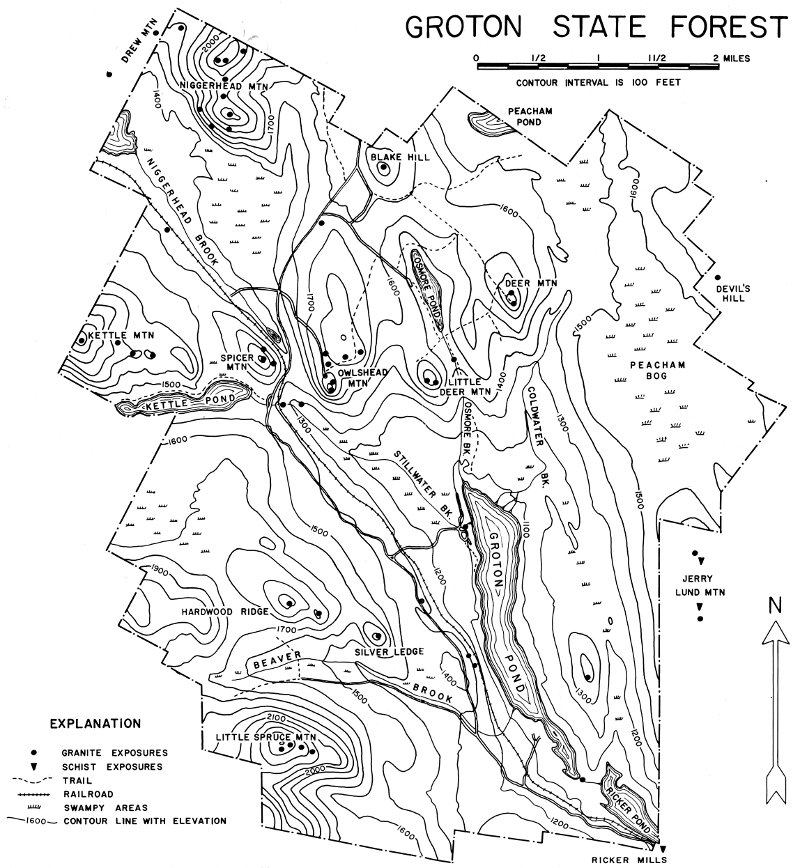
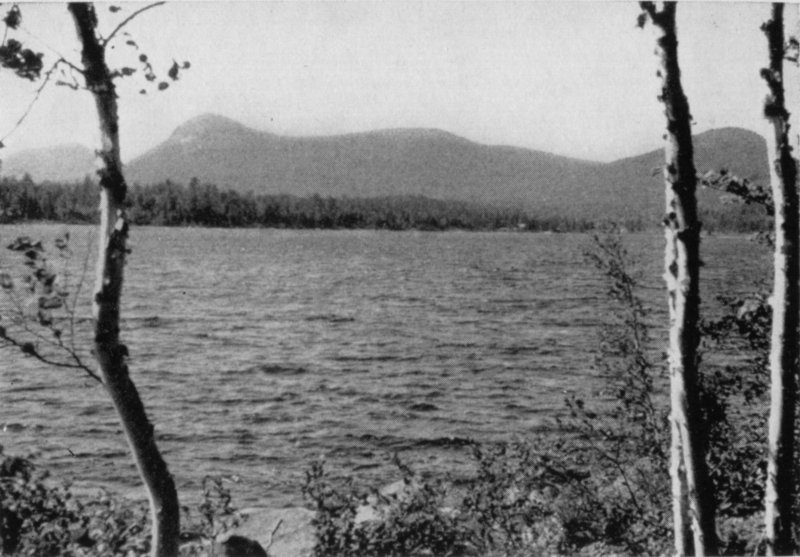
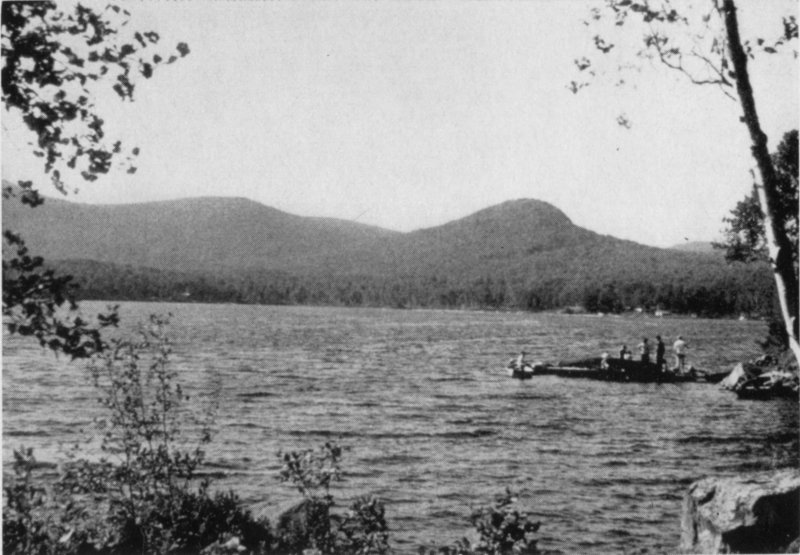
Ledges of light-colored granite occur at the summits of most of the
mountains and hills in the State Forest area and are found occasionally
at lower elevations. They are conspicuous on Owlshead, Silver Ledge,
Little Deer, Big Deer, Niggerhead and Spicer Mountains; smaller ledges
also occur on Kettle, and Little Spruce mountains, Hardwood Ridge and
the low hills east of Groton Pond. At lower elevations, granite is found
at the outlet of Groton Pond, along the railroad tracks west of Groton
Pond and at Stillwater Brook, along Osmore brook and at several other
minor locations. These locations are shown diagrammatically on the
map by a black dot. These dots indicate where the granite occurs but
nothing about the extent of the exposure. If every location of exposed
rock were marked with a dot, certain parts of the map, for instance, the
west side of Niggerhead, would be solid black and the contour lines
which show the elevation would be obscured completely.
All these rocks are presumably part of one large mass of granite which
extends deep below the surface of the earth. Most of this body of granite
is hidden by the soil and bouldery glacial deposits, so that its exact areal
extent is not known. It appears likely that it extends to the southwest
to the vicinity of East Barre.
The granite found at Groton State Forest is a gray to white, medium-grained
rock with the mineral grains all about the same size. Surfaces
exposed to weathering are generally darker in color and frequently are
5
covered with scales of dark colored lichen. If the rock is broken to reveal
an unaltered surface close examination will disclose individual mineral
grains of mica, feldspar and quartz. Mica occurs as very small plates
which appear either white or colorless, called muscovite, or as black shiny
plates called biotite. The feldspar, which is the most abundant mineral
in the granite, has a chalky white appearance and may occur as tabular
grains which reflect light from their flat surfaces when held in the proper
position. Quartz, which contains only silicon and oxygen, the two most
common elements in the earth’s crust, is a transparent, glassy mineral
which has no flat surfaces. It may appear gray because one can look down
into the glassy mineral where there is no light source.
A specimen of granite from Owlshead was studied with a microscope
after it had been cut and ground to a thickness of only 0.03 millimeters.
Many minerals, which ordinarily appear to be opaque, are transparent
when ground this thin. By their various optical properties, the different
minerals can be identified and the composition of the rock can be determined.
Figure 1 shows a photograph, taken through a microscope, of one
of these thin sections of granite. By careful examination of the thin
section and by measuring the areal extent of the different minerals
present, the rock was determined to contain, by volume, 35 percent
quartz, 60 percent feldspar (in proportions of 25 percent microcline
feldspar, KAlSi₃O₈ and 35 percent plagioclase feldspar, NaAlSi₃O₈)
and 5 percent mica (in proportions of 4 percent biotite and 1 percent
muscovite). Although it is a member of the granite family, this rock
should, in strict terminology, be called a quartz monzonite rather than a
granite to indicate more precisely the mineral composition. Because of
slight differences in composition, granite from the same body may elsewhere
be correctly called granodiorite, quartz diorite or granite proper,
depending on the relative amounts of the two feldspars and quartz. In
this report these close distinctions have not been made and the rock is
simply called granite.
Two kinds of natural breaks, or cracks, occur in the granite in the
State Forest area. Joints are breaks which occur along plane surfaces and
exfoliation is the name given to the breakage along curved surfaces
related to the exposure of the rock. Granite, as contrasted with other
rocks, is characterized by its uniformity of texture and massiveness, so
that any cracks present are conspicuous.
6
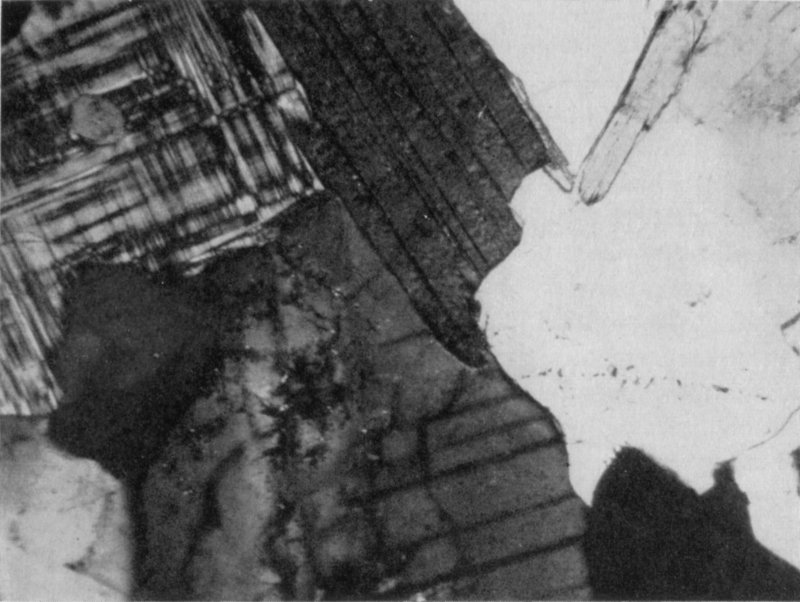
Figure 1. Photomicrograph of a thin section of granite from Owlshead Mountain. The
mineral with the grid pattern (upper left) is a feldspar named microcline which has
the composition of KAlSi₃O₈. The one with the indistinct striped pattern (lower
center) is a feldspar named plagioclase, variety oligoclase, which has the composition
of approximately NaAlSi₃O₈. The patterns for these minerals result from different
portions of the same mineral grain having different orientations, called twinning, so
as to give a different optical appearance. The clear white mineral (right center) is
quartz. The dark gray mineral with the fine lines (upper center) is biotite and the
smaller, lighter-colored, elongate mineral to the right of the biotite is muscovite. The
other minerals are feldspar and quartz in different orientations. The actual diameter
of the clear white quartz grain (right center) is about four-tenths of a millimeter so
that the photograph is a magnification of about one hundred.
Joints are more conspicuous of the two types, and typically belong
to a general system so that at a given location they tend to be parallel.
On top of Owlshead, for example, the most prominent joints trend
N.25°W. (read: North twenty-five degrees to the west) with
dips[2] that
are vertical or dipping steeply to the southwest. Another set of joints
trends N.10°E. with dips that are vertical or dipping steeply to the southwest.
Joints represent the breakage of the rock due to stress and strain.
Some joints result from tensional forces set up within the rock itself by
contraction due to cooling of the originally hot solidified rock. Other
7
joints result from larger-scale forces within the earth’s crust which cause
earthquakes and general movement of land masses. An exhaustive study
of all the rocks in a large area would be required to determine conclusively
the origin of the joints on Owlshead.
In addition to the nearly vertical joints, a third set of nearly horizontal
joints may be observed on cliffs. These joints are called sheeting and apparently
are related to the depth from a former topographic surface
which existed at the time the sheeting originated. The vertical joints and
sheeting are important qualities of a rock to be considered in choosing
a rock for commercial quarrying. Not only do these factors effect the ease
of quarrying, but they also determine the amount of waste material
which would have to be removed and discarded because of poor size and
shape.
Exfoliation is the term for breakage due to the disintegration caused
by decomposition of the rock on surfaces exposed to the weather. It is
characterized by the scaling off of concentric shells of altered rock to
produce a convex surface. Rocks showing exfoliation surfaces are not
common at Groton. One of the best developed exfoliation surfaces, illustrated
in Figure 2, occurs at the base of the cliffs on the south side of
Owlshead Mountain.
Once joints have formed, they are enlarged by weathering. In particular,
rocks are pushed apart by a “frost wedging.” When water freezes it
expands by about one-tenth of its volume. If it is confined it may exert
a pressure of as much as 138 tons per square foot. In this manner, huge
blocks may be pushed apart. If they are at the edge of a cliff, or part of
the cliff itself, they may eventually break off and fall to the slope below.
The accumulation of broken rock at the base of a cliff is called talus.
The granite originated in the interior of the earth many million years
ago as a molten mass, called magma. This magma moved upward
through the earth’s crust by a process of melting the pre-existing rock
or by forcefully pushing it aside. When it reached its present position it
became cooler and minerals began to crystallize out. However, as is
shown in Figure 3, it is important to understand that the surface of the
land was not in its present position and that the magma actually cooled
beneath a considerable thickness of other rocks. These overlying rocks,
now gone, acted as an insulator and prevented the magma from cooling
too quickly. If the magma had risen through these rocks and reached
8
their upper surface, it would have formed a lava flow similar to those of
present-day volcanoes and would have cooled much more rapidly. Rocks
formed near the surface are characterized either by being fine-grained
without visible crystals or by having a few large crystals in a fine-grained
matrix; they never have a uniformly, medium-to-coarse-grained texture.
Thus, the texture of the granite at Groton State Forest proves that it
cooled slowly and indicates that, at the time of cooling, the granite was
not at the surface. This is a reasonable postulation because studies of
the regional geology indicate that a large amount of rock has been
removed from this area by erosion through the long periods of geologic
time.
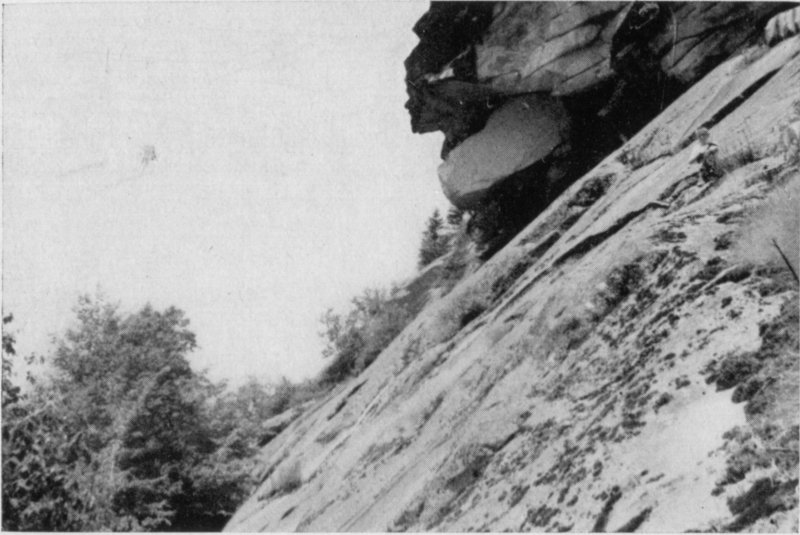
Figure 2. Exfoliation surface on the south side of Owlshead Mountain. Joints, of the
sheeting type, are visible in the granite cliff. The decomposition of the granite by
weathering in the niches has resulted in small patches of soil. The boy in the upper
right gives the scale.
9
Figure 3. Sequence of events at Groton State Forest shown diagrammatically.
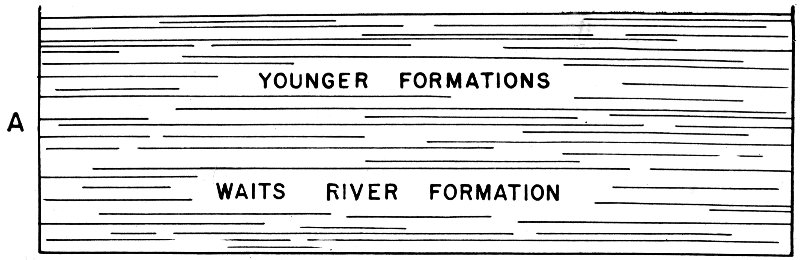
A. The Waits River Formation and other younger formations are deposited from a
shallow sea during Ordovician time.
- YOUNGER FORMATIONS
- WAITS RIVER FORMATION
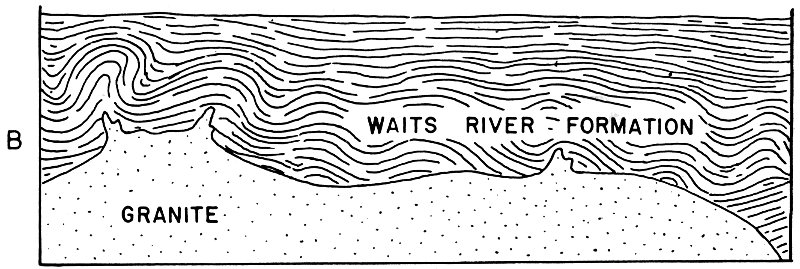
B. The sedimentary rocks are folded and metamorphosed and the granite is intruded
into the older rocks and crystallizes during Devonian time.
- WAITS RIVER FORMATION
- GRANITE
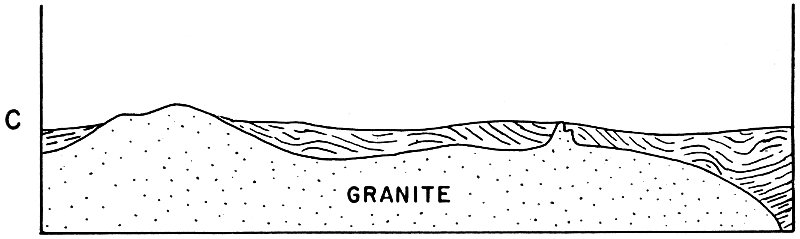
C. Erosion removes much of the rock from the area.
- GRANITE
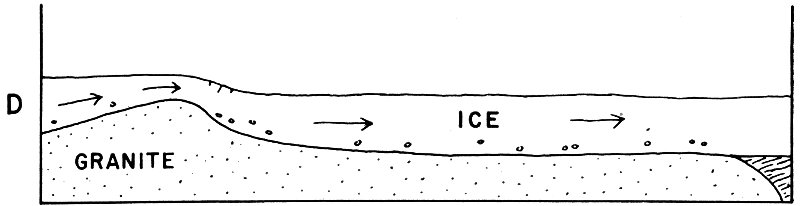
D. During the ice age, continental glaciers move over the land and erosion by the ice
forms Owlshead Mountain and the basin for Groton Pond.
- ICE
- GRANITE
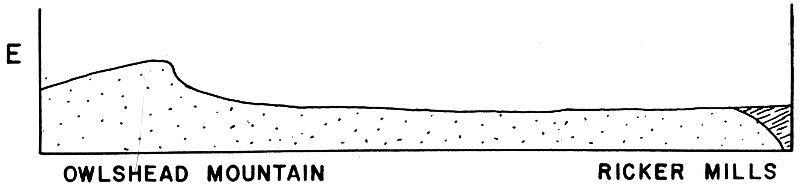
E. Present topography, exaggerated.
- OWLSHEAD MOUNTAIN
- RICKER MILLS
10
Evidence that the granite was emplaced into the older rocks of the
earth’s crust can be seen at certain locations outside of the State Forest.
At Ricker Mills, for example, narrow bodies of granite can be seen cross
cutting the older rocks. A fuller description of the geology at Ricker
Mills is given in a later section of this report. Another type of evidence
showing that the granite came into older rocks is found in the occurrence
of fragments of older rock incorporated into the granite. These are called
inclusions and represent broken pieces of older rock which were enveloped
by the granite. Inclusions are like peach slices in jello in that the surrounding
material solidified after they were dropped in. Inclusions were
observed in rocks on top of Kettle and Jerry Lund Mountains.
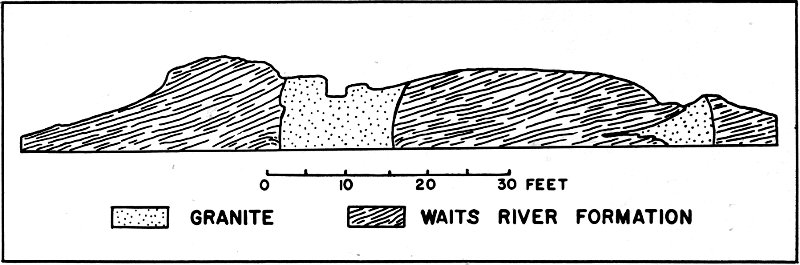
Near the covered picnic shelter at Ricker Pond, one of the large
granite boulders deposited by the glacier contains inclusions. Although
this boulder has been moved from its original occurrence, it probably
has not moved far as it is composed of the white granite which is typical
of the area. It is cut by several pegmatitic dikes. The most interesting
feature is the occurrence of inclusions of elongate, layered bands of older
rocks of gray to dark gray schist.[3]
These relations are shown in the sketch
of this boulder in Figure 4. A careful examination of the schist inclusions
reveals that they contain small plates of biotite in a fine matrix of quartz
and more mica. The contact between the schist and granite is gradational
at places because when the rock was formed the hot molten granite was
in the process of melting the solid schist. The schist resembles the rock
which occurred in this area before the granite was intruded and which
occurs in nearby areas where no granite is exposed. Older rocks of somewhat
similar appearance can be seen at Ricker Mills and on top of Jerry
Lund Mountain.
The composition of the granite at Groton State Forest is nearly the
same as that which occurs throughout this region of Vermont. Incomplete
mapping suggests that the granite at Groton is part of a large mass
which extends to the southwest to the vicinity of East Barre. Undoubtedly
all the granitic rocks of this region are related although they
11
are not continuous at the surface. They were all emplaced at about the
same time following a mountain-building episode in which the older
rocks were folded and metamorphosed. On the geologic time scale, the
granites were emplaced near the end of the Devonian period which is
estimated to be more than 300 million years ago.
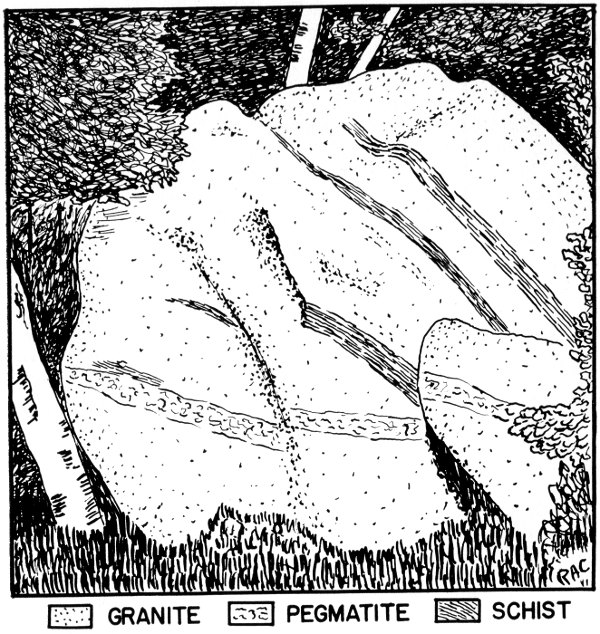
Figure 4. Sketch of boulder of granite containing pegmatite band and schist inclusions
at picnic area at Ricker Pond.
- GRANITE
- PEGMATITE
- SCHIST
Two other types of igneous rocks called aplite and pegmatite occur
sparingly in Groton State Forest. Both of these are productions of
crystallization of residual fluids or late stage magma related to the
granite. These were emplaced along cracks or planes of weakness in the
granite after the granite had solidified. When viewed from the surface
the aplite or pegmatite generally appear as bands cutting through the
granite. However, when the third-dimension is considered it is easily
realized that they are tabular or sheet-like in shape. Igneous rock masses
having these dimensions are called dikes. At Groton most of the dikes
are nearly vertical with a thickness ranging from less than an inch to
more than several feet and extending for considerable distances. On
Owlshead, one of these dikes is nearly three feet thick. The extent of
these dikes is not known because they are only partly exposed, in that
they extend beyond the limited areas of rock exposure.
12
- DREW MTN
- NIGGERHEAD MTN
- BLAKE HILL
- NIGGERHEAD BROOK
- KETTLE MTN
- SPICER MTN
- OWLSHEAD MTN
- KETTLE POND
- STILLWATER BK.
- HARDWOOD RIDGE
- BEAVER BROOK
- SILVER LEDGE
- LITTLE SPRUCE MTN
- PEACHAM POND
- DEER MTN
- DEVIL’S HILL
- PEACHAM BOG
- LITTLE DEER MTN
- OSMORE BK.
- COLDWATER BK.
- GROTON POND
- JERRY LUND MTN
- RICKER POND
- RICKER MILLS
- EXPLANATION
- GRANITE EXPOSURES
- SCHIST EXPOSURES
- TRAIL
- RAILROAD
- SWAMPY AREAS
- CONTOUR LINE WITH ELEVATION
- CONTOUR INTERVAL IS 100 FEET
- TOPOGRAPHY FROM U. S. GEOLOGICAL SURVEY MAPS
- BY ROBERT CHRISTMAN
14
The pegmatite dikes are coarse-grained, in some cases consisting of
individual mineral grains as much as two to four inches in diameter. The
mineral composition of the pegmatites is nearly the same as the granite,
except that biotite is usually absent. Because of their larger grain size,
the minerals can be recognized more easily in pegmatites than in either
granite or aplite. Quartz is glassy and breaks with smooth curved fractures.
Feldspar is chalky white, or pink, and may occur as tabular crystals
with straight-line contacts. It tends to break along definite intersecting
planes which can be seen in their reflecting position. Muscovite occurs as
“books” of semi-transparent leaves. The large “books” of muscovite are
particularly interesting because of the fascinating fact that a mineral
sheet can be split along a given planar direction into thinner and thinner
sheets until they are too thin to handle. Theoretically the mineral might
be split into sheets only as thick as one layer of atoms. The ability of a
mineral to break along definite planes is related to its atomic structure
and is called cleavage. The cleavage in mica is perfect, whereas the
cleavage in feldspar is only poorly developed, and quartz does not possess
cleavage at all.
The aplite dikes are composed of nearly the same minerals as granite
except that the average grain size is smaller. They are characterized by
the absence of dark minerals and muscovite and by a high quartz content
which gives the rock a “sugary” appearance. Most of the aplite dikes are
less than six inches thick.
Inasmuch as the pegmatite and aplite dikes both cut through the
granite, they both must be younger in age than the granite. As is shown
by the relations between these two types on Owlshead (reproduced in
Figure 5), the pegmatite dike is younger because it cuts across the aplite
dike. This is the general age relationship for these dikes in this age.
15
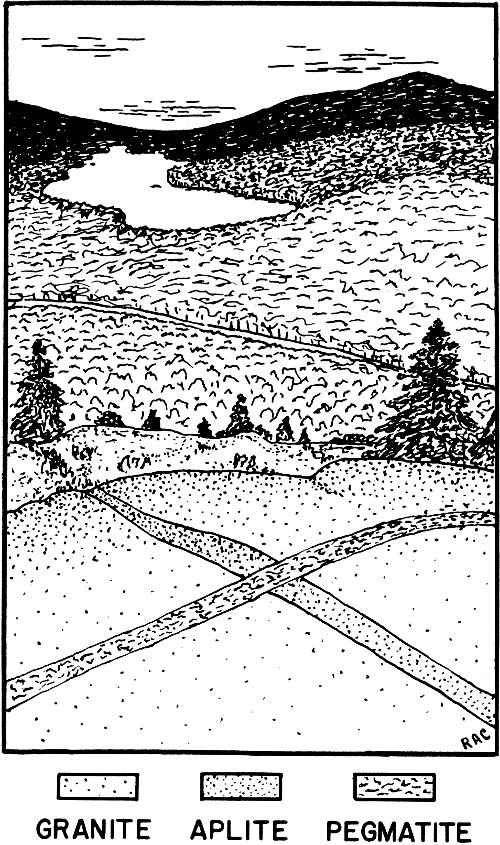
Figure 5. Sketch showing aplite and pegmatite dikes in the granite on Owlshead
Mountain. The cross cutting relations show that the pegmatite is youngest and that
aplite is younger than the granite but older than the pegmatite. In the distance is
Kettle Pond and Kettle Mountain.
- GRANITE
- APLITE
- PEGMATITE
16