The following classification is based on the gradual evolution of the
fruit from a cone symmetrical in form, parenchymatous in tissue,
indehiscent and deciduous at maturity, releasing its wingless seed by
disintegration—to a cone oblique in form, very strong and durable in
tissue, persistent on the tree, intermittently dehiscent, releasing its
winged seeds partly at maturity, partly at indefinite intervals during
several years. This evolution embraces two extreme forms of fruit, one
the most primitive, the other the most elaborate, among Conifers.
Two sections of the genus, Soft and Hard Pines, are distinguished by
several correlated characters, and moreover are distinct by obvious
differences in the tissues of their cones as well as in the quality and
appearance of their wood.
With the Soft Pines the species group naturally under two subsections on
the position of the umbo, the anatomy of the wood and the armature of
the conelet. In one subsection (Cembra) are found three species, P.
cembra and its allies, with the cone-tissues so completely
parenchymatous that the cones cannot release the seeds except by
disintegration. In both subsections there is a gradual evolution from a
wingless nut to one with an effective wing, adnate in one subsection,
adnate and articulate in the other. The different stages of this
evolution are so distinct that the Soft Pines are easily separated into
definite groups.
Among the Hard Pines a few species show characters that are peculiar to
the Soft Pines. These exceptional species form a subsection
(Parapinaster) by themselves.
With the remaining species, the majority of the Pines, the distinctions
that obtain among Soft Pines have disappeared. The dorsal umbo, the
articulate seed-wing, the persistent fascicle-sheath, the dorsal and
ventral stomata of the leaf and its serrate margins, the dentate walls
of the ray-tracheids have become fixed and constant. But a new form of
seed-wing appears, with a thickened blade, assuming such proportions in
P. Sabiniana and its two allies that these three constitute a distinct
group, remarkable also for the size of its cones.
Here also appear a new form of fruit, the oblique cone, and a new method
of dissemination, the serotinous cone. Associated with the latter are
the persistent cone and the multinodal spring-shoot. These characters do
not develop in such perfect sequence and regularity that they can be
employed for grouping the species without forcing some of them into
unnatural association. The oblique cone first appears sporadically here
and there and without obvious reason. The persistent cone, the first
stage of the serotinous cone, is equally sporadic in the earlier stages
of evolution. The same may be said of the multinodal shoot.
Nevertheless these characters show an obvious progression toward a
definite goal, where they are all united in a small group of species
remarkable for the form and texture of their cones, for a peculiar
seed-release and for the vigor and rapidity of their growth. It is
possible, with the assistance of other characters, to segregate these
species in three groups in which the affinities are respected and the
general trend of their evolution is preserved.
The first group, the Lariciones, contains species with large ray-pits,
cones dehiscent at maturity, and uninodal spring-shoots. They are, with
two exceptions, P. resinosa and P. tropicalis, Old World species.
The second group, the Australes, contains species with small ray-pits,
cones dehiscent at maturity and spring-shoots gradually changing, among
the species, from a uninodal to a multinodal form. They are, without
exception, species of the New World.
The third group, the Insignes, contains the serotinous species. The
ray-pits are small and the spring-shoots are, with two exceptions,
multinodal. With two exceptions, P. halepensis and P. pinaster, they are
New World species.
These three groups, being the progressive sequence of a lineal
evolution, are not absolutely circumscribed, but are more or less
connected through a few intermediate species of each group. The
systematic position of these intermediate species is determined by their
obvious affinities. It cannot be expected that the variations, which
take an important part in the evolution of the species, progress with
equal step or in perfect correlation with each other.
As to specific determinations, a little experience in the field
discloses an amount of variation in species that does not always appear
in the descriptions of authors; and species that are under the closest
scrutiny of botanists, foresters or horticulturalists, attest by their
multiple synonymy their wide variation. The possibilities of variation
are indefinite and, with adaptable Pines, the range of variation is
somewhat proportionate to change of climate. In mountainous countries,
where there are warm sheltered valleys with rich soil below cold barren
ledges, the most variable Pines are found. The western species of North
America, for instance, are much more variable than the eastern species,
while in Mexico, a tropical country with snow-capped mountains, the
variation is greatest.
Therefore in the limitation of species undue importance should not be
given to characters responsive to environment, such as the dimensions of
leaf or cone, the number of leaves in the fascicle, etc. Moreover, there
are familiar examples (P. sylvestris, etc.) that show the possibility of
wide differences in the cone of the same species.
In the following classification species only are considered without
attempting to determine varietal or other subspecific forms. But
varieties are often mentioned as one of the factors illustrating the
scope of species. Synonymy serves a like purpose, but synonyms not
conveying useful information are omitted, Roezl's list of Mexican
species, for instance, and variations in the orthography of specific
names.
- 1755 Pinus Duhamel, Traité des Arbres, ii. 121.
- 1790 Apinus Necker, Elem. Bot. iii. 269.
- 1852 Cembra Opiz, Seznam, 27.
- 1854 Strobus Opiz, Lotos, iv. 94.
- 1903 Caryopitys Small, Fl. Southeast. U. S. 29.
Leaves and shoots dimorphous, primary leaves on long shoots, secondary
leaves on dwarf shoots. Flowers diclinous, the pistillate taking the
place of long shoots, the staminate taking the place of dwarf shoots.
Growth of wood and fruit emanating from the nodes; buds, branchlets and
cones, therefore, in verticillate association. Leaves and staminate
flowers in internodal position, the primary leaves along the whole
length of the internode, subtending secondary leaf-fascicles on the
apical, staminate flowers on the basal part. Buds compounded of minute
buds in the axils of bud-scales, becoming the bracts of the
spring-shoot. Branchlets of one or more internodes, each internode in
three parts—a length without leaves, a length bearing leaves and a node
of buds. Cone requiring two, rarely three years to mature, displaying
its annual growths by distinct areas on each scale. Seeds wingless or
winged, edible and nutritious.
The Pines are confined to the northern hemisphere, but grow in all
climates and under all conditions of soil, temperature and humidity
where trees can grow. Some of the species are of very restricted range,
but others are adaptable and can cover wide areas. The sixty-six species
are distributed as follows—
Eastern Hemisphere, 23.
- 1 exclusively African (Canary Islands).
- 2 exclusively European.
- 3 about the Mediterranean Basin.
- 2 common to Europe and northern Asia.
- 14 exclusively Asiatic.
Western Hemisphere, 43.
- 28 in western North America, of which 12 are confined to Mexico and Central America.
- 15 in eastern North America, of which 2 are exclusively West Indian.
The two sections of the genus correspond with those of Koehne (Deutsch.
Dendrol. 28 [1893]) and his two names, Haploxylon and Diploxylon, are
adopted here, together with his two subsections of Haploxylon, Cembra
and Paracembra.
Of the two subsections of Diploxylon, Pinaster has been employed by
Endlicher (Syn. Conif. 166 [1847]) and later authors for smaller or
larger groups of Hard Pines. The subsection Parapinaster is now
proposed.
The names of groups, Cembrae, Strobi, Cembroides, Gerardianae,
Balfourianae, Pineae, Lariciones and Australes, are taken from
Engelmann's Revision of the Genus Pinus (Trans. Acad. Sci. St. Louis,
iv. 175-178 [1880]). The remainder, Flexiles, Leiophyllae, Longifoliae,
Insignes and Macrocarpae, are here proposed.
In order to bring the illustrations within the limits of the page the
dimensions of cone and leaf, as shown on the plates, are a little
smaller than life. In plates X and XXV the reproductions of the cones
are reduced to 2/5 life-size.
| Bases of the fascicle-bracts non-decurrent | A—HAPLOXYLON |
| | |
| Umbo of the cone-scale terminal | a—Cembra |
| Seeds wingless. | |
| Cones indehiscent | I. Cembrae |
| Cones dehiscent | II. Flexiles |
| Seed with an adnate wing | III. Strobi |
| | |
| Umbo of the cone-scale dorsal | b—Paracembra |
| Seeds wingless | IV. Cembroides |
| Seed-wing short, ineffective | V. Gerardianae |
| Seed-wing long, effective | VI. Balfourianae |
| | |
| Bases of the fascicle-bracts decurrent | B—DIPLOXYLON |
| | |
| Fascicle-sheath or seed of Haploxylon | c—Parapinaster |
| Fascicle-sheath deciduous | VII. Leiophyllae |
| Fascicle-sheath persistent. | |
| Seed-wing of the Strobi | VIII. Longifoliae |
| Seed-wing of the Gerardianae | IX. Pineae |
| | |
| Fascicle-sheath persistent, seed-wing articulate, effective | d—Pinaster |
| Base of wing-blade thin or slightly thickened. | |
| Cones dehiscent at maturity. | |
| Pits of ray-cells large | X. Lariciones |
| Pits of ray-cells small | XI. Australes |
| Cones serotinous, pits of ray-cells small | XII. Insignes |
| Base of wing-blade very thick | XIII. Macrocarpae |
Bases of the bracts subtending leaf-fascicles not decurrent. Staminate
flowers not sufficiently developed in the bud to be apparent.
Spring-shoots uninodal. Fibro-vascular bundle of the leaf single. Cone
symmetrical, of relatively fewer larger scales, its tissues softer.
Bark-formation late, the trunks of young trees smooth. Wood soft and
with little resin, of uniform color and with relatively obscure
definition of the annual rings. Tracheids of the medullary rays with
smooth walls.
All the species of this section, except P. Nelsonii, have deciduous
fascicle-sheaths. There are but two species of Diploxylon with
deciduous sheaths, P. leiophylla and P. Lumholtzii, both of them
easily recognized. The deciduous sheath, therefore, is an obvious and
useful means for recognizing the Soft Pines. On the characters of the
fruit and the wood Haploxylon can be divided into two subsections.
| a. Cembra | Umbo of the cone-scale terminal. |
| b. Paracembra | Umbo of the cone-scale dorsal. |
Umbo of the cone-scale terminal. Scales of the conelet unarmed. Leaves
in fascicles of 5, the sheath deciduous, the two dermal tissues
distinct, the hypoderm-cells uniform. Pits of the cells of the wood-rays
large.
| Seeds wingless. | |
| Cones indehiscent | I. Cembrae. |
| Cones dehiscent | II. Flexiles. |
| Seeds with an adnate wing | III. Strobi. |
I. CEMBRAE
Seeds wingless. Cones indehiscent, deciduous at maturity.
In this group of species there is no segregation of sclerenchyma into
an effective tissue. The cones are inert under hygrometric changes and
may always be recognized in herbaria by their persistent occlusion and
soft tissues. The seeds are released only by the disintegration of the
fallen cone. There is, however, a vicarious dissemination by predatory
crows (genus Nucifraga) and rodents.
| Leaves serrulate, their stomata ventral only. | |
| Cones relatively larger, the apophyses protuberant | 1. koraiensis. |
| Cones relatively smaller, the apophyses appressed | 2. cembra. |
| Leaves entire, their stomata ventral and dorsal | 3. albicaulis. |
1. PINUS KORAIENSIS
- 1784 P. strobus Thunberg, Fl. Jap. 275 (not Linnaeus).
- 1842 P. koraiensis Siebold & Zuccarini, Fl. Jap. ii. 38.
- 1857 P. mandschurica Ruprecht in Bull. Acad. Sci. St. Pétersb. xv. 382.
Spring-shoots more or less densely tomentose. Leaves from 8 to 12 cm.
long, serrulate, stomata ventral only, resin-ducts medial and confined
to the angles. Conelets large, subterminal, or on young trees often
pseudolateral. Cones indehiscent, from 9 to 14 cm. long,
short-pedunculate, ovoid-conical or subcylindrical; apophyses dull pale
nut-brown, rugose, shrinking much in drying and exposing the seeds,
prolonged and tapering to a more or less reflexed tip, the umbo
inconspicuous; seeds large, wingless, the spermoderm entire.
A species of the mountains of northeastern Asia with valuable wood and
large edible nuts; hardy and often cultivated in cool-temperate
climates.
The P. koraiensis of Beissner (in Nuov. Giorn. Bot. Ital. n. ser. iv.
184) and of Masters (in Gard. Chron. ser. 3, xxxiii. 34, ff.) are P.
Armandi and have led to an erroneous extension of the range of this
species into Shensi and Hupeh. In the original description of the
species the authors call attention to an error in the plate, where a
cone of another species has been substituted.
P. koraiensis resembles P. cembra in leaf and branchlet but not in the
cone. It is often confused with P. Armandi, but can easily be
distinguished by its tomentose branchlets, indehiscent cone and
peculiar seed. The two species, moreover, do not always agree in the
position of the foliar resin-ducts.
Fig. 85, Cone and seed. Fig. 86, Leaf-fascicle and magnified
leaf-section.
2. PINUS CEMBRA
- 1753 P. cembra Linnaeus, Sp. Pl. 1000.
- 1778 P. montana Lamarck, Fl. Franç. iii. 651 (not Miller).
- 1858 P. pumila Regel in Index Sem. Hort. Petrop. 23.
- 1884 P. mandschurica Lawson, Pinet. Brit. i. 61, ff. (not Ruprecht).
- 1906 P. sibirica Mayr, Fremdl. Wald- & Parkb. 388.
- 1913 P. coronans Litvinof in Trav. Mus. Bot. Acad. St. Pétersb. xi. 23, f.
Spring-shoots densely tomentose. Leaves from 5 to 12 cm. long,
serrulate; stomata ventral only; resin-ducts medial or, in the dwarf
form, often external. Conelets short-pedunculate, purple during their
second season. Cone from 5 to 8 cm. long, ovate or subglobose,
subsessile; apophyses dull nut-brown, thick, slightly convex, the margin
often a little reflexed, the umbo inconspicuous; seeds wingless, large,
the dorsal spermoderm adnate partly to the nut, partly to the
cone-scale, the ventral spermoderm wanting.
The Swiss Stone Pine attains a height of 15 or 25 metres and occupies
two distinct areas, the Alps, from Savoy to the Carpathians at high
altitudes, and the plains and mountain-slopes throughout the vast area
from northeastern Russia through Siberia. Beyond the Lena and Lake
Baikal it becomes a dwarf (var. pumila) with its eastern limit in
northern Nippon and in Kamchatka. It is successfully cultivated in the
cool-temperate climates of Europe and America. The wood is of even,
close grain, peculiarly adapted to carving. The nuts are gathered for
food and confections, but are destroyed in great numbers by squirrels,
mice and a jay-like crow, the European Nutcracker. It is generally
conceded, however, that these enemies assist in dissemination.
Fig. 87, Cone, seed and magnified leaf-section. Fig. 88, Tree at
Arolla, Switzerland. Fig. 89, Cone, leaf-fascicle and magnified
leaf-section of var. pumila.
3. PINUS ALBICAULIS
- 1853 P. flexilis Balfour in Bot. Exped. Oregon, 1, f. (not James).
- 1857 P. cembroides Newberry in Pacif. R. R. Rep. vi-3, 44, f. (not Zuccarini).
- 1863 P. albicaulis Engelmann in Trans. Acad. Sci. St. Louis, ii. 209.
- 1867 P. shasta Carrière, Trait. Conif. ed. 2, 390.
Spring-shoots glabrous or pubescent. Branchlets pliant and tough. Leaves
from 4 to 7 cm. long, entire, stout, persistent for several years;
stomata dorsal and ventral; resin-ducts external. Conelets
short-pedunculate, dark purple during the second season, their scales
often tapering to an acute apex. Cones from 5 to 7 cm. long, subsessile,
oval or subglobose; apophyses nut-brown or fulvous brown, dull or
slightly lustrous, very thick, the under surface conspicuous, meeting
the upper surface in an acute margin, and terminated by a salient,
often acute umbo; seed wingless, the testa bare of spermoderm.
This species ranges from British Columbia through Washington and
Oregon, over the mountains of northern California and the Sierras as
far south as Mt. Whitney, and, on the Rocky Mountains, through Idaho
and Montana to northern Wyoming. It is found at the timber-line of
many stations and forms, in exposed situations, flat table-like masses
close to the ground. It is a species of no economical importance and
is too inaccessible for the profitable gathering of its large nuts,
which are devoured in quantity by squirrels and by Clark's crow, a
bird of the same genus with the pinivorous Nutcracker of Europe.
P. albicaulis is distinguished from its allies by its entire leaves
with both dorsal and ventral stomata, from P. flexilis by its
indehiscent cone, and from all of these species by its seed without
membranous cover or rudimentary wing. It was united with P. flexilis
by Parlatore and Gordon, and, later, was referred to that species as a
varietal form by Engelmann (in Brewer & Watson, Bot. Calif. ii. 124).
Parrish's P. albicaulis (in Zoe, iv. 350), extending its range to the
mountains of southern California, proves to be P. flexilis (Jepson,
Silva Calif. 74).
Fig. 90, Two cones and seed. Fig. 91, Leaf-fascicle. Fig. 92,
Magnified leaf-section.
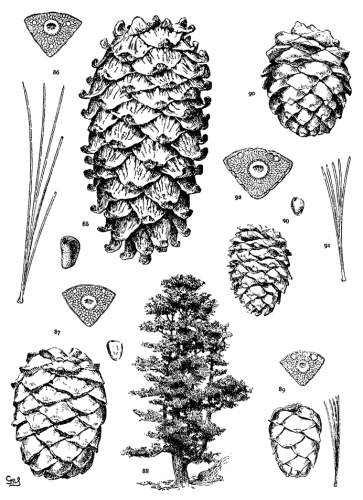 PLATE VIII. P. KORAIENSIS (85, 86), CEMBRA (87-89),
ALBICAULIS (90-92)
PLATE VIII. P. KORAIENSIS (85, 86), CEMBRA (87-89),
ALBICAULIS (90-92)
II. FLEXILES
Seeds wingless, the spermoderm forming a narrow border with a
rudimentary prolongation. Cones dehiscent at maturity.
The dehiscent cone distinguishes this group from the Cembrae.
Therefore confusion of P. koraiensis with P. Armandi, or P. albicaulis
with P. flexilis should be impossible. The peculiar seed is found
again only in the northern variety of P. ayacahuite.
| Leaves usually entire, the stomata dorsal and ventral | 4. flexilis. |
| Leaves serrulate, the stomata ventral only | 5. Armandi. |
4. PINUS FLEXILIS
- 1823 P. flexilis James in Long's Exped. ii. 34.
- 1882 P. reflexa Engelmann in Bot. Gaz. vii. 4.
- 1897 P. strobiformis Sargent, Silva N. Am. xi. 33, tt. 544, 545 (not Engelmann).
Spring-shoots pubescent; branchlets very tough and pliant. Leaves from 3
to 9 cm. long, entire, or serrulate in the southern variety, persistent
for five or six years; stomata dorsal and ventral or, in the south,
sometimes ventral only; resin-ducts external. Cones from 6 to 25 cm.
long, ovate or subcylindrical, short-pedunculate; apophyses pale tawny
yellow, or yellow ochre, lustrous, often prolonged and more or less
reflexed, thick, the margin together with the umbo raised above the
surface of the cone.
This species grows on the Rocky Mountains from Alberta in the Dominion
of Canada to Chihuahua in northern Mexico and ranges westward to the
eastern slope of the Sierras and to the southern mountains of
California. The wood, where accessible, is manufactured into lumber.
It may be seen in the Arnold Arboretum and in the Royal Gardens at
Kew.
P. flexilis is recognized by its lustrous yellow cones. This and the
constantly external ducts of its usually entire leaves distinguish it
from P. Armandi. From P. albicaulis, with similar leaves, it differs
by its dehiscent cone. At one extreme the cone of P. flexilis is not
unlike that of P. albicaulis, at the other extreme it approaches the
characteristic cone of P. ayacahuite, with prolonged reflexed scales.
Hence the confusion of P. albicaulis with P. flexilis (Murray,
Parlatore and others) and of P. flexilis with Engelmann's P.
strobiformis. Sargent's P. strobiformis, illustrated in the Silva of
North America, is the form of this species known as var. reflexa of
Engelmann.
Fig. 93, Two cones and seed. Fig. 94, Leaf-fascicle. Fig. 95,
Magnified leaf-section.
5. PINUS ARMANDI
- 1884 P. Armandi Franchet in Nouv. Arch. Mus. Paris, sér. 2, vii. 95, 96, t. 12.
- 1898 P. scipioniformis Masters in Bull. Herb. Boiss. vi. 270.
- 1903 P. koraiensis Masters in Gard. Chron. ser. 3, xxxiii. 34, ff. 18, 19 (not Siebold & Zuccarini).
- 1908 P. Mastersiana Hayata in Gard. Chron. ser. 3, xliii, 194.
Spring-shoots glabrous; branches and most of the trunk covered with a
smooth gray cortex. Leaves from 8 to 15 cm. long, serrulate; stomata
ventral only; resin-ducts external, external and medial, or medial, all
three conditions sometimes occurring in leaves of the same branchlet.
Cones from 6 to 20 cm. in length, pendent on peduncles of various
lengths, the peduncle often remaining on the tree after the fall of the
cone; apophyses fulvous brown, dull or sublustrous, the margin rounded
or tapering to an acute apex, sometimes a little prolonged and reflexed,
the umbo inconspicuous.
A tree of the mountains of central, southern and western China with an
outlying station on the Island of Formosa. Recently planted in Europe
and America, it has so far proved hardy. The nuts are gathered for
food and some use is made of the wood.
The glabrous shoots of P. Armandi distinguish it from P. flexilis and
P. koraiensis. From the latter it is also distinct in its dehiscent
cone and in its seed. The section of its leaf, with dorsal ducts often
in two positions, is peculiar to this species among Soft Pines.
Fig. 96, Two cones and seed. Fig. 97, Leaf-fascicle. Figs. 98, 99,
Magnified sections of three leaves.
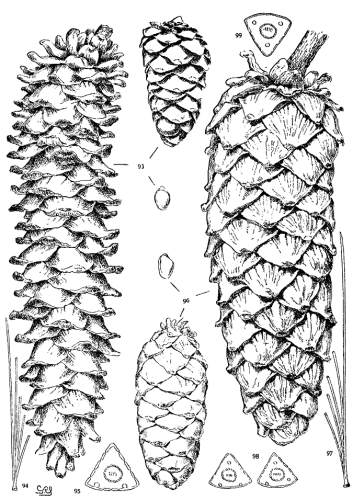 PLATE IX. P. FLEXILIS (93-95), ARMANDI (96-99)
III. STROBI
Seed with a long effective wing adnate to the nut.
The base of the seed-wing corresponds to the marginal spermoderm of the
Flexiles but is prolonged into an effective adnate wing. This form of
wing appears again in the species Balfouriana and in the group
Longifoliae.
| Cones very long, usually exceeding 25 cm. |
| Cone-scales prolonged and reflexed | 6. ayacahuite. |
| Cone-scales appressed | 7. Lambertiana. |
| Cones less than 25 cm. long. |
| Cone-scales prominently convex. |
| Leaves less than 7 cm. long | 8. parviflora. |
| Leaves 9-12 cm. long | 9. peuce. |
| Leaves 12-18 cm. long | 10. excelsa. |
| Cone-scales thin, conforming to the surface of the cone. |
| Cone relatively longer, its phyllotaxis 8/21 | 11. monticola. |
| Cone relatively shorter, its phyllotaxis 5/13 | 12. strobus. |
6. PINUS AYACAHUITE
- 1838 P. ayacahuite Ehrenberg in Linnaea, xii. 492.
- 1848 P. strobiformis Engelmann in Wislizenus, Tour Mex. 102.
- 1857 P. Veitchii Roezl, Cat. Graines Conif. Mex. 32.
- 1858 P. Bonapartea Roezl in Gard. Chron. 358.
- 1858 P. Loudoniana Gordon, Pinet. 230.
Spring-shoots glabrous or pubescent. Leaves from 10 to 20 cm. long,
serrulate, their stomata ventral only, their resin-ducts external, often
numerous. Cones from 25 to 45 cm. long, pendent on long stalks,
subcylindrical or tapering, often curved; apophyses pale nut-brown, dull
or sublustrous, varying much in thickness, prolonged in various degrees,
the prolongations patulous, reflexed, recurved or revolute; seeds of
the southern typical form with a long wing, the wing diminishing and the
nut increasing in relative size northward.
The White Pine of Mexico and Guatemala grows on mountain-slopes and at
the head of ravines. It is not very hardy in cultivation except in the
milder parts of Great Britain and in northern Italy, where the forms
of central and northern Mexico have been very successful. The species
is best recognized by the prolonged apophyses of its large cone.
The variations in the size of the cone and in the prolongations of its
scales are many, but of far more significance is the remarkable
variation of the seed-wing, which is long in the southern part of the
range, short and broad in central Mexico, and rudimentary, like the
seed of P. flexilis, in the north. This makes it possible to establish
two well defined varieties—Veitchii and brachyptera. The three forms
of the species present a gradation from the long effective wing of the
Strobi to the rudimentary form of the Flexiles. Many of the seed-wings
of the var. Veitchii correspond, in their short broad form and opaque
coloring, with the characteristic wing of P. Lambertiana.
Plate X. (leaves and cones much reduced).
Fig. 103, Cone and cone-scale of var. Veitchii. Fig. 104, Cone and
seed of var. brachyptera. Fig. 105, Cone-scale of the typical form.
Figs. 106, 107, Leaf-fascicles and magnified leaf-sections.
7. PINUS LAMBERTIANA
- 1827 P. Lambertiana Douglas in Trans. Linn. Soc. xv. 497.
Spring-shoots pubescent. Leaves from 7 to 10 cm. long, serrulate;
stomata dorsal and ventral; resin-ducts external or with one or two
ventral medial ducts. Cones from 30 to 50 cm. long, pendent,
subcylindrical, tapering to a rounded apex; apophyses pale nut-brown,
thick, a narrow border of the under surface showing on the closed cone,
the margin rounded or tapering to a blunt slightly reflexed tip; seed
with a large nut and a broad short opaque wing.
The Sugar Pine is the tallest of the genus and attains a height of 50
or 60 metres. It grows on mountain slopes and the sides of ravines.
Its southern limit is in Lower California on the plateau of San Pedro
Martir, its northern limit is in western Oregon. The wood is valuable,
its nuts are eaten by native Indians, and the sweet exudation, which
gives the tree its popular name, is a manna-like substance of some
officinal value. P. Lambertiana is recognized by its long cone and by
the constant dorsal stomata of its leaves.
Plate X. (leaves and cone much reduced).
Fig. 100, Cone and seed. Fig. 101, Conelet. Fig. 102, Leaf-fascicle
and magnified leaf-section.
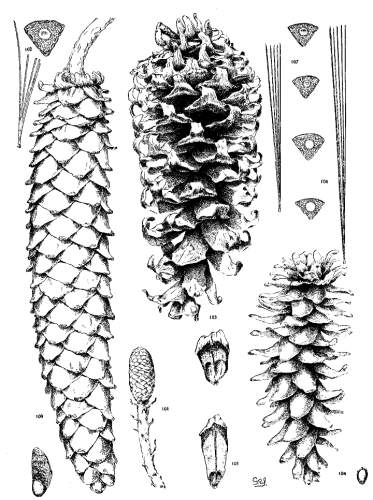 PLATE X. P. LAMBERTIANA (100-102), AYACAHUITE (103-107)
8. PINUS PARVIFLORA
- 1784 P. cembra Thunberg, Fl. Jap. 274. (not Linnaeus).
- 1842 P. parviflora Siebold and Zuccarini, Fl. Jap. ii. 27, t. 115.
- 1890 P. pentaphylla Mayr, Mon. Abiet. Jap. 78, 94, t. 6.
- 1908 P. morrisonicola Hayata in Gard. Chron. ser. 3, xliii. 194.
- 1908 P. formosana Hayata in Jour. Linn. Soc. xxxviii. 297, t. 22.
Spring-shoots pubescent or glabrous; branches becoming studded with
prominent resin-cells of the cortex. Leaves from 3 to 8 cm. long,
slender, serrulate; stomata ventral only; resin-ducts external and
dorsal. Cones subsessile, often persistent, from 5 to 10 cm. long,
patulous or horizontal, short-ovate, or elongate and slightly conical;
apophyses nut-brown, abruptly convex near the apex, or irregularly
warped, varying much in size, the umbo confluent with the thin margin of
the scale and resting on the apophysis beneath; seeds with a large nut
and a short broad wing, often temporarily adherent to the cone-scale and
breaking apart at the fall of the nut.
A tree of the mountains of Japan and Formosa, cultivated extensively.
It is recognized by its very short quinate leaves and by its nearly
sessile cones. The frequent but not invariable retention of the
seed-wing in the cone is due to adhesion. Many seeds fall with their
wings intact, others break away from the wing which, after a while,
loosens and also falls.
Figs. 114, 115, Three cones and seed. Fig. 116, Leaf-fascicle and
magnified leaf-section.
9. PINUS PEUCE
- 1844 P. peuce Grisebach, Spicil. Fl. Rumel. ii. 349.
- 1865 P. excelsa Hooker in Jour. Linn. Soc. viii. 145. (not Wallich).
Spring-shoots glabrous. Leaves from 7 to 10 cm. long, erect, serrulate;
stomata ventral only; resin-ducts external. Connective of pollen-sacs
small and narrow. Cones deciduous, from 8 to 15 cm. long,
subcylindrical, often curved, the peduncle short; apophyses tawny
yellow, prominently and abruptly convex, the umbo against the scale
beneath; seed-wing long.
A tree of the Balkan Mountains, very hardy and bearing abundant fruit
in the gardens of both hemispheres. The cone resembles that of P.
excelsa, but is prevalently much shorter and with a relatively shorter
peduncle. Its leaves are also much shorter and are always erect. A
curious difference is found in the connectives of the pollen-sacs,
small in peuce (fig. 113), large in excelsa (fig. 110). The convexity
of its apophyses distinguishes the cone from those of P. monticola and
P. strobus. Beissner followed Hooker and named this species excelsa,
var. peuce, in the first edition of his Handbuch (1891), but in the
second edition he restored the Balkan Pine to specific standing.
Fig. 111, Cone and seed. Fig. 112, Leaf-fascicle and magnified
leaf-section. Fig. 113, Pollen-sacs and connective magnified.
10. PINUS EXCELSA
- 1824 P. excelsa Wallich ex Lambert, Gen. Pin. ii, 5, t. 3.
- 1845 P. nepalensis De Chambray, Arbr. Résin. 342.
- 1854 P. Griffithii McClelland in Griffith, Notul. Pl. Asiat. iv, 17; Icon. Pl. Asiat. t. 365.
Spring-shoots glabrous. Leaves from 10 to 18 cm. long, drooping,
serrulate; stomata ventral only; resin-ducts external but often with a
medial ventral duct. Connective of the pollen-sacs large. Cones from 15
to 25 cm. long, narrow-cylindrical; apophyses tawny yellow or pale
fulvous brown, prominently convex, the umbo against the apophysis
beneath; seeds with a long wing.
A tree with gray-green drooping foliage, found, with some
interruptions, along the Himalayas. It furnishes resin, tar and wood
of considerable value. It is cultivated in all temperate climates and
is a familiar tree of American and European gardens. Madden states
that the foliage of P. excelsa is sometimes erect and is occasionally
bright green. Such variations are often met in other species of Pinus.
Usually the drooping gray-green foliage and the peculiar cone are
sufficient for the recognition of this species. The not infrequent
presence of a medial duct and the large connective are valuable aids
for identifying it.
Fig. 108, Cone and seed. Fig. 109, Leaf-fascicle and magnified
section of two leaves. Fig. 110, Pollen-sacs and connective
magnified.
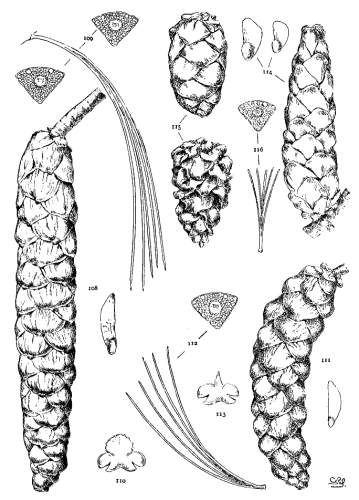 PLATE XI. P. EXCELSA (108-110), PEUCE (111-113),
PARVIFLORA (114-116)
PLATE XI. P. EXCELSA (108-110), PEUCE (111-113),
PARVIFLORA (114-116)
11. PINUS MONTICOLA
- 1837 P. monticola Douglas ex Lambert, Gen. Pin. iii. t.
- 1884 P. porphyrocarpa Lawson, Pinet. Brit. i, 83, ff.
Spring-shouts pubescent. Leaves from 4 to 10 cm. long, serrulate;
stomata ventral or rarely with a few dorsal stomata; resin-ducts
external. Cones from 10 to 25 cm. long, cylindrical or tapering,
sometimes curved; apophyses brown-ochre or fulvous brown, thin, smooth,
conforming to the surface of the cone, the apex sometimes slightly
prolonged and reflexed, the umbo not quite touching the surface of the
scale below.
The western White Pine grows in southern British Columbia and on
Vancouver Island, on the Rocky Mountains of Montana and Idaho, in
Washington, on the Blue Mountains, Cascades and Coast Range of Oregon,
across northern California and along the Sierras to the mountains of
southern California. Where it is abundant and accessible it furnishes
valuable timber. It is hardy in New England and in northern and
central Europe.
It differs from P. strobus in the higher phyllotaxis of its cone, an
obvious difference that may be seen by comparing cones of the two
species of the same length (figs. 117, 119), the number of scales on
the cone of P. monticola being much greater than that on the cone of
P. strobus. Nuttall (Sylva, iii, 118) followed Hooker in considering
it to be a variety of P. strobus.
Fig. 117, Cone and cone-scale. Fig. 118, Leaf-fascicle and magnified
leaf-section.
12. PINUS STROBUS
- 1753 P. strobus Linnaeus, Sp. Pl. 1001.
- 1855 P. nivea Booth ex Carrière, Trait. Conif. 305.
- 1862 P. alba-canadensis Provancher, Fl. Canad. ii. 554.
- 1903 Strobus strobus Small, Fl. Southeast. U. S. 29.
Spring-shoots pubescent. Leaves from 6 to 14 cm. long, serrulate;
stomata ventral only; resin-ducts external. Cones from 8 to 24 cm. long,
narrow cylindrical, sometimes curved; apophyses fulvous brown, or rufous
brown, thin, the smooth or slightly rugose surface conforming to the
general surface of the cone; seed with a long wing.
A valuable timber-tree of singular beauty and rapid growth. The
northern limit of its range extends from Newfoundland to Manitoba; it
grows throughout the northern states from Minnesota to the Atlantic,
and, south of Pennsylvania, along the Appalachians to northern
Georgia. Its tractable and reliable wood, its adaptability to various
soils and climates, its early maturity and stately habit, recommend it
to the forester and gardener.
Mature trees of P. strobus tower above the evergreens associated with
it. It is also recognized by the color and horizontal massing of its
foliage. The cone, when closed, is very narrow; its thin flat scales
distinguish it from the cone of P. peuce, and its phyllotaxis from the
cone of P. monticola. To illustrate the possibilities of variation in
the size of Pine cones, I once collected several in Tamworth, N. H.,
on the estate of Mr. Augustus Hemenway, on the same slope and within
an area of one square kilometre. These cones varied in length from 6
to 24 cm., with all intermediate sizes. Also on each tree were cones
of various lengths, but the longest were confined to two or three
trees among the several hundred examined. Dimensions of leaves also
varied with individual trees; not infrequently the leaves of a tree
were twice the length of those of an adjacent tree. Such variations
appear in many species and in many localities.
Fig. 119, Two cones. Fig. 120, Leaf-fascicle. Fig. 121, Magnified
leaf-section. Fig. 122, Conelets. Fig. 123, A cultivated tree in
Massachusetts.
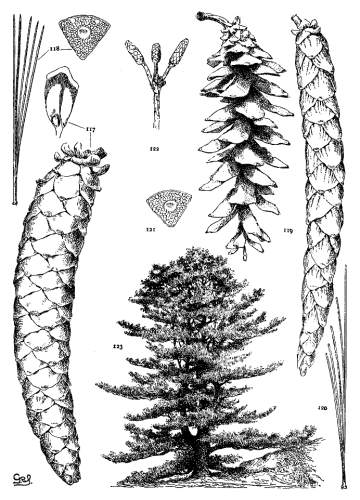 PLATE XII. P. MONTICOLA (117, 118), STROBUS (119-123)
Umbo of the cone-scale dorsal. Scales of the conelet mucronate or
aristate. Epiderm and hypoderm of the leaf similar, appearing as a
single tissue; resin-ducts external. Pits of the ray-cells small.
The wood of this subsection differs from that of other species, except
that of P. pinea, in the Picea-like characters of the medullary
rays—tracheids with smooth walls combined with the thick walls and
small pits of the ray-cells. On the character of the seeds the species
may be divided into three groups.
| Seeds wingless | IV. Cembroides. |
| Seeds with a short, ineffective, articulate wing | V. Gerardianae. |
| Seeds with a long and effective wing | VI. Balfourianae. |
IV. CEMBROIDES
Seeds wingless, the nut large, wholly or partly bare of membranous
cover. Cones varying from yellow-ochre to deep red-orange in color.
These are the Nut Pines, growing on the arid slopes and table-lands
above the great plateau of northern Mexico and its extension into the
southwestern United States. There are three distinct species.
| Leaves entire, the sheath deciduous. | |
| Cones subglobose, subsessile | 13. cembroides. |
| Cones cylindrical, pedunculate | 14. Pinceana. |
| Leaves serrulate, the sheath persistent | 15. Nelsonii. |
13. PINUS CEMBROIDES
- 1832 P. cembroides Zuccarini in Abh. Akad. Münch. i. 392.
- 1838 P. Llaveana Schiede in Linnaea, xii. 488.
- 1845 P. monophylla Torrey in Frémont's Rep. 319, t. 4.
- 1847 P. Fremontiana Endlicher, Syn. Conif. 183.
- 1848 P. edulis Engelmann in Wislizenus, Tour. Mex. 88.
- 1848 P. osteosperma Engelmann in Wislizenus, Tour. Mex. 89.
- 1862 P. Parryana Engelmann in Am. Jour. Sci. ser. 2, xxxiv. 332 (not Gordon).
- 1897 P. quadrifolia Sudworth, Bull. 14, U. S. Dep. Agric. 17.
- 1903 Caryopitys edulus Small, Fl. Southeast. U. S. 29.
Spring-shoots pruinose. Leaves from 2 to 6 cm. long, in fascicles of 1
to 5, the sheath-scales revolute at the apex, then deciduous; stomata
ventral, or ventral and dorsal; resin-ducts external. Scales of the
conelet armed with a minute prickle. Cones from 4 to 6 cm. long,
subglobose, subsessile; apophyses lustrous ochre-yellow, crowned with a
quadrilateral umbo bearing the minute prickle of the conelet; seed
flaxen yellow when fresh, its testa bare, the spermoderm adnate to the
cone-scale.
A broad tree with a round head, similar in size and form, but not in
ramification, to the cultivated Apple-tree; growing on arid slopes and
table-lands. Its eastern limit is in southwestern Wyoming, central
Colorado, Texas, western Tamaulipas and northwestern Vera Cruz. It
ranges over Utah, Nevada, Arizona and the northern states of Mexico to
the southern Sierras of California and to the northern and southern
extremities of Lower California. It is recognized by its small cone,
which expands, when open, into an irregular flat aggregate of loosely
attached scales. The leaves are shorter than those of the other Pines
of this group.
The cone of this species always retains its peculiar character. The
variations are mainly in the number of leaves in the fascicle. On this
character this Nut Pine is divided by many authors into four
species—cembroides, with three slender leaves—edulis, with two stout
leaves—monophylla, with one leaf and—Parryana, with four stout
leaves. But there are intermediate forms that may be either cembroides
or edulis, edulis or monophylla etc., and Voss's reduction of the four
to a single species with three varieties seems to be justified (Mitt.
Deutsch. Dendrol. Ges. xvi. 95).
Fig. 130, Cone, cone-scale and seed. Fig. 131, Open cone. Fig. 132,
Branchlet with leaves and magnified leaf-section.
14. PINUS PINCEANA
- 1846 P. cembroides Gordon in Jour. Hort. Soc. Lond. i. 236, f. (not Zuccarini).
- 1858 P. Pinceana Gordon, Pinet. 204.
- 1882 P. latisquama Engelmann in Gard. Chron. ser. 2, xviii. 712. f. 125 (as to cone only).
Spring-shoots slender, pruinose. Leaves in fascicles of three, the
sheath revolute at the base, then deciduous; stomata ventral, or ventral
and dorsal; resin-ducts external. Scales of the conelet minutely
mucronate. Cones from 6 to 9 cm. long, cylindrical, pendent on long
peduncles; apophyses lustrous ochre-yellow, elevated in the centre,
the umbo usually retaining the small prickle; seed large, bearing on its
dorsal surface remnants of the spermoderm.
A small bushy tree with long slender branchlets, clear gray cortex,
persistently smooth except on the lower part of the trunk, and
glaucous-green foliage. It grows along water-courses, dry in autumn
and winter, from southern Coahuila to central Hidalgo, and is
associated with P. cembroides, from which it may be distinguished by
its longer leaves and much longer cylindrical cone.
Fig. 127, Cone, cone-scale and seed. Fig. 128, Branchlet with
leaves. Fig. 129, Magnified leaf-section.
15. PINUS NELSONII
- 1904 P. Nelsonii Shaw in Gard. Chron. ser. 3, xxxvi. 122, f. 49.
Spring-shoots slender, pruinose; branchlets very pliant and tough,
summer-shoots abundant. Leaves with a persistent sheath, from 6 to 9 cm.
long, united in threes along a portion of their ventral surface into
pseudomonophyllous fascicles, serrulate on the two margins of the dorsal
surface, entire on the ventral margin; stomata dorsal and with one row
along the free portion of each ventral face. Conelets usually, if not
always, pseudolateral by reason of the summer growth of the branchlets,
and attaining in their first season an unusually large size. Cones from
6 to 12 cm. long, on very long stout and curved peduncles, cylindrical,
deciduous by an articulation between the cone and its peduncle, leaving
the latter for several years on the tree; apophyses dark lustrous
orange-red, rugose, elevated along a sharp transverse keel, the umbo
obscurely defined, the mucro usually broken away; nuts large, flaxen
yellow, the spermoderm adnate to the cone-scale.
A small bushy tree with long pliant branches, clear gray cortex all
over the limbs and trunk, and sparse gray-green foliage. It grows,
together with P. cembroides, on the lower slopes of the northeastern
Sierras of Mexico, near the boundary between the states of Tamaulipas
and Nuevo Leon. It is apparently confined to a small area near the
latitude of the city of Victoria, the capital of Tamaulipas, where its
nuts are often exposed for sale.
In many characters this species is unique. It can be recognized at
once by the connate leaves that form the fascicle or by the remarkable
stout curved peduncle of its cone. Such seeds as I have seen differ
from those of P. cembroides by a reddish area at one end, but this can
be seen with fresh seeds only.
Fig. 124, Cone, cone scale and seed. Fig. 125, Branchlet with
leaves. Fig. 126, Magnified section of a leaf-fascicle.
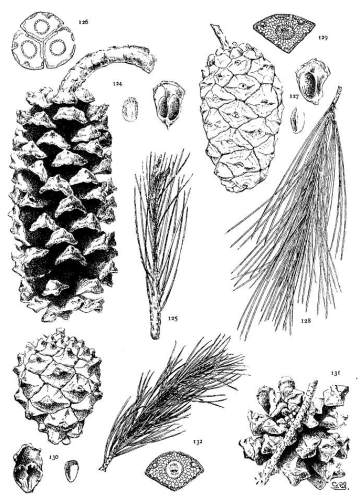 PLATE XIII. P. NELSONII (124-126), PINCEANA (127-129),
CEMBROIDES (130-132)
PLATE XIII. P. NELSONII (124-126), PINCEANA (127-129),
CEMBROIDES (130-132)
V. GERARDIANAE
Seeds with a very short ineffective articulate wing. Leaves in fascicles
of 3, serrulate, the sheath deciduous. Bark exfoliating in large scales,
leaving parti-colored areas.
These Asiatic Nut Pines are alike in leaf and cortex as well as in the
peculiar seed-wing. The last often remains in the cone after the nut
falls. The mechanical nature of this adhesion is apparent in P.
Gerardiana, where the wing adheres not to its own, but to the adjacent
scale. The two species are alike in their leaves but distinct in their
cones and seeds.
| Cones smaller, the nut short-ovate | 16. Bungeana. |
| Cones larger, the nut long-cylindrical | 17. Gerardiana. |
16. PINUS BUNGEANA
- 1847 P. Bungeana Zuccarini ex Endlicher, Syn. Conif. 166.
Spring-shoots glabrous, summer-shoots common on fruiting branches of
young trees. Leaves from 6 to 10 cm. long, serrulate; stomata dorsal and
ventral; resin-ducts external. Conelets subterminal or often
pseudolateral, their scales gradually narrowed into a spine. Cones from
5 to 7 cm. long, short-pedunculate, short-ovate; apophyses dull pale
nut-brown, elevated along a transverse keel, the dark brown umbo forming
a spine with a broad base; seeds with a short loosely attached wing,
sometimes remaining in the cone when the short-ovate nut falls.
A tree cultivated about the temples of China and recently found by
Wilson growing on the mountains of Hupeh. The earlier parti-colored
bark changes to chalky white on old trunks, by which the tree is
recognized from a great distance. The stem of the tree is often
multiple by the vertical growth of some of the lower branches. It is
very hardy and is cultivated in Europe and America, although these
cultivated trees are not yet of sufficient age to show the remarkable
white trunk.
Fig. 138, Cone and cone-scale with adhering wing. Fig. 139, Seed and
wing. Fig. 140, Leaf-fascicle and magnified leaf-section. Fig. 141,
Parti-colored bark. Fig. 142, Tree with white trunk.
17. PINUS GERARDIANA
- 1832 P. Gerardiana Wallich ex Lambert, Gen. Pin. ed. 8vo, ii. t. 79.
Spring-shoots glabrous. Leaves from 6 to 10 cm. long, serrulate; stomata
dorsal and ventral; resin-ducts external. Scales of the conelet armed
with a short spine. Cones from 9 to 15 cm. long, short-pedunculate,
ovoid or oblong; apophyses fulvous brown, very thick, with a prominent
reflexed or erect protuberance culminating in an umbo on which the spine
is more or less persistent; nuts remarkably long, narrow, terete, the
shell fragile, the short wing falling with the nut or adhering to the
adjacent scale.
A tree of the northwestern Himalayas found on the borders of Cashmere
and Thibet and in Kafiristan and north Afghanistan, and so highly
prized for its nuts that it is rarely felled for its wood. It grows in
dry regions and rarely attains a height of 20 metres. Attempts to
cultivate this species, even in the milder parts of Great Britain,
have generally failed.
The apophysis of the cone varies much in prominence (figs. 134, 135),
but the peculiar seed is invariable and quite unlike that of any other
Pine. The general color of the trunk at a distance is silver-gray.
Fig. 133, Cone. Fig. 134, Cone-scale with adhering seed-wing. Fig.
135, Cone-scale of flatter form. Fig. 136, Seed and wing. Fig. 137,
Leaf-fascicle and magnified leaf-section.
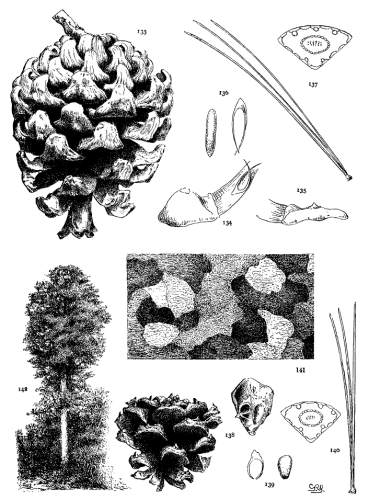 PLATE XIV. P. GERARDIANA (133-137), BUNGEANA (138-142)
VI. BALFOURIANAE
Seeds with long effective wings. Leaves entire, in fascicles of 5, the
sheath deciduous.
The two species known as Foxtail Pines are alike in their short entire
falcate leaves, persisting for many years and forming long dense
foliage-masses. They differ in the armature of their cones and in
their seed-wings. The presence of both adnate and articulate wings in
these closely related species suggests that these two forms of wing
are not fundamentally distinct.
| Cone-scales short-mucronate, the seed-wing adnate | 18. Balfouriana. |
| Cone-scales long-aristate, the seed-wing articulate | 19. aristata. |
18. PINUS BALFOURIANA
- 1853 P. Balfouriana Balfour in Bot. Exp. Oregon, 1, f.
Spring-shoots somewhat puberulent. Leaves from 2 to 4 cm. long,
persistent for many years; stomata ventral only; resin-ducts external.
Scales of the conelet short-mucronate. Cones from 7 to 12 cm. long,
tapering to a rounded apex, short-pedunculate; apophyses dark
terracotta-brown, tumid, the umbo bearing a short recumbent prickle;
seed with a long adnate wing.
An alpine species growing often at the timber-limit. It is found in
two distinct stations in California, on the northern Coast Range and
on the southern Sierras. It is not often cultivated, but young plants
may be seen in the Arnold Arboretum and in the Royal Gardens at Kew.
Fig. 147, Cone, seed and enlarged cone-scale. Fig. 148,
Leaf-fascicle. Fig. 149, Magnified leaf-section. Fig. 150, A branch
with persistent leaves.
19. PINUS ARISTATA
- 1862 P. aristata Engelmann in Am. Jour. Sci. ser. 2, xxxiv. 331.
- 1871 P. Balfouriana Watson in King's Rep. v. 331 (not Balfour).
Spring-shoots glabrous or temporarily pubescent. Leaves from 2 to 4 cm.
long, persistent for many years; stomata ventral only; resin-ducts
external. Scales of the conelet prolonged into long slender bristles.
Cones from 4 to 9 cm. long, subcylindrical or tapering to a rounded
apex, short-pedunculate; apophyses terracotta or purple-brown, tumid,
the long bristles of the umbo often partly or wholly broken away; seeds
with a long articulate wing.
A bushy tree, similar in foliage to the preceding species, growing at
the timber-limit from Colorado through Utah, central and southern
Nevada and northern Arizona into southeastern California, but
separated from the nearest station of P. Balfouriana by an arid
treeless desert. Engelmann (in Brewer and Watson, Bot. Calif. ii. 125)
considered it to be a variety of P. Balfouriana.
Fig. 143, Cone. Fig. 144, Seed and enlarged cone-scale. Fig. 145,
Leaf-fascicle and magnified leaf-section. Fig. 146, Conelet.
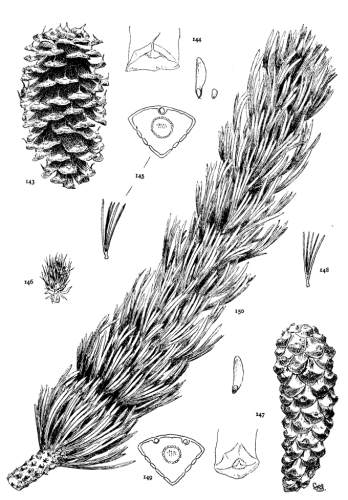 PLATE XV. P. ARISTATA (143-146), BALFOURIANA (147-150)
Bases of the bracts subtending leaf-fascicles decurrent. Leaves
serrulate; fibro-vascular bundle double; stomata dorsal and ventral.
Cones with a dorsal umbo, the phyllotaxis complex. Wood hard, with dark
resinous bands, the annual rings clearly defined.
In this section there are a few species combining the essential
characters of Diploxylon with important characters of Haploxylon. A
subsection, Parapinaster, is established for these exceptional
species.
| c. Parapinaster | Species with the fascicle-sheath or seed-wing of Haploxylon. |
| d. Pinaster | Sheath persistent, seed-wing articulate, effective. |
| Sheath of the leaf-fascicle deciduous | VII. Leiophyllae. |
| Sheath of the leaf-fascicle persistent. | |
| Seed-wing of the Strobi | VIII. Longifoliae. |
| Seed-wing of the Gerardianae | IX. Pineae. |
VII. LEIOPHYLLAE
| Sheath of the leaf-fascicles deciduous. | |
| Leaves short, erect, the fructification triennial | 20. leiophylla. |
| Leaves long, pendent, the fructification biennial | 21. Lumholtzii. |
20. PINUS LEIOPHYLLA
- 1831 P. leiophylla Schlechtendal and Chamisso in Linnaea, vi. 354.
- 1848 P. chihuahuana Engelmann in Wislizenus, Tour. Mex. 103.
Spring-shoots uninodal. Leaves in fascicles of 3, 4 or 5, the sheath
deciduous, from 8 to 14 cm. long; resin-ducts medial with an occasional
internal duct. Conelets single or verticillate, their scales mucronate;
conelets of the second year only slightly enlarged. Cones maturing the
third year, not exceeding 7 cm. in length, ovate or ovate-conic,
subsymmetrical, more or less reflexed, persistent for several years on
some trees, sometimes serotinous; apophyses lighter or darker brown,
often with an olive or fuscous shade, thin or tumid, the umbo double,
the mucro more persistent near the apex of the cone.
This species grows at subtropical or warm-temperate altitudes in
Mexico, from Oaxaca through the central and western states to southern
Arizona and New Mexico. As it approaches the northern part of its
range the leaves become thicker and more rigid and the number in the
fascicle is reduced to 3 or 4 (var. chihuahuana, Shaw, Pines Mex. 14).
Like P. rigida it sprouts freely along the branches and trunk, and
stumps of felled trees put out shoots in great numbers. The species is
easily recognized by the deciduous sheath and triennial cone.
Fig. 151, Branch with fruit of first, second and third years. Fig.
152, Leaf-fascicles. Fig. 153, Magnified leaf-section of the
species. Fig. 154, Magnified leaf-section of the variety.
21. PINUS LUMHOLTZII
- 1894 P. Lumholtzii Robinson & Fernald in Proc. Am. Acad. xxx. 122.
Spring-shoots uninodal, sometimes multinodal. Leaves in fascicles of 3,
the sheath deciduous, from 20 to 30 cm. long, absolutely pendent;
resin-ducts medial and internal. Conelets subterminal, or lateral and
subterminal, mucronate. Cones not exceeding 7 cm. in length,
symmetrical, pendent on slender peduncles, ovate-conic, early deciduous;
apophyses sublustrous, nut-brown, tumid at the margins, flat on the
surface, the umbo large, the mucro rarely persistent.
A remarkable Pine with long pendent bright green foliage, confined to
the western states of Mexico and ranging on the mountains from
southern Jalisco to the latitude of the city of Chihuahua. Each
season's growth of leaves hangs from the branchlet like a long beard,
from which the tree receives, in some localities, the name "Pino barba
caida." In the herbarium the long leaves, deciduous sheaths, and the
decurrent bases of the bracts, present a combination of characters not
found in other species.
Fig. 155, Cone. Fig. 156, Cone. Fig. 157, Leaf-fascicle. Fig. 158,
Magnified leaf-section. Fig. 159, Tree at Ferraria de Tula.
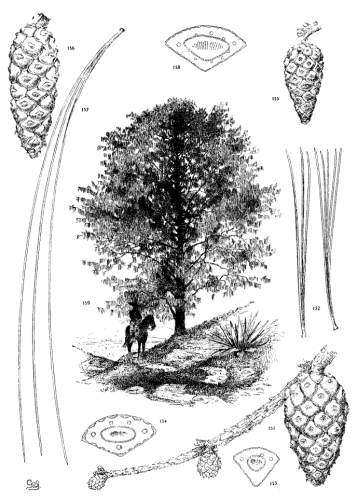 PLATE XVI. P. LEIOPHYLLA (151-154), LUMHOLTZII
(155-159)
PLATE XVI. P. LEIOPHYLLA (151-154), LUMHOLTZII
(155-159)
VIII. LONGIFOLIAE
Seed-wing adnate to the nut. Leaves long, in fascicles of 3, the sheath
persistent.
| Apophysis of the cone prolonged and reflexed | 22. longifolia. |
| Apophysis of the cone low-pyramidal | 23. canariensis. |
22. PINUS LONGIFOLIA
- 1803 P. longifolia Roxburgh ex Lambert, Gen. Pin. i. 29, t. 21.
- 1897 P. Roxburghii Sargent, Silva N. Am. xi. 9.
Spring-shoots uninodal. Leaves in fascicles of 3, the sheath persistent,
from 20 to 30 cm. long; resin-ducts external, the hypoderm often in
large masses, some or all of the endoderm cells with thick outer walls.
Cones from 10 to 17 cm. long, short-pedunculate, ovoid-conic; apophyses
lustrous brown-ochre or fuscous brown, elevated into thick, often
reflexed, beaks with obtuse mutic umbos; seeds with large nuts and
adnate striated dark gray or fuscous brown wings.
Of the three Pines of the Himalayas this species is the most
important. It grows on the outer slopes and foot-hills from Bhotan to
Afghanistan. The wood is used for construction and for the manufacture
of charcoal, the thick soft bark is valuable for tanning, the resin is
abundant and of commercial importance, and the nuts are gathered for
food. The tree is not hardy in cool-temperate climates, but has been
successfully grown in northern Italy.
It differs from P. canariensis in the usually protuberant apophysis of
the cone, in the thick outer walls of the leaf-endoderm and in the
nearly smooth walls of the ray-tracheids of the wood. In the
dimensions of cone and leaf, in the dermal tissues and resin-ducts of
the leaf and in the peculiar coloring of the seed-wing, the two
species are alike.
Fig. 160, Cone. Fig. 161, Leaf-fascicle. Fig. 162, Magnified
leaf-section.
23. PINUS CANARIENSIS
- 1825 P. canariensis Smith in Buch, Canar. Ins. 159.
Spring-shoots uninodal, pruinose. Bud-scales with conspicuously long
free fimbriate margins. Leaves in fascicles of 3, the sheath persistent,
from 20 to 30 cm. long; the hypoderm often in large masses, the
resin-ducts external, the endoderm with thin outer walls. Cones from 10
to 17 cm. long, short-pedunculate, ovoid-conic; apophyses lustrous or
sublustrous nut-brown, more or less pyramidal, the umbo unarmed; seeds
as in the last species.
A species confined to the Canary Islands, but cultivated in northern
Italy. The stately habit of this tree is seen in Schröter's portrait
(Exc. Canar. Ins. t. 15).
Fig. 163, Cone and seed. Fig. 164, Magnified leaf-section. Fig. 165,
Habit of the tree.
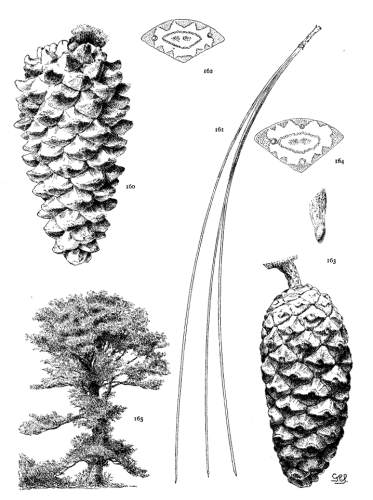 PLATE XVII. P. LONGIFOLIA (160-162), CANARIENSIS
(163-165)
PLATE XVII. P. LONGIFOLIA (160-162), CANARIENSIS
(163-165)
IX. PINEAE
Seed-wing articulate, short, ineffective. Leaves binate, the sheath
persistent. One species only.
24. PINUS PINEA
- 1753 P. pinea Linnaeus, Sp. Pl. 1000.
- 1778 P. sativa Lamarck, Fl. Franç. ii. 200.
- 1854 P. maderiensis Tenore in Ann. Sci. Nat. sér. 4, ii. 379.
Spring-shoots uninodal. Leaves from 12 to 20 cm. long; resin-ducts
external. Conelet mutic, slightly larger in the second year. Cones
triennial, from 10 to 14 cm. long, ovoid or subglobose; apophyses
lustrous nut-brown, convex, of large size, the umbo double; seeds large
with a short, loosely articulated, deciduous wing.
A species of the Mediterranean Basin, from Portugal to Syria. Its
northern limit is in southern France and northern Italy, but it is
cultivated in the southern parts of the British Isles and is a
familiar ornament of park and garden in southern Europe, and is valued
for its peculiar beauty and for its large savory nuts. In wood anatomy
as well as in the seed it agrees with the Gerardianae of the Soft
Pines.
Fig. 166, Fruit of three seasons. Fig. 167, Cone-scales and seed.
Fig. 168, Magnified leaf-section. Fig. 169, Habit of the tree.
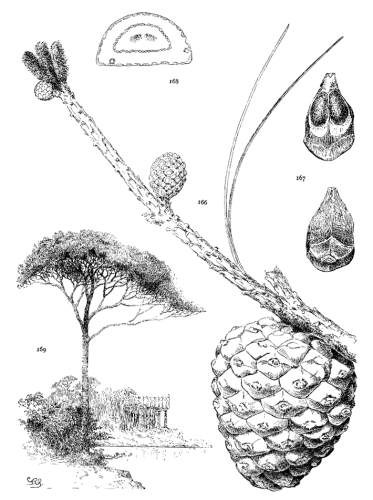 PLATE XVIII. PINUS PINEA
Bases of the bracts subtending leaf-fascicles decurrent. Seeds with an
effective articulate wing. Umbo of the cone-scales dorsal. Leaves
serrulate, stomatiferous on all faces, the sheath persistent. Walls of
the tracheids of the medullary rays dentate.
Forty-two of the sixty-six species of Pinus are included in this
subsection. As a group they are clearly circumscribed by several
correlated characters and are more closely interrelated than the
twenty-four species previously described. The distinctions of umbo and
seed have disappeared. The umbo here is invariably dorsal, the
seed-wing invariably articulate.
New forms, however, are gradually evolved—the seed with a thick
wing-blade, the indurated oblique cone, the serotinous cone with its
intermittent seed-release, and the multinodal spring-shoot. There are,
moreover, new forms of leaf-hypoderm and a new position of the
resin-duct.
Of these new characters, the thick wing-blade attains such proportions
in the three species of the Macrocarpae that they can be grouped
apart. But the characters that finally culminate in a lateral oblique
serotinous cone are so gradually and irregularly developed that they
offer no divisional distinctions. With the aid of wood and leaf
characters, however, groups can be established which preserve the
evolutionary sequence and, at the same time, the obvious affinity of
the species.
| Wing-blade thin or slightly thickened at the base. |
| Cones dehiscent at maturity. |
| Pits of the ray-cells large | X.Lariciones |
| Pits of the ray-cells small | XI.Australes |
| Cones serotinous, pits of the ray-cells small | XII.Insignes |
| Wing-blade very thick | XIII. Macrocarpae |
The species of this subsection are very difficult, if not impossible,
to classify by the usual method, which groups all species under a few
characters assumed to be invariable and of fundamental importance.
Such a method can be successfully applied to the Soft Pines and to
some of the Hard Pines, but cannot be applied to all the Hard Pines
without forcing some of them into unnatural associations.
To take an example, the group Pseudostrobus, characterized by
pentamerous leaf-fascicles, appears in many systems. In this group are
placed P. Torreyana and P. leiophylla. Another group, with trimerous
fascicles, contains P. Sabiniana and P. taeda. Now there are no two
species more obviously related by important peculiarities than P.
Torreyana and P. Sabiniana; nevertheless they are, by this method,
kept apart and associated with species which they resemble in no
important particular.
An attempt is made here to avoid such incongruities. Groups X, XI and
XII represent different stages of evolution. In the Lariciones the
cone is symmetrical, and dehiscent and deciduous at maturity, while
the spring-shoot is uninodal. In the Australes there is a similar
cone, but the spring-shoot gradually becomes multinodal. In the
Insignes the cone is oblique, persistent and serotinous, and the
spring-shoot is multinodal.
These definitions state the degree of evolution attained by each
group, but not all the species of a group conform exactly with its
definition. In each group are species with a characteristic of another
group. Among the Lariciones are a few species with both symmetrical
and oblique cones, and two with persistent cones. Similar exceptions
occur among the Australes. Among the Insignes are a few species with
symmetrical cones, and two with cones that are rarely, if ever,
serotinous.
There is, however, no difficulty in fixing the systematic position of
these exceptional species through other characters which show their
true affinity. They are placed with the species which they most
resemble. Their exceptional characters are merely the evidence of the
evolution that pervades and unites the groups. Therefore the
definition of a group is not necessarily the exact definition of its
species, and a species is placed in a group because all its
characters, specific and evolutional, show a closer affinity with that
group than with the species of any other.
X. LARICIONES
Pits of the ray-cells large. Cells of the leaf-hypoderm uniform.
Spring-shoots uninodal. Cones dehiscent at maturity.
This group represents the first stage in the evolution of the Hard
Pines. All the species, like the Soft Pines, are uninodal and the
cones are dehiscent at maturity, but the trend toward the serotinous
species is shown in the occasional appearance of the oblique cone as a
varietal form of a few species, and in the persistent cone of the last
two species of this group.
All the species of this group are of the Old World except P. resinosa
and P. tropicalis. These two are the only American Pines combining
large pits with dentate tracheids, and are the only American Hard
Pines with external resin-ducts of the leaf.
| Cones deciduous at maturity. |
| Cones ovate or ovate-conic. |
| Conelet with tuberculate or entire scales. |
| Resin-ducts external and medial | 25. resinosa |
| Resin-ducts septal and external | 26. tropicalis |
| Conelet with mucronate scales. |
| Resin-ducts mostly external. |
| Conelet pedunculate, erect. |
| Cone nut-brown | 27. Massoniana |
| Cone dull tawny yellow | 28. densiflora |
| Conelet pedunculate, reflexed | 29. sylvestris |
| Conelet subsessile, erect | 30. montana |
| Resin-ducts mostly medial. |
| Bark-formation late | 31. luchuensis |
| Bark-formation early. |
| Cone nut-brown | 32. Thunbergii |
| Cone lustrous tawny yellow | 33. nigra |
| Cones narrow cylindrical | 34. Merkusii |
| Cones tenaciously persistent. |
| Leaves stout, relatively short | 35. sinensis |
| Leaves slender, relatively long | 36. insularis |
25. PINUS RESINOSA
- 1789 P. resinosa Aiton, Hort. Kew. iii. 367.
- 1810 P. rubra Michaux f. Hist. Arbr. Am. i. 45, t. 1.
Spring-shoots uninodal. Leaves binate, from 12 to 17 cm. long;
resin-ducts external or external and medial; hypoderm uniform and
inconspicuous. Scales of the conelet mutic. Cones from 4 to 6 cm. long,
subsessile, symmetrical, deciduous the third year, leaving a few basal
scales on the tree; apophyses sublustrous, nut-brown, somewhat thickened
along a transverse keel.
From Nova Scotia and Lake St. John this species ranges westward to the
Winnipeg River and southward into Minnesota, Michigan, northern New
York and eastern Massachusetts, with rare occurrence on the mountains
of Pennsylvania. Under cultivation it is a beautiful tree, adapted to
cold-temperate climates. It was considered by Loiseleur (1812) and by
Spach (1842) to be a variety of P. nigra (laricio). The two species
vary in the color of the cone, the anatomy of the leaves, the buds,
and in the armature of the conelet. A fallen cone of this species is
moreover usually imperfect from the loss of a few basal scales.
Fig. 170, Cone and enlarged conelet. Fig. 171, Leaf-fascicle and
magnified leaf-section.
26. PINUS TROPICALIS
- 1851 P. tropicalis Morelet in Rev. Hort. Côte d'Or, i. 105.
- 1904 P. terthrocarpa Shaw in Gard. Chron. ser. 3, xxxv. 179, f. 74.
Spring-shoots uninodal. Leaves binate, sometimes ternate, from 15 to 30
cm. long, rigid, erect; hypoderm of uniform thick-walled cells;
resin-ducts of remarkable size, septal, or not quite touching the
endoderm and technically external. Scales of the conelet minutely
tuberculate. Cones from 5 to 8 cm. long, short-pedunculate, erect or
patulous; ovate-conic, symmetrical; apophyses rufous brown,
low-pyramidal, the umbo mutic.
Growing at sea-level within the tropics and confined to western Cuba
and the Isle of Pines. On the island it is associated with P.
caribaea. This species needs no other means of identification than its
peculiar leaf-section. Septal ducts are found in P. oocarpa, Pringlei,
Merkusii and rarely in other species, but they never attain the
extraordinary size that appears to be invariable in P. tropicalis.
Fig. 172, Cone and enlarged conelet. Fig. 173, Branch with leaves,
much reduced. Fig. 174, Leaf-fascicle and magnified leaf-section.
Fig. 175, Trees on the Isle of Pines.
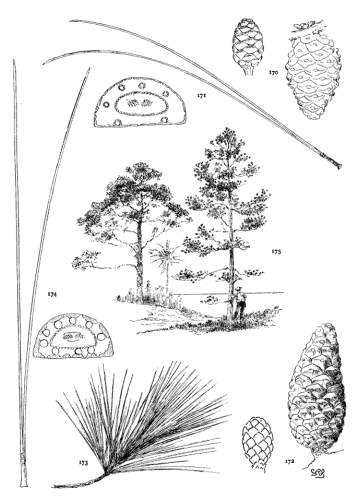 PLATE XIX. P. RESINOSA (170, 171), TROPICALIS (172-175)
27. PINUS MASSONIANA
- 1803 P. Massoniana Lambert, Gen. Pin. i. 17, t. 12. 1861 P. canaliculata
Miquel in Jour. Bot. Neerland. i. 86.
Spring-shoots uninodal. Leaves binate, rarely ternate, from 12 to 20 cm.
long, slender and pliant; hypoderm inconspicuous; resin-ducts external.
Staminate catkins often in long dense clusters. Conelets partly
tuberculate or mucronate, partly mutic. Cones symmetrical, from 4 to 7
cm. long, ovate-conic, short-pedunculate, early deciduous; apophyses
sublustrous, nut-brown, flat or somewhat elevated, the umbo usually
mutic.
The Chinese Red Pine is found in warm-temperate climates. It is native
to southeastern China and follows the valley of the Yangtse River into
Szech'uan. It has been confused by London with P. pinaster, which it
resembles in no respect, by Siebold with P. Thunbergii, from which it
differs in leaf-dimensions and in leaf-section, and by Mayr with his
P. luchuensis, whose peculiar cortex and whose leaf-section has no
counterpart among Chinese Hard Pines. Its nearest relative is P.
densiflora, from which it differs in its longer leaves, in the color
of its cone and in its conelet (Plate XX, figs. 176, 179).
Fig. 176, Cone and enlarged conelet. Fig. 177, Two leaf-fascicles.
Fig. 178, Magnified leaf-section.
28. PINUS DENSIFLORA
- 1842 P. densiflora Siebold & Zuccarini, Fl. Jap. ii. 22, t. 112.
- 1854 P. scopifera Miquel in Zollinger, Syst. Verz. Ind. Archip. 82.
Spring-shoots more or less pruinose, uninodal. Leaves binate, from 8 to
12 cm. long, slender; hypoderm of few inconspicuous cells; resin-ducts
external. Staminate catkins in long dense clusters. Scales of the
conelet conspicuously mucronate. Cones symmetrical, from 3 to 5 cm.
long, ovate-conic, often persistent for a few years but with a weak hold
on the branch; apophyses dull pale tawny yellow, flat or slightly
elevated, the mucro more or less persistent.
The Japanese Red Pine forms extensive forests on the mountains of
central Japan. It is perfectly hardy in cold-temperate climates. Wild
specimens of China, ascribed to this species, are forms of the
variable P. sinensis. From P. Massoniana it differs in its shorter
leaves and yellow cone, but particularly in the more prominent
prickles and thicker scales of its conelet (figs. 176, 179).
Fig. 179, Cones and enlarged conelet. Fig. 180, Leaf-fascicles. Fig.
181, Magnified leaf-section and more magnified dermal tissues of the
leaf.
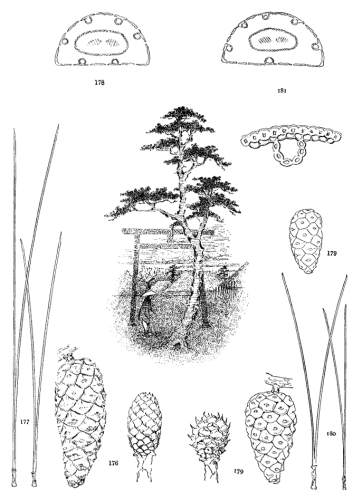 PLATE XX. P. MASSONIANA (176-178), DENSIFLORA (179-181)
29. PINUS SYLVESTRIS
- 1753 P. sylvestris Linnaeus, Sp. Pl. 1000 (excl. var.).
- 1768 P. rubra Miller, Gard. Dict. ed. 8.
- 1768 P. tatarica Miller, Gard. Dict. ed. 8.
- 1781 P. mughus Jacquin, Icon. Pl. Rar. i. t. 193 (not Scopoli).
- 1798 P. resinosa Savi, Fl. Pisa. ii. 354 (not Aiton).
- 1827 P. humilis Link in Abhandl. Akad. Berlin, 171.
- 1849 P. Kochiana Klotzsch in Linnaea, xxii. 296.
- 1849 P. armena Koch in Linnaea, xxii. 297.
- 1849 P. pontica Koch in Linnaea, xxii. 297.
- 1859 P. Frieseana Wichura in Flora, xlii. 409.
- 1906 P. lapponica Mayr, Fremdl. Wald- & Parkb. 348.
Spring-shoots uninodal. Leaves binate, from 3 to 7 cm. long; hypoderm
inconspicuous; resin-ducts external. Conelet reflexed, minutely
mucronate. Cones from 3 to 6 cm. long, reflexed, symmetrical or
sometimes oblique, ovate-conic, deciduous; apophyses dull pale tawny
yellow of a gray or greenish shade, flat, elevated or protuberant and
often much more prominent on the posterior face of the cone, the umbo
with a minute prickle or its remnant.
A tree of great commercial value, with a very extended range, from
Norway, Scotland and southern Spain to northeastern Siberia. A
vigorous hardy species and extensively cultivated. The red upper
trunk, characteristic of this Pine, is not invariable. The dark upper
trunk is sufficiently common to be considered a varietal form
(Mathieu, Flore Forest. ed. 4, 582). In various localities may be
found trees bearing oblique cones, their apophyses showing various
degrees of protuberance up to the extreme development represented in
Loudon's illustration of the variety uncinata (Arb. Brit. iv, f.
2047). This cone is the beginning of the changes that culminate in
species with oblique cones only. In P. sylvestris, however, the
purpose of this form of cone is not apparent except in connection with
this evolution.
Figs. 182, 183, Cones. Fig. 184, Leaf-fascicle, magnified
leaf-section and more magnified dermal tissues of the leaf. Fig.
185, Habit of the tree.
30. PINUS MONTANA
- 1768 P. montana Miller, Gard. Dict. ed. 8.
- 1772 P. mughus Scopoli, Fl. Carn. ii. 247.
- 1791 P. pumilio Haenke in Jirasek, Beobacht. 68.
- 1804 P. mugho Poiret in Lamarck, Encycl. Méth. v. 336.
- 1805 P. uncinata Ramond ex De Candolle, Lamarck, Fl. Franç. ed. 3, iii. 726.
- 1813 P. sanguinea Lapeyrouse, Hist. Pl. Pyren. 587.
- 1827 P. rotundata Link in Abhandl. Akad. Berlin, 168.
- 1830 P. obliqua Sauter ex Reichenbach, Fl. Germ. Exc. 159.
- 1837 P. uliginosa Neumann ex Wimmer, Arb. Schles. Ges. 95.
Spring-shoots uninodal. Leaves binate, from 3 to 8 cm. long, the epiderm
very thick, hypoderm weak; resin-ducts external. Conelets mucronate,
nearly sessile. Cones from 2 to 7 cm. long, subsessile, ovate or
ovate-conic, symmetrical or oblique, often persistent; apophyses
lustrous tawny-yellow or dark brown, both colors often shading into each
other on the same cone, flat, prominent or prolonged into uncinate
beaks of various lengths, the last much more developed on the posterior
face of the cone, the umbo bordered by a narrow dark ring and bearing
the remnant of the mucro.
P. montana grows as a bush or as a small tree, the two forms often
associated. It ranges from central Spain through the Pyrenees, Alps
and Apennines to the Balkan Mountains, associated with P. cembra at
higher, with P. sylvestris at lower altitudes. It grows indifferently
in bogs and on rocky slopes. Its dwarf form, under the name of the
Mugho Pine, is extensively cultivated as a garden ornament.
On the differences of the cone this species has been divided into
three subspecies: uncinata, with an oblique cone and protuberant
apophyses; pumilio, with a symmetrical cone and an excentric umbo;
mughus, with a symmetrical cone and a concentric umbo. Other
segregations based on the degree of development of the apophysis and
on the size and color of the cone, have received names of four or even
five terms—Pinus montana pumilio applanata—or Pinus montana uncinata
rostrata castanea etc., etc. These elaborations may be seen in the
Tharand Jahrbuch of 1861, p. 166, and with them appear also Hartig's
specifications of 60 forms of this species, each dignified with a
Latin name.
Fig. 186, Cone of var. uncinata. Figs. 187, 188, Cones. Fig. 189,
Leaf-fascicles, magnified leaf-section and more magnified dermal
tissues of the leaf. Fig. 190, Tree and dwarf-form of the Pyrenees.
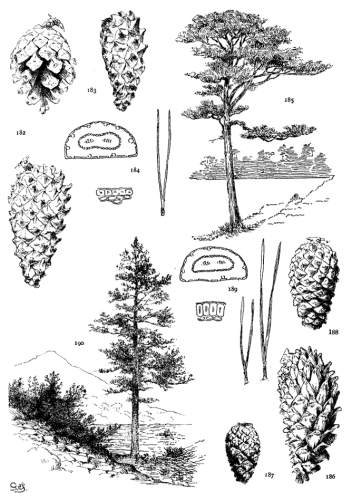 PLATE XXI. P. SYLVESTRIS (182-185), MONTANA (186-190)
31. PINUS LUCHUENSIS
- 1894 P. luchuensis Mayr in Bot. Centralbl. lviii. 149, f.
Spring-shoots uninodal. Bark-formation late, the upper trunk covered
with a smooth cortex. Leaves binate, from 12 to 16 cm. long, the epiderm
thick, hypoderm of two or three rows of cells; resin-ducts medial or
with an occasional external duct. Conelets mucronate toward the apex.
Cones from 3 to 6 cm. long, ovate-conic, symmetrical; apophyses lustrous
nut-brown, transversely carinate, the umbo unarmed.
This Pine is known to me through Mayr's description and a single dried
specimen. The smooth cortex of young trees distinguishes it from all
other east-Asiatic Hard Pines. Mayr includes under this species the
Pine of Hong Kong. But in this he must be mistaken, for there is no
species yet found in China that agrees with the description of P.
luchuensis.
Fig. 191, Cone. Fig. 192, Leaf-fascicle and magnified leaf-section.
32. PINUS THUNBERGII
- 1784 P. sylvestris Thunberg, Fl. Jap. 274 (not Linnaeus).
- 1842 P. Massoniana Siebold & Zuccarini. Fl. Jap. ii. 24, t. 113 (not Lambert).
- 1868 P. Thunbergii Parlatore in DC. Prodr. xvi-2, 388.
Spring-shoots uninodal. Buds of leading-shoots white and conspicuous.
Leaves binate, from 6 to 11 cm. long, the epiderm thick, hypoderm
strong, resin-ducts medial. Conelets with short-mucronate scales. Cones
from 4 to 6 cm. long, ovate or ovate-conic, symmetrical; apophyses
nut-brown, flat or convex and transversely carinate, the prickle of the
umbo more or less persistent.
The Black Pine of Japan has been cultivated for centuries, and by
skillful Japanese gardeners has been trained into dwarf and other
curious forms. It is hardy in cold-temperate climates. It is distinct
from P. densiflora by the medial ducts of its leaf, from P. nigra by
the fewer, larger, brown scales of its cone, and from P. resinosa by
the armature of its conelet. It appears in most determinations of
Chinese collections, but there is no Chinese Pine with the white buds
and the medial leaf-ducts of this species.
Fig. 196, Two cones. Fig. 197, Leaf-fascicle and magnified
leaf-section.
33. PINUS NIGRA
- 1785 P. nigra Arnold, Reise n. Mariaz. 8, t.
- 1804 P. laricio Poiret in Lamarck, Encycl. Méth. v. 339.
- 1808 P. halepensis Bieberstein, Fl. Taur. Cauc. ii. 408 (not Miller).
- 1809 P. pinaster Besser, Fl. Galic. ii. 294 (not Aiton).
- 1813 P. maritima Aiton, f. Hort. Kew. v. 315 (not Lambert).
- 1816 P. sylvestris Baumgarten, Stirp. Transsilv. ii. 304 (not Linnaeus).
- 1818 P. pyrenaica Lapeyrouse, Hist. Pl. Pyren. Suppl. 146.
- 1824 P. Pallasiana Lambert, Gen. Pin. ii. 1, t. 1.
- 1825 P. austriaca Höss in Flora, viii-1, Beil. 113.
- 1831 P. nigricans Host, Fl. Austr. ii. 628.
- 1842 P. dalmatica Visiani, Fl. Dalmal. 199, note.
- 1851 P. Salzmanni Dunal in Mém. Acad. Montp. ii. 82, tt.
- 1863 P. Heldreichii Christ in Verh. Nat. Ges. Basel, iii. 549.
- 1864 P. leucodermis Antoine in Oesterr. Bot. Zeitschr. xiv. 366.
- 1896 P. pindica Formanek in Verh. Nat. Ver. Brünn, xxxiv. 272.
Spring-shoots uninodal. Leaves binate, from 9 to 16 cm. long, the
epiderm thick, hypoderm conspicuous, resin-ducts medial. Conelets
mucronate. Cones from 4 to 8 cm. long, subsessile, symmetrical;
apophyses lustrous, tawny yellow, transversely carinate, the keel
strongly convex, the mucro of the umbo more or less persistent.
A valuable tree unequally distributed over the mountain slopes of
central and southern Europe and Asia Minor. The typical form, under
the name of the Austrian Pine, is a familiar exotic of the Middle and
Eastern States of America. As Mathieu states (Flore Forest., ed. 4,
597), this species is quite constant in cone and bark. It may be added
that the anatomy of the leaf is also constant, while the dimensions of
both leaf and cone present no unusual variations. The varieties
generally accepted are founded on the habit of the tree, a character
of forestal or horticultural rather than of botanical importance.
Fig. 193, Two cones. Fig. 194, Leaf-fascicle and magnified
leaf-section. Fig. 195, Magnified dermal tissues of the leaf.
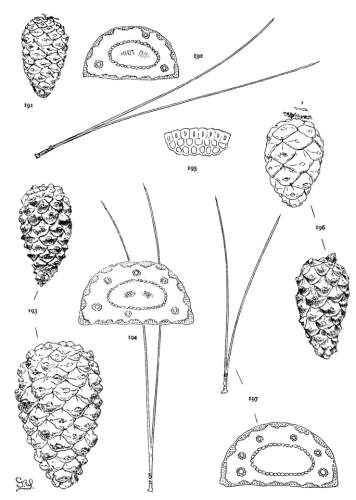 PLATE XXII. P. LUCHUENSIS (191, 192), NIGRA (193-195),
THUNBERGII (196, 197)
PLATE XXII. P. LUCHUENSIS (191, 192), NIGRA (193-195),
THUNBERGII (196, 197)
34. PINUS MERKUSII
- 1790 P. sylvestris Loureiro, Fl. Cochinch. ii. 579 (not Linnaeus).
- 1845 P. Merkusii De Vriese, Pl. Nov. Ind. Bat. 5, t. 2.
- 1847 P. Finlaysoniana Wallich ex Blume, Rumphia, iii. 210.
- 1849 P. Latteri Mason in Jour. Asiat. Soc. i. 74.
Spring-shoots uninodal. Leaves binate, slender, from 15 to 20 cm. long,
the hypoderm of uniform thick-walled cells, resin-ducts medial, or with
internal or septal ducts, endoderm-cells very unequal in size, some of
them large. Conelets unarmed. Cones from 5 to 8 cm. long, peculiarly
narrow-cylindrical, symmetrical; apophyses lustrous, rufous brown,
radially carinate, the transverse keel prominent.
Of the habit of this Pine I know nothing. As a species it is very
clearly defined by its peculiar cone and leaf-section. It grows in the
Philippines, Sumatra, Lower Burmah and western Indo-China. In my
specimen the pits of the ray-cells of the wood are both large and
small. In this particular it may belong in either of two groups of
species. Its uniform leaf-hypoderm associates it with this group or
with P. halepensis of the Insignes. I have assumed the cone to be
dehiscent at maturity and have placed it with the Lariciones, but if
further information shows the cone to be serotinous, this species
should be transferred to the serotinous group.
Fig. 198, Cone. Fig. 199, Magnified sections of two leaves. Fig.
200, Leaf-fascicle.
35. PINUS SINENSIS
- 1832 P. sinensis Lambert, Gen. Pin. ed. 8vo. i. 47, t. 29.
- 1867 P. tabulaeformis Carrière, Trait. Conif. ed. 2, 510.
- 1881 P. leucosperma Maximowicz in Bull. Acad. St. Pétersb. xxvii. 558.
- 1899 P. yunnanensis Franchet in Jour. de Bot. xiii. 253.
- 1901 P. funebris Komarow in Act. Hort. Petrop. xx. 177.
- 1902 P. Henryi Masters in Jour. Linn. Soc. xxvi. 550.
- 1906 P. densata Masters in Jour. Linn. Soc. xxxvii. 416.
- 1906 P. prominens Masters in Jour. Linn. Soc. xxxvii. 417.
- 1911 P. Wilsonii Shaw in Sargent, Pl. Wilson. i. 3.
Spring-shoots uninodal, pruinose. Leaves binate, ternate, or both, from
10 to 15 cm. long, stout and rigid; resin-ducts external, or external
and medial. Staminate catkins in short capitate clusters. Conelets
mucronate. Cones from 4 to 9 cm. long, ovate, symmetrical or oblique,
tenaciously persistent, dehiscent at maturity; apophyses lustrous, pale
tawny yellow at first, gradually changing to a dark nut-brown, tumid,
the posterior scales often larger and more prominent.
A tree of cold-temperate and subalpine levels, growing on the
mountains of central and western China, and at lower altitudes in the
north and in Corea. It is recognized by its tenaciously persistent
cones with a remarkable change in color. It is constantly confused
with P. Thunbergii and P. densiflora, neither of which grows
spontaneously in China. From the former it differs in leaf-section and
bud (the bud of P. sinensis is never white), from the latter in the
lustre and the color variation of its cone, and from both in the
frequent obliquity of its cone and in the frequent presence of
trimerous leaf-fascicles.
Of the two varieties of this species, densata and yunnanensis (Shaw in
Sargent, Pl. Wilson. ii. 17), the former represents the extreme
oblique form of cone, the latter represents the longest dimensions of
cone and leaf. The effect of environment on this species can be seen
in figs. 202, 203, from a lower slope and rich soil, and fig. 204,
from a high rocky ledge in the same locality.
Fig. 201, Cone of var. densata. Fig. 202, Cone of var. yunnanensis.
Fig. 203, Leaf-fascicle and magnified leaf-section of var.
yunnanensis. Fig. 204, Cone and leaf-fascicle from a rocky ledge.
Fig. 205, Cone, leaf-fascicle and magnified leaf-section of the
typical form. Fig. 206, Seeds. Fig. 207, Conelet and its enlarged
scale.
36. PINUS INSULARIS
- 1837 P. taeda Blanco, Fl. Filip. 767 (not Linnaeus).
- 1847 P. insularis Endlicher, Syn. Conif. 157.
- 1854 P. khasiana Griffith, Notul. Pl. Asiat. iv. 18; Icon. Pl. Asiat. tt. 367, 368.
- 1868 P. kasya Royle ex Parlatore in DC. Prodr. xvi-2, 390.
Spring-shoots uninodal, glabrous. Leaves from 12 to 24 cm. long, in
fascicles of 3, rarely of 2, very slender; resin-ducts external, rarely
with a medial duct. Conelets mucronate. Cones from 5 to 10 cm. long,
ovate-conic, symmetrical or oblique, tenaciously persistent; apophyses
lustrous, nut-brown, convex or elevated along a transverse keel, the
posterior scales of some cones larger and more prominent than the
anterior scales, the mucro usually deciduous.
A species of the Philippines and of northern Burmah. In both countries
it is locally exploited for wood and resin. It differs from the common
form of P. sinensis by its much longer leaves, and from its var.
yunnanensis, which it more resembles, by its much more slender and
pliant leaves. Moreover its cone, so far as I can learn, is not yellow
at maturity, but brown.
Figs. 208, 209, Three cones. Fig. 210, Leaf-fascicle and magnified
leaf-section.
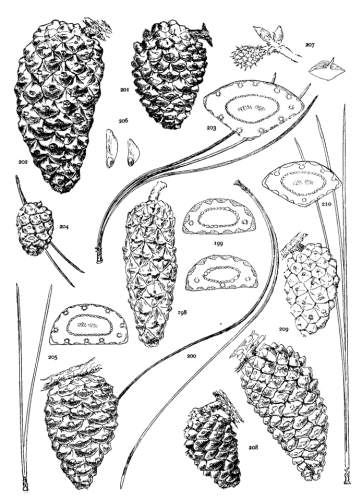 PLATE XXIII. P. MERKUSII (198-200), SINENSIS (201-207),
INSULARIS (208-210)
PLATE XXIII. P. MERKUSII (198-200), SINENSIS (201-207),
INSULARIS (208-210)
XI. AUSTRALES
Pits of the ray-cells small. Leaf-hypoderm biform or variable.
Spring-shoots uninodal in some, multinodal in other species. Cones
dehiscent at maturity.
This group combines the dehiscent cone of the Lariciones with the
wood-anatomy of the serotinous Pines. Also the multinodal spring-shoot
first appears here and is gradually developed among the species,
absent in Nos. 37-39, sometimes present in Nos. 40-43, and prevalent
in Nos. 44-47.
All the species are of the Western Hemisphere, and among them may be
found the biform hypoderm of the leaf, the internal resin-duct, and
the total absence of external resin-ducts, characters common in
American Hard Pines. The eastern species are quite constant in their
characters and present no varietal forms; the western species, on the
other hand, are very variable. This difference may be due to the even
level and slight climatic differences of the Atlantic states and to
the remarkable diversity of altitude and climate of the western states
and Mexico.
| Outer walls of the leaf-endoderm thick. |
| Cones large, attaining 12 cm. or more in length. |
| Prickles of the cone inconspicuous. |
| Bark-formation late | 37. pseudostrobus |
| Bark-formation early | 38. Montezumae |
| Prickle of the cone conspicuous | 39. ponderosa |
| Cones small, 7 cm. or less in length | 40. teocote |
| Outer walls of the leaf-endoderm thin. |
| Spring-shoots mostly uninodal. |
| Prickle of the cone slender, sometimes deciduous. |
| Cones mostly oblique | 41. Lawsonii |
| Cones symmetrical | 42. occidentalis |
| Prickles of the cone stout and persistent | 43. palustris |
| Spring-shoots multinodal. |
| Resin-ducts internal | 44. caribaea. |
| Resin-ducts mostly medial. |
| Prickle of the cone stout | 45. taeda |
| Prickle of the cone slender. |
| Bark-formation late | 46. glabra |
| Bark-formation early | 47. echinata |
37. PINUS PSEUDOSTROBUS
- 1839 P. pseudostrobus Lindley in Bot. Reg. xxv. Misc. 63.
- 1839 P. apulcensis Lindley in Bot. Reg. xxv. Misc. 63.
- 1842 P. tenuifolia Bentham, Pl. Hartw. 92.
- 1846 P. orizabae Gordon in Jour. Hort. Soc. Lond. i. 237, f.
Spring-shoots uninodal, conspicuously pruinose. Bark-formation late, the
cortex of young trees smooth. Leaves in fascicles of 5, sometimes of 6,
from 15 to 30 cm. long, drooping; resin-ducts medial, hypoderm variable
in amount, often in very large masses, the outer walls of the endoderm
thick. Conelets mucronate. Cones from 7 to 14 cm. long, ovate or
ovate-conic, symmetrical or oblique, deciduous and often leaving a few
basal scales on the trees; apophyses rufous or fulvous brown, flat,
elevated or, in one variety, prolonged in various degrees, the
prolongations nearly uniform or much more prominent on the posterior
face of the cone, the mucro usually deciduous.
A species of the subtropical and warm-temperate altitudes of Mexico
and Central America. Its range includes both eastern and western
slopes of the northern plateau. Its northern limit is in Nuevo Leon,
and it probably reaches in Nicaragua the southern limit of pines in
the Western Hemisphere. It is distinguished from all its associates by
the smooth gray trunk of the young trees, by their long internodes,
and by their drooping gray-green foliage.
Some cones of this species develop protuberances of all degrees of
prominence up to the curious cone collected in Oaxaca by Nelson (var.
apulcensis, Shaw, Pines Mex. t. 12, fig. 8). There is also a
remarkable difference in the amount of leaf-hypoderm. On many trees of
the western part of the range this tissue forms septa across the green
mesophyll. Such partitions are sometimes met in other species, P.
Pringlei or P. canariensis, where the hypoderm is abundant. But in P.
pseudostrobus they appear in some leaves of weak, as well as of strong
hypoderm (var. tenuifolia, Shaw, Pines Mex. t. 13, ff. 2, 4, 5, 7, 8).
Fig. 211, Cone. Fig. 212, Two cones of var. tenuifolia. Figs. 213,
214, Two cones of var. apulcensis. Fig. 215, Magnified section of 3
leaves of var. tenuifolia. Fig. 216, Magnified section of 2 leaves
of the species. Fig. 217, Bud destined to produce staminate flowers.
Fig. 218, Ten-year old branch showing smooth cortex. Fig. 219, Young
and mature trees in open growth.
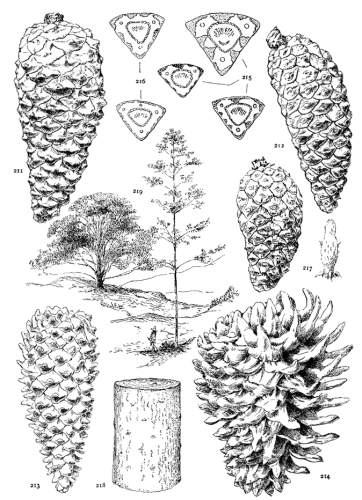 PLATE XXIV. PINUS PSEUDOSTROBUS
38. PINUS MONTEZUMAE
- 1817 P. occidentalis H. B. & K. Nov. Gen. ii. 4 (not Swartz).
- 1832 P. Montezumae Lambert, Gen. Pin. ed. 8vo, i. 39, t. 22.
- 1839 P. Devoniana Lindley in Bot. Reg. xxv. Misc. 62.
- 1839 P. Hartwegii Lindley in Bot. Reg. xxv. Misc. 62.
- 1839 P. Russelliana Lindley in Bot. Reg. xxv. Misc. 63.
- 1839 P. macrophylla Lindley in Bot. Reg. xxv. Misc. 63.
- 1840 P. filifolia Lindley in Bot. Reg. xxvi. Misc. 61.
- 1841 P. Sinclairii Hooker & Arnott, Bot. Beechy Voy. 392, t. 93 (as to cone).
- 1841 P. radiata Hooker & Arnott, Bot. Beechy Voy. 443 (as to leaves).
- 1847 P. Grenvilleae Gordon in Jour. Hort. Soc. Lond. ii. 77, f.
- 1847 P. Gordoniana Hartweg in Jour. Hort. Soc. Lond. ii. 79, f.
- 1847 P. Wincesteriana Gordon in Jour. Hort. Soc. Lond. ii. 158, f.
- 1847 P. rudis Endlicher, Syn. Conif. 151.
- 1847 P. Ehrenbergii Endlicher, Syn. Conif. 151.
- 1858 P. Lindleyana Gordon, Pinet. 229.
- 1891 P. Donnell-Smithii Masters in Bot. Gaz. xvi. 199.
Spring-shoots uninodal, slightly or not at all pruinose. Bark-formation
early, the branches becoming dark and rough. Leaves prevalently in
fascicles of 5, but varying from 3 to 8, extremely variable in length,
attaining 45 cm. at subtropical levels; resin-ducts medial, hypoderm
sometimes uniform, more commonly multiform, the outer walls of the
endoderm thick. Conelet mucronate, the prickle often reflexed. Cones of
many sizes, attaining in warm localities 30 cm. in length, ovate-conic
or long-conic, symmetrical, often curved, deciduous and often leaving a
few scales on the tree; apophyses dull, rarely lustrous, nut-brown, or
of various shades of fuscous brown to nearly black, flat, tumid,
pyramidal or sometimes slightly protuberant, the prickle rarely
persistent.
This species ranges from the mountains of northern Durango to the
volcanoes of Guatemala, or possibly farther south. It is found at all
altitudes where Pines can grow except on the tropical levels of
Guatemala. Its more hardy forms have been successfully grown in the
milder parts of Great Britain and northern Italy. It is felled for
lumber in many parts of Mexico.
This sturdy Pine and its numberless variations present the most
remarkable example of adaptation in the genus. The variations are
mostly those associated with changes of environment—dimensions of
cone and leaf and the number of leaves in the fascicle. These are so
accurately correlated with altitude and exposure, and are so
imperceptibly graded, that no specific segregations among them have
yet been successfully established.
The type-specimen figured by Lambert does not show the longest cone
and leaf of this species. They are better represented by specimens
which have been named P. filifolia. Such dimensions prevail in
subtropical localities. At temperate altitudes these dimensions are
much reduced, but here are found a longer form of cone and leaf (var.
Lindleyi, Loudon) and a shorter form (var. rudis, Shaw). At still
higher altitudes and up to the timber-limit the var. Hartwegii,
Engelmann, with short leaves and a small nearly black cone is found.
Among these varieties there is no such sharp distinction as these
definitions imply. All dimensions of fruit and foliage and the various
brown and black shades of the cone blend into each other through
endless intergradations. A monograph of this species, by one who could
devote some years to it on the superb volcanoes and in the delightful
climates where this tree abounds, would be a valuable contribution to
science.
Fig. 220, Cone and leaves of Lambert's plate. Figs. 221, 222, Longer
cones and leaves of the species. Fig. 223, Cone and leaves of var.
Lindleyi. Fig. 224, Cones and leaves of var. rudis. Fig. 225, Cone
and leaves of var. Hartwegii. Fig. 226, Magnified leaf-sections.
Figs. 227, 228, Two forms of the dermal tissues of the leaf,
magnified. Fig. 229, Habit of the tree.
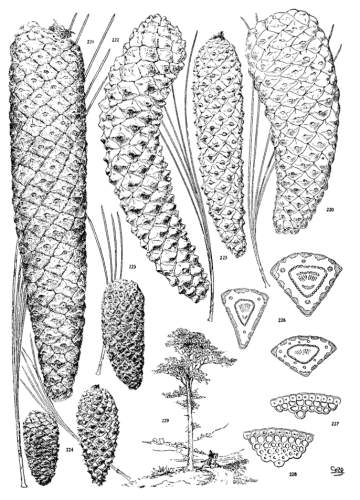 PLATE XXV. PINUS MONTEZUMAE
39. PINUS PONDEROSA
- 1836 P. ponderosa Douglas ex Lawson's Agric. Man. 354.
- 1847 P. Benthamiana Hartweg in Jour. Hort. Soc. Lond. ii. 189.
- 1848 P. brachyptera Engelmann in Wislizenus, Tour Mex. 89.
- 1848 P. macrophylla Engelmann in Wislizenus, Tour Mex. 103 (not Lindley).
- 1853 P. Jeffreyi Balfour in Bot. Exp. Oregon, 2, f.
- 1854 P. Engelmanni Carrière in Rev. Hort. 227.
- 1855 P. Beardsleyi Murray in Edinb. Phil. Jour. ser. 2, i. 286, t. 6.
- 1855 P. Craigana Murray in Edinb. Phil. Jour. ser. 2, i. 288, t. 7.
- 1858 P. Parryana Gordon, Pinet. 202 (not Engelmann).
- 1859 P. deflexa Torrey in Emory's Rep. ii. 1, 209, t. 56.
- 1878 P. arizonica Engelmann in Wheeler's Rep. vi. 260.
- 1889 P. latifolia Sargent in Gar. & For. ii. 496, f. 135.
- 1894 P. apacheca Lemmon in Erythea, ii. 103, t. 3.
- 1897 P. Mayriana Sudworth in Bull. 14, U. S. Dept. Agric. 21.
- 1897 P. scopulorum Lemmon in Gar. & For. x. 183.
- 1900 P. peninsularis Lemmon, W. Am. Conebear. 114.
Spring-shoots uninodal, sometimes pruinose. Bark-formation early. Leaves
prevalently in fascicles of 3, but varying from 2 to 5 or more, from 12
to 36 cm. long; resin-ducts medial, hypoderm uniform or multiform, outer
walls of the endoderm thick. Conelet mucronate, the mucro often
reflexed. Cones from 8 to 20 cm. long, ovate-conic, symmetrical,
deciduous and usually leaving a few basal scales on the tree; apophyses
tawny yellow to fuscous brown, lustrous, elevated along a transverse
keel, sometimes protuberant and reflexed, the umbo salient and forming
the base of a pungent, persistent prickle.
This species ranges from southern British Columbia over the mountains
between the Pacific and the eastern foot-hills of the Rocky Mountains,
including the Black Hills of South Dakota, to the northeastern Sierras
of Mexico, to northern Jalisco and Lower California, forming, in many
localities, large forests and furnishing the best Hard Pine timber of
the western United States. It attains its best growth on the Sierras
of California and is, next to P. Lambertiana, the tallest of the
Pines.
Like P. Montezumae, and under like influences, it shows much
dimensional variation, and the leaf-fascicles are heteromerous, with
the larger number in the southern part of its range. Many authors
consider the variety Jeffreyi Vasey to be a distinct species; but
here, it seems to me, too much importance is attached to the pruinose
branchlet, clearly a provision against transpiration and associated
rather with a dry environment than with a species. Most observers
discover many intermediate forms between this variety and the species.
The var. scopulorum Engelm. is the Rocky Mountain form with leaves in
2's and 3's and with small cones passing into P. arizonica, Engelm., a
more southern form with small cones and leaves in fascicles of 3 to 5.
The var. macrophylla (Shaw, Pines Mex. 24), in addition to its long
and stout leaves, bears a cone with protuberant apophyses, somewhat
comparable to the intermediate forms of P. pseudostrobus var.
apulcensis Shaw (l. c.). Fascicles of 6 and 7 leaves are sometimes
found, and specimens that I have collected in Sandia, Durango (issued
by Pringle, through a misunderstanding, under the name P. Roseana,
ined.) show such fascicles on the fertile branches.
Fig. 230, Cone and seed of var. Jeffreyi. Fig. 231, Cone of var.
macrophylla. Fig. 232, Cone of var. scopulorum. Fig. 233, Magnified
leaf-section and cells of leaf-endoderm. Fig. 234, Magnified dermal
tissues of the leaf, showing uniform and multiform hypoderm.
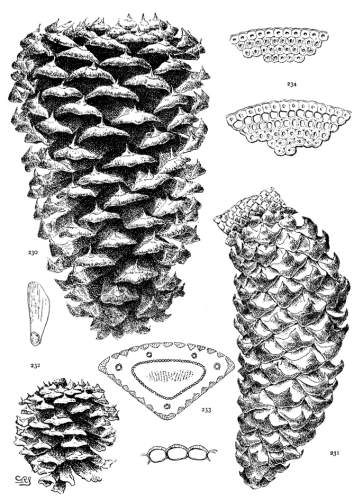 PLATE XXVI. PINUS PONDEROSA
40. PINUS TEOCOTE
- 1830 P. teocote Schlechtendal & Chamisso in Linnaea, v. 76.
Spring-shoots uninodal, or sometimes multinodal. Leaves prevalently in
fascicles of 3, but varying from 3 to 5, from 10 to 20 cm. long;
resin-ducts medial, sometimes with an internal duct, hypoderm biform,
endoderm with thick outer walls. Conelets mucronate. Cones usually very
small, from 4 to 6 cm. long, but with a larger varietal form, ovate to
long-conic, symmetrical; apophyses nut-brown, flat or tumid, the mucro
usually deciduous.
This species grows at temperate altitudes from Chiapas to Nuevo Leon,
associated with temperate Mexican species such as P. patula, P.
leiophylla and others, and is easily recognized by its small cone. The
variety with a larger cone (var. macrocarpa, Shaw, Pines Mex. t. 10) I
have found growing in mixed groves of P. teocote and P. leiophylla. It
resembles the latter in cone and leaf, but lacks the peculiar
character that distinguishes P. leiophylla from all other Mexican
species—the triennial cone. Some of the specimens of Hartweg No. 441
belong here, as well as Pringle's specimens, Nos. 10013, 10018,
distributed as P. eslavae, ined.
Fig. 235, Two cones of the species and the larger cone of the
variety. Fig. 236, Leaf-fascicle and magnified sections of two
leaves. Fig. 237 a, Dermal tissues of the leaf magnified; b,
magnified cells of the leaf-endoderm. Fig. 238, Habit of the tree.
41. PINUS LAWSONII
- 1862 P. Lawsonii Roezl ex Gordon, Pinet. Suppl. 64.
- 1905 P. Altamirani Shaw in Sargent, Trees & Shrubs, i. 209, t. 99.
Spring-shoots conspicuously pruinose, uninodal or not infrequently
multinodal. Leaves in fascicles of 3, 4 or 5, not exceeding 24 cm. in
length; resin-ducts internal, often with one or two medial ducts,
hypoderm biform, endoderm usually with thin outer walls. Conelets
mucronate. Cones from 5 to 7 cm. long on pliant peduncles, ovate or
ovate-conic, oblique or sometimes symmetrical, deciduous, or persistent
with a weak hold on the branch; apophyses nut-brown, flat or tumid,
often protuberant on the posterior face of the cone, the umbo usually
large and salient, forming a rounded button-like projection, on which
the mucro is wanting.
A subtropical species of central and western Mexico, growing alone or
associated with P. oocarpa, P. Pringlei and the subtropical forms of
P. Montezumae and P. pseudostrobus. It is recognized among its
associate species by its conspicuously glaucous foliage. The cone is
very variable on trees of the same grove, both in size and in the
protuberance of its apophyses. Gordon's specimen in the Kew herbarium
consists of a single detached cone and a few leaves. The leaves differ
from all that I have examined in showing thick-walled endoderm cells,
but the cone corresponds with many of my own collection.
Fig. 239, Three cones. Fig. 240, Leaf-fascicle and magnified
leaf-section. Fig. 241, Magnified cells of the leaf-endoderm.
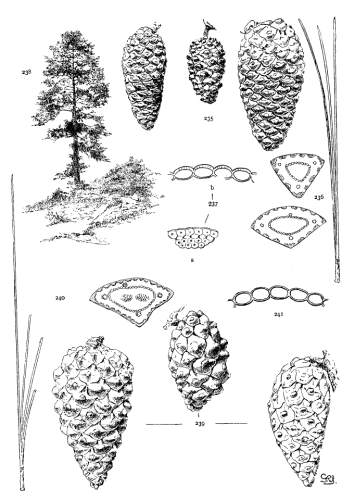 PLATE XXVII. P. TEOCOTE (235-238), LAWSONII (239-241)
42. PINUS OCCIDENTALIS
- 1788 P. occidentalis Swartz, Nov. Gen. & Sp. Pl. 103.
- 1862 P. cubensis Grisebach in Mem. Am. Acad. ser. 2, viii. 530.
- 1880 P. Wrightii Engelmann in Trans. Acad. Sci. St. Louis, iv. 185.
Spring-shoots uninodal, pruinose. Leaves in fascicles of 2 to 5, from 15
to 22 cm. long; resin-ducts internal, hypoderm biform, endoderm with
thin outer walls. Conelets erect, aristate. Cones from 5 to 8 cm. long,
reflexed, ovate, symmetrical, deciduous; apophyses nut-brown, lustrous,
flat or tumid, the umbo often thin and, together with the slender
prickle, bent sharply downward.
This species is confined to San Domingo, Hayti and eastern Cuba. Its
erect conelet and reflexed cone distinguish it from P. caribaea, which
has both its conelet and cone reflexed. Moreover the conelet is
usually, perhaps always, subterminal in P. occidentalis.
Fig. 247, Cone. Fig. 248, Conelet and enlarged aristate scales. Fig.
249, Magnified sections of two leaves and more magnified dermal
tissues.
43. PINUS PALUSTRIS
- 1768 P. palustris Miller, Gard. Dict. ed. 8.
- 1810 P. australis Michaux f. Hist. Arbr. Am. i. 64, t. 6.
Spring-shoots uninodal, rarely multinodal. Buds peculiarly large, white,
and conspicuously fringed with the long free cilia of the bud-scales.
Leaves in fascicles of 3, from 20 to 45 cm. long, rigid; resin-ducts
internal, hypoderm biform, endoderm with thin outer walls. Conelets
short-mucronate. Cones from 15 to 20 cm. long, narrow, tapering from a
rounded base to a blunt point, symmetrical, deciduous and usually
leaving a few scales on the tree; apophyses dull nut-brown, elevated
along a transverse keel, the umbo salient and forming the broad base of
a small persistent prickle.
Its thin sap-wood, its very strong heavy wood of large dimensions with
abundant resin of excellent quality make this the most valuable
species of the genus. It ranges over the sandy plain that borders the
Atlantic and the Gulf of Mexico, from southeastern Virginia to eastern
Texas. The northern limit is approximately the centre of the Southern
and Gulf States, with a northern extension in Alabama to the base of
the Appalachian Mountains and to northwestern Louisiana. Its southern
limit lies near the centre of the Florida peninsula.
Among its associates this species is recognized by its large white
fringed bud and its elongated cone. Its leaves attain, on vigorous
trees, the maximum length among Pines, but on most trees the leaves do
not differ in length from the longer forms of those of P. caribaea or
P. taeda. A peculiarity, which it shares with P. caribaea, is the
deciduous scaly bark of mature trees, constantly falling away in thin
irregular scales.
Figs. 242, 243, Cones and seed. Fig. 244, Bud. Fig. 245, Magnified
leaf-section. Fig. 246, Magnified cells of the leaf-endoderm. The
dermal tissues of fig. 249 also apply to this species.
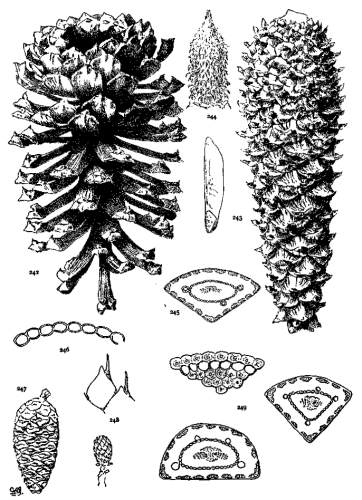 PLATE XXVIII. P. PALUSTRIS (242-246), OCCIDENTALIS
(247-249)
PLATE XXVIII. P. PALUSTRIS (242-246), OCCIDENTALIS
(247-249)
44. PINUS CARIBAEA
- 1851 P. caribaea Morelet in Rev. Hort. Côte d'Or, i. 105.
- 1864 P. bahamensis Grisebach, Fl. Brit. W. Ind. 503.
- 1880 P. Elliottii Engelmann in Trans. Acad. St. Louis, iv. 186, tt. 1-3.
- 1884 P. cubensis Sargent in Rep. 10th. Cens. U. S. ix. 202 (not Grisebach).
- 1893 P. heterophylla Sudworth in Bull. Torrey Bot. Club, xx. 45.
- 1903 P. recurvata Rowley in Bull. Torrey Bot. Club, xxx. 107.
Spring-shoots multinodal, more or less pruinose. Buds pale
chestnut-brown. Leaves in fascicles of 2 and 3, or more in its southern
range, from 12 to 25 cm. long; resin-ducts internal, hypoderm biform,
endoderm with thin outer walls. Conelets reflexed on long peduncles,
mucronate. Cones from 5 to 15 cm. long, ovate or oblong-ovate,
symmetrical, deciduous and leaving often a few basal scales on the
branch; apophyses lustrous, rufous-brown, tumid, the umbo somewhat
salient and minutely mucronate.
The northern limit of the range of P. caribaea extends from the coast
of southeastern S. Carolina through southeastern Georgia and southern
Alabama to southeastern Louisiana. It is associated with P. palustris,
taeda, serotina, echinata and glabra in this part of its range. It
continues through Florida, where it encounters P. clausa. On the
Bahamas it is the only Pine. On the Isle of Pines it finds in P.
tropicalis another associate. It also grows in Honduras and Guatemala.
The wood and resin of this species are of such excellent quality that
no commercial distinction is made between P. caribaea and P.
palustris.
Fig. 250, Cone from the Isle of Pines. Fig. 251, Small form of cone.
Fig. 252, Large form of cone and binate leaf-fascicle. Fig. 253,
Conelet. Fig. 254, Magnified sections of leaves from binate and
ternate fascicles. Fig. 255, Habit of the tree, contrasted with a
tree of P. palustris in the middle-distance.
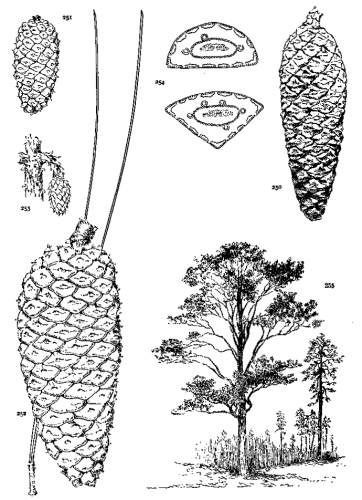 PLATE XXIX. PINUS CARIBAEA
45. PINUS TAEDA
- 1753 P. taeda Linnaeus, Sp. Pl. 1000.
- 1788 P. lutea Walter Fl. Carol. 237.
- 1903 P. heterophylla Small, Fl. Southeast. U. S. 28 (not Sudworth).
Spring-shoots multinodal. Leaves in fascicles of 3, from 12 to 25 cm.
long; resin-ducts medial, sometimes with an internal duct, hypoderm
biform, endoderm with thin outer walls. Conelets erect, their scales
prolonged into a sharp point. Cones from 6 to 10 cm. long, ovate-conic,
symmetrical; apophyses dull pale nut-brown, rarely lustrous, elevated
along a transverse keel, the whole umbo forming a stout triangular spine
with slightly concave sides.
The species ranges from southern New Jersey to southern Arkansas,
Oklahoma, eastern Texas and southwestern Tennessee, but does not occur
in the lower half of the Florida peninsula. It is an important
timber-tree, manufactured into all descriptions of scantlings,
boarding and finish, but the wood is of various qualities. It may be
recognized by the spine of its cone in both years of growth. Excepting
the formidable armature of the cone of P. pungens, the spines are the
strongest and most persistent of all the species of eastern North
America.
Fig. 264, Cone. Fig. 265, Leaf-fascicle. Fig. 266, Magnified
leaf-section. Fig. 267. Magnified scales of the conelet.
46. PINUS GLABRA
- 1788 P. glabra Walter, Fl. Carol. 237.
Spring-shoots multinodal. Bark-formation late, the upper trunks of
mature trees smooth. Leaves in fascicles of 2, from 9 to 12 cm. long;
resin-ducts medial, hypoderm weak, sometimes of a single row, biform
when of two rows, endoderm with thin outer walls. Conelets reflexed,
mucronate. Cones from 4 to 7 cm. long, reflexed, ovate, symmetrical,
deciduous on some trees, persistent on others; apophyses pale dull
nut-brown, thin or slightly thickened, the prickle usually deciduous.
A tree that sometimes attains important dimensions, growing singly or
in small groves from the neighborhood of Charleston, S. C., to eastern
Louisiana and central Mississippi, most abundant in a strip of
territory on either side of the northern boundary of Florida. Among
the Pines of the southeastern United States it is the only species
with late bark-formation, and is therefore easily identified.
Fig. 256, Cone. Fig. 257, Enlarged scale of the conelet. Fig. 258,
Leaf-fascicle and magnified leaf-section. Fig. 259, Dermal tissues
of the leaf magnified, with a double row of hypoderm cells.
47. PINUS ECHINATA
- 1768 P. echinata Miller, Gard. Dict. ed. 8.
- 1788 P. squarrosa Walter, Fl. Carol. 237.
- 1803 P. mitis Michaux, Fl. Bor. Am. ii. 204.
- 1803 P. variabilis Lambert, Gen. Pin. i. 22, t. 15.
- 1854 P. Royleana Jamieson in Jour. Hort. Soc. Lond. ix. 52, f.
Spring-shoots multinodal, somewhat pruinose. Bark forming early, rough
on the upper trunk. Leaves in fascicles of 2 and 3, from 7 to 12 cm.
long; resin-ducts medial, with an occasional internal duct, hypoderm
weak, biform when of two rows of cells, endoderm with thin outer walls.
Conelets mucronate. Cones from 4 to 6 cm. long, ovate-conic,
symmetrical, often persistent; apophyses dull pale nut-brown, thin or
somewhat thickened along a transverse keel, the umbo salient, the mucro
more or less persistent.
This species ranges from southeastern New York to northern Florida, to
West Virginia and eastern Tennessee, and through the Gulf States to
eastern Louisiana, eastern Texas, southern Missouri and southwestern
Illinois. It is extensively manufactured into material of all kinds
that enters into the construction of buildings. It differs from P.
virginiana in its longer leaves, brittle branches, and much greater
height, from P. glabra in its rough upper trunk, and from both by the
frequent presence of trimerous leaf-fascicles.
Of the six or seven pines of the southeastern United States, this
species covers a larger area and ascends the slopes of the Alleghany
Mountains far enough to meet the northern species, P. virginiana, P.
rigida, and P. strobus. Unlike the western members of this group, P.
echinata and its associates are not variable. Their characters are
singularly constant, as their limited synonymy and total lack of
varietal names attest.
Fig. 260, Cone. Fig. 261, Leaf-fascicle and magnified leaf-section
from a ternate fascicle. Fig. 262, Magnified leaf-section from a
binate fascicle. Fig. 263, Multinodal branchlet bearing lateral and
subterminal conelets and a ripe cone. Figs. 257, showing mucronate
scales of the conelet, and 259, showing dermal tissues of the leaf,
are applicable also to this species.
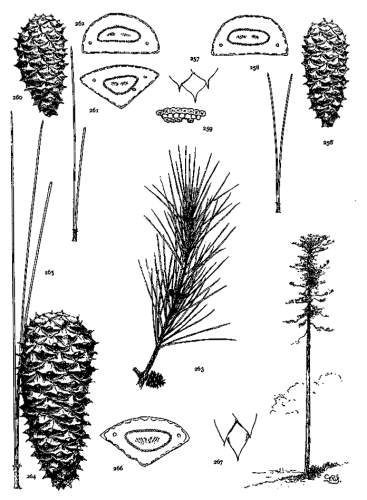 PLATE XXX. P. GLABRA (256-259), ECHINATA (260-263),
TAEDA (264-267)
PLATE XXX. P. GLABRA (256-259), ECHINATA (260-263),
TAEDA (264-267)
XII. INSIGNES
Pits of the ray-cells small. Cones tenaciously persistent, serotinous in
various degrees. Conelets mucronate or spinose.
| Spring-shoots uninodal. |
| Resin-ducts mostly internal | 48. Pringlei |
| Resin-ducts mostly septal | 49. oocarpa |
| Spring-shoots multinodal. |
| Cones symmetrical. |
| Leaf-hypoderm not biform. |
| Bark-formation late | 50. halepensis |
| Bark-formation early | 51. pinaster |
| Leaf-hypoderm biform. |
| Cones with slender spines. |
| Leaves binate. |
| Cones dehiscent at maturity | 52. virginiana |
| Cones serotinous | 53. clausa |
| Leaves ternate. |
| Cones dehiscent at maturity | 54. rigida |
| Cones serotinous | 55. serotina |
| Cones with stout spines | 56. pungens |
| Cones oblique or unsymmetrical. |
| Cones and leaves very short, not exceeding 6 cm. |
| Cones curved or warped | 57. Banksiana |
| Cones straight | 58. contorta |
| Cones and leaves much longer, more than 7 cm. |
| Posterior cone-scales gradually larger than anterior scales. |
| Bark-formation late | 59. Greggii |
| Bark-formation early | 60. patula |
| Posterior cone-scales abruptly larger than anterior scales. |
| Cones with very stout spines | 61. muricata |
| Cones with minute or deciduous prickles. |
| Bark-formation late | 62. attenuata |
| Bark-formation early | 63. radiata |
48. PINUS PRINGLEI
1905 P. Pringlei Shaw in Sargent, Trees & Shrubs, i. 211, t. 100.
Spring-shoots uninodal, sometimes pruinose. Leaves ternate, from 15 to
25 cm. long; resin-ducts internal or with an occasional septal duct,
hypoderm biform, in thick masses, often projecting far into the green
tissue and sometimes touching the endoderm. Conelets mucronate. Cones
from 5 to 10 cm. long, reflexed on a rigid peduncle, subsymmetrical or
more or less oblique, tenaciously persistent, often serotinous;
apophyses sublustrous tawny yellow or fulvous brown, convex, the
posterior scales often more prominently developed, the mucro usually
wanting; seed with a perceptibly thickened wing-blade.
A tree with long erect bright green foliage, confined, so far as
known, to the subtropical altitudes of western Mexico. As it grows in
Uruapan, Michoacan, there are two forms of the cone, large and small,
both with the same long rigid leaf.
Figs. 268, 269. Three cones and seed. Fig. 270, Leaf-fascicle and
magnified leaf-section.
49. PINUS OOCARPA
- 1838 P. oocarpa Schiede in Linnaea, xii. 491.
- 1842 P. oocarpoides Lindley ex Loudon, Encycl. 1118.
Spring-shoots uninodal, pruinose. Leaves in fascicles of 3, 4 or 5, from
15 to 30 cm. long, erect; resin-ducts mostly septal, sometimes internal,
hypoderm biform or multiform. Conelets on very long peduncles,
mucronate. Cones from 4 to 10 cm. long, long-pedunculate, broad-ovate to
ovate-conic, symmetrical or sometimes oblique, persistent, more or less
serotinous; apophysis gray-yellow or greenish yellow of high lustre,
flat or variously convex, delicately and radially carinate, the umbo
often salient, the prickle usually broken away; seed-wing appreciably
thickened at the base of the blade.
A subtropical species, ranging from Guatemala to the northern border
of Sinaloa in northern Mexico; remarkable for the length of the
peduncle of the cone and for the prevalence of septal resin-ducts in
the leaf.
Fig. 271, Three cones and seed. Fig. 272, Leaf-fascicle and
magnified leaf-section. Fig. 273, Cone from northern part of the
range. Fig. 274, Leaf-fascicle and magnified leaf-section from near
the northern limit.
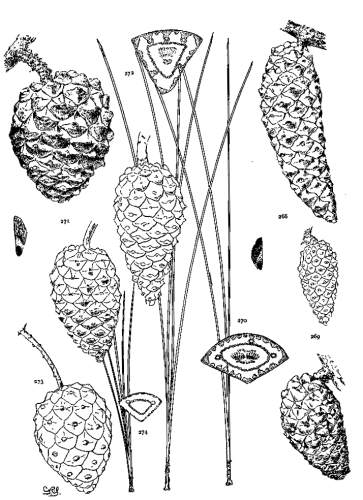 PLATE XXXI. P. PRINGLEI (268-270), OOCARPA (271-274)
50. PINUS HALEPENSIS
- 1762 P. sylvestris Gouan, Hort. Reg. Monspel. 494 (not Linnaeus).
- 1768 P. halepensis Miller, Gard. Dict. ed. 8.
- 1803 P. maritima Lambert, Gen. Pin. i. 13, t. 10.
- 1812 P. resinosa Loiseleur, Nouv. Duham. v. 237, t. 77 (not Aiton).
- 1815 P. brutia Tenore, Cat. Hort. Neap. Appx. 1, 75.
- 1826 P. arabica Sieber ex Sprengel, Syst. Veg. iii. 886.
- 1833 P. pyrenaica David in Ann. Soc. Hort. Paris, 186 (not Lapeyrouse).
- 1834 P. hispanica Cook, Sketches in Spain, ii. 337.
- 1838 P. pityusa Steven in Bull. Soc. Nat. Mosc. xi. 49.
- 1841 P. carica Don in Ann. Mag. Nat. Hist. vii. 459.
- 1847 P. persica Strangways ex Endlicher, Syn. Conif. 157.
- 1855 P. abasica Carrière, Trait. Conif. 352.
- 1855 P. Loiseleuriana Carrière, Trait. Conif. 382.
- 1856 P. Parolinii Visiani in Mem. Ist. Venet. vi. 243, t. 1.
- 1902 P. eldarica Medwejew in Act. Hort. Tiflis. vi-2, 21, f.
Spring-shoots often multinodal. Bark-formation late, the branches ashen
gray and smooth for several years. Leaves binate, from 6 to 15 cm. long;
resin-ducts external, hypoderm uniform. Conelets obscurely mucronate
near the apex. Cones from 8 to 12 cm. long, ovate-conic, symmetrical or
subsymmetrical, persistent, often serotinous; apophyses red with a
lighter or deeper brownish shade, lustrous, flat, convex or
low-pyramidal, radially carinate, the umbo often ashen gray and unarmed.
A tree ranging from Portugal to Afghanistan, and from Algeria to
Dalmatia and to northern Italy and Southern France. It is a vigorous
species in its own home, growing readily in poor soils, but not
successful in colder climates. The wood is resinous and valuable for
fuel. The turpentine industry, once associated with this species, has
gradually been abandoned for the more copious product of P. pinaster.
It is recognized by its lustrous red cones and by the ashen gray
cortex of its branches and upper trunk. Tenore's P. brutia (pyrenaica
of some authors) is founded on a difference in the length of the leaf
and on an erect cone with a shorter peduncle. To recognize species on
such distinctions would not be consistent with the purpose and spirit
of this discussion.
Fig. 279, Two cones. Fig. 280, Cone. Fig. 281, Lateral conelet. Fig.
282, Magnified leaf-section. Fig. 283, Dermal tissues of the leaf
magnified.
51. PINUS PINASTER
- 1768 P. sylvestris Miller, Gard. Dict. ed. 8 (not Linnaeus).
- 1789 P. pinaster Aiton, Hort. Kew. iii. 367.
- 1798 P. laricio Savi, Fl. Pisa. ii. 353 (not Poiret).
- 1804 P. maritima Poiret in Lamarck, Encycl. Méth. v. 337 (not Lambert).
- 1826 P. escarena Risso, Hist. Nat. ii. 340.
- 1835 P. Lemoniana Bentham in Trans. Hort. Soc. Lond. ser. 2, i. 512, t.
- 1845 P. Hamiltonii Tenore, Cat. Ort. Nap. 90.
Spring-shoots sometimes multinodal. Bark-formation early. Leaves binate,
from 10 to 20 cm. long, stout and rigid; resin-ducts medial, hypoderm
multiform, the inner cells gradually larger, remarkably large in the
angles of the leaf. Conelets minutely mucronate. Cones from 9 to 18 cm.
long, nearly sessile, ovate-conic, symmetrical or subsymmetrical,
persistent, sometimes serotinous; apophyses lustrous nut-brown or rufous
brown, conspicuously pyramidal, the umbo salient and pungent.
A maritime tree corresponding nearly, in its range, with the preceding
species, but more hardy in cooler climates. It grows from Portugal to
Greece, and from Algeria to Dalmatia, but its area has been much
extended by cultivation. Under favorable conditions it attains large
dimensions, but its exploitation for resin and turpentine tends to
diminish its size and disfigure its habit (Mathieu, Fl. Forest, ed. 4,
611). Its rapid growth, strong root-system, and its ability to thrive
on poor sandy soil, have led to the employment of this species for the
forestation of sand-dunes in France.
The tree can be recognized by its long stout leaves and persistent
brown cones. Its leaf-section is peculiar in the remarkable size of
the inner cells of the hypoderm, especially in the angles of the leaf.
Figs. 275, 276, Cones. Fig. 277, Magnified leaf-section. Fig. 278,
Magnified dermal tissues in the angle of the leaf.
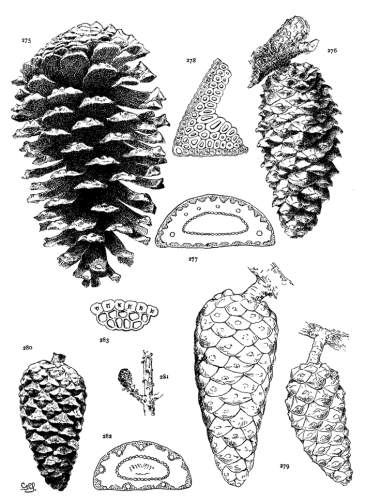 PLATE XXXII. P. PINASTER (275-278), HALEPENSIS
(279-283)
PLATE XXXII. P. PINASTER (275-278), HALEPENSIS
(279-283)
52. PINUS VIRGINIANA
- 1768 P. virginiana Miller, Gard. Dict. ed. 8.
- 1789 P. inops Aiton, Hort. Kew. iii. 367.
Spring-shoots multinodal, pruinose; branchlets pliant and tough.
Bark-formation slow, the cortex not rifted for some years. Leaves
binate, from 4 to 8 cm. long; resin-ducts medial, or with an occasional
internal duct; hypoderm biform. Conelets with long tapering sharp
scales. Cones from 4 to 6 cm. long, ovate or oblong-ovate, symmetrical,
persistent, dehiscent at maturity; apophyses lustrous nut-brown,
somewhat elevated along a transverse keel, the umbo salient, forming a
long slender prickle with a broad base.
Western Long Island to central Georgia and north Alabama, and from
eastern Tennessee to southern Indiana and southeastern Ohio. It is a
low bushy tree in the north, but in the south and west it attains
small timber-size and is locally exploited. It is hardy beyond the
limits of its natural range, growing readily in the vicinity of
Boston. Its short binate leaves, the persistent long prickles of its
cone, and its tough branches, combine to distinguish this Pine from
its associates. The obvious relationship of P. virginiana and P.
clausa places the former in this, rather than in the preceding group.
Fig. 284, Cones. Fig. 285, Conelet and its enlarged spinose scale.
Fig. 286, Leaf-fascicle, magnified leaf-section and more magnified
dermal tissues of the leaf. Fig. 287, Buds.
53. PINUS CLAUSA
- 1884 P. clausa Vasey ex Sargent, Rep. 10th Cens. U. S. ix. 199.
Spring-shoots multinodal. Bark-formation slow, as in the preceding
species. Leaves binate, from 5 to 9 cm. long; resin-ducts medial, or
with an occasional internal duct, hypoderm biform when of two rows of
cells. Conelets with long tapering acute scales. Cones from 5 to 8 cm.
long, reflexed, ovate-conic, symmetrical, persistent, often serotinous;
apophyses lustrous nut-brown, elevated along a transverse keel, the umbo
forming a triangular persistent spine.
A species of limited range, confined to the sandy coast of Alabama and
to Florida. It sometimes attains timber-size, but is usually a low
spreading tree of no commercial importance and never seen in
cultivation. It is recognized by its smooth branches, binate leaves
and numerous, often multiserial, clusters of persistent, often closed,
cones. It is associated with P. caribaea and, in the northern part of
its range, it grows with the other Southern species. By its close
resemblance it may be considered the serotinous form of P. virginiana.
Fig. 288, Three nodal groups of cones of the same year. Fig. 289,
Conelet and its enlarged scale. Fig. 290, Leaf-fascicle and
magnified leaf-section. Fig. 291, Larger form of the tree.
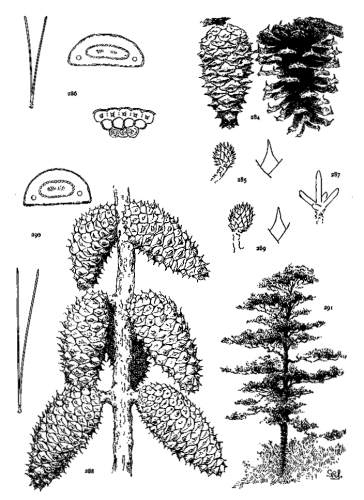 PLATE XXXIII. P. VIRGINIANA (284-287), CLAUSA (288-291)
54. PINUS RIGIDA
- 1768 P. rigida Miller, Gard. Dict. ed. 8.
- 1909 P. serotina Long, in Bartonia, ii. 17 (not Michaux).
Spring-shoots multinodal. Leaves ternate, from 7 to 14 cm. long;
resin-ducts medial, or with an occasional internal duct, hypoderm
biform. Scales of the conelet abruptly prolonged into a spine. Cones
from 3 to 7 cm. long, ovate-conic, symmetrical, persistent, dehiscent at
maturity or rarely serotinous; apophyses lustrous tawny yellow, elevated
along a transverse keel, the umbo salient and forming the broad base of
a slender sharp prickle.
A tree with bright green foliage in spreading tufts. The northern
limit of its range is in southwestern New Brunswick, southern Maine,
central New Hampshire and Vermont, the Thousand Islands of the St.
Lawrence River and central Ohio. It ranges into Pennsylvania and
Delaware at low levels and thence over the Alleghanies into northern
Georgia. It is associated with P. strobus and P. resinosa and, further
south, with P. virginiana. The cones are rarely serotinous, but it is
remarkably like P. serotina in many characters, and is therefore
placed in this group.
Fig. 292, Cones. Fig. 293, Leaf-fascicle, magnified section through
a fascicle, and magnified dermal tissues of the leaf. Fig. 294,
Upper part of a tree.
55. PINUS SEROTINA
- 1803 P. serotina Michaux, Fl. Bor. Am. ii. 205.
Spring-shoots multinodal. Leaves ternate, from 12 to 20 cm. long;
resin-ducts medial or medial and internal, hypoderm biform. Conelet
long-mucronate. Cones from 5 to 7 cm. long, subglobose or short-ovate,
symmetrical, persistent, serotinous; apophyses lustrous tawny yellow,
slightly elevated along a transverse keel, the umbo forming the broad
base of a slender, rather fragile prickle.
This species is confined to low wet lands from southeastern Virginia
to northern Florida and central Alabama. It is one of the associated
six timber-Pines of the Southern States and the only one of them with
serotinous cones. Its wood is of like value with that of P. taeda, the
two species being constantly confused by lumbermen. It is never
associated with P. rigida, but its resemblance to that Pine is so
great that it may be regarded as its serotinous form. Its leaf is
longer, its cone usually more orbicular and the prickle weaker.
Fig. 295, Cone. Fig. 296, Conelet and its enlarged scale. Fig. 297,
Leaf-fascicle and magnified leaf-section.
56. PINUS PUNGENS
- 1803 P. taeda Lambert, Gen. Pin. i. t. 16, (as to cone). (not Linnaeus).
- 1806 P. pungens Lambert in Ann. Bot. ii. 198.
- 1852 P. montana Noll, Bot. Class Book, 340. (not Miller).
Spring-shoots multinodal. Leaves binate or ternate, from 3 to 7 cm.
long; resin-ducts medial, or with an occasional internal duct, hypoderm
biform. Scales of the conelet much prolonged into a very acute triangle.
Cones from 5 to 9 cm. long, symmetrical or subsymmetrical, tenaciously
persistent, serotinous; apophyses lustrous or sublustrous fulvous brown,
much elevated along a transverse keel, the umbo forming a stout
formidable spine, uniform or nearly uniform on all faces of the cone.
A mountain species ranging from central Pennsylvania to northern
Georgia, with isolated stations in western New Jersey and Maryland. It
is remarkable among the Pines of eastern North America for the size
and strength of the spines of its cone. The armature resembles that of
the cone of the western P. muricata, but with the difference that the
western cone is strongly oblique, the anterior and posterior spines
varying greatly in size.
Fig. 298, Cone. Fig. 299, Conelet and its enlarged scale. Fig. 300,
Leaf-fascicle and magnified leaf-section.
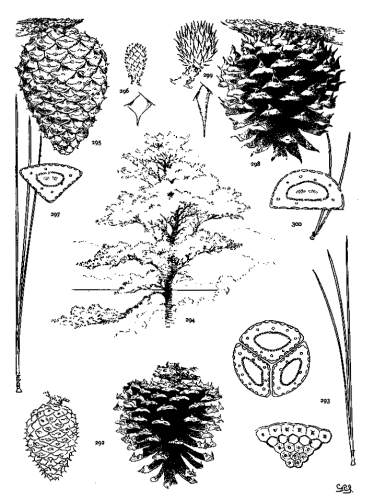 PLATE XXXIV. P. RIGIDA (292-294), SEROTINA (295-297),
PUNGENS (298-300)
PLATE XXXIV. P. RIGIDA (292-294), SEROTINA (295-297),
PUNGENS (298-300)
57. PINUS BANKSIANA
- 1803 P. Banksiana Lambert, Gen. Pin. i. 7. t. 3.
- 1804 P. hudsonia Poiret in Lamarck, Encycl. Méth. v. 339.
- 1810 P. rupestris Michaux f. Hist. Arbr. Am. i. 49, t. 2.
- 1811 P. divaricata Dumont de Courset, Bot. Cult. ed. 2, vi. 457.
Spring-shoots multinodal. Leaves binate, from 2 to 4 cm. long;
resin-ducts medial, hypoderm biform. Conelets minutely mucronate. Cones
from 3 to 5 cm. long, erect, ovate-conic, oblique, much curved or
variously warped from the irregular development of the scales,
serotinous; apophyses lustrous tawny yellow, concave, flat or convex,
the umbo small and unarmed.
The most northern American Pine, growing near the Arctic Circle in the
valley of the Mackenzie River, whence it ranges southeasterly to
central Minnesota and the south shore of Lake Michigan, and easterly
through the Dominion of Canada to northern Vermont, southern Maine,
and Nova Scotia. In the northern part of its range it is the only
Pine, but further south it is associated with P. strobus and P.
resinosa. It is easily identified by its curious curved or deformed
cones.
Fig. 301, Cones. Fig. 302, Biserial cones of the same
year. Fig. 303, Leaf-fascicle and magnified leaf-section. Fig. 304,
Habit of the tree.
58. PINUS CONTORTA
- 1833 P. inops Bongard in Mém. Acad. Sci. St. Pétersb. ii. 163, (not Aiton).
- 1838 P. contorta Douglas ex Loudon, Arb. Brit. iv. 2292, f. 2211.
- 1853 P. Murrayana Balfour in Bot. Exp. Oregon, 2, f.
- 1854 P. Boursieri Carrière in Rev. Hort. 225, ff. 16, 17.
- 1868 P. Bolanderi Parlatore in DC. Prodr. xvi-2, 379.
- 1869 P. tamrac Murray in Gard. Chron. 191, ff. 1-9.
- 1898 P. tenuis Lemmon in Erythea, vi. 77.
Spring-shoots multinodal. Leaves binate, from 3 to 5 cm. long;
resin-ducts medial, hypoderm biform. Conelets long-mucronate. Cones from
2 to 5 cm. long, sessile, ovate-conic, symmetrical or very oblique,
persistent, serotinous; apophyses lustrous tawny-yellow, flat or
protuberant, on oblique cones abruptly larger on the posterior face; the
umbo armed with a slender fragile prickle.
It grows from the valley of the Yukon, near the Alaskan boundary,
along the Pacific coast to Mendocino county, California. It covers the
plains and slopes of British Columbia and follows the Rocky Mountains
into western Colorado, with an outlying station on the Black Hills of
South Dakota. It grows on the Sierras and mountains of southern
California and in northern Lower California. On the seashore this Pine
is of low dense growth, but inland it is a slender tree with a long
tapering stem. It is easily recognized by its very short leaves and
very small cone.
Fig. 305, Cones. Fig. 306, Leaf-fascicle and magnified leaf-section.
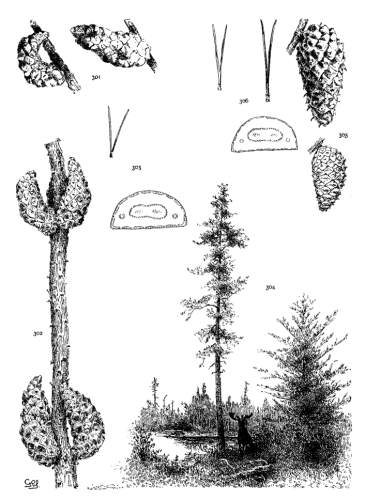 PLATE XXXV. P. BANKSIANA (301-304), CONTORTA (305, 306)
59. PINUS GREGGII
- 1868 P. Greggii Engelmann ex Parlatore in DC. Prodr. xvi-2, 396.
Spring-shoots uninodal and multinodal, pruinose. Bark-formation late,
the branches and upper trunk smooth. Leaves ternate, from 7 to 10 cm.
long, erect; resin-ducts medial, hypoderm of uniform thin-walled cells.
Conelets mucronate. Cones from 6 to 12 cm. long, ovate-conic, oblique,
serotinous, reflexed; apophyses lustrous tawny yellow, convex, the
posterior gradually larger and more prominent than the anterior scales,
the umbo flat or depressed, the mucro deciduous.
This species is known, at present, from specimens collected in the
vicinity of the city of Saltillo, in northeastern Mexico. Were it not
for the difference of bark it might be considered to be a northern
variety of P. patula with shorter erect leaves. With both species the
long peduncle of the conelet becomes overgrown by the basal scales of
the ripe cone, which appears to be sessile. With both, the cones are
in crowded nodal clusters, reflexed against the branch. They are so
much alike that earlier descriptions of P. patula included the smooth
gray bark of P. Greggii. The first correct description of the scaly
red bark of P. patula appeared in the second edition of Veitch's
Manual of Conifers.
Fig. 311, Cone. Fig. 312, Conelet. Fig. 313, Leaf-fascicle and
magnified leaf-section. Fig. 314, Branch showing erect leaves.
60. PINUS PATULA
- 1831 P. patula Schlechtendal & Chamisso in Linnaea, vi. 354.
Spring-shoots multinodal, more or less pruinose. Bark-formation early,
the scales deciduous, the upper trunk and branches red. Leaves
prevalently ternate but sometimes in fascicles of 4 or 5, from 15 to 30
cm. long, slender and gracefully drooping; resin-ducts medial or with an
occasional internal duct, hypoderm weak, of uniform thin-walled cells.
Conelets mucronate. Cones from 6 to 11 cm. long, in crowded verticillate
clusters, sessile, reflexed, ovate-conic, oblique, persistent and
serotinous; apophyses lustrous nut-brown, more or less tumid, the
posterior gradually larger than the anterior scales, the umbo flat or
depressed, the mucro wanting.
Patula grows in the warm-temperate climates of Hidalgo, Puebla and
Vera Cruz, in eastern and central Mexico. It can be at once recognized
by its slender drooping foliage, its persistent cones, and its red
upper trunk. It is cultivated in northern Italy and in the warmer
parts of Great Britain.
Fig. 307, Cone. Fig. 308, Conelet. Fig. 309, Leaf-fascicle and
magnified leaf-section. Fig. 310, Branchlet with drooping leaves.
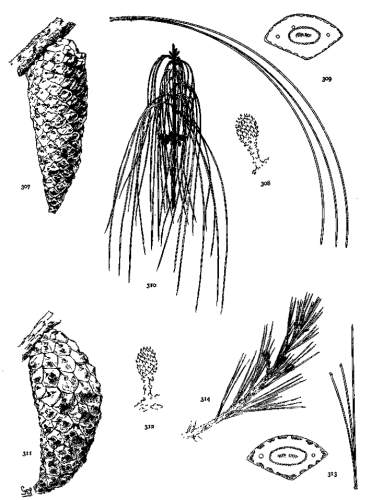 PLATE XXXVI. P. PATULA (307-310), GREGGII (311-314)
61. PINUS MURICATA
- 1837 P. muricata D. Don in Trans. Linn. Soc. xvii. 441.
- 1848 P. Edgariana Hartweg in Jour. Hort. Soc. Lond. iii. 217.
Spring-shoots multinodal. Leaves binate, from 10 to 15 cm. long;
resin-ducts medial, hypoderm biform. Scales of the conelet prolonged
into a triangular spine. Cones from 5 to 9 cm. long, in verticillate
clusters, sessile, reflexed, ovate-conic, oblique, serotinous; apophyses
lustrous nut-brown, abruptly much larger on the posterior face of the
cone, each armed with a formidable spine varying in size with the
varying size of the apophysis.
This species grows on the coast of California, in scattered stations
between Mendocino and San Luis Obispo Counties, and on the northwest
coast of Lower California and on Cedros Island. It is recognized by
its oblique cones, conspicuously spinose, indefinitely persistent and
very serotinous. The unequal development of its cone-scales
distinguishes the cone from the more symmetrically developed cone of
P. pungens. Fruiting trees of P. muricata may be seen in the Royal
Gardens at Kew.
Fig. 315, Cone. Fig. 316, Leaf-fascicle and magnified leaf-section.
62. PINUS ATTENUATA
- 1847 P. californica Hartweg in Jour. Hort. Soc. Lond. ii. 189, (not? P. californiana, Loiseleur).
- 1849 P. tuberculata Gordon in Jour. Hort. Soc. Lond. iv. 218, f. (not D. Don).
- 1892 P. attenuata Lemmon in Mining & Sci. Press, lxiv. 45.
Spring-shoots multinodal. Bark-formation late, the branches and upper
trunk smooth. Leaves ternate, from 8 to 16 cm. long; resin-ducts medial
or with one or more internal ducts, hypoderm biform. Scales of the
conelet prolonged into a triangular spine. Cones from 8 to 16 cm. long,
in verticillate clusters, sessile, reflexed, long-ovate, oblique,
persistent and remarkably serotinous; apophyses lustrous tawny yellow,
abruptly larger and more prominent on the posterior face of the cone,
where they are usually prolonged into acute pyramids with a small
incurved spine.
A tree of slender habit and gray-green foliage, the trunk studded with
persistent nodal cone-clusters; growing on dry mountain slopes, from
southwestern Oregon over the foot-hills of the northern mountains of
California and its coastal ranges as far as the southern slopes of the
San Bernardino Mountains. It attains its best development in the
northern part of its range, but is never a tree of importance. The
serotinous habit is more pronounced in this than in any other species.
It is distinct from P. radiata, its nearest relative, by the color of
the cone, by its smooth upper trunk and by its much smaller size.
The possibility of identifying P. californiana Loiseleur (Nouv. Duham.
v. 293), through a cone said to have been sent to the Museum at Paris,
may cause this name to be applied, by reason of its early date (1812),
to some existing species. Don's radiata and tuberculata, although
considered to be the same species, were nevertheless founded on
different forms of the cone. Under a very narrow conception of
specific limits tuberculata Don might therefore acquire specific rank.
These considerations seem to make it advisable to abandon for this
species the names californica Hartw. and tuberculata Gord. for the
later name attenuata.
Fig. 317, Cone. Fig. 318, Magnified leaf-section.
63. PINUS RADIATA
- 1837 P. radiata D. Don in Trans. Linn. Soc. xvii. 442.
- 1837 P. tuberculata D. Don in Trans. Linn. Soc. xvii. 442.
- 1838 P. insignis Douglas ex Loudon, Arb. Brit. iv. 2265, f. 2171.
- 1841 P. Sinclairii Hooker & Arnott in Bot. Beechy Voy. 392, t. 93 (as to leaves).
Spring-shoots multinodal. Bark formation early, the branches and upper
trunk rough. Leaves ternate or binate, from 10 to 15 cm. long;
resin-ducts medial or with an occasional internal duct, hypoderm biform.
Conelets mucronate, the mucro small and dorsal. Cones from 7 to 14 cm.
long, in verticillate clusters, sessile, reflexed, ovate or oblong,
oblique, serotinous; apophyses nut-brown, lustrous, tumid in various
degrees, the posterior scales abruptly larger and very prominent, the
umbo bearing the minute prickle or its remnant.
A tall tree with rich green foliage, growing on a strip of coast
south of San Francisco, particularly in Monterey County. It grows also
on the islands forming the Santa Barbara Channel and on the Island of
Guadeloupe, Lower California. It is remarkably successful in the
warmer climates of Europe and of Australasia. The species is distinct
in its peculiar cone with rounded apophyses.
Figs. 319, 320, Cones. Fig. 321, Leaf-fascicle and magnified
leaf-section. Fig. 322, Leaf-section from a binate fascicle. Fig.
323, Magnified dermal tissues of the leaf.
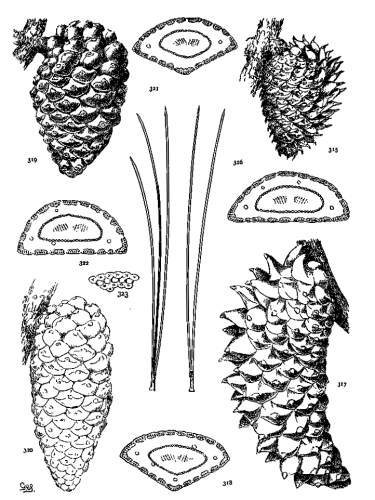 PLATE XXXVII. P. MURICATA (315, 316), ATTENUATA (317,
318), RADIATA (319-323)
PLATE XXXVII. P. MURICATA (315, 316), ATTENUATA (317,
318), RADIATA (319-323)
XIII. MACROCARPAE
Pits of the ray-cells small. Wing-blade of the seed thick. Cones large.
Leaves long and stout.
This group is remarkable for the size of leaf, conelet, and cone. The
peculiar thick seed-wing is more or less obscurely present among the
species of the Insignes, but never attains the development that
differentiates this group from all other Pines. The leaf-section is
notable for the large amount of hypoderm and for the presence of both
thick and thin outer walls of the endoderm-cells, both forms appearing
in the same leaf.
| Wing-blade with a short membranous extension. |
| Leaves in fascicles of 5 | 64. Torreyana |
| Leaves in fascicles of 3 | 65. Sabiniana |
| Wing-blade with a long membranous extension, leaves in fascicles of 3 | 66. Coulteri |
64. PINUS TORREYANA
- 1855 P. Torreyana Parry ex Carrière, Trait. Conif. 326.
- 1860 P. lophosperma Lindley in Gard. Chron. 46.
Spring-shoots uninodal, pruinose. Leaves in fascicles of 5, from 20 to
33 cm. long, very stout; resin-ducts medial, hypoderm uniform or
somewhat multiform and of many cells. Conelets large, mucronate. Cones
from 10 to 15 cm. long, on stout peduncles, broad-ovate, symmetrical,
somewhat persistent; apophyses chocolate-brown, prominently pyramidal,
the umbo salient and capped with a small mucro; seed-wing short, very
thick, the dorsal surface of the nut spotted with the black remnants of
the spermoderm.
A tree 10 or 12 metres high, often semi-prostrate in exposed
positions, confined to a restricted area on the coast north of San
Diego, California, and to the Island of Santa Rosa. This species
resembles P. Sabiniana in the length of its seed-wing and in the color
of its cone, but is distinct in the short triangular umbo, in its
pentamerous leaf-fascicles and in the mottled dorsal surface of its
nut.
Fig. 324, Cone and seed. Fig. 325, Magnified leaf-section.
65. PINUS SABINIANA
- 1833 P. Sabiniana Douglas in Trans. Linn. Soc. xvi. 747.
Spring-shoots multinodal, pruinose. Leaves in fascicles of 3, from 20 to
30 cm. long; resin-ducts medial, hypoderm multiform. Conelets large,
their scales tapering to a sharp point. Cones from 15 to 25 cm. long,
reflexed, ovate, slightly oblique, persistent; apophyses
chocolate-brown, very prominent, the curved umbo confluent with the
apophysis and with it forming a very large talon-like armature with a
sharp apex and a broad thick base; seed-wing very thick, with a short
membranous margin, the dorsal surface of the nut uniform in color.
A tree with sparse gray-green foliage, growing in small groves on the
foot-hills of the Sierra Nevada and Coast Ranges of California. Its
three leaves and the uniform color of the nut distinguish it from
P. Torreyana. From P. Coulteri it differs in the length of the
membranous portion of the seed-wing and in its gray-green leaves.
Fig. 326, Cone. Fig. 327, Seed, nut and wing. Fig. 328, Magnified
leaf-section.
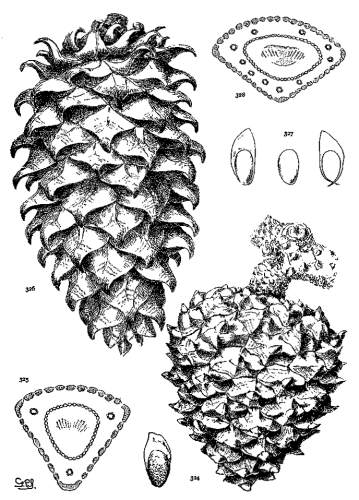 PLATE XXXVIII. P. TORREYANA (324, 325), SABINIANA
(326-328)
PLATE XXXVIII. P. TORREYANA (324, 325), SABINIANA
(326-328)
66. PINUS COULTERI
- 1837 P. Coulteri D. Don in Trans. Linn. Soc. xvii. 440.
- 1840 P. macrocarpa Lindley in Bot. Reg. xxvi. Misc. 62.
Spring-shoots multinodal, pruinose. Leaves in fascicles of 3, from 15 to
30 cm. long, very stout; resin-ducts medial, or with an occasional
internal duct, hypoderm multiform and of many cells. Conelet very large,
the scales tapering to a long sharp point. Cones from 25 to 35 cm. long,
reflexed, ovate or oblong-ovate, somewhat oblique, persistent; apophyses
sublustrous tawny yellow, very protuberant, with a narrow shoulder from
which springs the umbo in the form of a large stout curved talon;
seed-wing nearly equally divided between the very thick base and the
membranous apex.
Remarkable among Pines for the size and weight of its cones, many
times heavier than the longer cones of P. Lambertiana, illustrating
the great change that the cone-tissues undergo in the gradual
evolution of the species. It is a tree with dark-green foliage,
growing from northern Lower California over the mountains of southern
California to the Santa Lucia range and to Mt. Diablo. It is of no
value except for fuel and for its large nuts. It is best recognized by
its seed. The cone differs from the others of this group in its yellow
color, not unlike that of boxwood.
Fig. 329, Cone of small size. Fig. 330, Seed, nut and wing. Fig.
331, Magnified leaf-section. Fig. 332, Conelet.
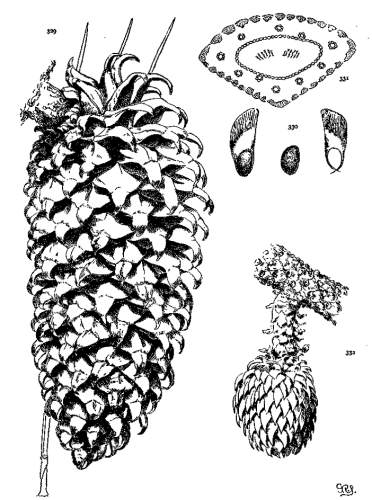 PLATE XXXIX. PINUS COULTERI