“An indispensable book to the student of art.”—Daily Graphic.
Recently Issued.
Water Colour Painting.
By Alfred W. Rich. 60 Illustrations. 10s. 6d. nett.
“Mr. Rich’s work has placed him among the
comparatively few water-colourists of to-day who
count, and the work of his students proves that
he can teach.”—Saturday Review.
The Artistic Anatomy of Trees.
By Rex Vicat Cole. Over 500 Illustrations. 15s. nett.
“Like all the volumes of the New Art Library,
thorough in its teaching, eminently practical in
its manner of presenting it, and splendidly illustrated.”—Connoisseur.
The Practice and Science of Drawing.
By Harold Speed. 96 Illustrations. 10s. 6d. nett.
“No work on Art has been published in recent
years which might be more advantageously placed
in the hands of a young student. Every page
shows robust common sense expressed in a clear
style.... We imagine that Mr. Speed is an
admirable teacher, and cordially recommend his
treatise.”—Athenæum.
The Practice of Oil Painting and Drawing.
S. J. Solomon, r.a. 80 Illustrations. 10s. 6d. nett.
“If students were to follow his instructions, and
still more, to heed his warnings, their painting
would soon show a great increase in efficiency.”—Manchester Guardian.
Human Anatomy for Art Students.
By Sir Alfred Downing Fripp, k.c.v.o., 159 Illustrations. 15s. nett.
“Combines the best scientific and artistic information.”—Connoisseur.
Modelling and Sculpture.
By Albert Toft, a.r.c.a., m.s.b.s. With 119 Illustrations. 15s. nett.
“Will be found an invaluable aid to the student....
Takes the student step by step through the
various technical processes, the text being supplemented
by over a hundred excellent illustrations.”—Studio.
Seeley, Service & Co., Ltd., 38 Great Russell St.
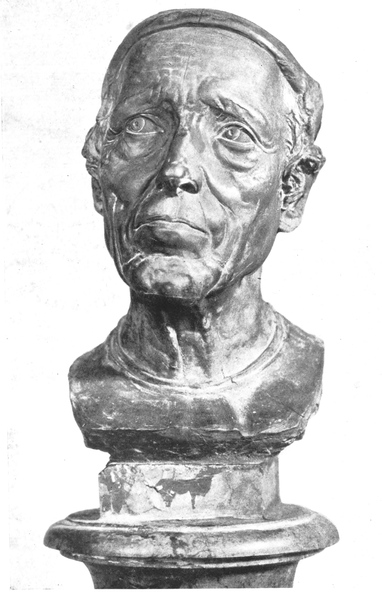
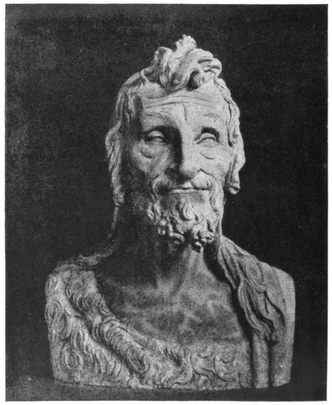
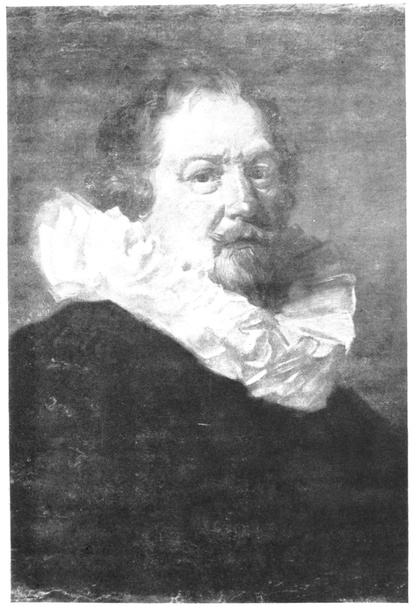
Photo]
[Alinari
Supposed Portrait of the Poet Bastianini Benivieni.
A direct cast from the original now in Paris and formerly kept in the Louvre Museum.
THE GENTLE ART OF FAKING
A HISTORY OF THE METHODS OF PRODUCING
IMITATIONS & SPURIOUS WORKS OF ART
FROM THE EARLIEST TIMES UP
TO THE PRESENT DAY
BY RICCARDO NOBILI AUTHOR OF “A MODERN ANTIQUE”
“Le dernier mot de l’art je le trouve dans la contrefaçon” Sainte-Beuve
WITH 31 ILLUSTRATIONS
LONDON SEELEY SERVICE & CO. LTD. 38 Great Russell Street 1922
TO MRS. MARY S. SHEPARD
WITH THE DEVOTED AFFECTION OF A SON
THIS BOOK IS DEDICATED
PREFACE
“Collectomania” may with some reason be looked upon
as a comedy in which the leading parts are taken by the
Collector, the Dealer, and the Faker, supported by minor
but not less interesting characters, such as imitators, restorers,
middlemen, et hoc genus omne, each of whom could tell more
than one attractive tale.
In analysing the Faker one must dissociate him from the
common forger; his semi-artistic vocation places him quite
apart from the ordinary counterfeiter; he must be studied
amid his proper surroundings, and with the correct local
colouring, so to speak, and his critic may perchance find
some slight modicum of excuse for him. Beside him stand
the Imitator, from whom the faker often originates, the
tempter who turns the clever imitator into a faker, and the
middleman who lures on the unwary collector with plausible
tales.
It is not the object of this volume to study the Faker by
himself, but to trace his career through the ages in his appropriate
surroundings, and compare the methods adopted by
him at various periods of history, so far as they may be
obtained.
Ethically, there is a strict line drawn between the imitator
and the forger, but in practice this line is by no means rigid.
Many imitators place their goods before the public as imitations;
others tacitly permit their work to be sold as genuinely
antique, influenced no doubt by the fact that though possibly
the imitation and the original may possess equal merit, the
one is handicapped by modernity, the other is hallowed by
age. The inexperienced and unwary collector is in most
cases the innocent originator of fraud; if there were no
buyer there would be no seller. Too often fashion leads
folly, and so fictitious values are created, and as demand
increases so, too, do the sources of supply, but unhappily
they are frequently not legitimate.
RICCARDO NOBILI.
Ville Marie, Via Dante da Castiglione 3, Florence.
THE GENTLE ART OF FAKING — Part I THE BIRTH AND DEVELOPMENT OF FAKING — CHAPTER I GREEKS AND ROMANS AS ART COLLECTORS
Why the Greeks by not being collectors in the modern sense were spared
faking in art—How the Romans became interested in art—Genesis of
their art collections—The first collectors and their methods—Noted
citizen’s indictment against art plundering of Roman conquerors—Attitude
of noted writers towards art, and art collecting.
The collector, the chief patron of fakery, being somewhat of
a selfish lover of art, it is quite natural that the Greeks,
who saw in art a grand means of public education and enjoyment,
cannot be called art collectors in the modern sense of
the word. Consequently there was hardly room for sham
art in a country where art as the direct emanation of public
spirit was rigorously maintained for the sake of the people.
It was the temples that became art emporiums—museums
that everyone was allowed to enjoy—or free institutions,
like the pinacotheca of the Acropolis, the collection of carved
stone at the Parthenon, the gymnasium of the Areopagus,
containing a collection of busts of the most celebrated
philosophers. With this public spirit in the enjoyment of
art Delphi gathered a famous picture gallery in the oracular
temple and, according to Pliny, possessed no fewer than three
thousand statues, one of them being the famous golden
Apollo. From this temple Nero carried off five hundred
bronze statues, and later on Constantine removed many of
the remaining works of art to Constantinople. An identical
spirit of public enjoyment of art had turned the temples of
Juno in Olympia, of Minerva in Platæa and Syracuse into
veritable museums of art and—curiosities also. The temple
of Minerva at Lyndon in the island of Rhodes, for instance,
contained a cup of electrum (amber) offered by Helen of
Troy, which was said to have a cavity cut to the exact
shape of the bosom of the beautiful wife of Paris (Pliny,
XXXIII, 23).
That the Greeks at their highest historical level did not
indulge in the private and artistic delights of the collector
may also be gathered from the poor construction of their
usual dwelling-houses. It is well known that thieves, more
especially in Athens, were called “wall breakers,” and
obtained this odd nickname from their peculiar method of
entering houses, namely, by making a hole through the wall
rather than troubling to unlock the door. Such flimsy
dwellings can hardly have sheltered the treasures of an art
collection. Thus simplicity of customs and a clearly defined
manner of enjoying art, saved the Greeks to a great extent
from a regular trade in antiques with all its strange and
deplorable etceteras.
As a matter of fact, we have no information as to anything
that might be called a private art collection in Athens,
though quite consistently, considering their extreme passion
for knowledge, the Greeks had fine private libraries, such
as those of Aristotle and Theophrastus. But even these,
though containing the rarest and most precious works, were
true libraries, not collections of elaborate volumes. The
mania for fine bindings of costly materials was later on the
caprice of the learned Roman, not of the Greek.
The home of the “collector,” and consequently of his
faithful companion, the faker, was Rome.
The Roman was not a born lover of art. In fact during
the early and primitive period of its existence Rome had not
only been somewhat negative as regards art, but was even
rather averse from its enjoyment. It took centuries for the
Roman to overcome the belief that matters of art were
trifling amusements that might be left as toys to their
conquered people. Thus for a long time Romans saw in
the enjoyment of art the chief source of the weakening and
degeneration of the enemies they had subjugated. Springing
from a progeny of soldiers and agriculturists, born to conquer
the world, the Roman citizen assumed as an aphorism the
Virgilian saying that his sole duty was to subjugate enemies,
by granting them pardon or humiliating their pride.
Thus the early Romans not only show great ignorance as
to marvels of art, but even contempt for them. When art
treasures were brought to Rome as booty for the first time by
Marcellus from conquered Sicily the Senate censured such an
innovation. Fabius Maximus, called the “shield of Rome,”
rose among others in protest, saying that after the siege of
Tarentum, he, unlike Marcellus, had brought home only
gold and valuable plunder. As for statues, more especially
images, he had preferred to leave to the conquered people
“their enraged gods.” In fact the only statue Fabius took
away from Tarentum was the Hercules of Lysippus, a bronze
colossus which must have appealed to him either for its
heroic size or the large quantity of material.
A type of the early ignorant Roman art collector is given
by Lucius Mummius, the general who destroyed Corinth,
and of whom Velleius Paterculus tells (I, 13) that in sending
to Rome what might be styled the artistic booty of the
destroyed city he consigned the statues and paintings to those
in charge of the transport with the warning that should the
goods be lost they would be held responsible and would have
to reproduce them all at their own expense.
Even when with the progress of time art was finally
appreciated in Rome, the old contempt for it was transferred
in a way from the product to the maker. Thus with the
feeling that seems to characterize the parvenu in art, and
with inexplicable inconsistency, the Roman lover of art
persisted in seeing in the artist either a slave or a good-for-nothing,
and never for a moment regarded the artist as worth
the consideration he granted to art. Notwithstanding his
belief of being a lover of art and an intelligent connoisseur,
Cicero calls statues and paintings toys to amuse children
(oblectamenta puerorum). In his fourth oration, In Verrem,
he candidly confesses that he fails to understand the importance
attached by Greeks to those arts which the Romans
most rightly despise.
Valerius Maximus, who lived at the time of Tiberius, that
is to say when Rome had fully completed its education in
art, calls the profession of the painter a vile occupation (sordidum
studium), and wonders how Fabius, a Roman and
patrician, can bring himself to sign his painting with full
name and qualification, “Fabius Pictor” (VIII, 14, 6).
In one of his letters (No. 88) Seneca, the contemporary of
Nero, states that sculpture and painting are unworthy to be
classified as liberal arts. Petronius, the magister elegantiorum
of Rome, two hundred years after the destruction of Corinth,
that is to say when Rome had reached its maturity in the
understanding of art, calls Apelles, Phidias and other
famous artists of Greece, crack-brained (græculi delirantes).
With such an innately negative sense of art and strong
racial prejudice, it is not surprising that when brought to an
appreciation of art by circumstances, the Romans, though
willing and fully prepared to pay extravagant prices for
works of art, should still retain their old contempt for artists,
those græculi delirantes who had come to beautify the Capital
as slaves or tempted by gain.
As a result of this peculiar feeling and in full contrast
with the Greek sentiment which has handed down to posterity
a great deal about the artists who lived in Athens
and the honours they received, Rome has preserved for us
hardly a name of painter, sculptor or architect. And they
must have been legion if we consider the magnitude of the
work accomplished. Vitruvius (VII, 15) informs us that
Damophilus, Gorgas, Agesilas, Pasiteles and other artists
were called to Rome by Julius Cæsar, and that so many
Greek artists were in Rome that when the temple of Jupiter
Olympicus was to be finished in Athens the citizens were
obliged to send to Rome, as none of their architects were to
be found in Greece.
It is interesting to trace how the Romans gradually
became collectors of art, and how there gradually developed
in Rome a whole world of lovers of art with all its true and
fictitious enthusiasms, furnishing a group of varied types of
collectors not altogether dissimilar from those of our modern
society of lovers of art.
As we have said, conquest and booty furnished the first
articles of virtu. At first statues and objects of art of all
kinds were brought to Rome without discrimination, then
education gradually progressed, taste developed and plunder
became more enlightened. Fulvius Nobilior, to quote one
of the many conquerors who brought artistic war booty to
Rome, enriched it with 285 bronze statues, 230 marble ones,
and 112 pounds of gold ornaments. Following the custom
of the Greeks, the Romans at first presented statues and
paintings to various temples as ornaments.
Later on, with more discrimination and less greed, Roman
officials proceeded to a systematic spoliation of Greece and
the Orient of their treasures of art. Statues and paintings
followed in the triumphs of Roman generals as did slaves and
prisoners of war. Occasionally returning officials brought
home with them pillaged artistic mementoes of the place they
had been ruling in the name of mighty Rome. Thus Fulvius,
consul in Ambracia, brought home the finest statues of that
country. One of these mementoes was excavated in the
year 1867; it bore the naive and candid confession of the
consul:—
Marcus Fulvius Marci Filius
Servii Nepos Nobilior
Consul Ambracia
Cepit
Having carried off the statues of the Nine Muses in his
conquest of Ambracia, this same Fulvius Nobilior placed
them in the temple of Hercules. At this time Roman conquerors
had progressed, and they already travelled with
experts and advisers. Fulvius Nobilior was accompanied
by the poet Ennius (Strabo, B. X, 5), whose suggestion it
may have been to place Hercules in the midst of the Nine
Muses playing the lyre like an Apollo, a metamorphosis of
the god showing that the Roman had finally harmonized
“Strength,” his chief and most cherished quality, with the
gentler feelings of an understanding of art. This “Hercules
Musagetes” seems to symbolize a first conquest of art over
the rude, sturdy Roman character.
Departing from the established rule of presenting their
artistic plunder to the temples after it had followed in their
triumphs to enhance the importance of their conquest, in
time the generals began to keep part of the spoil themselves.
In this way were the first private collections in Rome
formed.
The real artistic education of the Romans dates from this
time. The passion and ambition to enrich and embellish
private houses helped to teach what was worth consideration.
Sulla, who plundered Greece and Asia Minor, is said to have
acquired a sure eye for valuable objets de virtu; Verres, who
with an excellent eye had robbed and collected all that came
within his reach, was perhaps Rome’s best connoisseur of
art. He and Sulla were practically the first to organize that
enlightened manner of plundering subjugated countries that
finally made Rome the first emporium of art in the world.
Naturally, these early Roman collectors rarely bought
their articles of virtu. When they could not obtain by pillage
they had ready to hand a speedy and coercive means of
gratifying their artistic craving. Sulla placed on the proscription
list the names of all possessors of artistic objects
who were so unwise as to refuse to give them up to him.
Mark Antony did the same to Verres. The latter paid with
his life his refusal to offer the despotic Triumvir some famous
vases of Corinthian bronze which he sorely longed to have in
his collection.
It was, we repeat, in Sulla’s time that the passion for
collecting arose among the Romans, not only guided by an
artistic sense of discrimination, but with all the peculiar
characteristics that seem to attend the development of this
passion.
Sulla’s collection—to which the spoils of the temple of
Apollo in Delphi and of the temples of Jupiter in Elis and
Æsculapius in Epidaurus, considered the richest emporium
of art in Greece, had contributed—must have been magnificent
and without an equal—except, perhaps, that of Verres,
Sulla’s pupil, who surpassed his master in the art of plundering,
and sacked Sicily of all the island possessed of art.
CHAPTER II COLLECTOMANIA IN ROME
Collectomania develops—Rampant parvenuism in Rome—Extravagant
prices paid for art and curio—Faking arrives—Good and foolish collectors
as seen by writers and satirists of the time—Art dealing—The septæ,
shops and auction rooms.
Such was the earliest type of the real collector of art in Rome,
a first phase in a city where the passion for art was, generally
speaking, rarely genuine. This phase led first to the acquisition
of what might be styled something between ambition
and love of display. Then the trade in objects of art eventually
appeared, and as a logical consequence, imitation and
fraudulent art finally had their scope. Fictitious masterpieces
of painting and sculpture, often signed, as in modern
times, with the forged names of noted artists, were already
on the market before Cicero’s time. “Odi falsas inscriptiones
statuarum alienarum” (I hate the forged inscriptions on
statues not one’s own), remarks Cicero, who although somewhat
of a collector himself never missed a chance to ridicule
the pretentious amateur lost in hysterical ecstasy before
imitations supposed to be original works, or of fanning the
art lover’s pseudo-enthusiasm for the work of Polycletus,
which was extremely fashionable at one time among art
collectors.
Thus forgery received a great impulse when art reached
its climax in Rome and multiplied the number of collectors,
dragging after it in its triumphal march wealth and all the
fickle forces of wealth. Taste in art, then, became apparently
more exclusive, or rather, according to Quintilian, more
unstable in its standards. “Nowadays,” says the Latin
rhetorician and critic, “they prefer the childish monochrome
works of Polycletus and Aglæphon to the more expressive
and more recent artists.” Yet, very likely not understanding
this not unusual love for the archaic and the odd, so common
in collectors of all ages, Quintilian cannot explain the preference
for work he considers gross, except by fashion or
what we should call to-day a snobbish sentiment. Criticizing
the art in vogue, he adds, in fact: “I should call this art
childish compared to that of most illustrious artists who came
afterwards, but in my judgment it is, of course, only pretension”
(XII, 10).
It is evident that with the Romans as with us—the times
are not entirely dissimilar; indeed but for art critics, the new
modern fad, they might be called identical—prices paid for
works of art, or simple curiosities, became freakish and
fabulous, going up or down in a single period according to
fickle fashion. The momentary passion for murrhines, for
instance, tempted a collector to pay for one of these cups of
fluor-spar a sum approximating to £14,200. Another mania
succeeded, that of tables made of citrus, a species of rare
wood, possibly Thuja, grown on the slopes of Mount Athos.
Cathegus invested in one of these fashionable tables a sum
equivalent to twelve thousand pounds. Then at another
time wrought silver becomes the rage, and prices for this
article soon reached absurd figures. When Chrysogon, Sulla’s
wealthy freedman, was bidding at an auction for a silver
autepsa (a plate warmer), people standing outside the auction
room imagined he was buying a farm from the high sum he
offered.
As might be expected, high prices tempted brainless
parvenus. There were many in Rome like that Demasippus
of whom Horace said, “Insanit veteres statuas Demasippus
emendo” (Sat., 3), the type of a snobbish visionary and sham
art-seeker who bought roughly carved statues, supplying
their defects with his fancy, and who, in speaking of his
historical pieces, stated that to be admitted into his very
choicest collection a basin must at least have served Sisyphus,
son of Æolus, as a foot-bath!
Next to this foolish type of collector of art Rome possessed
a great many other characters, who, like those of to-day,
might be classified as odd specimens of art lovers.
“Isn’t Euctus a bore with his historical silver?” asks
Martial, adding that he would rather eat off the common
earthenware of Saguntus than hear all the gabble concerning
Euctus’ table-silver. “Think of it! His cups belonged to
Laomedon, king of Troy. And, mind, to obtain these
rarities Apollo played upon his lyre and destroyed the wall
of the city by inducing the stones to follow him by his music.”
But concerning this odd type of collector Martial merits
quotation. “Now, what do you think of this vase?” asks
Euctus of his table companions. “Well, it belonged to old
Nestor himself. Do you see that part all worn away, there
where the dove is? It was reduced to that state by the hand
of the king of Pylos.” Then showing one of those mixing
bowls that Latins called crater, “This was the cause of
the battle between the ferocious Rheucus and the Lapithæ.”
Naturally every cup has its particular history.
“This is the very cup used by the sons of Eacus when
offering most generous wine to their friend—That is the
cup from which Dido drank to the health of Bythias when
she offered him that supper in Phrygia.” Finally, when he
has bored his guests to death, Euctus offers them, in the
cup from which Pyramus used to drink, “wine as young as
Astyanax.”
Trimalcho is so well known that we are dispensed from a
detailed illustration. Petronius must have drawn from life
this capital character of his Satyricon. Like Euctus, Trimalcho
extols the historical merits of his articles of virtu;
he has the same mania for inviting people to his table and
forcing them to admire his rarities. He talks very much in
the same manner as the type quoted by Martial. Thus he
informs his guests that his Corinthian vases are the best and
most genuine in existence, because they were made at his
order by a workman named Corinth. As a side explanation
of this remark, fearing that the guest might suppose he did
not know the historical origin of the metal, he adds: “Yes,
yes, I know all about it. Don’t take me for an ignoramus.
I know the origin of this metal perfectly well. It was at the
capture of Troy, when Hannibal, a shrewd brigand by the
way, threw on to a burning pyre all the statues of gold and
silver and bronze. The mixture of the metals produced the
alloy from which goldsmiths have made plates, vases and
figures. From this, of course, comes the name of Corinth to
designate this mix-up of three metals, which, of course, is
no more any of the three!” Trimalcho also possesses a cup
with a bas-relief representing Cassandra cutting her children’s
throats. Not content with this gorgeous historical blunder,
and forgetting that he is talking of the bas-relief of a cup,
Trimalcho adds as an artistic comment that the bodies of
Cassandra’s children are so life-like that one might suspect
they had been cast from nature.
Continuing our comparison with Euctus we may add that
Trimalcho also possesses a rare pitcher with a bas-relief
representing Dædalus putting Niobe inside the wooden
horse of Troy! When he has finished maiming history, and
the guests have patiently listened to his fantastic tales, like
a true parvenu, Trimalcho never fails to add, “Mind, it is all
massive precious metal, it is all my very own as you see, and
not to be sold at any price.”
Except for the wording, a trifling difference—the word
“expensive” would play a conspicuous part with the Trimalcho
of to-day, decorated, be it understood, with “precious,”
“rare,” “unique” and all the rest of the arch-superlatives
of modern idioms—such collectors have not
been lost to our day.
But there are other types worth quoting. They will
certainly help us to understand the part played by art
imitations and forgery among the Romans, and how the
existence of fraud was in some way justified, that in the end
the one chiefly responsible for the existence of faking was
the collector himself. This understanding will be greatly
aided by a glimpse at the septæ, antiquity or simple bric-à-brac
shops, that were grouped together in certain streets of
ancient Rome like they are nowadays.
Like to-day, too, sales of art were effected by auctions or
by private dealing, the latter in shops or through the usual
go-between, the so-called courtier of our time.
Public auctions were announced by placards or a simple
writing on the walls. An idea of what these announcements
were like is given by the following one from Plautus’
Menœchme:
“Within seven days, in the morning, sale of Menœchme.
There will be sold slaves, furniture, houses, farms. Every
article bought must be paid for at the time of buying.”
As in our days, an exhibition of the goods preceded the
auction. These shows were held in appropriate rooms
adorned with porticos, called atria auctionaria. In speaking
of such exhibitions and commenting upon some special one,
Cicero remarks, Auctionis vero miserabilis adspectus (Phil.,
II, 29).
Curiously enough the auction sales of the Urbs were provided
with an employé whose function seems to have survived
in the public sales of Paris. The Latin præco is something
like the French crieur whose office it is at public auctions
to extol and praise the objects offered for sale. It must
be said that the præco, however, was not only a simple crieur
but at times a sort of director of the sale, thus combining
the functions of commissaire priseur, expert and crieur, but
it was certainly in the latter function that his ability best
contributed to the success of the sale. Some of these employés
must have enriched themselves like regular commissaires
priseurs. Horace (I. Ep., 7) describes one of these crieurs as
indulging in luxury, making money easily and scattering it
like water, allowing himself every kind of pleasure and
yielding tremendously to fashion. A curious description,
suggesting that this Vulteius Menas of Horace must have
had the lucky career of some of the Parisian auction employés
and cannot have been indifferent to that form of
gay self-indulgence that Parisians call: Faire la bombe.
Speaking of auctions and the way Romans disposed of their
goods to the highest bidder, it is worth while to refer to what
Suetonius tells us happened at the sale held by Caligula, who
being short of money thought fit one day to put up to auction
everything in the royal palace that was either useless or
considered out of fashion, quidquid instrumenti veteris aulæ
erat. According to Suetonius not only was the Emperor
himself present at the auction, but he put prices on the various
objects, bidding on them as well. An old prætor, Aponius
Saturninus, became sleepy during the sale, and in dozing
kept on nodding his head. Caligula noticed it, and told the
auctioneer not to lose sight of that buyer and to put up the
price each time Saturninus nodded. When the old man
finally awoke he realized that without knowing it he had
bought at the Imperial auction about £80,000 worth of
goods (Cal., 39).
Pliny relates an amusing story, which shows that then, as
now, the auctioneer was allowed to group objects.
“At a sale,” he says, “Theonius, the crieur, made a single
lot of a fine bronze candelabra, and a slave named Clesippus,
humpbacked and extremely ugly. The courtesan Gegania
bought the lot for 50,000 sesterces (about £400). The same
night at supper she showed her acquisitions, exhibiting the
naked slave to the gibes of the guests. Then yielding to a
freakish passion, made of him her lover and heir. Clesippus
thus became extremely wealthy and worshipped the candelabra
with a devotion as though it were his god” (XXXIV,
6).
As stated above, other sales generally took place in various
parts of Rome where antiquaries and bric-à-brac dealers had
assembled their shops. A great many of these merchants
had gathered in the Via Sacra or the Septa of the Villa
Publica, or Septa Julia.
Those parts of Roman streets called Septæ, where antiquaries
and bric-à-brac dealers had their dens, were the
amateur’s fool’s paradise and trap, and very likely they were
as inviting and picturesque as similar places in modern
European towns to-day.
These shops and shows, it is said, offered real rarities at
times, such as bronzes of Ægina by Myron, Delos bronzes
by Polycletus, genuine rarities in Corinthian bronze,
marvels in chiselling signed by Boethus or Mys. The septæ
not only exhibited artistic pieces but also sham rarities that
had won public appreciation in a moment of fashion. Among
these was a certain kind of candelabra shaped like a tree
with one or more branches. Concerning these candelabras
which were almost made to supplant the more artistic ones
by a fad, Pliny remarks, “Arborum mala ferentium modo
lucentes” (like trees bearing shining apples), and states with
caustic humour that although their name bore a common
etymology with the word candela (candle), a cheap means of
lighting, they were sold at prices equivalent to the yearly
appointment of a military tribune (Plin., XXXIV, 8).
Speaking of candelabras, it may be stated that the finest
ever seen in Rome belonged to Verres, being part of the
vast plunder of Sicily he accumulated when stationed there
by Rome as proconsul. This fact prompted the sarcastic
remark in Cicero’s indictment of the proconsul, that Verres
had in his triclinium a candelabra casting light where darkness
would have been more appropriate. This rich candelabra
must have been of a statuesque style, the kind Lucretius
describes:—
Si non aurea sunt juvenum simulacra per ædes Lampadas igniferas manibus retinentia dextris (II, 24). (Figures of youths holding lighted lamps in their right hands.)
Naturally it was not only a single speciality, valued through
fashion or fad, that was to be found on the market, it was a
regular emporium of antiquities in art, and of all kinds of
bric-à-brac. Besides murrhines, tables of citrus and other
specialities there were paintings of all schools and sizes, down
to miniatures, an art not unknown to the Romans. There
were also sculpture, ceramics, fine pieces of Rhegium and
Cumæ, Maltese tapestries, Oriental embroideries, etc. In
fact, mixed with a good deal that was dubious, these places
also offered fine treasures, as Martial says:—
Hic ubi Roma suas aurea vexit opes. (Here where golden Rome brought her treasure.)
It is easy to understand that the people moving in this
milieu were not dissimilar from those who indulge in articles
of virtu in our enlightened times, or who are somewhat of a
victim to the collector passion. Such a milieu, not to be
found in Athens where the passion for art was genuine and
essential, was quite consistent in Rome where improvised
Crœsuses and rich parvenus abounded; parvenus who, like
many of the collectors of our times, took to buying objects of
art as a fad or hobby. This type of collector is easily recognized
and in its grotesqueness is not essentially different
from some of our modern society.
It is true that Rome also produced many genuine lovers of
art, many first-rate connoisseurs and collectors such as
Agrippa, magnificent collectors of the calibre of Cæsar, keen,
intelligent, lovers of art, as greedy as unscrupulous, such as
Sulla, Verres and Mark Antony, but as in America to-day,
the magnitude of quickly-made fortunes, the impetus of a
passion suddenly aroused without any previous preparation,
produced only a few types of the true collector. As in
America now, for one Quincy Shaw, how many a—Trimalcho
and Euctus.
Needless to say, the art market generally follows the inclination
of the client, it tries to meet his taste, whims and
fads, it may be scrupulous or unscrupulous according to
circumstances and, particularly in art and antiques, these
circumstances chiefly depend upon the great despotic ruler
of all markets, the client.
Thus in the septæ, side by side with Firminius, Clodius and
Gratianus, dealers enjoying an undisputed reputation in the
sigillaria (image market) and other quarters where antiquary
shops were gathered, there were to be noted types like the
Milonius of whom Martial says:—
“Rare stuffs, chiselled silver, cloaks, togas, precious
stones, there is nothing you don’t sell, Milo, and your clients
invariably carry their acquisitions away with them! After
all your wife is the best article in your emporium, always
bought and never taken away from your shop” (VII-XII,
102).
The whole gamut of oddities with which the collecting
mania abounds were really to be found in the septæ.
There was the particular collector who has no eyes but
for one certain thing, no enthusiasm but for the objects
specializing his particular hobby, as Horace remarks in his
“Satires” about people who have either the passion for
silver pieces or bronzes:
Hunc capit argenti splendor, stupet Albius are. (This one the glitter of silver holds, Albius stands dumb before bronze.)
Seneca informs us that in his time there was an amateur
with the hobby of collecting rusty fragments, another who
had gone so crazy over small vases of Corinthian bronze that
he spent his days handling the pieces of his collection, taking
them down from the shelves, putting them back again and
continually arranging and rearranging them (De Brev. Vit.,
XII).
Martial tells us of a man who made a collection of pieces
of amber containing fossilized insects, and of another collector
who boasted that he had a fragment of the ship Argo among
the rare pieces of his collection. There was also Clarinus, a
debauchee, according to Martial, who vaunted himself upon
possessing samples of all the goldsmith’s art of his time.
“But,” remarks Martial, “this man’s silver cannot be pure!”
Another type noted by Martial makes one realize that there
is a species of collector that will never die. Of “Paullus”
Martial, observes: “... his friends, like his paintings and
his antiques: all for show” (XII, 69).
Codrus, quoted by Juvenal, is the needy collector. He
keeps his books “in an old basket where mice allow themselves
the luxury of nibbling the works of divine Greece.”
He sleeps “on a pallet shorter than his little wife.” His
collection and furniture are all in his bedroom, the only
room he has for living and sleeping in, and conspicuous are
six cups, a small cantarium on a console with a figure of
Chiron the Centaur below it (III).
Eros is another type, that of the mournful collector. This
is the way Martial describes this not unusual type:—
“Eros weeps every time he comes across some fine murrhine
of jasper or a finely marked table of citrus. He sighs
and sighs from the bottom of his heart, for he is not rich
enough to buy all the objects of the septa.” And here
Martial comments, “How many are like Eros without showing
it, and how many banter him for his tears and sighs and
yet in their hearts feel like him!” (X, 80).
Mamurra, another type handed down to us by the inexhaustible
Martial, never misses a day without visiting
the septa. “Spends hours in gadding about, reviews the
rows of young slaves which he devours with the eye of a
critic, not, if you please, the common ones but the choicest
samples, those that are not on show to every one, not to
common people like us,” adds Martial. “When he has had
enough of this show, he goes to examine the furniture; there
he discovers some rich tables (orbes, round tables) hidden
under some covering; then he orders that some pieces of
ivory furniture he wishes to examine be taken down from the
highest spot; afterwards he passes on to examine a hexaclinon,
a couch used in the triclinium, with six places, veneered
with tortoise-shell, and measures it four times. What a
pity it is not big enough to match his citrus table! A minute
later he goes to smell a bronze: Does it really smell of the
Corinthian alloy? Of course he is ready to criticize even
your statues, O Polycletus! Then those two rock crystals
are not pure, some are a trifle nebulous, others are marred
by slight imperfections. Ah! here’s a murrhine. He orders
about a dozen to be put aside. He goes to handle some old
cups as if he would weigh the merit of each one, more especially
that of Mentor. He goes to count the emeralds on a
golden vase, and the enormous pearls we see dangling together
on the ears of our elegant ladies. Afterwards he goes
to look everywhere on every side for real sardonyx; his
speciality is to collect large and rare pieces of jasper. Finally,
about the eleventh hour of the day, Mamurra is completely
exhausted, he must go home. He buys for an as (less than
three farthings) two bowls and takes them with him” (IX,
59).
Tongilius is the ponderous, important collector. He goes
through the places where the antiques are sold in an over-sized
palanquin and with his cortège and train of followers
upsets everybody and everything. Juvenal, by whom his
character is handed down to us, remarks rather sarcastically:
Spondet enim Tyrio stlataria purpura filo, Et tamen est illis hoc utile (Sat. VII).
Licinius is the type of the lunatic lover of art. He has a
fine collection, is wealthy and can buy the most expensive
objects of virtu, but he is far from happy. His mania is the
fear that his rarities may be stolen or become the prey of fire.
He keeps hoards of slaves watching his precious curios, night
and day. “At night,” says Juvenal, “a cohort of guardians
sits up with buckets of water ready to hand in case of emergencies;
the poor man is in continual fear for his statues, his
amber figures, his ivory and tortoise-shell veneered furniture.”
Naturally, in contrast to the foolish type of collector who
seems to have kindled the verve of Roman satirists, the true
amateur was to be found, and most select collections of art
were known in Rome. Among these also the city afforded
all the types of the true collector, the selfish one who never
showed his collection to anyone, and the man who gathered
objects of art chiefly to share the enjoyment of them with
others. Some of these latter wished the public to have the
benefit of their purchases, and adorned porticoes and public
places with their collections.
According to Statius, Vindex is the real connoisseur.
“Who can compete with him,” remarks the poet in his
Silvæ, lib. IV, “who possesses so sober an eye? He is deeply
versed in the technical procedure of all the artists of
antiquity, and when a work bears no signature he can decide
at sight to which master it belongs. He will point you out a
bronze that has cost the learned Myron many a day’s and
night’s work, the marble to which Praxiteles’ untiring chisel
has given life, the ivory polished by the hand of Phidias, the
bronzes of Polycletus which seem to breathe life on coming
out of the furnace, he can see the artistic line, the true mark
of all authentic Apelles.”
CHAPTER III RAPACIOUS ROMAN COLLECTORS
Some collectors’ hobbies—Sulla idolized statuette—Verres the most rapacious
of Roman art collectors—Mark Antony and his speedy methods—Cicero
as an art lover—Pompey the unselfish art lover—Julius Cæsar.
Shrewd and impassive connoisseurs like Sulla also had their
hobbies and fancies. Sulla’s particular fancy was a little
statue of Apollo he had pillaged from the temple of Delphi.
This statue was more to him than all the rest of the precious
things forming his unique collection. From this little god,
called by Winckelmann “Sulla’s private travelling god,” he
never separated. He used to kiss it devoutly and seems to
have consulted it in great emergencies. At times he used to
carry it in his breast, says Plutarch. We may note by the way
that this Apollo was not considered by connoisseurs the best
piece of Sulla’s collection, the real gem was his Hercules, a
work by Lysippus. The story of this Hercules is told by
Martial and Statius, who inform us that it measured a little
less than a Roman foot, about nine inches. Notwithstanding
its modest dimensions the statuette was modelled with such
grandeur and majestic sentiment as to cause Statius to
comment, “parvusque videri, sentirique ingens” (small in
appearance, but immense in effect). It represented Hercules
in a smilingly serene attitude, seated on a rock, holding a club
in his right hand and in the other a cup. It was in fact one
of those statuettes which Romans called by the Greek word
epitrapezios, and which were placed on dining-tables as the
genius loci of the repast.
The history of this gem of Sulla’s collection is uncommon,
and its vicissitudes most remarkable. The statue was
originally a gift made by Lysippus to Alexander the Great.
This sovereign and conqueror was so attached to Lysippus’
present that he carried the statue with him wherever he
went. When dying he indulged in a touching adieu to the
cherished statuette.
After Alexander, the little Hercules fell into the hands of
another conqueror, Hannibal. It is not known how he came
to be the possessor of Lysippus’ work, but it may be explained
by the fact that Hannibal, being a collector of art and
somewhat of a connoisseur and, above all, as Cornelius Nepos
states, a great admirer of Greek art, was a keen-eyed hunter
after rarities in art. However, be that as it may, Hannibal
seems to have been possessed by the same fancy as Alexander,
for he carried the little statue with him on all his peregrinations,
and even took it to Bithynia, where, as history informs
us, he destroyed himself by poison. At his death the Hercules
passed, in all probability, into the hands of Prusias at whose
court Hannibal died.
A century later the statue reappeared in Sulla’s collection.
Very likely it came into Sulla’s possession as a present from
King Nicomedes, who owed gratitude to Sulla for the
restitution of the throne of Bithynia.
After Sulla’s death it is difficult to locate this precious
statue of his famous collection. Presumably it passed from
one collector to another, and never left Rome. “Perhaps,”
says Statius, “it found its place in more than one Imperial
collection.” The statue reappears officially, however, under
Domitian. At this time it is in the possession of the above-quoted
Vindex, a Gaul living in Rome, a friend of Martial
and Statius and one of the best art connoisseurs of his time.
At Vindex’s death the statuette disappears again, and no
mention of it has ever been made since by any writer. What
may the fate have been of this chef-d’œuvre of Lysippus which
passed from one collection to another for more than four
centuries?
Among greedy lovers of art, with a connoisseur’s eye as
good as his soul was unscrupulous, Verres takes the prize.
He had learned the rapacious trade of art looting under Sulla.
Later on, not being powerful enough nor daring to go to the
length of the Dictator by placing reluctant amateurs on the
list of proscribed, he studiously sought to gain his end by all
forms of violence and vexatious methods. When in Sicily
as proconsul, he actually despoiled and denuded every temple
in the island.
“I defy you,” says Cicero in his indictment of Verres,
“to find now in Sicily, this rich province, so old, with opulent
families and cities, a single silver vase, a bronze of Corinth
or Delos, one single precious stone or pearl, a single work in
gold or ivory, a single bronze, marble or ivory statue; I
defy you to find a single painting, a tapestry, that Verres has
not been after, examined and, if pleasing to him, pillaged.”
As for private property, when he heard of a citizen possessing
some object that excited his cupidity, to Verres all
means of extortion seemed good, including torture and
fustigation. His passion was of such an uncontrollable nature
that even when invited to dinner by his friends he could not
resist scraping with his knife the fine bas-reliefs of the silver
plates and hiding them in the folds of his toga. Yet this
greedy, unscrupulous amateur, whom Cicero mercilessly
indicted in his In Verrem, was such a lover of the objects of
his collection that he faced death rather than give up some
fine vases of Corinthian bronze which Mark Antony had
demanded from him as a forced gift.
Mark Antony, who followed Sulla’s methods in forming one
of the finest of collections, was, like his violent predecessors,
a type of collector which finds no counterpart in our times.
His fine library had cost many victims, his taste being rather
eclectic, there seems to have been no security in Rome for
any kind of amateur who happened to possess rare and interesting
curios. Nonius was proscribed because he refused
to part with a rare opal, a precious stone of the size of a hazelnut.
“What an obstinate man, that Nonius,” remarks Pliny
(XXXVII, 21) most candidly, “to be so attached to an
object for which he was proscribed! Animals are certainly
wiser when they abandon to the hunter that part of their
body for which they are being chased.”
Mark Antony was not so good a connoisseur as Verres,
but having no less a passion for collecting art and being no
less unscrupulous and more in a position to use violence
without the risk of being accused before the Roman citizens,
as happened to Verres in the end, there was no limit to his
schemes. After the battle of Pharsalia he managed to seize
all Pompey’s artistic property, as well as his furniture and
gardens, and after Cæsar’s murder Antony, to whom we owe
one of the finest orations ever conceived, the one he delivered
before the dead body of his friend, lost no time in plundering
Cæsar’s property and transporting to his gardens all the
objects of art Cæsar had left to the people of Rome. The
information comes from Cicero with these words: “The
statues and pictures which with his gardens Cæsar bequeathed
to the people, he (Antony) carried off partly to his garden at
Pompeii, partly to his country-house.”
Speaking of this collection, it is believed that the colossal
Jupiter now in the Louvre Museum not only belonged to
Mark Antony, but was the work of Myron which the Triumvir
had stolen from Samos. Should this be so, the pedigree
of this statue is one of the few that can be actually traced
through the centuries. Brought to Rome by Mark Antony,
this Jupiter was later placed in the Capitol by Augustus.
The fine statue was then passed from one emperor to another,
to sink into the general oblivion of art at the end of the Roman
Empire. It reappears in Rome in the sixteenth century. It
was then in the possession of Marguerite of Antioch, Duchess
of Camerino. The statue was greatly mutilated, having
lost both legs and arms. The Duchess presented what remained
of this famous Jupiter to Perronet de Granvelle.
Subsequently cardinal and minister of Charles V, on his
retirement to his native country, Perronet de Granvelle took
the Jupiter to Besançon and placed it in the garden of his
castle. When Louis XIV took Besançon, the magistrates of
the city offered the French monarch what he might otherwise
have taken, the statue of Jupiter. Transferred from Besançon
to Versailles, this magnificent statue which by rare
chance had escaped serious damage during the barbarian
ages finally met two authentic barbarians in the artists
charged with its restoration. To clean off the old patina
from the statue—think of it—Girardon had a layer of marble
taken off with the chisel, and Drouilly, not perceiving that
the god had been formerly in a sitting posture, or more probably
not choosing to notice the fact as not appealing to his
artistic conception, made the Jupiter a standing statue by
adjusting and cutting the parts otherwise in the way for this
kind of adaptation. The only part of the statue that does not
seem to have suffered any damage is the head.
Even Brutus and Cassius appear not to have been indifferent
to the collector passion. Brutus, more especially,
used to devote to the collecting of art the less agitated
moments of his troubled life. The gem of his collection was
considered to be a bronze by Strongylion. Pliny tells us
that this statue of Brutus was called “the young Philippian,”
Strongylion fecit puerum, quem amando Brutus Philippiensis
cognomine suo illustravit (XXXIV, 19).
Cicero may be quoted as a type of the inconsistent art
collector. A man of dubious artistic taste and snobbish
tendencies but who becomes a true art lover when he specializes
in that part of art collecting more closely in keeping
with his studies. Thus in his letter to Atticus he reveals
his love of books and old Greek works, and how fond he was
of good bindings, etc. As a collector of art Cicero leaves one
doubtful as to his taste and connoisseurship, qualities to
which he seems to lay claim in more than one of his speeches.
When he writes to his friend Atticus, his good counsellor,
the man charged to buy art for him, he does not express
himself either as a real lover of art or a genuine connoisseur.
“Buy me anything that is suited for the decoration of my
Tusculum,” he writes to Atticus. “Hermathena might be an
excellent ornament for my Academy, Hermes are placed now
in all Gymnasia.... I have built exedras according to the
latest fashion. I should like to put paintings there as an
ornament,” etc.
In Paradoxa, a collection of philosophical thoughts called
Socratic in style by Cicero, in which he says he has called a
spade a spade, Socratica longeque verissima, Cicero has the
courage to write the following paragraph in defence of
Carneades, who maintained that a head of a Faun had been
found in the raw marble of a quarry at Chios:—
“One calls the thing imaginary, a freak of chance, just as
if marble could not contain the forms of all kinds of heads,
even those of Praxiteles. It is a fact that these heads are
made by taking away the superfluous marble, and in modelling
them even a Praxiteles does not add anything of his own,
because when much marble has been taken away one reaches
the real form, and we see the accomplished work which was
there before. This is what may have happened in the quarry
of Chios.”
The gamut of art collectors would not be complete without
quoting a few samples of worthy art lovers who either understood
art, like the Greeks, as a means of public enjoyment, or
in some way showed genuine and most praiseworthy qualities
as true collectors of art.
It is doubtful whether the great Pompey really felt any
pleasure in collecting art pieces, or whether he simply did it
to ingratiate himself with the public. But as a matter of
fact his attitude towards the enjoyment of art was certainly
of a most unselfish character. Though he very sumptuously
embellished his gardens on the Janiculum, this was nothing
compared with the public buildings he enriched with rare
statues, paintings, etc. His theatre was a magnificent
emporium of art of which we possess some samples in the
colossal Melpomene of the Louvre Museum and the bronze
Hercules excavated under Pius IX, now one of the finest
pieces of the Vatican collection. Both these statues were
found buried on the spot where once the monumental theatre
of Pompey had stood.
But the artistic glories of this theatre were perhaps even
surpassed by the interminable portico Pompey constructed
and adorned for the benefit of the public. This spot, which
was called the Promenade of Pompeius, became one of the
fashionable walks of Rome.
“You disdain,” asks Propertius of his lady love, “the
shady colonnades of Pompey’s portico, its magnificent
tapestries and the fine avenue of leafy plane-trees?” (IV, 8).
And in another place Cynthia forbids her paramour this
promenade with the words: “I prohibit you ever to strut
in your best fineries in that promenade.”
Pliny (XXXV, 9), says that Pompey had some famous
paintings in his galleries and seems to have been more especially
struck by a work by Polygnotus, representing “a man
on a ladder,” and a landscape by Pausias. Curiously enough
the characteristics that seem to have attracted Pliny in the
two works do not point to the noted writer as a great art
critic. He says that the remarkable side of Polygnotus’
painting was that the beholder could not tell whether the
man on the ladder was ascending or descending, and that
the main characteristic of Pausias’ work consisted in two
black oxen outlined on a dark landscape.
Cæsar, who showed himself to be a better connoisseur
than his rival Pompey, and who, being of a more refined
nature, would not, as did Pompey, have indulged in the
gratification of parading the chlamys of Alexander the Great
in a triumphal car drawn by four elephants, spent considerable
sums on the embellishment of Rome with art. He also,
like many collectors of art, had his hobbies, carrying with him
through his various campaigns an endless number of precious
mosaic tables, and always keeping in his tent a fine work of
a Greek artist, a statue of Venus, with whom he claimed
relationship. Though he showed eclectic taste in his gifts
to the town and temples, he was in private, like a true connoisseur
and refined lover of art, somewhat of a specialist,
being extremely fond of cameos and cut stones. Of these
he had six distinct collections that held the admiration of
all the connoisseurs of the city.
He was, however, not only a passionate seeker after
antiques, most boldly acquiring precious stones, curiosities,
statues, pictures by old masters (gemmas, tereumata, signa,
tabulas operis antiqui animosissime comparasse), as Suetonius
tells us, but also the ever-ready patron of modern art. In
this character he paid 80 talents (about £16,000) for a painting
by Timonacus. Damophilus and Gorgas, painters, sculptors
and decorators, worked for him to embellish the Arena he
built in Rome, an edifice capable of holding 2500 spectators.
Many artists worked at his Forum, a monument to his name
for which he paid a sum equivalent to twenty million liras
for the ground alone. Meanwhile he was also busy embellishing
other cities of Italy, Gaul, Spain, Greece, and even Asia.
Suetonius states that Cæsar sent a company of artists and
workers to rebuild destroyed Corinth and to replace its
statues on their pedestals.
Being a most unselfish kind of lover of art, Cæsar was one
of the few who did not yield to the momentary fashion that
led patricians to send their art pieces out of Rome, to embellish
and decorate their country houses and magnificent
villas.
This peculiar fashion that exiled so many fine statues
from Rome, leads us to speak of another noble type of collector,
Marcus Agrippa, who, like Cæsar, not only set a good
example by keeping all his treasures of art in Rome, mostly
for the enjoyment of the public, but protested against the new
custom, and held meetings and lectures to dissuade wealthy
Romans from sending away from the city their chef-d’œuvres.
Such was the spirit characterizing Agrippa as a lover of
art.
CHAPTER IV ROME AS AN ART EMPORIUM
Rome an art emporium—Every rich man is more or less a collector—Chrysogon,
Sulla’s freedman, competes with patricians—Scaurus’ extravagant
display—The type of a crack collector as described by Petronius Arbiter—The
Roman palaces have special rooms for art gatherings—The
Pinacotheca, the Library, the Exhedra, etc., according to the rules of
Vitruvius—Fashion creates new distinctions in the appreciation of art
and curios—The craze for Corinthian bronze and the classification of
bronze “patine”—The hobby of murrhines and citrus tables.
We do not know how many private collections there were in
Rome when the collectomania finally took the city by storm.
A list of Roman collectors in the fashion of the modern work
(Ritz-Pacot) would be most interesting and enlightening.
However, judging from the statues and the public buildings
we know to have been replete with objects of art, we gather
that as an emporium of art Rome must have attained a
magnitude unequalled in past or present times. Why this
great collection of art did not transform the Romans into
the most artistic people the world has ever seen, is a mystery
only to be solved by hypothesis. Either the Romans were
innately refractory to the refinements of true art, or, like to
all nouveaux riches, the field of art merely afforded room for
faddists, hobbyists and fashion seekers, and, only as sporadic
cases, a few real lovers of good art. However this may be,
without discussing the causes, the effect was certainly
gigantic: art from every land found its way to Rome, which
by force of circumstances thus became a monumental synthesis
of art. Even at the time of Constantine, Rome counted
10 basilicas, 11 forums, 11 thermes, 18 aqueducts, 8 bridges,
37 city gates, 29 military roads leading to all parts of the
known world, 2 arenas, 8 theatres, 2 circuses, 37 triumphal
arches, 5 obelisks, 2 colossal statues, 22 equestrian statues,
423 temples with statues of the gods—eighty of these being
in solid gold and seventy-seven in ivory.
It is easy to understand that the above statistics only give
a faint idea of the magnificence of Rome, for the 423 streets
and 1790 private palaces noted in the same statistics as
existing in Rome at the time of Constantine were in a measure
respectively open-air museums and repositories of private
collections of art, as no patrician mansion, according to
Vitruvius, was complete without a place where paintings and
objects of art could be exhibited with advantage.
Cicero allows us a peep at the collections and gorgeous
palaces owned by notable Romans as well as their style of
living. In his oratio (Pro Roscio Amerino) he speaks of
Chrysogon in these words:
“Look at Chrysogon when he comes down from his fine
mansion on the Palatine! He owns a charming villa, where
he goes to rest, just at the gates of Rome. He also owns
extensive domains, all magnificent and all near the city.
His palace overflows with vases of Delos and Corinthian
bronze. He keeps there the famous authepsa bought by him
some time ago at such a price that on hearing the auctioneer’s
voice repeat the bid, the passers-by imagined a farm was
being offered for sale. What shall we say of his chiselled
silver? his precious stuffs? his paintings? statues?
marbles? How many of such things do you think he owns?
Just imagine what has been pillaged from so many opulent
families in times of trouble and rapine; and all for the repletion
of one single palace.”
When one thinks that this Chrysogon, Sulla’s freedman,
had the chance to amass such an accumulation of art, it is
not difficult to imagine the artistic wealth that must have
been acquired by Scaurus, the terrible Sulla’s unscrupulous
son-in-law, the embezzler, the deplored and deplorable
Roman Ædile whom Cicero defended before the tribunal
with the inconsistency of his easy eloquence.
According to Pliny (XXXVI), Scaurus not only owned one
of the most magnificent palaces on the Palatine, but had
his mansion crowded with rare things in true Roman fashion.
With a Sulla for father-in-law, a Metella, the purchaser of
proscribed citizens’ goods, for mother, a Scaurus, the magna
pars of the Senate and Marius’ former friend and helper in
the spoliation of provinces, for father, he can have had no
difficulty, as Pliny informs us, in gathering the unequalled
treasures that were stored in his palace. The wonders of
the treasures of his art emporium are all the more easily
explained, too, when we consider that he not only inherited
a large fortune, but more than doubled it by speculations.
To give some idea of his fatuous munificence, we may state
that this Roman multi-millionaire built, for one month’s
performance, a theatre in the city, to hold eighty thousand
spectators, and adorned the edifice with three thousand
statues and three hundred and sixty columns. Among the
precious things of Scaurus’ collection were a great number
of paintings by Pausias, works intended by the artist for
his native town of Sycione, if the Romans had had milder
methods of collecting art.
Even those Romans, and they were many, who were not
considered collectors in the proper sense, owned fine works of
art. The Servilius, who had large gardens on the Palatine
near the present Porta San Paolo, had what a modern
connoisseur might call a few extra pieces. There was a
Triptolemus, a Flora and a Ceres by Praxiteles, a fine Vesta
with two Vestals by Scopas and an Apollo by Calamis. It
may be mentioned, by the way, that it was to this famous
garden Nero retired on the day preceding his death, it was
here in the Servilian mansion that he was abandoned by
his servants, parasites and courtiers, here that he wandered
desolate and despondent before resorting to flight. On the
spot formerly occupied by the Servilian gardens a mosaic
was discovered, now in San Giovanni in Laterano, representing
an unswept floor with the remains of a luxurious dinner.
One might fancy this mosaic to have belonged to one of those
Roman Triclinia and their noted orgies, or, having the imagination
of Ampere, the historian, to the place where Servilia
had supped with her lover, Julius Cæsar. History tells us
that this matron, the mother of Brutus, was of the pure
blood—one might use the modern expression, blue blood—of
the gens Servilia.
For the sake of the colour, we cannot refrain from giving
the description of a true collector of art as related in all its
suggestive reality in the Satyricon, the only known fiction
of Roman times, a work which, though fiction, seems close
to nature and a most faithful interpretation of the artistic
merits and oddities of Roman life.
“I entered the Pinacotheca, where marvels of all kinds
were gathered. There were works by Zeuxis which seemed
to have triumphed over all the affronts of age, sketches by
Prothogenes that appeared to dispute merits with nature
herself, works that I did not dare to touch but with a sort
of religious fear. There were some monochromes by Apelles
which moved me to holy reverence. What delicacy of touch
and what precision of drawing in the figures! Ah! the
painter of the very soul of things. Here on the wings of an
eagle a god raising himself higher than the air; there innocent
Hylas repulsing a lascivious Naiad; further on Apollo
cursing his murderous hand....”
At a certain moment the owner of the collection, apparently,
arrives. He is of a type not yet extinct: the man
who lives for his collection, the man so engrossed in his
cherished objects as to forget and neglect other pleasures in
life, social obligations, etc.
“A white-haired old man arrived,” the author of the
Satyricon goes on to relate, “his tormented expression seemed
to herald grandeur. His garments were of that neglected
character which is often distinctive of literary people who
have not been spoilt by wealth....
“I thought of questioning him. He was more of a connoisseur
than myself in the epochs of the paintings and their
subjects; some of the latter incomprehensible to me. ‘What
is the reason,’ I asked him while we were speaking of painting,
‘for the weakening, the great decadence of the fine arts
nowadays; more especially of painting which seems to have
disappeared and to have left no trace of past glory?’ He
answered, ‘The passion for money, that is the cause of the
great change. Years ago when merit, though left to starve,
was glorified and appreciated, art flourished.... Then,
only to mention sculpture, Lysippus was perishing of hunger
at the feet of the very statue he was intent upon perfecting;
Myron, that marvellous artist who could cast in bronze the
life of men and animals, Myron was so poor that at his death
no one was to be found to accept his inheritance. We of our
time, given over to orgies, wine and women, have no energy
left to study the fine art pieces under our very eyes. We
prefer to abuse and slander antiquity. Only vice nowadays
finds great masters and pupils!... Do you believe that
in our day any go to the temple to pray for the health of their
body? Before all else, even before reaching the threshold
of the temple, the one will promise an offering to the gods if
his rich relation dies and makes him his heir, the other,
if he discovers a treasure, and another if he shall achieve the
dispersal of his third million in health and safety.... And
are you surprised that painting languishes, when in the eyes
of every man an ingot of gold is a masterpiece that cannot be
equalled by anything that Apelles, Phidias and all the crack-brained
Greeks have been able to produce.’”
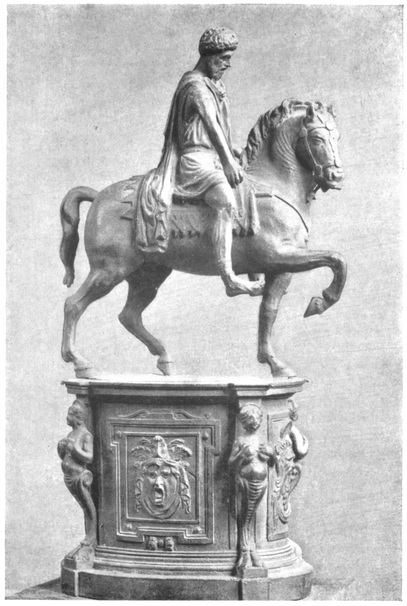
Photo]
[Alinari
Marcus Aurelius.
A XVIth Century copy by L. Del Duca of the equestrian statue in Rome (Campidoglio).
With the growth of fashion, a collection of art became the
necessary complement of a wealthy mansion. The need then
arose to give this collection the noblest place in the palace, a
room apart to enhance its importance. This new view
brought about a new architectural distribution of the Roman
patrician mansion, not only on account of the family life
and obligations of a wealthy class of citizens, but because the
well-to-do Roman had obligations towards art and antiquity.
In the Roman mansion we thus find first the atrium, a large
hall open to friends, clients and visitors at large. The
peristyle is the second courtyard, and is reserved for the
family. In the atrium the domestic gods were generally
placed and records concerning the family, including genealogical
trees (stemmata).
With time these atria became regular museums, as they
were excellent places for decoration and the display of art,
being the open central part of the house girded by a colonnade.
An idea of the importance of these atria may be gathered
from that of Scaurus’ palace, which had thirty-eight columns
12½ yards high, made of the same kinds of rare marble that
faced the walls—Egyptian green, old yellow or Oriental
alabaster, African marble and other rare kinds brought from
Syria and Numidia. Scaurus’ atrium appears to have been
hung round with tapestries, embroidered with gold, illustrating
mythological scenes. Alternating with these rare
tapestries were panopliæ and family portraits.
Though perhaps the favourite spot, the atrium was not
the only place for the artistic display of the Romans. Their
palaces also contained Oeci, magnificent galleries used for
receptions, and the Exhedræ, which were rooms for conversation,
generally of a more sober decoration. In the Triclinia
there were kept works in precious metals and the finest
pieces of furniture. There was also the Sacrarium, a private
shrine where precious pieces of art were often hidden. Verres
found his famous canephoros (basket-bearers) by Polycletus,
the Cupid of Praxiteles and the Hercules of Myron in the
sacrarium of Heius of Messina.
There was also a room in Roman mansions set apart for
the library, and some had special nooks for such collections
as gems and cameos. The place where the best paintings
were shown was called the Pinacotheca, and was always built
towards the north so that the light from the windows should
be without much variation, and above all because a northern
exposure left no chance for the sun’s rays to enter and spoil
the effect of the painting.
The Roman collector of books very often went in for
elegant bindings and all the showy and decorative side of a
library. Seneca deplores the fact that while every elegant
house in Rome contained a library, many of these collections
of books were simply for show. Too many collectors, not
dissimilar in this from our bibliomaniacs of to-day, had
quantities of works they did not care to read. “What is the
use of having so many thousand volumes,” cries Seneca,
“the lifetime of their owners would hardly suffice to read
the titles of the works.... There is a man with scarcely
the literary knowledge of a serf, and he is buying volumes,
not to read them, but as an ornament for his dining-room!
There is another who is proud of his library only because it
is in cedar and ivory; he has the mania of buying books
that no one looks for. He is always gaping among his
volumes, which he has bought solely for their titles. Lazy
people, who never read, are likely to be found with complete
collections of the works of orators or historians, books upon
books. One could really forgive this mania if it had originated
in a real passion for reading, but all these fine works, the great
creations of divine genius, works ornamented with the portraits
of their authors, do but serve to decorate the walls”
(Tranq., IX).
A large library was the desire of Horace. He wrote to
Lellius:
“Do you know my daily prayer?—Great Gods! let me
keep the little I own, less if it is your pleasure; let me live
according to my choice the days your indulgence has granted
me; let me have plenty of books, one year’s income in
advance that I may not be obliged to live day by day from
hand to mouth.... As regards the peace of my heart and
my happiness, that is my affair” (Sat., II, 6).
Such contrarieties have a genuine echo in our society where
the bibliomaniac is rarely a literary man or even slightly
interested in literature. Bibliomaniacs collected volumes
for the most part either because some of them were considered
rare, and therefore advertised the high price paid for them,
or because they might serve as a decorative show, but the
collecting of general art and curios, with a few exceptions,
appears to have been vacuous and freakish. Even specialization,
which is held to be progress in modern times, but as a
matter of fact more often merely represents the triumph
of erudition over art and taste, exercised in Rome the momentary
tyranny of fashion.
An example of this specialization is given us by the craze
in Rome for Corinthian bronze. Without entering into a
discussion about the legend of its origin, and simply hinting
that there are strong proofs that the alloy existed long before
the siege of Corinth, we are safe in saying that the craze in
Rome for Corinthian bronze was one of those freaks of
fashion that has had, perhaps, no echo in all the after-history
of “collectomania.” Every amateur was at that time
bound to have at least one vase of the coveted metal. According
to Pliny (XXXIV, 1, 2, 3) in his time this metal was
equal to gold in value. In order to obtain two vases of this
precious metal Mark Antony ordered the assassination of
the owner, and it must be borne in mind that Mark Antony
was accused of using golden vessels for the lowest services of
his household. Octavianus, supposed to be a collector of
mild passions and a man who certainly did give up all such
hobbies on becoming emperor, was also very fond of the
fashionable metal—corinthiorum præcupidus—and did not
scruple to adopt the methods of Sulla and Mark Antony to
gratify his ultra-fashionable taste.
Times were then ripe for all forms of degeneration. Connoisseurs,
like those of to-day, began to discuss patina. As it
required years for Corinthian bronze to assume the proper
patina—Nobilis ærugo, Horace calls it—it was natural that
this alloy should have the preference over all other kinds of
bronze. But there were gradations of colour even in this
metal and value was discriminated according to the quality
of the patina. Of these patinæ the Roman collector recognized
five different kinds. Apart from these varying
degrees of merit, the connoisseur, Pliny tells us, could tell
the quality of the alloy from its weight and determine the
excellency of the patina by its smell.
Another craze in Rome that greatly fostered imitation
and forgery was that of murrhines, cups of a mysterious
material which was more valued than any other rare stone
or rock crystal, though a cup of the latter, according to Pliny
(XXXVII), easily fetched 150,000 sesterces, an amount
equivalent to £1200. As a rule, always according to Pliny,
for one of these cups a bigger price was paid than for a
slave.
If the Romans, unlike the Americans, had no detectives
at festivals and banquets, they certainly took precautions to
guarantee the safety of the treasures displayed and to guard
against the possible greed of some guest.
“Whereas Virro drinks from pateras of beryl,” remarks
Juvenal, speaking to a parasite, “no one would trust you
with even a simple golden cup, or, if perchance they do let
you use one, be sure a guardian near you has previously
counted the precious stones studding it and follows with his
eye the movements of your fingers and your sharp nails.”
One can really not refrain from giving this gorgeous patch
of Roman colour as Juvenal himself puts it:—
... Ipse capaces Heliadum crustas et inæquales beryllo Virro tenet phialas: tibi non committitur aurum; Vel, si quando datur, custos affixus ibidem, Qui numeret gemmas unguesque observet acutos (V. 38).
One may be sure that the man charged with watching was
likely to do his duty with the utmost solicitude. Carelessness
in handling these precious pieces that were used to decorate
Roman tables was not easily overlooked. An anecdote will
illustrate this. Vedius Pollio, a Roman nobleman, possessed
one of the most esteemed collections of these crystals. One
day when Augustus was dining at this favourite’s house, a
slave broke one of the precious crystal cups. Vedius immediately
ordered the slave to be thrown alive into the pond
of lampreys. Disgusted at such an order, Augustus not only
made a freedman of the slave but ordered that Vedius’ whole
collection of crystals should be broken before his eyes and
thrown into the pond of lampreys.
But as we have said above, the craze for murrhines surpassed
the craze for the precious crystal, though comparing
the two, we are bound to add, with no artistic justification.
What these murrhines were made of is not exactly known.
Some of the scholars of our day believe they were artificial,
a mixture of clay with myrrh, hence, perhaps, the name.
Winkelmann is inclined to think they were made of a kind
of agate, and Mariette and de Caylus respectively believe
them to have been mother-of-pearl, or fluor-spar, or porcelain.
In further illustration of the peculiar substance of the murrhines
we quote from Pliny:
“The material of the murrhines is in blocks no larger than
an ordinary glass, and a stratum no thicker than the marble
of a small console. There is no real splendour in this material,
but instead of splendour what one might call brilliancy.
What gives the murrhines their price is the variety of their
tints, the colour of the veining, either purple or pure white,
sometimes shading off into nuances, reaching in some species
the hue of blazing purple. The white samples shade into
roseate or milky tones. Some amateurs are fond of freakish
accidentalities or reflex iridescent changes like the rainbow,
others prefer opaque effects. Transparency and pale hues
are considered defects, as also opaque grains inside even if
they do not alter the surface, like tumours, spreading in the
human body. The quality of the odour helps to set the price
on the stuff” (XXXVII, 8).
It is to be noted that while this rather vague description
of Pliny’s would seem on the one hand to point to the agate
or any fluor-spar, the addition of the odour tends to destroy
this hypothesis.
In any case murrhines became the rage of the Roman
collector, and the fashion being, as usual, imperative, no
one was considered elegant or correct who did not own at
least one sample of the precious cups. One of these cups
which, according to Pliny’s estimate, could not contain more
than a measure of liquid, less than half a gallon, had cost the
large sum of 70 talents (£15,400). Adding that the cup had
belonged to a consul, and that the edge of it was nibbled,
Pliny remarks that “such damage is the reason of the increased
price, there is not in all Rome a murrhine which can
boast of a more illustrious origin” (XXXVII, 7).
This consul, who loved his cup so much as to nibble it on
putting it to his lips, this collector, whose name is unknown to
us, used up all his patrimony on his hobby of collecting
murrhines. He possessed so many of them, Pliny adds, that
“one might have filled with them the private theatre that
Nero had constructed in his gardens on the other bank of
the Tiber.”
Perhaps one of the most esteemed murrhines was that
which was considered the gem of Petronius’ collection. He
had paid 300 talents (£66,000) for it. Knowing how much
Nero coveted this precious cup and wishing to baffle his plans,
before destroying himself Petronius ordered his slaves to
break it to pieces, so that it should not fall into the hands of
the man he detested.
A rival craze in Rome to that of murrhines was the passion
for tables of citrus. Here too there is uncertainty as to the
nature of this rare wood called citrus. Apparently it grew
at the foot of Mount Atlas in Africa, and was in all probability
a thuja. To obtain the proper grain it was felled at the root
and cut into planks of a length to furnish the board of the
table.
Pliny seems to think that Cicero—the snob collector—set
the example of extravagance in these tables. The one he
bought at the fancy price of 4000 English sovereigns was still
in existence in Pliny’s time and went under the name of
the Ciceroniana. Cicero’s price, however, was surpassed by
Asinius Gallus and Cethegus, the former paying 1,100,000
sesterces for his citrus table and the latter 1,400,000 sesterces.
Yet according to Cicero, the citrus table that Verres had
placed in his triclinium was the finest and most valuable
Rome had ever seen.
Needless to add that in this article, too, collectors had their
preferences, that there was citrus and citrus, that the precious
tables were valued according to the grain of the wood
and the patina. There were four qualities among the most
appreciated. The tigrines, the pantherines and the pavonines
were those tables of which the grain and knots of the wood
resembled the coats of the two animals in the case of the two
first, whereas the wood of the last showed knots like the eyes
of a peacock’s tail. The fourth quality was called apiates, for
in these tables the wood looked like a mass of dark seeds, or
more accurately a swarm of bees—hence the name.
The collectomania and thirst for display must have not only
favoured the trade in spurious pieces of cheap imitation but,
have caused in the chaos of tastes at times an equal confusion
in general reasoning. Thus wise men and philosophers
appear to have indulged in—what shall we say?—rather
amateurish considerations, indicating the reasoning powers
of a dilettante. Cicero at one time gibes at collectors and at
another boasts of being a collector himself. Seneca, the
wise Seneca, the cool-headed philosopher, was no better.
Forgetting that his triclinium was adorned with five hundred
fine, tripod-like tables with ivory feet, he writes as a comment:
“I like a simple table with nothing remarkable about its
grain, one that is not celebrated in the city for having belonged
to a succession of lovers of fashion.” And then
“... material considerations to which a pure soul mindful
of its origin should give no weight.”
At one time fashion demanded that citrus should be used
in veneering, an art in which the Romans were extremely
skilful, using all kinds of rare woods, ivory and tortoise-shell.
Furniture veneered with tortoise-shell, especially, fetched an
extremely high price and was in considerable vogue for a
time. The fact was sufficient to prompt Seneca to this odd
comment: “Is it possible that people are so ready to pay
most extravagant prices for the shell of such an unclean and
lazy animal!”
The prices paid for art were only too often created by
fashion, as shown by the artistic milieu of Rome we have been
trying to outline, and yet the characters we have passed in
review in our reconstruction of the past do not seem altogether
dissimilar from some of our present-day lovers of art.
CHAPTER V INCREASE OF FAKING IN ROME
Increase of Faking—Imitation precious stones—Cameos—Restorers and
copyists.
It is evident that in a society like that of Rome and an
artistic milieu such as we have tried to depict, comprising a
few good collectors among a whole hoard of fools setting up
as full-fledged connoisseurs, deception and fakery must have
been rampant. The large profits promised by a trade in
sham art must have helped to perfect those enslaved Greeks
in methods of taking an artistic revenge upon their oppressors.
Romans, especially in art matters, must have seemed to them
mere parvenus. The practised eclectic qualities and adaptability
of those græculi delirantes (crazy paltry Greeks), so
active in Rome, must have helped matters. In time there was
nothing they could not produce for the benefit of their patrons,
and often to such perfection as to deceive even keen-eyed
connoisseurs. As a consequence, already in Rome the imitation
of art and curios produced a certain perplexed feeling
even among people who claimed to be acquainted with the
business of buying art and antiques. Pliny, who was somewhat
of a connoisseur, more especially in bronzes, writes to a
friend that he has bought a charming statuette of Corinthian
bronze, and in confessing that he likes it, “no matter whether
modern or antique,” seems to reveal the cautious attitude
of a man who does not wish to be caught in error, a fear and
uncertainty that very able forgers had created in Rome.
Beyond a few hints and gibes about certain collectors and
art lovers and a few comments of Pliny and others we have
no detailed account of the part that imitation and faking
played in Rome, but it is to be presumed that the latter
especially found numerous and ever-ready clients, and that
it was able and prosperous beyond the dreams of modern
art duping.
According to Pliny the favourite article, the one to which
fakers and forgers gave their utmost care and attention,
was the article that was in vogue at the moment and therefore
promised the biggest return. Thus murrhines did not
escape this fate, they were imitated with obsidian. Pliny
also adds that all kinds of precious stones were imitated in
Rome, not only by coloured glass but also by a selection of
stones that, though rare, were of less value comparatively
than the types they imitated.
The most esteemed kinds of sardonyx were counterfeited
by joining various pieces of the cheaper jaspers or onyx,
cleverly alternating red, white and black, and joining the
pieces in such a manner that it was most difficult, Pliny tells
us, for a connoisseur to detect a fraud. The same writer,
who gives valuable hints on the imitation of precious stones,
says that in his time there were even books from which one
could learn the art of counterfeiting precious stones, that all
of them could be imitated, topaz, lapis lazuli, and amethyst;
that amber could be coloured, obsidian used to counterfeit
hyacinths, sapphires, etc. Speaking of the sardonyx, more
especially, Pliny says, “no fraud brings so much money as
this.”
In this line there were also other kinds of fraud. One of
the most profitable was the imitation of precious stones with
paste ones. There are some imitation cameos that are a
puzzle even to-day. Commenting upon this fraud, Winkelmann
benevolently points out that we owe to this unscrupulous
commerce of false cameos the preservation of the casts of
some precious originals now lost. The marvellous part of
these imitation cameos is that the faker was not only able
to imitate the plain stone of the original but all its characteristic
veining and peculiarities.
With regard to bronzes and other metal works it is to be
presumed that not only could the Nobilis ærugo of Horace
be easily counterfeited, as it is to-day, but the work as well.
Pliny the Younger gives us valuable hints about the perplexity
that fakery had generated among the connoisseurs of his
time.
The Greek artists in particular showed themselves most
versatile, they reproduced in Rome the most esteemed
originals and could to a certain extent imitate the most
appreciated types of art. Zenodorus, for example, copied
for Germanicus a cup by Calamis in such perfect imitation
of the chiselling that the copy could not be told from the
original.
Fraudulent masterpieces of painting and sculpture, often
with the forged signature of some great artist, as at present
times, were already on the market in Cicero’s time. His
“Odi falsas inscriptiones statuarum alienarum” is eloquent
enough.
Phœdrus seems to complete Cicero’s information about
Roman art faking.
“It is in this way,” he says, speaking of faked paintings
and sculpture, “that some of our artists can realize better
prices for their work: by carving the name of Praxiteles
on a modern marble, the name of Scopas on a bronze statue,
that of Myron on a silver-piece, and by putting the signature
of Zeuxis to a modern painting.”
We do not intend to confound fakers with honest restorers
of works of art, but in Roman times, as is often the case in
our own, faking learned no small lesson from the deft hand of
the restorer. The same may be said for imitators and copyists
who even in ancient Rome followed their trade openly with
no intention of cheating. Copyists in particular were very
active and their work was certainly appreciated by a certain
class of citizens. The fact is proved by the numerous copies
of Greek masterpieces that have been unearthed in Rome and
elsewhere. When an original was not to be had, a copy was
often ordered. Lucullus sent an artist expressly to Athens to
make a copy for him of a work by Pausias, the portrait of
Glycera, the artist’s lady love.
Restorers of works of art were, in Rome as elsewhere, the
nearest relatives of fakers; their ability to imitate antiquity
must have proved a great temptation, and the enormous
sums paid for certain objects, and the gross ignorance of some
of the buyers, must have paved the way to more than one
passage from honesty to dishonesty.
There were many restorers’ workshops in Rome, and one
has been discovered near the Forum, where apparently new
limbs and heads were provided for damaged statues. Many
an antique statue has come down to us already repaired.
Evander Aulanius, says Pliny (XXXVI, 5), restored the head
of Diana, in the temple of Apollo, on the Palatine. Like
modern restorers, their forefathers of Rome had not always
the delicate hand needed for such operations. When the
Prætor Julius ordered the cleaning of the paintings in the
temple of Apollo it was done in such a rough manner that
all the charm of the works disappeared. A fact that may
have induced some good connoisseur to advise leaving untouched
the Venus Anadyomene of Apelles, the masterpiece
placed by Cæsar in the temple of that goddess, and to let
it be damaged by age rather than allow the sacrilegious
hand of a restorer to maim the divine painting of the Greek
artist.
From what we have been perusing we may conclude that
the Roman artistic world was not entirely different from the
artistic world of to-day. Certainly the city must have been
of a magnificence of which no conception is given by its
grandiose ruins. But the artistic life, and the narrow path
of the collector, were somewhat similar to those of to-day.
Some of the characters we have quoted would seem to be
alive to-day, a change of name and a milieu of more modern
colouring and they would provide ground for an action for
libel. We feel quite familiar, in fact, with the characters
described by Seneca. Even to-day the world possesses
collectors of rusty nails and other worthless objects—mere
cult of fetishism. We feel no less acquainted with some of
the other types to whom Martial pays his attention. The
man who gathers ants fossilized in amber, the collector of
relics who glories in owning a fragment of the Argonauts’
ship, might both be alive to-day. So might Lycinius the
demented, Codrus the penurious and dissatisfied, Eros the
enthusiast and dreamer. They still exist and are well represented
in their various shades of foolishness down to that
Mamurra who used to upset all the shops of the Roman
antiquaries without buying a single thing. Would you
resuscitate Tongilius to our modern society just substitute a
bright motor-car for his rich and cumbersome lectica and,
for a certainty, the name of some modern collector of art,
some up-to-date Mæcenas, will come to your mind.
Of course, though Mr. Cook had not yet alighted to relieve
itinerant humanity from many troubles, tourists existed
even at the time when Rome did not possess the modern
type of traveller. According to Titus Livius many foreigners
used to visit the temples of Porta Capena, regular museums of
art. The tourists of that time followed a routine, as we can
gather from Pliny and other writers. They were taken to the
Palatine, to the Via Sacra to admire the temple of Apollo with
its peristyle of fifty-two columns, adorned by the simulacra
of the Danaides and fifty equestrian statues, one of the finest
sights in Rome and which inspired Horace with an ode.
This temple of Luni marble with ivory doors, surmounted by
a quadriga in gilded bronze carrying the god, was also a
museum, containing among other things a fine collection of
gems, and a room lined with silver in which the Sibylline
Books were kept. The Domus Aurea, the paintings of Apelles
exhibited in the Forum of Augustus, the temple of Venus,
one of the finest emporiums of art, that of Ceres which contained
the celebrated “Bacchus” of Aristides of Thebes,
the “Marsias” in the temple of Concord, and in the Capitol
the “Theseus” of Zeuxis, in Pompey’s portico the “Soldier”
by Polygnotus, in the temple of Peace the “Hero” by
Timante and another famous work by Protogenes.
There were of course foolish tourists who, like to-day, insisted
on being fed with more or less authentic anecdotes
of relics of an impossible character, who believed the unbelievable.
Thus, according to Procopius, who evidently
believed the genuineness of the relic, many tourists went to
see the boat, still moored in the river, from which Æneas had
landed in Italy, etc. This kind of tourist must have inspired
Lucian with the comment that Greek guides in Rome
might have starved but for the nonsense and legends with
which they enriched their descriptions of the city. “But
what of that,” remarks Lucian, “visitors like to hear such
things, and do not seem interested in the truth even if
offered to them free of charge.”
The revival of the past needed this slight touch to show
that the artistic world of two thousand years ago was not,
after all, dissimilar to that of our enlightened days.
Need we repeat that the phenomenon of art faking for
the benefit of foolish lovers of art generally appears when the
passion for collecting takes that Byzantine attitude which
makes it ripe for decay and degeneration, when mania,
fashion and snobbery chiefly hold the ground instead of taste
and genuine love of art, in fact when the parvenus or the
lunatic submerge the intelligent collector. It follows consequently
that the decline of Collectomania heralds the
decline of Forgery. The latter, its errand over with the
cessation of the demand for antiques and curios, disappears
to await a fresh chance. But the fake-festival and carnival
will revive, phœnix-like, with the awakening of a new
artistic world—just as though faking at certain moments
answered to a sore need of society.
CHAPTER VI DECADENCE OF ART AND CONSEQUENT CHANGES
Decadence of art and consequent change in the artistic milieu—Byzantine
art—Its new views do not seem to favour old ways—Art patronage and
collectomania tend to disappear—The medieval period—Character of
the collections—No imitators but a few forgers.
The change affecting the world with the decadence of the
Roman Empire was logically bound to stamp the successive
course of art with the inevitable downfall of past glory.
With the Christian era a new society had arisen and also a
new art, entirely symbolic, no more satisfied with the early
plagarisms, apparently lisping a new tongue but ready to
dispel all pagan sentiment in art, to establish the elements
of a new expression and purpose more in harmony with the
reborn civilization. With an art that Taine considers “after
five centuries to be unable to represent man except seated
or standing erect,” symbolic and calligraphic at the same
time, there seemed to be no room for amateurs and collectors
of the old type.
There may have been sporadic cases, though Constantine’s
severe censure of all the cults of the past doubtlessly
made it a daring act at that time to profess worship for old
traditions in art. Collectomania very likely became a thing
of the past. There must have been dealers in art and
antiques, as we can gather from the Digest, and transactions
between artists and clients, as can be seen from a
clause of the Justinian laws, but nothing like there were
in the ancient Roman world that had been dispersed by
the new civilization.
This clause Justinian was forced to add to a law on artistic
property, as judges had so lost all sense of art appreciation
that in a dispute between a painter and the man who had
furnished the board on which the work was painted, they
decided that the painting belonged to the one who owned the
board. Justinian was forced to do justice by stating that if
a quarrel arose between the artist and the one who furnished
the board the owner of the work was the artist, as the value
of the board could not be compared with the artistic one.
“Think,” he concludes, “of comparing the value of the
work of Apelles or Parrhasius with the price of a board of
very small value.”
The time for lovers of art, for private speculations and
the all but consequent faking, and all the characteristic
figures of an art market had disappeared.
In the early medieval period there seems to have been no
scope for faking and forgery. The collector, if the type then
existing is entitled to the name, was like nothing that had
been seen before or has since appeared. The objects treasured
generally had more intrinsic value than real artistic merit.
A collection represented a simple form of banking, a sound
and good investment taking the place of what the French
call “personal property.”
With such views, goldsmiths’ work, studded and ornamented
with precious stones, or rich embroideries in gold,
naturally had the preference. Articles of virtu then had a
solid value, and while suitable for princely display, could be
turned into money at any moment. The craze for manuscripts,
rare penmanship, and early illuminated parchments
may represent an exception, but only, apparently, as such
objects—apart from their rarity, skill and supreme patience
in miniature work—were of such an established value as to
be regarded like precious gems.
The medieval collections of art and precious things give a
true expression of those unsafe and uncertain times and were
in harmony with the erratic career of the monarchs and
potentates whose peculiar mode of life often necessitated the
packing of the whole museum into a coffer and dragging it
with them in their pilgrimages, wars, etc. This not only in
some way explains the preference given to goldsmiths’ work
but the fact that the dimensions of sculpture had to be reduced,
and painting, when not for church decoration, was
mostly restricted to miniatures, illumination, and designs for
tapestries and embroideries.
Clovis, the “Most Christian King,” as Pope Anastasius
called him, is supposed to have been an eager collector of
rare and precious objects. Tradition claims that a saint one
day broke one of his rarest cups of jasper all studded with
precious stones, and seeing Clovis’ sorrow at such a loss,
picked up the fragments and praying over them, performed
a miracle, handing to the monarch the cup restored to one
piece as before. Clotaire, the son of Clovis, had in his mansion
at Braine a secret room with chests full of jewellery and
precious vases.
Chilperic had a real ambition to collect rare objects of
virtu. For this purpose he sent everywhere for all that might
be worthy of his collection. Gregory of Tours tells us that
he had a Jew as adviser, a man called Priseus.
It is said that when Chilperic exhibited at Nogent-sur-Marne
the presents offered him by the Emperor Tiberius II,
to show that they did not surpass in splendour the best
pieces of his own treasure, he exhibited close to them one of
his precious cups, a golden vase studded with rare stones and
weighing fifty pounds. Twenty years later, between 560
and 580, Saint Radegond, the daughter of the king of Thuringia,
received the poet and canon Fortunatus in her convent
of Poitiers and gave him a dinner with the table covered in
roses and the richest ornamented silver plates and precious
jasper cups. Such a treat inspired the poet with one of his
fine Latin poems. Dagobert was not only an enlightened
collector of precious things but so extremely fond of artistic
“vaisselle” that when Sisinande, a Gothic king, wished to
induce the Frankish monarch to join him in his political
schemes he promised Dagobert a fine gold plate weighing
five pounds “and more precious still for the beauty of the
workmanship.”
After a long lapse of time, in which the only museums of the
art of the time seem to have been the churches, under Charlemagne
and his successors private collections of treasures,
art and fine pieces of work again seem to acquire importance.
The Bibliothèque Nationale of Paris owns an Évangéliaire of
rare artistic value, illuminated by a monk named Godescal
of the year 781.
The Bible and Psalter of Charles the Bald are said to have
been the work of the monks of Saint-Martin de Tours, and
are considered a marvel of illumination. Together with these
books, now kept in the Librairie Nationale of Paris, Charles
presented to the Church of Saint Denis a famous cup known
in his time as Ptolemy’s cup, a fine work carved from a piece
of precious sardonyx. In the will of this monarch’s brother,
the Marquis of Friuli, a document dated 870, there is, among
other legacies, the enumeration of arms studded with precious
stones, clothes in silk and gold embroideries, silver
vases and ivory cups, finely chiselled, and a library in which
among other notable works are the writings of Saint Basil,
Saint Isidore and Saint Cyprian. From this time forward
a collection of rare things and precious jewels is quite a
necessary apanage of kings and princes, but as we have said,
it mostly consisted of small objects in which art almost
invariably seems to have played a secondary rôle, and in
considering the art it is often hard to know whether to admire
more the miniaturist’s patience or his workmanship.
Later on the cult of pagan art seems to have been revived
by the Emperor Frederick II, the son of Barbarossa, but
even at this time the case is somewhat of an exception.
Under patrons of art who were as a rule absolute monarchs
or iron rulers and all-powerful princes, fakery would have
played a dangerous and most sorrowful part, nor was there
any inducement to indulge in any of the trickery that had
characterized the world of lovers of art during the Roman
decadence. A risky game at any time, it might have entailed
one of those exemplary punishments which characterized
the ferocious Middle Ages.
Coin counterfeiting was naturally the least artistic form
of deceit, and being a less hazardous venture seems to have
tempted ability in all ages. It represents a link between
more proficient periods of art swindling.
Some of these early fakers certainly planted the seed from
which sprang the arch-deceivers and clever medallists of the
Renaissance.
There lies Romena, where I falsified The alloy that is with the Baptist stamped For which on earth I left my body burned.
These words Dante puts into the mouth of Mastro Adamo
da Brescia, a skilful counterfeiter of coins whom he met in
hell. Adamo was burned at the stake near the castle of
Romena in the Casentino, for having cast, by order of the
Count of Romena, the golden florin of the Florentine Republic.
About this time counterfeit coining tempted the most
diverse classes of people. It had a long list of devotees,
including even a king of France who honoured the Republic
of Florence with not a few of his swindling specimens of the
golden florin. Marostica, a village in the Venetian domains,
challenged and defeated the powerful Republic of the lagoon
by flooding the Venetian market with the most deceptive
samples of false coinage.
CHAPTER VII THE RENAISSANCE PERIOD
Initiation of the Renaissance period—Newly born passion for the antique—The
Mæcenas and the collector—Plagiarians, imitators and fakers—Cola
di Rienzi, archæologist—A collection of the fourteenth century—Artists,
writers and travellers hunting for antiques—Niccoli, the Medicis,
Cardinal Scarampi and others—The Medici collection dispersed by the
Florentine mob.
The Renaissance fakers of art have a somewhat nobler
pedigree when compared with those of other epochs. The
early artists from whom they sprang were not actual imitators
of the Greeks and Romans, but were inspired by them to
reproduce that pagan expression which had deeply affected
their artistic temperament. Were these artists doing it
purely for art’s sake, or had they the hope that their work
might pass as antique? The answer to this is perhaps to be
deduced from the character of the age not yet fully ripe for
artistic deception. The sentiment for, and cult of, the
antique were certainly growing during this early part of the
Renaissance; they did not come in a sudden burst, but had
been gradually developing in the previous years.
As a matter of fact, already in the transitional period
which prepared the highest artistic accomplishment of the
Renaissance, collections and collectors were becoming not
only eclectic in taste, but seem to have been guided by a real
artistic fondness for the art of the past. It is no more a
question of solid silver and jewels, but of statues and paintings.
Catalogues no longer read like that of Charles VI of
France: “Inventoire des joyaux, vaiselle d’or et d’argent
estant au Louvre et en la Bastille à Paris appartenent à feu
le roy Charles,” followed by a monotonous enumeration of
jewels, vaiselle, etc., but are like that of the Medici collection,
and include all the most varied expressions of art—sculpture,
paintings, medals, carving, cameos, rare jewels, etc.
In the early part of the 14th century we know that Cola di
Rienzi, the Roman Tribune, collected inscriptions. One of
his biographers tells us that Cola “occupied himself every
day with inscriptions cut into marble, which were to be found
round Rome. No one could decipher the ancient epitaphs
like him. He translated all the ancient writings and gave the
right interpretation to these marbles.” It was between the
years 1344–47 that Cola compiled a work on Roman inscriptions,
re-edited a century later by Signorili in his Descriptio
urbis Romæ.
Oliver Forza, or Forzetta, who flourished about the year
1335, seems to have owned the first complete collection of
which we have notice. Forzetta was a wealthy citizen of
Treviso. We know that in the above year of 1335 he came
to Venice to buy several pieces for his collection, manuscripts
of the works of Seneca, Ovid, Sallust, Cicero, Titus, Livius,
etc., goldsmiths’ work, fifty medals that had been promised
him by a certain Simon, crystals, bronzes, four statues in
marble, others representing lions, horses, nude figures, etc.
The latter seem to have belonged to an earlier collector
named Perenzolo.
To point out that even outside Italy taste had changed at
the beginning of the 15th century, we may quote the following
description handed down to us by Guillebert de Metz.
It gives a full account of the collection of Jacques Duchie, a
Parisian, and indicates that at this early time Paris must
have possessed more than one of these collections of art and
curios.
“The house of master Duchie in the rue des Prouvelles,”
says Guillebert de Metz, “the door of which is carved with
marvellous artistry; in the courtyard there were peacocks
and diverse fancy birds. The first hall is adorned with diverse
pictures and instructive texts fixed to and hung on the walls.
Another hall filled with all manner of instruments, harps,
organs, viols, guitars, psalters, and others, upon all of which
the said master Jacques knew how to play. Another hall was
furnished with chess tables and other diverse kinds of games,
great in number. Item, a beautiful chapel where there were
stands to place books upon, marvellously wrought, which
had been sent from diverse places far and near, to the right
and to the left. Item, a study the walls of which were covered
with precious stones and with spices of sweet odour. Item,
several other rooms richly furnished with beds and with
ingeniously carved tables and adorned with rich hangings
and cloth of gold. Item, in another lofty room were a great
number of cross-bows, some of which were painted with
beautiful figures. Here were standards, banners, pennons,
bows, pikes, swords, lances, battle-axes, iron and lead
armour, pavais, shields, bucklers, cannon and other engines,
with arms in abundance, and, briefly, there were also all
manner of war implements. Item, there was a window of
wonderful workmanship, through which you put a hollow
iron mask through which you could look out and speak to
those outside, if occasion arose, without making yourself
known. Item, above the whole house was a square room
with windows on every side from which one could overlook
the town. And when it came to eating, food and drink were
sent up by a pulley, because it would have been too high
up to carry. And above the pinnacles of the house were
beautiful gilt figures. This master Jacques Duchie was a
handsome man ‘de honneste hebit’ and very distinguished;
he kept well-mannered and well-trained servants of pleasing
countenance, among whom was a master carpenter who was
constantly at work at the mansion.”
But Italy at the early part of this century was far more
advanced. There was no question here of collectors of
dubious taste or odd fancy for the simply curious; on the
contrary we are confronted by real connoisseurs and genuine
lovers of art, intelligent and eager hunters after all sorts of
articles of virtu of past art; and also enlightened art patrons
who were munificent toward their contemporary painters,
sculptors and literary men.
Taste had changed, and some tendencies merely outlined
at the time when religion seemed to absorb all the activities
of art, were now in full growth. That which in the art of the
Cosmati appeared to be a Byzantine aping Roman art, all
that seemed plagiarism of this classic art in Nicola Pisano,
takes an interestingly different course with Donatello,
Brunellesco, and all of those artists whom a wrong convention
calls the forerunners of the Renaissance instead of calling
them the real creators of that great artistic movement.
The passion for the antique was reviving. It was no
longer a question of sporadic cases but rather of a wide-spreading
taste. Roman art was in the air. Besides Rienzi,
this cult of antique memories had already claimed his friend
Petrarch and the learned Dondi, a physician from Padua,
who visited Rome in the year 1375 to crown a long course of
study devoted to the antique. In a letter addressed to his
friend Guglielmo da Cremona, Giovanni proclaims the
superiority of antique art and is certain that modern artists
will be the first to recognize the fact and learn from it. Poor
and hard-working, Dondi regrets that his profession, his
ailing patients, take so much of his time. But for the
profession, “I would rise as high as the stars,” he naively
declares.
Ciriaco d’Ancona, another great eager collector and intelligent
hunter after fine things, visits the Orient and Greece
in search of manuscripts and relics of art; Francesco
Squarcione comes from the East, bringing to his native
Padua fine Greek works, and is perhaps the first artist
to devote himself to antiques, just as Niccolo Niccoli, a
Florentine lover of art, represents at this time the learned
amateur of taste.
Photo:
Alinari
Diomedes with the Palladium.
An imitation of the antique by Donatello’s School (?) and a free copy of Niccoli’s
cameo, a Greek work. Palazzo Riccordi, Florence.
Niccoli is really one of the finest types of collectors. Born
at a time when Florence demanded that each citizen should
belong to one or other of the factions that kept civil war
alive in the city, he nevertheless managed to keep free from
all civil strife. His house was the temple of art and of neutrality.
A friend of the powerful and wealthy Medicis, who
by the way trusted to his infallible eye as a connoisseur
whenever rare things were offered, Niccoli never took advantage
of this unusual position, but kept himself far from all
ambition and was possessed by the sole desire to collect art,
study old manuscripts, and be an ever-obliging helper to
students. The friends and admirers who came in flocks
for advice, to borrow his rare manuscripts, or to visit his
fine emporium of art, were always well received. Niccolo
Niccoli was born in the year 1363. The son of a rich Florentine
merchant he was forced in his youth to give all his
activities to commerce. Liberated from the tie of a profession
for which he had no call, he finally gave himself to
his cherished study of art and literature, attending the lessons
of Luigi Marsigli and Emanuele Chrysoloras. His studies
were thus the stepping-stone to the collecting of antiquities.
In the year 1414 his fame had already extended beyond the
city walls. The Chancellor of the city of Padua addressed
him in a letter as “clarissimus vetustatis cultor.” Notwithstanding
his great wealth, such was his passion that but
for the discreet help of the Medici, the powerful Cosimo and
his brother Lorenzo, who became Niccoli’s benevolent bankers,
on more than one occasion this enlightened amateur might
have been forced to sell his precious collection, or at least do
that which is most hateful to the true lover of art, sell the
best that years of patient work had gathered together.
What is most surprising is the fact that Niccoli managed
to make one of the finest collections of art of his day almost
without leaving his native city. We know of him as going
once to Padua to secure a rare manuscript of Petrarch, and
later on as accompanying his friend and protector, Cosimo
Medici, to Verona, a trip the latter undertook in the year 1420.
With Cosimo again he visited Rome, to be horrified at the
mutilation inflicted upon the Eternal City by barbarians of
all ages and denominations. Yet without moving from his
native city, keen-eyed Niccoli managed to search the world
with the help of agents and friends—some of them, no doubt,
the practised servants of the Medicis. There was hardly a
rare thing discovered, no matter where, but the fact came
to Niccoli’s ears, and the “find” generally found its way to
this enlightened Florentine’s collection. Once he even had
the fortune to discover a fine sample of Greek art in Florence,
a few steps from the door of his house. It was the well-known
cameo which he attributed to Polycletus and which was
afterwards so often reproduced by the artists of the Renaissance.
Niccoli discovered this rare piece of chalcedony
hanging round the neck of a street urchin. He asked him
who his father was and found him to be a poor workman.
He went to see him, and to the man’s surprise offered for
the stone the round sum of 5 golden ducats. It is curious
to trace the migrations of Niccoli’s “calcedonio,” as the piece
was called later. When Cardinal Scarampi—the Patriarch of
Aquileia and the most passionate collector of his time—came
to Florence, he went to visit Niccoli and his collection.
There he became so enamoured of the “calcedonio” that he
proposed to buy it. Niccoli, who could hardly refuse the
favour to the powerful and influential Cardinal, consented to
part with the rare piece for 200 ducats. Later on the “calcedonio”
entered the collection of Pope Paul II, to pass finally
to that of Lorenzo il Magnifico. In an inventory belonging
to the Medici family the gem is valued at 1500 golden florins.
Not dissimilar from certain modern and older types of
collectors, Niccoli was what might be called a strange
character. While spending large sums of money on his
articles of virtu, he was almost parsimonious in his household,
although he liked to drink from rare cups and set his table
most richly with all sorts of precious vases. One of his
peculiarities was always to be dressed in pink. He had an
endless wardrobe of these rosy-hued garments and was as
preoccupied with them as he was with the rare objects of
his collection. These and other oddities were naturally
the subject of gibes and sarcasm from friends and unfriendly
humanists, but Niccoli never answered one written line,
content to retaliate with his witty and cutting tongue. He
certainly had the best of it in this curious duel, for he forced
Aurispa and Filelfe to leave the town, and also, perhaps not
through his sarcastic tongue alone but through some Medicean
intrigue, compelled his enemies, Emanuel Chrysoloras, his
former teacher, and Guarino to make themselves very scarce
in the city.
Niccolo Niccoli’s name brings us straight to that of his
protectors, the Medicis, the family who as collectors of art
and fosterers of literature and philosophy surpassed every
one of their age.
Cardinal Scarampi’s collection, that of Pietro Barbe,
afterwards Paul II, and even the most complete of all, that
of Niccoli, become rather minor stars when compared with
the artistic treasures gathered by the Medicis for generations.
This illustrious Florentine family seems to have been for
centuries nothing but a succession of patrons of the fine arts.
“No art collection,” says Eugene Müntz in his Les Collections
des Médicis, “has more deeply influenced the art of
the Renaissance, no collection has passed through more
trials than the one of this family. Ten generations of enthusiastic
amateurs have given themselves to its enrichment;
the greatest artists, Donatello, Ghiberti, Verrocchio, the two
Lippi, Ghirlandaio, Botticelli, Leonardo da Vinci, Michelangelo
and Raphael have sought inspiration and models
in the Medici collection. This while, by an unaccountable
contradiction, all the revolutions that troubled the city of
Florence seem to have continually threatened the existence
of such an inestimable gathering.”
To be convinced of the extreme importance of the Medici
collection one has but to reflect that what now remains of it
in the Florentine museums or in well-known private hands is
only the smallest part of those past treasures, which has
managed to survive the pillage of the collection in the year
1494, when Piero Medici fled and the Medici palace was
sacked by the populace and the remaining effects sold and
dispersed by order of the Commune. What was later recovered
by the family was only a small part of the collection.
An idea of the magnitude of the Medici museum of art can
be gained by perusing the accurate inventories still remaining
in the Florentine archives, the list of the objects left by
Cosimo the Elder to his son Piero and the catalogue of the
collection belonging to Lorenzo il Magnifico, and finally
the account of their money.
A brief study of the character of the two most important
collectors of the Medici family, Cosimo and Lorenzo il Magnifico,
will enable us to judge of the quality and tendencies
of the amateur of the Renaissance.
The characteristics of the time in which Cosimo lived and
the fact that he had spent a long period in exile, a misfortune
brought upon him by jealousy, gave his inclinations as an
amateur a different course from what they might otherwise
have had. Thus, while on the one hand Cosimo never lost
a chance to help artists and to acquire fine works of art, he
was shrewd enough to do so without ostentation, to avoid
arousing enmity from adversaries. But for this peculiar
feeling Cosimo’s palace, the present Palazzo Riccardi, one
of the most sumptuous monuments of Florence, might have
been still more imposing, displaying greater architectural
wealth. It is known that Brunelleschi’s project was privately
preferred by Cosimo, but he did not dare to arouse old
jealousies by too sumptuous a display. Michelozzo’s design
was chosen as the more modest of the two and thus better
fitted for the “bourgeois prince” of Florence. Notwithstanding
the necessity for caution even in liberality, Cosimo
encouraged Poggio Bracciolini and many others in their
intelligent search for manuscripts and rare parchments.
He had Niccoli as an invaluable adviser and helper, and left
to his son Piero one of the finest collections of antiques.
His grandson, Lorenzo il Magnifico, was more free-handed.
Times had changed, the Medici family, though without
heraldic title, was now master of the city, and the splendours
of a man of taste, such as Lorenzo, and his prodigal inclinations,
knew no restraint whatever. The difference between
Cosimo and Lorenzo lay perhaps in the fact that the former
could not do half what he might have done. Comparing
Niccoli and Lorenzo, one might say that the former tallied
more with the modern interpretation of the word collector,
while the latter, as being far too eclectic a lover of all sorts
of artistic expression, was more cut out for the part of an
enlightened Mæcenas, a prince-amateur and a generous
patron of art and literature. One can hardly even imagine
the Magnifico classifying his cameos as did Niccoli, or giving
a semi-scientific and rational order to his objects of virtu,
but, running on the same lines as Cosimo, Lorenzo invested
in the rôle of patron of art and lover of the antique, in which
he displayed such magnificence as to fully deserve his appellation.
Such was the character of these two Medicis, stated
by contemporaries as being more greedy for fame than money.
An estimation fully justified, especially in the case of Lorenzo,
who in his Ricordi notes that his father and grandfather
spent 663,755 florins in the space of thirty years and rejoices
in the fact. The sum quoted amounts to rather more than
a million francs; how many modern heirs would feel like
Lorenzo il Magnifico?
Like Niccoli and Cosimo, Lorenzo possessed the excellent
quality, most uncommon in a collector, of letting friends and
admirers have full benefit of his collection. More than the
gratification of an egotistic desire to possess rare and beautiful
things, he saw in his artistic pursuits a great means of
education and a help to the artists of his time.
According to the taste of his age, Lorenzo was very partial
to Greek and Roman art, to all that concerned past civilization.
A page of Plato or the beautiful form of a Greek marble
aroused in him feelings of emotion more than any modern
expression. Not only did he fill his palace with fine pieces of
sculpture but his villas also appear to have been replete
with them.
“He was bursting with joy,” Valori, one of his contemporaries
tells us, “when he received the bust of Plato sent
him by Girolamo Roscio.”
This passion for the antique, however, did not prevent
Lorenzo from encouraging the artists of his own time or
from taking a deep interest in their art. Eclectic in taste,
as a collector he nevertheless had some preferences. In a
letter to his son Giulio, the future Leo X, on his promotion to
the Cardinalate, he gives advice as to the kind of art which is
most in keeping with ecclesiastical taste, but as a matter of
fact epitomizes his own penchant as a collector of art.
Urging his son to give preference to antique statuary, he
discourages him from becoming a collector of jewels, tapestries
and embroideries. “Love in preference,” he recommends,
“fine antique things and books”—qualche gentilezza
di cose antiche.
Lorenzo the Magnificent seems to stand apart from the
lovers of art of his time not only on account of his culture
and intelligence, his broad eclectic views and genuine cult
of every expression of beauty, but as being a rare type of
the grand seigneur, æsthete and humanist. Paul II is a passionate
collector of art, but more a scholar than an artist,
with him knowledge is supreme; Cardinal Scarampi is, as
Ciriaco D’Ancona calls him, an archæologist, and Niccoli,
as an eager and intelligent searcher of objects, would make a
good type of antiquary of our day, but Lorenzo displays
interest in every kind of elevated human expression; his
character seems to conform to his noble motto, Nul ne sait
qui n’essaye (nobody knows who does not try).
His reputation as a connoisseur and expert in art spread
afar. Princes and monarchs asked his advice. Lorenzo is
not only prodigal in this respect, but also in the artistic
things of his collection which he sends as presents. To
Mathias Corvinus he sent a bust by Verrocchio, to the Count
of Madaloni of Naples a fine horse’s head—now in the
museum of that city—a rare piece of work which until lately
was taken for Greek but is now attributed to Donatello.
The Duke of Calabria asks him for an architect, and he sends
him one; in the year 1488 he sends to Ferdinand, king of
Naples, a fine plan of a palace by Giuliano da Sangallo, and
later he introduces Leonardo da Vinci to Lodovico il Moro,
Filippino Lippi to Cardinal Carafa, Sansovino to the king of
Portugal. In connection with odd requests that came to
Lorenzo from princes and monarchs there is a queer one from
Louis XI. The French king asks the Magnificent to lend him
for a while the miraculous ring of the Florentine patron saint,
San Zanobi, pledging himself to restore the ring to the owners—very
likely the Girolami of Florence—and begging Lorenzo
to tell him how and in what way it must be worn to perform
the miracle, cure his gout and restore him to health.
Through his love of art and his munificence towards
artists Lorenzo became practically bankrupt, and certainly
had no scruples about using public funds for his private
purposes. Not that he was fond of personal display, on the
contrary he detested outlays that had no public utility or
did not foster some progress.
Rinuccini, another of his contemporaries, tells us of
Lorenzo’s indifference to personal luxury and of his dislike
for society functions. “All the things that in olden days,”
says Rinuccini, “gave grace and reputation to the citizens;
like weddings, dances and fêtes and handsome clothes, he
condemned them all and did away with them through his
example and his words.”
A detailed description of his character as a collector and
the quality of his passion is not so eloquent of Lorenzo’s
particular penchant as his Ricordi. Take, for instance, these
words concerning his mission to Rome at the elevation to
the Holy See of Cardinal Della Rovere. “In the month of
September, 1471, I was sent as ambassador to attend the
coronation of Pope Sixtus. I was the recipient of many
honours in Rome and brought back from the city two antique
busts, the portraits of Augustus and Agrippa, given to me
by the Pope. I also brought with me the carved cup of
chalcedony and many cameos and medals.”
It must be said that in forming his collection the Magnifico
never lost sight of Rome and its treasures. He had many
agents in the Eternal City excavating and looking for antiques
to add to his collection. His intercourse with these accomplices,
the ruses employed, the adroit management of influential
prelates opposed to Lorenzo’s schemes, and grieved
that rare things should leave Rome, form an interesting
chapter of diplomacy.
Glyptography was given preference in Lorenzo’s collection.
Some of his cameos and engraved precious stones are now the
rarest things in our modern museums. Then came a fine
collection of coins and medals, 23,000 pieces in all, and another
of Etruscan vases. His statues, which Verrocchio and other
artists were often charged to repair, filled to overflowing his
palazzo in Florence and his villas.
To his assistance came not only special agents, but friends
as well. A magnificent vase was obtained by Lorenzo from
Venice, and it was through the mediation of his literary
friend Politiano that the rare find got into the Magnifico’s
collection. Politiano writes from Venice to his friend and
patron on June 20th, 1491, that Messer Zaccharia has just
received from Greece una terra cotta antiquissima and that
he believes it to be worthy of Lorenzo’s collection. Antonio
Yvane writing to Donato Acciaioli says that a little statue
of Hercules has been found at Luni, and that it and other
antiques excavated are to be sent to Lorenzo.
One of his agents sent him a marble statue with an Etruscan
inscription; from Siena, Lorenzo receives a bust that sends
him into raptures, and he immediately wishes to buy it.
To give an idea of his appreciation and willingness to pay
whatever it might be worth, we quote part of his letter dated
May 15th, 1490, addressed to Andrea da Foiano then at
Siena. “Ser Andrea, I received your letter last night, and
with it the head which you sent me and which, on account of
its being fine and having much of the antique beauty, I
would most willingly buy from him who owns it, if he will
part with it for what it is worth.”
Though there is no document to support the fact, this
bust is possibly the one that P. della Valle says was sent from
Siena to Lorenzo, representing a head of Jupiter, of such a
character that beheld from one side it had a benign expression,
and from the other a terrifying one. Naples also contributed
its share to the Medicean collection, from whence arrive
the portraits of Faustina and Scipio Africanus, a fine bust
of Hadrian and a sleeping Cupid. These last two statues
were conveyed to him by Giuliano da Sangallo, who under
Lorenzo’s directions had asked them of the king of Naples.
As a collector and type of antiquary not disdaining a good
bargain, and perhaps influenced by the lineage of shrewd
bankers, from which he sprang, Lorenzo made more than one
good stroke of business. From Pope Sixtus IV he managed
to buy the artistic treasure of the Holy See at such a ridiculous
price as to arouse protests from the Pontifical accountants.
The deal, which was carried through by Lorenzo’s
uncle, Giovanni Tornabuoni, caused a scandal that only the
Pope’s authority managed to silence, and the Medici collection
became enriched by many fine pieces. Among them,
the so-called “Tazza Farnese,” now one of the finest pieces
of the Naples Museum, to which the inventory of the collection
gives a value of 10,000 ducats, and the rare Greek work
known as the “Rape of the Palladium,” rated by the same
inventory at the sum of 1500 ducats. This celebrated cameo
had formerly belonged to Niccoli. Donatello copied it for
one of his medallions of the Medici palace. There were other
dealings between the Medici and the Holy See, but we fail
to know how advantageous they may have been for either
side. In the year 1460 the Medici sold a piece of tapestry to
Pope Pius II for the not inconsiderable sum of 1200 golden
ducats, and later on, through the above-quoted agent,
Giovanni Tornabuoni, in the year 1484 several yards of
common tapestry were sold to the Pope by the Medicis.
We have spoken at greater length of Lorenzo il Magnifico
as he appears to us to symbolize the type of Mæcenas and
collector of his epoch, but all Italian princes were more or
less art lovers and collectors at that time, as well as being
shrewd bargain drivers on occasion. As an example of this,
one is led straight to Isabella d’Este and her hard dealings
with Mantegna. Intelligent, keen-eyed and a good connoisseur,
Isabella had set her heart on a Faustina antica in the
possession of the Paduan painter, but did not wish to pay
the price demanded by the artist. Negotiations were carried
on for quite a time. Knowing Mantegna’s straightened
circumstances, Isabella coolly and almost cruelly waited the
favourable moment to take best advantage of the artist’s
distressing situation. Pressed by all sorts of needs, the aged
artist finally decides to part with his best antique, the portrait
of Faustina, a work of art he adored. Conscious of
having served the house of Gonzaga most faithfully and
knowing Isabella’s intelligence and admiration for his bust
of “Faustina antica,” as he calls it, he determined to offer
her the work for a hundred ducats. In his letter dated from
Mantua, January 13th, 1506, he tells Isabella all his troubles
and how hard it is for him to part with his cherished bust,
but also how glad he would be if she will take it, or as he
says: “Since I have to deprive myself of it, I would rather
you had it than any other Lord or Lady in the world.”
To this pitiful letter, ending with the touching appeal:
“I recommend myself to your Excellency many and many
times,” Isabella replies later by sending one of her agents,
whose letter to her is full of an astute spirit of bargaining
and runs as follows:
“In compliance with what your Signoria writes me, I will
call to-morrow morning on Messer Andrea Mantegna and
will act as shrewdly as possible about the Faustina (farò
l’opera con più destro e acconcio modo saperò) and will inform
your Excellency of the result at once. Giovanni Calandra
Mantua, July 14th, 1506.”
A second letter from Giovanni Calandra informs Isabella
that the artist is obdurate as to the price. That though he is
in extreme need he hates to part with his Faustina di marmo
antica and asks pardon for the refusal, that he hopes to find
his price with Monsignor Vescovo di Gonzaga, who has the
reputation, Calandra states, to be keen on these things.
Dealings through the agent go on, till one day the latter
announces to the Marchesa Isabella Gonzaga that she has
become the possessor of the Faustina antica, which is already
shipped to her (Mando per burchiello a posta la Faustina a
S.V.), provided she agrees to the price; if not the agent begs
that the bust may be sent back, in accordance with his
promise given to the painter, should the price not be agreed
upon (acciò possi disobbligar la fede data a M. Andrea Mantegna).
Negotiations between Isabella Gonzaga and the
penurious artist who had covered with glory the prince he
had served and had decorated with magnificent frescoes the
room of Isabella’s mansion, lasted from January 13th, 1506,
to August 2nd of the same year.
These are but a few incidents of the day. All Italy was
collecting. Excitement over antiques had now become a
mania, and this is perhaps the best justification for imitators
to have turned into fakers.
At this period art collecting ranged from its highest
votaries, Lorenzo Medici, the Duke of Urbino, Este, Gonzaga,
Sforza, Arragona, down to common citizens who were earnest
and intelligent collectors.
One thing to be noted in this epoch is the total absence
of the parvenu collector so fully represented in the Roman
period. There may be an occasional case of snobbery, like
that of Cardinal di San Giorgio, who refused to keep in his
house an excellent imitation of Michelangelo, because,
though having deceived him and many others, it was not
actually genuine, although far better than some of the rubbish
of his collection which contained indiscriminatingly anything
that had been unearthed in Rome, but a Tongilius, a Euctus,
and above all a Trimalcho, do not seem to have existed in
the Renaissance period. If they did, they were surely minor
characters and quite outside the world of real amateurs.
CHAPTER VIII IMITATION, PLAGIARISM AND FAKING
The artists’ passion for the antique—Brunelleschi, Donatello and their
followers—Florence, the School of Padua, Venice—Imitation, plagiarism
and faking—The plaquettes and their curious transformations of some
Greek and Roman originals—The character of the imitations and that
of the intended victims.
There is no occasion here to lose oneself in arguments as to
whether the artist was the primal cause of the awakening
of the taste for the antique, or whether it was a mere synthetic
translation of a sentiment already awakened through
complex causes, the main one being, perhaps, classic literature.
Classicism, lately developed into an entirely pagan
æsthetic sentiment, a combination of Philhellenic and Latin
tendencies, may as well have influenced art as life in general—a
sentiment that at the moment of its maturity aroused
anathematic protest from Savonarola and a momentary
reaction of pietism. However, the preaching of the friar and
his colossal bonfire of art treasures in Piazza della Signoria
were mere incidents in the course of Florentine tendencies of
art. The Piagnoni in Florence may have converted Botticelli
and a few other artists, but the pagan sentiment was not
dispelled. For the artist of the last part of the XVth century
San Giorgio and Perseus were, if not identical, to be treated
with the same artistic sentiment.
The real evolution, in our opinion, begins with Brunelleschi
and Donatello. In the year 1404 these two artists undertook
a journey to Rome. For the progress of art this is a memorable
date. The real influence of Greek and Roman art on
the artistic movement immediately preceding the Renaissance
begins at that date. It is undeniable that even before this
time mythological subjects had become familiar to both
painters and sculptors, artists preceding Donatello and
Brunelleschi, such as Piero di Giovanni Tedesco, Nicolo di
Piero Lamberti (called il Pela) and even Nanni and Antonio
di Banco, show slight traces of Roman art at times—even to
the way of working the marble, as in the ornaments of the
north door of the Duomo in Florence, by Giovanni Tedesco—but
they are faint and uncertain traits, leaving one undecided
whether they be attributable to Roman influence
or a mere inheritance from the Romanesque blunt-edged
way of working marble.
The years spent in Rome by Donatello and Brunelleschi
seem to have moulded the style of these two artists entirely
anew, particularly that of the former. The citizens of Rome
were more or less surprised at the persistency with which
the two artists endeavoured to unearth fragments of old
statues, and supposing them to be animated by a mere
mercenary hope, that of finding some treasure, they called
the two students quelli del tesoro (treasure-seekers). It is
undeniably true that however profitable their search for old
coins and marble relics, their copies and study of ancient
art were in their sum total more valuable than the solid
gold they brought back with them to Florence. The results
are plainly visible in Brunelleschi’s architecture and
Donatello’s sculpture, and the influence that their art
exercised over their contemporaries and followers.
As we have said, after his sojourn in Rome, Donatello,
particularly, seems to have immersed his art in a bath of
past paganism. His art is no fakery, nor is it sheer plagiarism
of the antique, but it is all permeated with Greek and
Roman reminiscences, and comes at times so close to the
Græco-Roman art that it misleads connoisseurs. Speaking
of Donatello’s art Louis Courajod, a well-known connoisseur,
observes: “He entered so deeply into the spirit of antiquity,
that some of his restorations of statues are very puzzling,
and it is difficult to distinguish his handiwork from that
of the original.”
In fact the famous horse’s head of the Naples Museum
was catalogued as a Greek bronze before it was recently
attributed to Donatello or his school. No one can fail to
draw a comparison between Donatello’s puttino and the
“Infant with the Goose,” a typical example of Græco-Roman
art.
One of the first to be affected by the new sentiment in art
was Lorenzo Ghiberti. As a matter of fact Ghiberti not only
became enamoured of the antique, but was seized by the
passion of collecting the best antiques in marble and bronze.
You may be sure that collectors of this calibre, unlike the
Roman samples, talked very little of patina and a great deal
of form, that their enthusiasm was of a higher alloy even
than that of present-day collectors, who are rarely artists
or even real lovers of art. Polycletus and Lysippus were
Ghiberti’s idols, and Greek art his worship; for the era of
Imperial Rome he had no enthusiasm. His cult for the Greek
went so far as to induce him to reckon time by the Olympiads
in his chronology. Instead of telling us that a certain artist
died when Martin V was pope, or in the year so and so,
Ghiberti states amazingly that the event took place in the
438th Olympiad! It is not surprising that an artist like
Ghiberti, and such a lover of Greek art as he was, should be
able to classify Greek art at sight, to discriminate it from
dubious Roman products and all the art that so closely
resembles certain Greek periods.
That the worship of pagan art was practised by artists
with no risk to themselves may be explained by the circumstance
that the time of religious intolerance had passed.
Intolerance, comprehensible perhaps in the early times of
Constantine, when it was a crime for an artist to go to the
forms of the past, had gradually sunk into tradition by the
dawn of the new era which paved the way to the Renaissance
in art and to humanistic tendencies, the most tolerant and
unprejudiced period of past civilization.
Lovers of art in this period appear to possess a certain
refinement of feeling that the Romans did not have, they
stand more as friends to the artist, esteem him more, and
thus their pursuit has a wider scope. Even Ghiberti, with
all the restrictions placed on his taste by his infatuation for
the antique, was, according to Vasari who describes his collection,
no narrow specialist in the so much praised modern
meaning of the word, namely, a collector who may be useful
to the history of art and to knowledge at large, but who
does not as a rule possess a spark of love for art or artistic
feeling.
As is often the case to-day, the heirs of these old collectors
were at times more greedy for money than a reputation for
art. Many fine collections were scattered to the four winds,
which was also the fate meted out to Ghiberti’s collection
by his relatives and heirs. Fortunately a few pieces of this
stupendous collection have been saved: a fine torso of a
Satyr can now be seen in the Uffizi. There are other pieces
too that have come down to us, but the finest works, those
attributed to Polycletus, among them a rare ornamented
vase, are now lost.
The new artistic feeling perpetuated itself in architecture
from Brunelleschi to Alberti. The latter built for Malatesta
what purported to be a church, but which is in fact nothing
but a temple to Love, which the tyrant of Rimini erected and
dedicated to the memory of his lady-love, Isotta Atti. The
revolution in sculpture effected by Donatello seems to be felt
in Padua and Venice. Imitations of all sorts, and probably
faked antiques, date from this time. It is difficult to decide
whether Donatello’s genuine pagan sentiment, his second
artistic nature, was solely due to his passion or to a desire
to accommodate the general taste for the antique; Italian
artists are far too versatile. However that may be, he was
no faker; the art of the faker flourished when imitators had
lost all artistic personality, becoming mere craftsmen catering
as usual to a momentary mania. Then was the time one
saw Filarete indulging in most absurd medals and portraits
of dubious, very dubious, historical correctness; Riccio in
Padua fabricating and flooding the market with charming
little bronzes in which the imitation is so evident that it
brings up the question as to what the art of Andrea Briesco
(called il Riccio) might have been, had he chanced to be born
at another epoch. Vellano also alternates fine pieces of
work with little bronzes that must have been in great vogue
with collectors of antiques. It is to be noted that the mania
is not confined to Italy, it takes that country by storm because
of its tremendous artistic activity and the fact that in
art it is the foremost country of the time; but others were
affected too. France is the first as being the nearest tributary
to Italian supremacy in art. There are many examples of
what we have said, but perhaps one of the most eloquent
is the decoration of the castle of Gaillon, where there are some
medallions with portraits of Roman emperors of a most
mystifying character. Though the work of Italians of the
end of the Quattrocento they were classified as antique
(antiqualles) only a few years later, at the beginning of the
sixteenth century.
An evident proof that Quattrocento imitations were not
always directed by artistic fancy, but rather by the love of
gain by means of fraud and fakery, is given by the fact that
some of the statuettes imitating the antique were cast with
broken limbs.
The Ambras collection of Vienna has one of these curious
specimens—a charming figure, a female nude. This piece has
evidently been cast without arms, the clay model having
been mutilated before the form was taken for the cast. In
the Prado of Madrid there is also a bronze statue of the
Renaissance, possibly a cast from the antique, the peculiarity
of which is that the arms have been added afterwards, as
though in restoration. The metal of the arms is of a different
alloy and the modelling of these parts purports to be of a
much later date than the rest of the statue.
The first pieces to show a positive character of fakery are
imitations of old coins and medals. Then small bronzes
called plaquettes, often pastiches of antique models, when
not actually reproductions from old cameos.
The Renaissance has also produced many bronze statuettes
that seem to have had no other purpose than to take in the
amateur—to gratify his demand for antiques by launching
spurious products upon the market. The artists responsible
for them represent what might be styled the aristocracy of
fakers; there is nothing banal about them, their work is
generally good, so much so that these imitations have now
acquired a value per se.
Antonio Pollaiolo, the Florentine sculptor, is one of the
most charming imitators of the antique. The Flute Player
of the National Museum of Florence is perhaps one of the
most convincing examples of this statement. Hercules and
Antæus is also a remarkable work by this artist, though the
other is superior on account of its simplicity. Of the Flute
Player there are copies of the same period in the Cluny
Museum and at Avignon. Curiously enough this statuette
tempted even the pencil of Raphael, who reproduced it in a
sketch-book now kept in the Academy of Venice.
As soon as he had left the goldsmith’s shop, Andrea del
Verrocchio started the early period of his activity in his new
career as a sculptor, and made his way, according to Vasari,
by casting small figures in bronze. We know very little of
these small statuettes of Verrocchio’s, beyond attribution,
but, Vasari says, Verrocchio was tempted to make them
while in Rome, because he saw how appreciated were antique
statuettes, so much so that even fragments fetched fancy
prices. Being an excellent craftsman with the chisel, and
skilled in the casting of metals, Verrocchio would seem to
have been fully equipped for catering to the demand of the
amateurs of his time.
Vellano, in his imitations of the antique, seems at times to
have even been tempted to counterfeit Egyptian art. His
art in imitating is eclectic and most versatile.
Imitations of the Antique.
By Moderno, XVIth Century.
Andrea Briesco seems to possess the brusque touch of
some antique sculptors combined with the mania of Roman
foppishness in over-draping his statuettes. They are invariably
arrayed in gorgeous consular armour, elaborate
togas, imperial sandals, and have, as a remarkable contrast,
wild, vulgar faces in complete disharmony with the rich
decoration of the costumes. However, when this artist
models horses or simple nude figures he gets closer to the
originals and is evidently an excellent and dangerous imitator.
The bronzes of the Paduan school that may, with
more or less certainty, be attributed to Riccio, are endless
and in some of them the intention of faking is evident.
Jacopo Sansovino, the presumed author of the bronze
statuette of Meleager of the Pourtales collection in Berlin,
does not seem to take the trouble to disguise the origin of his
plagium.
Michelangelo was too great a personality as an artist and
too highly gifted to be tempted to hide his genius and waste
his fine energies on imitation of the antique. Yet the story
of his Sleeping Cupid, sold in Rome as an antique, is very
instructive. Though well known it serves admirably to
illustrate the character of the amateurs contemporary to
the great sculptor. The anecdote casts a certain justified
suspicion that the collectors of the Renaissance and early
sixteenth century must have been duped on a larger scale
than we are led to suppose from the scanty information we
possess on the subject.
Vasari informs us that Michelangelo sculptured from a
piece of marble a life-sized sleeping Cupid, that in this work
he had imitated the antique to a surprising extent; so much
so that when the work was shown to Lorenzo di Pierfrancesco
de’ Medici the latter advised the sculptor to send the work
to Rome and sell it as an antique, as “by this means he could
obtain a far better price.” According to Vasari, the Cupid,
marvellously arranged and coloured like an old piece of
sculpture, was taken to Rome, buried in a vineyard and then
“discovered” and sold as an antique to Cardinal San Giorgio,
who paid 200 ducats for the work (a ducat was worth about
9s.). Vasari adds that the person who had acted as go-between
in the affair tried to cheat Michelangelo by saying
that the Cardinal had only paid him 30 scudi (a scudi was
worth about 4s.), and he then comments on the Cardinal’s
poor taste in not giving the Cupid due consideration after
he had discovered that it was modern. He says: “Not
recognizing the merit of the work, which consists in perfection,
wherein the moderns are as good as the ancients,” the
Cardinal did not know how lucky he was to own a genuine
work by Michelangelo in the place of heaven knows what
poor product of some modest master of antiquity.
Condivi repeats the story, which has given ample food for
popular fancy and folklore, adding that the irate Cardinal
caused the man to be arrested and, giving him back the
Cupid, claimed and received the sum paid for it.
The fact that Michelangelo, who went to Rome in the
year 1496, wrote in July, 1496, to Lorenzo di Pierfrancesco
de’ Medici that he had paid a visit to the Cardinal di San
Giorgio, shows that the prelate did not bear the artist a
grudge for the joke. In this letter Michelangelo tells Lorenzo
Medici that he has tried in vain to get the Cupid back from
Baldassarre Milanese, the dealer and go-between in the
affair of the Cardinal, but seeing that the man is obstinate
in his refusal to give back the statue he has been advised to
use Cardinal San Giorgio’s authority.
Condivi says that in some unknown way this statue passed
into the hands of Duke Valentino, and finally became the
property of the Marchioness of Mantua, who owned it at the
time Condivi, the historian and Michelangelo’s pupil, was
writing.
After the small statuettes, Roman busts are a source of
some excellent imitations. Of these works, both in marble and
bronze, many museums possess good examples. The Uffizi
Gallery has two or three good ones; besides these the many
restored busts and statues of this same Gallery speak of the
characteristic pliability and plagiarism in art of the Renaissance.
A fine bust in bronze of a hypothetical Roman
emperor, formerly in the collection of Baron Davillier, is
now in the Louvre Museum. It is evidently the work of an
artist of the versatile and prolific Paduan school.
This very school of Padua, strengthened by the advent
of Vittore Camelio, Cavino, de Bassiano, and other capable
fakers of art—we feel we need not scruple to use the word
in association with these names—is chiefly responsible for
those coins, medals and small bronzes that it would be naive
to say were made solely for the sake of imitating.
The imitations of bas-reliefs prepared perhaps the popularity
of those small bronze bas-reliefs called plaquettes
which seem to have meant so much to the collector of the
time. We even find the angelic Mino, the last Renaissance
artist who should have attempted to paganize his sweetly
ascetic art, trying his hand at these marble bas-reliefs of
Roman emperors, re-edited for the benefit of amateurs.
These bas-reliefs already seem to have inveigled artists
into palming them off with fantastic tales, giving them what
might be called a shampoo of history. In the Brunswick
Museum there is a bas-relief in marble, evidently aping
antique art, representing an Aristotle in an absurd pointed
headgear and with the following inscription:—
ΑΡΙΣΤΟΤΕΛΗΣ
Ο ΑΡΙΣΤΟΣ ΤΟΝ (sic)
ΦΙΛΟΣΟΦΩΝ
A replica of this bronze belonged to Charles Timbal’s
collection, and is now in the possession of Monsieur Gustave
Dreyfus; a third, with an identical inscription, is kept in
the Modena Museum; a fourth is in the Correr Museum of
Venice; and, finally, a fifth sample of this fantastic Aristotle
is in the National Museum, the Bargello of Florence.
It is certain that there was a companion-piece to this
Aristotle, the portrait of Plato, which has come down to us
in material other than bronze, but which must have once
been the pendant of the Aristotle, as there are clay reproductions
of both portraits, the Aristotle being identical to
the ones already quoted. Of Plato there are several bas-reliefs
in marble, one in the Bavarian Museum of Munich,
another in the Museum of Arezzo, and another in the Prado.
In the latter museum there is also an Aristotle in marble
with its freakish head-covering, long hair and a long beard;
of Plato there are two marble bas-reliefs, two medallions.
In the larger one there is the inscription:—
ΠΛΑΤΩΝΟΣ ΑΘΗΝΑΙΟΥ
A curious fact to be noticed is that of these two portraits
Aristotle’s must have caught public fancy more than that
of his philosophical companion. Not only because of the
numerous reproductions of the one original but because it
must have been popular already in the time of Louis XII,
being reproduced in clay in a medallion of the castle of
Alluye at Blois. In this race for popularity in a foreign
country and from a spurious origin, Plato seems to have
lost nearly half a century, as we find a reproduction in the
castle of Ecouen about the middle of the sixteenth century,
which landed finally in the Museum of French Monuments,
where Baltard renamed it as the portrait of Jean Bullant.
No strange transition when one considers that a cast of the
original Plato was, for quite a long time, shown in the Louvre
as the portrait of Philibert Delorme.
The Louvre has a queer marble medallion, a work of the
beginning of the sixteenth century, of a Roman Imperator
Caldusius, and a medallion of Cato is now in the Museum
of Beauvais.
When Vespasiano da Bisticci tells us that Niccoli “had
in his house an infinite number of medals in bronze and
silver and gold, and many antique brass figures, and many
marble heads, and other valuable things,” we can believe
that they were genuine, but when it is a question of a later
collection of old marble heads, bas-reliefs and medals, we
wonder how many an Emperor Caldusius it contained.
This curious trade in and mania for pastiche was assisted,
it must be added, by the tremendous skill that the artists
of all periods of the Renaissance seem to have possessed in
moulding, recasting, and composing one piece from two or
three originals.
We know that Verrocchio used to make plaster casts of
living people, and the custom of making bust portraits and
medallions from death masks was quite common in the
Quattrocento and later. Such post-mortem reproductions
were often ably disguised by the modelling stick, while at
other times they showed only too plainly their ghastly origin.
A regular riot of fakery, combined with the most fantastic
metamorphoses of Greek and Roman originals, existed for
the benefit of crazy numismatists, greedy collectors of medals
and amateurs with a fancy for small bronze bas-reliefs.
In the fifteenth and sixteenth centuries the imitation of
coins was most varied; some are quite excellent reproductions
of the antique ones, others again show the art and style of
the artist and his period but faintly disguised. Some of
these latter are at any rate charming works of art. The
coins, medals and small bronzes seem to emphasize the
Renaissance mania for the antique. Now, for instance,
after giving the portrait of Adam, Eve, Noah and Ham,
Shem and Japhet, the Promptuarium iconum insigniorum
a seculo hominum, published in Lyons by Guillaume Reville
(1553), gives other engravings purporting to be authentic
portraits of various personages of antiquity. As a matter
of fact many of these portraits are copied from old medals
that were circulating at the time, the work of the fifteenth
and sixteenth centuries. Mr. Courajod, the former curator
of the Louvre Museum, was able to prove this by finding
some of the medals from which the portraits of the Promptuarium
iconum had been copied. These portray Antigone,
the lieutenant of Alexander the Great, the king of Phrygia,
Lysimachus, king of Thrace. The first, an Italian bronze
of the fifteenth century, is characteristic for the effort made
by the artist to counterfeit the Oriental style he may have
noticed, perhaps, in other coins of the time.
But, as we have said, where the fancy of the faker really
ran riot was in those small bronzes of various origin and still
more various purpose, nowadays called plaquettes. These
bronzes were sometimes cast from the form of an old cameo,
at others they imitated or aped a like origin, and whether
they may have been used as buttons, pommels of the hilts
of swords, or simply been demanded by collectors, they were
for the most part imitations of the antique. In these works
the metamorphoses of the original are at times so numerous
and so absurd as to puzzle the modern collector and cause
him to speculate on the acumen of some of the connoisseurs
of the past. With some of these small bronzes the metamorphosis
is not in the form but in the inscription that sometimes
accompanies the plaquette, but on other occasions the subject
and the figures are considerably altered. As an example of
the former we may quote the supposed portrait of Julius
Cæsar of the Courajod collection. In this case the plaquette
bears the inscription “Ivllivs C. . Pp . Pm.”, which has
caused the wrong naming of this bas-relief, for an identical
plaquette, formerly in the collection of Mr. Bardini of Florence,
seems to indicate that it must be a question of Cicero. The
second inscription runs thus, “M. Tvllivs .C.P.P.P.M.”
As for the second method, the alteration of the form and
subject of a plaquette, the fancy displayed by the makers
borders upon the grotesque.
To begin with a mild form of metamorphosis, let us follow
the subject of Apollo and Marsyas in its transformation
from the original cameo that was in the collection of Lorenzo
il Magnifico and, according to Muntz, is now in the Naples
Museum, together with many others from the same collection.
In this cameo the god is on the right, playing the lyre held
in his left hand, Marsyas to the left has his hands tied behind
him, between the two figures kneels Olympus (a pupil of
Marsyas) interceding for his doomed master.
The supposed original in the Naples Museum bears but
one inscription, “Lavr Med.,” evidently standing for Lorenzo
Medici, but Ghiberti tells us that on this cornelian “around
the said figures were antique letters spelling the name of
Nero.” There is nothing strange in this, nor in the presupposition
that the cameo had been Nero’s private seal, as
one knows he was fond of playing the lyre, but what casts
some doubt on the authenticity of the Naples cornelian stone
is the fact that the Berlin Museum possesses a bronze
plaquette, evidently a reproduction from some antique cameo,
with the inscription to which Ghiberti alludes, “Nero-Avgvstvs-Germanicvs-P-M-Tr-P-Imp-Pp-.”
The cornelian
stone kept in the Naples Museum has no inscription and
for this reason is supposed by some to be a reproduction from
the original ordered by Lorenzo Medici. The plaquette of
the Berlin collection is thought to be cast from the original
Greek cornelian stone, though there are other reproductions
in various museums, one for instance in the Louvre very
similar to the one of Berlin, another in the collection of
Courajod, with the inscription, “Prudentia. Puritas. Tertiom.
Qvod. Ignoro.” Mr. Courajod also owned two more
copies of this subject, one similar to the one of the Louvre
with the addition of a border, the other of larger dimensions
with the figure resting on a ground in the form of a crescent.
A bas-relief of this subject, used as an ornament of the pommel
of a sword hilt and very similar to the other plaquettes was
in the Davillier collection. N. Schlifer and Giovanni Boldu
(1457) treated the favourite subject with a certain plagiarism
of the Greek model. In Boldu’s bas-relief Apollo is in the
usual attitude, but the other figure has disappeared.
There are many other plaquettes, with small variations, in
private collections. There is also a plaquette of this subject
in the Dreyfus collection, in which Apollo has become a
woman and Marsyas is playing the flute.
Evidently the subject must not only have been popular
among collectors but must have caught the fancy of artists
as the composition of Apollo and Marsyas is reproduced
in a bas-relief of a fine door formerly in Cremona and now
in the Louvre Museum. The one at Naples is repeated
almost identically in a cornelian of the Cabinet des Medailles,
in a portrait of a young girl, attributed to Botticelli, in the
Staedel Museum of Frankfurt; on the frontispiece of a work
executed for Mathias Corvinus; on a frontispiece of the
Sforziade, that rare work kept in the library of the Riccardi
in Florence; on a majolica dish of the fifteenth century, now
in the Correr Museum in Venice. There is a plagiarism of this
subject in a work by Raphael in the Vatican.
The following examples, however, are perhaps more typical
of an intentional transformation, a somewhat reversed case
and an exception to the rule in this sort of faking, namely a
Christian subject turned into a pagan one for the benefit
of the fifteenth-century amateurs. There still exist in San
Pietro in Vincoli in Rome, two bas-reliefs representing two
incidents in the life of the saint who has given the church
its name, one when he is arrested and put to prison, the other
when he is chained in his cell and liberated by the angels.
The two bas-reliefs, wrongly attributed to Pollaiolo, were
ordered from some Roman artist in the year 1477 by Sixtus IV,
then a simple cardinal. Of each of these bas-reliefs there is
a modified reproduction, one in the Louvre and the other
in the Victoria and Albert Museum, and the modifications
of both are such as to make people believe them to be pagan
subjects and antique work. In the reproduction kept in
the Louvre the transformation of the subject without much
alteration of the work is so evident that we can see how easily
old collectors were taken in by these curious pieces of truquage.
Of a more naive, but no less efficient character is the transformation
inflicted upon the bas-relief of Kensington. Here
in order to transform the miraculous liberation of Saint Peter
into the freeing of a Roman senator it has sufficed to clip
the angel’s wings, both inside the prison—the work being
divided into two different moments of the action—and where
the saints usher the apostle into the street.
Photo:
Alinari
Marsyas
An excellent work by Pollajolo after the antique.
There is no reason to disbelieve the supposition that this
piece of faking was perpetrated to cater for the mania of the
art lover of the time. As a matter of fact the Louvre bas-relief
was considered an antique till but recently, and that
of the Victoria and Albert Museum, which entered the collection
wrongly labelled as the work of Ghiberti, was believed,
before 1863, when it was acquired by the Museum, to be a
work of the classic Græco-Roman period. As for over three
centuries they have passed as genuine work of the Roman
Empire, it is not reasonable to suppose that the amateurs
of the time were wiser than the succeeding generations of
connoisseurs who believed the work to be antique. This
fact is eloquently brought out in the case of the work preserved
in the Louvre, as this bas-relief was not hidden but
has quite a long and well-established pedigree. Among other
migrations we can trace it to Malmaison in a sort of select
collection of objects coming from Italy. Edme Durand
bought it as an antique and in the belief that it was antique
kept it in his collection. The Louvre Museum also bought
it for an antique and for quite a long time classified it in the
catalogue (N. 280) as an Etruscan bronze.
It would take too long to trace all the transformations
of small bronzes made for the benefit of the fifteenth and
sixteenth-century amateurs, the many reproductions with
changes. Of the metamorphoses to which plaquettes were
subject we can mention another curious example in which
a Crucifixion has become a Rape of the Sabines, and as a
case in which a popular subject has caused many reproductions,
we quote the Palladium of the Niccoli collection which
has been reproduced by Donatello, Nicolo Florentino, etc.
The statue of Marcus Aurelius also seems to have been a
cherished subject for small statuettes from that by Filarete
given to Piero Medici in the year 1465 to reproductions of
the seventeenth century.
Of all the workmen of that fertile period running between
the fifteenth and sixteenth centuries, Moderno was the most
active and versatile. There is hardly a mythological subject
that has not been treated by him. His imitation of the antique
is at times quite convincing, more especially that belonging
to the early period of his career. Later on when he enters
into what might be styled his matured sixteenth-century
temperament, he seems to suffer from the same trouble as
the imitators of the first third of the said century, namely,
over-polish and mannerism, which must in fact have been
considered an improvement in imitation. Valerio Belli, a
sculptor and famous cutter of precious stones and rock crystal,
was quite justified in reproducing the subject of his own carving
in the small bronze bas-reliefs that now play such an
important part in modern collections of plaquettes, and which
in times gone by must have been the delight also of past
collectors. They often bore his signature, which speaks
eloquently for the fact that there was no intention to dupe
anyone.
There were also other artists who evidently had a hand in
faking antiques. They belong more or less to various schools,
but chiefly to those of Padua and Venice. The Paduan school
is in this respect fortified by the names of Vittore Camelio,
Cavino, Bassiano. Almost every bronze founder is associated
with an imitator of the antique, either a maker of statuettes,
inkstands, perfume vases, or plaquettes of various sizes and
use. Thus for a second time Italy became a gorgeous market
of imitation, very often in itself such good art as to be
worthier than the art counterfeited. One of the last of
these imitators was Tiziano Aspetti, to whom, rightly or
wrongly, small bronzes of private collections are attributed.
From the Anonimo Morelliano one gathers that there was a
period in which a gentleman could hardly afford to do without
a little collection of antiques. “The bronze figurines are
modern by various masters and are derived from the antique,”
remarks this Anonimo of Morelli, as though explaining that
there were some collectors perfectly satisfied with this and
perhaps the silent accomplices of a fine piece of faking. The
Anonimo tells us that there were many such pieces in the
collections of either ignorant or accommodating collectors and
art lovers, in the house of Marco Bonavido of Padua, and that
of a rich merchant of the same city, the sculptor Alviso; in
Venice, in the collections of Odoni and Zuanno Ram. They
are often mingled with genuine antiques, which fact causes
the Anonimo, who evidently thinks himself either a connoisseur
or a well-informed chronicler, to say here and
there, “the many bronze figurines are modern,” or “the
many medals are of modern bronze,” or “the medals are
most of them antique.” Precious confessions, as one can see.
We know but vaguely of imitations in painting, but an
assembly of such versatile artists can hardly have refrained
from imitating the work of some master. Besides, the very
teacher at the head of a school did not seem to resent it even
if a pupil signed the name of his master. But as regards
imitating the antique, there were hardly any samples to
imitate. The grotesques of the old Roman ruins may have
suggested to more than one artist a new type of decoration;
but this plagiarism, if it can be called so, though not without
influence on fifteenth and sixteenth-century art, found no
practical issue with fakers.
There is, however, an incident in which a piece of faking
saved to Florence a masterpiece of Raphael. It is related by
Vasari in Andrea del Sarto’s life. According to Vasari when
Frederick II, Duke of Mantua, came to Florence he greatly
admired the portrait of Pope Leo X, the magnificent painting
now hanging in the Gallery of the Pitti Palace in Florence.
His admiration turned to such greedy desire of possession
that when he reached Rome he begged the then all-powerful
Clement VII to procure it for him. The Pope agreed to the
Duke’s request and ordered Ottaviano Medici, then residing
in Florence, to have the painting packed and sent to Mantua
to Duke Frederick. Ottaviano Medici, a lover of art and a
Florentine, hating to deprive his city of such a work, was
yet not inclined to resist the wish of the Pope and resorted
to a ruse. He informed the Pope that the painting should
be sent to the Duke, according to His Holiness’ orders, as
soon as the frame had been repaired. The Duke of Mantua
was also informed that the frame needed regilding and that
the painting should be shipped as soon as the repairs were
finished. With this excuse Ottaviano Medici gained the
necessary time and ordered from Andrea del Sarto an
exact copy of Raphael’s work, a copy that all experts would
mistake for the original. The work was done to such perfection
that even Ottaviano Medici, who was an art connoisseur,
could not tell the original from the copy: the pseudo-Raphael
was sent off, the Duke was duped and one of the finest
portraits by Raphael was saved to Florence. In Vasari
there are comments here and there which lead us to think
that many others may have been duped by the versatility
of the fifteenth and sixteenth-century painters. We know
that Bellini’s pupils finished three-quarters of some of the
great Venetian master’s works, that Calchar imitated Titian
so closely as to be taken for the great Vecelli, but we do not
know to what extent lovers of art of the time may have
been duped.
As for sculpture, we may close this study by quoting what
Vasari writes in the life of Vellano. “So great is the power
of counterfeiting with love and care any object, that, more
often than not, if the style of one of these arts of ours be well
imitated by those who delight in the work of whoever it
be, the thing that imitates so closely resembles the thing
imitated, that no difference can be detected, except by the
most experienced eye.”
Of Ghiberti, a collector and versatile sculptor, Vasari
tells that “he took much pleasure in imitating the dies of
ancient coins and medals.” Which comment amply justifies
the observation that the learned Milanesi adds to the life
of Valerio Belli, who at times, according to Vasari, forgot
to add his signature, and was extremely clever in counterfeiting
antiques, from which ability “he derived very great
benefit.”
“Antique medals,” says Milanesi, “were very much in
demand about this time, consequently forgers and imitators
abounded; they had in fact multiplied to great numbers and
fostered the art of counterfeiting to its highest perfection.”
CHAPTER IX COLLECTORS OF THE SIXTEENTH CENTURY
Collectors of the sixteenth century—Character of the time and the artist’s
attitude towards the antique—Cellini restores antique statues—New
Roman masterpiece discovered in Rome—Decadence of art—A protest
of Raphael against daily destructions of Roman relics—First laws
prohibiting exportation of Roman finds—Barbaric attitude of a Barberini—First
law against the exportation of painting masterpieces.
As we have already observed, centuries in art cannot be
separated like horses in stable-boxes. There are periods
between one change and another, transitional times that make
it impossible to fix any date whatsoever. Thus we may say,
without stating a date, that the sixteenth century not only
felt the benefit of the Quattrocento for a certain time, but
was itself actually Quattrocento for a score of years or more.
The men of the past had not vanished; Riccio, for instance,
one of the most active imitators of the antique, died in 1533.
But when the sixteenth century began to outline its own
character, the cult of art, art patronage and the passion for
collecting fine things are seen to have taken another turn.
The Cinquecento has of course magnificent patrons of art,
and almost every prince collects something or other. Life
is still imbued with partiality for the antique.
Lorenzino Medici in playing Brutus and actually killing
his cousin, Duke Alexander Medici, is reconstructing an old
heroic attitude in his learned, pagan mind; Filippo Strozzi—or
whoever planned his suicide—makes one think of some
hero of Plutarch when he is found dead, apparently by his
own hand, with a line of Virgil, Exoriare aliquis nostris ex
ossibus ultur (may an avenger arise from my bones), written
in his own blood at his side. Painting still deals with subjects
from Roman history and so does sculpture, but artists have
lost all comprehension of them, a fact still more evident with
regard to Biblical subjects. In support of this statement
it is sufficient to quote the painting of Paolo Veronese, now
in the Academy at Venice, representing Jesus in the house
of Levi, one of the artist’s masterpieces, in which Christ
is in the company of—Venetian gentlemen of the sixteenth
century; but if in this painting disregard for the Oriental
side of the scene is carried to an extreme, it must be said
that Titian and Tintoretto, and a great many other painters
of the time, were no better. This trait, which certainly
originated in the good period of the Renaissance and which
we now find in its full development, indicates that in its
more significant and ripest expression the Cinquecento is
the logical decline of a past triumph in art, the victim, as it
were, of tradition—of tradition and a few artistic personalities,
such as Raphael and Michelangelo, who turned a new
leaf in art, awakened a new feeling, a new overpowering
school. Michelangelo, especially, with his fascinating and
inimitable style draws a legion of followers, fostering an art
that during the great sculptor’s life already is ripe for decadence.
Enlightened collectors abound in this period, their collections
increase daily, but are they really lovers of art as their
predecessors were, are they worshippers of the antique like
the bygone collectors? This is what we ask. In the sixteenth
century when art is a tradition of the far past, on the one
hand, and on the other, almost a tradition of the recent past,
life seems to have taken the selfsame attitude: people are
not real lovers of art, but are so merely by tradition. Every
well-bred gentleman of the Cinquecento was obliged to have
the air of understanding art. Machiavelli might have added
an interesting chapter to his Principe to demonstrate how important
it was for a prince to be interested in art, even though,
perchance, utterly indifferent to it in reality. When giving
instructions in his Cortegiano, as to what a gentleman of his
time ought to know, Castiglione adds that he must learn to
paint. “Even if this art affords you no pleasure,” advises
Castiglione, “it will give you a better understanding of things,
and a clearer appreciation of the excellency of ancient and
modern statues, vases, monuments, medals, cameos, carvings,
and other such objects.”
In a word, ably or otherwise, with natural disposition or
not, it was part of good breeding for a gentleman of the
sixteenth century to be interested in art and play the connoisseur.
It is from this that the Cinquecento suffers. The
patent prince-patron of art, the stock gentleman-collector
abounds, the genuine lover of art is rare. A prince’s house
or that of a simple person of good standing was considered
incomplete if without a collection of some sort. Yet while
the artists of the sixteenth century had certainly derived no
small benefit from their predecessors’ passion for the antique,
they had become far too individual, far too engrossed in
their own art to be susceptible to the art of the past. Michelangelo,
the artist who lived practically through both centuries,
the sculptor whose genius, tremendous and over-individual,
was nevertheless responsible for the decadence of sculpture,
is a good example of this. He can, like many another Italian
artist, show his versatility and skill by imitating an art
other than his own, as he did with the Sleeping Cupid that
deceived Cardinal San Giorgio, but when the artist is genuine
and gives his own artistic temperament full play, craft and
virtuosity disappear, reminiscence is impossible. Even when
the subject and peculiar quality of the work suggest imitation
and turn thought to the antique, Michelangelo remains true
to his own grand soul. His Brutus exemplifies the point. It
was a Roman subject of classical times, and Michelangelo
might easily have been infected by the history of the past
and the forms he had admired when interested in the excavation
of ancient statues in Rome. Yet his Brutus is more
Dantesque in its tragic lines than Roman.
Cellini, to illustrate another aspect, is a different case.
He can repair antiquities for his patron, Cosimo Medici,
fairly well, but he, also, is too highly individual to make an
excellent imitation of the antique. He tells us that he consented
to repair his illustrious patron’s Ganymede because it
was a fine Greek work, and, prone as he is to self-praise, he
tells how stupendously he can do it; but he does not like
such work, he calls it arte da Ciabattini (cobbler-work). The
fact, however, is that he is too much alive to his time, has
too strong an expression of his own art to be skilful in imitations.
In fact it happened that he had to try his hand at
a portrait of Cosimo I, in the guise of a Roman emperor.
The portrait of the Grand Duke of Tuscany will never deceive
any art simpleton, in spite of its elaborate cuirass fit for
Augustus. Cellini is too delightfully cinquecentesque. The
same may be said of him as a medallist. Yet in some of
Cellini’s work, especially his medals, the idea of imitating
the Romans must have been in his mind, and no doubt he
was convinced of his success. Yet he belonged to the group
that by their personality influenced others, and when trying
his hand at imitation quite congenial to his own artistic
temperament he makes something that is at least three-quarters
Cellini.
These artists nevertheless admire the art of the past,
though with no danger of infection. Michelangelo is entranced
when the Laocoön is discovered in a vineyard near
the Thermæ of Titus, and goes with his friend Sangallo to
see that the precious statue be carefully unearthed. Partly
for the sake of gain, and partly, maybe, for the love of art,
Cellini often goes to the Roman Campagna to see what
“certain Lombard yokels” have uncovered in their daily
spading of the soil. Raphael protests, in a famous document
addressed to Leo X, against the continual destruction of
Roman relics. His words are worth repeating. After declaring
that the Goths and Vandals have not done so much
damage to Rome as his contemporaries, Raphael concludes
by saying that far too many popes have allowed Roman
edifices to be ruined simply by permitting the excavation
of pozzolana (clay) from the ground upon which their foundations
rest, that statues and marble ornaments are daily
burned in ovens and turned into mortar, that Rome, in fact—the
Rome of Raphael’s time—is built with naught but
mortar made from old statues, the sacred marbles of past
glories.
Characteristic also is the fact that this country sees the
first protective laws against the exportation of antique art.
This would seem to indicate the consideration in which relics
of past art were held in Rome. Judging by the way it was
applied, however, even this act serves to show that there
was no more genuine a passion for old and precious antiques
in the Cinquecento than in the century before. The Roman
laws of the sixteenth century are severe, meting out punishments
to all and sundry daring to carry the produce of
excavations beyond the Papal domains; but otherwise
destruction goes on gaily, there seems to be no discrimination
as to what ought to be saved from the doom of destruction
and what is not worth keeping. So while edict after edict is
promulgated in order to safeguard the excavation of statues
in Rome and elsewhere, edicts often full of old-fashioned
magniloquence, “Prohibition concerning the exportation of
marble or metal statues, figures, antiquities and suchlike,”
the best buildings in Rome were allowed to fall into utter
ruin without a protest. This state of things reached the
climax of absurdity in the seventeenth century when Urban
VIII, of the Barberini family, declared the Coliseum a public
quarry, where the citizens might go for the stones they needed
for new constructions—an act still commemorated in the
protest of all lovers of art with the proverbial pun, Quod non
fecerunt barbari fecerunt Barberini (What barbarians did not
do, the Barberini did).
From this curious inconsistency in the appreciation of art
even Tuscany, the cradle of the Renaissance, is not immune.
A Medicean law intended, like the Roman one, to prevent
the exportation of masterpieces and rare works of art, makes
no mention of precious relics of Roman or Etruscan origin,
nor even of the fine pieces of sculpture that were often excavated,
but considers only the paintings of certain artists of
the past school of the Renaissance and those of other contemporary
artists, as being worth keeping, so the law declares,
for the glory and dignity of Florence. The regulations are
given in a second decree, along with a list of the names of
the artists concerned, dead and living. Their work must
not be taken out of Tuscany. The list is very instructive,
for it passes over some of the best artists, such as Botticelli,
Credi, the Pollaiolos and others, and prohibits the export
of the work of artists that are either unknown to us or
are of such mediocrity that it is surprising their work
should have been esteemed above the average of their day.
The following is one of these lists, the first that was made.
1. Michelangelo Buonarroti. 2. Raffaelo da Urbino. 3. Andrea
del Sarto. 4. Mecherino (?). 5. Il Rosso Fiorentino.
6. Leonardo da Vinci. 7. Il Franciabigio. 8. Perino del
Vaga. 9. Jacopo da Puntormo. 10. Tiziano. 11. Francesco
Salviati. 12. Angelo Bronzino. 13. Daniello da Volterra.
14. Fra Bartolommeo di San Marco (Della Porta). 15. Fra
Bast. Del Piombo. 16. Filippo di Fra Filippo. 17. Antonio
da Correggio. 18. Il Parmigianino.
Without insisting upon a comment that might appear
paradoxical, what kind of collectors of art can be expected
from people who place in the same list of merit Leonardo,
Michelangelo, Titian, with Cecchin Salviati, Perino del Vaga,
to say nothing of the now forgotten Mecherino, a painter
whose well-deserved oblivion saves us from judging his poor
work. In another list other names are added. They are
no less grotesque—Santi di Tito Ligozzi, Jacopo da Empoli,
etc, in far too good company.
CHAPTER X COLLECTING IN FRANCE AND ENGLAND
Passion for collecting art travels to France—The Florentine Republic and
the fate of a statuette by Michelangelo—Italy supplies antiques to France
and other countries—The fair of Frankfurt—A famous sale—In England
the passion for collecting art and curios may have originated in France.
While the passion in Italy for collections of art still goes on
enriching museums more through the impetus of the past
than from a genuine cult, and produces occasionally, together
with many illustrious patrons of contemporary art, some old
type of collector fond of the antique with the characteristic
greed for all kinds of rarities, France, and later almost every
other nation of Europe, awakens to the passion for art and
curios. It is no longer a question of monarchs and princes,
as was the case in Italy, nobles and the bourgeois as well
come to the fore. Even at the beginning of the sixteenth
century, France may quote the names of Grolier and
Robertet, both financiers employed at Court, both lovers of
fine things. The former is a specialist in rare editions and
fine bindings, the latter a keen-eyed, eclectic collector, as
may be gathered from the inventory of his excellent collection
kept in his castle of Bury.
It must be said, however, that Italy still remains a sort
of El Dorado of fine art and the inexhaustible mine to which
collectors come for their finds. The French had discovered
this fact from the time they came to Italy with Charles VIII.
Later on Grolier visits Italy and takes back with him some
of its treasures. When he has no opportunity to come to
Italy himself, his friends and agents continue the search for
him; they know his taste and his speciality and are very
alert in the hunt for fine and rare editions. Robertet bargained
with the Florentine Republic to exchange his political
influence for a statuette by Michelangelo. The Republic had
great interest in remaining friends with the French monarch
and accepted the bargain, and as the statuette had been left
unfinished by Michelangelo, who had moved to Rome by
this time, Benedetto da Rovezzano is charged to finish the
work and cast it. This statuette of a David was placed by
Robertet in the cour d’honneur of his castle and afterwards,
in the year 1633, removed to the castle of Villeroy, and
it is now lost. Only a design of this statue, by the great
Michelangelo, is now in the Louvre Museum, and from this
we can gather how the statue looked.
What was not bought was carried away from Italy after
the fashion of the old Roman conquerors. In the year 1527
a ship arrived at Valencia loaded with artistic and valuable
booty from the famous “Sack of Rome.” Curiously enough,
considering the age, the Spanish municipal authorities of
Valencia did not grant the vessel permission to unload her
cargo. This fact, quoted by Baron Davillier in his Histoire
des faïences hispano-moresques, is commented on by Edmond
Bonnaffé, a French collector of our times, thus: “I love
to think that the captain changed his course and found more
hospitable municipalities on the French coast.”
The rich artistic booty promised by Italy made it almost
obligatory for an orthodox French amateur to undertake
a journey to Italy. It is surprising that the Voyages de Montaigne
en Allemande et en Italie, 1580–81, makes no allusion
to this fad and contains very few comments on art. However
rich Montaigne’s work may be in valuable observations on
the life of the time, we should nevertheless have desired
him to have a touch of the art lover in him, a leaning to
the artistic and beautiful, and we would willingly have
exchanged a few words with him on the art and collections
of art in the Italy of his day, instead of his long, detailed
descriptions of his cures and his eternal search for medicinal
springs, etc.
An important annual meeting, one that the true collector
was likely to visit, was the fair of Frankfurt. According to
H. Estienne this must have been one of the most frequented
art markets of Europe. Italy, says Estienne, contributed
all kinds of antiques, faiences, old medals, books and brocades;
Germany furnished wrought iron and artistic prints,
Flanders sent tapestry, Milan its fine arms, Venice goods from
the East. Estienne also states that Spain used to send to
this fair American products, weapons, costumes, shells and
silver-work.
It was not a market exclusively for the genuine, as copies
and imitations were to be found there for the economical or
the foolish, easily duped amateur. Above all there were
those deplorable casts from fine originals that have ever
since deceived so many collectors and which so enraged the
good Palissy, who laments the fact and stigmatizes it with
the saying that it cheapens and offends sculpture, “mespris
en la sculpture à cause de la meulerie.”
This glimpse of the creation of a market of antique art
and bric-à-bracs of high quality would not be complete
without some typical sale of a famous collection. Among
others that took place towards the end of the sixteenth
century, we may quote a notable one, the sale of Claude
Gouffier (“Seigneir de Boisy,” duc de Reannes and Grand-Écuyer
de France), an intelligent gentleman who, with his
mother Hélène de Hargest-Genlis, is responsible for one
of the finest types of French pottery, the faience d’Oiron.
Besides spending considerable sums of money on the factory
of this ware, Gouffier was such a liberal patron of art and
artists that he ruined himself in the gratification of his noble
passion. At his death the creditors seized upon his rare
collections and objets de virtu and put them up to auction.
This sale was not only the artistic event of the day but,
perhaps, the most important sale of the second half of the
sixteenth century. All Paris of the time seems to have been
there. Plates, paintings, works of art, bibelots, toute la
curiosité, passed mercilessly under the hammer of the
auctioneer—which by the way was not a hammer, a usage
originating in England, but as a rule a barguette, a small rod,
with which the auctioneer struck a metal bowl. Nothing
was spared by the creditors, even the wearing apparel and
furs of the deceased were offered to the highest bidder. Of
these, strange to say, the Duke d’Aumule (Claude de Lorrain,
third son of Claude, first Duc de Guise) bought a second-hand
manteau de cerimonie with the evident intention of wearing
it at Court. By a curious coincidence, this sale took place
only twenty-five days after the tragic night of St. Bartholomew
(September, 18th, 1572), an event that did not prevent
Catherine de Médicis from appearing at the sale with her
ladies-in-waiting, to dispute with other buyers the spoils of
the deceased gentleman.
One of the conspicuous buyers at this auction was a
Florentine living in Paris, Luigi Ghiacceti, called by the
Frenchmen le seigneur d’Adjacet or d’Adjoute. Beside “ung
harnois d’homme d’armes complect, gravé et dorré à moresque”
he bought many other things, the portrait of Henry II and
also “sixty pictures painted in oils.” This Florentine was
not only an esteemed collector of his time, but a man of taste
who had built one of the finest mansions in Paris, which he
showed to visitors, together with his fine museum, “for a
sou,” so says Sauval, the chronicler quoted above.
While France appears to have been the first country to
follow Italy in the artistic movement, about this time, as we
have said, all European nations had more or less perfected
their taste and acquired the love for art collecting. The
English invasion of France is perhaps responsible for the
awakening of this passion in England. Warton (Hist. of
Poetry, II, 254) is of the opinion that after the battle of
Cressy (1346) the victorious army brought home such treasures
that there was not a family in England, modest though
it might be, that did not own some part of the precious booty,
furniture, furs, silk stuffs, tapestries, silver and gold works,
etc., the pillage of the French cities.
More than two centuries later, part of this artistic booty
may have come back to France. Gilles Corrozet tells us that
on the Mégisserie, the quay constructed by Francis I,
where artistic sales usually took place, “in the year one
thousand five hundred and fifty, in the month of August,
there were publicly sold in the Mégisserie several images,
altar-pieces, paintings and other church ornaments, which
had been brought and saved from the churches of England.”
Imitation and faking do not seem to find suitable patrons
at this time. Collectors are cold and methodical, and a well-established
commerce in antiques, an abundance of objects
offered for sale, seem to have precluded a demand for other
fakes than those of the past, and a few clumsy imitations.
The imitations of this period are hardly convincing. Restorers
of the antique were without skill, which fact plainly
tells that their patrons were not excessively particular.
They were satisfied with a Roman bust, repaired by a sculptor
who does not give himself the trouble to disguise his own
art.
About the time of which we are speaking, that is to say
when the merits and demerits of the sixteenth century had
delineated themselves and had reached the summit of the
curve that anticipates decline, the work of Michelangelo,
Raphael and a few others—if there were any others of that
calibre—produced their natural effect. To be a sculptor
meant to copy all the defects of Michelangelo, to indulge in
over-ripe forms, turgid muscles and exuberance in general;
to be a painter did not mean so much servility because
Raphael’s influence was less extended, but very few escaped
imitating or recalling the painting of the fine master of Urbino,
more especially as the public was naturally attached to
Raphaelite traditions. This was so much the case that not
only was Giulio Romano accepted, and a legion of other
painters who aimed more or less successfully to imitate
Raphael, but later the honour that should have belonged to
Raphael was given to Sogliani simply because he had deceived
the public by his craft and virtuosity, winning the
name of Raphael reincarnated. In our opinion, part of the
energy that was keenly given in olden times to the imitation
of the antique was now bestowed on “faking.”
It is true that France was coming to the fore about the
middle of the sixteenth century with indisputable superiority
in art, while Italy turns to inevitable decadence. France had
had a “school of Fontainebleau” disposed to exercise the
tyranny of genius, but Rosso was not Raphael, and the
Italian influence, though of great benefit to the French
school, was, after all, a mere passing incident in the course
of art in that country. Yet it is surprising that even in
France, at a moment when the mania for collecting art was
on the increase, the collector does not seem to have been
either victimized or annoyed by faking.
It must be said though, with Edmond Bonnaffé, that
“the French buyers were regarded somewhat as novices,
and everyone did his best to exploit them.”
The French art lover, with all his progress and enlightenment,
was at this time naive, and easily exploited by trickery.
It is easy to imagine that if faking did not become as rampant
as before, it must have been because it did not pay as
formerly.
Yet H. Estienne remarks on this subject:
“To-day the world is full of buyers of old lumber (antiquailles),
at whose expense many rogues are prospering.
For so little do they know how to distinguish the antique
from the modern, that no sooner do they hear the word
which so often makes them dip their fingers into their purse,
etc.”
By this remark, even without other documents, one is
entitled to conclude that even at this period, which seems
to have been less given than the others to imitation and faking,
victims existed and were ready, like the novice or the unwise
to-day, to pay fancy prices supported by a name.
Although ranking second in the movement of art—France,
England and Germany have risen up and improved their
taste, indulging in the true patronage of art—Italy is still
the inexhaustible source of antiques, in spite of the fact that
the decadence afflicting the country had destroyed the real
love of art in the collector. Italian villas and palaces are
replete with paintings, the best often in garrets, the bad art
of the time in full honour in the important rooms. The
Barocco, with its gorgeous errors and few merits, is about to
prepare the funeral of Italian art. The seventeenth century
is approaching.
CHAPTER XI MAZARIN AS A COLLECTOR
Collectors of the seventeenth century in France—Louis XIII—Richelieu—Mazarin
and his advisers—Louis XIV as an art lover—Vaillant’s strange
case—Sanson, the hangman, collecting pictures—The second collection
of Cardinal Mazarin—Its partial destruction through the Cardinal’s
nephew—The medailles insolentes under Louis XIV—Epigrams on
collectors—Duke of Orleans’ ill-fated collection.
We must now give our attention to France as the most
prominent country in all that concerns collections of art,
because the same conditions appear here that are vanishing
from Italy. In the seventeenth century Paris had a well-established
market of antiquities, authentic and spurious
masterpieces, articles of virtu, etc.; there were also collectors
of all types, dealers and the whole assemblage of wise and
foolish, honest and dishonest, peculiar to the commerce
when it finds its proper market.
Broadly speaking, in the seventeenth century every Parisian
seems to have been a collector of something or other. Painting
as a rule is given the preference.
It is about this time that Italy, however rich through the
daily excavation of antique works of sculpture, no longer
seemed to suffice to the greedy demand of France. Peiresse
sent his emissaries to Mount Athos, Syria and Africa in
search of finds, Tavernier, Thévenet, Lucas, Chardin and
Gallant scoured the world in quest of antiquities and rarities
both for themselves and for the King of France. Vaillant,
one of the most efficient of these hunters, went to the East,
sent by Louis XIV, who too has joined the ring of collectors
and in a kingly way played the rôle of art amateur. On his
return journey Vaillant was caught by pirates, but managing
to escape embarked for Europe. On the way to France the
vessel for the second time met the corsairs. They were seen
in the distance and were expected to attack at any moment.
The ship was able to escape, but fearing to be caught again
and of losing the valuable collection of coins and medals
he was bringing to Europe, Vaillant swallowed twenty of
the best pieces in order to save them from any possible
danger of being taken. This odd story, with its consequences,
is related in detail by M. Weiss in his Biographie
Universelle, with such French frankness as to forbid any
attempt at translation.
Besides monarchs, the princes, noblemen and simple middle
class of all conditions seemed to be collectors at this period.
The passion for collecting numbers names such as Richelieu
and Mazarin, among antiquaries, amateurs and dealers were
Jabach and others. The number and importance of art
collections, as well as of intelligent art lovers in France during
the seventeenth century, can be gathered from the many
publications on this century. They are many, and most of
the contemporary ones are quite documentary and important
for the number of collectors they mention. We may quote
among them the Itinerarium Galliæ, 1612, by Just Zinzerling,
a German signing himself Jodocus Sincerus, Abraham
Golnitz’s Ulysses Belgico-Gallico, a work written in 1631 dealing
with the collections of medals and painting that the
author found in France during his journey. There is also the
Voyage pour l’instruction et la commodité tant des François
que des Étrangers, printed in 1639 and reprinted by Verdier,
with interesting additions, in the year 1687. John Evelyn,
the English diarist, visited France in the year 1643 and gave
an account of many collections of art and their cabinets,
which was partially republished in the Voyage de Lister, in
an edition of the year 1878. We can enumerate further the
Traité des plus belles bibliothèques, published for the first
time in 1644 by Père Louis-Jacob, the librarian of Cardinal
de Retz and of President Du Harlay; the Liste anonyme des
curieux des diverses villes, etc.
In these works thousands of names of collectors of art,
whether specialists or not, are mentioned, not only those
residing in Paris but in all towns of the provinces.
Collectomania was becoming epidemic!
The list of seventeenth-century collectors of art has the
odd honour of including the name of Charles Sanson, the
hangman of Paris, and great-grandfather of the celebrated
Sanson, the executioner of the hautes œuvres at the time of
the French Revolution. According to information given by
Grammont, who related to the French king his adventure
with Sanson, the man who had been nominated public
executioner in Paris by a decision of Parliament dated
August 11th, 1688, possibly the first Sanson to enter the undesirable
profession, this man was not only a collector of
paintings but also a specialist; and logically so. Grammont
relates how he was one day hunting for paintings at the fair
of Saint Germain, when he came across Sanson with Forest,
a painter and art dealer. The hangman was haggling over
the price of a few works he wished to add to his collection.
One of the canvasses represented a wife mercilessly scourging
her husband, another was the portrait of M. Tardieu, the
deceased “Lieutenant Criminel,” a man Sanson had known
very well and to whom he owed a certain gratitude, because,
as he remarked to Grammont, when living he had made him
hang and torture so many people that his skill and efficiency
were gained through the work done in M. Tardieu’s time.
A third painting he finally decided to buy represented
Japanese torturing several missionaries to death. He
candidly declared that “spectacles of this kind appeared
charming to him” and that he intended to hang the painting
in his bedroom.
A characteristic of the latter part of the seventeenth
century is not only the many sales of collections of art in
France, England and elsewhere, but the appearance for the
first time of printed catalogues, prepared either for the sale
or as a simple illustrative document of certain collections.
The first printed catalogue of France bears the title, Roole
des medailles et autre antiquitez du cabinet de Monsieur Duperier,
gentilhomme d’Aix, and after this many collectors
follow the example. Even the learned Marolles is tempted
to give to the public his Catalogue de livres d’estampes et
de figures de taille douce.
To complete the characteristics of the revived market of
antiques and articles of virtu in France, now exuberant
in its various expressions, we may note the advent of the so-called
amateur marchand. The “private dealer,” a gentleman
with a collection who deals secretly in antiques and at the
same time plays the grand seigneur scorning commerce, has
been perfected since, and the modern one is perhaps more
intelligent, shrewder, more the grand seigneur, but less
frank and far more dangerous. It may be said, by the way,
that the art critic has not yet put in an appearance as a
disguised dealer, the wardrobe of the ambiguous trade not
having yet supplied the mask. There was no representative
at this time of the type of Pietro Aretino—why not call him
one of this species—who in the sixteenth century extolled
paintings for artists in exchange for paintings and sold his
literary eulogies to princes and monarchs.
One of the most characteristic collectors of the epoch is,
perhaps, Mazarin, a merchant and intriguer on the one side,
and on the other a passionate collector and an epic type of
the lover of art.
A brief sketch of his life and of the vicissitudes of his
collections of art are worth giving. Mazarin, in a way, so
thoroughly impersonates his time, that to portray him as a
collector helps to throw light on the milieu in which he
lived. History handed Mazarin down to us as a politician
and capital intriguer, etc., but only few know of him as a
lover of art.
As a collector Mazarin recalls the shrewdest kind of the
old Roman type. The times are changed and the old ways
of Sulla and Mark Antony no longer possible. Violence and
proscription lists would not be tolerated, but without the
extreme methods of a Roman proconsul, Mazarin possesses
the cunning of a Verres. Like the latter he also finds things
by instinct and has the unbounded passion of a true collector.
We are uncertain at times whether Mazarin, who was without
doubt one of the most appreciative collectors of his day,
possessed that rare sixth sense that goes under the name of
the collector’s touch, but he was nevertheless a man of taste
and an art lover of unusual promptitude in the use of the
ability of others. Like many a genuine and greedy collector
of Roman times, Mazarin was persistent and obdurate in the
carrying through of the most complex and discouraging plans
in order to secure objects for his collection. In Rome once
he saw a painting of Correggio, the Sposalizio. It belonged
to Cardinal Barberini, who had made up his mind never to
part with the masterpiece. To become possessed of it
Mazarin made use of a ruse. He asked Anne of Austria to
demand the painting from Cardinal Barberini, knowing that
stubborn as the Cardinal might be he would not refuse a
favour to the Queen of France. In fact, Barberini came to
Paris himself to present the painting to Anne of Austria.
The epilogue of this mazarinade is related by Brienne as
follows: “To do proper honour to the gift, the Queen hung
the picture in her bedroom in the presence of Cardinal
Barberini, but hardly had he left (il n’eut pas le dos tourné)
than she took the painting and gave it to Mazarin.” Brienne
ends his account with the observation that Mazarin “had
conducted this lengthy intrigue to get possession of a picture.”
Considering that intriguing was second nature with Mazarin
we must say that Correggio’s Sposalizio was worth the
trouble of such a mazarinade.
As a collector of art, bric-à-brac and precious things
generally, Cardinal Mazarin had an unusually lucky career.
Contrary to the rule that exacts a very high price for experience
in collecting, Mazarin seems to have been favoured
by fortune from the very first; as for scruples, if they are
known to a few connoisseurs he knew none.
He was scarcely known. His profession—if his occupation
may be so called—was to move between Rome and Paris, to
play to a certain extent the part of a courier between the
two cities, the navette (weaver’s shuttle) between the Roman
State and its intriguers in Paris. During this period of his
life Mazarin used to land in the French capital at the house
of the Chavignys, where he often arrived “covered all over
with dirt” (tout crotté).
Passing Monferrato on one of his journeys he bought a
rosary, the beads of which were supposed to be glass, but
were in fact precious stones, emeralds, sapphires, rubies and
diamonds. The rosary Mazarin bought for a mere song was
sold in Paris for ten thousand ducats.
His reputation as an excellent bric-à-brac hunter, with a
fine eye for works of art, reached Richelieu and this secured
to Mazarin the protection of the omnipotent Cardinal; the
rest is known.
Mazarin really remained a “private dealer” all his life, a
fact that his opponents could not forget. More than one
mazarinade alludes to the Cardinal’s dealings.
Even when writing to potentates or diplomats on the most
important political schemes, Mazarin never lost sight of his
hobby. In his letter to Cardinal Grimaldi on the importance
of watching our “affairs in Italy” he reminds him, by the
way, to be on the look out for good books and good paintings,
etc.
Through a well-organized network of agents and political
friends he received objects for his collection almost daily.
Chiefly from Rome, Florence and other cities of Italy,
statues, paintings, furniture arrived in a continual stream
at the Cardinal’s palace. His library numbered twelve
thousand volumes in a very short time.
The Fronde, however, is no longer satisfied with gibing
the Cardinal with mazarinades on his buying of books without
being able to read them. His opponents, antagonistic to
the Cardinal’s policy, finally rose up boldly against him.
Mazarin was obliged to fly from Paris. By a decree of
Parliament his goods were seized and sold. Whatever
criticism may be passed on the Cardinal’s shady policy, the
destruction of his collection and library is an unpardonable
sin and an artistic loss.
Mazarin does not seem to have been discouraged by this
unexpected contretemps. Learning that Jabach was going
to London to be present at the sale of the collection of
Charles I, he asked him to buy paintings for him, and through
this friend was able to secure for a new gallery the Venus by
Titian, the Antiope and the Marsyas by Correggio, the Deluge
by Carracci, as well as tapestries of inestimable value.
Two years later Mazarin triumphantly entered Paris
again, was reinstated in his former power, and started a new
library, while reconstituting his dispersed gallery; and when
he died his collection contained, according to an inventory
of the year 1661, 546 pictures, of which 283 were of the Italian
school, 77 German or Dutch, 77 French and 109 of various
schools. The Italian school included names such as Raphael,
Titian, Correggio, Tintoretto, Solario, Guido Reni, the
Carracci, Domenichino, Bassano, Albani, etc.
Many of these works are now in the Louvre Museum and
nearly all his statues, 350 in number, have also passed to
the Louvre and are now kept in the Galérie des Antiques.
The inventory also informs us that the Cardinal left
twenty-one cabinets, some in ebony, others veneered with
tortoise-shell and ivory, and a large quantity of marble tables
and Venetian glass, chandeliers in rock crystal, and irons in
silver or gilded.
The precious stones were valued at 387,014 francs, the
silver of the chapel at 25,995, the plates in silver, gold or
gilded (761 pieces) at 347,972, etc. The same inventory
also notes 411 fine pieces of tapestry estimated at 632,000,
perhaps what a single piece of the best would cost nowadays,
but an enormous sum considering the time. There were also
46 Persian rugs of unusual length, 21 complete “ameublements”
in velvet, satin, gold embroidered silk, etc.
The library included 50,000 volumes and 400 manuscripts.
Photo]
[Alinari
The Spinario.
A cherished Roman subject of the imitators of the XVth and XVIth Centuries. Several museums have similar imitations.
There is a fine original in Naples Museum.
Brienne, who was a collector himself on a smaller scale,
and who filled at the time the position of secretary to the
Cardinal, relates with a certain pathos the last moments of
this frantic art collector, and how during his last illness he
grieved to leave his cherished masterpieces.
“I was walking,” says Brienne, “in the small gallery in
which is the woollen tapestry representing Scipio—the
Cardinal did not possess a finer one. By the noise of his
slippers I heard him coming, shuffling along like a suffering
man or a convalescent. I hid myself behind the tapestry
and heard him say, ‘I must leave all this!’ Being very weak
he stopped at every step, leaning first to one side and then
to the other; gazing at the various objects of his collection,
and in a voice that came from his heart, he kept on repeating
‘I must leave all this!’ Then turning his head to another
side—‘and also that! What trouble I had to buy all these
things. How can I leave them without regret?—I shall
not be able to see them where I am going.’ I gave a sigh, I
could not help it, and he heard me. ‘Who is there?’ ‘It
is I, Monseigneur——’ ‘Come here,’ he said to me in a
doleful tone. He was nude, only covered with his robe de
chambre de camelot lined with petit-gris. He said, ‘Give me
your hand, I am so weak; I can hardly bear it——’ Then
returning to his first idea, ‘Do you see, my friend, that fine
painting by Correggio, that Venus by Titian and that incomparable
Deluge by Carracci—I know that you too love
and understand painting. Alas, my dear friend, I must
leave all this. Good-bye, dear paintings that I have loved
so much, that have cost me so high a price!’” (Brienne,
Memoires, II, XIV).
These three paintings, Correggio’s Sposalizio, Titian’s
Venus, and Carracci’s work, are now in the Louvre Museum.
“Que j’ai tant aimés et qui m’ont tant couté!” The
second part of the sad exclamation would indeed seem to
belong to this shrewd adventurer, but those not knowing
to what lengths the passion for collecting can go, would
hardly imagine that a man of Mazarin’s temperament could
love, really love, anything on earth but power and intrigue.
As a most remarkable contrast to this passionate love for
beautiful things, Destiny ordained that the greater part of
the Cardinal’s statues and paintings should fall into the hands
of his nephew and heir, Armand-Charles de la Porte, Duc de
la Meilleraye, the husband of Mazarin’s niece, Hortense
Mancini. This nephew, who on becoming the Cardinal’s heir
was allowed to take his uncle’s name and titles, was bigoted
to the last degree. Idiotically deprived of all artistic sense
he thought it his duty to destroy the art collection, to purge
the world of the offence offered to morality by nude sculpture,
to rid society of the Cardinal’s paintings with their shocking
mythological subjects. Saint-Evremont relates how this
fanatic iconoclast left his mansion at Vincennes one day with
the deliberate intention to destroy the fine gallery left to him
by the Cardinal, and how on his arrival in Paris he entered
the place where it was kept and taking a hammer out of a
mason’s hand proceeded to smash statue after statue and
destroy paintings. But the statues and works of art were
altogether too many to be destroyed single-handed, so he
armed half a dozen servants with hammers and ordered
them to help him in his artistic hecatomb. It was indeed
fortunate that upon the Cardinal’s death Louis XIV made up
his mind to buy some of the best paintings, and that some of
the statues had also been taken away from this strange
curator of Mazarin’s museum, or there would be very little
left to-day of one of the most famous collections of Paris.
Some of the statues now in the Louvre still show this fanatic
nobleman’s abuse of the hammer, more especially the one
bearing the title “Le Génie du repos eternel.”
The monarchs of this time bought paintings, statues and
fine things, sharing enthusiasm with private citizens. However,
they played their part well and the attitude of the art
lover gave them a finishing touch. Yet in less dangerous
and despotic an age the pen of a Molière might have tried
its caustic ability on some of these types. Louis XIII is,
after all, but a mild art lover, at least so he appears by the
side of Marie de Médicis who learned the part of Mæcenas at
the court of Tuscany. He collects arms and had a cabinet of
choice weapons, among other curios, his grosse Vitri, a carbine
of rare merit left him by Vitri. We know of this collection
of Louis XIII because it is recorded that when Concini, the
Florentine intriguer whom Marie de Médicis had created
Maréchal d’Ancre, was killed in the court of the Louvre,
“the king, who was in his cabinet des armes, heard the noise
of the pistols.” Anne of Austria, his wife, one of the few
women to detest roses and who could not even bear to see
this magnificent Queen of Flowers painted in a picture, had
a passion for fine book-bindings, and Monsieur Gaston
d’Orléans sported medals and also rare books.
As for Louis XIV, the best-staged king of his time, he
was apparently ready to buy anything that would add
magnificence to his court and be in keeping with his rôle
of Roi Soleil.
Notwithstanding his more or less decorative magnificence,
however, this monarch was at times a hard bargainer, and
like Isabella d’Este, knew how to take advantage of needy
or impecunious clients. His transactions with Jabach to buy
from him the finest art collection in France are scandalous,
nor can these transactions be solely attributed to Colbert,
who was for a long time the go-between in this affair. Jabach
was a German by birth and Parisian by election, a rich banker,
the director of the Compagnie des Indes Orientales, intelligent
and a most passioned art collector. With great care and
expense he had formed the finest collection of his time.
Later, through business reverses, his unbounded liberality
to artists and the extravagant prices he paid for his masterpieces,
Jabach finally found himself forced to part with his
collection, and entered into negotiations with Louis XIV
who knew its immense value. Dealings dragged on for a long
time, and every day Jabach was more pressed by his creditors.
Notwithstanding his necessitous condition he rebelled at the
absurd price offered and wrote to Colbert to beg the king
to treat him “as a Christian, and not as a Moor.” Finally
Louis XIV, the Roi Soleil, though in this affair a planet
certainly that did not shine in generosity, gained his point
and for the absurdly paltry sum of 200,000 livres became the
owner of the renowned Jabach collection, composed of no
fewer than 101 paintings, a great many of them masterpieces,
and 5542 drawings. It is sufficient to say that in this Jabach
collection were works by Leonardo da Vinci, the Saint John,
the “Concert champêtre” by Giorgione—one of the few
authentic works of this master—the Entombment of Christ,
the Pilgrims of Emmaus and the Mistress of Titian by
Titian, all of which now belong to the Louvre Museum.
With a king who played the connoisseur and collected
objects of art and virtu, no gentleman of the French court
would acknowledge indifference towards art, or be without
a certain hobby of his own, collecting some one thing in
particular, being in fact what is generally defined as a
specialist.
Speaking of “La Mode” in his Les Charactères, La Bruyère
lashes the collecting craze of his time without mercy. His
Chapter XIII treats of fads and fashions, and in it he tells
of the ridiculous freaks of collectors and cleverly points out
how utterly deprived of genuine meaning were the artistic
pursuits of such amateurs.
Nevertheless, with its good sides and its bad, the epidemic
spread, and not only in France, but in other countries as well.
We will, however, confine our study of this epoch to France
as for the purposes of this brief résumé of the collecting
craze France was ahead of the other countries, and thus by
the side of the wise and genuine lover of art, possessed all
the other degrees of Collectomania.
Though conforming to fashion, every one has his own views
on the matter, so that there are dreamers and speculators on
all kinds of antiques, but painting is given the preference.
“Pictures are bullion,” writes the fat Coulanges to his
cold-blooded and well-behaved cousin, Mme. de Sévigné,
“you can sell them at twice their price whenever you like.”
In fact during one of his journeys to Italy, Coulanges, who
had caught the collecting fever, made a considerable sum of
money in buying and selling pictures, so much money that
it spoilt his taste for, as a chroniclist says, “The treasure,
which he saw piled up at the Hotel de Guise awoke in him
more expensive tastes.” His wife, Marie-Angelique du Gue-Bagnol,
collected raretés curieuses. Mme. de Sévigné tells us
of her delight when she saw in her cousin’s house a looking-glass
that had been owned by Queen Marguerite.
At this epoch the art and curio market comprised all sorts
of odd characters and, as might be expected, the subject
gave ample food to writers and chroniclers for skits. La
Bruyère is not alone in making sport of the obsessed art
collector and crazy curio-hunter. From Molière to the Italian
Goldoni the antiquary and his victim are capital subjects.
Poetry also contributes its sarcasm. In France some of the
minor and justly obscure poets are very useful in the reconstruction
of our milieu. There are even chronicles written
in verse.
For instance, Marie-Thérèse, the wife of Louis XIV, goes
to see Caterine Henriette Bellier de Beauvais, the first lady
of the bedchamber of the queen dowager Anne of Austria, a
lady who is evidently collecting art. The poetical chronicle
at once informs the public that:—
Mercredi, notre auguste Reine Fut chez madame de Beauvais Pour de son aimable palais Voir les merveilles étonnantes Et raretés surprenantes....
We will spare the reader the description of the collection
given in a sort of litany of praise, a sequence of lines like
the following:—
Tant de belles orfevreries Tant d’éclatantes pierreries
* * * * *
Tant de vases si précieux, Tant de bustes et tant d’images, etc.
Le Maisel Prieur des Roches is crazy for books, and like a
true bibliomaniac he never reads his books, which are generally
bought for the title, etc. This of course is more than
enough for his introduction into one of these rhyming
chronicles, called Rymaille:—
Les livres Des Roches en belle couverture, Mais leur Maistre n’en donne Science ny Lecture.
Paintings being given the preference, they are also the
cherished subject for verse. Impassioned specialists who
collect the works of a single artist and spend a lifetime in
doing it are a capital subject. There is also an Arcadia
among art collectors, worthy of the eighteenth century,
a regular Arcadia with pseudo-names, etc. One of these
rhymed chronicles records the various names assumed by the
collectors and amateurs of the Arcadia. As we have said,
many of these collectors of paintings are specialists possessed
of the hobby of collecting the works of a single master.
Poussin is at one time the most fashionable, and while the
Poussinists are among the most impassioned in proclaiming
the merits of their artist, there are also other “ists.”
Gamarre, Sieur de Creze, lieutenant des chasses, is apparently
at the head of the Poussinists. His Arcadian name is
Pantolme.
The widow of Lescot—the jeweller who was one of
Mazarin’s advisers and was sent by the Cardinal to Spain
in search of fine things—collects paintings, but happens to
be a Rubenist. However, in due time she is converted
by Pantolme (Gamarre) to the Poussinist persuasion and
deserts the Flemish art of Rubens and starts a new collection
as a Poussinist. She is called Irene in the Banquet des Curieux.
It would take long to go over all the pleasantries of the
curio-hunters of this time. Bizot, named Lubin in the
Banquet des Curieux, is a type of collector we have already
introduced:—
Lubin, amateur d’antiquailles, De livres anciens et de vielles médailles, Philosophe sans jugement, Curieux sans raisonnement,...
* * * * *
Other odd characters have escaped record in rhyme. A
Sieur Basin de Limeville of Blois is a well-known collector
of medals. He spent his whole life in buying nothing but
medals. Yet no one ever saw his collection; as soon as they
were bought the medals were put away in his cabinet,
declares an informant of the time. His cabinet is provided
with an iron door and a lock with a key of most complex
make. At his death the heir tried to open the door but the
key refused to open, there being some special handling beside
the difficulty of the lock. The man who had made the key
was dead and the case was so hopeless that the heir was
forced to enter Sieur de Limeville’s cabinet through an
opening in the wall. Inside the cabinet there was found
among a mass of cobwebs a dirty sack filled with the precious
medals, the collection to which the deceased had given his
whole life.
La Bruyère tells of a man who spent all his years hunting
for a bad etching of Callot. He knew the work was the poorest
ever done by the artist, that it was not worth the trouble,
but he nevertheless gave his whole time and activity to the
search for that etching because it was the only work of Callot
that he did not possess.
Jacob Spoon, a doctor of medicine and an intelligent but
odd individual who died in the year 1685, declares that in
his native city of Lyons every one is collecting something
or other. Then, and perhaps as a physician he was in a position
to know, he says that collecting is a disease, contagious
though not fatal.
There is no need of special documents to say that faking
must have worked with a certain ease in such a world.
Brienne tells us that when Cardinal Mazarin received objects
from Italy, Jabach and Magnard were charged to examine
them and very often more than one piece of faking was
discovered, very successful counterfeits (Memoires de Brienne,
Chap. IX).
There is no instance to my knowledge of any sentence passed
by tribunal upon fakers at this time when everything seems
to have been decided by the almighty, power of Louis XIV
or the ever-ready Parliament.
Yet the police of Louis XIV seem to have one interest in
the collecting of art. They must watch that the books,
prints and paintings, etc., offered for sale contain nothing
immoral or what we should call nowadays subversive. By
this duty the police of Louis XIV become specialists, going
in chiefly for medals. In the year 1696 Pontchartrain wrote
to M. de la Reynie “to send a man to watch the sale of Abbé
Bizot and be on the look out for the médailles insolentes of
the said cabinet.” After other injunctions, he then adds:
“It is His Majesty’s wish that the medals incurring
suppression should be put into a sack, this to be sealed and
taken to the mint....”
It is clear from this that over and above interest in bad
coins and faked medals the police of the Roi Soleil were on
the look out for a particular historical coin bearing some
unfriendly allusion to the King of France, and their earnest
efforts to suppress it had naturally made it so rare that it
kindled the ambition of numismatists and collectors at large.
The eighteenth century might be called the period of sales
of art collections. Everywhere auctions were held of well-known
collections; in Holland alone we can register 185
catalogues of art sales from 1700 to 1750. This may be called
a sort of record, however, as France in the same period of
time counts only thirty catalogues. Following the art sales in
Paris we find that from 1751 to 1760 an average of four sale
catalogues a year is reached. From 1761 to 1770 the average
increases to thirteen; from 1771 to 1775 to twenty-eight,
and from 1776 to 1785 to forty-two each year. This is the
climax; at this point art sales were social functions and the
auction room a place where society met. Collections are
dispersed and new ones formed, and the transference of
masterpieces from one collection to another through the
auction room acquires unusual rapidity. Such a state of
affairs inspires Thibaudeau with the following reflection.
(Thibaudeau. Préface du Trésor de la Curiosité.)
“It is like a game of shuttlecock in which the bourgeoisie
and nobility throw masterpieces to each other and with such
swiftness that one really does not know to whom they belong.”
The eighteenth century, from the very beginning, numbers
collectors such as Crozat, who had a palace in Rue Richelieu
and a collection of 19,000 drawings, 400 paintings and 1400
cameos, etc., Comtesse de Verrue and Baudelet. The Duke of
Orleans’ gallery includes 478 paintings, of which three were
by Leonardo da Vinci, 15 by Raphael, 31 by Titian, 19 by
Paul Veronese, 10 by Correggio, 12 by Poussin, and many
others of the Dutch, Spanish and other schools.
This collection of the Duke of Orleans, one of the finest in
France after that of Cardinal Mazarin, seems to have been
pursued by the same ill-luck as the latter. The Regent’s
son, with deplorable prudery, destroyed all the paintings
with nude figures; as for the rest of the collection, it was
sold later to some English amateurs by Philippe-Egalité.
CHAPTER XII SOME NOTABLE FRENCH COLLECTORS
Speculation, financial disasters—Many collections change hands—Fakers
busy for newly-enriched collectors—Voltaire plays the silent partner to
art and curio dealers—Wonderful unearthings of Dr. Huber—Collectors
of the time: Mme. Pompadour, Cardinal Soubise, Malesherbes and
others—Interspace of the Revolution—Napoleon revives some of the
speedy methods of the Romans—Italian museums and galleries plundered
by his Imperial agents.
From this early period we enter that of the art sales, which,
as we have already said, seem characteristic of the eighteenth
century. Financial disasters and speculations disperse more
than one fortune and usher new-comers into the world of
finance. This is the time when masterpieces begin to change
hands so rapidly. The spirit of collecting is superceded by
that of commerce, and faking appears under new forms,
those with no other trickery beyond what commerce with
its intrigue and deceit can supply.
“All amateurs,” writes a contemporary in the Chronique
Scandaleuse, “are now mixed up with brocantage (bric-à-brac).
There is not a collector who does not sell or exchange (troque),
either on account of unstable taste, or for the sake of gain,
or to retaliate his own bad bargain upon some one greener
than himself.”
Even Voltaire, between an epigram and a satire, found
himself implicated in brocantage, only, more shrewd than
Cicero, he saved appearances by an associate, the Abbé
Moussinot, he remaining the sleeping partner.
Voltaire’s name and his banter over natural history and
explanations of geological phenomena—Buffon, the author of
a Natural History that Voltaire called “not at all natural,”
was one of his victims, he having replied to Buffon’s learned
hypothesis with regard to some sea-shells found on the summit
of the Alps that the shells might have been lost by pilgrims
on their way to Rome—recalls to our mind an eighteenth-century
successful piece of faking and practical joke played
on an erudite collector, Dr. Louis Huber of Würtzburg. In
the year 1727 two doctors of the town prepared a surprise
for Huber, a surprise by which his collection of fossils was to
be enriched by some extraordinary specimens. Speculating
on the enthusiasm and good faith of the learned doctor and
impassioned collector, the two accomplices fabricated fossils
of fantastic animals and the most impossible shells. The
imitations were generally modelled in clay with the addition
of a hardening substance. Incredible as it may sound, some
of them represented ants and bees of the most heroic
proportions, crabs of new line and shape, etc. These were
carefully buried in ground of suitable character where Prof.
Huber had been seen to excavate.
The rest is easily divined. What is not easy to understand,
however, is the fact that after having made several of these
most incredible discoveries Dr. Huber thought fit to publish
a work, consisting of a hundred folios, written in Latin and
issued under the auspices of Professor Béranger. The book,
which was dedicated to the Bishop of Franconia, had twenty-two
illustrations reproducing with extreme exactitude Dr.
Louis Huber’s fantastic antediluvian find.
But this is not all. The learned Faculty of Science of
Würtzburg assembled to honour Dr. Huber and the doyen of
the Faculty pronounced a speech in praise of his discovery.
What followed can be easily deduced. Only his good
faith saved the deceived collector from the sore experiences
of a modern sham discoverer of the North Pole.
The curio world, however, still counts some good art lovers
and serious collectors, such as Gersaint, Basant, whom the
Duc de Choiseul used to call le marechal de Saxe de la curiosité
on account of his daring and successful inroads on the art
market, where, by the way, though no blood is shed no less
strategy is needed than on the battlefield. There are other
names worth quoting in this century of decadence, Gloomy
and his friend Remy, painter and dealer in pictures and other
curios, Julliot, Langlier, Paillet, Regnault-Delalande, Pierre
Lebrun and his son, J. B. Lebrun, who married the famous
artist Mlle. Vigëe, and owned the well-known Salle Lebrun,
often used for celebrated sales.
Other names might be quoted, La Marquise de Pompadour,
Cardinal Soubise, Girardot de Prefond, Fontette, Malesherbes,
Marquis de Paulmy, etc.—then, the Revolution comes, the
ancien régime disappears and with it the dainty furniture,
foppish dress, and the supremacy of an art market which
with all its oddities were such perhaps as had never been seen
since the time of the orgy of curio-hunting of Ancient Rome.
This supremacy, deprived of many of its idiosyncrasies,
temporarily crossed the Channel and went to England
accompanied by many of the treasures that dealers and
refugees managed to save from the cataclysm of 1779.
Napoleon may be quoted as an exceptional art collector—if
ever such a name can belong to a man utterly deprived of a
sense of art but shrewd enough to understand the mighty
support given to sovereigns by art—for in the process of time
the man formed more than one art collection by methods
that in their drastic character greatly resembled those adopted
by Roman generals and proconsuls.
This statement is eloquently supported by facts and
numbers. Here is a laconic writing of Napoleon in which he
informs the Directory of his first artistic “finds” in Italy.
Speaking of his agents, he states:
“They have already seized: fifteen paintings from Parma,
twenty from Modena, twenty-five from Milan, forty from
Bologna, ten from Ferrara.”
This is, of course, his first experiment as a novice collector.
Other things were to follow, the Medici Venus from Florence,
the Roman Horses from Venice, and all the best works of
art from the Italian museums, and these but foster more
eclectic desires in this strange art lover, who while preoccupied
with the problem of transporting heavy statues from Rome
and harvesting antiques and Renaissance work, indiscriminately
orders to be taken to France with the artistic booty
the votive pen that Justus Lipsius left to the sanctuary of
Loretto and the votive image left by Montaigne to the same
sanctuary. The anecdote of Lucius Mummius of ignorant
memory is here repeated in a way, for the officials acting
under Napoleon’s orders have nothing to say about Montaigne’s
ex-voto, but when it comes to the pen of Lipsius these
worthies gleefully remark: “La plume de Juste Lipse qui
avoit été estimée cinq huitièmes, c’est trouvée peser six huitièmes”
(the pen of Juste Lipse which was supposed to weigh
five-eighths, has been found to weigh six-eighths).
From the Revolution to the time of Napoleon’s dominion
is the period in which the passion for art collecting is least
felt. Faking, of course, is an art that does not pay and thus
has no raison d’être. Yet faking passes from the field of art
to that of real life, the new Republic apes Roman customs.
David the artist is faked into a Tribune while busy painting
Romans that seem to have been brought out of a hot-house
and he sketches semi-Roman costumes for the new officials of
the Republic, garments that with all the foppishness of the
“old regime” had Roman Consular swords, Imperial chlamys
(mantle), faked buskins or ornamented cothurnus (boots
worn by tragedians). It is this faking of life that feels the
need even to alter the calendar, changing the Roman etymology
of the names of the months into more resounding
Latinesque appellations. At home in this staged drama of
life, Napoleon, the friend of Talma and David, continues the
grandiose faking with a sort of complex etiquette and a
veneer of aristocracy, which makes one sadly think of the
truth of the words pronounced by Courier on General Bonaparte’s
elevation to the throne: He aspires to descend.
Yet even in this peculiar and rather negative world the
chronicle of the curieux may contain some glorious names,
and these no doubt prepared at the beginning of the nineteenth
century the return of the cult of art in France, the
reappearance of devoted collectors and enlightened amateurs.
We may then name successively art lovers and intelligent
collectors such as Lenoir, Du Sommerville and Sauvageot,
Revoil Willemin. And after them artists, collectors and
dealers of the calibre of Mlle. Delaunay, Escudier, Montfort,
Roussel, Beurdeley, Henry Grandjean, Mannheim, the first
of a dynasty of honest and intelligent dealers; then almost
in our own times Baron Davilliers, Bonnaffé, Emile Peyre
and others. But art collecting is now no longer an accentuated
characteristic of France nor of England, Germany and
other European countries which have a tradition and have
come to the fore, but other new and powerful States have
joined the contest, cast new types of collectors and created
a new psychology in the art world which will form the
second part of this book.
Part II THE COLLECTOR AND THE FAKER — CHAPTER XIII COLLECTORS AND COLLECTIONS
Collectors and collections—Various kinds—Meaning of the word curieux—Various
types of collectors: the artist, the scholar, the eclectic and the
specialist—A large class of collectors as defined by La Bruyère—The
ultra-modern collector—The art and curio market—The three stages
of the collector’s career—The collector’s touch—The elasticity of prices
and an opinion of C. T. Yerkes—Gersaint’s advice and Schlegel’s
opinion—A Latin saying re-edited by Edmond Bonnaffé.
“La collection c’est l’homme,” a well-known French lover
of art and first-rate connoisseur used to say. Nowadays this
transformation of Buffon’s threadbare saying is only partially
true. It would, perhaps, be more correct to put it in the
past tense, as a new type of virtuoso has arisen. A collector
of the most recent brand prefers to buy collections “ready-made.”
Such collections all gathered in good order in the
houses of these new collectors speak very eloquently of the
owner’s financial power, but say nothing of his taste, ability,
or love for the artistically fine and beautiful.
However, this being somewhat of a recent change brought
about by casual circumstances with hardly any claim as an
artistic phenomenon, this study can be confined for the present
to that normal period, barely past, when the art and
curio collector was really a “collector” and above all a lover
of art as well as a passionate hunter after fine things. From
the study of this semi-past world of art it will be easy to
proceed to a comparative analysis of the up-to-date one,
to the new species of collector who in no way comes under
the definition “La collection c’est l’homme.”
In the foregoing review of collectors and collections, it
has mostly been a question of art collectors, with only incidental
reference to other kinds of art lovers. Curios,
however, imply many other things. The French word
curieux, which has often been used for lack of a better expression,
has a wider meaning. The word curieux, which
might be translated by the English word “curious,” without
losing much of its meaning, may have originated in the Latin
curiosis, though it is doubtful whether the Romans ever
applied this word to connoisseurs of art or other collectors.
The fact that the artistic world was then divided into lovers
of the beautiful and faddists or fools, that erudites had not
yet appeared, may have rendered new words of definitions
useless. When speaking of his friend Statius as a connoisseur
and virtuoso, Pliny uses the Greek word φιλόαλος (friend of
the beautiful), a word that might really be used to define the
true and genuine collector.
The French word curieux appears for the first time in a
dictionary by Robert Estienne (1531) and is defined ung
homme curieux d’avoir ou sçavoir choses antiques but later on,
presumably from its probable Italian origin, the word acquires
a wider sense, a sense that even finds an echo in Shakespeare,
and so also the old meaning of gentilezza as used by Lorenzo
Medici has a resonance, according to Lacroix du Maine, in
the French gentillesses ou gentilles curiositez.
A Child.
By Ferrante Zampini.
San Giovanni.
By Ferrante Zampini.
Notwithstanding this limitation, for many the word
curieux has the widest meaning and includes all kinds of
collectors. Trevoux’ definition “res singulares, eximiæ raræ”
with Millin’s broadening comment “tout ce qui peut piquer
la curiosité par la singularité des formes ou des usages” (all
that may excite curiosity in strangeness of form or use), is
the proper one, regardless of Mme. de Genlis, who as late
as 1818 goes back to the old meaning and includes under
curiosité the entirely scientific Natural History collections.
It must be said that the distinction between scientific
and artistic pursuits is not always clearly defined. Science
mingles with art with undisputed right, and scientific pursuits
at times have artistic interest. The two seem either
to alternate their rights or share them in the fields that lie
between.
In the artistic field, or rather in that which tallies with
Millin’s definition of la curiosité there are two quite typical
classes even though they cannot be separated by a sharp line
of delimitation on account of linking subdivisions. The
one includes the art collector alone and the searcher for the
beautiful, the other those gathering the rest, things which
for “strangeness of form or use” present a certain interest
to the collector.
There is no doubt that those of the first class possess the
impulsiveness that generally characterizes intuitive and non-learned
experience in art, and those of the second combine
artistic and scientific interests. The one has a tendency to
consider and value objects in a different manner from the
other: the artistic temperament has a penchant for synthesis,
the scientific is inclined towards analytic methods.
While the collector of the first class has a direct purpose—the
search for what is artistically fine, the other is less
absolute, and for him objects have what may be called a
relative value, the value of the series. In collecting coins
or medals, the latter more especially, art plays an undisputed
part, but science claims the right of classification, thus
placing a relative value of no secondary importance. As
a consequence, for instance, a medallist is likely to speak
of the rare in place of the fine, or at times use one word
for the other. It may be that in the eyes of a numismatist
a sample of inferior art acquires great value through
its rarity and through the place that it may occupy in the
series of his collection.
There are some collections consequently in which the best
artistic samples are forced to play a secondary part, the
object of the collection being classification, just as shells,
minerals and other purely scientific gatherings would be
arranged.
This peculiar tyranny of science may even find scope for
action in expressions of art, where science and erudition should
have no claim. In museums of painting and sculpture the
history of art demands that the objects should be classified
according to epochs, schools, etc. The man intent upon
such classification often becomes so engrossed in this one
scientific side as to grow indifferent to those artistic considerations
which give the painter and the real lover of art
the joy art is intended to give. Even connoisseurship is
often too tainted by erudition, and the curators of museums
are very rarely æsthetes. At the sight of a fine work of art,
a connoisseur is very often so intent upon discovering the
name of its author, the probable school and the epoch—all
forms of classification—that he forgets he is before a work of
art, that is to say, an expression of human sentiment, which
whether good or bad was created solely to arouse artistic
emotion in the beholder. The artist, while creating it, had
certainly not in mind the history of art and all its erudite
paraphernalia.
There are two other distinctions in art collecting, distinctions
so closely allied to the above classes that they share the
respective characteristics in a very similar manner. They are
represented by the eclectic collector and the specialist, two
distinct orders both useful in a way, both belonging to the
artistic sphere. The eclectic is well defined by Gersaint as
“an amateur whose passion presupposes taste and sentiment”;
the other, the specialist—generally regarded as
having perfected his taste by dropping his initial eclecticism—is
a collector who has restricted the field of his activity by
grafting, so to speak, the purity of his artistic penchant on
something that tends to diminish the broad outlook of an
eclectic lover of art, and this in order to enlarge the possibilities
of research and information. Thus although the
specialist has very often passed through an initial period
of eclectic wandering, when he becomes a specialist he is
very apt to forget his past enthusiasm for anything but his
chosen speciality. Show a fine Limoges enamel to a collector
of medals or a medal to a collector of enamels and you will
realize the truth of the statement. Of course he will understand
the beauty of the work—though not invariably—but
he will take no interest in it. While having perfected
his taste in some single branch of art, the specialist has
unquestionably atrophied all artistic qualities in other
directions. This theory naturally becomes more or less
elastic according to the genre and the character of the art
lover. A man who is a specialist on certain epochs is hardly
a specialist in the true sense, but rather an eclectic who has
restricted his pursuits so as to reconstruct in his mind the
whole artistic expression of a certain age: the medallist
and such like collectors have not such a wide scope and their
pursuits generally come to be characterized by method,
order and a whole Indian file of historic and erudite considerations.
The tout ensemble of an eclectic’s house presents a
very decorative appearance, that of the specialist does not
always, being mostly encumbered with glass cabinets or
pieces of furniture with shelves adapted to his speciality.
The eclectic collector will often speak of the beauty of
a certain find from a purely artistic point of view, the
specialist will grow poetic over the perfect cast, patina,
etc. The specialist in medals will often show you two or
three specimens of the same medal only distinguished by
the colour of the patina or differences of no artistic value,
and chronological considerations weigh with numismatists.
The specialist must therefore frequently recur to scientific
methods.
In Paris there is a loose belief that an art lover who is an
eclectic reveals a somewhat provincial sentiment, and that
to be characterized as a true Parisian one must be a specialist
in some one thing. This belief naturally implies that the
specialist has refined his taste and acquired distinction from
the grossness and obtuseness with which eclecticism is
libelled. Yet this is hardly true, the best French collectors,
such as Davilliers, Piot and others, were always enlightened
eclectics in their various pursuits though having a bent
towards specialization.
Nevertheless, we repeat that distinctions cannot be made
with mathematical precision. The difference between artist
and erudite, eclectic and specialist would seem to have been
well defined only by Bonnaffé in his characteristic saying:
“The first throws himself upon his knees before Beauty;
the other asks her for her passports.”
Neither of the two methods ensures infallibility. The
artistic collector, a lover at first sight, may be deceived by
an imitation possessing character and general effect sufficient
to pass in his eyes for an original; the erudite with his brain
in the place of his heart, who demands “passports” before
making up his mind, may be duped by a forged “passport,”
by an imitation, that is to say, in which the details are respected
even to the sacrifice of the totality which so greatly
appeals to artists.
There is one more kind of art and curio collector, perhaps
the most numerous of all. They have been well defined by
La Bruyère more than two hundred years ago. This particular
type of art lover is on the look out not for what he
really loves but for that which affords him gratifications
other than those art is intended to give.
“It is not an amusement,” says the author of Les Caractères
in his chapter on Fashion, “but a passion often so violent
that it lags behind love and ambition only as regards the
paltriness of its object.”
Passing then from the description of the effect to the
cause, La Bruyère proceeds:
“La curiosité is a taste for what one possesses and what
others do not possess, an attachment to whatever is the vogue
or the fashion; it is not a passion felt generally for rare and
fashionable things, but only for some special thing that is
rare and above all in fashion.”
To this last category, with a few slight modifications,
belongs the type of collector who might be called ultra-modern
to distinguish him from his modern confrères of
yesterday, a type that can lay no claim whatever to the
definition “La collection c’est l’homme,” because he never
troubles himself to hunt for works of art or curios, never
experiences the joys of discovery, experiences nothing
perhaps, but being cheated by dealers, friends and experts.
The ultra-modern collector is, of course, amply supplied with
money, and relies chiefly on his cheque-book. He is always
far from the spot where he might learn wisdom, yet not so
far as to be beyond the pale of the deceit and trickery of the
market of la curiosité.
This latest variation carries one direct to the modern
American type of collector. Not because the type does not
exist in other countries, but because America has furnished
the champion specimens who through the magnitude of their
speculations in art- and curio-hunting have stamped the
type. Yet even in America, where art lovers like the late
Quincy Shaw, Stanford White, H. Walters, etc., have been
known, the ultra-modern type represents a very recent and
astonishing novelty.
One conversation on art with this modern collector is
generally sufficient to reveal all absence of real passion.
These greedy buyers of works of art and curios have often
hardly the time to give even a glance at their glamorous
purchases. They have certainly not the enjoyment that other
collectors have. When they show their collections, a common
way of soliciting admiration is to recount the unreasonable
and extravagant prices paid.
What are they after? What is their main object in ransacking
old Europe for artistic masterpieces to be carried
off by the sheer force of money?
Lovesque says one is a connoisseur by study, an art lover
by taste, and a curieux by vanity, to which Imbert wisely
adds: “or speculation.”
Making every possible exception, vanity and speculation
still appear to rule alternately the ultra-modern collector.
We do not deny that many of them may be animated by
the noble desire to leave their collections to their countries,
but yet on closer study the attraction for the greater number
of them seems to be either a modification of their financial
interests, namely, sport and speculation combined, or an
inclination to spend money lavishly, everything being too
easily possible by reason of their great money power. In a
humorous toast at an American dinner, Stanley, the explorer,
said that a citizen of the United States is never at rest till
he has found something that he actually cannot afford to
buy. The definition fits the millionaire art collector with
more correctness and exactitude. In this field he shows
himself a regular blasé of buying possibilities—and his
passion for art and curios may to some extent bring him
out of his torpidity by the extra magnitude of the investment.
As Bernard Shaw says, a millionaire can buy fifty motor-cars
but can only drive one at a time. He can buy food for
a whole city but has only one stomach to digest it, secure all
the seats in the theatre but can only occupy one, etc. But to
own a work by Michelangelo or Raphael is a different tale;
it affords one the sensation of owning and driving a hundred
or more motor-cars all at the same time in a sort of modern—ultra-modern—triumphal
march of glory to the up-to-date
Olympus of the privileged, where fame is highly seasoned
with self-advertisement, and superlatives the daily ingredient
of reputation.
For others the modern whim of collecting works of art may
represent a diversion from business, or a way in which “to
astonish the natives.” From this type we come to the old
forms of foolishness, the Trimalchos, Euctuses and Paulluses,
etc., who have changed the ancient palanquin carried by
slaves for a brightly coloured motor of sixty or ninety horse-power.
One reason why this modern type of collector is so commonly
deceived is because he generally lives in a sort of
fool’s paradise of art trumpery separated from the real art
market by a little understood feeling of aristocratic pride.
The art collector of olden times used to mingle with dealers,
learn from them where and what to buy, tramping from
place to place, the former El Dorado of the “find.” The
modern species would consider it beneath him to have anything
to do with common dealers or to attend a public
sale even for the sake of interest in art. How can they
gain experience? They may engage an expert. No doubt
a good expert can assist them, but the real collector carries
his experience in his pocket, for the expert, like the gendarmes
of the well-known French operetta, arrives always
too late.
Sometimes a legion of experts are not able to save one from
deception. A well-known American collector on a visit to
Italy with his small court of experts was once offered in
Florence a crystal cup supposed to have been cut by Valerio
Vicentino. With the full approval of the experts the cup
was bought for the not inconsiderable sum of four thousand
dollars. The handsome find turned out to be the work of a
faker practising in the North of Italy and the whole scheme
planned by a non-Florentine dealer.
The fancy prices paid for antiques to-day and the peculiar
idiosyncrasies of this new species of collector have quite
logically somewhat changed the character of the commerce,
have given another tonality to the milieu in which the art
lover moves. It must be admitted that the trade in antiques
and curios is now far less interesting than formerly. The
antiquary and dealer of yore were most interesting and
characteristic. Their business could be defined by the
Horatian adage, Omne tulit punctum qui miscuit utile dulci
(he wins the praise of all who mingles the useful with the
pleasant), for while they had a keen eye to business, they
also possessed the passion and intelligent understanding of
art. The real antiquary hardly exists to-day, at best he is
represented by some old champion, the solitary survivor of
a past generation. The modern variety, even the most
enlightened, is nothing but an ordinary dealer. It is no
exaggeration to say that traders and antiquaries like old
Manheim and the rest whose intelligent criticism and learning
was of such assistance to the collector are no more. The
vulgar jobbery of the dealer of to-day may eventually find
its justification in the commonplace, unintelligent and gross
clientele upon which it practises. With few exceptions, the
ability of this pseudo-antiquary of to-day is more the ability
of a common jobber than of an intelligent man. The trade
has lost to a great extent the old artistic savour, bluff has
succeeded capability. The new strategy is based upon
knowing before others when some new Crœsus has become
a votary of art, upon getting in touch with him before
he has lost his money or his illusions; it relies also upon
what the French call “puffing what he has to sell,” and a
keen insight into the client’s weak side, the ability to fan
his pride and ambition.
Of course, as stated above, there are happy exceptions,
merchants still honouring the trade who deal with absolute
rectitude, and would be ashamed to resort to the aforesaid
indirect methods to conclude a sale, but nevertheless “the
gods are departing” and the erstwhile dealer plus antiquary,
this interesting figure once afforded by the art and curio
market, has vanished.
To whatever order a collector may belong—exception
being made for the ultra-modern type who, generally speaking,
has in our opinion hardly any claim to the title of art collector
or even simple curio-hunter—there generally exists a preparatory
stage in his career. No matter how the mania or
passion has been caught, there are three stages in its course
that can very rarely be suppressed.
The genesis of the passion is seldom spontaneous, there is
generally an infective cause that helps the development of
the fever for antiques and curios.
Photo]
[Alinari
Athlete.
Imitation of Roman Work by an unknown artist of the 15th Century.
It is attributed to Pollajolo.
“I believe,” says Major H. Bing Hall in his book The
Adventures of a Bric-à-brac Hunter, “my friend Mrs. Haggleton’s
taste for collecting the plate of Queen Anne’s era
originated in the fact of her aunt having left her a teapot of
that admirable period of the goldsmith’s art in England.
The teapot inspired an ardent desire to possess other articles
of the same style. The lady mildly commenced with salt-spoons,
and became in due course the proud owner of mustard-pots,
salt-cellars, and one large piece of sideboard plate,
which from the day she purchased it to that of her death
every night faithfully accompanied her to her bedroom.
My old bachelor friend Croker, again, began collecting
Wedgwood because some one had told him he possessed a
very fine specimen; while to my certain knowledge he was
as ignorant of its value and exquisite design as his own footman
could have been.”
There are naturally worthier causes, far higher and more
pleasing motives to lead a man of refined taste to become a
real practical collector—or dreamer according to circumstances—but
the genesis above-quoted, to which might be
added the having of a collector among friends or relations,
is the most common.
One thing is certain, when the passion is genuine and consequently
gives proof of being of a character that promises
success and satisfaction, there is no cure for it, it becomes
chronic almost invariably.
The first stage upon which the collector or simple bric-à-brac
hunter is likely to enter might be called the rosy period
of his career. He is generally inclined to optimism, he
dreams of nothing but masterpieces and astonishing finds,
to such an extent that he sees chefs-d’œuvre everywhere.
If he owns capital, this is of course his most perilous period;
if he has no capital, everything depends upon his wisdom,
his credit, or the possibility of borrowing money. Naturally
we are only referring to the most acute cases, temperaments
vary, and the infection may be more or less dangerous according
to the disposition of the individual.
Curiously enough, in this Collectomania fever, the first
time what might be called a chill is taken, improvement
sets in, convalescence perhaps. Chills in the purchasing of
curios and antiques often mean an awakening of suspicion
of being cheated.
A very bad chill, ague in fact, is usually experienced with
the first bad bargain, when, ignorant of possible dangers, one
considers oneself a full-fledged connoisseur and adds to one’s
private collection a pseudo-masterpiece, realizing too late
that the purse has been considerably lightened by a round
sum paid for—rubbish. There is hardly a more sudden and
effectual method of learning wisdom. Some learn at once,
others are obdurate and need a whole sequence of misadventures
before realizing that they have been cheated, or
becoming aware that they themselves are chiefly responsible
for being cheated.
These latter over-cheated ones, more especially, either
abandon the amusement in a moment of despondency or,
if they persist, enter upon the second stage of preparatory
training, a stage mostly characterized by scepticism and distrust.
At this moment you might offer the neophyte a
genuine Titian for a mere song and, blinded by fear, he is
likely to believe it a copy; offer him the most authentic
medal by Pisanello, the very one he desired, and he will
hesitate. Hesitation and colour-blindness are metaphorically
the main characteristics at this time.
There is, however, a good-natured type who oscillates,
pendulum-like, between one stage and another, from enthusiasm
to depression.
Emerging from this second stage of semi-despondency,
the neophyte is in all probability regaining a certain equilibrium
and realizes above all that the buying of antiquities
and curios is no easy matter to be handled by the first new-comer,
even though well-stocked with money. This is a
salient point in real progress, and from this time each year
will add experience and connoisseurship. If the art lover
possesses the so-called collector’s touch, it is at this particular
stage he will discover that such a gift without study
and practice does not lead to infallibility.
Speaking of this quality which every beginner believes
himself to possess, it cannot be denied that there are people
who do have a certain happy intuition of things, an almost
miraculous sixth sense, fully testifying to the existence of
what the English call the collector’s touch and the French
name le flair, but, alas! it is so very rare. Think of it,
rhabdomancy in art!
An amateur’s education is in most cases slow and by no
means an easy conquest. There are no books that can teach
him the practical side, the safe and important side. Book-learning
is certainly of great assistance as secondary matter
and completely subordinated to the education of the eye.
Some of the best art connoisseurs, those of the surest touch,
come from an ignorant class of workers, such as the celebrated
Couvreur of Paris or the Milanese Basilini, a former carter
who was often consulted by Morelli, the Italian art critic
and inventor of the analytical method, a connoisseur of
undisputed merit.
An antiquary of repute and art dealer of the old school
claims that the perfecting of the eye resembles the focussing
of a photographic apparatus, with the difference that in
photography one can learn how to focus with almost mathematical
precision, whereas in connoisseurship it is a continual
focussing for when what looks like a supreme conquest is
reached, the eye becomes still more perfect and exacting.
Similar progress characterizes the proper valuation of
prices, the most elastic side of the trade.
It must be remembered that as soon as an object leaves the
shop to enter the collection of a collector of repute, it increases
in value, because it is presumed to be genuine and
choice, having been selected by an art lover of cultivated
taste. Then, too, away from the chaos of the shop and in a
good light a work of art shows at its best.
In every branch of commerce there are shops and shops,
Piccadilly and Cheapside mean the same also in the world
of curio and bric-à-brac.
In conclusion, apart from the pleasure afforded by the
pursuit of fine objects, there is hardly a better way for a
collector to invest his money, provided he knows how to
do it; and there is no worse business, none so unreliable
and hastily ruinous as curio hunting if one is not a true and
real hunter.
What to buy as safe investments is told by Gersaint, a
dealer and connoisseur of the eighteenth century. He says
that “by sticking to what is beautiful and fine one has the
satisfaction of becoming the possessor of things that are
always valuable and pleasing. I dare say that going in for
the beautiful diminishes the probabilities of being duped, as
often happens to those who are content with the mediocre
or are tempted by low prices. It is very rare that a first-rate
work of art does not realize at least the price paid for it.
The mediocre is likely to lead to a loss.”
This advice, however, tacitly presupposes the collector to
be able to tell the fine from the mediocre, to be, in a word,
either an artist or a connoisseur.
With this part of connoisseurship we propose to deal in
another chapter at the end of this work. At present we would
state that the safest thing for an art and curio collector to
do, whatever his ambition, is to become acquainted with the
various ways of the peculiar milieu into which he is about
to enter, to train his eye as much as possible, to be diffident
at first and to have a passionate love for his interesting
pursuit.
It will then be for the collector a source of no common
enjoyment and a most pleasing occupation, an occupation
somewhat justifying the following lyricism of Schlegel:
“There is no more potent antidote to low sensuality than
the adoration of the beautiful.
“All the higher arts of design are essentially chaste without
respect to the object.
“They purify the thoughts as tragedy purifies the passions.
Their accidental effects are not worth consideration; there
are souls to whom even a vestal body is not holy.”
As the reverse to the ideal side let us warn the neophyte
that the supreme joy of art-hunting is often embittered by
the jealousy of colleagues, and that benevolence in the environment
in which the collector moves is as rare as the ceramics
of Henry II and the painting of Michelangelo; so much so
that Edmond Bonnaffé was fully justified in re-editing an
old Latin saying into:—
“Homo homini lupus, fæmina fæminæ lupior, curiosus
curioso lupissimus” (A man against man is like a wolf,
woman against woman still more so, but most of all is curio-hunter
against curio-hunter.)
CHAPTER XIV THE COLLECTOR’S FRIENDS AND ENEMIES
Curio-trading—The collector’s friends, semi-friends and enemies—The
antiquary, the so-called private dealer, the dealer, bric-à-brac vendor
and others of the species—Art critics and experts—Courtiers and other
go-betweens.
Madame Rolland writes in her famous Memoirs that one of
her greatest objections to a certain suitor was the fact that
he was a trader. “In commerce,” said this brilliant victim
of the French Revolution, “one is supposed to buy at a low
figure and sell at an exaggerated price, a scheme usually
demanding the aid of lies.”
Leaving with Mme Rolland the responsibility of such an
assertion, it is quite safe to say that the trade in antiques,
the flourishing commerce in curios, is a trade, if ever there
was one, in which objects are bought cheap and sold at a high
price, with a stock of lies as a necessary asset.
Naturally the statement does not imply that every dealer
is a confirmed liar, ready to take advantage of the incautious
and unskilled novice through misrepresentation. Yet even
at its best the character of the trade in our day is such that
it is difficult to score success without—what shall we say?—flavouring
opportunity with fantastic tales, without firing
the client’s enthusiasm with some form of mirage, namely,
tricking his good faith to entice him within the orbit of—faith.
Point out to a buyer, for instance, the different parts of an
object that have been skilfully restored, and nine times out
of ten the customer will drop the whole business.
It is incredible the amount of stuff even a good art lover
will swallow, if properly offered by a person he trusts, just
as it is incredible to see how the enhancing of merits with—grey
lies, will help the conclusion of a good round piece
of business. One must have had a glimpse at the make-up,
have taken a peep behind the scenes to become aware that
the more imposing the transaction, the more diverting and
genial is the comedy played before the customer, who, at
first a spectator, in due time will be called in most cases to
take his part in the play, the part of the duped.
There are methods to work up public enthusiasm greatly
resembling those adopted by the scheming capitalist in the
Stock Exchange.
An English curio dealer of unquestionably high repute
realized large profits on Dresden china by the artful way he
put before the public an article apparently out of fashion
with collectors of ceramics. For two or three years he
bought all the Meissen ware within reach until he had accumulated
a large quantity at extremely low figures. Then he
began sending pieces to noted auction sales, where he invariably
sent agents to buy them in after running the objects
up to an extravagant price. This trick gradually built up
a reputation for Meissen china, some noted collector began
to take an interest in it, others followed in his wake. When
Meissen ware became the rage and prices were accordingly
high, the shrewd dealer got rid of his stock at an astonishing
profit.
Nothing absolutely dishonest, one may observe. Yet
without stopping to ask whether the action comes within
Mme. Rolland’s hyperbolic conception of honesty, it cannot
be denied that in the fine art and curio trade what might be
defined as the staging part is the most important, even if
it finds its greatest justification in clients who follow one
another in taste like so many sheep.
The trade in curios may be more specifically outlined by
the study of the dramatis personæ taking part in it. It will
then be seen that the artifice practised by the London
antiquary of good repute is rather an anodyne form of misrepresentation.
Such trade tricks differ from the commonplace
ones characterizing unclean dealing in other branches
of commerce; there is a smack of genius about them which
might at times plead for the pardon that Draconian laws
accorded to well-thought-out and talented forms of theft.
A picture of the clever plots and amusing intrigues planned
to the detriment of the modern collector would demand the
pen of a Molière. Only the illustrator of Monsieur Tartuffe
could give the proper colouring to such inconceivable plays.
These plays are hardly new, however. They have been
constantly acted and re-acted with creditable success and
enlivening innovations. Formerly fools alone were the
victims, rarely real collectors. To-day it is different, with
the advent of the new type old distinctions have disappeared.
Some among the many art collectors are intelligent in
their work, and far from being beginners. They are outsiders,
however. Let them look within the penetralia, into the
mysteries, the hidden secrets of the trade so carefully concealed
from them, and they will learn how little exaggeration
there is in the saying that a large portion of the business in
antiques and curios is tainted with fraud, charlatanism, etc.,
and that even some of the best collectors of our time have
been deceived to such an extent that they live surrounded
by their objects of virtu as in a sham El Dorado.
One of the late Rothschilds, a man known traditionally
and de facto as a connoisseur, a type of genuine collector,
used to say that all the objects of his collection were, like
Cæsar’s wife, above suspicion. Yet by the side of the finest
masterpieces there were some in that collection which were,
metaphorically speaking, wives that Cæsar would certainly
have repudiated.
Photo]
[Reali
The Battesimo.
A Bas-relief by Sig. Natali, of Florence, bought by the Louvre as work of Verrocchio. Sig.
Natali, a fine imitator of the Quattrocento, like Sig. Zampini, sells his products as genuine modern
work even if the connoisseurs decide to believe them antique.
Photo]
[Alinari
Bacchus.
By Donatello.
“I would no more admit forgeries to my collection than I
would allow my wife to wear paste diamonds,” was the boast
of a well-known collector of bronzes in Paris to a party of
connoisseurs lunching with him. “But excuse me,” retorted
a moralizing friend who was dying to reveal the truth to
the “great specialist,” “no one is safe nowadays. There,”
pointing to a bronze figure, “that is, what shall I say? a
paste diamond! That object is a fake. I can tell you
where it was cast. It was offered me very likely by the
same fellow that must have palmed it off on you....”
There was no trial, however, because the great bronze
specialist recovered his money from the dealer—but, alas!
not his unblemished reputation.
Such stories are not strange when it is considered that
museums are regularly infested by forgeries and spurious
objects and that these have been admitted to public collections
with the full approbation of learned curators and clever
specialists. It is easy to estimate how rampant and keen
faking must be now that incredible prices are paid for articles
of virtu.
How the antiquary, the dealer, the go-between and other
characters in this world of deception may prove to be,
according to circumstances, the friend or the enemy of
the curio collectors, is readily understood. Discrimination,
sometimes too late, will teach who is a helper and who not.
The antiquary is generally a dealer who has no shop, but
keeps objects of art in his tastefully furnished house, allowing
his private show to be visited only by whom he chooses. He
is as it were the aristocrat of the trade, the one who is presumed
to ask and get the highest prices. This select dealer’s
success is according to his ability, integrity or the reputation
for trustworthiness he enjoys among collectors. We would
repeat that the “private dealer” belongs to this high branch
of the trade without any definite division. Very often he is
a disguised trader with the grand air of a gentleman—an air
that has to be paid for by the client, who is less likely in
such a sphere to attempt to drive the hard bargain that is
peculiar to the humble bric-à-brac shops.
The best and most reliable antiquaries and private dealers
must logically be reckoned among the friends of the art lover.
The latter is likely to pay them astonishing prices, but he also
pays for security. He knows that the dealer’s experience is
absolutely at his service, and that if by mischance an object
is not what it has been represented to be, the honest dealer
will make it good.
To end with a brief classification, it may be noted that
there are dealers whose shops have private rooms in the rear
where trade can be carried on in the same way as with a dealer
who has no shop. From this double-faced form we pass to
the real shopkeeper, the vaster class ranging from the vendor
who can afford to fill his window with the choicest samples
down to the modest curio shop, the benevolent harbour
of the humbler modes of expressing art.
With the exception of the unassuming curio shop, which
is still unchanged though less replete with interesting things
and quite denuded of tempting “finds,” the disappearance
in the dealer of his former artistic sentiment has fomented
in the trade the spirit of association. Trusts and alliances
have been formed by big firms, though the advantage to
the amateur is to be doubted. At one time such a thing
was very uncommon, if not impossible, being apparently
prevented by the dealer’s originality and artistic temperament.
“Monsieur, je ne suis pas le gendarme de la curiosité,” old
Manheim used to say to the novice showing him objects not
purchased from his gallery. This was the old attitude of
the trade. We do not mean that all behaved like Manheim
in refusing to play the part of “policeman of curio-dealing,”
others may have taken the opportunity to run down an article
sold by a neighbour, but there was no probability of an object
passing from one firm to another in search of better success,
or going from Paris to London and vice versa to find the
proper atmosphere or the suitable kind of knavery. Psychologically
speaking this is speculating on a faddism similar
to that which induces the Parisian dandy to send his shirts
to London to be ironed, and at the same time suggests an
inverted game to the London snob who may believe that
Parisian starch is without an equal for shirt fronts.
The spirit of association and a perfected knowledge of the
idiosyncrasies of the modern buyer have led to the discovery
that some objects show to better advantage in Paris and that
others gain in the sombre grey atmosphere of London, that
each background has its peculiar value and may be turned
to account respectively in the realization of higher figures.
There are even special cases when to fetch the best price an
object must be sent to its birthplace where the freakish or
immature client’s fancy may be tickled to advantage. The
whole of this complex game in modern curio-dealing may
be summed up in the single maxim: “Find the vulnerable
spot, the Achilles’ heel of your client, and you are safe.” It
must be added that the Achilles’ heel of the modern collector
may be of a more complex anatomy but is of more extended
proportions than that of the Greek hero. As soon as a star
of first magnitude bursts forth upon the financial sky to
rise upon the artistic one, all the forces of the latter quickly
learn dynamic precision, the extent of possibilities. Whether
erratic or not, the orbit of the new star will be studied throughout
its course with astronomical exactitude. To continue
the metaphorical image it may be added that should the
new star prove to be of solar magnitude a whole planetary
system of cupidity and greedy desire will soon be formed
within its golden rays.
From now forward it is of this shady brilliancy of the
planetary system of the curio world that we intend to speak.
The honest dealer needs neither our praise nor defence, he
can take care of himself, and the esteem he enjoys plainly
divides him from the sphere upon which we are entering, the
precinct of an art and curio inferno which might bear Dante’s
superscription: “Through me is the way to the city dolent.”
As the main principle of curio-dealing is to buy at a low
figure and sell at the highest price possible, it is evident that
when this apophthegm falls into the hands of the unscrupulous,
the art of buying and selling takes on most Machiavellian
hues.
The infrequency of good bargains, which are becoming
rarer every day, has lately fostered the activity of competition,
making the art of buying a shrewd, unscrupulous game, in
which the dealer, with his numerous emissaries, is prepared,
Proteus-like, to invest himself with every imaginable part.
If an object cannot be secured in a direct manner, the
dealer will indulge in side-play, called in the Italian argot of
the trade, di mattonella. When dealers are not admitted and
it is important that the object should be inspected before the
conclusion of a business transaction, the antiquary or shopkeeper,
namely the buyer, is generally careful to hide his
professional quality. He is often introduced as a foreign
casual visitor interested in art.
If the pretended foreigner does not succeed in obtaining
the object because the owner, perhaps a gentleman, has demanded
a big price, then other characters, the decoys in the
play, may be put upon the stage to say that the object is
not worth the price, that it has been injured in restoration,
etc. Sometimes the pseudo-foreigner assumes the part of
a novice naively confessing that he is not versed in antiques,
but should Professor So-and-so give a favourable opinion he
would willingly remit the price. The rest is left to the sham
professor.
Of the self-disguising tendency of a noted Italian antiquary
when in search for the ever-rarer good bargains, the following
amusing story is told.
A noble family of Pisa were induced, by financial circumstances,
to part with some of their valuable works of art and
made the condition that no antiquary or dealer was to be
mixed up in the transaction. A certain Florentine antiquary
noted for craft and trickery, in particular, was to be
excluded.
The said antiquary got wind of the unusual opportunity
and managed to visit the palace in the guise of a stranger.
He saw a certain work of art and a bargain was struck with
Count Z., the head of the family, to the satisfaction of them
both. As the antiquary was about to leave the nobleman
said, confidentially, “Don’t let anyone know about this
affair, nor that I am selling things. I have a particular
objection to dealers, above all to a certain intriguer and
thief——” Here he named the very man he was addressing.
When bargains are made on the plan of exchanging one
object for another, they are no less disastrous for the unwary
and ignorant owner. There are Madonnas by good Renaissance
artists that countrymen and villagers have gladly
bartered for cheap modern chromo-like paintings worth
only a few francs, old artistic stuccos and bas-reliefs secured
for some cheap piece of plaster-cast, pieces of old damask
exchanged by ignorant priests for a few yards of brand-new
shining satinette.
Even such exchanges necessitate at times certain wiles,
such as stories by “go-betweens,” garbed as monks or priests,
posing as benevolent friends of the church or some other meek
character.
A philodramatic society, owning a small theatre, once used
a piece of fine Flemish tapestry as a drop curtain. Dark and
unattractive to the untrained eye, the curtain was hung for
lack of a better. It was objectionably heavy to raise or
lower. To make things easier and lighter, a Mæcenas of the
dramatic art offered to exchange the old clumsy curtain for
a new one painted in the most approved style. The proposal
was accepted with enthusiasm, and after some time it
was casually found out by one of the actors that their former
curtain had been sold in Paris to a French collector for a sum
that would have built the needy society a palatial theatre.
If a dealer does not succeed in securing a work of art he
is apt to spoil all chances for others by what is known as
mettere il bavaglino, that is, metaphorically, to tie a bib round
the neck of the object. The game is played by enthusiastically
praising the article that it has not been possible to
acquire.
When a certain kind of dealer finds that his offer has not
been accepted he becomes artful, admitting that he has
tendered all he is able to give, but that he honestly recognizes
the article to be worth more. Proceedings now evolve much
as follows: “How much do you think it is really worth?”
asks the owner with legitimate curiosity. “A dealer richer
than myself might pay so and so, but then an outsider, of
course....” Here the trickster is not likely to estimate
the work but will vaguely convey an idea of its immense
value by telling of recent sales where millions have been
paid for works of art. The result is that the owner loses all
balance as regards the value of his object, and in all probability
will never sell it for the simple reason that he raises
the price every time the sum demanded is reached. A doctor
in Lucca who possessed a passable Maestro Giorgio, a ceramic
piece that may have been worth ten thousand francs, was
unacquainted with its value and would have been willing
to sell it for five francs. He received an offer of fifty francs
for it, and thinking it generous for a cracked bit of earthenware,
became suspicious. Very soon the dealer bid a thousand
francs, then gradually worked up to three thousand, the
price he had made up his mind not to pass. Then when the
“bib” was properly bound round the article he boldly offered
fifty thousand—naturally intending to turn it all into a joke
should the offer be accepted in good faith. The castle-builder
died dreaming of millions, of course before having
parted with his dish. The heir sold it for a moderate sum,
so moderate a one that it might have raised a posthumous
protest from the dead doctor.
In like manner, but this time by way of a joke, an antiquary
persuaded a countryman that a brass dish he owned,
for which he had refused the few francs that it was worth,
was priceless, that there was gold in the alloy and that the
chiselling was a lost process in the art of working brass. The
specimen was rarissimo, he said. As a finishing touch and to
give it a flavour of Boccaccio-like humour, he occasionally
sent friends to play the part of anxious buyers, offering
higher and higher sums. Gradually dealers entered into the
spirit of the joke and on passing the village never failed to
offer a few hundred francs more for the now celebrated dish.
This trick is also called inchiodare un oggetto (to nail down
an object), and is variously denominated in the different
provinces of Italy, the curio-dealers’ argot varying according
to district. The slang peculiar to the trade has not a wide
vocabulary, but comprises a few phrases and words by which
the initiated can express an opinion upon some special thing
or the artistic value of a certain object without being understood
by the outsider. For instance, the word musica is
indicative of faked objects, not as a single word but set in a
colloquial phrase. A dealer who wants his aide-de-camp or
go-between to know that the object in question is modern
and not worth wasting time over, yet would convey this
opinion in the presence of the proprietor without letting him
understand, is likely to warn his colleague in some such a way
as this, “Before I forget it, remind me to buy that piece of
music,” or any other phrase in which music comes in naturally.
To state that a price is too high, that there is no margin
for business, or maybe even risk, the dealer will use the word
bagnarsi (to get wet). It may also be merely hinted as, for
instance, “Have you your umbrella?” if it should be raining,
or in good weather, “No need for umbrellas.” Rather
than containing a wealth of words the jargon is fanciful and
pliable, forming a sort of summary esperanto which with a
few words furnish the freemasonry of the trade with multiform
expressions.
The complementary characters to which we have alluded
in our bird’s-eye view of the curio market are liable to exchange
their functions according to the moral principles
directing their actions, and in this peculiar chameleon-like
attitude change colour and hide, from friendship to enmity,
assisting the collector in his pursuit, namely, of helping the
dealer to dupe him. In broad terms they include art critics,
experts, go-betweens and many metamorphoses of the most
variegated agents. To these forces must be added the silent
help that is generally operative in favour of the dealer.
These are drawn from the multiform and numerous guilds
of the restorer, and from the questionable side of the trade,
namely, fakers, assumed owners, noblemen or pseudo-noblemen
willing to lend paternity and pedigree to works of art,
smugglers and other degenerate forms of criminal and semi-criminal
activity.
Speaking of the friends and enemies of the collector whose
co-operation is more or less openly apparent and of a less
mysterious character, it may be said that the art critic and
expert once represented two entirely distinct forms of interest
in art. A certain recent evolution of the art critic
tends to intermingle the two groups.
The art critic of years ago was, as a rule, either a literary
man who had a notion that he knew all about art by simple
instinct, or a scholar who, having studied the historical part
of art, imagined that this knowledge was more than sufficient
to label him a connoisseur.
The victims of this misunderstanding were not only the
art critics themselves but museums and public institutions
trusting to their knowledge of art and giving them posts
as curators or advisers, thus throwing their gates wide open
to faking—as erudition without eye or experience seems to
possess that deceitful form of suggestion which so rarely
affects the cold, keen intuition of the real connoisseur.
That scientists fall an easy prey to suggestion and are
prone to daring or misleading hypotheses in art or archæology
is beyond question. It is perhaps in the nature of their
analytical work to tend to remain purely and simply analytical.
Numerous and interesting anecdotes could be repeated.
A case of archæological suggestive fancy is told by Paul
Eudel. A piece of pottery was brought to a member of the
Académie des Inscriptions as it bore a rather cryptic sequence
of letters that had proved puzzling to other authorities.
The pot with the letters in question, M. J. D. D., had been
excavated near Dijon. As soon as the Academicien saw the
letters he had no hesitation in pronouncing it to be a Roman
vase, a small amphora used as an ex-voto. The letters, he
said, represented the initials of the Latin invocation:—
Magno Jove Deorum Deo.
Being a question of a votive offering, nothing would be
more consistent than the words, “To the great Jupiter, the
god of gods.” Unfortunately such a splendid piece of inductive
learning was shattered when an ordinary art dealer
examined the jar and declared it to be anything but ancient,
a mustard-pot in fact, the initials meaning
Moutarde Jaune de Dijon.
For a considerable time an inscription found on a worm-eaten
piece of a sign-board puzzled the world of erudites.
The inscription, evidently the work of a jester, ran thus:—
Needless to say many explanations of the obliterated
letters were prompted by the learned suggestive fancy of
professors, and many interesting reconstructions of the
ancient inscription were given. The riddle, however, was
not solved till some one perfectly unacquainted with the art
of reading old inscriptions happened to read the letters
straight off without regard to spacing, furnishing the following
true explanation:—
ICI EST LE CHEMIN DES ANES.
This is the way for asses! has since become a byword
in lampooning blind erudition.
Though art was not in question here, the anecdote nevertheless
illustrates a tendency of inductive science, a mania,
namely, for hypothesis and explanations which in the case
of art often encourages the blunders of auto-suggestion.
A great distinction between practical and learned opinion
is that the former rarely gives at first sight the name of the
author of a painting or statuary, whereas the latter almost
invariably baptizes works of art. Hardly has a learned art
critic cast his eye upon a work and out pops the name of the
artist, the school, etc. Let him talk and you will soon discover
that his conclusions are not based chiefly on the perfected
comparative work of his eye, but upon notions that book-reading
has massed in his head. He will refer to the now
almost prohibited and threadbare authority of Vasari—what
would an art critic do without Vasari either to abuse
or quote—saying that such and such an artist painted so and
so, and speak of the influences of masters and schools, go
through a list of quotations from Crowe and Cavalcaselle
down to more modern writers, display any amount of
borrowed wisdom but no originality; finally, through lack of
a trained eye, he will grow poetic and enthusiastic impartially
before a genuine work or a faked masterpiece.
Were not curio dealers a rather close-mouthed guild, they
might divulge some interesting incidents with regard to this
subject, and prove that though the case is uncommon there
are in this trade not only fakers of great masters but master
fakers of public opinion as well.
Of the expert, Henry Rochefort says:
“At first this name expert appears to awake in us the
majestic idea of science and authority. A dangerous opinion
to entertain.”
As a matter of fact there is no control, for, as Rochefort
goes on to remark: “Who can prevent a citizen from calling
himself, for instance, an expert in pictures?”
The dangerous vagueness of the profession, the facility
with which the title is acquired, together with the multitudinous
offices it fills, make of the expert a perilous companion
at times.
There is no doubt that when the magniloquence of the
title is justified, through unquestionable ability, supported
by a reputation of untainted honesty, the expert may be of
the greatest and most valuable assistance a collector can
desire. His ability must then be paid for at what it is worth.
But even when highly paid it is cheap compared with the
blunders the expert is likely to save the collector—those
costly blunders that are so often an integral part of the
commencement of the career.
On the other hand, what an ignorant expert, in his supreme
disdain for learning, is capable of saying when tendering
information, is incredible.
Rochefort has made an amusing collection of blunders by
experts when called upon to pronounce an opinion on matters
in which practice counts for nothing. The anecdotes were
gathered by the French writer in the public auction rooms
of Paris where the expert has an official function. Here he is
prepared to furnish details and useful hints regarding the
objects put up for sale, to enhance their importance.
A collector confided to the care of an expert, Monsieur
F——, a painting of a religious subject representing a scene
from the Apocalypse. Giving this information, the owner
asked the expert to put the painting up to auction at the
first important sale.
According to arrangement, Monsieur F—— included the
work among other canvasses at a public sale and printed
in the catalogue as a description of the subject: Tableau
de sainteté d’après l’Apocalypse (Sacred picture after Apocalypse).
“D’après l’Apocalypse?!” questioned some one when the
work was offered for sale. To which the unabashed expert
promptly replied:
“Yes, sir, Apocalypse; a German painter not very well
known in Paris but highly esteemed abroad.”
Another such catalogue, the product of a no less imaginative
expert, announced a canvas on sale to be the portrait of
Louis XV by Velasquez! A figure of a woman washing dishes,
attributed by the expert to Rubens on account of the exuberant
rotundity of the model, needed perhaps a further
justification for this daring attribution, for it was decorated
with the following astonishing comment: “Portrait of
Rubens’ wife.” (It is generally known that Rubens married
his cook.)
The recent mania of the collector to possess masterpieces
has turned the expert to a most versatile form of activity
in order to please this exacting fancy of the buyer. A painting
becomes “of the school” of this or that artist when it is
really too bad to bear even the uncompromising qualification,
“attributed to so-and-so.”
It is difficult to tell when a man ceases to be an expert and
becomes invested with the part of courtier, because in keeping
with the general character of the various functions of the
curio world, there is no definite and plain delineation between
the one capacity and the other. The courtier is naturally
supposed to know all about the trade, to possess the
necessary elements for appreciation of artistic value and to
make others appreciate it. His chief mission, however, is
to smooth over business difficulties that might arise between
the seller and the buyer. As may be logically expected, the
metamorphoses of this personage are infinite and may be
useful or not to the collector according to circumstances.
In conclusion, the go-between is not only often a necessary
complement but may at times be used to great advantage.
The difficulty lies in knowing how to choose the right sort.
CHAPTER XV IMITATORS AND FAKERS
The dealer’s silent partners—The important and interesting guild of restorers—The
imitator an unwilling accomplice—On the shady side of silent
activity—Again the faker—The patrician who supplies the pedigrees—The
smuggler and his ways—The “black band”—Wise tactics.
We now enter the department of the curio dealer’s silent
helpers, the manifold activities assembled under the broad
if not indefinite name of restorer. A brief glimpse into this
part of the trade will lead us to another artistic division,
that of the imitator, and these two last classes of an unquestionable
character will serve admirably to herald and usher
into that deeper, darker stratum of the commerce in which
the faker represents the principal character.
That the restorer should be called the curio dealer’s silent
partner is quite correct as a true definition. The day one
of these mute confidants should feel inclined to boast, he
would find no mercy from the dealer and no gratitude from
the duped or disappointed collector whose eyes he had opened
by revealing the truth.
This was fully exemplified by a clever restorer of paintings,
employed by an Italian antiquary at forty francs a day—no
mean pay—on account of his unusual ability in the imitation
and restoration of works by Botticelli more especially, as well
as for other pastiches. Thinking to start a profitable business
of his own as an art restorer and that his merits would
be valued per se, he disclosed the secret of the made-up
Botticellis to a rich collector and let out that he himself
to all practical purposes had painted the gem of the
gallery. He was promptly discharged by his employer and
the collector to whom he had told the truth became his
worst enemy.
The activity of the restorer is naturally multifarious,
many-sided as is the trade in curios. His methods will be
better explained when art faking is described. The procedure
in imitating, restoring and faking is more or less
identical, though in faking it is more synthetically perfect
than when limited to restoring various articles of virtu.
There are people who consider restoration a blessing, others
the reverse, a regular curse; particularly in the case of works
of art of no mean merit.
Without doubt the restoring of works of art has at times
greatly contributed to their preservation, and more than one
masterpiece has come down to us, thanks solely to some
clever restorer who at the right time prevented its complete
ruin. This is the good side of the profession, but as for
its reverse, the art of restoring has, through the ignorance
of workers, greatly damaged well-known works of art by
the repainting or obliterating of different parts, often helping
deception by embellishing bad art into deceitful good
art. In this way the art of restoring has proved a bridge
to fakery.
Restoration at its best and in the true artistic spirit never
consents to falsify any part of the work. Lies, even in art,
no matter how well they may be told, remain lies.
Artistically and ethically speaking the operations of the
restorer should be confined to work intended to save a work
of art from the ravages of time. These operations are many,
most varied and not at all easy. They demand long practice,
a deft hand, patience and skill as well. The process of restoration
may mean, for instance, the transference of the
layer of paint from a rotted panel to a new one or to canvas,
the consolidation of a ceiling painting or other deteriorating
forms, revarnishing and, to a certain extent, cleaning.
In sculpture orthodox restorations appear to be of a more
limited character, being chiefly confined to collecting broken
pieces and surface cleaning. Of course the repairing of limbs
and missing parts has its importance if done with great
artistic discrimination.
According to responsible art critics the restoration of
paintings may consist of repainting the missing and obliterated
parts and that of sculpture in the replacing of lost fragments
only when decorative parts are concerned, important for
the better comprehension of the whole but not expressing
any marked characteristic of the artist.
When in the service of the antiquary, the art of restoring
has no such scruples or limitations. As a matter of fact its
limits then rest with such restrictions as the dealer’s conscience
may impose, and it must be confessed that this is
rather a narrow and at the same time very elastic boundary.
The different views as to restoration are epitomized by the
curious distinction made by connoisseurs and dealers, when
judging between the two cleverest restorers of Italy. The
upshot is: If you have a painting that needs repairing and
you wish to restore it to its former state go to Cavenaghi, but
if perchance you are interested to sell it go to—the other one.
Disproportion and overdoing in restoration turns this very
legitimate art at times into sheer faking. A bust of a Roman
emperor, for example, that may have been found headless
and which the restorer completes into a Julius Cæsar by
copying the head of the great Roman dictator from another
statue, represents a form of faking. Yet, were our programme
one of disclosing the names of saints and sinners instead of
that of pointing out sins, we could designate more than one
dealer of good repute who sincerely thinks, we may assume,
that his form of daring and attractive restoration cannot be
called faking.
Another rather questionable form of restoration is that of
composing, say furniture or any other ornamental goods,
from old bits or fragments taken from various rotten objects.
There is no doubt that a tasteful artificer can do effective
work by composing a table out of two or three broken ones,
but nowadays such is the abuse of the method that we are
only surprised that the trick is not more easily discovered.
Some of these gross and hastily put together compositions of
uneducated dealers must count upon clients not only ignorant,
but utterly deprived of good taste. The faking qualities of
this method are proved, for as soon as the buyer knows of
the admixture he refuses to buy the object. Yet such
trickery is generally admitted in the trade.
There is, perhaps, a justification for this method of restoring
antiques when the character of the article is decorative, as in
certain pieces of furniture, marble or stone work, such as
chimney-pieces, ornamented doors and so forth. Yet even
in such cases honesty would seem to claim that the buyer
be warned as to the extent of the restoration.
Nevertheless the temptation to keep the secret must be
great, considering how rarely such patchwork is discovered
even by experts, and how easily it calls forth the praise and
enthusiasm of art critics.
Another form of restoration of a most questionable
character, as the decorative nature of the object cannot be
claimed as an excuse, is that, by which a painting is transformed
or embellished by repainting large missing portions
more or less fantastically, or by supplying the artistic quality
that is wanting. Such work is either done by totally repainting
the missing parts, or by veiling and repainting here
and there, so as to give the work the attractiveness of a
masterpiece.
Naturally in the vast field covered by the questionable
genius of this deceptive art, limits are set by the greater or
lesser capacity of the restorer, just as the quality of the restoration
determines whether he is to be called a professional
repairer of paintings or a faker.
It is incredible what an amount of work is executed
nowadays intended to give a coquettish character to a daub,
or to enhance the value of a fairly good painting. Even many
masterpieces sold in recent times have been to our knowledge
decorated with fantastic backgrounds of castles and quaint
landscapes, and mottoes and coats-of-arms have been added
to portraits. A barrel of alcohol—spirit, it is known, dissolves
fresh varnish and modern retouching—would accomplish
wonders with famous masterpieces of recent
acquisition and cause many a disillusionment to the curators
of museums.
As regards the juggling of poor or deficient works of what
is generally called a school, into a trompe-l’œil, making one
believe it to be a painting by the master of the said school,
should Italian export officials be inclined to make public
what is intended to remain private, many an astonishing
coup de théâtre would reveal the true nature of supposed
masterpieces bought by unwary collectors as genuine chefs-d’œuvre.
A member of the board of exportation explained to the
author, how it happens, that the officials are frequently led
into the penetralia of the make-up of a pseudo-masterpiece.
Sometimes the work is done so well that it would deceive the
very officials and experts of the export bureau. In this case
the antiquary, who has sold the painting and is desirous that
it should reach its destination without hindrance from the
export office, pays a visit to the inspector and shows him a
photograph of the supposed masterpiece, as it appeared
before its coquettish restoration. After this graphic proof
the office has nothing more to say and permission to export
is granted. The members of the Commission do not consider
themselves to be responsible to collectors. But they do
demand documents as guarantees, and two photos, one taken
before restoration and one after, are generally exacted and
kept in the office. One of the Commission showed us some
of these photographs, two in number for each object, before
and after the restoration. One could hardly believe the
miracles accomplished in this line. Botticini easily becomes
a Botticelli after a few caresses by a clever hand, and we
know cases in which a mediocre work by Ridolfo Ghirlandaio
has been turned into a Raphael. These photographs
are exacted by the inspectors as a protection from any
possible accusation from the central department located in
Rome. When the Press gives an elaborate account of some
American having captured a masterpiece, giving facts and
details and the reproduction of the chef-d’œuvre, adding that
it comes from Italy, when London art magazines go into
ecstasies over some newly-acquired find, and wonder how the
Italian Government came to allow such a magnificent “find”
to slip through its fingers and cross the frontier, the Central
Office in Rome naturally becomes alarmed and demands an
explanation from the local office responsible for the exportation
permit. As a convincing answer the two photographs
are then sent to Rome, with the consequence that the case is
dismissed. The various export offices, whose chief duty it is
to impede the exodus of fine works of art, do not consider
themselves under any obligation to prevent sham masterpieces
from leaving Italy.
The imitator, a type to figure later as a help to the better
understanding of the faker, occasionally becomes an involuntary
or accidental accomplice in deception. His complete
equipment, his excellent work, which but for his rectitude
and scruples might turn him into a formidable faker, are
frequently exploited by others, who, on coming into possession
of some of his good imitations launch them upon the
collector world, just as they might any species of faked
works of art. Many of the noted bastard masterpieces in
museums are the work of imitators that have been palmed
off by tricky dealers without the consent or knowledge of
the artist, and it has often been the latter who has helped
in the discovery of the fraud.
There are also cases when simple plagiarism or chance
similarity has been turned to advantage by shrewd people.
The fact that Trouillebert’s painting greatly resembled
Corot, was sufficient to give corrupt dealers the chance to
pass off Trouillebert’s landscapes as works by the famous
French master. This was done, of course, in spite of Trouillebert’s
protests, who never thought of imitating Corot.
It is curious when some work of a clever imitator or genial
faker falls in the course of time into the hands of the restorer
to be repaired—there are circumstances in which modern
paintings may need repair. Something still more extraordinary
happened to a clever restorer and imitator living
in Siena who received from England one of his own paintings—one
of his first imitations of Lorenzetti—obviously damaged
and entrusted to him for restoration.
There are other characters which will form the subject of
a more particular study. These individuals belong to the
shady side of the commerce and have no redeeming points
whatever. They comprise fakers, forgers, smugglers, deceivers
at large, and the whole clan included in the vague
and broad term “the black band,” as some collectors call
them.
The faker is the Deus ex machina in the most varied kinds
of deception. Fakers are not only those who furnish spurious
works of art and well-imitated articles of virtu, but also those
who help in any form or manner to dispose of sham objects.
Thus the parts played by masquerading aristocrats, lending
their names and swearing to heirlooms, the debased patricians
helping to build the reputation of an artistic product, are
forms of faking, as well as others which aim at cheating or
deflecting public opinion or a genuine appreciation—forms
of faking that will be more clearly outlined when degenerate
varieties of art sales are described.
One of the most clandestine helpers of art and curio-dealing
and one who is in close contact with the dark side
of the commerce is the smuggler, a genuine specialist not
resembling other smugglers but with characteristics of his
own worth notice.
Needless to say smuggling has no raison d’être in such
countries as have no custom laws to regulate the export
of artistic goods nor put duty upon their entrance within
the precinct of the State. It is also obvious that the dual
form of such legislation, laws to prevent exportation, and
importation dues, has produced two corresponding kinds of
smuggling, the one aiming to baffle prohibitive laws on exportation,
and the other trying to undervalue artistic goods
generally taxed ad valorem.
Italy being the classical country of art treasures which
have been exploited for centuries, and the first to issue laws
and penalties on the subject, it is naturally ahead in the
cryptic art of smuggling. The high tariff of the United States,
but recently abolished, and the incredible prices paid by
the citizens for antiques and works of art in general, make it
the country best adapted to illustrate the branch of smuggling
which aims at avoiding Custom House dues.
When reading old and modern laws promulgated against
illicit exportation of works of art, one cannot help wondering
how such daring still exists, and how there should still be
people willing to brave the severity of these laws. The
Medicis, it is known, prescribed punishments in the second
half of the sixteenth century; the Papal laws that followed
were if anything even more Draconian, to say nothing of the
iron laws of the former kingdom of the Two Sicilies, the
severest of them all. Modern governments may not impose
prison and galley so freely upon the culprit, but they are
no less hard on the transgressor. Money fines are certainly
exceedingly heavy, they amount at times to large fortunes.
The present laws on the export of art from Italy have a
preventive character which the old regulations had not.
Every owner of a work of art is himself eventually responsible,
and is bound to bring it before the inspectors of the Export
Office, who after close examination give or withhold permission
to pass the frontier. When permission is granted there
is a tax to be paid averaging between 5 per cent and 20 per
cent ad valorem, according to the inspector’s estimate, and
should the object leave the country after permission has
been refused, the owner is held responsible and may be called
before the tribunal to answer for his action and to pay
damages.
An Italian adage runs: Fatta la legge trovato l’inganno,
which in a free translation may be rendered: Make a law
and the means of evasion are found.
This is somewhat the fate of the protective laws regarding
art in Italy, the more stringent and circumspect they are
the law-breaker apparently becomes correspondingly bolder
and more astute.
The way in which Italian authorities have been hoodwinked
at times, points to the magnitude attained by the
shrewd activity of the law-breakers, and to how their art
has almost been turned into a science, even calling in the aid
of psychology—in this case a deep study of the faulty idiosyncrasies
of the officials.
A few skirmishes between the two parties concerned will
serve to demonstrate the variety of the modus operandi
adopted by the law-breakers and their final success over an
easily conquered opponent.
In the case of a painting of unusual artistic value, a work
that has not been put upon the prohibited list of the official
catalogue, and the reproduction of which is unknown to the
authorities, but which might, nevertheless, by its good qualities
catch even the generally inexperienced eye of the inspectors—mostly
art critics of the literary species—the work is transformed
into a daub without damage to the painting or change
to any essential part. The process is exactly the reverse of
that helping a poor painting by clever restoration and additions.
Here it is a question of reducing a good work to an
apparently bad one, obtainable chiefly by veiling the good
qualities of the work, altering good drawing by cleverly
introducing offensive disproportion of limbs, etc. There is
a difference, however, between the work intended to embellish
a painting and that aiming to do the reverse. The former,
with the idea of facilitating the sale, is permanent, the
latter is only temporary, just to get permission to export.
This latter work must be executed in such a way that it
can be washed out without damage to the work after the
painting has safely crossed the frontier. For this operation
a coat of glue is generally given as a preparation, then the
modifications are painted in with tempera on the layer
of glue, which is easily dissolved in water, together with
the retouching when the work is to be restored to its original
state.
Similar treatment is also given to statues, busts and bas-reliefs,
more especially when of material that allows the
addition of parts that can be removed afterwards without
damage to the original. How well the work is done and how
successful it proves is hardly credible. Security lies in the
fact that should a question be raised afterwards when the
work has been sold to some noted collector outside the
country, nothing can be said or done, as permission has been
granted and there is no pictorial proof that the work had
been done for the occasion.
Naturally this method is not of daily or common occurrence,
nor, as we have stated, can it be applied to well-known works
the photographs of which could be obtained to contradict
evidence.
Sometimes more is undertaken than retouching or apparently
maiming the artistic qualities of a work. One
antiquary who intended to send off a painting that might
be detained at the Export Office, pasted paper over the
picture, and then after the usual coat of glue painted in
tempera a very mediocre landscape. With this he obtained
the export permit and packed his work as prescribed by
law before the eyes of the authorities, after which the case
was sealed by them and safely sent on its way to the frontier.
Leaving the endless tricks which might be grouped more
or less with the above we will take up other curious ways of
eliciting permission, methods showing the deceiver to be as
good an observer of human nature as he is a true psychologist.
A noted bric-à-brac dealer entered the Export Office bringing
a Della Robbia with him. According to custom when
official inspection is sought, the bas-relief was packed ready
for the permit and seal of the office. Taking off the lid of
the case, the dealer handed the documents to the inspector
to be signed.
“You must take us for fools,” said the latter, struck by
the beauty of the work. “Do you really think we allow such
works to leave the country?”
“Well, don’t say anything and I’ll explain things—look
here.”
The bas-relief was taken from the case and with a pocketknife
the dealer scraped a piece of plaster from the apparently
aged back, showing not only freshly baked clay but the mark
of a well-known modern factory of ceramics.
“Modern! I confess I should never have thought it.”
“Keep our secret,” pleaded the bric-à-brac dealer. “You
see they go to America.”
Satisfied that his professional honour was safe with the
dealer, who would naturally not expose the blunder, and not
considering it within the sphere of his activity to see that
Americans were not fooled as he himself had been, the
inspector granted permission, provided the documents should
be honestly endorsed by the declaration “modern.”
Later on the dealer presented himself with a similar work.
The case was hardly opened when the same inspector exclaimed,
“Oh these Americans! Another cuckoo.”
“Well, as you stop the genuine we have to content ourselves
with sending off imitations,” observed the dealer with
intentional flattery.
“They seem to prosper,” laughed the inspector, signing
the papers and sealing the case for expedition.
Needless to explain, this time it was a genuine Della
Robbia, sent off with all the requisite legal papers, and labelled
by the man of law as a modern work.
Some years ago an antiquary of Rome, the owner of a
statue of fine Greek workmanship, knew that if the work
should be presented to the Export Office, permission would
be refused. The statue had been excavated in three separate
parts and subsequently recomposed, and it was thought wise
to take it apart again and send it off in that state. The head,
the finest piece, was taken across the frontier as luggage
by a tourist, the torso was sent out of Rome to get the permission
from the office of another city, and the legs were the
only part to leave the capital with free and unsuspecting
permission from the Central Office.
A marble statue, now in the Museum of Art in Berlin, a
work of heroic proportions, passed the frontier in two parts,
each piece packed in separate trunks such as are used by
ladies. The statue had been sawn in two along the line of
the drapery in such a way that when the two parts were
united the join could hardly attract attention. That the
great weight should not arouse suspicion the two marble
blocks were hollowed out and thus considerably lightened.
The two parts of the statue were first conveyed to Paris,
that haven of smuggled goods, where they were reunited
and the reconstructed statue was finally sent to its destination.
Though cleverly put together the joint is noticeable to
an experienced eye upon close inspection. One wonders
whether the authorities of the Museum ever discovered that
their fine specimen of Roman Renaissance, which had been
bought in a single piece in Italy, with the assurance that it
was the dealer’s affair to get it to Berlin, had been delivered
in two patched pieces almost as hollow as a plaster-cast.
Another curious form of smuggling, which must be classed
among the suggestive methods, consists of perturbing and
influencing the opinion of the Export Office employé or, if
necessary, that of his immediate superior, very often the
curator of a museum or the highest authority on artistic
matters in the province.
This sort of innuendo is accomplished in several ways.
Sometimes a confrère will drop into the office as if by accident
when the case is there ready for examination, and on seeing
the object will exclaim, “That awful thing, sold at last!”
He will naturally be asked to explain what he knows about
it. He may say that it was offered to him, but that he
had refused it because repainted and restored by so-and-so.
He is likely to conclude by saying, “Ask the man who
restored ——” of course, another confederate.
Though it may appear naïve and clumsy to the outsider,
this latter method has been known to work extremely well.
It is only to be expected, too, when the depth and calibre of
Italian official wisdom on art matters is taken into consideration,
the post of inspector being filled chiefly by scribblers
or art critics, seeking Government employment; or perhaps
they may be students fresh from a recently instituted university
course on art, their main equipment being historical
studies. There is no question but that they are excellently
informed, so far as art erudition is concerned, but they lack
experience, and the trouble is that the chief requisite in an
office such as the Export Office is a long experienced and
sure eye, with a thorough knowledge of the trade in curios,
and its peculiar resources in deceit. One word of doubt let
fall at the right moment works wonders when dealing with
people whose lack of practical knowledge is so appalling.
We recall the case of an inspector who felt uncertain as
to the artistic value of a painting and finally resorted to the
experience of his immediate superior, the curator of a museum
and a well-known art writer. On examining the work the
latter pronounced it to be a good specimen of the Ferrara
school, and declared that permission could not be granted.
The owner and would-be exporter, an antiquary in great
favour, called on the curator, who had had the painting
transferred to his own private room with a view to making
a careful examination. He directed the curator’s attention
to the repainted and repaired condition of the work. Persuaded
finally that the painting was nothing but a shocking
piece of modern restoration the curator granted permission.
A friend who was present and noticed the dealer’s satisfied
smile, asked him afterwards whether the work was really so
bad as he had represented to the curator.
“Not a single retouch,” was the answer, “most genuine.”
“But you convinced him. You pointed out the restored
parts.”
“Yes, suggestion is one of our most formidable weapons,”
assented the antiquary, doubling his crafty smile. “Yes.
Suggestion is one of our best accomplices.”
Although recognizing that many of the employés of the
Export Office are quite unfitted for their difficult task, through
their particular form of education, we are ready to admit
that to decide almost at sight, what may safely leave the
country and what must be retained, is no easy affair. Imitations
at times are so perfect that even the most experienced
eye, without mature and well-pondered examination of the
object, is apt to be duped.
Some years ago one of the sons of Professor Costantini, a
well-informed antiquary of Florence, made a copy of an
Antonello de Messina that was in his father’s collection.
The copy was undertaken to oblige an English friend, and
being painted on an old worm-eaten panel of wood, so cleverly
imitated the original as to be mistaken for it. When the
work was to be exported the official refused his permission
on the ground that it was by a great master and must consequently
remain in Italy. However, as the young artist
insisted in his declaration that it was a copy made by himself,
appeal was made to the curator of the Uffizi Gallery of
Florence, Professor Ridolfi. The latter confirmed the inspector’s
verdict, reiterating the prohibiting injunction, and
a sort of consultation was held, with the aid of Professor
Supino, curator of the National Museum, Professor Elia Volpi,
a highly esteemed antiquary of Florence, and a German
artist, acting restorer of paintings at the Uffizi Gallery.
They unanimously declared the work to be old. Some attributed
it to Antonello himself, others to his school, there was
no suspicion of modernism. The whole affair was afterwards
settled as it should have been from the first. Professor
Costantini invited Professor Ridolfi and the others
to see the original painting at his house.
When the high tariff on imported works of art and curios
was still in force in the United States, smugglers relied
chiefly on undervaluation, as orthodox smuggling, namely
introduction into the country without any payment of duty,
was hardly possible under the vigilance of Argus-eyed
Custom House officials. Thus the grand art of smuggling
works of art and antiques of repute, always pliable to circumstances,
relied mainly upon the ignorance of the so-called
appraisers. At first a legal estimate enclosed with
the documents accompanying the goods from their place of
departure was sufficient and very rarely discussed. Gradually
the United States Custom House agents grew suspicious,
and to support the low valuation it became necessary to
adjust the objects, in very much the same way as was done
to obtain export permission, from the Italian office.
One of the tricks practised in the case of furniture is to
take off all ornamental and carved parts by disjointing or
sawing and then polishing or in some way adjusting the place
left bare. The ornaments are sent separately to be replaced
when the piece of furniture is safely beyond the reach of the
Custom House laws.
Custom House officials all the world over are generally
reckoned by trained smugglers to be very poor judges of
art. They consider them capable of making a great fuss over
the wrong article and letting the dutiable ones slip through
their fingers. Something of this kind happened at the
Custom House of Bercy, Paris, where, with no intention of
smuggling or deceiving the officials, Dazzi, an Italian dealer,
came to pay duty in a sort of topsy-turvy way. Together
with other things, Dazzi was importing into France a box
of modern bronzes, imitating objects of Pompeiian excavation
and coated with an indecent patina, green as a lizard’s skin,
and a piece of seventeenth-century silk damask, which
according to French law should have been duty free as only
antique goods of the eighteenth century and onwards pay.
After a long confabulation the appraiser of the Custom House
decided that being, as he thought, of modern fabric, the
damask must pay duty and that the bronzes, supposed by
him to be two thousand years old, might enter free of duty.
Dazzi saw that this queer exchange was to his advantage
and submitted to the strange verdict without further observation.
In Italy, the law on exportation, intended to prevent the
exodus of fine works of art, is often turned to advantage by
sharp dealers who manage to have their mediocre goods
detained at the Export Office, and when exportation has been
finally permitted make use of the momentary detention to
enhance the merits of the object exported.
This trick has been practised to such an extent that,
particularly in America, it is not unusual to hear an amateur
extol some bit of rubbish with the remark, “It was stopped
by the Italian inspectors, but my man managed to get it
through by greasing the paw——”
An imitation of the work of Bellano, a bas-relief in clay,
was in custody at the Export Office and afterwards allowed
to pass, being recognized as modern. This was quite enough
to advertise the work as excellent, so excellent that it was
held up at the Italian Export Office. The bas-relief is now
shown in the collection of a New York amateur, and the
romantic tale of the refused permit adds flavour and draws
particular attention to the masterpiece, and yet——!
This is more or less the dark side of the traffic in curios
and the various questionable forces that many collectors
call “the black band.” As will be shown later, the “black
band” is a Parisian expression, denoting a more restricted
field of activity.
How is the beginner to cope with such odds? To become
acquainted with the peculiar milieu to be avoided in the
commerce of antiques requires time, to learn to detect
restorations and repairs, we mean undue repairs, is an art
in itself that demands considerable experience.
To sum up, while striving daily to become more efficient,
relying as little as possible on the help of others, or knowing
how to choose the right sort of aid, it is most important to
be circumspect, to assume in principle that the beginner is
likely to be duped at the start, and to believe that there is
more wisdom than people are ready to think in the advice
of Paul Eudel, Soyez athées en objets d’art (Be sceptical in art
objects!).
CHAPTER XVI THE ARTISTIC QUALITIES OF IMITATORS
Sculptors—A few notable examples—Bastianini’s art and the adventures of
his Girolamo Benivieni—A modern imitation of Renaissance art entered
at a Munich museum as a genuine antique—The sculptor’s art and
method—The Verrocchio, Robbia and Co., Ltd.—Signor Natali’s art
and Signor Bonafedi’s patina—Various methods of would-be makers of
old masters—Painting—The Sienese imitative school—Mr. Salting’s
experience—Professor Ezio Marzi’s imitation of the Flemish school—Stone
and ornamental work—Professor Orlandini’s art—Iron work—Weapons,
etc.
From the point of view of art, the creator of “finds,” the
imitator of masterpieces, and faker of sham “chefs-d’œuvre”
are not attractive personalities. The value of their art—if it
deserves so noble a title—is likely to vanish as soon as the
scheme is detected and to leave us with something of the
disillusionment experienced when viewing a set of stage
scenery by broad daylight.
The simple imitator, the man who honestly declares his
work to be modern, though of a higher moral standard than
his comrade the forger, is no more likely to win our admiration.
The difference between the two, artistically speaking, is
that the one is apt to irritate us from the first, the other only
after we have been “taken in,” the first cheats himself
alone when he believes his patchwork to be good art, the
second is ready to deceive any and everyone who credits his
artistic lies. High above these two classes, however, stand a
few gifted beings who seem to have actually imbibed the
artistic qualities of Renaissance art to such an extent as to
have attained a new and genuine personality—modern in
date but old and faithful to the past in creative conception.
In this case, imitation becoming creative, as we have said, it
rises to the rank of real art.
Up to the present, since Bastianini’s excellent work was
first launched, many of the imitators who followed and who
have successfully duped museums and art lovers, belong to
the commonplace order. Their success is chiefly due to the
deficiency and lack of practice among curators, collectors and
connoisseurs at large.
The more recent imitations that have deceived some of
the most experienced eyes in Florence, Munich and Paris
have revealed the names of two sculptors, Zampini and Natali,
who apart from their imitative ability may, like Bastianini,
be studied and admired per se.
Both these artists have some points in common with the
sculptor who puzzled all the French connoisseurs of the
Second Empire. Both, like Bastianini and other good and
honest imitators, have made the fortunes of others, not their
own; like him, too, have sold their products as modern, only
to realize that as soon as believed antique they reached
fabulous figures.
The portrait bust of Girolamo Benivieni—for which
Bastianini received 350 francs—was finally sold to the Louvre
for 14,000 francs. Before landing in the Paris Museum it
had passed through the hands of Freppa—a Florentine
antiquary—Nolives, a connoisseur who travelled in Italy in
search of “finds,” and Nieuwerkerque, Princess Mathilde
Bonaparte’s all-powerful protégé, who was responsible for
its acquisition by the Museum.
This classic piece of fakery is worth recalling in all its
details, together with the stir succeeding Bastianini’s declaration
of himself as the author of the Benivieni bust and the
humiliating figure cut by the officially recognized connoisseurs
and art critics after the dénouement.
Contrary to the general mode adopted by imitators and
fakers of copying the various parts here and there from
Renaissance work, welding them into a would-be tout ensemble
of originality, Bastianini had so imbibed the character of
the fifteenth century that he was able to work without
immediate suggestions other than the influence of the recollections
and skill he had acquired by copying from good old
models in his preparatory period. Thus the work was done
straight from nature, the model chosen being an old man
nicknamed the Priore, employed in a cigar factory. When
the clay was still fresh, struck by the unusual Renaissance
style of the bust, someone suggested the name by which it
was finally christened, and Bastianini inscribed the words:
HierMUSBenivieni.
The name of Girolamo Benivieni, Savonarola’s poet friend,
was in keeping with the austere features of the portrait, and
the modest employé of the Florentine cigar factory well
represented one of the most illustrious types of Republican
Florence.
When Nolives exhibited Bastianini’s work in 1867 as a
specimen of Renaissance sculpture at the Retrospective Art
Show of the Palais des Champs Élysées, an influential art
critic wrote:
“We have not known Benivieni, but are prepared to swear
that this portrait must be extremely like him. Who is the
artist that modelled it? We are almost tempted to label
the work with a string of names from the glorious period
of Florentine art.”
Noting, incidentally, that the art critic’s temptation to go
through a long litany of names by way of attribution is
simply delightful, we may state that the illustrious writer
was not the only one to be caught and duped by Bastianini’s
capital work. The supposititious Girolamo Benivieni had
turned the heads of all the art intellectuals of Paris.
Later on, when Nolive’s collection was put up to auction
the bust was acquired, as we have already stated, by Nieuwerkerque
for the sum of 13,600 francs and was finally placed
in the Louvre Museum.
It is said that, believing the bust to be antique, Nolives
wrote to Bastianini bantering him upon his gross error in
letting such a stupendous “find” slip from his hands.
Finally the name of Bastianini as the author of the bust
leaked out. Admiration began to cool, opinions as to the
genuineness of the work were divided and a long polemic over
the case ensued.
When Bastianini, up to then an obscure Florentine artist,
finally declared in a letter sent to the Diritto, an Italian
newspaper, that he himself was the author of the Benivieni,
he was supposed to be an imposter.
Among others to contest Bastianini’s assertion was the
talented sculptor Lequesne, who went so far as to call the
Florentine artist a liar, maintaining that the men who could
mould clay into such forms as that of the bust were no more
of this world, having long since disappeared. At the end of
his invective against the Florentine sculptor, M. Lequesne
swore that should Bastianini be able to prove himself to be
the sculptor of the Benivieni, he himself would be willing to
serve such a sculptor, if only to mix his clay.
It would be tedious to follow the long and spicy polemic
from which Bastianini was perforce to issue triumphantly.
Pamphlets and articles were written on both sides, Bastianini
himself taking part in the controversy and showing himself
to be a wit worthy of those old Florentines whom Dante
designates as having a “spirito bizzarro.”
Irrefutable proofs—the first plaster-cast of the head which
had been kept by the sculptor, witnesses who had seen Bastianini
at work, the assurance of the model and his true resemblance
to the pseudo-Benivieni—cut short all possibility
of further discussion. The actual author of the Renaissance
bust that had puzzled the learned public of the French
capital, was beyond all doubt Bastianini.
Naturally this was not Bastianini’s first essay. In the
year 1864 a bust by him, an effigy of Savonarola, had been
exhibited at the Palazzo Riccardi in Florence. This work,
too, was taken for antique. Vincenzo Capponi, a Florentine
dealer, secured it for 640 francs and sold it for ten thousand.
Another work, a charming type of Florentine youth, a girl
singing, was sold to M. Édouard André of Paris.
Resurrection.
By Signor Ferrante Zampini, bought at Munich as work of the XVth Century. Zampini
was a clever Italian artist, who possessed the rare gift of imitating Renaissance work. He
never deceived anyone with his imitations, but his work passing through several hands
eventually deceived the connoisseurs of the Munich Gallery.
Pietà.
By Sig. Ferrante Zampini.
Bastianini’s imitations are of such excellency that they
are now held in high esteem by collectors and are bought by
museums at extremely handsome prices. The Victoria and
Albert Museum has one of the most complete collections of
Bastianini’s art, where the whole range of this genial imitator
of the Renaissance can be seen almost au complet.
Signor Ferrante Zampini, whose imitations deceived the
museum of Munich and many good connoisseurs and specialists,
worked with different methods.
The Pietà—the large lunette which together with other
works deceived the art authorities of Munich so completely—had
passed in Florence from the studio of Ferrante Zampini
to the well-known atelier of Signor Bonafedi, a painter of
uncommon talent whose ability in colouring and in giving
a proper patina to clay is unrivalled. This work was afterwards
sold (for the sum of 1200 francs), as modern, to Professor
Paolini, a violinist, who also sold it for modern to a
German, and finally, through a string of collectors, the Pietà
landed in the Munich Museum for 14,000 francs.
It is said that the discovery of its modern authorship was
due to a successful antiquary of Florence, a collector who has
sharpened his natural alertness after a sad experience when he
bought a bronze by a living German artist as Quattrocento
work, and who is in a position to know more than one histoire
through a regular network of informants. On this occasion
his informant, it seems, was close to hand in the person of
his packer.
As for other antiquaries who had had no forewarning from
kind informants, they have been more or less taken in by
Signor Zampini’s works which have appeared now and then
on the market since the year 1904. Less exception seems to
have been taken to the work of the other modern imitator,
Signor Natali. His imitations, made previously to his best
one, bought by the Louvre Museum, appear to have travelled
very far; some of them are still in undisturbed
enjoyment of honour as Renaissance work in private collections.
Ferrante Zampini’s first work was a portrait of a lady, a
finely executed head evidently made under the direct impression
of those busts attributed to Laurana, those that
Courajod insisted upon calling death masks. This piece,
however, had no fortune in the world of antiques, it travelled
from place to place, and finally, as faithful as a carrier-pigeon,
returned to the man who had bought it from the
sculptor.
A strikingly fine clay head followed. It closely resembled
the portrait of Colleoni, though giving the general of the
Venetian Republic a more aged appearance than that of the
equestrian statue in Venice: it was readily bought as a
Verrocchio.
Since then Zampini has produced several works of his
peculiar art. Although they have realized large sums of
money his own gains were but small.
A curious proof of Zampini’s excellence in imitating the
Quattrocento is given by the following incident. A French
collector bought from a Florentine dealer a genuine piece of
Renaissance, and a work by Zampini. After taking the two
purchases to Paris the collector sent back the real article as
a fake, keeping the Zampini bust as a recognized authentic
object of art. A Munich princess possesses one of the finest
works of our sculptor which still defies all evidence—even
now after the Munich disclosures have enlightened the
Bavarian connoisseurs.
Professor X. of Florence, a connoisseur whose ability is
beyond question and whose experience is highly esteemed
among art lovers, bought a clay bust by Zampini, believing
it to be work of the fourteenth century. Some time after he
had transferred the object to his collection the clay began to
peel off and show signs of the progressive scaling usually
called sbullettare.1
1 “Sbullettare” signifies the scaling of terra-cotta by which it becomes
full of little holes, as though pitted by small-pox. The word is derived from
bulletta (a nail or tack), the poor victim looking as though nails had been
roughly drawn out.
Zampini, it must be said, often uses Impruneta clay (that
used by della Robbia), and he was not aware that to prevent
scaling—a phenomenon that may set in months after the
work is baked—this peculiar earth must be moistened as soon
as it leaves the oven. Had this been done the work would
have been saved that curious scaling which in the end told
the truth about the bust. But for this unforeseen circumstance
the work might still be playing its part in the world
of antiques.
Professor X., however, knew that antique busts are not
liable to suffer from this peculiar kind of small-pox and called
the go-between who had helped in the conclusion of the
business and a friend who had shared his admiration and to
them he confided his suspicions. The bust then disappeared
for some time. Later, however, the same friend of Professor
X. who had admired the bust before it began to scale, was
called in to admire it again in the collection of Professor Y.,
another noted connoisseur, who had bought it as antique.
For reasons of his own, possibly so as not to spoil the new
owner’s pleasure, the friend did not reveal the secret of the
make-up. But Impruneta clay seemed determined the truth
should become manifest to all, in spite of circumstances.
Within a few days the work that had already been attributed
to Verrocchio by the new owner, began to peel once more, and
the secret of its modern date was revealed a second time.
Professor Y., who is an honest dealer and a connoisseur of
such ability as to be able to afford a blunder without loss of a
well-deserved reputation, laughed at the clever joke played
upon him and buried the Verrocchio in his cellar—the Erebus
to which all honest antiquaries relegate their bad bargains.
The bas-relief which has been bought by the Louvre at a
larger figure than any other recent acquisition of this nature,
is the work of a young sculptor, Natali, a Florentine who has
lately emerged as a clever imitator of the Renaissance. The
newspapers have already spoken of the last part played by
the supposed Verrocchio in the Museum, and the magnificent
sum paid for it. What is not generally known is that the
curator’s eyes were opened—wisdom and knowledge are
often wakened in this way!—by an anonymous letter written
from an aggrieved would-be partner in the affair who had
been, as it were, “cut off with a shilling” in the handsome
transaction.
* * * * *
Though Bastianini, Zampini and Natali seem to exploit a
common field and to work with identical aims, they so
essentially differ in the quality and character of their work
as to deserve a brief comparison.
Bastianini, who flourished when connoisseurship was yet
without the powerful aid of photography, appears in some way
at a disadvantage when compared with the others, and this
although his qualities as a modern sculptor, even though
academic, were perhaps of a more solid character than
theirs.
Apart from his Benivieni, his Savonarola bust and a few
heads of aged people in which the sculptor reveals his best
and strongest qualities as an imitator of the Quattrocento,
his work is of a perplexed and, consequently, weaker nature.
We very much doubt whether some of his female heads now
in the Victoria and Albert Museum could deceive in these
days even a mediocre connoisseur.
In Bastianini’s minor works one is likely to find the
explanation of this curious artistic temperament—he was
a lover of modern life and prided himself upon cooking
macaroni fit to make a Neapolitan blush, he claimed to be
the best ball player (giocatore di pallone) of his day and could
pass from modern art to antique imitations with a facility
that astonishes us. In his less important works an oscillating
mind is evident, swinging like a pendulum between modern
and antique art. It is clear that the two artistic personalities
worked alternately in Bastianini’s mind, leaving no deep or
permanent impression. This artist’s imitations, consequently,
bear every symptom of immediate suggestion—fugitive
impressions cleverly caught and blended into a surprisingly
harmonious whole, thanks to his uncommon skill in modelling.
It is this happy tout ensemble (summing up of qualities and
circumstances) that raised the artist above the level of the
obvious imitator, more especially when modelling certain
heads the character of which would seem to tally with the
original impression—some early souvenir or first work in
copying maybe—he had received from the masters of the
Renaissance.
With Ferrante Zampini the artistic evolution is somewhat
reversed. A man of taciturn disposition, inclined to dream
and of mystic tendencies, he must have cogitated, loved and
longingly caressed his idea before giving it form. Rebelling
against any academic yoke it was not long before he began
an intercourse of sentiment with the work of the past,
questioning those old masters as to the reason why their
sentiment should clash with scholastic tuition. He must have
actually saturated his mind with old forms before taking up
the modelling stick. To see him working without a model,
without a suggestion even to aid his creation, made one
almost believe that through some mesmeric power the soul
of an old master had passed into his own, and that he was
enjoying at the moment all the glorious freedom of irresponsibility.
Thus while Bastianini worked in a well-lighted studio,
filled with plaster-casts of the creations of Verrocchio,
Pollajuolo and other great masters, Zampini models in a small
room, working in the faintest of lights, surrounded by bare
grey walls. With blinds almost drawn, this sculptor holds
that he can dominate the masses with security and be in
closer touch with his vision. Perhaps the great unity of his
work really is due in part to this unusual method of modelling,
a method which, while it permits him to detect errors of mass,
and to correct the general lines of composition, at the same
time harmonizes into a happy ensemble the characteristics
of the older style he imitates.
It may be said also that while Bastianini rarely attempted
compositions in bas-relief, confining his main work of imitation
to heads, Zampini boldly attacks the difficulties of large
bas-reliefs and grouped figures. Though Zampini’s works
vaguely suggest reminiscences—either in composition or in
form—this sculptor must be credited with an unusual power
of synthesis, and we are not surprised that the Munich
authorities were deceived by his art.
Natali’s workmanship is of a different nature. This young
artist—the author of the Baptism, the lunette bought by
the Louvre as a work of Verrocchio—shows great versatility
even when not imitating the old masters, and he is, above all,
a virtuoso—a true product of Latin facility.
But it must be added that while the lunette of the Louvre
shows happy composition, with charming details here and
there in its interpretation, it does not possess the intimate
qualities, the essential unity, of Zampini’s work. The latter
may be taken for Verrocchio or not, according to the ability
or appreciation of the critic; but Natali’s lunette might be
modernized as “Verrocchio and Co.,” or (since in the angels
the manner of Andrea Robbia alternates with Verrocchio) we
might even go a step further and describe the composite
result as “Verrocchio, Robbia and Co., Ltd.”
Not only because Natali occupies a room in Bonafedi’s
studio, and appears to work under this artist’s supervision—at
least it was so when we had occasion to study the work
of this excellent imitator—but direct from the work in the
lunette of the Baptism one feels inclined to look on this young
artist as endowed with the defects and good qualities of a
painter indulging in plastic work. The composition, for instance,
harmonious and rich, with a happy suggestion of light
and shade, lacks the directness of form peculiar to sculptors,
and the modelling shows here and there—and this even
considering the task the artist has imposed upon himself of
imitating Quattrocento work—the flatness and dryness of a
painter who models without plastic insight or preoccupation.
These characteristics, these pictorial qualities which are not
to be seen in Signor Natali’s modern work, are perhaps the
disguise with which he sometimes veils his touch—the touch
of a modern sculptor. Though admiring this excellent
imitation, we must say we are surprised at the fact that it
was not sooner detected as modern work.
From Bonafedi, a painter possessing great facility in execution
and uncommon versatility as an imitator, the mere
association of ideas easily leads one to the Siena imitators
who have for years held the privilege of being the strongest
imitators of early Quattrocento work. Joni and others have,
unwittingly, deceived more than one connoisseur. One of
these Sienese products was bought by Mr. Salting for twenty
thousand lire.
There is no doubt that the imitation bought by Mr. Salting
as work of the old Sienese school is one of the best that
modern Siena has ever produced. Yet anyone already
acquainted with that kind of work, and who had seen at
least one specimen out of the many that have met with
good success among unguarded collectors, would not have
found it difficult to detect the first-rate imitation that so
triumphantly entered the Salting collection. It is said
that Mr. Salting got his money back, and the painting was
returned to the dealer; a remarkable occurrence and a
proof of good faith, as usually when the collector finds he
has been duped and is not disposed to keep it quiet, the
vendor is either not to be found or he has taken prudent
measures and good care to be on the safe side legally.
In our opinion the drawing of the Sienese imitator is too
caligraphic, it reproduces too closely, namely, the forms
of well-known originals, and this while the composition is
not always free from plagiarisms that are too easily recognizable.
Some of the later artists of Florence, and elsewhere,
have broadened the technique, appearing less servile because
better versed in the qualities of the old masters, and through
this deeper insight their work is more convincing and synthetic.
One of these characteristic workers is Professor Ezio Marzi
of Florence, an imitator of the Dutch school, who has never
sold his panels as antique, but whose work, it is said, through
others, has penetrated into more than one collection, where
it is held to be genuine and above suspicion. His Teniers,
now honoured as such, are many, and if Marzi instead of
being stationary in Florence like most of his compatriots who,
generally speaking, never travel, should indulge in one of
those erratic trips of which Americans are so fond, visiting
collections here and there, he would have good cause to laugh
in his sleeve.
Like many of his Italian brothers of the brush, Ezio Marzi
has eclectic tendencies and a most versatile workmanship.
But what places him apart from his confrères who also imitate
the art of the past, is the fact that when he chooses to be
Ezio Marzi in his painting, that is to say to paint something
of his own, giving a true expression of his own personality,
he can do so without infection from reminiscences of his
workmanship as an imitator. In a word, Marzi is a painter
of mark, extremely original and fully temperamental—a rare
thing among imitators of other people’s art. As regards his
plagiaristic indulgences, he has tried the most varied and
dissimilar schools of the past, successfully too. His preference,
however, for Dutch or Flemish art has finally prevailed.
Possibly at his first essays Marzi was the obvious
sort of imitator, servile to direct suggestion of form, disguising
artistic thefts from old masters by the usual well-matched
mosaic, but now this inevitable preparatory period is dismissed
and surpassed. When imitating Teniers this artist
is really composing Dutch scenes without a scrap of suggestion
in his studio.
Portrait.
An imitation of Dutch School by Prof. Ezio Marzi an Italian artist, who does his
work with no apparent sense of plagiarism, but who is so versatile in Dutch School that
but for his honest dealing he might prove a danger to amateurs.
While Marzi affords us a good type of the imitator in painting
and Bastianini and Zampini show us the best possibilities
of assumed characters in sculpture, Professor Orlandini of
Florence imitates Quattrocento ornamental sculpture with
capital results. We can repeat here the same comment passed
on Marzi’s art: his works, too, are sold as modern, but, alas,
how many ornamental chimneypieces and would-be aged
lavabos now decorating rooms, are Orlandini’s work, although
ostentatiously shown as pure productions of the Renaissance.
Not so pure, though, always, for Professor Orlandini is at
times forced to fall in with the customer’s ambition and thus
allows himself to give full play to over-ornamentation,
producing a sort of Quattrocento usus Americanus.
Still, when left to his own artistic bent we know of no one
who can turn out of the Fiesole stone an aristocratic-looking
chimneypiece more closely resembling the work of Desiderio
da Settignano.
As a brief observation it may be added that Professor
Orlandini is a sculptor of the old school who deals chiefly
with hard materials. This fact greatly contributes to give
his art that stern sobriety of line that is a characteristic
mark of the Renaissance artist.
In the present flood of imitations it has been urged that
honest artists should put their signatures to their modern
antiques, thus preventing the danger represented by imitations
when launched on the market by able imposters. There
are a few who do sign their productions, but we must say
such an act does not win the deserved success. The buyer
seems to demand a certain amount of illusion which would
inevitably be destroyed by a signature in full sight. Besides,
supposing that to prevent any possible fakery all imitators
should decide to sign their work, what guarantee would such
a movement represent? Nothing is easier to erase than a
signature on a painting, and so far as a sculptor is concerned
it is a baby trick to cover the artist’s mark.
Commerce has its risks, risks placing an elective stigma
on any enterprise, rendering it more difficult and eliminating
the incapable. In our artistic milieu such risks are doubled,
thus while “imitation,” and its black sister “faking,”
represent a formidable danger, they also, through the said
magnified risk, confer upon the elect ones, the true connoisseurs,
the exclusiveness of an aristocratic caste.
And yet, unlike the beginner, these superior beings who
have in a way learned through experience how to cope with
dangerous odds repeat with Bonnaffé:
“Do not trust the collector who never makes a mistake.
The strongest is he who makes the fewest mistakes.”
CHAPTER XVII FAKERS, FORGERS AND THE LAW
Faking and fakers—Views of art forgers—Too great a productiveness aids
the exposure of fakers—The chink in the armour of silence and mystery—Collector’s
view of the dangerous trade in counterfeited objects—Laws
and tribunals—Grotesque cases in court—M. Chasles’ autographs—A
collector who lacks a Rameses—The faker for gain and the one for fun—Some
moral considerations on fabricators of modern antiques.
Moral considerations apart, the faker of objects for collections
is far more interesting a personage than some of his
duped victims. His artistic personality separates him from
the commoner class, the peculiarity of his trade, while not
redeeming the disreputableness of his conduct, confers upon
him the poetical nimbus of art and mystery, just as an undefined
feeling of heroism or chivalry may, to an imaginative
mind, turn an old-fashioned brigand into a classical type of
buccaneer.
These mute workers, who actually earn their money by
false pretences, deluding and deceiving with callous energy
in what a commercial mind might call “their line of business,”
are not infrequently people of scruples and probity in all
other respects, men to whom credit might be given with
safety.
As we have stated before, the collector is partially responsible
if excellent imitators sometimes turn into fakers. Ask
the forger how it was that he became such, and nine times
out of ten you will either hear that he was tired of seeing others
make indecent profits out of his work, or that he was prompted
by the consideration that there were fools ready to pay ten
times the value of his work, provided he did not claim authorship,
and would pretend his work was antique. Curiously
enough, when questioned about the beginning of their fraudulent
profession, some will speak of their transition from
honesty to dishonesty with the reticence of a woman gone
astray; others, perhaps the larger number, are boastful and
inclined to glory in the success accorded to their fakes.
La Rochefoucauld has written in his Maximes that it is
easier to deceive oneself than others. The vaunting class of
fakers have somewhat reversed the terms of this saying,
their common tenet being that it is easier to cheat others
than to cheat oneself. This maxim, however, gives the faker
undue confidence and a too prolific activity in creating sham
masterpieces, and eventually contributes to the exposure of his
fraud and the final ruin of what he considers, and what has
proved to be, a most remunerative business. Many discoveries
of falsified chefs-d’œuvre are due to over-productiveness of
the faker. His self-confidence augmenting his activity to
alarming proportions, it naturally increases the probability
of discovery.
However, the faker is perforce a close-mouthed fellow,
always on his guard and very rarely taken, as one might say,
by surprise. Nevertheless he too possesses what might be
called in fanciful metaphor the Achilles’ vulnerable spot where
his silence may be attacked: it is his pride that must be
tickled.
It was an aim of mine in the past to trace forgery in art
to its origin. Not exactly as a hobby but in the belief that
in these days it is important to know how works of art are
imitated and faked, that it is part of modern connoisseurship
in fact. To-day one must learn how to detect forgeries just
as one must learn how to admire genuine art.
Forgery museums, intelligently organized, would be far
more interesting—and more original—to-day than the
various galleries of fine arts.
On more than one occasion after having traced the forger,
the above system of flattering his vanity has extorted an
unexpected confidence. To give an instance: some time ago
the Italian market began to be infested by good imitations
of bronze figures of the type of the Paduan school. An
antiquary, from whom I have the story, traced the forger to
Modena and called upon the fellow whom he held in suspicion.
At first he had no clue, but finally, becoming friendly, he
happened to surprise a confession from him under the following
circumstances. It must be noted that a faker will talk
freely on the subject of forgery, never presuming to be discovered
and always as an outsider. Speaking of imitations,
the antiquary expressed his surprise at the sure modelling
and most convincing patina of some recent imitations he had
seen. He explained that the imitation was really so good
that he himself had been deceived by a small group representing
a nymph and satyr. Circumstances alone had saved him
at the last moment from being taken in and giving his opinion
by attributing the bronze to Andrea Briosco. The piece to
be sure was convincing enough to pass for one of the best
works Briosco ever conceived. It was really worth the
extravagant sums collectors are willing to pay for Briosco’s
piece, called il Riccio, even though it was modern.
“Perhaps it was worth it,” remarked the artist with the
characteristic rebellious accent peculiar to successful fakers.
This first burst of self-pride, properly nourished by the
other with eulogies of the great artist who had modelled the
group, drew forth the desired disclosure. When the antiquary
remarked:
“That group ought to bring a big price. If collectors were
not, generally speaking, so utterly deprived of true artistic
sense, if they were not——”
“Such a pack of fools and snobs,” interrupted the
artist.
The chink in the armour of silence was now discovered.
Though without giving a hint as to his craft or the recipe
of his wonderful patina, upon promise of silence with regard
to his name, he proudly acknowledged authorship of the
bronze group supposed to be of the school of Padua, and
finally offered to show other pieces ready to enter the world
of fakes, finished and ready to go and play the part of masterpieces
of the Renaissance.
When the artist was asked how he managed to dispose
of his faked goods, he averred that that part of the business
belonged to the dealer. A specialist like himself, he said,
had nothing to do with that side. The only compact he had
made was with his own conscience, being perfectly aware
that he was handsomely paid and that his agent realized
three times as much.
According to him, even museums were buying spurious
works of art, and labelling them with pompous attributions,
knowing all the while that they were not authentic.
We quote this as a mere incident to show the view and supercilious
attitude taken by the faker with regard to his art.
Incidentally and from the same source came the information
that some well-imitated octagonal tables that had fetched
high prices in the antique furniture market as real Quattrocento
work were made in Bologna, and that the old patina
and blunt corners were acquired by real use, the tables being
lent for a time to cheap restaurants and the shops of sausage-dealers.
The bronze faker of Modena possessed one of these
tables which showed a casual knife cut and the abuse of age.
To make the piece more handsomely suggestive, upon the
top of the table there had been roughly scratched with a nail
a square of the geometrical lines of the old game of “Filetto.”
One could easily work up one’s fancy before that perpetrated
abuse and imagine crowds of lansquesnets or inveterate dice-throwers.
When asked why he did not put his signature to such
excellent work as his, that it would certainly be valued on its
own merits, he shook his head and repeated the refrain so
often heard from successful fakers that the time of the old-fashioned
intelligent and art-loving collectors had passed,
that collecting was nowadays nothing but a fad, that the
modern collector is only a pretender. In proof of his assertion
he referred to the then recent incident.
“See what happened to Donatello’s puttino in London.”
For those who may have forgotten the incident, we will
recall how a little bronze statue by Donatello was vainly
offered for sale to the London dealers. This statue was missing
from the baptistery of San Francesco of Siena. The statuette
represented a puttino (boy) and, hardly a foot high, had been
stolen from the church at Siena in the beginning of the nineteenth
century. It mysteriously found its way to London,
where it was in all probability buried and forgotten in some
private collection for three-score years or more. When the
forgotten statue suddenly emerged from its nook of oblivion
it was offered for sale simply as an old bronze, but being taken
for a modern imitation it fetched no decent price. A Bond
Street specialist refused it at two thousand francs. The
Donatello was finally bought for 12,000 francs by the Berlin
Museum, this being about the fiftieth part of its present
value.
It is curious to hear the various opinions entertained by
collectors and art lovers concerning faking and its alarming
and increasing success. An old collector who had, no doubt
like so many of his colleagues, learned his lesson through
being duped, unhesitatingly declared that faking is a grand
art with a reason for existence as it seems to meet a real need
of society, the need of being, as it were, deluded and cheated
by elegance. Queer ethics answering to the Latin saying:
Vulgus vult decipi, ergo decipiatur (The crowd likes to be
deceived, let it be deceived!).
A former curator of the Victoria and Albert Museum used
to pay due tribute to the art of good imitators and fakers,
who had succeeded in deceiving the vigilant eye of the
guardians of museums, by stating that imitations are really
too good to be mistaken for antiques, much better, indeed,
than some of the examples of the art they would falsify.
The really experienced collector is inclined to look upon
faking as a huge joke to be played on greenhorns and the
inexperienced, even although some of the silent torpedoes of
faking do triumphantly succeed in hitting people who are
iron-clad with knowledge.
Novices take two opposite views of the matter. One class
is positively ashamed of having been “taken in,” and hides
the fact by concealing the proof of his ignorance in a dark
corner of the house; the other, viewing the deception in a more
business-like way, has recourse to the courts with more or
less happy results. The latter class is naturally inclined to
favour the greatest possible severity of the law.
In some of the cases in which the tribunals are called upon
to pass judgment, one is inclined to wonder whether in pronouncing
a severe sentence on the culprit, the magistrates
do not feel like laughing up their sleeve at the supine foolishness
of the plaintiff.
The case of M. Chasles, a celebrated and highly esteemed
mathematician and member of the Paris Institut, furnishes
us with proof of how a man can be great in his own speciality,
yet likely to be taken in under peculiar and rather astonishing
circumstances.
Monsieur Chasles had apparently taken to autograph-hunting,
one of the most dangerous pursuits a mere dilettante
can dream of. His career at the beginning was perhaps
that of any other neophyte, and except for the astonishing
sequence, might belong to the trite record of daily happenings
on the unsafe side of curio-hunting.
The celebrated mathematician had hardly gathered his
first autographs when to his misfortune he met with a certain
Vrain-Lucas, an imposter whose talent fitted to perfection
the over-trusting mathematician.
But for the documentary evidence of the trial (quoted by
Paul Eudel in his book, Le Truquage), it would be utterly
incredible that anyone, particularly a learned man, could
be gulled to such an extent. Yet on the 16th of February,
1869, Monsieur Chasles appeared before the Paris Court of
Justice as a plaintiff, and the public discussion of the case—which
ended in the condemnation of the defendant, Vrain-Lucas,
to two years’ imprisonment and a fine of 500 francs
with costs—clearly divulged how the eminent professor had
been the victim of le sieur Vrain-Lucas, a semi-learned man
of unquestionable talent and a stupendous and fertile power
of invention. For the total sum of 140,000 francs he had sold
to his client would-be authentic autographs and pretended
indisputable original manuscripts—really the most extraordinary
pieces a collector ever dreamt of!
Among other things there was included: a private letter
of Alexander the Great addressed to Aristotle; a letter of
Cleopatra to Julius Cæsar, informing the Roman Dictator
that their son “Cesarion” was getting on very well; a
missive of Lazarus to St. Peter; also a lengthy epistle
addressed to Lazarus by Mary Magdalen. It should be added
that the letters were written in French and in what might be
styled an eighteenth-century jargon, that Alexander addressed
Aristotle as Mon Ami and Cleopatra scribbled to Cæsar:
Notre fils Cesarion va bien. Lazarus, no less a scholar in the
Gallic idiom, and to whom, maybe, a miraculous resurrection
had prompted a new personality, writes to St. Peter in the
spirit of a rhetorician and a prig, speaking of Cicero’s oratory
and Cæsar’s writings, getting excited and anathematic on
Druidic rites and their cruel habit de sacrifier des hommes
saulœvaiges.
Mary Magdalen, who begins her letter with a mon très
aimé frère Lazarus, ce que me mandez de Petrus l’apostre de
notre doux Jesus, is supposed to be writing from Marseilles
and thus would appear to be the only one out of the many
who can logically indulge in French, the jargon-bouillabaisse
that Vrain-Lucas lent to the gallant array of his personages.
Photo]
[Alinari
Child.
By Donatello, whose taste in statuary was chiefly formed in Rome.
After such a practical joke played on the excellent good
faith of M. Chasles, some of the other autographs seem
tame. The package, however, also contained scraps jotted
down by Alcibiades and Pericles, a full confession of Judas
Iscariot’s crime written by himself to Mary Magdalen before
passing the rope round his neck; a letter of Pontius Pilate
addressed to Tiberius expressing his sorrow for the death of
Christ. Other astounding pieces of this now famous collection
were: a passport signed by Vercingetorix, a poem of Abelard
and some love-letters addressed by Laura to Petrarch, as
well as many other historical documents down to a manuscript
of Pascal and an exchange of letters between the
French scientist and Newton on the laws of gravitation, the
Frenchman claiming the discovery as his own.
The latter manuscript caused a memorable polemic between
the savants of London and Paris, a regular tournament of
clever arguing among the scholars of the two countries,
which finally led to the discovery of the huge fraud of which
M. Chasles was the assigned but unresigned victim.
The chance way the imposture was exposed makes one
wonder how it was possible for the case to have the honour
of serious discussion among scientists. Among other historical
blunders is the supposition that Newton could have exchanged
letters with Pascal on the laws of gravitation. The former
being but nine years old when Pascal died, he had certainly
not yet given his mind to the observations bringing about his
marvellous discovery. Further, as an example of gravitation,
Pascal relates that he has noticed how in a cup of coffee
the bubbles are attracted toward the edge of the receptacle.
It is known that coffee was imported into France some
nine years after the death of the great French philosopher
and mathematician.
Leaving the man who does really artistic work we are now
introduced to the majority of the class, mere fabricators of
artistic pastiches, which notwithstanding complete absence
of meritorious qualities are nevertheless effective decoys for
unwary art lovers.
To this legion belong, of course, the most mediocre painters
and sculptors, those whose chief cunning lies in the transference
of age to their modern fabrications. They are guided in
their work mostly by a considerable amount of practice in
restoring old paintings, marbles, stuccoes, and so forth.
There is also a peculiar type of impostor who plays his
tricks solely for the fun of it, a curious type who for the joy
of having cheated some one, will deny himself the pleasure
of revealing his name and glory in his success.
To this stamp must have belonged M. A. Maillet, a distinguished
chemist who in 1864 took the trouble to publish
a book on antediluvian excavations, for no other purpose
evidently than to fool scholars given to that particular study.
Needless to say the volume met with astonishing success.
Among reproductions of genuine antediluvian relics, the
eminent chemist interspersed his writing with spurious and
fantastic illustrations of pretended finds of his own invention.
They consisted of carved bones with figures, symbols and
mysterious writings.
To say that no polemic or learned appreciation of the
volume followed its publication would be to slander the too
easily kindled enthusiasm of learned specialists. As usual
the polemic revealed the true character of the volume, but
before reaching its conclusion there was more than one
reputation sullied and more than one scientist who lost caste.
The perplexity and chaotic confusion caused by the publication
was felt by M. A. Maillet to be ample recompense for his
labour and expense.
The jovial faker, who is out solely for the fun of making
game of some one, is no modern invention. Notably in Italy
it is not uncommon to find a Greek or Latin inscription, traced
centuries ago, with no apparent purpose than that of puzzling
posterity, or putting historians off the scent. This would
seem to be a still more remarkable form of faking, as the
author not only derives no profit whatever from his trouble,
but is not at all likely to be present to enjoy the result of
his dupery.
Even among these mysterious helpers of the trade in
curios—those who work for their living—they are rarely
deprived of that facetious spirit that gives them a relish
for some brilliant case of deception. Their joy is not wholly
permeated by venal considerations.
There is no question but that some fakers go to work like
true sportsmen. Hearing them boast, or describe some of
their successful comedies in which they have been author,
actor and manager all in one, it is not difficult to deduce that
the only genuine thing to spur their imagination and activity
is the desire to cheat any and everybody willing to be convinced
by them or their work.
The chief characteristics of some of these comedies, which
often necessitate the help of the faker’s bosom friend, the
dealer or go-between, are pluck and an uncommon knowledge
of the psychology of collectors. In more than one instance
psychology would appear to have actually made the impossible
become possible.
The story of the forged Rameses is still floating as a tradition
in the gossipy world of antiquities in Paris. In his work,
Le Truquage, Paul Eudel relates the anecdote in all its amusing
detail.
A Parisian collector was, it seems, the happy owner of the
most complete collection of Egyptian fine art objects. Not
a specimen was missing apparently. But, as Eudel observes,
“Is a collector ever ready to call his collection complete?”
A collection is like a literary work which never seems to go
beyond the “preface,” and there is no limit to it.
The collector in question had, however, set his limit,
deciding that his collection might be considered complete
as soon as he had secured one of those serene-looking, colossal
Egyptian statues with which to ornament and complete the
courtyard of the mansion housing his collection.
To be rich, to have a fixed desire and to blazen forth one’s
particular hobby is a dangerous combination of ingredients
in the world of curio-dealing, especially with the ever-ready
and active faker close to hand.
To gratify this collector’s hobby an informant turned up one
day to report that near Thebes a splendid statue of heroic
proportions had been discovered. It was said to be the effigy
of a Rameses in all its impassive beauty. Having knowledge
of the collector’s penchant the informant’s agent in Egypt
had kept back the secret of the discovery. In this way the
collector was given the first refusal, the statue was all ready
to be shipped, the whole at the reasonable price of a hundred
thousand francs.
As usual the proposal was accompanied with convincing
documents, stamped letters, descriptive memoranda and so
forth. Within view of a long-desired ornament, the collector
was easily induced to take part in the transaction to be carried
on with the usual secrecy, upon the condition that the statue
should be taken straight to his house on its arrival, and in such
a way as to preclude all knowledge on the part of others.
Anyone unacquainted with the psychology of collectors—something
that never happens to fakers—might be inclined
to imagine that the schemer would try to hasten the conclusion
of the business so elaborately planned, for fear the buyer
might change his mind or have his eyes opened in some way.
But our man knew that the collector would speak to no one,
lest he might lose the rare chance offered him, and also that
the longer the delay, the more obstacles met with or surmounted,
the keener would he become to possess the exceptional
“find.”
Finally, when the arrival of the statue was announced and
it reached the Paris railway station in due time, the collector,
suspicious and afraid like all true art lovers, insisted that it
should be conveyed to his house by night.
After so much picturesque mystery the dénouement came, as
usual, too late and in the most banal manner. The fraud
was exposed on the very day of the exhibition, and the
enraged collector started an energetic search for the culprits,
but the birds had flown—he only found the empty cage,
namely the atelier in a neighbouring street where his Rameses
had been given birth. The debris of the would-be Oriental
granite still strewed the floor.
“Sic transit——”
The faker and the forger are not prone to repentance.
Vrain-Lucas, who had made himself notorious by cheating
M. Chasles, had hardly regained his liberty after serving his
term before he was again called to answer for another fraud.
For a poor provincial priest he had falsified a whole genealogical
tree.
Paul Eudel relates of one Oriental faker who proved himself
as impenitent as resourceful. Clever and gifted with the
peculiar shrewdness of the Oriental, he made his first coup
by selling to the German Emperor some Moabite pottery
which had certainly never been on the shores of the Jordan
nor on the coast of the Dead Sea. This clever piece of
trickery was recently discovered by the eminent Orientalist
M. Clermont-Ganneau.
Back in Jerusalem and silent for a time, he next appeared
in Europe offering the savants a most astonishing relic.
Quite unabashed by the exposure of the Moabite pottery,
he went straight to Berlin to offer some old passages of the
Bible of most authentic character. They were written on
narrow strips of leather supposed to have been found on a
mummy.
Scholars examined the precious relics with care and silently
concluded to decline to enter into the bargain. The precious
document, though evidently forged, had been falsified on a
piece of very old leather, the only part unquestionably
aged.
The surprising part was that the culprit was not at all
discouraged by the first collapse of his scheme but went to
London, where he offered his Biblical find to the British
Museum for the trifling sum of a million pounds sterling.
The plan very nearly succeeded. Daily papers became
excited over the discovery of the rare Moabite manuscript,
a document dating from at least the eighth or ninth century
before Christ.
The learned Dr. Ginsburg, who set himself to the task of
deciphering the obscure and indistinct characters of the
worn-out leather strips, recognized in them a fragment of the
fifth book of the Pentateuch. When M. Clermont-Ganneau
came to examine the document he declared it for many reasons
to be a daring forgery.
Apart from the fact that the strips could not have enwrapped
a mummy, as neither Hebrews nor Phœnicians had
the custom of embalming their dead, the leather said to have
been found in Palestine could hardly have withstood for so
long the action of a damp climate. Such preservation would
only be possible in the dry climate of the desert or some one
of the favoured parts of Egypt.
It was discovered at the same time that the strips of the
famous manuscript had been cut from a piece of leather some
two centuries old—the erased original characters still being
traceable—upon which the Biblical fragments had been
copied in the Moabite alphabet.
The artist with a vaster range and wider scope for duping
is, without doubt, the one working on artistic frauds, as the
proportion stands at one collector of manuscripts to a thousand
art collectors. It is immaterial to him whether he meets
specialists or eclectics in this large field—they are all good
game. The facility with which he is thus able to dispose of
his wares makes him still more refractory to reform. Silent,
often obscure, always mysterious, he claims for his activity
what must appear to him a noble justification: he paradoxically
believes himself to be a real factor of his client’s
happiness. But for him some of the collectors would find it
tremendously difficult to possess masterpieces, and if they die
happy without realizing that they have been fooled, where
is the difference?
After all, in this fool’s paradise they are happy and undisturbed—so
very few realize either that they have been
totally duped by a fake or partially cheated by over-restoration.
Most of the modern collectors too often resemble that
type of art lover:
... Qui croit tenir les pommes d’Hesperides Et presse tendrement un navet sur son coeur.2
.. : Who thinks he holds the apples of the Hesperides Whilst pressing tenderly a turnip to his heart.
CHAPTER XVIII THE FAKED ATMOSPHERE AND PUBLIC SALES
The art of producing a faked atmosphere—Private sales of faked objects of
art—Real and spurious noblemen as elements in creating the desired
atmosphere for an antique—The various and endless possibilities in
private dealing—Public sales—Auction sales—Various characters among
frequenters of public sales—La Bande Noire—The trick of the sale
catalogue as a proof of authenticity, etc.—The part played in public
sales by Peter Funk and the transformations of this helpful personage.
In most cases the art forger is provided with an indispensable
accessory in the person of a co-worker who helps to dispose
of the artist’s questionable product advantageously. This
may be done by one agent or by many, according to circumstances,
but the spirit of the mission is always the same, to
steep faking, namely, in another kind of fakery, no less
illusive and delusive, the deception that serves to misguide
judgment through false information about some particular
object of art, or to create a misleading suggestion around the
work of art offered for sale. The trick might be termed “producing
a faked atmosphere,” in plain words the creation of
a false atmosphere of genuineness is an additional fakery to the
success of a faked object of art or curio, and it is a most
multiform species of imposture and a very dangerous adjunct
to the already deceptive trade. So multifarious is the deception
practised that an attempt to classify it in its diversity
would probably fail to illustrate in full the metamorphoses of
this supplement to the art of faking.
As this support to faking is chiefly concerned with the sale
of objects of art, our investigation can be broadly divided
according to the kind of sale, private or public, the latter
generally taking the form of an auction.
In private sales the limit is not so much set by the seller’s
conscience as his inventive powers, and his more or less
fertile imagination. His method relies mainly on the power
of suggestion brought about by false information or, as we
have said, by the silent misleading glamour of a pseudo-environment.
The former works principally with the decoy
of invented documents calculated to lend certain objects an
appearance of historical worth, or wrongly to magnify their
artistic importance. It is not always the documents that are
fitted to the faked art, sometimes the case is reversed and the
artist creates work to fit a genuine document. The same is
done with signatures, more especially in painting and
sculpture.
There are all kinds of specialists in the world of faking
who can imitate artists’ signatures, marks and so forth, but,
alas, it is not said that to a genuine signature our versatile
and imaginative artist cannot supply a genial piece of fraud
the only genuine part of which is represented by the signature.
This is often performed by painting over works that
have been defaced, either partially or completely, and yet
by some chance still bear the artist’s signature in one corner—generally
the least abused spot of a painting whether on
canvas or panel. The same trick is carried out with equal
facility in sculpture. To illustrate what at first sight would
seem more complex than fitting a painting to a signature,
it is sufficient to recall the false Clodion group, sold in perfectly
good faith by M. Maillet du Boullay to Mme. Boiss,
also a dealer, whose experience, like that of many others, had
a noisy sequel in Court.
M. Maillet du Boullay had bought the clay group some
years previously. The subject, a satyr with a nymph, was of
the kind that the French call un peu leste. For five years
Mme. Boiss found no buyer. It was after this long period of
actual possession that she discovered the clay statuette to be
not by Clodion but in all probability the work of a noted
faker of Clodions, Lebroc, and that a small bit bearing the
signature and date, both by the hand of Clodion, had been
cleverly inserted at the side of the group. The line of the
join had been concealed by colour and patina.
The purchase money, however, was not refunded as the
Court accepted the theory advanced by M. Senard, acting for
M. Boullay, that Mme. Boiss had after all enjoyed the possession
of the group for five years and had perhaps put forward
her claim because she had not been able to sell it on
account of its objectionable character.
In the cases when the documents are the original ones and
the work of art is not, the artist naturally creates his work in
accordance with the indications given in the documents.
The occurrence is not common, but it has nevertheless taken
place. We have heard of a man ordering a portrait to be
painted to fit a detailed description of one of his ancestors
given in an old letter. The Florentine “Prioristi” and old
diaries can well be used for the purposes of such suggestion.
An old family chronicle recorded a marriage with some detail,
sufficient at any rate to inspire an art counterfeiter to model
a small bas-relief representing the scene. When the work
was suitably coated with old patina, put into a sixteenth-century
frame and an old worm-eaten board fastened to
the back, the authentic document was carefully pasted on as
proof of genuineness.
Possible combinations of this sort of scheme are endless
and can be applied to almost every expression of curio-dealing.
What we have styled “faking the milieu,” in order to
enhance the value of a genuine article or to give additional
effect to a falsified one, trades upon the fact that a collector
prefers to buy from a private house rather than a shop. This
often appeals to him as convincing proof that the article
is genuine, and it also appears to confer a higher value by
comparison with the surroundings in a shop.
To humour this peculiar trait in the collector, environments
have been faked as well as objects of art, and in the
evil grand art we are illustrating they furnish to-day more
often than not the proper dignity which aids highly profitable
sales effected through private transaction.
When a work leaves the faker’s hands there are many ways
in which to give birth to the false and illusive dignity designed
to lend importance and an air of genuineness. One of the
simplest methods is to provide the work with a respectable
passport in the person of a patrician, real or faked, according
to opportunities. This decoy is prepared, of course, to swear
that the object has been in his family for centuries. When
the mansion is really old and the family of ancient lineage,
success is practically assured. How a man of noble birth can
lend his name to such deception can only be explained by a
form of degeneracy which, unfortunately, is not extremely
rare in our times. It is known to be practised with both
genuine works and with forgeries. In the former case it helps
the command of an extravagant price, that would never be
reached in a shop or through the hands of a dealer; in the
latter, working through suggestion, it serves to dispel any
lingering doubt from the buyer’s mind. When it appears
difficult to bring off the deal, in the case of forgery, the
object is taken to the country by preference and placed in
some old villa or mansion with the connivance of a genuine
nobleman, who will receive a secret visit from the purchaser—all
acts in the antiquarian world, it must be remembered,
savour of mystery and secrecy—and play the dignified
part of a member of a time-honoured family who collected
works of art in years past. A sham nobleman may also give
himself out as Count So-and-so and safely act the part for a
day or even a few hours. It must be borne in mind that this
course of working by suggestion is very dangerous to the
purchaser; by its silent and convincing method art antiquaries
of skill and veteran connoisseurs have been deceived.
Another application of this deceptive scheme, that relies
on a favourable environment to help fraud, is the sending of
counterfeit objects to remote country places supposed to be
unexplored. This also is based upon a psychological peculiarity
of some collectors, who still hope and believe that there
are yet unsearched regions in the world of antiques, oases
that have escaped the ever-vigilant eye of the trader. As a
matter of fact if anything like neglected corners exist where
one may hope for a “find,” they are in large cities, such as
Paris or London, particularly the latter, where even Italian
antiquaries go at times to hunt for what it would be hopeless
to seek in their own country.
Be it understood, the above two ways of disposing in
private of pretended genuine antiquities are likely to be
combined. The nobleman who charitably houses the masterpiece
that the amateur is after, completes the stage-like
effect of the hatched environment, with sham documents, etc.
Among public sales it is, as we have said, the auction sale
that offers the greatest possibilities to those who falsify an
“atmosphere” to put the client on the wrong track so profitable
to the faker. As may readily be seen, a false environment
and any tampering with the elements that go to the
formation of a right opinion as regards an objet d’art, invariably
lead not only to the acquisition of the wrong thing
but to the payment of an exorbitant price for its worthlessness.
Much that is amusing and that would bring home this
point could be written on public sales. Enough to fill a
bulky volume could be culled from what has taken place at
the atrium auctionarium to the modern Hotel Drouot or the
historical sale-room still extant and busy in London.
Cicero tells us that one of the first auctions to be held in
Rome was the sale of property that Sulla had seized from
proscribed Romans. He also tells us with his usual rhetorical
emphasis that all Pompey’s property was put up to auction
and disposed of to the highest bidder by “the præco’s
lacerating voice.” This great sale included a large portion of
Mithradates’ treasure, the catalogue of which cost thirty
days’ work to the Roman officials who took the objects in
charge. “At this sale,” adds Cicero with redoubled emphasis,
“Rome forgot her state of slavery and freely broke
into tears.” It may be, but Mark Antony, to be sure, took
advantage of this supposed public emotion and had all the
valuable lots knocked down to himself at ridiculously low
figures. Some of them, it is said, were never paid for at all
by this audacious triumvir.
Another famous auction sale in Rome was that of Juba,
king of Numidia, who left his treasure to Rome in the time of
Tiberius. Caligula was his own auctioneer, and in this way
disposed of furniture in his imperial palace that he considered
out of fashion. His example was followed by Marcus
Aurelius who sold in the public square dedicated to Trajan
the jewels and other precious objects forming part of
Hadrian’s private effects. In order to pay his troops,
Pertinax put up to public auction all Commodus’ property, a
most confused medley of imperial effects, an omnium gatherum
ranging from the deceased emperor’s gorgeous robes to the
gladitorial array he used in the circus, and from his court
jester to his slaves. Perhaps the most remarkable part of
the sale was Commodus’ original and interesting collection
of coaches, an odd assemblage that should have been capable
of stirring even Julius Cæsar’s blasé mind, who, it is said
used to attend sales in quest of emotion. They afforded him
a certain stimulation, for Suetonius speaks of him as rather a
rash and unwise bidder. Caligula’s coaches were of all kinds
and shapes, there were some for summer with complex
contrivances to shelter from the sun and cool the air by means
of ventilators, and some for winter devised in such a way as to
give protection from cold winds. Others were fitted with a
device that would now be called a speedometer, a contrivance
for measuring the distance covered by the vehicle.
The mania for sales went so far with the Romans that at
the death of Pertinax, the empire itself was put up to auction
and knocked down to the highest bidder, Didius Julianus.
Although not so complex as the modern houses of public
sale, the Roman atrium auctionarium was not simplicity
itself. The original auction sales of the Romans consisted of
the disposal of war spoils to the highest bidder, in the open
air on the battlefield or in a square of some conquered city.
In order to indicate the spot where the sale was to take place
a lance was driven into the ground. The name of sub hasta
was therefore given to these rudimentary auction sales,
which is the etymology of the Italian word asta, still used
for auctions. The tabulæ auctionariæ, giving daily notice
of the number and description of objects offered for sale,
were in some way the forerunners of the modern catalogue,
just as the præco must be considered as the ancestor of
the auctioneer or, maybe, the crieur. There were also amanuenses
who wrote down prices and purchaser’s name as each
lot was sold.
Martial tells of a curious incident at an auction in which
a girl slave was offered for sale. When the bidding failed to
elicit a higher offer, Gellianus, the celebrated auctioneer,
ended his eulogy of the beauty of the human merchandize by
giving the young slave a couple of kisses. “What happened?”
says Martial in conclusion. “A buyer who had just
made a bid of 600 sesterces on the girl, immediately withdrew
his offer.” Times are changed. It is no longer a question of
selling slaves in our modern atrium auctionarium, but the
auction room itself has nevertheless remained about the same,
a great place of interest, an assemblage of types such as old
Tongilius, Licinius and Paullus who, revived and modernized,
gather in our sale-rooms, elbowing the crowds of bidders,
among whom are shrewd, clever buyers, true, impassioned
collectors, cool and self-possessed customers.
The auction room is no less freakish than in olden times.
There may be, in fact, reason in the refusal to bid for young
slaves that the buyer considers defiled by the kisses of the
auctioneer, even if he were a Gellianus, the man à la mode;
but we can find none, for instance, in what happened some
years ago at the celebrated Castellani sale in Rome. On
account of Castellani’s high reputation among collectors and
the fine things offered, this sale gathered to Rome a cosmopolitan
crowd of connoisseurs. While a fine Cafaggiolo vase
was under the hammer, the employé who was exhibiting it to
the public dropped it and it broke to pieces. At the moment
of the accident the object had just been sold to the last bidder,
who naturally enough, immediately declared his offer cancelled,
as he had made a bid on a sound vase and not a heap
of debris. The auctioneer then proposed to put the fragments
of the vase up to auction and a fresh start was made. Strange
to say the second bidding reached a higher figure than the
vase had fetched when offered to the public intact and in all
its faultless beauty. But for the consideration that the second
sale may have tempted some who regretted that they had
let slip the chance to bid on the fine Cafaggiolo, one would
be inclined to deduce that in the world of curios an object
acquires more worth the more it is damaged.
It is true that while a broken china vase is practically
worthless, a piece of faience does not lose value by being
broken and put together again, if it does not actually rise in
value, as in the case of the Castellani Cafaggiolo.
Though to an outsider, the auction room may doubtlessly
appear very simple in mechanism, it is rather a complex
affair; its atmosphere has engendered any amount of side
speculation. This is the more marked in such sale-rooms as
have, by reason of the importance of the sales held in them,
in a way fertilized, as it were, every kind of speculation.
Rochefort, whose passion for bric-à-brac took him to the
Hotel Drouot almost daily, has a good deal to say on this
subject. In his amusing book on auction sales in the celebrated
Parisian sale-room—a book, by the way, which is now
almost out of print—the witty Frenchman deals at length
with the odd characters and silent speculations that have,
all unnoticed and unmolested, grafted themselves upon the
popular institution of the Rue Drouot and other auction sale
rooms.
As for the types of frequenters, they are of all kinds and
the most nondescript character. First comes the collector
in all his most interesting and amusing personifications.
Rochefort divides the amateurs hanging about auction rooms
into three distinct classes, which he subdivides into genres
and sous-genres, to use the writer’s own terms.
According to Rochefort’s classification, the first class
consists, broadly speaking, of persons who pay more for an
object than it is worth; the second is composed of collectors
who generally buy a thing for what it is worth; the third and
last comprises those who pay less for a thing than it is worth.
Rochefort aptly observes that the three divisions resemble
the classes of a school, the students passing from the lowest
to each of the more advanced classes.
The collectors of the first group, all freshmen without
exception, are separated by Rochefort into sincere art lovers
and mere poseurs. Speaking of the sincerity of collectors
and premising that sincerity does not always imply an
intelligent knowledge of art, Rochefort wittily remarks:
“There are people who with the greatest self-confidence buy
a daub for a Titian.”
“Suffice it to say,” adds the writer, “that at the sale of
M. Patureau’s collection, a Virgin of the Flemish school,
possibly a Eckhout or Govært Flinck, was sold for a Murillo
at the price of 45,500 francs.” In this foolish acquisition
insincerity is out of the question, poseurs, snobs and the like
rarely carry their foppishly garbed insincerity to the length
of paying such high prices for mere parade.
In reference to real connoisseurs, to quote Rochefort again,
who was certainly most well informed on the subject, he says
that they are so rare that it is scarcely worth while to speak
of them.
The most genuine living exponent of the species is already
a fake among faking: becoming, namely, the owner of expensive
curios not for art’s sake but chiefly in order to be able
to ask his friends: “By the way, have you seen my collection?”
or “the last masterpiece I have bought,” etc.
The poseur, however, in his flippant and manifold attitudes,
may be certain that schemes of deception are multiform
and always a match for any incarnation of this type. He is
the prey, and there are all kinds of snares waiting for him,
just as there are many ways of catching birds.
A collector who does not belong to the general class of
collectors is the private dealer, who all too often joins forces
with the “black band” of the sale-rooms.
Among the buyers at the Hotel Drouot, there are to be
found, says Rochefort, all manner of originals. Take for
instance the maquilleur, who is a regular godsend to restorers
of paintings. The maquilleur is a purchaser of paintings
who can never bring himself to leave a canvas in the state
he bought it. If it is the portrait of an old woman, he is sure
to take the work to a restorer to see if the wrinkles can
possibly be smoothed out, if it is a landscape he invariably
has changes to suggest. When the canvas has been duly
maquillé he often takes it back to the auction room to try
his chances with some novice. By the side of this character
is the “cleaner,” the man who insists upon cleaning every
painting that falls into his hands. On coming into his possession
the work may be as bright and fresh as the varnish of a
newly painted motor-car, it makes no difference, he will
clean it all the same.
“Cleaning spells death to pictures, just as spinach spells
death to butter,” wisely says the French writer in conclusion,
laying down a humorous aphorism implying that to clean
paintings practically means to ruin them.
The very antithesis of the cleaner is the defiler of pictures.
Diametrically opposed to the former, who worships soap,
dye and other cleansing materials, he no sooner becomes the
owner of a painting than he proceeds, as he says, to confer
the proper age upon the work, by a coat of dirt, the would-be
patina of age, which he ennobles and honours with various
names: harmonizing, toning, etc.
Curious as it may sound, from among all the queer legion
of auction room questionables, this member is less dangerous
to art than many others, especially his pendant, the cleaner.
This is readily understood when one considers that a skilled
hand may remove any artificial patina, which is frequently
separated from the pigment of the painting by a hard layer
of old varnish, without any serious damage to the work of art,
while the cleaning of an old painting proves more or less
ruinous to its artistic qualities. In fact, the use of strong
chemical means either to remove aged dirt or centennial
varnish brings away some of the colour as well. The damage
done by cleaning with spirits, or other strong methods, is
exceedingly great to some of the Dutch paintings, finished to
a great extent by veiling with delicate layers of transparent
pigment diluted in varnish. Venetian works, the colours of
which do not always withstand the dissolvent properties of
reagents, suffer irreparably from cleaning.
According to the author of Les Petits Mystères de l’Hôtel
des Ventes it is by no means impossible that the
manipulations of these two art fiends may bring it about that
a work be bought and cleaned by the cleaner, then put on
sale again and bought by a defiler, to reappear at the auction
room covered with fresh but soiled and old-looking patina.
These two characters, like the maquilleur, are chiefly
hobbyists and rarely associate. There are other oddities,
such as restorers, providers of documents, simple intriguers
and unscrupulous business men who club together. One of
their common schemes is to create pseudo-collections, supposed
to have belonged to some noted person. Such
collections are often composed only a few days before the
auction sale and labelled as the property of Conte X. or
Baron D., or styled anonymously, as having belonged to a
“well-known collector,” or more often uncompromising initials
designate the pseudo-owner of the works of art put up to
auction.
The profits to be gained by commending one’s own goods
and running down those in competition with them is accountable
for other strange professions that flourish in the stuffy
atmosphere of auction rooms. The competition between
genuine collections belonging to genuine collectors and these
faked ones impels the schemer to extol the importance of
the latter, which has doubled and disciplined the activities
of many strange helpers and queer professions.
One of the most important personages of this unnumbered
company of frauds is the ereinteur. He is, as the French
word indicates, a man whose part in the business is to hang
about auction rooms, and run down works from which he
has nothing to gain, or, impersonating the character of a
disinterested outsider, to praise works the sale of which will
bring him profit, whether directly or indirectly. This defamer
or praiser of works of art according to orders, puts himself
in the way of possible clients, makes their acquaintance, and
cleverly manages to influence their opinion as though incidentally.
He may pass himself off as a simple art lover,
a dealer, or any other suitable character. It must be added
that the ereinteur is not always so venal as to sell his praises
or defamation, he is not always what might be called professional.
There exist a number of people who slander merely
for its own sake, urged either by jealousy, evil disposition
or a tendency to gossip.
At important auction sales this over-courteous personage
is far more dangerous than the man who does his work
systematically and as a profession, likely to be spotted by the
public.
One of these art slanderers came very near inflicting a
deadly blow to the successful sale of a Donatello bronze put
up to auction in London at a well-known art sale-room.
On the day the objects were on view, the work—which by the
way belonged to an Italian antiquary who enjoys the reputation
of being one of the best of connoisseurs—was much
admired by English art lovers and possible buyers. A French
art writer and connoisseur posed before the bronze and remarked
that it was a clever fake, possibly an imitation of the
eighteenth century. The comment passed from mouth to
mouth, and as the French critic was known to understand
the Italian Renaissance, those present expressed doubts as
to its authenticity. To counteract this unexpected check
the antiquary hurriedly threw himself into a cab and visited
the most serious frequenters of the auction room during the
few hours preceding the sale and thus had time to convince
them. A new atmosphere soon prevailed and the Donatello
reached the record price of £6000. It was afterwards discovered
that the French critic had had a quarrel with the
Italian antiquary, hence the spiteful comment.
Some of these misrepresenters are not content with going
about the sale-room in search of opportunities to injure by
running down a work or praising rubbish to the disadvantage
of good things. They pass judgment, favourable or the
reverse, at the very moment a certain object is offered for
sale, an act which, strictly speaking, is against the law—but
the hidden practices of auction room intriguers are more
or less baffling to protective laws, like all the worthy members
of the “black band,” whose chief purpose in attending auction
sales is to promote what is called the “knock-out.” This
is a scheme of combined forces to hamper the natural course
of bidding and to oblige the unwary to renounce competition
or to pay an exaggerated price.
In its simplest and most schematic form the knock-out
works as follows. A certain number of dealers, go-betweens
or other promiscuous plotters, band together in a secret society
for the purpose of discouraging buyers not belonging to their
set. Though secret because of the law, the society is in fact
notorious among many of the regular frequenters of auction
rooms as being both imperious and obnoxious.
This is not only carried on in Paris but in other cities too,
where auction sale parasites manage to evade regulations and
escape the vigilant eye of the law.
By this system the way is opened to any member of the
society to “cure” an outsider of ambition or hope to buy
advantageously at a sale. If X., a new-comer, offers for some
object its value, or even a trifle more, he will nevertheless
lose the object or be forced to bid to a foolish figure, as one
of the conspirators will bid against him and if he happens to
be obstinate he will pay dearly, but if by mischance the object
is left to his opponent after the fever of bidding has inflated
the price, the society makes good the loss sustained by its
member.
Dividing the money losses among the members of the
society, considerably lessens the loss of the bidder who has
run the price up to an extravagant figure, in order to “punish”
some one they consider an invader.
The division of “damages” is generally effected as follows:
After the sale all the objects bought by the partners are put
up to auction a second time among the members of the society.
At this second sale the goods are likely to be disposed of at
their real commercial value. If, as is sometimes the case,
the total returns of this second sale are inferior to those of
the auction room, the difference, paid to keep in force the
rule of “punishing,” is jointly borne by the co-operators,
and thus the cost of this “chastisement” game amounts
to a small tax that each partner of the “black band” very
willingly pays. The “black band,” as it is called in Paris,
is so powerful that many not belonging to the society often
consent to deal with the members. Sometimes they ask
one of them to buy on their behalf. There may, of course,
be a trifling commission to pay, a certain percentage, but
in the end it comes considerably cheaper. Such transactions
are naturally against the disposition of the laws on
auction sales, and are invariably made without the consent
or knowledge of the directors of the sale-room, and it must
be understood that if discovered there may be repression
and an unexpected and brusque recall to the strict observance
of the law. Hence the fluctuating success of such
societies, which, however, notwithstanding the trammels of
regulations, appear to prosper.
One way of faking reputations, as it might be called,
by which an object is sold at a higher price than it would
reach under ordinary conditions, is to list it in the catalogue of
a forthcoming sale of some noted collection. The “faked
reputation” here consists in the fact that the name and reputation
of the collector who had formed the collection
bestows lustre upon the object inserted in the sale. This
illegal proceeding, which well-known and reputable sale-rooms
will not countenance, has occasioned endless lawsuits
with the usual uncertain results, as the illegitimacy of the
object is not always easy to prove.
Another method of faking the reputation of a certain
work of art is the following. Suppose a dealer possesses a
very mediocre picture of little value and wishes to have documentary
proof that the work has cost him a good price, instead
of a low sum, he has only to send the painting to the auction
room and ask his comrades to run the bidding up to a certain
figure, then by buying in his own property and paying the
percentage due to the auctioneer he withdraws the picture
with the receipt, the document he desired. By this trick,
when an opportunity presents itself to sell the work, he is
able to produce what looks like a convincing proof of his
honesty and square dealing. “You see, sir, I am going to be
very candid and sincere with you. Here, let me show you
what I myself paid for this painting,” he will say, and show
the receipt of the public auction sale.
Not infrequently the responsibility of the attribution is
left to the owner of the work of art, by which means objets
d’art are often christened with names of a most fantastic
paternity. This is easily done; take for instance a canvas
that might or might not be righteously baptized “School of
Leonardo.” The work is presented by the owner to be sold
by auction and declared as a Leonardo da Vinci, and in the
catalogue it will naturally be put down to Leonardo. When
the owner goes to buy in his own canvas, he has, of course, no
interest to run the price up to a fancy figure, his sole aim is
to be able to show to some future buyer a catalogue with the
attribution printed—and, curiously enough, printed attributions
would appear to carry undisputed weight! It is
nevertheless a bait only for greenhorns, with whom its
effect rarely fails.
To prevent objects put up to auction from being knocked
down at an unreasonably low figure it is an accepted system
to place a reserve price upon them, to write down when
consigning the goods, namely, a certain sum representing
the lowest figure at which the object may be sold. The
auctioneer keeps this price in pectore, on his private list,
that is to say. When the article is put up for sale it is either
offered straight away for the price quoted or the latter is
led up to by by-bidding. If this proves to be impossible,
the object is bought in and the owner has merely a slight
percentage to pay on the last bid and can withdraw his
property. Thus while an auction sale always presents
hazards, the reserve price is a guarantee against the risks
of flagging moments. The room may chance to be deserted
of its best public through unforeseen circumstances,
enthusiasm may suddenly cool unaccountably, and for these
and other reasons a reserve price is therefore a legitimate
defence.
Strange to say, even this honest and recognized safeguard
has been turned to cunning abuse. The principle of the
reserve price, at least, has brought into being that questionable
personage nicknamed in English auction rooms Peter
Funk, a most undesirable “faker of situations.”
The fact that the reserve price given to the auctioneer is
often disclosed to interested collectors, and that it may be
divulged by auction-room clerks and so become known,
induced collectors with objets de virtu on sale to send friends or
agents secretly, in order to run up the bidding to a certain
figure. The name long since given to this complacent, secret
partner shamming the art buyer is Peter Funk.
“Funkism,” if one may be allowed to coin a neologism,
certainly has its right to existence and originated in the
legitimate desire to protect objects from falling at ridiculous
prices in depressed moments of the sale, but it has now
become a regular curse, especially at first-class auctions,
where by reason of the great interests at stake, the system
can be worked to its full magnitude and no expense spared.
As an example—and one that to our knowledge worked greatly
to the advantage of the seller and not at all to that of the
buyer, from whom “funkism” robs all chance of the “fair
play” which should be the dominant note in auctions—we
may quote the sale of an Italian collection at Christie’s
at which, certainly without the knowledge or even suspicion
of the auctioneers, Peter Funk played havoc under every
form and guise. To make sure that the keen-eyed collectors
should not discover the pseudo-collectors, the latter were all
imported from the Continent and given strict injunctions to
buy at the stated price, to bid without comment and to
indulge in none but commonplaces in conversation with the
public, the dealer employing them knowing how impossible
it is for a non-collector or a feigned art lover to say three
words about a work of art, without giving himself away.
A good appearance, natural bidding without emphasis or
theatrical pose, an occasional “yes” or “may-be” or
“hem” when questioned, and a whole string of uncompromising
banalities, these are the stock-in-trade of an
improvised Peter Funk, who may not be so capable as the
professional one but has the advantage of being less easily
detected.
A clever Peter Funk knows the right moment to run up a
price, judging from his competitor’s enthusiasm up to what
sum he can safely bid before abandoning the game, and by
counting on his opponent’s rashness and impulsiveness runs
him up to bids which he afterwards regrets. Risky as it is,
rarely does an object remain in the hands of Peter Funk,
and if it does, the owner will supply him with the money and
withdraw the article, paying the auctioneer’s dues, a comparatively
modest percentage.
These combined forces in the auction room secretly working
as a sequence of traps caused a well-known French
collector to propose as an inscription to be put over the
door of one of these dangerous dens: “Ici il y a des pièges
à loups.”
It is not meant by this that all auction rooms are infested
by brigands, who leave no chance for fair-play, and that all
who ever enter them come out regretting the attempt to buy
by a system that appeals to the public for its square dealing.
Not at all, the best artistic investments are often made at
public sales, but rarely, alas, by the inexperienced novice
who has but a limited knowledge of art, and is besides wholly
unfamiliar with the ways of auction rooms.
This double form of ignorance needs the warning that there
are traps, so that coolness and wisdom may enter the brain
of the enthusiastic beginner, two necessary items in gaining
experience at a reasonable price.
Part III THE FAKED ARTICLE — CHAPTER XIX THE MAKE-UP OF FAKED ANTIQUES
Paintings, drawings, etchings, etc.—How the art of faking necessarily borrows
technique and experience from the restorer—Old and modern ways of
imitating the technique of painting—New pictures on old canvases and
old paintings repainted and doctored—Suggestions for imitating the
preparation of panel or canvas—Imitating characteristic paintings in
impasto—Veiling and varnishing—Imitating the cracking of varnish—Old
drawings—Technique of the proper abuse to give an appearance of
age to drawings—Etchings—Fresh margins to old prints, etc.
Opinions as to the restoration of objects of art are of a
most varied character; more especially in the case of painting,
an art of rather complex technique. The various opinions
about the restoration of paintings may, however, be classified
into three distinct categories. One might be said to be entirely
in favour of the process, one entirely discountenancing it,
and between them one which is permissible as it has to do
only with mechanical methods calculated to reinforce pigment,
or the canvas or panel, and is not concerned with what
might be called the artistic side of the art, such as retouching
or filling in the missing parts of a painting.
Speaking of certain restorations of his time, even Vasari
remarks in the Life of Luca Signorelli, that “it would be far
better for a masterpiece to remain ruined by time than to
have it ruined by retouching by an inferior hand.”
Baldinucci tells us how Guido Reni objected to the retouching
of old paintings, more especially the work of good masters,
and that he invariably refused to do it himself, no matter
how much a client was disposed to offer for the work.
Milizia, the architect and writer, says that to retouch an
old painting, particularly a fine work of art, is to pave the way
for future and wider destruction, as in the course of time the
retouching will show itself and then another act of barbarity
will have to be perpetrated.
According to the opinion of a well-known Florentine antiquary
and famous restorer of paintings for the American
market, a picture has nothing to gain from the hand of the
restorer. On the contrary, his opinion is that: “As soon as a
restorer lays hands on a painting he ruins it.”
The class we have placed between the two extremes, the
one using a certain discrimination, accepting such methods
as are intended merely to preserve the work without encroaching
upon its artistic merits, such as furnishing a fresh panel
or canvas to a painting, removing old and deteriorated
varnish, etc., being the wise one is, of course, represented by
the minority.
Needless to say, the main forces of the class supporting
restoration in its extreme form are drawn from the ranks
of restorers or authors of works teaching the grand art of
resuscitating masterpieces, such men as Merimée, Vergnaud,
Prange, Deon, Forni and Secco Suardo. The latter, in fact,
does not hesitate to call restoration a magic art and depicts
the restorer as a regular miracle-worker.
We do not propose in this chapter to follow the various
methods of restoring paintings according to the character
of the work, fresco, tempera or oil, but simply to indicate
some of the restoration processes that are useful to fakers
in deceiving inexperienced collectors.
In the case of faking up an old painting of weak or defective
character, into the delusive suggestion of a work of good
quality, the process consists principally of bringing the form
into proper shape by veiling and toning the crude parts of
the colouring. This work, the success of which chiefly depends
upon the skill and versatility of the forger, is generally effected
by first removing the old varnish with a solvent. There are
many kinds of solvents which can be used, according to the
quality of the varnish, the most common, however, is alcohol.
It must be very pure, containing the minimum of water.
Ordinary alcohol is likely to produce opaque, white patches,
a phenomenon called by the French restorer chanci, and very
difficult to obliterate once it has appeared. Being one of the
strongest solvents and of dangerous and too rapid action at
times, the alcohol is generally mixed with turpentine to the
proportion of half-and-half to start with. Then, according
to the greater or lesser solubility of the varnish, the proportion
of alcohol is gradually increased. This mixture, called la
mista by Italian antiquaries, may be substituted, as we
have said, by various solvents—potash, soda, ammonia, etc.—according
to the nature or hardness of the varnish to be dissolved.
Some restorers also resort to mechanical methods
to remove old varnish. These methods, too, are various. If
the varnish is hard it can be cracked by pressure from the
thumb, a long operation requiring no small amount of patience
and skill. If it possesses sufficient elasticity to withstand this
process, it is generally removed with a steel blade in the form
of an eraser. The latter operation is not only very difficult
but very slow, particularly when the painting possesses
artistic qualities that must not be impaired by the removal
of the varnish.
This first operation successfully accomplished, the artist
steps in and proceeds to help the work, say of such and such
a school, to resemble the painting of the master of this school
as much as possible. The process is naturally executed by
the aid of a more or less complete collection of photographs
of the work of the master the faker intends to imitate. The
retouching may follow the most varied methods. To take
the most common case, that of oil painting, the new work can
be carried out with oil colours previously kept on blotting-paper
to drain off the oil which is then substituted with
turpentine to give the colours their lost fluidity; it may also
be effected with tempera colours or with colours the fluid
element of which consists only of varnish. The use of tempera
is preferred by restorers because, although it presents the
extreme difficulty of changing hue when varnished and consequently
demands no little experience to judge the requisite
hue or tone, still once laid down it is not likely to change
with time as oil retouching on old paintings generally does.
The mixing of colour with varnish alone has the advantage
of keeping the proper tone from beginning to end. This
method is extremely useful not only in the painting of missing
parts but also to veil and tone what has been painted in
tempera if this is not entirely harmonious with the rest after
varnishing. Needless to add, those colours the fluid part of
which is supplied by varnish are unalterable as they do not
contain any oil whatever. One of the difficulties in handling
these pigments is the lack of fluidity, hence turpentine may
be added with advantage.
However, as the above methods of retouching are not proof
against chemical tests, alcohol being the proper solvent with
which to do away with added touches to old paintings
which have been done with either oil or varnish colours, the
shrewder fakers either mix amber varnish with the colours
or give the fresh touches a solid coating of this varnish,
which when well prepared is supposed to be insoluble and not
easily acted upon by solvents. Although more than one
special work on the art of restoring gives recipes for the
preparation of this varnish, in practice very few know how
to prepare it in the proper way.
We have here presupposed that the picture was in good
order, that there were no missing parts of importance, or
rather that, with panel or canvas unimpaired, the work only
required to be retouched by the artist, a rare case, as when
the paint has vanished the preparation of the panel or canvas
has generally vanished with it, on account of its adhesiveness.
We do not propose to give the various recipes for the plaster
dressing forming the preparation of the panel or canvas.
They are different according to time and country and can be
found in special works on painting. Under ordinary conditions
it is very easy to substitute the missing preparation,
just as it is easy to give it the proper surface either by pumice
or skilled coating with the brush, but in the case of a painting
on canvas it is very seldom that there are not big holes right
through it. The first operation in such cases is to recanvas
the work, to line it, namely, with another canvas which is
pasted to the old one and flattened with an iron till perfectly
dry. The missing part must then be filled in, imitating the
weave of the canvas on which the work is painted. No easy
matter this, as the different weaves of canvases are as
characteristic as signatures: no two are ever alike. The
new canvas showing through the hole is therefore either
covered with a patch of canvas taken from some comer of
the painting to be restored, or it is given the same appearance
by pressing a piece of the old canvas upon the fresh preparation
of the part missing, thus moulding the texture of the threads.
This must be done skilfully in such a way that the parallel
lines of the threads match. There are some clever fakers who
imitate the old canvas by strokes of a hard brush upon the
fresh preparation of the new pieces, reproducing the
characteristics of the canvas by actually copying from the
original part.
When a painting is finished there are various methods by
which an appearance of age may be given or restored to it.
From asphalt to liquorice hundreds of things are used, either
dissolved in turpentine or water, glue, albumen, etc. Veiling
with varnish, coloured with the proper pigment, generally
gives the finishing touch.
The imitation of old and cracked varnish is simple enough.
First one must give the canvas a coat of diluted glue, then
varnish before the glue is quite dry. As the underlayer of
glue dries quickly and has a shrinking capacity disproportionate
to that of the varnish, it is easy to understand that
the result will be a cracking of the varnish. A close or a
coarse network of cracks is obtained by increasing or decreasing
the inequality of shrinkage between the two layers,
or by hastening or retarding the drying of the upper layer by
artificial means. Although comparatively easy, these operations
nevertheless demand no little experience to be crowned
with due success.
If a painting has been repainted only in the parts that
were missing, and the old varnish has not been removed from
the rest of the picture, it is a question of not only giving the
varnish of the new spots cracks like the old varnish, but
these must imitate as closely as possible those of the original
part of the painting. In such cases a needle is used to make
the cracks on the newly varnished parts. When the grooves
have been made in the varnish they are filled in with water
and colour or soot to give them the desired appearance of age.
Such, roughly, is the method mostly in use for oil paintings.
With the necessary variations, and the use of the proper
medium, the same method also answers for tempera. It is
rare that frescoes are imitated or retouched, but in such
cases fresh cheese is used as the vehicle for the colour, and
when dry it not only acquires the quality of insolubility but
also the opaque hue of the fresco.
As far as technique is concerned, the imitator does not find it
easy to imitate the work of those artists who paint in impasto,
that is to say with a thick layer of pigment, the consequent
characteristic strokes of the brush requiring no little experience
for reproduction in all their force, character and characteristics.
Through long study and practice some finally succeed
in imitating the work of such painters as Rembrandt or Frans
Hals, but such cases are extremely rare. Forni, who has
written a work on the restoration of paintings, suggests a
method of imitating impasto painting with its characteristic
brush strokes which, in our view, can only be applied in the
case of repairing a part missing in some old painting. Forni’s
method consists of first reproducing the peculiarities of the
brush strokes in a plaster composition closely resembling that
of the preparation of the canvas, and then giving the proper
colouring. According to Forni this method has the advantage
of giving the impression of a frank and vigorous style of
painting such as is usual with the impasto technique, and yet
it has been achieved slowly and patiently.
One of the side-businesses of picture faking is the providing
of suitable signatures. When one considers that paintings
generally bear the artist’s signature, more especially in
recent times, it would be strange if this branch of the shady
trade did not number specialists who can imitate signatures
to perfection, as well as reproduce artists’ special monograms.
It is easy to understand how old drawings and sketches
may be imitated. Just as in the case of faking a painting,
the artist tries first to become familiar with the work he wishes
to imitate. It is then usually executed on old paper and
when finished soaked in dirty water, dried and scoured with
pumice to give it the apparent abuse of age. Some imitators,
however, do not give themselves the trouble to find the proper
paper, and it is not unusual to see imitations on modern
paper, or would-be sixteenth-century, work on paper bearing
the mill-mark of two or three centuries later. But these
of course are the gross imitations only intended to dupe the
most naïve of beginners.
Prints are also imitated, and nowadays to perfection with
the help of mechanical aids, when they have to reproduce
an excellent original. The ageing process is the same as that
used for drawings. There is one difference between them to
be noted, it is that in the case of old prints or etchings the
presence or absence of the margin counts for much. An etching
with its original paper margin is far more valuable than
one that has been cut to fit a frame or for any other purpose.
Hence one particular branch of faking of the prints is to refurnish
paper margins to those specimens that have lost them.
The work is more or less successful according to the skill of
the faker, but is usually effected in the following manner:
The etching is cut all round the edge reasonably near the
printed part, then a large piece of old paper is cut to fit the
etching as a frame and the two edges are brought and held
together for some time by a paper lining at the back. The
crack of the join between the old etching and the new margin
is filled in with paste of the same composition as the paper
and smoothed even by a mechanical process. It is of course
needless to add that such a method is not likely to take in a
true collector, but the faker knows that foolish clients are
sometimes numerous and his best supporters.
Miniature work is easy to imitate, not only on account of
its technique, in which originality has a comparatively small
rôle to play, but because it needs hardly any patina or
ageing.
Pastels and water colours, more especially the latter,
appear to be a little out of the forger’s line. Yet pastel, with
its peculiar technique, affords possibilities for faking.
Copies of noted originals have not escaped the speculative
spirit of the counterfeiter. They are generally sold as contemporary
copies or antique copies, and they seem to command
higher prices, even if an old copy is at times far inferior
to a modern one.
In the faking of modern, or semi-modern art, the technique
intended to confer age and venerability to the work finds no
place. In such cases, it is easy to understand, the main
craft lies in imitating the style of the master counterfeited.
Speaking of such imitations, we may note that fakers
contemporary with the artist are perhaps the most dangerous
to the neophyte, and as imitations have always existed more
or less, and are by no means only the product of the greed of
modern fakers and dealers, a collector is often taken in by
a false Corot or a false Rousseau, in which the only legitimate
thing is perhaps the date, the forgery having been perpetrated
during the master’s lifetime.
Naturally, the imitation is not always made for the purpose
of cheating, but almost always with the hope of becoming as
popular as a certain master by imitating his style. It is very
often the work of pupils, as in the case of the Watteau imitations
by Lancret and Pater.
It is known that the work of Paul Potter has been imitated
by Klomp, that Jacob van Huysum has counterfeited the
work of Breughel and of Wouwermans, that Constantin
Netscher made plenty of money copying Vandyke Charles I
portraits, and that Teniers the Younger sold false Titians.
To go back to prints and etchings before closing this chapter
one must make a distinction between old imitations and
modern ones. A good connoisseur is never at a loss to detect
signs of counterfeit, but there is an essential difference of
criterion needed in judging old imitations of etchings and
modern imitations. In old prints involuntary discrepancies
are sure to occur as they have been reproduced by hand, and
the connoisseur must therefore be acquainted with them.
These variations are more or less known to experts, whereas
in the case of a modern purely mechanical reproduction, a
magnifying glass and technical experience are the chief
requirements. Marco Dente’s reproduction of Marcantonio’s
work and the copies of Callot’s etchings by some of his pupils
are examples of the imperfections of old imitations, details
having been omitted.
CHAPTER XX FAKED SCULPTURE, BAS-RELIEFS AND BRONZES
Faked sculpture—Clay work—The false Tanagras—Imitation of Renaissance
work—Bas-reliefs and busts—Baked clay and stucco-duro—The Clodions—Bronzes—The
importance of patina—The patina of Pompeiian
bronzes and excavated bronzes—Renaissance patina and that of later
times—Gilded bronzes—Marble work and its general colouring—Sculpture
in wood and ivory—The Ceroplastica.
We must repeat that in sculpture also, faking borrows
largely from the art of restoring. Indeed it is no exaggeration
to say that nearly all branches of the faker’s art turn for
help to the restorer’s methods. And here again, as in painting,
we are also immediately confronted by two forms of trickery;
one is the creation of a modern object in imitation of the
antique so as to deceive the collector, and the other the
reconstruction of some fantastic piece of forgery from an
inferior object, or one greatly damaged by over-restoration.
To speak of over-restoration is in such cases to use a euphemism.
We can offer an example showing how this over-restoration
of objects is nothing but a form of faking highly
flavoured with different varieties of deception. A rich
American bought a marble statue some years ago representing
a famous Roman empress. It was bought not only
because the Roman art appealed to him but as the portrait
of that particular Roman empress. As a matter of fact, the
whole statue had been faked by the addition of new portions
to a headless, limbless torso, which was the only genuinely
antique part. We must say, however, that the new head
given to the half-faked statue was extremely well done. It
had been copied from a well-known model and except that
the patina of the marble was not so perfect as might have
been expected from a great master in trickery, the most
experienced collector might have been deceived.
Clay work is perhaps the most popular form of plastic art
among the fakers of antiques. As it has the special advantage
of being made from casts of originals, it does not present
any real technical difficulty, and it demands no expensive
additions and may be given colour and patina with comparative
ease. Of course many of these advantages are also
shared by bronzes, stucco, and all productions worked from
an original model in clay or any other plastic substance, such
as wax, pastiline, etc.
Tanagra figurines undoubtedly hold the first place in the
large class of faked clay work. There has been an uninterrupted
succession of forgers in this line from the time Tanagra
work first came into fashion with collectors, to the stock
imitations now sold in Paris and still bought for genuine
Tanagras by over-naïve collectors. The old Baron Rothschild,
who had a fine collection of Tanagra figurines and no
small experience as a connoisseur, used to say that when it is
a question of a Tanagra one must see it excavated, and even
that nowadays is hardly a guarantee of genuineness.
The imitations are generally cast from good originals, and
as the clay shrinks considerably in drying and baking, the
imitation is usually smaller than the original and can therefore
easily be detected when confronted with a genuine
piece.
Some of the more advanced imitators have somewhat
obviated this difference of dimension by mechanical methods
of expanding moulds, but the work in such cases is not so
perfect as otherwise and what is gained on the one hand,
namely, a dimension identical to that of the original, is lost
on the other, as methods of taking over-sized moulds from
originals are generally imperfect.
A flourishing product of the Italian market are bas-reliefs
and clay busts in imitation of Renaissance work.
When not the work of clever artists who model direct
from the clay, having studied and mastered the old style,
it is the product of miserable mechanical deception aided by
ability to disguise its patchwork nature, the trickery and
general sleight-of-hand of the wily art of faking.
In the case of bas-reliefs they are often composed of
different parts belonging to different originals, sometimes
originals unknown to connoisseurs and art critics. This
method has been applied to the imitation of Renaissance
terra-cotta busts. A bust bought at a high figure from a
Venetian antiquary many years ago and believed to be
genuine Quattrocento work was afterwards discovered to
have been made from the cast taken from the face of a
recumbent figure on a tomb in the church of San Pietro e
Paolo, to which had been added the back part of another
bust, the whole finally set upon a pair of shoulders cast from
another original of the period. The monument from which
the face had been moulded was so high up on the wall of the
church of San Pietro e Paolo that no one knew of the existence
of this original and the other parts of the faked object had
also been taken from little known originals. The fraud was
discovered in Paris some time after the bust had entered a
noted collection, a lawsuit ensued and the collector eventually
recovered the money he had paid.
Italian art of the fifteenth century has produced many
clay bas-reliefs, apparently from one and the same original
and yet presenting slight differences, additions and modifications
evidently made after the clay had left the mould but
when it was still fresh. This fact has greatly incited the fancy
of Italian forgers and largely contributed to the confusion of
art critics and the duping of more than one collector. These
bas-reliefs represent sacred subjects for the most part, and
sometimes it is not merely a question of putting a rose in the
Madonna’s hand or a little bird into those of the Infant
Jesus, in order to lay claim to due originality, but the modifications
are so radical that the whole appearance of the work
is changed. It is generally done as follows. A good plaster-mould
is made from a good original, and a clay reproduction
formed from this mould, which is then modified and changed
while still fresh. Should the work to be divested of its
original character represent, say, a Madonna and Child, the
artist may proceed to alter its size by modifying the border;
then, to transform the subject, he may make an addition on
one side, of the heads of the ox and ass, taken of course from
another original. To change the pose of the Madonna the
clay is generally cut behind the head and neck with a fine
wire and then the position of the head can be altered at
pleasure; from being erect, for instance, it can be inclined,
or vice versa. By the same method, and no small amount
of skill, arms and hands can be given new attitudes, etc. The
final result is a work which passes as an original among
foolish art lovers who collect series.
Stucco duro imitations are produced by almost identical
methods. These compositions are generally made of plaster,
which hardens as it dries after being poured into a mould.
When the original is to be modified a first model of clay or
some other soft modelling material is indispensable, of course,
and from this a mould is then taken for the casting of the
stucco duro.
To colour and give a patina either to baked clay or
stucco is comparatively easy. The colouring is given with
tempera colours, the patina with tinted water, for which
tobacco, soot, etc., may be used, applied with smoky and
greasy hands. A coat of benzine in which a small quantity
of wax has been dissolved is finally laid on with a brush and
the whole polished with a brush or wool.
As we have said, however, fakers are especially partial to
clay work. It requires little outlay, the finished work can be
fired at small expense, the colouring and patina can be given
“at home,” not needing the special light of a studio, etc.
Not only in the case of Renaissance work has this method
been the favoured one but in other types of art forgery,
the eighteenth-century terra-cottas, for instance, the lovely
work of Clodion, Falconnet, Marin, etc. Paris is glutted
with imitations of Clodion’s clay groups. Some of them are
sufficiently good to puzzle the best connoisseurs. As we have
seen, a pseudo-Clodion sold years ago in perfect good faith by
M. Du Boullay to Mme. Boiss caused a complicated lawsuit
and many inconclusive discussions among art critics and
connoisseurs of the calibre of Eugène Guillaume, Chapu,
Millet, Carrier Belleuse, and specialists on Clodion’s work
such as Thiacourt. It was finally established that the bit
bearing Clodion’s name was authentic and had been inset
in a group of much later date, a spurious original, but even
this was not absolutely proved and simply offered as the
most acceptable hypothesis. As Paul Eudel remarks, to
decide the matter, “Clodion would have to raise the stone of
his sepulchre and to rise from his tomb in order to supply an
irrefutable solution.”
The initial process for faking antique bronzes is very
similar to that used in clay and stucco forgeries. By initial
process we mean, of course, the way the mould is made for
casting the bronze. When the pseudo original has been
modelled in clay, the form of it is naturally taken to obtain
a matrix of some harder material, and from this matrix is
taken the mould that is used for the cast. There is also
another system of casting bronzes greatly in vogue among
fakers, more especially for small objects, which is called
cire perdu. It is a simplified method, consisting of modelling
the object in wax, then taking its mould, which is emptied by
melting the wax. The details of these two methods of casting
bronze, the ordinary casting and the cire perdu process, can
be found in any technical work on bronze casting and need
not be repeated here.
The patina of bronzes presents a difficulty in addition
to the artistic difficulties of creating a convincing pseudo-original,
difficulties common to clay, stucco, and, in fact,
all faked sculpture. Patina, the nobilis ærugo of Horace,
is the peculiar oxidization acquired by bronze with age.
For the connoisseur, the patina is not only a part of the
artistic tout ensemble of a bronze object—so much so that
there are collectors more impressed by the beauty of the
patina than by the artistic value of the piece—but it is the
chief indication of the authenticity of the work.
According to Pliny, great importance was attached to the
nobilis ærugo by the Roman connoisseurs also, especially in the
case of the famous Corinthian bronze. This metal was classified
into five qualities by the Roman amateur according to
five different hues or patinas depending upon the proportion
of gold and silver in the alloy. Roman art lovers made a
regular study of bronze patina and of the composition of the
bronze of art objects. The components of this knowledge
were not only gathered from the appearance of a certain
bronze, but by its relative weight and the odour of the
metal. That the odour of an alloy should have been made a
test to judge of its component parts is very possible as the
smell of bronze and brass is essentially different, and there
is no reason why a practised Roman nose should not have
distinguished slight differences according to the proportion
of the various metals in the alloy.
One reason, apart from artistic motives, why the collector
gives the patina so much consideration is, as we have
said, because the patina nowadays is one of the safest guides
in buying antique bronzes. Whilst the artistic qualities
of certain objects may be reproduced with skill or trickery,
patina of a really genuine and entirely convincing appearance
is supposed to be beyond the faker’s art. Our own and other
people’s experience leads us to doubt this, but such, as a
matter of fact, is the common belief among collectors. Faked
patina, it is true, is less transparent and duller than the
genuine, and it can easily be detected by shininess at the
points and sharp edges of a bronze where it is difficult to
fix the imitation patina, but, we would repeat, there are
bronzes in Naples and some of the cities of Northern Italy
that have deceived the best connoisseurs, and samples may
be seen in nearly all the important museums of Europe and
America. Almost all works treating specially of metal
casting give various methods for obtaining a proper patina
according to the different hues one may wish to give the
bronze. Yet modern methods of colouring and oxidizing
bronze do not seem to satisfy the antiquary and, in consequence,
the faker of antique bronzes. All modern mechanical
methods produce fine colouring without brilliancy, colouring
that does not seem to possess the vibrant quality of old
patina, oxidation that appears to be too superficial to show
the depth of colouring peculiar to patina obtained by the
slow process of age. To obtain such an effect the faker
resorts to the most varied and out-of-the-way methods,
and when possible tries to hasten the slow oxidation of age
by greasing and smoking the object, putting it in damp
places and treating it with acids. Often the most varied
methods are used in conjunction or alternately with a patience
and persistence worthy of a more honourable cause, but
practised with ever-greater keenness, alas, with the promise
of much gain. Some of the most successful patinas are
obtained not only by duly working at the colouring and
oxidation of the metal, but by composing the alloy in such
a way as to favour the production of a convincing patina
later on.
Naturally, the differences of the patina of old bronzes
depend not only upon the various conditions to which the
work may have been exposed through age, but also upon the
colouring or kind of artificial oxidation that may have been
given it upon leaving the foundry.
Photo
Alinari
An Imitation of Roman Work.
Latest part of XIVth Century
Photo
Alinari
An Imitation of 16th Century Work.
Thus whilst an antique bronze brought up from the bottom
of the sea may have the peculiar patina of age acquired
under these special conditions and another statue exposed
only to atmospheric oxidation may show the different hue
belonging to the effect of air, there are bronzes which have
been coloured upon leaving the foundry, and even when age
has given brilliance to the patina they bear the characteristics
differentiating the school or artist. The most difficult
to imitate are the excavated Greek, Roman or Etruscan
bronzes, especially when the humidity of the soil or some
peculiar condition has produced a kind of patina possessing
the appearance of enamel. Among the artificial hues of
Renaissance bronze, the brownish tint of the Paduan school
is characteristic, and worthy of note are some of the blackish
specimens of Venetian bronze, as well as the whole emporium
of samples of the versatile Florentine school. Some of these
patinæ are reproduced fairly well, and now that Gianbologna
and his school are beginning to be appreciated, we would
state that faking is successfully studied to produce the
reddish patina of some of the not always exquisite but yet
invariably interesting little bronzes of Tacca Susini Francavilla
and others.
It was once believed by some collectors that gilded bronze
could not be imitated, that the galvanoplastic method was
as recognizable as any false and badly made coin. We
doubt this, for we fail to see why the old system of gilding
with mercury could not be applied to imitations. It is
somewhat slower and more expensive, but the profit, as usual,
makes it worth while in the eyes of the faker. Gilding is
certainly imitated to perfection on modern pieces purporting
to be the work of French artists of the eighteenth century and
some of the counterfeits of Gutierrez’ and Caffieri’s work
have even the varnish that was at one time considered
inimitable.
The great progress made in imitating patina, has rendered
the collecting of bronzes one of the most dangerous branches
the collector can choose.
In the case of marble, stone or other hard material that has
to be chiselled, the faker generally starts his work along the
lines of the sculptor, that is to say, he models the original
in clay, casts it in plaster and transfers it to the marble by the
usual methods. Then when this artistic part has been accomplished
successfully, the marble or stone must be given the
appearance of antiquity and the patina belonging to age.
This is generally effected by two distinct operations, one
relating to the form, the other to the colour and the whole
peculiar harmonization of tone and polish called patina.
As regards the form, modern sculpture being somewhat too
precise and sharp-edged, the chief aim of the operation is to
destroy these qualities, as well as to confer upon the object
the abuse that is supposed to be traced upon an antique
during its long pilgrimage through the ages. The marble
is therefore skilfully chipped here and there with mallet
and chisel, sand and acid are applied to dull the over-sharp
tooling, and sometimes to cause corrosion, etc. The principle
accepted, it is easy to understand that ways of ageing sculpture
are multiplied, and vary according to the illusion the
faker intends to convey. The fact that old Greek and Roman
work is not identical with Renaissance productions in appearance,
as the former are generally excavated while the latter
come down to us through a long succession of owners, is
sufficient to show that there are slight differences which
must be taken into consideration.
For colouring marble and stone, a general tone is usually
given at first which is intended to destroy the crudeness of
the new material, especially in the case of marble. One of
the most common ways is to wash the object with water
containing a certain quantity of green vitriol. When applied
before the stone has lost its permeability, this solution
penetrates deeply, particularly in marble, and the colouring
is not easily destroyed or washed out by long exposure to
atmospheric action. Some use nitrate of silver also when a
different hue is to be given, but the solution mentioned first,
which confers the proper ivory tone to the marble, is the most
common. Naturally, a tone given by these means is too
uniform and monotonous to be taken for the colouring of
old age, so the artist calls his talent and experience into play
to produce the desired variation; there is, in fact, no other
teaching but experience and taste. It is to be noted that in
the colouring of stone, and particularly marble, the artist
has an almost complete palette at his disposal, for in this
branch chemistry supplies nearly every hue possible.
We may remark by the way that the art of colouring
marble was already well understood in the days of ancient
Greece, and it is a fact that more than one statue of that
period shows signs of colouring wonderfully preserved through
the ages. In Italy, where marble dyeing is still a flourishing
art, it is done with very few colours: verdigris, gamboge,
dragon’s-blood, cochineal, redwood and logwood.
Nearly all vegetable dyes are suitable, and many coal-tar
colours, if properly used, give a very fast and beautiful
colour to marble. It is essential for the solution of all dyes
to be made with alcohol or ether, and only such anilines may
be employed as are soluble in fat. Some solutions may be
applied direct to the marble, whatever its temperature; others
require the heating of the marble, to increase its permeability
and consequent faculty of imbibing the colouring solution.
The quality and condition of the marble must also be taken
into consideration. If the marble has not been polished
properly, or has been touched with greasy hands, a patchy
effect or stains will result.
Rubbing with flannel and the moderate use of encaustic,
give the finishing touches, when the character of the patina
requires the shiny effect so often seen in old marbles.
Objects sculptured in wood represent no change of technique
for the forger of antiques as far as the carving is concerned.
The forger’s ability to imitate the work of an old
master is purely artistic, and cannot, of course, be achieved
by any special method; but the art of giving the object a
convincing appearance of age is fairly mechanical, depending
upon the use of alkali, permanganate of potash and other
substances. The process being somewhat complex and
common, as a matter of fact, to all kinds of wood carving,
it will be given in detail when imitation antique furniture
and the methods of producing it are described; faked
furniture being, perhaps, one of the most productive branches
of the obscure trade of counterfeit antiques. Sometimes
artistic figures or bas-reliefs in wood are either coloured or
gilded. In the case of polychromatic work, the wood is
generally coated with a plaster preparation to receive the
colour, and the technique for ageing or giving a patina is
that already described for stucco or clay work; in the
case of gilding, the appearance of age is given to the new
gold by colour veiling, also liquorice juice and burnt paper
are used with advantage applied to the gold with a soft
brush.
Ivory work too, which represents one of the most dangerous
fields to neophytic enterprise, requires no special technique
in counterfeiting as far as the artistic creation is concerned.
It must also be tempting to the carver as a material, for
certain naïve effects of primitive art seem aided by the
essential qualities of the ivory, its fibrous constitution in
particular. One may safely say that there is nowadays
hardly a single genuine Byzantine Christ; there are, however,
plenty on the market of course.
The old cracks of antique ivory are very easily imitated.
There is more than one method for producing them, the most
common is to plunge the piece into boiling water and then
dry quickly before a fire. The operation can of course be
repeated until the desired effect is attained. Here also smoke
and tobacco-juice can perform miracles. Sometimes ivory
pieces are placed in a fermenting heap of fertilizer or wet hay.
The methods are, in fact, most varied, and an inventive
spirit seems of great assistance to the faker in devising new
schemes every day.
We now come to the last class of this chapter, ceroplastics,
which includes all forms of modelled wax, small bas-reliefs
supposed to have been the originals of plaquettes, little family
portraits in coloured wax, etc. In this branch, patina and
complicated methods to attain an appearance of age hardly
come into consideration, a mere touch of the hand is at
times sufficient to stain the wax, and work of this kind takes
the colouring so readily after it is modelled that no craft
is needed in imitating old wax work, provided the artist is
able to imitate the antique handiwork. Besides, wax portraits
have been for the most part kept under glass and have
come down to us as fresh as though made yesterday, not only
those of a century or two ago but also those that have reached
a most respectable centennial age. Wax work is one of the
easiest to imitate and one of the most difficult to detect
when imitated. We are therefore inclined to advise the
freshman collector to abstain from buying this kind of work,
unless irrefutable documentary evidence is offered in the
shape of a well-authenticated pedigree of the work.
CHAPTER XXI FAKED POTTERY
Faked pottery—Old unglazed types—Artistic and scientific interest in
pottery—Oriental glazed pottery—Greek and Etruscan half-glazed
vases—Faience and its various types—Italian factories, Cafaggiolo,
Urbino, etc.—Iridescent glazes, Hispano-Moresque, Deruta and Gubbio—French
pottery—Faked Palissy and imitations of Henri II—Other
types of French faience—China, the old and modern composition of
china—Various ways of faking china of good marks—Half-faked pieces—Blunders
in marks—Glasses and enamels.
Pottery presents one of the richest and most varied fields
for imitation and faking. The endless types and specialities
of this class seem to have spurred the versatile genius of the
imitator.
Broadly speaking, and age apart, pottery may be divided
into two classes: one in which glazing does not appear, and
one in which this important element of ceramics lends an
entirely different character to the product.
The first class more especially, if not exclusively, may be
grouped into two types according to character: those that
interest the scientist in particular, and those that come more
into the domain of the artist and art lover. It is of course
understood that there is no definite line of demarcation
between the two.
Faking, however, with a great spirit of impartiality, makes
no distinctions and is ready to meet its clients on the scientific
or artistic field, and fully prepared to accommodate the
scientist with an artistic bent or the artist possessing the
learned propensities of the historian.
Thus Mexican idols and Peruvian pottery, as well as the
productions of savage tribes, are imitated and copied with the
same interest as the unglazed vases of Samos, Greek clay
urns and Roman lamps. What regulates the increase of the
forger’s activities and spurs his genius is, as we have said,
the demand for an article and its price.
There is nothing surprising then in the fact that some
rather indifferent types of pottery of savage tribes, or incomplete
aboriginal specimens, should have been faked as
though they presented the interest of a chef-d’œuvre. Not
altogether of this class, but certainly of limited interest so
far as art is concerned, are the Mexican articles which have
been among the most exploited by those who know that these
kinds of relics are in great demand by scientists as well as
collectors who have a passion for specialities.
In the Exhibition of 1878, a group of scientists put the
incautious upon their guard by exhibiting a whole series of
faked Mexican idols, pottery and so forth. But as the articles,
especially at that time, were in great vogue, the warning
was not sufficient for specialists and collectors, and the show
of faked Mexican art proved such a success that it stirred the
honesty or cynicism, we hardly know which, of a Parisian
dealer who conceived the notion to advertise his wares:
“Forgeries of Mexican idols, 5–25 francs.”
Unglazed Oriental and Græco-Roman pottery, with its
fine forms and decorative character, has not only proved an
attraction to the collector but very tempting to the faker
who finds no great difficulty in imitating it. The way to
render such pottery antique-looking is easy. Acids may
play their part here too, but they are hardly necessary as
the porous nature of the clay makes it able to absorb any
kind of hue, tone and dirt if buried in specially prepared
ground or in a bed of fertilizer.
Curiously enough from one point of view, the imitation
of this early art generally flourishes on the very spot where
the originals are excavated, and still more odd is it that on
more than one occasion those duped were the very ones
supposed to be good connoisseurs and who took direct
interest in the excavations. Thus it is that there is an
abundance of faked Samos, Rhodes and other specimens,
in collections now housed in museums. A superficial inspection
of the Cesnola collection in the Metropolitan Museum of
New York, ought to be sufficient to prove that even connoisseurs
as good as Cesnola, are not quite safe in this
speciality against the trickery of modern imitators.
With Greek, Campanian or Etruscan pottery that bears a
peculiar polish or glazing the nature of which is still a mystery
to ceramists the case is somewhat different; good imitations
are rare. Naturally there cannot be included among convincing
imitations those upon which a lead glaze has been used,
as such imitations are covered with a thick layer of shining
glaze and are only intended for veriest neophytes who have
presumably never seen an original. Successful imitations
are either finished with a very thin and non-shining glaze
or an encaustic polish. To ascertain whether encaustic has
been used, one has only to rub the piece with a cloth soaked
in benzine, which will soon turn it opaque.
In the pottery museum of Sèvres there is an interesting
series of faked Greek and Etruscan vases, urns, etc. It
comprises some good specimens of the work of Touchard, an
imitator flourishing about the year 1835, other pieces by the
Giustiniani of Naples, and some of the most successful fakes
of this particular kind of pottery, the pieces by Krieg from
the Rheinzabern factory. These pieces were sold to the
Sèvres Museum as genuine, by a Bavarian, in the year 1837.
We are told that a good method in imitating Etruscan
pottery is to work with engobe, adding a well-ground
frit to the barbotine that contains the elements of a glaze.
To our knowledge all imitations of this kind are wanting
in appearance and it is safe to assert that they could hardly
receive serious consideration from a true connoisseur.
As regards glazed Oriental ceramics, there are to be noted
some good imitations of Persian work and, above all, imitations
of the characteristic pottery of Rhodes. Factories
for these ceramics are almost everywhere. Perhaps the best
imitations come from a factory in Paris. Imitations from this
factory have succeeded in deceiving more than one connoisseur.
A well-known curator of a Berlin museum bought one
of these samples as genuine, paying eighty pounds for it, and
an antiquary of Florence, quite a specialist in ceramics, very
nearly committed the same mistake, but by good luck he was
warned by a friend who had been taught by hard experience
that this Oriental pottery is a product of very Western
origin. Curiously enough the manufacturers do not sell their
produce for anything but imitations; however, through the
usual frauds in which the market in antiques abounds, these
pieces are evidently palmed off on unwary collectors outside
France. Oriental pottery is usually so well preserved,
thanks to its hard glaze, that the faker is spared all
complicated processes to give the piece an appearance of
age.
The glazed work of Hispano-Moresque pottery presents a
more or less successful field to imitators. The lustrous
glaze of various hues does not seem to offer difficulties to the
modern ceramist, who has learned how to use the mysterious
co-operation of smoke in the so-called muffle glaze. Yet
when confronted with originals, which are becoming rarer
and rarer in the market every day, the best of imitations
leaves room for meditation as the genuine is usually a very
uncomfortable neighbour to the counterfeit.
The Italian Renaissance with its various and interesting
types has yielded a fine crop of imitations. In fact plagiarism
was already rampant when the old factories, now extinct,
were in full activity. Thus on more than one occasion Faenza
has copied Cafaggiolo, and the models of Urbino, Pesaro
and Casteldurante are often interchanged, while the factory
of Savona seems to have blended its unmistakable individuality
with the models of all the most successful factories.
Cafaggiolo, Gubbio and Derutha are perhaps the types of
old Italian pottery to which the faker has given preference.
There are some modern imitations of Cafaggiolo made by a
ceramist of Florence so well done that they have deceived
the best connoisseurs of Paris and Berlin. But for the fact
that we have pledged ourselves to point out the sins and not
the sinners or their victims, we could enumerate a rather
interesting list of illustrious victims to this clever imitator
of Cafaggiolo, who is still at work in Florence and more
dangerous every day by reason of the perfecting of his
deceitful art.
There are also old imitations of Cafaggiolo, made by the
Sicilian factory of Caltagirone, and if one thing surprises
us more than another it is that good collectors should buy
this type freely as genuine. They are apparently blind to
the grossness of the imitation and above all to its dark,
dirty blue which has nothing in common with the beautiful
colour of a genuine Cafaggiolo.
Another cherished type offering great enticement to the
Italian faker, even though not imitated successfully enough
to take in the real expert, is the work of Della Robbia.
Imitations of this work, copies from good originals and
honestly sold as such, are to be seen at one of the most
important potteries of Florence, Cantagalli, a firm of almost
historical reputation. Being intended to be sold as reproductions,
copies or imitations, no patina is given to these.
It is not only in Italy that Italian faience has been freely
imitated but also in other countries, particularly France.
Among the successful imitators we may quote Joseph Devers,
who made such good imitations of Italian faience that he had
the honour to sell some of his specimens to the Sèvres Museum
in 1851. Looking now at these imitations of Della Robbia,
made so successfully by Devers in 1851, one wonders how
they could have been taken for genuine by experienced
connoisseurs.
The lustre work of Maestro Giorgio Andreoli and Derutha
has been imitated by many factories, but, notwithstanding the
efforts put forth and the progress made in discovering the
secret of lustrous glazing, the imitations, especially of Maestro
Giorgio, are deficient. In the Gubbio work of the best epoch
a special firing must have been used, especially for the red
hue, which is so original and characteristic that it seems to
defy imitation. That the Maestro Giorgios must have been
glazed at a low temperature, at any rate for the production
of the iridescent effect of the colours, may be concluded
from an incident that occurred in Gubbio years ago. On the
spot where Maestro Giorgio is supposed to have had his
furnace for firing his masterpieces, some debris of fine Gubbio
work was found. By chance a woman put one of these pieces
that had apparently not received the last firing for the
iridescent hue into the warming pan with which she was
warming her hands, and the moderate heat of the ashes was
sufficient to produce the iridescent effect. Imitators of this
kind of work use various methods, but one of the most
common is muffled glaze, specially prepared and aided by
smoke which envelopes the piece when incandescent and the
glaze about to melt.
In France the hard-glazed work of Palissy was naturally
an incentive to the imitator’s versatile aptitude, and later on
to the faker’s. Being as esteemed for his work, as ill-treated
for his religious convictions, Palissy had many imitators in
his own time, mostly among his pupils or enthusiastic
followers. However, Palissy died in the Bastille without
revealing the secret of his glaze or the composition of his
clay, so even his followers could only grope in the dark, to
use the expression by which Palissy defined his long and
arduous research, before he discovered the secret of his
marvellous pottery. Perhaps because plagiarists are, after
all, always plagiarists, the fact remains that none of the
sixteenth and seventeenth-century imitators reached the
level of the master.
However, false Palissys are legion now. They are of all
kinds and the originals being now practically off the market,
museums, as usual, abounding in pseudo-Palissys, so a comparison
with an original is not always possible.
Apart from his immediate followers, Palissy was copied
and imitated at Avon near Fontainebleau in the seventeenth
century during Louis XIII reign. Demmin, a real authority
on Palissy ceramics, mentions many false Palissys now in
museums, some of them regular pastiches, suggested from
well-known prints of a later date than Palissy. According to
Demmin, some of these pieces are in the Victoria and Albert
Museum, the motives of the composition, old-fashioned
gardens, being taken from engravings in the style of Lenotre,
possibly dating between 1603 and 1638.
In modern times there are to be noted imitations by Alfred
Corplet, a restorer of pottery who filled the market after the
year 1852 with passable imitations, sold as such, of Palissy
work. For a long time he had been a restorer of broken
and damaged Palissy work and thus he had had opportunity
to study the work of the master closely, and at one time his
imitations fetched high prices. A. M. Pull also imitated
Palissy work about the year 1878, as well as Barbizet Brothers,
of whom a plat à reptiles is kept in the Sèvres Museum.
Some firms even reproduce sea-fish which are never found
on genuine Palissys, as the master only moulded such animals
and fish as he found in the environs of Paris.
There are many fakers who still love to imitate the work
of Palissy, and if we may give advice to the inexperienced
collector we would say: “Don’t go after Palissys nowadays,
as a find in this line is almost an impossibility; good originals
are either kept in well-known collections or jealously guarded
in museums.”
Henry II faience, the technique of which is as much a
mystery as Bernard Palissy’s glaze, has also been imitated,
but, with the exception of a few specimens, the imitations are
so coarse that they could hardly be dangerous even to the
neophyte who had perchance some slight acquaintance with
originals. As in the case of Palissy, however, Henry II
ceramics do not abound on the market and such a thing as a
find is not to be hoped for.
More common are the imitations of Rouen, Moustiers,
down to the ceramics of the Revolution. The latter were at
one time in such demand that a very commercial type was
produced which can be imitated, of course, with ease. In
this field also, therefore, do not get excited too quickly over
some truculent subject with the conspicuous date of the
Terror. Naturally among these subjects, the assiettes au
confesseur and à la guillotine, depicting the execution of
Louis XVI, are too tempting to forgers not to be given a
certain preference among the faked pottery of the Revolution.
We would point out, further, that the pottery of all parts
of the world has invariably been faked or imitated, as soon
as a promise of success was presented to the imitator and of
gain to the faker, but it is not the purpose of this work to
make a long exposition of the countless types of faking,
which would considerably increase its bulk and risk monotony
by an endless list of names and almost identical facts with the
usual dramatis personæ—the cheater and the cheated.
To give an appearance of age to pottery, especially glazed
pottery, there are various methods, as we have already
said.
Sometimes it is not only a question of determining whether
an object is genuine or not, but as pottery is apt to be one
of the most restored articles of antiquity offered to the
collector, the art lover must be acquainted with the means
of detecting which parts of a piece of pottery have been
restored, often over-restored. There are two ways of restoring
pottery where parts are missing. One is to make the missing
part in clay, bake it, and glaze and colour it to imitate the
genuine part of the object. When this is done the new part
is cemented to the old, and the piece is supposed to have been
only broken and mended, a fact which does not lessen the
value of the object in the eyes of the collector so much as
incompleteness would. As this operation is an extremely
difficult one which only a few specialists can perform—there
is a Florentine ceramist who does it to perfection—and very
expensive as well, only really fine pieces of pottery are restored
in this way as a rule. Ordinary pieces are repaired as
follows. The fragments of the object are carefully cemented
together and the missing parts are then supplied with plaster.
Some use plaster mixed with glue, others some similar
composition, in fact any soft substance will do if it will
harden after it has been modelled and properly shaped.
When the missing parts have been filled in and carefully
polished with sand-paper, they are prepared for oil paint
with a light coating of a weak solution of glue. After this
the artist paints in the missing pattern with oil colours and a
brush, copying from the original parts of the object. This
finished, the glaze is imitated by a coat of varnish.
Incredible as it may sound, in the hands of a clever artist
this rather clumsy method produces an almost complete
illusion. It is, however, easy to ascertain what parts have
been repaired. The new parts are warmer to the touch than
the glazed pottery, and they will also smell of turpentine
or oil paint. Should an old mending have lost all smell,
the heat of the hand is sufficient to revive it. Place your
finger for a time on the part you suspect, and then smell it
and you will be able to detect whether the part has been
repainted with oil colours. A piece repaired by the other
method is naturally more difficult to detect; an experienced
eye, however, will notice some slight differences in colour
and form between the old and the new parts, and sometimes
the join is not quite perfect, a defect that is often remedied
by filling in the crack with a mastic imitating the glazed
ground of the piece. This rarely occurs, however, as a good
repairer can generally calculate to a nicety the shrinkage
of the part to be added and makes such a neat and perfect
fit that only an experienced eye can detect it.
In the case of a purely modern imitation, the faker’s art
consists, as usual, in giving the piece a convincing appearance
of age, once the actual making has been performed. This
is generally effected by exposure to apparent ill-usage, by
greasing and smoking the object, then cleaning it and repeating
the operation over and over again till the dirt has
penetrated into all the cracks, or by burying it in a manure-heap
and letting it remain till it has lost all freshness. There
are also chemical ways by which the glaze is eaten and its
composition altered. It is a fact that fluoric acid readily
eats the glaze just as it dissolves glass, and under certain
circumstances the lead in the glaze under the form of silicate
changes under the action of hydrosulphuric acid.
Cracks or a regular network of craquelage are generally
produced on new ceramics by the same principle as they are
obtained on oil paintings, namely, by producing artificially
a difference in the shrinkage capacity of two superimposed
layers. In oil painting it is the layer of pigment and of varnish,
in the case of pottery the two layers are represented by the
baked clay and the glaze. If the clay has a smaller shrinkage
than the glaze, in the second firing of the piece to melt the
glaze, the latter will dry in a network of cracks like those on
Chinese or Japanese vases, which are reproduced by this
method. Reversing the game, the glaze peels off here and
there in drying and produces the imperfections sometimes
desired on imitations of old and damaged pottery.
An artificial disproportion between the shrinkage of the
clay and the glaze is usually obtained by modifying the
quality of either the one or the other. Does the clay shrink
more in the firing than is desired, the ceramist generally
mixes it with non-shrinking elements such as powdered
brick, or even another kind of clay which he knows must
shrink less on account of its composition, although it may
not be suitable in colour and quality. By this same modification
of the composition the shrinkage of the glaze is increased
or diminished. Glazes are generally composed of a combination
of silex, furnished by sand, and oxide of lead with the
addition of some flux such as borax. With an increased
quantity of silex in the composition of the glaze the shrinkage
capacity is diminished. Consequently a predominance of
the other elements, lead, flux, etc., produces the opposite
effect, namely, giving the glaze a greater shrinkage capacity.
Some workmen prefer to modify the quality of the clay to
obtain the desired craquelage, others find it more practical
to modify the glaze.
A full account of faked china would probably fill a bulky
volume. It may be taken for granted that every kind of
artistic china worth imitating has tempted the faker, with
disastrous results to the unwary collector. We have mentioned
some of the most noted forgeries of faience, merely
to show what a happy hunting-ground ceramics have been
to the faker of all times, and with china this is doubly
the case. From the early attempts of Bottger, those rare
specimens of rare china, down to almost modern samples
of Sèvres there has been a long succession of types that
have kept generations of fakers and imitators incessantly
busy.
* * * * *
Curiously enough and with no intention of cheating, as
far as china is concerned, noted factories have themselves
greatly added to the confusion between originals and copies
by becoming their own plagiarists, as it were, by imitating
old kinds. Thus the Meissen factory now puts upon the
market types of old Dresden very satisfactory to people not
intimately familiar with the fine old models of the factory.
The same has been done at Sèvres, Doccia and other factories.
Then, too, in some cases the plagiarism is furnished with
distinguishing marks that have increased the confusion—for
the neophyte collector, be it understood.
It is well known, for instance, that before closing its doors
towards the end of the eighteenth century, the Capodimonte
factory sold all the models of the factory to Ginori’s noted
china works at Doccia, and together with the models the
right to use the N surmounted by a crown which was the
Capodimonte factory mark. Ginori’s factory has ever since
reproduced imitation Capodimonte with the mark of the
Royal Neapolitan factory. Of course the pieces may be
sold by the firm as Ginori ware and not as Capodimonte, but
once on the market they are sure to come into the possession
of some unscrupulous dealer who will palm them off as
Capodimonte.
A good connoisseur, however, can tell, almost at sight, the
real Capodimonte from the ones Ginori’s factory has been
turning out for more than a century. The latter are not so
fine in form or colour, and although made from the same
mould are not so well finished and retouched as the real
Capodimonte.
Apart from this, a large contribution to imitations of
highly reputed china is made by smaller factories that find
it convenient and profitable to copy pieces of celebrated
marks. Some of these factories even go so far as to imitate
the mark, rendering the deception perfect.
There is another form of deceit in the market for artistic
china, peculiar to this particular branch. Many factories
are in the habit of disposing of such artistic pieces as are not
considered altogether up to the reputation of the factory.
These pieces are often bought by clever workmen who embellish
them with skill and patience, and then sell them
profitably. If the mark is missing it is added with muffled
colours. To obviate this irregularity some of the best
factories either erase the mark on the wheel, or cut certain
lines in the glaze which indicate that the piece is genuine but
not recognized by the factory as up to its standard of artistic
value. Of course even a moderately expert collector knows
the indelible sign made over the genuine mark, but there,
nevertheless, seem to be people who buy such pieces under
the impression that they are genuine first-rate Dresden,
whereas no other claim can be made than that the white
background and the mark are authentic, both baked a gran
fuoco as the decoration is generally muffled work and can
be executed by any skilled workman who has built a muffle
in his own house. Nowadays defective pieces are destroyed
by reputable firms; but years ago they were not only sold
off, but even given to the very factory men, who took them
home, decorated them and put them on the market as genuine
pieces. Some of these curious fakes are naturally almost as
good as the genuine article, being at times the work of the
same artist and the defect of the first firing is not always
visible as a slight curve in a dish, or a tiny speck in the glaze
of a vase, is a sufficient blemish for the piece to be thrown
aside by the factory.
Where the faker does not always display his usual sharpness
is in the falsification of marks of noted factories. He is apt
to make gross mistakes by copying a mark from an original
without knowing the historical characteristics of the marks
of certain factories, their peculiarities and eventual changes.
Take, for instance, the Sèvres mark. It is known that instead
of dating the pieces in figures, the Sèvres factory began in the
year 1753 to mark the pieces with an A between the entwined
initials of the King’s name, and that each successive year
was marked by the French alphabet till the letter Z was
reached in 1776, after which the alphabet was repeated again,
doubling each letter, thus:—
1753
A
1776
Z
1777
AA
1793
ZZ
It is, however, not unusual to see a faked piece of Sèvres
imitating the work of the end of the eighteenth century
wrongly marked as to date, the faker having evidently
copied the mark from an original, unaware that it represented
a date as well. This incredible ignorance can only
be explained by the fact that many of these clever imitators,
are artists altogether unacquainted with any information
outside their imitative art. There are also other difficulties
in the imitation of Sèvres and its marks, more especially
the pieces of the above series, of which the faker appears
to be unaware. Beside the factory mark, in the alphabet
series particularly, there is always the special mark of the
artist who did the decoration. These marks are generally
not very conspicuous, initials, dots, lines, etc., and belong to
specialists, miniature portrait painters, landscapists or simple
decorators. By copying the old marks mechanically without
knowing the information carried by the artist’s initials or
marks, the faker is liable to attribute a piece of faked landscape
painting to a portraitist and vice versa. Errors of this
kind are more common than is generally supposed.
In faked china there is no question of patina or devices
by which to confer an appearance of age to the piece, nor of
artificial breakages for, by a freak of connoisseurship and
contrary to faience, repaired china has lost in a great many
cases all artistic and monetary value.
We now turn to glassware and enamels as bearing a certain
affinity in the domain of faked art and antiquities with the
glazed pottery already illustrated.
The museum of Saint-Germain contains specimens of
faked Roman glass with iridescent effect produced by the
queer scheme of sticking fish scales to one side, which as
every one knows are iridescent. A most naïve form of faking
to which later progress in the grand and artistic profession
of duping unwise collectors hardly renders it necessary for
imitators to have recourse.
Phœnician glass, the little scent bottles, the so-called
lachrymatories or tear-bottles, furnish a large source of
profit to the faker. They do not command high prices, and
appeal to the less fastidious class of collectors, tourists,
and are sure of finding purchasers. Interment in earth or
manure gives the desired iridescent quality to the glass in
time.
From these antique types we will proceed to others of more
recent times which demand more care and skill to imitate,
not so much on account of the art as the peculiar defects of
certain kinds. While Cologne distinguishes herself with
imitations of specimens of old glass, the so-called product of
excavation, and other cities of Germany reproduce old
national types, Italy has revived old Murano with a certain
amount of success, as well as various kinds of Quattrocento
and later samples.
These imitations are not always made with the intention
to deceive and their success depends upon the class of collector.
He who has perfected his taste finds that although
they may approximate to the old originals materially,
artistically they are wanting. The excess of precision that
belongs to modern reproductions somewhat lessens the
artistic effect and forms one of the salient differences between
old and new.
But these after all are not dangerous, they represent the
cabotage on the sea of deceit; there are also fine pieces of
real artistic value that are imitated by artists of every nation
such as old Bohemian chefs-d’œuvre, Murano chandeliers,
the latter sometimes composed of old and modern parts.
Cut glass is another branch in which the skilful imitator
has triumphed. The work of Valerio Belli and others is so
well imitated that even the best connoisseurs are deceived.
With regard to enamels we would repeat the usual refrain,
do not buy them until you know whence they come, and until
you have traced at least two or three centuries of well-authenticated
pedigree.
There are ordinary imitations in the antique market
which are quite easily distinguished, but there are others,
regular chefs-d’œuvre of art and craft, that defy and have, in
fact, defied experience and knowledge.
Not all imitations are by Laudin or Noailher, whose work
may be of interest to the accommodating taste of lovers of
imitations, but there are products of a higher grade, unfortunately
for collectors and museums, and these are not sold
as imitations, but good round sums have been paid for them
and they have, in a way, ruined the reputation of more than
one collector and expert.
The technique of the work is identical with that of the past,
and the process for giving an appearance of age very much
resembles that already described in this chapter, though
there are some fakers who claim to have found a patina that
cannot be dissolved, being incorporated with the enamel as
a glaze obtained in the second firing. The many lawsuits
and summonses at the Courts with respect to the buying
and selling of counterfeit enamels, are ample proof that
faking is rampant also, in this interesting branch of art collecting.
It suffices to say that among the illustrious victims of
faked enamels there is to be included the elder Baron Rothschild,
or le Baron Alphonse as he was briefly called among
antiquaries.
The first of his bad experiences in faked enamel was revealed
to the wealthy Baron by Mr. Mannheim, one of the
finest and most honest connoisseurs of Paris, then taking
his first steps in the traffic with antiques. From the first,
Mannheim had an excellent eye and he discovered that a
place of honour was being given to a false piece in Baron
Alphonse’s rare series of choicest enamels. At first he did
not dare to reveal the secret, but after having gained the
certitude that not only the one piece, but others also, of the
collection were more or less clever fakes, he took the opportunity
to speak that was offered one day by the Baron’s
praise of this fine piece of enamel.
At first the Baron was of course obstinate in his unbelief,
but upon a final test and the opinion of other experts, Mannheim’s
good eye finally triumphed. The chef-d’œuvre and
other spurious pieces for which the multi-millionaire had paid
a fortune disappeared from the collection.
Long after the above experience with which Mannheim’s
name was connected, Rothschild bought an altar-piece of
immense value and great artistic merit. This fine enamel
had been sold to the Baron by a London dealer, who had
evidently bought the piece as an antique and did not scruple
to sell the rarity to his best client for one million lire.
Having been told by his dealer that the enamel had originally
come from Vienna, Baron Rothschild one day pointed it
out to an Austrian attaché, his guest, commenting upon its
beauty and his own good fortune in having it in his possession.
He concluded by expressing his surprise that Austria should
let such a fine work of art cross the frontier. The attaché said
nothing in the presence of the other guests, and only whispered
to his host “I will come to-morrow to tell you what I
think of your find!” The next day, in fact, he returned and
revealed to the Baron how he had been deceived in what he
thought to be a precious original, as it was nothing but a copy
of a well-known altar-piece preserved in Vienna. He was
even able to name the man who had made the copy of the
precious enamel, a certain Werninger who had secretly made
a reproduction while restoring the original.
The Baron claimed and obtained his million from the
London dealer, whose good faith in this affair was beyond
question, and a warrant was issued against Mr. Werninger.
The dealer did not recover the price he had paid but Mr.
Werninger was sentenced to five years’ imprisonment, ample
time in which to meditate upon the reprehensible side of his
alluring art.
As usual we must conclude the illustration of this particular
branch of the trade with a warning, for if Baron Rothschild
had to regret the acquisition of expensive enamels, and he is
not the only conspicuous connoisseur to do so, what is the
fate likely to overtake the first exploits of a neophyte in the
field! If not assisted by a first-rate expert, the freshman had
better not meddle with enamels for a long time, but assuage
his passion by going and admiring well-known and authentic
pieces in famous museums.
CHAPTER XXII METAL FAKES
Metal work—The bronze family: brass, copper, and their various colours
and patinæ—Beaten iron work—Arms and armour—Artificial rust and
chemical oxidation—When the imitators of arms and armour used steel
and when iron—Cast iron pieces—Chemical tests—Difficulties in the
connoisseurship of arms and the story of three shields—Old and modern
imitations—Silver work—Its colour and oxidization—Why artistic pieces
in precious metal are in danger of being destroyed—Fashion one of the
dangers of silver plate—How far reliance may be placed in marks—Gold
work—The tiara of Saitafernes—Jewels and their extreme rarity—Imitations
and forgeries of all ages—Advice to the non-initiated in the
art of buying jewels.
When speaking in another part of this work about the
methods of conferring an appearance of age to newly cast
bronze, we remarked that the faker’s best accomplice in the
ageing process was chemistry. The colouring and bronzing
of metals in fact is usually accomplished by one of two
methods, by the action of chemicals or by the application
of bronze powders rendered impalpable and used as a pigment.
The latter method is mostly used in modern industrial art,
but has, nevertheless, been applied in imitating antiques and
in disguising mended parts, etc. It is often used with success
in the case of imitations of excavated objects which generally
have a bluish-green patina. This may be imitated to deceive
the eye of the beginner only, by the application of green-bronze
lacquer of a dull lustre, or of green varnish. The green
of the bronze colour is best prepared by mixing Frankfort
black with chrome yellow.
These are, however, but cheap and not always convincing
expedients, the real way to give tone and colour to bronze
and other metals is by resort to chemistry.
A brown colour on bronze, for instance, may be obtained
by preparing a sand bath large enough to contain the article
to be bronzed. When the object has been cleansed from all
grease by dipping in boiling potash lye, it is treated with
white vinegar. After this preliminary operation the object
is wiped thoroughly dry and then rubbed with a linen rag
moistened with hydrochloric acid. When this coating is
perfectly dry—a quarter of an hour is sufficient—the article
must be heated in the sand bath until it has acquired a bluish
tint, and a final rubbing with a linen rag soaked in olive oil
will change the blue colour to brown.
Recipes and processes are endless and so rich in hues that
almost any tone may be obtained. To any interested in this
branch of imitating old metals we can but suggest the excellent
book, The Metal Worker’s Handy Book, edited by William
T. Brannt.
As we have said, there are many methods by which to give
the proper patina to metals, and a good deal of mystery,
some fakers and imitators claiming to be in possession of
unrevealed secrets.
When exposed to the air for a long time, copper and bronze
acquire a fine brown or green patina which, as every collector
knows, greatly enhances the merits of an artistic piece in
these two metals. A perfect imitation of the result of a long
process of time is not an easy matter, in fact an almost impossible
task.
Formerly the patina of a bronze was in a way the final
test of authenticity, but nowadays there are modern imitations
of so deceptive a character that the best connoisseurs
are taken in.
One of the best known methods by which old patina is
imitated on copper and bronze, is to follow as closely as
possible the process by which the genuine patina is produced.
Thus the action of rain, interment, immersion in some permeating
substance that will generate hydrosulphuric acid
are called into service by those willing to wait a comparatively
long time for the desired effects. Others accelerate
the above process by increasing the proportion of the natural
conducive elements. The objects are also treated with water
containing ammonia, carbonic acid, etc., exposed to the
intense and direct action of vapour or vaporized acid in order
to produce those basic salts that form a certain patina.
To obtain the malachite kind of patina that generally
characterizes objects found in the ground, the imitator
generally brushes the metal over with a very weak solution
of cupric nitrate to which a small quantity of common salt
in solution may be added. When completely dry it is again
brushed over with a liquid consisting of one hundred parts
of weak vinegar, five of sal-ammoniac and one of oxalic
acid, and the application is repeated after the first has
dried. In about a week’s time the metal will have acquired
a green-brown colour that may be polished with encaustic if
the patina is to have a shiny appearance.
Such is the leitmotiv, more or less, of the processes for
obtaining the green or brown-green patinæ. Some dip the
object in cupric acid and then place it in a room in which an
excess of carbonic acid is produced, by others preference is
given to one or the other element according to the tone and
colour desired.
Brass articles are coated with green patina by a solution
containing 150 parts of vinegar to which has been added ten
parts of copper dissolved in twenty of nitric acid. An application
of this liquid is generally made on the object.
The brown patina usually characterizing old medals is
obtained in many ways. One is by heating the medal at
the flame of a spirit lamp and then brushing it with graphite.
To colour a number of medals at the same time, some
imitators dissolve thirty parts of verdigris and thirty parts
of sal-ammoniac in ten of water, adding water to the solution
till a precipitate is no longer formed. Then the medals
are placed in a shallow dish without touching one another
and the boiling solution is poured over them. The medals
are allowed to remain in the solution till they have acquired
the desired tint, which should be a fine brown.
Green or bluish patinæ may also be given to bronze or
copper by triturated copper carbonate used as a paint with a
pale spirit varnish, shellac or sandarac, and applied with a
brush.
Verdigris generally gives a bluish tint and crystallized
verdigris a pale green tint. The two tones can be mingled to
obtain some special hue.
Iron work is perhaps one of the easiest to imitate and give
an appearance of antiquity. As far as the actual work is
concerned, it rests entirely upon the skill and artistic taste
of the worker. Patina on iron is either caused simply by
rust or by a slow process of oxidation which confers a rich,
dark tone to iron. There is also a special patina seen on iron
that has been under water for a long time, but this is rare in
imitations and very difficult to obtain.
The rusty coating on iron can be produced by almost
any preparation capable of oxidizing the surface or transforming
it into basic salt provided a red colour results, as
with nitric or hydrochloric acid, for instance.
The brown patina is often obtained by oiling the piece
and exposing it to the direct action of flame. The two
methods may be alternated and the corrosion of the acid here
and there adds character to the piece. Methods are so
various, however, that the way to obtain a convincing
patina is perhaps contained in the dictum of an Italian
antiquary: “To inflict upon the object that is to be turned
into an antique every possible indignity and abuse.”
The patina in imitations of old iron work is so well reproduced
nowadays that even experts are unable to distinguish
the real from the unreal with certainty, so much so that
more than one has had recourse to an analysis of the composition
of the iron in order to decide whether the object were
modern or antique.
Lamp Designed by
Professor Orlandini, Jun.
Mantel-Piece.
By Prof. Orlandini, an honest imitator of the Renaissance, who is responsible
for many fine pieces of ornamental work and many good restorations of antique
works.
This justifies the verdict of Moreau, an expert and celebrated
artist in iron, who when called upon to decide whether
a certain artistic key exhibited at the Paris World Exhibition
of 1878 were really of ancient workmanship, replied that he
could not tell unless he were allowed to break the key and
examine the grain of iron.
Italy is one of the countries where the imitation of old
iron is traditional. In olden times it was the work of Caparra
and other artists of the Renaissance that were imitated,
nowadays old models are reproduced for the benefit of the
tourist, and some are conceived in the old style with extreme
perfection for those collectors who go in for originals and who
buy this modern work as genuine chefs-d’œuvre of the Quattrocento
and Cinquecento.
Florence, Venice, and the town of Urbino furnish the
Italian market with the best imitations of old candelabra,
andirons, gates, lamps, and keys; in fact everything that is
likely to attract the tourist or please the collector.
Nearly every country possesses good imitators of artistic
old iron, which is perhaps due to the fact that such imitations
do not require any great artistic ability, nor is the coat of
rust on modern iron a matter incurring expense or complicated
methods. The most difficult in this field are the imitations
of arms of all kinds, which require a skilful workman
and often a finished artist in iron work.
In this particular branch of faking it is not only a question
of reproducing old weapons of a national character, but the
forger frequently turns his attention to imitating arms of
exotic type. We all know that Constantinople is the place
par excellence for imitations of old Oriental arms and armour,
but very few are aware that when they buy an Oriental
poignard or Turkish gun ornamented with passages from the
Koran in Africa, for instance, they are buying goods made in
Germany. As a matter of fact, however, German factories
supply Oriental maritime markets with all their fine arms.
We still recollect the amazement of an American tourist
who on returning from a fair near Tangiers showed the
hotel-keeper his find, a fine Morocco knife with a carved
scabbard in brass, and was told that it was German. As he
persisted in his incredulity, the hotel-keeper showed him
the mate of his bargain, which had been presented to him
by the German commercial traveller who had lodged in his
hotel.
As usual, collectors of the genre being diverse as to taste
and calibre as connoisseurs, the accommodating faker has
goods to suit the varied scale of his clients, or rather there are
fakers of arms and armour like the Venetian rubbish which
is for easily pleased greenhorns, and others producing fine
goods for the man of exquisite taste such as the product
of Vienna, Belgium, France, and sundry Italian artists of
forged steel. We have purposely made a distinction by saying
sundry Italian artists, because while the imitation of arms in
other countries assumes the character of factory work of
extremely good quality, in Italy the artist who forges steel,
chisels it and imitates old weapons, is usually a solitary worker
in his own home, a fact that makes him far more dangerous
to the collector. These artists are often simply imitators
of the old style whose work is sold by others as antique. One
of them used to live in Lucca whose imitations of old daggers
cinquedee or lingue di bove have become famous. Another
in a town of Northern Italy, imitates Negroli and Milanese
work with uncommon success.
Many of these artists, who imitated and copied old damascened
work to perfection, with no thought of cheating, have
executed fine work that can stand upon its own merits so to
say. Such, for instance, is the work of Zuloaga, the father of
the painter of that name, and of another Spaniard of repute
in the artistic world, Mariano Fortuny. This excellent
painter was also a first-rate chiseller and good artist in damascened
work. He imitated the Moresque style to perfection.
At the sale that took place after his death, one of his productions,
a damascened sword, fetched the price of 15,000
francs, and was sold with no other recommendation than that
of being a modern imitation of the antique by Mariano
Fortuny.
In a letter written to the well-known amateur Baron
Davillier, Fortuny speaks of a flourishing factory near his
studio in which excellent imitations of armour were made,
chiefly repoussé shields. It may be taken for granted that
if such a judge as Fortuny called the imitation of this Roman
work excellent, some of them are at present enriching well-known
collections.
There is a scarcity of genuine pieces on the market, in fact
hardly a single fine Cinquecento sword or halberd is to be
seen in shops now or is for sale. The few still obtainable
are poor specimens as a rule, and this fact ought to put the
neophyte on his guard when he is offered some gorgeously
ornamented sword, pike, ranseur or partisan lavishly chased
and gilded.
* * * * *
Some years ago an elegant lady was asked why the fair
sex preferred to dress elaborately rather than in the stylish
simplicity of tailor-made gowns, to which she replied, “Perhaps
because it is less expensive.” In a way the fine plain
swords and unornamented pieces of armour are more difficult
to fake; they would seem to demand the same eye for form
as a perfectly cut, well-fitting, simple tailor-made gown.
This combined with the collector’s cheap taste in arms may
be the reason why the faker gives preference to imitations
loaded with chased or damascened ornamentation, and enriched
with gilding and elaborate arabesques.
The rarity of imitations of fine weapons characterized by
elegant lines, simplicity and sobriety of ornament, suggested
to the author some years ago the solution to a difficult
problem propounded by Baron Nathaniel Rothschild.
When called to Baron Rothschild’s magnificent mansion in
Vienna, I found this rich and sagacious collector had received
two fine swords that were being offered for sale. One was
simplicity itself, the other over-ornamented and lavishly
gilded on blade and hilt.
“Which do you advise me to buy? I must decide between
the two.”
To be frank, they both looked genuine to me, but the
Baron’s question roused a suspicion in my mind that one of
the two swords was a forgery.
“I should buy this one,” I answered, pointing to the sword
almost deprived of ornament.
“You have a good eye,” complimented the Baron. “The
other sword is an imitation, one of the most admirable I
have ever seen.”
My discernment, however, was merely based on the accepted
aphorism that the combination in art of simplicity and extreme
elegance is difficult to imitate, otherwise who knows
but what I might not have selected the faked sword.
It must be added here, that an imitation can very rarely
bear close comparison with a genuine piece. The proximity
of the genuine article is always rather disastrous to the fake,
and never more so than in the case of arms and armour.
This may be accounted for by the difference in the modern
methods of working and ornamenting steel. These methods
not only produce a difference in the raw and worked steel
that connoisseurs claim to distinguish, but the ornamentation
itself is wrought by other means. Engraved ornaments,
especially on pieces that do not aim to deceive first-rate
connoisseurs, are rarely done by the old method but preferably
by acids.
Damascening, such as is rarely done now even in the East,
was a skilful and complicated operation by which steel blades
and armour were inlaid with gold or silver ornamentations.
The designs were first cut deep into the steel with a burin,
then the gold or silver was beaten in with a hammer, not only
until the surface was smooth, but until the inset was securely
worked into and held by all the irregularities of the groove.
Such work is now imitated by gilding over a rather shallow
groove obtained by the action of nitric acid. The sombre
shine of old steel is generally reproduced by a thin coat of
encaustic. The sum total of these differences, together with
a certain loss of artistic sense in the art, are the causes
perhaps of the disastrous effect upon fakery of a close proximity
with genuineness, as above noted.
This, of course, is in common cases, for, as we have said,
there are sporadic workers in steel who produce pieces
that baffle the best connoisseurs—as an artistic object
cannot always be tested by breaking it and examining the
texture of the metal, which would be the safest method at
present.
Here again we are forced to advise the new-comer in the
field of connoisseurship during his search for arms in his
first enthusiastic stage, to use more than one grain of salt
with what he hears, and several pounds of scepticism when
he comes across what would seem to be a real find. For
over thirty years arms, we mean fine specimens, have practically
disappeared from the market. Pistols, guns and weapons
of a late epoch may still be seen, but not swords of the
Quattrocento and early Cinquecento.
Also in this field the semi-faked article has the usual
luck of fetching a good price with the majority of collectors.
Plain old pistols are often embellished with all kinds of most
seductive additions. Mottoes are engraved or inlaid in
silver on blades originally simple but deprived of the elegant
simplicity to which we have already alluded.
These, however, are the cheap articles of the trade; but the
story of three shields, a well-known incident still recounted
among Paris collectors, offers ample proof that there are
also in this field imitations that defy the best connoisseurs,
as we have already said, and gladly repeat, in order to render
our warning to the novice all the more emphatic.
One of these skilled imitators flourished several years
ago in Italy’s chief rival in antiquities and faking. We refer,
of course, to Spain.
The first of the three identical shields, all of which came
to Paris, was palmed off on Mr. Didier-Petit, an excellent
connoisseur, who paid the good round sum of £400 for
this fine piece of imitation. It was repoussé work with a
mythological subject in the centre, “Jove fulminating the
Titans.” The person to be struck down really, however, was
poor Mr. Didier-Petit, rather than the Titans, for on realizing
that he had been fooled he died of grief or apoplexy, brought
on by his disillusion, and wounded pride as a connoisseur.
Under the auctioneer’s hammer at a subsequent sale, the
famous shield fetched £20.
The second, of identical make, was very nearly passed off on
Baron Davillier, perhaps the most esteemed connoisseur of
his time. Baron Davillier was offered the rare piece in Spain.
He was struck at first by its beauty and appearance of
authenticity as well as the plausible story by which the
owner explained his possession of such a valuable object.
The bargain was struck at £320 and, happy over his piece of
good luck, Baron Davillier, like a true collector, hastened
to convey his find safely to his home in Paris. Noticing at
the Custom House that the official treated his precious find
with indifference, he became suspicious, and his suspicion
of having been cheated grew to certainty before the end of
the journey. It would take long to recount the circumstances
by which Baron Davillier recovered his £320, suffice it to
say that he did recover them and the Spaniard replaced the
faked shield in the panoply from whence the Baron had taken
it down, swearing all the time that it was genuine even though
the Baron had seen another like it, that there might be twins
among articles of virtu, etc.
But there was still the third of the shield triplet fated to
come to Paris, bought by the well-known expert called, or
rather nicknamed, Couvreur. Curiously enough, this third
expert from one and the same city was also a specialist in
arms, as Baron Davillier might have been considered, had
his immense knowledge not conferred upon him the character
of a specialist in almost every branch of connoisseurship.
Plaquettes of Various Artists.
Imitations of Roman work.
Where did Couvreur buy this third shield? From the
very man who tried to cheat Baron Davillier. It appears
it was not the same shield as the Baron’s, though of identical
workmanship, for there were trifling differences between it
and the fake No. 2 to reach Paris. Couvreur had paid a
fine price for his find, £800. He never recovered his money
and created a scandal by presenting the piece for exhibition
at the World’s Show of 1878, insulting the judges upon
their refusal to place it among the genuine pieces. Thus he
lived and died maintaining that all who believed the piece
to be a fake were fools.
This story only goes to prove that in every branch of
imitation or faking there exist some artists of unusual
talent able almost to attain perfection. Those who remember
the story of the famous Gladius Rogieri quoted by Paul
Eudel in his amusing book, Le Truquage, and all the discussion
held in Court over this supposed sword of the valiant
King Robert of Sicily, are aware how a good connoisseur
such as M. Basilewski and a well-informed dealer like M.
Nolivos can be taken in by a fine piece of faking, and how
a legion of experts may give contrary evidence as to the
authenticity of an object. And if this could happen in Paris,
one of the most enlightened cities as to connoisseurship,
and among a coterie of specialists, it may be imagined what
possibilities for deception are offered by America, that
El Dorado of fakers.
While speaking of first-rate imitations by fakers conscientious
enough to use steel, we may add that there are
successful imitations in which iron and cast iron have been
substituted for the orthodox metal for weapons.
The learned Demmin declares that “the casting which
forgery has made it very difficult to recognize” is a source
of no little embarrassment to collectors. He suggests that
when there is a suspicion that a piece is cast, an unimportant
part of it should be filed and, as usual, the texture of the
material be examined. If under the magnifying glass the
grain appears coarser and very shiny, the piece has been cast.
To tell iron from steel Demmin suggests that a drop of sulphuric
acid diluted with water should be applied. If the
action of this liquid turns the metal black it is steel, if a
greenish mark is made that can be easily washed away with
water, then it is iron. The black stain is produced on steel
because the acid eats into the iron and not the carbon contained
in the composition of steel.
Before closing the topic of arms and armour, we may
observe that marks on these pieces, whether engraved or
impressed, are hardly a guarantee, as marks can be as easily
imitated on these articles as on any other kind of artistic
imitation. In the case of weapons they have even been
imitated by workers contemporary with the artist they
fraudently copy, in order to take advantage of the high
reputation of certain marks. The work of a Missaglia,
Domenico or Filippo Negroli, however, is not only attested
by the stamped name or sigla but by the inimitable sum
total of their art. Many imitators have made a great study
of copying impressed marks, but have neglected or failed to
copy the individual characteristics that bear witness to an
artist as much as his signature.
In the imitation and faking of ancient art in its various
branches, the methods and the results all differ so little that
we fear to grow monotonous in this brief sketch of the
questionable trade when now entering another class of
metal work, that of silver and gold.
The precious metals require no recipe for patinæ, as
patinæ play no part. This is especially so in the case of gold,
but as naïve collectors of all branches of art present the same
idiosyncrasies, it is evident that the general trend of trickery
in the human comedy is more or less identical, when allowance
is made for the different materials peculiar to each particular
art. Indeed the whole matter might be reduced to a simple
equation with no unknown quantity, namely a fool on one
side and on the other a fraud which works out to a positive
and disastrous result for the former.
In the case of silver, although there is not exactly a question
of patina properly so-called, there is certainly a question of
colouring or oxidizing, for old silver, as everyone knows,
never keeps the brightly shining appearance of a new piece.
It rather improves with time by the acquisition of a low,
pleasing tonality which has a most favourable effect, a sort of
pleasing light and shade, which the flat negative shininess
of a new piece rarely possesses.
In England the conservatism of the upper classes has preserved
some really genuine silver articles with duly authenticated
pedigree. In France the spirit of the Revolution
may be responsible to a certain extent for the scarcity of
rich pieces of artistic silver, only long before the ruit hora of
the Revolution various circumstances had rendered the life
of artistic silver precarious, risks to which all artistic objects
in precious metals are liable. Many fine pieces of silver,
in fact, were coined into money during Louis XIV’s time,
when the State became a financial wreck under the glorious
reign of the Roi Soleil. Changing fashion and taste also,
combined with the fact that the silver was for use and not
collections, contributed to the destruction of old types of
silver-plate to make way for new ones more in keeping with
the new forms dictated by fashion or altered taste. To the
combined effect of financial distress and changing taste
Italy also owes the destruction of old silver that would otherwise
have come down to us intact, just as nowadays plated
silver is likely to pass undisturbed from one generation to
another.
It is not uncommon in Italy, to hear that some aristocratic
family had ancient silver melted down a few years
ago, to make new and commonplace table spoons and forks.
A lady from Siena who did this for a whim, kept one piece of
the old silver service and was much astonished to learn later
that this one piece alone would have fetched a sum sufficient
to buy the coveted new set of table silver. In Italy, and more
especially in Tuscany, the heavy taxes levied by Napoleon
during the occupation forced many Florentine families to
get rid of their silver-plate. As a matter of fact in Italy and
elsewhere fine pieces are very rare nowadays. Yet a few
years ago fickle fashion helped several people of good taste to
form excellent collections, gatherings of artistic pieces that
the art lover would seek in vain to-day. That was the happy
time, when old-fashioned and yet artistic silver was hardly
reckoned above the intrinsic value of the metal it contained.
Fifty or so years ago it was not uncommon for one of the
few collectors of artistic silver to come across some artistic
beauty offered at so much a gramme, generally a very
moderate figure slightly above the current price of the metal
or at times at the actual value of the silver. To quote one
instance out of many. In 1855, at the sale held after the
death of Mlle. Mazencourt, some particularly fine flambeaux
and other pieces of silver were sold at the price of 20 centimes
a gramme. Such conditions explain how Baron Pichon, a
collector of taste, was able to buy for the moderate sum of
300 francs an artistic bowl which was sold at his death for
14,000 francs, a price that could easily be surpassed nowadays.
Unfortunately for the true collector, not only has old
silver become fashionable, but it has become fashionable
to be a collector of artistic silver, and thus real connoisseurship
and ignorant greedy wealth have started the usual
competition that inevitably creates an artificial standard
of values, all too apt to generate faking. Faked silver, in
fact, came at once triumphantly to the front in forms of all
kinds, entirely new pieces successfully parading as old, were
launched upon the market as well as plain old pieces decked
out with the heavy ornamentation likely to suit the taste
of the parvenu. There was also the usual piecemeal of
different authentic parts, joined together more or less harmoniously
by modern work, in fact all that the faker’s
genius and versatility is able to produce.
Silver marks, which on genuine pieces guarantee the quality
of the metal and the authenticity of the piece as the work of a
certain artist, factory or mint, can, unfortunately, be imitated
with success. In fact the faker who is a good psychologist
and knows that the neophyte amateur relies largely upon
his knowledge of marks, generally expends great care upon
the imitation of the various hall-marks.
Though, as we have already said, silver has no patina
properly so-called, there is the tone and colour which has to be
imitated. To dull silver—to give it, we mean, the leaden-brownish
colour acquired by age—a mixture with sulphur or
chlorine is used. A solution of pentasulphide of potassium—the
liver of sulphur of the shops—is generally used. Liver
of sulphur is prepared by thoroughly mixing and heating
together two parts of well-dried potash and one of sulphur
powder. This mixture also takes effect on cupriferous silver,
but the result is not so fine. A velvety black is obtained by
dipping the article into a solution of mercurous nitrate
previous to oxidization. This method is used when a half
polish is to be given to the silver, leaving the dark tones in
the grooves. Another method consists of dipping the article
into chlorine water, a solution of chloride of lime, or into
eau de Javelle. Special works on metals also give many
other methods and it is for the imitator to chose the best
adapted for the particular case and to use his artistic criterion
to obtain a convincing effect.
Passing on to gold, more especially in jewellery, we may
say that imitators and fakers have wrought havoc by filling
the market with spurious products. Imitation in this branch
ranges from copying the old art of working gold, of which the
famous tiara of Saitaphernes, bought by the Louvre, is one
of the most striking examples, to the small piece of jewellery
with imitated enamels or more or less genuine stones. In
this line there is something to suit all tastes, from the eager
connoisseur, difficult to please, still on the look out for the
marvellous jewellery of the Rennaissance and early sixteenth
century, to the less exclusive, satisfied with later epochs
down to the eighteenth century.
There is no way of helping the neophyte to collect jewellery,
not only because fine old pieces are extremely rare, but
because no advice or theoretical hints can help the discernment
of the genuine article, only sound and well-tested
experience, gained often at great cost, is of any real avail.
In this branch also there are imitations that are entirely
new and others, like the above-said tiara, that have become
such by the preponderance of restored parts, or because the
latter are the most important artistically speaking. In the
tiara of Saitaphernes the genuine part, if genuine, is the
upper portion of the domed tiara, which is said to have
been an ancient drinking cup reversed and placed at the top
of the tiara.
Many well-imitated rings are really old worn-out rings used
for the circle, to show that they have been used, on which
the artistic setting of the jewel or other ornamental part has
been soldered.
In conclusion, when you would buy old jewellery buy as
if it were modern and pay the price of imitations, then if
by some rare chance you are mistaken you will experience
the unique pleasure of possessing a “find,” but never
reverse the process, for if you buy an ancient piece of
jewellery you will certainly realize in due time that it is
really modern.
CHAPTER XXIII MUSICAL INSTRUMENTS
Carved wood—Artistic furniture—Wood staining and patina—The merits of
elbow-grease—Painted and lacquered furniture—Veneer and inlaid
work—Musical instruments—Imitations and fakers of musical instruments—Connoisseurship
of musical instruments twofold—Attribution
and labels—Some good imitators—The violin as example—The restoration
and odd adventures of well-known musical instruments—Legends
and anecdotes that help—Analysis of form and of sound—Rossini’s
saying.
The finest pieces of faked furniture are very rarely entirely
new, sometimes they are old pieces to which rich ornaments
have been added; at other times, and this is the most
common occurrence, they are put together from fragments
belonging to two, three, or even four different pieces, the
parts and debris, in fact, of old broken furniture. There is
also the entirely new fake imitating old furniture, but this
is rarely as convincing as the other which is the really
dangerous type even for an experienced collector.
Impressed by the great amount of faked furniture glutting
the Paris market, Paul Eudel says, “in principle there is no
more such a thing as antique furniture. All that is sold is
false or terribly repaired.”
In Italy, that inexhaustible mine of past art, it is still
possible to find genuine pieces, provided, of course, that the
collector does not insist upon having those first-rate pieces
now belonging to museums or collections formed several
years ago. There are, however, in Italy, as in every other
country, modern productions of antique furniture for the
novices in the collector’s career. This furniture may be
carved out of old pieces of wood or ordinary wood. In both
cases it is generally necessary to give an old colouring to the
wood, for which there are a variety of methods according to
the desired effect, tone, colour, etc. Many use walnut-juice,
others permanganate of potash, and still others the more
drastic system of burning the surface of the wood with acid.
The old way of imitating worm-holes was to use buckshot, a
ridiculous method which nevertheless had its vogue and
apparently satisfied the gross eye of some collectors. Nowadays
worm-holes are made with an instrument that imitates
them to perfection, although they do not go so deep as the
genuine ones, and this difference, by the way, is one of the
tests to tell real worm-holes from spurious ones. As new
furniture that imitates old is generally too sharp-edged and
neatly finished, it is usually subjected to a regular course
of ill-treatment. French dealers call this process “aviler un
meuble,” and it consists of pounding with heavy sticks,
rubbing with sand-paper, pumice, etc.
The finishing touch, that peculiar polished surface characterizing
ancient furniture, is usually given by friction with
wool after a slight coating of benzine in which a little wax
has been dissolved. The less wax used and the more elbow-grease,
the more will the polish resemble that of real old
furniture and the more difficult does it become to detect
the deceit. If much wax has been used the scratch of a needle
is sufficient to reveal even the thinnest layer, but if it is so
imperceptible as to stand this test it is very difficult to tell
the real from the imitation. The polished parts of an old
piece of furniture are not casual but the result of long use.
Prominent parts are naturally, therefore, the ones to get so
polished rather than other parts.
I remember witnessing a curious sight one day when
admitted to the sanctum of a well-known antiquary. Half a
dozen stools had been repaired, most generously repaired, a
new patina had been given and now they were to receive
the last touches, the polished parts that add such charm to
old furniture. The workman who had half finished the job
kept passing and repassing close to the stools which he had
arranged in a row, rubbing his legs against each one. I
asked him the meaning of the performance and he answered
that as there were no sharp edges on the lower part of those
sixteenth-century walnut stools, he wanted to find out where
and to what extent they would be most polished by use.
Not having a genuine stool from which to copy, he had resorted
to this means so as to make no mistake. I very nearly
asked him if he thought everyone was the same height and
had the same length of leg. But as the work proceeded I
gathered from the practical application of his method, better
than I could have done from any explanation, that he was
endeavouring to get a mere hint, where to begin to rub with
his pad, in order to produce that vague patch of hollows one
notices sometimes in church benches.
The same patience is necessary in making imitation
worm-holes, which are so cunningly distributed, so convincingly
worked in their erratic manner of piercing wood as to
suggest to Edmond Bonnaffé the fine bit of sarcasm: “Des
vers savants chargés de fouiller le bois neuf à la demande.”
That piecemeal kind of furniture, the parts of which are
unquestionably antique but of various origins, being the
remains of more than one piece of furniture—l’assemblage, as
the French call it—may prove a danger to the best connoisseurs
if done well and with taste. In certain respects the piece
is genuinely antique, but not exactly as the collector understands
the word, hence its fraudulency entitles it to be
classified among fakes. It is incredible what an industrious
antiquary is able to do in the way of piecing furniture together.
This consists not merely of finding a top for table-legs,
or legs for a table-top, but there is no limit to the invention
of this piecemeal furniture. A wooden door may furnish
the back of a throne when well matched with a rich old
coffer; the gilded ornamentation of an altar may be transformed
into the head of a Louis XV bed, and so on. In the
same way a simple piece of furniture may be enriched by
attaching ornaments, coats of arms, etc. The whole is invariably
toned and harmonized by means of one of the above-mentioned
methods.
Naturally, ignorance of style sometimes leads some fakers
to extremely amusing blunders, but it must be confessed the
cases are rare, and this piecemeal furniture has been palmed
off on too many connoisseurs, and graces too many well-reputed
collections to be dismissed with a smile of incredulity.
Were antiquaries more disposed to talk or less indulgent
towards the conceit of collectors, it might be learnt that
all the rich furniture sold during the last twenty years to
museums and collectors belongs to this composite order.
A special branch of the imitation of antique furniture is
inlaid work, the French marqueterie and Italian tarsia, by
which designs are traced upon the surface by inlaying wood,
ivory or metal. There are various epochs and styles of inlaid
furniture. One may begin with the geometrical patterns of
the Trecento or the cappuccino of about the same time and
later, and gradually pass through the many styles and
methods to the complex ornamentation of Buhl’s work.
The early work, including the cappuccino, a peculiar inlaid
ivory work with geometric patterns, is very well imitated
in Italy where restorers of this kind of furniture generally
turn into good imitators, and become at times impenitent
fakers of the most fantastic would-be old style. Skill in
inlaying wood and ivory according to different epochs and
the ordinary collector’s love of ornamented furniture have
suggested to some imitators the most absurd combinations
of styles, a riot of incongruity and incompatibility. It is
not rare to see fine chairs that would otherwise be tasteful
but for the heavy ornamentation of inlaid wood or ivory
arabesques, grotesques, etc. The outrage of having a fifteenth-century,
inlaid after the style and designs of at least a century
later, is not uncommonly excused by the explanation that
it appeals to the tawdry taste of customers and that the
article commands a higher price by the addition of the heavy
incongruous ornamentation.
This peculiar form of degeneration in taste, the passion for
excessive ornamentation, is also what often mars the imitations
of seventeenth- and eighteenth-century painted furniture,
imitations of the Venetian style especially being generally
very carelessly finished but overcharged with gilding
and cheap bits of painted ornamentation.
French imitations in this line are not so debased as some
Italian, but like them they are not very convincing, as it
is almost impossible to imitate the French eighteenth-century
gilding, and the carving of this epoch shows such neatness
and is so clean cut that the gilded parts assume an appearance
of metal, a quality that the modern industry of antiques
does not find convenient or is unable to imitate. The French
Buhl also is often imitated with celluloid instead of tortoise-shell
and can only succeed in attracting the very easily
satisfied collector. This is the case with some other cheap
imitations overcharged with ordinary gilded bronze. By
the side of these specimens, however, French art also counts
some excellent imitations done by real artists, which if not
successful in deceiving experienced collectors are nevertheless
regular chefs-d’œuvre in the art of imitating the finest and
richest pieces of the Louis XV and Louis XVI styles.
The simplicity and purity of line that characterized
English styles from the end of the seventeenth century to
the best period of the next, helped to keep the imitators of
this country within bounds. Their fancy in any case was
less inventive and less disastrously enterprising than that
of the cheap imitators of Italian furniture.
Before leaving the subject, we may say that many of the
walnut panels in furniture, which appear to be so elaborately
carved, are not carved at all but burnt into the desired
patterns. The process consists of making a good cast iron
matrix from a fine bas-relief, then heating it and pressing
it upon the wood by a special procedure by which all the
superfluous wood is burnt away and the rest takes the shape
of the mould. This method not only gives the wood the
desired form in perfect imitation of carving, but the burning
stains it to a fine brown tone very much resembling old
wood, after which an application of oil or encaustic is
sufficient to give it a semblance of patina.
In another part of this book we have noted that in Bologna
more especially imitations of old tables are placed for a time
in cheap restaurants where, through grease, dirt and rough
wear and tear, they acquire that fine patina so highly esteemed
in ancient wood. Such pieces are not only found in towns but
are housed here and there about the country, sometimes in
old palaces and villas, or else in out of the way nooks. The
former system gives the alluring sensation of buying something
really worth while, and at first hand, from its historical
owner; the latter that a real find has been discovered, that
find which is the eternal fata Morgana of freshman collectors.
Imitations of musical instruments vary according to the
style of the instrument and its musical quality. In some fakes
the musical quality is of minor importance to a certain extent,
the artistic properties and ornamentation being the chief
consideration with the collector. In other instruments the
quality of the tone is of importance, so that though the form
may not be neglected, the faker must bear in mind that his
imitation will have to stand a double test: it must satisfy
the ear and stand the examination of an experienced eye.
The first class includes collectively such instruments as
are no longer in use and are highly ornamented with carving,
inlaid work or gilding such as lutes, archilutes, harps,
virginals, spinets, etc.; the second comprises instruments still
in use such as violins, ’cellos, etc. The ornamental, strange
and obsolete instruments are the ones that fakers chiefly
furnish to the ordinary trade.
Naturally the trade in imitating instruments for the mere
curio hunter and non-musical collector, is not so remunerative
as other branches of the shady art of faking. The number of
collectors in this branch is comparatively restricted, many
of them talented and not easily duped as is the case in all
branches not enjoying popularity. The tourist would rather
go home with a painting or faked bronze of Naples or elsewhere,
than carry an instrument he cannot play, which will
probably be an encumbrance and dust-catcher in the small
rooms of big cities. On the other hand, however, there is
nothing complicated about this branch of faking. It is usually
an easy matter for a guitar or mandoline maker to invest
in the small amount of material needed, and to turn his hand
to the work. It must also be taken into account that these
workers are very often repairers of ancient instruments
whereby they learn to make their imitations technically
correct, though this is by no means always the case. We
have, indeed, seen appalling exceptions, pianos of an early
period transformed into spinets, lutes with grotesque and
impossible finger-boards, etc. Some careless and certainly
unmusical imitators go so far as to make instruments that
could never be played, and even put common wire instead
of gut strings, which makes one wonder what kind of collector
it can be who delights in such delusions.
Our intention is to deal only with the artistic side of musical
instruments, so we lay no claim to real connoisseurship of
musical instruments, more especially as regards the family
of stringed instruments which finds its best and most complete
expression in the violin. Yet the fact that the great
discoveries have generally been made by ignorant men like
Tarisio, not necessarily fine musicians, goes to show that
connoisseurship of form has its importance, greatly resembling
after all, the connoisseurship of other branches in its summing
up of various analyses into a final synthesis of form and
character. True, in a good violin there is rarely any ornamentation,
or if there is, it still more rarely furnishes a clue;
but although all is entrusted to simplicity of line and form
in its most aristocratic and elemental expression, there still
seems to be enough to tell of the “touch of a vanished hand.”
“How interesting,” justly remarks Olga Racster, “it is to
observe an expert spelling out the name of an old fiddle by
the aid of this ‘touch of a vanished hand.’ How eagerly he
seeks it and finds it with the help of that alphabet which
lies concealed in the colour, shape, height and curves of an
old violin.”
Together with the difficulty of faking instruments the synthesis
of connoisseurship in this line could not be better
expressed. As for the quality of the tone, the expert relies
purely and simply upon his ear, no book or hints of a practical
character can assist the expert to perfect his ear. All
depends upon natural disposition and the experience of a
well-trained organ in this most important part of connoisseurship
of musical instruments.
When Rossini was asked what is required to make a good
singer, he said: “Three things, voice, voice, voice.” The
quotation fits here for the chief requirement of a good connoisseur
of musical instruments as regards their musical
quality consists of a triply good ear.
CHAPTER XXIV VELVETS, TAPESTRIES AND BOOKS — CHAPTER XXV SUMMING UP
Olla Podrida: Genuine and faked antique stuffs—The peculiar knowledge
necessary to an expert on stuffs—The difficulty in imitating Renaissance
velvet—Collectors of costumes—Collections of dolls—Tapestries—Repairs
and faked parts or qualities—Book collecting—Two kinds of
book collectors—The faking of editions and rare bindings—The extended
and ambitious activity of the art of faking—Faked aerolites!
Assembling in this chapter a variety of objects under the
title of minor branches of art collecting, we do not use the
term artistically, but merely because these branches apparently
attract fewer art lovers than the others, and the activity
of the faker is more restricted in their case. In many of these
branches, too, the art of collecting and connoisseurship is
reduced to technical knowledge and artistic sentiment plays
a very secondary part.
If there is any one branch of collecting in which it is
necessary to be a specialist to ensure success, that branch
is unquestionably antique stuffs. Artistic sentiment and
good taste are of comparatively slight assistance compared
with technical knowledge, and they may even at times
produce two dangerous psychological elements only too often
responsible for collectors’ blunders: enthusiasm and suggestion.
The technician with knowledge of the different qualities
of materials, with an eye for the various peculiarities of the
weave and colour, and sound information as to the character
of the various patterns, etc., is doubtlessly the best equipped
as a connoisseur of stuffs. This may sound absurd to the
outsider, especially to artists, whom we have ourselves
found to be over-confident as to their qualities, their pictorial
eye, their full acquaintance with form. Yet too many of these
artists, not being collectors or experts, have bought modern
goods as antique, old furniture re-covered with modern
brocade that no expert would for a moment have taken as
being of the same date as the furniture. We refer, of course,
to those modern imitations generally the easiest to detect,
however artfully they have been coloured and aged to give
them the appearance of genuine antiquity.
The detection of modern products offers no difficulty to
the expert. They may look extremely convincing to the
uninitiated or beginner, as they possess what may be termed
a general impression of antiquity, but to the trained eye of
the expert there are too many essential differences; and they
lack, above all, a character that in the case of a large quantity
of stuff and not a mere sample, is inimitable. For the
Jaquard machine is not the old weaving loom, the material
used is produced with greater care and precision which gives
the fabric a different look even when the coarseness of ancient
textiles has been imitated, the colours are different and so
is the chemical process for dyeing the thread, etc. The sum
total of these elementary differences with which the art of
imitation cannot cope, is what reveals to the expert almost
at sight the antiquity or modernity of the product. In
conclusion, with the exception of some rare samples of small
pieces, the modern imitation of ancient stuffs is but a successful
optical illusion.
Imitations that count at least a century of age, on the
contrary, prove dangerous puzzles to experts and connoisseurs
of this speciality, these imitations having been made
in almost exactly the same way as the originals, before
weaving machines were invented, and when the thread was
spun and dyed in the simple old way before aniline dyes had
furnished beautiful but most unstable colours.
Photo]
[Alinari
Europa on the Bull.
By Andrea Brioschi called “Il Riccio.” Imitation of the Antique, Padua School.
In France, under Louis XIII, Renaissance patterns were
admirably copied, as well as those of the sixteenth century.
The reproduction of old designs is not confined to Italy and
France alone. In nearly every country there have been
imitators of the best samples of ancient stuffs, damasks,
brocades and velvets.
As regards imitation, the more complex the pattern in
design and colouring, the easier it can be reproduced with
success. In fact plain velvet is the most difficult to imitate.
No one, not even in the past, has ever reproduced the fine
velvets of the Quattrocento and early Cinquecento with
complete success.
Methods of ageing modern stuffs which have not the advantage
of the genuine hues of age of old imitations, greatly
resemble in general lines those adopted to give an appearance
of age to other objects. If the colouring is crude and too
new looking, the stuff is exposed to atmospheric action,
rain, dew and sunshine. Needless to add, this treatment
must be followed with care and discrimination otherwise
the fabric may be reduced to a rag as well as to an appearance
of age. To harmonize the colours and give them a more
faded look, some put the goods into a bath of slightly tinted
liquid, thus obtaining on the fabric what in painting is
termed velatura. Others put the liquid into an atomizer
and steam it on to the stuff. This process has the advantage
of giving alternate hues without any sharp delimitation
between them.
These methods, however, by which the artist can display
variation, are not convenient or possible in the case of large
quantities of fabric, nor is the result convincing in the proximity
of the original. One does not need to be an expert,
in fact, to see the difference between the old and the new
on a piece of furniture or in a room where imitations have
been used to supply what was lacking.
To make imitations more convincing, more especially in
the case of small pieces, some antiquaries stitch on bands
before discolouring the stuff, which are afterwards taken
off leaving parts with fresher colours, as often happens in
really antique pieces that have belonged to ecclesiastical
copes, etc.
Strict order having been dispensed with in this chapter,
and as, after all, fabrics are involved, we may here touch
upon the subject of dress and past costumes. The rarity of
such collections depends not only upon the fact that the roomy
space of a museum is indispensable for their display but
largely upon the scarcity of past century costumes. This
branch of collecting is very useful to the history of fashion
and national costumes, but it must be considered that to
be of interest to the collector a dress must be at least forty
years old, and very few garments attain that age nowadays.
Either they are altered to conform to fashion, or unpicked
or given away until they have run through the scale of society
and end in rags. The rarity of the genuine article appears
to correspond with the rarity of collectors of this line, and
there is therefore no question of fakes, unless one should
take seriously certain comic incidents and consider as a
collector the simpleton who buys the cast-off costumes of
an elegant fancy dress ball as genuine articles, those poor
imitations, with no pretence at being anything else, of
Henry IV, Marie Antoinette, and other historical garments.
Having mentioned the subject of costumes, we may speak
of another kind of collection that is also very useful to the
history of past usages and fashions, that of dolls and toys
of past centuries. Dolls and children’s toys are not an invention
of to-day. It is safe to say that their existence can
be traced almost as far as the history of civilization. The
Romans used to bury dolls and toys with the bodies of their
little ones or place them in the funereal urn, a usage that
has preserved for us specimens of these tiny objects that have
drawn smiles from young lips closed and sealed centuries
ago. Together with these relics are other images that illustrate
the history of costumes like the dolls, the statuettes
offered to temples and churches as ex-votos and those used
in the construction of the old presepio (birth of Christ scene),
the Christmas Eve representations of the Bethlehem scene.
These wooden dolls and statuettes are not only artistic in
themselves, but are dressed in stuffs of their epoch very often
cut in the fashion of the time.
Some of these collections have really been excellent
commentaries on the history of fashion and domestic customs
of past ages. Among the few important collections we may
quote as an example that of Mme. Agar, exhibited by this
celebrated French artist several years ago in the Palais de
l’Industrie now demolished. Mme. Agar’s collection was very
complete and illustrative of fashion and life in Holland centuries
ago. The collection had originally belonged to the
infant princess, the daughter of William of Orange and
Nassau. Not only was it extremely artistic, containing
several interiors of Dutch houses with inmates and accurate
details suggesting a painting by Terburg or Teniers, but
it represented all kinds of expression of seventeenth-century
Dutch life. Mme. Agar came into possession of this fine
collection under the following circumstances. Returning
from one of her artistic tours in Belgium she visited the city
of Ghent and found the collection in the hands of a gentleman
to whom she had been introduced upon her arrival.
She offered to buy it, but the owner refused all offers declaring
that he did not wish to part with the precious collection.
However, after having heard Mme. Agar at the theatre one
evening, he was so taken by her art that he wrote to the
actress the very same night, “Come to fetch my toys.
I offer them to you, they are yours.”
There is no question of fakes in this branch either. The
difficulty in finding old stuffs and linen with which to garb
the figures is sufficient to discourage the trade, especially
when one remembers how few customers the imitator could
hope to attract.
The art of tapestry weaving is the most complete of the
class. Although technique may play its part in constituting
expert knowledge, it is certainly subordinate to the artistic
qualities necessary to perfect connoisseurship.
Faking plays no part in this field, at least not the conspicuous
part that it plays in painting and other artistic
products likely to attract rich amateurs. This is easily
understood when one takes into consideration the time,
patience and money needful to the making of tapestry; it
costs something like eighty pounds a square yard. The
imitator also knows that it would be a waste of time and
money to fake old tapestries as any expert can tell modern
work from old. The apparatus has hardly undergone any
essential change it is true, but the materials are so different
from formerly that fairly tolerable imitations can only be
given in the case of repairs to old pieces. On account of the
great cost of modern tapestry the few existing factories
either belong to the State or potentates, or they are supported
by the lavish encouragement of some modern Mæcenas.
As we have said, the difference between the work of modern
and ancient tapestry does not lie in a difference of process,
unchanged in essentials since the Egyptian dynasties, but
rather in the impossibility of obtaining materials like the
old ones.
Although some unscrupulous dealers do palm off over-repaired
pieces of tapestry on foolish novices, the repair of
tapestry is no faking after all, for the decorative character of
the fabric fully justifies the mending and restoration of
missing parts and, unlike painting, the work does not bear
an individual imprint. It is our duty, however, to warn the
neophyte that repairs are very seldom pointed out by dealers
and that it is absolutely necessary for the collector to train
his eye in order to be able to detect the modern parts from
the old and to know how much must be bought as antique
and how much as modern. This is not so difficult as it
may appear. The modern parts are worked in with the
needle and although the threads have generally been specially
dyed, as the usual colours now on sale are very rarely suitable,
there is a slight difference in the final effect. Nothing to
offend the eye, even when closely examined, but enough to
warn the expert of the size of the repaired piece. Sometimes
the repairer of tapestries uses a method which in our opinion
comes under the head of faking. This consists of re-colouring
faded parts with water-colours or tempera. Some of this
touching up is really cleverly done, at other times it is so
clumsy that one wonders how even a novice can be taken in.
If there is any suspicion that the tapestry has been coloured,
a practical test is the displacement of the threads with a needle
as the fresh colours are generally laid on with a brush and
never penetrate between the threads where the old faded
colour is visible. Incredible as it may seem, some tapestries
are touched up with pastel. This was sometimes done even
in the eighteenth century to disguise defects and crudeness
of tone and now it is practised to deceive the eye by making a
better match between the old and the new parts. Of course
pastel work is easily detected if one is allowed to rub the part,
but this is not always feasible, especially at public sales
where the tapestry is hung on the wall, sometimes very high
up, on purpose to defy close inspection. There is also a
method of fixing the pastel retouch with an atomizer and a
certain liquid sold in Paris, but even these means are not so
effective as milk and tempera, and hard rubbing with a white
cloth will always reveal the deception when pastel has been
used.
Rugs, particularly Oriental rugs, belong in a way to the
same family as tapestry and may be classified with it. There
is this difference, however: being less complicated in character
and for the most part adorned only with geometrical patterns
and rudimentary arabesques, rugs are imitated with greater
facility. Things do not change so quickly in the East as in
Western countries, and there the old weaving apparatus is
still in use and materials are only just beginning to be imported
from Europe. A large field is thus opened up to
imitation, and to a certain extent to faking also. It is nevertheless
hard to deceive experts and specialists. Keen-eyed
and accustomed to distinguish between different kinds, and
to judge of age, they are also able to detect modern frauds.
But, alas, good experts are rare and conceited collectors
abound, and for this reason fraud is rampant and remunerative,
even in this field. Those buying rugs for the sake of
having a collection and not to furnish their houses with a
comfortable and highly artistic luxury are advised to place
themselves in the hands of an expert. It will save time and
trouble. An eclectic collector, however gifted, will rarely
consent to go deeply into this branch, as the mastery of it
implies great sacrifice of time and the boredom of learning
a difficult language, things that prove no obstacle to the
passionate lover of the speciality, but tedious and irksome
to the general art lover.
Following an erratic course in this chapter, we will now pass
on to books, manuscripts and autographs, a branch with
many devotees and all kinds of collectors, in which trickery
and faking find an almost incredibly large sphere of action.
Book collectors are of two kinds, the one who prizes the
work for the rarity of the edition, and the other who is
attracted by the binding. The former is the true book collector,
the latter is really only a collector of rare and artistic
bindings. The two preferences do not mutually exclude one
another, of course, and when found together offer the most
complete kind of book collector.
It might be imagined that imitations in this branch would
be confined to such pieces as only require the faker’s shrewdness
and imitative skill and not the great amount of work
and money demanded by the reproduction of a whole edition,
but this is not the case. As soon as fashion—sovereign and
despotic in this department also, taste and art being secondary—sets
a value on what is called a rare edition, false ones find
that the work pays and imitations are thrown upon the market
at once. About the end of the eighteenth century a speciality
was made in Lyons of reproducing all the rare editions of
Racine’s works, while Rouen acquired a certain notoriety
in faking old volumes of Molière with every detail carefully
and accurately copied—quality of the paper, the type, decorative
initials, tailpieces, etc. That the labour was worth
the trouble and expense is amply proved by the high prices
that some original editions have fetched. The first edition of
Molière’s works, dated 1669, was sold in Paris for 15,000
francs. At M. Guy Pellion’s sale separate works bearing
various dates were sold—Le Tartufe, 1669, for 2200 francs,
Le Misanthrope for 1220 francs, and few volumes below this
price. Fashion having set extravagant prices—the original
edition of Molière’s works was sold at 70 to 100 francs
apiece at Bertin’s sale, 1885—old incomplete editions have
been completed, and for the late-comers not in time for
this half-genuine article, full and first-class imitations are
provided.
Missing pages of rare volumes, incunabula or precious,
highly prized editions, are often supplied by the most skilful
pen and ink work. It is surprising to see how well the clever
calligraphic artist can imitate the printed characters, and
how carefully and faithfully the missing pages are copied
from some complete edition. In a damaged edition it is
generally the frontispiece that is missing or the ornamental
title on the first page. Some of the latter are true works of
art and require most artistic penmanship for their reproduction.
The illusion is, nevertheless, often complete. Paul
Eudel tells an amusing story of an expert who had not
noticed that one of the pages of a certain work was a clever
piece of penmanship added later, but to whom the secret was
revealed by circumstantial evidence which saved him from
being cheated. The work was so admirably done that the
expert had not detected it to be pen work, till he happened
to notice a worm-hole in the parchment of that page whereas
the preceding and following pages bore no hole. As it was
impossible for a worm to reach a page in the middle of the
book without boring through the others, he surmised that
the hole must have been there when the page was done, that
the page was a later addition in fact. Once suspicious, it is
easy to ascertain the truth. A closer examination showed
M. Pourquet, such was the name of the expert, that the page
in question was hand work, and not print.
It is true that nowadays, by means of photo-mechanical
reproductions old books, characters and illustrations can
be imitated to perfection, and there are also mills that can
supply all sorts of old-fashioned paper to order, as near as
possible to a given sample. Experts claim, however, that
such fakes are only dangerous for the inexperienced collector,
that a magnifying glass reveals the action of the acid in a
sort of scalloped edge to the ink lines, and that, although
well imitated, the paper has a different grain when closely
examined, etc. But it is, of course, understood that fakes
are not as a rule intended to baffle the skill of the expert
but rather to take advantage of the inexperienced.
The expert who gives his attention chiefly to the bindings
of the books needs to be more of an artist than the other.
We know that editions, too, have their elegancy, forms and
tasteful simplicity needing, as it were, an artistically trained
eye to enjoy their beauty and appreciate their value, but
compared with bookbinding their artistic quality seems to
be of a more restricted kind. In bookbinding, art in all its
decorative eloquence appears to claim full rights. There are
bindings of past centuries—more especially in Paris, where
bookbinding has always been a grand art—that are really
chefs-d’œuvre. As usual it is the unwary who in this branch
also pays the highest tribute to fakery.
From the Grolier bindings down to the last specimens of
the eighteenth century, imitation has a wide field of action
for its versatility, but according to experts the most exploited
period is that running from the early years of the
seventeenth century to the end of the eighteenth, one of
the most difficult to imitate and yet one of the most profitable.
There are, of course, various ways of faking old
bindings. Many have tried to fake the whole, beginning
with the fabrication of the ornaments cut in iron which
are used to stamp the gilt ornaments on leather or parchment.
In the opinion of the connoisseurs of Paris, where
these imitations appear to find their best market, they are
far from convincing, being only intended for such as seek
a certain decorative quality without pretending to be experts
or collectors. Specialists say there are imitations of
a far more dangerous character, those composed of various
genuinely antique parts, those relying upon some authentic
element in the process of making, and original bindings fitted
to other books which thus embellished and enriched fetch
higher prices. The first of the above operations knows no
limits but those set by the material, it may be a question of
using old leather or aged parchment, or of using old labels,
or of taking advantage of the characteristic coloured lining
papers that modern industry reproduces fairly well. Here
we have, in fact, the usual composite style with which a
fanciful binding is made or a book put together out of various
elements that are perfectly genuine, but belong to different
sources.
The second manner of faking in decorating the cover of a
book is to use some old iron stamps for the impress on the
leather of the binding. Some of these old implements that
have escaped destruction are now used to advantage, especially
to stamp decorative coats of arms on imitation antique
bindings, so that the buyer should think the books have come
straight from the former library of a nobleman. The faker
has used this trick successfully with Americans particularly.
In this way the stamps of the Sacré de Louis XV, which are,
apparently, still in existence, have been used as a decoy on
fine bindings, as well as that of the Rohan-Chabot family
coat of arms perpetuating the supposition that books belonging
to that illustrious family are still on the market.
The third method is called in French rembotage and consists,
as we have said, of transferring covers from one book to
another. There are some good editions that have lost their
covers and some worthless books with fine bindings—fakery
repairs this injustice of fate by transferring the good binding
to the more meritorious book, a simple act of justice invariably
rewarded in the world of fakery by the large sum that
can be asked for the edition thus treated.
There are naturally many ways to discover the bindings
that have in one way or other received the paternal and not at
all disinterested caress of the faker, but the best and safest
way—shall we ever tire of repeating it—is to train one’s eye
to that helpful synthesis of judgment called experience.
Newly coloured and patinated leather does not stand rubbing
with a damp cloth like the old does, modern gilding and
modern stamping imitating antique designs are heavier and
less clean cut as well as not so rich—qualities best understood
by comparing modern work with the old, for although the
differences are slight they are, nevertheless, plain to the experienced
eye accustomed to comparing old and new. Even
rembotage, the most difficult to detect, may be found out by
examining the way one part is joined to the other, the peculiarities
of the work, etc. All that can be said, however, to
put the neophyte on his guard who may imagine that hints
from books or special works on the subject are sufficient to
assist him, is: Go slow, and if you are really anxious to have
a good collection and prepared to pay good prices, in the
beginning ask the man who knows for his help—Experto crede.
It is obvious that no artistic temperament, taste or
knowledge of art is necessary in order to become a collector
of autographs. This class of collector, who may boast an
uninterrupted line from scholars to specialists, has neither
the assistance nor complicity of art. Consequently the faker,
who inevitably follows suit, must have a knowledge of
history in order to avoid historical blunders, he must be
acquainted with particulars connected with the personage
whose autograph is to be forged, and above all must be an
expert imitator of other people’s hand-writing, in fact in
him the art of forging signatures must be brought to the
highest perfection, for here documents are to be forged, a
succession of calligraphic characters and idiosyncrasies far
more difficult of execution than a mere signature on a false
cheque.
The aptitude of a bank clerk gives promise of a good
expert in this subject. Studies of various papers according
to epoch is not of such assistance here to the expert as in the
case of books, for there is still plenty of old-fashioned paper
on the market, enough of it at least to bear a few lines from
a celebrated man, the chief quality needed is experience
gained by comparing originals with forgeries, or better still
such familiarity with a given man’s hand-writing that its
genuineness can be judged at sight, as a bank clerk does with
a signature.
There are some artists also in this class, but not only is it
rarer, but their work deals less with autographs properly
so-called than old documents mostly on parchment with
illuminations, etc.
Stamp-collecting hardly comes within our sphere, and
represents rather a minor department of connoisseurship.
Several books have been written on the subject, many with
valuable hints as to prices and with reproductions of the best
samples, etc. We would warn our readers who may perchance
be interested, that every stamp of value has been
faked, that, strange to say, some of these fifty-year-old fakes
fetch handsome prices and flourishing factories have been
established to supply not only the rare specimens already
acknowledged as such, but to produce at a few hours’ notice
any sample despotic fashion may suddenly raise to the rank
of a rarity. Art plays so small a part that the way to become
an expert on the subject is to become an—expert. Beyond
this, which is only in appearance an idem per idem, there is
very little to be done. Experience consists of being familiar
with the original, the kind of paper used, the colours, peculiarities
and also defects, particularly the defects, as when the
stamps were printed that are now rare, the art of printing
was in its infancy compared with our times.
There is no occasion to speak of minor fancy collections
that, as usual, form links between the true collector and the
man with a mania. Even in these minor branches there may
be more than one interesting collection, such, for instance,
as that of General Vandamme who left his relatives no fewer
than sixty thousand pipes, and Baron Oscar de Watterville’s
and others. Art plays no great part in these minor expressions
of curio-collecting and science also occupies but a
limited field. One axiom may be given, however, which
holds good for all classes of collecting, whether artistic,
scientific, or anything else, and that is that as soon as the
prices of certain articles come under the nomenclature of
fancy prices, through fashion or merit, the faker is ready to
hand.
In the Paris world of fakers, a larger world than the outsider
may imagine, an amusing anecdote is told. Learning
the high prices paid by astronomers for bolides, an inveterate
faker called upon a well-known chemist to propose a partnership
for the production of imitations of meteorites. Even
if an invention, the anecdote gives the full size of the faker’s
spirit of enterprise.
With some show of reason Swift affirmed that all sublunary
happiness consists in being well deceived.
We are perfectly aware that this book does not support
Swift’s ethics of happiness, for while agreeing that the English
satirist’s theory may hold good on a great many occasions, we
claim an exception for collectors as a class. In the world
of art, art lovers and collectors, to be well deceived means
to be living in a fool’s paradise, a most costly dwelling which
promises no eternal joy. On the contrary, the happiness
derived from being well deceived in this case is generally
not only of very short duration but inflicts smarting wounds
to pride and pocket.
In the world at large there seems to exist a certain benevolence
towards deluded ones, which makes it at times
possible for the well deceived to be the only one of his entourage
unaware that he has been duped. In the world of
collectors such a thing is almost an impossibility for, to quote
a well-known French art lover: “After pictures by Michelangelo
and specimens of Medici ware, the rarest thing to find
with collectors is kindliness.”
The same art lover assures us that in this peculiar world
not only is kindliness (bienveillance) rare, but the opposite
sentiment has been developed almost to the point of genius.
Collectors, especially first-rate collectors who have finally
emerged into fame through the complex resultant of a good
eye, shrewdness and extreme skill in fencing with strong
competitors, have a regular talent for flavouring bitter pills
for deceived friends and comrades with troublesome innuendoes
and smarting disclosures, for, as the above-quoted
connoisseur declares, they have a way of praising with
“praise that exasperates and with homicidal compliments,”
and there is a type of collector who knows his repertory by
heart, a man who is a “toreador raffiné—il massacre artistement.”
What the neophyte can do to avoid being “artistically”
massacred, as the French connoisseur puts it semi-euphemistically,
is difficult to say. Books and special treatises may
explain the nature of the deceit, point out the dangers
awaiting him and show how traps are laid and how they
work, but to pretend to become a truly safe buyer on the
security of knowledge gathered from books and manuals
would be like attempting the ascent of some dangerous peak
on the strength of wisdom drawn from works on Alpine
climbing.
The rudiments of the art do not concern so much the
knowledge of how to buy as of how not to buy, how to resist,
namely, the first impulse, which in an inexperienced art lover
proves to be one of the worst dangers. The slow, prudent
method must be learnt of not listening to first impulses till
the first impulses are supported by something better than
the innate conceit of a beginner. We know, of course, that
there may be occasions when even a beginner may have
cause to regret not having listened to a first impulse, but such
a thing is further from the general rule than the beginner
claims, and in any case it pays in the long run to let a good
chance slip rather than risk becoming the possessor of some
expensive would-be chef-d’œuvre.
In addition, during the early stages in particular, a certain
amount of scepticism must temper a too ready belief in what
the dealer has to say or show, in support of his assertion.
There will come a time when experience will help the collector
to detect more easily than at first alluring, suggestive information,
etc.
Naturally it is not all dealers who are on the watch to
take advantage of the beginner. On the contrary, there are
more honest dealers in the antique market than one would
think, but the trouble is that the dishonest ones seem to be to
the fore, to be ever there ready to confront the inexperienced
novice, and their noisy deceits become far more known than
good, honest dealing, causing perplexity in some collectors
so that it may be they disbelieve the man who is telling
the truth and give credence to the liar, who being a perfect
master in the art of misrepresentation, seems to be honesty
itself.
Here, too, the determination to be rather sceptical as to
documents, letters, pedigrees and mercantile evidence may
lead the beginner to miss some good opportunity, but the
case is rare and such losses are as a rule amply covered in
the summing up of the total cost of apprenticeship, through
not having paid for experience the extravagant price usually
demanded. In due time the art lover’s ability to discern
between dealing and dealing will be sharpened, and he will
be able to defend himself better.
This merely concerns dealing and experience in distinguishing
the genuine from the fake. But even supposing perfection
has been attained in this part, the fact does not necessarily
imply qualification as a connoisseur, collector, expert or
even simple lover of art. A collection may be composed of
genuine articles and yet be a poor one, utterly devoid of
artistic merit or even commercial value of importance.
To have paid a high price is no guarantee of merit. There are,
as a matter of fact, perfectly genuine paintings for which
extravagant fancy prices have been paid, but which in the
eyes of a true connoisseur are not worth the nail they hang
on.
It is almost impossible to conceive that experience in
distinguishing the genuine from the false should be acquired
without the attainment of some artistic progress prompting
discrimination between poor art and mediocre, and mediocre
art and fine art, yet this artistic side is the most difficult to
develop to that perfection and semi-intuition of the beautiful,
so necessary to the real and first-rate connoisseur.
By what method this artistic side may be perfected in the
collector is still more difficult to tell, for in this direction
experience only counts to a certain extent. In fact as regards
this artistic education of the connoisseur we are inclined to
repeat with Taine, in his Philosophie de l’Art: “Precepts?
Well, two might be given: first to be born with genius—that
is your parents’ affair, not mine; second to work a good
deal to bring it out, and that is not my business either.”
Here too, then, actual methods are out of the question.
They are, perforce, of such a general character as to be no
more use than telling a blind man to keep in the middle of the
road because there are ditches on either side. It is, further,
not uncommon for contrary systems to lead to equally
happy results according to the person employing them. One
antiquary when undecided as to the genuineness of a painting
used to have a photograph of it taken, for, he said, he could
easily detect the traits of forgery on seeing the work in black
and white with all colours eliminated, or, to put it in his own
words: The faked side sweats out. Another connoisseur
held exactly the contrary theory, declaring that he could
tell nothing from photos but needed the colours to help to
detect the genuineness or fraud of the painting. Perhaps the
former had an artistic temperament based chiefly upon the
charm of form while the latter was what in art is termed a
colourist.
In addition, at times another misleading cause may be
added which comes under the form of intervening suggestion
and may put even a highly gifted artistic temperament
off the scent.
Perhaps an example will best illustrate this peculiar
interference, which is not only of a circumstantial order, as
we have seen in another part of this book, but may be the
result of an unconscious parti pris.
Some years ago when Mr. Stanford White imported works
of art and antiques for his millionaire patrons, a Mr. X., who
owned a fine mansion on Fifth Avenue, very much admired
an early fifteenth century single andiron that was among
the imported goods. He wished, however, to have a pair.
The suggestion that a modern copy should be made from the
only remaining original at first disgusted him, for everyone
knows how easily American collectors buy imitations for
originals and how disgusted they are if the dealer honestly
says that a certain work is an imitation. On being assured
that the imitation should be perfect, the new piece was finally
ordered and the antiquary arranged for an artistically exact
copy of the ancient andiron to be made in Italy. However,
possibly because not wishing to be suspected of concocting
“modern antiques,” or for some other reason, the Italian
firm sent a perfect copy of the original in a brand new condition,
suggesting that a certain Italian artist living in New
York should give it the proper patina as he was fully initiated
in the cryptic art of making new objects look as old as might
be desired. The art critic chosen to come and judge of the
final result of the work was, as the artist knew, rather distrustful
of Italians and their tricks, as he put it.
The Italian artist did the work as well as it could be done,
and knowing that it was going to be judged side by side with
the original, the hardest test that can be inflicted upon an
imitation, he managed to cheat the art critic by being excessively
frank and honest, taking advantage of his prejudice
against Italians and a probable momentary mental
attitude. The two pieces were shown in the artist’s atelier,
the imitation being placed by the artist in the full light and
the original in the most benevolent corner, far from the window
in a half-shade. The first thought that passed through
the art critic’s brain as he entered the studio was that the
“tricky Italian” had put the imitation where the light was
less strong and the shade more benevolently helpful.
“Very good,” he remarked, “but of course even when
not in the full light an imitation is always an imitation.”
“But that is the original,” replied the artist, for to make
his positive assertion the more definite the critic had been
pointing to the wrong piece.
A stony silence followed.
The story ends here and we do not know whether the critic
ever forgave the artist his honest trick. Knowing that the
art critic was a real connoisseur, a good exception to the
class, we are quite sure that his judgment was perverted by
the preconceived notion that the Italian had placed the
imitation in the shade and thus had hardly let his artistic
temperament and knowledge of art come into play in forming
an opinion, or rather the opinion was already formed,
and too quickly expressed, by a semi-subconscious process of
reasoning that had nothing in common with art judgment.
So many are the special cases, and so little the assistance
generally given to new-comers, that the safest method in
conclusion is to have no actual method, to watch and study
one’s own temperament, value the first results objectively,
to be ready to learn as much as possible from experience
under whatever form it comes and finally, like in so many
cases of human life and possibilities, to work out one’s own
salvation.
In this way, even if not called to the Olympus of the elect,
the art lover will certainly reduce his bad bargains to a
minimum—bad bargains in the way of buying the wrong
things as far as the genuineness of the article is concerned
as well as with regard to its artistic worth. With this he
must rest satisfied for, as we gladly repeat once more with
the Nestor of French connoisseurs: “Beware of the collector
who never makes a mistake; the strongest is he who makes
the fewest mistakes.”
* * * * *
As we have seen, the genus curieux (curio-hunter) comprises
a most complex and multiform assembly of types. From
the distant ages of Roman dominion down to our times,
collectomania has produced characters graduated in originality
from the grotesque to the tragic, the false to the genuine,
the sordid or wicked like Mark Antony and Verres to noble
representatives like Julius Cæsar, Augustus and Agrippa.
Curiously enough the noble type of collector and the usefulness
of his mission have generally escaped the observation
of writers of all ages. They seem to have been quicker to
see the grotesque side of collectomania than its utility.
Martial, Juvenal, Pliny, Seneca and others are not dissimilar
in their remarks from—say, Molière and La Bruyère.
So strong is the inclination to place the types in a grotesque
setting, to make them the target of witty sallies, that they
very often mistake oddities for signs of idiocy, idiosyncrasies
and peculiarities for craziness, and, carrying their analysis
no further, they let loose the vein of their satire on people
whose passion for collecting has been of extreme use to the
intellectual world, greatly assisting progress and the civilization
of humanity.
“Just like a donkey beholding a lyre,” gibes an old Greek
epigram in allusion to collectors who, while buying eagerly,
give so little time, or none at all, to the enjoyment of the
artistic merits of their acquisitions. Addressing one of his
contemporaries who had a passion for collecting manuscripts
and volumes but no inclination to read them, Lucian remarks:
“Why so many literary works? Do you collect them in
order to lie on the learned thoughts of others, or to paste the
parchment of the volumes to your skin? With it all you will
not become a jot more learned; a monkey is always a monkey,
even though covered with gilded garments.”
To follow up the special case of book-collecting to which
Lucian’s remark casually leads us, the same sentiment as
that of the Greek writer was entertained centuries later by
Petrarch and Robert Estienne. The former was a poet
and bibliophile, the latter a famous printer, author of the
Thesauros linguæ latinæ. The two did not spare satires on
the mere collector of books.
A like attitude is taken towards Mazarin by a mediocre
poet of La Fronde, who reproaches the Cardinal with collecting
books without reading them; the same reproach that
contemporary writers make to Magliabechi, a passionate
collector of rare editions who never went further in a book
than the title-page. Yet, to confine ourselves to these alone,
to Mazarin is due one of the finest libraries of Paris which
still bears his name, and by his careful, patient work, Magliabechi
was the founder of the Magliabechiana, now the
National Library of Florence, a marvel and model of historical
character to other more modern institutions of the
kind. These two persistent and passionate book collectors
have certainly contributed more to science and its progress
than many of those scholars who made fun of their hobby.
It must be taken into consideration that collecting, after
all, is a passion, at times a deep and firmly rooted one, and
that passion, like love, in its most exalted expression does
not represent normality, but while on the one hand presenting
qualities of an intuitive character, can be coupled with
oddities and idiosyncrasies, frequently the inevitable heritage
of originality.
Hannibal who stored his money in the hollow of the bronze
statues of his collection, Sulla who put to death citizens to
seize their rare pieces of art, and Julius Cæsar who travelled
with his cherished objects of virtu, are known to us as
collectors mostly through their peculiarities, the amusing
anecdotal side of a passion, certain to be exploited by a
writer, be he chronicler or historian.
Yet, to go back to the unjustified and indiscriminating
spirit of satirists, both of ancient and more recent times,
which tends to consider the collector a maniac or fool, many
a Greek and Roman chef-d’œuvre of art has nevertheless
been spared to our admiration by the patient persistence
and art-loving care of collectors.
It would, indeed, be interesting to follow the passage of
some of the most noted specimens of past art. If one
could trace the true history of each one of these objects in
all its details, it would perhaps give us the history of the
collecting passion together with tangible proof of its merits
and utility.
It would, indeed, not only be interesting but also instructive
to know the vicissitudes of some of the works of art that
have come down to us. The few hints existing as to the
lineage of owners of some of the most famous pieces of Greek
and Roman art, certainly promise interest even though
marred at times by the fact that much of the information
rests upon the vague authority of tradition, or is strongly
doubted by modern criticism.
“We owe, it is more than possible, the Venus of the
Hermitage to Cæsar; the well-known ‘Whetter’ has almost
certainly been saved to our admiration by Lucullus, just as
Cicero may be thanked for the ‘Demosthenes’ and the
collecting passion of Sallust has handed down to us the
‘Faun,’ the ‘Hermaphrodite’ and the ‘Vase’ of the Villa
Borghese.”
These remarks of a well-known French collector who mainly
notes works contained in the Louvre Museum might be
extended to many other collections, especially those of Rome,
where several of the works of art have old historical records
of undisputed character.
From the Renaissance down to our own days the pedigrees
of celebrated works of art are not only surer, but present
at times a less interrupted line of descent. With such it is
not uncommon to find a rare object pass from one collector
to another, receiving the same care and consideration as
though passing from father to son as a cherished heirloom—and
it is, in fact, passing from one to another member of
the same family, the family bound by an identical burning
passion, that of collecting.
As to the essence of this passion, so often confounded
with mania—a mistake calling forth the following comment
from a French collector: “... confondre la ‘manie’
avec la curiosité, c’est prendre l’hysterie pour l’amour, ‘la Belle
Helenè’ pour l’Iliade”—we should like to quote Gersaint,
one of the few men who as art dealer and collector in one,
what might be styled private dealer in modern phrase,
impersonated the passion, as we have said, in its highest
expression among the many collectors of the eighteenth
century. It must be understood, of course, that Gersaint,
one of these maniacs in, say, La Bruyère’s opinion, was a
representative of those passionate collectors who subordinate
every other passion of mankind to the one they have made
the sole aim of their lives. “... A curieux,” says this
unilateral lover but not hobbyist collector, “has the advantage
of not falling an easy prey to the many passions so
familiar to the human family: the curiosité fills all the empty
spaces of his leisure moments. Entertained by his cherished
possessions, he has time only for working at the advance
of his curiosité, and his cabinet becomes the centre of all
his pleasures, and the seat of all his passions.”
The outsider and half-way-insider will agree that this is a
trifle too much; but, after all, the great collectors who have
left to the museums of their countries fortunes that would
have been lost but for their intense passion—treasures of
art left by the ignorant to the doom of decay—have all felt,
more or less, the burning passion described by Gersaint, in
the passage quoted which goes on to assert that a true
paradise awaits the perfect collector, who is never bored,
and never the prey of spleen.
Without discussing the promises held out by Gersaint, as
the perfect collector is, to our knowledge, rare, let us state
that our book does not hope to urge any reader on to the
perfection that ushers into Gersaint’s bliss, but if the brief
glimpse we have given of Collectomania with its pleasures
and dangers should convince some really passionate lover of
art that collecting has a nobler aim than that of mere pleasure,
if we should discourage a Tongilius or Paullus, or if this work
should scare some modern Clarinus and do away with a
noisy, useless up-to-date Trimalchus, we shall feel that the
purpose of the book has been justified to some extent.