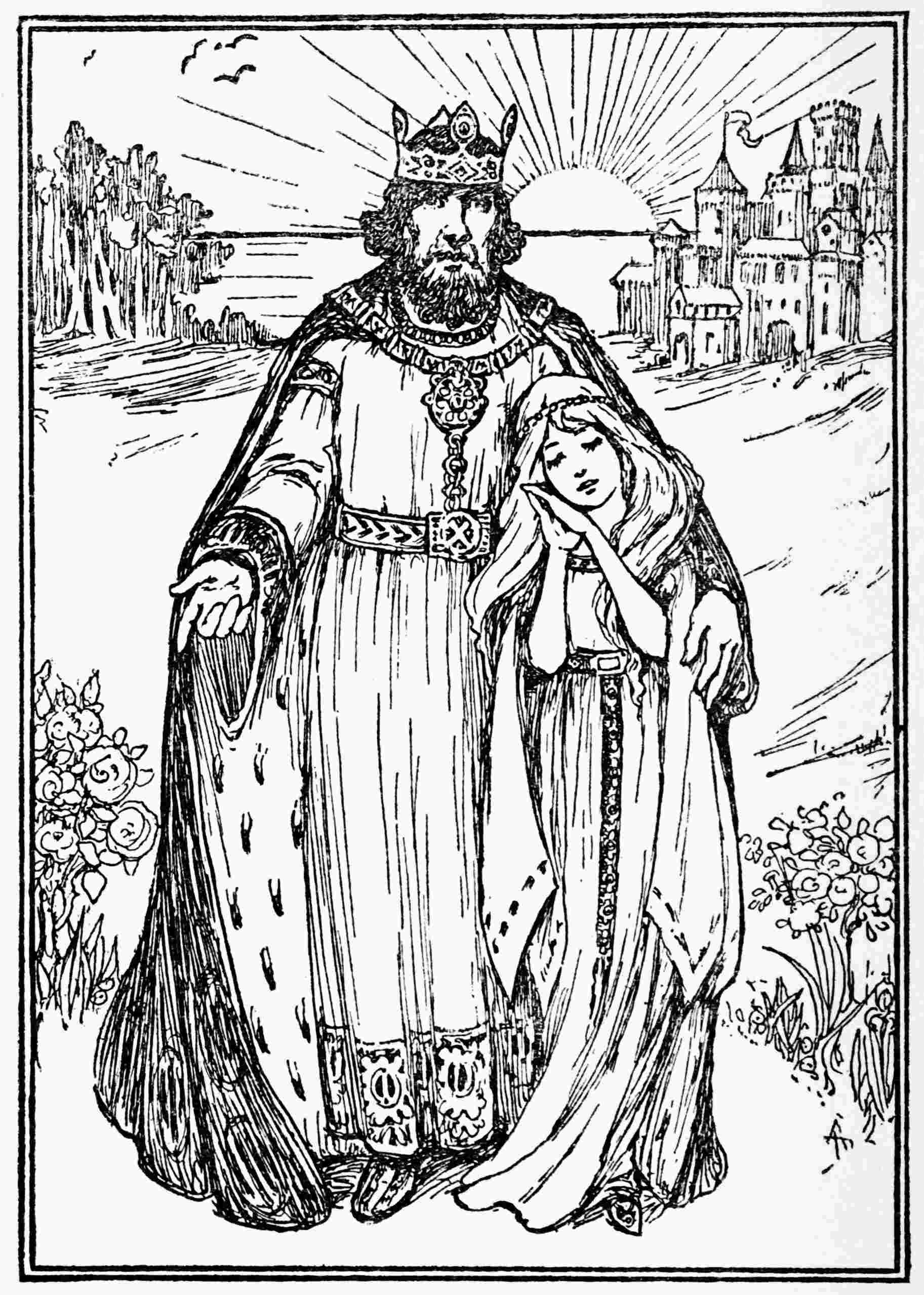
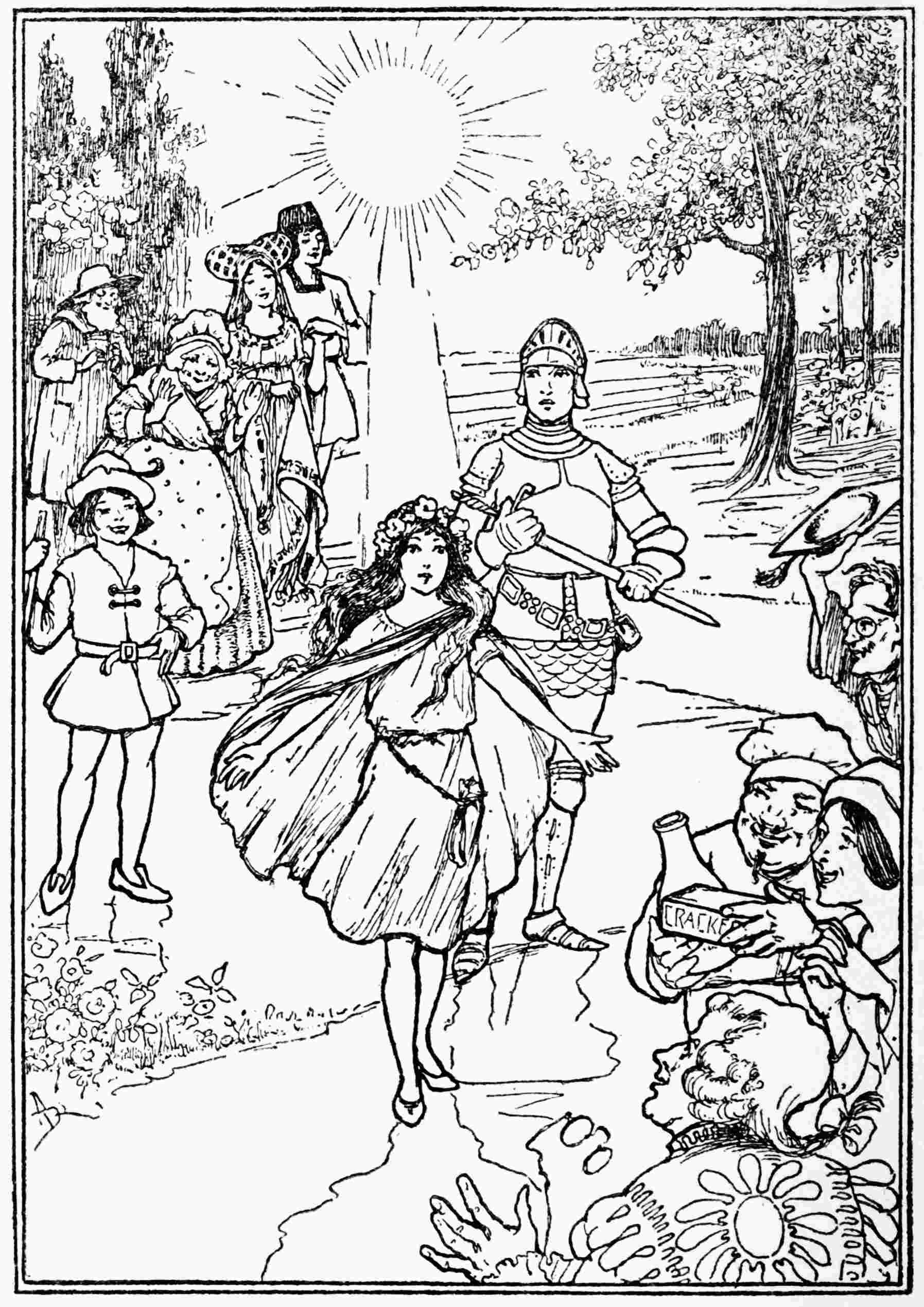
 “Her heart full of joy, the little Princess came at last
to her Coronation”
The little Princess lay on her bed and sobbed. Tomorrow she was to be
crowned Queen, and her manners were still far from perfect. In fact
Pom-Pom, the Lord High Chamberlain, and Mizzi, the Master-teacher, and
Bombo, the Chief Cook, had all gone so far as to say that she had none
at all. And they had reason. She cried for buttered crackers and hot
milk when Bombo served her with fine salads and roasted pigeons, she
never learned her spelling lessons, and she treated Rollo, the Errand
Boy, as though he were a Prince. Once they had seen her giggling—yes,
actually giggling with him, on the very day on which he had borrowed
Pom-Pom’s white wig and his best handkerchief, on which were written all
the State Secrets! Pom-Pom did not know what they were laughing at, but
he had an idea that it was at him that they were laughing. At any rate
the little Princess enjoyed herself so much that she had a very large
appetite that night for dinner, which was not considered ladylike in the
Royal Palace, and she ate three large bowls of crackers and milk instead
of one.
Today three things had happened to spoil her happiness. She had been
forbidden by Carla, the Head Nurse, to go into the gardens, she had had
to listen to a long talk between Pom-Pom and a stranger about a new war;
and, worst of all, Rollo, her only playmate, was to be sent away, far,
far away Pom-Pom had said. He had told her in his everyday manner, quite
in the same tone of voice that he used in talking about boundary lines
and armies; and all the time he kept looking down at her over his rimmed
glasses and his bumpy, red nose. It made the Princess very unhappy and
angry, and she felt like crying. Of course she did not cry. Princesses
do not cry, because crying is even worse than laughing. But oh, how she
hated Pom-Pom! He was fat and round, like a stuffed canary, in his
yellow velvet coat and breeches. His stomach stuck out like a stuffed
canary’s, his feet in the long, pointed shoes stuck out, and then his
nose stuck out.
“Your Highness,” he said, “will rest indoors today and retire early, so
as to be ready for the Coronation tomorrow.”
“But I don’t want——” began the Princess and stopped. Hadn’t she been
told that it is the most unladylike thing in the world to argue? Pom-Pom
showed his surprise with a “Tch—Tch” noise in his throat. Then he bowed
very low, as though he were a servant.
“For many, many years there have been customs among the Royal House. It
is these that you will obey, when you are Queen—and not myself or
anyone else.”
He bowed again, and it was so hard for him to do it that the Princess
felt like laughing again, because, all tumbled-over like that, he looked
like a round, yellow muffin. You and I would have laughed surely, but
not the Princess. She bowed too, looking up slyly to see if he could
straighten out, and when he had, she gave a great sigh of relief. When
the door had closed upon him, she sighed again.
It was after that that she threw herself on the bed and wept bitterly.
And it was while she was sobbing that a Big Idea came to her. She turned
over on the bed, propped herself on her elbows, and blew her nose hard.
This helped her a lot. The Big Idea grew bigger and bigger, and the
funny thing about it was that Pom-Pom himself had put it into her head.
Had he not said that it was a custom she was to obey and not himself
or Mizzi, or Carla, the Nurse, or Bombo, the Chief Cook?
“Custom, custom,” repeated the little Princess to herself,
“k-u-s-t-u-m—custom.” She had got so into the habit of spelling every
word for Carla and Mizzi that she did it without thinking.
“And what is a custom?” said the Princess to herself. “Why, I suppose
it’s a rule—r-o-o-l.”
At that she fell to thinking very hard and this is what she thought:
“It is much easier to disobey a rule than to disobey Pom-Pom or Bombo or
Mizzi, because none of them made the rule.” It had been made, you see,
many, many years ago. The Princess now sat up very straight and smiled
right through her tears.
But someone must have made it at sometime!
“Why,” said the little Princess to herself, “the people that made it
aren’t even alive!”
It was perfectly plain to see that, if they weren’t alive, they couldn’t
care a bit whether she stayed in her room, whether she ate crackers and
milk, whether she laughed with Rollo, or even whether she came to the
Coronation at all!
“I will go away,” whispered the little Princess to herself, “where there
aren’t so many rules.”
As soon as this Idea came to her, the Princess lost no time. She put her
clothes and her jewels into a little sack which she hid carefully under
a long, black cape. Then she tied an old shawl of Carla’s over her head
and crept carefully, without making the slightest noise, down the back
stairs of the castle. It was just twilight and she hid behind the pantry
door until it grew dark, and then she slipped out among the thick
bushes.
It was some time before she found Rollo, crying near the garden wall,
his curly head buried in his arm. She came up to him on tiptoe.
“Rollo,” she whispered. “Rollo!”
He turned, startled, but, when he saw who it was a smile spread slowly
over his face.
“I’m going with you, Rollo,” said the Princess softly. “Come.”
“But you cannot do that!” cried Rollo. “Think of Pom-Pom, and Mizzi and
Bombo. Would you disobey?”
The Princess stood very straight.
“I am a Queen,” she said. “I need never obey Pom-Pom or anyone. Only a
rule. Pom-Pom said so himself—and that is easy to break. I shall merely
make new rules.”
“But where are you going?” gasped Rollo.
“To see my country,” the little Princess told him.
Hand in hand they sought the long passage beneath the castle, and though
it was full of cobwebs and even bats, the little Princess did not
complain, but, drawing the hood of her long cape over her head, went
forward through the darkness and dust, until at last a little streak of
light showed them that they were coming out into the world.
So Rollo and the little Princess went forth to see her own country, and
what befell them on the way I will soon tell you.
Now there were some words that Carla, the Royal Nurse, and Pom-Pom had
explained to the Princess very fully, such as wars and boundary lines
and Court and manners; but there were other words that they had not
thought needful to a Princess, so they had not even mentioned them to
her. This caused her to make many mistakes as soon as she went outside
the castle gardens and to learn much that Pom-Pom had never taught her.
The first of these mistakes occurred very soon after Rollo and the
Princess had left the castle. They had gone some distance along a narrow
pathway and already the castle looked like a lump of black towers at the
top of the hill. It was very dark and they had to stumble over the
uneven road as best they could. The Princess’ robe was torn and her
face was scratched, but she scarcely noticed it, so happy was she to be
able to laugh and talk all she wanted to with Rollo. Now a soft, rounded
object like an orange cushion crept from behind the hills.
“The moon!” exclaimed Rollo.
“The moon? Oh, Goodie!” said the Princess, who had always been put to
bed by Carla before the moon was up. She began to dance a little dance
all her own down the road, when Rollo jerked her by the sleeve.
“Sh-sh-h-h!” he whispered. “They’ll be hunting for you all over soon.
And anyhow tonight we’ll be hungry—and then what’ll we do?”
“Oh, what?” gasped the little Princess, forgetting her glee.
Rollo was silent. They walked on so for a moment or two, while the
orange moon grew and grew, from a flat cushion into a round balloon, and
finally it rose right out of the woods and seemed to balance itself
foolishly on the pointed arm of a pine tree. Suddenly Rollo grasped the
little Princess roughly by the arm.
“There!” he said. “Did you see that?”
“What?”
He pointed through the bushes to a very faint light that flickered
through the leaves; and, going toward it, they soon came to a tiny house
and garden. Rollo walked boldly up and knocked. After what seemed a very
long wait, they heard footsteps and a pounding that sounded like a cane
and then the key turned in the lock.
The little Princess was sure she had never seen anything like the old
man that stood in the doorway as it swung open. Had she not seen him
with her own eyes, she would never have believed that there could be
anything so withered and knotted and bent as he was, or that there could
be anything as worn and loose and baggy as his clothes, quite unlike the
yellow velvet breeches that Pom-Pom wore. But beneath the soft, silky
hair of the old man, a pair of blue eyes twinkled at the Princess and
quite charmed her. He invited her to come in so pleasantly and stood
aside holding the candle to light the way in so friendly a fashion that
the Princess felt more welcome than she ever had in her own castle. The
room was certainly more comfortable than the castle. Instead of high
windows and carved chairs, there were little cross-barred windows and
Grandfathers’-chairs, some flowers, and a low stool before a blazing
fire.
“Step right in,” said the old man, “step right in and warm yourselves.
And perhaps,” he added, his little eyes sparkling merrily, “perhaps
you’ll have a cup of tea with Gamma Turkin and myself.”
The little Princess laughed and clapped her hands.
“We’d love it, wouldn’t we, Rollo? Tea—and cookies?”
“Cookies of course,” replied the old fellow, and he shouted to someone
in the other room, then turned and looked at the little Princess as
though he thought her the loveliest creature in all the world.
At the sound of the voices an old woman appeared at the door, as
wrinkled and bent as himself, and dressed in a rough brown dress and the
whitest, cleanest cap imaginable.
“What, tea at this time!” she exclaimed. Then, catching sight of the
little Princess, “Wherever did you come from, child? Sit right down and
Gamma Turkin will bring you tea.”
“And cookies,” the little Princess reminded her. (You see Bombo had
never been allowed to feed the little Princess more than one cooky a
week, because cookies were much too common for a Princess.)
It was a feast and the little Princess, munching greedily, asked as many
questions as she liked, and you can see from what she asked how many
things Mizzi and Pom-Pom and Carla had forgotten to teach her.
It was in the midst of the fifth cooky that the little Princess paused
for breath and asked the first question.
“What is that for?” she said, trailing her finger around a large patch
on the old man’s knee. Gamma Turkin gave an angry snort, but, seeing the
sweet expression on the little Princess’ face, smiled instead.
“That is a patch,” the old man explained gently. “Have you never seen
one?”
The little Princess shook her head.
“What is it for?” she asked again.
“Why!” said Gamma Turkin, “to cover a hole, of course!”
“But——” began the little Princess, and just then Rollo kicked her.
“Sh-h-h!” he whispered.
“Let her ask what questions she chooses,” said the old man much puzzled,
but looking at the Princess affectionately.
“Then—why not wear another coat?” said the Princess.
“Because I have no other.”
“Couldn’t you get one?”
“Don’t you see?” Rollo interrupted.
“Let her be!” cried the old man. Then, turning to the little Princess,
“I am too poor.”
For sometime the little Princess stared at him in silence, while a
strange frightened feeling grew about her heart.
“What—is poor?” she asked finally.
“Poor,” said the old man, “is always to live in hope. To have few
things—but to prize them highly.”
And the Princess, seeing tears in Gamma Turkin’s eyes, threw her arms
about her.
“I, too, have been poor!” she cried. “But, oh, so differently!”
So saying she drew from her sack one of the crown jewels, a rare and
lovely ruby, and slipped it in the pocket of Gamma Turkin’s worn dress.
But Gamma Turkin did not see her, and it was only long afterwards that
she found the ruby. But that I will have to tell you a little later.
In the morning, rested by a good night’s sleep in a high feathered bed,
the little Princess and Rollo set out again on their journey. It was a
hot, dusty road and the little Princess shared her cookies with all who
passed, so that by noon none were left. But she had had a very happy
time, talking to all whom she met, and learning all about their lives,
which seemed very strange to the Princess.
By nightfall they were both hot and dirty and hungry, but this time
there was no house in sight. On all sides a thick forest stood about
them, with fearful shadows and rustling noises. It grew darker. A star
glimmered to the north, but there was as yet no moon. The little
Princess felt like crying, but Princesses do not cry. So she grasped
Rollo even tighter by the hand and they trudged on.
“You must rest soon,” said Rollo finally.
The little Princess shook her head. But she put her hand to her head and
to her foot. “Though I feel something here,” she said, “and here.”
Just at that moment they heard a low groan that seemed to come from the
woods, so close that the little Princess jumped and her heart beat
strangely. Sounds of music and soldiers marching and even guns the
little Princess had heard before, but never a noise like that! She would
have hung back, had not Rollo seized her by the hand. Quickly parting
the bushes, they came upon a little twisting path that after a few turns
led them to a white tent from which the groans still issued. Rollo
lifted the flap of the tent and peered in. Then he beckoned to the
Princess. There on a straw mattress in the corner lay a very thin young
man, who looked at them crossly at first; but, upon seeing the face of
the little Princess, he smiled.
“Come in,” he said in a high voice. The Princess did so, very quietly,
and it was only then that she noticed that the young man’s face was
drawn about the lips and eyes in a way that she had never seen before.
He held out his hand to her.
“Perhaps you will stay for supper—though it isn’t much that I have to
offer you. Only crackers and milk, which an old peasant woman brings me
every morning.”
The Princess jumped up and down for joy.
“Oh, I hoped that you would ask us to supper!” she cried. “And I think
crackers and milk the best thing on earth. You see, Pom-Pom——”
Here Rollo coughed to remind her that she must not give her secret away.
“Who are you?” the sick man questioned her. “A fairy or just a gypsy?”
“I will tell you after supper,” replied the little Princess. “But isn’t
it time that you were getting up?”
The man gave her a strange look, which soon changed to one of
puzzlement.
“I do not get up—at least for some weeks,” he told her. “I am sick.”
“And what is that?” asked the little Princess. You see now how very
little Pom-Pom and Mizzi had taught her, for no sick person had ever
been allowed to come into the Royal Rooms occupied by the Princess.
“Sick is to have pain. Something that is with you constantly, either in
your body or in your mind—and makes you feel—while it lasts—that you
can never laugh again.”
The little Princess’ hand went to her head and then to her feet—just as
it had along the road when her feet felt sore from tramping and her head
had become dizzy from hunger.
“That’s it!” exclaimed the man on the cot. “You must have had very funny
teachers.”
“They taught me a great deal,” said the little Princess, “but it is all
very strange——” She broke off suddenly. “When were you first sick?”
“In the war,” he answered her gently, and this was a word the little
Princess understood.
“And do wars always make men sick?”
He nodded gravely. At that the little Princess fell to thinking, and she
thought so long and so hard that Rollo had to poke her to tell her that
supper was ready at last.
That night the little Princess slept but little on the straw provided
for her in the tent, for she had a great many things to think about. And
in the morning, before the sick man was awake, she took another jewel
from her sack—this time a sapphire that sparkled like morning sunlight
over a lake—and she slipped it into a coffee cup. Then very quietly she
and Rollo started out along the road.
A long, long way they walked—how many days and nights passed the
Princess could not remember; and everywhere they stopped people were
kind to them and took them in, and everywhere the little Princess
learned new words, and every day her sack got lighter and lighter, until
there was only one jewel left.
At last one night Rollo found the little Princess so absorbed in
thinking over all she had learned that she did not answer him when he
spoke to her. He felt of her sack in which the one jewel remained, and
he felt afraid for what would become of them. It was a very lonely road
and once more the moon was slowly crawling over the end of it. At last
the little Princess turned to Rollo.
“Where shall we rest—and eat?” she asked.
“Ah!” cried Rollo, “when you were not hungry I was beginning to think
that something was the matter. But, alas! where shall we eat and
rest?”
He looked about him sadly. Under a cloudy sky the road stretched before
them empty of travellers. It looked as though it led straight into the
center of the moon. But in a few minutes the moon lifted itself away
from the road and lighted up the whole country with a soft, white light.
Then Rollo gave a sudden leap of joy.
“Look there!” he commanded, pointing to a bridge that ran over a tiny
stream.
There near the steps of the bridge stood an old man, and nearby stood a
youth and a young girl in whose yellow hair the moonbeams were caught
and tangled. But as Rollo and the little Princess approached, they could
see that she had been weeping.
The Princess held her breath for a moment. Then she went straight up to
the old man—he was the sort of old man that one would go straight up
to—and she whispered in his ear.
“Why—is she crying?”
He looked at her for a long time and she repeated her question.
“What is the—matter?”
The old man set down his cane and put his hand on the little Princess’
shoulder.
“Is it really true that you do not know?”
Rollo opened his mouth to speak but wisely decided not to.
“I do not know—many things,” said the little Princess, remembering all
her other visits.
“She is crying,” explained the old man, “because she loves the boy—and
he is going away.”
The Princess looked very grave. She thought that she had asked almost
enough questions, and that she had better stop. But finally she got up
courage and said:
“What is love?”
If the old man had looked surprised before, he looked as though someone
had really puzzled him now. But, glancing at the little Princess, he
could not doubt her honesty.
“It is difficult to explain,” he said, “but it is like having everything
you want in the world—and then, sometimes, like having nothing at
all.”
“Look!” said the little Princess. “She is smiling now—almost laughing.
At least her eyes are laughing.”
“Yes,” agreed the old man, “they are both smiling now.”
“And why is she happy now?”
“For everyone we love,” said the old man patiently, “we gain
something—and we give up something.”
“Is it wise, then?” asked the little Princess, “to love?”
“What do you think?” said the old man.
And the Princess, looking at the two lovers, sighed and smiled.
“I think it is wise,” she said, which is just what you would have
expected of her. “I, too,” said the little Princess, “love.”
The old man nodded, as though she had told him no news.
“Whom do you love?” he asked her.
“I love Gamma Turkin and the sick man of the tent. I love Rollo and the
beautiful lady with the golden hair and——” the little Princess swung
her arms about as though to include the world—“and everybody,” she
said. “I love even Pom-Pom and Mizzi and Carla—and Bombo—and——”
“Stop!” cried the old man. “You are going much too fast!”
The little Princess looked at him, her mouth open.
“Only a Queen,” continued the old man “should love so many people.”
And for the last time in her life the little Princess said, “Why?”
“Because only she who loves all the people of her country can rule
wisely.”
For a moment the little Princess regarded him in silence.
“Ah, then,” she said finally. “I must go back.”
“Where?” demanded the old man.
“Home,” said the little Princess. “For I have learned something.”
“And what is that?”
“To obey a rule,” she answered sadly.
So it was that Rollo and the little Princess of their own accord started
on their homeward way. But before they left the Princess took the last
jewel from her sack. It was warm with the yellow flame of firelight and
it was cool with the clear yellow of moonlight, and for an instant the
little Princess gazed at it longingly, then she slipped it into the old
man’s hand; and he, being as you have seen a very wise old man, asked no
questions but only pointed out the road to them and wished them
Godspeed.
They had gone only a very short distance however when Pom-Pom’s army,
that had been hunting them high and low, discovered them, torn and
bedraggled, and carried them back post-haste to the castle gates.
There a great crowd awaited them. It seemed that all the people of the
land, learning that the little Princess had been found, had gathered
together to welcome her back. It was very surprising.
Suddenly the little Princess was aware of Pom-Pom in his rimmed
spectacles and his velvet suit. One thing was very plain to see and that
was that he was exceedingly angry. Once more he bowed low, and once
again the little Princess thought of Bombo’s yellow muffins and wondered
whether he could straighten out again. He did straighten out, however,
at which the little Princess gave a sigh of relief, while Bombo frowned
and Carla and Mizzi shook their heads. Something very terrible was in
store for the little Princess and they knew it.
“Your Majesty,” said Pom-Pom puffily, “it has long been a custom and a
rule in this Court that no Royal Princess shall be crowned Queen who is
late to her own Coronation.”
He paused to let his words sink in.
“The crown will go to the next in line.” He closed his mouth tightly and
looked down at the Princess over his rimmed glasses and his bumpy, red
nose.
The little Princess could hardly restrain her tears. It is a dreadful
thing to find out that you cannot do a thing just when you have decided
that you must do it. And the Princess had just decided that she wanted
to be Queen.
“But what am I to do?” she cried. “What that will become of——”
A great roar from the crowd swallowed up her question. It seemed to come
from miles and miles around and to grow louder every instant, until even
Pom-Pom had to put his hands over his ears. A man who leaned on a cane
came forward, and the Princess saw that it was the sick man of the tent.
He looked much stronger and bigger. When he raised his hand the crowd
became silent. Then he bowed very low to Pom-Pom.
“The people,” he said, “will have no other Queen.”
Pom-Pom grew red in the face.
“They have nothing to say about it,” he snapped.
The man bowed again.
“Yes,” he agreed. “But they are saying it very loudly.”
Pom-Pom’s face was now purple.
“She cannot reign in this castle!” he shouted angrily.
“Be that as it may,” said the man of the tent, “she will reign in the
hearts of her people.”
At that moment, amid the cheers and laughter of the throng, an old lady,
in a neat brown dress and the most spotlessly white cap imaginable, came
forward; and in her hand she held a crown. It was woven of mistletoe and
thistle-down; and in the center, where the great ruby should have been,
was instead a large red poppy; and where the yellow topazes shone in the
royal crown this one had a cluster of yellow wood-violets; and where the
sapphire should have been set, there was a larkspur. Very carefully
Gamma Turkin and a beautiful lady, whose golden hair was still more
lovely in the morning light, placed the crown on the head of the little
Princess. And the sun came out and shone on all its petals, and the wind
rustled down, scattering its perfumes among all. It was a very beautiful
sight.
Even Pom-Pom took off his rimmed spectacles and blew his nose long and
hard on his best silk handkerchief on which were embroidered all the
State Secrets of the Kingdom. This caused him to lose several pounds.
The Princess could not help laughing; but she was at the same time so
sorry for him that she decided, in spite of the protests of the crowd,
to keep him at the castle as Lord-High Censor of the Spelling Book, a
post that he fulfilled with honor and dignity until he died. As for
Rollo, he became her Chief Adviser and wore a white wig that pleased him
mightily, although it was not in the least becoming.
So, standing at her castle gates, her ragged cape hanging loosely from
her shoulders, her sack empty of jewels but her heart full of joy, the
little Princess came at last to her Coronation.
The End.