There are a few races of poultry that have two kinds of males, one with
the feathering of the ordinary cock, the other with the feathering of
the hen. The Hamburgs and the Campines are perhaps the best known races
of this sort. Convention amongst breeders, in certain countries, has
determined that the cock-feathered bird shall be the standard, and at
other times and places that the hen-feathered males shall be the show
birds. In one breed, at least, viz., the Sebright bantams, the
hen-feathered cock is the only known type. Cock-feathered Sebrights have
never been seen, so far as I know. This breed is pure for
hen-feathering. As shown in plate 1, figure 3, the male Sebright lacks
the long, pointed saddle feathers at the base of the tail of the common
cock, also the peculiar back and neck feathers (hackles) of the cock
bird, as well as the male feathering on the bow of the wing. His
feathers in these parts are almost exactly like those of the hen (plate
4, fig. 4). The long sickle feathers covering the true tail are also
absent, although the two median ones sometimes occur in males of this
race.
The Sebrights seemed excellent material for studying the heredity of
this type of plumage in the male. In 1911 I began to study this problem,
and crossed Sebrights to Black-Breasted Game bantams. The latter race
was chosen not only because the males have the typical cock-feathering,
but also because the coloration of these birds resembles very closely
that of the jungle-fowl, from which many, perhaps all, of our
domesticated races have sprung.
In dissecting some of the F₂ birds from this cross I noticed that the
testis of the male was often more flattened than is the testis of the
typical male bird, that it was often somewhat pear-shaped, and that
frequently it was in part or entirely black. Recalling that male
Sebrights are said to be often partially sterile, the idea naturally
suggested itself that these birds are hen-feathered because the testes
have assumed some of the characteristics of the ovary. It had long been
supposed, and had been finally established by Goodale, that the presence
of the ovary in the female suppresses her potential development of
plumage, for when the ovaries of the hen are diseased or removed she
develops the plumage of the male. This reasoning led me to try the
experiment of castrating the hen-feathered males in order to see if
they would become cock-feathered. The outcome was immediately apparent;
the new feathers were those of the cock bird. While the “reasoning” that
led to the experiment is open to serious question, nevertheless the
“hint” furnished by the unusual condition of the testis led finally to
the discovery that luteal cells were present in abundance in the testes
of the male Sebright like those present only in the females of other
breeds. Whether or not the shape of the testis of the Sebright, that is
sometimes like that of the ovary, is connected with the unusual
abundance of luteal cells in the testis I do not know. If so, then the
hint that came from their shape was not so unreasonable as appears at
first sight.
The birds first operated upon were adult F₁ and F₂ hen-feathered birds.
The first one done by myself died, but a few, whose testes were removed
by Dr. H. D. Goodale at my request, lived and changed to cock-feathered
birds. Since then I have operated successfully on a number of F₁ and F₂
birds, as well as Sebright males. In these operations I have had
throughout the assistance of Dr. A. H. Sturtevant and for two years the
assistance of Dr. J. W. Gowen also. I wish to express my appreciation of
their help and advice, for without it I doubt whether I could have
carried out the work successfully. Since the main interest attaches to
the Sebright experiments, they will be described first, although they
were the last to be performed.
Except for the similarities of the plumage, the male Sebright differs as
much from the female as do cocks of other races. The rose comb is very
large in the male, small in the female (plate 4, figs. 3, 4). The
wattles also are longer in the male. The cock carries himself erect, as
do the males of other breeds. His spurs are well developed and he shows
the aggressive behavior of his sex. On the other hand, the shortness of
the feathers on the back of the neck (the hackles), the absence of the
pointed feathers on the back and rump, and the usual absence of long
sickles and other tail-covert feathers make him hen-like. The detailed
account of the feathers in these critical regions will be given when
comparisons are made with the feathers of the castrated birds (plate 6
and plate 8).
Six males have been successfully operated upon and with one apparent
exception have all given the same results. The birds were of somewhat
different ages; they had been hatched about July, and were operated upon
about November of the same year, when they were either half grown or had
nearly reached maturity. At the time of the operation a few feathers
were removed from different regions of the body, and the new feathers
that regenerated in the course of 3 or 4 weeks showed all the
characteristics of those that came in later to replace the juvenile or
first adult coat. These regenerated feathers do not, therefore, call
for special notice. All of the new feathers were in shape, pattern, and
general coloration strikingly different from the original feathers, some
of which were at first still present, the old feathers of course showing
no change.
After completely molting, the appearance of the birds may be gathered
from the photographs (plate 5) and from the colored drawings (plate 1
and plate 3). The male now has in all points the plumage of a typical
cock-feathered male bird of other breeds. This is startlingly apparent
in the hackle, back, rump, sickle, and tail-covert feathers. Instead of
the laced feathers that are characteristic of both male and female, the
whole upper surface of the bird appears reddish or yellowish, the black
marginal edging of the feathers having disappeared. A detailed
comparison of the feathers of the different regions will show how great
a change has taken place. (See page 8.)
In plate 6 and plate 8 the feathers from characteristic regions of the normal
Sebright and of the castrated Sebright are shown in pairs.
One of the first Sebrights that was castrated was a lighter bird than
the others. Its lighter color was partly due to the narrower outer band
of the laced feathers, (plate 6, figure 1,) and partly to the lighter
color of the yellow-brown center of the feathers. The bird had a single
comb, but as this crops up occasionally in some stocks of Sebrights, it
need not be interpreted to mean that the bird was impure for color
factors. After being castrated the bird changed over completely to
cock-feathering and has remained in that condition for two or more
years. As shown in plate 5, figure 2, the plumage is even more fully
developed than in cock birds of some other breeds. The comb and wattles
are, however, shrunken and pale, as in a capon. The bird is timid and
scarcely or never crows. When killed (May 1919) no pieces of testes and
no trace of testicular tissue at the old situs were found.
The details of the feathers are shown in plate 6, figures 1 and 1a,
where, in each instance, one of the old and one of the new feathers from
the same region are placed side by side. The feathers on the head and
hackle are yellow, even to the base. At the base of the hackle—the
so-called cape—a few feathers have a small black tip. The feathers of
the back are entirely yellow, except that where the fluff begins there
is some dark pigment. The saddle feathers are for the most part all
yellow, but a few have at the base, near the fluff, black on each side.
The tail coverts are long, with a black margin at their tip. The tail
feathers are long, mossy, and have a black tip. The wing-bow feathers
are all yellow, except the black fluff at the base. The feathers on the
crop are mostly yellow with black margin around the end. Those on the
breast lower down are yellow with black tip and black fluff.
There was another Sebright operated upon at the same time that was a
darker bird (as the original feathers show, plate 8, figs. 1 to 4). It
had a rose comb. The feathers that were plucked at the time of
operation were replaced at once by new feathers of the cock-feathered
type. The new feathers that came in as the old ones were molted were
also cock-type, and the bird soon assumed the complete characteristic
cock-feathering. The comb was shrunken as in castrated birds (plate 5,
figure 5).
SEBRIGHT.
Plate 6 and 8. | CASTRATE.
Plates 6 and 8. |
| 1. | On the head (a) the feathers are small, dull black with lighter margin and reddish quill.
| 1. | Feathers entirely yellow and more slender. Those on each side of the shrunken comb stand up from the head. |
| 2. | On the hackle (b) the feathers are yellow bordered with black, especially at the base, and at the tip outside of this border there is an arrow yellow border (broader at base). The border is absent at tip.
| 2. | Hackles on upper part of neck have a black base with red tip. The outer edge, without barbules, is narrow, then broader than at tip. Farther down the neck the edge with barbules is yellow with a narrow black margin. |
| 3. | In the middle of the back (between the wings) the feathers are yellow with black margin at the tip. At the base there is some dark color.
| 3. | In the part of the feather with barbules there is a yellow center bordered by a broad black band, especially at base. In the part without barbules the feathers are yellow and more pointed. This region especially is deeper yellow than in the original Sebright. |
| 4. | The saddle is made up of typical laced feathers with black where the fluff begins.
| 4. | Saddle consists of long, slender laced feathers, except at tip, which is red. Barbules are absent along edge of outer third of feather. |
| 5. | The tail coverts are short; the upper ones, especially the short sickles, are slightly curved. The sickle feathers extend up only about half the length of the tail. They are yellow, laced, and have a black margin, tending to be lost at tip.
| 5. | Tail coverts long, covering the tail as in cock birds of other breeds. The sickle feathers, especially the upper ones, are much curved, with black tips; the black margin is largely gone. The feathers are mossy, sometimes splotched (this is also sometimes noticeable in normal birds). |
| 6. | The yellow tail is short and erect.
| 6. | The tail feathers themselves are almost twice as long as in normal bird; the upper feathers are more curved. |
| 7. | The feathers on the wing bow are practically like those on the back, but shorter.
| 7. | The feathers of wing bow are like those of the back of the same bird, but shorter. |
| 8. | Over the crop and lower breast the feathers are laced.
| 8. | The crop feathers are narrower, with a wider black margin, and a few may be also entirely black. Feathers on lower breast much like those in normal, but a little more pointed. |
During the spring of 1917 it was noticed that the bird was going back
towards the hen-feathered type, and by the end of the summer he was in
the intermediate condition, as shown by the photograph and by the
individual feathers (plate 8, 1b, 2b, 3b, 4b). The comb had
begun to enlarge also. The bird was opened again (1918) and pieces of
testis about as big as peas were found on one side. Evidently a piece of
the old testis had been left behind and had regenerated. As it enlarged
the new feathers were affected so that the plumage returned towards the
normal type. The pieces of testis were removed and a few feathers
plucked out. The new feathers that came in were typically
cock-feathered, and, as the molting proceeded during the winter and
spring, the bird became cock-feathered for a second time as shown in
photograph (plate 5, figure 6) and by the feathers in plate 8, 1c,
2c, 3c, 4c. Here, then, is an excellent example of the connection
between the gonad and the condition of the plumage. On opening this bird
(May 1919) no pieces of testes were found. There was a very small
whitish lump at the situs of the old testes, which, when sectioned,
showed some glandular-like tissue, not in tubules, and no evidence of
testicular tissue.
Three other younger Sebrights of the same stock were successfully
castrated. They were hatched in June or July and castrated in November
of the same year. They remained quite small birds, despite their
elongation due to the long tail and tail coverts that they developed.
One of these birds in his cock-feathered plumage is shown in plate 3,
figure 1. One has died, the other two are alive and markedly
cock-feathered, as shown in plate 6, figure 2a. All three birds were
dark red-brown, much more so than the two preceding cases, especially
the first case. This color difference might be attributed to the earlier
age of the three birds when operated upon, or to a more complete (or
less complete) operation involving perhaps neighboring parts, or to the
birds having a somewhat different genetic composition (i. e.,
modifying factors). There is no special reason why the operation if
performed early should have a different result on feathers that develop
after the bird is of adult age. Goodale has suggested that there may be
organs in the vicinity of the testis that have some influence on the
kind of plumage produced, and if there are such organs they might be
removed in one bird and accidentally left in another. It would not,
however, be probable that the bird operated on at first had received one
treatment and the later ones the other treatment. It seems to me more
probable that the birds have come from different genetic strains, and
that this genetic difference gives a more plausible explanation of the
darker cock-feathered plumage. Goodale observed, for the first time I
think, that the largest wing coverts of the castrated cock become
longer. I looked, therefore, with some interest at the condition of
these same feathers in the castrated Sebrights. As shown in plate 10,
figures 1, 1a, these feathers are also longer and narrower in the
castrated Sebright than in the normal bird.
The true tail feathers of the capon are said to be longer than those of
the cock. This holds also for the tail feathers of all of my castrated
Sebrights. Their true tail feathers are considerably longer than those
of the normal male, as seen by pulling them out and comparing the two.
Their length is concealed while on the bird by the excessively long
coverts that appear after castration.
In 1916 I operated on a Sebright male that lived for some months, but
died in the summer of 1917. At the time of his death he had assumed a
partial cock-feathering, as shown by the feathers in plate 9, figure 3,
3a. Dissection showed that some of the testes had been left, and as is
then to be expected, the change was incomplete.
One of the males that had been castrated with the others did not become
cock-feathered even after a year. Taking for granted that the castration
had been incomplete, the bird was opened, but as no pieces of the testes
were to be found in the normal position he was killed and carefully
dissected. There were no pieces of testes found in the normal situs. A
small whitish patch of material from this region was cut into sections,
but no testicular material was found in it. Then a large piece of the
back from the region of the attachment of the testes was prepared, but
as yet this piece has not been sectioned. Even were a small piece of
tissue to be found, it would seem unlikely that it would suffice to hold
back all indications of the cock-feathering, for after incomplete
removal of the testis there are nearly always at first some indications
of the lack of material. The most plausible view here is either that
some other gland may have assumed, provisionally, the function of the
missing testes, or else a detached piece has not yet been found.
Glandular cells like the luteal cells of the ovary have in fact been
described by some observers in other organs of the body. As yet I have
not found time to make a thorough histological study of the tissues of
this bird.
In several birds new feathers had begun to develop at the time of the
operation under the influence of the testicular secretion. After the
removal of the testes, these feathers continued to grow and in the
absence of the original conditions changed over to the other type. The
outer end of these feathers shows the original or normal shape and
color, while the inner end shows the new characteristics. Such feathers
have been seen in nearly all of my castrated birds; a few from the
Sebright will suffice by way of illustration. In plate 10, figure 2a,
four such transitional feathers are shown. In a and b two feathers
from the hackle are photographed. The first (a) had begun as a normal
Sebright hackle feather, as seen in the condition of its tip; the rest
of the feather is the same as the feather of the castrated bird. For
comparison with this feather, two (2b) from the same bird are shown
that began to develop after the testes were removed, i. e., at the
same time as the change occurred in the former feather. At the time the
latter feather (b) had not yet completed its full growth. On the bow
of the wing a few intermediate feathers, like the one shown in 2a,
were present. (For comparison with normal and castrated feathers see
those on plate 6 and plate 8.)
An intermediate feather from the back is shown in 2a. For comparison
with the old feathers from the same region see plate 6, fig. 2. An
intermediate saddle feather is shown in 2a. For comparison with normal
feathers from the same region see figure 2. A still later feather from
the castrated bird is shown in 2b. The last was not yet complete when
removed from the bird.
It will be noticed that the change after castration involves the color,
the shape, and the presence and absence of barbules in those parts of
the bird that are peculiar in the last respect. The transition in these
characters is quite sharp—as sharp in fact as is compatible with the
passage from one structure to that of an entirely different kind without
any discontinuity of growth. Owing to the quickness of the response
shown by the feather, it will be possible to study more in detail the
length of time the secretion remains in the body of the bird after the
testes have been removed.
Hen-feathering is dominant to cock-feathering. As shown in plate 2, the
F₁ male is almost as completely hen-feathered as is the male Sebright.
There is a somewhat greater color difference between the F₁ male and F₁
female than between the Sebright male and female. Two F₁ birds were
castrated for me by Goodale. At the time of operation, in the autumn of
1916, both birds were full grown, (plate 2, figure 1). After molting the
old feathers, both birds appeared as shown in plate 2, figure 4. Each is
completely cock-feathered. The plumage has also undergone a remarkable
change in color. In general, the color change is from yellow and black
to reddish yellow. The greatest change is over the upper surface. The
sickle, covert, and tail feathers are well formed and have now become
iridescent black. The breast has changed least of all. One bird died
February 12, 1919. When opened there was found on the left side a small
white lump; on the other side almost nothing. The lump was found to
consist of testicular tubules with loose glandular cells on its walls.
The extent to which the change has taken place is best shown by
comparison of individual feathers from identical regions—one before and
one after the new feathers (taken out two years later) have come in
(plate 7). The contrast between the old and new feathers of the hackle,
saddle, back, and wing-bow are the most striking. In all of these the
new feathers have become red on the exposed portion and the margin is
free from barbules, as in the cock bird. The increase in size and
change in shape of these feathers is remarkable. Equally great is the
change in the tail-coverts that grade into those of the saddle at the
base. The two median coverts or sickle feathers are longer than the tail
and much arched. They are jet black with a purplish iridescence and with
a yellow-red shaft. The tail itself has also changed; it has lost its
stippling, and has become black like the coverts. The increase in length
of the tail feathers is as remarkable as the increase in length of the
coverts. A detailed account of these changes follows:
| F₁. |
CASTRATE. |
| 1. | The head feathers are yellow with black base that shows through on the head.
| 1. | The feathers are entirely red. |
| 2. | The hackle feathers are yellow with black base (showing through on neck).
| 2. | The hackle feathers are entirely red. |
| 3. | The red feathers of the back are penciled. There is a black band, especially around tip just inside of the margin.
| 3. | Feathers of back are red except for black at base. Barbules absent at end and side. Tip pointed. |
| 4. | The saddle feathers are much like those of the back, much stippled in center. The border is more distinct.
| 4. | The saddle feathers are red with black base. They are long and pointed. |
| 5. | The tail coverts are similar to those of the hen.
| 5. | The coverts are blue-black, with brown shaft. They are long, pointed, and curved. |
| 6. | The tail feathers are black, and with exception of the lower feathers they are partly stippled.
| 6. | The tail feathers are black, not stippled, and have a black shaft. |
| 7. | The wing-bow feathers are penciled like those of the back.
| 7. | The wing-bow feathers are red with black base. |
| 8. | Feathers on crop yellow with black spot at tip; those lower down on breast have a bigger spot.
| 8. | Over the crop the feathers are orange-brown; on the breast they have the same color and a small black tip. |
The F₁ bird from which the colored drawing (plate 2) was made and from
which the normal F₁ feathers were pulled was lent to Dr. Goodale in the
summer of 1917. The bird died in April 1918, and his skin was sent to
me. He also had begun to change over to cock-feathering (plate 9,
figures 2, 2a). Goodale recorded that the testis had dwindled to small
bodies only about 10 by 5 mm. This accounts for the change to
cock-feathering. For comparison I have added a third set of feathers to
the two former sets, showing the new hackle, back, saddle, wing, and bow
feathers of this bird. The feathers show that the change is in the same
direction as that shown by the castrated cock, but it has not gone so
far in the direction of cock-feathering. The tail is still short and the
feathers are black. The sickle feathers are not longer than the tail and
are stippled. It is probable that this is the old tail whose feathers
have not been molted since the testis dwindled. In fact, elsewhere the
old and the new feathers are both present, showing that a complete molt
had not taken place. The old feathers still present are practically like
those of the original F₁ bird, showing that the change was of recent
date, and due to the decrease in the testis which was probably caused by
disease.
The F₂ hen-feathered males from this cross could not be utilized until
they had begun to assume the adult plumage, since before that time they
were like the cock-feathered F₂ males. Consequently, the operation is
more difficult and more dangerous to the bird. A good many birds have
died in consequence of the operation, but enough successful operations
(five) were made to show what the color of certain types of
hen-feathered bird would be when changed to cock-feathering.
A hen-feathered male (No. 292) that was darker than the F₁ male—in
fact, almost black, except for a yellow center in some of the dorsal
feathers that were mossy or penciled—was castrated. The details of
characteristic feathers may be gathered from the feathers in plate 7,
figure 2. A corresponding set of the new feathers after castration,
2a, are paired with the former. The castrated male in his new plumage
is shown in plate 2, figure 3. His dorsal surface is colored very much
as is the same region in the F₁ bird, but the breast is very much
darker, so that the bird as a whole presents a very different appearance
from the F₁ castrated male. A very small white mass was found when the
bird was killed in place of the old testis, composed, in sections, of a
reticulated mass of cells that look like old broken-down follicles of
testicular tubules with a few cell-layers lining the tubules.
An F₂ male (68) also had dark feathers (plate 3, figure 2, and plate 9,
figure 1). The castrated male in his new plumage is represented in plate
3, figure 3. Here again the upper surface is much like that of the last
castrate, and also like that of the F₁ castrate. The breast has changed
much less than the back; the centers of the feather are brown with a
black margin and a black band at the tip. The exposed portion of the
secondaries and the coverts are not so brown as in the last bird. The
spurs of this bird were bent back, looking like the horns of a ram. When
killed and examined, several small white pieces, that looked like pieces
of testes, were found in the abdominal cavity near the old attachment of
the testis. A histological study showed that these pieces contained
tubular tissue apparently testicular, but without germ-cells.
Another F₂ male (Band No. 221) was yellow in general color, the feathers
being irregularly penciled. After castration (plate 3, figure 4) the
bird became red above and deep brown below; the tail and coverts were
black.
A pale-yellow hen-feathered bird (No. 218) was also castrated. Here also
the change was most conspicuous over the upper surface, not only in a
greater depth of color than elsewhere, but in the shape, etc., of the
feathers. On the breast the original yellow color remains, but is
slightly deepened. When killed and opened (May 14, 1919), a few small,
whitish pieces were found. When these were sectioned it was seen that
they were made up, for the most part, of tubules looking like those of
the epididymus and also a few testicular tubules. At the old situs there
were some regenerated lumps, which in sections appeared to be loose
glandular tissue. No germ-cells were present and the tissue just
referred to may be old testicular tubules.
Darwin records in Chapter XIII of Animals and Plants under Domestication
a change that took place in an old female Sebright:
“Mr. Hewitt possessed an excellent Sebright gold-lace bantam hen,
which, as she became old, grew diseased in her ovaria and assumed
male characters. In this breed the males resemble the females in
all respects except in their combs, wattles, spurs, and instincts;
hence it might have been expected that the diseased hen would have
assumed only those masculine characters which are proper to the
breed, but she acquired, in addition, well-arched tail
sickle-feathers quite a foot in length, saddle-feathers on the
loins, and hackles on the neck—ornaments which, as Mr. Hewitt
remarks, would be held to be abominable in this breed.”
This is the only record I know of showing the change that takes place in
the Sebright hen when the influence of her ovary is removed. There can
be no doubt from the above description that she changes in the same way
as does the castrated Sebright male.
Concerning the origin of the Sebright bantam Darwin states that the race
“originated about the year 1800 from a cross between a common bantam and
a Polish fowl, recrossed by a hen-tailed bantam, and carefully selected;
hence there can hardly be a doubt that the sickle feathers and hackles
which appeared in the old hen were derived from the Polish fowl or
common bantam; and we thus see that not only certain masculine
characters proper to the Sebright bantam, but other masculine characters
derived from the first progenitors of the breed, removed by a period of
about 60 years, were lying latent in this hen bird ready to be evolved
as soon as her ovaria became diseased.” To-day the problem appears to us
in a somewhat different light, since the secondary sexual characters
referred to by Darwin have simply been kept under for more than a
hundred years by the secretion produced in the ovary of the hen (as in
all breeds) and in the testis of the male Sebright.
In 1913 I found that hen-feathering as seen in the Sebright is a
dominant non-sex-linked character. A preliminary statement was given in
the first edition of my book on Heredity and Sex (1913), which treated
the character as a recessive one. This was a mistake due to a male
having been obtained that was like the game race, which subsequent work
showed must have been due to a sperm having been retained in the
oviduct of the female during her isolation period. In the second edition
published a few months later the mistake, having been found out, was
corrected.
If one dominant suffices to produce hen-feathering, the F₂ ratio would
be 3 hen-feathered to 1 cock-feathered bird. The numbers found were 31
to 28. This realized ratio departs too far from a 3:1 ratio to make it
probable that the results are due to a single factor.
The F₂ expectation for two dominants, both necessarily present to
produce hen-feathering, is 9 hen-feathered to 7 cock-feathered birds. If
the dominant factors are represented by H and H´ and their wild-type
(recessive) allelomorphs by h and h´, the expected F₂ recombinations are
given in the following table:
| |
HH´ |
Hh´ |
hH´ |
hh |
| HH´... |
{HH´ |
Hh´ |
hH´ |
hh |
| {HH´ |
HH´ |
HH´ |
HH´ |
| Hh´... |
{HH´ |
Hh´ |
hH´ |
hh |
| {Hh´ |
Hh´ |
Hh´ |
Hh´ |
| hH´.. |
{HH´ |
Hh´ |
hH´ |
hh |
| {hH´ |
hH´ |
hH´ |
hH´ |
| hh .. |
{HH´ |
Hh´ |
hH´ |
hh |
| {hh |
hh |
hh |
hh |
There are 9 classes containing both H and H´, 6 containing one or the
other, and one containing neither H nor H´. The realized numbers, 31 to
28, are in close approximation to 9:7.
In classifying the F₂ hen-feathered males, an attempt was made to divide
them into two classes, viz, type 1, hen-feathered to the same extent as
the Sebright, and type 2, intermediate between hen and cock feathering.
The line between intermediate and cock-feathering is sharp, all the
intermediates belonging distinctly to the hen-feathered group, but the
line between the two subdivisions of hen-feathered birds is not sharp,
and occasionally a bird is found that is difficult to place. These
statements hold also for the F₁ birds, whose skins I now have. Five of
these are classified as intermediates and one as completely
hen-feathered. The difference between these two classes, then, is
environmental or due to other modifying genetic factors, for which
either the Sebright or the game is not pure. Under these circumstances
it would not be profitable to attempt to find out (without additional
evidence) what genetic differences, if any, lie behind the hen-feathered
and intermediate-feathered birds in the F₂ classes.
Concerning the back-cross (F₁ by game) the expectation, for one dominant
factor-difference, is 1 hen-feathered to 1 cock-feathered male. There
were obtained 2 hen-feathered (intermediates) to 7 cock-feathered
birds. The numbers are too small to be significant, taken by themselves.
The expectation for 2 dominants, both essential to hen-feathering, is 1
to 3, and this is in agreement with 2 to 7 as found. It seems, then,
more probable from the evidence of the F₂ and of the back-cross combined
that there are two dominant factors present in the Sebright that make
the male hen-feathered, and since the race breeds true to
hen-feathering, both factors must be present in homozygous condition
unless an undetected lethal destroys some of the classes.[1]
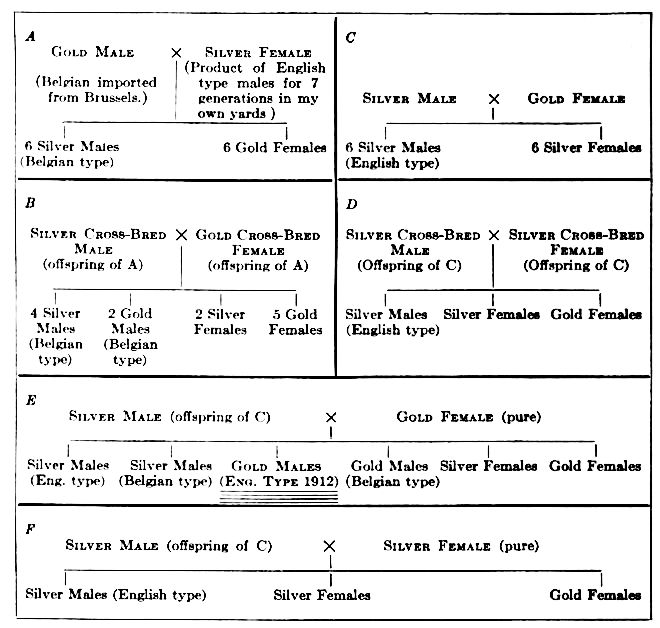
Smith and Haig have reported the following curious case of
hen-feathering. Smith had a breed of White Leghorns with cocks of two
classes—those that assumed cock plumage at 6 months and those that are
like the hens for 8 months, after which they slowly assumed the
cock-feathering. The difference is hereditary and appears to segregate.
Possibly this breed had one factor at least for hen-feathering that is
effective for young birds, but not for older ones, or some of the birds
pass through a stage when they produce an internal secretion that
disappears later. But it is also possible, and perhaps more probable,
that the young birds, not cock-feathered, have remained longer in the
juvenile stage than the others, so that they might be said to be falsely
hen-feathered.
The results published by the Rev. E. Lewis Jones in 1914, describing
crosses between two breeds of Campines, one called Belgian (which has
hen-feathered males), the other English (that has cock-feathered males),
are summarized in the table on page 16. They show the dominance of
hen-feathering with some probability. The table given there is the
original, to which the author has kindly added the numbers here prefixed
to some of the classes. The numbers are not large enough in all cases to
be satisfactory, but the dominance of the hen-feathering is, I think,
apparent, as well as its non-sex-linked transmission. The golden female
in C must have been English type, or at any rate heterozygous for
English-type feathering, for if Belgian her sons would have been Belgian
type.
Punnett and Bailey (1914) have published the result of a cross with
hen-feathered Silver Sebrights and Hamburgs. The dominance of
hen-feathering in the male is shown in the figures that illustrate their
paper, but as the paper deals solely with the inheritance of weight the
account of inheritance of hen-feathering was deferred to a later paper,
that has not yet appeared.
The cross between the Sebright and the Black-Breasted Game bantam was
undertaken primarily to study the inheritance of hen-feathering. The
Sebright was chosen, on the one hand, because this race is pure for
hen-feathering, whereas in other races, such as the Campines, both kinds
of males are known. The hen-feathered birds of such races are, I
believe, frequently not pure for hen-feathering. The game race was
chosen because the cock has the typical plumage of the wild bird,
Gallus bankiva, and although his feathers are remarkably short, they
show the characteristic cock-feathered type.
Only secondarily was the experiment concerned with color inheritance.
The two breeds differ so markedly in coloration and pattern that the
very complex results that appeared in F₂ were to be expected. In
addition to the differences involving hen-feathering versus
cock-feathering, and Sebright plumage versus game plumage, the game is
strongly dimorphic in the plumage, while in the Sebright the coloration
of the two sexes is closely similar. But the castration experiments have
shown that this difference is the result of hen-feathering in the
Sebright cock, and that the race carries the same potential dimorphism
as do other races of poultry.
The game cock is shown in plate 1, figure 1, and plate 4, figure 1. The
wattles and comb had been removed from the bird. The yellow-red back and
saddle are to be noted. The upper tail coverts and sickle feathers are
black, as is the tail. These parts are shorter in the game than in other
races, being one of the points selected for. The dorso-anterior edge of
the wing is black, this color meeting across the middle of the back.
Below this black area comes the red wing bow, followed by a double row
of blue-black feathers. The exposed portions of the secondaries are
brown, of the primaries black with green margin. The breast and entire
lower surface is black. The legs are greenish, the bill black and
yellow, the iris yellow.
The hen of the Black-Breasted game (plate 1, figure 2) is light
yellowish-brown. The back, saddle, and wing coverts are golden brown,
finely penciled with darker brown or black. The hackle is penciled; it
has a yellow border (without barbules); the back is more brown, the
forepart of the breast is salmon, the more posterior parts lighter
salmon. The sides of the body under and below the wings are stippled
gray.
The Sebright male is represented in plate 1, figure 3. Photographs of
the male and the female are given in plate 4, figures 3 and 4. Most of
the feathers have a yellow center and a black border. Such feathers are
said to be laced. The details of the different regions are shown in the
feather plates, 6 and 8.
The F₁ birds were remarkably uniform. The sexual dimorphism is slight,
as a comparison of the male and female in plate 4, figures 5, 6, will
show. In the female the body feathers are penciled but very mossy, and
this holds for the male too, except that in the hackle, back, and
saddle, a change in color accompanies the change in shape, as seen in
the individual feathers in the feather chart (plate 7, figure 1). If
there are any sex-linked factors involved in the cross, we should expect
different types of F₁ hens in the direct cross and its reciprocal,
because in one case the F₁ hen gets her single X chromosome from one
father, and in the other case, the reciprocal cross, from the other.
Unfortunately no careful comparison can now be made, because the crosses
were carried out in different years and the changes due to age may have
affected the color sufficiently to obscure such slight difference that
may have existed. But the effects of such factors, if present, are very
small, since the birds seemed to be the same, regardless of the way in
which the cross was made. In the F₂ counts, although an attempt has been
made to keep apart the birds obtained in the two crosses (i. e., the
direct and the reciprocal crosses), it is very doubtful if the two
groups show any significant differences.
All together there are 72 hens, 29 hen-feathered males, and 26
cock-feathered males, as shown in table 1:
Table 1.
| | F₂ from Sebright ♀ by Game ♂. |
F₂ from Sebright ♂ by Game ♀. |
| |
Females. |
Hen-feath.
♂ type 1. |
Hen-feath.
♂ type 2. |
Cock-feath.
♂. |
Females. |
Hen-feath.
♂ type 1. |
Hen-feath.
♂ type 2. |
Cock-feath. ♂. |
| A | 15 | | 3 | 2 | 1 | 1 | 4 | |
| B | 1 | 1 | | | 5 | | | 1 |
| C | 3 | 1 | | | 4 | 1 | | |
| D | 3 | 2 | | 2 | 2 | | | 1 |
| E | 6 | | | | | 1 | | 1? |
| F | 6 | 1 | 2 | 3 | | 2 | 1 | 1 |
| G | 11 | 1 | 1 | 1 | 2 | 1 | | 1 |
| H | 5 | | | | | | | |
| I | 1 | | | 2 | 1 | | | 2 |
| J | 2 | 1 | | 2 | 2 | 1 | 1 | 2 |
| K | | | 2 | 1 | | | | 2 |
| L | | | | | 1 | | | |
| M | | | | | 1 | | | |
| N | | | | | | | | |
| O | | | | | | | | 1 |
| P | | | | | | | 1 | |
| | 53 | 7 | 8 | 13 | 19 | 7 | 7 | 13 |
F₂ Hens.
A. 8 females that are like F₁; 7 others resemble them below, but
have stippled back and rump feathers (4 of these have yellow necks,
and 3 black necks like those of F₁). Here, then, are two or three
subdivisions, or perhaps main classes.
B. 1 female is very close to game, having the characteristic
stippling above and salmon breast below. She is darker colored than
the game females, therefore more like the Leghorn female.
C. 3 birds resemble the Sebright in plumage, but would not pass
muster for real Sebrights.
D. 3 others have spangled breast feathers like the Sebright, but
a great amount of stippling on the back.
E. 6 birds are yellow on breast, with stippled back.
F. 6 others are yellow, stippled birds with a little yellow
penciling on the breast.
G. 11 black birds with some stippling on the back of the wing,
and sometimes with traces of yellow in the hackle.
H. 6 other birds are dark, but not as black as the last. There is
some stippling, especially on breast. The hackle is always striped.
(4 of these have yellow necks above and below; 2 have dark necks.)
The series of feathers photographed in plate 10, figure 4, from a
bird of class H, show all gradations between a spangled and a
barred condition. It is practically certain that the barring seen
here (as well as that under class M) is quite different from that
of the Barred Plymouth Rock.
I. 1 yellow hen with a little black (as a band) on wings and
tail.
J. 2 other yellow birds with a little black penciling on the
back, the tail, and with long wing feathers.
F₂ Males.
K. 2 intermediate males with a black-splotched red breast and
black tail. The saddle is coarsely stippled. The corresponding
male-feathered bird is red above.
L. A Sebright-like bird with black stippled feathers on back; the
rest of the plumage heavily laced. Posterior part of breast and
thigh black. The tail stippled.
M. Yellow neck, the back, tail, and lower half of each secondary
coarsely stippled. Posterior part of breast barred; cape and
anterior breast penciled. The series of feathers photographed in
plate 10, figure 5, from the breast of a bird in class M, shows
all possible gradations from a penciled to a barred condition.
O. 1 cock-feathered, Red-Breasted game with somewhat stippled
feathers. The lower half of each secondary is penciled (Hamburg
type).
P. 1 intermediate male with yellow hackle that is black striped.
He has a peculiar saddle, the general color of which is reddish
brown. Each feather has a faint black edge, and is clear yellow
along shaft; the rest of the feather is finely dusted on a yellow
background (plate 10, fig. 3). Breast feathers (in front part) are
laced with an outer black band edged with yellow. In the posterior
region of the breast the feathers are broadly laced. Wing-bow and
coverts red, laced with black. The exposed edges of primaries and
secondaries are red-brown, the covered parts black. The tail is
black.
Back-Cross Hens.
A. Two dark F₁ types. The breast is between stippled and
penciled, the head is black.
C. (1) Sebright type. Very dark with much stippling. Some
penciling on back. Breast dark; neck like that of Sebright.
(2) Sebright type like (1), but not such clear yellow. Secondaries
and tail feathers and coverts stippled (with black tips).
(3) Yellow Sebright. Neck and breast yellow with black base and tip
to feathers. Cape, breast, and wings (except bow) penciled to
barred.
C. to D. (1) Pale yellow, breast spangled, back lightly
penciled, tail same. Secondaries yellow and little stippled. Upper
web of primaries stippled.
(2) Breast spangled, rest as in (1).
(3) Same as (2).
L. Dark Sebright. Back-feathers broadly laced and a little
penciled. Neck black with yellow centers to feathers and yellow
edges (reversed Sebright).
All of the preceding hens except A are in general Sebrights. The last
three are pale stippled Sebrights.
Back-Cross Hen-Feathered Cocks.
A. One cock like F₁ male, but rather paler on back.
C. Four cocks. Light Sebrights, but spangled, in general, instead
of laced. Feathers clear, not stippled.
G. One black.
L. Dark Sebright. Back and rump black. Feathers with narrow
center, not stippled.
Q. Dark Sebright nearer to hen C (1). Thoroughly stippled with
game tail. Neck and breast dark Sebright. Probably a new class
nearer to (C).
R. Two cocks. Pale yellow instead of reddish, and much less black
than are other yellows. No class of hens to match.[2]
In regard to color inheritance the preceding 19 birds are too few to add
anything of significance to the other results, except that they serve to
emphasize the dominance of the factors making for Sebright coloration.
The hen-feathered cocks confirm the other results as to the dominance of
the factor or factors in question.
There can be little doubt that some of these classes are complex. They
almost merge into each other and in one part of the body individuals
may grade off into one class, in other parts into other classes. An
almost continuous series of types might be arranged from black to pale
yellow.
The difficulty of matching the hen-feathered males to their genetic
mates is almost insuperable. In table 1 an attempt was made to put these
males with their respective females. The difficulty is, of course,
greater for the cock-feathered birds, even with the castration evidence
(that is too meager at present for the purpose), but a few of the males
may be placed with certainty, and the rest guessed at.
One bird appears to be a hen-feathered game male resembling in many
respects the female game, but darker and redder. There is more shafting
on cape and wing-bow. The breast is unusually dark-salmon. The hackle is
darker than is the game female. Upper wing-coverts broadly laced with
black. (Plate 10, fig. 3.)
The occurrence of this hen-feathered jungle-fowl is so unique and the
coloration of the bird so interesting that I have added to the plates
three feathers of such a bird, viz., a stippled saddle feather, a
feather from the back, a hackle feather, and a wing covert with stippled
center and a black border. The neck hackle departs somewhat from the
hackle of the jungle-fowl hen, but in the same direction as does the
neck hackle of the Sebright cock from his hen.
Looking over the F₂ group, the most noticeable thing is the large number
of blacks (E and G), all of which are stippled. Probably the factor came
from the game, because group E was present in the back-cross as well as
in F₂, and because these black birds are always stippled. The yellow
color (I and J) may have come from both, each breed having then a black
factor that, as a pattern, covers over most of the yellow. It is
difficult to distinguish penciling from stippling in the F₂ yellows.
Without figuring each of these types, their description in detail is not
of much value. The skins will be deposited for reference in the
Zoological Laboratory of Columbia University.
C. Back-Cross of F₁ to Game.
As the back-cross of the F₁ to the game might appear more likely to
reveal the kinds of germ-cells present in the individual, the results
from such a cross may be given before discussing the genetic data. If it
were certain that the “game” contained all of the recessive factors that
are involved in the experiment, this method of testing the result would
be ideal, but there is no way of determining a priori whether this is
the case. The question will be taken up later. The presence of two kinds
of males with corresponding but largely uncorrelated differences in
their plumage makes their classification as a group impossible. It is
simpler, therefore, to put the females into their classes first, after
which the hen-feathered males may be expected to fall into the same
groups (or nearly so), while the identity of the cock-feathered males,
i. e., their class relationship can only be determined for the classes
that resemble the F₁ and the P₁ birds. The F₂ hen-feathered males can in
part be further identified by means of the evidence that castration of
these types affords.
Two of the F₂ classes of hens can be identified in this back-cross, viz,
(a) 4 hens like the F₁ birds, (b) 3 hens like the game; (c) there
were 3 other hens with plain yellow, i. e., not stippled backs. The
upper surface was like that of the game female, but much lighter. The
first two classes (a), (b) might be again split into two types.
There were only two hen-feathered males, one nearly like the F₁ male,
the other blacker; they probably belong to different classes.
Of the 7 cock-feathered males, one was like the F₁ castrated males;
another had a similar back, but a darker and differently marked breast;
2 were game-cock type; 3 were odd birds much like the game cock above
except for absence of black, with reddish heads without any black. The
males may be approximately classified as follows:
| Back-cross F₁ ♀ by game ♂. |
| Hen-feathered | Intermediate | Cock-feathered |
| ♂. | ♂. | ♂. |
| F (or K) | | 1 | 1 |
| (C) | | 1 | 2 |
| B | | | 2 |
| A | | | 2 |
| | | 7 |
Four or five types may then be recognized in this rough grouping. None
of the groups seem uniform and probably might be split again.
The theoretical expectation for two pairs of factors calls for 4 classes
in the back-cross, but this assumes that the parent type used for
back-crossing contains all (here 2) recessives. But this simple
assumption can not be true in this case, for the F₁ bird would have been
like the Sebright. On the 3-factor assumption the expectation for the
back-cross is 8 classes, but this would apply only if the game were the
triple-recessive form, which, again, it is not, as shown by the F₁
cross. But if the dominance of one or more of the Sebright color factors
is incomplete, then either a 2 or 3 factor assumption might apply to the
back-cross.
If only 2 pairs of factors are present we should expect to recover the
game type once in 16 cases in F₂. But, as will be shown, only 1 game was
recovered out of the 49 F₂ females. This result fits better with a
3-factor assumption, for even with the small number in the back-cross
the indications are that more than 4 classes are present.
In the F₂ birds at least 11 classes may be distinguished, and some of
these appear composite. For 3 factors the maximum number of possible
classes (including heterozygotes) is 27. We can recognize at least 11 F₂
classes amongst the females alone, and a few others are doubtfully
present in the males.
In favor of the view that the heterozygous classes are here different
from the homozygous, the following evidence may be utilized:
(1) The F₁ birds are entirely different from either parent and they are
heterozygous for all the factor differences between the two types. The
only alternative explanation for the intermediate condition of F₁ would
be that each race carries one or more completely dominant factors. But
the latter view is improbable because more of each parent type would
then be expected in the F₂ generation.
(2) In the F₂ generation the F₁ type is not as frequent as would be
expected on the view that the heterozygotes could not be distinguished.
It is possible to add, now, while this paper is passing through the
press (June 1919), the results of a back-cross of 4 F₁ females to a
Sebright male carried out during the summer of 1918. The birds being now
mature their permanent colors are evident. Making the back-cross in this
direction is much less advantageous than the reciprocal described above,
because the Sebright contains most of the dominant color factors. The
group of birds obtained appeared to be less variable in color than those
from the other back-cross, and one can see at a glance that more of them
approach the Sebright type; some quite closely.
All of the males are hen-feathered, as expected. No evidence was found
that two types of males exist, which would have been expected if the two
types noted in F₂ had any hereditary significance. If, then, as the F₂
results suggest, two factors for hen-feathering are present both are
dominant, and no genetic distinction is found between individuals in
which one or both of the dominant factors are duplex or simplex.
There were 9 adult hens and 10 hen-feathered cocks. An attempt is made
below to refer them to their corresponding F₂ classes.
In poultry there are perhaps more different colors and color-patterns
than in any other species of domesticated animals. The genetic work has
advanced far enough to show that many of the differences depend on
Mendelian factors. It is probable that, in addition to the main factors,
there are many contributory, minor, or modifying factors that give the
finer details to “show birds.”
It is generally supposed that the wild bird from which some at least of
the domesticated races have come is Gallus bankiva of India and
Indo-China, or else one or another of its subspecies. In any case, the
wild type of coloration is approximately known, since the known wild
races are colored alike in all essential respects. Even were the color
of the wild type not known, the original plumage could be deduced with
some degree of probability from the atavism that appears when some of
the races are hybridized. It is interesting to find that many of the new
plumage characters are dominant to the wild type. The same relation also
holds rather generally for other characters of poultry, such as the
comb, etc.
Amongst the uniform or single-colored races, the whites, blacks, reds,
and buffs have been studied. Bateson and Punnett were the first to show
that the white of the White Leghorn is dominant. They also showed that
the white of the White Rose Comb bantams is recessive. Another white,
that of the White Silky, is also recessive, but due to a different
factor from the white factor of the Rose Comb bantams; for, when these
two whites are bred together they give colored birds in the first
generation. Hurst showed later that the white of the Leghorn is dominant
over the black of the Hamburg and the buff of the Cochin. The dominance
is often not complete, since tints of black or of buff or even patches
of these colors may occur. The latter may be confined to the head, neck,
and breast. The black plumage of the Hamburg is dominant over the buff
of the Cochins, but incompletely so, as the black background may be
marked and shaded with brown. Whether we are dealing here with one pair
of factors, or two pairs, could only be determined by an F₂ ratio;
whether it is 3:1 or 9:3:3:1.
The blue color of the Andalusian is known not to be a simple color, but
to be a fine mosaic of splashed white and black. The color is produced
in birds that are heterozygous for splashed white and black, or at least
for certain kinds of white and black. This relation was first
demonstrated by Bateson and Punnett (1902 and 1905) and later Saunders
(1906). It appears also from certain crosses made by Davenport that some
of the whites (such as that of the Leghorn) and black (such as that of
the Minorca) may at times also give some blue birds when crossed.
Whether there are also other races with dominant white color different
from that of the Andalusian white (and the same holds for black races
also) or whether a special (recessive) white was present in this cross
when the blue appeared, was not made out by Davenport.
Lippincott has recently studied the Andalusian cross and obtained
essentially the same results as his predecessors. He calls attention to
an interesting fact in the splashed whites, namely, that the color
splashes are blue when they are found in those parts of the body where
the color is blue in the Andalusian. Although the Andalusian is always
spoken of as a blue bird, the hen only is entirely blue, while the male
is black above and blue below. The splashes on a white male correspond
to the black and blue of the Andalusian male, and are black if above and
blue if below.
Lippincott found also that the blue birds differ from the black in two
characteristics, viz, in the blues the pigment is in larger masses, i.
e., it is more clumped, leaving more white between the clumps than in
the blacks, and in the blues the pigment is absent in the extremities of
the barbules. If the clumping and the condition of the barbules are
treated as separate entities, each gives a 3:1 ratio. Lippincott
concludes, therefore, that the Andalusian cross is a 2-factor case. If
each of these characteristics was independent of the other in the sense
that some birds had clumped pigment and others deficiencies in the
barbules, then one might conclude that he was dealing with a 2-factor
case; but if these two characters are only different aspects of the same
gene, and when one is present the other is also, the situation is not
different from those that are very common, viz, two or more effects
produced by the same genetic factor.
Davenport has recorded results of crossing several breeds of different
colors (1906 and 1909). The white of the Leghorn was found dominant to
the black of the Minorca breed, although the hybrids, “at least the
females,” had some black feathers. This white was also found to be
dominant to the mottled Houdan and to the “Red-backed game.” On the
other hand, a male Tosa with wild-type plumage by recessive White Cochin
female gave “barred” males in F₁; the barring coming in, no doubt, from
the Cochin and although not at the time recognized by Davenport as
sex-linked inheritance, the statement that barring is “associated with
maleness” (as already pointed out by Darwin) indicated that the barring
that appeared within the cross was probably the sex-linked barring shown
by other breeds.
In Davenport’s cross of White Leghorn by Minorca two blues appeared (as
stated above), indicating that the same factors were here present that
in the Andalusian white and black strain gives the same result,[3] but
why only some of the F₁ appear as blue, while others are not blue, is
not yet made clear, unless two factors for white were present. White of
the Leghorn breed was found not to be as completely dominant over buff
as over black. Black was found dominant over the wild-type
(Black-Breasted game), but red is present in F₁ birds also to some
extent in those places where red is found in the game. Lacing, as shown
by the Dark Brahma, is dominant to the plumage of the Tosa. Penciling
also is said to be dominant, as shown in females of the cross between
the Dark Brahma and Tosa fowl.
In his later paper (1909) Davenport gives fuller information in regard
to some of the F₁ cases reported in his first paper, as well as the F₂
results. Thus, in the cross of Silky to Minorca, that gives black F₁
birds, the F₂ count gave 210 black, 57 game, and 95 white—approximately
the expectation for two pairs of factors, one of them giving white
(9:3:4). Silky by White Leghorn gave white F₁’s, but the males developed
red on the wing bow and saddle when they became mature, and the female a
faint blush of salmon (“red”) on the breast. In F₂ there were whites,
games, and blacks, approximating to expectation for three pairs of
factors, one being a dominant white (52:9:3). Silky by Buff Cochin gave
a washed-out buff, but with the jungle coloration partly developed in
the tail (black) and hackles and wing bow (redder buff). Davenport
represents the Buff Cochin as having lost the jungle patterns and
coloration, while the Silky retains it. The heterozygous condition of
the genes for the wild-type color in F₁ is made responsible for the part
development of color. The White Silky is represented as carrying the
factor for black (N), hence in F₂ both black and game-colored birds are
expected and they were obtained. When Black Cochin is crossed to Buff
Cochin, the F₁ males are in general like the game (black and red) while
the females are black (except for some red on the hackle). In this case
Davenport represents the Black Cochin as showing a factor for
jungle-fowl pattern, but lacking the color that is assumed in his other
formulæ to go with this pattern. What is meant by this change is not
quite clear to me, unless Davenport supposes there is an independent
factor for the jungle-fowl pattern which may be filled in by other
colors determined by other factors. But were there enough F₁ birds to
exclude the possibility that jungle-fowl birds would not appear in this
cross?
Davenport has reported a cross between a female White Cochin and a male
Tosa (wild type) from which the daughters were Tosa, except that the
shafting was broadened, and the saddle feathers and proximal secondaries
were obscurely barred (black and buff); the sons were also like the
Tosa, but every feather was repeatedly barred (see above). In F₂ there
were 15 white, 25 game, and 16 barred birds. Davenport concludes that
“barring is clearly heterozygous and confined to the male sex,” and in a
footnote he adds that the sex-linked barring factor of the Plymouth Rock
is different from that of this Cochin-Tosa cross, but Goodale informs me
that the barring that appeared in this cross is probably the same as
that in Barred Rocks.
As pointed out, an interesting feature of color inheritance in poultry
is the large number of cases of sex-linked inheritance. It might seem
probable here, as in the case of Drosophila, that this is due to a
well-recognized difference between sex-linked and autosomal characters,
namely, that a recessive mutation in one of the sex chromosomes of a
sperm-cell of the male bird will have a chance of showing its effect
immediately if that sperm-cell unites with an egg without a Z to form a
daughter, whereas it would not immediately show up in the offspring if
the mutation were autosomal.[4] In consequence the recessive mutant
would have a greater chance of being observed and selected if it
appeared in a sex chromosome. But dominant sex-linked characters,
however, have the same chance as dominant autosomal ones and the
question turns therefore on the kinds of characters shown in the cross.
The first indication of sex-linkage in fowls was furnished by evidence
that Spillman published in 1903 on information supplied by
poultry-men—information that has been proven subsequently to have been
accurate. Spillman pointed out clearly the similarity between the facts
he quoted and the then known cases of sex-linkage in the canary and in
the currant moth. The case referred to by Spillman was a cross between
Barred Plymouth Rock and Black Langshan. Goodale and I repeated the
cross, using both Plymouth Rock and American Dominques, publishing the
results in 1912. In addition to the F₁ results evidence was obtained for
the F₂ generation. The theory was also tested by back-crossing. The
results of such a cross that are typical for all cases of the sort are
briefly as follows: Plymouth Rock cock by Langshan hen gives F₁ barred
sons and barred daughters. These inbred give F₂ barred cocks and barred
and black hens (2:1:1).
In the following schemes the sex chromosomes are represented by Z and W,
while the exponents stand for the factors involved, viz, B for barred
and b for not-barred, which here means a black bird.
             Barred♂      Black♀
      P₁       ZᴮZᴮ         ZᵇbW
                 \         /
                  \       /
                   \     /
                    \   /
                  ZᴮZ   ZᴮW
      F₁       Barred♂  Barred♀
                   \   /
                    \ /
         ZᴮZᴮ    ZᴮZᵇ    ZᴮW      ZᵇW
       Barred♂ Barred♂ Barred♀ Black♀
In the reciprocal cross, a black cock was mated to a barred hen. The
sons were barred, the daughters black (F₁). These inbred gave (F₂)
barred males and females, black males and females in the ratio of
1:1:1:1. The chromosome scheme of inheritance is as follows:
            Black♂          Barred♀
       P₁     ZᵇZᵇ             ZᴮW
                \            /
                 \          /
                  \        /
                ZᴮZᵇ       ZᵇW
       F₁     Barred♂     Black♀
                    \  /
                     \/
      ZᴮZᵇ     ZᵇZᵇ        ZᴮW     ZᵇW
    Barred♂  Black♂    Barred♀  Black♀
One back-cross test consists in mating the F₁ barred males ZᴮZᵇ (from
both crosses) to a pure black female. The expectation is for equal
numbers of barred and black males and females, and the result was
realized. The F₁ barred hen of the first cross (ZᴮW) back-crossed to a
black cock is expected to give only barred males and black females, and
this result also was obtained. The explanation of the last cross, based
on the sex chromosomes, is as follows:
              Black♂       F₁ Barred♀
               ZᵇZᵇ           ZᴮW
                 \           /
                  \         /
                   \       /
               ZᴮZᵇ         ZᵇW
             Barred♂       Black♀
Before these experiments were finished Goodale had made other crosses
involving the barring factor, and had obtained results that showed the
sex-linked inheritance of this factor (1909). For example, he crossed
Buff Rock male (not barred) to white Plymouth Rock females. The sons
were barred and the daughters not barred. The reciprocal cross gave
barred sons and daughters. A White Rock male (carrying barring) mated to
a Brown Leghorn female gave barred sons and daughters. Reciprocally, the
chicks were of two kinds as to their down, viz, black chicks and chicks
with the down pattern of the barred rock. All these results with Barred
Plymouth Rocks show that they carry a sex-linked dominant factor for
barring. Its wild-type allelomorph would be game-color (jungle-fowl),
but since, when the dominant barring is absent in some of the
individuals in these crosses, they are black, it would seem to follow
that another dominant factor, one for black, that is not sex-linked, is
also present.
Pearl and Surface have also carried out crosses with Plymouth Rocks on a
much larger scale. Their results conformed in every way to the
foregoing. They crossed Barred Plymouth Rocks and Cornish Indian games.
The plumage of the male of the latter race is black with dark red on the
back and wing-bows; the females are also black laced with mahogany
ground-color on back, breast, wing, and tail coverts. When the male game
is mated to the barred hen the sons are barred and the daughters are
black. In the reciprocal cross both sons and daughters are barred. The
back-cross tests conformed to expectation. The results were the same as
those already stated above for the Langshan-Rock cross.
Sturtevant crossed Columbian Wyandottes and Brown Leghorns. The F₁ sons
were alike, whichever way the cross was made. They were fairly typical
Wyandottes, which race carries therefore more of the dominant plumage
characters (two or three?). There were two types of daughters, depending
on the direction in which the cross was made. When the father is
Wyandotte, the daughters are like him (except for stippling of the
Leghorn type). When the father is Brown Leghorn the daughters are
somewhat stippled red birds. In the former case the daughters getting
their Z chromosome from their Wyandotte father resemble him; in the
latter case the daughters getting their Z chromosome from their Leghorn
father look more like him. Their failure to look exactly like him must
be due to autosomal factors derived from the Wyandotte mother that
dominate other autosomal factors from the father.
Hagedoorn crossed Black Breasted Game bantams (like those used in my
Sebright crosses) to Brown-Breasted bantams. In the latter the black
breast feathers of the male are bordered by lemon; the hens are nearly
black. Black-breasted male to “brown-red” female gave both
black-breasted sons and daughters. In the reciprocal cross all the sons
were black-breasted (like the mother) and all the daughters were brown
red like the father. Evidently the factor here for Brown Breasted game
is sex-linked and recessive. In this case the new mutant sex-linked
character is recessive to the wild type.
Davenport (1912) crossed Brown Leghorns to Dark Brahmas. In the cross
and its reciprocal all the sons are alike. Two dominant sex-linked
factors were found,[5] viz, the white background characteristic of the
Dark Brahmas and the red upper wing-coverts (and back) characteristic of
the Brown Leghorns. On the other hand, the daughters differ in the two
crosses, in each case resembling their father in their hackle color.
When two sex-linked characters are involved in a cross it is possible to
determine by suitable matings whether an interchange between the
chromosomes that bear them has taken place. In the case of the sex
chromosomes only one sex, the male, has both like chromosomes, viz, ZZ,
and we expect from analogy with the Drosophila work that crossing-over
would be found between the sex chromosomes only in the male. Goodale has
recently (1917) made the important discovery that in poultry
crossing-over takes place between the sex chromosomes (ZZ) in the male,
but not in the female (ZW or ZO). This relation, therefore, is the
reverse in birds and flies, for, in the one, crossing-over takes place
in the female and in the other in the male. Whether this difference
extends also to the other chromosomes in birds as it does in flies is as
yet not known.
Several years ago some crosses between gold and silver Campines were
reported by Rev. E. Lewis Jones. The results are consistent with the
view that a sex-linked factor pair is responsible for this difference in
color, although the author does not apply this view to his results. The
results may be seen in the table on page 16, to which Jones has
prefixed the number of individuals. The cross also involved
hen-feathering versus cock-feathering, which appears here (as in other
cases) to be a non-sex-linked dominant factor. As stated above there are
in the results a few apparent inconsistencies with this interpretation,
due possibly to heterozygous females having been used in the crosses.
Lefevre crossed Silver Spangled Hamburgs and Brown Leghorns. The
spangling was found to be a sex-linked dominant factor. A spangled cock
bred to a Leghorn hen gives spangled sons and daughters; a spangled hen
by a Leghorn male gave spangled sons and not spangled daughters. The
daughters do not transmit spangling. Other factors may obscure the
results, especially factors for black, or the localization of the
pattern. Lefevre says “it would seem probable that multiple factors for
black, introduced by the Brown Leghorns, are present, and that these
factors may have a cumulative effect, with the result that pigmentation
is developed to varying degrees of extension.” Whether the factors for
black spoken of as coming from the Leghorns are dominant wild-type
factors that have mutant allelomorphs in the Silver Spangled Hamburg is
not entirely clear from the quotation.
Baur gives in his Introduction to the Study of Heredity (1914, pp.
202-203) some results (unpublished) that Hagedoorn had obtained by
crossing gold and silver races of Assendelver birds. The factor is
sex-linked and is no doubt the same factor reported by Jones for gold
and silver Campines and by Sturtevant for Columbian Wyandottes. Silver
dominates gold and the sex relations are the same as those already
reported by others for poultry, viz, the male is ZZ, the female ZW. Gold
hens by a heterozygous silver[6] gave 162 silver cocks, 163 silver hens,
168 gold cocks, 160 gold hens, expressed graphically (g for gold, s
for silver):
| Zᵍ—W♀ × Z—Zᵍ♂ |
| ZˢZᵍ—ZᵍZᵍ—ZˢW—ZᵍW |
| Silver | Gold | Silver | Gold |
| male | male | female | female |
When a silver hen was united to a gold cock there were 246 silver cocks
and 243 gold hens—crisscross inheritance.
Summary.
From the standpoint of the Brown Leghorn type representing the wild
type, the following colors and patterns represent dominant mutations
from that type:
| Dominants. |
White of White Leghorn.
Silver of Dark Brahma.
Black of Minorca.
Lacing of Brahma. |
Barring of Plymouth Rock.
Black (?) of Plymouth Rock.
Buff (or red). |
Each of these (in heterozygous condition of course) is dominant; in some
cases completely so, in others incompletely dominant. At three different
loci in the sex chromosome a dominant mutation has occurred; at three
loci in other chromosomes dominant mutant changes have also occurred.
| Recessives. |
White of Rose Comb bantam.
White of Silky.
White of White Rock. |
Brown of Brown-breasted game.
Penciling. |
Whether the recessive white that is sometimes found in dominant White
Rock stock is different from both of the other recessive whites is not
known. There are, then, 5 or 6 recessive characters that are not
sex-linked and 1 recessive sex-linked character.
Owing to the relatively large number of color dominants in poultry, some
unnecessary confusion has arisen concerning the relation of the
dominants to the wild type, and especially to other mutant characters to
which they are said to be dominant, in the sense, however, of being
epistatic. An imaginary example will illustrate this. For example, if at
some locus in the wild type a mutation occurred that gave a dominant
black (i. e., a black that shows up when one gene for it is present)
and at the same time this black also showed up even when other recessive
mutant characters were present in homozygous form, then F₁ birds would
be black when black is crossed to such pure recessive stocks. Such cases
have indeed been described as dominant, but a knowledge of F₂ would have
shown at once the error of such a system. For, if black had been a real
dominant, the F₂ would have given 3 blacks to 1 of the other type (such
as the wild type), but if the case were one of epistasis, then there
would have been 9:3:3:1 classes in F₂ (or some modification of that
ratio). In this sense, then, epistasis may be defined as a result that
appears when one member of the pair of genes produces its effect
regardless of the constitution of the individual with respect to another
gene (or other pairs of genes). It is curious at least to note that in
the case of dominant white the term epistatic has been much less often
used than in the case of black. Theoretically the two situations are
exactly alike, but because black could so obviously conceal things
beneath it, while white is not thought of as doing so, it seemed
“natural” to make such a distinction. In reality it is not a question of
covering up at all, but a case of a dominant character (white or black)
preventing other colors from appearing.
In the case of recessive white the situation is somewhat different and
no one, so far as I know, has gone so far as to speak of such a white as
epistatic, although when the animal is white it certainly hides, when
completely effective, all the other effects of color-producing factors,
but allows them to “show through” in some of the cases. This means not
that they do “show through,” but that they only develop to a “lower”
degree. The difference between dominant and recessive whites rests on
the fact that in one case one member of a pair of factors gives white
and in the other both members are necessary. But obviously such a
distinction is not important, and if it were worth while the case might
be argued for recessive whites being also epistatic. The whole tangle
goes back to a false interpretation of presence and absence of
characters and presence and absence of factors. As I have gone over this
ground recently in my paper on the Theory of the Gene, I need not repeat
here what I tried to make clear there.
The occurrence of gland-like cells with an internal secretion in the
ovary and testes of fowls has been described by a number of writers and
denied, at least for the testes, by others. The work of Boring and Pearl
has done much to bring this question to a satisfactory solution, for
they have tested out and made use of the best reagents that their
predecessors had discovered and have used a much greater amount of
material. As they have reviewed very fully the literature of the
subject, it will not be necessary to go over the ground again in detail.
In the follicles of the ovary there are present, according to Boring and
Pearl, groups or nests of cells lying among the connective tissue of the
inner theca. The cells are about three times as large as the ordinary
connective-tissue cells of the ovary. The cytoplasm is clear and
vacuolated, “only occasionally containing a few acidophile granules
which stain with the fuchsin in Mallory’s stain or the eosin of Mann’s
stain, while the real interstitial cells are crowded with granules.”
When the egg is set free from its follicle, the latter collapses and the
rupture becomes closed. A mass of cells collects in the center of the
collapsed structure which develop yellow pigment. The cells, lying in
the puckered edge of the follicle, may also develop such yellow color.
The cells that produce the yellow pigment come from the nests of cells
that lay originally mainly in the theca interna. Either by migration or
by division they come to fill up the central cavity. The yellow
substance in the cells is not fat, since it does not dissolve in the
clearing oils, nor can it be protein, for it does not take acid stains
as normal secretion granules of protein. It does not dissolve in HCl,
HNO₃, or H₂SO₄, nor in strong KOH, although the latter turns the pigment
a bright red color. Many other substances were also tried by Boring and
Pearl, but none of them dissolved the yellow pigment, which reacts in
this respect in the same way as does the yellow pigment in the luteal
cells of the mammal. The similarity in the nature of the pigments in the
two cases is an argument in favor of the view that the cells that
produce the pigment are the same in both groups. In the mammal the
yellow corpus luteum is a large, gland-like organ that develops after
the ovum is discharged; in the bird there is also a yellow spot on the
ovary, due to the pigment in the collapsed follicle, but it is smaller
and much less conspicuous than in the mammal. The evidence concerning
luteal cells in the testes of the bird is conflicting. One of the
difficulties in the situation is the identification of the cells, which
are sometimes regarded merely as the general connective-tissue stroma of
the testis that is undoubtedly present; at other times special secretory
cells are discerned embedded in the connective tissue, as individual
cells or in islands. Boring states (1912) that in newly hatched chicks
about half of the tissue of the testes is interstitial connective
tissue; the other half consists of tubes or cords whose principal
function is the development of the germ-cells. In the paper of 1912
Boring reached the conclusion that there are no “interstitial cells in
the testes of the domesticated chicken in the sense that this term has
been previously used,” and states that no evidence has been found that
an internal secretion of any kind is formed by any cells of the
interstitial tissue.
It is not necessary to discuss whether or not connective-tissue cells
are present in the testes of birds, for is it generally conceded that
they are found at least in certain stages, but it is important to look
into the question as to whether among these interstitial cells there are
others that have an endocrine function. Mazzetti gives pictures of such
gland-cells between the seminal tubules of the cock bird, but says that
they are rare, “even though this bird has very marked secondary sexual
characters” (Boring and Pearl). It may be remarked parenthetically that
if they had been more abundant the bird might have had no secondary
sexual plumage since it will be pointed out below that such glandular
cells may have as their special function the suppression of these
characters.
According to Des Cilleuls, interstitial cells are first found in males
about 30 days old and at this time the secondary sexual characters put
in their appearance. If, as will be shown in the sequel, he means by
interstitial cells the endocrine cells that suppress the development of
the male plumage in the female, the appearance of these cells at this
time would be significant; but if he implies that their occurrence in
the male incites the development of the secondary sexual characters, his
interpretation is open to serious doubt. Reeves found interstitial cells
in testes of cocks 3, 5½, 9, and 18 months—more in the earlier stages.
In a later communication by Boring and Pearl the whole question is taken
up again with improved methods, etc. Previously 21 male birds had been
studied, just hatched to 12 months old. More sections of this same
material were made which were stained according to Mann’s and Mallory’s
methods. In addition, a whole new series of preparations was made. A few
interstitial cells, i. e., granule containing-cells were found in newly
hatched chicks, but not in any of the 60 mature birds examined.
Finding that the testes of F₂ hen-feathered birds were often flat and
pear-shaped instead of rounded and cylindrical, as in ordinary cocks,
and that they were often black in color, suggested, as already stated,
that the testes of the Sebright might be hermaphrodite in some element.
It seemed not impossible that egg-cells might be found. I made a
considerable number of sections of the testes of these birds and
examined them under the microscope; not finding any egg or egg-like
bodies, the slides were laid aside, but the idea that in some other way
the Sebright’s testes might correspond to the ovary of the female next
recurred to my mind. Consequently, when in the summer of 1918 I had some
new material derived from a castrated Sebright male that had partly
regenerated its testes and was again going back to hen-feathering, and
pieces from one of the old testes of a castrated bird, I asked Miss
Boring, who was then in Woods Hole, to make some preparations and
examine them to see if she could detect any such elements in them as she
had found in the female. Miss Boring reported the occurrence of luteal
cells in the testes from hen-feathered males, and the results have been
published in a brief preliminary paper (1918). The abundance of these
clear cells, supposedly gland-cells with endocrine influences, in the
testes of hen-feathered birds is in sharp contrast to their absence in
the normal adult cock birds. It seems to follow, therefore, that the
hen-feathering in the Sebrights is due to the presence of these cells,
whose function is the same as of the similar cells in the female, i.
e., the suppression in both of cock-feathering. Castrating the Sebright
produces its effect by the removal of these cells that are responsible
for the suppression of cock-feathering.
The occurrence of luteal cells in young stages of other races of poultry
raises the question as to whether in these races the first or juvenile
plumage, that resembles that of the hen rather than that of the cock,
may not also be due to an internal secretion from these cells, or
whether this juvenile plumage is only the plumage of a characteristic
stage in development. Castration of young chicks ought to settle this
point. Such castration experiments have been made by Goodale. The
absence of any reference to any effect on the juvenile plumage in these
early castrated birds probably meant that they did not develop
precociously cock-feathering, and he writes me that he examined them
carefully and that their plumage is like that of the normal chicks.
Geoffrey Smith has reported the occurrence of two kinds of males in a
race of Leghorns, the males of one of which become cock-feathered before
the other. May not this difference depend on the length of time
endocrine cells remain or begin to develop? A histological study of the
two types would be of the greatest interest.
In man and other mammals it has long been recognized that in addition to
the germinal cells of the testis there are also present other cells,
sometimes called interstitial cells, that, so far as known, have no
immediate function in connection with the germ-cells, or at least that
have other important functions outside the relation to the reproductive
organ. That some internal secretion from these cells has an important
influence on the secondary sexual characters rather than anything done
by or produced by the germinal cells has been very clearly shown by
evidence derived from three separate sources, namely, from the operation
known as vasectomy, from an exceptional condition known as
cryptorchidism, and more indirectly from X-ray treatment. Vasectomy
involves either cutting the vasa deferentia in such a way that the cut
ends do not reunite. In consequence of the closure of the outlet of the
testis the germinal cells slowly degenerate, and finally completely
disappear. How such an effect is produced we do not know. That this
result does take place is borne out by the unanimous testimony of all
those who have successfully performed the operation. Ancel and Bouin
showed (1903) that breaking the continuity of the vas deferens
suppressed spermatogenesis in 8 to 12 months. Both the Sertoli cells
(the nourishing cells of the germinal epithelium) and the interstitial
cells persist. Such animals remain sexually active and their secondary
sexual characters are not affected. Marshall states that in the hedgehog
the remarkable periodic enlargement of the testis takes place even after
vasectomy, although the germ-cells have disappeared.
In mammals the testes fail at times to pass through the inguinal canal,
and, in consequence of their retention in the body-cavity, the
germ-cells fail to develop. On the other hand, the interstitial cells of
the testis develop normally. Cryptorchid individuals show the normal
secondary sexual characters of their species. How retention of the sperm
should give rise to the same result as cutting the duct, viz, absorption
of the germinal cells, is not known. A possible solution may be found in
the pressure exerted on the testes, both when retained in the abdomen
and when their outlets are stopped by tying or cutting the ducts.
Finally, it has been long known that continued or repeated exposure to
X-rays or to radium causes the destruction of the germ-cells, but leaves
the interstitial cells intact and presumably functional. Destruction of
the germ-cell by X-rays has no effect on the secondary sexual
characters.
This threefold evidence demonstrates that in the male of the mammalia
most, perhaps all, of the secondary sexual characters that are affected
by castration are not affected by the destruction of the germ-cells.
This conclusion supports very strongly the view that the interstitial
cells are the cellular element in the testes that influence through
internal secretion the development of the secondary sexual characters of
the male.
Equally important are the results that relate to the accessory organs of
reproduction, such as the glands that open into the vas deferens
(prostate, Cowper’s gland, etc.) and the copulatory organs also. In the
castrated mammals these organs diminish in size. On the other hand,
after destruction of the germ-cells in the testes (or even when they
fail to develop as in cryptorchid individuals) these accessory parts are
unaffected. In birds, as will be shown, the situation is entirely
different.
The changes that take place in the interstitial cells in mammals that
hibernate and in which there is a definite rutting season following
hibernation have been examined by several workers. The mole has been
studied by Regaud (1904), Lécaillon (1909), Tandler and Grosz (1911);
the marmot by Hauseman (1895) and Gaugini (1903); the hedgehog by
Marshall (1911); and the woodchuck by Rasmussan (1917). In the mole the
interstitial cells are most abundant when the tubules in which the
spermatogenesis is taking place are least developed, and vice versa.
In the hedgehog the increase in both tissues takes place at the same
time. In the woodchuck both tissues increase rapidly after hibernation
(during March and April), after which the spermatogenesis continues
actively for the two following months (May and June), while the
interstitial cells retrograde rapidly during April and remain at a low
level for the rest of the year. Retrogression in the germinal epithelium
begins in July, after the rutting season is past. It appears from this
evidence that the activity of the two tissues does not always run the
same course. Since the secondary sexual characters of the male, which
are not well developed in these animals, are not so far as known
affected by the condition of the testes, the evidence does not have any
very direct bearing on our present topic. How far the sexual behavior of
these mammals is determined by the quantity or by the activity of the
interstitial cells is not very clear from the evidence, although there
is a very noticeable increase in the amount of this tissue just before
and during the rutting season. In the mole also the interstitial cells
begin to increase just before the mating season, and the increase
continues for several months after mating has taken place. It is
difficult to judge how great or how little the change amounts to unless
the whole organ is considered, for the relative volumes of the seminal
tubes and the interstitial tissues does not give a measure of the total
volume of these tissues, since the testes may decrease greatly in size
when the seminal tubes retrograde, and the apparent increase of the
interstitial cells at the time may not increase the total amount of that
tissue present.
Probably more important than the ratio of interstitial tissue to tubules
is the activity of the former. Rasmussan states that in the woodchuck
the interstitial cells not only increase in number immediately after
hibernation, but the increase in amount of this tissue is largely due to
increase in the cytoplasm, in which there appears an accumulation of
fatty globules in the more peripheral parts of the cells. In the central
cytoplasm an abundance of fine lipoid granules develops.
Marshall has made some interesting experiments on the hedgehog at
different seasons. Castration in March prior to the breeding-season has
an influence on the accessory generative organs (vesiculæ seminales,
prostates, and Cowper’s glands). They remain in the same undeveloped
stage in which they were at the time of operation. If castration is
carried out very early in the breeding-season, when the accessory
reproductive organs are about half developed, their further enlargement
is prevented. In so far as the accessory organs rank as secondary sexual
organs, their complete development is thus shown to depend on the
testes. Transection of the vasa deferentia before the beginning of the
breeding-season affects somewhat the enlargement of the testes, but
produces no effect on the accessory organs.
Several hermaphrodite birds have been described (Brandt, 1889; Shattock
and Seligman, 1906; Pearl and Curtis, 1909; Smith and Thomas, 1913;
Bond, 1914; etc.). The most recent and complete account of such birds is
that by Boring and Pearl. They examined in all 8 hermaphrodites, or at
least 8 birds that showed in their plumage, or other secondary sexual
characters, peculiarities of both sexes. Five of the birds came from
Herr Houwink in Meppel, Holland, who had a stock in which there
appeared, in 1911, two hermaphrodites out of 80 birds, and in 1912,
three out of 80 birds. These were the birds studied by Boring and Pearl.
In addition, when Pearl saw Herr Houwink’s birds in 1910, “there were
then on hand a considerable number of these supposed hermaphrodite
birds.” An anatomical study of the Holland birds showed that one of them
was nearly a normal female; three, the authors say, were “evidently
undeveloped females. They have infantile oviducts and embryonic
ovaries.” It should be added that there was a tumor more than twice the
size of the ovary attached to or part of the ovary. If the ovary itself
was affected by the tumor, or the tumor was a part of the ovary, the
slightly unusual condition of the birds might be accounted for. Of the
other 3 birds, 2 are also suspected to have ovarian tumors, while in the
third bird streaks of a secretion which resembles the substance of the
tumor of the other two were found. The change towards male plumage in
these 5 birds is probably due either to the incomplete development of
ovary or to the effect of the tumor on the ovary. Although luteal cells
are described as present, it seems probable that their total number
might be less than in a normal bird, and hence their insufficient
secretion would fail to suppress the development of male plumage. From
this point of view these birds are no more hermaphrodites than is a hen
with her ovary taken out.
The remaining Holland birds were entirely different. On the left side
there was an ovary in an inactive condition; on the right side there was
a testis, producing spermatozoa. Sections of the testis show that it is
normal, consisting of a mass of tubules with very little connective
tissue between them. In both ovary and testis there are “a few nests of
luteal cells near the surface. The ovary contains eggs, but is abnormal
to some extent.” The authors state:
“In external appearance it is more like a male than the others,
which fact correlates well with the active condition of the testis
and inactive diseased ovary, with only one corpus luteum scar. The
interstitial cells can scarcely be held accountable for the male
secondary sex characters, as the only ones in an active secreting
condition are a few in the ovary.”
It is not quite clear what is meant in this quotation by the statement
that the interstitial cells can scarcely be held accountable for the
male secondary characters unless to suggest that they cause the
development of these characters in the male, as they are supposed to do
in mammals—a view that the authors do not seem at other times to hold.
Another hermaphrodite (Atwood’s black) had an infantile oviduct and an
ovotestis. A second bird, too, had an ovotestis—mostly testis—as well
as a rather large oviduct. Collections of luteal cells are described
between the tubules of the testicular portion. If, as suggested by the
Sebright cases, these cells tend to suppress the female plumage, their
presence here in excess might at least be made to account for the female
part of the plumage of this bird. Comparing the last two birds (that
showed active sex-behavior as males) with the best of the Holland birds,
Boring and Pearl point out that the active sex behavior of the two
former can not be due to “interstitial cells that are absent in these
but present to a slight extent in the former.” They then add”
...though the differences can not be laid to the lutear cells, as they
are present in all three.” That the relative amounts of the latter or
their activity might still be accountable for the difference would not
seem entirely excluded from the evidence so far as it is given.
A fourth hermaphrodite (Dexter’s) laid 12 eggs and had a large coiled
oviduct. There was present “a large, lobulated reproductive organ on the
left,” which proved to be an ovotestis. Several ovarian tumors were
present and there was testicular tissue.
It is fairly evident, then, that four of these birds described by Boring
and Pearl were females with abnormal ovaries. The incomplete development
of the latter, or their abnormal condition due to tumors, may
sufficiently explain the occurrence of male secondary sexual characters.
That these tumors affect, to different degrees, such characters is
expected from what is shown by imperfectly spayed females of normal
breeds.
There are a few statements in the summary of this paper that call for
comment. The statement that the “development of comb, spurs, and wattles
does not stand in direct quantitative relation to the sex of the gonad,”
appears to be only intended as a statement of fact based on the author’s
observation. But in what sense is there an expectation that they should
stand in such relation beyond the obvious fact that in the cock the comb
and wattles are larger than in the hen, and that spurs are generally
present only on the cock. But if the expression “sex of the gonad”
implies the germ-cells it is not at all certain that there is any
expectation of a quantitative relation, and there is some probability at
least that other cells than the sex-cells are involved in the
development of combs, wattles, and possibly spurs. A castrated cock has
a small comb resembling that of the female bird. On the other hand,
removal of the ovary sometimes leads to an increase in the comb and
wattles. Here we have, to say the least, a paradoxical situation, for
the result looks superficially as though something in the ovary keeps
down the hen’s comb, while something in the testes keeps up the cock’s
comb, yet when the ovary is removed the hen develops a cock’s comb; when
the testes are removed the cock develops a hen’s comb. The real meaning
is, I think, that the genetic complex for femaleness (one Z or else ZW)
stands in itself for a full-sized comb, while the genetic complex for
maleness (two Z’s) stands in itself for small comb.
Boring and Pearl state that “body-shape and carriage have a genetic
relation to the sex of the gonad.” This statement means, I think, that
the amount of testicular matter present stands in some direct relation
to the shape of the body and carriage of the male. Castration, both of
the normal cock and the Sebright, seems to change the carriage somewhat
and perhaps the shape. Both lose something of the peculiar attitude of
the male, but I have not been able to my own satisfaction to analyze
what this means. As has been pointed out, and as the pictures show, the
castrated Sebright changes his attitude, but whether this is a change
due to his new contour, or to a new balance resulting from a large tail,
or to a let-down resulting principally from effects on the nervous
system, is difficult to determine. The same statements apply in part to
the castrated cock of ordinary breeds, but not to the same degree, since
the change after castration, in feathering and in carriage at least, is
slight.
The conclusions that the “amount of lutear cells or pigment (?) is in
precise correlation with the degree of external somatic femaleness
exhibited by the individual” is of especial interest in connection with
the Sebright evidence. It is difficult, however, to gather from the body
of the paper what the absolute amount of luteal cells is that is
present, for even in some of the more male-like birds with an ovotestis
the description leads one to suppose that there may be as much luteal
material present as in some of the more female birds with infantile
ovaries or cystic tumors.
Pearl and Curtis (1909) described “a case of incomplete hermaphroditism”
in a Barred Plymouth Rock fowl. Externally the bird looked like a hen,
but “the head and neck resembled these parts in the cockerel,”
especially the comb and wattles. The bird was never seen to tread a hen,
nor did it ever crow normally. An ovary and oviduct were found on the
left side, the former no larger than that of a laying hen after removal
of the large yolks. No eggs were visible on its surface. On the right
side a testis (9 mm. by 6 mm.) and vas deferens were present. No eggs
were found in the ovary, and it gave every indication of being in a
degenerating condition, with no eggs or egg follicles in it. The testis
had no “normal seminiferous tubules”, but indications of cellular rods
were present. The organ is in all probability a degenerating testis.
A Leghorn 2 years old has been described by Shattuck and Seligmann
(1906) that had the full-developed comb and wattles of the cock, but the
former drooped slightly to one side as in the hen. Well-developed spurs
were present. The plumage was mainly female, with neck-hackles
moderately developed, and with “saddle-hackles” practically absent. The
tail, though not typically female, lacks sickle feathers. The bird
excited no notice from other birds of either sex. A large left oviduct
and the distal end of a right oviduct were present. Two vasa deferentia
were also present. In the left side a flattened sex-gland (3 cm. high)
was found, made up of testicular tubules. Two small ova were found in
its posterior end. The right gonad was also tubular (testis).
The occurrence of real testicular tissue in one of the Holland birds and
in three others described by Boring and Pearl, as well as in one
described by Pearl and Curtis, and in another by Shattuck and Seligmann
calls for special comment, since the presence of both testicular and
ovarian tissue in the same bird is the essence of hermaphroditism. In
general there are two ways of looking at such a result. Either the
sex-determining factors have been changed so that in one part of the
body, where the reproductive organs are laid down, one condition can
prevail, in other parts other conditions; or a mixup of the sex
chromosomes has taken place. Until we get some more evidence concerning
such cases it is useless to speculate, although the former view might
seem the most probable of the two if the Holland birds of Herr Houwink’s
flock were in a high degree true hermaphrodites.
But in fact three of the four described by Boring and Pearl were due to
tumors of the ovary, which, if they suppress the normal development of
this organ, would be expected to call forth the appearance of the
secondary sexual characters of the cock. If the likelihood of developing
a tumor were inherited, the frequent occurrence of hen-feathered birds
in this flock would be explained. However, one true hermaphrodite in 4
birds is surprisingly high for a chance result, since hermaphrodite
birds are very rare.
The second interpretation suggested above is one that has been advanced
and established by genetic evidence in Drosophila, viz., dislocation
of the sex chromosomes. In the case of birds the male is supposed to be
duplex for the sex factors (ZZ), the female simplex (ZW), and
consequently the chromosome-dislocation hypothesis must be worked out
contrawise in birds and insects. We should have to suppose that such
birds start as males (ZZ), and that at some division of the cells of the
embryo one of the Z’s became lost (left at the cell-wall for example).
All the cells that got ZZ would be male; all that got Z would be female.
If the reproductive region included cells of these two kinds, an
ovotestis would result. The rest of the body should be the same, or
nearly so, since the soma of male and female birds is alike whether ZZ
or Z, except in so far as it is affected by the secretions from the
ovaries (in most races of poultry), or from the testes if the race be
Sebright, Campines, or Hamburgs. Birds with ovotestis might,
nevertheless, be expected, on this view, to show at times an
intermediate condition of the secondary sexual characters, according to
how much internal secretion is produced in the ovotestis. In other
words, the chromosome loss might involve much more extensive regions
than the reproduction organs, but show its effects first in that organ
and then indirectly other parts of the body be affected by the luteal
cells of the testis. There is one rather good piece of evidence that
seems opposed to this interpretation. In the hermaphrodites the oviduct
is present in all cases. Its conspicuous presence in the four
hermaphrodites would seem, therefore, to indicate that the birds
started as females (ZW), which is inconsistent with the dislocation
hypothesis. The alternate would be that in all these cases the Z part
always included the region of the oviduct, which seems improbable.
There is another possibility, viz, that in birds a sex-factor is carried
by the W chromosome, and ZW is a female not because of one Z, but due to
the presence of W. If so, then one Z or two Z’s might give the same
result, viz, female. If a bird started as female, (ZW) and chromosomal
dislocation occurred, then the Z parts would be female and the male part
W. Until we get evidence on this point it is not worth elaborating.
Without genetic evidence from hybrids, the interpretation of
hermaphrodites in birds can have at present only a speculative interest.
We may hope some day to get the same kind of evidence as in the case of
Drosophila. Hermaphrodite hybrid pheasants that have been often
described might seem to furnish a hopeful field, for they appear to be
quite common and to show characteristics of both races. As yet, however,
no one has, I think, succeeded in finding a simple interpretation of the
results. It is also not unlikely that many of the pheasant cases are not
true hermaphrodites, but due to failure of normal development of the
reproductive gland, which gives an intermediate or mixed type of
secondary sexual characters.