THE BOOK AND THE BAGDAD.
The fears of the druggist were well founded.
That night marked a new era in the Vanderhook home. After five years
of profound silence, the discarded lover took advantage of his
mysterious powers and became an unsought, uninvited, but permanent
guest in his successful rival’s house.
From this date forward no day, nor occasion, was free from his
presence or the expectation of it. From this day forward an
estrangement developed between the hitherto apparently devoted husband
and wife. At first, the still charming Imogene was somewhat awed by
the unusual methods of entrance and exit practiced by this
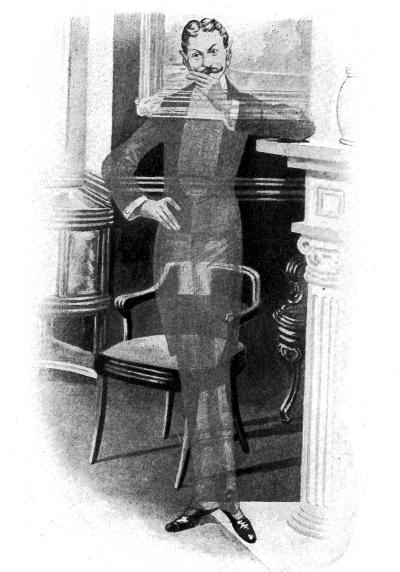
foreign-mannered Mystic. It did seem so very novel and so very creepy
to see a gentleman sliding in through the dado and melting out through
the frieze.
Since witnessing the swift and scientific pig killing at the Yards,
she had seen nothing at once so rapid in execution and so shocking to
the nerves. The first time she observed the back of a chair through
her admirer’s waistcoat it gave her a genuine chill. Habit, however,
dissipated the sense of awe and the lady became amused, then
entertained, and finally deeply interested—as a student of Advanced
Thought.
And further, Mrs. V. soon discovered many agreeable qualities in this
diaphanous and cultivated Gnani, qualities which by contrast
intensified the native inelegance of her husband.
Indeed, so swift was the progress of this marvelous romance that it
was but a matter of weeks until the lawful master of the Vanderhook
mansion saw himself relegated to a position inferior to that of the
hired man. He inwardly chafed and outwardly expressed himself in
large, round and unusual words. In vain, however, for notwithstanding
both inward rage and outward expletives, the Honorable William K.
Vanderhook, of Kankakee, was as nothing in the presence of this witty
and agreeable shade who pervaded the atmosphere at all times and in
all directions.
And what of the wife—she who had deliberately chosen the Mansard
Roof—she who for five years had earned her board and clothes with at
least every appearance of genuine satisfaction?
She was now as one bewitched. She was deaf to both Bill’s appeals and
to his imprecations. She was no longer moved by presents. She was a
wholly changed woman.
When Bill would protest more savagely than usual, she would
say,—“Now, don’t be a grouch. I don’t see that he can do any harm to
anybody. And besides, he is no expense to you, and he’s no trouble to
me.”
And thus it was that the once happy home became a battlefield of
words—words sharp, pointed, prickly and jagged. Bill’s temper,
usually so sunny, became like a sheet of sand paper. His appetite fell
off and his belt hooked in the fourth eyelet. But Imogene, feeding
upon a fresh flirtation, bloomed again to girlish gaiety. In the
presence of this suave and insinuating astral interloper she resumed
all the fascinations and fripperies of the old days at the Yards.
Imogene Silesia Vanderhook had progressed.
Five years ago she had not even heard of “Occultism.” Now, however,
since she herself had become an Advanced Thinker, she recognized the
advantages of Mysticism.
The Club of which she was President had given a good deal of time to
the Ultimate Destiny of Everything. Only recently she had prepared a
“Paper” on Reincarnation which had been very highly spoken of. She
could now discuss the nature and uses of the Ego with the same
intelligence as did other ladies of the Club. She had spent hours
together figuring out how she must have been a Princess—long ago. She
was now quite up in karma and entirely absorbed in the “Uplift.”
It also came to be that while other ladies of Kankakee Tiddeldy-Winked
and Ping-Ponged or wasted time on Diabolo, or clung to Bridge Tables,
the members of the New Thought Club lost themselves in PRANAYAMA and
KUMBHOKA. Even when their serious work was over they carried their
enthusiasm to Five O’Clock Tea, chattering enthusiastically of PERUSA
and KAIVALYA, and uttering longings for the state of NIRVIKALPA.
Mrs. Vanderhook yearned to be the first to waken KUNDELINI.
Bill, however, greatly to his wife’s chagrin, had steadily declined
every effort toward his own illumination. He even on one occasion used
some near swear-words when Imogene begged him to contemplate his
Higher Self.
It was indeed Bill’s own obtuseness that finally helped to turn the
tide against him. Had he been less dense and more amenable to the
mystical peregrinations of the “Thoughters,” perhaps this tragedy had
never been.
For here we must pause and explain how our one-time Typewriter was now
become an Advanced Thinker.
The tragic love of Alonzo Leffingwell and his disappearance from
Kankakee had made an indelible impression on the woman who rejected
him.
From this time forward she became curious about “Occultism.”
Her marriage afforded the time and means necessary for the development
of her Higher Self—about which so many ladies were now talking.
Presently she was as familiar with “Mysticism” as other members of the
New Thought Club.
As time went on she enjoyed an ever extending acquaintance with the
numerous and high-priced “Professors” and Specialists in Higher Lines
of business.
While Bill was busy in the drug store, or looking after his political
fences, the charming Imogene was brushing up on her “Subliminal Self”
and learning how to “Wake the Plexus.”
Gradually Mrs. Vanderhook saturated her daily life with studies of the
occult, adorned herself with mystic symbols, and prepared “papers” for
the Club, on unintelligible subjects.
The Occidental woman who “aspires” does nothing by halves. Whatever
her goal of attainment, she conforms her activities to that end,
dedicates her energies to that ambition, and colors every duty with
that Aspiration.
In this wise Imogene converted all of her entertainments and
indulgences into expressions of the Universal, and made every day in
the week a separate exercise for Self-Development.
To the Western Woman has been left the co-ordination of
“Everything—I—WANT—TO—DO” with “Everything—I—ASPIRE—TO—BE.”
Mondays Mrs. Vanderhook devoted to Rhythmic Vibrations under the name
of Physical Culture. Mornings she spent with an Advanced Athlete,
rounding up with a contest at the Ladies’ Club Gym, and closing her
day with a session at the Chicago Bargain Counters. This day of the
week she devoted to swinging and swaying and climbing and bending and
twisting and kicking and pushing and pulling, that she might develop
the “Body Beautiful” in harmony with her “Higher Self.”
She never missed a Monday—in the field—for like most practical
occultists of the Occident, she tended to overweight, and for this
reason took kindly to the suggestion that reduction of the Surplus
meant increase of illumination.
Tuesdays were given over to Beauty Culture; or, as her Specialist
said, “To the making of a countenance that shall vibrate with the
Beautiful Inner.” Throughout this day, therefore, she submitted
herself to be steamed and buttered and rubbed and vibrated. She
endured to be sponged and benzoined and rouged and stenciled and
powdered, that she might “affirm with her face” the “Radiance at the
Center.”
This was but one of the steps, for she also was shampooed and
hot-aired and “treated” and hennatead and brilliantined and ratted and
marcelled and puffed as to hair; and her hands, now freed from the
cramp of the “keys,” were also soaked and creamed and massaged, while
the nails were pumiced and oiled and tinted and polished—and still
some more, for the ordeal ended in a bout with depilatories and
electric needles.
All these things did Imogene, the charming; not that she liked it, nor
that she was vain, but only that her Professors insisted that “the
Outer must Express the Inner.”
“All-Is-Youth” and “There-Are-No Wrinkles” are the watchwords of a
lady who has “found Herself.”
Wednesdays were set aside for another phase of co-ordination. This day
was given over to the Nature-Cure Treatment, in which process she was
played upon by vigorous streams of alternating hot and cold water. She
was Osteopathed and Exercised. She was warmed in the Sun-Parlor,
concentrated under blue glass and aired on the roof garden.
After this she ate a Nature-Cure Luncheon of Almost-Ox-Tail Soup,
Near-Meat Salad, and other pretty nearly foods, drinking Roastum
Cereal—thus eliminating the poisons of other medical systems, and
developing the Cosmic Consciousness.
It was therefore Wednesday evening that the lady drank lemon juice
copiously and slept under the Mansard Roof swathed in wet
sheets—slept calmly, with an abiding faith in the illuminative power
of her Water-Soaked System.
Thursdays, however, were reserved for the higher phases of her
intellectual uplift. This day was set apart, as one of the mystics
expressed it, for “Interior Decoration.”
This day she immured herself in her boudoir, where, with a roll
before rising and a kimona all day long, she gave herself entirely to
the “Contemplation of Herself.” For this day were reserved the most
mystical books and profounder studies and solemner exercises.
Several hours of this day she gave to “The Secrets of Mental
Supremacy,” and in the effort to attain “Consciousness without
Thought” she spent many a half hour. Much time she consumed before her
mirror in “Meditative Self-Analysis.” Again and again would her lunch
grow cold while she was occupied in one of these many expensive Occult
or Therapeutical Courses, purchased from leading Wise Men in Illinois.
One of these covered Practical Occultism, another was Transcendental
Mysticism. In still another she worked upon Rhythmic Inspiration, and
yet another she was studying the How to Breathe—but none among them
was more profoundly veiled in mystic meaning than the Course on “How
to Ascertain the Heart Beat Unit.” At times she was so engaged in
“Concentration” that she would fall asleep. At other times she became
enthused in the effort to discover the Inner Meaning of the
Meaningless. She became very skillful in the Expansion of Self and
Manifested the Joy Philosophy every time she enlarged her Aura.
Fridays were set apart for what the lady termed “Expression”—that is
to say, Fridays were selected for Social visits and “At homes,” on
which day she gave a Manifestation of her several acquirements, making
the rounds—that her friends might observe the Outer Beauty from the
Radiant Center. This she felt to be the solemn duty of the Elect—that
they set up the Joy and Beauty Vibrations in other women.
As a result of her strenuous lessons in Attainment she became the
admired and envied of other New Thought Ladies. This could not fail to
be, for aside from possessing an Original Design for this ever
increasing beauty, Mrs. Vanderhook had both the time and money to
search for her Highest Self in the best shops and under the most
expensive Seers.
Still further and at odd moments Mrs. Vanderhook increased her wisdom
by visiting such Mystics as did business near the Beauty Parlors and
the Department Stores. To one she would go for a Horoscope—a reading
of the Stars. Another would trace her glowing future in the lines of
the palm, and another would instruct her in Psychological Polarity,
and another dealt in “Character Sketches by Inspiration.”
There were still others who gave short lessons in Vibrations—some who
taught “The Inner Meanings of Everything” in small blocks for large
checks, and another, the Telo-Psycho-Theraput, who taught his patients
to meet him at fixed times—and for fixed rates—out in stellar Space,
where “soul to soul” and “freed from the Material,” he best could
diagnose and “impart the healing word.”
Still other half hours—for she doted on symbolism—Mrs. Vanderhook
would spend with one who advertised as “The World’s Most Famous
Seer,” from whom she purchased expensive Charms and Sacred Bugs and
things.
Again she would slip into the “Temple” of one whose Circulars
“guaranteed” information concerning the Origin of Everything and its
“Absorption into Nothing.”
Inspiring moments she would steal for the study of Vivilore and in
these brief snatches she would “Contemplate the Path of Perfection,”
or, breaking away from the downtown luncheon, she would rush for the
Masonic Temple, where an American-East Indian was imparting Fourteen
lessons in Philosophy in a few minutes.
With Saturday for Shopping and the Matinee, and Sunday for home and
Bill, the mistress of the Mansard Roof led the life of the up-to-date
New Woman.
Thus, as time went on, the erstwhile Typewriter became thoroughly
“Advanced,” and the “Yards” became a far off memory.
And of all this Bill knew nothing.
Like other students of the “Ultimates,” Mrs. Vanderhook found that her
“Attainments” did not mix well with every-day commonplaces. Her
husband’s absorption in the drug store, and his fondness for a “Game,”
seemed quite to unfit him for Higher Thought.
Indeed, at times Imogene seriously doubted Bill’s understanding of the
Unknowable.
Bill was not watching for the subtle changes taking place in his
Imogene. But one phase of it seemed to reach his obtunded
consciousness, for this made a direct inroad upon his bank account.
The Special Course in “OPTIMISM AND OPULENCE”—for which “Ten Lessons
at reduced prices” had captured Mrs. Vanderhook as a special
bargain—produced direct results for which even the generous druggist
was not prepared.
From the first “All-is-good” to the middle “Opulence-is-MINE” and to
the final lesson, “I-AM-IT,” Imogene Vanderhook absorbed and radiated
this beautiful Attitude of “I-am-entitled-to-everything-I-can-get.”
Matters of expense were airily dismissed. Bill’s “We-can’t-afford-it”
was met by that splendidly wide Optimistic Smile and ignored with that
expensively broad sense of Universal Opulence which is so perfectly
fascinating in those who do not pay the bills.
The beautiful feeling that “I can tap the Universal for all I need”
and that “I have only to affirm OPULENCE and have it,” encouraged the
Mayor’s wife to extend her Charge Accounts with a childlike faith in
the “Higher Currents of Wealth.”
Then again, Bill had experienced a sense of loneliness at times, when
he would come in with a toothache or a touch of gastritis, to be
assured that it was all in his Mortal Mind, and that what he supposed
was Pain was but an “error” and instead of the earlier coddling to
receive but a calm, vague, unsympathetic glance and a frosty little
smile of one who “Functioned in the Realities.”
But these were all mere incidents, and the still devoted husband went
on earning dollars for his Imogene Silesia to “radiate.”
Thus it was that the Mayor’s wife had been drawn into the rage for
“Occultism” and the current “Uplift,” without his knowledge or
consent, and by “Holding a Thought” or two and by means of fifty-seven
Varieties of Unfoldment, had gradually unfitted herself fully to share
her husband’s ambitions and tastes, which still centered in the Drug
Store, the Lighting Plant and Politics.
Thus, unknown to him and scarcely apprehended by herself, the fair
Imogene was preparing for a Change. This was why the Appearance of
Alonzo, the Wise Man, had not disturbed her more, and why she so
quickly accepted him as a matter of course and adjusted herself to
Orientalisms.
But now that her perceptions were sharpened, the lady could not but
perceive the primordial relation between herself and the once despised
Mystic. She also was forced to cognize the enormous advantage of
astral attainments over physical conditions and physical powers. She
began to draw odious comparisons and invidious distinctions between
her lawful master and her extra-lawful mate.
“Fool, and blind,”—she now murmured, from time to time, in just the
same tone and with the same wild, back-handed gesture she had seen at
the Chicago Opera House.
And the Gnani, day by day, murmured to his Higher Self,—“She is
advancing beautifully.” He noted the sweet trustfulness with which she
now leaned upon him—that is, philosophically speaking.
“She now Aspires from choice”—he would whisper to himself again and
again. “She will lop off several reincarnations, while I—aha! ha
ha!”—and his gaseous form would undulate with ethereal ecstasy.
In that astral realm where thoughts are things and business is
transacted by mental checks, the inhabitants have distinct advantages
over mere human beings who are circumscribed by purveyors of goods and
settlements on a cash basis.
The learned Mystic quite obscured the Mayor of Kankakee. He covered
him with humiliation at his own fireside. He trifled with the
husband’s prerogatives. For, did the good-natured Bill, thinking to
propitiate her on the old lines, send home to Imogene a Paris model
from the swell modiste, then did his skillful rival at once
materialize for her another headgear out of nothing, a “dream” so
unique, so gorgeous, so becoming and so altogether stunning, that
Imogene would shriek with delight, while Bill could only grind his
teeth in rage.
Did the husband bring to his wife a bunch of early violets, the
vigilant Gnani would immediately materialize great loads of American
beauties towering upon extraordinary stems. He would shower her with
Marechal Niels, worth a dollar apiece. With but one sweep of his hand
a hundred rare blossoms would descend from the ceiling, covering and
enveloping the lady in beauty and bloom.
Could any mere, mortal woman withstand such attentions as these?
To please her eye this ardent admirer rendered his appearance as
alluring as his manners. Independent of tailors, and with everything
at hand, this astral man got himself up regardless of expense, and
thought on his costumes at will, to meet the requirements of the
fashion plates. He frequently would surprise her with rapid
transformations of raiments, posing successively in the distinctive
garbs of many nations, races and times.
Perhaps at breakfast it was some Oriental potentate in royal robes who
hovered by her side. At lunch a velvet coated artist, at dinner a
gorgeous Indian chief, whose picturesque scalp-lock, beads and
feathers and whose thrilling war-whoop delighted her refined taste.
And Alonzo would discourse to her oft and long of the beauties and
practices of “Meditation.”
“But I’ll be switched”—she would say at times, “if I can understand
your kind of mysticism.”
Whereupon the seer, smiling indulgently, would with all perspicuity
reply,—
“Of course you don’t. I don’t expect you to. That isn’t what we’re
here for. Nobody understands mysticism; for don’t you see, if they
did, or could, or were likely to, there wouldn’t be any mysticism
left, and then—why, my occupation is gone.”
“Why, sure; I hadn’t thought of it that way”—his Mate would murmur,
and then she would add, “How sweet to be taught by one so wise.”
Moreover, this proficient prestidigitator constituted himself her
private secretary and astral errand boy. He not only precipitated her
social correspondence upon kid-finished, but he thus prepared all of
her “advanced thought” papers, thereby saving her long hours over the
Encyclopedia Britannica. Still more, he would read to her all letters
and notes received, thus saving her the trouble of breaking the seals;
and to amuse and gratify her, would peep—astrally, of course—and
report upon the private correspondence and the private affairs of her
friends in Kankakee.
And this was but one of the many offices and arts he exploited to
charm his Affinity. And so it came to be an every-day occurrence that
following any social invitation into the exclusive circles of
Kankakee, Imogene would call to her “Llama Lonnie,” or her “Lonnie
Bird,” and say, “Please won’t you just run over to Mrs. Dr. this, or
Mrs. Judge that, and rubber a while? Then,” she would say,—“I’ll know
what to wear and who is invited and how much it’ll cost, etc.”
Mrs. Vanderhook’s sudden acquisition of unlimited finery and jewels
created unfavorable comment. The sudden costly equipment of her house
astonished everybody. Her lavish display in entertaining was severely
criticised by the best people. For in Kankakee, as elsewhere, the best
people keep tab on each other’s faults, follies and failures.
The ghost of this gossip drifted back to the drug store; and Bill, who
was too proud of himself to betray his wife, chafed in secret.
For, of course, the world knew nothing of the great astro-human drama
that was being enacted in the Mayor’s home.
But there came a day when the outraged owner of the Mansard Roof cast
aside all semblance of hospitality toward his rival and broke out into
a fierce and jealous anger at his ethereal tormentor.
“Begone! you bloodless villain,”—he roared one morning when he had
entered his dining room unexpectedly and found his guest strewing
lilies of the valley around the plate laid for Imogene’s breakfast.
“Begone! I say. Get out of my sight! Leave my house! Get out! I say,
now, at once. Fly! melt! disappear!—vamoose!”
But the platter he hurled at his rival’s head went straight through
it, crashing against the back of the chair on which sat the seer,
smiling and unruffled.
Imogene snickered, and the astral man showered lilacs over her chair,
while a handful of thistles were viciously flung from nowhere—into
the blazing countenance of the enraged husband.
“Faithless woman! black magician!” shrieked Bill Vanderhook; and
gathering up a large, bright carving knife, he sent it spinning into
the heart of his rival. That is to say, the point of the knife clove
the back of Alonzo Leffingwell’s chair, while the handle protruded
from that gentleman’s left vest pocket.
But the gay Gnani of Gingalee still sat in his chair, erect, tranquil,
smiling.
Imogene was so tickled she stuffed a napkin into her mouth. She did
not intend to betray herself before the dining room girl.
Whereupon, the Mayor of Kankakee flung himself out of his mansion in
a frenzy.
He did not come home to lunch.
At dinner he did not exchange a word with his wife. He scowled through
five courses. Imogene was radiant. And their guest who seated himself
at the table, [merely to keep Imogene company,] amused himself by
inciting the knives, forks and spoons to cut unseemly capers on the
cloth.
A few days later Bill Vanderhook returned from his office an hour
earlier than usual. He came with the deep, deadly purpose of seeing
what was to be seen, and he saw it.
Gently turning his latch-key, softly treading the deserted hall,
stealthily crossing the costly Wilton of the drawing-room, and still
on, still creeping through and around and up and back, on through my
lady’s boudoir, still on, to the draped portals of his own private
den—the one corner of his castle which thus far had been left to its
master. Up to this time he had not dreamed that even an astral man
could become wholly lost to the amenities of polite society.
But here and now he came upon the guilty pair, trespassers, invaders
of man’s most sacred corner, his elysium in hours of peace, his refuge
in times of woe,—his “Den.”
Outside, and screened by the heavy portieres, Bill Vanderhook sized up
the situation. He saw what made his blood first warm and then to
simmer and boil. It was not simply that they sat side by side. This he
expected. But this—that they had the nerve to sit in his den; and
more, to sit upon his couch; and worse still, to sit upon that gay and
picturesque Bagdad which, of all his possessions, should have been
left to him and him alone.
For this artistic creation had been Imogene’s gift to him upon that
fatal anniversary wedding. That she had bought this Bagdad on bargain
day and that Bill thought she had made it herself did not alter the
sentiment. True, she bought the Bagdad to please herself; and true,
that he cared no more for the dizzy thing than he would for a
door-mat; yet, all the same, she had given it to him, and the giving
was what he cared for.
Was it to be expected that this would ever have been made the
background of his rival’s wiles and fascinations?
“This is too much, too much. Where am I at?”—and Bill Vanderhook
clenched his fists and glared ferociously.
But, hist!—what is it these two are doing? What new conspiracy is
hatching against the master of the house? Why do they sit so close,
with heads bent in such juxtaposition? Why are they so silent, so
absorbed?
“Aha! aha! a book!” It is a book they are poring over; a great leather
book. A hand of each is under it. The other two are slowly turning
leaves. Aha! they search for something. This is no ordinary book. They
search,—and for what?
So intent are these two, this gay Gnani and his giddy Mate, that they
have neither heard nor sensed the intrusion.
Bill Vanderhook listens.
What he hears chills his blood,—congeals it. He hears the frozen
pellets rattle through his veins.
“Oh, my Llama Lonnie, it is not here.”
“Yes, my Goo-goo Eyes, it is, it is.”
“I don’t believe it, my Llama,” whispered Imogene.
“But it must be, it must be there my lady bird; for I happen to
know something of the jurisprudence of Illinois.”
Bill was struck by the expression of their faces. He had never before
seen the astral man evince any sort of anxiety over anything. He never
remembered seeing that look in Mrs. Vanderhook’s face, except when she
wanted something he couldn’t buy.
But he could no longer restrain himself. The jealous husband
sacrificed his curiosity to gratify his anger. With one bound he
cleared the threshold and landed in the middle of the den, full under
the light of the Turkish lantern.
“You measly monstrosity!”—he cried in a loud voice. “Get ye
back!—get ye back to your musty old lair in Gingalee!”—and lifting
his walking stick he brought it down upon the despoiler of his peace.
“And this is how you occupy yourself in my absence!”—he bawled.
“These are the uses to which you put my house and my furniture, and my
books! Is it for this that I run a drug store and—for Mayor the rest
of the time? What new infernal scheme are you hatching now?”—and Mr.
Vanderhook pounded the air,—instead of Alonzo Leffingwell.
Alonzo sat on the couch. He leaned against Mr. Vanderhook’s cushions.
At the first stroke Imogene had leaped from the couch; but the mystic
never turned a hair, much less his head. A shower of blows fell
harmlessly upon the gilded frame of the costly couch. There were some
gilt chips on the carpet, some abrasions on the walking stick,
but—the gentleman who had been beaten sat wholly unmoved, upright and
smiling.
When it was all over, however, he rose, bowed mockingly and silently
floated out of the room alongside of Imogene, who had regained her
composure.
The deserted man now seized upon the book which had fallen from the
hands of the surprised couple and lay upon the floor. He glanced at
the title and then—his eyes were opened a little wider. Now he saw it
all. Now he understood the weepiness in their tones as they had turned
the pages.
The gay Gnani of Gingalee and Mrs. William K. Vanderhook had been
reading the “Statutes of Illinois.”
The section on Divorce was blurred by tears.
But alas, as they had discovered, even this liberal and up-to-date
commonwealth does not recognize the astral. Their case was therefore
without parallel or precedent. These two had found in their particular
case that there was no cause for divorce.
When he finally took in the whole force of the incident Bill vibrated
with wrath. He dashed the book upon the floor of his den. He tore the
brilliant Bagdad from its moorings of silken pillows; and then, as if
by a wicked inspiration, he stooped, seized both book and drapery and
dashed them into the open, glowing grate.
“So, there!—perish my love of woman!—and—and—anathema upon
everything from anywhere that takes advantage of friendship and
hospitality, that plays upon a woman’s vanity and with the honor of an
honest man!”
And the plotters, but momentarily disturbed, had glided down stairs
and sought another retreat. Their sorrow was soon modified, for they
remembered presently that they could, in reality, defy all the
statutes of all the states. They remembered that they could not be
separated by law, even though the party of the third part could not
be eliminated by law.
It was now Bill Vanderhook’s time to meditate.