Some of his Subjects: Dogs, Rabbits, ‘Mice, and such small Deer.’
WHEN a dog, young and yet unskilled, follows his master across the
meadows, it often happens that he meets with difficulties which sorely
try the capacity of the inexperienced brain. The two came to a broad
deep brook. The man glances at the opposite bank, and compares in his
mind the distance to the other side with other distances he has
previously leaped. The result is not quite satisfactory; somehow a
latent doubt develops itself into a question of his ability to spring
over. He cranes his neck, looks at the jump sideways to get an angular
measurement, retires a few paces to run, shakes his head, deliberates,
instinctively glances round as if for assistance or advice, and
presently again advances to the edge. No; it will not do. He recalls to
mind the division of space into yards, feet, and inches, and endeavours
to apply it without a rule to the smooth surface of the water. He can
judge a yard on the grass, because there is something to fix the eye
on—the tall bennet or the buttercup yonder; but the water affords no
data.
On second thoughts, yes—even the smooth flowing current has its marks.
Here, not far from the steep bank is a flag, bowed or broken, whose
pennant-like tongue of green floats just beneath the surface, slowly
vibrating to and fro, as you wave your hand in token of farewell. This
is mark one—say three feet from the shore.
Somewhat farther there is a curl upon the water, not constant, but
coming every few seconds in obedience to the increase or decrease of the
volume of the stream, which there meets with some slight obstacle out of
sight. For, although the water appears level and unvarying, it really
rises and sinks in ever so minute a degree with a rhythmic alternation.
If you will lie down on the sward, you may sometimes see it by fixing a
steady gaze upon the small circular cave where the gallery of a
water-rat opens on this the Grand Canal of his Venice. Into it there
rises now and again a gentle swell—barely perceptible—a faint pulse
rising and falling. The stream is slightly fuller and stronger at one
moment than another; and with each swell the curl, or tiny whirlpool,
rotates above the hidden irregularity of the bottom. If you sit by the
dam higher up the brook, and watch the arch of the cataract rolling
over, it is perhaps more visible. Every now and then a check seems to
stay the current momentarily: and at night, when it is perfectly still,
listening to the murmur of the falling water from a distance, under the
apple-trees in the garden it runs a scale—now up, then down; each
variation of volume changing the musical note. This faint undulation is
more visible in some brooks than others.
A third mark is where a branch, as it was carried along, grounded on a
shallow spot; and one mast, as it were, of the wreck protruding upwards,
catches the stray weeds as they swim down and holds them. Thus, step by
step, the mind of the man measures the distance, and assures him that it
is a little beyond what he has hitherto attempted; yet will not extra
exertion clear it?—for having once approached the brink, shame and the
dislike of giving up pull him forward. He walks hastily twenty yards up
the brook, then as many the other way, but discovers no more favourable
spot; hesitates again; next carefully examines the tripping place, lest
the turf, undermined, yield to the sudden pressure, as also the landing,
for fear of falling back. Finally he retires a few yards, and pauses a
second and runs. Even after the start, uncertain in mind and but half
resolved, it is his own motion which impels the will, and he arrives on
the opposite shore with a sense of surprise. Now comes the dog, and note
his actions; contrast the two, and say which is instinct, which is mind.
The dog races to the bank—he has been hitherto hunting in a hedge and
suddenly misses his master—and, like his lord, stops short on the
brink. He has had but little experience in jumping as yet; water is not
his natural element, and he pauses doubtfully. He looks

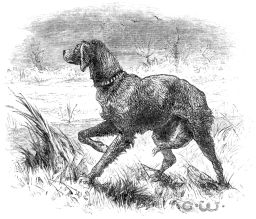 DOG AT STREAM.
across earnestly, sniffs the air as if to smell the distance, then
whines in distress of mind. Presently he makes a movement to spring,
checks it, and turns round as if looking for advice or encouragement.
Next he runs back a short way as if about to give it up; returns, and
cranes over the brink; after which he follows the bank up and down,
barking in excitement, but always coming back to the original spot. The
lines of his face, the straining eye, the voice that seems struggling to
articulate in the throat, the attitude of the body,—all convey the idea
of intense desire which fear prevents him from translating into action.
There is indecision—uncertainty—in the nervous grasp of the paws on
the grass, in the quick short coursings to and fro. Would infallible
instinct hesitate? He has no knowledge of yards, feet, and inches—yet
he is clearly trying to judge the distance. Finally, just as his master
disappears through a gateway, the agony of his ‘mind’ rises to the
highest pitch. He advances to the very brink—he half springs, stays
himself, his hinder paws slip down the steep bank, he partly loses his
balance, and then makes a great leap, lights with a splash in
mid-stream, and swims the remainder with ease. There is, at least, a
singular coincidence in the outward actions of the two.
The gamekeeper, with dogs around him from morning till night, associated
with them from childhood, has no doubts upon the matter whatever, but
with characteristic decision is perfectly certain that they think and
reason in the same way as human beings, though of course in a limited
degree. Most of his class believe, likewise, in the reasoning power of
the dog: so do shepherds; and so, too, the labourers who wait on and
feed cattle are fully persuaded of their intelligence, which, however,
in no way prevents them throwing the milking-stool at their heads when
unruly. But the concession of reason is no guarantee against ill-usage,
else the labourer’s wife would escape.
The keeper, without thinking it perhaps, affords a strong illustration
of his own firm faith in the mind of the dog. His are taught their
proper business thoroughly; but there it ends. ‘I never makes them learn
no tricks,’ says he, ‘because I don’t like to see ’em made fools of.’ I
have observed that almost all those whose labour lies in the field, and
who go down to their business in the green meadows, admit the animal
world to a share in the faculty of reason. It is the cabinet thinkers
who construct a universe of automatons.
No better illustration of the two modes of observation can be found than
in the scene of Goethe’s ‘Faust’ where Faust and Wagner walking in the
field are met by a strange dog. The first sees something more than a
mere dog; he feels the presence of an intelligence within the outward
semblance—in this case an evil intelligence, it is true, but still a
something beyond mere tail and paws and ears. To Wagner it is a dog and
nothing more—that will sit at the feet of his master and fawn on him if
spoken to, who can be taught to fetch and carry or bring a stick; the
end, however, proves different. So one mind sees the outside only;
another projects itself into the mind of the creature, be it dog, or
horse, or bird.
Experience certainly educates the dog as it does the man. After long
acquaintance and practice in the field we learn the habits and ways of
game—to know where it will or not be found. A young dog in the same way
dashes swiftly up a hedge, and misses the rabbit that, hearing him
coming, doubles back behind a tree or stole; an old dog leaves nothing
behind him, searching every corner. This is acquired knowledge. Neither
does all depend upon hereditary predisposition as exhibited in the
various breeds—the setter, the pointer, the spaniel, or greyhound—and
their especial drift of brain; their capacity is not wholly confined to
one sphere. They possess an initiating power—what in man is called
originality, invention, discovery: they make experiments.
I had a pointer that exhibited this faculty in a curious manner. She was
weakly when young, and for that reason, together with other
circumstances, was never properly trained: a fact that may perhaps have
prevented her ‘mind’ from congealing into the stolidity of routine. She
became an outdoor pet, and followed at heel everywhere. One day some
ponds were netted, and of the fish taken a few chanced to be placed in a
great stone trough from which cattle drank in the yard—a common thing
in the country. Some time afterwards, the trough being foul, the
fish—they were roach, tench, perch, and one small jack—were removed to
a shallow tub while it was being cleansed. In this tub, being scarcely a
foot deep though broad, the fish were of course distinctly visible, and
at once became an object of the most intense interest to the pointer.
She would not leave it; but stood watching every motion of the fish,
with her head now on one side, now on the other. There she must have
remained some hours, and was found at last in the act of removing them
one by one and laying them softly, quite unhurt, on the grass.
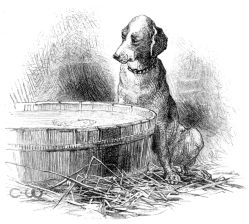 POINTER AND FISH.
I put them back into the water, and waited to see the result. She took a
good look, and then plunged her nose right under the surface and
half-way up the neck, completely submerging the head, and in that
position groped about on the bottom till a fish came in contact with her
mouth and was instantly snatched out. Her head must have been under
water each time nearly a minute, feeling for the fish. One by one she
drew them out and placed them on the ground, till only the jack
remained. He puzzled her, darting away swift as an arrow and seeming to
anticipate the enemy. But after a time he, too, was captured.
They were not injured—not the mark of a tooth was to be seen—and swam
as freely as ever when restored to the water. So soon as they were put
in again the pointer recommenced her fishing, and could hardly be got
away by force. The fish were purposely left in the tub. The next day she
returned to the amusement, and soon became so dexterous as to pull a
fish out almost the instant her nose went under water. The jack was
always the most difficult to catch, but she managed to conquer him
sooner or later. When returned to the trough, however, she was done—the
water was too deep. Scarcely anything could be imagined apparently more
opposite to the hereditary intelligence of a pointer than this; and
certainly no one attempted to teach her, neither did she do it for food.
It was an original motion of her own: to what can it be compared but
mind proceeding by experiment? They can also adjust their conduct to
circumstances, as when they take to hunting on their own account: they
then generally work in couples.
If a spaniel, for instance, one of those allowed to lie loose about
farmhouses, takes to hunting for herself, she is almost always found to
meet a canine friend at a little distance from the homestead. It is said
that spaniels when they go off like this never bark when on the heels
of a rabbit, as they would do if a sportsman was with them and the chase
legitimate. This suppression of what must be an almost uncontrollable
inclination shows no little intelligence. If they gave tongue, they
would be certainly detected, and as certainly thrashed. To watch the
sneaking way in which a spaniel will come home after an unlawful
expedition of this kind is most amusing. She makes her appearance on the
road or footpath so as not to look as if coming from the hedges, and
enters at the back; or if any movement be going on, as the driving of
cattle, she will join in it, displaying extraordinary zeal in assisting:
anything to throw off suspicion.
Of all sport, if a man desires to widen his chest, and gain some idea of
the chase as it was in ancient days, let him take two good greyhounds
and ‘uncouple at the timorous flying hare,’ following himself on foot. A
race like this over the elastic turf of the downs, inhaling with
expanded lungs air which acts on the blood as strong drink on the brain,
stimulating the pulse, and strengthening every fibre of the frame, is
equal to another year of life. Coursing for the coursing’s sake is
capital sport. A hare when sorely tried with the hot breath from the
hounds’ nostrils on his flanks, will sometimes puzzle them by dashing
round and round a rick. Then in sweeping circles the trio strain their
limbs, but the hare, having at the corners the inner side and less
ground to cover, easily keeps just ahead. This game lasts several
minutes, till presently one of the hounds is sharp enough to dodge back
and meet the hare the opposite way. Even then his quick eye and ready
turn often give him another short breathing space by rushing away at a
tangent.
Rabbits, although of ‘low degree’ in comparison with the pheasant,
really form an important item in the list of the keeper’s charges.
Shooting generally commences with picking out the young rabbits about
the middle or towards the end of the hay harvest, according as the
season is early or late. Some are shot by the farmers, who have the
right to use a gun, earlier than this, while they still disport in the
mowing grass. It requires experience and skill to select the young
rabbit just fit for table from the old bucks, the does which may yet
bring forth another litter, and those little bunnies that do not exceed
the size of rats.
The grass conceals the body of the animal, and nothing is visible beyond
the tips of the ears; and at thirty yards distance one pair of ears is
very like another pair. The developed ear is, however, less pointed than
the other; and in the rabbit of a proper size they are or seem to be
wider apart. The eye is also guided by the grass itself and the
elevation of the rabbit’s head above it when lifted in alarm at a chance
sound: if the animal is full grown of course the head stands higher. In
motion the difference is at once seen; the larger animal’s back and
flanks show boldly, while the lesser seems to slip through the grass. By
these signs, and by a kind of instinct which grows upon one when always
in the field, it is possible to distinguish between them even in tall
grass and in the gloaming.
This sort of shooting, if it does not afford the excitement of the
pheasant battue, or require the alertness necessary in partridge
killing, is not without its special pleasures. These are chiefly to be
attributed to the genial warmth of the weather at that season, when the
reapers have only just begun to put the tall corn to the edge of their
crooked swords, and one can linger by the hedge-side without dread of
wintry chills.
The aftermath in which the rabbits feed is not so tall as the mowing
grass, and more easy and pleasant to walk through, though it is almost
devoid of flowers. Neither does it give so much shelter; and you must
walk close to the hedge, gliding gently from bush to bush, the slower
the better. Rabbits feed several times during the day—i.e. in the
very early morning, next about eleven o’clock, again at three or four,
and again at six or seven. Not that every rabbit comes out to nibble at
those hours, but about that time some will be seen moving outside the
buries.
As you stroll beside the hedge, brushing the boughs, a rabbit feeding
two hundred yards away will lift his head inquiringly from the grass.
Then stop, and remain still as the elm tree hard by. In a minute or
two, reassured, the ears perked up so sharply fall back, and he feeds
again. Another advance of ten or twenty yards, and up go the ears—you
are still till they drop once more. The rabbit presently turns his back
towards you, sniffing about for the tenderest blades; this is an
opportunity, and an advance of forty or fifty paces perhaps is
accomplished. Now, if you have a rook-rifle you are near enough; if a
smooth-bore, the same system of stalking must be carried farther yet. If
you are patient enough to wait when he takes alarm, and only to advance
when he feeds, you are pretty sure to ‘bag’ him.
Sometimes, when thus gliding with stealthy tread, another rabbit will
suddenly appear out of the ditch within easy reach; it is so quiet he
never suspected the presence of an enemy. If you pause and keep quite
still, which is the secret of all stalking, he will soon begin to feed,
and the moment he turns his back towards you up goes the gun; not
before, because if he sees your arm move he will be off to the ditch.
True, a snap-shot might be made as he runs, which at first sight would
appear more sportsmanlike than ‘potting;’ but it is not so, for it is
ten chances to one that you do not kill him dead on the spot in the
short distance he has to traverse. Perhaps the hind legs will be broken;
well, then he will drag them along behind him, using the fore paws with
astonishing rapidity and power. Before the second barrel can be emptied
he will gain the shelter of the fern that grows on the edge of the bank
and dive into a burrow, there to die in misery. So that it is much
better to steadily ‘pot’ him. Besides which, if a rabbit dies in a
burrow all the other animals in that particular burrow desert it till
nature’s scavengers have done their work. A dog cannot well be taken
while stalking—not that dogs will not follow quietly, but because a
rabbit, catching sight of a dog, is generally stricken with panic even
if a hundred yards away, and bolts immediately.
I have seen a rabbit whose back was broken by shot drag itself ten yards
to the ditch. If the forelegs are broken, then he is helpless: all the
kicks of the hind legs only tumble him over and over without giving him
much progress. The effects of shot are very strange, and sometimes
almost inexplicable; as when a hare which has received a pellet through
the edge of the heart runs a quarter of a mile before dropping. It is
noticed that hares and rabbits, hit in the vital organs about the heart,
often run a considerable distance, and then, suddenly in the midst of
their career, roll head over heels dead. Both hares and rabbits are
occasionally killed with marks of old shot wounds, but not very often,
and they are but of a slight character—the pellets are found just under
the skin, with a kind of lump round them. Shot holes through the ears
are frequently seen, of course doing no serious harm.
Now and then a rabbit hit in the head will run round and round in
circles, making not the slightest attempt to escape. The first time I
saw this, not understanding it, I gave the creature the second barrel;
but next time I let the rabbit do as he would. He circled round and
round, going at a rapid pace. I stood in his way, and he passed between
my legs. After half a dozen circles the pace grew slower. Finally, he
stopped, sat up quite still for a minute or so, and then drooped and
died. The pellet had struck some portion of the brain.
I once, while looking for snipe with charges of small shot in the
barrels, roused a fine hare, and fired without apparent effect. But
after crossing about half of the field with a spaniel tearing behind, he
began to slacken speed, and I immediately followed. The hare dodged the
spaniel admirably, and it was with the utmost difficulty I secured him
(refraining from firing the second barrel on purpose). He had been
stopped by one single little pellet in the great sinew of the hind leg,
which had partly cut it through. Had it been a rabbit he would certainly
have escaped into a bury, and there, perhaps died, as shot wounds
frequently fester: so that in stalking rabbits, or waiting for them
behind a tree or bush, it is much better to take a steady aim at the
head, and so avoid torturing the creature.
‘Potting’ is hardly sport, yet it has an advantage to those who take a
pleasure in observing the ways of bird and animal. There is just
sufficient interest to induce one to remain quiet and still, which is
the prime condition of seeing anything; and in my own case the rabbits
so patiently stalked have at last often gone free, either from their own
amusing antics, or because the noise of the explosion would disturb
something else under observation. In winter it is too cold; then you
step quietly and yet briskly up to a fence or a gateway, and glance
over, and shoot at once; or with the spaniels hunt the bunnies from the
fern upon the banks, yourself one side of the hedge and the keeper the
other.
In excavating his dwelling, the rabbit, thoughtless of science,
constructs what may be called a natural auditorium singularly adapted
for gathering the expiring vibrations of distant sound. His round tunnel
bored in a sandy bank is largest at the opening, like the mouth of a
trumpet, and contracts within—a form which focusses the undulations of
the air. To obtain the full effect the ear should listen some short way
within; but the sound, as it is thrown backwards after entering, is
often sufficiently marked to be perceptible when you listen outside. The
great deep ditches are dry in summer; and though shooting be not the
object, yet a gun for knocking over casual vermin is a pleasant excuse
for idling in a reclining position shoulder-high in fern, hidden like a
skirmisher in such an entrenchment. A mighty root bulging from the slope
of the bank forms a natural seat. There is a cushion of dark green moss
to lean against, and the sand worked out from the burrows—one nearly on
a level with the head and another lower down—has here filled up the
ditch to some height, making a footstool.
In the ditch lie numbers of last year’s oak leaves, which so sturdily
resist decay. All the winter and spring they were soaked by the water
from the ‘land-springs’—as those which only run in wet weather are
called—draining into it, and to that water they communicated a peculiar
flavour, slightly astringent. Even moderate-sized streamlets become
tainted in the latter part of the autumn by the mass of leaves they
carry down, or filter through, in woodland districts. Often the
cottagers draw their water from a small pool filled by such a ditch, and
coated at the bottom with a thick layer of decomposing leaves. The taste
of this water is strong enough to overcome the flavour of their weak
tea, yet they would rather use such water than walk fifty yards to a
brook. It must, however, be admitted that the brooks at that time are
also tinctured with leaf, and there seems to be no harm in it.
Out from among these dead leaves in the ditch protrudes a crooked branch
fallen long since from the oak, and covered with grey lichen. On the
right hand a tangled thicket of bramble with its uneven-shaped stems
closes the spot in, and on the left a stole of hazel rises with the
parasitical ‘hardy fern’ fringing it near the earth. The outer bark of
the hazel is very thin; it is of a dark mottled hue; bruise it roughly,
and the inner bark shows a bright green. The lowly ivy creeps over the
bank—its leaves with five angles, and variegated with grey streaks.
Through the hawthorn bushes above comes a faint but regular sound—it is
the parting fibres of the grass-blades in the meadow on the other side
as the cows tear them apart, steadily eating their way onwards. The
odour of their breath floats heavy on the air. The sun is sinking, and
there is a hush and silence.
But the rabbit-burrow here at my elbow is not silent; it seems to catch
and heighten faint noises from a distance. A man is walking slowly home
from his work up the lane yonder; the fall of his footsteps is
distinctly rendered by the hole here. The dull thuds of a far-off mallet
or ‘bitel’ (beetle) driving in a stake are plainly audible. The
thump-thump of a horse’s hoofs cantering on the sward by the roadside,
though deadened by the turf, are reproduced or sharpened. Most distinct
of all comes the regular sound of oars against the tholepins or rowlocks
of a boat moving on the lake many fields away. So that in all
probability to the rabbit his hole must be a perfect ‘Ear of Dionysius,’
magnifying a whisper—unless, indeed, its turns and windings confuse the
undulations of sound. It is observable that before the rabbit ventures
forth he stays and listens just within the entrance of his burrow, where
he cannot see any danger unless absolutely straight before him—a
habit that may have unconsciously grown up from the apparent resonance
of sound there.
Sitting thus silently on the root of the oak, presently I hear a slight
rustling among the dead leaves at the bottom of the ditch. They heave up
as if something was pushing underneath; and after a while, as he comes
to the heap of sand thrown out by the rabbits, a mole emerges, and
instantly with a shiver, as it were, of his skin throws off the
particles of dust upon his fur as a dog fresh from the water sends a
shower from his coat. The summer weather having dried the clay under the
meadow turf and made it difficult to work, he has descended into the
ditch, beneath which there is still a certain moistness, and where he
can easily bore a tunnel.
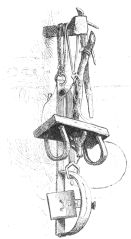 TRAPS.
It is rather rare to see a mole above ground; fortunately for him he is
of diminutive size, or so glossy a fur would prove his ruin. As it is,
every other old pollard willow tree along the hedge is hung with
miserable moles, caught in traps, and after death suspended—like
criminals swinging on a gibbet—from the end of slender willow boughs.
Moles seem to breed in the woods: first perhaps because they are less
disturbed there, next because under the trees the earth is usually
softer, retains its moisture longer, and is easier to work. From the
woods their tracks branch out, ramifying like the roads which lead from
a city. They have in addition main arteries of traffic, king’s highways,
along which they will journey one after the other; so that the
mole-catcher, if he can discover such a road, slaughters many in
succession. The heaps they throw up are awkward in mowing grass, the
scythe striking against them; and in consequence of complaints of their
rapid multiplication in the woods the keeper has to employ men to reduce
their numbers. It is curious to note how speedily the mole buries
himself in the soil; it is as if he suddenly dived into the earth.
Another slight rustling—a pause, and it is repeated; this time on the
bank, among the dry grass. It is mice; they have a nervous habit of
progressing in sharp, short stages. They rush forward seven or eight
inches with lightning-like celerity—a dun streak seems to pass before
your eye; then they stop short a moment or two, and again make another
dash. This renders it difficult to observe them, especially as a single
dead brown leaf is sufficient to hide one. It is so silent that they
grow bold, and play their antics freely, darting to and fro, round and
under the stoles, chasing each other. Sometimes they climb the bushes,
running along the upper surface of the boughs that chance to be nearly
horizontal. Once on a hawthorn branch in a hedge I saw a mouse
descending with an acorn; he was, perhaps, five feet from the ground,
and how and from whence he had got his burden was rather puzzling at
first. Probably the acorn, dropping from the tree, had been caught and
held in the interlacing of the bush till observed by the keen, if tiny,
eyes below.
Mice have a magical way of getting into strange places. In some
farmhouses they still use the ancient, old-fashioned lanterns made of
tin—huge machines intended for a tallow candle, and with plates of thin
translucent horn instead of glass. They are not wholly despicable; since
if set on the ground and kicked over by a recalcitrant cow in the sheds,
the horn does not break as glass would. These lanterns, having a handle
at the top, are by it hung up to the beam in the kitchen; and sometimes
to the astonishment of the servants in the quiet of the evening, they
are found to be animated by some motive power, swinging to and fro and
partly turning round. A mouse has got in—for the grease; but how? that
is the ‘wonderment,’ as the rustic philosophers express it; for, being
hung from the beam, eight or nine feet from the stone-flagged floor,
there seems no way of approach for the mouse except by ‘walking’ on the
ceiling or along and partly underneath the beam itself. If so, it would
seem to be mainly by the propulsive power exerted previous to starting
on the trip—just as a man can get a little way up the perpendicular
side of a rick by running at it. Occasionally, no doubt, the mouse has
entered when the lantern has been left opened while lighted on the
ground, and so got shut in; but mice have been found in lanterns
cobwebbed from long disuse.
Suddenly there peeps out from the lower rabbit-hole the stealthy reddish
body of a weasel. I instinctively reach for the gun leaning against the
bank, and immediately the spell is broken. The mice rush to their holes,
the weasel darts back into the bowels of the earth, a rabbit that has
quietly slipped out unseen into the grass bounds with eager haste to
cover, and out of the oak overhead there rises, with a great clatter of
wings, a wood-pigeon that had settled there.
When the pale winter sunshine falls upon the bare branches of an avenue
of elms—such as so often ornament parks—they appear lit up with a
faint rosy colour, which instantly vanishes on the approach of a shadow.
This shimmering mirage in the boughs seems due to the myriads of lesser
twigs, which at the extremities have a tinge of red, invisible at a
distance till the sunbeams illuminate the trees. Beyond this passing
gleam of colour, nothing relieves the blackness of the January
landscape, except here and there the bright silvery bark of the birch.
For several seasons now in succession the thrush has sung on the
shortest days, as though it were spring; a little later, in the early
mornings, the blackbird joins, filling the copse with a chorus at the
dawn. But, if the wind turns to east or north, the rooks perch on the
oaks in the hedgerows in the middle of the day, puffing out their
feathers and seeming to abandon all search for food, as if seized with
uncontrollable melancholy. Hardy as these birds are, a long frost kills
them in numbers, principally by slow starvation. They die during the
night, dropping suddenly from their roosting-place on the highest boughs
of the great beech-trees, with a thud distinctly heard in the silence of
the woods. The leaves of the beech decay so gradually as to lie in heaps
beneath for months, filling up the hollows, so that an unwary passer-by
may plunge knee-deep in leaves. Rooks when feeding usually cross the
field facing the wind, perhaps to prevent the ruffling of their
feathers.
Wood-pigeons have apparently much increased in numbers of recent years;
they frequent sheltered spots where the bushes diminish the severity of
the frost. Sometimes on the hills at a lonely farmhouse, where the
bailiff has a long-barrelled ancient fowling-piece, he will lay a train
of grain for them, and with a double charge of shot, kill many at a
time.
Men have boasted of shooting twenty at once. But with an ordinary gun it
is not credible; and the statement, without wilful exaggeration, may
arise from confusion in counting, for it is a fact that some of the
older uneducated country labourers cannot reckon correctly. It is not
unusual in parishes to hear of a cottage woman who has had twenty
children. Upon investigation the real number is found to be sixteen or
seventeen, yet nothing on earth will convince the mother that she has
not given birth to a score. They get hazy in figures when exceeding a
dozen.
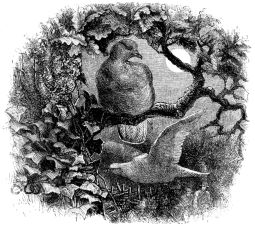 SHOOTING WOOD-PIGEONS BY MOONLIGHT.
A pigeon is not easily brought down—the quills are so stiff and strong
that the shot, if it comes aslant, will glance off. Many pigeons roost
in the oaks of the hedges, choosing by preference one well hung with
ivy, and when it is a moonlit night afford tolerable sport. It requires
a gun on each side of the hedge. A stick flung up awakes the birds;
they rise with a rush and clatter, and in the wildness of their flight
and the dim light are difficult to hit. There is a belief that pigeons
are partially deaf. If stalked in the daytime they take little heed of
footsteps or slight noises which would alarm other creatures; but, on
the other hand, they are quick of eye, and are gone directly anything
suspicious appears in sight. You may get quite under them and shoot them
on the bough at night. It is not their greater wakefulness but the noise
they make in rising which renders them good protectors of preserves; it
alarms other birds and can be heard at some distance.
When a great mound and hedgerow is grubbed up, the men engaged in the
work often anticipate making a considerable bag of the rabbits, whose
holes riddle it in every direction, thinking to dig them out even of
those innermost chambers whence the ferret has sometimes been unable to
dislodge them. But this hope is almost always disappointed; and when the
grub-axe and spade have laid bare the ‘buries’ only recently teeming
with life, not a rabbit is found. By some instinct they have discovered
the approach of destruction, and as soon as the first few yards of the
hedge are levelled secretly depart. After a ‘bury’ has been ferreted it
is some time before another colony takes possession: this is seemingly
from the intense antipathy of the rabbit to the smell of the ferret.
Even when shot at and pressed by dogs, a rabbit in his hasty rush will
often pass a hole which would have afforded instant shelter because it
has been recently ferreted.
At this season the labourers are busy with ‘beetle’ (pronounced
‘bitel’)—a huge mallet—and iron wedges, splitting the tough elm-butts
and logs for firewood. In old times a cottager here and there with a
taste for astrology used to construct an almanack by rule of thumb,
predicting the weather for the ensuing twelve months from the first
twelve days of January. As the wind blew on those days, so the
prevailing weather of the months might be foretold. The aged men,
however, say that in this divination the old style must be adhered to,
for the sequence of signs and omens still follows the ancient reckoning,
which ought never to have been interfered with.