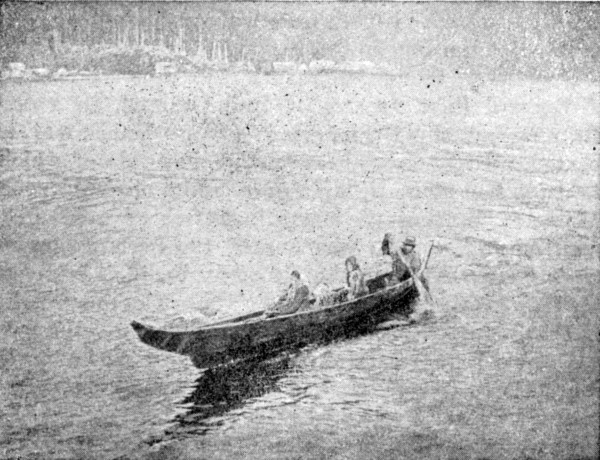
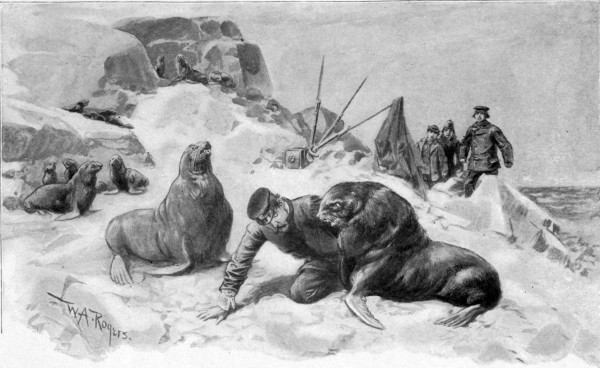
When Phil Ryder stepped from the bidarrah, or
big open boat, in which he had made the six-mile trip
from St. Paul to Walrus Island, and clambered up
over the slippery rocks of the latter, he was nearly
stunned by the volume of sound that ceaselessly rises
from it. The shrieks of myriads of startled sea-fowl,
the rapid beating of their pinions resembling a low roll
of thunder, the gruntings, croakings, and hissings of
sitting birds that refused to leave their splotched and
dirt-smeared eggs, the roar of walrus, and the boom of
surf, combined to form a pandemonium of sound at
once deafening and distracting.
“How can I spend a night here?” thought Phil;
“and what a fool I was to come.”
He was standing, bewildered by the awful racket,
with arms bent above his head, to defend it from the
whizzing flight of clumsy birds that shot through the
air in every direction; two enraged burgomaster gulls,
whose nests his feet were invading, were pecking savagely
at his legs, and he was just meditating a retreat,
when some one pulled his sleeve. Turning, he was
amazed to see the sea-lion hunter, who could speak
English, and whom he had left nearly two hours before
on Northeast Point.
As the latter could not make himself heard above
the horrible din, he was pointing to the tiny cove in
which lay the bidarrah. There, to Phil’s greater surprise,
he saw his friend Serge Belcofsky fending off
from the rocks a two-holed bidarkie that tossed, light
as an egg-shell, on the heaving waters.
“What on earth brought you here?” he shouted,
as soon as he had scrambled to his comrade’s side.
“You did,” answered Serge. “The Phoca is about
to sail, and I’ve come for you. So step in quick, and
let’s be off. The hunter who came with me is going
to stay in your place, and come back in the bidarrah.”
“All right,” replied Phil; “I’m more than willing to
leave this beastly rookery, and more than anxious to
start for Sitka. I must have a few of those eggs,
though, for I promised Miss Matthews some for her
collection.”
Within two minutes as many dozen eggs of all sizes
and varieties had been collected and stowed in the
after-part of the bidarkie. Phil slipped into the forward
hatch and fastened his kamleika about its coaming,
while Serge assumed his position aft, and made
the second hatch equally water-tight with the hunter’s
over-garment which he had borrowed.
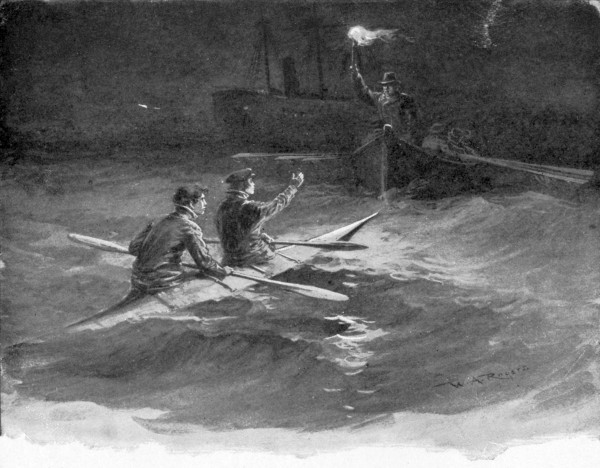
It was nearly dark, and they could see a fog-bank
rolling sullenly in from the southward. Even the native
who held their canoe began to grow apprehensive.
“Me fraid you no get,” he said; “mebbe you stay here
better till morning.”
“Oh, we’ll get!” shouted Phil, confidently. “Anyhow,
I’d rather run the risk than to miss our one chance
of a passage to Sitka. So shove off, Serge. Good-bye!”
Serge himself felt somewhat uneasy, but he had
come too far and worked too hard on this errand to
incline towards giving up now. Besides, he also was
very anxious to reach Sitka. So he shoved off, and
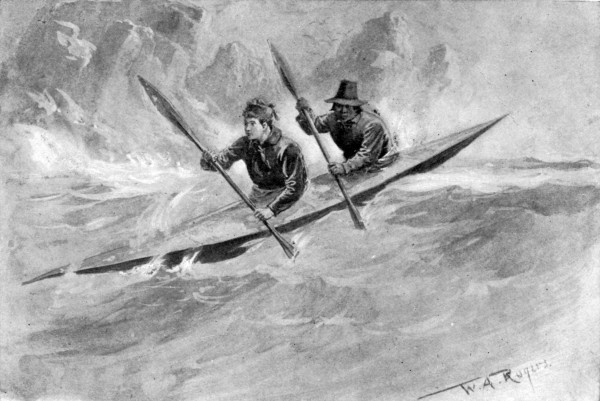
both the lads began to paddle with long sweeping
strokes. In another minute the arrowy craft had shot
away from the roaring islet, and was lost to view in
the gathering gloom.
They had not covered more than a mile before the
advancing fog enveloped them in its soft, moist folds.
“Whe-e-w!” gasped Phil, breathing rapidly from
his vigorous paddling. “Isn’t this smothering?”
“Yes,” replied his companion, “and I’m getting
somewhat dubious about finding St. Paul.”
“Oh, I guess we’ll find it all right. We’ve only got
to keep the wind at our back. It is blowing from the
eastward, you know.”
“But this fog came in from the southward.”
“Do you think so? It seemed to me to come from
the east with the breeze.”
“All right,” agreed Serge. “Perhaps it did. I’m not
quite sure of my compass up here. We’ve got to keep
on now, at any rate, for we could never find Walrus
again, while we can hardly miss hitting so big a mark
as St. Paul. If we strike either coast we can cruise
along it until we come to the village. I’m afraid,
though, we won’t get there in time to catch the Phoca.”
“Oh yes, we will. Captain Matthews isn’t the man
to go off and leave us when he knows we are going to
be back some time to-night. You said you sent word
by Ramey, didn’t you?”
“Yes.”
“Then he’s sure to wait. What’s his hurry, anyhow?”
“I believe he has word of some sealer poaching in
the sea, and is going to hunt her.”
“My! won’t it be fun to be on the other side of such
an affair? I tell you, we struck big luck when we
met the Phoca—in fact, I think this whole cruise, as
I look back on it, has been made up of a series of
lucky events, even though we haven’t had the fur-seal’s
tooth to help us.”
So they talked, in disjointed sentences, as well as
their rapid breathing and relative positions would allow,
and all the while wielded their dripping paddles
with the energy of young athletes striving for a
prize.
Finally, Phil stopped paddling, and, half turning,
said: “Let us listen a minute, old man. It seems to
me we ought to hear the roar of seals on St. Paul by
this time. I’m sure we’ve been an hour on the way.”
So the lads listened intently, but all they heard was
the ceaseless roar and dash of the wind-swept waves.
Under circumstances such as those in which the
occupants of the little bidarkie found themselves,
there is no sound more depressing and awe-inspiring
than this, nor one that conveys more clearly an idea
of the immensity and terror of oceans. When it is
accompanied by darkness and fog, the effect is so
heightened as to be wellnigh unbearable.
As our lads listened to it and felt the chill breath
of the wind-driven mist on their cheeks, they shivered,
and a great fear began to creep into their hearts.
“This won’t do!” cried Phil. “We must keep at
work or we’ll never get there. It is strange, though,
that we don’t hear anything. We ought to be almost
on the beach by this time. Do you notice how big
the waves are? It’s lucky that our course is with them,
for they’d be tough fellows to work against, and make
an ugly sea to cross.”
For an hour longer they paddled steadily and in
dogged silence. Then both paused in their labor as
though moved by a single impulse.
“We’ve gone wrong somehow,” said Serge, without
an attempt to conceal his anxiety.
“Do you mean, old man, that you think we have
missed the island altogether?”
“I am afraid we have.”
“Then may God help us, for we can no longer help
ourselves.”
“Amen,” responded Serge, solemnly.
“I suppose we had better continue paddling, if only
to keep her headed with the sea.”
“And to keep from freezing,” said Serge. “I’m
chilled to the bone now.”
So they resumed their labor, but they worked listlessly
and without heart.
At length the short night came to an end, and daylight,
dim and shadowy, began to steal over the tossing
waters. Occasionally the round head of a seal
rose above the surface close at hand, and the animal
stared at them for a moment with great wondering
eyes before again sinking silently from their sight.
“We could get one of those fellows if we wanted
him,” said Serge, his glance resting on the slender
shaft of the native spear that was lashed on deck.
“What good would it do us? I thought we lost our
interest in seal-skins some time ago,” said Phil, bitterly.
“Seal-meat would save us from starving.”
“How could we cook it?”
“We couldn’t,” replied Serge, significantly.
“Well, I must confess that I’m hungry, but I don’t
think I care to eat raw seal-meat just yet. I say, old
man, do you suppose two fellows ever had such an
unlucky trip as ours? We seem to have jumped from
one trouble into another ever since we started.”
“And this is the worst of all,” answered Serge,
despondently.
“Yes, I suppose it is; and starving to death does
seem a very dreadful way of dying. I don’t know
but what I’d rather drown and done with it.”
“Suppose we try an egg,” suggested Serge, with
a sudden inspiration.
“That’s so! we have got eggs. I’d forgotten them
entirely. Raw eggs aren’t half so bad as raw meat.
I’ve eaten them before, and when I didn’t have to,
either.”
“So have I,” replied Serge, as, unfastening his
kamleika, he reached behind him and drew forth a
couple of the eggs Phil had brought along as specimens.
“H’m!” ejaculated the latter, as, after carefully
removing a portion of the shell to see that the contents
were fresh, he swallowed them at a gulp. “A
little fishy, but not so bad as I expected. Let’s have
another.”
After eating half a dozen eggs apiece, the lads felt
decidedly better, and even a little more cheerful.
“It warn’t much of a breakfust, but even a poor
breakfust tastes good to a hungry man, as old Kite
Robinson uster say,” remarked Phil, and at the picture
thus called up both lads actually smiled. Then,
too, they caught a glimpse of the sun, which was a
slight comfort, though not so great as it might have
been, had it not shown them that they were headed
due north, instead of west, as they had supposed.
“We are headed for the north-pole,” said Phil.
“Do you know of any place on which we might fetch
up, short of it?”
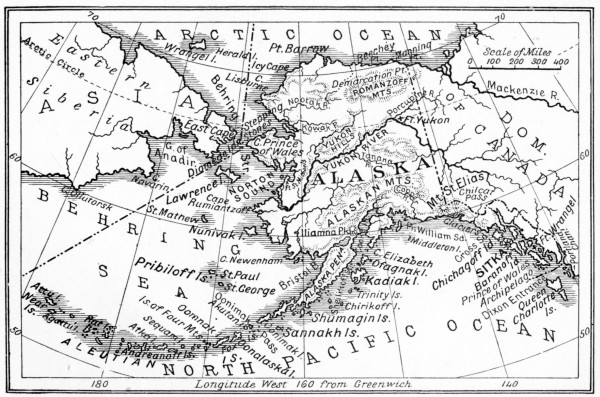
“Yes,” replied his companion, “there are islands
somewhere to the north of here, though I don’t know
exactly where. I don’t believe they are more than a
hundred miles or so away, though.”
“Let’s make a try for them,” cried Phil, with sudden
energy. “Anything is better than lying still, and we
are not done for yet, by a long shot.”
So all that long, weary day the plucky lads tried to
cheer each other as they alternately paddled, rested,
and made melancholy pretence of enjoying their raw,
fishy eggs. At length, however, their supply of these
was exhausted, they were too utterly wearied to paddle
any longer, and night was again coming on. The
fog had thinned during the day, but only so as to disclose
a wider expanse of chill waters, and with the
coming of night it closed in again as dense as ever.
The only comfort was that the wind had gone down
with the sun, leaving a smooth sea.
“I’m beat out, old man!” said Phil, at length, as he
laid his paddle on deck.
“So am I,” answered Serge, “and, what is worse—”
Here the lad suddenly checked himself. He would
not add to his comrade’s misery by disclosing, any
sooner than he could help, the new source of dread
that had just been revealed to him by a peculiar motion
of their frail craft.