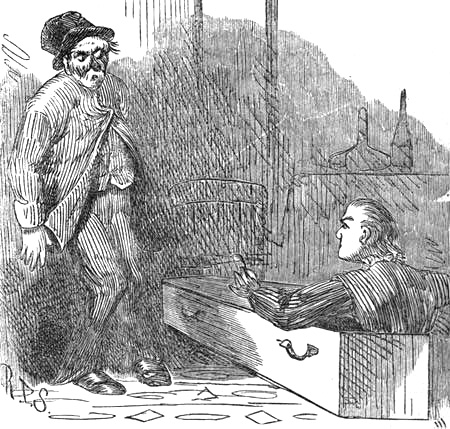
MEDICAL HUMBUGS.
| Marina. |
... Should I tell my history,
’Twould seem like lies disdained in the reporting. |
| Pericles. |
Pray thee, speak.—Shakspeare. |
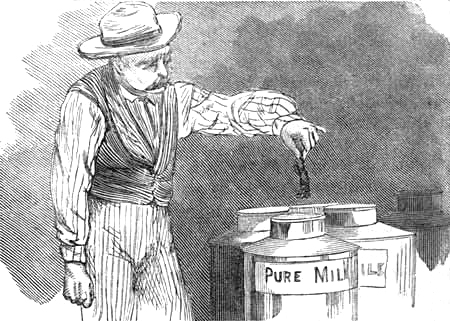
ORIGIN AND APPLICATION OF “HUMBUG.”—A FIFTH AVENUE HUMBUG.—JOB’S
OPINION OF DOCTORS.—EARLY PHYSICIANS.—PRIESTS AS DOCTORS.—WIZARDS
COME TO GRIEF.—A “CAPITAL” OPERATION.—A WOMAN CUT INTO TWELVE
PIECES.—ANECDOTE.—ROBIN HOOD’S LITTLE JOKE.—TIT FOR TAT.—ENGLISH
HUMBUGS.—FRENCH DITTO.—A FORTUNE ON DIRTY WATER.—AMERICAN
HUMBUGS.—A FIRST CLASS “DODGE.”—A FREE RIDE.—A SHARP
INTERROGATOR.—DOCTOR PUSBELLY.—A WICKED STAGE-DRIVER’S STORY.—“OLD
PILGARLIC” TAKES A BATH.—LUDICROUS SCENE.—PROFESSOR BREWSTER.
Medical humbugs began to exist with the first pretenders to the science of
healing. Quacks originated at a much later period. So materially different
are the two classes, that I am compelled to treat of them separately.
The word humbug is a corruption of Hamburg, Germany, and seems to have
originated in London. The following episode is in illustration of both its
origin and meaning:—
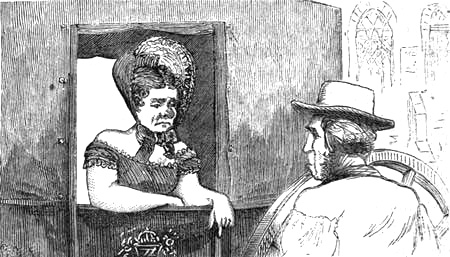
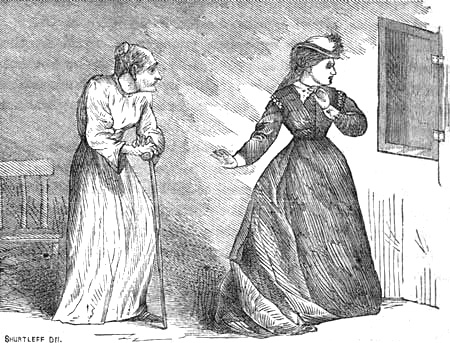
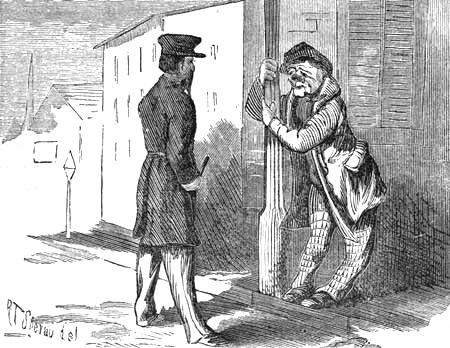
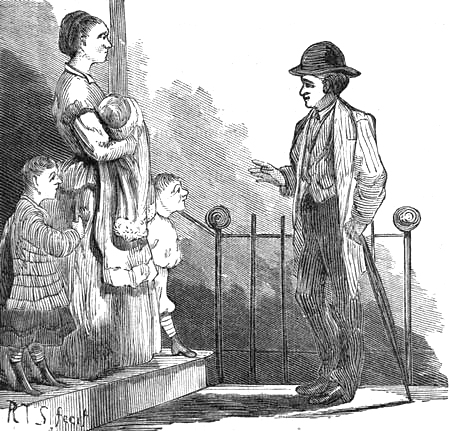
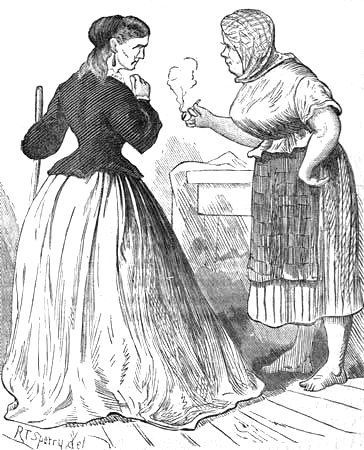
“O, Bridget, Bridget!” exclaimed the fashionable mistress of a brown stone
front in Fifth Avenue, New York, to her surprised servant girl, “what have
you been doing at the front door?”
“Och, murther! Nothin’, ma’am.”
“Nothing!” repeated the mistress.
“Yes’m—that is—” stammered Bridget, greatly embarrassed.
“What were you doing at the front door but a moment since?”
“Nothin’, ma’am, but spakin’ to me cousin; he’s a p’leeceman, ma’am, if ye
plaze, ma’am,” replied Bridget, dropping a low courtesy to the mistress.
“No, no; I did not mean that. But haven’t you been cleaning the door-knob
and the bell-pull?”
“Yes’m,” replied Bridget, changing from embarrassment to surprise.
“Why, Bridget, didn’t I tell you never to polish the front door-knobs
during the warm season? Now my friends will think that I have returned
from Saratoga—”
“And is it to Saratogy ye’ve been, ma’am?” exclaimed Bridget.
“No, you dunce; but was not the front of the house closed, and the
servants forbidden to polish the plates and glass, that my friends might
be led to believe we had all gone to the watering-place?”
That was true humbug. Double humbuggery! for the servant girl was
humbugging her mistress by pretending to polish the door-knobs, while she
was really coqueting with a policeman; and the mistress was humbugging her
friends into the belief that the house was closed, and the family gone to
Saratoga.
So, Hamburg, on the Elbe, being a fashionable resort of the upper-ten-dom
of London, those who would ape aristocracy, yet being unable to bear the
expense of a trip to the Continent, closed the front of their dwellings,
moved into the rear, giving out word that they had gone to Hamburg.
When a house was observed so closed, with a notice on the door, the
passers by would wag their heads, and exclaim, questionably, “Ah, gone to
Hamburg!” or, “All gone to Hamburg!” “It’s all Hamburg!” and so on. And,
like a thousand other words in the English language, this became
corrupted, and “humbug” followed. Hence, taking the sense from the
derivation of the word, humbug means “an imposition, under fair
pretences;” cheat; hoax; a deception without malicious intent. Webster
says it is “a low word.”
The humbugs in medicine, we assert, began to exist with the first persons
of whom we have any account in the history of the healing art. Among the
early Egyptian physicians, Æsculapius was esteemed as the most celebrated.
He was the first humbug in his line. However, nearly all the accounts we
have of him are mythological. If we are to credit the early writers, this
great healer restored so many to life, that he greatly interfered with
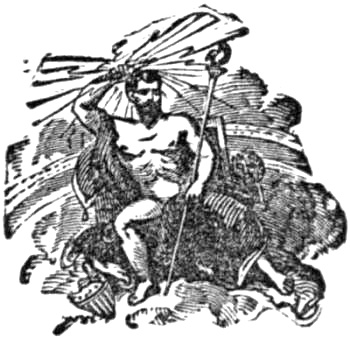
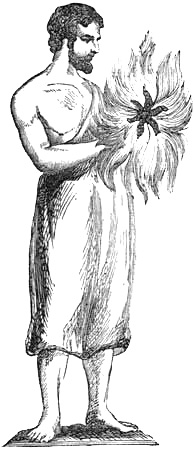
undertaker Pluto’s occupation, who picked a quarrel with Æsculapius, and
the two referred the matter to Jupiter for adjudication.
But we may go back of this “god of medicine.” If he was physician to the
Argonauts, we must fix the date of his great exploits at about the year
B. C. 1263. It is claimed by good authority that the Book of Job dates back
to B. C. 1520, and is the oldest book extant. Herein we find Job saying,
“Ye are forgers of lies; ye are all physicians of no value.” Since his
friends were trying their best to humbug him, Job certainly intimates that
physicians—some of them, at least—were looked upon as humbugs. But,
then, Job was only an Arab prince; not an Israelite, at all; nor does he
condescend to mention that “peculiar people” in his book. And besides,
what reliance can be based upon the opinion of a man respecting
physicians, whose only surgical instrument consisted of a “piece or
fragment of a broken pot”?
Therefore, leaving the “Arab prince,” we will turn for a moment to the
early Jewish physicians. Josephus does not enlighten us much respecting
them. The Old Testament makes mention of physicians in three
instances,—the last figuratively.
The first instance—a rather amusing one—where physicians are mentioned
in the sacred writings, is in 2 Chron. xvi. 12: “And Asa, in the
thirty-ninth year of his reign, was diseased in his feet, until the
disease was exceeding great; yet in his disease he sought not to the Lord,
but to the physicians.” The compiler adds, very coolly, as though a
natural consequence, “And Asa slept with his fathers!” This reminds us
of an anecdote by the late Dr. Waterhouse. An Irishman obtained twenty
grains of morphine, which, instead of quinine, he took at one dose, to
cure the chills. The doctor, in relating it long afterwards, added,
laconically, “He being a good Catholic, his funeral was numerously
attended.”
For generations nearly all the pretensions to healing were made by the
priests and magicians, who humbugged and “bamboozled” the ignorant and
superstitious rabble to their hearts’ content. Kings and subjects were
alike believers in the Magi. Saul believed in the magic powers of the
“witch of Endor.” The wicked king Nebuchadnezzar classed Daniel and his
three companions with the magicians, although Daniel (chap. xi. 10) denied
the imputation. Joseph laid claim to the power of divination; for, having
caused the silver cup to be placed in the sack of corn, and after having
sent and brought his brother back, he said (Gen. xliv. 15), “What deed is
this that ye have done? Wot ye not that such a man as I can certainly
divine?” It seemed necessary to deal with the people according to their
belief. It was useless to dispute with them. As late as the preaching of
Paul and Barnabas, the whole nations of Jews and Greeks were so tinctured
with belief in magic and enchantment in healing, taught and promulgated by
the priesthood, that when the apostles healed the cripple of Lystra, the
rabble, headed by the priests, cried out, “The gods are come down to us in
the likeness of men.” And they called Barnabas Jupiter, and Paul
Mercurius.
The town clerk in the theatre said to the excited crowd, “These men are
neither robbers of churches, nor yet blasphemers of your goddess.”
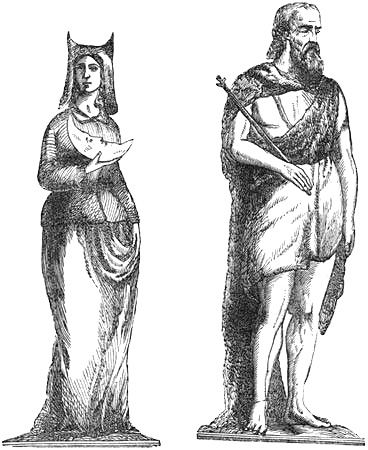
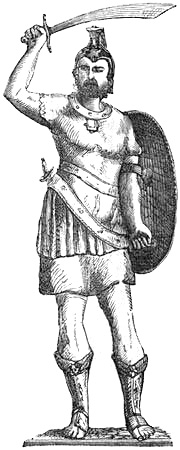
Diana was appealed to for women in childbirth; Mercurius for the healing
of cutaneous diseases (herpes), probably because he carried a herpe,
or short sword, also, at times, the caduceus; and Jupiter for various
diseases. But to return to the times of Saul and David.
It seems that the business became overcrowded, and the vilest and most
degraded of both sexes swelled the ranks of sorcerers, astrologers, and
spiritualists, until every class and condition of people became
impregnated with these beliefs, from kings to the lowest subject. Finally,
the strong arm of the law laid hold of them, and the edict went forth that
“a witch shall not live,” that “a wizard shall be put to death,” and that
“the soothsayer be stoned.”
Nevertheless, the wretches continued to practise their deceptions, but
less openly for a time, and they are made mention of throughout the sacred
writings, until “the closing of the canon.”
But the Scriptures are almost totally silent on surgery, and the remedies
resorted to by those pretending to the science—as also by physicians and
priests—were such as to lead us to believe that their materia medica
was very limited. Under the head of Ridiculous Prescriptions, we shall
mention these remedies:—
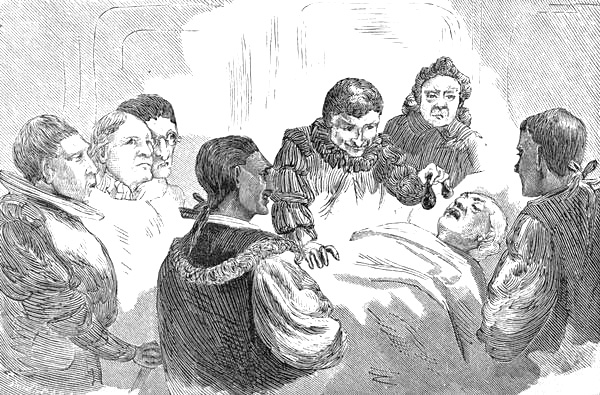
The earliest record we find of surgical operations in the Old Testament is
in Judges xix. 29,—a “capital operation,” we may judge, for the account
informs us that the patient, a woman, “was divided into twelve pieces.”
Turning to the profane writers for information, we plunge into an abyss of
uncertainty, with this exception; that the practice of medicine—it could
not be called a science—was still in the hands of the priesthood, and
partook largely of the fabulous notions of the age, being connected almost
entirely with idolatries and humbuggeries. The cunning priests caused the
rabble, from first to last, to believe that all disease was inflicted, not
from the violation of the laws of nature, but by some angry and outraged
divinity, whose wrath must be appeased by bribes (paid to the priests),
by incantations, and absurd ceremonies, or else the afflicted victim must
die a painful death, and forever after suffer a more horrible eternity.
The priests’ receiving the pay reminds us of the following little
anecdote.
A very pious man, recently congratulating a convalescing patient upon his
recovery, asked his friend who had been his physician.
“Dr. Blank brought me safely through,” was his reply.
“No, no,” said the friend, “God brought you out of this affliction, and
healed you,—not the doctor.”
“Well,” replied the man, “may be he did; but I am sure that the doctor
will charge me for it.”
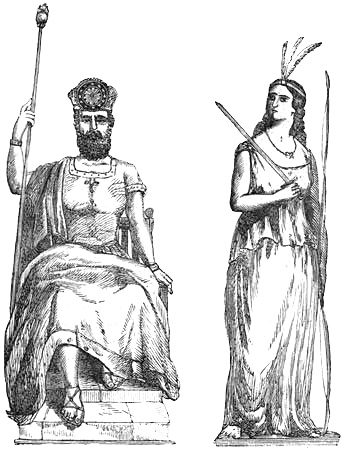
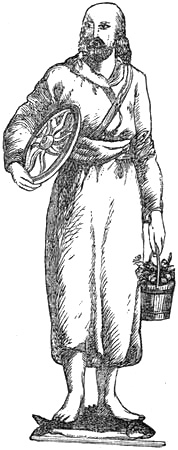
The offices of priest and physician were united among the Jews, Heathens,
Greeks, Egyptians, and Romans. The Druids (from draoi, magician) ruled
and ruined the ancient Celts, Gauls, Britons, and Germans. The people of
these nations looked up to the priests as though life and death and
immortality hung only upon their lips. Among our aborigines we have also
examples of the double office of priest and “medicine man.” And it is an
astonishing fact, that notwithstanding the ignorance of the pretenders to
healing, or the ridiculousness of the prescriptions, or the exorbitant
fees, the rabble of the age relied upon them with the most implicit
confidence. If the patient recovered, the priests—embodying the gods—had
restored them by their great skill and the favor of some particular
divinity, and so were worshipped, and again rewarded with other fees to
offer sacrifices to the individual god who was supposed to favor the
priest or wizard. If he died it was the will of the gods that it should so
be, and the friends lost none of their faith in the abilities of their
medical and spiritual advisers.
The priests could not be disposed of so easily as the witches and wizards
were supposed to have been, for they kept the people under greater fear,
and held the balance of power in their own hands. The only difference
between the priests and wizards was, that the former claimed to exercise
their arts by the power of the gods, while the latter were said to be
assisted by the evil spirits. The priests claimed this in the times of
Christ, and tried to persuade the rabble that he was assisted by
Beelzebub. While the grasping priesthood professed poverty and
self-denial, they were continually enriching themselves by robberies and
extortions upon the ignorant and superstitious common people.
A mirth-provoking anecdote is told of Robin Hood and two friars, which we
cannot forbear relating here as illustrative of the above assertion. If
our readers regard stories from such a source as very uncertain, we have
only to reply that we are now dealing with “uncertainties.”
“One day, Robin disguised himself as a friar, and went out on the highway.
Very soon he met two priests, to whom he appealed for charity in the
blessed Virgin’s name.
“‘That we would do, were it in our power,’ they replied.
“‘I fear you are so addicted to falsehood, I cannot believe that you have
no money, as you say. However, let us all down on our marrow bones, and
pray the Virgin to send us some money.’
“‘No, no,’ replied the priests; ‘it is of no use.’
“‘What! have you no faith in your patron saint? Down, I say, and pray.’
“In fear, down fell the two priests, and Robin by their side, and all
prayed most lustily.
“‘Now feel in your pockets,’ said Robin, rising.
“‘There is nothing,’ they replied, plunging their hands deep into their
cloaks.
“‘Down again, and pray harder,’ shouted Robin, drawing his sword.
“Down they fell, and mumbled over their Latin, but declared the gods had
sent them nothing.
“‘I do not believe you,’ said Robin; ‘you ever were a pack of liars. Let
each stand a search, that we deceive not each other.’ So Robin turned his
own empty pockets wrong side out, then compelled the friars to follow
suit, when lo! out fell five hundred pieces of gold.
“When Robin saw this glorious sight, he berated the priests soundly, and
taking the gold, went away to Sherwood, and made merry at the expense of
the church.”
About 1185 B. C. we find among the Grecians some traces of what was termed
the healing art. But fact and fable, history and mythology, are so mixed
and blended, that it is impossible to gain any reliable information so far
back.
Chiron is made mention of as having acquired much celebrity as a
physician. It is claimed that he was learned in the arts and sciences,
that he taught astronomy to Hercules, music to Apollo, and medicine to
Æsculapius, who came from Egypt. From what can be gleaned, of reliability,
it seems that he employed simple medicines, and possessed some knowledge
of dressing wounds and reducing fractures and dislocations; but no doubt
he pretended to greater things than the times would warrant, for, when
shot by an arrow from the bow of Hercules, his former pupil, he was unable
to heal the wound, and begged Jupiter to “set him up” among the stars,
which request was complied with, and Chiron was translated to the heavens,
where he still shines in the constellation Sagittarius, represented as a
centaur, with drawn bow, driving before him the other eleven signs of the
zodiac.
We have alluded to Æsculapius, and, passing over all others of his class,
we come to the times of Hippocrates.
Hippocrates is rightly called the “Father of Medicine,” for he was the
first to raise medicine to a science. We mention him without classing him
with humbugs; but Menecrates, who flourished about the same time, arrived
at great notoriety by ruse and deception. He was “famous for vanity and
arrogance.” He went about accompanied by some patients, whom he claimed to
have cured, as proofs of his great ability. One he disguised as Apollo,
another he arrayed in the habit of Æsculapius, and sent them abroad to
sound his praise, while he took upon himself the garb, and assumed the
character, of Jupiter.
Pliny says that medicine was the last of the sciences introduced into
Rome, and that the Septimont City was six hundred years without a regular
physician. Archagathus, a Grecian, settled in Rome about 300 B. C., and if
he was a fair sample of those who followed him, it had been better for
Rome that it had remained another six hundred years “without a regular
physician.” He introduced cruel and painful escharotics, and made free use
of the knife and the lancet. He was a humbug of the first water, and a
quack besides, and as such he was banished in a few years.
The Christian era introduced some light into the medical, as well as the
religious world; yet we learn, by both sacred and profane writers, that
truth and knowledge were the exceptions, and ignorance and humbug were the
rule by which medicine was practised by those who pretended to the art.
Names changed, characters remained the same.
The priests still held their own, and were not, as already shown, to be
gotten rid of, as the witches and wizards, their rivals and imitators, by
litigation, nor was their power broken until the Decree of the Council of
Tours in 1163 A. D., which prohibited priests and deacons from performing
certain surgical operations.
After the Reformation the vocations of spiritual and medical adviser
diverged wider and wider, until now a priest or minister is seldom
consulted for bodily infirmities, and only by persons of the most ignorant
and superstitious denominations.
Setting the priesthood aside did not suppress humbugs in medicine. In fact
the profession went into disrepute, which the priests hastened, and a
lower order of people took upon themselves the practice of deceiving the
sick and afflicted. Now and then a greater humbug than common would spring
up, and for a time draw the rabble after him, till the next arose to
eclipse him.
From the discovery of America to about 1600, ambitious upstarts, humbugs,
and seekers of fame and fortune were drawn away from the old world, and
either for this reason, or because the biographers were attracted to a
more interesting field, accounts of medical celebrities are very meagre;
but from the latter period to the present day there has been no lack of
records from which to draw our material.
During the 17th and 18th centuries medical impostors had things all their
own way. Ignorance was no hinderance to advancement, socially or
pecuniarily. Some men published, in their own names, voluminous works, in
both English and Latin, which they themselves could not read. By soft
words and cunning arts others gained high positions, and, without
knowledge of the first branch of medical science, became “court
physicians.”
From the lowest walks, they rose up on every side: from the cobbler’s
bench, and the tailor’s board; from cutting up meat in the butcher’s shop,
to “cutting up” naughty boys in a pedagogue’s capacity; from shaving the
unwashed rabble behind the striped barber’s pole, to shaving their wives
behind counters, where they measured the cloth of the weaver, they became
cobblers of poor healths, butchers of men, and shavers of the invalided
public. But these will be discoursed of under another head.
We here offer one proof of this state of affairs by a quotation from the
original charter of the first College of Physicians, granted by Henry
VIII., which reads, “Before this period a great multitude of ignorant
persons, of which the greater part had no insight into physic, nor into
any other kind of learning,—some could not even read the Book,—so far
forth that common artificers, as smiths, weavers, and women boldly and
accustomedly took upon themselves great cures, to the high displeasure of
God, great infamy of the faculty, and the grievous hurt, damage, and
destruction of many of the king’s liege people.”
The meetings of this august body (College of Physicians) were held at the
house of Dr. Linacre. “He was a gentleman of distinction, both as a
physician and scholar.” He became disgusted with physic, and took “holy
orders” five years before his death. He was one of the original
petitioners of the charter, which complained that the above rabble of
doctors could not read the Book (Bible). Now see the ignorance—the
hypocrisy of the man!
Dr. Caius, who wrote his epitaph, says of Linacre, “He certainly was not a
very profound theologian, for a short time before his death he read the
New Testament for the first time, when, so greatly was he astonished at
finding the rules of Christianity so widely at variance with their
practice, that he threw down the sacred volume in a passion, saying,
‘Either this is not gospel, or we are not Christians.’” This was just
prior to 1600.
This Dr. Caius is supposed to be the same character whom Shakspeare
introduced in his “Merry Wives of Windsor;” and as it is a fact patent
to all that the great poet had no very exalted opinion of doctors, and
would “throw physic to the dogs,” it has been suggested that Caius was
produced by him on that ground.
There are others of this and a later period, whom, though ranking amongst
the greatest of humbugs, we defer mentioning here, but will notice in our
chapter on quacks.
Mr. Jeaffreson, in his excellent work, “Book About Doctors,” to which work
I am indebted for several anecdotes, says,—
“The lives of three physicians—Sydenham, Sir Hans Sloane, and
Heberden—completely bridge over the uncertain period between old
empiricism and modern science.”
The former, Dr. Thomas Sydenham, was born at Windford Eagle, Dorsetshire,
England, in 1624, and was esteemed as an excellent physician and profound
scholar of his day. Nothing is known of his boyhood. For a time he was a
soldier. He was about forty years old when admitted a member of the
College of Physicians. Dr. Richard Blackmore, his contemporary, who was
but a pedagogue at the outstart himself, but afterwards knighted as Sir
Richard, says of Dr. Sydenham, “He was only a disbanded officer, who
entered upon the practice of medicine for a maintenance, without any
preparatory learning.” The fact of his possessing a diploma went for
nothing, since Dr. Meyersbach obtained his about this time for a few
shillings, and without the rudiments of an education, made a splendid
living out of the credulity even of the most learned and fashionable
classes of English society, and arrived at the height of honor and
distinction.
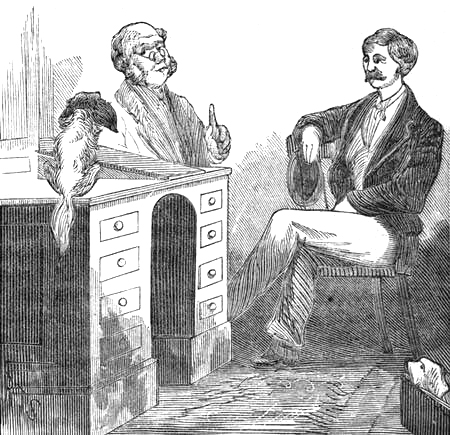
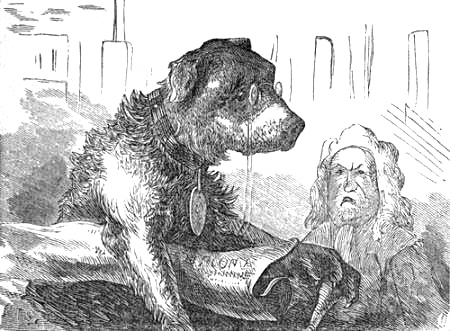
The reader must admit that diplomas were cheap honors, when one was
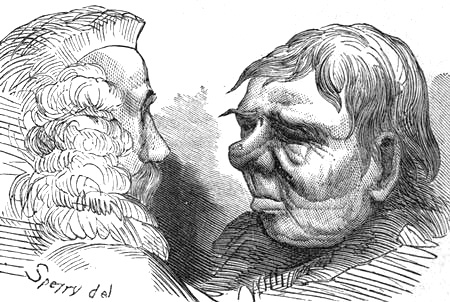
granted to a dog! A young English gentleman, for the sport of the thing,
paid the price of a medical diploma soon after Dr. Meyersbach’s was
granted, and had it duly recorded in the archives of the college (Erfurth)
as having been awarded to Anglicus Ponto.
“And who was Anglicus Ponto?”
“None other than the gentleman’s dog—a fine mastiff.”
But this question was not asked till too late to prevent the joke. It had
the good effect, however, to raise at once the price of degrees.
Dr. Sydenham published several medical works, copies of which are now
extant, but his pretensions to skill availed him but little in time of
need. His prescriptions—some of them, at least—were very absurd, and
during his latter years, while enjoying a lucrative practice, and
possessing the utmost confidence of the bon ton, he suffered
excruciating pains from the gout, which, with other complications, ended
his days. “Physician, heal thyself.”
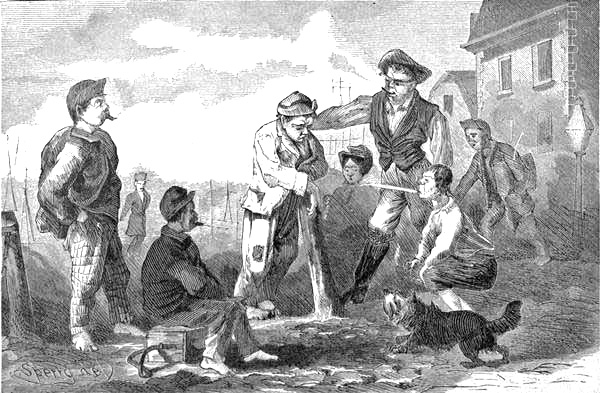
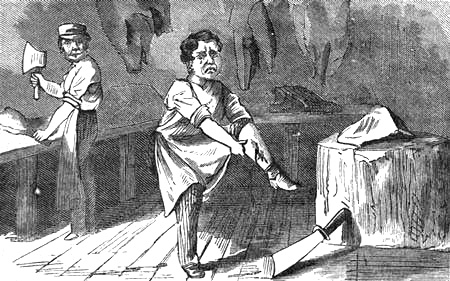
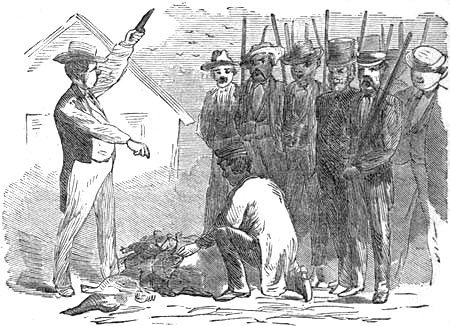
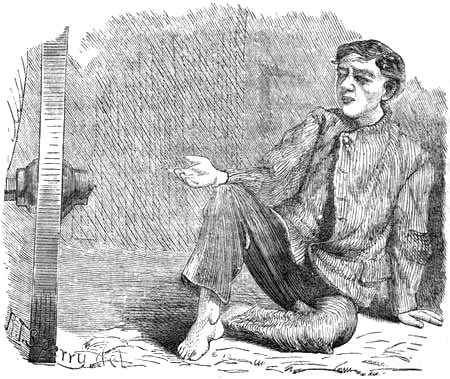
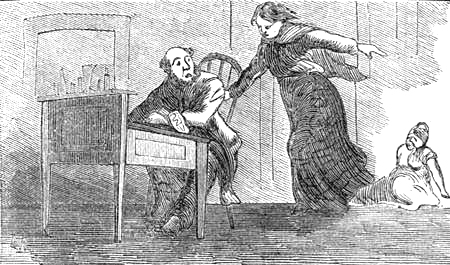
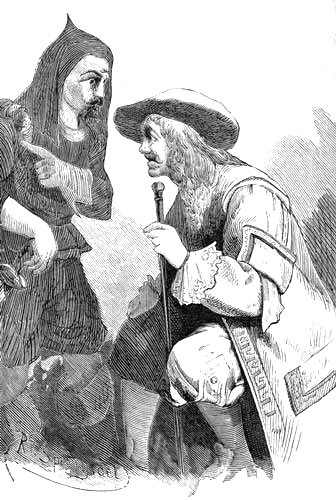
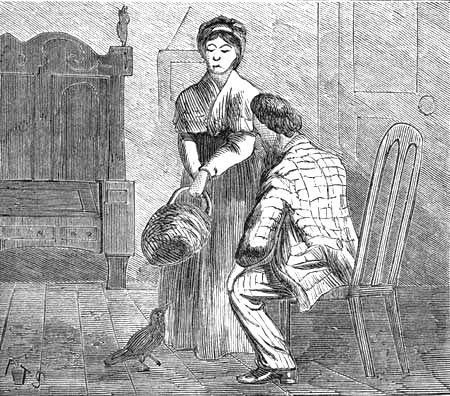
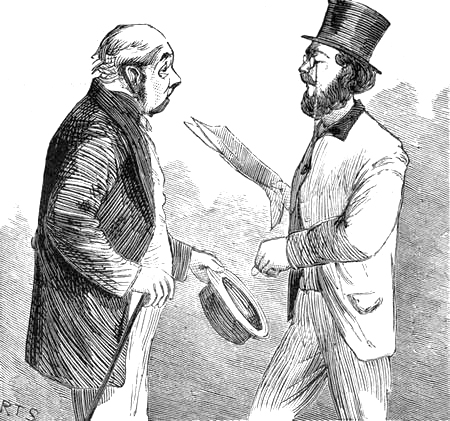
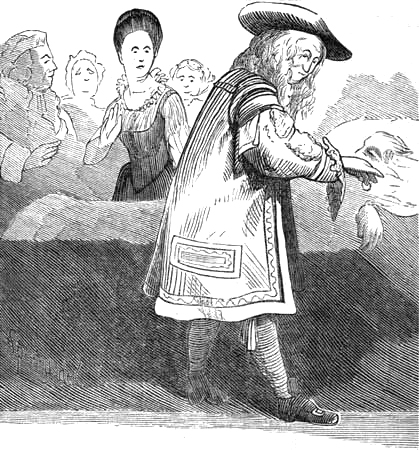
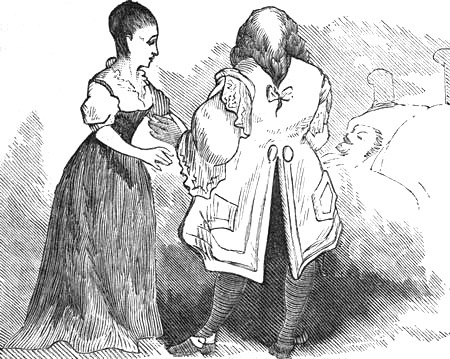
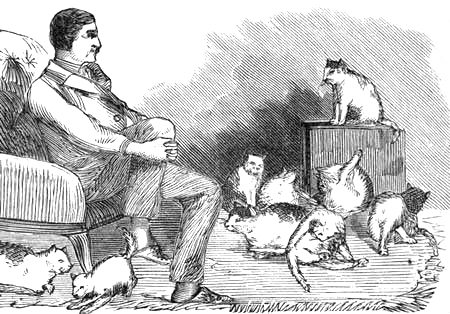
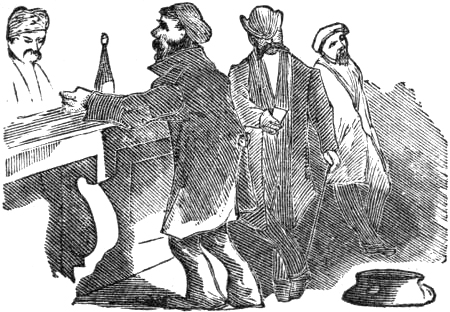
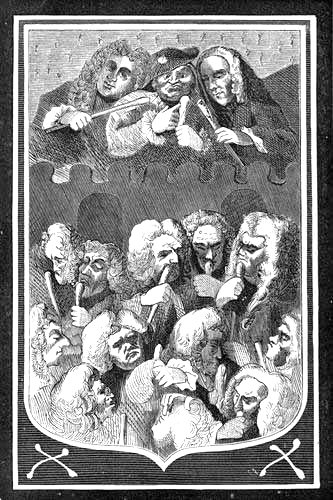
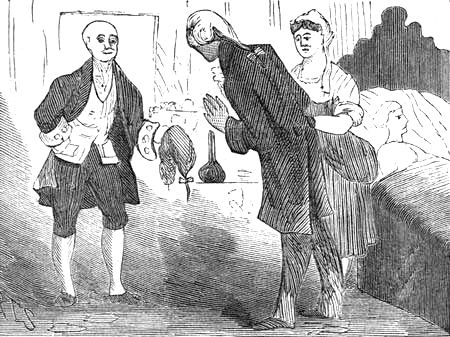
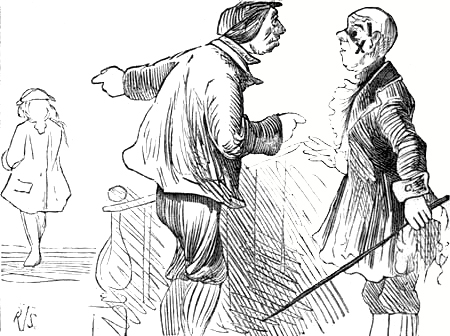
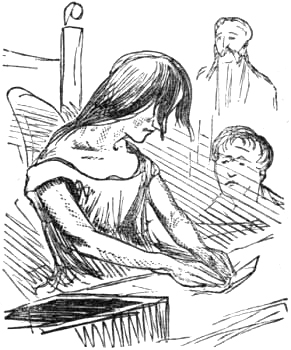
DR. ANGLICUS PONTO.
Dr. Blackmore, an aspirant to medical fame, applied to Dr. Sydenham, while
residing in Pall Mall, with the following inquiry:—
“What is the best course of study for a medical student?”
“Read Don Quixote,” was Sydenham’s reply. “It is a very good book. I read
it yet.” I find this in a biographical dictionary of 1779. While some
biographers endeavor to pass this off as a joke, it is a well-known fact
that the doctor was a sceptic in medicine, and those who knew him best
believe that he meant just what he said.
On the arrival of Dr. Sloane in London, he waited on Dr. Sydenham, as
being the great gun of the town at that time, and presented a letter of
introduction, in which an enthusiastic friend had set forth Sloane’s
qualifications in glowing language, as being perfected in anatomy, botany,
and the various branches of medicine. Sydenham finished the letter, threw
it on the table, eyed the young man very sharply, and said,—
“Sir, this is all very fine, on paper—very fine; but it won’t do.
Anatomy! botany! Nonsense. Why, sir, I know an old woman in Covent Garden
who better understands botany; and as for anatomy, no doubt my butcher can
dissect a joint quite as well. No, no, young man; this is all stuff. You
must go to the bedside; it is only there that you can learn disease.”
In spite of this mortifying reception, however, Sydenham afterwards took
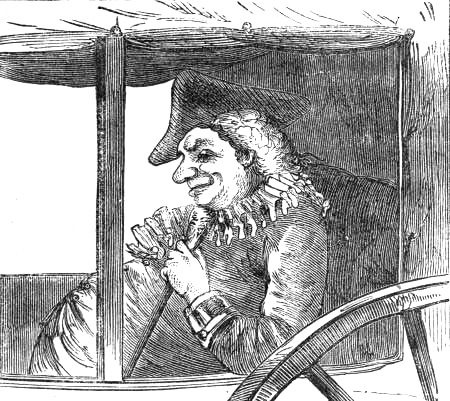
the greatest interest in Dr. Sloane, frequently taking the young man with
him in his chariot on going his rounds.
In “Lives of English Physicians,” the author, in writing of Dr. Sydenham,
says, “At the commencement of his practice, it is handed down to us, that
it was his ordinary custom, when consulted by patients for the first time,
to hear attentively their story, and then reply, “Well, I will consider
your case, and in a few days will prescribe something for you;” thereby
gaining time to look up such a case. He soon learned that this
deliberation would not do, as some forgot to return after “a few days,”
and to save his fees he was obliged, nolens volens, to prescribe on the
spot.
A further proof of his contemptible opinion of deriving knowledge from
books, as expressed above to Dr. Blackmore, is exemplified and
corroborated in an address to Dr. Mapletoft (1675).
“The medical art could not be learned so well and surely as by use and
experience, and that he who would pay the nicest and most accurate
attention to the symptoms of distempers, would succeed best in finding out
the true means of cure.”
“Riding on horseback,” he says, in one of his books, “will cure all
diseases except confirmed consumption.” How about curing gout?
A very amusing, though painful picture, is drawn by Dr. Winslow, a
reliable author of the seventeenth century, in his book, “Physic and
Physicians:”—
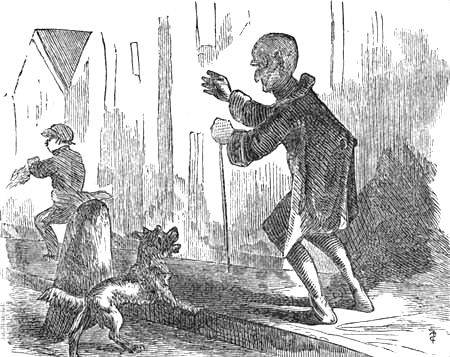
“Dr. Sydenham suffered extremely from the gout. One day, during the latter
part of his life, he was sitting near an open window, on the ground floor
of his residence in St. James Square, inspiring the cool breeze on a
summer’s afternoon, and reflecting, with a serene countenance and great
complacency on the alleviation of human misery that his skill enabled him
to give. Whilst this divine man was enjoying this delicious reverie, and
occasionally sipping his favorite beverage from a silver tankard, in which
was immersed a sprig of rosemary, a sneak thief approached, and seeing the
helpless condition of the old doctor, stole the cup, right before his
eyes, and ran away with it. The doctor was too lame to run after him, and
before he could stir to ring and give alarm the thief was well off.”
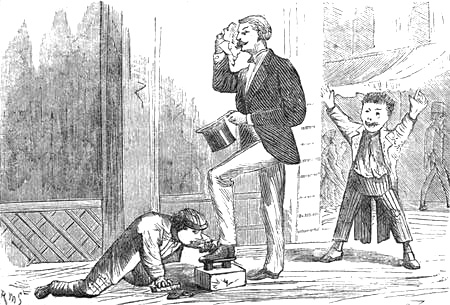
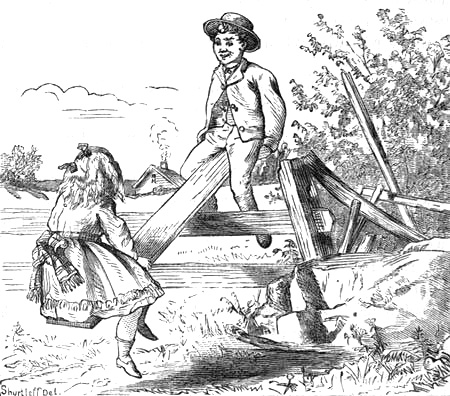
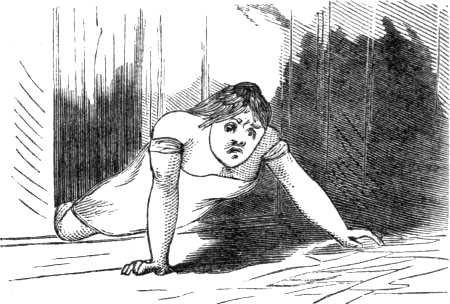
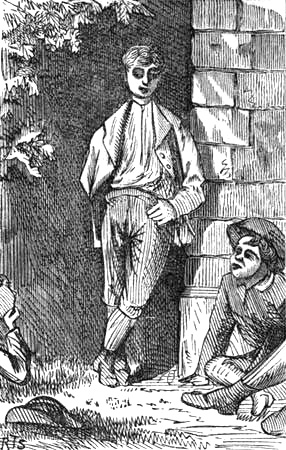
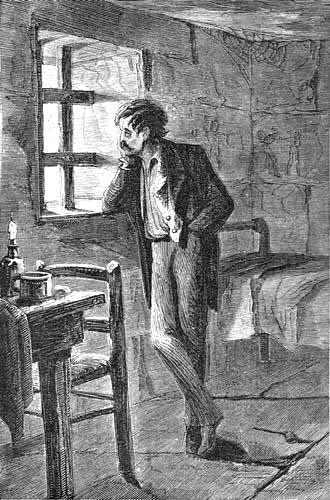
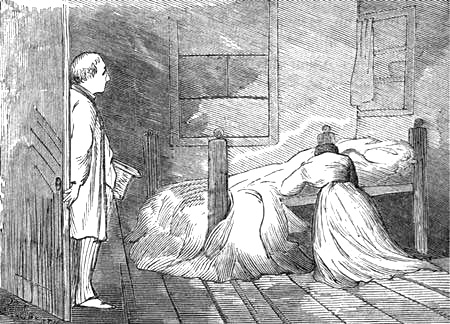
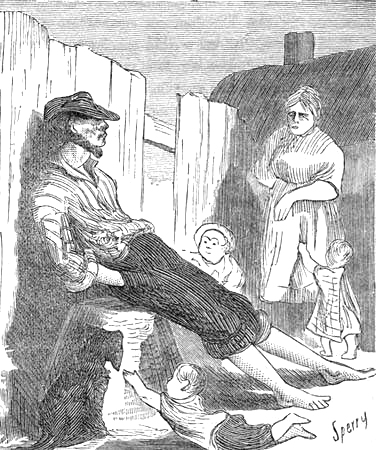
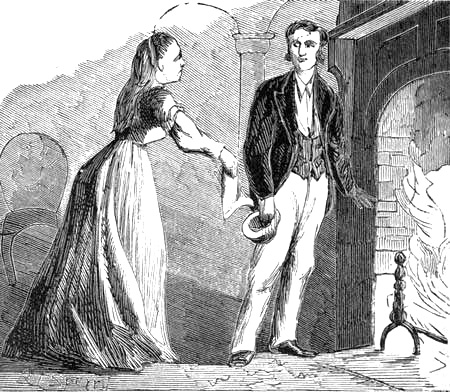
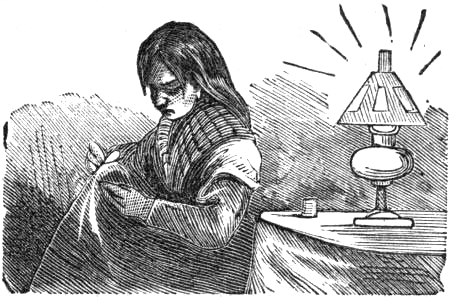
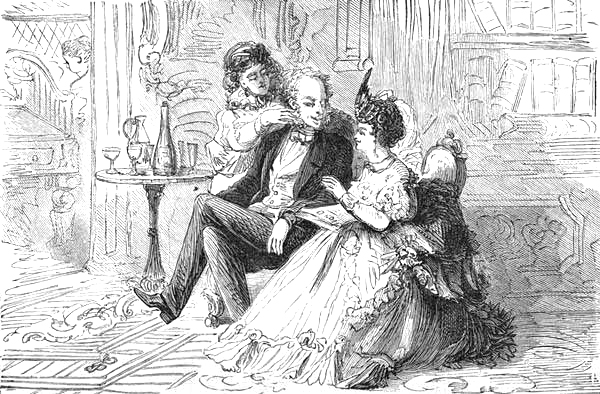
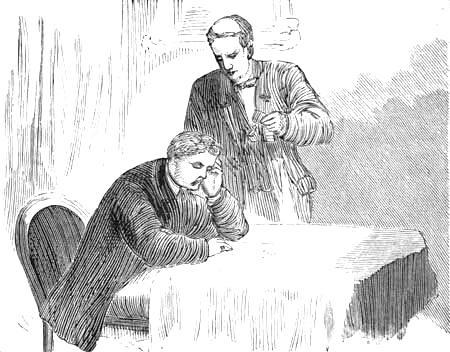
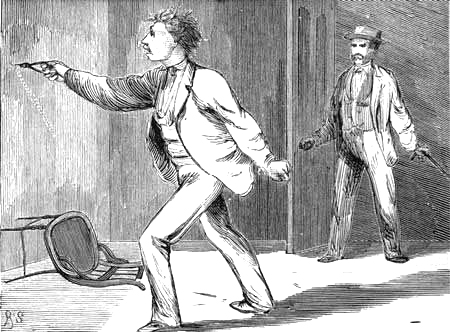
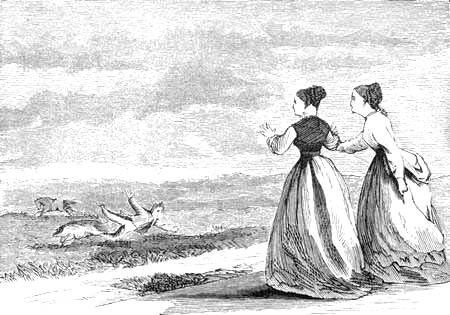
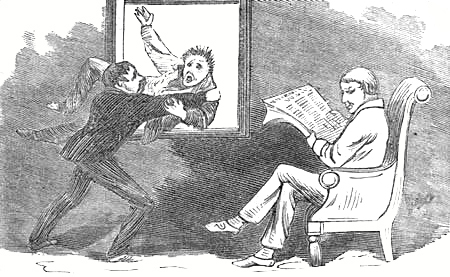
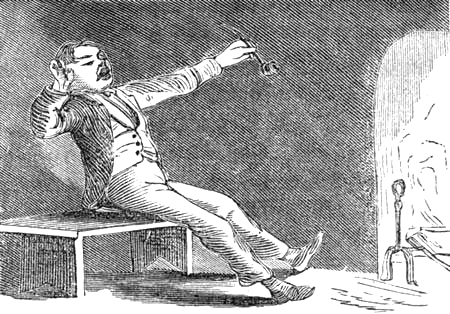
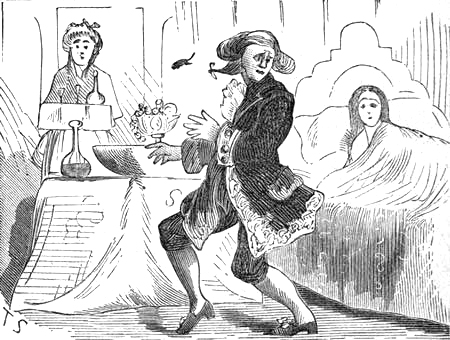
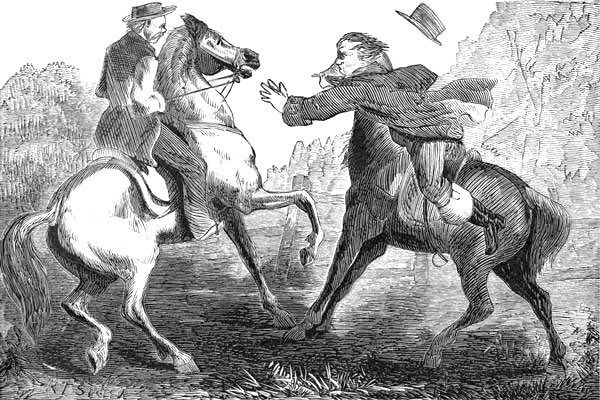
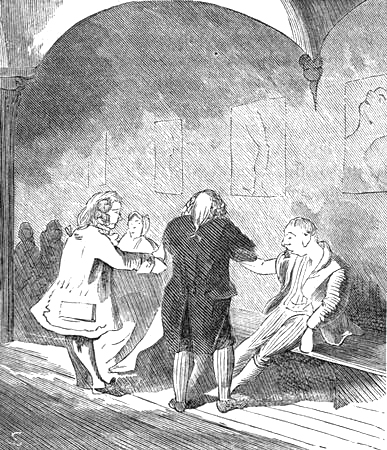
MISFORTUNES NEVER COME SINGLY.
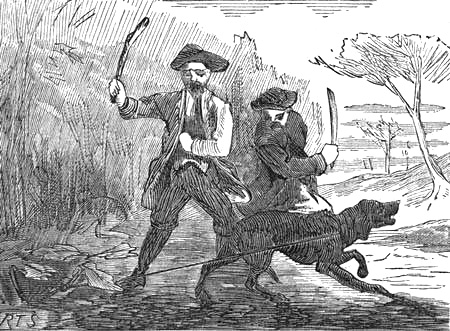
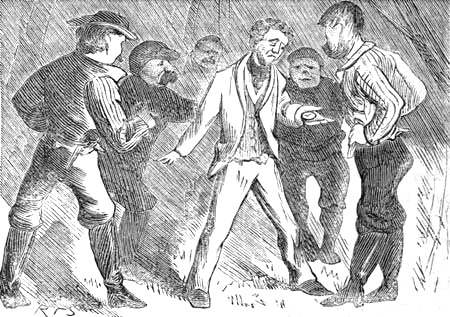
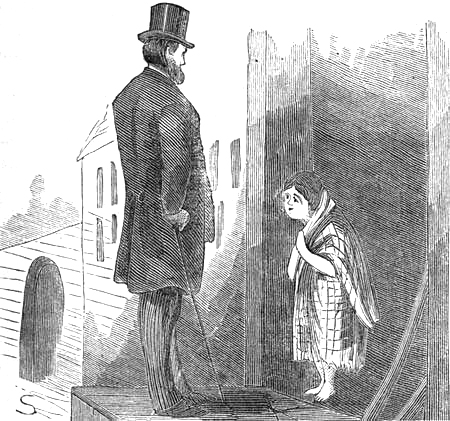
This reminds one of a story of an old man who stood in a highway, leaning
on his staff, and crying, in a feeble, croaking voice, “Stop thief! stop
thief!”
“What is the matter, sir?” inquired a fellow, approaching.
“O, a villain has stolen my hat from my head, and run away.”
“Your hat!” looking at the bare head; “why didn’t you run after him?”
“O, my dear sir, I can’t run a step. I am very lame.”
“Can’t run! then here goes your wig.” And so saying, the fellow caught the
poor old man’s wig, and scampered away at the top of his speed.
Dr. Sydenham died December 29, 1689. He could not be termed a quack, but
certainly he was a consummate humbug.
An author, before quoted, after copying a description of the “poor
physician” of the age, adds,—
“How it calls to mind the image of Dr. Oliver Goldsmith, when, with a
smattering of medical knowledge and a German diploma, he tried to pick out
of the miseries and ignorance of his fellow-creatures the means of keeping
soul and body together! He, too, poet and doctor, would have sold a pot of
rouge to a faded beauty, or a bottle of hair dye, or a nostrum warranted
to cure the bite of a mad dog.”
“Set a rogue to catch a rogue.” And to this principle we are indebted for
the exposition of many fallacies and humbugs pursued by early physicians
in order to gain practice.
“Dr. Radcliffe,” says Dr. Hannes, “on his arrival in London, employed half
of the porters in town to call for him at the coffee-houses (a famous
resort of physicians of the seventeenth and eighteenth centuries) and
places of public resort, so that his name might become known.”
On the other hand, Radcliffe accused Dr. Hannes of the same trick a few
years later. Doctors were doctors’ own worst enemies. Instead of standing
by each other of the same school, in lip service, or passing by each
other’s errors and imperfections in silence, as they do nowadays, they
quarrelled continually, accusing each other of the very tricks they
practised themselves.
Of Dr. Meade it was confidently asserted, that without practice at first,
he opened extensive correspondence with all the nurses and midwives in his
vicinity, associated and conversed with apothecaries and gossips, who,
hoping for his trade, would recommend him as a skilful practitioner. The
ruse worked, and soon the doctor found his calls were bona fide. This is
a trick that some American physicians we know of may have learned from Dr.
Meade. Certainly they know and practise the deception.
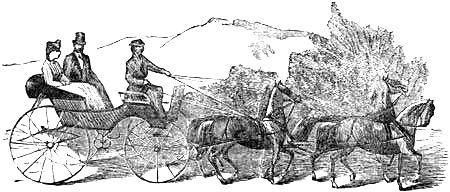
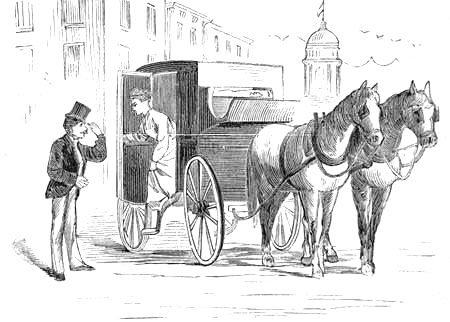
When Dr. Hannes went to London, he opened the campaign with a coach and
four. The carriage was of the most imposing appearance, the horses were
the best bloods, sleek and high-spirited, the harnesses and caparisons of
the richest mountings of silver and gold, with the most elegant trimmings.
“By Jove, Radcliffe!” exclaimed Meade, “Dr. Hannes’ horses are the finest
I have ever seen.”
“Umph,” growled Radcliffe, “then he will be able to sell them for all the
more.” But Dr. Radcliffe’s prognosis was at fault for once; and
notwithstanding all the prejudice that Radcliffe and his friends could
bring to bear against Hannes, and the lampooning verses spread broadcast
against him, he kept his “fine horses,” and rode into a flourishing
business.
To make his name known, Dr. Hannes used to send liveried footmen running
about the streets, with directions to poke their heads into every coach
they met, and inquire anxiously, “Is Dr. Hannes here?” “Is this Dr.
Hannes’ carriage?” etc.
Acting upon these orders, one of these fellows, after looking into every
carriage from Whitehall to Royal Exchange, ran into a coffee-house, which
was one of the great places of meeting for members of the medical
profession. Several physicians were present, among whom was Radcliffe.
“Gentlemen,” said the liveried servant, hat in hand, “can your honors tell
me if Dr. Hannes is present?”
“Who wants Dr. Hannes, fellow?” demanded Radcliffe.
“Lord A. and Lord B., your honor,” replied the man.
“No, no, friend,” responded the doctor, with pleasant irony; “those lords
don’t want your master; ’tis he who wants them.”
The humbug exploded, but Hannes had got the start before this occurred.
A worthy biographer begins thus, in writing of Dr. Radcliffe: “The
Jacobite partisan, the physician without learning, the luxurious bon
vivant, Radcliffe, who grudged the odd sixpence of his tavern score,”
etc., “was born in Yorkshire, in the year 1650.”
But notwithstanding Radcliffe’s plebeian birth, he died rich, therefore
respected—a fact which hides many sins and imperfections. He not only
humbugged the people of his day into the belief that he was a learned and
eminent physician, but by his shrewdness in disposing of his gains, in
bestowing wealth where it would tell in after years, when his body had
returned to the dust from whence it came,—such as giving fifty thousand
dollars to the Oxford University as a fund for the establishment of the
great “Radcliffe Library,” etc.,—he succeeded in humbugging subsequent
generations into the same belief.
Certainly there is room for a few more such humbugs.
Dr. Barnard de Mandeville, in “Essays on Charity and Charity Schools,”
says of Radcliffe, “That a man with small skill in physic, and hardly any
learning, should by vile arts get into practice, and lay up wealth, is no
mighty wonder; but that he should so deeply work himself into the good
opinion of the world as to gain the general esteem of a nation, and
establish a reputation beyond all contemporaries, with no other qualities
but a perfect knowledge of mankind, and a capacity of making the most of
it, is something extraordinary.”
Mandeville further accuses him of “an insatiable greediness after wealth,
no regard for religion, or affection for kindred, no compassion for the
poor, and hardly any humanity to his fellow-creatures; gave no proofs that
he loved his country, had a public spirit, or love of the arts, books, or
literature;” and asks, in summing up all this, “What must we judge of his
motives, the principle he acted from, when after his death we find that he
left but a mere trifle among his (poor) relatives who stood in need, and
left an immense treasure to a university that did not want it?”
“Radcliffe was not endowed with a kindly nature,” says another writer.
“Meade, I love you,” he is represented as saying to his fascinating
adulator, “and I will tell you a secret to make your fortune. Use all
mankind ill.”
Radcliffe had practised what he preached. Though mean and penurious, he
could not brook meanness in others.
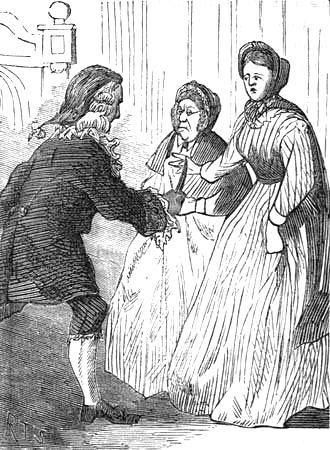
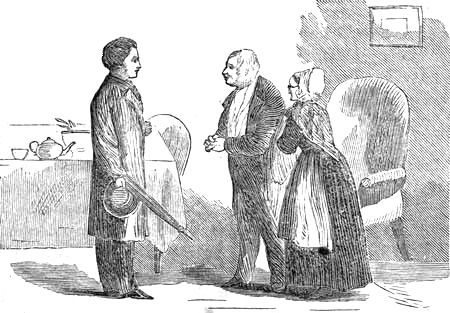
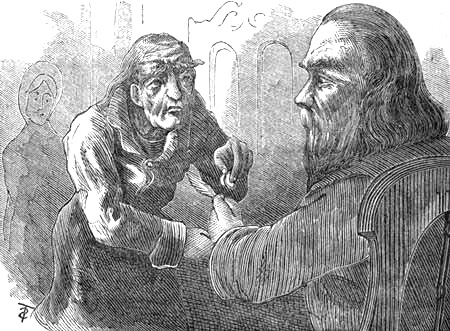
The rich miser, John Tyson, approximating his end, magnanimously resolved
to pay two of his three million guineas to Dr. Radcliffe for medical
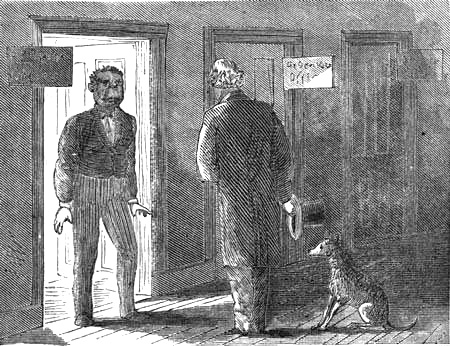
advice. The miserable old man, accompanied by his wife, came up to London,
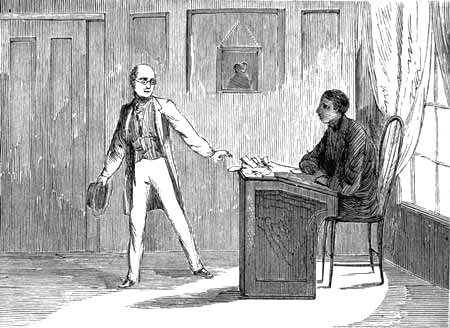
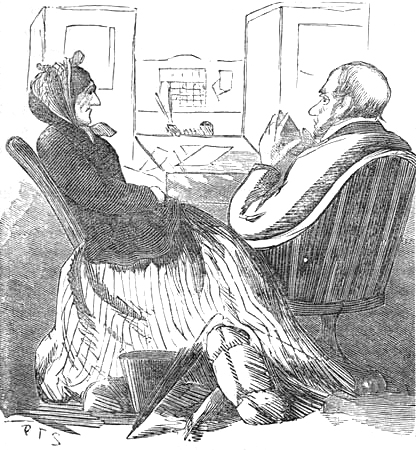
and tottered into the doctor’s office at Bloomsbury Square.
“I wish to consult you, sir; here are two guineas.”
“You may go, sir,” exclaimed Radcliffe.
The old miser had trusted that he was unknown, and he might pass for a
poor wretch, unable to pay the five guineas expected from the wealthy, as
a single consultation fee.
“You may go home and die, and be d——d; for the grave and the devil are
ready for Jack Tyson of Hackney, who has amassed riches out of the public
and the tears of orphans and widows.”
As the miserable old man turned away, Radcliffe exclaimed, “You’ll be a
dead man in less than ten days.”
It required little medical skill, in the feeble condition of the old man,
in order to give this correct prognosis.
Radcliffe was the Barnum of doctors. “Omnia mutantur, et nos mutamus in
illis,” exclaimed Lotharius the First. But that “all things are changed,
and we change with them,” did not apply to medical humbugs during the
seventeenth and eighteenth centuries—no, nor in the nineteenth century,
as we will show, particularly in our articles on Quacks and Patent
Medicines.
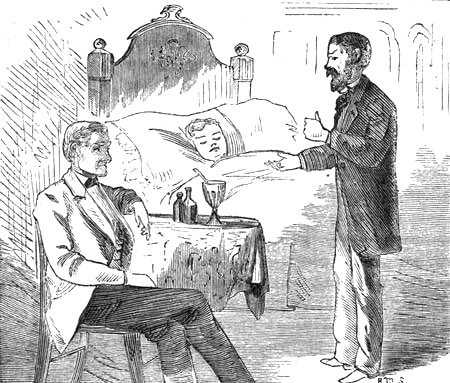
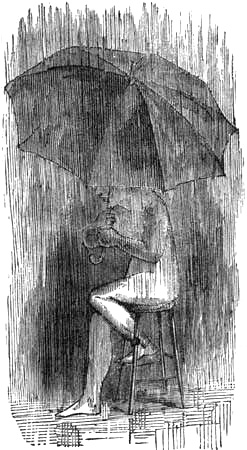
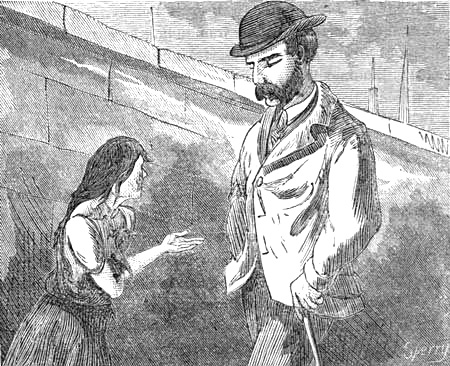
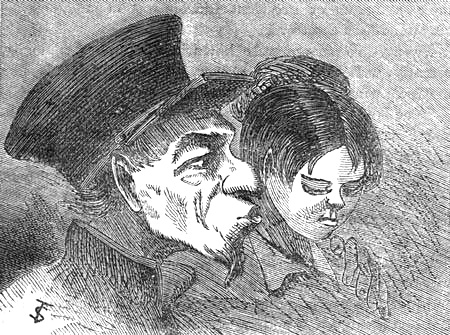
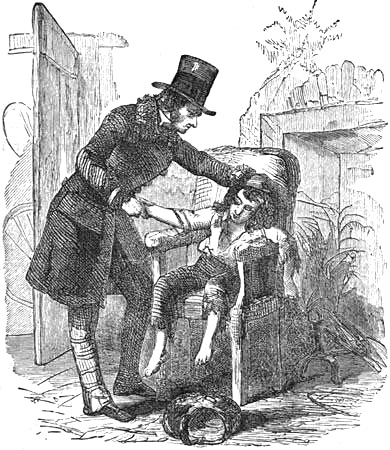
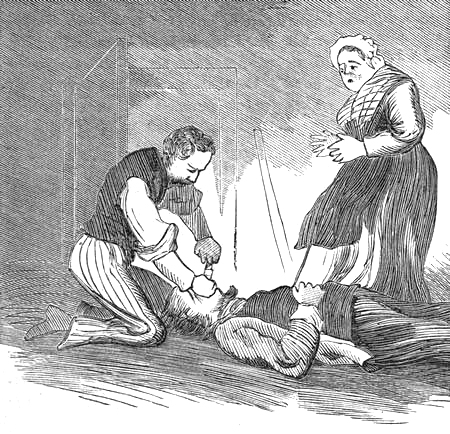
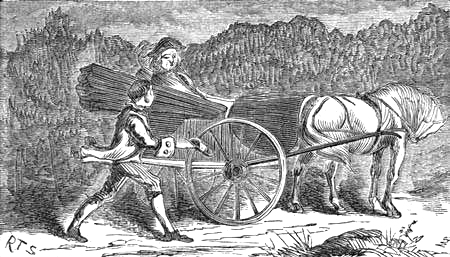
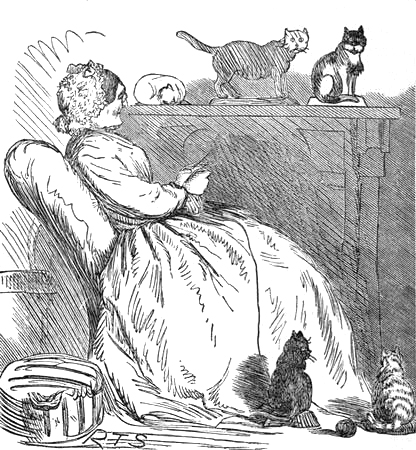
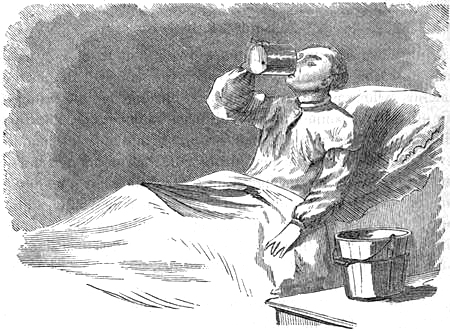
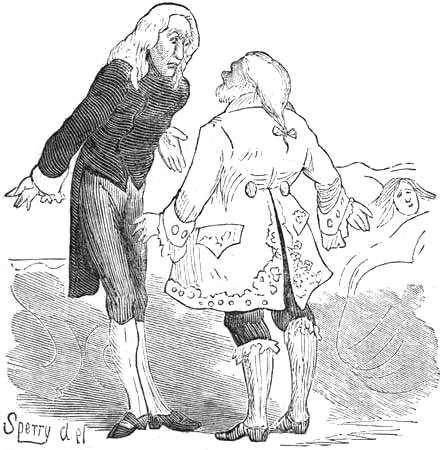
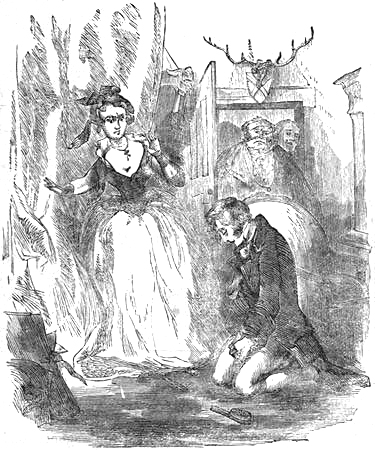
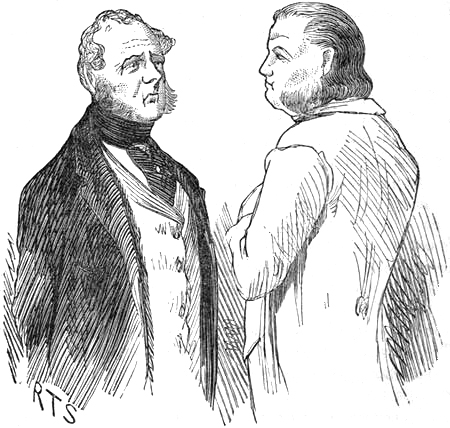
THE MISER OUTWITS HIMSELF.
The requisites essential to success are amusingly described by a writer of
the former time, as follows:—
First. A decent black suit, and (if your credit will stretch so far), a
plush jacket, not a pin the worse if threadbare as a tailor’s cloak—it
shows the more reverend antiquity.
Second. You must carry a caduceus, or cane, like Mercury, capped with a
civet-box (or snuff-box like Sir Richard’s), and must walk with becoming
gravity, as if in deep contemplation upon an arbitrament between life and
death.
Third. You must hire convenient lodgings in a respectable neighborhood,
with a hatch[1] at the door; have your reception-room hung with pictures
of some celebrated physicians, ancient historical scenes, and anatomical
plates, and the floor belittered with gallipots and half-empty bottles.
Any sexton will furnish your window with a skull, in hope of your custom.
Fourth. Let your desk never be without some old musty Greek and Arabic
authors, and on your table some work on anatomy, open at a picture page,
to amuse, if not astonish spectators, and carelessly thrown on the same a
few gilt shillings, to represent so many guineas received that morning as
fees.
Fifth. Fail not to patronize neighboring alehouses, which may, in turn,
recommend you to inquirers; and hold correspondence with all the nurses
and midwives whose address you may obtain, to applaud your skill at
gossiping.
Sixth. Be not over modest in airy pretensions, not forgetting that
loquaciousness and impudence are essentials to gaining a fool’s
confidence. In case you are naturally backward in language, or have an
impediment of speech, you are recommended to persevere in a habit of
mysterious and profound silence before patients, rendered impressive by
grave nods and ahems.
Early French Physicians.
From what meagre biographies we have of French doctors of the past, we are
led to believe that, as at the present time, the humbugs outnumbered the
honest medical practitioners. In the days of Clovis and the great
Charlemagne, before the power of Rome was broken, before Russia was a
nation, and when England was subject to the caprices of many masters,
there were many surgeons employed in the armies of these kings, but the
priests and wizards were the physicians to the great public. The surgeons
possessed all the knowledge there was to be attained at that distant day;
yet they made the heart, not the brain, the centre of thought, and “the
palace of the soul,” knew little of anatomy, and nothing of the
circulation of the blood.
The physicians of later periods held court positions by flattery, not by
merit. This was particularly true up to and inclusive of the reign of
“Louis le Grand.” Those who attended as physicians upon the court of this
remarkable monarch of France for seventy-two years, received no stipend
whatever, except the honor of holding so exalted a position as court
physician to such a mighty ruler; and, notwithstanding the outside
practice that this elevated station necessarily brought them, but few
physicians could long bear the enormous expense attending that position.
Louis resided at a distance from his capital. His changes of residence
were continual, and not without a design, and chiefly made for the purpose
of creating and maintaining a number of artificial distinctions. By these
he kept the court in a state of constant anxiety, expense, and
expectation. When the next proposed change was announced, he had made it
the fashion for courtiers to accompany him,—to Versailles, to St.
Germain, or Marly,—and to occupy apartments near him, and the
extravagance and magnificence in which he made it incumbent upon his
followers to appear, with the frequent prescribed changes, rendered it too
expensive a position for a man to sustain, unless possessed of a previous
ample fortune. The surgeons of the armies were paid for their services.
Both Drs. O’Meara and Antommarchi have testified to Napoleon’s scepticism
in medicine and distrust of physicians. But “surgeons are godlike,” he is
represented as saying, and upon all worthy he bestowed the “Legion of
Honor.”
At St. Helena, Dr. Antommarchi was endeavoring to persuade the emperor to
take a simple remedy which he had prepared for him.
“Bah!” exclaimed Napoleon, “I cannot; it is beyond my power to take
medicine.”
“I pray your majesty to try,” entreated the doctor.
“The aversion I have for the slightest preparation is inconceivable. I
have exposed myself to the dangers of the battle-field with indifference;
I have seen death without betraying emotion; but to take medicine, I
cannot,” was his reply.
Madame Bertrand, who was present, tried also to persuade the emperor to
take the physician’s prescription.
“How do you manage to take all those abominable pills and drugs, Madame
Bertrand, which the doctor is continually prescribing for you?” asked the
emperor.
“O, I take them without stopping to think about it,” was her reply; “and I
beg your majesty will do the same.”
Still the dying man shook his head, and appealed to General Montholon, who
gave a similar answer.
“Do you think it will relieve me from this oppression, doctor?” he finally
asked of Dr. Antommarchi.
“I do, my dear sire; and I entreat your majesty to drink it.”
“What is it?” asked Napoleon, eying the glass suspiciously.
“Merely some orange water,” was the reply.
“Give it me, then;” and the emperor seized the cup and drank the contents
at one draught.
“The emperor has no faith in medicine, and never takes any,” said Las
Cases, in his memoirs.
About the year 1723, a man sprang into notice in Paris, styling himself
Dr. Villars. He claimed relationship to the Duke Louis Hector Villars, and
the Abbe Pons is represented as saying that “Dr. Villars is superior to
the great marshal, Louis Hector. The duke kills men,—the doctor prolongs
their existence.”
Villars declared that his uncle, who had been killed at the age of one
hundred years, and who might, but for his accidental death, have lived
another half century, had confided to him the secret of his longevity.
It consisted of a medicine, which, if taken according to directions
accompanying each bottle, would prolong the life of the fortunate
possessor ad infinitum.
Villars employed several assistants to stand on the corners of the
streets, and who, when a funeral was seen passing, would exclaim,—
“Ah! if the unfortunate deceased had but taken Dr. Villars’ nostrum, he
might now be riding in his own carriage, instead of in a hearse.”
“Of course,” says our authority, “the rabble believed the testimony of
such respectable and disinterested appearing witnesses, and made haste
to obtain the doctor’s nostrum—and instructions.” And here is where the
laugh comes in.
The patient received positive instructions to live temperately, to eat
moderately, bathe daily, to avoid all excesses, to take steady and
moderate exercise, to rise early, and, in fact, to obey all the laws of
nature. Of course those who persevered in these instructions were greatly
benefited thereby, and the dupes, attributing their recovery to the use of
the nostrum, lauded the doctor.
The medicine, put up in a small bottle, carefully labelled, and sold for
the modest sum of five francs, consisted of water from the River Seine,
tinctured with a quantity of spirits of nitre. A few were wise enough to
see the trick, but most people believed in the efficacy of the nostrum.
Unfortunately for Villars, he intrusted his secret to another, the humbug
leaked out, and Othello’s occupation was gone; but not, however, until
Villars had amassed a large fortune from the credulity of the public.
This brings to mind a story, the truth of which can be vouched for,
respecting a New England doctor. His labels contained the following
instructions:—
“The doctor charges you to take care of the health God has given you. In
eating and exercise be moderate. Avoid bad habits and excesses that sap
the life from you. Use no salt pork, newly-baked fine bread, vinegar,
coffee, strong tea, or spirits while taking this medicine. ’Tis not in the
power of man to restore you to health unless you regard these directions.”
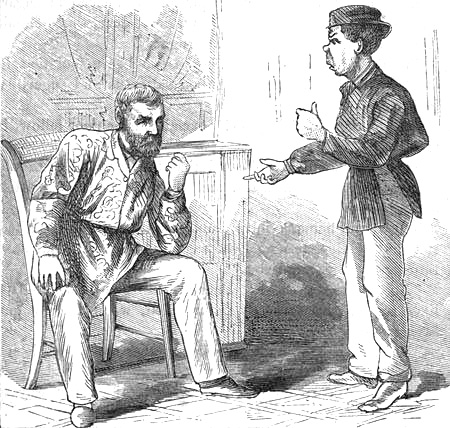
“What do you think of this?” asked the editor of a journal of Dr. P.,
former professor of H—— College, presenting a vial of the high dilution,
as the medicine was, labelled as above.
“All very well,” the doctor replied, after having read the label; “for if
the vial contains nothing but water, with just sufficient alcohol to keep
it, a strict observance of these directions might restore you to health.”
“You have treated my case for a long time, doctor, and have never given me
such instructions. Pray why don’t you get up something similar?”
“Well, what was his reply?” I asked, as the editor hesitated.
“O, he has not yet informed me.”
American Humbugs.
Humbug is not necessarily synonymous with ignorance. So far from it, that
doubtless a very perfect and successful man in the art of humbugging must
be educated to his business.
The following true statement is a case in point: A physician of New York,
now in excellent standing, who “rolls in riches,” and whose own carriage
is drawn by a span of horses that Bonner once might have envied, was but a
few years ago as poor as a church mouse, and as unknown as Scripture. He
had graduated with honors in Transylvania University, opened an office in
a country town, where his knowledge and talents were unappreciated, and
which place he abandoned after a twelve months’ patient waiting for a
practice which did not come. He had become poorer every month, and but
for the kind assistance of early friends, must have perished of want.
“Either it is distressingly healthy here, or the good people are afraid to
trust their lives and healths in the hands of an inexperienced physician,”
he remarked to a friend to whom he applied for means for a new start
elsewhere.
“And where will you try your luck next?” inquired his friend.
“In New York city.”
“In New York city?”
“Yes, and I shall there succeed,” he exclaimed, with great determination.
“Well, I hope in my heart of hearts you will,” was his friend’s reply, as
he kindly loaned him the required sum of money.
Had his friend asked the advice of a third party before making the loan,
doubtless the answer would have been something like the following, though
it was respecting another case:—
“Dr. J. wants me to loan him some money for thirty days; do you suppose he
will refund it?”
“What! lend him money?” was the reply. “He return it? No, sir; if you lend
that man an emetic he would never return it.”
On his borrowed funds,—neither principal nor interest of which his kind
friend ever expected him to be able to return,—the doctor entered the
great metropolis. He hired a house in a respectable locality, and hung out
his sign. During his long quiet days in the country village he had read a
great deal, and was “up to the tricks” of his predecessors. He had
particularly posted himself on the ways and means resorted to by some of
those physicians, of whom we have already made brief mention, for getting
into practice.
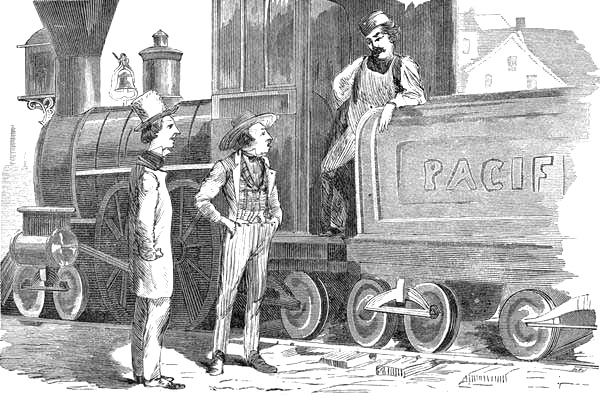
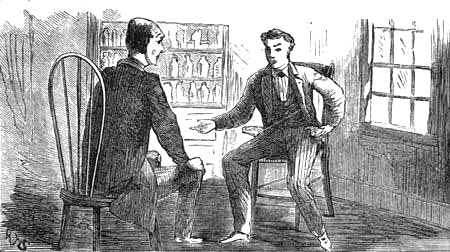
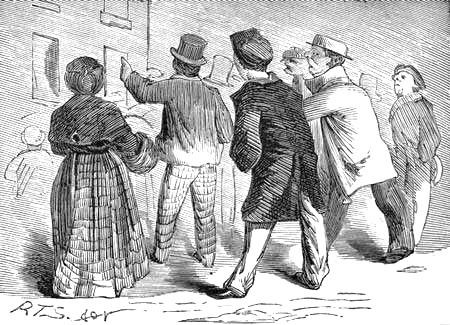
COMMENCING A PRACTICE IN NEW YORK.
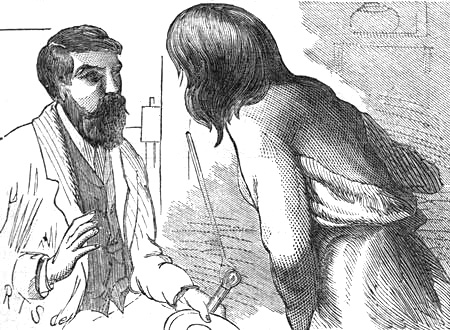
“What avails it that I know as much as other physicians who have entered
upon a practice? What does my diploma amount to if I have no patients?”
he asked himself over and again. Practice was now his want, and this is
the way he obtained it. Having read of a celebrated physician, who kept
his few patients a long time in waiting, under pretence that he was
preoccupied by the many who fortunately had preceded, our young physician
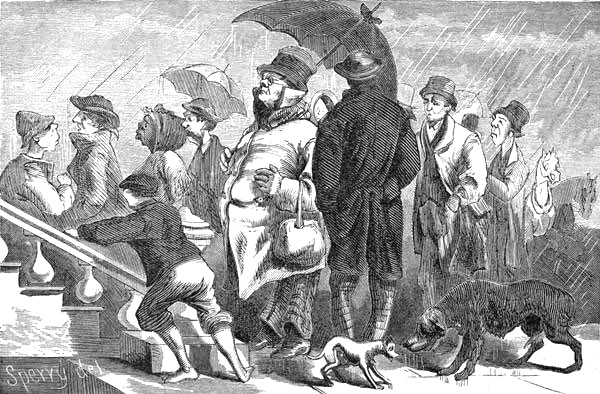
adopted that great man’s tactics. For want of patients to keep in waiting,
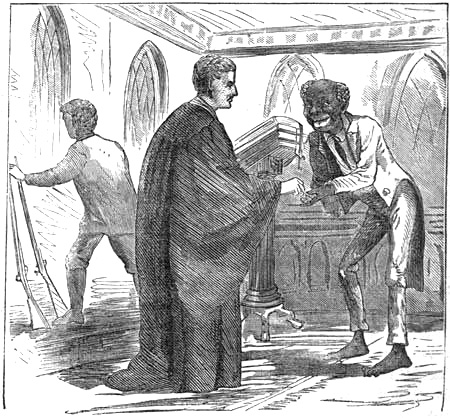
he hired some decently dressed lackeys to apply regularly at his front
door, at specified times, and wait till the colored servant admitted them,
one at a time. Each was passed out after a half hour’s supposed
consultation, and the next admitted. The neighbors and others passing,
seeing patients continually in waiting, some with a hand, a foot, face, or
other parts bound up, were led to read his sign, and soon a bona fide
patient applied, who, in turn, was kept waiting a long time,
notwithstanding the young doctor’s anxiety to finger a real medical fee
from his first New York patient. Others followed, the lackeys were
dismissed, and the physician’s practice was established. His merit kept
what his shrewdness had obtained.
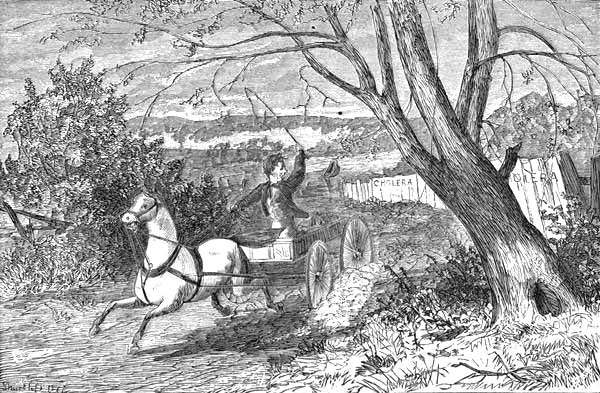
Cannot the reader avouch for the reputed extensive rides of some country
doctor, who, without a known patient, harnessed his bare-ribbed old horse
to his crazy gig, and drove furiously about the country, returning by a
roundabout way, without having made a single professional visit, thereby
humbugging the honest country people into a belief that he had innumerable
patients in his route?
To quite another class of humbugs belongs the subject of the following
sketch. I have had the pleasure of meeting him but twice—may I never meet
him again. The first interview was at the board of a country hotel.
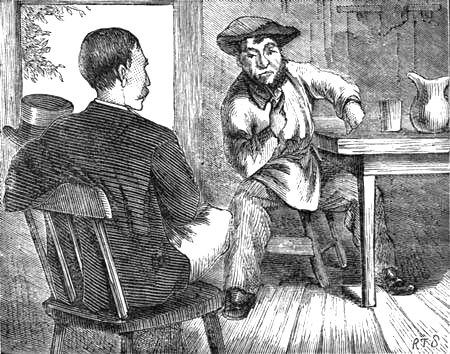
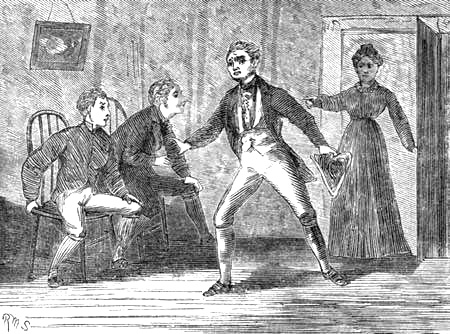
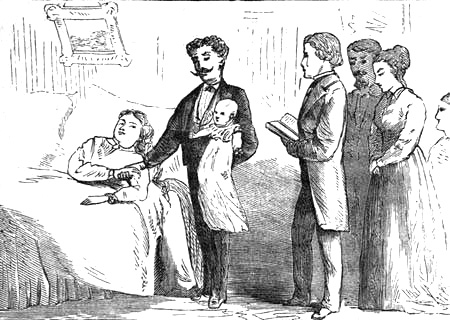
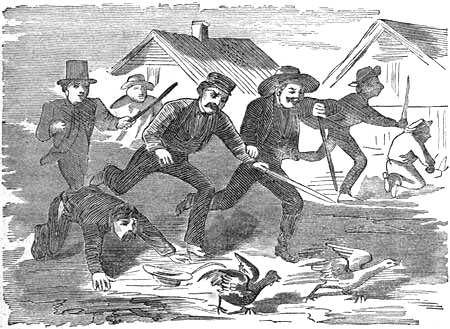
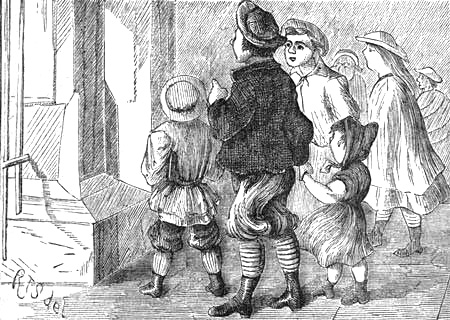
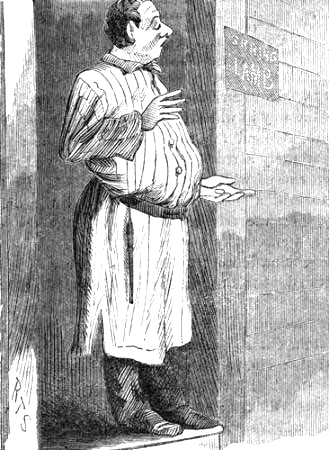
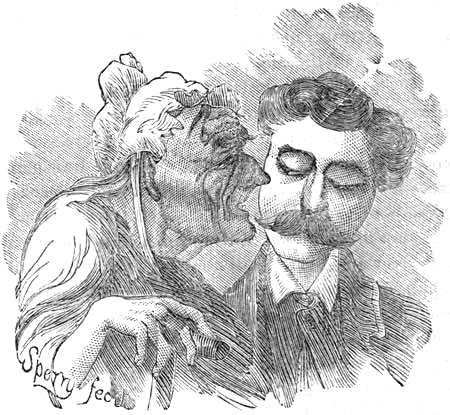
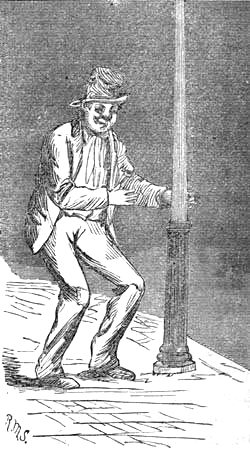
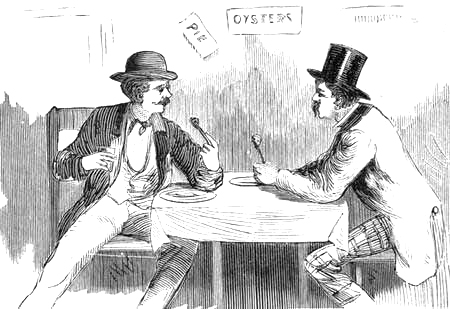
GRACE BEFORE MEAT.
I had arrived late at evening by rail, and ordered a light supper. When
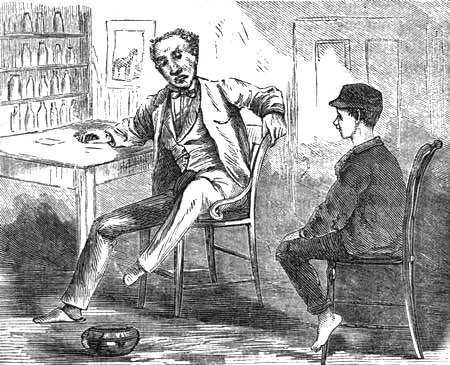
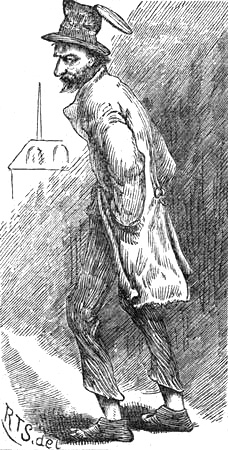
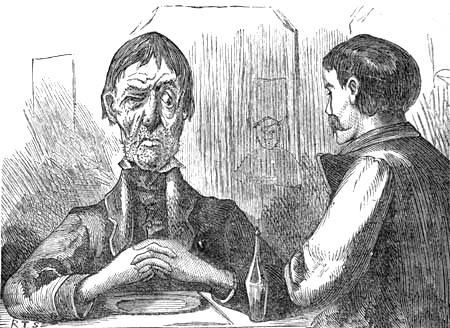
the tea-bell had summoned me, I found a large, phlegmatic individual
seated opposite at the table, who possibly had arrived by the same
conveyance as myself. His person was quite repulsive. He was probably
fifty years of age, his eyes watery and restless, his thin stock of
hair—indicating a corresponding poverty of brain—black, streaked by
gray, was stuck back professionally (!) over a low bump of veneration, and
high organs of firmness and self-esteem, which, with a Roman nose, large,
protruding under jaw, and wide, open mouth, gave him a striking
appearance, at least. But what was most observable was his thin, uneven,
scraggy whiskers, uncombed, and besmeared by tobacco juice and bits of the
weed, drooling down over their uncertain length, over waistcoat, and so
out of sight below the table. His coat sleeves had evidently been
substituted for a handkerchief when too great a surplus of tobacco juice
obstructed his face. He bent his great, watery eyes over towards me, and
opened the ball by suggesting that I ask a blessing over the food so
bountifully and temptingly laid before us. Having too much compassion on
the present exhausted state of my stomach to disregard its immediate
demands, and too little confidence in the veneration of my vis-a-vis to
return the request, I went to eating, while he closed one eye, keeping the
other on a plate of hot steak just placed before him by the table girl. I
have since been strongly reminded of him by the character “Bishopriggs,”
in Wilkie Collins’s book, “Man and Wife.” I think, however, for
hypocrisy, the present subject exceeded Bishopriggs. Having wagged his
enormous jaw a few times, by way of grace, he began eating and conversing
alternately.
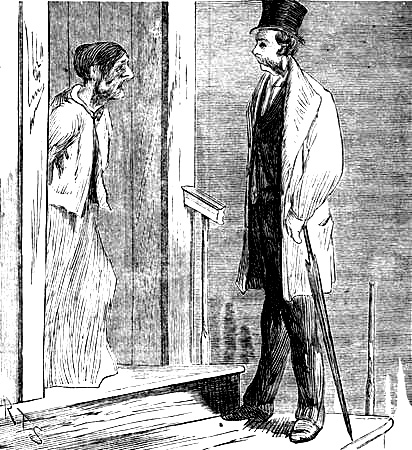
“I take it, friend, you’re a railroad conductor, coming in so late,” he
suggested, between mouthfuls.
“No,” was my brief reply.
“Perhaps, cap’n, you’re a drummer. Sell dry or wet goods?”
“No.”
“A newspaper man?”
I merely shook my head.
“Then a patent medicine vender?”
“No!” emphatically.
“Not a minister,” he asserted. “Perhaps a doctor,” he perseveringly
continued.
“Yes, sir; I am a physician.”
“O! ah! indeed! I am rejoiced to learn it. Give me your hand, sir,” he
exclaimed, rising and reaching his enormous palm across the table. “I am
rejoiced, as I said before, to meet a brother.”
“A brother!” I repeated, with unfeigned surprise and disgust.
“Yes, a brother! I, too, am a doctor. I have the honor,” etc., for the
next ten minutes, while I hastened to finish my supper.
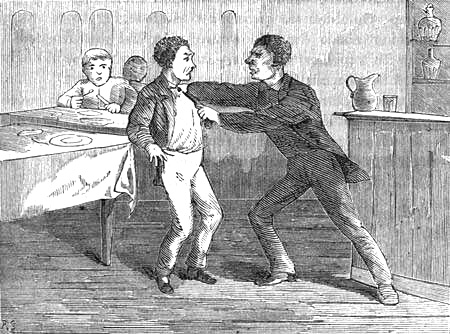
His last interrogation was what a college boy would call a “stunner.”
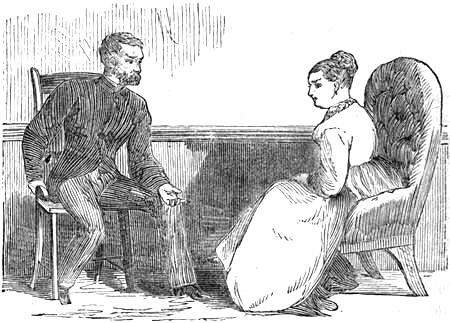
“Do you think, sir, that the Fillopian ducks are the same in a male as
they are in a female?”
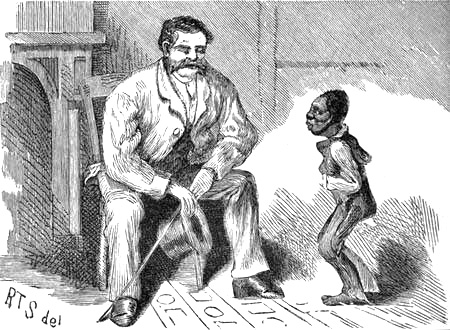
[Dr. S., a quack living in Winsted, Conn., once said to an educated
physician, that he sometimes found difficulty in introducing a female
catheter on account of the “prostrate” (meaning prostate) gland,—which
exists only in the male!]
I saw him once after the above interesting interview. He entered the drug
house of Rust, Bird, & Brother, Boston, just as I was about to go out. I
could not refrain from turning my attention towards him, as I recognized
his stentorian voice.
“Have you got any Bonyset arbs?” was all I waited to hear. I
subsequently learned that he was known in Vermont and part of New York
State by the sobriquet of “Dr. Pusbelly.”
The following story respecting “Dr. Pusbelly,” related in my hearing by a
stage-driver, is in perfect keeping with the character of the man, as he
impressed me in my first interview at the country hotel.
Dr. Pusbelly.
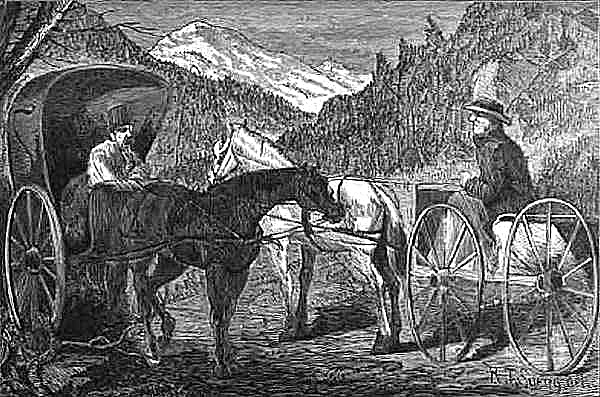
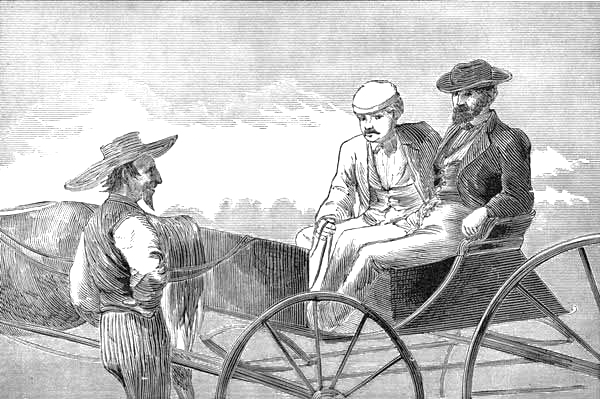
One sunny day in autumn I had occasion to take a long journey “away down
in Maine,” when and where there was no railroad. I was seated on the
outside of a four-horse stage-coach, with three or four other passengers,
one of whom was a lady, who preferred riding in that elevated station to
being cramped up inside the coach with eight persons, besides sundry
babies, a poodle dog, and a parrot.
“Sam,” our driver, was a sociable fellow, full of pleasant stories,—and
Medford rum, though he was considered a perfectly safe Jehu. The greatest
drawback to his otherwise agreeable yarns was his habit of swearing.
Notwithstanding the presence of the lady, he would occasionally round his
periods and emphasize his sentences with an expletive which had better
have been omitted.
“Can’t you tell a story just as well without swearing, Sam?” I inquired.
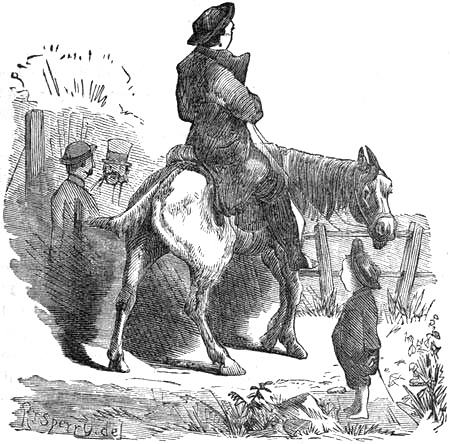
“O, no; it comes second natur. Why, cap’n, everybody swears sometimes. And
that reminds me—Git up, Jerry” (to the horse). “There was an old doctor,
Pill—Pilgarlic, I called him, on account of his pills, and the strong
effluvia from his cataract mouth. He was up round Champlain, where I drove
before the d—d railroads ruined the great stage business. Well, he was as
religious as a cuss,—that ain’t swearin’, is it, cap’n? Well, he came
round there pill-peddling, you see, and in order to make the old women
believe in his (expletive) medicines—”
“Don’t swear, Sam. You can tell the story better without. Come, try,”
interrupted a passenger, with a twinkle of fun in his expressive eyes.
“Who’s telling this story,—you or me?” exclaimed Sam, with a wink.
“Yes, he talked pills by Bible doctrine, swore his essences by the blood
of the Lamb, the —— old hypocrite. I knowed he was a blamed old
hypocrite, for I had to drive him round every onct in a while, and he
never failed, in season and out of place, to exhort me to seek salvation,
and a new heart, and pure understanding, while, all the time, the filthy
tobacco juice slobbered all over his filthier mug, and down his scattering
whiskers;—now and then one, like the scattering trees in yonder
field,—all over his vest; and his coat sleeves were as bad, from frequent
drawing across his face. Yes, he said, ‘Jesus,’ but he meant pills. He
said, ‘Get wine and milk, without money and without price,’ but he meant,
buy his essences, with money. The old gals went crazy over him, and the
pill market was lively. The louder he prayed and exhorted, the faster he
sold his medicines.
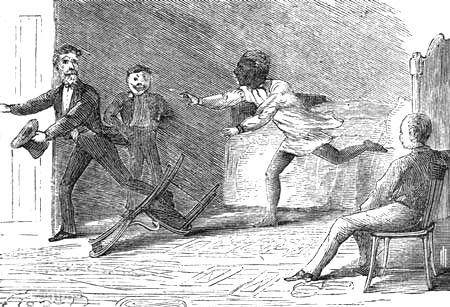
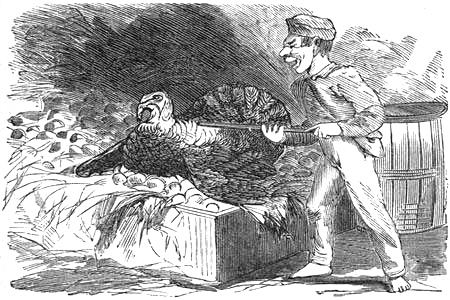
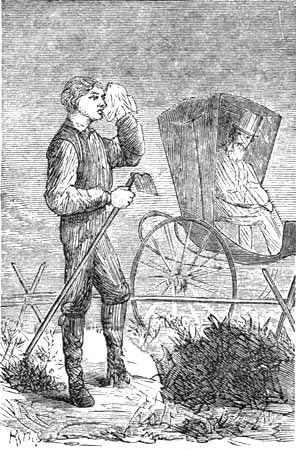
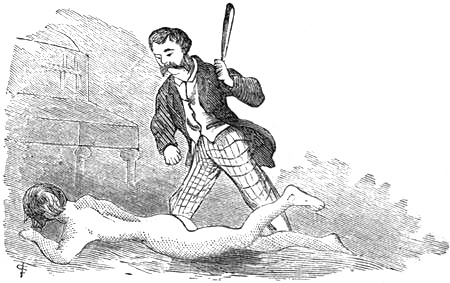
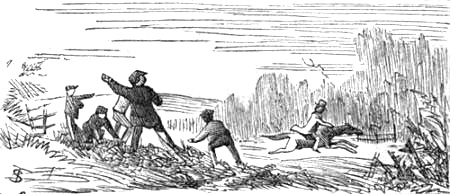
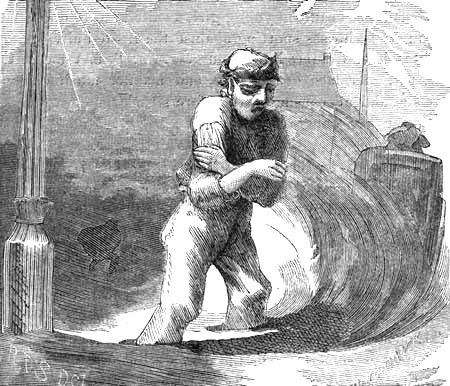
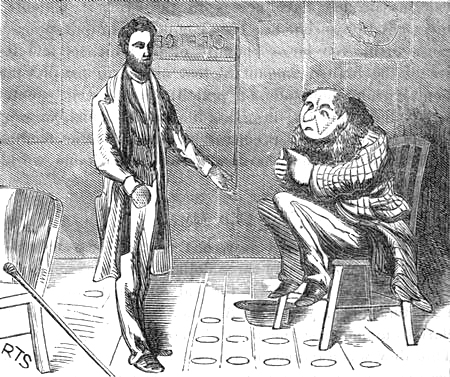
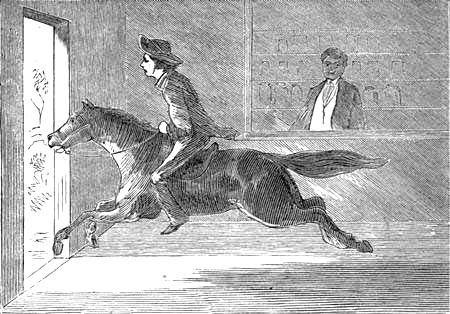
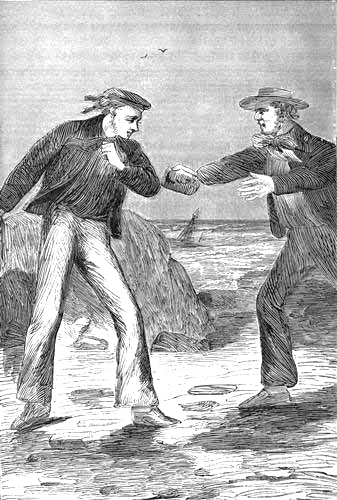
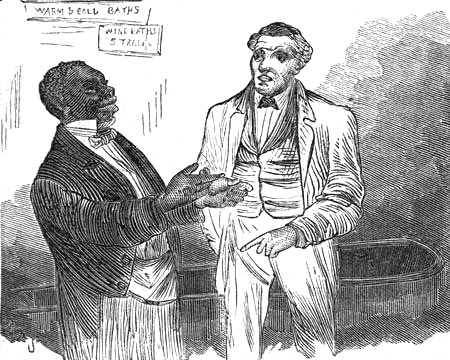
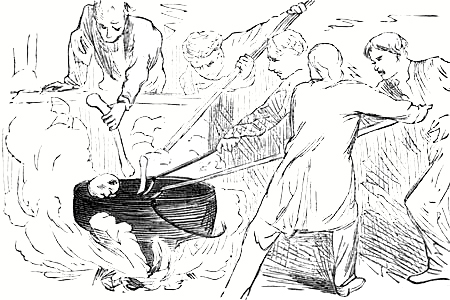
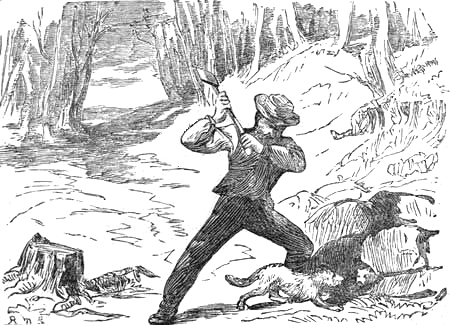
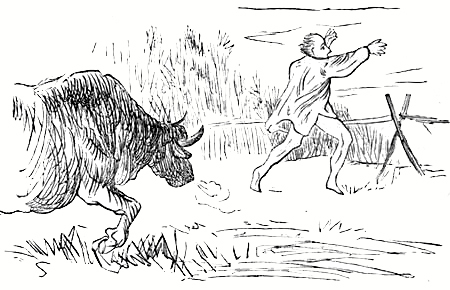
“One Sunday afternoon he wanted me to shy him over the lake; so, taking
his Hem-book and Bible in his coat pockets, and his two tin trunks of
medicine, he followed me to the shore. He seated his great carcass in the
starn of the boat, while I rowed him over the lake. All the way he
slobbered tobacco juice; and gabbled his religion at me, while
occasionally I swore mine back at him.
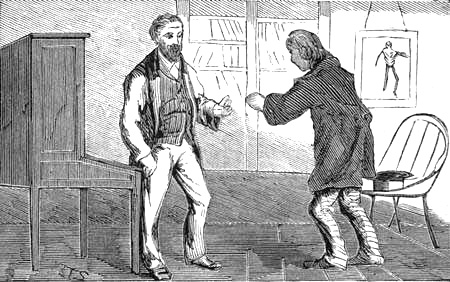
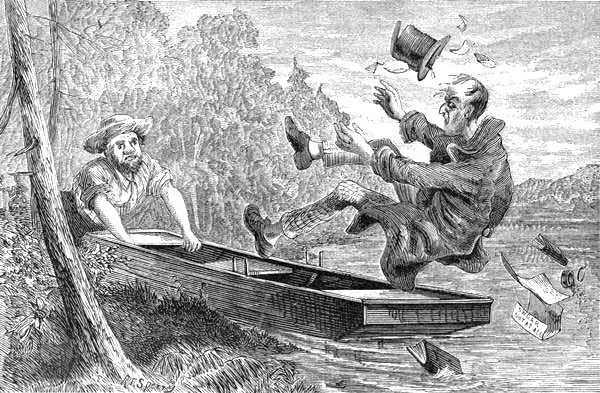
“When we got over, I jumped out, and told him to set steady till I hauled
the boat up further; but he didn’t mind, and rose up in the starn with his
kit, a tin trunk in each hand, just as I gave the craft a yerk, when over
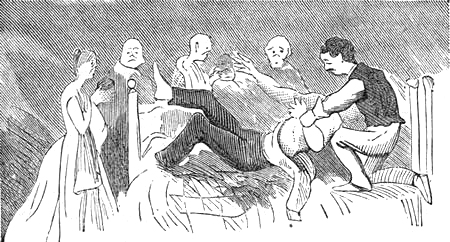
backwards he went kerflounce into the water,—carcass, trunks, Bible,
pills, and essences, all into the lake. O, the d——! You ought to have
seen him. Up he came, puffin’ and blowin’ like a big whale! Then I fished
him out with the boat-hook, and went for his trunks. No sooner had he
reached terror firmer than, blowin’ the surplus water and tobacco out of
his throat, he commenced swearin’ at me. Religion went by the board! O,
Jerusalem! Such a blessing as he gave me I never before heard. I knowed it
was pent up in him, the —— old sinner, and he only wanted the occasion
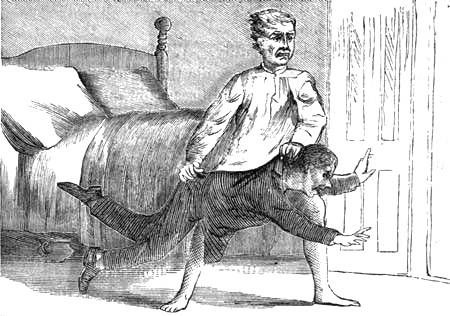
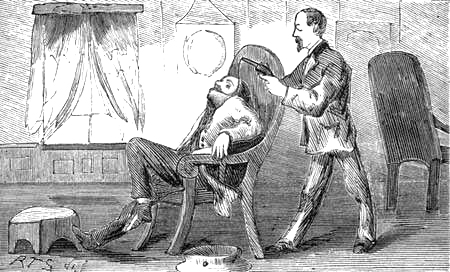
to let it out. The bath done it! It was the cussidest baptism I ever
witnessed in the hull course of my life.”
“Was he called Dr. Pusbelly?” I suggested, at the close of the narrative.
“Yes, that was his name; but I called him Old Pilgarlic, blame him.”
“Professor Brewster.”
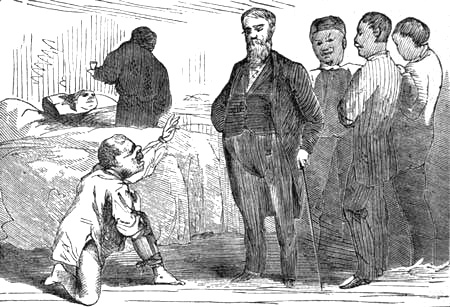
When I lived in Hartford, Conn., some years ago, there resided in that
city a black man, then somewhat noted as a “seer” among various classes of
whites, as well as blacks, and who resides there still, and has since
become quite famous. In what category to place this man,—Professor
Brewster, so called,—it is perhaps a little difficult to determine;
whether among “clairvoyants,” “animal magnetizers,” “natural doctors,”
“fortune-tellers,” or what, or all, it must be admitted that he is a
“character,” and wields great influence among certain classes. Nature made
him a superior man of his race, and what thorough, early education
might have done for him, we are left to conjecture. So noted is
Professor Brewster, that I have thought him a proper subject for comment
here, as a living illustration of what a man of subtle genius may
accomplish, though wholly without “book learning,” or other approved
instruction, in the field of medicine.
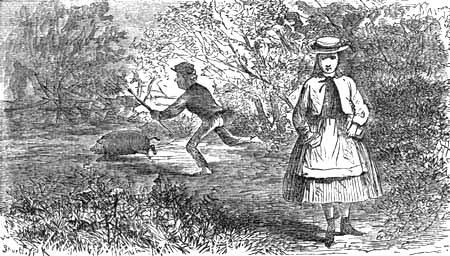
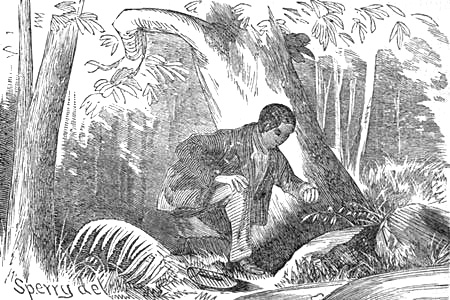
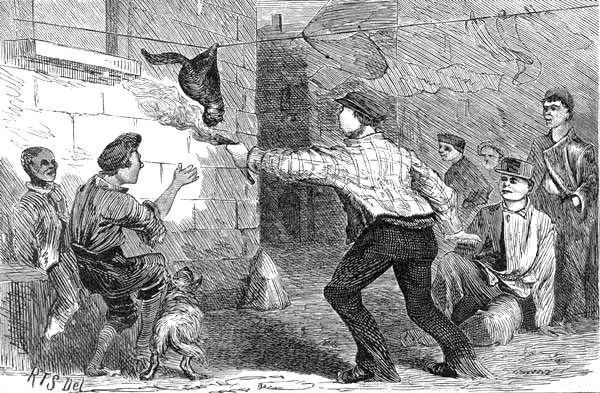
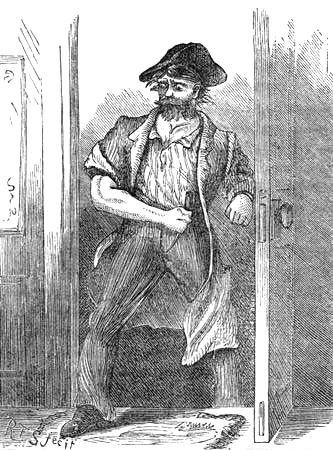
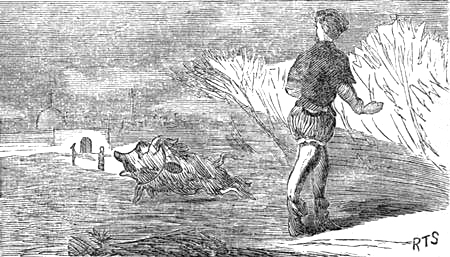
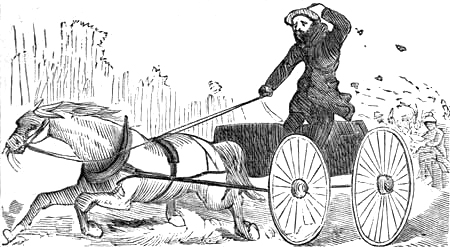
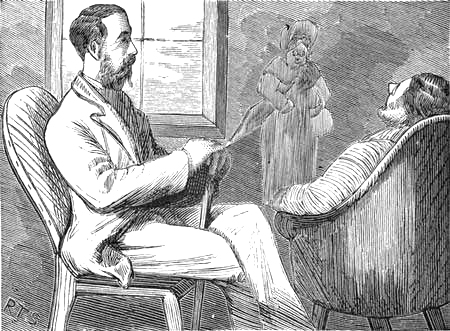
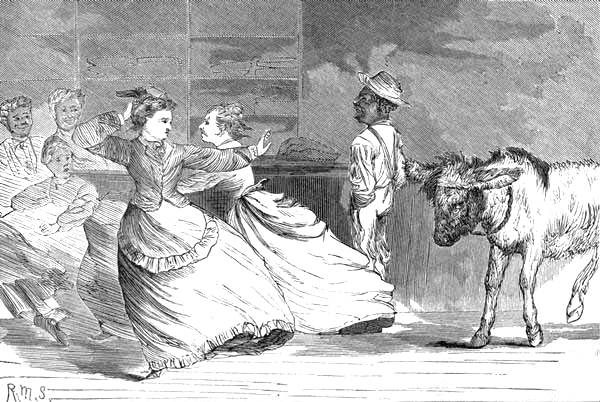
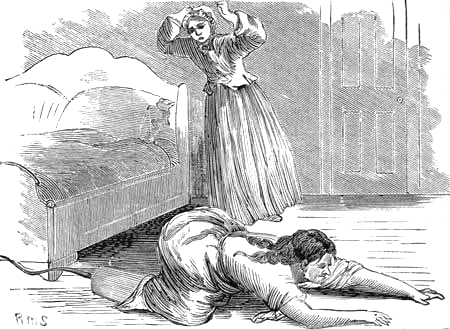
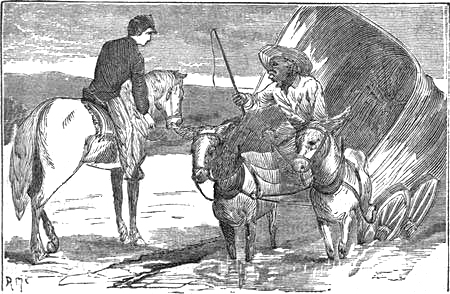
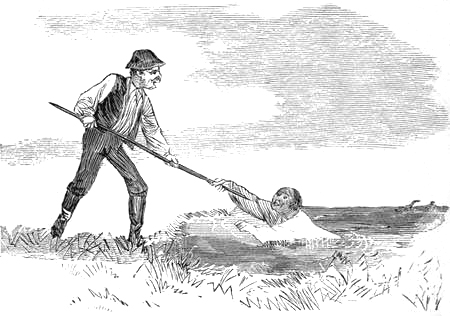
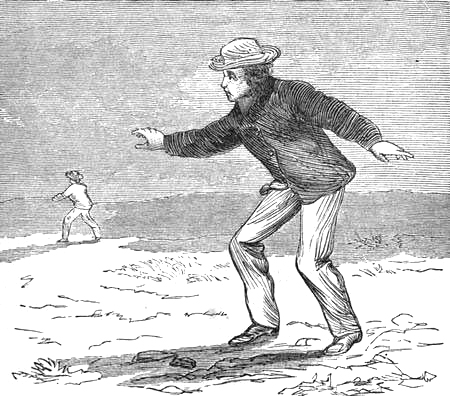
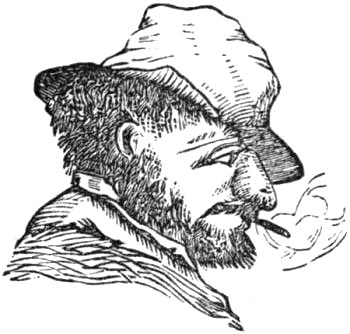
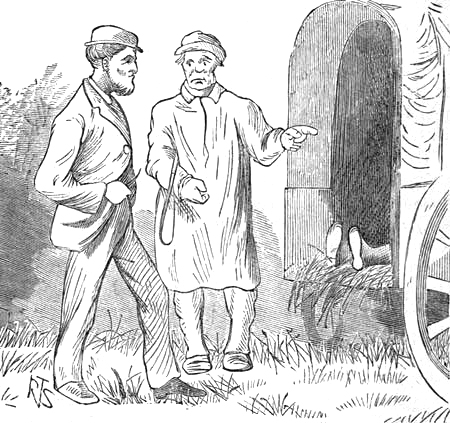
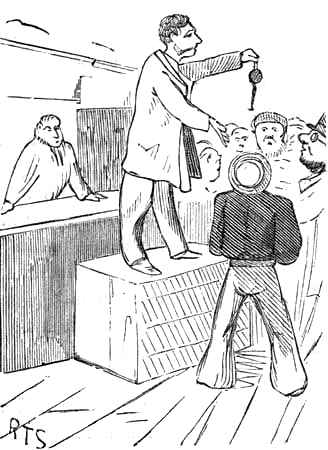
OLD PILGARLIC TAKES A BATH.
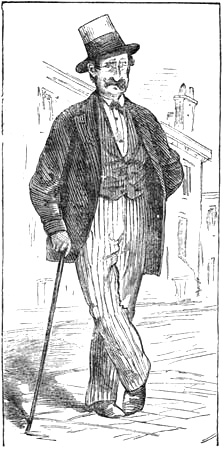
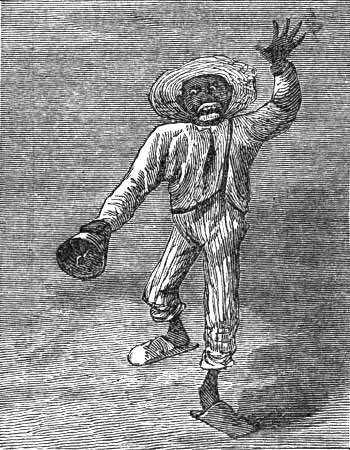
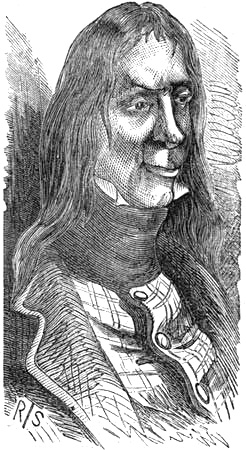
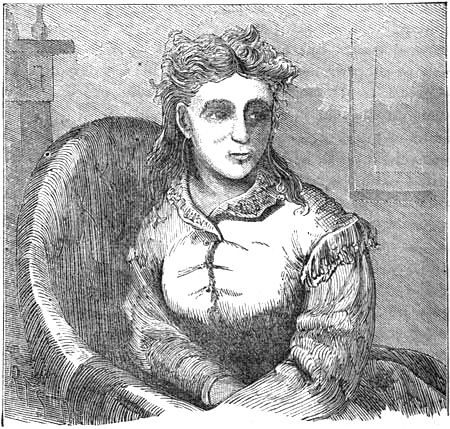
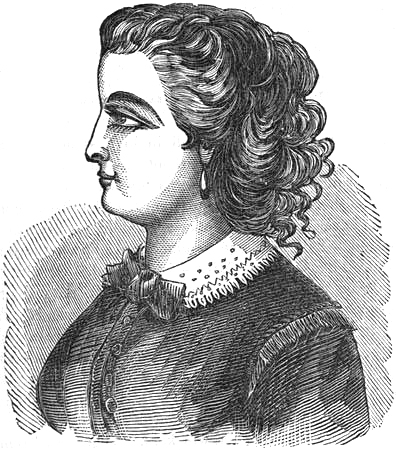
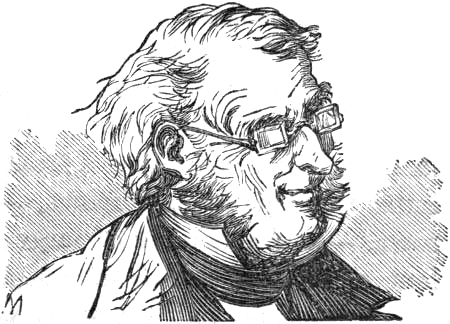
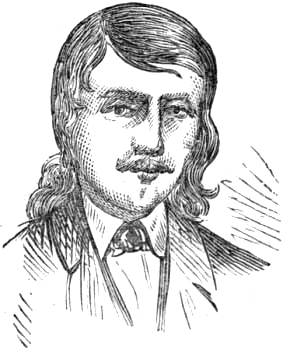
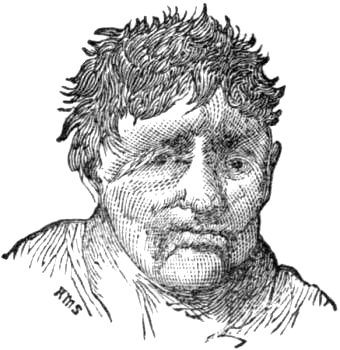
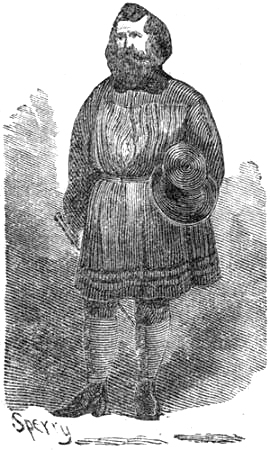
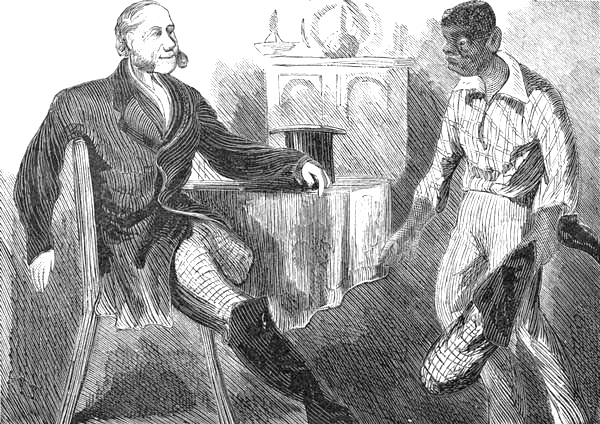
A reliable friend of mine has gathered the following facts and statements
in regard to Professor Brewster, and taken pains to secure the
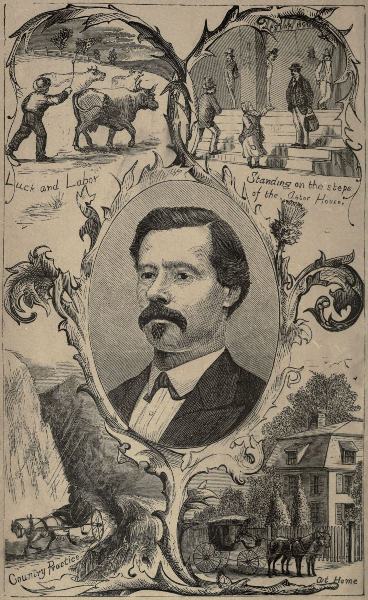
accompanying engraving of the veritable professor, as he appears in the
year 1872.
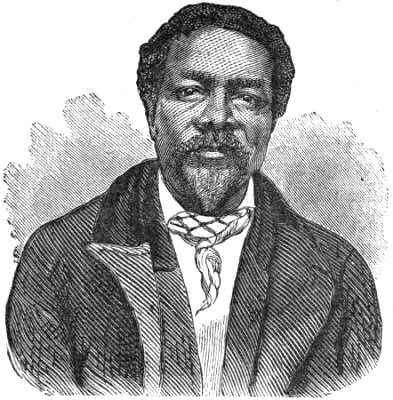
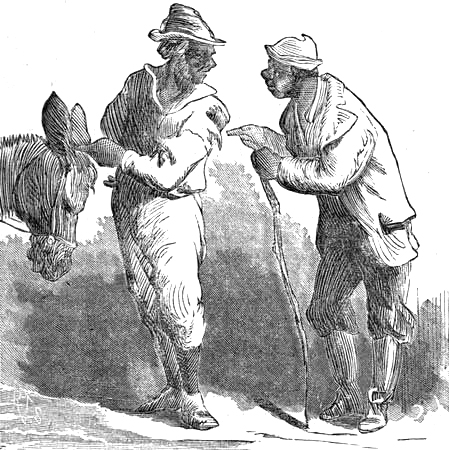
PROFESSOR BREWSTER.
“The full name of this remarkable man, now residing in Hartford, Conn., is
Worthington Hooker Erasmus Brewster, commonly called, by those who venture
on familiarity, ‘Worthy’ Brewster, for short. Worthy is of full medium
height, powerfully built, and well knitted together. His head is very well
moulded, and also extremely large, but not disproportionally large for his
massive shoulders. He was born of ‘poor but honest’ (though undoubtedly
black) parents, in the town of Granby, Conn., on the 21st day of January,
1812.
“The boy Worthy, at the age of six years, went with his mother (his father
having died) and her new husband to the hills of Litchfield County to
live, and was there brought up to youth’s estate, enjoying the
opportunities of education at the district school in what is now West
Winsted. The places of the birth and early rearing of Professor Brewster
are fixed beyond question, which fact will, it is hoped, forbid the
contention of other towns, and of ‘seven cities,’ or more, over the
question, after he shall have passed away. Worthy was not attracted to
literature and science, however. He seemed to spurn these, as unworthy of
his natural gifts to waste their time upon. But he learned to read, and
can write a ‘fair hand.’ Seeing no special need of being cramped and
confined by the narrow rules of spelling, Worthy has invented a style of
orthography for himself, and writes a compact, forcible, and even masterly
letter.
“But we must not linger on the details of his youth. Suffice it that
Worthy grew up a powerful lad, and became the conquering athlete of all
the region about his home. No man, of hundreds who tried, was able to
successfully wrestle with him. The strongest men were no match for him. He
was as agile as he was powerful, and to this day retains great elasticity
of foot and limb. He was a mysterious fellow also, and, before he was
sixteen years old, was regarded by his friends and acquaintances, of
African descent, especially, as a sort of prophet, while many whites
considered him a necromancer, and people all about declared he ‘had the
devil in him’ to no ordinary extent. Worthy claimed, in those days, to
‘see visions,’ and many stories are current among his contemporaries
regarding his then being able to ‘charm snakes,’ and do other miraculous
things. Abundant witnesses, such as they are, can now be found ready to
take their oaths that they have seen Worthy, ‘with their own eyes,’
perform his miracles. It is certain that these believe in him.
“At the age of twenty Worthy went to New York city, where (in Lawrence
Street) he lived for the period of a year, successfully practising the art
of fortune-telling. While there Worthy first discovered his powers as a
‘mesmerizer,’ or magnetic physician. A school-girl, knowing that Worthy
‘practised the healing art’ somewhat, and suffering intensely with a
toothache, jeeringly asked him, ‘Why can’t you think of something to cure
my toothache?’ Whereupon Worthy clapped his hands to her head, and
vigorously drew them down her cheeks, half in fun, half seriously, when,
to his astonishment, he found that all his (sound) teeth ached terribly,
while she declared that the pain had left hers. Such is his story; and it
is by no means an improbable one; for animal magnetism is a fixed fact
(however it may be analyzed or defined), and diseases are often
‘magnetically’ alleviated; and Worthy, with his powerful body and superb
health, as well as native force of intellect, may be as naturally gifted,
as a magnetic operator, as even Mesmer himself. Indeed, the writer is
inclined to believe that Worthy’s great power over many people is largely
due to his superior vital forces.
“Worthy now turned his attention considerably to diseases, but returned to
Litchfield County for a while. At the age of twenty-six, he resolved ‘to
see more of the world,’ and in the capacity of steward embarked at New
Haven on board the brig Marshal, Captain Brison, freighted with horses,
and bound for a long trading voyage to the Island of Demarara, and to
South America, where they coasted during the winters, and took in coffee,
etc., in exchange for their cargo. Worthy was gone from home on this
voyage two years and two months, during which time he learned many
mysteries. He was a foreign traveller now, and his polite and
professional education may be said to have at that time become
‘finished.’
“Since then Worthy has practised medicine to considerable extent, told
fortunes, ‘looked’ (in a crystal) for stolen property, and, if we are to
believe half of what is attested by many astute people (such as police
detectives, etc.), has, by force of his great sagacity, or in some way (he
would say, through clairvoyance), managed to achieve great success in
ferreting out lost or stolen treasures, and bringing thieves to grief.
“People of all classes in society visit him with their troubles of mind
and body. But the major part of his clientage is females. The wives and
accomplished daughters of wealthy men, as well as poor and ignorant women,
come from distant parts of the country to consult him, and a great number
of the first ladies of Hartford also consult him. Worthy carries on the
business of a ‘chair-seater,’ partly to occupy his time during the
intervals of his divinations, and partly to provide an excuse for cautious
persons to call on him for consultations. Those who consult him do so
mostly regarding secret matters, and they pretend to visit him to engage
him to seat chairs!
“He is consulted in respect to all sorts of diseases, and by unsuccessful,
perplexed, or doubting lovers; by husbands whose wives have absconded, and
who are anxious to call them back; by wives in regard to their wandering
husbands; by hosts of superstitious people (and these are found in all
classes), who believe themselves ‘possessed by devils,’ or demons. He is
expected to cast out the devils (and he does so as surely as most doctors
cure imaginary diseases). People who have lost property, and officers of
the law in search of stolen goods, consult him; and bachelors and widowers
in want of wives, and countless maids (both old and young), anxious to get
married, visit him and receive his sweet consolations, or mourn over the
ill luck which he prognosticates for them. His correspondence is large. A
hasty glance through several hundred letters in ‘Professor Brewster’s’
possession convinced the writer that the amount and character of the
superstition and ignorance which exist in these days, in our very midst,
are probably but little conjectured by the more cultivated classes. They
are indeed astounding, but are not confined, as we have before intimated,
to the wholly illiterate classes. People competent to write letters with
grammatical precision, and observing what would ordinarily be called an
‘excellent business style,’ at least, in their composition, consult the
professor; and so successful is Worthy in his diagnoses of and
prescriptions for various diseases, that many of his patients write him
letters overflowing with gratitude, while others voluntarily and
admiringly attest his skill as a ‘seer.’ To what talent, ‘gift,’ or what
secret of good luck, ‘Professor Brewster’ owes the many successes he wins
(even though he may fail ten times more often than he succeeds), we
cannot, of course, decide. But certain it is that he, with all his claims
to a knowledge of the ‘occult,’ exists, practises his arts, and through a
period of years has retained his old patients, and the postulants before
his supposed demigodship, while adding constantly to their number. In this
he is a remarkable man. He has accumulated quite a respectable property,
and is decidedly one of the ‘institutions’ of the enlightened and
cultivated city of Hartford.
“It should be remarked here that Worthy was, during the late civil war, a
true patriot. He was attached to the twenty-ninth regiment Connecticut
Volunteers, under Colonel Wooster (a ‘colored’ regiment), and was ‘gone to
the war’ over two years. His powers as a ‘clairvoyant,’ or ‘fore-seer,’
served him in the war, and he ‘always knew what was coming,’ he says. As a
part of the curious history of the war, serving to show how little the
people of the North understood, in the first years of the contest, that
they were fighting for a great humanitary end,—the abolition of chattel
slavery,—it may be noted here, that Worthy wrote to Governor Buckingham,
in August, 1862, proposing to raise a black regiment, and the governor, by
his secretary, replied to Worthy’s proposition, that he then did ‘not deem
it expedient,’—which fact institutes a comparison between the judgments
of the governor and Worthy, not uncomplimentary to the latter.”