In the most sociable city, in the most sociable age in the history of
the world, there is one man who stands out as the host par excellence.
In the Rue Royale at Paris and in his country house at Grandval, near
Charenton, Baron d’Holbach entertained for more than thirty years the
wit and the celebrity of all nations. His name runs like a thread
through the English memoirs and letters of the mid-eighteenth century.
There was not a Frenchman or a Frenchwoman of fame and fashion who had
not dined at the Rue Royale on the immortal Thursdays and Sundays, or
driven down from Paris to Grandval for a few days of a company and a
conversation unequalled and, perhaps, unrivalled.
But it is not only or chiefly as the Host of All the World that
d’Holbach is remarkable. He was the ‘maître d’hôtel of philosophy.’
Voltaire, banned and exiled, could only encourage
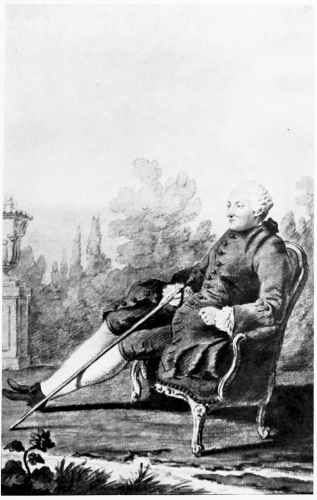
PAUL-HENRI-THIRY. BARON D’HOLBACH.
From a Portrait in the Musée Condé, Chantilly.
his children from lonely Cirey or far Geneva. D’Holbach was here, in the
midst of them.
Comfortable, cultured, liberal, the freest of all free thinkers, and yet
always in the smiling good favour of the authorities, not shy and
retiring like d’Alembert, not wild and imprudent like Diderot, without a
profession to distract him from his appointed métier, with a
well-stocked mind, an enormous income, a fine library, a pretty wife, a
first-rate cook, and an admirable cellar—why, here was the man intended
by Fate to be the link to bind us together and to make for us a
meeting-place, a common ground, where, in words to be first applied only
to the Head of our Party,
In very wantonness of childish mirth
We puffed Bastilles, and thrones, and shrines away,
Insulted Heaven, and liberated earth.
Was it for good or evil? Who shall say?
. . . . . .
Paul-Henri-Thiry d’Holbach was born in 1723 at Heidelsheim, in the
Palatinate. His father, said Jean Jacques Rousseau when he had
quarrelled with the son, was a parvenu. Another of Paul-Henri’s guests
announced that his host was called Baron because he was ‘of German
origin, had a small estate in Westphalia, and an income of sixty
thousand livres.’ Very little is known with certainty of his family. He
was brought up in Paris, and was from the first French of the French,
Parisian of the Parisians. He seems to have visited Germany as a very
young man, and to have studied natural science there. He made his bow to
the literary world by translating German scientific works into French.
At his death Grimm wrote in the ‘Literary Correspondence’ that the rapid
progress natural history and chemistry had made for thirty years in
France was largely owing to the Baron d’Holbach.
As a young man the Baron was what he remained all his life—a compiler,
an annotator, a transcriber, rather than the possessor of any great
original talent of his own. Boy and man he had in perfection that gift
which surely makes for human happiness more than any other single
quality—a devoted love of learning. He was always rich enough to buy
the books and the leisure to gratify that love. He lived in an age and
in the midst of brilliantly accomplished men and women. He should have
found life delightful. He did. A serene, easy, generous nature, troubled
by no agitating ambitions, everything seems to have fallen out from the
first according to his modest desires. For him, and for him alone among
Voltaire’s co-operators, the path to light and knowledge flowered
pleasantly all the way. The others look out eagerly from their
portraits—furrowed foreheads and burning eyes—or with faces noble and
sad, like d’Alembert or Condorcet. Only the good Baron is seated at his
ease in his pleasant, sumptuous garden, surveying life calmly and
leisurely. Which things are a parable.
In 1752 or 1753, when he was about thirty years old, he began writing
articles for that Encyclopædia which set on almost all its other
contributors the ban of Government ill-favour. Only Paul-Henri—writing
always judiciously under a pseudonym—gained nothing but pleasure and
approbation from his excellent papers on mineralogy and chemistry. He
formed the happiest life-long friendships with his fellow-writers in
that immortal book. He married a pretty and charming wife, Mademoiselle
d’Aine. She died, in August 1754, after a very brief married life.
D’Holbach travelled abroad with Grimm for a while.
In 1755, he obtained a special dispensation from the Pope, and married
his deceased wife’s sister, Mademoiselle Charlotte-Suzanne d’Aine, and
began to live with her a life which presented the very rare combination
of perfect domestic contentment and the most brilliant social success.
In the very heart and core of Paris, Rue Royale butte Saint-Roch, the
Baron held in his town house what Rousseau calls the ‘club holbachique,’
Diderot ‘the synagogue of the Rue Royale,’ and Garat ‘the Institute of
France before there was one.’ Here, at two o’clock every Sunday and
Thursday, unless the d’Holbachs were in the country, their friends were
certain to find a free and affluent hospitality, the most intellectual
society of the capital, the most distinguished foreigners who visited
it, a host as liberal in idea as in the very good cheer to which he made
his guests welcome, and the most daring speculative conversation of the
eighteenth century.
But, after all, it was not in the Rue Royale that d’Holbach and his
friends found their most characteristic setting. Grandval, near
Charenton, remains not only the most influential salon of the age, the
great headquarters of a great party and the arsenal in which were forged
the armaments which destroyed a king, a dynasty, and a state religion,
but also the country house of the period.
When Talleyrand, in that much quoted phrase, declared that no one knew
how delightful a thing life could be unless he had belonged to the upper
classes before the Revolution, he might have been thinking of the life
at Grandval in particular.
There was a fine and charming château, and the most delightful of
gardens. Grandval was just near enough to Paris, and just far enough
away—which is to say, it was absolute country, within easy reach of
town, in an age when the suburb was not, or, at least, when the social
drawbacks comprehended in the word ‘suburban’ had no existence. The
estate actually belonged to Madame d’Aine, d’Holbach’s mother-in-law,
who was as ‘lively as any romp of fifteen,’ always thoroughly enjoying
herself, determined her guests should do the same, and with the rare
wisdom to leave them to do it in their own way.
Madame d’Holbach was pretty, gay, and charming. She played on the lute,
adored her husband and children, and hated philosophy. If her guests
like to talk it—and they are always talking it—well, by all means, so
they shall! Live and let live, do as you like come what may—these would
have been the Grandval rules, if it had ever bothered itself to have
anything so tiresome as rules.
The d’Holbach children were adorable—or despatched to governesses and
servants if they even threatened to become less than adorable. There
were two little boys and a couple of little girls, the elder ‘as pretty
as a cherub,’ said Diderot, and the younger ‘a ball of fat, all pink and
white.’
Then there was an ami de la maison, a household fixture, a
chimney-corner habitué—a Scotchman named Hope, and nicknamed Père
Hoop—a shrivelled, withered, pessimistic person, who suffered, or said
he suffered, from ‘life-weariness’ and bad health, who was an excellent
foil to what Sterne called the ‘joyous sett’ in which he found himself,
and the perpetual and dismally good-natured butt of Madame d’Aine’s
rippling jokes.
The Baron had all the virtues of the host. He was not only rich and
generous—with that cook and cellar beyond reproach. In those days to be
a perfect entertainer something more even than this was required. An
agreeable talker, and a still more agreeable listener, really learned,
but with the most pleasing human weakness for a little scandal, as
easy-going as his mother-in-law and his wife, entirely simple in manner,
with no faintest touch of pretension or affectation, a bon vivant in
the pleasantest and most harmless sense of the phrase—who would not
delight to have been among his guests?
There were generally three or four of them staying in the house, and
sometimes very many more. Diderot was here often for weeks together, and
sometimes for months. He had a special bedroom always reserved for him.
In d’Holbach’s most intimate confidence, his abundance, fecundity, and
inspiration were in piquant contrast to the Baron’s calm learning and
well-regulated sense. Here too came, but not very often, Diderot’s
partner in the Encyclopædia, d’Alembert. Too shy and retiring to enjoy
Grandval’s freedom and liveliness as a recreation, d’Alembert’s work
for his party was not to be advanced, as his brethren certainly advanced
their work, by speculative talk in clever company—but always in
solitude, in silence, and in simplicity.
Turgot, like d’Alembert, was from time to time a guest, but a rare one.
Turgot was beginning to Do, what most of his friends were still
discussing How to do.
Little Galiani skipped down very often from the Italian Embassy, and the
Paris he worshipped, to amuse the Baron’s house-party by telling it
those stories, ‘like dramas,’ which no one ever found too long. ‘That
man is a pantomime from his head to his feet,’ said admiring Diderot,
watching him. After 1761, the heavy Abbé Morellet, the would-be refuter
of Galiani’s wit on the Corn Laws, was constantly at the Baron’s
‘developing my theories on public economy’ to his own great
satisfaction. His audience have not left their feelings on record.
Grimm, Diderot’s dear Damon, was here very often, with that slightly
nauseous affection for his Pythias, which, said the frankly vain Denis,
made d’Holbach jealous. For jealous, one may be allowed to read
‘disgusted.’
Grimm’s chère amie, Madame d’Épinay, sometimes accompanied him. Her
sister-in-law, Madame d’Houdetot, often drove down to Grandval with her
superb Marquis de Saint-Lambert in her train. Pitted deeply with the
smallpox, with a cast in her eye, and a little given to too much wine,
the secret of Madame d’Houdetot’s charm is hard to be found by this
generation. But in that one, it was not only Rousseau who discovered it
to his cost. Saint-Lambert’s ‘faith unfaithful kept him falsely true’ to
her for so many years that it came to be considered quite praiseworthy,
and he would have been admitted to Grandval as Madame d’Houdetot’s
constant lover, if his passion for Madame du Châtelet and his poem on
the ‘Seasons’ had not given him the entrée as a literary character as
well.
His rival, Jean Jacques Rousseau, was also an habitué at d’Holbach’s.
The peaceful Baron could agree even with that fretful child of genius,
until one unlucky day, when, Grandval having suffered gladly and
politely a curé’s reading of his own stupid tragedy, Jean Jacques
bounces furiously out of his armchair, seizes the manuscript from its
author, and throws it to the ground—‘Do you not see these people are
laughing at you? Go back to your curacy.’ The kindliest and politest of
hosts tries to smooth the ruffled plumage of both playwright and
Rousseau. If the curé was appeased is not a matter of moment. Jean
Jacques burst out of the house in a rage, and despite all the efforts
of Grimm and of Diderot, as well as of d’Holbach himself, never returned
to it. ‘He imagined all his misfortunes our doing ... and thought we had
incited ... all Europe against him,’ says Grimm. He did try, however, to
make some amends to his good host by portraying him in the ‘New Éloïsa’
in the character of Wolmar—‘benevolent, active, patient, tranquil,
friendly, and trustful.’
Marmontel came here very often: and that dreadful, garrulous old bore,
the Abbé Raynal, was constantly to be found seeking ideas among the
Baron’s guests for his ‘History of the Two Indies,’ which received, and
did not deserve, the advertisement of burning.
The cautious Buffon soon edged away from this salon, as he also edged
away from the gatherings of Helvétius. The monstrous things these people
talk about might come to the ears of the authorities—accompanied by the
fact that the politic author of the ‘Natural History’ was among the
talkers! Helvétius himself was often at d’Holbach’s, until the storm of
fury and hatred which assailed his book ‘On the Mind’ banished him,
astounded and embittered, to his estates in Burgundy.
Madame Geoffrin, with her prim little cap tied under her firm old chin,
drove down to play picquet with the Baron and to scold Diderot for
neglecting his wife.
It was partly owing to the influence of Diderot—himself greatly bitten
by the Anglomania just creeping into fashion—that the Baron entertained
Englishmen so largely both in Paris and in the country.
In the years 1762-64-66 Sterne accepted the hospitality of the host,
whom he called ‘the great protector of wits and the sçavans who are no
wits,’ to so large an extent that he could say the Baron’s house was as
his own. To be sure, d’Holbach’s ‘joyous sett’ must have admirably
suited this Parson Yorick, who had ‘no religion but in appearance,’ and
a domestic morality very little better than the worst of the Baron’s
French convives.
The ‘broad, unmeaning face’ of Hume, the historian, was sometimes to be
seen at d’Holbach’s table, where he found himself for the first time
with thinkers not too narrow, but too emancipated, for his liking. It
was the Baron who, speaking from experience, warned Hume against
nourishing in his bosom a serpent like Rousseau, and from d’Holbach’s
house, says Hume’s biographer, Burton, that the story of the famous
quarrel between Hume and Rousseau spread all over France ‘in a moment.’
David Garrick came to Grandval, and delighted an age and a company
passionately devoted to histrionic talent. A sprightly Madame Riccoboni
used to write accounts of d’Holbach’s society to the actor when he had
gone back to England; and whenever she saw the Baron looked bored or
worried, made that expression a text on which to moralise on the
worthlessness of riches.
The Baron did not often appear anything but placid, however, and there
are very few of his guests who even hint at anything in himself or his
gatherings which was not smooth and delightful.
Horace Walpole, indeed, talks of ‘dull d’Olbach’s.’ But then Horace was
the intimate friend of Madame du Deffand, who loathed ‘les philosophes’
and all their ways and works, and on one occasion at least was so
unlucky as to find himself at one of the Baron’s dinner parties, not
only the solitary Englishman out of a party of twelve, but next to that
tedious Raynal. ‘I dreaded opening my mouth in French before so many
people and so many servants,’ says Horace; and to avoid being bored by
the ‘Two Indies,’ he made signs to Raynal that he was deaf. After
dinner, Raynal discovered the trick, and naturally was not pleased.
John Wilkes, with his ugly face, his flaming past, and his irresistible
charm, also sat at the Baron’s cosmopolitan board; as did Benjamin
Franklin, Lord Shelburne, and Priestley—Non-conformist, chemist, and
one of the founders of modern scientific criticism.
Some of these people, of course, only dined, or were merely invited to
spend a long day in the Grandval grounds and gardens; but many became
part of the house party for days, like Galiani, for weeks, like Grimm,
for months, like Diderot, or for ever, like Father Hoop.
In the forenoon, the guests were left entirely to their own devices, and
unless by special arrangement, never met each other or their host until
dinner-time at half-past one or two. Some of them had arrived with a
chef-d’œuvre in their pockets—or, it might be, up their sleeves.
Here, in the pleasant solitude of these morning hours, Galiani, no
doubt, was ‘settling the question of the Corn Laws,’ Grimm engrossed
with his ‘Literary Correspondence,’ and Hoop arranging his pessimism
into a regular system. (Madame d’Aine had thoughtfully provided Hoop
with a bedroom overlooking the moat, so that he could at any moment put
his principles into practice and throw himself into it.) Diderot, beside
his open windows and with the solace of a cup of tea, wrote for
Mademoiselle Volland those descriptions of life at Grandval to which all
narrators of it are indebted.
As for the Baron—the Baron always seemed to have plenty to do in that
magnificent library, where he could invariably find chapter and verse
for the maddest of Diderot’s theories, but where the actual nature of
his occupation was known only to Diderot himself, to a certain very
useful friend called Naigeon, who, having been painter and sculptor, had
finally settled into a philosopher, and to La Grange, the d’Holbach
children’s tutor.
It is charitable to suppose that the women also performed their duties
in the morning, since it is certain they performed none at any other
time of day. But in this age, if a woman was witty and charming, her
métier was considered to be fulfilled, and she not only did nothing
practical for the good of humanity, but, better still, never even felt
she ought to be doing something. Madame d’Holbach had her lute and her
embroidery frame, the kindest of clever husbands, those engaging babies,
and a perpetual house party. What more could be expected of her? Of
Madame d’Aine, it is not recorded that she had any other rôle than
that of adding to the gaiety of her household.
At about half-past one, then, the work of the day was done, and hosts
and guests met in the salon, and went in to dinner—the famous dinner,
exquisitely arranged and appointed; servants numerous, noiseless, and
perfectly au fait in their duties; the most delicate wines, and the
most irreproachable of chefs. A couple of Englishmen, perhaps, and
half a dozen French men and women had driven down to it from Paris.
There were generally from twelve to fifteen persons at table, and
sometimes more. Good as the fare was—much too good for the health of
some of the diners—‘the only intoxication’ at this table ‘was of
ideas.’
The talk ranged from the history and customs of the Chinese to the final
annihilation of the human race. Sometimes it lit on ‘Clarissa Harlowe,’
and the company divided itself into For and Against Sentiment as
understood by the bookseller Richardson. Occasionally the meal was given
up to buffoonery, and Madame d’Aine led the way with jokes of such a
character that if Morellet is conscientious in declaring in his
‘Memoirs’ that all freedoms, except freedoms as to speculation, were
banished from d’Holbach’s gatherings, he must certainly have been deaf.
One day, a story going the round of the Paris cafés, holds the table
curious and laughing. The Baron, says Grimm, was as amusingly credulous
of gossip as he was sceptical of everything else. Another day, it is a
question of ton or of mode; and a third, of art or of literature.
There was scarcely one of d’Holbach’s convives—there was not one of
Voltaire’s co-operators—who did not contribute, at one time or another,
a masterpiece, or at least a Book of the Moment, for d’Holbach’s table
to discuss.
In 1755, it is the famous article on ‘Existence’ in the Encyclopædia, by
young Turgot, our shy, rare guest, which brings the heads of the older
Encyclopædists together over the walnuts and the wine, and inspires them
with prophecies of a great future for its quiet author. Three or four
years later, the great suppression of that Encyclopædia itself inflames
the passions of the party, goads Diderot to fury, and d’Alembert to
despair.
In 1759, the ‘Candide’ of the Master sets the table in a roar of
delight. ‘The Social Contract’ of our impossible, impassioned Jean
Jacques sounds for us, in 1762, the trumpet-note of battle in that
sonorous opening sentence: ‘Man is born free, and is everywhere in
chains.’ The next year, the guests give their ever-generous admiration
to a far wiser work—one of the mightiest weapons ever forged against
‘the greatest of human curses’—‘The Treatise on Tolerance.’ In 1765,
d’Alembert comes out of his shell again with his ‘History of the
Destruction of the Jesuits;’ while Diderot is for ever finger deep in
ink—up to the neck in ideas.
Only, at the head of the table, d’Holbach, host and president, always
applauding, encouraging, (and sometimes also financing) the producers,
himself produces nothing. Yet it is not because he does not go, as it
were, with his guests. He goes far beyond them. Here, the women of the
party left the table after dinner as they do in England, to exchange
what Diderot called their ‘little confidences.’ Then the conversation
took, not the kind of freedoms which Morellet declared he did not hear,
but speculative liberties which, said he, ‘would have brought down
thunderbolts on the house a hundred times if they ever fell for that.’
At d’Holbach’s table, with d’Holbach pushing, urging, with a quiet,
invincible persistence, with Diderot waving the flag, leading, pleading,
inciting, the ‘club holbachique’ dragged every dogma, every so-called
fact of existence, every creed, into court before them; judged by the
tribunal of their own reason, and cast away all that failed to satisfy
it, as fagots for the burning.
Grandval did not speculate, as did Voltaire and his guests at Ferney, on
the attributes of God and the nature of the Soul. It began where he left
off: asked not, What is God? but, Is there a God? not, What is the Soul?
but, Have we a Soul? and in each case answered, No.
Gagged for hundreds of years, Grandval used the newly seized freedom of
thought and speech as a very little later the mob used its social and
political liberty. The bloody extremes of the Terror, and the
speculative extremes of d’Holbach’s table, were alike the result of long
slavery and repression.
That d’Holbach at least was strongly and honestly persuaded of the truth
of his own unbelief, and was convinced that he did well to destroy in
men those faiths which, looking back on history, he saw were responsible
for the intolerable miseries of religious persecution, is not doubtful.
D’Holbach was an honest man. It is true, indeed, that he was not one of
the highest intellectual capacity. His seems to have been just the kind
of clever mind—much more common among women than men—which is the dupe
of its own cleverness, and easily led by it into absurdities which both
wise people, and very simple ones, detect and avoid.
Set the problem of deriving Everything from Nothing, it is not
marvellous that the Grandval talkers descended sometimes to the wildest
nonsense. Horace Walpole said acidly that they soon turned his head
with ‘a new system of antediluvian deluges which they have invented to
prove the eternity of matter.... Nonsense for nonsense, I prefer the
Jesuits.’ No wonder poor little Galiani (he was an Abbé, though he
very often forgot it) fled to the more circumspect gatherings of Madame
Geoffrin, that the wise Turgot also turned away from Grandval, and
d’Alembert drew back from an atheism so positive and arrogant.
By the time the philosophers joined the women it was four, five, or even
six o’clock. It does take some hours to construct Man and the Universe
out of Chaos, with nothing but blind Force to help us! Then came for the
host himself, and some few of the other men of the party, a walk in the
beautiful gardens. Most of the Baron’s guests, however, sat indoors with
the women, Nature and exercise being both greatly out of fashion in the
eighteenth century.
When the walkers returned the evening was drawing in, and there were
lights and cards on the table. Some of the guests rested on long chairs.
Some played picquet, some billiards, some tric-trac. Some visited their
host’s picture gallery or his famous cabinet of natural history. He was
himself always pleasant, courteous, cheerful. He loved to rally gently
‘the old mummy,’ as he called Father Hoop, and, perhaps, other Fathers,
certain Jesuit priests, whom, in defiance of all his own principles, he
generously made free of his house.
Old Madame d’Aine entertained the whole company with her perfectly
indecorous and perfectly good-natured wit. Madame d’Holbach, always
‘douce et honnête,’ ‘très aimable,’ and exquisitely dressed (the
description is Madame d’Épinay’s), accepted her mother’s buffooneries
with absolute complacency.
Coarse as this society was in its speech—worse as it was in its easy
condonation of vice than the worst social sets of our own day—in one
respect at least it was immeasurably superior. Except for an occasional
desultory game proposed by their hosts, the guests at Grandval were
expected to bring, and did bring, their own entertainment with them in
their own heads. To be bored would have been to confess oneself stupid.
For the costly freaks of amusement, the elaborately idiotic devices of
modern times to prevent the visitor having to fall back for an instant
on his own resources or intelligence, Grandval had no need. If
materialism was its creed, there was, as has been justly said, a great
deal of ‘indirect spiritualism’ in its practice. Its lengthy dinners
were feasts of reason (in spite of those intellectual extravagances)
as well as of costly meats and wines, and the ill-flavoured jests were
only interludes in the midst of brilliant and fruitful talk on
literature, history, politics, and the new world beginning for France.
Supper came about nine—‘wit, gaiety, and champagne,’ Diderot described
it. Then more conversation, until sometimes the party were still
ardently philosophising with their bedroom candle-sticks in their hands.
When d’Holbach had been entertaining, apparently without a break, for at
least ten years, he took what seemed to his friends the foolhardy, not
to say desperate, resolve of crossing the Channel. To bury himself in
what Diderot called ‘the depths of England’ for two months is a very
different thing, the Baron will find, from entertaining Englishmen (and
those quite the most enlightened of their species) in Paris! He did find
it so. If England delighted Voltaire, soothed wounded Helvétius, and
pleased even critical Grimm, she thoroughly disgusted d’Holbach. He gave
Diderot his vivid first impressions of her, and Diderot retailed them,
red-hot, for Sophie Volland and for posterity.
The Baron was hospitably received and entertained in this island by a
rich and generous host, whose name has not transpired; he had the best
of health during his visit, and he paid that visit in August, when even
the British climate can be very tolerable; he had the pleasure of
calling on his guest, Garrick; he went to Oxford and Cambridge;
travelled in some of the prettiest English counties, and he was
bored—to extinction.
Our confessedly bad manners he found worse than anyone had ever found
them before, and was dreadfully disgusted with people ‘on whose faces
one never sees friendliness, confidence, or gaiety, but which all wear
the inscription, “What is there in common between you and me?”’ The
aristocracy struck him as cold and haughty, the common people as rough
and violent. As for the dinner parties, ‘where people sit according to
their rank, and formality and ceremony are beside each guest,’ after the
gracious ease of Grandval, the Baron may be forgiven for finding them
intolerable.
Then the public entertainments: ‘This people is sad and melancholy,
especially in places built for pleasure. You can hear a pin drop. A
hundred stiff and silent women promenade round an orchestra discoursing
the most delicious music,’ and the promenade can only be compared to
‘the processions of the Egyptians round the mausoleum of Osiris.’
Then the gambling: ‘Englishmen lose incredible sums in perfect silence.
By thirty they have exhausted all the pleasures, even beneficence. Ennui
... conducts them to the Thames, unless they prefer a pistol.’
At the universities, the good Baron found many ‘rich do-nothings
drinking and sleeping half the day;’ at Court, corruption; among the
people, no public education and great inequality of riches. The King, to
be sure, was powerful chiefly to do good, but still he was much the
master. With regard to religion, ‘the Christian religion,’ said the
Baron, ‘is almost extinct in England.’ This was an advantage from his
point of view. But then, though there were innumerable Deists, like
Hume, there was not an atheist, or not an avowed one. The travelling
facilities he praised—there were always post-horses in plenty; and at
the meals at inns, he found himself ‘served promptly, but with no
affability.’ It must be owned that now and again the Baron has us on the
hip.
But, after all, there was very great good in England: it made one so
delighted to get back to France. D’Holbach, who had left Paris about
August 1, 1765, had returned there by September 20. He dined that same
evening with his dear Diderot and a whole colony of English, ‘who had
left their morgue and sadness on the banks of the Thames.’
Two years after his return, there appeared, not only to the horror of
Court, Church, and Government, but to the horror of the philosophers
also, a book called ‘Christianity Unveiled, or an Examination of the
Principles and Effects of Revealed Religion.’
It purported to be by a person called Boulanger. It asserted
Christianity to be unnecessary for the maintenance of law and order;
declared its dogmas incoherent, its morals fit only to make enthusiasts
and fanatics, and its political results infinitely fatal and disastrous.
Voltaire fell upon the thing tooth and nail. ‘Impiety Unveiled,’ he
called it. It was not Christianity, but the perversions of Christianity,
with which he quarrelled. In the margin of his own copy of the book he
wrote criticisms as scathing as they are brief. That it was both
discussed and condemned at d’Holbach’s table, is practically certain.
Galiani at least professed Christianity; Turgot practised it. There are
many men—there were some even round d’Holbach’s board—who, having
themselves relinquished a faith, are yet greatly averse to hearing that
faith blasphemed; and who would fain leave for the souls of others the
consolations their reason denies to their own. D’Holbach, to be sure,
would commend the thing. ‘A proselytising atheist,’ as his friends had
long known him to be—he must approve this daring effort to make men
think as he did.
Soon came talk of other books—from the same hand it might be—certainly
from a hand as bold. In 1767 appeared a pamphlet called ‘The Mind of the
Clergy;’ in 1768 ‘Priests Unmasked,’ and ‘Portable Theology.’ The last
was condemned to be burnt.
Then came whispers of yet another work on the same lines, but on a far
larger scale, written with an even greater daring, with ‘the zeal of a
missionary for atheism,’ with a passion, a fanaticism, an enthusiasm,
usually associated with the ‘heated pulpiteer’ of some narrow sect; and
yet having in it, too, something of the serenity, the calm and confident
faith of the believer wholly satisfied with his belief. Who has written
it? A. M. Mirabaud, Perpetual Secretary to the French Academy, is to be
the name, it is said, on the title-page. But the real author? Diderot,
whose Encyclopædic labours bring him in touch with all the literary men
in Paris, is impulsively positive that he has not the slightest idea.
Naigeon—Naigeon, the Baron’s factotum—is abroad on some business of
the Baron’s and cannot be appealed to. Most of the company condemn the
book unseen. The extremists of the party are always the worst enemies
the party has to dread. At the head of his table, fingering his glass
thoughtfully, the Baron, with his benevolent, leisurely air, is only
following his usual custom in saying little and listening much.
In August 1770, there was published in London and Amsterdam ‘The System
of Nature, or The Laws of the Physical and Moral World,’ by Mirabaud,
Perpetual Secretary to the French Academy.
The best kept literary secret in history is the authorship of the
‘Letters of Junius,’ for that remains a secret still. But the Baron
d’Holbach’s authorship of ‘The System of Nature’ is certainly among the
most piquant concealments in literature.
He had begun by sitting and listening to criticisms, mostly adverse, on
his ‘Christianity Unveiled’ and the pamphlets which followed it, which
were all from his pen. Many people start a literary career under as
thick a veil of anonymity. A few have died still under the disguise. But
no book has ever attracted such howls of rage and imprecation, such a
storm of universal loathing and opprobrium as did ‘The System of
Nature,’ while its author sat in perfect peace and comfort, beloved by
all his fellows, safe, unsuspected, and serene. D’Holbach, said Grimm
long after, when d’Holbach was dead and the secret out, never ran any
danger from his books, save the danger of being bored by them.
Naigeon, La Grange, and Diderot were in his confidence. Diderot was more
than in it. To most of the Baron’s works—certainly to ‘The System of
Nature’—he lent some of the colour and fire of his genius. Poor Diderot
was always suspect of anything rash and extreme. ‘The System of Nature’
was published quite early in August. On the 10th of that month, Denis
slipped off to Langres and the baths of Bourbonne. The Baron went on
having dinner parties. On the 18th, the book was condemned to be burnt.
The Baron continued to dine in peace. Then, as men read it, and passed
it secretly from one to the other, the murmurs of horror and hatred
swelled to a roar—the roar of the great multitude, always deafening and
terrible. Above it, d’Holbach heard, close, distinct, and scathing, the
bitter condemnations of his own guests and friends. He went on dining to
that accompaniment.
From Ferney, Voltaire pronounced the work ‘a philippic against God’ and
‘a sin against nature;’ swore it had wrought irreparable harm to
philosophy; passionately refuted it in his article on ‘God’ in the
Philosophical Dictionary; while it wrung from him, in a letter to the
Duc de Richelieu, that famous confession: ‘I think it very good to
sustain the doctrine of the existence of a punishing and rewarding God:
society has need of this opinion.’ Galiani declared ‘this Mirabaud’ to
be ‘the Abbé Terrai of metaphysics: he causes the bankruptcy of
knowledge, of happiness, and of the human mind.’ La Harpe called it
‘this infamous book.’ Young Goethe said he fled from it as from a
spectre. It caused Frederick the Great to break with the philosophic
party. Grimm, indeed—but this was after d’Holbach’s death, when it was
no longer dangerous to hold such opinions—praised the purity of its
author’s intentions, and the passages of ‘imposing eloquence’ the book
contained—though these, he added, Grimm-like, ‘were by Diderot.’
Who reads ‘The System of Nature’ now? It never was in any sense a great
book. But it certainly was one of the three or four most famous books of
an age richer in them than any other age in history. It was, after all,
simply the logical outcome, the natural, though the extreme result of
the rationalistic criticism of the fifty or sixty years which preceded
it. The philosophers had sought to define God. D’Holbach said aloud,
what the fool of David’s time said in his heart, ‘There is no God.’
In Part I. he disposed of Kings as effete, luxurious, war-making, and
tyrannical. Then he expounded his views on Happiness. Men will never be
happy till they are enlightened, and never enlightened till they have
ceased to believe in a God. Study Nature, and obey Nature’s laws—that
is the way to felicity, if way there be. Then he went on to Mind. All
Mind is Matter. Of Free Will he denied the existence, as twelve years
earlier his friend Helvétius had denied it in his book ‘On the Mind.’
Still, even if one cannot help one’s wrong-doing, punishments there must
be, for the good of society; only such punishments should be reformative
and never cruel. In his protest against torture and the brutalising
effect of public executions, one sees for a moment the man behind the
book. With regard to the Immortality of the Soul, since there is no such
thing as soul, it cannot be immortal. The false doctrine of Hell is
useless even as a deterrent from sin.
Part II. contains what is certainly the most burning and outspoken
attack on the Existence of God to be found in literature. That there is
a Force behind Matter, I admit. He who does not admit this, must be a
madman. But further I will not go. As for morality depending on a belief
in a Deity—not at all. Nature bids man do right as his own best
interest. Let each try to do his utmost for the greatest good of the
greatest number, and there stands established a high and an unselfish
ideal.
Preached, as these doctrines were, in a style not a little vehement and
abundant, with much Teutonic pomposity and rhetoric, it could soon be
said of d’Holbach that he had ‘accommodated atheism to chambermaids and
to hairdressers.’ More learned critics disliked his manner as much as
his matter. ‘Four times too many words in the book,’ says Voltaire
acidly. But the uneducated, or the half-educated, prefer both their
oratory and their literature rich and fruity.
Simple and learned alike would, or should, had they known him, have
given the author credit for the certain fact that ‘no sordid end, no
personal consideration, attached him to his dismal system.’ If his
anonymity shielded him from danger, it kept from him fame and celebrity
too, and gave him the wholesome, but not soothing, experience of hearing
expressed to his face criticisms of the kind generally only made behind
one’s back. He did not gain even the painful glories of martyrdom; and
had money been an object to him, by the publication of such works as
his, he can only have lost it.
Long before the tumult ‘The System of Nature’ raised had passed away,
the Baron was busy supplementing it. In 1772 appeared ‘Good Sense, or
Natural Ideas opposed to Supernatural Ideas,’ which was a sort of
simplification of ‘The System of Nature.’ It was burnt. Then appeared
‘The Social System,’ which tried to establish a rule of morality totally
unfounded on religion. That was burnt too. Then there was a translation
from Hobbes. The last, or one of the last, of d’Holbach’s published
works was entitled ‘Universal Morality, or the Duties of Man founded on
his Nature.’ This appeared in 1776. He had the pleasure of watching all
the bonfires from a distance where there was not the least danger of
scorching.
In 1781 one of his daughters was married. Her father was now
fifty-eight years old. Did philosophy, as Galiani inquired (Galiani had
returned to Italy in 1769), still eat at his table with its old
appetite? Grimm said—in Grimm’s caustic fashion—that the guests fell
off somewhat when the Baron had to retrench his expenses to establish
his children. Some of the convives had gone before that, to solve for
themselves those questions on a future world, and the existence of the
soul, which they had discussed so often. In 1771 died Helvétius; in 1778
Voltaire himself. In 1783, d’Alembert, who had indeed long ceased to
frequent the Baron’s society, or any society, laid down the burden of
his life. In the next year, Diderot, the friend of his heart, the
fruitful inspiration of his work, was called away from d’Holbach’s side
for ever.
It must have been with this society, as it is with all societies at
last: the sight of vacant chairs stops the mirth, and among the living
guests glide others, dear and dead. When one has more memories than
hopes, the time has come to give up such gatherings. That time came even
to the Host of his generation. By his own fireside he had to the end
the wife he loved. She long survived him. He had, too, that tranquil and
even disposition which is surely one of the best of assets—a possession
indeed.
The Baron was as prudent in the time of his death as he had been in the
conduct of his life. He died on January 21 of that annus mirabilis,
1789. Five years more, and he would have seen his own principles
enthroned with the Goddess of Reason at Notre-Dame, and as, in part at
least, the consequence of her reign, the streets of Paris running with
blood. Directly after his death, the secret of his authorship became
public property.
It is permissible only to think of d’Holbach now as his guests and
friends thought of him in life—not as the author of ‘The System of
Nature’ at all, but as the liberal patron of letters, the best and
kindliest of good, easy men. One may be permitted to hate as bitterly as
Voltaire did the unreasonableness of his philosophy of pure reason; and
yet to regard the philosopher with gratitude and appreciation, as the
man who played in the great intellectual revival of his time one of the
homeliest, yet one of the most necessary of parts.
For d’Holbach provided the rendez-vous.