As the large, thick-set man with the red face, the bushy mustache, and
the very square chin swung round on his swivel chair, at the great
roll-top desk with its elaborate arrangements of telephones, receivers,
and electric buttons, he conveyed to the little mild-eyed man waiting on
a chair by the door the sense of infinite power.
And surely it must be a position requiring singular gifts and remarkable
capacity. For was this not Dollbones, the house famous throughout the
civilized world for supplying trimmings, gimp, embroidery, buttons, and
other accessories to nearly every retail furnisher in England and the
colonies? and was not this Mr. Godfrey Hylam, the London manager? To
hold such a position a man must have not only brains, and an infinite
capacity for work and driving power, but he must have character, a
genius for judging people and making quick decisions.
“Almost like a general,” thought the mild-eyed man by the door. He had
waited fifty minutes in the outer office for his interview, and on being
at length shown in, had been told to “sit down a minute.” This minute
had been protracted into thirty-five minutes, but it was very
interesting to watch the great man grappling with the myriad affairs
that came whispering through the wires, and giving sharp instructions to
the two flurried clerks who sat in the same office, or dictating to the
young lady stenographer who sat furtively on a small chair by his side
scribbling into a book with a fountain-pen.
“She looks ill and worried,” thought the little man. He was indulging in
a dreamy speculation on the girl’s home life, when he was suddenly
pulled up by the percussion of Mr. Hylam’s voice. He realized that the
great man was speaking to him. He was saying:
“Let’s see, what’s your name?”
“Thomas Pinwell, sir,” he answered, and stood up.
“What name?” repeated the big man.
“Pinwell—Thomas Pinwell,” he said in a rather louder voice.
Mr. Hylam looked irritably among some papers and sighed. He then
continued dictating a letter to the stenographer. When that was finished
he got up, and went out of the room. He was absent about ten minutes,
and then came hurrying in with some more papers. He called out as he
walked:
“Jackson, have you got that statement from Jorrocks, Musgrove &
Bellwither?”
One of the clerks jumped up and said:
“I’ll find it, sir.”
The clerk took some time to do this, and in the meanwhile Mr. Hylam
dictated another report to the young lady. Then the clerk brought the
statement, and he and Mr. Hylam discussed it at some length. He gave the
clerk some further instructions, which were twice interrupted by the
telephone bell. When this was finished, Mr. Hylam again caught sight of
the little man by the door. He looked at him with surprise, and said:
“Let’s see, what’s your name?”
“Pinwell—Thomas Pinwell, sir,” he answered patiently.
Mr. Hylam again sighed and fingered a lot of papers in pigeon-holes. At
that moment there was a knock, and a boy in buttons entered and said:
“There’s Mr. Curtis, of Curtis, Tonks & Curtis, called.”
“Oh!” exclaimed Mr. Hylam. “Yes. All right. Er—ask him to come in. I
want to see him.” He turned to the telephone, and asked some one to put
him on to some one else, and while waiting with the receiver to his ear,
his eye once more caught sight of the little man by the door. He called
out to him:
“Oh!—er—just wait outside a minute, Mr.—er—Hullo! is that you,
Thomson?”
Finding himself temporarily dismissed, Mr. Pinwell took up his hat and
went into the outer office. There was a tall, elderly man with a
fur-lined overcoat standing there, and he was immediately shown in. He
remained with Mr. Hylam just one hour. At the end of that time, one of
the directors called and went out to lunch with Mr. Hylam. A clerk gave
Mr. Pinwell the tip that he had better call back about four o’clock. He
said he would do so. He had had thirty years’ experience in the
furnishing trade, and he knew that “business was business.” One had to
be patient, to conform to its prescripts. A gentleman like Mr. Hylam
lived under continual pressure. He was acting according to his
conscience in the best interests of the firm. One had to take one’s
chance with him. After all, it would be very nice to get the job. He had
been out so long, and he was not so young as he used to be. He thought
of his placid wife and the two children. They were indeed getting into a
very penurious state. He understood that the salary would be thirty
shillings per week, and a small royalty on the sales. Not a princely
emolument but it would make all the difference. Besides, what might not
the royalties amount to? If he worked hard and energetically he might
make between two and three pounds per week—who knows? He went into an
äerated bread shop and had a cup of tea and a piece of seed cake, and
read the morning paper. He stayed there as long as he dare, and then
went for a stroll round the streets. At four o’clock precisely he
presented himself at the managerial office at Dollbones once more. Mr.
Hylam had not returned. They expected him every minute. There were five
other people waiting to see him. At half-past four Mr. Hylam came in,
smoking a cigar. He was accompanied by another gentleman. They walked
right through the waiting crowd and went into the inner office and shut
the door. As a matter of fact, Mr. Pinwell did not see the manager at
all that day. So great was the congestion of business in the trimming,
gimp, embroidery, and button business that afternoon that he was advised
by one of the least aggressive clerks, at about a quarter to six, to try
his luck in the morning. It was a quarter-past three on the following
afternoon that he eventually obtained his interview with Mr. Hylam, and
it was from his point of view entirely satisfactory. Mr. Hylam said:
“Let’s see. You told me your name?”
“Yes, sir,” he answered. “Thomas Pinwell.”
Mr. Hylam seemed at last to find the papers he desired. He said:
“Er—just come here. Show me your references.”
Mr. Pinwell approached the great desk deferentially. On it was a chart
of London with one section shaded red. Mr. Hylam read the references
carefully and then asked one or two searching questions. At last he
said:
“Well, now, look here. This is your section. Go to Mr. Green, and he
will give you the cards and samples. Then go to Rodney in the Outer
London department upstairs, and he will give you a list of several
hundred furnishing houses with the names of the buyers and a few
particulars. Everything else you must find out. The salary is thirty
shillings a week and two per cent. on sales completed. Settlement
monthly. Good-day, Mr.—er—”
He turned to the telephone, and Mr. Pinwell’s heart beat rapidly. He had
really got a job again! As he walked to the door he had a vision of the
expression of delight on his wife’s face as he told her the news. He
visualized a certain day in a certain month when he would bring home a
lot of sovereigns and buy the children things. Two per cent.! For every
hundred pounds’ worth of orders, two golden sovereigns of his very own!
It seemed too good to be true!
His wife indeed did share with him the comforting joys of this new vista
of commercial prosperity. They occupied now two rooms in Camling Town,
and Tom had been out so long there was no immediate prospect of a
removal. But the rent was now secure and just the barest necessities of
life, and everything depended on the two per cent. commission. He was to
start on the following Monday, and the intervening days were filled with
active preparations. There were shirts to mend, an overcoat to be
stitched, a pair of boots to have the heels set up, and three new
collars to be bought. These were vital things pertinent to the active
propaganda of the bread-winner. Other things were urgent,—a new piece
of oil-cloth for the bedroom, some underclothes for the girls, and
several small debts—but all these things could wait, at any rate a
month or two, till the commissions started coming in. For Mrs. Pinwell
herself there never seemed necessities. She always managed to look
somehow respectable, and, as Mr. Pinwell once remarked to a neighbor,
“My wife is a marvel, sir, with a string bag. She always believes in
bringing the things home herself. She goes out into the High Street,
Camling Town, on a Saturday night, and I assure you, sir, it’s
surprising what she will bring back. She will make a shilling go further
than many of them would half-a-crown. She is a remarkable woman. It
surprises me how she manages to bargain, being so unassuming, so
diffident, as it were, in the home.”
There was nothing, then, missing in the necessary equipment of Mr.
Pinwell as he set out with his leather case of samples on the following
Monday. It was a cold, bright day, and he enjoyed the exercise of
walking. He was not by nature a pushful man and he found the business of
calling on people whom he did not know somewhat irksome. Fortunately he
was by temperament patient and understanding, and he made allowances
when people were rude to him, or kept him waiting indefinitely and then
gave him no orders. “It’s all in the way of business,” he thought as he
shuffled out of the shop and sought the next street.
At the end of the first week he explained to his wife:
“You see, my dear, there’s a lot of spade-work to be done yet. I’m
afraid Flinders, who had the round before me, must have neglected it
disgracefully. It all requires working up again. One has to get to
know people, the right people, of course. They seem prejudiced against
one like, at first.”
“Was that Mr. Flinders who used to—” began Mrs. Pinwell in a whisper.
“Yes, my dear, I’m afraid he drank. It was a very distressing story,
very distressing indeed. They say he drank himself to death. A very
clever salesman too—very clever! They tell me he worked this district
up splendidly, and then gradually let it go to pieces.”
“Dear, dear! I can’t think how people do such things?” murmured Mrs.
Pinwell.
“It was a great recommendation in my case,” continued her husband, “that
I was a teetotaler. Mr. Hylam made a great point of that. He asked me
several times, and read the letter of Judkins & Co. vouching for my
honesty and sobriety for a period of twenty-two years. He seemed very
pleased about that.”
At the end of the first month the orders that Mr. Pinwell had secured
for Dollbones were of a negligible character. He felt discouraged—as
though conscious of there being something fundamentally wrong in his
method of doing business—but his wife cheered him by expressing her
view that it would probably take months before his initial spade-work
would take effect.
He started on his rounds a little earlier after that, and stayed a
little later. He became more persistent and more patient. He went back
again and again to see people who seemed inaccessible. He tried to be a
little more assertive and plausible in his solicitations, but at the end
of the second month there was little improvement in his returns, and his
commissions amounted to scarcely enough to pay for the new oil-cloth in
the sitting-room.
The optimism of Mrs. Pinwell was in no way affected by this failure, but
a more alarming note was struck by Mr. Rodney of the “Outer London
Department.” He told Mr. Pinwell that Mr. Hylam was not at all
satisfied with his work so far, and he would have to show greater
energy and enterprise during the ensuing month, or the firm would be
impelled to try a new traveler for that district, one who could show
better results.
Mr. Pinwell was very alarmed. The idea of being “out” again kept him
awake at night. It was a very serious thing. He put in longer hours
still, and hurried more rapidly between his calls. He increased his
stock of samples till they amounted to a very considerable weight. He
made desperate appeals for orders, ringing the changes on various ways
of expressing himself. But at the end of the next week there was still
no improvement on the pages of his order-book. There was one firm in
particular who caused him considerable heart-burning—Messrs. Carron and
Musswell. These were quite the biggest people in the neighborhood, and
had five different branches, each doing a prosperous business. Mr.
Pinwell for the life of him could not find out how to get into the good
graces of this firm. No one seemed to know who bought for them, and he
was referred from one person to another, and sent dashing from one
branch to another, all to no purpose.
He had one friend who had a small retail business of his own, a Baptist
named Senner, who gave him small orders occasionally. He went into Mr.
Senner’s shop one Friday, and feeling thoroughly tired and discouraged,
he poured out his tale of woe to Mr. Senner. Mr. Senner was a large
doleful man, to whom the sorrows of others were as balm. He listened to
Mr. Pinwell’s misfortunes in sympathetic silence, breathing heavily. At
the end of the peroration his son entered the shop. He was a
white-faced, dissipated-looking young man who wore lavender ties and
brushed his hair back. One might have imagined that he would have been a
source of disappointment to Mr. Senner, but quite the contrary was the
case. The son had a genius for concealing his vices from his father, and
his father had a great opinion of the boy’s intelligence and character.
He certainly had a faculty of securing orders for his father’s business.
On this occasion Mr. Senner turned to his son and said:
“Harry, who buys for Carron & Musswell?”
The son looked at Mr. Pinwell and fidgeted with his nails. Then he
grinned weakly and said:
“Oh, you want to get hold of Clappe.”
Mr. Pinwell came forward and said:
“Oh, indeed! I’m really very much obliged to you. It’s very kind! Mr.
Clappe, you say? Dear me! yes. Thank you very much. I’ll go and ask for
Mr. Clappe.” And he shook the young man’s hand.
The young man continued grinning in rather a superior manner, and at
that moment Mr. Senner’s attention was attracted by a customer who
entered the shop. Mr. Pinwell picked up his bags and went out. He had
not gone more than a dozen yards when he became aware of Senner junior
at his side. The young man still grinned, and he said:
“I say, you know, it’s no good your going to Carron & Musswell’s and
asking for Clappe. You’ll never get hold of him in that way.”
“Really!” exclaimed Mr. Pinwell. “Now tell me, what would you suggest?”
The young man sniffed and looked up and down the street, and a curiously
leery expression came over his face. Then he said:
“I expect I could fix it for you all right, Pinwell. You’d better come
with me into the bar of the ‘Three Amazons’ after lunch. I’ll introduce
you. Of course, you know, Mr. Pinwell,—er—you know, business is
business. We always like to oblige our friends, and so on—”
He looked at Mr. Pinwell furtively and bit his nails. For the moment Mr.
Pinwell could not catch the drift of these smiles and suggestions, but
he had been in the upholstery line for twenty-seven years, and it
suddenly dawned upon him that of course the young man was suggesting
that if he introduced him, and business came out of it, he would expect
a commission or a bonus. He was quite reasonable. He had a sort of
ingrained repugnance to these things himself, but he knew that it was
done in business. It was quite a usual thing. Some of the best firms—He
took the young man’s hand and said:
“Er—of course—Mr. Senner, I shall be very pleased to accommodate you.
It’s—er—only natural, only natural of course. Business is business.
Where shall I meet you?”
The appointment was made for the corner of Mulberry Road at half-past
two; and at that hour Mr. Pinwell arrived with two heavily laden bags.
He walked by the side of the young man down the street, and then crossed
over into the High Road. Right opposite them was a large gaudy public
house called “The Three Amazons,” and they crossed over to it. A feeling
of diffidence and shyness came over Mr. Pinwell. He had only entered a
public house on about three occasions in his life, and then under some
very stringent business demands, or else to get a bottle of brandy when
his wife was very ill. Nevertheless he followed the young man through a
passage and entered the saloon bar, in the corner of which he deposited
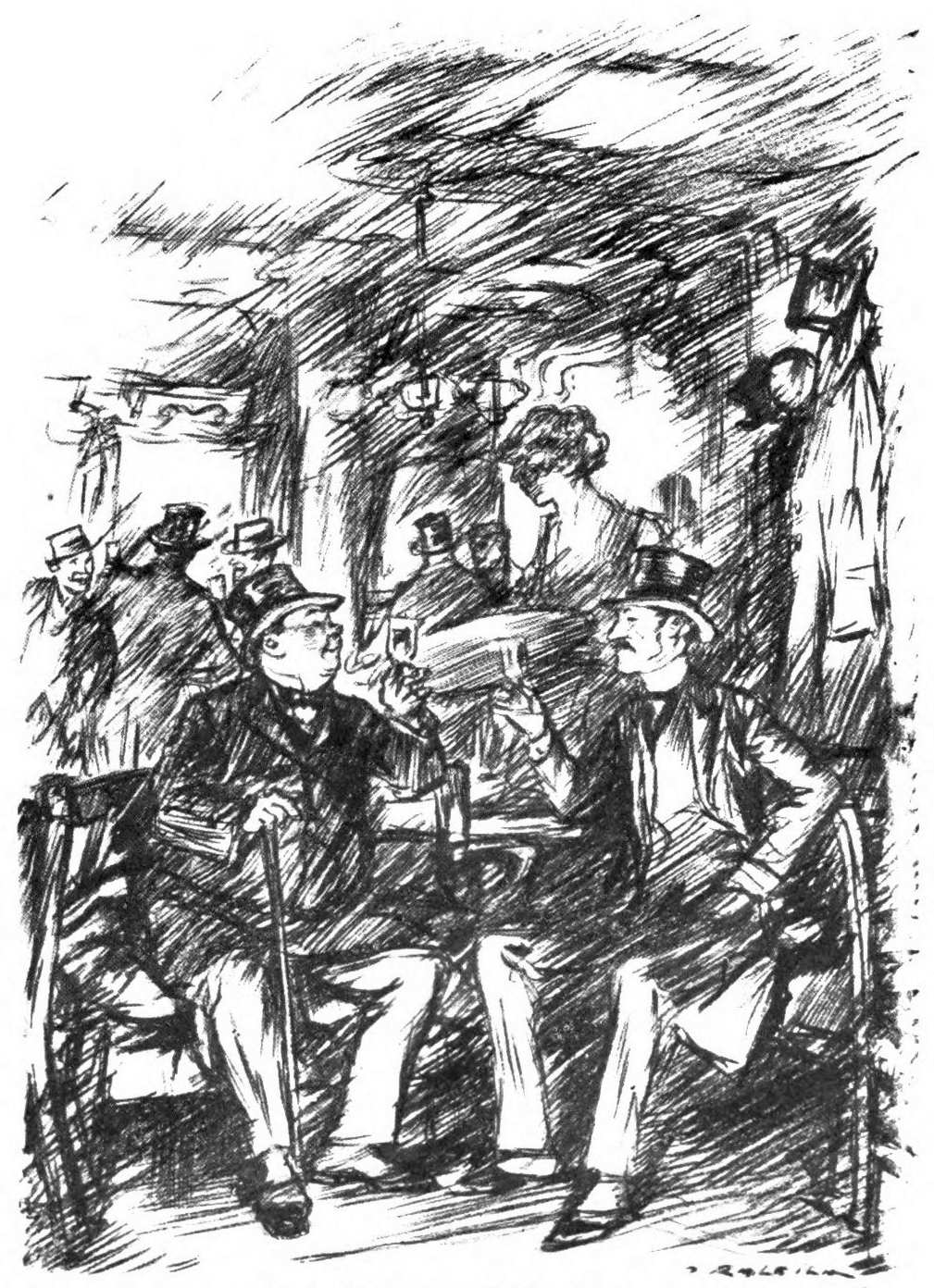
his bags. The bar was fairly crowded with business men, but there was
one figure that by its personality immediately arrested Mr. Pinwell’s
attention. He was a very big man in a new shiny top-hat with a curl to
it. He was leaning heavily against the center of the bar, and was
surrounded by three or four other men who seemed to be hanging on his
words. He had a large red face and small, dark, expressionless eyes. The
skin seemed to be tight and moist, and to bind up his features in
inelastic bags, except round the eyes, where it puckered up into dark
yellowish layers of flesh. His hands were fat and stiff and blue like
the hands of a gouty subject. His gray hair curled slightly under the
brim of his hat, and his clothes were ponderously impressive from the
silk reveres of his tail coat to the dark-brown spats that covered his
square-toed boots. As they entered, this impressive individual looked in
their direction and gave young Mr. Senner a faint nod, and then
continued his conversation.
“That’s Clappe,” whispered Mr. Pinwell’s cicerone, and dusted the knees
of his trousers. He then added:
“We’d better wait a bit.”
They stood there in the corner of the bar, and the young man produced a
silver cigarette-case and offered its contents to Mr. Pinwell, an overt
act of kindness which that gentleman appreciated but did not take
advantage of. They waited there twenty minutes before an opportunity
presented itself of making any approach to the great man. But in the
meantime Mr. Pinwell watched the conversation with considerable
interest. The four men stood very close together, smoking, and speaking
in thick whispers. He was alarmed at moments by the way in which one
would hold a glass of whisky-and-water at a perilous angle over the
waistcoat of another, while fumbling with a cigarette in the unoccupied
hand. He could not hear the conversation, but occasional sentences
reached him: “It’s the cheapest line there is.” “Here! I tell you where
you can get—” “D’you know what they paid last year?” “I ’ad ’im by the
short ’airs that time.” “’E says to me—”
It occurred to Mr. Pinwell that there was something distressing about
this scene, something repelling and distasteful, but he consoled himself
with the reflection that after all business had to be conducted somehow.
Money had to be made to pay for the streets and the lamp-posts, and the
public baths and the battleships. “Business is not always pleasant,” he
reflected, “but it has to be done.”
At the end of twenty minutes two of the men went away and left Mr.
Clappe talking apathetically to the remaining man.
“Now’s our chance,” said Senner junior, and he walked across the bar. He
seized on a lull in the conversation to step forward and touch Mr.
Clappe on the arm.
“Er—excuse me, Mr. Clappe,” he said. “This is my friend Mr. Pinwell, of
Dollbones.”
The big man glanced from Senner junior to Mr. Pinwell and gave that
gentleman an almost imperceptible nod. He then sighed, breathed heavily,
and took a long drink from the glass in front of him.
“I’m very pleased to meet you, Mr. Clappe,” said Pinwell nervously.
“I’ve heard about you. I’m with Dollbones, you know, the Dollbones. We
have—er—several very good lines just now.”
The great Clappe fixed him with his lugubrious eyes and suddenly said in
a thick voice:
“What’ll you drink?”
It is curious that Mr. Pinwell with all his experience should have been
taken back by this hospitable request. He stammered and said:
“Oh! thank you very much, sir. I don’t think I’ll—at least, I’ll
have—er—a lime-juice and soda.”
And then Mr. Clappe behaved in a very extraordinary way. An expression
of utter dejection came over his face. He puffed his cheeks out and
suddenly muttered, “Oh, my God!”
And then he rolled round and deliberately turned his back on Mr.
Pinwell and his friend! It was a very trying moment. Mr. Pinwell was at
his wit’s end how to act, and Senner junior did not help him in any way.
On the contrary he seemed to be taking Mr. Clappe’s side. He gave a sort
of snigger of disgust, and called across the bar in a jaunty voice:
“Johnny Walker and soda, please, Miss Parritt.”
Mr. Pinwell gaped ineffectually at the back of the great man, and
hesitated whether to make any further advance. But he was relieved of
the necessity of coming to a decision by the act of Mr. Clappe himself,
who slowly drained the remnants of refreshment in his glass, and then
walked heavily out of the bar, without looking round.
In the meantime young Senner had acquired his drink, and was feverishly
tapping the end of a cigarette on the rail. He took a long drink and
spluttered slightly, and then, turning on Mr. Pinwell, he said:
“What particular brand of blankety fool are you?”
“I beg your pardon?” exclaimed Mr. Pinwell, amazed.
“I tell you,” said the young man, “you’re a particular type of blankety
fool. You’ve missed the chance of yer life! Don’t you know when a man
like Clappe asks yer to have a drink yer a blankety fool not to? D’you
know that man places thousands and thousands of pounds a year for Carron
& Musswell? Thousands, I tell yer! It don’t matter to ’im where he
places the orders. He puts it all out among ’is pals. You ’ad a chance
of being a pal, and you’ve muffed it!”
“But—but—but—” spluttered Mr. Pinwell. “I really—I—had no idea. I
said I would have a drink. It was only that I ordered
a—er—non-alcoholic drink. I really can’t—”
“Psaugh!”
Young Mr. Senner swirled the whisky round in his glass and drank it at a
gulp. Then he muttered:
“Gawd! Asking Clappe for a lime-juice and soda!”
Mr. Pinwell thought about this meditatively. He wondered whether he had
been in the wrong. After all, people all had their notions of the way to
conduct business. Business was a very big thing. It had “evolved”—that
was the word!—evolved out of all sorts of complicated social
conditions, supply and demand, and so on. A man perhaps who had been in
the habit of taking alcoholic refreshment and expecting others to—it
might perhaps be difficult for him to understand.
“Don’t you never drink?” suddenly exclaimed Mr. Senner.
“I—er—occasionally have a glass of stout,” murmured Mr. Pinwell. “Last
Christmas my wife’s sister brought us a bottle of canary sac. I have no
particular taste for—er—things of this sort—”
“Anyway,” said Mr. Senner, “you’re not under any bally pledge?”
“Oh, dear me, no!” exclaimed Mr. Pinwell.
“Well, then,” answered his youthful adviser. “I should advise you next
time Clappe or any one like him asks you to have a drink, lap it up like
a poodle and stand him a quick one in return.”
Mr. Pinwell surveyed his friend over the rim of his glasses, and thought
for some minutes. Then he said:
“I’m afraid Mr. Clappe is not likely to ask me to have a drink again.”
But the young man of precocious experience answered:
“If you come in here to-morrer, I’ll bet yer he’ll have forgotten who
you are.”
It was all a very astounding experience, and that night in bed Mr.
Pinwell gave the matter long and serious consideration. If his
circumstances had been normal he would have hardly thought about it for
five consecutive minutes, but his circumstances were anything but
normal. They were somewhat desperate. He was on his last month’s trial.
If he should be out again!... Both the children wanted new clothes, and
Eileen’s boots were all to pieces. And then there was that bill of
Batson’s for three pounds seventeen shillings, for which payment was
demanded by the seventeenth; there were other bills less urgent perhaps
but—the little man kept turning restlessly in bed and even in his
sleep he made febrile calculations.
It must be acknowledged that the result of Mr. Pinwell’s nocturnal
meditations tended to loosen certain moral tendencies in himself. He set
out on the morrow in a peculiarly equivocal frame of mind, wavering
between conflicting impulses, but already predisposed to temporize with
his conscience if by so doing he could advance what he considered to be
the larger issues of business considerations. These first concessions,
curiously enough, were not made at the instance of the great Mr. Clappe,
however, but at that of a certain Mr. Cherish whom he met during that
day. He was a breezy, amiable person, and the manager of the
International Hardwood Company. He was just going out to lunch as Mr.
Pinwell called, and being in a particularly buoyant mood, owing to a
successful business deal, he took hold of our hero’s arm and drew him
into the street. As they walked along he asked what it was that Pinwell
wanted, and that gentleman immediately expatiated on the virtues of the
goods he had at his disposal. While talking he found himself almost
unconsciously led into the bar of a public-house called “The Queen of
Roumania.” And when asked by Mr. Cherish, “What he was going to have,” a
sudden desperate instinct of adventure came over him, and he called for
whisky. When it was brought he drank it in little sips, and thought it
the most detestable drink he had ever tasted. But he determined to see
the matter through, and salved his conscience with the reflection that
it was just “in the way of business.” He certainly had to acknowledge
that after drinking it he felt a certain elevated sense of assurance. He
talked to Mr. Cherish quite unselfconsciously and listened to him with
concentrated attention. This mental attitude was quickened by the
discovery that Mr. Cherish was actually in need of certain embroideries
that Dollbones were in a position to supply. It would be quite a big
order. He promised to bring samples of the embroideries on the following
day, and took his departure. During the afternoon he felt a sudden
reaction from the whisky and was very tired. He went home early,
complaining to his wife of “a bad headache, as though something had
disagreed with him.” Nevertheless the prospect of securing the order for
the embroideries excited him considerably, and he went so far as to tell
her that he hoped things were soon going to take a turn for the better.
He arrived at his appointment the next day to the minute, carrying a
very heavy valise stuffed with machine embroideries. He was kept waiting
by Mr. Cherish for nearly an hour, and was then ushered into his
presence. Mr. Cherish was still in a very jovial mood and had another
gentleman with him. He shook Mr. Pinwell’s hand and immediately told him
three obscene stories that he had just heard—Mr. Cherish was reputed to
have the largest repertoire of obscene stories in the trade—and the
other gentleman also told two. Pinwell laughed at them to the best of
his ability, although they did not appear to him to be particularly
humorous. He then felt peculiarly uncomfortable in that for the life of
him he could not think of a story in reply. He never could remember
these stories. So he opened his valise and displayed the tapestries. The
other two gentlemen took a desultory interest in them as tapestries, but
a rapacious interest in them as regards value. They were figured
tapestries and the price was four pounds seventeen and sixpence a yard.
Mr. Cherish mentioned casually that they would want about seventy
yards. And then Mr. Pinwell made the rapidest mental calculation he had
ever made in his life. Seventy yards at £4,17s. 6d. would be
£341,5s. which, at two per cent, would mean just on seven pounds for
himself! It was dazzling! Seven gold sovereigns! However, the order was
not yet given. The two gentlemen talked about it at some length, and
looked up other quotations. At last Mr. Cherish said:
“Well, I think we’ll go and see what the ‘Queen of Roumania’ has got up
her sleeve.”
Mr. Pinwell and the other gentleman laughed, and they all went out. Mr.
Pinwell dreaded the prospect of drinking more whisky, but—seven golden
sovereigns! enough to pay that bill of Batson’s and to buy the children
all the clothes they wanted! He knew in any case the etiquette of the
trade, and when they arrived in the resplendent bar it was he who
insisted on ordering “three Scotch whiskies and a split soda.” On the
arrival of these regenerating beverages the other two gentlemen resumed
their sequence of improper stories. And it was just after the glasses
had been re-charged at the instance of Mr. Cherish that he suddenly
recollected a story he had heard nearly twenty years ago. It was a
disgusting story, and it had impressed itself on his memory for the
reason that it struck him when he heard it as being so incredibly vulgar
that he could not understand how any one could appreciate it. But as he
neared the end of his second glass of whisky it suddenly flashed into
his mind that here was the story that Mr. Cherish and his friend would
like. He had by this time arrived at an enviable state of
unselfconsciousness, and he told the story as well as he had ever told
anything in his life. The result amazed him. The other two gentlemen
roared with laughter, and Mr. Cherish tilted his hat back and slapped
his leg.
“Gawd’s truth! that’s a damn good story, Pinwell!” he cried out several
times.
Other people came into the bar, and Mr. Pinwell found himself something
of a hero. Every one seemed to know Mr. Cherish, and he introduced him,
and on several occasions said, “I say, Pinwell, tell Mr. Watson that
story about the sea captain.”
The story was an unqualified success, and seemed in some way to endear
him to Mr. Cherish. That gentleman became more confidential and
confiding, and they talked about business.
Mr. Pinwell believed he drank four whiskies-and-sodas that afternoon. In
any case, he arrived home feeling very bilious and ill. He told his wife
he had felt faint, and had taken some brandy—“Thank heaven,” he
thought, “she doesn’t know the difference in smell between brandy and
whisky!” He said he would go to bed at once, he thought, and he kissed
her in rather a maudlin fashion, and said he knew she would be glad to
hear that he had that afternoon taken an order for £341—that would mean
nearly seven pounds to them! Enough to buy clothes for the children and
pay Batson’s bill; he laughed a little hysterically after that, and
rolled into bed.
On the following day he was very unwell and unable to get up, and Mrs.
Pinwell wrote to the firm and explained that her husband had got his
feet wet on his rounds and had contracted a chill. She also inclosed his
order-book.
It was three days before he was well enough to resume his rounds, and
then he avoided the company of Mr. Cherish and set out on a pilgrimage
to the meaner parts of the district. But the orders there seemed few
and far between, and a feeling of depression came over him.
On the 21st of the month he was bidden to the presence of Mr. Rodney.
That gentleman said that the firm was still dissatisfied with his
efforts, but on the strength of the order he had secured from the
International Hardwood Co. they were willing to keep him on for another
month’s trial. But unless at the end of that time he had secured further
orders of a similar nature, he must consider his engagement at an end.
It would be tedious and extremely disconcerting to follow the precise
movements of Thomas Pinwell during the ensuing four weeks. It need only
be said that, utterly discouraged by his lonely peregrinations in the
paths of honest effort, he eventually once more sought the society of
young Mr. Senner and Mr. Cherish. In their company he discovered what
might be called “a cheering fluidity.” He found that whisky made him so
ill that he simply could not drink it, but he drank ale, stout, brandy,
and gin. None of these things agreed with him, but he found that by
drinking as little as possible and ringing the changes on them he could
just manage to keep going. The direct result of this moral defection was
that his circle of business acquaintances increased at an enormous rate.
He gradually got to know the right place and the right hour to catch the
right people. His efforts on behalf of Messrs. Dollbones during the
following three months were eminently satisfactory, and his own
commissions amounted to no mean sum. Neither was his conscience
seriously affected by this change of habit. He considered it an
inevitable development of his own active progress “in the way of
business.” The very word “business” had a peculiarly mesmerizing effect
upon him. It was a fetish. He looked upon it as an acolyte might look
upon the dogma of some faith he blindly believed in. He believed that
people were in some mysterious way pale adjuncts to the idea that
whatever happens, “Business” must go on. He would stand in the corner of
the bar of “The Queen of Roumania” and look across the street at the
Camling Town public wash-houses, a mid-Victorian Gothic building in
stucco and red brick, and then, turning his mild watery eyes towards
Senner junior, he would say:
“It’s a wonderful thing—business, you know, Mr. Senner, a very
wonderful thing indeed. Now look at the wash-houses! They simply have
been the result of business. No progress is made, nothing is done except
through business. If it weren’t for business we should all be
Barbarians.”
And then he would take a little sip at the gin-and-water in front of
him.
After copious trials he found that gin affected him less than any of the
other drinks, so he stuck to that. He did not like it, but he found that
people simply would not do business with him in Camling Town unless he
drank and stood drinks. It was very trying, and the most trying part was
the necessity of concealing these aberrations from his wife. When he
first started he was conscious that he often returned home smelling of
the disgusting stuff. He tried cloves, but they were not very effective.
Then one day he had a brilliant inspiration. He was unwell again. It
happened very often now—at least once a week—and the doctor gave him
some medicine. Then it occurred to him that medicine might smell like
anything else. He would keep up the medicine. His wife was very
unsuspecting. He hated deceiving her. He had never deceived her about
anything, but he thought, “Women don’t understand business. It is for
her benefit that I take it.”
Sunday was a great joy to him. He would take the children out for a walk
in the morning while his wife cooked the dinner. In the afternoon he
would have a nap; but the greatest luxury of the day seemed to him that
he need drink nothing except water.
At the end of six months there came a proud day when Mr. Rodney informed
him that Mr. Hylam was quite satisfied with his progress, and his
ordinary salary was raised to two pounds. It was summertime, and the
accumulation of his commissions justified the family moving into larger
rooms, one of which was to be a bathroom. But Mr. Pinwell was beginning
to feel his health very much affected, and he looked forward with
intense avidity to the two weeks’ holiday which was his due in
September. In July he achieved a great triumph. He met and got into the
good graces of the great Mr. Clappe. As Senner junior predicted, that
gentleman had quite forgotten their previous meeting, and it happened in
the company of the good Mr. Cherish. They all met in the bar of “The
Cormorant,” and after several drinks Cherish said:
“I say, Pinwell, tell Mr. Clappe that story about the sea captain!”
Mr. Pinwell complied, and when he had finished he saw the shiny bags of
flesh on Mr. Clappe’s face shaking. He was evidently very much amused,
although his eyes looked hard and tired. He said hoarsely:
“Damn good! What’s yours?”
Mr. Pinwell did not fail on this occasion, and asked for some gin. And
directly he noticed that the great man’s glass was nearly empty, he
insisted on ordering some more all round. He found Mr. Clappe an
expensive client. He drank prodigiously, in a splendid nonchalant
manner, hardly noticing it, or taking any interest in who paid for it.
It took Mr. Pinwell several weeks, and cost him the price of several
whole bottles of whisky, before he became sufficiently established in
favor to solicit orders. But once having arrived there, the rest was
easy, for Mr. Clappe had the reputation of being “loyal to his pals,”
and he had the power of placing very large orders.
There came a day when Mr. Pinwell received an order for over eight
hundred pounds’ worth of goods, and for the first time in his life he
got very drunk. He arrived home in a cab very late at night and was just
conscious enough to tell his wife that he had been taken ill, and some
one had given him some brandy, and it had gone to his head. She helped
him to bed, and seemed rather surprised and alarmed.
On the following day he was very ill, and a doctor was sent for. He
examined him carefully, and looked stern. Out in the hall he said to
Mrs. Pinwell:
“Excuse me, Mrs. Pinwell, but does your husband drink rather a lot?”
“Drink!” exclaimed the lady. “My Tom!... Why, he’s practically a
teetotaler.”
The doctor looked at her thoughtfully and murmured, “Oh!” Then, as he
turned to go, he said:
“Well, we’ll pull him through this, I hope, but he must be very careful.
You must advise him never to touch alcohol in any form. It’s poison to
him,” and he left Mrs. Pinwell speechless with indignation.
Mr. Pinwell’s illness proved more obstinate than was anticipated, and it
was some weeks before he was well enough to get about. When he arrived
at that stage the firm of Dollbones were considerate enough to suggest
that he might take his holiday earlier than had been arranged, and go
away at once.
Consequently, on a certain fine morning in August, Mr. and Mrs. Pinwell,
with the two children, set out for a fortnight’s holiday to Herne Bay.
The firm paid his salary while he was away, and in addition he had now
nearly thirty-five pounds in the bank, and all his debts were paid. It
was many years since the family had been in such an affluent position,
and everything pointed to the prospect of a joyous and beneficial time.
And so indeed, to a large extent, it was. Mr. Pinwell felt very shaky
when he arrived, and he spent most of his time sitting in a deck chair
on the sands, watching the children, while his wife sat on the sands by
his side, sewing. The fresh breezes from the Channel made him very
sleepy at first, but he gradually got used to them. It was extremely
pleasant sitting there listening to the waves breaking on the shore and
watching the white sails of yachts gliding hither and thither; very
pleasant and very refreshing. It was only after some days that when he
was left alone a certain moroseness came over him. He could not explain
this to himself; it seemed so unreasonable. But he felt a curious and
restless desire and an irritability. These moods became more pronounced
as the week advanced, in spite of the fact that his strength returned to
him. He had moods when he wished to be alone and the children tired him.
On the fifth day, he and his wife were strolling up from the beach late
in the afternoon, and they were nearing their lodgings when he suddenly
said:
“I think I’ll just stroll round and get a paper.”
“Oh! Shall I come with you?” his wife asked.
“No, no, my dear. Don’t. Er—I’ll just stroll round by myself—”
He seemed so anxious to go by himself that she did not insist, and he
sauntered round the corner. He looked back to see that she had gone in,
and then he walked rather more quickly round into the High Street. He
hummed to himself and glanced rather furtively at the contents of the
newspaper bills, then, after looking up and down the street, he suddenly
darted into the saloon bar of the principal hotel....
After his second glass of gin-and-water a feeling of comfortable
security crept over him. After all, it was a very ingratiating
atmosphere this, ingratiating and sociable. He glanced round the bar and
carried on a brief but formal conversation with a florid individual
standing near him. He hesitated for a moment whether he would tell him
the story about the sea captain, but on second thoughts decided to
reserve it to a more intimate occasion. Besides, he must not be away
long.
After that it became a habit with Mr. Pinwell for the rest of the
holiday for him at some time during the day, and occasionally twice or
three times during the day, to “go for a stroll round by himself.” His
wife never for one moment suspected the purpose of these wanderings,
though she was informed that he was taking another bottle of the
medicine.
When they returned to town Mr. Pinwell certainly seemed better and more
eager about his work. It may be that he had the measure of his
constitution more under control. He knew what was the least damaging
drink he could take, and he knew how much he dare consume without
immediately disastrous results. He gradually became a well-known
habitué of all the best-known saloon bars in the neighborhood of his
rounds. His character altered. He always remained mild and unassertive,
but his face became pinched and thin, and he began to enjoy the
reputation of being a “knowing one.” He did not make a fortune in his
solicitations for orders for gimp, trimmings, buttons, and embroidery,
but he certainly earned a very fair competence. In two years’ time he
was entirely intimate with every buyer of importance in the Camling Town
district and out as far as the “Teck Arms” at Highgate. The family still
occupied the larger rooms (with the bathroom) that they had moved to,
and both the girls attended the Camling Town Collegiate School for
Girls, and showed every promise of being worthy and attractive members
of society.
It was not till the end of the second year that two events following
rapidly on each other’s heels tended to disturb the normal conditions
of the Pinwell family. A letter arrived one day from a lawyer. It
appeared that a brother of Mr. Pinwell’s whom he had not seen for twelve
years, and who had owned a farm in Northamptonshire, had died intestate.
He was not married, and Tom Pinwell was his only living relative. Under
the circumstances he inherited the whole of his brother’s property. When
this had been assessed it was proved to be worth £140 per year. Needless
to say this news brought great joy to the traveler’s family. Visions of
great splendor opened out before them, wealth, comfort, security. The
day after the settlement was made, Tom Pinwell entertained Mr. Cherish,
Mr. Clappe, and a few others of his friends to a supper at “The Queen of
Roumania,” and the next day he was taken very ill. He lay in a critical
state for ten days, nursed with a sort of feline intensity by his wife.
The doctor then said that he might recover—he was a different doctor to
the one who had so exasperated Mrs. Pinwell with his outrageous
suggestions—but that he would be an invalid all his life. He would have
to live on special food and must not touch either sweets or alcohol in
any form.
On a certain evening Mr. Pinwell showed traces of convalescence and was
allowed to sit up in bed. His wife as usual sat by his bedside,
knitting. He seemed more cheerful than he had ever been before, and Mrs.
Pinwell took the opportunity of saying:
“What a blessing it is, dear, about this money!”
“Yes, dear,” answered her spouse.
“Do you know, Tom,” she said suddenly, “there is a thing I’ve wanted to
do all my life. And now perhaps is the opportunity.”
“What is that, my dear?”
“To go and live in the country.”
“Yes, dear.”
“Think of it! When you’re better, we can go and get a little cottage
somewhere, with a bit of a garden, you know—grow our own vegetables and
that. You can live fine in some parts of the country for £140 a year.
You’ll be able to give up this nasty tiring old business. It’ll be
lovely.”
“Yes, my dear.”
Mr. Pinwell’s voice sounded rather faint, and she busied herself with
his beef-tea. Nothing more was said about the idea that night. But
gradually, as he got stronger, Mrs. Pinwell enlarged on the idea. She
talked about the flowers they could grow, and the economy of having your
own fowls and potatoes. It would have to be right in the country, but
not too far from a village or town, so that the girls could continue
their schooling and meet other girls. To all of this Mr. Pinwell agreed
faintly, and he even made a suggestion that he thought Surrey was nicer
than Buckinghamshire.
Mr. Pinwell was confined to his bedroom for nearly two months. And then
one day a letter came from Messrs. Dollbones. It was to say that in view
of the short time that Mr. Pinwell had been in their service they could
not see their way to continue paying his salary after the end of the
month, unless he were well enough to continue his work.
Mrs. Pinwell said:
“No, and they needn’t continue to pay it at all, for all we care!”
A troubled look came over her husband’s face, and he said:
“Um—they’ve treated me very well, Emma, very well indeed. There’s many
firms don’t pay their employees at all when they’re ill.”
“Well, then, they jolly well ought to,” answered Mrs. Pinwell. “People
get ill through doing the firm’s work.”
Mr. Pinwell sniffed. It was the one subject upon which he and his wife
were inclined to differ. Mrs. Pinwell did not understand business; she
had no reverence for it.
By the end of the month Mr. Pinwell was up again and going for short
walks up and down the street. One day he said:
“Let me see, my dear—next Thursday is the first of the new month, isn’t
it?”
“Yes,” answered Mrs. Pinwell. “And thank goodness you haven’t got to go
back to that horrid old business!”
Mr. Pinwell said nothing at the time, but a few hours later he said:
“Er—I’ve been thinking, my dear. I rather think I ought perhaps
to—er—to try and see if I could go for a little while on Thursday. You
see, the firm have treated me very generously, very generously
indeed—and—er—business is business.”
“What does it matter?” answered his wife. “I’m sure they’ve got some one
else doing your job by now. Besides, you’re not strong enough.”
Mr. Pinwell fidgeted with his watch-chain and walked up the street.
During the next two days Mrs. Pinwell could tell that he was fretting.
He seemed distracted and inclined to be irritable. He gave
demonstrations of his walking powers and stayed out longer and moved
more quickly. He got into such a state on the Wednesday evening, that in
a weak moment Mrs. Pinwell made the mistake of her life.
She agreed that he might try and go the next day just for an hour or so,
but he was to come home directly he felt tired.
Tom started out on the Thursday morning, and he seemed in a great state
of elation. In spite of his weakness he insisted on taking one of his
bags of samples. He walked more quickly down the street than she had
seen him walk for a long time. Mrs. Pinwell then turned to her household
duties. She was disappointed, but not entirely surprised, that her
husband did not come home to lunch, but at half-past three a sudden
curious feeling of alarm came over her. She tried to reason with herself
that it was all nonsense; nothing had happened, Tom was a little
late—that was all. But her reason quailed before some more insidious
sense of calamity. The children came home from school at a quarter-past
four, and still he had not returned. She gave them their tea and somehow
their gay chatter irritated her for the first time. She would not convey
to them her sense of fear. She washed up the tea-things and busied
herself in the house.
It was a quarter to six when Tom came home. He staggered into the hall.
His eyes had a strange look she had not seen before. He was trembling
violently. She did not ask any questions. She took his arm and led him
into the bedroom and untied his collar and tie. He lay on the bed and
his teeth chattered. She got him a hot-water bottle and gradually
undressed him. Then she sent one of the girls for the doctor.
In the meantime he started talking incoherently, although he repeated on
one or two occasions, “I’ve taken another bottle of the medicine, Emm’.”
The doctor was on duty in the surgery when the child called, and he did
not come round till half-past eight.
When he looked at Pinwell and took his pulse, he said:
“What’s he been doing?”
“He’s been out,” said Mrs. Pinwell. “He said he’d taken another bottle
of the medicine.”
“Medicine? what medicine?” The doctor seemed to examine the lips of the
sick man very closely, then he shook his head. He turned to Mrs. Pinwell
as though he were going to make a statement, then he changed his mind.
It did not require any great astuteness to determine from the doctor’s
face that the case was critical. He gave the patient a powder, and after
a few instructions to Mrs. Pinwell he went, and said he would return
later in the evening. After the doctor had gone, Mr. Pinwell was
delirious for an hour, and then he sank into a deep sleep. The doctor
returned just after eleven. He examined him and said that nothing more
could be done that night. He would return in the morning. In the
meantime, if things took a more definite turn, they could send for him.
Tom Pinwell lay unconscious for nearly twenty-four hours, sometimes
mumbling feverishly, at other times falling into a deep coma. But
suddenly, late on the following evening, he seemed to alter. His face
cleared, and he sighed peacefully. Mrs. Pinwell noticed the change and
she went up close to the bed. He looked at her and said suddenly:
“I don’t think it would do, my dear, to go and live in the country.”
“No, no, dear; all right. We’ll live where you like.”
“You see,” he said after a pause, “business has to be gone through....
There was Judkins & Co., they treated me very fair, then they went
bankrupt. It was very unfortunate, very unfortunate indeed.... I
wouldn’t like these people—what’s their name, Emma?...”
“Dollbones.”
“Ah, yes, Dollbones!... Dollbones. No, I wouldn’t like them to think I’d
let them in like. Just because I had a little money.... It’s a very
serious thing—business....”
Mr. Pinwell seemed about to say something, but he smiled instead and
looked up at the ceiling. He became very still after that, and Mrs.
Pinwell placed a book so that the candle-light should not shine on his
face. All through the night she sat there watching and doing the little
things the doctor had told her to. But he was very still. Once he
sighed, and on another occasion she thought he said:
“That was very amusin’ about that invoice of Barrel and Beelswright, Mr.
Cherish ... oh, dear me!”
About dawn, thoroughly exhausted with her vigil, Mrs. Pinwell fell into
a fitful sleep, sitting up in her chair. She only slept for a few
minutes, and then awakened with a start. The short end of candle was
spluttering in its socket, and its light was contending with the cold
blue glimmer of the early day. She shivered, her frame racked by
physical fatigue, and her mind benumbed by the incredible stillness of
the little room.
. . . . . .
“Consequently, ladies and gentlemen, after placing £17,500 in the
reserve fund, for the reasons which I have indicated to you, I feel
justified in recommending a dividend of 12½ per cent. on the ordinary
shares.”
The big man with the square chin dabbed his forehead with his
handkerchief and took a sip of water as he resumed his seat. A faint
murmur of approval and applause ran round the room; papers rustled, and
people spoke in low, breathless voices. Twelve and a half per cent.! It
was a good dividend, a very good dividend! A hundred different brains
visualized rapidly what it meant to them personally. To some it meant a
few extra luxuries, to others comforts, and to some a distinct social
advance. If Dollbones could only keep this up!
Sir Arthur Schelling was seconding the adoption of this report, but it
was a mere formality. No one took any interest in the white-haired
financier, except to nudge each other and say, “That’s Schelling. They
say he’s worth half a million.” It was a curiously placid meeting, there
was no criticism, and every one seemed on the best of terms. It broke
up, and the share-holders dispersed into little knots, or scattered to
spread the good news that Dollbones were paying twelve and a half per
cent.
Sir Arthur took the chairman’s hand and murmured:
“I must congratulate you, Hylam. An excellent report!”
The large man almost blushed with pleasure, and said:
“It’s very kind of you, Sir Arthur. Are you lunching in town?”
“I was going to suggest that you lunch with me at the Carlton. I have my
car here.”
“Oh! thank you very much. I shall be delighted.”
Mr. Hylam turned and gave a few instructions to his lawyer and his
private secretary, and handed various papers to each; then he followed
his host out of the Cannon Street Hotel.
They got into the great car, and each man lighted a well-merited cigar.
As they drove through the city, Sir Arthur discussed a few details of
the balance-sheet, and then added:
“I really think you have shown a remarkable genius of organization in
conducting this business, Hylam. It is a business which I should imagine
requires considerable technical knowledge and great—er—tact.”
Mr. Hylam laughed deprecatingly and muttered:
“Oh, we have our little difficulties!” He puffed at his cigar and looked
out of the window.
“So many—er—varieties of employees, I should imagine?” said Sir
Arthur.
“Yes, you’re right, sir. There are varieties. I’ve had a lot of
difficulty with the travelers this year.” He gave a vicious puff at his
cigar and stamped on the ash on the floor, and suddenly exclaimed:
“Drunken swine!”
Sir Arthur readjusted his gold-rimmed pince-nez and looked at his
friend.
“Is that so indeed?”
“Yes,” answered Mr. Hylam. “I don’t know how it is. They nearly all
drink. In one district alone, I’ve had two travelers practically drink
themselves to death, one after the other.”
“I’m very distressed to hear that,” said Sir Arthur; “very distressed.
It’s a very great social evil. My wife, as you may know, is on a board
of directorship of the Blue Riband Evangelists. They do a lot of good
work. They have a branch in Camling Town. They have pleasant evenings,
you know—cocoa and bagatelle, and so on; and lectures on Sunday. But, I
don’t know, it doesn’t seem to eradicate the evil.”
“No; I’m afraid it’s in the blood with many of them,” said the managing
director.
“Yes, that’s very true. I often tell my wife I’m afraid she wastes her
time. It seems inexplicable. I can’t see why they should do it. What
satisfaction can it be to—er—drink to excess? And then it must hamper
them so in the prosecution of their work. It seems in a way
so—ungrateful, to the people who employ them, I mean. Ah! here we are
at the Carlton! Champneys, come back for me at—er—three-thirty. Yes,
it’s a great social evil, a very great social evil indeed!”
THE END