A HARVARD man, not exempt from the
complacency sometimes attributed to
graduates of his university, once observed,
according to Barrett Wendell, that the group
of forgotten litterateurs, who toward the close
of the eighteenth century attained a brief measure
of fame as the "Hartford Wits," represents
the only considerable literary efflorescence
of Yale. The remark did not fail to provoke the
rejoinder, doubtless from a Yale source, that nevertheless
at the time when the Hartford Wits
flourished no Harvard man had produced literature
half so good as theirs.
How good this literature was considered in its
day is not readily understood by the modern
reader, for from the Hudibrastic imitations and
heroic couplets of these writers, whose brilliance
was dimmed so long ago, the contemporary flavor
has long since evaporated. Indeed there is no
modern reader in the general sense. It is only
the antiquarian, the literary researcher, the casual
burrower among the shelves of some old library
who now opens these yellow pages and
follows for a few moments the stilted lines that
seem to him a diluted imitation of Pope, Goldsmith
and Butler. Professor Beers of Yale ventures
the surmise that he may be the only living
man who has read the whole of Joel Barlow's
"Columbiad."
Yet in their time this coterie of poets, who
gathered in the little Connecticut town after the
close of the war for independence, became famous
not only in their own land but abroad, and the
community where most of them lived and met
at their "friendly club"—was it at the Black
Horse Tavern or the "Bunch of Grapes"?—shone
in reflected glory as the literary center of
America. No Boswell was among them to record
the sparkling epigrams, the jovial give and
take, the profound "political and philosophical"
debates of those weekly gatherings. Yet imagination
loves to linger on the old friendships, the
patriotic aspirations, the common passion for
creative art, the wooing of the Muses of an older
world, thus dimly shadowed forth against the
background of the raw young country just embarking
on its mysterious experiment.
Do not doubt that these personages whose individualities
are now so effectually concealed behind
the veil of their sounding and artificial cantos
were real young men who cherished their
dreams and their hopes. One can see them gathered
around the great wood fire in the low ceiled
room redolent of tobacco, blazing hickory and
hot Jamaica rum.
Here is Trumbull, the lawyer, the author of
"M'Fingal" which everybody has read and which
has been published in England and honored with
the criticism of the Quarterly and Edinburgh
Reviews. He is a little man, rather frail, rather
nervous, not without impatience, with a ready
wit that sometimes bites deep. Here is Lemuel
Hopkins, the physician, whose lank body, long
nose and prominent eyes are outward manifestations
of his eccentric genius. His presence lends
a fillip to the gathering for he is an odd fish and
no one can tell what he will do or say next.
Threatened all his life with tuberculosis he is
nevertheless a man of great muscular strength
and during his days as a soldier he used to astonish
his comrades by his ability to fire a heavy
king's arm, held in one hand at arm's length.
In his verses he castigates shams and humbugs
of all kinds, whether the nostrums of medical
quacks or the irreverent vaporings of General
Ethan Allen—
"Lo, Allen, 'scaped from British jails
His tushes broke by biting nails,
Appears in hyperborean skies,
To tell the world the Bible lies."
Perhaps Colonel David Humphreys, full of war
stories and anecdotes of his intimacy with General
Washington, on whose staff he served, is in
Hartford for the evening. A well dressed, hearty,
sophisticated traveler and man of the world is
Colonel Humphreys, who would be recognized at
first glance as a soldier, though not as a poet.
Nevertheless he is addicted to the writing of
verse which is apt to run in the vein of comedy or
burlesque when it is not earnestly patriotic. To
look at him one would know that he enjoys a
good dinner, a good story and a bottle of port.
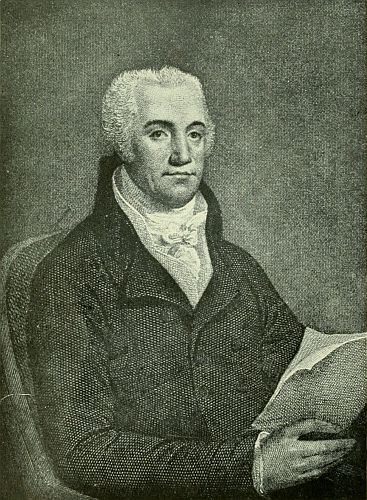
We may be sure that Joel Barlow is here, the
vacillating, visionary Barlow who has tried, or
is to try his hand at many pursuits besides epic
poetry—the ministry, the law, bookselling, philosophy,
journalism and diplomacy—but who is
pre-occupied now, as all his life, with his magnum
opus, "The Vision of Columbus," later elaborated
into "The Columbiad." He is a good looking,
if somewhat self-centered young man, a favorite
in the days of his New Haven residence with the
young ladies of that town. Perhaps it was there
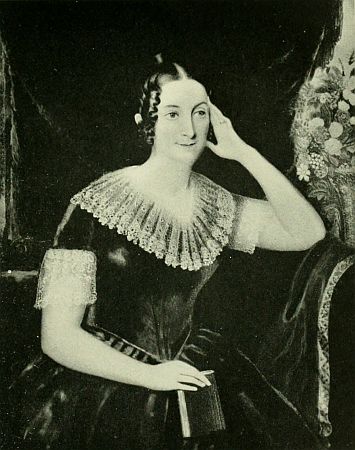
that he first met the charming and talented Elizabeth
Whitman, the daughter of the Rev. Dr.
Elnathan Whitman, sometime pastor of the
South Congregational Church in Hartford, who
often visited her friend Betty Stiles, the daughter
of the president of Yale College. A few of
Elizabeth Whitman's letters that have survived—the
packet bearing an endorsement in Barlow's
handwriting—are evidence that he made her a
confidante of his literary schemes and hopes and
welcomed her assistance with his great epic. A
strong friendship and entire harmony seem to
have existed between her and Ruth Baldwin of
New Haven, whom Barlow married during the
war, and who is said to have "inspired in the
poet's breast a remarkable passion, one that survived
all the mutations of a most adventurous
career, and glowed as fervently at fifty as at
twenty-five." For nearly a year the marriage
was kept a secret, but parental forgiveness was
at last secured and Barlow has now brought his
wife to Hartford where he is continuing his legal
studies, begun in his college town. But the law
will not engross him long. Soon, with his friend
Elisha Babcock, he is to start a new journal,
"The American Mercury," of which his editorship,
like all of Barlow's early enterprises, is to
be brief, though the paper is to continue till
1830.
A tall, slender man, Noah Webster by name,
a class-mate of Barlow at Yale, though four years
his junior, sits near him, relaxing for the moment
in the informality of these surroundings his
strangely intense powers of mental application,
divided just now between the law and the preparation
of his "Grammatical Institute." To the
"poetical effusions" of his friends he contributes
nothing, but he was an intimate of them all and
no doubt often attended their gatherings.
Perhaps, now and later, something of the poet's
license in the matter of chronology may be
granted. Let us assume, then, that young Dr.
Mason Cogswell is in town for a day or two,
looking over the ground with a view of settling
here in the practice of medicine and surgery in
which he is now engaged at Stamford, after his
training in New York where he served with his
brother James at the soldiers' hospital. It is
true that the fragments of his diary, which by
a fortunate chance were rescued from destruction,
do not mention any visit to Hartford as
early as this, though his journal does describe a
short sojourn here a few years later. Still, his
presence is by no means impossible. He is a
companionable youth, as popular with the young
ladies as Barlow, but with an easier manner, a
readier humor. Delighted at this opportunity to
sit for an evening at the feet of the older celebrities,
he is a welcome guest, for already he has a
reputation for versatility and culture and the
fact that he was valedictorian of the Yale Class
of 1780—and its youngest member—is not forgotten.
Richard Alsop, book-worm, naturalist and linguist,
who is beginning to dip into verse, has
locked up his book shop for the night and is here.
Near him sits a man who is, or is soon to be, his
brother-in-law, a tall, dark youth, Theodore
Dwight, the brother of the more famous Timothy,
whose pastoral duties detain him at Greenfield
Hill, but who is sometimes numbered as
one of this group. Theodore is now studying law,
but he has a flair for writing and makes an occasional
adventure into the gazettes.
These more youthful aspirants have their spurs
to win. A little later they, with their friend Dr.
Elihu Smith, who published the first American
poetic anthology, are to get into print in a vein
of satirical verse ridiculing the prevalent literary
affectation and bombast. After journalistic publication
these satires will appear in book form
under the title of "The Echo," in the introduction
to which the anonymous authors state that
the poems "owed their origin to the accidental
suggestion of a moment of literary sportiveness."
"The Echo" was "Printed at the Porcupine Press
by Pasquin Petronius."
That particular sportive moment is still in the
future. Now it is sufficient for these younger men
to shine in the reflected luster of the established
luminaries. These greater lights are worthy indeed
of the worship of the lesser stars. Three of
them have achieved, or are soon to acquire, an
international as well as a national reputation.
That "M'Fingal" had provoked discussion in
England has been noted. Humphreys's "Address
to the Armies of America," written in camp at
Peekskill, and dedicated to the Duke de Rochefoucault,
was issued with an introductory letter
by the poet's friend, the Marquis de Chastellux,
in a French translation in Paris, after its publication
in England where the Monthly and Critical
Reviews gave it a fair amount of praise,
though they could not refrain from the statement
that the poem was "not a very pleasing one to a
good Englishman." Barlow's "Vision of Columbus"
was published almost simultaneously in
Hartford and London in 1787.
In short these men had attained a genuine intellectual
eminence in their generation. They
were the cognoscenti of their day. Like most
young intellectuals their gospel concerned itself
with reform, with the ridicule of shams, with
the refusal to accept the popularity of new doctrines
as a final test of their value. Trumbull and
Barlow, both Yale graduates, had fought with
their friend Timothy Dwight their first reform
campaign which was an effort to introduce into
the somewhat archaic and outworn body of the
Yale curriculum the breath of the humanities
and of modern thought. Trumbull, according to
Moses Coit Tyler, was an example of a "new
tone coming into American letters—urbanity,
perspective, moderation of emphasis, satire, especially
on its more playful side—that of irony."
Their interests were not only literary. They
were publicists, political satirists, social philosophers,
not without their religious theories. In
all these matters their search was for the true
standards and as champions of causes and enthusiasts
of ideals they exhibited a variation from
type in that their warfare was waged, not against
the recognized conventions in government, religion
and society, but in favor of them. Priding
themselves on untrammelled and direct thinking,
their reasoning led them to support the established,
the orderly, the stable. Temperamentally
aristocrats, theoretically republicans—in
the broad sense of the term—they were practically
federalists. "The Anarchiad," a series of
poems they were contributing anonymously
about this time to "The New Haven Gazette,"
dealt satirically with the dangers of national unrest
and instability, of selfish aggrandizement
and of a fictitious currency. In these verses Hesper
addresses "the Sages and Counsellors at
Philadelphia" as follows:
"But know, ye favor'd race, one potent head
Must rule your States, and strike your foes with dread."
And in the same passage occur some lines, attributed
to Hopkins, that Daniel Webster may
have read:
"Through ruined realms the voice of UNION calls;
On you she calls! Attend the warning cry:
YE LIVE UNITED, OR DIVIDED, DIE!"
They ridiculed unsparingly the dangers hidden
under the cloak of "Democracy"—dangers imminent
and menacing in the days following the end
of the war in which most of them had served. In
fighting these perils they were sagacious in making
use of the means frequently employed by advocates
of radicalism—invective, irony and ridicule.
For these methods secured, as they naturally
would secure if cleverly managed, a wide
appeal. Yet the efficiency of such weapons depends
very largely upon the occasion. Their potency
is contemporary with the events against
which they are directed and with the passing
years their force weakens. Who reads nowadays
the political diatribes of Swift, the tracts of Defoe,
or the letters of Junius? Here perhaps is in
part an explanation of the great temporary influence
of the Hartford Wits, as well as of their
complete modern obscuration. The brilliant
blade they wielded had a biting edge, but the
rust of a century and a half has dulled it.
This general leaning toward the established
canons, this impatience with the new doctrines
that in the judgment of these men made for disunion
and disaster, should be qualified, at least
in the religious aspect, in two interesting particulars,
each contradictory to the other. Hopkins
began adult life as a sceptic but became a defender
of the Christian philosophy. Barlow, on
the other hand, deserted in later life the orthodox
ideals of his youth, never, perhaps, very
enthusiastically championed, and during his
sojourn in France became a rationalist and free-thinker.
In general, however, the Hartford Wits fought
for the established order against the forces of
innovation and disintegration and thus when
they sat down to unburden their minds of their
visions of their country's future greatness, or of
their impatience with demagoguery and political
short-sightedness, it was natural that their sense
of tradition and order should lead their thoughts
to seek expression in the verse forms lifted into
fame by the masters of an older and greater literature
and accepted as the conventional vehicle
of poetic expression. Here is another reason, if
they must be catalogued, for the forgetfulness
of the Hartford Wits. These balanced, formal
lines, so expressive of the artificial modes and
manners of the subjects of Queen Anne and her
successors, are to us prosy, old-fashioned and
imitative. Their charm has fled. Can you imagine
Miss Amy Lowell reading Hudibras? And
we must admit that "M'Fingal," though it has
given to literature some still remembered aphorisms,
such as—
"No man e'er felt the halter draw
With good opinion of the law"—
is, on the whole, poorer reading than its model.
ii
It is significant that the distinction of the individuals
united in the "friendly club" was not
confined to their literary activities. In an age
sometimes esteemed narrow and limited in its
cultural aspects they are refreshing in their versatility.
Trumbull was a well-known lawyer and
served on the bench for eighteen years, part of
his legal training having been pursued in the office
of John Adams. It was a strange combination,
not unprecedented but nevertheless arresting,
of this talent for the law associated with
the artistic temperament. For with all his practical
attributes Trumbull was essentially an artist.
His early poem entitled "An Ode to Sleep,"
says Tyler, "is a composition resonant of noble
and sweet music and making, if one may say so,
a nearer approach to genuine poetry than had
then [1773] been achieved by any living American
except Freneau." And in the following bit of
autobiography, quoted by Tyler, may be discerned
the self-distrust and depression to which
no soul that longs and strives for the beautiful
in this imperfect world is entirely a stranger:
"Formed with the keenest sensibility and the
most extravagantly romantic feelings . . . . I
was born the dupe of imagination. My satirical
turn was not native. It was produced by the
keen spirit of critical observation, operating on
disappointed expectation, and revenging itself on
real or fancied wrongs."
This is an extraordinary item of self-revelation
to come from a man who at various times held
office as State's Attorney for Hartford County,
member of the General Assembly and Judge of
the Superior and Supreme Courts of his State.
It may not be an entirely fanciful surmise to attribute
a partial cause of the delicate health that
followed Trumbull all his long life to the warring
elements that strove to unite in his brilliant
mentality.
With Dr. Hopkins poetizing was distinctly a
by-product. His chief concern was the practice
of medicine and in his profession he won a reputation
that is not entirely forgotten today by
members of the faculty, for he was probably the
first American physician to assert that tuberculosis
was curable and his success as a specialist
in this field was so marked that, says Dr. Walter
R. Steiner in a monograph upon him, "patients
with this disease came to him for treatment from
a great distance—one being recorded to have
made the trip all the way from New Orleans."
In his treatment he was unique in his day in very
largely discarding the use of drugs and relying
more upon pure air, good diet and moderate exercise
when strength permitted. His theory that
fresh air was better for colds than the warm air
of houses was revolutionary, but so was almost
everything he did—or so it seemed to his contemporaries.
At one time he evidently considered
that New York City might offer a wider field of
practice than the Connecticut capital, for in December,
1789, Trumbull wrote to Oliver Wolcott,
"Dr. Hopkins has an itch of running away
to New York, but I trust his indolence will prevent
him. However if you should catch him in
your city, I desire you to take him up or secure
him so that we may have him again, for which
you shall have sixpence reward and all charges."
In spite of his malady he lived till almost fifty-one,
dying in April, 1801, the head of the medical
profession in Connecticut.
It is to be noted that though Dr. Cogswell was
one of the chief contributors to "The Echo" his
main business in life was as a surgeon rather than
a poet, and he became one of the most skillful
surgical practitioners in the country, being the
first to introduce into the United States the operation
for cataracts and the first to tie the carotid
artery. Closely associated with him is the pathetic
memory of his daughter Alice who became
stone deaf in early childhood and whose infirmity
led to the establishment at Hartford of the first
school in this country for the education of the
deaf. Of this institution Dr. Cogswell was one
of the founders and he was a leader in other
philanthropic enterprises. He lived till 1830. To
the last he wore the knee breeches and silk stockings
customary in his youth and which he considered
the only proper dress for a gentleman.
His death broke the heart of his daughter Alice,
to whom he had been a never-failing protection
and support, and she died within a fortnight
after her father.
In contrast with the activities of their colleagues,
the careers of Theodore Dwight and
Alsop are associated solely with the product of
their pens. Dwight, however, was more of a publicist
and editor than a creative literary worker.
He had the brains with which nature had endowed
his family and his history of the unjustly
maligned Hartford Convention is a thoughtful
and able piece of work—an original historical
document that is illuminating and suggestive.
Such distinction as Alsop attained was strictly
literary, yet one gets the impression that he
worked at writing rather as an amateur than a
professional. He was really a student, a scholar,
a research worker, and seems to have sought his
reward more in the pleasure of following his interests
than in the quest of public recognition.
Much that he wrote was never published.
There was a great deal in life that Colonel
Humphreys enjoyed besides composing verses and
a great many activities other than poetry for
which he may be remembered. Not the least hint
of any paralyzing self-distrust, no subtle questionings
as to whether it was all worth while, disturbed
his equanimity. And fate rewarded his
zest in life by furnishing him with a variety of
experiences. They began in the war from which
he emerged with a reputation for gallantry and
daring and, what was perhaps more valuable,
with the firm friendship of George Washington.
He participated in the raid into Sag Harbor by
Colonel Meigs in '77 and the next year raided the
Long Island shore on his own account, burning
three enemy ships and getting away without the
loss of a man. It was only a freak of the weather
that perhaps withheld from him a more glorious
exploit for on Christmas night, 1780, he headed
a desperate venture that had for its object no
less an achievement than the capture of Sir
Henry Clinton at his headquarters in New York.
The rising of the wintry northwest gale drove
the boats of the little group of adventurers away
from the intended landing near the foot of Broadway
and swept them down through the British
shipping in the harbor to Sandy Hook. After
Yorktown he was ordered by Washington to
carry the captured colors to Congress which in
the enthusiasm of the moment voted him a handsome
sword.
"See Humphreys, glorious from the field retire.
Sheathe the glad sword and string the sounding lyre,"
wrote Barlow in his "Vision of Columbus," The
lyre accompanied songs in praise of his country,
tributes to his commander-in-chief, political satires,
and even love lyrics—
"Enough with war my lay has sung
A softer theme awakes my tongue
'Tis beauty's force divine;
Can I resist that air, that grace,
The charms of motion, figure, face?
For ev'ry charm is thine."
But this was by the way. Appointed secretary
to the commission, consisting of Franklin, John
Adams and Jefferson, sent to negotiate treaties
of commerce and amity with European nations,
he no doubt thoroughly enjoyed his two years in
London and Paris. In theory the nobility of
Europe may have been anathema to a patriotic
citizen of a republic, but practically there were
many persons among them whose acquaintance
was agreeable to an amiable and gallant gentleman
of sensibility like Colonel Humphreys and
there was, no doubt, a certain gratification in
dedicating one's poems to a duke and in having
them reviewed by a marquis who incidentally
disclosed the fact that he was an old companion
in arms. Also it was pleasant to be elected a
fellow of the Royal Society.
On Colonel Humphreys's return he spent some
time as a member of the family at Mount Vernon
where Washington encouraged him in his
project of writing a history of the war which,
however, never got any further in print than a
memorial of his old general, Putnam. At Mount
Vernon he wrote an ode celebrating his great and
good friend whose friendship we may reasonably
infer constituted one of his chief conversational
assets:
"Let others sing his deeds in arms,
A nation sav'd, and conquest's charms:
Posterity shall hear,
'Twas mine, return'd from Europe's courts
To share his thoughts, partake his sports
And sooth his partial ear."
It is clear that European life had its attractions
for Colonel Humphreys. At all events he
returned to it, serving as minister to Portugal
and later to Spain whence he imported his famous
merino sheep to his acres at Humphreysville,
now Seymour. Here, and in the adjoining town
of Derby, he projected and to a creditable extent
realized, an ideal patriarchal manufacturing and
farming community, instructing his operatives
and husbandmen in improved industrial methods,
in scientific agriculture and stock raising, athletics,
poetry and the drama in which one of his
productions was actually presented on the stage.
At least he accomplished his wish, voiced in his
poem "On the Industry of the United States of
America"—
"Oh, might my guidance from the downs of Spain
Lead a white flock across the western main,
. . . . .
Clad in the raiment my merinos yield,
Like Cincinnatus, fed from my own field:
. . . . .
There would I pass, with friends, beneath my trees,
What rests from public life, in letter'd ease."
iii
Though the friends grouped around the tavern
fire are united in two sympathetic qualities—devotion
to the Muses and a proud conviction,
singularly justified by events, of the destiny of
their country—it is manifest that the membership
of the little club furnishes only another illustration
of the truism that human personality
is the most varying thing in the world and that
life has different lessons for each of us. The most
baffling individuality of them all, the man whose
story seems to have been a quest for some mysterious,
unattained goal, was Joel Barlow.
In early life everything he attempted went to
pieces. His chaplaincy in the army was a tour de
force which he dropped as soon as possible. The
law proved a mistake almost as soon as begun
and his editorship of "The American Mercury"
was abandoned after less than a year. Perhaps it
was with renewed hope, perhaps it was with
something of desperation, that he persuaded himself
to embark on an entirely new undertaking
and to accept a proposal to journey overseas to
procure settlers for the Ohio lands which the
Scioto Land Company desired to sell to unsuspecting
Frenchmen. It is an established fact that
Barlow was unsuspecting himself, but after he
had procured the settlers and shipped them off
with golden promises the project turned out to
be a gigantic fraud. Personal humiliation was
added to general discouragement. Yet somehow
he survived the mortification. It may be that at
this particular time mundane affairs did not seem
to be of the utmost importance. He was dwelling
somewhat in the clouds, in a vision—the "Vision
of Columbus," which he proposed to amplify and
republish in a form more fitting the great theme
than the first modest edition of the original poem.
He was pre-occupied with the millenium he foresaw.
To the present day reader it is of the highest
interest to note that the "Vision" foretold the
Panama Canal, and that the climax of the poem
is a congress of the nations.
"Hither the delegated sires ascend,
And all the cares of every clime attend.
. . . . . .
To give each realm its limits and its laws
Bid the last breath of dire contention cease,
And bind all regions in the leagues of peace."
Indeed with the break-down of his career as a
promoter the tide began to turn. Barlow's friends
knew he was innocent of complicity in the land
swindle. In Paris he found himself at last in an
environment where freedom of thought was encouraged,
where the ambitions of a poet were
regarded with respect and admiration. He was
always an idealist and he caught the contagion
in the mental atmosphere of Paris as the revolution
came on. Perhaps it seemed to him that
his dream of the millenium was coming true.
He became a Girondist and a political writer,
supporting himself mainly by his pen, with the
re-writing of the "Vision" always in the back of
his mind. Was this the real Barlow—or was it a
phase, a manifestation of a kind of philosophic
idealism, fostered by the air of Paris, so favorable
to the blossoming of this new flower of liberty
and universal human brotherhood which
centered on France the minds of all the dreamers
of the world?
What did he now think, we wonder, of his
dedication of the first edition of his epic, published
the year before he sailed for France, to
Louis the Sixteenth whom, as one commentator
has noted, he soon indirectly assisted in sending
to the guillotine? He had gone a long way from
the militant conservatism of the brilliant companions
of his youth—from the days when he
had preached the gospel to American soldiers and
had collaborated with Timothy Dwight, at the
request of the General Association of the Connecticut
Clergy, in getting out an edition of Isaac
Watts's metrical versions of the Psalms—to
which he had added a few poetical renderings
of his own.
For the following years his residence alternated
between Paris and London where he found
congenial souls among the artists and poets who
were members of the Constitutional Society. His
"Advice to the Privileged Orders" was attacked
by Burke, praised by Fox, proscribed by the
British government and translated into French
and German. In 1792 he presented to the National
Convention of France a treatise on government
which was in fact a remarkable state
paper, combining profound philosophic theories
of government with practical administrative and
executive suggestions. As a result he was made
a citizen of France—an honor he shared among
Americans with only Washington and Hamilton.
Defeat for election as a deputy from Savoy
and his repugnance to the excesses of the Revolution
appear to have thrown him out of practical
politics for a time. And then a strange thing
happened. This visionary poet and idealist attempted
to retrieve his fortunes in commerce and
speculation and actually succeeded. During his
consulship at Algiers, from which he anticipated
he might never return, he left a letter for his
wife in which he stated that his estate might
amount to one hundred and twenty thousand
dollars if French funds rose to par.
This appointment came to him in a pleasant
way. One day in the summer of 1795 he returned
from a business trip to the Low Countries to find
an old friend waiting for him. Colonel Humphreys,
now minister at Lisbon, had arrived at
the request of the administration to ask Barlow
to accept this mission to Algiers where for a year
and a half he was to labor, succeeding in the end
in liberating imprisoned countrymen and in effecting
a treaty that composed troublesome difficulties.
It must have been an interesting reunion.
Humphreys was too much of a cosmopolitan, too
generous in spirit, to make Barlow's growing liberalism
of thought a personal grievance. Here
for the exiled American was first-hand news of
the old Connecticut friends—that Trumbull, between
ill health and the pressure of public affairs,
was neglecting the Muses; that Noah Webster
was said to be working on a great lexicon; that
Dr. Cogswell had settled in Hartford and married
a daughter of Colonel William Ledyard who
was killed at Fort Griswold with his own sword
in the act of surrender; that a play by Dr. Elihu
Smith had been acted at the John Street Theatre
in New York; that Timothy Dwight would probably
succeed Dr. Stiles as President of Yale—and
much besides. Very likely Humphreys confided
to his friend his growing interest in Miss Ann
Bulkley, an English heiress, whom he had met
in Lisbon and who soon afterward was to become
his wife, and Barlow no doubt found a sympathetic
listener to his great project of enlarging
and re-publishing the "Vision."
His return from Algiers found French consols
rising with the Napoleonic successes and Barlow
lived as became a man of wealth and distinction.
Robert Fulton, who made his home with him,
painted his portrait in the intervals of experimenting
with submarine boats and torpedoes in
the Seine and the harbor at Brest. Indeed Barlow
had now acquired so strong an influence with
the Directory and the French people that his biographer
attributes to him the chief part in averting
war between France and the United States in
the tense days after 1798.
Then followed a return to his own country
where he had an ambition to found a national
institution for education and the advancement
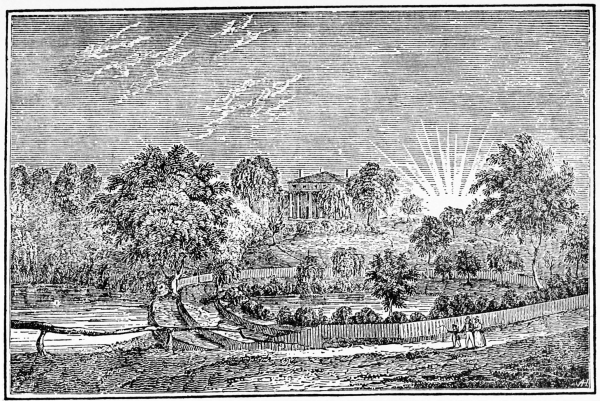
of science. He built a beautiful home, not in
New England, be it noted, but near Washington—the
"Holland House of America"—and began,
but never finished, a history of the United States.
He did, however, at last complete "The Columbiad,"
which was published in Philadelphia in
1807—"the finest specimen of book-making ever
produced in America."
Did the great moment hold something of disillusion
and disappointment, when, amid the
somewhat perfunctory adulation, came the bitter
criticism of the Federalists and the expressed conviction
of some of his old Yale and Hartford
friends that he was an apostate in politics and
religion? To him it was clear that they did not
understand. How could it be expected that Timothy
Dwight, for example, the grandson of Jonathan
Edwards, with all of New England's conservatism
and provincialism in his blood, could
understand? Yet Barlow's ancestral background
was the same—but who can fathom the depths
of personality, or solve the complexity of motive
and aspiration?
Perhaps there were times when the returned
wanderer grew homesick for Paris. At last the
chance to return to the land that had adopted
him came—a chance for notable service in an
honorable capacity. War was again in the air
and in 1811 Barlow went back to France as minister
plenipotentiary, charged with the duty of
again averting conflict and negotiating a treaty
embodying a settlement of the differences.
In the French capital he took his old house.
His old servants came back to him with tears of
joy. Old friends gathered about him. It was not
easy, however, to clinch the treaty. The Emperor
was involved in momentous affairs. The
Russian expedition was on foot. The ministers
procrastinated. There is an intimation in the
record that the poet and political theorist was
out-maneuvered in the negotiations by players
of a game that had nothing to do with poetry or
abstract questions but that concerned itself, persistently
and relentlessly, with very definite but
not entirely obvious purposes. Yet it does not
seem that this inference is conclusively supported
by the evidence. However that may be, it was
given out that Barlow had secured, and he unquestionably
believed that he had secured, an
agreement as to the provisions of the proposed
treaty. At any rate the Emperor consented to
meet the American envoy if he would come to
Vilna in West Russia.
So in that dreary winter he set out with a high
hope of achieving his greatest service to his country,
but what would have happened at Vilna we
shall never know, for on Barlow's approach to
that town an incredible and stupendous piece of
news awaited him. The invincible Grand Army
was retreating, apparently in some demoralization.
Everything was in confusion. Where the
Emperor was, no one knew. Obviously nothing
could now be done and the American minister
started to return.
Somewhere on those frozen roads the Emperor
passed him, racing for Paris to save his dynasty
and himself. In the exposure and hardship Barlow
fell ill. At the little village of Zarnovich,
near Cracow, it became evident that he could
travel no further and there, in the midst of that
historic cataclysm, he died.
It was a strange ending for one of the old
Hartford coterie. In the clairvoyance said sometimes
to accompany the supreme moment did he
realize that if his great epic might not live forever
he had at least given form in his day to a
dream of which civilization would never let go?
Did any intimation come to him that his "Ode
to Hasty Pudding," written off-hand at a Savoyard
inn, held more real emotion than all the
balanced cadences of his monumental work? No
doubt his delirious fancies sometimes went back
to the old days. Perhaps he saw once more the
faces of his old companions of the friendly club,
not clouded now with misunderstanding or disapproval.
From beyond the frosted panes came
intermittently the confused noises of the great
retreat, with all their implications of selfish ambition,
human suffering and the continual warfare
of the world. Was his belief in the final triumph
of the fraternity of mankind shaken by that sinister
monotone? It is idle to conjecture, but let
us hope that he was comforted by a lingering
faith, revived in this hour of his extremity from
the days of his youth, that he would soon learn
as to the truth of his vision and that he would
find as well the answers to the other riddles that
had puzzled him all his life.