The Revolution would never have achieved its object: on the contrary, it
would have led to no less than a violent reaction against those
principles which were maturing before it broke out, and which it carried
to triumph, had not the armies of revolutionary France proved successful
in the field; but the grasping of this mere historic fact, I mean the
success of the revolutionary armies, is unfortunately no simple matter.
We all know that as a matter of fact the Revolution was, upon the whole,
successful in imposing its view upon Europe. We all know that from that
success as from a germ has proceeded, and is still proceeding, modern
society. But the nature, the cause and the extent of the military
success which alone made this possible, is widely ignored and still more
widely misunderstood. No other signal military effort which achieved its
object has in history ended in military disaster—yet this was the case
with the revolutionary wars. After twenty years of advance, during which
the ideas of the Revolution were sown throughout Western civilisation,
and had time to take root, the armies of the Revolution stumbled into
the vast trap or blunder of the Russian campaign; this was succeeded by
the decisive defeat of the democratic armies at Leipsic, and the superb
strategy of the campaign of 1814, the brilliant rally of what is called
the Hundred Days, only served to emphasise the completeness of the
apparent failure. For that masterly campaign was followed by Napoleon’s
first abdication, that brilliant rally ended in Waterloo and the ruin of
the French army. When we consider the spread of Grecian culture over
the East by the parallel military triumph of Alexander, or the conquest
of Gaul by the Roman armies under Cæsar, we are met by political
phenomena and a political success no more striking than the success of
the Revolution. The Revolution did as much by the sword as ever did
Alexander or Cæsar, and as surely compelled one of the great
transformations of Europe. But the fact that the great story can be read
to a conclusion of defeat disturbs the mind of the student.
Again, that element fatal to all accurate study of military history, the
imputation of civilian virtues and motives, enters the mind of the
reader with fatal facility when he studies the revolutionary wars.
He is tempted to ascribe to the enthusiasm of the troops, nay, to the
political movement itself, a sort of miraculous power. He is apt to use
with regard to the revolutionary victories the word “inevitable,” which,
if ever it applies to the reasoned, willing and conscious action of men,
certainly applies least of all to men when they act as soldiers.
There are three points which we must carefully bear in mind when we
consider the military history of the Revolution.
First, that it succeeded: the Revolution, regarded as the political
motive of its armies, won.
Secondly, that it succeeded through those military aptitudes and
conditions which happened to accompany, but by no means necessarily
accompanied, the strong convictions and the civic enthusiasm of the
time.
Thirdly, that the element of chance, which every wise and prudent
reasoner will very largely admit into all military affairs, worked in
favour of the Revolution in the critical moments of the early wars.
With these points fixed, and with a readiness to return to them when we
have appreciated the military story, it is well to begin our study by
telling that story briefly, and upon its most general lines. In so
doing, it will be necessary to cover here and there points which have
already been dealt with in this book, but that is inevitable where one
is writing of the military aspect of any movement, for it is impossible
to deal with that aspect save as a living part of the whole: so knit
into national life is the business of war.
When the Revolution first approached action, the prospect of a war
between France and any other great Power of the time—England, Prussia,
the Empire, or let us say Russia, or even Spain—was such a prospect as
might have been entertained at any time during the past two or three
generations of men.
For pretty well a hundred years men had been accustomed to the
consideration of dynastic quarrels supported by a certain type of army,
which in a moment I shall describe.
I have called these quarrels dynastic; that is, they were mainly
quarrels between the ruling houses of Europe: were mainly motived by
the desire of each ruling house to acquire greater territory and
revenue, and were limited by the determination of all the ruling houses
to maintain certain ideas inviolate, as, for instance, the sacredness of
monarchy, the independence of individual States, etc. Though they were
in the main dynastic, yet in proportion as a dynasty might represent a
united nation, they were national also. The English oligarchy was in
this respect peculiar and more national than any European Government of
its time. It is also true to say that the Russian despotism had behind
it, in most of its military adventures and in all its spirit of
expansion, the subconscious agreement of the people.
Still, however national, the wars of the time preceding the Revolution
moved within a fixed framework of ideas, as it were, which no commander
and no diplomatist dreamed of exceeding. A, the crowned head of a State,
would have some claims against B, the crowned head of another State,
with regard to certain territories. C, the crowned head or Government of
a third State, would remain neutral or ally himself with either of the
two; if he allied himself, then, as a rule, it was with the weaker
against the stronger, in order to guarantee himself against too great an
increase on the part of a rival. Or, again, a rebellion would break out
against the power of A in some part of his dominions; then would B,
somewhat reluctantly (as the almost unlimited right of an existing
executive was still a strong dogma in men’s minds), tend to ally
himself with the rebels in order to diminish the power of A.
Human affairs have always in them very strongly and permanently
inherent, the character of a sport: the interest (at any rate of males)
in the conduct of human life is always largely an interest of seeing
that certain rules are kept, and certain points won, according to those
rules. We must, therefore, beware of ridiculing the warfare of the
century preceding the Revolution under the epithet of “a game.” But it
is true of that warfare, and honourably true, that it attempted limited
things in a limited manner; it did not attempt any fundamental change in
society; it was not overtly—since the Thirty Years’ War at least—a
struggle of ideas; it was conducted on behalf of known and limited
interests for known and highly limited objects, and the instruments with
which it was conducted were instruments artificial and segregated from
the general life of nations.
These instruments were what have been called the “professional” armies.
The term is very insufficient, and, in part, misleading. The gentry of
the various Powers, mixed with whom were certain adventurers not always
of gentle blood, were the officers that led these forces; and for the
major part of the gentry in most European countries, the military career
was the chief field of activity. The men whom they led were not a
peasantry nor a working class, still less a civic force in which the
middle class would find itself engaged: they were the poorest and the
least settled, some would have said the dregs of European life. With the
exception here and there of a man—usually a very young man whom the
fabled romance of this hard but glorious trade had attracted—and with
the exception of certain bodies that followed in a mass and by order the
relics of a feudal lordship, the armies of the period immediately
preceding the Revolution were armies of very poor men, who had sold
themselves into a sort of servitude often exciting and even adventurous,
but not, when we examine it minutely, a career that a free man would
choose. The men were caught by economic necessity, by fraud, and in
other ways, and once caught were held. No better proof of this could be
found than the barbarous severity of the punishments attached to
desertion, or to minor forms of indiscipline. So held, they were used
for the purposes of the game, not only in what would make them
serviceable instruments of war, but also in what would make them
pleasing to their masters. Strict alignment, certain frills of parade
and appearance, all that is required in a theatre or in a pretentious
household, appear in the military regulations of the time.
I must not in all this be supposed to be belittling that great period
between 1660 and 1789, during which the art of war was most thoroughly
thought out, the traditions of most of our great European armies fixed,
and the permanent military qualities which we still inherit developed.
The men so caught as private soldiers could not but enjoy the game when
it was actively played, for men of European stock will always enjoy the
game of war; they took glory in its recital and in its memories; to be a
soldier, even under the servile conditions of the time, was a proper
subject for pride, and it is further to be remarked that the excesses of
cruelty discoverable in the establishment of their discipline were also
accompanied by very high and lasting examples of military virtue. The
behaviour of the English contingents at Fontenoy afford but one of many
examples of what I mean.
Still, to understand the wars of the Revolution we must clearly
establish the contrast between the so-called professional armies which
preceded that movement and the armies which the Revolution invented,
used, and bequeathed to the modern world.
So also, to revert to what was said above, we must recall the dynastic
and limited character of the wars in which the eighteenth century had
been engaged; at the outbreak of the Revolution no other wars were
contemplated by men.
Had you spoken, for instance, at any moment in 1789, to a statesman,
whether of old experience or only introduced to political life by the
new movement, of the position of Great Britain, he would at once have
discussed that position in the terms of Great Britain’s recent defeat at
the hands of France in the affair of the American colonies. Had you
discussed with him the position of Prussia he would at once have argued
it in connection with Prussia’s secular opposition to Austria and the
Empire. Had you asked him how he considered Spain, he would have spoken
of the situation of Spain as against France in the light of the fact
that Spain was a Bourbon monarchy allied in blood to the French throne.
And so forth. No true statesman imagined at the time, nor, indeed, for
many years, that a war of ideas, nor even, strictly speaking, of
nations, was possible. Even when such a war was actually in process of
waging, the diplomacy which attempted to establish a peace, the
intrigues whereby alliances were sought, or neutrality negotiated, were
dependent upon the older conception of things; and the historian is
afforded, as he regards this gigantic struggle, the ironic satisfaction
of seeing men fighting upon doctrines the most universal conceivable and
yet perpetually changing their conduct during the struggle according to
conceptions wholly particular, local and ephemeral, and soon to be
entirely swept away by time.
Napoleon himself must needs marry an Austrian archduchess as part of
this old prejudice, and for years brains as excellent as Danton’s or
Talleyrand’s conjecture the possibility of treating now England, now
Prussia, as neutral to the vast attempt of the French to destroy
privilege in European society!
One may say that for two years the connection of the revolutionary
movement with arms had no aspect save that of civil war. True, whenever
a considerable change is in progress in society the possibility of
foreign war in connection with it must always arise. Were some European
State, for instance, to make an experiment in Collectivism to-day, the
chance of foreign intervention would certainly be discussed by the
promoters of that experiment. But no serious danger of an armed struggle
between the French and any of their neighbours in connection with the
political experiment of the Revolution was imagined by the mass of
educated men in France itself nor without the boundaries of France
during those first two years. And, I repeat, the military aspect of
those years was confined to civil tumult. Nevertheless, that aspect is
not to be neglected. The way in which the French organised their civil
war (and there was always something of it present from the summer of
1789 onwards) profoundly affected the foreign war that was to follow:
for in their internal struggles great masses of Frenchmen became
habituated to the physical presence, millions to the discussion, of
arms.
It is, as we have seen in another part of this book, a repeated and
conspicuous error to imagine that the first revolutionary outbreaks were
not met sufficiently sternly by royal troops. On the contrary, the royal
troops were used to the utmost and were defeated. The populace of the
large towns, and especially of Paris, proved itself capable of military
organisation and of military action. When to this capacity had been
added the institution of the militia called the National Guard, there
were already the makings of a nation wholly military.
Much in this exceptional and new position must be ascribed to the Gallic
character. It may be said that from the fall of the Roman Empire to the
present day that character has been permanently and of its own volition
steeped in the experience of organised fighting. Civil tumult has been
native to it, the risk of death in defence of political objects has been
equally familiar, and the whole trade of arms, its necessary
organisation, its fatigues and its limiting conditions, have been very
familiar to the population throughout all these centuries. But beyond
this the fact that the Revolution prepared men in the school of civil
tumult was of the first advantage for its later aptitude against foreign
Powers.
It is always well in history to fix a definite starting-point for any
political development, and the starting-point of the revolutionary wars
may easily be fixed at the moment when Louis, his queen and the royal
children attempted to escape to the frontier and to the Army of the
Centre under the command of Bouillé. This happened, as we have seen, in
June 1791.
Many factors combine to make that date the starting-point. In the first
place, until that moment no actual proof had been apparent in the eyes
of European monarchs of the captivity of their chief exemplar, the king
of France.
The wild march upon Versailles, in the days of October 1789, had its
parallel in a hundred popular tumults with which Europe was familiar
enough for centuries. But the rapidly succeeding reforms of the year
1790, and even the great religious blunder of 1791, had received the
signature and the public assent of the Crown. The Court, though no
longer at Versailles, was splendid, the power of the King over the
Executive still far greater than that of any other organ in the State,
and indefinitely greater than that of any other individual in the State.
The talk of captivity, of insult and the rest, the outcries of the
emigrants and the perpetual complaint of the French royal family in its
private relations, seemed exaggerated, or at any rate nothing to act
upon, until there came the shock of the King’s attempted flight and
recapture. This clinched things; and it clinched them all the more
because more than one Court, and especially that of Austria, believed
for some days that the escape had been successful.
Again, the flight and its failure put the army into a ridiculous
posture. Action against the Revolution was never likely, so long as the
discipline and steadiness of the French army were believed in abroad.
But the chief command had hopelessly failed upon that occasion, and it
was evident that the French-speaking troops could not easily be trusted
by the Executive Government or by their own commanders. Furthermore, the
failure of the flight leads the Queen, with her vivacity of spirit and
her rapid though ill-formed plans, to turn for the first time to the
idea of military intervention. Her letters suggesting this (in the form
of a threat rather than a war, it is true) do not begin until after her
capture at Varennes.
Finally, coincident with that disaster was the open mention of a
Republic, the open suggestion that the King should be deposed, and the
first definite and public challenge to the principles of monarchy which
the Revolution had thrown down before Europe.
We are, therefore, not surprised to find that this origin of the
military movement was followed in two months by the Declaration of
Pillnitz.
With the political nature of that Declaration one must deal elsewhere.
Its military character must here be observed.
The Declaration of Pillnitz corresponded as nearly as possible to what
in the present day would be an order preparatory to mobilising a certain
proportion of the reserve. It cannot with justice be called equivalent
to an order calling out all the reserves, still less equivalent to an
order mobilising upon a war footing the forces of a modern nation, for
such an action is tantamount to a declaration of war (as, for instance,
was the action of the English Government before the South African
struggle), and Pillnitz was very far from that. But Pillnitz was
certainly as drastic a military proceeding as would be the public
intimation by a group of Powers that the reserves had been warned in
connection with their quarrel against another Power. It was, for
instance, quite as drastic as the action of Austria against Servia in
1908. And it was intended to be followed by such submission as is
expected to follow upon the threat of superior force.
Such was the whole burden of Marie Antoinette’s letters to her brother
(who had called the meeting at Pillnitz), and such was the sense in
which the politicians of the Revolution understood it.
All that autumn and winter the matter chiefly watched by foreign
diplomatists and the clearest of French thinkers was the condition of
the French forces and of their command. Narbonne’s appointment to the
War Office counted more than any political move, Dumouriez’ succession
to him was the event of the time. Plans of campaign were drawn up (and
promptly betrayed by Marie Antoinette to the enemy), manifold occasions
for actual hostilities were discovered, the Revolution challenged the
Emperor in the matter of the Alsatian princes, the Emperor challenged,
through Kaunitz, the Revolution in a letter directly interfering with
the internal affairs of France, and pretending to a right of ingérence
therein; and on the 20th of April, 1792, war was declared against the
Empire. Prussia thereupon informed the French Government that she made
common cause with the Emperor, and the revolutionary struggle had begun.
The war discovered no serious features during its first four months: so
slow was the gathering and march of the Allies; but the panics into
which the revolutionary troops fell in the first skirmishes, their lack
of discipline, and the apparent breakdown of the French military power,
made the success of the Invasion in Force, when it should come, seem
certain. The invading army did not cross the frontier until more than a
week after the fall of the palace. Longwy capitulated at once; a week
later, in the last days of August, the great frontier fortress of Verdun
was summoned. It capitulated almost immediately.
On the 2nd of September Verdun was entered by the Prussians, and a
little outside the gates of the town, near a village bearing the name of
Regret, the allied camp was fixed. Rather more than a week later, on the
11th, the Allies marched against the line of the Argonne.
The reader will remember that this moment, with the loss of the frontier
fortresses Longwy and Verdun, and the evidence of demoralisation which
that afforded, was also the moment of the September massacres and of the
horrors in Paris. Dumouriez and the mixed French force which he
commanded had been ordered by the Ministers of War to hold the line of
the Argonne against which the Allies were marching. And here it is well
to explain what was meant in a military sense by this word “line.”
The Argonne is a long, nearly straight range of hills running from the
south northward, a good deal to the west of north.
Their soil is clay, and though the height of the hills is only three
hundred feet above the plain, their escarpment or steep side is towards
the east, whence an invasion may be expected. They are densely wooded,
from five to eight miles broad, the supply of water in them is bad, in
many parts undrinkable; habitation with its provision for armies and
roads extremely rare. It is necessary to insist upon all these details
because the greater part of civilian readers find it difficult to
understand how formidable an obstacle so comparatively unimportant a
feature in the landscape may be to an army upon the march. It was quite
impossible for the guns, the wagons, and therefore the food and the
ammunition of the invading army, to pass through the forest over the
drenched clay land of that wet autumn save where proper roads existed.
These were only to be found wherever a sort of natural pass negotiated
the range.
Three of these passes alone existed, and to this day there is very
little choice in the crossing of these hills. The accompanying sketch
will explain their disposition. Through the southernmost went the great
high road from the frontier and Verdun to Paris. At the middle one
(which is called the Gap of Grandpré) Dumouriez was waiting with his
incongruous army. The third and northern one was also held, but less
strongly. The obvious march for an unimpeded invader would have been
from Verdun along the high road, through the southern pass at “Les
Islettes,” and so to Chalôns and on to Paris. But Dumouriez, marching
down rapidly from the north, had set an advanced guard to hold that pass
and was lying himself with the mass of the army on the pass to the north
of it at Grandpré. Against Grandpré the Prussians marched, and meanwhile
the Austrians were attacking the further pass to the north. Both were
forced. Dumouriez fell back southward to St. Menehould. Meanwhile
Kellermann was coming up from Metz to join him, and all the while the
main pass at “Les Islettes,” through which the great road to Paris went,
continued to be held by the French.
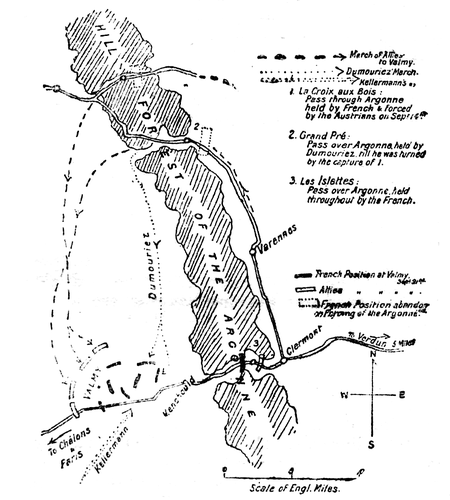 Sketch Map, showing the turning of the positions on the
Argonne and the Cannonade at Valmy, September 1792.
Sketch Map, showing the turning of the positions on the
Argonne and the Cannonade at Valmy, September 1792.
Enlarge Map
The Prussians and the Austrians joined forces in the plain known as the
Champagne Pouilleuse, which lies westward of Argonne. It will be seen
that as they marched south along this plain to meet Dumouriez and to
defeat him, their position was a peculiar one: they were nearer the
enemy’s capital than the enemy’s army was, and yet they had to fight
with their backs to that capital, and their enemy the French had to
fight with their faces towards it. Moreover, it must be remarked that
the communications of the Allied Army were now of a twisted, roundabout
sort, which made the conveyance of provisions and ammunition slow and
difficult—but they counted upon an immediate destruction of Dumouriez’
force and after that a rapid march on the capital.
On September 19 Kellermann came up from the south and joined hands with
Dumouriez near St. Menehould, and on the morning of the 20th his force
occupied a roll of land on which there was a windmill and immediately
behind which was the village of Valmy; from this village the ensuing
action was to take its name. It must here be insisted upon that both
armies had been subjected to the very worst weather for more than a
fortnight, but of the two the Prussian force had suffered from this
accident much more severely than the French. Dysentery had already
broken out, and the length and tortuousness of their communications were
greatly emphasised by the condition of the roads.
On the morning of that day, the 20th of September, a mist impeded all
decisive movements. There was an encounter, half accidental, between an
advanced French battery and the enemy’s guns, but it was not until
mid-morning that the weather lifted enough to show each force its
opponent. Then there took place an action, or rather a cannonade, the
result of which is more difficult to explain, perhaps, than any other
considerable action of the revolutionary wars. For some hours the
Prussian artillery, later reinforced by the Austrian, cannonaded the
French position, having for its central mark the windmill of Valmy,
round which the French forces were grouped. At one moment this cannonade
took effect upon the limbers and ammunition wagons of the French; there
was an explosion which all eye-witnesses have remembered as the chief
feature of the firing, and which certainly threw into confusion for some
moments the ill-assorted troops under Kellermann’s command. At what hour
this took place the witnesses who have left us accounts differ to an
extraordinary extent. Some will have it at noon, others towards the
middle of the afternoon—so difficult is it to have any accurate account
of what happens in the heat of an action. At any rate, if not
coincidently with this success, at some moment not far removed from it,
the Prussian charge was ordered, and it is here that the difficulties of
the historian chiefly appear. That charge was never carried home;
whether, as some believe, because it was discovered, after it was
ordered, to be impossible in the face of the accuracy and intensity of
the French fire, or whether, as is more probably the case, because the
drenched soil compelled the commanders to abandon the movement after it
had begun—whatever the cause may have been, the Prussian force, though
admirably disciplined and led, and though advancing in the most exact
order, failed to carry out its original purpose. It halted halfway up
the slope, and the action remained a mere cannonade without immediate
result apparent upon either side.
Nevertheless that result ultimately turned out to be very great, and if
we consider its place in history, quite as important as might have been
the result of a decisive action. In the first place, the one day’s delay
which it involved was just more than the calculations of the Allies,
with their long impeded line of communications, had allowed for. In the
next place, a singular increase in determination and moral force was
infused into the disheartened and ill-matched troops of the French
commanders by this piece of resistance.
We must remember that the French force upon the whole expected and
discounted a defeat, the private soldier especially had no confidence in
the result; and to find that at the first action which had been so long
threatened and had now at last come, he could stand up to the enemy,
produced upon him an exaggerated effect which it would never have had
under other circumstances.
Finally, we must recollect that whatever causes had forbidden the
Prussian charge forbade on the next day a general advance against the
French position. And all the time the sickness in the Prussian camp was
rapidly increasing. Even that short check of twenty-four hours made a
considerable difference. A further delay of but yet another day, during
which the Allied Army could not decide whether to attack at once or to
stand as they were, very greatly increased the list of inefficients from
illness.
For a whole week of increasing anxiety and increasing inefficiency the
Allied Army hung thus, impotent, though they were between the French
forces and the capital. Dumouriez ably entertained this hesitation, with
all its accumulating dangers for the enemy, by prolonged negotiations,
until upon the 30th of September the Prussian and Austrian organisation
could stand the strain no longer, and its commanders determined upon
retreat. It was the genius of Danton, as we now know, that chiefly
organised the withdrawal of what might still have been a dangerous
invading force. It is principally due to him that no unwise Jingoism was
permitted to claim a trial of strength with the invader, that he was
allowed to retire with all his guns, his colours and his train. The
retreat was lengthy and unmolested, though watched by the French forces
that discreetly shepherded it but were kept tightly in hand from Paris.
It was more than three weeks later when the Allied Army, upon which
Europe and the French monarchy had counted for an immediate settlement
of the Revolution, re-crossed the frontier, and in this doubtful and
perhaps inexplicable fashion the first campaign of the European Powers
against the Revolution utterly failed.
Following upon this success, Dumouriez pressed on to what had been, from
the first moment of his power at the head of the army, his personal
plan—to wit, the invasion of the Low Countries.
To understand why this invasion failed and why Dumouriez thought it
might succeed, we must appreciate the military and political situation
of the Low Countries at the time. They then formed a very wealthy and
cherished portion of the Austrian dominions; they had latterly suffered
from deep disaffection culminating in an open revolution, which was due
to the Emperor of Austria’s narrow and intolerant contempt of religion.
From his first foolish policy of persecution and confiscation he had
indeed retreated, but the feeling of the people was still strongly
opposed to the Government at Vienna. It is remarkable, indeed, and in
part due to the pressure of a strongly Protestant and aristocratic
state, Holland, to the north of them, that the people of the Austrian
Netherlands retained at that time a peculiar attachment to the Catholic
religion. The Revolution was quite as anti-Catholic as the Austrian
Emperor, but of the persecution of the latter the Belgians (as we now
call them) knew something; that of the former they had not yet learnt to
dread. It was, therefore, Dumouriez’ calculation that, in invading this
province of the Austrian power, he would be fighting in friendly
territory. Again, it was separated from the political centre of the
empire; it was, therefore, more or less isolated politically, and even
for military purposes communication with it was not so easy, unless,
indeed, Austria could count on a complete co-operation with Prussia,
which Power had been for now so long her ruthless and persistent rival.
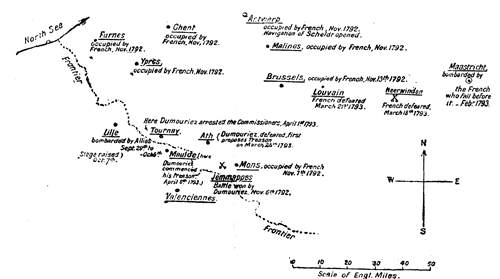 Sketch Map of towns occupied by French in 1792 and
evacuated in March 1793, with sites of battles of Jemappes and of
Neerwinden, and of Dumouriez’ treason.
Sketch Map of towns occupied by French in 1792 and
evacuated in March 1793, with sites of battles of Jemappes and of
Neerwinden, and of Dumouriez’ treason.
Enlarge Map
Favourable, however, as the circumstances appeared for an invasion, two
factors telling heavily against the French had to be counted: the first
was the formation of their army, the second the spirit of rebellion
against any anti-Catholic Government which had given such trouble to
Joseph II.
Of these two factors by far the most important was, of course, the
first. If the French forces had been homogeneous, in good spirit, and
well trained, they might have held what they won; as a fact, they were
most unhomogeneous, great portions of them were ill trained, and, worst
of all, there was no consistent theory of subordinate command. Men who
imagined that subordinate, that is, regimental, command in an army
could be erected from below, and that a fighting force could resemble a
somewhat lax and turbulent democracy, marched alongside of and were
actually incorporated with old soldiers who had spent their whole
careers under an unquestioned discipline, and under a subordinate
command which came to them they knew not whence, and as it were by fate.
The mere mixture of two such different classes of men in one force would
have been bad enough to deal with, but what was worse, the political
theories of the day fostered the military error of the new battalions
though the politicians dared not interfere with the valuable
organisation of the old.
The invasion of the Low Countries began with a great, though somewhat
informal and unfruitful success, in the victory of Jemappes. It was the
first striking and dramatic decisive action which the French, always of
an eager appetite for such news, had been given since between forty and
fifty years. The success in America against the English, though
brilliantly won and solidly founded, had not presented occasions of this
character, and Fontenoy was the last national victory which Paris could
remember. Men elderly or old in this autumn of 1792 would have been boys
or very young men when Fontenoy was fought. The eager generation of the
Revolution, with its military appetites and aptitudes, as yet had hardly
expected victory, though victory was ardently desired by them and
peculiarly suitable to their temper.
It may be imagined, therefore, what an effect the news of Jemappes had
upon the political world in Paris. The action was fought just below the
town of Mons, a few miles over the frontier, and consisted in a somewhat
ill-ordered but successful advance across the River Haine. Whether
because the Austrians, with an inferior force, attempted to hold too
long a line, or because the infantry and even the new French volunteer
battalions, as yet untried by fatigue, proved irresistible in the centre
of the movement, Jemappes was a victory so complete that the attempts of
apologists to belittle it only serve to enhance its character.
Like many another great and apparently decisive action, however, it bore
no lasting fruit. Both the factors of which I have spoken above appeared
immediately after this success. Belgium was, indeed, over-run by the
French, but in their over-running of it with something like eighty
thousand men, they made no attempt to spare the traditions or to
conciliate the sympathies of the inhabitants. Hardly was Jemappes won
when Mons, the neighbouring fortified frontier town, was at once endowed
with the whole machinery of revolutionary government. Church property
was invaded and occasionally rifled, and the French paper money, the
assignats of which we have heard, poured in to disturb and in places to
ruin the excellent commercial system upon which Belgium then as now
reposed.
Jemappes was fought upon the 6th of November, 1792. Brussels was entered
upon the 14th, and throughout that winter the Low Countries lay
entirely in the hands of the French. The Commissioners from the
Convention, though endowing Belgium with republican institutions,
treated it as a conquered country, and before the breaking of spring,
the French Parliament voted its annexation to France. This annexation,
the determination of the politicians in Paris that the new Belgian
Government should be republican and anti-Catholic, the maltreatment of
the Church in the occupied country and the increasing ill discipline and
lack of cohesion in his army, left Dumouriez in a position which grew
more and more difficult as the new year, 1793, advanced. It must be
remembered that this moment exactly corresponded with the execution of
the King and the consequent declaration of war by or against France in
the case of one Power after another throughout Europe. Meanwhile, it was
decided, foolishly enough, to proceed from the difficult occupation of
Belgium to the still more difficult occupation of Holland, and the siege
of Maestricht was planned.
The moment was utterly ill-suited for such a plan. Every Executive in
the civilised world was coalescing openly or secretly, directly or
indirectly, against the revolutionary Government. The first order to
retreat came upon the 8th of March, when the siege of Maestricht was
seen to be impossible, and when the great forces of the Allies were
gathered again to attempt what was to be the really serious attack upon
the Revolution: something far more dangerous, something which much more
nearly achieved success, than the march of the comparatively small force
which had been checked at Valmy.
For ten days the French retreat continued, when, upon the 18th of March,
Dumouriez risked battle at Neerwinden. His army was defeated.
The defeat was not disastrous, the retreat was continued in fairly good
order, but a civilian population understands nothing besides the words
defeat and victory; it can appreciate a battle, not a campaign. The news
of the defeat, coming at a moment of crisis in the politics of Paris,
was decisive; it led to grave doubts of Dumouriez’ loyalty to the
revolutionary Government, it shattered his popularity with those who had
continued to believe in him, while the general himself could not but
believe that the material under his command was rapidly deteriorating.
Before the end of the month the army had abandoned all its conquests,
and Valenciennes, in French territory, was reached upon the 27th. The
dash upon Belgium had wholly failed.
At this moment came one of those political acts which so considerably
disturb any purely military conspectus of the revolutionary wars.
Dumouriez, at the head of his army, which, though in retreat and
defeated, was still intact, determined upon what posterity has justly
called treason, but what to his own mind must have seemed no more than
statesmanship. He proposed an understanding with the enemy and a
combined march upon Paris to restore the monarchical government, and
put an end to what seemed to him, as a soldier, a perfectly hopeless
situation. He certainly believed it impossible for the French army, in
the welter of 1793, to defeat the invader. He saw his own life in peril
merely because he was defeated. He had no toleration for the rising
enthusiasm or delirium of the political theory which had sent him out,
and, even before he had reached French territory, his negotiations with
Coburg, the Austrian commander, had begun. They lasted long. Dumouriez
agreed to put the frontier fortresses of the French into the hands of
the enemy as a guarantee and a pledge; and on the 5th of April all was
ready for the alliance of the two armed forces.
But just as the treason of Dumouriez is, in the military sense, abnormal
and disturbing to any general conspectus of the campaign, so was the
action of his army.
The doubtful point of a general command which is political in nature,
and may be unpopular with the rank and file, lies, of course, in the
attitude of the commanders of units, and these unanimously refused to
obey the orders of their chief. It was known that Dumouriez had been
summoned to the bar of the Convention, which body had sent commissioners
to apprehend him. He had arrested the commissioners, and had handed them
over as hostages and prisoners to Coburg. So far from Dumouriez upon the
critical day handing over his force to the enemy, or constituting it a
part of an allied army to march upon the capital, he was compelled to
fly upon the 8th of April; all that disappeared with him, counting many
who later deserted back again to the French colours, was less than a
thousand men—and these foreign mercenaries.
The consequence of this strange passage upon the political history of
the time we have already seen. Its consequence upon the military history
of it was indirect but profound. The French forces, such as they were,
were still intact, but no general officer could in future be trusted by
Paris, and the stimulus which nations in the critical moments of
invasion and of danger during foreign war seek in patriotism, in the
offering of a high wage to the men and of honours and fortunes to their
commanders, was now sought by the French in the singular, novel and
abnormal experiment of the Terror. Command upon the frontier throughout
1793 and the first part of 1794, during the critical fourteen months,
that is, which decided the fate of the Revolution, and which turned the
tide of arms in favour of the French, was a task accomplished under the
motive power of capital punishment. A blunder was taken as a proof of
treason, and there lay over the ordering of every general movement the
threat of the guillotine.
What we have now to follow is somewhat over a year of a struggle thus
abnormally organised upon the French side, and finally successful
through the genius of a great organiser, once a soldier, now a
politician, Carnot. The French succeeded by the unshakable conviction
which permitted the political leaders to proceed to all extremity in
their determination to save the Revolution; by the peculiar physical
powers of endurance which their army displayed, and finally, of course,
by certain accidents—for accident will always be a determining factor
in war.
The spring of 1793, the months of April and May, form the first crisis
of the revolutionary war. The attack about to be delivered is universal,
and seems absolutely certain to succeed. With the exception of the rush
at Jemappes, where less than thirty thousand Austrians were broken
through by a torrent superior in numbers (though even there obviously
ill-organised), no success had attended the revolutionary armies. Their
condition was, even to the eye of the layman, bad, and to the eye of the
expert hopeless. There was no unity apparent in direction, there were
vast lesions in the discipline of the ranks like great holes torn in
some rotten fabric. Even against the forces already mobilised against
it, it had proved powerless, and it might be taken for granted that by
an act more nearly resembling police work than a true campaign, the
Allies would reach Paris and something resembling the old order be soon
restored. What remains is to follow the process by which this
expectation was disappointed.
The situation at this moment can best be understood by a glance at the
sketch map on p. 178. Two great French advances had been made in the
winter of 1792-93; the one a northern advance, which we have just
detailed, the over-running of Belgium; the other an eastern advance
right up to the Rhine and to the town of Mayence. Both had failed. The
failure in Belgium, culminating in the treason of Dumouriez, has been
read. On the Rhine (where Mayence had been annexed by the French
Parliament just as Belgium had been) the active hostility of the
population and the gathering of the organised forces of the Allies had
the same effect as had been produced in the Low Countries.
It was on March 21, 1793, that the Prussians crossed the Rhine at
Bacharach, and within that week the French commander, Custine, began to
fall back. On the first of April he was back again in French territory,
leaving the garrison of Mayence, somewhat over twenty thousand men, to
hold out as best it could; a fortnight later the Prussians had
surrounded the town and the siege had begun.
On the north-eastern front, stretching from the Ardennes to the sea, a
similar state of things was developing. There, a barrier of fortresses
stood between the Allies and Paris, and a series of sieges corresponding
to the siege of Mayence in the east had to be undertaken. At much the
same time as the investment of Mayence, on April 9, the first step in
this military task was taken by the Allies moving in between the
fortress of Condé and the fortress of Valenciennes. Thenceforward it was
the business of the Austrians under Coburg, with the Allies that were to
reach him, to reduce the frontier fortresses one by one, and when his
communications were thus secure, to march upon Paris.
It is here necessary for the reader unacquainted with military history
to appreciate two points upon which not a little of contemporary
historical writing may mislead him. The first is that both in the Rhine
valley and on the Belgian frontier the forces of the Allies in their
numbers and their organisation were conceived to be overwhelming. The
second is that no competent commander on the spot would have thought of
leaving behind him the garrison of even one untaken fortress. It is
important to insist upon these points, because the political passions
roused by the Revolution are still so strong that men can hardly write
of it without prejudice and bias, and two errors continually present in
these descriptions of the military situation in the spring of 1793, are,
first, that the Allies were weakened by the Polish question, which was
then active, and secondly, that the delay of their commanders before the
French fortresses was unnecessary.
Both these propositions are put forward with the object of explaining
the ultimate defeat of the enemies of the Revolution: both, however
great the authority behind them, are unhistorical and worthless. The
French success was a military success due to certain military factors
both of design and accident, which will appear in what follows. The
Allies played their part as all the art of war demanded it to be played;
they were ultimately defeated, not from the commission of any such
gross and obvious error in policy or strategy as historians with too
little comprehension of military affairs sometimes pretend, but from the
military superiority of their opponents.
It is true that the Polish question (that is the necessity the Austrian
and Prussian Governments were each under of watching that the other was
not lessened in importance by the approaching annexations of further
Polish territory with the consequent jealousy and mistrust that arose
from this between Austria and Prussia) was a very important feature of
the moment. But it is bad military history to pretend that this affected
the military situation on the Rhine or in the Netherlands.
Every campaign is conditioned by its political object. The political
object in this case was to march upon and to occupy Paris. The political
object of a campaign once determined, the size and the organisation of
the enemy are calculated and a certain force is brought against it. No
much larger force is brought than is necessary: to act in such a fashion
would be in military art what paying two or three times the price of an
article would be in commerce. The forces of the Allies upon the Rhine
and in the Netherlands were, in the opinion of every authority of the
time, amply sufficient for their purpose; and more than sufficient: so
much more than sufficient that the attitude of that military opinion
which had to meet the attack—to wit, the professional military opinion
of the French republican soldiers, was that the situation was
desperate, nor indeed was it attempted to be met save by a violent and,
as it were, irrational enthusiasm.
The second point, the so-called “delay” involved in the sieges
undertaken by the Allies, proves, when it is put forward, an
insufficient acquaintance with contemporary conditions. Any fortress
with a considerable garrison left behind untaken would have meant the
destruction of the Austrian or Prussian communications, and their
destruction at a moment when the Austrian and Prussian forces were
actually advancing over a desperately hostile country. Moreover, when
acting against forces wholly inferior in discipline and organisation, an
untaken fortress is a refuge which one must take peculiar pains to
destroy. To throw himself into such a refuge will always stand before
the commander of those inferior forces as a last resource. It is a
refuge which he will certainly avail himself of ultimately, if it is
permitted to him. And when he has so availed himself of it, it means the
indefinite survival of an armed organisation in the rear of the
advancing invaders. We must conclude, if we are to understand this
critical campaign which changed the history of the world, that Coburg
did perfectly right in laying siege to one fortress after another before
he began what every one expected to be the necessarily successful
advance on Paris. The French despair, as one town after another
surrendered, is an amply sufficient proof of the excellence of his
judgment.
We approach the military problem of 1793, therefore, with the following
two fields clear before us:—
1. In the north-east an advance on Paris, the way to which is blocked by
a quadrilateral of fortresses: Mons, Maubeuge, Condé, and Valenciennes,
with the subsidiary stronghold of Lequesnoy in the neighbourhood of the
last. Mons has been in Austrian hands since Dumouriez’ retreat; Condé is
just cut off from Valenciennes by Coburg’s advance, but has not fallen;
Valenciennes and the neighbouring Lequesnoy are still intact, and so is
Maubeuge. All must be reduced before the advance on Paris can begin.
Behind these fortresses is a French army incapable as yet of attacking
Coburg’s command with any hope of success. Such is the position in the
last fortnight of April.
2. Meanwhile, on the Rhine the French garrison in Mayence is besieged;
Custine, the French commander in that quarter, has fallen back on the
French town of Landau, and is drawing up what are known in history as
the Lines of Weissembourg. The accompanying sketch map explains their
importance. Reposing upon the two obstacles of the river on the right
and the mountains on the left, they fulfilled precisely the same
functions as a fortress; and those functions we have just described.
Until these lines were carried, the whole of Alsace may be regarded as a
fortress defended by the mountains and the river on two sides, and by
the Lines of Weissembourg on the third.
A reader unacquainted with military history may ask why the obstruction
was not drawn upon the line of the Prussian advance on Paris. The answer
is that the presence of a force behind fortifications anywhere in the
neighbourhood of a line of communication is precisely equivalent to an
obstacle lying right upon those lines. For no commander can go forward
along the line of his advance and leave a large undestroyed force close
to one side of that line, and so situated that it can come out when he
has passed and cut off his communications; for it is by communications
that an army lives, especially when it is marching in hostile country.
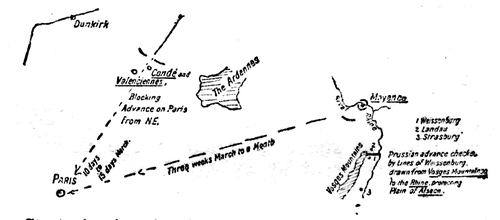 Strategic situation in early summer of 1793. Mayence
besieged, Condé and Valenciennes about to be besieged. Conditions of the
double advance on Paris.
Strategic situation in early summer of 1793. Mayence
besieged, Condé and Valenciennes about to be besieged. Conditions of the
double advance on Paris.
Enlarge Map
Custine, therefore, behind his Lines of Weissembourg, and the besieged
garrison in Mayence, correspond to the barrier of fortresses on the
north-east and delayed the advance of the Prussians under Wurmser and
Brunswick from the Rhine, just as Condé, Valenciennes, and Maubeuge
prevented the advance of Coburg on the north-east. Such in general was
the situation upon the eastern frontier at the end of that month of
April, 1793.
Let us first follow the development of the northern position. It will be
remembered that all Europe was at war against the French. The Austrians
had for allies Dutch troops which joined them at this moment, and
certain English and Hanoverian troops under the Duke of York who also
joined them.
At this moment, when Coburg found himself in increasing strength, a
tentative French attack upon him was delivered and failed. Dampierre,
who was in command of all this French “Army of the North,” was killed,
and Custine was sent to replace him. The Army of the North did not, as
perhaps it should have done, concentrate into one body to meet Coburg’s
threatened advance; it was perpetually attempting diversions which were
useless because its strength was insufficient. Now it feinted upon the
right towards Namur, now along the sea coast on the left; and these
diversions failed in their object. Before the end of the month, Coburg,
to give himself elbow room, as it were, for the sieges which he was
preparing, compelled the main French force to retreat to a position well
behind Valenciennes. It was immediately after this success of Coburg’s
that Custine arrived to take command on the Belgian frontier, his place
on the Rhine being taken by Houchard.
Custine was a very able commander, but a most unlucky one. His plan was
the right one: to concentrate all the French forces (abandoning the
Rhine) and so form an army sufficient to cope with Coburg’s. The
Government would not meet him in this, and he devoted himself
immediately to the reorganisation of the Army of the North alone. The
month of June and half of July was taken up in that task.
Meanwhile, the Austrian siege work had begun, and Condé was the first
object of its attention. Upon July 10 Condé fell. Meanwhile Custine had
been recalled to Paris, and Valenciennes was invested. Custine was
succeeded by Kilmaine, a general of Irish extraction, who maintained his
position for but a short time, and was unable while he maintained it to
do anything. The forces of the Allies continually increased. The number
at Coburg’s disposal free from the business of besieging Valenciennes
was already larger than the force required for that purpose. And yet
another fifteen thousand Hessian troops marched in while the issue of
that siege was in doubt. This great advantage in numbers permitted him
to get rid of the main French force that was still present in front of
him, though not seriously annoying him.
This force lay due south-west of Valenciennes, and about a day’s march
distant. He depended for the capture of it upon his English and
Hanoverian Allies under the Duke of York, but that general’s march
failed. The distance was too much for his troops in the hot summer
weather, and the French were able to retreat behind the line of the
Scarpe and save their army intact.
The Duke of York’s talents have been patriotically exaggerated in many a
treatise. He always failed: and this was among the most signal of his
failures.
Kilmaine had hardly escaped from York, drawn up his army behind the
Scarpe and put it into a position of safety when he in his turn was
deprived of the command, and Houchard was taken from the Rhine just as
Custine had been, and put at the head of the Army of the North. Before
the main French army had taken up this position of safety, Valenciennes
had fallen. It fell on the 28th of July, and its fall, inevitable though
it was and, as one may say, taken for granted by military opinion, was
much the heaviest blow yet delivered. Nothing of importance remained to
block the march of the Armies of the Allies, save Maubeuge.
At about the same moment occurred three very important changes in the
general military situation, which the reader must note if he is to
understand what follows.
The first was the sudden serious internal menace opposed to the
Republican Government; the second was the advent of Carnot to power; the
third was the English diversion upon Dunquerque.
The serious internal menace which the Government of the Republic had to
face was the widespread rebellion which has been dealt with in the
earlier part of this book. The action of the Paris Radicals against the
Girondins had raised whole districts in the provinces. Marseilles, which
had shown signs of disaffection since April, and had begun to raise a
local reactionary force, revolted. So did Bordeaux, Nîmes, and other
great southern towns. Lyons had risen at the end of May and had killed
the Jacobin mayor of the town in the period between the fall of Condé
and that of Valenciennes. The troop which Marseilles had raised against
the Republic was defeated in the field only the day before Valenciennes
fell, but the great seaport was still unoccupied by the forces of the
Government. The Norman march upon Paris had also failed between those
two dates, the fall of Condé and the fall of Valenciennes. The Norman
bark had proved worse than the Norman bite; but the force was so
neighbouring to the capital that it took a very large place in the
preoccupations of the time. The Vendean revolt, though its triumphant
advance was checked before Nantes a fortnight before the fall of Condé,
was still vigorous, and the terrible reprisals against it were hardly
begun. Worst of all, or at least, worst perhaps, after the revolt of
Lyons, was the defection of Toulon. Toulon rose two days before the fall
of Valenciennes, and was prepared to hand itself over (as at last it did
hand itself over) to occupation by the English fleet.
The dates thus set in their order may somewhat confuse the reader, and I
will therefore summarise the general position of the internal danger
thus: A man in the French camp on the Scheldt, listening to the guns
before Valenciennes fifteen miles away, and hourly expecting their
silence as a signal that the city had surrendered, would have heard by
one post after another how Marseilles still held out against the
Government; how the counter-attack against the successful Vendeans had
but doubtfully begun (all July was full of disasters in that quarter);
how Lyons was furiously successful in her rebellion and had dared to put
to death the Republican mayor of the town; and that the great arsenal
and port at Toulon, the Portsmouth of France upon the Mediterranean, had
sickened of the Government and was about to admit the English fleet. His
only comfort would have been to hear that the Norman march on Paris had
failed—but he would still be under the impression of it and of the
murder of Marat by a Norman woman.
There is the picture of that sudden internal struggle which coincides
with this moment of the revolutionary war, the moment of the fall of
Condé and of Valenciennes, and the exposure of the frontier.
The second point, the advent of Carnot into the Committee of Public
Safety, which has already been touched upon in the political part of
this work, has so preponderating a military significance that we must
consider it here also.
The old Committee of Public Safety, it will be remembered, reached the
end of its legal term on July 10. It was the Committee which the wisdom
of Danton had controlled. The members elected to the new Committee did
not include Carnot, but the military genius of this man was already
public. He came of that strong middle class which is the pivot upon
which the history of modern Europe turns; a Burgundian with lineage,
intensely republican, he had been returned to the Convention and had
voted for the death of the King; a sapper before the Revolution, and one
thoroughly well grounded in his arm and in general reading of military
things, he had been sent by the Convention to the Army of the North on
commission, he had seen its weakness and had watched its experiments.
Upon his return he was not immediately selected for the post in which he
was to transform the revolutionary war. It was not until the 14th of
August that he was given a temporary place upon the Committee which his
talents very soon made permanent. He was given the place merely as a
stopgap to the odious and incompetent fanatic, Saint-André, who was for
the moment away on mission. But from the day of his admission his
superiority in military affairs was so incontestable that he was
virtually a dictator therein, and his first action after the general
lines of organisation had been laid down by him was to impose upon the
frontier armies the necessity of concentration. He introduced what
afterwards Napoleon inherited from him, the tactical venture of “all
upon one throw.”
It must be remembered that Carnot’s success did not lie in any
revolutionary discovery in connection with the art of war, but rather in
that vast capacity for varied detail which marks the organiser, and in
an intimate sympathy with the national character. He understood the
contempt for parade, the severity or brutality of discipline, the
consciousness of immense powers of endurance which are in the Frenchman
when he becomes a soldier;—and he made use of this understanding of
his.
It must be further remembered that this powerful genius had behind him
in these first days of his activity the equally powerful genius of
Danton; for it was Danton and he who gave practical shape to that law of
conscription by which the French Revolution suddenly increased its armed
forces by nearly half a million of men, restored the Roman tradition,
and laid the foundation of the armed system on which Europe to-day
depends. With Carnot virtually commander-in-chief of all the armies, and
enabled to impose his decisions in particular upon that Army of the
North which he had studied so recently as a commissioner, the second
factor of the situation I am describing is comprehended.
The third, as I have said, was the English diversion upon Dunquerque.
The subsequent failure of the Allies has led to bitter criticism of this
movement. Had the Allies not failed, history would have treated it as
its contemporaries treated it. The forces of the Allies on the
north-eastern frontier were so great and their confidence so
secure—especially after the fall of Valenciennes—that the English
proposal to withdraw their forces for the moment from Coburg’s and to
secure Dunquerque, was not received with any destructive criticism.
Eighteen battalions and fourteen squadrons of the Imperial forces were
actually lent to the Duke of York for this expedition. What is more,
even after that diversion failed, the plan was fixed to begin again when
the last of the other fortresses should have fallen: so little was the
English plan for the capture of the seaport disfavoured by the
commander-in-chief of the Allies.
That diversion on Dunquerque turned out, however, to be an error of
capital importance. The attempt to capture the city utterly failed, and
the victory which accompanied its repulsion had upon the French that
indefinable but powerful moral effect which largely contributed to their
future successes.
The accompanying sketch map will explain the position. Valenciennes and
Condé have fallen; Lequesnoy, the small fortress subsidiary to
Valenciennes, has not yet been attacked but comes next in the series,
when the moment was judged propitious for the detachment of the
Anglo-Hanoverian force with a certain number of Imperial Allies to march
to the sea.
It must always be remembered by the reader of history that military
situations, like the situations upon a chess board, rather happen than
are designed; and the situation which developed at the end of September
upon the extreme north and west of the line which the French were
attempting to hold against the Allies was strategically of this nature.
When the Duke of York insisted upon a division of the forces of the
Allies and an attack upon Dunquerque, no living contemporary foresaw
disaster.
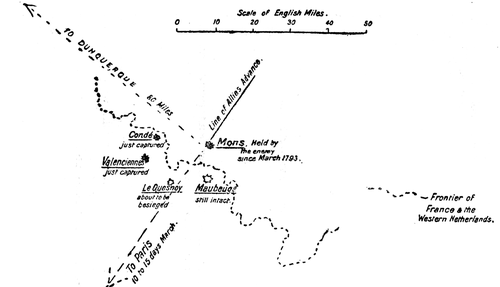 Showing condition of the frontier fortresses blocking the
road to Paris when the expedition to Dunquerque was decided upon. August
1793.
Showing condition of the frontier fortresses blocking the
road to Paris when the expedition to Dunquerque was decided upon. August
1793.
Enlarge Map
Coburg, indeed, would have preferred the English to remain with him, and
asked them to do so, but he felt in no sort of danger through their
temporary absence, nor, as a matter of fact, was he in any danger
through it.
Again, though the positions which the Duke of York took up when he
arrived in front of Dunquerque were bad, neither his critics at home,
nor any of his own subordinates, nor any of the enemy, perceived fully
how bad they were. It was, as will presently be seen, a sort of drift,
bad luck combined with bad management, which led to this British
disaster, and (what was all-important for the conduct of the war) to the
first success in a general action which the French had to flatter and
encourage themselves with during all that fatal summer.
The Duke of York separated his force from that of Coburg just before the
middle of August; besides the British, who were not quite 7,000 strong,
11,000 Austrians, over 10,000 Hanoverians and 7,000 Hessians were under
his command. The total force, therefore, was nearly 37,000 strong. No
one could imagine that, opposed by such troops as the French were able
to put into line, and marching against such wretched defences as those
of Dunquerque then were, the Duke’s army had not a perfectly easy task
before it; and the plan, which was to take Dunquerque and upon the
return to join the Austrian march on Paris, was reasonable and feasible.
It is important that the reader should firmly seize this and not read
history backward from future events.
Certain faults are to be observed in the first conduct of the march. It
began on the 15th of August, proceeding from Marchiennes to Menin, and
at the outset displayed that deplorable lack of marching power which the
Duke of York’s command had shown throughout the campaign.[6] From
Marchiennes to Tourcoing is a long day’s march: it took the Duke of York
four days; and, take the march altogether, nine days were spent in
covering less than forty miles. In the course of that march, the British
troops had an opportunity of learning to despise their adversary: they
found at Linselles, upon the flank of their advance, a number of
undisciplined boys who broke the moment the Guards were upon them, and
whose physical condition excited the ridicule of their assailants. The
army proceeded after this purposeless and unfruitful skirmish to the
neighbourhood of the sea coast, and the siege of Dunquerque was
undertaken under conditions which will be clear to the reader from the
following sketch map.
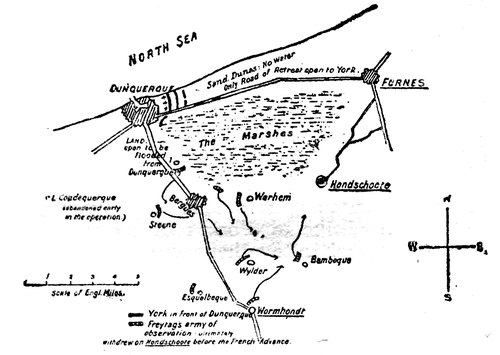 Operations round Dunquerque. September 1793.
Enlarge Map
The date of the 20th of August must first be fixed in the mind: on that
date the army which was to take Dunquerque was separated into its two
component parts. The first, under the Duke of York, was to attack the
town itself; the second, under the aged Austrian general, Freytag, was
to watch the movement of any approaching enemy and to cover the force
which was besieging the town. Two days later, the Duke of York was
leaving Furnes, which he had made his base for the advance, and Freytag
had with the greatest ease brushed the French posts—mainly of
volunteers—from before him, and was beginning to take up the flanking
positions south and east of Bergues which covered the siege of
Dunquerque.
Two days later again, on August 24, Freytag had occupied Wormhoudt and
Esquelbecque, capturing guns by the dozen, doing pretty well what he
would with the French outposts, and quite surrounding the town of
Bergues. Wilder was his headquarters. On the same day, the 24th, the
Duke of York had with the greatest ease driven in the advanced posts of
the French before Dunquerque, and shut up the enemy within the town,
while he formed his besieging force outside of it, entrenched in a
position which he had chosen beforehand, reposing upon the sea at his
right, his left on the village of Tetteghem. He was then about 3,000
yards from the fortifications at Dunquerque.
Such was the situation upon the dawn of the 25th, when everything was
ready for active operations. And here the reader must look upon the map
for what ultimately proved the ruin of the situation.
Supposing Freytag round Bergues in the position which the map shows; the
Duke of York in front of Dunquerque as the map also shows him; the two
forces are in touch across the road and the belt of country which unites
Bergues and Dunquerque. The covering army and the besieging force which
it covers are each a wing of one combined body; each communicates with
the other, each can support the other at the main point of effort, and
though between the one and the other eastward there stretches a line of
marshy country—the “meres” which the map indicates—yet a junction
between the two forces exists westward of these, and the two armies can
co-operate by the Bergues-Dunquerque road.
A factor which the Duke of York may have neglected was the power of
flooding all that flat country round, the road which the French in
Dunquerque, being in possession of the sluices, possessed. They used it
at once: they drowned the low lands to the south of Dunquerque, upon the
very day when the last dispositions of the attacking force were
completed. But more important—and never yet explained—was the
Austrians’ abandonment of Coudequerque. By this error, the main road
itself, standing above the flood, was lost, and from being one strong
army the force of the Allies became two weak ones. Communication was no
longer possible between the Duke of York’s and Freytag’s territories,
and it was of this separation that the French, in spite of their
deplorable organisation and more deplorable personnel, took advantage.
They took advantage of it slowly. Houchard gathered altogether forty
thousand men near Cassel, but it was ten days before they could be
concentrated. It must again be insisted upon and repeated that, large as
the number was—it was four times as great as Freytag’s now isolated
force—Houchard’s command was made up of men quite two-thirds of whom
were hardly soldiers: volunteers both new and recent, ill-trained
conscripts and so forth. There was no basis of discipline, hardly any
power to enforce it; the men had behaved disgracefully in all the
affairs of outposts, they had been brushed away contemptuously by the
small Austrian force from every position they had held. With all his
numerical superiority the attempt which Houchard was about to make was
very hazardous: and Houchard was a hesitating and uncertain commander.
Furthermore, of the forty thousand men one quarter at least remained out
of action through the ineptitude and political terror of Dumesny,
Houchard’s lieutenant upon the right.
It was upon the 6th of September that the French advance began along the
whole line; it was a mere pushing in of inferior numbers by superior
numbers, the superior numbers perpetually proving themselves inferior to
the Austrians in military value. Thus, the capture of old Freytag
himself in a night skirmish was at once avenged by the storming of the
village near which he had been caught, and he was re-taken. In actual
fighting and force for force, Houchard’s command found nothing to
encourage it during these first operations.
The Austrians in falling back concentrated and were soon one compact
body: to attack and dislodge it was the object of the French advance,
but an object hardly to be attained.
What happened was not only the unexpected success of this advance, but
the gaining by the French of the first decisive action in the long
series which was to terminate twenty years later at Leipsic.
The army of Freytag fell back upon the village of Hondschoote and stood
there in full force upon the morning of Sunday, the 8th of September.
Houchard attacked it with a force greatly lessened but still double that
of the defenders. So conspicuous, however, was the superiority of the
Austrian regulars over the French raw troops and volunteers that during
this morning of the 8th the result was still doubtful. By the afternoon,
however, the work was done, and the enemy were in a retreat which might
easily have been turned into a rout. A glance at the map will show that
Houchard, had he possessed the initiative common to so many of his
contemporaries, might at once have driven the numerically inferior and
heavily defeated force (it had lost one-third of its men) to the right,
and proceeded himself to cut the communications of the Duke of York and
to destroy his army, which lay packed upon the waterless sand dunes
where the village of Malo-les-Bains now stands. Houchard hesitated;
Freytag escaped; the Duke of York, abandoning his siege-pieces to the
number of forty and much of his heavy baggage, retreated precipitately
through the night to Furnes, right across the front of the French army,
and escaped destruction.
The Battle of Hoondschoote, therefore, as it is called, raised the siege
of Dunquerque. It was, as I have said, the first successful decisive
action which the Revolution could count since the moment of its extreme
danger and the opening of the general European war. But it was nothing
like what it might have been had Houchard been willing to risk a hardy
stroke. Houchard was therefore recalled, condemned to death, and
executed by the Committee of Public Safety, whose pitiless despotism was
alone capable of saving the nation. He remains the single example of a
general officer who has suffered death for military incompetence after
the gaining of a victory, and his execution is an excellent example of
the way in which the military temper of the Committee, and particularly
of Carnot, refused to consider any factor in the war save those that
make for military success.
Carnot and the Committee had no patience with the illusions which a
civilian crowd possesses upon mere individual actions: what they saw was
the campaign as a whole, and they knew that Houchard had left the armies
opposite him intact.
Perhaps his execution was made more certain by the continuance of bad
news from that more important point of the frontier—the direct line of
Austrian advance upon Paris. Here, already, Valenciennes had fallen two
months before, and Condé also. Lequesnoy, the third point of the barrier
line, capitulated on the 11th of September, and the news of that
capitulation reached Paris immediately after the news of Hondschoote. No
fortress was now left between the Allies and the capital but Maubeuge.
Coburg marched upon it at once.
Not only had he that immense superiority in the quality of his troops
which must be still insisted upon, but numerically also he was three to
one when, on the 28th of September, at dawn, he crossed the Sambre above
and below Maubeuge, and by noon of that day had contained the French
army in that neighbourhood within the lines of the fortress.
The situation was critical in the extreme: Maubeuge was ill prepared to
stand siege; it was hardly provisioned; its garrison was of varied and,
on the whole, of bad quality. In mere victuals it could stand out for
but a few days, and, worst of all, it had behind it the continued
example of necessary and fatal surrenders which had marked the whole
summer. The orders of the Committee of Public Safety to its commander
were terse: “Your head shall answer for Maubeuge.” After the receipt of
that message no more came through the lines.
The reader, if he be unaccustomed to military history, does well to note
that in every action and in every campaign there is some one factor of
position or of arms or of time which explains the result. Each has a
pivot or hinge, as it were, upon which the whole turns. It was now upon
Maubeuge that the revolutionary war thus depended. At risk of
oversimplifying a complex story, I would lay this down as the prime
condition for the understanding of the early revolutionary wars: had
Maubeuge fallen, the road to Paris lay open and the trick was
done[7]—and here we must consider again the effect in the field of
Carnot’s genius.
In the first place, he had provided numbers not on paper, but in
reality; the Committee, through a decree of the Assembly, had
despotically “requisitioned” men, animals, vehicles and supplies. The
levy was a reality. Mere numbers then raw, but increasing, had begun to
pour into the north-east. It was they that had told at Hoondschoote, it
was they that were to tell in front of Maubeuge.
Secondly, as the Committee supplied the necessary initiative, Carnot
supplied the necessary personality of war. His own will and own brain
could come to one decision in one moment, and did so. It was he, as we
shall see, who won the critical action. He chose Jourdan, a man whose
quaint military career we must reluctantly leave aside in so brief a
study as this, but at any rate an amateur, and put him in Houchard’s
command over the Army of the Northern Frontier, and that command was
extended from right away beyond the Ardennes to the sea. He ordered (and
Jourdan obeyed) the concentration of men from all down that lengthy line
to the right and the left upon one point, Guise. To leave the rest of
the frontier weak was a grave risk only to be excused by very rapid
action and success: both these were to follow. The concentration was
effected in four days. Troops from the extreme north could not come in
time. The furthest called upon were beyond Arras, with sixty-five miles
of route between them and Guise. This division (which shall be typical
of many), not quite eight thousand strong, left on receiving orders in
the morning of the 3rd of October and entered Guise in the course of the
6th. The rate of marching and the synchrony of these movements of
imperfect troops should especially be noted by any one who would
understand how the Revolution succeeded.
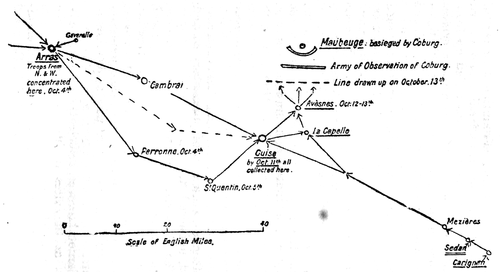 The rapid eight days’ concentration in front of Maubeuge.
October 1783.
The rapid eight days’ concentration in front of Maubeuge.
October 1783.
Enlarge Map
A second division of over thirteen thousand men followed along the
parallel road, with a similar time table. From the other end of his
line, a detachment under Beauregard, just over four thousand men, was
called up from the extreme right. It will serve as a typical example
upon the eastern side of this lightning concentration. It had been
gathered near Carignan, a town full fourteen miles beyond Sedan. It
picked up reinforcements on the way and marched into Fourmies upon the
11th, after covering just seventy miles in the three and a half days.
With its arrival the concentration was complete, and not a moment too
soon, for the bombardment of Maubeuge was about to begin. From the 11th
to the 15th of October the army was advanced and drawn up in line, a
day’s march in front of Guise, with its centre at Avesnes and facing the
covering army of Coburg, which lay entrenched upon a long wooded crest
with the valley of the Sambre upon its right and the village of
Wattignies, on a sort of promontory of high land, upon its left.
The Austrian position was reconnoitred upon the 14th. Upon the 15th the
general attack was delivered and badly repelled. When darkness fell upon
that day few in the army could have believed that Maubeuge was
succourable—and it was a question of hours.
Carnot, however, sufficiently knew the virtues as the vices of his novel
troops, the troops of the great levy, stiffened with a proportion of
regulars, to attempt an extraordinary thing. He marched eight thousand
from his left and centre, over to his right during the night, and in the
morning of the 16th his right, in front of the Austrian left at
Wattignies had, by this conversion, become far the strongest point of
the whole line.
A dense mist had covered the end of this operation as the night had
covered its inception, and that mist endured until nearly midday. The
Austrians upon the heights had no hint of the conversion, and Wattignies
was only held by three regiments. If they expected a renewed attack at
all, they can only have expected it in the centre, or even upon the left
where the French had suffered most the day before.
Initiative in war is essentially a calculation of risk, and with high
initiative the risk is high. What Carnot gambled upon (for Jourdan was
against the experiment) when he moved those young men through the night,
was the possibility of getting active work out of them after a day’s
furious action, the forced marches of the preceding week and on top of
it all a sleepless night of further marching. Most of the men who were
prepared to charge on the French right as the day broadened and the mist
lifted on that 16th of October, had been on foot for thirty hours. The
charge was delivered, and was successful. The unexpected numbers thus
concentrated under Wattignies carried that extreme position, held the
height, and arrived, therefore, on the flank of the whole Austrian line,
which, had not the effort of the aggressors exhausted them, would have
been rolled up in its whole length. As it was, the Austrians retreated
unmolested and in good order across the Sambre. The siege of Maubeuge
was raised; and the next day the victorious French army entered the
fortress.
Thus was successfully passed the turning-point of the revolutionary
wars.
Two months later the other gate of the country was recovered. In the
moment when Maubeuge was relieved, the enemy had pierced the lines of
Wissembourg. It is possible that an immediate and decisive understanding
among the Allies might then have swept all Alsace; but such an
understanding was lacking. The disarrayed “Army of the Rhine” was got
into some sort of order, notably through the enthusiasm of Hoche and the
silent control of Pichegru. At the end of November the Prussians stood
on the defensive at Kaiserslautern. Hoche hammered at them for three
days without success. What really turned the scale was the floods of men
and material that the levy and the requisitioning were pouring in. Just
before Christmas the enemy evacuated Haguenau. Landau they still held;
but a decisive action fought upon Boxing Day, a true soldiers’ battle,
determined by the bayonet, settled the fate of the Allies on this point.
The French entered Wissembourg again, and Landau was relieved after a
siege of four months and a display of tenacity which had done not a
little to turn the tide of the war.
Meanwhile the news had come in that the last of the serious internal
rebellions was crushed. Toulon had been re-captured, the English fleet
driven out; the town, the harbour and the arsenal had fallen into the
hands of the French largely through the science of a young major of
artillery (not captain: I have discussed the point elsewhere),
Bonaparte, and this had taken place a week before the relief of Landau.
The last confused horde of La Vendée had been driven from the walls of
Granville in Normandy, to which it had erred and drifted rather than
retreated. At Mans on the 13th of December it was cut to pieces, and at
Savenay on the 23rd, three days before the great victory in Alsace, it
was destroyed. A long peasant-and-bandit struggle, desperate yet hardly
to be called guerilla, continued through the next year behind the hedges
of Lower Brittany and of Vendée, but the danger to the State and to the
Revolution was over. The year 1793 ended, therefore, with the complete
relief of the whole territory of the Republic, save a narrow strip upon
the Belgian frontier, complete domination of it by its Cæsar, the
Committee of Public Safety; with two-thirds of a million of men under
arms, and the future of the great experiment apparently secure.
The causes of the wonder have been discussed, and will be discussed
indefinitely. Primarily, they resided in the re-creation of a strong
central power; secondly, in the combination of vast numbers and of a
reckless spirit of sacrifice. The losses on the National side were
perpetually and heavily superior to those of the Allies—in Alsace they
had been three to one; and we shall better understand the duel when we
appreciate that in the short eight years between the opening of the war
and the triumph of Napoleon at Marengo, there had fallen in killed and
wounded, on the French side, over seven hundred thousand men.
The story of 1794 is but the consequence of what we have just read. It
was the little belt or patch upon the Belgian frontier which was still
in the hands of the enemy that determined the nature of the campaign.
It was not until spring that the issue was joined. The Emperor of
Austria reached Brussels on the 2nd day of April, and a fortnight later
reviewed his army. The French line drawn up in opposition to it suffered
small but continual reverses until the close of the month.
On the 29th Clerfayt suffered a defeat which led to the fall, or rather
the escape, of the small garrison of Menin. Clerfayt was beaten again at
Courtray a fortnight later; but all these early engagements in the
campaign were of no decisive moment. Tourcoing was to be the first heavy
blow that should begin to settle matters, Fleurus was to clinch them.
No battle can be less satisfactorily described in a few lines than that
of Tourcoing, so different did it appear to either combatant, so
opposite are the plans of what was expected on either side, and of what
happened, so confused are the various accounts of contemporaries. The
accusations of treason which nearly always arise after a disaster, and
especially a disaster overtaking an allied force, are particularly
monstrous, and may be dismissed: in particular the childish legend which
pretends that the Austrians desired an English defeat.
What the French say is that excellent forced marching and scientific
concentration permitted them to attack the enemy before the junction of
his various forces was effected. What the Allies say is (if they are
speaking for their centre) that it was shamefully abandoned and
unsupported by the two wings; if they are speaking for the wings, that
the centre had no business to advance, when it saw that the two wings
were not up in time to co-operate.
One story goes that the Archduke Charles was incapacitated by a fit;
Lord Acton has lent his considerable authority to this amusing version.
At any rate, what happened was this:—
The Allies lay along the river Scheldt on Friday, the 16th of May:
Tournay was their centre, with the Duke of York in command of the chief
force there; five or six miles north, down the river, was one extremity
of their line at a place called Warcoing: it was a body of Hanoverians.
The left, under the Archduke Charles, was Austrian and had reached a
place a day’s march south of Tournay called St. Amand. Over against the
Allies lay a large French force also occupying a wide front of over
fifteen miles, the centre of which was Tourcoing, then a village. Its
left was in front of the fortress of Courtrai. Now, behind the French,
up country northward in the opposite direction from the line of the
Allies on the Scheldt was another force of the Allies under Clerfayt.
The plan was that the Allied right should advance on to Mouscron and
take it. The Allied centre should advance on to Tourcoing and Mouveaux
and take them, while the left should march across the upper waters of
the river Marque, forcing the bridges that crossed that marshy stream,
and come up alongside the centre. In other words, there was to be an
attack all along the French line from the south, and while it was
proceeding, Clerfayt, from the north of the French, was to cross the Lys
and attack also.
On the day of the 17th what happened was this: The left of the Allies,
marching from St. Amand, came up half a day late; the right of the
Allies took Mouscron, but were beaten out of it by the French. The
centre of the Allies fulfilled their programme, reaching Tourcoing and
its neighbourhood by noon and holding their positions. It is to the
honour of English arms that this success was accomplished by a force a
third of which was British and the most notable bayonet work in which
was done by the Guards. Meanwhile, Clerfayt was late in moving and in
crossing the river Lys, which lay between him and his objective.
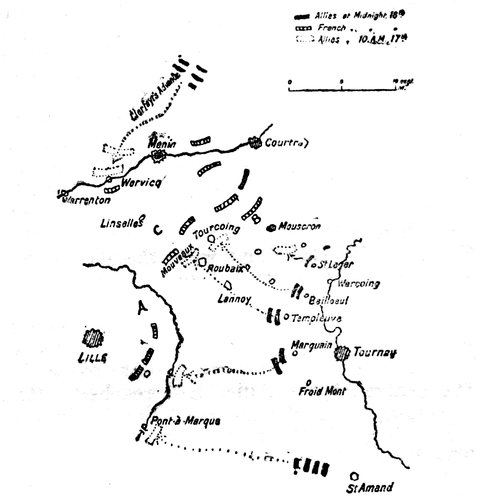 Tourcoing. May 16 to 18, 1794.
The breakdown of the attempt of the Allies to cut off the French near
Courtrai from Lille was due to their failure to synchronise They should
have been in line from A to B at noon of the 17th with Clerfayt at C.
Enlarge Map
When night fell, therefore, on the first day of the action, a glance at
the map will show that instead of one solid line advancing against the
French from A to B, and the northern force in touch with it at C, the
Allied formation was an absurd projection in the middle, due to the
success of the mixed and half-British force under the Duke of York: a
success which had not been maintained on the two wings. A bulge of this
sort in an attacking line is on the face of it disastrous. The enemy
have only to be rapid in falling upon either flank of it and the bulge
can be burst in. The French were rapid, and burst in the bulge was. By
concentrating their forces against this one central part of the Allies
they fought three to one.
That same capacity which at Wattignies had permitted them to scorn sleep
and to be indefatigable in marching, put them on the road before three
o’clock in the morning of Sunday, the 18th, and with the dawn they fell
upon the central force of the Allies, attacking it from all three sides.
It is on this account that the battle is called the Battle of Tourcoing,
for Tourcoing was the most advanced point to which the centre of the
Allies had reached. The Germans, upon the Duke of York’s right at
Tourcoing, felt the first brunt of the attack. The Duke of York himself,
with his mixed, half-British force, came in for the blow immediately
afterwards, and while it was still early morning. The Germans at
Tourcoing began to fall back. The Duke of York’s force, to the left of
them, was left isolated: its commander ought not to have hung on so
long. But the defence was maintained with the utmost gallantry for the
short time during which it was still possible. The retreat began about
nine in the morning and was kept orderly for the first two miles, but
after that point it was a rout. The drivers of the British cannon fled,
and the guns, left without teams, blocked the precipitate flight of the
cavalry. Their disorder communicated itself at once to the Guards, and
to the line.
Even in this desperate strait some sort of order was restored, notably
by the Guards Brigade, which were apparently the first to form, and a
movement that could still be called a retreat was pursued towards the
south. The Duke of York himself was chased from spinney to spinney and
escaped by a stroke of luck, finding a bridge across the last brook held
by a detachment of Hessians. In this way were the central columns, who
between them numbered not a third of the total force of the Allies,
destroyed.
Clerfayt had first advanced—but far too late to save the centre—and
then retreated. The Archduke Charles, upon the left, was four hours late
in marching to the help of the Duke of York; the right wing of the
Allies was not even late: it spent the morning in an orderly artillery
duel with the French force opposed to it. By five in the afternoon
defeat was admitted and a general retreat of the Allies ordered.
I have said that many reasons are given to account for the disaster of
Tourcoing, one of the very few in which a British force has been routed
upon the Continent; but I confess that if I were asked for an
explanation of my own, I would say that it was simply due to the gross
lack of synchrony on the part of the Allies, and that this in its turn
was taken advantage of by the power both of vigil and of marching which
the French troops, still inferior in most military characteristics, had
developed and maintained, and which (a more important matter) their
commanders knew how to use.
This heavy blow, delivered on the 18th of May, in spite of a successful
rally a week later, finally convinced the Emperor that the march on
Paris was impossible. Eleven days later, on the 29th, it was announced
in the camp of Tournay, upon which the Allied army had fallen back, that
the Emperor had determined to return to Vienna. The Allied army was
indeed still left upon that front, but the French continued to pour up
against it. It was again their numbers that brought about the next and
the final victory.
Far off, upon the east of that same line, the army which is famous in
history and in song as that of the Sambre et Meuse was violently
attempting to cross the Sambre and to turn the line of the Allies.
Coburg reinforced his right opposite the French left, but numbers had
begun to bewilder him. The enthusiasm of Saint-Just, the science of
Carnot, decided victory at this eastern end of the line.
Six times the passage of the Sambre had failed. Reinforcements continued
to reach the army, and the seventh attempt succeeded.
Charleroi, which is the main fortress blocking the passage of the
Sambre at this place, could be, and was, invested when once the river
was crossed by the French. It capitulated in a week. But the evacuation
of Charleroi was but just accomplished when Coburg, seventy thousand
strong, appeared in relief of the city.
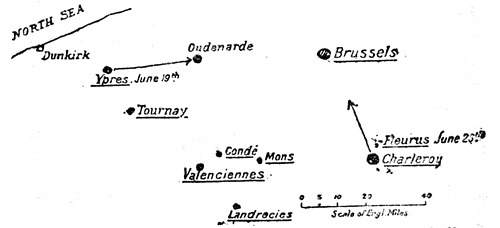 Showing effect of Ypres, Charleroi and Fleurus in
wholly throwing back the Allies in June 1794.
Showing effect of Ypres, Charleroi and Fleurus in
wholly throwing back the Allies in June 1794.
Ypres captured on June 19 by the French, they march on Oudenarde and
pass it on June 25 to 27. Meanwhile Charleroi has also surrendered to
the French, and when, immediately afterwards, the Austrians try to
relieve it, they are beaten at Fleurus and retire on Brussels.
Thus the English at Tournai and all the Allied Forces at Condé,
Valenciennes, Landrecies, and Mons are imperilled and must
surrender or retire.
Enlarge Map
The plateau above the town where the great struggle was decided, is
known as that of Fleurus, and it was upon the 26th of June that the
armies were there engaged. Never before had forces so equal permitted
the French any success. It had hitherto been the ceaseless
requisitioning of men to supply their insufficient training and command,
which had accomplished the salvation of the country. At Fleurus, though
there was still some advantage on the French side, the numbers were
more nearly equal.
The action was not determined for ten hours, and on the French centre
and left was nearly lost, when the Reserves’ and Marceau’s obstinacy in
front of Fleurus village itself at last decided it.
The consequences of the victory were final. As the French right advanced
from Fleurus the French left advanced from Ypres, and the centre became
untenable for the Allies. The four French fortresses which the enemy
still garrisoned in that Belgian “belt” of which I have spoken, were
invested and re-captured. By the 10th of July the French were in
Brussels, the English were beaten back upon Holland, the Austrians
retreating upon the Rhine, and the continuous success of the
revolutionary armies was assured.
While these things were proceeding upon land, however, there had
appeared a factor in the war which modern desire for comfort and, above
all, for commercial security has greatly exaggerated, but which the
student will do well to note in its due proportion. This factor was the
military weakness of France at sea.
In mere numbers the struggle was entered upon with fleets in the ratio
of about two to one, while to the fleet of Great Britain, already twice
as large as its opponent, must be added the fleets of the Allies. But
numbers did not then, nor will they in the future, really decide the
issue of maritime war. It was the supremacy of English gunnery which
turned the scale. This triumphant superiority was proved in the battle
of the 1st of June, 1794.
The English fleet under Lord Howe attacked the French fleet which was
waiting to escort a convoy of grain into Brest; the forces came in
contact upon the 28th of May, and the action was a running one of three
days.
Two examples must suffice to prove how determining was the superiority
of the British fire. The Queen Charlotte, in the final action, found
herself caught between the Montagne and the Jacobin. We have the
figures of the losses during the duel of these two flagships. The Queen
Charlotte lost forty-two men in the short and furious exchange, the
Montagne alone three hundred. Again, consider the total figures. The
number of the crews on both sides was nearly equal, but their losses
were as eleven to five. It cannot be too often repeated that the initial
advantage which the English fleet gained in the great war, which it
maintained and increased as that war proceeded, and which it made
absolute at Trafalgar, was an advantage mainly due to the guns.
The reader must not expect in a sketch which ends with the fall of
Robespierre any treatise, however short, upon the effect of sea power in
the revolutionary wars. It has of late years been grossly exaggerated,
the reaction which will follow this exaggeration may as grossly belittle
it. It prevented the invasion of England, it permitted the exasperation
and wearing out of the French forces in the Peninsula. But it could not
have determined the fate of Napoleon. That was determined by his Russian
miscalculation and by his subsequent and consequent defeat at Leipsic.
Upon the early success of the Revolution and the resulting establishment
of European democracy, with which alone these pages deal, sea power was
of no considerable effect.


