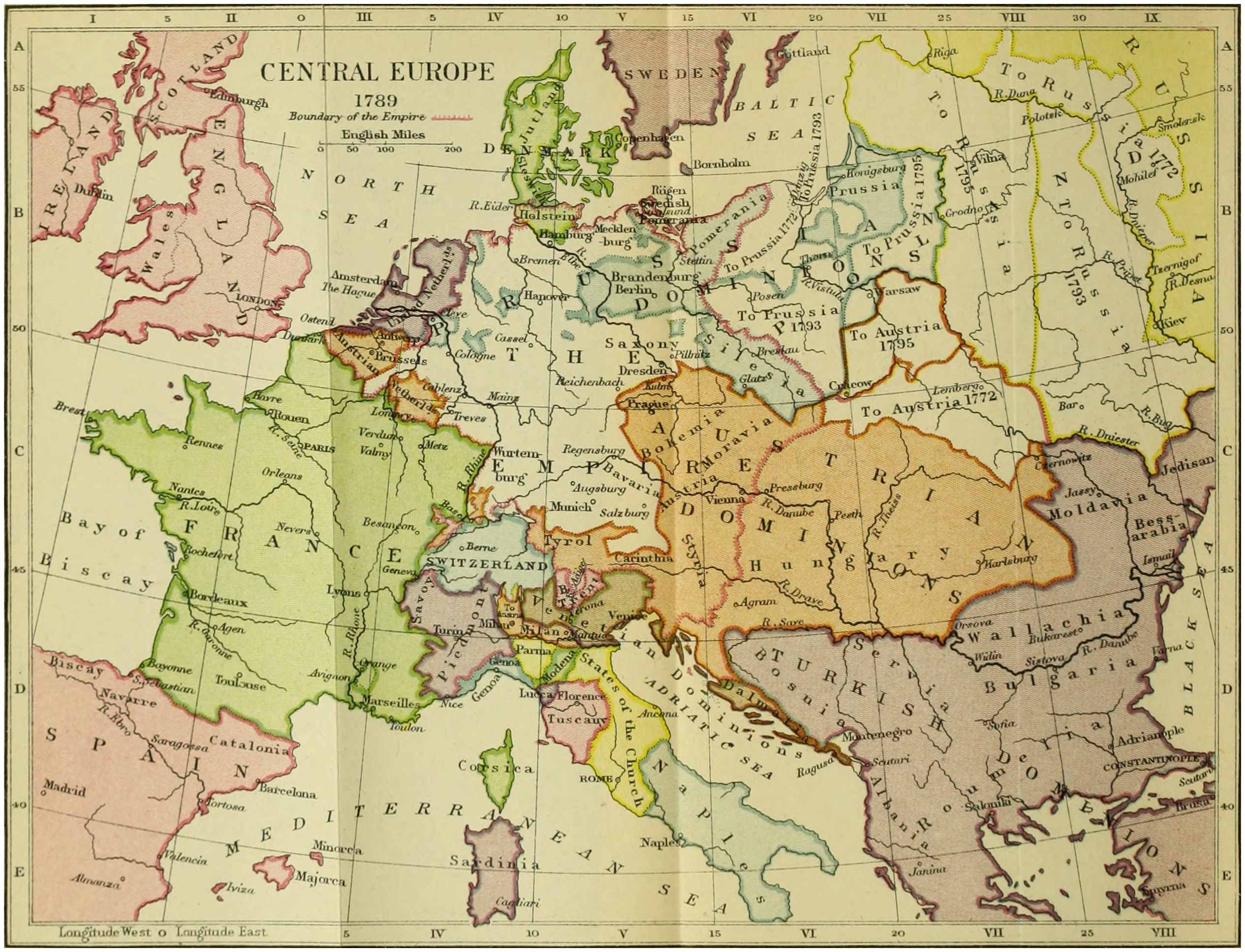
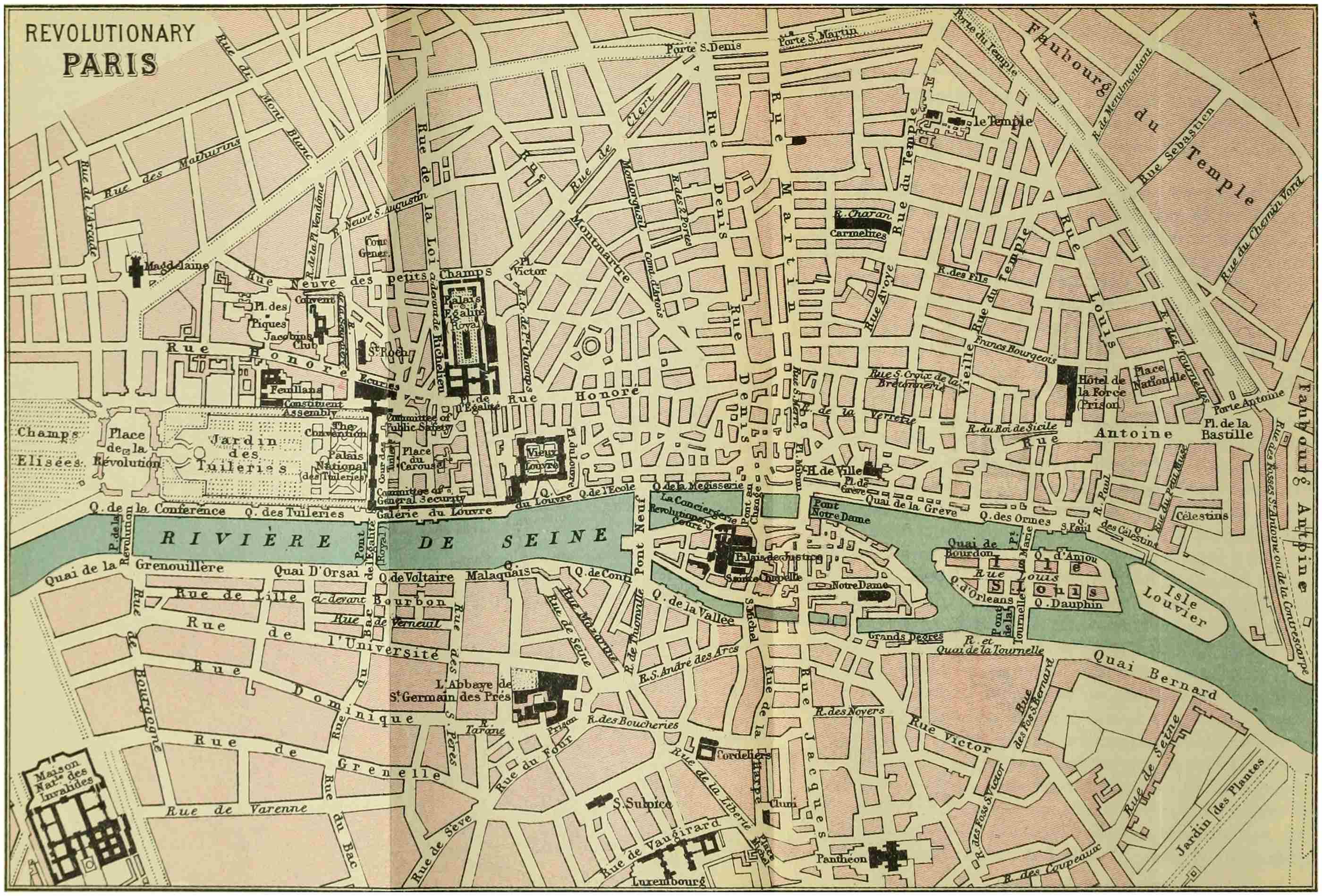
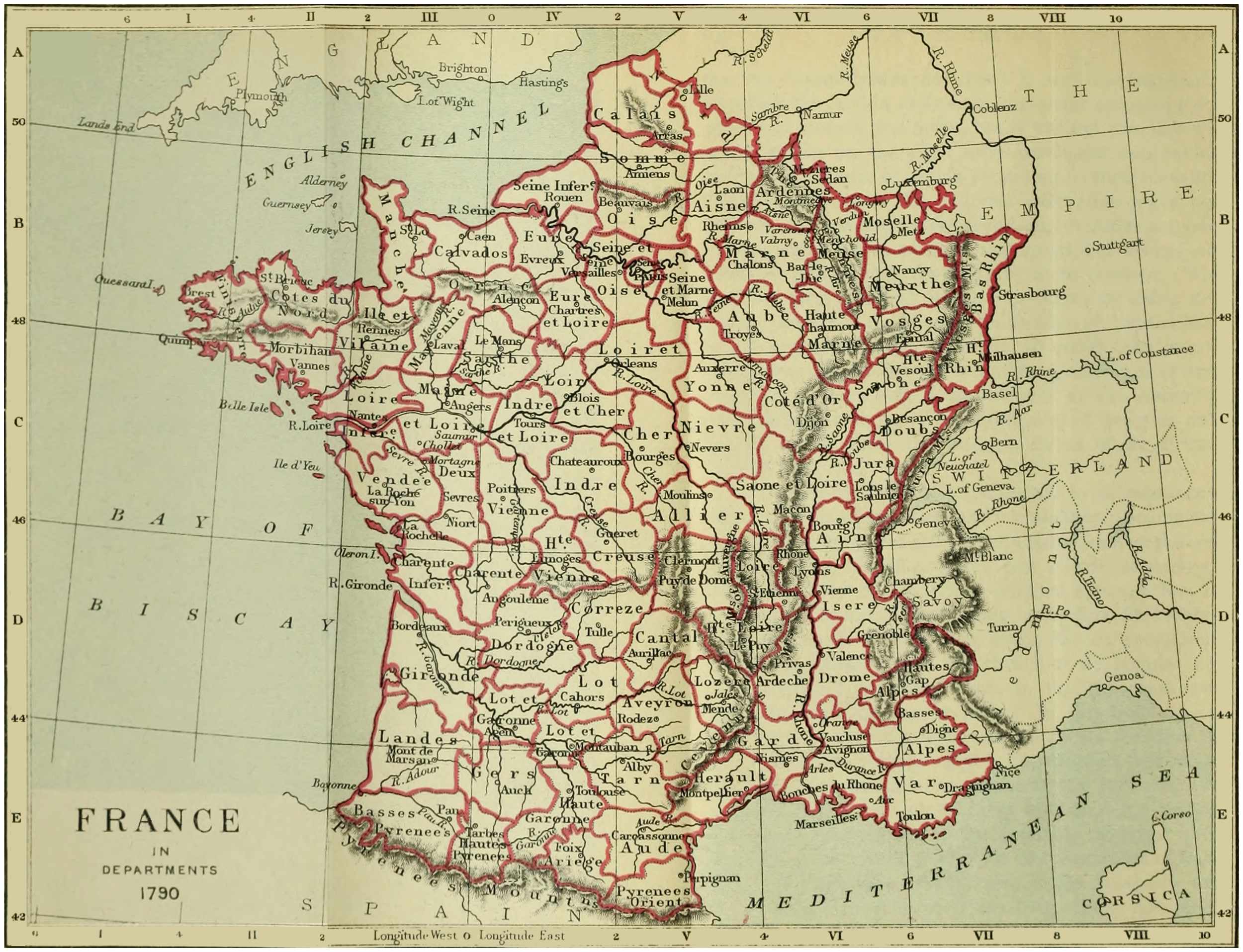
Larger versions of most illustrations may be seen by right-clicking them
and selecting an option to view them separately, or by double-tapping and/or
stretching them. Larger, more detailed versions of the maps may be seen by
clicking "Larger" beneath those maps.
This ebook contains sidenotes. Most of them have been positioned
at the beginnings of the paragraphs they summarize. In a few cases,
the original sidenotes were printed well into the middle of their
paragraphs, and in those cases, they appear here in similar positions.
To distinguish mid-paragraph sidenotes from regular text, the .epub
and .mobi versions of this book surround those sidenotes in diamond
symbols: ♦sidenote text♦.
Longmans, Green & Co., London, New York, Bombay, Calcutta & Madras.
Epochs of Modern History
BY BERTHA MERITON GARDINER
SIXTEENTH IMPRESSION
LONGMANS, GREEN, AND CO.
39 PATERNOSTER ROW, LONDON FOURTH AVENUE & 30TH STREET, NEW YORK
BOMBAY, CALCUTTA, AND MADRAS
1921
All rights reserved
PREFACE.
In writing this handbook on the French Revolution, it
has been my endeavour to give a correct and impartial
account of the most important events of the revolutionary
period, and of the motives by which the leading characters
were actuated. Much has necessarily been omitted
which finds a place in larger works. Those who wish to
pursue the subject further, and have time at their disposal,
would do well to study, besides general histories, some of
the many books lately published which deal with special
branches of the subject, and often enable the reader to
form a more independent judgment both of men and
events than is possible from the perusal of works of
the former class alone. Amongst general histories those
of Michelet and Louis Blanc will probably be found
most serviceable. No satisfactory account of the relations
of France with other countries is to be found in the
French tongue, partly because French historians still
write with bias, partly, also, because they hitherto either
have been unacquainted with, or have ignored the results
of German research. Professor Von Sybel’s well-known
book, ‘Geschichte der Revolutionszeit,’ contains the
fullest and best account of the relations which existed
between the different States of Europe, but it is not an
impartial one. Hermann Hüffer’s books are valuable
contributions to our knowledge of diplomatic relations,
and, being written from an opposite point of view, should
be studied by all readers of Von Sybel. The history of
the foreign policy of England during this period has still
to be written. M. Sorel has lately published in the pages
of the ‘Révue Historique’ a full account of the foreign
policy pursued by the Committee of Public Safety after
Robespierre’s fall, and of the negotiations leading to the
treaties of peace signed in 1795 between France and
Prussia and France and Spain. Much fresh information
regarding the internal condition of France during
the revolutionary period is to be found scattered in local
and special histories of various kinds. Amongst such
may be specially mentioned Mortimer Ternaux’s ‘Histoire
de la Terreur,’ and ‘La Justice Révolutionnaire,’ by
Berriat St. Prix. M. Taine in his great work has collected
a large number of extracts from documents lying in the
archives of the departments, but entire absence of classification,
and the strong political bias of the writer, makes
this work of less value to the student than others of less
pretensions. Amongst the best of local histories are the
works of M. Francisque Mège, which reveal the course
taken by the Revolution in the province of Auvergne.
Biographical works are numerous. Mirabeau’s character
will best be learnt from his correspondence with the
Count de la Marck. M. D’Héricault’s ‘Révolution de
Thermidor’ contains a detailed account of the policy
pursued by Robespierre after the expulsion of the
Girondists. Danton’s life and character can best be
studied in the works of M. Robinet. Schmidt’s ‘Pariser
Zustände während der Revolutionszeit’ contains the best
existing account of the economic condition of Paris
between 1789 and 1800. As it is improbable that those
for whom this book is in the first place intended will
have any idea of the amount represented by so many
thousand or million livres, I have invariably given the
English equivalent of the French money, following the
table inserted by Arthur Young in his ‘Travels in
France.’ After the introduction of the revolutionary
calendar, I have in giving dates followed the table in
‘L’Art de vérifier les Dates.’ In consequence of the
different system of intercalation pursued in the two
calendars, the correspondence of dates varies from year
to year, and in consequence of leaving this fact unnoticed
even French historians sometimes give the
date in the old style wrongly. I have only further to
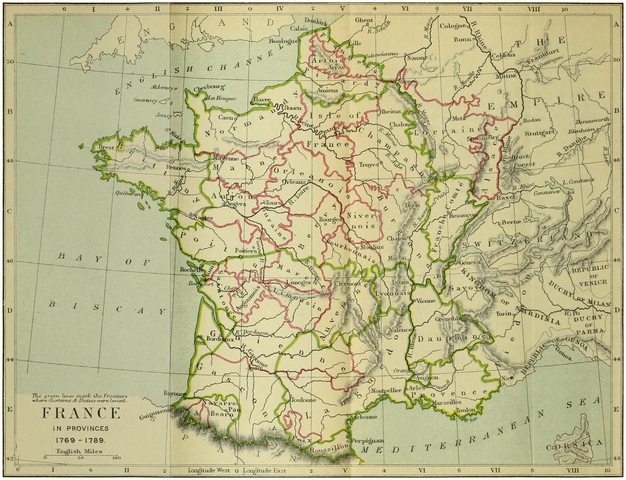
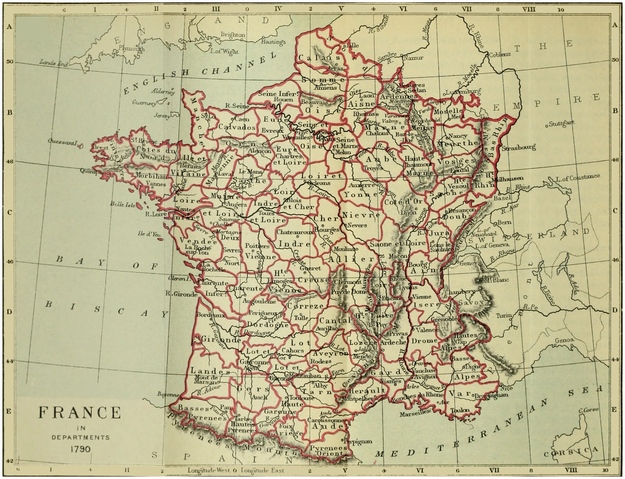
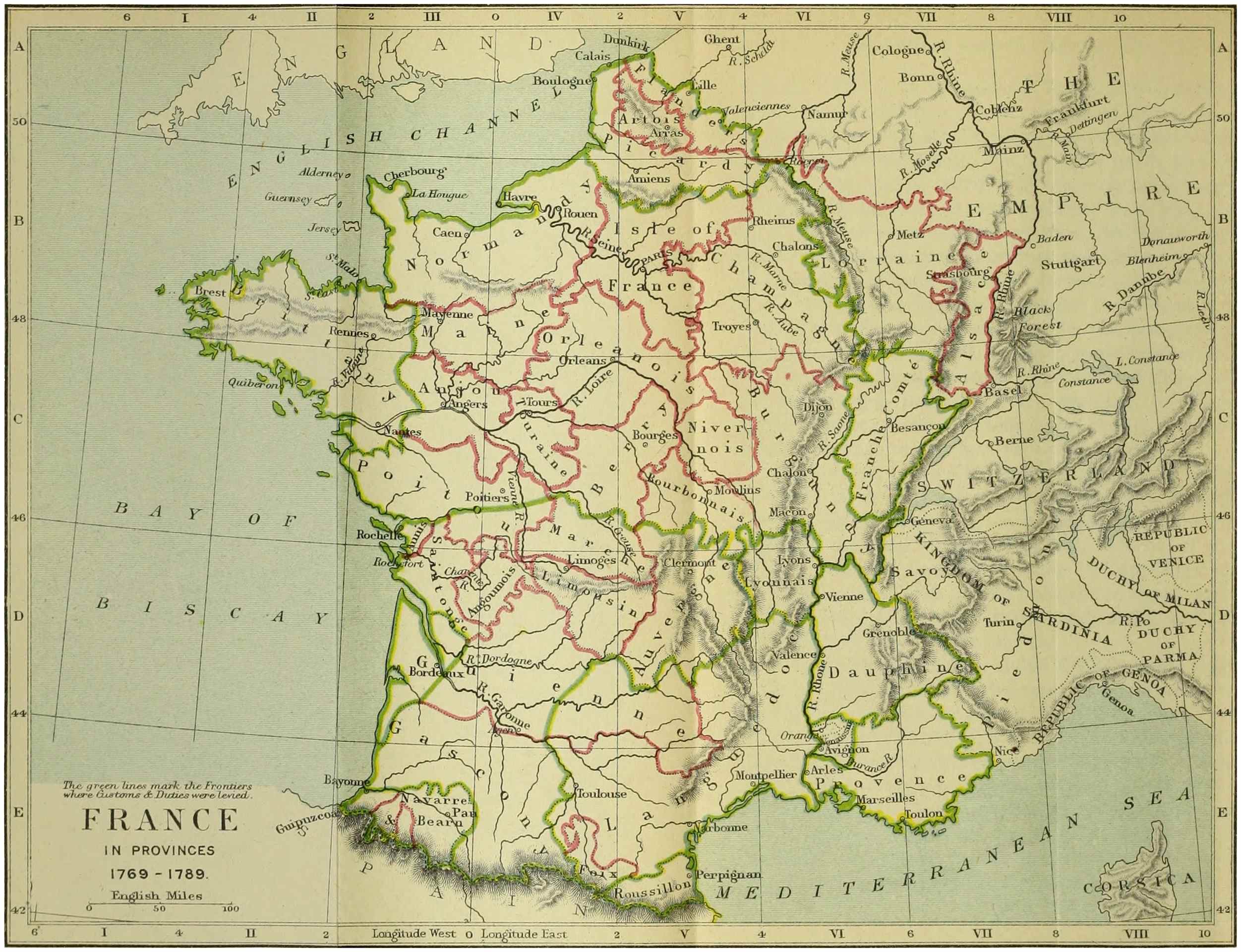
add that the purple lines upon the map of France in
provinces represent the frontiers where customs duties
were levied under the old Monarchy. They are copied
from a map published with Necker’s works. It will
be seen that Alsace and Lorraine, as well as Bayonne
and Dunkirk, were allowed to trade freely with the
foreigner. Marseilles enjoyed the same privilege.
CONTENTS. — LEADING DATES IN THE HISTORY OF THE FRENCH REVOLUTION.
Dates relating to military or foreign affairs are given in italics
in order that the attention of the reader may be drawn to the
relation between them and the domestic occurrences.
1774
Accession of Louis XVI.—Ministry of Turgot.
1776
Dismissal of Turgot—Ministry of Necker—American Declaration of Independence.
1778
France allies itself with America.
1781
Resignation of Necker.
1783
Calonne’s Ministry.
1787
The Assembly of Notables—Brienne’s Ministry.
1788
Necker’s Second Ministry.
1789
May 5.
Meeting of the States General.
June 17.
Adoption of the title of National Assembly.
June 20.
The Tennis Court Oath.
June 23.
The King comes to the Assembly to command the separation of the Orders.
July 14.
Capture of the Bastille.
Aug. 4.
Abolition of feudal rights.
Oct. 6.
The King brought to Paris.
1790
July 14.
Feast of the Federation.
Nov. 27.
Oath imposed on the Clergy.
1791
April 2.
Death of Mirabeau.
June 20.
The Flight to Varennes.
July 17.
The Massacre of the Champ de Mars
Aug. 27.
Declaration of Pilnitz.
Sept. 30.
End of the Constituent Assembly.
Oct. 1.
Meeting of the Legislative Assembly.
1792
April 20.
Declaration of War against the King of Hungary and Bohemia, entailing also a War with Prussia.
June 13.
Dismissal of the Girondist Ministers.
June 20.
The King mobbed in the Tuileries.
July 26.
The Duke of Brunswick’s Manifesto.
Aug. 10.
Overthrow of the Monarchy.
Aug. 24.
Surrender of Longwy.
Sept. 2–7.
The September Massacres.
Sept. 20.
The Cannonade of Valmy.
Sept. 21.
Meeting of the Convention.
Sept. 22.
Proclamation of the Republic.
Nov. 6.
Victory of Jemmapes, followed by the occupation of Belgium, Savoy, Nice, and Mainz.
Nov. 19.
The Convention offers assistance to all Peoples desirous of freedom.
Dec. 2.
The French driven out of Frankfort.
Dec. 15.
The Convention orders its Generals to revolutionise the Foreign Countries in which they are.
1793
Jan. 21.
Execution of the King.
Feb. 1.
Declaration of War against England and Holland.
Mar. 3.
Miranda driven from Maestricht.
Mar. 9.
Establishment of the Revolutionary Court.
Mar. 18.
Defeat of Neerwinden, followed by the loss of Belgium.
April 6.
Constitution of the Committee of Public Safety.
June 2.
Expulsion of the Girondists.
July 3.
Assassination of Marat.
July 8.
Surrender of Mainz, Condé, and Valenciennes.
Aug. 23.
The Levy of all men capable of bearing arms decreed.
Sept. 8.
Victory of Hondschoote.
Sept. 17.
The great Maximum Law and the Law against Suspected Persons.
Oct. 7.
Capture of Lyons.
Oct. 16.
Execution of the Queen.
Oct. 16.
Victory of Wattignies.
Oct. 31.
Execution of the Girondists.
Nov. 10.
Worship of Reason at Notre Dame.
Dec. 10.
Capture of Toulon.
Dec. 12.
Destruction of the Vendean Army at Le Mans.
1794
Mar. 24.
Execution of the Hébertists.
April 5.
Execution of the Dantonists.
April.
Insurrection in Poland.
April 18.
Victory of Turcoing.
June 1.
Battle of June 1.
June 8.
Feast in honour of the Supreme Being.
June 26.
Victory of Fleurus, followed by the evacuation of Belgium by the Allies.
July 28.
Execution of the Robespierrists.
Nov. 12.
Jacobin Club closed.
Dec. 8.
Seventy-three Deputies of the Right readmitted into the Convention.
Dec. 24.
Repeal of Maximum Laws.
1795
Jan.
Invasion of Holland.
Mar. 8.
Readmission to the Convention of survivors of Girondist Deputies proscribed on June 2, 1793.
April 1.
(Germinal 12) Insurrection of Lower Classes against the Convention.
Feb. 22.
Public exercise of all forms of worship permitted by the Convention.
May 20.
(Prairial 1) Second insurrection by Lower Classes against the Convention.
April 5.
Treaty of Peace made at Basel between France and Prussia.
June 8.
Death of the Dauphin.
July 12.
Treaty of Peace between France and Spain.
July 21.
Defeat of Emigrants at Quiberon.
Sept. 23.
Proclamation of the Constitution of the Year III. (1795).
Oct. 5.
(Vendémiaire 13) Insurrection of the Middle Classes against the Convention.
Oct. 26.
(Brumaire 4) Meeting of the New Legislature.
THE FRENCH REVOLUTION. — CHAPTER I. FEUDALISM AND THE MONARCHY.
The Monarchy in France.
Like the rest of Western Europe, France, in the Middle
Ages, was ruled by a feudal nobility, holding their lands
of the king. Nowhere in Western Europe in
the tenth century was the power of the king
less, or the power of the nobles greater. The
weight of their authority, therefore, fell heavily upon the
peasants on their estates, and upon the inhabitants of
the little towns scattered over the country. A feudal
noble, if he were a seigneur, answering to our lord of the
manor, ruled all dwellers on his estate. Their claims
to property were heard in his courts, and they were
amenable to his jurisdiction for crimes committed, or
alleged to have been committed, by them. The seigneur
may not have been a worse tyrant than many kings and
princes of whom we read in history; but he was always
close at hand, whilst Nero or Ivan the Terrible was far
off from the mass of his subjects. He knew all his subjects
by sight, had his own passions to gratify amongst
them, and his vengeance to wreak upon those whom he
personally disliked. To be free from this domination
must have been the one thought of thousands of miserable
wretches.
To shake off the yoke by their own efforts was an
impossibility. The nearest ally on whom they could
count was the king. He too was opposed to the domination
of the nobles, for as long as they could disregard his
orders with impunity, he was king in name alone. He
was, in fact, but one nobleman amongst many, with a
higher title than the rest.
Dwellers in towns could more readily coalesce and
resist the authority of the seigneurs than dwellers in the
country. By trade they acquired wealth, and with wealth
influence. In the twelfth century they formed themselves
into municipal communities, and, bidding defiance to
their seigneurs, called upon their king to aid them in
achieving independence. From that time to the end of
the seventeenth century the power of the Monarchy grew
stronger with every succeeding generation. The king
was the dispenser of law and order, while the enemies of
law and order were the feudal nobles. When Louis XIV.
took the government into his own hands, in 1661, his will
was law. Justice was administered by parliaments or
law courts acting in the name of the king. The affairs of
the provinces were administered by intendants, acting by
his commission. No nobleman, however wealthy or
highly placed, dared to resist his authority. With the
frank gaiety of their nation the nobles themselves accepted
the position, and crowded to his court or confronted
death in his armies. He was able to say, without
fear of contradiction, ‘I am the State.’
Unhappily for his people, he could not say ‘I am the
Nation.’ In him the Monarchy had been victorious over
its enemies, but it had not accomplished its task. The
nation wanted more work from its kings, wanted simply
that they should go on in the path which had been
trodden by their ancestors. The national wish was too
feebly expressed to reach the ears of Louis. He was
thinking of military glory and courtly display, not of the
grievances of his people. He had overthrown the power
of the nobility so far as it threatened his own. He did
not care to inquire whether there was enough left to
produce cruel wrong far off from the splendid palace
of Versailles. His great-grandson, the vile, profligate
Louis XV., had even less thought for the exercise of the
duties of a king, as father of his people. The Monarchy
was in its decline, not because it was intentionally tyrannical,
but because it had ceased to do its duty. The
French people were not Republican. They needed a
government, and government in any true sense there was
none.
Social condition of France.
In consequence of the king thus deserting the path
trodden by his ancestors, a state of things arose in
France such as was found in no other country. Nowhere
did the nobility as a class do so little for the service of
their countrymen, yet nowhere were they in possession of
more social influence or greater privileges. Nowhere
were the mercantile and trading classes comparatively
more wealthy and intellectual, yet
nowhere was the distinction between the noble
and the plebeian or bourgeois more rigorously maintained.
Finally, in no other country where, as was the case in
France, the mass of peasants were free men, did the
owners of fiefs retain so many rights over the dwellers on
their estates, and yet live in such complete separation
from them.
After the nobles had lost political power they were
cut off from all healthy communication with their fellow
subjects. In France all sons and daughters of noblemen
were noble, and their families did not blend with
those of other classes like the family of an English
peer. Nobles contemned the service of the administration
as beneath their birth; on the contrary, no one who
was not of noble birth could hold the rank of an officer
in the army. The great lords flocked to Paris and
Versailles, where they wasted their substance in extravagant
living; the lesser nobles, men who in England
would have occupied the position of country gentlemen,
were often through poverty compelled to reside in their
châteaux, where they lived in isolation, having no common
interests with their neighbours, while clinging tenaciously
to the possession of their rights as proprietors and feudal lords.
♦Feudal rights.♦
These feudal rights varied in every
province, but were of three general kinds. (1)
Rights which had their origin when the seigneur was also
ruler—as, for instance, the right of administering justice,
though this he now almost invariably farmed to the
highest bidder; the right of levying tolls at fairs and
bridges; and the exclusive right of fishing and hunting.
(2) Peasants in the position of serfs were only to be found
in Alsace and Lorraine; but rights still existed all over
the country which betrayed a servile origin. Thus, the
farmer might not grind his corn but at the seigneur’s mill,
nor the vine-grower press his grapes but at the seigneur’s
press; and every man living on the fief must labour for
the seigneur without return so many days in the year.
(3) Finally, the courts ruled that wherever land was held
by a peasant from the owner of a fief, there was a presumption
that the owner retained a claim to enforce cultivation
and the payment of annual dues. Land so held
was termed a censive—resembling an English copyhold.
The granting of land on these terms never stopped from
the close of the Middle Ages down to the Revolution.
The dues retained were often petty. One tenant might
pay a small measure of oats; another a couple of chickens.
Yet the payments were often sufficiently numerous to
form the chief maintenance of many of the nobles. The
holders of these censives possessed however, all the rights
of proprietors. They could not be dispossessed so long
as they paid the dues to which they were liable, and they
could sell and devise the land without the consent of
the owners of the fief. Properties held on these terms
abounded in all parts of France, and though the extent
of each censive was often no more than a couple of acres,
it is probable that before the Revolution at least a fifth of
the soil had by these means passed into the possession
of the peasantry.
The existence of feudal rights produced three results
exceedingly detrimental to the national prosperity. It
impeded a good cultivation of the soil; it prevented the
country from being inhabited by men of the middle class,
who preferred to reside in towns rather than recognise
the social superiority claimed by the seigneur; and,
finally, it was an incessant source of irritation to the
whole rural population. By the rights due to a seigneur
as ruler, and by those of servile origin, all dwellers upon
the fief were affected, whether occupiers of land or not.
The cultivator suffered at every turn—in the prohibition
to plant what crops he pleased; in the prohibition to
destroy the seigneur’s deer and rabbits that roamed at
will over his fields and devoured his green corn; in the
toll he paid for leave to guard his crops while growing,
and to sell them after they were gathered in; and in
many other ways. Such a system had become in the
course of centuries both excessively complicated and
wholly unsuited to existing social conditions. Sometimes
half-a-dozen different persons claimed dues from
the same piece of land. The proprietorship of fiefs and
the ownership of feudal rights, or the greater part of
them, were constantly separated. Poverty induced the
resident seigneur to sell his rights, which, bought by a
townsman, passed from hand to hand in the market, like
any other property, and were the more sought after
because their possession was held a sign of social superiority.
Non-resident owners farmed them, and middle-men
were harsh and exacting in their collection. The
peasant, ignorant and poor, but thrifty and cunning, and
fondly attached to his plot of ground, disputed claims
made upon him to pay dues now to this man, now to
that, in virtue of concessions of which, in a vast number
of cases, the origin was completely lost. Innumerable
lawsuits resulted, which left stored up in the peasant’s
mind bitter feelings of resentment against both judge
and seigneur, one of whom he accused of partiality, the
other of rapacity and extortion.
The Church.
The maintenance of feudal relations between classes,
when neither government nor society rested on the same
bases as in feudal times, could only be productive
of harm. In right of birth privileges and
advantages were claimed by nobles without regard to
principles of justice or of public utility. On every side, in
the army, the navy, the profession of the law, distinction
between the nobleman and the bourgeois still prevailed.
But no institution suffered in consequence of the privileges
of the nobility so great moral detriment as the
Church. The Church was a rich, self-governed corporation,
in possession of an annual revenue of more than
8,750,000l., providing for about 130,000 persons, including
monks and nuns. This great wealth was unfairly distributed,
and to a large extent misapplied. As a rule, all
higher posts were reserved for portionless daughters and
younger sons of noble families. Bishops and abbots,
who revelled in wealth, were nobles; parish priests, who
had barely enough for subsistence, were bourgeois and
peasants. Thus the Church teemed with abuses, and
exerted little moral influence. Her wealth excited the
jealousy of the middle classes, whilst the luxurious and
profligate lives led by many prelates and holders of
sinecures brought disgrace on the ecclesiastical profession.
Of reform there was no hope, since the lower
clergy, who had interest in effecting it, were excluded
from all part in Church government.
Government and administration.
Such abuses called aloud for the hand of a reformer.
The material result of social disorder was impoverishment
and decay. ‘Whenever you stumble on
a grand seigneur,’ wrote an English traveller,
‘you are sure to find his property a desert....
Go to his residence, wherever it may be, and you will
probably find it in the midst of a forest very well peopled
with deer, wild boars, and wolves. Oh! if I were the
legislator of France for a day, I would make such great
lords skip.’ The king had acquired power in right of
the services he rendered the nation. When he ceased to
do good, as had been the case since Louis XIV. plunged
the nation into a series of wars of ambition, it was
inevitable that he should do harm. The welfare of the
masses was dependent on the action of the central
government, and the central government sacrificed their
welfare for the sake of obtaining favour with the upper
classes. Hence administration was in a chaos, and the
government, in appearance all powerful, was in reality
strong only when it had to deal with the crushed and
helpless peasant and artisan. The States-General, which
in some sort answered to our English Parliament, had
last met in 1614. For the past two centuries the royal
council had been engaged in undermining local liberties,
and establishing a centralised system of administration.
The work in all essentials was so thoroughly done, that
no parish business, down to the raising of a rate or the
repairing of a church-steeple, could be effected without
authorisation from Paris. Absolute and centralised, the
government was also excessively arbitrary. On plea of
State necessity it repudiated debts, broke contracts, over-ruled
laws, and set aside proprietary rights without
scruple. The issue of warrants, called lettres de cachet
sealed letters, ordering the imprisonment of the person
designated in some state fortress, was an ordinary mode
of inflicting punishment. Yet, however harsh and arbitrary
in treatment of individuals, the government sought
to avoid collision with the upper classes as a body. On
all sides it left standing institutions of the Middle Ages,
local functionaries, and municipal assemblies, of which
the existence in many instances increased the weight of
local charges and impeded attempts to ameliorate the
condition of the working classes. In the same way the
upper law courts, the Parliaments, were suffered as of
old to meddle in administrative matters. Privileges, so
far from being assailed, were respected. Whatever
special rights provinces, towns, or classes possessed
were suffered to remain and were often extended.
Privileged classes.
The wars of Louis XIV. and the orgies of Louis XV.
absorbed more and more money. On the labouring
classes, already overtaxed, an increased weight of taxation
was always being laid. Hence, of these
classes the king became the oppressor, and
the oppression was the greater because the upper classes,
who were best able to pay taxes, contributed much less
than their fair share of the burden.
The nobles and clergy, styled the two upper orders,
stood, in right of their privileges, both pecuniary and
honorary, apart from the rest of the nation. Nobles did
not pay any direct taxes in the same proportion as their
fellow subjects, and in the case of the taille, a heavy
property tax, their privilege approached very nearly to
entire exemption. The clergy, except in a few frontier provinces,
paid personally no direct taxes whatever. The
bourgeoisie was regarded as an inferior class. Those who
were able acquired by purchase the rank and privileges of
nobles, and in this way had come into existence a nobility
of office and royal creation, which, although looked down
upon by the old nobility of the sword, enjoyed the same
pecuniary immunities. Those left on the other side of
the line deeply resented the social superiority claimed by
the nobility in right of its privileges. The upper section
of the bourgeoisie was, however, itself privileged to no
inconsiderable extent. By living in towns, merchants,
shopkeepers, and professional men were able to avoid
serving in the militia and collecting the taille, from
which in the country nobles alone were exempt. They
also purchased of the government petty offices, created
in order that they might be sold, to which no serious
duties were attached, but the possession of which conferred
on the holders partial exemption from payment of
the taille and of excise duties, and other privileges of
like character.
Longmans, Green & Co., London, New York, Bombay, Calcutta & Madras.
Taxes.
Oppressive as taxation was, owing to its weight alone,
and to its unjust distribution between classes, it was
rendered yet more so by want of administrative
unity, by the nature of some of the taxes and
the method of their assessment and collection. Internal
custom-houses and tolls impeded trade, gave rise to
smuggling, and raised the price of all articles of food and
clothing. It took three and a half months to carry goods
from Provence to Normandy, which, but for delays caused
by the imposition of duties, might have travelled in three
weeks. Customs duties were levied with such strictness
that artisans who crossed the Rhône on their way to
their work had to pay on the victuals which they carried
in their pockets. Excise duties were laid on articles of
commonest use and consumption, such as candles, fuel,
wine, and even on grain and flour. Some provinces and
towns were privileged in relation to certain taxes, and as
a rule it was the poorest provinces on which the heaviest
burdens lay. One of the most iniquitous of the taxes
was the gabelle, or tax on salt. Of this tax, which was
farmed, two-thirds of the whole were levied on a third of
the kingdom. The price varied so much that the same
measure which cost a few shillings in one province cost
two or three pounds in another. The farmers of the tax
had behind them a small army of officials for the suppression
of smuggling, as well as special courts for the
punishment of those who disobeyed fiscal regulations.
These regulations were minute and vexatious in the
extreme. Throughout the north and centre of France, the
gabelle was in reality a poll tax; the sale of salt was a
monopoly in the hands of the farmers; no one might use
other salt than that sold by them, and it was obligatory
on every person aged above seven years to purchase
seven pounds yearly. This salt, however, of which the
purchase was obligatory, might only be used for purely
cooking purposes. If the farmer wished to salt his pig,
or the fisherman his fish, they must buy additional salt
and obtain a certificate that such purchase had been
made. Thousands of persons, either for inability to pay
the tax, or for attempting to evade the laws of the farm,
were yearly fined, imprisoned, sent to the galleys, or
hanged. The chief of the property taxes, the taille,
inflicted as much suffering as the gabelle, and was also
ruinous to agriculture. Over two-thirds of France the
taille was a tax on land, houses, and industry, reassessed
every year not according to any fixed rate, but according
to the presumed capacity of the province, the parish, and
the individual taxpayers. The consequence was that,
on the smallest indication of prosperity, the amount of
the tax was raised, and thus parish after parish, and
farmer after farmer, were reduced to the same dead level
of indigence.
Condition of the people.
Under the state of things here described, France had
retrograded in wealth and population. Intense misery
prevailed amongst the working classes. Artisans were
unable to live on their wages; farmers and small proprietors
were constantly being reduced to beggary; ignorance
grew more dense. The government, by its own
frequent setting aside of laws, and by its intolerance
and cruelty, helped to render the
people lawless, superstitious, and ferocious.
Protestants were subjected to persecuting laws. Thousands
of them had been driven from the country, or shot
down by troops. The penal code was barbarous, and the
brutal breaking on the wheel was an ordinary mode of
putting criminals to death. It was only by very rough
usage that fiscal regulations were maintained, and the
taxes gathered in. If the taille and the gabelle were not
paid, the defaulter’s goods were sold over his head, and
his house dismantled of roof and door. In all cases in
which the administration was concerned, whatever
justice peasant and artisan received was meted to them
by administrative officials who were themselves parties
in the cause. Famine was like a disease which counted
its victims by hundreds. As a rule, the farmer was a
poor and ignorant peasant, living from hand to mouth,
miserably housed, clothed, and fed.
An Englishman, Arthur Young, travelling in France
in the years 1788–1789, reports how he passed over
miles and miles of country once cultivated, but then
covered with ling and broom; and how within a short
distance of large towns no signs of wealth or comfort
were visible. ‘There are no gentle transitions from ease
to comfort, from comfort to wealth; you pass at once
from beggary to profusion. The country deserted, or if
a gentleman in it, you find him in some wretched hole,
to save that money which is lavished with profusion in
the luxuries of a capital.’ The same traveller tells us
how, as he was walking up a hill in Champagne, he was
joined by a poor woman who complained of the hardness
of the times. ‘She said her husband had but a morsel
of land, one cow and a poor little horse, yet he had a
franchar (42 lbs.) of wheat and three chickens to pay as
a quit rent to one seigneur, and four franchars of oats,
one chicken, and one shilling to pay another, besides very
heavy tailles and other taxes. She had seven children,
and the cow’s milk helped to make the soup. It was said,
at present, that something was to be done by some great
folks for such poor ones, but she did not know who nor
how, but God send us better, “car les tailles et les droits
nous écrasent.” This woman, at no great distance, might
have been taken for sixty or seventy, her figure was so
bent and her face so furrowed and hardened by labour,
but she said she was only twenty-eight.’
Since, owing to the weight of taxation, no profits were
to be made by farming, it was impossible that there
should be a good cultivation of the soil. The amount of
capital employed on land in England was at least double
that employed in France. Hence, while in England
famine was unknown, in France production barely
equalled consumption, and scarcities were of incessant
occurrence. A single bad season would force the farmer
to desert his land, and with his family beg or steal.
Whenever bread rose above three halfpence the pound
men starved. Bread riots constantly took place in one
or another province, and the country swarmed with
beggars, brigands, poachers, and smugglers. Thousands
of these outcasts were imprisoned, sent to the galleys, or
hanged; but no severity could lessen their number, while
the causes producing them remained unremoved. Adequate
means of providing for the destitute there were
none. A few hospitals and other charitable institutions
existed. Bishops, great seigneurs, and monasteries often
kept alive hundreds in seasons of scarcity. Hospitals,
however, were little better than plague houses, where the
sick and infirm were taken in to die, whilst private charity
was partial and insufficient. There was no general system
of poor relief. With the object of keeping bread at a price
within the people’s reach, the corn trade was subject to a
variety of regulations and restrictions. Occasionally the
government made purchases of foreign corn, which was
resold under price. Sometimes the prices of corn and other
articles of food were fixed. In towns the price of bread
was ordinarily regulated according to the price of corn
by police officers, a not unnecessary precaution when the
baking trade was in the hands of a close corporation. A
more vicious mode of relief could hardly have been devised,
but to abandon it was no easy matter. The arbitrary means
taken to reduce the price of corn often had the effect of
raising it, and, when successful, only tended to lessen
production and lead to greater scarcities, since cutting
down the profit of the already overweighted corn grower
was, in reality, casting an additional tax upon him. On
the other hand, it was no less true that so long as the
existing order continued, a slight rise in the price of the
pound of bread meant sheer starvation for the mass of
artisans, and for thousands of agricultural labourers and
small proprietors who were not corn growers. Accustomed
to look to the government to provide them with
cheap bread, in every season of scarcity these clamoured
for a reduction in price, and unless authorities were
complaisant, resorted to riot and pillage.
Voltaire.
The misery of the working classes presented in itself
reason enough for revolution; but revolution only comes
when there are men of ideas to lead the unlettered
masses. In France the educated
classes entertained revolutionary ideas, and the men of
letters who promulgated those ideas became the leaders
of opinion, and exerted enormous influence over their
own and the following generations. First came the Voltairians,
led by Voltaire (1694–1778). During the century
rapid advance was being made in all branches of study—in
history, jurisprudence, mathematical and physical
science. The idea of progress was definitely conceived,
and knowledge upheld as the chief factor in producing
virtue and happiness. For the increase and diffusion of
knowledge the recognition of two principles was indispensable—religious
toleration and the freedom of the
press. Both these principles were, however, in direct
antagonism to the principles on which the authority of
the Roman Catholic Church was based—unity of faith
and worship, the subordination of philosophy and science
to theology, the submission of reason to the teaching of
tradition. Protestant clergymen were put to death as
late as 1762; while in 1765 a lad convicted of sacrilege
was hanged, and his body afterwards burned. Such acts
of intolerance and cruelty were, however, condemned by
public opinion, and, between the Church and the exponents
of the new ideas, violent collision inevitably ensued.
Voltaire made it the work of his life to destroy belief in
revealed religion. In verse and in prose, in historical
works, in letters and pamphlets by the dozen, with rude
licence or sham respect, he held up the Church to derision,
indignation, and contempt, as the great enemy of
enlightenment and humanity. ‘The most absurd of empires,’
he wrote, ‘the most humiliating for human nature,
is that of priests; and of all sacerdotal empires, the
most criminal is that of priests of the Christian religion.’
Encyclopædists.
Voltaire himself was a sceptic. Behind him followed
men who denied belief in a personal God and the immortality
of the soul. Diderot (1713–1784)
and D’Alembert (1717–1783), with indefatigable
energy published the ‘Encyclopædia,’ or dictionary
of universal knowledge, inculcating, at least indirectly,
atheistical opinions, and designed, by the destruction of
ignorance and superstition, to undermine the whole
fabric of Christian theology. Before the end of his long
life, in 1778, Voltaire was the most eminent man in
France, and sceptical and atheistical opinions were commonly
held and openly professed by men and women of
the upper and middle classes. The triumph of the new
philosophy was not, indeed, due merely to the powers
of irony or the reasoning of its advocates. The scandalous
abuses within the Church had prepared the way
for its reception. The attacked had no efficient weapon
with which to repel their assailants. The Church was
without reforming energy or proselytising zeal. On the
arm of the State she could not rely for support with
the same confidence as in former times. The government
was incapable of stamping out the new movement,
nor was it prepared seriously to make the attempt. The
official class, which came out of the middle class, was,
like all others, permeated with the new ideas. The occasional
arrest of authors and printers, and seizure of types
and presses, did but increase the virulence of the attack,
and made the forbidden books more eagerly sought after.
The clergy were the more open to attack because they
were interested in the maintenance of privileges and
abuses which inflicted cruel wrongs on the working
classes, while the new philosophy aimed at destroying
whatever stood in the way of material progress and the
happiness of the masses. In opposition to the Church’s
doctrine of the natural depravity of human nature, its
adherents taught that man is born good, and that wrong-doing
is the result of ignorance; inculcated the importance
of educating all classes, and refused to recognise
limits to the improvement of which both individuals and
the race are capable. Often accompanied by a sensual
view of life, which accorded with the profligacy common
amongst the upper classes at the time, this high opinion
of human nature developed a respect for man as man,
regardless of social position, race, or creed, and a passionate
hatred of inequalities founded on such distinctions.
♦Economists.♦
A school of political economists,
starting from the theory that all men originally had equal
rights, and every man liberty to employ his time, his
hands, and his brains according to his own advantage,
demonstrated the principles of free trade, and declared
entire liberty of agriculture, entire liberty of commerce
and industry, entire liberty of the press to be the true
foundations of national prosperity. Appealing to abstract
principles of justice, humanity and right, Voltairians
and Economists joined in opening a fire of
scathing criticism on existing laws, customs, and institutions.
They exposed the abuses and sufferings incident
to the use of torture, serfdom, and the slave trade,
to excessive centralisation and interference with trade
and agriculture, to close guilds, feudal duties, internal
custom-houses, to the taille and the gabelle, and demanded
the carrying out of reforms which should set
trade and industry free, destroy class and provincial
privileges, introduce unity in the administration, and
equality of rights between man and man.
Rousseau.
The Voltairians were specially characterised by their
attack upon the Church and Christianity; the Economists
by the importance which they attached to individual
liberty. Neither regarded the ignorant and oppressed
masses as able to act for themselves,
and both looked to the royal power, enlightened by a
free press, as the instrument through which reform must
be effected. Rousseau was a writer of a different stamp.
Instead of idolising knowledge he declared the untaught
peasant and artisan the superiors of the philosopher and
man of culture. They alone, he said, had retained that
natural goodness of heart which men had in times long
since gone by, when social inequalities along with idleness
and luxury were unknown. Rousseau opposed also
the atheistic tendencies of the day, declaring belief in a
personal God and the immortality of the soul requisite to
make life endurable to the oppressed. His indifference
to knowledge and culture caused him to regard the
masses themselves as alone able to regenerate France, if
indeed regeneration were still possible. Society, according
to him, was originally based on a contract by which
every citizen in return for protection of person and property
placed himself under the general will. Laws, therefore,
were the expression of the general will; kings were
merely the servants of the people, and not they but the
people sovereign. Whatever was amiss in France, or in
other countries, the fault lay purely with society and
government, and should ever idleness and luxury disappear
and the people recover their lost sovereignty, then
and then only, as in primitive times, would men be happy
and virtuous. ‘Man is born free,’ were the opening words
of the ‘Social Contract,’ the book in which these theories
were maintained, ‘and everywhere he is in chains.’
CHAPTER II. FRANCE UNDER LOUIS XVI. (1774–1789).
When the necessity of reform had been demonstrated
by a band of powerful and brilliant writers, whose works
were the popular reading of the day, it was inevitable that
desire for change should grow, as the new ideas spread
over wider circles, and sufferers from abuses became
more and more alive to their wrongs. Undermined by
public opinion, the existing order could not endure for
long, and the vital question before France was, by what
means change should be accomplished. The
Voltairians called on the King to take the
work in hand, and on the death of Louis XV. in 1774,
it appeared possible that the young Louis XVI. would
endeavour to regain the path that his predecessors had
abandoned, and, by relieving the people from their
burdens, seek the welfare of the entire nation.
♦Turgot’s Ministry.♦
Turgot, the new Controller-General, who exercised the functions
both of Minister of Finance and Minister of the Interior,
represented the party of reform, and was in all his actions
inspired by a strong love of knowledge and by a passionate
desire to benefit his fellow-men. He was not,
like the writers of his time, a mere theorist, but also a
practised and successful administrator, who for thirteen
years had been Intendant of the poor province of
Limousin. Now that he was invested with higher authority,
it was Turgot’s aim to ameliorate the condition
of the people throughout France, by the introduction of
reforms based on those principles of equality and individual
liberty which Voltairians and Economists proclaimed.
His chief reforms were the abolition of restrictions
on the internal trade in corn and wine; the
abolition of the corvée, or forced unpaid labour of the
peasants for repair of roads, for which he substituted a
land-tax payable by all proprietors whether privileged or
not; and finally, the abolition of guilds, giving liberty to
every one, however poor, to exercise what trade he
pleased and to raise his condition according to his capacity.
Besides these, his most important measures, Turgot
carried out many lesser reforms tending to set labour and
industry free, to cheapen food and clothing, and to lessen
the burdens of the poor by the equalisation of taxation,
and by the abolition of the fiscal abuses and sinecure
offices which enriched the monied aristocracy of Paris
and the court nobility. The reforms, however, which
Turgot accomplished were but a small portion of those
which he had in contemplation. He aimed at the remodelling
of the whole system of taxation, the removal
of all custom-houses to the frontier, the abolition of the
gabelle, and the substitution for the taille of a new tax
to be imposed on the land of all proprietors without
exception, the gradual abolition of feudal dues, the
grant of civil rights to Protestants, and, finally, the decentralisation
of administration by the establishment of
provincial assemblies, to be elected by all landed proprietors
without distinction of rank. His work was no
sooner begun than it was prematurely cut short. A
violent opposition party was at once formed, which comprised
the court nobility, the upper clergy, the nobility of
office, farmers of the gabelle and other indirect taxes,
judges in Parliament, masters of guilds and state officials—in
a word, all those who made profit out of existing
abuses, and whose special privileges were assailed.
‘Everybody fears,’ a friend of Turgot wrote to him,
‘either for himself, or for his brother, or for his friend.’
Louis XVI.
Whether Turgot was to stand or fall depended entirely
on the resolution of the King. Louis XVI. was well-intentioned,
conscientious, and sincerely desirous
of ruling for the good of his subjects,
but he lacked the qualities which are requisite to a
prince called on to govern at a great national crisis.
He was without self-confidence, irresolute in action,
and incapable of judging the real value of men, or of
grasping the real bearing of events and measures. He
could not even rule his own court. Simple in his tastes,
and shy and reserved by disposition, his happiest hours
were spent in the hunting field, or in the company of a
blacksmith, mastering the art of making locks. It was
no wonder that such a King should be driven to and fro
between conflicting opinions, when those who surrounded
his throne, and with whom he came in daily contact,
accused his Minister of violence and injustice, and of
entertaining projects destructive to monarchical government.
‘The King,’ said Turgot, ‘is above all, for the
good of all.’ Louis could never rise to this conception of
his position. Turgot would have made him ruler of men
equal before the law, and in possession of equal rights
as citizens. Desirous as Louis was to ease the lower
classes of their burdens, he was never able to conceive
of the noble as being on the same footing as the common man.
♦Marie Antoinette.♦
The only person in whom he reposed confidence
was his wife, Marie Antoinette, a daughter of the Empress
Maria Theresa, and with fatal weakness he often yielded
to her desires in opposition to his own better judgment.
She had been married to him while still a child, and left
to grow up uninstructed and without guides in the corrupt
atmosphere of the court of Versailles. At the
age of nineteen, when she became Queen, she
was a bright and vivacious, but ignorant and thoughtless
woman, whose days were spent in a never ceasing round
of formalities and dissipation. She employed her influence
over her husband to obtain for her friends pensions
and offices, without any sense of what was due to her
position as Queen in the midst of a frivolous and intriguing
court, or of what she owed to the starving and suffering
masses who were deprived of their hard-won earnings for
the enrichment of an idle and spendthrift nobility. When
ministers sought to put a check on her extravagance, or
in any way thwarted her inclinations, they provoked her
resentment, dangerous in proportion to the power that
she was able to exercise over the King. Her aversion to
Turgot was the cause which finally produced his dismissal
from office. The Austrian ambassador, Mercy, informing
Maria Theresa of the event, used words of more pregnant
meaning than he was himself aware. ‘The Controller-General,’
he said, ‘is of high repute for integrity, and is
loved by the people; and it is therefore a misfortune that
his dismissal should be in part the Queen’s work. Such
use of her influence may one day bring upon her the just
reproaches both of her husband and of the entire nation.’
Turgot was the greatest statesman that France had
seen since Richelieu. He had a clear comprehension of
the economical and social evils under which the country
suffered, and of the remedies to be applied to them. The
best ideas of the age found room in his capacious mind,
and all that he attempted to do had ultimately to be
accomplished, though by other means than those which
he contemplated. Louis had shown his incapacity to see
that it was his first duty to make himself the repairer of
wrong and injustice, and truly a representative king, who
could say, ‘I am the nation.’ After Turgot’s failure,
revolution, that is to say change accompanied by violence
and convulsion, became inevitable.
Reforming movement a European one.
The reforming movement, of which in France Turgot
was the representative, was not confined to that country,
but was, in fact, an European movement, of
which the influence was felt, however faintly,
even in the most backward States. Kings and
statesmen, under the influence of Voltairian ideas, held
sceptical opinions, and took interest in the material
condition of their subjects. It was perceived that if
monopolies enriched individuals they prevented the development
of commerce and industry; that if duties were
levied between the provinces of the same kingdom, exchange
of commodities could only with difficulty be
effected; that if nobles did not pay their fair share of
taxation, the revenue of the State suffered, and the working
classes were overburdened. Jealous eyes were cast
upon the territorial wealth of the Catholic Church, and
protests were raised against the multiplication of monasteries,
and the idle lives led by their inmates. In many
States efforts were made to increase the authority of the
king by the destruction of provincial and class privileges.
The idea that the sovereign reigned for the good of the
nation was accepted, at least in theory, by the most
autocratic of European princes. In Russia Catherine II.,
in Prussia Frederick II., invited to their courts and
patronised French philosophers. In Spain Aranda, in
Tuscany Manfredini, in Portugal Pombal endeavoured to
lessen the privileges of nobles and clergy, and to loosen
the bonds in which industry and commerce were held.
In Savoy feudal charges were abolished, compensation
being given to the proprietors. In Parma, in Brunswick,
and in other Italian and German states, similar tendencies
were manifested. But although the reforming movement,
on the lines laid down by Voltaire and the Economists,
was not confined to France, nowhere else was there to be
found amongst the people any strong desire for reform.
In Germany, in Spain, in Italy, the new views were confined
to a few theorists and statesmen, and did not penetrate
beneath the surface of society. The cause lay in the
difference of social conditions. Outside France, nobles,
as a rule, lived at home on their estates, still administering
justice to peasants and serfs. The middle class took no
interest in matters of government, but devoted its energies
to scientific and literary pursuits. The lower classes,
being still in dependence on the upper, entertained no
lively resentment of their privileges. Hence reforming
princes could never accomplish more than a few isolated
changes without danger of rousing rebellion. Nobles and
clergy, the moment their privileges were threatened,
offered opposition; the middle class did not care to render
support; the lower classes were more ready to follow the
lead of nobles and clergy than the lead of the government.
Of all the princes of his time the Emperor
Joseph II. was the boldest innovator. In his hereditary
dominions he offended the nobles by the abolition of
provincial states, the clergy by closing monasteries and
upholding principles of toleration, the people by alterations
in their religious services. An insurrection broke
out in Belgium under the leadership of nobles and clergy
(1789). Both in Galicia and Hungary the nobles threatened
to take up arms, and for a time it seemed as if the
Austrian dominion would fall to pieces.
England.
In England the same ideas prevailed as on the Continent,
but the social and political condition of the country
was such as to enable reforms to be accomplished
more gradually and with far less violent
change than was possible either in France or Austria.
The English people had for centuries formed an united
nation. No sharp lines of division divided one class
from another. The laws were the same for all: younger
sons of noblemen ranked as commoners, and country
gentlemen sat in Parliament by the side of merchants
and traders. A free press prepared the way for change
by allowing the discussion of questions of general
interest, and free institutions gave political experience,
and taught the governing classes the necessity of yielding
in time to public opinion. Parliament, which represented
only the landed and commercial interests, legislated selfishly,
and was slow to admit or redress wrong done to
the unrepresented classes; but gross oppression of the
lower orders, such as existed in France, was unknown in
England. Country gentlemen looked after the affairs of
parish and county. The body of the rural population consisted
of agricultural labourers maintained by poor-rates
when wages fell short. Charges on land due to the lord
of the manor, though far from being extinct, existed
mainly in the form of money payments, affecting only
a comparatively small number of persons. Although the
same protective principles which prevailed on the Continent
prevailed also in England, whatever restraints were
laid either on persons in the selection of their calling, or
on industry, commerce and agriculture, there was to be
found far more liberty than elsewhere. The country
was the most flourishing in Europe, and wealth was
being rapidly accumulated. Special advance was made
in the system of farming by the introduction of the rotation
of crops and artificial manures. Wages rose, and
bread was cheap, and all classes for a time shared in the
general prosperity.
In England a large body of eminent men, philosophers,
statesmen, and philanthropists, entertained the
new ideas and sought to bring them into practice. In
1776, Adam Smith published the ‘Wealth of Nations,’ in
which the principles of free trade were promulgated.
The younger Pitt, who took office in 1783, was his
disciple. He proposed to abolish restrictions on the
trade of Ireland with England, and intended to lessen
the power of the aristocracy by a reform of the electoral
system. In 1787 a Treaty of Commerce was concluded
between England and France, designed to increase trade
between the two countries. The most important measures
brought forward by Pitt were not, however, carried
through Parliament. This was in part owing to the
factious opposition of the Whigs, in part to the strong
Conservative instincts of the governing classes, but in
part also because little discontent or desire for change
existed among the people at large.
Ministry of Necker.
If, however, England was slow to move, reforms once
made rested on a sure foundation. Such was not the
case with those made in the name of absolute princes
on the Continent. After Turgot’s dismissal, fifty out of
seventy of the guilds which he had abolished were revived,
and the peasants were compelled by blows to
resume their labours on the roads. Necker,
a Genevese banker, was Turgot’s successor
(October 1776). He was not a statesman, like Turgot,
with definite aims in view, but he was an able financier
and a humane man, holding the philanthropic sentiments
of the day, and eager to relieve the condition of the
masses. A war with England increased the difficulties
of the government. In 1778 Louis, reluctantly following
public opinion, assisted the English colonies in America
in their struggle for independence. There were only
three means of meeting the expenses of the war:
increased taxation, economy, and loans. The first was
impossible; the second only possible to a limited extent;
and Necker, therefore, was compelled to borrow. The
loans that he opened were quickly filled up, because men
of the middle class, who were the chief lenders, believed
that their interests were safe while he directed the
finances. But the public debt was greatly increased, and
the prospect of the future, with reforms uneffected in the
system of taxation, rendered them more dark. Although
Necker did not attempt to introduce radical measures
such as had excited opposition against Turgot, his abolition
of sinecures and other administrative changes gave
offence to the same classes. The Parliament of Paris,
whose lead was followed by the twelve provincial Parliaments,
formed the chief organ of resistance. These
Parliaments or law-courts were, in fact, powerful legal corporations
to which many hundred persons were attached.
The judges belonged to the nobility of office, and were
independent of the government, since they held their
offices in right of purchase, and might not be dispossessed
without proof of misconduct. They exercised, besides
judicial, a certain political function, since edicts of the
King’s council did not have the force of law until they
had been registered by the Parliaments. This right of
registration in the time of Louis XIV. had been a mere
form. If the Parliament of Paris hesitated to carry out
his wishes, he held a so-called bed of justice when he
came to the court in person, and on his command
registration was compulsory. But now that the royal
authority had fallen into contempt, the Parliaments
offered prolonged resistance, and before the Government
could obtain registration of its edicts, intimidation and
even the use of military force were resorted to. Necker,
when he sought to effect reform, necessarily became
involved in quarrels with the Parliaments, and, finding
that the King gave but a half-hearted support, he resigned
office (1781).
Desire for political liberty.
Louis could relieve himself from momentary inconvenience
by abandoning a Minister of whom he was
weary, but had no power to stay the course of
events. Those who had lent money to the
government deeply resented Necker’s fall, because
they believed him able to secure regular payment
of the interest on the national debt. Desire for social
change was accompanied by desire for political change
also. Rousseau had said that the people was sovereign,
and as the incompetency of the crown to carry out
the national will became with each successive ministry
more manifest, ideas long since vaguely floating in men’s
minds gathered strength and consistency. The cause of
the American colonies was taken up with immense
enthusiasm. The Declaration of Independence (July 4,
1776), which, in accordance with the principles laid down
in the ‘Social Contract,’ asserted that all men were created
equal and endowed with the natural right of overthrowing
an unjust government, was hailed as the enunciation of
an universal truth, of which Frenchmen as well as the
colonists might reap the benefit. Meanwhile government
in France grew yearly more utterly weak and helpless.
The war with England ended in 1783, but financial embarrassments increased.
♦Calonne.♦
Calonne, who became Controller-General
the same year, pursued Necker’s system
of borrowing without his justification, and
retained office by abstaining from acts calculated to offend
the privileged classes. The demands of the Queen and
the Court were complied with, and abuses destroyed by
Necker again called into existence. ‘If it is possible,
madam,’ said the obsequious Minister, on an occasion
when the Queen pressed him for money, ‘it shall be
done; if it is impossible, it shall be done.’ But such
squandering of the revenue could not last for ever.
Calonne’s credit broke down, and he was driven as a last
resource to propose the reform of the entire system of
administration and taxation. By publicity he hoped to
overcome resistance. He called together an extraordinary
council or assembly of notables, nominated by the
King (February 1787), and laid his propositions before
them, thinking that in the existing state of opinion they
would not venture to refuse support. But this assembly,
composed almost entirely of privileged persons, proved
recalcitrant. The majority were against the reforms
proposed, while the few who approved them were determined
that they should be made by an assembly representative
of the nation.
Brienne.
Calonne gave place (1787) to Brienne, Archbishop of
Toulouse, the candidate of the Queen; but the new
Minister had no choice except to take up the
plans of his predecessor, and the government
became involved in incessant strife with the Parliaments.
The Parliaments concealed their aversion to the principle
of equality of taxation, by denying the right of the King
to impose new taxes without the consent of the nation, and
by demanding the meeting of the States-General. The
government, on its side, sought popularity by coupling
edicts for raising loans and taxes with reforming
measures. But it could obtain no support. The shifting
policy which it had so long pursued, the attempts at
reform, made, abandoned, and then made again, had
destroyed confidence alike in its power and its good-will.
Hence, although the Parliaments defended the privileges
of nobles and clergy, their resistance was applauded,
because it offered the surest means of forcing the King’s
hand, and leaving him no alternative but to summon the
nation to his aid. Along with equality, the word ‘liberty’
was on every man’s lips. The very nobles, who had so
long opposed administrative and economical change, had
themselves become vehement advocates of political
change. More afraid of the crown than of the classes
beneath them, and blind to the complete isolation of
their own order, they looked forward to being at once
leaders of a political revolution and guardians of their
own interests. In fact, the privileged orders had no
choice but either to submit at discretion to the King, or
to join in the popular cry for the meeting of the States-General.
Arbitrary attempts made by Brienne to free the
crown of dependence on the Parliaments failed, in the
face of resistance offered by all classes, and brought the
country to the verge of actual insurrection. Disaffection
was rife in the army. Peasants and artisans, excited by
expectation of better days, were more ready than before
to rise in insurrection against local authorities, and were
less easily quelled. State bankruptcy impended. There
was a deficit in the revenue of more than 2,000,000l., and
money was wanting with which to pay the interest of the
national debt. Under such circumstances Louis reluctantly
yielded to the demand made on every side. He
declared his intention of summoning the States-General
and in order to regain confidence restored to the head of
the finances his former and still popular minister, Necker
(Aug. 1788).
Necker recalled to office.
Necker’s return to office was greeted with a burst of
applause from one end of France to the other. His
financial ability was relied on to stave off bankruptcy,
and it was known that he had always
opposed the court, and that he now desired
the meeting of the States-General. But his popularity was
due to those causes alone; not to any proof that he had
given or could give of his fitness to direct the royal policy.
As he failed to comprehend the real causes of the impending
revolution, he would be unable to moderate its violence.
Pamphlets and cahiers.
The hopes and desires of every class found expression
first in pamphlets, and subsequently in the cahiers or
petitions of grievances drawn up by electoral assemblies
to be laid before the States. The importance
and necessity of reform was generally admitted,
except where special interests or class prejudices
made men averse to change. Thus nobles combated
the conservative tendencies of ecclesiastics, ecclesiastics
the conservative tendencies of nobles. Induced by
pressure of public opinion the nobles mostly declared
their willingness to admit the principle of equality of
taxation. But agreement went no further. Between the
two privileged orders and the body of the nation a gulf
was fixed, of bridging which no hope existed. That
which the nobles had in view by the meeting of the
States was the establishment of constitutional monarchy,
based on aristocratical institutions and insuring political
and social predominance to their own order. The aim
of the middle and working classes was absolutely to
destroy every distinction which gave to nobles and
ecclesiastics a position apart in the State. The members
of the upper orders were not only to bear their fair
share of taxation, but to submit to the same law, and to
stand in all respects on exactly the same level as the
mass of their fellow-citizens. A pamphlet written by the
Abbé Siéyès, which gave clear articulation to the thought
in men’s minds, acquired for its author European celebrity.
What, he asked, is the Third Estate?—Everything.
What hitherto has it been in the State?—Nothing.
He then proceeded to argue that the Third Estate, in
other words the people of France with the exception of
the nobles, formed a complete nation by themselves; that
by them all useful work was done; and that the nobility
was merely an excrescence, preventing the growth and
development of national life. The Third Estate is, he
said, a nation fettered and oppressed. What would it be
without the nobility?—A free and flourishing nation.
Siéyès’ nation was a nation of twenty-five millions.
The first two orders numbered together about 1,500,000
persons. That they were a minority was in itself no
ground for crushing them. Reason and justice might as
well lie on the side of the minority as on that of the
majority. But Siéyès’ arguments were in existing circumstances
perfectly sound and unanswerable. The
nobles represented no national interests, and had long
ceased to be the organs through which the nation
expressed its wants. To the exercise of political powers
they had no claim whatever. Their privileges and
prejudices had for years stood in the way of the common
good. They were without experience in political life, and
as a rule without experience even in matters of government
and administration. Their position amongst their
fellow-citizens was that of an isolated caste; in short, all
the bonds of connection were wanting which cause men
to place reliance in others, and to accept them as leaders.
The privileges of the clergy and their claims to
exercise power as a special order met with as little favour
as those of the nobles. Clergy and laity were to stand
on exactly the same footing with regard to civil and
political rights. The combined influence of sceptical and
liberal ideas made men desire to withdraw from the
Church all coercive means of maintaining authority. The
press was to be free, worship was also to be free, and
nonconformists were to enjoy full civil and political
rights. Equality was to prevail within the Church as
well as within the State. The government of the Church
was to be reorganised on a democratic basis, and the
Pope’s authority, as head of the Church, to be confined to
matters purely spiritual. Although the provincial nobles
were jealous of the great lords, and desired to deprive
them of whatever advantages they possessed above
themselves, yet the nobility as a body still formed a
caste, of which all members, except a small minority,
were united in asserting rights and claiming privileges
in opposition to the rest of the nation. The clergy, on
the contrary, though held together by common interests
as ecclesiastics, were torn asunder by the same class
divisions that prevailed amongst laymen. The upper
clergy, who were all of noble birth, proposed to maintain
authority in their own hands and to effect ecclesiastical
reform from inside; while the curés, who came from the
ranks of the people, demanded State interference, as the
only means of securing for themselves a full representation
in Church councils, and a just share in the distribution
of Church property.
Double representation of the Third Estate.
The question round which for the time discussion
centred was the form to be taken by the States-General,
as its solution would decide whether political
supremacy should rest with the first two orders
or with the Third Estate. Nobles and clergy
demanded, in the first place, that they should each be
represented by as many deputies as the Third Estate;
in the second, that the deputies of each order should sit
by themselves in a separate chamber, and that each
chamber should vote apart. The bourgeoisie, backed by
the people, on their side denied the right of the two first
orders to a separate representation, and demanded that
in any case the deputies of the Third Estate should
equal in number the deputies of nobles and clergy combined,
and that the three orders should sit together,
forming a single chamber. The dispute engendered
strong displays of party feeling, leading to riot and
bloodshed. The Parliaments, formerly popular for contesting
the royal authority, were now hooted and mobbed
for supporting the demands of nobles and clergy. If at
the present juncture Louis had taken clearly and unreservedly
the side of the nation, it might have been
possible for the crown to gain immense popularity and
influence. The bourgeoisie, however democratic its
theories of government, was warmly attached to the
monarchy, and thoroughly loyal to the person of the
King. But Louis, who had rejected Turgot, was again
incapable of making himself the leader of the nation.
In summoning the States he had acted, not through
policy, but under stress of circumstances which he was
unable to control. He expected the deputies of the Third
Estate to aid him in subjecting the nobles to taxation,
and in carrying out administrative reforms; but he could
not understand that they expected him to join with them
in destroying every vestige of the old feudal system, and
in establishing a completely democratic rule. In relation
to the point immediately at issue, the King went so
far as it seemed to suit his own purpose, and no further.
Accepting Necker’s advice, he consented that the deputies
of the Third Estate should equal in number the deputies
of both clergy and nobles. Whether after meeting the
deputies were to sit as three chambers or as one was
left undecided.
CHAPTER III. THE ASSEMBLY AT VERSAILLES.
The King and the Revolution.
The States-General were opened by the King at Versailles
amid a vast concourse on May 5, 1789. There
were about 1,200 deputies, of whom about 300 represented
the clergy, 300 the nobility, and the other 600 the
Third Estate. If the King wished to retain
the direction of affairs, it was imperative for
him at once to declare for a single chamber.
The privileged orders could but involve the crown in
their own ruin, whilst behind the deputies of the Third
Estate was the nation. Louis, however, was not prepared
to accept the change which the formation of a single
chamber implied—the abolition of all class distinctions,
and the swamping of the nobles in the Third Estate.
Necker, though more alive to the necessity of seeking
popular support, had as little comprehension of the real
situation in which the government stood. He wanted
ultimately to establish a constitution with two houses,
and regarded as the most pressing work of the moment
the restoration of the finances. He did not perceive
that civil and political equality was what the deputies of
the Third Estate had set their heart upon effecting; and
that until they were convinced that the government would
be on their side, they would pay no attention to mere
financial or administrative reforms. At the opening of
the States, after speaking at length on the subject of the
finances, Necker advised the deputies to appoint commissioners
to settle what questions they would discuss
in common session, and what as three separate bodies.
The intention of the Minister probably was that the
deputies of the three orders should sit and vote together
only when financial and administrative questions were
under discussion. All other subjects were to be debated
by the three estates sitting apart; and in cases in which
they failed to come to an agreement, the final decision
was to be left to the King.
Experience, indeed, has been in favour of the belief
that, in ordinary times, it is expedient that legislative
assemblies should be divided into two chambers. But in
1789 the work before the States-General was not one of ordinary
legislation. No good could be accomplished until
the abolition of the privileged existence of nobles and
clergy had been effected; and as an upper chamber could
at that time only be composed of nobles and clergy, such
a chamber was certain to thwart the Third Estate in doing
that which the nation expected them to do. It was,
therefore, the vainest hope that Necker’s policy should
give satisfaction to the country and enable the King to
retain authority. He could only obtain the leadership of
the Assembly by declaring unreservedly for a single
chamber. But to adopt this course Louis must have been
other than he was. Though he wanted to overcome the
opposition of the privileged orders to the crown, he
regarded their existence as inseparable from the monarchy.
He was unable to conceive a monarchy founded
on democratic institutions, and strong in proportion to
the trust reposed in it. Education, surroundings, habits,
his sense of duty itself forbade him to break loose from
his past and accept the position of the People’s King.
Yet all vestiges of the old feudal order were doomed to
perish, whatever attitude Louis assumed; and it would
have been well, both for him and France, could he at
once have resigned power or been deposed. For if he
refused to lead the attack upon the privileged orders, it
would be made with all the greater violence, and government,
in the true sense of the word, there would be none.
Already disorder and riot were rife in many parts of the
country. Peasants refused to pay taxes and feudal dues.
Educated men cast suspicion on the intentions of the
government. Officials were powerless to act with rigour
in opposition to the current of public opinion. Intense
excitement everywhere prevailed. In every town and
hamlet men waited with eagerness for the speedy
accomplishment of the desires which had found expression
in the cahiers drawn up to be laid before the States.
Mirabeau.
If Louis was unable to forecast the future, so too was
the great mass of his subjects. Amongst the throng of
deputies who met together at Versailles, there
was but one, the Marquis of Mirabeau, who
comprehended the real meaning of the revolution, and
foresaw with accuracy the course which events would
take. This remarkable man was endowed by nature with
enormous energy, mental and physical. While still a
youth, he had left his mark for good or for ill wherever
he went. He had incurred debts, fought duels, kept
order amongst hungry peasants, eating, drinking, and
working with them, obtained the good-will of men prejudiced
against him, and won the hearts of women. His
father, according to the fashion of the time, supported
paternal authority by obtaining lettres de cachet from the
government, ordering the imprisonment of his son.
Mirabeau was imprisoned, now in one fortress, now in
another, for months at a time. In early manhood, at the
age of twenty-eight, he entered the donjon of Vincennes,
a state fortress, where he inhabited a dark, barely-furnished
room, and had converse with none but his
gaoler. His offences against social order had not been
light, for he had deserted his own wife for the wife of
another man. But in his vices Mirabeau was but a type
of the generation to which he belonged, and the real
ground of his imprisonment lay elsewhere. Books and
paper were as a favour allowed him. ‘Without books,’
he wrote, ‘I should be dead or mad.’ He read and wrote
for fifteen hours out of the twenty-four. After a confinement
of more than three years, the quarrel between him
and his father was patched up. In 1780 he was released,
broken in health, harassed by debts, and blackened in
fame, but possessed of a large store of knowledge, a
ready pen, a fluent tongue, and a genius for statesmanship
which no man in France could rival. Genius was,
however, no ground for advancement. A man who had
sufficiently powerful interest at court might rise to the
highest dignities in Church or State, whatever his incapacity,
or whatever the stains on his past life. Mirabeau
had no interest at court, while by Louis and his councillors
talent was distrusted, and the one statesman that
France possessed occupied the position of an unscrupulous
adventurer, seeking by whatever means came first to
hand to force his way into the ministry. It was no matter
of surprise that so signal a victim of arbitrary government
should prove an inveterate enemy to the existing
order. But Mirabeau did not, through resentment for
personal injuries, desire to weaken or degrade the royal
authority. He possessed too strong a capacity for the
exercise of power. He saw, moreover, too directly into
the heart of the situation. He comprehended what no
man but himself comprehended at that time, that the
real aim of the French people was the sweeping away of
all class distinctions, and that the monarchy might be
immensely strong if only the King could be brought to
adopt new principles of government, in accordance with
the democratic spirit of the age. Had he been at the head
of affairs he would at once have summoned the States-General
and led the way in opening the attack upon the
privileged orders. Excluded from all share in the
government, he revenged himself by attacking it on every
side. The proposition was made to him that he should
employ his pen to destroy the popularity of the Parliaments.
‘I will never,’ was his reply, ‘make war upon
the Parliaments except in presence of the nation.’ The
hesitating and shuffling policy of the ministers; their
vain attempts to effect reform through the royal power
alone; their efforts to avoid or defer the meeting of the
States; and, finally, their refusal, after being driven to
call the nation to their aid, to declare for a single chamber,
excited his scorn and indignation. He had not only the
clear perception that in order to maintain the monarchy
the first thing to be done was to crush the privileged
orders; he had also the clear perception that the second
thing, if indeed it was not of equal importance, was the
organisation of government, and that this was impracticable
so long as distrust existed between the crown
and the nation. When the elections were held, rejected
by his own order, he took his seat as representative of the
Third Estate of Aix. At Versailles he was the mark of
all observers. The wildness of his youth, his long imprisonment,
his quarrels with his father, his lawsuits
with his wife, his writings, and his eloquence, had given
him notoriety throughout France. With the meeting
of the States Mirabeau knew that the opportunity had
come of making his power felt. ‘At last,’ he said, ‘we
shall have men judged by the value of their brains.’
Title of National Assembly adopted by the Third Estate.
The inevitable consequence of the King’s refusal to
declare himself against the privileged orders at once
ensued. Disputes arose between the deputies
as to the form that the legislature should take.
There was a small minority of nobles for union,
and a large minority of clergy, composed almost
entirely of parish priests, who had to choose
between alliance with the Third Estate and dependence on
their ecclesiastical superiors. The questions at stake were
too vital for compromise to be possible, and thus, while
the people impatiently awaited redress of grievances, the
Third Estate refused to proceed to business until they
were joined by the other two. Political excitement grew
greater amongst the middle classes, irritation and discontent
amongst the lower. The winter had been one of
the coldest and longest on record. The price of bread
was rising, and misery, which sufferers expected to vanish
on the first meeting of the Estates, was on the increase.
It had always been a difficult matter to prevent rioting at
Paris in times of political excitement or of scarcity, and
now both causes combined to create disorder. In the
Faubourg St. Antoine and other poor quarters of the city
existed a population including great numbers of ruffians,
beggars, and destitute workmen, of whom many were
strangers from the country, largely brought to Paris by
hope of finding bread or labour, and whose passions
might readily be worked on with dangerous effect; while
pamphleteers and street orators, without sense of responsibility,
and full of passionate desire to assure the triumph
of the Third Estate, did not measure their words in
seeking to rouse popular indignation against the upper
orders. Deputies distinguished as opponents of union
were mobbed and hustled at Versailles, and their names
held up to execration in Paris. The attitude of the
capital gave strength to the deputies of the Third
Estate, who finally cut the knot by adopting the title
of National Assembly, inviting nobles and clergy to
join them, and declaring their purpose of proceeding to
business without those who refused to do so (June 17).
Royal sitting of June 23.
The assumption of this title was held an act of
usurpation by the opponents of union. Court nobles and
ecclesiastics appealed to the King to maintain the authority
of his crown by interfering in support of their
rights. The deputies of the Third Estate had, it was
said, grasped at sovereign power to which they had no
claim. As yet there had been no direct collision between
the Crown and the deputies of the Third
Estate. The long inefficiency of the King had,
indeed, destroyed belief in the royal power
as an instrument of government. Men believed in
themselves, and they believed in the nation. They
demanded liberty for individuals, and they demanded
that the nation should govern itself. Yet, however
democratic were the theories that prevailed, the great
body of the French people was deeply attached to
monarchy as a form of government, and thoroughly
loyal to the person of the King. If desire for the establishment
of a democratic constitution was intensely
strong, there appeared no other means in the first place
of destroying the upper orders; in the second, of preventing
their resurrection. Had Louis taken the side
of the nation, he might, as Mirabeau foresaw, have
exercised immense influence over the course of affairs.
If he refused, nominal sovereignty would be left to him,
but men would be careful that he should have no real
power in his hands. Louis was honestly prepared to
cede constitutional rights to the country, which should set
limits to the royal authority, and secure the persons and
properties of his subjects against arbitrary usage. But
he would not, so far as he could prevent it, suffer the
abolition of class distinctions, or allow the real governing
power to pass from himself and his council to the representatives
of the nation. Thus, although the deputies of
the Third Estate sought to conceal the fact from themselves,
they had to contend against the Crown as well as
against the nobility. Louis, in alarm for his authority,
now thought to maintain it by openly taking the part of
nobles and clergy. Marie Antoinette, less patient than
her husband, witnessed with extreme resentment and
indignation the conduct of the Third Estate. To excited
courtiers it seemed as easy a matter for the King to
impose his will on the representatives of the nation as it
had been for his predecessors in times past to impose
theirs on the Parliament of Paris. It was determined
that the King should hold a royal sitting or séance, and
declare his intentions to the assembled Estates. Meanwhile
the deputies of the Third Estate were excluded
from their hall on pretext that preparations had to be
made for the reception of the King. Fully expecting a
dissolution, they repaired to a neighbouring tennis court,
where with one voice and hands raised to the sky they
swore an oath never to separate before they had established
constitutional government. There was a dense
crowd outside. All approaches to the court were blocked,
and the one deputy who refused to take the oath was
with difficulty saved from outrage (June 20). The
cause of the upper orders was now weakened by desertions
from their ranks. A large number of curés as
well as a few nobles joined the deputies of the Third
Estate. This in itself, had Louis been well advised,
might have warned him against the course that he proposed
to take. On June 23 he came in state to the hall,
where the whole body of deputies was by his injunction
assembled. There, by the mouths of his ministers, he
told them that they were to meet as three separate
orders. With his consent first obtained, they might
form one assembly for the discussion of matters of
common interest; from which, however, all the burning
questions of the day, ecclesiastical, social, and constitutional,
were expressly excepted. Necker, who disapproved
the arbitrary form in which the royal will was
signified, saved his popularity by refusing to be present
on the occasion. Before retiring, Louis ordered all to
disperse and assemble next day in their separate
chambers. In case of disobedience he would undertake
by himself to secure the happiness of his subjects.
‘Seul,’ he said, ‘je ferai le bien de mes peuples.’ After
he had gone, most of the nobility and the upper clergy left
the hall; but the deputies of the Third Estate as well as
many curés kept their seats. The Master of the Ceremonies,
De Brézé, asked Bailly, the President, whether
he had heard the orders of the King. ‘Yes, sir, we have
heard the orders put in the King’s mouth,’ retorted
Mirabeau, in words repeated and applauded throughout
France, ‘and let me inform you that if your business is
to turn us out, you had better ask orders to employ
force, for we shall only quit our seats at the bayonet’s
point.’ Before dispersing the recalcitrants declared their
persons inviolable for all that they said or did as deputies.
Union of the three orders.
After this defiance of the royal authority, the Queen
and the court would gladly have obtained the dissolution
of the States. Difficulties, however, stood in
the way. The financial embarrassments of the
Government were still unrelieved. Further,
it was clearly impossible for the King to cause his commands
to be obeyed, unless he was prepared to appeal to
military force, and the consequences of so doing were
exceedingly doubtful. Class distinctions prevailed in
the army as in other institutions of the old system. The
officers, who were all noble, lived in luxury, largely on
perquisites made at the men’s expense. The men,
cheated of their pay, badly fed, and subjected to a harsh
discipline, bitterly resented their wrongs, and despised
and hated their officers. If an attempt were made to
use intimidation there was great probability that resistance
would be offered, that Paris would rise, and that
the troops would refuse to fire on the insurgents. Louis
was never willing to take decided action, and, for the
time, the deputies of the Third Estate were left in
enjoyment of victory. The King himself requested the
nobles and ecclesiastics, who still kept aloof, to abandon
further struggle, and thus after a delay of seven weeks
the three Estates were finally constituted as one assembly.
Excitement in Paris.
The evil consequences of that delay were already but
too plainly apparent. Since the meeting of the Estates
agitation in Paris had spread from day to day.
The Government, unable to use arbitrary and
violent means of obtaining order, could no longer
effectively perform its duties, because no trust was reposed
in it. Political liberty threatened to degenerate
rapidly into anarchy. No moral restraints existed
amongst a people for centuries unaccustomed to self-government.
There was no political organisation, and
no standard of political morality. There were no recognised
leaders weighted with a sense of responsibility, nor
journals with a character to maintain. Appeals were
made to the lowest passions, rumours and libels circulated
without question of their truth or justice. The fiercer
and more bitter his language, the more sure was the
orator or journalist to gain a hearing and exert influence.
In the garden, surrounded by book and coffee shops,
which was attached to the Palais Royal, a palace belonging
to the Duke of Orleans—who, although distantly
related to the King, had taken the popular side—agitators,
mounted on chairs and tables, discoursed to excited
throngs on the sovereignty of the people, and denounced
the opponents of a single chamber to popular wrath.
Here neither police officers nor supporters of the claims
of nobles and clergy could enter except at peril of violent
and brutal usage. This licence was the more dangerous
because the hard times made the people more ready for
the commission of criminal actions. Nevertheless, the
tradesmen, merchants, and other persons in the middle
class of life, who under ordinary circumstances are the
first to feel the effects of mob violence, regarded the designs
of the court as far more dangerous than the oratory
of the Palais Royal. For while the court demanded the
maintenance of class distinctions, the demagogues of the
Palais Royal demanded their abolition, guaranteed by the
establishment of a free and democratic constitution.
Longmans, Green & Co. London, New York, Bombay, Calcutta & Madras.
The fall of the Bastille, July 14.
The government, on the pretext of maintaining order,
quartered round and in Paris and Versailles regiments of
Swiss and German troops in the service of
France. The Queen and the Court desired, if
not immediately to dissolve the Assembly, to
compel its removal to some provincial town, where the
deputies might more readily be forced to accept the terms
offered by the King on June 23. Necker, supported by a
minority of his fellow-councillors, was opposed to any
plans for the intimidation of the Assembly; but he had
no influence with the King, and was detested by the
Queen and the King’s brothers, the Counts of Provence
and Artois, of whose projects he was left in ignorance.
Louis relied on the troops to overawe the capital, but
was averse to resort to military force unless in self-defence.
Meanwhile, their neighbourhood increased excitement in
Paris, and the middle classes found themselves between
two fires. On the one side they feared an armed occupation
of the town, and the proclamation of martial law;
on the other a rising of the populace, which might end in
the dissolution of all authority. The elections of deputies
of the Third Estate had been by two degrees. Paris
had been divided into sixty districts, returning 120
electors, who had elected twenty deputies to sit in the
States-General. These electors, wishing to induce the
Government to remove the troops, proposed the establishment
of a civic guard for the maintenance of order. It
was not, however, an easy matter to obtain the sanction
of the Government to a measure that would put an
armed force at the disposition of the capital. The National
Assembly, agitated by fear lest violence should be
exercised against itself, repeatedly besought the King
to order the withdrawal of the troops. Louis refused,
and at the same time dismissed Necker from office,
ordering him to leave the kingdom immediately (July 11).
It was on the presence of Necker in the council that the
popular party relied as security that force would not be
employed against the Assembly or the capital. Accordingly,
the news of his dismissal, reported the next
morning, set Paris in motion. All believed that troops
would immediately advance, and the revolution be suppressed
in blood. In the Palais Royal a young man,
Camille Desmoulins, leaping on a table, exclaimed,
‘Citizens, they have driven Necker from office. They
are preparing a St. Bartholomew for patriots. To arms!
To arms! For a rallying sign take green cockades, the
colour of hope.’ The leaves were torn from the surrounding
trees to serve as cockades. There was, in fact,
but one course which Louis could consistently pursue
after he had dismissed Necker from office. He must use
force to suppress opposition, taking whatever risk there
was. But of decisive action there was no chance. The
King had dismissed Necker without making up his mind
what he would do afterwards. There was no plan formed,
and no understanding between different authorities. A
regiment of German cavalry charged, first, into a procession
parading the streets with a bust of Necker, and
afterwards into the Tuileries gardens, dispersing the
throngs which excitement and curiosity had brought
together. After blood had thus been shed, and the alarm
and rage of the populace had increased, no further attempt
was made to suppress the insurrection. Officers of the
army were afraid to act without authorisation, and could
not trust their men, many of whom deserted their regiments.
The French guards, 3,600 strong, went over in
a body to the people. Paving stones were torn up to
erect barricades. The cry was raised for arms; pikes
were fabricated by thousands; gunsmiths’ shops were
ransacked, military storehouses broken open, and muskets
and powder carried off in triumph.
During the following night and day (July 13) the
barriers where the excise was levied were set on fire,
the prisons opened, and bakers and wine shops pillaged.
There were none in authority, and none who obeyed.
The electors, sitting at the Hôtel de Ville, usurped what
authority they could, which they exercised surrounded by
a raging mob at imminent peril of their lives. At their
appeal the bourgeoisie began promptly to raise an
organised militia force in each of the sixty districts.
Early next morning, July 14, the fury of the people was
directed against the Bastille, the great State fortress and
prison in the Faubourg St. Antoine, the ‘Tower’ of
Paris, where for centuries past prisoners, often without
charge of crime, had wasted their lives away. Its
commander, the Marquis de Launay, had long since
pulled up his drawbridges and made ready for defence as
he watched the insurrection grow. His garrison was
small, consisting only of thirty-two Swiss and eighty-two
old French soldiers or Invalides. But the massive walls
of the fortress and its double moat would effectually guard
it against the assault of an undisciplined multitude.
Summoned to surrender by a deputation from the Hôtel
de Ville, De Launay replied that he would rather set
fire to the powder magazine and blow the place to the
skies. The population streamed by thousands to the
spot, and the fortress was soon surrounded by a surging
mob. An old soldier succeeded in cutting the chain which
held up the drawbridge of the outer moat. A shout of
triumph was raised. The assailants rushed over the
fallen bridge, but only to be confronted by the second
moat and unscaleable walls of the fortress. The French
guards, bringing with them cannon, joined the besiegers,
but all efforts to force the passage of the moat were frustrated.
For five hours an incessant fire of musketry had
been kept up. A hundred of the assailants lay dead, and
but one of the garrison, when the Bastille unexpectedly
and suddenly succumbed. The Invalides refused longer
to resist, and compelled De Launay to surrender. Hulin,
an officer leading the French guards, accepted the
terms proposed—pardon and immunity for all. But he
could not enforce their observance. The mass of human
beings behind knew nothing of what those in front did.
Enraged and uncontrollable, the mob broke into the
fortress, those behind pushing aside those who went
before, and striking blows at random. Six of the garrison
were killed. De Launay was sent with an escort of
French guards to the Hôtel de Ville. On the way the
escort was hustled aside and the old man savagely
murdered. His head, fixed on a pike, was carried in
triumph about the streets. Late at night the news
reached Versailles that the Bastille had fallen. ‘But,’
said Louis, ‘that is a revolt.’ ‘Sire,’ replied his informant,
the Duke of Liancourt, ‘it is not a revolt, it is a
revolution.’
Establishment of a Municipality and of a National Guard in Paris.
A great revolution had indeed been accomplished.
The fall of the Bastille indicated the fall of the old
monarchy, in which the King alone represented
the nation. Louis had said to the Assembly
that, unless he were obeyed, he would secure
the happiness of his subjects without its aid,
and Paris had replied by rising in support
of the Assembly against himself. The falling away of
the army had unmistakably revealed his weakness and
powerlessness to resist the national will. His brother,
the Count of Artois, and other unpopular courtiers,
known to be especially hostile to the people’s cause, fled
the country in disgust and alarm. Louis himself had no
choice but to yield all that was demanded of him. He
ordered the withdrawal of the troops, and recalled Necker
to office. The Assembly sent eighty-eight of its members
to announce the good news to Paris. They were received
with enthusiasm, and escorted by thousands of national
guards to the Hôtel de Ville, where the electors exercised
the functions of a provisional municipality. Two deputies
were singled out for special honours. A young and
popular nobleman, Lafayette, who had fought in America
against the English, and since the meeting of the Assembly
had supported the cause of the Third Estate,
was by acclamation chosen commander-in-chief of the
new militia or national guard. Bailly, a mathematician,
who had been president of the Third Estate when the
oath was taken in the tennis court, was after the same
fashion chosen mayor of Paris. To the blue and red,
the colours of Paris first worn by the national guard,
was subsequently, on Lafayette’s suggestion, added
white, the colour of France. This new flag would, he
magniloquently said, make the round of the world.
Thus was instituted the famous tricolour, the emblem
to France of the revolution.
It only remained for Louis to recognise these new
revolutionary authorities, which made the capital of his
kingdom independent of him and of his government.
Leaving the Queen weeping at Versailles in alarm for
his safety, he drove to Paris, attended merely by some
members of the Assembly and a few national guards. At
the barrier of Passy, the mayor, Bailly, presented him with
the keys of the city, the same which, on an occasion
dissimilar to this had been presented to Henri IV., when
Paris had surrendered to him, ‘He,’ said Bailly to Louis,
‘had made conquest of his people. Now the people have
made conquest of their King.’ Arrived at the Hôtel de
Ville, Louis fixed a tricolour cockade on his hat and
appeared on a balcony in front of the building. The
thousands assembled outside applauded him loudly, and
shouts of ‘Vive le Roi’ mingled with shouts of ‘Vive la
Nation.’ The enthusiasm exhibited in his favour was not
unreal. Amongst the multitude present, no stronger desire
existed than that of accomplishing the revolution
in accordance with the crown.
Risings in the provinces.
While political strife was raging at Paris, in the
provinces the people, impatient for relief, were taking
upon themselves the work of redressing their wrongs.
Since the meeting of the States riots had broken out by
scores over the face of the country. Taxes were refused,
barriers for the collection of custom and excise duties
burnt, the collectors driven off, markets pillaged,
municipal officers forced at peril of their
lives to fix a price for corn and bread. The
news of the great insurrection of July 14 gave courage
to agitators, and added fuel to the flame. In Paris, street
mobs, goaded by hunger, were not easily restrained from
hanging objects of suspicion on the nearest lamp-post.
Foulon, an officer of the Government, accused truly or
falsely of having said that the people if hungry might
eat grass, was savagely murdered. His son-in-law,
Berthier, suffered a like fate. Many other persons
escaped but narrowly with their lives. Nevertheless,
owing to the exertions of the new municipality and the
national guard, life and property were more secure in the
capital than in many provinces. Risings accompanied
by pillage and murder took place in Strasbourg, Rouen,
Besançon, Lyons, and other provincial towns. In the
east, through Alsace, Franche-Comté, Lorraine, Burgundy
and Dauphiny, the rural population sought to settle the
question of feudal services by burning together the residences
and the title-deeds of the seigneurs. In the
Maconnais and Beaujolais, bands of peasants sacked and
burned seventy-two country-houses in a fortnight. A panic
spread through the country on the report that brigands,
instigated by the enemies of the revolution, were on the
march to destroy the crops. A general cry was raised
for arms; the example set by Paris was followed; the
middle classes combined to restore order; provisional
municipalities were established and national guards instituted.
The order obtained, however, was still most
precarious. Municipal officers were in constant danger
of falling victims to mob violence, while in country
districts national guards often made common cause with
the rioters.
Thus the result of the insurrection of July 14, and of
the risings in the provinces, was the utter disorganisation
of all the old machinery of government. Royal officers
where they remained could not exercise authority. The
army was in mutiny; the people were armed. New
popular authorities had, as it were, of themselves sprung
up over the face of the country, and the National Assembly,
in place of the royal council, became the centre
of government, so far as any government existed.
Decrees of August 4.
The Assembly was far more disquieted by the risings
in the provinces than by the insurrection of July 14.
The fall of the Bastille assured political power
to the middle classes. This burning of country-houses
and the refusal to pay taxes and feudal dues
struck at all alike, and sapped the base on which the
whole framework of society rested. As yet, in the south-west
and centre, where feudal dues were less burdensome,
riots were isolated and bloodshed rare, but there
was every probability that the movement, if unchecked,
would spread over the whole country. The injustice
of the existing order, by which provinces, towns, and individuals
were privileged without regard to public utility,
the injury inflicted on agriculture by feudal dues, and the
oppressive nature of many rights exercised by seigneurs
had been demonstrated over and over again, and were
admitted on all sides. In an evening sitting on August
4, the Assembly laid the axe to the root of the old
order by adopting decrees based on the principles of
unity of State institutions, equality before the law, and
individual liberty. There was no province, town, class,
or corporation whose special interests these decrees did
not touch. They were in part the work of design, in
part of the enthusiasm of the moment. No voices were
raised in opposition. Nobles, bishops, curés, representatives
of towns and provinces, vied with one another in
proposing the abolition of privileges and rights which
stood in the way of the common good. The decrees
declared the feudal order destroyed, deprived seigneurs
of the exclusive right of hunting and of keeping rabbits
and pigeons, and abolished serfdom and servile dues off-hand;
abolished also all special privileges belonging to
provinces, towns, and corporations, and laid open to all
citizens, without regard to birth, civil, military, and
ecclesiastical preferment; and, finally, abolished tithes
paid to the Church, and made promise of ecclesiastical
reform in the future.
These decrees were not practical laws, but little more
than an enunciation of general principles in accordance
with which reform was afterwards to be effected. Thus
the mass of feudal dues had still to be rendered until
compensation had been given to the proprietors; the old
taxes were to be paid until a new system of taxation
based on principles of equality had been introduced.
This hasty legislation could not, therefore, allay discontent,
but excited a stronger reluctance on the part of the
people to endure burdens, the injustice of which the
National Assembly itself publicly proclaimed.
Composition of the Assembly.
The Assembly, on which rested the task of founding
a new order amid the ruins of the old, was without
political experience or recognised principles of action.
It contained about 290 representatives of the nobility, of
whom 140 were provincial noblemen, 20
judges in the upper courts, and 125 belonged
to the court aristocracy. The clergy had returned
200 curés and only 100 bishops, abbés, and other
dignitaries. A few more than 600 deputies represented
the Third Estate, of whom 4 were ecclesiastics and 15
noblemen. The great majority were men independent
of the Government. The profession by far the most
largely represented was the law. There were 360 judges,
barristers, and law officers of various kinds. The
chamber was fitted up like a theatre, with a semi-circle
of seats facing the president’s chair, beneath which was
a tribune whence all set speeches were made.
The Reactionary Right.
Four main lines of opinion divided the Assembly
roughly into four sections. The majority of nobles and
the upper clergy sat together on the president’s
right hand, forming the right side of the
Assembly. Their standpoint was reactionary,
in favour of the privileged orders. The fusion of the
three orders having been accomplished against their
will and in defiance of the royal authority, they regarded
the Assembly’s work as resting on no justifiable
foundation, and looked forward to reversing it on the
first occasion. Here an officer, Cazalès, eloquently and
loyally defended monarchical principles of government;
the Abbé Maury, with vehemence and ability, the cause
of the upper clergy; and D’Espréménil, a judge in the
Parliament of Paris, the institutions of the old order.
The Right Centre.
The second section comprised deputies of all three
orders. They were defenders of individual liberty and
parliamentary control, but were bitterly opposed
to the establishment of democratic institutions.
They did not believe in the endurance of
monarchy without an aristocracy and aristocratical institutions,
and aimed at replacing the effete nobility by an
aristocracy of wealth. For the exercise of political rights
they would have required a high property qualification;
and, copying the constitution of the English parliament,
would have established a legislature composed of two
houses, in both of which the landed interest was to predominate.
They detested insurrection as a weapon, and were
thoroughly alive to the danger in which since July 14 all
authorities stood—of falling beneath the sway of mob
violence. The restoration of order was, from their point
of view, the matter of first moment, and they accordingly
desired that the Assembly, in place of discussing constitutional
questions, should at once turn its attention to the
reform of the taxes and to other remedial laws, and that
at the same time ministers should be empowered to use
coercive measures for the punishment of rioters and the
maintenance of the public tranquillity. The upholders of
these views, who sat next the reactionary right, were but
a small minority. Their most able speakers were two
deputies of the Third Estate—Mounier and Malouet,
and two nobles—Clermont-Tonnerre and Lally-Tollendal.
The Centre and Left.
The third and most numerous section, forming the
centre and left of the Assembly, consisted of curés and
deputies of the Third Estate, with a sprinkling
of nobles and upper clergy. Though considerable
differences of opinion prevailed in this body of
seven to eight hundred men, two sentiments were common
to all—passion for equality and desire for self-government.
Hence no schemes calculated to vest
power in the hands of large landed proprietors found
favour with them. They were not, however, pure democrats,
nor by sentiment republicans. Their real aim was
government by the middle classes. To monarchy as a
form of government they were not only attached, but
regarded its maintenance as necessary to give stability to
the constitution they were about to establish. Amongst
the most prominent men on this side of the house were
Thouret, Merlin of Douai, and other eminent lawyers,
the Marquis of Mirabeau, Lafayette, the Abbé Siéyès,
two brothers, the Lameths—both of them nobles and
officers—and a young and eloquent barrister, Barnave.
The Extreme Left.
The fourth section, sitting on the extreme left—which
must be distinguished from the left—was formed of a
few deputies, some twenty or thirty in all, who
were pure democrats, and whose programme
included manhood suffrage, and the eligibility of all
citizens to office without property or other qualifications.
A republic was their ideal form of government, which
they held alone compatible with free and democratic
institutions. At the same time they entertained no
thought of establishing such a government in France.
The possibility of getting rid of the throne had not yet
suggested itself to their minds. In the Assembly their
opinions were regarded as exaggerated, and their influence
was small. Amongst them sat Pétion and Robespierre,
whose names afterwards rose into notoriety.
None of these four groups, except the last, properly
speaking formed a party of which the members ordinarily
voted in a body. There was no concerted action, no
party discipline, no recognised leaders. The galleries
were often filled by an excited and noisy audience, which
interrupted debates and menaced unpopular speakers.
Each deputy voted independently, and was subject to be
swayed by whatever influence at the moment predominated—were
it eloquence, enthusiasm, fear, or prejudice.
The provincial nobility followed but sullenly in the wake
of the court nobility, and on every opportunity made its
hostility manifest. Deputies belonging to the centre and
left constantly voted on opposite sides. According to
the special point at issue, more or less democratic
opinions were entertained by the same person. Thus
Lafayette, although as a rule he was found in opposition
to Malouet, wished like him for the establishment of a
legislature composed of two houses, having become
strongly convinced of the advantages of that system
through his affection to American institutions. The
most advanced group of the whole centre and left,
headed by Barnave and the Lameths, sat furthest left,
next to Buzot and Robespierre, with whom they not
seldom voted.
Causes giving ascendancy to the Left.
In the chamber thus constituted, a variety of causes
often gave ascendancy to the group which followed
Barnave and the Lameths. The events of June 23 (p. 39)
had destroyed confidence in the King, and though not
expressed in words fear always prevailed that Louis
would hereafter use whatever powers were
given to him to effect a restoration of the old
order. The reactionary right also refused to
work with the advocates of the system of two
chambers, such as Malouet and Mounier, thus alienating
the less democratic members of the centre and propelling
them towards the left. Nobles and ecclesiastics, who
had opposed the union of the three orders, in place of
seeking to establish a constitution based on monarchical
principles, made it their policy to vitiate the Assembly’s
work and so increase the elements of disorder as the
surest and speediest means of producing reaction.
Sometimes they abstained from voting or attending debates;
sometimes they interrupted debates; at others
they voted with the left against the constitutional right.
The ministry was too feeble and too divided to exercise
influence over the Assembly. It was without the first
requisite for acquiring confidence, a declared and open
policy. Necker, whose principles and aims coincided
for the most part with those of Malouet and Mounier,
always received hearty support from them and their
friends. But, proud and irritable, accustomed to command
and not to lead, he did not take advantage of
the opportunities which he had for forming a ministerial
party. While devising expedients for avoiding
bankruptcy, he failed even to lay before the Assembly
any complete account of the state of the finances. The
reactionary right, which never forgave him for recommending
the double representation of the Third Estate,
and the extreme left, which distrusted him, concurred
in attacking him on every opportunity. His popularity
rapidly decreased, and his position in the ministry grew
weak in proportion as his relations to the Assembly
became strained. Mirabeau, the most powerful man in
the house, was his enemy. The mass of deputies, without
trust in the Government and menaced by the right,
looked to the people for support, and through desire of
maintaining popularity were the more ready to adopt
measures urged on them by the ultra democratic press.
Their minds were undisturbed, either by the violent
language of Parisian demagogues, or by the existence of
riots and bloodshed in many provinces. The one object
that they kept steadily in view was the establishment of
constitutional government on foundations that should
make reaction hopelessly impossible; and compared
with this the restoration of order was to them a matter of
secondary importance. They had no fear of the people.
Following the one-sided philosophy of their day, and
leaving out of account the dense ignorance of the lower
classes, the pride and prejudices of the upper, they
believed that the establishment of a free constitution,
followed by remedial legislation, would bring the revolution
to an end within the course of a few months, and
render the country law-abiding, prosperous, and contented.
Policy of Mirabeau.
How vain was this dream, entertained by those with
whom he sat and voted, Mirabeau was well aware. He
saw the people ignorant and credulous, without confidence
in the middle class, and ready to follow the
guidance of whoever promised them most; the middle
class unaccustomed to take part in government
and divided into factions, which were united
merely by common hatred of aristocratic institutions.
Under such conditions Mirabeau gave small credit to his
countrymen for political capacity, and had no faith in
the endurance of any constitution which cast upon the
nation the entire work of administration and government.
But, on the other hand, he did not seek, like
Malouet, to found a strong monarchy on aristocratic
institutions. No real aristocracy existed, and the passion
for equality was irresistible, for the very reason that it
was justified by the incapacity of those classes which
had hitherto claimed to rise above their fellow countrymen.
The government which Mirabeau regarded as
alone suited to the requirements of the time was constitutional
monarchy, based on principles of equality and
individual liberty, upheld by the confidence of the middle
class, and exercising influence over the direction of
public opinion. Local administration was to be under
the control of the central government; ministers were to
have seats in the legislative body; and the king, in case
of difference between himself and the legislature, was
to have the right of refusing his consent to bills and
of appealing by a dissolution to the constituencies.
Mirabeau prophesied that unless the distrust which the
Assembly felt towards Louis were dissipated, the throne
would be overturned by the Parisian populace. His
sense of danger quickened his desire to obtain a place in
the council. He had many qualities fitting him to the
task to which he aspired of at once domineering over
Louis, and obtaining a majority in the Assembly to follow
his guidance. He had insight into character, was master
of his temper, and able to inspire men with his own
belief, and to fascinate those who were prejudiced
against him. As an orator he was unrivalled. The
effect that he produced on his hearers was so powerful
that his very opponents applauded him. But there were
many drawbacks in his way. He came to the Assembly
with an ill reputation that told heavily against him. His
life even now was riotous and profligate, and he was
known to be harassed by debts and unscrupulous in
action. His fellow deputies, afraid of the crown acquiring
influence over the Assembly by corruption, even whilst
they were under the spell of his genius, were mistrustful of
his political integrity. Lafayette refused to have dealings
with a man whom he contemned as a libertine. Barnave
and the Lameths were Mirabeau’s rivals for popularity,
and jealous of the influence that his superior eloquence
at times allowed him to exercise. On the side of the
Government, which had no chance of surmounting the
crisis under any other guidance, he received no encouragement.
Necker feared and hated him as a dangerous and
unprincipled demagogue, and repelled his overtures;
while the aversion of the Queen to all noblemen who
took the popular side was intense. ‘I trust,’ she one day
said, ‘we shall never be reduced to the painful extremity
of seeking aid of Mirabeau.’
Thus circumstanced, Mirabeau did his best to weaken
and degrade the Government, expecting that in the course
of a few months the King would be compelled to recognise
his claims to office. He never missed an opportunity
of undermining Necker’s popularity, and while
defending with vehemence what he held to be the
essential prerogatives of monarchy, maintained sway over
the Assembly and the populace by fierce attacks directed
against the nobles, the clergy, and the court.
Declaration of the Rights of Man.
The first legislative work of the Assembly after the
decrees of August 4 (p. 50), was a Declaration of the
rights of man, which, in general language,
stated the aims which the greater part of the
Assembly had in view. This manifesto of the
principles of the revolution declared that men have
natural and imprescriptible rights to liberty, property,
and security, and also the right of resisting tyranny; that
men are born equal in rights; that all citizens are equal
in the eye of the law, and are equally admissible to all
offices without other distinctions than those of virtue
and talent; that the nation is sovereign, and that laws
are the expression of the general will. In accordance
with these principles, the Declaration announced the
abolition of all orders and corporations, and proclaimed
liberty of the press and liberty of worship.
Veto given to the King.
Debates on the form to be given to the new legislature
followed the adoption of the Declaration of the
rights of man. The proposal that there should
be two houses was negatived by 499 against 89
votes. The new legislature was to meet every two years.
The question whether the King was to have power to
refuse his consent to decrees or exercise a so-called veto
upon them was the cause of great excitement both at
Versailles and Paris. Ultra-democratic agitators and
journalists declared that to allow the King a share in the
legislative power was to wrong the sovereignty of the
nation. The relation existing between Louis and the
Assembly was thoroughly false. The deputies of the
centre and left were eager to avoid coming into collision
with him, but were aware that he was only following by
compulsion in their wake. On the ground that the nation
was entitled to choose its own form of government, they
took for granted that Louis must sanction without
question or criticism all constitutional decrees. But they
dared not trust the King, whom they excluded from any
share in the formation of the new constitution, with authority
which he might hereafter employ to subvert it.
On the question of the veto a compromise was adopted,
and the King empowered to refuse to pass the same
decree during the sitting of two consecutive legislatures
(September 20).
Scarcity of bread.
While the Assembly was engaged in discussion on the
rights of man, all the causes which had been productive
of crime and riot were still at work. The
price of bread remained high after the harvest.
This was due in part to deficiency in the crops, but
much more generally to interference with the corn trade.
The Assembly, acting in accordance with the free trade
theories of the Economists, annulled all regulations impeding
the free circulation of corn and flour. But the
people, ignorant, distrustful and fierce, used the power
that was in their hands to carry out the old system
more methodically, threatening municipal officers with
personal violence unless they took measures to insure
that markets were well supplied. Pillage of corn on
transit and purchases made by public bodies stopped
ordinary trade, and produced an appearance of scarcity
even where corn was plentiful. In every large town
bread was sold under cost, the municipalities making
good the loss to the bakers. To provision Paris, convoys
of flour were brought into the town under military escort;
large purchases of foreign corn were made, the Government
supplying funds; and by these means bread was
sold at about three halfpence the pound. But bread, if
cheap, was scarce. Purchasers stood for hours in long
ranks or queues at the bakers’ doors, and those who came
last often left empty-handed. On the municipality and
the national guard devolved the task of maintaining order.
The national guard formed an organised police force.
Most of those who served were volunteers, but 6,000,
with whom had been incorporated the French guards,
were paid and lodged in barracks. The officers were
elected by the men. Lafayette, the commander-in-chief,
was a brave and chivalrous soldier, whose enthusiasm
for liberty and equality was unmixed with motives of
personal aggrandisement. He was very popular with his
troops, but his influence over them was confined within
narrow limits. The guard, composed principally of the
middle and lower middle classes, retained its character
of a citizen force, possessing a strong political bias, and
capable at any time of taking a course of its own.
The 6th October.
During the month of September the idea of going to
Versailles and bringing the royal family to Paris fermented
in the minds of the poorer inhabitants
of the city. There were rumours that the
King intended flight. The hungry people believed that
their sufferings were solely due to the intrigues of reactionary
nobles and ecclesiastics, and that bread would
be abundant were the King once securely established
in their midst. Whatever was proposed at Paris was
known at Versailles. Since the revolution of July, plans
of retreat to Metz and other towns had been urged on
Louis. It was impossible to adopt this course without contemplating
resource to arms. The Queen was willing, but
Louis preferred to let events drift on sooner than give
occasion to his subjects to throw on him the reproach cast
on Charles I., of having roused civil war and caused the
shedding of blood. Meanwhile the policy pursued was
of a piece with that which preceded the fall of the Bastille.
Paris was defied by bringing an additional force of a
thousand foreign troops, the regiment of Flanders, from
Arras to Versailles, but no further measures were taken
to repel aggression. The officers of the royal body-guard
held a banquet in honour of the new comers in the
palace theatre before a large audience. The occasion
was taken to make a strongly pronounced display of
royalist sentiment. Insulting words were spoken against
the Assembly; national toasts were left undrunk; the
tricolor replaced by white cockades. The King was induced
to come to the theatre, and the Queen, with the
Dauphin in her arms, went the round of the table,
making gracious speeches (October 1). Exaggerated
reports of what had taken place spread through Paris.
National guards were eager to avenge the insult offered
to the tricolour, which, it was said, had been trampled
under foot. Early on the morning of October 5 many
thousands of hungry women began a march from Paris
to Versailles, stopping and forcing all of their own sex
whom they met on the way to accompany them. Bands
of men soon followed, and the national guards, in place
of opposing the movement, compelled Lafayette to march
at their head after the mob. There was heavy rain all
day, and the women on their arrival at Versailles were
weary, fasting, and wet. They surrounded the palace,
and broke into the hall of the Assembly, shouting, in
reply to the speeches of the deputies, ‘Bread, bread, and
not so many words!’ All through the day new bands
continued to arrive, composed of both men and women.
The royal body-guard, between whom and the mob
shots were exchanged, were withdrawn within the palace
gates. A little before midnight Lafayette at last arrived
at the head of an orderly force of 20,000 men. He set
watches at the palace gates, and afterwards entered to
take a short rest. But at daybreak some of the mob
broke into the palace courts, killed two soldiers of the
body guard who fired on them, wounded others, and
burst into the ante-room of the Queen’s bedchamber.
Marie Antoinette, roused by her women, fled for her life
to the King’s apartment. The alarm was given, and
national guards arrived on the spot in time to avert more
bloodshed, and to drive back the intruders. Louis, who
had not been able to decide on flight while he still had
opportunity, yielded to the will of the populace. A
dense crowd was assembled in front of the palace,
shouting, ‘The King to Paris!’ Louis stepped out on a
balcony, in sign of assent. The popular instinct rightly
fixed on the Queen as much more hostile to the revolution
than the King. As she stepped out after her husband, with
her girl and boy by her side, voices from below shouted,
‘No children.’ Pushing the children back, she bravely
advanced without hesitation alone, while Lafayette, afraid
for her safety, sought to make her peace with the people
by stooping and kissing her hand. All steps were now
turned towards Paris. First went a disorderly mob,
rejoicing in their capture of the royal family, and shouting
that bread would be plentiful, for they were bringing
with them the baker, the baker’s wife, and the baker’s
boy. The heads of the slain body-guards, ghastly
trophies of their triumph, were carried on pikes. The
royal carriages, surrounded by national guards, followed
in the wake of the mob. On their arrival in Paris, the
King and Queen were conducted to the Tuileries. The
Assembly, which after a few days followed the King, was
established in a riding-school in the neighbourhood of
the palace.
CHAPTER IV. THE CONSTITUTION.
Results of movement of October 6.
The movement of October 6 was not, like the rising of
July 14, unpremeditated. The scarcity of bread had
been made use of by agitators to suggest to the
populace the idea of bringing the King to
Paris. Their object was to place both the
King and the Assembly immediately under the influence
of the capital. To the Duke of Orleans at the time was
ascribed the intention of driving the royal family from
Versailles, and obtaining for himself, if not the throne, a
regency. The Duke, unprincipled and of mean capacity,
was incompetent, if he had the ambition, to play a
prominent part in the revolution. The possession of
great wealth assured him hangers-on and partisans, but
he was generally despised, and no man of any standing
ever openly espoused his cause. Deputies of the centre
and left, as well as the municipality and Lafayette,
regarded the residence of the court at Paris as security
against attempts to raise civil war by the removal of the
King and the division of the Assembly. From this time
the royal family was in fact in the keeping of Lafayette,
whose troops composed the palace guard. The court
could see nothing in the event but one more act of popular
violence, which must before long cause reaction. After
the fall of the Bastille, the King’s brother, the Count of
Artois, had left France. Many court nobles, including
deputies of the reactionary right, now took the same
course, with full expectation of shortly returning and finding
the old order of things restored. Two leaders of the
right centre, Mounier and Lally-Tollendal, quitted the
capital on the plea that their lives were in danger, and
that the Assembly was not free. It was true that those
who took the lead in defending unpopular opinions were
subject to menace and insult, but it was not true that deputies
sitting on the right were precluded from taking
part in the debates or voting according to their pleasure.
On the contrary, if the galleries were often noisy and
abusive, bishops and nobles found opportunities not only
of replying at length to their opponents, but also of obstructing
proceedings for hours by mere clamour. The
ordinary form of voting, which was simply by rising and
sitting, prevented the frequent publication of division lists.
Much important work, in which all could take part in
safety, was done in private committees, and drafts of laws
prepared in them were often adopted by the Assembly
with little alteration. The withdrawal of deputies only
helped to complete the disorganisation of an already
divided minority.
The Jacobins.
While the right side of the Assembly, in consequence of
desertions, disorganisation, and intimidation, became constantly
less able to exert influence over the centre,
the left acquired new sources of strength.
With the object of concerting common action, a few deputies
used to meet in a building in the Rue St. Honoré,
belonging to some Dominican friars, who were commonly
called Jacobins, because the church of St. Jacques had
been assigned to them when, in the thirteenth century,
they first arrived in Paris. In this building was
organised a debating club, entitled by its founders the
Society of the Friends of the Constitution, but which
acquired celebrity under the name of the Jacobins. All
deputies of the left joined it, as well as many persons
who were not members of the Assembly, amongst whom
were the most radical politicians and journalists of Paris.
Whatever questions were debated in the Assembly were
at the same time debated in the club, where democratic
opinion was more pronounced, and put forward with less
reserve. Barnave was in the club a more popular orator
than Mirabeau, and Robespierre, who could hardly obtain
a hearing in the Assembly, was listened to with attention
and applause. Thus the existence of the Jacobins gave
organisation to the more democratic party at a time
when organisation was nowhere else to be found.
Longmans, Green & Co., London, New York, Bombay, Calcutta & Madras.
The Constitution.
Under the influences above described, fear of reaction,
belief in theory, and desire for popularity, the Assembly
completed the constitution and carried reform
into every department of the state. Its work
was based on principles of uniformity, decentralisation,
and the sovereignty of the people, and whatever institutions
clashed with these were swept away. The old
division of the territory by provinces was abandoned, and
France was divided into eighty-three departments, all as
nearly as possible of the same extent, and named after
geographical features, such as rivers and mountains.
The eighty-three departments were subdivided into 374
districts. In every department was an elected administrative
body for the management of its affairs; in every
district an elected administrative body, subordinate to
the administration of the department, for the management
of affairs special to the district. These bodies
were composed each of a general council and a permanent
executive, styled the directory. In every district the
former divisions, called communes, were left unaltered.
Of these communes there were no less than 44,000 in
France, some being large towns, whilst others were mere
villages. The local affairs of these communes were placed
under the direction of municipalities. The members of
these municipalities were elected by all men inhabiting
the commune twenty-five years old, and paying yearly
in direct taxes, according to a reformed system of taxation,
a sum varying from eighteen pence to two shillings,
the value of three days’ labour. Manhood suffrage would
have given 6,000,000 voters, while this qualification
limited their number to about 4,300,000 only. Persons
qualified to vote were required to serve in the national
guard, and were called active citizens, whilst those disqualified
were known as passive citizens. For the election
of the administrative bodies of the district and the department,
as well as of deputies to the legislature, the
system adopted was by two degrees. There were many
primary assemblies, consisting of all active citizens in
each department, each of which chose a certain number
of electors, who in turn elected the administrative bodies
of the districts and of the department, as well as the
deputies who were to represent the department in the
legislature. The qualification for being a member of a
municipality, or of any administrative body, was the
payment yearly in direct taxes of a sum varying from six
to eight shillings. A special and higher qualification
was required for sitting in the legislature—the payment
in direct taxes of a marc, in value nearly fifty shillings.
Judicial reform.
The new administrative divisions served as judicial
divisions also. The old courts, including the parliaments,
were one after another abolished. Each district
was divided into cantons, and the primary
assemblies in each canton elected judges, called justices
of the peace (juges de paix), for the trial of petty
causes. Every district had a civil, every department a
criminal court, of which the judges were respectively
elected by the electors of the district and the department.
Persons belonging to any branch of the legal profession
were eligible as judges, who were elected for six years
only. Much directly remedial legislation accompanied
this new framework. Procedure was rendered more
favourable to the accused. Trial by jury on the English
system was adopted in criminal cases, every department
having its grand jury. Securities were taken against
arbitrary arrest and imprisonment, and the law was made
the same for all, without distinction of persons. A new
penal code was drawn up which contrasted most favourably
with the criminal law in force in other countries.
Heresy and magic were no longer recognised as crimes.
Torture was abolished, and the punishment of death
confined to four or five offences.
Church property appropriated by the State.
Economical and financial reforms were also effected.
Internal custom houses were removed, monopolies and
trade restrictions abolished. The Assembly, however,
trod here with more cautious steps than when effecting
constitutional and administrative reforms. The tariff of
export and import duties was modified, but fear of injuring
French industries prevented the adoption
of free trade principles in regulating the commercial
relations between France and other
countries. The restoration of the finances in
the midst of revolution was not a work to be easily
accomplished. The Assembly delayed to abolish the
old taxes until a new system of taxation was organised,
but meanwhile thousands refused to pay them, and the
revenue proportionately decreased. To meet the expenses
of government Necker was compelled to borrow,
and in the autumn of 1789 the State debt reached about
43,750,000l. To prevent its increase and to meet the
claims of creditors, the Assembly had resource to Church
property. By the abolition of tithes on August 4, a
revenue of 5,818,750l. passed into the hands of landed
proprietors and agriculturists. The Church, however,
remained possessed of property valued at a capital of
more than 100,000,000l., bringing in a revenue of about
3,500,000l. All this property was declared to be at the
service of the State, which undertook henceforth to
provide for the clergy. Crown lands and Church lands
to the value of 17,500,000l. were offered for sale, and
state paper money to the same amount issued in the
form of notes of the value of 44l., bearing a forced currency
and called assignats, which were to be used in
payment of state creditors, and were to be received back
by the state from purchasers of the land so offered for
sale, and thus to be gradually withdrawn from circulation
and destroyed.
The upper clergy, supported by the nobles, vehemently
opposed these measures, which entirely altered the status
of the clergy. The clergy regarded themselves as administrators
of property for Church purposes, and as
independent of state influence; whereas they would
henceforth be brought into close dependence on the state
and lose the social position which wealth and independence
gave them. The Abbé Maury accused the
Assembly of interfering with the rights of property, and
of being guilty of an act of spoliation. But the supporters
of the new laws formed an overwhelming majority.
Sceptics and theists, Jansenists who sought to
reform the Church in accordance with the primitive
usages of Christianity, lawyers who were merely following
the legal traditions of the old monarchy in arguing
that the state interest was paramount, informed the
bishops that the clergy were not proprietors, but merely
administrators of national property, who were justly deprived
of a trust which they had executed ill. By the
sale of Church lands the Assembly designed not merely
to restore the finances, but by motives of self-interest
to bind thousands to the work of revolution by indissoluble
ties, since every purchaser of Church lands, every
holder of assignats, every state creditor, would have a
direct interest in the maintenance of the new order.
Civil constitution of the clergy.
The laws for the appropriation and sale of Church
property were followed by laws for the reform of the
Church. Monasteries and nunneries were suppressed,
the existing inmates being pensioned and left at liberty
to return to the world or live in such houses as were
assigned to them. A special code, entitled
the ‘Civil Constitution of the Clergy,’ undertook
to carry out in the Church what had
been already done for the state. The old diocesan and
parochial divisions were abandoned. Every department
was made a bishopric, and the boundaries of the parishes
were changed according to convenience. Bishops were
to be elected by all the electors of the department, curés
by the electors of each district. Bishops were to signify
their election to the Pope, but not to seek confirmation
of their appointments at his hands. Chapters and ecclesiastical
courts were abolished, and in exercising his
functions each bishop was to be assisted by an ecclesiastical
council, composed of chaplains selected amongst
the curés of the diocese. The incomes of bishops were
lowered, and those of curés raised. The whole expense
of the establishment was estimated at nearly 3,000,000l.
Federation, July 14, 1790.
It was only by degrees that these changes were
carried out. The municipalities and other administrative
bodies were elected during the spring of
1790, the new judges not till the autumn, while
the Civil Constitution of the Clergy came into
force in the summer of the same year. An enormous
strain was laid upon the patriotism and intelligence of
the country. Active citizens were incessantly called upon
to give time and thought to public affairs, by taking part
in elections and serving in the national guard; while
there were more than a million of unpaid administrative
and municipal officers charged with important duties and
great responsibility. All the local business of the departments
devolved on them, the maintenance of roads and
bridges, the police regulations, the care of hospitals, the
imposition and collection of taxes, the sale of national
property, and generally the carrying out of the decrees
of the Assembly. Nevertheless, the country responded
with admirable energy. Men believed that a new era
of freedom and prosperity was about to open, and
numbers came forward who unsparingly devoted time
and money in discharge of civic duties, arduous and
often dangerous. During the spring all over France the
inhabitants of different villages, towns, and provinces
met together to hold federations, or feasts of union, in
honour of the new constitution. On July 14, the anniversary
of the fall of the Bastille, a federation for the
whole of France, at which the King presided, was held at
Paris. Every department sent its deputation of national
guards, who came to the number of 15,000 men. An
altar was raised in the middle of the Champ de Mars,
where Talleyrand, Bishop of Autun, said mass, and blessed
the banners of the departments. The thousands assembled
swore with one voice to be faithful to the nation,
the law, and the King. Louis, from his throne, took an
oath to maintain the constitution, and the air resounded
with shouts of ‘Long live the King.’ The Parisians
entertained the visitors, and the day closed amid general
lightheartedness and rejoicing. The Bastille was already
razed to the ground, and crowds came to dance on the
place where it had stood.
The nobles and the revolution.
The joy and enthusiasm exhibited at the festival of
the federation was a genuine expression of desire for
union entertained by the main and best part
of the population, but this desire rested on no
substantial basis. As the Assembly continued
its work divisions multiplied, party spirit increased in
violence, and the country, in place of enjoying order and
settled government, drifted further in the direction of
anarchy. The upper nobility did not conceal its detestation
of the work of the revolution, or its expectation that
the whole would be reversed. Most great nobles left the
country, and establishing themselves at Coblentz or
Turin proscribed all who took part in the revolution,
threatened invasion, and called on foreign powers to
restore the King to his rights by force. Those who
remained in France assumed an attitude of scornful defiance,
and by protests and intrigues sought to stir up
hatred against the Assembly, and to bring it into contempt
with the country. The lower nobles, if in some
way losers, would have greatly gained by the revolution
if it had proceeded no further; but various causes induced
them to declare against it. The Assembly made
no efforts to conciliate them, and a decree abolishing
titles and armorial bearings had deeply hurt the pride
of the whole order (June 9). By many it was held a
point of honour to remain true to their caste; and, in
fact, those who gave support to the revolutionary laws
were placed under a social ban. Many nobles quitted
the country with their families, owing to the insecurity
of their lives. Those who were arming on the frontiers
brought on all who belonged to their order the suspicion
of being their accomplices. The peasantry needed no
incentive to turn upon the seigneurs. Although the
Assembly had abolished the feudal rights of a servile
origin, and those which represented sovereignty, it maintained,
until compensation was made to the owners, all
dues presumed to have had their origin in agreement,
and to represent the price paid for the possession of land.
The arrangement was just, and, if it had been feasible,
would have been of advantage to almost everyone interested.
But to effect it a strong government was required,
and France was in the midst of revolution. The
peasants, in whose minds all feudal rights were inextricably
bound up together, refused to recognise legal
distinctions between them. The machinery, moreover,
provided by the Assembly for effecting enfranchisement,
in place of being speedy and simple, was complicated
and in many cases practically inoperative. Hence the
relations between peasants and seigneurs, as the revolution
advanced, grew more and more embittered. While
the owners of the dues threatened suits, their debtors
resorted to violence. Scenes similar to those witnessed
in the east in 1789 now occurred over a large portion of
the country. Again and again, in 1790 and 1791, in the
centre, in La Marche and Limousin, further south in
Perigord and Rouergue, in the west in Bretagne, as well
as in the east in Lyonnais, Alsace, Franche-Comté, and
Champagne, peasants and vagabonds went about the
country in bands, burning country-houses and title-deeds,
and murdering those who attempted resistance.
Weakness of the Central Government.
The central government, whose duty it was to protect
life and property, was impotent even to attempt the
restoration of order. The Assembly, through fear that
the King would use authority for the undoing of its work,
had left him without means of enforcing obedience to the
laws. His only agents were the administrative
bodies, and he had no means of compelling
them to perform their duties. The highest
authority in reality rested with the administrative bodies
which were lowest in the hierarchical scale—namely, with
the municipalities. Of these there were no less than
44,000, each acting independently of the other, and
though, according to the constitution, bound to carry out
the instructions of the directories of districts and departments,
able to disregard them with impunity. For the
maintenance of order a Riot Act had been passed, but
that the King might not take advantage of it for the suppression
of constitutional rights, the municipalities alone
had been empowered to put it in force. Sometimes municipal
officers were unable, sometimes unwilling, to call
out the national guard for the forcible dispersion of
rioters. In towns the bourgeoisie served on the national
guard, and there was no want of educated men to hold
office. But in rural districts there were no inhabitants
except a few nobles and curés and an unlettered peasantry.
In hundreds of instances the mayor and his
colleagues could neither read nor write, spoke only their
own patois, and were incapable even of understanding
the laws that they were required to enforce. National
guards, in place of protecting the noble and his family
from harm, took part with their neighbours in destroying
their dwelling, and in maltreating all whom interest or
prejudice incited them to regard as conspirators against
the revolution.
Mutinies in the army.
Though troops of the line could be called out by
municipalities to aid in the enforcement of the Riot Act,
their presence was in towns but an additional
cause of disorder. Class feeling was strongly
pronounced in the army, and the men turned upon their
officers, accusing them of extortion and oppression. All
over the country, wherever regiments were quartered,
troops mutinied, demanding milder discipline and higher
pay, forming councils, seizing military chests, and compelling
officers to render account of the sums that
passed through their hands. These frequent mutinies
alarmed men who closed their eyes to outrages committed
by peasants. Supported by a large majority in the Assembly,
the Marquis of Bouillé suppressed with heavy
loss of life a serious mutiny that broke out in a Swiss
regiment, Châteauvieux, stationed at Nancy (August 31).
Reforms were afterwards effected both in army and
navy. The pay of the men was raised, and juries composed
of both men and officers instituted for the trial of
military offences.
Schism in the Church.
The upper clergy, like the nobles, were alienated from
the revolution by the fusion of the three orders in one
chamber, and by the appropriation of Church property,
and the civil constitution of the clergy, were rendered
irreconcilable enemies. They accused the Assembly of
seeking to destroy the Catholic religion, and denounced the
civil constitution as unlawful interference with
matters of Church government and discipline,
which, as being matters of faith, were beyond the cognisance
of the state. But these attempts to excite
hostility against the Assembly had little success. The
great body of the nation had its interests far too closely
bound up with the revolution to be tempted into a
crusade against it. The peasantry had no quarrel with
ecclesiastical changes which affected neither eyes nor
ears. The civil constitution itself did but reform the
Church on the basis laid down in the cahiers. It was
only in the south where the existence of Protestants
excited religious rivalry, and the population was most
fanatic and intolerant, that the work of the Assembly
met with any serious resistance. At Perpignon, Tarn,
Toulouse, and other towns, the election of administrative
bodies and the closing of the monasteries gave rise to
rioting and loss of life; while at Nimes, where Protestants
formed a third of the inhabitants, the streets for
three days ran with blood. Amongst the lower clergy
there was small disposition to follow the lead of their
ecclesiastical superiors. The state, which had appropriated
church property, had improved their material
condition, and raised their position within the Church.
Of the monks, two-thirds elected to abandon monastic
life. Nevertheless, the arguments employed against recognition
of the civil constitution disturbed the minds of
the curés, and the enforcement by the Assembly of an
oath as a condition for holding any benefice or office,
placed in the hands of the bishops, who had been driven
by the loss of their revenues into unappeasable hostility
to the revolution, an arm of which they were not slow
to avail themselves, and by which they created a schism
within the Church (November 27). This oath engaged
the taker to be faithful to the nation, the law, and the
King, and to maintain the constitution. The object
which the Assembly had in view was to replace bishops
who refused to take part in carrying out the new laws by
men attached to the revolution. The fact, however, that
the oath might be interpreted to imply acknowledgment
of the lawfulness of the Civil Constitution of the Clergy,
the provisions of which were inconsistent with the Papal
system, was left out of account. The Pope declared that
those who had taken it were schismatics, and cut off
from communion with the Church. Passive acceptance
of the civil constitution was, therefore, no longer possible
to the curés. Of 138 bishops and archbishops only four
took the oath, and two-thirds of the secular clergy
refused it. Many members of the regular orders, however,
took it, so that in the end about 60,000 ecclesiastics,
or half of the clergy of France, accepted the new arrangements.
By the imposition of this oath discord was aroused
in every department. The Assembly granted nonjurors
a pension, and allowed them to officiate in parish
churches. The result was that in two-thirds of the
parishes of France there were two ministers, nominally
of the same persuasion, struggling, the one to gain, the
other to maintain, influence over the flock. The constitutional
priest represented the nonjuror, or former incumbent,
as a plotter against the laws and the constitution;
the latter represented the intruder as a schismatic,
incapable of administering any sacrament, so that
persons married or children baptised by him were in
reality neither married nor baptised. Here nonjurors
were regarded as enemies to the State; there the constitutional
clergy as enemies to religion; and whichever
side was the stronger proceeded to acts of violence
against the other. Generally, in the north of France,
the nonjurors had comparatively small influence; and
it was only in certain provinces, where they had the
support of the peasantry—in Poitou, Auvergne, Alsace,
and parts of Artois, Franche-Comté, Champagne, Languedoc,
and Bretagne—that any large portion of the
population exhibited zeal in their behalf.
Bold and radical reformers as the makers of the
constitution proved themselves, monarchical sentiment
and distrust of the political capacity of some million and
a half of their countrymen had caused them at times to
shrink from carrying out fully Rousseau’s theory of the
sovereignty of the people. Hence, while their work was
on one side attacked by the party of reaction, on the
other it was decried by the extreme left, as being in contradiction
to the principles which the Assembly had
itself proclaimed in the Declaration of Rights. Outside
the Assembly these views were even more strongly expressed.
♦Brissot.♦
One of the most noted journalists of the time,
Brissot, combined with ultra-democratic tendencies
a firm belief in the advantages of individual
liberty, and was a zealous exponent of opinions
subsequently known as Girondist. His ideal form of
government, which he aspired to see established in
France, was a democratic republic, where no civil or
political distinctions existed between man and man;
where habits of local government and obedience to the
law allowed, without detriment to public order, the action
of the central government to be barely visible; where
principles of free trade, liberty of the press, and religious
toleration were carried systematically out; where education,
respect for labour, simple and virtuous habits of
life prevailed amongst all classes. On the ground that
vice and corruption readily found footing in large towns,
Brissot was averse to the capital exercising political ascendancy
over the country. ‘Without private morality,’
he said, ‘no public morality, no public spirit, and no
liberty.’ The goal here pointed out was truly Utopian as
compared with the actual condition of things in France.
Nevertheless, Brissot was credulous enough to believe
that, owing to the beneficial influences of general education
and free institutions, its attainment would be possible
in the course of some twenty or thirty years.
Desmoulins.
In Camille Desmoulins the levelling principles of the
revolution found their ablest advocate. He belonged to
the lower section of the middle class; and,
while speaking in the name of the people,
gave expression to the intense jealousy with which men
in his position of life regarded claims of property or of
birth to political or social distinction. Young, naive,
and enthusiastic, Desmoulins was incapable of throwing
dust in his own eyes or in the eyes of others, and from
the first avowed that even the form of monarchical
government was incompatible with the principles that
his party held. Since, however, the Assembly ordained
that France was to have a king, he expressed his readiness
to take off his hat when Louis passed by, but he
refused to recognise Marie Antoinette as Queen, and
only made mention of her as the King’s wife. Desmoulins
was no precisian like Brissot, and did not
concern himself with the moral disposition of his fellow-countrymen.
When attacking men whom he designated
as ‘reactionaries’ and ‘aristocrats,’ without heed of consequences,
he made use of every arm which served his
end—irony, calumny, and gross exaggeration. The prevailing
state of anarchy he made light of. Rousseau
had said that the people were by nature merciful and
forgiving, and his disciples palliated acts of ferocity
on the score of ignorance and misery. Was it to be
expected, Desmoulins asked, that after centuries of
debasement liberty could be obtained without a little
blood-letting?
Marat.
Marat, a writer of a third type—called, after the title
of his journal, the ‘People’s Friend’—had no faith in any
of the distinctive principles of the time. He did not believe
in the goodness of human nature, nor in reason as
the main lever by which to reconstitute society
and government, nor in the political capacity of
his countrymen, and was as ready to throw suspicion on
the people’s nominees as Brissot on the integrity of men
put in office by the King. He did not regard either
commercial or individual liberty as necessarily calculated
to increase the happiness and prosperity of the masses.
The goal to which he pointed was a shadowy one of a
democratic state, where mediocrity ruled, and government
provided that the working-classes lacked neither
labour nor bread. His means were the re-establishment
of absolute power and the use of force. Since officials
were corrupt, the upper classes seeking power merely
for selfish ends, the people ignorant and easily deceived,
Marat proposed to invest a dictator with authority to
establish genuine equality by crushing under foot the
possessors of wealth and talent. As, however, there
appeared no probability of the adoption of this plan, he
filled the pages of his journal with incentives to murder
and insurrection, advising the people to secure their
happiness by rising and killing their enemies in a body.
Some thousands of heads laid low, the true era of
freedom and prosperity would open.
Sources of influence of ultra-democrats.
Besides Brissot, Desmoulins, and Marat, there were
a number of other writers who in words declared their
loyalty to the constitution, while they excited discontent
against it, called in question the patriotism and good
faith of all who did not agree with themselves, and rendered
harder the task of maintaining order.
They had different aims and different views
of life, but on certain points they were all
agreed, and for the time the points of agreement
alone came into prominence. With one voice they
cast bitter reproaches on the Assembly for dividing
Frenchmen into active and passive citizens, denying the
suffrage to the latter, and excluding them from the
national guard. So, again, they denounced the royal veto
on decrees, on the ground that it subjected the will of the
sovereign people to the will of the king. They condemned
the Riot Act, and attacked the Assembly whenever
sanction was given to the employment of military
force against rioters. When the mutiny at Nancy was
suppressed in blood, a loud cry of indignation was raised
against Lafayette and other deputies who on that occasion
abandoned the popular side. The ultra-democrats
formed undoubtedly but a minority of the population.
The majority of Frenchmen were content with the constitution,
and had no desire to make more radical changes
than those already accomplished. Many causes, however,
enabled the ultra-democrats to exercise influence
quite out of proportion to their numerical strength. It
was not merely that the Government was weak, but also
that there was no cohesion between classes, and that
there was no class capable of leading the nation by
obtaining its entire confidence. Suspicion of the nobles
was so strong that they were already nearly in the position
of a proscribed class. The bourgeoisie had not the
habit even of administering local affairs, and was itself
regarded with suspicion by the class beneath it. The
people, both ignorant and discontented, regarded those
men who were for the time in office as responsible for
their misery. If corn and bread were dear, the municipal
officer who would not lower their price was denounced as
an aristocrat, and his life was threatened. Men of the
middle class, engaged in professional and other pursuits,
withdrew in large numbers from political life. The ultra-democrats,
active, united, and unscrupulous, were therefore
able, although a minority, to put themselves forward
as representatives of France, and gradually to engross
the direction of affairs in their own hands.
Influence exercised by Jacobin clubs.
In the National Assembly which represented France
as it was in 1789, the party did not, as has been seen,
number more than from twenty to thirty, but its weakness
in the Assembly was fully atoned for by its strength in
the Jacobins. This society had developed into
a political organ which was none the less
powerful because its authority was not recognised
by the laws. During 1790 and 1791
Jacobin clubs were established in most provincial towns,
and even in mere villages. They were generally affiliated
to the head or mother society at Paris, with which they
maintained a regular correspondence. Thus, at a time
when all other bonds of cohesion had been destroyed or
had fallen away, there was rising into existence over
France, outside the constitution, a network of authorities,
directed from a common centre in Paris. The clubs, in
fact, perpetually interfered with the administrative bodies,
tendering advice which often assumed the form of dictation
or intimidation, and were always able, if they pleased,
to get up demonstrations in favour of their own views.
They represented that spirit of distrust which was
everywhere felt and seemed to pervade the very air men
breathed; and if more moderate politicians disapproved
the violent language often used in them, and their assumptions
of administrative authority, they did not desire
their suppression, for the reason that their fear of
danger from this source was less than their fear of the
triumph of reactionists and the undoing of the work of the
revolution.
In September 1790, the ministry had been dissolved
in consequence of attacks made on it by the Jacobins of
Paris. Necker, painfully alive to his loss of popularity,
left the country unregretted (September), and his colleagues,
alarmed at the charges brought against them,
shortly afterwards resigned. Louis after this put men in
office known to be opposed to the restoration of the old
order, but they possessed as little influence on the
Assembly as their predecessors. The right refused them
support, because they did not belong to the party of
reaction; and the left, because their attachment to the
existing constitution was called in question.
Commune of Paris.
Besides the Jacobin Club, other machinery existed at
Paris by aid of which the ultra-democrats were gradually
paving the way for their own advent to power.
In September 1790, the commune of Paris
was reorganised in accordance with a special law, being
divided into 48 sections, each of which had its primary
assembly, composed of active citizens. Out of a population
of 800,000, 84,000 were entitled to vote. Each
of the 48 primary assemblies, commonly known as the
sections, had a permanent committee, whose business it
was to execute the orders of the municipality, and to
carry out police regulations within the section. The
municipality itself, of which Bailly was re-elected mayor,
consisted of a general council of 96 and an executive of
44 members. It did its best to maintain order and
support the constitution. Its position, however, was a
difficult one. Work was scarce, crime rife, the prisons
crowded. Liberty of speech and of the press was on all
sides abused. There were no laws by which political agitation,
though it took the form of treason to the constitution,
could be legally suppressed. In the sections, owing
to the withdrawal into private life of men of moderate
views, the ultra-democrats were often able to obtain the
upper hand. The permanent committees, in place of
obeying the municipality, sometimes disputed authority
with it or took an independent course of their own. All
the 48 primary assemblies were entitled to meet whenever
eight of their number made the demand in legal
form. In the poorer sections agitators, by unceasing
hostile criticism, undermined amongst the lower classes
the popularity of the Assembly, of the municipality, of
Lafayette, and of the national guard. Amongst many
popular clubs, founded in different parts of Paris, the
Cordeliers south of the Seine acquired special notoriety.
Here presided Danton, an orator distinguished among
his fellows by the zeal and energy which he flung into
the contest with the municipality.
Mirabeau’s policy and death.
As the revolution thus ran its course, and the ultra
democratic party, with the populace behind it, threatened
by its activity and unscrupulousness in time to make
itself entire master of the political arena, the stronger
had become Mirabeau’s desire to enter the ministry and
direct the counsels of the King. From entrance
into the council he was, however, for
the time hopelessly debarred. To nip his
ambition in the bud, Necker and his colleagues, shortly
after the King’s arrival in Paris, had instigated the
Assembly to decree that no deputy should be a minister.
In the spring of 1790 the King and Queen were induced
to enter into secret communication with the great orator.
He tendered them advice in a written form, and the King
in return for his services made him monthly payments.
But Mirabeau soon experienced that except in trivial
matters his advice was never followed. He demanded a
far fuller and more generous acceptance of the principles
of the revolution than it was possible for Louis to give.
He accepted as absolute gain, both for the King and the
nation, the fall of the parliaments, the abolition of privileges,
the destruction of the orders of nobles and clergy,
and the freeing of land and labour. Unceasingly he
urged and implored Louis to win the confidence of the
nation by turning his back wholly on the past, and separating
the cause of the crown from that of the upper
orders. ‘To accomplish a reaction,’ he wrote, ‘you must
destroy at a blow a whole generation or make blank the
memories of twenty-five millions of men.’ Mirabeau
accepted also as the noblest fruits of the revolution freedom
of worship, freedom of the press, and the freedom
of the individual from arbitrary treatment in property
and person. But while detesting government that was
arbitrary, or which went astray through want of means
to test public opinion, Mirabeau had little faith in the
wisdom of collective bodies of men, or in the political
intelligence of the middle and lower classes, of whom
he believed that, in the long run, the one would sell
political liberty for order, the other for bread. He,
therefore, looked to the King to be the guide and leader
of the nation. His belief was that if only the existing
barriers of distrust were broken down, the middle-class,
relieved from fear of reaction in favour of the nobility
and the Church, would readily assent to the establishment
of a strong executive and the repeal of the decrees
making administrative bodies independent of the central
government, and excluding ministers from the legislature.
He had, moreover, the penetration to see that
the abolition of aristocratic institutions, and the parcelling
out of the country into equal divisions, without
historical traditions, were measures destructive of variety
and vigour in the national life, and thereby favourable to
the exercise of power by the crown. Unless the course
that he advised were followed he predicted the fall of
the throne. ‘The mob,’ he repeatedly said of the King
and Queen, ‘will trample on their corpses.’ In despair
of getting the existing Assembly to repeal its decrees,
Mirabeau advised the King to quit Paris, and after
doing all in his power to win the middle-class to his
side to make, if necessary, an appeal to arms. While,
however, he was urging such projects on Louis his naturally
strong constitution, overtaxed by his exertions,
broke down, and he died at the age of forty-two (April
2, 1791). It is wrong to regard Mirabeau as having
been false to his principles because he entered into a
pecuniary transaction with the King. He was a monarchist
before 1789, and he died one in 1791. But the
low moral elevation of his character vitiated his judgment,
and increased the difficulties in his path. By
taking money of the King he was precluded from the
possibility of obtaining his confidence. Louis and Marie
Antoinette never regarded him otherwise than as a
dangerous demagogue bought over. The distrust in
which his fellow deputies held him was not without
justification. He was quite unscrupulous as to what
means he employed to gain his ends, and did not hesitate
to speak words in direct opposition to his real opinion,
nor to support measures which he deemed injurious, in
order to lower the Assembly in the opinion of the
country, and increase the possibility of bringing about a
reaction in the royal favour. It is difficult to doubt that
his intense mortification at being excluded from the
ministry made him more ready to countenance the idea
of civil war.
Although long before his death ultra-democrats had
accused Mirabeau of playing a double game, they could
not prove the truth of their words, and to the last
the great orator retained his popularity amongst the
people. His remains were interred in the Panthéon, a
large church lately built on the south side of the Seine,
which the Assembly had reserved for the special burial-place
of Frenchmen who by their services had won the
honour and gratitude of their country. A vast crowd
formed his funeral procession. A lady, annoyed by the
dust, complained of the municipality for neglecting to
water the boulevard. ‘Madam,’ replied a fishwoman,
‘they reckoned on our tears.’ Whether true or not, the
story bears witness to the feelings of the time.
Position of Constitutionalists.
When Mirabeau died a significant change of temper
was drawing over the Assembly. As the framers of the
constitution approached its completion the truth began to
press home on them that its stability was imperilled
by the continuance of disorder. They
saw taxes refused, administrative bodies pursuing
whatever course was right in their own eyes,
peasants pillaging corn, street mobs persecuting nonjurors,
soldiers refusing obedience to officers, their own
popularity waning, clubs usurping authority, ultra-democratic
journals discrediting the constitution, and incessantly
urging on the people the duty of insurrection.
Now that a free constitution was established, and reform
effected in every branch of the public service, justification
for this state of things from their point of view vanished.
Lafayette, Barnave, the Lameths, and other deputies of
the left, who in 1790 had purposely sought to render the
executive weak, in 1791 began to fear lest they had
overshot their mark. Yet for them to change their course
was no easy matter. They still sought for popular
support, and clung to the principles on which the constitution
of which they had themselves been the authors
was based. Fear of reaction, moreover, still weighed
heavily on them. The reactionary press, in coarse and
violent language condemned the entire work of the
Assembly, and threatened with the axe or the gallows all
who from the opening of the States had at any time given
support to revolutionary principles. Such threats were
not without meaning at a time when emigrants were
collecting in armed bands at Basel and Coblentz,
threatening invasion; and the King’s brother, the Count
of Artois, was calling on foreign powers to restore by force
of arms the authority of the throne.
The primary assemblies for the election of the constitutional
legislature were already meeting, when an event
took place which brought into clearer light the relations
existing between all parties.
CHAPTER V. THE FALL OF THE MONARCHY.
Flight of the Royal Family.
To the King and Queen their position had long since
become intolerable. They regarded the constitution as a
monstrous work, based on principles subversive
of all good government. To the laws
establishing the Civil Constitution of the
Clergy and imposing an oath on beneficed ecclesiastics,
Louis had given his official consent with reluctance, but
as he was unable to obtain the sanction of the Pope to
what he had done, his peace of conscience was gone.
The Queen was greatly suspected of using her influence
to incite her husband against the revolution. She was
intensely unpopular. Up to the middle of the century
France had pursued a policy of opposition to Austria.
In 1756 jealousy of England, and of England’s ally,
the rising state of Prussia, had brought about an offensive
and defensive alliance between France and Austria.
The national feeling of hostility had, however, not died
out, and the insignificant part that France took in foreign
affairs was ascribed not to the decadence of the monarchy,
but to the Austrian alliance. To make firm the bond,
the partisans of the new system had accomplished, in
1770, a marriage between Louis, then Dauphin, and
Marie Antoinette, daughter of the Empress Queen, Maria
Theresa. Thus, from her first entrance into the country,
Marie Antoinette had been regarded with disfavour, as
the pledge of an unpopular alliance. Courtiers and
intriguers, opposed to the faction which had brought
about her marriage, had accused her of sacrificing
French to Austrian interests, and had bruited false and
scandalous tales against her name. By the revolutionary
journalists she was now held up to execration as the
untrue wife and false Queen, the betrayer of France, who
was seeking by aid of Austrian troops to put down the
revolution in blood. Now that trouble had destroyed her
love of dissipation and brought into relief the strong side
of her character, Marie Antoinette devoted all the
energy of which her mind was capable to the task of
recovering for her husband and bequeathing to her son the
reins of government. She found her chief pleasure in the
fulfilment of her duties as wife and mother, and by her
dignified bearing impressed those who came into contact
with her with a high idea of her daring and intellect. Less
ready, however, than her husband to make concessions,
and far more so to practise deceit, she proved an evil
councillor to Louis. Both desired that the constitution
should fail, and regarded the increase of disorder with
indifference, under the idea that suffering would speedily
recall their penitent subjects to the foot of the throne.
Meanwhile, Louis made repeated and public avowals of
his satisfaction with the constitution, intending hereafter
to withdraw his words on the plea that he was not
at liberty to express his true opinion. Since the winter
a plan of flight to the eastern frontier was projected, but
its execution was delayed owing to want of money and
troops. The Queen relied on her brother, the Emperor
Leopold, to place whatever Austrian troops were in
Luxemburg at her disposal in case of need. She thought
that if the King were once in safety on the frontier, and
able to protect his supporters, a large portion of the
nation would rally round him, and that it would be
possible to make a settlement which, while leaving to
the country some form of constitutional government,
would set the royal authority above the heads of all
subjects. Rumours that the King intended flight had
for months been floating about. In April, the national
guard, in spite of Lafayette’s remonstrances, detained by
force the royal carriages when on the point of starting for
the Palace of St. Cloud, a short distance outside the city.
The King and Queen had for some time been preparing
for flight, though the day of departure had been from
various causes delayed. Servants who could not be
trusted had to be dismissed, and clothes and other
articles forwarded to the frontier ready for use. On the
night of June 20 the King, disguised as a valet, his sister,
the Princess Elizabeth, the Queen, the two children, and
their governess, left the Tuileries unobserved, and were
driven in a hackney-carriage a short distance outside
Paris. Here they found ready waiting them a large new
travelling coach, built for the occasion, and three soldiers
of the bodyguard, dressed in yellow liveries, and prepared
to act as couriers. The destination of the royal party
was Montmédy, close to the Luxemburg frontier; and the
Marquis of Bouillé, who commanded in that quarter, had
undertaken to station detachments of troops to guard the
way at all the chief towns and villages after Chalons. It
was already two o’clock at night when the coach left
Paris behind. The driver urged on his horses at a quick
pace, some eight miles an hour, and about five o’clock in
the afternoon the travellers reached Chalons-sur-Marne.
At this point the most dangerous part of the journey
seemed over. At the next post-house, Pont Sommevesle,
Louis expected to see the first detachment of Bouillé’s
troops. On his arrival, a little after six, he was, however,
disappointed. Bouillé had, indeed, with considerable skill,
ordered the passage of troops so that detachments should
be present at all the principal places on the road along
which the royal party was travelling; but unfortunately
at each station those in command lacked either zeal or
capacity, or both. Because the coach was three or four
hours behind the time expected, the troops had already
withdrawn from Pont Sommevesle. At St. Menehould,
Louis, who incautiously put his head out of window, was
recognised by the master of the post, Drouet, who observed
his likeness to the image of the King on the assignats.
Though not stopped, the coach was pursued by Drouet
and others, whilst the troops present in the town suffered
themselves to be disarmed. About midnight the coach
safely reached Varennes, a little town divided in two by
the river Aire. While the bodyguards were vainly seeking
in the darkness a relay of horses, which was waiting
on the farther side of the bridge, Drouet and his companions
rode into the town, roused the mayor, and with
whatever waggons and barrels came first to hand,
blocked the road over the bridge. The coach was
stopped, and the travellers compelled to alight and enter
a house belonging to a grocer, the procureur of the commune.
This was close to the bridge, beyond which were
sixty hussars in their barracks. Their officers, in place
of calling them out on the first alarm, rode off to seek
instructions of Bouillé, who was miles away, at Stenay.
Fifty or sixty more troops arrived shortly afterwards, and
during the night it was still possible to disperse the
opposers with a charge, and force a way through the
barricade. The officers, unwilling to do it on their own
responsibility, sought commands of Louis, who refused
to take any decisive action. The Queen, nearly on her
knees, implored the wife of the procureur, Madame Sauce,
to let them proceed on their way. The woman expressed
sympathy for her, but said that she too had a husband and
children to care for. Meanwhile barricades were being
strengthened, the alarm-bells were ringing through all
the countryside, and by the morning the town was
crowded with national guards, with whom the troops were
drinking. The return journey was therefore begun, and
five days after their departure the fugitives re-entered the
Tuileries as prisoners (June 25).
Split between constitutionalists and ultra-democrats.
When Louis’s flight was first reported, intense alarm
prevailed at Paris. It was expected that civil war, already
organised, was on the point of breaking out,
and that the emigrants were about to cross the
frontier. The King’s capture brought a sense
of relief, but did not tend to lessen the difficulties
of the situation. In justification of his departure,
Louis had left behind him a document, in which he
criticised the constitution from an unfavourable point of
view, and called in question all that had been done since
October 1789. Thus by act and word he had made
known, without disguise, his intention not to rule in
accordance with the constitution, and henceforth it was
impossible that the country should have confidence in
him. Ultra-democrats with one voice wisely pronounced
his protest and flight a virtual abdication. Some, slow
to take a decided part, amongst whom Robespierre was
prominent, or desirous of putting the Duke of Orleans
forward, demanded Louis’s deposition and a regency;
others, as Brissot, Desmoulins, and Danton, more sanguine
and more outspoken, called for the establishment
of a republic. The Cordeliers, under Danton’s guidance,
covered the walls with placards in favour of a republic.
The Jacobins, following Robespierre, stopped short of this,
and asked only for the deposition of Louis. Closing their
eyes, however, to the undoubted fact of the King’s insincerity,
the deputies of the left and centre rallied together
to support the tottering throne. They were aware that
the republican party was but a small minority. Lafayette
and Barnave, as well as other deputies, held themselves
pledged in honour to Louis to maintain his throne. In
case of deposition, there was increased danger of involving
France in foreign war. Neither a change of succession
nor a regency appeared desirable. The King’s brothers
were emigrants, the Duke of Orleans a tool in the hands
of Parisian demagogues. Above all, there was fear that
the deposition of Louis would tend to undermine the
constitution itself, and give increased influence to the
advocates of pure democracy. Under the influence of
such motives, the Assembly determined to restore the
executive power to Louis, should he accept the constitution
when presented to him as a completed whole. The
republican party attempted a demonstration against this
decision. On Sunday, July 17, a large gathering of
persons assembled in the Champ de Mars, where a
petition was signed asking the Assembly to reconsider
its decrees. The meeting itself was not illegal, and in
character perfectly peaceful. It was possible, however,
that within twenty-four hours the petition would be
brought before the Assembly supported by an armed and
threatening mob. Urged on by the monarchists, the
municipal officers, accompanied by Lafayette and the national
guard, marched to the place of assemblage. Before
the Riot Act was read or dispersion possible, some companies
fired, in irritation, into the throng, killing and maiming
several persons, men, women, and children. General
flight followed, and the petition was no more heard of.
Attempt to revise the Constitution.
This event, known in the annals of the revolution as
the massacre of the Champ de Mars, caused complete
severance between the men who were bent on
maintaining the constitution and the ultra-democratic
party. A schism took place in
the Jacobins. The constitutionalists founded
a new club, the Feuillants, so called because it met in a
convent formerly belonging to monks of that name, while
the ultra-democrats remained in undisputed possession of
the Jacobins. Amongst the constitutionalists or Feuillants
were Lafayette, Barnave, the Lameths, and all the
most prominent men of the centre and left. Could they
have done their work over again, they would have introduced
material changes in the constitution, with the
double object of making it more acceptable to the King,
and enabling the ministry to exercise control over the
administrative bodies. Their main fear was that, after
the dissolution of the existing Assembly, new men would
come into power who, having had no hand in framing
the constitution, would not have the same interest as
themselves in sustaining it. According to a constitutional
law, those who had been deputies could neither enter the
ministry nor hold any government appointment for a
certain number of years; while a special law forbade the
election of men who had been members of the present
constituent Assembly to the ensuing Legislature. Robespierre
had proposed this latter law in April 1791, and to
obtain its adoption had appealed to the deputies to give
proof of disinterestedness. When the constitutional laws
were adopted in a body, ready for final presentation to
Louis, some few amendments were made, but the attempt
of the constitutionalists to obtain the repeal of these important
disqualifications failed. The right voted with
Robespierre and Pétion, rejoicing over the falling out of
their opponents.
Work of the Assembly.
Louis, when the constitution was presented to him,
undertook to govern in accordance with it, and the
deputies then dispersed to give place to their successors
(September 30). Called upon to effect in the
course of a few months changes which could only be
accomplished without convulsions in the course of
years, whatever their errors, they had rendered France
many and great services. By their legal reforms
alone they did away with an untold
amount of mental and physical suffering. By their economical
and financial reforms they paved the way for
a new era in agriculture and industrialism. If, under
passion and prejudice, they had on occasions wantonly
increased the number and fury of opponents, yet much
that they had been called on to do remained still undone,
and when they closed the sittings there was small
prospect that the tide of revolution would stop at the
limit which they had drawn. They had found neither
time nor opportunity to establish any general system of
poor relief or any national system of education. By their
decrees dealing with proprietary rights they had struck at
the root of the old law, but the work of promulgating a
new code they left to those who came after them. With
the fiefs had fallen the law of primogeniture, but liberty
of devise had been left in the main unrestricted, though
in default of a will all relations equal in blood inherited
equally. This principle of equal division was not a
speculative invention of the revolution, but as regards
land held by certain tenures, it had already existed in
some parts of France. The finances of the state had been
restored only on paper. All the expenses of government
were regulated and the civil list fixed. Four main
branches of the revenue, tobacco and salt monopolies,
excise duties, and duties on wine had been abolished.
The yearly expenditure, including the expenses of the
Established Church, was estimated at 27,900,000l., of
which 21,350,000l. had to be raised by taxation. In place
of the taille a tax of 13,125,000l., rated by local boards,
was imposed on lands and buildings. Taxes of 2,625,000l.
were imposed on personal property. The remaining
6,000,000l. were to be raised by various forms of indirect
taxation, custom duties, stamp taxes, and trade patents.
The debt, however, during these two and a half years of
revolution had been greatly augmented, and the deficit
increased. The holders of the abolished offices had been
liberally indemnified, and the reforms effected in all departments
cost the nation no less than 61,200,000l., swelling
the state debt to more than 87,500,000l. Meanwhile
the people had refused to pay the old taxes long before
their abolition by the Assembly, and it was now only
with difficulty that some portion of the new was collected.
Not only to pay state creditors, but also to cover the
expenses of government, resort had been had to new
issues of assignats, and in the spring of 1791 the paper
money fell in value about ten per cent. Metal money
became scarce, being sent out of the kingdom or kept in
reserve. To supply the circulation, assignats of a few
shillings value had been created, and thus their fall in
value affected all classes. In September 1791 there were
in circulation assignats to the value of about 48,125,000l.
Plans of the Queen.
Marie Antoinette and Louis had no other aim in
accepting the constitution than to deceive the nation
until foreign powers were ready to act in their
behalf. After her return from Varennes the
Queen repeatedly urged on her brother, the Emperor
Leopold, to effect the meeting of a European congress
for the settlement of French affairs. This congress was
to have at its disposition an army; but the Queen
wished that war should be avoided. Her expectation
was that the country, under terror of invasion, would
gladly accept the mediation of the King, and consent
to a remodelling of the constitution according to his
wishes. She sought to separate the cause of the crown
alike from the cause of emigrants and of constitutionalists.
She recalled with bitterness the opposition of the nobles
to the government before 1789, and deeply resented
their subsequent flight as a base desertion of the royal
cause. Their present conduct stood in the way of the
accomplishment of her own plans and heightened her
feelings of resentment. They refused to accept as sincere
the King’s acceptance of the constitution; they excited
the country by threats of invasion and vengeance; and,
by representing themselves as defenders of the monarchy,
brought on Louis suspicion of being their accomplice.
‘The cowards,’ she indignantly wrote, ‘first to abandon
us, and then to require that we should think only of
them and their interests!’ To alliance with the constitutionalists
Marie Antoinette was as averse as to
alliance with the emigrants. Even were they willing and
able to make some modifications in the constitution, to
rule on their terms was to rule under their tutorship.
Accordingly, while pretending to be acting with them,
she looked forward with impatience to the day when
she might with safety show her hand and prove them her
tools and dupes.
State of Europe.
There was, however, small probability that a European
congress would meet; still less that the nation
would, without resistance, submit to foreign interference.
Europe was in a disturbed condition. The
great powers had no confidence in one
another, nor were they desirous of acting in union. The
empire of which the Queen’s brother was the head was
composed of more than 300 states, greatly varying in size.
The Peace of Westphalia, concluded at the end of the
Thirty Years’ War (1648), had assured the princes all the
rights of independent and absolute rulers. Imperial
institutions were in decay. The military organisation of
the empire was very defective and inefficient for its
defence. The Diet consisted merely of a few diplomatists,
sitting permanently at Ratisbon, who were representatives
of the larger states, and whom the smaller
entrusted with their votes. Under Frederick the Great
(1740–1786) Prussia had developed into a strong power,
which acted as a rival to Austria within the empire. On
all important occasions the larger states followed the
lead either of the Emperor or of the King of Prussia,
and between the cabinets of Vienna and Berlin a bitter
antagonism existed. Russia was another state which,
during the past hundred years, had risen into prominence.
The Empress Catherine II. was an able and ambitious
woman, who had made use of the rivalry existing between
Prussia and Austria to interfere with effect in the affairs
of Central Europe. Throughout the century, all the
great powers, influenced by ambition and a desire for
strengthening their frontiers, had pursued a policy of
territorial aggrandisement. Louis XIV. had taken from
the empire Alsace and Lorraine; Frederick the Great
had torn Silesia from Austria; in 1772, Catherine II.,
Frederick the Great, and Maria Theresa together had
deprived Poland of some of her provinces; more recently
the Emperor Joseph II., son of Maria Theresa,
had sought to incorporate Bavaria with the Austrian
dominions, and had formed an alliance with Catherine
for the spoliation of Turkey. In 1783 Catherine obtained
the Crimea, thus extending her dominions to the Black
Sea. Under this condition of things, the main security
of the weaker states was found in the jealousy existing
between the more powerful. The principle of the balance
of power required that no large alterations should be
made in the map of Europe, and that no one power
should make territorial acquisitions unless others obtained
an equivalent. Thus the opposition of Frederick
the Great had foiled Joseph’s project of incorporating
Bavaria. It was the traditional policy of France to
support Sweden, Poland, and Turkey against aggression,
and the readiness with which the first partition of Poland
was carried out in 1772 was wholly owing to the decadence
into which the French monarchy had fallen under
Louis XV.
Europe and the revolution.
In 1789, when the States-General met, Joseph and
Catherine were engaged in hostilities with Turkey,
while England, Holland, and Prussia threatened to
take part in the conflict on behalf of the Porte. This
war in the east, and the possibility of a European conflict
diverted attention from affairs in France.
In February 1790, however, the enterprising
and ambitious Joseph II. died; and his
brother and successor, Leopold II., a prince of cool and
cautious temperament, made it his chief object to restore
order within his own dominions, more especially in
Hungary and Belgium, which were still in a disturbed
state owing to Joseph’s reforms. To insure Austria
against being attacked by Prussia, he made, in July 1790,
a treaty with Frederick William II., nephew of Frederick
the Great, at Reichenbach, and, to free his hands more
completely, entered into negotiations with Turkey. He
had no disposition to attempt the restoration of absolute
monarchy in France. It was the belief of continental
statesmen that where, as in Poland or in England,
a constitutional form of monarchy existed, the executive
was necessarily weak and precluded from acting with
vigour or decision in foreign affairs. Hence neither
Leopold nor his chancellor, Kaunitz, took exception to
the establishment of constitutional monarchy in France,
which indeed they regarded as a pure gain to Austria.
But after the flight of the royal family to Varennes,
and the manifestation of republican opinions in Paris,
foreign princes began to look on Louis’s cause as the
cause of kings, and to dread lest revolutionary principles,
spreading beyond France, should render their own
thrones insecure. Leopold, desirous to aid his sister,
sought the alliance of Frederick William, and made peace
with the Porte at Sistova. A meeting was held between
the two allied princes at Pilnitz, where they signed a
declaration expressing their readiness to undertake
armed intervention in French affairs, if other European
powers would unite with them (August 27). Practically
this declaration was no more than a threat. Neither
Leopold nor Frederick William contemplated immediate
resource to arms. The English cabinet, directed by Pitt,
had already refused to take part in common action. The
alliance between Austria and Prussia was as yet but loosely
knit and was regarded with distrust by the old school
of both Austrian and Prussian statesmen. Affairs in the
east, moreover, called for unremitting attention. Poland,
situated between three powerful and grasping neighbours,
was a prey to perpetual anarchy. The monarchy
was elective, and the king was kept in check by the fierce
and seditious nobility by whose votes he was placed on
the throne. The peasantry were downtrodden serfs,
and the middle class without political rights; king and
nobles struggling for power invited foreign interference,
and Russia and Prussia by turns exercised ascendancy
at Warsaw. In May 1791, a patriotic party, eager to
secure national independence by the establishment of a
strong government, obtained the adoption of a new
constitution, curtailing the privileges of the nobles and
making the crown hereditary. This measure at once
excited the hostility of Catherine. She gave support to
its opponents, and in order that she might carry out her
designs in Poland undisturbed made peace with Turkey,
and sought to stir up a European war in the west,
encouraging the French emigrants, and instigating the
German powers to interfere in their behalf. Catherine’s
zeal, however, rendered Leopold the less willing to
involve himself in hostilities, since events on the Vistula
were of much more moment to him than the details of
the French constitution. When, therefore, in September,
Louis agreed to rule in accordance with the constitution,
he affected to regard him as a free agent, and in the
hope that the constitutional party would maintain the
upper hand, turned a deaf ear to his sister’s entreaties
that he would obtain the meeting of a European congress.
The King of Prussia entertained a violent hatred
of the principles of the revolution, but Polish affairs and
distrust of Austria restrained him from coming forward
as a champion of Louis’s cause. Thus, while continental
princes agreed that the revolutionary tide must be stayed,
nothing was settled as to time and means.
The new Legislature.
In such a state of foreign affairs the new Legislative
Assembly met (October 1), the only one which ever came
together in accordance with that constitution
which had cost so much labour to build up.
It consisted of 740 deputies, who represented exclusively
revolutionary France. There were in it no partisans of
the old rule, and no reformers with aristocratic tendencies.
The right side was now composed of constitutionalists,
who held that only by close adherence to the
constitution could the country be safely guided between
the double perils of reaction and anarchy. Though without
confidence in the King, they regarded him as much
less powerful for harm than the leaders of the Parisian
populace, and sought on all occasions to maintain him
in the unrestrained exercise of his constitutional prerogatives.
The left of the Assembly, though avowedly
constitutionalist, at heart cherished a desire for the
establishment of a more democratic government, and the
abolition of monarchy. A group of men, remarkable for
youth, talent, and eloquence, sat on this side of the
house. They were called Girondists, because their
chief orators—Vergniaud, Gensonné, Guadet, and others
who formerly belonged to the bar of Bordeaux—had been
returned by the department of the Gironde. These
men were fervent democrats and republicans, and at the
same time defenders of the principle of individual
liberty. They were also sceptics and theists, inheritors
of Voltaire’s passionate scorn and hatred of Catholicism.
Brissot, who now had a seat in the house, belonged to
them, and his journal became the recognised organ of
their party. Their policy was mainly dictated by a theoretic
aversion to monarchical government, and nervous
apprehension of the consequences of Louis’s treachery.
Alive, however, to the fact that public opinion was in
favour of the constitution, they formed no definite plans
for its destruction, but endeavoured to obtain the adoption
of measures calculated to reveal the King’s duplicity,
and so to weaken the hold that the throne had upon the
affection of the nation. The body of deputies forming
the centre of the Assembly sincerely desired the maintenance
of the constitution, but had no reliance on the
good faith of Louis, and hence oscillated between the
right and the left, being desirous of maintaining the
throne, and yet being afraid to give to the executive a
hearty support or to take strong measures for the suppression
of insurrectionary movements.
Ecclesiastical policy.
Important questions pressed upon the Legislature for
solution. The ecclesiastical settlement attempted by the
constituent Assembly was being daily proved impracticable.
In many cases the administrative bodies strove
hard to preserve the peace and to keep the Churches
open, both to the nonjurors and their rivals;
but their efforts were hopeless. Without a
military force always at command it was practically impossible
to maintain both parties in their legal rights.
In some departments the nonjurors set themselves at the
head of insurgent peasants. In others they were subjected
to insult and outrage. At Paris they could celebrate
mass only under the protection of national guards.
During the summer of 1791 many administrative bodies,
on the plea that by no other means could order be preserved,
prohibited nonjurors from officiating in parish
churches, and required them to reside in the chief town
of the department, away from their former parishioners.
The Legislature had no choice but either to abandon the
imposition of the oath or to follow it out to its logical consequences,
and to regard those who refused to take it as
enemies to the existing order. The last course accorded
best with the prejudices of the majority, who accused
the nonjurors of being the sole authors of troubles to
which the situation itself could not fail to give rise.
Some on the left proposed to exile them in a body. The
Girondists detested them as the most bigoted of Catholics.
The right weakly sought, on the ground of religious
liberty, to leave matters as they were; but the centre
here voted with the left, and a decree was passed depriving
nonjurors of their pensions, and preventing their officiating
in public (November 25). Louis, however, refused his
sanction, and the situation remained unchanged.
Foreign policy.
A second and no less important question before the
Assembly was the policy to be pursued in relation to the
emigrants and to foreign powers. The Elector
of Treves and other rulers of the small states,
lay and ecclesiastical, on the Rhine, gave encouragement
and aid to the emigrants in arming against France. These
princes were eager to involve the larger states of the
Empire in hostilities. Their territories were amongst
the worst governed in Germany, and they feared lest
revolutionary principles should prove contagious, and
affect their own subjects. Many of them had, besides,
a special ground of complaint. In Alsace and Lorraine
they possessed rights as seigneurs, secured to them by
the Treaty of Westphalia, and of which the decrees of
August 4 (p. 50) had deprived them. This matter, however,
might easily have been arranged between France
and the Empire had there been a disposition on either
side to maintain peace.
The principles of foreign policy pursued by the
cabinets of Europe, and the theories promulgated by
the revolutionists, were in direct opposition to one
another. Statesmen took no account of national forces
or aspirations, but, intent on territorial acquisitions, were
ready to distribute populations of the same race and
tongue among different masters as suited diplomatic
combinations. On the contrary, the doctrine of the
sovereignty of the people involved a right to national
independence. The constituent Assembly had publicly
declared the aversion of the French nation to offensive
wars, and had given proof of its pacific tendencies by
limiting the army to 150,000 men. But the flight of the
King and the drawing together of Austria and Prussia
gave rise to great uneasiness as to the intentions of
those powers, while the threat of interference in the
Declaration of Pilnitz gave deep offence to the national
pride. Measures were taken for increasing the army by
an additional force of 97,000 volunteers. The Legislative,
like the constituent Assembly, repudiated ideas
of aggression and conquest, but became rapidly inflamed
with warlike zeal. It gave expression to the intense
feelings of hatred existing against the emigrants by a
decree condemning to death as traitors all Frenchmen
who, after the end of the year, should still be beyond
the frontier in arms against their country (November 9).
Louis refused to sanction the decree, and thus increased
the suspicion resting on him of being the secret accomplice
of those against whom it was aimed. The Girondists
desired war with Austria. They were aware that there
was no immediate danger of attack from the great powers,
and that both the emigrants and the princes who abetted
them, unless supported by the Emperor, were impotent;
but they believed that, during war, the King’s duplicity
would be clearly revealed, and judged it the wiser course,
in place of waiting for attack, to begin hostilities, while
Leopold still sought to avoid them. Enthusiastic confidence
in the national spirit to fight to the last extremity
in defence of its independence, and the expectation that
the principles of the revolution would spread rapidly
amongst other nations, and cause them to rise against
their rulers, led the Girondists to entertain no doubt of the
success of their arms. ‘Let us tell Europe,’ exclaimed
a fiery orator, Isnard, ‘that if cabinets engage kings in
a war against peoples, we will engage peoples in a war
against kings.’ Of the constitutionalists few cared to
avoid a rupture. The majority looked forward to war as
a means of insuring the ascendancy of their own party,
and of bringing into existence a powerful army under
Lafayette’s command. There was no difficulty in finding
a ground of quarrel with Leopold either as Emperor or
as King of Hungary and Bohemia. The Assembly
threatened to attack the empire unless the bands of
emigrants on the frontier were dispersed. Afterwards,
shifting its ground, it accused Leopold of having broken
the treaty of 1756 between France and Austria, and declared
that a refusal to renounce all treaties directed
against the independence of the French nation—in other
words, his understanding with the King of Prussia—would
be held tantamount to a declaration of war (January 25,
1792). This hostile attitude of the Assembly hastened
the conclusion of a defensive alliance between Austria
and Prussia; after which Leopold, no longer caring to
delay hostilities, added fuel to the flame by claiming a
right of interference in the internal affairs of France,
and by accusing the Assembly of being under the illegal
ascendancy of republicans and Jacobins.
The outbreak of war might probably have been postponed,
but it could hardly have been definitely averted.
The doctrines of social and political equality announced by
the French revolutionists were not, as were the arguments
from law and precedent which had in the seventeenth
century risen to the surface in the English Long Parliament,
adapted merely to the country in which they arose.
They were applicable to all the states of Western Europe.
Hence, they acquired all the force of a religious propaganda.
As in the sixteenth century men were not asked
whether they were Germans or Frenchmen, but whether
they were Catholics or Protestants, so now they would
be first asked whether they were on the side of the revolutionary
opinions or not. Before that great division of
opinions all national antagonisms sank into comparative
insignificance. The French revolutionist could not long
avoid being carried away by a fierce desire to give
effectual aid to his brother revolutionist abroad, and the
German or English anti-revolutionist could not long keep
his hands out of the fray whilst the classes in France
with whom he warmly sympathised were being borne
down and oppressed.
Declaration of War.
The ministry at this important crisis was disunited
and without the confidence of the Assembly. While the
Assembly desired war, Delessart, minister of foreign
affairs, sought to maintain peace. The minister of war,
Narbonne, a friend of Lafayette, flung so much energy
and enthusiasm into the work of making preparations
for hostilities that he won support
from both sides of the Assembly. Bertrand de Molleville,
minister of marine, was a reactionary. Louis through
aversion to Lafayette dismissed Narbonne from office.
Brissot took advantage of the discontent that this step
excited amongst constitutionalists to bring a charge of
high treason against Delessart for betraying the interests
of France to Austria (March 10). This attack led to a
break-up of the cabinet, and Louis, whose one object now
was to tide with safety over the next few months, till the
arrival of the allies at Paris, put in office men who
represented the opinions dominant in the Assembly.
Roland and Clavière, respectively ministers of the interior
and of finance, belonged to the Girondists. Dumouriez,
minister of foreign affairs, was an able, self-confident and
unscrupulous soldier, eager to obtain distinction and a
career. On March 1, Leopold had died. His son and
successor, Francis, a young man of four-and-twenty, who
was some months later elected Emperor, cared less to
avoid a rupture than his father had done. The new
French ministry was above all a war ministry, and on the
official proposition of the King, the Assembly amid loud
applause, declared war against Francis, as King of Hungary
and Bohemia (April 20). Wars have often been
entered on with as little ground of offence, but rarely with
more rashness than when the Assembly thus engaged
France in hostilities with Austria, which would necessarily
involve a war also with her ally Prussia. The French
fortresses were out of repair and the army completely
disorganised. Since 1789 hundreds of officers had resigned,
deserted, or had been driven away by their men.
According to the laws of the constituent Assembly under
officers were elected out of the ranks, and officers generally
advanced according to length of service. There were,
however, hundreds of vacancies still unfilled, and desertions
both in army and navy continued. Of the 150,000
troops of the line, 50,000 had yet to be recruited. The
97,000 volunteers ordered to be raised were for the most
part unarmed and untrained.
Robespierre and the Jacobins.
The peril of the country excited on all sides suspicion
and distrust, increasing the bitterness of party strife and
threatening to undermine the standing ground alike of
constitutionalists and Girondists. Girondists as little as
constitutionalists had an interest in making further alterations
in the bases of social order. If the Girondists held
more democratic notions of life and government,
yet by equality they understood equality
of rights alone, and were to the full as zealous
defenders of the principles of internal free trade and
individual liberty. They were also political purists
and precisians, who, while decrying the aristocracies of
birth and wealth, were intent on founding one of talent
and virtue. Hence no sooner had they obtained possession
of the ministries than they came into sharp collision
with whatever members of the ultra-democratic party did
not share their genuine devotion to impracticable ideals.
A spirit different from theirs was by this time rising into
prominence amongst the Jacobins. The saddest result
of the long exercise of arbitrary authority is that it renders
mutual confidence impossible. The legacy of the old
system of government to the new France was distrust.
Man distrusted man, and class distrusted class. Thousands
of persons who had embarked in the revolution
full of sentimental hope and confidence were now rushing
into the opposite extreme. They had known so little of
their fellow creatures as to imagine that the new equality
would be received with enthusiasm, even by those who
had profited the most by the old inequality; and they now
fancied that under every reluctance to accept the fullest
results of the revolution was concealed a deep design to
betray it. A perfect self-confidence easily leads to the
most deep-rooted suspicion; and those who, after the long
seclusion from all participation in practical politics to
which most Frenchmen had been condemned for centuries,
were inevitably ignorant how complicated modern
society is, readily imagined all who differed from them
to be traitors to their country. Not only was this suspicion
directed against the King and those of the once
privileged orders who remained in France, but it fastened
upon all superiority of station or of intellect. Many
who had been educated in the theories of Rousseau to
believe unreasonably in the purity and intelligence of the
masses, learned no less unreasonably to distrust every
man who in any way rose above the common level, and
offered himself with more or less qualification as a rallying
point to the disorganised society around him.
The man who most represented this prevailing distrust
of all superiority would in the end gain for a time that
very superiority which he himself denied to be desirable,
but which was required by the very necessities of human
nature. Such a man was Maximilien Robespierre.
A lawyer from Arras, he had been so far influenced by
the teaching of Rousseau as to throw up a lucrative
judicial post, lest he should be compelled to condemn a
fellow-creature to death. From such feelings of pity for
the human race to cruelty towards individuals there is
in times of revolution, but a short step. The few who
stood in the way of the entrance of the people into the promised
land, where liberty, equality, and fraternity were to
become the accepted rule of life, soon came to be regarded
as monsters of wickedness, whom it was the duty of every
good citizen to sweep away from the earth for very
kindness’ sake. The time for such a proscription had
not yet come. But Robespierre, though he was now
excluded from the Legislature, as having been a member
of the last Assembly, was always on the alert in the
Jacobins, ready in dry and acrid tones to draw attention
to every delinquency of those who were struggling to
build up authority. The social and political formulas of
Rousseau alone had taken root in his mind. He cared
for equality, and he cared for democracy. For individual
liberty he ceased to care as soon as he found himself
in a position to get the better of his adversaries
by resorting to the arms of absolute and despotic
governments. He was certain to be a dangerous and
a cruel opponent. His mind was logical and narrow, he
was ambitious and envious of all above himself, cunning
and hypocritical, yet earnest in pursuit of his aims,
incapable of strong affection, of a generous act or a
magnanimous resolution, and wholly devoid of moral
sense. Whoever stood in his light he regarded at once
as a personal enemy and a traitor to the people’s cause.
By temperament he was nervous and cautious. He never
set himself at the head of popular movements, always
guarded his statements so as to mean much or little,
according to circumstances; and in case of danger,
delayed till the last moment to take a decided part.
Robespierre opposed the war because he divined that
both constitutionalists and Girondists entered upon
it with the aim of obtaining for themselves mastery
over France. While the Girondists accused him of
making himself the people’s idol, he accused them of
seeking power for party purposes. In the end he
entirely destroyed the popularity originally enjoyed by
Brissot, Guadet, and others in the Jacobins. The society
had become even more democratic in character
since the constitutionalists abandoned it in July 1791.
The galleries were opened to the public, and were ordinarily
filled by the most ardent revolutionists belonging
to the lower and lower middle classes. Of this audience
Robespierre won the entire confidence. He put himself
forward as the special representative of the people, whose
wisdom and goodness formed his constant theme. He
personified the distrust felt by the lower classes towards
the possessors of rank, wealth, and talent. He was
himself indifferent to the enjoyments that wealth can
give, absolutely incorruptible, an orator without brilliant
qualities of any kind, but in appearance and language
always respectable. Behind Robespierre, frequenters of
the Jacobins and joining in the attack on the Girondists,
were Desmoulins and others, to whom the preciseness and
exclusiveness of Roland and Brissot gave offence, besides
adventurers and agitators of the lowest type, whose sole
object was to pave the way for their own advent to power
and office. Marat, in his journal, openly accused the
Girondists as well as the constitutionalists of being sold to
the court, and included both in the general proscription
which he unceasingly urged on the people of Paris.
Administrative anarchy.
The party conflicts waged in the capital were repeated
in the departments. The central government was powerless
to impose uniform action. Roland, the
minister of the interior, issued circulars, inculcating
the duty of obedience to the laws, but words were
powerless to restrain the passions which the revolution
had let loose. Each administrative body followed its
own course, according as it was under the dominion of
constitutionalist or Girondist opinions. In the departments
round Paris small armies of peasants and brigands,
often with municipal officers at their head, went about
fixing a maximum price of corn and other articles of food.
In Languedoc and Guienne insurgent bands extorted
money and pillaged country houses. But nowhere was administrative
anarchy so great and crime so rife as in the
four departments of Gard, Bouches-du-Rhône, Vaucluse,
and Lozère, where reactionary and revolutionary elements
came into violent collision. In Lozère attempts were
being made to excite amongst the peasantry a Catholic
reaction, and an armed camp, in communication with the
emigrants, was formed at Jalès. On the other hand, the
municipality at Marseilles, composed of violent ultra-democrats,
raised a force of 4,000 men, and disarmed a
Swiss regiment at Aix, and the national guard of Arles.
Avignon, under mob rule, witnessed the commission of
horrible crimes. The Comtat Venaissin had belonged to
the Pope since 1273, and Avignon, its chief town, since
1348. After the meeting of the States-General civil war
broke out within this small territory between the supporters
and opponents of revolutionary principles and
of union with France. The constituent Assembly sent
mediators who patched up a peace in January 1791.
In September 1791 it at last decreed the union of
Avignon and the Comtat to France. But it had been
too late to prevent the perpetration of the most atrocious
deeds. The force raised by the French party, which had
been recruited from the lowest sources, quarrelled with
its employers, the municipality of Avignon. A number
of persons were imprisoned without regard to age or sex.
One of the insurgent officers was in revenge brutally
murdered in the streets. His comrades, led by Jourdan,
a brigand by profession, retaliated by killing in cold
blood sixty and more prisoners—men, women, and
children—whose bodies they flung into a dungeon beneath
a tower of the Papal palace (October, 1791). The
assassins, though they were at first imprisoned, afterwards
obtained their release in right of an amnesty, which the
constituent Assembly before its dispersion had passed,
covering all crimes attaching to the revolution.
Position of Girondists.
The undisguised enmity of Robespierre, the cry raised
for a maximum price of corn, the tragedy of Avignon,
the illegalities and crimes incessantly committed, alarmed
the Girondists, and tended to restrain them
from coming to open breach with the constitutionalists;
but they continued to regard domestic
treason as far more dangerous than mob violence, both
to themselves and to France, and fearing to give the
executive the least vantage ground whence to facilitate
the advance of the Allies, opposed with vehemence the
employment of coercive measures, either to suppress
political agitation on the part of the clubs, or to restrain
administrative bodies from passing beyond their legal
functions. They still entertained the belief that the
people would be brought to obey the voice of reason,
and thought that were Louis’s treachery once set in a
clear light, the storm of revolution would pass over with
the establishment of a republican government, and the
country return without effort to paths of law and amity.
The 20th June.
Sense of danger made the Assembly the more eager to
resort to repressive measures against the emigrants and
the nonjurors. The property, real and personal,
of the emigrants, was put under charge of the
administrative bodies, and their revenues confiscated by
the state. A decree, to which, however, the King refused
his sanction, authorised the directories of the departments
to banish nonjurors who refused to take an oath of fidelity
to the nation, the law, and the King (May 27). Sanguine
expectations of victory had been rapidly dissipated. In
April the Belgian frontier was crossed; but the troops on
their first meeting with the enemy fled in disorder, disobeying
their officers, whom they accused of treason.
Servan, the minister of war, proposed the formation of
an armed camp for the protection of Paris. Much
opposition was however, raised to the project, and the
Assembly decreed (June 6) that 20,000 volunteers, recruited
in the departments, should meet at Paris to take
part in the celebration of a federal festival on July 14,
the third anniversary of the fall of the Bastille. The real
object of those who supported the decree was to have
a force at Paris with which to maintain mastery over the
city should the Allies penetrate into the interior. Louis
left the decree unsanctioned, as he had the one directed
against nonjurors. The agitators of the sections sought
to get up an armed demonstration against this exercise
of the King’s constitutional prerogative. Though armed
demonstrations were illegal, the municipality offered but
a perfunctory and half-hearted resistance. Bailly had
resigned office in the autumn of the preceding year.
The new mayor, Pétion, was a Girondist. During the
winter half of the municipal officers had been re-elected,
and of the new members many were ultra-democrats.
Lafayette, no longer at the head of the national guard,
commanded on the eastern frontier. The officers of the
guard were mostly constitutionalists, but there was so
little confidence in the King that few were prepared
to act with vigour or could answer for the conduct of
their men. Louis, irritated at the pressure put on him
by Roland, Clavière, and Servan to sanction the two
decrees, dismissed the three ministers from office (June
13). Dumouriez, who had quarrelled with his colleagues,
supported the King in taking this step, but in face of the
hostility of the Assembly himself resigned office (June
15). Three days later a letter from Lafayette was read
in the Assembly. The general denounced the Jacobins
as the authors of all disorders, called on the Assembly to
maintain the prerogatives of the crown, and intimated
that his army would not submit to see the constitution
violated (June 18). Possibly the dismissal of the
ministers and the writing of this letter were measures
concerted between the King and Lafayette. In any case
the King’s motive was to excite division between the
constitutionalists and the Girondists, so as to weaken the
national defence. The dismissal of the ministers was,
however, regarded by the Girondists as a proof of the truth
of their worst suspicions, and no measures were taken to
prevent an execution of the project of making an armed,
and therefore illegal demonstration against the royal
policy. On June 20, thousands of persons, carrying
pikes or whatever weapon came to hand, and accompanied
by several battalions of the national guard,
marched from St. Antoine to the hall of the Assembly.
A deputation read an address demanding the recall of
the ministers. Afterwards the whole of the procession,
men, women, and children, dancing, singing, and carrying
emblems, defiled through the chamber. Instigated
by their leaders they broke into the Tuileries. The
King, who took his stand on a window seat, was mobbed
for four hours. To please his unwelcome visitors, he put
on his head a red cap, such as was now commonly worn
at the Jacobins as an emblem of liberty, in imitation of that
which was once worn by the emancipated Roman slave.
He declared his intention to observe the constitution,
but neither insult nor menace could prevail on him to
promise his sanction to the two decrees. The Queen,
separated from the King, sat behind a table on which
she placed the Dauphin, exposed to the gaze and taunts
of the crowds which slowly traversed the palace apartments.
At last, but not before night, the mob left the
Tuileries without doing further harm, and order was
again restored.
This insurrection and the slackness, if not connivance,
of the municipal authorities, excited a widespread feeling
of indignation amongst constitutionalists. Lafayette came
to Paris, and at the bar of the Assembly demanded in
person what he had before demanded by letter (June 28).
With him, as with other former members of the constituent
Assembly, it was a point of honour to shield the
persons of the King and Queen from harm. Various
projects for their removal from Paris were formed, but
policy and sentiment alike forbade Marie Antoinette to
take advantage of them. There was hazard in their
execution, and the aims of their authors were not hers.
The one gleam of light on the horizon of this unhappy
Queen was the advance of the Allies. ‘Better die,’ she
one day bitterly exclaimed, ‘than be saved by Lafayette
and the constitutionalists!’
Country declared in danger.
There was, no doubt, a possibility of the Allies reaching
Paris that summer, but this enormously increased
the danger of the internal situation. There
were 80,000 Austrians and Prussians collecting
on the other side of the Rhine. To oppose
their advance there were but 40,000 men stationed at Metz
and Sedan, half of whom were recruits who had never
seen fire. The new ministers were constitutional monarchists
of weak type, who had neither energy nor a
decided policy. It was known that the army was not
in a fit state to repel the enemy. The Girondist orators
unnerved the Assembly by asking whether the King and
his ministers desired that it should be in such a state?
Both in Paris and in the departments thousands of honest
and patriotic men, disgusted with party violence, and
not knowing which side to take, withdrew wholly into
private life, or went to serve on the frontier. To rouse
the nation to a sense of peril the Assembly caused public
proclamation to be made in every municipality that the
country was in danger. The appeal was responded to
with enthusiasm, and within six weeks more than 60,000
volunteers enlisted. The Duke of Brunswick, the commander-in-chief
of the allied forces, published a manifesto,
drawn up by the emigrants. If the authors of this
astounding proclamation had deliberately intended to
serve the purpose of those Frenchmen who were bent
on kindling zeal for the war, they could not have done
anything more likely to serve their purpose. The powers
required the country to submit unconditionally to Louis’s
mercy. All who offered resistance were to be treated as
rebels to their King, and Paris was to suffer military
execution if any harm befell the royal family.
August 10.
The Jacobins openly proposed to depose the King.
Those who shared their views in the Assembly, however,
consisted of but a small body of members, who were
called the Mountain, because they occupied the topmost
benches on the left. Unhappily the majority refused to
take into consideration a question the solution of which
in the sense indicated by the Jacobins would have
spared much future misery to both King and people.
In the house of Roland, the dismissed Girondist minister
of the interior, projects were discussed of defending
the line of the Loire in case of the Allies reaching
the capital. Madame Roland, a talented, enthusiastic
woman, who directed the actions of her husband, was
the centre of a small, and uncompromising
circle, which was ready to abet the destruction
of the throne by violence. But the leading Girondists—Vergniaud,
Brissot, Guadet, and Gensonné—unwilling
that the republic should owe its origin to violence, were
prepared to give support to the throne had Louis
assented to make the executive dependent on the Legislature,
and to restore the late ministers to office. Their
overtures to this effect were, however, rejected; and,
meanwhile, a second insurrection, which had for its
object the King’s deposition, was in preparation. The
Assembly, after declaring the country in danger, had authorised
the sections of Paris, as well as the administrative
authorities throughout France, to meet at any moment.
The sections had, in consequence, been able to render
themselves entirely independent of the municipality. In
each of the sectional or primary assemblies from 700
to 3,000 active citizens had the right to vote, but few
cared to attend, and thus it constantly happened that a
small active minority spoke and acted in the name of an
apathetic constitutional majority. Thousands of volunteers
passed through Paris on their way to the frontier,
some of whom were purposely retained to take part in
the insurrection. The municipality of Marseilles, at the
request of Barbaroux, a young friend of the Rolands,
sent up a band of 500 men, who first sung in Paris the
verses celebrated as the ‘Marseillaise.’ The danger was
the greater since every section had its own cannon and a
special body of cannoneers, who nearly to a man were
on the side of the revolutionists. The terrified and
oscillating Assembly made no attempt to suppress agitation,
but acquitted (August 8) Lafayette, by 406 against
280 votes, of a charge of treason made against him by
the left, on the ground that he had sought to intimidate
the Legislature. This vote was regarded as tantamount
to a refusal to pass sentence of deposition on Louis.
On the following night the insurrection began. Its centre
was in the Faubourg of St. Antoine, and it was organised
by but a small number of men. Mandat, the commander-in-chief
of the national guard, was an energetic constitutionalist,
who had taken well concerted measures for
the defence of the Tuileries. But the unscrupulousness
of the conspirators was more than a match for his zeal.
Soon after midnight commissioners from twenty-eight
sections met together at the Hôtel de Ville, and forced the
Council-General of the Municipality to summon Mandat
before it, and to send out orders to the officers of the
guard in contradiction to those previously given. Mandat,
unaware of what was passing, obeyed the summons, and
on his arrival was arrested and murdered. After this
the commissioners dispersed the lawful council and
usurped its place. At the Tuileries were about 950
Swiss and more than 4,000 national guards. Early in
the morning the first bands of insurgents appeared.
On the fidelity of the national guards it was impossible
to rely; and the royal family, attended by a small
escort, left the palace, and sought refuge with the
Assembly. Before their departure orders had been given
to the Swiss to repel force by force, and soon the sound of
firing spread alarm through Paris. The King sent the
Swiss instructions to retire, which they punctually obeyed.
One column, passing through the Tuileries gardens, was
shot down almost to a man. The rest reached the
Assembly in safety, but several were afterwards massacred
on their way to prison. For twenty-four hours the most
frightful anarchy prevailed. Numerous murders were
committed in the streets. The assailants, some hundreds
of whom had perished, sacked the palace, and killed all
the men whom they found there. Of the 749 deputies
only 284 ventured to attend the sitting. The Assembly was
flooded by dense crowds calling for the deposition of the
King. A decree was passed pronouncing Louis provisionally
suspended, and summoning a National Convention
to decide on the future form of government. The
distinction between active and passive citizens was
abolished, and manhood suffrage ordained. Roland,
Clavière, and Servan were restored to office, and the
candidate of the Mountain, Danton, appointed minister
of justice.
The throne which had for so many centuries been the
symbol of law and order for the French nation, had
fallen in a day before the attack of a disorganised mob.
Yet the very ease with which the insurgents succeeded in
their task carries conviction with it that the catastrophe
was the result of causes which had been long at work.
In truth, the throne of Louis had, since the meeting of
the States-General, ceased to be the symbol of law and
order. Unable to guide the people whom he had once
called his subjects, Louis had become an obstacle in their
path. It was but natural that he should feel dissatisfied
with the course of events which had reduced him to that
nullity for which alone his character fitted him. Even in
time of peace his existence in a place of nominal authority
would have been irritating alike to himself and to those
who still called him King. With the outbreak of war his
position became absolutely untenable. He could not
but wish well to the invaders, whose advent would free
him from degradation and personal constraint. The
mere suspicion that such a wish was entertained by
him—and such a suspicion would be hard to silence—would
arm against him all who most prized the independence
of their country, or would make them indifferent
to his fall. Even if he did nothing to assist the invaders,
his continuance on the throne would paralyse the national
defence. To remove the cause of that paralysis was the
first step to that reorganisation of anarchical France
which the invasion had made imperative. Though Louis
had been struck down by a violent and unruly mob, the
submission of France to the act done in its name was
more than the outcome of that helplessness to which
Frenchmen had been condemned by centuries of despotic
government. It was the silent acknowledgment that
Louis was out of place upon the throne.
CHAPTER VI. THE FALL OF THE GIRONDISTS.
Submission of the country.
The departments accepted passively the results of the
insurrection of August 10. Men feared lest by offering
opposition they might render easier the advance
of the allies. Lafayette, while he prepared
to defend the road to Paris, refused to
recognise the validity of what had been done. The
Assembly declared him a traitor, his soldiers abandoned
him, and, in company with three other members of the late
constituent Assembly, he fled across the frontier, where
all four were arrested and imprisoned by the Austrians.
The Assembly itself had lost all control over the course of
events. The men who had refused to take the right step
of deposing Louis had now to pay the penalty. That
which might have been effected without shock by the
constituent or legislative Assembly had been done by a
violent explosion of popular wrath. The Assembly had
failed to take the lead, and after its flagrant subjection
to mob dictation, it was without moral energy or force.
Yet a mob, however powerful to destroy, is powerless to
reconstruct. The one organised force in Paris which
could translate the feelings of the populace into action
was that of the sixty or seventy commissioners who had
dispersed the legal Municipal Council on the night before
the insurrection. A few days afterwards they raised their
number by fresh elections to 288. From henceforth this
irregularly-elected body is known to history as the Commune
of Paris. With this new Commune supreme power
for the moment practically resided. It was strong because
it knew its own mind, and because it fully accepted the work
of those of its members who had swept away a king suspected
of being in alliance with a foreign enemy. Among
the newly-chosen members was Robespierre, the only
one who had hitherto been of note. Other names, such
as those of Billaud-Varennes, Collot d’Herbois, Hébert
and Chaumette now rose first into prominence. Of the
mass many were unprincipled adventurers, others timid timeservers.
♦The insurrectionary Commune.♦
To a few the holding of municipal
office was merely a step in their career
upwards. The better men resigned office or
kept out of sight, the more ruffianly and unscrupulous
came to the front. The ministers were thwarted and
disobeyed, the Assembly threatened, public property
plundered, numbers of arrests made, liberty of speech
suppressed. Constitutionalists for the most part kept
away from the Assembly, and laws were passed which
before the insurrection had been rejected by large majorities.
Nonjurors were required to leave the country
within fifteen days on pain of ten years’ imprisonment;
and unbeneficed ecclesiastics, on whom the oath had
never been imposed, were subjected to the same fate
whenever six citizens of their department joined in demanding
their exile. Emigrants’ property was confiscated
and offered for sale. Administrative bodies and municipalities
were authorised to issue warrants of arrest
against persons suspected of political crime. This law,
which may be likened to a suspension of the Habeas
Corpus Act in England, destroyed at a blow the safeguards
against arbitrary arrest and imprisonment which
the constituent Assembly had toiled to build up.
Yet, in spite of the terror that reigned, the position of
the Commune was insecure. In the departments it had
no supporters. In Paris it could only reckon on some
hundreds of arms and votes. The artisans of St. Antoine
had taken part in the insurrection to destroy the throne,
not with the intention of placing power in the hands of
the present holders of office, most of whom were men
entirely unknown to fame. The Assembly resented their
ascendancy, and there was no doubt that one of the first
acts of the Convention would be to attempt to establish
its own authority over the Commune.
The September massacres.
With the object of obtaining political supremacy an
atrocious scheme was devised, in the execution of which
the advance of the enemy assisted. The allies,
marching from Coblentz, arrived before Longwy
on August 20. The place surrendered in four
days. Verdun was next besieged. Dumouriez, who commanded
in Lafayette’s place, was at Sedan with 20,000
men; Kellermann with another 20,000 at Metz. Unless
these forces should unite before Verdun surrendered, the
way to Paris would be open to the enemy. Strenuous
exertions were being made by all authorities to send
men to the frontier, and Danton devoted to the task
unflagging vigour and energy. He dominated in the
ministry over his Girondist colleagues, and by his
stirring appeals excited the passion and enthusiasm of
whatever audience he addressed. ‘The bells that ring,’
he cried, as recruits hastened to the Champs de Mars, ‘are
no signal of alarm. They sound the charge upon our
country’s enemies. To conquer them we need audacity,
and again audacity, and ever audacity, and France is
saved.’ On his proposition the Assembly decreed that
commissioners should go from house to house and make
an inventory of arms, horses and carts. Of this decree
the Commune took advantage for its own purposes. For
two days and nights the barriers were closed, and many
hundred persons arrested, principally nobles and constitutionalists.
Twenty-four hours later, while the church
bells were ringing and Danton exciting citizens to enlist,
bands of assassins, hired by the Commune, visited the
prisons and massacred their inmates. The work was
carried out under the special direction of a committee
composed of the municipal officers at the head of the
police, to whom Marat and a few other persons, who, like
himself, were not members of the Commune, joined themselves.
Besides political prisoners, a number of ordinary
criminals perished, including women and boys, though in
most cases the women were spared. At two of the chief
prisons, the Abbey and La Force, some show of judicial
forms was observed. At the Abbey a dozen individuals
appointed themselves judges with a president at their
head. Each prisoner was called in turn before them.
He was asked one or two questions, and without further
discussion, either acquitted or ordered to be taken to the
other prison, La Force, a formula which meant death.
As the condemned passed through the prison gates,
executioners stationed without rained blows upon his
back and head. The street became strewn with corpses
and ran with blood.
Similar scenes were enacted at La Force, where
Hébert acted as president of the tribunal. The massacres
effected in eight prisons went on continuously for
five days and nights (September 2–7), during which it is
calculated that more than a thousand prisoners were
butchered. No action was taken to interfere with the
murderers. Ministers and deputies were afraid even to
denounce the Commune in vigorous language lest the
weapons of the assassins should be turned against themselves.
They had no material force on which to rely.
Santerre, who commanded the national guard, obeyed
the Commune. The inhabitants of Paris remained perfectly
passive, the violence of party strife having destroyed
enthusiasm for political ideals, and the sense of common
duty. In the midst of the butchery the news came that
Verdun had fallen, and the uncertainty of their own fate
deadened men’s sympathy for the fate of those charged
justly or unjustly with being in connivance with the
enemy. So far as Paris was concerned the contrivers of
the massacres succeeded in their object. The elections
to the Convention were held while terror reigned over
the city, and twenty-four men, some of whom were partners
in the crime, and none of whom were prepared to
denounce it, were returned for Paris. An attempt was
made to influence, by like means, the elections in the
departments. A circular, signed by Marat and his colleagues,
was sent out inviting the country to follow the
example of the capital and to murder traitors. This
incitation to massacre, was, however, attended with small
success. In a few towns murders were committed at the
instigation of agents of the Commune; but generally the
elections were conducted without disturbance.
The Campaign of 1792.
When Verdun surrendered Dumouriez was still at
Sedan, and Kellermann at Metz. Between the allies
and the plain of Champagne was only a natural
barrier, the forest of Argonnes, a range of
wooded hills. Fortunately for France the allies were
dilatory in all their movements. The campaign, instead
of being commenced in the spring, had been delayed till
autumn, when the season was less favourable and France
better prepared to resist. The Duke of Brunswick was a
cautious commander, who had acquired his military reputation
in the Seven Years’ War. With 80,000 men he did
not believe it possible to maintain his communications
and occupy Paris in safety. His proposal, therefore, had
been to capture the fortresses on the Meuse, and to reserve
operations against the capital for the ensuing spring.
But the King of Prussia, who in person took part in the
war, was eager to push on to Paris and to release the royal
family. After the fall of Verdun the Duke assented, but
advanced slowly and reluctantly. Meanwhile Dumouriez
by rapid marches got before him to the forest, and occupied
the passes leading through it. Driven from his
positions as Brunswick advanced, he rallied his men in
the plain and made a stand near St. Menehould, where
he was joined by Kellermann. Recruits were incessantly
pouring in, so that the united French forces numbered
60,000 men. The allies on their descent into the plain
took up a position between the French army and Paris.
The weather was very wet, the roads nearly impassable,
and the invading army with difficulty supplied with bread.
The placing of garrisons in Longwy and Verdun, together
with sickness, had reduced the effective force
under Brunswick’s command to 40,000 men, and he
could not push on to Paris leaving Dumouriez’ army
unbeaten behind him. The King was eager to fight, but
Brunswick persuaded him, in place of attempting to
storm the French positions, merely to open a cannonade
on Kellermann’s forces, which were stationed in advance
of Dumouriez’ men on some heights near the village of
Valmy (September 20). This cannonade was the turning
point of the campaign. The young French recruits stood
fire so well that the allies determined on retreat. The
Austrian troops were afterwards called off for the defence
of Belgium, and thus Brunswick’s plan of holding the
line of the Meuse was rendered impracticable. Verdun
and Longwy were evacuated, and the Prussians retreated
to Coblentz (October).
The Convention.
The Legislative Assembly gave place to the Convention
on September 21, the day after the cannonade of
Valmy. At once, the abolition of monarchy
was decreed, and the following day was henceforth
accounted as the first of the French Republic. The
new Assembly consisted of 749 members, of whom 186
had belonged to the legislative, 77 to the constituent Assembly,
and 486 were new men. The constitutionalists,
through intimidation or want of public spirit, had kept
away from the poll, and among all the deputies were
none who did not vote for the abolition of monarchy with
real or feigned enthusiasm. The Girondists now sat on
the right, forming the conservative side of the House.
Vergniaud, Brissot, Gensonné, and Guadet were all re-elected,
and around them gathered a knot of new comers,
amongst whom were Buzot, Pétion, Barbaroux, Louvet,
and others who shared their views. The deputation of
Paris, together with about thirty deputies from the departments,
now formed the Mountain, sitting as in the
last Assembly on the topmost benches of the left. Here
were Marat and other directors of the massacres, several
municipal officers, including Robespierre, Billaud-Varennes,
and Collot d’Herbois, the Duke of Orleans, who
to flatter the mob now called himself Philip Egalité, Desmoulins,
and Danton, who resigned the post of minister
of justice in order to retain his seat in the Assembly.
The Girondists and the Mountain.
From the opening of the Convention irreconcilable
hostility was declared between the Girondists and the
Mountain. To secure the independence of
the Convention and supremacy for their own
party, the Girondists sought to bring to justice
the contrivers of the massacres, and to destroy the ascendancy
of the Commune. They resented the stain cast on
the revolution, and were eager to prove to Europe that
the massacres were the work of a few hired assassins,
and not, as the deputies of Paris strove to represent, of
the people of the capital rising spontaneously to take
vengeance on traitors. In appearance their position
was strong. Through their supporters, who occupied the
ministries, they directed the government and foreign relations.
They were enthusiastic, brilliant, eloquent; they
had right on their side, and both the country and the
Convention shared their abhorrence of the crimes committed.
Yet the difficulties in their way were not to be
easily overcome. The Commune ruled the capital and
had in its pay bands of thieves and assassins, whose
crimes bound them to its support. The departments
had taken no part in the insurrection of August 10, yet
had accepted without question the result, and the predominance
of Paris over them had thus acquired all the
strength of uncontested fact. Public spirit, moreover, no
longer existed amongst large masses of men. Primary
assemblies were nearly deserted, and few of the many
thousands whose names were inscribed as national guards
rendered active service. Under such circumstances the
task of crushing the criminal band which, through the
Commune and the sections, ruled the city, was in any
case difficult, and for the Girondists especially impracticable.
They were unversed in the conduct of affairs and
were strong party men, intensely credulous and suspicious
in relation to all that was outside their own circle. They
stood on very narrow ground. Republican fervour and
hatred of Catholicism rendered them harsh and intolerant
towards whatever savoured of reaction. Abhorrence of
crime and pride in their own cause made them averse to
compromise, and to having dealings with men whose
hands they believed to be soiled with the blood of the
September massacres. They had neither the traditions
of office nor the large capacity which creates a government
by its power of taking the lead in a distracted
nation. Hence they did not attempt to conciliate constitutionalists,
nor yet to break the power of the Commune
by dividing its leaders, and bribing its followers with
money and office. As a party they did not inspire confidence.
They were without organisation or union, and
being constantly divided in opinion amongst themselves,
they often voted on contrary sides. Their chief orator,
Vergniaud, possessed talent of a high order, and qualities
in which the party, as a body, was notably deficient—moderation
and foresight; but he was a man of retired
habits and unassuming disposition, who had neither taste
nor inclination for the position of a party leader. Hence
the Girondists never brought forward any series of well-concerted
measures for gaining their objects, nor were
they ever able to obtain a working majority in the Convention.
Impetuous orators vaguely threatened to bring
the Commune to justice, made vehement attacks on the
whole Paris deputation, and, singling out the two most
powerful men belonging to it, Robespierre and Danton,
accused them of aspiring, in conjunction with Marat, to
form a triumvirate, and Robespierre especially of aiming
at a dictatorship. General charges of this character
could not be substantiated and were easily repelled.
Where, asked Robespierre, were the arms and the men
by which he could obtain a dictatorship, while he accused
the Girondists of seeking to sow disunion by calumniating
Paris. It was no easy matter to fix even on him
the charge of being an author of the massacres. All
members of the Commune were, without doubt, immediately
responsible for what had taken place, but to allege
mere inaction as proof of guilt was hardly befitting to
men who had formed part of the legislature at the time
Robespierre had been at the Hôtel de Ville, and had expressed
hostility towards the Girondists; but to this day
it is a matter of dispute how deeply he was implicated.
Danton, though not a member of the insurrectionary
Commune, had been Minister of Justice. He, indeed, had
made no effort to stay the assassins’ hands, but there is
no proof whatever that it was he who gave the signal for
the shedding of blood, and officially he was no more
responsible than Roland, who was Minister of the Interior.
It was, however, Danton whom the Girondists
regarded with most suspicion and distrust, whom they
were readiest to attack, and most eager to crush. To
them he was vice personified. His language was cynical;
he affected to despise scruples of conscience in action;
crime could not revolt him; they believed him corrupt
and blood-stained, while he despised them as squeamish
politicians, who did not comprehend the conditions under
which they worked, and who, from being over-scrupulous
in their choice of tools, let power slip from their grasp.
Nevertheless, he desired reconciliation with them. He
recognised the value of their disinterestedness and
patriotism, and was aware that the more narrow and
criminal the base on which the republic rested, the less
would be its power of endurance, and the less room would
there be for himself to exert influence. Not easily moved
by petty considerations, and devoid of envy and resentment,
Danton was the one man on the left, as Vergniaud
on the right, whose speeches bore no trace of personal
animosity.
Policy of the Centre.
The Centre of the Convention, often styled the Plain,
consisted mainly of new-comers from the departments,
who abhorred Marat and his doctrines, and
resented the tyranny exercised by the Commune.
But in place of giving undisputed victory to
the right, they followed the safer course of a temporising
policy between the two parties. They feared to come
into violent collision with the unscrupulous Commune,
and regarded the exaggerated charges brought against
Robespierre and Danton as what in fact they were—the
fruits of violent party hate. It was, indeed, no wonder
that men who accepted the results of the last insurrection
should hesitate to send Danton to the scaffold, or should
doubt whether the revolution, having gone on thus far,
could sustain itself without him. The services that he
had rendered in organising the national defence were undoubted.
There was no man so capable, with his stentorian
voice, his violent gesticulations, his abrupt vigorous
language, of rousing popular enthusiasm. The Girondists
were no mob orators, but Danton was at home alike in
the Convention and in the streets.
Re-election of the Commune.
The contest, incessantly renewed by the Girondists
but never ending in victory, resulted in strengthening the
position of the Mountain. The galleries of
the House were ordinarily occupied by adherents
of the Jacobins, who applauded the
deputies on the left and hooted those on the right. Petitioners,
often accompanied by armed mobs, invaded the
Convention, menacing insurrection unless their demands
were complied with. A project was brought forward by
the Girondists for giving the Convention a paid guard
of 4,000 men, drawn in equal proportions from the departments.
But it never became law; and in case of a
breach with the Commune, the Convention had nothing
to rely on except recruits passing through Paris on their
way to the frontier. A law was finally carried for the re-election
of the Commune. As, however, the inhabitants
of the city, through fear or indifference, did not attend the
sections, the result of the elections was merely to confirm
the existing party in power. Although since August 10 manhood
suffrage had prevailed, in many sections there were
no more than 150 or 200 voters present out of the many
thousands who had the right to take part in the elections.
Chaumette and Hébert, as well as other members of
the revolutionary Commune, were re-elected. This new
Commune was not fully organised until July 1793. In
the meantime its Council at the Hôtel de Ville, often reduced
to twenty members in place of its full complement
of ninety-six, ruled Paris under the guidance of Chaumette
and Hébert.
Conquest of Savoy, Mainz, and Belgium.
The war increased the difficulties of the internal situation.
Success at first attended the French arms. During
September French troops occupied Nice and Savoy, part
of the dominions of the King of Sardinia, whose unconcealed
hostility had given France a pretext for a declaration
of war. At the time when the Austrians
and Prussians invaded Lorraine, the French
General Custine, with 18,000 men, marched
from Alsace against the smaller lay and ecclesiastical
states on the Rhine. Nowhere was serious
opposition attempted. The petty rulers proclaimed their
neutrality, or fled to Coblentz. The important fortress
of Mainz surrendered. From this point it was open to
Custine to intercept the retreat of the Prussians from
Lorraine; but, eager to push his conquests further, he
crossed the Rhine and took Frankfort, whence he commanded
the surrounding country (November). After the
retreat of the allied army through the Argonnes, Dumouriez
hastened to carry out the project of invading
Belgium, where the fortresses were out of repair, and
little preparation for resistance had been made. A battle
was fought near the village of Jemmapes (November 6),
in which the Austrians were defeated. They retreated
behind the Meuse, leaving the French in undisputed
possession of the country.
Foreign policy of the Convention.
The victory of Jemmapes, the first pitched battle
fought, was greeted with a burst of applause from one
end of France to the other. When the Legislative
Assembly had declared war on Austria, it had represented
France as acting on a purely defensive
policy, and had repudiated wars of conquest
as contrary to the right of each people to
shape its own destinies. Now that France was in possession
of conquered territories, the question of the
manner in which they were to be dealt with necessarily
arose. The idea of making a merely diplomatic use of
them, and of restoring them in case of convenience to
their former rulers without regard to the wishes of the
inhabitants, found no supporters. The point at issue was
whether the inhabitants were to be left really free to
select their own form of government, or whether France
should influence their decision.
Since the commencement of the war the Convention
had become inflamed with the desire of spreading the
principles of the revolution far beyond the frontiers of
France. With the advance of French armies it hoped
that peoples would rise against their rulers, and that not
only the Continental countries in which the old aristocratic
institutions were in full play would willingly accept French
aid for the constitution of society and government upon
a new basis, but that even in constitutional England the
people would insist upon the establishment of the French
system. Exultant in what they had already achieved,
French enthusiasts underestimated the strength of the
forces opposed to them, and overlooked the fact that a
strong sense of nationality was to be found in England;
and that, under circumstances favourable to its development,
it might spring into activity even in countries
where it seemed most dead, as in Germany and in Italy.
Under the influence of such crude impulses the Convention
gave wanton offence to governments at peace with
France by the issue of a proclamation, proffering assistance
to all peoples desirous of obtaining their freedom
(November 19).
BELGIUM
E. Weller.
Question of annexation of Belgium.
The wish to spread revolutionary principles operated
strongly upon the policy pursued by the Convention in
relation to its conquests. The annexation of
conquered territories involved carrying out in
them the changes already effected in France.
For smaller territories the maintenance of political independence
was in reality impracticable amidst the clash
of the great powers. Hence it came to pass that the Convention
rapidly gravitated towards a policy of forced annexation,
which they attempted to conceal by accepting
the vote of their own partisans as the expression of the
popular will. Other motives also existed. The ambition
was roused of extending the French frontier to the Alps
and the Rhine. In case of annexations, the financial difficulties
of the government would be decreased. Church
property in the newly-acquired territory would become
national property, and the possession of new securities
would raise the value of the assignats. In Savoy and in
Nice, as also in Liége and the small states near the Rhine,
much discontent prevailed, and no small part of the population
desired union with France. But in the Austrian
Netherlands the case was different. The clergy and feudal
aristocracy possessed much influence; the forms of constitutional
government existed, and there was a powerful
party which sought to maintain political independence of
France while discarding connection with Austria. The
Convention accordingly decreed the union of Nice and
Savoy with France, but hesitated to annex the Austrian
Netherlands. Its hesitation was not due merely to the
fact that only a minority of the population desired union.
Further consequences had to be taken into consideration.
The attempt to unite Belgium was certain to involve
France in hostilities with a fresh and formidable enemy.
For centuries it had been a cardinal point of English
foreign policy that Belgium was to be in possession of a
power capable of resisting French aggression, and the
extension of the war was deprecated by all deputies who
cared for the restoration of internal order and settled
government. A war with England would seriously increase
the expenses of government, which were already
only met by fresh issues of assignats, whilst the rapid
rise of prices which had ensued inflicted suffering on the
working-classes, and placed means at the command of
the Commune of exciting discontent against the Convention.
An alternative plan of creating an independent
Belgian republic was desired by Dumouriez and by some
members of the Convention. Yet it was unlikely that
this plan would succeed in averting war with England.
English statesmen were as averse to the establishment
of a Belgian republic as to the annexation of the country
to France. In fact, the Convention could only maintain
peace by abandoning the principles on which it was
acting, and by giving a pledge that Belgium should be
restored to Austria. There was, moreover, an immediate
ground of quarrel. After the French armies were in
occupation of Belgium, the Convention had proclaimed
the free navigation of the Scheldt, which by an European
arrangement, agreeable to England and Holland, but
ruinous to the trade of Antwerp, was closed to commerce.
This measure gave great offence to England as increasing
French influence, and was regarded in itself as
sufficient ground for a declaration of war. Though in
accordance with the new principles of the rights of
nations not recognised by cabinets, but which were no
more than the principles of justice itself, the liberation
of the Scheldt was in the teeth of treaties to which both
England and France had been parties. The decree of
November 19 (p. 131), which the French government
refused to withdraw, was regarded as a direct incitation
to subjects to revolt. The passing of a new decree
(December 15), ordering French generals to proclaim
wherever they went the sovereignty of the people, the
suppression of the existing authorities, and the abolition
of feudal rights and privileges, was a second clear intimation
to Europe that France was intent on spreading
revolutionary principles beyond her own borders.
A portion of the Convention desired, at whatever
hazard, to carry out an immediate annexation of Belgium,
and afterwards to invade Holland, in accordance with a
plan proposed by Dumouriez. Holland was at peace
with France, but there was no doubt whatever that in
case of war between England and France, the stadt-holder,
who was maintained in his seat by English and
Prussian influence, would join the coalition. The
majority, however, led by the Girondists, hesitated to
adopt this course. Although their minds were inflated with
the desire of rousing revolutionary movements in other
countries, including England itself, they sought, from a
sense of internal peril which every day grew stronger,
to circumscribe the field of war, and both to maintain
peace with England and to withdraw Prussia from the
coalition. To attain their ends the ministers were prepared
to abandon the project of invading Holland, to
suffer the King and his family to quit France, and to
defer the final settlement of Belgium till the making of
peace. But neither the disposition of the King of Prussia
nor of the English people rendered it possible for any
understanding to be arrived at on these terms.
Austria and Prussia unwilling to make peace.
The allied princes had not entered into the war out
of pure chivalry, and did not intend to withdraw from
it until they had obtained what in diplomatic language
they called an indemnity—in other words, territorial
acquisitions, either at the cost of France or of some neutral
state. Shortly before hostilities broke out
Catherine II. proposed to Frederick William a
second partition of Poland. The King, though
bound by two treaties to maintain the integrity of Poland,
entered into the agreement. It was, therefore, to Poland
that he looked for his indemnity, and his assistance in
the war against France was the price he paid for the
Emperor’s consent to his making acquisitions in the
east. Francis, on his side, looked for conquests in
France, and also had in his mind the revival of Joseph’s
project of making over Belgium to the Elector of Bavaria
in exchange for that country. A study of the map of Europe
shows clearly what would have been the advantage of the
exchange to Austria in consolidating her dominions and
giving her increased predominance within the Empire.
England and the revolution.
While the personal feeling of Frederick William involved
his subjects in a war for which they had no enthusiasm,
public opinion in England compelled
the Government to take a hostile attitude.
William Pitt, supported by the King, the
country gentlemen, and the commercial middle classes,
had fought his way to power in 1783 in a sharp struggle
in which the Whig aristocracy was overthrown. As the
head of the Tory party he professed a toryism very different
from the past toryism of Harley and of St. John,
which had battled against dissenters and the mercantile
class, and from the future toryism of Eldon, which was to
battle against improvement. In one sense he was the
Turgot of England. He was pre-eminently a peace
minister, and he had taken the lead, sometimes far in
advance of the public opinion of his day, in advocating
projects of financial and economical reform. Those
projects he had viewed from the point of view of the
highest statesmanship. He had sought to bind England
and Ireland together by a commercial union, which he
was unable to carry into effect. He had sought to bind
England and France together by a commercial treaty
which had increased the communications between the
two countries. It was not his fault that even a Parliament
in which he counted so many supporters had rejected
a scheme of Parliamentary reform, which would
have gone far to bind class to class in England itself.
Yet, even in his failures, his efforts after good had made
his government inapproachably strong. The fallen Whig
aristocracy, indeed, was very different from the effete
privileged orders of France. It counted amongst its
members and its followers high-spirited and large-minded
politicians, such as Fox and Burke. Its traditions were
those of men brought up to combat for their ideas in the
open light of publicity, and to support their cause by
argument before their fellows. Yet there was something
in it of the faults which had made the continental nobilities
unpopular. It was narrow and exclusive, and was
apt to regard office and emolument as the special perquisite
of its own members. Against such an aristocracy
Pitt stood as the champion of so much of equality as
the conditions of English society admitted of. Representing,
as he did, the King and the middle classes, he
advocated a rational government, founded on the best
political science of the day. It was impossible that if
war broke out with France he should continue his work
of internal reform. Events happening in France were
but superficially comprehended in England. At first
some of the Whigs, following Fox, extended sympathy
to a revolutionary movement which put forward as its
object the establishment of constitutional government.
As soon as disorder and violence showed themselves in
France a large section of the Whigs, including most
of the great landowners, joined the Tories in viewing
the movement with distrust, though the latter had confidence
in Pitt, who sought to maintain friendship between
the two governments. Neither party had any
clear perception of the fact that the revolution was produced
by social as well as political causes, and that its
real aim was to complete the destruction of the old
feudal order long since in slow process of decay. The
special causes of discontent operating in France were
left unnoted. The comparative excellence of government
in England made Englishmen callous to the past misgovernment
of France. The fact was patent that the
revolution declared war on established institutions, and
exhibited propagandist tendencies. Public opinion, therefore,
soon set strongly against it. Already, in 1790, Burke,
breaking loose from Fox, published his ‘Reflections on
the French Revolution,’ in which his eloquent declamations
against men who were destroying continuity between
the past and the present, helped to ripen the
distrust that already existed in the minds of his countrymen
into fear and hatred. After the fall of the throne
and the September massacres, intense alarm prevailed
lest the spread of democratic principles should produce
similar convulsions in England. In reality there was no
danger. The middle classes were not jealous of the
upper; the people were not starving. Societies established
for the promotion of French principles obtained
but a few hundred supporters, a strong proof of the
unmoved disposition of the people at large. The
panic, however, if unfounded, was genuine. To secure
themselves against danger the governing classes desired
to suppress the revolution by force of arms, and loudly
demanded the reclosing of the Scheldt and the evacuation
of Belgium as the price of peace.
While his supporters clamoured for war, Pitt still
strove to avert a breach. In the hope of effecting a
European peace he made offers of mediation at Berlin
and Vienna. His offers were, however, but coldly received,
since both the Emperor and the King expected
to gain from the continuance of hostilities. War, therefore,
became inevitable. The French ministers went to
the full length of their tether when, for the sake of the
neutrality of England, they left Holland untouched, and
offered to defer the settlement of Belgium till the making
of peace. To obtain more of the Convention was not in
their power, nor was it their wish. To satisfy the demands
of England by reclosing the Scheldt and re-establishing
the old order of things in Belgium, appeared
to the mass of deputies, irrespective of party, as a base
and cowardly abandonment of principle. As the hostility
of England grew more manifest, the party in the Convention
for immediate annexation gained strength; and
in the meantime an event happened which caused the
balance of power hitherto on the side of the Gironde to
fall on the side of the Mountain.
Trial and Death of the King.
Since the fall of the throne the King and his family
had been kept under harsh durance in the Temple, an
old keep once belonging to the Knights Templars. The
Convention, after long and stormy debates,
decreed that Louis should be brought to trial
before itself. The charge that could justly be
made against him was that, having undertaken to govern
in accordance with the constitution, he had sought foreign
aid to overthrow it. But for this he had been dethroned,
and neither the country nor the Convention had ground
or right to take vengeance on him for seeking to free
himself from the untenable position which the constituent
Assembly had required him to accept. The deputies,
however, judged Louis’s conduct in the light of their
own theories. They set the nation in the place of the
King, and then accused Louis of treason because he had
conspired against the will of the sovereign people.
None had any doubt of his guilt; few that its due penalty
was death. Many, however, even of those who thought
his crime merited death, desired not to shed his blood,
but merely to give satisfaction to their pride as republicans
by passing sentence against him either of banishment
or of captivity till the end of the war. The ministers
hoped by suspending the sword over his head to put
pressure on Prussia, and to induce her to abandon her
alliance with Austria, in return for the liberty of the
royal family. The Montagnards, or members of the
Mountain, however, sought Louis’s life. They were eager
to defy the sovereigns of Europe, and to give proof
of their passion for equality by sending Louis to the
scaffold. ‘Let us,’ said Danton, ‘cast down before
Europe, as the gauntlet of battle, the head of a king.’
The Montagnards were determined, moreover, to involve
the majority of their fellow deputies in an act that should
unite them by an indissoluble bond to themselves. The
trial could be but a form; Louis’s guilt was a foregone
conclusion. The question what sentence should be
passed upon him became the object of a fierce party
conflict. The Mountain set all the machinery at its
command in motion to intimidate the Convention. In
the clubs and in the sections a cry was raised for ‘the
tyrant’s blood,’ and the ignorant populace was taught to
believe that the existing high prices were in some occult
manner connected with Louis’s existence as a captive.
As the trial dragged on, the Girondists became alarmed
at the danger of their own situation and the possibility of
defeat; but not for the sake of France, much less for the
sake of Louis, were they prepared to belie the past acts
of their political life by declaring him innocent. For, if
Louis had not been in connivance with the enemy,
where was the justification for the insurrection of August
10? They, as well as he, had sworn to maintain the
constitution. Twice Louis was brought before the
Convention, once to hear his accusation read, a second
time when his counsel spoke in his defence. He did not
dispute the authority of the Convention, but denied the
truth of the charges brought against him. The Convention
unanimously pronounced him guilty of treason
against the nation; 361 deputies voted for the penalty
of death; 72 for death, but with a demand for delay of
execution or for some other restriction; 288 for imprisonment
or banishment, thus leaving only a majority of one
for immediate death, though when a final vote was taken
two days later, on a fresh proposal to delay execution,
the majority for immediate death was swollen to 60
(January 17). Each deputy voted aloud, and during the
whole sitting, which lasted many hours, the galleries and
corridors of the house were occupied by armed adherents
of the Commune and the Jacobins.
Since his imprisonment Louis’s time had been spent
in preparation for death. Towards his enemies he
entertained no feeling of resentment or hatred, and
received intelligence of the sentence passed against him
with calmness and resignation. On January 21, while
the city maintained a mournful silence, the King was
guillotined on the great square, now known as the Place
de la Concorde, which since August 10 had borne the
name of the Place de la Révolution.
War with England.
The execution of the King hastened the rupture with
England. Pitt sent the French agent in London out of
the country. The Convention adopted a decree
for effecting the union of Belgium with
France, and without a voice being raised in opposition
declared war on England and Holland (February 1).
About this time Spain and Portugal, the Empire, and
most of the Italian states joined the coalition.
French driven from Belgium.
The French generals had owed their brilliant
successes in part to the speed of their movements, in
part also to the defenceless state of the countries invaded.
During the winter Frankfort had been
stormed by the Prussians (December 2, 1792),
and Custine had been driven back to the Rhine.
For the recovery of Belgium and the territory of the
Empire on the left bank of the river, Austria and Prussia
brought together more than 200,000 men, and these
formed two armies. The northern, commanded by an
Austrian, Coburg, was to operate against Belgium; the
southern, commanded by the Duke of Brunswick, was
to besiege Mainz, and to drive Custine out of the Palatinate.
The French government authorised Dumouriez to
invade Holland, though the probabilities of success were
now small. Coburg was advancing towards the Meuse,
and the Dutch were prepared to defend the passage of
their rivers. Dumouriez had only 100,000 men for purposes
of defence and invasion. He made a rapid march
through the west of Flanders as far as the arm of the
sea which forms the mouth of the Meuse, where he was
checked by want of means of transport. Meanwhile
one of his officers, Miranda, guarded the line of the
Meuse and besieged Maestricht. Coburg advanced and
relieved the town. The French troops, three-fourths of
whom were untrained volunteers, fled in disorder and
deserted by thousands. The pursuit, however, was not
closely pressed, and Miranda, rallying his scattered
forces, took up a strong position near Louvain.
Revolutionary Court.
These disasters reacted on the situation in the capital.
The hold that the Girondists possessed on the Convention
grew feebler every day. They had failed in all they
had attempted. Their foreign policy had broken down,
and the reproach fell heavily on the ministry
of not having suffered Dumouriez to invade
Holland when the proposition was first made. They had
failed to save the King’s life, so that the whole constitutional
party outside the Assembly was as fully estranged
from them as from the Mountain. In spite of the fresh
municipal elections in Paris, which they had decreed in
hope of changing the character of the Commune (p. 128),
it was the same criminal band that still exercised authority.
To provide for the war expenditure resort was had to new
issues of assignats. Prices incessantly rose, and discontent
spread rapidly amongst the working population, taught
by agitators to regard the right side of the Convention
as the cause alike of the prevailing destitution and of
military disaster. The deputies of the centre, in alarm for
their own safety, and without confidence in the Girondists
as leaders, followed a vacillating course, accordingly as
they were actuated by their principles, their fears, or
their regard for the necessities of the situation. When
Miranda’s retreat was known an attempt was made to
get up an insurrection directed against the Girondists.
It failed, from want of union and support. But the
bands at the service of the Jacobins and the Commune
gathered round the Convention, filling the galleries and
menacing deputies. The Mountain made use of the
occasion to obtain the adoption of a law for the creation
of an extraordinary criminal court, to judge without
appeal conspirators against the state (March 9). The
Girondists opposed the measure, but in vain; and thus
were Robespierre and Marat provided with a ready
weapon with which to strike at the heads of those who
had so long menaced their own.
Treason of Dumouriez.
Affairs in Belgium assumed a yet more alarming
aspect. Dumouriez, hastening back from Holland, rejoined
Miranda near Louvain. He returned resolved
to break with the Convention. He had no enthusiasm
for democratic or republican ideals, and was excessively
irritated because the Convention had not
pursued the policy advocated by himself, of
creating Belgium into a separate republic. He resolved
to make a stand and to fight the Austrians, expecting
after victory to be able to dictate his own terms to the
Convention and to mediate between France and the allies.
But a long contested battle, which raged fiercely round
the village of Neerwinden, ended in the defeat and flight
of the French (March 18). Dumouriez, with a remnant
of his army, effected a retreat to the frontier, where he
sought to make good his position by opening negotiations
with Coburg. He offered to march to Paris and place
the Dauphin on the throne if Coburg would undertake
to give him moral and, in case of need, material support.
As a pledge of good faith he was prepared to admit
Austrian troops into Lille and Valenciennes, on condition
that the towns were restored to France on the
making of peace. It had long been suspected at Paris
that Dumouriez was not to be trusted; but neither
Girondists nor Montagnards had dared to propose his
dismissal, because they had no general of talent to take
his place. After the battle of Neerwinden he made no
concealment of his hostile intentions; and on the arrival
of four deputies sent by the Convention to summon him
to Paris, gave them up to Coburg as hostages for the
safety of the royal family. In the meantime every effort
was made by the agents of the government to secure the
fidelity of the army, and with success. The soldiers
refused to betray France to Austria, and Dumouriez, to
save himself from arrest, took refuge in Coburg’s
quarters (April 3).
Party strife at Paris.
Dumouriez’ treachery increased the violence of the
party struggle at Paris, where Girondists and Montagnards
strove to cast on each other the odium of being the
traitor’s accomplices. It was against Danton that the
Girondists directed their most vehement attacks. They
made charges in support of which they had no
evidence to bring, and which have never been
proved. According to them Danton had been bribed by
Louis; he had misapplied public money; in Belgium he
had plundered state property. They even accused him
of plotting with Dumouriez the restoration of the throne,
because he had praised that general’s talent in the Convention.
Danton turned fiercely on his assailants,
threatening irreconcilable war. Counter accusations and
menaces were hurled from right to left, from left to right.
Robespierre came forward to represent the entire public
life of the Girondists as forming a long series of crimes
directed against liberty and the republic, and concluded
with a formal proposal to send Brissot, Vergniaud, Gensonné
and Guadet, along with Marie Antoinette and the
Duke of Orleans, as Dumouriez’ accomplices, before the
new criminal court (April 9).
Committee of Public Safety.
Though the ascendancy which the Girondists once
held was lost, their eloquence was still a power, and the
first deputy who was sent before the court was
a Montagnard, Marat, on the charge of inciting
the people to insurrection (April 14). But
this isolated party victory served only to irritate without
weakening their adversaries. The court, composed
of judges and jurymen, both elected in Paris, acquitted
the accused, and his partisans restored him in triumph
to his seat. The direction of the government, possessed
by the Girondists at the opening of the convention,
passed into other hands. The ministry had been broken
up. Roland had resigned, complaining that he had not
the support of the Convention. The Mountain and the
Gironde struggled to obtain appointments for their own
candidates, and the ministers, fearful of having their acts
misinterpreted, refused to take a step on their own
responsibility. Hence the wheels of government, when
expedition and secrecy were most requisite, threatened
to come to a standstill. Under the influence of the
alarm excited by the treason of Dumouriez, the Convention
established a Committee of Public Safety, composed
of nine members, but subsequently enlarged to twelve,
who were subject to re-election every month, and were
empowered to deliberate in secret, to superintend the
action of the ministry, and to take provisionally whatever
measures were requisite for the national defence (April 6).
The deputies entrusted with these large powers were
Danton and eight others belonging to the Mountain and
the Plain. From this time the ministers sank into the
position of chief clerks of their respective departments,
while the Committee of Public Safety stood at the head
of the executive government.
Committee of General Security.
A second committee, which had been created earlier,
acquired special importance about the same time. This
was a Committee of General Security, which had under
its superintendence the measures taken for the detection
of political crime. Originally the Girondists
possessed a majority in it, but shortly after
the King’s death it had been reorganised, and
was now composed of twelve Montagnards.
Deputies in mission.
The immediate object of the Convention in instituting
the Committee of Public Safety was to have an executive
sufficiently strong to bring large armies
rapidly into the field. About 200,000 men
were now under arms. For the ensuing campaign it was
determined to raise the number to 500,000; 300,000
had, therefore, to be found in the course of a few weeks.
All national guards between the ages of eighteen and
forty were put in requisition. Every department had to
furnish a definite contingent; if the voluntary system
failed to make up the required number, conscription was
resorted to. In most departments the call for soldiers
was responded to with enthusiasm, but in a few zeal was
wanting, and there was great difficulty everywhere in obtaining
money and arms. In order to bring local authorities
under the immediate control of the Government,
the Convention took direct part in the administration,
and sent deputies into every department, authorised to
take all measures necessary for hastening the levy of
recruits and for providing supplies for the armies. These
men established special committees to act as their agents,
compelled the sale of corn, horses, and arms, and dismissed
administrative officers whose attachment to the
republic was held in question. When they had completed
their work they returned to Paris, but the Convention
continued to pursue the system of sending its
members into the departments, invested with arbitrary
and absolute power for carrying out the work entrusted
to them. Deputies were always present with the armies,
to superintend commissariat arrangements and to keep
a watchful eye on the conduct of general officers. They
were responsible only to the Convention and to the Committee
of Public Safety, under whose immediate direction
they acted. Agents of the central government were thus
established by the side of the independent local authorities,
and the way was prepared for the complete submission
of the country to whichever party triumphed at
Paris. For the first time since the fall of the old system
of the monarchy there was a Government in France.
Laws against emigrants and nonjurors.
As the situation grew more perilous, legislation
assumed an increasingly harsh and tyrannical character.
In March, at the very time when the retreat of Dumouriez
from Belgium offered an opportunity to the allies of
attempting a march on Paris, a dangerous insurrection,
excited by the forced recruitment, broke out
amongst the peasants of La Vendée. The
Convention, enraged against its adversaries,
and frightened at the unexpected danger, struck at
random, regardless of the fact that it was crushing the
innocent along with the guilty. Those who instigated
resistance to the recruitment of the army were punished
by death. Priests, subject to banishment, who had remained
in the country, were to be transported to French
Guiana. Banished priests who returned were to be executed
within twenty-four hours. The Legislative Assembly
had made it a crime to quit the country, and had confiscated
the property of the emigrants. The Convention
laid a firmer grip on their property by banishing them
for ever from the republic, and by forbidding them to
return under penalty of death. Although many of the
exiles had had no intention of fighting against their
country, but had merely quitted France because their
lives were in danger, no exceptions were made, and no
account taken of sex or circumstance.
Policy of the Mountain.
In the midst of internal strife and preparation for
defence the Convention was engaged on the task of
framing a new constitution. When abstract questions
were under discussion but little difference of view arose.
In fact, the contention between the two parties did not
concern principles, but their immediate application.
The Girondists were prepared, without
heed of circumstances, to carry into action
principles of decentralisation, popular election, and free
trade, and contended that the republic must rest upon
the political virtue and public spirit of the mass of the
population. The Montagnards regarded facts only.
They recognised that active support to the republic was
to be looked for from the mob alone; that attempts
to enforce principles of free trade against the will of
their own supporters must lead to the overthrow of
the Convention; that under the circumstances popular
election was a farce, and that amid the strife of parties
and factions decentralisation meant, as the experience of
the past two years had shown, that France would be without
an effective Government at a time when a powerful
coalition was formed against her. A far lower motive
impelled them in the same direction. The safety of their
country appeared to them dependent on the triumph of
their own party, and to secure this they were prepared to
act in the teeth of their theoretical opinions. They denied
liberty to the press. They sacrificed freedom of trade to
the clamours of the populace. They not only maintained
the right of Paris to act for the whole of France, but, in
order the more effectually to secure submission, sought
by the agency of clubs and special committees to stamp
out all vestiges of public spirit that yet remained in the
departments, and were indifferent to the character of their
instruments, or to the commission of acts of injustice and
cruelty, so long as their own ascendancy was secured.
Economical situation.
The Girondists denounced the policy of their adversaries
with eloquence and fervent indignation. But the
issue of the struggle was dependent, not on their power
of speech, but on the support which they could
obtain in Paris. Affection for the Convention
was nowhere to be found. The middle classes were
alienated by the death of the King, the lower classes by
the dearness of food, while large numbers were estranged
by the indifference manifested by the Convention towards
the Catholic faith. The actual hostility of the working
classes was excited in consequence of the strenuous
opposition made by the Girondists to the economic
theories which found favour in the streets. In July 1792,
the nominal value of assignats in circulation was about
87,500,000l. In May 1793, it had risen, owing to the
war expenditure, to about 131,250,000l. The Church
lands, the security on which the assignats were first
issued, were already sold. A new security had been
found in the property of emigrants, which was now in
course of sale. This was conveniently estimated to be
worth the exact amount of the assignats in circulation,
131,250,000l. The Government, however, remained no
better off. It had no credit on which to borrow, and taxes
were only partially paid. All foresaw that, to cover the
war expenses, it would be necessary to have recourse to
new issues of assignats, and hence in spite of the large
security offered the paper money fell rapidly in value.
In March 1793, assignats could be exchanged for silver
at about half their nominal value. To supply the deficiency
of small change the Legislative Assembly had
created notes for very small sums. Hence the depreciation
of the paper money inflicted great suffering on
men living on wages, who had nothing but these small
notes on their hands. Since the autumn of 1791 prices
had been rising rapidly all over France, while special
causes contributed to produce dearness and scarcity of
food in Paris. In proportion as assignats were multiplied
all persons disliked to hold them. While purchasers were
eager to pay with them, sellers pressed for coin in exchange
for their wares. The consequence was that trade
deserted Paris, where paper money was most abundant,
and where it was more difficult to get payment in gold
and silver than in the country. Corn-growers kept their
corn in store or sent it elsewhere. Few cattle came to
market. Bread, meat, fish, wine, wood—in short, all
articles rose in price, some trebling in cost in the course
of six months. In the spring of 1793 the drawing off of
men to the frontier caused a rapid rise in wages, which
before had not advanced in proportion to prices. Nevertheless,
real want existed amongst the lower classes, and
a not unfounded fear of want even amongst the upper
classes. Those who had money laid in stores, thus increasing
the scarcity; while wholesale dealers held back
supplies, either because they were unwilling to take paper
money, or calculated on an increased rise in prices.
Under this condition of things, while there were
many sufferers, some made large gains, more especially
capitalists, speculators, wholesale dealers, and contractors
engaged in large transactions with the Government
and foreign countries. The depreciation of the paper
money benefited also to a certain extent the taxpayer and
the purchaser of State lands. But in proportion as individuals
gained the State lost, for while its revenue was
received in assignats at their nominal value, when it
made purchases it was compelled to find hard cash or
else to pay in assignats at their depreciated value.
How to raise the value of the paper money and
to lower prices was the question that pressed hardest
on the Convention during the spring of 1793. The
people, accustomed under the monarchy to arbitrary
interference with trade, were now raising all through
France a clamorous cry for compelling farmers to bring
corn to market, and for fixing the prices of articles of
ordinary use and consumption. In the capital a draconian
code was proposed as the best means of keeping assignats
at par and ensuring plenty. Persons who exchanged assignats
for money, who speculated on variations in price,
who held back goods from sale, were to suffer the penalty
of death. A special tax was to be imposed for the maintenance
of the war, a special rate for supplying Paris
with cheap bread. Petition followed petition, from the
sections, the clubs, and the Commune, calling on the
Convention, under the threat of insurrection, to legislate
to such effect.
Popular remedies opposed by Girondists.
These demands were in direct contradiction to the
free trade principles maintained by a large majority of
deputies. Laws for the suppression of speculation and
for the regulation of the corn trade were held by the
Girondists as an unjustifiable interference with
individual liberty, and as calculated to produce
the contrary effect to that which their proposers
intended. ‘Do you wish,’ said Vergniaud, ‘to
decree famine?’ They ascribed the scarcity of corn solely
to fear of pillage, and had the temerity to denounce the
system of supplying Paris with cheap bread as demoralising
the inhabitants of the city and as unjust to those
of the country, who received lower wages but had to pay
the market price of the commodity. To the demand for
a maximum price and the punishment of forestallers and
speculators, there was added soon the demand for sending
the Girondists before the revolutionary court, as standing
in the way of the popular remedies becoming law. The
Montagnards supported a coercive policy. The large
issue of assignats and the consequent breakdown of ordinary
commercial relations appeared to some to justify
exceptional legislation. But the preponderating motive,
leading the Mountain, as a body, to support propositions
for maximum laws, was the dread of an insurrection
directed against the entire Convention, and the desire
of maintaining against the Commune the leadership of
the populace. Several members of the centre, under
the influence of fear, and regarding as impracticable
the policy of the right, seceded to the Mountain. The
Girondists had eloquence and courage, but no practical
programme able to rally supporters round them. They
had no means of protecting the Convention, yet it was
impossible to abandon the existing system of supplying
cheap bread to Paris without having to face an
immediate insurrection. They were unable to set a limit
to the issue of assignats, yet it was evident that if the
notes went on falling in value, there must before long be
famine prices in Paris. Most deputies of the centre,
though they still held the same opinions as the Girondists,
dared not emulate their courage. The exchange of
assignats for silver at less than their nominal value was
prohibited, under penalty of six years’ imprisonment
(April 11). Restrictions upon the corn trade, which had
been in force under the monarchy, were revived, and a
variable maximum for corn was fixed, to be regulated in
each department by the local authorities (May 3). To
provide for the war expenses, a forced loan was to be
raised of more than forty-three millions (May 20). These
concessions, however, failed to satisfy the populace,
while on the point which the leaders of the agitation
had most in view, the expulsion of the Girondists, the
Convention stood firm, and refused to proscribe its
members. Plotting went on openly. The Convention
had lately instituted special committees to put in force
police laws regarding foreigners residing in France
(March 21). There was one in every section of Paris, and
ultimately in most municipalities in the country. These
committees, which usurped the functions of the ordinary
or civil committees of the sections, became agents for
the execution of the police laws generally, and soon
acquired celebrity under the name of revolutionary committees.
Nobles and ecclesiastics were excluded from
sitting on them, and they were most often composed of
ruffianly and dissolute adventurers. One insurrectionary
committee was now formed at Paris of delegates from
these revolutionary committees; a second of delegates
from the sections. The Commune, under the leadership
of its mayor, Pache, and its two law officers, Hébert and
Chaumette, set itself at the head of the movement.
Some Montagnards, including Robespierre, Marat, Collot
d’Herbois, Chabot, Tallien, and Desmoulins gave it undisguised
support. But those whose hostility was less,
hesitated. For if the Mountain had to call in the aid of
the Commune in order to obtain victory over the Girondists,
what security was there that after their expulsion
it would be able to maintain its own independence?
And what influence could Danton hope to exercise
over a brow-beaten and intimidated body of men, in
fear for their lives? Compromise with the Girondists
was, however, impracticable, and the Committee of
Public Safety, in place of taking active measures against
the conspirators, sought merely to moderate their violence.
June 23.
While their enemies plotted the Girondists made no
efforts to secure the Convention against attack, or to
form a party in Paris for its defence. They relied on
their eloquence and the goodness of their cause
to keep the centre true to them. They made
the useless proposition that the primary assemblies should
meet and decide which deputies should be ejected, and
which keep their seats. They obtained addresses from
the departments promising armed intervention in their
support, and in case of insurrection threatened Paris with
annihilation. ‘If ever,’ said the unrestrainable Isnard,
when President of the Convention, to a deputation from
the Commune, ‘it should happen that violence were
offered to the national representatives, I declare to you,
in the name of the whole of France, that Paris would be
destroyed, and grass would grow on the banks of the
Seine.’ Such words were far more hurtful to the Girondists
themselves than to those whom they threatened.
They sounded in men’s ears like an echo of Brunswick’s
proclamation, and made the inhabitants of Paris fear
more the consequences of the success of the Girondists,
in case of a collision between the two parties, than those
of submission to the one which posed itself as the defender
of Paris from violence. Meanwhile the enemies
of the Girondists lost no opportunity of turning opinion
against them. They accused them, not only of seeking
to excite civil war, but also of being Federalists, and of
plotting to destroy the unity of the republic by making
the departments independent of the capital. Marat and
his murderous followers were ready to execute a second
massacre, whilst amongst the people propositions were
heard for a redistribution of property. Such ideas were
not countenanced either by the Jacobins or the Commune.
Bloodshed might lead the departments to rise,
and it was possible that the middle classes in Paris
might move for the defence of the Girondists if they
thought the city was to be given over to assassins and
assailants of the rights of property. Meanwhile the Convention,
encouraged by some movements in the sections
against the tyranny of the Commune, assumed a bolder
attitude, and appointed a commission of twelve deputies
to investigate the conspiracies (May 18). Hébert and
other agitators were arrested. But these acts of vigour
hastened the crisis. To quiet the apprehensions of the
middle classes the Commune and the Jacobins made public
declaration of their respect for property and of their intention
to maintain order.
The Convention a few days previously had removed
from the Riding School to a spacious hall in the Palace
of the Tuileries, capable of holding more than a thousand
persons. On May 31 armed bands streamed through
the streets to impose their will on the representatives of
the nation. The terrorised Convention decreed the suppression
of the Commission of Twelve, but refused to
proscribe its members. It was not allowed to escape
without bending its neck yet more beneath the yoke.
On June 2 many thousand insurgents flooded the
Chamber, demanding, with threats, the arrest of the
leaders of the right. The alarmed and indignant deputies,
with the exception of some thirty on the left
rose in a body and left the hall. But all issues out
of the palace courts and garden were closely guarded,
and passage refused with insult. They returned, and
while intruders sat on the benches and voted with them,
a decree was carried that thirty-one deputies, including
Vergniaud, Gensonné, Guadet, Brissot, and other leading
Girondists, should be kept under arrest at their own
houses.
CHAPTER VII THE COMMUNE AND THE TERROR.
The fall of the Girondists was the necessary result of
their unfitness to govern France in the midst of war and
revolution. The constitutionalists had been overthrown,
because they refused to recognise that Louis desired the
triumph of the invaders. The Girondists were overthrown
because they refused to recognise the insurrection
of August 10 under its real aspect. After that event it was
inevitable that France should for a time be governed by the
minority which, aided by the populace, had swept away
the throne of the weak and incapable King. Not only had
the people of France no attachment to a republican form
of government, and therefore no readiness to move forward
actively in support of the Girondists against the
Mountain; but also the great majority of the population,
through dread of reaction in favour of the privileged
classes, had no will or policy of their own. The Girondists
had been incapable of evolving a policy which could
rouse enthusiasm in their cause or give confidence in
their guidance. Their ideal republic was fitted for some
ideal nation, not for the French people, torn by factions
and involved in war with half Europe. Yet it was all
they had to offer to France, and hence it happened that
when the Commune of Paris rose against them, not an
arm had been raised in their behalf.
If, however, the Girondists had failed in solving the
problem of giving France a government, their ejection
from the Convention was none the less a catastrophe,
fraught with most evil consequences. They had put themselves
forward as representatives not merely of the departments
against Paris, but also of principles of individual
liberty, of justice, and of humanity. The Montagnards
used the same words, but meant by them very different
things. By the sovereignty of the people they meant the
domination of their own party; by justice and humanity
the sacrifice of the opponents of their own ideas. ‘Others
have sought,’ Vergniaud had said in one of his finest
speeches, ‘to complete the revolution by aid of terror; I
would have wished to complete it by aid of love.’
Submission of the Departments.
Though in the departments there was no popular
movement in favour of the Girondists, yet they had more
supporters there than in the capital. In Paris
all authorities, with the exception of the Convention,
were on the side of the conspirators.
In the departments the administrative bodies, which had
all been re-elected since the autumn, resembled closely
in constitution the Convention itself. As a rule, in these
bodies supporters of the Girondists were in a majority,
supporters of the Mountain in a minority. In more than
sixty departments administrative bodies contested the
authority of the Convention, and threatened to resort to
arms in favour of the expelled deputies. The chief centres
of resistance were, in the north-west, Rennes and
Caen; in the south-west, Bordeaux. The danger of a
general insurrection seemed greater, owing to the fact that
royalists at the same time were raising the standard of
revolt. In the important industrial town of Lyons they
gained the entire direction of affairs. The leaders of the
Jacobins were put to death, and active preparations were
taken to resist by force the authority of the Convention.
At Toulon like dispositions were manifested and the same
course was pursued. In the departments of Ardéche and
Lozère royalist conspirators had already been in arms
before the expulsion of the Girondists; while in La
Vendée and Deux Sèvres the peasants since March were
in open rebellion. The task, however, of quelling resistance
under these circumstances was, in reality, less
formidable than at first sight appeared. There could be
no alliance between royalist and Girondist insurgents,
and the mere fact that royalists were in arms increased
the reluctance of the population to dispute the authority
of the mutilated Convention. Hence the opposition
raised by the supporters of the Girondists was vacillating
and weak. The administrative bodies could not
rely on any class for hearty support. Even amongst
the proscribed deputies themselves union was wanting.
While some fled to Normandy, others remained in Paris,
prepared to suffer whatever fate awaited them rather than
bring upon themselves the guilt of exciting civil war. On
the other side, the party victorious in Paris was for the
time thoroughly united, and acted with caution and decision.
The Committee of Public Safety, under Danton’s
guidance, sought to pursue a policy of conciliation, and
the supporters of the Commune, aware of the insecurity
of their position, held themselves under restraint. The
charge of socialism and tyranny made by the Girondists
was repudiated by the adoption of a new constitution,
based upon individual liberty and democratic principles.
There was indeed not the smallest intention of putting
this constitution in force, but its promulgation held out
promise to the country of a speedy return to normal modes
of government. The phrase ‘The Republic, one and
indivisible,’ was adopted by the Montagnards to signify
the national cause, while they accused the Girondists of
seeking to destroy the possibility of defence against the
foreigner by the establishment of a loosely organised
federal state, and even of being in alliance with the
enemy, and of seeking to betray France to England. In
the course of a few weeks the administrative authorities
abandoned the attitude of even passive resistance against
the Convention. A few hundred men advancing from
Caen to Paris were defeated at Vernon on the Seine.
Bordeaux, starved out, surrendered at discretion, and
thus before the end of August there were none but
royalists who continued to contest the authority of the
Convention.
War in La Vendée.
The danger of the situation, nevertheless, remained
great. The royalists, both in Lyons and Toulon, held
out, and the rebellion in La Vendée became
more formidable every day. In this department
the destructive tendencies dominant in other parts
of France were tempered by strong conservative instincts.
No violent feeling of antagonism existed between nobles
and peasants. The nobles lived at home and came into
personal contact with the tenant-farmers. The country
was wholly agricultural; there were few towns and no
industries. The peasants, excessively credulous and
superstitious, were easily led by their priests, and were
ready to hazard the loss of whatever advantages the revolution
brought them for the sake of keeping their faith
intact. The attempt to deprive them of the priests to
whom they were attached first rendered them hostile to
the revolution. The attempt to carry out the forced levy
of soldiers decreed in March was the immediate cause of
insurrection. For the republic they had no sympathy,
and refused to leave their homes to fight in its defence.
A general rising took place, extending over the whole of
La Vendée and part of Deux Sèvres. The Government,
compelled to send every available soldier to the frontier,
was quite unable to cope with the insurgents. Raw and
undisciplined levies, hastily brought together in the neighbouring
departments, were no match for them. The
character of the country was that of an almost impregnable
fortress. The interior, called the Bocage, was
hilly, thickly wooded, and intersected by small streams
flowing at the bottom of steep ravines. The villages lay
far apart. Roads and lanes, often impassable for wheels,
ran a tortuous course up and down-hill, between high
hedges and forests of furze and broom. On the sea-coast
the country, though flat, was readily defended, being
marshy and cut up by wide ditches. A large portion of
the population were poachers and smugglers, who were
skilled marksmen, and the very men to carry on the
guerilla warfare which now arose in every part of a country
so inaccessible to the regular soldier. Defeat told heavily
on the republicans, who lost stores and ammunition,
missed their way in flight, and were cut down one by one
by the peasantry. The Vendeans, on the other hand, if
the enemy withstood their first onset, disappeared by
tracks known only to themselves, and returned to their
farms and ploughs, prepared to resume the contest on a
more favourable occasion.
In the conduct of a war of this description there was
naturally little method. The insurgent bands sought out
the nobles and put them at their head. The stream of the
Sèvre Nantaise divided the country into two parts, and
the leaders on the two sides of the river rarely attempted
concerted action. In the lower district Charette, a noble,
exercised the chief authority. In the upper, two nobles,
De Lescure and Bonchamps, and two peasants, Stofflet
and Cathelineau, commanded.
Repeated successes were won by the Vendeans, who
fought with all the ardour inspired by religious enthusiasm,
and were ready to follow their leaders to the death.
Priests, always present with the armies, stimulated their
courage, promising to those who fell immediate entrance
into Paradise. One after another the towns lying on
the edge of the disturbed country fell into the insurgents’
possession. In June Saumur was captured, giving them
the passage of a bridge across the Loire. Cathelineau
crossed to the right bank, entered Angers, and marched
against Nantes; while Charette, in Lower Vendée,
agreed to open an attack on the same place from the
south. But the peasants, whose custom it was to disperse
after a few days’ service, had neither inclination
nor heart for an expedition directed against a distant
town. Many of those who followed Cathelineau deserted
on the way. Nantes was bravely defended, and the
assault repelled (June 29). Cathelineau received a mortal
wound. Charette, south of the Loire, failed to get
possession of the bridge across the river, and the
Vendeans on the north bank dispersed, returning by
boats to their own country.
Objects pursued by the Allies.
While the Vendeans triumphed in the west, in the
east the allies were victorious. The armies of Coburg
and Brunswick mustered 250,000 men. After the re-conquest
of Belgium, Coburg laid siege to the French
fortresses of Condé and Valenciennes. These
surrendered in July. About the same time
Mainz was retaken by Brunswick, and had the
two generals advanced, the one from the Scheldt, the other
from the Rhine, there was every probability of their
making themselves masters of the capital, and with the
capital, of France. The opportunity, however, was let
slip. The powers had their own separate objects in view,
and cared more for attaining them than for suppressing
the revolution.
England designed to extend her maritime dominion
and her trade by the conquest of French colonies and
the destruction of the French marine. A body of English
and Hanoverian troops was sent under the Duke
of York to help the Austrians to capture French border
fortresses, and especially to gain possession of the port
of Dunkirk, where the existence of a French naval station
had always been an object of jealousy to English statesmen.
The alliance between Austria and Prussia was fast
breaking down. Austria had given her consent to the
acquisition of Polish provinces by Prussia. Prussia, on
her side, had undertaken to support the Austrian plan of
exchanging Belgium for Bavaria. Neither power, however,
acted openly or honourably towards the other.
Prussia secretly encouraged opposition to the plan of
exchange. Austria urged Russia to cut Prussia’s share
of Poland down to the smallest possible portion, and to
delay her entering into possession of it. This state of
tension was increased when the second partition of Poland
was actually carried out in March and April. In
consequence a change of ministry took place at Vienna.
The supporters of the Prussian alliance were dismissed
from office, and Baron Thugut was entrusted by the
Emperor with the sole direction of foreign affairs. It
was the aim of Thugut’s ambition to give to Austria
a dominant position on the continent. The Prussian
alliance he regarded in the light of an impediment to the
accomplishment of his schemes, since Prussia was Austria’s
rival in Germany and jealous of Austrian aggrandisement.
For the time he let drop the idea of exchanging
Belgium for Bavaria. That plan could not be carried
out without the co-operation of Prussia, and the chances
of Prussia’s co-operation decreased in proportion as she
laid firmer hold on her new acquisitions in Poland.
England, moreover, was unwilling to see Belgium passing
out of the Emperor’s possession, and Thugut was eager
to secure the friendship of England, in order the more
effectually to keep Prussia in check. He held it, therefore,
the surer policy to leave the plan in abeyance, and
meanwhile to make conquest of French territory, more
especially of Alsace and Lorraine, which provinces at the
making of peace might be disposed of as appeared most
consonant to Austrian interests. The idea of attempting to
reach Paris was, accordingly, not entertained with favour
by any of the powers. England and Austria both wished
to operate on the French frontier, while Prussia did not
care to engage deeply in hostilities in the west while
affairs in Poland remained unsettled. It was, besides,
the belief both of generals and diplomatists, that the
strife of factions within France must result in the collapse
of all government, and that in the following year a
march to Paris could be effected without difficulty.
Murder of Marat.
But while the allies besieged fortresses in Flanders,
and operations lagged on the Rhine, immense exertions
were being made within France to increase the
size of the armies, and an iron despotism was
established which placed all the resources of the country
at the disposition of the Government. As the departments
one after another submitted, deputies from the
Convention were sent into them to bring them the more
completely under the control of the party which had
secured ascendancy in Paris by the insurrection of June 2
(p. 155). Men who had espoused the cause of the proscribed
deputies were excluded from office, and were
expelled from the clubs, which from this time were only
frequented by ardent supporters of the Mountain. The
body of the population watched the establishment of a
ruthless tyranny in their midst without attempting resistance.
The will and the union requisite for action were
both lacking, and the few who dared either by act or word
to venture opposition to the emissaries of the Mountain
or of the Commune of Paris, paid the penalty by loss of
liberty if not of life. Amongst those who had placed faith
in the Girondists and their ideals was a young woman
of Normandy, Charlotte Corday. Like them, she had
dreamed of the establishment of a republic founded on
the political virtue and intelligence of the people; and
when the mob of Paris rose and drove with insult from
the Convention those who in her eyes were the heroic
defenders of the universal principles of truth and justice,
she bitterly resented the wrong that had been done not
only to the men themselves, but to that France of which
she regarded them as the true representatives. Owing to
Marat’s persistent cry for a dictatorship and for shedding
of blood, it was he who, in the departments, was accounted
especially responsible both for the expulsion of the
Girondists and for the tyranny which now began to weigh
as heavily upon the whole country as it had long weighed
upon the capital. Incapable as all then were of comprehending
the causes which had brought about the fall of
the Girondists, Charlotte Corday imagined that by putting
an end to this man’s life, she could also put an end
to the system of government which he advocated. Informing
her friends that she wished to visit England, she
left Caen and travelled in the diligence to Paris. On her
arrival she purchased a knife, and afterwards obtained
entrance into Marat’s house on the pretext that she
brought news which she desired to communicate to him.
She knew that he would be eager to obtain intelligence of
the movements of the Girondist deputies still in Normandy.
Marat was ill at the time, and in a bath when Charlotte
Corday was admitted. She gave him the names of the
deputies who were at Caen. ‘In a few days,’ he said, as
he wrote them hastily down, ‘I will have them all guillotined
in Paris.’ As she heard these words she plunged
the knife into his body and killed him on the spot (July 13).
The cry uttered by the murdered man was heard, and
Charlotte, who did not attempt to escape, was captured
and conveyed to prison amid the murmurs of an angry
crowd. It had been from the first her intention to sacrifice
her life for the cause of her country, and glorying
in her deed, she met death with stoical indifference. ‘I
killed one man,’ she said, when brought before the revolutionary
court, ‘in order to save the lives of 100,000 others.’
Sanguinary tendencies of the Government.
Thus perished by the hands of an assassin the man
who, since the revolution began, had persistently maintained
that assassination was a justifiable mode for the
accomplishment of political ends. His murder brought
about contrary results to those which the woman who
ignorantly and rashly had flung away her life, hoped by
the sacrifice to effect. Marat had not been the creator of
the circumstances which enabled him to exert influence,
and there was no lack of men equally sanguinary,
and equally fanatic, ready to usurp
the place left vacant by his death. He was
regarded as a martyr by no small portion of the
working population of Paris. The influence which he
had exerted over them was in reality due, not so much to
his exhortations to massacre, as to the fact that amongst
the many writers who had put themselves forward as the
spokesmen of the lower orders, he alone had truly at
heart the destruction of the existing material misery.
His murder excited indignation beyond the comparatively
narrow circle of those who took an active part in political
life, while at the same time it added a new impulse to the
growing cry for blood. After the expulsion of the Girondists,
power drifted more and more into the hands of those
who were most violent in language, and who were prepared
to be most violent in act. The more moderate
section of the Mountain, composed of Dantonists and
seceders from the Plain, rapidly lost influence. They
were without means by which to exert control over their
colleagues, and were driven to use exaggerated and sanguinary
language in order to escape the charge of being
themselves bad patriots and secret supporters of royalists
and federalists. The deputies forming the right and centre
of the Convention kept silence, or ceased to appear in
their seats. The nation remained passive, incapable of
resistance. Every day the Government displayed a more
and more ferocious character. It was cruel, because it was
weak in the sense that it had little material force on
which it could rely for support, if its authority were once
disputed. It was cruel also, because it was resolute and
fanatic, determined to maintain itself at whatever cost,
and at the same time under the influence of theories and
ideas which could not be carried into practice except
by resort to despotic means and by the destruction of
individual as well as of political liberty.
Disorganisation of Government.
Despotic as it was, the Government was also exceedingly
disorganised, and this cause rendered it the more
sanguinary and aggressive. It consisted of a number of
separate and independent authorities, each striving for
mastery. They were composed in part of the same
men, but in part also of men whose characters,
ideas, and aims were often at variance with
each other. The Convention, the Jacobins,
the Deputies in mission, the Committees of Public Safety
and General Security, now commonly called the two
Committees of Government, and finally the Commune of
Paris, directed between them the affairs of France. Of
all these authorities the Convention, nominally representative
of France, was the weakest. It had lost the respect
alike of the country and of the populace of Paris,
which had so often converted it into its tool. The contempt
in which it was held reacted on the position of the
Mountain, which after the expulsion of the Girondists was
powerless to adopt any measures that gave offence either
to the Commune of Paris or to the Committee of Public
Safety, and was equally powerless to reject measures
which either of these bodies desired that it should adopt.
The authority once possessed by the Convention was now
transferred to the Committee of Public Safety, which continued
to gather strength in proportion as the Mountain
grew weaker. At first composed of Dantonists and
seceders from the Plain, it became converted into the
organ of the extreme faction which had urged on the
insurrection against the Girondists. In July, Robespierre
entered it with two adherents—Couthon and St. Just.
In September were added Billaud-Varennes and Collot
d’Herbois, who were allied with the leaders of the Commune.
On special occasions this Committee consulted in
common with the Committee of General Security, which,
however, always occupied a position subordinate to it.
It was now composed of twelve members, but the five
men just named were those who directed the general action
of the Government. In the persons of Robespierre and
his supporters the Committee represented the Jacobins;
in the persons of Billaud and Collot it represented the
Commune; and so complete did the subserviency of the
Montagnards become, that although the Committee was
legally subject to re-election every month, they never
dared to avail themselves of this opportunity for naming
fresh members in the place of those who had made themselves
their masters.
The Commune of Paris.
By the side of the Committee of Public Safety, the
Commune of Paris occupied an independent position.
Although nominally merely the body administering
the affairs of the capital, it in reality
took the lead in directing the general affairs of
France. After it had accomplished the insurrection
against the Girondists, it was the strongest power in
Paris. It had armed bands of ruffians in its pay; the
national guard was under its orders; the revolutionary
and civil committees of the sections were its tools; and,
for the time, it had the support of the populace, which
it supplied with bread. The Committee of Public Safety
dared as little as the Mountain risk collision with it.
It forced its supporters into the government offices;
sent agents into the departments; exerted influence over
deputies in mission, and compelled the Convention to
appoint ministers and generals of its selection, and to
make laws in accordance with its wishes.
The action of the Commune had for long been mainly
directed by two men, Chaumette and Hébert. They
had both been members of the insurrectionary Commune
which had driven Louis from the Tuileries in 1792, and
after its re-election had been ordered by the Convention
in the autumn of the same year, they had reappeared
at the Hôtel de Ville, where they filled the influential
position of law officers to the new Commune, which was
made up in part of the same men, and was animated
by the same spirit as its predecessor. Their ascendancy
was now signalised by an extraordinary outburst of
cruelty and fanaticism. Not content with the abolition
of political and civil distinctions between man
and man, they sought to destroy all superiorities and to
put men socially and intellectually on the same level. The
superiority of wealth was a special object of their attack.
Capitalists, bankers, speculators, large landowners, were
by them and their followers classed along with federalists,
Girondists, nobles, priests, and royalists, as enemies to
the republic. Intellectual superiority and culture became
a crime in their possessors. Equality, in short, was to be
produced not by the raising of the lower, but by the
degradation of the higher. If Hébert demanded the
establishment of a primary school in every village, he was
actuated not so much by a regard for the moral and
intellectual results of education as by the wish to make
the working classes independent of the upper. Higher
education, more especially classical education, was decried.
Valuable books, statues, and works of art which
bore trace of having been produced under the monarchy,
were wantonly destroyed. Ignorance and rags
were put forward as in themselves giving a claim to
respect, and the term ‘sans-culotte,’ ‘the breechless’ (applied
to the poor from their wearing trowsers in place
of knee-breeches), was held synonymous with that of
‘patriot.’ The words ‘Monsieur’ and ‘Madame’ were
replaced by ‘citoyen’ and ‘citoyenne,’ and an untidy dress,
a rough manner, and rude language were adopted as
symbols of a patriotic spirit.
Despite the violence and brutality of which they were
guilty, neither the leaders of the Commune, nor yet many
of those who followed in their track or spurred them
on, were without enlightened ideas. The humane philosophy
of the century had left its impression, though it
might be but a superficial one, on the hardest and most
selfish natures. Thus, while they sought by terror to
destroy the existing bases of society, Chaumette and
Hébert sought also to figure in the light of philanthropists
and guardians of public morality. Acting under their
impulse, the Commune brought forward projects for the
reform of youthful criminals, and for the alleviation of the
sufferings of the sick in hospitals, as well as others of like
character, and incessantly urged on the Convention the
suppression of state lotteries, by which the poor were led
to gamble away their sous. Even at their best, however,
the members of the Commune were mainly actuated by
personal motives. They sought to obtain some moral
support to their position, without which it would in the
end be impossible for them to retain power for long. Of
their philanthropic schemes, moreover, very few were
carried out in practice. It was the inevitable result of
the conditions under which the Commune had grasped
authority, that the better men should be thrust into the
background by the more selfish and more unscrupulous.
Thus Chaumette by the side of Hébert soon sank into
comparative insignificance. For while Chaumette cared
for the accomplishment of ideal aims, Hébert cared alone
for the retention of power by himself, and was entirely
indifferent as to the means by which he secured this
end. He was a coarse and low-minded adventurer.
Before the revolution he had been dismissed from an
inferior office at a theatre for dishonest practices. After
the revolution began, he had sought notoriety by the
publication of a paper, Le Père Duchesne, written
in language coarse even for that time, and advocating
atheism. Around him and the Commune now rallied all
the worst ruffians and scoundrels in Paris. Assassins
were appointed to the command of armed forces, and
thieves and rogues were placed on civil and revolutionary
committees which had at their disposition the property
and liberty of their fellow-citizens. In short, so far as the
administration was concerned, the prevailing characteristics
of the rule of the Commune under Hébert’s leadership
were anarchy and licence.
The Conscription.
All authorities were equally interested in preserving
France from invasion, and all concurred in making
exertions to put soldiers in the field, and to
provide them with the necessary arms and
supplies. The Convention had at once to find forces to
besiege the still revolted towns of Lyons and Toulon, to
suppress the rebellious Vendeans in the east, to fight the
Spaniards in the Pyrenees, the Piedmontese in the Alps,
the English and Austrians in the Netherlands, and the
Austrians and the Prussians on the Rhine. None of the
usual motives which cause men to shrink from adopting
extraordinary measures were felt by the existing rulers
of France. To recruit the armies, they resorted to
a conscription. All citizens between the ages of eighteen
and twenty-five were called on to serve in person. Urged
on by the Commune, the Convention further decreed a levy
of the whole male population capable of bearing arms
(August 23). Such a measure was of course impracticable,
but it enabled the deputies in mission to bring
together large bodies of men to act against Lyons and
Toulon, and to hold in check the insurgent Vendeans.
Maximum laws.
Between July and October laws were passed fixing
prices and carrying out the economical system long since
demanded in the streets. A small minority, however,
alone of those who were willing to adopt them,
regarded them as economically good. Their
framers had in reality ulterior objects in view. The
Hébertists desired to ruin the upper commercial classes.
The Montagnards, as a body, hoped to avert a State
bankruptcy by maintaining the value of the assignats in
spite of new issues, and to provide for the armies by
putting at the disposition of the Government the entire
resources of the country—its revenue, its capital, its stock,
and its labour. In the spring a decree had been passed
fixing a maximum price for corn, but variable in the
different departments (p. 152). A maximum price for corn
and meal was now fixed without variation for the whole
republic. Neither article might be sold except at fairs
and markets, and the trade in both was put under the
supervision of the municipal bodies. Nearly all articles
of consumption, many manufactured articles, and most
raw materials, were also subjected to a maximum price,
which was fixed in each department at the price that the
article sold at in 1790, with the addition of a third as
much again (September 17). In order to prevent wholesale
or retail dealers from keeping back goods from sale,
they were required to expose over their shop doors a list
of all articles that they had in stock, and even private
individuals were prohibited from laying in stores. The
practice of supplying the army through contractors was
entirely abandoned. Corn, cloth, butter, flour, meat,
fodder, cattle, carts, horses, vessels, and, in a word, all
raw materials, manufactured articles, or live stock immediately
or remotely connected with the service of the
armies, were put in requisition, which meant that their
owners were compelled to sell to the Government at the
maximum price, and to take in payment assignats at
their nominal value. Exactly the same course was pursued
with regard to labour. A maximum was fixed for
wages, the most the workman might demand being the
wage he received in 1790, with the addition of half as
much again. Workmen, like goods, were then put in
requisition, and employed by thousands in making of
arms, building of ships, repairing of roads, and other
services of the same character. In every transaction the
State thus gained at the expense of individuals, since the
assignats, in which all payments were made, were now
worth only 33 per cent. of their nominal value.
Together with the requisition and maximum laws
were passed others, which had for their direct object the
suppression of speculation on the fluctuation in prices
and in the value of the paper money. Capitalists,
bankers, merchants engaged in foreign commerce, and
speculators of every description, were denounced as
aristocrats and enemies of their country, and in order the
more effectually to suppress their transactions, the idea
was entertained of breaking off commercial and financial
relations between France and foreign countries. It was
rendered a capital offence to refuse to accept assignats
in payment of goods, or to offer or accept a higher price
in them than in metal money. Financial and commercial
companies were dissolved. The investment of
capital in foreign countries was prohibited, the Exchange
closed, the export of nearly all articles of French growth
and manufacture forbidden, and the mere possession of
articles grown or manufactured in Great Britain declared
a crime. All the laws here described were
enforced by fines, confiscations, the prison, and the
guillotine. They succeeded in their immediate end.
Wherever buying and selling went on in public the paper
money was taken at par, and the Government was able
to go on incessantly increasing the number of notes in
circulation without meeting a corresponding rise in prices.
But this result was only obtained at the cost of the
destruction of private enterprise, the ruin of hundreds of
traders and manufacturers, a lavish waste of the capital of
the country, and the infliction of an enormous amount of
suffering. Little foreign trade remained except what the
Government itself carried on, and the only manufactures
which flourished were those of arms and war material.
Trade and agriculture became the most dangerous occupations
in which it was possible to engage.
From a variety of motives all who could pressed into
the service of the State. It was the one means of avoiding
the proscription, the surest means of avoiding
imprisonment, the surest means of acquiring wealth.
The Government offices were flooded with incapable
clerks. Municipal officers and administrators, charged
with the care and sale of national property, had abundant
opportunities of benefiting themselves and their relatives
at the expense of the State. The multitude of agents
who were employed in making requisitions for the
army could, with small danger of exposure, enrich themselves
by extortion and by breach of the maximum
laws.
Formation of a revolutionary army.
The maximum laws prevented prices from rising in
the open market, but they could not assure abundance.
It was possible to search a tradesman’s cellars,
and to force him to offer his existing stock of
goods for sale at a definite price; but it was
impossible to make him continue to carry on his trade
at a loss to himself. It was easier for the farmer than
for the tradesman to break the law; but this did not
benefit the inhabitants of towns. The farmer would often
choose to risk his head by concealing his corn or by
sending it out of the country, sooner than send it to
Paris or any other large town, where the maximum law
was most rigidly enforced, and its breach attended with
greatest danger to himself. Since the spring the Commune
had been compelled to take upon itself the entire
task of providing for the city’s consumption of bread.
Its agents went into the surrounding departments and
purchased all the corn and meal they could obtain, often
giving a higher price than that prescribed by the law;
but it was nevertheless only with extreme difficulty that
the necessary provision was made. In order to maintain
popularity with the working classes, the Commune was,
however, compelled to provide that the daily supply of
bread did not fail. It was compelled also to give satisfaction
to that idle and ruffianly portion of the population
by aid of which it was enabled to impose its will upon the
Convention and the Committee of Public Safety. At the
demand of the Commune the Convention passed a law
declaring that Paris, like the armies, should be supplied
by requisitions, and ordering the formation of a special
paid force, or so-called ‘revolutionary army,’ of 7,000
men, which was to go into the departments and compel
farmers to part with their corn at the maximum price.
By these means the Commune obtained command of a
new force, and found means of living for the destitute
thieves and beggars with whom the city swarmed. This
army was simply a horde of villains, let loose upon the
neighbouring departments, who went from village to
village, plundering, imprisoning, and torturing the inhabitants.
Meanwhile, scarcity increased at Paris to such an
extent that to put an end to the crowding at the bakers’
doors, the Commune ordered that tickets should be
issued by the sections, specifying the number of loaves
that each family in the city was to be suffered to have
for its daily consumption.
Law of ‘suspected persons.’
The maximum laws increased the already large number
of those placed by the Mountain, the Jacobins, and the
Commune outside the pale of citizenship. The
farmer, forced to part with his corn at the
maximum price, would henceforth be suspected
of ill-will towards the republic, as much as the
speculator, the merchant, and the contractor for the armies,
who, while freedom of contract had prevailed, had made
large profits at the cost either of individuals or of the
State. It was, in fact, impossible that the economical
system established by the laws described should be accepted
except through fear alone. The self-interest of
too many thousands operated in the contrary direction.
The very artisan, who thought it fair that the farmer
should be forced to sell his produce at maximum prices,
strove, whenever opportunity occurred, to obtain higher
wages than those which the law allotted to him. As the
number of their enemies increased, the Hébertists, aware
of increased danger to themselves, grew fiercer and more
sanguinary in word and act. ‘To be safe,’ said Hébert,
‘you must kill all.’ If once nobles, royalists, seigneurs, had
been the enemies of France, now Girondists, federalists,
speculators, breakers of maximum laws were placed in
the same class. Urged on by the Commune, the Convention
passed a vaguely-worded law empowering the
revolutionary committees throughout France to imprison
all nobles, relations of emigrants, federalists, and other
persons ‘suspected’ of ill-will towards the Republic
(September 17). To carry out literally Hébert’s advice,
and kill all such, was impracticable. But it was possible
to diffuse terror on every side, by casting into prison
every man and woman who, by their conduct or even by
their looks, expressed disapproval of the existing order,
and by taking the lives of all those who bore names in
any way representative of the past. At the beginning
of September the number of prisoners in Paris was
about 1,500; by the end of October it had risen to 3,000.
Deputies could neither be imprisoned nor be sent before
the revolutionary court without the authorisation of the
Convention. Their security was, however, slight. Ever
since the expulsion of the leading Girondists, the imprisonment,
now of one, now of another of their followers
had been decreed, so that the right side was gradually
being destroyed. The final blow was given when, on
the demand of the Committee of General Security, the
Convention sent before the revolutionary court twenty-one
deputies of the right, and also the man who had
once been known as the Duke of Orleans, but who now
sat in the ranks of the Mountain and styled himself
Philip Egalité. At the same time the Convention ordered
the arrest of more than forty other deputies who had
signed protests against the proceedings of June 2 (October
3). The judges and jurymen of the revolutionary
court, like all authorities elected at Paris, were the tools
or accomplices of the Commune and of the Committees
of Government. The public prosecutor, Fouquier Tinville,
acted under the instructions of the Committee of Public
Safety. Hitherto the Court had observed the forms of
its institution. Witnesses were called on both sides, and
the defence was fully heard. Between March and October
the Court had sentenced to death sixty-nine persons
and acquitted ninety-two. But from this time forms were
less and less regarded, while the number of condemnations
rose to more than sixty a month. The guillotine stood
permanently on the Place de la Révolution.
Execution of the Queen.
The life of the captive Queen had long been sought
for by the Hébertists. Since the fall of the throne she
had been shut off from all communication with the outer
world. She had seen her husband leave her to die on
the scaffold, and her young son had since been torn from
her arms, on the pretext that if he were left
with her she would bring him up to be a
tyrant. Her gaolers, whatever their feelings
might be, dared not show her the smallest sign of sympathy.
She was informed of the fate that awaited her by
her removal from the Temple to the Conciergerie, a prison
situated on the island in the Seine, close to the Palais de
Justice, where the Revolutionary Court, as well as other
Courts of Justice, sat. When brought before the Court she
replied with firmness to the accusations made against her,
and by her composed and dignified bearing won murmurs
of applause from the hostile crowd, which had gathered to
witness how the once haughty Queen would endure degradation
and ignominy. Like other condemned persons,
Marie Antoinette was taken from the Conciergerie to the
Place de la Révolution, seated in a common cart with
her arms tied behind her. History can have little to say
in praise of a Queen whose conduct, during her years of
prosperity, had done much to cause that general disorganisation
of society and government, in the midst of which
she perished amongst so many other victims, of whom
many had striven for higher objects, and of whom many
were more innocent than herself. But by her brave
endurance of adversity, and the noble and resigned
manner in which she met death, she, like others, atoned
for past errors, and won for her memory respect and
sympathy (October 16).
Execution of the Girondists.
Twenty-one deputies of the right soon followed the
Queen to the scaffold. Amongst them were nine of
those deputies whose arrest had been ordered
on June 2, including Vergniaud, Brissot, and
Gensonné. Their trial was cut short through
fear lest if they were allowed to plead their cause they
would gain the sympathy of the eager and excited audience
with which the Court was thronged. On their way
from the Conciergerie to the Place de la Révolution they
sang together the already famous song, the Marseillaise,
beginning,—
Allons, enfants de la patrie,
Le jour de gloire est arrivé.
After their arrival at the scaffold the song was continued,
while each in turn received the blow of the fatal knife,
and did not cease until the head of the last had fallen.
From this time a number of victims, some distinguished,
others obscure, belonging to all parties, went
every week to end their lives at the Place de la Révolution.
Amongst them were the late King’s sister, the
gentle and pious Madame Elizabeth; the former Mayor
of Paris, the grey-haired Bailly; the youthful Barnave,
Mirabeau’s rival for popularity in the Constituent Assembly;
Philip Egalité, who could not atone for the
crime of his birth, although he had voted for the death
of Louis; and Madame Roland, the friend and inspirer
of the Girondists, condemned for plotting against the
unity and indivisibility of the republic. Her husband,
the former Minister of the Interior, who had been in
hiding at Rouen, was found lying in a field, stabbed
to death by his own hand, soon after the news of her
condemnation reached him.
Worship of Reason.
Those who were prepared to shed blood like water,
and had, in their own words, put terror on the order of the
day, recognised no limitations to their power.
All, however, were not prepared to adopt the
same course of action. The Hébertists, following the
atheistic and materialistic doctrines which had been circulated
by Diderot and other philosophers of the same
school, denied the existence of a personal God and the immortality
of the soul. Theists and sceptics, the followers
of Rousseau and of Voltaire, regarded the Catholic faith as
pernicious and degrading; but various reasons restrained
them from attempting its suppression. They held in theory
the principles of religious toleration; they believed that
the Catholic faith would necessarily lose influence as
knowledge became more diffused; they were alive to the
danger of exciting the peasantry against the revolution
by depriving them of the rites to which they were accustomed.
Hébert and Chaumette entertained no such
scruples. They were active propagandists, eager to avail
themselves of the power of the State in order to impose
a new form of worship on Catholic France. Unlike
Marat and Robespierre, Hébert from the beginning of
the revolution had exhibited equal hostility towards the
hard-working and poorly-paid curé, whose parents were
peasants, as towards the titled and wealthy bishop who
belonged to the caste of the nobility; and he now exhibited
equal hostility towards the constitutional priest
who had accepted the work of the revolution, as towards
the nonjuror who sought to excite reaction in favour of
royalty. Morality and reason as displayed by man were
declared alone fit for veneration, and the worship to take
the place of the Catholic ritual was to be one which, refusing
to recognise a spiritual world beyond the sphere of human
knowledge, glorified human nature and material objects.
The people, said Chaumette, shall be our God; we need
no other. We want, said Hébert, no other religion than
that of nature; no other temple than that of reason; no
other worship than that of liberty, equality, and fraternity.
By the orders of the Commune the suppression of the
Catholic worship was begun. Constitutional priests were
encouraged to marry and to abdicate their functions,
and those who refused were imprisoned. The exercise
of the Catholic worship, either in the streets or in the
churches, was prohibited. Even burial rites were
changed. Every sign of mourning was abolished, and
the black pall was replaced by a tricolour cloth.
These things were done by the Commune on its sole
authority, but the Convention offered no opposition. The
voices of Catholics were silent through fear. Forty
bishops and curés had seats in the House. But of these
the bravest had been proscribed with the Girondists. If
few deputies professed atheism, those who were theists
and sceptics saw not without gratification the suppression
of the Catholic worship by other hands than their own.
Urged on by the Commune the Assembly adopted a new
calendar, which was in reality incompatible with the
maintenance of the Catholic Church as a State institution.
The year was divided into twelve months of thirty
days each and five odd days; each of the months into
three weeks of ten days each. The months were named
after the seasons, the Frosty, the Rainy, and the like.
The year I. began on September 22, 1792, the day of the
proclamation of the republic. Hostility towards Catholicism
was yet more plainly evinced by the adoption of a
new law, which treated the constitutional clergy as enemies
of the revolution. Not only were nonjurors to be
immediately transported to the West Coast of Africa, and
if taken in hiding in France to be put to death, but constitutional
priests were made subject to transportation
to the same place at the pleasure of the administrative
authorities. Willingly or unwillingly the Convention was
dragged in the wake of the Commune, and had to give
official recognition to the new worship. Gobel, the
Archbishop of Paris, attended by his chaplains and
curés, was brought before the Assembly to make public
resignation of his office. Several bishops and curés, who
were deputies, rose and followed his example. One man
alone, a Montagnard, Grégoire, the constitutional Bishop
of Blois had the courage to protest and to declare his intention
of maintaining his post (November 7). From day
to day revellers, masquerading in priestly vestments and
laden with church plate, visited the Convention, there to
deposit their spoils and to denounce as impostors the
maintainers of Catholic doctrines. Finally, a festival in
honour of Reason was celebrated in the Church of Notre
Dame. A mountain of painted wood was erected in the
choir, on which was seated a woman representing Reason,
dressed in white, with a pike in her hand and a red
cap on her head. All the civic authorities attended the
ceremony. A procession, carrying this representative of
Reason in its midst, marched to the Convention to the
sound of music, and upon the demand of the municipal
officers it was decreed that the Church of Notre Dame
should thenceforth be converted into the Temple of
Reason (November 10). From this time the churches
of Paris were either closed or used as meeting-places,
where disorderly crowds from time to time assembled to
hear speeches made and songs sung in honour of Liberty
and of Reason.
Destruction of the Vendean army.
While these strange scenes were being enacted in
Paris, war on the frontiers, and war in the interior of
France continued to be waged as fiercely as before.
The allies, when they deferred invasion till the next campaign,
had made the error of rendering no assistance
to the royalist insurgents within France. England sent
no aid to the Vendeans; Austria none to
Lyons. Accordingly, in October, Lyons surrendered.
Toulon, by admitting an English and
Spanish fleet into its harbour, was enabled to
lengthen out till the end of the year its isolated and
hopeless resistance. In La Vendée the war on both
sides was conducted with extreme ferocity. The Convention
adopted a decree, brought in by the Committee
of Public Safety, which ordered the generals to burn the
forests and insurgent villages, to seize the corn and
cattle, and to make prisoners of the women and children
(August 1). The intention was to burn and starve the
country out. But the undisciplined republican levies were
repelled whenever they sought to make their way into the
interior. The generals were incompetent and authority
divided. The Commune, the Committee of Public Safety,
and the Mountain, were severally represented by a number
of agents and deputies in mission, who contended with one
another for the direction of the war and gave support to
different generals. The situation was at last changed by
the arrival at Nantes of several thousand troops of the
line who had formed the late garrison of Mainz, and who
were bound by the terms of their capitulation not to fight
against the allies for a year, but were not forbidden to
fight against French insurgents. Led by one of their own
officers, Kléber, these troops penetrated to the heart of
Upper Vendée, driving before them the largest army the
Vendeans ever brought together. At the same time forces
marched from Saumur and other points to effect a junction
with them. The retreating Vendeans were accompanied
by a host of non-combatants, old men, women,
and children, burnt out of their homes or flying for their
lives. Forced back on the Loire, they made a stand at
Chollet, but only to experience fresh defeat. A general
flight was effected across the river in boats (October 20).
By this time most of the chiefs were either dead or dying.
La Rochejaquelein, a young noble, and Stofflet, a peasant,
took the command. Compelled always to move onwards
through scarcity of food, the fugitives made their way to
Normandy, in the hope of occupying Granville, a port town,
and of receiving aid from England. But they had no siege
pieces, and their repeated attempts to storm the fortifications
failed. Then despair, long since felt by the chiefs,
overtook the whole body. The ranks of the fighting men,
incessantly called on to repel the attacks of the pursuing
enemy, were gradually thinned; there was dearth of
food, and the sufferings of the wounded were intense.
The republicans massacred every man, woman, and
child left behind. The peasants forced their officers to
lead them back to their own country. Angers was
reached, where was a bridge over the Loire. But their
attempt to force an entrance into the town failed. A
defeat took place outside Le Mans (December 12); the
retreat became a flight. Thousands were killed and
made prisoners; a few escaped in boats; the rest were
hunted down and slaughtered on the banks of the Loire.
The Terror in the departments.
While this civil war was continuing in the west, scenes
similar to those occurring in Paris occurred simultaneously
throughout the country. The will of the Commune
was law in most of the departments of France. Some
of the deputies in mission joined the Hébertist
faction, and their colleagues followed in their
train, not daring to venture collision with them.
Men, in fact, adopted the language then in vogue, and
acted cruelly, instigated by fear lest if they showed clemency
they would offer a handle which their enemies
would use to compass the ruin of themselves and their
families. The deputies in mission, so long as they found
protection in Paris, exercised uncontrolled powers over
the properties and lives of their fellow-citizens. They
imposed fines and taxes, set aside laws, created criminal
offences, and erected criminal courts. Many decrees of
the Convention merely extended to the whole country
measures already in force in different departments. As
instruments the deputies had at their service the municipalities,
which were reconstituted over and over again;
the clubs, from which they drove all who were not prepared
slavishly to applaud their actions; and, finally,
the revolutionary committees, to which they delegated the
same arbitrary powers that they themselves exercised.
These committees, of which there was one established
in every district and every populous commune, were, as
a rule, formed of the most fanatic, the most cowardly, and
the most worthless men whom the neighbourhood produced.
Many thousand persons were at their bidding flung
into prison on the merest pretext or without any motive
at all being given. One would be imprisoned because
he was related to an emigrant, another because he was
a fanatic, a third because he was an egotist, a fourth because
he had done nothing for the revolution, a fifth
because he had 100l. or 50l. a year. Persons of both
sexes, of every age and rank, were involved in the same
proscription. Taxes were assessed at random. Those
who could not or would not pay the sum demanded were
imprisoned and their revenues confiscated. Persons in
possession of metal money were made to exchange it
for assignats. In every third department at least executions
continually took place. There were no less than
178 extraordinary or revolutionary courts of one and
another kind. Many observed no forms whatever, and
passed several hundred judgments in a single sitting.
So small was the control exercised by the central Government,
that the Committee of Public Safety was in
ignorance of the existence of some of these courts or of
the number of persons punished by their decrees. The
Catholic religion was proscribed. Before the worship of
Reason was established at Paris, Hébertist deputies were
confiscating the plate of churches, prohibiting the exercise
of Catholic rites, and making bonfires of religious books
and relics. Constitutional priests were imprisoned and
guillotined by the score. Between one and two thousand
married and abjured their faith. The observance of Sunday
was prohibited. On the first days of the new weeks
of ten days, feasts in honour of Reason, of Equality,
of Liberty, and the like, were held in the churches, from
which none remained absent without risk of being classed
in the category of suspected persons.
In every department property was confiscated, many
persons imprisoned, and lives taken. But the amount of
suffering inflicted and blood shed in any one department,
nevertheless, depended in some degree on the character
of the deputy in mission, and on the part that had been
taken by the department after the expulsion of the
Girondists. The Government had the support of a small
number of men who, if fanatics, were nevertheless honest
in believing that, whatever its excesses, it alone could
save France from conquest, and who endeavoured to
make use of their authority, not for personal or selfish
ends, but for the public good, as they understood the
term. Such men might be cruel; but if so, it was with a
motive, not through cowardice, or the mere pleasure
taken by the tyrant in making his power felt. St. Just,
in Alsace, took from the citizens of Strasburg their
coats, their beds, their boots, or whatever else he wanted
to supply the wants of the soldiers. The municipal
officers were commanded to provide 10,000 pairs of boots
in the course of twenty-four hours. ‘Take,’ the youthful
dictator wrote to them, ‘the boots off the feet of the
aristocrats.’ In Auvergne, Couthon, while he exercised a
grinding tyranny, aspired to win the attachment of the
population. He obtained State grants for the embellishment
of Clermont, his native town, established a manufactory
of arms to give employment to destitute workmen,
founded a college in the interests of education, and let
out of prison a number of peasant farmers. But men of
the description of St. Just and Couthon were rare. Far
more often deputies in mission sought to enrich themselves,
and closed their eyes to the greed and rapacity of
their agents. At Bordeaux, under the presidency of the
cowardly Tallien, the rich man who could offer a sufficiently
large bribe to his judges escaped with his life:
the poor man went to the scaffold. In the departments
where the Hébertists ruled most licence and most shedding
of blood were invariably to be met with. Following
the example set in Paris, they established revolutionary
armies, which were charged with collecting taxes and
bringing in corn, and which made havoc of the country
through which they passed. Men of weak and violent
character, suddenly risen to power, developed into tyrants
capable of the most atrocious crimes, and with hearts
apparently destitute of all feelings of justice and humanity.
The prisons at Nantes were crowded with
persons dying from disease and starvation, the wrecks of
the Vendean army. In place of sending these victims
of civil war back to their own country, the deputy Carrier
caused them to be placed on rafts, which were afterwards
sunk in the Loire, a process of execution twelve times
adopted. On the great industrial town of Lyons savage
vengeance was taken. Persons of every condition of
life—manufacturers, shopkeepers, and artisans—condemned
by military commissioners, were shot in batches
of two or three hundred at a time. Whole streets and
squares were blown up by gunpowder; an immense
amount of property was plundered and destroyed. According
to the reckoning of the two deputies on whom
the immediate responsibility rested, Collot and Fouché, in
five months the population was reduced from 130,000 to
80,000 souls. The punishment inflicted on Toulon, when at
last it surrendered in December, was hardly less atrocious.
Terrorists few in number.
The men who approved these acts and took part in
them formed but an exceedingly small minority in the
departments—in some districts so small that they might
be counted on the fingers. In parts of Brittany fugitive
Vendeans, in the neighbourhood of Bordeaux fugitive
Girondists, remained in safe hiding, because there was no
one who cared to betray them. In the Basses Pyrénées,
up till the autumn of 1793, revolutionary laws had remained
unenforced, and a noble, elected in
1790, was still mayor of Pau. The judges of the
ordinary courts, though at peril of their lives,
refused to condemn their neighbours to death. The mass
of municipal and administrative officers only took part in
revolutionary measures under compulsion. A small knot
of men, cowards, ruffians, fanatics, and fortune-hunters,
gathered round the deputy in mission, directed the action
of the clubs, sat in the revolutionary committees, and were
judges in the revolutionary courts. Peasants and artisans
gave as little active support to the Terror as the nobles or
the bourgeoisie. The peasants, having freed themselves
from feudal duties, became conservative. The requisitions
for the armies and the corn maximum were incessant
causes of irritation to them. The maximum of wages irritated
artisans. Both classes were alienated by the suppression
of the Catholic worship. The Hébertists vainly strove
to acquire support by holding up the rich to reprobation,
and by undertaking to give provision to the poor, and to
provide labour for them. They succeeded in ruining the
rich, but failed to benefit the poor. The main object, with
a view to which their whole conduct was regulated, was
to lay hands on all the wealth which tyranny and brutality
could bring within their grasp; and of the spoils the larger
part stayed, if not in their own hands, in the hands of
their agents—the smaller was spent in the public service,
and a bare pittance was left for providing bread and
alms for the destitute. Thus, in 133 districts, where
1,400,000l. were admittedly raised in revolutionary taxes,
a year afterwards only 430,000l. were accounted for.
Material want was far greater than in the capital. In
Lyons, Bordeaux, and many other places the inhabitants
were put on rations, and a few ounces of bad bread
were daily doled out per head.
CHAPTER VIII. THE FALL OF THE HÉBERTISTS AND DANTONISTS.
The Army.
While the internal condition of France was such as
has been described, her enemies were being successfully
held in check on the frontiers. After the great
conscription decreed by the Convention in
August had been effected, there were in all some million
of men in arms. The nation might hate and despise its
fanatic, tyrannical, and cruel Government, but it none the
less remained proud of the changes which the revolution
had effected, and was ready to endure the heavy yoke
laid on it for the sake of defending France against interference
from abroad. The nation was in reality far more
truly represented by the army than by the Government.
The soldiers, like the mass of those who stayed at home,
were intensely enthusiastic in defence of their country,
but took no part in the strife of internal factions. The
Government was fully alive to the fact that it had not,
except in a passive sense, the support of the large forces
which necessity had compelled it to bring together, and
the leaders in Paris lived always with the fear before
them that some general would follow the example of
Dumouriez, and turn against his employers. The Hébertists
sought to weed out of the army all officers who by
birth belonged to the old nobility. Such were cashiered
by hundreds, and their places given to men from the ranks.
Even these new officers, however, became objects of suspicion
if they displayed military capacity, and won the
affection of their men; and the generals were on the
merest pretext condemned of treachery or treason by
the revolutionary court, and were sent to the scaffold.
Deputies in mission acted as spies on the conduct of
all superior officers, reported their words and actions to
the Committee of Public Safety, attended at military
councils, and were held by the soldiers in more awe than
the commander-in-chief. All the more important movements
of the armies were directed from Paris, where the
plans of campaigns were laid down by Carnot, one of the
members of the Committee of Public Safety. Carnot had
been educated as a military engineer, and his considerable
abilities were made available by his indefatigable
energy and his intense enthusiasm for his work. In the
face of the many obstacles which the disorganisation of the
Government presented, he devoted himself entirely to the
task of organising the armies, and of insuring that the war
which extended over so wide a field should be conducted
with intelligence and method. The success which the
French attained was undoubtedly in great part owing to
his unremitting exertions. Hitherto the army had been
divided into two bodies, distinguished from one another
by pay, uniform, and system of advancement—namely,
troops of the line which had formed the army
of the monarchy, and new battalions raised
since the beginning of the war.
♦The French Army.♦
In February 1793, the
Convention had determined to abolish these distinctions,
and to fuse in common regiments the troops of the line and
the new recruits, and the operation was actually carried
into effect during the following winter. Thus, in place
of the old royal army there had come into existence a
wholly new army, the creation of the revolution. The
troops lacked training and discipline, but were ready to
fight continually against superior numbers, had confidence
in their officers, and were not easily shaken by
reverses. Many officers were unable to read and write,
but against this defect was to be set the advantage that
military talent rapidly found its way to the front. Two-thirds
of the regimental officers were elected by those
whom they were to command, one-third was advanced
by time of service. The appointment of the generals
the Government reserved to itself.
THE RHINE
E. Weller.
Campaign in Belgium.
After the surrender of Condé and Valenciennes, the
forces of the allies in Flanders separated. The Duke of
York, against Coburg’s desire, went west to lay
siege to Dunkirk, while Coburg himself invested
Le Quesnoi. The Duke’s forces were in two divisions.
He himself with 20,000 men besieged Dunkirk;
15,000 Hanoverians under Freitag remained a few miles
inland to watch the enemy. The commander of the
garrison opened the dykes and flooded the country, cutting
off communication between the two divisions, and confining
the Duke’s retreat eastwards to Furnes, along the
sea coast. The French General Houchard, bringing together
50,000 men, overpowered Freitag’s 15,000 at the
village of Hondschoote, and drove them back on Furnes
(September 8). The Duke of York, hastily raising the
siege, effected by a night march his retreat to Furnes, and
afterwards rejoined the Austrians. Houchard, accused
of treason and of neglecting to follow up his victory, was
guillotined. In his place was appointed General Jourdan,
who in 1791 had entered the army as a volunteer. Le
Quesnoi surrendered to Coburg, and the allies next laid
siege to Maubeuge. Jourdan, bringing together a large
force, defeated at Wattignies 18,000 Austrians, stationed
south of the river to guard against his advance (October
16). Coburg in consequence raised the siege, and the
armies on both sides retired into winter quarters. The
allies during the campaign had won three French fortresses—Condé,
Valenciennes, and Le Quesnoi.
Campaign on the Rhine.
After the fall of Mainz the war on the Rhine had
flagged. The Austrians proposed to turn
south and conquer Alsace, the Prussians to lay
siege to Saarlouis. The Austrian plan was
adopted, but not vigorously pursued. At Berlin the
final settlement of affairs in Poland was regarded as being
of more importance to Prussia than anything that might
happen in France; and the advisers of Frederick William
were unwilling that Prussian troops should shed their
blood in conquering Alsace for the Emperor. The French
occupied a strong position behind the Lauter, called the
lines of Weissenburg. After many weeks’ delay these
lines were stormed by a combined attack of the Austrian
and Prussian forces (October 11–13). The Austrian
general Wurmser then pressed on southwards, eager to
reach Strasburg; while Brunswick, who knew that he
would give offence at Berlin if he engaged the Prussian
troops in a winter campaign in Alsace, blockaded
Landau, and began to take up winter quarters in the
Vosges. The allied army in this quarter was consequently
spread out in a long thin line, extending
from Kaiserslautern to Hagenau and Dussenheim.
The French forces, divided into two armies, were
commanded by two young and talented generals—the
Rhine army by Pichegru, the Moselle army by Hoche.
Hoche at first made ineffectual efforts to storm Brunswick’s
positions round Kaiserslautern, while Pichegru
attacked the Austrians. Directed by Carnot, Hoche
then placed a portion of his army at Pichegru’s disposal,
after which a fierce and unremitting assault was opened on
Wurmser’s positions. The Austrian line, broken through
and surrounded, gave way on all sides. Wurmser, casting
the blame of the disaster on the Prussians, retreated
across the Rhine, and Brunswick was compelled to follow
him. The siege of Landau was thus raised, and the
French reoccupied Spires and Worms (December).
The victory of Wattignies, and still more the expulsion
of the allies from Alsace, affected the relations of the
factions which were struggling for ascendancy in Paris.
The Montagnards resented the subserviency in which they
were held by the Commune and by the two Committees;
and as the danger of invasion decreased, the stronger
grew their desire to shake off the oppressive yoke which
they had laid upon themselves by the expulsion of the
Girondists. Only a very few of their number really
entertained the same ideas as the Hébertists; whilst
outside the Committees of Public Safety and General
Security, there was scarcely a deputy who did not
resent the tyranny exercised by these Committees.
Yet the Montagnards could not regain independence.
They could not appeal to the deputies of the centre,
who crouched in subservience even greater than their
own before the Committees and the Commune. They
were themselves without courage or union. All sense of
political honour was dead, and in order to avoid giving
offence, where to do so was dangerous, men were prepared
to retract their own words, and to sacrifice their fellows
without compunction. Some Montagnards, instigated
by fear for their own lives, obtained the adoption of a
decree to the effect that the Convention would suffer its
members to speak in self-defence when charges were
made against them (November 10). A few days afterwards,
on the demand of the Committee of Public
Safety, the Convention repealed this decree, and ordered
the arrest of four deputies, including its proposers
against whom a general charge of conspiring against the
Republic was laid by the Committee.
The work of the Convention.
Happily, this tale of crouching submission to tyranny
does not fill the whole of the annals of the Convention.
Men ordinarily silent in the Convention sought shelter
in private committees appointed for the preparation of
special laws. In these, Montagnards and deputies of the
centre still worked side by side, elaborating legislative
projects for the advance of education, the reform of the
civil law, the improvement of agriculture, the draining
of marshes, the suppression of mendicity and the relief
of the poor, and others of similar character. Although
much of their labour produced no results, still
a considerable amount of most important legislation
was effected, which dated its commencement
from the times when the Girondists had been
in power, and which was far more truly characteristic of
the Convention as a body than the bloody laws which it
passed at the dictation of the Committee of Public
Safety speaking in the name of the Jacobins and of the
Commune.
The Constituent Assembly had retained, until the
proprietors could be compensated, feudal duties presumed
to be due for a grant of land. The Legislative
Assembly, following a theory which had been entertained
by many lawyers—that land was originally free—had
decreed the abolition of all duties without indemnity,
except in cases where the proprietors could prove
the original title, showing that the duties were really due
for a grant of land. This as a rule was impossible, the
duties being due by prescription only. The new law
gave rise to suits, and the Convention destroyed the last
vestiges of the feudal system by decreeing the abolition
without indemnity of all duties which bore a feudal character.
Before the ejection of the Girondists entails were
abolished, and parents were also prohibited from making
wills favouring one child more than another. Parents
were now further prohibited from giving more than
a tenth of their property to strangers, or more than a
sixth to collateral relations. Illegitimate children were
put on the same footing as legitimate. The Legislative
Assembly had instituted civil marriages, and had permitted
divorce, on the mere ground of incompatibility of
temper, with the consent of both parties. A new civil
code, clear and simple, and in accordance with the legislation
of the revolutionary Assemblies, was being prepared
to take the place of the chaos of old laws and
customs. The work, however, was but in progress, and
the new code was not promulgated by the Convention.
Negro slavery was abolished, and men of colour in the
colonies received the rights of French citizens. A
decree was passed for the establishment of primary
schools to be maintained by the State. Instruction was
to be gratuitous, attendance compulsory, and no religious
teaching allowed. Laws were also passed for the institution
of three schools of medicine and a school of
natural history at Paris. But little was in reality effected
for the instruction of any class. Money and power were
both wanting. Instigated by its Committee of Public
Instruction, the Convention repeatedly ordered the preservation
of the valuable monastic libraries. None the
less, the books were neglected, plundered, and scattered.
Primary schools, if opened, were, in the country, unattended.
Of higher education little was to be had. Suspected
of reactionary tendencies, all academies and
learned societies had been broken up. Most colleges
had disappeared; a few dragged on a feeble existence.
Cambon’s financial measures.
By the side of the two committees of Government, the
Committee of Finance occupied an important and, to
some extent, an independent position. The Committee
of Public Safety possessed no member prepared to
undertake the direction of the finances, and it was therefore
obliged to leave the initiative to others.
The deputy Cambon, who sat on the confines
of the Mountain, practically occupied the position
of Minister of Finance; and several laws introduced
by him were adopted, designed to restore equilibrium
between expenditure and revenue, and to prevent increase
in the number of assignats in circulation. The State
possessed a large number of creditors, some lenders
before the revolution, others since; whilst to others
compensation was due for abolished offices. All these
creditors were put on the same footing. Capital, if
due to them, was made irrecoverable, and in all cases
five per cent. interest given. The old titles were destroyed
and the new entered in a common book, called
the Great Book of the Public Debt. The State gained by
the operation, more especially in the case of loans contracted
before the revolution, often on very onerous
terms. A new source of revenue was sought in the imposition
of a forced loan, according to the law passed in
the spring. The lenders were to be repaid in confiscated
lands. This loan was expected to bring in the large
sum of 43,750,000l., and assignats to that amount were
to be withdrawn from circulation.
Efforts to restore the finances were, however, as
fruitless as efforts to advance education. While millions
were being squandered in the departments, taxes imposed
by the Convention remained unpaid. The forced
loan never brought in more than eight millions. Cambon
vainly reiterated complaints that but little of the sums
irregularly raised in the departments ever reached the
treasury. So long as the Commune exercised power, it
was impossible for the Convention to take any effectual
steps for the enforcement of its decrees.
Thus it came about from a variety of causes that the
existing Government gave dissatisfaction to many of those
who took part in it. Even the most cruel and unprincipled
of the Montagnards resented their subservient
position. The institution of the Worship of Reason gave
offence to many of them. The wanton waste of property
and destruction of life going on in the chief commercial
towns of France, in Lyons, Toulon, Bordeaux, and
Nantes, excited disgust if not pity. Now that the
country was no longer in any immediate danger of
invasion, men, before indifferent as to what was done so
long as the enemy was repulsed, awoke to the horror of
the scenes that were being enacted round them. The
Dantonists sincerely desired to stay the action of the
guillotine. Having been pushed aside, since the reconstitution
of the Committee of Public Safety in July, by
men more fanatic and sanguinary than themselves, they
were visited by remorse as they experienced their powerlessness
to hold in check passions which they had
themselves helped to unloose. ‘I cannot forget,’ wrote
Desmoulins, warmly attached to his own wife and child,
‘that the men they are killing by thousands have also
wives and children.’
The Hébertists attacked by Robespierre.
Besides creating discontent in the Mountain, the
ascendancy of the Commune gave dissatisfaction to the
Committee of Public Safety, and in particular to Robespierre.
Robespierre was opposed to the principles of
which Hébert had declared himself the special champion.
He put himself forward, indeed, as being as well as
Hébert the people’s friend, but between neither
the aims nor the characters of the two men
did any real similarity exist. Robespierre had
no sympathy for a movement which idolised ignorance,
rags, and vice, and made the Republic the prey of bands
of rapacious and unscrupulous adventurers. While
Hébert, by the adoption of rude manners and coarse
language, sought popularity, Robespierre always maintained
propriety both in language and in dress, continuing
even to wear his hair powdered, as had been the custom
of educated men under the monarchy. Further, the
atheistic doctrines which Hébert professed were to
Robespierre essentially repugnant. Robespierre was
a theist of the school of Rousseau, and Rousseau had
said that men could not be good citizens who did not
believe in a special providence and in a future life, and
that atheism was the one doctrine the public profession
of which no wise legislator would tolerate.
In the Jacobins Robespierre attacked Hébert and the
Commune on the ground of their intolerance. Those,
he said, who persecute priests are more fanatic than the
priests themselves. Atheism is aristocratic. The idea
of a Supreme Being who watches over oppressed innocence
and punishes triumphant crime is wholly popular.
If God did not exist, we should have to invent him.
Thus, both by principle and ambition, Robespierre
was urged on to seek the destruction of the Hébertists
and of the Commune. His colleagues on the two committees,
though most of them disliked him personally,
and were afraid of his gaining increased ascendancy for
himself, shared his desire to break the power of the
Commune. As they grew more accustomed to the
exercise of authority, they became impatient at having to
share it with a body whose will had always to be taken
into consideration, and by whose action their own was
often thwarted. The Montagnards hated the tyranny
of the two committees, but they hated the tyranny of
the Commune yet more, and were willing to take part
in overthrowing it, neglectful of the probability that
by so doing they would yet more securely rivet the
chains in which the committees held them. In the
Convention the Hébertist generals and agents in La
Vendée were incessantly accused of misconduct and incapacity,
and of being responsible for whatever reverses
had taken place. A law was passed intended to centralise
power in the hands of the two committees, and to
deprive the Commune of the instruments by means of
which it secured ascendancy in the departments. The
revolutionary committees of Paris were put under the
supervision of the Committee of General Security. The
Commune was deprived of the right of sending agents
into the departments. The revolutionary army of Paris
was for the time left in existence, through fear lest if an
attempt were made to disband it, it might rise against
the Convention, but the revolutionary armies in the
departments were to be suppressed. No taxes were to
be imposed without the sanction of the Convention.
The law officers belonging to districts and municipalities,
hitherto elected, were made dependent on the central
Government, and received the name of national agents
(December 4).
Struggle between Dantonists and Hébertists.
About the same time that this law was adopted,
Desmoulins, encouraged by Robespierre, began the publication
of a paper, the Old Cordelier, in which
he first confined himself to denouncing the
Hébertists, but went on to denounce the Terror
itself as a great deception, and to compare
the state of things in France to that which prevailed
under the worst of the Roman emperors. The law of
treason, he said, was extended to words; the inhabitants
of towns were killed in masses. Grief, pity, looks of
disapprobation, silence itself, constituted State crimes.
It was a crime to be rich; a crime to give shelter to a
friend. Is it possible, he asked, that the state of things
which constituted despotism and the worst of governments
when Tacitus wrote, constitutes to-day liberty and the
best of possible worlds? You wish to exterminate your
enemies by the guillotine. What folly! For every man
you kill you make ten new enemies. If we do not understand
by liberty the carrying out of principles, never
was there an idolatry so stupid as ours, nor one that
costs more. Liberty is no operatic singer promenading
in a red cap. Liberty is happiness, equality, justice, the
Declaration of Rights itself. If I am to recognise her
presence, open the prison doors to those 200,000 citizens
whom you call ‘suspected.’
Thus was the Commune attacked on three sides at
once—by Montagnards, who desired the independence
of the Convention; by the Committee of Public Safety,
which sought the extension of its own authority; and
by Dantonists, who sought to hold in check the Terror.
Hébert was afraid to enter into contention with Robespierre.
By the atheistic movement he had sought and
attained notoriety, but its active supporters were few,
and there was no probability that any considerable body
of men would rally round him in its defence. Chaumette,
at the Commune, made a speech on the folly of
attempting to suppress religious opinions by force.
Hébert went further, and made a formal denial of atheism
at the Jacobins. But while seeking to curry favour with
Robespierre, Hébert and his followers opened the more
vehement attack on the Dantonists. Here they were
surer of their ground, for all who had been actively
engaged in the work of destruction dreaded the first
step of reaction, lest vengeance should overtake themselves.
The Cordeliers erased the names of Danton
and Desmoulins from their list of members. Collot, the
director of the atrocities committed at Lyons, who had
returned to Paris in December, expressed amazement
that the first who spoke of clemency had not been sent
to the scaffold. Amongst the twelve men who formed
the Committee of Public Safety no good understanding
existed. Six concerned themselves with special branches
of administration, but took no part in directing the
general action of the Government. The remaining six
were not all of one mind. Couthon and St. Just were
devoted adherents of Robespierre. Barère, originally a
deputy of the centre, and a temporiser between the
Mountain and the Gironde, was indifferent whether
Robespierre or Hébert succumbed, so long as he found
himself on the winning side. Billaud and Collot, who
acted together, were the two most sanguinary men on
the committee. They were connected with the Hébertists.
They had no quarrel with the establishment
of the Worship of Reason, and dreaded, by the destruction
of Hébert, to give Robespierre an opportunity
of domineering over themselves. As members of the
committee, however, they disliked the rivalry of the
Commune, and they were besides afraid both of Robespierre’s
enmity and of the triumph of the Dantonists.
Accordingly, they were prepared to sacrifice Hébert, so
long as they could secure themselves against reaction
by putting Danton to death as well. On his side,
Robespierre was prepared to sacrifice Danton. He
could not join the Dantonist reaction against the Terror
without imperilling his influence at the Jacobins, and
forcing Collot and Billaud to make common cause with
Hébert. Moreover, were the Hébertists suppressed by
the triumph of the Dantonists, Robespierre would have
to face the contingency of the Mountain shaking off the
control of the two committees.
Robespierre and the Jacobins.
The Jacobin club was the field where the battle between
Robespierre and Hébert was first fought out. In
this society, which was Robespierre’s stronghold,
Hébert was powerless to contend against
him. Many of the frequenters of the club were
indeed Hébertists, but their influence was small compared
with that of Robespierre and his supporters. All the
small tradesmen and artisans who, uninfluenced by
sordid motives, still took interest in political affairs,
idolised Robespierre. While Hébert had the adherence
of the unprincipled and vicious only, who were sure to
abandon him in time of peril, Robespierre had the
affection of partisans ready to stand by him, and in case
of need to die for him. His undoubted integrity, his
constant talk of virtue and morality, the reserve of his
manner, the very dryness of his language, made a deep
impression upon sincere but narrow and fervent minds.
The rough men and women who frequented the galleries
of the Jacobins listened to him with rapt attention, and
applauded his words with such hearty energy that persons
who ventured amongst them without imitating their
conduct became objects of remark. The society which
Robespierre thus dominated was a real political power,
and had for long been the instrument by aid of which
he had been able to assume precedence of his colleagues
in the Committee of Public Safety. Every resolution the
club adopted the Convention had ultimately to adopt;
and every individual whom the club proscribed, were he a
minister, a general, a deputy, or any other, went in the
course of a few days to prison and the guillotine. No
man was regarded as a good patriot who was not a
Jacobin, and hundreds of persons who never entered the
place had, for the sake of security, inscribed their names
as members.
Fall of Hébertists and Dantonists.
Robespierre, as his habit was before he was sure of his
path, adopted an undecided attitude between the Hébertists
and the Dantonists, blaming the extreme,
whether of excess or of moderation. The Hébertists
sought to strengthen their position in
the club by attacking the Dantonists; and it was only
owing to Robespierre’s protection that Desmoulins and
others who had demanded the adoption of a more
clement policy, were able to maintain their footing in the
society. Finally, Robespierre secured his end by abandoning
the Dantonists as victims to the fanaticism and
cruelty of his followers, whilst he openly sought the proscription
of the Hébertists. One after another, persons
who had either professed atheism or had displayed
feelings of humanity, were deprived of membership.
The club became the tool of the Committee of Public
Safety, and none but the satellites of Robespierre and
Collot breathed freely in it. The Dantonists had no
support to which to look but the feeble and disunited
Mountain. No one trusted his neighbour, and each
dreaded to oppose the will of the two committees, lest
he should afterwards be abandoned to their vengeance.
Although the Hébertists appeared more formidable, the
danger of their being able to overpower their adversaries
was small. They could no longer rely for support on
the forces which had been at their disposal in July and
August. After the passing of the maximum laws they
had played their last card, and had no means left by
which to move the populace to take their side. On
the contrary, it had become a constant effort on the part
of the Commune to prevent the gathering together of
hungry crowds in the streets, which might lead to a perfectly
genuine explosion of popular fury directed against
itself. Every vestige of free political life had been stamped
out. The general assemblies of the sections only met twice
a week, and those attending them were paid. Clubs to
which many members belonged were viewed with suspicion
and discountenanced. The great maximum law of
September, fixing prices at a third above what they were in
1790, had ruined so many persons that it was abandoned
as untenable. A new law took as a basis the real cost
of each article in the place of production, allowed a
certain percentage for carriage, ten per cent. for the
wholesale, and five per cent. for the retail dealer. The
tariff for Paris, which was published in March, excited
great discontent. Of the needier supporters of the Commune
many had now acquired booty or office, and hesitated
to risk their lives by taking up the cause of Hébert
against Robespierre. The Committee of Public Safety
bid for the support of the idle and hungry by two laws,
the one (February 26) ordering the sequestration of
property belonging to the enemies of the revolution, the
second (March 3) promising that means should be taken
to make provision for destitute patriots out of the
sequestered property. An attempt, headed by the Cordeliers,
to get up an insurrection against the Convention
and the two committees failed. Hébert and eighteen
others were arrested and condemned to death by the
revolutionary court on the usual absurd charge of seeking
to destroy the Convention and to restore monarchy
(March 24). A few days after their execution came the
turn of the Dantonists. Danton, Desmoulins, and two
other deputies were arrested in the night. The Convention
abandoned them on the demand of St. Just,
without a voice speaking in their defence (March 31).
Danton, forewarned, had made no effort to save himself.
Can a man, he replied when urged to fly, take his country
with him on the soles of his shoes? By the court which
he had himself taken part in instituting, he and his
friends were condemned as monarchists and traitors to
the Republic. No documents were produced, and the
accused were not suffered to make their defence. ‘On
such a day,’ said Danton in prison, ‘I caused to be erected
the revolutionary court. I ask pardon of God and man.’
Shortly afterwards a new batch of victims was brought
to the scaffold, some Hébertists, others Dantonists.
Amongst them was the widow of Hébert and the young
widow of Desmoulins, with whom, as well as with her
husband, Robespierre had lived on terms of close
intimacy.
CHAPTER IX. THE FALL OF ROBESPIERRE.
Dictatorship of the Committee of Public Safety.
The members of the Committee of Public Safety now
concentrated all the powers of government in their own
hands. The Mountain was crushed with Danton, the
Commune with Hébert. The deputies in mission, who
before had joined the Hébertist party, now
sought to guard their heads by pursuing whatever
line of action was indicated to them by
the committee. The Commune was reconstituted
and placed under the direction of two men
devoted to Robespierre—its mayor, Fleuriot-Lescot, and
its national agent, Payan. The partisans of Hébert on
civil and revolutionary committees were replaced. The
system of popular election was abandoned even in form,
and all reappointments were made either by the committee
itself, or by the Convention at its dictation. The
ministries were abolished, and the ministerial departments
divided between twelve commissions, on which
new men were placed.
Aims of Robespierre.
Reports of the execution of the Hébertists penetrated
the prison walls, and aroused hope that the Terror itself
was to come to an end. Such hopes rapidly
proved delusive. The dictatorship of the Committee
of Public Safety, founded by terror, rested on
terror alone. Collot and Billaud had no other thought
than to perpetuate their rule by continuing the system
already in force. Robespierre was equally cruel, not, as
in their case, from mere disregard of the amount of
blood shed, but because he aimed at more, and regarded
the guillotine as the most facile instrument for the attainment
of his ends. He could not be satisfied with that
which satisfied Billaud and Collot. Already the most
prominent man on the committee, he sought the first
place in the Republic, and to figure before Europe as the
maintainer of virtue and the regenerator of his country.
He had learned of Rousseau to regard as utterly hateful
the state of society in the midst of which he had grown up
with its division of classes and glaring contrasts between
knowledge and ignorance, indolence and toil, luxury and
squalor. Had the power been his, he would have destroyed
every vestige of it by fusing all classes into one,
abolishing vice and ignorance, with the extremes of
wealth and poverty, and giving to all citizens similar
interests, habits and pleasures. This ideal, which was
Rousseau’s, was always present in Robespierre’s mind,
veiling from him his own ambition; but it was vague,
and he had no definite conception of the manner in
which its realisation should be attempted. He was not
a thinker or an organiser. Rousseau had suggested
education and legislation as possible means of regeneration.
To these Robespierre added nothing but the
guillotine, the principle of extermination of opponents.
All who stood in his light he proscribed one after another,
as they appeared before him—the noble, the capitalist,
the merchant, the free-trader, the atheist, the fanatic, the
merciful, the moderate, the corrupt, the extortionate, and
even the neutral man, until at last the people whose
praises were constantly on his lips dwindled down in his
mind to be no more than the Robespierrists, a few hundred
ignorant and credulous but fervent supporters and
admirers.
St. Just.
Behind Robespierre was St. Just, a young man a little
over twenty, fanatic, self-confident and intolerant.
In thought he was more audacious than Robespierre,
and his conceptions were more definite. He was
probably the most thorough-going disciple of Rousseau
in France. Like his master, he based his conceptions
of what the government of a great state ought to be on
the institutions of the petty republics of antiquity, and of
all those republics the one which he selected for imitation
was, strangely enough, that of aristocratic Sparta.
But it was the despotism of Sparta, not its aristocracy,
which he admired. By means of Spartan institutions he
thought to remould the habits and customs of his countrymen.
All boys were to be brought up together in common
schools. Every man was to marry, and every man
to work. Every man was to have friends, and to make
every year a public declaration of their names in the
temple of the Supreme Being. If he committed a crime,
his friends were to be banished from the Republic.
In short, by aid of laws and state institutions of this
character, St. Just believed it possible to give to the
French people simple, frugal, and industrious habits.
Circumstances, he said, were of no importance, except to
men who fear death. Meanwhile, until the necessary
institutions should be established and the habits and
beliefs of his countrymen transformed, St. Just, like
Robespierre, fell back on the guillotine in order to get
rid of those who stood in the way of the accomplishment
of his ideal. Until men were virtuous in his sense of the
word, the Republic could rest upon terror alone. What,
asked this young, fanatical, and unscrupulous theorist,
would those have who reject alike as principles of government
virtue and terror?
Besides fanaticism and love of power, there existed
a material motive for the continuance of the Terror. Resources
were secured for the service of the State. As soon
as a person was imprisoned his capital was sequestered
and his revenue confiscated. When he was condemned
to die, the capital itself was confiscated. But the promise
held out before the arrest of the Hébertists, that provision
should be made for the indigent out of sequestered
property, was never carried into effect. Further, purchasers
of state lands lost their lives by scores, and
thus national property came a second time into the
market as security for the paper money. Cynical words
ascribed to Barère exactly expressed the satisfaction
felt by many at these financial results of the guillotine.
‘We coin money,’ he was reported to have said, ‘on the
Place de la Révolution.’
The result of the dictatorship of the committee and
of Robespierre’s ascendancy was, therefore, that the
Terror was reduced to a system. Those who hoped
for a return to a more clement policy were grievously
disappointed. The revolutionary army of Paris was
disbanded. Special courts in the departments, with the
exception of some twenty, were suppressed, and political
prisoners sent to Paris for trial. Justice, probity, and
virtue were declared to be the order of the day, and
the penalties of imprisonment and death were suspended
over the heads of those who defrauded the Republic. The
bands of villains, which, under the name of revolutionary
armies, were still the curse of several departments, were
broken up and their leaders sent to the scaffold. Encouragement
was promised to trade and agriculture, and
the release ordered of artisans and labourers in country
districts against whom no definite charges had been
brought. The number of executions at Paris rose in
proportion as it decreased in the departments, from 60 to
155, and then to 354 a month. In Bordeaux, Arras, and
other towns where special courts were retained, executions
were recommenced. A new court was established by
the committee at Orange, which in forty-two sittings
condemned to death 331 persons, imprisoned 98, and
acquitted 159. Five Girondist outlaws still hiding in the
Gironde were hunted out. Guadet and Barbaroux were
executed at Bordeaux, the bodies of Pétion and Buzot
were found dead in a field.
War in La Vendée.
In La Vendée a war of extermination was being carried
on. After the destruction of the great Vendean
army in December, the country was quiet
through exhaustion, and by the adoption of a
clement policy the insurrection might have been
brought to an end. But at the Commune, where Hébert
was still in power, the idea had been entertained of
annihilating the inhabitants and of confiscating their
land. Under the command-in-chief of Turreau, a man
as brutal as Collot himself, twelve columns marched
into the interior from different points, killing all living
things that came in their way, and destroying villages,
farms, crops, ovens, and corn-mills. Even towns which
they did not occupy were pillaged and burnt, and those
inhabitants who had throughout supported the Republic
were required to quit the country on pain of being
themselves treated as brigands. The war flared up
again on all sides. The population of entire villages,
taking their goods and stock with them, sought refuge
in their forests, whence they carried on an incessant
guerilla warfare against the enemy. The isolated
republican posts were either stormed or starved out.
If the soldiers had corn they had no means of grinding
it, because all the mills had been destroyed. Supplies
from Saumur and Nantes were cut off on the way. The
men fell ill by thousands, and the reduction of the
country appeared less near completion than when
Turreau’s columns first began their work of destruction.
The Hague Treaty.
After the disastrous ending of the Rhine campaign in
December 1793, the alliance between Austria and Prussia
practically came to an end. Prussia having
acquired her so-called compensation in
Poland, her generals and diplomatists were desirous of
bringing the war with France to a speedy termination.
The country was poor, and without interest in its continuation.
An important consideration, however, restrained
the Government from rashly entering on a peace
policy. Prussia was bound, for the sake of her headship
in North Germany, to protect the northern States
against invasion. The King, moreover, had personally
a strong disinclination to desert the coalition before the
existing government in France was overthrown. A
middle path was found. Prussia declared her readiness
to leave her army on the Rhine if the allies would bear
the cost of its maintenance. The lesser States of the
Empire showed no alacrity in responding to this appeal,
while Austria refused to be a party to any arrangement
for the payment of a Prussian army. After the experience
of the last campaign, Thugut did not credit Prussia
with the intention of rendering any material assistance,
and foresaw that if Austria held back, England would
undertake to bear the burden. The ministers of
George III. were making strenuous efforts to hold the
coalition together. They were intent on extending the
colonial empire of England, and while France was
engaged in hostilities with half the continent, it was
impossible for her to defend her colonies. Accordingly,
a treaty was signed at the Hague between Malmesbury
on the English side and Haugwitz on the Prussian, by
which England undertook, together with Holland, to
supply Prussia with a monthly sum for the maintenance
of 62,000 men (April 19).
Insurrection in Poland.
This treaty was hardly signed when news reached
Berlin that the Poles were in arms. The Polish Diet
had been forced, at the time of the second partition,
not merely to relinquish provinces to
Russia and Prussia, but to sign a treaty which placed in
subjection to Russia that portion of the country still left
nominally independent. King Stanislaus was the tool of
Catherine, and his Government was supported by 40,000
Russians. Discontent permeated the country. The
inhabitants of the towns regretted the reformed constitution
of May 1791, overthrown by the influence of
Catherine (p. 98). The lesser nobility was bitterly hostile
to Russian domination; the army, still 30,000 strong,
resented its degradation. The standard of revolt was now
raised on all sides. At Warsaw the populace, uniting
with insurgent Polish regiments, drove out the Russian
garrison with heavy loss of life (April 18). Yet, in spite
of the enthusiasm with which the insurrection was begun,
and the patriotic spirit animating its leaders, Potocki and
Kosciusko, there was but little probability of final success.
The Poles, torn by internal faction, were unable
to present a united front against the common foe. Many
of the upper nobility were in Russian pay. Three powerful
neighbours—Austria, Prussia, and Russia—did but need
a pretext for the accomplishment of a final partition and
the effacement of Poland from the map. Frederick
William, with 50,000 troops, at once marched into the
country, and, joining with the Russians, laid siege to
Warsaw (July 13).
These events reacted sensibly on military operations in
the West. England and Prussia had had different objects
in view when they entered into the treaty of the Hague.
The English Government expected that the Prussian army
would fight in Belgium; the King of Prussia intended
that it should merely secure the Empire against invasion
by blocking the passage of the Rhine. The Polish
insurrection had heightened the aversion of Prussian
generals and ministers to the French war. They refused
to allow their army to leave the Rhine, urging the
forcible plea that the Empire would be exposed to invasion.
They further made the quarrel with England which
broke out on this ground an excuse for taking no active
steps whatever to attack the enemy. In May, indeed, their
army had advanced in the direction of Alsace, and had
driven the French from Kaiserslautern and the neighbouring
positions. But from that time it remained
inactive, and thus the French were able to send large
additional forces to combat the allies in Belgium.
Campaign in Belgium.
The Committee of Public Safety had abetted the
insurrection of the Poles, and had sought, though without
result, to stir up war on the Danube as
well as on the Vistula, by subsidising the Porte
to attack Austria. Carnot, aware of the differences existing
between Austria and Prussia, arranged the campaign
on the supposition that no vigorous enemy would be
found on the Rhine. He designed to confine offensive
operations to Belgium, where he hoped to overpower the
allies by superiority of numbers, and to threaten Holland
and England with invasion. The seat of war may be
roughly divided into three divisions: first, the country
between the rivers Meuse and Sambre; secondly, the
country between the Sambre and the Scheldt; and
thirdly, Flanders between the Scheldt and the sea.
This long line of territory the allies had to defend
with 160,000 against 300,000 men. Their generals had
no superior talents enabling them to contend with success
against such odds as these. The Duke of York, who
had again been appointed to command the English
troops, because he was the son of George III., had
neither military knowledge nor capacity. Coburg followed
without reserve the strategy of the day, which
was to put an opposing body of men opposite each body
of the enemy, and to defend every locality which had
once been occupied. The idea of gaining victory by
bringing an overpowering force to bear upon a weak
point of the enemy’s line did not suggest itself to him
or his staff, and his plan of operations was confined
to maintaining his positions and capturing French fortresses.
The allies were still in occupation of the three fortresses—Valenciennes,
Condé, and Le Quesnoi—which
they had taken in the preceding year. Between Valenciennes
and Bavay was the Austrian centre; their right
wing occupied Flanders, their left guarded the line of the
Sambre. Carnot’s plan was to make use of his numerical
superiority, first to shatter the enemy’s wings, and
then, attacking his centre both in front and in flank, to
drive him out of Belgium. The Austrians began hostilities
by laying siege to Landrecies. Pichegru, with
100,000 men, advanced into Flanders, and defeated the
allied right wing at Turcoing (April 18). He next laid
siege to Ypres, and the allies, after an ineffectual attempt
to relieve the town, retreated behind the Scheldt. On
the Sambre the allied forces were equal in number to
the French, both armies being about 50,000 strong; and
here, while Pichegru was conquering Flanders, an effectual
stand was made against the repeated efforts of the
French generals to get a footing on the north side of the
river and to invest Charleroi. But the continued inactivity
of the Prussians enabled Carnot to send 50,000
men from the Rhine to the Sambre, so as to outnumber
the allies on this side also. Charleroi was invested, and
capitulated (June 25). The following day Coburg, who
had arrived from the centre with reinforcements and was
unaware of the surrender, attacked the French positions
at Fleurus and the neighbouring villages (June 26). The
battle lasted the whole day, without decided result; and
Coburg, on hearing that Charleroi had already surrendered,
did not renew the struggle. The evacuation of
Belgium followed these disasters. Coburg withdrew
behind the Meuse, and the Duke of York, with the
English and Dutch troops, retreated into Brabant. The
French laid siege to those fortresses in France and
Flanders in which the allies had left garrisons.
After the allies had been thus driven from Belgium,
all danger of invasion was over, and men would be more
ready to call in question the authority of a Government
which it might soon be possible to resist without rendering
France weak in the presence of a dangerous enemy.
Robespierre had ever been keenly alive to the possibility
of the Government being overthrown by some victorious
general, and he followed the successes of the armies
with an excessively jealous eye. At this time, although
he occupied the first place in the Committee of Public
Safety, he was not content with his position,
but was seeking to draw the reins of government
more closely into his own grasp, and
to make himself independent of his colleagues. They
had no means of combating him. The Commune and
the Jacobins, the two main wheels by which the revolutionary
Government was kept in action, were now under
his control. He established a special police office, which
encroached on the functions of the Committee of General
Security. He sent special agents into the departments
as spies on the conduct of the deputies in mission, who
were to make private reports to himself. Above all, he
sought to obtain a basis to his authority wanting to his
rivals, by asserting the necessity of laying the foundations
of morality and duty in spiritual beliefs. In thus
acting, if Robespierre was instigated by personal
ambition, he was instigated also by the desire to put
into practice, at whatever risk to himself, the principles
which he had learned of Rousseau.
♦The worship of the Supreme Being.♦
Under his inspiration
the Convention decreed that the French people recognised
a Supreme Being and the immortality of the soul.
A new worship was inaugurated by a festival in honour
of the Supreme Being, held in the Champ de Mars. The
Convention took part in the ceremonies. Robespierre,
at the time president, walked first, dressed in a sky-blue
coat, and holding in his hand a large bunch of
flowers, fruits, and corn. Arrived at the Champ de
Mars he set fire to figures representing atheism and
egoism. As they burnt, the figure of wisdom rose out
of the flames. Hymns were sung, and the ground
strewn with flowers by children (June 8).
Revolutionary Court reorganised.
For a moment expectation prevailed that this recognition
of a Supreme Being would be followed by a
revival of sentiments of humanity. The case
proved otherwise. The festival was barely
over when the Convention, in accordance with
a project drawn up by Robespierre, reorganised the revolutionary
court (June 10). The calling of witnesses,
hearing of counsel, and other forms long since only partially
observed, were formally abolished. The prisoners
were brought before the court in batches of twenty,
thirty, or fifty at a time. A short vaguely-worded
charge was read. The president asked each person his
or her name and one or two questions. No evidence on
either side was heard. The jury condemned the accused
in a body. To make as quick as possible the work
of judicial massacre, Robespierre’s agents invented a
story that the prisoners were conspiring to save themselves
by assassinating the members of the Convention,
and on this charge persons belonging to every condition
of life, brought together from all quarters of France, were
sent pell mell to the scaffold. From the time of its institution
in March 1793 to the passing of this law on June 10,
1794, the court had condemned to death 1,259 persons;
after June 18, in less than seven weeks, it caused the
execution of 1,368 persons.
The reorganisation of this court, which Robespierre,
by the reappointment of judges and jurymen, endeavoured
to convert into his special instrument, spread alarm on
every side. At this time, indeed, terror prevailed in
official circles to an extent that it would be difficult to
exaggerate. There was no opposition to the Government.
In the Jacobins, the Commune, the Convention, the Sections,
no propositions were made that did not accord
with the views of the two committees. In the Commune,
the National agent Payan travestied the language of
Robespierre, as Robespierre in the Convention the
language of Rousseau. In the departments party strife
was suppressed as it was in Paris. The clubs, few of
which now numbered more than forty or fifty members,
followed without a will of their own the cue given them
from Paris. All over the country festivals in honour of
the Supreme Being took the place of festivals in honour
of Reason. Although Robespierre proclaimed principles
of religious toleration, he neither desired nor suffered
their observance. It is possible that he would never
have ventured, as Hébert had done, to proscribe the
Catholic worship, but the work having been done for
him, circumstances would not permit him to seek supporters
by again allowing the celebration of those rites
which still had the affection of the nation. He was
at the head of a Government which could not retrace a
step without extreme danger of weakening its own
authority, and it was only by continuing the system
already in force that it was possible for him, as he
could not fail to be aware, to carry his social ideas
into practice. Hence the feast of the Supreme Being,
in place of leading to a revival of principles of
humanity, had been followed by a sharpening of the
Terror. On the pretext of maintaining public order, the
Catholic worship remained prohibited. The tyranny
weighed down the oppressors along with the oppressed.
Men were imprisoned and sent to the scaffold indifferently
for acts of mercy, knavery, or extravagance.
The denouncer of to-day was the denounced of to-morrow.
Municipalities and administrative bodies
trembled before clubs and revolutionary committees;
these, in turn, before deputies in mission; deputies in
mission before the two committees; and the members
of the committees before one another. However high a
man’s place in the revolutionary hierarchy, he could not
shelter his best friends or nearest relatives without risking
his own head.
Insurrection of Thermidor 10.
Violent discords broke out within the Committee of
Public Safety. Robespierre’s efforts to raise himself
excited the indignation of his colleagues; for the more
powerful he became, the more insecure was the tenure
on which their own lives rested. On the other hand,
Robespierre was nervous, envious, and suspicious, and
the higher he rose the more eager he became to shed the
blood of his enemies, and of those who stood in the way
of his rising higher still. The Montagnards hated him.
Those who had walked behind him at the feast of the
Supreme Being had not been able to restrain themselves
from uttering insulting words. ‘Formerly he was master’,
one was heard to say, ‘and now he must be God as well.’
Some, aware that they were objects of his
special enmity, were plotting obscurely against
him. Of the twelve members of the Committee
of General Security all but two were his enemies. Supported
by Couthon and St. Just, Robespierre proposed in
the Committee of Public Safety a proscription of several
members of the Mountain and of the Committee of
General Security. Billaud and Collot opposed. Consent
would have been suicidal, since they were called on
to sacrifice their own supporters. The cowardly Barère
hesitated which side to join. One member of the Committee
of Public Safety had been guillotined with the
Dantonists. The remaining five, though it was not their
desire to shed blood, were accustomed to give their
signatures without questioning on the demand of the
governing members, and thus incurred responsibility for
all that took place. They had more in common with
Robespierre than with Collot, since they too cared for
order as well as power; but, while submitting to his
ascendancy, they loathed and despised him. Carnot,
who was one of these, and whose success at the head of
the war administration made Robespierre envious, and
who could not conceal his antipathy for Robespierre and
St. Just, was marked out for destruction. The threatened
members of the Committee of General Security, afraid
that Billaud and Collot would sacrifice them sooner than
come to an open breach with Robespierre, sought to
defend themselves by combining with the threatened
Montagnards. Within the Committee of Public Safety
efforts were made to come to an understanding, but
without success. Robespierre, aware that his enemies
were conspiring against him, determined to strike first,
and to secure dictatorship for himself by replacing
his opponents on the two committees by partisans of his
own. There appeared to be little doubt of the result.
The Convention had less reason to support Billaud and
Collot than himself. They had been fully as sanguinary
as he; and when Collot in the Convention had once
proposed to send to the scaffold seventy-three deputies
of the right who had been imprisoned for signing
protests against the ejection of the Girondists, he had
opposed and saved their lives. In case of a struggle he
had material force at his command, his opponents none.
The Jacobins and the Commune were both his; the
national guard, now called the armed force, was under
the command of Henriot, a partisan of his own. The
cannoniers of each section formed a paid force, of
which every man had been selected by the Commune.
Robespierre opened the attack by a long speech in the
Convention, in which he complained of the traitors
who spread calumnies against himself (July 26). He
threatened many, but named none. It was a fatal
mistake, for each man in the Convention fancied it
possible that his name might be on the list of proscription.
Despair gave courage to the plotters to struggle
for their lives. They belonged to all parties. Some
were Hébertists, others Dantonists, others independent
Montagnards. Most were inferior in character to the
man who attacked them. Amongst them were members
of the Committee of General Security, such as the
cowardly and ferocious Vadier and Amar, and the most
brutal members of the Convention—Fouché, who had
slaughtered at Lyons, Tallien at Bordeaux, Fréron at
Marseilles, Carrier at Nantes.
When, on the following day, Thermidor 10 (July 27),
St. Just ascended the tribune, he was interrupted almost
before he opened his lips. Shouts were raised of ‘Down,
down with the tyrant!’ as Robespierre, gesticulating and
menacing, strove to make himself heard above the din. The
President, a Dantonist, Thuriot, incessantly rang his bell.
The struggle went on for hours. ‘President of assassins’,
cried Robespierre, sinking under exhaustion, ‘for the
last time I demand the right of speech.’ He appealed
to the Plain, the members who had been mere tools in
the hands of the strongest party, and who had been mute
against the Mountain since the ejection of the Girondists.
But the Plain, seeing that he was no longer powerful,
joined his enemies; and when it was proposed to arrest
himself, his brother, Couthon, and St. Just, its members
rose in a body to confirm the condemnation of the man
before whom they had so long trembled.
All four were conducted to prison. Yet victory
so far was merely a parliamentary one. An attempt to
arrest Henriot gave warning of danger to Robespierre’s
partisans outside the Convention. The Municipality
summoned the armed force to the Hôtel de Ville,
and sent agents into the sections to stir up an insurrection.
The two Robespierres, St. Just, and Couthon
were released from prison and taken to the Hôtel de
Ville. But excess of tyranny had left isolated those by
whom it had been exercised. The Robespierrists were
ardent in the defence of their leader; but they were
but a mere handful, even amidst the Terrorists. The
members of the civil and revolutionary committees,
wishing to secure their heads, waited to declare for
the Commune until they had assurance that the Commune
would win. The Convention outlawed Henriot,
Robespierre, and his companions, and sent deputies
into the sections to gain their support. The few who
still attended the assemblies of the sections were
eager to fling off the yoke with which they were oppressed.
When they understood that the quarrel was
between Robespierre and the Convention, they sent
messengers to recall the battalions of national guards
already at the Hôtel de Ville. The deputy Barras, appointed
by the Convention to command in Henriot’s
place, invested, about two at night, the nearly-deserted
building without encountering opposition. Those within
were surprised where they sat. Robespierre, with his
jaw painfully fractured by a pistol shot—it is uncertain
whether the wound was inflicted by his own or by the
hand of another—was taken to the Committee of Public
Safety, and left lying upon a table, exposed to the taunts
of every gazer. Being already outlawed, Robespierre,
his brother, Couthon, and St. Just, with eighteen other
persons, were executed as soon as day arrived, without
form of trial. During the two following days more than
eighty of Robespierre’s followers, including a large
number of the members of the Commune, were sent to
the scaffold.
CHAPTER X. FALL OF THE MONTAGNARDS.
Reaction.
It is calculated that during the fourteen months which
had elapsed since the ejection of the Girondists, about
16,000 persons had perished throughout France by the
sentence of revolutionary courts. With the proscription
of the Robespierrists the Terror as a system of government
came to an end. Collot and Billaud, in overthrowing
Robespierre, had deprived themselves
of the two main engines by which the
machinery of the Terror had been kept in motion. After
the execution of its members the Commune had been
broken up, and the Jacobins were enfeebled. The
Mountain at once asserted its independence of the two
committees; the Plain, in turn, asserted its independence
of the Mountain. From this time the committees were
renewed by a fourth every month, and the outgoing
members rendered incapable of immediate re-election.
Within a few weeks all the men who conducted the
Government during the Terror had resigned or had been
deprived of office.
The fall of Robespierre and of the committees was
felt as much in Paris as it was in the Convention. No
sooner did the incessant action of the guillotine cease than
the revolutionary authorities fell into contempt, and the
revolutionary laws, which the Terror alone had sustained,
ceased to be observed. There was again freedom of action,
of speech, and of the press. Hundreds and thousands of
young men collected in the sections and public places, declaring
war on the Jacobins, and demanding the release of
friends and relations, the abolition of revolutionary committees,
the imprisonment and trial of their late oppressors.
They belonged to all ranks of life, but were mostly skilled
artisans, clerks in offices, shopmen, tradesmen, and sons
of nobles and capitalists. As in 1789, the agitation had
its centre in the Palais Royal, and, as then, found its
leaders in young authors and journalists. In the departments
the reaction proceeded with equal rapidity. Nowhere
was any attempt made to resist the new revolution.
The names of Robespierre and Couthon were given over
to execration by the same men who a week before had
made a show of delight in honouring them. The petty
tyrant of yesterday, ejected from office, went to join his
victims in prison; and, as in Paris, all classes of the
population speedily took advantage of the relaxation of
the Terror to slip their necks free of the yoke of the
revolutionary laws.
Upon the destruction of the dictatorship of the committees,
supreme power reverted to the Convention.
That body, however, had as little coherence now as it
had had in the first months of its existence. The restitution
of its liberty split it into numerous sections. It
was torn by violent party spirit, and had no determinate
policy or aim, but drifted onwards, following not directing
the course of events. All agreed in condemnation
of Robespierre, but in that alone. The Montagnards were
divided amongst themselves. Only a small minority was
prepared to maintain in its entirety the Terror as a system
of government—Billaud and Collot and their companions
in office, who feared for their own lives. A few, such as
Romme and Soubrany, resolutely opposed social and
economical changes which would, in the end, lead to the
return of the middle-class to power. Others again, as the
financier Cambon and the Dantonist Thuriot, struggled
to maintain the ascendancy of the Mountain over the
Plain, but declared war on Billaud and Collot, who,
following in the course of Hébert and Robespierre,
sought, by aid of clubs and revolutionary committees,
to tyrannise over the Mountain. The Thermidorians,
so-called from the name of the revolutionary month
in which the new revolution had been effected, Tallien,
Fréron, and others of the men who had conspired to
destroy Robespierre, took up a position between the
Mountain and the Plain, and for the time possessed the
leadership of the Convention; but they had no policy
except that of yielding sufficiently to public opinion to
maintain ascendancy, and at the same time of holding in
check the reaction so as to prevent its reaching themselves.
One after another demands made by the anti-Terrorist
press and by gatherings in the Palais Royal
were complied with. The Jacobin Club, the resort of
Collot, Billaud, and their partisans, was closed (November
12). The Revolutionary Committees were reduced
in number and shorn of their powers. Thousands of
prisoners were released and their property restored to
them. Throughout the country new men were placed in
office, while members of revolutionary committees and
other inferior tools of the Terror were imprisoned by
hundreds. A trial going on before the Revolutionary
Court at Paris revealed in all their horrible details the
massacres committed at Nantes, and raised a cry for
vengeance against Carrier. Abandoned by the Thermidorians
and almost the entire Mountain, Carrier was sent
before the court for trial, and thence in his turn to the
scaffold (December). Billaud, Collot, and other marked
Terrorists, already denounced in the Convention by
Danton’s friends, felt that danger was every day drawing
nearer to themselves. Their fate was to all appearance
sealed by the readmission to the Convention (December
8) of seventy-three deputies of the right, imprisoned
in 1793 for signing protests against the expulsion of the
Girondists.
By the return of these deputies the complexion of the
Assembly was entirely altered. It was they who had
formed the phalanx which had supported the Gironde,
and they now sought to undo the work of the Convention
since the insurrection by which their party had been
overwhelmed. They demanded that confiscated property
should be restored to the relatives of persons condemned
by the revolutionary courts; that emigrants who had fled
in consequence of Terrorist persecutions should be
allowed to return; that those deputies proscribed on
June 2, 1793, who yet survived, should be recalled to
their seats. The Mountain, as a body, violently opposed
even the discussion of such questions. The Thermidorians
split into two divisions. Some in alarm rejoined
the Mountain; while others, headed by Tallien and
Fréron, sought their safety by coalescing with the
returned members of the right. A committee was
appointed to report on accusations brought against
Collot, Billaud, Barère, and Vadier (December 27, 1794).
In a few weeks the survivors of the proscribed deputies
entered the Convention amidst applause (March 8,
1795), and it was clear that, in spite of every effort
made by the left to delay a decision, the four accused
men would be called upon to account for the tyranny
that had been exercised by the two committees unless
the Convention were overpowered by force.
The revolt of Germinal 12.
There was at this time great misery prevalent in
Paris, and imminent peril of insurrection. After Robespierre’s
fall, maximum prices were no longer
observed, and assignats were only accepted in
payment of goods at their real value compared
with coin. The result was a rapid rise in prices, so that
in December prices were double what they had been in
July, and were continuing to rise in proportion as assignats
decreased in value. The policy pursued by the
Convention tended of necessity to hasten the depreciation
of the paper money. Girondists, Thermidorians, and a
portion of the Mountain concurred in denouncing the
economic system imposed on the Convention by Hébert
and Robespierre. The system of requisitions was gradually
abandoned, the armies were again supplied by
contract, and the maximum laws, already a dead letter,
were repealed (December 24). The abolition of maximum
prices and requisitions increased the already lavish
expenditure of the Government, which, to meet the deficit
in its revenues, had no resource but to create more
assignats, and the faster these were issued the faster they
fell in value and the higher prices rose. In July 1794,
they had been worth 34 per cent. of their nominal
value. In December they were worth 22 per cent., and
in May 1795, they were worth only 7 per cent. Want of
food was the more acutely felt owing to the winter having
been one of great severity. The Seine was covered for
weeks with ice, and wood and coal were, like other articles,
dear and scarce. All persons living on fixed incomes
suffered intensely. Even those who lived on wages were
seriously affected. Wages had indeed risen, but not in
proportion to prices. Starvation prices prevailed. Workmen
earned from five to eleven shillings a day in paper
money, while a multitude of State officials, pensioners and
creditors, received no more than from three to six shillings
a day. Yet at this time a pound of bread cost eight
shillings, of rice thirteen, of sugar seventeen, and other
articles were all proportionately dear. It is literally true
that more than half the population of Paris was only
kept alive by occasional distributions of meat and other
articles at low prices, and the daily distribution of bread
at three-halfpence a pound. In February, however, this
source of relief threatened to fail. Farmers preferred
to send their corn anywhere else than to Paris,
where only paper money was to be had. It was only
with extreme difficulty that the Government, which since
the annihilation of the Commune had supplied Paris
with bread, performed its task. The rations fell from
one pound to half a pound, and soon to a few ounces
per head. Numerous deaths took place, the result of
destitution or actual starvation. An insurrection, however,
though constantly threatened, for weeks failed to
break out. One cause was that the people had grown
hopeless of improving their condition by insurrection;
another, that those journalists, clerks, and others, who at
the opening of the revolution had incited popular movements,
were now, although suffering themselves, found on
the other side, and were prepared to fight in defence of
the Convention, which they none the less detested,
sooner than endure a revival of the Terror. Material
suffering offered, however, a ready handle for Terrorist
agitators; and as the peril of insurrection increased, so
too, within the Convention, did the violence of party strife.
The Mountain, threatened with proscription, sought to
turn the position of the right and to obtain credit outside,
by demanding the immediate end of provisional government
and the putting in force of the democratic constitution
promulgated by the Convention in 1793, after the
ejection of the Girondists. On April 1, or Germinal 12,
bread riots, begun by women, broke out in every section.
Bands collected and forced their way into the Convention,
shouting for bread, but offering no violence to
the deputies. Occasionally the demand was made for
the release of imprisoned patriots and for the Constitution
of 1793. The crowd was already dispersing when
forces arrived from the sections and cleared the House.
The insurrection was a spontaneous rising for bread,
without method or combination. The Terrorists had
sought, but vainly, to obtain direction of it. Had they
succeeded, the Mountain would have had an opportunity
of proscribing the right. Their failure gave the right
the opportunity of proscribing the left. The transportation
to Cayenne of Billaud, Collot, Barère, and Vadier
was decreed, and the arrest of fifteen other Montagnards,
accused without proof, in several cases without probability,
of having been accomplices of the insurgents.
The Thermidorians showed themselves more vindictive
than the Girondists, and it was on the proposition of
Tallien that amongst those proscribed were included
Thuriot and Cambon, men whose hands, compared with
his own, were clear of blood.
The insurrection of Germinal 12 gave increased
strength to the party of reaction. The Convention, in
dread of the Terrorists, was compelled to look to it for
support. The bands of young men who assembled in
the Palais Royal, called ‘Fréron’s army,’ often rendered
useful service by clearing the Tuileries Gardens of discontented
and threatening groups. Already the dress,
language, and manners in vogue during the Terror were
laid aside. Red caps gave place to hats. The habit of
addressing strangers by the familiar ‘thou,’ and the use
of the word ‘citizen,’ were dropped in drawing-rooms.
No Jacobin could set foot in the Palais Royal without
experiencing insults and blows. Busts of Marat, which
had been set up in every public building, were pulled
down and broken, and both theatres and streets became
the scene of incessant riots.
Reaction in the Departments.
In the departments famine, disorder, and crime prevailed,
as well as in Paris. In all towns a large portion
of the population was kept alive by daily distributions of
bread. The country was exhausted by the war burdens
laid on it. Requisitions for the armies had
drained one department after another of horses,
carts, corn, and men. Nevertheless, destitution
was not so great in rural districts as in towns. Corn
growers, since the fall of Robespierre, had made large
profits, while every peasant sold his wine or other produce
at prices as high in proportion as the price of bread.
From the first the reaction proceeded in the departments
with a more rapid step and in bolder form than in Paris
which was subjected to the restraining influences exercised
by the presence of the Convention. Everywhere,
except in Paris, municipal bodies had, as early as in
January, suffered churches to be reopened and Mass
again to be celebrated. Without the Terror it was as
impossible to maintain the proscription of the Catholic
worship as it was to enforce the observance of maximum
laws. A minority in the Convention, composed of
Catholics and Liberals, desired to carry into practice
those principles of religious toleration which the Convention
in theory had always maintained and had publicly
announced in opposition to Hébert, but which for so
many months it had neglected to put in practice. The
majority, whatever their repugnance to a revival of sacerdotal
influence, recognised the hopelessness of resisting
the popular movement. Since the beginning of the Revolution
the idea of the separation of Church and State had
gained ground. The constitutional clergy desired to be
allowed to reorganise the Church without any interference
by the State. The mass of deputies were unwilling to
recognise the Catholic as the national religion, lest by so
doing they should enable the Church the more readily
to regain ascendency. A compromise was arrived at.
The Convention declared that the public exercise of all
forms of worship was permissible, but that henceforth the
State would provide neither buildings nor funds for any
religious body. Small pensions, however, varying from
35l. to 52l., which under the Terror had been accorded
to bishops and priests who had resigned their offices
were granted to the whole body of the Constitutional
clergy. Further, various restrictions were laid on the
public exercise of religion. No ceremonies might be
performed outside the building set apart for worship,
whether in streets, burial grounds, hospitals, or prisons.
Ecclesiastics might not wear a special dress out of doors,
and even the ringing of bells was prohibited (February
22).
The White Terror.
Though their position was far more precarious—for
none of the laws against them had been repealed—nonjurors,
as well as the Constitutional clergy, resumed
their functions. With the connivance of
municipal bodies they had come in numbers out of their
hiding-places, or had returned to France from abroad.
In the departments of the south-east, where the Royalists
had always possessed a strong following, emigrants of all
descriptions readily made their way back; and here the
opponents of the Republic, instigated by a desire for
vengeance or merely by party spirit, commenced a reaction
stained by crimes as atrocious as any committed
during the course of the revolution. Young men belonging
to the upper and middle classes were organised in
bands bearing the name of companies of Jesus and companies
of the Sun, and first at Lyons, then at Aix, Toulon,
Marseilles, and other towns, they broke into the prisons
and murdered their inmates without distinction of age or
sex. Besides the Terrorist and the Jacobin, neither the
Republican nor the purchaser of State lands was safe
from their knives; and in the country numerous isolated
murders were committed. This lawless and brutal movement,
called the White Terror in distinction to the Red
Terror preceding Thermidor 9, was suffered for weeks to
run its course unchecked, and counted its victims by
many hundreds, spreading over the whole of Provence,
besides the departments of Rhône, Gard, Loire, Ain,
and Jura.
Insurrection of Prairial.
Neither deputies in mission nor administrative officers
attempted to arrest the assassins or to bring them to
justice. The Convention expressed indignation,
but took no active measures for the
maintenance of law and order. In fact, men still lived
in incessant fear of a revival of the Terror, and hence
for the time they regarded with indifference the reaction
in the south, in spite of its Royalist tendencies. After
the insurrection of Germinal, the condition of the people
at Paris remained unchanged. The rations of bread on
occasions fell as low as a couple of ounces. Jacobins
and other agents of the Terror did their utmost to direct
the ever-swelling flood of discontent against the Convention.
On May 20, or Prairial 1, a second insurrection
broke out, fiercer, more extended, and more persistent
than the preceding one. The insurgents, men and
women, broke into the Convention clamouring for bread,
and insulting and reproaching the deputies without distinction
of party. With cries for bread were joined cries
for the Constitution of 1793, but the crowd was without
leaders, and barely knew its own ends, still less by what
means to seek their realisation. On the arrival of
battalions of the national guard in support of the Convention,
a general combat took place within the Chamber,
in which the defenders of the Convention were at first
worsted. A deputy, Feraud, who sought to protect the
President, Boissy d’Anglas, from insult, was wounded by
the populace and dragged outside, his head cut off and
paraded on a pike through the streets. Many deputies
fled. A few Montagnards, threatened by the mob and
urged by the frightened deputies on the right, put to the
vote the demands raised by voices in the crowd, such as
the release of imprisoned patriots and the reconstitution
of the Committees of Government. The insurgents,
who were now appeased, began to disperse, when more
national guards arrived and drove away those who still
remained. Victory, however, was not secured. The
Faubourg St. Antoine remained in insurrection, and the
next day directed the mouths of its cannon upon the
Tuileries. The Convention only secured its safety by
promising to provide bread, and to put in force the Constitution
of 1793. In the meantime, however, 4,000 troops
of the line were being brought to Paris. These, with a
selected force of national guards, surrounded the insurgent
faubourg. To a population supported upon rations,
there was no choice between yielding or starving. They
yielded, giving up arms and cannon (May 23). The
Convention made use of its triumph to destroy the
Mountain and to secure itself against a repetition of the
late scenes. A decree for the disarmament of agents of
the Terror furnished a pretext for taking pikes and guns
from the hands of the people, and the national guard
was reorganised so as to exclude from active service the
poorer sections of the population. Many hundred persons
were imprisoned. The revolutionary court had already
been dissolved. For the sake of summary procedure a
military commission was instituted, which sat for more
than two months, and condemned to death between
thirty and forty persons, and as many more to imprisonment
or transportation. The proscription of the Mountain
comprised in all more than sixty deputies. Of those
who formed the Committees of Government during the
Terror, Carnot and one other alone were spared. ‘Carnot,’
said a voice, when his arrest was proposed, ‘has
organised victory.’ Many of the proscribed effected their
escape. A few committed suicide. The remainder suffered
transportation or death.
CHAPTER XI. THE TREATY OF BASEL AND THE CONSTITUTION OF 1795. — INDEX. — Transcriber’s Notes
Conquest of Holland.
While internally France was a prey to bankruptcy,
hunger, crime, and civil strife, the triumph of her armies
continued uninterruptedly. After the evacuation
of Belgium by the English and Austrians,
in June 1794, the Prussians, in danger of being outnumbered
and isolated, abandoned their positions round
Kaiserslautern and fell back on the Rhine. The Austrians
retreated to the same river, while the English and Hanoverians,
under the Duke of York’s command, withdrew
behind the Lower Meuse. One French army invested the
great fortress of Mainz, while Pichegru pressed on into
North Brabant. Little defence was made. The Dutch
army was small, and there was no probability that the
country would rise. Not only had the French numerous
and influential partisans amongst the political opponents
of the House of Orange, but the peasantry, alienated by
the brutal and plundering habits of the allied troops, were
eager to be relieved of their presence. The invaders
were, however, not above 46,000 strong, and short of
clothes, arms, and munition for besieging purposes; so
that the English army of 30,000 men, competently led,
would have been sufficiently strong to hold them in check.
But the Duke was a bad general, and his men were demoralised
by their retreat. He remained helplessly on
the north side of the Meuse, while the fortresses in North
Brabant fell one after another. The French, after effecting
the passage of the Meuse by a bridge of boats
(October 19), found their further advance barred by the
mouths of the Rhine, the broad and rapid rivers Waal
and Leck. Here, however, the inclement winter came to
their aid. By the middle of January 1795, the rivers
were covered with ice which bore the passage of men,
horses, and cannon. The English forces retreated eastwards,
leaving the French masters of the country. The
Stadtholder fled to England. A revolutionary movement
broke out in the principal towns, and the French were
everywhere accepted as friends. The fleet, which was
frozen up in the harbours of the Texel, was prevailed on
to capitulate by an attack of a body of French cavalry
advancing on the ice. The English and Hanoverians
finally abandoned the country, and the conquerors left
the seven united provinces in possession of nominal independence
and their federal form of government; but
forced them to conclude a treaty of alliance which reduced
the country to the position of a satellite of France,
and put its resources at her disposition (May 12).
Foreign policy of the Convention.
The brilliant achievements of her armies had revived
in France the old passion for military glory and conquest
which had been distinctive of the reign of
Louis XIV. The war, begun with the object of
securing France against invasion, was being
pursued with the object of extending the frontiers of the
Republic. The national triumph over foreign foes became
the one point in respect to which there existed a strong
bond of sympathy between France and the Convention.
Girondists, Thermidorians, and Montagnards, if only for
the sake of winning popularity, vied with each other in
seeking to gratify the national pride and ambition; and
the point of view of the Republican Government was
practically identical with that of the Emperor, or of the
King of Prussia, namely, that there must be no laying
down of arms without acquisition of territory. A small
minority of deputies would have restored the conquered
Rhine lands to the Empire and constituted Belgium into
an independent republic, if they could on such terms
have obtained a European peace. But the majority, including
all the more prominent men who by turns sat on
the Committee of Public Safety and directed foreign
affairs, to whatever party they belonged—Boissy d’Anglas,
Thibaudeau, Merlin of Thionville, Merlin of Douai,
Carnot, Siéyès, Cambacérès, Rewbel, Larevellière-Lépeaux—aspired
to incorporate Belgium with France, and
on the side of the Empire to extend the frontier, if not
to the Rhine, at least to the Meuse.
If, however, the country, proud of its conquests,
desired to retain them, its exhaustion made it eager for
the conclusion of hostilities, and the necessity of at least
confining the field of war to narrower limits was recognised
even by those deputies whose policy was most
aggressive and ambitious. As in France, so also in Spain,
in Prussia, throughout Italy, the Austrian dominions, and
the Empire, a general desire for peace existed. In none
of these countries had there been from the first any
national enthusiasm for the war, while the large expectations
with which governments began hostilities had been
blown to the winds. There was no longer any thought
of restoring the Bourbon monarchy in France, nor probability
of making conquests at her expense; and, in fact,
those continental Princes alone cared to continue the
struggle who looked forward to effecting, at the cost of
third and weaker States, the enlargement of their own
dominions.
Policy of Thugut.
As yet Austria had, during the course of the war,
made no territorial acquisition. In the second division
of Poland, Russia and Prussia alone shared. The chancellor,
Thugut, the director of Austrian foreign policy,
and the one statesman of mark whom Austria possessed,
was a continuator of the schemes formerly entertained
by Joseph II. for the extension and consolidation of the
Austrian dominions. He possessed the entire confidence
of his master, Francis II., but the position which he held
was isolated, and his authority limited. Had
he attempted to draw upon the resources of
the various kingdoms and duchies subject to the Emperor,
as the Convention had drawn upon the resources
of France, he would have incited disturbance and revolt
on every side. The administration, more especially of
the war department, was inefficient and lax, and the
public service suffered in consequence of the negligence
or wilfulness of officials high in place. Thugut was the
son of a poor boatbuilder, and the court nobility never
forgot his origin, and thwarted him on every opportunity.
Thugut, however, proud, despotic, and ambitious, would
not be diverted from his course by misfortune in war, by
the factious opposition of a court nobility, or by the ill-will
and discontent of subject populations. On the retention
of Belgium he laid no great stress. Belgium lay far
from the seat of government, and though wealthy, its
wealth was not at the arbitrary disposition of the Emperor.
If, however, he were to resign Belgium, Thugut
required an ample equivalent for the loss elsewhere, and
before bringing to a close the French war, designed further
to acquire an indemnity equal to that which Prussia
had obtained by the second partition of Poland. There
were three courses by which Thugut saw possible opportunities
of making acquisitions. He might make Austrian
influence supreme in Germany by the annexation of Bavaria,
or he might extend the Austrian dominions in
Italy, or, again, he might acquire new possessions in the
East, at the expense of Poland and of the Porte. For
the time he had no thought of entering into negotiation
with the Republic, because he expected best to gain his
ends by making common cause with England and Russia,
which two Powers were both urgent for the continuation
of the war.
Alliances between Austria and Russia.
The third partition of Poland was at this time at the
point of accomplishment. The insurrection which broke
out in the Spring of 1794 had been suppressed
by Russian troops, under the command of
Suwaroff, the famous conqueror of the Crimea.
The Poles had received two crushing defeats.
The national hero, Kosciusko, had been wounded and
made prisoner. Warsaw, the capital, had surrendered
(November 8) after the storm of its suburb Praga, when,
for a long time, no quarter was given, and, as it was
said, 10,000 persons, including many non-combatants,
were either drowned in the Vistula or perished by the
sword. Poland, having thus been obliterated from the
list of independent kingdoms, Catherine II. again turned
her attention to the destruction of the empire of the
Porte. She sought to secure the good-will of Austria,
and by insuring the continuance of war in the West, to
avert the possibility of interference on the part either
of England or of France. The evident reluctance with
which the Prussian Government continued to take part
in the French war was sufficient cause for Catherine to
favour Austria in dividing the remains of Poland. But,
on the other hand, she could not exclude Frederick William
II. from all share in the partition without incurring
risk of driving him to take up arms against herself. A
treaty was concluded between Russia and Austria, determining
the partition that was to be made between the
three Powers, which the Emperor and the Czarina undertook
to carry into effect, whether the King of Prussia
were content or not with the share allotted to him
(January 3, 1795). At the same time they entered into
an alliance directed against Turkey, and agreed that in
case of war Moldavia, Wallachia, and Bessarabia should
be converted into a Russian dependency, and that
Servia and Bosnia should pass to Austria. The plan of
exchanging Belgium for Bavaria was revived, and Catherine
further engaged to support the Emperor in making
acquisition of Venetian or other territory.
England’s foreign policy.
Between France and England the strong sense of
national hostility which existed when the war first broke
out had increased in intensity. There was no
name so hated in France as the name of Pitt.
The English statesman, who by his gold sustained
the arms of the Coalition, had also, according to
popular report, by his bribes and emissaries been the
author of the Terror, and was held responsible for all the
internal ills under which France suffered. In England,
the feeling of hatred was fully reciprocated. The ideas
of the Revolution were regarded with abhorrence, the
Convention with loathing, and the triumph of the French
armies did but excite the stronger determination to go on
fighting until both Holland and Belgium were wrested
from the grasp of the atheistic and regicide Republic.
If England had ignominiously been beaten on the Continent,
she had been victorious at sea. Corsica had been
occupied, and George III. proclaimed (February, 1794).
A naval battle had been fought, commonly called the battle
of June 1, when the French fleet, sailing out of Brest, had
been defeated by Lord Howe, and driven back shattered
to the coast (1794). Tobago, St. Martinique, Guadaloupe,
and other French West Indian islands were already in
English possession, and St. Domingo, the most important
of French colonies, threatened with conquest. If now
the Dutch fleet was pressed into the service of France,
on the other hand the rich Dutch colonies, possessions
coveted by England, such as Ceylon and the Cape, were
open to seizure. The Cabinet was indeed intensely
eager that the Continental war should continue, and was
making every exertion to fan the zeal of Austria, and to
draw Russia on to render active assistance. Instead of
subsidising Prussia, England now subsidised Austria. In
return for a loan of 4,600,000l. the Emperor undertook to
put 200,000 men in the field (May 4, 1795). A treaty was, at
the same time, entered into between England and Russia,
in which Catherine agreed to send 12,000 men to fight
against France. Subsequently, in the autumn, a Triple
Alliance was concluded between the three Powers, and
separate negotiations renounced (September 28).
Treaty of Basel.
While thus Austria, Russia, and England were drawing
closer together, Prussia was fast backing out of the
war. Both military and official circles were
thoroughly weary of it. The country had no
interests peculiar to itself to defend, and the Government
no acquisitions in view, beyond what had already
been obtained in Poland. It was, however, but with
reluctance that the King, who had lost none of his
repugnance to the Revolution, consented to the opening
of the negotiations held with Barthélemy, the French
Ambassador at Basel. The main difficulty in coming
to terms was the disposition of Prussian possessions
on the left bank of the Rhine, of which the cession
would imply readiness on the King’s part to resign to
France all the territory of the Empire on that side. The
Committee of Public Safety demanded absolutely whatever
belonged to Prussia on the left bank. But Frederick
William was unwilling formally to abandon the cause of
the Empire, and the Committee was too desirous of concluding
peace to refuse a compromise which, in reality,
yielded to France the point required. In the public
articles of the treaty it was merely stated that French
troops should remain in occupation of Prussian territory
on the left bank until the making of peace between
France and the Empire; but in a secret article the King
declared his readiness to abandon his territory on the
left bank in return for an equivalent on the right, if
France kept the Rhine as her boundary when she made
peace with the Empire. A second matter of difficulty
was the question whether the Empire was to obtain the
benefits of peace. The King could not leave the
Northern States to be overrun by French armies without
lowering the position of Prussia within the Empire.
He accordingly proposed that France should agree to
a truce with the Empire, and afterwards accept Prussian
mediation. The Committee refused these demands,
but consented to a line of demarcation being drawn
across Germany, and to regard as neutrals the States
lying to the north of it. It was also agreed that the
Committee should accept the services of the King in
treating with the separate States of the Empire. On
these terms peace was concluded at Basel (April 5), and
ratified with applause by the Convention. The Empire
was henceforth torn in half. The Northern States under
the wing of Prussia enjoyed neutrality, while the Southern
remained subjected to the miseries of war.
Treaty with Spain.
Spain, shortly after Prussia, made her peace with
France. Before the revolution the two countries had
been united by a treaty, entitled the Family
Compact (1761), which placed Spain, ruled by
a younger branch of the House of Bourbon, in political
dependence on France. Dynastic reasons had therefore
had a large share in causing Spain to join the coalition.
No desire existed in the country for the triumph of the
allies. In possession of a large colonial empire, at the
expense of which she lived, Spain was intensely jealous
of England’s superiority at sea, and feared, in case of the
ruin of the French navy, only to retain her colonies at
the good-will of her too powerful ally, and to be forced
to throw open their trade to English vessels. The war
was conducted without vigour. Nearly the whole of the
revenue was absorbed in the maintenance of the fleet,
and the army did not consist of 35,000 men. During
1793 the French, however, had not been able to muster
at the Pyrenees an equally strong force. The Spaniards
had crossed the mountains and had occupied French territory.
But in 1794 the tide of success had turned. The
French armies were reinforced, and drove the Spaniards
back over the frontier (October-November). At Madrid
reigned confusion, alarm, and incapacity. The country
was taxed to the utmost extent it could bear. The
Government had not credit to borrow. Insurrectionary
movements were feared in the towns. The peasants of
Catalonia, Navarre, and Biscay were warlike, and ready
to rise against the invaders; but the Government dared
not give them encouragement, through fear lest they
should seize the occasion to demand the re-establishment
of provincial rights.
The weak and incapable king, Charles IV., was led
by his wife, Marie Louise of Parma, whose favourite,
Godoy, was the real ruler of Spain. This man, whose
object was whether by war or peace to maintain himself
in power, after much vacillation opened negotiations
with the French Government. The Committee of Public
Safety was eager to bring the war to a close, but still
persisted in demanding in return for the evacuation of
Spanish territory, the cession of the Spanish part of the
island of St. Domingo. The advance of the army of the
Western Pyrenees to the Ebro created a panic, which
induced Godoy to yield the point, and in July peace
between France and Spain was on such terms made at
Basel.
Expedition to Quibéron.
QUIBERON BAY
E. Weller
Siéyès, Rewbel, and the other members of the Committee
of Public Safety, regarded these treaties with
Prussia and Spain merely as steps towards the final
goal they had in view, namely, the conclusion of a
European peace ceding to France the Alps and the
Rhine as her boundaries. After making peace with
Prussia and Spain, they hoped to obtain the alliance of
Prussia to aid them in crushing Austria in
Germany, and the alliance of Spain to aid
them in crushing England at sea. For the time, want of
resources caused a practical cessation of hostilities on the
Upper Rhine. The Austrian armies on the right bank,
short of money and food, remained on the defensive.
The French armies on the left bank lived with difficulty
at the cost of the conquered territories, which, having
long been the seat of war, were suffering extreme misery.
Meanwhile, the attention of the Government was drawn
towards the west, where war still smouldered in La
Vendée, and where a new war had broken out north of
the Loire. In the large forests and uncultivated tracts
in which the provinces of Brittany, Maine, and Anjou
abounded, many bands of insurgents appeared, composed
of brigands, deserters from the armies, fugitive Vendeans,
and returned emigrants. They were called ‘Chouans,’
after one of their leaders, a smuggler, who had himself
received the nickname—derived from ‘chouette,’ a small
owl—either from his surly, morose habits, or from his
using the owl’s cry as a signal. Though without organisation,
and under the conduct of a number of independent
chiefs, the war proved as difficult to suppress
as the war in La Vendée. In the autumn of 1794 it
spread into Normandy, and threatened to assume the
form of a general insurrection. The peasants, who
resented the suppression of their religion and the persecution
of their priests, when they did not join the
marauders were in connivance with them. Raids were
made on republican posts, supplies cut off from towns,
and many isolated murders committed. In support of
the movement, emigrants and priests came from England,
bringing with them munitions of war, and money
both in coin and forged assignats. So serious did the
danger become, that the Committee appointed Hoche,
at this time the most distinguished general whom the Republic
possessed, to the command-in-chief of the forces
north of the Loire. During the Terror, his services to his
country had been requited by imprisonment, and but for
Robespierre’s sudden destruction, he would have fallen a
victim to the guillotine. Besides being an able soldier,
Hoche was a sincere and patriotic man in both public
and private life, single-minded, straightforward, and pure.
The irksome and inglorious task now entrusted to him he
carried out with characteristic firmness and moderation,
and while taking severe measures for the repression of
rebellion, he did all in his power to win the good-will of
the inhabitants, by treating them justly and restoring
discipline amongst his troops. He allowed the churches
to be reopened, and by leaving the clergy unharassed,
sought to destroy their enmity towards the Republic.
Both the Convention and the insurgents desired a
breathing time in which to recruit their forces. Charette,
and other Vendean leaders, made an engagement to lay
down arms and recognise the authority of the Republic,
on condition that indemnity should be granted to themselves,
that liberty of worship should be allowed, and
that the national guard should be under their command
(February 17). Many Chouan chiefs recognised the
Republic on the same terms (April 20). These agreements
were merely armed truces. The insurgent leaders
retained their authority, and were but waiting the arrival
of means from England to resume their arms.
Fortunately for the Republic, its enemies were unready
and disunited. The concurrence of a general conflagration
in the West, and of the advance of 200,000 men across
the Rhine, would have called to mind the hazards run in
1793. Hostilities, however, still flagged on the Rhine, while
in the West jealousy and discord destroyed the chances of
successful resistance to the Republican armies. Amongst
the emigrants no union existed. Those who had fled
in 1790 regarded with contempt and aversion those who
fled at a later date, and confounded Constitutionalists
with Robespierrists and Terrorists under the common
name of Jacobins. The leader of the expedition from
England, Count Joseph of Puisaye, was in ill-favour with
the supporters of the Count of Provence, because in 1789
he had been on the popular side. Hoche, aware of their
designs, arrested the Baron of Cormaton, the most able
of the Chouan chiefs, and seven other leading conspirators
(May 15). The war in consequence was renewed in
Brittany, but Charette, who did not care to act as second
to Puisaye, remained quiet in La Vendée. The expedition
from England disembarked at Carnac, the little
town at the head of the peninsula which encloses on one
side the Bay of Quibéron. Pitt had forborne to risk the
lives of English troops until assured that the emigrants
were able, in accordance with their representations, to
acquire a firm footing in the country. The force consisted
of about 5,000 emigrants and between 1,000 and
2,000 French prisoners of war. Large bodies of Chouans
came to the commander and joined the invaders, and
Fort Penthièvre, guarding the connection between the
peninsula and the mainland, was besieged and taken.
Meanwhile, however, quarrels broke out between the
leaders of the expedition and between the emigrants and
the Chouans. Hoche, having brought together 12,000
men at Auray, defeated the rebels, and forced them back
from their position at Carnac on to the peninsula of
Quibéron, where, with women and children, 20,000 persons
were collected. By aid of French prisoners of war who
deserted, Fort Penthièvre was, at the dead of night, surprised
and captured (July 20). The crowded peninsula
lay open to the Republican army. Amid scenes of utter
confusion and distress an effort to reach the English
ships was made. Some succeeded in escaping, but
several thousands were left behind and made prisoners.
The lives of the Chouans were spared, but there remained
more than a thousand emigrants. The Convention
refused mercy to emigrants, and all of them were shot in
accordance with the law.
Death of the Dauphin.
In dealing thus harshly with the captured emigrants,
the Convention was actuated by fear of danger to itself
from the classes by which it had recently been
supported. After the insurrection of Prairial,
the working classes of Paris, defeated and leaderless,
disappeared for the time from the scene of political
action. The Convention found itself left face to face
with its late ally, the middle classes, which had taken
part against the insurgents through dread of a Terrorist
reaction, but which now sought to turn the victory to their
own account. To the rule of the Convention intense
aversion was felt and freely expressed. There were in
Paris concealed Royalists, most of them persons belonging
to the old privileged orders, who sought by intrigue and
conspiracy to effect a reaction in favour of the emigrant
Bourbon Princes. But such were comparatively few in
number. The middle classes desired merely complete
liberty of worship and return to constitutional forms of
government. Though the Republic did not possess their
confidence or affection, they did not avow themselves
Monarchists nor aim definitely at the re-establishment
of monarchy. The formation of a strong united monarchical
party was prevented both by the conduct of the
emigrants and by the want of a name to which constitutional
monarchists could rally. The late King’s
brothers, the Counts of Provence and Artois, as well as
his more distant relations, were emigrants. The young
Dauphin, his only son, died at this time in the Temple
(June 8). In the summer of 1793 the child had been
parted from his mother, and placed under the charge of
a shoemaker, Simon, who treated him with roughness, if
not brutality. In January 1794 he was confined in a
small dark room, of which the door was barred up, and
communication between him and his keepers maintained
by means of a grating, through which was passed daily a
little bread, meat, and water. Here he remained till
after the fall of the Robespierrists in July. When again
brought into the light he was found covered with dirt,
apathetic, and diseased. His material condition was from
this time improved, but none of the care necessary to
revive his spirits and to save his life was given. The
companionship of his sister, imprisoned in the same
building, was refused, and it was not until he was visibly
dying that resort was had to medical advice. Of the
thousands who perished in the course of the revolution
none suffered so cruel or so unmerited a fate as this
innocent child, separated from every friend, and slowly
killed by misusage and neglect.
The death of the young Prince was a subject of
rejoicing to Republicans, but served as an additional
cause of indignation against the Convention. The probability
of a Royalist insurrection in Paris was increased
by the landing of the emigrants at Quibéron. The
Thermidorians became alarmed for their own safety, and
denounced as Royalists the same journalists and national
guards, whose action they had before the insurrection of
Prairial abetted and applauded. But, since the proscription
of the Mountain, they had lost the power of
controlling the Assembly, and the reaction, though impeded
by their resistance, still continued its course.
State of the Church.
Accepting what had already been done in many parts
of the country, the Convention passed a law sanctioning
the provisionary use of churches for the exercise of
worship, but prohibiting any persons from
officiating in them before making a promise
of submission to the laws of the Republic (May 30).
At Paris twelve, and subsequently fifteen, churches were
reopened. The oath imposed by the civil constitution
of the clergy was thus abandoned, and, in fact, the civil
constitution itself. Within the limits assigned by this
law and the law which had been passed in February
(p. 227), the Church was left at liberty to effect its own
reorganisation. The constitutional Bishops, of whom the
majority had not abdicated, headed by Grégoire, Bishop
of Blois, made every endeavour to recover for the
Church its former influence. The work was accomplished
with rapidity. The religious persecution in itself
had tended to destroy the sceptical spirit which had
prevailed amongst the middle classes in 1789, while the
mass of the constitutional clergy were men who had
proved themselves worthy of respect by remaining
throughout the Terror faithful to their convictions.
Within a few months the clergy were again exercising
their former functions without obstruction. Internal divisions,
however, remained unhealed. Some of the nonjurors,
who had never taken the oath imposed by the
civil constitution, made the promise of submission to the
laws of the Republic, and officiated in public buildings,
but refused to recognise the authority of the former constitutional
Bishops. Others of the nonjurors refused
even to promise submission to the laws, and officiated in
secret in barns and private houses, under constant fear of
proscription and death. There were thus three classes
of priests, all at enmity with each other: (1) those who
had taken the oath required in 1790; (2) those who had
refused this oath, but had since promised submission to
the laws; (3) the so-called refractory priests, who had
not taken the oath required in 1790, and now refused
submission to the laws. As a rule the lower and middle
classes were attached to the constitutional clergy, while
nobles and Royalists followed the nonjurors. It was in
the East, the South, and the West that the refractory
priests had most influence.
Constitution of 1795.
The re-establishment of constitutional government,
loudly demanded by public opinion, was held by the
majority in the Convention itself necessary for the security
of the Republic. On one side the Constitution of 1791
was lauded by the Monarchists; on the other side the
Constitution of 1793, framed by the Mountain after the
ejection of the Girondists, but never put into force, was
demanded by the Jacobins. To the Convention both were
unacceptable; the first because it admitted a
king, the second because it appeared impracticable.
The Terror had dissipated faith in the political
virtue and intelligence of the people, and the same men
who in 1791 had been the warmest advocates of decentralization
and extreme forms of democratic government,
were now opposed to manhood suffrage, or to
giving to local authorities the opportunity of usurping
sovereign powers. The appointment of a committee to
revise the Constitution of 1793 led to the adoption of
what was in reality a new form of government. The
Constitution of the year III., or 1795, was based on the
liberal principles of 1789. It guaranteed individual
liberty, liberty of worship, liberty of the press, and security
of property and of person. As in the Constitution
of 1791, a low property qualification was required for
voting in primary assemblies, a higher one for voting
in secondary assemblies. Primary assemblies elected,
as hitherto, justices of the peace for the canton and
municipal officers; secondary assemblies elected the
judges of the higher courts, the upper administrative
bodies, and the deputies to the Legislature. The
number of administrative and municipal bodies was
greatly reduced. The administration of districts was
entirely abolished. Only communes with a population of
over 5,000 retained separate municipalities. Communes
of which the population was below this number, included
in any one canton, had a municipality common to all.
To every administrative and municipal body was added
a commissioner, nominated by the Government, whose
duty was to see that the laws were executed. Precaution
was taken against the revival of an authority
at Paris rival to the Legislature. Communes of over
100,000 inhabitants were divided into districts, each with
a municipality of its own. Paris had thus twelve municipalities.
The Legislative body was formed of two
Houses, a council of five hundred, and a council of 250
Ancients. Both Houses were elected on the same
principle, but the Ancients had to be forty years of age.
Both were renewed by a third of their number yearly.
To the five hundred belonged the introduction of laws;
the Ancients had the right of rejecting them. At the
head of the executive was a Directory of five members,
selected by the Ancients out of a list drawn up by the
five hundred. These Directors appointed the ministers,
in number six, and ordered the disposition of the armed
forces. They had no veto on legislation, and neither
they nor the ministers might sit in either council. One
Director had to retire yearly, so that the whole body
would be renewed in the course of five years.
Vendémiaire 13.
This Constitution, put in force as it stood, would have
given France a government formed of new men. But
the members of the Convention, long accustomed
to the exercise of power, were unwilling
to resign it, or to hazard the maintenance of the
Republic by allowing Royalists and Monarchists an opportunity
of obtaining a majority in the new Legislature.
It was determined to apply at once the principle of
renewing the Legislature by a third of its number every
year. A special law bound the secondary assemblies to
elect two-thirds of their deputies out of the Convention,
so that only a single third in either council would be
formed of new men (August 22, Fructidor 5). There
were further to be no new elections till the spring of
1797, so that for a year and a half the domination of
the republican party was secured. A second law required
that if, in consequence of double elections, all the seats
reserved for members of its own body were not filled, the
Convention should elect the deputies required to make
up the number wanting (August 31, Fructidor 13). The
new constitution was submitted to the primary assemblies,
and accepted by large majorities, but with it were coupled
these two accessory laws. At Paris popular indignation
was fanned into revolt by the emigrants and royalists.
The Convention depended for its safety on 4,000 troops
of the line, and a few hundred Jacobins and workmen
hastily armed for its defence. On the other side were
20,000 national guards. These, however, were under
two great disadvantages. They had no competent
general, and they had no artillery, all the sections having
been deprived of their cannon after the insurrection of
Prairial. The forces of the Convention were commanded
by the deputy Barras, who entrusted the organisation of
resistance to Napoleon Bonaparte, a young general, who
was the ablest man in the service of the Republic, but
whose name as yet was hardly known beyond military
circles, where his reputation stood high as the officer
to whose genius was owing the capture of Toulon in
1793. In all haste a strong force of artillery was brought
from a camp at Grenelle, a few miles from Paris, and
stationed round the Tuileries, so as to command the
approaches from the Rue St. Honoré and the Church of
St. Roch, which the insurrectionists occupied. The
combat was sharp, but soon decided. Before nightfall
the insurgents were on all sides in flight and dispersed
(October 5, Vendémiaire 13).
The insurrection, thus quelled, strengthened the
Thermidorians and more violent party in the Convention.
New laws were passed, designed to keep the
defeated party down and to insure that power should
remain in the hands of its actual possessors. Deported
priests, returned to France, were ordered to quit the
country on pain of suffering, in accordance with the laws,
death as emigrants. Relations of emigrants, in the first
or second degree, such as fathers, brothers, sons, uncles
and nephews, were prohibited from holding any office,
judicial, legislative, or administrative (October 25). This
measure, known as the law of Brumaire 3, was of great
political importance. It deprived a very large number
of persons of rights, guaranteed by the Constitution, and
was calculated to prevent the new Government rising
above the character of a purely party Government. Before
the arrival of the new deputies, those of the old members
who retained their seats elected to be Directors five men,
all bound by interest to support the Republic, since all
had voted for the death of Louis XVI.
The new Government was therefore formed only in
an insensible degree of new men. The five Directors—Larevellière-Lépeaux,
Rewbel, Carnot, Letourneur, and
Barras—the six ministers, and the two councils, stood
in the place of the Committee of Public Safety and the
Convention; but the change was one of name and form,
not of system. There was no change, either in the internal
or in the foreign policy of the Government.
As the Government remained practically unchanged,
it could not, by any possibility, be strong. It had none
of that authority which comes from representing the
national will. What that will might be, it was at the
time hard to say. The nation itself had given up the
task of impressing its mind upon its rulers, and contented
itself with private disapprobation of their conduct. In
Paris, where that disapprobation had been expressed
in action, it had been promptly silenced by military
intervention, and it was by no means unlikely that the
army, which was now the only strong organisation remaining
in the country, might hereafter intervene against
the Directory as it had lately intervened in its favour.
It was the more likely that this would happen
because the army did not owe its strength to its organisation
alone. As far as it is possible to judge, it fairly
represented, for the time, the popular sentiment of the
nation. At the outset of the revolution, zeal for improvement
and change had seized upon every variety of
mind and upon every class of the community. The
higher minds looked forward to liberty of speech and
thought, and through them to the raising of mankind in the
scale of human progress. The masses looked forward to
material equality, to the removal of the load of outrage
and oppression under which they groaned. For some
time it seemed as if these objects could be achieved
together. It was not long before the attempt to grasp
too much at a time brought failure with it. Liberty was
trodden down in practice, whilst it was adored in word.
Fraternity became but an excuse for fratricide. Equality
remained as the one aim to be pursued at all hazards,
and the equality which was most in favour was the lower
and more material equality which appealed to the masses
of unlettered peasants. For one man who cared about
moral and spiritual advancement there were at least a
hundred who cared only to have a guarantee for their
purchases of confiscated property, and an assurance that
they should be under no disadvantages because they
were not of noble birth. Such feelings, strong in the
nation, were strong in the army. The soldier has never
much sympathy for the machinery of a free government.
It is his duty in life to obey orders, not to impose them
on his superiors. But the soldier of revolutionary
France was the champion of material equality. He had
offered it to the peoples which he had invaded. It had
given to him that which he prized most, the right of promotion
to the superior ranks of the service, irrespective
of birth.
A body which is thoroughly organised, and which
represents the dominant ideas of a people, is, in reality,
irresistible. For the perfect organisation of the army
one thing was wanting—a general who could inspire it
with confidence. That general would be found in the
young chief who had fought the battle of the Convention
against the insurgents of Vendémiaire. Because
the nation itself was as yet unprepared to appear upon
the scene, the revolutionary epoch was followed not by
the Constitutional but by the Napoleonic age.
Yet the striving of the political revolutionists had
not been in vain. The time would come when the
pursuit of merely material gains would bring ruin and
desolation with it, and the old ideals of the thinkers
of the eighteenth century would again be welcomed
by a generation wearied by military despotism, and which
would therefore seek to establish social and political
institutions on a safer basis than Mirabeau or Vergniaud
had been able to do. Nor do even the wild schemes of
Chaumette and St. Just form a mere episode in French
history, though wisely to lighten the load which inevitably
falls on the shoulders of the poor and unfortunate, and
thus to diminish the amount of human suffering, is a
work which opens up problems which these men attempted
rashly to cut with the axe of the executioner,
but which are now understood to be amongst the most
complicated subjects of political thought. To trace the
fate of the ideas which were thrown up in the course of
the French Revolution would require many volumes.
It is because these ideas were so many sided and so
powerful that the French nation accepts the Revolution,
in spite of the errors and crimes of the revolutionists, as
the source of its mental as well as of its political life.
Young, Arthur, describes the economical condition of France, 11
Printed atThe Ballantyne Press Spottiswoode, Ballantyne & Co. Ltd. Colchester, London & Eton, England
Punctuation, hyphenation, and spelling were made
consistent when a predominant preference was found
in the original book; otherwise they were not changed.
Simple typographical errors were corrected; unbalanced
quotation marks were remedied when the change was
obvious, and otherwise left unbalanced.
Illustrations in this eBook have been positioned
between paragraphs and outside quotations. In versions
of this eBook that support hyperlinks, the page
references in the List of Illustrations lead to the
corresponding illustrations.
The index was not checked for proper alphabetization
or correct page references.