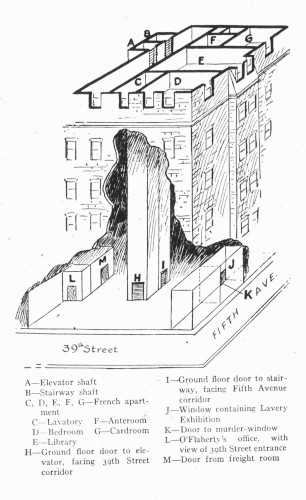
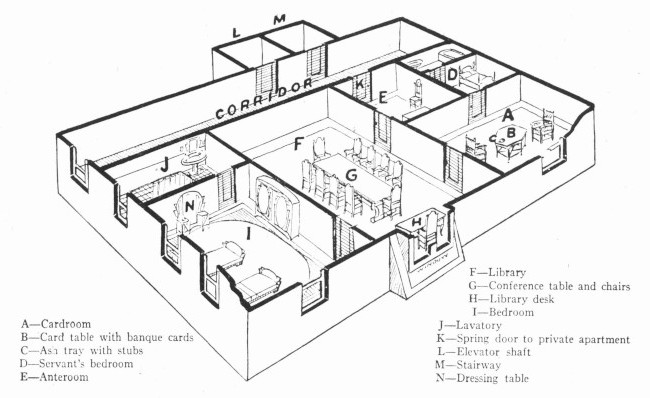
It had been Ellery Queen's hand on the knob—a subtly changed young man
with drawn features and a sharpened glance that swept the room once and
then returned to the anteroom.
"Before me, Commissioner," he murmured, holding the door wide.
Commissioner Scott Welles grunted, pushed his heavy body into view.
Three tight-lipped men in plain clothes—his bodyguard—flanked him as
he crossed the room toward the desk.
Next to appear in full sight of the assembled company was a strangely
altered Inspector Richard Queen, holding himself rigidly erect. He was
pale. He followed the police commissioner in silence.
After Queen came District Attorney Henry Sampson and his assistant, the
red-haired Timothy Cronin. They were whispering to each other, paying
no attention to the occupants of the room.
Velie, making up the rear, carefully closed the anteroom door, flipped
Bush back to his post with a curt finger, and dropped into his chair
beside Crouther. The store detective looked up at him inquiringly;
Velie said nothing and settled his big body. Both men turned to watch
the newcomers.
There was a little flurry of conversation as Ellery Queen and his
companions stood near the desk at the head of the room. Inspector Queen
indicated one of the leather-padded conference chairs immediately to
the right and a little behind the desk, as the seat to be occupied by
the Commissioner. Welles seemed a sadder and wiser man—he sat down
without a word, his eyes on Ellery's quiet figure before the desk.
The three guards disposed themselves with the other detectives at the
side of the room.
Inspector Queen himself sat down in a big chair to the left of the
desk, with Cronin at his side. The District Attorney dropped into a
chair next to the Commissioner. Desk in the center, its varied articles
beckoning attention. On either side two chairs with official occupants.
And dominating the scene....
The stage was set.
Ellery Queen, cynically examining the room and its occupants once
more, expressed himself as satisfied at the Commissioner's brusque
question. Ellery stepped behind the desk and stood with his back to
the dormer-windows. His head was lowered, his eyes on the desk-top.
His hand strayed to the glass, hovered over the book-ends, played with
the jar of white powder.... He smiled, straightened, raised his head,
removed his pince-nez glasses, looked calmly at his hushed audience,
waited.... Not until there was absolute silence did he speak.
"Ladies and gentleman." Prosy beginning! Yet something vaguely eerie
shivered through the air; it was a simultaneous sigh from many breasts.
"Ladies and gentlemen. Sixty hours ago Mrs. Winifred French was shot to
death in this building. Forty-eight hours ago her body was found. This
morning we have assembled at a private Waterloo to name her murderer."
Ellery had spoken quietly; now he paused for the slightest instant....
But after that sigh en masse even breaths seemed to be drawn with
care. No one spoke; no one whispered. They merely sat and waited.
A cutting edge slipped into the tone of Ellery's voice. "Very well!
A few preliminary explanations are required. Commissioner Welles—"
he turned slightly toward Welles, "it is with your permission that I
conduct this unofficial inquest?"
Welles nodded, once.
"Then let me explain," continued Ellery, turning back to his auditors,
"that I am merely taking the place of Inspector Queen, who is unable
to take charge because of a minor throat ailment which makes long
speaking difficult and painful. Correct, sir?" He bowed very solemnly
in the direction of his father. The Inspector grew even paler than
before, nodded wordlessly. "Further," Ellery went on, "if I shall at
any time use the personal 'I' in my discourse this morning, you are to
understand that it is merely for convenience—that in reality I shall
be describing the investigatory processes of Inspector Queen himself."
He halted abruptly, threw a challenging glance about the room, met
nothing but wide eyes and ears, and plunged at once into an analysis of
the French murder case.
"I shall take you through our investigation of this crime, ladies and
gentlemen," he began in a sharp decisive tone, "step by step, deduction
by deduction, observation by observation, until I arrive at what is an
inevitable conclusion. Hagstrom, you are taking this down?"
Eyes followed the direction of Ellery's glance. At the side of the room
where the detectives were congregated, Detective Hagstrom was seated,
pencil poised above a stenographic notebook. Hagstrom bobbed his head.
"What transpires here this morning," explained Ellery pleasantly, "will
become part of the official dossier of the case. Enough of asides!" He
cleared his throat.
"Mrs. Winifred Marchbanks French was discovered dead—killed by two
bullets, one in the heart and one in the precordial region below the
heart—on Tuesday at fifteen minutes or so past noon. When Inspector
Queen arrived upon the scene he noted several facts which led him to
believe that"—he paused—"the exhibition-window on the main floor was
not in effect the place where the crime was committed."
The room was deathly still. Fascination, fear, aversion, grief—the
gamut of emotions played upon those intent white faces. Ellery Queen
went on, rapidly.
"There were five component elements in this initial investigation," he
said, "that pointed to the conclusion that the murder was not committed
in the window.
"The first was the fact that, while on Monday night Mrs. French had in
her possession her personal key to this apartment, the key was missing
from her person and effects Tuesday morning, on the discovery of her
dead body. O'Flaherty, the head night-watchman, testified that she
had the key at eleven-fifty Monday night when she left his cubbyhole
to take the elevator upstairs. Yet it was gone. Search of the store
and premises left the key still unfound. What was the inference? That
the key and the crime were in some way connected. How? Well, the key
appertained to the apartment. If it was missing, wasn't there an
indication that the apartment also entered into the crime somewhere? At
least there was enough suspicion to be gleaned from the missing key to
warrant a belief that the apartment might have been the scene of the
crime."
Ellery paused; his lips twitched with fleeting amusement at the
frowning faces before him.
"Captious reasoning? I see the disbelief on your faces. Yet bear it in
mind. The fact of the key's being missing meant nothing of itself—but
when it was added to the four other facts of which I shall speak, it
took on significance indeed."
He swung back into his main narrative.
"The second element was a grotesque and even amusing one—you will
see, incidentally, that the detection of crime is not built upon
weighty salient factors, but upon just such incongruities as I shall
have occasion to mention this morning.... I refer to the fact that the
crime must have been committed a short time after midnight. This was
simply calculated from Dr. Prouty's report—Dr. Prouty is the Assistant
Medical Examiner—that Mrs. French had been dead some twelve hours when
she was found.
"If Mrs. French had been shot to death in the window-room at a little
past midnight, ladies and gentlemen," continued Ellery, with a twinkle
in his eye, "her murderer must have committed his crime either in
total darkness or by the feeble illumination of a pocket-torch! For
there were no lighting fixtures that worked in the room—in fact, no
bulbs—and the room was not even wired. Yet we were forced to suppose
that the murderer met his victim, talked with her, perhaps quarreled
with her, then shot her unerringly in two vital spots, disposed of her
body in the wall-bed, cleaned up the blood-stains and what not—all in
a room at best illuminated by a flashlight! No, it was not reasonable.
Wherefore Inspector Queen, quite logically, I believe, concluded that
the crime was not committed in the exhibition-window."
There was a little rustle of excitement. Ellery smiled, continued.
"This, however, was not the only reason for his belief. There was
a third point. And that was the lipstick—the long, silver-chased
lipstick—monogrammed C, found in Mrs. French's handbag by her body.
That this lipstick obviously was not Mrs. French's I shall not discuss
at this point. The pertinent factor was that it contained lip-rouge of
a decidedly darker shade of red than the lip-rouge on the dead woman's
lips. But this meant that Mrs. French's own lipstick—with which she
daubed the lighter rouge on her lips—should be somewhere about. But
it was not! Where could it be? Perhaps the murderer took it? That
sounded rather nonsensical. The most plausible explanation seemed to be
that the missing lipstick was somewhere else in the building.... Why
somewhere else in the building?—why not at Mrs. French's home, or at
least outside the store?
"For this very good reason. That Mrs. French's lips—her dead mute
lips—which were painted with the lighter shade of red, indicated that
she had not completed her application of the rouge! There were two dabs
on either side of her upper lip, and another small dab in the center
of her lower lip. The rouge had not been smeared—it had patently been
applied with a finger and left that way..." Ellery turned toward Marion
French. He said gently, "How do you apply your lip-rouge, Miss French?"
The girl whispered: "Just as you described, Mr. Queen. Three pats, one
on each side of the upper lip and one in the center of the lower lip."
"Thank you." Ellery smiled. "We had, then, visible evidence of a
case where a woman began to paint her lips and did not complete the
operation. But this was unnatural, remarkable. There are very few
things that will keep a woman from finishing this delicate task. Very,
very few! One of them might be a violent interruption of some kind.
A violent interruption? But there was murder committed! Was that the
interruption?"
He changed his tone, forged ahead. "It seemed likely. But in any
case, those lips had not been painted in the window-room. Where was
the lipstick? That we found it later in the apartment was merely
confirmation....
"Point number four was physiological. Dr. Prouty was puzzled by the
fact that there was so little blood on the corpse. Both wounds—one
particularly—should have bled considerably. The precordial region
contains many blood-vessels and muscles which would have been badly
torn by the passage of the bullet, which left a ragged wound. Where
was the blood? Had the murderer cleaned it up? But in the dark, or
semi-darkness, he could not possibly have removed all traces of the
copious blood-flow from those wounds. Whereupon we were compelled
once more to conclude that that blood had flowed—somewhere else.
Which meant that Mrs. French had been shot somewhere else than in the
window-room.
"And the fifth point was a psychological one which I fear"—he smiled
sadly—"would not carry much weight in a court of law. Nevertheless to
me it was quite over-whelming in its indication. For the mind rebelled
at the thought that the window-room was the scene of the crime. It was
preposterous, dangerous, asinine from the point of view of a potential
murderer. A meeting and a murder connote secrecy, privacy—any number
of exact requirements. The window-room afforded none of these. The
room is not fifty feet away from the head night-watchman's office.
That area is well-patrolled at periodic intervals. Revolver-shots had
to be fired—and none was heard. No! Both Inspector Queen and myself
felt—for the five reasons I have given you, no single one of which was
conclusive, but which were collectively significant—that the crime was
not committed in the window-room."
Ellery paused. His audience was following the story with eager, panting
concentration. Commissioner Welles regarded Ellery with a new light in
his small eyes. The Inspector was sunk deeply in thought.
"If not the window," continued Ellery, "where then? The key pointed
to the apartment—the required privacy, illumination, a logical
place for the use of lipstick—certainly the apartment seemed the
best possibility. So Inspector Queen, relying upon my discretion and
discernment, since he himself could not leave the window-room where
the preliminary investigation was still going on, asked me to go to
the apartment and see what I could see. Which I did, with interesting
results....
"The first thing I found in the apartment was Mrs. French's own
lipstick, lying on the bedroom dressing-table." Ellery picked up
the gold lipstick from the desk and held it up for a moment. "This
lipstick proved at once, of course, that Mrs. French had been in the
apartment on Monday night. The fact that it was lying under the curved
edge of a mother-of-pearl tray on the dressing-table and was quite
hidden, showed that it had probably been overlooked by the murderer.
In fact, the murderer had no reason even to look for it, because he
did not apparently observe that the lipstick in Mrs. French's bag and
the coloring on her lips were not identical." Ellery replaced the
glittering metal case on the desk.
"Now, I found the lipstick on the dressing-table. What did this mean?
It seemed rather plain that Mrs. French had been using the stick at
that dressing-table inside when she was interrupted. But the fact that
the lipstick was still there on the table when I found it pointed, it
seemed to me, to the fact that Mrs. French was not shot in the bedroom.
What was the interruption, then? Obviously, either a knock on the outer
door or the noise of the murderer entering the apartment. It was not
the latter, for the murderer had no key to the apartment, as I shall
soon prove. Then it must have been a knock at the door. Then, too, Mrs.
French must have been expecting it, for it so disturbed her, or it
was so important to her, that she immediately put down her lipstick,
neglecting to complete the daubing of her lips, and hurried through
the library and into the anteroom to admit her nocturnal visitor.
Presumably she opened the door, the visitor entered, and they went into
the library where Mrs. French stood behind the desk and the visitor
stood to the right, facing her—that is, Mrs. French stood where I am
standing now and the murderer stood about where Detective Hagstrom is
sitting at this moment.
"How do I know this?" went on Ellery rapidly. "Very simply. On
examining the library, I discovered that these book-ends, which lay on
the desk"—he lifted the two onyx book-ends carefully and exhibited
them—"had been tampered with. The green felt sheathing of one of
them was lighter in shade than its mate. Mr. Weaver volunteered the
information that the book-ends were only two months old, having been
presented to Mr. French by Mr. Gray on the occasion of Mr. French's
last birthday, and that he had observed them at that time in perfect
condition, with the felts exactly alike in color. Furthermore, the
book-ends had never left the room, or in fact the desk itself.
Apparently, then, the change of felt had occurred the night before. And
that was proved when, on examining the felt under a powerful glass, I
noted some scattered grains of a white powder stuck in the glue-line
where felt and onyx met!
"The glue was still a trifle viscid," said Ellery, "showing that it
had been very recently applied. The grains, on examination, by myself
cursorily and on analysis by the official fingerprint expert, proved
to be ordinary fingerprint powder, such as is used by the police.
But the use of fingerprint powder predicated a crime. There were no
fingerprints on the onyx. That meant the fingerprints had been removed.
Why the powder, then? Obviously, first to sprinkle the surface in order
to bring out what fingerprints might be there, and second to remove the
ones found. So much was evident.
"But the larger question arose—why were these book-ends handled at
all?" Ellery smiled. "It was an important question, and its answer
told an important story. Well, we now knew that they were handled in
order to change the felt on one of them. But why had that felt been
changed?"
His eyes challenged them mischievously. "There was only one logical
answer. To hide or remove a trace of the crime. But what could such
a trace be—one that would necessitate carefully ripping off a whole
felt, running down to some department in the store which stocks felts
and baizes (with what risk you may imagine!), bringing back the felt
and some glue, and finally pasting the new protector on the book-end?
It must be a damaging trace indeed. The most damaging trace of a crime
which I can conceive is—blood. And that was the answer.
"For Dr. Prouty had stated positively that much blood had flowed.
Then I had found the exact spot where Mrs. French's heart-blood had
poured out of her body! I proceeded to reconstruct that incident. The
book-ends were on the far edge of the desk, opposite the place where
I am now standing. The blood must have come, then, from a position
similar to mine at this moment. If we suppose that Mrs. French had been
shot as she stood here, the first bullet striking above the abdomen in
the precordial region, then the blood spurted out directly on the
glass top of the desk and trickled across to the book-end, soaking
it in gore. Whereupon she must have collapsed in the chair, falling
forward just as the second bullet, fired from the same spot, hit her
directly in the heart. This also bled a little. Only one book-end was
affected—the one nearer the center of the table. It was so bloody that
the murderer was compelled to remove the felt altogether and substitute
a new one. Why he felt compelled to hide this trace of the crime I
shall go into later. As for the different shade of the new felt—it is
an optical fact that colors are more difficult to distinguish truly
by artificial light than by daylight. At night, no doubt, the two
shades of green seemed identical. With the aid of the sun I immediately
detected the difference....
"You see now how we concluded exactly where Mrs. French was when she
was murdered. As for the position of her assailant, it was determined
from the angle of the wounds themselves, which were pointing to the
left and quite ragged, indicating that the murderer stood rather
sharply to the right."
Ellery paused, patting his lips with a handkerchief. "I have strayed
a little from the main line of my exposition," he said, "because it
was necessary to convince you that I now had genuine proof that the
murder had been committed in the apartment. Until the discovery of the
tampered book-ends I could not be sure, despite the fact that I found
these cards and cigaret-stubs"—he displayed them briefly—"in the
cardroom next door."
He put down the board on which the cards were tacked. "We found the
cards lying on the table there arranged in such a manner as to indicate
immediately that a game of Russian banque had been interrupted. Mr.
Weaver testified that the cardroom had been tidy the evening before,
that the cards had not been there. That meant, of course, that some one
had used them during the night. Mr. Weaver further attested to the fact
that of all the French family and their friends and acquaintances, Mrs.
French and her daughter Bernice Carmody were the only ones addicted to
the game of banque—that in fact it was well known in many quarters how
passionately devoted to it they were.
"The cigaret-stubs in the ashtray on the table bore the brand-name La
Duchesse—again identified by Mr. Weaver as Miss Carmody's brand. It
was scented with her favorite odour, violet.
"It seemed, then, that Mrs. French and Miss Carmody had both been in
the apartment Monday night, that Miss Carmody had smoked her unusual
cigarets, and that they had played a game of their beloved banque.
"In the bedroom closet we found a hat and a pair of shoes identified by
Miss Underhill, the French housekeeper, and Miss Keaton, a maid in the
French employ, as having been worn by Miss Carmody on Monday, the day
of the murder, when she left the house and was not seen again. Another
hat and another pair of shoes were missing from the closet, seeming to
indicate that the girl had changed the damp ones she was wearing for
the dry ones that were missing.
"So much for that." Ellery paused and looked about him, eyes glittering
strangely. There was not the slightest sound from his audience. They
seemed mesmerized, intent only on watching the slowly rising structure
of damning evidence.
"To make an all-important point.... Now that I knew that the apartment
was the scene of the crime, the question inevitably arose: Why was the
body removed to the window downstairs? What purpose did it serve? For
it must have served some purpose—we saw too many signs of cunning,
coördinated scheming to believe that the murderer was an arrant
lunatic, doing things for no reason at all.
"The first alternative was that the body was removed to make it appear
that the apartment was not the scene of the murder. But this did not
follow from the facts, for if the murderer wished to remove all traces
of the crime from the apartment, why did he not also remove the banque
game, the cigaret-stubs, the shoes and the hat? True, if the body
were not discovered or the murder not suspected, the finding of these
articles would indicate no crime. But the murderer could not hope to
conceal the body forever. Some day, somehow, it would be found, the
apartment gone over, and the cards, cigarets and other things would
point to the apartment as the place where the murder was committed.
"So, it was evident that the body was removed for another reason
entirely. What could that be? The answer came after thought—to
delay the discovery of the body. How was this arrived at? Simple
mental arithmetic. The exhibition was held every single day at noon
sharp. This was an unvarying rule. The window was not entered until
noon. These facts were common knowledge. If the body were hidden in
that wall-bed the murderer had absolute assurance that it would not be
discovered before twelve-fifteen. There was the good sharp reason ready
made for us—the only gleam of light in the whole muddle, which was
complicated by such questions as why the window was used at all when it
had so many obvious disadvantages, and so on. So we had no doubt that
the murderer took the trouble of carrying the body down six flights of
stairs and into the exhibition-room because he knew that the body would
not be found all the next morning.
"Logically, then, the question followed: Why did the murderer desire to
delay the discovery of the body? Think it over and you will see that
there can be only one convincing reason—because he had to do something
on Tuesday morning which the discovery of the body would have rendered
dangerous or even impossible!"
They were hanging on his words now breathlessly.
"How could this be?" asked Ellery, his eyes sparkling. "Let's shift to
a new tack for the moment.... No matter how the murderer entered the
store, he must have stayed all night. He had three ways to enter, but
no way to get out unobserved. He could have hidden in the store during
the day; he could have come in after hours by the Employees' Entrance;
or he could have slipped into the building by the freight-door at
eleven o'clock at night while the commissary truck was unloading the
food supplies for the next day. The chances were that this last was
the method used, for O'Flaherty had seen no one enter by his door, and
coming in at eleven at night was better for the murderer's purpose
than having to stay in the store from five-thirty until midnight.
"But how to get out? O'Flaherty reports no one left by his door; all
other exits were locked and bolted; and the freight-door on 39th Street
was closed at eleven-thirty, fifteen minutes before Mrs. French even
arrived at the store and a half-hour before she was murdered. So the
criminal had no recourse but to stay in the store all night. Then he
could not escape until nine the next morning, when the doors were
opened to the public. At that time he could walk out of the store as if
he were an early customer.
"But here another factor entered. If he could walk out of the store at
nine, a free man, why couldn't he also attend to whatever business he
had without the rigmarole of taking the body to the window in order to
secure a delay? The point is that he did transfer the body. Then he
couldn't walk out of the store at nine, a free man. He needed that
delay. He had to stay in the store even after nine!"
Simultaneously there came a short gasp from different quarters of the
room. Ellery looked around quickly, as if anxious to determine exactly
who had been shocked into astonishment and perhaps fear.
"I see that several of you catch the inference on the wing," he said,
smiling. "There could be only one reason to explain why our murderer
had to stay in the store even after nine—and that is that he was
connected with the store!"
This time incredulity, suspicion, dread were written on all those
plastic faces. Every one drew unconsciously away from his neighbor, as
if suddenly aware of the many persons which this last indictment might
implicate.
"Yes, that is where we arrived finally," continued Ellery in an
unemotional voice. "If our mysterious criminal were an employee of the
store or connected with the store in some official or even unofficial
capacity, his absence on the discovery of a murder would certainly be
noted. He could not afford to have his absence, which was evidently
of paramount importance, noted. He was in a difficult position. The
memorandum note"—he exhibited the blue slip on the desk before
him—"left on this desk by Mr. Weaver overnight told the murderer
that both Mr. Weaver and Mr. French would be in the apartment at nine
o'clock the next morning. If he left the body in the apartment, the
murder would be discovered at nine, the hue and cry raised, and he
would never get his chance to slip out of the store and attend to his
secret business. And even telephone calls might be watched. So he had
to make sure the body was not discovered until he had time to slip
away, or even telephone (for this would be untraceable if there was
no reason to check calls). The only method which he knew would surely
delay the discovery of the body was to hide it in the window-room.
Which he did, and quite successfully.
"By this time we were able to clear up finally that minor point of how
the murderer entered the building. We had the Monday time-chart. Our
murderer must be, we said, an employee of the store or in some way
connected with it. Yet the time-chart showed that every one had checked
out regularly before or at five-thirty. Then the murderer must have
entered the building by the freight-door, as the only means left.
"One other point, while we are on the subject of the murderer's desire
to delay the discovery of the body.... It occurred to me, as no doubt
it has occurred to you, that our mysterious criminal ran uncommon
risks and embarked on numerous voyages of complication when he began
to clean up the mess after his crime. For example—that he carried
the body downstairs. But that is explained by the fact that he had to
have time in the morning to attend to this vague business, an item,
incidentally, which we have not as yet explained. Also—why did he go
to the trouble of securing a new felt, carefully mopping up the blood,
and so on? Again this is answered by the need for time in the morning,
and the fact that if a bloody book-end were found by Mr. Weaver,
let us say, at nine o'clock a crime would be suspected at once, and
undoubtedly the criminal's chance of getting his business done would
be seriously jeopardized. Evidently then, what he had to do was of the
most pressing importance—so pressing that he could not run the risk
of the crime's even being suspected before that business was attended
to...."
Ellery paused and referred to a sheaf of paper which he took from
his breast-pocket. "We must leave for the moment our general
conclusion that the person we are seeking is connected officially or
semi-officially with this establishment," he said at last. "Please
bear that statement in mind while I veer off into another lane of
speculation entirely....
"I brought to your attention a few moments ago four concrete evidences
of the presence of Miss Bernice Carmody in this apartment on Monday
night. These were, in the order in which we found them, the game of
banque exclusively indulged in by Miss Carmody and her mother; the La
Duchesse cigarets, violet-scented, known to be Miss Carmody's special
brand; Miss Carmody's hat, which she was observed wearing on Monday
afternoon when she disappeared from sight; and her shoes, which fit the
same description.
"Now I shall show you that, far from proving that Miss Carmody was
present here on Monday night, they prove exactly the contrary,"
continued Ellery briskly. "The banque game contributes nothing to our
little refutation; the cards lay there in a legitimate array, and we
must leave them for the present.
"The cigarets, however, present a more illuminating view of
my contention. These"—he held up one of the ashtrays on the
exhibit-table—"these cigaret-stubs were found on the table in the
cardroom." He lifted one of the stubs from the tray and held it high.
"As you can see, this cigaret has been almost entirely consumed—in
fact, only the small strip which bears the brand imprint is left.
Without exception, each of the ten or twelve cigarets in this ashtray
have been uniformly smoked to the same tiny stub.
"On the other hand, in Miss Carmody's bedroom at the French house we
found these stubs." He exhibited the second ashtray, picking out one of
the cigarets from its cluttered, dusty depths to show to his audience.
"You will observe that in the case of this stub, the cigaret, also
a La Duchesse of course, has been little more than one-quarter
consumed—Miss Carmody evidently having taken only five or six puffs
before crushing the remainder in the tray. Every stub in this tray from
Miss Carmody's bedroom has been similarly treated.
"In other words," he said with a bare smile, "we find the amusing
phenomenon of two sets of cigarets, both presumably smoked by the
same person, exhibiting distinctly opposite physical remains. On
investigating, we discovered that Miss Carmody, for reasons soon to be
clarified, is extremely nervous—so much so that none of those persons
who know her best can recall any occasion on which she has not smoked
her favorite cigarets in exactly this wasteful, convulsive manner.
"What is the inference?" A perceptible pause. "Merely that Miss
Carmody did not smoke the cigarets we found on the cardroom table;
that they were smoked or prepared by some one else who did not know
Miss Carmody's unvarying method of throwing away cigarets one-quarter
consumed....
"Now, as for the shoes and hat," Ellery said without allowing his
auditors time in which to digest this latest pronouncement, "we found
further signs of a tampering hand. The appearance of things is that
Miss Carmody was here Monday night, having been wet by the rain of
the afternoon and evening, and that before leaving the apartment
she changed her soaked hat and shoes, putting on others from the
small stock of her clothing already in the bedroom closet. But we
discovered that the hat had been inserted in a hat-box with its brim to
the bottom. And that the shoes had been stuck into the shoe-bag with
their heels projecting from the pocket.
"In testing the habituary nature of such a procedure, we considered
that an over-whelming percentage of women put their hats away in
hat-boxes with the crowns to the bottom and the brims to the top;
also that when shoes have large buckles, as this pair has, they are put
away with the heels inside, so that the buckles will not catch on the
material of the bag. Yet both articles denoted this peculiar ignorance
of feminine custom. Here the inference is also obvious—Miss Carmody
did not put away those shoes and the hat; a man did. For it is the
masculine custom to put hats away with the brim downward; and a man
would not grasp the significance of the buckle. All the shoes in the
rack had the heels showing, because none happened to have buckles;
whoever put Miss Carmody's shoes in the rack automatically followed
suit, which a woman would not have done.
"Now these points, taken by and of themselves, are, I will confess,
rather weak and inconclusive. But when you put the three together, the
evidence is too strong to be overlooked—it was not Miss Carmody who
smoked the cigarets and put away shoes and hat, but some one else—a
man."
Ellery cleared away a huskiness in his throat. His tone was barbed
with earnestness, despite a growing hoarseness. "There is another
item of considerable interest in this last connection," he continued.
"In examining the lavatory inside, Mr. Weaver and I ran across an
intriguing theft. A safety-razor blade of Mr. Weaver's, which he had
used after five-thirty Monday afternoon and had cleaned and restored
to the case because it was his last blade and he knew he would have
to shave in the morning—this blade, I say, was missing on Tuesday
morning. Mr. Weaver, who was busy Monday night and consequently forgot
to put in a new supply of blades, came to the apartment Tuesday
morning early—at eight-thirty, in fact, because he had to clear up
some business and reports before the arrival of Mr. French at nine. He
intended to shave in the apartment. The blade, which he had put away
only the late afternoon before, was gone. Mr. French, let me explain,
does not keep a razor, never shaving himself.
"Now why was the blade gone? Of course, it was plain that the blade
must have been used Monday night or early Tuesday morning before Mr.
Weaver arrived here. Who could have used it? One of two people—Mrs.
French or her murderer. Mrs. French could have used it as a cutting
instrument of some sort; or her murderer could have used it.
"Of the two alternatives, surely the second is more tenable. Remember
that the criminal was constrained by circumstances to pass the night
in the store. Where could he stay with most safety? Certainly in the
apartment itself! He could not roam about the dark floors, or even hide
among them with as great a margin of safety as in the apartment—not
with the watchman prowling about all night! Now—we find a blade
used. It suggests normally the process of shaving. Well, why not? We
know that the murderer had to make an appearance in the morning as an
employee or official of the store. Why shouldn't he shave while he was
temporarily occupying the apartment? It predicates a cold-blooded
personality, but that is an argument for rather than an argument
against it. Why is the blade missing? Evidently something happened
to it. What could have happened to it? Did it break? Why not! The
blade had been used a few times; it was brittle. A little extra force
in screwing the parts of the razor together, and the blade might
easily have snapped. Let us suppose that this happened. Why didn't
the murderer merely leave the broken blade? Because the murderer is
a canny scoundrel and in his own way an excellent psychologist. If a
broken blade remains it is more likely to be recalled that it was not
broken at a former date than to take it for granted that the blade
was broken at that former date. If the blade is missing there is no
incentive to suspicion or memory. An altered object is a more vigorous
mental stimulant than a missing one. At least, that is what I should
have thought if I had been in the murderer's place; and in effect I
believe the person who planned this affair did the correct thing in
taking away the blade—correct according to his lights. The proof is
that Mr. Weaver thought little or nothing of the missing blade until
I probed it out of him; and then it was only because I brought to the
investigation an unprejudiced, impersonal observation."
Ellery grinned a little. "I have been working on presumptions and more
or less feeble deductions, as you can see; yet if you put together
all the scattered, flimsy facts which I have outlined in the past ten
minutes, I think you will see that common sense simply cries out that
the blade was used for shaving, that it was broken, and that it was
taken away. We find no evidence that the blade might have been used
for anything but its legitimate purpose; and this only strengthens
the contention. Let me leave this line of thought temporarily and go
to another, altogether different, and in its way one of the most
significant in the entire investigation."
There was a surreptitious rustling of bodies in hard chairs, a quick
intake of breaths. The eyes on Ellery did not waver.
"It may have come to you," he said in a quiet, merciless voice, "that
more than one person could have been implicated in this affair;
that, perhaps, if Miss Carmody did not put away her shoes and
hat—disregarding the damning evidence of the cigarets—she still might
have been present; for another—a man—could have disposed of the shoes
and hat while she stood by or did something else. I shall disprove that
with the most gratifying expedition."
He put his palms flat on the desk, leaned slightly forward. "Who,
ladies and gentlemen, had rightful access to this apartment? Answer:
The five possessors of the keys. That is—Mr. French, Mrs. French,
Miss Carmody, Miss Marion French, and Mr. Weaver. The master-key in
O'Flaherty's desk was closely guarded, and no one could have got it
without either his knowledge or the knowledge of the day-man, O'Shane.
And no such knowledge exists, which makes it plain that the master key
in no way enters our calculations.
"Of the six keys in esse, as it were, we are now able to account for
five. Mrs. French's is missing. All the others are absolutely accounted
for as having been exclusively in the possession of their owners.
Mrs. French's key has been sought for by the combined cunning of the
detective force. It is still missing. In other words, it is not on
these premises, despite the fact that O'Flaherty positively avers that
Mrs. French had it in her possession when she entered the store Monday
night.
"I told you at the beginning of this impromptu demonstration that the
murderer probably took that key. Now I tell you not only that he took
it, but that he had to take it.
"We have one confirmation in fact that the criminal wanted a key. On
Monday afternoon, some time after Miss Carmody left the French house
furtively, Miss Underhill, the housekeeper, received a telephone call.
The caller claimed to be Miss Carmody. The caller asked Miss Underhill
to have Miss Carmody's key to the apartment ready, that a messenger
would be sent for it at once. Yet only the very same morning, Miss
Carmody had told Miss Underhill that she had lost her key, she thought,
and asked Miss Underhill to secure one of the other keys and make a
duplicate for her!
"Miss Underhill doubts that the caller was Miss Carmody. She is ready
to swear that some one stood by the telephone at the other end and
prompted the caller's reply when Miss Underhill reminded the caller
about the lost key and the morning's instructions. The caller then hung
up in some confusion....
"What is the inference? Surely that the caller was not Miss Carmody,
but a hireling or accomplice of the murderer, who prompted the call in
order to secure a key to the apartment!"
Ellery drew a long breath. "I leave you for the moment to your own
cogitations on the interesting inflections this incident raises.... Now
let me conduct you through a logical maze to another conclusion—the
one with which I began this branch of my thesis.
"Why did the murderer want a key? Obviously, to secure a means of
access to the apartment. He could not get in except through the agency
of a second person who possessed a key, if he had not one himself.
Presumably he expected to be admitted to the apartment by Mrs. French,
but in the careful planning of the crime the possession of a key for
himself might conceivably be important, and this explains the call and
the projected 'messenger.' But to the case in point!
"The criminal killed Mrs. French in the apartment. Now that he had a
corpse and knew that he must take it down into the window-room, for
the various reasons I have given, he pulled up with a sudden thought.
He knew that the door to the apartment had a spring lock that snapped
shut. He had no key, having failed in his effort to get hold of Bernice
Carmody's. He must carry the body out of the apartment. Yet he had much
to do in the apartment afterward—clean up the evidences of blood,
'plant' the shoes and hat, the banque game and cigarets. As a matter of
fact, even if he cleaned up the room and 'planted' the false evidence
before he took the body down, he still needed means of reëntry into
the apartment. He had to pussyfoot through the store for the felt,
the glue, and other paraphernalia needed to fix the book-ends. How
was he to get back into the apartment? He also meant to sleep in the
apartment, apparently—again, how was he to get back? You see, whether
he took the body downstairs before or after he cleaned up, he still
needed a means of reëntry to the apartment....
"His first thought must have been to insert something between the
door and the floor to keep the springed door from clicking shut. But
what about the watchmen? He must have thought: 'The watchmen make
rounds through this corridor by the hour. They will be sure to notice
a partly open door and investigate.' No, the door had to be closed.
But—a thought! Mrs. French had a key, her own key—the one by which
she herself entered the apartment. He would use that. We can picture
him opening her bag while she lay, bleeding and dead, across the desk,
finding the key, putting it into his own pocket, picking up the corpse
and leaving the apartment, now certain of a means of reëntering it
when he was through with his grisly task.
"But"—and Ellery smiled grimly—"he had to bring the key back
upstairs with him, obviously, to get into the apartment again.
Therefore we didn't find it on the body. True, he might have gone
upstairs, done his cleaning up, and then taken the key downstairs
again. But—of course that's inane—how would he get back again?
Besides, the danger he would encounter—taking still another chance
of being detected on the main floor getting into the window.... It
was dangerous enough the first time, but that was inescapable. No, he
probably figured that the best thing he could do would be to pocket the
key and dispose of it when he left the building in the morning. True,
he might have left it in the apartment, on the card-table for example.
But the fact that it isn't in the apartment shows that he took it away
with him—he had two alternatives and chose one of them.
"We find then—" Ellery paused for the merest instant—"that our
criminal committed the murder without accomplices.
"I see doubt on some faces. But surely it is quite clear. If he had an
accomplice, he wouldn't have been forced to take the key at all!...
He would have carried the body downstairs, and his accomplice would
have remained in the apartment to open the door for him when he was
finished downstairs. Don't you see? The very fact that he had to take
the key shows that it was a one-man job. I might be confronted with
the objection: 'Well, it could have been two people at that, because
both might have carried the body downstairs.' To that I reply with
certainty, 'No!' because it would have involved a double risk—two
people would have been easier to detect by a watchman than one. This
crime is well thought out—the author of it would never have taken
this unnecessary chance of discovery."
Ellery stopped abruptly and stared down at his notes. No one moved.
When he looked up there was a tightness about his lips that revealed an
inward strain whose cause no one there could guess.
"I have now reached the point, ladies and gentlemen," he announced in
a calm flat voice, "where I can go to some length in describing our
elusive criminal. Would you care to hear my description?"
He looked about the room, challenging them with his eyes. Bodies rigid
through excitement sagged in reaction. Every one averted his head.
There was no sound from them.
"I take it that you would," said Ellery in the same flat voice, which
contained a note of amused menace. "Very well, then!"
He leaned forward, eyes glittering. "Our murderer is a man. The tactics
employed in putting the shoes and hat into the closet plus the evidence
of the missing blade point to this masculinity. The physical energy
required in disposing of the body and the rest; the mental agility,
with its recurrent traces of hard common sense; the cold-bloodedness,
the unscrupulosity—all these point unerringly to a masculine figure
with, if you will, a fairly heavy beard which requires daily shaving."
They followed the movements of his lips with bated breaths.
"Our man worked alone, without accomplices. The deductions from the
missing key, which I have gone into at great length, point to this."
There was not a tremor of movement in the room.
"Our lone man is connected with the store. The removal of the body to
the window downstairs and all its attendant complications, which I
have also expounded at some length, prove this."
Ellery relaxed slightly. Again he looked about the room with a little
smile. He applied his handkerchief to his lips, glanced slyly at
Commissioner Welles, who sat perspiring and alert in his chair; at his
father, who was slumped in an attitude of weariness, one fragile hand
shielding his eyes; at the motionless detectives to his left; at Velie,
Crouther, "Jimmy," and Fiorelli to his right. Then he began once more.
"On one point," he said dryly, "we have as yet reached no definite
conclusion. I refer to the nature of the business which the murderer
considered so imperative as to require special attention Tuesday
morning....
"Which brings me to the most absorbing subject of the five books which
we discovered on this desk—that interesting mélange of paleontology,
elementary music, commerce of the moyen age, philately, and bad
vaudeville jokes."
Ellery launched into a short, graphic description of the five strange
volumes, the markings, Weaver's story of Springer's duplicity, the
revelation that the addresses were drug-distributing depots, and
finally the unsuccessful raid on the house at the 98th Street address,
taken from the sixth book in Weaver's possession.
"When Springer prepared the sixth book," continued Ellery, to his
ever-tensing audience, "we can assume that he had no suspicion that
the book-code was being tampered with or known to an outsider. If he
had, he would not have prepared the book and left it for Mr. Weaver's
investigating fingers. So that, when Springer left the store on Monday
night, followed by Mr. Weaver, he did not know that this sixth book,
Modern Trends in Interior Decoration, by Lucian Tucker, was in our
young amateur detective's possession. And since Springer met and spoke
to no one all evening, even when he arrived at his Bronx apartment
(for we have checked up through the telephone company and found that
he did not make any telephone calls when he got home), he could not
therefore have known that the book-system had been tampered with until,
at the very earliest, the next morning, Tuesday, when he returned
to work. In other words, after the murder. If we presume that not
Springer, but some one else, would have been apprised by an outsider
of the discovery of the code-system, we must not forget that the only
method by which any one could have communicated with another about
the matter from the store would be by telephoning, since he could not
leave the store during the night. And we discovered that the telephone
service at this store is cut off at night, with the exception of
one trunk line leading to O'Flaherty's desk; and this was not used,
according to O'Flaherty's own testimony.
"Then we are forced to conclude that it was impossible for any one in
the store Monday night and early Tuesday morning to have communicated
with Springer or any one else about the missing sixth book, which
Weaver took away with him."
Ellery forged ahead rapidly. "The fact that the system of dope
distribution was disorganized the next morning, Tuesday—as it was, for
the sudden abandonment of the 98th Street house on Tuesday afternoon
is clear evidence—could have been due only to some one of the drug
ring discovering during the night that the system was being tampered
with. I repeat here the fact that Springer went ahead on Monday evening
with his regular task of codifying the sixth book, showing that up to
that time the ring considered their system safe. Yet by next morning
they had become alarmed and fled the 98th Street rendezvous, even
before catering to their addict-customers. Again, then, the logical
explanation is that it was during the previous night that some one
discovered something wrong.
"This discovery could have been caused only by, first, noticing the
absence of the sixth book from its accustomed shelf in the Book
Department Monday night after Weaver left—the last one to check out
of the store; second, finding the five duplicate books on Mr. French's
desk Monday night; or third, both. We must conclude therefore that,
since the disorganization did take place the morning after the crime,
it could have only been ordered by some one who made one or both of
these discoveries Monday night. Some one—to amplify—who must have
been in the store after Springer and Weaver left, and who therefore
could not get out of the store or communicate with any one until at
least nine o'clock Tuesday morning."
Dawning comprehension shone from several faces before him. Ellery
smiled. "I see that some of you are anticipating the inevitable
conclusion.... Who in the store that night was in a position to make
one or both of these bibliographical discoveries? The answer is: the
murderer, the man who killed Mrs. French in the room in which the five
books were prominently in sight. Is there anything about the murderer's
subsequent actions which proves that he did make the discovery of the
five books in the apartment? Yes, there is. The fact that the murderer
removed the body to the window-room in order to give himself time next
morning to attend to his 'business'—which until this point has been
obscure....
"The deductive chain, ladies and gentlemen," said Ellery in a curiously
triumphant voice, "is too strong and perfectly welded to be anything
but truth. The murderer warned the drug ring Tuesday morning.
"In other words, to add an element to our growing description—our
murderer is a man, who worked alone, who is connected with the store,
and who belongs to a large, well-organized drug ring."
He paused, fingered the five books on the desk with sensitive fingers.
"Furthermore, we are now in a position to add another qualifying item
to the growing description of the murderer.
"For had our drug-distributing murderer been present in the French
apartment before the night of the murder—and by 'before' I mean at
any time within five weeks prior to the fatal night—he would have
seen the books on the table, would have become suspicious, would have
at once ordered the cessation of the book-code operations in the
Book Department. And since up to the very night of the murder the
book system was still in effect, it follows most gracefully that the
murderer had not been in the French library for between one and five
weeks before Monday night last.... We have confirmation that it was
the murderer again who saw those books on the desk. For in examining
and later fixing the damaged book-ends, he could scarcely have missed
seeing—and understanding to his horror the significance of—the five
volumes....
"As a matter of fact," continued Ellery swiftly, "there is no
difficulty in deducing that the murderer, upon seeing the incriminating
books on this desk, immediately stole downstairs to the Book Department
with a flashlight to determine whether the sixth book had been
tampered with also. And of course he would have found it gone—the
climax-capping discovery which would make it imperative for him to
get word to his confederates that the game was up. This is a decently
reasonable conjecture which very soon, I am happy to announce, we shall
be able to check more positively!"
And with this he stopped short, mopped his forehead with his
handkerchief, and polished the lenses of his pince-nez with absent
fingers. This time a ripple of conversation disturbed the quiet
atmosphere, beginning in a minor cadence that swelled to excited
proportions, only to cease abruptly when Ellery lifted a hand for
silence.
"To make the analysis complete," he resumed, restoring his glasses
to his nose, "I shall now become perhaps objectionably personal. For
I mean to take up, one by one, each of you and measure you by the
yardstick I have constructed in this analysis!"
Instantly the room was a babel of exclamations, expressions of anger,
resentment, bewilderment, uncomfortable self-interest. Ellery shrugged
his shoulders, turned toward Commissioner Welles. The Commissioner said
"Yes!" in a decisive tone and glared at the people assembled before
him. They subsided, muttering.
Ellery turned back to his audience with a half-smile. "Really," he
said, "I have not sprung my greatest surprise by any means. So there is
little cause for protest on the part of any one here—or should I say
nearly any one? At any rate, let's begin this fascinating little game
of elimination.
"From the first unit on my yardstick—the fact that the murderer is
a man—" he said, "we may at once absolve, even as an intellectual
exercise, Miss Marion French, Miss Bernice Carmody, and Mrs. Cornelius
Zorn.
"The second unit—that this man worked alone—is irrelevant and useless
to determine identity, so we will proceed to the third unit, which is
that the murderer, a man, is connected with this establishment. And to
the fourth, which is that the murderer has not been in this apartment
within the past five weeks.
"There is, first, Mr. Cyrus French." Ellery bowed insouciantly to the
feeble old millionaire. "Mr. French is certainly connected with this
establishment. Mr. French, further, could have committed the crime, if
you judge physical possibility a factor. I demonstrated privately not
long ago that, had Mr. French bribed the chauffeur of his host, Mr.
Whitney, to take him into the City from Great Neck on Monday night and
forget about it, he could have arrived at this apartment in sufficient
time to slip through the freight-entrance and into the apartment. He
was not seen again, except by the chauffeur, after he retired to his
room in the Whitney house at nine o'clock Monday night complaining of a
slight indisposition.
"However—" Ellery smiled at the purpling face of French—"Mr. French
has certainly been in this room within the past five weeks—every day,
in fact, for years. And if this seems inconclusive, Mr. French, rest
easy. For there is another reason, that thus far I have purposely
neglected to mention, which makes your culpability a psychological
impossibility."
French relaxed, a vague smile lifting the corners of his tremulous old
mouth. Marion squeezed his hand. "Now," said Ellery busily, "Mr. John
Gray, donor of the entangled book-ends and close friend to the French
family. You, Mr. Gray," he said gravely, directly addressing the spruce
old director, "are eliminated on a number of counts. Although you are
connected with the store in a very important capacity, and although
your absence on Tuesday morning would have been seriously noticed,
you too have been a frequent visitor to these rooms during the past
five weeks; in fact, you attended a meeting here on Friday, I believe.
And you had an alibi for Monday night which we checked up and found
stronger than even you believe. For not only does the night-man at your
hotel desk confirm your statement that you were talking with him at
eleven-forty Monday night, making it impossible for you to have entered
the store, but another person, unknown to you—a fellow-resident at the
same apartment hotel—saw you enter your suite at eleven-forty-five....
Even without this we could not seriously have entertained a thought
of your guilt, for we had no reason to believe that your friend the
night-clerk is anything but an honest man. No more reason, in fact,
than that Mr. Whitney's chauffeur, in the case of Mr. French, is
dishonest. In Mr. French's case I merely mentioned the bribe as an
eventuality, improbable but certainly within the realm of possibility."
Gray sank back with a curious sigh, dug his small hands into the
pockets of his coat. Ellery turned to red-faced, nervous Cornelius
Zorn, who was fumbling with his watch-chain. "Mr. Zorn, your alibi was
weak, and you could have, with perjured testimony on the part of Mrs.
Zorn, committed the murder. But although you are a prominent official
of the store, you too have been in this room at least once weekly for
many months. And you, too, as well as Mr. French and Mr. Gray, are
further absolved by this psychological inadmissibility of which I spoke
before.
"Mr. Marchbanks," continued Ellery, turning to the heavy-set, lowering
brother of the dead woman, "your story about the automobile trip to
Long Island and staying overnight at your house in Little Neck, unseen
by any one who might vouch for your presence, also made it physically
possible for you to have returned to the city in time to get into
the store and commit the murder. But you needn't have been so irate
yesterday—you are absolved too by this secret point of mine, besides
being eliminated, as a regular attendant here at the directorial
conferences, on the same account as Mr. Zorn.
"And Mr. Trask—" Ellery's tone hardened slightly—"although you were
drunk and rolling about the streets—" Trask's jaw dropped in vapid
astonishment—"on Monday night and Tuesday morning, you, too, are set
free by my yardstick, as well as by my as yet undivulged item."
Ellery paused, looked contemplatively at the stony, dark features
of Vincent Carmody. "Mr. Carmody. In many respects you deserve our
apologies and genuine commiserations. You were entirely eliminated from
our speculations by the fact that you are in no way connected with the
store. Had you committed the murder, despite your story of the night
trip to Connecticut, which was unsubstantiated and might have been
false, there would have been no necessity for taking the body of Mrs.
French downstairs to the window-room. Because you could have walked
out of the store at nine o'clock unrestrained by any fear that your
absence might be noticed. You did not belong in the store at all. You,
too, incidentally, are eliminated further by my charming and mysterious
little point.
"And now," continued Ellery, turning to the disturbed Gallic features
of Paul Lavery, "we come to you. Don't be afraid!" he smiled—"you
didn't commit the crime! I was so certain that I did not even bother
to ask you for a statement of your movements on Monday night. You
have been in this apartment daily for weeks. Besides, you came here
directly from France only a short time ago—it was quite beyond the
area of probability to suspect you, therefore, of being embroiled in
a gang of drug-peddlers operating with intense organization in this
city and country. And you, too, cannot very well be our murderer, since
you do not logically measure up to my last point, still withheld. And,
if I were to be minutely psychiatric, I might add that a man of your
refined and Continental intelligence would never have committed the
regrettable mistakes which got our esteemed mysterioso into trouble.
For I do believe that, out of all of us, you alone would have been
man-of-the-world enough to know how a woman puts her hat into a
hat-box, and how she stores buckled shoes in a shoe-bag....
"We have now," continued Ellery pleasantly, but there was a feverish
glitter in his eye, "narrowed the field of inquiry considerably. We
might discuss, of course, Mr. MacKenzie, the general manager, who
is an employee of the store. No, no! Mr. MacKenzie, don't rise to
protest—we've eliminated you already. Because of this last point of
ours, which is almost ready for exposition, and because you have
been in this apartment within five weeks. But any of the hundreds
of employees of the store who have never been in this apartment
and whose movements Monday night are unaccounted for, might be the
murderer. We'll come to that in a moment. At this time, ladies and
gentlemen—" Ellery made a sharp sign to Patrolman Bush at the anteroom
door, who immediately bobbed his head and went out, leaving the door
open behind him—"at this time I wish to present to you a gentleman
who until now has been more or less of an unknown quantity; no less
a personage than—" there was a flurry at the outer door; it opened
and Bush entered, followed by a detective who held a white-faced man,
manacled, tightly by the elbow—"Mr. James Springer!"
Ellery retreated slightly, a grim smile on his face. The detective
escorted his prisoner to the front of the room, where two chairs were
immediately set by one of the attendant policemen. The two men sat
down, Springer holding his manacled hands limply in his lap, staring
steadfastly at the floor. He was a middle-aged man with sharp features
and grey hair; a livid bruise on his right cheek was mute evidence of a
recent scuffle.
Everybody in the room stared at him wordlessly. Old French was
speechless with rage at the sight of the employee who had betrayed him.
Weaver and Marion both laid restraining hands on his shaking arm. But
there were no words in that audience—only hot eager glances, and in
one case a frozen steady immutability....
"Mr. Springer," said Ellery quietly—yet his voice exploded like a
shell in the strained atmosphere of the room—"Mr. Springer has been
kind enough to turn State's evidence. Mr. Springer, who ran away with
the deluded thought that he might successfully evade the police, was
caught the very day he attempted to escape because we were prepared for
it. Mr. Springer's capture has been kept very quiet. Mr. Springer has
cleared up many little items of procedure which we could not possibly
have deduced.
"For example, that the murderer is his chief in the drug ring, which
even now is being scattered and pursued throughout the country. That
the murderer is the right-hand man of the eloquently termed 'master
mind' of the drug ring in this city. That Miss Bernice Carmody, who we
discovered by investigation was probably a drug addict in an advanced
stage, had come under the influence of the heroin habit, had met by
devious ways the 'master mind,' had been introduced to the code-system,
had become so dependent upon the drug that she willingly solicited
new customers from her social circle, becoming in a way therefore
almost a member of the ring. That Miss Carmody's pernicious addiction
was unsuspected by her family until, as we know, her father, Mr.
Carmody, began to suspect and told his former wife, Mrs. French, what
he suspected; and Mrs. French, observing, saw that it was true. That
Mrs. French, in her assertive way, directly accused her daughter of
addiction and finally broke down the girl's weakened will until she
confessed everything—including the name of the man connected with
the French store who was supplying her directly with her own drugs.
That Mrs. French, who we may suppose did not inform her husband of the
true state of affairs because of his violent aversion to this form
of vice, on Monday took away from Miss Carmody the newly replenished
supply of drugs which she kept in the false bottom of her specially
made lipstick. That Mrs. French further forced her daughter to make
an appointment for her with this man, this employee in her husband's
store, for Monday night at midnight, secretly, to plead with him for
her daughter—to force him, by threats of disclosing to the police
what she now knew about the drug organization, to loose his grip on
her daughter and allow the girl to be cured secretly by her mother.
That this appointment was made on Sunday through Miss Carmody. That
this man immediately reported the alarming state of affairs to his
chief, the ubiquitous 'master mind,' who in his customary cold-blooded
fashion commanded him to kill Mrs. French, who by now, in turn, was in
possession of too much vital information to be allowed to live; and
also to do away with Miss Carmody, who had proved a weak cog in the
machine and must also be disposed of. That this man, under threat of
being killed himself, laid his plans and made his appointment. That
he entered secretly through the freight-door, which as an employee
of the store he knew was open at that exact half-hour each night.
That he waited until midnight in a store lavatory and then made his
way stealthily to the apartment on the sixth floor, knocked, and was
admitted by Mrs. French, who had arrived a few minutes before. That
she stood by the desk, as we deduced, and they argued; that he was
not aware of the heroin-filled lipstick in her bag, or he would have
taken it; that without hesitation he shot and killed Mrs. French,
who bled profusely, the blood staining the book-end; that on bending
over the desk he saw the five books, and realized that some one had
been tampering with the code-system; that he saw the blue memorandum
announcing the arrival next morning at nine of Mr. Weaver and Mr.
French; that he realized he could not communicate with any one of the
ring about this latest unforeseen development, because he was unable
to get out before the next morning and could not telephone; that he
therefore decided to hide the body in the exhibition-window, which
would give him ample time next morning to slip away and warn his gang,
for if the body were left in the apartment and discovered at nine, he
would be unable for precautionary reasons to leave the building; and
finally that he disposed of the body where we found it. Also that on
his way back he stopped at the Book Department on the main floor and
confirmed his suspicion that the sixth book was also missing. That
he took Mrs. French's key back with him, having been unsuccessful in
his attempt to get Bernice Carmody's that afternoon by the ruse of
the telephone call. Finally, that he cleaned up the apartment, fixed
the book-end, 'planted' the evidence against Miss Carmody, stayed
overnight, shaved in the morning, broke the blade and took it away
with him; and slipped out shortly after nine, emerging with the early
shoppers only to reënter the building at once through the regular
Employees' Entrance, in order to be checked in officially. And that
he managed soon after to sneak off and warn his gang leader of the
discovery of the book-system...."
Ellery cleared his throat, went on relentlessly. "Mr. Springer was also
kind enough to clear up the matter of Miss Carmody's abduction. With
the action of Mrs. French on Sunday of taking away her store of the
drug, the girl became desperate and got in touch with the murderer.
This fitted in with his plans—he told her to come to a rendezvous
in the lower part of the city for a new supply. She went on Monday
afternoon and was promptly abducted, being taken by confederates to
a Brooklyn hideaway and murdered. Her clothes were confiscated and
brought back to our murderer, who had as yet committed no capital
crime. These clothes the murderer brought with him to the apartment
Monday night—the hat and shoes, tied up innocently in a small parcel,
but wet a trifle with rain to make the deception perfect.
"There is only one thing more to explain before proceeding to the
much-wished-for dénouement.... And that is the reason for 'planting'
the banque game, cigarets, shoes and hat to make it appear as if
Bernice herself had been implicated in the crime. And this, too, was
outlined—under protest—by Mr. Springer, who has been just a cog—an
important cog, perhaps—in the vicious wheel....
"The murderer left evidences of Miss Carmody's presence because she
had necessarily vanished. Since she had been murdered and would be
missing, there was a logical reason for connecting the two events—the
disappearance of the girl and the murder of her mother. It would seem
perhaps as if the girl had committed the crime. Since this was untrue,
the murderer felt that it might confuse the police and put them off
the real track. The murderer did not really hope that the deception
would be successful for long—it was merely another red herring drawn
across the trail, and anything which would lead the scent away from him
in another direction he felt was desirable. And the actual 'framing'
required little enough trouble and work. The cigarets he secured from
Xanthos', Miss Carmody's tobacconist, since she had once told him where
she secured her private supply. The banque he knew about from Miss
Carmody, also. The rest was child's play...."
They were sitting on the edge of the hard camp-chairs now, straining
forward to catch every syllable. Occasionally they looked at each other
in a puzzled manner, as if unable to see clearly to the end of the
analysis. Ellery brought them back to attention with his next words.
"Springer!" The name cracked out sharply. The prisoner started,
paled, looked up furtively. His eyes fell at once to the carpet he
had been studiously observing. "Springer, have I given your story
faithfully—and completely?"
The man's eyes fluttered in a sudden agony, rolled in their sockets,
wildly seeking a face in the swaying crowd before him. When he spoke,
it was in a husky monotone, barely audible to those avid ears.
"Yes."
"Very well, then!" exclaimed Ellery, leaning forward, his tone keenly
triumphant. "I have still to expatiate upon that unspoken point which I
termed mysterious a few moments ago....
"You will recall that I spoke of the book-ends and the few grains of
powder stuck in the glue between the onyx and the new felt. That powder
was ordinary fingerprint powder.
"From the moment that I was certain of the nature of the powder, the
veils dissipated before my eyes and I sensed the truth. We thought
at first, ladies and gentlemen," he continued, "that the use of
fingerprint powder by the criminal indicated a very superior sort of
murderer—a super-criminal, in fact. One who would use the implements
of the police's own trade—it was a natural thought....
"But"—and the word lashed into them with deadly emphasis—"there was
another inference to be drawn—an inference which in a fell swoop
eliminated all suspects but one...." His eyes flashed fire; the
hoarseness disappeared from his voice. He leaned forward carefully,
over the desk with its litter of clues, holding them with the magnetism
of his personality. "All suspects—but one...." he repeated slowly.
After a pregnant moment he said: "That one is the man who was employed
by this store; who had not been in this room for at least five
weeks; who attempted to put us off the track of himself by getting
an accomplice without a record to give false information about the
'movements' of Bernice Carmody, who was already dead, in fact; who at
the same time was clever enough to say, when he saw that we believed
Miss Carmody to have been 'framed,' that he thought so, too, despite
the fact that he himself had done the framing; who was present—the
only suspect to be present, by the way—when the full story of the
codified books and the culpability of Springer was told, and who took
the very first opportunity of warning Springer to flee, realizing
that, with Springer caught, he himself was in serious danger; who,
most important of all, was the only personality connected with this
investigation to whom the use of fingerprint powder was natural and
thoroughly logical...."
He stopped abruptly, eyes fixed with interest, expectancy, the
eagerness of the chase, upon one corner of the room.
"Watch him, Velie!" he cried suddenly, in a piercing voice.
Before they could turn, before they could grasp the significance of
the scene enacted before them so swiftly and vitally, there came the
sounds of a short violent struggle, a bull-like bellow of rage, the
hoarse panting of breaths, and finally one sharp stupendous deafening
report....
Ellery stood limply, wearily in his fixed position at the desk. He did
not move while they rushed concertedly from all sides of the room to
the quiet spot where the body of a man lay, already stiff in death, in
a pool of blood.
It was Inspector Queen who reached that contorted body first, by a
lightning leap; who knelt quickly on the carpet, motioning aside the
red-faced, heaving figure of Sergeant Velie; who turned the convulsed
corpse of the suicide over; who muttered in words inaudible even to the
nearest spectator:
"No legal evidence—and the bluff worked!... Thank God for a son...."
The face was the face of the head store detective, Thomas Crouther.
THE END