IF YOU ARE AN OBSERVANT PERSON addicted to washing your hands and face,
you can hardly fail to have noticed the legend ‘Whitehand’ imprinted on
your basin and soap-dish, and indeed on every sort of crockery.
Probably, if you thought about it at all, you imagined that this was a
trade-name, alluding to the effect of washing, but it is not really so
at all. Mr. Whitehand is the kind American gentleman who supplies so
many of us with these articles of toilet, and as a consequence Mr.
Whitehand is rich if not beyond the feverish dreams of avarice, at any
rate, as rich as avarice can possibly desire to be in its waking
moments.
This fortunate gentleman began life as a boy who swept out a public
lavatory in New York, and this accounts for his turning his attention to
hardware. When he had made this colossal fortune he set about spending
it, though he had no chance of spending it as quickly as it came in, and
with a view to this bought a large chocolate-coloured house in Fifth
Avenue, a cottage at Newport, an immense steam-yacht, a complete train
in which to go on his journeys, and ordered a few dozen of Raphael’s
pictures and some Gobelin tapestry. He was never quite certain whether
Gobelin had painted the pictures and the firm of Raphael the tapestry,
but that did not matter, since he had them both. He then expected his
wife to get him into the very best New York society, and enter the
charmed circle of the Four Hundred. She had been his typewriter, and in
a fit of moral weakness, of which he had never repented, since she
suited him extremely well, he had married her. But whether it was that
the Four Hundred had seen too much of Mr. Whitehand’s name on their
slop-basins, or whether he had not bought sufficient Raphaels, they one
and all turned their ivory shoulders on him and his wife, and banged the
door in their faces. As Mrs. Whitehand had just as keen a desire to
shine among the stars of the amazing city as her husband, she was
naturally much annoyed at her inability to climb into the firmament, the
more so because she was convinced that with practice she could become a
first-rate climber. She had the indomitable will and the absolute
imperviousness to rebuffs that are the birthright of that agile race,
and felt the inward sense of her royalty in this respect, as might some
Princess over whom a wizard had cast a spell. But somehow, here in New
York, she got no practice in climbing, because she could make no
beginning whatever. She could only stand on tiptoe, which is a very
different matter. And when at the end of her second year of standing on
tiptoe, Nittie Vandercrump, the acknowledged queen of Newport, cut her
dead for the seventeenth time, and with her famous scream asked her
friend, Nancy Costersnatch, who all those strange faces belonged to,
Mrs. Whitehand began to think that New York was impregnable by direct
assault. But in the manner of Benjamin Disraeli, she vowed that some day
she would attract attention in that assembly, and with Nittie
Vandercrump’s scream ringing in her ears, sat down to think.
Well, there were other places in the world besides New York, places
where there grew social trees of far greater antiquity and magnificence,
and she settled to climb the London tree. But she felt that she would
get on better there at first without her husband. He was rather too fond
of telling people what he paid for his Raphaels and how fast his special
train went. When she had climbed right up among the topmost branches,
she would send for him, and let a rope down to him, and he might quote
as many prices as he chose, but she felt with the unerring instinct of
a born climber that he would be in the way at first, even as he had been
in New York. She talked it over quite amicably with him that night,
while the still air vibrated with the sound of the band next door and
the screams of Nittie, and he cordially consented to the experiment.
Money ad libitum was to be hers, and it was to be her business to get
somewhere where the screams of Nittie would be no more to them than the
cries of the milkman in the street. He, meantime, was to amuse himself
with the special train and the Gobelin tapestry and the steam-yacht, and
make himself as comfortable as he could, while his wife made this broad
outflanking movement on New York.
So one May afternoon Sarah Whitehand, with twenty-two trunks and a
couple of maids and her own indomitable will, arrived at the Ritz Hotel
in Piccadilly, and set about her business. She dined alone in the
restaurant, read the small paragraphs in the evening paper, and ordered
a box at the opera. She was an insignificant little personage in the way
of physical advantages, being short, and having a face which owned no
particular features. She had, it is true, two eyes, a nose and a mouth,
for the absence of any of them would have made her conspicuous, which
she was
Climbers: The Perpendicular
not, but there was nothing to be said about them. They were just there:
two of them greenish, one of them slightly turned up, while the other
was but a hole in her face. She was not ugly any more than she was
pretty; she was merely nothing at all; you did not look twice at her.
But if you had, it might have struck you that there was something
uncommonly shrewd about the insignificant objects which supplied the
place of features. Also, when she was determined to do anything, you
would have seen that she had a chin.
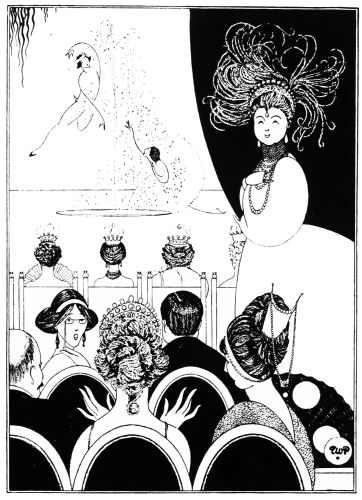
But to-night this face of common objects rose out of the most wonderful
gown in shades of orange that was ever seen. It was crowned too in a
winking splendour of diamonds that shouted and sang in her
sandy-coloured hair, and round her neck were half-a-dozen rows of
marvellous pearls. While the curtain was up she sat close to the front
of her box with her eyes undeviatingly fixed on the stage, and when the
curtain fell she stood there a minute more, so that the whole house
should get a good view of her. She did not look about her; she merely
stood there, seemingly unconscious of the opera-glasses that were turned
on her from all quarters of the house. All round, everybody was asking
everybody else who the woman with the diamond Crystal Palace was, and
nobody knew. Nor did anybody know, not even Mrs. Isaacs, the fashionable
clairvoyante, who exposed a considerable portion of her ample form in
the stalls, that through the mists of the horizon there faintly shone
to-night the star of surpassing magnitude that was to climb to the very
zenith, and burn there in unwinking splendour.
For the next week Sarah took no direct step forward, but sat in the Ritz
Hotel, or in her box at the opera, or drove about on shopping errands.
Among these latter must be included a quantity of visits to
house-agents, who had in their hands the letting of furnished houses in
such localities as Grosvenor Square and Brook Street, and what seemed to
interest her more than the houses themselves was the question of who was
wishing to let them. But she was in no hurry: she was perfectly well
aware that the first steps were of the utmost importance, and before she
stepped at all, she wanted to find the largest and strongest
stepping-stone available. The evening usually found her alone in her
opera-box, seemingly absorbed in the presentation of Russian ballet, and
unconscious of the opera-glasses levelled at her. She gave the
opera-glasses something to look at too, for she never appeared twice in
the same gown, but in a series of last cries, most stimulating to the
observer. One night she wore a sort of bonnet of ospreys on her head,
and again everybody asked everybody else who the Cherokee Indian was.
But again nobody knew, and so they all supposed that the ospreys were
made of celluloid. But they had an uncomfortable idea that they might be
genuine. But if so, who’s were they? London began to be genuinely
intrigued.
After about a week of this, she suddenly lighted upon exactly what she
had been looking for in the books of the house-agents. A certain new big
house in Grosvenor Street, which externally recalled a fortress made of
stout sand-bags was to be let by Lord Newgate (marquis of), the eldest
son of the Duke of Bailey. Sarah had already seen Lady Newgate, a tall,
floating dream of blue eyes, golden hair and child-like mouth, at the
opera, and knew her and her husband to be among the true white
nightingales who sing and play poker at the very top of the tree she was
pining to climb. A less Napoleonic climber than she might have thought
that to take the Newgates’ house was a passport to London, but she knew
that it would only carry its cachet among the people who could not
really be of any use to her, namely, that well-dressed esurient gang of
Londoners who find it quite sufficient to be fed and amused at other
people’s expense. Sensible woman that she was, she fully intended to
feed and amuse them, but it was not they that she was out for: at the
best they were like the stage army which marches in at one door and out
at another, and in and out again. They were not the principals. You
were, of course, surrounded by people whom you fed and amused, if you
were on the climb, just as you were surrounded by footmen and
motor-cars, but she looked much further than this. She argued, again
correctly, that if such conspicuously melodious songsters as the
Newgates wanted to let their house during the very months when they
would naturally be needing it most, they must be in considerable want of
money, and would be likely to give some valuable equivalent for it. So,
seeing her scheme complete from end to end, as far as the taking of this
house was concerned, she told the slightly astonished agent that she was
willing to take the house for the next three months or the next six at
the price named, but that she wished to make her arrangements with Lady
Newgate herself. The agent, seeing that she was just a wild American,
politely represented to her that this was not the usual method of doing
such business in civilized places, but she remained adamant.
‘If I don’t settle it up with the Marchioness of Newgate,’ she said, ‘I
won’t settle it up with anybody else. Kindly give that message over your
’phone, please, to the Marchioness, and say that if she feels disposed
to entertain my proposals, I shall be very happy to see her at the Ritz
Hotel this afternoon. And if she don’t care to come, why, I don’t care
to take her old house. That’s all. You may say that my name is Mrs.
Whitehand, and that my husband’s the head of the firm, which she maybe
has heard of.’
Now simple as this procedure appeared, it had the simplicity of genius
about it, not the simplicity of the fool. As far as houses went, she did
not care whether she had Lady Newgate’s house or a house in Newgate.
What she was going for was Lady Newgate. It was possible, of course,
that on receiving this message, Lady Newgate would simply say, ‘What on
earth does she want to see me for? She can settle it through the agent.’
If that was the case, it was not likely that Lady Newgate would be any
good to her. But it was quite possible that Lady Newgate might say,
‘Hullo: here is the Mrs. Whitehand going about looking for a house,
and probably unchaperoned.’ Anyhow there was a chance of this, and
since Sarah Whitehand had nothing to lose, she took it. For there might
be something to gain, and these are the best chances to take.
Now the price asked for this fortress of marble and cedar-wood was an
extremely high one, and the Newgates would have been perfectly willing
to take about half of the sum named, after a little genteel and lofty
bargaining. Consequently the prospect of immediately obtaining the full
price, not for three months only, but for six, including August and
September, when an aged caretaker usually had it for nothing, was
irresistibly attractive. Toby Newgate, it is true, momentarily demurred
against his wife’s waiting upon the peremptory Yankee at the Ritz, but
she had seen much further than him with her forget-me-not coloured eyes.
She had seen in fact just as far as Mrs. Whitehand.
‘My dear, it’s flying in the face of Providence to neglect such a
chance,’ she said, ‘and if she’d told me to wait at the bottle entrance
of the Elephant and Castle I should have gone.’
He shuffled about the room a little.
‘Don’t like your being whistled to by the wife of the manufacturer of
hardware, just for six months’ rent,’ he said.
She laughed.
‘My dear Toby, it isn’t only six months’ rent that’s at stake,’ she
said. ‘I’m not going to be landlady only, I expect, but godmother.’
‘Godmother?’
‘Yes, dear, and you godfather to Mr. Hardware, if he is here. But you
needn’t buy any presents. Good American godchildren give the presents
themselves.’
Toby had some vague sense of her position, she only the necessity of his
poverty.
‘You mean you’re going to trot them round?’ he asked.
‘Yes, if possible. I think her message means that. Why else should she
want to see me, or take the house for August and September? It’s a
bribe, a hint, a signal.’
The interview between the two ladies was extremely satisfactory, as is
usually the case when there is no nonsense about the conversationalists,
and each of them is willing and even eager to give exactly what the
other wants. The business of the house was very soon relegated to a firm
of solicitors, and the godmotherly aspect began to show through the form
of the landlady, as in some cunning transformation scene, faintly at
first but with increasing distinctness.
‘Your first visit to London?’ asked Madge Newgate.
‘Yes: I’ve been here but a week, and have done nothing but hunt round
for a house and go to the opera.’
Instantly Lady Newgate remembered the solitary and dazzling figure in
the box. She, too, had wondered who the woman in orange and diamonds
was. Mrs. Whitehand’s face had made no impression whatever on her.
‘Ah, then I am sure I saw you there,’ she said. ‘We were all wondering
who you were. You must allow me to put some of my friends out of their
suspense by letting them know.’
Mrs. Whitehand laughed.
‘I should be very pleased for your friends not to strain themselves,’
she remarked. ‘And I’m in suspense too, as to who your friends are. I
don’t know a soul in London.’
This was rather a relief to Madge Newgate. Sometimes a perfectly
impossible tail was attached to these strange Americans, and you had to
encounter the riff-raff of the Western world en masse. She laid her
hand on the other’s knee.
‘My dear, you must get some friends at once,’ she said. ‘You might dine
with us to-night, will you? I have two or three people coming.’
This was quite sufficient. Mrs. Whitehand spoke shortly and to the
point.
‘I want to be run,’ she said.
Madge Newgate was a perfectly honest woman, and now that all ambiguity
had been cleared away, she explained what she could do and what she
would expect to receive. She could give Mrs. Whitehand the opportunity
of meeting practically any one she wished, and she could repeat and
again repeat that opportunity. She could bring people to Mrs.
Whitehand’s house, and within limits get them to invite her to theirs.
But more than that, she frankly admitted she could not do.
‘I can’t make them your friends,’ she said. ‘I can only make them your
acquaintances. The other depends on you. You must show yourself useful
or charming or striking in some way, if you want more than just to go to
balls and dinner-parties. Luckily in London we are very hungry, so that
you can always feed people, and very poor, so that you can always tip
people, and very dull, so that you can always amuse people.’
‘I see: I quite see that,’ said Mrs. Whitehand.
Madge felt that she understood: that it was worth while explaining.
‘I’m sure you will forgive my plain speaking,’ she said, ‘but it is
never any use being vague. And there’s a lot of luck about it.
Sometimes a very stupid woman “arrives” and a very clever agreeable one
doesn’t, and the Lord knows why. I should be quite American do you know,
if I were you; Americans are taking well just now. About—well, why
should I beat about the bush?—about what I am to receive for my
trouble. I imagine you don’t want my house in the least for the three
months after July, and I am willing to take a good deal of trouble for
your renting it then. And when some more rent is due, I think I had
better tell you, hadn’t I? I am not greedy, I am only very poor.’
Now no climber could possibly have made a better beginning than this.
Sarah Whitehand could not have chosen a more admirable godmother, and
though she was lucky in having hit on precisely the right one, she had
shown true perpendicularity in having gone to the right class. She had
aimed at the best and hit it, and in the three months that followed she
continued to show a discretion that bore out the early promise of her
talents. She neither gave herself airs, nor was she grovellingly humble,
she merely enjoyed herself enormously, and since of all social gifts
that is the most popular, she rapidly mounted. She threw herself, with
Lady Newgate’s sanction, into artistic circles, and firmly annexed as
her mascot the chief dancer of the Russian ballet. Unlike poor
horizontal Mrs. Howard-Britten, with her disappointing Herr
Grossesnoise, she made it quite clear that when she asked a party to
meet a bevy of Russian dancers that party was surely going to see the
bevy dance, which it did quite delightfully under the stimulus of
enormous fees. She did not waste her quails and champagne on
unremunerative guests, or guests who so far from helping her would only
hinder her, but followed Lady Newgate’s directions precisely as to whom
she should ask, and very good directions they were.
She had other modes of access as well. She flattered grossly or
delicately as the occasion demanded. When she saw that some one liked to
be drenched in flattery she had bucketsful of it ready. At other times
she confined herself to telling So-and-so’s friends how lovely So-and-so
was looking, or how brilliant So-and-so was. This method she chiefly
adopted to those of Lady Newgate’s friends who had somewhat unwillingly
come to her house, and plentiful applications of these gratifying
assurances usually had their effect sooner or later, for Sarah Whitehand
knew that nobody is insensible to flattery, if (and here lay the
virtue) the proper brand properly administered was supplied. Sometimes
the case required study: it was no use conveying to a beautiful woman
the flattery of acknowledging her beauty: you had to find out something
on which she secretly prided herself, her tact or her want of tact, her
charming manners or her absence of manners, her toes or her teeth, and
make little hypodermic injections in the right place. Then again there
were people who in spite of all allurements would have nothing to do
with her. After two or three unsuccessful direct assaults, she would
attempt that no more, but, just as she was outflanking New York by
laying siege to London, outflank those obdurate folk by laying siege to
their friends. She was infinitely patient over these operations, and
nibbled her way round them, until they were cut off, and found
themselves devoid of all friends save such as were friends of the
accomplished Sarah. By patience, by good humour and by her own enjoyment
she moved steadily and rapidly upwards on branches that she gilded
beforehand. She often thought about Nittie Vandercrump screaming away in
New York, and even adopted a modified version of her yells of pleasure.
These she gave vent to when dull people, who for some reason mattered,
told her long stupid stories, and found that they had achieved, for the
first time in their lives, a brilliant and startling success.
Naturally she made quantities of mistakes. Occasionally a man at her
table would find in his neighbour a woman with whom he had not been on
speaking terms for years, or again, she solemnly introduced Bob Crawley
to the wife he had divorced a year before, and immediately afterwards to
the woman concerning whom his wife might have divorced him the year
before that. Nor could she at first grasp the fact that a Duchess
perhaps did not matter at all, and that Mrs. Smith mattered very much,
and she had to drop the Duchess and smooth down Mrs. Smith. But these
were mere childish stumbles, and having picked herself up she again
clung tightly with one hand to her godmother and with the other to her
mascot, the Russian dancer.
And all the time while she was so nimbly climbing, she and
Petropopoloffski were sitting on a great egg which was to be hatched in
the autumn, when London would be full again for the session. Russian
ballet this year was the rage to the exclusion of all other rages, and
the great egg was no less than a further six-weeks season of it,
financed and engineered by Sarah. Not until when late in July the egg
was, so to speak, announced, did any one, even her godmother, know that
it was she who had laid it, and she who had Petropopoloffski in her
pocket, and she who had taken the Duke of Kent’s theatre for it, and she
who had arranged to have the dress-circle and pit taken away and rows of
boxes substituted, and she, finally, who had taken thirty-seven boxes
herself, so that only through her favour could anybody engage them. It
was a great, a brilliant stroke, hazardous perhaps, but then everybody
wanted to see Russian ballet so much that they would not stick at being
indebted to her for their boxes. But it came off: within a couple of
days of the subscription list being opened, all boxes not reserved by
her had been let, and she began most cordially to allow applicants to
have some of hers. Very wisely, she gratified no private slights by
refusing them, she only made friends by granting them. She kept just two
or three of the best, in case of emergencies.
And so she goes on from height to height. Mr. Whitehand was duly sent
for in the succeeding spring, and sat entranced for a month, as in a
dream of content, in this Valhalla of the gods. But he found he could
not stand much of the rarefied air at a time, and so bought a large
place in the country, where in leather gaiters he feels like an English
squire, and has revolutionized all the sanitary arrangements of the
house. And when Nittie came to London, as she did during the summer, and
screamed a welcome to her darling Sally, her darling Sally was very wise
about it, and instead of kicking her down, which she might easily have
done, she gave her a leg-up by asking her to a particularly dazzling
dinner-party and being quite kind to her. She does not see much of her,
but always treats her with the respect and pity due to a poor relation.
There is no more climbing to be done here, and for a change next autumn
she means to go downstairs to New York and see how they are all getting
on in the kitchen.