It was in old Sonora town that Miss Helen came across Señorita Dolores
Mendez de Garcia. This part of the city always fascinated Miss Helen
and she took frequent walks through the ancient streets bordered
by the houses built a century before and occupied by the former
Spanish residents. But a few of these now remained, though the quaint
one-storied, adobe structures, with their deep-niched windows, spoke
eloquently of a former régime. It was at the door of one of the best
preserved of these houses that there stood a dark-eyed girl as Miss
Helen passed by. Her fair skin and soft brown hair marked her as
unlike her dark-complexioned neighbors, and when she picked up the
handkerchief which Miss Helen accidentally dropped she returned it
saying, "Permit me to return your handkerchief, madam." It was then
that Miss Helen marked the girl's grace and refinement. "Surely," she
said to herself, "she is a descendant of some blue-blooded hidalgo.
I should like to know more of her." Then as a sudden thought struck
her she said to the girl, "Could you recommend to me a good teacher of
Spanish? I wish to take a few lessons."
The warm color spread over the girl's soft cheeks as she replied
hesitatingly: "Perhaps if madame will allow me to call upon her I shall
be able to give her the information she desires."
Miss Helen gave her address and made an appointment for the next day,
then she went on her way wondering if she had been too impulsive. The
appointment was promptly kept and the conference was a long one. Mrs.
Corner was finally called in and the session continued behind closed
doors.
"What in the world do you suppose they can be talking about all this
time?" said Nan to Mary Lee as the two swung in a hammock on the
veranda. "They've been there hours I do believe."
"Aunt Helen said the young lady was to tell her about a Spanish
teacher," returned Mary Lee, "but I should think she must be giving a
lesson herself."
"Hark, there is the piano," said Nan, "and it is not Aunt Helen
playing. That surely must be a Spanish dance. Isn't it lovely? It
sounds like castanets and Moorish palaces and things."
"Oh, you are so romantic, Nan," said Mary Lee; "you are always
imagining all sorts of things."
"She plays well," continued Nan without heeding her sister, and
listening intently to the music. "I wonder if she plays the guitar or
the mandolin; I should love to hear her."
"They are coming out now," remarked Mary Lee after a pause. "She is
very pretty, Nan, isn't she?"
Nan drew herself up from her lounging position and Mary Lee did the
same. The movement attracted Miss Helen's attention. "Come here,
girls," she said, "I want you to meet Miss de Garcia who will perhaps
be your teacher for the time you will be here." Miss Helen was anxious
to note the effect upon the girls, of this latest applicant.
The young lady gave a flashing smile to each of the girls and extended
a slim hand. "I am pleased to meet the young ladies," she said with a
slight accent and deliberate utterance. "We shall be good friends, yes?"
The girls were ready to promise friendship on the spot, and after a few
more words Miss de Garcia departed promising to be on hand the next
morning to begin her work.
As soon as she was out of hearing the questions began. "Where did you
find her, Aunt Helen? Is she Spanish? Isn't she lovely? Are we to have
Spanish lessons? Can she teach English? Oh, do tell us all about her."
"I met her quite by accident," said Miss Helen, "but I was charmed
at once. I had no idea of engaging her as a teacher for you children
till I learned that she was quite qualified and then it seemed as if
a good providence had sent her to me. She has given me satisfactory
references, and there seems no reason why she should not be everything
we could desire. She speaks French as well as she does English, for
she was partially educated in France at a convent there, and spent a
year in England. She is an orphan who was adopted by her aunt when she
was scarce more than a baby. The aunt has since died, but the girl
has been living in the family of her aunt's husband where I fancy she
is not entirely happy. Now the uncle has married a second time and
Miss de Garcia felt that her place in the household is not such as
it was during her aunt's lifetime, therefore she is very anxious to
be independent for she cannot bear to be a burden upon those to whom
she is not related by ties of blood. I learned this only through some
little remarks she happened to make, for she made no complaints, yet I
judge that is the situation."
"She is the loveliest thing I ever saw," said Mary Lee with a long
sigh. "Those beautiful melting dark eyes, that lovely hair and that
exquisite complexion; I shall love to sit and look at her."
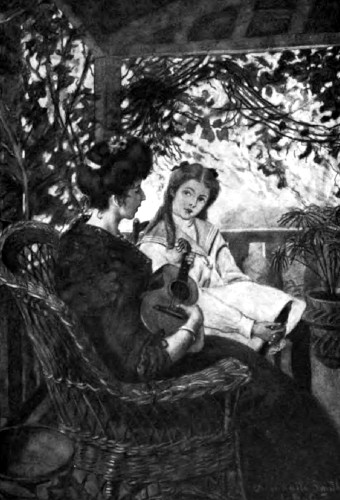
"I Shall Love to Sit and Look at Her."
"In which case you will not learn very much," returned Miss Helen
laughing. "When Mary begins to get sentimental," she went on saying to
Mrs. Corner, "I feel as if California were really going to our heads.
What have you to say, Miss Nan?"
"Words fail," replied Nan expressively.
"Then you think she will do," said Miss Helen with a smile.
"She's exactly right," returned Nan. "Are you going to engage her, Aunt
Helen?"
"If her references prove satisfactory, as I have no doubt they will.
She seems to me really a great find. How often it is that we get what
we want quite by accident. After all our inquiries and advertisements
to merely chance upon Miss Garcia seems queer. Her French is beautiful,
and though she is not a great musician, she has temperament and has
been taught in the right way."
"I loved those things she was playing," said Nan. "They were Spanish,
weren't they?"
"Some of them."
"I thought so. I felt the castanets and tambourines were there."
Miss Helen nodded approvingly. "That's it exactly. I am glad you
recognized just what I did. I shall certainly be disappointed now if
there is any adverse report."
"Whom does she give as reference?" inquired Mrs. Corner.
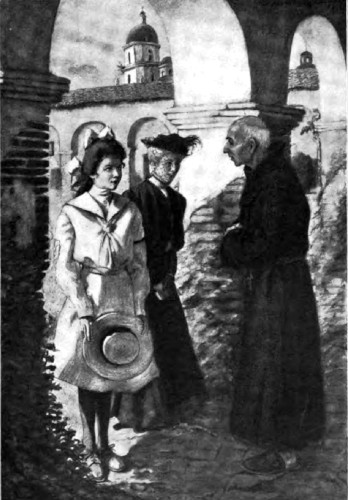
"An old priest, an antique Spanish lady and her uncle, but," seeing
Mrs. Corner's doubtful expression, "I am content with them. She has
not lived in this city long and has made few friends. If we could wait
she would like me to write to the heads of the schools where she was
educated: the convent mother in France and the principal of the English
school, but I think we can waive that. Aren't you satisfied, Mary?
Would you rather wait?"
"I am perfectly satisfied if you are."
"Then to-morrow I will start out upon my visits to her three friends. I
shall rather enjoy myself, I fancy. One doesn't often have a chance to
meet such people in anything like an intimate way."
Miss Helen was not disappointed in her expectations, for she did enjoy
her visits. "The old priest is a dear," she reported, "and Señora
Rodriguez is perfectly charming. I wish you could hear her broken
English and see the way she uses her fan in those lovely slim hands of
hers. As for the uncle he is a quiet, grave sort of man. He has found
life a disappointment, I should imagine, for he has such a sombre face
and never once smiled. However, they all had only good to say of Miss
Garcia and I feel sure we shall make no mistake in engaging her."
"Then it is all settled, is it?" asked Nan eagerly.
"Yes, all settled, and you are to begin work to-morrow. Are you ready
for it, girls?"
"I am. Are you, Mary Lee?" said Nan.
"I am when we are to have such a dear as that to teach us."
"I think we have found the kind you want, Nan," said Miss Helen with a
smile. "I am sure we shall all respect Miss Garcia, and I am equally
sure she will not let you walk over her."
"That's good," returned Nan. "You've done noble, Miss Helen, as Unc'
Landy says," and she ran out to hunt up the twins and to tell them this
important news. She was as much excited as Mary Lee and was usually
much more romantic, yet, strange to say, it was Mary Lee who gave a
doting affection to the new governess. Nan admired her immensely and
felt the influence of her gentle dignity, but Mary Lee fell in love
with her in that fond and foolish way that girls sometimes have. She
was always at the gate to watch for her approach; she hoarded up
dainties for her until her mother said she believed Mary Lee grudged
the entire family anything specially good.
Miss Garcia accepted all these attentions with a grave graciousness,
but was not spoiled by them. "She is just like a queen," said Mary Lee.
"I'd love to dress her in silks and satins and shower jewels upon her.
She dresses so very plainly. Do you suppose she hasn't any real nice
things?"
"I don't suppose she has," returned Nan, to whom the remark was made.
"She would look lovely in fine fixings, wouldn't she? I suppose her
uncle is not well off, and he has a wife and children to support.
I shouldn't wonder if they had had money though, for the other day
she was speaking of the great estates the Spaniards used to have and
told how they had lost them all. I should think they would hate the
Americans."
"I reckon they do," said Mary Lee, "but my señorita doesn't hate us."
"Your señorita! You would suppose you had discovered her and then
bought her," replied Nan in a vexed tone. "I declare, Mary Lee, you
make me ill the way you go on, and I don't believe she cares for you
any more than for the rest of us. I believe she is fondest of Jean,
myself."
This was gall and bitterness to poor Mary Lee, who felt such jealous
pangs as never before had she endured and which had the effect of
sending her with a miserable countenance to the further end of the
veranda when Miss de Garcia next came.
"Why do you retire so far from the ozzers?" asked the governess. "I
cannot hear you so well."
Mary Lee edged a little nearer but sat gloweringly through the lesson
hours. She kept her place, however, after the rest were free, and let
her eyes linger on her teacher's head, bent over some exercises she was
correcting. After a while the exercises were laid aside with a sigh and
Miss de Garcia smiled upon her adoring pupil.
Mary Lee moved toward her. "Are you tired?" she said.
"A little; not too much. Have you somesin for me to explain to you?"
Mary Lee dropped a light kiss upon her teacher's bright hair. "I didn't
wait for that," she said, then all the pain of her jealousy found
relief in the words: "I love you so. May I call you Miss Dolores? It is
such a beautiful name."
"Do you like it? My aunt was named so. If you like, yes. I do not
object that you say Miss Dolores."
"It makes you seem nearer; it is not so distant and formal as Miss de
Garcia, and I love you so much."
"I am pleased if you do," was the reply. "One finds not too many to
love one as the years pass, as time rolls on."
"I don't see how any one could help loving you. I should think
thousands would," said Mary Lee in the fulness of her devotion.
"My aunt did love me; my grandfazer, too; when I was a child in Mexico."
"Oh, did you live in Mexico?"
"I went many times to visit my grandfazer. He was at one time of
California. A large ranch he had, cattle, sheep, horses, servants.
Nothing is left." She sighed.
"Did the Americans take them from him?"
"Their coming made a difference. I know not if it was robbing as some
say."
"I should think you would hate the Americans."
"I do not. No. My fazer was American."
"Oh, was he?"
"So I am told and that from him I have the hair and skin, but I do not
bear his name."
"Oh, how queer. I mean, why not?" It was unusual to find Miss de Garcia
in so expansive a mood, and Mary Lee hung upon her every word, proud of
being made her confidante.
Miss de Garcia was silent a moment. "Because you love me I will tell
you, though I do not say so much to strangers. I do not know my fazer's
name. He died before I was born. My mozer died when I was a baby at her
fazer's home in Mexico. I was given my aunt's name. I called her mamma
and my uncle papa; he it is who is Garcia. They would not speak of my
fazer; I know not why. My grandfazer did not like the marriage, was all
my aunt would tell me."
"Oh, how Nan would revel in this romantic history," was Mary Lee's
thought, though she only said, "Did you live long in Mexico?"
"No, I came to California with my aunt and uncle when they came. When
I was sixteen I went to France with my aunt, who placed me in school;
after I was in England one year, then I returned to see my aunt die, my
grandfazer's estates wasted, my uncle in poverty and myself at last, as
you might say homeless Now that my mozer's people are all gone, I wish
if I might know some of my own blood, for my uncle who is kind is made
more poor by another marriage to a widow who had children. I am alone."
She said these last words so sadly that Mary Lee was seized with an
overwhelming pity, and kneeling down showered kisses upon her hands.
"You are not alone," she cried. "We love you; all of us do. Oh, if
mother and Aunt Helen would only take you home with us you should never
feel alone."
The tears rose to Miss de Garcia's eyes. "I have talked too much of
myself," she said, "but it has done me good. It is my birthday and no
one knew. You are very kind, very dear, to feel so sympathy for me; as
the Spanish say, you are very friend to me. I shall not forget, Mary
Lee, but I must go now."
"How I love to hear you roll your R's," said Mary Lee. "Please don't go
just yet; wait till I come back."
She rushed off to her mother and aunt. "Mother, Aunt Helen," she cried,
"can't we invite Miss Dolores to stay to dinner with us? It is her
birthday and no one knows, and mayn't I make a birthday cake for her?
I think I could if Nan would help me. Oh, please say yes. Won't you go
right out, mother, and ask her to stay? I am so afraid she won't wait."
"Why, my dear," Mrs. Corner looked at her sister. "Certainly we shall
be glad to ask her. Her birthday, did you say? Then I will order
something extra."
"Do you suppose she will have to have tortillas and tamales and such
things?" asked Mary Lee eagerly, turning to her aunt as her mother
left the room.
"Nonsense," said Miss Helen. "You forget, Mary Lee, that she has lived
in Paris and England, and is quite used to different dishes, beside
there is no doubt but she will enjoy a change from frijoles negros and
red pepper."
"Oh, I hope she'll stay," said Mary Lee, clasping her hands anxiously.
"I think she is going to," said Miss Helen, going to the window. "I see
she is sitting down again. I must go out and talk to her. Go hunt up
Nan, Mary Lee, and hurry up your cake or it will not get done in time
for dinner, though perhaps after all it will not do to have it then; it
will be piping hot, but we can save it for tea."
Mary Lee rushed off to find her sister, and presently they were at work
in the little buttery which led out of the kitchen where Li Hung was
at work. It would never have done to invade his kingdom, and when the
girls wanted to prepare anything themselves they always took to the
buttery, though Li Hung always smilingly allowed them to use the stove
and was ready to help when they required his aid. Mary Lee was bubbling
over with excitement. Her usual calmness had disappeared entirely under
pressure of the occasion. She poured forth into Nan's willing ear the
story she had heard from Miss Dolores. "Isn't it romantic?" she said at
last, pausing to take breath.
"I should think so," returned Nan, briskly beating eggs. "Why, Mary
Lee, it is just like Ramona. She was adopted by her aunt and didn't
know her father's name and all that. Isn't it queer? Do you suppose
she will marry an Indian like Allessandro? Dear me, it is just like a
story."
"It isn't just like Ramona," said Mary Lee the literal, "for you know
her father gave her to the Señora Ramona, who was no relation at all,
and then she gave her to her sister, Felipe's mother. Besides her
father was a Scotchman, not an American."
"Well, it is near enough alike," returned Nan, seeing things less in
detail. "It must be very funny not to know who your father was. I
wonder if he was a criminal or a gambler or had killed some one. You
know what wild, lawless men used to come West in those days."
"Yes, they did at first I know, when the old forty-niners began
to search for gold, but this was later, for Miss Dolores is only
twenty-two."
"Well, but even then it wasn't like it is now. Mr. St. Nick said when
he first came out here in 1880, Los Angeles was a very small place, the
streets were not paved and most of the houses were of adobe, so it
couldn't have been so awfully civilized."
"I shouldn't want to say that before Miss Dolores. Her people think the
Americans have spoiled all the old elegance of the Spanish days."
"Why do you call her Miss Dolores? I think the señorita sounds much
prettier; it makes her seem Spanish right off."
"But I think Dolores is so beautiful; it means sorrow, she told me
once, and I think it seems more intimate to say Miss Dolores."
"Well, you may call her that, but I shall say señorita. Any one could
be named Dolores, but no one would think of calling any but a Spanish
lady señorita, just as you would say mademoiselle to a French woman.
Take care, Mary Lee, you are putting in too much flour; the cook book
says scant cups, not heaping ones."
"Oh, does it?" Mary Lee emptied out some of the contents of her
over-full cup before she stirred the flour into the mixture.
"Now beat like mad," said Nan, "and here, let me put in some of the
beaten whites of the eggs before you add more flour."
"Oh, I do hope it will be good," said Mary Lee watching her sister
slide off some of the frothy heap into the cake bowl. "Did you tell Li
Hung this was to be a birthday dinner?"
"No, but I will tell him." When she carried the cake out to put it in
the oven she gave the information to the Chinaman, who looked pleased;
he liked opportunities to try his powers.
"You likee I make plitty salad?" he asked. "Plitty flowel, plitty
namee? You lite namee evlybody on paper, I makee him on salad."
"Oh, he's going to do something lovely," Nan told her sister when she
returned to her. "He says he will watch the cake and take it out when
it is done, but I think I shall have an eye to it, too. I have promised
to write the names of all of us, but I think it will be better to print
them. What would you say, Señorita de Garcia, or Señorita Dolores?"
"I suppose Señorita de Garcia would be more correct for a dinner," said
Mary Lee after weighing the question.
Nan at once set to work to print out the names and was so interested
in watching the baking of the cake and in the process of preparing the
salad that she did not appear till dinner was about ready.
In the meantime Mary Lee had sought out the twins and had arrayed them
and herself in festal garments. She had rummaged through her own
belongings and had appealed to her mother and aunt so that each one
had some gift to lay by Miss de Garcia's plate. The twins produced
two souvenirs which they had bought in San Diego: a little box of
orangewood and a paper cutter, Mrs. Corner contributed a small Indian
basket, Miss Helen a pretty fan, and Nan, in desperation at being out
of it all by remaining so long in the kitchen, dragged from her trunk
a photograph of the old San Diego mission and tied it up hastily. Mary
Lee sacrificed her beloved Venetian beads which she admired almost more
than any of her possessions, yet nothing was too good for the señorita
and she would have the pleasure of seeing her wear them.
Therefore, when the guest of honor was ushered to the table she was
overpowered by the array before her. Tears came to her eyes and for
a moment she could not speak, then when she did the Spanish words
slipped between the English ones when she tried to express her thanks.
"Amigas mias," she began—"my friends, you have made me glad, ashamed,
muy felices—so happy. I cannot say my thanks. Mil gracias señoras,
señoritas. Beso a sus manos de ustedes; I kiss your hands; I thank God
for my good friends."
"We just loved to do it," exclaimed Jack anxious to put her at her
ease, "and just see what a good dinner we are going to have because it
is your birthday."
The laugh that followed took away every vestige of embarrassment, and
when the wonderful salad was brought in every one was on sufficiently
informal terms to think it no breach of etiquette to admire the yellow
flowers of mayonnaise on green lettuce leaves which surrounded the red
tomato centres, the red forming a good background for the ivory white
lettering of the names.
"What are the letters made of?" whispered Jean to Jack.
"I know," said Nan from the other side; "they are cut out of the hard
boiled whites of eggs."
The dinner certainly did Li Hung credit, and proved his claim to being
equal to emergencies.
"I'd like to take him home with us," declared Miss Helen.
"I'd rather take Miss Dolores," remarked Mary Lee.
The cake was brought in later in the day when tea was served in the
garden, winter though it was. To this cake Li Hung had added his own
embellishments; it was frosted artistically and bore Miss de Garcia's
name in tiny pink flowery letters. Miss Dolores declared it was too
pretty to cut, yet all insisted that she should divide it, and Mary Lee
flushed with pleasure when she and Nan were praised for being expert
cake makers.
Under the warmth of love and friendship Miss Dolores became really
joyous and told many tales amusing or pathetic. She confided to her
friends that her uncle was going to remove to Mexico and that she
thought she would not go with him, preferring to make her own living in
the States. "I cannot be dependent," she said. "I shall be American and
not be afraid. You have shown me that one need not fear to work, and if
all are so good, so kind, so generous as you why should I hesitate?"
"When is your uncle going?" asked Mrs. Corner.
"Soon, two weeks, perhaps."
"And then where will you go to live?"
"I do not know. Some neighbors perhaps will give me room for little. I
shall try to go where is protection and retirement."
"But why not come here to us? We have room to spare, and at any rate,
during our stay here, we should be glad to have you, and in the
meantime you can be making plans for your future."
The señorita's gratitude was pathetic, though she looked more of it
than she spoke, and so to Mary Lee's great joy it was arranged that
the señorita should take up her residence with the Corner family,
a fortunate thing as time proved, for even the simple accident of
dropping a handkerchief can change the manner of one's whole life.