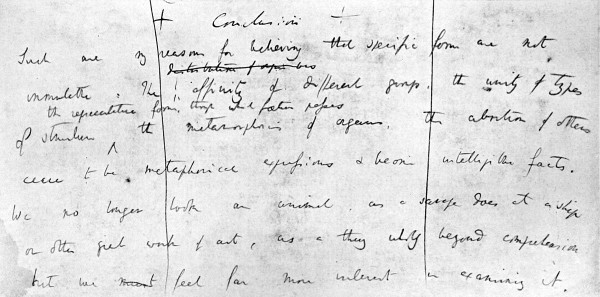
For convenience sake I shall divide this chapter into three sections{340}.
In the first place I shall endeavour to state the laws of the
distribution of existing beings, as far as our present object is
concerned; in the second, that of extinct; and in the third section I
shall consider how far these laws accord with the theory of allied
species having a common descent.
In the following discussion I shall chiefly refer to terrestrial
mammifers, inasmuch as they are better known; their differences in
different countries, strongly marked; and especially as the necessary
means of their transport are more evident, and confusion, from the
accidental conveyance by man of a species from one district to another
district, is less likely to arise. It is known that all mammifers (as
well as all other organisms) are united in one great system; but that
the different species, genera, or families of the same order inhabit
different quarters of the globe. If we divide the land{341}
into two divisions, according to the amount of difference, and
disregarding the numbers of the terrestrial mammifers inhabiting them,
we shall have first Australia including New Guinea; and secondly the
rest of the world: if we make a three-fold division, we shall have
Australia, S. America, and the rest of the world; I must observe that
North America is in some respects neutral land, from possessing some S.
American forms, but I believe it is more closely allied (as it certainly
is in its birds, plants and shells) with Europe. If our division had
been four-fold, we should have had Australia, S. America, Madagascar
(though inhabited by few mammifers) and the remaining land: if
five-fold, Africa, especially the southern eastern parts, would have to
be separated from the remainder of the world. These differences in the
mammiferous inhabitants of the several main divisions of the globe
cannot, it is well known, be explained by corresponding differences in
their conditions{342};
how similar are parts of tropical America and Africa; and accordingly we
find some analogous resemblances,—thus both have monkeys, both
large feline animals, both large Lepidoptera, and large dung-feeding
beetles; both have palms and epiphytes; and yet the essential difference
between their productions is as great as between those of the arid
plains of the Cape of Good Hope
and the grass-covered savannahs of La Plata{343}.
Consider the distribution of the Marsupialia, which are eminently
characteristic of Australia, and in a lesser degree of S. America; when
we reflect that animals of this division, feeding both on animal and
vegetable matter, frequent the dry open or wooded plains and mountains
of Australia, the humid impenetrable forests of New Guinea and Brazil;
the dry rocky mountains of Chile, and the grassy plains of Banda
Oriental, we must look to some other cause, than the nature of the
country, for their absence in Africa and other quarters of the world.
Furthermore it may be observed that all the organisms inhabiting any
country are not perfectly adapted to it{344};
I mean by not being perfectly adapted, only that some few other
organisms can generally be found better adapted to the country than some
of the aborigines. We must admit this when we consider the enormous
number of horses and cattle which have run wild during the three last
centuries in the uninhabited parts of St Domingo, Cuba, and S. America;
for these animals must have supplanted some aboriginal ones. I might
also adduce the same fact in Australia, but perhaps it will be objected
that 30 or 40 years has not been a sufficient period to test this power
of struggling «with» and overcoming the aborigines. We know
the European mouse is driving before it that of New Zealand, like the
Norway rat has driven before it the old English species in England.
Scarcely an island can be named, where casually introduced plants have
not supplanted some of the native species: in La Plata the Cardoon
covers square leagues of country on
which some S. American plants must once have grown: the commonest weed
over the whole of India is an introduced Mexican poppy. The geologist
who knows that slow changes are in progress, replacing land and water,
will easily perceive that even if all the organisms of any country had
originally been the best adapted to it, this could hardly continue so
during succeeding ages without either extermination, or changes, first
in the relative proportional numbers of the inhabitants of the country,
and finally in their constitutions and structure.
Inspection of a map of the world at once shows that the five divisions,
separated according to the greatest amount of difference in the
mammifers inhabiting them, are likewise those most widely separated from
each other by barriers{345}
which mammifers cannot pass: thus Australia is separated from New Guinea
and some small adjoining islets only by a narrow and shallow strait;
whereas New Guinea and its adjoining islets are cut off from the other
East Indian islands by deep water. These latter islands, I may remark,
which fall into the great Asiatic group, are separated from each other
and the continent only by shallow water; and where this is the case we
may suppose, from geological oscillations of level, that generally there
has been recent union. South America, including the southern part of
Mexico, is cut off from North America by the West Indies, and the great
table-land of Mexico, except by a mere fringe of tropical forests along
the coast: it is owing, perhaps, to this fringe that N. America
possesses some S. American forms. Madagascar is entirely isolated.
Africa is also to a great extent isolated, although it approaches, by
many promontories and by lines of shallower sea, to Europe and Asia:
southern Africa, which is
the most distinct in its mammiferous inhabitants, is separated from the
northern portion by the Great Sahara Desert and the table-land of
Abyssinia. That the distribution of organisms is related to barriers,
stopping their progress, we clearly see by comparing the distribution of
marine and terrestrial productions. The marine animals being different
on the two sides of land tenanted by the same terrestrial animals, thus
the shells are wholly different on the opposite sides of the temperate
parts of South America{346},
as they are «?» in the Red Sea and the Mediterranean. We can
at once perceive that the destruction of a barrier would permit two
geographical groups of organisms to fuse and blend into one. But the
original cause of groups being different on opposite sides of a barrier
can only be understood on the hypothesis of each organism having been
created or produced on one spot or area, and afterwards migrating as
widely as its means of transport and subsistence permitted it.
It is generally{347}
found, that where a genus or group ranges over nearly the entire world,
many of the species composing the group have wide ranges: on the other
hand, where a group is restricted to any one country, the species
composing it generally have restricted ranges in that country{348}.
Thus among mammifers the feline and canine genera are widely
distributed, and many of the individual species have enormous ranges
[the genus Mus I believe, however, is a strong exception to the
rule].
Mr Gould informs me that the rule holds with birds, as in the owl
genus, which is mundane, and many of the species range widely. The rule
holds also with land and fresh-water mollusca, with butterflies and very
generally with plants. As instances of the converse rule, I may give
that division of the monkeys which is confined to S. America, and
amongst plants, the Cacti, confined to the same continent, the species
of both of which have generally narrow ranges. On the ordinary theory of
the separate creation of each species, the cause of these relations is
not obvious; we can see no reason, because many allied species have been
created in the several main divisions of the world, that several of
these species should have wide ranges; and on the other hand, that
species of the same group should have narrow ranges if all have been
created in one main division of the world. As the result of such and
probably many other unknown relations, it is found that, even in the
same great classes of beings, the different divisions of the world are
characterised by either merely different species, or genera, or even
families: thus in cats, mice, foxes, S. America differs from Asia and
Africa only in species; in her pigs, camels and monkeys the difference
is generic or greater. Again, whilst southern Africa and Australia
differ more widely in their mammalia than do Africa and S. America, they
are more closely (though indeed very distantly) allied in their plants.
If we now look at the distribution of the organisms in any one of the
above main divisions of the world, we shall find it split up into many
regions, with all or nearly all their species distinct, but yet
partaking of one common character. This similarity of type in the
subdivisions of a great region is equally well-known with the
dissimilarity of the inhabitants of the several great regions; but it
has been less often insisted on, though more worthy of remark. Thus for
instance, if in Africa or S. America, we go from south to north{349},
or from lowland to upland, or from a humid to a dryer part, we find
wholly different species of those genera or groups which characterise
the continent over which we are passing. In these subdivisions we may
clearly observe, as in the main divisions of the world, that
sub-barriers divide different groups of species, although the opposite
sides of such sub-barriers may possess nearly the same climate, and may
be in other respects nearly similar: thus it is on the opposite sides of
the Cordillera of Chile, and in a lesser degree on the opposite sides of
the Rocky mountains. Deserts, arms of the sea, and even rivers form the
barriers; mere preoccupied space seems sufficient in several cases: thus
Eastern and Western Australia, in the same latitude, with very similar
climate and soils, have scarcely a plant, and few animals or birds, in
common, although all belong to the peculiar genera characterising
Australia. It is in short impossible to explain the differences in the
inhabitants, either of the main divisions of the world, or of these
sub-divisions, by the differences in their physical conditions, and by
the adaptation of their inhabitants. Some other cause must intervene.
We can see that the destruction of sub-barriers would cause (as before
remarked in the case of the main divisions) two sub-divisions to blend
into one; and we can only suppose that the original difference in the
species, on the opposite sides of sub-barriers, is due to the creation
or production of
species in distinct areas, from which they have wandered till arrested
by such sub-barriers. Although thus far is pretty clear, it may be
asked, why, when species in the same main division of the world were
produced on opposite sides of a sub-barrier, both when exposed to
similar conditions and when exposed to widely different influences (as
on alpine and lowland tracts, as on arid and humid soils, as in cold and
hot climates), have they invariably been formed on a similar type, and
that type confined to this one division of the world? Why when an
ostrich{350}
was produced in the southern parts of America, was it formed on the
American type, instead of on the African or on Australian types? Why
when hare-like and rabbit-like animals were formed to live on the
Savannahs of La Plata, were they produced on the peculiar Rodent type of
S. America, instead of on the true{351}
hare-type of North America, Asia and Africa? Why when borrowing Rodents,
and camel-like animals were formed to tenant the Cordillera, were they
formed on the same type{352}
with their representatives on the plains? Why were the mice, and many
birds of different species on the opposite sides of the Cordillera, but
exposed to a very similar climate and soil, created on the same peculiar
S. American type? Why were the plants in Eastern and Western Australia,
though wholly different as species, formed on the same peculiar
Australian types? The generality of the rule, in so many places and
under such different circumstances, makes it highly remarkable and seems
to demand some explanation.
{159}
If we now look to the character of the inhabitants of small islands{353},
we shall find that those situated close to other land have a similar
fauna with that land{354},
whilst those at a considerable distance from other land often possess an
almost entirely peculiar fauna. The Galapagos Archipelago{355}
is a remarkable instance of this latter fact; here almost every bird,
its one mammifer, its reptiles, land and sea shells, and even fish, are
almost all peculiar and distinct species, not found in any other quarter
of the world: so are the majority of its plants. But although situated
at the distance of between 500 and 600 miles from the S. American coast,
it is impossible to even glance at a large part of its fauna, especially
at the birds, without at once seeing that they belong to the American
type{356}.
Hence, in fact, groups of islands thus circumstanced form merely small
but well-defined sub-divisions of the larger geographical divisions. But
the fact is in such cases far more striking: for taking the Galapagos
Archipelago as an instance; in the first place we must feel convinced,
seeing that every island is wholly volcanic and bristles with craters,
that in a geological sense the whole is of recent origin comparatively
with a continent; and as the species are nearly all peculiar, we must
conclude that they have in the same sense recently been produced on this
very spot; and
although in the nature of the soil, and in a lesser degree in the
climate, there is a wide difference with the nearer part of the S.
American coast, we see that the inhabitants have been formed on the same
closely allied type. On the other hand, these islands, as far as their
physical conditions are concerned, resemble closely the Cape de Verde
volcanic group, and yet how wholly unlike are the productions of these
two archipelagoes. The Cape de Verde{357}
group, to which may be added the Canary Islands, are allied in their
inhabitants (of which many are peculiar species) to the coast of Africa
and southern Europe, in precisely the same manner as the Galapagos
Archipelago is allied to America. We here clearly see that mere
geographical proximity affects, more than any relation of adaptation,
the character of species. How many islands in the Pacific exist far more
like in their physical conditions to Juan Fernandez than this island is
to the coast of Chile, distant 300 miles; why then, except from mere
proximity, should this island alone be tenanted by two very peculiar
species of humming-birds—that form of birds which is so
exclusively American? Innumerable other similar cases might be adduced.
The Galapagos Archipelago offers another, even more remarkable, example
of the class of facts we are here considering. Most of its genera are,
as we have said, American, many of them are mundane, or found
everywhere, and some are quite or nearly confined to this archipelago.
The islands are of absolutely similar composition, and exposed to the
same climate; most of them are in sight of each other; and yet several
of the islands are inhabited, each by peculiar species (or in some cases
perhaps only varieties) of some of the genera characterising the
archipelago. So that the small group of the Galapagos
Islands typifies, and follows exactly the same laws in the distribution
of its inhabitants, as a great continent. How wonderful it is that two
or three closely similar but distinct species of a mocking-thrush{358}
should have been produced on three neighbouring and absolutely similar
islands; and that these three species of mocking-thrush should be
closely related to the other species inhabiting wholly different
climates and different districts of America, and only in America. No
similar case so striking as this of the Galapagos Archipelago has
hitherto been observed; and this difference of the productions in the
different islands may perhaps be partly explained by the depth of the
sea between them (showing that they could not have been united within
recent geological periods), and by the currents of the sea sweeping
straight between them,—and by storms of wind being rare, through
which means seeds and birds could be blown, or drifted, from one island
to another. There are however some similar facts: it is said that the
different, though neighbouring islands of the East Indian Archipelago
are inhabited by some different species of the same genera; and at the
Sandwich group some of the islands have each their peculiar species of
the same genera of plants.
Islands standing quite isolated within the intra-tropical oceans have
generally very peculiar floras, related, though feebly (as in the case
of St Helena{359}
where almost every species is distinct), with the nearest continent:
Tristan d'Acunha is feebly related, I believe, in its plants, both to
Africa and S. America, not by having species in common, but
by the genera to which they belong{360}.
The floras of the numerous scattered islands of the Pacific are related
to each other and to all the surrounding continents; but it has been
said, that they have more of an Indo-Asiatic than American character{361}.
This is somewhat remarkable, as America is nearer to all the Eastern
islands, and lies in the direction of the trade-wind and prevailing
currents; on the other hand, all the heaviest gales come from the
Asiatic side. But even with the aid of these gales, it is not obvious on
the ordinary theory of creation how the possibility of migration
(without we suppose, with extreme improbability, that each species with
an Indo-Asiatic character has actually travelled from the Asiatic
shores, where such species do not now exist) explains this Asiatic
character in the plants of the Pacific. This is no more obvious than
that (as before remarked) there should exist a relation between the
creation of closely allied species in several regions of the world, and
the fact of many such species having wide ranges; and on the other hand,
of allied species confined to one region of the world having in that
region narrow ranges.
We will now turn to the floras of mountain-summits which are well known
to differ from the floras of the neighbouring lowlands. In certain
characters, such as dwarfness of stature, hairiness, &c., the
species from the most distant mountains frequently resemble each
other,—a kind of analogy like that for instance of the succulency
of most desert plants. Besides this analogy, Alpine plants
present some eminently curious facts in their distribution. In some
cases the summits of mountains, although immensely distant from each
other, are clothed by the same identical species{362}
which are likewise the same with those growing on the likewise very
distant Arctic shores. In other cases, although few or none of the
species may be actually identical, they are closely related; whilst the
plants of the lowland districts surrounding the two mountains in
question will be wholly dissimilar. As mountain-summits, as far as their
plants are concerned, are islands rising out of an ocean of land in
which the Alpine species cannot live, nor across which is there any
known means of transport, this fact appears directly opposed to the
conclusion which we have come to from considering the general
distribution of organisms both on continents and on
islands—namely, that the degree of relationship between the
inhabitants of two points depends on the completeness and nature of the
barriers between those points{363}.
I believe, however, this anomalous case admits, as we shall presently
see, of some explanation. We might have expected that the flora of a
mountain summit would have presented the same relation to the flora of
the surrounding lowland country, which any isolated part of a continent
does to the whole, or an island does to the mainland, from which it is
separated by a rather wide space of sea. This in fact is the case with
the plants clothing the summits of some mountains, which mountains it
may be observed are particularly isolated; for instance, all the species
are peculiar, but they belong to the forms characteristic of the
surrounding continent, on the mountains of Caraccas, of Van
Dieman's
Land and of the Cape of Good Hope{364}.
On some other mountains, for instance «in» Tierra del Fuego
and in Brazil, some of the plants though distinct species are S.
American forms; whilst others are allied to or are identical with the
Alpine species of Europe. In islands of which the lowland flora is
distinct «from» but allied to that of the nearest continent, the Alpine plants
are sometimes (or perhaps mostly) eminently peculiar and distinct{365};
this is the case on Teneriffe, and in a lesser degree even on some of
the Mediterranean islands.
If all Alpine floras had been characterised like that of the mountain of
Caraccas, or of Van Dieman’s Land, &c., whatever explanation
is possible of the general laws of geographical distribution would have
applied to them. But the apparently anomalous case just given, namely of
the mountains of Europe, of some mountains in the United States (Dr
Boott) and of the summits of the Himalaya (Royle), having many identical
species in common conjointly with the Arctic regions, and many species,
though not identical, closely allied, require a separate explanation.
The fact likewise of several of the species on the mountains of Tierra
del Fuego (and in a lesser degree on the mountains of Brazil) not
belonging to American forms, but to those of Europe, though so immensely
remote, requires also a separate explanation.
{165}
Now we may with confidence affirm, from the number of the then floating
icebergs and low descent of the glaciers, that within a period so near
that species of shells have remained the same, the whole of Central
Europe and of North America (and perhaps of Eastern Asia) possessed a
very cold climate; and therefore it is probable that the floras of these
districts were the same as the present Arctic one,—as is known to
have been to some degree the case with then existing sea-shells, and
those now living on the Arctic shores. At this period the mountains must
have been covered with ice of which we have evidence in the surfaces
polished and scored by glaciers. What then would be the natural and
almost inevitable effects of the gradual change into the present more
temperate climate{366}?
The ice and snow would disappear from the mountains, and as new plants
from the more temperate regions of the south migrated northward,
replacing the Arctic plants, these latter would crawl{367}
up the now uncovered mountains, and likewise be driven northward to the
present Arctic shores. If the Arctic flora of that period was a nearly
uniform one, as the present one is, then we should have the same plants
on these mountain-summits and on the present Arctic shores. On this view
the Arctic flora of that period must have been a widely extended one,
more so than even the present one; but considering how similar the
physical conditions must always be of land bordering on perpetual frost,
this does not appear a great difficulty; and may we not venture to
suppose that
the almost infinitely numerous icebergs, charged with great masses of
rocks, soil and brushwood{368}
and often driven high up on distant beaches, might have been the means
of widely distributing the seeds of the same species?
I will only hazard one other observation, namely that during the change
from an extremely cold climate to a more temperate one the conditions,
both on lowland and mountain, would be singularly favourable for the
diffusion of any existing plants, which could live on land, just freed
from the rigour of eternal winter; for it would possess no inhabitants;
and we cannot doubt that preoccupation{369}
is the chief bar to the diffusion of plants. For amongst many other
facts, how otherwise can we explain the circumstance that the plants on
the opposite, though similarly constituted sides of a wide river in
Eastern Europe (as I was informed by Humboldt) should be widely
different; across which river birds, swimming quadrupeds and the wind
must often transport seeds; we can only suppose that plants already
occupying the soil and freely seeding check the germination of
occasionally transported seeds.
At about the same period when icebergs were transporting boulders in N.
America as far as 36° south, where the cotton tree now grows in
South America, in latitude 42° (where the land is now clothed with
forests having an almost tropical aspect with the trees bearing
epiphytes and intertwined with canes), the same ice action was going on;
is it not then in some degree probable that at this period the whole
tropical parts of the two Americas
possessed{370}
(as Falconer asserts that India did) a more temperate climate? In this
case the Alpine plants of the long chain of the Cordillera would have
descended much lower and there would have been a broad high-road{371}
connecting those parts of North and South America which were then
frigid. As the present climate supervened, the plants occupying the
districts which now are become in both hemispheres temperate and even
semi-tropical must have been driven to the Arctic and Antarctic{372}
regions; and only a few of the loftiest points of the Cordillera can
have retained their former connecting flora. The transverse chain of
Chiquitos might perhaps in a similar manner during the ice-action period
have served as a connecting road (though a broken one) for Alpine plants
to become dispersed from the Cordillera to the highlands of Brazil. It
may be observed that some (though not strong) reasons can be assigned
for believing that at about this same period the two Americas were not
so thoroughly divided as they now are by the West Indies and tableland
of Mexico. I will only further remark that the present most singularly
close similarity in the vegetation of the lowlands of Kerguelen’s
Land{373}
and of Tierra del Fuego (Hooker), though so far apart, may perhaps be
explained by the dissemination of seeds during this same cold period, by
means of icebergs, as before alluded to{374}.
Finally, I think we may safely grant from the foregoing facts and
reasoning that the anomalous
similarity in the vegetation of certain very distant mountain-summits
is not in truth opposed to the conclusion of the intimate relation
subsisting between proximity in space (in accordance with the means of
transport in each class) and the degree of affinity of the inhabitants
of any two countries. In the case of several quite isolated mountains,
we have seen that the general law holds good.
As the fact of the same species of plants having been found on
mountain-summits immensely remote has been one chief cause of the belief
of some species having been contemporaneously produced or created at two
different points{375},
I will here briefly discuss this subject. On the ordinary theory of
creation, we can see no reason why on two similar mountain-summits two
similar species may not have been created; but the opposite view,
independently of its simplicity, has been generally received from the
analogy of the general distribution of all organisms, in which (as shown
in this chapter) we almost always find that great and continuous
barriers separate distinct series; and we are naturally led to suppose
that the two series have been separately created. When taking a more
limited view we see a river, with a quite similar country on both sides,
with one side well stocked with a certain animal and on the other side
not one (as is the case with the Bizcacha{376}
on the opposite sides of the Plata), we are at once led to conclude that
the Bizcacha
was produced on some one point or area on the western side of the
river. Considering our ignorance of the many strange chances of
diffusion by birds (which occasionally wander to immense distances) and
quadrupeds swallowing seeds and ova (as in the case of the flying
water-beetle which disgorged the eggs of a fish), and of whirlwinds
carrying seeds and animals into strong upper currents (as in the case of
volcanic ashes and showers of hay, grain and fish{377}),
and of the possibility of species having survived for short periods at
intermediate spots and afterwards becoming extinct there{378};
and considering our knowledge of the great changes which have taken
place from subsidence and elevation in the surface of the earth, and of
our ignorance of the greater changes which may have taken place, we
ought to be very slow in admitting the probability of double creations.
In the case of plants on mountain-summits, I think I have shown how
almost necessarily they would, under the past conditions of the northern
hemisphere, be as similar as are the plants on the present Arctic
shores; and this ought to teach us a lesson of caution.
But the strongest argument against double creations may be drawn from
considering the case of mammifers{379}
in which, from their nature and from the size of their offspring, the
means of distribution are more in view. There are no cases where the
same species is found in very remote localities,
except where there is a continuous belt of land: the Arctic region
perhaps offers the strongest exception, and here we know that animals
are transported on icebergs{380}.
The cases of lesser difficulty may all receive a more or less simple
explanation; I will give only one instance; the nutria{381},
I believe, on the eastern coast of S. America live exclusively in
fresh-water rivers, and I was much surprised how they could have got
into rivulets, widely apart, on the coast of Patagonia; but on the
opposite coast I found these quadrupeds living exclusively in the sea,
and hence their migration along the Patagonian coast is not surprising.
There is no case of the same mammifer being found on an island far from
the coast, and on the mainland, as happens with plants{382}.
On the idea of double creations it would be strange if the same species
of several plants should have been created in Australia and Europe; and
no one instance of the same species of mammifer having been created, or
aboriginally existing, in two as nearly remote and equally isolated
points. It is more philosophical, in such cases, as that of some plants
being found in Australia and Europe, to admit that we are ignorant of
the means of transport. I will allude only to one other case, namely,
that of the Mydas{383},
an Alpine animal, found only on the distant peaks of the mountains of
Java: who will pretend to deny that during the ice period
of the northern and southern hemispheres, and when India is believed to
have been colder, the climate might not have permitted this animal to
haunt a lower country, and thus to have passed along the ridges from
summit to summit? Mr Lyell has further observed that, as in space, so
in time, there is no reason to believe that after the extinction of a
species, the self-same form has ever reappeared{384}.
I think, then, we may, notwithstanding the many cases of difficulty,
conclude with some confidence that every species has been created or
produced on a single point or area.
The last fact in geographical distribution, which, as far as I can see,
in any way concerns the origin of species, relates to the absolute
number and nature of the organic beings inhabiting different tracts of
land. Although every species is admirably adapted (but not necessarily
better adapted than every other species, as we have seen in the great
increase of introduced species) to the country and station it frequents;
yet it has been shown that the entire difference between the species in
distant countries cannot possibly be explained by the difference of the
physical conditions of these countries. In the same manner, I believe,
neither the number of the species, nor the nature of the great classes
to which they belong, can possibly in all cases be explained by the
conditions of their country. New Zealand{385},
a linear island stretching over about 700 miles of latitude, with
forests, marshes, plains and mountains reaching to the limits of eternal
snow, has far more
diversified habitats than an equal area at the Cape of Good Hope; and
yet, I believe, at the Cape of Good Hope there are, of phanerogamic
plants, from five to ten times the number of species as in all New
Zealand. Why on the theory of absolute creations should this large and
diversified island only have from 400 to 500 (? Dieffenbach)
phanerogamic plants? and why should the Cape of Good Hope, characterised
by the uniformity of its scenery, swarm with more species of plants than
probably any other quarter of the world? Why on the ordinary theory
should the Galapagos Islands abound with terrestrial reptiles? and why
should many equal-sized islands in the Pacific be without a single one{386}
or with only one or two species? Why should the great island of New
Zealand be without one mammiferous quadruped except the mouse, and that
was probably introduced with the aborigines? Why should not one island
(it can be shown, I think, that the mammifers of Mauritius and St Iago
have all been introduced) in the open ocean possess a mammiferous
quadruped? Let it not be said that quadrupeds cannot live in islands,
for we know that cattle, horses and pigs during a long period have run
wild in the West Indian and Falkland Islands; pigs at St Helena; goats
at Tahiti; asses in the Canary Islands; dogs in Cuba; cats at Ascension;
rabbits at Madeira and the Falklands; monkeys at St Iago and the
Mauritius; even elephants during a long time in one of the very small
Sooloo Islands; and European mice on very many of the smallest islands
far from the habitations of man{387}.
Nor let it be assumed that quadrupeds are more slowly created and hence
that the oceanic islands, which generally
are of volcanic formation, are of too recent origin to possess them;
for we know (Lyell) that new forms of quadrupeds succeed each other
quicker than Mollusca or Reptilia. Nor let it be assumed (though such an
assumption would be no explanation) that quadrupeds cannot be created on
small islands; for islands not lying in mid-ocean do possess their
peculiar quadrupeds; thus many of the smaller islands of the East Indian
Archipelago possess quadrupeds; as does Fernando Po on the West Coast of
Africa; as the Falkland Islands possess a peculiar wolf-like fox{388};
so do the Galapagos Islands a peculiar mouse of the S. American type.
These two last are the most remarkable cases with which I am acquainted;
inasmuch as the islands lie further from other land. It is possible that
the Galapagos mouse may have been introduced in some ship from the S.
American coast (though the species is at present unknown there), for the
aboriginal species soon haunts the goods of man, as I noticed in the
roof of a newly erected shed in a desert country south of the Plata. The
Falkland Islands, though between 200 and 300 miles from the S. American
coast, may in one sense be considered as intimately connected with it;
for it is certain that formerly many icebergs loaded with boulders were
stranded on its southern coast, and the old canoes which are
occasionally now stranded, show that the currents still set from Tierra
del Fuego. This fact, however, does not explain the presence of the
Canis antarcticus on the Falkland Islands, unless we suppose that it
formerly lived on the mainland and became extinct there, whilst it
survived on these islands, to which it was borne (as happens with its
northern congener, the common wolf) on an iceberg, but this fact removes
the anomaly of an island, in appearance effectually separated
from other land, having its own species of quadruped, and makes the
case like that of Java and Sumatra, each having their own rhinoceros.
Before summing up all the facts given in this section on the present
condition of organic beings, and endeavouring to see how far they admit
of explanation, it will be convenient to state all such facts in the
past geographical distribution of extinct beings as seem anyway to
concern the theory of descent.
I have stated that if the land of the entire world be divided into (we
will say) three sections, according to the amount of difference of the
terrestrial mammifers inhabiting them, we shall have three unequal
divisions of (1st) Australia and its dependent islands, (2nd) South
America, (3rd) Europe, Asia and Africa. If we now look to the mammifers
which inhabited these three divisions during the later Tertiary periods,
we shall find them almost as distinct as at the present day, and
intimately related in each division to the existing forms in that
division{389}.
This is wonderfully the case with the several fossil Marsupial genera in
the caverns of New South Wales and even more wonderfully so in South
America, where we have the same peculiar group of monkeys, of a
guanaco-like animal, of many rodents, of the Marsupial Didelphys, of
Armadilloes and other Edentata. This last family is at present very
characteristic of S. America, and in a late Tertiary epoch it was even
more so, as is shown by the numerous enormous animals of the Megatheroid
family, some
of which were protected by an osseous armour like that, but on a
gigantic scale, of the recent Armadillo. Lastly, over Europe the remains
of the several deer, oxen, bears, foxes, beavers, field-mice, show a
relation to the present inhabitants of this region; and the
contemporaneous remains of the elephant, rhinoceros, hippopotamus,
hyæna, show a relation with the grand Africo-Asiatic division of
the world. In Asia the fossil mammifers of the Himalaya (though mingled
with forms long extinct in Europe) are equally related to the existing
forms of the Africo-Asiatic division; but especially to those of India
itself. As the gigantic and now extinct quadrupeds of Europe have
naturally excited more attention than the other and smaller remains, the
relation between the past and the present mammiferous inhabitants of
Europe has not been sufficiently attended to. But in fact the mammifers
of Europe are at present nearly as much Africo-Asiatic as they were
formerly when Europe had its elephants and rhinoceroses, etc.; Europe
neither now nor then possessed peculiar groups as does Australia and S.
America. The extinction of certain peculiar forms in one quarter does
not make the remaining mammifers of that quarter less related to its own
great division of the world: though Tierra del Fuego possesses only a
fox, three rodents, and the guanaco, no one (as these all belong to S.
American types, but not to the most characteristic forms) would doubt
for one minute «as to» classifying this district with S. America; and if fossil
Edentata, Marsupials and monkeys were to be found in Tierra del Fuego,
it would not make this district more truly S. American than it now is.
So it is with Europe{390},
and so far as is known with Asia, for the lately past and present
mammifers all belong to the Africo-Asiatic division of the world. In
every case, I may add, the forms which a country has is of more
importance in geographical arrangement than what it has not.
We find some evidence of the same general fact in a relation between
the recent and the Tertiary sea-shells, in the different main divisions
of the marine world.
This general and most remarkable relation between the lately past and
present mammiferous inhabitants of the three main divisions of the world
is precisely the same kind of fact as the relation between the different
species of the several sub-regions of any one of the main divisions. As
we usually associate great physical changes with the total extinction of
one series of beings, and its succession by another series, this
identity of relation between the past and the present races of beings in
the same quarters of the globe is more striking than the same relation
between existing beings in different sub-regions: but in truth we have
no reason for supposing that a change in the conditions has in any of
these cases supervened, greater than that now existing between the
temperate and tropical, or between the highlands and lowlands of the
same main divisions, now tenanted by related beings. Finally, then, we
clearly see that in each main division of the world the same relation
holds good between its inhabitants in time as over space{391}.
{177}
If, however, we look closer, we shall find that even Australia, in
possessing a terrestrial Pachyderm, was so far less distinct from the
rest of the world than it now is; so was S. America in possessing the
Mastodon, horse, [hyæna,]{392}
and antelope. N. America, as I have remarked, is now, in its mammifers,
in some respects neutral ground between S. America and the great
Africo-Asiatic division; formerly, in possessing the horse, Mastodon and
three Megatheroid animals, it was more nearly related to S. America; but
in the horse and Mastodon, and likewise in having the elephant, oxen,
sheep, and pigs, it was as much, if not more, related to the
Africo-Asiatic division. Again, northern India was much more closely
related (in having the giraffe, hippopotamus, and certain musk-deer) to
southern Africa than it now is; for southern and eastern Africa deserve,
if we divide the world into five parts, to make one division by itself.
Turning to the dawn of the Tertiary period, we must, from our ignorance
of other portions of the world, confine ourselves to Europe; and at that
period, in the presence of Marsupials{393}
and Edentata, we behold an entire blending of those mammiferous forms
which now eminently characterise Australia and S. America{394}.
If we now look at the distribution of sea-shells, we find the same
changes in distribution. The Red Sea and the Mediterranean were more
nearly related in these shells than they now are. In different parts of
Europe, on the other hand, during the
Miocene period, the sea-shells seem to have been more different than at
present. In{395}
the Tertiary period, according to Lyell, the shells of N. America and
Europe were less related than at present, and during the Cretaceous
still less like; whereas, during this same Cretaceous period, the shells
of India and Europe were more like than at present. But going further
back to the Carbonaceous period, in N. America and Europe, the
productions were much more like than they now are{396}.
These facts harmonise with the conclusions drawn from the present
distribution of organic beings, for we have seen, that from species
being created in different points or areas, the formation of a barrier
would cause or make two distinct geographical areas; and the destruction
of a barrier would permit their diffusion{397}.
And as long-continued geological changes must both destroy and make
barriers, we might expect, the further we looked backwards, the more
changed should we find the present distribution. This conclusion is
worthy of attention; because, finding in widely different parts of the
same main division of the world, and in volcanic islands near them,
groups of distinct, but related, species;—and finding that a
singularly analogous relation holds good with respect to the beings of
past times, when none of the present species were living, a person might
be tempted to believe in some mystical relation between certain areas of
the world, and the production of certain organic forms; but we now see
that such an assumption would have to be complicated by the admission
that such a relation, though holding good for long revolutions of years,
is not truly persistent.
I will only add one more observation to this
section. Geologists finding in the most remote period with which we are
acquainted, namely in the Silurian period, that the shells and other
marine productions{398}
in North and South America, in Europe, Southern Africa, and Western
Asia, are much more similar than they now are at these distant points,
appear to have imagined that in these ancient times the laws of
geographical distribution were quite different than what they now are:
but we have only to suppose that great continents were extended east and
west, and thus did not divide the inhabitants of the temperate and
tropical seas, as the continents now do; and it would then become
probable that the inhabitants of the seas would be much more similar
than they now are. In the immense space of ocean extending from the east
coast of Africa to the eastern islands of the Pacific, which space is
connected either by lines of tropical coast or by islands not very
distant from each other, we know (Cuming) that many shells, perhaps even
as many as 200, are common to the Zanzibar coast, the Philippines, and
the eastern islands of the Low or Dangerous Archipelago in the Pacific.
This space equals that from the Arctic to the Antarctic pole! Pass over
the space of quite open ocean, from the Dangerous Archipelago to the
west coast of S. America, and every shell is different: pass over the
narrow space of S. America, to its eastern shores, and again every shell
is different! Many fish, I may add, are also common to the Pacific and
Indian Oceans.
{180}
Let us sum up the several facts now given with respect to the past and
present geographical distribution of organic beings. In a previous
chapter it was shown that species are not exterminated by universal
catastrophes, and that they are slowly produced: we have also seen that
each species is probably only once produced, on one point or area once
in time; and that each diffuses itself, as far as barriers and its
conditions of life permit. If we look at any one main division of the
land, we find in the different parts, whether exposed to different
conditions or to the same conditions, many groups of species wholly or
nearly distinct as species, nevertheless intimately related. We find the
inhabitants of islands, though distinct as species, similarly related to
the inhabitants of the nearest continent; we find in some cases, that
even the different islands of one such group are inhabited by species
distinct, though intimately related to one another and to those of the
nearest continent:—thus typifying the distribution of organic
beings over the whole world. We find the floras of distant
mountain-summits either very similar (which seems to admit, as shown, of
a simple explanation) or very distinct but related to the floras of the
surrounding region; and hence, in this latter case, the floras of two
mountain-summits, although exposed to closely similar conditions, will
be very different. On the mountain-summits of islands, characterised by
peculiar faunas and floras, the plants are often eminently peculiar. The
dissimilarity of the organic beings inhabiting nearly similar countries
is best seen by comparing the main divisions of the world; in each of
which some districts may be found very similarly
exposed, yet the inhabitants are wholly unlike;—far more unlike
than those in very dissimilar districts in the same main division. We
see this strikingly in comparing two volcanic archipelagoes, with nearly
the same climate, but situated not very far from two different
continents; in which case their inhabitants are totally unlike. In the
different main divisions of the world, the amount of difference between
the organisms, even in the same class, is widely different, each main
division having only the species distinct in some families, in other
families having the genera distinct. The distribution of aquatic
organisms is very different from that of the terrestrial organisms; and
necessarily so, from the barriers to their progress being quite unlike.
The nature of the conditions in an isolated district will not explain
the number of species inhabiting it; nor the absence of one class or the
presence of another class. We find that terrestrial mammifers are not
present on islands far removed from other land. We see in two regions,
that the species though distinct are more or less related, according to
the greater or less possibility of the transportal in past and present
times of species from one to the other region; although we can hardly
admit that all the species in such cases have been transported from the
first to the second region, and since have become extinct in the first:
we see this law in the presence of the fox on the Falkland Islands; in
the European character of some of the plants of Tierra del Fuego; in the
Indo-Asiatic character of the plants of the Pacific; and in the
circumstance of those genera which range widest having many species with
wide ranges; and those genera with restricted ranges having species with
restricted ranges. Finally, we find in each of the main divisions of the
land, and probably of the sea, that the existing organisms are related
to those lately extinct.
Looking further backwards we see that the past geographical distribution
of organic beings was different from the present; and indeed,
considering that geology shows that all our land was once under water,
and that where water now extends land is forming, the reverse could
hardly have been possible.
Now these several facts, though evidently all more or less connected
together, must by the creationist (though the geologist may explain some
of the anomalies) be considered as so many ultimate facts. He can only
say, that it so pleased the Creator that the organic beings of the
plains, deserts, mountains, tropical and temperature forests, of S.
America, should all have some affinity together; that the inhabitants of
the Galapagos Archipelago should be related to those of Chile; and that
some of the species on the similarly constituted islands of this
archipelago, though most closely related, should be distinct; that all
its inhabitants should be totally unlike those of the similarly volcanic
and arid Cape de Verde and Canary Islands; that the plants on the summit
of Teneriffe should be eminently peculiar; that the diversified island
of New Zealand should have not many plants, and not one, or only one,
mammifer; that the mammifers of S. America, Australia and Europe should
be clearly related to their ancient and exterminated prototypes; and so
on with other facts. But it is absolutely opposed to every analogy,
drawn from the laws imposed by the Creator on inorganic matter, that
facts, when connected, should be considered as ultimate and not the
direct consequences of more general laws.
{183}
First let us recall the circumstances most favourable for variation
under domestication, as given in the first chapter—viz. 1st, a
change, or repeated changes, in the conditions to which the organism has
been exposed, continued through several seminal (i.e. not by buds or
divisions) generations: 2nd, steady selection of the slight varieties
thus generated with a fixed end in view: 3rd, isolation as perfect as
possible of such selected varieties; that is, the preventing their
crossing with other forms; this latter condition applies to all
terrestrial animals, to most if not all plants and perhaps even to most
(or all) aquatic organisms. It will be convenient here to show the
advantage of isolation in the formation of a new breed, by comparing the
progress of two persons (to neither of whom let time be of any
consequence) endeavouring to select and form some very peculiar new
breed. Let one of these persons work on the vast herds of cattle in the
plains of La Plata{399},
and the other on a small stock of 20 or 30 animals in an island. The
latter might have to wait centuries (by the hypothesis of no
importance){400}
before he obtained a “sport” approaching to what he wanted;
but when he did and saved the greater number of its offspring and their
offspring again, he might hope that his whole little stock would be in
some degree affected, so that by continued selection he might
gain his end. But on the Pampas, though the man might get his first
approach to his desired form sooner, how hopeless would it be to
attempt, by saving its offspring amongst so many of the common kind, to
affect the whole herd: the effect of this one peculiar “sport{401}”
would be quite lost before he could obtain a second original sport of
the same kind. If, however, he could separate a small number of cattle,
including the offspring of the desirable “sport,” he might
hope, like the man on the island, to effect his end. If there be organic
beings of which two individuals never unite, then simple selection
whether on a continent or island would be equally serviceable to make a
new and desirable breed; and this new breed might be made in
surprisingly few years from the great and geometrical powers of
propagation to beat out the old breed; as has happened (notwithstanding
crossing) where good breeds of dogs and pigs have been introduced into a
limited country,—for instance, into the islands of the Pacific.
Let us now take the simplest natural case of an islet upheaved by the
volcanic or subterranean forces in a deep sea, at such a distance from
other land that only a few organic beings at rare intervals were
transported to it, whether borne by the sea{402}
(like the seeds of plants to coral-reefs), or by hurricanes, or by
floods, or on rafts, or in roots of large trees, or the germs of one
plant or animal attached to or in the stomach of some other animal, or
by the intervention (in most cases the most probable means) of other
islands since sunk or destroyed. It may be remarked that when one part
of the earth’s crust is raised it is probably the general rule that another part
sinks. Let this island go on slowly, century after century, rising foot
by foot; and in the course of time we shall have instead
«of» a small mass of rock{403},
lowland and highland, moist woods and dry sandy spots, various soils,
marshes, streams and pools: under water on the sea shore, instead of a
rocky steeply shelving coast, we shall have in some parts bays with mud,
sandy beaches and rocky shoals. The formation of the island by itself
must often slightly affect the surrounding climate. It is impossible
that the first few transported organisms could be perfectly adapted to
all these stations; and it will be a chance if those successively
transported will be so adapted. The greater number would probably come
from the lowlands of the nearest country; and not even all these would
be perfectly adapted to the new islet whilst it continued low and
exposed to coast influences. Moreover, as it is certain that all
organisms are nearly as much adapted in their structure to the other
inhabitants of their country as they are to its physical conditions, so
the mere fact that a few beings (and these taken in great degree by
chance) were in the first case transported to the islet, would in itself
greatly modify their conditions{404}.
As the island continued rising we might also expect an occasional new
visitant; and I repeat that even one new being must often affect beyond
our calculation by occupying the room and taking part of the subsistence
of another (and this again from another and so on), several or many
other organisms. Now as the first transported and any occasional
successive visitants spread or tended to spread over the growing island,
they would undoubtedly be exposed through several generations to new and
varying conditions: it might also easily happen that some of
the species on an average might obtain an increase of food, or food
of a more nourishing quality{405}.
According then to every analogy with what we have seen takes place in
every country, with nearly every organic being under domestication, we
might expect that some of the inhabitants of the island would
“sport,” or have their organization rendered in some degree
plastic. As the number of the inhabitants are supposed to be few and as
all these cannot be so well adapted to their new and varying conditions
as they were in their native country and habitat, we cannot believe that
every place or office in the economy of the island would be as well
filled as on a continent where the number of aboriginal species is far
greater and where they consequently hold a more strictly limited place.
We might therefore expect on our island that although very many slight
variations were of no use to the plastic individuals, yet that
occasionally in the course of a century an individual might be born{406}
of which the structure or constitution in some slight degree would allow
it better to fill up some office in the insular economy and to struggle
against other species. If such were the case the individual and its
offspring would have a better chance of surviving and of beating out
its parent form; and if (as is probable) it and its offspring crossed
with the unvaried parent form, yet the number of the individuals being
not very great, there would be a chance of the new and more serviceable
form being nevertheless in some slight degree preserved. The struggle
for existence would go on annually selecting such individuals until a
new race or species was formed. Either few or all the first visitants to
the island might become modified, according
as the physical conditions of the island and those resulting from the
kind and number of other transported species were different from those
of the parent country—according to the difficulties offered to
fresh immigration—and according to the length of time since the
first inhabitants were introduced. It is obvious that whatever was the
country, generally the nearest from which the first tenants were
transported, they would show an affinity, even if all had become
modified, to the natives of that country and even if the inhabitants of
the same source «?» had been modified. On this view we can
at once understand the cause and meaning of the affinity of the fauna
and flora of the Galapagos Islands with that of the coast of S. America;
and consequently why the inhabitants of these islands show not the
smallest affinity with those inhabiting other volcanic islands, with a
very similar climate and soil, near the coast of Africa{407}.
To return once again to our island, if by the continued action of the
subterranean forces other neighbouring islands were formed, these would
generally be stocked by the inhabitants of the first island, or by a few
immigrants from the neighbouring mainland; but if considerable obstacles
were interposed to any communication between the terrestrial productions
of these islands, and their conditions were different (perhaps only by
the number of different species on each island), a form transported from
one island to another might become altered in the same manner as one
from the continent; and we should have several of the islands tenanted
by representative races or species, as is so wonderfully the case with
the different islands of the Galapagos Archipelago. As the islands
become mountainous, if mountain-species were not introduced, as could
rarely happen, a greater amount of variation and selection would be
requisite to adapt the species, which originally came from the lowlands
of the nearest continent, to the mountain-summits than to the lower
districts of our islands. For the lowland species from the continent
would have first to struggle against other species and other conditions
on the coast-land of the island, and so probably become modified by the
selection of its best fitted varieties, then to undergo the same process
when the land had attained a moderate elevation; and then lastly when it
had become Alpine. Hence we can understand why the faunas of insular
mountain-summits are, as in the case of Teneriffe, eminently peculiar.
Putting on one side the case of a widely extended flora being driven up
the mountain-summits, during a change of climate from cold to temperate,
we can see why in other cases the floras of mountain-summits (or as I
have called them islands in a sea of land) should be tenanted by
peculiar species, but related to those of the surrounding lowlands, as
are the inhabitants of a real island in the sea to those of the nearest
continent{408}.
Let us now consider the effect of a change of climate or of other
conditions on the inhabitants of a continent and of an isolated island
without any great change of level. On a continent the chief effects
would be changes in the numerical proportion of the individuals of the
different species; for whether the climate became warmer or colder,
drier or damper, more uniform or extreme, some species are at present
adapted to its diversified districts; if for instance it became cooler,
species would migrate from its more temperate parts and from its higher
land; if damper, from its damper
regions, &c. On a small and isolated island, however, with few
species, and these not adapted to much diversified conditions, such
changes instead of merely increasing the number of certain species
already adapted to such conditions, and decreasing the number of other
species, would be apt to affect the constitutions of some of the insular
species: thus if the island became damper it might well happen that
there were no species living in any part of it adapted to the
consequences resulting from more moisture. In this case therefore, and
still more (as we have seen) during the production of new stations from
the elevation of the land, an island would be a far more fertile source,
as far as we can judge, of new specific forms than a continent. The new
forms thus generated on an island, we might expect, would occasionally
be transported by accident, or through long-continued geographical
changes be enabled to emigrate and thus become slowly diffused.
But if we look to the origin of a continent; almost every geologist will
admit that in most cases it will have first existed as separate islands
which gradually increased in size{409};
and therefore all that which has been said concerning the probable
changes of the forms tenanting a small archipelago is applicable to a
continent in its early state. Furthermore, a geologist who reflects on
the geological history of Europe (the only region well known) will admit
that it has been many times depressed, raised and left stationary.
During the sinking of a continent and the probable generally
accompanying changes of climate the effect would be little, except on
the numerical proportions and in the extinction (from the lessening of
rivers, the drying of marshes
and the conversion of high-lands into low &c.) of some or of many
of the species. As soon however as the continent became divided into
many isolated portions or islands, preventing free immigration from one
part to another, the effect of climatic and other changes on the species
would be greater. But let the now broken continent, forming isolated
islands, begin to rise and new stations thus to be formed, exactly as in
the first case of the upheaved volcanic islet, and we shall have equally
favourable conditions for the modification of old forms, that is the
formation of new races or species. Let the islands become reunited into
a continent; and then the new and old forms would all spread, as far as
barriers, the means of transportal, and the preoccupation of the land by
other species, would permit. Some of the new species or races would
probably become extinct, and some perhaps would cross and blend
together. We should thus have a multitude of forms, adapted to all kinds
of slightly different stations, and to diverse groups of either
antagonist or food-serving species. The oftener these oscillations of
level had taken place (and therefore generally the older the land) the
greater the number of species «which» would tend to be formed. The inhabitants
of a continent being thus derived in the first stage from the same
original parents, and subsequently from the inhabitants of one wide
area, since often broken up and reunited, all would be obviously related
together and the inhabitants of the most dissimilar stations on the
same continent would be more closely allied than the inhabitants of two
very similar stations on two of the main divisions of the world{410}.
I need hardly point out that we now can obviously
see why the number of species in two districts, independently of the
number of stations in such districts, should be in some cases as widely
different as in New Zealand and the Cape of Good Hope{411}.
We can see, knowing the difficulty in the transport of terrestrial
mammals, why islands far from mainlands do not possess them{412};
we see the general reason, namely accidental transport (though not the
precise reason), why certain islands should, and others should not,
possess members of the class of reptiles. We can see why an ancient
channel of communication between two distant points, as the Cordillera
probably was between southern Chile and the United States during the
former cold periods; and icebergs between the Falkland Islands and
Tierra del Fuego; and gales, at a former or present time, between the
Asiatic shores of the Pacific and eastern islands in this ocean; is
connected with (or we may now say causes) an affinity between the
species, though distinct, in two such districts. We can see how the
better chance of diffusion, from several of the species of any genus
having wide ranges in their own countries, explains the presence of
other species of the same genus in other countries{413};
and on the other hand, of species of restricted powers of ranging,
forming genera with restricted ranges.
As every one would be surprised if two exactly similar but peculiar
varieties{414}
of any species were raised by man by long continued selection, in two
different countries, or at two very different periods, so we ought not
to expect that an exactly similar form would be produced from the
modification of an old one in two distinct countries or at two distinct
periods. For in such places and times they would probably be exposed to
somewhat different climates and almost certainly to different
associates. Hence we can see why each species appears to have been
produced singly, in space and in time. I need hardly remark that,
according to this theory of descent, there is no necessity of
modification in a species, when it reaches a new and isolated country.
If it be able to survive and if slight variations better adapted to the
new conditions are not selected, it might retain (as far as we can see)
its old form for an indefinite time. As we see that some sub-varieties
produced under domestication are more variable than others, so in
nature, perhaps, some species and genera are more variable than others.
The same precise form, however, would probably be seldom preserved
through successive geological periods, or in widely and differently
conditioned countries{415}.
Finally, during the long periods of time and probably of oscillations of
level, necessary for the formation of a continent, we may conclude (as
above explained) that many forms would become extinct. These extinct
forms, and those surviving (whether or not modified and changed in
structure), will all be related in each continent in the same manner and
degree, as are the inhabitants of any two different sub-regions in that
same continent. I do not mean to say that, for instance, the present
Marsupials of Australia or Edentata and rodents of S. America have
descended from any one of the few fossils of the same orders which have
been discovered in these countries. It is possible that, in a very few
instances, this may be the case; but generally they must be considered
as merely codescendants of common stocks{416}.
I believe in this, from the improbability, considering the vast number
of species, which (as
explained in the last chapter) must by our theory have existed, that
the comparatively few fossils which have been found should chance to
be the immediate and linear progenitors of those now existing. Recent as
the yet discovered fossil mammifers of S. America are, who will pretend
to say that very many intermediate forms may not have existed? Moreover,
we shall see in the ensuing chapter that the very existence of genera
and species can be explained only by a few species of each epoch leaving
modified successors or new species to a future period; and the more
distant that future period, the fewer will be the linear heirs of the
former epoch. As by our theory, all mammifers must have descended from
the same parent stock, so is it necessary that each land now possessing
terrestrial mammifers shall at some time have been so far united to
other land as to permit the passage of mammifers{417};
and it accords with this necessity, that in looking far back into the
earth’s history we find, first changes in the geographical
distribution, and secondly a period when the mammiferous forms most
distinctive of two of the present main divisions of the world were
living together{418}.
I think then I am justified in asserting that most of the above
enumerated and often trivial points in the geographical distribution of
past and present organisms (which points must be viewed by the
creationists as so many ultimate facts) follow as a simple consequence
of specific forms being mutable and of their being adapted by natural
selection to diverse ends, conjoined with their powers of dispersal, and
the geologico-geographical changes now in slow progress and which
undoubtedly have taken place. This large class of facts being thus
explained,
far more than counterbalances many separate difficulties and apparent
objections in convincing my mind of the truth of this theory of common
descent.
There is one observation of considerable importance that may be here
introduced, with regard to the improbability of the chief transitional
forms between any two species being found fossil. With respect to the
finer shades of transition, I have before remarked that no one has any
cause to expect to trace them in a fossil state, without he be bold
enough to imagine that geologists at a future epoch will be able to
trace from fossil bones the gradations between the Short-Horns,
Herefordshire, and Alderney breeds of cattle{419}.
I have attempted to show that rising islands, in process of formation,
must be the best nurseries of new specific forms, and these points are
the least favourable for the embedment of fossils{420}:
I appeal, as evidence, to the state of the numerous scattered islands
in the several great oceans: how rarely do any sedimentary deposits
occur on them; and when present they are mere narrow fringes of no great
antiquity, which the sea is generally wearing away and destroying. The
cause of this lies in isolated islands being generally volcanic and
rising points; and the effects of subterranean elevation is to bring up
the surrounding newly-deposited strata within the destroying action of
the coast-waves: the strata, deposited at greater distances, and
therefore in the depths of the ocean, will be almost barren of organic
remains. These
remarks may be generalised:—periods of subsidence will always be
most favourable to an accumulation of great thicknesses of strata, and
consequently to their long preservation; for without one formation be
protected by successive strata, it will seldom be preserved to a distant
age, owing to the enormous amount of denudation, which seems to be a
general contingent of time{421}.
I may refer, as evidence of this remark, to the vast amount of
subsidence evident in the great pile of the European formations, from
the Silurian epoch to the end of the Secondary, and perhaps to even a
later period. Periods of elevation on the other hand cannot be
favourable to the accumulation of strata and their preservation to
distant ages, from the circumstance just alluded to, viz. of elevation
tending to bring to the surface the circum-littoral strata (always
abounding most in fossils) and destroying them. The bottom of tracts of
deep water (little favourable, however, to life) must be excepted from
this unfavourable influence of elevation. In the quite open ocean,
probably no sediment{422}
is accumulating, or at a rate so slow as not to preserve fossil remains,
which will always be subject to disintegration. Caverns, no doubt, will
be equally likely to preserve terrestrial fossils in periods of
elevation and of subsidence; but whether it be owing to the enormous
amount of denudation, which all land seems to have undergone, no cavern
with fossil bones has been found belonging to the Secondary period{423}.
Hence many more remains will be preserved to a distant age, in any
region of the world, during periods of its subsidence{424},
than of its elevation.
But during the subsidence of a tract of land, its inhabitants (as before
shown) will from the decrease of space and of the diversity of its
stations, and from the land being fully preoccupied by species fitted to
diversified means of subsistence, be little liable to modification from
selection, although many may, or rather must, become extinct. With
respect to its circum-marine inhabitants, although during a change from
a continent to a great archipelago, the number of stations fitted for
marine beings will be increased, their means of diffusion (an important
check to change of form) will be greatly improved; for a continent
stretching north and south, or a quite open space of ocean, seems to be
to them the only barrier. On the other hand, during the elevation of a
small archipelago and its conversion into a continent, we have, whilst
the number of stations are increasing, both for aquatic and terrestrial
productions, and whilst these stations are not fully preoccupied by
perfectly adapted species, the most favourable conditions for the
selection of new specific forms; but few of them in their early
transitional states will be preserved to a distant epoch. We must wait
during an enormous lapse of time, until long-continued subsidence shall
have taken the place in this quarter of the world of the elevatory
process, for the best conditions of the embedment and the preservation
of its inhabitants. Generally the great mass of the strata in every
country, from having been chiefly accumulated during subsidence, will be
the tomb, not of transitional forms, but of those either becoming
extinct or remaining unmodified.
The state of our knowledge, and the slowness of the changes of level, do
not permit us to test the truth of these remarks, by observing whether
there are more transitional or “fine” (as naturalists would
term them) species, on a rising and enlarging
tract of land, than on an area of subsidence. Nor do I know whether
there are more “fine” species on isolated volcanic islands
in process of formation, than on a continent; but I may remark, that at
the Galapagos Archipelago the number of forms, which according to some
naturalists are true species, and according to others are mere races, is
considerable: this particularly applies to the different species or
races of the same genera inhabiting the different islands of this
archipelago. Furthermore it may be added (as bearing on the great facts
discussed in this chapter) that when naturalists confine their attention
to any one country, they have comparatively little difficulty in
determining what forms to call species and what to call varieties; that
is, those which can or cannot be traced or shown to be probably
descendants of some other form: but the difficulty increases, as species
are brought from many stations, countries and islands. It was this
increasing (but I believe in few cases insuperable) difficulty which
seems chiefly to have urged Lamarck to the conclusion that species are
mutable.
{198}

 From a photograph by Maull & Fox in 1854