When we went downstairs to breakfast Netta was setting the table;
setting it, too, after a fashion of her own which never varied, were
the meal breakfast, luncheon or dinner.
First she spread the cloth, whose lack at luncheon on the previous
day had so offended Catalina's sense of what was neat and proper.
Then she put before each place a big tumbler, a little tumbler, two
soup-plates, and a wooden spoon and fork.
Netta proved to be tall and nice-looking, with tragic dark eyes, and
a gravity of manner that was in striking contrast to her husband's
smiling bonhomie. She was an admirable housewife. We never caught
her at work; yet, without the slightest appearance of fuss and
flurry, she managed to keep everything the pink of perfection.
The weather was hardly promising. Rain had fallen in the night;
veils of mist smothered the crests of the near hills and completely
obliterated the more distant. But we were resolved to let nothing
short of an actual downpour keep us indoors. And as the Man wished
to sketch at Valldemosa, which had captivated us all on the previous
day, the Boy and I accompanied him thither. Perhaps it is unwise to
attempt to renew first impressions. Possibly the charm of Miramar
clouded our eyes to the undoubted beauty of Valldemosa. More likely
the fact that the sun only peeped out fitfully, and that the wind
was damp and the sky sullen, influenced our view: but somehow
Valldemosa seemed to have lost the glamour it cast over us when we
first saw it basking in the warm sunlight. Everybody seemed chilly,
and all the children looked as if they had colds in their noses.
Leaving the Man working at a water-colour of the old Carthusian
monastery from rising ground above a covered well, we set off with
the intention of augmenting our little stock of provisions from the
shops of the town.
The store we chanced upon sold every likely and unlikely commodity,
from green and orange boots to radishes. When we inquired where we
might find a butcher, the shop-mistress, with a majestic wave of her
hand, signed to us to follow her. And, walking in her footsteps, we
threaded our way through an apartment, which was partly kitchen and
partly an overflow stock chamber, into an inner room, where hung
garlands of black and yellow sausages and the carcasses of two
lambs.
This was the butcher's shop, she announced, and there was no beef,
only lamb. So perforce we added yet more cutlets to our diet, and
humbly craved bread. But the only loaves she had were so large that,
rejecting them, we went in search of a baker.
In the less important Majorcan towns, shops are difficult to find.
The fact that a tax is levied upon signs keeps all but the most
prominent vendors from exhibiting one. The room of an ordinary
house that opens directly to the street usually acts as the place of
business; and a cabbage, or a basket of striped haricot beans, set
casually on the doorstep, often serves to indicate the existence of
a general shop.
After a little searching we succeeded in finding a panaderia, but
the loaves of the baker, in place of being smaller than those of the
grocer (which sounds Ollendorffian), were so huge that they
resembled cartwheels, or, to be more exact, perambulator wheels,
baked of rye.
For a moment the choice lay between possible starvation and the
prospect of trundling the mammoth rye loaf up and down the three
miles of highway that lay between us and the Hospederia.
While we hesitated, the baker lady, and the half dozen or so of her
intimate friends who had followed us into the shop to see what the
foreigners would buy, regarded us interestedly. Then a compromise
suggested itself.
"Would it be possible to ask the señora to divide the loaf?"
"Yes—without doubt."
The complacent señora already had the large knife in her hand. So,
clutching the half of the still steaming rye loaf, we returned to
the Man, with whom we had arranged to share an open-air luncheon.
Before we had reached him, the mist that had been threatening to
swoop down upon us resolved itself into a shower. Taking advantage
of the near vicinity of the covered well, we boiled our tea-kettle
under the archway, and drank tea, to the surprise of the people who
were constantly coming to fill their water-jars.
Then, the sun consenting, rather sulkily, to peep out again, the Man
returned to his work, while the Boy and I, feeling no further
temptation to linger at Valldemosa, took up our section of the
cartwheel and set off for Miramar.
On the way, not far beyond the outskirts of the town, we caught
sight of a notice-board, which stated that a Museum of Mallorquin
antiquities might be seen in a house on the side of the road
nearest to the mountains. Following the path indicated, we found
ourselves, after a few minutes walking, in the courtyard of what had
evidently been a fine old country seat.
The doors stood open to the world. Except for a beautiful flock of
cream-coloured turkeys, the place seemed utterly untenanted. There
was no sign of humanity until the Boy woke the echoes by smiting
lustily on a cow-bell that hung outside the kitchen door.
Then a little sun-dried old woman popped her head out, and with a
scared face fled up a broad flight of steps that led from the
courtyard to the floor above.
She had gone to warn the custodian of the Museum; and that dame,
quickly appearing, invited us upstairs to see the collection.
The house, Son Moragues, she told us, was one of the many owned by
the Archduke on the different estates he had bought. He had never
used it as a residence, and merely kept it as a receptacle for the
specimens of typical Mallorquin manufactures, such as pottery,
models of baskets, furniture, etc., he was collecting.
The object that interested us perhaps more than any other exhibit
was a jar that had been salved from the sea in Palma Harbour.
Although a genuine antique it was of the shape in use to-day; and
its unrecorded period of immersion had left it encrusted with a
marvellous decoration of barnacles and shells.
What really delighted us most in the Museum were the views from the
balconies; especially those obtained from a great old terras with
a sloping floor, where we stood in the brilliant sunshine and
watched the showers sweeping along the mountain tops and up the
valley.
Down below us was a thick hedge of prickly pear, the edges of the
fleshy leaves ruched with scarlet fruit. And beside us, as we leant
on the edge of the balcony, was a wire tray on which a quantity of
figs, gathered presumably from the trees in the field beneath, were
drying in the sun.
The quaint old garden, which we saw on the way out, had tall box
hedges and a spreading magnolia, and crumbling stone seats
surrounded the fountain, whose waters have long run dry.
In the evening I had gone to bed early, leaving the others to follow
their own devices, and was sleeping the sleep of the woman who had
been all day in the open air, when an insistent calling of my name
aroused me back to semi-consciousness, and I gradually gathered that
I must descend to open the door. The men, who had gone out walking
in the moonlight, had returned to find that, inadvertently, the
house door had been locked and barred against them.
Had my room been less accessible, or my sleep more profound, they
might have knocked and called in vain, for although it was hardly
nine o'clock, Fernando and Netta were deep in the slumber of the
agriculturist in some unknown roof-chamber of the tall old house.
Although so isolated in position, Miramar is intimately connected
with the romantic life-history of Ramon Lull—rake, recluse,
scholar, fanatic, martyr, saint—what you will.
The father of Ramon Lull—the name is variously spelt: Raymund Lully
in the English; Ramundo Lulio in the Spanish; and Ramon Lull in the
Mallorquin, which has a bad habit of chipping the ends off
words—was one of those brave young knights of Aragon who fought
with their King during his invasion and conquest of Majorca. When
that war had ended happily for all but the Moors, the parent Lull,
in company with the other nobles who had supported King Jaime the
Conquistador, was rewarded with an estate in Majorca. And there,
about six years later, his son Ramon was born.
During his earlier manhood Ramon gave little hint of what he was
ultimately to become. His behaviour was by no means sedate. Nay,
more, it is on record that his love affairs were so numerous as to
become a public scandal, which reached a climax on his riding on
horseback into church in pursuit of a devout lady whom he madly
adored.
The fatal illness of this lady, by awakening his conscience and
rousing him to a sense of sin, changed the current of his thoughts,
and after a period of self-accusation and contrition, he decided not
only to lead a better life, but to spend that life in the
reformation of others.
King Jaime, on being applied to, supplied the funds necessary for
the carrying out of his project, and Lull erected a college at
Miramar, where close by the house of the Archduke a fragment of the
original chapel is still to be seen. His scheme was to teach
thirteen monks Arabic, so that they could go forth as missionaries
among the infidels. And Miramar, one of the most secluded spots on
earth, as well as one of the most beautiful, he deemed a suitable
place for study.
But the scheme failed. Why, the chroniclers do not say. Perhaps the
students, being merely human, wearied of the restrictions of
existence in that seminary perched on the hill-side between the
mountains and the sea, and pined for company.
The project was abandoned. A later record speaks of King Sancho,
grandson of the Conquistador, visiting Miramar in quest of relief
from the asthma with which he was afflicted, and residing at the
Arabic College.
Lull, nothing daunted by the defection of his pupils, alone put into
execution his plan of carrying the truth into other lands. We hear
of his preaching Christ in Africa and being rewarded with stripes.
Then we are told of his travelling in the Holy Land. Later he
appears in Paris, in Egypt, and even in England, writing books and
teaching.
In spite of besetting dangers, Lull's life of study and propagandism
lasted beyond the ordinary term of man. When he was an octogenarian,
and probably weary of the struggle, he desired to quit the world in
a blaze of glory; and, as the best means of attaining his end,
returned to Africa, where earlier he had been received with
contumely and severely beaten. There Lull met the fate he coveted:
for continuing to preach openly and persistently, he was stoned to
death at Bugia in June, 1315.
Some Genoese disciples who had begged for his bruised and broken
body brought it tenderly back to his birthplace. We had seen the
spot of its interment in the beautiful church of San Francisco, at
Palma, a Gothic temple of the thirteenth century, that vies in
antiquity with the Cathedral. One of the chapels in the transept to
the left of the high altar gives sepulture to the aged martyr. The
effigy shown is that of an old man lying on his side, as though to
signify that his unwavering and indomitable spirit had at last
gained rest.
We had spoken tentatively of Lull to Fernando, and Fernando had not
only admitted a knowledge of the old-world frequenter of his slopes,
but had volunteered to take us to visit his cave, a sanctuary high
on the mountain-side above Miramar, where Lull was wont to go when
he felt the need of seclusion. And at ten next morning we were
waiting, expectant.
But at ten Fernando, just returned from his morning's work on the
farm, was at breakfast. So we went to the mirador, below the
Hospederia, and spent the minutes of waiting enjoying the view that,
no matter how often we saw it, always wore a different aspect.
This morning, though the sun was shining on the sea and on the
olives that covered the lower slopes, the higher peaks were obscured
by filmy scarves of mist, and scarcely perceptible wisps were
floating about the mountain sides, giving an air of mystery and
grandeur to the lofty heights.
Then Fernando appeared wiping his moustached lips, which already
held the inevitable cigarette. Under his guidance we moved along the
highroad until we came to a gate where a cross fixed to the post
betokened monastery ground. A sandalled monk passing by gave us
grave greeting. There the ascent began at once, the path zigzagging
about on the terraced slopes that were thickly planted with olives.
The undergrowth was bright with the vivid green foliage and
brilliant scarlet berries of the winter cherry.
Up and up we mounted, Fernando and the Boy walking lightly in
advance, we others lagging a little behind, until we felt like birds
seeking some mountain aerie; till looking down we saw nothing but a
steeply shelving forest of tree tops, or looking up caught a glimpse
of mist-obscured crags.
The path wound about along narrow ledges and up crazy, almost
obliterated steps, until with the suddenness of a surprise the track
branched off to a ledge on the right, and we saw, set in the face of
the solid rock, a little wicket gate.
It was so long since the gate had been opened that it necessitated a
strong effort on the part of Fernando's broad shoulders before it
would consent to open.
Within, the unexpected awaited us. Set in the wall of the cave
facing the door was an old bas-relief carving that had evidently
marked the place of the altar before which the saint had been wont
to worship. The passing of the centuries has gradually blurred the
outlines of the carving: still we could see the form of the Virgin
and Child, and the worshipping figure of an angel. Behind the group
was a background of palms.
The wall still held a faint trace of fresco, and from the side hung
the socket—in the shape of a bird—for an antique lamp.
There was something so attractive, and even homely, in the cave,
that we required no great effort of imagination to fancy Lull
choosing it as his hermitage, and escaping thither when he yearned
for a space to be free from the society of the thirteen monks who so
soon had tired of their task.
That raised ledge might have served for a couch; this stone seemed
the right height for a seat; a small window hewn in the side
admitted sufficient light did the recluse wish to study. In the wall
was a natural basin, which to this day, except when long-continued
drought has dried up all the watercourses, holds a supply of fresh
water.
It seemed to us that Lull had chosen an ideal place of seclusion in
the rock-dwelling set far up in the pure air, where no sound save
the twitter of bird or the far-off murmur of the sea could break the
solemnity of his thoughts.
Everything about the cave bespoke its antiquity. The trees that
fronted the entrance were hoary with age and fringed with lichen.
And on the hill-side above, amidst moss-grown trees and blooming
heath, a tall cross had been erected in memory of the recluse whose
haven it once had been.
There was yet another cave that Fernando had promised to show us;
one of worldly, not of religious uses this time. It was the place
where in not very remote ages smugglers concealed the contraband
goods that they had succeeded in landing on the coast below. So,
leaving the cell of Ramon Lull, we followed our guide, clambering
higher and yet higher, and speedily getting into the dim twilight of
forests that might have existed since the beginning of the world, so
venerable were they, so thickly mossed and festooned with grey-green
lichen.
The signs of foliage were of the scantiest. Many trees revealed no
more than half a dozen leaves set at the extreme tips of the
lichen-furred branches. And all about was a huddled waste of
stones—the debris that collects at the base of great mountains. In
these gloomy recesses where daylight never enters there was no
indication of life—no flutter of startled bird, not even a
scurrying beetle. All was still and weird.
On hastened the light-footed Fernando, and on we followed more
ponderously, marvelling how he knew his way where we could see no
trace of a path. Suddenly branching off to the right, over the rough
rocks, he preceded us to where, low down amongst a tumbled heap of
boulders, a slight crevice showed. Smiling, he glanced back at us,
then bent down and disappeared. Close on his heels the Boy followed.
And both had vanished off the face of the earth, leaving us gaping
at the mouth of the exaggerated rabbit burrow that had seemingly
swallowed them up. We, wisely, did not attempt to enter. The
prospect of a rough scramble did not tempt us.
On his return to the surface the Boy described the interior of the
cave as both wide and lofty. But I must confess the idea of the
smugglers conveying their illicit cargoes from the beach all that
distance up the steep mountain-side to store it in a cavern that was
on the way to nowhere seemed absurd. It assuredly was inaccessible.
And it spoke well for the vigilance of the carbineers that the
contrabandistas could find no more convenient place of
concealment.
But had Majorca not been free from the bandit plague, what a
glorious place that would have been for brigands in which to keep
prisoned the rich foreigners they were holding for ransom!
In some such unattainable holes and crannies of the heights must the
mountain Moors have existed during the two years that passed before
their chief surrendered to the Conquistador.
Just beyond the smugglers' cave were the fragmentary remains of a
monastery, so old and long deserted that the lichen-fringed trees
had rooted as deeply within the ruined walls of its chambers as
without in the forest.
Still further we went, keeping close on the heels of our untiring
leader, for the track sloped downwards now and the going was easier.
Once more we were in the region of trees that seemed alive, not
merely fossilized and moss-grown.
Like a born guide, Fernando had reserved the most charming part of
the excursion to the last. All unexpectedly he brought us to where,
on an outjutting pinnacle of rock, the Archduke had erected a
chapel. From the stone seats placed round its base we had an
enchanting and yet more comprehensive view than ever before of the
scene that, from whatever point we chanced to see it, never failed
to give us a fresh thrill of delight.
And wasn't I glad to sit down!
We had felt so much at home at the Hospederia and so enthralled with
this new world of steeps and silences that, when the last of our
three days had come, we felt sincerely sorry to leave it.
In torrid summer weather, when the southern plains of the island lie
baking in the sun, it would be impossible to imagine a more charming
way of escape from the heat than to rest under the shades of leafy
Miramar, or to sit at ease in one of the cunningly placed
miradors "looking lazy at the sea" and the everlasting hills.
But the law is inexorable. When his three days' free lodging has
come to an end each guest must move on to make room for others. A
wise provision; for, had it not been so ruled, the first travellers
who filled these beds and ate at these tables would never have left
the Hospederia—they would have been there yet!
Our next stopping-place was to be Sóller, a town that is envalleyed
amid the highest mountains in the island. Sóller is ten miles
distant from Miramar, and the question was how we were to get
transported thither. At the Hospederia we were quite out of the way
of traffic. Not even a diligence lumbered by.
Fernando, coming to our rescue, offered to negotiate with a farmer
for the use of a cart. It was the ploughing season, the busiest time
of the year for both men and mules, but he succeeded in arranging
that we could have the loan of a conveyance of some kind at two
o'clock that afternoon for ten pesetas.
The morning had been wet. Happily not with the drenching, torrential
rain of these latitudes, but with an insinuating moisture
reminiscent of the Scottish Highlands. Disregarding it, we made the
most of the few hours at our disposal, seeking, and finding, fresh
walks and wonders in our surroundings.
One thing I remember that specially interested us in the terraced
olive plantations of Miramar, was the method of throwing a little
stone bridge from one walled terrace to another across the bed of
the river. There was no water in the channel, the bed was dry and
mossy. As we looked up at the succession of bridgelets, each flanked
on either side by short flights of stone steps, it seemed to typify
the extreme of the elaborate and painstaking system of culture that
prevails all over the island.
With appetites sharpened by the famed air of Miramar we had lunched
off goats' milk, the toasted remains of our half cartwheel of rye
bread, and something I had confidently expected would prove to be
an omelet, but which turned out to be something entirely different.
It was eatable, however, even delectable, and we devoured it to the
last yellow fragment, then waited the arrival of our carriage.
It came at last. And as it drew up in front of the Hospederia we
looked first at it, then at each other, in silent dismay.
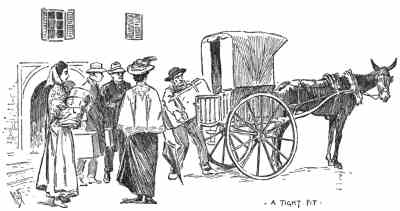
In place of the roomy farm cart drawn by mules that we had expected
to see, the conveyance was one of the gaily painted, two-wheeled
cockleshells in which Majorcan farmers go a-junketing. It would have
been an admirable vehicle for two people. Viewed as a means of
carrying four with luggage, it at first sight seemed absolutely
impracticable.
"Oh, it's all right; I'll walk," said the Boy, regardless of the
fact that ten long miles of wet road lay between us and the Hotel
Marina at Sóller.
Our luggage was as little as a party of three could be expected to
require during a week's expedition, comprising as it did only one
large portmanteau, a suit-case, some sketching materials, and a
couple of rugs. Yet compared with the size of the conveyance it
appeared of enormous dimensions.
Nothing daunted by the overwhelming bulk of his prospective load,
the driver put the suit-case under the seat, propped the big
portmanteau up on it, and invited me to get in. That done, allowing
a modicum of space for himself, the carriage was full.
Obviously that plan would not do. Again we looked at each other in
despair. Fortunately the driver was a man of resource. Hauling out
the big bag, he wrapped it in a sail-like canvas cover, and,
producing fragments of rope from all his pockets, proceeded to tie
it on at the back of the cart. Running into the house, Netta brought
more rope for its better security. With the load hanging behind, it
seemed as though the tiny vehicle were already overweighted; but its
capacity for endurance proved greater than we anticipated. The Man
got in, the Boy got in, the driver also mounted. All three were
jammed into a narrow seat for two. I was squeezed in somewhere at
the back, and at last our journey began.
As we drove on the feeling of insecurity lessened; we forgot to
expect the cart to tip up. Our mule proved himself a good goer, and
we early learned to adapt ourselves to conditions—to lean forwards
going uphill, to incline backwards when the way led downwards.
Though the mist still blurred the mountains the coast scenery was
magnificent. The road, which lay half-way between sea and
mountain-top, was bordered on either side by olive plantations.
About three miles from the Hospederia it curved inwards into the
most beautiful valley I had ever seen.
 A TIGHT FIT
Houses that looked like nests, so thickly were they surrounded by
luxuriant foliage, were scattered about the lower parts of the hills
that on three sides rose steeply; on the fourth the land declined
gently to the Mediterranean.
Here there were no jealous walls to hedge in the gardens. Oranges,
lemons, and figs in full fruitage overhung the highway. Tall palms
rose overhead, and down by a fountain women were washing. It was the
village of Deyá, a sleepy nest seven miles from even a diligence,
but, even seen through a blur of rain, a place of exquisite beauty.
"We must come back here."
"Yes, we'll come back——"
"And stay a month," we agreed, as we had done about so many charming
spots that we had got just a glimpse of, and as we were fated to do
about so many more before our sojourn in these lovely isles came to
a close.
We would gladly have lingered to explore the beauties of Deyá, but
the delay at starting had already encroached on the November
afternoon, and the greater portion of our journey was yet to come.
So the men, who had got down to walk through the village, remounted,
and once more, huddled up together, off we joggled, out of the
lovely valley and along a cliff-road where, among the grey-green
olive-trees, girls in skirts of vivid scarlet were gathering the
fallen fruit.
It was five o'clock and dusk was already falling when we descended
the zigzag road leading into Sóller and, passing a picturesque old
cross, turned into a modern-looking street planted on either side
with trees.
"What I want to see now," I said, deliberately shutting my eyes to
the scenery, "is a hotel with electric light, and a good fire, and
German waiters, and French cookery."
"Don't be hateful," retorted the Boy. "But it doesn't matter; you
won't see it. My only fear is that they won't be able to take us
in."
The rain, which was now falling more heavily, had sent the townsfolk
indoors. The only wayfarer in sight was a venerable gentleman who,
as he sat astride a panniered donkey, protected himself from the
rain with a large umbrella.
Turning with a final jolt, we drew up in front of the Hotel Marina,
whose wide glass doors opened hospitably to receive us.
There was no question of lack of room, fortunately, but the
dinner-hour was yet two hours ahead, and even the satisfaction
derived from the omelet (which wasn't really an omelet) was already
a vague memory. But we are people of resource. While I boiled the
unfailing tea-kettle the men foraged, returning with provender in
the shape of crisply toasted bizcochos and cocas, and we had a
cosy tea that enabled us to possess our bodies in patience until the
dinner-hour.
The waiter who served us was German, the cookery revealed more than
a suspicion of French influence, the electric light was brilliant,
and there was a cheery fire. But even the Boy did not complain.