When the good ship “Morning Star,”
bound to Liverpool from New York,
foundered at sea, the officers, the crew,
and all of the passengers but two, escaped in the
boats. Professor E. L. Baffin and his daughter,
Matilda Baffin, preferred to intrust themselves to
a patent india-rubber life-raft, which the Professor
was carrying with him to Europe, with the hope
that he should sell certain patent rights in the contrivance.
There was time enough, before the ship sank, to
inflate the raft and to place upon it all of the
trunks and bundles belonging to the Professor and
Matilda. These were lashed firmly to the rubber
cylinders, and thus Professor Baffin was encouraged
to believe that he might save from destruction
all of the scientific implements and apparatus
which he had brought with him from the Wingohocking
University to illustrate the course of lectures
which he had engaged to give in England
and Scotland.
Having made the luggage fast, the Professor
handed Matilda down from the ship’s side, and
when he had tied her to one of the trunks and
secured himself to another, he cut the raft adrift,
and, with the occupants of the boats, sorrowfully
watched the brave old “Morning Star” settle
down deeper and deeper into the water; until at
last, with a final plunge, she dipped beneath the
surface and disappeared.
The prospect was a cheerless one for all of the
party. The sea was not dangerously rough; but
the captain estimated that the nearest land was at
least eight hundred miles distant; and, although
there were in the boats and upon the raft provisions
and water enough for several days, the
chance was small that a port could be made before
the supplies should be exhausted. There was,
moreover, almost a certainty that the boats would be
swamped if they should encounter a severe storm.
The Professor, for his part, felt confident that
the raft would outlive any storm; but his shipmates
regarded his confidence in it as an indication
of partial insanity.
The captain rested his expectations of getting
ashore chiefly upon the fact that they were in the
line of greatest travel across the Atlantic, so that
they might reasonably look to meet, within a day
or two, with a vessel of some kind which would
rescue them.
As the night came on, it was agreed that the
boats and the raft should keep together, and the
captain had provided a lantern, which was swung,
lighted, aloft upon an oar, so that the position of
his boat could be determined. The Professor, with
his raft under sail, steered along in the wake of the
boats for several hours, Matilda, meanwhile, sleeping
calmly, after the exciting and exhausting labors
of the day, upon a couple of trunks.
As the night wore on, a brisk wind sprang up,
and shortly afterward the light upon the captain’s
boat for some reason disappeared. The Professor
was somewhat perplexed when he missed it, but he
concluded that the safest plan would be to steer
about upon the course he had hitherto held, and
then to communicate with the boats if they should
be within sight in the morning.
The wind increased in force about midnight, and
the raft rolled and pitched in such a manner that
the Professor’s faith in it really lost some of its
force. Several times huge waves swept over it,
drenching the Professor and his daughter, and filling
them with grave apprehensions of the result if
the storm should become more violent.
Even amid the peril, however, Professor Baffin
could not but admire the heroic courage and composure
of Matilda, who sat upon her trunk, wet
and shivering with cold, without showing a sign of
fear, but trying to encourage her father with words
of hope and cheer.
When the dawn came, dim and gray, the gale
abated its force, and although the sea continued
rough, the raft rode the waves more buoyantly and
easily. Producing some matches from his waterproof
box, the Professor lighted the kerosene-lamp
in the tiny stove which was in one of the boxes;
and then Matilda, with water from the barrel, began
to try to make some coffee. The attempt
seemed to promise to be successful, and while the
process was going on, the Professor looked about
for the boats. They could not be seen. The Professor
took out his glass and swept the horizon.
In vain; the boats had disappeared completely;
but the Professor saw something else that attracted
his attention, and made his heart for a moment
stop beating.
Right ahead, not distinctly outlined, but visible in
a misty sort of way, he thought he discerned
land!
At first he could not believe the evidence of his
sight. The captain, an expert navigator, had assured
him that they were eight hundred miles from
any shore. But this certainly looked to the Professor
very much like land. He examined it through
his glass. Even then the view was not clear enough
to remove all doubts, but it strengthened his conviction;
and when Matilda looked she said she
knew it was land. She could trace the outline of a
range of hills.
“Tilly,” said the Professor, “we are saved! It is
the land, and the raft is drifting us directly towards
it. We cannot be sufficiently thankful, my child,
for this great mercy! Who would have expected
it? Taken altogether, it is the most extraordinary
circumstance within my recollection.”
“Captain Duffer must have made a miscalculation,”
said Tilly. “The ship must have been off
of her course when she sprang a leak.”
“It is incomprehensible how so old a sailor could
have made such a blunder,” replied the Professor.
“But there the land is; I can see it now distinctly.
It looks to me like a very large island.”
“Are you going ashore at once, pa?”
“Certainly, dear; that is, if we can make a landing
through the breakers.”
“Suppose there are cannibals on it, pa? It would
be horrid to have them eat us!”
“They would have to fatten us first, darling;
and that would give us an opportunity to study
their habits. It would be extremely interesting!”
“But the study would be of no use if they should
eat us!”
“All knowledge is useful, Tilly; I could write
out the results of our observations, and probably
set them adrift in a bottle!”
“It is such a dreadful death!”
“Try to look at it philosophically! There is
really nothing more unpleasant about the idea of
being digested than there is about the thought of
being buried.”
“O, pa!”
“No, my child! It is merely a sentiment. If I
shall be eaten, and we have volition after death, I
am determined to know how I agreed with the man
who had me for dinner! Tilly, I have a notion
that you would eat tender!”
“Pa, you are simply awful!”
“To me, indeed, there is something inspiring in
the thought that my physical substance, when I
have done with it, should nourish the vitality of
another being. I don’t like to think that I may be
wasted.”
“You seem as if you rather hoped we should find
savage cannibals upon the island!”
“No, Tilly; I hope we shall not. I believe we
shall not. Man-eaters are rarely found in this latitude.
My impression is that the island is not inhabited
at all. Probably it is of recent volcanic
origin. If so, we may have a chance to examine
a newly-formed crater. I have longed to do so for
years.”
“We might as well be eaten as to be blown up
and burned up by a volcano,” said Matilda.
“It would be a grand thing, though, to be permitted
to observe, without interruption, the operation
of one of the mightiest forces of nature! I could
make a magnificent report to the Philosophical Society
about it; that is, if we should ever get home
again.”
“For my part,” said Matilda, “I hope it contains
neither cannibals nor volcanoes; I hope it is simply
a charming island without a man or a beast
upon it.”
“Something like Robinson Crusoe’s, for example!
I have often thought I should like to undergo his
experiences. It must be, to an inquiring mind,
exceedingly instructive to observe in what manner
a civilized man, thrown absolutely upon his own
resources, contrives to conduct his existence. I
could probably enrich my lecture upon Sociology
if we should be compelled to remain upon the
island for a year or two.”
“But we should starve to death in that time!”
“So we should; unless, indeed, the island produces
fruits of some kind from its soil. I think it
does. It seems to be covered with trees, Tilly,
doesn’t it?”
“Yes,” said Matilda, looking through the glass.
“It is a mass of verdure. It is perfectly beautiful. I
believe I see something that looks like a building, too.”
“Impossible! you see a peculiar rock formation,
no doubt; I shan’t be surprised if there is enough
in the geological formation of the island to engage
my attention so long as we remain.”
“But what am I to do, meantime?”
“You? Oh, you can label my specimens and
keep the journal; and maybe you might hunt
around for fossils a little yourself.”
The raft rapidly moved toward the shore, and
the eyes of both of the voyagers were turned toward
it inquiringly and eagerly. Who could tell
how long the island might be their home, and what
strange adventures might befall them there?
“The wind is blowing right on shore, Tilly,”
said the Professor. “I will steer straight ahead,
and I shouldn’t wonder if we could shoot the
breakers safely. Isn’t that a sand-beach right in
front there?” inquired the Professor, elevating his
nose a little, to get his spectacles in focus. “It
looks like one.”
“Yes, it is,” replied Matilda, looking through her
glass.
“First-rate! Couldn’t have been better. There,
we will drive right in. Tilly, hoist my umbrella, so
as to give her more sail!”
The raft fairly danced across the waves under
the increased pressure, and in a moment or two it
was rolling in the swell just outside of the line of
white breakers. Before the Professor had time to
think what he should do to avoid the shock, a huge
wave uplifted the raft and ran it high upon the
beach with such violence as to compel the Professor
to turn a somersault over a trunk. He recovered
himself at once, and replacing his spectacles
he proceeded, with the assistance of Matilda, to
pull the raft up beyond the reach of the waves.
Then, wet and draggled, with sand on his coat,
and his hat knocked completely out of shape, he
stood rubbing his chin with his hand, and thoughtfully
observing the breakers.
“Extraordinary force, Tilly, that of the ocean
surf,—clear waste, too, apparently. If we stay here
long enough, I must try to find out the secret of its
motion.”
“Hadn’t we better put on some dry clothing
first?” suggested Miss Baffin, “and examine the
surf afterwards? For my part I have had enough
of it.”
“Certainly! Have you the keys of the trunks?
Everything soaking wet, most likely.”
When the trunks were unfastened, the Professor
was delighted to find that the contents were perfectly
dry. Selecting some clothing for himself, he
went behind a huge rock and proceeded to dress.
Matilda, after looking carefully about, retreated to
a group of trees, and beneath their shelter made
her toilette.
“Isn’t this a magnificent place?” said the Professor,
when Matilda, nicely dressed, came out to
where he was standing by the raft.
“Perfectly lovely.”
“Noble trees, rich grass, millions of wild flowers,
birds twittering above us, a matchless sky, a bracing
air, and—why, halloa! there’s a stream of
running water! We must have a drink of that,
the very first thing. Delicious, isn’t it?” asked
the Professor, when Miss Baffin, after drinking,
returned the cup to him.
“It is nectar.”
“I tell you what, Tilly, I am not sure that it
wouldn’t be a good thing to be compelled to live
here for two or three years. The vegetation shows
that we are in a temperate latitude, and I know I can
find or raise enough to eat in such a place as this.”
“Why, pa, look there!”
“Where?”
“Over there. Don’t you see that castle?”
“Castle? No! What! Why, yes, it is! Bless
my soul, Tilly, the place is inhabited!”
“Who would have thought of finding a building
like that on an island in mid-ocean?”
“It is the most extraordinary circumstance,
taking it altogether, that ever came under my observation,”
said the Professor, looking towards the
distant edifice. “So far as I can make out, it is a
castle of an early period.”
“Mediæval?”
“Well, not later than the seventh or eighth century,
at the farthest. Tilly, I feel as if something
remarkable was going to happen.”
“Pa, you frighten me!”
“No, I mean something that will be extraordinarily
interesting. I know it. The voice of instinct
tells me so. Have you your journal with you?”
“It is in the trunk.”
“Get it and your lead-pencils. We will drag the
baggage further up from the water, and then we
will push towards the castle. I am going to know
the date of that structure before I sleep to-night.”
“There can hardly be any danger, I suppose?”
suggested Miss Baffin, rather timidly.
“Oh, no, of course not; I have my revolver with
me. Let me see; where is it? Ah, here. And
the cartridges are waterproof. I think I will put a
few things in a valise, also. We might find the
castle empty, and have to depend upon ourselves
for supper.”
The Professor then let the air out of the raft,
and folded the flattened cylinders together.
When the valise was ready, the Professor
grasped it, shouldered his umbrella, and said,
“Now, come, darling, and we will find out what all
this means.”
The pair started along a broad path which ran
by the side of the stream, following the course of
the brook, and winding in and out among trees of
huge girth and gigantic height. Birds of familiar
species flitted from branch to branch before them,
as if to lead them on their way; now and then a
brown rabbit, after eyeing them for a moment with
quivering nostrils, beat a quick tattoo upon the
ground with his hind legs, then threw up his tail
and whisked into the shrubbery. Gray squirrels
scrambled around the trunks of the trees to look
at them, and now and then a screaming, blue-crested
kingfisher ceased his complaining while he
plunged into one of the pools of the rivulet, and
emerged with a trout in his talons.
It was an enchanting scene; and Miss Baffin
enjoyed it thoroughly as she stepped blithely by
the side of her father, who seemed to find especial
pleasure in discovering that the herbage, the trees,
the rocks, and all the other natural objects, were
precisely like those with which he had been familiar
at home.
After following the path for some time, the pair
came to a place where the brook widened into a
great pool, through which the water went sluggishly,
bearing upon its surface bubbles and froth,
which told how it had been tossed and broken by
rapid descents over the rocks in some narrow
channel above. Here the Professor stopped to observe
an uncommonly large and green bullfrog,
which sat upon a slimy stone a few yards away,
looking solemnly at him.
During the pause, they were startled to hear a
voice saying to them,—
“Good morrow, gentle friends.”
Matilda uttered a partly-suppressed scream, and
even the Professor jumped backward a foot or two,
in astonishment.
Looking toward the place from which the voice
came, they saw an old man with gray hair and
beard lifting a large stone pitcher, which he had
been filling from the pool. He was dressed in a
long and rather loose robe, which reached from
his shoulders to his feet, and which was gathered
about his waist with a knotted cord. This was
his entire costume, for his feet were bare, and he
wore no hat to hide the rich masses of hair which
fell to his shoulders. As he offered his salutation,
he raised his pitcher until he stood upright, and
then he looked at the Professor and Miss Baffin
with a pleasant smile, in which there were traces
of curiosity.
“Good afternoon,” returned the Professor, after
a moment’s hesitation; “how are you?”
“Are you not strangers in this land?” asked the
old man.
“Well, yes,” said the Professor, briskly, with a
manifest purpose to be sociable; “we have just
come ashore down here on the beach. Shipwrecked,
in fact. This is my daughter. Let me
introduce you. My child, allow me to make you
acquainted with—with—beg pardon, but I think
you did not mention your name.”
“I am known as Father Anselm.”
“Ah, indeed! Matilda, this is Father Anselm.
A clergyman, I suppose?”
“I am a hermit; my cell is close at hand. You
will be welcome there if you will visit it.”
“A hermit! Living in a cell! Well, this is
surprising! We shall be only too happy to visit
you, if you will permit us. Delightful, isn’t it,
dear? We will obtain some valuable information
from the old gentleman.”
The Hermit, with the pitcher poised upon his
shoulder, led the way, and he was closely followed
by the Professor and by Matilda, who regarded
the proceeding rather with nervous apprehension.
The Hermit’s cell was a huge cave, excavated from
the side of a hill. The floor was covered with
sprigs of fragrant evergreens. A small table stood
upon one side of the apartment; beside it was a
rough bench, which was the only seat in the room.
A crucifix, a candle, a skull, an hour-glass, and a
few simple utensils were the only other articles to
be seen.
The Hermit brought forward the bench for his
visitors to sit upon, and then, procuring a cup, he
offered each a drink of water.
The Professor, hugging one knee with interlocked
fingers, seemed anxious to open a conversation.
“Pardon me, sir, but do I understand that you
are a clergyman; that is to say, some sort of a
teacher of religion?”
“I belong to a religious order. I am a recluse.”
“Roman Catholic, I presume?” said the Professor,
glancing at the crucifix.
“Your meaning is not wholly clear to me,” replied
the Hermit.
“What are your views? Do you lean to Calvinism,
or do you think the Arminians, upon the
whole, have the best of the argument?”
“The gentleman does not understand you, pa,”
said Miss Baffin.
“Never mind, then; we will not press it. But
I should like very much if you would tell us something
about this place; this country around here,”
said the Professor, waving his hand towards the
door.
“Let me ask first of the misadventure which
cast you unwillingly upon our shores?” said the
Hermit.
“Well, you see, I sailed from New York on the
twenty-third of last month, with my daughter here,
to fulfil an engagement to deliver a course of lectures
in England.”
“In England!” exclaimed the Hermit, with an
appearance of eager interest.
“Yes, in England. I am a professor, you know,
in an American university. When we were about
half way across, the ship sprang a leak, from some
cause now unknown. My daughter and I got off
with our baggage upon a life-raft, which I most
fortunately had with me. The rest of the passengers
and the crew escaped in the boats. I became
separated from them, and drifted here. That
is the whole story.”
“I comprehend only a part of what you say,”
replied the Hermit. “But it is enough that you
have suffered; I give you hearty welcome.”
“Thank you. And now tell me where I am.”
“You spoke of England a moment ago,” said
the Hermit. “Let me begin with it. Hundreds
of years ago, in the time of King Arthur, of noble
fame, it happened, by some means even yet not revealed
to us, that a vast portion of that island
separated from the rest, and drifted far out upon
the ocean. It carried with it hundreds of people—noble,
and gentle, and humble. This is that
country.”
“In-deed!” exclaimed the Professor. “This?
This island that we are on? Amazing!”
“It is true,” responded the Hermit.
“Why, Tilly, do you hear that? This is the lost
Atlantis! We have been driven ashore on the far-famed
Fortunate Island! Wonderful, isn’t it?
Taking every thing into consideration, I must say
this certainly is the most extraordinary circumstance
I ever encountered!”
“Nobody among us has ever heard anything
from England or of it, excepting through tradition.
No ship comes to our shores, and those of us who
have builded boats and gone away in search of
adventure have never come back. Sometimes I
think the island has not ended its wanderings, but
is still floating about; but we cannot tell.”
“But, my dear sir,” said the Professor, “you can
take your latitude and longitude at any time, can’t
you?”
“Take what?”
“Your latitude and longitude! Find out exactly
in what part of the world you are?”
“I never heard that such a thing was done.
None of our people have that kind of learning.”
“Well, but you have schools and colleges, and
you acquire knowledge, don’t you?”
“We have a few schools; but only the low-born
children attend them, and they are taught only
what their fathers learned. We do not try to know
more. We reverence the past. It is a matter of
pride among us to preserve the habits, the manners,
the ideas, the social state which our fore-fathers
had when they were sundered from their
nation.”
“You live here pretty much as King Arthur and
his subjects lived?”
“Yes. We have our chivalry; our knight errants;
our tournaments; our castles—everything
just as it was in the old time.”
“My dear,” said the Professor to Miss Baffin,
“the wildest imagination could have conceived
nothing like this. We shall be afforded an opportunity
to study the middle ages on the spot.”
“Sometimes,” said the Hermit, gravely, “I have
secret doubts whether our way is the best,
whether in England and the rest of the world
men may not have learned while we have remained
ignorant; but I cannot tell. And no one would be
willing to change if we could know the truth.”
“My friend,” said the Professor, with a look of
compassion, “the world has gone far, far ahead of
King Arthur’s time! It has almost forgotten that
there ever was such a time. You would hardly believe
me, at any rate you would not understand me,
if I should tell you of the present state of things in
the world. But if I stay here I will try to enlighten
you gradually. I feel as if I had been sent
here as a missionary for that very purpose.”
“Do you come from England?”
“Oh, no! I was going thither. I came from
the United States. You never heard of them, of
course. They are a land right across the ocean
from England, about three thousand miles.”
“Discovered by a man named Columbus,” said
Miss Baffin.
“Your dress is an odd one,” continued the Hermit.
“Are you a fighting man?”
“A fighting man! Oh, no, of course not. I’m
a Professor.”
“Then this is not a weapon that you carry.”
“Bless my soul, my dear sir! Why, this is an
umbrella! Tilly, we have to deal with a very
primitive condition of things here. It is both entertaining
and instructive.”
“What is it for?”
“I will show you. Suppose it begins to rain, I
untie this string and open the umbrella, so! Now
don’t be alarmed! It is perfectly harmless, I
assure you!”
The holy man had retreated suddenly into the
furthest recess of the cell.
“While it rains I hold it in this manner. When
it clears, I shut it up, thus, and put it under my
arm.”
“Wonderful! wonderful!” exclaimed the Hermit.
“I thought it was an implement of war. The
world beyond us evidently has surpassed us.”
“This is nothing to the things I will show you,”
said the Professor. “I see you have an hour-glass
here. Is this the only way you have of recording
time?”
“We have the sun.”
“No clocks or watches?”
“I do not know what they are.”
“Tilly, show him your watch. This is the machine
with which we tell time.”
“Alive, is it?” asked the Hermit.
The Professor explained the mechanism to him
in detail.
“You are indeed a learned man,” said the recluse.
“But I have forgotten a part of my duty.
Will you not take some food?”
“Well,” said the Professor, “if you have anything
about in the form of a lunch, I think I could
dispose of it.”
“I am awfully hungry,” said Miss Baffin.
The Hermit produced a piece of meat, and hanging
it upon a turnspit he gathered a few sticks and
placed them beneath it. The Professor watched
him closely; and when the holy man took in his
hands a flint and steel with which to ignite the
wood, the Professor exclaimed,—
“One moment! Let me start that fire for
you?”
Taking from his pocket an old newspaper, he
put it beneath the sticks; then from his match-box
he took a match, and striking it there was a blaze
in a moment.
The Hermit crossed himself and muttered a
prayer at this performance.
“No cause for alarm, I assure you,” said the
Professor.
“You must be a wizard,” said the Hermit.
“No; I did that with what we call a match; like
this one. There is stuff on the end which catches
fire when you rub it,” and the Professor again
ignited a match.
“I never could have dreamed that such a thing
could be,” exclaimed the recluse. “You will be
regarded by our people as the most marvellous
magician that ever lived.”
The Professor laughed.
“Oh,” said he, “I will let them know it is not
magic. We must clear all that nonsense away.
Tilly, I feel that duty points me clearly to the task
of delivering a course of lectures upon this island.”
During the repast, the Hermit, looking timidly
at Professor Baffin, said,—
“Would it seem discourteous if I should ask you
another question?”
“Certainly not. I shall be glad to give you any
information you may want.”
“What, then,” inquired the Hermit, “is the
reason why you protect your eyes with glass windows?”
“These,” said the Professor, removing his spectacles,
“are intended to improve the sight. I
cannot see well without them. With them I have
perfect vision. Tilly, make a memorandum in the
journal that my first lecture shall be upon Optics.”
“Pa, I wish we could learn something about the
castle we saw,” observed Miss Baffin.
“Oh, yes; by the way, Father Anselm,” said the
Professor, “we observed an old-fashioned castle
over yonder, as we came here. Can you tell me
anything about it?”
“The castle,” replied the Hermit, “is the home
and the stronghold of Sir Bors, Baron of Lonazep.
He is a great and powerful noble, much feared in
this country.”
“Any family?” inquired the Professor.
“He has a gallant son, Sir Dinadan, as brave a
knight as ever levelled lance, and a beautiful
daughter, Ysolt. Both are unmarried; but the fair
Ysolt fondly loves Sir Bleoberis, to whom, however,
the Baron will not suffer her to be wedded,
because Sir Bleoberis, though bold and skilful, has
little wealth.”
“Human nature, you observe, my child, is the
same everywhere. We have heard of something
like this at home,” remarked the Professor to his
daughter.
“Ysolt is loved also by another knight, Sir Dagonet.
He has great riches, and is very powerful;
but he is a bad and dangerous man, and the Baron
will not consent to give him Ysolt to wife. These
matters cause much strife and much unhappiness.”
“It’s the same way with us,” observed the Professor;
“I have known lots of such cases.”
“I hope we shall stay here long enough to see
how it all turns out,” said Miss Baffin.
“Of course,” replied the Professor. “You hated
the island when you thought it might promote the
interests of science. But some lovers’ nonsense
would keep you here willingly for life. Just like a
woman.”
“The King,” said the Hermit, “has espoused
the cause of Sir Bleoberis, and we hope he may
win the lady for the knight whom she loves.”
“The King, eh? Then you have a monarchical
government?”
“We have eleven kings upon this island.”
“All reigning?”
“Yes.”
“How many people are there in the whole
island?”
“No one knows, exactly. One hundred thousand,
possibly.”
“Not ten thousand men apiece for the kings!
Humph! In my country we have a million men
in one town, and nobody but a common man to
rule them.”
“Incredible!”
“And what is the name of your particular king,—the
one who is lord of this part of the country?”
“King Brandegore; a wise, and good, and valiant
monarch.”
“Tilly,” said the Professor, “you might as well
jot that down. Eleven kings on the island, and
King Brandegore running this part of the government.
I must get acquainted with him.”
When the meal was finished the Professor said
to the recluse,—
“Do you allow smoking?”
“Smoking!”
“Pray excuse me! I forgot. If you will permit
me, I will introduce you to another of the practices
of modern civilization.”
Then the Professor lighted a cigar, and, sitting
on the bench in a comfortable position, with his
back against the wall of the cave, he began to puff
out whiffs of smoke.
The Hermit, with a look of alarm, was about to
ask for an explanation of the performance, when
loud cries were heard outside of the cave mingled
with frightened exclamations from a woman.
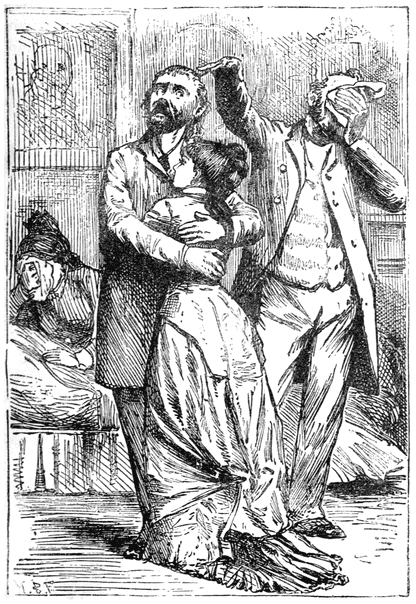
The occupants of the cavern started to their feet,
just as a beautiful girl, dressed in a quaint but
charming costume, ran into the doorway in such
haste that she dashed plump up against the Professor,
who caught her in his arms.
For a moment she was startled at seeing two
strangers in a place where she had thought to encounter
none but the Hermit; but her dread of her
pursuer overcame her diffidence, and, clinging to
the Professor, she exclaimed,—
“Oh, save me! save me!”
“Certainly I will,” said the Professor, soothingly,
as his arm tightened its clasp about her waist.
“What’s the matter? Don’t be afraid, my child.
Who is pursuing you?”
The Professor was not displeased at the situation
in which he found himself. The damsel was fair
to see, and the head which rested, in what seemed
to him sweet confidence, upon his shoulder, was
crowned with golden hair of matchless beauty.
Even amid the intense excitement of the moment
the reflection flashed through the Professor’s mind
that he was a widower, and that Matilda had
always expressed a willingness to try to love a
stepmother.
“My father! The Baron! He threatens to
kill me,” sobbed the maiden, and then, tearing herself
away from the Professor in a manner which
struck him as being, to say the least, inconsiderate,
she flew to Father Anselm and said, “You, holy
father, will save me.”
“I will try, my daughter; I will try,” replied the
Hermit. And then, turning to the Professor he
said, “It is Ysolt.”
“Ah!” said the Professor, “the Baron’s daughter.
May I ask you, miss, what the old gentleman
is so excited about? It is not one of the customs
here for indignant parents to chase their children
around the country, is it?”
“I had gone from the castle,” said the damsel,
partly to the Hermit and partly to Professor Baffin,
“to meet Sir Bleoberis at the trysting-place.
My father was watching me, and as I neared the
spot he rushed toward me with a drawn sword,
threatening to kill me.”
“It is an outrageous shame!” exclaimed the
Professor, sympathetically.
“I eluded him,” continued the sobbing girl, “and
flew towards this place. When he saw me at last
he gave chase. I am afraid he will slay me when
he comes.”
“I think, perhaps, I may be able to reason with
this person when he arrives,” said the Professor,
rubbing his chin and looking at the hermit over the
top of his spectacles. “The Baron ought to be
ashamed of himself to go on in this manner! Tilly,
wipe the poor creature’s eyes with your handkerchief.
There now, dear, cheer up.”
Just then the Baron rushed into the cell, with
his eyes flaming, and his breath coming short and
fast.
He was a large man, with a handsome face, thick
covered with beard. He was dressed in doublet,
trunks and hose, and over one shoulder a mantle
hung gracefully. His sword was in its sheath, and
it was manifest that he had repented of his murderous
purpose.
“Where is that faithless girl?” he demanded in
a voice of thunder.
Ysolt had hidden behind Matilda Baffin.
“Say, priest, where have you secreted her?”
“One moment!” said the Professor, stepping
forward. “May I, without appearing impertinent,
offer a suggestion?”
“Out, varlet!” exclaimed the Baron, pushing
him aside. “Tell me, Hermit, where is Ysolt?”
The Professor was actually pale with indignation.
Pushing himself in front of the Baron, and
brandishing his umbrella in a determined way he
said:
“Old man, I want you to understand that you
have to deal with a free and independent American
citizen! What do you mean by ‘varlet?’ I hurl
the opprobrious word back into your teeth, sir! I
am not going to put up with such conduct, I’d like
you to know!”
The Baron for the first time perceived what
manner of man the Professor was, and he paused
for a moment amid his rage to eye the stranger
with astonishment.
“Why do you want to hurt the young woman?
Is this any way for an affectionate father to behave
to his own offspring? Allow me to say, sir, that
I’ll be hanged if I think it is! If you don’t want
her to marry Sir What’s-his-name, don’t let her;
but it strikes me that charging around the country
after her, and threatening to kill her, is an evidence
that you don’t understand the first principles of
domestic discipline!”
“What do you mean? Who are you? What
are you doing here?” demanded the Baron, fiercely,
recovering his self-possession.
“I am Professor E. L. Baffin, of Wingohocking
University; and I mean to try to persuade you to
treat your daughter more gently,” said the Professor,
cooling as he remembered that the Baron had
a father’s authority.
“You have a weapon. I will fight you,” said the
Baron, drawing his sword.
The Professor put his cigar in his mouth, and
opened his umbrella suddenly in the Baron’s
face.
The Baron retreated a distance of twenty feet
and looked scared.
“Come,” said the Professor, closing his umbrella
and smiling, “I am not a fighting man. We will
not quarrel. Let us talk the matter over calmly.”
But the Baron, mortified because of the alarm
that he had manifested, rushed savagely at the
Professor, and would have felled him to the earth
had not Matilda sprung forward and placed herself,
shrieking, between the Baron and her father.
At this precise juncture, also, a young man
entered the cell, and, seeing the Baron apparently
about to strike a woman, seized his sword-arm and
held it. The Baron turned sharply about. Recognizing
the youth as his son, he simply looked at
him angrily, and then, while Miss Baffin clung to
the Professor, the Baron seized Ysolt by the arm
and led her weeping away.
The Professor, after freeing himself from Miss
Baffin’s embrace, extended his hand to the youth,
and said,—
“I have not the honor of knowing you, sir, but
you have behaved handsomely. Permit me to inquire
your name?”
“Sir Dinadan; the son of the Baron,” said the
youth, taking hold of the Professor’s hand, as if he
were somewhat uncertain what he had better do
with it.
“No last name?” asked the Professor.
“That is all. And you are?—”
“I am Everett L. Baffin, a Professor in the
Wingohocking University. I was cast ashore
down here with my daughter. Tilly, let me introduce
to you Sir Dinadan.”
Sir Dinadan colored, and dropping upon his
knee he seized Miss Baffin’s hand and kissed it.
Rising, he said:
“What, Sir Baffin, is the name of the sweet
lady?”
“Matilda.”
“How lovely!” exclaimed Sir Dinadan.
“It is abbreviated sometimes to Tilly, by her
friends.”
“It is too beautiful,” said the youth, gazing at
Miss Baffin with unconcealed admiration. “I
trust, Sir Baffin, I may be able to serve in some
manner you and the Lady Tilly.”
“Professor Baffin, my dear sir; not Sir Baffin.
Permit me to offer you my card.”
Sir Dinadan took the card, and seemed perplexed
as to its meaning. He turned it over and
over in a despairing sort of way in his fingers.
“If you will read it,” said the Professor, “you
will find my name upon it.”
“But, Sir Baffin, I cannot read.”
“Can’t read!” exclaimed the Professor, in
amazement. “You don’t mean to say that you
have never learned to read!”
“High-born people,” replied Sir Dinadan, with
an air of indifference, “care nothing for learning.
We leave that to the monks.”
“This,” said the Professor to Miss Baffin, “is
one of the most extraordinary circumstances that
has yet come under my observation. Tilly, mention
in your journal that the members of the upper
classes are wholly illiterate.”
“As the Lady Tilly is a stranger here,” said Sir
Dinadan, “I would be glad to have her walk with
me to the brow of the hill. I will show her our
beautiful park.”
“That would be splendid!” said Miss Baffin.
“May I go, pa?”
“Well, I don’t know,” said the Professor, with
hesitation, and looking inquiringly at the Hermit.
As that individual appeared to regard the proposition
with no such feeling of alarm as would indicate
a breach of ordinary social custom, the Professor
continued, “Yes, dear, but be sure not to go
beyond ear-shot.”
Sir Dinadan, smiling, led Miss Baffin away, and
the Professor sat down to finish his cigar and to
have some further conversation with the Hermit.
Before he had time to begin, two other visitors arrived.
Both were young men, gaily dressed in
rich costume. One of them, whom the recluse
greeted as Sir Bleoberis, had a tall slender figure
and an exceedingly handsome countenance, which
was adorned with a moustache and pointed beard.
His companion, Sir Agravaine, was smaller, less
comely, and if his face was an index of his mind, by
no means so intelligent.
After being presented to the Professor, whom
they regarded with not a little curiosity, Sir Bleoberis
said:
“Holy father, the fair Ysolt was here and was
taken away by the Baron, was she not?”
“Yes!”
“Alas!” said the Knight, “I see no hope.
Whilst I am poor, the Baron will never relent.”
“Never!” chimed in Sir Agravaine.
“Is your poverty the only objection he has to
you?” asked the Professor.
“Yes.”
“Well,” replied the Professor, “I can understand
a father’s feelings in such a case. It seems hard
upon a young man, but naturally he wants his
daughter to be comfortable. Is there nothing you
can turn your hand to to improve your fortunes?”
“We might rob somebody,” said Sir Agravaine,
with a reflective air.
“Rob somebody!” exclaimed the Professor,
“That is simply atrocious! Can’t you go to work;
go into business, start a factory, speculate in
stocks, or something of that kind?”
“Persons of my degree never work,” said Sir
Bleoberis.
The Professor sighed, “Ah! I forgot. We must
think of something else. Let me see; young man,
I think I can help you a little, perhaps. You agree
to accept some information from me and I believe
I can make your fortune.”
“Do you propose,” asked Sir Agravaine, “to drug
the Baron, or to enchant him so that he will change
his mind? I have often tried love-philters with ladies
whose hands I sought, but they always failed.”
“Nonsense!” exclaimed the Professor. “I don’t
operate with such trumpery as that. You agree to
help me, and we’ll give this island such a stirring
up as will revolutionize it.”
The Professor then proceeded to explain in detail
the nature and operation of some of the scientific
apparatus which he had with him in his trunk;
and the Knight and the Hermit listened with
open-eyed amazement while he told them of the
telegraph, the telephone, the phonograph, the photograph,
and other modern inventions.
Whilst the Professor waxed eloquent, Sir Dinadan
and Miss Baffin strolled slowly back towards
the cave.
Sir Dinadan had improved the opportunity to
offer Miss Baffin his hand, rather abruptly.
“But you can try to love me,” he pleaded, as
she, with much embarrassment but with gentleness,
resisted his importunity.
“I can try, Sir Dinadan,” she said, blushing,
“but really I have known you only a few moments.
It is impossible for me now to have any affection
for you.”
“Will to-morrow be time enough?”
“No, no! I must have a much longer time than
that.”
“I will fight for you. We will get up a tournament
and you will see how I can unhorse the
bravest knights. If I knock over ten, will that
make any difference in your feelings?”
“Not the slightest!”
“Fifteen?”
“You do not understand. It is not the custom
in our country to press a suit upon a lady by poking
people off of a horse.”
“Perhaps I ought to fight your father? Will
Sir Baffin break a lance with me to decide if I shall
have you?”
“My father does not fight.”
“Does not fight! Certainly you don’t mean
that?”
“He is the Vice-President of the Universal
Peace Society.”
“The WHAT?” asked Sir Dinadan, in amazement.
“Of the Peace Society; a society which opposes
fighting of every kind, under any circumstances.”
It was a moment or two before Sir Dinadan
could get his breath. Then he said—
“But—but then, Lady Tilly, what—what do
men in your country do with themselves?”
Miss Baffin laughed and endeavored to explain
to him the modern methods of existence.
“I never could have believed such a thing from
other lips,” said Sir Dinadan. “It is marvellous.
But tell me, how do lovers woo in your land?”
“Really, Sir Dinadan,” replied Miss Baffin,
blushing, “I have had no experience worth speaking
of in such matters. I suppose, perhaps, they
show a lady that they love her, and then wait until
she can make up her mind.”
“I will wait, then, as long as you wish.”
“But,” said Miss Baffin, shyly, although plainly
she was beginning to feel a genuine interest in
the proceeding, “your father and your mother may
not think as you do; and then, I shall not want to
stay upon this island if I can get away.”
“My mother always consents to anything I
wish, and the Baron never dares to oppose what
she wants. And if you go back to your own country,
I will go with you, whether you accept me or
not.”
Miss Baffin smiled. Sir Dinadan was in earnest,
at any rate. She could not help thinking of the
sensation that would be created in Wingohocking
if she should walk up the fashionable street of the
town some afternoon with Sir Dinadan in his parti-colored
dress of doublet and stockings, and jaunty
feathered cap, and sword, while his long yellow
hair dangled about his shoulders.
While Sir Dinadan was protesting that he should
love her for ever and for ever, they came back
again to the Hermit’s cell, and then Sir Dinadan,
greeting Sir Bleoberis and Sir Agravaine, presented
Miss Baffin to them.
Sir Bleoberis was courteous but somewhat indifferent;
Sir Agravaine, upon the contrary, appeared
to be deeply impressed with Miss Baffin’s
beauty. After gazing at her steadily for a few
moments, he approached her, and while the other
members of the company engaged in conversation,
he said,—
“Fair lady, you are not married?”
“No, sir,” replied Miss Baffin, with some indignation.
“Permit me, then, to offer you my hand.”
“What!” exclaimed Miss Baffin, becoming
angry.
“I love you. Will you be mine?” said Sir Agravaine,
falling upon one knee and trying to take her
hand.
Miss Baffin boxed his ear with a degree of violence.
Rising with a rueful countenance, he said,—
“Am I to understand, then, that you decline the
offer?”
Miss Baffin, without replying, walked away from
him and joined her father.
Sir Dinadan was asking the Hermit for a few
simples with which to relieve the suffering of his
noble mother.
“I judge, from what you say,” remarked the
Professor, “that the Baroness is afflicted with
lumbago. The Hermit’s remedies, I fear, will
be ineffectual. Permit me to recommend you
to iron her noble back, and to apply a porous
plaster.”
Sir Dinadan wished to have the process more
clearly explained. The Professor unfolded the
matter in detail, and said,—
“I have some plasters in my trunk, down there
upon the beach.”
“Then you are a leech?” asked Sir Dinadan.
“Matilda, my child,” remarked the Professor,
“observe that word ‘leech’ used by Sir Dinadan!
How very interesting it is! Not exactly a leech,
Sir Dinadan; but it is my habit to try to know a
little of everything.”
“Can you cast a lover’s horoscope?” asked Sir
Agravaine, looking at Matilda.
“Young man,” said the Professor, sternly, “there
is no such foolery as a horoscope; and as for love,
you had better let it alone until you have more wit
and a heavier purse.”
“I wish you and the Lady Tilly to come with me
to the castle,” remarked Sir Dinadan. “My father
will welcome you heartily if you can medicine the
sickness of my mother; and she will be eager to
receive your fair daughter.”
“I will go, of course,” replied the Professor;
“you are very kind. Tilly, we had better accept, I
think?”
Miss Baffin was willing to leave the matter
wholly in the hands of her father.
After requesting Sir Dinadan to have his luggage
brought up from the beach, the Professor
bade adieu to the Hermit, and then turning to Sir
Bleoberis, who stood with a disconsolate air by the
fire, he said:
“I will see you again about your affair; and
meantime you may depend upon my using my influence
with the Baron to remove his prejudices.
I will dance at your wedding yet; that is, figuratively
speaking, of course; for, as a precise matter
of fact, I do not know how to dance.”
As the Professor and Sir Dinadan and Miss
Baffin left the cell, Sir Agravaine approached the
lady and whispered:
“Did I understand you to say you don’t love me?”
Miss Baffin twitched the skirt of her gown to one
side in a scornful way, and passed on without replying.
“Women,” sighed Sir Agravaine, as he looked
mournfully after her, “are so incomprehensible. I
wish I knew what she meant.”