The battle of Bushy Run was so disastrous to the Indians that many
of them fled to parts unknown immediately after the results of the
conflict were ascertained. They lost several hundred in killed and
wounded, and among the number were a half a dozen well-known chiefs.
But though he had been victorious, Colonel Bouquet had suffered a heavy
loss, consequently he continued on his march to Fort Pitt with as great
caution as before. Eight officers and one hundred and fifteen men had
fallen, and it was a sad body of troops that wended its way through the
wilderness.
Barringford and Rodney were very downhearted over the disappearance of
Dave, and hoped hour by hour that he would reappear.
At last, on the tenth of August, the troops came in sight of Fort Pitt
and were glad to see that the stronghold had not fallen, although
greatly harassed by the red men for many weeks. Provisions and
ammunition were running low, and Captain Ecuyer hailed the coming of
Colonel Bouquet with satisfaction. It was learned that the Indians had
left the vicinity of the fort to march against Bouquet's troops only
two days previous to the battle of Bushy Run.
The meeting between James Morris, Henry, Rodney, and Barringford was
a warm one, but the news that Dave was missing saddened the trader
greatly, while the information that Nell had been abducted, along with
the twins, brought tears to Henry's eyes.
"Rodney, we must find Nell—and find Dave and the twins too," he said,
huskily.
"I am willing enough, Henry," answered his brother. "But where are we
going to look for them?"
"Dave must be somewhere in the vicinity of that battleground."
"True enough, but that locality is a perfect wilderness."
Rodney and Barrington were astonished to learn that Benoit Vascal was
at the fort. The Frenchman had almost recovered from his illness, but
he pleaded that he was very weak, doing this for fear Captain Ecuyer
would otherwise make him do soldier's duty.
"I'm goin' to talk to thet Frencher," said Barringford, and lost no
time in confronting the man.
"Vat you vant of me?" asked Vascal, suspiciously.
"I reckon as how your name is Benoit Vascal," began the old
frontiersman.
"Yees."
"I've been a-huntin' you for some time. You stole a couple o' children
onct—pair o' twin boys."
At this announcement the Frenchman started.
"Zat—zat ees not so," he stammered. "I know noddings of ze children."
"It won't do no good to lie," interrupted the old frontiersman,
sternly. "I've heard the story, an' it's true. I want to know the full
names o' them twins."
"I not steal zem children," cried Benoit Vascal. "Paul Camont, he steal
zem."
"Who is Paul Camont?"
"Ah, who ees he? He ees not—no more. He vas eat up by ze wolves!"
"Was he the man who was killed on the road?"
"Zat ees heem. He run off wiz ze children—it ees big snow—he miss ze
way——"
"Yes, I know."
"Ha! So! Who are you, I vant know?"
"I'm the man ez found them twins when this 'ere Camont war chewed up.
Now then, out with it, what's the name o' them youngsters, speak up,
or sumthin' a-goin' to happen to ye putty quick!"
As Barringford spoke he caught the Frenchman by the arm. The clutch
made Benoit Vascal shiver.
"Stop, I beg! I vill tell! Ze children, dare name ees Hamilton."
"Hamilton?"
"Yees. Fadder, hees name is Maurice Hamilton. He ees an Englishman. I
not know vere he ees now."
Having confessed so much, Benoit Vascal told the remainder of his
story to suit himself. He insisted upon it that Paul Camont and not
he had taken the twins. He said both he and Camont had had trouble
with Maurice Hamilton over some American lands. He did not think that
Hamilton was in America. He had been over, but had returned to London
nearly a year ago.
"Well, thet settles one thing," said Barringford, when he rejoined his
friends. "Them twins is named Hamilton, an' their father's fust name is
Maurice. Ef he's in London, all we can do is to write to him."
"Do you believe this Vascal?" asked Rodney.
"I do in part. But I kind o' reckon he had as much to do with stealin'
the twins ez thet Paul Camont."
After that Barringford and James Morris talked the matter over with
Colonel Bouquet and Captain Ecuyer, and as a result it was decided to
detain the Frenchman at Fort Pitt, at least for a few weeks.
All was now bustle and excitement at the fort, and it was not long
before it was decided to send out a body of rangers, to see if any
Indians were still in that vicinity. With the rangers went Mr. Morris,
Barringford, Rodney, and Henry, all anxious to see if they could learn
anything concerning Dave.
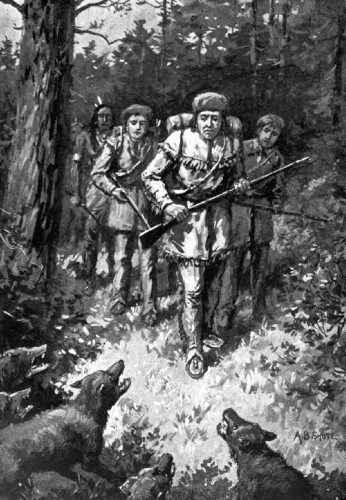
Two days were spent roaming the vicinity of the fort, and only two
Indians were discovered, both badly wounded. Then the rangers separated
into two parties, one going northward and the other westward.
"That other party will come close to our trading-post," said Mr.
Morris, to Henry. "I hope they make the Indians and the French run away
and leave our goods behind them."
The night that followed brought on the storm already described in the
previous chapter. As the rangers had no shelter they soon got wet
through, and had to build a camp-fire by which to dry themselves.
"I don't know if it's quite safe to build a fire," said James Morris.
"But if the men want to dry themselves we'll have to risk it."
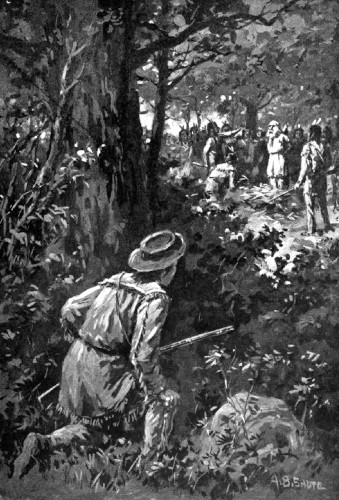
A guard had been put out, while the others slept, and about two o'clock
in the morning came an alarm that brought everybody in the camp to his
feet.
"What's the trouble?" came from several.
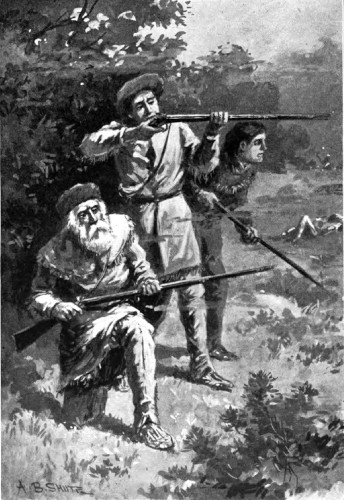
"Saw an Injun, just over thar!" cried the guard.
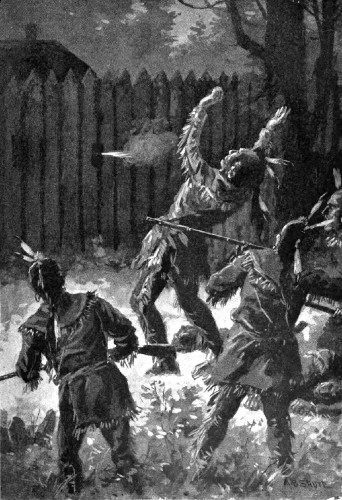
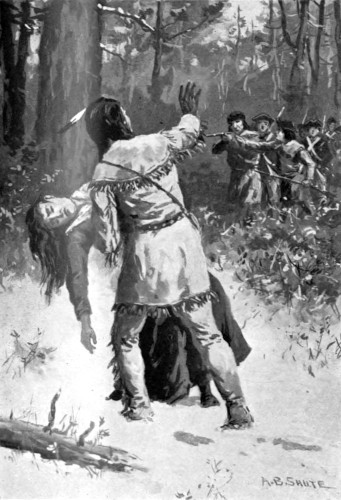
He had scarcely spoken when from a distance came a rifle shot, followed
by another. Then an Indian burst into view, carrying a little white
girl on his shoulder.
"White Buffalo and Nell, as I live!" came from James Morris's lips. He
ran forward. "Nell, don't you know me?"
"Uncle Jim!" cried the girl. "And oh, there are Henry and Rodney, and
Uncle Sam! Oh, I must be dreaming!"
"Here is Dave!" cried the trader, and he ran forward to meet his son.
"And one of the twins!"
"And here is the other twin!" said Barringford.
There was no time, just then, to say for additional rifle shots
could be heard. The Indians from the village were following up White
Buffalo's warriors, and the latter were doing their best to hold them
back, and thus cover the flight of their chief and Dave, with the
children.
"Give it to 'em!" cried Barringford, as soon as he understood the
situation. "Pepper 'em hot!" And as the nearest of Moon Eye's warriors
came into sight the rangers fired a volley which laid three Indians
low. The rest halted, and darted behind the trees.
"We must do our best to get back to the fort," cried James Morris.
"Wait till we count up this crowd that has attacked us," urged Rodney.
A moment later some additional Indians came into view, and then the
whites and their red allies took up the retreat towards Fort Pitt. They
kept up a constant shooting, and this noise at length reached the fort
and caused Colonel Bouquet to hurry out a company.
"The regulars are coming!" cried Dave. He was almost exhausted from
running and fighting.
"Thank God for it," murmured James Morris. "They cannot get here too
soon."
As the soldiers came forward they shouted loudly, and hearing this,
Moon Eye gave his warriors orders to be cautious. Then the regulars
bounded to the front, and at the first volley from the gallant
Highlanders the enemy fled back to the lake and then to their village.
On the following morning, fearing another attack by the English, the
village was moved many miles to the westward.
"The battle is over," said Henry. "And I am not sorry."
"Is everybody safe?" asked Rodney.
"Reckon as how they are," answered Barringford, with a look around.
"Then that is a good deal to be thankful for," said Dave, soberly.
Here let me add a few words and then draw to a close this tale of "The
Fort in the Wilderness."
As they journeyed to Fort Pitt, Dave told his father and the others of
his adventures since being made captive by the Indians, and heard the
story of the attack on the trading-post and how it had been captured by
the Indians and Jean Bevoir.
"Now that the Indians have been defeated we ought to try to get the
post back, father," said the youth.
Dave was much interested in the story about the twins and was willing
to believe their name was Hamilton, because of the documents he had
read. In the excitement of escaping from the Indians he had lost the
papers and he had no idea what had become of them.
"They were certainly valuable," he said. "But whether they belonged to
Benoit Vascal or Maurice Hamilton, or somebody else, I do not know."
When they arrived at Fort Pitt they found that Benoit Vascal was
missing. Watching his chance, the Frenchman had bribed a pack-driver
to let him have some provisions and a horse, and had set out for parts
unknown.
"That's too bad," said Dave. "We might have learned something more from
him about the twins. But we know their name, and that is something."
"And we can send a letter to London, to Mr. Maurice Hamilton," added
Rodney.
A day later the rest of the rangers came in. They said they had not
gotten as far as the trading-post, having journeyed to the southward.
"Father, let us organize a company to go out to the post," said Dave.
"I think we can get quite a number of rangers to join us."
The matter was talked over, and in the end a company was organized
with James Morris at its head, to march westward and try to retake
the place. At the same time Sam Barringford, aided by White Buffalo,
started out to see if they could not find Benoit Vascal. In another
volume, to be entitled "Trail and Trading-Post; or, The Young Hunters
of the Ohio," we shall meet all our friends again and learn what was
done towards recapturing the post on the Ohio, and in bringing Jean
Bevoir to justice, and also something more concerning the mystery of
the twins.
During the days spent in resting at Fort Pitt came cheering news from
Fort Cumberland. Matters around that place had quieted down greatly and
some of the settlers had started in to farm once more. Joseph Morris
was feeling better. It had been definitely settled that White Buffalo
had had nothing to do with the killing of the Diglys.
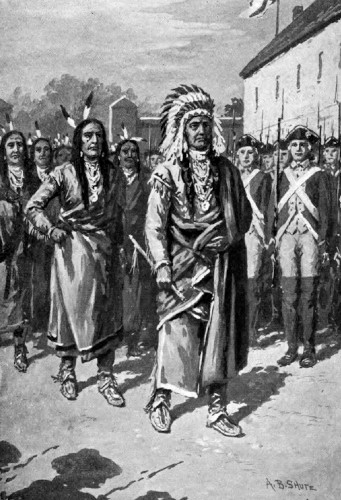
"I'm glad for your sake of this," said Dave, to the aged Indian chief.
"White Buffalo glad, too," was the quiet answer. "Want to be good
friends with all the English."
"It was good of you to give Nell those beads," went on Dave. "They
certainly saved her life."
"White Buffalo think so, maybe, when he give beads," said the Indian.
"No want to see his little queen die."
"You're the best Indian in the world!" cried little Nell, and gave him
a hug. "I wish they were all as good as you."
"If that were so, there would be no further fighting," laughed James
Morris.
"Do you think this Indian war is over?" asked Rodney.
"No," said Henry. "Pontiac will do what he can to stir it up again."
This proved to be the case, as later events showed.
"I'm glad we are together once more," said Dave, as they were resting
on the following Sunday. "Won't the folks at home be joyful over the
news?"
And they were joyful; and here, kind reader, let us bid each other
good-bye.
THE END
By EDWARD STRATEMEYER
Author of "Pan-American Series," "Old Glory Series,"
"American Boys' Biographical Series," etc.
Six volumes, Cloth, Illustrated, Price per volume, $1.25
WITH WASHINGTON IN THE WEST
Or A Soldier Boy's Battles in the Wilderness
MARCHING ON NIAGARA
Or The Soldier Boys of the Old Frontier
AT THE FALL OF MONTREAL
Or A Soldier Boy's Final Victory
ON THE TRAIL OF PONTIAC
Or The Pioneer Boys of the Ohio
THE FORT IN THE WILDERNESS
Or The Soldier Boys of the Indian Trails
TRAIL AND TRADING POST
Or The Young Hunters of the Ohio
"Mr. Stratemeyer has put his best work into the 'Colonial
Series.'"—Christian Register, Boston.
"A series that doesn't fall so very far short of being history
itself."—Boston Courier.
"The tales of war are incidental to the dramatic adventures of two
boys, so well told that the historical facts are all the better
remembered."—Boston Globe.
"Edward Stratemeyer has in many volumes shown himself master
of the art of producing historic studies in the pleasing story
form."—Minneapolis Journal.
"The author, Edward Stratemeyer, has used his usual care in matters of
historical detail and accuracy, and gives a splendid picture of the
times in general."—Milwaukee Sentinel.
"Told by one who knows how to write so as to interest boys, while still
having a care as to accuracy."—Commercial Advertiser, New York.
For sale by all booksellers, or sent, postpaid, on receipt price by
LOTHROP, LEE & SHEPARD CO.,
BOSTON