It was the evening of April 7, 1812. The children were dancing before
the fire to the music of their father's violin. The tea table was
spread, and they were awaiting the return of their mother, who had gone
to visit a sick neighbor about a quarter of a mile up the river.
Suddenly their sports were interrupted. The door was thrown open, and
Mrs. Kinzie rushed in, pale with terror, and scarcely able to speak.
"The Indians! the Indians!" she gasped.
"The Indians? What? Where?" they all demanded in alarm.
"Up at Lee's Place, killing and scalping!"
With difficulty Mrs. Kinzie composed herself sufficiently to say that,
while she was at Burns', a man and a boy had been seen running down with
all speed on the opposite side of the river. They had called across to
the Burns family to save themselves, for the Indians were at Lee's
Place, from which the two had just made their escape. Having given this
terrifying news, they had made all speed for the fort, which was on the
same side of the river.
All was now consternation and dismay in the Kinzie household. The family
were hurried into two old pirogues that lay moored near the house, and
paddled with all possible haste across the river to take refuge in the
fort.
All that the man and boy who had made their escape were able to tell was
soon known; but, in order to render their story more intelligible, it is
necessary to describe the situation.
Lee's Place, since known as Hardscrabble, was a farm intersected by the
Chicago River, about four miles from its mouth. The farmhouse stood on
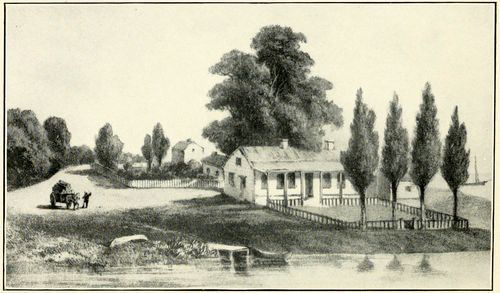
the west bank of the south branch of this river. On the north side of
the main stream, but near its junction with Lake Michigan, stood the
dwelling house and trading establishment of Mr. Kinzie.
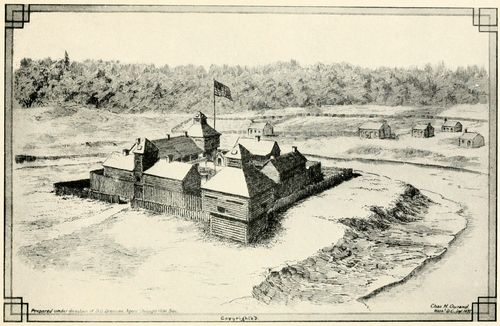
The fort was situated on the southern bank, directly opposite this
mansion, the river and a few rods of sloping green turf on either side
being all that intervened between them.
The fort was differently constructed from the one erected on the same
site in 1816. It had two blockhouses on the southern side, and on the
northern a sally port, or subterranean passage from the parade ground to
the river. This was designed to facilitate escape in case of an
emergency or as a means of supplying the garrison with water during a
siege.
In the fort at this period were three officers, Captain Heald, who was
in command, Lieutenant Helm, the son-in-law of Mr. Kinzie, and Ensign
Ronan—the last two very young men—and the surgeon, Dr. Van Voorhees.
The garrison numbered about seventy-five men, very few of whom were
effective.
A constant and friendly intercourse had been maintained between these
troops and the Indians. It is true that the principal men of the
Potowatomi nation, like those of most other tribes, went yearly to Fort
Malden, in Canada, to receive the large number of presents with which
the British Government, for many years, had been in the habit of
purchasing their alliance; and it was well known that many of the
Potowatomi, as well as Winnebago, had been engaged with the Ottawa and
Shawnee at the battle of Tippecanoe, the preceding autumn; yet, as the
principal chiefs of all the bands in the neighborhood appeared to be on
the most amicable terms with the Americans, no interruption of their
harmony was at any time anticipated.
After August 15, however, many circumstances were recalled that might
have opened the eyes of the whites had they not been blinded by a false
security. One incident in particular may be mentioned.
In the spring preceding the destruction of the fort, two Indians of the
Calumet band came to the fort on a visit to the commanding officer. As
they passed through the quarters, they saw Mrs. Heald and Mrs. Helm
playing at battledoor.
Turning to the interpreter, one of them, Nau-non-gee, remarked, "The
white chiefs' wives are amusing themselves very much; it will not be
long before they are hoeing in our cornfields!"
At the time this was considered an idle threat, or, at most, an
ebullition of jealous feeling at the contrast between the situation of
their own women and that of the "white chiefs' wives." Some months
after, how bitterly was it remembered!
The farm at Lee's Place was occupied by a Mr. White and three persons
employed by him.
In the afternoon of the day on which our narrative commences, a party of
ten or twelve Indians, dressed and painted, arrived at the house.
According to the custom among savages, they entered and seated
themselves without ceremony.
Something in their appearance and manner excited the suspicion of one of
the household, a Frenchman, who remarked, "I do not like the looks of
these Indians—they are none of our folks. I know by their dress and
paint that they are not Potowatomi."
Another of the men, a discharged soldier, then said to a boy who was
present, "If that is the case, we'd better get away from them if we can.
Say nothing; but do as you see me do."
There were two canoes tied near the bank, and the soldier walked
leisurely towards them. Some of the Indians inquired where he was going.
He pointed to the cattle standing among the haystacks on the opposite
bank, making signs that they must go and fodder them, and that they
would then return and get their supper.
As the afternoon was far advanced, this explanation was accepted without
question.
The soldier got into one canoe, and the boy into the other. The stream
was narrow, and they were soon across. Having gained the opposite side,
they pulled some hay for the cattle, made a show of herding them, and
when they had gradually made a circuit, so that their movements were
concealed by the haystacks, took to the woods, close at hand, and then
started for the fort.
They had run about a quarter of a mile when they heard two guns
discharged in succession. These guns they supposed to have been leveled
at the companions they had left.
They ran without stopping until they arrived opposite Burns',[2] where,
as before related, they called across to warn the family of their
danger, and then hastened on to the fort.
It now occurred to those who had secured their own safety that the Burns
family was still exposed to imminent peril. The question was, who would
hazard his life to bring them to a place of security? The gallant young
officer, Ensign Ronan, with a party of five or six soldiers, volunteered
to go to their rescue.
They ascended the river in a scow, took the mother, with her infant,
scarcely a day old, upon her bed to the boat, and carefully conveyed her
with the other members of the family to the fort.
The same afternoon a party of soldiers, consisting of a corporal and
six men, had obtained leave to go fishing up the river. They had not
returned when the fugitives from Lee's Place arrived at the fort. It was
now night and, fearing they might encounter the Indians, the commanding
officer ordered a cannon fired, warning them of their danger.
It will be remembered that the unsettled state of the country after the
battle of Tippecanoe, the preceding November, had rendered every man
vigilant, and the slightest alarm was an admonition to "beware of the
Indians."
At the time the cannon was fired the fishing party were about two miles
above Lee's Place. Hearing the signal, they put out their torches and
dropped down the river towards the garrison, as silently as possible.
When they reached Lee's Place, it was proposed to stop and warn the
inmates to be on their guard, as the signal from the fort indicated some
kind of danger. All was still as death around the house. The soldiers
groped their way along, and as the corporal jumped over the small
inclosure he placed his hand upon the dead body of a man. He soon
ascertained that the head was without a scalp, and otherwise mutilated.
The faithful dog of the murdered man stood guarding the lifeless remains
of his master.
The tale was told. The men retreated to their canoes, and reached the
fort unmolested about eleven o'clock at night.
The next morning a party of citizens and soldiers volunteered to go to
Lee's Place to learn further the fate of its occupants. The body of Mr.
White was found pierced by two balls, with eleven stabs in the breast.
The Frenchman also lay dead, his dog still beside him. The bodies were
brought to the fort and buried in its immediate vicinity.
Later it was learned from traders out in the Indian country that the
perpetrators of the deed were a party of Winnebago who had come into the
neighborhood to "take some white scalps." Their plan had been to proceed
down the river from Lee's Place and kill every white man outside the
walls of the fort. However, hearing the report of the cannon, and not
knowing what it portended, they thought it best to retreat to their
homes on Rock River.
The settlers outside the fort, a few discharged soldiers and some
families of half-breeds, now intrenched themselves in the Agency House.
This building stood west of the fort, between the pickets and the river,
and distant about twenty rods from the former.
It was an old-fashioned log house, with a hall running through the
center, and one large room on each side. Piazzas extended the whole
length of the building, in front and rear. These were now planked up,
for greater security; portholes were cut, and sentinels posted at night.
As the enemy were believed to be still lurking in the neighborhood, or,
emboldened by former success, were likely to return at any moment, an
order was issued prohibiting any soldier or citizen from leaving the
vicinity of the garrison without a guard.
One night a sergeant and a private, who were out on patrol, came
suddenly upon a party of Indians in the pasture adjoining the esplanade.
The sergeant fired his piece, and both retreated towards the fort.
Before they could reach it, an Indian threw his tomahawk, which missed
the sergeant and struck a wagon standing near. The sentinel from the
blockhouse immediately fired while the men got safely in. The next
morning traces of blood were found for a considerable distance into the
prairie, and from this and the appearance of the long grass, where it
was evident a body had lain, it was certain some execution had been
done.
On another occasion Indians entered the esplanade to steal horses. Not
finding any in the stable, as they had expected to, they relieved their
disappointment by stabbing all the sheep in the stable and then letting
them loose. The poor animals flocked towards the fort. This gave the
alarm. The garrison was aroused, and parties were sent out; but the
marauders escaped unmolested. The inmates of the fort experienced no
further alarm for many weeks.
On the afternoon of August 7, Winnemeg, or Catfish, a Potowatomi chief,
arrived at the post, bringing dispatches from General Hull. These
announced that war had been declared between the United States and
Great Britain, and that General Hull, at the head of the Northwestern
army, had arrived at Detroit; also, that the Island of Mackinac had
fallen into the hands of the British.
The orders to Captain Heald were to "evacuate the fort, if practicable,
and, in that event, to distribute all the United States property
contained in the fort, and in the United States factory or agency, among
the Indians in the neighborhood."
After having delivered his dispatches, Winnemeg requested a private
interview with Mr. Kinzie, who had taken up his residence in the fort.
He told Mr. Kinzie he was acquainted with the purport of the
communications he had brought, and begged him to ascertain if it were
the intention of Captain Heald to evacuate the post. He advised strongly
against such a step, inasmuch as the garrison was well supplied with
ammunition, and with provisions for six months. It would, therefore, be
far better, he thought, to remain until reinforcements could be sent.
If, however, Captain Heald should decide to leave the post, it should
by all means be done immediately. The Potowatomi, through whose country
they must pass, being ignorant of the object of Winnemeg's mission, a
forced march might be made before the hostile Indians were prepared to
interrupt them.
Of this advice, so earnestly given, Captain Heald was immediately
informed. He replied that it was his intention to evacuate the post, but
that, inasmuch as he had received orders to distribute the United States
property, he should not feel justified in leaving until he had collected
the Indians of the neighborhood and made an equitable division among
them.
Winnemeg then suggested the expediency of marching out, and leaving all
things standing; possibly while the Indians were engaged in the
partition of the spoils the troops might effect their retreat
unmolested. This advice, strongly seconded by Mr. Kinzie, did not meet
the approbation of the commanding officer.
The order to evacuate the post was read next morning upon parade. It is
difficult to understand why, in such an emergency, Captain Heald
omitted the usual form of holding a council of war with his officers. It
can be accounted for only by the fact of a want of harmonious feeling
between him and one of his junior officers, Ensign Ronan, a
high-spirited and somewhat overbearing, but brave and generous, young
man.
In the course of the day, no council having been called, the officers
waited on Captain Heald, seeking information regarding the course he
intended to pursue. When they learned his intentions, they remonstrated
with him, on the following grounds:
First, it was highly improbable that the command would be permitted to
pass through the country in safety to Fort Wayne. For although it had
been said that some of the chiefs had opposed an attack upon the fort,
planned the preceding autumn, yet it was well known that they had been
actuated in that matter by motives of personal regard for one family,
that of Mr. Kinzie, and not by any general friendly feeling towards the
Americans; and that, in any event, it was hardly to be expected that
these few individuals would be able to control the whole tribe, who were
thirsting for blood.
In the next place, their march must necessarily be slow, as their
movements must be accommodated to the helplessness of the women and
children, of whom there were a number with the detachment. Of their
small force some of the soldiers were superannuated, others invalid.
Therefore, since the course to be pursued was left discretional, their
unanimous advice was to remain where they were, and fortify themselves
as strongly as possible. Succor from the other side of the peninsula
might arrive before they could be attacked by the British from Mackinac;
and even should help not come, it were far better to fall into the hands
of the British than to become the victims of the savages.
Captain Heald argued in reply that "a special order had been issued by
the War Department that no post should be surrendered without battle
having been given, and his force was totally inadequate to an
engagement with the Indians; that he should unquestionably be censured
for remaining when there appeared a prospect of a safe march through;
and that, upon the whole, he deemed it expedient to assemble the
Indians, distribute the property among them, and then ask them for an
escort to Fort Wayne, with the promise of a considerable reward upon
their safe arrival, adding that he had full confidence in the friendly
professions of the Indians, from whom, as well as from the soldiers, the
capture of Mackinac had been kept a profound secret."
From this time the officers held themselves aloof, and spoke but little
upon the subject, though they considered Captain Heald's project little
short of madness. The dissatisfaction among the soldiers increased
hourly, until it reached a high pitch of insubordination.
On one occasion, when conversing with Mr. Kinzie upon the parade,
Captain Heald remarked, "I could not remain, even if I thought it best,
for I have but a small store of provisions."
"Why, captain," said a soldier who stood near, forgetting all etiquette
in the excitement of the moment, "you have cattle enough to last the
troops six months."
"But," replied Captain Heald, "I have no salt to preserve it with."
"Then jerk it," said the man, "as the Indians do their venison."
The Indians now became daily more unruly. Entering the fort in defiance
of the sentinels, they made their way without ceremony into the
officers' quarters. One day an Indian took up a rifle and fired it in
the parlor of the commanding officer, as an expression of defiance. Some
believed that this was intended among the young men as a signal for an
attack. The old chiefs passed backwards and forwards among the assembled
groups with the appearance of the most lively agitation, while the
squaws rushed to and fro in great excitement, evidently prepared for
some fearful scene.
Any further manifestation of ill feeling was, however, suppressed for
the time and, strange as it may seem, Captain Heald continued to
entertain a conviction of having created so amicable a disposition among
the Indians as to insure the safety of the command on their march to
Fort Wayne.
Thus passed the time until August 12. The feelings of the inmates of the
fort during this time may be better imagined than described. Each
morning that dawned seemed to bring them nearer to that most appalling
fate—butchery by a savage foe; and at night they scarcely dared yield
to slumber, lest they should be aroused by the war whoop and tomahawk.
Gloom and mistrust prevailed, and the want of unanimity among the
officers prevented the consolation they might have found in mutual
sympathy and encouragement.
The Indians being assembled from the neighboring villages, a council was
held with them on the afternoon of August 12. Captain Heald alone
attended on the part of the military. He had requested his officers to
accompany him, but they had declined. They had been secretly informed
that the young chiefs intended to fall upon the officers and massacre
them while in council, but they could not persuade Captain Heald of the
truth of their information. They waited therefore only until,
accompanied by Mr. Kinzie, he had left the garrison, when they took
command of the blockhouses overlooking the esplanade on which the
council was held, opened the portholes, and pointed the cannon so as to
command the whole assembly. By this means, probably, the lives of the
whites who were present in council were preserved.
In council, the commanding officer informed the Indians that it was his
intention to distribute among them, the next day, not only the goods
lodged in the United States factory, but also the ammunition and
provisions, with which the garrison was well supplied. He then requested
the Potowatomi to furnish him an escort to Fort Wayne, promising them,
in addition to the presents they were now about to receive, a liberal
reward on arriving there. With many professions of friendship and good
will, the savages assented to all he proposed, and promised all he
required.
After the council, Mr. Kinzie, who well understood not only the Indian
character but the present tone of feeling among them, had a long
interview with Captain Heald, in hopes of opening his eyes to the real
state of affairs.
He reminded him that since the trouble with the Indians along the Wabash
and in the vicinity, there had appeared to be a settled plan of
hostilities towards the whites, in consequence of which it had been the
policy of the Americans to withhold from the Indians whatever would
enable them to carry on their warfare upon the defenseless inhabitants
of the frontier.
Mr. Kinzie also recalled to Captain Heald how, having left home for
Detroit, the preceding autumn, on receiving news at De Charme's[3] of
the battle of Tippecanoe, he had immediately returned to Chicago, that
he might dispatch orders to his traders to furnish no ammunition to the
Indians. As a result, all the ammunition the traders had on hand was
secreted, and those traders who had not already started for their
wintering grounds took neither powder nor shot with them.
Captain Heald was struck with the inadvisability of furnishing the enemy
(for such they must now consider their old neighbors) with arms against
himself, and determined to destroy all the ammunition except what should
be necessary for the use of his own troops.
On August 13 the goods, consisting of blankets, broadcloths, calicoes,
paints, and miscellaneous supplies were distributed, as stipulated. The
same evening part of the ammunition and liquor was carried into the
sally port, and there thrown into a well which had been dug to supply
the garrison with water in case of emergency. The remainder was
transported, as secretly as possible, through the northern gate; the
heads of the barrels were knocked in, and the contents poured into the
river.
The same fate was shared by a large quantity of alcohol belonging to Mr.
Kinzie, which had been deposited in a warehouse near his residence
opposite the fort.
The Indians suspected what was going on, and crept, serpent-like, as
near the scene of action as possible; but a vigilant watch was kept up,
and no one was suffered to approach but those engaged in the affair. All
the muskets not necessary for the command on the march were broken up
and thrown into the well, together with bags of shot, flints, gunscrews;
in short, everything relating to weapons of defense.
Some relief to the general feeling of despondency was afforded by the
arrival, on August 14, of Captain Wells[4] with fifteen friendly Miami.
Of this brave man, who forms so conspicuous a figure in our frontier
annals, it is unnecessary here to say more than that he had resided from
boyhood among the Indians, and hence possessed a perfect knowledge of
their character and habits.
At Fort Wayne he had heard of the order to evacuate the fort at Chicago,
and, knowing the hostile determination of the Potowatomi, had made a
rapid march across the country to prevent the exposure of his relative,
Captain Heald, and his troops to certain destruction.
But he came "all too late." When he reached the post he found that the
ammunition had been destroyed, and the provisions given to the Indians.
There was, therefore, no alternative, and every preparation was made for
the march of the troops on the following morning.
On the afternoon of the same day a second council was held with the
Indians. They expressed great indignation at the destruction of the
ammunition and liquor. Notwithstanding the precautions that had been
taken to preserve secrecy, the noise of knocking in the heads of the
barrels had betrayed the operations of the preceding night; indeed, so
great was the quantity of liquor thrown into the river that next morning
the water was, as one expressed it, "strong grog."
Murmurs and threats were everywhere heard among the savages. It was
evident that the first moment of exposure would subject the troops to
some manifestation of their disappointment and resentment.
Among the chiefs were several who, although they shared the general
hostile feeling of their tribe towards the Americans, yet retained a
personal regard for the troops at this post and for the few white
citizens of the place. These chiefs exerted their utmost influence to
allay the revengeful feelings of the young men, and to avert their
sanguinary designs, but without effect.
On the evening succeeding the council Black Partridge, a conspicuous
chief, entered the quarters of the commanding officer.
"Father," said he, "I come to deliver up to you the medal I wear. It was
given me by the Americans, and I have long worn it in token of our
mutual friendship. But our young men are resolved to imbrue their hands
in the blood of the whites. I cannot restrain them, and I will not wear
a token of peace while I am compelled to act as an enemy."
Had further evidence been wanting, this circumstance would have
sufficiently justified the devoted band in their melancholy
anticipations. Nevertheless, they went steadily on with the necessary
preparations; and, amid the horrors of the situation there were not
wanting gallant hearts who strove to encourage in their desponding
companions the hopes of escape they themselves were far from indulging.
Of the ammunition there had been reserved but twenty-five rounds,
besides one box of cartridges, contained in the baggage wagons. This
must, under any circumstances of danger, have proved an inadequate
supply; but the prospect of a fatiguing march, in their present
ineffective state, forbade the troops embarrassing themselves with a
larger quantity.
The morning of August 15 arrived. Nine o'clock was the hour named for
starting and all things were in readiness.
Mr. Kinzie, having volunteered to accompany the troops in their march,
had intrusted his family to the care of some friendly Indians, who
promised to convey them in a boat around the head of Lake Michigan to a
point[5] on the St. Joseph River, there to be joined by the troops,
should their march be permitted.
Early in the morning Mr. Kinzie received a message from To-pee-nee-bee,
a chief of the St. Joseph band, informing him that mischief was intended
by the Potowatomi who had engaged to escort the detachment, and urging
him to relinquish his plan of accompanying the troops by land, promising
him that the boat containing his family should be permitted to pass in
safety to St. Joseph.
Mr. Kinzie declined this proposal, as he believed his presence might
restrain the fury of the savages, so warmly were the greater number of
them attached to him and his family.
Seldom does one find a man who, like John Kinzie, refuses safety for
himself in order to stand or fall with his countrymen, and who, as stern
as any Spartan, bids farewell to his dear ones to go forward to almost
certain destruction.
The party in the boat consisted of Mrs. Kinzie and her four younger
children, their nurse Josette, a clerk of Mr. Kinzie's, two servants,
and the boatmen, besides the two Indians who were to act as their
protectors. The boat started, but had scarcely reached the mouth of the
river, which, it will be recalled, was here half a mile below the fort,
when another messenger from To-pee-nee-bee arrived to detain it. There
was no mistaking the meaning of this detention.
In breathless anxiety sat the wife and mother. She was a woman of
unusual energy and strength of character, yet her heart died within her
as she folded her arms about her helpless infants and gazed upon the
march of her husband and eldest child to what seemed certain death.
As the troops left the fort, the band struck up the Dead March. On they
came, in military array, but with solemn mien, Captain Wells in the lead
at the head of his little band of Miami. He had blackened his face
before leaving the garrison, in token of his impending fate. The troops
took their route along the lake shore; but when they reached the point
where the range of sand hills intervening between the prairie and the
beach commenced, the escort of Potowatomi, in number about five hundred,
took the level of the prairie, instead of continuing along the shore
with the Americans and Miami.
They had marched perhaps a mile and a half when Captain Wells, who had
kept somewhat in advance with his Miami, came riding furiously back.
"They are about to attack us," shouted he; "form instantly, and charge
upon them."
Scarcely were the words uttered, when a volley was showered from among
the sand hills. The troops, brought hastily into line, charged up the
bank. One man, a veteran of seventy winters, fell as they ascended. The
remainder of the scene is best described in the words of an eyewitness
and participator in the tragedy, Mrs. Helm,[6] the wife of Captain (then
Lieutenant) Helm, and stepdaughter of Mr. Kinzie.
"After we had left the bank the firing became general. The Miami fled at
the outset. Their chief rode up to the Potowatomi, and said: 'You have
deceived us and the Americans. You have done a bad action, and
(brandishing his tomahawk) I will be the first to head a party of
Americans to return and punish your treachery.' So saying, he galloped
after his companions, who were now scurrying across the prairies.
"The troops behaved most gallantly. They were but a handful, but they
seemed resolved to sell their lives as dearly as possible. Our horses
pranced and bounded, and could hardly be restrained as the balls
whistled among them. I drew off a little, and gazed upon my husband and
father, who were yet unharmed. I felt that my hour was come, and
endeavored to forget those I loved, and prepare myself for my
approaching fate.
"While I was thus engaged, the surgeon, Dr. Van Voorhees, came up. He
was badly wounded. His horse had been shot under him, and he had
received a ball in his leg. Every muscle of his face was quivering with
the agony of terror. He said to me, 'Do you think they will take our
lives? I am badly wounded, but I think not mortally. Perhaps we might
purchase our lives by promising them a large reward. Do you think there
is any chance?'
"'Dr. Van Voorhees,' said I, 'do not let us waste the moments that yet
remain to us in such vain hopes. Our fate is inevitable. In a few
moments we must appear before the bar of God. Let us make what
preparation is yet in our power.'
"'Oh, I cannot die!' exclaimed he, 'I am not fit to die—if I had but a
short time to prepare—death is awful!'
"I pointed to Ensign Ronan, who, though mortally wounded and nearly
down, was still fighting with desperation on one knee.[7]
"'Look at that man!' said I. 'At least he dies like a soldier.'
"'Yes,' replied the unfortunate surgeon, with a convulsive gasp, 'but he
has no terrors of the future—he is an atheist.'
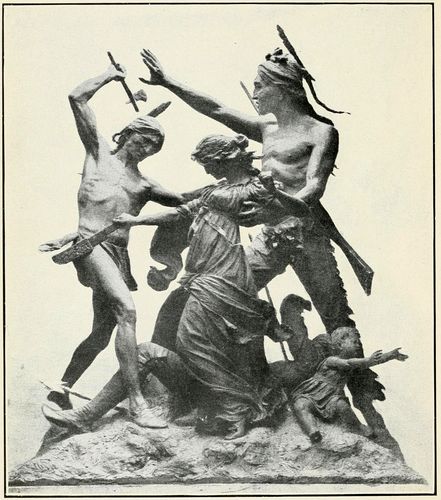
"At this moment a young Indian raised his tomahawk over me. Springing
aside, I partially avoided the blow, which, intended for my skull, fell
on my shoulder. I seized the Indian around the neck, and while exerting
my utmost strength to get possession of his scalping-knife, hanging in a
scabbard over his breast, I was dragged from his grasp by another and
older Indian.
"The latter bore me struggling and resisting towards the lake. Despite
the rapidity with which I was hurried along, I recognized, as I passed,
the lifeless remains of the unfortunate surgeon. Some murderous tomahawk
had stretched him upon the very spot where I had last seen him.
"I was immediately plunged into the water and held there with a forcible
hand, notwithstanding my resistance. I soon perceived, however, that the
object of my captor was not to drown me, for he held me firmly in such a
position as to keep my head above water. This reassured me, and,
regarding him attentively, I soon recognized, in spite of the paint with
which he was disguised, the Black Partridge.
"When the firing had nearly subsided, my preserver bore me from the
water and conducted me up the sand banks. It was a burning August
morning, and walking through the sand in my drenched condition was
inexpressibly painful and fatiguing. I stooped and took off my shoes to
free them from the sand with which they were nearly filled, when a squaw
seized and carried them off, and I was obliged to proceed without them.
"When we had gained the prairie, I was met by my father, who told me
that my husband was safe and but slightly wounded. I was led gently back
towards the Chicago River, along the southern bank of which was the
Potowatomi encampment. Once I was placed upon a horse without a saddle,
but, finding the motion insupportable, I sprang off. Assisted partly by
my kind conductor, Black Partridge, and partly by another Indian,
Pee-so-tum, who held dangling in his hand a scalp which by the black
ribbon around the queue I recognized as that of Captain Wells, I dragged
my fainting steps to one of the wigwams.
"The wife of Wau-bee-nee-mah, a chief from the Illinois River, was
standing near. Seeing my exhausted condition, she seized a kettle,
dipped up some water from a stream that flowed near,[8] threw into it
some maple sugar, and, stirring it with her hand, gave it to me to
drink. This act of kindness, in the midst of so many horrors, touched me
deeply. But my attention was soon diverted to other things.
"The fort, since the troops marched out, had become a scene of plunder.
The cattle had been shot as they ran at large, and lay about, dead or
dying. This work of butchery had commenced just as we were leaving the
fort. I vividly recalled a remark of Ensign Ronan, as the firing went
on. 'Such,' turning to me, 'is to be our fate—to be shot down like
brutes!'
"'Well, sir,' said the commanding officer, who overheard him, 'are you
afraid?'
"'No,' replied the high-spirited young man, 'I can march up to the enemy
where you dare not show your face.' And his subsequent gallant behavior
showed this was no idle boast.
"As the noise of the firing grew gradually fainter and the stragglers
from the victorious party came dropping in, I received confirmation of
what my father had hurriedly communicated in our meeting on the lake
shore: the whites had surrendered, after the loss of about two thirds of
their number. They had stipulated, through the interpreter, Peresh
Leclerc, that their lives and those of the remaining women and children
be spared, and that they be delivered in safety at certain of the
British posts, unless ransomed by traders in the Indian country. It
appears that the wounded prisoners were not considered as included in
the stipulation, and upon their being brought into camp an awful scene
ensued.
"An old squaw, infuriated by the loss of friends, or perhaps excited by
the sanguinary scenes around her, seemed possessed by a demoniac
ferocity. Seizing a stable fork she assaulted one miserable victim,
already groaning and writhing in the agony of wounds aggravated by the
scorching beams of the sun. With a delicacy of feeling scarcely to have
been expected under such circumstances, Wau-bee-nee-mah stretched a mat
across two poles, between me and this dreadful scene. I was thus in
some degree shielded from its horrors, though I could not close my ears
to the cries of the sufferer. The following night five more of the
wounded prisoners were tomahawked."
After the first attack, it appears the Americans charged upon a band of
Indians concealed in a sort of ravine between the sand banks and the
prairie. The Indians gathered together, and after hard fighting, in
which the number of whites was reduced to twenty-eight, their band
succeeded in breaking through the enemy and gaining a rise of ground not
far from Oak Woods. Further contest now seeming hopeless, Lieutenant
Helm sent Peresh Leclerc, the half-breed boy in the service of Mr.
Kinzie, who had accompanied the troops and fought manfully on their
side, to propose terms of capitulation. It was stipulated, as told in
Mrs. Helm's narrative, that the lives of all the survivors should be
spared, and a ransom permitted as soon as practicable.
But in the meantime horrible scenes had indeed been enacted. During the
engagement near the sand hills one young savage climbed into the baggage
wagon which sheltered the twelve children of the white families, and
tomahawked the entire group. Captain Wells, who was fighting near,
beheld the deed, and exclaimed:
"Is that their game, butchering the women and children? Then I will
kill, too!"
So saying, he turned his horse's head and started for the Indian camp,
near the fort, where the braves had left their squaws and children.
Several Indians followed him as he galloped along. Lying flat on the
neck of his horse, and loading and firing in that position, he turned
occasionally on his pursuers. But at length their balls took effect,
killing his horse, and severely wounding the Captain. At this moment he
was met by Winnemeg and Wau-ban-see, who endeavored to save him from the
savages who had now overtaken him. As they helped him along, after
having disengaged him from his horse, he received his deathblow from
Pee-so-tum, who stabbed him in the back.
The heroic resolution shown during the fight by the wife of one of the
soldiers, a Mrs. Corbin, deserves to be recorded. She had from the first
expressed the determination never to fall into the hands of the savages,
believing that their prisoners were invariably subjected to tortures
worse than death.
When, therefore, a party came upon her to make her prisoner, she fought
with desperation, refusing to surrender, although assured, by signs, of
safety and kind treatment. Literally, she suffered herself to be cut to
pieces, rather than become their captive.
There was a Sergeant Holt, who early in the engagement received a ball
in the neck. Finding himself badly wounded, he gave his sword to his
wife, who was on horseback near him, telling her to defend herself. He
then made for the lake, to keep out of the way of the balls.
Mrs. Holt rode a very fine horse, which the Indians were desirous of
possessing, and they therefore attacked her in the hope of dismounting
her. They fought only with the butt ends of their guns, for their
object was not to kill her. She hacked and hewed at their pieces as they
were thrust against her, now on this side, now that. Finally, she broke
loose and dashed out into the prairie, where the Indians pursued her,
shouting and laughing, and now and then calling out, "The brave woman!
do not hurt her!"
At length they overtook her, and while she was engaged with two or three
in front, one succeeded in seizing her by the neck from behind, and in
dragging her from her horse, large and powerful woman though she was.
Notwithstanding their guns had been so hacked and injured, and they
themselves severely cut, her captors seemed to regard her only with
admiration. They took her to a trader on the Illinois River, who showed
her every kindness during her captivity, and later restored her to her
friends.
Meanwhile those of Mr. Kinzie's family who had remained in the boat,
near the mouth of the river, were carefully guarded by Kee-po-tah and
another Indian. They had seen the smoke, then the blaze, and immediately
after, the report of the first tremendous discharge had sounded in
their ears. Then all was confusion. They knew nothing of the events of
the battle until they saw an Indian coming towards them from the battle
ground, leading a horse on which sat a lady, apparently wounded.
"That is Mrs. Heald," cried Mrs. Kinzie. "That Indian will kill her.
Run, Chandonnai," to one of Mr. Kinzie's clerks, "take the mule that is
tied there, and offer it to him to release her."
Mrs. Heald's captor, by this time, was in the act of disengaging her
bonnet from her head, in order to scalp her. Chandonnai ran up and
offered the mule as a ransom, with the promise of ten bottles of whisky
as soon as they should reach his village. The whisky was a strong
temptation.
"But," said the Indian, "she is badly wounded—she will die. Will you
give me the whisky at all events?"
Chandonnai promised that he would, and the bargain was concluded. The
savage placed the lady's bonnet on his own head, and, after an
ineffectual effort on the part of some squaws to rob her of her shoes
and stockings, she was brought on board the boat, where she lay moaning
with pain from the many bullet wounds in her arms.
Having wished to possess themselves of her horse uninjured, the Indians
had aimed their shots so as to disable the rider, without in any way
harming her steed.
Mrs. Heald had not lain long in the boat when a young Indian of savage
aspect was seen approaching. A buffalo robe was hastily drawn over her,
and she was admonished to suppress all sound of complaint, as she valued
her life.
The heroic woman remained perfectly silent while the savage drew near.
He had a pistol in his hand, which he rested on the side of the boat,
while, with a fearful scowl, he looked pryingly around. Black Jim, one
of the servants, who stood in the bow of the boat, seized an ax that lay
near and signed to him that if he shot he would cleave his skull,
telling him that the boat contained only the family of Shaw-nee-aw-kee.
Upon this, the Indian retired. It afterwards appeared that the object
of his search was Mr. Burnett, a trader from St. Joseph with whom he had
some account to settle.
When the boat was at length permitted to return to the house of Mr.
Kinzie, and Mrs. Heald was removed there, it became necessary to dress
her wounds.
Mr. Kinzie applied to an old chief who stood by, and who, like most of
his tribe, possessed some skill in surgery, to extract a ball from the
arm of the sufferer.
"No, father," replied the Indian. "I cannot do it—it makes me sick
here," placing his hand on his heart.
Mr. Kinzie himself then performed the operation with his penknife.
At their own house, the family of Mr. Kinzie were closely guarded by
their Indian friends, whose intention it was to carry them to Detroit
for security. The rest of the prisoners remained at the wigwams of their
captors.
On the following morning, the work of plunder being completed, the
Indians set fire to the fort. A very equitable distribution of the
finery appeared to have been made, and shawls, ribbons, and feathers
fluttered about in all directions. The ludicrous appearance of one young
fellow arrayed in a muslin gown and a lady's bonnet would, under other
circumstances, have been a matter of great amusement.
Black Partridge, Wau-ban-see, and Kee-po-tah, with two other Indians,
established themselves in the porch of the Kinzie house as sentinels, to
protect the family from any evil that the young men might be incited to
commit, and all remained tranquil for a short space after the
conflagration.
Very soon, however, a party of Indians from the Wabash made their
appearance. These were, decidedly, the most hostile and implacable of
all the tribes of the Potowatomi.
Being more remote, they had shared less than some of their brethren in
the kindness of Mr. Kinzie and his family, and consequently their
friendly regard was not so strong.
Runners had been sent to the villages to apprise these Indians of the
intended evacuation of the post, as well as of the plan to attack the
troops.
Thirsting to participate in such an event, they had hurried to the
scene, and great was their mortification, on arriving at the river Aux
Plaines, to meet a party of their friends with their chief,
Nee-scot-nee-meg, badly wounded, and learn that the battle was over, the
spoils divided, and the scalps all taken. Arriving at Chicago they
blackened their faces, and proceeded toward the dwelling of Mr. Kinzie.
From his station on the piazza Black Partridge had watched their
approach, and his fears were particularly awakened for the safety of
Mrs. Helm, Mr. Kinzie's stepdaughter, who had recently come to the post,
and was personally unknown to the more remote Indians. By his advice she
was made to assume the ordinary dress of a Frenchwoman of the country—a
short gown and petticoat with a blue cotton handkerchief wrapped around
her head. In this disguise she was conducted by Black Partridge himself
to the house of Ouilmette, a Frenchman with a half-breed wife, who
formed a part of the establishment of Mr. Kinzie and whose dwelling was
close at hand.
It so happened that the Indians came first to this house in their search
for prisoners. As they approached, the inmates, fearful that the fair
complexion and general appearance of Mrs. Helm might betray her as an
American, raised a large feather bed and placed her under the edge of it
upon the bedstead, with her face to the wall. Mrs. Bisson, a half-breed
sister of Ouilmette's wife, then seated herself with her sewing upon the
front of the bed.
It was a hot day in August, and the feverish excitement of fear and
agitation, together with her position, which was nearly suffocating,
became so intolerable that Mrs. Helm at length entreated to be released
and given up to the Indians.
"I can but die," said she; "let them put an end to my misery at once."
Mrs. Bisson replied, "Your death would be the destruction of us all, for
Black Partridge has resolved that if one drop of the blood of your
family is spilled, he will take the lives of all concerned in it, even
his nearest friends; and if once the work of murder commences, there
will be no end of it, so long as there remains one white person or
half-breed in the country."
This expostulation nerved Mrs. Helm with fresh courage.
The Indians entered, and from her hiding place she could occasionally
see them gliding about and stealthily inspecting every part of the room,
though without making any ostensible search, until, apparently satisfied
that there was no one concealed, they left the house.
All this time Mrs. Bisson had kept her seat upon the side of the bed,
calmly sorting and arranging the patchwork of the quilt on which she was
engaged, and preserving an appearance of the utmost tranquillity,
although she knew not but that the next moment she might receive a
tomahawk in her brain. Her self-command unquestionably saved the lives
of all who were present.
From Ouilmette's house the party of Indians proceeded to the dwelling of
Mr. Kinzie. They entered the parlor in which the family were assembled
with their faithful protectors, and seated themselves upon the floor, in
silence.
Black Partridge perceived from their moody and revengeful looks what was
passing in their minds, but he dared not remonstrate with them. He only
observed in a low tone to Wau-ban-see, "We have endeavored to save our
friends, but it is in vain—nothing will save them now."
At this moment a friendly whoop was heard from a party of newcomers on
the opposite bank of the river. As the canoes in which they had hastily
embarked touched the bank near the house, Black Partridge sprang to meet
their leader.
"Who are you?" demanded he.
"A man. Who are you?"
"A man like yourself. But tell me who you are,"—meaning, Tell me your
disposition, and which side you are for.
"I am a Sau-ga-nash!"
"Then make all speed to the house—your friend is in danger, and you
alone can save him."
Billy Caldwell,[9] for it was he, entered the parlor with a calm step,
and without a trace of agitation in his manner. He deliberately took off
his accouterments and placed them with his rifle behind the door, then
saluted the hostile savages.
"How now, my friends! A good day to you. I was told there were enemies
here, but I am glad to find only friends. Why have you blackened your
faces? Is it that you are mourning for the friends you have lost in
battle?" purposely misunderstanding this token of evil designs. "Or is
it that you are fasting? If so, ask our friend, here, and he will give
you to eat. He is the Indian's friend, and never yet refused them what
they had need of."
Thus taken by surprise, the savages were ashamed to acknowledge their
bloody purpose. They, therefore, said modestly that they had come to beg
of their friends some white cotton in which to wrap their dead before
interring them. This was given to them, with some other presents, and
they peaceably took their departure from the premises.
With Mr. Kinzie's party was a non-commissioned officer who had made his
escape in a singular manner. As the troops had been about to leave the
fort, it was found that the baggage horses of the surgeon had strayed
off. The quartermaster sergeant, Griffith, was sent to find and bring
them on, it being absolutely necessary to recover them, since their
packs contained part of the surgeon's apparatus and the medicines for
the march.
For a long time Griffith had been on the sick report and for this reason
was given charge of the baggage, instead of being placed with the
troops. His efforts to recover the horses proved unsuccessful, and,
alarmed at certain appearances of disorder and hostile intention among
the Indians, he was hastening to rejoin his party when he was met and
made prisoner by To-pee-nee-bee.
Having taken his arms and accouterments from him, the chief put him
into a canoe and paddled him across the river, bidding him make for the
woods and secrete himself. This Griffith did; and in the afternoon of
the following day, seeing from his lurking place that all appeared
quiet, he ventured to steal cautiously into Ouilmette's garden, where he
concealed himself for a time behind some currant bushes.
At length he determined to enter the house, and accordingly climbed up
through a small back window into the room where the family were,
entering just as the Wabash Indians had left the house of Ouilmette for
that of Mr. Kinzie. The danger of the sergeant was now imminent. The
family stripped him of his uniform and arrayed him in a suit of
deerskin, with belt, moccasins, and pipe, like a French engagé. His
dark complexion and heavy black whiskers favored the disguise. The
family were all ordered to address him in French, and, although utterly
ignorant of this language, he continued to pass for a
Weem-tee-gosh,[10] and as such remained with Mr. Kinzie and his
family, undetected by his enemies, until they reached a place of
safety.
On the third day after the battle, Mr. Kinzie and his family, with the
clerks of the establishment, were put into a boat, under the care of
François, a half-breed interpreter, and conveyed to St. Joseph, where
they remained until the following November, under the protection of
To-pee-nee-bee's band. With the exception of Mr. Kinzie they were then
conducted to Detroit, under the escort of Chandonnai and their trusty
Indian friend, Kee-po-tah, and delivered as prisoners of war to Colonel
McKee, the British Indian Agent.
Mr. Kinzie himself was held at St. Joseph and did not succeed in
rejoining his family until some months later. On his arrival at Detroit
he was paroled by General Proctor.
Lieutenant Helm, who was likewise wounded, was carried by some friendly
Indians to their village on the Au Sable and thence to Peoria, where he
was liberated through the intervention of Mr. Thomas Forsyth, the half
brother of Mr. Kinzie. Mrs. Helm accompanied her parents to St. Joseph,
where they resided for several months in the family of Alexander
Robinson,[11] receiving from them all possible kindness and hospitality.
Later Mrs. Helm was joined by her husband in Detroit, where they both
were arrested by order of the British commander, and sent on horseback,
in the dead of winter, through Canada to Fort George on the Niagara
frontier. When they arrived at that post, there had been no official
appointed to receive them, and, notwithstanding their long and fatiguing
journey in the coldest, most inclement weather, Mrs. Helm, a delicate
woman of seventeen years, was permitted to sit waiting in her saddle,
outside the gate, for more than an hour, before the refreshment of fire
or food, or even the shelter of a roof, was offered her. When Colonel
Sheaffe, who was absent at the time, was informed of this brutal
inhospitality, he expressed the greatest indignation. He waited on Mrs.
Helm immediately, apologized in the most courteous manner, and treated
both her and Lieutenant Helm with the greatest consideration and
kindness, until, by an exchange of prisoners, they were liberated and
found means of reaching their friends in Steuben County, N. Y.
Captain and Mrs. Heald were sent across the lake to St. Joseph the day
after the battle. The Captain had received two wounds in the engagement,
his wife seven.
Captain Heald had been taken prisoner by an Indian from the Kankakee,
who had a strong personal regard for him, and who, when he saw Mrs.
Heald's wounded and enfeebled state, released her husband that he might
accompany her to St. Joseph. To the latter place they were accordingly
carried by Chandonnai and his party. In the meantime, the Indian who had
so nobly released his prisoner returned to his village on the Kankakee,
where he had the mortification of finding that his conduct had excited
great dissatisfaction among his band. So great was the displeasure
manifested that he resolved to make a journey to St. Joseph and reclaim
his prisoner.
News of his intention being brought to To-pee-nee-bee and Kee-po-tah,
under whose care the prisoners were, they held a private council with
Chandonnai, Mr. Kinzie, and the principal men of the village, the result
of which was a determination to send Captain and Mrs. Heald to the
Island of Mackinac and deliver them up to the British.
They were accordingly put in a bark canoe, and paddled by Robinson and
his wife a distance of three hundred miles along the coast of Michigan,
and surrendered as prisoners of war to the commanding officer at
Mackinac.
As an instance of Captain Heald's procrastinating spirit it may be
mentioned that, even after he had received positive word that his Indian
captor was on the way from the Kankakee to St. Joseph to retake him, he
would still have delayed at that place another day, to make preparation
for a more comfortable journey to Mackinac.
The soldiers from Fort Dearborn, with their wives and surviving
children, were dispersed among the different villages of the Potowatomi
upon the Illinois, Wabash, and Rock rivers, and at Milwaukee, until the
following spring, when the greater number of them were carried to
Detroit and ransomed.
Mrs. Burns, with her infant, became the prisoner of a chief, who carried
her to his village and treated her with great kindness. His wife, from
jealousy of the favor shown to "the white woman" and her child, always
treated them with great hostility. On one occasion she struck the infant
with a tomahawk, and barely failed in her attempt to put it to
death.[12] Mrs. Burns and her child were not left long in the power of
the old squaw after this demonstration, but on the first opportunity
were carried to a place of safety.
The family of Mr. Lee had resided in a house on the lake shore, not far
from the fort. Mr. Lee was the owner of Lee's Place, which he cultivated
as a farm. It was his son who had run down with the discharged soldier
to give the alarm of "Indians," at the fort, on the afternoon of April
7. The father, the son, and all the other members of the family except
Mrs. Lee and her young infant had fallen victims to the Indians on
August 15. The two survivors were claimed by Black Partridge, and
carried by him to his village on the Au Sable. He had been particularly
attached to a little twelve-year-old girl of Mrs. Lee's. This child had
been placed on horseback for the march; and, as she was unaccustomed to
riding, she was tied fast to the saddle, lest she should slip or be
thrown off.
She was within reach of the balls at the commencement of the engagement,
and was severely wounded. The horse, setting off at a full gallop,
partly threw her; but held fast by the bands which confined her, she
hung dangling as the animal ran wildly about. In this state she was met
by Black Partridge, who caught the horse and disengaged the child from
the saddle. Finding her so badly wounded that she could not recover, and
seeing that she was in great agony, he at once put an end to her pain
with his tomahawk. This, he afterwards said, was the hardest thing he
had ever done, but he did it because he could not bear to see the child
suffer.
Black Partridge soon became warmly attached to the mother—so much so,
that he wished to marry her; and, though she very naturally objected, he
continued to treat her with the greatest respect and consideration. He
was in no hurry to release her, for he was still in hopes of prevailing
upon her to become his wife. In the course of the winter her child fell
ill. Finding that none of the remedies within their reach was effectual,
Black Partridge proposed to take the little one to Chicago, to a French
trader then living in the house of Mr. Kinzie, and procure medical aid
from him. Wrapping up his charge with the greatest care, he set out on
his journey.
Arriving at the residence of M. Du Pin, he entered the room where the
Frenchman was, and carefully placed his burden on the floor.
"What have you there?" asked M. Du Pin.
"A young raccoon, which I have brought you as a present," was the reply;
and, opening the pack, he showed the little sick infant.
When the trader had prescribed for the child, and Black Partridge was
about to return to his home, he told his friend of the proposal he had
made to Mrs. Lee to become his wife, and the manner in which it had been
received.
M. Du Pin entertained some fear that the chief's honorable resolution to
allow the lady herself to decide whether or not to accept his addresses
might not hold out, and at once entered into a negotiation for her
ransom. So effectually were the good feelings of Black Partridge wrought
upon that he consented to bring his fair prisoner to Chicago
immediately, that she might be restored to her friends.
Whether the kind trader had at the outset any other feeling in the
matter than sympathy and brotherly kindness, we cannot say; we only know
that in course of time Mrs. Lee became Madame Du Pin, and that the
worthy couple lived together in great happiness for many years after.
The fate of Nau-non-gee, a chief of the Calumet village, deserves to be
recorded.
During the battle of August 15, the principal object of his attack was
one Sergeant Hays, a man from whom he had accepted many kindnesses.
After Hays had received a ball through the body, this Indian ran up to
tomahawk him, when the sergeant, summoning his remaining strength,
pierced him through the body with his bayonet. The two fell together.
Other Indians running up soon dispatched Hays, and not until then was
his bayonet extracted from the body of his adversary.
After the battle the wounded chief was carried to his village on the
Calumet, where he survived for several days. Finding his end
approaching, he called together his young men, and enjoined them, in the
most solemn manner, to regard the safety of their prisoners after his
death, and out of respect to his memory to take the lives of none of
them; for he himself fully deserved his fate at the hands of the man
whose kindness he had so ill requited.