Effingham
"I'll take that change now," whispered the porter,
nudging Wyeth, as he lay trying to sleep, as the train
roared westward toward Effingham, the iron city, and
greatest industrial southern center.
Raising up, he reached in his pocket while yet half
asleep, and handed the porter two dollars. "I paid fifty
cents for the ticket to Spruceville, as you know, and the
charge was to be two fifty?" The other nodded, and
pocketing the money, he melted away noiselessly.
A few hours later, Wyeth raised the shade and peered
out. The train was flying through a valley, that spread
away from either side of the single track, smooth and
unobstructed, except for comfortable farm homes, set
back from the roads. He looked back in the seat behind
him, observed young Hatfield, whom he was bringing
with him, dozing peacefully. Then he looked toward the
front of the car for the first time, and observed another
with whom he had become acquainted in Attalia. He
had never learned his name, in fact, he had never inquired
it; but, since the other possessed such long legs, and was
tall and good-natured into the bargain, he had called him
Legs, which had brought no objection on the part of the
other. And it is by that name we shall follow him in
this story.
"Hello, there!" he greeted cordially, when their eyes
met. "And where did you get on and call yourself
going?"
"Hello, Books!" the other returned, as cordially.
He rose from his seat, shook himself as if to start the
blood, jumped about for a moment, rubbed his face, and
then came back to where Wyeth was and sat down.
"Say," he cried, "a little liquah'd go good right now,
wouldn't it? I had some, but like a pig I emptied the
bottle last night. Oh, yes," he cried suddenly, "I'm
going to Chicago. Where are you going?"
"To Effingham; but I wish I were on the way for old
Chi' along with you," said Wyeth. The other smiled
blandly, stretched his long legs in the isle, then got up,
went to the end of the car and looked around for a cup
out of which to drink; and, of course, not finding any,
he lifted the lid of the cooler, turned it over, and finding
it had a disk, drew it full and drank from it. Replacing
it, he came back and reseated himself. Since we shall
become quite familiar with him, and very shortly, a
description is quite necessary.
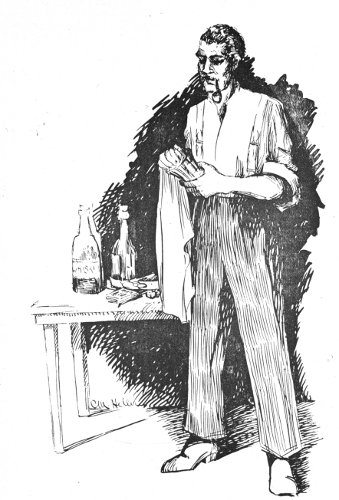
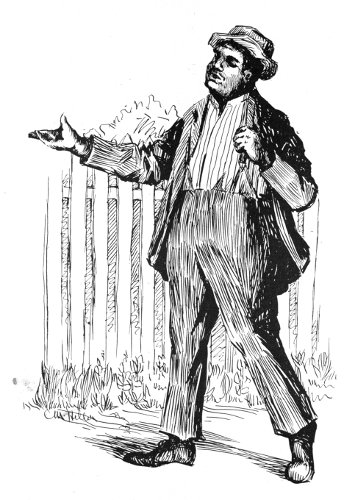
He was tall, over six feet, and a mulatto. His shoulders
were broad, while his chest was thin and flat. His head
was small, and straight up from his back, while he possessed
a pair of small ears that fitted closely and oddly
against his head—so oddly that, when one observed him
at a glance, he reminded one of an elf. He appeared to
be smiling always, although there was no great depth in
the same. His eyes were small, and danced about playfully
in his head, while his hips were arched and broad,
between which was a full stomach which made him
resemble a pickaninny.
"You see, it's like this," he began confidentially. He
lowered his voice almost to a whisper, and held his mouth
close to Wyeth's ear. "The reason you did not see me
when we left Attalia last night, was because I had the
porter lock me in the lavatory. I didn't come through
the gate at the station, but went out to the yards where
he concealed me. When the train was out of the town,
I came out; but you were reading and didn't look up,
when I came out and took that seat."
Wyeth observed him now wonderingly. He could not
understand this unconventional manner of boarding a
passenger train. He was not, however, left long in doubt.
In fact, before he could give words to the question his
eyes asked, the other enlightened him:
"I's havin' a little game Sunday night, and the bulls
run in on me." It was now all clear to Wyeth. He
recalled the other's occupation. He had become acquainted
with him through "Spoon," and recalled that
he kept a rooming house for questionable purposes. In
addition to this, he sold liquor, and ran a game on Saturday
nights and Sundays—or any time a crowd gathered
with enough money to start.
"M-m. Did they arrest you?"
"No; that is what I's goin' t' tell. I got away; but
they got the rest of the bunch, every damn last one of
them, the fools! You see," he explained, warming to
the narrative, "it was not altogether my fault. It was
like this: I had a nigga watching, that is, I had him
hired to watch, but the d——n fool was a whiskey head,
and had t' have a drink eve' ten minutes, claiming, of
course, that it was necessary that he have plenty of
booze t' keep himself awake."
Wyeth laughed quietly.
"Well, I was 'head a the game and winning right
along, and didn't give a damn; so I fed him all he could
pour down. The result of this was that he got good and
full by and by, went off t' sleep, and the bulls walked
right in on us without a word of warning.
"We were shooting craps on the bed, and the game was
going along nicely. I was sitting at the head holding the
lamp, and getting the cuts. At least fifteen dollars was
in the betting, when, on hearing a slight noise to my back
like some one creeping, I looked around—and, man! The
room was full of bulls with dark lanterns, which they at
that moment flashed upon us!
"I didn't know what to do for a moment. 'Up with
yu' hands, niggers!' they cried. All the shines looked
then into the barrels of a bunch a-guns. 'Don't try no
monkey business there, you big nigger,' the sargent cried,
as he observed me shifting about. All the time, though,
I was edging toward a place I knew none ov'm didn't see.
Suddenly, I drops the lamp, and there is some tall cussin'.
A little pup—I think he was a sup'—put a star on the
back of my head"—he turned and Wyeth saw it. "I
staggered about now like I was knocked out. They were
all over us now, a-hand cuffin' the nigga's like a lot of
cattle with halters. By this time I see's my way clear t'
make this break. One sucker spots me and cries: 'Look
out! That big nigga!' But they were too late. I had
my hand on the knob of a door that none ov'm have
seen; and, swinging it open quickly, I ducked out. As I
did so, one of the bulls takes a shot at me, but missed.
He was determined to have me, though, if possible, so
he comes after me in a hurry. That's where I am wise
and he wasn't. There is a fence a few feet from the
door, that he didn't see. Out he came after me in a
blind fury, and, 'bing!' He ran full into the fence, and
knocked the wind out of himself. I saw my chance.
I was mad and scared now, too; so I rushed upon him
while he was staggering about and 'bingo!' I landed on
him, and knocked him cold. Then I 'beat' it. I had his
gun and club and 'peeper,' and I flew. Out the back
way I went like a race horse. In the rear, two or three
bulls were a-workin' over this bull that I done knocked
stiff. I entered the alley, and ran until I reached Bell
street. An onry bunch of dogs kept barking away at me
as I hurried along, and kept me scared, because I's
afraid I'd be located by other bulls. I ran down one, a
little pug-nosed bull. He was game and tried to bite.
I reached down and got'm by the head, whirled him over
my shoulder three or four times, and when I turned him
loose, he landed beside a second story window, and fell
to the ground a dead dog, I didn't try to see. I then
began to jump fences. I bet I jumped a dozen fences,
and then got hung on the last one, which held my shirt.
I fell off at last, and liked to have bust open. My face
was bleeding, and my head, while my shirt was soaked.
I looked like the devil. I at last tore off the shirt, and
tried to tie up my head, then went to my brother-in-law's."
"Gee!" exclaimed Sidney, "but you certainly had
some experience!"
"Aw, man, I done some runnin', believe me!" he
declared, and looked grim.
"They had plenty a-liquah—the bootlegs, too—, so's
soon's I's cleaned up with my head bathed and a clean
shirt, I took a few drinks, and went to bed, feeling all
right.
"I laid around town hid away, until he could slip me
my clothes and a few dollars. So I happened to know
this porter, and arranged to come over tonight, and here
I am," and he breathed a sigh of relief.
"How did those they arrested come out, and how come
the cops to be next to your little game?" Wyeth inquired,
casually.
"Oh, yes," cried Legs. "I forget to tell you that part
of it. You see, there was a guy in the crowd—or had
been, rather, whose wife didn't want him to gamble.
Now he came down there and lost what little he had, and
went home drunk. His wife, of course, learned that he
had lost his money, and got sore. He was a damned
tramp, and told her the whole story, with tears, perhaps,
and you know a nigga with tears, so she went and put
the cops next.
"Now 'bout them other shines—the ones who got
arrested—they came before Judge Loyal's the next
morning, and got ten seventy-five each."
"I thought it was fifteen seventy-five for gaming."
"They were let off lighter, owing to the fact that I was
not brought. If they'd a caught me, it would have been
fifteen seventy-five for them, and about a hundred for me."
Wyeth laughed amusedly.
"You don't gamble or drink liquah, either, do you?"
he asked, and then answered his own question. "No, I
know you don't. You're lucky for using such common
sense. It doesn't pay, even if four nigga's out-a five do.
Yeh," he went on wearily, "only the straight and narrow
path leads to happiness in the long run," and with that
he turned on his side, and went to sleep.
"Say," he cried suddenly, raising up, "what did you
pay?" Then looked around quickly to see if he had been
overheard.
"Two and a half," the other replied. "How much
did you?"
Legs held up two fingers. "I told'm 't'was all I had,
and I didn't have but a precious little more."
"Are you acquainted with any one in Chicago?"
Wyeth inquired.
"Aw, yeh, a plenty; but I am not going on through
now. I'm going to stop in Effingham for a while, it
depends."
"Hello, Red," cried young Hatfield, coming up now,
rubbing his half closed eyes. "I see you got out all
right."
"Say, man!" cried Legs. "Didn't I get out of that
thing in luck?"
"Bet your life on that you did," commented Hatfield.
"If they'd have gotten you, the devil would have been
to pay." He laughed a low, hard laugh, and then added:
"Those church people have had their eyes on your
place for some time, and the chances are if you had
been caught, they'd have appeared against you."
"They certainly put old Jack Bell out of business
proper," Legs commented, thoughtfully. "That old
nigga conducted such a rotten dump and tiger, though;
and all those dirty little girls around on top of it, I don't
wonder."
"Wonder whether he had any money left when they
got through with him?" Hatfield inquired.
"Hard to tell," said Legs. "They fined him out of
hundreds, that I do know."
By this time, the train was entering the city. From
the car could be seen an incomplete mass of varied buildings,
little shacks that faced alleys, and at the front of
which played dozens of little unbleached pickaninnies.
Wyeth viewed the city as the train crept slowly along,
and his impression did not agree with what he had
gathered from reading of it. It was not, he felt positive,
the city Attalia was, although claiming almost an equal
number of people.
"You see those two brick cupola's extending into the
air?" he heard Hatfield saying. "That's a Negro Baptist
church." He was mistaken, however, for the same
proved to be the large, new station, the pride of the city.
Soon the train rolled into this, and a few minutes
later, they stood in the waiting room.
"It's going to cost like the dickens to get all these
grips of your hauled," said Hatfield, with a frown.
"Only had to pay thirty-five cents to get them to the
depot in Attalia." He walked to the lower end of the
platform, and began a series of inquiries relative to the
hauling of the same. He soon came upon an express
man, who agreed to unload them for fifty cents, at where-ever
they found a room.
The three walked down a level street, paved with
brick. On either side a lot of houses appeared behind a
row of trees, dense with foliage. It was a calm, soft
morning, and the sun, red and glorious, was just peeping
out of the east. The street they followed led from the
depot into the business section. Perhaps eight blocks
ahead of them, several buildings of extraordinary height,
stood outlined far above those about them. Wyeth
counted the windows of two, and found them to total
sixteen.
"There are two or three buildings here higher than
any in Attalia," said Hatfield, following his gaze. "I
think the ones you have been noticing, are twenty-five
stories high."
The other whistled. "That's going some!"
Soon they were well into the business section. "Let's
go by and look at that hotel they have just completed
and opened," suggested Legs; for, just then, a little to
the right, the outline of that beautiful structure arose.
It was a grand affair, to say the least, and stood as a
monument to the enterprise of the populace. It was
claimed, by them, to be the swellest in the south.
"I think I can get on there after a bit," said Legs.
"I'm a head waiter by trade, but I haven't done any
hotel work for some little time now."
"I hear they brought all the waiters from the north,"
said Hatfield.
"Well," said Legs, "I'll be from the north when the
time comes, so I can make a fit if there is an opening."
"You'll pass, Red," laughed Hatfield, as they walked
onward now in a different direction.
As Wyeth saw Effingham, he observed that it lay very
differently from Attalia. It had been built up recently,
so to speak, and had, therefore, broad, spacious streets,
unusually so, he thought, as he now found himself in the
heart of the business district. Perhaps they may have
seemed wider, because he had become accustomed to the
narrow highways of Attalia. In addition to the wide
streets, the sidewalks stretched back from the buildings
they fronted, from twelve to twenty feet, giving
pedestrians plenty of room to walk unconcernedly along.
As they continued on their way, he further observed that
the business section covered an unusually large area, and
it was hard to tell which might be called the main street.
As the street cars clanged by him, he noticed another
feature, also. The position occupied by the Negro passengers.
They entered and left the car from the front
instead of from the rear, as was the custom in Attalia.
"Negroes do lots of business in this town," said Hatfield,
as they came abreast of a large, new building, that
reached five stories into the air. "This, now," said he,
pausing and surveying the structure, "is the Dime
Savings Bank building." Wyeth, having read much
about the bank, observed the building carefully. To one
side, through the street door, there was no entry, or,
rather, the small entry was to one side of the building,
and not in the middle, and one elevator was in operation.
Straight back from where they stood, the open doors of
the bank (which the janitor was now sweeping) revealed
the inside of the institution.
A few hours later, their wanderings brought them
back again before the bank, which they entered. It
proved to be a busy place, and at that hour, was filled
with black people, depositing and withdrawing money,
and attending to other business in connection therewith.
He observed, in the first glance, that the furnishing was
elegant. Behind the first desk, enclosed by an oak office
fence, sat a black man, the cashier he thought, since the
insignia was plated conspicuously before him. And still
to the left of him, behind a grating with the insignia of
Collections before it, was another man, and he was blacker
still. And then, in the next cage, over which was labeled
boldly, Receiving Teller, worked still another black man.
He was younger, and he worked rapidly, counting the
money that was continually being thrust to him. There
was another cage to the right of him, and this was marked
Paying. Behind this worked another black man, young
and intelligent, and seeming perfectly efficient, as had the
others. In the rear, working over books, he saw the first
mulatto. Another, brown-skinned this time, worked near
him, and these made up the active members of the bank.
No blue veins held sway here. It was truly a black
man's bank. It was, as he had long since learned, the
largest in the country conducted by black people, and
the footing exceeded a half million by almost a hundred
thousand dollars.
Young Hatfield, who was a student in one of the
colleges of Attalia, had been to the city before, was well
acquainted, and pointed out the many places of interest,
and, in particular, those conducted by black people.
"The president of this bank, Dr. Jerauld," he explained,
"is in failing health, and is substituted by the
vice, Dr. Dearford."
"I see," acknowledged the other. "So the president,
then, is a physician."
"No," corrected the other, "a minister."
Wyeth recalled now, that "Reverend" or "Elder" was
almost a thing of the past among Negro preachers.
They were all called, and called themselves "doctors."
But he did not then realize to what extent this title was
usurped. Beyond the instant of medicine and dentistry,
he had noted that "doctor" was an honorary term, conferred
upon men who had done something notable in the
evolution of mankind; but he was soon to learn that the
title had become a fetish with his people, sought after
and preempted by any and everyone without even the
remotest right to claim it.
"Everything that has ever been started down south
has been done by the preachers. A Negro preacher down
here, in the past in particular, has headed everything.
Of course, that would be natural, granting that almost
every man with ambition to be before the public has
been a preacher," Hatfield explained. "Now, for example,
the largest insurance company in Attalia—that is,
with offices there and conducted by our people—has for
its president, a preacher located in this town."
"I've heard of him. His name is—"
"Dr. Walden," he explained. "He's the pastor of a
big church on the other side of town. Dr. Jerauld,
before he retired, was pastor of the Sixth Avenue church."
"And what denomination do these preacher business
men represent?"
"Oh, Baptist, of course. As I said, they are at the
head of everything, including," and he smiled humorously,
"a great many wives of other men." They both
laughed, and Legs, who was almost forgotten, joined in.
By this time, they were wandering aimlessly down
a street that finally came to an end, and ran abruptly
into a brick wall. Changing their course into another
street, they continued their indefinite pilgrimage. Presently,
they paused before one or two neat looking houses,
and inquired regarding rooms. Both were full. A convention
of preachers was still in session, which explained
the state of circumstances. So, on again they went,
until they paused at a corner. A middle-aged woman
sat on the front porch of a house that rose to two stories,
and was decorated with two vine-laden porches. The
house appeared to contain possibly seven or eight rooms.
"Hello, Mis'!" exclaimed Legs, in greeting so familiar
that Wyeth felt he surely must know her.
"How-do," she answered as familiarly and smiling.
"Three tramps we are from Attalia, and without a
place to roost. Do you happen to have a spare pole or
two?"
"Sho has. Come upon the po'ch and be seated," she
invited.
"A-hem. That's when you said something," smiled
Legs, "eh, Mis'?" She joined in the humor.
"Well, boys," said Legs, when they were comfortably
seated, "this looks good to me. Supposing we just
hang up here, and send for our stuff?"
It was agreeable to the other two, and they were,
therefore, duly installed, three in a room. Legs, being
the longest, was given a bed to himself, while Hatfield
and Wyeth agreed to share another together. It was
fortunate for both that it was arranged thus, since Legs
proved to be a dreadful night man, and, from his apparently
restless way of tossing, required a halter.
"Any saloons around here, Mis'?" he inquired shortly,
when she reappeared on the porch a few minutes later.
"Sho is!" she exclaimed. "Yeh, most sho. Go right
down this street, turn the corner, and across the street
near the other corner, is what you want," she laughed,
taking them all for granted. Wyeth and Hatfield followed
Legs to the inevitable fountain he now sought
energetically.
"Got t' have a little liquah before I c'n feel like myself,"
he grinned, as they sauntered along.
"Hello!" called some one from the rear. Turning,
they observed a medium sized Negro walking rapidly in
their direction, and beckoning to them. They halted,
and presently he stood before them, introducing himself.
"Pardon me, gentlemen," he began very properly;
"but the Mis' back there," pointing in the direction of
the house they had just left, "was telling me that you
have just taken a room with her, and, since I am the
man of the house, I wish to offer my name and make
you welcome."
He was very cordial. His name was Moore, John
Moore, he said, and to describe him, our pen fails to a
degree. He had, however, an odd looking face. His
cheek bones were high, slightly Indian-like, while his
face was broad. His nose was not flat, nor was it high
or medium, it was—just a nose, that's all. He held his
head forward aggressively, his eyes were twinkling, and
possessed a cordiality that, to a careful observer, was
distrustful. And still, his appearance in general, was that
of a Negro who might be expected to bluff, but not to
fight; to steal when the opportunity was ripe, with enough
cunningness to keep from being caught. Otherwise, he
was apparently harmless.
They acknowledged his welcome, and, joining them,
they all went toward the place of happiness by proxy.
"I'm buyin' this," said Moore, as they lined the bar,
four abreast.
"Let me do the buying this time," insisted Legs, who
proved himself a sport, and a good mixer.
"I've paid him already," said Moore, as if in dismissal,
shoving at the same time, a half dollar across
the bar.
"Whiskey," nodded Legs familiarly, to the bartender.
"Little liquah, too," from Moore.
"Beer."
"Beer."
"Drink whiskey!" insisted Legs and Moore, of the
other two. "Something that has the kick."
"These are my sons," said Legs, teasingly.
"Hold on heh', George," argued Moore with the bartender,
"you know how I take mine. A half-a-pint 'n'
two glasses." The bartender obeyed.
Here Wyeth observed, was diplomacy, albeit economy.
Moore paid twenty-five cents for the half pint, wherein
he and Legs had six sociable drinks, three a-piece;
whereas, the same would have totalled sixty cents otherwise.
"How's this town for gettin' hold a-something?"
inquired Legs of Moore, when John Barleycorn was
doing his duty.
"Best town in the south to get it, if you're wise,"
Moore winked.
Legs responded with a big wink. "I'm the man that
put 'w' in whiskey," he smiled. "I'n get mine when
it's in the gettin'."
"What's your line?" from Moore, pouring more
whiskey.
"Anything from heavin' coal to sellin' liquah and
operatin' a crap game, and a little 'skin' when the
crowd's right."
"I see," said the other thoughtfully, then added:
"And your friends?"
"This lad here is going to school to learn how to get
'his without workin'; while the other boy," pointing to
Wyeth, "is already doin' it."
"Well, men," began Moore, as he opened a fresh half
pint that Legs paid for, "as I said, 'f you're wise, Effingham
is the best town in the country for pickin's. It is,
as you should know, the greatest industrial center in the
south."
"So I have understood," interposed Wyeth, waiving
the bartender's invitation aside; "I am anxious to learn
something, everything about the town, and the colored
people."
"Are they employed in considerable numbers at the
mines, steel mills and furnaces about here, of which the
city possesses so many?"
"Thousands upon thousands," he was informed.
"And how are they paid? From a personal standpoint,
I'd be glad to know?" went on Wyeth.
"All kinds of wages, and at various times. Some
receive as low as a dollar and a quarter, while others
make as high as seven and eight; but the average wage
runs from a dollar fifty, to three dollars."
"How's the crap games?" from Legs, with the usual
smile.
"Nigga's will shoot craps, yu' know," grinned Moore.
"I shoot a little myself when the moon's right," he
winked.
"I want t' find a good game as soon as possible, and
win about a hundred," said Legs, beginning to show the
effects of liquor. Hatfield and Wyeth left them to their
cheerful diversion, which was now, to all appearance,
warming to the superlative.
The former went toward town, looking for certain
friends. Wyeth went back to the place where he was
going to stay, and retired. They had called up for their
luggage before they went to the saloon. Wyeth was
sleeping peacefully, when he was aroused by an argument
on the porch. He tried to close his ears, but the same
was persistent. It was between the landlady and the
expressman, who had arrived with the stuff.
"That little trunk is as heavy as lead," he heard that
worthy saying.
"That has nothing to do with it," from the landlady.
"They left fifty cents here to pay for it, and you must
have agreed to that amount, or they would have left
more."
"Seventy-five cents, seventy-five cents. That little
trunk is like something filled with bricks."
"My trunk," mumbled Wyeth, coming to himself, and
listening to the argument. "And that sucker is trying to
work her. The dirty cur!" he now cried, angry for two
reasons. One for being disturbed when he was sleeping
so peacefully, and another for being worked, or trying
to be. With a bound he was on the floor, and in a jiffy
he was in his trousers and upon the porch.
"Well, 'f' y' ain' go'n pay it, I'll haf t' take th' stuff
back," the expressman said, as Wyeth came up. The
other did not see him until he mounted the porch. Then
he looked into his eyes which were fighting, and recoiled.
"What's this you are going to do!" he demanded,
filling the doorway, and bestowing upon the other, a look
that corresponded with his feelings.
"Well, stuff I brung down heah's mor'n I thought
't'was, so I'll haf t' have a quarter mo'!"
"What kind of a proposition did we make with you in
regard to hauling it at the depot awhile ago?"
"You said yu'd give me a haf a-dollah fo' haulin' it,
but I didn't say I'd do it fo' a haf," he sulked, evasively.
Wyeth glared at him, but the other refused to meet
his eye. "Then," he began, "when you took hold of it
and loaded it into your wagon, you subsequently agreed
to my offer, and now I want to see you get more."
"I'll haf t' take the stuff," argued the other, shifting
about, but keeping at a safe distance. Something in the
eye of the other did not offer welcome.
"Give him a quater more," called Legs, who had returned
in the meantime, and had been trying to catch a little
sleep.
"I don't intend to pay him one little dime more!"
exclaimed Wyeth stubbornly.
"Then I'll haf t' see 'n' officer," bluffed the other, and
turning, he started briskly down the street. Wyeth
learned later, he was sure he could not have found one.
He was not looking for any, but the landlady and Legs
made up the quarter, and calling him back, paid him.
"Books is stubborn when he thinks he's been worked.
M-m," said Legs, going back to bed. "Yeh, comes
down to a show, believe he'd fight."