“Right Honourable,
“Acoording unto your Lordship’s warrant, Wee repaired unto
and have veiwed and duelie considered the severall woodes, known by the
names of Great Bradley, Little Bradley, Stonegrove, Pigstade, Buckholde
Moore, and the Copps; all lying together and conteyning by the measure of
16½ foote the pole, 520 acres. In wch grounds we
thinke (the woodes being muche differing in qualitie, by an equall
proportion) there maie be raised for everie acre 30 coard of woode;
reserving sufficient staddells according to the state, wch,
according to the measure of the said grounds, amounted unto the number of
15,600 cordes of woode. Uppon conference with divers in the contrie,
wee finde that such a quantitie of woode is not suddainly to be vented in
anie other sorte then to the iron workes, wch causeth either the
cheapnes or dearnes of the same; the contrie not vallewing the said woodes
uppon the stem above xiiiid the coard, although
to the iron workes it may be vallued at IIs VId the
coard. So that according to the rate of the contrie, the said
proportion of woode is worthe cccccv li.
And according to the compictacon for the iron works, the same maie be
vallued at mixclx li. We imagine that the
charge of ffensing the said woodes, circuting 4 miles, will cost, to be
done and kept according to the state, aboute cc
markes. The rent is 20 li. per ann.
“Robert
Treswell. J. Norden. Tho. Morgan.”
The wood standing in the 6 copses above named, Sir Edward Winter
proposed to buy for 800 lib., cutting and carrying away the same, one copse
after another, in 5 years’ time. But this proposal was so
impugned as to elicit the ensuing defence from Sir E.
Winter:—“A true Answere to the objections made
against my late bargaine for some of his Mties coppices or
colletts adioyning to the fforest of Deane.
“‘1. Ffirst, that contrarie to the intention of this
bargaine, I have alredie cut downe a great number of tymber-trees, whereas
to this howre not any one is felled of that kynde or any other.
“‘2. That a follower of my Ld of
Worcester’s should survey those woodes is a wilful mistakinge, synce
by the particules it appeares that one Mr Hervye made this
survey by warrant from the late L. Trer.
“‘3. That I should gaine a 1000 li. per ann. by this
bargaine is soe vayre and ympossible a thing as deserves noe Aunswere.
“‘Yet that your Lpp maye see howe much Th’
informer hath exceeded therein, himselfe or any man els shall purchase
my interest for a tenth parte of his valuation. Which I write not
in any sorte to capitulate with your Lpp; for wthout
any consideration at all, I am redie to yealde upp this bargaine, rather
then by reteyning thereof to harbour in your noblest thoughts the least ill
conceipt of mee or my proceedinges. But nowe, Sr, howe
profitable a bargaine you have made for the Kinge, these considerations
followinge will easely demonstrate—ffor whereas in former tyme a
greater proffit was never raised out of these wooddes than xxvs per ann. vntill my Ld your ffather and
Sr Walter Myldemaye did let them by lease, and soe made viili rent, wthout any ffyne, your
Lpp hath now made 500li ffyne, and 20li
rent, wch is noe smale improvement, consideringe that these
25 yeares last past not one pennye rent or proffitt otherwise hath bene
made out of them, but left as a thing forgotten. That the coppice
woodd or vnderwoodd through the abuse of the last ffarmer, who never
inclosed these wooddes, and the contynuall spoyle and havocke of the
country thereabouts, is utterly destroyed. That there is
nothinge nowe eft in 4 of those 6 coppices for wch I have
bargained but old beaches, heretofore topt and lopt, whereof many of them
nowe are scarce worth the cuttinge out to any man but myselfe, in respect
of my iron workes beinge soe nere to them. That the other twoe
coppices which are well stored have nothinge in them but younge beaches,
and some other woodd of xx or xxx yeares growth. That in dyvers of those
coppices there are many acres wch have noe manner of woodd
standing vpon them at all. Lastly, that the enclosinge
of these coppices wth a sufficient mound will cost me 200 markes
the least, beside the great quantitie of woodd that must necessarilye be
spent therein, for wch no manner of allowance is made mee,
&c. &c. &c.’”
The next MS. in Sir J. Cæsar’s collection seems designed to
promote the extension of the iron-works, and relates several interesting
particulars. It is headed “Reasons to move his Mtie
to make vse and profitt of the woodes within the fforest of
Deane.” The Forest woods are said to “containe of great
standing woodes, though of severall and different sortes, 15,000 acres,
parte beinge tymber, and parte other, the most parte well sett, the lawndes
not accompted. The same fforest is a forest for waste, and of soe ill
condicõn for hunting, as that the preservinge the woodes thereof
will nether yield pleasure to the hunter nor profitt to the owner; and the
woodes thereupon soe subject to waste, will dayly grow worse and
worse. The fforest is for II. or III. myles vpon the skirts soe
exceedingly wasted, as well by the inhabitants as other the borderers
adiacent, that yt is grief to see soe many goodly trees to be spoiled, the
vse whereof hath bene such as yt hath converted the tymber trees to
Dotards, and that almost generally vpon the borders of the same
fforest. The liberty of makinge sale of the wood hath bred in the
same such a multitude of poore creatures, as it is lamentable to thinke soe
many inhabitants shall lyve vpon soe bare provision as vpon spoile of the
fforest woodes, wch yf in tyme yt be not forseene, will consume
all his Mties woodes without accompte. It appeareth by
Recorde, that in the raigne of Henry III., Edward I., II., and III., and
longe sithence, there were divers forges within the fforest, and noe other
but the Kinge’s only; and of these there were VIII. at one tyme, as
appeareth by the accompt of Maurice de Scto Amando, and the rest
were Forgium Itinerans ad siccum in bosco de, &c.
All lyberty beinge prohibited for cuttinge of greene wood but to his
Mates owne forge. And whosoever cutt greene wood was by
the officer of the Bayliwycke attached for the same. Also by
negligence of former officers the inhabitantes of the said forest have much
insulted by cuttinge of trees in the said forest, whereas by Recorde it
appeareth the Kynge’s Warrant was in former tymes obtayned for
cuttinge of deade trees, and who soe cutt, shredd, or lopped great wood
wthout good warrant, was from tyme to tyme attached, presented,
and made to paye for ye same. There are, to keepe and
preserve the woodes of the said forest, tenn woodwardes, or Baylyfes of
ffee, who hould Landes by that service, viz. Per servitum custodiendi
boscum Domini Regis infra Ballinam, &c. Yet late experience
proveth that they, their Tenauntes and Servantes, are as great spoilers as
any others. And the antient Recordes make mencõn, that some of
these woodwardes have forfeyted their Bayliwyckes, and have compounded
wth the Kinge to have them againe regranted. It appeareth
alsoe by Recordes, that the King hath bene answered of Browsewood
wthin the Forest of Deane, and therein is sett downe what ffees
were from tyme to tyme allowed to the keeper and what not. The
profitt to be made of the said woodes is either by convertinge the same to
coles, and soe for makinge iron or otherwise by sellinge of the tymber by
the tonne. In wch disposition of the woodes there wil be
lytle or noe difference in advantage. But of the two the makinge of
coles will be lykely to yield most profitt.”
These succeeding papers, preserved with those already given, have also
their interest:—
“Certain lands and tenemts holden by the face, and
called new sett landes, wch the tenantes doe passe from partie
to partie in the Kinge’s Court at St Breuills, being all
the Kinge’s lands liing in the fforest of Deane in com’ Glouc.,
every tenante there payeing a certein yerely rent to his Mts
Bailiff. Imprimis, the parke of Thomas Baynham, Esqr,
called Noxon, is parcell therof, except from the gutter to the pale towards
his house, holden by the tenure aforesaid, 50li per ann.
“Item, the house and land of Richard Allowaye, gent., is so
holden, 30li per ann.
“George Wirrelle’s land at Bicknor, from the same towne to
one Sipprian’s howse, and so downe to Skidmore’s house, and
likewise to the fforest side, is of the like tenure, together
wth other lands beyond his house, 50li per ann.
“Richard Carpenter’s land, called 5 acres, and his corne
leasowes, wth all his other landes abutting vpon Mr
Thornburie’s Myll, and so vp to the same forrest, is so holden,
15li pr ann.
“Mr Thornburie’s Myll, wth all the
landes thereunto belonginge, is so holden, 20li.
“Richard Wirgan’s land, nere to a place called the Meine,
wthin the said forrest, adioyning to the woodside, is of that
same tenure, 10li.
“Christofer Bunn holdeth parcell of the same landes
wch I have not viewed, 10li.
“The Earle of Pembrooke holdeth by lease for 5 yeres yet to come,
Whitemayde Parke, wch was taken out of the forrest, of the like
tenure, 20li.
“Sir Edward Winter’s parke from the woodeside to the launde
is of the like tenure, together wth the 2 highwaies
wch have bene inclosed out of the forrest wthin this
20 yeres, 30li.
“Widowe Earwoode’s ground from Mr
Carpenter’s to the forrest side is of the same tenure,
15li.
“Thomas Dininge’s Myll, called Breame, wth all
the landes and tenements thereto belonging, is so holden, as allso his
house and land upon the hill, and all other his landes towardes Breame
likewise.
“Item, all the lands from Conyers bridge, being a great quantity,
to the forrest, are belonging to the same landes, but lately aliened &
sould by deed, & now holden by demise, are of like tenure, being
parcell of the forrest, 40li.
“Mr. Jeames, of Bristoll, holdeth 100li per ann. of the
same tenure wthin the forrest.
“Md these are not halfe the landes on that side the
forrest, but towards Michell Deane & little Deane there is muche
more.
“Item, Willm. Hall hath land there wch a Dyer holdeth
vnder him, & was taken out of the Kinge’s comon, together
wth other lands not yet throughly viewed.
“Item, all Wrurdyne is much more land, wch shall be
viewed & sett downe hereafter.
“Item, Stanton’s myne, wth much other land
vnviewed, is so holden.
“All wch particulars doe but conteine but the least
parte of the landes holden by the foresaid tenure.”
Further particulars, of the same character as the above, and forming a
part of the series now given, occur in the records of another survey, as
follows:—
“Rent reserved for the farme of two Messuages and one Watermill,
of which two Messuages one is called Sulley, the other Redmore; And of 5
cotages, with gardens and orchards to the same belonginge; and of one 30
Acres of Land, Meadow, Pasture, Arrable, and Woodland; Some whereof are
called Salley fields, Gumspitt, Le Harper, Diwardens, Broadfeild, Radmore,
Coppier, Kew-grove, Martin’s Wall, and Ediland, conteyninge together
cccxlvii acres, one rood, and one
perch, late in the occupacon of Edward James, lying in the fforest of
Deane, in the County of Gloucester, of the yearely value of vis and viiid and ivs penny halfepenny.
“And of six Messuages, six Barnes, gardens, and orchards to the
same belongings, And of xvi. several Closes of
Land, Meadowe, Pasture, Arrable Land, and Woodland; Two whereof are called
Cownedge, ten called Digges, one called Bradley, one Beggars’ Thorne
mead, one called Marshall’s grove, and the other called ffernefeilde,
and one other called Bradley, conteyninge in the whole Threescore and ten
acres and three roods, lying in the fforest aforesaid, late in the
occupation of Robert Pearke, of the yearly value of iis and vid, &c.
&c. &c.
“The names of the officers belonging to his Mties
fforrest of Deane in Com’ Glouc., viz., the Earle of Pembrooke is now
High Cunstable of the same fforest. William Winter and Roger Myners,
Esqrs, or one of them, is deputie Cunstable to the said Earle,
& they keepe Courtes every 3 weeks at St Breuilles, and
allso every 6 weekes at the Speach House, or Court of Attachment
wthin the same fforrest. William Carpenter is Steward of
St Breuills Courtes & the said Speach Court or Attachementes
courtes. Robert Bridgeman is Bailiff for all the said Courtes, and
allso in all the liberties in the said fforrest, and James Yennys is his
deputie Bayliff. Md every tenantes & the borderers doe
take tymber for their buildings as allso hedge woods to inclose their own
groundes, & take fyring at their pleasure wthin the
fforrest, & sell their owne woodes and the woodes of the landes
wthin mentioned, to the great spoile of the Kinge’s woodes
wthin the said fforrest.”
Clamea posita in Itinere Forestæ de Deane tento apud Castrum
Glouc. in com. Glouc. die Iovis decimo die Iulij anno Regni Domini Caroli
nunc Regis Angliæ decimo coram Henrico Comite de Holland
prænobilis Ordinis Garterii Milite Capitali Justitiario ac
Justitiariis Itinerantibus omnium Forestarum Chacearum parcorum et
warrennarum Domini Regis citra Trentam.
(18) Foresta de Deane in Comitatu Glouc.Et
modo ad hanc curiam venit Willielmus Skynne, per Edwardum Offley attornatum
suum, et dicit quod ipse est seisitus de antiquo mesuagio in Plattwell in
parochia de Newland et de viginti acris terræ prati et pasturæ
et de diversis horreis stabulis, Anglice barnes Stables, et aliis
necessariis edificiis super terram prædictam ab antiquo edificatis in
parochia de Newland infra Forestam de Deane prædictam in dominico suo
ut de feodo, et pro se et hæredibus suis clamat has libertates
privilegia et franchesias sequentia tanquam ad mesuagium terram pratum et
pasturam et cætera edificia prædicta pertinentia et spectantia,
videlicet pro necessaria reedificatione et reparatione dicti mesuagii sui
et aliorum antiquorum edificiorum suorum super terram et tenementa sua
prædicta existentium, quod ipse per visum et allocationem
forestariorum et viridariorum Forestæ prædictæ de bosco
et maeremio domini Regis super vasta et communia Forestæ
prædictæ crescentibus de tempore in tempus capere et percipere
potest. Et quod forestarii et viridarii Forestæ
prædictæ post requisitionem per ipsum Willielmum Skynne eisdem
factam apud Curiam domini Regis infra Forestam prædictam tentam
vocatam Le Speech Court, debent ire videre et appunctuare boscum et
maeremium in vastis et communibus Forestæ prædictæ sic ut
præfertur crescentia prædictis necessariis reedificationibus et
reparationibus suis dicti mesuagii et aliorum edificiorum suorum supradictorum et eidem Willielmo Skynne inde allocationem
facere. Clamat etiam pro necessariis estoveriis suis in dicto antiquo
mesuagio comburendis et expendendis ad libitum suum capere de mortuis et
siccis arboribus dicti domini Regis in vastis et communibus locis
Forestæ prædictæ existentibus. Clamat etiam
communiam pasturæ in omnibus locis apertis et communicalibus
Forestæ prædictæ pro omnibus averiis suis communicalibus
super terras et tenementa sua prædicta levantibus et cubantibus
omnibus anni temporibus (mense vetito solummodo excepto). Clamat
etiam habere pawnagium pro omnibus porcis suis super terras et tenementa
sua prædicta levantibus et cubantibus in omnibus vastis Forestæ
prædictæ tempore pawnagii, Reddendo domino Regi annuatim summam
unius denarii pro pawnagio prædicto per nomen de Swinesilver et non
amplius. Et pro titulo ad has libertates privilegia et franchesias
sic ut præfertur superius per ipsum clamata, idem Willielmus Skynne
ulterius dicit quod ipse et omnes antecessores sui et omnes illi quorum
statum ipse nunc habet in mesuagio terra et tenementis supradictis a
tempore cujus contrarii memoria hominum non existit in contrarium usi
fuerunt et consueverunt de tempore in tempus facere sectam ad Curiam dicti
domini Regis et prædecessorum suorum Regum et Reginarum Angliæ
apud Castrum suum Sancti Briavelli de tribus septimanis in tres septimanas,
ac etiam annuatim solvere feodo firmario domini Regis Forestæ
prædictæ pro tempore existenti vel ejus ballivo redditum octo
solidorum et octo denariorum ad usum dicti domini Regis. Ac etiam
annuatim solvere dicto feodo firmario vel ejus ballivo summam unius denarii
in nomine de Swinesilver ad usum dicti domini Regis. Et quod ipse
præfatus Willielmus Skynne et omnes antecessores et omnes ili quorum
statum ipse nunc habet in mesuagio terris et tenementis supradictis ratione
soctæ ad Curiam dicti domini Regis et redditus octo solidorum et octo
denariorum prædictorum ac summæ unius denarii in nomine de
Swinesilver sic ut præfertur per ipsum de tempore in tempus domino
Regi factorum et solutorum usi fuerunt et a toto prædicto tempore
cujus contrarii memoria hominum non existit in contrarium uti consueverunt
omnibus et singulis libertatibus privilegiis et franchesiis modo et forma
prout per ipsum Willielmum Skynne superius sunt clamata tanquam ad
prædictum mesuagium terras et tenementa prædicta spectantia et
pertinentia, et eis omnibus et singulis juxta vim formam et effectum
clamei sui prædicti usi fuerunt, et idem Willielmus Skynne adhuc
utitur prout ei bene licet. Et hoc paratus est verificare prout curia
consideraverit unde idem Willielmus Skynne petit prædicta libertates
privilegia et franchesias hic ut præfertur per ipsum superius clamata
sibi et hæredibus suis allocari juxta clameum suum
prædictum.
Tobias Rose.
An Account of the Admeasurement of Trees in Dean Forest; viz., A, an Oak
near the Woodman’s in Shutcastle; B, “Jack of the Yat,”
an Oak Tree on the Coleford and Mitcheldean Road; C, a large Oak in Sallow
Vallets; D, an Oak which appears to be formed of two Oaks grown together,
on the Lodge Hill, 300 yards west of York Lodge; E, a black Italian Poplar
in the Garden at Whitemead. All taken at six feet from the
ground.
[Note: In each table, Inc = Increase in
Size.]
|
|
A
|
|
B [265]
|
|
C [265a]
|
|
D [265b]
|
|
E
|
|
|
|
|
Inc
|
|
Inc
|
|
Inc
|
|
Inc
|
|
Inc
|
|
|
Ft.ins
|
ins
|
Ft.ins
|
ins
|
Ft.ins
|
ins
|
Ft.ins
|
ins
|
Ft.ins
|
ins
|
|
Oct 1814
|
3 9
|
-
|
-
|
-
|
-
|
-
|
-
|
-
|
-
|
-
|
|
„ 1816
|
3 10⅝
|
1⅝
|
-
|
-
|
-
|
-
|
17 2
|
-
|
-
|
-
|
|
„ 1818
|
3 11⅝
|
1
|
-
|
-
|
-
|
-
|
17 3
|
1
|
0 11½
|
-
|
|
„ 1820
|
4 0⅞
|
1¼
|
-
|
-
|
-
|
-
|
17 7⅛
|
4⅛
|
-
|
-
|
|
„ 1822
|
4 2⅝
|
1¾
|
-
|
-
|
-
|
-
|
18 0¼
|
5⅛
|
-
|
-
|
|
„ 1824
|
4 4½
|
1⅞
|
-
|
-
|
-
|
-
|
18 3¾
|
3½
|
-
|
-
|
|
„ 1826
|
4 5½
|
1
|
-
|
-
|
-
|
-
|
18 9¾
|
6
|
-
|
-
|
|
„ 1828
|
4 8
|
2½
|
-
|
-
|
-
|
-
|
18 11¾
|
2
|
-
|
-
|
|
„ 1830
|
4 10
|
2
|
-
|
-
|
12 4½
|
-
|
19 0½
|
0¾
|
4 3
|
-
|
|
„ 1832
|
4 10¾
|
0¾
|
-
|
-
|
-
|
-
|
19 1¾
|
1¼
|
-
|
-
|
|
„ 1834
|
4 11¼
|
0½
|
-
|
-
|
-
|
-
|
19 4
|
2¼
|
6 1¾
|
-
|
|
„ 1836
|
5 0
|
0¾
|
-
|
-
|
-
|
-
|
19 9
|
5
|
6 9
|
7¼
|
|
„ 1838
|
5 0¾
|
0¾
|
17 9
|
|
12 10½
|
6
|
20 2
|
5
|
7 0½
|
3½
|
|
„ 1840
|
5 1
|
0¼
|
17 10
|
1
|
12 10¾
|
0¼
|
20 4
|
2
|
7 7
|
6½
|
|
„ 1842
|
5 1¼
|
0¼
|
17 11¼
|
1¼
|
12 11½
|
0¾
|
20 8
|
4
|
8 0
|
5
|
|
„ 1844
|
5 3½
|
2¼
|
18 2¾
|
3½
|
13 1
|
1½
|
-
|
-
|
8 10
|
10
|
|
„ 1846
|
5 4¾
|
1¼
|
18 3½
|
0¾
|
13 2½
|
1½
|
21 0
|
4
|
9 3¼
|
5¼
|
|
„ 1848
|
5 6
|
1¼
|
18 5¼
|
1¾
|
13 4
|
1½
|
21 4
|
4
|
9 10
|
6¾
|
|
„ 1850
|
5 6½
|
0½
|
18 6
|
0¾
|
13 4¾
|
0¾
|
21 6½
|
2½
|
10 2
|
4
|
|
„ 1852
|
5 7
|
0½
|
18 6½
|
0½
|
13 5¼
|
0½
|
21 8
|
1½
|
10 8
|
6
|
|
„ 1854
|
cut down
|
-
|
18 7¼
|
0¾
|
13 7½
|
2¾
|
21 10
|
2
|
11 2½
|
6½
|
An Account of the Admeasurement of several Oak Trees in the Bailey Copse
(North), A, B, C, D, E, and F.
N.B.—The Copse was open for many years, and the Oak underwood kept
down by cattle browsing. It was enclosed in 1813, and thickly stored,
and the underwood cut in 1817. It is now (1818) well stored with
young Oaks of the same description as those measured.
|
|
A
|
|
B
|
|
C
|
|
D
|
|
E
|
|
F
|
|
|
|
|
Inc
|
|
Inc
|
|
Inc
|
|
Inc
|
|
Inc
|
|
Inc
|
|
|
in.
|
in.
|
in.
|
in.
|
in.
|
in.
|
in.
|
in.
|
in.
|
in.
|
in.
|
in.
|
|
Oct. 1818
|
7¾
|
-
|
10¾
|
-
|
9½
|
-
|
9
|
-
|
12⅝
|
-
|
10¾
|
-
|
|
„ 1820
|
9
|
1¼
|
13
|
2¼
|
10½
|
1
|
10¼
|
1¼
|
14⅜
|
1¾
|
12⅛
|
1⅜
|
|
„ 1822
|
10¼
|
1¼
|
15⅛
|
2⅛
|
11¼
|
0¾
|
11½
|
1¼
|
16¼
|
1⅞
|
13
|
0⅞
|
|
„ 1824
|
11⅜
|
1⅛
|
17⅛
|
2
|
12⅜
|
1⅛
|
12⅝
|
1⅛
|
17¾
|
1½
|
14¾
|
1¾
|
|
„ 1826
|
12¼
|
0⅞
|
18¾
|
1⅝
|
13¼
|
0⅞
|
13¾
|
1⅛
|
19⅛
|
1⅜
|
16⅛
|
1⅜
|
|
„ 1828
|
13⅛
|
0⅞
|
19½
|
0¾
|
13¾
|
0½
|
14½
|
0¾
|
20⅜
|
1¼
|
17¼
|
1⅛
|
|
„ 1830
|
13⅝
|
0½
|
20⅜
|
0⅞
|
14
|
0¼
|
15¼
|
0¾
|
21
|
0⅝
|
17¾
|
0½
|
|
„ 1832
|
15⅜
|
1¾
|
22¼
|
1⅞
|
14½
|
0½
|
16⅝
|
1⅜
|
22½
|
1½
|
19¼
|
1½
|
|
„ 1834
|
17⅜
|
2
|
25
|
2¾
|
15⅝
|
1⅛
|
18⅛
|
1½
|
24
|
1½
|
21
|
1¾
|
|
„ 1836
|
19⅛
|
1¾
|
27¾
|
2¾
|
17⅝
|
2
|
19½
|
1⅜
|
25¾
|
1¾
|
22¾
|
1¾
|
|
„ 1838
|
21⅛
|
2
|
30⅜
|
2⅝
|
19
|
1⅜
|
20¾
|
1¼
|
27¾
|
2
|
24¼
|
1½
|
|
„ 1840
|
22⅞
|
1¾
|
32
|
1⅝
|
20⅜
|
1⅜
|
21¾
|
1
|
29
|
1¼
|
25¾
|
1½
|
|
„ 1842
|
24⅝
|
1¾
|
33⅞
|
1⅞
|
21¾
|
1⅜
|
22⅝
|
0⅞
|
30¼
|
1¼
|
27
|
1¼
|
|
„ 1844
|
26
|
1⅜
|
34¾
|
0⅞
|
22
|
0¼
|
22⅞
|
0¼
|
30¾
|
0½
|
27½
|
0½
|
|
„ 1846
|
27½
|
1½
|
36½
|
1¾
|
22¾
|
0¾
|
23⅝
|
0¾
|
32⅛
|
1⅜
|
28⅝
|
1⅛
|
|
„ 1848
|
30
|
2½
|
38¾
|
2¼
|
24½
|
1¾
|
25¼
|
1½
|
34⅛
|
2
|
30⅝
|
2
|
|
„ 1850
|
31½
|
1½
|
40½
|
1¾
|
26
|
1½
|
26
|
0¾
|
35½
|
1⅜
|
32½
|
1⅞
|
|
„ 1852
|
32¾
|
1¼
|
41
|
0½
|
26¾
|
0¾
|
26¼
|
0¼
|
37
|
1½
|
33¾
|
1¼
|
|
„ 1854
|
33¾
|
1
|
44
|
3
|
26¾
|
-
|
27¼
|
1
|
37¾
|
0¾
|
34¾
|
1
|
An Account of the Admeasurement of Seven Beech Timber Trees growing in
Doward Wood, near the walk by the side of the River Wye. They are
clean and smooth in the bark, and appear fast growing.
|
|
A
|
|
B
|
|
C
|
|
D
|
|
E
|
|
F
|
|
G
|
|
|
|
|
Inc
|
|
Inc
|
|
Inc
|
|
Inc
|
|
Inc
|
|
Inc
|
|
Inc
|
|
|
ins
|
ins
|
ins
|
ins
|
ins
|
ins
|
ins
|
ins
|
ins
|
ins
|
ins
|
ins
|
ins
|
ins
|
|
Oct. 1838
|
64½
|
-
|
52
|
-
|
56¼
|
-
|
58¼
|
-
|
56½
|
-
|
53¼
|
-
|
47¼
|
-
|
|
„ 1840
|
65
|
0½
|
53
|
1
|
57⅛
|
0⅞
|
59
|
0¾
|
57½
|
1
|
53¾
|
0½
|
49
|
1¾
|
|
„ 1842
|
66¾
|
1¾
|
54¼
|
1¼
|
58½
|
1⅜
|
60⅜
|
1⅜
|
58⅝
|
1⅛
|
55⅛
|
1⅜
|
49
|
-
|
|
„ 1844
|
69¾
|
3
|
54½
|
0¼
|
59
|
0½
|
61¼
|
0⅞
|
59
|
0⅜
|
55¾
|
0⅝
|
49
|
-
|
|
„ 1846
|
73
|
3¼
|
55½
|
1
|
60¼
|
1¼
|
62
|
0¾
|
59½
|
0½
|
56½
|
0¾
|
49½
|
0½
|
|
„ 1848
|
73¼
|
0¼
|
56
|
0½
|
61½
|
1¼
|
62¼
|
0¼
|
60¼
|
0¾
|
57½
|
1
|
50½
|
1
|
|
„ 1850
|
73½
|
0¼
|
56¼
|
0¼
|
62½
|
1
|
63¼
|
1
|
60½
|
0¼
|
58¾
|
1¼
|
50¾
|
0¼
|
|
„ 1852
|
76
|
2½
|
56½
|
0¼
|
63¼
|
0¾
|
64½
|
1¼
|
61½
|
1
|
59½
|
0¾
|
51½
|
0¾
|
|
„ 1854
|
78
|
2
|
58
|
1½
|
64¾
|
1½
|
65⅝
|
1⅛
|
62½
|
1
|
61¼
|
1¾
|
52½
|
1
|
An Account of the Admeasurement of 14 Oak Timber Trees, A, B, C, D, E,
F, and G, growing on Hall’s Hill, and H, I, J, K, L, M, and N, on
Pritchard’s Hill, both near the Ride in the Highmeadow Woods.
The trees are probably now (1822) 80 or 90 years old.
FIRST PART.
|
|
A
|
|
B
|
|
C
|
|
D
|
|
E
|
|
F
|
|
G
|
|
|
|
|
Inc
|
|
Inc
|
|
Inc
|
|
Inc
|
|
Inc
|
|
Inc
|
|
Inc
|
|
|
in.
|
in.
|
in.
|
in.
|
in.
|
in.
|
in.
|
in.
|
in.
|
in.
|
in.
|
in.
|
in.
|
in.
|
|
Oct 1822
|
61
|
-
|
62
|
-
|
65½
|
-
|
67⅜
|
-
|
46½
|
-
|
82½
|
-
|
49
|
-
|
|
„ 1824
|
62½
|
1½
|
63¾
|
1¾
|
68
|
2½
|
69
|
1⅝
|
49¼
|
2¾
|
83¼
|
0¾
|
52
|
3
|
|
„ 1826
|
65
|
2½
|
65¾
|
2
|
71¾
|
3¾
|
71½
|
2½
|
52
|
2¾
|
84
|
0¾
|
55½
|
3½
|
|
„ 1828
|
67¼
|
2¼
|
67½
|
1¾
|
74½
|
2¾
|
73¼
|
1¾
|
54¾
|
2¾
|
85
|
1
|
58
|
2½
|
|
„ 1830
|
68¼
|
1
|
68½
|
1
|
75
|
0½
|
73¾
|
0½
|
55¼
|
0½
|
87¼
|
2¼
|
59
|
1
|
|
„ 1832
|
69
|
0¾
|
69½
|
1
|
76½
|
1½
|
74¼
|
0½
|
56¾
|
1½
|
88¼
|
1
|
60½
|
1½
|
|
„ 1834
|
71
|
2
|
71¼
|
1¾
|
77½
|
1
|
75¼
|
1
|
57½
|
0¾
|
90
|
1¾
|
61½
|
1
|
|
„ 1836
|
72½
|
1½
|
72¾
|
1½
|
78½
|
1
|
76
|
0¾
|
58
|
0½
|
91
|
1
|
62½
|
1
|
|
„ 1838
|
73½
|
1
|
73½
|
0¾
|
79¾
|
1¼
|
76½
|
0½
|
59
|
1
|
92
|
1
|
63¾
|
1¼
|
|
„ 1840
|
74
|
0½
|
74¾
|
1¼
|
80¼
|
0½
|
78
|
1½
|
59¼
|
0¼
|
92½
|
0½
|
64
|
0¼
|
|
„ 1842
|
75⅝
|
1⅝
|
74⅞
|
0⅛
|
81½
|
1¼
|
79⅛
|
1⅛
|
59¼
|
-
|
93⅜
|
0⅞
|
64
|
-
|
|
„ 1844
|
76¾
|
1⅛
|
75¾
|
0⅞
|
82
|
0½
|
80¼
|
1⅛
|
60½
|
1¼
|
93¾
|
0⅜
|
65¾
|
1¾
|
|
„ 1846
|
78
|
1¼
|
77½
|
1¾
|
82¾
|
0¾
|
81½
|
1¼
|
61½
|
1
|
96
|
2¼
|
67
|
1¼
|
|
„ 1848
|
80¼
|
2¼
|
78½
|
1
|
83¼
|
0½
|
82¼
|
0¾
|
63
|
1½
|
96¼
|
0¼
|
67
|
-
|
|
„ 1850
|
82
|
1¾
|
79¾
|
1¼
|
84¾
|
1½
|
83¾
|
1½
|
64½
|
1½
|
98
|
1¾
|
68
|
1
|
|
„ 1852
|
82½
|
0½
|
80½
|
0¾
|
85¼
|
0½
|
83¾
|
-
|
65¼
|
0¾
|
98½
|
0½
|
69¾
|
1¾
|
|
„ 1854
|
83¼
|
0¾
|
81¼
|
0¾
|
85½
|
0¼
|
86
|
2¼
|
66¼
|
1
|
99¼
|
0¾
|
71
|
1¼
|
SECOND PART.
|
|
H
|
|
I
|
|
J
|
|
K
|
|
L
|
|
M
|
|
N
|
|
|
|
|
Inc
|
|
Inc
|
|
Inc
|
|
Inc
|
|
Inc
|
|
Inc
|
|
Inc
|
|
|
in.
|
in.
|
in.
|
in.
|
in.
|
in.
|
in.
|
in.
|
in.
|
in.
|
in.
|
in.
|
in.
|
in.
|
|
Oct 1822
|
49
|
-
|
31¼
|
-
|
46¾
|
-
|
30
|
-
|
67¼
|
-
|
36¾
|
-
|
28
|
-
|
|
„ 1824
|
52¼
|
3¼
|
32¼
|
1
|
49½
|
2¾
|
32
|
2
|
69¾
|
2½
|
39
|
2¼
|
29¾
|
1¾
|
|
„ 1826
|
55¾
|
3½
|
33¾
|
1½
|
52½
|
3
|
34½
|
2
|
72½
|
2¾
|
42¼
|
3¼
|
31¾
|
2
|
|
„ 1828
|
58¼
|
2½
|
35¼
|
1½
|
55¼
|
2¾
|
37
|
2½
|
75
|
2½
|
45
|
2¾
|
34
|
2¼
|
|
„ 1830
|
59
|
0¾
|
36
|
0¾
|
56
|
0¾
|
37½
|
0½
|
76
|
1
|
45½
|
0½
|
34½
|
0½
|
|
„ 1832
|
60¼
|
1¼
|
38
|
2
|
57¼
|
1¼
|
39
|
1½
|
77½
|
1½
|
47¼
|
1¾
|
36¼
|
1¾
|
|
„ 1834
|
61
|
0¾
|
38¾
|
0¾
|
58
|
0¾
|
39
|
-
|
78¾
|
0¾
|
48
|
0¾
|
37
|
0¾
|
|
„ 1836
|
62
|
1
|
39½
|
0¾
|
59
|
1
|
40
|
1
|
79
|
0¼
|
48¾
|
0¾
|
38
|
1
|
|
„ 1838
|
62¾
|
0¾
|
40½
|
1
|
60¼
|
1¼
|
41¾
|
1¾
|
80¼
|
1¼
|
50
|
1¼
|
39
|
1
|
|
„ 1840
|
63
|
0¼
|
41¼
|
0¾
|
61
|
0¾
|
42¾
|
1
|
82¼
|
2
|
51½
|
1½
|
39¼
|
0¼
|
|
„ 1842
|
63¾
|
0¾
|
41¼
|
-
|
61
|
-
|
43¼
|
0½
|
83¼
|
1
|
53¼
|
1¾
|
39½
|
0¼
|
|
„ 1844
|
64¼
|
0½
|
42
|
0¾
|
62
|
1
|
44
|
0¾
|
84¾
|
1½
|
54½
|
1¼
|
40⅛
|
0⅝
|
|
„ 1846
|
66¼
|
2
|
43
|
1
|
62¾
|
0¾
|
45¼
|
0½
|
85¾
|
1
|
55½
|
1
|
41
|
0⅞
|
|
„ 1848
|
67
|
0¾
|
44
|
1
|
63¾
|
1
|
46¼
|
1
|
86½
|
0¾
|
57
|
1½
|
42
|
1
|
|
„ 1850
|
68¾
|
1¾
|
44½
|
0½
|
65
|
1¼
|
47½
|
1¼
|
88
|
1½
|
58
|
1
|
43
|
1
|
|
„ 1852
|
69
|
0¼
|
44¾
|
0¼
|
65¾
|
0¾
|
48
|
0½
|
89
|
1
|
59
|
1
|
43¾
|
0¾
|
|
„ 1854
|
69½
|
0½
|
45¾
|
1
|
66⅜
|
0⅝
|
48¾
|
0¾
|
90
|
1
|
60
|
1
|
44
|
0¼
|
An Account of the Admeasurement of nine Trees growing on York Lodge
Hill: A, B, C are Oaks; D, E, F are Turkey Oaks; and G, H, I are
Chesnuts. These trees have been planted singly on the open Forest
without any Fence (now 1836), about 20 years since.
FIRST PART.
|
|
A.
|
Oak.
|
B.
|
Oak.
|
C.
|
Oak.
|
D.
Turkey
|
Oak.
|
E.
Turkey
|
Oak.
|
|
|
|
Inc
|
|
Inc
|
|
Inc
|
|
Inc
|
|
Inc
|
|
|
ft.in.
|
in.
|
ft.in.
|
in.
|
ft.in.
|
in.
|
ft.in.
|
in.
|
ft.in.
|
in.
|
|
Oct 1836
|
2 8½
|
-
|
2 5
|
-
|
2 9¼
|
-
|
1 7½
|
-
|
1 9
|
-
|
|
„ 1838
|
2 11
|
2½
|
2 6¾
|
1¾
|
2 11¼
|
2
|
1 10
|
2½
|
1 11½
|
2½
|
|
„ 1840
|
3 0¼
|
1¼
|
2 8½
|
1¾
|
3 1½
|
2¼
|
2 0¾
|
2¾
|
2 2½
|
3
|
|
„ 1842
|
3 2
|
1¾
|
2 10
|
1½
|
3 3½
|
2
|
2 3½
|
2¾
|
2 5½
|
3
|
|
„ 1844
|
3 5½
|
3½
|
3 1
|
3
|
3 6½
|
3
|
2 7
|
3½
|
2 9
|
3½
|
|
„ 1846
|
3 8
|
2½
|
3 2
|
1
|
3 10
|
3½
|
2 10
|
3
|
3 0
|
3
|
|
„ 1848
|
3 10¼
|
2¼
|
3 4
|
2
|
4 1
|
3
|
3 1
|
3
|
3 2¼
|
2¼
|
|
„ 1850
|
4 0½
|
2¼
|
3 5½
|
1½
|
4 2
|
1
|
3 2¾
|
1¾
|
3 4¼
|
2
|
|
„ 1852
|
4 2¾
|
2¼
|
3 7½
|
2
|
4 4
|
2
|
3 4¾
|
2
|
3 6½
|
2¼
|
|
„ 1854
|
4 5¾
|
3
|
3 10
|
2½
|
4 7
|
3
|
3 8¾
|
4
|
3 10½
|
4
|
SECOND PART.
|
|
F
|
Turkey Oak.
|
G
|
Chesnut.
|
H
|
Chesnut.
|
I
|
Chesnut.
|
|
|
|
Inc
|
|
Inc
|
|
Inc
|
|
Inc
|
|
|
ft.in.
|
in.
|
ft.in.
|
in.
|
ft.in.
|
in.
|
ft.in.
|
in.
|
|
Oct 1836
|
1 7¼
|
-
|
1 11½
|
-
|
2 2
|
-
|
2 0¼
|
-
|
|
„ 1838
|
1 10¼
|
3
|
2 3
|
3½
|
2 5½
|
3½
|
2 5
|
4¾
|
|
„ 1840
|
2 1¼
|
3
|
2 5¾
|
2¾
|
2 8¾
|
3¼
|
2 10
|
5
|
|
„ 1842
|
2 4½
|
3¼
|
2 9½
|
3¾
|
3 0
|
3¼
|
3 3½
|
5½
|
|
„ 1844
|
2 8
|
3½
|
3 1
|
3½
|
3 2
|
2
|
3 9
|
5½
|
|
„ 1846
|
2 11
|
3
|
3 4
|
3
|
3 5½
|
3½
|
4 2¾
|
5¾
|
|
„ 1848
|
3 2¼
|
3¼
|
3 7½
|
3
|
3 8½
|
3
|
4 7¾
|
5
|
|
„ 1850
|
3 4¼
|
2
|
3 10
|
2½
|
3 9¾
|
1¼
|
4 11
|
3¼
|
|
„ 1852
|
3 6¾
|
2¼
|
4 1
|
3
|
3 11½
|
1¾
|
5 3½
|
4½
|
|
„ 1854
|
3 10
|
3¼
|
4 5
|
4
|
4 3½
|
4
|
5 8¼
|
4¾
|
The following letter of Mr. Vaughan, of Court Field on the
Wye, near Lydbrook, merits insertion, as bearing testimony to
the value of the preceding Tables compiled by Mr. Machen, exhibiting
the growth of Trees in the Forest.
“Court Field, October 15, 1841.
“My dear Sir,
“I thank you very much for the interesting account you have sent
me of the result of your observation during a series of years upon the
growth of trees. It is really a most curious document. I ought
to have thanked you sooner, but I was anxious, first, to compare your Table
with the result of my own admeasurements of trees at Court Field in various
situations; and give you, at the same time, the result of my
calculations.
“I find that my experience fully corroborates yours, though it
induces me to believe that the forest growth is slightly below an
average—which the soil and situation would also induce one to
imagine.
“I calculate, from your Table, that an oak-tree measuring 6 inches
girt doubles its contents (exclusive of its increase in height and limb) in
5 to 6 years. Whereas, a tree measuring 8½ inches, or half a
foot girt, requires 10 or 12 years to double itself.
“With regard to the trees 170 years old, I find that A has
increased 19 feet or 28 per cent. only in 30 years, and B 26 feet or 48 per
cent. during the same period; neither, therefore, paying much interest on
their value within the last 30 years.
“I calculate that the value of the acres of growing timber which
you refer to (73 oaks averaging 58 feet) would be £624 at £7
10s. per 50 feet; or, if the original value of the land and expense of
ploughing it amounted to £25, about twenty-five times its original
value.
“If the thinnings be considered equivalent to the expense of
protection-fences, &c., and £25 at compound interest for 170
years be calculated, £624 will be found to be less than 1/20 per
cent. = a hundredth of 5 per cent. per annum.
“I remain, my dear Sir, very faithfully yours,
“John V.
Vaughan.”
“Canop Furnace.—Most pt new built, the
rest repaired by the Farmers, 22ft square, wheel 22ft
diamr. Furnace box built 4 years since by the
Farmers. Bridge-house 48ft by 21, 9 high, built 4 years,
Bellow’s boards 18ft by 4. Clerk’s house and
stable built by the Farmers. A cottage built by the Workmen belonging
to the Works, now occupied by the Filler. Built before the Farmers
hired.—Founder’s house, Minecracker’s cabin, A Mine
Kiln.
“Park Furnace.—Same dimensions, repaired 4 years
since by the Farmers, Wheel and almost all the houses built by the
Farmers.
“Park end Forge.—2 Hamrs, 3 Fineries, 1
Chaffery, repd 2 years since, one of the Fineries new.
“Whitecroft Forge,—built abt 6
yrs since by the Farmers, d° d°
“Bradley Forge.—d° d° d°
“Sowdley Furnace, built 3 years—Qu. if rebuilt?
Bridge house, pt built by the farmers, pt old and
decayd, Trow leading to the wheel, ½ made new 5 years
since, decayd, 5 Cottages, 1 built by the Farmers. A dam a
mile above Sowdley built by the Farmers. A dam half a mile still
higher, built long since.
“Sowdley Forge, 2 Fineries, 1 Chaffery built 2 years, in
the place of the old Forge. Trows & Penstocks made new by the
Farmers, decayed.
“Lydbrook Furnace, 23ft long, 9 bottom,
23ft deep, new built 3 yrs since from the ground, 3
ft higher than before, much cracked. A great Buttress
behind the Furnace to strengthen it.
“Lydbrook Forge.—1 Chaffery, 2 Fineries, House built
4 years, being burnt by accident.”
Besides the above, Mr. Wyrrall also transcribed the following additional
particulars from a MS. dated 23 September, 1635, and
endorsed,—“The booke of Survey for the Forest of Deane Iron
work, and the Warrant annexed unto yt.”
“Cannope Furnace.—Now blowinge, and likely to
contynue aboute 3 weeks. The most part new built, and the rest
repaired by the Farmers about 4 years since. Stone walls, about
60lb, consistinge of the stone body thereof 22 foote square,
wherein are:—
“In the fore front 4 Sowes of Iron }
and the Tempiron Wall 3 Sowes } 7
Sowes.
“A Wheele, 22 Foote diamr, 7 Iron Whops, one the Waste,
made about three years since. With Shafte and all things belonginge
about 20lb, in good repaire.
“The Furnace Howse half tiled, built with timber 4 years since by
the Farmers, cost about 80lb, in repaire.
“The Bridge house, 21 foot broad, 48 foot longe, and 9 foote
heigh, built about 2 years since, the bridge about 4 years, covered with
bords bottomed with Planks.
“5 bellow bords ready sawed, 18ft longe, 4ft
broad. A Watter Trowe 1ft at bottome and 15 ynches high,
75 yards longe, leadinge the water to the Wheele, cut out of the whole
tymber, and ledged at the top, newe made within 4 years, and now in
repaire, cost about 20lb.
“The Hutch leading the Watter from the Wheele, 5 foot square, 85
foote long, not mended by these farmers, in repaire.
“In doinge of the saied Workes, besids the Hutch used by estimate
about 150 Tonns, at viiis, and the Hutch about
40 Tonns, being trees only slitt and clapt together at 5s the
Ton.
“Outhouses.—The Furnace Keeper’s Cabbyne built
of timber covered with bords built by the Farmers, cost 3lb, 4
tonns.
“A Cottage neare the said Furnaces built by the workmen of the
said Works, now enjoyed by the Filler there, and not belonging to the
Workes.
“A Howse wherein the Clarke dwells, built by the Farmers
wth a stable, 20 Nobs 6 Tonns.
“Another howse adjoyninge for the founder, built before the
Farmers’ time.
“Another little cabbyne for the Myne Cracker, built before the
Farmers’ time.
“8 dozen of Collyers Hurdles, 13s
4d.
“A Myne Kilne not in repaire, built before the Farmers’
tyme, with 5 piggs of Iron in the walls, 20s will repaire.
“Cole places.
“Implemnts—one paire of Bellowes furnished with iron
implemnts, somewhat defective in the lethers, valued at
15lb, made by the Farmers, the repaire whereof will cost
6lb 13s 4d.
“6 cambes of iron in Wheele Shafte waying about
4cwt.
“3 water Trowes for the Worke.
“1 Grindstone, 19 longe Ringers, 1 short one, 1 Constable, 7
Sinder Shovells, 1 moulding Ship, 2 casting ladles, 1 cinder hooke, 1
Plackett, 2 buck stoves, 1 Tuiron hooke, 1 Iron Tempe, 1 Sinder plate, 1
dame plate.
“4 Wheele barrowes, 1 great Sledge, 1 Tuiron plate cast, 1 Shamell
plate, 1 Gage, 1 crackt wooden beame and scales, furnished, and triangles,
1 ton of Wtts, Pigs used for weights upon the bellows poises,
3½c of Rawe Iron, 1 new firkett in the Backside, 1 lader
of 14 rungs, 1 dozen of cole basketts, 2 Myne hammers, 2 Myne Shovells, 2
Coale Rakes, 2 Myne Rakes, 2 baskes to put myne into the Furnace.
“Parke Furnace.—The stone body thereof 22 foote
square in the Front, 2 broken sowes, one taken thence, 2 sowes in the
Wall.
“Repaired 4 years since by the Farmers, viz., the backe wall from
the foundation to the top, and parte of the wall over the Bellows,
40lb it cost.
“The Water Wheele 22ft heigh, wth a Shaft
whereon 7 whops, 2 Gudgions and 2 brasses, built about the same tyme, in
repaire, valued at 20lb. The Furnace Howse tiled, built
with stone wall 9 foot heigh, 22 foote square, the Roof good, built about
the same tyme, in repair, saving a Lace by the Bridge. The stone
worke valued at 10lb. The Carpenter’s worke one the
roofe at 20s, the tilinge valued at 6lb
13s 4d.
“A Pent house under the Furnace, 10s.
“The Bridge House 42ft longe, 22ft broad,
the said walles 8½ foot, covered with boards, double bottomed with
plancke, upon stronge sleepers, valued at 40lb.
“Fence Walls all built by the Farmers about 4 yeares since.
“100 Foote of trowes made of square timber, hollowed and covered
with plancke, valued at 10lb, made by the Farmers.
“Another Water course, built with stone one both sides and
covered wth planckes 2½ foot broad, 46 foot, in repaire,
5lb.
“An Iron cast grate one the same watercourse.
“A watercourse of half a mile one the North of the Furnace, at the
head thereof a dam and a small breach, wants soweringe, otherwise good,
cutt by the Farmers, and cost them 20lb, and will cost
3lb.
“A Water course of above ½ mile to the South, made before
their tyme.
“The Hutch built with stone and covered with plankes of 6 foot
heigh, 3 foot broad, 70ft, saving about 11 foot at the vent
which is timber, repaired by the Farmers, in repaire, but the Courant stopt
below with cinders, 13lb 6s 8d; the
cutting of a newe will cost 8lb.
“The Fownder’s howse built before the Farmers’
tyme.
“A Cottage adjoininge.
“A Cabbyne for the bridge-server, covered with boards, built by
them about a yeare since, 3 tonns, 18ft longe, 11 broad, valued
at 5lb.
“A Cabbyne adjoining to the Furnace for the Furnace Keeper, about
a Tonn, built by the Farmers, and valued at 2lb.
“A Faire Howse, the ends stone built, the rest with Timber 50 foot
longe, 16 broad; in it is a crosse building stories heigh, in repaire,
tiled, built before the Farmers now granted, with 2 stables belonging, of
tymber.
“A smale cottage, now William Wayt’s.
“A myne kilne, the inside in decay, the piggs of iron taken out of
the draught thereof, the repaire will cost 2lb.
“Tymber in doeinge of }
the saied worke .. } 150 Tonnes, worth vis viiid
the tonne.
“Implemnts.—1 pr bellowes open with the furniture of
iron thereto belonging, defective in the lethers, valued at 13lb
6s 8d, the repaire will cost 10lb.; 2
buckstaves, 1 dam-plate, 2 sinder plats, 1 tuiron plate, 1 plackett, 1
gadge, 1 tuiron hoocke, 1 dam hoocke or stopinge hoocke, 4 iron shovells, 9
ringers, 6 cole baskets, 2 wheel barrows, 2 myne hammers, 1 coale rake, 2
cinder raks, 1 great sledge, 1 ringer hammer, 1 constable, 1 shammell
plate, 6 iron cambs.
“A beame with scales, hoocks, triangles, and lincks, with about
½ a ton of rawe iron for a wt, in repaire; 1 sowe of iron
of 16cwt. which was in the front wall, soe now lyes before the
doore, 5lb.
“1 Grindstone, 2 bellowe boards, never used, and 4 old ones,
1lb 10s.
“Collyers’ Hurdles.
“The tymber ymployed about the said worke estimated at 140 tonns,
and valued at 8s the tonn, 56lb.
“The Repaire of the body of the furnace and the buildings, beames
thereto belonginge, and other defects, to make it fit to blowe, estimated
at 60lb.
“Parkend Forge—consistinge of 2 hamers, 3 Fyneryes,
and 1 chaffery, repayered about 2 years since by the Farmers, viz., 2 newe
drome beames, 2 great hamers, shafts with wheeles and armes all newe, the
body of the forge repaired in sundry places, one of the fyneryes built newe
with the whole and shafts.
“The harmes to the great hamers newe and in repaire, valued at
12lb.
“One other finerye chimney, made within the yeare, 5lb,
3 newe trowes through the bay, 26ft longe a piece, covered with
planke one the west side, 13lb 6s 8d.
“The hamer hutch one the west side, heigh and broad one the one
side, plancked in the bottome ranges of tymber with spreaders conteyninge
150 foote in length, 40lb.
“The chaffery wheele in the west side, old and decayed,
3lb to repaire it.
“One longe trowe one the est side leadinge the watter to the
fynerye, 66 foote longe, 6lb 13s 4d;
another great trowe with a penstocke, 32 foote, cost 3lb
6s 8d; 1 great penstocke in the hamer trowe, 14 foot
longe, 2 foote square, 40s.
“2 Water Pricke Posts with his laces, 4lb.
“The Hamer Hutch one the west side, 4 foote square, bottoms and
sides with plancks, 2 ranges of timber 150 foote longe,
10lb.
“The bodye of one Fynerye wheele all newe, made within 2 yeares
last past by the Farmers.
“One little house for the carpenter to work in one the bay.
“Two ranges of tymber worke in the lower side of the bay,
consistinge of sils, laces, and posts, built by the Farmers within 2
yeares, 120 foote, 12 heigh, 80lb.
“The front of the bay where the water is led to the west side and
drawinge gates built about 2 years since. Stone walls on each side,
5lb.
“A flowd gate with 6 sluices, strongly tymbered, built with
stronge wall one either side thereof, 160 foote longe, 3ft
heigh, 3 foot thicke, aproned and plancked on the top for a bridge 3 years
since, 44 foot longe, 22ft broad, 50lb.
* * * * *
The same careful investigator (Mr. Wyrrall) of every particular relating
to the iron-works of the Forest formed a glossary of the terms used in the
above specifications, which not only sufficiently explains them, but also
shows that very similar apparatus continued to be used in this
neighbourhood up to the close of the last century. It proceeds
thus:—
“Sows of Iron are the long pieces of cast iron as they run
into the sand immediately from the furnace; thus called from the appearance
of this and the shorter pieces which are runned into smaller gutters made
in the same sand, from the resemblance they have to a sow lying on her side
with her pigs at her dugs. These are for working up in the forges;
but it is usual to cast other sows of iron of very great size to lay in the
walls of the furnaces as beams to support the great strain of the work.
“Dam Plate is a large flat plate of cast iron placed on its
edge against the front of the furnace, with a stone cut sloping and placed
on the inside. This plate has a notch on the top for the cinder or
scruff to run off, and a place at the side to discharge the metal at
casting.
“The Shaft of a wheel is a large round beam having the
wheel fixed near the one end of it, and turning upon gudgeons or centres
fixed in the two ends.
“The Furnace House I take to be what we call the casting
house, where the metal runs out of the furnace into the sand.
“The Bridge is the place where the raw materials are laid
down ready to be thrown into the furnace. I conceive that it had its
name (which is still continued) from this circumstance—that in the
infancy of these works it was built as a bridge, hollow underneath.
It was not at first known what strength was required to support the blast
of a furnace bellows; and the consequence was that they were often out of
repair, and frequently obliged to be built almost entirely new.
“Bellows Boards—not very different from the present
dimensions.
“Water Troughs—scooped out of the solid
timber. This shows the great simplicity of these times, not 150 years
ago.
“The Hutch, or as it is now corruptly called the Witch, a
wide covered drain below the furnace-wheel to carry off the water from it,
usually arched, but here only covered with timbers to support the rubbish
and earth thrown upon it.
“Cambs are iron cogs fixed in the shaft to work the bellows
as the wheel turns round.
“Cinder Shovels, iron shovels for taking up the cinders
into the boxes, both to measure them and to fill the furnace.
“Moulding Ship, an iron tool fixed on a wooden handle, so
formed as to make the gutters in the sand for casting the pig and sow
iron.
“Casting Ladles, made hollow like a dish, with a lip to
lade up the liquid iron for small castings.
“Wringers, large long bars of iron to wring the furnace,
that is to clear it of the grosser and least fluid cinder which rises on
the upper surface, and would there coagulate and soon prevent the furnace
from working aright.
“Constable, a bar of very great substance and length, kept
always lying by a furnace in readiness for extraordinary purposes in which
uncommon strength and purchase were required. I suppose this name to
have been given to this tool on account of its superior bulk and power, and
in allusion to the Constable of St. Briavel’s Castle, an officer
heretofore of very great weight and consequence in this Forest.
“Cinder Hook, a hook of iron for drawing away the scruff or
cinder which runs liquid out of the furnace over the dam plate, and soon
becomes a solid substance, which must be removed to make room for fresh
cinder to run out into its place.
“Plackett, a tool contrived as a kind of trowel for
smoothing and shaping the clay.
“Buckstones, now called Buckstaves, are two thick plates of
iron, about 5 or 6 feet long, fixed one on each side of the front of the
furnace down to the ground to support the stone work.
“Iron Tempe is a plate fixed at the bottom of the
front wall of the furnace over the flame between the buck-staves.
“Tuiron Plate is a plate of cast iron fixed before the
noses of the bellows, and so shaped as to conduct the blast into the body
of the furnace.
“Tuiron Hooke, a tool contrived for conveying a lump of
tempered clay before the point of the tuiron plate, to guard the wall from
wearing away as it would otherwise do in that part, there being the
greatest force of the fire.
“Shammel Plate, a piece of cast iron fixed on a wooden
frame, in the shape of a ──│, which works up and down as
a crank, so as for the camb to lay hold of this iron, and thereby press
down the bellows.
“Firketts are large square pieces of timber laid upon the
upper woods of the bellows, to steady it and to work it.
“Firkett Hooks, two strong hooks of square wrought iron
fixed at the smallest end of the bellows to keep it firm and in its
place.
“Gage, two rods of iron jointed in the middle, with a ring
for the filler to drop the shortest end into the furnace at the top, to
know when it is worked down low enough to be charged again.
“Poises, wooden beams, one over each bellows, fixed upon
centres across another very large beam; at the longest end of these poises
are open boxes bound with iron, and the little end being fixed with harness
to the upper ends of the firketts are thus pressed down, and the bellows
with it by the working of the wheel, while the weight of the poises lifts
them up alternately as the wheel goes round.”
“After they have provided their ore, their first work is to
calcine it, which is done in kilns, much after the fashion of our ordinary
lime-kilns; these they fill up to the top with coal and ore untill it be
full, and so putting fire to the bottom, they let it burn till the coal be
wasted, and then renew the kilnes with fresh ore and coal: this is done
without any infusion of mettal, and serves to consume the more drossy part
of the ore, and to make it fryable, supplying the beating and washing,
which are to no other mettals; from hence they carry it to their furnaces,
which are built of brick and stone, about 24 foot square on the outside,
and near 30 foot in hight within, and not above 8 or 10 foot over where it
is widest, which is about the middle, the top and bottom having a narrow
compass, much like the form of an egg. Behind the furnace are placed
two high pair of bellows, whose noses meet at a little hole near the
bottom: these are compressed together by certain buttons placed on the axis
of a very large wheel, which is turned round by water, in the manner of an
overshot mill. As soon as these buttons are slid off, the bellows are
raised again by a counterpoise of weights, whereby they are made to play
alternately, the one giving its blast whilst the other is rising.
“At first they fill these furnaces with ore and cinder intermixt
with fuel, which in these works is always charcoal, laying them hollow at
the bottom, that they may the more easily take fire; but after they are
once kindled, the materials run together into an hard cake or lump, which
is sustained by the furnace, and through this the mettal as it runs
trickles down the receivers, which are placed at the bottom, where there is
a passage open, by which they take away the scum and dross, and let out
their mettal as they see occasion. Before the mouth of the furnace
lyeth a great bed of sand, where they make furrows of the fashion they
desire to cast their iron: into these, when the receivers are full, they
let in their mettal, which is made so very fluid by the violence of the
fire, that it not only runs to a considerable distance, but stands
afterwards boiling a great while.
“After these furnaces are once at work, they keep them constantly
employed for many months together, never suffering the fire to slacken
night or day, but still supplying the waste of fuel and other materials
with fresh, poured in at the top.
“Several attempts have been made to bring in the use of the sea
coal in these works instead of charcoal; the former being to be had at an
easy rate, the latter not without a great expence; but hitherto they have
proved ineffectual, the workmen finding by experience that a sea coal fire,
how vehement soever, will not penetrate the most fixed parts of the ore, by
which means they leave much of the mettal behind them unmelted.
“From these furnaces they bring the sows and piggs of iron, as
they call them, to their forges; these are two sorts, though they stood
together under the same roof; one they call their finery, and the other
chafers: both of them are upon hearths, upon which they place great heaps
of sea coal, and behind them bellows like those of the furnaces, but
nothing near so large.
“In such finerys they first put their piggs of iron, placing three
or four of them together, behind the fire, with a little of one end thrust
into it, where softening by degrees they stir and work them with long barrs
of iron till the mettal runs together in a round masse or lump, which they
call an half bloome: this they take out, and giving it a few strokes with
their sledges, they carry it to a great weighty hammer, raised likewise by
the motion of a water-wheel, where applying it dexterously to the blows,
they presently beat it into a thick short square; this they put into the
finery again, and heating it red hot, they work it under the same hammer
till it comes to the shape of a bar in the middle, with two square knobs in
the ends; last of all they give it other beatings in the chaffers, and more
workings under the hammer, till they have brought their iron into barrs of
several shapes, in which fashion they expose them to sale.
“All their principal iron undergoes the aforementioned
preparations, yet for several other purposes, as for backs of chimneys,
hearths of ovens, and the like, they have a sort of cast iron, which they
take out of the receivers of the furnace, so soon as it is melted, in great
ladles, and pour it into the moulds of fine sand in like manner as they do
cast brass and softer mettals; but this sort of iron is so very brittle,
that, being heated with one blow of the hammer, it breaks all to
pieces.”
“Forest of Deane to witt.Att a Court
of Mine and Miners of Our Sovereign Lord the King, held att the
Speech-ouse, in and for the Forest of Deane, on Tuesday the 13th
day of December, in the year of Our Lord one thousand seven hundred and
forty-eight, before Christopher Bond, Esqr, and Thomas James,
gentleman, deputyes to the Right Honourable Augustus, Earl of Berkeley,
Constable of the Castle of St Briavels, in the County of
Gloucester, Christopher Bond, Esqr, gaveller of the said mines,
and Phillip Elly, deputy gaveller of the said mines.
“The names of the Jury.—Richard Powell, Simon
Bannister, George Thomas, Frances Dutheridge, William Kerr, Richard
Hawkins, Joseph Cooper, Samuel Kerr, Henry Roberts, William Meeke, Richard
Tingle, James Teague.
“William Gagg otherwise Smith, and his Vearns, against
James Bennett and his Vearns.
“I complaine against William Gagge and his Vearns for hindering
our levell and doing of us willfull trespas, whereby we have sustained
great damage, att a stone (lime) coale worke called Churchway, otherwise
Turnbrooke, in the Hundred of Saint Briavels, (as this,) they hindered the
levell, and deepwall they would not bring forward to our new pit that was
then just downe. We leave this to the best
proof & the order.I asked them the reason, and they told me it
was to make coale scarce and men plenty; they went back sixteen or eighteen
weeks into their scale, contrary to the rule and custom of all free miners
beneath the wood with us; and likewise before, they hindered the levell in
their new deepit. And wilfully more they cut up to their land gutter,
and tooke in the water by a single sticken gutter in their backer deep pit,
and turned it across the bottom of our deep pit into our air gutter, which
we prepared for ourselves and them, whereby our lamping the charks was
swelled downe, and have destroyed the air, and filled our gateway with
water and sludge, and very likely to destroy the levells, and put us by
getting a scale of coale there. And by their so doing, I and my
vearnes are dampnified thirty pounds. All this I will prove myself
and by evidence in the King’s mine.”
Another suit, dated 20th January, 1753, is also subjoined:—
“William Dukes and his vernes, plaintiffs, against William
Keare and his vernes, defendants.
“We complain against William Keare and his vernes for wrongfully
forbidding us out of a stone coal work, called the Gentlemen Colliers,
within the Hundred of St Briavels, that we should not get any
coal of the deep side of our former work, which coal our levell drains, and
ours being the most ancient level. We leave
this to the best evidence.We have attended the place, and burned our
light, according to our laws and customs, and through this wrong forbidd we
are dampnified five pounds. And whereas several forbidds have been
given before, we, the aforesaid plaintiffs and defendants, left the same to
the determination of Charles Godwin and Richard James, and we the said
plaintiffs have duly observed the said determination, and that the said
defendants have gone contrary to an order made by 48 free miners in getting
of coal that our levell would have drained, and have dampnified our levell,
whereby they have forfeited the penalty of the said Order. And this
we will prove by evidence, and the damages in getting coal we will leave to
the Order in Ct.
“We deny the forbid given to him or his vernes. We forbidd
them in getting any coal betwixt our work and theirs, except their levell
could dry it fairly. There was an agreement betwixt us, and they went
contrary to the agreement, and this we will prove ourselves and by
witnesses.”
Here is a copy of an Agreement, resembling no doubt the one mentioned
above:—
“August the 8th.—In the ear of our Lord
1754. Aun award, or an Agreement, made by Richard Powell, John
Jenkins, Wm Thomas, Thos Worgan, and James Elsmore,
betwixt James Bennet and his vearns, belonging to a coale work called by
the name off Upper Rockey, and Robert Tingle and his vearnes, belonging to
the Inging Coale Work near the Nail Bridge, within the Hunderd of Saint
Bravewells; and we have farther agreed that the fore said James Bennet and
his vearns shall have the liberty of getting what coale their leavel will
dry without being interrupted, but they shall not get coale by the strength
of hauling or laveing of water within the bounds of Robert Tingle and his
vearns, except to drowl their work, under the forfet of the sum of five
pounds; and we do farther agree that Robert Tingle and his vearns shall com
in at any time to see if they do carry on their work in a proper manner
without trespassing them; and if the foresaid James Bennet and his vearns
do interrupt them for comming in to see their work, they shall forfeit the
sum of five pounds. And we do order the partys to stand to their
expenses share share alike, and the viewers to be paid between both partys,
which his fifteen shillings.
“The mark of X Richd Powell.
“The mark of X John Jenkins.
“The mark of X James Elsmore.
“The mark of X Wm Thomas.
“The mark of X Thos Worgan.”
The following is a specimen of an official
“Forbid:”—
“Thomas Hobbs. I do hereby, in his Majesty King George the
Third’s name, being owner and chief gaveller of his Majesty’s
Forest of Dean, in the county of Gloucester, and of the coal and mines
therein, forbid you, your verns, your servants, agents, or workmen, for
getting, diging, or raising any more stone coal out of any fire pitt or
pitts, or water pitt or pitts, a deep the Majors suff level gutter in the
said Forest, or to permit or suffer any stone coal to be got, dug, or
raised out of any such pitt or pitts, untill you have satisfied and paid me
his Majesty’s gale and dues for working and getting coal in such
pitts for two years last past, and untill you agree with me for the gale
and dues of such pitt and pitts for the future. If you break this
forbid, you will incur the penalty of an Order made by forty-eight free
miners.
“Dated this 22d
day of } John Robinson, &c.,
May, 1775. } deputy gaveller.”
In the terms of a Memorandum, apparently of this date, or perhaps
earlier, it is said:—
“The place of gaveler within the Forest of Dean is held by
patent from the Crown, & by vertue of his office the gaveler hath a
right to put a man to work in every coalwork or work for iron mine within
the limitts of the Forest, or within any private person’s property in
the hundred of St Briavels (but not in any stone quarry that is
belonging to Ld Berkeley). This right the gaveler never
makes use of by setting his man to work in the mine pitt or coalwork, but
lets it out to the partners of the work at such price as he can agree for,
which is from twenty shillings to three pounds a work.”
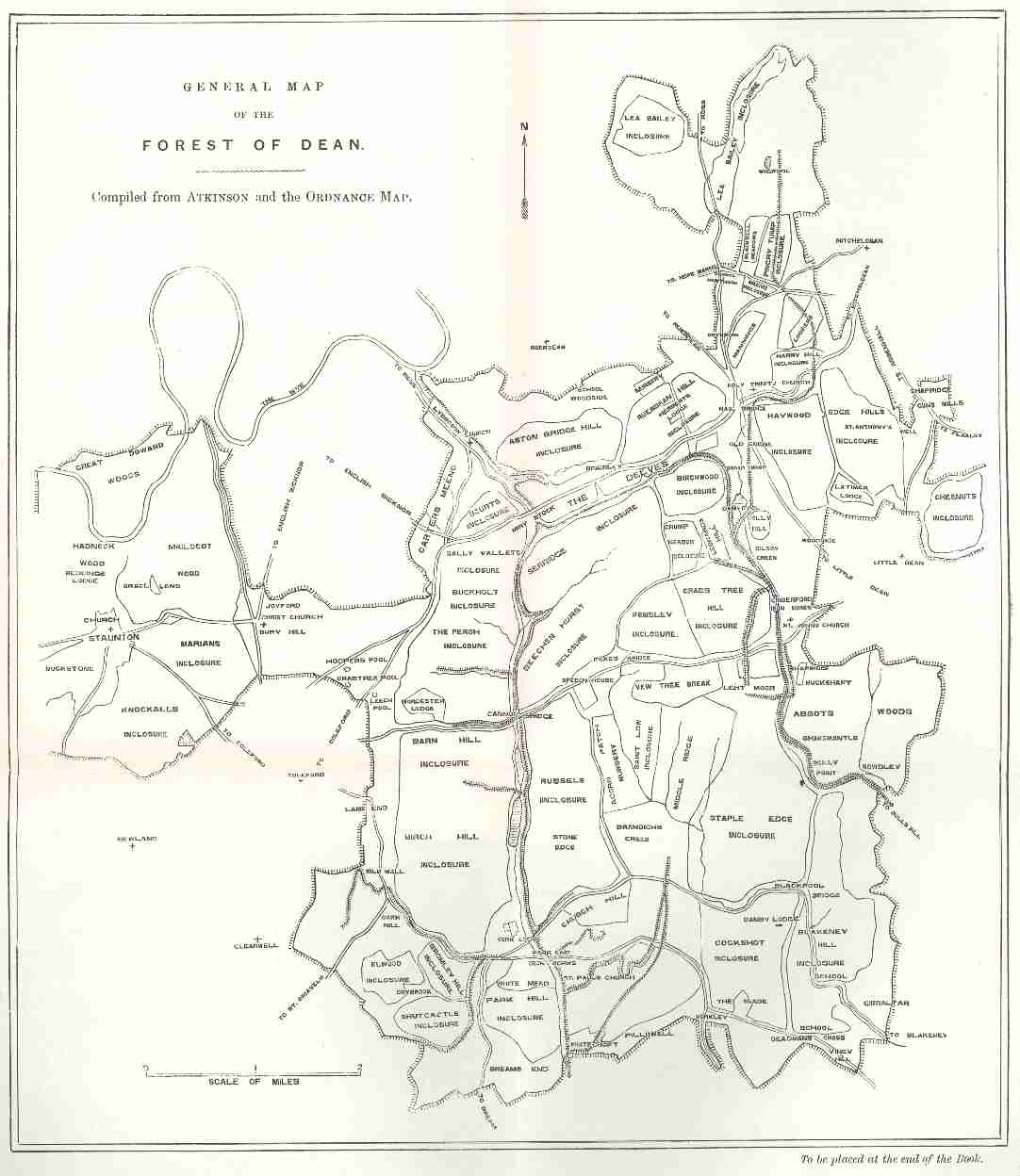
It is absolutely certain that the stone may
be made to oscillate: indeed one of the Hadnock woodmen states that when
sufficient force is applied to it, at the proper point, you can even hear
the gravel grinding underneath.
A corruption, apparently, of the British
word “crowll,” meaning “caves.”
We must, however, remember, in calculating
the price of labour in the middle ages, that the value of money was about
fifteen times greater than at present; and the coins, which were of silver,
were double their present weight.
Of these lands the Rev. G. Ridout, the
Vicar, has kindly furnished the following list:—
|
|
Acres
|
|
Land near English Bicknor, “Hoarthorns,” containing
|
199
|
|
„ „
Lydbrook „
|
21
|
|
„ Ruardean „
|
13
|
|
„ „ „
|
81
|
|
„ Flaxley, Little Dean „
|
94
|
|
„ Abbenhall, “Loquiers”
„
|
51
|
|
„ Hope Mansel „
|
41
|
|
„ Weston „
|
37
|
|
„ Lea and Longhope „
|
90
|
|
„ Lydney and Blackney „
|
329
|
|
„ Paster, Nels, and Whitecroft „
|
507
|
|
„ Ellwood „
|
134
|
|
„ Whitemead „
|
220
|
|
„ Bream „
|
213
|
|
|
----
|
|
|
2030
|
See ante, p. 7 and 13.
See post, p. 116.
One of them, as a specimen, will be found
in the Appendix No. II.
The meat market there is reported to have
been much injured long before this time, by the singular circumstance of a
murderer, named Eli Hatton, having been gibbeted on Pingry Tump, a point on
the Forest hills overlooking the town, the flies from the body being
supposed to resort to the meat on the butchers’ stalls. The
body was cut down in the night time, but the stump of the gallows is yet
remembered by old inhabitants as “Eli’s Post,” and as a
spot to be avoided, especially at night.
Mr. C. Meek, of the Morse, has ascertained
that Lord Nelson spent the 20th, 21st, 22nd of August, 1802, at Rudhall
House, near Ross.
See page 79.
Drawings of the mice were made and sent to
Lord Glenbervie.
Warren James was concealed in a coal-pit
on Breem’s Eaves, and was induced to come up by Thos. Watkins, who
had the reward offered for his apprehension. With the exception of
his conduct on this occasion, he was a man of good character, and a dutiful
and affectionate son to an aged mother, who was supported by him.
The map at page 15 exhibits the direction
taken on this occasion.
To such a scheme the chief objection, in
the words of the Hon. Thomas Frankland Lewis, appeared to be, that,
“unless guarded against by some special provisions, the land will
become subject to all the abuses which are so much complained of as to
charity lands in general. It is altogether unlike a fund to be raised
when and as it is wanted; there it is, and it must and will create objects
on which to bestow itself, if it does not find them.” The
proposition was consequently not carried into effect.
These three gentlemen opened their
commission on Wednesday the 5th of September following, at Coleford, and
after successive meetings it was there finally closed on Monday, the 20th
of July, 1841.
The same stick was usually employed,
being considered by long usage as consecrated to the purpose.
A pleasing emblem of such improvement
seems manifested in the following lines of Richard Morse (a young native
Forester), on a “Primrose found in a natural arbour among the large
oaks in the Forest.”
“Pretty little lonely flower,
How I love thy modest blow!
Ever grace this little bower,
Here in safety ever grow.
“And, if tempted by ambition
E’er to leave my humble cot,
May I learn from thee submission
To be happy with my lot.
“For while storms spread desolation
‘Mong the lofty trees around,
In thy lowly situation
Peace and safety may be found.
“So, when states and empires shaking
Bid the rich and great beware,
I, comparatively speaking,
Am secure from strife and care.
“Though the wintry blast should wither
Thy pale blow—thy leaves decay,
Gales, the first that spring sends hither,
Thy perfume shall bear away.
“And like thee, I too shall perish,
When my life’s brief summer ‘s o’er;
But there is a hope I cherish,
To be blest for evermore.
“Winter past, so drear and hoary,
Thou again wilt spring and bloom:
So I hope to rise in glory
From the darkness of the tomb.”
The preservation of the existing crop
depends mainly upon the practical inculcation of this principle.
“River Jordan” occurs in the
neighbouring parish registers many times during the last 150 years; also
“Providence Potter;” one of whose representatives, a sad
drunken fellow, once went to his humane squire in great distress. The
worthy gentleman, after suggesting various expedients, but to no purpose,
at last said—“Well! he could see nothing for it but to trust in
Providence.” “Lord bless ye, Sir, why, Providence has
been dead these ten years.”
The Author has had the satisfaction of
promoting the erection of a tablet in Holy Trinity Church, to the memory of
a man who had been so useful in his generation.
This liberal gift may be regarded as a
fitting memorial of Mr. Machen’s fifty years’ services in
connexion with the Forest.
Our best thanks are due to Sir Martin
Crawley Boevey, the present Baronet, by whom many of the incidents in this
chapter have been communicated.
It is built of the two Forest
stones—the red grit with grey stone facings, the stonework throughout
being executed in the most perfect manner. The edifice consists of a
chancel, nave, and N. aisle, with open oak roofs, covered with Broseley
tile, with crease tiles, and the gables are mounted with rich floriated
crosses. At the N.W. angle of the building rises in beautiful
proportion the tower, capped with a shingle broach spire. The chancel
is furnished with a sedile, credence-niche, stalls, reading desk, and
lectern. The 3-light E. window by Gerente contains, in twelve
compartments, a Personal History of Our Saviour, suggested by the verses in
the Litany:—“By the mystery of Thy holy incarnation . . . and
by the coming of the Holy Ghost.” The other windows, all
different in their tracery, are of Powell’s quarry glass. The
alabaster reredos by Philip exhibits in its three medallions the Feeding of
the Multitude, the Institution of the Holy Communion, and the Agony in the
Garden; and on the E. wall are illuminated, by Castell, of London, the
Lord’s Prayer, the Ten Commandments, and the Creed. The pulpit
and font are of Painswick stone, with serpentine marble shafts; and the
chancel rails, stalls, open seats, together with an exquisitely worked
south porch, are of massive oak.
The new road over the Plump Hill in its
formation exposed an ancient mine-hole, in which was found a heap of
half-consumed embers, and the skull of what appeared from its tusks to be a
wild boar, the fragments perhaps of a feast partaken of by our Forest
ancestors.
One, or perhaps two roads, traversing the
Forest from north to south, are yet wanting for public accommodation.
Amongst the Patent Rolls of Henry III.,
dated 1238, occurs one entitled “de forgeis levandis in Foresta de
Dean.”
At all times obligingly permitted to the
Author by Mr. John Atkinson, the Queen’s Gaveller.
This large Oak is called “Jack of
the Yat.” Yat means gate here. It is probably 500 years
old. It was struck by lightning a few years since.
In Sallow Vallets, a quarter of a mile
below the Lodge; 90 yards round the outside of the branches.
This tree about eight feet from the
ground separates into two large branches, or rather distinct trees; the
rent or chasm in the trunk grows wider, and we have now (i.e. in
1847) fastened the limbs together with iron to prevent its breaking into
two parts.


