“I DON’T like it here!” wailed the voice of the coward within him.
“There are too many things that I don’t understand. I’d like to run away
from it all.”
“My Grandmother used to tell me never to run away from what I can’t
understand,” said David. “Try to understand it—face it, anyway—and if
you can’t overcome it, go round it. But always keep your face toward it,
because if you run from it, it may run after you, and then there is no
telling what may happen. I’m going to face everything in this land! I
feel so strong and so happy that you can’t make me afraid—no, not even
you, you Doubting Voice—for I’m off to find the Garden, and I want you
just to keep still.”
He had walked only a little way when he came to a small cottage. An
elderly man was seated on the step, mending a pair of shoes. He called
to David as the boy approached.
“What is your name?” asked the man.
“David,” the boy answered.
“Well, well, David,” said the Cobbler, “you are just the little boy I
have been looking for. I want you to come into my cottage, and I will
show you something.”
Now, the Cobbler was really a witch, and all he wanted to do was to get
David into his cottage. Once he had the lad within its doors, he would
cast a spell over him that would prevent him from wishing to leave. Then
the old Cobbler could do with him as he pleased. But David knew nothing
of all this. He entered the cottage; and as he entered, the witch’s
spell began to take effect. He forgot the Garden for which he was
seeking; he forgot the old woman to whom he had given the cup, and what
she had told him; and, saddest of all, he forgot the Blue Bird. This
meant that he could neither see nor hear it again till he thought of it
himself and sought it of his own free will.
On the table was a tempting supper of cereal and milk, and a large slice
of mocha pie stood enticingly before him. The Cobbler motioned to him to
be seated and told him that the supper was spread there for him. David
was really very hungry, and he sat down and ate a good meal.
Just as he finished the last mouthful of the pie, a little girl entered
the room. David, looking at her, thought that he had never in his life
seen so beautiful a child. She was about eight years of age. Her hair
was golden brown, fine as spun gold, and she wore it pushed back from
her face and held in place by a narrow shell band. Her forehead was high
and well rounded. And her eyes were so kind and beautiful that David
just stood and looked into them, as she in turn was looking into his. It
seemed to them both as if they had known one another long, long ago; no,
it was as if they had always known one another—as if their meeting
now were the most natural thing in the world.
The little girl held out her hand to David.
“What is your name?” he asked her as he took it.
“Ruth,” said the child. “And yours?”
“David,” he answered.
They became friends at once and for ever and ever and ever.
The months passed by, and David and Ruth worked and worked for the
Cobbler—for both he and his wife knew how to keep the children busy.
But as time went on, the two children grew older and wiser, till at last
they grew so wise that they saw right through the old Cobbler and his
wife. They knew that the pair pretended a great deal that was not true,
simply in order to keep the children in ignorance so that they would
fear their elders. For there is nothing that keeps one so filled with
fear as ignorance. Many persons who want power just for themselves alone
know this, and therefore try to keep others bound in the heavy chains of
ignorance.
Many months passed, then. Yet to Ruth and David they seemed but weeks;
for the two were held under a certain spell which kept them always in
the same state of blindness to past and future. Therefore time, as we
know it, had hardly any existence for them; for, in the land where they
now dwelt, this was the Law.
So the children grew and grew. And as they grew physically, they also
grew mentally. Soon they were approaching the very borderland of
womanhood and manhood. The old Cobbler and his wife were really kind
enough to them: the only thing that one could find fault with was their
extreme selfishness—for selfish they certainly were. Their selfishness
showed in their wish that David and Ruth should never hear or know
anything that might make the boy and girl restless or desire something
other than what the old couple saw fit to give them; for they
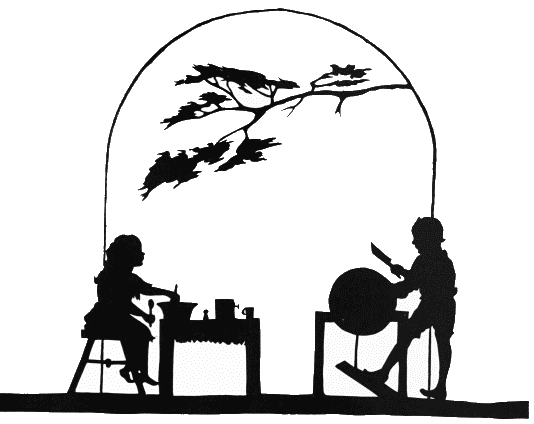
THE MONTHS PASSED BY AND DAVID
AND RUTH WORKED AND WORKED
FOR THE COBBLER
wanted the children to remain with them always, and in their old age to
care for them and make them comfortable. But this state of things was
not to last for ever.
David and Ruth both had their daily tasks and duties to perform. They
were kept busy most of the time, and for that reason were sound and
strong in body. In their leisure hours they would play and sing
together. As Ruth grew older, David found that she had a sweet, clear
voice. Together the two would sing songs of their own making, many of
them very beautiful.
One day they wandered through the meadow hand in hand, singing,
laughing, and playing, for they were both very happy. Presently they
came to a clear brook-side. Growing on either bank, hidden in the soft
grass, they found the tiny blue flowers called forget-me-nots. They
gathered a quantity of these; then, seeking a cool spot on a dry knoll
beneath the shade of a pine tree, they wove the flowers into chains,
making a fairy-like crown with which David decked Ruth. The sunlight
danced about them as the shadows of the pine branches waved to and fro.
Ruth’s soft hair fell about her face in a shower of golden beauty, her
cheeks were flushed with the joy and zest of youth, and her eyes were
soft and as deep as the cloudless sky at noonday. As David gazed upon
her it seemed to him that he had never seen anything so filled with
beauty and joy in all his life.
“Ruth!” he cried, “how beautiful you are! You remind me of
something—something that I have half forgotten—something of long, long
ago.”
“What is it?” asked the girl.
“I do not know,” answered David. “But you are so beautiful, you fill my
heart with longing—a longing to do and to be.”
“What do you mean?” asked Ruth. “I cannot understand you.”
“I do not know how to tell you,” said the boy, laughing, “but—you are
so beautiful, Ruth, I would like to do something to prove to you,
yourself, how beautiful you are! I am some day going to prove it to you,
Ruth; for you truly seem to grow more beautiful every day.”
A tiny olive-green bird hopped about from twig to twig near them. The
two watched it in silence.
“Yes, Ruth, I will prove it to you some day. Something has stirred in my
heart that has never wakened before. It is like a great, deep
longing—not for anything that I can really put into words, but—it
seems as if sometime, somewhere, I must have seen something, and my
longing is to see and to find it again, whatever it was, so that I may
show it to you.”
The little olive-green bird chirped upon the pine twig. There was one
note in his song that seemed to stir David’s memory.
“Listen, Ruth!” he cried; “catch that bird’s note. Listen!”
They both waited, and the bird sang again.
David’s eyes shone. “Oh, Ruth,” he cried, “there is one note in that
song that seems almost divine!” Ruth sang the bird’s song, in a voice
sweet and clear, but very soft.
“Good!” cried David. “Now hold that note.”
Ruth held the note that had especially caught the boy’s ear. David
looked at her as she sang. Then, all at once, a wave of memory swept
over him.
“I have it, Ruth! It is the note in the Blue Bird’s song. Oh, how could
I forget it all this time?”
Then, as if in answer to his cry, far up in the topmost branches of the
pine tree came the song of the Blue Bird, clear, sweet, unmistakable.
David sprang to his feet.
“My Bird! My beautiful Bird!” he cried, “where are you?” He sought
eagerly among the branches above him. The song came almost
uninterruptedly, and David followed each note. At last his eye caught
the sunlight on the iridescent wings; he fell on his knees, eager face
upturned to the tiny woodland creature.
Yes, it was the Blue Bird, the same wondrous and exquisite being that he
had known and followed so faithfully, and then forgotten. A vision
drifted before his eyes ... the little cottage in which he had been
born ... the woodlands ... the beautiful little old lady to whom he had
brought the water, and then ... the Blue Bird. Yes, there it was again.
He lifted his hands and stretched them upwards, up toward the clear blue
sky and the great sun above.
“I must follow the Bird!” he cried. “Now I know and understand the
longing in my heart.”
He rose from his knees and returned to Ruth. He found her sitting upon
the ground, the chain of forget-me-nots looped round her, the crown
which they had made still lending its beauty to her golden hair. Her
head rested against the rough bark of the pine tree. Her hands lay
folded in her lap; her eyes were closed, and tears had left their trail
unheeded upon her cheeks.
“Ruth!” he whispered, “you have been weeping.”
She opened her eyes at the sound of his voice. The lashes, he saw, were
still heavy with tears.
“Yes,” she answered simply. “The song is so beautiful—! I never knew
before that one could weep because a thing is beautiful, but the tears
seem to come from deep down—deeper down than any tears that I have ever
known. I have no wish to sob as one does in sorrow, but I could not help
weeping. It is the strangest experience I have ever had.”
“Come,” said David, taking her hand. “I want to show you the Blue Bird.”
Together they sought the Bird. When they had found it they gazed and
gazed. David told her of the old woman, of her beauty and sweetness, of
the long, long trail that he had followed before reaching the Cobbler’s
Cottage.
She listened to his story. “Yes, David,” she said—and she tried not to
let a shadow of sadness enter her voice—“you must follow the Blue Bird.
I will help you in any way I can.”
“Stay here, then, Ruth, just for a moment, while I run to the cottage
and get my axe and hunting knife. Watch the Bird till my return, so that
I may not lose it again; I will come back in a minute.” And David
started off in the direction of the cottage.
“How I should love to go with him,” thought Ruth, “to aid and cheer him!
But I must say nothing about it unless he asks me, for I might only be
in his way.”
In a few minutes David returned, his hunting knife strapped about his
waist and his axe swung over his shoulder. “Ruth,” he said, “I will
follow the Blue Bird; and when I get to the end of the trail, I will
come back again for you. I would take you with me now, but I fear the
way will be too rough and hard for you. It will be better for me to
return for you, and that I will surely do.”
Ruth longed to accompany him, and David longed to have her; but because
each wished to consider the other and to be unselfish in regard to that
which they both most desired, they remained apart—as very often happens
in other lives, too.
A flash of brilliant colour streaked the woods: the Blue Bird had flown.
David waved his hand, called “Goodbye!” and was off once more upon the
unknown trail.
Ruth watched him cross the meadow and enter the woods on the further
side. Just at this point he turned to wave once more to her; and as he
did so he took the spray of forget-me-nots that she had tucked into his
cap and put it into the little pocket in the side of the leathern case
that held his hunting knife.
Ruth returned to the cottage alone. As the day drew to a close and David
did not return, the old Cobbler and his wife asked her where he was.
“I do not know,” answered Ruth simply. “He followed the Blue Bird, and I
saw him disappear in the woods. He did not come back to me after that.”
“Followed the Blue Bird!” cried the old couple in one voice. “We never
dreamed that he could see that!”


