LONDON: GEORGE BELL AND SONS
PORTUGAL ST. LINCOLN’S INN, W.C.
CAMBRIDGE: DEIGHTON, BELL & CO.
NEW YORK: THE MACMILLAN CO.
BOMBAY: A. H. WHEELER & CO.
THE FOREIGN DEBT OF
ENGLISH LITERATURE
BY T. G. TUCKER, Litt.D. PROFESSOR OF CLASSICAL PHILOLOGY IN THE UNIVERSITY OF MELBOURNE
LONDON
GEORGE BELL AND SONS 1907
CHISWICK PRESS: CHARLES WHITTINGHAM AND CO.
TOOKS COURT, CHANCERY LANE, LONDON.
PREFACE
The following unpretentious chapters are
intended to offer to the ordinary student,
who has not yet given the matter any particular
thought, a first assistance in realizing
the interdependence of literatures. They aim
at clearness, and at as great a measure of accuracy
as is permitted by the compass within
which the matter is necessarily compressed.
No pretence whatever is made to completeness.
The summaries of various literatures do
not profess to be more than epitomes with a
special object. If, while helping to that end,
they are also readable in themselves, their
purpose is served.
It is, perhaps, advisable to state that, while
the professional studies of the writer have been
for the most part concerned with the literatures
of Greece and Rome, it has more than once
fallen to his lot to promote academic teaching
in the literature of England. It was this
experience which suggested the present attempt
at a more general survey. French, Italian, and
German literatures have been approached at
first hand, although the standard works have
been duly consulted. With the literature of
Spain contact has been less intimate, but care
has been taken to check impressions formed
under these conditions. For the rest the best
authorities have been used and trusted.
Inasmuch as guiding hints and clues are
often more helpful than elaborate treatises, a
special acknowledgment is due to various
writings of Professor Churton Collins and
Professor W. P. Ker.
A just appreciation of any modern European
literature is not to be derived from the study of
that literature alone. Not one has grown up spontaneously
and independently from the soil of the
national genius. Some seeds at least have come from
elsewhere. Often whole forms of writing have been
transplanted bodily. We must particularly recognize
these truths when dealing with English literature.
The basis of the English mind is chiefly Teutonic,
in some measure Celtic. If the English genius had
been left to itself, to develop its spiritual and intellectual
creations in its own way, English literature
would have been a very different thing in both substance
and form. But in reality English literary
history is the story of the Teutonic and Celtic tendencies
“corrected and clarified,” and the Teutonic
and Celtic invention immensely assisted, by influences
and ideas flowing in from other sources. There
have been large ingraftings from other stocks, either
partially kindred or altogether alien—from Greeks,
Romans, Italians, French, Spaniards, Germans, as
well as from Hebrews and other Orientals.
All sound study is comparative. We must place
other literatures beside our own, if we desire to appraise
rightly our national genius, its capacities, and
its creations. We find our English writers composing
their works in certain forms, and giving expression
to a certain range of ideas. How came they to
employ these particular forms of creation? How did
they arrive at these particular ideas? How is it with
other nations? Have they built upon the same lines
and with the same materials, or how is it with them?
Have we borrowed from them, or they from us? If
there have been borrowings, when and in what
measure did they occur? Looking back over the
changes of spirit and form which our poetry, for
example, has undergone, we shall encourage altogether
false notions of the causes of such changes,
unless we see how, every now and then, a shower of
new ideas, a stream of new light, has come in from
abroad. Most readers know in some vague way that
Chaucer avows or betrays his debts to France and
Italy; that Shakespeare did not invent his own plots,
but borrowed from Italians, from Plautus, from
Plutarch, and others; that Milton was steeped in the
Greek, Latin, and Italian classics. But we want to
know more than this. We want to perceive with some
definiteness how far the whole course of English
literature has been enriched by tributary streams,
and what sort of waters they brought. It would be
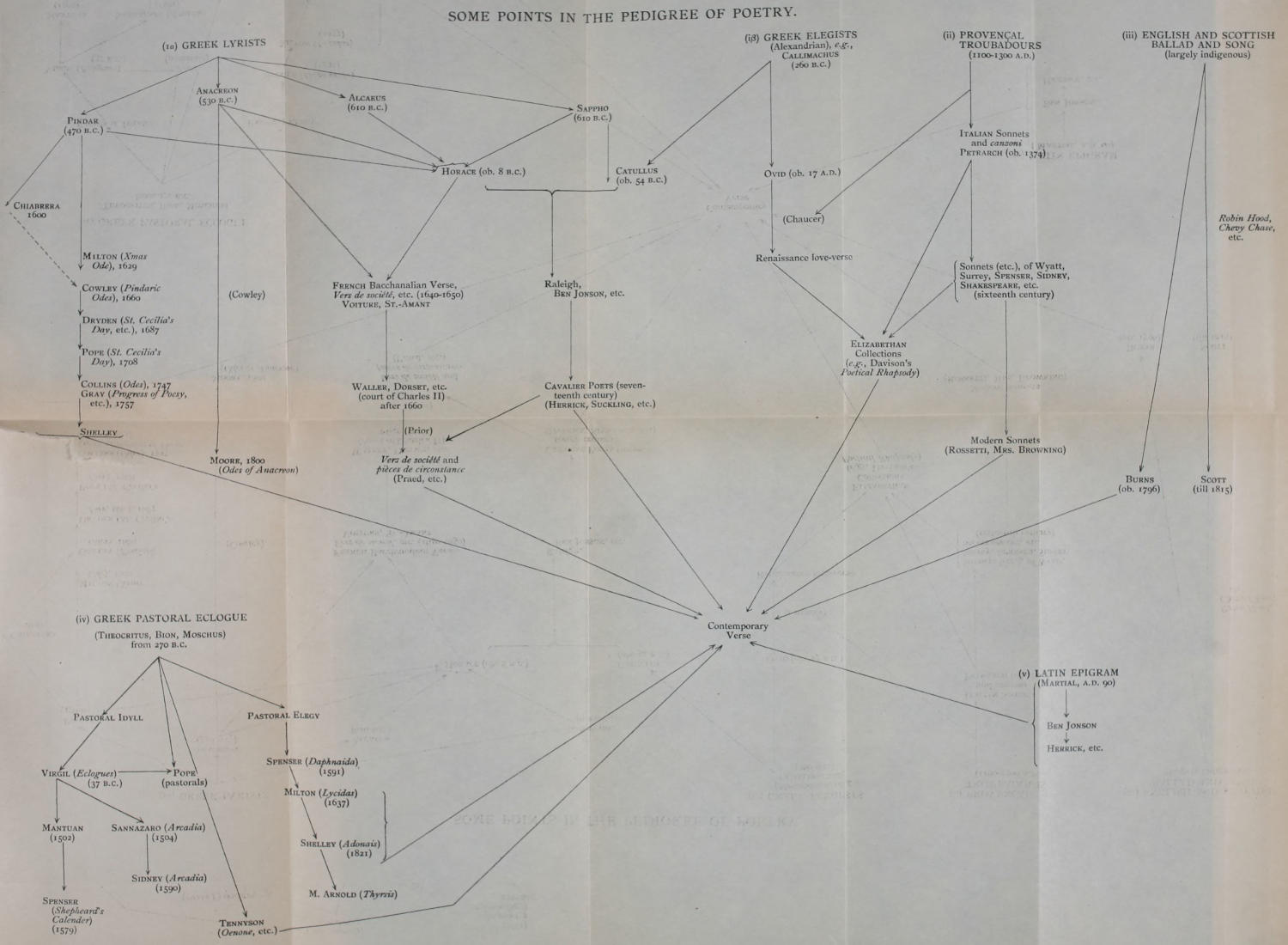
instructive to draw a diagram of our literary history;
to liken it to the course of a river, and to picture its
various fountain-heads and tributaries pouring in
their several quotas at their several times.
In all modern literatures there is a large proportion
which is unoriginal to them. Milton has been mentioned
already. Those who read only English works
find Milton full of nobility of thought and imagery.
Yet, before Milton produced his greater poems,
he had read, re-read, and deliberately steeped himself
in, the literature of Greece, Rome, modern
Italy, and France. Precisely how much of Milton
is made up of Homer, Euripides, Virgil, Dante,
Ariosto, and other predecessors, can only be known
to such as have those authors at their finger-ends.
Shelley, again, is commonly regarded as one of
the most daringly original of English writers. Yet
Shelley’s mind was an amalgam of himself, Homer,
Euripides, Plato, Virgil, Dante, Calderon, Goethe;
and this, once more, is but another way of saying
that it had incorporated the genius of generations of
Greeks, Romans, Spaniards, Italians, and Germans.
We cannot therefore arrive at the true genius of
Milton or of Shelley, or speak understandingly of
their originality, until we have surveyed those other
literatures and their relations with our own.
Let us, indeed, claim with a proper national pride
that the influence of English literature, of our Shakespeare,
our Bacon, our Locke, our Byron, upon foreign
writers has been profound. Her debt to modern literature
has been repaid by England, and, at least in
the influence of Shakespeare, more than repaid. But
with that question we are not here concerned.
One prefatory remark has yet to be made. It is
that there is no discredit in this literary borrowing.
Nations can no more be independent in the art of
literature than in other arts. To be independent, to
be unaffected by others’ genius, inaccessible to
others’ ideas, would be to render our literature as
stagnant and as grotesque as the paintings of China
and of old Japan. It is a condition of progress in
literature as in science, that new inspiration must
be continually sought, new conceptions assimilated.
One vein is soon worked out; another must be opened.
True art is of all the world, and a nation does best in
art when it corrects its own peculiar faults and expands
its own particular ideas, without meanwhile
surrendering itself to a servile imitation of that for
which its genius is naturally unfit. And English
writers may glory that they have seldom been servile
imitators.
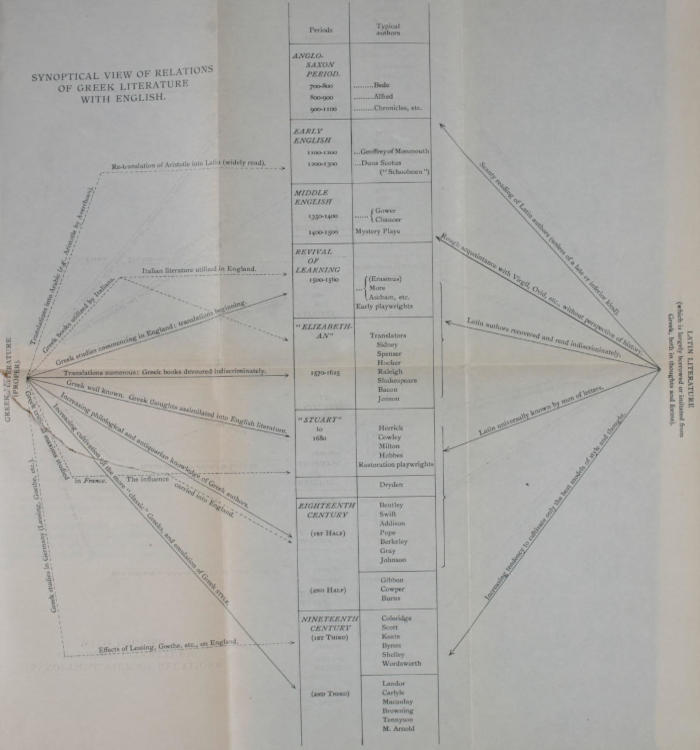
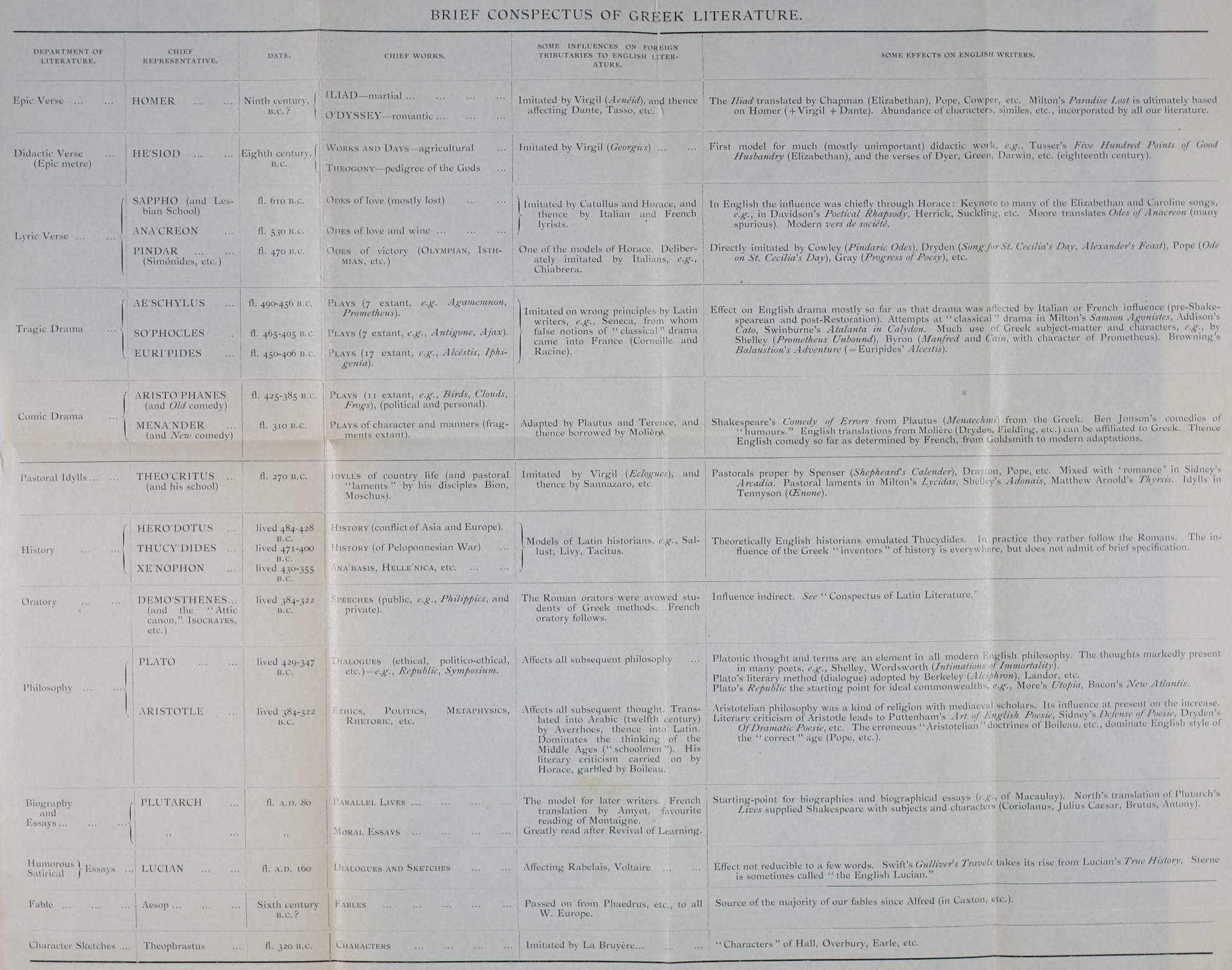
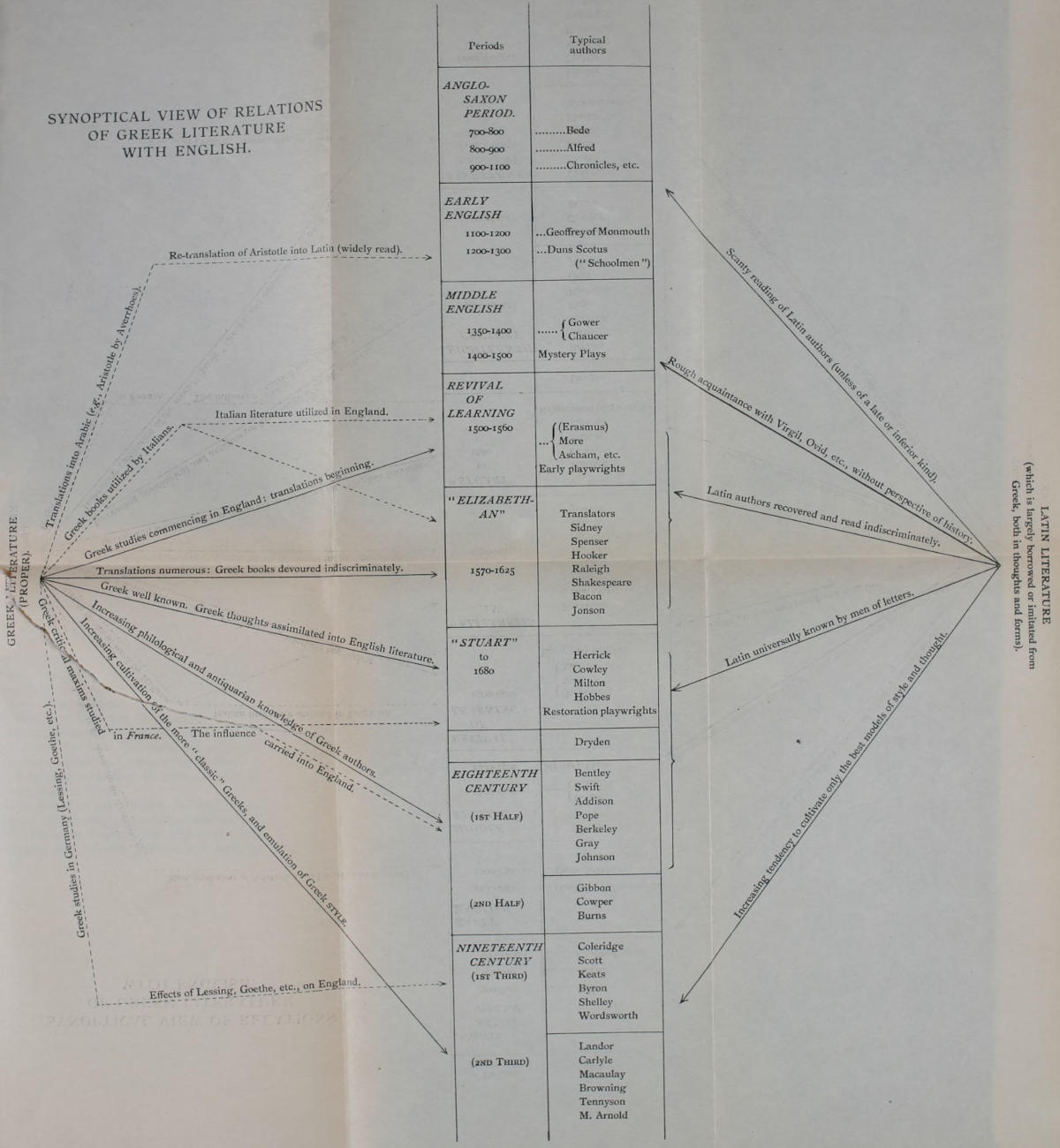
I GREEK LITERATURE AND ENGLISH — BRIEF CONSPECTUS OF GREEK LITERATURE. — SYNOPTICAL VIEW OF RELATIONS OF GREEK LITERATURE WITH ENGLISH.
Of all the literatures which have contributed to
that of England, the Greek is by far the first and
most important. The study of Greek literature is the
indispensable introduction to the study of European
literary history. Whether we review the literature
of England, of Italy, of France, or of Germany, it is
at Greece that we shall ultimately arrive. Take our
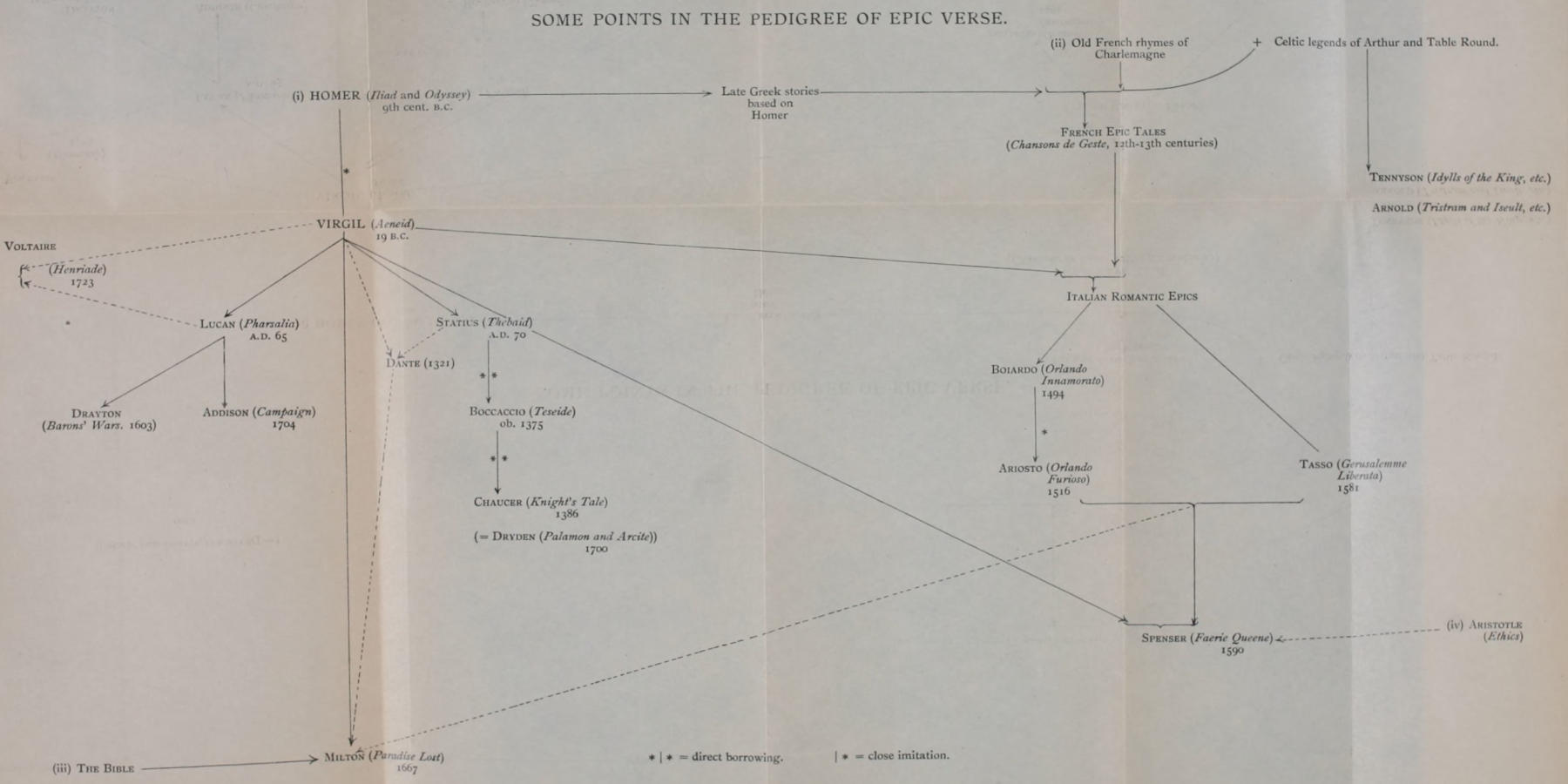
English epic, Paradise Lost. It is a commonplace
that it derives much inspiration from Dante’s Divine
Comedy. But, when we arrive at the Divine Comedy,
we are assured that it would never have taken such
shape but for Virgil’s Aeneid. And, when we come
to Virgil’s Aeneid, it is a fact known to the veriest
tiro that the Aeneid is a copy, and, in a sense, a
plagiarism, of Homer’s Iliad and Odyssey. The
pedigree is self-evident and undeniable. Practically
it is avowed at every step. Look elsewhere. Pope
and Shenstone wrote “pastorals,” after the fashion
introduced into English by Spenser. But Spenser
himself had been led to this form of composition by
the Italian Sannazaro and the Latin Virgil. And,
when we reach Virgil, we find that he is a liberal
borrower, in matter and manner alike, sometimes
even in the very phrase, from the Greek of Theocritus,
Bion, and Moschus. It is the same with
literary criticism. Pope’s Essay on Criticism, like
Roscommon’s Essay on Translated Verse, is derived
from Boileau’s French Art Poétique. But Boileau
is an echo of the Latin Horace and his De Arte
Poetica, while Horace is himself a borrower from
Greeks of Alexandria, and ultimately from Aristotle
of Athens. And so it is throughout. Often, especially
in these later days, our stars of English literature
shine with a light reflected directly from Greek constellations.
No less often they shine with a light
transmitted through several media, but ultimately
issuing from the suns of Greece.
Pre-eminent by far among the literatures to which
we owe a debt stands this body of eternally great
creators, who, by the clear beauty of their language,
their luminous apprehension, and their simple but
magnificent originality, surpass in the aggregate
those whom any other nation can assemble. It is
no paradox, but a simple historical fact, that the old
English writers have had less influence in moulding
our modern literature than have Homer and
Sophocles, Plato and Demosthenes. “We are all
Greeks,” says Shelley, in the preface to his Hellas.
Whether we will or no, our literature and philosophy,
our canons of taste, our ideals of art, are all,
in a sense, Greek.
Greek literature, unlike Latin, and unlike those of
modern Europe, was mainly, if not wholly, original.
What we have been able to borrow or to find ready-made
seems to have developed itself spontaneously
in the wonderful genius of Greece. Latin literature
has been called—and not without some justice—one
vast plagiarism from Greek. But Greek itself is
guiltless of plagiarism. Its thoughts, like its exquisite
clearness and restraint of style, are almost entirely
its own. With unlettered barbarians to north and
west of them, with flowery, bombastic, or mystic
orientals on the Asiaward side, the Greeks must be
credited with a marvellous gift of their own, the instinct
for sound judgement and sure taste.
But they possessed more than taste and judgement.
They had inventiveness. We may reflect for
a moment upon the various forms and modes of
literature which we possess and practise in verse and
prose. Of verse there are the epic, lyric, elegiac,
satiric, dramatic, didactic, pastoral, epigrammatic,
philosophic varieties. In prose there are history,
oratory, philosophy, biography, criticism, fiction.
To us all these forms and species, with their appropriate
language, metre and tone, are taken for
granted, as if they were the necessary outcome of
some natural order of things. They are, no doubt,
founded in nature. Nevertheless, we should remember
that they must have had a beginning of their differentiation,
that they must have been invented somewhere.
And we discover that each of them is to be
found arising in recognizable shape on the soil of
ancient Greece. It is easy nowadays for us to imitate
existing forms, to build with the architecture of the
drama of Shakespeare and the epic of Milton, to copy
the lyrical metres of Gray, Shelley, and Tennyson, to
adopt the satirical machinery of Pope and Dryden.
But these differentiations in mode of expression represent
something deeper, some distinction evolved
by the human mind between compositions of one
purpose and compositions of another. It was the
Greeks who first convincingly and systematically
illustrated that distinction, and who found for each
subject of thought its appropriate vehicle of expression.
More modern times have evolved many modifications
of detail in metre or rhyme, and have
essayed many novelties in the way of narrative. But
they have never added an entirely new form of poetry
or prose to the répertoire of the Greeks. Tennyson
does not write In Memoriam in the metre and language
of Paradise Lost. Shelley’s Ode to a Skylark
does not employ the diction and rhythm of Pope’s
Essay on Man. It is recognized that the feeling
and its vehicle would be incongruous. But how does
this come to be recognized? A world is quite conceivable
in which there might have been developed
but one form of literature and one ideal of expression.
In such a world the incongruity would not be
felt. The early Hellenes made their own literary
beginnings upon almost a clear field, and it is one
of their imperishable glories that they succeeded in
realizing the subtle relations between language and
thought or feeling, and in expressing these latter
in all the variety of extant literary forms. For heroic
deeds and lofty incident they developed the epic
verse; for the sweets and bitters of love, and for other
passions and ardours, they built the lyric stanza;
for the plaints of mourning they created the elegiac;
they did this gradually, no doubt, and in the main
unconsciously, but with all the more perfect result.
If we inherit what Greece has created, we have no
right to assume that all our happy varieties of literary
form are things of course, which would somehow
have come to any nation.
The history of Greek literature should be a study
of years. Nevertheless it is not without profit to take
the greater names and the more prominent types, to
show their order of succession, to say something of
their range and scope, to note the essentials of their
style, and thence to derive some clearer idea of their
influence on what we read to-day in our own English
tongue.
The earliest Greek books which we now possess
are Homer’s Iliad and Odyssey. But these are much
too polished and perfect works to have been the very
first that Greeks ever composed. Indeed we know
that before Homer’s time there were minstrels, who
sang the “glories” of heroes, very much after the
manner in which the bards sang in Wales or Scotland,
or the gleemen in Anglo-Saxon England. It
must also be assumed that popular songs of a religious
kind were in existence. Yet all these earliest efforts
at literary creation have vanished; we possess no
material for definite information concerning them.
For us Greek literature begins with “Homer.” The
question as to who Homer was cannot be answered.
Some critics contend that he is a mere title, and that
the compositions which go by his name are patchworks,
made up of a series of narratives sung by
wandering bards called “rhapsodists.” Homêros,
they say, is but a fictitious title under which to string
all these separate compositions together into one so-called
epic. Others, going less far, say that there
was indeed a veritable Homer, that he composed a
poem on the Wrath of Achilles, and that this poem
has been enlarged by other hands, which turned the
whole into the Iliad, or poem on the “Siege of Troy”.
Even if this be true, we know nothing of the original
Homer, when or where he lived. To discuss the
question at any length is beyond our present province.
Perhaps we may believe, with great masters
of poetry like Goethe and Schiller, that a “Homer”
wrote the poem of the Iliad, but that it has since
been added to, tampered with, reconstructed. We
may also believe that some one other poet wrote a
corresponding portion of the Odyssey. These two
original poets were of nearly, though not quite, the
same period. They were inspired with much the same
literary ideals, and were almost equal, though by
no means identical, in genius. They may be supposed
to have appeared in a specially fertile epoch,
like the great Elizabethans, or like the Italian poets
of the first Renaissance. Their artistic principles
would be much the same; they would live in much
the same environment; they would see the world,
the gods, mankind, through much the same moral
temperament. Let us grant that their work has undergone
large interference and contamination. Yet it is
hard to think that a motley crowd of rhapsodists could
ever possess such a lofty average of genius as pervades
the whole body of these inimitable poems. Both
works were, beyond reasonable doubt, in complete
existence before 800 B.C. Twenty-seven centuries
ago the Greek genius had reached thus high a point.
The Iliad and the Odyssey are to be read in many
a translation. The Iliad is the poem of Ilium or
Troy. It deals with events during the siege of that
town by the confederated Achaeans. It narrates the
doings and sayings of the Grecian heroes, of Agamemnon,
Achilles, Ajax, Ulysses, Diomede, Menelaus,
outside Troy, and of the Trojans, King Priam,
Hector or Paris within the city, where is also the
traitress Helen. It narrates the counsels, quarrels,
and battles of the gods, as they arise from partisanship
during the siege. The poem is filled with
prowess of battle, till it ends with the death of Hector,
champion of Troy. The narrative is rapid and vigorous,
full of valorous and exciting exploits of men
interwoven with the friendly or unfriendly actions of
gods. Descriptions are many, but always brief, and
everywhere inimitably fresh and luminous. The
whole purpose of the poem is to tell a story, and to
tell it with clearness and simplicity, yet with fire and
force. When it is embellished with ornaments of
simile or other figure, it is because that device best
brings home the picture. There is no idle lavishing
of ornament for mere ornament’s sake.
The Odyssey is the poem of Odysseus, the wandering
Ulysses. He, the king of the little island of
Ithaca, after being for ten years absent at the siege
of Troy, starts homeward in his ship to his wife,
Penelope. But on the journey he meets with adventures,
strange, terrible, or happy. He is storm-tossed
and delayed by the anger of offended gods.
He nearly meets his death from the one-eyed cannibal
monster Polyphemus; he nearly loses his crew
among the Lotus-eaters; he is detained for seven
years in the island of the seductive Calypso; his
comrades are turned into swine by Circe the enchantress;
he is wrecked between Scylla and Charybdis.
He at last arrives home, only to find Penelope
at the mercy of a rabble calling themselves
her suitors. He slays them, and reveals himself to
his wife—and so a happy ending. In this poem, as
in the Iliad, composed nearly three thousand years
ago, there is already achieved a perfection of literary
art which we moderns find ourselves for ever aiming
at and for ever missing. For this there is other
reason than the natural genius of the Greek. The
poets who wrote these two stories looked out upon
the world with a frank, unclouded gaze, for which,
perhaps, we are now too sophisticated. They therefore
tell their tale with such simple directness that it
might seem told by a grown-up child; but meanwhile
with such brilliant clearness, with such firm
outline, that it no less appears the work of a consummate
artist. There is, it is true, no psychological
probing in these books. There is no subtle moralizing,
no pondering of any kind of deep question.
Nowhere does there obtrude itself a desire to be
clever, rhetorical, dazzling. Yet no one can read
the Iliad without seeing those warriors face to face,
as they were, in their physical strength and simplicity
of character; nor can he read the Odyssey
without feeling that he is with Ulysses on his raft,
sailing through the deep, blue Mediterranean, that
the salt breeze is blowing on his face, that the world
is young and fresh, and that a man’s part is to perform
that which lies nearest to his hand.
What effect the Iliad and the Odyssey have upon
the intelligent reader may be judged by their preeminence
among poems of all times and all places.
What an effect they have had on our literature may be
judged by the number of translations, many in prose,
and many better known in verse, from the hands of
Chapman, Pope, Cowper, Derby, Morris, Way. It
may be judged by the countless allusions to the “tale
of Troy divine” which are strewn through every book
of the last three millennia; by our everyday familiarity
with the names of Hector and Achilles, Helen of
Troy and Paris, Diomede and Ulysses, Circe and
Penelope, Polyphemus and the Lotus-eaters. On
reading Chapman’s Homer, Keats felt like an astronomer
“when a new planet swims into his ken.” The
same experience has been felt by all who recognize,
as Keats did, “the principle of beauty in all things.”
But little notion of those poems can be gathered at
second-hand. Of its similes we may here quote one,
not because it is in any way the most beautiful, but
because it has been translated by a master in the art,
Tennyson. Nothing in English has ever been hit
upon to give the majestic, sonorous roll of the Greek
hexameter, but Tennyson has, at least, preserved
the frank simplicity of his original:
As when in heaven the stars about the moon
Look beautiful, when all the winds are laid,
And every height comes out, and jutting peak
And valley, and the immeasurable heavens
Break open to their highest, and all the stars
Shine, and the shepherd gladdens in his heart:
So many a fire between the ships and stream
Of Xanthus blazed before the towers of Troy,
A thousand on the plain; and close by each
Sat fifty in the blaze of burning fire;
And eating hoary grain and pulse the steeds,
Fixed by their cars, waited the golden dawn.
Next to Homer may come, by no means in importance,
but in date, the poet Hesiod. He, too,
uses the hexameter line, but with a different tone
and movement, and for quite another purpose. He
is our first example of “didactic” verse—the verse
which is intended to instruct. Hesiod, who may be
dated about the year 700 B.C., composed two poems
of some dimensions, the one called the Theogony
or Pedigree of the Gods, the other known as the
Works and Days. The latter is a collection of versified
rules of agriculture mixed with proverbial
wisdom. It is, in fact, a sort of “Farmer’s Annual”
of Greece combined with the proverbial wisdom of
“Poor Richard.” Practical farming and practical
morals go together. It would almost certainly have
been written in prose, but for the simple reason that
prose literature had not yet been invented. All
literary composition begins with verse. As a poem,
there is little to be said for the Works and Days, except
that, like all things early Greek, it is entirely unpretentious
and goes straight to the point. Didactic
verse has grown common since Hesiod’s day, although
happily it is now seldom used for agricultural
purposes. Tusser’s Five Hundred Points of Good
Husbandry is one of the earliest results of the revival
of Greek studies in England in the Elizabethan time,
and, though it cannot count for much in literature,
it is our first example of a species of work which took
a more moralizing shape in Dyer’s Fleece and many
later didactics.
Of much more value is the next kind of poetry
which arose among the Greeks, a kind which has
been called “personal,” inasmuch as it is prompted
by the writer’s individual feelings and emotions,
and has reference to himself, his hopes, griefs, loves,
and other sentiments. The epic poetry of Homer had
been purely objective, dealing with incidents, things,
and men outside the poet. The author makes no
revelation of himself; he does not speak in the first
person. But what is known as “lyric” and “elegiac”
poetry is the outcome of a man’s own inner experience,
and is only valuable in proportion as it expresses
powerfully or touchingly a real or imagined
passion of the writer, which the world at large can
also recognize for its own. The poetry of Lycidas,
Adonais, In Memoriam, is “elegiac”; the poetry
of songs, such as those of Herrick and Burns, is
“lyric.” “Elegiac” properly means “adapted to
mourning,” but the elegy, with its couplet rhythm
varied from the hexameter, yet with a plaintive
dignity all its own, was used for other feelings than
those of grief. It was used for praise, exhortation, reflection,
love; for anything “subjective,” or springing
from the mood of the writer. We need not
enumerate the Greeks who at various dates wrote
poetry of this personal description. After the year
700 B.C. there were many and excellent lyrists of the
kind. At Lacedaemon the poet Tyrtaeus composed
marching songs, which acted upon the Spartans as
the Marseillaise and Die Wacht am Rhein act upon
nations in modern days. Archilochus of Paros,
soured by his own failings and misfortunes, wrote
often in bitterness, like Burns. He is styled an
“iambic” writer from a new form of composition
which he employed, and he became the first great
name in satire. In Lesbos, a fertile, luxurious, and
cultured island, we meet with the foremost name in
the poetry of passion, the famous Sappho, the first
and greatest of women in literature. It is Sappho
who could paint, better than poet has ever painted
since, the agonizing of love. Nor was she alone. In
the same island she had her school of followers, and,
separately from these, the poet Alcaeus poured forth
his fiery thoughts in “words that burn.” But it
is Sappho who, like George Sand, wrote from the
“real blood of her heart and the real flame of her
thought” things which have been the despair of
imitator or translator. Unhappily, very little of her
work is extant now, even in fragments; but what
there is, is “more golden than gold.” Her metres
are as nobly simple as in one of Herrick’s songs;
her words are simple also. Yet, just as Dante could
make a mighty verse out of the noun and verb, by
choosing for his noun and verb the absolutely truest
and most home-coming, so the simplicity of Sappho
is only a deceptive covering for the most consummate
art. Often as our lyrists have tried to catch something
of her sacred fire, never has one quite attained
to her irresistible pathos. Perhaps he who has approached
nearest is Burns. Sappho is untranslatable.
All absolutely best words in any language
must be so. The nearest equivalent in English may
be sought and found for the best word in the Greek,
but in the special quality of its music or its associations
it can never be the same.
The names of Pindar and Simonides are of a later
date. Before them comes another, who sang to the
lyre those gemlike songs of love, and joy, and wine,
which the cavalier poets of the English seventeenth
century made their ideal. This was Anacreon of
Teos. “Anacreontics” is the name given to those
polished cameo-like little poems which imitators
have essayed upon Anacreon’s themes. Cowley’s
translations into English verse are known to literature,
and readers familiar with the works of Thomas
Moore will remember his loose youthful version of
a few true and many spurious lyrics of the Teian
bard. It is to Anacreon that we may look for the
prototype of those graceful trifles called vers de
société, and of those songs of love or gaiety which
Herrick, Suckling, Lovelace, and Waller have developed
in such exquisite examples.
All this personal poetry was meant to be sung to
the accompaniment of lyre or flute. Had it been
primarily meant to be read, it might possibly, even
with Greek creators, have been less simple and
direct, more artificial.
There was also another class of poetry which was
sung to the same accompaniment. Early Greece
found many occasions for festivities, and at religious
holidays, public rejoicings, and public thanksgivings,
choruses sang while moving in procession or while
dancing round the altars. Hymns were chanted to
the gods, triumphal odes were chanted in honour of
men. When literature turned to these—or when
these became literature—there arose in particular
two most famous poets, Simonides and Pindar, to
compose such public odes, very much after the
manner in which a modern laureate might compose
an ode of installation or national victory, or a dirge
upon a national loss. Compositions written in this
spirit are seldom of the highest rank of literature.
They lack the saving grace of inspiration. Pindar is
strong, noble, imaginative. His odes were, no doubt,
splendid compositions for chanting and musical purposes.
To read them is to be conscious of a stateliness
and dignity and an “eagle flight” which
powerfully affect the student. But, full as they are
of great imagery and diction, they are beyond doubt
apt to be artificial and perplexed in structure; they
are too often obscure, too often deliberately learned
in allusion. To be its best, poetry must be written
from the promptings of the poet’s heart, and Pindar
too often wrote to order, for payment, and not from
inward compulsion. No exact, or very near, parallel
to Pindar can be found. He has never been even
tolerably well translated. This has not been for want
of admirers. Gray, who imitated him in the Progress
of Poesy, has been said by Mason (erroneously
enough) to possess Pindar’s fire: Cowley’s tombstone
calls him, without much justification, the English
Pindar, and at all times down to the present writers
have been led to emulate the soaring Pindaric ode.
Whatever his defects, it is certain that over all modern
lyric poets, even over those who could not always
follow his meaning, Pindar has exercised the sway
of a master and imperial spirit.
Among the kinds of poetry chiefly affected by the
earlier Greeks must also be included the “gnomic”
or “sententious” verse which goes under the names
of Theognis and Phocylides. These writers both lived
in the sixth century B.C., and both composed versified
maxims or precepts of conduct and worldly wisdom.
After times came to credit to those great originals
any verses of this character which were current in
the elegiac or the hexameter metre, and such verses
played very much the same part in Greek mouths as
is played by the Proverbs of Solomon or by proverbial
philosophy of unknown authorship in the mouths
of Englishmen. At a later date in the iambic metre
the comic poet Menander introduced into his plays
a large number of maxims, which gained wide vogue
and which caused many more of the same species
to be fathered upon him. Of the various wise
saws thus current in Greece a great number were
translated or adapted by Latin writers, and have so
passed into the general possession of the European
world.
Between the years 500 and 400 B.C. there arose
in Athens that which is the special poetic glory of
that city—the drama, embracing both the drama of
tragedy, as wrought by Aeschylus, Sophocles, and
Euripides, and the drama of comedy, as built by
Aristophanes, and later, in a different form and
spirit, by Menander.
The Attic drama arose on Grecian ground. At
one time choruses danced round the altar of the
wine-god Dionysus (or Bacchus), and chanted songs
in his honour. The chorus had its leader, the Coryphaeus.
In time it became the fashion for the Coryphaeus
to personate the god, or some character whom
story connected with him. He recited a speech, or
related some legend, in which the wine-god was concerned.
It naturally followed that he was next raised
upon a low dais, and distinguished from the rest
of the chorus. The dais later became the dramatic
stage. Subsequently another member of the chorus
was told off to converse with him in rough dialogue,
the theme being still the history of Bacchus. So far,
then, we have a chorus which dances and sings,
and two actors supporting crude dramatic parts. It
was from these simple beginnings that there grew
to perfection in Athens, as suddenly as the Shakespearean
perfection arose from the old miracle-plays
and “moralities” in England, noble dramas like
those of Aeschylus and Sophocles. The open sward
had become a theatre, the acting art, the dialogue
poetry. Drama had been raised to an art of the
most absolute literary completeness. It must, however,
be observed that the tragedy which grew up
in this way was religious in its origin. Until the
end it—theoretically at least—remained so. Its subject-matter
and laws were, therefore, limited. The
stage was at the same time a pulpit for moral and
religious teaching. The theatre was, moreover,
national. Here are some important elements of
artistic difference. Those who read Shakespeare and
then turn to Athenian tragedies are puzzled. They
do not understand those Attic creations. They think
them rather cold, with somewhat slender plot, containing
few surprises. Italians and Frenchmen can
understand them; the average Englishman cannot.
The poetry is often admirable, but the action appears
strangely simple, and for the most part over obvious.
The very name “tragedy” seems sometimes misapplied.
But by “tragedy” the Greeks did not necessarily
mean a play which ends in death and
disaster. Such an end was, indeed, usual, and hence
the modern meaning of the term. But the Eumenides
of Aeschylus ends happily, as do the Alcestis of
Euripides and the Philoctêtes of Sophocles. The
Greeks meant rather the working out of some great
and powerful situation affording occasion for sensations
of pity and fear. Here was “the luxury of
grief.” The spectators knew that there would be
some climax in the drama; but whether it would
issue in good or evil depended on the poet; they
only knew that their feelings would be powerfully
worked upon by great poetry greatly delivered. For
the rest, they required no startling ingenuity of plot
or variety of incident.
The three great dramatists in artistic sequence are
Aeschylus, Sophocles, Euripides. These were all
alive together, but Aeschylus was old when Euripides
was young. The appearance of all these in one epoch
is exactly paralleled by the cluster of superlative
dramatists in the Elizabethan age or in the France
of Louis XIV. Of Sophocles it has been said that
he represented men as they ought to be, and of
Euripides that he represented them as they were.
The dictum is hardly true, and, if it were, it must
be noted that, whereas to “hold the mirror up to
nature” is as much the function of Greek tragedy as
of English, it is no function of Greek drama to be a
literal copy of literal everyday human experience.
In Aeschylus all is in the grand style of an awe-inspiring
simplicity. Take his Prometheus Bound.
We have a majestic Titan figure bound to a desolate
rock, there to remain in punishment for an offence
against the law of Zeus. He had bestowed fire and
other boons on mortal men. Therefore Zeus pinioned
him on Caucasus for tens of thousands of years. In
one way, and one only, could he gain his freedom—by
disclosing to Zeus a certain secret of fate. But
Prometheus would not repent of having exercised
his benevolent freewill against the decree of Heaven.
He gloried in his action; he refused to deliver up
the secret. Now during the whole play the figure of
Prometheus does not move: he is fixed fast. There
is no action on his part, nothing but speech. Different
gods, demigods, and a mortal visit him, condole
with him, advise him, or threaten him. He remains
firm to the end, the spectacle of an utterly resolute
heart rebelling against fate.
It is not hard to recognize in English literature
some of the characters to which this Prometheus has
served as prototype. There is Milton’s Satan, who
is distinctly modelled on the Titan. Byron acknowledges
that all his rebellious spirits, Cain, Manfred,
and their like, are echoes of the same character.
Shelley wrote a Prometheus Unbound for sequel.
Keats’s Hyperion shows the same influence. Swinburne’s
Atalanta in Calydon is throughout inspired
by the conception of Aeschylus.
Ancient drama has much attracted the modern
poet. The Agamemnon of Aeschylus has been translated
by Browning, far more roughly—not to say
grotesquely—in style than it deserves, but with the
Greek spirit in no small measure retained. The same
writer has translated the Alcestis of Euripides in the
work known as Balaustion’s Adventure.
But to the English stage Greek tragedies are not
suited. Our theatre is not religious, nor national.
But in France and Italy Greek plays have found a
more congenial soil. Corneille and Racine in France,
Alfieri in Italy, have sought to mould their dramas
upon Greek lines, though, truth to tell, they much
more closely suggest the rhetorical constructions of
the Latins. The only deliberate attempt to compose
in English directly on the Grecian model is Milton’s
Samson Agonistes, a work in which admirable poetry
does not atone for a certain coldness and formality
intolerable in drama, whether meant for Greece or
for England. Yet inasmuch as the Italian drama
was largely instrumental in developing the English
from its crude and vulgar antecedents, and as
Italian drama was in its turn evoked by the dramatic
examples of Greece, we can even here, despite
all unlikenesses, distinctly affiliate the main principles
of our own stage-pieces to those of ancient
Athens. We cannot, indeed, maintain that without
Athens we should have had no drama; we can only
assert that our greatest drama, as we have it, in its
poetical dignity and its technical architecture, would
hardly have been. It might have been a prose drama,
and one of very different conception and ideals. But
it is what it is because it took from Greece that which
suited its purpose, while it left to Greece those elements
which belong to so different a theatre.
It has been described how Greek tragic drama
arose from the choruses singing round the altar of
Dionysus. Greek comedy springs from the same
source. There were two sides to a Greek festival, as
there are two sides to Christmas Day. The serious
part of the festivity developed serious poetry and
serious action. The light, sportive, and satirical part
developed humorous verse and humorous action.
It is easy to see how both dramatic kinds would
originate from these two different aspects of the feast.
From beginnings as rude as those of tragedy was
developed the comedy of Aristophanes or of Menander,
which in its turn, begat that of Plautus and
Terence at Rome, and thence of Shakespeare’s predecessors
in England and of Molière in France. Even
the comic opera of to-day bears a wonderfully close
resemblance to plays of Aristophanes, with whom
occur almost the same bizarre situations and humours
as in Gilbert’s very modern eccentricities.
Comedy, like tragedy, had its chorus, chanting
appropriate odes during the intervals of acting. And
be it noted that the Greek drama, whether tragic or
comic, was literary. It bears to be read as much as
to be acted; it is a work of conscientious art. In
tragedy the writing is pure poetry. In comedy it is
humour and wit, biting, sparkling, often coarse and
very personal, but always full of life. There was
some defence for personality. Comedy, like tragedy,
served to give various lessons to the Athenians.
Greece possessed no newspapers, and in their place
the comic stage served even more than now to criticize
fads, to chastise political and private misdoings.
So long as it was what is called the “Old Comedy”
of Aristophanes it availed itself only too fully of
these licences. But when its attacks on politics or
private persons became intolerable, its wings were
clipped by law, and in the “New Comedy” of Menander
we find another tone, the tone of Molière or of
Ben Jonson, the treatment of social types, the comedy
of domestic intrigue. Of the whims of the “Old
Comedy” the following may serve as a specimen. In
the Birds of Aristophanes two enterprising Athenians
persuade the birds to build a city in the clouds—“Cloud-cuckoo-town”
it is called—by which the ungrateful
gods are to be cut off from men, and so forced
to come to terms. This is the central idea. Twenty-four
persons, equipped as different birds, form the
chorus, and give the name to the piece. The central
conception, however, is but a peg on which to hang
attacks upon the follies of the day, and particularly
follies in contemporary politics. Neither parties nor
men are spared. Nevertheless the piece is always
comedy; it cultivates “the laughable”; it is never
mere diatribe.
One other kind of ancient poetry, and a delightful
kind as we see it in Greece, is the pastoral idyll of
Theocritus, Bion, and Moschus. In English literature
the word “pastoral” at once suggests poor
triviality, the rather mawkish and always artificial
eclogues of Pope or the Shepheard’s Calender of
Spenser. But, though the conception of these works
was ultimately borrowed from Greek through the
Latin medium of Virgil, or the Italian medium of
Sannazaro, they lack precisely those elements which
make the Greek pastoral idyll a thing of beauty and
a joy for ever. When Theocritus, about 270 B.C., wrote
in Alexandria or elsewhere his “Idylls” or (“little
pictures”), he was portraying a life among Sicilian or
Coan shepherds which possessed a large proportion
of truth and naturalness. At least it is of real shepherds
that he writes, idealizing, perhaps, their Arcadian
environment of sunshine and simplicity, but
nevertheless presenting a life easily conceivable
among entirely possible rustics. He imaged a rural
scene, placed in it a befitting action or situation, and
called his work “a little picture.” But when Virgil
imitated him at Rome, the Corydons and Damoetases
whom he introduces are hardly shepherds of
reality. Their talk tends to be artificial and literary.
Shepherds did not pipe and contend in alternate
minstrelsy on the Italian farms as Greek shepherds
had done, however rudely, in Cos or Sicily. Moreover
Virgil wrote with an arrière pensée. He was
thinking of the society of his time, and more or less
representing that society under the guise of obviously
theatrical shepherds. In Spenser’s Shepheard’s
Calender we no longer recognize any pretence at
reality. The idea of merry witty shepherds piping
in sylvan scenes of sunlit Sicily is natural enough;
but the notion of the smock-frocked rustic of rainy
Britain vying in song with another smock-frocked
rustic concerning his Amaryllis or his Chloe is not
a little ludicrous. Especially is this so when we
know that Colin Clout, Cuddie, Hobbinol, and the
other swains, are talking moral wisdom, and are
nothing but Spenser’s friends or contemporary
celebrities with shepherds’ crooks for poetic “properties.”
Distinguished, however, from pastoral poetry pure
and simple, as seen in Pope and Spenser, there is
a more important form of creation by these Alexandrian
poets, which finds its way into English literature.
It is from Theocritus and his school that
Milton’s Lycidas is drawn, and it is from Lycidas
that we get Shelley’s Adonais and Matthew Arnold’s
Thyrsis. Here are two quite unimportant passages,
the comparison of which will show at once how
closely a great English poet may occasionally
copy an ancient. Says Theocritus, as translated by
Calverley:
The voice of Thyrsis: Etna’s Thyrsis I.
Where were ye, Nymphs, oh where, while Daphnis pined?
In fair Peneus or in Pindus’ glens?
For great Anapus’ stream was not your haunt,
Nor Etna’s cliff, nor Acis’ sacred rill.
Says Milton:
Where were ye, Nymphs, when the remorseless deep
Closed o’er the head of your loved Lycidas?
For neither were ye playing on the steep,
Where your old bards, the famous Druids, lie,
Nor on the shaggy top of Mona high,
Nor yet where Deva spreads her wizard stream.
Greek literature is also rich in verse “epigram”
in the original sense of the word. In modern times
we have come to associate with the epigram the notion
of a pithy composition containing a neat and
witty point, and particularly a “sting in the tail.”
This description seldom suits the Greek type, especially
in its earlier days, but is derived rather
from the custom of the epigrammatists of Rome. An
“epigram” was originally a composition to be inscribed
upon a monument, votive offering, or the
like. That it should be brief was an obvious requirement,
and it was natural that it should try to excel
mere commonplace. But wit and “point” of a
biting kind were alien to the first conception. A
Simonides or other early poet wrote a couplet or a
quatrain which might be pathetic, eulogistic, or even
almost simply descriptive, and this was an “epigram”
if actually intended as, or proposed as fit for,
an inscription. In later times the composition of
such pieces was a poetic exercise, the occasion being
imaginary, and the tendency to impart point and
wit naturally increased. Very many charming little
cameo-poems of this kind, touching upon most of
the elements of human life, are to be found in what
is known as the Greek Anthology, some of the best
being of the Graeco-Roman age and written by
Romans as well as Greeks throughout the Greek
world. Our own epigram, whatever may be its
change of character, is derived through French and
Latin channels—particularly through Martial—from
the Greek invention. It is probable also that the
Italian, and thence the English, sonnet owes much
to the pattern set in the Greek epigram.
In the regions of prose we can hardly be so definite.
In history, oratory, philosophy, we still return
again and again to the Greeks for inspiration,
but the inspiration is chiefly one of spirit, not of
outward form or special thoughts.
Herodotus, who began to flourish about 450 B.C.,
and who writes concerning the Persian invasion of
Greece, and, by way of preface, tells of Lydia, Babylon,
Egypt, Scythia, is still known as the “Father
of history.” His undying charm is his style, the
style of a delightful story-teller. Clear and direct as
all the best Greek writing is, there is something so
fresh, so frank, so suave, about Herodotus, that, even
if he tells falsehoods knowingly—as some critics say,
but as we need not believe—we cannot grow virtuously
indignant with him. He is both uncritical and
shrewd—shrewd where the knowledge of his times
guides him, uncritical where they were ignorant. His
stronger-minded contemporary Thucydides is the
very pattern of an historian. His function is to tell
the history of the long protracted Peloponnesian
war, and he tells it inimitably. The graphic terseness
of his account is only equalled by his severe impartiality.
If he tells you of a battle, he describes
luminously its main features, how it went, who won
it, and what the consequences were. He does not
attempt to minimize or explain away an Athenian
defeat or crime because he is an Athenian. If a
political party commits an error, he tells us so, and
tells us how. It is scarcely possible to find out precisely
his own political views. If he describes the
terrible plague of Athens or the terrible fall before
Syracuse, he describes it with moving pathos. But
he does not overdo his part. The pathos is in the distinct
simplicity of the picture, not worked up by
labour of ambitious words. It is perhaps enough
warrant of his excellence that he grew in the admiration
of Macaulay with every year of Macaulay’s
maturing judgement.
In oratory the great name of Demosthenes stands
pre-eminent. Volumes of his speeches are in our
hands, political and forensic speeches equally. The
word “Philippics” has become typical for invective.
That Demosthenes is the prince of orators everybody
knows. But why? We may imagine the crude
aspirant to oratory reading a speech of Demosthenes
in amazement, and asking “Where are the flashings
of rhetoric? Where the dazzling flights of imagination?
Where the magnificent bursts of diction?” The
highest art is to conceal art, and Demosthenes would
have been no perfect artist if he had allowed the
novice to perceive exactly wherein his perfection
lay. He is the perfect orator just because he can be
graphic, cogent, pathetic, anything he will, without
all those rhetorical tropes, purple patches, bouquets
of flowery diction, which weaker men are driven to
use. His language is like a Greek statue, instinct
with a life diffused through every part, but showing
no straining at effect, accentuating nothing beyond
its value as a persuasive or moving force. His metaphors
and similes are few; often his words are even
homely; but there is a directness, a “home-coming,”
about his diction and his periods, a dexterity about
his arrangement, a noble fervour and simplicity.
In philosophy the Greeks have been the teachers
of the civilized world. Two only of their great
masters need be considered here. It is said that every
man is born either an Aristotelian or a Platonist.
This means that there are two chief types of mind
which really think, and of those one is akin to the
mind of Plato, the other akin to that of Aristotle.
Plato is the suggestive, but inconclusive, imaginative,
transcendental philosopher. Aristotle is the
matter-of-fact, logical, analytical. The style is like
the men. The style of Plato is rich with poetical
colour, that of Aristotle is hard and thin, prose of
the prose. Between them these two cover nearly
all the ground of speculative thinking, and modern
thought can never emancipate itself from them. For
centuries in the Middle Ages the philosophy of
Aristotle was almost a religion of civilized Europe,
and it is the fact that even now students of morals
and politics find themselves constantly returning to
Aristotle. The Stagirite, as he was called because
of his birth at Stagira, lived before the days of
experimental science. Yet he virtually anticipated
much of modern scientific results. He was nearly an
evolutionist. Plato, on the other hand, has had his
votaries. He, too, was a religion in Renaissance Italy.
Whether we can always follow him or not, he is a stimulating
influence, and he has left his mark in many
places where one would hardly look for it. We should
perhaps scarcely light on Wordsworth’s beautiful
Ode on the Intimations of Immortality as an echo of
Plato. Yet all its fancy concerning “a sleep and a
forgetting,” and the previous existence of the soul,
is pure Plato. Whether Wordsworth was conscious
of it or not, his mind had been pervaded by the Platonic
influence. Nor was it much otherwise with
Shelley. Of direct and appreciable bearing upon
literature since his day, is the fact that Plato is our
first model of the prose dialogue or imaginary conversation.
He did not indeed absolutely invent this
form of writing, but the comparatively crude work
which preceded him is lost, and it is Plato who
stands to Berkeley or Landor as their prototype and
exemplar. Centuries later Lucian followed in his
steps, though with a somewhat different purpose,
combining, as he declared, the philosophical dialogue
with the spirit of Attic comedy. Plato’s dialogues
are always serious in intention, whatever
humour or lightness of touch he may display;
Lucian’s are but partially serious, the humour, which
tends to satire, being the predominant element.
A work of Plato to which the world owes much
in the way of imitation is his Ideal Commonwealth
or Republic, from which are derived in succession
the hints for the Civitas Dei or City of God of St.
Augustine, the Utopia of Sir Thomas More, the New
Atlantis of Bacon, and various minor efforts in the
theoretical construction of an ideal polity.
Here we must cease to speak of Greek literature
in classical Greece. The subject is inexhaustible.
Yet before we come to illustrate in some detail the
effect of all this wealth of original thought and
splendid style on English, we must mention two
famous writers in the later or “post-classical” period
of Greek literature. These introduced new forms of
prose writing which have had many imitators in
every European country. They are Lucian and
Plutarch. Lucian wrote in Syria and in Athens
during the later part of the second century of our
era. He composed what we should call “articles,”
in the form of dialogue and essays, nearly all of
them of a satirically humorous character, but nearly
all possessed of sound common sense and practical
purpose. Lucian is the precursor of Swift, Voltaire,
and Heine. Of Swift he is the predecessor in more
ways than one. Lucian supplies us with the first
instance of ironical fiction. His True History is
composed in the same ironical vein, and with precisely
the same assumption of seriousness, as Swift’s
Gulliver’s Travels. It is to Lucian that Swift owes
the hint for such a work, and, after all, the hint was
in this case a great part of the genius. The width
of Lucian’s range may be recognized from the fact
that both Swift and Sterne have been called the
“English Lucian.”
If Herodotus is the “Father of History,” Plutarch
(first century A.D.) is the father of biography. Strictly
speaking neither is the originator of the form of
literature in question; nevertheless each is to be
judged rather by the influence of his example than
by absolute invention of a literary species. Besides
the biographies there exists much other work of Plutarch
in the nature of moral essays and “articles”
on historical or antiquarian subjects, and this work
was liberally drawn upon by essayists after the Revival
of Learning, in particular by Montaigne and
Bacon. Nevertheless his chief contribution to the
development of literature was in his “Parallel
Lives,” a series of biographies and character-studies,
in which a distinguished Greek and a distinguished
Roman were studied in comparison, pair by pair.
To Shakespeare the Lives were known through
North’s translation, and, in Coriolanus and the other
Roman plays, they supplied not only his conception
of antiquity and ancient character, but also the great
bulk of the matter which he dramatized. The genesis
of modern sketches of the kind represented in
Macaulay’s Chatham, Lord Clive, or Warren Hastings,
can be distinctly traced to similar short studies
in the Greek of Plutarch.
A very prolific department of literature, and one
which has served as a rich source of inspiration,
imitation, and allusion in all subsequent times, was
that of the fable. In this domain the name of
“Aesop” is supreme. Whether there was ever an
historical person bearing precisely this name has
been questioned. The tradition which places him in
Rhodes as a slave in the middle of the sixth century
B.C. cannot be implicitly trusted; but it is
difficult to understand how the special name of
“Aesopus” can have come to attach itself to a series
of beast-stories, unless some individual who bore it,
or of whom it was a sobriquet, had been distinguished
for his invention, or at least for his promulgation,
of such satirical narratives. It is indeed almost certain
that a large number of “fables of Aesop” originally
came from India and the East; yet it is in
Greece that Europe first makes acquaintance with
those fables which are still the best known, and
which most constantly appear in the existing collections
or selections. All educated or even sophisticated
Greeks were supposed to know “Aesop.” At
a later time (in the third century A.D.) the Graeco-Roman
Babrius versified such fables as were known
to him, and he again was copied into Latin verse
by Avianus. The Indian fables of Pilpay were not
circulated in Europe till five centuries later than
Babrius, nor did they ever gain such wide currency.
It was primarily along the Greek channel
that there was derived, if not all the matter, at least
the inspiration, for the fables in French by La Fontaine,
and the English fables by Gay, together with
all the collections which have been printed, or which
were current before the days of printing, and which
have become part of the répertoire of childhood and
a fund of reference for proverbs and for all classes
of writers.
Of other kinds of writing which appear already in
ancient Greece may be briefly mentioned:
(1) Character-sketches, first produced by Theophrastus
(about 320 B.C.), and imitated by La
Bruyère (Characters) in France, and in England in
such works as Hall’s Characterismes of Virtues and
Vices, Overbury’s Characters or Witty Descriptions
of the Properties of Sundry Persons, and best in
Earle’s Microcosmography.
(2) Essays in rhetoric, literary criticism, and belles
lettres, such as the Rhetoric and Poetics of Aristotle,
the latter of which exerted so profound an effect
upon the verse, and particularly the dramatic verse,
of the French, and thence upon that of the English
so-called “classical” school; the essays of Dionysius
of Halicarnassus (25 B.C.) upon the style of the
Attic orators; and the treatise On Sublimity by
Longinus, a writer who cannot be identified, but
who wrote in the flourishing times of the Roman
imperial epoch; (3) the works in grammar and dictionary-making,
which range from the textual criticism
and comment of great Alexandrians, like Aristophanes
of Byzantium (200 B.C.), to the school
grammar of Dionysius Thrax and the lexicons of
the early centuries A.D.; (4) geographies and descriptive
guidebooks, the former particularly represented
by Strabo, about the beginning of the Christian
era, and the latter by Pausanias (in the second
century A.D.); (5) Miscellanies, antiquarian or literary,
such as the famous Pundits at the Dinner-Table
of Athenaeus (end of second century A.D.); (6)
letters (i.e., fictitious epistles), such as those of
Alciphron (second century A.D.); (7) romances, of
which the extant examples are mostly much later
than the classical period, those of Longus and
Heliodorus dating from the latter part of the fourth
century A.D.
We have now cursorily surveyed the course
of Greek literary history. We have shown that it
comprised all the forms of literature now known to
us; that in this respect at least we can claim no
originality. We have incidentally alluded to some
of our debts, though that part of the subject remains
to be dealt with more fully. The question which
now arises is—what is there distinctive about this
Greek literature as a whole, to make it possess such
a precious and perpetual salt and savour?
We may reply that, to begin with, the Greek
writers were characteristically possessed of one prime
literary virtue—lucidity, whether in their picturing
of scenes or in their expression of a thought. And
they expressed clearly because they saw clearly.
Besides being lucid, they were restrained. For the
most part they went directly to their point, and did
not suffer themselves to be drawn away from the
point by irrelevant attractions. They knew, as
Lowell puts it, how much writing to leave in the
ink-pot. There is so much “not to say.” They
shrank from overdoing. Floweriness, extravagance,
bombast, irrelevance, these were an abomination to
classical Greek taste. The Greeks proper did not
fail to recognize fustian when they saw it. They
were a critical, and a self-critical, people. What we
see in the purity of their sculpture and architecture,
we may see in their literature. A word or phrase
must have a rational and artistic purpose, or it must
not be there.
Again, they were eminently sane men, those
Greeks. They looked out on the world with eyes
like those of their Goddess of Wisdom, the imperturbable
eyes of unabashed intelligence. What
they saw they saw frankly: they knew facts from
fancies, and recognized facts when they met them.
They were mentally a healthy people, not constitutionally
given to moodiness and mysticisms and impossible
aspirations. They took meanwhile a wholesome
delight in living, and in the boons of physical
life.
This whole way of looking at things has received
a name of its own. It is styled “Hellenism.” The
Greeks called their country “Hellas,” and themselves
“Hellenes.” Hence this name, which means
so much. Hellenic thought means direct and fresh,
if not always profound, thought; Hellenic art means
art of consummate simplicity, art of clear principle.
Hellenic style means in literature a perfect directness
and lucidity, with just so much of the figurative as
will flash light upon the sense.
This is what is meant by “Classical” Hellenism.
True, no scholar would dare to say that even in
the classical age every Greek who has left us a book
or a fragment was always as perfect as Greek principles
and ideals were perfect. Homer sometimes
nods. We may find palpable blemishes not a few.
But we must judge a national literature as a whole;
and when, as with the Greek, a literature can show
so large a proportion which is flawless, when it is
so obviously informed with one and the same
artistic spirit, so manifestly controlled by the same
canons of taste, then we may use our general
terms with more confidence than we can usually
feel in generalizing of whole peoples and their
histories.
In later times, when Greece was no longer free,
when cultured Greeks had been scattered into Asia
Minor, Syria, and to Alexandria, when literature
became mere reading, then Greek art and letters
lost their prime virtue. Oratory declined, as poetry
had done. Greek writing became more oriental,
more “Asian” in its artificiality. In classical
Greek the ornamentation was not compassed for
its own sake. It grew spontaneously out of the subject
and helped the subject. But when Greek literature
became “unclassical,” when it became artificial,
mere imitation and make-believe, when it
was not the outcome of a national spirit, but was
forced in the hotbeds of literary coteries and court-favour,
then ornamentation was first and foremost;
poems and speeches were composed in order to bring
in fine things. Rhetoric grew bombastic and poetry
finical; or, as it is commonly expressed, literature
became “Asiatic” instead of “Attic.” This literature
in general is sometimes called “Hellenistic,”
rather than “Hellenic”; but that term should be
appropriated to other purposes. Its headquarters
being at Alexandria, the title “Alexandrian” has
come to be virtually a term of disparagement in
literature.
When therefore we speak of the influence of Greek
literature on English, we include not merely a fund
of classical history and of mythology, not merely a
long list of Greek words and Greek allusions, not
even merely an inheritance of all the great forms of
poetry and prose writing, but also that way of looking
at things and that style of putting things which
we call Hellenic. We mean not only so many
similes, metaphors and figures of speech, but a
whole scope of thinking and style.
We might, indeed, in some rough way, gauge
the influence of Greece by the mere titles of English
books or compositions bearing such Greek names
as Utopia, Arcadia, Comus, Pindaric Odes, Endymion,
Hellas, Prometheus Unbound, Hellenics, Life
and Death of Jason, The Lotus-Eaters. We might
gauge it in some measure by the allusions scattered
up and down from Chaucer to Tennyson, allusions
to Homer and his Agamemnon, Achilles and Hector,
his Circe and all the beings of his mythology, to
Greek history, to Plato and Aristotle. We might
gauge it in a measure by terms like Parnassus,
Clio, Helicon, Academe, and similar references to
the literary haunts and divinities of Greece. We
might further take the Greek words which now form
part of our English vocabulary.
But the subject requires more methodical treatment,
and perhaps some little retrospect. Meanwhile
we may well assert with Shelley:
But Greece and her foundations are
Built below the tide of war,
Based on the crystalline sea
Of thought and its eternity;
Her citizens, imperial spirits,
Rule the present from the past,
On all this world of men inherits
Their seal is set.
As the same poet says in his preface to Hellas,
“We are all Greeks.”
It now remains to examine at what times, in what
ways, and to what extent, our own English literature
has been influenced by models so rich and virile.
The points of contact have been numerous; the influence
which has been felt has not always been felt
in the same respects. At one time we merely borrowed
some of the matter of Greek writing, some of
its stories of mythology and history, some of its
figures and similes, some fragments of its philosophy.
At another time we have copied some of its
forms of production, such as the epic form of Homer,
the Pindaric Ode, the idyll of Theocritus. At another
time we have borrowed its literary criticism,
and either garbled and misapplied it, like Pope, or
rightly assimilated it, like Matthew Arnold. It is
possible also to adopt its matter, its form, its Hellenic
principles of criticism, all together; and that is what
so many of the best writers of to-day are, consciously
or unconsciously, labouring to do.
We have, in fact, grown more and more dependent
on Greece with every generation of our literature
since the days of Chaucer. This may appear a
paradox, but it is no more than the truth. Antecedently
one might suppose that, with the progress
of what is called civilization, and with the expansion
of knowledge, the literature of the ancient Greeks
must now have been left far behind, as a thing of
remarkable interest, no doubt, but a thing which
has performed its practical function, a nourishment
which has been sucked dry. Yet the very contrary
is the case. In verse Tennyson, Matthew Arnold,
Browning, Swinburne, William Morris, in prose
Newman, Froude, Ruskin, whatever may be their
points of difference, or even of contrast, nevertheless
agree in this, that they have all saturated themselves
with Greek and the things of Greece, with its ideas,
phrases, and stories, till their work is in greater or
less measure dominated by what they have thence
derived. A Greek scholar realizes this obvious fact
at once, and with gladness. A reader to whom Greek
literature has been a sealed book little thinks how
many of the felicitous expressions which especially
captivate him in his poets of the present age are
conscious or unconscious echoes, paraphrases, or
mere translations, of things written more than a
score of centuries ago in pagan Athens or the Isles
of Greece.
Let us take a brief preliminary survey.
To Chaucer there filtered through from Greece,
by way of writers in Latin or Italian, crude notions
of Greek mythology or Homeric stories. Of the style
and form and historical perspective of Greek literature
he had no manner of conception. To him
Agamemnon and Ulysses were knights with squires;
Troy was besieged as Paris might be. His debt to
Greece amounts to little more than a jumble of
fables at second hand.
By Spenser’s day our English writers are beginning
to realize how rich a store lies to their hand in
the books of that Greek which men of Western
Europe have once more begun to study. They learn
some little of the tongue, and they borrow unsparingly
its stories and its similes. But of the lesson of
its style, its restrained art, they have still learned
almost nothing. They are caring for little beyond
the solids which it affords. The Faerie Queene is
crammed with classical allusion, and with similitudes
traceable to Homer and other Greeks; but
hardly a vestige appears as yet of the Greek literary
spirit of clear simplicity, self-restraint, severity of
taste. The extravagance and tastelessness which so
often tire and irritate the reader of the Faerie Queene
are altogether alien from Hellenic art.
Pass onward for some generations, till we come to
the days of Pope and Addison. The study of Greek
is more careful and more widely spread, its history
and mythology have dropped into truer perspective
and proportion. Greek life, Greek thought, are
somewhat better comprehended, though still far from
well. Much that the Greeks have written has now
become general property. Better still, criticism is
alert. The principles of the Greeks have passed, in
a garbled form, it is true, through Rome to France,
from France to England. The English have awakened
to the fact that what deserves to be said at all deserves
to be said concisely and precisely. So far, so
good. Perhaps we do not profoundly admire the
spirit of the literature of the age of Pope and Addison.
But we must perforce admire its great advance in
polish of expression. As literature, it may fail from
want of ideas, from thinness of its substance. In
that respect it departs as far from the Greek ideal as
it approaches near the Greek ideal in skill of execution.
The aim of Greek literature is to express
thought or feeling perfectly. But there must be a
real thought or a real feeling to express. And this
spontaneousness or compelling sincerity the school
of Pope and Addison did not, in the main, possess.
Yet it did invaluable work. It furnished a later
generation, which had ideas and was not ashamed
of feelings, with an improved conception of expression.
The “Classical” school these writers have
been called, but classical they distinctly are not, for
to be classical is to express matter of sterling worth
in a style for ever fresh. To utter brilliantly a nothing,
an artificiality, or a commonplace, is not
classical.
The Queen Anne and early Georgian school, then,
so far as Greek literature is concerned, owe to it
sundry healthy principles of style, not yet properly
assimilated; they owe many allusions, better ordered
and digested than in Spenser or Chaucer; but of its
higher thoughts and deeper imaginings they exhibit
little influence.
Let that century expire, and come to the generation
of Wordsworth, Shelley, Keats, and Byron.
In them we meet with rich ideas in plenty, and with
abundance of exquisite expression. Wordsworth,
Shelley, and Byron had studied Greek; Shelley
read it all his life. Keats, who knew no Greek at
first hand, but who had innate in him that part of
the Greek spirit which, as he puts it, “loves the
principle of beauty in all things,” had steeped himself
in Greek legend; he revelled in Greek mythology;
he assimilated the Greek view of nature and
at least the passion of Greek life. All the literature
of this period is shot through and through with
the colour of Greek myths, Greek philosophy in its
widest sense, Greek ideas. It shows an advance
upon the age of Pope; for now once more the
matter is made of the first account, although the
manner is duly cultivated to form its fitting embodiment.
Expression is fashioned to great beauty in
Shelley, Coleridge, Keats, and often in Wordsworth.
But the matter is of the first moment. A great advance
is this upon the perfectly uttered proprieties
of Pope. Yet still the age of Shelley was less Greek
than the following “Victorian” age. The magnificent
outbursts of the “spontaneous” and “romantic”
schools of the beginning of last century too
often ended in extravagance of fancy and riot of
imagination. The transcendental rhapsodizings of
Shelley and the sensuous revellings of Keats lack
the sanity and self-repression which we associate
with the name of Hellas. But the aim of the last
age has been to secure the perfect union of sane,
clear, yet unhackneyed thought with sane, clear,
yet unhackneyed phrase. This was the aim of
Tennyson, as of Matthew Arnold. Even Browning
aims at this ideal in his most perfect moments.
Now, if what has been said of the ages of Chaucer,
Spenser, Pope, Shelley, and Tennyson respectively
is true, it is anything but a paradox to assert that,
generation after generation since Chaucer’s day, we
have been passing more and more under the domination
of Greek thoughts and Greek literary principles,
and that we are groping forward to a literary ideal
which turns out to have been the ideal of ancient
Greece.
The full influence of Greece, then, was not felt all at
once, nor in the same way and in the same respects.
Early English literature never came into direct
contact with Greek books. Our old writers knew no
Greek, for it is only since what is known as the
“Revival of Learning” that the borrowing, whether
of thought or style, has been at first hand. Nevertheless
the debt was there, though the fathers of our
literature were not conscious of it. Even King
Alfred drew from Greek sources, though he knew no
more of Greek than of baking cakes. When there
was not a man from one end of England to the
other who could properly read a Greek book, the
men of England were nevertheless deriving, in a
mutilated form no doubt, but still deriving, philosophy
and ideas from that ancient Greece which to
them was shrouded in the darkness of distance and of
a tongue unknown. We may endeavour to see how
this came to pass.
In the first place, if our earliest writers could not
read Greek, they could read Latin. If they could
not read Homer, they could read Virgil; if not
Sappho and Pindar, they could read Horace. The
Latin literature was with them, in a considerable
measure. It is true that in the Dark Ages many of
the best works of Latin literature lay concealed, and
that others were deliberately neglected. The taste
of readers in those ages ran rather in favour of
the later and inferior Latin authors. Nevertheless,
Latin literature of considerable extent they did study
and assimilate; and what was this Latin literature,
speaking generally, but an avowed imitation or copy
of Greek models? The Roman Virgil copies the
Greek Homer, Hesiod, and Theocritus. The Roman
Horace copies Sappho, Pindar, Archilochus, Anacreon.
The Roman Plautus and Terence are practically
plagiaries of the Greek Menander and his like.
Latin literature is, in a very large degree, Greek
literature borrowed, adapted to inferior taste, played
upon like studies with variations.
When Rome became the mistress of the world, it
aspired to greater glory than mere conquest can ever
impart, to the glory of culture and the arts. It found
these perfected in Greece, and it became the pupil
and imitator of that country, just as England has at
various times become the pupil of Italy or France.
It would hardly be too much to say of Latin literature,
as of Roman art, that most of what is vital and
perennial in it comes from Greece, while its faults
and shortcomings are chiefly its own. Those who
possess Latin literature possess a body of Greek
thought and Greek material, but lacking the sure
Greek taste and the soul of spontaneity. Our English
writers down to Chaucer were in this position. Even
their Latin reading was unsatisfactory enough, but,
so far as they practised it, they were drinking of
Greek waters rendered turbid by Roman handling
and adulteration.
King Alfred knew Latin enough to translate Boethius.
The monks and scholars, who, till Chaucer’s
time, were the only writers, kept alive the reading of
Latin literature. But, so far as the Greek was concerned
at first hand, there was but one poorly
equipped scholar here and another there in all the
West of Europe. So little was it known that, even
in Wyclif’s day, it was necessary for that reformer
in translating the New Testament to render from the
Latin Vulgate, the Greek original being veritably
“all Greek” to him. Chaucer, again, writes indeed of
Greeks at Thebes and Troy, and refers to Aristotle
and Greek authors; but his acquaintance with these
is all at second hand, through Roman poets like
Ovid and Statius, or even at third or fourth hand,
through the literature of Frenchmen or Italians,
who themselves derived from writers in Latin and
not from the Greek originals.
This, then, is the first period and manner of Greek
influence, an influence indirect and roundabout, exerted
through the medium of Latin literature, in
which the style and spirit of Greece had already
been corrupted or destroyed.
The second manner of influence was still more
roundabout. It came through the Saracens and
Moors. When the Saracen power had reached its
zenith and one caliph sat in state at Bagdad and
another at Cordova, the Saracens felt what the
Romans had felt, that, after all, it is culture and arts
which give a nation nobility. In the eleventh and
twelfth centuries in particular the Saracen kingdom
in Spain flourished mightily in culture and learning.
Early in the ninth century a caliph of Bagdad showed
himself one of the most devoted fosterers of literature
that the world has ever known. His Court was
thronged with men of letters and learning; he
lavished honours on them; he collected books from
every source, and especially from Greece. When he
dictated terms of peace to the Greek Emperor Michael
he demanded as tribute a collection of Greek authors.
Works of the Greeks on rhetoric and philosophy
were particularly prized, translated, and commented
on. But the learning of Bagdad meant also the
learning of the Moors in Spain. In the eleventh and
twelfth centuries the science of the Moors was sought
by many western students who were not Moslems;
and thus from Bagdad, round by way of Spain, there
percolated to Italy, France, and England some knowledge
of what classical Greece had thought and written.
In particular, Averrhoes, a Saracen, translated Aristotle
into Arabic; from the Arabic a Latin version
was made. This version passed into general use,
and the Aristotelean philosophy, which dominated,
not to say tyrannized, over Europe for centuries,
owes its access to Western Europe to the followers
of Mohammed.
Thus far, until the Renaissance dawned in Italy,
we find in Western Europe no acquaintance with
Greek literature at first hand, but only so much
knowledge of its contents as could be gathered from
the Latin writers, who had recast it or plagiarized it,
or from the Saracen writers, who had translated it
in parts.
At last, however, the influence was to become
direct. And first on Italy. As the Turks entered
Europe, and gradually overran the empire of Greece,
Greeks of learning made their way westward to Venice,
Ravenna, Padua, Florence, Rome. After the year
1300, or thereabouts, during the great age of Dante,
Petrarch and Boccaccio, we find writers of Italy beginning
to acquire some knowledge of Greek, and
some insight into the rich literary stores which that
language contained. Boccaccio learned the language
from a native Greek; Petrarch took lessons from the
same. One Italian here, and another there, essayed
translations and imitations of Greek authors. In
1453 Constantinople, the capital of the Greek empire,
fell into the hands of the Turks, and Greece no
longer existed. As a result, crowds of cultured Greeks
streamed into Italy with books and manuscripts,
prepared to teach for love or money, or from mere
ardour and pride of patriotism. The Court of Cosmo
de’ Medici at Florence was readily opened to them,
and all Italy was agog to learn whatever they could
bring. The libraries of Rome and Florence were
enriched with Greek manuscripts; and when, soon
after, the printing press of Aldus at Venice was established,
Homer or Aeschylus passed in the original
into many hands, while translations of them came
into many more. Greek teachers like Chalcondylas,
Argyropoulos, and Lascaris have left their names to
fame in Rome and Padua and Florence. The Revival
of Learning had filled all Italy, and “learning”
meant little but the literature of Greece; it became
regular, almost inevitable, that the Italian man of
letters should know Greek, and should steep himself
in the writings of the Grecians. From Italy the study
spread to France and England. Grocyn and Linacre
at Oxford, Erasmus and Cheke at Cambridge, worked
zealously to establish it against that opposition which
always attends the disturbance of sluggish methods
and musty privilege. The study was opposed by
the “Trojans,” and it was perhaps natural that these
should cry out, in an ancient phrase, “Beware of
the Greeks, lest they make you a heretic”; for already
it was recognized that the revival of Greek learning
meant the stimulation of all clear, and therefore progressive,
intellectual activities.
By about the year 1550—that is to say, just in
time for Spenser, Shakespeare, Bacon, and their
kindred—it had become usual for the Universities
and the better schools in England to teach the
elements of Greek; and there were not wanting
ardent students, in those pre-examination days, to
prosecute the study for themselves, and to find more
than ample reward in the rich intellectual resources
which lay revealed before them.
We have now reached the Elizabethan age of
English literature. It is in this age that there came
such an outburst of splendid creation in every form
as the world has seen but once or twice. Sidney,
Spenser, Shakespeare, Marlowe, Bacon, Hooker, Raleigh—drama,
novel, lyrics, narrative poetry, essay-writing,
philosophy, history—all these made new and
magnificent efforts. And why? Not merely because
at this epoch was born a genius like Shakespeare’s,
or a lofty intellect like Bacon’s. The genius must
have his opportunity; the intellect must have its
materials. It was because the world was electrified
with a current of new thoughts and new ideas, pervading
and furnishing every mind. The “revival
of learning” was something more than that name
alone implies. It was also a renaissance, a “new
birth,” both of intellect and art. The spirit of Greece
had breathed life into the dry bones of the valley of
the West-European mind.
The writers of the Elizabethan age flung themselves
about in the gardens and orchards of Greek
literature with all the impatient appetite and reckless
gaiety of schoolboys on holiday. They tore at the
plots of Greek epics, plays, and histories; they
plucked the similes and metaphors of Greece to
“stick them in their hats,” so to speak; so great
was their joy in the strange fresh atmosphere of this
luxuriant newly-opened paradise. Their scholarly
knowledge of Greek as a language was too slight,
their perspective of Greek life and thought too distorted,
for them to catch the artistic style and spirit
while they were catching the matter and the substance.
Amazingly rich as Spenser is in imagery
and melody, exhaustless as Shakespeare is in ideas,
boundless as he is in capacity of seeing and feeling,
no one will call either Spenser or Shakespeare a flawless
artist, or say that either is free from extravagance
or unevenness. In short, no one will concede to them
the Greek spirit, which tempers imagination with
self-restraint and unfailing sanity. The wide free
range of mind they have; the tactful sense of proportion
and seasonableness they too often lack. The
influence of Greece, beneficent and large as it is,
remains yet incomplete.
We must not, however, overstate the case. No one
doubts that all this stupendous outburst obtained its
chief stimulus and food from Greece. Nevertheless,
when speaking of these Elizabethan times and of the
new Greek studies which were being fostered by the
Universities and the highest schools, let us not
picture to ourselves every considerable writer of that
time assiduously studying Greek books in their originals.
That was far from the case. Their scholarship
in that way was mostly but shallow. Shakespeare,
we know, learned “little Latin and less Greek.” We
need not claim that, after his college days, Spenser
went directly to his Greek Homer, any more than that
Shakespeare went directly to his Greek Plutarch.
What should be understood is that the matter,
though not the manner, of Greek books was now
fairly abundant in those writers’ hands. The Elizabethan
age was the age of translations, not always
accurate translations, but generally translations of
spirit. Chapman’s Homer and North’s Plutarch are
household words. And, where there existed no
English translation of a Greek book, there was almost
certainly one in French or in Italian. Homer,
for instance, translated by Filelfo, had come within
English ken even before England had begun its own
direct studies in Greek. Now, though a translation
can do much, there is one thing it cannot do. It
cannot convey the lesson of perfect art in style, least
of all can it do this when the translator allows himself
liberties. And therefore the Elizabethan writers
have not yet gathered from the Hellenic mind its
sober aesthetic principles.
Historically considered, the ancient Greeks too
often become transformed, in the respective free
translations, into contemporary Italians, or Englishmen,
or Frenchmen. They present themselves to
the mind in an alien dress, physically and mentally.
They are, in fact, anachronisms. Agamemnon and
Ulysses, instead of appearing as simple Achaean
chiefs, become transformed into knights in armour,
gallants with rapiers, kings in purple robes and
crowns. They quote philosophy, or speak of sciences
and instruments they never knew.
In brief, in the Elizabethan age we have reached
this—that the knowledge of Greek literature is no
longer dependent on the Latin copies and plagiarisms
of it, or on such driblets of philosophy as trickle
through from the Saracens of Spain. It is derived,
sometimes at first hand, but mostly from translations
directly made in English, French, or Italian, from
the Greek originals. Nor is this all. For among
Englishmen who are training themselves to be the
writers of the next generation there are growing up
many to whom Greek itself, in all its nervous plasticity,
is becoming a familiar tongue, and who will
use no modern versions at the risk of distorting their
taste and judgement. With this new generation will
come the critical chastening of style which has
hitherto been lacking.
Those who have never studied language as the
classical languages are studied can scarcely hope to
understand how vast is the difference between two
educational results; on the one hand, of a painstaking
study of that indescribable harmony of thought and
word which constitutes style, and, on the other, of
that superficial perusal of translations which supplies
but coarse notions of the substance, notions as different
from those of the scholar as the commercial
plaster cast is different from the marble originals of
Attic sculpture. Since the Shakespearean time our
writers have become more and more scholars in
Greek—witness Milton, Gray, Cowper, Shelley,
among the poets—till, in our own days, it is difficult
to meet with an author eminent either in prose or
poetry who has not received a liberal training in the
Greek language itself, and thence acquired a care
of expression such as Greek models cannot fail to
impress.
It may now be well to take for illustration one or
two of the departments of literature—not necessarily
of the first consequence—in which our debt to Greek
is on the surface.
A striking form of Greek composition was the
Pindaric Ode. Our English poets from Cowley to
Swinburne have shown a marked fondness for this
form. Cowley, Congreve, and Gray deliberately affect
even the title Pindaric Ode, acknowledging the source
of their inspiration and avowing the imitativeness of
their work. The poet Mason speaks of “a Pindar’s
rapture in the lyre of Gray.” Cowley, as has been
mentioned already, is called on his tombstone the
“English Pindar.” Pope’s Ode on St. Cecilia’s
Day is meant to be, even if it does not succeed in
being, Pindaric in both shape and spirit. It is full,
too, of allusion to things Greek, to the ship Argo,
to the underworld, with Phlegethon and Sisyphus
and Ixion, to the yellow meads of asphodel, to Orpheus
and Eurydice. Dryden’s Song for St. Cecilia’s
Day and his Alexander’s Feast are imitations of
Pindar and Simonides. Gray’s Progress of Poesy is
of the same stamp. When he circulated the poem in
manuscript, he called it an “Ode in the Greek manner.”
His Bard belongs to the same category. Meanwhile
the words which open the Progress of Poesy
Awake, Aeolian lyre, awake,
And give to rapture all thy trembling strings
profess a debt to Aeolis, the country of the lyric
Sappho and Alcaeus. We must add Collins and
Shelley to the list of those over whom Pindar has
exercised his charm. Shelley’s Ode to Liberty, with
its panegyric stanzas on Athens, is at least as Pindaric
as the avowed Pindarics of Gray or Cowley.
We have already referred to that rather artificial
and not very important form of composition called
the “pastoral,” whether it be the “pastoral idyll”
or the “pastoral elegy”—an idealizing picture of the
shepherd’s life, or an idealistic “shepherd’s lament.”
We may here briefly revert to the subject.
Of this class we have in English literature such
works as the Shepheard’s Calender of Spenser, a
manifest and avowed imitation of Virgil through
the Italians. As, however, Virgil is but the pupil
of Theocritus in this kind, it is to the Greek Theocritus
that we are in the end brought back. Spenser’s
imitation is, indeed, anything but good. He mixes
up “Fair Elisa, queen of shepherds all” with talk of
Parnassus, Helicon, Pan, Cynthia and the nymphs
(whom he calls “ladies of the lake”). Colin Clout,
Cuddie, and Hobbinol are found side by side with
Tityrus and invocations to Calliope. Moreover he
justly incurs the reproach of Sir Philip Sidney by
his affectation of an archaic language for his shepherds,
a language which never was on land or sea.
Says Sidney, “that same framing of his style to an
old rusticke language I dare not allow; since neither
Theocritus in Greek, Virgil in Latin, nor Sannazaro
in Italian, did affect it.” We have also the youthful
Pastorals of Pope, in which the poet begins by announcing
his studied imitation:
Fair Thames, flow gently from thy sacred spring,
While on thy banks Sicilian Muses sing;
that is to say, the Muses of Theocritus of Sicily. He
even appends notes to show what lines he has especially
copied. We meet always the familiar Greek
characters, Daphnis, Strephon, Alexis, Lycidas, and
Thyrsis. Like the pastorals of Spenser, they are
purely and confessedly artificial; they are anachronisms,
carelessly mixing modern and antique ideas
and associations. When Theocritus wrote pastorals
in ancient and sunny Sicily he wrote, as we have
remarked, of what lay within the range of conceivable
possibility. Pope relegates the pastoral to a
fictitious golden age in a purely fictitious golden
land.
No one nowadays is likely to set any high value
upon such eclogues as Pope’s Pastorals. Even
Spenser’s Shepheard’s Calender is rather talked of
than read. Sidney’s Arcadia has had its day. But
it is otherwise with a nobler species of composition
which arose out of pastorals, to wit, the pastoral
elegy. Theocritus and his disciples, Bion and
Moschus, all compose poetic laments for a lost
shepherd, either an imaginary Daphnis or a real
friend lately dead. To this original conception we
owe certain English poems which we could not
spare. They include the Lycidas of Milton, on the
death of his friend King, the Adonais of Shelley, on
the death of Keats, the Thyrsis of Matthew Arnold,
on the death of Clough. The Daphnaida of Spenser
was apparently the first of such elegiac pastorals.
Another is his Astrophel, “on the death of the most
noble and valorous knight, Sir Philip Sidney.”
Dryden, too, did not disdain to write a pastoral
elegy on the death of a supposed Amyntas, in which
he sings his dirge in the good old style of the Sicilians.
A more refined, more distant and subtle development
from the same original is Tennyson’s In Memoriam.
Finally we may take leave of this rural style with
brief mention of the fact that Tennyson’s Œnone is
in essence a pastoral idyll, inspired by the second of
Theocritus.
We may also turn again to literary criticism. It is
a significant thing that, no sooner had Sir John Cheke
studied Greek and become its first regular professor
at Cambridge, than he forthwith published maxims
on the avoidance of bombast and pedantry in style.
He had been to the fountain heads of criticism, to
the Greek of Aristotle and Longinus. From that
day down to the days of Matthew Arnold, in “essays
in criticism” Greek principles have everywhere been
theoretically worshipped, however much they may
have been violated in practice. Following on the
revival of Greek learning came a rage to discuss the
rationale of the poetic art, as well as to exemplify
its various forms. In the Elizabethan age Puttenham
wrote on the Art of English Poesie; Sidney composed
a Defence of Poesie. Later on Dryden put forth a
prose treatise Of Dramatic Poesie, and the Earl of
Roscommon an Essay on Translated Verse. Dryden
expressly declares that true criticism began with the
Greeks in the Poetics of Aristotle. He says:
Such once were critics; such the happy few
Athens and Rome in better ages knew.
The mighty Stagirite first left the shore,
Spread all his sails, and durst the deep explore;
He steered securely, and discovered far,
Led by the light of the Maeonian star.
Pope followed with an Essay on Criticism, Shelley
contributed a critical Defence of Poetry; and since
that date books, essays, articles have showered upon
us, in one and all of which we are assured with increasing
urgency that the true principles of literary
art are the principles of Athens, the principles of
Greek literature at its best.
We may now leave types of literary creation and
deal with individual authors. It would require a
whole book for each of the greater names, if we
sought to discover how much of matter or form each
owes directly or indirectly to Greece. Mr. Churton
Collins has written one such book on Tennyson.
Here our survey must be but very superficial, as befits
an introduction to the study.
Of Spenser’s Shepheard’s Calender, Daphnaida,
and Astrophel something has been said. It remains
to observe that his Faerie Queene is but one mass of
scenes, events, and images borrowed from sources in
Italy and Greece, and that the hint for the whole
design was suggested by his studies in Aristotle;
for he says, “I labour to pourtraict in Arthur the
image of a brave knight, perfected in the twelve moral
vertues, as Aristotle hath devised.” Of the Greek
manner, its proportion and moderation, Spenser has
unhappily learned little or nothing.
Shakespeare was, in one sense, no Grecian. Sundry
of his Roman plots, Coriolanus and Antony and
Cleopatra for example, he takes from North’s translation
of the Greek Plutarch; a certain amount of
Greek mythology and history reveals itself incidentally;
but he owes less to Greece and more to his own
genius acting upon desultory reading, than other
writers of the time or since. Dryden, indeed, in his
adaptation of Troilus and Cressida makes him say:
Untaught, unpractised, in a barbarous age,
I found not, but created first, the stage;
And if I drained no Greek or Latin store,
’Twas that my own abundance gave me more.
But this is hardly the truth. One immensely important
thing Shakespeare did owe to Greece, through
scholars who were his own immediate predecessors,
and that was the general shape and form of the poetic
drama.
Milton was an accomplished Greek scholar. It has
been already pointed out that his great epic is descended
from Homer, and his Lycidas from Theocritus. His
Samson Agonistes was deliberately built—though not
with complete success—upon the traditional frame-work
of Greek tragedies, and Milton himself leaves
it to be judged by those who are “not unacquainted
with Aeschylus, Sophocles, and Euripides.” His
Ode on the Morning of the Nativity is intended to
be Pindaric. But the most palpable advance made
by Milton on his predecessor Spenser is in the
chastening of his style. The principles of that style
Milton derived at first hand from his Hellenic models.
He has learned how to use ancient material, how to
adapt ancient thoughts, ancient expressions, how to
sink them and imbed them in his own, not merely
how to overlay or fancifully decorate his own with
them. The texture of Milton’s verse is shot through
and through with colours borrowed from the Greek;
it would often be quite possible to resolve a series of
his lines into components which are imitations and
quotations. But he has made them all so much a
part of himself that we may often pass by his loans,
as we never can those of Spenser, unconsciously.
Dryden owns himself an obedient follower of the
Greeks. His ode To the Memory of Mrs. Anne Killigrew,
like his St. Cecilia’s Day and his Alexander’s
Feast, is Pindaric. His admiration for Pindar was
indeed peculiarly ardent. He speaks of him as “the
inimitable Pindar, who stretches on pinions out of
sight, and is carried upward, as it were, into another
world.” Of his literary criticism we have spoken;
there was a time when he conceived the idea of translating
Homer, and he did in fact attempt versions
of various writings of Greek poets.
Pope was but an indifferent Greek scholar at first
hand; he did indeed freely translate and recast
Homer’s Iliad and Odyssey by the help of his little
Greek and a translation in French, but he never
entered into the spirit of Greek life or penetrated to
the precise secret of Greek style. Nevertheless, he
makes great pretensions to follow in the footsteps
of the Greek masters. One thing he did catch—the
vigour and fire of Homer; and Pope’s Iliad is still
the English Homer commonly read in these days,
although Chapman had preceded him, and Cowper,
Derby, and Morris have made their more or less
faithful renderings since. And yet the book is far
too much Pope to be Homer. Of the Pastorals and
the Essay on Criticism all has been said above that
need be said for our purpose. We have only to add
that his burlesque heroics, the Rape of the Lock
and the Dunciad, had their prototype in the heroi-comical
poems of Greece, the Battle of the Frogs
and Mice and the Margites, compositions which
were once ascribed to Homer, and which Pope professed
to have in mind.
Gray was a scholar of rare attainments in both the
language and the literature of Greece. Hence, in no
inconsiderable measure, his self-critical spirit. His
aim, as stated by himself, is at “extreme conciseness
of expression, yet pure, perspicuous and
musical.” As a poet he suffered from constitutional
shortcomings. He is without profound imaginings
or ecstatic sensibilities; but his beauties are no less
undeniable, although of the sort which are mainly
acquired from training. No one can fail to admire
the perfect technique of his stanzas. It is doubtful,
however, whether any but a Greek scholar can perceive
the skill with which he has combined a mosaic
of reminiscences of ancient writers into stanzas of
perfect English. His Progress of Poesy and his
Bard are plainly modelled on Pindar, but even his
most beautiful individual expressions are sometimes
but translations from the Greek. Said the Greek
Phrynichus: “The purple light of love shines on
her flushing cheeks.” To this Gray owes his
O’er her warm cheek and rising bosom move
The bloom of young desire and purple light of love.
Of his enthusiasm for Greece we may judge from a
passage in the Progress of Poesy:
Woods, that wave o’er Delphi’s steep,
Isles, that crown the Egaean deep,
Fields, that cool Ilissus laves,
Or where Maeander’s amber waves
In lingering lab’rinths creep;
How do your tuneful echoes languish—
Mute, but to the voice of anguish?
Where each old poetic mountain
Inspiration breath’d around:
Ev’ry shade and hallowed fountain
Murmur’d deep a solemn sound:
Till the sad Nine in Greece’s evil hour,
Left their Parnassus for the Latian plains.
Swift’s most popular work, Gulliver’s Travels,
derives its hint from Lucian’s True History, and all
that peculiar vein of humour which runs through the
Tale of a Tub and the Battle of the Books, is, consciously
or unconsciously, the parallel of the characteristic
irony of the same Lucian.
Of Shelley’s debts to Greece one can hardly estimate
the amount. Says he himself: “The poetry
of ancient Greece and Rome and modern Italy and
our own country has been to me like external nature,
a passion and an enjoyment.” During his travels
in Italy “the Greek tragedies,” says Mrs. Shelley,
“were his most familiar companions in his wanderings,
and the sublime majesty of Aeschylus filled
him with wonder and delight.” We find him reading
Homer, Hesiod, Theocritus, Thucydides, Aeschylus,
Plutarch, Plato; he even translates portions of these;
he steeps himself to the lips in the literature of
Greece. His own soul and genius were by nature
akin to those of Plato, and his training lent to his
genius clear capacity. Among those of his works
which most manifestly bear the Greek impress are
the lyrical drama of Hellas—which, he says, was
suggested by the Persae of Aeschylus—and the
drama of Prometheus Unbound, which is meant for
a sequel to the Prometheus Bound of Aeschylus. Not
that his drama of Prometheus is fashioned wholly
like the Greek; its architecture is less simple, its
character is more rhetorical, more ornamented, more
metaphysical. But it owes its whole existence to the
fact that Shelley lived so long in a world of Greek
literature, a world very remote from that in which
he moved and had his being. His Adonais—
I weep for Adonais—he is dead!
O weep for Adonais! though our tears
Thaw not the frost that binds so dear a head!
is an echo of Theocritus, his Ode to Liberty an echo
of Pindar, his Epipsychidion an outcome of Plato.
His enthusiasm for Greece may be gathered from
his Hellas:
The world’s great age begins anew,
The golden years return;
The earth doth like a snake renew
Her winter weeds outworn....
A brighter Hellas rears its mountains
From waves serener far;
A new Peneus rolls its fountains
Against the morning star;
Where fairer Tempes bloom, there sleep
Young Cyclads on a sunnier deep.
Keats never learned the Greek language. But he
was read, as perhaps never Englishman was read
before, in Greek legend and mythology. He devoured
Lemprière’s Dictionary. His greatest poetry—his
chief odes, as well as his Hyperion and Endymion—is
based on subjects thence acquired. The
manners and characters of Greek divinities pervade
his writings. In heart and soul, in sensuous enjoyment
of life, he was himself a pagan Greek. The
life of the ancient world, idealized, was the world of
his choice. Above all he loves the sounds uttered
In Grecian isles
By bards who died content on pleasant sward,
Leaving great verse unto a little clan.
O give me their old vigour!
“Therefore,” says he,
’Tis with full happiness that I
Will trace the story of Endymion.
The very music of the name has gone
Into my being.
Had he studied Greek as language, and Greek as
style, he would, we may believe, have avoided
earlier his one great fault, the fault of excess, extravagance,
and riot. What Keats thought of the
great Greek writers whose Greek he could not read,
may be gathered from his lines to Homer:
Standing aloof in giant ignorance,
Of thee I hear, and of the Cyclades,
As one who sits ashore and longs perchance
To visit dolphin-coral in deep seas:
and from those On first looking into Chapman’s
Homer:
Much have I travelled in the realms of gold,
And many goodly states and kingdoms seen;
Round many western islands have I been,
Which bards in fealty to Apollo hold.
Oft of one wide expanse had I been told,
That deep-brow’d Homer ruled as his demesne;
Yet did I never breathe its pure serene
Till I heard Chapman speak out loud and bold.
Then felt I like some watcher of the skies,
When a new planet swims into his ken;
Or like stout Cortez, when with eagle eyes
He stared at the Pacific—and all his men
Look’d at each other with a wild surmise—
Silent, upon a peak in Darien.
The name of Byron is at once associated with
enthusiasm for Greece. True, it was modern Greece,
but the only reason for that warm affection lay in
the fervour of his admiration for the Greece of old.
That “land of lost gods and godlike men” was to
him a sacred land. Everyone knows his outburst
touching the “isles of Greece.” But not everyone
perceives how profoundly the mind of Byron had
been stirred by the ancient ideals and influences.
Not everyone perceives that his Manfred is an unmistakable
echo of Aeschylus’ Prometheus, in the
tone and pitch of its composition, in the firmness of
the central character, in his mental suffering, in the
tremendous solitude, in the supernatural of the
surroundings. Yet Byron is not one whom we may
quote as typifying any great direct and salutary
effect of Greek upon either his style or his matter.
He is too slipshod in the one and too romantic in
the other. But his ardour for the land of great
literature is beyond denying:
The isles of Greece, the isles of Greece!
Where burning Sappho loved and sung,
Where grew the arts of war and peace,
Where Delos rose, and Phoebus sprung!
Eternal summer gilds them yet,
But all, except their sun, is set.
The Scian and the Teian muse,
The lover’s harp, the lover’s lute,
Have found the fame your shores refuse:
Their place of birth alone is mute
To sounds which echo further west
Than your sires’ “Islands of the Blest.”
And where are they? and where art thou,
My country? On thy voiceless shore
The heroic lay is tuneless now—
The heroic bosom beats no more!
And must thy lyre, so long divine,
Degenerate into hands like mine?
During the last fifty years the study of Greek
literature has been set on a new basis. A collection
of ill-digested matter no longer suffices. Greek
is taught more understandingly and more deeply.
First comes a patient observant study of the language;
afterwards, in years of maturity, are estimated
the qualities of the thought and of the style; these
are set in clearer lights, and turned to a direct
application. Landor is the first modern in whom
this sort of study reveals its effects. His Greek devotion
to classical associations, to ideal beauty, his
Greek aversion to the mysterious, his love for clearness
and purity of outline, appear cold to many a
reader. He is too pellucid, of too delicate a preciseness,
they imagine. But Landor does not displease
through these qualities, which are virtues. His coldness
is constitutional. However that may be, his
imaginary dialogues, imitated from Plato, and the
poetry of his Hellenics, show the Greek influence in
a fuller form than we have met with hitherto. Since
Landor’s day our literature is pervaded with Greek
ideals: it aims at Greek style, and often it attains
fairly to its mark. We need not deal with matter so
voluminous as that of Browning, nor with a style so
inconsistent. But Browning’s love of Greek is matter
of fame. Has he not translated the Agamemnon of
Aeschylus, the Alcestis and the Heracles of Euripides?
Nor need we deal with the poetry of Swinburne.
It is enough to point out that the Atalanta in
Calydon is in spirit intensely Greek, and that its
most famous speech is a translation from Euripides.
From William Morris we have a translation of the
Odyssey; he has written the Life and Death of Jason
and the Earthly Paradise, and both of these owe
almost everything—their matter and the charm of
their manner—to the Iliad and the Odyssey, to
Apollonius, and to the Greek tragedians.
To two of the best and purest poets of our age
Greece has supplied the very breath of literary life.
One is Matthew Arnold, the other is Tennyson.
Matthew Arnold as critic, Matthew Arnold as poet,
is equally Hellenic. He has been charged with
“an air of aristocratic selectness and literary exclusiveness.”
The art of Pheidias is open to the
same objection. What really marks the style of
Matthew Arnold is his reasoned simplicity of taste,
his cultivated appreciation of the delicate aroma of
words and the poetical atmosphere of thought. Like
Tennyson, he has a true eye for beauty, grace, and
congruity of effect. He compasses the “liquid clearness
of an Ionian sky.” It may be that he lacks
abandon. He may not feel with the poignancy, or
soar with the boldness, of the greatest creators.
But, artistically considered, he is as nearly perfect as
it is given to man to be. His poetic style is, indeed,
almost too perfect for the general. When he says
Or where the echoing oars
Of Argo first
Startled the unknown sea.
he is using the only two adjectives which the place
required, and which it truthfully admits. They are
exactly the two epithets which a Greek might put.
Yet, no doubt, the untutored mind asks for something
more assertive, something which will cut
more sharply or press more heavily into the unready
imagination. Than Mycerinus, than Sohrab and
Rustum, than Philomela, Thyrsis, or The Strayed
Reveller, one can find nothing more absolutely
Greek in point of execution, though one may know
Greek passages which stir profounder emotional
depths.
Tennyson’s debts to classical authors have been
treated by Mr. Churton Collins in a monograph.
That critic is right in saying that the knowledge of
a scholar is requisite to appreciate Tennyson fully,
however much he may be appreciated by those who
are no scholars. No man has ever been better read
in previous poetry than Tennyson, and no man has
known better how to assimilate what he found, or
has possessed a surer tact and taste in using it.
With Tennyson the Greek matter is, as with Milton,
imbedded in his own, not overlaid. Greek forms of
verse are moulded to his purpose. The Greek style,
describing what is luminously seen in a few luminous
touches, is ever conspicuous. He neither tries to
disguise his borrowings, nor does he obtrude them.
When he says, “for now the noonday quiet holds the
hill,” he is translating Callimachus; when “the charm
of married brows,” Theocritus; when “shadowy
thoroughfares of thought,” Sophocles; when “sitting
well in order smite the sounding furrows,”
Homer. His device of making the sound answer
to the sense, as in
I heard the water lapping on the crag,
And the long-ripple washing in the reeds,
is a common device of the Greeks. In point of form
his Œnone is modelled on Theocritus; his Ulysses
and his Tithonus are framed after the soliloquies in
Greek plays. His Lotus-eaters gets its matter from
Homer, Bion, and Moschus. Everywhere we meet
hints and reminiscences of Simonides, or Pindar, or
Theocritus, or Anacreon. But these are all incorporated,
amalgamated in a body of work which is
wholly in keeping with them in taste, in tone, in
diction—in short, in style.
This age of ours, to put it briefly, has been an age
of stylists, of artists who work on principles derived
from their education in Greek, and their love, which
every scholar feels, of that glorious and undying
literature.
Transcriber’s Note: An image of the original table is available
by downloading the HTML version of the book from Project Gutenberg.
DEPARTMENT OF LITERATURE.
CHIEF REPRESENTATIVE.
DATE.
CHIEF WORKS.
SOME INFLUENCES ON FOREIGN TRIBUTARIES TO ENGLISH LITERATURE.
SOME EFFECTS ON ENGLISH WRITERS.
Epic Verse
HOMER
Ninth century, B.C.?
ILIAD—martial
Imitated by Virgil (Aenéid), and thence affecting
Dante, Tasso, etc.
The Iliad translated by Chapman (Elizabethan), Pope, Cowper, etc.
Milton’s Paradise Lost is ultimately based on Homer (+ Virgil +
Dante). Abundance of characters, similes, etc., incorporated by all our
literature.
O´DYSSEY—romantic
Didactic Verse (Epic metre)
HE´SIOD
Eighth century, B.C.
Works and Days—agricultural
Imitated by Virgil (Georgics)
First model for much (mostly unimportant) didactic work, e.g.
Tusser’s Five Hundred Points of Good Husbandry (Elizabethan), and
the verses of Dyer, Green, Darwin, etc. (eighteenth century).
Theogony—pedigree of the Gods
Lyric Verse
SAPPHO (and Lesbian School)
fl. 610 B.C.
Odes of love (mostly lost)
Imitated by Catullus and Horace, and thence
by Italian and French lyrists.
In English the influence was chiefly through Horace: Keynote to
many of the Elizabethan and Caroline songs, e.g., in Davidson’s
Poetical Rhapsody, Herrick, Suckling, etc. Moore translates
Odes of Anacreon (many spurious). Modern vers de société.
ANA´CREON
fl. 530 B.C.
Odes of love and wine
PINDAR (Simónides, etc.)
fl. 470 B.C.
Odes of victory
(Olympian, Isthmian, etc.)
One of the models of Horace. Deliberately imitated by Italians,
e.g., Chiabrera.
Directly imitated by Cowley (Pindaric Odes), Dryden (Song
for St. Cecilia’s Day, Alexanders Feast), Pope (Ode
on St. Cecilia’s Day), Gray (Progress of Poesy), etc.
Tragic Drama
AE´SCHYLUS
fl. 490-456 B.C.
Plays (7 extant, e.g.Agamemnon, Prometheus).
Imitated on wrong principles by Latin writers,
e.g., Seneca, from whom false notions of “classical” drama came
into France (Corneille and Racine).
Effect on English drama mostly so far as that drama was affected by
Italian or French influence (pre-Shakespearean and post-Restoration).
Attempts at “classical” drama in Milton’s Samson Agonistes,
Addison’s Cato, Swinburne’s Atalanta in Calydon. Much
use of Greek subject-matter and characters, e.g., by Shelley
(Prometheus Unbound), Byron (Manfred and Cain,
with character of Prometheus). Browning’s Balaustion’s Adventure
(= Euripides’ Alcestis).
SO´PHOCLES
fl. 465-405 B.C.
Plays (7 extant, e.g., Antigone,
Ajax).
EURI´PIDES
fl. 450-406 B.C.
Plays (17 extant, e.g.,
Alcéstis,Iphigenía).
Comic Drama
ARISTO´PHANES (and Old comedy)
fl. 425-385 B.C.
Plays (11 extant, e.g., Birds,
Clouds, Frogs), (political and personal).
MENA´NDER (and New comedy)
fl. 310 B.C.
Plays of character and manners (fragments extant).
Adapted by Plautus and Terence, and thence borrowed by Molière.
Shakespeare’s Comedy of Errors from Plautus (Menaechmi)
from the Greek. Ben Jonson’s comedies of “humours.” English translations
from Molière (Dryden, Fielding, etc. ) can be affiliated to Greek.
Thence English comedy so far as determined by French, from Goldsmith
to modern adaptations.
Pastoral Idylls
THEO´CRITUS (and his school)
fl. 270 B.C.
Idylls of country life (and pastoral
“laments” by his disciples Bion, Moschus).
Imitated by Virgil (Eclogues), and thence by Sannazaro, etc.
Pastorals proper by Spenser (Shepheard’s Calender), Drayton,
Pope, etc. Mixed with ‘romance’ in Sidney’s Arcadia. Pastoral
laments in Milton’s Lycidas, Shelley’s Adonais, Matthew
Arnold’s Thyrsis. Idylls in Tennyson (Œnone).
History
HERO´DOTUS
lived 484-428 B.C.
History (conflict of Asia and Europe).
Models of Latin historians, e.g.,
Sallust, Livy, Tacitus.
Theoretically English historians emulated Thucydides. In practice
they rather follow the Romans. The influence of the Greek “inventors”
of history is everywhere, but does not admit of brief specification.
THUCY´DIDES
lived 471-400 B.C.
History (of Peloponnesian War)
XE´NOPHON
lived 430-355 B.C.
Ana´basis, Helle´nica, etc.
Oratory
DEMOS´THENES (and the “Attic canon,” Isocrates, etc.)
lived 384-322 B.C.
Speeches (public, e.g.,
Philippics, and private).
The Roman orators were avowed students of Greek methods. French
oratory follows.
Platonic thought and terms are an element in all modern English
philosophy. The thoughts markedly present in many poets, e.g.,
Shelley, Wordsworth (Intimations of Immortality). Plato’s
literary method (dialogue) adopted by Berkeley (Alciphron),
Landor, etc. Plato’s Republic the starting point for ideal
commonwealths, e.g., More’s Utopia, Bacon’s New
Atlantis.
ARISTOTLE
lived 384-322 B.C.
Ethics, Politics,
Metaphysics, Rhetoric,
etc.
Affects all subsequent thought.
Aristotelian philosophy was a kind of religion with mediaeval
scholars. Its influence at present on the increase. Translated into
Arabic (twelfth century) by Averrhoes, thence into Latin. Dominates
the thinking of the Middle Ages (“schoolmen”). His literary criticism
carried on by Horace, garbled by Boileau. Literary criticism
of Aristotle leads to Puttenham’s Art of English Poesie,
Sidney’s Defense of Poesie, Dryden’s Of Dramatic Poesie,
etc. The erroneous “Aristotelian” doctrines of Boileau, etc., dominate
English style of the “correct” age (Pope, etc.).
Biography and Essays
PLUTARCH
fl. A.D. 80
Parallel Lives
The model for later writers. French translation by Amyot, favourite
reading of Montaigne.
Starting-point for biographies and biographical essays (e.g.
of Macaulay). North’s translation of Plutarch’s Lives supplied
Shakespeare with subjects and characters (Coriolanus, Julius Caesar,
Brutus, Antony).
”
”
Moral Essays
Greatly read after Revival of Learning.
Humorous and Satirical Essays
LUCIAN
fl. A.D. 160
Dialogues and Sketches
Affecting Rabelais, Voltaire.
Effect not reducible to a few words. Swift’s Gulliver’s
Travels takes its rise from Lucian’s True History.
Sterne is sometimes called “the English Lucian.”
Fable
Aesop
Sixth century B.C.?
Fables
Passed on from Phaedrus, etc., to all W. Europe.
Source of the majority of our fables since Alfred (in Caxton, etc.).
Transcriber’s Note: A higher-resolution version of this image is available
by downloading the HTML version of the book from Project Gutenberg.
II LATIN LITERATURE AND ENGLISH — CONSPECTUS OF LATIN LITERATURE
The fashion of treating Latin literature as of all
importance to English is passing away in the
better understanding of things. It is true that the
knowledge of Latin has been always more widely
spread than the knowledge of Greek, and that our
speech is more deeply tinged with Latinity. Yet
Greek literature is the source and origin of almost
all that is best in Latin, and its influence to-day is
far more vital. Let it be added that, while in point
of matter and thought Latin borrowed unsparingly
from Greek, in point of style its principles were less
sound or consistent.
Nevertheless, Latin literature is of immense importance.
We may think of the prodigious historical
significance of the pagan Roman Empire, and then
of the prodigious spiritual significance of the Christian
Roman Church. We may think of the impress
that has been left on all Western Europe by these,
and remember that the language of each is Latin.
The necessity of not neglecting the mere language
is obvious. But we are here concerned with Latin
literature, of which the language is but the vehicle.
Where does Latin literature begin and end?
Writing in Latin has not ended yet. But we
shall for the present confine ourselves to the Latin
works of pagan Rome, in the days when Rome can
fairly be called a nation of tolerably homogeneous
life and pursuits. Though the writings of Tertullian,
Lactantius, Jerome and Augustine, in the third and
fourth centuries, are undeniably Latin, and literature
also, we can on this principle draw a tolerably clear
line against them. Similarly the later poets, such
as Ausonius, Claudian, and Boethius, lie outside the
scope of the present chapter.
From the third century B.C. onwards, the Latin-speaking
Romans, beginning as a mere clan in
central Italy, spread their empire gradually over the
peninsula, over France, Spain and Portugal, over
Great Britain to the Grampians, across the Rhine,
along the Danube, over modern Turkey and Greece,
over Asia Minor and Syria to the river Euphrates,
over most of Arabia, Egypt, and all the southern
coast of the Mediterranean. In Spain and Portugal,
in France, and in Roumania they planted colonies
and settlements, till the languages of those countries
actually became Latin; dialects, no doubt, but Latin.
Over all this empire Latin literature spread with the
spreading of control and settlement, and in the first
century of our era it was as natural for a Latin
writer to hail from Spain as from Rome. Persons
no less than Seneca, Lucan, Quintilian, and Martial
are Spaniards from towns later known as Cordova,
Calahorra and Bambola. Subsequently Africa
(Tunis) and Gaul have their distinguished representatives.
Considerations like these should make it clear how
vast an influence Latin literature must have wielded
both directly and indirectly. The modern languages
of France, Spain, Portugal, Roumania, and Italy
are various continuations of the Latin; and France,
Spain, Portugal, and Italy, despite all historical
changes, have been neither able nor desirous to
shake off the guidance and impulses of Latin literature.
This is one reason why it is the French and
Italians who find their chief study in Virgil and
Horace, Cicero and Seneca, whereas the Teutons,
exerting a greater freedom of choice, more distinctly
recognize the superiority of Homer and Sappho,
Demosthenes and Aeschylus.
Needless to say that the people which could build
and govern such an empire and hold it so long together
must have been a people of strong innate
quality. It need be no surprise that it was hardly an
imaginative or artistic quality. It is, indeed, scarcely
open to dispute that the old Roman and his kindred
Italian tribes were marked by a comparative lack of
fine imagination. Not only in war and politics, in
legal and political institutions, but in intellectual
culture they were a most practical and literal-minded
race.
We are apt, in looking at the modern Frenchman
or Italian, to commit two large errors. Because
they frequently appear excitable in temper and
demonstrative in gesture, we incline to put them
down not only as passionate, but as profound in
sentiment, feeling, and imagination. Yet, in point of
fact, still waters run deep, here as elsewhere. The
second error is greater still. We judge the old Latin
stock from the so-called “Neo-Latin” peoples, or
those who speak the neo-Latin tongues. Yet in
many cases the “Neo-Latins” have but a comparatively
small infusion of Roman blood still running
in their veins. In some cases their forbears must
have had none at all.
We can only judge the old Latin race, as especially
embodied in the Roman, from its literature,
its history and its institutions. From these we gather
that it was a stock excellent for great ideals in the
way of conquering and administering, a people of
admirable commanders and engineers and jurists, a
practical people, but a people not distinguished by
brilliance of fancy, great delicacy of taste, notable
depth of imagination or poignancy of feeling. Roman
literature, left to itself, would, we may believe,
have proved a very solid and rather heavy thing.
The Latin language is like the Roman people. It
is a language of great logical method and strict
system of structure. As languages go, it is unusually
free from idioms in the proper sense of the
word. It is distinctly a solid and stately, but distinctly
not a flexible, speech.
And yet, despite the innate character of the Latin
stock, and the unyielding nature of the language,
Latin literature is not so eminently practical and
massive as we might expect.
For this there are two reasons. The one is that a
large number of the chief writers of Latin literature
are not themselves of unmixed Latin birth; they
possess Celtic blood, or Greek blood, or some other
non-Roman strain. Virgil came from Mantua,
Catullus from Verona, Horace from Venusia, and
other writers from other northern, southern, or even
Spanish towns. The second reason is that, before
Roman literature had properly earned the name, it
had come into contact with the fully developed art
of Greece, both Attic and Alexandrian, and forthwith
became a literature of imitation. Feeling its
limitations, the Latin genius submitted its own tendencies
to the correction of a people whom it instinctively
recognized as superior in this domain.
But here an important qualification must be made.
It cannot be too much insisted upon that Latin literature
hardly rose at all till Greek literature was
far decayed. Unhappily, when the Roman writers
set about imitating their masters, they exploited, it
is true, the matter or substance of anything Greek,
and of any period, but the style and form which
they affected were rather those of the later and inferior
Greeks of Alexandria, not those of the perfect
earlier masters of Attica and Ionia. It is in any
case easier to imitate what is affected or “loud” or
artificial than what is simply and naturally strong
and beautiful.
Latin literature, in the sense in which we are to
treat it, may be divided into three main periods.
The first is that of immature art, of vigorous but
ill-disciplined imitation of Greek models, of growing
mastery over language. It is a period of preparation,
the “iron age,” corresponding roughly to the
period of English literature before the Revival of
Learning. The date of this epoch is from 250 to
80 B.C., and it embraces the best days of the republic.
During all this time the literature, rough
and poor as it was, was sincere enough. It was
meant for the people and for a purpose. For us,
however, it contains little of any consequence besides
the comedies of Plautus and Terence.
The second period is that of highest excellence
in prose and poetry, the age of Cicero, Lucretius,
Catullus, Sallust, Caesar, Livy, Virgil, Horace,
and Ovid. This is the “golden age,” and may
be dated from 80 B.C. to A.D. 14, a period during
which the republic was passing into an empire, and
when great men played their parts in great historical
dramas; men like Sulla and Pompey, Julius Caesar,
Antony, and Augustus. The latter half of this
period, which extends from 30 B.C. to A.D. 14, and
includes the names of Livy, Virgil, Horace, and
Ovid, coincides with the rule of Augustus, and is
therefore called the “Augustan” age. In other
words, the Augustan age is the second half of the
“golden” age. It is from 80 B.C. to A.D. 14 that
Latin literature and the Latin language are at their
highest degree of perfection. But, unhappily, at
least during the second half, it is also a time when
writers and readers are coming more and more to
form a special literary class, which stands far aloof
from the great public and its urgent or spontaneous
interests.
The third period, the “silver age,” is that of the
despotic and often tyrant emperors, when freedom
of speech no longer existed, when the autocrat, a
servile aristocracy, and a vicious populace occupied
the capital. At this date literature is but a forced
product without real motive or inspiration. It is
characterized by declamation and rhetoric, by smart
epigram, by cynicism and satire, by clever expression.
Such is the period of Seneca, Lucan, Martial,
Tacitus, Pliny, Juvenal. It may be put down roughly
as extending from A.D. 14 to the year 150.
These three epochs are peculiarly well defined;
they are universally recognized, because so conspicuously
recognizable.
The first real incentive to literature among the
Romans sprang from the contact into which they
came with the Greeks of southern Italy and Sicily
when their conquests reached so far. This was in
the third century B.C. Until the Greek influence
was strongly felt, we meet only with a series of rude
records, or of uncouth and clownish verses of a
satirical or farcical sort. From the rude records
there began to develop themselves histories and
epics; from the farces and satirical verses were destined
to come the drama of tragedy and comedy and
the literary satire; this, however, did not occur till
the communication with Greece was full and close,
and Greek material at hand to be utilized.
The first branch of Latin literature with which we
need deal is the drama of comedy and tragedy.
Practically this limits itself to the popular comedy
of Plautus and Terence in the “iron” age, and the
artificial and rhetorical tragedy of Seneca in the
“silver” period.
Titus Maccius Plautus, who flourished about the
year 210 B.C., and Publius Terentius, a generation
later, are more nearly allied to each other than are
Shakespeare and Ben Jonson. It is only the special
student of literature who need be concerned to elaborate
the full distinction between them. Plautus has
the more of broad and boisterous fun and drollery,
Terence has the subtler humour and the more
artistic style and architecture. But both alike borrow
plots and even dialogue wholesale from those Greek
comedians of whom Menander is a type. They both
adapt Greek plays, just as English playwrights once
adapted Molière, and recently adapted Sardou. The
Latin adaptations, however, were of quite undisguised
closeness, if not of positive servility. Whereas
our playwrights seek to make their adaptations entirely
English, Plautus and Terence did not seek to
make theirs entirely Roman. It is true that their
plots were based on real life, but it was a Greek life
and not a Roman life. The scene was always in a
Greek city. Imbecile fathers duped by spendthrift
sons, jealous husbands outwitted and stultified,
cunning and unscrupulous slaves playing the part
of dei ex machina, armies of cooks, confidantes and
nondescripts—these things, which appear monotonously,
are not really Roman. Those who read the
earlier plays of Molière generally grow somewhat
weary of the clever valets, the Mascarilles, of the
dupes, of the Sganarelles, and of the conventional
tricks upon parents and husbands. The truth is
that Molière, at this stage of his career, in imitating
or adapting Plautus and Terence, was almost as far
from the real life of Paris in his own day as Plautus
and Terence were from the real life of Rome. Les
Fourberies de Scapin is as distinct and as unconvincing
an adaptation of the Phormio of Terence as
Shakespeare’s early Comedy of Errors is of Plautus’s
Menaechmi.
Now it is a noteworthy fact, as illustrating how
doubly exotic a thing Latin literature was, that
neither Plautus nor Terence was a true-born Roman.
Plautus was a countryman of Umbria, Terence was
an African of Carthage. Yet it was these two who
remained the only considerable writers of Latin
comedy, and the whole of their work was adaptation,
free translation, or guileless plagiarism.
To our subject these writers are of no small account,
in virtue of the fact that they were the progenitors
of Italian comedy, thence of Molière, and,
from Molière, of our own comic stage of the seventeenth,
and the earlier and greater part of the
eighteenth, century, the ages of Congreve and Farquhar,
and of Fielding and Sheridan.
Tragedy, the other and nobler half of drama, took
its rise in Latin literature as early as the year 240 B.C.;
but the obscure names of Andronicus (who, as usual,
was not a genuine Roman, but a Greek) and of
Naevius (who likewise was not a genuine Roman,
but a Calabrian) need not here detain us. The one
considerable personage in the whole history of the
Latin tragic stage is Seneca, the Spanish-born Roman
of the middle of the first century A.D. Unfortunately,
this one important figure is also the incarnation of the
defects of his epoch. He touches no real chord in the
public mind or heart; he borrows his subject-matter
from the Greeks—Greek gods, Greek heroes, Greek
plots; there is nothing national, local, nothing really
natural or alive, about his work. The tragedies are
mainly excuses for putting fine declamatory speeches
or brilliant phrases into the mouths of the characters.
They are, in short, exercises in oratory, masquerading
in dramatic form. In all probability they were
never intended for the stage. Those who know what
Addison’s Cato is like in its coldness and artificiality,
those also who know French literature and can remember
the declamation in the least interesting of
the works of Corneille and Racine, can form a very
fair notion of the salient characteristics of the tragedy
of Seneca. It was Seneca, the easily accessible Latin
model, whom the Italian and French tragedians deliberately
copied, and who in turn determined the
style of Addison’s Cato.
It is perhaps well to remark at this point how
thoroughly unreal in every domain of Latin literature
is that part which deals with the gods. The native
Roman religion had no Olympus, no nymphs. It
was a cold and formal worship of gods either far removed
or quite artificial abstractions. To a Roman
the Greek gods and heroes who fill Latin poetry are
more or less ornamental make-believe. They are
introduced and regarded rather as poetical properties,
virtually meaning little more to the cultivated
Romans than the Roman gods, in their turn, mean
to an English writer of the eighteenth century, when
he talks of Venus or Jove. Therefore, whether it
be tragedy or epic or lyric, a dispiriting artificiality
generally—although Virgil is an exception—drops
upon Latin literature immediately that we find ourselves
among the gods and their doings. Yet it
cannot be too often repeated that the saving grace of
literature is sincerity. No immortal writing can base
itself upon convention and a sham.
Perhaps one of the most deplorable legacies left to
us by the influence of Latin literature has been the
introduction of Jupiter, Juno, Venus, Cupid, Mars,
Vulcan, the nymphs, the Graces and the rest into
the répertoire of what is called poetic diction. As
the eighteenth century, more than any other, was
dominated by the artificial principles of Roman
literature, both directly and through the French, so
in that century these names became a set of tinsel
tokens to take the place and conceal the lack of
honest and genuine ideas and their natural expression.
Leaving Plautus and Terence, we turn to the
golden age of Latin literature, its most classical
period. Most classical, because during that period
its works attain to the “class,” the class of the
best in their kind. It is between the year 80 B.C.
and A.D. 14 that Latin literature reaches this best,
although the kind itself may be in frankness considered
not of the most sublime. In point of matter
and style Latin literature attains its acme during
these last active days of the republic and under the
fostering, but at the same time cramping, care of the
first emperor, the great Augustus, and his favourite
and minister, the munificent Maecenas.
Before this golden period Latin work had been
crude, rough, and inharmonious. It is now perfectly
polished and used for polished purposes. On the
other hand, after this period, in the silver age,
there is a loss of purpose, of healthy and genuine
subject-matter, and consequently an indulgence in
strained cleverness, far-drawn epigram, empty declamation.
But during this period itself Latin in the
hands of Cicero, Lucretius, Caesar, Catullus, Virgil,
Livy, Horace, and Ovid is for the most part sober
and restrained. It may not, in most of these cases,
delve very deep or soar very high, but at least it is
both admirable workmanship and marked by sober
and practical sense. In the poetry of the epic, the
lyric, and the elegiac; in the prose of history, oratory,
and philosophy; in all but satire and epigram (which
by their nature flourish best in times of decadence),
this golden period far transcends the age which
followed. It is not in this period that neatly executed
nothings, verbal conceits in the absence of true
matter, out-of-the-way learning and allusions, take
the place of thinking.
It is true that during this Ciceronian and Augustan
age the Roman literary art was always conscious
in its workmanship, always studied and deliberate,
always intentionally aiming at finish or style, at
skill and beauty and harmony of expression. It is
true that it was seldom prompted by instinct like the
Greek. It is true that it was nearly all imitative,
unoriginal. But it is also true that it was sensible
withal, free from absolute rodomontade, bathos, or
frivolity.
The department of poetry from which Latin literature
derives most nobility, if no other quality, is the
epic. The two greatest epics of the world are indisputably
the Iliad of Homer and the Aeneid of Virgil.
The Jerusalem Delivered of the Italian poet Tasso
and the Paradise Lost of the English Milton rank
next, but the distance between either of these works
and the Greek and Roman epics is scarcely to be
bridged. Probably an epic in the old-world sense is
scarcely possible under our modern social conditions
and philosophic limitations.
The epic is the poem of a great action of a great
hero. There may be many episodes in the shape of
other actions performed by other characters, but, if
the art is to be true, all must bear some appreciable
relation to, or centre upon, the said great action of
the chief great figure. Virgil’s Aeneid is an epic left
somewhat incomplete; its hero is Aeneas, and the
great action is the founding of the Roman race. In
the poem are described the wanderings of Aeneas
from Troy, his adventures by sea and land, his love
of Dido and its calamitous ending, his landing in
Italy, his descent to the nether world and the sights
he there beholds, his wars and victories over the
native Italian princes. But the foundation of the
Roman race is never reached, the work, which consists
already of some 10,000 lines, having been left
unfinished.
The more serious purpose of this fine and noble
work was to give to the Romans a great national
poem, and to supply them, now that they were
masters of the world, with an origin of which to be
proud. In this aim the poet completely succeeded,
establishing himself at the same time as the supreme
national poet of the Empire. We may refrain from
blaming him if, meanwhile, he sought to offer poetical
incense to the emperor Augustus, by connecting
him in direct descent with the Aeneas of heroic exploits
and half-divine birth. In such conscious purposes
Virgil differs entirely from Homer. Homer
composed his verse to be heard or read by all and
sundry for its own sake, as a narrative full of life
and interest and verbal charm. His works have a
nearer claim to be called effusions. But Virgil
necessarily writes without a simple strong conviction,
with more conscious toil of art, as a greatly
gifted man of letters writing for men of culture.
Spontaneous he assuredly is not. Homer had described
battles and councils in the Iliad, and wanderings
and marvels in the Odyssey. Virgil borrows
the battles or the wanderings, and weaves them with
wonderful art into one poem. He takes the similes
and imagery of Homer and other Greeks; he translates
or paraphrases much of their diction; he “finds
his good things wherever he can” and works all
into a mosaic, which is exceedingly dexterous, vigorous
and polished, but which cannot be called original.
The chief sphere of his originality is perhaps to be
found in the rhetorical strength and adroitness of
many of the speeches which he puts into the mouths
of his characters.
Virgil is essentially a writer for the lover of verbal
art. For those who can read Latin with easy and
scholarly apprehension he appears to combine the
splendid harmonies of Milton with the studied grace
of Tennyson and often the polished conciseness of
Pope. It is impossible to translate him so as to
convey any adequate idea of these qualities, for it
is exactly these which are untranslatable. Matthew
Arnold, in his Essays in Criticism, speaks of individual
lines which may serve as touchstones of poetic
virtue. In the mere matter of sound each great writer
is apt to be distinguishable by such isolated lines.
Milton, for example, is only one of many who have
written in blank verse. Yet a fragment like
A dungeon horrible on all sides round
As one great furnace flamed
instantly reveals Milton. Virgil answers to the same
test of indescribable and incommunicable quality.
To the ignorant Middle Ages Virgil became a
name to conjure with. He grew, with little apparent
reason except his general poetic fame, to be regarded
as the embodiment of all pagan wisdom, and
it is for this reason that Dante puts himself under
the guidance of Virgil in his Hell and Purgatory,
though it is the Christian Beatrice, and not the
pagan poet, who accompanies him into Paradise.
Dante’s Inferno is the sixth book of Virgil’s Aeneid
expanded and adapted to the strange blend of rapt
mysticism and crude realism which prevailed under
mediaeval Catholicism. It is from Virgil’s sixth book,
combined with Dante, that Milton derives the main
hint and many of the particular suggestions for his
Hell in Paradise Lost. And it is, in short, to Virgil
that all epics have looked since his Aeneid once
appeared.
Virgil is not, indeed, the only epic poet of Rome,
although immeasurably the greatest. Lucan, in the
silver age, composed an epic poem of the “great
action” of Julius Caesar in crushing Pompey. Like
most of the productions of that period of the second
best, the Pharsalia is full of epigrammatic sayings,
deliberate tours de force and brilliant rhetoric, together
with much unreal sentiment, false taste, and
grotesque or repellent detail. According to Quintilian
Lucan is “more fit to be ranked amongst orators
than poets.” Soon afterwards comes Statius with his
Thebaid, or epic of Thebes, a work of great pains
and little life, here and there beautified with those
rather morbid colours which have been known to
suggest the dying dolphin, but incapable of sustaining
any natural interest. If he was called “Virgil’s
ape,” the censure is hardly too severe. To us, however,
the poem is of some account as having formed
a portion of the staple reading in the days of Chaucer,
who refers to “Stace” with avowed admiration. The
tale of Palamon and Arcite, which Chaucer so admirably
transformed from Boccaccio, owes its origin to
this somewhat insipid epic of the Roman. Meanwhile
the world has been content to forget the partial
versions of Statius essayed by Pope or Gray.
In Lyric poetry, apart from the elegiac style, there
are two names, and two only, which stand out upon
the chart of Roman history. One is Catullus, the
other Horace, and both are of the golden age, although
of different halves of that epoch. Catullus
flourished under the republic about 60 B.C., Horace
under Augustus a generation later. It is curious to
observe how the verdict of taste is reversing the
positions once held in the general estimation by
these two exquisite writers. Time was, and not so
long ago, when Horace was more read and quoted
than any other poet of antiquity. He was quoted at
dinners, in literature, in parliament. It was taken
for granted that he represented the ne plus ultra of
lyric quality. Catullus, it is true, was praised, but
comparatively neglected withal. But those who love
literature as much for its substance as its form, who
seek for inward warmth and for stimulation of the
pulses as well as for pleasure of the palate, and who
are attracted by the sterling rather than by the elaborated—these
set Catullus on a plane to which Horace
never reaches. Horace has been called “the poet of
the man of the world,” and the phrase, while fairly
true, is manifestly not the highest commendation.
Those who read him without prepossession discover
that under all his gracefulness he is naturally unimaginative;
that, feeling little, he has little power
over the heart; and, furthermore, that he is prone
to a peculiar inconsequence. Among his virtues is
included the characteristic Roman virtue of sound
practical sense; but lyric poetry is hardly to be
satisfied with that merit. As a man of letters he
takes his rank from the perfection of his expression,
from his consummate skill of putting the fittest word
in the fittest place with a singular terseness and
lucidity. To the ancient critic his work was marked
by a curiosa felicitas—a “painstaking happiness”
of phrase. Meanwhile Catullus possesses a far
higher gift, the gift of experiencing a sincere emotion
and of communicating it by a rare directness
and simplicity of expression, almost after the
manner of the Lesbian lyrists or of Robert Burns.
This is not to deny that Catullus was a conscious
artist, but perfect literature consists in this, that art
expends itself on expressing a feeling sincerely felt
or a thought sincerely conceived.
Upon English literature the Latin lyrists, and
more especially Horace, have exercised a far-reaching
influence, sometimes with the full consciousness
of the English poet, more often indirectly. The
“Horatian Ode”—that is to say, the ode in which
there is but one comparative short form of stanza repeated
throughout—explains its own genesis by its
name. In other cases of English lyrics it is not easy,
nor is it necessary, to distinguish precisely between
the debt due to the Latin writers and that due to
native-grown song and ballad. English lyrics of
feeling would necessarily have developed themselves
in some shape without the aid of foreign example,
but in point of fact, the Elizabethans, and still more
the “cavalier” poets of the seventeenth century, were
in the habit of looking to Horace, and in a less degree
to Catullus, for suggestions of form and expression
and occasionally of thought. For one external
indication of this attitude we may look to the
practice of the school of Herrick, Suckling, Lovelace,
and Waller, who (following Elizabethan sonneteers)
habitually call their inspiring mistresses by the names
of “Lesbia,” “Delia,” “Chloe,” and the like, for no
other reason than that these are the non-committal
names sanctioned by the usage of the Latin lyrists.
Elegiac poetry, which, though properly a branch
of lyric, has acquired a form and character practically
constituting it a class apart, was cultivated and
brought to perfection by a group of poets in the last
third of the last century before Christ. Tibullus, Propertius,
and Ovid are the representatives in Latin of
a form of art which had flourished greatly in the
lyric age of classical Greece, and had been revived
with much distinction, but with a new tone of sentiment,
by Callimachus in the age of Alexandria. In
Latin Catullus had already taken Callimachus for a
model, and transplanted the elegy to Rome. But it
was the group above-named who in turns imparted
to such compositions a specially Roman character
in respect of exacting rules of form. The elegy in
early Greece found various themes in martial and
social exhortations, moral sentiments, and advice,
or in the expression of personal feelings in different
moods. If at Alexandria its matter consisted most
frequently of the thoughts and moods of the lover,
the modification was due to altered social conditions.
It is hard to say what themes might not be treated
in the elegiac form, provided they were of moderate
length and scope. The Latin poets use the fullest
liberty in this respect. Thus Ovid not only writes his
Amores or love-poems in the usual sense, his Tristia
or personal sorrows in banishment, and his Letters
of Heroines, in which the writers pour out their
feelings to their absent or unfaithful lovers or husbands,
but he also puts together stories of Roman
history into a sort of calendar, which is accordingly
named the Fasti. A modern poem of reflection,
an “occasional” poem, a sonnet, or even Milton’s
Lycidas, would alike be fitly converted into Latin
elegiac verse.
Of the three elegists, Propertius, though remarkably
unequal in quality, and often rough and obscure
(with an obscurity which suggests Browning), in
both expression and allusion, shows the most of native
strength and emotional sincerity. Tibullus is
the lucid and graceful exponent of the pensive commonplace.
Ovid, the master of verbal polish and
concision, is to the elegy very much what Horace
is to the ode. Facile and prolific, he touches few
subjects which he does not adorn. Unfortunately the
subjects which he touches are too often shallow and
morally unworthy. His attitude is that of a man not
only without moral care, but without capacity for any
genuine ardour or emotion. He charms with his
variety, and with his grace and dexterity of treatment,
but he strikes none of those full or poignant
chords which are wont to be stirred by elegies in
Greek or English literature.
Other forms of poetical composition among the
Romans were the bucolic (or pastoral eclogue), the
philosophic, the didactic, the narrative, and the
poetry of fable.
Of bucolic or pastoral poetry, as written by the
Greeks, something has already been said, as also of
the pedigree of this species before its arrival in the
literature of England. In Latin literature it is represented
almost solely by Virgil, his later imitator
Calpurnius being of little account either in himself
or his effects. Virgil is the first to introduce the
species into Latin, and the line of descent from
Theocritus through Virgil to the Italians Sannazaro
and Mantuan, and thence to Spenser, is distinct and
undisguised. In verse of a certain subtle charm of
movement, tinged occasionally with a deliberate
rusticity, and pervaded with a suggestion of pensive
sympathy rare in Latin writers, Virgil ostensibly
tells in dramatic or semi-dramatic form of the loves,
labours, sorrows, and songs of shepherds, goatherds,
and other simple rural folk. Under this cover, however,
he is often in reality touching upon his own
personal experiences and those of his friends, or
gently couching some poetical moral, or finding a
safe vent for the mild philosophizings of his meditative
youth. Something of the kind had already
been done by the Greek imitators of Theocritus, but
Virgil goes much further than they. He has thus
changed the whole nature of the pastoral, and,
artistically considered, for the worse. The shepherds
are no longer real and convincing, and the truth of
nature’s mirror is destroyed. Nevertheless, through
a happy trick of cadence, felicitous touches of natural
description, and an indescribable atmosphere of
sympathy, the Eclogues are wont to exert a charm
which defies criticism to do its worst.
Didactic poetry is met with in Virgil’s Georgics,
or Rules for Husbandmen. In four compositions
he deals with corn-crops, fruit-trees, cattle-breeding,
and bee-keeping. The model was supplied, as usual,
by the Alexandrian Greeks, and for these the ancient
inventor and the source was Hesiod. There is no
reason to doubt Virgil’s genuine interest in these
practical rustic themes. But, being essentially a
poet and not a farmer, he is not to be satisfied with
versifying, however skilfully, a list of useful precepts.
If the work was, as Merivale considers it, the
“glorification of labour,” it served meanwhile as a
frame for special passages of great beauty upon
topics more or less naturally associated with the
matter in hand. The poet on occasion finds it no
long step to take from the weather to eclipses, from
eclipses to the death of Caesar, and from Caesar to
patriotic reflections. The digressions are not so far
afield, nor so numerous as in Cowper’s Task, but
that work may perhaps be cited in partial illustration.
Didactic in another kind is that short Art of Poetry,
written in deft verse by Horace, which was copied
by Boileau in his Art Poétique, and freely utilized
by Pope in his Essay on Criticism. Its professed
aim is to inculcate certain principles of poetic composition,
and, in particular, the composition of
drama. Inasmuch as Horace was drawing upon
Greek doctrines derived from Aristotle, but not
always understood by their somewhat superficial
Roman poetizer; inasmuch also as poetic drama
had no real existence in the days of Horace, there
was little prospect that the Art of Poetry would shed
any new illumination upon the world. To those who
have read the seminal work of Aristotle, the precepts
of Horace inevitably appear rather trite and shallow.
The writer here, as elsewhere, is marked by shrewd
and humorous good sense and a gift of terse expression,
and it must be admitted that these form an
excellent endowment for the middleman of intellectual
traffic. The essay would doubtless be read
by his contemporaries with enjoyment, and in many
cases with edification. The misfortune is that, from
the later seventeenth century onwards, it was the
superficial Horace rather than the fundamental Aristotle
who served as dictator of the laws of verse to
both England and France.
Philosophic verse, which is, of course, a species
of the didactic, finds its best representative, not
merely for Latin literature, but for the literature of
the world, in Lucretius, who wrote during the latter
days of republican Rome. His poem On the Nature
of Things is an exposition of the philosophy of
Epicurus, as developed from the physical speculations
of Democritus. According to this philosophy
the original contents of the universe were minute
atoms, the “seeds” or “elements” of things, moving
in a void. By their fortuitous collisions and
various combinations were formed all things as they
are or have been. To this extent had ancient
speculation, combining bold imagination with close
reasoning, anticipated modern chemistry and astronomical
hypothesis. From crude and accidental
beginnings, says Lucretius, there ensues a “survival
of the fittest,” and thus, though unaided by
modern scientific appliances, and imperfectly directed
from the point of view of modern scientific method,
ancient speculation anticipates also the doctrines of
modern evolutionists. In the application of these
results to the conduct of life (which is the practical
aim of philosophy) it is evident that current theology
must receive a severe blow. To Lucretius the chief
blessing derived from the true philosophy is that
man is emancipated from superstition, with all its
terrors in life and death and all the mischiefs it has
worked. We may conjecture that the soul of the
poet himself, which was brooding and melancholy,
would have been eminently impressible by superstitious
dread, if it had not been fortified by this
wisdom of “the master.” His fervent onslaught
on religio (in the Latin sense) and its crushing
effects can hardly be otherwise explained. He does
not—nor did Epicurus—absolutely deny the existence
of gods; these are logically as producible as
other “things.” What he denies is their interference
with the processes of nature. All this and more he
sets forth in the six books of the De Rerum Natura.
In the use of verse as the vehicle of philosophic
teaching, Lucretius is but following the lead of the
older Greeks, Empedocles, Xenophanes, or Parmenides.
The task is technically difficult, and in
modern times it would be purposeless. But for
Lucretius we must not only grant the utility of the
method in awakening intellectual interest as widely
as possible among a community less prepared for
philosophy than for poetry; we are also compelled
to recognize that his effort to make philosophy
talk in Latin verse was technically a triumph. Yet
Lucretius is much more than a translator of Greek
philosophy into Latin hexameters. He is a poet.
Doubtless the passages in which he is setting forth
bare statement of theory, or bare argument, are of
necessity as dull as many passages of theologizing
in Milton’s Paradise Lost or Paradise Regained, or
as many passages in Wordsworth’s Excursion. But
when the poetic opportunity arrives, and when he is
irresistibly borne away with such reflections as those
upon the life and death of man, he writes in lines
as splendid as those of Milton and Wordsworth at
their best. Through all the work there is a tone of
the ardent missionary of intellectual deliverance,
blent with a certain melancholy which recalls
Ecclesiastes. Latin literature is not strong in great
intellectual forces, but among these Lucretius must
hold a foremost place.
Narrative poetry, apart from epic, occupies no
large space in the literature of Latin. The Metamorphoses
of Ovid practically stand alone. These,
written in a lighter and more fluent hexameter than
that of Virgil’s Aeneid, are a series of stories dealing,
as the title shows, with the various transformations
undergone by human beings in mythology or
legend. If there is anything in Latin answering to
the “romantic” elements in Ariosto or Spenser it is
to be found here. The author, knowing the stories
to be fabulous, employs all his fancy and inventiveness,
his descriptive power and gift of language, in
embellishing them. Men and women are turned into
beasts, birds, monsters, trees, or stones with much
poetic gusto of circumstance. The want of real unity
is no drawback to the work; the telling of the legends
is brilliant; the stories themselves are such as at all
times appeal to the lovers of the romantic and the
marvellous, and particularly to the young. From
these causes it is not too much to say that the influence
of the Metamorphoses has been immeasurable.
The usual mediaeval, renaissance, and modern
répertoires of mythological story have been
almost entirely derived from Ovid. To the better
read contemporaries of Chaucer, as of Shakespeare,
Ovid supplied not only the matter, but the spirit of
such narrative. Such a familiar legend as that touching
one of Philemon and Baucis may be Greek in
origin, but it is Ovid who has made it the property
of the later western world.
Not inappropriately may be introduced here the
mention of a minor writer, whose work, despite its
slender substance and its narrow range of genius,
has been far-reaching in its legacy. This is Phaedrus,
the versifier of fables in the reign of Tiberius.
With no special brilliancy or gift of invention, but
with a style of lucid simplicity which is excellent for
such narration, Phaedrus puts into verse the Greek
fables—commonly fathered all alike on “Aesop”—which
he could find current in his day. The collection
is probably much the same as that of the Greek Demetrius
Phalereus (300 B.C.). From the point of view
of both morals and language the book served admirably
for schoolboys, and it is at least one of the main
sources of the fables which found their way into
England, first with Alfred, and later, in more force,
with Caxton’s “Aesop.”
In one branch of verse-writing, which must next
be considered, the Roman writers have every claim
to the credit of originality. There has always been,
as there is at the present day, in the Italian mind a
pronounced strain of satire and irony, a tendency to
lampoon and epigram, a disposition to look on the
seamy or ridiculous side of things. The Aretino of
later Italy is a true descendant of the Lucilius of
ancient Rome. The Romans themselves claimed as
their very own the form of composition known as
satura. Satire, as a tone, may appear in Greek
writers of various kinds; it may even approach a
special recognition in certain portions of the Old
Comedy of Athens; but there existed no Greek example
of a separate composition with the character
implied in “a satire.” The word itself, however,
demands some examination. To us it primarily
implies fault-finding, general or particular, and such
the satire became, particularly in the hands of
Juvenal. But originally satura meant a mixed dish,
a medley of observations upon society and men.
These observations naturally took the form of describing
habits and revealing motives. It would
follow that, according to the temperament of the
writer, the satura might become either a moral
essay or a satire in the modern sense. Bitterness is
not properly essential to such compositions, and in
the Satires of Horace there is comparatively little of
that quality. His Epistles, which are practically
only saturae under another name, are still more
distinguished by geniality. Nevertheless, just as
“censure” began by meaning “judgement” and has
come to mean unfavourable judgement, so “satire”
speedily limited its implication even among the
Romans. A hundred years before Horace a certain
Lucilius (of whom only fragments remain) had
practised a vigorous but rough invective in his
saturae, but for us it is Horace who represents the
establishment of satire as a species of cultivated
writing. To him these compositions were sermones,
or “talks,” and they were permitted to serve as the
vehicle for a frank egotism not unlike that of the
Essais of Montaigne. They are “satirical” in that
they from time to time administer more or less
caustic chastisement to contemporary follies or vices.
Three-quarters of a century later, in the silver age,
Persius put forth a small book of satires full of
promise, but also full of faults in the way of obscurities
and artificialities of style. Trained as a philosopher,
he had studied mankind from books, and
particularly from Horace, rather than from experience,
and, as he died at twenty-eight, it may be presupposed
that his insight is far from deep. Fortunately
he was withheld from the savage invective
customary with youth by his philosophic sincerity
and the mildness of his nature. It is early in the
next century that satire, in the hands of Juvenal, becomes
the polished and trenchant weapon of offence
now commonly understood by the term. Juvenal
became, and has remained, the very prince of those
who condense wit and sarcasm into pungent and rememberable
lines of the most consummate terseness.
He possesses a singular power of presenting moral
vices and social foibles and follies in all their contemptibleness,
and there is ample reason to believe
that, as he expressed it, it was indignation which
created his lines. It is Juvenal and Horace, though
chiefly the former, who have served as models for
Dryden and Pope, for Hall and Butler, and for
Byron in his English Bards and Scotch Reviewers.
The less fierce and more descriptive part of Juvenal’s
work also found a notable imitation in Johnson,
whose London is copied from one satire and his
Vanity of Human Wishes from another.
Often cognate to satire is epigram, as treated by
Martial, a writer of the generation preceding Juvenal.
An epigram is, in fact, apt to be a stinging
satire in little. This is, however, a very distinct departure
from the nature and province of epigram as
employed by the Greeks. Of this something has
already been said. It would, nevertheless, be a mistake
to suppose that the narrow sense now usually,
if erroneously, given to “epigram” was equally the
sense in which it would have been understood by
the contemporaries of Martial. The “sting in the
tail” is by no means indispensable. That the wit
and verbal dexterity of Martial were so often applied
to caustic purposes was no hindrance to the use of
the same qualities in epigrams of compliment, of
fancy, of description, and of mere humour. We cannot,
it is true, assign to Martial a place in “poetry”
proper. A man without convictions or much refinement
of feeling, but well acquainted with his world,
witty, and a manipulator of phrase, he poured out
more than a thousand of these little pieces, many
excellent, many execrable, many indifferent. But in
this species of literature—be it worth what it may—it
is Martial who has determined the form and matter
of the epigram for modern Europe.
In prose, Roman literature is very copious, although
not equally rich in all domains. Its chief
strength lies in history, after which come philosophical
works, oratory, and letter-writing. With
Roman jurisprudence and with grammatical (or
philological) writing we are not here concerned.
The famous Cato, the Censor (184 B.C.), has left us
a treatise On Agriculture, consisting of practical
maxims which are scarcely literature; and a large
number of didactic works (many of which are not
preserved, or only preserved in fragments) were
produced at different dates of the republic or the
empire by men of distinction. Thus Varro, a most
erudite contemporary of Cicero, wrote voluminously
upon Antiquities Human and Divine, upon The
Latin Language, and upon Agriculture. Seneca the
elder, in the reign of Tiberius, collected educational
examples of methods of rhetorical disputation. In
the time of Claudius medicine was treated by Celsus.
Columella exhausted the subject of agriculture.
During the Flavian régime Frontinus composed a
treatise on aqueducts and another upon military
operations, and the laborious Pliny the elder put
together thirty-seven books on Natural History, a
vast cyclopaedia of mixed truth and untruth concerning
all departments of natural science, the arts
connected therewith, and the fine arts to boot. But,
whatever merits and demerits of style these works
display, they hardly merit discussion in so general
an outline of literary history as this. It is impossible
to say what information or ideas in our modern
possession might be traceable to writers like these,
but they can scarcely rank as appreciable “literary
influences.” Doubtless Pliny’s encyclopaedia is ultimately
responsible for much of the confused natural
history of the middle ages, and not only Chaucer,
but also the sixteenth-century Euphuists, with their
egregious similitudes, are almost certainly in his
debt. The affiliation of scientific knowledge and
error, however, lies beyond our scope.
In the field of history, Latin literature presents us
with various attitudes and styles. Historical writing
in general may be of at least three salient kinds.
The first kind is imaginative, credulous, careless of
accuracy so long as the story is attractive, the narrative
being, as Quintilian would have it, “akin to
poetry.” In the second kind, sheer imagination may
play no pronounced part, but there may be a rhetorical
tendency to embellish and expand, and to
exaggerate the lights and shades. The third kind is
direct, simple, impartial, shrewdly critical. In classical
Roman history we have (besides the “Lives”
of Nepos), the works of Sallust, Caesar, Livy,
Tacitus, and Suetonius. We cannot take all these
together and refer them to any one of the above-named
descriptions. So far as there is a characteristic
common to any group of them it is to be found
in the fact that Sallust, Livy, and Tacitus all show
in various ways the customary Roman taste for
rhetorical effect. To this extent they are not greater
sinners than Macaulay or Carlyle, who, like them,
fall into the second of the divisions described.
Meanwhile the Commentaries (or “Notebooks”) of
Caesar offer the best example that Latin can supply
of the third style. His plain narrative in straightforward
Latin is easily distinguished from the rich
and picturesque eloquence of Livy, the conscious
stylism and laboured point of Sallust, and the epigrammatic
brilliance of Tacitus. Once more Suetonius,
a naturally inferior writer in a decadent age,
is the precursor, in his Lives of the Twelve Caesars,
of that less ambitious history which gossips and
“deals in ana” concerning great personages and
their surroundings. Among all the Roman writers
it is in vain that we seek the historian who will, like
Thucydides, describe the facts with a lucid and serene
impartiality, while clothing them with that style of
supreme art which makes them live before the
reader.
These qualifications made, it still remains indisputable
that Livy and Tacitus are two of the very
foremost historians in the literature of the world.
The unpretentious work of Caesar has its claim as
well as its intrinsic interest, but it cannot rank with
these. Sallust, despite undeniable merits, is placed
in a minor rank by the triteness of his ideas and the
obviousness of his reflections. But Livy, in virtue
of his superb eloquence and unflagging descriptive
power, and Tacitus, in virtue of his shrewd insight
and vivid presentation in a style inimitable for its
sparkling condensation—these will remain for ever
admirable, as they were, one or other, admired and
followed by Gibbon, Macaulay, or Carlyle. Of the
vast work of Livy, written in the reign of Augustus,
and entitled The History of Rome from its Foundation,
we possess but a portion, although that portion
is in itself of considerable dimensions. As Latin
prose, the style is magnificent in variety and colour.
It may be called Gibbon, without Gibbon’s sameness
or too frequent ponderousness; Gibbon warmed
by patriotic ardour. That it sometimes suggests the
poetical is assuredly no drawback to what, after all,
is a narrative intended primarily to be read. As
sober history it suffers from the shortcoming that
Livy hardly concerns himself with the verification
and criticism of authorities. He does not wholly
emancipate himself from the first type of historian.
If Tacitus, a hundred years later, cannot be called
credulous, neither can he be called impartial. While
we have no right to doubt his moral earnestness,
we have reasons for doubting his authority—or
his use of his authority—for the motives and conduct
of the emperors who reigned before his own
time. As with Carlyle, and as with Macaulay, his
temperament and views led him to darken all the
shades and whiten the brightnesses. But, when we
have admitted this, it is impossible to rise from his
Annals or Histories of imperial Rome without feeling
that men and women and events have been
brought before the mind’s eye with a wonderful
vividness, nor without remembering many a phrase
amazingly packed with meaning. Whatever philosophic
criticism may have to say of Livy and Tacitus
as history, they possess the essential literary merit,
that they captivate.
If in the region of philosophy we include, with
works of morals and politics, works on the principles
and practice of rhetoric—a department to which the
Romans attached an unusual, but not unaccountable,
importance—we have to deal with three great names.
These are Cicero, Seneca, and Quintilian. The last-mentioned
concerns himself with oratory, the second
with moral philosophy, while to Cicero nothing comes
amiss. Here, as generally elsewhere, the Latin
genius makes little claim to originality. When Cicero
writes On the Orator he is doubtless fully at home
with his subject; nevertheless he is practically converting
into Latin, with embellishments and enlargements,
the system and terminology of the Greeks.
His moral treatises, which are excellent reading in
their kind, are but the expositions of an extremely
clever man, who rightly thought that he was rendering
no small service to his own countrymen by
giving them in compact and intelligible form the
substance of Greek philosophy. With a view to
imparting lightness to his themes, and led by the
example of Plato, he adopts the device of a pretended
conversation or disputation, but it can scarcely
be said that he lends much verisimilitude to the
situation. The style everywhere is lofty, the thinking
is serious and helpful, if not profound or original,
and it is difficult to over-estimate the influence exercised
by these books upon the later thought of Rome,
of the Middle Ages, or of the Renaissance. Seneca
the younger, writing under Claudius and Nero, is
a philosopher in the more strict sense of the term.
Living in an age which demanded striking phrase,
point, and epigram, he is a master in that style.
None the less he was a deep and earnest thinker.
Cicero, in dealing with stoicism, is the highly intelligent
amateur; Seneca is the expert, but not a
pedantic one. His Moral Epistles and his dialogues
are essays touching upon matters of daily ethical
concern, and both in their matter and its presentation
they deserve a much wider recognition than
they commonly receive. Some such recognition
they did obtain at the Revival of Learning, when
Englishmen read the classics more for what they
contained than for the niceties of philology. It follows
that the thoughts of Seneca, acknowledged or
not, have played no small part in modern literature.
Quintilian, a salaried professor and practitioner
of rhetoric under the Flavian emperors, has left us
an exhaustive treatise upon The Training of the
Orator, a training which begins at the cradle. The
work sets forth in all their completeness the principles
of oratory, but it is incidentally a discussion of education
in a wider sense. The formation of “a good
man skilled in speaking” involves more than the
cultivation of language and the mastery of speech
and delivery. It implies great mental culture, and
particularly culture derived from literature. To subsequent
ages Quintilian became an authoritative
law-giver in the domain of rhetoric, criticism, and
language. Doubtless it would have been intellectually
better for the later European world to study its
philosophy and culture in the Greek originals, but,
these being commonly inaccessible, all gratitude is
due to Cicero, Seneca, and Quintilian for supplying
so excellent a substitute in Latin.
Roman oratory, in the form of written speeches,
is fortunately represented for us by the greatest of
Roman orators. It is a trite observation that oratory
can have no existence, except artificially, under a
despotism. Cicero, however, lived in the last days
of the republic, when speech was still free, burning
questions numerous, and the art of public speaking
fully developed. Accordingly in his long list of
public speeches he has complete liberty to express
himself with such vigour, passion, pathos or humour
as he chooses. The Roman ideal still demanded
from a great public character the quality of gravitas,
a moral impressiveness; that quality was in any
case congenial to Cicero; but, with that maintained,
his scope was unrestricted. To the modern reader
the oratorical greatness of Cicero lies in the verbal
eloquence rather than in strenuous cogency of
thought, or in those powerful flashes which come from
Demosthenes. He is an ingenious special pleader,
a tactful disposer of arguments; but, above all, he
is a master of full, rich, sonorous, impressive, and
overwhelming language. As compared with Demosthenes,
he is at times somewhat too copious, and
even too florid; he is evidently speaking to a people
less critical and less true in taste; his humour is apt
to be awkward; nevertheless the impression left
upon the reader is that of a man who employed
superlative gifts, natural and acquired, in an art of
which he entertained a lofty conception. It is not
too much to say that the highest eloquence of Italy,
France, and England has at all times striven to be
Ciceronian. Cicero was the model, consciously or
unconsciously, of Burke, Pitt, Fox, or Gladstone,
just as he was the model of great French preachers
like Bossuet. It is perhaps one mark of his inferiority
to Demosthenes that he can be thus imitated.
Demosthenes himself is inimitable. In its later
stages Roman oratory was too much given to hunting
the phrase, its decoration became vicious with
efforts of preciosity. But it cannot be said that these
productions of decadence have exercised any appreciable
effect upon English speaking or writing.
Just as in verse the Romans invented one form of
literature, the satire, so in prose they probably invented
the epistle or letter. In Greek literature letters
are seldom found; those which are found are of dubious
authenticity, and in any case they are but essays
in epistolary form. But in Latin we meet with two
great letter-writers, who, if they had written nothing
else, would have occupied the same positions in literature
as are occupied by Horace Walpole in England
and by Madame de Sévigné in France. The
correspondence of Cicero was followed, a century
and a half later, by the correspondence of Pliny the
younger, and both are full of literary and also of
historical interest. How far any of the letters of
Cicero were intended for publication is doubtful;
very many of them obviously were not. Those of
Pliny, however, were carefully composed with the
distinct object of being given to the world. Apart
from the different characters and environment of the
two men, there is consequently an appreciable dissimilarity
in the style. Except when he is writing
formal or courtesy letters to comparative strangers
the correspondence of Cicero carries with it a natural
and unstudied air. He is vehement, jocular, despondent,
testy, as he thinks fit. He puns freely,
breaks off a sentence, quotes Greek, or uses colloquial
terms. It would have been well if critics of
Cicero’s character had remembered to distinguish
private and not always serious correspondence from
public behaviour. With Pliny the case is otherwise.
He was constitutionally a kindly man, with
a genuine love for letters; by training he was a
staid man of affairs; in circumstances he was rich,
and his later years were leisured. But he was withal
a man who took himself with some excess of seriousness.
In any case he would not have forgotten what
was orthodox for a Roman gentleman; least of all
was he likely to forget it in letters destined for publication.
His epistles are therefore always marked
by a certain reserve and a suggestion that they are
intended to rank as literature. Probably there would
have been less unbending still, except for the warrant
of the letters of Cicero, who is plainly his model.
Yet, in spite of these drawbacks, they give an excellent
picture of contemporary Roman life, and
afford an insight, otherwise unattainable, into current
Roman sentiment. For us it is important to note
that the literary letter-writing of France and England
was, in the first instance, directly suggested
by these patterns of ancient Rome.
Despite the fact that there were three well marked
periods in the history of classical Latin literature,
there are, nevertheless, certain characteristics which
appertain to that literature considered as a whole.
To say this is not to maintain that all Latin writers
are monotonously alike. Enough has been said
already to demonstrate the contrary. It is only
meant that, taking writer after writer, and department
of literature after department, we can discover
certain traits common to the majority of them, and
that these traits give a national character to the total
body of production. In the case of the Greeks the
characteristic was the clear-cut presentation of genuine
thought or feeling at first-hand. In the case of
the Latins the case can hardly be stated so simply.
Yet the following observations may assist towards
a fair generalization.
In the first place Latin literature is for the most
part confessedly imitative. It sets itself foreign
models. Its standard of excellence does not so much
lie in the consciousness of having given a completely
truthful expression to a thought or emotion, as in
the supposed success with which a writer reproduces
or transplants some Greek exemplar, modifying it to
what is believed to be unavoidably required by conditions
of the Roman tongue and Roman culture.
It is in this spirit that the comedians, the tragedians,
the epic, lyric, and elegiac poets—Plautus, Terence,
Seneca, Virgil, Horace, Ovid—set about their work.
It is in this spirit that historians like Sallust, literary
critics like Horace, philosophic writers like Cicero,
set about theirs. They are all avowedly adapting
Greek thoughts, Greek plots, Greek rhythms, and
Greek expressions, so far as the Latin can be made
to admit them with elegance. And in this secondary
kind of work they were eminently successful. They
contrived somehow to make the Latin tongue do the
work which they asked of it. Horace and Virgil are
consummate masters in this tasteful but unoriginal
labour. Thanks to them the forms and metres of
Sappho and Alcaeus, of Homer and Theocritus,
were reproduced with only just so much difference
as the nature of the Latin tongue rendered unavoidable.
The result was verse of perfect polish and
ease, and of splendid harmony. But creators in any
large sense they were not. They were magnificent
technical artists, of the kind who can reproduce an
original picture as a perfect etching with modifications,
or who can carve and elaborate artistic decorations
if they are supplied with a portfolio of designs.
Possibly in this proceeding they worked some injustice
to Latin capabilities. It is conceivable that a
number of Latin writers might have left us work of
much more essential strength if they had allowed
their own creative genius freer play. It was well
that they should learn from the Greeks, but not so
well that they should mimic them. It is somewhat
as if the Germans, instead of writing from the full
nature of a Goethe, a Schiller, or their balladists,
had followed the example of Frederick the Great
and put themselves into as complete a pupilage to
the models from France. There are instances in
which the Latin genius did actually follow its own
course after gathering technical lessons from the
Greeks, and the result is then of such excellence
that we cannot help feeling some regret at the
prevalence of deliberate imitation. The most truly
spontaneous, and therefore most creative, writers in
Latin are Lucretius the philosophic poet, Catullus the
lyrist, Juvenal the satirist, the letter-writers Cicero
and Pliny, and the historians Caesar, Livy, and
Tacitus. Of these Lucretius, Catullus, and Caesar
are frank and genuine men with corresponding
thoughts. They learn what Greece can teach in the
way of form, and then set themselves to deliver their
own souls. In letter-writing and in satire the native
genius, strong in those directions, broke out without
assistance.
The first prevailing characteristic of Latin literature,
then, is its deliberate secondariness, which too
often goes with lack of serious purpose.
The second consists in a remarkable zest for polish
of expression, a studied elaboration of elegant diction
and pointed phrase, which may recall in some cases
Pope, in others Tennyson. Something of this is
due to a necessarily disproportionate care for words
in the absence of substantial or novel matter; something
is also due to the constitutional Italian genius,
which excels in cameo-cutting, whether in the literal
or the metaphorical sense. Doubtless the ideal
literature combines the exquisite expression with the
original thought, but, if we must make some surrender,
we should naturally prefer to leave the
brilliancy in the thought. Latin writers, however,
on the whole rather agreed with Boileau and Pope,
that the aim of literature was to utter “what oft was
thought, but ne’er so well expressed.” The result
with them is that the most famous of their poets are
unsurpassable verbal artists, and that their silver
age writers are in particular exceedingly deft in the
command of terse and pointed phrase. But the
result is also that their inferior writers were apt to
become mere tricksters and contortionists in words.
Nevertheless, it is one indefeasible ground of praise
of the literature of Rome that it did thus set itself
and us a high ideal in the way of melodious or
compact and rememberable diction.
There is a third consideration. Greek literature
reached its perfection in the midst of free and stirring
democratic activities; it was therefore addressed
to the mind and heart of the people at large. At
Rome, on the contrary, literature only reached its
technical acme when freedom was practically extinct.
The work of Virgil, Horace, and Ovid, belongs already
to a period of despotism. It is addressed first
to imperial ears and then to those of an aristocracy
more or less idle. It is in a large measure written
by a coterie for a coterie, or by a dependant for
patrons, its object being to entertain elegantly. For
that reason it avoids emotional depths and altitudes,
and shuns intellectual audacities. It seeks to say
clever things, displaying culture and knowledge
agreeable to a society which plays with such matters.
It adheres to a certain ideal of “good form,” which,
however, does not preclude plenty of such allusion
as will show wide reading and social experience.
Ardours for the vital interests of society, and the
frankness of large natures communicating with their
fellow men, are necessarily taboo. Whether these
existed largely in Roman natures is, as has been said
already, matter for doubt, but almost certainly they
existed beyond the extent to which expression was
countenanced. It is therefore with more justice than
is commonly perceived that the “Augustan” age of
English literature has received that name.
It seems not unjust to sum up Roman literature—allowing
for the exceptions already made—as a
literature largely imitative and secondary, highly
polished and elegant in execution, but limited in its
intellectual and emotional range as in its originality.
The influence, direct and indirect, of Latin literature
upon English is perhaps best realized from the
tabulations which appear in this volume. Nevertheless
it may be helpful to make sundry notes upon
certain more obvious debts taken in chronological
order.
In and before the age of Chaucer the poems of
Ovid upon love and its cure were much drawn upon
by writers of romances and allegories. They were
the direct inspiration of much of the troubadour
poetry of Provence and thence of the mediaeval
lyric verse of Europe in general. Ovidian borrowings
are manifest in the Romance of the Rose.
Chaucer himself was a student of Ovid, Lucan,
Virgil, “Stace,” and also Livy. From Ovid’s Metamorphoses
and love-elegies in particular he took much
matter. His Knight’s Tale is ultimately from the
Thebaid of Statius. The reading of his contemporary
Gower, and of his successor Lydgate, was even more
deep in the same authors. At the beginning of the
sixteenth century Gawin Douglas translated the
Aeneid, and soon afterwards Wyatt and Surrey show
themselves steeped in Seneca and the epigrams of
Martial; Surrey also translated portions of the
Aeneid. Before Marlowe and Shakespeare the more
scholarly pioneers of drama, such as Sackville,
sought for tragic models in Seneca and for comic
models in Plautus. Elizabethan readers ransacked
all available Latin books. Spenser’s Eclogues follow
Virgil’s, and his Faerie Queene is full of borrowings
from the Aeneid and from Ovid’s Metamorphoses.
The effect of Ovid on Shakespeare himself is manifest
in his Venus and Adonis. Bacon who, like all
the great prose-writers of his time, could use both
English and Latin, shows in especial the influence
of Seneca. Ben Jonson, who translated portions of
Horace and Martial, is an imitator of Horace in the
way of poetical epistles and short lyrics, and of
Martial in epigram. In the school of the “Sons of
Ben” and the “Cavalier poets,” we meet with very
distinct manifestations of the combined influence of
the lyrists Horace and Catullus and the epigrammatist
Martial. We know these to have been favourite
poetic reading of the period. Simultaneously the
general style of prose-writing, whether as in Milton
or as in Jeremy Taylor, was imagined to be based
upon the rounded periodic style of Cicero, and the
language itself is deliberately Latinized to a remarkable
degree. Milton, who wrote Latin poems as well
as English, is greatly and openly indebted in his
epics to both the matter and the manner of Virgil.
The post-Restoration comedy derives itself through
a French medium from that of Plautus and Terence.
At the same time the second-hand critical principles
of Rome begin to prevail in England. Roscommon
translates the Ars Poetica of Horace; Dryden translates
the Aeneid and passages of Ovid; he also writes
powerful satire in direct imitation of Juvenal. Addison
produced his Campaign under the influence of Lucan,
and his Cato under the influence of Seneca. Pope
begins with pastorals after the manner of Virgil and
Theocritus, composes Imitations of Horace, and
copies the Ars Poetica and Epistles and Satires in
his own poetical essays on criticism and morals. His
Messiah is a recasting of Virgil’s fourth Eclogue and
his Eloisa to Abelard is based on Ovid’s Heroides.
Samuel Johnson’s London and Vanity of Human
Wishes are similar copies of Juvenal, while his prose
seeks to model itself upon the Ciceronian. The great
preachers and orators of the eighteenth century are
Latinists in their rhetorical principles. During the
same age the didactic poems, such as Dyer’s
Fleece or Akenside’s Pleasures of the Imagination,
are the outcome of the study of Lucretius and the
Georgics of Virgil. The letters of Pope or Walpole
no less distinctly take their hint from Cicero and
Pliny.
It is unnecessary to elaborate further a bare catalogue
of such obligations. It is, perhaps, more useful
to emphasize one consideration which should
bring home the vast, if undefinable, influence necessarily
exercised by Latin thoughts and Latin expression
upon English writers. Before the days of Alfred
and the days of Chaucer the chief writers of prose in
England composed in some sort of Latin. They
knew Latin, and read such Latin books as they
could get. From the Revival of Learning Latin came
more and more to be studied as modern languages
are studied now, for the sake of actual speech, correspondence,
or controversy. The pens of Englishmen
like Sir Thomas More, Bacon, and Milton,
were fluent in Latin. Ben Jonson, Cowley, Addison,
and Samuel Johnson were great Latinists among
a society in which Latin knowledge was general.
Landor and De Quincey were no less great. There
are few writers in the English language who have
not received at least some tinge of Latin education.
Familiar as all these generations have been with
Latin books, practised in the imitation of Latin diction,
filling the language with Latin terms, it is
quite impossible to determine how deeply we are
steeped in the influence which has passed through
them. During the last century it is true that education
has not cultivated that fluency in spoken Latin
which marked the two or three centuries preceding.
Latin is no longer necessary as a medium for the
interchange of thought, and the increasing number
of arts and sciences restricts the prominence of any
one study. On the other hand it is no less true that
almost every considerable writer and speaker of the
century had received that more recent form of Latin
education which consists in an accurate and tasteful
study of the words, styles and thoughts of the best,
or most classic, of the Roman writers—Catullus,
Lucretius, Cicero, Virgil, Horace, Livy, Ovid—rather
than Lucan or Statius. The influence of
Roman literature during that period has been more
wholesome than during the later period of the seventeenth
and the greater part of the eighteenth century,
an epoch in which English writers delivered themselves
over to almost as servile a subjection to Latin
(or rather Latin-French) patterns as the Romans had
once, with more reason, assumed towards the Greeks.
That era, the era of Dryden, Pope, Addison, Johnson,
is in this sense the most Roman period of our literary
history. To it, unfortunately, we owe all that personification
of abstract qualities by the simple device
of a capital letter; all that use of “nymph” for
“woman” and “fire” for “love”; all that stereotyped
phraseology, such as “reddening Phoebus
lifts his golden fire” for the “sun is rising,” from
which we were delivered by Burns and Wordsworth.
To the Romans themselves these terms were artificial
enough, to the English they were doubly
artificial.
Transcriber’s Note: An image of the original table is available
by downloading the HTML version of the book from Project Gutenberg.
DEPARTMENT OF LITERATURE.
CHIEF REPRESENTATIVES.
DATE.
CHIEF WORKS.
THEIR RELATION TO GREEK LITERATURE.
SOME INFLUENCES ON FOREIGN TRIBUTARIES TO ENGLISH LITERATURE.
SOME EFFECTS ON ENGLISH WRITERS.
LATIN NAME.
ENGLISH NAME.
Tragic Drama
Gnaeus Naevius
Naevius
fl. 230 B.C.
Tragedies (only fragments extant).
Crudely translated from the Greek, chiefly Euripides.
Quintus Ennius
Ennius
fl. 200 B.C.
Lucius Annaeus SENECA
SENECA
ob. A.D. 65
Tragedies, e.g., Medea,
Hippolytus, etc.
Imitating Greek subjects, metres, and treatment (chorus, etc.);
but more rhetorical, epigrammatic, and moralizing.
Served as type for Italian Renaissance drama and for the French
declamatory tragedy of Corneille, Racine, etc.
Little effect on English drama. Addison’s Cato the best
instance of attempt at the Roman “classical.”
Comic Drama
Titus Maccius PLAUTUS
PLAUTUS
fl. 210 B.C.
Comedies, e.g., Aulularia,
Menaechmi (20 extant).
From Middle and New comedy, chiefly Menander; almost mere
adaptations, but broader and rougher. The scene is always in
Greek cities.
Type for Italian comedy of Renaissance. Great influence on
Molière, whose L’Avare is from the Aulularia, and
his Amphitryon from Amphitruo.
Shakespeare’s Comedy of Errors is from Plautus’s
Menaechmi. Dryden’s Amphitryon through Molière
from Plautus. So Fielding’s The Miser = L’Avare
from Aulularia. French comedy of intrigue (from Plautus
and Terence) reproduced in Congreve, Farquhar, etc.
Publius TERENTIUS Afer
TERENCE
fl. 160 B.C.
Comedies, e.g., Phormio,
Adelphi, etc. (6 extant).
As with Plautus, but less boisterous.
As with Plautus. Molière’s École des Maris is from the
Adelphi, and Les Fourberies de Scapin from the
Phormio.
English comedy of intrigue, after the Restoration.
Epic Verse
Quintus Ennius
Ennius
fl. 200 B.C.
Epic (on Roman history and legend)
called Annales.
Copies the Homeric hexameter and borrows the Olympic deities.
Called the “Roman Homer,” but crude and inartistic.
Publius VERGILIUS Maro
VIRGIL
lived 70-19 B.C.
AENEID (epic of Aeneas, legendary founder of Roman people).
Copies Odyssey in first six books (wanderings), and
Iliad in last six (battles); borrows images and incidents
from all Greek writers. But more descriptive, philosophical, and
fastidious of expression.
The basis for subsequent epics. Utilized by Dante, Ariosto,
Tasso, etc., in Italy. Model for the French epic, e.g.,
Voltaire’s Henriade.
Translated by Gawain Douglas (1513), Dryden, etc. Very important
for Milton’s Paradise Lost, Spenser’s Faerie Queene,
and to all modern poets of classical training. See Tennyson’s poem,
“To Virgil.”
Marcus Annaeus LUCANUS
Lucan
lived A.D. 39-65
Pharsalia (epic of civil wars between Caesar and Pompey).
Departing further from Greek directness. Cleverness in rhetoric,
epigram, description, satire, etc., aimed at. Fondness for details of
horror.
Two favourite writers in the early middle ages. Statius affected
by Dante and Boccaccio (who founds his Teseide upon him).
Lucan and “Stace” were among the chief Latin reading of Chaucer’s
day. [The Knight’s Tale (of Palamon and Arcite, modernized by
Dryden) is from the Thebaid.] Comparatively little read in
modern times. Addison’s Campaign has clear traces of Lucan;
so has Drayton’s Barons’ Wars.
Publius Papinius STATIUS
Statius
(“Stace” in Chaucer)
fl. A.D. 70
Thebaid (epic of Thebes and its heroes).
Clever and facile verse: elegant simile, etc., of more importance
than the matter.
Lyric Verse
Gaius Valerius CATULLUS
Catullus
lived 84-54 B.C.
Poems (odes, epigrams, and occasional
pieces—especially love-poems to “Lesbia”).
Imitates metre and style of Greek lyrists (Sappho, etc.) and
Alexandrian elegists (Callimachus, etc.). Most Greek of all Romans
in his simplicity and spontaneity.
His works lost during Middle Ages, and always less read than Horace.
These combined are the type for all such English
odes and short pieces as are addressed to “Lesbia,” “Delia,” “Celia,” etc.
(Ben Jonson). Horace in particular was imitated by the seventeenth-century
“cavalier” poets (Suckling, Herrick, etc.), and (unconsciously) guides
later writers of pièces de circonstance.
Quintus HORATIUS Flaccus
HORACE
lived 65-8 B.C.
ODES AND EPODES (love, politics, vers de société, moralizings).
Avowed imitation of Sappho, Alcaeus, Pindar, Anacreon. Adapts Greek
lyrical metres. Deft but unimpassioned.
The model for lyrists and writers of social verse in France and Italy.
Elegiac Verse
Albius Tibullus
Tibullus
fl. 20 B.C.
Elegies (of affection and sentiment).
Direct imitations of Alexandrian Greek elegists.
Exerted an influence similar to that of Ovid,
but in a less degree.
Sextus Aurelius Propertius
Propertius
Publius OVIDIUS Naso
OVID
fl. 43 B.C.-A.D. 17.
Various Poems, e.g., Heroides (in the form of letters). Tristia, Amores, etc.
The Greek models are less epigrammatic. Ovid affects pointed couplets
(compare Pope).
Ovid was a favourite author even in the early Middle Ages. His
love-elegies were particularly affected (as in the Romance of the
Rose), and are best represented (in a shorter form) by the sonnet
of the Italians and of the sixteenth-century English. The Italian
painters and poets of the Renaissance made great use of him, and
Chaucer, Spenser, Milton, Pope are much indebted to him. The favourite
work, however, was his Metamorphoses, which is not in elegiac,
but in heroic verse, being narrative.
Satiric Verse
Gaius Lucilius
Lucilius
fl. 120 B.C.
Satires on politics, literature (fragments), etc.
A native Latin growth (Greek satire takes a
different form and medium).
Models for much Italian satire (Aretino, etc.), and French (Regnier,
Satyre Ménippée, Boileau, etc.).
In English the best examples out of many are the Moral Essays
and Imitations of Horace by Pope, his Dunciad, and the
satires of Dryden (MacFlecknoe, etc.). Compare Byron’s English
Bards and Scotch Reviewers. Johnson copies Juvenal in London
and Vanity of Human Wishes.
Quintus HORATIUS Flaccus
HORACE
65-8 B.C.
SATIRES AND EPISTLES (genial).
Aulus Persius Flaccus
Persius
fl. A.D. 60
Satires (crabbed style)
Decimus Junius JUVENALIS
JUVENAL
fl. A.D. 120
SATIRES (polished, terse, trenchant).
Didactic (and “philosophical”) Verse
Titus LUCRETIUS Carus
LUCRETIUS
fl. 60 B.C.
DE RERUM NATURA (“the Constitution of Nature”).
In form follows old Greek philosophical poets, and in matter
expounds the philosophy of Epicurus.
Seen directly in the philosophical verse-essay (Pope’s Essay
on Man, Akenside’s Pleasures of the Imagination, etc.):
but Lucretius has also been the favourite reading of many poets,
e.g., Shelley. Compare Tennyson’s Poem on “Lucretius,”
Wordsworth’s Excursion.
Publius VERGILIUS Maro
VIRGIL
lived 70-19 B.C.
GEORGICS (poems on husbandry).
The idea taken from Hesiod.
[See Hesiod in the Greek Table.]
Quintus HORATIUS Flaccus
HORACE
lived 65-8 B.C.
ARS POETICA (an essay in literary criticism).
An ill-digested rechauffé of Aristotle and later Greek critics.
The source of the shallow criticism of Boileau and his school.
And of Pope and his school.
Pastoral Verse
VIRGIL
BUCOLICS (or ECLOGUES).
From Theocritus, but moralized and sometimes artificial.
Imitated by Mantuan and Sannazaro in Italy, and Marot in France.
Spenser’s Shepheard’s Calender etc. [SeeGreek Table: Pastoral.]
Epigram
Marcus Valerius MARTIALIS
MARTIAL
fl. A.D. 90.
EPIGRAMS (various subjects).
The conception of Greek epigram is polish and delicacy. Of
Latin it is chiefly point and sting.
The modern conception of epigram is entirely taken from the
Latin form. Martial is the one model.
History
Gaius Julius CAESAR
CAESAR
lived 100-44 B.C.
COMMENTARIES (on the Gallic and the Civil Wars; simple,
straightforward narrative).
It is impossible to estimate the great
influence of these writers
on later historians. Livy (with Cicero) is the model (in point of
style) followed by Gibbon. [Compare remark in
Greek Table:
History.]
Gaius SALLUSTIUS Crispus
Sallust
fl. 45 B.C.
Catilina and Jugurtha
Attempts to imitate Thucydides. A commonplace moralizer.
Titus LIVIUS Patavinus
LIVY
Ob. A.D. 17
HISTORY (of Rome); (rich style, ample, pathetic).
Adopts the Greek custom of putting verbatim speeches
into the mouths of his characters.
Gaius Cornelius TACITUS
TACITUS
fl. A.D. 100
HISTORIES and ANNALS (of Emperors); (epigrammatic,
terse, satirical).
Aims at the condensation of Thucydides.
Oratory
Marcus Tullius CICERO
CICERO (and “Tully.”)
lived 106-43 B.C.
Speeches (59 extant, e.g.,
Philippics, Against Verres, etc.).
Follower of Demosthenes, but in a more rotund and loaded style.
The model of most French oratory and preaching (Bossuet, etc.)
(Otherwise Seneca is followed).
The model of speakers and preachers of seventeenth and eighteenth
centuries (Jeremy Taylor, etc., to Burke, etc.). The “Johnsonian”
style is based on Cicero.
Marcus Fabius Quintilianus
Quintilian
fl. A.D. 100
The Training of the Orator.
Letter-Writing
CICERO
106-43 B.C.
Letters (“To Atticus,” “To Friends”).
A specially Roman department of literature.
Type followed in France (Madame de Sévigné, etc.).
The model for published letters like those of Horace Walpole and Pope.
Gaius PLINIUS Secundus
Pliny (the Younger.)
fl. A.D. 100
Letters (to friends, to Trajan, etc.).
Philosophy
CICERO
Academica, De Officiis, etc.
A reproducer of Greek systems in popular expositions.
SENECA
A brilliantly epigrammatic moralizer on old lines of thought.
Seneca was favourite reading of moralizers of all European
countries after the Renaissance.
Latin literature, despite its decline after the
classical period, is marked by a number of
names which merit eminence in their several domains.
The era succeeding the silver age hardly
deserves to be called leaden. Literature does, indeed,
both descend from the Virgilian and Ciceronian
style of language, and also adopt a less classic
attitude in its themes and sentiment, but it is not
without a life and value of its own. Some of the
writers are pagan, some are Christian, but their
religious professions are not to be determined by
their dates. Apuleius, the African writer, a professional
rhetorician and man of letters, who wrote
his prose Metamorphoses or Golden Ass in the
second century, is, of course, a pagan, and by no
means a model one. The work just mentioned,
probably based on current folk-tales, is entirely fiction,
narrating the story of a man turned by sorcery
into an ass, and describing his adventures, scandalous,
distressful, or amusing, in the hands of robbers
and other low types of a society which, we may trust,
was not really so bad as it is here painted. Yet into
this otherwise not very edifying work there comes
the exquisite story of Cupid and Psyche, which has
been so frequently translated or recast in literature—best
of all by William Morris in the Earthly
Paradise—and so frequently utilized as the subject
of pictorial or plastic art.
From the beginning of the third century until the
fifth, Christian views find their exponents in Tertullian,
Lactantius, Ambrose, Prudentius, Jerome,
and Augustine. To Jerome is due in particular that
Latin version of the Bible of which the present
Vulgate represents successive partial revisions, to
Augustine the City of God, to Ambrose the initiation
of the Christian hymn, and to Prudentius its development.
Christian also is the Gallo-Roman poet
Ausonius, of the later fourth century, but his verse
is by no means dedicated to Christian teaching. In
him appears what might seem to be a modern, if
not fully “romantic,” partiality for affectionate observation
of natural scenery, best illustrated by his
well-known description of the stream and banks of
the Moselle.
Meanwhile among pagan writers must be reckoned
Ammianus, a picturesque and interesting historian,
who undertook to bring the work of Tacitus up to
the year 378; Macrobius, whose Saturnalia discourses
in a desultory fashion on a variety of literary
and social topics; and Claudian, the composer of
polished poems on contemporary history, in which
extremely skilful polish of verse is united to brilliant
gifts of description. The religion of Boethius, the
last man of letters who can be said to linger on the
border of the classical world, but who in style and
thought stands nearer to it than many an earlier
writer, is doubtful. In all probability he was a
pagan, but he concerned himself, not with religion,
but with philosophy as reflected from Plato. His
De Consolatione, or Consolations of Philosophy, is a
prose work interspersed with verses, and in virtue
of this production, which often rises to great excellence,
Boethius stood to the Dark Ages for the
exemplar of the philosopher. His place in mediaeval
reading was a very high one, and may be gauged
from the fact that in England Alfred the Great translated
his Consolations into Anglo-Saxon, though
with insertions and comments of his own. To
Chaucer, as to all the mediaeval world, “Boece”
was part of the staple library.
During the centuries from the decay of the literature
of Rome till the emergence of the modern
literatures of western Europe there occur the great
migrations of conquering peoples and the forming
of the new nations. The Gothic conquests of Italy
and Spain, the movements of the Franks, Burgundians,
and Lombards, the story of Alaric or Theodoric,
of Pharamond or Clovis, belong to history, as
do the settlement of the Anglo-Saxon and Danish
tribes in Britain and the occupation of Normandy
by the men from whom it is named. Against these
Teutonic triumphs and their influence to the north
must be set the Moslem triumphs and influence to
the south. Not only did the Moors conquer and
hold for centuries the greater part of the Spanish
peninsula, but Sicily also passed for five generations
into the hands of the Saracens. In England a
national history commences with Alfred at the close
of the ninth century, but its development, both from
a literary and social point of view, was deeply modified
at the Norman Conquest. In France and Germany
the empire of Charlemagne, the great fact of
the eighth century, had done much towards consolidating
culture and reviving learning. At the
end of the eleventh century began the Crusades,
which helped to bring the western nations into
closer touch with each other and also into contact
with the Greek world and with legends of the east.
Meanwhile, the Christians of north-west Spain were
gradually winning back their country from the
Moors, but, in the process, absorbing no little of
their Arabic culture.
By the twelfth century the modern Romance
tongues, Italian, French, Provençal, and Castilian,
are sufficiently formed for literary purposes, and
the speakers of those languages have attained to the
position of steady and settled communities. Though
the English language is temporarily in abeyance for
literary uses, the English nation is free from further
disturbance, while nevertheless it is now happily
placed in direct communication with continental
tendencies and ideas. In the meantime it must not
be forgotten that Europe had now become Christian,
and that in the west the teaching of one great Church
was common to all the nations.
This long period of disintegration and reconstruction
is for the most part so little studied, and is,
in fact, comparatively so studiously ignored, that
we are apt to forget how long it actually was. The
literary productions of nearly seven hundred years
are regarded as of so little moment that we forget
there were any at all. Yet for a proper comprehension
of the inter-relations of literature as affecting
the development of our own, it is necessary to form
some conception of the various literary currents of
these “Dark Ages.”
As might perhaps be anticipated after a survey
of the historical movements and situations, we have
to reckon with:
(1) Such Latin literature, of classical or later date,
as survived after the wreck of the empire and still
formed part of, at least, the higher reading.
(2) Such new productions in Latin as appeared
before the new tongues were formed.
(3) The matter and influence of the literature of
the Church, comprising the Hebrew Scriptures,
chiefly in the shape of the Vulgate, commentaries,
moral works, and also religious legends, lives of
saints, and the like.
(4) The material and spirit brought in by
the Teutons in the shape of their own old epics
and sagas, with the myths which formed their
basis.
(5) The Celtic feeling, traditions, and compositions
which made their way into the répertoire of
such countries as contained a Celtic population.
(6) The learning, literary matter, and literary art
of the Saracens, whether introduced by way of Spain
or by that of Sicily, and whether derived from
Oriental or from Greek sources.
(7) Literary influences from the Greek world, including
remnants of classical and post-classical compositions,
mediaeval productions of Byzantium, and
tales of the East which had been rendered into a
Greek form.
It is difficult to disentangle these various threads,
which interlace each other in complex ways, but on
the whole the most satisfactory procedure will be
to make a note or two upon each. Such notes will
necessarily be brief to the point of mere hinting.
(1) It was, perhaps, to be expected that, with the
decline of Latin culture, the “fittest” part of Latin
literature to survive in the knowledge of the semi-barbarized
west should be that which lacked the
highest artistic qualities. It is only with the dawn
of the first Renaissance, which led up to and was
assisted by the great Tuscan trio, that the true
classics began to reappear among the common
reading of men of superior learning. Virgil, indeed,
was not wholly forgotten, nor was Cicero, and in
the age of Charlemagne there was promise of a much
wider scope. But, unless with the piously inclined—and
often even with them—the Dark Ages were
more interested in scraps of miscellaneous information
containing a spice of the wonderful, derived
and garbled from Pliny, in stories with a similar
spice of the marvellous and, by preference, of the
licentious, such as are to be found in the Satyricon
of Petronius and the Golden Ass of Apuleius, or in
traditions of the art of love culled from Ovid and
crudely transmitted. For those of a more serious
turn there were the mild philosophizing of Boethius,
the history of the Spaniard Orosius, and the encyclopaedic
educational medley of Martianus Capella;
and, for the religious, the hymns of Prudentius
served as a model. Yet, though sparingly met, the
reading of literary Latin never quite failed, and
verses, for example, continued to be written as much
in the style of Claudian as writers could command.
Latin comedy was not unknown to the monasteries,
since the German nun Hrotswith is found in the tenth
century composing prose imitations of Terence. It
is impossible, in the defect of our material, to tell
with any precision the extent to which Latin reading
was directly kept in vogue. Capella and Orosius, at
least, were accepted as standard works, but in respect
of the legends, stories, mythologies, and pseudo-marvels
of natural history, such matter as shows
itself at the birth of the new literatures had in a
large measure come back in roundabout ways and
through other channels.
(2) It is more easy to name the chief Latin productions
of the Dark Ages themselves. If we regard
Boethius as the last figure in Roman literature
proper, the series consists mainly—for the sixth
century—of the voluminous writings of Cassiodorus,
historical and educational; the informal History of
the Franks by Gregory of Tours; and the work of
the Goth Jordanes concerning his own people. To
the seventh century belong the Christian and didactic
Moralia of Gregory the Great, and the encyclopaedic
Origines of Isidore of Seville. To these we must add
two writers of Great Britain; the one, Gildas, who
wrote in Wales, in the middle of the sixth century,
his dolorous account of the conquest of Britain by
the Saxons; the other, the Englishman Bede, whose
Ecclesiastical History and biographical works belong
to the eighth. The age of Charlemagne, with
its vigorous encouragement of education, consolidated
all the promiscuous learning of the time, in
which style plays a part altogether subordinate to
the multifarious contents. From a literary point of
view the creations above-named are of little moment
to our subject, except in so far as information and
misinformation from this uncritical mass of material
found its way into all the work of our pre-Renaissance
writers. Their chief merit is that they kept the
channels of classical influence from being completely
blocked. We must, however, note one important
innovation in literary form. This was the introduction
of rhyme into Latin hymns. The exact source
of the novelty is unknown, but it began as early as
the fourth century, and, together with Arabic influence,
it helps to account for the use of rhyme
which became current in the neo-Latin countries
before their modern languages produced a real
literature.
(3) The Hebraic influence which came through
Christianity is as obvious as it was far-reaching.
Every step in the Christianizing of Europe meant
the conveying, not only of new sentiment and new
ways of regarding things, but also of new materials
in the way of Biblical history, however distorted in
perspective. From the new doctrines of self-mortification
there grew legends of the saints; from the
traditions of their sanctity, legends of miracles;
from the persecutions, legends of the martyrs. Both
the Old and the New Testament already existed in
a Latin form even before the more competent and
authoritative version of Jerome (about A.D. 400). It
should also be observed that the Bible which was
thus rendered accessible was then read, far more
than in later times, as a book containing matter interesting
in itself, and therefore to be utilized and
recast in story, apart from its uses in theology.
Meanwhile round the original Scriptures both the
earlier and later “Fathers” built up large masses
of comment. When we remember that in the Dark
Ages it was the churchmen who kept alive literary
cultivation and production, and that the Bible narrative,
the legends, martyrologies, and Christian doctrines
were conveyed to every mind by sermons and
other agencies, it is manifest how extensive must
have been the effect upon thought and matter before
the newly forming literatures emerged. On actual
literary art and style it is true that there could be
but little palpable influence, until, or unless, the
Bible came to exist and to be widely read, as it
eventually did in England, in the vernacular. But
of this something more will be said in a later section
of this book.
(4) With the Teutonic invaders of France there
came in the spirit of feudal relationship. For centuries
this spirit survived. Combined with the Celtic
exaltation which is so pronounced in the Arthurian
legends, and also with the sentiments of Christianity,
it became embellished into the well-known mediaeval
conception of knighthood with its vows of
utter loyalty and self-devotion. The way was thus
prepared for the knightly, or chivalrous, romances
which are to be described in the chapter on the
literature of France.
But, besides this feudal spirit shown in the Franks,
there had already existed among the Germanic tribes
before their settlement in France or Britain an
orally transmitted literature. Its form was epic, and
its themes the superhuman exploits of heroes among
scenes of slaughter and carousal, in contest with
huge monsters, and under the dispensation of rude
pagan deities, Woden, Thor, and the rest of the
Teutonic pantheon. Between the fourth and sixth
centuries this heroic poetry of Germany grows into
appreciable form, and both the Franks of the Continent
and the Anglo-Saxons of England bring with
them their several portions. In Germany itself it is
much later that the Nibelungen Lied is edited into a
connected shape; but to England there came in the
sixth century the epic legend of Beowulf, of which
the source is to be found in events of southern
Sweden and the Western Baltic dimly recorded.
This poem was edited in Christian times, and with
some Christian additions, during the literary flourishing
of northern England in the early part of the
eighth century. Another poem carried from the
mainland by the Englecyn was the Song of Widsith
(the Far-Traveller), a wandering gleeman who has
much to say of the deeds and generosity of the
Gothic and other German chiefs among whom he
roamed “as his fate willed,” and to whom he “unlocked
his word-hoard.”
In point of matter this Germanic contribution to
Dark Age literature is perhaps of little account.
But its vigour of action and strenuous temper did no
little towards determining the virility of the French
chansons de geste, which formed so large a portion
of English reading in the pre-Chaucerian period.
In point of form it is necessary to note that the
Anglo-Saxon method of versification, based on accent,
alliteration and assonance, is naturally inherited
from the German tradition. With very slight
modification the method of Anglo-Saxon
poetry is also that of Langland in his Piers Plowman
of the Chaucerian age. Though this was subsequently
abandoned by English poets in favour
of the French system of rhyme and numbered syllables,
the use—all the more artistic for being disguised—of
alliteration and accent has survived as
one of the chief formal beauties of all our poetry.
Whereas the Teutonic poetry, when it came in
contact with Christianity in England or France, soon
lost its characteristic themes, its mythology, and
much of its savagery, the older matter and spirit
still flourished among the pagan Norsemen, and
were re-imported into northern England with the
invasions of the Danes.
(5) More distinguishable and pronounced effects
upon the literature of western Europe were produced
by a backward invasion of the Celtic themes and
temperament. There was much Celtic blood in
northern Italy and in Spain, still more in France
and the British Islands. When once the Celtic temperament
emerged in literature it was sure of a
ready and wide response. Perhaps no such emergence
would have happened if it had not been that
in the Dark Ages the Christian scholars—the only
authors of that epoch—were especially cultured and
ardent in Wales and Ireland. The racial and patriotic
feelings of the British Celts were pathetic
and intense, and, whether among those in western
Britain, or among the emigrants to Brittany, the
exploits of their race were celebrated in song marked
by a high spirit of pride, as well as by a peculiar
mysticism and a remarkable sentiment of chivalry
and romance. The actual contributions of the Celts
to our own literary making are the subject of brief
remark elsewhere.
(6) The influence of the East during the period
before the first Renaissance was of no small importance.
The language through which it came, but
not often the language in which it originated, was
the Arabic of the Saracens, whether as invaders of
Spain or of Sicily. It is precisely while the literary
state of Europe was at its lowest that the Saracenic
culture was at its height. Into Spain, where the
Moors had established themselves in splendour and
opulence, there followed all the learning of the
Semitic East, in philosophy, natural science, and
medicine, together with the literary forms of the
Arabs and the music of their accompaniments.
Though the western Saracens were politically altogether
separate from the Caliphate of Bagdad, the
literary language was common to the Moslem world,
and men of learning and artistic gift—whether Arabs
or Jews—were equally welcome at either end. In
the reign of Abd-ur-Rahman, in the early part of
the tenth century, there particularly flourished in
Moorish Spain the light verse of love and its gay
surroundings. Meanwhile Cordova developed what
was practically a University, to which congregated
all manner of Oriental talent, and in which studies
in science and philosophy were prosecuted with zeal.
Nor was the diffusion of all this culture restricted to
the Arabs or their Spanish subjects. Many Christians
from other parts of western Europe sought a
knowledge of mathematics or medicine at Cordova,
nor were these severer accomplishments all that the
visitor would acquire.
To literature proper the true Arabs would have
contributed little. In their original home their
poetry had mostly taken the shape of the qasîda, a
loosely connected ode, in which an introduction concerning
the forsaken camping ground was regularly
followed by reflections on the singer’s love affairs,
and these by thoughts concerning his desert wanderings,
his steed, and finally his chief. Of most
importance to us, perhaps, is the fact that this
Arabic verse was in rhyme, and that short odes, or
ghazels, of fourteen lines, appear to anticipate the
sonnet, a form which arose in Sicily in a court frequented
by cultured Moslems.
After the establishment of Islam, the new religion
at first exercised a cramping effect, but the same
fondness for rhyme (which, indeed, was associated
with notions of sacred or magic power) introduced
it even into the prose of the Koran. When the
Saracen conquest had extended widely and included
Persia, the superior culture of the Persians gave
them, from about A.D. 750, a predominating influence
at the court of the Abbasids at Bagdad.
Arabic literature, therefore, widened its forms and
themes, and its poetry now embraced lyrics of love
and wine, satires and elegies, largely of Persian
origin. Of this poetry in general it may be said that
it is marked by a peculiar predilection for sententious
wisdom in the shape of proverbs and aphorisms,
and for fables and allegories which convey similar
maxims. These, we shall find, appear in full force
in Spain, where they are converted into part of the
earliest literature in Spanish. For the collection of
such fables the Arabs and Persians could reach a
hand in either direction. From the west they could
take the Greek fables of Aesop and convert them
into the Arabic fables of Loqman; from the east
they could gather the Indian fables of Pilpay (or
Bidpai), translated first from the Indian Pancatantra
into the Middle Persian (better called Pehlevi), and
thence by Muqaffa into the Arabic Kalila and
Dimna. In this collection the actions of the beasts
serve subtly to convey to a prince rules of wise conduct,
more moral than the later principles of Macchiavelli.
The Orientals showed an equal passion
for purely romantic stories, provided that they contained
wonderful and magical occurrences, much
prowess, and luscious suggestions of magnificence
and pleasure. The Thousand and One Nights, better
known as the Arabian Nights, form an immense
body of such compositions, which have been perpetually
translated and re-translated, and which are
still among the standard books of the world.
But the Saracens were by no means sunk in sententiousness
or frivolity. They were impassioned
for philosophy and science, especially the sciences of
mathematics, astronomy, medicine, and chemistry.
For their acquirements in these directions they were
indebted to the Greeks, and chiefly through the
Syrians of Mesopotamia. Here Hellenism, introduced
by Alexander, had grown into peculiar
strength, nor was the Greek blood itself inconsiderable.
From the Syrians the Arabs derived their
knowledge both of Aristotle and of Plato, although,
from their practical turn of mind, it was the Aristotelian
philosophy which they mainly affected, and
which passed into the famous Arabic translation of
Averrhoes. Carried to Cordova, much of this learning,
and particularly that derived from Aristotle, was
disseminated through western Europe. The Arabic
influence on thought, reflected from Greece, was
therefore great. From a more purely literary point
of view, we must reckon with the introduction of
Oriental apologues and tales, although many of
these, as will be seen immediately, come in also
from eastern Europe through a Greek medium.
In point of form it is impossible not to conclude
that the minstrelsy and poetry which prevailed in
Moorish Spain contributed liberally to the fashioning
of the troubadour poetry of Provence. The
itinerant Arab minstrel was not welcomed solely by
Moors; he played his part among the true Spaniards,
and Spaniards themselves turned minstrels after the
same fashion. The eastern, or Catalonian, part of
Spain was in language virtually identical with the
neighbouring south of France, and no border separated
the Catalonian minstrelsy from the Provençal
districts. In 1112 the Count of Barcelona became
the ruler of Provence, and in his train followed all
the poetry and song which had grown familiar in
Catalonia. It is dangerous to attempt to decide the
more and less of direct borrowing; but the manner
of the troubadour, his rhymes, his themes of the
tenso, the planh, and the morning and evening songs,
so closely recall the machinery and devices of the
Saracens, that the affiliation can hardly be denied.
(7) Direct effect of Greece upon Europe to the
West was in abeyance from the fall of Rome till the
Renaissance. Occasionally indeed, but very seldom,
we hear of scholars who read some Greek, and
Theodore of Tarsus actually visited and taught in
Anglo-Saxon England in the later seventh century.
But such influence of Greek work as appears during
the dark and mediaeval times comes only in circuitous
ways and from inferior writers of inferior matter.
It for the most part appears in stories derived from
the post-classical Greek romances, or from Oriental
tales first translated into Greek and then recast into
Latin.
Greek romance itself—beginning as early as the
second century, but mostly produced at uncertain
dates from the fourth century onwards—at once
betrays an Oriental atmosphere. Its genesis is not
so much in the Greek mind as in the eastern mind,
with which the empire of Alexander had brought
the Greeks into contact. The writers commonly hail
from Asia Minor or Alexandria, and the scenes and
adventures are apt to be Babylonian, Syrian, or
Egyptian. Their chief features are much the same.
A number of unlikely and inconsequent adventures,
comprising separations and stratagems of lovers,
travels, voyages, dangers, pirates, magic, murders,
descriptions, and dreams, are tediously repeated with
unessential variations. One of the first examples,
it is true, deals with wanderings in the north and
west, among Celts and Cimmerians. This is the
Marvels beyond Thule of Antonius Diogenes. But
the Babylonica of Iamblichus and the Aethiopica (or
Theagenes and Chariclea) of Heliodorus have their
mise-en-scène in the east, with events and wonders
in the Oriental style. The latter work enjoyed a
special vogue, and portions of its contents were not
scorned even in comparatively late times by Italians
like Tasso and Guarini, and Frenchmen like Hardy
and Racine. This, together with the Leucippe and
Cleitophon of Achilles Tatius, and the pastoral romance
of Daphnis and Chloe by Longus, played no
small part in the conception of the French sentimental
romances of the seventeenth century, beginning
with D’Urfé and carried on by Scudéry and La
Calprenède. The work of Longus is on the whole
the most important, since it contains the new element
of pastoral setting and description and some novelty
of simple sentiment. In the Dark Ages themselves
we cannot tell how far these productions were known
in any direct form in the west, but at least we know
that nothing travels more quickly than stories.
Another romance, with the usual elements of love
and adventure, and with the addition of “recognition
of the long-lost,” was the famous story of
Apollonius of Tyre, of which we possess only the
Latin version, through which the tale was passed
westward. This work was favourite reading in the
age with which we are here concerned. It was translated
even into Anglo-Saxon, and later came in
again as an English version of a French rendering.
Of a different character was the Barlaam and
Josaphat of John of Damascus, an ecclesiastical
writer of the eighth century. The story is derived
from Buddhist sources in India. Though magic
plays its part, the whole is naturally of a moral and
theological turn. The mediaeval world found it
vastly interesting, for after its conversion into Latin
by Vincent of Beauvais in the thirteenth century, it
passed into nearly every European language which
could pretend to a literature.
Meanwhile, through Greek versions, there came
in tales of purely non-Greek construction. Chief
among these was the work known to more modern
times as the Seven Wise Masters, originally an
Indian production, styled the Parables of Sandabar.
This was turned into Persian or Arabic, then into
Greek under the name of Syntipas, thence, in the
thirteenth century, into Latin as Dolopathos, and
thence again versified into French.
All this material appears and reappears in the
fabliaux of France, in the earliest novelle of the
Italians, and naturally in Boccaccio.
Other productions popular in the Dark Ages,
of special note as the storehouse upon which the
French trouvères in particular drew for their classical
cycles of romances (to be dealt with in the chapter
on French literature), were those attributed to
“Dares Phrygius,” “Dictys Cretensis,” and “Callisthenes.”
If we place the two former under the head
of Greek work, it is because of their ascription to
Greek writers and their possible derivation, at least
in part, from lost Greek sources. They deal with
the story of Troy, ostensibly from complementary
points of view—a Trojan and a Greek. That there
actually was some sort of history by Dares of Phrygia
appears from a passage in Aelian; but the book On
the Destruction of Troy, in which mediaeval readers
put their simple trust, is a Latin production of a
date probably not earlier than the sixth century A.D.,
although it pretends to be a translation of Dares by
the classical writer Nepos. Similarly an actual Greek
Dictys of Crete apparently did write an account of
the Trojan war and the Greek heroes, but the book
in actual use was but a fourth-century production in
Latin, asserting itself to be a translation. Portions
of these two compilations were versified, transfused,
and invested with an atmosphere of mediaeval
chivalry, by Trouvères, including the Norman-English
Benoît de Sainte-More, whom again Guido
Colonna, in the thirteenth century, exploited for
his Latin History of the Trojan War, a work which
became the standard reference for “matter of Troy”
as it appears in Chaucer, Lydgate (Troy Book), and
Gower. It is not from Homer, but from these pseudo-classical
accounts, that we derive such episodes as
those of Troilus and Cressida.
For the cycle of Alexander the same generation
of Trouvères and their English followers were indebted
to a late Byzantine writer, who pretended to
be the Greek Callisthenes, contemporary of the great
Macedonian. In point of fact his History of Alexander
is an imaginative mixture of passages culled from
history with eastern stories and marvels. It is, of
course, in a Latin version that this farrago became
known to the authors of the romans.
We must not forget the vogue during these ages,
devoted as they were to tale and apologue, of the
fables of “Aesop.” Of these there were in mediaeval
times various versions and collections, some derived
directly from the Latin Phaedrus, who had versified
from the Greek; others from the later Greek remodelling
by Babrius; others again from an Arabic
collection, which combined a compilation of the
Greek with a compilation from the Indian Fables of
Bidpai (or Pilpay). One early version, of uncertain
provenance, was that of King Alfred; and it was
apparently a general massing of all this material
which, after passing through German and French
hands, became the famous Esope of Caxton.
To all that literary matter which pretended to
classical antiquity the Middle Ages, entirely lacking
historical perspective, gave the comprehensive name
of “Roman.” How freely that term was used, and
how miscellaneous had been the sources of legend,
is manifested in the strange medley of the thirteenth
or fourteenth century, known as the Gesta Romanorum,
in which fragments of classical history, legends
of saints, and Oriental stories, are combined without
the least notion of their relations or contradictions.
To the Gesta every writer, whether in England,
beginning with Chaucer, or in Italy, beginning with
Boccaccio, had free recourse for the matter of his
poems or his plots.
IV FRENCH LITERATURE AND ENGLISH — BRIEF CONSPECTUS OF FRENCH LITERATURE.
It will be remembered that the influence of the
literature of Greece upon that of England has
been exerted in various ways, direct and indirect, and
at various epochs; and that it continues still to
operate upon us rather more than less, affecting
both the matter and the form of what is written in
our midst. The literature of Latin, again, has always
exercised an influence on every generation, Latin
forms and thoughts being imbedded in our English
writings beyond all enucleation or analysis. The
literature of mediaeval and Renaissance Italy, we
shall find, had indeed much to do with shaping and
polishing the literature of England during the three
hundred years from the time of Chaucer to the time
of Milton, but since the last-named period it has
played little part in determining what our authors
shall say, or how they shall say it.
Prior in date and influence to that of Italy comes
the literature of France, with the debts in substance
or in manner which we are bound to acknowledge
to our neighbours across the Channel. Our purpose
does not require that we should pretend to traverse
the whole history of French literature. If we dwell
upon a certain number of salient topics or famous
names, it is because they in particular represent the
chief types in the development of French literary
history, and either directly or indirectly affect the
evolution of our own.
France has, during civilized times, been politically
and socially, as well as geographically, so near to
us; Englishmen and Englishwomen have been
generally so well acquainted with the French language
and French books, that it is beyond possibility
to determine exactly what effect French models
have had and are having upon us, just as on the
other hand it is beyond possibility to analyse exactly
the effect which English models have had and are
having upon France. But, without aiming at this
impossible exactitude, we may at least make ourselves
aware of such periods and manners of French influence
as yield themselves readily to the student’s
survey.
It will be found that, though the influence of
French literature has been felt in every generation,
there are two great periods in particular during
which the creations and the critical principles of
Frenchmen have dominated those of our own authors.
The one is the period between the Conquest and the
rise of Chaucer; the second is the period which
began in the seventeenth century with writers of the
age of Waller and Dryden, and continued till towards
the end of the eighteenth century, that is to
say, till the time of Cowper and Burns. Approximate
dates are, perhaps, necessary here, and the following
may roughly serve. From about the year 1100 till
about the year 1370, and from about the year 1660
till 1780, England took its cue in many departments
of literary work from the matter, the form, and the
critical principles of contemporary France. Doubtless
at all times there have been borrowings to and
fro, but these are the periods when the borrowings
have been most one-sided and most palpable. The
interval from the maturity of Chaucer till the earlier
part of the seventeenth century was more especially
the era of Italian influence, introducing and supporting
that mightier influence from pagan Greece and
pagan Rome which began in what is justly styled
the Renaissance. Again, since the latter part of the
eighteenth century, the time heralded by Cowper
and crowned by Burns, the English have emancipated
themselves from direct literary imitation of
the French, although, as is briefly stated at the end
of this chapter, there have been no few currents of
French influence upon various classes of our writers,
and, from them, upon the reading public.
Let it then be repeated that two periods especially
concern us—the period of the Norman and Plantagenet
kings preceding and reaching up to Chaucer,
and that period which embraces the literature of the
reigns of Charles II, James II, William III, Anne,
and the first two Georges; or, to put the latter
period more plainly and more suitably in a literary
connection, the age of Dryden, of the “Social
School,” of the comedy of Wycherley and Congreve,
of the essays of Addison and the Spectator, of the
verse of Pope, of the prose of David Hume and
Samuel Johnson.
The former period corresponds to the era of
influence from the Provençal Troubadours and the
Northern French Trouvères, from the epic chansons
de gestes, the several kinds and cycles of “romances,”
the allegories, fabliaux, and other creations
of which we must take some special account.
The second period answers in particular to the names
of Corneille, Racine, Molière, Boileau, Voltaire,
and of a number of famous French novelists, letter-writers,
and critics. How and in what manner these
authors came to tyrannize so completely and so long
over English literature will require some terse
statement. For the rest, in the period from the
writers of the romans and allegories down to Corneille,
and again in the period from Rousseau to the
present, we shall speak of French authors only as
links in the chain of French development in itself,
with a passing reference to any value they may
have individually for the literature of England.
The greater part of the land of Gaul—the modern
France—was at an early date occupied mainly by
Celts, akin to, though not precisely identical with,
the present Bretons of the north-west corner of the
country. There were also Germans in the north-east,
and Euskarians in the south-west. Under the
Roman empire the land was gradually overrun with
Roman settlers, Roman merchants, and Roman
soldiers, and Latin naturally became the official
language, the language of high society, of literature,
and of education.
The mixed people in process of time thus came
to speak a provincial Latin, and to call themselves
“Romans.” In reality they were very far from being
true Romans, and their speech almost was as far
from being true Latin. It was both corrupted and
also broken up into local dialects. It was, in fact, a
blend of Latin with influences from the various
native peculiarities. Early in the fifth century a
body of Franks, a German people and speaking a
German language, invaded the heart of Gaul and
permanently held its northern half. It is from them,
the Franks, that the whole country obtained the
name of “France.” These conquerors brought
many a German word—mostly of war and feudalism—into
the language of the conquered, and likewise
hastened the corruption of their “Latin” syntax.
The old Latin of culture became more and more
widely severed from everyday speech, and hence
“Romance,” the corrupted language of these modern
“Romans” of Gaul, was regularly used as a term
in direct opposition to the old and literary “Latin.”
It came, in fact, to mean the vulgar tongue. It was
about the year 800 that, in the northern half of
Gaul, the popular or Romance speech was formally
recognized. In the tenth century, the Northmen
descended on much of this region, and became its
masters. Meanwhile the southern half of Gaul,
which had been subdued by other German peoples,
the Visigoths and Burgundians, was forming its
own particular corruption of the Latin, and, among
the dialects which arose in that division, the dialect
of Provence, in the south-east, took earliest shape
and clearest predominance.
Before entering upon any account of “French”
literature, we must remove from our minds the
conception of France and French as they are, and
try to see them as they were in the eleventh and
twelfth centuries. North of the Loire are various provinces
and a distinctly marked Romance language,
the langue d’oïl, or “French.” A Celtic attachment,
which has immigrated from Great Britain, exists in
Brittany, much Norman blood in the north, and a
Frankish influence has modified the Gallo-Roman
staple. South of the Loire are other states, and,
for the most part, another Romance language, the
langue d’oc, or “Provençal,” with leanings rather
to an Italian kindred on one side, and a Catalonian-Spanish
on the other. Strictly speaking, the langue
d’oc extended over the country south of a line drawn
from about Charente to the Alps, while Provençal
is properly the language of the south-eastern portion
of that area. Corresponding to the two divisions of
Gaul there arose two different forms and two different
spirits of literature, one “French,” one “Provençal.”
Later it was a joining of these two forms and spirits
(though with a very distinct predominance of the
northern) which produced modern French literature,
or “French literature” in the ordinary sense; and
it was both of them, though chiefly the northern,
which largely controlled England during two centuries
before Chaucer, and so contributed to the
making of that poet and his age.
There is a fact too often forgotten by students of
English writing and even of English history. It is
that until Chaucer’s time England was only a portion
of the King of England’s dominions; the rest was
on the continent, in France. Under Henry II, King
of England in the later twelfth century, more than
half of modern France, namely, Normandy and other
provinces north of the Loire, Poitou, Aquitaine and
Gascony south of it, were part of an English or
Franco-English empire. At the peace of Brétigny
in 1360, Poitou, Guienne, and Gascony were still
left a portion of the realms of Edward III. This fact
of the oneness of England and much of France is
of very great importance to early English literature.
The court and official tongue, and, in a large degree,
the literary language, of England were in any case
French. The intercourse between England and the
langue d’oïl, and (though less continued) between
England and the langue d’oc, was, moreover, intimate
and frequent. The writers and minstrels were,
in a considerable measure, common to England and
to both northern and southern France. No few of
the writers belonging to old literature in French, e.g.,
Walter Map, and Benoît de Ste. More, had their
homes in England; among them was Marie de
France. The channels of communication were constantly
open, and the current flowing and ebbing
through.
A concise account must first be given of the two
Gallic literatures, “French” and Provençal. Provençal
flourished early, and enjoyed but a brief life.
We may, therefore, trace this branch first, then the
northern French, and afterwards compare and combine
the two.
Though northern France had its song of Roland
and other chansons at as early a date as the love
lyrics of Provence, yet, if literature implies conscious
art and system, Provençal composition is—with the
exception of Anglo-Saxon—the first real literature
of modern Europe; it stimulated Spain on the one
hand, and Italy on the other; but it was in advance
of either. It is earlier than Dante, and, although it
is appreciably indebted to Ovid, and in some degree
to Virgil, it is anterior to the influence of the classical
forms or spirit of the first Renaissance. It began,
helped by Moorish or “Arabian” impulses and
lessons, in the eleventh century, enjoyed a brilliant
existence for two hundred years, and died with the
dying langue d’oc. Though it was never enriched
and made immortal by the work of any one transcendent
genius, it can boast a large number of
composers possessed at least of talent and taste.
Provençal verses became models for all neighbouring
countries. Frederick Barbarossa in Germany,
Richard Cœur-de-Lion in Anglo-French England,
Alfonso II in Aragon, Frederick II in Sicily, these
royal personages went out of their way to compose
in the fashionable style and rhythm of Provence.
They became, in fact, troubadours. The terms needs
some explanation. A troubadour is not properly a
wandering minstrel carrying a guitar. That itinerant
minstrel is an inferior order of person, the jongleur
(in Provençal joglar). He stands to the troubadour
as the Anglo-Saxon “gleeman” to the “maker.”
The troubadour was the “finder,” the poet, generally
a noble, a knight, sometimes even a prince. It is no
doubt true that the jongleur, who originally sang
the troubadour’s ditties, was fain, like other inferiors,
to assume the higher rank, try his own hand at
composing variations, and call himself a troubadour,
and so the title became degraded. It is true also that
the real troubadours frequently chanted their own
songs of love and glory, and so helped to cause
confusion between themselves and the mere jongleur
minstrels. But the troubadour proper was one who
travelled sumptuously mounted and attired, to be the
honoured guest of châtelains and princes.
Nearly all this Provençal literature of three centuries
of troubadours is lyric, not epic. It is generally
singing, not narrating, and its theme is chiefly
personal feelings. Rhymes, which had, it is true,
been sparsely employed in monkish compositions in
Latin, were then novel things in European literature,
although long and universally used by the Saracens.
The Provençal poets cultivated rhymes which grew
more and more varied and complicated; with careful
elaboration of soft and harmonious sounds they
sang of two things, and almost only of two, to wit,
love and glory, gallantry and chivalry in both senses
and connections. The verses were love verses or
martial verses, celebrating loyalty in love and
valour in arms. As a class they are without pretension
to any profoundness of imagination or to
any sublimity. Their excellence is their music, not
any translatable substance of thought. It must be
confessed that the songs and subjects lacked variety;
the same tricks of expression and “conceits,” the
same nouns and adjectives, the same situations, the
same “fantastic sentimentality,” would reappear
monotonously, and would inevitably suggest the
artificial and unreal. One could hardly be expected
to read extensively in the cansos, or love-songs, of
those who called themselves the “gentle troubadours,”
without a feeling of satiety. The serenade
(serena), the morning greeting (alba), the dispute of
lovers (tenso or joc parti), the lament (planh), which
were recognized species of troubadour effort, inevitably
suffered from exhaustion of material. Nevertheless
one cannot but be impressed with the
chivalrous idea of love which many of the Provençal
poets professed, and according to which they nearly
always treat that passion, vaunting a devoted tenderness
and a delicate and sentimental worship. The
influence of this idea, as still further refined and
ennobled in Tuscany, is palpable in the attitude of
Dante towards Beatrice, and of Petrarch towards
Laura; there are many traces of its influence in
Chaucer and his contemporaries. Through the
Petrarchist sonneteers it again reaches England in
the Elizabethan age.
It must be enough merely to mention the names
of Bernard de Ventadour, Bertran de Born, Pierre
Vidal, and Arnaud Daniel, among famous troubadours.
But a word may be said of that remarkable
institution, the “Court of Love,” to which a poem
of Chaucer (or more probably of some one with a
large share of Chaucer’s mind) owes its conception
and its title. During the later generations of the
“gentle troubadours,” the way to speak and think
of love and gallantry was reduced to a system. It
was made a science—called el gai saber, “the gay
science”—which every poet was supposed to understand
and to have at his finger-ends. One favourite
form of poetry was the tenso, a dispute or altercation
between troubadours upon delicate questions and
scruples of behaviour and feeling in affairs of love.
It became the fashion for noble ladies in those idle,
rather frivolous, but doubtless not unhappy days to
hold mock courts, in which poets sang one against
the other, like opposing advocates; whereafter the
court gave its decision, or arrêt d’amour, and awarded
prizes to that troubadour whose arguments and verse
were most in keeping with the code prescribed by
the gay science. “Is it a greater grief to lose a
lover by death or by unfaithfulness?” may serve as
an example of the subjects particularly favoured in
these poetical courts of the ladies of Gascony, of the
Countess of Champagne, or of Queen Eleanor.
Such, briefly, was the genuine Provençal literature—lyrics
of love and bravery, with here and there
a pastoral, and here and there a poem of censure or
satirical criticism. But true epics and romances of
adventure, sustained allegories, witty tales of common
life, they had practically none. For these we
must look to northern France, to the land not of the
troubadours, but of the Trouvères. Trouvère is the
French form corresponding to the Provençal troubadour,
and equally means the “finder,” who is indeed
the “poet.” But in northern France there existed
different social conditions and a different clime; there
was also the sterner stuff which belongs to Franks
and Normans, while in Brittany there was the Celt,
with all his melancholy fire and imaginative and
mystical emotion. The lyric literature of the north
blossomed, indeed, somewhat later than that of
Provence, and is largely an imitation of it. The
romances of the trouvères are also distinctly infused
with the ideas and style of the lyric south. Nevertheless
the great mass of the poetry of northern
France is of its own creation in both matter and
spirit. It is the poetry of the epic, the allegory, and
the tale; the poetry of the romance of heroic adventures,
of satirical teaching, and of stories to amuse;
in other words, it produced the chanson de geste, the
roman, and the fabliau. It is in every way stronger
than the creations of the south, in seriousness, in
vigour, in variety, in invention. According to Ten
Brink, prouesse, the masculine side of chivalry, is
more northern, while courtoisie, the feminine side,
is more Provençal. But the difference goes much
deeper than any pair of terms can express it.
The old French poems of heroic adventure, blent
with more or less of that other-world imaginative
quality known as “romance,” fall into three main
cycles of subjects. They deal with Charlemagne and
his Paladins (in which case they are more truly epic
in character, and are called chansons de geste, a term
properly thus restricted to incidents in supposed
French history), or with King Arthur and his
knights (together with the once independent legends
of Tristram), or with classical heroes, whether of the
Trojan legend or, like Alexander, of actual history.
These three cycles have been named the “Carlovingian”
(or “French”), the “Arthurian” (or “British”),
and the “classical” (or “Grecian”). Or we may
make four by subdividing the last into “Trojan”
and “Alexandrian.” At the time of their composition
the cycle which dealt with the classical subjects of
antiquity was said to deal with “matter of Rome.”
All antiquity was “Rome,” and all ancient heroes
“Romans.” We find, then, songs of Roland and
Oliver, romances of Tristram or Launcelot, romances
of Alexander the Great, and many more. Some
romans, called d’aventures, are independent of any
cycle and make no pretence at all to be history. The
twelfth and thirteenth centuries are rich in the poetical
narratives which tell of heroic feats, or miracles
of devotion and loyalty, mixed with much of the
supernatural withal. This was the day of the Crusades,
of conquests of the Saracens, single combats,
adventures in distant lands, where dwarfs and enchanters,
dragons and giants, were supposed to
dwell; and nothing pleased the venturous barons
more than to be told such tales to the music of the
itinerant jongleurs. A further variety of these songs
of exploit was the lai, which is too short and too
lyrical to be an epic or a roman, and is rather the
song of an epic episode. The allegorical poems—which
they also called romans, as being similarly
akin to epic and written in the vulgar tongue—long
and tedious as they are to us, were not disdained by
Chaucer, and gave the cue to several conspicuous
works of the Chaucerians down to the sixteenth
century. That most famous of all, the Roman de la
Rose, was translated by our master of English undefiled.
This poem, begun by Guillaume de Lorris
as an “Art of Love,” after the manner of Ovid (as
filtered through Provence), was continued a generation
later by Jean de Meung as a satirical miscellany
of learning and legend. It is all about a lover who
sought to pluck a rose, about his difficulties in reaching
it, about the abstract qualities which help or
hinder him, about personified virtues and vices,
such as Dame Idleness, who lets him into the
garden, Avarice, Meanness, Hatred, who stand
in his way, Fair-Seeming, who has much to say in
the matter, and numerous others. Thanks to these
agencies, it takes that unhappy youth some 23,000
verses before he attains to plucking the object of his
affections. Yet it was this reading which inspired
the earliest efforts of our Chaucer, and which, in his
first stage, he fell to imitating. It was this literature
which the cultivated Norman English delighted
hugely to hear. Allegorical, also, and purely satirical
is the prolonged beast-fable known as the Roman
de Renard (“the fox”), which enjoyed an immense
vogue throughout Europe, and provoked countless
imitations.
One chief species of composition, and a highly
important one, yet remains. This was the fabliau,
the amusing tale in verse, the one kind of writing
to let us know that the world was not wholly made
of doughty knights and gentle damosels. The fabliau
is a tale of real or possible adventure in ordinary life,
generally of a humorous kind. It is, in fact, a sort
of novelette. Chaucer’s Canterbury Tales are often
fabliaux. From France the fabliau was borrowed
by the Novellieri of Italy. It was taken up and
developed by Boccaccio, and both directly from
France and indirectly through Italy it made its way
into the general stock of European narrative material.
Had it not been for fabliaux, one might have thought
that in those days there was nothing else for men to
do but fight and love. Yet the great ordinary mass
of mankind existed all the time, doing its sober
work in towns and country places. And it was time
for this great stratum to find recognition in bourgeois
story.
Thus in northern France we have chiefly epics
and romances of heroic adventures, allegories more
or less satirical and didactic, and amusing tales; in
southern France we have chiefly lyrics of love and
chivalry. As time goes on, each half moves closer to
the other, although during the whole epoch of the
northern romances the Provençal spirit had combined
with the Celtic to pervade them with a peculiar
tone of chivalric sentiment. In 1249 the two geographical
divisions became one kingdom. Before
the middle of the fourteenth century the Provençal
tongue begins to die, and its literature to perish.
The story of French literature thenceforward is one
and undivided.
While the troubadour and trouvère literatures
were thus flourishing in the two halves of France,
the cultivated circles of Norman and Plantagenet
England found those literatures sufficiently adapted
to their needs. The ordinary language of these
circles was identical with that of the trouvères, and at
the same time the English possessions in Languedoc,
including the cultured centre Bordeaux (gained by
the marriage of Henry II with Eleanor of Guienne and
Poitou), brought the Court into direct communication
with the lyrics of the troubadours. Henry’s son,
Richard Cœur-de-Lion, was himself a troubadour
and the friend of troubadours, in particular of Bertran
de Born. But better suited to the Anglo-Norman
temperament, and, of course, completely intelligible
to the French-speaking barons and gentry, were the
romances, lais and fabliaux of the trouvères. The
work of the Norman Wace (Geste des Bretons) in
1155 was as much intended for England as for
France. So also was the Roman de Troie (1160) of
Benoît de Ste. More, which included the story of
Troilus. The French Saint Grael stories of Walter
Map (1180) and the lais of Marie de France (1210)
were produced in our island, and were the common
property of England and Norman France. The
jongleurs wandered from baron’s court to baron’s
court, and the stories of Arthur,
Of Greece and Troy the strongë stryf,
There many a man lost his lyf;
Of Brute that baron bold of hand,
The first conqueroure of Engeland;
Of King Arthur, that was so riche,
Was not in his tyme him liche;
How Kyng Charles and Rowland fought,
With Sarazens nold they be caught;
Of Tristrem and Ysoude the swete,
How they with love first gan mete;
Of King John and of Isumbras,
Of Ydoine and of Amadas;
Stories of diverse thinges,
Of princes, prelates and kinges;
Many songes of divers rhyme,
As Engelish, French and Latyne.
Before French literature could make much further
advance, it must pass, after that of Italy, under
pupilage to the Renaissance. As in England of the
fifteenth century, there is first a period of stagnation,
and then one during which France is borrowing and
assimilating to its utmost lessons in thought and
style, in form and substance, from the lately recovered
classical masterpieces of Greece and Rome,
as well as from the Italian writers who first enjoyed
and exploited these treasures. During these stagnant
and growing stages of French literature it exercises
comparatively little effect upon our own.
The Renaissance naturally reached France before
it extended to England, and the Renaissance meant
in France what it had meant in Italy, and what it
afterwards came to mean in England, namely, the
widening of the intellectual and moral horizon,
broader knowledge and broader views, a shaking off
of old and dry traditions. And therewith it also
meant greater variety of subjects in literature and
the reign of better models of thought and expression.
The effect of the Renaissance on French literature
was to draw the thoughts of authors away from the
old monotonous round of romances and allegories,
and at the same time away from the old monotonous
expressions and phrases; to make them attack all
interesting subjects of thought, and meanwhile to
adapt and polish the instrument of language which
expressed them. This it was which the recovery
of the Greek and Latin classics accomplished for
Italians, Frenchmen, and Englishmen alike, supplying
them with new range and scope, with new
patterns and principles.
But as in England, so in France, this new birth
and literary reformation did not exercise its full effect
immediately. In England it gradually culminated in
the Elizabethan age, in France it only attained its
full development in the seventeenth century. That
is to say, it was actually slower of progress in France
than in our own literature.
For a time, while the first influences of the Renaissance
were being felt, the effect in France was, as
in England, a severance from the old subjects and
methods, without a full adoption of the classical
subjects and principles. The classical influence acts
as a solvent before it comes to act as a crystallizing
agent. There is, in fact, a transition period, during
which writing is left free to attempt various forms.
If a man of natural genius arises in such an epoch,
he will give us his natural self, and so may create us
prose or verse which, despite a deficiency in knowledge,
will be immortal through its own truth and
strength. If on the other hand at such a transition
period men who write are lacking in native power,
they will write much worse when they follow no
models and adhere to no principles. In England,
during the transition from the epoch of Chaucer to
the time of Wyatt and Surrey, there appeared no
distinguished poetic genius, and, except among
Scottish writers like Dunbar, little more than tiresome
production. In France, on the contrary, there
were two distinguished poets, Villon (fifteenth century)
and Marot (early sixteenth). These were stimulated
by the new ideas, but were not yet dominated
by the new classical models. They were freed from
the mediaeval shackles, and not yet fettered in the
bonds of misapprehended and misapplied “classical”
principles.
François Villon wrote during the latter half of the
fifteenth century, and is principally known by his
ballads, which were something quite new to French
literature, and have, one may venture to say, remained
unique therein. From the old artificial romances
and allegories he breaks clean away. He
is as original and independent as our poet Burns,
whom, by the way, he somewhat resembled in personal
character. His merit, like that of the Greeks
whom he did not know, lies in his truth, in the
candid expression of his own personal emotions, in
his naive confessions, in his sincere pathos. We all
sympathize with emotions and confessions of this
nature, and therefore Villon, like Burns, possesses
a permanent and a universal value. And not only is
he true in sentiment, he is clear and direct in his
phrase, and musical in his verse.
Clément Marot opens the sixteenth century. He
has been called the father of modern French poetry.
If this means that he wrote with an ease and sprightliness,
and a vein of urbane satire, which are usually
associated with the esprit gaulois, but which skim
rather along the surface of things, it is true. But if
it means that he is the consummation of the Renaissance,
and that the critical principles of French
poetry were established in his time, it is without
truth. For Marot, like Villon, is a poet and an
artist without following the despotic rules which
afterwards came to prevail in France, and he
furthermore sought his themes rather in the old
French subjects, the romances and the fabliaux,
than in realms of classical antiquity. The Italian
influence, however, touches him and leads him
into pastorals, which, we must note, were known to
Spenser.
Villon and Marot are both of the transition period,
and not wholly of the Renaissance. They both fell
short in one great respect; they lacked depth and
elevation. This is a vice to which all French verse
is prone, setting, as it does, so special a value on
form; but it was the more discoverable in these two
poets, because the rich intellectual nutriment of
antiquity had not yet been assimilated by them, because
their minds laboured under the intellectual
poverty of mediaevalism, because, in other words,
they lacked the substance with which the best ancient
literature is crammed. Their poetry has many blossoms,
but bears little fruit. Yet they mark one great
step in progress. They are emancipated from the old
mediaeval artificiality.
While Villon and Marot were thus emancipated,
there were others during this transition time who
were not by any means so. On the one hand they
allegorized, like the trouvères, to the utmost; their
subjects were obsolete and unreal; on the other,
their language was trivial and their contents uneven.
Verse literature seemed to need bracing and correction
in the light of advancing study of the Greek and
Latin masterpieces, and it is to the administering of
such correction that we come in what is known as the
Pléiade.
The Pléiade, or constellation of the seven stars,
was the term applied to seven men of letters, who
formed themselves into a coterie or league about the
year 1550, with the professed resolve of reforming
the French language and French literary methods.
The conception is very French. This cool manner
of looking at language and literary expression as
subject to definite laws of art, which may be codified
by a league or academy, is contrary to English
notions. Not so with the French. They have no
desire for impulsive and perhaps erratic individuality.
This is one of their clearest characteristics.
Of the Pléiade the two greatest names are Ronsard,
the poet, and Du Bellay, who was both poet and
manifesto-writer. Their object, as stated by themselves,
was to bring French literature nearer to the
classical models of Greece and Rome, and to create
a nobler form and use of the language for literary purposes.
And while Du Bellay was to write his manifesto,
Ronsard was to give a practical illustration of
the theory, by himself composing odes and sonnets
in the proper style. The attempt was bold, and it
was successful. For fifty years all French literature
“Ronsardized.” Here are a few sentences of the
manifesto concerning the Défense et Illustration de
la Langue Française. “Our ancestors have left us
our language so poor and bare, that it stands in
need of the ornaments, and, so to speak, the features
of other people.... By what means can we hasten its
development? By the imitation of the ancients....
Translating is not a sufficient means of elevating
our vulgar tongue to an equality with the most
famous. What must we do? Imitate! Imitate the
Romans as they did the Greeks!... We must digest
the best authors and convert them into blood and
nutriment.... You that mean to be a poet, read and
re-read the Greek and Latin models. Then leave all
those old French rondeaux, ballades, virelais, chants
royaux, chansons and other such vulgarities (épiceries),
which corrupt the taste of our tongue, and
only serve to testify to our ignorance. Throw yourself
on those witty epigrams in imitation of Martial!... Distil
with a flowing style tender elegies after
the manner of Ovid and Tibullus!... Sing me
some of those odes as yet unknown to the French
tongue ... and let there be nothing in which
does not appear some trace of rare and ancient
learning.”
We need not agree with all this breezy advice. It
is impossible to re-create a language all at once. If
there is not inspiration, there cannot be good poetry,
though one may have infinite good models to follow.
Nevertheless the new school was a success for half a
century, and both Ronsard and Du Bellay, though
often mechanical and often flat, have left a few imperishable
sonnets and other pieces. Our own Elizabethans
not only read Marot and his contemporary
Saint-Gelais (who introduced the Petrarchan sonnet
into France), they also read Du Bellay, who finally
established the sonnet and at the same time served
as a pattern for English writers. One writer of the
Ronsardist school, Du Bartas, was a writer of real
religious conviction, and his Semaine or Week of
Creation, translated by Sylvester, gained no small
currency in England.
What calls for particular notice in this connection
is the deliberate way in which French writers and
critics can contemplate and formulate the principles
and methods of good literature. The English, to
whom so much of French verse is cold and mechanical,
may perhaps think that it is this same formulating
which has done incalculable harm to poetry, a
thing in its nature as incapable of regulation as are
our emotions and our thoughts. But the French
are of another opinion, and it is at least fair to say
that, if writing by rules hampers the flight of genius
and prevents creations of the sublime, it on the other
hand checks the production of that utter doggerel
which has been so often inflicted on readers of
English literature. We shall do best to complete
at once the history of this formulation, and then retrace
our steps.
Early in the seventeenth century flourished the
man to whom first were due those definite and
despotic critical principles which were fully developed
by Boileau and which came to tyrannize in
England after the restoration of Charles II, subsequently
reaching their perfection in Pope and his
eighteenth-century school. It is true that Malherbe
represents a movement which was simultaneously
proceeding in Italy, and was also being begun in
England by Waller and his follower Denham. But he
was destined to exert a peculiar influence. François
Malherbe was by nature critic, and not creator. He,
like the Pléiade, offers himself as a deliberate reformer
of literature. His thoughts are fixed on style and its
correctness. His notion of verses is that they should
be “beautiful as prose,” without any of the bold
irregularities of a Pindar or the sentimental vagaries
of a Petrarch. He measures words and syllables,
toils laboriously over every line he writes, and prunes
down metaphors and hazardous expressions with the
deliberate knife of cold reason. What he compasses
is conciseness and preciseness of phrase, and what
he revels in is the sense, not of a profound thought
or keen emotion expressed, but of a technical difficulty
overcome. He is the true parent of all that
verse, in reality but brilliant rhyming prose, which
prevailed in France for two centuries, and which
also reigned in England for at least one. It is he
who taught Corneille and Racine how to form a
verse, and Boileau how to criticize one. It was
Boileau who passed on the word to our English
Pope, Parnell, Gay, and Johnson. Dryden was
doubtless the intermediate step, but it is to Boileau
that Pope expressly resorts. But for Boileau, Pope’s
Essay on Criticism would not have existed.
Nicolas Boileau, who flourished and dictated the
principles of criticism in his Art Poétique during
the life of Dryden, in the latter part of the seventeenth
century, was long called in France the “law-giver
of Parnassus.” There is little doubt that the
title was justified. His bent and character were
almost identical with those of Pope. He was a keen
satirist, acute critic, and clever reviewer, but he was
no true “poet.” His avowed object was to remove
uncertainty of taste and to establish criticism on a
basis of mathematical finality, to set forth a positive
doctrine of literary judgement. And what his doctrine
amounts to is that reason and good sense must decide
against all spontaneity of taste. This means
that poetry must attempt no audacious flights of
fancy, must restrain its metaphors, must avoid complexity,
and be sheer, plain, good sense, admirably
expressed. And who that has read French poetry
thenceforth until the rise of Victor Hugo, or who
that has read English poetry from Dryden down to
Cowper, will not perceive that the result of this doctrine
was disaster to poetry, and that it produced, as
Matthew Arnold expresses it, instead of so many
classics of our poetry, just so many classics of our
prose writing in verse? Poetry cannot be judged by
“common sense,” nor written by “common sense.”
It is an imaginative art, and therefore requires uncommon
sense.
When, after the Restoration, the second great influence
from French literature came distinctly over
England, it came in this shape, one which was, on
the whole, to be regretted.
There is one particular department of French verse
of the seventeenth century which deserves a special
note for students of English literature. In this department
there flourished between Malherbe and
Boileau sundry minor poets who had their representatives
and pupils in the English Court of the
restored Charles II. These were the poets of amusement
and diversion, the writers of society verses on
the one hand, and of drinking songs on the other.
The art of expression elaborated by Malherbe told
on these. Voiture, with his vers de société, and St.
Amant, with his Anacreontic poems, compose in a
polished style worthy of the literary reform which
Malherbe and Boileau brought to pass. When
Charles II came back from France to England, his
court was entertained by “society verses” and by
convivial songs written on the French pattern. Such,
among others, are verses and songs of Dorset, Roscommon,
Sedley, and some of those of Waller.
Meanwhile, in prose, the productions of France
were of much greater intrinsic importance. At the
end of the fourteenth century the chatty chronicler,
or historian, Froissart, had combined much of the
naïveté and freshness of Herodotus with much of
the narrative picturesqueness of Walter Scott. A
century later, under the growing influence of the
new thought, the conception of history has grown
almost philosophical, certainly practical and judicial,
in Comines. The full effect of the Renaissance,
however, appears in three sixteenth-century writers
of very different characters and spheres of work.
Amyot, the translator of Plutarch, is not merely
famous for unlocking the treasure-house of that
author to the French and thence to the English
world; he also taught how the prose of the language
should be written for biography or essay.
Somewhat earlier—contemporary with Sir Thomas
More—appears the learned, satirical, gross, jolly,
pathetic priest, Rabelais, whose mock romance, the
Life of Gargantua and Pantagruel, is still a classic
to those who know how to discern, beneath all its
terrible coarseness, its grotesque obscurity, and its
deliberate buffoonery, the bold criticism, and wise as
bold, of contemporary society, especially of religion
and the church. In the freedom and range of his
thought he embodies the Renaissance, but a Renaissance
which has imparted vigour and freshness
without having yet taught the lesson of literary form
and proportion. Rabelais is like no one else, but he
contains elements which recall the broader, comic
side of Shakespeare, and others which anticipate the
scathing railleries of Swift. Sterne, apart from his
natural affinities with the earlier ecclesiastic, draws
upon him liberally.
More pleasant reading, both for its sweeter matter
and its ease of style, is the work of the Gascon,
Michel de Montaigne—a contemporary of Sir Philip
Sidney—whose Essays, while the first example in
that domain of writing, have remained unique in
their kind. To the reading of Seneca and of Amyot’s
Plutarch he confessedly owed much, but his conception
of the essay as an easy-going monologue of
moralizing self-revelation is his own. He chooses a
theme, begins to discourse in an amiable conversational
way concerning it, rambles from it into side
paths, plucking the flowers of quotation, and returns
to it when it so pleases him. Meanwhile, his real
subject is himself. Montaigne the writer is serenely
contemplating Montaigne the man. He is submitting
him, his tastes, views, habits, and feelings, to
a friendly inspection, recorded in the easy style of a
man of the world, which charms the reader as he
might be charmed by varied and fruity talk. It
charms him all the more because the self depicted
by Montaigne is always in many respects the self
of the listener, who feels all through that touch of
nature which makes the whole world kin. For Montaigne
is no narrow egotist or pedant. He displays
a wide sympathy or tolerance, and he is no dogmatist.
His motto was Que sçais-je? To Elizabethan
England the Essays were well known, either directly
or through the translation of Florio, with which
Shakespeare was familiar. The Essays of Bacon,
with all their unlikeness to Montaigne, are clearly
indebted to his example. How far the Frenchman’s
influence has since extended is rendered incalculable
by its very breadth and pervasiveness.
For the sake of easier apprehension we may now
briefly review French poetry proper, noting its characteristics
and its effects on the poetry of England.
Early French poetry, we have said, consisted of
romances, of chivalrous adventures, allegories, and
fabliaux. The nature of these troubadour and trouvère
compositions has been described. Till after
Chaucer’s day the romances and allegories of France
flourished almost as well on English soil, whether
read and sung in the original French or adapted—like
the Romance of Alexander or the Romance of
the Rose—in English dress. Chaucer himself translated
the Roman de la Rose, and otherwise made free
use of the French material, including the fabliaux.
His contemporary, Gower, is almost wholly a copier
of the French, and, during all the epoch which is
called the Chaucerian, authors known and nameless
used the stock of mediaeval France as freely and as
monotonously as the French themselves.
This was the first period of our debt. It passed
away wholly with all other things mediaeval, with
chivalry and feudalism, superstition and ignorance.
Then came the transition period to the Renaissance,
with Villon and Marot, who are among the
truest poets of France just because they wrote without
a deliberate theory. To those two poets we English
are, however, in no special debt. The Pléiade next
began a conscious literary reform with a propaganda
of its own, only to be further reformed in turn by
the poet-critic Malherbe, who inaugurated the era of
“correctness,” of prose in poetry, which was consummated
and legislated upon by Boileau. Thenceforth,
until the early nineteenth century (the “romantic”
period, when French verse is under the
influence of England and Germany), French poetry
is nearly all alike—clear, cleverly, often brilliantly
expressed, graceful, eminently sane, but generally
cold, matter-of-fact, colourless, often satirical, rarely
pathetic, never deeply imaginative or informed with
profound emotion. The prime characteristic of
French poetry since Malherbe’s time is that it is
beautified prose. The prime characteristic of the
French literary mind is its willingness to be disciplined
and checked, to be rendered uniform by
means of rules and precepts.
On English writing in verse this French literature
of the “golden age,” the seventeenth century, had
effect in two chief departments—in determining the
school of social verse-writers and convivialists at the
court of the restored Stuarts, and in dominating the
poetical ideals from Dryden down to Cowper, in
producing, in fact, the so-called “correct” or “classical”
school of English literature, the school which
said with Pope
True wit is nature to advantage dressed,
What oft was thought, but ne’er so well expressed.
This school aimed at polished, condensed, sparkling
expression of thoughts which should be reasonable
and easily understandable. How defective is such
an ideal of poetry needs little demonstration. The
true note of the time is the treatment of mediocre
subjects in language which is the perfection of neatness
and point.
Along with the development of classical verse, and
of the more happily directed prose which is the chief
glory of French literature, there was proceeding the
development of the classical drama.
Dramatic performances in France began in the
manner usual in all Catholic countries, namely, with
representations of religious events, biblical or legendary,
such as the Passion of Christ or the miracles
of the saints. The “Mysteries” drawn from the
scriptures, and the “Miracles” drawn from the lives
of the saints, were in turn followed by the “Moralities,”
or representations of the contests of abstract
virtues and vices, which formed a pronounced step
in the secularization of the drama and in the encouragement
of original plot. Into all these there
was imported a liberal amount of comedy, frequently
of astounding coarseness. The actors, from being
churchmen, came to be the members of the guilds
of trade. Next, a corporation of the law-students of
the Palais de Justice, which had been established
and vested with privileges at the beginning of the
fourteenth century under the name of La Basoche,
took up the moralities and developed them still more
in the direction of comedies with ingenious plot and
literary dialogue. To the Basoche is probably to be
attributed the famous piece (of about the year 1470)
called Lawyer Patelin, from which at least one reiterated
phrase has secured immortality in the shape
of Revenons à nos moutons. From the Basoche the
drama of Paris passed to the “Enfants sans Souci,”
whose particular vein lay in the so-called Soties, a
bold species of satirical and farcical modification of
the Moralities. So bold, indeed, were these pieces,
that it became necessary for Francis I to suppress
them. By this date (which is near the middle of the
sixteenth century) the revived study of antiquity
begins to act directly upon the drama also, and
members of the Pléiade turn first to the translation
and then to the imitation of the drama of Greece.
The latter was the course taken by Jodelle, whose
Cléopâtre marks the epoch at which the serious
drama of France definitely bound itself in the chains
of the “three unities,” accepted Seneca for its model
of style, and adopted the Alexandrine couplet for its
orthodox vehicle of dialogue. Comedy meanwhile
enjoyed more freedom, though taking its patterns,
directly and avowedly from Italy. Between Jodelle
and the great age of the drama of Corneille, the stage,
like so much besides in France, passed under the
domination, partly of Spain, partly of Italy. The
chosen models were the Spaniards, Lope de Vega
and Calderon, or the Italian Trissino, of whom something
is said in their proper places. It remained for
the literary reformation of Malherbe to find the consummation
for drama also in the work of Corneille.
Pierre Corneille, the author of Le Cid, Horace,
Cinna, Polyeucte, and other plays of greater and
less note, flourished about the middle of the seventeenth
century (the time of our English Civil Wars
and Commonwealth), and was followed by Racine,
the author of Phèdre, Esther, and Athalie, and the
contemporary of our poet Dryden. When it is said
that these two dramatists possess in full the French
characteristics, it is meant that they show all the
French virtues of elegance, good sense, and polish
of style, and all the French defects of servility to
rule, coldness, and consequent monotony. There
can be nothing more unlike than the typical drama
of Corneille and the typical drama of Shakespeare.
The Frenchman deliberately adopts the so-called
“Aristotelian” and “classical,” but really Senecan
and pedantic, rule of the unities, of time, of place,
and of action; that is to say, his plays contain the
development of but one action, which proceeds in the
same place and within a time equal to that of the representation
itself. To these conventions, which can
have no natural or divine right to call themselves
“laws,” Shakespeare and the Elizabethan dramatists
are strangers. A Shakespearean play—described as
“romantic” in antithesis to “classical”—carries us
from place to place, from year to year, and embraces,
if it so chooses, a number of loosely related actions
and episodes. Its unity is the unity of a whole story,
not of a situation or climax. Corneille, to use his
own words, had an aversion to putting Paris, Rome,
and Constantinople on the same stage. The result
is that there is often no background of place or time
at all. This was but one difference. Again, Shakespeare’s
tragedies are performed, if he thinks fit,
with all their slayings, suicides, and mutilations
full in the face of the audience. In the French
theatre, as in the Greek, these actions are regularly
perpetrated out of sight and are merely reported
upon the stage.
French tragedy is mostly the working out of a
moral situation. English tragedy holds the mirror up
to manifold nature. The French tragedy is “heroic,”
it seeks to interest and to elevate the soul by heroic
sentiments dramatically displayed. We meet with
heroes who are altogether noble, and with the opposite
characters who are altogether base. They are
“ideal” personages, who do little else but deliver artistic
declamatory speeches in the manner of Seneca.
On the other hand, the English tragedy represents
men as they are, with all their complexities, inconsistencies,
and shortcomings. The French do
not, or did not, understand the English drama any
better than we understand theirs. They call it
irregular and inartistic. Voltaire at one period declared
Shakespeare “a drunken savage, without the
least spark of good taste or the least knowledge of
the rules.” We, on the other hand, grow weary of
the continuous and unrelieved progress of the one
and only action, and of the vagueness of background
and lack of individuality in “the ideal action performed
by ideal characters.” The French portray
types, not characters. The great masters accepted a
fixed architecture for their plays and fixed limitations
to work under, and their merit is that, despite these
cramping conditions, they produced works of so
elevated a literary and so exalted a moral style. It
is not meant that Corneille, Racine, and the minor
dramatists were as much alike as larger and smaller
peas. A manifest difference, for example, which
renders the plays of Racine more generally interesting
than those of Corneille, is that Racine chooses
subjects which come nearer home to most human
beings. He brings us into one part, at least, of the
practical human world, the world of love. The fault
of French tragic drama is excess of rule and restraint;
the fault of English drama had, by the
time of the post-Shakespeareans, come to be excess
of licence and consequent bad taste bordering on
absurdity.
In the midst of the French influence upon English
literature, which set in towards the end of the
seventeenth century—the only time when Englishmen
as a body have shown a readiness to submit to
a prescribed code of critical principles—it is not unnatural
that the English drama also should copy the
French. The imitation, however, was by no means
good as such. The English tragedy of the Restoration
aims at being “heroic” tragedy, turns declamation
into rant and bombast, and ideal character
into impossible perfection. Fortunately the copying
in this region was of comparatively brief duration.
Of those whom it affected Dryden was the least
guilty. He came to a theatre which had been but
newly opened under Charles II, after the Puritan
tyranny, and, as with everything else under Charles,
the theatre endeavoured to take its tone from France.
Dryden had himself been largely influenced by
French critical ideas. He did not, it is true, agree
entirely with the French principles; nevertheless, he
found submission necessary. On the one side he
had before him the magnificent “romantic” and
“irregular” drama of Shakespeare and the other
Elizabethans, on the other the new heroic and “regular”
tragedies of France. He attempted to combine
the better elements of both, and failed through
falling between two stools. That he was conscious
of a deliberate choice is clear from his own words:
“Let any man, who understands English, read diligently
the works of Shakespeare and Fletcher, and I
dare undertake that he will find in every page either
some solecism of speech, or some notorious flaw in
sense—many of their plots were made up of some ridiculous
incoherent story.” He mentions in particular
Love’s Labour’s Lost, Winter’s Tale, and Measure for
Measure, and he goes on to quote the classical rules
concerning unity of action, with its “beginning,
middle, and end,” and the rest; and thereto he adds
as his authorities the names of French critics of the
school of Boileau, the now unremembered Bossu
and Rapin. He does not, indeed, admire the French
coldness and monotony, and his own object, though
not that of his contemporaries, was, as has been
already stated, to combine the better elements of
both the French and English style. It is a grief to
note that, in keeping with this view, it was thought
no literary sin at this time to mutilate and adapt the
plays of Shakespeare till they more or less suited
the current taste. Dryden’s own dramas, Tyrannic
Love, Secret Love, Aurengzebe, and the Conquest of
Granada are largely indebted to French originals,
and have fallen between the two stools. Whereas
Shakespeare and Corneille alike survive, no one
now can act, and very few care to read, the plays of
Dryden. Another play which is of some repute, the
Cato of Addison, would certainly either not have
been written, or would have been a less cold and
declamatory thing than it is, if Addison had not
lived in an age when France was England’s teacher
in dramatic and other literary rules.
Of French comedy a different story must be told.
It is impossible to mention the name of Jean Baptiste
Poquelin, better known as Molière, the contemporary
of Corneille and Racine, without feeling that we
are naming the world’s best writer of comedy pure
and simple, next to Aristophanes. What Shakespeare
might have done if he had written comedies
alone, we cannot tell. Wherever his mature plays
offer us undiluted comedy, it is superlatively comic.
Yet we do not think of him primarily in connection
with Aristophanes and Molière, but rather as the
writer of Hamlet or King Lear. If we named an
English author whose genius in many respects recalls
Molière, it would perhaps be Sheridan, the
writer of the School for Scandal. In Molière there
comes out the best side of the peculiar French genius,
the Gallic wit, the trenchant satire without brutality,
the keen entertainment without vulgarity. Molière
at his zenith makes comedy a work of art, and of
refined art; a comedy which edifies while it delights,
and which delights without appealing to the lower
elements of our nature. It is a humorous feast of
the delighted reason, not a pandering to a mere
taste for “lungs tickle o’ the sere.” His Précieuses
Ridicules is keen and killing criticism of the silly
affectations of a literary coterie; his Bourgeois Gentilhomme
slays the ignorant parvenu, and his Tartuffe
the hypocrite.
This comedy, delightful now to read as it was
then to see, could not but seize hold upon Englishmen
of the Restoration times and later still. Molière
was copied, adapted, translated by English writers,
and that not merely for reading, but for acting purposes.
Dryden translated L’Etourdi as Sir Martin
Mar-all; Vanbrugh turned Le Dépit Amoureux into
The Mistake; Wycherley offered The Plain Dealer
as a version of Le Misanthrope; Fielding’s Mock-Doctor
is Le Médecin Malgré Lui, his Miser is
Molière’s L’Avare; Colley Cibber converted Tartuffe
into The Non-Juror.
So much at least does English literature proper
owe to French tragedy and comedy. Of the constant
plagiarism and adaptation of French plays in
modern times nothing need be said, since these
things have been for the most part hardly literature
in the proper meaning of the term.
Meanwhile French prose-writing, which had been
of such easy simplicity in Montaigne, passed for
a while under the bad influence of the Spanish
estilo culto, and of the English Euphuism. This was
the day of the Hôtel de Rambouillet and of the
Précieuses, with their finical refinements and affectations
of speech. In the subject-matter of literature
the Spanish influence showed itself first in the
Astrée of D’Urfé (1608), a wearisome and unnatural
“pastoral romance,” prompted by the Diana of the
Portuguese-Spaniard Montemayor. To this work
are to be affiliated the “heroic romances” of La
Calprenède and Mademoiselle de Scudéry, who are
shortly to be mentioned. As for the prose vehicle
itself, apart from these vagaries of its use, it may be
said that, ever since French literature reached its
golden age in the middle of the seventeenth century,
its characteristics have been much the same as those
of French verse, namely, clearness of order, precision
of statement, good sense of thinking, a triumph of
reasonable and exact expression.
Our own literature of the later part of the seventeenth
century, and of the earlier half of the eighteenth,
which owes so much to France, is nowhere
more manifestly indebted than in respect of that lighter
prose which takes the shape of letters and novels, and
of what would now be called occasional journalism.
The French have always been excellent letter-writers
and journalists, as well as admirable novelists. Even
the inferior French work, such as Mademoiselle de
Scudéry’s interminable pseudo-romantic prolixities—the
Grand Cyrus, or Clélie with its Carte de
Tendre—and those of La Calprenède (Cléopâtre and
Cassandre), was reproduced in England by writers
of the calibre of Mrs. Aphra Behn, as well as exploited
by Dryden and other post-Restoration dramatists.
The novel of adventure, which we associate
with the names of Defoe (as in Moll Flanders and
Colonel Jack), Fielding (Joseph Andrews), and
Smollett (Roderick Random), and which is known
as “picaroon” or “picaresque,” is no doubt ultimately
derived from Spain, but its way into England
was made through Paul Scarron, a French seventeenth-century
novelist, and through his followers
and literary heirs, among whom in the early eighteenth
century is the renowned Lesage, the author
of Gil Blas. On the other hand, that class of fiction
which deals with character and its analysis, and
which appears in English with Richardson, the
author of Clarissa Harlowe and Pamela, dates from
Madame de la Fayette, who lived a century earlier
than he, although it is perhaps to his contemporary
Marivaux that the Englishman is more directly under
obligation. The first great exemplar of modern
letter-writing, who, after Cicero and Pliny, taught
Horace Walpole and Chesterfield how to pen epistles,
and who inspired the more or less mock correspondence
of Addison in the Spectator, was Madame
de Sévigné, a contemporary of Madame de la
Fayette.
The seventeenth century in France is covered with
prose-writers of clear reasoning power, pinnacled in
Descartes’ Discours de la Méthode and Pascal’s Provincial
Letters, and with writers of essays, memoirs,
novels, letters, criticisms, character-sketches, and
“maxims” in all their various kinds. There is the
essai, which enlarges on a theme; the conversation,
an essay in dialogue, like those of Landor; the
pensée, a miniature essay with narrower theme; and
the maxime, a pithy sentence forming the cream of
a pensée. La Bruyère, La Rochefoucauld, and St.
Evremond, for example, are familiar names. For
our purpose it is enough that these writers preceded
our own Addison, Swift, Steele, and Johnson, and
that English prose of the Queen Anne period and the
earlier eighteenth century was fashioned by France
as much as was our verse itself. And as the excellence
of prose is perfect clearness and ease, the
influence of France herein was wholly good, just as
the prosaic influence of its verse had been mainly
harmful.
In the same century stands, sui generis, La
Fontaine, the fertile author of the famous stories and
Fables, to whom Dryden, Gay, and Prior owe, besides
the hint of form, no little suggestion.
In the eighteenth century French literature is of
an inferior order, unproductive of things noble in
imagination or of great dramatic works. At its best
it is critical, not creative. Until André Chénier at
the end of the century, it has practically no poetry
to show, since neither the occasional verses of Voltaire,
nor his epic Henriade, nor his drama Zaïre,
can properly bear the name. Wit indeed flourished
in the epigrams and comedy of Piron, as it could
hardly fail to do in French work of the lighter
kinds; but it was not till the precursors of the
“Romantic movement” of the nineteenth century—for
which France was almost as much indebted to
the English Byron and the German Goethe as to
its own Rousseau and Chateaubriand—that creative
poetry appears again with Béranger and Lamartine.
The Romantic epoch itself is then embodied in
Victor Hugo. So far as the eighteenth century is
productive, it is in prose, and chiefly the prose of
thought and science. The novel is represented in
the picaresque Diable Boiteux and Gil Blas of Lesage
early in the century, in the analytical Marianne
of Marivaux, in the satirically destructive Candide of
Voltaire, in the powerful character study of Manon
Lescaut by Prévost, in the sentimental and picturesque
Nouvelle Héloïse of Rousseau and Paul
et Virginie of Bernardin de St. Pierre, and in the
social fiction of Madame de Staël. Of the effect of
Lesage upon England we have already spoken.
Marivaux appears to have distinctly influenced
Richardson, whose Pamela otherwise bears a strange
similarity to Marianne. But most congenial to the
English mind, now on its way to the Romantic revolt,
was the work of Rousseau and St. Pierre, in
which the notion of a “return to nature” is the
dominant note. St. Pierre was the disciple; Rousseau
is the master, who, whether in the novel or in
his Confessions, is the first writer in modern Europe
to expatiate upon inanimate nature in connection
with the feelings. How much of the “nature-worship”
of Wordsworth and his age may be due to
this example from France can hardly be estimated,
but the name of Rousseau was a familiar one in
England, and by him was sown much of the seed
which our own revivalists watered.
Passing over the letter-writers and minor essayists,
we come to the thinkers, the propagators of freedom
of thought, commonly known as the philosophes. In
this case the impulse came from the English Locke
and from contact with, and personal observation of,
the liberal circumstances of England, at that time
the most advanced in Europe. The crop of French
solvent ideas from these sources soon found its way
back to our own country. In his Esprit des Lois,
Montesquieu, a writer of remarkable wisdom, examines
the natural basis and evolution of law and
custom; the fertile but superficial Voltaire, in various
“Letters” and essays, lends his powerful wit
to the weakening of accepted authority, especially
in religion. Subsequently, in order to crystallize
the knowledge which forms the necessary basis to
right criticism and reformation, there was undertaken
the famous, if not very successful, Encyclopaedia,
or Dictionnaire Raisonné of sciences and
arts, under the direction of Diderot and D’Alembert.
Falling into the revolutionary current, and being in
direct association with the philosophes and Encyclopaedists,
the eloquent and passionate Rousseau produced
the Contrat Social, with its doctrines of equality
and fraternity and its innovating theories of education,
and the Confessions, in which he lays bare his
own pettinesses, but with exquisite literary skill.
As his follower must be reckoned Chateaubriand,
who, so far as expression of temperament goes,
passed on his mantle to the English Byron.
If now it is asked on what groups of our English
writers French influence is most pronounced and
obvious, we should most safely reply that in pre-Renaissance
times we must name Chaucer and
Gower; then, after a gap of two hundred and fifty
years, we may begin once more with Dryden and
his contemporaries, the poetic “roisterers,” Dorset
and Roscommon, and the comedians Congreve,
Wycherley, Farquhar, and Vanbrugh. In Pope
and all his school the influence is manifest and conscious.
It is present in Addison and Steele, and in
the novelists Richardson, Fielding, and Smollett,
different as they are; in the letters of Walpole and
Chesterfield, and, in more or less measure, consciously
and unconsciously, in all the writers of
poetry, drama, letters, essays, journals and novels
from about the year 1660 for a whole century.
Since that time the influences have been rather
the other way, but those from France upon England
may perhaps be enumerated as (1) the elaboration of
a sentiment for inanimate nature since Rousseau,
St. Pierre, and Chateaubriand; (2) the absorption,
and sometimes imitation, of French novels, such as
Les Misérables and Notre Dame of Hugo, the revived
picaroons of Dumas, and the naturalistic work
of Zola; (3) the Positivist philosophy of Comte;
(4) imitations or plagiarisms of French comedy, such
as that of Sardou; (5) lessons from the literary criticism
of Ste. Beuve, chiefly derived through Matthew
Arnold; (6) stylistic lessons from writers like
Flaubert.
Transcriber’s Note: An image of the original table is available
by downloading the HTML version of the book from Project Gutenberg.
DEPARTMENTS OF LITERATURE.
CHIEF REPRESENTATIVES.
DATES.
TYPICAL WORKS.
SOME EFFECTS ON ENGLISH LITERATURE.
Epic tales of Chivalry (Chansons de Geste)
Various Trouvères (mostly unknown)
Twelfth and thirteenth centuries
1. Romances of Charlemagne’s Paladins.
These works and their like were practically as familiar to the
“reading public” of England as of France during the pre-Chaucerian
period, when French was the social, official, and literary language.
Some portions were contributed by Anglo-Normans, e.g., Wace
and Benoît de Sainte-More. Chaucer began by translating and imitating
from the French, e.g., in his Romance of the Rose. His
Canterbury Tales include a number of fabliaux, and also
borrowings from the romans. Gower is still more after the
same school. The Romance of the Rose and other allegories
continued in vogue till the Renaissance. The Chansons de Geste
exerted much influence on Italian writers of romantic heroics (Pulci,
Boiardo, Ariosto, etc.), thence again affected England (through Spenser,
etc.). The fabliaux were utilized by Boccaccio and the Italian
novellieri, and thence influenced Elizabethan novel and drama.
2. Romances of ancient heroes, e.g., Roman de Troie.
3. Romances of Arthur.
Allegorical Epic (Romans)
Mostly anonymous, but Roman de la Rose begun by Guillaume
de Lorris and completed by Jean de Meung
Twelfth and thirteenth centuries
Roman de Renart (Reynard the Fox), Roman de la Rose.
Fabliaux
Generally anonymous
Twelfth and thirteenth centuries
Poetry:
(Other than Drama)
Transition to Renaissance.
VILLON
1431-1500
Personal lyrics.
MAROT
1495-1544
Epistles, elegies, eclogues.
Marot and his followers, e.g., Saint-Gelais, were an
influence upon Wyatt, Spenser, etc. Spenser copies Marot in eclogue.
(Till eighteenth century)
Pléiade reformers.
RONSARD
1524-1585
Odes, sonnets
Spenser begins his poetical work by
paraphrasing Du Bellay. The
school of Ronsard aided the Italian school in bringing the so-called
“classical” forms of verse into England.
DU BELLAY
ob. 1560
Apostle of “correctness.”
MALHERBE
1556-1628
The influence of the doctrine of “correctness” on English
literature begins in the latter part of the seventeenth century,
and extends till late in the eighteenth. See “Boileau” below.
VOITURE
1598-1648
Occasional verses, vers de société,
bacchanalian verse.
Models for post-Restoration writers,
e.g., Dorset, Sedley.
SAINT-AMANT
1594-1660
LA FONTAINE
1621-1695
Fables and Contes
Influenced Dryden, Gay, Prior in similar compositions.
Legislator in poetic style.
BOILEAU
1636-1711
L’Art Poétique, satires, etc.
The authority of Boileau was almost as high in England as in
France. Pope, Addison, and the “correct” school generally follow
him. Pope’s Essay on Criticism echoes Boileau.
Drama:
(a) Tragedy
CORNEILLE
1606-1684
Cinna, Le Cid, Polyeucte, etc.
Effect of French dramatic principles
appears with the re-opening
of theatres under Charles II. It is considered necessary to recast
Shakespeare, and an effort is made after the “unities.” The “heroic
plays” of Dryden’s time are due to a combination of French tragedy
with French romance (e.g., Tyrannic Love, Conquest
of Granada, etc.). Addison’s Cato is a full attempt at “classical”
drama in imitation of the French.
RACINE
1639-1699
Phèdre, Esther Attalie, etc.
(b) Comedy
MOLIÈRE
1622-1673
Le Misanthrope, Tartuffe, L’Avare, etc.
French comedy was imitated, but debased, by Wycherley, Farquhar,
etc. Molière was much utilized by post-Restoration dramatists,
e.g., in Wycherley’s Plain Dealer (= Misanthrope),
Country Wife (= L’École des Femmes + L’École des
Maris), Dryden’s Sir Martin Mar-all (= L’Elounis).
Prose Fiction:
(a) Allegorical (satirical)
RABELAIS
1483-1553
Life of Gargantua and Pantagruel.
Appreciably the precursor of Swift and Sterne.
(b) Heroic romances (of sentiment)
LA CALPRENÈDE
1602-1663
Cléopâtre, etc.
These long and ranting works were translated into English and
were much read. They were imitated by Aphra Behn. Combined with
French “classical” tragedy they produced the English “heroic plays,”
e.g., Dryden’s Secret Love (from the Grand Cyrus)
and Settle’s Ibrahim.
MLLE. DE SCUDÉRY
1607-1701
Le Grand Cyrus, etc.
(c) Picaroon romances (adventures after Spanish models)
SCARRON
1610-1660
LESAGE
1668-1747
Gil Blas, Le Diable Boiteux
This style was taken up in particular by Defoe, Fielding, and
Smollett. Of late there has been a recrudescence of Dumas in minor
English fiction.
DUMAS (the elder)
1803-1870
Three Musketeers, etc.
(d) Character novel
MME. DE LA FAYETTE
1633-1693
Zaide, Princesse de Clèves
Followed by Richardson (Clarissa
Harlowe, etc.), who began
the vogue which has continued till the present.
MARIVAUX
1688-1763
Marianne
BALZAC
1799-1850
Novels of the Comédie Humaine
Essays, moralizings, philosophy
MONTAIGNE
1533-1592
Essais
The first model of the “Essay” proper. Well known to Elizabethans
(Bacon, Shakespeare, etc.). Translated by Florio.
PASCAL
1623-1662
Provincial Letters, Pensées
All this literature was widely
read and assimilated in England,
but precise effects can hardly be specified. Rousseau, however, is
the first to evoke the “Nature worship,” or the study of natural
influence upon the feelings, which becomes so prominent in the
English poetry of the early nineteenth century. The same influence
from Chateaubriand is seen in Byron.
DESCARTES
1596-1650
Discours de la Méthode
LA ROCHEFOUCAULD
1613-1680
Maxims
LA BRUYÈRE
1639-1696
Characters
MONTESQUIEU
1689-1755
Esprit des Lois
VOLTAIRE
1694-1778
Candide, Essai sur les Mœurs, etc.
ROUSSEAU
1712-1778
Contrat Social, Confessions, etc.
CHATEAUBRIAND
1768-1848
Génie du Christianisme
COMTE
1798-1857
Philosophie Positive.
Letter-writing
MME. DE SÉVIGNÉ
1627-1696
The model for English letter-writers of the eighteenth century,
Horace Walpole being the great exemplar for our own country. The
mock-correspondence of the Spectator already shows the vogue.
Literary Criticism
BOILEAU
1636-1711
(See “Poetry”).
STE. BEUVE
1804-1869
Portraits Littéraires, Causeries du Lundi, etc.
Exponent of criticism based on wide knowledge of literature.
Matthew Arnold was his avowed disciple.
V ITALIAN LITERATURE AND ENGLISH — CONSPECTUS OF ITALIAN LITERATURE
To Italy there always attaches a singular fascination.
Its natural beauties, its historic associations,
its ancient ruins, its mediaeval buildings,
its collections of art—these things scattered thickly
and in endless variety from one end of the peninsula
to the other, from Sicily to Milan, from Genoa to
Venice, make Italy the country of countries for the
traveller of culture and sensibility, of enthusiasm for
things splendid and beautiful.
This being so, it might seem a most inconsistent
and regrettable fact that, while there are thousands
who go, guidebook in hand, through the galleries of
the Vatican or the palace of the Venetian Doges,
or through that Florentine church of Santa Croce
where they read the name of a Michelangelo or
a Machiavelli on illustrious tombs, yet a very few
have thought fit to look into Italian literature, to
see if it perhaps contains things as worthy of regard
as Italian edifices or Italian pictures. Few also
realize that it is often impossible to understand Italian
art without understanding contemporary Italian literature.
Time was when education was hardly a complete
and liberal education if it did not include the knowledge
of Italian and of the best thoughts of Italy.
Time was when England was the pupil of Italy in
letters, as it has largely continued to be in those
other arts which are called “fine.” At two periods,
namely, first in the days of Chaucer, and afterwards
for more than a century, from the time of Wyatt
and Surrey to the prime of Milton, Italian masterpieces
and Italian style were chief patterns to Englishmen,
and Italian thoughts and subjects were
borrowed without stint.
Doubtless Italy has had her day as our teacher in
letters, and we look to her no more for inspiration
or guidance in poetry or prose. Nevertheless it is a
mistake to seek so little direct knowledge of what is
meant by the names of Dante, Petrarch and Boccaccio,
of Ariosto and Tasso, and of others well known
to the ear. The study of writers like these in their
own tongue would do much to remove the false impressions
we are so apt to form of foreign peoples
and their character. Literature is the “expression
of the soul of a people,” and the only sure way of
getting at a people’s soul is to study the expression
of that soul in its literature. For instance, are the
Italians a people of profound feeling, of much imagination,
of high ideals of conduct? It is not travel
which will readily tell us this, but a study of the
emotions, imaginings, and moral conceptions which
are revealed in their books.
The Italians are in but a partial degree descendants
of the ancient Romans. The Romans proper
never did fill much of Italy. To the south of Rome
and in Sicily lay colonies of Greeks, at Naples,
Reggio, Taranto, Syracuse and Palermo. To the
north lay the alien and rather mysterious Etruscans
in modern Tuscany. Still further north lay various
Celtic Gauls along the valleys of Piedmont and
Lombardy. And even in central Italy there were
many tribes and many dialects, which were only
brought by force under a common Roman empire
and a common literary and official Latin tongue.
The Romans did their best to weld all these diverse
elements into a homogeneous people with a common
feeling of nationality, common ideals and common
customs. But at no time did one identical race or
one identical dialect fill the peninsula of Italy.
With the fall of the Roman empire Italy became
the prey of Goths and Lombards in the north, and
later of Saracens, Normans, and Spaniards successively
in the south. Modern times have seen these
elements also combining as best they can into one
people, with a national sentiment and a national
soul.
The modern Italians are, therefore, descendants
of ancient Romans and their kindred tribes, intermixed
in intricate ways with Etruscans, Ligurians,
and Gaulish Celts, with Goths and other Teutons,
with Greeks, Spaniards, and a strain of Saracen.
Nevertheless, among all these constituents, it is the
Roman mental attitude which most prevails. Beyond
doubt the literary ideal which possesses modern
Italy is an inheritance from ancient Rome.
The modern Italian speech is the child of Latin,
in the sense in which French and Spanish are the
children of Latin; or rather, like French and Spanish,
it is a new shape which Latin has gradually put on
after hundreds of years of use and misuse. Perhaps
a word must be said in order to explain the chasm
between Latin literature and the Italian literature of
Dante. At no time, even in the zenith of Roman
prosperity, did all parts of Italy speak the same
Latin, even if they spoke Latin at all. Local peculiarities
of grammar and pronunciation were numerous
and marked. Moreover, in the most golden days
of Latin speech, that Latin which we know and learn
was the language of a literary and cultured class;
the Latin of the people was different and more free.
As generations went by, and the Roman empire
grew, the difference between the literary and the
popular speech became wider and wider still, until
the one was scarcely recognizable in the other. And
when Italy in the Dark Ages was ravaged, unsettled,
and dismembered; when little state sprang up here
and little state there; when the literary and cultured
class almost disappeared, the upshot was that the
speech of the people prevailed, just as Saxon-English
prevailed over Norman-French. In each district its
own dialect became the law, so that people at Naples,
at Rome, at Florence, at Bologna, at Venice, and
at Milan, were speaking in distinct manners of their
own, while recognized Italian language there was
none. Dialects exist in all these places, and in
many more, even to-day; nevertheless there is an
orthodox Italian language, the “Tuscan speech
with the Roman utterance,” in which cultivated people
endeavour to speak, and which is the only language
recognized for serious literature. Many still
imagine that it was Dante who made that language.
On the contrary, no great literature can exist till
the language is shaped. English had to be formed
before Chaucer could come. An Italian tongue was
necessary before Dante could build his masterpiece.
It appears at first a remarkable thing that the first
literature which can pretend to any extensive influence
in Italy was called “Sicilian.” Moreover the
ideal language of Dante was one which he called the
“courtly language”—the lingua aulica cortigiana—whereas
no court existed in his Tuscan Republics.
The two facts have their relation. Until late in
the twelfth century Italy, having no recognized
language, had produced nothing. Meanwhile the
southern half of France had been for several generations
ringing with the musical voices of the Provençal
troubadours. Yet Italy, except for some troubadour
influence in the north, was silent. But about the
year 1220, Frederick II, of the “two Sicilies,” had
gathered about himself, in his rich and luxurious
court at Palermo, scholars and men of refinement
from all parts of Italy and Provence. At his seat,
where cultured Saracens were numerous, and their
artistic tastes in strong evidence, Provençal troubadours
were to be found rhyming their dainty and
harmonious songs of love and chivalry. “Sicilians”
and others, gathered from the rest of Italy, took the
key from these, and in Sicily sprang up for the first
time in Italy a definite form of poetry composed in
a popular speech instead of Latin. It is a love-poetry,
which, in kind, is copied from Provence, aiming
solely at a fine air of style and harmony of verse,
and caring nothing for variety of subject or for
originality of thought. There are the same trite
comparisons, the same threadbare reflections, self-communings,
and self-pityings. But the language
employed was the Italian of the court, an eclectic
diction, polished and regulated, and known as the
lingua cortigiana or lingua aulica—the “court language.”
To the Italians assembled in Frederick’s
dominions this diction became the model for literary
speech. Any who composed in it were “courtly
makers” in “Sicilian.”
After the decline of Frederick’s power in the
south, it was Florence, Pisa, Lucca and the Tuscan
communes that possessed the chief vitality and influence
in Italy, and it was these that chiefly carried
on the literary tradition. But the Tuscan dialect, like
the East Midland English, was the most central. Its
peculiarities were therefore the least pronounced
among the dialects of the peninsula. The Tuscans
readily formed from their own dialect a “courtly language”
similar to that of the Sicilian poetry, and it
was to Florence and its neighbourhood that Italians
came to look for the choicest literature, as they looked
for the most vigorous commerce. The custom of
turning literary compositions from the local dialects
into Tuscan as the fashionable language—the process
called Toscaneggiamento—had begun before
Dante wrote. And when Dante had written in
Tuscan that monumental and immortal work, the
Divine Comedy, it was inevitable that Tuscan should
remain for all time the one and only language of
ambitious Italian composition.
The first promptings to any Italian literature thus
came from the graceful and musical, but often sickly
and always artificial, poems of the troubadours,
whether clustered about Frederick or brought by
visitors to the northern courts of Milan, Ferrara, or
Verona. The contribution of Italy itself had so far
been the sonnet form, invented in Sicily and destined
to play the most important part among all Italian
lyrics. The ideal erected had been one of polish, not
of thought, and unhappily for the most part this
suited the Italian genius only too well. But fortunately
for the literature of the peninsula, there came
very early the man to whom life was real and earnest,
and to whom writing meant the expression of things
intensely serious and vital.
Dante Alighieri was born at Florence in 1265, and
died in exile at Ravenna in 1321. The first great
writer of Italian is its very greatest—a name to be
written with those of Homer and Shakespeare. It
would require a volume to speak adequately and
with illustration of the profound impression of
nobility of character which he leaves upon his
readers, of the vast reach of his imagination, of the
startling vividness of the visions which he creates,
of his master-power to make simple words tell just
what he sees. To read the story of his life and times
is a romance in itself. To place oneself in that
Florence of six centuries ago, where Guelfs are
conflicting with Ghibellines and “Whites” with
“Blacks,” where the burghers are at one moment
filling the streets with songs and gay processions
and pageants, and at another moment with the
shouts of fighting and scenes of murder; to see
among these same burghers the firm-set face of
the future poet Dante, as he goes out to battle at
Campaldino; to see him sitting as a magistrate of the
city, and then again driven into exile and wandering,
with a price upon his head, to Verona or Ravenna—it
is tempting to dwell upon such visions, but the
temptation is one which we must resist.
Dante is a figure in the literature of the world, not
of Italy alone. Like Shakespeare, he began with the
lyric work dominant in his age. Like Shakespeare,
he therein revealed a power beyond his contemporaries
or predecessors. His sonnets and Canzoni are
indeed limited by the prevailing conventions of that
style, but from him they gain a pure nobility of feeling
and an intrinsic weight which no Provençal had
displayed, and to which the best Italians had but
striven. But to the world at large he is the author
of the Divine Comedy. His readers, not he himself,
called it the “Divine,” both because it deals with
things heavenly and mystical beyond all ordinary
vision, and also because it transcends all other
works which bore the name of “Comedy”—divine
in its subject, divine in its execution. Dante himself
called it Commedia. He knew nothing of the correct
distinctions of true drama, for none existed in his day.
To him commedia meant a medley, with a happy ending,
something written in the vulgar tongue, not
aspiring to be an epic, like that of the great master
Virgil, but written in the middle style. The poem,
as a fact, is no more a comedy than Paradise Lost
is a comedy. Yet the title is his own and is indefeasible.
The Divine Comedy is a work which stands alone
in literature, without a distinct prototype and without
a worthy follower. The fact that Homer had
made Odysseus descend to the shades, and that
Virgil had done the same with Aeneas, accounts
for the shape or machinery, but for no more. It is
a work involving the most stupendous materials—no
less than an epitome of contemporary thought,
belief, mysticism, aspiration, passion, history—and
handled with stupendous unconsciousness of
mastery.
On the face of it, it is a narrative of a journey taken
by the poet through Hell, through Purgatory, and
into Paradise. In Easter week of the year 1300,
Dante is led by Virgil (who to the Middle Ages had
strangely enough become the incarnation of this
world’s wisdom) down through the concentric circles
of Hell—a funnel-shaped abyss within the centre of
the earth—and descends step after step to greater and
greater horrors. There he sees the gluttons wallowing
in fetid mud, and the leaders of heresies burning
in half-opened tombs; he sees the sinners of avarice
and of prodigality suffer together with mutual revilings;
he sees the steady rain of burning flakes of
fire; he is amazingly fertile in other agonies for
unrepentant or unshriven sinners. Then, from the
Inferno, under the self-same guidance, he mounts to
the light and ascends the mountain of Purgatorio,
which rises like a cone, plane after plane, in seven
tiers for the seven deadly sins. Here the souls that
are being purified are suffering penances, which grow
less and less awful as we approach the summit. On
the summit itself is the Terrestrial Paradise. Further
than that Virgil, the pagan poet, may not go; but
Beatrice, Dante’s lost love and his emblem of Christian
faith, comes down to meet him, and together
they rise in spiral rings of flight, upward and upward
through glory after glory, till they reach the true
Paradise, and stand in the presence of the Beatific
Vision.
There is something awe-inspiring in the very
contemplation of a subject so vast: yet Dante combines
and handles all these mysteries with such a
vivid realistic power that the last suggestion to rise
in the reader’s mind is any suspicion of grotesque,
still less of futile, extravagance. His pictures are
intensely vivid. His creations live. It would be no
wonder if the good people of Verona really pointed
him out in awe, and said, “Yonder is the man who
has been in Hell!” A pictorial artist could scarcely
exhaust Dante in subjects for paintings. And, with
it all, his mere language is as simple and direct as
was ever used by a poet’s pen. It is so far Homeric.
Almost the mere noun and verb suffice to say what
he has to say, and yet, somehow, that same noun
and verb combine into a sweet and majestic harmony
which fit the sublime subject as the “organ-voice”
of Milton fitted his. We must, of course, make all
concession to the ignorance of his day and the unattractive
subtleties of the philosophy. These may
often affect our interest, but they take nothing from
the poet’s genius.
Such was the narrative on the face of it. But the
narrative is only the cloak for an allegory. Dante,
unlike most other Italian writers, was a profoundly
pious, and not merely a pietistic man. Moreover,
his mind was stored with all the theology, science,
and philosophy of the time, and he meant his work
to have another and a deeper interpretation. In the
Inferno and Purgatorio he represents the moral
passage of man through life, learning to see its
vices and their punishments, descending through
them, and thence again mounting through self-mortification
and cleansing fires upward to moral
purity and wisdom. Virgil is the embodiment of
moral philosophy; and so far moral philosophy can
guide us. But Beatrice is the personification of
Divine philosophy, the heavenly wisdom of theology,
and it is this which is required to bring man
to the full beauty and beatitude of perfect holiness.
That, on the one hand, so many should read the
narrative as narrative, and be awed and fascinated
by it, while they miss, or are unconcerned with, the
allegory beneath; and that, on the other, the allegorical
interpretation should not obtrude itself, and
yet should be so clear and so symmetrical when discovered,
is a superlative token of the poet’s extraordinary
genius.
There had been nothing really like this poem
before, and there has been nothing since. We cannot
explain away the original genius of Dante.
Before him Italian literature had nothing but the
amatory effusions of the Provençal-Sicilian type,
insipid songs, laboured and affected sonnets, and
some crude visions and allegories. From these the
Divine Comedy utterly departs. All that it can be
said to owe to the writer’s times and his nation is
the vivid realistic way in which spiritual conceptions
are apprehended. The tendency which had been
awakened by St. Francis of Assisi and St. Dominic
had become general in Dante’s day, a tendency to
make material and visible, in symbols, in painting,
and in acting, all the mysterious things hoped and
feared in religion—a tendency to picture the details,
the scenes, and the personages in Heaven and Hell—a
tendency in which we do not share, and which
sometimes shocks the weaker brethren when they
read the Divine Comedy.
There is one other topic to be considered, which
must keenly interest both readers of Dante in particular,
and students of literature, including English,
in general. Before his great masterpiece, Dante had
written a work in which stately prose alternates with
grave and stately sonnets. This was the Vita Nuova
(or New Life), a work full of a profoundly touching,
if quaint, nobility of manner, and one which places
Dante more humanly, so to speak, among the writers
of his time. His sonnets, we have said, are a prelude
to greater work. They are the outcome of his
era. The attitude towards love comes from Provence,
and the sonnet from Sicily, while a certain allegorical
metaphysics had been imparted by the Italian Guido
Guinicelli, who had combined with the troubadour
spirit the philosophic learning—such as it was—of
Bologna. Dante had contemporaries, Guido Cavalcanti
and Cino da Pistoia, who composed sonnets in
a vein closely resembling that of the greater master.
And in all of them the treatment is of one and the
same thing—love.
In a previous chapter we have spoken of the conventional
theory of that affection as established in
Provence, and have anticipated its connection with
the immortalized Beatrice of Dante and the Laura
of Petrarch. Woman, it will be remembered, had
been sublimated into something half divine, an
object of a distant devotion, shrouded in a semi-religious
haze. Following the Provençal fashion,
every Tuscan poet—putting, it is true, into his
work a finer and graver spirit than that of his Provençal
models—felt bound to devote himself, or to
profess to devote himself, to some such ennobling
object of affection. To that real or imaginary being
he addressed his sonnets, from her he sought inspiration,
by the ideal of her he guided his life. We
shall find this phenomenon in its completest form
in Petrarch, from whom it passed to our English
sonneteers. Sometimes the sentiment was absolutely
real, as real as the Rosalind of Spenser’s Amoretti.
We cannot but believe that in the first instance it
was so with Dante, when he wrote of Beatrice in his
Vita Nuova, possibly even when he commemorated
her in the Divine Comedy. We cannot but believe
that he loved a real Beatrice de’ Portinari, whom he
first saw at nine years of age, with a pure and
elevated sentiment, and that he encouraged the
sentiment as the means of uplifting and stimulating
his genius and his soul. And we must believe that
he is in earnest when, after her death, he makes her
not only the type of all that is best in womanhood,
but converts her into an abstract emblem of celestial
wisdom. There is the very sound of truth in the
words wherein he tells us of their first meeting.
Rossetti translates them thus: “At that moment, I
say most truly, that the spirit of life, which hath its
dwelling in the secretest chamber of my heart, began
to tremble so violently that the least pulses of my
body shook therewith, and in trembling it said these
words: ‘Behold God is stronger than I, and he shall
reign over me.’” And after her death he writes:
“It was given unto me to behold a very wonderful
vision; wherein I saw things which determined me
that I would say nothing further of this most blessed
one, until such time as I could discourse more
worthily concerning her. And to this end I labour
all I can, as she well knoweth. Wherefore, if it be
His pleasure through whom is the life of all things,
that my life continue with me a few years, it is my
hope that I shall yet write concerning her that which
hath not before been written of any woman. After
the which, may it seem good unto Him who is the
master of grace, that my spirit should go hence to
behold the glory of its lady; to wit, of that blessed
Beatrice, who now gazeth continually on His countenance,
who is blessed for all ages.”
Of Dante it has seemed necessary to speak at this
length because he is so incalculable a proportion of
Italian literature. While other writers of Italy can
be placed in general categories, Dante’s Commedia
must remain for ever by itself. So far as he betrays
himself Italian, it is that, like all Italians, he is a
vivid realist of pictures, cultivates a literary style of
finished art, and possesses by nature a strong vein
of irony.
Francesco Petrarca is accorded a rank second only
to Dante among Italian poets. Perhaps in our
primary object, which considers the influence of
Italian literature upon ourselves, he is of more palpable
consequence than Dante himself. For though
Dante did indeed set modern Europe a great example,
a model of sublimity in literature; though
he did indeed supply English writers with many a
thought and phrase; though Chaucer made borrowings
and translations from him—as, for instance, in
the story of Ugolino; and though he influenced the
early part of Milton’s Paradise Lost in a degree which
we cannot exactly estimate, nevertheless his influence
is comparatively indirect. But Petrarch is the writer
to whom our English “courtly makers” and sonneteers
directly and admittedly owe the conception of
their literary form and tone, from Wyatt and Surrey
and Sidney down to Rossetti and Elizabeth Barrett
Browning. It is to the existence of Petrarch’s sonnets
that Shakespeare’s owe theirs. Vast is the influence
of a man to whose example is due at least
the form, and often more than the hint of the matter,
of the sonnets of our poets, great and small, for five
hundred years. Nor was his influence confined to
the sonnets. Chaucer borrowed love-songs from
Petrarch, and Spenser learned his art of writing in
translating a Petrarchan canzone. The effect of
Petrarch was moreover cumulative, inasmuch as the
French sonneteers, like Saint-Gelais, Ronsard, and
Du Bellay, who borrowed from him, were themselves
in turn imitated by Spenser and other English
writers.
Petrarch, who was born in 1304, and lived for
seventy years, was both a poet and a scholar. He
cared, in fact, more for his Latin writing in an epic
like Africa, and for his collections of Latin MSS.
than for those Italian poems which have made him
famous to all Europe. We may render him hearty
thanks for the immense help he gave towards bringing
about the Renaissance; but we are here concerned
with him only as the poet who expresses the
Italian mind and expands the literature of England.
Petrarch is the poet of love. He is the heir of the
Provençal lyrics of chivalrous idealizing devotion.
But his Laura is set upon a more human plane than
Beatrice. The Laura de Noves, whom Petrarch first
saw in the church at Avignon in the year 1327, and
to whom he addressed some three hundred sonnets,
was his inspiration, as Beatrice was Dante’s. “I
owe to Laura all that I am,” he asserts. “She made
to bud forth with the noblest sentiments all the seeds
of virtue which nature had sowed in my heart.” Here
we meet explicitly the accepted Italian attitude, as
we met it in Dante, and as it was afterwards adopted—though
with a change due to time and race and
circumstances—by our English Surrey, and even by
Shakespeare. Beatrice was a woman seen through
all the grave piety and theology of Dante’s serious
soul; Laura was a woman seen through a Platonic
atmosphere which the humanist Petrarch was adopting
from the Greek revival. Yet Laura, though an inspiration,
is only a real woman; she does not become
refined away, like Beatrice, into a mere personification
of some abstract motive force. Petrarch’s
sonnets are poems to Laura, so many polished gems,
so many keleidoscopic aspects of a true and pure
passion, of the fluctuations of hope, despair, surprise.
He is an artist in words and in verbal music. He
uses no artificial ornamentation, and he scarcely ever
falls below himself. If taste, delicacy, and refinement,
combined with ingenious fancy and with a
purity of thought which spurns all vulgarity, can
make a poet, Petrarch is a great poet. And it is no
wonder if sonneteers of all nations have made him
their model. Nor is it much wonder that, after the
exhaustive manner in which he treats of the phases
of his passion, its vicissitudes, and its inward and
outward experiences, there was little room for novelty
on the part of any but a more than ordinary genius.
After Dante there is one thing we shall never find
in Italian poetry, and we do not find it in Petrarch.
We shall find taste, melody, beauty of expression,
descriptive power, but we shall not find deep passion,
uncontrollable rapture, soarings of sublime inspiration.
Yet, for what Petrarch’s sonnets are, they are
perfect. His Canzoniere contains works of graceful
thought or of tender feeling, of brilliant and
polished expression, such works as a more fertile
Tennyson might have written in that age; but they
have no claims to be more. The impression, however,
must not be left that Petrarch’s poetry was all
in sonnets. To this Sicilian form he joined a series
of larger and freer Canzoni after Provençal example,
and also Trionfi, or allegorical visions, dealing more
after the fashion of Dante with love, death, chastity,
and other abstracts.
From the Divine Comedy, through Petrarch, we
come down to the Human Comedy of Boccaccio.
Giovanni Boccaccio, the younger and more worldly-minded
contemporary of Petrarch, the son of a Florentine
merchant and a Paris grisette, educated at Naples
and domiciled in his maturer years at Florence, is
best known as the author of the first great prose
work of Italy, the Decameron. In the year 1348 a
terrible plague befell the city of Florence. Boccaccio,
after opening with a powerful description of this
pestilence, represents seven young ladies and three
cavaliers as retiring to a delightful villa outside the
walls in order to escape the contagion and their
responsibilities, and to pass the time in idleness and
amusement. Each of the ten persons relates ten
stories, and thus we obtain a hundred short tales (or
“novels,” as they then called them), tales pathetic,
sportive, or licentious. We are not greatly concerned
with these stories; they are not original, but are
taken from current recital, from Oriental sources,
from French fabliaux, and from scattered productions
or collections of insignificant Italian writers, such as
are found in the crude shapes of the Cento Novelle.
The notion of a series of stories strung into some
sort of connection with each other is as old as the
Book of Sinbad or the Seven Sages. Boccaccio’s chief
merit is that he wrought such stories into artistic
tales full of the varied life of his time, and gave them
literary shape in language pure, elegant, and sonorous,
if, perhaps, often too diffuse. It is he who sets
the example for his immediate follower Sacchetti
and for those novels of Bandello or Cinthio which
were current in English in the Elizabethan age, and
which so often supplied our dramatists, including
Shakespeare, with plots. It particularly interests us
that the plan of Chaucer’s Canterbury Tales, where
each pilgrim is to tell the same number of stories, is
directly or indirectly borrowed from Boccaccio, as
indeed are some of the tales themselves, besides
hints hard to specify. Gower’s Confessio Amantis is
under the same kinds of obligation.
In this work Boccaccio shows the usual Italian
love, and also power, of depicting in words whatever
the eye sees, a love and power which recall the
Italian fondness for realistic painting. There is in
the Italian genius at all times this same quality. In
Ariosto or in Tasso, as in Boccaccio, there appears
this affection for word-painting, always skilful and
complete, but often carried to excess and satiety.
Meanwhile, for students of English literature, there
is other work of Boccaccio’s which possesses no
small importance. His two heroic poems, La Teseide
and Filostrato, were the source of Chaucer’s Knight’s
Tale and his Troilus and Cressida, as well as of all
the compositions for which these have served as
models. La Teseide is the story of Palamon and
Arcite and their rivalry for the hand of Emilia; and
Chaucer, Fletcher, and Dryden are among the English
writers who have handled this theme. Filostrato
is the story of Troilus and Cressida, and to compare
Chaucer with Boccaccio is to see how different is the
characteristic Italian light-hearted and rather cynically
objective contemplation of the struggle of innocence
and vice, from the English tendency to the
dramatic and subjective realization of the pathos of
love and suffering. For other copying of Boccaccio
it may be enough to refer to Lydgate’s Falls of
Princes and to the Mirror for Magistrates (1559)
based on the De Casibus Illustrium Virorum of the
Italian.
Before leaving this great triumvirate of the most
potent and golden period of Italian letters—a triumvirate
which represents three steps, from the sublimity
of poetic vision, through the higher experiences
of the poetic real, down to unelevated or
vulgar facts of the reality of prose; from a Beatrice
through a Laura to a Fiammetta, who was very much
flesh and blood; we must not forget to note their
several vehicles of verse. Dante wrote in the terza
rima, or stanza of three lines, linked in an arrangement
which we may represent by a b a, b c b, c d c,
and so on consistently. This is not found before
him, though after him it became appropriated to
Italian philosophic and satirical poetry. Petrarch’s
chief vehicle was the sonnet. Boccaccio composed
his poems in the ottava rima, which he did not,
indeed, invent, but which he fixed for ever after
as the orthodox verse of Italian romance and epic,
whether to be used by Ariosto and Tasso or by lesser
men. The Italians are characteristically imitators
of set forms, and the metres of Dante, Petrarch, and
Boccaccio have bound their followers in a degree in
which Englishmen have never been bound by any
metres. When English writers adopted Boccaccio’s
ottava rima, they modified it. Chaucer dropped a
line; Spenser added one. Yet both the stanza of
Chaucer’s Troilus and Cressida and the stanza of
Spenser’s Faerie Queene are none the less to be
reckoned as borrowings from Italy, though both,
we may believe, are improvements upon the original.
That Spenser’s, at least, was such is shown by the
unanimity with which Thomson, Byron, Shelley
and Keats accepted it for sustained works of their
own.
The first three classics of Italy thus passed away.
Boccaccio died in 1375, and the Italian literature of
Italy practically stood still. This was the age of the
revival of learning, when the Latin and Greek
classics, and at first particularly the Latin classics,
were engaging the attention of every man who pretended
to scholarship and taste, and when men of
letters, instead of perfecting their own tongue and
enriching it with works full of modern manners and
modern thoughts, were engaged in a servile imitation
of the ancient writers of Rome, especially Virgil,
Ovid, Cicero, Plautus, and Seneca. It was a time
of insatiate erudition in the things of antiquity, an
age of great scholars like Bruno, Poggio Bracciolini,
Filelfo, and Valla, but an age when all their
best was written in Latin and that without originality
or the savour of reality. It was also a great time
of literary patronage. The princes themselves studied
more or less earnestly, and affected literary taste,
scholarship and Platonism. Scholars were in the
highest repute, not only as teachers and companions
of princes, but as ambassadors and counsellors.
Every little state had its group of learned writers.
The Popes at Rome, the Visconti at Milan, the
Gonzaga at Mantua, the Este at Ferrara, the Medici
at Florence, collected together men of letters
and bestowed lavish gifts upon them. Cosmo de’
Medici, the Florentine merchant who had gained
the control of his city, turned his gardens into an
academy. His trading agents collected manuscripts
everywhere in Greece and the East. The first of those
academies which afterwards became so numerous,
and which bore such remarkable names as Della
Crusca, Intronati, and the rest, began to spring up
everywhere in Italy. Florence took the lead. The
talk was of letters and literary taste. Much pedantry,
no doubt, there was; but the universal love of letters
was none the less genuine. Unfortunately it took
the practical shape of a cultivation of writing in
Latin, not in Italian. The illuminati of the day
despised the tongue of Dante, Petrarch, and Boccaccio.
They gathered and absorbed the ideas of
pagan antiquity, but they did not yet seek to embody
them in the language which men actually spoke.
They learned the secrets of literary polish, but did
not apply them to composition in Italian. So was
it till towards the end of the fifteenth century, or,
roughly speaking, a hundred years after the death
of Boccaccio. These studies were anything but
regrettable in the end: the immediate fault lay in
exclusive devotion to them, to the neglect of the
vernacular. When the fruits of classical study began
to be utilized for the purpose of literature in Italian,
the results were of the best. For the enthusiasm of
the New Learning itself all Europe has reason to be
grateful to Italy, and no country more so than England,
from which (in 1488) Linacre went to sit at the
feet of Poliziano in Florence, whither also Grocyn
and Latimer found their way.
At length, thanks to the efforts of Lorenzo the
Magnificent, Poliziano and Pulci at Florence, and
of Boiardo at Ferrara, there was a revival of Italian
letters, a new breath of spontaneity passing over
literary creation. There is no need to speak in detail
of the sonnets and canzoni of Lorenzo de’ Medici,
modelled on Petrarch and addressed to a Lucrezia
Donato as the counterpart of Laura, nor of the lyric
grace and descriptive beauty of the learned and
tasteful Poliziano. But of Pulci’s romantic epic of
Morgante Maggiore and Boiardo’s Orlando Innamorato
it is necessary to say a word, for the reason
that they are the precursors of Ariosto’s Orlando
Furioso, of Tasso’s Jerusalem Delivered, and thence
indirectly of Spenser’s Faerie Queene. It is Ariosto
and Tasso who rank next to Dante, Petrarch, and
Boccaccio, and who consummate that sixteenth century
or “Cinque Cento” literature which constitutes
the silver epoch of Italian letters. Pulci’s Morgante
Maggiore and Boiardo’s Orlando Innamorato are
both “chivalrous romances,” written in the ottava
rima, or Italian equivalent of the Spenserian stanza.
They are not exactly epics, but rather stories of
knightly adventures, full of description and of the
marvellous, of the romance of love and arms, full
of knights who slay giants, liberate ladies, and fall
in love with pagan maidens. Pulci’s work, though
often sufficiently earnest and stirring, is also often
seasoned with that mocking humour, that irony,
that refusal to take ideals seriously, which is one of
the most constant of Italian characteristics. That of
Boiardo is of a more serious type. These books, as
has just been hinted, mark a revival of the well-known
French romances, of the adventures credited
to the Paladins of Charlemagne. Such stories, which
have no foundation in sober history, were early
borrowed by the Italians, and everyone knew of
Charlemagne, of Roland and Oliver, of the disaster
of Roncesvalles, of the traitor Gano and the rest. It
was for Pulci and Boiardo to take these legends of
romance from the people, give them a literary shape,
and so lead the way for the magnificent work of Ariosto.
It may be mentioned in passing that Boiardo’s
Moorish hero Rodamonte, the insolent and atheistic—a
name utilized by Ariosto in the form Rodomonte—has
supplied a term for that species of
bombastic romancing which we call “rodomontade.”
That Boiardo was read by Milton is clear from allusion
in Paradise Regained.
In the next generation the Orlando Innamorato
was recast by Berni into a mocking and satirical
form, which was much more to the taste of the
Italian mind. The language of this rifacimento is
marked by greater ease and polish than the original,
but its chief claim to distinction lies in the peculiar
humour of the writer—the “Bernesque”—of interest
to students of English literature, from the fact that
Berni largely determined the character of the great
productions of Byron’s Italian period.
Italian literature has thus been brought back from
scholars to the people, when Lodovico Ariosto begins
to write at Ferrara. His works are various, including
comedies and the inevitable sonnet after the manner
of Petrarch; but it is the Orlando Furioso, the romance
of “Orlando Mad,” which renders him immortal.
That work is of special interest here, inasmuch
as it advanced English literature by inspiring
the author of the Faerie Queene with the desire to
“outgo” its power of perfect description, and its
unending chain of marvels and adventures. The
poem is a “romantic epic,” begun in 1505, and
finished in eleven years. It undertakes—following
Boiardo on a higher plane of art—to sing of Paladins
at the court of Charlemagne, their loves, and their
adventures, during the fabulous wars of that famous
emperor with the Moors. The hero Orlando became
mad through love of Angelica, and this madness,
though it is only an episode in the poem, gives the
name to the whole. The entire work is full of the
spirit of prowess, of marvellous adventures of heroes
in rapid succession, their triumphs over the forces of
nature and the spells of magic, and of magnificent
descriptions painted by the poet as vividly as Italian
artists painted with the brush—perhaps, it may be,
somewhat too fully, too precisely. The actions are
placed in an ideal world of chivalry, of knightly
courtesy and knightly omnipotence, where there
are no stubborn facts and limitations to interfere
with the valour of the heroes. That world Ariosto
did not create; he borrowed it from the French
trouvères, and from his predecessor Boiardo, whose
work he simply continues while throwing it into the
shade. The magic and sorcery come largely from
Arabian sources; nevertheless Ariosto himself is of
imagination all compact, he invents episodes with
wonderful fertility, and orders them with wonderful
distinctness. And the style is of the most consummate
in point of grace, elegance, and sweetness.
He, like other Italians, draws character but faintly;
he does not soar to great poetic heights, or descend
to profound poetic depths; but in all the forty
thousand lines of his poem, it is asserted by Italians
who should be judges of their own tongue, that
there is not one which is crude, inharmonious, or
feeble. According to himself
Le donne, i cavalier, l’arme, gli amori,
Le cortesie, l’audaci imprese io canto,
and it is not easy to see how such things could be
more perfectly sung.
Ariosto became a rage and a model. During the
sixteenth century every Paladin and every Knight of
the Round Table had his poet. Our own Spenser,
deeply read as he was in Italian, had not only read
Ariosto, but in all probability more than one imitator
of Ariosto, and it is not for nothing that so
many characters in the Faerie Queene, such as
Archimago and Orgoglio, Duessa, and Fidissa, bear
Italian names, names that so well fit the land of
romance which the Italians had annexed for their
own. In 1591 appeared the well-known translation
by Sir John Harington.
Torquato Tasso, who lived during the latter half
of the sixteenth century (1544-1595), and who also
wrote at Ferrara, composed the world-famed epic
Gerusalemme Liberata, or “Jerusalem Delivered.”
It is the epic or Iliad of the first great Crusade,
in which Godfrey of Boulogne, who is the hero—Goffredo
indeed was the earlier name of the epic—took
back the sacred city of Jerusalem from the
Saracens. It would be vain to attempt here to give
an idea of this splendid heroic poem, of its vigour,
of the beauty of language in its episodes, of the romantic
experiences of the knightly Tancred and the
heroine Clorinda, of the exploits, the miracles, the
magic, and the enchanted forest. That it greatly
influenced Spenser—whose Bower of Acrasia, for instance,
is Tasso’s garden of Armida—that it, along
with the Iliad, the Aeneid, and the Divine Comedy,
helped to build up the Paradise Lost of Milton, is
one of its claims upon our special notice here. To
Elizabethan readers the work was made accessible
through the famous translation of Fairfax (1600),
and by others of less renown. To Tasso also belongs
an unfinished poem on the Creation, Il Mondo Creato,
with which Milton was manifestly well acquainted.
Whether or not the English poet was also influenced
in his Paradise Lost by another Italian production,
the Adamo of Andreini, is uncertain.
Before proceeding further, we must take advantage
of the mention of Tasso, and make reference to
another form of composition, of which the Italians
were always peculiarly fond, and which much
affected the rest of Europe for nearly two centuries.
We have seen how the Greek Theocritus wrote idylls
of country life in Sicily, and how Virgil composed
pastoral eclogues on Italian soil. After the Renaissance—even
the earlier wave of that name—the
writers of Italy took up these themes and began to
dwell again on country scenes, and on the delights
of an ideal pastoral life, as far removed as possible
from the vicious and troublous realities of their cities.
Boccaccio, Poliziano, Sannazaro, Mantuanus are
steps in the history of such pastoral before Tasso.
The poet of Jerusalem Delivered does not disdain
this region of poetry. In his pastoral drama Aminta
he places his highly cultivated and courtly shepherds,
shepherdesses, and nymphs on the hills about
Sorrento, and lends to their external life as much
pretence at reality as he can command. But he is
above all things a poet, and only secondarily a
dramatist, and it is upon the lyrics that the chief
effect is staked. What the great Tasso did, others
must do, and at the end of the sixteenth century there
are more than a dozen Italian verse-writers composing
in similar strain. The chief is Guarini, with
his Pastor Fido, destined to become well-known in
an English shape as Fletcher’s Faithful Shepherdess.
But Tasso, as has just been said, was not the first
to revive the pastoral. It was a century since
Poliziano had written a Favola di Orfeo, a dramatic
eclogue blending idyll and tragedy. But greatest
among such predecessors had been the Neapolitan
Sannazaro, who in 1504 had published the Arcadia,
a medley of romance and eclogue, partly in prose,
partly in verse, which gave its shape to our own
Arcadia, the polished, if long and often tiresome,
work of Sir Philip Sidney. Sannazaro indeed practically
invented that mythical Arcady, or rural
Utopia, into which poets and prose-writers have
since made so many journeys in order to find a land
where there still lingers the golden age of innocence
and felicity amid bowers of beauty, where hard
facts and bad weather never intrude. Another writer,
Battista of Mantua—commonly called “the Mantuan”—composing
in Latin, had also become a
famous model in the pastoral kind for all western
Europe. Readers of Love’s Labour’s Lost need hardly
be told that “good old Mantuan” was a Latin
school-book in Shakespeare’s boyhood, and had also
been imitated by Barclay, and translated by Turbervile.
From him, partly direct and partly through the
medium of the French Marot, came the cue for Spenser’s
Shepheard’s Calender and its progeny. In the
Elizabethan age, pastorals and pastoral plays were
numerous, and among the writers must be reckoned
Lyly, Lodge, Greene, Peele, and Giles Fletcher.
The work of Italy in this century—the
“Cinquecento”—was above all things work of artistic polish.
The importance attached to beauty of style and elegance
of words is apt to seem to us disproportionate.
We are inclined to wish that the Italian writers had
explored greater heights and depths of thinking and
feeling, and had grappled more closely with matters
of high seriousness. We find them enlarging, elaborating,
and polishing tales of romance and adventure,
or scenes of beauty and romantic life. We find them
revelling in descriptions, and yet, all the time, ironically
playing with the very unrealities of that which
they describe, often plainly hinting to us not to take
the matter too seriously. Above all things they are
artists in style. And, therefore, it is natural to find
that words are often compassed to the neglect of the
matter. This was not only so in writing, it extended
to their more courtly speech. It is largely from
Italy, though partly from Spain, that there came
over France and England that vice of affectation
which developed a special shape in Euphuism. Before
the appearance of Lyly’s Euphues in 1578, association
with the gallants and wits of the Italian
Courts had worked upon English pretenders to
courtly graces. They deliberately affected forms of
speech which should show both how much they
knew, and how ingeniously refined they could be
in novelty of phrase. Early Elizabethan literature
is greatly tainted by Euphuism, with its tricks of
language, alliterative, antithetical, hyperbolical, full
of whimsical comparisons, overwrought descriptions,
plays on words, avoiding natural forms of expression
in favour of those which would show off the
writer’s cultivation, his wit, and taste.
Carried to its extreme in Italy, this minute attention
to elaborate expression produced an irritating
artificiality in the literature of the seventeenth century.
The seicentisti produced many fine words, but
little important substance. Literature declined into
a plaything. Marini’s affected figures of speech, far-fetched
comparisons, and tricks of verbiage, as illustrated
particularly in his romantic Adone, characterized
a generation of writers. “Marinism” in Italian
literature, like “Alexandrianism” in the Greek, is
now a term of reproach in letters. We cannot,
indeed, in fairness, always attribute a mania of style
to some definite inventor. Nor can we always draw
clear distinction between one class of frigid, and
finally exasperating, artifice and another. Unfortunately
each new example is a new temptation, since
exaggerations and tricks are always easier to imitate
than the quiet and unaccentuated perfections of the
consummate masters. The strained conceits of
Donne and Crashaw, and in general of the “Fantastic”
and “Metaphysical” school of our early
seventeenth century, are one manifestation of the
same spirit which was working in Italy. But Donne
follows in the track of Euphuism, with new developments
from his own talents, while others of the
“Fantastics” go directly to the school of Marini.
Among these must be included Crashaw, who both
translates and imitates the Italian poet, and Cowley,
whose early poems reproduce many of the Italian
conceits.
In the seventeenth century Italian literature fell
into its decline, and by about 1650 its influences on
English writers ceased. Milton is perhaps the last
great poet whose debts to Italian models and Italian
culture can be declared measurable. His own knowledge
of the Italian language, his travels in Italy,
and his friendships with Italians kept him in touch
with the current literature of the country. The sonnet
was not dead in a land which was still to produce
a Filicaia, and Milton was a sonneteer both in his
own language and in Italian. His Comus is an
Italian pastoral masque raised for once to the scope
and dignity of literature, and to two famous poems
he is led to attach the Italian names L’Allegro and
Il Penseroso. What his great epic owes to his reading
of Dante and Tasso is readily perceived, and the
student of the two literatures cannot but feel that the
quiet tone of noble sweetness in his earlier work is
largely due, as it is with Spenser, to the fine example
of Italy. We should, perhaps, add at this point that
a less considerable contemporary of Milton, the artificial
Cowley, was much under the influence of the
Italian lyrist Chiabrera (1552-1637), whose sumptuous,
courtly, glittering, but very un-Pindaric,
“Pindarics” for a time challenged the lyric supremacy
of Petrarch. It is not a little strange that Wordsworth
also was so far attracted by Chiabrera as to
translate certain of his poetical epitaphs. Nor is it
to be passed over that Pope’s heroi-comical Rape of
the Lock was suggested—and in such compositions
the suggestion counts for much—by the Rape of the
Bucket (La Secchia Rapita) of Tassoni, who died in
1636.
It is hardly part of our subject to dwell upon
Italian drama, inasmuch as it exerted but very little
effect upon ours. So far as there was any, it was in
the “masques,” which owe their birth to the age of
Poliziano, played no inconsiderable part in the court
festivities of England from the time of Henry VIII,
and came to engage so much of the learning and
ingenuity of Ben Jonson. Yet masques are little
more than glorified tableaux in glorified “private
theatricals,” accompanied by some form of libretto
written ad hoc, and of almost no permanent value.
Milton’s Comus is no fair specimen of the class. It
is, perhaps, scarcely relevant to literature to record
that we owe our Harlequin and Pantaloon to the
stock characters in the Italian semi-improvisations
known as commedie dell’arte.
Italians may think otherwise, but, to our foreign
conception, Italy has never possessed a really fine
dramatic masterpiece, tragic or comic. The drama
of Italy, like drama elsewhere, had its prelude in the
realistic presentations of religion, commonly known
as “mysteries” and “miracles,” but in Italy styled
sacre rappresentazioni. But Italy, unlike France
or England, quickly developed the purely secular
drama from a source distinct from the Church. The
Italians lay nearer to the Roman comedy, and it was
in Italy that the Latin Renaissance came earliest.
The ordinary Italian ingenuity and love of art and
show produced the “masque,” which was apt to be
blent with pastoral, while the deliberate Latinizing
of the cultured classes brought in imitations, often
mere translations, of the comedies of Plautus and
Terence, and of the tragedies of Seneca. In the
development of its tragedy Italy became severely
“classical,” in the misused sense of the term. That
is to say, it became Senecan, and obeyed the three
unities. The vogue began with Trissino and his
Sofonisba (1515), and was carried on by Rucellai,
Alamanni, and others. Comedy, which also followed
in the Roman path, was in a large degree emancipated
by Aretino. To none of the dramatic forms,
tragedy, comedy, drammi pastorali, drammi musicali
(opera, tragedia per musica), do we owe any real
growths within our own literature. Late in the
eighteenth century Alfieri did his best, within the
Senecan conventions, to create a tragic stage, and
much can be said in praise of his efforts and his
talents; but he was no dramatic genius. Goldoni’s
comedies do not concern us. The one dramatic gift
of Italy to Europe has been opera, which arose from
musical pastoral in Rinnucini’s Dafne. This, however,
belongs rather to the domain of music. It is,
no doubt, hard to pass by the lyric brilliancy and
charm of Metastasio (who flourished about 1740),
but for our subject he cannot fairly be regarded as of
moment.
For prose, besides the novelle and novellini, we
have in particular the much read and rightly detested
Prince of Machiavelli, and the Cortegiano of Castiglione
(1518), a book which speedily influenced
English courtly ideals, both directly and through
various manuals written in imitation. But there is
little else to which conspicuous influence could be
ascribed without exaggeration.
The “Novella” is regularly a short story outlined
round a situation which is intended to be exciting.
It is not a novel, but rather the sketch of one. In
this domain Italy was exceedingly prolific. True
to the national instinct for fidelity to patterns, the
Italian novellieri are fond of the old device of Boccaccio,
borrowed by Chaucer; they frequently pretend
that their various stories are related by a company
of persons accidentally brought together in a
country house, or on a voyage, or the like, and
placed in need of such mutual entertainment. The
Pecorone of Ser Giovanni, the Hecatommithi of
Cinthio, and the stories of Straparola, Da Porto,
Bandello, and others, enjoyed a wide vogue in
France and England, and formed matter for the exploitation
of every class of our Elizabethan dramatists
or writers of fiction.
What English literature owes to that of Italy, except
in the case of Byron’s Bernesque period, it owes
before the middle of the seventeenth century. From
Dante to Tasso the obligations were great and manifold.
To Italian stories, Italian sonnets and lyrics,
to Italian epic, romance and pastoral, our writers
from Chaucer to Milton are multifariously indebted.
Most indebted of all is the great epoch which culminated
in Shakespeare. Before his day the Tudor
Court had much affected the language and courtesies
of Italy. Italian travel was common, and Italians
were relatively numerous in London. Even that
sweet stateliness which characterizes so much of the
Elizabethan lyric is a gift of Italy. To Italian skill
and refinement of language, to Italian melodies of
versification, our rough lyric beginnings owe debts
more appreciable than to Italian matter. In other
words, Italy taught us the art of writing, while leaving
us to use it upon our own realities of thought
and feeling. Before the poetical innovations of
Wyatt and Surrey, English verse had stood in much
need of further moulding of form and polish of
language. It was an outcome of the partiality of
the Court of Henry VIII for Italian art and manners
that there arose the new school of poets whom
Puttenham describes as “a new company of courtly
makers, of whom Sir Thomas Wyatt, the elder, and
Henry, Earl of Surrey, were the two chieftains, who,
having travelled into Italy and there tasted the sweet
and stately measures and style of the Italian poesy,
as novices newly crept out of the schools of Dante,
Ariosto, and Petrarch, they greatly polished our
rude and homely manner of vulgar poesy from that
it had been before, and for that cause may justly be
said the first reformers of our English metre and
style.” Both Wyatt and Surrey are best known
as sonneteers. Sometimes they are translating from
Petrarch, but they are by no means mere translators,
or even servile imitators. It is well known that the
sonnet, as introduced by them, differs somewhat
from the Italian, and its ending in an epigrammatic
couplet is a purely English novelty. “Sonnet,”
indeed, was for a time used loosely for other forms
than the true poem of fourteen lines; but, when it
found itself, it had lost nothing in strength and
beauty. Perhaps the chief impulse in establishing
the sonnet in England, when a certain halt had
occurred after Surrey, came from Watson’s Passionate
Century of Love (1581), although in these
“sonnets,” Italian enough in spirit, the form is
strangely made to consist of eighteen lines in three
sestets.
The whole Elizabethan world of lyrists “Petrarchized.”
The Amoretti of Spenser made him to Gabriel
Harvey “an English Petrarch,” although in truth
Petrarch is but one in a list of Spenser’s models,
which includes also Sannazaro, Ariosto, and Tasso.
It would be easy to trace throughout the English
sonneteers, from the appearance of Tottell’s Miscellany
in 1557, the effects of many an Italian
Petrarchist whose name has not been given in the
foregoing sketch. Nor was the borrowing confined
to the sonnet form or the sonnet spirit. It extended
also to the “sonnet series” or “sonnet sequence.”
The notion of such related sonnets was introduced
from Italy by Surrey in his series dedicated to
“Geraldine,” and from him was taken up by Sidney
(to Stella), Spenser (to Rosalind), Constable (Diana),
Daniel (Delia), Drayton (Idea), Lodge (Phillis),
Giles Fletcher (Licia), as well as by Shakespeare,
who, in his more noble way, leaves the object
nameless. This development should perhaps serve
as a warning to those who press Shakespeare’s
sonnets too rigorously for a key to his actual experiences.
Our servitude to France followed upon the decline
of Italian influence. So far as we have been affected
by Italy during the last century it has been due
rather to the residence of English writers—Byron,
Shelley, Landor, Leigh Hunt, Browning, Ruskin—in
the peninsula, than to any new fountains of
inspiration to be found in its productions.
The English genius wisely rejected some portions
of the literary offerings of Italy. Especially was this
so in the domain of critical principle, and particularly
as it concerned the drama. Sidney’s Apologie for
Poetrie follows the false doctrine of the dramatic
unities as laid down by Castelvetro (1570), but such
pseudo-classical plays as were attempted met with
the fate which had previously attended Sackville’s
sterile effort of Gorboduc. The only useful and
permanent contribution from dramatic sources was
the blank verse of Trissino, which Surrey first
borrowed for his translation of the Aeneid, whence
it was passed on to the stage by Sackville. Taken
up by playwrights, it was moulded into a powerful
instrument by Marlowe, and thence grew to all its
subsequent ripe uses. For the rest, when Gascoigne
translated Ariosto’s comedy I Suppositi in The Supposes,
the Italian model itself proved barren, but the
lesson of style in dialogue left its usual improving
result.
In borrowing the Italian novelle and translating
them, the English sixteenth century for a time
reproduced their horrors and licentiousness, much
to the disgust of many good citizens, who would
scarcely have recognized themselves if described as
Puritans. It became necessary even to order the
burning of many of them for their wantonness. Yet
on the whole the English selection, whether for
mere reading (as in Painter’s Palace of Pleasure), or
for exploitation by the stage (as in Romeo and
Juliet), or by prose fiction (as in the work of Greene),
shows sufficient indication of the superior English
sense of decency. Nevertheless, it was a recommendation
to story-books if it could be said (truly or
otherwise) that the tales came “from Italy.” Nor
did the borrowings of them cease till the Puritans
closed the playhouses, for Massinger and Webster
seek their situations where Shakespeare sought his,
albeit their choice may be less sure.
The Italians display literary characteristics not
difficult to define. They are the heirs of the Latin
tradition. But Latin literature, as has been stated
earlier in this book, was not particularly original
either in thought or style. It was not a highly
imaginative or emotional literature; its verse tends
chiefly to polish, and its prose to either declamation
or epigram. It was marked by incessant strivings
after verbal art, but not by any abandonments of
passionate ardour, of lofty endeavours, or of profound
meditations. It was a literature given to narration
and satire; but not to exalted feeling. In other
words, it was a literature of culture rather than of
spontaneity. It was prone, therefore, to follow
models, and to consider the form before the substance.
In almost all these qualities Italian literature
shares. Except in Dante, it hardly shows in any
large measure the great poetic faculty of experiencing
and vividly realizing great passions and far-reaching
thoughts. Nearly all the Italians, after the vernacular
had once been established, cultivate the most fastidious
perfection of workmanship, while their thought
and feeling are of but average depth, dealing with
things positive and on the surface. Except in Dante
and his age, Italian literature avoids the visionary
and abstract, and deals by preference with the
material and sensuous. It is not marked by potent
and seminal thoughts, which are found almost only
in Dante. For that reason it is Dante whom we
generally satisfy ourselves with reading, if, indeed,
we are not rather satisfied with talking of him and
reading about him.
Transcriber’s Note: An image of the original table is available
by downloading the HTML version of the book from Project Gutenberg.
DEPARTMENT OF LITERATURE.
CHIEF REPRESENTATIVES.
DATE.
TYPICAL WORKS.
SOME INFLUENCES ON ENGLISH LITERATURE.
Allegorical Poetry (“Visions”)
DANTE ALIGHIERI
1265-1321
(Divina Commedia)
The first model of noble style and matter
in modern literature.
Afforded much suggestion to Milton (Paradise Lost). Chaucer
shows borrowings and translations in e.g., House of Fame,
Parliament of Fowles, and the story of Ugolino in Monk’s
Tale. Specific influences are less obvious than the general fact.
Francesco PETRARCA
1304-1374
Trionfi (“Triumphs”).
Lyrical Poetry:
(a) Sonnets and Canzoni
(Dante and his circle)
1265-1321
Francesco PETRARCA
1304-1374
Sonnets and Canzoni
Petrarch’s sonnets became the model for all later Italians,
and thence for Englishmen. The form (modified) was introduced
into England by Wyatt and Surrey (temp. Henry VIII) and sonnets,
or sonnet sequences, were written by more than a hundred versifiers
in the Elizabethan period. Examples are Spenser (Amoretti),
Sidney (Astrophel and Stella), Watson (Teares of
Fansie), Daniel (Delia), Drayton (Idea)
Constable (Diana), Shakespeare. Milton’s sonnets (five
of them in Italian) are of the same suggestion; and so down to
them Rossetti and Mrs. Browning. The poetical collections of
Elizabethans (Tottell’s Miscellany, The Paradise of
Dainty Devices, etc.) are markedly Italian in provenance.
(Lorenzo de’ Medici, etc.)
1448-1492
Sonnets and Canzoni.
Lodovico ARIOSTO
1474-1533
Sonnets.
Torquato TASSO
1544-1595
Sonnets.
Giovanni Battista MARINI
1569-1625
(Various.)
(b) Other Lyrics
Gabriello Chiabrera
1551-1637
Pindaric lyrics
Influenced the taste for Pindarics which appeared in Cowley, Dryden, etc.
Pietro METASTASIO
1698-1782
Operatic lyrics.
Heroic and Epic Verse (chiefly romantic heroics)
Giovanni BOCCACCIO
1313-1375
La Teseide and Filostrato
Chief introducer of the octave stanza (ottava rima),
which became the type for Italian epic. Adopted in English with
one modification by Chaucer (Troilus and Cressida), and
with another by Spenser (Faerie Queene). Chaucer’s
Knight’s Tale is from Boccaccio’s Teseide, and
his Troilus and Cressida (like Shakespeare’s) from the
Filostrato. Chaucer shows many borrowings and paraphrases.
Luigi PULCI
1431-1487
Morgante Maggiore (heroic romance, serious only in part).
Matteo Maria BOIARDO
1430-1494
Orlando Innamorato (mockingly recast by Berni fifty
years later).
Important as leading to Ariosto’s poem. Boiardo was well
known to Milton, and had previously served as material for
Elizabethan story writers. Byron in Don Juan and
Beppo adopted the “Bernesque” style.
Lodovico ARIOSTO
1474-1533
Orlando Furioso (1516)
Favourite reading of Spenser, to whom it suggests the metrical
form and romantic style of Faerie Queene. Translated by
Harington (1591) in the same metre.
Torquato TASSO
1544-1595
Gerusalemme Liberata (1581)
Spenser’s Faerie Queene is full of echoes and imitations
of Tasso (the bower of Acrasia is a translation of the garden of
Armida). Milton is similarly indebted, as well as to Tasso’s
Creation (Il Mondo Creato). Translated by Fairfax
(1600).
Giovanni Battista MARINI
1569-1625
Adone (a romantic epic)
Chiefly memorable for encouragement of the fantastic style
known as Marinism (early seventeenth century in England). Marini
was favourite reading with Crashaw and his like.
Mock Heroic
Alessandro Tassoni
1565-1638
La Secchia Rapita (“Rape of the Bucket”).
Suggested Pope’s Rape of the Lock.
Satirical Verse
(Ariosto)
Luigi Alamanni
1495-1556
Utilized by Wyatt.
Pietro Aretino
1492-1557
Much affected by Elizabethan pamphleteers, e.g.,
Nash (“the English Aretino”).
Drama: Tragedy
Giovanni Giorgio TRISSIMO
1478-1550
Sofonisba.
Important as the first example of blank verse, which was
borrowed from him by Surrey, used in the first English tragedy
(Gorboduc, by Sackville), and thence established by
Marlowe for English drama.
TASSO
Il Torrismondo.
(The French and English dramatists proper began by following
the Italian example of producing so-called classical plays: but
English drama owes little to Italian, the case being rather the
reverse. So far as Italian effect was pronounced it was in the
direction of horrible detail.)
Scipione MAFFEI
1675-1755
Merope.
Vittorio ALFIERI
1749-1803
Saul.
Drama: Comedy
ARIOSTO
1474-1533
I Suppositi and La Cassaria, etc.
I Suppositi (The Supposes)
translated by Gascoigne (1566) as one of our earliest comedies. (The
general influence in England was as slight as that of
Tragedy. It should, however, be remarked that our Harlequin,
Pantaloon, Columbine, and Punch, are derived from the old Italian
commedie dell’arte, i.e., stock un-literary comedies:
also that the “Masques” (up to Ben Jonson) were a suggestion from
Italy.)
Niccolo MACHIAVELLI
1469-1527
Mandragola, etc.
(Pietro Aretino)
Carlo GOLDONI
1707-1792
Comedies.
Pastoral Drama (See below, “Pastoral Eclogues.”)
Angelo POLIZIANO
fl. 1480
Orfeo.
TASSO
1544-1595
Aminta (1572)
Watson’s Amyntas (1584).
Battista GUARINI
1537-1612
Pastor Fido (1585)
Many times translated into English, first in 1602. Fletcher’s
Faithful Shepherdess.
Musical Drama (Melodrama, Opera.)
Ottavio Rinuccini
fl. 1594
Dafne and Euridice.
Apostolo Zeno
1669-1750
Pietro METASTASIO
1698-1782
Twenty-eight grand operas (La Semiramide, etc.).
Pastoral Eclogues
Battista Spagnoli (MANTUANUS)
fl. 1502
Latin eclogues
Used by Barclay (1513) and freely by Spenser (Shepheard’s
Calender), quoted by Holofernes in Shakespeare.
Giacomo SANNAZARO
1458-1530
Arcadia (1504) (prose and verse).
Original of Sidney’s Arcadia. (These revive pastoral
poetry among both the French (Marot) and English.)
(Marini.)
Prose Fiction
Giovanni BOCCACCIO
1313-1375
Decameron (100 tales).
Suggests plan of Chaucer’s Canterbury Tales, and also
several of the tales themselves. In Elizabethan times some of them
appear in Painter’s Palace of Pleasure, whence All’s Well
that Ends Well is derived. Well known at all times.
Ser Giovanni
Publ. 1558
Pecorone
Much read and used by Elizabethans
(Greene, Peel, etc. ). The
storehouse of dramatic plots. Thus, Romeo and Juliet,
Measure for Measure, Othello, etc., are from the
Novelle.
Giraldi Cinthio
Publ. 1565
Hecatommithi
Matteo Bandello, etc.
Publ. 1554-1573
Novelle
Other Prose
Niccolo MACHIAVELLI
1469-1527
Il Principe, History, Discourses on Livy
The Prince widely read. Bacon was well acquainted with
Machiavelli, and takes occasional suggestion from him in the Essays.
VI OTHER LITERARY INFLUENCES SUMMARIZED — ( a ) Spanish Literature and English — BRIEF CONSPECTUS OF SPANISH LITERATURE. — ( b ) German Literature and English — BRIEF CONSPECTUS OF GERMAN LITERATURE. — ( c ) Celtic Literature and English — ( d ) Hebrew Influence — SOME POINTS IN THE PEDIGREE OF POETRY. — SOME POINTS IN THE PEDIGREE OF EPIC VERSE.
The direct and avowed influence of Spain upon
English literature has hardly been comparable
to that of France or Italy; nevertheless, in its totality,
it has been sufficient to demand some concise review.
Meanwhile that review necessitates, if less inevitably
than in the case of Italy and France, an outline
survey of the history of Spanish literature down to
the middle of the seventeenth century. After that
date the Peninsula, apart from its own lack of
progress, cannot be said to count in our literary
development.
In the summary of such literary forces as existed
in the Dark Ages, we have already spoken of the
Moslem learning of Cordova, and of the agency of
Moors, Arabs, and Jews in spreading science and
philosophy. We must not forget also the influence
of Arab lyrics accompanying Arab music, which
not only operated in Spain, but also in Provence
after the Counts of Barcelona had established their
court in that region. The interpenetration of Christian
and Moorish thought was, as a matter of course,
continued for many generations during the Christian
re-conquest, but from the eighth to the twelfth century
both learning and literary art lay with the Moslem.
When in the thirteenth century the dialect of Castile
had become the most important, though by no means
the only Spanish speech, it embodied but little
contribution from the north. Such as it reveals is
an imitation of the Carlovingian chansons de geste
of France, in the shape of romantic poems of which
the hero is Ruy Diaz de Bivar, commonly called the
“Cid” (a corruption of the Arabic Seyd, “lord”).
Side by side with these went the troubadour poetry
common to the Provençal of Southern France and
its closely related Catalonian of Eastern Spain. In
the next and following centuries there were destined
to spring from the Cid poems, combined with the
Celtic tales of Arthur, brought through France from
Wales, those romances of chivalry—libros de caballerias—of
which something will be said in due course.
Meanwhile some noticeable elements in the character
of the rising Spanish literature were being
cultivated under Oriental influence. Chief among
these were the love of aphorism and the love of
story. The Spanish mind has at all times been
peculiarly sententious, and the proverbial philosophy
of Spain extraordinarily rich. The Spanish taste
has also set strongly in the direction of fiction of no
very probable kind, whether embodying more or less
supernatural marvel, impossible sentiment, chivalric
and pastoral, or crowd of incident. These predilections
already showed themselves during the nascent
period of the thirteenth and fourteenth centuries.
The Spanish taste worked with the Oriental in respect
both of proverb and story. The people of the Arabian
Nights naturally passed on their répertoire more
readily to their Spanish neighbours than elsewhere.
The Arabic version of the Fables (or Tales) of Pilpay
was translated under the same title of Kalila and
Dimna, and the Arabic version of the Seven Sages
(or Book of Sindabad) into the Stratagems of Women.
With these and other materials there went a native inventiveness,
in which Spanish writers have seldom
been deficient. When they proceed to issue stories
in their own names, though still derived from eastern
sources (as in the forty-nine tales of the Count Lucanor
of Don Juan Manuel early in the fourteenth century),
the sententious character common to Moors and
Spaniards is in strong evidence. The same people
which was gathering proverbial wisdom into such
collections as Blooms of Philosophy and Mouthfuls
of Gold, affected tales with a moral. Count Lucanor
consists of stories, told by a minister to a prince
according to the Oriental machinery, which are
meant to do more than amuse. They have the credit
of being the first collection of novels, if we may call
them such, in modern Europe. Scattered fabliaux
existed in France, and various tales were current in
Italy, but there was as yet no Decameron. The
extent to which portions of this early fiction filtered
into England cannot very well be estimated, but in
the neo-Latin countries, with their comparative nearness
of language and traditions, their racial affinities
and their common church, the tales enjoyed a large
vogue, which brought them into the hands of the
French composers of fabliaux, of Boccaccio’s Italian
predecessors, of Boccaccio himself, and thence of
Chaucer. The plot of one of Don Manuel’s stories
is familiar to us through the Taming of the Shrew,
and on the Continent some of them reappear in the
dramas of Calderon, or the novels of Lesage. Nor
was the circulation of the proverbs confined to Spain.
In Caxton’s Dictes and Sayings of the Philosophers,
translated from the French, there appear aphorisms
which correspond to those in the Spanish Florilegia.
The next step in Spanish literature consists of the
prose “Chivalric Romances,” or libros de caballerias,
of which the existence is best known to the ordinary
reader through the derision showered upon them by
Cervantes in Don Quixote. The only exception which
he makes is in the case of their parent, the original
Amadis of Gaul (or Wales), as being the best book
in this kind, and deserving of preservation as an
example of a type. This Amadis, derived from Welsh
sources, appeared early in the fourteenth century, but
enjoyed its greatest popularity during the fifteenth.
Elsewhere in western Europe the age of chivalry had
already passed, but in Spain the spirit lingered. The
Amadis romances, with their peculiar blend of Celtic
knightly self-devotion and the semi-Oriental fondness
for magical and other marvels, were entirely to the
Spanish taste. About the original Amadis and some
of its imitations, despite their extravagant conception
of knightly honour and knightly prowess, and their
lack of all reality of time, place, and circumstance,
there is a certain tone or temper of nobility which
redeems them from entire contempt. Beyond this
the sequels to Amadis of Gaul, such as Palmerin,
Palmerin of England, and Amadis of Greece, possess
no literary virtues. They are simply more or less
ingenious variations of one another, employing
much the same figures and much the same situations.
Their knights-errant are totally unreal, and
move with much prolixity in an unreal world, of
which the chief elements appear to be love and
sorcery. Nevertheless, when reinforced by a new
development, of which we are to speak next, their
chivalric virtues gave them life under a new shape
in France of the seventeenth century.
This new development was the pastoral romance.
Our knights and their loves are now placed in the
Arcady of shepherds and shepherdesses. It is the
same world of chivalric impossibility of sentiment,
heroism, and enchantment; but, during the vogue
of the Amadises, Italy had developed the pastoral,
and the increasing contact of Spain with Italy—since
the acquisition of Naples—speedily brought
before the Spanish writers the example of Sannazaro.
From the Arcadia of the Italian on the one
hand, and from the libros de caballerias on the other,
the Portuguese-Spaniard Montemayor created his
famous Diana. This work, like Sidney’s Arcadia,
is partly in prose and partly in verse, and, in such
English development as arose from the pastoral, the
influence of the Spaniard must be reckoned with
that of the Neapolitan. It appears in Spenser’s
Shepheard’s Calender, and incidentally it may be
observed that, before writing his Two Gentlemen of
Verona, Shakespeare would seem at least to have
been told of the substance of Montemayor. Not only
did this influence come directly from the Spanish
work, and from its translation into English at the
end of the sixteenth century; it came also by way of
France in the latter part of the seventeenth. For in
France, early in that century, had appeared the
Astrée of D’Urfé, based upon the Spaniard, and this
in turn was the parent of those tedious creations of
sentimental affectation, the heroic romances of La
Calprenède and Scudéry, which have already been
mentioned in dealing with the effect of French literature
upon our post-Restoration writers of drama and
fiction.
It would, however, be an error to suppose that,
during this period of romance and pastoral, literature
made no approach towards real existence. When war
has come to play a smaller part in the national interest,
and when reading is becoming general, a
country which loves stories and “situations” will
begin to find material for them in the facts, or at
least the possibilities, of real life. It was so with
Spain. In the latter part of the fifteenth century
appears the first instalment of non-romantic or non-chivalric
literature in the shape of Calisto and Meliboea,
better known as Celestina, a work of uncertain
authorship. A prose “comedy,” though impracticable
for the stage, and written in twenty-one so-called
acts, it sets forth—ostensibly with a dissuasive moral
purpose—a tale of intrigue and vice which might
conceivably belong to the realities of contemporary
Spain. “Realistic,” indeed, it cannot be called, since
realism describes things strictly as they are. The
work was translated in all western Europe, including
England. The fact that in the early sixteenth
century the productions of Spain found ready access
to our own country will be considered later. Meanwhile
it is most convenient to note the subsequent
history of the Spanish novel of common life. That
history was peculiar, but intelligible. Spain was
growing weary of the monotonous pretences of the
Amadises, and it was by the treatment of the most
opposite type of humanity that the liveliest interest
could be evoked. From the knight-errant to the
rogue-errant was a grateful change. The country
possessed a plenty of picaros or rogues, who lived
by the exercise of their wits, and whose adventures
might be embellished into stories at least as interesting
as those of a Palmerin. The appearance of The
Life of Lazarillo de Tormes, his Fortunes and Adventures
(1554)—a work of unknown authorship,
though commonly attributed to Mendoza—marks
the date at which such stories first take shape as a
distinct branch of the novel, to be known as the
“picaroon” or “picaresque.” From that time, for
nearly a century, the “Novelas de Picaros” are a
chief product of Spanish writing. In them the
vagabond of low life is carried by his cunning and
his luck through a multitude of such adventures as
the Spanish mind considered humorous, even though
they might not be particularly edifying. Unfortunately
the hero and his history tend to become as
stereotyped as those of the chivalric romance; and
unhappily also many of the situations at which contemporary
Spain could evidently laugh, are, to us,
rather productive of pity or disgust. Chief among
the progeny of Lazarillo are Guzman de Alfarache
(1599), a sequel to Lazarillo itself by Luna (1620),
and The Life of Buscon (otherwise entitled The Great
Knave) by Quevedo (1626). All these were quickly
translated into English. Upon England the effect of
the picaresque novel first appears in the Jack Wilton
of Nash, who was well acquainted with Spanish,
and whose choice of a picaroon higher in the social
scale than Lazarillo is merely a concession to contemporary
English tastes and interests. In France
the type passed through the hands of Scarron and
reached those of Lesage, whose Diable Boiteux and
Gil Blas were destined to eclipse the fame of the
Spanish originals. From the example of France
this species broke out in England with the Moll
Flanders and Colonel Jack of Defoe, the Joseph
Andrews of Fielding, the Roderick Random and
Peregrine Pickle of Smollett. In the nineteenth
century it finds its congeners in the Three Musketeers
of Dumas and in the works of several minor
English novelists. Mr. Jingle does not essentially
differ from the type.
It is commonly said that it was the ridicule of
Miguel Cervantes which destroyed the vogue of the
chivalric romances. In reality he is rather the embodiment
of his epoch, dealing the coup de grâce to
that which was already dying. His immortal Don
Quixote appeared first in 1605, when Amadis and
Palmerin had already been losing their hold for a
generation. Cervantes himself began with a pastoral
Galatea, but it is not to be wondered at that his
characteristic satirical sense of reality diverted him
from this vein to the writing of original novels.
Some twelve of these “Novelas Exemplares,” or
moral and instructive tales, were published in 1613,
and, though of uneven quality, they are the nearest
approach which Spain could show to a novel of
actuality. Some of these were soon converted into
plots for dramas by the later Elizabethan playwrights.
La Gitanilla becomes the Spanish Gipsy
of Middleton, and Fletcher’s The Fair Maid of the
Inn is from the Illustrious Housemaid. But the
abiding fame of Cervantes rests upon work of an
entirely novel kind, and one which has remained
unique, despite all efforts at imitation. Though full
of contemporary Spain, Don Quixote is one of those
immortal books which become the property of the
world rather than of any particular country. Its
happy conception and execution, its humour, its fine
suggestion of the true gentleman, and its admirable
style, combine to make Cervantes the one significant
name in Spanish literature. Don Quixote, a poor
gentleman of La Mancha, a true type of the Castilian
with all his native dignity and ready acceptance
of lofty views of honour and loyalty, has bemused
himself—as so many others had done—with the
reading of the libros de caballerias. Accepting the
world of the chivalric romances as a real world,
where wrongs and oppressions clamour for heroic
knights to redress them, he saddles his gaunt mare,
Rosinante, clothes himself in old armour, with a
barber’s dish for helmet, and sallies forth to seek
adventures. To him Cervantes attaches the necessary
squire in the shape of Sancho Panza, a good-natured,
ignorant peasant, endowed with a simple
readiness to believe his betters, but also with a fund
of vulgar shrewdness which forms an excellent contrast
to the idealizing monomania of his master. The
story consists of the adventures of this worthy pair.
The inns which the knight takes for castles, and the
windmills which he takes for giants, are now a
commonplace, and had become proverbial in England
within a few years of the appearance of the
book. The word “Quixotic” itself tells the story of
the vogue which the work secured. But thousands
have been entertained by the book as a novel without
realizing its deeper perfections. Don Quixote is
something far greater than a satire upon the chivalric
romances. It is a work of creative art, a perfect
mirroring of two types of character, all the more
true to nature for the apparent contradictions which
each embraces. And Cervantes possesses the supreme
gift of creation, in that, like Swift or Defoe, he makes
his persons live. We are apt to feel, not that the
Don is an imaginary character in a book, but that
he once actually lived and entertained his noble delusions
in La Mancha. The skill which not only
saves him from contempt, but invests him with
pathetic admiration, is in itself the skill of genius.
It should be observed that Cervantes adapts his
Spanish to the situations with the delicate tact of a
master, and that more than usual is therefore inevitably
lost in translation. The difficulty of imitating
such a work is manifest. Among the best known
must be reckoned the Hudibras of Samuel Butler
(1663), but beyond adopting the notion of an errant
knight and squire, in the persons of Sir Hudibras
and Ralpho, he achieves little that is comparable
to his original. Sir Hudibras is a cowardly and
contemptible person of narrow mind, but, even
as such, his treatment is inconsistent, and the
verse which Butler employs in place of Cervantes’
prose is but facile doggerel. It would be better
indeed to speak of Hudibras as a vulgar, if often
amusing, travesty of Don Quixote than as an imitation.
Meanwhile the Spanish lyric verse of the cancioneros,
cultivated with much assiduity but with little
genius, hardly concerns us, whether in its native
form or when reshaped into sonnets and other
varieties under Italian influence by “learned” poets
like Boscan and Garcilaso de la Vega. Of most
importance is the fact that poetry of the latter kind
was disfigured by Gongora, a writer of the end of
the sixteenth century, into one of those styles of exaggerated
preciosity which always seem to secure
a temporary success by their very absurdity. The
estilo culto, otherwise known as Gongorism, was a
deliberate invention, of which the main features were
the consistent avoidance of the natural word and, as
far as possible, of the natural order. Such tricks
were congenial to the Spanish taste, which has
always been too much inclined, whether in verse or
prose, to verbose and ornate expression. Gongorism
is but a new species of Spanish artificiality in this
respect—a national characteristic recognized and
ridiculed by Shakespeare in his Don Armado. How
much of the peculiar style of Lyly’s Euphues may be
due to Spanish as well as Italian influences cannot
be determined with any preciseness. But it should
always be borne in mind that, after the marriage of
Henry VIII with Catharine of Aragon, the English
Court was frequented by Spaniards, and that, thanks
to this fact, and the general prominence of Spain in
the eyes of contemporary Europe, Spanish manners,
whether of person or expression, were regarded as
a proper subject of emulation by gallants and beaux
esprits. This imitation extended far into the reign
of Elizabeth. Before Gongora had introduced his
new varieties of expression, this circle of Englishmen
had been more or less familiar with the sententious
antitheses and fantastic prolixities of the
prose of Guevara (of the early sixteenth century),
whose Golden Book of Marcus Aurelius and Golden
Letters combined the characteristic proverbial philosophizing,
often tediously platitudinarian, of his
nation with its almost equally characteristic straining
after uncommonness of phrase. Indeed it would
seem that Elizabethan England caught from the
Spaniards a taste for apophthegmatic wisdom which
reached some among even the best of its writers,
including no less a person than Bacon.
It only remains to remark briefly upon that form
of literature which, apart from Cervantes, is the chief
boast of Spain. This was the drama, established by
Lope de Vega (1562-1635), and polished by Calderon
a generation later. Spanish plays had begun in the
usual manner with the performance of “Mysteries”
and “Miracles,” of which the latter, when connected
with the sacrament, were called autos. But from
these Spain, like England, and unlike Italy or
France, developed an entirely native species of drama.
As in England, the attempts to impose the Senecan
form, with its unities of place and time and its
entire distinction of the tragic from the comic, entirely
failed. But, unlike the drama of England,
that of Lope de Vega and Calderon does not undertake
to mirror human nature and action with all its
various sides and complex motives. Its characters
are but types, and, even as such, they are narrowly
conceived. In the “cloak and sword” pieces a lady,
a lover, a sober old man, and a clown, are the stock
figures, who are brought into existence chiefly for
the purpose of enacting their parts in certain ingenious
and complicated intrigues with abundance
of exciting or amusing situations. If Calderon shows
a more finished style and a finer observation than
Lope, his scope is otherwise the same. The Spanish
stage does, indeed, like the French or Italian, affect
frequent displays of rhetoric, but there the resemblance
ends. Of special note among the comedias
were those above mentioned as “cloak and sword”
(de capa y espada). The title refers to the usual
equipment of a typical Spaniard of the higher
middle class, who was the most natural hero of adventures
and intrigues. It is not difficult to find in
Ben Jonson and Fletcher resemblances to these
plays of Spain. In France, where Spanish influence
was at its highest in the time of Lope, comedy was
inevitably affected by much that was congenial in
the tastes and lives of the two peoples, and with the
Restoration the same influence reached England in
an attenuated form. Perhaps the most amazing
thing in all Spanish literature is the miraculous
fecundity of Lope, to whom are credited nearly two
thousand plays, dashed off with a rapidity which
remains a unique phenomenon. In finish they are,
of course, to seek; but the passableness of the verse
thus composed, and the ingenuity of the plots conceived,
are beyond denial. To the Spaniards Lope
was “the prodigy of nature,” and “the Spanish
phoenix.”
It is needless for our purpose to follow further the
story of Spanish literature, which, since the seventeenth
century, has been singularly barren, and, in
any case, has exerted no appreciable effect whatever
upon our own. On the whole it has been justly
said that the writing of Spain has not been quite
worthy of the nation. Perhaps its best work, leaving
Cervantes aside, has been in history, from which,
however, we have derived no definite influence which
can be classed as literary. Apart from these its
merits are those of inventiveness in plot and of a
certain high conception of dignity—a most consistent
trait of the Spaniard. But it is a literature
wordy in expression, lacking in insight, and seldom
concerning itself with the deeper interests of human
life.
Transcriber’s Note: An image of the original table is available
by downloading the HTML version of the book from Project Gutenberg.
DEPARTMENT OF LITERATURE.
CHIEF REPRESENTATIVE OR WORK.
DATE.
SOME EFFECTS ON ENGLISH LITERATURE.
Fiction:
(a) Moral Tales
Don Juan MANUEL (Count Lucanor)
Early fourteenth century
Passed into stock of fabliaux and novelle, and
thence occasionally reappear, e.g., in Taming of the
Shrew.
CERVANTES (Novelas Exemplares)
1613
Utilized by later Elizabethan playwrights, e.g., Middleton’s
Spanish Gipsy, Fletcher’s Fair Maid of the Inn.
(b) Chivalric Romances (Libros de Caballerias)
Amadis of Gaul
Fourteenth century
The chivalric romances, combined with the pastoral, led
(through D’Urfé) to the French “heroic romances” of La Calprenède and
Scudéry. For their effect on English work, seeFrench Literature. The Arcadia
of Sidney and Spenser’s Shepheard’s Calender owe some influence
to Montemayor. Diana was Englished at the end of the sixteenth
century.
Palmerin, Palmerin of England, etc.
Fifteenth century
(c) Pastoral Romance (part prose, part verse)
MONTEMAYOR (Diana)
1520-1562
CERVANTES (Galatea)
1585
(d) Romance of Common Life
Celestina (Calisto and Meliboea)
Fifteenth century
Picaroon Novels (Novelas de Picaros)
Lazarillo de Tormes, Guzman de Alfarache
1554, 1599
The original source of the picaroon (or picaresque)
novel, first seen in England in, e.g., Nash’s Jack Wilton.
In France passed through Scarron to Lesage. Taken up by Defoe (Moll
Flanders, etc.), Fielding (Joseph Andrews), Smollett
(Roderick Random, etc.). Revived by Dumas and his followers.
QUEVEDO (Life of Buscon)
1626
(e) Satirical
CERVANTES (Don Quixote)
1547-1616 (D.Q. 1605)
Greatly read and quoted in England at all times. Imitated in
Butler’s Hudibras.
Poetry:
(a) Early Romance
Poem of the Cid
Twelfth and thirteenth centuries
(b) Learned Poetry (lyric)
GARCILASO DE LA VEGA
1530-1568
GONGORA
1561-1627
The estilo culto joins with Italian influence to create
artificiality of style.
Ethical Writing
Early Collection of Proverbs
Utilized in Caxton’s Dictes and Sayings, etc.
GUEVARA (Golden Book and Golden Letters)
1474-1546
Much effect on Tudor England in encouraging apophthegmatic and
sententious style.
Drama
LOPE DE VEGA
1562-1635
The “cloak and sword” dramas of situation and intrigue influence
plays of Jonson and Fletcher. French comedy sought material in Lope,
and England was thence indirectly affected after the Restoration.
CALDERON
1601-1681
For our purpose, which is that of surveying the
influence exerted by other literatures upon both the
form and contents of our own, the writings of Germany
are of less prominence than those of the
countries with which we have hitherto dealt. To
Latin our debt has been great and continuous; to
Greek it has been less continuous, but essentially
much more important; to Italian it was a debt of
considerable dimensions for some three centuries;
to French it has been an extensive obligation at two
different and well marked epochs of some duration
and potency. But to German we owed but an inconsiderable
debt until the end of the eighteenth
century or the beginning of the nineteenth, and,
even since that time, the influence has been rather
philosophical and scientific than literary—one affecting
general currents of thought and methods of
thinking rather than one affecting range of literary
subject or manner of literary expression.
German “literature” at its best covers some half-century.
The years from about 1770 to about 1820
were its golden period, the age of Lessing, Schiller,
and Goethe. Since the latter date Heine alone stands
forth as one of those names in pure literature which
have a cosmopolitan, and not merely a German,
significance. In speaking thus we are not forgetting
minor poets like Uhland, or philosophers like
Schopenhauer, or historians like Mommsen. But,
in a literary inquiry of the present scope, we must
not, on the one hand, confound science, even the
science of philosophy, with literature; and, on the
other, we must not lose our truth of perspective by
magnifying the relatively small.
It is at first sight one of the most amazing facts in
literary history that Germany should have been so
late in arriving at a stage of creative genius which
was reached five centuries earlier in Italy, a hundred
and fifty years earlier in France, and nearly two
hundred years earlier in England; for by so much
time does the flourishing of Dante, of Corneille, and
of Shakespeare, respectively precede the flourishing
of Goethe. When we recognize what a capacity
the German mind possesses for deep and sustained
reflection, for tender sentiment, for rhythmic expression,
we are struck with wonder that, before the
days of Lessing in the latter half of the eighteenth
century, German literature appears like a huge sand-waste,
with here and there a poor oasis yielding for
the most part but stony fruits and almost destitute
of verdant beauty, except—and the exception is considerable—those
simple and earnest Volkslieder in
which the Teutonic feeling finds such touching
outlet.
The Lay of the Nibelungen is properly an antique.
The Minnesänger are to us little more than a tradition.
Of the Meistersänger perhaps Hans Sachs
is the only name which readily recalls itself. Luther
we know full well, but, except for his hymn, Ein
feste Burg ist unser Gott, he is remembered as a
figure of theological controversy and a translator of
the Bible rather than as a man of letters in the
proper sense. We are familiar with the almost
omniscient Leibnitz in the realms of science and
philosophy; but it is not till towards the end of the
eighteenth century, just before our own Wordsworth,
Byron, and Shelley, that we meet with a fully matured
and artistic literature, graced with numerous rememberable
names—with Lessing, Goethe, Schiller,
and, in a minor rank, Klopstock, Wieland, Bürger,
Jean Paul Richter.
For this long sterility and slow development of
German literature various reasons are assigned.
We need not here pretend to estimate how far
they are severally true. We cannot refer all literary
outbursts to causes independent of genius.
Nor is it necessary always to demand an extensive
national life as a condition of literary fertility.
Looking at the golden-age literatures of Athens
and Florence, we should rather hold that it is a
free-spirited and cultured life pervading a community,
small or great, which stimulates to literary
productiveness and excellence. It is, in fact, the
prevailing ideals in a community which determine
whether it shall create a splendid literature or not.
In Germany there were for centuries no communities
pervaded with this spirited and cultured life; the
prevailing ideals were not in the direction of any
consummate artistic production. Till 1802 there existed,
in name at least, as many as two hundred and
fifty petty princedoms and paltry republics in Germany,
for the most part little better than narrow
feudal domains, struggling, ignoble, and selfish, as
such disintegrated political atoms are wont to be.
So long as these were really separate there was no
grandeur of spirit, no high level of culture, in Germany.
Nevertheless, for a generation before the end
of the eighteenth century there had been growing up
a wider and more national German sentiment and a
considerable measure of union, political and social. It
was not till this generation that Goethe and Schiller
appeared. The wars which devastated Germany after
the Reformation were of most hideous ferocity and
unparalleled continuance, and had necessarily caused
a dearth of literature as of other arts. What literature
is to be found in Germany for two hundred
years, from the time of our own Henry VIII down
to the time of our George III—all those generations
which include our Spenser, Bacon, Shakespeare,
Jonson, Milton, Dryden, Pope, Gray—is
almost entirely a literature of controversy, religion,
hymns, criticism, and learning. Then at length,
with the growing feeling of a general Germanic nationality
and a general Germanic spirit and culture,
with religious freedom established and controversy
worn out, with the ideals of learning homogeneously
spread, the time has come when literary genius finds
its apt environment, and the thought and feeling
of Germany take shape in dramas, ballads, lyrics,
novels, and all other wonted forms. And then, for
a generation, German literature is the dominant
literature of Europe.
With the literary work—if we may call it such—of
the monastic period, and with the religious poems
of the learned German monks, we have nothing to
do. German literature at all worthy of the name
begins with the various Lieder, or romantic lays and
lyrics of the twelfth century. The impulse to the
Romances of Alexander and of the Table Round
came from the trouvères of Northern France; the
impulse to the lyrics of chivalrous minstrelsy came
from the troubadours of Languedoc. During the
Crusades the German barons were prominent, and
that great motley pilgrimage of Frenchmen, Germans,
Provençals, and Italians to the Holy Land
was the means of spreading the legends and literary
manners of the one to the knowledge and imitation
of the rest. It was probably in this way, it was
certainly at this time, that arose the Minne-Gesang
and the army of Minnesänger, who were its poets.
Minne means “love,” and love is the special theme
of those who copied the troubadours. The lyrics of
the Minnesänger are primarily love-ditties of the
kind which have been already described as current
in Provence. Not that all their Lieder were lyric
songs. There were also legends and romances,
satires and fables.
Most famous among all the creations of mediaeval
Germany stands forth the Nibelungen Lied, the “Lay
of the Nibelungen.” Properly speaking the title is
The Calamity of the Nibelungen—Der Nibelungen
Noth. The work is an epic, the one epic of Germany.
It records how Siegfried, a hero of the fifth century,
was done to treacherous death through the jealousy
of the Amazon Queen Brünhild, and how his murder
was ruthlessly avenged by his wife Kriemhild. The
Nibelungen are properly fabulous giants of the Land
of Fog, but when a vast treasure, which Siegfried
has taken from them, comes into the hands of the
Burgundians at Worms, these Burgundians become
in turn the Nibelungen. And since it is upon the
lords of these hapless Burgundian Nibelungen that
Kriemhild’s vengeance falls, the poem is rightly
styled Der Nibelungen Noth. Such is the plot of
this “Iliad of Germany,” of which the collecting or
formulation dates from about the year 1200, and
which is full of great exploits and great passions,
of witchcraft and murder and grimness. From a
literary point of view the composition is one of great
vigour but of no less great uncouthness.
One other product of the time deserves some mention.
It is the beast story, or satirical fable, of Reineke
Fuchs—“Reynard the Fox”—wherein the cunning
of the fox is contrasted with the qualities of the other
animals, who each bear a special sobriquet, and
wherein human practices are all the time playfully
satirized. That the French borrowed this beast-epic
in their Roman de Renart from the Germans, and
not the Germans from the French, is clear from the
names borne by the various animals, such as the
French renard, the fox, and baudet, the donkey,
which are but the old German nicknames, Reynhart
and Baldwin, in slight disguise.
Following the Minnesänger came the Meister-Gesang
and the Meistersänger. This was the age of
trade guilds, when artisans met as in a club, and
when each guild contained its poet or its poetaster.
The shoemaker or weaver had often a fancy to be
rhymester for his mates; thereupon were formed
special guilds of poets of this sort, poetic artisans or
artisan poets, and these were called the Schools of
Meistersänger. Naturally enough the verse of men
like these concerned itself, not with chivalry and
troubadour lyrics, but with themes of common life,
with wedding and christening songs, with songs of
drink, of labour, and of domesticity.
In this age begin those special German Volkslieder,
or “people’s songs,” of which some touchingly sweet
and musical specimens are still read and heard to-day.
The most prolific and best known of the
Meistersänger is Hans Sachs, “the cobbler bard,”
who flourished about the year 1550.
Of more importance to ourselves, perhaps, at this
time was Sebastian Brandt. He is scarcely one of
the Meistersänger, since he was no artisan, but a
lawyer. Though of the same time and style he stands
quite apart. Us he concerns because his work, the
Narrenschiff, or “Ship of Fools,” was imitated in
the sixteenth century by our English Barclay, and
was the parent of a considerable satirical progeny
during that century. It suggested, for instance, both
the conception and the title of such productions as
the Ship of Drunkards. The “Ship” was chosen by
Brandt to convey the fools he satirizes—fops, misers,
drunkards, and the like—because no other conveyance
was large enough. The captain was a book-fool,
and his name was Sebastian Brandt. About
1550 there was also translated by Copland, under
the name of the Owl-glass, the famous Eulenspiegel,
a series of amusing trickeries which are reflected in
the English Robin Goodfellow.
The age of the Meistersänger is followed by the
age of Luther, the Reformation, and the Thirty Years’
War. It is an era of the founding of universities, of
the spread of learning, of religious dispute carried
on in pedantic language, an era when the popular
speech was disregarded in favour of Latin or French.
To speak broadly, there is no literature worth the
name from the time of Luther, who died in 1546,
down to Lessing, who wrote in 1760. Nor is Luther
himself a figure of literature proper. As a translator
of the Bible into the Upper-Saxon dialect, and as
having thus fixed the modern German language, he
is of the greatest importance to Germany itself. To
us his value is that of a thinker or moral force.
Yet there is one product of this long period which
must count for something in virtue of its subject. It
is the legend of Dr. Faustus, which was first printed
in 1587, was utilized by Marlowe for his most
celebrated play, gave the hint for Green’s Friar
Bacon, and was revived by Goethe in his most
famous and most influential work, the drama of
Faust. It is reported that there actually was a person
named Faust in Swabia in 1560, who rejoiced in a
reputation for sorcery, and in the companionship of
the devil.
With a long leap over an irrelevant and wearisome
interspace we arrive at the “Classic Period” of
German literature. It seems better to call this the
“classic” than the “classical” period, since the
former word signifies the best and golden age, the
age of the classic works, not the age in which
literature followed the rules and canons of classicism
after the manner of the French in the “classical”
period of Louis XIV, or of the English in the
“classical” period after the days of Dryden. It is a
superlative merit of the great German writers that
they, like our Elizabethans, and like our poets of
the early nineteenth century, for the most part refused
to be fettered by artificial rules.
Now was the time of a splendid crop of genius,
a time when Frederick the Great had made North
Germany more compact and peaceful, a time when
princely patronage deigned to take note of literature.
It was the time of a revolt against pedantry, of a
reaction in favour of the national language, and of
romantic and spontaneous literary creation.
The period of creation had been preceded in the
early eighteenth century by a period of criticism, in
which the German Swiss school of Bodmer, affecting
the literary freedom of England, came into collision
with the Leipzig school of Gottsched, which favoured
the regulated literature of France. The latter faction,
however, soon passed away, and Klopstock’s Messias,
inspired by Milton, though a work poor in action
and character, showed how Germany was minded to
abandon the mundane tone and interests which had
satisfied the school of Voltaire and his Teutonic
followers, and to adopt the cult of feeling and the
ideal. For a time, it is true, the rising poet Wieland
set himself in deliberate opposition to this cult, and
proclaimed himself a pupil of the French; but,
when settled at Weimar in 1772, his French predilections
did not prevent him from at least devoting
his abilities to the reconstruction of old romance.
The attack on the old formalism and its rules, in
favour of free and untrammelled genius, was deliberate
and organized. It consisted on the one hand
of the fresh and searching criticism of Lessing and
Herder, and, on the other, of the efforts of German
poetic youth. The name given to the young spirits
of the literary revolt and regeneration, the clamourers
for free play of spontaneity and imagination, was
that of Stürmer und Dränger. They were so called
from the words Sturm und Drang, often translated
“Storm and Stress,” but in reality meaning “Vigorous
Assault,” which formed the title of a drama
published by a certain Klinger in 1774, although
their appropriateness is not now easy to discern.
This particular drama supplied, however, in its wild
and extravagant structure, imagery and figures, a
kind of manifesto of the new school. Those who
sided with the movement were therefore called the
“Storm-and-Stress men,” just as the “Impressionists”
in painting have been so named from the
picture called Impressions, in which Monet first
publicly exemplified their methods. Most of the
poets who were afterwards to become famous belonged
in their youth to this new school, went
through its extravagances, and came out all the
better for it in their maturity. Goethe with his
juvenile drama of Götz, Schiller with his of The
Robbers, had their “Sturm und Drang” stage, the
stage when they allowed their imaginations and
their language to run riot in wild extravagance.
The first great writer of the classic period in point
of date is Lessing. He had nothing to do with the
violent ardours of “Sturm und Drang.” None the
less he is a regenerator, a more powerful regenerator,
and, in a sense, the founder of German literature.
His dramas, with their central idea of depicting a
hero whose character and conduct point a general
moral, fixed the manner of German drama for Goethe
and Schiller, and therefore for all German literature.
His Minna von Barnhelm, and his Nathan the Wise,
are moral lessons in military duty, or in religious
toleration. They are the precursors and direct
progenitors of Goethe’s Faust and Schiller’s Wallenstein.
But, perhaps, of all Lessing’s works that
which is best known abroad, and which has been
most powerful and far-reaching in its influence, is
his Laocoon. Despite its errors and shortcomings,
this famous treatise on the “Boundaries of Poetry
and Painting,” a work of criticism in the philosophy
of the beautiful, has perhaps influenced more minds
than any other work on aesthetics ever written except
those of Aristotle and Longinus. To countless
others besides Macaulay it has been their first
illumination of the everlasting principles of beauty.
Side by side with Lessing, younger than he, but
more ardent, went the Dichterbund, the “Poets’
League,” of Göttingen, whose object it was to make
the poetry of Germans truly German, by composing
natural lyrics and ballads of that sort in which
modern German poetry perhaps abounds more richly,
more musically, than any poetry of any other land.
They, too, greatly influenced Goethe and Schiller,
and from them Heine derives the impulse to his
exquisite music and simplicity. Chief among them
was Bürger, the ballad-writer and author of Lenore,
who, perhaps, deserves additional mention as the
reputed author of the famous adventures of Baron
Münchhausen, perhaps the most perfectly ridiculous
set of impossible lies ever invented.
To speak of Goethe, Schiller, and Heine, would
require volumes. Perhaps nothing more perfect in
their kind can be found than the lyrics of these three
superlative artists, superlative in their simplicity of
language, in their music, and in their clear-cut
thought. Schiller’s Song of the Bell is thought converted
into, identified with, melody. Goethe’s Heath
Rose, his Serenade, his songs in Egmont; the gems
scattered through Heine’s Buch der Lieder; these
show every possible virtue of poems in their kind.
For what is the supreme merit of such a poem, unless
that it should give expression to a worthy thought
or emotion in exquisite language, which shall
communicate it wholly, clearly, and movingly, by
means of sounds and cadences acting like music on
the emotions, and tuning the mind to a state of
perfect receptiveness? This is precisely what the
great German triad did, and, if German were only
more closely regarded on its literary, as opposed to
its utilitarian side, a study of German lyrics, odes,
ballads, and songs might serve as the best of trainings
for any who would learn to write them as poets
should. Herein, perhaps, the literary influence of
Germany has yet to work with ample scope and
unmixed benefit.
But, though their lyrics alone are more than enough
to make Goethe, Schiller, and Heine immortal, it is
not by these that Goethe and Schiller are best known
to the world outside of Germany. It is by dramas
like Wallenstein and Wilhelm Tell that Schiller holds
his place, while Goethe’s fame is mostly identified
with Faust, with Iphigenie, and with Egmont.
For German literature Goethe is the consummate
name. He is the apex of the pyramid, and that in
virtue of one sublime quality—originality, a word
which perhaps means, after all, independence of
observation combined with a keen capacity for its
exercise. After passing through his Sturm-und-Drangship,
his morbid stage of The Sorrows of
Werther, and his intermediate stage of classical proportion,
Goethe wrote as one who saw, and saw
clearly. He saw facts, he dissected passions and
motives. He could analyse the complex, and build
up the elements again into a sound complexity. He
has no narrowness. He displays a broad Hellenic
tolerance, and a clear Hellenic way of seeing things
in their reality. The influence of such a man must
be vast. Byron and Shelley owned it and showed
it. Carlyle, as stern a critic as ever played the
pedagogue, is unmixed in his admiration for the
man Goethe, who is to him divine. In his own
country his Werther, despite its frequent morbidness
and its longueurs, determined the feeling of
every sentimentalist. Outside that country his Faust
has become almost a textbook in poetical philosophy.
He is translated, commented on, consulted like
an oracle. In the reality and width of sway which
he exercises, he stands next to Shakespeare among
the poets.
“The genius of Germany,” says Lamartine, “is
deep and austere.” The characteristics of German
literature bear the impress of that national genius.
The German mind is one which inquires and ponders.
The German is, above all things, a deep and earnest
thinker. Philosophy and learning, investigation in
history, language, physical science, these belong to
the Germans more than to any other people. We
shall expect, therefore, to find German literature full
of reflection and original thought, more concerned
with the pursuit of the truth of that thought and
reflection than with the form of expression. Heine,
indeed, cannot be classed with the other great writers
in this respect. Humour, wit, grace, music, all
these he has in abundance. But he is apt to be
reckless in his brilliancy; he is the incarnation of
cleverness, but scarcely of sober and sincere thought.
But Heine, though a German, was not a Teuton.
He was a Jew. He wrote in German words in a
German atmosphere, but hardly from a Teutonic
mind.
Truth and earnestness are essentials of German
writing. And therefore it is difficult to find in
German literature mere writing for writing’s sake.
Its prose is the prose of discussion, argument, reflection,
criticism, philosophy, analysis: its poetry
is poetry of earnest meditation, real pathos, and real
sentiment. Above all things German poetry is
lyrical, and its lyric note rings true.
For German “literary” influence on ourselves we
cannot point to much that is very definite. The
influence of German philosophy in Leibnitz, Kant,
Hegel, Schelling, Fichte, Schopenhauer, is one of
thought in the scientific, not in the literary, aspect.
We cannot say how great that philosophic influence
has been. Nor are we under any obligation here to
attempt the task. Neither are we concerned with the
immense theological influence—which is also one
of philosophy—that came to us from Luther. We
are only concerned with the literary subject matter,
the forms, and the principles which we may owe to
Germany. Our conception of how history should be
written owes much to Niebuhr, Ranke, and Mommsen;
our aesthetic criticism to Lessing and Winckelmann;
and our literary criticism to the brothers
Schlegel. So long as there is intercommunication
between countries by reading and by travel we
necessarily expect ideas to pass in some shape and
measure from one to the other. But it is only when
great writers look abroad for formative influences
that we can perceive and demonstrate a positive
literary debt. English literature, and especially
Shakespeare, has, in this respect, exercised much
more influence on Germany than German literature
upon ours.
In the sixteenth century we may find German
legends like those concerning Bishop Hatto or the
Piper of Hamelin transferred to England; we may
find the story of Dr. Faustus producing Marlowe’s
Dr. Faustus and Greene’s Friar Bacon; we may
see Brandt’s Narrenschiff translated as Barclay’s
Ship of Fools, and producing other satirical “Ships”
of a similar kind. We may trace the thoughts of
Pope’s Essay on Man back through Bolingbroke’s
prose to the philosophic writings of Leibnitz. Yet
instances like these are but scattered, and are intrinsically
not of the first importance. A really large
and steady influence begins for us with the end of
the eighteenth and the commencement of the nineteenth
century, with Lessing and Goethe in Germany,
and thence with Coleridge, Byron, and
Shelley in England. Coleridge and De Quincey
were much read in German literature and philosophy;
Byron and Goethe were mutual admirers;
Shelley read Goethe along with the ancient classics;
Scott practically commenced writing by translating
Goethe’s Götz into Goetz of the Iron Hand. Carlyle
admired Goethe with an entirety which he refuses
to any but the greatest; English thinkers and essayists
are constantly quoting him. In our own day,
when the knowledge of German is increasing, we
all absorb more or less of the thought of Germany.
Yet the influence is one of thought. It has not yet
developed into an influence which can be seen to
determine the form and tone of poetry or prose, as
was the case with French and with Italian. The fact
seems to be that German literature is naturally too
much like our own to exert such clear and palpable
effect.
The influence of German ballads and
lyrics becomes clear in Scott and Coleridge, and has affected all
English work in this kind during the nineteenth century. Translations
have been numerous.
Schiller
1759-1805
Heine
1799-1856
Uhland
1787-1862
Drama
Lessing (Minna von Barnhelm, Nathan der Weise)
1729-1781
Schiller (Wallenstein, Wilhelm Tell)
Goethe (Faust, Egmont)
The influence of Goethe is not calculable. The effect of his
Faust begins most clearly in Byron (Manfred).
Legends, Novels, and Tales
Eulenspiegel
Printed 1515
Translated by Copland (Owlglasse), 1550. References were frequent
in sixteenth century. Cf. the French derivative espiègle.
Stories of Bishop Hatto, Fortunatas, etc.
Sixteenth century
Familiarized in England in the same century.
Stories of Doctor Faustus
1587
Source of Greene’s Friar Bacon, and Marlowe’s Dr. Faustus.
Baron Münchhausen (partly by Bürger)
Goethe, Sorrows of Werther (1774)
Influenced by Rousseau, but itself the source of “Wertherism.”
”Wilhelm Meister
Translated by Carlyle.
Philosophy, Theology, etc.
Luther (Pamphlets, Transl. of Bible, 1534)
1483-1546
Wide reaching effect on Protestant thought in England.
Leibnitz (Théodicée, etc.)
1646-1716
Pope’s Essay on Man is derived, through Bolingbroke,
from thoughts of Leibnitz.
Kant (Critique of Pure Reason, 1781)
Fichte, Schelling, Hegel, Schopenhauer
Nineteenth century
German philosophy has dominated England since the age of Coleridge
(who borrowed from Schelling), De Quincey, etc.
Criticism
Lessing (Laocoon, 1776)
Winckelmann (Hist. of Ancient Art, 1764)
A. W. Schlegel (Lectures on Dramatic Art)
1767-1845
We are apt to forget how considerable a substratum
of the “English” people is Celtic. The first historical
inhabitants of Britain were mainly Celts. They filled
England and Scotland as they now fill Wales; they
still occupy most of Ireland and of the Caledonian
Highlands. The conquering Romans with their
settlers and legionaries affected the population very
little. When the Anglo-Saxons and Danes came in
their successive waves, and occupied the southern,
eastern, and northern portions of Great Britain, they
did not arrive in numbers so great as absolutely to
sweep away the existing people, that blend of little
Roman with much Celt. They simply laid thicker
strata on the ethnological concretion. The Celtic
strain was much thinned, particularly in England,
but it was by no means eliminated. The subsequent
Norman invaders count numerically for little
in the mass. If, therefore, we take the whole body of
English literature, and think of the men who have
produced it in Great Britain and Ireland, we cannot
but recognize that in those writers there were probably
certain Celtic elements, which must have had
some potency in determining their capacity for
thought and feeling. Englishmen may call themselves
Anglo-Saxons, and we may be mostly made
of Anglo-Saxon clay, but we do not know how
much of us is, after all, the contribution of a Celtic
strain, with its characteristic tendencies, the melancholy
sentiment and the chivalrous but inconstant
ardour which mark the Celtic race. Nevertheless
it is one matter to speak of the Celtic spirit in our
literature, and another to display the influence of
Celtic literature upon our own. Celtic literature properly
means the literature of peoples speaking Celtic,
and to that literature some debts are due, at least to
the Cymry of Wales and Brittany.
Already before the Anglo-Saxon invasion there
were doubtless floating among the British Celts
legends of mystery and marvel congenial to the
racial taste. After the conflicts with the Saxons a
great chieftain, Arthur, grew into prominence, and
around him were destined to gather both these older
legends, and also new stories of adventures with
human foes, with dragons, or with mysterious
powers and spells. Christianity, working upon the
natural temperament of the Celt, encouraged that
idealizing self-dedication to the cause of love or
piety, which belongs to knights with a mission to
“right the wrong.” It is this spirit which is the
most important Celtic contribution to the literature
of the middle ages.
In the sixth century Gildas, called by Gibbon the
“British Jeremiah,” who had at least been educated
in Wales, writes in Latin his Destruction and Conquest
of Britain, a dirge in the true tone of Celtic
remonstrance against the hardship of ruthless circumstance.
In the ninth century Nennius composes a
summary of Welsh traditions, in which we meet with
the story of Brutus as the legendary colonizer of
primitive Britain. In 1132 appeared the Latin History
of the Britons by Geoffrey of Monmouth, who
pretends to base his interesting but unhistoric compilation
upon materials gathered in Brittany by
Walter of Oxford, but who probably collected at
least as many from the neighbouring Celts of Wales.
In this work are to be found not only the legendary
Brutus, but also the stories of Gorboduc and Lear,
afterwards to figure in Elizabethan drama. The
cycle of Arthur is as yet incomplete; the Holy
Grail is not mentioned nor the Round Table.
In 1155 the Jersey Norman, Robert Wace, converts
and amplifies Geoffrey’s work into the French
romance Brut d’Engleterre or Geste des Bretons,
introducing for the first time the Table Round. This
again is developed in English verse by Layamon in
his Brut of 1205. From various sources, and by
various hands, the Arthurian legends are increased,
first in the romances in verse, next in the romances
in prose. Though the infusion of Celtic chivalrous
sentiment appears in all, there are naturally various
degrees in the mysticism and asceticism which they
display. The vogue of these romances was not confined
to France and England. As with other portions
of the epic verse of France, it passed into Italy, and
inspired both the predecessors of Ariosto and also
that great poet himself. Thence, as well as from
the sources nearer home, it awoke the interest of
Spenser. To the same subjects Milton also was for
awhile strongly attracted. In his Epitaphium Damonis
he shows the hold which the Arthurian legends
had taken upon him, and he explicitly proposes to
make Arthur and the British knights the subject of
an epic. In the Sabrina of the Comus, and in various
references, the same poet reveals how well read he
was in the matter of Geoffrey.
In Spain “matter of Britain” took a new lease of
life. In that country was produced the series of
chivalric romances in prose, which began soon after
the year 1300 with the Amadis of Gaul (i.e., Wales),
and continued for nearly three centuries, until, from
their increasing extravagance, they fell into disrepute,
and were finally slain by the satire of Cervantes.
How these operated together with pastoral, to produce
the sentimental longueurs of La Calprenède and
Scudéry in France of the seventeenth century, and
thence affected the novel and drama of post-Restoration
England, is told in the sketch of the literature
of Spain. The affiliation to Celtic origins is in this
case clear enough, but with the circuitous route there
goes a gradual defection in that real Celtic spirit
which was possessed by the original Amadis.
When we are asked at what date English literature
is most distinctly affected by the creations of Celtic
countries, we may reply that it is chiefly before the
age of Chaucer, when the romantic legends of Arthur
and his Table came through two channels; on the
one hand through Breton sources, on the other
through Wales. This is, in point of subject matter,
the largest Celtic contribution on which we can lay
our hand. To it we owe not only the Arthurian
cycle of romances as we find them in Geoffrey, the
trouvères, Layamon, and later in the compilation of
Sir Thomas Malory (called Morte D’Arthur), which
was one of the earliest books that Caxton chose to
print; but also much reference in Spenser and Milton,
as well as the whole substance of Tennyson’s
Idylls of the King. To a once independent group
of legends, afterwards brought into relation with
the Arthurian, we owe the exquisite Tristram and
Iseult of Matthew Arnold.
It was in “matter of Britain” that appeared the
special vein of tender chivalry which passed into the
romances, first of France, then of Italy and Spain.
Not in Germany, not in Italy, not in Provence, not
in Spain, did these stories of knightly loyalty and
uttermost honour and devotion take their rise. It
was in Northern France, where Franks and Normans
were in contact with the large Celtic remnants
of the Bretons. In all these legends there speaks
the Celtic voice, rememberable and distinguishable
everywhere by its prevailing melancholy, its devotion
to a cause, be that cause right or wrong, be it strong
or weak.
For the rest, we are in no position to fix the first
invention of the Quest of the Holy Grail, or any
other legend of the cycle, upon any definite author.
What we allow to Tennyson in his liberties with the
details of the stories and the form they take, we must
perforce allow to the many who had told and retold
the same stories scores of times since the Celt of
Britain first passed them on to Brittany.
A very dubious, if not wholly mythical, figure in
Celtic literature, is the once hugely admired Ossian.
Macpherson, a contemporary of Dr. Johnson, came
into prominence at the time when the eighteenth
century was growing weary of the “classicism” of
the school of Pope, and was ready to be interested in
the simple, frank, romantic world. Macpherson was
a Scotsman, who pretended to have collected from
manuscripts, and from the memory of Highlanders,
sundry poems of a certain Ossian, a Gaelic poet of
the third century. These he translated into pompous
declamatory prose, attempting something like the
style and imagery of the Hebraic scriptures, but
overstraining both. They were received with immense
enthusiasm in England, France, and Germany,
and were Napoleon’s favourite odes. Unhappily
the alleged originals will, for the most part,
not bear the light of criticism. Johnson did not
scruple to call Macpherson an impostor. That there
was an Ossian is probable, but the few poems which
can with tolerable safety be assigned to him belong
to a much later date than Macpherson claimed.
Nevertheless, though Macpherson’s Ossian may be
as great an imposture as Chatterton’s Rowley Poems,
he, no doubt, did gather from the Celtic fragments
and the Celtic folklore a mass of imagery and fire
of words, which came in most fitting time to lend
some help in ridding the weary world of the stereotyped
coldnesses of the followers of Pope.
For those who are not Hebrews, Hebrew literature
means the Bible, and especially the old Testament
of that Bible. It would be a vain pretence to attempt
to show precisely how far the Bible has influenced
the thought of English writers. It is not our province
here to deal with morals and moral influence, however
much we may recognize that, since out of the
fullness of the heart the mouth speaketh, our English
literature could not have been the literature it is, if
the moral disposition and attitude at the back of it
had been other than they are. And these have been
in the largest measure determined by the Old Testament
of the Hebrews.
Imagine for a moment that the Bible did not exist,
that no Englishman had ever read one line of it,
that the religious notions which it inculcates were
without expression in any such established standard.
Our way of looking at life and at things suprasensual,
our maxims of conduct, our ideals of feeling,
would obviously be something widely unlike
those which we now entertain. A nation’s literature
is the expression of a nation’s soul. Give us a different
soul, and the expression will convey that difference.
We cannot separate literature from moral
conceptions and moral tone, and therefore, in a
sense, the Hebrews have determined our literature
more than all other influences combined. And there
is this manifest and vastly important difference between
the influence of the Bible and the influence
of any other work. The Biblical thoughts have become
part of our earliest, youngest, and most plastic
selves. We are born into them, and brought up in
them, as something natural to ourselves. The English
heart and mind are now partly made of Hebrew
thoughts and ideals. This fact is so obvious that
we need not pursue it further. To other literatures
we have looked for models to imitate and notions to
borrow; to the Biblical literature we have looked
for a transfusion of all our thinking.
But there is also a purely literary effect of the
Bible, concerning which a few words must be said.
Who can estimate the immense extent to which
Biblical imagery and Biblical phrase—what one may
call Biblical style and Hebrew style—have determined
the style of English writers? Remember that the
average English child is brought up on the Bible,
that he reads, marks, learns, and inwardly digests
it; that its diction and its figures of speech persist,
however loosely, in his memory. What is the result?
Is it not that, though in a less degree than with the
Puritans, there remains, consciously or unconsciously,
a habit of imitating those figures and further
developing them; of imitating that diction, and
carrying it into his higher forms of speech and his
writings? Take the great preachers and religious
prose writers from Jeremy Taylor to Cardinal Newman,
and observe how their language unconsciously
follows the rhythm, clothes itself in the dignity, and
repeats the very phraseology, of the authorized version
of the scriptures. Take poets like Milton, or
mere verse-writers like Akenside, and see how their
language seems to echo the language of the Testaments,
Old and New.
It is true that the language of the “Authorized
Version” is English and not Hebrew. None the less
the imagery, the similes and metaphors, the fiery
turns of exhortation and denunciation, the fervent
question and the apostrophe, all these and other
elements which make up style, are, apart from the
rhythm, Hebrew and not English. And it is to
these things we refer when we speak of the purely
“literary” effect of the Bible on our writers. Quite
apart from the spiritual effect which is sought for
without reference to the qualities of the style, there
are, all the time, powerful qualities in the Hebraic
style itself, qualities often reaching to the poetical
sublime. Take, for instance, the passage, “Whither
shall I go then from Thy Spirit, or whither shall I
go then from Thy Presence? If I climb up into
heaven, Thou art there: if I go down to hell, Thou
art there also. If I take the wings of the morning
and remain in the uttermost parts of the sea, even
there also shall Thy hand lead me, and Thy right
hand shall hold me. If I say ‘Peradventure the
darkness shall cover me,’ then shall my night be
turned to day. Yea, the darkness is no darkness
with Thee: but the night is clear as the day: the
darkness and the light to Thee are both alike.” And
once again: “Ye mountains of Gilboa, let there be
no dew, neither rain upon you, nor fields of offerings:
for there the shield of the mighty is vilely
cast away, the shield of Saul, as though not
anointed with oil. From the blood of the slain,
from the fat of the mighty, the bow of Jonathan
turned not back, and the sword of Saul returned not
empty. Saul and Jonathan were lovely and pleasant
in their lives, and in their deaths they were not
divided. They were swifter than eagles, they were
stronger than lions. Ye daughters of Israel, weep
over Saul, who clothed you in scarlet, with other
delights; who put on ornaments of gold on your
apparel. How are the mighty fallen in the midst of
the battle!”
What we are here concerned with is the way in
which the diction of every English writer has been
dominated from his youth up by echoes of words
like these, which he received into his plastic mind in
childhood, and which mix themselves with his
thoughts as he shapes the words and the images of
his English prose or verse.
If, indeed, we were to take our greater authors
and read them through, pencil in hand; if we were
to mark those words and images and turns of expression
which we feel to be derived consciously
or unconsciously from the English version of the
Hebrew Bible, we should be amazed to find how
much of purely literary strength and dignity that
one book has added to our tongue.
And this Hebrew influence has existed ever since
we were a nation, nay, even before. There was, indeed,
no translated English Bible till the days of
Wyclif, the contemporary of Chaucer; nevertheless
the images and thoughts of the Latin Vulgate
had become part of every good ecclesiastic, and in
all preaching and exhortation the Biblical phrases
were heard in English, perhaps rougher and less
rhythmical than those of our own version, but still with
their essential quality retained. Remember again
that, still in these days, in all Christian churches,
the language employed is deliberately Biblical, that
the prayers are Biblical in expression, and that the
language is considered the more apt and more
effective in proportion as it more distinctly bears the
Hebraic impress. Put all these considerations together,
and it will be recognized without need of
further words than on literary style, as well as on
moral sentiment, the influence of the one Hebrew
book has been unparalleled. Meanwhile the writings
in English verse and prose which have taken
their titles, their subject matter, their suggestions,
or their inspiration, from the Bible, would form an
interminable list.
CHISWICK PRESS: PRINTED BY CHARLES WHITTINGHAM AND CO.
TOOKS COURT, CHANCERY LANE, LONDON.
LONDON: GEORGE BELL AND SONS — HANDBOOKS OF ENGLISH LITERATURE — HISTORY OF EARLY ENGLISH LITERATURE — HISTORY OF THE ENGLISH LANGUAGE — INTRODUCTION TO ENGLISH LITERATURE — BELL’S MINIATURE SERIES OF GREAT WRITERS
EDITED BY PROFESSOR HALES.
“The admirable series of handbooks edited by Professor Hales is rapidly taking shape
as one of the best histories of our literature that are at the disposal of the student....
When complete there is little doubt that we shall have a history of English literature
which, holding a middle course between the rapid general survey and the minute examination
of particular periods, will long remain a standard work.”—Manchester Guardian.
Crown 8vo. 3s. 6d. net each volume.
THE AGE OF CHAUCER (1346-1400). By F. J. Snell, M.A. With an Introduction
by Professor Hales.
THE AGE OF TRANSITION (1400-1579). By F. J. Snell, M.A. In 2 vols. With
Introduction by Professor Hales. Vol. I.—Poetry. Vol. II.—Prose and Drama.
THE AGE OF SHAKESPEARE (1579-1631). By Thos. Seccombe and J. W. Allen.
In 2 vols. Vol. I.—Poetry and Prose, with an Introduction by Professor Hales.
Vol. II.—Drama. Second Edition, revised.
THE AGE OF MILTON (1632-1660). By the Rev. J. H. B. Masterman, M.A., with
an Introduction, &c., by J. Bass Mullinger, M.A. Second Edition.
THE AGE OF DRYDEN (1660-1700). By Richard Garnett, C.B., LL.D. Fourth
Edition.
THE AGE OF POPE (1700-1744). By John Dennis. Fourth Edition.
THE AGE OF JOHNSON (1744-1798). By Thomas Seccombe. Second Edition.
THE AGE OF WORDSWORTH (1798-1832). By Professor C. H. Herford, Litt.D.
Third Edition.
THE AGE OF TENNYSON (1830-1870). By Professor Hugh Walker, M.A. Third
Edition.
BY BERNHARD TEN BRINK.
In Three Vols. Small Post 8vo. 3s. 6d. each. Each Vol. Sold Separately.
“It will be long before England breeds so good an historian of its own early literature
as this gifted Dutchman.”—Manchester Guardian.
Vol. I.—TO WYCLIF. Translated into English by Horace M. Kennedy, Professor of
German Literature in the Brooklyn Collegiate Institute. Fifth Edition.
Vol. II.—WYCLIF, CHAUCER, EARLIEST DRAMA, RENAISSANCE. Translated
by W. Clarke Robinson, Ph.D.
Vol. III.—LANCASTER AND YORK. RENAISSANCE UP TO SURREY’S
DEATH. Translated by L. Dora Schmitz.
By T. R. LOUNSBURY, Professor in Yale University.
xxiv and 505 pages. Crown 8vo, 5s.
Prof. A. V. Williams Jackson.—“You may judge how excellent a book I regard
this work when I tell you I have used it regularly for nine years with my classes. This
new edition I welcome heartily, and shall of course use it.”
By HENRY S. PANCOAST.
556 pages. Small Crown 8vo, 5s.
Prof. C. H. Herford, Litt.D.—“Seems to me to fulfil better, on the whole, than
any other ‘Introduction’ known to me, the real requirements of such a book as distinguished
from a ‘Sketch’ or a ‘Summary.’ It rightly does not attempt to be cyclopædic,
but isolates a number of figures of first-rate importance, and deals with these in a
very attractive way. The directions for reading are also excellent.”
Edited by G. C. WILLIAMSON, Litt.D.
Pott 8vo. illustrated, 1s. net, or in limp leather, with photogravure
frontispiece, 2s. net.