Being something about the process by which performances are got
ready for the pleasure of the public and the profit of the
ticket speculators.
"You see, I've been fishing, too."
"Hello! Only you—"
"Wait! Mr. Leeds, I've told you a dozen times to count five before
that entrance!"
"I thought I—"
"Never mind what you thought! Go back! Now!"
"Hello! Only you two here! What's become of—"
"Wait!... Flynn, take this entrance for the sunset cue. Dim your
borders and throw in your reds.... Now, Mr. Leeds, once more!"
Doesn't make sense, does it? Yet this is a commonplace passage from an
ordinary dress rehearsal. Anybody really connected with theatricals
could translate the extract at a glance, but intimate knowledge of the
stage, and its language, is gained only by actual experience. Of the
method of producing plays, more has been written and less is generally
understood than of any other common process. The outsider who devotes
an hour to watching a rehearsal is as well qualified to describe that
function as you or I, after seeing a ship steam down the bay, would be
to pen a treatise on the science of navigation.
Most laymen have a vague idea that theatrical performances spring into
being full-fledged, like birds which prestidigitators hatch by the
simple expedient of shooting at the cage. If this statement seems
far-fetched, you have but to read the stories of the playhouse written
by clever men, like O. Henry and Hamlin Garland, whose wide knowledge
of most things under the sun does not seem to extend to things under
the calcium.
Rehearsals are much more than aimless walking and talking, as
navigation is more than the turning of a wheel. Their direction is a
fine art, a very fine art, not the least unlike the painting of a
miniature, and one must comprehend something of this art to explain or
describe it.
There are many points of similarity between a performance and a
painting, which must create an impression without reminding the
spectator of the brush-strokes which made that impression possible.
The preparation of a play is a succession of details. It is
astonishing how small a thing can cause the success or failure, if not
of the whole work, at least of an incident or an episode. A pause, a
movement, an expression, a light or a color may defeat or carry out
the intention of the dramatist.
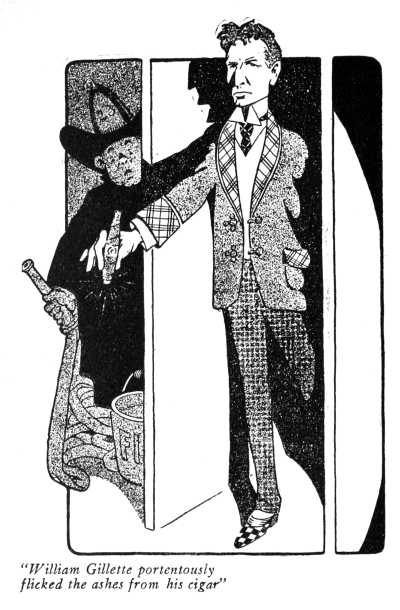
William Gillette's melodrama, "Secret Service", has a scene in which a
telegraph operator, dispatching military orders, is shot in the hand.
When the piece was given its initial hearing, Mr. Gillette, in the
role of the operator, upon receiving the wound (1) bandaged his hand
with a handkerchief, (2) picked up his cigar, and (3) went on
"sending." There was no applause. The second night the "business" was
changed. The operator (1) picked up the cigar, (2) bandaged his hand,
and (3) went on "sending." The audience was vociferous in its
approval. This particular instance of the importance of trifles is
easily explained. That a wounded man's first thought should be to care
for the wound is not remarkable, but that his first thought should be
of his cigar suggests pluck and intrepidity which the spectators were
quick to appreciate. Frequently, however, author and actors experiment
for months before finding the thing that makes or mars a desired
effect.
The play-goer who believes himself a free agent does not understand
the art of the theater. That art being perfect, he restrains his
laughter and waits with his applause until the precise moment when the
stage director wants him to laugh or applaud. It often happens that a
laugh may spoil a dramatic situation, or that applause may not be
desirable at a particular time. For example, if an audience is
permitted to vent its enthusiasm over some stirring incident just
before the end of an act the applause after the act will be
appreciably less, and the number of curtain calls will be smaller. It
is a simple matter of mechanics to "kill" a laugh or a round of
applause, just as, in many cases, the impression made by an actor in a
situation may depend, not upon himself, but upon a detail of stage
direction.
When two actors have an important dialogue, each wants to stand
farther "up stage"—which is to say farther from the footlights—than
the other, because the person fartherest "up stage" is most likely to
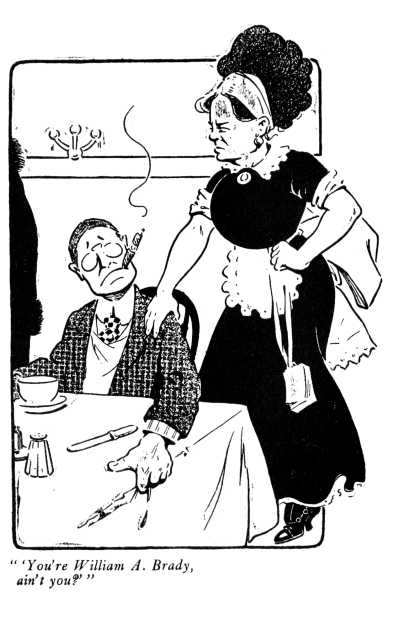
dominate the scene. "It's no use", I once heard William A. Brady say
to a veteran, who was rehearsing with a young woman star. "She knows
the tricks as well as you do, and she'll back through the wall of the
theater before she'll give you that scene!"
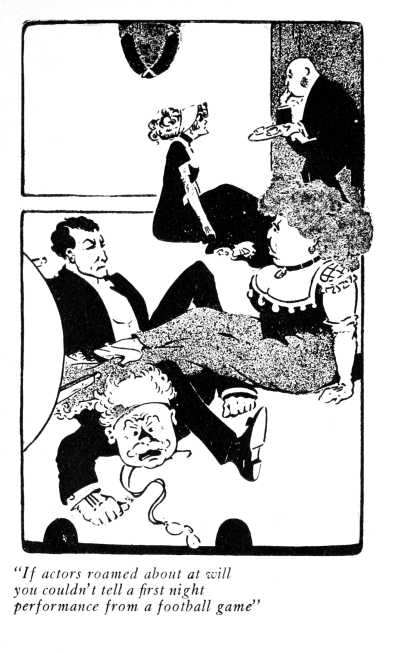
The position of the player being of such consequence, it will be seen
at once that actors do not, as is commonly believed, roam about the
stage at will. In point of fact, they are practically automata,
reflecting the brain-pictures of the director and working out his
scheme. It is not unusual for the man in charge of a rehearsal to
instruct one of his puppets to "take six steps to the right at this
speech", or to "come down stage four steps." No person in a
performance ever "crosses" another person—that is, passes behind or
in front of that other person—without having been told just when and
how to do so. That movement which seems least premeditated often has
been most carefully planned, and you may be sure that, at the
performance you are witnessing, everybody on the stage knows to the
fraction of a yard where he or she will be standing at a given moment.
Edwin Booth's reply to a novice who inquired where he should go during
a long speech—"Wherever you are I'll find you"—would not be possible
from a stage director of today.
While this pre-arrangement may appear to the layman to be opposed to
any semblance of life and spontanaeity, it is absolutely necessary to
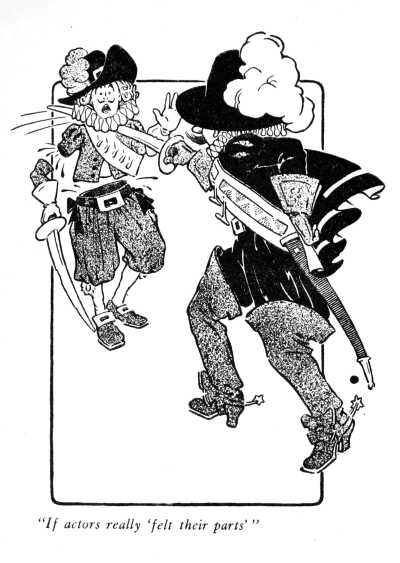
the giving of a smooth performance. If actors really "felt their
parts" they would be about as dependable as horses that "feel their
oats", and the representation in which they took part would soon
become utterly chaotic. Fancy the awkwardness of Bassanio, in the
trial scene of "The Merchant of Venice", looking around to find
Shylock before inquiring: "Why dost thou whet thy knife so earnestly?"
Nor would this uncertainty be the worst effect of such unpreparedness.
On the stage every move, every gesture means something; conveys some
impression. Thus, in a dialogue in which one character is defying
another, a single step backward will produce the effect of cowardice,
or at least of weakness and irresolution, in the person who retreats.
The whole tension of a scene may be lost if one of the parties to it
so much as glances down or reaches out for some necessary article.
In the enactment of "The Traitor", a dramatization of the novel by
Thomas Dixon, Jr., we found that a certain passage between the
"lead", or hero, and the "heavy", or villain, failed of its intended
effect. The hero, John Graham, is brought into court handcuffed, and
seated in the prisoners' dock. Steve Hoyle goes to him with a taunt.
It was thought veracious, even suggestive of manliness, that Graham,
hearing the taunt, should rise angrily, as though prevented only by
his bonds from striking his foe. After two weeks of guessing and
experimenting, we discovered that this very natural movement, for some
reason still inexplicable, gave the impression of weakness. It is
minutae like this that must be considered at rehearsal, and taught so
carefully that the actor moves, as it were, in a groove, swerving from
the determined course only as a needle in a sewing machine swerves in
its downward stroke.
Accent and facial expression are planned by the stage director with
the same absolutism that marks his attention to manouvre. Few actors
can be counted upon to read every line intelligently, and frequently
the person in charge must stop a rehearsal to point out an
underlying thought. "You blur that speech", the director may say to
the actor. "You don't define the changes of thought which it implies.
See here! Jones says: 'I'll go to her with the whole story.' You
listen. Your first emotion is surprise. 'You will?' Suspicion enters
your mind. 'Then you——' The suspicion becomes certainty. 'Then you
love her, too!'" Thus, more frequently than will be believed by the
hero-worshipper, the much admired tone in which some big speech is
delivered is the tone of the teacher.
"If actors really 'felt their parts'"
So much, so very much, may depend upon the emphasis given a single
word. The art of speaking, however, is not more part and parcel of a
perfect performance than the art of listening. The director not only
rehearses the manner of giving a sense, but the manner of receiving
it. He must note pronunciations, too, and, if there is an odd or
foreign name in the play, he must take care that all his people
pronounce it alike. The length of pauses, the tempo of comic or
serious conversations, the light and shade of the entire
representation depend upon his competence.
Drama is the Greek word for action, and so, in a play, what the people
do is even more important than what they say. Practically every
motion made on the stage, except that of walking, comes under the head
of what is known technically as "business." Laymen who believe that
mummers act on their own initiative, even "making up" lines as they go
along, will be surprised to learn that the manuscript of a workmanlike
play contains more "business" than dialogue. The performer picks up a
photograph or lights a cigar or toys with a riding whip, not because
it has occurred to him to do so, but because the author has written
down what he must do, and how and when he must do it, and the stage
director has taught him properly to interpret the author.
Here is a page from the "prompt copy" of "Clothes." The unbracketed
sentences are dialogue; those in parenthesis are "business":
WEST.
I'm going to marry you in spite of——
(Checks himself suddenly. Gets his hat and brushes it with his
sleeve. Laughs a little.)
Pardon me. My temper is a jack-in-the-box. The cover is down again.
Goodnight.
(Walks quickly to door L. C., and exits. OLIVIA stands still a
moment, then throws herself into chair R. of table, and
indulges in a torrent of tears. The bell rings. She sits
upright and listens. It rings again. She rises and runs to door
L. 2. E. The MAID enters.)
The capital letters—L. C., R., and L. 2. E. are abbreviations of
terms that indicate exact spots on the stage. You see, it is not left
to the discretion of West by which door he shall leave the room, nor
of Olivia into which chair she shall throw herself. This "business"
the director works over at rehearsal, elaborating, amplifying, making
clear. West is told precisely where he must find his hat, with which
arm he must brush it, in what tone he must laugh. If this were a case
where a pause would heighten the effect of an entrance, the maid would
be informed, as was the mythical Mr. Leeds in my opening paragraphs,
how many she must count, which is to say how long she must wait,
before entering.
The more experienced an author, the more definite, exhaustive and
significant his "business." When a play goes into rehearsal, however,
there are always places where speech may be exchanged for action, and
often, after a dramatist has seen his work on the stage, he is able to
cut whole pages, the sense of which is made clear by the appearance,
the manner, or the "business" of his people.
There are various kinds of "business", and of different purpose. The
old-fashioned stage director used to invent dozens of meaningless
things for actors to do, merely to "fill in", or give the appearance
of activity. It is related that, when the farce, "It's All Your
Fault", was being rehearsed, the man in charge insisted that Charles
Dickson, who was supposed to be calling at the room of a friend,
should "fill in" a long speech by taking a brush from a bureau drawer
and brushing his hair.
"But", protested Mr. Dickson, "I'm simply visiting. I can't use
another man's brush."
"Can't help that!" said the director. "There are long speeches here,
and you must do something while they are being spoken."
This kind of stage management, however, is no longer general. It is
understood now that the best way to make a speech impressive is to
stand still and speak it, so that actors are not often given by-play
without some good reason.
"Business" may supply "atmosphere", as the spectacle of a man rubbing
his ears and blowing on his hands helps create the illusion of intense
cold. In the original production of "In the Bishop's Carriage", Will
Latimer, impersonated by a very slight young fellow, was supposed to
cowe Tom Dorgan, a thug of enormous bulk. The scene never carried
conviction, until our stage director hit upon an ingenious bit of
"business." He put a telephone on the table that stood between the two
men. Dorgan made a movement toward Latimer. Latimer, without flinching
or taking his eyes from Dorgan's face, laid his hand on the telephone.
That gesture suggested a world of power, the police station within
reach, law and society standing back of Latimer. It saved the
situation.
Much "business" is obvious and essential, as Voysin's fumbling in his
wife's dressing table, in "The Thief", since this fumbling leads to
the discovery of the bills upon the purloining of which the play is
built. If a small article is to be used importantly in a performance
it must be "marked", so that the audience will know what it is and so
that it will not seem to have appeared miraculously to fit the
occasion. The paper cutter falls off the table in the first act of
"The Witching Hour", not by accident, but by carefully thought out
design, so that the audience will know where the instrument is and
recognize it when Clay Whipple uses it to kill Tom Denning.
"Business", in a word, may be the smashing of a door or the picking up
of a pin. It is the adornment that makes an otherwise bald and
unconvincing narrative seem real; that translates mere dialogue into
the semblance of every-day life.
Many plays—even most plays—are substantially altered at rehearsal.
Dion Boucicault, the great Irish dramatist, said: "Plays aren't
written; they are rewritten." It has been proved utterly impossible to
judge the effect of a play from the manuscript, to know the merit of
any story or episode until it is visualized, translated into action.
Some time ago, William Gillette finished a farce, "That Little Affair
at Boyd's", to which he had devoted the greater part of a year, and in
which, therefore, he must have had considerable faith. Yet, after a
week's rehearsal, he dismissed the company engaged and abandoned the
idea of producing the piece. The soundness of his judgment was
demonstrated later when this farce, re-christened "Ticey", was revived
and failed utterly.
When defects manifest themselves at rehearsal, the director does not
hesitate to make or to suggest changes, the directness of his course
depending upon the standing of his author. No dramatist is a hero to
his stage director. Also, while we're parodying maxims, it's a wise
author that knows his own play on its first night.
The playwright is quick to learn humility. "Who's that meek-looking
chap?" somebody once asked Augustin Daly during the course of a trial
performance. "That!" returned Daly. "Oh, that's only the author!" If a
director is employed, the writer makes his suggestions through that
gentleman. Sometimes the experience of the producer, who brings a
fresh mind to the subject, is surer than the instinct of the author,
who may easily have lost sense of perspective from long association
with his work.
"The Three of Us", a well-known domestic comedy, depends for its chief
interest upon a scene in the third act, where Rhy MacChesney pays a
midnight visit to Louis Berresford. When the piece was put into
rehearsal, the idea was that Berresford, hearing a knock at the door,
bade the girl hide herself, which she did, only to be discovered
later. George Foster Platt, the stage director, who recently filled
that post at the New Theater, objected that this was trite,
conventional, unnecessary. "Why shouldn't the young woman tell the
truth—that she came on a perfectly legitimate errand, meaning no
harm, and that she has nothing to fear—and refuse to hide?" The
author adopted his view, a new scene was written, and the play,
largely because of the unexpectedness of this turn of affairs, ran for
an entire year at the Madison Square.
The knowledge of the stage director must cover the mechanical features
of production as well as the literary. It is essential that he should
understand the full value of light and scenic effects, and how to
produce them. A stage may be, and generally is, illuminated by means
of five different devices—from the "borders", which are directly
overhead; from calciums, in the balcony or on either side of the
stage; from spot lights, which really are calciums whose light is
focused upon one spot; from footlights, and from "strips", which are
placed wherever light from more remote sources would be obstructed.
The "borders" are long, inverted troughs, stretching from the extreme
left of the stage to the extreme right and suspended from the roof of
the theater. When it is said that the light coming from the "borders",
or, indeed, from anywhere else, may be raised or lowered, may be white
or blue or red or amber, or a combination of these colors, reproducing
the glow of a lamp, or the first gray glimmer of sunrise, it will be
understood that the director has a wide range of effects at his
command.
Just as the reading of a line may alter the impression created by an
entire passage, so may the least variation in illumination. Comedy
scenes, for example, must be played in full light, as sentimental
scenes are helped by half lights. If you could witness the second act
of "Charley's Aunt" performed in the steel blue of moonlight, and the
last act of "Dr. Jekyll and Mr. Hyde" in the glare of "full up", you
would be amazed at the result.
Color has as subtle an influence. I have seen the people in a play
fairly melt into the background of a yellow setting, causing their
action to seem vague and illy-defined. Augustus Thomas' "The Harvest
Moon" had a scene in which the same subject matter was repeated
successively in different settings. Unless you had witnessed this
performance, you would hardly believe how wholly unlike were the
impressions produced. Costumes and music have an equal portence, and
both call for the exercise of nice discretion.
The personality of the stage director, and his manner at rehearsal,
are vital considerations. In acting, more than in any other art, the
feeling of the artist reaches through his work. Everyone who has
watched rehearsals has come to the conclusion, at one time or another,
that actors are something less than human. As a matter of fact they
are simply children, calling for the patience, the forbearance, and
the flexibility of view-point necessary in a nursery. Wholly
self-centered, having little contact with the outside world, their
standards, their emotions, their false valuations make constant
difficulties for the man who has to play upon them as upon a piano.
The dramatic instinct and the egregious ego form a provoking blend. I
have known an actress, at a dress rehearsal, the night before the
public performance of a play, to go into violent hysterics, apparently
reduced to a nervous wreck by the strain of her work. "Great heavens!"
I have said to the director; "she won't be able to appear tomorrow."
"Acting, my boy", that gentleman would reply. "Acting for our benefit
and her own. She'll be all right in ten minutes." And in ten minutes
this same woman, done with her scene, would be advancing most logical
reasons why she should have somebody's dressing room and why somebody
else should have been given hers. I don't know exactly what
temperament is, but most actors think they have it.
Player folk are full of superstitions, and many of these relate to
rehearsal. Few actors will speak the "tag", or last line, of a play
until its premiere. If that line were spoken the play would fail.
Managers are not exempt from similar ideas, a mixture of ignorance and
experience. A good final rehearsal is supposed to forecast a bad first
performance, and this notion is not without reason, since the people,
made sure of themselves, are pretty certain to lose the tension of
nervousness. When the actors like a play at rehearsal the manager
grows fearful. An actor usually likes best the play in which he has
the best part, and that is not invariably the best play.
Small, indeed, is the share of glory that goes to "the power behind
the throne." His name adorns no bill-boards, and, on the program, you
will find it most frequently among the announcements that the shoes
came from Hammersmith's or that the wigs are by Stepner. The manager
knows the stage director, though, and respects him, reputation of this
kind being more profitable than reputation with the great, careless
public.
Some few managers, like David Belasco and Collin Kemper, attend to the
staging of their own productions, and, indeed, are most noted for
their skill in this work. Many authors, among the number Augustus
Thomas, James Forbes and Charles Klein, "put on" their own plays. Then
there are "General Stage Directors", like William Seymour or J. C.
Huffman, employed at so much per annum by big firms like those of
Charles Frohman or the Shuberts. There are also detached directors,
who contract to stage a play here or there at sums varying from five
hundred to a thousand dollars for each piece. Julian Mitchell, R. H.
Burnside and George Marion head the list of men who make a specialty
of producing musical comedy, which is a field in itself. A broad
distinction exists between the stage director and the stage manager,
the province of the latter being only to carry out the plans of the
former.
A dramatic composition is rehearsed from two to four weeks, the
rehearsals usually lasting from ten o'clock in the morning until five
in the evening, with an hour for luncheon. The play being finished
and accepted, the manager turns the manuscript over to the stage
director. This gentleman reads it carefully, realizing possibilities
and devising "business." I have known authors to write, and directors
to read, with a miniature stage beside them. On this stage, pins would
take the place of people, being moved here and there as one situation
followed another. The exact location of the characters at every speech
was then marked on the manuscript, so that little or no experimenting
was necessary at rehearsal.
After he has read the play, the director consults with the author and
the manager and the scene painter. He helps the manager decide what
actors had best be engaged, and the four determine every detail of the
settings to be built and painted. Miniatures of these settings are
afterward prepared by the artist and officially O. K.'d. The manager
interviews such people as he thinks he may utilize, and comes to terms
with them. Actors are not paid for time spent in rehearsal, and, if
they prove unsatisfactory before the initial performance, may be
dismissed without notice and without recompense.
It is an old custom, now in the way of being revived, to begin
operations by reading the play to the company. The first rehearsals
may take place in a hall, but, whenever it is possible, a stage is
brought into requisition. In the centre of the stage, directly back of
the footlights, is the prompt table, at which sit the author, the
director, and the stage manager. The players, when they are not at
work, lounge in remote corners, leaving the greater portion of the
floor space cleared for action. There is no scenery, no furniture, no
"properties." Two stools, with a space between them, may stand for
Juliet's balcony, for the Rialto Bridge, or merely for a window in a
modern apartment house. The casual observer may be puzzled at hearing
some Thespian harranguing to four vacant chairs, until it is explained
that these four chairs mark the corners of a jury box in which twelve
good men and true—same being "supers" yet to be employed—are to try
the hero for his life.
In the beginning the actors read lines from their parts. A "part"
contains the speeches and "business" of the actor for whom it is
intended, with "cues", or the last few words of each speech preceding
his, so that he may know when to speak. An extract from the "part" of
the Queen in "Hamlet" (Act iii; Scene i) would look something like
this:
(You enter L.3.E.)
Did he receive you well?
——free in his reply.
Did you assay him to any pastime?
——he suffers for.
I shall obey you. Etc.
The director shows the actor where he shall stand, and where go, at
every speech, and the stage manager notes on the manuscript such
"business" as is not already written in it. Also, he sets down
memoranda for the raising and "dimming" of lights, the ringing of
bells, and other things to be done "off stage."
After a couple of days' rehearsal the players may be told that they
must have the lines of the first act committed to memory within a
certain time. "Letter perfect on Thursday!" says the director. "Don't
forget; I want to hear every 'if, 'and', and 'but' spoken on
Thursday!"
So, act by act, the piece is learned, and, within a week, "parts" are
put away, and the real work of rehearsal begins. By this time, the
"roughing out" of the production has been done, positions have been
taught, and the director begins devoting himself to details.
Throughout the first fortnight he interrupts frequently; compels the
people to go back a dozen times over this scene or that; halts, thinks
out trifles, suggests and experiments. When the rehearsals are
two-thirds done, however, he and the author break in less and less
often. They sit, notebooks in hand, jotting down their observations,
which are read aloud to the company at the end of each act.
Meanwhile, the director has attended to several important matters with
which the cast has no immediate concern. He has made out a list of
"properties", or small articles to be handled in the performance, and
has given it to the manager. This list requires care. For example, if
matches are needed in the play, it must be ascertained what kind of
matches were used at that period, and sulphur, parlor, or "safety"
matches must be specified. The manager must also be given lists of
furniture and draperies. Later on, a table of "music cues" must be
made out for the orchestra, and one of "light cues" for the
electrician. The play must be timed, so that it may be known to a
minute at what hour the curtain will rise and fall on every act.
Generally, a page of typewritten manuscript will occupy a minute, but
guess work on this point does not suffice for the director. The
players begin to consult him about their costumes, too, and he must
take into account the blending of colors, the fashions of the period,
and the personal characteristics likely to manifest themselves in
attire.
I wish I could make you see a theater during the progress of a
rehearsal. The great auditorium is dark and vacant, but for two or
three cleaners, who may be sweeping and dusting. White cloths cover
the seats, and hang over the facades of the boxes. Through the center
of the stage, just behind the footlights, a gas pipe rears itself to a
height of five or six feet, and a single jet burns at the end of it.
Close beside this pipe is the table I have mentioned, where, with
their backs to the auditorium, sit three very busy, very attentive
gentlemen. Farther on the stage, which is bare except for a couple of
tables and a few chairs, stand two or three actors, attired in street
dress, talking in a fashion utterly out of keeping with their
every-day appearance. And on all sides are little groups of men and
women, who pay no attention to the people in the scene and to whom the
people in the scene pay no attention, who laugh and chat in subdued
tones until some "cue" brings them into the action.
One day a notice appears on the call board. The company will leave
from the Grand Central Station the next morning at 7:20 o'clock. The
destination may be Syracuse, N. Y. The hotels in that city are
so-and-so. The theater is the New Wieting. There will be a dress
rehearsal there tomorrow night at 8. "Everybody will please be made up
half an hour earlier."
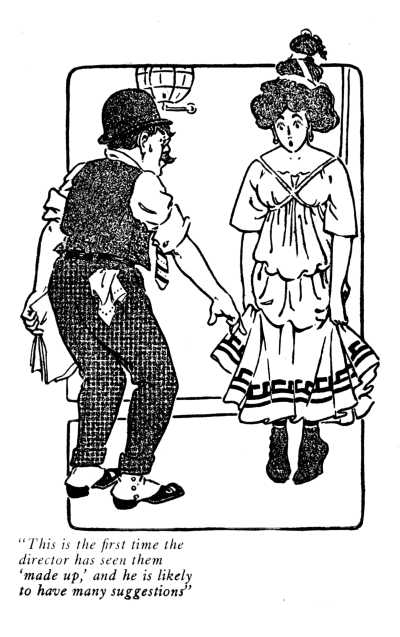
"This is the first time the director has seen them 'made up' and he is likely to have many suggestions"
The dress rehearsal is the crowning ordeal in the business of
producing plays. It is the summing up of everything that has gone on
before; the concentration into one evening of all the work and nervous
strain of the past month. It is safe to say that in no other
profession is so much labor and agony crowded into a single effort.
Very often dress rehearsals last from eight o'clock at night until
eight the next morning. Sometimes they last longer. The dress
rehearsal of "The Burgomaster", at the Manhattan Theater, New York,
began at noon on Sunday and continued, without intermission, until
eleven o'clock Monday. Frequently, coffee and sandwiches are served in
one of the dressing rooms, or on the stage, and the tired players
snatch a bite or two between scenes.
The director has been in the theatre all the afternoon, superintending
the setting of scenes and the "dressing" of the stage, which means
the placing of furniture and the hanging of curtains. Half an hour
before the rehearsal begins, the members of the company come from
their rooms, one by one, for an inspection of costumes. This is the
first time the director has seen them "made up", and he is likely to
have many suggestions. This wig isn't gray enough, that beard is too
straggling, the dress over there isn't in character. Back go the
actors to remedy these defects, and after a time the rehearsal is
started.
Dress rehearsals invariably are prefaced by the managerial
announcement that there will be no interruptions, but I have never
seen an uninterrupted dress rehearsal. The leading man stops in the
middle of a love scene to inquire what he shall do with his bouquet,
or the leading woman to complain that the property man hasn't placed a
bundle of letters where it ought to be. I remember that, when we came
to the final rehearsal of "The Little Gray Lady", the manager, Maurice
Campbell, finished his remarks about interruptions, and called upon
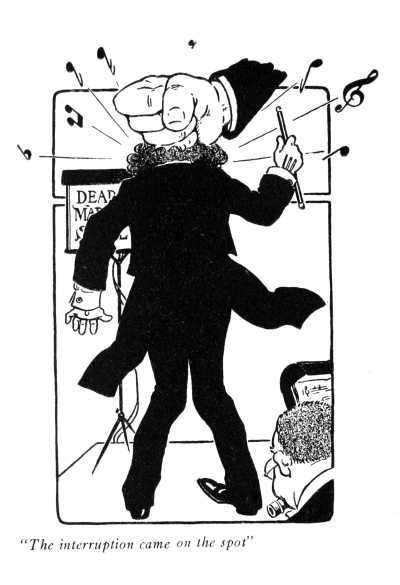
the orchestra to begin the overture. The orchestra promptly struck
up "The Dead March from Saul", and the forbidden interruption came
on the spot.
"The interruption came on the spot"
A dress rehearsal is supposed to be an ordinary performance without an
audience. But it isn't. There is no excitement, no enthusiasm, no
inspiration. Speeches fall flat, dialogue seems inordinately long and
wearisome, bits of "business" that have appeared all right before look
wholly different in changed surroundings. The actors, finding
themselves for the first time in the setting to be used, are utterly
lost. By-play with small articles, rehearsed twenty times, is
blundered over when the player finds the "prop" actually in his hands.
To observe the most experienced actor, and man of the world, handle a
tea cup or a card case at a dress rehearsal you would swear that he
had never seen such a thing before in his life.
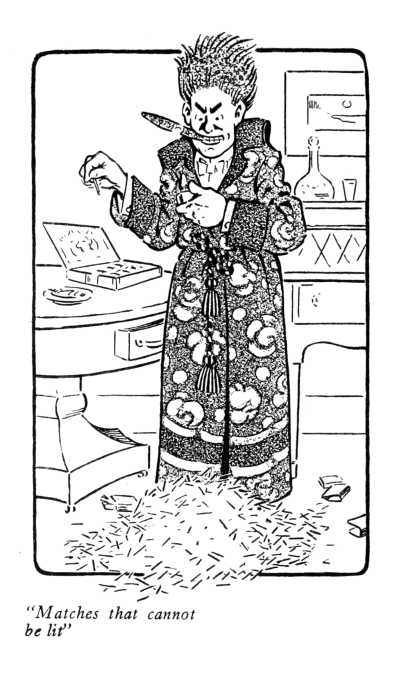
And, O, the wickedness of inanimate things—doors that will not shut,
matches that cannot be lit, table drawers that positively refuse to
open! Whenever something of this sort goes wrong, the carpenter or the
property man has to be called upon, and the scene stops, to be
resumed later with a flatness commensurate with the length of the
halt. Above all other sounds rings the clarion voice of the director,
shouting to electricians, stage hands, actors. Everybody makes notes,
to be quietly gone over with the company on the morrow, just before
the actual performance.
At last, when the gray dawn is peeping in at the windows, when
everyone concerned has reached the ultimate stage of exhaustion, the
rehearsal is dismissed. The director makes a few remarks—sufficient
censure to prevent over-confidence, mixed with enough hope to give
courage. "Pretty bad", he says, "but I look for you to pull up
tonight. We'll get together for a little chat at four o'clock in the
smoking room of the theater."
Thus ends the period of rehearsal—a period of hard work, trials,
tribulations, constant nervous strain. And it may all go for nothing.
In three short hours the labor of years on the part of the author, of
months on the part of the manager, of weeks on the part of the
players, may be proved utterly worthless and without result. This,
however, depends upon the public; those concerned have done all they
know, all that can be done, not by random and haphazard work; but by
skillful following of what is at once an exact science and a variable
art. The philosophic author shrugs his shoulders as he leaves the
theater.
"Matches that cannot be lit"
"Well?" inquires the stage director.
"Well", he replies. "We've done our best. It's on the knees of the
gods."