TO THE READER.
There are chapters in this little volume which
will, I am afraid, be deemed too prolix by the general
reader, and which yet the geologist would like less
were there any portion of them away. They refer
chiefly to organisms not hitherto figured nor described,
and must owe their modicum of value to that very
minuteness of detail which, by critics of the merely
literary type, unacquainted with fossils, and not greatly
interested in them, may be regarded as a formidable
defect, suited to overlay the general subject of the
work. Perhaps the best mode of compromising the
matter may be to intimate, as if by beacon, at the
outset, the more repulsive chapters; somewhat in the
way that the servants of the Humane Society indicate
to the skater who frequents in winter the lakes
in the neighborhood of Edinburgh, those parts of the
ice on which he might be in danger of losing himself.
I would recommend, then, readers not particularly
palæontological, to pass but lightly over the
whole of my fourth and fifth chapters, with the latter
half of the third, marking, however, as they skim the
pages, the conclusions at which I arrive regarding the
bulk and organization of the extraordinary animal
described, and the data on which these are founded.
My book, like an Irish landscape dotted with green
bogs, has its portions on which it may be perilous for
the unpractised surveyor to make any considerable
stand, but across which he may safely take his sights
and lay down his angles.
It will, I trust, be found, that in dealing with errors
which, in at least their primary bearing, affect questions
of science, I have not offended against the courtesies
of scientific controversy. True, they are errors
which also involve moral consequences. There is a
species of superstition which inclines men to take on
trust whatever assumes the name of science; and
which seems to be a reaction on the old superstition,
that had faith in witches, but none in Sir Isaac Newton,
and believed in ghosts, but failed to credit the
Gregorian calendar. And, owing mainly to the wide
diffusion of this credulous spirit of the modern type,
as little disposed to examine what it receives as its
ancient unreasoning predecessor, the development
doctrines are doing much harm on both sides of the
Atlantic, especially among intelligent mechanics, and
a class of young men engaged in the subordinate departments
of trade and the law. And the harm, thus
considerable in amount, must be necessarily more than
merely considerable in degree. For it invariably happens,
that when persons in these walks become materialists,
they become also turbulent subjects and bad
men. That belief in the existence after death, which
forms the distinguishing instinct of humanity, is too
essential a part of man’s moral constitution not to be
missed when away; and so, when once fairly eradicated,
the life and conduct rarely fail to betray its
absence. But I have not, from any consideration of
the mischief thus effected, written as if arguments,
like cannon-balls, could be rendered more formidable
than in the cool state by being made red-hot. I have
not even felt, in discussing the question, as if I had
a man before me as an opponent; for though my
work contains numerous references to the author of
the “Vestiges,” I have invariably thought on these
occasions, not of the anonymous writer of the volume,
of whom I know nothing, but simply of an ingenious,
well-written book, unfortunate in its facts
and not always very happy in its reasonings. Further,
I do not think that palæontological fact, in its
bearing on the points at issue, is of such a doubtful
complexion as to leave the geologist, however much
from moral considerations in earnest in the matter,
any very serious excuse for losing his temper.
In my reference to the three great divisions of the
geologic scale, I designate as Palæozoic all the fossiliferous
rocks, from the first appearance of organic existence
down to the close of the Permian system; all
as Secondary, from the close of the Permian system
down to the close of the Cretaceous deposits; and all
as Tertiary, from the close of the Cretaceous deposits
down to the introduction of man. The wood-cuts
of the volume, of which at least nine tenths of the
whole represent objects never figured before, were
drawn and cut by Mr. John Adams of Edinburgh,
(8, Heriot Place,) with a degree of care and skill
which has left me no reason to regret my distance
from the London artists and engravers. So far at
least as the objects could be adequately represented
on wood, and in the limited space at Mr. Adams’
command, their truth is such that I can safely recommend
them to the palæontologist. In the accompanying
descriptions, and in my statements of geologic
fact in general, it will, I hope, be seen that I have
not exaggerated the peculiar features on which I have
founded, nor rendered truth partial in order to make
it serve a purpose. Where I have reasoned and inferred,
the reader will of course be able to judge for
himself whether the argument be sound or the deduction
just; and to weigh, where I have merely speculated,
the probability of the speculation; but as, in
at least some of my statements of fact, he might lie
more at my mercy, I have striven in every instance
to make these adequately representative of the actualities
to which they refer. And so, if it be ultimately
found that on some occasions I have misled
others, it will, I hope, be also seen to be only in cases
in which I have been mistaken myself. The first or
popular title of my work, “Foot-prints of the Creator,”
I owe to Dr. Hetherington, the well-known
historian of the Church of Scotland. My other various
obligations to my friends, literary and scientific,
the reader will find acknowledged in the body of the
volume, as the occasion occurs of availing myself of
either the information communicated, or the organism,
recent or extinct, lent me or given.
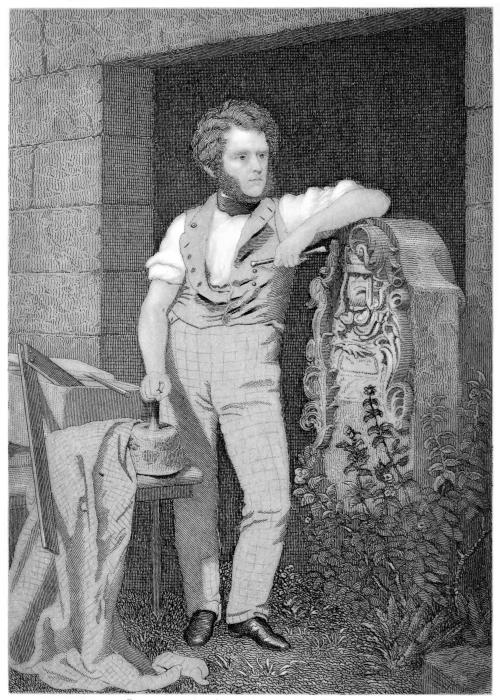
HUGH MILLER, AUTHOR OF “OLD RED SANDSTONE” AND “FOOTPRINTS OF THE CREATOR.”
The geological works of Hugh Miller have excited the greatest
interest, not only among scientific men, but also among general readers.
There is in them a freshness of conception, a power of argumentation,
a depth of thought, a purity of feelings, rarely met with
in works of that character, which are well calculated to call forth
sympathy, and to increase the popularity of a science which has already
done so much to expand our views of the Plan of Creation.
The scientific illustrations published by Mr. Miller are most happily
combined with considerations of a higher order, rendering both
equally acceptable to the thinking reader. But what is in a great
degree peculiar to our author, is the successful combination of Christian
doctrines with pure scientific truths. On that account, his
works deserve peculiar attention. His generalizations have nothing
of the vagueness which too often characterize the writings of those
authors who have attempted to make the results of science subservient
to the cause of religion. Struck with the beauty of Mr. Miller’s
works, it has for some time past been my wish to see them more extensively
circulated in this country; and I have obtained leave from the
author to publish an American edition of his “Footprints of the
Creator,” for which he has most liberally furnished the publishers
with the admirable wood-cuts of the original.
While preparing some additional chapters, and various notes illustrative
of certain points alluded to incidentally in this work, it was
deemed advisable to preface it with a short biographical notice of
the author. I had already sketched such a paper, when I became
acquainted with a full memoir of this remarkable man, containing
most interesting details of his earlier life, written by that eminent
historian of the “Martyrs of Science,” the great natural philosopher
of Scotland. It has occurred to me that, owing to the frequent references
which I could not avoid to my own researches, I had better
substitute this ample Biography for my short sketch, with such alterations
and additions as the connection in which it is brought here
would require. I therefore proceed to introduce our author with Sir
David Brewster’s own words:—
Of all the studies which relate to the material universe, there
is none, perhaps, which appeals so powerfully to our senses, or
which comes into such close and immediate contact with our wants
and enjoyments, as that of Geology. In our hourly walks, whether
on business or for pleasure, we tread with heedless step upon the apparently
uninteresting objects which it embraces: but could we
rightly interrogate the rounded pebble at our feet, it would read us
an exciting chapter on the history of primeval times, and would tell
us of the convulsions by which it was wrenched from its parent rock,
and of the floods by which it was abraded and transported to its
present humble locality. In our visit to the picturesque and the
sublime in nature, we are brought into closer proximity to the more
interesting phenomena of geology. In the precipices which protect
our rock-girt shores, which flank our mountain glens, or which variegate
our lowland valleys, and in the shapeless fragments at their
base, which the lichen colors, and round which the ivy twines, we
see the remnants of uplifted and shattered beds, which once reposed
in peace at the bottom of the ocean. Nor does the rounded
boulder, which would have defied the lapidary’s wheel of the Giant
Age, give forth a less oracular response from its grave of clay, or
from its lair of sand. Floated by ice from some Alpine summit, or
hurried along in torrents of mud, and floods of water, it may have
traversed a quarter of the globe, amid the crash of falling forests,
and the death shrieks of the noble animals which they sheltered.
The mountain range, too, with its catacombs below, along which the
earthquake transmits its terrific sounds, reminds us of the mighty
power by which it was upheaved;—while the lofty peak, with its
cap of ice, or its nostrils of fire, places in our view the tremendous
agencies which have been at work beneath us.
But it is not merely amid the powers of external nature that the
once hidden things of the Earth are presented to our view. Our
temples and our palaces are formed from the rocks of a primeval age;
bearing the very ripple-marks of a Pre-Adamite ocean,—grooved by
the passage of the once moving boulder, and embosoming the relics
of ancient life, and the plants by which it was sustained. Our
dwellings, too, are ornamented with the variegated limestones,—the
indurated tombs of molluscous life,—and our apartments heated
with the carbon of primeval forests, and lighted with the gaseous
element which it confines. The obelisk of granite, and the colossal
bronze which transmit to future ages the deeds of the hero and the
sage, are equally the production of the Earth’s prolific womb; and
from the green bed of the ocean has been raised the pure and spotless
marble, to mould the divine lineaments of beauty, and perpetuate
the expressions of intellectual power. From a remoter age, and
a still greater depth, the primary and secondary rocks have yielded a
rich tribute to the chaplet of rank, and to the processes of art.
Exhibiting, as it peculiarly does, almost all those objects of interest
and research, Scotland has been diligently studied both by native
and foreign observers; and she has sent into the geological field
a distinguished group of inquirers, who have performed a noble feat
in exploring the general structure of the Earth, in decyphering its
ancient monuments, and in unlocking those storehouses of mineral
wealth, from which civilized man derives the elements of that gigantic
power which his otherwise feeble arm wields over nature.
The occurrence of shells on the highest mountains, and the remains
of plants and animals, which the most superficial observer
could not fail to notice, in the rocks around him, have for centuries
commanded the attention and exercised the ingenuity of every student
of nature. But though sparks of geological truth were from
time to time elicited by speculative minds, it was not till the end of
the last century that its great lights broke forth, and that it took the
form and character of one of the noblest of the sciences. Without
undervaluing the labors of Werner, and other illustrious foreigners,
or those of our southern countrymen, Mitchell and Smith, at the
close of the last century, we may characterize the commencement of
the present as the brightest period of geological discovery, and place
its most active locality in the northern metropolis of our island. It
was doubtless from the Royal Society of Edinburgh, as a centre, that
a great geological impulse was propagated southward, and it was by
the collision of the Wernerian and Huttonian views, the antagonist
theories of water and of fire, that men of intellectual power were
summoned from other studies; and that grand truths, which fanaticism
and intolerance had hitherto abjured, rose triumphant over the
ignorance and bigotry of the age. The Geological Society of London,
which doubtless sprung from the excitement in the Scottish metropolis,
entered on the new field of research with a faltering step. The
prejudices of the English mind had been marshalled with illiberal
violence against the Huttonian doctrines. Infidelity and Atheism
were charged against their supporters; and had there been a Protestant
Inquisition in England at that period of general political excitement,
the geologists of the north would have been immured in its
deepest dungeons.
Truth, however, marched apace; and though her simple but majestic
procession be often solemn and slow, and her votaries few and
dejected, yet on this, as on every occasion, she triumphed over the
most inveterate prepossessions, and finally took up her abode in those
very halls and institutions where she had been persecuted and reviled.
When their science had been thus acquitted of the charge of
impiety and irreligion, the members of the Geological Society left
their humble and timid position of being the collectors only of the
materials of future generalizations, and became at once the most successful
observers of geological phenomena, and the boldest asserters
of geological truth.
In this field of research, in which the physical, as well as the intellectual,
frame of the philosopher is made tributary to science, two
of our countrymen—Sir Roderick Murchison and Sir Charles Lyell—have
been among our most active laborers. From the study of
their native glens, these distinguished travellers, like the Humboldts
and the Von Buchs of the continent, have passed into foreign lands,
exploring the north and the south of Europe, and extending their
labors to the eastern ranges of the Ural and the Timan, and to the
Apallachians and the Alleghanies in the far west. But while our
two countrymen were interrogating the strata of other lands, many
able and active laborers had been at work in their own.
Among the eminent students of the structure of the earth, Mr.
Hugh Miller holds a lofty place, not merely from the discovery of
new and undescribed organisms in the Old Red Sandstone, but from
the accuracy and beauty of his descriptions, the purity and elegance
of his composition, and the high tone of philosophy and religion
which distinguishes all his writings. Mr. Miller is one of the few
individuals in the history of Scottish science who have raised
themselves above the labors of an humble profession, by the force
of their genius and the excellence of their character, to a comparatively
high place in the social scale. Mr. Telford, like Mr. Miller,
followed the profession of a stone-mason, before his industry and
self-tuition qualified him for the higher functions of an architect
and an engineer. And Mr. Watt and Mr. Rennie rose to wealth
and fame without the aid of a university education. But, distinguished
as these individuals were, none of them possessed those
qualities of mind which Mr. Miller has exhibited in his writings;
and, with the exception of Burns, the uneducated genius which has
done honor to Scotland during the last century, has never displayed
that mental refinement, and classical taste, and intellectual energy,
which mark all the writings of our author. We wish that we
could have gratified our readers with an authentic and even detailed
narrative of the previous history of so remarkable a writer, and of
the steps by which his knowledge was acquired, and the difficulties
which he encountered in its pursuit; but though this is not, to any
great extent, in our power, we shall at least be able, chiefly from
Mr. Miller’s own writings, to follow him throughout his geological
career.
Mr. Miller was born at Cromarty, of humble but respectable parents,
whose history would have possessed no inconsiderable interest,
even if it had not derived one of a higher kind from the genius and
fortunes of their child. By the paternal side he was descended
from a race of sea-faring people, whose family burying-ground, if
we judge from the past, seems to be the sea. Under its green waves
his father sleeps: his grandfather, his two granduncles, one of whom
sailed round the world with Anson, lie also there; and the same
extensive cemetery contains the relics of several of his more distant
relatives. His father was but an infant of scarcely a year old, at
the death of our author’s grandfather, and had to commence life as a
poor ship-boy; but such was the energy of his mind, that, when
little turned of thirty, he had become the master and owner of a
fine large sloop, and had built himself a good house, which entitled
his son to the franchise on the passing of the Reform Bill. Having
unfortunately lost his sloop in a storm, he had to begin the world
anew, and he soon became master and owner of another, and would
have thriven, had he lived; but the hereditary fate was too strong
for him, and when our author was a little boy of five summers, his
father’s fine new sloop foundered at sea in a terrible tempest, and
he and his crew were never more heard of. Mr. Miller had two
sisters younger than himself, both of whom died ere they attained
to womanhood. His mother experienced the usual difficulties
which a widow has to encounter in the decent education of her
family; but she struggled honestly and successfully, and ultimately
found her reward in the character and fame of her son. It is from
this excellent woman that Mr. Miller has inherited those sentiments
and feelings which have given energy to his talents as the defender
of revealed truth, and the champion of the Church of his fathers.
She was the great granddaughter of a venerable man, still well
known to tradition in the north of Scotland as Donald Roy of Nigg,—a
sort of northern Peden, who is described in the history of our
Church as the single individual who, at the age of eighty, when the
presbytery of the district had assembled in the empty church for
the purpose of inducting an obnoxious presentee, had the courage
to protest against the intrusion, and to declare “that the blood of
the people of Nigg would be required at their hands, if they settled
a man to the walls of that church.” Tradition has represented him
as a seer of visions, and a prophesier of prophecies; but whatever
credit may be given to stories of this kind, which have been told
also of Knox, Welsh, and Rutherford, this ancient champion of
Non-Intrusion was a man of genuine piety, and the savor of his
ennobling beliefs and his strict morals has survived in his family
for generations. If the child of such parents did not receive the best
education which his native town could afford, it was not their fault,
nor that of his teacher. The fetters of a gymnasium are not easily
worn by the adventurous youth who has sought and found his pleasures
among the hills and on the waters. They chafe the young and
active limb that has grown vigorous under the blue sky, and never
known repose but at midnight. The young philosopher of Cromarty
was a member of this restless community; and he had been the hero
of adventures and accidents among rocks and woods, which are still
remembered in his native town. The parish school was therefore
not the scene of his enjoyments; and while he was a truant, and,
with reverence be it spoken, a dunce, while under its jurisdiction,
he was busy in the fields and on the sea-shore in collecting those
stores of knowledge which he was born to dispense among his fellow-men.
He escaped, however, from school, with the knowledge of
reading, writing, and a little arithmetic, and with the credit of uniting
a great memory with a little scholarship. Unlike his illustrious
predecessor, Cuvier, he had studied Natural History in the fields and
among the mountains ere he had sought for it in books; while the
French philosopher had become a learned naturalist before he had
even looked upon the world of Nature. This singular contrast
is not difficult to explain. With a sickly constitution and a delicate
frame, the youthful Cuvier wanted that physical activity which the
observation of Nature demands. Our Scottish geologist, on the contrary,
in vigorous health, and with an iron frame, rushed to the
rocks and the sea-shore in search of the instruction which was not
provided for him at school, and which he could find no books to
supply.
After receiving this measure of education, Mr. Miller set out in
February, 1821, with a heavy heart, as he himself confesses, “to
make his first acquaintance with a life of labor and restraint:”—
“I was but a slim, loose-jointed boy at the time, fond of the pretty
intangibilities of romance, and of dreaming when broad awake; and woful
change! I was now going to work at what Burns has instanced in his
‘Twa Dogs’ as one of the most disagreeable of all employments—to
work in a quarry. Bating the passing uneasiness occasioned by a few
gloomy anticipations, the portion of my life which had already gone by
had been happy beyond the common lot. I had been a wanderer among
rocks and woods,—a reader of curious books, when I could get them,—a
gleaner of old traditionary stories,—and now I was going to exchange
all my day-dreams and all my amusements for the kind of life in which
men toil every day that they may be enabled to eat, and eat every day
that they may be enabled to toil. The quarry in which I wrought lay on
the southern shore of a noble inland bay, or frith, rather, (the Bay of
Cromarty,) with a little, clear stream on the one side, and a thick fir wood
on the other. It had been opened in the Old Red Sandstone of the district,
and was overtopped by a huge bank of diluvial clay, and which rose
over it in some places to the height of nearly thirty feet.”—Old Red
Sandstone, p. 4.
After removing the loose fragments below, picks and wedges and
levers were applied in vain by our author and his brother workmen
to tear up and remove the huge strata beneath. Blasting by gunpowder
became necessary. A mass of the diluvial clay came tumbling
down, “bearing with it two dead birds, that in a recent storm had
crept into one of the deeper fissures, to die in the shelter.” While
admiring the pretty cock goldfinch, and the light-blue and grayish-yellow
woodpecker, and moralizing on their fate, the workmen were
ordered to lay aside their tools, and thus ended the first day’s labor
of our young geologist. The sun was then sinking behind the thick
fir wood behind him, and the long dark shadows of the trees stretching
to the shore. Notwithstanding his blistered hands, and the
fatigue which blistered them, he found himself next morning as light
of heart as his fellow-laborers, and able to enjoy the magnificent
scenery around him, which he thus so beautifully describes:—
“There had been a smart frost during the night, and the rime lay white
on the grass as we passed onwards through the fields; but the sun rose in
a clear atmosphere, and the day mellowed as it advanced into one of those
delightful days of early spring which give so pleasing an earnest of whatever
is mild and genial in the better half of the year. All the workmen
rested at midday, and I went to enjoy my half hour alone on a mossy
knoll in the neighboring wood, which commands through the trees a wide
prospect of the bay and the opposite shore. There was not a wrinkle on
the water, nor a cloud in the sky; and the branches were as moveless in
the calm as if they had been traced on canvas. From a wooded promontory
that stretched half way across the frith, there ascended a thin column
of smoke. It rose straight on the line of a plummet for more than a
thousand yards; and then, as reaching a thinner stratum of air, spread out
equally on every side, like the foliage of a stately tree. Ben Wevis rose
to the west, white with the yet unwasted snows of winter, and as sharply
defined in the clear atmosphere as if all its sunny slopes and blue retiring
hollows had been chiselled in marble. A line of snow ran along the opposite
hills; all above was white, and all below was purple.”—Old Red
Sandstone, pp. 6, 7.
In raising from its bed the large mass of strata which the gunpowder
had loosened, on the surface of the solid stone, our young quarrier
descried the ridged and furrowed ripple marks which the tide
leaves upon every sandy shore, and he wondered what had become
of the waves that had thus fretted the solid rock, and of what element
they had been composed. His admiration was equally excited
by a circular depression in the sandstone, “broken and flawed in
every direction, as if it had been the bottom of a pool recently dried
up, which had shrunk and split in the hardening.” And before the
day closed, a series of large stones had rolled down from the clay,
“all rounded and water-worn, as if they had been tossed in the sea
or the bed of a river for hundreds of years.” Was the clay which
enclosed them created on the rock upon which it lay? No workman
ever manufactures a half-worn article!—were the ejaculations of
the geologist at his alphabet.
Our author and his companions were soon removed to an easier
wrought quarry, and one more pregnant with interest, which had
been opened “in a lofty wall of cliffs that overhangs the northern
shore of the Moray Frith.” Here the geology of the district exhibited
itself in section.
“We see in one place the primary rock, with its veins of granite and
quartz,—its dizzy precipices of gneiss, and its huge masses of hornblende;
we find the secondary rock in another, with its bed of sandstone and
shale,—its spars, its clays, and its nodular limestones. We discover the
still little known but highly interesting fossils of the Old Red Sandstone
in one deposition; we find the beautifully preserved shells and lignites
of the lias in another. There are the remains of two several creations at
once before us. The shore, too, is heaped with rolled fragments of almost
every variety of rock,—basalts, ironstones, hypersthenes, porphyries,
bituminous shales, and micaceous schists. In short, the young geologist,
had he all Europe before him, could hardly choose for himself a better
field. I had, however, no one to tell me so at the time, for geology had
not yet travelled so far north; and so, without guide or vocabulary, I had
to grope my way as I best might, and find out all its wonders for myself.
But so slow was the process, and so much was I a seeker in the dark, that
the facts contained in these few sentences were the patient gatherings of
years.”—Old Red Sandstone, pp. 9, 10.
In this rich field of inquiry, our author encountered, almost daily,
new objects of wonder and instruction. In one nodular mass of
limestone he found the beautiful ammonite, like one of the finely
sculptured volutes of an Ionic capital. Within others, fish-scales
and bivalve shells; and in the centre of another he detected a piece
of decayed wood. Upon quitting the quarry for the building upon
which the workmen were to be employed, the workmen received
half a holiday, and our young philosopher devoted this valuable
interval to search for certain curiously shaped stones, which one of
the quarriers told him resembled the heads of boarding-pikes, and
which, under the name of thunder-bolts, were held to be a sovereign
remedy for cattle that had been bewitched. On the shore two miles
off, where he expected these remarkable bodies, he found deposits
quite different either from the sandstone cliffs or the primary rocks
further to the west. They consisted of “thin strata of limestone,
alternating with thicker beds of a black slaty substance,” which
burned with a bright flame and a bituminous odor. Though only
the eighth part of an inch thick, each layer contained thousands of
fossils peculiar to the lias,—scallops and gryphites, ammonites, twigs
and leaves of plants, cones of pine, pieces of charcoal, and scales of
fishes,—the impressions being of a chalky whiteness, contrasting
strikingly with their black bituminous lair. Among these fragments
of animal and vegetable life, he at last detected his thunder-bolt in the
form of a Belemnite, the remains of a kind of cuttle-fish long since
extinct.
In the exercise of his profession, which “was a wandering one,”
our author advanced steadily, though slowly and surely, in his geological
acquirements.
“I remember,” says he, “passing direct on one occasion from the wild
western coast of Ross-shire, where the Old Red Sandstone leans at a high
angle against the prevailing quartz rock of the district, to where, on the
southern skirts of Mid-Lothian, the mountain limestone rises amid the
coal. I have resided one season on a raised beach on the Moray Frith.
I have spent the season immediately following amid the ancient granites
and contorted schists of the central Highlands. In the north, I have laid
open by thousands the shells and lignites of the Oolite; in the south, I
have disinterred from their matrices of stone or of shale the huge reeds
and tree ferns of the carboniferous period.... In the north, there
occurs a vast gap in the scale. The Lias leans unconformably against
the Old Red Sandstone; there is no mountain limestone, no coal measures,
none of the New Red Marls or Sandstones. There are at least
three entire systems omitted. But the upper portion of the scale is well-nigh
complete. In one locality we may pass from the Lower to the Upper
Lias, in another from the Inferior to the Great Oolite, and onward to the
Oxford Clay and the Coral Rag. We may explore in a third locality beds
identical in their organisms with the Wealden of Sussex. In a fourth, we
find the flints and fossils of the chalk. The lower part of the scale is
also well-nigh complete. The Old Red Sandstone is amply developed in
Moray, Caithness, and Ross, and the Grauwacke very extensively in
Banffshire. But to acquaint one’s self with the three missing formations,—to
complete one’s knowledge of the entire scale, by filling up the
hiatus,—it is necessary to remove to the south. The geology of the Lothians
is the geology of at least two thirds of the gap, and perhaps a
little more;—the geology of Arran wants only a few of the upper beds
of the New Red Sandstone to fill it entirely.”—Old Red Sandstone,
pp. 13-17.
After having spent nearly fifteen years in the profession of a stone-mason,
Mr. Miller was promoted to a position more suited to his
genius. When a bank was established in his native town of Cromarty,
he received the appointment of accountant, and he was thus
employed, for five years, in keeping ledgers and discounting bills.
When the contest in the Church of Scotland had come to a close, by
the decision of the House of Lords in the Auchterurder Case, Mr.
Miller’s celebrated letter to Lord Brougham attracted the particular
attention of the party which was about to leave the Establishment,
and he was selected as the most competent person to conduct
the Witness newspaper, the principal metropolitan organ of the Free
Church. The great success which this journal has met with is owing,
doubtless, to the fine articles, political, ecclesiastical, and geological,
which Mr. Miller has written for it. In the few leisure hours which
so engrossing an occupation has allowed him to enjoy, he has devoted
himself to the ardent prosecution of scientific inquiries; and we trust
the time is not far distant when the liberality of his country, to which
he has done so much honor, will allow him to give his whole time to
the prosecution of science.
Geologists of high character had believed that the Old Red Sandstone
was defective in organic remains; and it was not till after ten
years’ acquaintance with it that Mr. Miller discovered it to be richly
fossiliferous. The labors of other ten years were required to assign
to its fossils their exact place in the scale.
Among the fossils discovered by our author, the Pterichthys or
winged fish is doubtless the most remarkable. He had disinterred it
so early as 1831, but it was only in 1838 that he “introduced it to
the acquaintance of geologists.” It was not till 1831 that Mr. Miller
began to receive assistance in his studies from without. In the appendix
to Messrs. Anderson of Inverness’s admirable Guide to the
Highlands and Islands of Scotland, which “he perused with intense
interest,” he found the most important information respecting the
geology of the North of Scotland; and during a correspondence with
the accomplished authors of that work, many of his views were developed,
and his difficulties removed. In 1838, he communicated to
Dr. Malcolmson of Madras, then in Paris, a drawing and description
of the Pterichthys. His letter was submitted to Agassiz, and subsequently
a restored drawing was communicated to the Elgin Scientific
Society. The great naturalist, as well as the members of the provincial
society, were surprised at the new form of life which Mr. Miller had
disclosed, and some of them, no doubt, regarded it with a sceptical eye.
“Not many months after, however, a true bona fide Pterichthys was
turned up in one of the newly-discovered beds of Nairnshire.” In his
last visit to Scotland, Agassiz found six species of the Pterichthys, three
of which, and the wings of a fourth, were in Mr. Miller’s collection.
This remarkable animal has less resemblance than any other fossil
of the Old Red Sandstone to anything that now exists. When first
brought to view by the single blow of a hammer, there appeared on
a ground of light-colored limestone the effigy of a creature, fashioned
apparently out of jet, with a body covered with plates, two
powerful looking arms articulated at the shoulders, a head as entirely
lost in the trunk as that of the ray, (or skate,) and a long
angular tail, equal in length to a third of the entire figure. Its
general resemblance is to the letter T,—the upper part of the vertical
line being swelled out, and the lower part ending in an angular
point, the two horizontal portions being, in the opinion of Agassiz,
organs of locomotion. To this remarkable fossil M. Agassiz has
given the appropriate name of Pterichthys Milleri. An account of it,
accompanied with two fine specimens, was communicated to the
Geological Section of the British Association at Glasgow, in September,
1840; and the most ample details, with accurate drawings,
were afterwards published, in 1841, in Mr. Miller’s first work, The
Old Red Sandstone, which was dedicated to Sir Roderick Murchison,
who was born on the Old Red Sandstone of the North, in the same
district as Mr. Miller, and whose great acquirements and distinguished
labors are known all over the world among scientific men.
This admirable work has already passed through three editions.
From the originality and accuracy of its descriptions, and the importance
of the researches which it contains, it has obtained for its
author a high reputation among geologists; while from the elegance
and purity of its style, and the force and liveliness of its illustrations,
it has received the highest praise from its more general readers.[1]
Although we have been obliged, from the information which it
contains of our author’s early studies, to mention the “Old Red
Sandstone” as if it had been his first work; yet so early as 1830,
after he had made his first fossil discoveries at Cromarty, he composed
a paper on the subject, (his first published production,) which
appeared as one of the chapters of a small legendary and descriptive
work, entitled The Traditional History of Cromarty, which did not
appear till 1835. This chapter, entitled “The Antiquary of the
World,” possesses a high degree of interest. After describing the
scene around him in its pictorial aspect, and under the warm associations,
which link it with existing life, he surveys it with the cool
eye of an “antiquary of the world,” studying its once buried monuments,
and decyphering the alphabet of plants and animals, the
hieroglyphics which embosom the history of past times and of successive
creations. The gigantic Ben Wevis, with its attendant hills,
rose abruptly to the west. The distant peaks of Ben Vaichard appeared
in the south, and far to the north were descried the lofty hills
of Sutherland, and even the Ord-hill of Caithness. Descending
from the towers of nature’s lofty edifice he surveys its ruins, its
broken sculptures, and its half-defaced inscriptions, as exhibited in
certain Ichthyic remains of the Lower Old Red Sandstone which had
then no name, and which were unknown to the most accomplished
geologists. Among these he specially notices “a confused bituminous-looking
mass that had much the appearance of a toad or frog,”
thus shadowing forth in the morning twilight the curious Pterichthys,
which he was able afterwards, in better specimens, to exhibit in open
day. As we have already referred, with some minuteness, to the
fossils which our author had at this time discovered in the great
charnel-house of the old world, we shall indulge our readers with a
specimen of the noble sentiments which they inspired, and of the
beautiful language in which these sentiments are clothed.
“But let us quit this wonderful city of the dead, with all its reclining
obelisks, and all its sculptured tumuli, the memorials of a race that exist
only in their tombs. And yet, ere we go, it were well, perhaps, to indulge
in some of those serious thoughts which we so naturally associate
with the solitary burying-ground and the mutilated remains of the
departed. Let us once more look around us, and say, whether, of all
men, the Geologist does not stand most in need of the Bible, however
much he may contemn it in the pride of speculation. We tread on the
remains of organized and sentient creatures, which, though more numerous
at one period than the whole family of man, have long since ceased
to exist; the individuals perished one after one—their remains served
only to elevate the floor on which their descendants pursued the various
instincts of their nature, and then sunk, like the others, to form a still
higher layer of soil; and now that the whole race has passed from the
earth, and we see the animals of a different tribe occupying their places,
what survives of them but a mass of inert and senseless matter, never
again to be animated by the mysterious spirit of vitality—that spirit
which, dissipated in the air, or diffused in the ocean, can, like the sweet
sounds and pleasant odors of the past, be neither gathered up nor recalled!
And O, how dark the analogy which would lead us to anticipate
a similar fate for ourselves! As individuals, we are but as yesterday;
to-morrow we shall be laid in our graves, and the tread of the coming
generation shall be over our heads. Nay, have we not seen a terrible
disease sweep away, in a few years, more than eighty millions of the race
to which we belong; and can we think of this and say that a time may
not come when, like the fossils of these beds our whole species shall be
mingled with the soil, and when, though the sun may look down in his
strength on our pleasant dwellings and our green fields, there shall be
silence in all our borders, and desolation in all our gates, and we shall
have no thought of that past which it is now our delight to recall, and no
portion in that future which it is now our very nature to anticipate.
Surely it is well to believe that a widely different destiny awaits us—that
the God who endowed us with those wonderful powers, which enable
us to live in every departed era, every coming period, has given us to
possess these powers forever; that not only does he number the hairs
of our heads, but that his cares are extended to even our very remains;
that our very bones, instead of being left, like the exuviæ around us, to
form the rocks and clays of a future world, shall, like those in the valley
of vision, be again clothed with muscle and sinew, and that our bodies,
animated by the warmth and vigor of life, shall again connect our souls
to the matter existing around us, and be obedient to every impulse of the
will. It is surely no time, when we walk amid the dark cemeteries of a
departed world, and see the cold blank shadows of the tombs falling
drearily athwart the way—it is surely no time to extinguish the light
given us to shine so fully and so cheerfully on our own proper path,
merely because its beams do not enlighten the recesses that yawn around
us. And O, what more unworthy of reasonable men than to reject so
consoling a revelation on no juster quarrel, than when it unveils to us
much of what could not otherwise be known, and without the knowledge
of which we could not be other than unhappy, it leaves to the invigorating
exercises of our own powers whatever, in the wide circle of creation,
lies fully within their grasp!”—The Antiquary of the World, pp. 56-58.
The next work published by Mr. Miller was entitled “First Impressions
of England and its People,”[2] a popular and interesting
volume, which has already gone through two editions, and which
may be read with equal interest by the geologist, the philanthropist,
and the general reader. It is full of knowledge and of anecdote, and
is written in that attractive style which commands the attention even
of the most incurious readers.
This delightful work, though only in one volume, is equal to three
of the ordinary type, and cannot fail to be perused with high gratification
by all classes of readers. It treats of every subject which is
presented to the notice of an accomplished traveller while he visits
the great cities and romantic localities of merry England. We know
of no tour in England written by a native in which so much pleasant
reading and substantial instruction are combined; and though we
are occasionally stopped in a very delightful locality by a precipice
of the Old Red Sandstone, or frightened by a disinterred skeleton,
or sobered by the burial-service over Palæozoic graves, we soon
recover our equanimity, and again enter upon the sunny path to
which our author never fails to restore us.
Mr. Miller’s new work, the “Footprints of the Creator,” of which
we publish now another edition, authorized by the writer, is very
appropriately dedicated to Sir Philip Grey Egerton, Bart., M. P. for
Cheshire—a gentleman who possesses a magnificent collection of
fossils, and whose skill and acquirements in this department of geology
is known and appreciated both in Europe and America. The
work itself is divided into fifteen chapters, in which the author treats
of the fossil geology of the Orkneys, as exhibited in the vicinity of
Stromness; of the development hypothesis, and its consequences;
of the history and structure of that remarkable fish, the Asterolepis;
of the fishes of the Upper and Lower Silurian rocks; of the progress
of degradation, and its history; of the Lamarckian hypothesis of the
origin of plants, and its consequences; of the Marine and Terrestrial
floras; and of final causes, and their bearing on geological history.
In the course of these chapters Mr. Miller discusses the development
hypothesis, or the hypothesis of natural law, as maintained by Lamarck
and by the author of the Vestiges of Creation, and has subjected
it, in its geological aspect, to the most rigorous examination.
Driven by the discoveries of Lord Rosse from the domains of astronomy,
where it once seemed to hold a plausible position, it might
have lingered with the appearance of life among the ambiguities of
the Palæozoic formations; but Mr. Miller has, with an ingenuity and
patience worthy of a better subject, stripped it even of its semblance
of truth, and restored to the Creator, as Governor of the universe,
that power and those functions which he was supposed to have resigned
at its birth.
Having imposed upon himself the task of examining in detail the
various fossiliferous formations of Scotland, our author extended his
inquiries into the mainland of Orkney, and resided for some time in
the vicinity of the busy seaport town of Stromness, as a central point
from which the structure of the Orkney group of islands could be
most advantageously studied. Like that of Caithness, the geology
of these islands owes its principal interest to the immense development
of the Lower Old Red Sandstone formation, and to the singular
abundance of its vertebrate fossils. Though the Orkneys contain
only the third part of the Old Red Sandstone, which, but a few years
ago, was supposed to be the least productive in fossils of any of the
geological formations, yet it furnishes, according to Mr. Miller, more
fossil fish than every other geological system in England, Scotland,
and Wales, from the Coal Measures to the Chalk, inclusive. It is, in
short, “the land of fish,” and “could supply with ichthyolites, by
the ton and by the ship-load, the museums of the world.” Its various
deposits, with the curious organisms which they inclose, have
been upheaved from their original position against a granitic axis,
about six miles long and one broad, “forming the great back-bone
of the western district of the Island Pomona; and on this granitic
axis, fast jambed in between a steep hill and the sea, stands the town
of Stromness.”
The mass or pile of strata thus uplifted is described by Mr. Miller
as a three-barred pyramid resting on its granite base, exhibiting
three broad tiers—red, black, and gray—sculptured with the hieroglyphics
in which its history is recorded. The great conglomerate
base on which it rests, covering from 10,000 to 15,000 square miles,
from the depth of from 100 to 400 feet, consists of rough sand and
water-worn pebbles; and above this have been deposited successive
strata of mud, equal in height to the highest of our mountains, now
containing the remains of millions and tens of millions of fish which
had perished in some sudden and mysterious catastrophe.
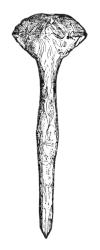
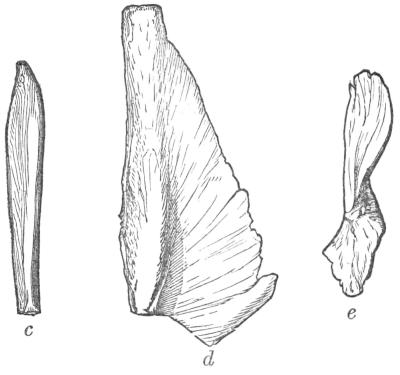
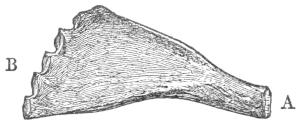
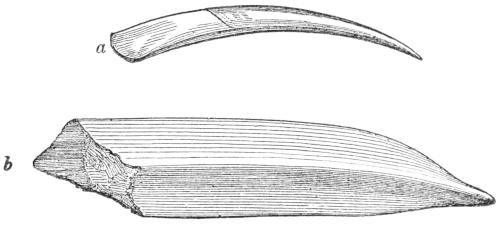
In the examination of the different beds of the three-barred formation,
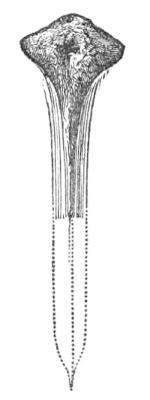
our author discovered a well-marked bone, like a petrified
large roofing nail, in a grayish-colored layer of hard flag, about 100
yards over the granite, and about 160 feet over the upper stratum
of the conglomerate. This singular bone, which Mr. Miller has represented
in a figure, was probably the oldest vertebrate organism
yet discovered in Orkney. It was 5⅞ inches long, 2¼ inches across
the head, and ³⁄₁₀ths of an inch thick in the stem, and formed a
characteristic feature of the Asterolepis, as yet the most gigantic of
the ganoid fishes, and probably one of the first of the Old Red Sandstone.
In his former researches, our author had found that all of the
many hundred ichthyolites which he had disinterred from the Lower
Old Red Sandstone were comparatively of a small size, while those in
the Upper Old Red were of great bulk; and hence he had naturally
inferred, that vertebrate life had increased towards the close of the
system—that, in short, it began with an age of dwarfs, and ended
with an age of giants; but he had thus greatly erred, like the supporters
of the development system, in founding positive conclusions
on merely negative evidence; for here, at the very base of the system,
where no dwarfs were to be found, he had discovered one of the
most colossal of its giants.
After this most important discovery, Mr. Miller extended his inquiries
easterly for several miles along the bare and unwooded Lake
of Stennis, about fourteen miles in circumference, and divided into
an upper arm lower sheet of water by two long promontories jutting
out from each side and nearly meeting in the middle. The sea enters
this lake through the openings of a long rustic bridge, and hence the
lower division of the lake “is salt in its nether reaches, and brackish
in its upper ones; while the higher division is merely brackish
in its nether reaches, and fresh enough in its upper ones to be potable.”
The fauna and flora of the lake are therefore of a mixed character,
the marine and fresh water animals having each their own
reaches, though each kind makes certain encroachments on the province
of the other.
In the marine and lacustrine floras of the lake, Mr. Miller observed
changes still more palpable. At the entrance of the sea, the Fucus
nodosus and Fucus vesiculosus flourish in their proper form and magnitude.
A little farther on in the lake, the F. nodosus disappears,
and the F. vesiculosus, though continuing to exist for mile after
mile, grows dwarfish and stunted, and finally disappears, giving
place to rushes and other aquatic grasses, till the lacustrine has entirely
displaced the marine flora. From these two important facts,
the existence of the fragment of Asterolepis in the lower flagstones
of the Orkneys, and of the “curiously mixed semi-marine semi-lacustrine
vegetation in the Loch of Stennis,” which our author
regards as bearing directly on the development hypothesis, he takes
occasion to submit that hypothesis to a severe examination, and to
point out its consequences—its incompatibility with the great truths
of morality and revealed religion. According to Professor Oken,
one of the ablest supporters of the development theory, “There are
two kinds of generation in the world, the creation proper, and the
propagation that is sequent thereon, or the original and secondary
generation. Consequently, no organism has been created of larger
size than an infusorial point. No organism is, or ever has been
created, which is not microscopic. Whatever is large has not been
created, but developed. Man has not been created, but developed.”
Hence it follows that during the great geological period, when race
after race was destroyed, and new forms of life called into being,
“nature had been pregnant with the human race,” and that immortal
and intellectual Man is but the development of the Brute—itself
the development of some monad or mollusc, which has been
smitten into life by the action of electricity upon a portion of gelatinous
matter.
If the development theory be true, “the early fossils ought to be
very small in size,” and “very low in organization.” In the earliest
strata we ought to find only “mere embryos and fœtuses; and if we
find instead the full-grown and mature, then must we hold that the
testimony of geology is not only not in accordance with the theory,
but in positive opposition to it.” Having laid this down as the
principle by which the question is to be decided, our author proceeds
to consider “what are the facts.” The Asterolepis of Stromness seems
to be the oldest organism yet discovered in the most ancient geological
system of Scotland, in which vertebrate remains occur. It is
probably the oldest Cœlacanth that the world has yet produced, for
there is no certain trace of this family in the great Silurian system,
which lies underneath, and on which, according to our existing
knowledge, organic existence first began. “How, then,” asks Mr.
Miller, “on the two relevant points—bulk and organization—does
it answer to the demands of the development hypothesis? Was it a
mere fœtus of the finny tribe, of minute size and imperfect embryonic
faculty? Or was it of, at least, the ordinary bulk, and, for its
class, of the average organization?”
In order to answer these questions, Mr. Miller proceeds in his third
chapter to give the recent history of the Asterolepis; in his fourth,
to ascertain the cerebral development of the earlier vertebrata; and
in his fifth chapter to describe the structure, bulk, and aspect of the
Asterolepis. In the rocks of Russia certain fossil remains had been
long ago discovered, of such a singular nature as to have perplexed
Lamarck and other naturalists. Their true place among fishes was
subsequently ascertained by M. Eichwald, a living naturalist; and
Sir Roderick Murchison found that they were Ichthyolites of the
Old Red Sandstone. Agassiz gave them the name of Chelonichthys;
but in consequence of very fine specimens having been found in the
Old Red Sandstone of Russia, which Professor Asmus of Dorpat
sent to the British Museum, and which exhibited star-like markings,
he abandoned his name of Chelonichthys, and adopted that of Asterolepis,
or star-scale, which Eichwald had proposed. Many points,
however, respecting this curious fossil remained to be determined,
and it was fortunate for science that Mr. Miller was enabled to accomplish
this object by means of a variety of excellent specimens
which he received from Mr. Robert Dick, “an intelligent tradesman
of Thurso, one of those working men of Scotland, of active curiosity
and well developed intellect, that give character and standing to the
rest.” Agassiz had inferred, from very imperfect fragments, that
the Asterolepis was a strongly-helmed fish of the Cœlacanths, or hollow
spine family—that it was probably a flat-headed animal, and that
the discovery of a head or of a jaw might prove that the genus
Dendrodus did not differ from it. All these conjectures were completely
confirmed by Mr. Miller, after a careful examination of the
specimens of Mr. Dick.
Before proceeding to describe the structure of the gigantic Asterolepis,
Mr. Miller devotes a long and elaborate chapter to the subject
of the cerebral development of the earlier vertebrata, in order to
ascertain in what manner their true brains were lodged, and to discover
the modification which the cranium, as their protecting box,
received in subsequent periods. This inquiry, which he has conducted
with great skill and ability, is not only highly interesting in
itself, but will be found to have a direct bearing on the great question
which it is his object to discuss and decide.
The facts and reasonings contained in this chapter will, we doubt
not, shake to its very base the bold theory of Professor Oken, which
has been so generally received abroad, and which is beginning to
find supporters even among the solid thinkers of our own country.
In the Isis of 1818, Professor Lorenz Oken has given the following
account of the hypothesis to which we allude. “In August, 1806,”
says he, “I made a journey over the Hartz. I slid down through
the wood on the south side, and straight before me, at my very feet,
lay a most beautiful blanched skull of a hind. I picked it up, turned
it round, regarded it intensely;—the thing was done. ‘It is a vertebral
column,’ struck me like a flood of lightning, ‘to the marrow
and bone;’ and since that time the skull has been regarded as a
vertebral column.”
This remarkable hypothesis was at first received with enthusiasm
by the naturalists of Germany, and, among others, by Agassiz, who,
from grounds not of a geological kind, has more recently rejected it.
It has been adopted by our distinguished countryman, Professor
Owen, and forms the central idea in his lately published and ingenious
work “On the Nature of Limbs.” The conclusion at which he
arrives, that the fore-limbs of the vertebrata are the ribs of the occipital
bone or vertebra set free, and (in all the vertebrata higher in
the scale than the ordinary fishes) carried down along the vertebral
column by a sort of natural dislocation, is a deduction from the idea
that startled Professor Oken in the forest of the Hartz. Whatever
support this hypothesis might have expected from Geology, has been
struck from beneath it by this remarkable chapter of Mr. Miller’s
work; and though anatomists may for a while maintain it under the
influence of so high an authority as Professor Owen, we are much
mistaken if it ever forms a part of the creed of the geologist. Mr.
Miller indeed has, by a most skilful examination of the heads of the
earliest vertebrata known to geologists, proved that the hypothesis
derives no support from the structure which they exhibit, and
Agassiz has even upon general principles rejected it as untenable.
Mr. Miller’s next chapter on the structure, bulk, and aspect of the
Asterolepis, is, like that which precedes it, the work of a master,
evincing the highest powers of observation and analysis. Its size in
the larger specimens must have been very great; and from a comparison
of the proportion of the head in the Ganoids to the length
of the body, which is sometimes as one to five, or one to six, or one
to six and a half, or even one to seven, our author concludes that the
total length of the specimens in his possession must have been at
least eight feet three inches, or from nine feet nine to nine feet ten
inches. The remains of an Asterolepis found by Mr. Dick at Thurso,
indicate a length of from twelve feet five to thirteen feet eight inches;
and one of the Russian specimens of Professor Asmus must have
been from eighteen to twenty-three feet long. “Hence,” says Mr.
Miller, “in the not unimportant circumstance of size—the most
ancient Cœlacanths yet known, instead of taking their places agreeably
to the demands of the development hypothesis among the sprats,
sticklebacks, and minnows of their class, took their place among its
huge basking sharks, gigantic sturgeons, and bulky swordfishes.
They were giants, not dwarfs.” Again, judging by the analogies
which its structure exhibits to that of fishes of the existing period,
the Asterolepis must have been a fish high in the scale of organization.
A specimen of Asterolepis, discovered by Mr. Dick, among the
Thurso rocks, and sent to Mr. Miller, exhibited the singular phenomenon
of a quantity of thick tar lying beneath it, which stuck to
the fingers when lifting the pieces of rock. “What had been once
the nerves, muscles, and blood of this ancient Ganoid, still lay under
its bones,” a phenomenon which our author had previously seen beneath
the body of a poor suicide, whose grave in a sandy bank had
been laid open by the encroachments of a river, the sand beneath it
having been “consolidated into a dark colored pitchy mass,” extending
a full yard beneath the body. In like manner, the animal juices
of the Asterolepis had preserved its remains, by “the pervading bitumen,
greatly more conservative in its effects than the oil and gum
of an old Egyptian undertaker.” The bones, though black as pitch
retained to a considerable degree the peculiar qualities of the original
substance, in the same manner as the adipocire of wet burying-grounds
preserves fresh and green the bones which it encloses.
In support of his anti-development views, Mr. Miller devotes his
next and sixth chapter to the recent history, order, and size of the
fishes of the Upper and Lower Silurian rocks. Of these ancient
formations, the bone bed of the Upper Ludlow rocks is the only one
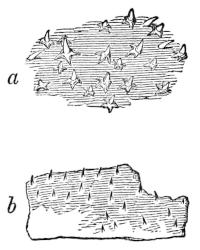
which, besides defensive spines of fish, contains teeth, fragments of
jaws, and shagreen points, whereas, in the inferior deposits, defensive
spates alone are found. The species discovered by Professor Phillips,
in the Wenlock shale, were microscopic; and the author of the Vestiges
took advantage of this insulated fact to support his views, by
pronouncing the little creatures to which the species belonged as
the fœtal embryos of their class. Mr. Miller has, however, even on
this ground, defeated his opponent. By comparing the defensive
spines of the Onchus Murchisoni of the Upper Ludlow bed with
those of a recent Spinax Acanthias, or dog-fish, and of the Cestracion
Phillippi, or Port Jackson shark, he arrives at the conclusion, that
the fishes to which the species belonged must be all of considerable
size; and in the following chapter on the high standing of the Placoids
he shews that the same early fishes were high in intelligence and
organization.
In his ninth chapter on the History and Progress of Degradation,
our author enters upon a new and interesting subject. The object
of it is to determine the proper ground on which the standing of the
earlier vertebrata should be decided, namely, the test of what he
terms homological symmetry of organization. In nature there are
monster families, just as there are in families monster individuals—men
without feet, hands, or eyes, or with them in a wrong place—sheep
with legs growing from their necks, ducklings with wings on
their haunches, and dogs and cats with more legs than they require.
We have thus, according to our author—1, monstrosity through defect
of parts; 2, monstrosity through redundancy of parts; and 3, monstrosity
through displacement of parts. This last species, united in some
cases with the other two, our author finds curiously exemplified in
the geological history of the fish, which he considers better known
than that of any other division of the vertebrata; and he is convinced
that it is from a survey of the progress of degradation in the
great Ichthyic division that the standing of the kingly fishes of the
earlier periods is to be determined.
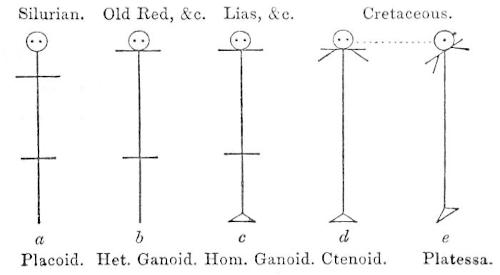
In the earliest vertebrate period, namely, the Silurian, our author
shews that the fishes were homologically symmetrical in their organization,
as exhibited in the Placoids. In the second great Ichthyic
period, that of the Old Red Sandstone, he finds the first example in
the class of fishes of monstrosity, by displacement of parts. In all the
Ganoids of the period, there is the same departure from symmetry
as would take place in man if his neck was annihilated, and the
arms stuck to the back of the head. In the Coccosteus and Pterichthys
of the same period, he finds the first example of degradation
through defect, the former resembling a human monster without hands,
and the latter one without feet. After ages and centuries have
passed away, and then after the termination of the Palæozoic period,
a change takes place in the formation of the fish tail. “Other ages
and centuries pass away, during which the reptile class attains to its
fullest development in point of size, organization, and number; and
then, after the times of the cretaceous deposits have begun, we find
yet another remarkable monstrosity of displacement introduced
among all the fishes of one very numerous order, and among no inconsiderable
proportion of the fishes of another. In the newly-introduced
Ctenoids (Acanthopterygii,) and in those families of the
Cycloids which Cuvier erected into the order Malacopterygii sub-brachiati,
the hinder limbs are brought forward and stuck on to the
base of the previously misplaced fore limbs. All the four limbs, by
a strange monstrosity of displacement, are crowded into the place
of the extinguished neck. And such, in the present day, is the
prevalent type among fishes. Monstrosity through defect is also
found to increase; so that the snake-like apoda, or feet-wanting
fishes, form a numerous order, some of whose genera are devoid, as
in the common eels and the congers, of only the hinder limbs, while
in others, as in the genera Muræna and Synbranchus, both hinder and
fore-limbs are wanting.” From these and other facts, our author
concludes that as in existing fishes we find many more proofs of the
monstrosity, both from displacement and defect of parts, than in all
the other three classes of the vertebrata, and as these monstrosities
did not appear early, but late, “the progress of the race as a whole,
though it still retains not a few of the higher forms, has been a
progress not of development from the low to the high, but of degradation
from the high to the low.” An extreme example of the
degradation of distortion, superadded to that of displacement, may
be seen in the flounder, plaice, halibut, or turbot,—fishes of a family
of which there is no trace in the earlier periods. The creature is
twisted half round and laid on its side. The tail, too, is horizontal.
Half the features of its head are twisted to one side, and the other
half to the other, while its wry mouth is in keeping with its squint
eyes. One jaw is straight, and the other like a bow; and while one
contains from four to six teeth, the other contains from thirty to
thirty-five.
Aided by facts like these, an ingenious theorist might, as our author
remarks, “get up as unexceptionable a theory of degradation
as of development.” But however this may be, the principle of
degradation actually exists, and “the history of its progress in creation
bears directly against the assumption that the earlier vertebrata
were of a lower type than the vertebrata of the same Ichthyic class
which exist now.”
In his next and tenth chapter, our author controverts with his
usual power the argument in favor of the development hypothesis,
drawn from the predominance of the Brachiopods among the Silurian
Molluscs. The existence of the highly organized Cephalopods, in
the same formation, not only neutralizes this argument, but authorizes
the conclusion that an animal of a very high order of organization
existed in the earliest formation. It is of no consequence
whether the Cephalopods, or the Brachiopods were most numerous.
Had there been only one cuttle fish in the Silurian seas, and a million
of Brachiopods, the fact would equally have overturned the development
system.
In the same chapter, Mr. Miller treats of the geological history of
the Fossil flora, which has been pressed into the service of the development
hypothesis. On the authority of Adolphe Brongniart, it
was maintained that, previous to the age of the Lias, “Nature had
failed to achieve a tree—and that the rich vegetation of the Coal
Measures had been exclusively composed of magnificent immaturities
of the vegetable kingdom, of gigantic ferns and club mosses, that
attained to the size of forest trees, and of thickets of the swamp-loving
horse-tail family of plants.” True exogenous trees, however,
do exist of vast size, and in great numbers, in all the coal-fields of
our own country, as has been proved by Mr. Miller. Nay, he himself
discovered in the Old Red Sandstone, Lignite, which is proved
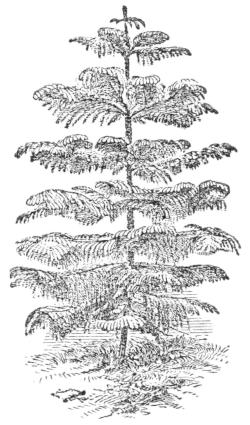
to have formed part of a true gymnospermous tree, represented by
the pines of Europe and America, or more probably, as Mr. Miller
believes, by the Araucarians of Chili and New Zealand. This important
discovery is pregnant with instruction. The ancient Conifer
must have waved its green foliage over dry land, and it is not probable
that it was the only tree in the primeval forest. “The ship
carpenter,” as our author observes, “might have hopefully taken
axe in hand to explore the woods for some such stately pine as the
one described by Milton,—
‘Hewn on Norwegian hills, to be the mast
Of some great admiral.’”
Viewing this olive leaf of the Old Red Sandstone as not at all devoid
of poetry, our author invites us to a voyage from the latest formation
up to the first zone of the Silurian formation,—thus passing
from ancient to still more ancient scenes of being, and finding, as at
the commencement of our voyage, a graceful intermixture of land
and water, continent, river, and sea.
But though the existence of a true Placoid, a real vertebrated fish,
in the Cambrian limestone of Bala, and of true wood at the base of
the Old Red Sandstone, are utterly incompatible with the development
hypothesis, its supporters, thus driven to the wall, may take
shelter under the vague and unquestioned truth that the lower
plants and animals preceded the higher, and that the order of creation
was fish, reptiles, birds, mammalia, quadrumana, and man.
From this resource, too, our author has cut off his opponents, and
proceeds to show that such an order of creation, “at once wonderful
and beautiful,” does not afford even the slightest presumption in
favor of the hypothesis which it is adduced to support.
This argument is carried on in a popular and amusing dialogue in
the eleventh chapter. Mr. Miller shows, in the clearest manner, that
“superposition is not parental relation,” or that an organism lying
above another gives us no ground for believing that the lower organism
was the parent of the higher. The theorist, however, looks
only at those phases of truth which are in unison with his own
views; and, when truth presents no such favorable aspect, he finally
wraps himself up in the folds of ignorance and ambiguity—the
winding-sheet of error refuted and exposed. We have not yet penetrated,
says he, in feeble accents, to the formations which represent
the dawn of being, and the simplest organism may yet be detected
beneath the lowest fossiliferous rocks. This undoubtedly may be,
and Sir Charles Lyell and Mr. Leonard Horner are of opinion that
such rocks may yet be discovered; while Sir Roderick Murchison
and Professor Sedgwick and Mr. Miller are of an opposite opinion.
But even were such rocks discovered to-morrow, it would not follow
that their organisms gave the least support to the development hypothesis.
In the year 1837, when fishes were not discovered in the
Upper Silurian rocks, the theorist would have rightly predicted the
existence of lower fossiliferous beds; but when they are discovered,
and their fossils examined, they furnish the strongest argument that
could be desired against the theory they were expected to sustain.
This fact, no doubt, is so far in favor of the supposition that there
may be still lower fossil-bearing strata; but, as Mr. Miller observes,
“The pyramid of organized existence, as it ascends into the by-past
eternity, inclines sensibly towards its apex,—that apex of ‘beginning’
on which, on far other than geological grounds, it is our
privilege to believe. The broad base of the superstructure planted
on the existing scene stretches across the entire scale on life, animal
and vegetable; but it contracts as it rises into the past;—man,—the
quadrumana,—the quadrupedal man,—the bird and the reptile
are each in succession struck from off its breadth, till we at
length see it with the vertebrata, represented by only the fish, narrowing
as it were to a point; and though the clouds of the upper
region may hide its apex, we infer, from the declination of its sides,
that it cannot penetrate much farther into the profound.”
In our author’s next chapter, the twelfth of the series, he proceeds
to examine the “Lamarckian hypothesis of the origin of plants, and
its consequences.”
In his thirteenth chapter, on “The two Floras, marine and terrestrial,”
he has shown that all our experience is opposed to the opinion,
that the one has been transmuted into the other. If the marine
had been converted into terrestrial vegetation, we ought to have, in
the Lake of Stennis, for example, plants of an intermediate character
between the algæ of the sea, and the monocotyledons of the
lake. But no such transition-plants are found. The algæ, as our
author observes, become dwarfish and ill-developed. They cease to
exist as the water becomes fresher, “until at length we find, instead
of the brown, rootless, flowerless fucoids and confervæ of the ocean,
the green, rooted, flowering flags, rushes, and aquatic grasses of the
fresh water. Many thousands of years have failed to originate a
single intermediate plant.” The same conclusion may be drawn
from the character of the vegetation along the extensive shores of
Britain and Ireland. No botanist has ever found a single plant in
the transition state.
The fourteenth chapter of the “Footprints” will be perused with
great interest by the general reader. It is a powerful and argumentative
exposure of the development hypothesis, and of the manner
in which the subject has been treated in the “Vestiges.” Whether
we consider it in its nature, in its history, or in the character of the
intellects with whom it originated, or by whom it has been received
and supported, Mr. Miller has shown that it has nothing to recommend
it. It existed as a wild dream before Geology had any being
as a science. It was broached more than a century ago by De
Maillet, who knew nothing of the geology even of his day. In a
translation of his Telhamed, published in 1750, Mr. Miller finds very
nearly the same account given of the origin of plants and animals,
as that in the “Vestiges,” and in which the sea is described as that
“great and fruitful womb of nature, in which organization and life
first begin.” Lamarck, though a skilful botanist and conchologist,
was unacquainted with geology; and as he first published his development
hypothesis in 1802, (an hypothesis identical with that of the
“Vestiges,”) it is probable that he was not then a very skilful zoologist.
Nor has Professor Oken any higher claims to geological acquirements.
He confesses that he wrote the first edition of his work in
a kind of inspiration! and it is not difficult to estimate the intelligence
of the inspiring idol that announced to the German sage that
the globe was a vast crystal, a little flawed in the facets, and that
quartz, feldspar, and mica, the three constituents of granite, were
the hail-drops of heavy showers of stone that fell into the original
ocean, and accumulated into rocks at the bottom!
Such is the unscientific parentage of the theories promulgated in
the “Vestiges.” But the author of this work appeals in the first
instance to science. Astronomy, Geology, Botany, and Zoology are
called upon to give evidence in his favor; but the astronomer, geologist,
botanist, and the zoologist, all refuse him their testimony, deny
his premises, and reject his results. “It is not,” as Mr. Miller happily
observes, “the illiberal religionist that casts him off. It is the
inductive philosopher.” Science addresses him in the language of
the possessed: “The astronomer I know, and the geologist I know;
but who are ye?” Thus left alone in a cloud of star-dust, or in
brackish water between the marine and terrestrial flora, he “appeals
from science to the want of it,” casts a stone at our Scientific Institutions,
and demands a jury of “ordinary readers,” as the only
“tribunal” by which “the new philosophy is to be truly and righteously
judged.”
The last and fifteenth chapter of Mr. Miller’s work, “On the Bearing
of Final Causes on Geologic History,” if read with care and
thought, will prove at once delightful and instructive. The principle
of final causes, or the conditions of existence, affords a wide scope to
our reason in Natural History, but especially in Geology. It becomes
an interesting inquiry, if any reason can be assigned why at
certain periods species began to exist, and became extinct after the
lapse of lengthened periods of time, and why the higher classes of
being succeeded the lower in the order of creation? The incompleteness
of geological science, however, does not permit us to remove,
for the present, the veil which hangs over this mysterious
chronology; but our author is of opinion that in about a quarter of
a century, in a favored locality like the British Islands, geological
history “will assume a very extraordinary form.”
It is a singular fact, which will yet lead to singular results, that
Cuvier’s arrangement of the four classes of vertebrate animals should
exhibit the same order as that in which they are found in the strata
of the earth. In the fish, the average proportion of the brain to the
spinal cord is only as 2 to 1. In the reptile, the ratio is 2½ to 1. In
the bird, it is as 3 to 1. In the mammalia, it is as 4 to 1; and in man,
it is as 23 to 1. No less remarkable is the fœtal progress of the
human brain. It first becomes a brain resembling that of a fish;
then it grows into the form of that of a reptile; then into that of a
bird; then into that of a mammiferous quadruped, and finally it
assumes the form of a human brain, “thus comprising in its fœtal
progress an epitome of geological history, as if man were in himself
a compendium of all animated nature, and of kin to every creature
that lives.”
With these considerations, Mr. Miller has brought his subject to
the point at which Science in its onward progress now stands. It is
to embryology we are in future to look for further information upon
the most intimate relations which exist between all organized beings.
We may fairly entertain the hope that the time is not far when we
shall not only fully understand the Plan of Creation, but even lift
some corner of the veil which has hitherto prevented us from forming
adequate ideas of the first introduction of animal and vegetable
life upon earth, and of the changes which both kingdoms have undergone
in the succession of geological ages.
L. AGASSIZ.
Cambridge, September, 1850.
STROMNESS AND ITS ASTEROLEPIS. THE LAKE OF STENNIS.
When engaged in prosecuting the self-imposed
task of examining in detail
the various fossiliferous deposits of
Scotland, in the hope of ultimately
acquainting myself with them all, I extended
my exploratory ramble, about
two years ago, into the Mainland of Orkney, and resided for
some time in the vicinity of Stromness.
This busy seaport town forms that special centre, in this
northern archipelago, from which the structure of the entire
group can be most advantageously studied. The geology
of the Orkneys, like that of Caithness, owes its chief
interest to the immense development which it exhibits of
one formation,—the Lower Old Red Sandstone,—and to the
extraordinary abundance of its vertebrate remains. It is
not too much to affirm, that in the comparatively small
portion which this cluster of islands contains of the third
part of a system regarded only a few years ago as the least
fossiliferous in the geologic scale, there are more fossil fish
enclosed than in every other geologic system in England,
Scotland, and Wales, from the Coal Measures to the Chalk
inclusive. Orkney is emphatically, to the geologist, what a
juvenile Shetland poetess designates her country, in challenging
for it a standing independent of the “Land of Cakes,”—a
“Land of Fish;” and, were the trade once fairly opened
up, could supply with ichthyolites, by the ton and the ship-load,
the museums of the world. Its various deposits, with
all their strange organisms, have been uptilted from the bottom
against a granitic axis, rather more than six miles in
length by about a mile in breadth, which forms the great
back-bone of the western district of Pomona; and on this
granitic axis—fast jammed in between a steep hill and the
sea—stands the town of Stromness. Situated thus at the
bottom of the upturned deposits of the island, it occupies exactly
such a point of observation as that which the curious
eastern traveller would select, in front of some huge pyramid
or hieroglyphic-covered obelisk, as a proper site for his
tent. It presents, besides, not a few facilities for studying
with the geological phenomena, various interesting points in
physical science of a cognate character. Resting on its
granitic base, in front of the strangely sculptured pyramid of
three broad tiers,—red, black, and gray,—which the Old
Red Sandstone of these islands may be regarded as forming,
it is but a short half mile from the Great Conglomerate base
of the formation, and scarcely a quarter of a mile more from
the older beds of its central flagstone deposit; while an hour’s
sail on the one hand opens to the explorer the overlying arenaceous
deposit of Hoy, and an hour’s walk on the other
introduces him to the Loch of Stennis, with its curiously
mixed flora and fauna. But of the Loch of Stennis and its
productions more anon.
The day was far spent when I reached Stromness: but as
I had a fine bright evening still before me, longer by some
three or four degrees of north latitude than the midsummer
evenings of the south of Scotland, I set out, hammer in
hand, to examine the junction of the granite and the Great
Conglomerate, where it has been laid bare by the sea along
the low promontory which forms the western boundary of
the harbor. The granite here is a ternary of the usual components,
somewhat intermediate in grain and color between
the granites of Peterhead and Aberdeen; and the conglomerate
consists of materials almost exclusively derived from it,—evidence
enough of itself, that when this ancient mechanical
deposit was in course of forming, the granite—exactly
such a compound then as it is now—was one of the surface
rocks of the locality, and much exposed to disintegrating influences.
This conglomerate base of the Lower Old Red Sandstone
of Scotland—which presents, over an area of many
thousand square miles, such an identity of character, that
specimens taken from the neighborhood of Lerwick, in Shetland,
or of Gamrie, in Banff, can scarce be distinguished
from specimens detached from the hills which rise over the
Great Caledonian Valley, or from the cliffs immediately in
front of the village of Contin—seems to have been formed
in a vast oceanic basin of primary rock,—a Palæozoic Hudson’s
or Baffin’s Bay,—partially surrounded, mayhap, by
primary continents, swept by numerous streams, rapid and
headlong, and charged with the broken debris of the inhospitable
regions which they drained. The graptolite bearing
grauwacke of Banffshire seems to have been the only fossiliferous
rock that occurred throughout the entire extent of
this ancient northern basin; and its few organisms now
serve to open the sole vista through which the geological explorer
to the north of the Grampians can catch a glimpse of
an earlier period of existence than that represented by the
ichthyolites of the Lower Old Red Sandstone.
Very many ages must have passed ere, amid waves
and currents, the water-worn debris which now forms the
Great Conglomerate could have accumulated over tracts
of sea-bottom from ten to fifteen thousand square miles in
area, to its present depth of from one to four hundred feet.
At length, however, a thorough change took place; but
we can only doubtfully speculate regarding its nature or
cause. The bottom of the Palæozoic basin became greatly
less exposed. Some protecting circle of coast had been
thrown up around it; or, what is perhaps more probable,
it had sunk to a profounder depth, and the ancient
shores and streams had receded, through the depression, to
much greater distances. And, in consequence, the deposition
of rough sand and rolled pebbles was followed by a
deposition of mud. Myriads of fish, of forms the most
ancient and obsolete, congregated on its banks or sheltered
in its hollows; generation succeeded generation, millions
and tens of millions perished mysteriously by sudden
death; shoals after shoals were annihilated; but the productive
powers of nature were strong, and the waste was
kept up. But who among men shall reckon the years or
centuries during which these races existed, and this muddy
ocean of the remote past spread out to unknown and nameless
shores around them? As in those great cities of the desert
that lie uninhabited and waste, we can but conjecture their
term of existence from the vast extent of their cemeteries.
We only know that the dark, finely-grained schists in which
they so abundantly occur must have been of comparatively
slow formation, and that yet the thickness of the deposit
more than equals the height of our loftiest Scottish mountains.
It would seem as if a period equal to that in which
all human history is comprised might be cut out of a corner
of the period represented by the Lower Old Red Sandstone,
and be scarce missed when away; for every year during
which man has lived upon earth, it is not improbable that the
Pterichthys and its contemporaries may have lived a century.
Their last hour, however, at length came. Over the
dark-colored ichthyolitic schists so immensely developed in
Caithness and Orkney, there occurs a pale-tinted, unfossiliferous
sandstone, which in the island of Hoy rises into hills of
from fourteen to sixteen hundred feet in height; and among
the organisms of those newer formations of the Old Red
which overlie this deposit, not a species of ichthyolite identical
with the species entombed in the lower schists has yet
been detected. In the blank interval which the arenaceous
deposit represents, tribes and families perished and disappeared,
leaving none of their race to succeed them, that other
tribes and families might be called into being, and fall into
their vacant places in the onward march of creation.
Such, so far as the various hieroglyphics of the pile have yet
rendered their meanings to the geologist, is the strange story
recorded on the three-barred pyramid of Stromness. I traced
the formation upwards this evening along the edges of the
upturned strata, from where the Great Conglomerate leans
against the granite, till where it merges into the ichthyolitic
flagstones; and then pursued these from older and lower to
newer and higher layers, desirous of ascertaining at what
distance over the base of the system its more ancient organisms
first appear, and what their character and kind. And,
embedded in a grayish-colored layer of hard flag, somewhat
less than a hundred yards over the granite, and about a
hundred and sixty feet over the upper stratum of the conglomerate,
I found what I sought,—a well-marked bone,—in
all probability the oldest vertebrate remain yet discovered in
Orkney. What, asks the reader, was the character of this
ancient organism of the Palæozoic basin?
As shown by its cancellated texture, palpable to the naked
eye, and still more unequivocally by the irregular complexity
of fabric which it exhibits under the microscope,—by its
speck-like life-points or canaliculi, that remind one of air-bubbles
in ice,—its branching channels, like minute veins,
through which the blood must once have flown,—and its
general groundwork of irregular lines of corpuscular fibre,
that wind through the whole like currents in a river studded
with islands,—it was as truly osseous in its composition
as the solid bones of any of the reptiles of the Secondary, or
the quadrupeds of the Tertiary periods. And in form it
closely resembled a large roofing-nail. With this bone our
more practised palæontologists are but little acquainted, for
no remains of the animal to which it belonged have yet been
discovered in Britain to the south of the Grampians,[3] nor, except
in the Old Red Sandstone of Russia, has it been detected
any where on the Continent. Nor am I aware that, save in
the accompanying wood-cut, (fig. 1,) it has ever been figured.
The amateur geologists of Caithness and Orkney have, however,
learned to recognize it as the “petrified nail.” The
length of the entire specimen in this instance was five
seven eighth inches, the transverse breadth of the head two
inches and a quarter, and the thickness of the stem nearly
three tenth parts of an inch. This nail-like bone formed
a characteristic portion of the Asterolepis,—so far as is yet
known, the most gigantic ganoid of the Old Red Sandstone,
and, judging from the place of this fragment, apparently one
of the first.
There were various considerations which led me to regard
the “petrified nail” in this case as one of the most interesting
fossils I had ever seen; and, before quitting Orkney, to
pursue my explorations farther to the south, I brought two intelligent
geologists of the district,[5] to mark its place and
character, that they might be able to point it out to geological
visitors in the future, or, if they preferred removing it
to their town museum, to indicate to them the stratum in
which it had lain. It showed me, among other things, how
unsafe it is for the geologist to base positive conclusions
on merely negative data. Founding on the fact that, of
many hundred ichthyolites of the Lower Old Red Sandstone
which I had disinterred and examined, all were of comparatively
small size, while in the Upper Old Red many of
the ichthyolites are of great mass and bulk, I had inferred
that vertebrate life had been restricted to minuter forms at
the commencement than at the close of the system. It
had begun, I had ventured to state in the earlier editions of a
little work on the “Old Red Sandstone,” with an age of
dwarfs, and had ended with an age of giants. And now,
here, at the very base of the system, unaccompanied by
aught to establish the contemporary existence of its dwarfs,—which
appear, however, in an overlying bed about a hundred
feet higher up,—was there unequivocal proof of the existence
of one of the most colossal of its giants. But not
unfrequently, in the geologic field, has the practice of basing
positive conclusions on merely negative grounds led to a misreading
of the record. From evidence of a kind exactly
similar to that on which I had built, it was inferred, some two
or three years ago, that there had lived no reptiles during the
period of the Coal Measures, and no fish in the times of the
Lower Silurian System.
I extended my researches, a few days after, in an easterly
direction from the town of Stromness, and walked for several
miles along the shores of the Loch of Stennis,—a large lake
about fourteen miles in circumference, bare and treeless, like
all the other lakes and lochs of Orkney, but picturesque of
outline, and divided into an upper and lower sheet of water
by two low, long promontories, that jut out from opposite
sides, and so nearly meet in the middle as to be connected by
a thread-like line of road, half mound, half bridge. “The
Loch of Stennis,” says Mr. David Vedder, the sailor-poet of
Orkney, “is a beautiful Mediterranean in miniature.” It gives
admission to the sea by a narrow strait, crossed, like that
which separates the two promontories in the middle, by a
long rustic bridge; and, in consequence of this peculiarity,
the lower division of the lake is salt in its nether reaches
and brackish in its upper ones, while the higher division
is merely brackish in its nether reaches, and fresh enough
in its upper ones to be potable. Viewed from the east,
in one of the long, clear, sunshiny evenings of the Orkney
summer, it seems not unworthy the eulogium of Vedder.
There are moory hills and a few rude cottages in front; and
in the background, some eight or ten miles away, the bold,
steep mountain masses of Hoy; while on the promontories
of the lake, in the middle distance, conspicuous in the landscape,
from the relief furnished by the blue ground of the
surrounding waters, stand the tall gray obelisks of Stennis—one
group on the northern promontory, the other on the
south,—
“Old even beyond tradition’s breath.”
The shores of both the upper and lower divisions of the
lake were strewed, at the time I passed, by a line of wrack,
consisting, for the first few miles from where the lower loch
opens to the sea, of only marine plants, then of marine plants
mixed with those of fresh-water growth, and then, in the
upper sheet of water, of lacustrine plants exclusively. And
the fauna of the loch is, I was informed, of as mixed a character
as its flora,—the marine and fresh-water animals having
each their own reaches, with certain debatable tracts
between, in which each kind expatiates with more or less
freedom, according to its specific nature and constitution,—some
of the sea-fish advancing far on the fresh water, and
others, among the proper denizens of the lake, encroaching
far on the salt. The common fresh-water eel strikes out, I
was told, farthest into the sea-water; in which, indeed, reversing
the habits of the salmon, it is known in various places
to deposit its spawn. It seeks, too, impatient of a low temperature,
to escape from the cold of winter, by taking refuge
in water brackish enough, in a climate such as ours, to resist
the influence of frost. Of the marine fish, on the other hand,
I found that the flounder got greatly higher than any of
the others, inhabiting reaches of the lake almost entirely
fresh. I have had an opportunity elsewhere of observing a
curious change which fresh water induces in this fish. In the
brackish water of an estuary, the animal becomes, without
diminishing in general size, thicker and more fleshy than when
in its legitimate habitat, the sea: but the flesh loses in quality
what it gains in quantity;—it grows flabby and insipid, and
the margin-fin lacks always its strip of transparent fat. But
the change induced in the two floras of the lake—marine and
lacustrine—is considerably more palpable and obvious than
that induced in its two faunas. As I passed along the strait,
through which it gives admission to the sea, I found the
commoner fucoids of our sea-coasts streaming in great luxuriance
in the tideway, from the stones and rocks of the bottom.
I marked, among the others, the two species of kelp-weed,
so well known to our Scotch kelp-burners,—Fucus
nodosus and Fucus vesiculosus,—flourishing in their uncurtailed
proportions; and the not inelegant Halidrys siliquosa,
or “tree in the sea,” presenting its amplest spread of pod and
frond. A little farther in, Halidrys and Fucus nodosus disappear,
and Fucus vesiculosus becomes greatly stunted, and
no longer exhibits its characteristic double rows of bladders.
But for mile after mile it continues to exist, blent with some
of the hardier confervæ, until at length it becomes as dwarfish
and nearly as slim of frond as the confervæ themselves;
and it is only by tracing it through the intermediate forms
that we succeed in convincing ourselves that, in the brown
stunted tufts of from one to three inches in length, which
continue to fringe the middle reaches of the lake, we have
in reality the well-known Fucus before us. Rushes, flags,
and aquatic grasses may now be seen standing in diminutive
tufts out of the water; and a terrestrial vegetation at least
continues to exist, though it can scarce be said to thrive, on
banks covered by the tide at full. The lacustrine flora
increases, both in extent and luxuriance, as that of the sea
diminishes; and in the upper reaches we fail to detect all
trace of marine plants: the algæ, so luxuriant of growth along
the straits of this “miniature Mediterranean,” altogether
cease; and a semi-aquatic vegetation attains, in turn, to the
state of fullest development any where permitted by the temperature
of this northern locality. A memoir descriptive of
the Loch of Stennis, and its productions, animal and vegetable,
such as old Gilbert White of Selborne could have produced,
would be at once a very valuable and curious document, important
to the naturalist, and not without its use to the geological
student.
I know not how it may be with others; but the special
phenomena connected with Orkney that most decidedly bore
fruit in my mind, and to which my thoughts have most frequently
reverted, were those exhibited in the neighborhood
of Stromness. I would more particularly refer to the characteristic
fragment of Asterolepis, which I detected in its lower
flagstones, and to the curiously mixed, semi-marine, semi-lacustrine
vegetation of the Loch of Stennis. Both seem to
bear very directly on that development hypothesis,—fast
spreading among an active and ingenious order of minds,
both in Britain and America, and which has been long known
on the Continent,—that would fain transfer the work of creation
from the department of miracle to the province of natural
law, and would strike down, in the process of removal, all the
old landmarks, ethical and religious.
THE DEVELOPMENT HYPOTHESIS, AND ITS CONSEQUENCES.
Every individual, whatever its species or order, begins
and increases until it attains to its state of fullest development,
under certain fixed laws, and in consequence of their
operation. The microscopic monad develops into a fœtus,
the fœtus into a child, the child into a man; and, however
marvellous the process, in none of its stages is there the
slightest mixture of miracle; from beginning to end, all is
progressive development, according to a determinate order of
things. Has Nature, during the vast geologic periods, been
pregnant, in like manner, with the human race? and is the
species, like the individual, an effect of progressive development,
induced and regulated by law? The assertors of the
revived hypothesis of Maillet and Lamarck reply in the affirmative.
Nor, be it remarked, is there positive atheism
involved in the belief. God might as certainly have originated
the species by a law of development, as he maintains it
by a law of development; the existence of a First Great
Cause is as perfectly compatible with the one scheme as with
the other; and it may be necessary thus broadly to state the
fact, not only in justice to the Lamarckians, but also fairly to
warn their non-geological opponents, that in this contest
the old anti-atheistic arguments, whether founded on the
evidence of design, or on the preliminary doctrine of final
causes, cannot be brought to bear.
There are, however, beliefs, in no degree less important
to the moralist or the Christian than even that in the being of
a God, which seem wholly incompatible with the development
hypothesis. It, during a period so vast as to be scarce
expressible by figures, the creatures now human have been
rising, by almost infinitesimals, from compound microscopic
cells,—minute vital globules within globules, begot by electricity
on dead gelatinous matter,—until they have at length
become the men and women whom we see around us, we must
hold either the monstrous belief, that all the vitalities, whether
those of monads or of mites, of fishes or of reptiles, of birds
or of beasts, are individually and inherently immortal and
undying, or that human souls are not so. The difference between
the dying and the undying,—between the spirit of the
brute that goeth downward, and the spirit of the man that
goeth upward,—is not a difference infinitesimally, or even
atomically small. It possesses all the breadth of the eternity
to come, and is an infinitely great difference. It cannot, if I
may so express myself, be shaded off by infinitesimals or
atoms; for it is a difference which—as there can be no class
of beings intermediate in their nature between the dying and the
undying—admits not of gradation at all. What mind, regulated
by the ordinary principles of human belief, can possibly
hold that every one of the thousand vital points which swim in
a drop of stagnant water are inherently fitted to maintain their
individuality throughout eternity? Or how can it be rationally
held that a mere progressive step, in itself no greater or more
important than that effected by the addition of a single brick
to a house in the building state, or of a single atom to a body
in the growing state, could ever have produced immortality?
And yet, if the spirit of a monad or of a mollusc be not immortal,
then must there either have been a point in the history
of the species at which a dying brute—differing from
its offspring merely by an inferiority of development, represented
by a few atoms, mayhap by a single atom—produced
an undying man, or man in his present state must be a mere
animal, possessed of no immortal soul, and as irresponsible
for his actions to the God before whose bar he is, in consequence,
never to appear, as his presumed relatives and progenitors
the beasts that perish. Nor will it do to attempt
escaping from the difficulty, by alleging that God at some
certain link in the chain might have converted a mortal creature
into an immortal existence, by breathing into it a “living
soul;” seeing that a renunciation of any such direct interference
on the part of Deity in the work of creation forms
the prominent and characteristic feature of the scheme,—nay,
that it constitutes the very nucleus round which the
scheme has originated. And thus, though the development
theory be not atheistic, it is at least practically tantamount
to atheism. For, if man be a dying creature, restricted in
his existence to the present scene of things, what does it really
matter to him, for any one moral purpose, whether there be a
God or no? If in reality on the same religious level with
the dog, wolf, and fox, that are by nature atheists,—a nature
most properly coupled with irresponsibility,—to what one
practical purpose should he know or believe in a God whom
he, as certainly as they, is never to meet as his Judge? or
why should he square his conduct by the requirements of the
moral code, farther than a low and convenient expediency
may chance to demand?[6]
Nor does the purely Christian objection to the development
hypothesis seem less, but even more insuperable than that
derived from the province of natural theology. The belief
which is perhaps of all others most fundamentally essential
to the revealed scheme of salvation, is the belief that “God
created man upright,” and that man, instead of proceeding
onward and upward from this high and fair beginning, to a
yet higher and fairer standing in the scale of creation, sank
and became morally lost and degraded. And hence the necessity
for that second dispensation of recovery and restoration
which forms the entire burden of God’s revealed message
to man. If, according to the development theory, the
progress of the “first Adam” was an upward progress, the
existence of the “second Adam”—that “happier man,”
according to Milton, whose special work it is to “restore”
and “regain the blissful seat” of the lapsed race—is simply
a meaningless anomaly. Christianity, if the development
theory be true, is exactly what some of the more extreme
Moderate divines of the last age used to make it—an idle
and unsightly excrescence on a code of morals that would be
perfect were it away.
I may be in error in taking this serious view of the matter;
and, if so, would feel grateful to the man who could point out
to me that special link in the chain of inference at which,
with respect to the bearing of the theory on the two theologies—natural
and revealed—the mistake has taken place.
But if I be in error at all, it is an error into which I find
not a few of the first men of the age,—represented, as a
class, by our Professor Sedgwicks and Sir David Brewsters,—have
also fallen; and until it be shown to be an error, and
that the development theory is in no degree incompatible
with a belief in the immortality of the soul—in the responsibility
of man to God as the final Judge—or in the Christian
scheme of salvation—it is every honest man’s duty to protest
against any ex parte statement of the question, that would
insidiously represent it as ethically an indifferent one, or as
unimportant in its theologic bearing, save to “little religious
sects and scientific coteries.” In an address on the fossil
flora, made in September last by a gentleman of Edinburgh
to the St. Andrew’s Horticultural Society, there occurs the
following passage on this subject: “Life is governed by
external conditions, and new conditions imply new races; but
then as to their creation, that is the ‘mystery of mysteries.’
Are they created by an immediate fiat and direct act of the
Almighty? or has He originally impressed life with an elasticity
and adaptability, so that it shall take upon itself new
forms and characters, according to the conditions to which it
shall be subjected? Each opinion has had, and still has, its
advocates and opponents; but the truth is, that science, so far
as it knows, or rather so far as it has had the honesty and
courage to avow, has yet been unable to pronounce a satisfactory
decision. Either way, it matters little, physically or morally,
either mode implies the same omnipotence, and wisdom,
and foresight, and protection; and it is only your little religious
sects and scientific coteries which make a pother about the
matter,—sects and coteries of which it may be justly said,
that they would almost exclude God from the management
of his own world, if not managed and directed in the way
that they would have it.” Now, this is surely a most unfair
representation of the consequences, ethical and religious
involved in the development hypothesis. It is not its compatibility
with belief in the existence of a First Great Cause
that has to be established, in order to prove it harmless; but
its compatibility with certain other all-important beliefs, without
which simple Theism is of no moral value whatever—a
belief in the immortality and responsibility of man, and in
the scheme of salvation by a Mediator and Redeemer. Dissociated
from these beliefs, a belief in the existence of a God
is of as little ethical value as a belief in the existence of the
great sea-serpent.
Let us see whether we cannot determine what the testimony
of Geology, on this question of creation by development,
really is. It is always perilous to under-estimate the strength
of an enemy; and the danger from the development hypothesis
to an ingenious order of minds, smitten with the novel
fascinations of physical science, has been under-estimated very
considerably indeed. Save by a few studious men, who to
the cultivation of Geology and the cognate branches add some
acquaintance with metaphysical science, the general correspondence
of the line of assault taken up by this new school
of infidelity, with that occupied by the old, and the consequent
ability of the assailants to bring, not only the recently
forged, but also the previously employed artillery into full
play along its front, has not only not been marked, but even
not so much as suspected. And yet, in order to show that
there actually is such a correspondence, it can be but necessary
to state, that the great antagonist points in the array of
the opposite lines, are simply the law of development versus
the miracle of creation. The evangelistic Churches cannot,
in consistency with their character, or with a due regard to
the interests of their people, slight or overlook a form of error
at once exceedingly plausible and consummately dangerous,
and which is telling so widely on society, that one can scarce
travel by railway or in a steamboat, or encounter a group of
intelligent mechanics, without finding decided trace of its
ravages.
But ere the Churches can be prepared competently to
deal with it, or with the other objections of a similar class
which the infidelity of an age so largely engaged as the present
in physical pursuits will be from time to time originating
they must greatly extend their educational walks into the
field of physical science. The mighty change which has
taken place during the present century, in the direction in
which the minds of the first order are operating, though
indicated on the face of the country in characters which
cannot be mistaken, seems to have too much escaped the notice
of our theologians. Speculative theology and the metaphysics
are cognate branches of the same science; and when,
as in the last and the preceding ages, the higher philosophy of
the world was metaphysical, the Churches took ready cognizance
of the fact, and, in due accordance with the requirements
of the time, the battle of the Evidences was fought on metaphysical
ground. But, judging from the preparations made in
their colleges and halls, they do not now seem sufficiently
aware—though the low thunder of every railway, and the snort
of every steam engine, and the whistle of the wind amid the
wires of every electric telegraph, serve to publish the fact—that
it is in the departments of physics, not of metaphysics,
that the greater minds of the age are engaged,—that
the Lockes, Humes, Kants, Berkeleys, Dugald Stewarts, and
Thomas Browns, belong to the past,—and that the philosophers
of the present time, tall enough to be seen all the world
over, are the Humboldts, the Aragos, the Agassizes, the Liebigs,
the Owens, the Herschels, the Bucklands, and the Brewsters.
In that educational course through which, in this country,
candidates for the ministry pass, in preparation for their
office, I find every group of great minds which has in turn
influenced and directed the mind of Europe for the last three
centuries, represented, more or less adequately, save the last.
It is an epitome of all kinds of learning, with the exception
of the kind most imperatively required, because most in
accordance with the genius of the time. The restorers of classic
literature—the Buchanans and Erasmuses—we see represented
in our Universities by the Greek and what are termed
the Humanity courses; the Galileos, Boyles, and Newtons, by
the Mathematical and Natural Philosophy courses; and the
Lockes, Kants, Humes, and Berkeleys, by the Metaphysical
course. But the Cuviers, the Huttons, the Cavendishes, and the
Watts, with their successors, the practical philosophers of the
present age,—men whose achievements in physical science
we find marked on the surface of the country in characters
which might be read from the moon,—are not adequately
represented. It would be perhaps more correct to say, that
they are not represented at all;[7] and the clergy, as a class,
suffer themselves to linger far in the rear of an intelligent and
accomplished laity—a full age behind the requirements of
the time. Let them not shut their eyes to the danger which
is obviously coming. The battle of the Evidences will have
as certainly to be fought on the field of physical science, as
it was contested in the last age on that of the metaphysics.
And on this new arena the combatants will have to employ
new weapons, which it will be the privilege of the challenger
to choose. The old, opposed to these, would prove but of
little avail. In an age of muskets and artillery, the bows and
arrows of an obsolete school of warfare would be found
greatly less than sufficient, in the field of battle, for purposes
either of assault or defence.
“There are two kinds of generation in the world,” says
Professor Lorenz Oken, in his “Elements of Physio-philosophy;”
“the creation proper, and the propagation that is
sequent thereupon—or the generatio originaria and secundaria.
Consequently, no organism has been created of larger
size than an infusorial point. No organism is, nor ever has
one been created, which is not microscopic. Whatever is
larger has not been created, but developed. Man has not
been created, but developed.” Such, in a few brief dogmatic
sentences, is the development theory. What, in order to
establish its truth, or even to render it in some degree probable,
ought to be the geological evidence regarding it? The
reply seems obvious. In the first place, the earlier fossils
ought to be very small in size; in the second, very low in
organization. In cutting into the stony womb of nature, in
order to determine what it contained mayhap millions of ages
ago, we must expect, if the development theory be true, to
look upon mere embryos and fœtuses. And if we find, instead,
the full grown and the mature, then must we hold that
the testimony of Geology is not only not in accordance with
the theory, but in positive opposition to it. Such, palpably, is
the principle on which, in this matter, we ought to decide.
What are the facts?
The oldest organism yet discovered in the most ancient
geological system of Scotland in which vertebrate remains
occur, seems to be the Asterolepis of Stromness. After the
explorations of many years over a wide area, I have detected
none other equally low in the system; nor have I ascertained
that any brother-explorer in the same field has been more
fortunate. It is, up to the present time, the most ancient
Scotch witness of the great class of fishes that can in this case
be brought into court; nay, it is in all probability the oldest
ganoid witness the world has yet produced; for there appears
no certain trace of this order of fishes in the great Silurian
system which lies underneath, and in which, so far as geologists
yet know, organic existence first began. How, then, on
the two relevant points—bulk and organization—does it
answer to the demands of the development hypothesis? Was
it a mere fœtus of the finny tribe, of minute size, and imperfect,
embryonic faculty? Or was it of at least the ordinary
bulk, and, for its class, of the average organization? May I
solicit the forbearance of the non-geological reader, should
my reply to these apparently simple questions seem unnecessarily
prolix and elaborate? Peculiar opportunities of observation,
and the possession of a set of unique fossils, enable
me to submit to our palæontologists a certain amount of information
regarding this ancient ganoid, which they will deem
at once interesting and new; and the bearing of my statements
on the general argument will, I trust, become apparent
as I proceed.
THE RECENT HISTORY OF THE ASTEROLEPIS. ITS FAMILY.
It had been long known to the continental naturalists, that
in certain Russian deposits, very extensively developed, there
occur in considerable abundance certain animal organisms;
but for many years neither their position nor character could
be satisfactorily determined. By some they were placed too
high in the scale of organized being; by others too low.
Kutorga, a writer not very familiarly known in this country,
described the remains as those of mammals;—the Russian
rocks contained, he said, bones of quadrupeds, and, in especial,
the teeth of swine: whereas Lamarck, a better known
authority, though not invariably a safe one,—for he had
a trick of dreaming when wide awake, and of calling his
dreams philosophy,—assigned to them a place among the
corals. They belonged, he asserted, as shown by certain
star-like markings with which they are fretted, to the Polyparia.
He even erected for their reception a new genus of
Astrea, which he designated, from the little rounded hillock
which rises in the middle of each star, the genus Monticularia.
It was left to a living naturalist, M. Eichwald, to fix
their true position zoologically among the class of fishes, and
to Sir Roderick Murchison to determine their position geologically
as ichthyolites of the Old Red Sandstone.
Sir Roderick, on his return from his great Russian campaigns,
in which he fared far otherwise than Napoleon,
and accomplished more, submitted to Agassiz a series of
fragments of these gigantic Ganoids; and the celebrated
ichthyologist, who had been introduced little more than a
twelvemonth before to the Pterichthys of Cromarty, was at
first inclined to regard them as the remains of a large cuirassed
fish of the Cephalaspian type, but generically new.
Under this impression he bestowed upon the yet unknown
ichthyolite of which they had formed part, the name Chelonichthys,
from the resemblance borne by the broken plates
to those of the carapace and plastron of some of the Chelonians.
At this stage, however, the Russian Old Red
yielded a set of greatly finer remains than it had previously
furnished; and of these casts were transmitted by Professor
Asmus, of the University of Dorpat, to the British and
London Geological Museums, and to Agassiz. “I knew not
at first what to do,” says the ichthyologist, “with bones
of so singular a conformation that I could refer them to
no known type.” Detecting, however, on their exterior
surfaces the star-like markings which had misled Lamarck,
and which he had also detected on the lesser fragments submitted
to him by Sir Roderick, he succeeded in identifying
both the fragments and bones as remains of the same genus
and on ascertaining that M. Eichwald had bestowed upon
it, from these characteristic sculpturings, the generic name
Asterolepis, or star-scale, he suffered the name which he
himself had originated to drop. Even this second name,
however, which the ichthyolite still continues to bear, is
in some degree founded in error. Its true scales, as I shall
by and by show, were not stelliferous, but fretted by a peculiar
style of ornament, consisting of waved anastomosing
ridges, breaking atop into angular-shaped dots, scooped out
internally like the letter V; and were evidently intermediate
in their character between the scales which cover the
Glyptolepis and those of the Holoptychius. And the stellate
markings which M. Eichwald graphically describes as minute
paps rising out of the middle of star-like wreaths of
little leaflets, were restricted to the dermal plates of the
head.
Agassiz ultimately succeeded in classing the bones which
had at first so puzzled him, into two divisions—interior and
dermal; and the latter he divided yet further, though not
without first lodging a precautionary protest, founded on the
extreme obscurity of the subject, into cranial and opercular.
Of the interior bones he specified two,—a super-scapular
bone, (supra-scapulaire,)—that bone which in osseous fishes
completes the scapular arch or belt, by uniting the scapula to
the cranium; and a maxillary or upper jaw-bone. But his
world-wide acquaintance with existing fishes could lend
him no assistance in determining the places of the dermal
bones: they formed the mere fragments of a broken puzzle,
of which the key was lost. Even in their detached and irreducible
state, however, he succeeded in basing upon them
several shrewd deductions. He inferred, in the first place,
that the Asterolepis was not, as had been at first supposed, a
cuirassed fish, which took its place among the Cephalaspians,
but a strongly helmed fish of that Cœlacanth family to which
the Holoptychius and Glyptolepis belong; in the second, that,
like several of its bulkier cogeners, it was in all probability
a broad, flat-headed animal; and, in the third, that as its remains
are found associated in the Russian beds with numerous
detached teeth of large size,—the boar tusks of Kutorga—which
present internally that peculiar microscopic
character on which Professor Owen has erected his Dendrodic
or tree-toothed family of fishes,—it would in all likelihood
be found that both bones and teeth belonged to the
same group. “It appears more than probable,” he said,
“that one day, by the discovery of a head or an entire jaw,
it will be shown that the genera Dendrodus and Asterolepis
form but one.” As we proceed, the reader will see how
justly the ichthyologist assigned to the Asterolepis its place
among the Cœlacanths, and how entirely his two other conjectures
regarding it have been confirmed. “I have had in
general,” he concluded, “but small and mutilated fragments
of the creature’s bones submitted to me, and of these, even
the surface ornaments not well preserved; but I hope the
immense materials with which the Old Red Sandstone of
Russia has furnished the savans of that country will not be
lost to science; and that my labors on this interesting genus,
incomplete as they are, will excite more and more the attention
of geologists, by showing them how ignorant we are of
all the essential facts concerning the history of the first inhabitants
of our globe.”
I know not what the savans of Russia have been doing for
the last few years; but mainly through the labors of an
intelligent tradesman of Thurso, Mr. Robert Dick,—one of
those working men of Scotland of active curiosity and well-developed
intellect, that give character and standing to the
rest,—I am enabled to justify the classification and confirm
the conjectures of Agassiz. Mr. Dick, after acquainting himself,
in the leisure hours of a laborious profession, with the
shells, insects, and plants of the northern locality in which
he resides, had set himself to study its geology; and with
this view he procured a copy of the little treatise on the Old
Red Sandstone to which I have already referred, and which
was at that time, as Agassiz’s Monograph of the Old Red
fishes had not yet appeared, the only work specially devoted
to the palæontology of the system, so largely developed in
the neighborhood of Thurso. With perhaps a single exception,—for
the Thurso rocks do not yet seem to have yielded
a Pterichthys,—he succeeded in finding specimens, in a state
of better or worse keeping, of all the various ichthyolites which
I had described as peculiar to the Lower Old Red Sandstone.
He found, however, what I had not described,—the remains
of apparently a very gigantic ichthyolite; and, communicating
with me through the medium of a common friend, he
submitted to me, in the first instance, drawings of his new
set of fossils; and ultimately, as I could arrive at no satisfactory
conclusion from the drawings, he with great liberality
made over to me the fossils themselves. Agassiz’s
Monograph was not yet published; nor had I an opportunity
of examining, until about a twelvemonth after, the
casts, in the British Museum, of the fossils of Professor
Asmus. Besides, all the little information, derived from
various sources, which I had acquired respecting the Russian
Chelonichthys,—for such was its name at the time,—referred
it to the cuirassed type, and served but to mislead.
I was assured, for instance, that Professor Asmus regarded
his set of remains as portions of the plates and paddles
of a gigantic Pterichthys, of from twenty to thirty feet in
length. And so, as I had recognized in the Thurso fossils
the peculiarities of the Holoptychian (Cœlacanth) family, I
at first failed to identify them with the remains of the great
Russian fish. All the larger bones sent me by Mr. Dick
were, I found, cerebral; and the scales associated with
these indicated, not a cuirass-protected, but a scale-covered
body and exhibited, in their sculptured and broadly imbricated
surfaces, the well-marked Cœlacanth style of disposition
and ornament. But though I could not recognize in either
bones or scales the remains of one ichthyolite more of the
Old Red Sandstone, “that could be regarded as manifesting
as peculiar a type among fishes as do the Ichthyosauri and
Plesiosauri among reptiles,”[8] I was engaged at the time in
a course of inquiry regarding the cerebral development of
the earlier vertebrata, that made me deem them scarce less
interesting than if I could. Ere, however, I attempt communicating
to the reader the result of my researches, I must
introduce him, in order that he may be able to set out with
me to the examination of the Asterolepis from the same starting-point,
to the Cœlacanth family,—indisputably one of the
oldest, and not the least interesting, of its order.
So far as is yet known, all the fish of the earliest fossiliferous
system belonged to the placoid or “broad plated” order,—a
great division of fishes, represented in the existing seas
by the Sharks and Rays,—animals that to an internal skeleton
of cartilage unite a dermal covering of points, plates, or
spines of enamelled bone, and have their gills fixed. The
dermal or cuticular bones of this order vary greatly in
form, according to the species or family: in some cases they
even vary, according to their place, on the same individual.
Those button-like tubercles, for instance, with an enamelled
thorn, bent like a hook, growing out of the centre of each,
which run down the back and tail, and stud the pectorals of the
thorn-back, (Raja clavata,) differ very much from the smaller
thorns, with star-formed bases, which roughen the other parts
of the creature’s body; and the bony points which mottle
the back and sides of the sharks are, in most of the known
species, considerably more elongated and prickly than the
points which cover their fins, belly, and snout. The extreme
forms, however, of the shagreen tubercle or plate seem to be
those of the upright prickle or spine on the one hand, and of
the slant-laid, rhomboidal, scale-shaped plate on the other.
The minuter thorns of the ray
(fig. 2, a) exemplify the extreme
of the prickly type; the fins, abdomen,
and anterior part of the
head of the spotted dog-fish (Scyllium
stellare) are covered by lozenge-shaped
little plates, which glisten
with enamel, and are so thickly set
that they cover the entire surface of
the skin, (fig. 3, b,)—and these
seem equally illustrative of the scale-like
form. They are shagreen
points passing into osseous scales,
without, however, becoming really
such; though they approach them so nearly in the shape and
disposition of their upper disks, that the true scales, also osseous,
of the Acanthodes sulcatus, (fig. 3, a,) a Ganoid of the Coal
Measures, can scarce be distinguished from them, even when
microscopically examined. It is only when seen in section
that the distinctive difference appears. The true scale of the
Acanthodes, though considerably elevated in the centre, seems
to have been planted on the skin; whereas the scale-like shagreen
of the dog-fish is elevated over it on an osseous pedicle or
footstalk (fig. 5, a) as a mushroom is elevated over the sward
on its stem; and the base of the stalk
is found to resemble in its stellate character
that of a shagreen point of the prickly
type. The apparent scale is, we find, a
bony prickle bent at right angles a little
over its base, and flattened into a rhomboidal
disk atop.
In small fragments of shagreen, (fig.
2 b) which have been detected in the
bone-bed of the Upper Ludlow Rocks,
(Upper Silurian,) and constitute the most
ancient portions of this substance known
to the palæontologist, the osseous tubercles
are, as in the minuter spikes of the ray, of the upright
thorn-like type; they merely serve to show that the placoids
of the first period possessed, like those of the existing
seas, an ability of secreting solid bone on their cuticular
surfaces; and that, though at least such of them as have
bequeathed to us specimens of their dermal armature possessed
it in the form farthest removed from that of their immediate
successors the ganoid fishes, they resembled them
not less in the substance of which their dermoskeletal, than
in that of which their endoskeletal, parts were composed.
For the internal skeleton in both orders, during these early
ages, seems to have been equally cartilaginous, and the cuticular
skeleton equally osseous. In the ichthyolitic formation
immediately over the Silurians,—that of the Lower Old Red
Sandstone,—the Ganoids first appear; and the members
of at least one of the families of the deposit, the Acanths,—a
family rich in genera and species,—seem to have
formed connecting links between this second order and
their placoid predecessors. They were covered with true
scales (fig. 4, a,) and their free gills were protected by gill-covers;
and so they must be regarded
as real Ganoids but as the shagreen
of the spotted dog-fish nearly approaches,
in form and character, to ganoid
scales, without being really such,
the scales of this family, on the other
hand, approached equally near, without
changing their nature, to the shagreen
of the Placoids, especially to that of the
spiked dogfish, (Spinax Acanthias.)
(Fig. 4, b.) We even find on their under
surfaces what seems to be an approximation
to the characteristic footstalk.
They so considerably thicken in the
middle from their edges inwards, (fig.
5, c,) as to terminate in their centres
in obtuse points. With these shagreen-like
scales, the heads, bodies, and
fins of all the species of at least two
of the Acanth genera,—Cheiracanthus
and Diplacanthus,—were as thickly
covered as the heads, bodies, and
fins of the sharks are with their shagreen;
and so slight was the degree
of imbrication, that the portion of each
scale overlaid by the two scales in
immediate advance of it did not exceed
the one twelfth part of its entire area. In the scale of
the Cheiracanthus we find the covered portion indicated by a
smooth, narrow band, that ran along its anterior edges, and
which the furrows that fretted the exposed surface did not
traverse. It may be added, that both genera had the anterior
edge of their fins armed with strong spines,—a characteristic
of several of the Placoid families.
In the Dipterian genera Osteolepis and Diplopterus the scales
were more unequivocally such
than in the Acanths, and more
removed from shagreen. The
under surface of each was
traversed longitudinally by a
raised bar, which attached it
to the skin, and which, in the
transverse section, serves to
remind one of the shagreen
footstalk. They are, besides,
of a rhomboidal form; and,
when seen in the finer specimens,
lying in their proper
places on what had been once
the creature’s body, they seem
merely laid down side by side
in line, like those rows of
glazed tiles that pave a cathedral
floor; but on more careful
examination, we find that
each little tile was deeply
grooved on its higher side and
end, (for it lay diagonally in relation
to the head,) like the flags of a stone roof, (fig. 6, a,)—that
its lateral and anterior neighbors impinged upon it along
these grooves to the extent of about one third its area,—and
that it impinged, in turn, to the same extent on the scales that
bordered on it posteriorly and latero-posteriorly. Now, in
the Cœlacanth family, (and on this special point the foregoing
remarks are intended to bear,) the scales, which were generally
of a round or irregularly oval form, (fig. 6, b,) overlapped
each other to as great an extent as in any of the existing
fishes of the Cycloid or Ctenoid orders,—to as great an
extent, for instance, as in the carp, salmon, or herring. In a
slated roof there is no part on which the slates do not lie
double, and along the lower edge of each tier they lie triple;—there
is more of slate covered than of slate seen: whereas
in a tile-roof, the covered portion is restricted to a small
strip running along the top and one of the edges of each tile,
and the tiles do not lie double in more than the same degree in
which the slates lie triple. The scaly cover of the two genera
of Dipterians to which I have referred was a cover on the
tile-roof principle; and this is an exceedingly common characteristic
of the scales of the Ganoids. The scaly cover of the
Cœlacanths, on the other hand, was a cover on the slate-roof
principle;—there was in some of their genera about one third
more of each scale covered than exposed; and this is so rare
a ganoidal mode of arrangement, that, with the exception of
the Dipterus,—a genus which, though it gives its name to
the Dipterian sept, differed greatly from every other Dipterian,—I
know not, beyond the limits of the ancient Cœlacanth
family, a single Ganoid that possessed it. The bony
covering of the Cœlacanths was farthest removed in character
from shagreen, as that of their contemporaries the Acanths
approximated to it most nearly; they were, in this respect,
the two extremes of their order; and did we find the
Cœlacanths in but the later geological formations, while the
Acanths were restricted to the earlier, it might be argued
by assertors of the development hypothesis, that the amply
imbricated, slate-like scale of the latter had been developed
in the lapse of ages from the shagreen tubercle, by passing
in its downward course—broadening and expanding as it
descended—through the minute, scarcely imbricated disks
of the Acanths, and the more amply imbricated tile-like
rhombs of the Dipterians and Palæonisci, until it had reached
its full extent of imbrication in the familiar modern type
exemplified in both the Cœlacanths and the ordinary fishes.
But such is not the order which nature has observed;—the
two extremes of the ganoid scale appear together in the same
early formation: both become extinct at a period geologically
remote; and the ganoid scales of the existing state of things
which most nearly resemble those of ancient time are scales
formed on the intermediate or tile-roof principle.
The scales of the Cœlacanths were, in almost all the
genera which compose the family, of great size; in some
species, of the greatest size to which this kind of integument
ever attained. Of a Cœlacanth of the Coal Measures,
the Holoptychius Hibberti, the scales in the larger specimens
were occasionally from five to six inches in diameter.
Even in the Holoptychius nobilissimus, in an individual
scarcely exceeding two and a half feet in length, they measured
from an inch and a half to an inch and three quarters
each way. In the splendid specimen of this last species, in
the British Museum, there occur but fourteen scales between
the ventrals, though these lie low on the creature’s body,
and the head; and in a specimen of a smaller species,—the
Holoptychius Andersoni,—but about seventeen. The exposed
portion of the scale was in most species of the family curiously
fretted by intermingled ridges and furrows, pits and tubercles,
which were either boldly relieved, as in the Holoptychius,
or existed, as in the Glyptolepis, as slim, delicately chiselled
threads, lines, and dots. The head was covered by strong
plates, which were roughened with tubercles either confluent
or detached, or hollowed, as in the Bothriolepis, into shallow
pits. The jaws were thickly set with an outer range of
true fish teeth, and more thinly with an inner range of what
seem reptile teeth, that stood up, tall and bulky, behind the
others, like officers on horseback seen over the heads of their
foot-soldiers in front. The double fins,—pectorals and ventrals,—were
characterized each by a thick, angular, scale-covered
centre, fringed by the rays; and they must have
borne externally somewhat the form of the sweeping paddles
of the Ichthyosaurian genus,—a peculiarity shared also by
the double fins of the Dipterus. The single fins, in all the
members of the family of which specimens have been found
sufficiently entire to indicate the fact, were four in number,—an
anal, a caudal, and two dorsal fins; and, with the exception
of the anterior dorsal, which was comparatively small,
and bent downwards along the back, as if its rays had been
distorted when young,[11] they were all of large size. They
crowded thickly on the posterior portion of the body,—the
anterior dorsal opposite the ventrals, and the posterior dorsal
opposite the anal fin. The fin-rays of the various members
of the family, and such of their spinous processes as have
been detected, were hollow tubular bones; or rather, like the
larger pieces in the framework of the Placoids, they were
cartilaginous within, and covered externally by a thin osseous
crust or shell, which alone survives; and to this peculiarity
they owe their family name, Cœlacanth, or “hollow-spine.”
The internal hollow, i. e. cartilaginous centre, was, however,
equally a characteristic of the spinous processes of the Coccosteus.
In their general proportions, the Cœlacanths, if we
perhaps except one species,—the Glyptolepis microlepidotus,—were
all squat, robust, strongly-built fishes, of the Dirk
Hatterick or Balfour-of-Burley type; and not only in the
larger specimens gigantic in their proportions, but remarkable
for the strength and weight of their armor, even when of but
moderate stature. The specimen of Holoptychius nobilissimus
in the British Museum could have measured little more
than three feet from snout to tail when most entire; but it
must have been nearly a foot in breadth, and a bullet would
have rebounded flattened from its scales. And such was that
ancient Cœlacanth family, of which the oldest of our Scotch
Ganoids,—the Asterolepis of Stromness,—formed one of
the members, and which for untold ages has had no living
representative.
Let us now enter on our proposed inquiry regarding the
cerebral development of the earlier vertebrata, and see
whether we cannot ascertain after what manner the first true
brains were lodged, and what those modifications were which
their protecting box, the cranium, received in the subsequent
periods. Independently of its own special interest, the
inquiry will be found to have a direct bearing on our general
subject.
CEREBRAL DEVELOPMENT OF THE EARLIER VERTEBRATA. ITS APPARENT PRINCIPLE.
It is held by a class of naturalists, some of them of the highest
standing, that the skulls of the vertebrata consist, like the
columns to which they are attached, of vertebral joints, composed
each, in the more typical forms of head, as they are in
the trunk, of five parts or elements,—the centrum or body,
the two spinous processes which enclose the spinal cord, and
the two ribs. These cranial vertebræ, four in number, correspond,
it is said, to the four senses that have their seat
in the head: there is the nasal vertebra, the centrum of which
is the vomer, its spinal processes the nasal and ethmoid
bones, and its ribs the upper jaws; there is the ocular vertebra,
the centrum of which is the anterior portion of the
sphenoid bone, its spinal processes the frontals, and its
ribs the under jaws; there is the lingual vertebra, the centrum
of which is the posterior sphenoid bone, its spinal processes
the parietals, and its ribs the hyoid and branchial
bones,—portions of the skeleton largely developed in fishes;
and, lastly, there is the auditory vertebra, the centrum of
which is the base of the occipital bone, and its spinal processes
the occipital crest, and which in the osseous fishes
bears attached to it, as its ribs, the bones of the scapular
ring. And the cerebral segments thus constructed we find
represented in typical diagrams of the skull, as real vertebræ.
Professor Owen, in his lately published treatise on
“The Nature of Limbs,”—work charged with valuable
fact, and instinct with philosophy,—figures in his draught of
the archetypal skeleton of the vertebrata, the four vertebræ
of the head, in a form as unequivocally such as any of the
vertebræ of the neck or body.
Now, for certain purposes of generalization, I doubt not
that the conception may have its value. There are in all
nature and in all philosophy certain central ideas of general
bearing, round which, at distances less or more remote, the
subordinate and particular ideas arrange themselves,
“Cycle and epicycle, orb in orb.”
In the classifications of the naturalist, for instance, all species
range round some central generic idea; all genera round some
central idea, to which we give the name of order; all orders
round some central idea of class; all classes round some
central idea of division; and all divisions round the interior
central idea which constitutes a kingdom. Sir Joshua Reynolds
forms his theory of beauty on this principle of central
ideas. “Every species of the animal, as well as of the vegetable
creation,” he remarks, “may be said to have a fixed or
determinate form, towards which nature is continually inclining,
like various lines terminating in a centre; or it may be
compared to pendulums vibrating in different directions over
one central point, which they all cross, though only one of
their number passes through any other point.” He instances,
in illustrating his theory, the Grecian beau ideal
of the human nose, as seen in the statues of the Greek deities.
It formed a straight line; whereas all deformity of
nose is of a convex or concave character, and occasioned by
either a rising above or a sinking below this medial line of
beauty. And it may be of use, as it is unquestionably of interest,
to conceive, after this manner, of a certain type of
skeleton, embodying, as it were, the central or primary type
of all vertebral skeletons, and consisting of a double range
of rings, united by the bodies of the vertebræ, as the two
rings of a figure 8 are united at their point of junction; the
upper ring forming the enclosure of the brain,—spinal, and
cephalic; the lower that of the viscera,—respiratory, circulatory,
and digestive. Such is the idea embodied in Professor
Owen’s archetypal skeleton. It is a series of vertebræ
composing double rings,—their brain-rings comparatively
small in the vertebræ of the trunk, but of much greater size
in the vertebræ of the head. But it must not be forgotten, that
central ideas, however necessary to the classification of the
naturalist, are not historic facts. We may safely hold,
with the philosophic painter, that the outline of the typical
human nose is a straight line; but it would be very unsafe
to hold, as a consequence, that the first men had all
straight noses. And when we find it urged by at least one
eminent assertor of the development hypothesis,—Professor
Oken,—that light was the main agent in developing the substance
of nerve,—that the nerves, ranged in pairs, in turn
developed the vertebræ, each vertebra being but “the periphery
or envelope of a pair of nerves,”—and that the
nerves of those four senses of smell, sight, taste, and hearing,
which, according to the Professor, “make up the head,” originated
the four cranial vertebræ which constitute the skull,—it
becomes us to test the central idea, thus converted into
a sort of historic myth, by the realities of actual history.
What, then, let us inquire, is the real history of the cerebral
development of the vertebrata, as recorded in the rocks of the
earlier geologic periods?
Though the vertebrata existed in the ichthyic form throughout
the vastly extended Silurian period, we find in that system
no remains of the cranium: the Silurian fishes seem, as has
been already said, (page 53,) to have been exclusively Placoid,
and the purely cartilaginous box formed by nature for
the protection of the brain in this order has in no case been
preserved. Teeth, and, in at least one or two instances, the
minute jaws over which they were planted have been found,
but no portion of the skull. We know, however, that in the
fishes of the same order which now exist, the cranium consists
of one undivided piece of a cartilaginous substance, set
thickly over its outer surface with minute polygonal points of
bone, (fig. 7,) composed internally of
star-like rays, that radiate from the
centre of ossification, and that present,
in consequence, seen through a
microscope, the appearance of the
polygonal cells of a coral of the genus
Astrea. The pattern induced is that
of stars set within polygons. Along
the sides or top of this unbroken
cranial box, that exhibits no mark of suture, we find the
perforations through which the nerves of smell, sight, taste,
and hearing passed from the brain outwards, and see that they
have failed to originate distinct vertebral envelopes for themselves;—they
all lodge in one undivided mansion-house,
and have merely separate doors. We find, further, that the
homotypal ribs of the entire cranium consist, not of four, but
simply of a single pair, attached to the occiput, and which
serves both to suspend the jaws, upper and nether, in their
place under the middle of the head, and to lend support to
the hyoid and branchial framework; while the scapular ring
we find existing, as in the higher vertebrata, not as a cerebral,
but as a cervical or dorsal appendage. In the wide
range of the animal kingdom there are scarce any two
pieces of organization that less resemble one another in
form than the vertebræ of the placoids resemble their skulls;
and the difference is not merely external, but extends to
even their internal construction. In both skull and vertebræ
we detect an union of bone and cartilage; but the bone of
each vertebra forms an internal continuous nucleus, round
which the cartilage is arranged, whereas in the skulls it
is the cartilage that is internal, and the bone is spread in
granular points over it. If we dip the body of one of the
dorsal vertebræ of a herring into melted wax, and then withdraw
it, we will find it to represent in its crusted state the vertebral
centrum of a Placoid,—soft without, and osseous within;
but in order to represent the placoid skull, we would have
first to mould it out of one unbroken piece of wax, and then
to cover it over with a priming of bone-dust. And such is
the effect of this arrangement, that, while the skull of a
Placoid, exposed to a red heat, falls into dust, from the circumstance
that the supporting framework on which the granular
bone was arranged perishes in the fire, the vertebral
centrum, whose internal framework is itself bone, and so not
perishable, comes out in a state of beautiful entireness,—resembling
in the thornback a squat sand-glass, elegantly fenced
round by the lateral pillars, (fig. 8, b;) and in the dog-fish (a)
a more elongated sand-glass, in which the lateral pillars are
wanting. Such are the heads and vertebral
joints of the existing Placoids;
and such, reasoning from analogy, seem
to have been the character and construction
of the heads and vertebral joints
of the Placoids of the Silurian period,—earliest-born
of the Vertebrata.
The most ancient brain-bearing craniums
that have come down to us in
the fossil state, are those of the Ganoids
of the Lower Old Red Sandstone; and in these fishes the
true skull appears to have been as entirely a simple cartilaginous
box, as that of the Placoids of either the Silurian
period or of the present time, or of those existing Ganoids,
the sturgeons. In the Lower Old Red genera Cheiracanthus
and Diplacanthus, though the heads are frequently preserved
as amorphous masses of colored matter, we detect no trace
of internal bone, save perhaps in the gill-covers of the first-named
genus, which were fringed by from eighteen to twenty
minute osseous rays. The cranium seems to have been covered,
as in the shark family, by skin, and the skin by minute
shagreen-like scales; and all of the interior cerebral framework
which appears underneath exists simply as faint impressions
of an undivided body, covered by what seem to be osseous
points,—the bony molecules, it is probable, which encrusted
the cartilage. The jaws, in the better specimens, are also
preserved in the same doubtful style, and this state of keeping
is the common one in deposits in which every true bone,
however delicate, presents an outline as sharp as when it occupied
its place in the living animal. The dermal or skin-skeleton
of both genera, which consisted, as has been shown
(pages 55, 56) of shagreen-like osseous scales and slender
spines, both brilliantly enamelled, is preserved entire; where
as the interior framework of the head exists as mere point
speckled impressions; and the inference appears unavoidable
that parts which so invariably differ in their state of keeping
now, must have essentially differed in their substance originally.
Now, in the Cheiracanthus we detect the first faint indications
of a peculiar arrangement of the dermal skeleton, in relation
to certain parts of the skeleton within, which—greatly
more developed in some of its contemporaries—led to important
results in the general structure of these Ganoids, and
furnishes the true key to the character of the early ganoid
head. In such of the existing Placoids as I have had an opportunity
of examining, the only portions of the dermal skeleton
of bone which conform in their arrangement to portions
of the interior skeleton of cartilage, are the teeth, which are
always laid on a base of skin right over the jaws: there is
also an approximation to arrangement of a corresponding
kind, though a distant one, in those hook-armed tubercles of
certain species of rays which run along the vertebral column;
but in the shagreen by which the creatures are covered I have
been able to detect no such arrangement. Whether it occurs
on the fins, the body, or the head, or in the scale form, or
in that of the prickle, it manifests the same careless irregularity.
And on the head and body of the Cheiracanthus, and
on all its fins save one, the shagreen-like scales, though
laid down more symmetrically in lines than true shagreen,
manifested an equal absence of arrangement in relation
to the framework within. On that one fin, however;—the
caudal,—the scales, passing from their ordinary rhomboidal
to a more rectangular form, ranged themselves in right
lines over the internal rays, (fig. 9, a,) and imparted to these
such strength as a splint of wood or whalebone fastened over
a fractured toe or finger imparts to the injured
digit,—a provision which was probably
rendered necessary in the case of this important
organ of motion, from the circumstance
that it was the only fin which the
creature possessed that was not strengthened
and protected anteriorly by a strong spine.
In the Cheirolepis,—a contemporary fish,
characterized, like its cogeners the Cheiracanthus
and Diplacanthus, by shagreen-like scales,
but in which the spines were wanting,—we
find a farther development of the provision.
In all the fins the richly-enamelled dermal-covering
was arranged in lines over the rays,
(fig. 9, b;) and the scale, which assumes in
the fins, like the scales on the tail of the
Cheiracanthus, though somewhat more irregularly,
a rectangular shape, is so considerably
elongated, that it assumes for its normal character
as a scale, that of the joint of an external
ray. A similar arrangement of external
protection takes place in this genus over
the bones of the head; the cartilaginous jaws receive their
osseous dermal covering, and, with these, the hyoid bones,
the opercules, and the cranium. And it is in these dermal
plates, which covered an interior skull, of which, save
in one genus,—the Dipterus,—not a vestige remains in any
of the Old Red fishes thus protected, that we first trace what
seem to be the homologues of the cranial bones of the osseous
fishes,—at least their homologues so far as the cuticular
can represent the internal. They appear for the first time,
not as modified spinous processes, broadened, as in the carapace
of the Chelonians, into osseous plates, but like those
corneous external plates of this order of reptiles, (known
in one species as the tortoise-shell of commerce,) the origin
of which is purely cuticular, and which evince so little correspondence
in their divisions with the sutures of the bones
on which they rest, that they have been instanced, in their
relation to the joinings beneath, as admirable illustrations of
the cross-banding of the mechanician.
In the heads of the osseous fishes, the cranium proper,
though consisting, like the skulls of birds, reptiles, and mammals,
of several bones, exists from snout to nape, and from
mastoid to mastoid, as one unbroken box; whereas all the
other bones of the head, such as the maxillaries and intermaxillaries,
the lower jaws, the opercular appendages, the
branchial arches, and the branchiostegous rays, are connected
but by muscle and ligament, and fall apart under the putrefactive
influences, or in the process of boiling. This unbroken
box, which consists, in the cod, of twenty-five bones,
is the homologue of that cranial box of the Placoids which
consists of one entire piece, and the homotype, according to
Oken, of the bodies and spinal processes of four vertebræ;
while the looser bones which drop away represent their ribs.
The upper surface of the box,—that extending from the nasal
bone to the nape,—is the only part over which a dermal
buckler could be laid, as it is the only part with which the external
skin comes in contact; and so it is between this upper
surface and the cranial bucklers of the earlier Ganoids that we
have to institute comparisons. For it is a curious fact, that,
with the exception of the Old Red genera Acanthodus, Cheiracanthus,
and Diplacanthus,[14] all the Ganoids of the period in
which Ganoids first appear have dermal bucklers placed right
over their true skulls, and that these, though as united in their
parts as the bones proper to the cranium in quadrupeds and
fishes, are composed of several pieces, furnished each with its
independent centre of ossification. The Dipterians, the Cœlacanths,
the Cephalaspians, and at least one genus placed
rather doubtfully among the Acanths,—the genus Cheirolepis,—all
possessed cranial bucklers extending from the nape to
the snout, in which the plates, various, in the several genera,
in form and position, were fast soldered together, though in
every instance the lines of suture were distinctly marked.
On each side of this external cranium the various cerebral
plates, like the corresponding cerebral ribs in the osseous
fishes, were free, at least not anchylosed together; and some
of their number unequivocally performed, in part at least,
the functions of two of these cerebral ribs, viz. the upper
and under jaws, with the functions of the opercular appendages
attached to the latter. In the cod, as in most other
osseous fishes, the upper portion of the cranium consists of
thirteen bones, which represent, however, only seven bones
in the human skull,—the nasal, the frontal, the two parietal,
the occipital, and one-half the two temporal bones. And
whereas in man, and in most of the mammals, there are four
of these placed in the medial line,—the four which, according
to the assertors of the vertebral theory, form the spinal
crests of the four cerebral vertebræ,—in the cod there are but
three. The super-occipital bone, A, (fig. 10,) pieces on to the
superior frontal, C, C, C; and the parietals, B, B, which in
the human subject from the upper and middle portions of
the cranial vault, are thrust out laterally and posteriorly, and
take their places, in a subordinate capacity, on each side
of the super-occipital. This is not an invariable arrangement
among fishes;—in the carp genus, for instance, the parietals
assume their proper medial place between the occipital
and frontal bones; but so very general is the displacement,
that Professor Owen regards it as characteristic of the great
ichthyic class, and as the first example in the vertebrata,
reckoning from the lower forms upwards, of a sort of natural
dislocation among the bones,—“a modification,” he
remarks, “which, sometimes accompanied by great change
of place, has tended most to obscure the essential nature of
parts, and their true relations to the archetype.”
Of all the cerebral bucklers of the first ganoid period, that
which best bears comparison with the cranial front of the cod
is the buckler of the Coccosteus, (fig. 11.) The general proportions
of this portion of the ancient Cephalaspian head
differ very considerably from those of the corresponding part
in the modern cycloid one; but in their larger divisions, the
modern and the ancient answer bone to bone. Three
osseous plates in the Coccosteus, A, C, I, the homologues,
apparently, of the occipital, frontal, and nasal bones,
range along the medial line. The apparent homologues of
the parietals, B, B, occupy the same position of lateral displacement
as the parietals of the cod and of so many other
fishes. The posterior frontals, F, and the anterior frontals,
D, also occupy places relatively the same, though the latter,
which are of greater proportional size, encroach much further,
laterally and posteriorly, on the superior frontal C, C, C,
and sweep entirely round the upper half of the eye orbits, 2, 2.
The apparent homologue of the mastoid bone, E, which also
occupies its proper place, joins posteriorly to a little plate, a,
imperfectly separated in most specimens from the parietal,
but which seems to represent the par-occipital bone; and it is
a curious circumstance, that as, in many of the osseous fishes,
it is to these bones that the forks of the scapular arch
are attached, they unite in the Coccosteus in furnishing,
in like manner, a point of attachment to the cuirass which
covered the upper part of the creature’s body. Of the true
internal skull of the Coccosteus there remains not a vestige
Like that of the sturgeon, it must have been a perishable
cartilaginous box.
In the Osteolepis,—an animal the whole of whose external
head I have, at an expense of some labor, and from the examination
of many specimens, been enabled to restore,—the
cranial buckler (fig. 12) was divided in a more arbitrary
style; and we find that an element of uncertainty mingles
with our inferences regarding it, from the circumstance that
some of its lines of division, especially in the frontal half,
were not real sutures, but formed merely a kind of surface-tatooing,
resorted to as if for purposes of ornament. The
cranial buckler of the Asterolepis exhibited, as I shall afterwards
have occasion to show, a similar peculiarity;—both
had their pseudo-sutures, resembling those false joints introduced
by the architect into his rusticated basements, in order
to impart the necessary aspect of regularity to what is technically
termed the coursing and banding of the fabric. We can
however, determine, notwithstanding the induced obscurity
that the buckler of the Osteolepis was divided transversely in
the middle into two main parts or segments,—an occipital
part, C, and a frontal part, A; and that the occipital segment
seems to include also the parietal and mastoid plates, and the
frontal segment to comprise, with its own proper plates, not
only the nasal plate, but also the representative of the anterior
part of the vomer. All, however, is obscure. But in
our uncertainty regarding the homologies of the divisions of
this dermal buckler, let us not forget the homology of the
buckler itself, as a whole, with the upper surface of the
true cranium in the osseous fishes. Though frequently crushed
and broken, it exists in all the finer specimens of my collection
as a symmetrically arranged collocation of enamelled
plates, as firmly united into one piece, though they all indicate
their distinct centres of ossification, as the corresponding
surface of the cranium in the carp or cod. The lateral
curves in the frontal part immediately opposite the lozenge-shaped
plate in the centre, show the position of the eyes,
which were placed in this genus, as in some of the carnivorous
turtles, immediately over the mouth,—an arrangement
common to almost all the Ganoids of the Lower Old Red
Sandstone. The nearly semicircular termination of the
buckler formed the creature’s snout; and in the Osteolepis, as
in the Glyptolepis and the Diplopterus, it was armed on the
under side, like the vomer of so many of the osseous fishes,
with sharp teeth. Some of my specimens indicate the nasal
openings a little in advance of the eyes. The nape of the
creature was covered by three detached plates, (9, 9, 9, fig.
13,) which rested upon anterior dorsal scales, and whose
homologies, in the osseous fishes, may possibly be found in
those bones which, uniting the shoulder-bones to the head,
complete the scapular belt or ring. The operculum we find
represented by a single plate (8) which had attached to
it, as its sub-operculum, a plate (13) of nearly equal size,
(see figs. 14 and 15.) Four small plates (2, 4, 5) formed
the under curve of the eyes, described in many of the osseous
fishes by a chain of small bones or ossicles; a considerably
larger plate (6) occupied the place of the preopercular
bone; while the intermaxillaries had their representatives in
well-marked plates, (3, 3,) which, in the genera Osteolepis,
Diplopterus, and Glyptolepis, we find bristling so thickly with
teeth along their lower edges, as to remind us of the miniature
saws employed by the joiner in cutting out circular holes.
These external intermaxillaries did not, as in the perch or cod,
meet in front of the nasal bone and vomer, but joined on at
the side, a little in advance of the eyes, leaving the rounded
termination of the cranial buckler, which, like the intermaxillaries,
was thickly fringed with teeth, to form, as has been
already said, the creature’s snout.
The under jaws (10)—strongly-marked bones in at least
all the Dipterian and Cœlacanth genera—we find represented
externally by massy plates, bearing, like those of the upper
jaw, their range of teeth. As shown in a well-preserved
specimen of the lower jaw of Holoptychius, in my possession,
they were boxes of bone enclosing a bulky nucleus of cartilage,
which, in approaching towards the condyloid process,
where great strength was necessary, was thickly traversed by
osseous cancelli, and passed at the joint into true bone. It is
in the under jaws of the earlier Ganoids that we first detect
a true union of the external with the internal skeleton,—of
the bony plates and teeth, which were mere plates and teeth of
the skin, with the osseous, granular walls which enclosed at
least all the larger pieces of the cartilaginous framework of
the interior. The jaws of the Rays and Sharks, formed of
cartilage, and fenced round on their sides and edges by their
thin coverings of polygonal, bony points, are wholly internal
and skin-covered; whereas the teeth, which rest on
the soft cuticular integument right over them, are as purely
dermal as the surrounding shagreen. Teeth and shagreen
may, we find, be alike stripped off with the skin. Now, in
the earlier ganoidal jaw, two sides of the osseous box which
it composed,—its outer and under sides,—were mere
dermal plates, representative of the skin of the placoids, or
of their shagreen; while the other two,—its upper and inner
sides,—seem to have been developments of the interior
osseous walls which covered the endo-skeletal cartilage. Nor
is it unworthy of notice, that the reptile fishes of the period
had their ichthyic teeth ranged along the edge of an exterior
dermal plate which covered the outer side of the jaw;
whereas their reptile teeth were planted on a plate, apparently
of interior development, which covered its upper
edge. It is further worthy of remark, that while the teeth
of the dermal plate,—themselves also dermal,—seem as if
they had grown out of it, and formed part of it,—just as the
teeth of the Placoids grew out of the skin on which they rest,—the
reptile teeth within rested in shallow pits,—the first
faint indications of true sockets.
That space included within the arch formed by the sweep
of the under jaws, which we find occupied in the osseous
fishes by the hyoid bones and the branchiostegous rays, was
filled up externally, in the Dipterians and Cœlacanths, and in
at least two genera of Cephalaspians, by dermal plates; in some
genera, such as the Diplopterus, by three plates; in others,
such as the Holoptychius and Glyptolepis, by two; and in the
Asterolepis, as we shall afterwards see, by but a single plate.
In the Osteolepis these plates were increased to five in number,
by the little plates 14, 14, (fig. 14,) which, however, may have
been also present in the Diplopterus, though my specimens
fail to show them. The general arrangement was of much
elegance,—an elegance, however, which, in the accompanying
restorations, the dislocation of the free plates, drawn apart to
indicate their detached character, somewhat tends to obscure.
But the position of the eyes must have imparted to the animal
a sinister reptile-like aspect. The profile, (fig. 15,) the
result, not of a chance-drawn outline, arbitrarily filled up, but
produced by the careful arrangement in their proper places
of actually existing plates, serves to show how perfectly the
dermo-skeletal parts of the creature were developed. Some
of the animals with which we are best acquainted, if represented
by but their cuticular skeleton, would appear
simply as sets of hoofs and horns. Even the tortoise or
pengolin would present about the head and limbs their gaps
and missing portions; but the dermo-skeleton of the Osteolepis,
composed of solid bone, and burnished with enamel,
exhibited the outline of the fish entire, and, with the exception
of the eye, the filling up of all its external parts. Presenting
outside, in its original state, no fragment of skin or
membrane, and with even its most flexible organs sheathed
in enamelled bone, the Osteolepis must have very much resembled
a fish carved in ivory; and, though so effectually
covered, it would have appeared, from the circumstance, that
it wore almost all its bone outside, as naked as the human
teeth.
The cranial buckler of the Diplopterus (fig. 16) somewhat
resembled that of its fellow-dipterian the Osteolepis, but exhibited
greater elegance of outline. My first perfect specimen,
which I owe to the kindness of Mr. John Miller, of
Thurso, an intelligent geologist of the north, reminded me, as
it glittered in jet-black enamel on its ground of pale gray, of
those Roman cuirasses which one sees in old prints, impaled
on stakes, as the central objects in warlike trophies formed
of spoils taken in battle. The rounded snout represented the
chest and shoulders, the middle portion the waist, and the expansion
at the nape the piece of dress attached, which, like
the Highland kilt, fell adown the thighs. The addition
of a fragment of a sleeve, suspended a little over the eye
orbits, 2, 2, seemed all that was necessary in order to render
the resemblance complete. But as I disinterred the buried
edges of the specimen with a graver, the form, though it
grew still more elegant, became less that of the ancient
coat of armor; the snout expanded into a semicircle; the
eye orbits gradually deepened; and the entire fossil became
not particularly like any thing but the thing it once was,—the
cranial buckler of the Diplopterus. The print (fig. 17)
exhibits its true form. It consists of two main divisions,
occipital (A) and frontal, (C, fig. 16;) and in each of these
we find a pair of smaller divisions, with what seem to be indications
of yet further division, marked, not by lines, but
by dots; though I have hitherto failed to determine whether
the plates which these last indicate possess their independent
centres of ossification. Not unfrequently, however, has
the comparative anatomist to seek the analogues of two
bones in one; nor is it at least more difficult to trace in
the faint divisions of the cranial buckler of the Diplopterus,
the homologues of the occipital, frontal, parietal, mastoid,
and nasal bones, than to recognize the representatives of the
carpals of the middle and ring finger in man, in the cannon
bone of the fore leg of the ox. I may mention in passing,
that the little central plate of the frontal division, (1, fig. 16,)
which so nearly corresponds with that of the Osteolepis,
occurred, though with considerable variations of form and
homology, and some slight difference of position, in all the
Ganoids of the Old Red Sandstone whose craniums were
covered with an osseous buckler, and that its place was
always either immediately between the eyes or a very little
over them. Its never-failing recurrence shows that it must
have had some meaning, though it may be difficult to say
what. In the Coccosteus it takes the form of the male
dovetail, which united the nasal plate or snout to the plate
representative of the superior frontal. Of the cartilaginous
box which formed the interior skull of either Osteolepis,
or Diplopterus, or, with but one exception,
of the interior skulls of any of
their contemporaries, no trace, as I
have said, has yet been detected. The
solitary exception in the case is, however,
one of singular interest.
In a collection of miscellaneous fragments
sent me by Mr. Dick from the
rocks of Thurso, I detected patches
of palatal teeth ranged in nearly the
quadratures of circles, and which
radiated outwards from the rectangular
angle or centre, (fig. 18, b.) And
with the patches there occurred plates
exactly resembling the barbed head of a dart, (a,) with which
I had been previously acquainted, though I had failed to
determine their character or place. The excellent state
of keeping of some of Mr. Dick’s specimens now enabled me
to trace the patches with the dart-head, and several other
plates, to a curious piece of palatal mechanism, ranged along
the base of a ganoid cranium, covered externally by a brightly
enamelled buckler, and to ascertain the order in which
patches and plates occurred. And then, though not without
some labor, I succeeded in tracing the buckler with which
they were associated to the Dipterus,—a fish which, though
it has engaged the attention of both Cuvier and Agassiz, has
not yet been adequately restored. It is on an ill-preserved
Orkney specimen of the cranial buckler of this Ganoid that
the ichthyologist has founded his genus Polyphractus; while
groupes of its palatal teeth from the Old Red of Russia he
refers to a supposed Placoid,—the Ctenodus. But in the
earlier stages of palæontological research, mistakes of this
character are wholly unavoidable. The palæontologist who
did avoid them would be either very unobservant, or at once
very rash and very fortunate in his guesses. If, ere an
entire skeleton of the Ichthyosaurus had turned up, there had
been found in different localities, in the Liasic formation, a
beak like that of a porpoise, teeth like that of a crocodile,
a head and sternum like that of a lizard, paddles like those
of a cetacean, and vertebræ like those of a fish, it would
have been greatly more judicious, and more in accordance
with the existing analogies, to have erected, provisionally at
least, places specifically, or even generically separated, in
which to range the separate pieces, than to hold that they had
all united in one anomalous genus; though such was actually
the fact. And Agassiz, in erecting three distinct genera out
of the fragments of a single genus, has in reality acted at once
more prudently and more intelligently than if he had avoided
the error by rashly uniting parts which in their separate state
indicate no tie of connection.
The cranial buckler of the Dipterus (fig. 19) was, like
that of the Diplopterus, of great beauty. In some of the
finer specimens, we find the enamel ornately tatooed, within
the more strongly-marked divisions, by delicately traced lines,
waved and bent, as if upon the principle of Hogarth; and
though the lateral plates are numerous and small, and defy
the homologies, we may trace in those of the central line,
from the snout to the nape, what seem to be the representatives
of the frontal, parietal, and occipital bones,—the
parietals ranging, as in the skull of the carp and in that of
most of the mammals, in their proper place in the medial
line. But the under surface of the cranium, armed, as on
the upper surface, with plates of bone, exhibited an arrangement
still more peculiar, (fig. 20.) Its rectangular patches
of palatal teeth, its curious dart-like bone, placed immediately
behind these, and attached, as the dart-head is attached to
the handle, to a broad lozenge-shaped plate, with two strong
osseous processes projecting on either side, forms such a
tout ensemble as is unique among fishes. Even here, however,
there may be traced at least a shade of homological resemblance
to the bones which form the base of the osseous skull.
The single lozenge-shaped plate, (A,) with its dart-head,
occupies the place of the basi-occipital bone; the posterior
portion of the vomer seems represented by a strong bony
ridge, extending towards the snout; two separate bones, each
bearing one of the angular patches of teeth, corresponds to
the sphenoid bone and its alæ; and attached laterally to each
of these there is the strong projecting bone, on which the
lower jaw appears to have hinged, and which apparently represents
the lower part of the temporal bone. Not less
singular was the form of the creature’s under jaw, (fig. 21.)
I know no other fish-jaw, whether of the recent or the extinct
races, that might be so readily mistaken for that of a
quadruped. It exhibits not only the condyloid, but also the
coronoid processes; and, save that it broadens on its upper
edges, where in mammals the grinders are placed, so as to
furnish field enough for angular patches of teeth, which
correspond with the angular patches in the palate, it might
be regarded, found detached, as at least a reptilian, if not
mammalian, bone. The disposition of the palatal teeth of the
Dipterus will scarce fail to remind the mechanist of the style
of grooving resorted to in the formation of mill-stones for
the grinding of flour; nor is it wholly improbable that, in
correspondence with the rotatory motion of the stones to
which the grooving is specially adapted, jaws so hinged may
have possessed some such power of lateral motion as that
exemplified by the human subject in the use of the molar
teeth.
The protection afforded by the osseous covering of both the
upper and under surface of the cranium of this ichthyolite has
resulted, in several instances, in the preservation, though always
in a greatly compressed state, of the cranium itself, and
the consequent exhibition of two very important cranial cavities,
the brain-pan proper, and the passage through which the
spinal cord passed into the brain. In the sturgeon the brain
occupies nearly the middle of the head; and there is a considerable
part of the occipital region traversed by the spine in
a curved channel, which, seen in profile, appears wide at the
nape, but considerably narrower where it enters the brain-pan,
and altogether very much resembling the interior of a miniature
hunting-horn. And such exactly was the arrangement
of the greater cavities in the head of the Dipterus. The portion
of the cranium which was overlaid by what may be regarded
as the occipital plate was traversed by a cavity shaped
like a Lilliputian bugle-horn; while the hollow in which the
brain was lodged lay under the two parietal plates, and the
little elliptical plate in the centre. The accompanying print,
(fig. 22,) though of but slight show, may be regarded by the
reader with some little interest, as a not inadequate representation
of the most ancient brain-pan on which human eye has
yet looked,—as, in short, the type of cell in which, myriads
of ages ago, in at least one genus, that mysterious substance
was lodged, on whose place and development so very much
in the scheme of creation was destined to depend. The specimen
from which the figure is taken was laid open laterally by
chance exposure to the waves on the shores of Thurso,
another specimen, cut longitudinally by the saw of the lapidary,
yields a similar section, but greatly more compressed in
the cavities; on which, of course, as unsupported hollows, the
compression to which the entire cranium had been exposed
chiefly acted. When the top and bottom of a box are
violently forced together, it is the empty space which the box
encloses that is annihilated in consequence of the violence.
It is deserving of notice, that the analogies of the cranial
cavities in this ancient Ganoid should point so directly on the
cranial cavities of that special Ganoid of the present time
which unites a true skull of cartilage to a dermal skull of
osseous plates,—a circumstance strongly corroborative of the
general evidence, negative and positive, on which I have concluded
that the true skulls of the first Ganoids were also cartilaginous.
It is further worthy of observation, that in all the
sections of the cranium of Dipterus which I have yet examined,
the internal line is continuous, as in the Placoids,
from nape to snout, and that the true skull presents no trace
of those cerebral vertebræ of which skulls are regarded by
Oken and his disciples as developments. Historically at
least, the progress of the ichthyic head seems to have been
a progress from simple cartilaginous boxes to cartilaginous
boxes covered with osseous plates, that performed the functions
whether active or passive, of internal bones; and then
from external plates to the interior bones which the plates
had previously represented, and whose proper work they had
done.
The principle which rendered it necessary that the divisions
which exist in the dermal skulls of the first Ganoids
should so closely correspond with the divisions which exist
in the internal skulls of the osseous fishes of a greatly later
period, does not seem to lie far from the surface. Of the
solid parts of the ichthyic head, a certain set of pieces afford
protection to the brain and cerebral nerves, and to some of the
organs of the senses, such as those of seeing and hearing;
while another certain set of pieces constitute the framework
through which an important class of functions, manducatory
and respiratory, are performed. The protective bones of
merely passive function are fixed, whereas the bones of active
function, such as the jaws, the osseous framework of the
opercules, and the hyoid bones, are to the necessary extent
free, i. e. capable of independent motion. Of course, the
detached character necessary to the free cerebral bones would
be equally necessary in cerebral plates united dermally to the
pieces of the cartilaginous framework, which performed in
the ancient fish the functions of these free bones. And hence
jaw plates, opercular plates, and hyoid plates, whose homological
relation with recent jaws and opercular and hyoid bones
cannot be mistaken. They were operative in performing
identical mechanical functions, and had to exist, in consequence,
in identical mechanical conditions. And an equally
simple, though somewhat different principle, seems to have
regulated the divisions of the fixed cranial bucklers of the
Old Red Ganoids, and to have determined their homologies
with the fixed cerebral bones of the osseous fishes.
These cranial bucklers, extending from nape to snout, protected
the exposed upper surface of the cartilaginous skull,
and conformed to it in shape, as a helmet conforms to the
shape of the head, or a breast-plate to the shape of the chest.
And as the cartilaginous heads resembled in general outline
the osseous ones, the buckler which covered their
upper surface resembled in general outline the upper surface
of the osseous skull. It was in no case entirely a
flat plate; but in every species rounded over the snout
and in most species at the sides; and so, in order that its
characteristic proportions might be preserved throughout the
various stages of growth in the head which it covered, it had
to be formed from several distinct centres of ossification, and
to extend in area around the edges of the plates originated
from these. The workman finds no difficulty in adding to
the size of a piece of straight wall, whether by heightening
or lengthening it; but he cannot add to the size of a
dome or arch, without first taking it down, and then erecting
it anew on a larger scale. In the domes and arches of the
animal kingdom, the problem is solved by building them up of
distinct pieces, few or many, according to the demands of the
figure which they compose, and rendering these pieces capable
of increase along their edges. It is on this principle that the
Cystidea, the Echinidæ, the Chelonian carapace and plastron,
and the skulls of the osseous Vertebrata, are constructed. It
is also the principle on which the cranial bucklers of the
ancient Ganoids were formed.[17] And from the general resemblance
in figure of these bucklers to the upper surface of
the osseous skull, the separate parts necessary for the building
up of the one were anticipated, by many ages, in the building
up of the other; just as we find external arches of stone
which were erected two thousand years ago, constructed on
the same principle, and relatively of the same parts, as internal
arches of brick built in the present age. Doubtless, however,
with this mechanical necessity for correspondence of parts
in the formation of corresponding erections, there may have
mingled that regard for typical resemblance which seems
so marked a characteristic of the style, if I may so express
myself, in which the Divine Architect gives expression to
his ideas. The external osseous buckler He divided after
the general pattern which was to be exemplified, in latter
times, in the divisions of the internal osseous skull; as if in
illustration of that “ideal exemplar” which dwelt in his
mind from eternity, and on the palpable existence of which
sober science has based deductions identical in their scope
and bearing with some of the sublimest doctrines of the theologian.
“The recognition,” says Professor Owen, “of an
ideal exemplar for the vertebrated animals, proves that the
knowledge of such a being as man existed before man appeared;
for the Divine mind which planned the archetype
also foreknew all its modifications. The archetypal idea was
manifested in the flesh, under divers such modifications, upon
this planet, long prior to the existence of those animal species
that actually exemplify it.”
But while we find place in that geological history in which
every character is an organism, for the “ideal exemplar” of
Professor Owen, we find no place in it for the vertebræ-developed
skull of Professor Oken. The true genealogy of the
head runs in an entirely different line. The nerves of the
cerebral senses did not, we find, originate cerebral vertebræ,
seeing that the heads of the first and second geologic
periods had their cerebral nerves, but not their cerebral vertebræ;
and that what are regarded as cerebral-vertebræ appear
for the first time, not in the early fishes, but in the
reptiles of the Coal formation. The line of succession
through the fish, indicated by the Continental assertor of the
development hypothesis, is a line cut off. All the existing
evidence conspires to show that the placoid heads of the Silurian
system were, like the placoid heads of the recent
period, mere cartilaginous boxes; and that in the succeeding
system there existed ganoidal heads, that to the internal cartilaginous
box added external plates of bone, the homologues,
apparently,—so far at least as the merely cuticular could be
representative of the endo-skeletal,—of the opercular, maxillary,
frontal, and occipital bones in the osseous fishes of a
long posterior period,—fishes that were not ushered upon the
scene until after the appearance of the reptile in its highest
forms and of even the marsupial quadruped.
THE ASTEROLEPIS, ITS STRUCTURE, BULK, AND ASPECT.
With the reader, if he has accompanied me thus far, I shall
now pass on to the consideration of the remains of the Asterolepis.
Our preliminary acquaintance with the cerebral peculiarities
of a few of its less gigantic contemporaries will be
found of use in enabling us to determine regarding a class of
somewhat resembling peculiarities which characterized this
hugest Ganoid of the Old Red Sandstone.
The head of the Asterolepis, like the heads of all the other
Cœlacanths, and of all the Dipterians, was covered with osseous
plates,—its body with osseous scales; and, as I have
already had occasion to mention, it is from the star-like tubercles
by which the cerebral plates were fretted that M.
Eichwald bestowed on the creature its generic name. Agassiz
has even erected species on certain varieties in the pattern
of the stars, as exhibited on detached fragments; but
I am far from being satisfied that we are to seek in their
peculiarities of style the characters by which the several
species were distinguished. The stellar form of the tubercle
seems to have been its normal or most perfect form
as it was also, with certain modifications, that of the tubercle
of the Coccosteus and Pterichthys; but its development
as a complete star was comparatively rare: in most cases the
tubercles existed without the rays,—frequently in the insulated
pap-like shape, but not rarely confluent, or of an elongated
or bent form; and when to these the characteristic
rays were added, the stars produced were of a rather eccentric
order,—stars somewhat resembling the shadows of stars
seen in water. Individual specimens have already been
found, on which, if we recognize the form of the tubercle as
a specific character, several species
might be erected. The accompanying
wood-cut (fig. 24) represents,
from a Thurso specimen,
what seems to be the true normal
pattern of these cerebral carvings.
Seen in profile (b) the tubercles
resemble little hillocks, perforated
at their base by single lines of
thickly-set caves; while seen from
above, (a,) the narrow piers of bone by which the caves are
divided take the form of rays. The reader will scarce fail
to recognise in this print the coral Monticularia of Lamarck,
or to detect, in at least the profile, the peculiarity which suggested
the name.
The scales which covered the creature’s body (fig. 25)
were, in proportion to its size, considerably smaller and thinner
than those of the Holoptychius, which, however, they greatly
resemble in their general style of sculpture. Each, on the
lower part of its exposed field, was, we see, fretted by longitudinal
anastomosing ridges, which, in the upper part, break
into detached angular tubercles, placed with the apex downwards,
and hollowed, leaf-like, in the centre; while that covered
portion which was overlaid by the scales immediately
above we find thickly pitted by microscopic hollows, that give
to this part of the field, viewed under a tolerably high
magnifying power, a honeycombed appearance.
The central and lower parts of the interior surface
of the scale (a) are in most of the specimens
irregularly roughened; while a broad,
smooth band, which runs along the top and
sides, and seems to have furnished the line of
attachment to the creature’s body, is comparatively
smooth. The exterior carvings, though
they demand the assistance of the lens to see
them aright, are of singular elegance and
beauty; as perhaps the accompanying wood-cut,
(fig. 26,) which gives a magnified view of a
portion of the scale immediately above (b) from
the middle of the honeycombed field on the
right side, to where the anastomosing ridges
bend gracefully in their descent, may in some degree serve to
show. I have seen a richly inlaid coat of mail, which was
once worn by the puissant Charles the Fifth; but its elaborate
carvings, though they belonged to the age of Benvenuto
Cellini, were rude and unfinished, compared with those which
fretted the armor of the Asterolepis.
The creature’s cranial buckler, which was of great size
and strength, might well be mistaken for the carapace of some
Chelonian fish of no inconsiderable bulk. The cranial bucklers
of the larger Dipterians were ample enough to have covered
the corresponding part in the skulls of our middle-sized
market-fish, such as the haddock and whiting; the buckler
of a Coccosteus of the extreme size would have covered, if a
little altered in shape, the upper surface of the skull of a cod,
but the cranial buckler of Asterolepis, from which the accompanying
wood-cut was taken, (fig. 27,) would have considerably
more than covered the corresponding part in the skull of a
large horse; and I have at least one specimen in my collection
which would have fully covered the front skull of an elephant.
In the smaller specimens, the buckler somewhat
resembles a laborer’s shovel divested of its handle, and sorely
rust-eaten along its lower or cutting edge. It consisted
of plates, connected at the edges by flat squamous sutures, or,
as a joiner might perhaps say, glued together in bevelled joints.
And in consequence of this arrangement, the same plates
which seem broad on the exterior surface appear comparatively
narrow on the interior one, and vice versa; the occipital
plate, (a,) which, running from the nape along the centre
of the buckler, occupies so considerable a space on its outer
surface, exhibits inside a superficies reduced at least one half.
Like nine tenths of its contemporaries, the Asterolepis exhibits
the little central plate between the eyes; but the
eye orbits, unlike those of the Coccosteus, and of all the
Dipterian genera, which were half-scooped out of the cranial
buckler, half-encircled by detached plates, were placed completely
within the field of the buckler,—a circumstance
in which they resemble the eye orbits of the Pterichthys,
and, among existing fish, those of the sea-wolf. The
characteristic is also a distinctive one in Cuvier’s second
family of the Acanthopterygii,—the “fishes with hard
cheeks.” A deep line immediately over the eyes, which,
however, indicated no suture, but seems to have been merely
ornamental, forms a sort of rudely tatooed eyebrow;
the marginal lines parallel to the lateral edges of the buckler
were also mere tatooings; but all the others indicated
joints which, though more or less anchylosed, had a real
existence. So flat was the surface, that the edge of a ruler
rests upon it, in my several specimens, both lengthwise and
across; but it was traversed by two flat ridges, which, stretching
from the corners of the latero-posterior, i. e. parietal,
plates, (b, b,) converged at the little plate between the eyes,
while along the centre of the depressed angle which they
formed, a third ridge, equally flat with the others, ran towards
the same point of convergence from the nape. The three
ridges, when strongly relieved by a slant light, resemble
not inadequately an impression, on a large scale, of the
Queen’s broad arrow.
The inner surface of the cranial buckler of Asterolepis, (fig.
28,)—that which rested on the cartilaginous box which
formed the creature’s interior skull,—stands out in bolder
relief from the stone than its outer surface, and forms a more
picturesque object. Like the inner surfaces of the bucklers
of Coccosteus and Pterichthys, but much more thickly than
these, it was traversed by minute channelled markings, somewhat
resembling those striæ which may be detected in the
flatter bones of the ordinary fishes, and which seem in these
to be mere interstices between the osseous fibres. And in the
plates, as in the bones, they radiate from the centres of ossification,
which are comparatively dense and massy, towards the
thinner overlapping edges. These radiating lines are equally
well marked in the cerebral bones of the human fœtus. The
three converging ridges on the outer surface we find on the
inner surface also,—the lateral ones a little bent in the middle,
but so directly opposite those outside, that the thickening
of the buckler which takes place along their line is at
least as much a consequence of their inner as of their outer
elevation over the general platform. A fourth bar ran
transversely along the nape, and formed the cross beam on
which the others rested; for the three longitudinal ridges
may be properly regarded as three strong beams, which, extending
from the transverse beam at the nape to the front,
where they converged like the spokes of a wheel at the nave,
gave to the cranial roof a degree of support of which, from
its great flatness, it may have stood in need. In cranial
bucklers in which the average thickness of the plates does
not exceed three eighth parts of an inch, their thickness in
the centre of the ridges exceeds three quarters. The head
of the largest crocodile of the existing period is defended
by an armature greatly less strong than that worn by the
Asterolepis of the Lower Old Red Sandstone. Why this
ancient Ganoid should have been so ponderously helmed
we can but doubtfully guess; we only know, that when nature
arms her soldiery, there are assailants to be resisted and
a state of war to be maintained. The posterior central plate,
the homologue apparently of the occipital bone, was curiously
carved into an ornate massive leaf, like one of the larger
leaves of a Corinthian capital, and terminated beneath,
where the stem should have been, in a strong osseous knob,
fashioned like a pike head. Two plates immediately over it,
the homologues of the superior frontal bone, with the little
nasal plate which, perched atop in the middle, lay between the
creature’s eyes, resembled the head and breast in the female
figure, at least not less closely than those of the “lady in the
lobster;” the posterior frontal plates in which the outer and
nether half of the eye orbits were hollowed formed a pair of
sweeping wings, and thus in the centre of the buckler we are
presented with the figure of an angel, robed and winged, and
of which the large sculptured leaf forms the body, traced in
a style in no degree more rude than we might expect to see
exemplified on the lichen-encrusted shield of some ancient
tombstone of that House of Avenel which bore as its arms the
effigies of the Spectre Lady. Children have a peculiar knack
in detecting such resemblances; and the discovery of
the angel in the cranium of the Asterolepis I owe to one of
mine.
It is on this inner side of the cranial buckler, where there
are no such pseudo-joinings indicated as on the external surface,
that the homologies of the plates of which it is composed
can be best traced. It might be well, however, ere
setting one’s self to the work of comparison, to examine the
skulls of a few of the osseous fishes of our coast, and to mark
how very considerably they differ from one another in their
lines of suture and their general form. The cerebral divisions
of the conger-eel, for instance, are very unlike those of
the haddock or whiting; and the sutures in the head of the
gurnard are dissimilarly arranged from those in the head of
the perch. And after tracing the general type in the more
anomalous forms, and finding, with Cuvier, that in even these
the “skull consists of the same bones, though much subdivided,
as the skulls of the other vertebrata,” we will be the better
qualified for grappling with the not greater anomalies
which occur in the cranial buckler of the Asterolepis. The
occipital plate, A, a, a, (fig. 29,) occupies its ordinary place
opposite the centre of the nape; the two parietals, B, B, rest
beside it in their usual ichthyic position of displacement; the
superior frontal we find existing, as in the young of many animals,
in two pieces, C, C; the nasal plate I, placed immediately
in advance of it, is flanked, as in the cod, by the anterior frontals,
D, D; the posterior frontals, F, F, which, when viewed
as in the print, from beneath, seem of considerable size, and
describe laterally and posteriorly about one half the eye
orbits, have their area on the exterior surface greatly reduced
by the overriding squamose sutures of the plates to which
they join; and lastly, two of these overlying plates, E, E,—which,
occurring in the line of the lateral bar or beam, are
of great strength and thickness, and lie for two thirds of their
length along the parietals, and for the remaining third along
the superior frontals,—represent the mastoid bones. Such,
so far as I have been yet able to read the cranial buckler
of the Asterolepis, seem to be the homologies of its component
plates.
There were no parts of the animal more remarkable than
its jaws. The under jaws,—for the nether maxillary consisted,
in this fish, as in the placoid fishes, and in the quadrupeds
generally, of two pieces joined in the middle,—were,
like those of the Holoptychius, boxes of bone, which enclosed
central masses of cartilage. The outer and under sides were
thickly covered with the characteristic star-like tubercles; and
along the upper margin or lip there ran a thickly-set row
of small broadly-based teeth, planted as directly on the edge
of the exterior plate as iron spikes on the upper edge of a
gate (fig. 30.) Mr. Parkinson expresses some wonder, in
his work on fossils, that, in a fine ichthyolite in the British
Museum, not only the teeth should have been preserved, but
also the lips; but we now know enough of the construction
of the ancient Ganoids to cease wondering. The lips were
formed of as solid bone as the teeth themselves, and had
as fair a chance of being preserved entire; just as the
metallic rim of a cogged wheel has as fair a chance of being
preserved as the metallic cogs that project from it. Immediately
behind the front row,—in which the teeth present the
ordinary ichthyic appearance,—there ran a thinly-set row
of huge reptile teeth, based on an interior platform of
bone, which formed the top of the cartilage-enclosing box
composing the jaw. These were at once bent outwards and
twisted laterally, somewhat like nails that have been drawn
out of wood by the claw of a carpenter’s hammer, and bent
awry with the wrench, (fig. 31.) They were furrowed
longitudinally from point to base by minute thickly-set striæ
and were furnished laterally, in most of the specimens
though not in all, with two sharp cutting edges. The reptile
had as yet no existence in creation; but we see its future
coming symbolized in the dentition of this ancient Ganoid:
it, as it were, shows us the crocodile lying entrenched behind
the fish. The interior structure of these reptile teeth is
very remarkable. In the longitudinal section we find
numerous cancelli, ranged lengthwise along the outer
edges, but much crossed, net-like, within,—greatly more
open towards the base than at the point,—and giving place
in the centre to a hollow space, occasionally traversed by a
few slim osseous partitions. In the transverse section these
cancelli are found to radiate from the open centre towards
the circumference, like the spokes of a wheel from the
nave; and each spoke seems as if, like Aaron’s rod, it had
become instinct with vegetative life, and had sprouted into
branch and blossom. Seen in a microscope of limited field,
that takes in, as in the accompanying print, (fig. 32,) not more
than a fourth part of the section, the appearance presented is
that of a well-trained wall tree. And hence the generic
name Dendrodus, given by Professor Owen to teeth found
detached in the deposits of Moray, when the creatures to
which they had belonged were still unknown,—a name,
however, which will, I suspect, be found synonymous rather
with that of a family than of a genus; for so far as I have
yet examined, I find that the dendrodic or tree-like tooth, was
in at least the Old Red Sandstone, a characteristic of all the
Cœlacanth family. I may mention, however, as a curious
subject of inquiry, that the Cœlacanths of the Coal Measures
seem to have had their reptile teeth formed of pure ivory,—a
substance, which I have not yet detected among the reptile-fish
of the Old Red. Towards the base of the reptile teeth
of Asterolepis, the interstices between the branches greatly
widen, as in the branches of a tree in winter divested of its
foliage, (fig. 33, c;) the texture also opens towards the
base in the fish-teeth,
outside, in which, however,
the pattern in
the transverse section
is greatly less complex
and ornate than that
which the reptile teeth
exhibits. When cut
across near the point,
they appear each as
a thick ring, (b,) traversed
by lines that
radiate towards the
centre; when cut across about half way down, they
somewhat resemble, seen under a high magnifying power
those cast-iron wheels on which the engineer mounts his
railway carriages, (a.) In the longitudinal section their line
of junction with the jaw is marked by numerous openings,
but by no line of division, and they appear as thickly dotted
by what were once canaliculi, or life points, as any portion of
the dermal bone on which they rest.
It seems truly wonderful, when one considers it, to what
minute and obscure ramifications that variety of pattern which
nature so loves to maintain is found to descend. It descends
in the fishes, both recent and extinct, to even the microscopic
structure of their teeth; and we find, in consequence, not
less variety of figure in the sliced fragments of the teeth of
the ichthyolites of a single formation, than in the carved blocks
of an extensive calico print-yard. Each species has its own
distinct pattern, as if, in all the individuals of which it consisted,
the same block had been employed to stamp it; and
each genus its own general type of pattern, as if the same
radical idea, variously altered and modified, had been wrought
upon in all. In the Dendrodic (Cœlacanth?) family, for instance,
it is the radical type, that from a central nave there
should radiate, spoke-like, a number of arborescent branches;
but in the several genera and species of the family, the
branches belong, if I may so express myself, to different
shrubs, and present dissimilar outlines. It has appeared to me,
that at least a presumption against the transmutation of species
might be based on those inherent peculiarities of structure
which are thus found to pervade the entire texture of the
framework of animals. If we find erections differing from
one another merely in external form, we have no difficulty in
conceiving how, by additions and alterations, they might be
brought to exhibit a perfect uniformity of plan and aspect:
transmutation,—development,—progression,—(if one may
use such terms,)—seem possible in such circumstances. But
if the buildings differ from each other, not only in external
form, but also in every brick and beam, bolt and nail, no mere
scheme of external alteration could ever induce a real resemblance.
Every brick would have to be taken down, and every
beam and bolt removed. The problem could not be wrought
by the remodelling of an old house: the only mode of solving
it would be by the erection of a new one.
Of the upper maxillary bones of the Asterolepis, I only
know that a considerable fragment of one of the pieces,
recognized as such by Agassiz, has been found in the neighborhood
of Thurso by Mr. Dick, unaccompanied, however,
by any evidence respecting its place or function. It exhibits
none of the characteristic tubercles of the dermal bones, and
no appearance of teeth; but is simply a long bent bone, resembling
somewhat less than the half of an ancient bow of
steel or horn,—such a bow as that which Ulysses bended in
the presence of the suitors. By some of the Russian geologists
this bone was at first regarded as a portion of the arm
or wing of some gigantic Pterichthys. In the accompanying
print (fig. 34) I have borrowed the general outline from that
of a specimen of Professor Asmus, of which a cast may be
seen in the British Museum; while the shaded portion represents
the fragment found by Mr. Dick. The intermaxillary
bones, like the dermal plates of the lower jaw, were studded
by star-like tubercles, and bristled thickly along their lower
edges with the ichthyic teeth, flanked by teeth of the reptilian
character. The opercules of the animal consisted, as in the
sturgeon, of single plates (fig. 35) of great massiveness and
size, thickly tubercled outside, without
trace of joint or suture, and marked
on their under surface by channelled
lines, that radiate, as in the other
plates, from the centre of ossification.
That space along the nape
which intervened between the opercules,
was occupied, as in the Dipterus
and Diplopterus, by three plates,
which covered rather the anterior
portion of the body than the posterior portion of the head,
and which, in the restoration of Osteolepis, (fig. 13,) appear
as the plates, 9, 9, 9. I can say scarce any thing regarding
the lateral plates which lay between the intermaxillaries and
the cranial buckler, and which exist in the Osteolepis, fig. 13,
as the plates 2, 4, 5, 6, and 7; nor do I know how the snout
terminated, save that in a very imperfect specimen it exhibits,
as in the Diplopterus and Osteolepis, a rounded outline, and
was set with teeth.
That space comprised within the arch of the lower jaws, in
which the hyoid bone and branchiostegous rays of the osseous
fishes occur, was filled by a single plate of great size and
strength, and of singular form, (fig. 36;) and to this plate, existing
as a steep ridge running along the centre of the interior
surface, and thickening into a massy knob at the anterior termination,
that nail-shaped organism, which I have described
as one of the most characteristic bones of the Asterolepis,
belonged. In the Osteolepis, the space corresponding to that
occupied by this hyoid plate was filled, as shown in fig. 14,
by five plates of not inelegant form; and the divisions of the
arch resembled those of a small Gothic window, in which
the single central mullion parts into two branches atop. In
the Holoptychius and Glyptolepis there were but two plates;
for the central mullion, i. e. line of division, did not branch
atop; and in the Asterolepis, where there was no line of
division, the strong nail-like bone occupied the place of the
central mullion. The hyoidal armature of the latter fish
was strongest in the line in which the others were weakest.
Each of the five hyoid plates of the Osteolepis, or of the two
plates of the Glyptolepis or Holoptychius, had its own centre
of ossification; and in the single plate of Asterolepis, the
centre of ossification, as shown by the radiations of the fibre,
was the nail-head. This head, placed in immediate contact
with the strong boxes of bone which composed the
under jaw, just where their central joining occurred, seems to
have lent them a considerable degree of support, which at
such a juncture may have been not unnecessary. In some of
the nail-heads, belonging, it is probable, to a different species
of Asterolepis from that in which the nail figured in page 7,
and the plate in the opposite page, occurred,—for its general
form is different, (fig. 37,)—there appear well-marked
ligamentary impressions closely resembling
that little spongy pit in the head of the
human thigh-bone to which what is termed the
round ligament is attached. The entire hyoid-plate,
viewed on its outer side, resembles in form
the hyoid-bone,—or cartilage rather,—of the
spotted dog-fish, (Scyllium stellare;) but its area
was at least a hundred times more extensive
than in the largest Scyllium, and, like all the
dermal plates of the Asterolepis, it was thickly
fretted by the characteristic tubercles. In the
Ray, as in the Sharks, the piece of thin cartilage
of which this plate seems the homologue, is a
flat, semi-transparent disk; and there is no part
of the animal in which the progress of those
bony molecules which encrust the internal
framework may be more distinctly traced, as if in the act of
creeping over what they cover, in slim threads or shooting
points,—and much resembling new ice creeping in a frosty
evening over the surface of a pool.
That suite of shoulder-bones that in the osseous fishes
forms the belt or frame on which the opercules rest, and furnishes
the base of the pectorals, was represented in the Asterolepis,
as in the sturgeon, by a ring of strong osseous plates,
which, in one of the two species of which trace is to be found
among the rocks of Thurso, were curiously fretted on their
external surfaces, and in the other species comparatively
smooth. The largest, or coracoidian plate of the ring, as it
occurs in the more ornate species, (fig. 38,) might be readily
enough mistaken, when seen with only its surface exposed
for the ichthyodorulite of some large fish, allied, mayhap, to
the Gyracanthus formosus of the Coal Measures; but when
detached from the stone, the hollow form and peculiar striæ
of the inferior surface serve to establish its true character as
a dermal plate. The diagonal furrowings which traversed
it, as the twisted flutings traverse a Gothic column moulded
after the type of the Apprentice Pillar in Roslin chapel, seem
to have underlaid the edge of the opercule; at least I find a
similar arrangement in the shoulder-plates of a large species
of Diplopterus, which are deeply grooved and furrowed where
the opercule rested, as if with the design of keeping up a
communication between the branchiæ and the external element,
even when the gill-cover was pressed closely down
upon them. And,—as in these shoulder-plates of the Diplopterus
the furrows yield their place beyond the edge of the
opercule to the punctulated enamel common to the outer
surface of all the creature’s external plates and scales,—we
find them yielding their place, in the shoulder-plates of the
Asterolepis, to the starred tubercles.
A few detached bones, that bear on their outer surfaces
the dermal markings, must have belonged to that angular-shaped
portion of the head which intervened between the
cranial buckler and the intermaxillary bone; but the key
for assigning to them their proper place is still to find; and
I suspect that no amount of skill on the part of the comparative
anatomist will ever qualify him to complete the work
of restoration without it. I have submitted to the reader the
cranial bucklers of five several genera of the ganoids of the
Old Red Sandstone; but no amount of study bestowed on
these would enable even the most skilful ichthyologist to
restore a sixth; nor is the lateral area of the head, which
was, I find, variously occupied in each genus, less difficult
to restore than the buckler which surmounted it. Two of
the more entire of these dermal bones I have figured (fig. 39,
a and b) in the hope of assisting future inquirers, who, were
they to pick up all the other plates, might yet be unable,
lacking the figured ones, to complete the whole. The
curiously-shaped plate a, represented in its various sides by
the figures 1, 2, 3, is of an acutely angular form in the transverse
section, (the external surface, 1, forming an angle which
varies from thirty to forty-five degrees with the base, 3;)
and as it lay, it is probable when in its original place,
immediately under the edge of the cranial buckler, it may
have served to commence the line of deflection from the flat
top of the head to the steep descent of the sides, just as what
are technically termed the spur-stones in a gable-head serve
to commence the line of deflection from the vertical outline
of the wall to the inclined line of the roof, or as the spring-stones
of an arch serve to commence the curve. A few
internal bones in my possession are curious, but exceedingly
puzzling. The bone a, fig.
40, which resembles a rib, or branchiostegous
ray, of one of the ordinary
fishes, formed apparently
part of that osseous style which
in fishes such as the haddock and
cod we find attached to the suite
of shoulder-bones, and which, according
to Cuvier, is the analogue
of the coracoidian bone, and, according
to Professor Owen, the analogue
of the clavicle. Fig. b is a
mere fragment, broken at both ends,
but exhibiting, in a state of good keeping, lateral expansions,
like those of an ancient halbert. Fig. c, 41, which
is also a fragment, though a more considerable one, bears
in its thicker and straighter edge a groove like that of an
ichthyodorulite, which, however, the bone itself in no
degree resembles. Fig. d is a flat bone, of a type common
in the skeleton of fishes, but which, in mammals, we find
exemplified in but the scapulars. It seems, like these, to
have furnished the base to which some suite of movable
bones was articulated,—in all likelihood that proportion of
the carnal bonelets of the pectoral fins which are attached in
the osseous fishes to its apparent homologue, the radius. Fig.
e, a slim light bone, which narrows and thickens in the centre,
and flattens and broadens at each end, was probably a scapula
or shoulder-blade,—a bone which in most fishes splices on,
as a sailor would say, by squamose jointings, to the coracoidian
bone at the one end, and the super-scapular bone at the
other. As indicated by its size, it must have belonged to a
small individual: it is, however, twice as long, and about six
times as bulky, as the scapula of a large cod.
Of the bone represented in fig. 42, I have determined, from
a Cromarty specimen, the place and use: it formed the interior
base to which one of the ventral fins was attached. In
all fishes the bones of the hinder extremities are inadequately
represented: in none do we find the pelvic arch complete;
and to that nether portion of it which we do find represented,
and which Professor Owen regards as the homologue of the
os ischium or hip-bone, the homologues of the metatarsal and
toe-bones are attached, to the exclusion of the bones of the
thigh and leg. In the Abdominales,—fishes such as the
salmon and carp,—that have the ventrals placed behind the
abdomen, in the position analogous to that in which the
hinder legs of the reptiles and mammals occur, the ischiatic
bones generally exist as flat triangular plates, with their heads
either turned inwards and downwards, as in the herring, or
outwards and downwards, as in the pike; whereas in some of
the cartilaginous fishes, such as the Rays and Sharks, they
exist as an undivided cartilaginous band, stretched transversely
from ventral to ventral. And such, with but an upward direction,
appears to have been their position in the Asterolepis.
They seem to have united at the narrow neck A, over the
middle of the lower portion of the abdomen; and to the
notches of the flat expansion B,—notches which exactly resemble
those of the immensely developed carpal bones of the
Ray,—five metatarsal bones were attached, from which the
fin expanded. It is interesting to find the number in this
ancient representative of the vertebrata restricted to five,—a
number greatly exceeded in most of the existing fishes, but
which is the true normal number of the vertebrate sub-kingdom
as shown in all the higher examples such as man, the
quadrumana, and in most of the carnaria. The form of this
bone somewhat resembles that of the analogous bone in those
fishes, such as the perch and gurnard, cod and haddock, which
have their ventrals suspended to the scapular belt; but its
position in the Cromarty specimen, and that of the ventrals
in the various specimens of the Cœlacanth family in which
their place is still shown, forbids the supposition that it was
so suspended,—a circumstance in keeping with all the existing
geological evidence on the subject, which agrees in indicating,
that of the low type of fishes that have, monster-like,
their feet attached to their necks, the Old Red Sandstone does
not afford a trace. This inferior type, now by far the most
prevalent in the ichthyic division of the animal kingdom, does
not seem to have been introduced until near the close of the
Secondary period, long after the fish had been degraded from
its primal place in the fore front of creation. In one of my
specimens a few fragments of the rays are preserved, (fig.
43, b.) They are about the eighth part
of an inch in diameter: depressed in
some cases in the center, as if, over the
internal hollow formed by the decay of
the cartilaginous centre, the bony crust
of which they are composed had given
way; and, like the rays of the thornback,
they are thickened at the joints,
and at the processes by which they were attached to the ischiatic
base. It may be proper, I should here state, that of some of
the internal bones figured above I have no better evidence
that they belonged to the Asterolepis, than that they occur
in the same beds with the dermal plates which bear the characteristic
star-like markings,—that they are of very considerable
size,—and that they formed no part of the known
fishes of the formation.
On exactly the same grounds I infer that certain large coprolites
of common occurrence in the Thurso flagstones, which
contain the broken scales of Dipterians, and exhibit a curiously
twisted form, (fig. 44,) also belonged to the Asterolepis;
and from these, that the creature was carnivorous in its habits,—an
inference which the character of its teeth fully corroborates;
and farther, that, like the sharks and rays, and
some of the extinct Enaliosaurs, it possessed the spiral disposition
of intestine. Paley, in his chapter on the compensatory
contrivances palpable in the structure of various animals,
refers to a peculiar substitutory provision which occurs in a
certain amphibious animal described in the Memoirs of the
French Academy. “The reader will remember,” he says,
“what we have already observed concerning the intestinal
canal,—that its length, so many times exceeding that of the
body, promotes the extraction of the chyle from the aliment,
by giving room for the lacteal vessels to act upon it through
a greater space. This long intestine, whenever it occurs, is
in other animals disposed in the abdomen from side to side,
in returning folds. But in the animal now under our notice,
the matter is managed otherwise. The same intention is
mechanically effectuated, but by a mechanism of a different
kind. The animal of which I speak is an amphibious
quadruped, which our authors call the Alopecias or sea-fox.
The intestine is straight from one end to the other
but in this straight, and consequently short intestine, is a
winding, cork-screw, spiral passage, through which the food,
not without several circumvolutions, and, in fact, by a long
route, is conducted to its exit. Here the shortness of the
gut is compensated by the obliquity of the perforation.” This
structure of intestine, which all the true Placoids possess,
and at least the Sturiones among existing Ganoids, seems to
have been an exceedingly common one during both the
Palæozoic and Secondary periods. It has left its impress
on all the better preserved coprolites of the Coal Measures,
so abundant in the shales of Newhaven and Burdie House,
and on those of the Lias and Chalk. It seems to be equally
a characteristic of well nigh all the bulkier coprolites of the
Lower Old Red Sandstone.[19] In these, however, it manifests
a peculiar trait, which I have failed to detect in any of the
recent fishes; nor have I yet seen it indicated, in at least the
same degree, by the Carboniferous or Secondary coprolitic
remains. In the bowels which moulded the coprolites of
Lyme-Regis, of the Chalk, and of the Newhaven and Granton
beds, a single screw must have winded within the cylindrical
tube, as a turnpike stair winds within its hollow shaft; and
such also is the arrangement in the existing Sharks and
Rays; whereas the bowels which moulded the coprolites of
the Lower Old Red Sandstone must have been traversed by
triple or quadruple screws laid closely together, as we find
the stalk of an old-fashioned wine-glass traversed by its
thickly-set spiral lines of thread-like china. And so, while
on the surface of both the Secondary and Carboniferous
coprolites there is space between the screw-like lines for
numerous cross markings that correspond to the thickly set
veiny branches which traverse the sides of the recent placoid
bowel, the entire surface of the Lower Old Red coprolites is
traversed by the spiral markings. Is there nothing strange in
the fact, that after the lapse of mayhap millions of years,—nay,
it is possible, millions of ages,—we should be thus able
to detect at once general resemblance and special dissimilarity
in even the most perishable parts of the most ancient of the
Ganoids?
I must advert, in passing, to a peculiarity exemplified in
the state of keeping of the bones of this ancient Ganoid, in at
least the deposits of Orkney and Caithness. The original
animal matter has been converted into a dark-colored bitumen,
which in some places, where the remains lie thick, pervades
the crevices of the rocks, and has not unfrequently been
mistaken for coal. In its more solid state it can hardly be
distinguished, when used in sealing a letter,—a purpose
which it serves indifferently well,—from black wax of the
ordinary quality; when more fluid, it adheres scarce less
strongly to the hands than the coal-tar of our gas-works and
dock-yards. Underneath a specimen of Asterolepis, first
pointed out to me in its bed among the Thurso rocks by Mr.
Dick, and which, at my request, he afterwards raised and
sent me to Edinburgh, packed up in a box, there lay a
quantity of thick tar, which stuck as fast to my fingers, on
lifting out the pieces of rock, as if I had laid hold of the
planking of a newly tarred yawl. What had been once the
nerves, muscles, and blood of this ancient Ganoid still lay
under its bones, and reminded me of the appearance presented
by the remains of a poor suicide, whose solitary grave, dug in
a sandy bank in the north of Scotland, had been laid open by
the encroachments of a river. The skeleton, with pieces of
the dress still wrapped round it, lay at length along the section;
and, for a full yard beneath, the white dry sand was
consolidated into a dark-colored pitchy mass, by the altered
animal matter which had escaped from it, percolating downwards,
in the process of decay.
In consequence of the curious chemical change which has
thus taken place in the animal juices of the Asterolepis, its
remains often occur in a state of beautiful preservation: the
pervading bitumen, greatly more conservative in its effects
than the oils and gums of an old Egyptian undertaker, has
maintained, in their original integrity, every scale, plate, and
bone. They may have been much broken ere they were
first committed to the keeping of the rock, or in disentangling
them from its rigid embrace; but they have, we find, caught
no harm when under its care. Ere the skeleton of the
Bruce, disinterred after the lapse of five centuries, was
recommitted to the tomb, such measures were taken to secure
its preservation, that, were it to be again disinterred, even
after as many more centuries had passed, it might be found
retaining unbroken its gigantic proportions. There was
molten pitch poured over the bones, in a state of sufficient
fluidity to permeate all the pores, and fill up the central
hollows, and which, soon hardening around them, formed a
bituminous matrix, in which they may lie unchanged for a
thousand years. Now, exactly such was the process to
which nature resorted with these gigantic skeletons of the
Old Red Sandstone. Like the bones of the Bruce, they are
bones steeped in pitch; and so thoroughly is every pore and
hollow still occupied, that, when cast into the fire, they flame
like torches. Though black as jet, they still retain, too, in a
considerable degree, the peculiar qualities of the original
substance. The late Mr. George Sanderson of Edinburgh,
one of the most ingenious lapidaries in the kingdom, and a
thoroughly intelligent man, made several preparations for me,
for microscopic examination, from the teeth and bones; and
though they were by far the oldest vertebrate remains he had
ever seen, they exhibited, he informed me, in the working,
more of the characteristics of recent teeth and bone than any
other fossils he had ever operated upon. Recent bone
when in the course of being reduced on the wheel to the
degree of thinness necessary to secure transparency, is apt,
under the heat induced by the friction, to acquire a springy
elasticity, and to start up from the glass slip to which it has
been cemented; whereas bone in the fossil state usually
lies as passive, in such circumstances, as the stone which envelopes
it. Mr. Sanderson was, however, surprised to find
that the bone of the Asterolepis still retained its elasticity,
and was scarce less liable, when heated, to start from the
glass,—a peculiarity through which he at first lost several
preparations. I have seen a human bone that had for ages
been partially embedded in a mass of adipocere, partially
enveloped in the common mould of a churchyard, exhibit
two very different styles of keeping. In the adipocere it was
as fresh and green as if it had been divested of the integuments
only a few weeks previous; whereas the portion which
projected into the mould had become brittle and porous, and
presented the ordinary appearance of an old churchyard bone.
And what the adipocere had done for the human bone in this
case, seems to have been done for the bones of the Asterolepis
by the animal bitumen.
The size of the Asterolepis must, in the larger specimens,
have been very great. In all those ganoidal fishes of the
Old Red Sandstone that had the head covered with osseous
plates, we find that the cranial buckler bore a certain definite
proportion,—various in the several genera and species,—to
the length of the body. The drawing-master still
teaches his pupils to regulate the proportions of the human
figure by the seven head-lengths which it contains; and
perhaps shows them how an otherwise meritorious draftsman,[21]
much employed half an age ago in drawing for the
wood-engraver, used to render his figures squat and ungraceful
by making them a head too short. Now, those ancient Ganoids
which possessed a cranial buckler may, we find, be also
measured by head-lengths. Thus, in the Coccosteus decipiens,
the length of the cranial buckler from nape to snout equalled
one fifth the entire length of the creature from snout to
tail. The entire length of the Glyptolepis was equal to
about five one half times that of its cranial buckler. The
Pterichthys was formed in nearly the same proportions. The
Diplopterus was fully seven times the length of its buckler:
and the Osteolepis from six and a half to seven. In all the
cranial bucklers of the Asterolepis yet found, the snout is
wanting. The very fine specimen figured in page 99 (fig.
28) terminates abruptly at the little plate between the eyes,
the specimen figured in page 98 (fig. 27) terminates at the
upper line of the eye. The terminal portion which formed
the snout is wanting in both, and we thus lack the measure,
or module, as the architect might say, by which the proportions
of the rest of the creature were regulated. We can,
however, very nearly approximate to it. A hyoid plate in
my collection (fig. 45) is, I find, so exactly proportioned in
size to the cranial buckler, (fig. 28,) that it might have belonged
to the same individual; and by fitting it in its proper
place, and then making the necessary allowance for the
breadth of the nether jaw, which swept two thirds around
it, and was surmounted by the snout, we ascertain that the
buckler, when entire, must have been, as nearly as may be, a
foot in length. If the Asterolepis was formed in the proportions
of the Coccosteus, the buckler (fig. 28) must have belonged
to an individual five feet in length; if in the proportions
of the Pterichthys or Glyptolepis, to an individual five
and a half feet in length; and if in those of the Diplopterus
or Osteolepis, to an individual of from six and a half to seven
feet in length. Now I find that the hyoid plate can be inscribed—such
is its form—in a semicircle, of which the
nail-shaped ridge in the middle (if we strike off a minute
portion of the sharp point, usually wanting in detached specimens)
forms very nearly the radius, and of which the diameter
equals the breadth of the cranial buckler, along a line
drawn across at a distance from the nape, equal to two thirds
of the distance between the nape and the eyes. Thus, the
largest diameter of a hyoid plate which belonged to a cranial
buckler a foot in length is, I find, equal to seven one quarter
inches, while the length of its nape somewhat exceeds three five
eighth inches. The nail of the Stromness specimen measures
five and a half inches. It must have run along a hyoid plate
eleven inches in transverse breadth, and have been associated
with a cranial buckler eighteen one eighth inches in length;
and the Asterolepis to which it belonged must have measured
from snout to tail, if formed, as it probably was, in the proportions
of its brother Cœlacanth the Glyptolepis, eight feet
three inches; and if in those of the Diplopterus, from nine
feet nine to ten feet six inches. This oldest of Scottish fish—this
earliest-born of the Ganoids yet known—was at least
as bulky as a large porpoise.
It was small, however, compared with specimens of the
Asterolepis found elsewhere. The hyoid plate figured in
page 110, (fig. 36,)—a Thurso specimen which I owe to the
kindness of Mr. Dick,—measures nearly fourteen inches, and
the cranial buckler of the same individual, fifteen one fourth
inches, in breadth. The latter, when entire, must have
measured twenty-three one half inches in length; and the fish
to which it belonged, if formed in the proportions of the
Glyptolepis, ten feet six inches; and if in those of the Diplopterus,
from twelve feet five to thirteen feet eight inches in
length. Did the shield still exist in its original state as a
buckler of tough, enamel-crusted bone, it might be converted
into a Highland target, nearly broad enough to cover the ample
chest of a Rob Roy or Allan M’Aulay, and strong enough
to dash aside the keenest broadsword. Another hyoid plate
found by Mr. Dick measures sixteen one half inches in
breadth; and a cast in the British Museum, from one of the
Russian specimens of Professor Asmus, (fig. 46,) twenty-four
inches. The individual to which this last plate belonged must,
if built in the shorter proportions, have measured eighteen,
and if in the longer, twenty-three feet in length. The two
hyoid plates of the specimen of Holoptychius in the British
Museum measure but four and a half inches along that transverse
line in which the Russian Asterolepis measures two
feet, and the largest Thurso specimen sixteen inches and a half.
The maxillary bone of a cod-fish two and a half feet from
snout to tail measures three inches in length. One of the Russian
maxillary bones in the possession of Professor Asmus
measures in length twenty-eight inches. And that space circumscribed
by the sweep of the lower jaw which it took, in
the Russian specimen, a hyoid plate twenty-four inches in
breadth to fill, could be filled in the two-and-a-half-feet cod
by a plate whose breadth equalled but an inch and a half.
Thus, in the not unimportant circumstance of size, the most
ancient Ganoids yet known, instead of taking their places,
agreeably to the demands of the development hypothesis,
among the sprats, sticklebacks, and minnows of their class,
took their place among its huge basking sharks, gigantic sturgeons,
and bulky sword-fishes. They were giants, not dwarfs.
But what of their organization? Were they fishes low or
high in the scale? On this head we can, of course, determine
merely by the analogies which their structure exhibits to
that of fishes of the existing period; and these point in three
several directions;—in two of the number, directly on genera
of the high Ganoid order; and in the third, on the still higher
Placoids and Enaliosaurs. No trace of vertebræ has yet been
found; and so we infer—lodging, however, a precautionary
protest, as the evidence is purely negative, and therefore it
some degree inconclusive—that the vertebral column of the
Asterolepis was, like that of the sturgeon, cartilaginous.
Respecting its external covering, we positively know, as has
been already shown, that, like the Lepidosteus of America and
the Polypterus of the Nile, it was composed of strong plates
and scales of solid bone; and, regarding its dentition, that, as
in these last genera, and even more decidedly than in these,
it was of the mixed ichthyic-reptilian character,—an outer
row of thickly-set fish-teeth being backed by an inner row of
thinly-set reptile-teeth. And its form of coprolite indicates
the spiral disposition of intestine common to the Rays and
Sharks of the existing period, and of the Ichthyosauri of the
Secondary ages. Instead of being, as the development hypothesis
would require, a fish low in its organization, it seems to
have ranged on the level of the highest ichthyic-reptilian
families ever called into existence. Had an intelligent being,
ignorant of what was going on upon earth during the week
of creation, visited Eden on the morning of the sixth day, he
would have found in it many of the inferior animals, but no
trace of man. Had he returned again in the evening, he
would have seen, installed in the office of keepers of the
garden, and ruling with no tyrant sway as the humble
monarchs of its brute inhabitants, two mature human creatures,
perfect in their organization, and arrived at the full
stature of their race. The entire evidence regarding them, in
the absence of all such information as that imparted to Adam
by Milton’s angel, would amount simply to this, that in the
morning man was not, and that in the evening he was. There,
of course, could not exist, in the circumstances, a single appearance
to sanction the belief that the two human creatures
whom he saw walking together among the trees at sunset had
been “developed from infusorial points,” not created mature.
The evidence would, on the contrary, lie all the other way.
And in no degree does the geologic testimony respecting the
earliest Ganoids differ from what, in the supposed case, would
be the testimony of Eden regarding the earliest men. Up to
a certain point in the geologic scale we find that the Ganoids
are not; and when they at length make their appearance
upon the stage, they enter large in their stature and high in
their organization.
FISHES OF THE SILURIAN ROCKS—UPPER AND LOWER. THEIR RECENT HISTORY, ORDER, AND SIZE.
But the system of the Old Red Sandstone represents the
second, not the first, great period of the world’s history.
There was a preceding period at least equally extended, perhaps
greatly more so, represented by the Upper and Lower
Silurian formations. And what is the testimony of this morning
period of organic existence, in which, so far as can yet
be shown, vitality, in the planet which man inhabits, and of
whose history or productions he knows anything, was first associated
with matter? May not the development hypothesis
find a standing in the system representative of this earliest
age of creation, which it fails to find in the system of the Old
Red Sandstone?
It has been confidently asserted, not merely that it may,
but that it does. Ever since the publication, in 1839, of Sir
Roderick Murchison’s great work on the Silurian System, it
had been known that the remains of fishes occur in a bed of
the “Ludlow Rock,”—one of the most modern deposits of
the Upper Silurian division; and subsequent discoveries
both in England and America, had shown that even the base
of this division has its ichthyic organisms. But for year
after year, the lower half of the system,—a division more
than three thousand feet in thickness,—had failed, though
there were hands and eyes busy among its deposits, to yield
any vertebrate remains. During the earlier half of the first
great period of organic existence, though the polyparia, radiata,
articulata, and mollusca, existed, as their remains testified,
by myriads, fish had, it was held, not yet entered upon
the scene; and the assertors of the development theory
founded largely on the presumed fact of their absence. “It
is still customary,” says the author of the “Vestiges of Creation,”
in his volume of “Explanations,” “to speak of the
earliest fauna as one of an elevated kind. When rigidly
examined, it is not found to be so. In the first place, it
contains no fish. There were seas supporting crustacean
and molluscan life, but utterly devoid of a class of tenants who
seem able to live in every example of that element which supports
meaner creatures. This single fact, that only invertebrated
animals now lived, is surely in itself a strong proof that, in
the course of nature, time was necessary for the creation of
the superior creatures. And if so, it undoubtedly is a powerful
evidence of such a theory of development as that which
I have presented. If not, let me hear an equally plausible
reason for the great and amazing fact, that seas were for
numberless ages destitute of fish. I fix my opponents down
to the consideration of this fact, so that no diversion respecting
high molluscs shall avail them.” And how is this bold
challenge to be met?
Most directly, and after a fashion that at once discomfits
the challenger.
It might be rationally enough argued in the case, that the
author of the “Vestiges” was building greatly more on a
piece of purely negative evidence,—the presumed absence
of fish from the Lower Silurian formations,—than purely negative
evidence is, from its nature as such, suited to bear; that
only a very few years had passed since it was known that vertebrate
remains occurred in the Upper Silurian, and only a few
more since they had been detected in the Old Red Sandstone;
nay, that within the present century their frequent occurrence
in even the Coal Measures was scarce suspected; and
that, as his argument, had it been founded twelve years ago
on the supposed absence of fishes from the Upper Silurian,
or twenty years ago on the supposed absence of fishes from
the Old Red Sandstone, would have been quite as plausible
in reference to its negative data then as in reference to its
negative data now, so it might now be quite as erroneous as it
assuredly would have been then. Or it might be urged, that
the fact of the absence of fish from the Lower Silurians, even
were it really a fact, would be in no degree less reconcilable
with the theory of creation by direct act, than with the hypothesis
of gradual development. The fact that Adam did not
exist during the first, second, third, fourth, and fifth days of
the introductory week of Scripture narrative, furnishes no
argument whatever against the fact of his creation on the
sixth day. And the remark would of course equally apply to
the non-existence of fishes during the Lower Silurian period,
had they been really non-existent at the time, and to their
sudden appearance in that of the Upper. But the objection
admits of a greatly more conclusive answer. “I fix my
opponents down,” says the author of the “Vestiges,” “to
the consideration of this fact,” i. e. that of the absence of
fishes from the earliest fossiliferous formations. And I, in
turn, fix you down, I reply, to the consideration of the
antagonist fact, not negative, but positive, and now, in the
course of geological discovery, fully established, that fishes
were not absent from the earliest fossiliferous formations.
From none of the great geological formations were fishes absent,—not
even from the formations of the Cambrian division.
“The Lower Silurian,” says Sir Roderick Murchison, in
a communication with which, in 1847, he honored the writer
of these chapters, “is no longer to be viewed as an invertebrate
period; for the Onchus (species not yet decided) has
been found in the Llandeilo Flags and in the Lower Silurian
rocks of Bala. In one respect I am gratified by the discovery;
for the form is so very like that of the Onchus Murchisoni of
the Upper Ludlow rock, that it is clear the Silurian system is
one great natural-history series, as is proved, indeed, by all its
other organic remains.” It may be mentioned further, in addition
to this interesting statement, that the Bala spine was
detected in its calcareous matrix by the geologists of the Government
Survey, and described to Sir Roderick as that of an
Onchus, by a very competent authority in such matters,—Professor
Edward Forbes, and that the annunciation of the
existence of spines of fishes in the Llandeilo Flags we owe to
one of the most cautious and practised geologists of the present
age,—Professor Sedgwick of Cambridge.
So much for the fact of the existence of vertebrata in the
Lower Silurian formations, and the argument founded on their
presumed absence. Let me now refer—their presence being
determined—to the tests of size and organization. Were
these Silurian fishes of a bulk so inconsiderable as in any degree
to sanction the belief that they had been developed shortly
before from microscopic points? Or were they of a structure
so low as to render it probable that their development was at
the time incomplete? Were they, in other words, the embryos
and fœtuses of their class? or did they, on the contrary, rank
with the higher and larger fishes of the present time?
It is of importance that not only the direct bearing, but
also the actual amount, of the evidence in this case, should be
fairly stated. So far as it extends, the testimony is clear;
but it does not extend far. All the vertebrate remains
yet detected in the Silurian System, if we except the debris
of the Upper Ludlow bone-bed, might be sent through
the Post-Office in a box scarcely twice the size of a copy
of the “Vestiges.” The naturalist of an exploring party,
who, in crossing some unknown lake, had looked down
over the side of his canoe, and seen a few fish gliding
through the obscure depths of the water, would be but
indifferently qualified, from what he had witnessed, to write
a history of all its fish. Nor, were the some six or eight
individuals of which he had caught a glimpse to be of
small size, would it be legitimate for him to infer that only
small-sized fish lived in the lake; though, were there to be
some two or three large ones among them, he might safely
affirm the contrary. Now, the evidence regarding the fishes
of the Silurian formation very much resembles what that
of the naturalist would be, in the supposed case, regarding
the fishes of the unexplored lake; with, however, this difference,
that as the deposits of the ancient system in which
they occur have been examined for years in various parts of
the world, and all its characteristic organisms, save the
ichthyic ones, found in great abundance and fine keeping,
we may conclude that the fish of the period were comparatively
few. The palæontologist, so far as the question of
number is involved, is in the circumstances, not of the naturalist
who has only once crossed the unknown lake, but of
the angler who, day after day, casts his line into some inland
sea abounding in shell-fish and crustacea, and, after the lapse
of months, can scarce detect a nibble, and, after the lapse of
years, can reckon up all the fish which he has caught as considerably
under a score. The existence of this great division
of the animal kingdom, like that of the earlier reptiles during
the Carboniferous period, did not form a prominent characteristic
of those ages of the earth’s history in which they
began to be.
The earliest discovered vertebral remains of the system—those
of the Upper Ludlow rock—were found in digging the
foundations of a house at Ludford, on the confines of Shropshire,
and submitted, in 1838, by Sir Roderick Murchison to
Agassiz, through the late Dr. Malcolmson of Madras. I
used at the time to correspond on geological subjects with
Dr. Malcolmson,—an accomplished geologist and a good
man, too early lost to science and his friends,—and still remember
the interest which attached on this occasion to his
communication bearing the Paris post-mark, from which I
learned for the first time that there existed ichthyic fragments
greatly older than even the ichthyolites of the Lower Old
Red Sandstone, and which made me acquainted with Agassiz’s
earliest formed decision regarding them. Though existing
in an exceedingly fragmentary condition,—for the
materials of the thin dark-colored layer in which they had
lain seemed as if they had been triturated in a mortar,—the
ichthyologist succeeded in erecting them into six genera;
though it may be very possible,—as some of these were
formed for the reception of detached spines, and others for
the reception of detached teeth,—that, as in the case of
Dipterus and Asterolepis, the fragments of but a single
genus may have been multiplied into two genera or more.
And minute scale-like markings, which mingled with the general
mass, and were at first regarded as the impressions of
real scales, have been since recognized as of the same character
with the scale-like markings of the Seraphim of Forfarshire,
a huge crustacean. Even admitting, however, that a
set of teeth and spines, with perhaps the shagreen points
represented in page 54, fig. 2, b, in addition, may have all
belonged to but a single species of fish, there seem to be materials
enough, among the remains found, for the erection of
two species more. And we have evidence that at least two
of the three kinds were fishes of the Placoid order, (Onchus
Murchisoni and Onchus tenuistriatus,) and—as the supposed
scales must be given up—no good evidence that the
other kind was not. The ichthyic remains of the Silurian
System next discovered were first introduced to the notice of
geologists by Professor Phillips, at the meeting of the British
Association in 1842.[22] They occurred, he stated, in a quarry
near Hales End, at the base of the Upper Ludlow rock, immediately
over the Aymestry Limestone, and were so exceedingly
diminutive, that they appeared to the naked eye
as mere discolored spots; but resolved under the microscope
into scattered groupes of minute spines, like those of
the Cheiracanthus, with what seemed to be still more minute
scales, or, perhaps,—what in such circumstances could scarce
be distinguished from scales,—shagreen points of the scale-like
type. The next ichthyic organism detected in the Silurian
rocks occurred in the Wenlock Limestone, a considerably
lower and older deposit, and was first described in the
“Edinburgh Review” for 1845 by a vigorous writer and
masterly geologist, (generally understood to be Professor
Sedgwick of Cambridge,) as “a characteristic portion of a
fish undoubtedly belonging to the Cestraciont family of the
Placoid order.” In the “American Journal of Science” for
1846, Professor Silliman figured, from a work of the States’
Surveyors, the defensive spine of a Placoid found in the
Onondago Limestone of New York,—a rock which occurs
near the base of the Upper Silurian System, as developed in
the western world;[23] and in the same passage he made reference
to a mutilated spine detected in a still lower American
deposit,—the Oriskany Sandstone. In the Geological
Journal for 1847, it was announced by Professor Sedgwick,
that he had found “defences
of fishes” in the
Upper Llandeilo Flags,
and by Sir Roderick
Murchison, that the “defence
of an Onchus” had
been detected by the
geologists of the Government
survey, in the
Limestone near Bala.
Sir Roderick referred in
the same number to the
remains of a fish found
by Professor Phillips in
the Wenlock Shale. And
such, up to the present
time, is the actual
amount of the evidence
with which we have to
deal, and the dates of
its piecemeal production.
Let us next consider the
order of its occurrence
in the geologic scale.
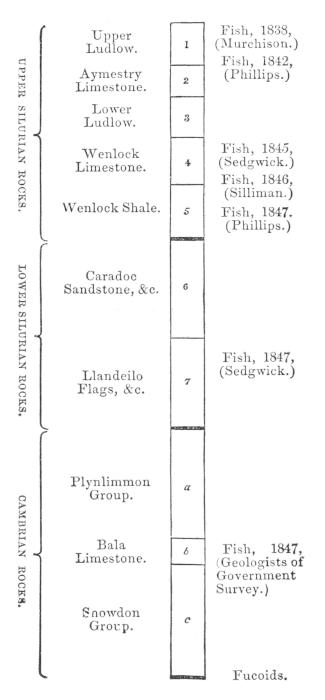
The better marked
sub-divisions of the Silurian
System, as described
in the great
work specially devoted
to it, may be regarded as
seven in number. An
eight has since been
added, by the transference of the Tilestones from the lower
part of the Old Red Sandstone group, to the upper part of the
Silurian group underneath; but in order the better to show
how ichthyic discovery has in its slow course penetrated into
the depths, I shall retain the divisions recognized as those of
the system when that course began. The highest or most
modern Silurian deposit, then, (No. 1 of the accompanying
diagram,) is the Upper Ludlow Rock; and it is in the superior
strata of this division that the bone-bed discovered in 1838
occurs; while the exceedingly minute vertebrate remains
described by Professor Phillips in 1842 occur in its base.
The division next in the descending order is the Aymestry
Limestone, (No. 2;) the next (No. 3.) the Lower Ludlow
rock; then (No. 4.) the Wenlock or Dudley Limestone occurs;
and then, last and oldest deposit of the Upper Silurian formation,
the Wenlock shale, (No. 5.) It is in the fourth, or Wenlock
Limestone division, that the defensive spine described in
the “Edinburgh Review” for 1845 as the oldest vertebrate
organism known at the time, was found;[24] while the vertebrate
organism found by Professor Phillips belongs to the fifth,
or base deposit of the Upper Silurian. Further, the American
spines of Onondago and Oriskany, described in 1846, occurred
in rocks deemed contemporary with those of the Wenlock
division. We next cross the line which separates the base of
the Upper from the top of the Lower Silurian deposits, and
find a great arenaceous formation, (No. 6,) known as the
Caradoc Sandstones; while the Llandeilo Flags, (No. 7,) the
formation upon which the sandstones rest, compose, according
to the sections of Sir Roderick, published in 1839, the lowest
deposit of the Lower Silurian rocks. And it is in the upper
part of this lowest member of the system that the ichthyic
defences, announced in 1847 by Professor Sedgwick, occur.
Vertebrate remains have now been detected in the same
relative position in the seventh and most ancient member of the
system, that they were found to occupy in its first and most
modern member ten years ago. But this is not all. Beneath
the Lower Silurian division there occur vast fossiliferous
deposits, to which the name “Cambrian System” was given,
merely provisionally, by Sir Roderick, but which Professor
Sedgwick still retains as representative of a distinct geologic
period; and it is in these, greatly below the Lower Silurian
base line, as drawn in 1839, that the Bala Limestones
occur. The Plynlimmon rocks (a)—a series of conglomerate,
grauwacke, and slate beds, several thousand yards in
thickness—intervene between the Llandeilo Flags and the
Limestones of Bala, (b.) And, of consequence, the defensive
spine of the Onchus, announced in 1847 as detected in these
limestones by the geologists of the Government Survey, must
have formed part of a fish that perished many ages ere the
oldest of the Lower Silurian formations began to be deposited.
Let us now, after this survey of both the amount of our
materials, and the order and time of their occurrence, pass on
to the question of size, as already stated. Did the ichthyic
remains of the Silurian System, hitherto examined and
described, belong to large or to small fishes? The question
cannot be altogether so conclusively answered as in the case
of those Ganoids of the Lower Old Red Sandstone whose
dermal skeletons indicate their original dimensions and form.
In fishes of the Placoid order, such as the Sharks and Rays,
the dermal skeleton is greatly less continuous and persistent
than in such Ganoids as the Dipterians and Cœlacanths; and
when their remains occur in the fossil state, we can reason, in
most instances, regarding the bulk of the individuals of which
they formed part, merely from that of detached teeth or spines,
whose proportion to the entire size of the animals that bore
them cannot be strictly determined. We can, indeed, do little
more than infer, that though a large Placoid may have been
armed with but small spines or teeth, a small Placoid could
not have borne very large ones. And to this Placoid order all
the Silurian fish, from the Aymestry Limestone to the Cambrian
deposits of Bala inclusive, unequivocally belong. Nor,
as has been already said, is there sufficient evidence to show
that any of the ichthyic remains of the Upper Ludlow rocks
do not belong to it. It is peculiarly the order of the system.
The Ludlow bone-bed contains not only defensive spines, but
also teeth, fragments of jaws, and shagreen points; whereas,
in all the inferior deposits which yield any trace of the vertebrata,
the remains are those of defensive spines exclusively.
Let us, then, take the defensive spine as the part on which to
found our comparison.
One of the best marked Placoids of the Upper Ludlow
bone-bed is that Onchus Murchisoni to which the distinguished
geologist whose name it bears refers, in his communication,
as so nearly resembling the oldest Placoid yet known,—that
of the Bala Limestone. And the living fishes with which the
Onchus Murchisoni must be compared, says Agassiz, though
“the affinity,” he adds, “may be rather distant,” are those
of the genera “Cestracion, Centrina, and Spinax.” I have
placed before me a specimen of recent Spinax, of a species
well known to all my readers on the sea-coast, the Spinax
Acanthias, or common dog-fish, so little a favorite with our
fishermen. It measures exactly two feet three inches in
length; and of the defensive spines of its two dorsals,—these
spear-like thorns on the creature’s back immediately in
advance of the fins, which so frequently wound the fisher’s
hand,—the anterior and smaller measures, from base to
point, an inch and a half, and the posterior and larger, two
inches. I have also placed before me a specimen of Cestracion
Phillippi, (the Port Jackson Shark,) a fish now recognized
as the truest existing analogue of the Silurian Placoids.
It measures twenty-two three fourth inches in length, and is
furnished, like Spinax, with two dorsal spines, of which the
anterior and larger measures from base to point one one half
inch, and the posterior and smaller, one one fifth inch. But
the defensive spine of the Onchus Murchisoni, as exhibited
in one of the Ludlow specimens, measures, though mutilated
at both ends, three inches and five eighth parts in length.
Even though existing but as a fragment, it is as such nearly
twice the length of the largest spine of the dog-fish, unmutilated
and entire, and considerably more than twice the length
of the largest spine of the Port Jackson Shark. The spines
detected by Professor Phillips, in an inferior stratum of the
same upper deposit, were, as has been shown, of microscopic
minuteness; and when they seemed to rest on the extreme
horizon of ichthyic existence as the most ancient remains of
their kind, the author of the “Vestiges” availed himself of the
fact. He regarded the little creatures to which they had
belonged is the fœtal embryos of their class, or—to employ
the language of the Edinburgh Reviewer—as “the tokens
of Nature’s first and half-abortive efforts to make fish out of
the lower animals.” From the latter editions of his work,
the paragraph to which the Reviewer refers has, I find, been
expunged; for the horizon has greatly extended, and what
seemed to be its line of extreme distance has travelled into the
middle of the prospect. But that the passage should have
at all existed is a not uninstructive circumstance, and shows
how unsafe it is, in more than external nature, to regard
the line at which, for the time, the landscape closes, and
heaven and earth seem to meet, as in reality the world’s end.
The Wenlock spine, though certainly not microscopic, is, I
am informed by Sir Philip Egerton, of but small size; whereas
the contemporary spine of the Onondago Limestone,
though comparatively more a fragment than the spine of the
Upper Ludlow Onchus,—for it measures only three inches in
length,—is at least five times as bulky as the largest spine of
Spinax Acanthias. Representing one of the massier fishes
disporting amid the some four or five small ones, of which
in my illustration, the naturalist catches a glimpse in fording
the unknown lake, it at least serves to show that all the
Silurian ichthyolites must not be described as small, seeing
that not only might many of its undetected fish have been
large, but that some of those which have been detected were
actually so. Another American spine, of nearly the same
formation,—for it occurs in a limestone, varying from twenty
to seventy feet in thickness, which immediately overlies that
of the Onondago deposit, though still more fragmentary than
the first, for its length is only two three eighth inches,—maintains
throughout a nearly equal thickness,—a circumstance
in itself indicative of considerable size; and in positive
bulk it almost rivals the Onondago one. Of the Lower
Silurian and Bala fishes no descriptions or figures have yet
appeared. And such, up to the present time, is the testimony
derived from this department of Geology, so far as I
have been able to determine it, regarding the size of the ancient
Silurian vertebrata. “No organism,” says Professor
Oken, “is, nor ever has one been, created, which is not microscopic.”
The Professor’s pupils and abettors, the assertors
of the development hypothesis, appeal to the geological
evidence as altogether on their side in the case; and straightway
a few witnesses enter court. But, lo! among the expected
dwarfs, there appear individuals of more than the
average bulk and stature.
Still, however, the question of organization remains. Did
these ancient Placoid fishes stand high or low in the scale?
According to the poet, “What can we reason but from what
we know?” We are acquainted with the Placoid fishes of
the present time; and from these only, taking analogy as our
guide, can we form any judgment regarding the rank and
standing of their predecessors, the Placoids of the geologic
periods. But the consideration of this question, as it is
specially one on which the later assertors of the development
hypothesis concentrate themselves, I must, to secure the
space necessary for its discussion, defer till my next chapter.
Meanwhile, I am conscious I owe an apology to the reader for
what he must deem tedious minuteness of description, and a
too prolix amplitude of statement. It is only by representing
things as they actually are, and in the true order of their
occurrence, that the effect of the partially selected facts and
exaggerated descriptions of the Lamarckian can be adequately
met. True, the disadvantages of the more sober mode are
unavoidably great. He who feels himself at liberty to arrange
his collected shells, corals, and fish-bones, into artistically designed
figures, and to select only the pretty ones, will be of
course able to make of them a much finer show than he who
is necessitated to represent them in the order and numerical
proportions in which they occur on some pebbly beach washed
by the sea. And such is the advantage, in a literary point of
view, of the ingenious theorist, who, in making figures of his
geological facts, takes no more of them than suits his purpose,
over the man who has to communicate the facts as he finds
them. But the homelier mode is the true one. “Could we
obtain,” says a distinguished metaphysician, “a distinct and full
history of all that has passed in the mind of a child, from the
beginning of life and sensation till it grows up to the use of
reason,—how its infant faculties began to work, and how
they brought forth and ripened all the various notions, opinions,
and sentiments which we find in ourselves when we
come to be capable of reflection,—this would be a treasure
of natural history which would probably give more light into
the human faculties than all the systems of philosophers about
them since the beginning of the world. But it is in vain,” he
adds, “to wish for what nature has not put within the reach
of our power.” In like manner, could we obtain, it may be
remarked, a full and distinct account of a single class of the
animal kingdom, from its first appearance till the present
time, “this would be a treasure of natural history which would
cast more light” on the origin of living existences, and the
true economy of creation, than all the theories of all the philosophers
“since the beginning of the world.” And in order
to approximate to such a history as nearly as possible,—and
it does seem possible to approximate near enough to
substantiate the true readings of the volume, and to correct the
false ones,—it is necessary that the real vestiges of creation
should be carefully investigated, and their order of succession
ascertained.
HIGH STANDING OF THE PLACOIDS.—OBJECTIONS CONSIDERED.
We have seen that some of the Silurian Placoids were large
of size: the question still remains, Were they high in intelligence
and organization?
The Edinburgh Reviewer, in contending with the author of
the “Vestiges,” replies in the affirmative, by claiming for
them the first place among fishes. “Taking into account,”
he says, “the brain and the whole nervous, circulating, and
generative systems, they stand at the highest point of a natural
ascending scale.” They are fishes, he again remarks,
that rank among “the very highest types of their class.”
“The fishes of this early age, and of all other ages previous
to the Chalk,” says his antagonist, in reply, “are, for
the most part, cartilaginous. The cartilaginous fishes—Chondropterygii
of Cuvier—are placed by that naturalist as
a second series in his descending scale; being, however, he
says, ‘in some measure parallel to the first.’ How far this is
different from their being the highest types of the fish class,
need not be largely insisted upon. Linnæus, again, was so
impressed by the low characters of many of this order, that
he actually ranked them with worms. Some of the cartilaginous
fishes, nevertheless, have certain peculiar features of
organization, chiefly connected with reproduction, in which
they excel other fish; but such features are partly partaken
of by families in inferior sub-kingdoms, showing that they
cannot truly be regarded as marks of grade in their own
class. When we look to the great fundamental characters
particularly to the framework for the attachment of the
muscles, what do we find?—why, that of these Placoids,—‘the
highest types of their class,’—it is barely possible to
establish their being vertebrata at all, the back-bone having
generally been too slight for preservation, although the vertebral
columns of later fossil fishes are as entire as those
of any other animals. In many of them traces can be observed
of the muscles having been attached to the external
plates, strikingly indicating their low grade as vertebrate
animals. The Edinburgh Reviewer ‘highest types of their
class’ are in reality a separate series of that class, generally
inferior, taking the leading features of organization of structure
as a criterion, but when details of organization are regarded,
stretching farther, both downward and upward, than
the other series; so that, looking at one extremity, we are as
much entitled to call them the lowest, as the Reviewer, looking
at another extremity, is to call them the ‘highest of
their class.’ Of the general inferiority there can be no room
for doubt. Their cartilaginous structure is, in the first place,
analogous to the embryonic state of vertebrated animals in
general. The maxillary and intermaxillary bones are in
them rudimental. Their tails are finned on the under side
only,—an admitted feature of the salmon in an embryonic
stage; and the mouth is placed on the under side of the
head,—also a mean and embryonic feature of structure.
These characters are essential and important, whatever the
Edinburgh Reviewer may say to the contrary; they are the
characters which, above all, I am chiefly concerned in looking
to, for they are features of embryonic progress, and embryonic
progress is the grand key to the theory of development.”
Such is the ingenious piece of special pleading which this
most popular of the Lamarckians directs against the standing
and organization of the earlier fishes. Let us examine it
somewhat in detail, and see whether the slight admixture of
truth which it contains serves to do aught more than to render
current, like the gilding of a counterfeit guinea spread over
the base metal, the amount of error which lies beneath. I
know not a better example than that which it furnishes, of
the entanglement and perplexity which the meshes of an artificial
classification, when converted, in argumentative processes,
into symbols and abstractions, are sure to involve
subjects simple enough in themselves.
Fishes, according to the classification of a preponderating
majority of the ichthyologists that have flourished from the
earliest times down to those of Agassiz, have been divided
into two great series, the Ordinary or osseous, and the Chondropterygii
or cartilaginous. And these two divisions of the
class, instead of being ranged consecutively in a continuous
line, the one in advance of the other, have been ranged
in two parallel lines, the one directly abreast of the other.
There is this further peculiarity in the arrangement, that
the line of the cartilaginous series, from the circumstance
that some of its families rise higher and some sink lower
in the scale than any of the ordinary fishes, outflanks the
array of the osseous series at both ends. The front which
it presents contains fewer genera and species than that of
the osseous division; but, like the front of an army drawn
out in single file, it extends along a greater length of ground.
And to this long-fronted series of the cartilaginous, or, according
to Cuvier, chondropterygian fishes, the Placoid families
of Agassiz belong,—among the rest, the Placoids of the Silurian
formations, Upper and Lower. But though all the Placoids
of this latter naturalist be cartilaginous fishes, all cartilaginous
fishes are not Placoids. The Sturionidæ are cartilaginous,
and are, as such, ranked by Cuvier among the Chondropterygii,
whereas Agassiz places them in his Ganoid order.
Many of the extinct fishes, too, such as the Acanthodei, Dipteridæ,
Cephalaspidæ, were, as we have seen, cartilaginous
in their internal framework, and yet true Ganoids notwithstanding.
The principle of Agassiz’s classification wholly
differs from that of Cuvier and the older ichthyologists; for
it is a classification founded, not on the character of the
internal but on that of the cuticular or dermal skeleton. And
while to the geologist it possesses great and obvious advantages
over every other,—for of the earlier fishes very little
more than the cuticular skeleton survives,—it has this further
recommendation to the naturalist, that, (in so far at least as
its author has been true to his own principles,) instead of anomalously
uniting the highest and lowest specimens of their
class,—the fishes that most nearly approximate to the reptiles
on the one hand, and the fishes that sink furthest towards the
worms on the other,—it gathers into one consistent order all
the individuals of the higher type, distinguished above their
fellows by their development of brain, the extensive range
of their instincts, and the perfection of their generative systems.
Further, the history of animal existences, as recorded
in the sedimentary rocks of our planet, reads a recommendation
of this scheme of classification which it extends
to no other. We find that in the progress of creation the
fishes began to be by groupes and septs, arranged according to
the principle on which it erects its orders. The Placoids
came first, the Ganoids succeeded them, and the Ctenoids and
Cycloids brought up the rear. The march has been marshalled
according to an appointed programme, the order of which it
is peculiarly the merit of Agassiz to have ascertained.
Now, may I request the reader to mark, in the first place
that what we have specially to deal with at the present stage
of the argument are the Placoid fishes of the Silurian formations,
Upper and Lower. May I ask him to take note, in the
second, that the long-fronted chondropterygian series of
Cuvier, though it includes, as has already been said, the
Placoid order of Agassiz,—just as the red-blooded division
of animals includes the bimana and quadrumana,—is no
more to be regarded as identical with the Placoids, than the
red-blooded animals are to be regarded as identical with the
apes or with the human family. It simply includes them in
the character of one of the three great divisions into which it
has been separated,—the division ranged, if I may so express
myself, on the extreme right of the line; its middle portion,
or main body, being composed of the Sturiones, a family on
the general level of the osseous fishes; while, ranged on the
extreme left, we find the low division of the Suctorii, i. e.
Cyclostomi, or Lampreys. But with the middle and lower
divisions we have at present nothing to do; for of neither
of them, whether Sturiones or Suctorii, does the Silurian
System exhibit a trace. Further be it remarked, that the
scheme of classification which gives an abstract standing to
the Chondropterygii, is in itself merely a certain perception
of resemblance which existed in certain minds, having cartilage
for its general idea; just as another certain perception
of resemblance in one other certain mind had cuticular
skeleton for its general idea, and as yet another perception
of resemblance in yet other certain minds had red blood for
its general idea. As shown by the disparities which obtain
among the section which the scheme serves to separate from
the others, it no more determines rank or standing than that
greatly more ancient scheme of classification into “ring-streaked
and spotted,” which served to distinguish the flocks
of the patriarch Jacob from those of Laban his father-in-law,
but which did not distinguish goats from sheep, nor sheep from
cattle.
The effect of introducing, after this manner, generalizations
made altogether irrespective of rank, and avowedly without
reference to it, into what are inherently and specifically questions
of rank, admits of a simple illustration.
Let us suppose that it was not with the standing of the
Silurian Placoids that we had to deal, but with that of the
mammals of the recent period, including the quadrumana, and
even the bimana, and that we had ventured to describe them,
in the words of the Edinburgh Reviewer, as “the very
highest types of their class.” What would be thought of the
reasoner who, in challenging the justice of the estimate,
would argue that these creatures, men as well as monkeys,
belonged simply to that division of red-blooded animals which
includes, with the bimana and quadrumana, the frog, the gudgeon,
and the earthworm?—a division, he might add, “which,
when details of organization are regarded, stretches farther,
both downward and upward,” than that division of the white-blooded
animals to which the crab, the spider, the cuttle-fish,
and the dragon fly belong; “so that, looking at one extremity,
any one is as much entitled to call the red-blooded animals
the lowest division, as any other, looking at another extremity,
is to call them the highest division, of animals.”
What, it might well be asked in reply, has the earthworm,
with its red-blood to do in a question respecting the place
and standing of the bimana? Or what, in the parallel case,
have the Suctorii—the worms of Linnæus—to do in a
question respecting the place and standing of the real
Placoids? True it is that, according to one principle of
classification, now grown somewhat obsolete, men and earthworms
are equally red-blooded animals; true it is that,
according to another principle of classification, the Placoids
of Agassiz and the cartilaginous worms of Linnæus are equally
Chondropterygii. The bimana and the earthworm have their
red blood in common; the glutinous hag and the true Placoids
have as certainly their internal cartilage in common; and
if the fact of the red blood of the worm lowers in no degree
the rank of the bimana, then, on the same principle, the
fact of the internal cartilage of the glutinous hag cannot
possibly detract from the standing of the true Placoid. In
both cases they are creatures that entirely differ,—the earthworms
from the bimana, and the cartilaginous worms from
the Placoids; and the classification which tags them together,
whether it be that of Aristotle or that of Cuvier, cannot
be converted into a sort of minus quantity, of force enough
to detract from the value and standing of the bimana in
the one case, or of the true Placoids in the other. It is
in no degree derogatory to the human family that earthworms
possess red blood; it is in no degree derogatory to
the true Placoids that the Suctorii possess cartilaginous
skeletons.
Let the reader now mark the use which has been made, by
the author of the “Vestiges,” of the name and authority of
Linnæus. “Linnæus,” he states, “was so impressed by the
low character of many of this order, (the Chondropterygii,)
that he actually ranked them with worms.” Now, what is the
fact here? Simply that Linnæus had no such general order
as the Chondropterygii in his eye at all. Though chiefly
remarkable as a naturalist for the artificialness of his classifications,
his estimate of the cartilaginous fishes was remarkable—though
carried too far in its extremes, and in some degree
founded in error—for an opposite quality. It was an estimate
formed, in the main, on a natural basis. Instead of taking
their cartilaginous skeleton into account, he looked chiefly at
their standing as animals; and, struck with that extent of front
which they present, and with both their superiority on the extreme
right, and their inferiority on the extreme left, to the
ordinary fishes, he erected them into two separate orders, the
one lower and the other higher than the members of the osseous
line. And so far was he from regarding the true Placoids—those
Chondropterygii which to an internal skeleton of
cartilage add external plates, points, or spines of bone—as
low in the scale, that he actually raised them above fishes altogether,
by erecting them into an order of reptiles,—the older
Amphibia Nantes. Surely, if the name of Linnæus was to be
introduced into this controversy at all, it ought to have been
in connection with this special fact; seeing that the point to
be determined in the question under discussion is simply the
place and standing of that very order which the naturalist
rated so high,—not the place and standing of the order which
he degraded. It so happens that there is one of the Chondropterygii
which, so far from being a true Placoid, does not
possess a single osseous plate, point, or spine: it is a worm
like creature, without eyes, without movable jaws, without
vertebral joints, without scales, always enveloped in slime,
and greatly abhorred by our Scotch boatmen of the Moray
Frith, who hold that it burrows, like the grave-worm, in the
decaying bodies of the dead. And this creature, “the
glutinous hag,” or, according to north-country fishermen, the
“ramper-eel,” or “poison-ramper,” was regarded by Linnæus
as belonging, not to the class of fishes, but to the
Vermes. Now, this is the special fact with which, in the
development controversy, the author of the “Vestiges” connects
the name of the Swedish naturalist! All the fish of
the Silurian System belonged to that true Placoid order which
Linnæus, impressed by its high standing, erected into an
order, not of worms, but of reptiles. He elevated A, the
true Placoid, while he degraded B, the glutinous hag. But it
was necessary to the argument of the author of the “Vestiges”
that the earliest existing fish should be represented as
fish low in the scale; and so he has cited the name and
authority of Linnæus in its bearing against the glutinous hag
B, as if it had borne against the standing of the true Placoid
A. The Patagonians are the tallest and bulkiest men in the
world, whereas their neighbors, the Fuegians are a slim and
diminutive race. And if, in some controversy raised regarding
the real size of the more gigantic tribe, they were to be
described as the “very tallest types of their class,” any statement
in reply, to the effect that some trustworthy voyager
had examined certain races of the extreme south of America,
and had found that they were both short and thin, would be
neither relevant in its facts nor legitimate in its bearing. But
if the controversialist who thus strove to strengthen his case
by the voyager’s authority, was at the same time fully aware
that the voyager had seen not only the diminutive Fuegians,
but also the gigantic Patagonians, and that he had described
these last as very gigantic indeed, the introduction of the
statement regarding the smaller race, when he wholly sank
the statement regarding the larger, would be not merely very
irrelevant in the circumstances, but also very unfair. Such,
however, is the style of statement to which the author of the
“Vestiges” has (I trust inadvertently) resorted in this controversy.
It is not uninstructive to mark how slowly and gradually
the naturalists have been groping their way to a right classification
in the ichthyic department of their science, and how it
has been that identical perception of resemblance, having
cartilage for its general idea, to which the author of the
“Vestiges” attaches so much importance, that has served
mainly to retard their progress. Not a few of the more distinguished
among their number deemed it too important a
distinction to be regarded as merely secondary; and so long
as it was retained as a primary characteristic, the fishes failed
to range themselves in the natural order;—dissimilar tribes
were brought into close neighborhood, while tribes nearly
allied were widely separated. It failed, as has been shown,
to influence Linnæus; and though he no doubt pressed his
peculiar views too far when he degraded the glutinous hag
into a worm, and elevated the Sharks and Rays into reptiles,
it is certainly worthy of remark, that, in the scheme of classification
which is now regarded as the most natural,—that
of Professor Muller, modified by Professor Owen,—the
ichthyic worms of the Swede are placed in the first and
lowest order of fishes,—the Dermopteri,—and the greater
part of his ichthyic reptiles, in the eleventh and highest,—the
Plagiostomi. Cuvier yielded, as has been shown, to the
idea of resemblance founded on the material of the ichthyic
framework, and so ranged his fishes into two parallel lines.
Professor Oken, after first enunciating as law that “the characteristic
organ of fishes is the osseous system,” confessed
the “great difficulty” which attaches to the question of skeletal
“texture or substance,” and finally gave up the distinction
founded on it as obstinately irreducible to the purposes of a
natural classification. “The cartilaginous fishes,” he says, “appear
to belong to each other, and are also usually arranged together;
yet amongst them we find those species, such as the
Lampreys, which obviously occupy the lowest grade of all
fishes, while the Sharks and Rays remind us of the Reptilia.”
And so, sinking the consideration of texture altogether, he
placed the family of the Lamprey, including the glutinous hag,
at the bottom of the scale, and the Sharks and Rays at the top.
Agassiz’s system, peculiarly his own, has had the rare merit,
as I have shown, of furnishing a key to the history of the
fish in its several dynasties, which we may in vain seek in
any other. His divisions,—if, retaining his strongly-marked
Placoids and Ganoids, as orders stamped in the mint of nature,
we throw his perhaps less obviously divisible Ctenoids and Cycloids
into one order,—the corneous or horn-covered,—are
scarcely less representative of periods than those great classes
of the vertebrata, mammals, birds, reptiles, and fishes, which
we find not less regularly ranged in their order of succession
in the geologic record than in the “Animal Kingdom” of
Cuvier,—a shrewd corroboration, in both cases, I am disposed
to think, of the rectitude of the arrangement. What
seems to be the special defect of his system is, that having
erected his four orders, and then finding a certain number of
residuary families that, on his principle of cuticular character,
stubbornly refused to fall into any determinate place, he distributed
them among the others, with reference chiefly to the
totally distinct principle of Cuvier. Thus the Suctorii, soft,
smooth, slimy-skinned fishes, that do not possess a single
placoid character, and are not true Placoids, he has yet placed
in his Placoid order, influenced, apparently, by the “perception
of resemblance that has cartilage for its central
idea;” and the effect has been a massing into one anomalous
and entangled group the fishes of the first period of geologic
history, with fishes of which we do not find a trace save in
the existing scene of things, and of the highest families of
their class with families that occupy the lowest place. But
we live in an age in which even the benefactors of the world
of mind cannot make false steps with impunity; and so,
while Agassiz’s three ichthyic orders will continue to be
recognized by the palæontologist as the orders of three great
geologic periods, the Suctorii have already been struck from
off his higher fishes by the classification of Muller and Owen,
and carried to that lowest point in the scale (indicated by
Linnæus and Oken) which their inferior standing renders so
obviously the natural one. Some of my readers may perhaps
remember how finely Bacon, in his “Wisdom of the
Ancients,” interprets the old mythologic story of Prometheus.
Prometheus, says the philosopher, had conferred inestimable
favors on men, by moulding their forms into shape, and bringing
them fire from heaven; and yet they complained of him
and his teachings to Jupiter. And the god, instead of censuring
their ingratitude, was pleased with the complaint, and
rewarded them with gifts. In putting nature to the question,
it is eminently wholesome to be doubting, cross-examining,
complaining; ever demanding of our masters and benefactors
the philosophers, that they should reign over us, not arbitrarily
and despotically,
“Like the old kings, with high exacting looks,
Sceptred and globed,”
but like our modern constitutional monarchs, who govern by
law; and, further, that an appeal from their decisions on all
subjects within the jurisdiction of Nature should for ever
be open to Nature herself. The seeming ingratitude of such
a course, if the “complaints” be made in a right spirit and
on proper grounds, Jupiter always rewards with gifts.
Let us now see for ourselves, in this spirit, whether there
may not be something absolutely derogatory, in the existence
of a cartilaginous skeleton, to the creatures possessing it; or
whether a deficit of internal bone may not be greatly more
than neutralized, as it assuredly must have been in the view
of Linnæus, Muller, and Owen, by a larger than ordinary
share of a vastly more important substance.
THE PLACOID BRAIN. EMBRYONIC CHARACTERISTICS NOT NECESSARILY OF A LOW ORDER.
That special substance, according to whose mass and degree
of development all the creatures of this world take rank
in the scale of creation, is not bone, but brain. Were animals
to be ranged according to the solidity of their bones, the
class of birds would be assigned the first place; the family
of the Felidæ, including the tiger and lion, the second; and
the other terrestrial carnivora the third. Man and the herbivorous
animals, though tolerably low in the scale, would be
in advance of at least the reptiles. Most of these, however,
would take precedence of the sagacious Delphinidæ; the
osseous fishes would come next in order; the true Placoids
would follow, succeeded by the Sturiones; and the Suctorii,
i. e. Cyclostomi or Lampreys, would bring up the rear.
There would be evidently no order here: the utter confusion
of such an arrangement, like that of the bits of a dissected
map flung carelessly out of its box by a child, would of
itself demonstrate the inadequacy and erroneousness of
the regulating principle. But how very different the appearance
presented, when for solidity of bone we substitute
development of brain! Man takes his proper place
at the head of creation; the lower mammalia follow,—each
species in due order, according to its modicum of intelligence;
the birds succeed the mammalia; the reptiles succeed
the birds; the fishes succeed the reptiles; next in
the long procession come the invertebrate animals; and
these, too, take rank, if not according to their development
of brain proper, at least according to their development of
the substance of brain. The occipital nervous ganglion of the
scorpion greatly exceeds in size that of the earthworm; and
the occipital nervous ring of the lobster, that of the intestinal
Ascaris. At length, when we reach the lowest or acrite
division of the animal kingdom, the substance of brain
altogether disappears. It has been calculated by naturalists,
that in the vertebrata, the brain in the class of fishes
bears an average proportion to the spinal cord of about two
to one; in the class of reptiles, of about two and a half to
one; in the class of birds, of about three to one; in the class
of mammals, of about four to one; and in the high-placed,
sceptre-bearing human family, a proportion of not less than
twenty-three to one. It is palpably according to development
of brain, not development of bone, that we are to determine
points of precedence among the animals,—a fact of which
no one can be more thoroughly aware than the author of the
“Vestiges” himself. Of this let me adduce a striking instance,
of which I shall make further use anon.
“All life,” says Oken, “is from the sea; none from the
continent. Man also is a child of the warm and shallow
parts of the sea in the neighborhood of the land.” Such
also was the hypothesis of Lamarck and Maillet. In following
up the view of his masters, the author of the “Vestiges”
fixes on the Delphinidæ as the sea-inhabiting progenitors of
the simial family, and, through the simial family, of man
For that highest order of the mammalia to which the Simiadæ
(monkeys) belong, “there remains,” he says, “a
basis in the Delphinidæ, the last and smallest of the cetacean
tribes. This affiliation has a special support in the brain of
the dolphin family, which is distinctly allowed to be, in proportion
to general bulk, the greatest among mammalia next
to the orang-outang and man. We learn from Tiedemann,
that each of the cerebral hemispheres is composed, as in
man and the monkey tribe, of three lobes,—an anterior, a
middle, and a posterior; and these hemispheres present
much more numerous circumvolutions and grooves than those
of any other animal. Here it might be rash to found any
thing upon the ancient accounts of the dolphin,—its familiarity
with man, and its helping him in shipwreck and various
marine disasters; although it is difficult to believe these stories
to be altogether without some basis in fact. There is no
doubt, however, that the dolphin evinces a predilection for
human society, and charms the mariner by the gambols which
it performs beside his vessel.”
Here, then, the author of the “Vestiges” palpably founds
on a large development of brain in the dolphin, and on the
manifestation of a correspondingly high order of instincts,—and
this altogether irrespective of the structure or composition
of the creature’s internal skeleton. The substance to
which he looks as all-important in the case is brain, not bone.
For were he to estimate the standing of the dolphin, not by
its brain, but by its skeleton, he would have to assign to it a
place, not only not in advance of its brethren the mammalia
of the sea, but even in the rear of the reptiles of the sea, the
marine tortoises, or turtles,—and scarce more than abreast
of the osseous fishes. “Fishes,” says Professor Owen, in his
“Lectures on the Vertebrate Animals,” “have the least proportion
of earthy matter in their bones; birds the largest.
The mammalia, especially the active, predatory species, have
more earth, or harder bones, than reptiles. In each class,
however, there are differences in the density of bone among
its several members. For example, in the fresh-water fishes,
the bones are lighter, and retain more animal matter, than
in those which swim in the denser sea. And in the dolphin,
a warm-blooded marine animal, they differ little in this respect
from those of the sea-fish.” Such being the fact, it is
surely but fair to inquire of the author of the “Vestiges,”
why he should determine the rank and standing of the Delphinidæ
according to one set of principles, and the rank and
standing of the Placoids according to another and entirely
different set? If the Delphinidæ are to be placed high in the
scale, notwithstanding the softness of their skeletons, simply
because their brains are large, why are the Placoids to be
placed low in the scale, notwithstanding the largeness of their
brains, simply because their skeletons are soft? It is not too
much to demand, that on the principle which he himself recognizes
as just, he should either degrade the dolphin or elevate
the Placoid. For it is altogether inadmissible that he
should reason on one set of laws when the exigencies of his
hypothesis require that creatures with soft skeletons should
be raised in the scale, and on another and entirely different
set when its necessities demand that they should be depressed.
But do the Placoids possess in reality a large development
of brain? I have examined the brains of almost all the common
fish of our coast, both osseous and cartilaginous, not,
I fear, with the skill of a Tiedemann, but all the more intelligently
in consequence of what Tiedemann had previously
done and written: and so I can speak with some little confidence
on the subject, so far at least as my modicum of experience,
thus acquired, extends. Of all the common fish
of the Scottish seas, the spotted or lesser dog-fish bears, in
proportion to its size, the largest brain; the gray or picked
dog-fish ranks next in its degree of development; the Rays,
in their various species, follow after; and the osseous fishes
compose at least the great body of the rear; while still
further behind, there lags a hapless class—the Suctorii, one
of which, the glutinous hag, has scarce any brain, and one,
the Amphioxus or lancelet, wants brain altogether. I have
compared the brain of the spotted dog-fish with that of a
young alligator, and have found that in scarce any perceptible
degree was it inferior, in point of bulk, and very slightly
indeed in point of organization, to the brain of the reptile.
And the instincts of this Placoid family,—one of the truest
existing representatives of the Placoids of the Silurian System[25]
to which we can appeal,—correspond, we invariably
find, with their superior cerebral development. I have
seen the common dog-fish, Spinax Acanthias, hovering in
packs in the Moray Frith, some one or two fathoms away
from the side of the herring boat from which, when the
fishermen were engaged in hauling their nets, I have watched
them, and have admired the caution which, with all their
ferocity of disposition, they rarely failed to manifest;—how
they kept aloof from the net, even more warily than the
cetacea themselves,—though both dog-fish and cetacea are
occasionally entangled;—and how, when a few herrings were
shaken loose from the meshes they at once darted upon them,
exhibiting for a moment, through the green depths, the pale
gleam of their abdomens, as they turned upon their sides to
seize the desired morsels,—a motion rendered necessary by
the position of the mouth in this family; and how next, their
object accomplished, they fell back into their old position, and
waited on as before. And I have been assured by intelligent
fishermen, that at the deep-sea white-fishing, in which baited
hooks, not nets, are employed, the degree of shrewd caution
exercised by these creatures seems more extraordinary still.
The hatred which the fisher bears to them arises not more
from the actual amount of mischief which they do him, than
from the circumstance that in most cases they persist in
doing it with complete impunity to themselves. I have seen,
said an observant Cromarty fisherman to the writer of these
chapters, a pack of dog-fish watching beside our boat, as we
were hauling our lines, and severing the hooked fish, as
they passed them, at a bite, just a little above the vent, so that
they themselves escaped the swallowed hook; and I have
frequently lost, in this way, no inconsiderable portion of a
fishing. I have observed, however, he continued, that when
a fresh pack of hungry dog-fish came up, and joined the
pack that had been robbing us so coolly, and at their leisure,
a sudden rashness would seize the whole,—the united packs
would become a mere heedless mob, and, rushing forward,
they would swallow our fish entire, and be caught themselves
by the score and the hundred. We may see something very
similar to this taking place among even the shrewder mammalia.
When pig refuses to take his food, his mistress
straightway calls upon the cat, and, quickened by the dread
of the coming rival, he gobbles up his rations at once. With
the comparatively large development of brain, and the corresponding
manifestations of instinct, which the true Placoids
exhibit, we find other unequivocal marks of a general superiority
to their class. In their reproductive organs they rank
not with the common fishes, nor even with the lower reptiles,
but with the Chelonians and the Sauria. Among the
Rays, as among the higher animals, there are individual
attachments formed between male and female: their eggs
unlike the mere spawn of the osseous fishes, or of even the
Batrachians, are, like those of the tortoise and the crocodile,
comparatively few in number, and of considerable size:
their young, too, like the young of birds and of the higher
reptiles, pass through no such metamorphosis as those of the
toad and frog, or of the amphibia generally. And some
of their number—the common dog-fish for instance—are
ovoviviparous, bringing forth their young, like the
common viper and the viviparous lizard, alive and fully
formed.
“But such features,” says the author of the “Vestiges,”
referring chiefly to certain provisions connected with the reproductory
system in the Placoids, “are partly partaken of by
families in inferior sub-kingdoms, showing that they cannot
truly be regarded as marks of grade in their own class.”
Nay, single features do here and there occur in the inferior
sub-kingdoms, which very nearly resemble single features in
the placoid character and organization, which even very
nearly resemble single features in the human character and
organization; but is there any of the inferior sub-kingdoms
in which there occurs such a collocation of features? or does
such a collocation occur in any class of animals—setting the
Placoids wholly out of view—which is not a high class?
Nay, further, does there occur in any of the inferior sub-kingdoms—existing
even as a single feature—that most
prominent, leading characteristic of this series of fishes,—a
large brain?
But is not the “cartilaginous structure” of the Placoids
analogous to the embryonic state of vertebrated animals in general?
Do not the other placoid peculiarities to which the
author of the “Vestiges” refers,—such as the heterocercal
or one-sided tail, the position of the mouth on the under side
of the head, and the rudimental state of the maxillaries and
intermaxillaries,—bear further analogies with the embryonic
state of the higher animals? And is not “embryonic progress
the grand key to the theory of development?” Let us examine
this matter. “These are the characters,” says this
ingenious writer, “which, above all, I am chiefly concerned in
looking to; for they are features of embryonic progress, and
embryonic progress is the grand key to the theory of development.”
Bold assertion, certainly; but, then, assertion is not
argument! The statement is not a reason for the faith that is
in the author of the “Vestiges,” but simply an avowal of it;
it is simply a confession, not a defence, of the Lamarckian
creed; and, instead of being admitted as embodying a first
principle, it must be put stringently to the question, in order
to determine whether it contain a principle at all.
In the first place, let us remark, that the cartilaginous
structure of the Placoids bears no very striking analogy to
the cartilaginous structure of the higher vertebrata in the
embryonic state. In the case of the Delphinidæ, with their
soft skeletons, the analogy is greatly more close. Bone
consists of animal matter, chiefly gelatinous, hardened by a
diffusion of inorganic earth. In the bones of young and
fœtal mammalia, inhabitants of the land, the gelatinous prevails;
in the old and middle-aged there is a preponderance
of the earth. Now, in the bones of the dolphin there is
comparatively little earth. The analogies of its internal
skeleton bear, not on the skeletons of its brethren the mature
full-grown mammals of the land, but on the skeletons of their
immature or fœtal offspring. But in the case of the true
Placoids that analogy is faint indeed. Their skeletons contain
true bone;—the vertebral joints of the Sharks and Rays
possess each, as has been shown, an osseous nucleus, which
retains, when subjected to the heat of a common fire, the
complete form of the joint; and their cranial framework has
its surface always covered over with hard osseous points.
But though their skeletons possess thus their modicum of bone,
unlike those of embryonic birds or mammals, they contain, in
what is properly their cartilage, no gelatine. The analogy
signally fails in the very point in which it has been deemed
specially to exist. The cartilage of the Chondropterygii is a
substance so essentially different from that of young or
embryonic birds and mammals, and so unique in the animal
kingdom, that the heated water in which the one readily dissolves
has no effect whatever upon the other. It is, however,
a curious circumstance, exemplified in some of the Shark
family,[26] though it merely serves, in its exceptive character,
to establish the general fact, that while the rays of the
double fins, which answer to the phalanges, are all formed
of this indissoluble cartilage, those rays which constitute
their outer framework, with the rays which constitute the
framework of all the single fins, are composed of a mucoidal
cartilage, which boils into glue. At certain definite lines
a change occurs in the texture of the skeleton; and it is
certainly suggestive of thought, that the difference of
substance which the change involves distinguishes that
part of the skeleton which is homologically representative of
the skeletons of the higher vertebrata, from that part of it
which is peculiar to the creature as a fish, viz. the dorsal and
caudal rays, and the extremities of the double fins. These
emphatically ichthyic portions of the animal may be dissipated
by boiling, whereas what Linnæus would perhaps term
its reptilian portion abides the heat without reduction.
But is not the one-sided tail, so characteristic of the sharks,
and of almost all the ancient Ganoids, also a characteristic of
the young salmon just burst from the egg? Yes, assuredly;
and, so far as research on the subject has yet extended, of
not only the salmon, but of all the other osseous fishes in
their fœtal state. The salmon, on its escape from the egg, is
a little monster of about three quarters of an inch in length,
with a huge heart-shaped bag, as bulky as all the rest of its
body, depending from its abdomen. In this bag provident
nature has packed up for it, in lieu of a nurse, food for five
weeks; and, moving about every where in its shallow pool,
with its provision knapsack slung fast to it, it reminds one
disposed to be fanciful, save that its burden is on the wrong
side, of Scottish soldiers of the olden time summoned to attend
their king in war,—
“Each on his back, a slender store,
His forty days’ provision bore,
As ancient statutes tell.”
Around that terminal part of the creature’s body traversed by
the caudal portion of the vertebral column, which commences
in the salmon immediately behind the ventrals, there
runs at this period, and for the ensuing five weeks in which
it does not feed, a membranous fringe or fin, which exactly
resembles that of the tadpole, and which, existing simply as
an expansion of the skin, exhibits no mark or rays. In the
place of the true caudal fin, however, we may detect with
the assistance of a lens, an internal framework with two
well-marked lobes, and ascertain, further, that this tail is set
on awry,—the effect of a slight upward bend in the creature’s
body. And when viewed in a strong light as a transparency,
we perceive that the spinal cord takes the same upward bend,
and, as in the sturgeon, passes in an exceedingly attenuated
form into the upper lobe. What may be regarded as the
design of the arrangement is probably to be found in the peculiar
form given to the little creature by the protuberan
bag in front. A wise instinct teaches it, from the moment of
its exclusion from the egg, to avoid its enemies. In the instant
the human shadow falls upon its pool, we see it darting
into some recess at the side or bottom, with singular alacrity;
and in order to enable it to do so, and to steer itself aright,—as,
like an ill-trimmed vessel, deep in the water ahead, the
balance of its body is imperfect,—there is, if I may so express
myself, a heterocercal peculiarity of helm required. It
has got an irregularly-developed tail to balance an irregularly-developed
body, as skiffs lean on the one beam and full on
the other require, in rowing, a cast of the rudder to keep them
straight in their course.
Sinking altogether, however, the final cause of the peculiarity,
and regarding it simply as a fœtal one, that indicates a
certain stage of imperfection in the creature in which it occurs,
on what principle, I ask, are we to infer that what is a
sign of immaturity in the young of one set of animals, is a
mark of inferior organization in the adult forms of another
set? The want of eyes in any of the animal families, or the
want of organs of progression, or a fixed and sedentary condition,
like that of the oyster, are all marks of great inferiority.
And yet, if we admit the principle, that what are evidences
of immaturity in the young members of one family are signs
of inferior organization in the fully-grown members of another,
it could easily be shown that eyes and legs are defects, and
that the unmoving oyster stands higher in the scale than the
ever-restless fish or bird. The immature Tubularia possess
locomotive powers, whereas in their fully developed state they
remain fixed to one spot in their convoluted tubes. The immature
Lepas is furnished with members well adapted for
swimming, and with which it swims freely; as it rises towards
maturity, these become blighted and weak; and, when
fully grown,—fixed by its fleshy pedicle to the rock or floating
log to which it attached itself in its transition state,—it
is no longer able to swim. The immature Balanus is furnished
with two eyes: in its state of maturity these are extinguished,
and it passes its period of full development in
darkness. Further, it is not generally held that in the human
family a white skin is a decided mark of degradation, but
rather the reverse; and yet nothing can be more certain than
that the Negro fœtus has a white skin. Since eyes, and organs
of progression, and a power of moving freely, and a
white skin, are mere embryonic peculiarities in the Balanus,
the Lepas, the Tubularia, and the Negro, and yet are in themselves,
when found in the mature animal, evidences of a
high, not of a low standing, on what principle, I ask are we
to infer that the peculiarity of a heterocercal tail, embryonic
in the salmon, is, when found in the mature Placoid, an evidence,
not of a high standing, but of a low? Every true
analogy in the case favors an exactly opposite view. In the
heterocercal or one-sided tail, the vertebral joints gradually
diminish, as in the tails of the Sauria and Ophidia, till they
terminate in a point; whereas the homocercal tail common to
the osseous fishes exhibits no true analogy with the tails
of the higher orders. Its abruptly terminating vertebral column,
immensely developed posterior processes, and broadly
expanded osseous rays, seem to be simply a few of the many
marks of decline and degradation which fishes, the oldest of
the vertebrata, exhibit in this late age of the world, and which,
in at least the earlier geologic periods, when they were greatly
younger as a class, they did not betray.
In illustration of this view, I would fain recommend to the
reader a simple experiment. Let him procure the tail of a
common dog-fish, (fig. 48, a,) and cutting it across about half
an inch above where the caudal fin begins, let him boil it
smartly for about half an hour. He will first see it swell
and then burst, all around those thinner parts of the fin that
are traversed by the caudal rays,—wholly mucoidal, as shown
by this test, in their texture, and which yield to the boiling
water, as if formed of isinglass. They finally dissolve, and
drop away, with the surrounding cuticular integument; and
then there only remains, as the insoluble framework of the
whole, the bodies of the vertebræ, with their neural and
hœmal processes. The tail has now lost much of its ichthyic
character, and has acquired, instead, a considerable degree
of resemblance to the reptilian tail, as exemplified in the saurians.
I have introduced into the wood-cut, for the purpose
of comparison, the tail of the ichthyosaurus, (b.) It consists,
like the other, of a series of gradually diminishing vertebræ,
and must have also supported, says Professor Owen, a propelling
fin, placed vertically, as in the shark, which, however,
from its perishable nature, has in every instance disappeared
in the earth, as that of the dog-fish disappears in
the boiling water. It will be seen that its processes are comparatively
smaller than those of the fish, and that the bodies
of its vertebræ are shorter and bulkier; but there is at least
a general correspondence of the parts; and were the tail of the
crocodile, of which the vertebral bodies are slender and the
processes large, to be substituted for that of the enaliosaur here,
the correspondence would be more marked still. After thus
developing the tail of the reptile out of that of the fish,—as the
cauldron-bearing Irish magician of the tale developed young
ladies out of old women,—simply by boiling, let the reader
proceed to a second stage of the experiment, and see whether
he may not be able still further to develope the reptilian tail so
obtained, into that of the mammal, by burning. Let him spread
it out on a piece of iron hoop, and thrust it into the fire;
and then, after exposure for some time to a red heat has
consumed and dissipated its merely cartilaginous portions,
such as the neural and hœmal processes, with the little pieces
which form the sides of the neural arch, and left only the
whitened bodies of the vertebræ, let him say whether the
bony portion which remains does not present a more exact
resemblance to the mammiferous tail—that of the dog, for
example—than any thing else he ever saw. The Lamarckians
may well deem it an unlucky circumstance, that one special
portion of their theory should demand the depreciation of
the heterocercal tail, seeing that it might be represented with
excellent effect in another, as not merely a connecting link in
the upward march of progression between the tail of the true
fish and that of the true reptile, but as actually containing in
itself—as the caterpillar contains the future pupa and butterfly—the
elements of the reptilian and mammiferous tail.
If there be any virtue in analogy, the heterocercal tail is, I
repeat, of a decidedly higher type than the homocercal one.
It furnishes the first example in the vertebrata of the coccygeal
vertebræ diminishing to a point, which characterizes
not only all the higher reptiles, but also all the higher mammals,
and which we find represented by the Os coccygis in
man himself. But to this special point I shall again refer.
With regard to that rudimentary state of the occipital
framework of the Placoids to which the author of the “Vestiges”
refers, it may be but necessary to say that, notwithstanding
the simplicity of their box-like skulls, they bear in
their character, as cases for the protection of the brain,
at least as close an analogy to the skulls of the higher animals,
as those of the osseous fishes, which consist usually
of the extraordinary number of from sixty to eighty bones,—a
mark—the author of the “Vestiges” himself being judge
in the case—rather of inferiority than the reverse. “Elevation
is marked in the scale,” we find him saying, “by an
animal exchanging a multiplicity of parts serving one end,
for a smaller number.” The skull of a cod consists of about
thrice as many separate bones as that of a man. But I do
not well see that in this case the fact either of simplicity in
excess or of multiplicity in excess can be insisted upon in
either direction, as a proper basis for argument. Nearly the
same remark applies to the maxillaries as to the skull. The
under jaw in man consists of a single bone; that of the thornback—if
we do not include the two suspending ribs, which
belong equally to the upper jaw—of two bones, (the number
in all the mammiferous quadrupeds:) that of the cod of
four bones, and, if we include the suspending ribs, of twelve.
On what principle are we to hold, with one as the representative
number of the highest type of jaw, that two indicates
a lower standing than four, or four than twelve? In
reference to the further statement, that in many of the ancient
fishes “traces can be observed of the muscles having
been attached to the external plates, strikingly indicating
their low grade as vertebrate animals,” it may be
answer enough to state, that the peculiarity in question was
not a characteristic of the most ancient fishes,—the Placoids
of the Silurian system,—but of some Ganoids of the succeeding
systems. The reader may remember, as a case
in point, the example furnished by the nail-like bone of
Asterolepis, figured in page 111, in which there exists depressions
resembling that of the round ligament in the head of
the quadrupedal thigh-bone. And as for the remark that
the opening of the mouth of the Placoid, “on the under side
of the head,” is indicative of a low embryonic condition, it
might be almost sufficient to remark, in turn, that the
lowest family of fishes—that to which the supposed worms
of Linnæus belong—have the mouth not under, but at the
anterior termination of the head,—in itself an evidence
that the position of the mouth at the extremity of the muzzle,
common to the greater number of the osseous fishes,
can be no very high character, seeing that the humblest
of the Suctorii possess it; and that many osseous fishes,
whose mouths open, not on the under, but the upper side of
the snout, as in the distorted and asymmetrical genus Platessa,
are not only in no degree superior to their bony neighbors,
and far inferior to the placoid ones, but bear, in direct consequence
of the arrangement, an expression of unmistakable
stupidity. The objection, however, admits of a greatly more
conclusive reply.
“This fish, to speak in the technical language of Agassiz,”
says the Edinburgh Reviewer, in reference to the ancient
ichthyolite of the Wenlock Shale, “undoubtedly belongs to
the Cestraciont family of the Placoid order,—proving to
demonstration that the oldest known fossil fish [1845] belongs
to the highest type of that division of the vertebrata.”
I may add, that the character and family of this ancient
specimen was determined by our highest British authority in
fossil ichthyology, Sir Philip Egerton. And it is in depreciation
of Professor Sedgwick’s statement regarding its high
standing that the author of the “Vestiges” refers to the
supposed inferiority indicated by a mouth opening, not at the
extremity of the muzzle, but under the head. Let us, then,
fully grant, for the argument’s sake, that the occurrence of
the mouth in the muzzle is a sign of superiority, and its occurrence
under the head a mark of great inferiority, and
then ascertain how the fact stands with regard to the Cestracion.
“The Cestracion sub-genus,” says Mr. James Wilson,
in his admirable treatise on fishes, which forms the article
Ichthyology in the “Encyclopædia Britannica,” “has the
temporal aperture, the anal fin, and rounded teeth, of
Squalus Mustelus; but the mouth is terminal, or at the extremity
of the pointed muzzle.” The accompanying
figure, (fig. 49,) taken from a specimen of Cestracion in the
collection of Professor John Fleming, may be recorded as of
some little interest, both from its direct bearing on the point
in question, and from the circumstance that it represents, not
inadequately for its size, the sole surviving species (Cestracion
Phillippi) of the oldest vertebrate family of creation. With
this family, so far as is yet known, ichthyic existence first began.
It does not appear that on the globe which we inhabit
there was ever an ocean tenanted by living creatures at all
that had not its Cestracion,—a statement which could not be
made regarding any other vertebrate family. In Agassiz’s
“Tabular View of the Genealogy of Fishes,” the Cestracionts,
and they only, sweep across the entire geologic scale. And,
as shown in the figure, the mouth in this ancient family, instead
of opening, as in the ordinary sharks, under the middle of the
head, to expose them to the suspicion of being creatures of
low and embryonic character, opened in a broad, honest-looking
muzzle, very much resembling that of the hog. The
mouths of the most ancient Placoids of which we know any
thing, did not, I reiterate, open under their heads.
But why introduce the element of embryonic progress into
this question at all? It is not a question of embryonic progress.
The very legerdemain of the sophist—the juggling
by which he substitutes his white balls for black, or converts
his pigeons into crows—consists in the art of attaching the
conclusions founded on the facts or conditions of one subject,
to some other subject essentially distinct in its nature.
Gestation is not creation. The history of the young of animals
in their embryonic state is simply the history of the fœtal
young; just as the history of insect transformation, in which
it has been held by good men, but weak reasoners, that there
exists direct evidence of the doctrine of the resurrection, is
the history of insect transformation, and of nothing else.
True, the human mind is so constituted that it converts all
nature into a storehouse of comparisons and analogies; and
this fact of the metamorphosis of the creeping caterpillar,
after first passing through an intermediate period of apparent
death as an inert aurelia, into a winged image, seemed to
have seized on the human fancy at a very early age, as wonderfully
illustrative of life, death, and the future state. The
Egyptians wrapped up the bodies of their dead in the chrysalis
form, so that a mummy, in their apprehension, was simply a
human pupa, waiting the period of its enlargement; and the
Greeks had but one word in their language for butterfly and
the soul. But not the less true is it, notwithstanding, that the
facts of insect transformation furnish no legitimate key to the
totally distinct facts of a resurrection of the body, and of a
life after death. And on what principle, then, are we to trace
the origin of past dynasties in the changes of the fœtus if
not the rise of the future dynasty in the transformations of
the caterpillar? “These [embryonic] characters [that of
the heterocercal tail, and of the mouth of the ordinary shark
type] are essential and important,” remarks the author of the
“Vestiges,” “whatever the Edinburgh Reviewer may say
to the contrary;—they are the characters which, above all,
I am chiefly concerned in looking to, for they are the features
of embryonic progress, and embryonic progress is the grand
key to the theory of development.” Yes; the grand key to
the theory of fœtal development; for embryonic progress is
fœtal development. But on what is the assertion based that
they form a key to the history of creation? Aurelia are not
human bodies laid out for the sepulchre, nor are butterflies
human souls; as certainly gestation is not creation, nor a
life of months in the uterus a succession of races for millions
of ages outside of it. On what grounds, then, is the
assertion made? Does it embody the result of a discovery
or announce the message of a revelation? Did the author of
the “Vestiges” find it out for himself, or did an angel from
heaven tell it him? If it be a discovery, show us, we ask,
the steps through which you have been conducted to it; if
a revolution produce, for our satisfaction, the evidence on
which it rests. For we are not to accept as data, in a question
of science, idle comparisons or vague analogies, whether
produced through the intentional juggling of the sophist, or
involuntarily conjured up in the dreamy delirium of an excited
fancy.
It is one of the difficulties incident to the task of replying
to any dogmatic statement of error, that every mere annunciation
of a false fact or false principle must be met by elaborate
counter-statement or carefully constructed argument
and that prolixity is thus unavoidably entailed on the controversialist
who labors to set right what his antagonist has set
wrong. The promulgator of error may be lively and entertaining,
whereas his pains-taking confutator runs no small risk
of being tedious and dull. May I, however, solicit the forbearance
of the reader, if, after already spending much time
in skirmishing on ground taken up by the enemy,—one of
the disadvantages incident to the mere defendant in a controversy
of this nature,—I spend a little more in indicating what
I deem the proper ground on which the standing of the earlier
vertebrata should be decided. To the test of brain I have
already referred, as all-important in the question: I would now
refer to the test of what may be termed homological symmetry
of organization.
THE PROGRESS OF DEGRADATION. ITS HISTORY.
Though all animals be fitted by nature for the life which
their instincts teach them to pursue, naturalists have learned
to recognize among them certain aberrant and mutilated
forms, in which the type of the special class to which they
belong seems distorted and degraded. They exist as the
monster families of creation, just as among families there appear
from time to time monster individuals,—men, for instance,
without feet, or hands, or eyes, or with their feet,
hands, or eyes grievously misplaced,—sheep with their fore
legs growing out of their necks, or ducklings with their
wings attached to their haunches. Among these degraded
races, that of the footless serpent, which “goeth upon its
belly,” has been long noted by the theologian as a race typical,
in its condition and nature, of an order of hopelessly
degraded beings, borne down to the dust by a clinging curse;
and, curiously enough, when the first comparative anatomists
in the world give their readiest and most prominent instance
of degradation among the denizens of the natural world, it is
this very order of footless reptiles that they select. So far as
the geologist yet knows, the Ophidians did not appear during
the Secondary ages, when the monarchs of creation belonged
to the reptilian division, but were ushered upon the scene
in the times of the Tertiary deposits, when the mammalian
dynasty had supplanted that of the Iguanodon and Megalosaurus.
Their ill omened birth took place when the influence
of their house was on the wane, as if to set such a stamp of
utter hopelessness on its fallen condition, as that set by the
birth of a worthless or idiot heir on the fortunes of a sinking
family. The degradation of the Ophidians consists in the
absence of limbs,—an absence total in by much the greater
number of their families, and represented in others, as in
the boas and pythons, by mere abortive hinder limbs concealed
in the skin; but they are thus not only monsters
through defect of parts, if I may so express myself, but
also monsters through redundancy, as a vegetative repetition
of vertebra and ribs, to the number of three or four
hundred, forms the special contrivance by which the want
of these is compensated. I am also disposed to regard the
poison-bag of the venomous snakes as a mark of degradation;—it
seems, judging from analogy, to be a protective
provision of a low character, exemplified chiefly in
the invertebrate families,—ants, centipedes, and mosquitos,—spiders,
wasps, and scorpions. The higher carnivora
are, we find, furnished with unpoisoned weapons, which,
like those of civilized man, are sufficiently effective, simply
from the excellence of their construction, and the power
with which they are wielded, for every purpose of assault
or defence. It is only the squalid savages and degraded
boschmen of creation that have their feeble teeth and tiny
stings steeped in venom, and so made formidable. Monstrosity
through displacement of parts constitutes yet another form
of degradation; and this form, united, in some instances, to
the other two, we find curiously exemplified in the geological
history of the fish,—a history which, with all its blanks and
missing portions, is yet better known than that of any other
division of the vertebrata. And it is, I am convinced, from
a survey of the progress of degradation in the great ichthyic
division,—a progress recorded as “with a pen of iron in
the rock for ever,”—and not from superficial views founded
on the cartilaginous or non-cartilaginous texture of the ichthyic
skeleton, that the standing of the kingly fishes of the earlier
periods is to be adequately determined. Any other mode of
survey, save the parallel mode which takes development
of brain into account, evolves, we find, nothing like principle,
and lands the inquirer in inextricable difficulties and inconsistencies.
In all the higher non-degraded vertebrata we find a certain
uniform type of skeleton, consisting of the head, the vertebral
column, and four limbs; and these last, in the various symmetrical
forms, whether exemplified in the higher fish, the
higher reptiles, the higher birds, the higher mammals, or in
man himself, occur always in a certain determinate order. In
all the mammals, the scapular bases of the fore limbs begin
opposite the eighth vertebra from the skull backwards, the
seven which go before being cervical or neck vertebræ; in
the birds,—a division of the vertebrata that, from their peculiar
organization, require longer and more flexible necks than
the mammals,—the scapulars begin at distances from the
occiput, varying, according to the species, from opposite the
thirteenth to opposite the twenty-fourth vertebra; and in the
reptiles—a division which, according to Cuvier, “presents a
greater diversity of forms, characters, and modes of gait,
than any of the other two,”—they occur at almost all points,
from opposite the second vertebra, as in the frog, to opposite
the thirty-third or thirty-fourth vertebra, as in some species
of plesiosaurus. But in all,—whether mammals, birds, or
undegraded reptiles,—they are so placed, that the creatures
possess necks, of greater or less length, as an essential portion
of their general type. The hinder limbs have also in all
these three divisions of the animal kingdom their typical
place. They occur opposite, or very nearly opposite, the
posterior termination of the abdominal cavity, and mark the
line of separation between the vertebræ of the trunk (dorsal,
lumbar, and sacral) and the third and last, or caudal division
of the column,—a division represented in man by but four
vertebræ, and in the crocodile by about thirty-five, but which
is found to exist, as I have already said, in all the more perfect
forms. The limbs, then, in all the symmetrical animals
of the first three classes of the vertebrata, mark the three
great divisions of the vertebral column,—the division of the
neck, the division of the trunk, and the division of the tail.
Let us now inquire how the case stands with the fourth and
lowest class,—that of the fishes.
In those existing Placoids that represent the fishes of the
earliest vertebrate period, the places of the double fins,—pectorals
and ventrals,—which form in the ichthyic class the
true homologues of the limbs, correspond to the places which
these occupy in the symmetrical mammals, birds, and reptiles.
The scapular bases of the fore or pectoral fins ordinarily begin
opposite the twelfth or fourteenth vertebra;[27] but they range,
as in man and the mammals, in a forward direction, so that the
fins themselves are opposite the eighth or tenth. The pelvic
bases of the ventral fins are placed nearly opposite the base of
the abdomen, so that, as in all the symmetrical animals, the
vent opens between, or nearly between, those hinder limbs
which the bases support. In the Rays, which, so far as is yet
known, did not appear in creation until the Secondary ages
had begun, the bases of the fore limbs, i. e. pectoral fins,
are attached to the lower part of a huge cervical vertebra,
nearly equal in length to all the trunk vertebræ united; and
in the Chimeridæ, which also first appear in the Secondary
division, they are attached, as in the osseous fishes, to the
hinder part of the head. But in the representatives of all
those Silurian Placoids yet known, of which the family can
be determined, or any thing with safety predicated, the cervical
division is found to occur as a series of vertebræ: they present
in this, as in the hinder portion of their bodies, the homological
symmetry of organization typical of that vertebral sub-kingdom
to which they belong.
In the second great period of ichthyic existence,—that of
the Old Red Sandstone,—we find the first example, in the
class of fishes, of “monstrosity through displacement of parts,”
and apparently also—in at least two genera, though the evidence
on this head be not yet quite complete—of “monstrosity
through defect of parts.” In all the Ganoids of the
period, with (so far as we can determine the point) only two
exceptions, the scapular bases of the fore limbs are brought
forward from their typical place opposite the base of the cervical
vertebræ, and stuck on to the occipital plate. There
occurs, in consequence, in one great order of the ichthyic
class, such a departure from the symmetrical type as would
take place in a monster example of the human family in
whom the neck had been annihilated, and the arms stuck on
to the back of the head. And in the genera Coccosteus and
Pterichthys we find the first example of degradation through
defect. In the Pterichthys the hinder limbs seem wanting,
and in the Coccosteus we find no trace of the fore limbs. The
one resembles a monster of the human family born without
hands, and the other a monster born without feet. Ages and
centuries pass, and long unreckoned periods come to a close;
and then, after the termination of the Palæozoic period, we
see that change taking place in the form of the ichthyic tail,
to which I have already referred, (and to which I must refer
at least once more,) as singularly illustrative of the progress
of degradation. Yet other ages and centuries pass away,
during which the reptile class attains to its fullest development,
in point of size, organization, and number; and then, after
the times of the Cretaceous deposits have begun, we find yet
another remarkable monstrosity of displacement introduced
among all the fishes of one very numerous order, and among
no inconsiderable proportion of the fishes of another. In the
newly-introduced Ctenoids, (Acanthopterygii,) and in those
families of the Cycloids which Cuvier erected into the order
Malacopterygii sub-brachiati, the hinder limbs are brought
forward, and stuck on to the base of the previously misplaced
fore limbs. All the four limbs, by a strange monstrosity of
displacement, are crowded into the place of the extinguished
neck. And such, at the present day, is the prevalent type
among fishes. Monstrosity through defect is also found to increase;
so that the snake-like apoda, or feet-wanting fishes,
form a numerous order, some of whose genera are devoid, as
in the common eels and the congers, of only the hinder limbs,
while in others, as in the genera Muræna and Synbranchus,
both hinder and fore limbs are wanting. In the class of fishes,
as fishes now exist, we find many more evidences of the monstrosity
which results from both the misplacement and defect
of parts, than in the other three classes of the vertebrata united,
and knowing their geological history better than that of any of
the others, we know, in consequence, that the monstrosities
did not appear early, but late, and that the progress of the
race as a whole, though it still retains not a few of the higher
forms, has been a progress, not of development from the low
to the high, but of degradation from the high to the low.
The reader may mark for himself, in the flounder, plaice,
halibut, or turbot,—fishes of a family of which there appears
no trace in the earlier periods,—an extreme example of the
degradation of distortion superadded to that of displacement.
At a first glance the limbs seem but to exhibit merely the
amount of natural misarrangement and misorder common
to the Acanthopterygii and Sub-brachiati;—the base of the
pectorals are stuck on to the head, and the base of the ventrals
attached to that of the pectorals. From the circumstance,
however, that the creature is twisted half round and
laid on its side, we find that at least one of the pairs of
double fins—the pectorals—perform the part of single fins,—one
projecting from the animal’s superior, the other from
its inferior side, in the way the anal and dorsal fins project
from the upper and under surfaces of other fishes; while its
real dorsal and anal fins, both developed very largely, and—in
order to preserve its balance—in about an equal degree,
and wonderfully correspondent in form, perform, from their
lateral position, the functions of single fins. Indeed, at a first
glance they seem the analogues of the largely-developed pectorals
of a very different family of flat fishes,—the Rays.
It would appear as if single and double fins, by some such
mutual agreement as that which, according to the old ballad,
took place between the churl of Auchtermuchty and his
wife, had agreed to exchange callings, and perform each the
work of the other. The tail, too, possesses, in consequence
of the twist, not the vertical position of other fish-tails, but
is spread out horizontally, like the tails of the cetacea. It is
however, in the head of the flounder and its cogeners that
we find the more extraordinary distortions exemplified. In
order to accommodate it to the general twist, which rendered
lateral what in other fishes is dorsal and abdominal, and dorsal
and abdominal what in other fishes is lateral, one half its
features had to be twisted to the one side, and the other half
to the other. The face and cranium have undergone such a
change as that which the human face and cranium would undergo,
were the eyes to be drawn towards the left ear, and the
mouth towards the right. The skull, in consequence, exhibits,
in its fixed bones, a strange Cyclopean character, unique
among the families of creation: it has its one well-marked
eye orbit opening, like that of Polyphemus, direct in the middle
of the fore part of its head; while the other, external to the
cranium altogether, we find placed among the free bones, directly
over the maxillaries. And the wry mouth—twisted in
the opposite direction, as if to keep up such a balance of deformity
as that which the breast-hump of a hunchback forms to
the hump behind—is in keeping with the squint eyes. The
jaws are strangely asymmetrical. In symmetrical fishes the
two bones that compose the anterior half of the lower jaw are
as perfectly correspondent in form and size as the left hand or
left foot is correspondent, in the human subject, to the right
hand or right foot; but not such their character in the flounder.
The one is a broad, short, nearly straight bone; the other
is larger, narrower, and bent like a bow; and while the one
contains only from four to six teeth, the other contains from
thirty to thirty-five. Scarcely in the entire ichthyic kingdom
are there any two jaws that less resemble one another than the
two halves of the jaw of the flounder, turbot, halibut, or plaice.
The intermaxillary bones are equally ill matched: the one is
fully twice the size of the other, and contains about thrice as
many teeth. That bilateral symmetry of the skeleton which
is so invariable a characteristic of the vertebrata, that ordinary
observers, who have eyes for only the rare and the uncommon,
fail to remark it, but which a Newton could regard as so
wonderful, and so thoroughly in harmony with the uniformity
of the planetary system, has scarce any place in the asymmetrical
head of the flounder. There exists in some of our north
country fishing villages an ancient apologue, which, though
not remarkable for point or meaning, at least serves to show
that this peculiar example of distortion the rude fishermen of
a former age were observant enough to detect. Once on a
time the fishes met, it is said, to elect a king; and their
choice fell on the herring. “The herring king!” contemptuously
exclaimed the flounder, a fish of consummate vanity,
and greatly piqued on this occasion that its own presumed
claims should have been overlooked; “where, then, am I?”
And straightway, in punishment of its conceit and rebellion,
“its eyes turned to the back of its head.” Here is there a
story palpably founded on the degradation of misplacement
and distortion, which originated ages ere the naturalist had
recognized either the term or the principle.
It would be an easy matter for an ingenious theorist, not
much disposed to distinguish between the minor and the
master laws of organized being, to get up quite as unexceptionable
a theory of degradation as of development. The
one-eyed, one-legged Chelsea pensioner, who had a child, unborn
at the time, laid to his charge, agreed to recognize his
relationship to the little creature, if, on its coming into the
world, it was found to have a green patch over its eye,
and a wooden leg. And, in order to construct a hypothesis
of progressive degradation, the theorist has but to take for
granted the transmission to other generations of defects and
compensating redundancies at once as extreme and accidental
as the loss of eyes or limbs, and the acquisition of timber
legs or green patches. The snake, for instance, he might regard
as a saurian, that, having accidentally lost its limbs, exerted
itself to such account throughout a series of generations,
in making up for their absence, as to spin out for itself, by dint
of writhing and wriggling, rather more than a hundred additional
vertebræ, and to alter, for purposes of greater flexibility,
the structure of all the rest. And as fishes, when nearly
stunned by a blow, swim for a few seconds on their side, he
might regard the flounders as a race of half-stunned fishes, previously
degraded by the misplacement of their limbs, that,
instead of recovering themselves from the blow given to some
remote parent of the family, had expended all their energies in
twisting their mouths round to what chanced to be the under
side on which they were laid, and their eyes to what chanced
to be the upper, and that made their pectorals serve for anal
and dorsal fins, and their anal and dorsal fins serve for pectorals.
But while we must recognize in nature certain laws of
disturbance, if I may so speak, through which, within certain
limits, traits which are the result of habit or circumstance in
the parents are communicated to their offspring, we would
err as egregiously, did we take only these into account, without
noting that infinitely stronger antagonist law of reproduction
and restoration which, by ever gravitating towards the
original type, preserves the integrity of races, as the astronomer
would, who, in constructing his orrery, recognized only
that law of propulsion through which the planets speed
through the heavens, without taking into account that antagonist
law of gravitation which, by maintaining them in their
orbits, insures the regularity of their movements. The law
of restoration would recover and right the stunned fish laid
on its side; the law of reproduction would give limbs to the
offspring of the mutilated saurian. We have evidence, in
the extremeness of the degradation in these cases, that it
cannot be a degradation hereditarily derived from accident.
Nature is, we find, active, not in perpetuating the accidental
wooden legs and green patches of ancestors in their descendants,
but in restoring to the offspring the true limbs
and eyes which the parents have lost. It is, however, not
with a theory of hereditary degradation, but a hypothesis of
gradual development, that I have at present to deal; and
what I have to establish as proper to the present stage of my
argument is, that this principle of degradation really exists,
and that the history of its progress in creation bears directly
against the assumption that the earlier vertebrata were of a
lower type than the vertebrata of the same ichthyic class
which exist now.[28]
The progress of the ichthyic tail, as recorded in geologic
history, corresponds with that of the ichthyic limbs. And
as in the existing state of things we find fishes that nearly
represent, in this respect, all the great geologic periods,—I
say nearly, not fully, for I am acquainted with no fish adequately
representative of the period of the Old Red Sandstone,—it
may be well to cast a glance over the contemporary
series, as illustrative of the consecutive one. In those Placoids
of the shark family that to a large brain unite homological
symmetry of organization, and represent the fishes of the
first period, we find, as I have already shown, that the vertebræ
gradually diminish in the caudal division of the
column, until they terminate in a point,—a circumstance
in which they resemble not merely the betailed reptiles, but
also all the higher mammiferous quadrupeds, and even man
himself. And it is this peculiarity, stamped upon the less destructible
portions of the framework of the tail,—vertebræ
and processes,—rather than the one-sided or heterocercal
form of the surrounding fin, composed of but a mucoidal
substance, that constitutes its grand characteristic; seeing
that in some Placoid genera, such as Scyllium Stellare, the
terminal portion of the fin is scarce less largely developed
above than below, and that in others, as in most of the Ray
family, the under lobe of the fin is wholly wanting. In the
sturgeon,—one of the few Ganoids of the present time,—we
become sensible of a peculiar modification in this heterocercal
type of tail: the lower lobe is, we find, composed, as in
Spinax and Scyllium, of rays exclusively; while through the
centre of the upper lobe there runs an acutely angular patch
of lozenge-shaped plates, like that which runs through the
centre of the double fins of Dipterus and the Cœlacanths.
But while in the sharks the gradually diminishing vertebræ
stand out in bold relief, and form the thickest portion of the
tail, that which represents them in the sturgeon (the angular
patch) is slim and thin,—slimmer in the middle than even at
the sides;—in part a consequence, no doubt, of the want,
in this fish, of solid vertebræ, but a consequence also of the
extreme attenuation of the nervous cord, in its prolongation
into the lobe of the fin. Further, the rays of the tail—its
peculiarly ichthyic portion, which are purely mucoidal in
Spinax, Scyllium, and Cestracion—have become osseous in
the sturgeon. The fish has set and become fixed, as cement
sets in a building, or colors are fixed by a mordant. And
it is worthy of special remark that, correspondent with the
peculiarly ichthyic development of tail in this fish, we find
the prevailing ichthyic displacement of the fore limbs.
Again, in the Lepidosteus, another of the true Ganoids
which still exist, the internal angle of the upper lobe of the
tail wholly disappears, and with the internal angle the prolongation
of the nervous cord. Still, however, it is what the
tail of the sturgeon would become were the angular patch to
be obliterated, and rays substituted instead,—it is a tail set on
awry. And in this fish also we find the ichthyic displacement
of fore limb. One step more, and we arrive at the homocercal
or equal-lobed tail, which seems to attain to its
most extreme type in those fishes in which, as in the perch
and flounder, the last vertebral joint, either very little or very
abruptly diminished in size, expands into broad processes
without homologue in the higher animals, on which the caudal
rays rest as their bases. And in by much the larger
proportion of these fishes all the four limbs are slung round
the neck;—they at once exhibit the homocercal tail in its
broadest type, and displacement of limb in its most extreme
form.
Now, in tracing the geologic history of the ichthyic tail,
we find these several steps or gradations from the heterocercal
to the homocercal, represented by periods and formations.
The Siluran periods may be regarded as representative of that
true heterocercal tail of the Placoids, exemplified in Spinax,
(page 172, fig. 48,) and Cestracion, (page 177, fig. 49.) The
whole caudal portion of this latter animal, commencing immediately
behind the ventrals, is, as becomes a true tail, slim,
when compared with its trunk; the vertebræ are of very
considerable solidity; the rays mucoidal; and where the
spinal column runs into the terminal fin, it takes such an upward
turn as that which the horse-jockey imparts, by the
process of nicking, to the tails of the hunter and the racehorse.
And with the heterocercal tail, so true in its homologies
to the tails of the higher vertebrata, we find associated,
as has been shown, the true homological position of the fore
limbs. With the commencement of the Old Red Sandstone
the ganoidal tail first presents itself; and we become sensible
of a change in the structure of the attached fin, similar to that
exemplified in the caudal rays of the sturgeon. As shown by
the irregularly-angular patch of scales which in all the true
Cœlacanths, and almost all the Dipterians,[29] runs through the
upper lobe of the fin, and terminates in a point, (see fig. 50,)
it must have possessed the gradually diminishing vertebræ, or
a diminishing spinal cord, their analogue; but the rays, fairly
set, as their state of keeping in the rocks certify, exist as narrow
oblong plates of solid bone; and their anterior edges are
strengthened by a line of osseous defences, that pass from
scales into rays. And in harmonious accompaniment with
this fairly stereotyped edition of the ichthyic tail, we find, in
the fishes in which it appears, the first instance of displacement
of limb,—the bases of the pectorals being removed from
their original position, and stuck on to the nape of the neck.
It may be remarked, in passing, that in the tails of two ganoidal
genera of this period,—the Coccosteus and Pterichthys,—the
analogies traceable lie rather in the direction of the tails
of the Rays than in those of the Sharks; and that one of
these, the Coccosteus, seems, as has been already intimated,
to have had no pectorals, while it is doubtful whether in the
Pterichthys the pectorals were not attached to the shoulder,
instead on the head. In the Carboniferous and Permian
systems there occur, especially among the numerous species
of the genus Palæoniscus, tails of the type exemplified by the
internal angle of the tail of the sturgeon: the lozenge-shaped
scales run in acutely angular patches through their upper lobes;
but such is their extreme flatness, as shown by the disposition
of the enamelled covering, that it appears exceedingly doubtful
whether any vertebral column ran beneath;—they seem
but to have covered greatly diminished prolongations of
the spinal cord. In the base of the Secondary division,—another
long stage towards the existing state of things,—we
find, with the homocercal tail, which now appears
for the first time, numerous tails like that of the Lepidosteus,
(fig. 51,) of an intermediate type;—they are rather
tails set on awry than truly heterocercal. The diminished
cord has disappeared from among the fin rays. In the numerous
Lepidoid genus, and the genera Semionotus and Tetra
gonolepis,—all ganoidal fishes of the Secondary period—this
intermediate style is very marked; while in their
contemporaries of the genera Uræus, Microdon, and Pycnodus,
we find the earliest examples of true homocercal tails.
And in the Ctenoids and Cycloids of the Chalk the homocercal
tail receives its fullest development. It finds bases for
its rays in broad non-homological processes, that spread out
behind abruptly-terminating vertebræ, (fig. 52,) in the same
period in which, by a strange process of degradation, the
four ichthyic limbs are first gathered into a cluster, and hung
about the neck.[30]
I am aware that by some very distinguished comparative
anatomists, among the rest Professor Owen, the attachment,
so common among fishes, of the scapular arch and the fore
limbs to the occipital bone, is regarded, not as a displacement,
but as a normal and primary condition of the parts. Recognizing
in the scapular bones the ribs of the occipital centrum,
the anatomists of this school of course consider them, when
found articulated to the occiput, as in their proper and original
place, and as in a state of natural dislocation when removed,
as in all the reptiles, birds, and mammals, farther
down. We find Professor Oken borrowing support to his hypothesis
from this view. The limbs, he tells us, are simply
ribs, that in the course of ages have been set free, and have
become by development what they now are. And it is unquestionably
a curious and interesting fact, that there are certain
animals, such as the crocodile, in which every centrum of
the vertebral column, and of every vertebra of the head, has
its ribs or rib-like appendages, with the exception of the occipital
centrum. And it is another equally curious fact, that
there is another certain class of animals, such as the osseous
horn-covered fishes, with the Sturionidæ, Salamandroidei, and at
least one genus among the Placoids, (the Chimæroidei,) in which
this occipital centrum bears as its ribs the scapular bones,
with their appendages the fore limbs. It is the centrum without
ribs that is selected in these animals as the centrum to which the
scapular ribs should be attached. Be it remembered, however,
that while it is unquestionably the part of the comparative
anatomist to determine the relations and homologies of
those parts of which all animals are composed, and to interpret
the significancy in the scale of being of the various
modes and forms in which they exist, it is as unquestionably
the part of the geologist to declare their history, and the
order of their succession in time. The questions which fall
to be determined by the geologist and anatomist are entirely
different. It is the function of the anatomist to decide regarding
the high and the low, the typical and the aberrant;
and so, beginning at what is lowest or highest in the scale, or
least or most symmetrical in type, he passes through the intermediate
forms to the opposite extreme: and such is the
order natural and proper to his science. It is the vocation of
the geologist, on the other hand, to decide regarding the early
and the late. It is with time, not with rank, that he has to
deal. Nor is it in the least surprising that he should seem at
issue with the comparative anatomist, when, in classifying his
groupes of organized being according to the periods of their
appearance, there is an order of arrangement forced upon
him, different from that which, on an entirely different principle,
the anatomist pursues. Nor can there be a better
illustration of a collision of this kind, than the one furnished
by the case in point. That peculiarity of structure which, as
the lowest in the vertebral skeleton, is to the comparative
anatomist the primary and original one, and which, as such,
furnishes him with his starting point, is to the geologist not
primary, but secondary, simply because it was not primary,
but secondary, in the order of its occurrence. It belongs,
so far as we yet know, not to the first period of vertebrate
existence, but to the second; and appears in geologic
history as does that savage state which certain philosophers
have deemed the original condition of the human species, in
the history of civilization, when read by the light of the Revealed
Record, under the shadow of those gigantic ruins of
the East that date only a few centuries after the Flood. It is
found to be a degradation first introduced during the lapse of
an intermediate age,—not the normal condition which obtained
during the long cycles of the primal one. It indicates, not
the starting point from which the race of creation began, but the
stage of retrogradation beyond it at which the pilgrims who set
out in a direction opposite to that of the goal first arrived.[31]
This fact of degradation, strangely indicated in geologic
history, with reference to all the greater divisions of the
animal kingdom, has often appeared to me a surpassingly
wonderful one. We can see but imperfectly, in those twilight
depths to which all such subjects necessarily belong;
and yet at times enough does appear to show us what a
very superficial thing infidelity may be. The general advance
in creation has been incalculably great. The lower
divisions of the vertebrata preceded the higher;—the fish
preceded the reptile, the reptile preceded the bird, the bird
preceded the mammiferous quadruped, and the mammiferous
quadruped preceded man. And yet, is there one of these
great divisions in which, in at least some prominent feature,
the present, through this mysterious element of degradation,
is not inferior to the past? There was a time in which the
ichthyic form constituted the highest example of life; but
the seas during that period did not swarm with fish of the
degraded type. There was, in like manner, a time when all
the carnivora and all the herbivorous quadrupeds were represented
by reptiles; but there are no such magnificent reptiles
on the earth now as reigned over it then. There was an
after time, when birds seem to have been the sole representatives
of the warm-blooded animals; but we find, from the
prints of their feet left in sandstone, that the tallest men
might have
“Walked under their huge legs, and peeped about.”
Further, there was an age when the quadrupedal mammals
were the magnates of creation; but it was an age in which
the sagacious elephant, now extinct, save in the comparatively
small Asiatic and African circles, and restricted to two
species, was the inhabitant of every country of the Old
World, from its southern extremity to the frozen shores of
the northern ocean; and when vast herds of a closely allied
and equally colossal genus occupied its place in the New.
And now, in the times of the high-placed human dynasty,—of
those formally delegated monarchs of creation, whose
nature it is to look behind them upon the past, and before
them, with mingled fear and hope, upon the future,—do we
not as certainly see the elements of a state of ever-sinking
degradation, which is to exist for ever, as of a state of ever-increasing
perfectibility, to which there is to be no end?
Nay, of a higher race, of which we know but little, this
much we at least know, that they long since separated into
two great classes,—that of the “elect angels,” and of “angels,
that kept not their first estate.”
EVIDENCE OF THE SILURIAN MOLLUSCS—OF THE FOSSIL FLORA. ANCIENT TREE.
After dwelling at such length on the earlier fishes, it may
seem scarce necessary to advert to their lower contemporaries
the mollusca,—that great division of the animal kingdom
which Cuvier places second in the descending order, in his
survey of the entire series, and first among the invertebrates;
and which Oken regards as the division out of which
the immediately preceding class of the vertebral animals have
been developed. “The fish,” he says, “is to be viewed as a
mussel, from between whose shells a monstrous abdomen
has grown out.” There is, however, a peculiarity in the molluscan
group of the Silurian system, to which I must be permitted
briefly to refer, as, to employ the figure of Sterne, it
presents “two handles” of an essentially different kind, and
as in all such two-handled cases, the mere special pleader is
sure to avail himself of only the handle which best suits his
purpose for the time.
Cuvier’s first and highest class of the molluscs is formed
of what are termed the Cephalopods,—a class of creatures
possessed of great freedom of motion: they can walk, swim,
and seize their prey; they have what even the lowest fishes
such as the lancelet, want,—a brain enclosed in a cartilaginous
cavity in the head, and perfectly formed organs of sight;
they possess, too, what is found in no other mollusc,—organs
of hearing; and in sagacity and activity they prove more than
matches for the smaller fishes, many of which they overmaster
and devour. With this highest class there contrasts an
exceedingly low molluscous class at the bottom of the scale,
or, at least, at what is now the bottom of the scale; for they
constitute Cuvier’s fifth class; while his sixth and last, the Cirrhopodes,
has been since withdrawn from the molluscs altogether,
and placed in a different division of the animal kingdom.
And this low class, the Brachiopods, are creatures that,
living in bivalve shells, unfurnished with spring hinges to throw
them open, and always fast anchored to the same spot, can but
thrust forth, through the interstitial chinks of their prison-houses,
spiral arms, covered with cilia, and winnow the water
for a living. Now, it so happens that the molluscan group of
the Silurian system is composed chiefly of these two extreme
classes. It contains some of the other forms; but they are
few in number, and give no character to the rocks in which
they occur. There was nothing by which I was more impressed,
in a visit to a Silurian region, than that in its ancient
graveyards, as in those of the present day, though in
a different sense, the high and the low should so invariably
meet together. It is, however, not impossible that, in even
the present state of things, a similar union of the extreme
forms of the marine mollusca may be taking place in deep-sea
deposits. Most of the intermediate forms provided with
shells capable of preservation, such as the shelled Gasteropoda
and the Conchifers, are either littoral, or restricted to
comparatively small depths; whereas the Brachiopoda are
deep-sea shells; and the Cephalopoda may be found voyaging
far from land, in the upper strata of the sea above them. Even
in the seas that surround our own island, the Brachiopodous molluscs—terebratula
and crania—have been found, ever since
deep-sea dredging became common, to be not very rare shells;
and in the Mediterranean, where they are less rare still,
fleets of Argonauts, the representatives of a highly organized
family of the Cephalopods, to which it is now believed the
Bellerophon of the Palæozoic rocks belonged, may be seen
skimming along the surface, with sail and oar, high over the
profound depths in which they lie. And, of course, when
death comes, that comes to high and low, the remains of both
Argonauts and Brachiopods must lie together at the bottom, in
beds almost totally devoid of the intermediate forms.
Now, the author of the “Vestiges,” in maintaining his
hypothesis, suspends it on the handle furnished him by the
immense abundance of the Silurian Brachiopods. The Silurian
period, he says, exhibits “a scanty and most defective
development of life; so much so, that Mr. Lyell calls it, par
excellence, the age of Brachiopods, with reference to the by
no means exalted bivalve shell-fish which forms its predominant
class. Such being the actual state of the case, I
must persist in describing even the fauna of this age, which
we now know was not the first, as, generally speaking, such
a humble exhibition of the animal kingdom as we might expect,
upon the development theory, to find at an early stage
of the history of organization.” The reader will at once discern
the fallacy here. The Silurian period was peculiarly
an age of Brachiopods, for in no other period were Brachiopods
so numerous, specifically or individually, or of such size
or importance; whereas it was not so peculiarly an age of
Cephalopods, for these we find introduced in still greater numbers
during the Liasic and Oolitic periods. In 1848, when
Professor Edward Forbes edited the Palæontological map of
Britain and Ireland, which forms one of the very admirable
series of “Johnstone’s Physical Atlas,” the Cephalopods of
the Silurian rocks of England and Wales were estimated at
forty-eight species, and the Brachiopods at one hundred and
fifty; whereas at the same date there were two hundred
and five Cephalopods of the Oolitic formations enumerated,
and but fifty-four Brachiopods. It is the molluscs of the inferior,
not those of the superior class, that constitute (with their
contemporaries the Trilobites) the characteristic fossils of the
Silurian rocks; and hence the propriety of the distinctive
name suggested by Sir Charles Lyell. But in the development
question, what we have specially to consider is, not the
numbers of the low, but the standing of the high. A country
may be distinctively a country of flocks and herds, or a country
of the carnivorous mammalia, or, like New South Wales or
the Galapagos, a country of marsupial animals or of reptiles.
Its human inhabitants may be merely a few hunters or shepherds,
too inconsiderable in numbers, and too much like
their brethren elsewhere, to give it any peculiar standing as
a home of men. But in estimating the highest point in the
scale to which the animal kingdom has attained within its
limits, it is of its few men, not of its many beasts, that we
must take note. And the point to be specially decided regarding
the organisms of the Silurian system, in this question,
is, not the proportion in number which the lower forms
bore to the higher, but the exact rank which the higher bore
in the scale of existence. Did the system furnish but a
single Cephalopod or a single fish, we would yet have as
certainly to determine that the chain of being reached as high
as the Cephalopod or the fish, as if the remains of these creatures
constituted its most abundant fossils. The chain of
animal life reached quite as high on the evening of the sixth
day of creation, when the human family was restricted to a
single pair, as it does now, when our statists reckon up by
millions the inhabitants of the greater capitals of the world;
and the special pleader who, in asserting the contrary, would
insist on determining the point, not by the rank of the men
of Eden, but by the number of minnows or sticklebacks that
swarmed in its rivers, might be perhaps deemed ingenious in
his expedients, but certainly not very judicious in the use of
them. It is worthy of remark, however, that the Brachiopods
of those Palæozoic periods in which the group occupied such
large space in creation, consisted of greatly larger and more
important animals than any which it contains in the present
day. It has yielded to what geological history shows to be
the common fate, and sunk into a state of degradation and
decline.
The geological history of the vegetable, like that of the
animal kingdom, has been pressed into the service of the
development hypothesis; and certainly their respective
courses, both in actual arrangement and in their relation to
human knowledge, seem wonderfully alike. It is not much
more than twenty years since it was held that no exogenous
plant existed during the Carboniferous period. The frequent
occurrence of Coniferæ in the Secondary deposits had been
conclusively determined from numerous specimens; but,
founding on what seemed a large amount of negative evidence,
it was concluded that, previous to the Liasic age,
nature had failed to achieve a tree, and that the rich vegetation
of the Coal Measures had been exclusively composed
of magnificent immaturities of the vegetable kingdom,—of
gigantic ferns and club-mosses, that attained to the size of
forest trees, and of thickets of the swamp-loving horsetail
family of plants, that well nigh rivalled in height those forests
of masts which darken the rivers of our great commercial
cities. Such was the view promulgated by M. Adolphe
Brongniart; and it may be well to remark that, so far as the
evidence on which it was based was positive, the view was
sound. It is a fact, that inferior orders of plants were developed
in those ages in a style which, in their present state
of degradation, they never exemplify: they took their place,
not, as now, among the pigmies and abortions of creation, but
among its tallest and goodliest productions. It is, however,
not a fact that they were the highest vegetable forms of their
time. True exogenous trees also existed in great numbers
and of vast size. In various localities in the coal fields
of both England and Scotland,—such as Lennel Braes and
Allan Bank in Berwickshire, High-Heworth, Fellon, Gateshead,
and Wideopen near Newcastle-upon-Tyne, and in
quarries to the west of the city of Durham,—the most
abundant fossils of the system are its true woods. In the
quarry of Craigleith, near Edinburgh, three huge trunks have
been laid open during the last twenty years, within the space
of about a hundred and fifty yards, and two equally massy
trunks, within half that space, in the neighboring quarry of
Granton, all low in the Coal Measures. They lie diagonally
athwart the strata,—at an angle of about thirty,—with the
nether and weightier portion of their boles below, like snags
in the Mississippi; and we infer, from their general direction,
that the stream to which they reclined must have flowed from
nearly north-east to south-west. The current was probably
that of a noble river, which reflected on its broad bosom the
shadow of many a stately tree. With the exception of one
of the Granton specimens, which still retains its strong-kneed
roots, they are all mere portions of trees, rounded at both
ends as if by attrition or decay; and yet one of these portions
measures about six feet in diameter by sixty-one feet in
length; another four feet in diameter by seventy feet in
length; and the others, of various thickness, but all bulky
enough to equal the masts of large vessels, range in length
from thirty-six to forty-seven feet. It seems strange to one who
derives his supply of domestic fuel from the Dalkeith and
Falkirk coal-fields, that the Carboniferous flora could ever have
been described as devoid of trees. I can scarce take up a piece
of coal from beside my study fire, without detecting in it fragments
of carbonized wood, which almost always exhibit the
characteristic longitudinal fibres, and not unfrequently the
medullary rays. Even the trap-rocks of the district enclose,
in some instances, their masses of lignite, which present in
their transverse sections, when cut by the lapidary, the net-like
reticulations of the coniferæ. The fossil botanist, who
devoted himself chiefly to the study of microscopic structure,
would have to decide, from the facts of the case, not that
trees were absent during the Carboniferous period, but that,
in consequence of their having been present in amazing
numbers, their remains had entered more palpably and extensively
into the composition of coal than those of any other
vegetable.[32] So far as is yet known, they all belonged to the
two great divisions of the coniferous family, araucarians and
pines. The huge trees of Craigleith and Granton were of the
former tribe, and approximate more nearly to Altingia excelsa,
the Norfolk-Island pine,—a noble araucarian, that rears its
proud head from a hundred and sixty to two hundred feet
over the soil, and exhibits a green and luxuriant breadth of
foliage rare among the Coniferæ,—than any other living tree.
Beyond the Coal Measures terrestrial plants become extremely
rare. The fossil botanist, on taking leave of the
lower Carboniferous beds, quits the land, and sets out to sea;
and it seems in no way surprising, that the specimens which
he there adds to his herbarium should consist mainly of Fucaceæ
and Conferveæ. The development hypothesis can borrow
no support from the simple fact, that while a high terrestrial
vegetation grows upon dry land, only algæ grow in the sea;
and even did the Old Red Sandstone and Silurian systems furnish,
as their vegetable organisms, fucoids exclusively, the
evidence would amount to no more than simply this, that the
land of the Palæozoic periods produced plants of the land, and
the sea of the Palæozoic periods produced plants of the sea.
In the Upper Old Red Sandstone,—the formation of the
Holoptychius and the Stagonolepis,—the only vegetable remains
which I have yet seen are of a character so exceedingly
obscure and doubtful, that all I could venture to premise regarding
them is, that they seem to be the fragments of sorely
comminuted fucoids. In the formation of the Middle Old
Red,—that of the Cephalaspis and the gigantic lobster of Carmylie,—the
vegetable remains are at once more numerous and
better defined. I have detected among the gray micaceous
sandstones of Forfarshire a fucoid furnished with a thick,
squat stem, that branches into numerous divergent leaflets or
fronds, of a slim parallelogrammical, grass-like form, and
which, as a whole, somewhat resembles the scourge of cords
attached to a handle with which a boy whips his top. And
Professor Fleming describes a still more remarkable vegetable
organism of the same formation, “which, occurring in
the form of circular, flat patches, composed each of numerous
smaller contiguous circular pieces, is altogether not unlike
what might be expected to result from a compressed berry,
such as the bramble or rasp.” In the Lower Old Red,—the
formation of the Coccosteus and Cheiracanthus,—the remains
of fucoids are more numerous still. There are gray
slaty beds among the rocks of Navity, that owe their fissile
character mainly to their layers of carbonized weed; and
“among the rocks of Sandy-Bay, near Thurso,” says Mr.
Dick, “the dark impressions of large fucoids are so numerous,
that they remind one of the interlaced boughs and less
bulky pine-trunks that lie deep in our mosses.” A portion of
a stem from the last locality, which I owe to Mr. Dick, measures
three inches in diameter; but the ill-compacted cellular
tissue of the algæ is but indifferently suited for preservation;
and so it exists as a mere coaly film, scarcely half a line in
thickness.
The most considerable collection of the Lower Old Red
fucoids which I have yet seen is that of the Rev. Charles
Clouston of Sandwick, in Orkney,—a skilful cultivator of
geological science, who has specially directed his palæontological
inquiries on the vegetable remains of the flagstones of
his district, as the department in which most remained to be
done; but his numerous specimens only serve to show what
a poverty-stricken flora that of the ocean of the Lower Old
Red Sandstone must have been. I could detect among them
but two species of plants;—the one an imperfectly preserved
vegetable, more nearly resembling a club-moss than
aught else which I have seen, but which bore on its surface,
instead of the well-marked scales of the Lycopodiaceæ, irregular
rows of tubercles, that, when elongated in the profile,
as sometimes happens, might be mistaken for minute, ill-defined
leaves; the other, a smooth-stemmed fucoid, existing
on the stone in most cases as a mere film, in which, however,
thickly-set longitudinal fibres are occasionally traceable, and
which may be always distinguished from the other by its
sharp-edged outline, and from the circumstance that its stems
continue to retain the same diameter for considerable distances,
after throwing off at acute angles numerous branches nearly
as bulky as themselves. In a Thurso specimen, about two
feet in length, which I owe to the kindness of Mr. Dick, there
are stems continuous throughout, that, though they ramify
in that space into from six to eight branches, are nearly as
thick atop as at bottom. They are the remains, in all probability,
of a long, flexible weed, that may have somewhat
resembled those fucoids of the intertropical seas, which,
streaming slantwise in the tide, rise not unfrequently to the
surface in from fifteen to twenty fathoms of water; and
as, notwithstanding their obscurity, they are among the most
perfect specimens of their class yet found, and contrast with
the stately araucarians of the Coal Measures, in a style which
cannot fail to delight the heart of every assertor of the development
hypothesis, I present them to the reader from Mr.
Dick’s specimen, in a figure (fig. 54) which, however
slight its interest, has at least the merit of being true.
The stone exhibits specimens of the two species of Mr.
Clouston’s collection,—the sharp-edged, finely-striated
weed, a, and that roughened by tubercles, b; which, besides
the distinctive character manifested on its surface, differs
from the other in rapidly losing breath with every
branch which it throws off, and, in consequence, runs soon
to a point. The cut on the opposite page (fig. 55) represents
not inadequately the cortical peculiarities of the two
species when best preserved. The surface of the tubercled one
will perhaps remind the Algologist of the knobbed surface of
the thong or receptacle of Himanthalia lorea, a recent fucoid,
common on the western coast of Scotland, but rare on the
east. An Orkney specimen lately sent me by Mr. William
Watt, from a quarry at Skaill, has much the appearance
of one of the smaller ferns, such as the moor-worts, sea
spleen-worts, or maiden-hairs. It exists as an impression
in diluted black, on a ground of dark gray, and has so little
sharpness of outline, that, like minute figures in oil-paintings,
it seems more distinct when viewed at arm’s length than
when microscopically examined; but enough remains to show
that it must have been a terrestrial, not a marine plant. The
accompanying print (fig. 56) may be regarded as no unfaithful
representation of this unique fossil its state of
imperfect keeping. The vegetation of the Silurian system,
from its upper beds down till where we reach the zero of life,
is, like that of the Old Red Sandstone, almost exclusively
fucoidal. In the older fossiliferous deposits of the system in
Sweden, Russia, the Lake Districts of England, Canada, and
the United States, fucoids occur, to the exclusion, so far as is
yet known, of every other vegetable form; and such is their
abundance in some localities, that they render the argillaceous
rocks in which they lie diffused, capable of being fired
as an alum slate, and exist in others as seams of a compact
anthracite, occasionally used as fuel. They also occur in
those districts of Wales in which the place and sequence
of the various Silurian formations were first determined,
though apparently in a state of keeping from which little can
be premised regarding their original forms. Sir Roderick
Murchison sums up his notice of the vegetable remains of the
system in the province whence it derives its name, by stating
that he had submitted his specimens to “Mr. Robert Brown
and Dr. Greville, and that neither of these eminent botanists
were able to say much more regarding them than that they
were fucoid-like bodies.”
Such are the vegetable organisms of the Old Red Sandstone
and Silurian systems: they are the remains of the
ancient marine plants of ancient marine deposits and, as such,
lend quite as little support to the development hypothesis as
the recent algæ of our existing seas. The case, stated in its
most favorable form, amounts simply to this,—that at certain
early periods,—represented by the Upper and Lower Silurian
and the Old Red deposits,—the seas produced sea-plants;
and that, at a certain later period,—that of the Carboniferous
system,—the land produced land-plants. But even this, did
it stand alone, would be a too favorable statement. I have
seen, on one occasion, the fisherman bring up with his nets,
far in the open sea, a wild rose-bush, that, though it still bore
its characteristic thorns, was encrusted with serpula, and
laden with pendulous lobularia. It had been swept from its
original habitat by some river in flood, that had undermined
and torn down the bank on which it grew; and after floating
about, mayhap for months, had become so saturated
with water, that it could float no longer. And in that single
rose-bush, dragged up to the light and air from its place
among Sertularia, Flustra, Serpula, and the deep-sea fucoids,
I had as certain an evidence of the existence of the dicotyledonous
plant, as if I had all the families of the Rosaecæ
before me. Now, we are furnished by the more ancient formations
with evidence regarding the existence of a terrestrial
vegetation, such as that which the rose-bush in this case
supplied. We cannot expect that the proofs should be numerous.
In the chart of the Pacific attached to the better
editions of “Cook’s Voyages,” there are several notes along
the tract of the great navigator, that indicate where, in mid
ocean, trees or fragments of trees had been picked up.
These entries, however, are but few, though they belong to
all the three voyages together: if I remember aright, there
are only five entries in all,—two in the Northern, and three
in the Southern Pacific. The floating shrub or tree, at a
great distance from land, is of rare occurrence in even the
present scene of things, though the breadth of land be great,
and trees numerous; and in the times of the Silurian and Old
Red Sandstone systems, when the breadth of land was apparently
not great, and trees and shrubs, in consequence, not
numerous, it must have been of rarer occurrence still. We
learn, however, from Sir Charles Lyell, that in the “Hamilton
group of the United States,—a series of beds that corresponds
in many of its fossils with the Ludlow rocks of
England,—plants allied to the Lepidodendra of the Carboniferous
type are abundant; and that in the lower Devonian
strata of New York the same plants occur associated with
ferns.” And I am able to demonstrate, from an interesting
fossil at present before me, that there existed in the period
of the Lower Old Red Sandstone vegetable forms of a class
greatly higher than either Lepidodendra or ferns.
In my little work on the Old Red Sandstone, I have referred
to an apparent lignite of the Lower Old Red of Cromarty,
which presented, when viewed by the microscope, marks of
the internal fibre. The surface, when under the glass, resembled,
I said, a bundle of horse-hairs lying stretched in parallel
lines: and in this specimen alone, it was added, had I
found aught in the Lower Old Red Sandstone approaching to
proof of the existence of dry land. About four years ago I had
this lignite put stringently to the question by Mr. Sanderson,
and deeply interesting was the result. I must first mention,
however, that there cannot rest the shadow of a doubt regarding
the place of the organism in the geologic scale. It is unequivocally
a fossil of the Lower Old Red Sandstone. I found it
partially embedded, with many other nodules half-disinterred
by the sea, in an ichthyolitic deposit, a few hundred yards to
the east of the town of Cromarty, which occurs more than
four hundred feet over the Great Conglomerate base of the
system. A nodule that lay immediately beside it contained a
well-preserved specimen of the Coccosteus Decipiens; and in
the nodule in which the lignite itself is contained, (fig. 57,)
the practised eye may detect a scattered group of scales of
Diplacanthus, a scarce less characteristic organism of the lower
formation. And what, asks the reader, is the character of
this very ancient vegetable,—the most ancient, by three
whole formations, that has presented its internal structure
to the microscope? Is it as low in the scale of development
as in the geological scale? Does this venerable Adam of the
forest appear, like the Adam of the infidel, as a squalid, ill-formed
savage, with a rugged shaggy nature, which it would
require the suggestive necessities of many ages painfully to
lick into civilization? Or does it appear rather like the Adam
of the poet and the theologian, independent, in its instantaneously-derived
perfection, of all after development?
“Adam, the goodliest man of men since born
His sons.”
Is its tissue vascular or cellular, or, like that of some of the
cryptogamia, intermediate? Or what, in fine, is the nature
and bearing of its mute but emphatic testimony, on that doctrine
of progressive development of late so strangely resuscitated?
In the first place, then, this ancient fossil is a true wood,—a
Dicotyledonous or Polycotyledonous Gymnosperm, that, like
the pines and larches of our existing forests, bore naked seeds,
which, in their state of germination, developed either double
lobes to shelter the embryo within, or shot out a fringe of verticillate
spikes, which performed the same protective functions,
and that, as it increased in bulk year after year, received
its accessions of growth in outside layers. In the transverse
section the cells bear the reticulated appearance which distinguish
the coniferæ, (fig. 58, a;) the lignite had been exposed
in its bed to a considerable degree of pressure; and so the openings
somewhat resemble the meshes of a net that has been
drawn a little awry; but no general obliteration of their original
character has taken place, save in minute patches, where
they have been injured by compression or the bituminizing
process. All the tubes indicated by the openings are, as in recent
coniferæ, of nearly the same size; and though, as in
many of the more ancient lignites, there are no indications of
annual rings, the direction of the medullary rays is distinctly
traceable. The longitudinal sections are rather less distinct
than the transverse one; in the section parallel to the radius
of the stem or bole the circular disks of the coniferæ
were at first not at all detected; and, as since shown by a
very fine microscope, they appear simply as double and triple
lines of undefined dots, (b,) that somewhat resemble the stippled
markings of the miniature painter; nor are the openings
of the medullary rays frequent in the tangental section
(i. e. that parallel to the bark,) (c;) but nothing can be better
defined than the peculiar arrangement of the woody fibre,
and the longitudinal form of the cells. Such is the character
of this, the most ancient of lignites yet found, that yields to
the microscope the peculiarities of its original structure. We
find in it an unfallen Adam,—not a half-developed savage.[33]
The olive leaf which the dove brought to Noah established
at least three important facts, and indicated a few more.
It showed most conclusively that there was dry land, that
there were olive trees, and that the climate of the surrounding
region, whatever change it might have undergone,
was still favorable to the development of vegetable life.
And, further, it might be very safely inferred from it, that if
olive trees had survived, other trees and plants must have
survived also; and that the dark muddy prominences round
which the ebbing currents were fast sweeping to lower levels,
would soon present, as in antediluvian times, their coverings of
cheerful green. The olive leaf spoke not of merely a partial,
but of a general vegetation. Now, the coniferous lignite of
the Lower Old Red Sandstone we find charged, like the olive
leaf, with a various and singularly interesting evidence. It is
something to know, that in the times of the Coccosteus and
Asterolepis there existed dry land, and that that land wore, as
at after periods, its soft, gay mantle of green. It is something
also to know, that the verdant tint was not owing to a
profuse development of the mere immaturities of the vegetable
kingdom,—crisp, slow-growing lichens, or watery spore-propagated
fungi that shoot up to their full size in a night,—nor
even to an abundance of the more highly organized families
of the liverworts and the mosses. These may have
abounded then, as now; though we have not a shadow of
evidence that they did. But while we have no proof whatever
of their existence, we have conclusive proof that there
existed orders and families of a rank far above them. On
the dry land of the Lower Old Red Sandstone, on which,
according to the theory of Adolphe Brogniart, nothing higher
than a lichen or a moss could have been expected, the ship-carpenter
might have hopefully taken axe in hand, to explore
the woods for some such stately pine as the one described by
Milton,—
“Hewn on Norwegian hills, to be the mast
Of some great admiral.”
Viewed simply in its picturesque aspect, this olive leaf of
the Old Red seems not at all devoid of poetry. We sail
upwards into the high geologic zones, passing from ancient
to still more ancient scenes of being; and, as we voyage
along, find ever in the surrounding prospect, as in the existing
scene from which we set out, a graceful intermixture of land
and water, continent, river, and sea. We first coast along
the land of the Tertiary, inhabited by the strange quadrupeds
of Cuvier, and waving with the reeds and palms of the Paris
Basin; the land of the Wealden, with its gigantic iguanodon
rustling amid its tree ferns and its cycadeæ, comes next;
then comes the green land of the Oolite, with its little pouched
insectivorous quadruped, its flying reptiles, its vast jungles of
the Brora equisetum, and its forests of the Helmsdale pine;
and then, dimly as through a haze, we mark, as we speed on,
the thinly scattered islands of the New Red Sandstone, and
pick up in our course a large floating leaf, veined like that of
a cabbage, which not a little puzzles the botanists of the expedition.
And now we near the vast Carboniferous continent,
and see along the undulating outline, between us and the sky,
the strange forms of a vegetation, compared with which that
of every previously seen land seems stunted and poor. We
speed day after day along endless forests, in which gigantic
club-mosses wave in air a hundred feet over head, and skirt
interminable marshes, in which thickets of reeds overtop the
mast-head. And, where mighty rivers come rolling to the
sea, we mark, through the long-retiring vistas which they open
into the interior, the higher grounds of the country covered
with coniferous trees, and see doddered trunks of vast size,
like those of Granton and Craigleith, reclining under the banks
in deep muddy reaches, with their decaying tops turned adown
the current. At length the furthermost promontory of this
long range of coast comes full in view: we near it,—we
have come up abreast of it: we see the shells of the Mountain
Limestone glittering white along its further shore, and
the green depths under our keel lightened by the flush of
innumerable corals; and then, bidding farewell to the land
forever,—for so the geologists of but five years ago would
have advised,—we launch into the unmeasured ocean of the
Old Red, with its three consecutive zones of animal life.
Not a single patch of land more do those geologic charts
exhibit which we still regard as new. The zones of the
Silurian and Cambrian succeed the zones of the Old Red;
and, darkly fringed by an obscure bank of cloud ranged
along the last zone in the series, a night that never dissipates
settles down upon the deep. Our voyage, like that of the old
fabulous navigators of five centuries ago, terminates on the
sea in a thick darkness, beyond which there lies no shore and
there dawns no light. And it is in the middle of this vast
ocean, just where the last zone of the Old Red leans against
the first zone of the Silurian, that we have succeeded in discovering
a solitary island unseen before,—a shrub-bearing
land, much enveloped in fog, but with hills that at least look
green in the distance. There are patches of floating sea-weed
much comminuted by the surf all around it; and on
one projecting headland we see clear through our glasses a
cone-bearing tree.
This certainly is not the sort of arrangement demanded
by the exigencies of the development hypothesis. A true
wood at the base of the Old Red Sandstone, or a true Placoid
in the Limestones of Bala, very considerably beneath the base
of the Lower Silurian system, are untoward misplacements
for the purposes of the Lamarckian; and who that has
watched the progress of discovery for the last twenty years,
and seen the place of the earliest ichthyolite transferred from
the Carboniferous to the Cambrian system, and that of the
earliest exogenous lignite from the Lias to the Lower Devonian,
will now venture to say that fossil wood may not
yet be detected as low in the scale as any vegetable organism
whatever, or fossil fish as low as the remains of any animal?
But though the response of the earlier geologic systems be
thus unfavorable to the development hypothesis, may not
men such as the author of the “Vestiges” urge, that the
geologic evidence, taken as a whole, and in its bearing on
groupes and periods, establishes the general fact that the
lower plants and animals preceded the higher,—that the
conifera, for instance, preceded our true forest trees, such as
the oak and elm,—that, in like manner, the fish preceded
the reptile, that the reptile preceded the bird, that the bird
preceded the mammiferous quadruped and the quadrumana,
and that the mammiferous quadruped and the quadrumana
preceded man? Assuredly yes! They may and do urge
that Geology furnishes evidence of such a succession of existences;
and the arrangement seems at once a very wonderful
and very beautiful one. Of that great and imposing
procession of being of which this world has been the scene,
the programme has been admirably marshalled. But the
order of the arrangement in no degree justifies the inference
based upon it by the Lamarckian. The fact that fishes and
reptiles were created on an earlier day than the beasts of the
field and the human family, gives no ground whatever for
the belief that “the peopling of the earth was one of a
natural kind, requiring time,” or that the reptiles and fishes
have been not only the predecessors, but also the progenitors
of the beasts and of man. The geological phenomena,
even had the author of the “Vestiges” been consulted
in their arrangement, and permitted to determine their sequence,
would yet have failed to furnish, not merely an
adequate foundation for the development hypothesis, but even
the slightest presumption in its favor. In making good the
assertion, may I ask the reader to follow me through the
details of a simple though somewhat lengthened illustration?
SUPERPOSITION NOT PARENTAL RELATION. THE BEGINNINGS OF LIFE.
Several thousand years ago, ere the upheaval of the last
of our raised beaches, there existed somewhere on the British
coast a submarine bed, rich in sea-weed and the less destructible
zoophytes, and inhabited by the commoner crustaceæ
and molluscs. Shoals of herrings frequented it every autumn,
haunted by their usual enemies the dog-fish, the cod, and the
porpoise; and, during the other seasons of the year, it was
swum over by the ling, the hake, and the turbot. A considerable
stream, that traversed a wide extent of marshy
country, waving with flags and reeds, and in which the frog
and the newt bred by millions, entered the sea a few hundred
yards away, and bore down, when in flood, its modicum
of reptilian remains, some of which, sinking over the submarine
bed, found a lodgment at the bottom. Portions of
reeds and flags were also occasionally entombed, with now
and then boughs of the pine and juniper, swept from the
higher grounds. Through frequent depositions of earthy
matter brought down by the streamlet, and of sand thrown
up by the sea, a gradual elevation of the bottom went on,
till at length the deep-sea bed came to exist as a shallow
bank, over which birds of the wader family stalked mid-leg
deep when plying for food; and on one occasion a small porpoise,
losing his way, and getting entangled amid its shoals,
perished on it, and left his carcass to be covered up by its
mud and silt. That elevation of the land, or recession of the
sea, to which the country owes its last acquired marginal strip
of soil, took place, and the shallow bank became a flat
meadow, raised some six or eight feet above the sea-level.
Herbs, shrubs, and trees, in course of time covered it over;
and then, as century succeeded century, it gathered atop a
thick stratum of peaty mould, embedding portions of birch
and hazel bushes, and a few doddered oaks. When in this
state, at a comparatively recent period, an Italian boy, accompanied
by his monkey, was passing over it, when the poor
monkey, hard-wrought and ill-fed, and withal but indifferently
suited originally for braving the rigors of a keen northern
climate, lay down and died, and his sorrowing master
covered up the remains. Not many years after, the mutilated
corpse of a poor shipwrecked sailor was thrown up, during a
night-storm, on the neighboring beach: it was a mere fragment
of the human frame,—a mouldering unsightly mass, decomposing
in the sun; and a humane herd-boy, scooping out a
shallow grave for it, immediately over that of the monkey,
buried it up. Last of all, a farmer, bent on agricultural improvement,
furrowed the flat meadow to the depth of some
six or eight feet, by a broad ditch, that laid open its organic
contents from top to bottom. And then a philosopher of the
school of Maillet and Lamarck, chancing to come that way,
stepped aside to examine the phenomena, and square them
with his theory.
First, along the bottom of the deep ditch he detects marine
organisms of a low order, and generally of a small size
There are dark indistinct markings traversing the gray silt
which he correctly enough regards as the remains of fucoids
and blent with these, he finds the stony cells of flustra, the
calcareous spindles of the sea-pen, the spines of echinus,
and the thin granular plates of the crustacea. Layers of mussel
and pecten shells come next, mixed up with the shells of
buccinum, natica, and trochus. Over the shells there occur
defensive spines of the dog-fish, blent with the button-like,
thornset boucles of the ray. And the minute skeletons of herrings,
with the vertebral and cerebral bones of cod, rest over
these in turn. He finds, also, well-preserved bits of reed, and
a fragment of pine. Higher up, the well-marked bones of
the frog occur, and the minute skeleton of a newt; higher
still, the bones of birds of the diver family; higher still, the
skeleton of a porpoise; and still higher, he discovers that of a
monkey, resting amid the decayed boles and branches of dicotyledonous
plants and trees. He pursues his search, vastly
delighted to find his doctrine of progressive development so
beautifully illustrated; and last of all he detects, only a few
inches from the surface, the broken remains of the poor sailor.
And having thus collected his facts, he sets himself to collate
them with his hypothesis. To hold that the zoophytes had
been created zoophytes, the molluscs molluscs, the fishes
fishes, the reptiles reptiles, or the man a man, would be, according
to our philosopher, alike derogatory to the Divine wisdom
and to the acumen and vigor of the human intellect:
it would be “distressing to him to be compelled to picture the
power of God, as put forth in any other manner than in those
slow, mysterious, universal laws, which have so plainly an
eternity to work in;” nor, with so large an amount of evidence
before him as that which the ditch furnishes,—evidence
conclusive to the effect that creation is but development,—does
he find it necessary either to cramp his faculties or outrage his
taste, by a weak yielding to the requirements of any such belief.
Meanwhile the farmer,—a plain, observant, elderly man,
comes up, and he and the philosopher enter into conversation.
“I have been reading the history of creation in the
side of your deep ditch,” says the philosopher, “and find the
record really very complete. Look there,” he adds, pointing
to the unfossiliferous strip that runs along the bottom of the
bank; “there, life, both vegetable and animal, first began.
It began, struck by electricity out of albumen, as a congeries
of minute globe-shaped atoms,—each a hollow
sphere within a sphere, as in the well-known Chinese puzzle;
and from these living atoms were all the higher forms
progressively developed. The ditch, of course, exhibits none
of the atoms with which being first commenced; for the
atoms don’t keep;—we merely see their place indicated by
that unfossiliferous band at the bottom; but we may detect
immediately over it almost the first organisms into which—parting
thus early into the two great branches of organic being—they
were developed. There are the fucoids, first-born
among vegetables,—and there the zoophytes, well nigh the
lowest of the animal forms. The fucoids are marine plants;
for, according to Oken, ‘all life is from the sea,—none from
the continent;’ but there, a few feet higher, we may see the
remains of reeds and flags,—semi-aqueous, semi-aerial plants
of the comparatively low monocotyledonous order into which
the fucoids were developed; higher still we detect fragments
of pines, and, I think, juniper,—trees and shrubs of the land
of an intermediate order, into which the reeds and flags were
developed in turn; and in that peaty layer immediately beneath
the vegetable mould, there occur boughs and trunks
of blackened oak,—a noble tree of the dicotyledonous
division,—the highest to which vegetation in its upward course
has yet attained. Nor is the progress of the other great branch
of organized being—that of the animal kingdom—less distinctly
traceable. The zoophytes became crustacea and molluscs,—the
crustacea and molluscs, dog-fishes and herrings,—the
dog-fish, a low placoid, shot up chiefly into turbot, cod,
and ling; but the smaller osseous fish was gradually converted
into a batrachian reptile; in short, the herring became a
frog,—an animal that still testifies to its ichthyological
origin, by commencing life as a fish. Gradually, in the
course of years, the reptile, expanding in size and improving
in faculty, passed into a warm-blooded porpoise; the porpoise
at length, tiring of the water as he began to know better,
quitted it altogether, and became a monkey, and the monkey
by slow degrees improved into man,—yes, into man, my
friend, who has still a tendency, especially when just shooting
up to his full stature, and studying the ‘Vestiges,’ to resume
the monkey. Such, Sir, is the true history of creation, as
clearly recorded in the section of earth, moss, and silt, which
you have so opportunely laid bare. Where that ditch now
opens, the generations of the man atop lived, died, and were
developed. There flourished and decayed his great-great-great-great-grandfather
the sea-pen,—his great-great-great-grandfather
the mussel,—his great-great-grandfather the herring,—his
great-grandfather the frog,—his grandfather the
porpoise,—and his father the monkey. And there also lived,
died, and were developed, the generations of the oak, from the
kelp-weed and tangle to the reed and the flag, and from the
reed and the flag, to the pine, the juniper, the hazel, and the
birch.”
“Master,” replies the farmer, “I see you are a scholar
and, I suspect, a wag. It would take a great deal of believing
to believe all that. In the days of my poor old neighbor
the infidel weaver, who died of delirium tremens thirty
years ago, I used to read Tom Paine; and, as I was a little
wild at the time, I was, I am afraid, a bit of a sceptic. It
wasn’t easy work always to be as unbelieving as Tom, especially
when the conscience within got queasy; but it would
be a vast deal easier, Master, to doubt with Tom than to
believe with you. I am a plain man, but not quite a fool;
and as I have now been looking about me in this neighborhood
for the last forty years, I have come to know
that it gives no assurance that any one thing grew out of
any other thing because it chances to be found atop of it,
Master. See, yonder is Dobbin lying lazily atop of his
bundle of hay; and yonder little Jack, with bridle in hand,
and he in a few minutes will be atop of Dobbin. And all I
see in that ditch, Master, from top to bottom, is neither more
nor less than a certain top-upon-bottom order of things. I see
sets of bones and dead plants lying on the top of other sets
of bones and dead plants,—things lying atop of things, as I
say, like Dobbin on the hay and Jack upon Dobbin. I
doubt not the sea was once here, Master, just as it was once
where you see the low-lying field yonder, which I won from
it ten years ago. I have carted tangle and kelp-weed where
I now cut clover and rye-grass, and have gathered periwinkles
where I now see snails. But it is clean against experience, as
my poor old neighbor the weaver used to say,—against my
experience, Master,—that it was the kelp-weed that became
the rye-grass, or that the periwinkles freshened into snails.
The kelp-weed and periwinkles belong to those plants and
animals of the sea that we find growing in only the sea; the
rye-grass and snails, to those plants and animals of the land
that we find growing on only the land. It is contrary to all
experience, and all testimony too, that the one passed into
the other, and so I cannot believe it; but I do and must believe,
instead,—for it is not contrary to experience, and much
according to testimony,—that the Author of all created both
land productions and sea productions at the ‘times before appointed,’
and ‘determined the bounds of their habitation.’
‘By faith we understand that the worlds were framed by the
word of God;’ and I find I can be a believer on God’s
terms at a much less expense of credulity than an infidel on
yours.”
But in this form at least it can be scarce necessary that the
argument should be prolonged.
The geological phenomena, I repeat, even had the author
of the “Vestiges” been consulted in their arrangement, and
permitted to determine their sequence, would fail to furnish
a single presumption in favor of the development hypothesis.
Does the ditch-side of my illustration furnish it with a
single favoring presumption? The arrangement and sequence
of the various organisms are complete in both the
zoological and phytological branch. The flag and reed succeed
the fucoid; the fir and juniper succeed the flag and reed; and
the hazel, birch, and oak succeed the fir and juniper. In like
manner, and with equal regularity, zoophytes, the radiata, the
articulata, mollusca, fishes, reptiles, birds, and mammals, are
ranged, the superior in succession over the inferior classes, in
the true ascending order; and yet we at once see that the
evidence of the ditch-side, amounting in the aggregate to no
more than this, that the remains of the higher lie over those
of the lower organisms, gives not a shadow of support to the
hypothesis that the lower produced the higher. For, according
to the honest farmer, the fact that any one thing is
found lying on the top of any other thing, furnishes no presumption
whatever that the thing below stands in the relation
of parent to the thing above. And the evidence which
the well-ranged organisms of the ditch-side do not furnish,
the organisms of the entire geologic scale, even were they
equally well ranged, would fail to supply. The fossiliferous
portion of the ditch-side of my illustration may be, let us suppose,
some five or six feet in thickness; the fossiliferous
portion of the earth’s crust must be some five or six miles in
thickness. But the mere circumstance of space introduces no
new element into the question. Equally in both cases the
fact of superposition is not identical with the fact of parental
relation, nor even in any degree an analogous fact.
As, however, the succession of remains in the fossiliferous
series of rocks is infinitely less favorable to the development
hypothesis than that of the organisms of the ditch-side,
it is not very surprising that the disciples of the development
school should be now evincing a disposition to escape from
the ascertained facts of Geology, and the legitimate conclusions
based upon these, unto unknown and unexplored provinces
of the science; or that they should be found virtually
urging, that though some of the ascertained facts may seem
to bear against them, the facts not yet ascertained may be
found telling in their favor. Such, in effect, is the course
taken by the author of the “Vestiges,” in his “Explanations,”
when, availing himself of a difference of opinion which exists
among some of our most accomplished geologists regarding
the first epochs of organized existence, he takes part
with the section who hold that we have not yet penetrated
to the deposits representative of the dawn of being, and that
fossil-charged formations may yet be detected beneath the
oldest rocks of what is now regarded as the lowest fossiliferous
system. Sir Charles Lyell and Mr. Leonard Hornet
represent the abler and better-known assertors of this last
view; while Sir Roderick Murchison and Professor Sedgwick
rank among the more distinguished assertors of the antagonist
one. It would be of course utterly presumptuous in
the writer of these pages to attempt deciding a question
regarding which such men differ; but in forming a judgment
for myself, various considerations incline me to hold,
that the point is now very nearly determined at which,
to employ the language of Sir Roderick, “life was first
breathed into the waters.” The pyramid of organized existence,
as it ascends in the by-past eternity, inclines sensibly
towards its apex,—that apex of “beginning” in which,
on far other than geological grounds, it is our privilege to
believe. The broad base of the superstructure, planted on
the existing now, stretches across the entire scale of life,
animal and vegetable; but it contracts as it rises into the
past;—man—the quadrumana—the quadrupedal mammal—the
bird—and the reptile—are each in succession struck
from off its breadth, till we at length see it with the vertebrata,
represented by only the fish, narrowing, as it were,
to a point; and though the clouds of the upper region may
hide its extreme apex, we infer from the declination of its
sides, that it cannot penetrate much farther into the profound.
When Steele and Addison were engaged in breaking
up, piecemeal, their Spectator Club,—killing off good
Sir Roger de Coverly with a defluction, marrying Will
Honeycomb to his tenant’s daughter, and sending away
Captain Sentry and Sir Andrew Freeport to their estates
to the country,—it was shrewdly inferred that the “Spectator”
himself was very soon to quit the field; and the
sudden discontinuance of his lucubrations justified the inference.
And a corresponding style of reasoning, based
on the corresponding fact of the breaking up and piecemeal
disappearance of the group of organized being, seems
equally admissible. It is somewhat difficult to conceive how
at least many more volumes of the geologic record than the
known ones could be got up without the club. Further,—so far
as yet appears, the fish must have lived in advance of the reptile
during the three protracted periods of the Old Red
Sandstone, the two still more protracted periods of the Upper
and Lower Silurians, and the perhaps more protracted
period still of the Cambrian deposits;—in all, apparently, a
greatly more extended space than that in which the reptile
lived in advance of the quadrupedal mammal, or the
quadrupedal mammal lived in advance of man. On principles
somewhat similar to those on which, with reference to
the average term of life, the genealogist fixes the probable
period of some birth in his chain of succession of which he
cannot determine the exact date, it seems natural to infer
that the birth of the fish should have taken place at least not
earlier than the times of the Cambrian system.
There is another consideration, of at least equal, if not greater
weight. A general correspondence is found to obtain in widely-separated
localities, in the organic contents of that lowest
band of the Lower Silurian or Cambrian system in which fossils
have been detected. In Russia, in Sweden, in Norway, in the
Lake district of England, and in the United States, there are
certain rocks which occupy relatively the same place, and enclose
what may be described generally as the same remains.
They occur in Scandinavia as that “fucoidal band” of Sir Roderick
Murchison which forms the base of the vast Palæozoic
basin of the Baltic; they exist in Cumberland and Westmoreland
as the Skiddaw slates of Professor Sedgwick, and bear
also their fucoidal impressions, blent with graptolites; they
are present in North America as those Potsdam sandstones of
the States’ geologists in which fucoids so abound, mixed with
a minute lingula, that they impart to some portions of the
strata a carboniferous character. But with these deep-lying
beds in all the several localities, thousands of miles apart, in
which their passage into the inferior deposits has been traced,
fossils cease. And why cease with them? In one locality
the ancient ocean may have been of such a depth in the
period immediately previous, and represented, in consequence,
by the strata immediately beneath, that no animal could have
lived at its bottom,—though I do not well see why the remains
of those animals who, like the shark and pilot-fish, are
frequently seen swimming over the profoundest depths, might
not, did such exist at the time, be notwithstanding found at its
bottom; or in another locality every trace of organization in
the nether rocks may have been obliterated, at some posterior
period, by fire. But it is difficult to imagine that that uniform
cessation of organized life at one point, which seems to have
conducted Sir Roderick Murchison and Professor Sedgwick to
their conclusion, should have been thus a mere effect of accident.
Accident has its laws, but uniformity is not one of
them; and should the experience be invariable, as it already
seems extensive, that immediately beneath the fucoidal beds
organic remains cease, I do not see how the conclusion is to
be avoided, that they represent the period in which at least
existences capable of preservation were first introduced. Every
case of coincident cessation which has occurred since the
determination of the second case, must be reckoned, not
simply as an additional unit in evidence, but, on the principles
which determine mathematical probability, as a unit
multiplied first by the chances against its occurrence, regarded
as a mere contingency in that exact formation, and
second, by the sum of all the previous occurrences at the
same point.
In this curious question, however, which it must be the part
of future explorers in the geological field definitely to settle,
the Lamarckian can have no legitimate stake. It is but natural
that, in his anxiety to secure an ultimate retreat for his
hypothesis, he should desire to see that darkness in which
ghosts love to walk settling down on the extreme verge of the
geological horizon, and enveloping in its folds the first beginnings
of life. But even did the cloud exist, it is, if I
may so express myself, on its nearer side, where there is light,—not
within nor beyond it, where there is none,—that the
battle must be fought. It is to Geology as it is known to be,
that the Lamarckian has appealed,—not to Geology as it is
not known to be. He has summoned into court existing witnesses;
and, finding their testimony unfavorable, he seeks to
neutralize their evidence by calling from the “vasty deep,”
of the unexamined and the obscure, witnesses that “won’t
come,”—that by the legitimate authorities are not known
even to exist,—and with which he himself is, on his own
confession, wholly unacquainted, save in the old scholastic
character of mere possibilities. The possible fossil can have
no more standing in this controversy than the “possible angel.”
He tells us that we have not yet got down to that base-line
of all the fossiliferous systems at which life first began; and
very possibly we have not. But what of that? He has
carried his appeal to Geology as it is;—he has referred his
case to the testimony of the known witnesses, for in no case
can the unknown ones be summoned or produced. It is on
the evidence of the known, and the known only, that the
exact value of his claims must be determined; and his
appeal to the unknown serves but to show how thoroughly he
himself feels that the actually ascertained evidence bears
against him. The severe censure of Johnson on reasoners of
this class is in no degree over-severe. “He who will determine,”
said the moralist, “against that which he knows, because
there may be something which he knows not,—he that
can set hypothetical possibility against acknowledged certainty,—is
not to be admitted among reasonable beings.”
But the honest farmer’s reminiscences of his deceased
neighbor the weaver, and his use at second-hand of Hume’s
experience-argument, naturally lead me to another branch of
the subject.
LAMARCKIAN HYPOTHESIS OF THE ORIGIN OF PLANTS. ITS CONSEQUENCES.
I have said that the curiously-mixed, semi-marine, semi-lacustrine
flora of the Lake of Stennis became associated
in my mind, like the ancient Asterolepis of Stromness, with
the development hypothesis. The fossil, as has been shown,
represents not inadequately the geologic evidence in the
question,—the mixed vegetation of the lake may be regarded
as forming a portion of the phytological evidence.
“All life,” says Oken, “is from the sea. Where the sea
organism, by self-elevation, succeeds in attaining into form,
there issues forth from it a higher organism. Love arose out
of the sea-foam. The primary mucus (that in which electricity
originates life) was, and is still, generated in those very
parts of the sea where the water is in contact with earth and
air, and thus upon the shores. The first creation of the organic
took place where the first mountain summits projected
out of the water,—indeed, without doubt, in India, if the
Himalaya be the highest mountain. The first organic forms,
whether plants or animals, emerged from the shallow parts of
the sea.” Maillet wrote to exactly the same effect a full century
ago. “In a word,” we find him saying, in his “Telliamed,”
“do not herbs, plants, roots, grains, and all of this kind that
the earth produces and nourishes, come from the sea? Is it
not at least natural to think so, since we are certain that all
our habitable lands came originally from the sea? Besides,
in small islands far from the continent, which have appeared
but a few ages ago at most, and where it is manifest that
never any man had been, we find shrubs, herbs, roots, and
sometimes animals. Now, you must be forced to own either
that these productions owed their origin to the sea, or to a
new creation, which is absurd.”
It is a curious fact, to which, in the passing, I must be
permitted to call the attention of the reader, that all the
leading assertors of the development hypothesis have been
bad geologists. Maillet had for his errors and deficiencies
the excellent apology that he wrote more than a hundred
years ago, when the theory of a universal ocean, promulgated
by Leibnitz nearly a century earlier, was quite as
good as any of the other theories of the time, and when
Geology, as a science, had no existence. And so we do
not wonder at an ignorance which was simply that of his
age, when we find him telling his readers that plants must
have originated in the sea, seeing that “all our habitable
lands came originally from the sea;” meaning, of course,
by the statement, not at all what the modern geologist
would mean were he to employ even the same words, but
simply that there was a time when the universal ocean covered
the whole globe, and that, as the waters gradually diminished,
the loftier mountain summits and higher table-lands,
in appearing in their new character as islands and
continents, derived their flora from what, in a universal
ocean could be the only possible existing flora,—that of the
sea. But what shall we say of the equally profound ignorance
manifested by Professor Oken, a living authority, whom we
find prefacing for the Ray Society, in 1847, the English
translation of his “Elements of Physio-philosophy?” “The
first creation of the organic took place,” we find him saying,
“where the first mountain summits projected out of the
sea,—indeed, without doubt, in India, if the Himalaya be
the highest mountain.” Here, evidently, in this late age of the
world, in which Geology does exist as a science, do we find
the ghost of the universal ocean of Leibnitz walking once
more, as if it had never been laid. Is there now in all Britain
even a tyro geologist so unacquainted with geological
fact as not to know that the richest flora which the globe
ever saw had existed for myriads of ages, and then, becoming
extinct, had slept in the fossil state for myriads of ages
more, ere the highest summits of the Himalayan range rose
over the surface of the deep? The Himalayas disturbed, and
bore up along with them in their upheaval, vast beds of the
Oolitic system. Belemnites and ammonites have been dug
out of their sides along the line of perpetual snow, seventeen
thousand feet over the level of the sea. What in the recent
period form the loftiest mountains of the globe, existed as
portions of a deep-sea bottom, swum over by the fishes
and reptiles of the great Secondary period, when what is
now Scotland had its dark forests of stately pine,—represented
in the present age of the world by the lignites of Helmsdale,
Eathie, and Eigg,—and when the plants of a former
creation lay dead and buried deep beneath, in shales and fire-clay,—existing
as vast beds of coal, or entombed in solid
rock, as the brown massy trunks of Granton and Craigleith.
And even ere these last existed as living trees, the coniferous
lignite of the Lower Old Red Sandstone found at Cromarty
had passed into the fossil state, and lay as a semi-calcareous,
semi-bituminous mass, amid perished Dipterians
and extinct Coccostei. So much for the Geology of the German
Professor. And be it remarked, that the actualities in
this question can be determined by only the geologist. The
mere naturalist may indicate from the analogies of his science,
what possibly might have taken place, but what really did
take place, and the true order in which the events occurred,
it is the part of the geologist to determine. It cannot be out
of place to remark, further, that geological discovery is in no
degree responsible for the infidelity of the development
hypothesis; seeing that, in the first place, the hypothesis
is greatly more ancient than the discoveries, and, in the second,
that its more prominent assertors are exactly the men who
know least of geological fact. But to this special point I
shall again refer.
The author of the “Vestiges” is at one, regarding the supposed
marine origin of terrestrial plants, with Maillet and
Oken; and he regards the theory, we find him stating in his
“Explanations,” as the true key to the well-established fact,
that the vegetation of groupes of islands generally corresponds
with that of the larger masses of land in their neighborhood.
Marine plants of the same kinds crept out of the
sea, it would seem, upon the islands on the one hand, and
upon the larger masses of land on the other, and thus produced
the same flora in each; just as tadpoles, after passing
their transition state, creep out of their canal or river on the
opposite banks, and thus give to the fields or meadows on the
right-hand side a supply of frogs, of the same appearance
and size as those poured out upon the fields and meadows of
the left. “Thus, for example,” we find him saying, “the
Galapagos exhibit general characters in common with South
America; and the Cape de Verd islands, with Africa. They
are, in Mr. Darwin’s happy phrase, satellites to those continents,
in respect of natural history. Again,” he continues, “when
masses of land are only divided from each other by narrow
seas, there is usually a community of forms. The European
and African shores of the Mediterranean present an example.
Our own islands afford another of far higher value. It appears
that the flora of Ireland and Great Britain is various, or
rather that we have five floras or distinct sets of plants, and
that each of these is partaken of by a portion of the opposite
continent. There are, first, a flora confined to the west of
Ireland, and imparted likewise to the north-west of Spain;
second, a flora in the south-west promontory of England and
of Ireland, extending across the Channel to the north-west
coast of France; third, one common to the south-east of England
and north of France; fourth, an Alpine flora developed
in the Scottish and Welsh Highlands, and intimately related
to that of the Norwegian Alps; fifth, a flora which prevails
over a large part of England and Ireland, ‘mingled with
other floras, and diminishing slightly as we proceed westward:’
this bears intimate relation with the flora of Germany.
Facts so remarkable would force the meanest fact-collector
or species-demonstrator into generalization. The
really ingenious man who lately brought them under notice
(Professor Edward Forbes) could only surmise, as their explanation,
that the spaces now occupied by the intermediate
seas must have been dry land at the time when these floras
were created. In that case, either the original arrangement
of the floras, or the selection of land for submergence, must
have been apposite to the case in a degree far from usual.
The necessity for a simpler cause is obvious, and it is found in
the hypothesis of a spread of terrestrial vegetation from the sea
into the lands adjacent. The community of forms in the various
regions opposed to each other merely indicates a distinct
marine creation in each of the oceanic areas respectively
interposed, and which would naturally advance into the lands
nearest to it, as far as circumstances of soil and climate were
found agreeable.”
Such, regarding the origin of terrestrial vegetation, are the
views of Maillet, Oken, and the author of the “Vestiges.”
They all agree in holding that the plants of the land existed
in their first condition as weeds of the sea.
Let me request the reader at this stage, ere we pass on to
the consideration of the experience-argument, to remark a
few incidental, but by no means unimportant, consequences
of the belief. And, first, let him weigh for a moment the
comparative demands on his credulity of the theory by which
Professor Forbes accounts for the various floras of the British
Islands, and that hypothesis of transmutation which
the author of the “Vestiges” would so fain put in its place, as
greatly more simple, and, of course, more in accordance with
the principles of human belief. In order to the reception of
the Professor’s theory, it is necessary to hold, in the first place,
that the creation of each species of plant took place, not by
repetition of production in various widely-separated centres,
but in some single centre, from which the species propagated
itself by seed, bud, or scion, across the special area
which it is now found to occupy. And this, in the first instance,
is of course as much an assumption as any of those
assumed numbers or assumed lines with which, in algebra
and the mathematics, it is necessary in so many calculations
to set out, in quest of some required number or line, which,
without the assistance of the assumed ones, we might despair
of ever finding. But the assumption is in itself neither
unnatural nor violent; there are various very remarkable analogies
which lend it support; the facts which seem least to
harmonize with it are not wholly irreconcilable, and are,
besides, of a merely exceptional character; and, further, it
has been adopted by botanists of the highest standing.[34] It
is necessary to hold, in the second place, in order to the reception
of the theory, that the area of the earth’s surface
occupied by the British Islands and the neighboring coasts
of the Continent once stood fifty fathoms higher, in relation
to the existing sea-level, than it does now,—a belief which,
whatever its specific grounds or standing in this particular
case, is at least in strict accordance with the general geological
phenomena of subsidence and elevation, and which, so far
from outraging any experience founded on observation or
testimony, runs in the same track with what is known of
wide areas now in the course of sinking, like that on the
Italian coast, in which the Bay of Baiæ and the ruins of the
temple of Serapis occur, or that in Asia, which includes the
Run of Cutch; or of what is known of areas in the course of
rising, like part of the coast of Sweden, or part of the coast
of South America, or in Asia along the western shores of
Aracan. Whereas, in order to close with the simpler antagonistic
belief of the author of the “Vestiges,” it is necessary
to hold, contrary to all experience, that dulce and henware[35]
became, through a very wonderful metamorphosis,
cabbage and spinnage; that kelp-weed and tangle bourgeoned
into oaks and willows; and that slack, rope-weed, and
green-raw,[36] shot up into mangel-wurzel, rye-grass, and clover.
Simple, certainly! An infidel on terms such as these could
with no propriety be regarded as an unbeliever. It is well
that the New Testament makes no such extraordinary demands
on human credulity.
Let us remark further, at this stage, that, judging from the
generally received geological evidence in the case, very little
time seems to be allowed by the author of the “Vestiges”
for that miraculous process of transmutation through which
the low algæ of our sea-shores are held to have passed into
high orders of plants which constitute the prevailing British
flora. The boulder clay, which rises so high along our hills, and
which, as shown by its inferior position on the lower grounds,
is decidedly the most ancient of the country’s superficial deposits,
is yet so modern, geologically, that it contains only
recent shells. It belongs to that cold, glacial, post-Tertiary
period, in which what is now Britain existed as a few
groupes of insulated hill-tops, bearing the semi-arctic vegetation
of our fourth flora,—that true Celtic flora of the country
which we now find, like the country’s Celtic races of our
own species, cooped up among the mountains. The fifth or
Germanic flora must have been introduced, it is held, at a
later period, when the climate had greatly meliorated. And
if we are to hold that the plants of this last flora were developed
from sea-weed, not propagated across a continuity of
land from the original centre in Germany, or borne by currents
from the mouths of the Germanic rivers,—the theory
of Mon. C. Martins,—then must we also hold that that development
took place since the times of the boulder clay, and
that fucoids and confervæ became dicotyledonous and monocotyledonous
plants during a brief period, in which the Purpura
lapillus and Turritella terebra did not alter a single
whorl, and the Cyprina islandica and Astarte borealis retained
unchanged each minute projection of their hinges, and
each nicer peculiarity of their muscular impressions. Creation
would be greatly less wonderful than a sudden transmutative
process such as this, restricted in its operation to groupes
of English, Irish, and Manx plants, identical with groupes in
Germany, when all the various organisms around them, such
as our sea-shells, continued to be exactly what they had been
for ages before. A process of development from the lowest
to the highest forms, rigidly restricted to the flora of a country,
would be simply the miracle of Jonah’s gourd several
thousand times repeated.
I must here indulge in a few remarks more, which, though
they may seem of an incidental character, have a direct bearing
on the general subject. The geologist infers, in all his
reasonings founded on fossils, that a race or species has existed
from some one certain point in the scale to some other
certain point, if he find it occurring at both points together.
He infers on this principle, for instance, that the boulder clay,
which contains only recent shells, belongs to the recent or
post-Tertiary period; and that the Oolite and Lias, which
contain no recent shells, represent a period whose existences
have all become extinct. And all experience serves to show
that his principle is a sound one. In creation there are many
species linked together, from their degree of similarity, by
the generic tie; but no perfect verisimilitude obtains among
them, unless hereditarily derived from the one, two, or more
individuals, of contemporary origin, with which the race began.
True, there are some races that have spread over very
wide circles,—the circle of the human family has become
identical with that of the globe; and there are certain plants
and animals that, from peculiar powers of adaptation to the
varieties of soil and climate,—mayhap also from the tenacious
vitality of their seeds, and their facilities of transport by
natural means,—are likewise diffused very widely. There
are plants, too, such as the common nettle and some of the
ordinary grasses, which accompany civilized man all over the
globe, he scarce knows how, and spring up unbidden where-ever
he fixes his habitation. He, besides, carries with him
the common agricultural weeds: there are localities in the
United States, says Sir Charles Lyell, where these exotics outnumber
the native plants; but these are exceptions to the
prevailing economy of distribution; and the circles of species
generally are comparatively limited and well defined. The
mountains of the southern hemisphere have, like those of
Switzerland and the Scotch Highlands, their forests of coniferous
trees; but they furnish no Swiss pines or Scotch firs; nor do
the coasts of New Zealand or Van Dieman’s Land supply
the European shells or fish. True, there may be much to
puzzle in the identity of what may be termed the exceptional
plants, equally indigenous, apparently, in circles widely separated
by space. It has been estimated that there exist
about a hundred thousand vegetable species, and of these,
thirty Antarctic forms have been recognized by Dr. Hooker
as identical with European ones. Had Robinson Crusoe failed
to remember that he had shaken the old corn-bag where he
found the wheat and barley ears springing up on his island,
he might have held that he had discovered a new centre of
the European cerealia. And the process analogous to the
shaking of the bag is frequently a process not to be remembered.
There are several minute lochans in the Hebrides
and the west of Ireland in which there occurs a small plant
of the cord-rush family, (Eriocaulon septangulare,) which,
though common in America, is nowhere to be found on the
European Continent. It is the only British plant which belongs
to no other part of Europe. How was it transported
across the Atlantic? Entangled, mayhap, in the form of a
single seed,—for its seeds are exceedingly light and small,—in
the plumage of some water-fowl, free of both sea and
lake, it had been carried in the germ from the weed-skirted
edge of some American swamp or mere, to some mossy
lochan of Connaught or of Skye; and one such seed transported
by one such accident, unique in its occurrence in
thousands of years, would be quite sufficient to puzzle all the
botanists forever after. I have seen the seed of one of our
Scotch grasses, that had been originally caught in the matted
fleece of a sheep reared among the hills of Sutherland, and
then wrought into a coarse, ill-dressed woollen cloth, carried
about for months in a piece of underclothing. It might have
gone over half the globe in that time, and, when cast away
with the worn vestment, might have originated a new circle
for its species in South America or New Holland. There are
seeds specially contrived by the Great Designer to be carried
far from their original habitats in the coats of animals,—a
mode which admits of transport to much greater distances
than the mode, also extensively operative, of consigning
them for conveyance to their stomachs; and when we see
the work in its effects, we are puzzled by the want of a
record of an emigratory process, of which, in the circumstances,
no record could possibly exist. Unable to make out
a case for the “shaking of the bag,” we bethink us, in the
emergency, of repetition of creation. But in circles separated
by time, not space,—by time, across whose dim gulfs no
voyager sails, and no bird flies, and over which there are no
means of transport from the point where a race once fails,
to any other point in the future,—we find no repetition of
species. If the production of perfect duplicates or triplicates
in independent centres were a law of nature, our works
of physical science could scarce fail to tell us of identical
species found occurring in widely-separated systems,—Scotch
firs and larches, for instance, among the lignites of the Lias,
or Cyprina islandica and Ostrea edulis among the shells of
the Mountain Limestone. But never yet has the geologist
found in his systems or formations any such evidence as facts
such as these might be legitimately held to furnish, of the
independent de novo production of individual members of
any single species. On the contrary, the evidence lies so entirely
the other way, that he reasons on the existence of a
family relation obtaining between all the members of each
species, as one of his best established principles. If members
of the same species may exist through de novo production,
without hereditary relationship, so thoroughly, in consequence,
does the fabric of geological reasoning fall to the
ground, that we find ourselves incapacitated from regarding
even the bed of common cockle or mussel shells, which we
find lying a few feet from the surface on our raised beaches,
as of the existing creation at all. Nay, even the human remains
of our moors may have belonged, if our principle of
relationship in each species be not a true one, to some former
creation, cut off from that to which we ourselves belong,
by a wide period of death. All palæontological reasoning is
at an end forever, if identical species can originate in independent
centres, widely separated from each other by periods
of time; and if they fail to originate in periods separated
by time, how or why in centres separated by space?
Let the reader remark further, the bearing of those facts
from which this principle of geological reasoning has been
derived, on the development hypothesis. We find species
restricted to circles and periods; and though stragglers are
occasionally found outside the circle in the existing state
of things, never are they found beyond their period among
the remains of the past. It was profoundly argued by Cuvier,
that life could not possibly have had a chemical origin.
“In fact,” we find him remarking, “life exercising upon the
elements which at every instant form part of the living body,
and upon those which it attracts to it, an action contrary to
that which would be produced without it by the usual chemical
affinities, it is inconsistent to suppose that it can itself
be produced by these affinities.” And the phenomena of restriction
to circle and period testify to the same effect. Nothing,
on the one hand, can be more various in character and
aspect than the organized existences of the various circles
and periods; nothing more invariable, on the other, than the
results of chemical or electrical experiment. And yet, to use
almost the words of Cuvier, “we know of no other power in
nature capable of reuniting previously separated molecules,”
than the electric and the chemical. To these agents, accordingly,
all the assertors of the development hypothesis have had
recourse for at least the origination of life. Air, water, earth
existing as a saline mucus, and an active persistent electricity,
are the creative ingredients of Oken. The author of the
“Vestiges” is rather less explicit on the subject: he simply
refers to the fact, that the “basis of all vegetable and animal
substances consists of nucleated cells,—that is, of cells having
granules within them;” and states that globules of a resembling
character “can be produced in albumen by electricity;”
and that though albumen itself has not yet been produced
by artificial means,—the only step in the process of
creation which is wanting,—it is yet known to be a chemical
composition, the mode of whose production may “be any
day discovered in the laboratory.” Further, he adopts, as
part of the foundation of his hypothesis, the pseudo-experiment
of Mr. Weekes, who holds that out of certain saline
preparations, acted upon by electricity, he can produce certain
living animalcula of the mite family;—the vital and the
organized out of the inorganic and the dead. In all such
cases, electricity, or rather, according to Oken, galvanism, is
regarded as the vitalizing principle. “Organism,” says the
German, “is galvanism residing in a thoroughly homogeneous
mass.... A galvanic pile pounded into atoms
must become alive. In this manner nature brings forth organic
bodies.” I have even heard it seriously asked whether
electricity be not God! Alas! could such a god, limited
in its capacity of action, like those “gods of the plains” in
which the old Syrian trusted, have wrought, in the character
of Creator, with a variety of result so endless, that in no geologic
period has repetition taken place? In all that purports
to be experiment on the development side of the question, we
see nothing else save repetition. The Acarus Crossi of Mr.
Weekes is not a new species, but the repetition of an old
one, which has been long known as the Acarus horridus, a
little bristle-covered creature of the mite family, that harbors
in damp corners among the debris of outhouses, and the dust
and dirt of neglected workshops and laboratories. Nay, even
a change in the chemical portion of the experiment by which
he believed the creature to be produced, failed to secure variety.
A powerful electric current had been sent, in the first
instance, through a solution of silicate of potash, and, after a
time, the Acarus horridus crawled out of the fluid. The current
was then sent through a solution of nitrate of copper, and
after a due space, the Acarus horridus again creeped out. A
solution of ferro-cyanate of potash was next subjected to the
current, and yet again, and in greater numbers than on the
two former occasions, there appeared, as in virtue, it would
seem, of its extraordinary appetency, to be the same ever-recurring
Acarus horridus. How, or in what form, the little
creature should have been introduced into the several experiments,
it is not the part of those who question their legitimacy
to explain; it is enough for us to know, that individuals
of the family to which the Acarus belongs are so remarkable
for their powers of life, even in their fully developed
state, as to resist, for a time, the application of boiling water,
and to live long in alcohol. We know, further, that the
germs of the lower animals are greatly more tenacious of vitality
than the animals themselves; and that they may exist
in their state of embryonism in the most unthought of and
elusive forms; nay,—as the recent discoveries regarding alterations
of generation have conclusively shown,—that the
germ which produced the parent may be wholly unlike the
germ that produces its offspring, and yet identical with that
which produced the parent’s parent. Save on the theory of
a quiescent vitality, maintained by seeds for centuries within
a few inches of the earth’s surface, we know not how a layer
of shell, sand, or marl, spread over the bleak moors of Harris,
should produce crops of white clover, where only heath
had grown before; nor how brakes of doddered furze burnt
down on the slopes of the Cromarty Sutors should be so frequently
succeeded by thickets of raspberry. We are not,
however to give up the unknown,—that illimitable province in
which science discovers,—to be a wild region of dream, in
which fantasy may invent. There are many dark places in the
field of human knowledge which even the researches of ages
may fail wholly to enlighten; but no one derives a right
from that circumstance to people them with chimeras and
phantoms. They belong to the philosophers of the future,—not
to the visionaries of the present. But while it is not our
part to explain how, in the experiments of Mr. Weekes, the
chain of life from life has been maintained unbroken, we
can most conclusively show, that that world of organized
existence of which we ourselves form part, is, and ever has
been, a world, not of tame repetition, but of endless variety.
It is palpably not a world of Acaridæ of one species, nor
yet of creatures developed from these, under those electric
or chemical laws of which the grand characteristic is invariability
of result. The vast variety of its existences speak
not of the operation of unvarying laws, that represent, in
their uniformity of result, the unchangeableness of the Divinity,
but of creative acts, that exemplify the infinity of His
resources.
Let the reader yet further remark, if he has followed me
through these preliminary observations, what is really involved
in the hypothesis of the author of the “Vestiges,” regarding
the various floras common to the British islands and
the Continent. If it was upon his scheme that England, Ireland,
and the mainland of Europe came to possess an identical
flora, production de novo and by repetition of the same
species must have taken place in thousands of instances along
the shores of each island and of the mainland. His hypothesis
demands that the sea-weed on the coast of Ireland should
have been developed, first through lower, and then higher
forms, into thousands of terrestrial plants,—that exactly
the same process of development from sea-weed into terrestrial
plants of the same species should have taken place on
the coast of England, and again on the coasts of the Continent
generally,—and that identically the same vegetation
should have been originated in this way in at least three great
centres. And if plants of the same species could have had
three distinct centres of organization and development, why
not three hundred, or three thousand, or three hundred thousand?
Nor will it do to attempt escaping from the difficulty,
by alleging that there is the groundwork in the case of at
least a common marine vegetation to start from; and that
thus, if we have not properly the existence of the direct
hereditary tie among the various individuals of each species,
we may yet recognize at least a sort of collateral relationship
among them, derived from the relationship of their marine
ancestry. For relationship, in even the primary stage, the
author of the “Vestiges” virtually repudiates, by adopting,
as one of the foundations of his hypothesis, with, of course,
all the legitimate consequences, the experiments of Mr.
Weekes. The animalculæ-making process is instanced as
representative of the first stage of being,—that in which
dead inorganic matter assumes vitality; and it corresponds,
in the zoological branch, to the production of a low marine
vegetation in the phytological one. A certain semi-chemical,
semi-electrical process, originates, time after time, certain
numerous low forms of life, identical in species, but connected
by no tie of relationship: such is the presumed result
of the Weekes experiment. A certain further process of
development matures low forms of life, thus originated, into
higher species, also identical, and also wholly unconnected
by the family tie: such are the consequences legitimately
involved in that island-vegetation theory promulgated by the
author of the “Vestiges.” And be it remembered that Mr.
Weekes’ process, so far as it is simply electrical and chemical,
is a process which is as capable of having been gone through
in all times and all places, as that other process of strewing
marl upon a moor, through which certain rustic experimenters
have held that they produced white clover. It could have
been gone through during the Carboniferous or the Silurian
period; for all truly chemical and electrical experiments
would have resulted in manifestations of the same phenomena
then as now:—an acid would have effervesced as freely
with an alkali; and each fibre of an electrified feather—had
feathers then existed—would have stood out as decidedly
apart from all its neighbors. We must therefore hold, if
we believe with the author of the “Vestiges,” first, from the
Weekes experiment, that in all times, and in all places, every
centre of a certain chemical and electric action would have
become a new centre of creation to certain recent species of
low, but not very low, organization; and, second, from his
doctrine regarding the identity of the British and Continental
floras, that in the course of subsequent development from
these low forms, the process in each of many widely-separated
centres,—widely separated both by space and time,—would
be so nicely correspondent with the process in all
the others, that the same higher recent forms would be matured
in all. And to doctrines such as these, the experience
of all Geologists, all Phytologists, all Zoologists, is diametrically
opposed. If these doctrines be true, their sciences are
false in their facts, and idle and unfounded in their principles.
THE TWO FLORAS, MARINE AND TERRESTRIAL. BEARING OF THE EXPERIENCE ARGUMENT.
Is the reader acquainted with the graphic verse, and scarce
less graphic prose, in which Crabbe describes the appearances
presented by a terrestrial vegetation affected by the
waters of the sea? In both passages, as in all his purely
descriptive writings, there is a solidity of truthful observation
exhibited, which triumphs over their general homeliness
of vein.
“On either side
Is level fen, a prospect wild and wide,
With dykes on either hand, by ocean self-supplied.
Far on the right the distant sea is seen,
And salt the springs that feed the marsh between;
Beneath an ancient bridge the straitened flood
Rolls through its sloping banks of slimy mud;
Near it a sunken boat resists the tide,
That frets and hurries to the opposing side;
The rushes sharp, that on the borders grow,
Bend their brown florets to the stream below,
Impure in all its course, in all its progress slow.
Here a grave Flora scarcely deigns to bloom,
Nor wears a rosy blush, nor sheds perfume.
The few dull flowers that o’er the place are spread,
Partake the nature of their fenny bed;
Here on its wiry stem, in rigid bloom,
Grows the salt lavender, that lacks perfume;
Here the dwarf sallows creep, the septfoil harsh,
And the soft slimy mallow of the marsh.
Low on the ear the distant billows sound,
And just in view appears their stony bound.”
“The ditches of a fen so near the ocean,” says the poet, in
the note which accompanies this passage, “are lined with
irregular patches of a coarse-stained laver; a muddy sediment
rests on the horse-tail and other perennial herbs which
in part conceal the shallowness of the stream; a fat-leaved,
pale-flowering scurvy-grass appears early in the year, and
the razor-edged bullrush in the summer and autumn. The
fen itself has a dark and saline herbage: there are rushes
and arrow-head; and in a few patches the flakes of the cotton-grass
are seen, but more commonly the sea-aster, the dullest
of that numerous and hardy genus; a thrift, blue in
flower, but withering, and remaining withered till the winter
scatters it; the salt-wort, both simple and shrubby; a few
kinds of grass changed by the soil and atmosphere; and low
plants of two or three denominations, undistinguished in the
general view of scenery;—such is the vegetation of the fen
where it is at a small distance from the ocean.”
And such are the descriptions of Crabbe, at once a poet
and a botanist. In referring to the blue tint exhibited in
salt-fens by the pink-colored flower of the thrift, (Statice
Armeria,) he might have added, that the general green of
the terrestrial vegetation likewise assumes, when subjected
to those modified marine influences under which plants of the
land can continue to live, a decided tinge of blue. It is further
noticeable, that the general brown of at least the larger algæ
presents, as they creep upwards upon the beach to meet with
these, a marked tinge of yellow. The prevailing brown of
the one flora approximates towards yellow,—the prevailing
green of the other towards blue; and thus, instead of mutually
merging into some neutral tint, they assume at their
line of meeting directly antagonistic hues.
But what does experience say regarding the transmutative
conversion of a marine into a terrestrial vegetation,—that
experience on which the sceptic founds so much? As I
walked along the green edge of the Lake of Stennis, selvaged
by the line of detached weeds with which a recent gale had
strewed its shores, and marked that for the first few miles
the accumulation consisted of marine algæ, here and there
mixed with tufts of stunted reeds or rushes, and that as I receded
from the sea it was the algæ that became stunted and
dwarfish, and that the reeds, aquatic grasses, and rushes,
grown greatly more bulky in the mass, were also more fully
developed individually, till at length the marine vegetation
altogether disappeared, and the vegetable debris of the shore
became purely lacustrine,—I asked myself whether here, if
anywhere, a transition flora between lake and sea ought not to
be found? For many thousand years ere the tall gray obelisks
of Stennis, whose forms I saw this morning reflected in the
water, had been torn from the quarry, or laid down in mystic
circle on their flat promontories, had this lake admitted
the waters of the sea, and been salt in its lower reaches
and fresh in its higher. And during this protracted period had
its quiet, well-shattered bottom been exposed to no disturbing
influences through which the delicate process of transmutation
could have been marred or arrested. Here, then, if
in any circumstances, ought we to have had in the broad,
permanently brackish reaches, at least indications of a vegetation
intermediate in its nature between the monocotyledons
of the lake and the algæ of the sea; and yet not a
vestige of such an intermediate vegetation could I find
among the up-piled debris of the mixed floras, marine and
lacustrine. The lake possesses no such intermediate vegetation.
As the water freshens in its middle reaches, the
algæ become dwarfish and ill-developed; one species after
another ceases to appear, as the habitat becomes wholly unfavorable
to it, until at length we find, instead of the
brown, rootless, flowerless fucoids and confervæ of the ocean,
the green, rooted, flower-bearing flags, rushes, and aquatic
grasses of the fresh water. Many thousands of years have
failed to originate a single intermediate plant. And such,
tested by a singularly extensive experience, is the general
evidence.
There is scarce a chain-length of the shores of Britain and
Ireland that has not been a hundred and a hundred times
explored by the botanist,—keen to collect and prompt to
register every rarity of the vegetable kingdom; but has he
ever yet succeeded in transferring to his herbarium a single
plant caught in the transition state? Nay, are there any of
the laws under which the vegetable kingdom exists better
known than those laws which fix certain species of the algæ to
certain zones of coast, in which each, according to the overlying
depth of water and the nature of the bottom, finds the only
habitat in which it can exist? The rough-stemmed tangle
(Laminaria digitata) can exist no higher on the shore than
the low line of ebb during stream-tides; the smooth-stemmed
tangle (Laminaria saccharina) flourishes along an inner belt,
partially uncovered during the ebbs of the larger neaps;
the forked and cracker kelp-weeds (Fucus serratus and Fucus
nodosus) thrive in a zone still less deeply covered by water,
and which even the lower neaps expose. And at least one
other species of kelp-weed, the Fucus vesiculosus, occurs in a
zone higher still, though, as it creeps upwards on the rocky
beach, it loses its characteristic bladders, and becomes short
and narrow of frond. The thick brown tufts of Fucus canaliculatus,
which in the lower and middle reaches of the Lake
of Stennis I found heaped up in great abundance along the
shores, also rises high on rocky beaches,—so high in some
instances, that during neap-tides it remains uncovered by
the water for days together. If, as is not uncommon, there
be an escape of land springs along the beach, there may be
found, where the fresh water oozes out through the sand
and gravel, an upper terminal zone of the confervæ, chiefly
of a green color, mixed with the ribbon-like green layer,
(Ulva latissima,) the purplish-brown layer, (Porphyra laciniata,)
and still more largely with the green silky Enteromorpha,
(E. compressa.)[37] And then, decidedly within
the line of the storm-beaches of winter,—not unfrequently
in low sheltered bays, such as the Bay of Udale or of Nigg,
where the ripple of every higher flood washes,—we may
find the vegetation of the land—represented by the sentinels
and picquets of its outposts—coming down, as if to
meet with the higher-growing plants of the sea. In salt
marshes the two vegetations may be seen, if I may so express
myself, dovetailed together at their edges,—at least one
species of club-rush (Scirpus maritimus) and the common saltwort
and glasswort (Salsola kali and Salicornia procumbens)
encroaching so far upon the sea as to mingle with a thinly-scattered
and sorely-diminished fucus,—that bladderless variety
of the Fucus vesiculosus to which I have already referred,
and which may be detected in such localities, shooting forth
its minute brown fronds from the pebbles. On rocky coasts,
where springs of fresh water come trickling down along the
fissures of the precipices, the observer may see a variety of
Rhodomenia palmata—the fresh-water dulse of the Moray
Frith—creeping upwards from the lower limits of production,
till just where the common gray balanus ceases to
grow. And there, short and thick, and of a bleached yellow
hue, it ceases also; but one of the commoner marine
confervæ,—the Conferva arcta, blent with a dwarfed Enteromorpha,—commencing
a very little below where the
dulse ends, and taking its place, clothes over the runnels
with its covering of green for several feet higher: in some
cases, where it is frequently washed by the upward dash of
the waves, it rises above even the flood-line; and in some
crevice of the rock beside it, often as low as its upper edge,
we may detect stunted tufts of the sea-pink or of the scurvy-grass.
But while there is thus a vegetation intermediate in
place between the land and the sea, we find, as if it had been
selected purposely to confound the transmutation theory,
that it is in no degree intermediate in character. For, while
it is chiefly marine weeds of the lower division of the confervæ
that creep upwards from the sea to meet the vegetation
of the land, it is chiefly terrestrial plants of the higher
division of the dicotyledons that creep downwards from the
land to meet the vegetation of the sea. The salt-worts, the
glass-worts, the arenaria, the thrift, and the scurvy-grass, are
all dicotyledonous plants. Nature draws a deeply-marked
line of division where the requirements of the transmutative
hypothesis would demand the nicely graduated softness of a
shaded one; and, addressing the strongly marked floras on
either hand, even more sternly than the waves themselves,
demands that to a certain definite bourne should they come,
and no farther.
But in what form, it may be asked, or with what limitations,
ought the Christian controversialist to avail himself, in
this question, of the experience argument? Much ought to
depend, I reply, on the position taken up by the opposite
side. We find no direct reference made by the author of
the “Vestiges” to the anti-miracle argument, first broached
by Hume, in a purely metaphysical shape, in his well-known
“Inquiry,” and afterwards thrown into the algebraic form by
La Place, in his Essai philosophique sur les Probabilités. But
we do not detect its influences operative throughout the entire
work. It is because of some felt impracticability on the part
of its author, of attaining to the prevailing belief in the miracle
of creation, that he has recourse, instead, to the so-called law
of development. The law and the miracle are the alternatives
placed before him; and, rejecting the miracle, he closes with
the law. Now, in such circumstances, he can have no more
cause of complaint, if, presenting him with the experience
argument of Hume and La Place, we demand that he square
the evidence regarding the existence of his law strictly according
to its requirements, than the soldier of an army that
charged its field-pieces with rusty nails would have cause of
complaint if he found himself wounded by a missile of a
similar kind, sent against him by the artillery of the enemy.
You cannot, it might be fairly said, in addressing him, acquiesce
in the miracle here, because, as a violation of the laws
of nature, there are certain objections, founded on invariable
experience, which bear direct against your belief in it. Well,
here are the objections, in the strongest form in which they
have yet been stated; and here is your hypothesis respecting
the development of marine algæ into terrestrial plants. We
hold that against that hypothesis the objections bear at least
as directly as against any miracle whatever,—nay, that not
only is it contrary to an invariable experience, but opposed
also to all testimony. We regard it as a mere idle dream.
Maillet dreamed it,—and Lamarck dreamed it,—and Oken
dreamed it; but none of them did more than merely dream
it: its existence rests on exactly the same basis of evidence
as that of Whang the miller’s “monstrous pot of gold and
diamonds,” of which he dreamed three nights in succession,
but which he never succeeded in finding. If we are in error
in our estimate, here is the argument, and here the hypothesis;
give us, in support of the hypothesis, the amount of evidence,
founded on a solid experience, which the argument demands.
But to leave the experience argument in exactly the state
in which it was left by Hume and La Place, would be doing
no real justice to our subject. It is in that state quite sufficient
to establish the fact, that there can be no real escape
from belief in acts of creation never witnessed by man, to
processes of development never witnessed by man; seeing
that a presumed law beyond the cognizance of experience
must be as certainly rejected, on the principle of the argument,
as a presumed miracle beyond that cognizance. It
places the presumed law and the presumed miracle on exactly
the same level. But there is a palpable flaw in the anti-miracle
argument. It does not prove that miracles may not have
taken place, but that miracles, whether they have taken place
or no, are not to be credited, and this simply because they are
miracles, i. e. violations of the established laws of nature.
And if it be possible for events to take place which man, on
certain principles, is imperatively required not to credit, these
principles must of course serve merely to establish a discrepancy
between the actual state of things, and what is to be
believed regarding it. And thus, instead of serving purposes
of truth, they are made to subserve purposes of error; for
the existence of truth in the mind is neither more nor less
than the existence of certain conceptions and beliefs, adequately
representative of what actually is, or what really has
taken place.
I cannot better illustrate this direct tendency of the anti-miracle
argument to destroy truth in the mind, by bringing
the mental beliefs into a state of nonconformity with the possible
and actual, than by a quotation from La Place himself:
“We would not,” he says, “give credit to a man who would
affirm that he saw a hundred dice thrown into the air, and that
they all fell on the same faces. If we had ourselves been
spectators of such an event, we would not believe our own
eyes till we had scrupulously examined all the circumstances,
and assured ourselves that there was no trick or deception.
After such an examination, we would not hesitate to admit
it, notwithstanding its great improbability; and no one
would have recourse to an inversion of the laws of vision
in order to account for it.” Now, here is the principle broadly
laid down, that it is impossible to communicate by the
evidence of testimony, belief in an event which might
happen, and which, if it happened, ought on certain conditions
to be credited. No one knew better than La Place
himself, that the possibility of the event which he instanced
could be represented with the utmost exactitude by figures.
The probability, in throwing a single die, that the ace will
be presented on its upper face, is as one in six,—six being
the entire number of sides which the cube can possibly present,
and the side with the ace being one of these;—the
probability that in throwing a pair of dice the aces of both
will be at once presented on their upper faces, is as one in
thirty-six, as against the one sixth chance of the ace being
presented by the one, there are also six chances that the ace
of the other should not concur with it;—and in throwing
three dice, the probability that their three aces should be at
once presented is, of course, on the same principle, as one in
six times thirty-six, or, in other words, as one in two hundred
and sixteen. And thus, in ascertaining the exact degree of
probability of the hundred aces at once turning up, we have
to go on multiplying by six, for each die we add to the number,
the product of the immediately previous calculation.
Unquestionably, the number of chances against, thus balanced
with the single chance for, would be very great; but its existence
as a definite number would establish, with all the force of
arithmetical demonstration, the possibility of the event; and
if an eternity were to be devoted to the throwing into the air
of the hundred dice, it would occur an infinite number of times.
And yet the principle of Hume and La Place forms, when
adopted, an impassable gulf between this possibility and human
belief. The possibility might be embodied, as we see, in
an actual occurrence,—an occurrence witnessed by hundreds;
and yet the anti-miracle argument, as illustrated by
La Place, would cut off all communication regarding it between
these hundreds of witnesses, however unexceptionable
their character as such, and the rest of mankind. The principle,
instead of giving us a right rule through which the
beliefs in the mind are to be rendered correspondent with the
reality of things, goes merely to establish a certain imperfection
of transmission from one mind to another, in consequence
of which, realities in fact, if very extraordinary ones, could
not possibly be received as objects of belief, nor the mental
appreciation of things be rendered adequately concurrent with
the state in which the things really existed.
Nor is the case different when, for a possibility which the
arithmetician can represent by figures, we substitute the
miracle proper. Neither Hume nor La Place ever attempted
to show that miracles could not take place; they merely directed
their argument against a belief in them. The wildest
sceptic must admit, if in any degree a reasonable man, that
there may exist a God, and that that God may have given laws
to nature. No demonstration of the non-existence of a Great
First Cause has been ever yet attempted, nor, until the knowledge
of some sceptic extends over all space, ever can be
rationally attempted. Merely to doubt the fact of God’s existence,
and to give reasons for the doubt, must till then form
the highest achievements of scepticism. And the God who
may thus exist, and who may have given laws to nature, may
also have revealed himself to man, and, in order to secure man’s
reasonable belief in the reality of the revelation, may have
temporarily suspended in its operation some great natural
law, and have thus shown himself to be its Author and
Master. Such seems to be the philosophy of miracles; which
are thus evidently not only not impossibilities, but even not
improbabilities. Even were we to permit the sceptic himself
to fix the numbers representative of those several mays in
the case, which I have just repeated, the chances against them,
so to speak, would be less by many thousand times than the
chances against the hundred dice of La Place’s illustration
all turning up aces. The existence of a Great First Cause
is at least as probable—the sceptic himself being judge
in the matter—as the non-existence of a Great First
Cause; and so the probability in this first stage of the argument,
instead of being, as in the case of the single die,
only one to six, is as one to one. Again,—in accordance
with an expectation so general among the human family as to
form one of the great instincts of our nature,—an instinct
to which every form of religion, true or false, bears evidence,—it
is in no degree less probable that this God should have
revealed himself to man, than that he should not have revealed
himself to man; and here the chances are again as
one to one,—not, as in the second stage of the calculation
on the dice, as one to thirty-six. Nor, in the third and last
stage, is it less probable that God, in revealing himself to man
should have given miraculous evidence of the truth of the
revelation, so that man “might believe in Him for His work’s
sake,” than that He should not have done so; and here yet
again the chances are as one to one,—not as one to two hundred
and sixteen. No rational sceptic could fix the chances
lower; nay, no rational sceptic, so far as the existence of a
Great First Cause is concerned, would be inclined to fix
them so low: and yet it is in order to annihilate all belief in
a possibility against which the chances are so few as to be
represented—scepticism itself being the actuary in the case—by
three units, that Hume and La Place have framed their
argument. Miracles may have taken place,—the probabilities
against them, stated in their most extreme and exaggerated
form, are by no means many or strong; but we are
nevertheless not to believe that they did take place, simply
because miracles they were. Now, the effect of the establishment
of a principle such as this would be simply, I repeat, the
destruction of the ability of transmitting certain beliefs, however
well founded originally, from one set or generation of
men to another. These beliefs the first set or generation
might, on La Place’s own principles, be compelled to entertain.
The evidence of the senses, however wonderful the
event which they certified, is not, he himself tells us, to be
resisted. But the conviction which, on one set of principles,
these men were on no account to resist, the men that came
immediately after them were, on quite another set of principles,
on no account to entertain. And thus the anti-miracle
argument, instead of leading, as all true philosophy ought, to
an exact correspondence between the realities of things and
the convictions received by the mind regarding them, palpably
forms a bar to the reception of beliefs, adequate to the possibilities
of actual occurrence or event, and so constitutes an
imperfection or flaw in the mental economy, instead of working
an improvement. And, in accordance with this view,
we find that in the economy of minds of the very highest
order this imperfection or flaw has had no place. Locke
studied and wrote upon the subject of miracles proper, and
exhibited in his “Discourse” all the profundity of his extraordinary
mind; and yet Locke was a believer. Newton
studied and wrote on the subject of miracles of another kind,—those
of prophecy; and he also, as shown by his “Observations
on the Prophecies of Daniel and the Apocalypse,”
was a believer. Butler studied and wrote on the subject of
miracles, chiefly in connection with “Miraculous Revelation;”
and he also was a believer. Chalmers studied and
wrote on the subject of miracles in his “Evidences,” after
Hume, La Place, and Playfair had all promulgated their peculiar
views regarding it; and he also was a believer. And
in none of the truly distinguished men of the present day,
though all intimately acquainted with the anti-miracle argument,
is this flaw or imperfection found to exist: on the contrary,
they all hold, as becomes the philosophic intellect and
character, that whatever is possible may occur, and that whatever
occurs ought, on the proper evidence, to be believed.
But though the experience argument is of no real force,
and, as shown by the beliefs of the higher order of minds, of
no real effect, when brought to bear against miracles supported
by the proper testimony, it is of great force and effect
when brought to bear, not against miracles, but against some
presumed law. It is experience, and experience only, that
determines what is or is not law, and it is law, and law only,
that constitutes the subject-matter of ordinary experience.
Experience, in determining what is really miracle, does so
simply through its positive knowledge of law: by knowing
law, it knows also what would be a violation of it. And
so miracle cannot possibly form the subject-matter of experience
in the sense of Hume. For did miracle constitute
the subject-matter of experience, the law of which the
miracle was a violation could not: most emphatically, in this
case, were there “no law” there could be “no transgression;”
and so experience would be unable to recognize, not
only the existence of the law transgressed, but also of the
miracle, in its character as such, which was a transgression
of the law. We determine from experience that there
exists a certain fixed law, known among men as the law
of gravitation; and that, in consequence of this law, if a
human creature attempt standing upon the sea, he will sink
into it; or if he attempt rising from the earth into the heavens,
he will remain fixed to the spot on which the attempt is
made. Such, in these cases, would be the direct effects of
this gravitation law; and any presumed law antagonistic in
its character could not be other than a law contrary to that
invariable experience by which the existence of the real law
in the case is determined. But certain it is—for the evidence
regarding the facts cannot be resisted, and by the
greatest minds has not been resisted—that a man did once
walk upon the sea without sinking into it, and did once
ascend from the earth into the sky; and these miracles
ought not to be tested—and by earnest inquirers after truth
really never have been tested—by any experience of the
uniformity of the law of which they were professed transgressions,
seeing it was essentially and obviously necessary
that, in order to serve the great moral purpose which God
intended by them, the law which they violated should have
been a uniform law, and that they should have been palpable
violations of it. But while the experience argument is thus
of no value when directed against well-attested miracle, it is,
as I have said, all-potent when directed against presumed
law. Of law we know nothing, I repeat, except what experience
tells us. A miracle contrary to experience in the
sense of Hume is simply a miracle; a presumed law contrary
to experience is no law at all. For it is from experience,
and experience only, that we know any thing of natural
law. The argument of Hume and La Place is perfect, as
such, when directed against the development visions of the
Lamarckian.
THE DEVELOPMENT HYPOTHESIS IN ITS EMBRYONIC STATE. OLDER THAN ITS ALLEGED FOUNDATIONS.
When Maillet first promulgated his hypothesis, many of the
departments of natural history existed as mere regions of
fable and romance; and, in addressing himself to the Muscadins
of Paris, in a popular work as wild and amusing as a
fairy tale, he could safely take the liberty, and he did take it
very freely, of exaggerating the marvellous, and adding fresh
fictions to the untrue. And in preparing them for his theory
of the metamorphoses of a marine into a terrestrial vegetation,
he set himself, in accordance with his general character,
to show that really the transmutation did not amount to
much. “I know you have resided a long time,” his Indian
Philosopher is made to say, “at Marseilles. Now, you can
bear me witness, that the fishermen there daily find in their
nets, and among their fish, plants of a hundred kinds, with
their fruits still upon them; and though these fruits are not
so large and so well nourished as those of our earth, yet
the species of these plants is in no other respect dubious.
They there find clusters of white and black grapes, peach-trees,
pear-trees, prune-trees, apple-trees, and all sorts of
flowers. When in that city, I saw, in the cabinet of a curious
gentleman, a prodigious number of those sea-productions of
different qualities, especially of rose-trees, which had their
roses very red when they came out of the sea. I was there
presented with a cluster of black sea-grapes. It was at the
time of the vintage, and there were two grapes perfectly
ripe.”
Now, all this, and much more of the same nature, addressed
to the Parisians of the reign of Louis the Fifteenth,
passed, I doubt not, wonderfully well; but it will not do now,
when almost every young girl, whether in town or country, is
a botanist, and works on the algæ have become popular. Since
Maillet wrote, Hume promulgated his argument on Miracles,
and La Place his doctrine of Probabilities. There can be no
doubt that these have exerted a wholesome influence on the
laws of evidence; and by these laws, as restricted and
amended,—laws to which, both in science and religion, we
ourselves conform,—we insist on trying the Lamarckian
hypothesis, and in condemning it,—should it be found to have
neither standing in experience nor support from testimony,—as
a mere feverish dream, incoherent in its parts and baseless
in its fabric. Give, we ask, but one well-attested instance
of transmutation from the algæ to even the lower
forms of terrestrial vegetation common on our sea-coasts,
and we will keep the question open, in expectation of more.
It will not do to tell us—as Cuvier was told, when he appealed
to the fact, determined by the mummy birds and reptiles
of Egypt, of the fixity of species in all, even the slightest
particulars, for at least three thousand years—that immensely
extended periods of time are necessary to effect specific
changes, and that human observation has not been spread over
a period sufficiently ample to furnish the required data regarding
them. The apology is simply a confession that, in
these ages of the severe inductive philosophy, you have been
dreaming your dream, cut off, as if by the state of sleep, from
all the tangibilities of the real waking-day world, and that you
have not a vestige of testimony with which to support your
ingenious vagaries.
But on another account do we refuse to sustain the excuse.
It is not true that human observation has not been spread
over a period sufficiently extended to furnish the necessary
data for testing the development hypothesis. In one special
walk,—that which bears on the supposed transmutation
of algæ into terrestrial plants,—human observation has
been spread over what is strictly analogous to millions of
years. For extent of space in this matter is exactly correspondent
with duration of time. No man, in this late period
of the world’s history, attains to the age of five hundred
years; and as some of our larger English oaks have been
known to increase in bulk of trunk and extent of bough for
five centuries together, no man can possibly have seen the
same huge oak pass, according to Cowper, through its various
stages of “treeship,”—
“First a seedling hid in grass;
Then twig; then sapling; and, as century rolls
Slow after century, a giant bulk,
Of girth enormous, with moss-cushioned root
Upheaved above the soil, and sides embossed
With prominent wens globose.”
But though no man lives throughout five hundred years of
time, he can trace, by passing in some of the English forests
through five hundred yards of space, the history of the oak
in all its stages of growth, as correctly as if he did live
throughout the five hundred years. Oaks, in the space of a
few hundred yards, may be seen in every stage of growth,
from the newly burst acorn, that presents to the light its
two fleshy lobes, with the first tender rudiments of a leaflet
between, up to the giant of the forest, in the hollow of whose
trunk the red deer may shelter, and find ample room for the
broad spread of his antlers. The fact of the development of
the oak, from the minute two-lobed seedling of a week’s
growth up to the gigantic tree of five centuries, is as capable
of being demonstrated by observation spread over five hundred
yards of space, as by observation spread over five hundred
years of time. And be it remembered, that the sea-coasts
of the world are several hundred thousand miles in extent.
Europe is by far the smallest of the earth’s four large
divisions, and it is bounded, in proportion to its size, by a
greater extent of land than any of the others. And yet the
sea-coasts of Europe alone, including those of its islands,
exceed twenty-five thousand miles. We have results before
us, in this extent of space, identical with those of many hundred
thousand years of time; and if terrestrial plants were
as certainly developments of the low plants of the sea as the
huge oak is a development of the immature seedling, just
sprung from the acorn, so vast a stretch of sea-coast could not
fail to present us with the intermediate vegetation in all its
stages. But the sea-coasts fail to exhibit even a vestige of
the intermediate vegetation. Experience spread over an extent
of space analogous to millions of years of time, does
not furnish, in this department, a single fact corroborative
of the development theory, but, on the contrary, many hundreds
of facts that bear directly against it.
The author of the “Vestiges” is evidently a practised and
tasteful writer, and his work abounds in ingenious combinations
of thought; but those powers of abstract reflection
on whose vigorous exercise the origination of argument depends,
nature seems to have denied him. There are two
things in especial which his work wants,—original observation
and abstract thought,—the power of seeing for himself
and of reasoning for himself; and what we find instead is
simply a vivid appreciation of the images of things, as these
images exist in other minds, and a vigorous perception of the
various shades of resemblance which obtain among them.
There is a large amount of analogical power exhibited; but
that basis of truth which correct observation can alone furnish,
and that ability of nicely distinguishing differences by which
the faculty of discerning similarity must be forever regulated
and governed, are wanting, in what, in a mind of fine
general texture and quality, must be regarded as an extraordinary
degree. And hence an ingenious but very unsolid
work,—full of images transferred, not from the scientific
field, but from the field of scientific mind, and charged with
glittering but vague resemblances, stamped in the mint of
fancy; which, were they to be used as mere counters in some
light literary game of story-telling or character-sketching,
would be in no respect out of place, but which, when passed
current as the proper coin of philosophic argument, are really
frauds on the popular understanding. There are, however,
not a few instances in the “Vestiges” and its “Sequel,” in
which that defect of reflective power to which I refer rather
enhances than diminishes the difficulty of reply, by presenting
to the controversialist mere intangible clouds with which to
grapple; that yet, through the existence of a certain superstition
in the popular mind, as predisposed to accept as true
whatever takes the form of science, as its predecessor the old
superstition was inclined a century ago to reject science itself,
are at least suited to blind and bewilder. Of this kind of
difficulty, the following passage, in which the author of the
work cashiers the Creator as such, and substitutes, instead, a
mere animal-manufacturing piece of clock-work, which bears
the name of natural law,[38] furnishes us with a remarkable instance.
“Admitting,” he remarks, “that we see not now any such
fact as the production of new species, we at least know, that
while such facts were occurring upon earth, there were associated
phenomena in progress of a character perfectly ordinary.
For example, when the earth received its first fishes, sandstone
and limestone were forming in the manner exemplified a few
years ago in the ingenious experiments of Sir James Hall; basaltic
columns rose for the future wonder of man, according
to the principle which Dr. Gregory Watt showed in operation
before the eyes of our fathers; and hollows in the igneous
rocks were filled with crystals, precisely as they could now
be by virtue of electric action, as shown within the last few
years by Crosse and Becquerel. The seas obeyed the impulse
of gentle breezes, and rippled their sandy bottoms, as
seas of the present day are doing; the trees grew as now,
by favor of sun and wind, thriving in good seasons and
pining in bad: this while the animals above fishes were yet
to be created. The movements of the sea, the meteorological
agencies, the disposition which we see in the generality
of plants to thrive when heat and moisture were most abundant,
were kept up in silent serenity, as matters of simply
natural order, throughout the whole of the ages which saw
reptiles enter in their various forms upon the sea and land.
It was about the time of the first mammals that the forest
of the Dirt-Bed was sinking in natural ruin amidst the sea
sludge, as forests of the Plantagenets have been doing for
several centuries upon the coast of England. In short all
the common operations of the physical world were going on in
their usual simplicity, obeying that order which we still see
governing them; while the supposed extraordinary causes
were in requisition for the development of the animal and
vegetable kingdoms. There surely hence arises a strong presumption
against any such causes. It becomes much more
likely that the latter phenomena were evolved in the manner
of law also, and that we only dream of extraordinary causes
here, as men once dreamt of a special action of Deity in
every change of wind and the results of each season, merely
because they did not know the laws by which the events in
question were evolved.”
How, let us suppose, would David Hume—the greatest
thinker of which infidelity can boast—have greeted the
auxiliary who could have brought him such an argument as a
contribution to the cause? “Your objection, so far as you have
stated it,” the philosopher might have said, “amounts simply
to this:—Creation by direct act is a miracle; whereas all
that exists is propagated and maintained by natural law. Natural
laws—to vary the illustration—were in full operation at
the period when the Author of the Christian religion was, it
is said, engaged in working his miracles. When, according to
our opponents, he walked upon the surface of the sea, Peter,
through the operation of the natural law of gravitation, was
sinking into it; when he withered, by a word, the barren
fig-tree, there were other trees on the Mount thriving in
conformity with the vegetative laws, under the influence of
sun and shower; when he raised the dead Lazarus, there
were corpses in the neighboring tombs passing, through the
natural putrefactive fermentation, into a state of utter decomposition.
In fine, at the time when he was engaged,
as Reid and Campbell believe, in working miracles in violation
of law, the laws of which these were a violation
actually existed, and were every where actively operative;
or, to employ your own words, when the New Testament
miracles were, it is alleged, in the act of being
wrought, ‘all the common operations of the physical world
were going on in their usual simplicity, obeying that order
which we still see governing them.’ Such is the portion of
your statement already made; what next?” “It is surely
very unlikely,” replies the auxiliary, “that in such a complex
mass of phenomena there should have been two totally
distinct modes of the exercise of the Divine power,—the
mode by miracle and the mode by law.” “Unlikely!” rejoins
the philosopher; “on what grounds?” “O, just unlikely,”
says the auxiliary;—“unlikely that God should be at
once operating on matter through the agency of natural laws,
of which man knows much, and through the agency of miraculous
acts, of the nature of which man knows nothing. But I
have not thought out the subject any further: you have, in the
statement already made, my entire argument.” “Ay, I see,”
the author of the “Essay on Miracles” would probably have
remarked; “you deem it unlikely that Deity should not only
work in part, as he has always done, by means of which men,—clever
fellows like you and me—think they know a great
deal but that he should also work in part, as he has always
done, by means of which they know nothing at all. Admirably
reasoned out! You are, I make no doubt, a sound, zealous
unbeliever in your private capacity, and your argument may
have great weight with your own mind, and be, in consequence,
worthy of encouragement in a small way; but allow
me to suggest that, for the sake of the general cause, it
should be kept out of reach of the enemy. There are in the
Churches Militant on both sides of the Tweed shrewd combatants,
who have nearly as much wit as ourselves.” I think
I understand the reference of the author of the “Vestiges”
to the dream “of a special action of Deity in every change
of wind and the results of each season.” Taken with what
immediately goes before, it means something considerably
different from those fancies of the “untutored Indian,” who,
according to the poet,
“Sees God in clouds, or hears him in the wind.”
There is a school of infidelity, tolerably well known in the
capital of Scotland as by far the most superficial which our
country has yet seen, that measures mind with a tape-line
and the callipers, and, albeit not Christian, laudably exemplifies,
in a loudly expressed regard for science, the Christian
grace of loving its enemy. And the belief in a special Providence,
who watches over and orders all things, and without
whose permission there falleth not even a “sparrow to the
ground,” the apostles of this school set wholly aside, substituting,
instead, a belief in the indiscriminating operation
of natural laws; as if, with the broad fact before them that
even man can work out his will merely by knowing and directing
these laws, the God by whom they were instituted
should lack either the power or the wisdom to make them
the pliant ministers of his. It is, I fear, to the distinctive
tenet in the creed of this hapless school that the author of
the “Vestiges” refers. Nor is it in the least surprising,
that a writer who labors through two carefully written volumes,[39]
to destroy the existing belief in “God’s works of
Creation,” should affect to hold that the belief in his “works
of Providence” had been destroyed already. But faith in a
special superintendence of Deity is not yet dead: nay, more,
He who created the human mind took especial care, in its construction,
that, save in a few defective specimens of the race,
the belief should never die.
The author of the “Vestiges” complains of the illiberality
with which he has been treated. “It has appeared to various
critics,” we find him saying, “that very sacred principles
are threatened by a doctrine of universal law. A natural
origin of life, and a natural basis in organization for the
operations of the human mind, speak to them of fatalism and
materialism. And, strange to say, those who every day give
views of physical cosmogony altogether discrepant in appearance
with that of Moses, apply hard names to my book for
suggesting an organic cosmogony in the same way, liable to
inconsiderate odium. I must firmly protest against this mode
of meeting speculations regarding nature. The object of my
book, whatever may be said of the manner in which it is
treated, is purely scientific. The views which I give of the
history of organization stand exactly on the same ground
upon which the geological doctrines stood fifty years ago.
I am merely endeavoring to read aright another chapter of
the mystic book which God has placed under the attention
of his creatures.... The absence of all liberality in my
reviewers is striking, and especially so in those whose geological
doctrines have exposed them to similar misconstruction.
If the men newly emerged from the odium which was thrown
upon Newton’s theory of the planetary motions had rushed
forward to turn that odium upon the patrons of the dawning
science of Geology, they would have been prefiguring the
conduct of several of my critics, themselves hardly escaped
from the rude hands of the narrow-minded, yet eager to join
that rabble against a new and equally unfriended stranger, as
if such were the best means of purchasing impunity for themselves.
I trust that a little time will enable the public to penetrate
this policy.”
Now, there is one very important point to which the author
of this complaint does not seem to have adverted. The astronomer
founded his belief in the mobility of the earth and
the immobility of the sun, not on a mere dream-like hypothesis,
founded on nothing, but on a wide and solid base of
pure induction. Galileo was no mere dreamer;—he was a
discoverer of great truths, and a profound reasoner regarding
them: and on his discoveries and his reasonings, compelled
by the inexorable laws of his mental constitution, did
he build up certain deductive beliefs, which had no previous
existence in his mind. His convictions were consequents,
not antecedents. Such, also, is the character of geological
discovery and inference, and of the existing belief,—their
joint production,—regarding the great antiquity of the globe.
No geologist worthy of the name began with the belief, and then
set himself to square geological phenomena with its requirements.
It is a deduction,—a result;—not the starting assumption,
or given sum, in a process of calculation, but its ultimate
finding or answer. Clergymen of the orthodox Churches,
such as the Sumners, Sedgwicks, Bucklands, Conybeares, and
Pye Smiths of England, or the Chalmerses, Duncans, and Flemings
of our own country, must have come to the study of
this question of the world’s age with at least no bias in favor
of the geological estimate. The old, and, as it has proven,
erroneous reading of the Mosaic account, was by much too
general a one early in the present century, not to have exerted
upon them, in their character as ministers of religion, a
sensible influence of a directly opposite nature. And the fact
of the complete reversal of their original bias, and of the
broad unhesitating finding on the subject which they ultimately
substituted instead, serves to intimate to the uninitiated
the strength of the evidence to which they submitted.
There can be nothing more certain than that it is minds of
the same calibre and class, engaged in the same inductive
track, that yielded in the first instance to the astronomical
evidence regarding the earth’s motion, and, in the second, to
the geological evidence regarding the earth’s age.[40]
But how very different the nature and history of the development
hypothesis, and the character of the intellects
with whom it originated, or by whom it has been since
adopted! In the first place, it existed as a wild dream ere
Geology had any being as a science. It was an antecedent,
not a consequent,—a starting assumption, not a result. No
one will contend that Maillet was a geologist. Geology has
no place among the sciences in the age in which he lived
and even no name. And yet there is a translation of his
Telliamed now lying before me, bearing date 1750, in which
I find very nearly the same account given of the origin of
animals and plants as that in the “Vestiges,” and in which
the sea is described as that great and fruitful womb of nature
in which organization and life first began. Lamarck,
at the time when Maillet wrote, was a boy in his sixth
year. He became, comparatively early in life, a skilful botanist
and conchologist; but not until turned of fifty did he
set himself to study general zoology; and his greater work
on the invertebrate animals, on which his fame as a naturalist
chiefly rests, did not begin to appear—for it was published
serially—until the year 1815. But his development hypothesis,
identical with that of the “Vestiges,” was given to the
world long before,—in 1802; at a time when it had not been
ascertained that there existed placoids during the Silurian
period, or ganoids during the Old Red Sandstone period, or
enaliosaurs during the Oolitic period; and when, though
Smith had constructed his “Tabular View of the British
Strata,” his map had not yet appeared, and there was little
more known regarding the laws of superposition among the
stratified rocks than was to be found in the writings of
Werner. And if the presumption be strong, in the circumstances,
that Lamarck originated his development hypothesis
ere he became in any very great degree skilful as a zoologist,
it is no mere presumption, but a demonstrable truth,
that he originated it ere he became a geologist; for a geologist
he never became. In common with Maillet and Buffon,
he held by Leibnitz’s theory of a universal ocean; and such,
as we have already seen, was his ignorance of fossils, that
he erected dermal fragments of the Russian Asterolepis into
a new genus of Polyparia,—an error into which the merest
tyro in palæontology could not now fall. Such, in relation
to these sciences, was the man who perfected the dream of
development. Nor has the most distinguished of its continental
assertors now living,—Professor Oken,—any higher
claim to be regarded as a disciple of the inductive school of
Geology than Lamarck. In the preface to the recently published
translation of his “Physio-Philosophy,” we find the
following curious confession:—“I wrote the first edition of
1810 in a kind of inspiration, and on that account it was
not so well arranged as a systematic work ought to be. Now,
though this may appear to have been amended in the second and
third edition, yet still it was not possible for me to completely
attain the object held in view. The book has therefore remained
essentially the same as regards its fundamental principles.
It is only the empirical arrangement into series of
plants and animals that has been modified from time to time,
in accordance with the scientific elevation of their several departments,
or just as discoveries and anatomical investigations
have increased, and rendered some other position of the objects
a matter of necessity.” An interesting piece of evidence
this; but certainly rather simple as a confession. It will be
found that while whatever gives value to the “Physio-Philosophy”
of the German Professor (a work which, if divested of
all the inspired bits, would be really a good one) was acquired
either before or since its first appearance in the ordinary way,
its development hypothesis came direct from the god. Further,
as I have already had occasion to state, Oken holds, like
Lamarck and Maillet, by the universal ocean of Leibnitz; he
holds, also, that the globe is a vast crystal, just a little flawed
in the facets: and that the three granitic components—quartz,
feldspar, and mica—are simply the hail-drops of
heavy stone showers that shot athwart the original ocean, and
accumulated into rock at the bottom, as snow or hail shoots
athwart the upper atmosphere, and accumulates, in the form
of ice, on the summits of high hills, or in the arctic or antarctic
regions. Such, in the present day, are the geological notions
of Oken! They were doubtless all promulgated in what
is modestly enough termed “a kind of inspiration;” and
there are few now so ignorant of Geology as not to know that
the possessing agent in the case—for inspiration is not quite
the proper word—must have been at least of kin to that
ingenious personage who volunteered of old to be a lying
spirit in the mouths of the four hundred prophets. And the
well-known fact, that the most popular contemporary expounder
of Oken’s hypothesis—the author of the “Vestiges”—has
in every edition of his work been correcting, modifying,
or altogether withdrawing his statements regarding both
geological and zoological phenomena, and that his gradual
development as a geologist and zoologist, from the sufficiently
low type of acquirement to which his first edition bore witness,
may be traced, in consequence, with a distinctness and certainty
which we in vain seek in the cases of presumed development
which he would so fain establish,—has in its bearing
exactly the same effect. His development hypothesis was
complete at a time when his geology and zoology were rudimental
and imperfect. Give me your facts, said the Frenchman,
that I may accommodate them to my theory. And no one
can look at the progress of the Lamarckian hypothesis, with
reference to the dates when, and the men by whom, it was promulgated,
without recognizing in it one of perhaps the most
striking embodiments of the Frenchman’s principle which the
world ever saw. It is not the illiberal religionist that rejects
and casts it off,—it is the inductive philosopher. Science
addresses its assertors in the language of the possessed to the
sons of Sceva the Jew;—“The astronomer I know, and the
geologist I know; but who are ye?”
One of the strangest passages in the “Sequel to the
Vestiges,” is that in which its author carries his appeal from
the tribunal of science to “another tribunal,” indicated but
not named, before which “this new philosophy” [remarkable
chiefly for being neither philosophy nor new] “is to be truly
and righteously judged.” The principle is obvious, on which,
were his opponents mere theologians, wholly unable, though
they saw the mischievous character and tendency of his conclusions,
to disprove them scientifically, he might appeal from
theology to science: “it is with scientific truth,” he might
urge, “not with moral consequences, that I have aught to do.”
But on what allowable principle, professing, as he does, to
found his theory on scientific fact, can he appeal from science
to the want of it? “After discussing,” he says, “the whole
arguments on both sides in so ample a manner, it may be
hardly necessary to advert to the objection arising from the
mere fact, that nearly all the scientific men are opposed to the
theory of the ‘Vestiges.’ As this objection, however, is likely
to be of some avail with many minds, it ought not to be
entirely passed over. If I did not think there were reasons,
independent of judgment, for the scientific class coming so
generally to this conclusion, I might feel the more embarrassed
in presenting myself in direct opposition to so many men
possessing talents and information. As the case really stands,
the ability of this class to give at the present a true response
upon such a subject appears extremely challengeable. It is
no discredit to them that they are, almost without exception,
engaged each in his own little department of science, and
able to give little or no attention to other parts of that vast
field. From year to year, and from age to age, we see them
at work, adding, no doubt, much to the known, and advancing
many important interests, but at the same time doing
little for the establishment of comprehensive views of nature
Experiments in however narrow a walk, facts of whatever
minuteness, make reputations in scientific societies; all beyond
is regarded with suspicion and distrust. The consequence is,
that philosophy, as it exists amongst us, does nothing to raise
its votaries above the common ideas of their time. There
can therefore be nothing more conclusive against our hypothesis
in the disfavor of the scientific class, than in that of
any other section of educated men.”
This is surely a very strange statement. Waiving altogether
the general fact, that great original discoverers in any
department of knowledge are never men of one science or
one faculty, but possess, on the contrary, breadth of mind
and multiplicity of acquirement;—waiving, too, the particular
fact, that the more distinguished original discoverers of
the present day rank among at once its most philosophic,
most elegant, and most extensively informed writers;—granting,
for the argument’s sake, that our scientific men are men
of narrow acquirement, and “exclusively engaged, each in
his own little department of science;”—it is surely rational
to hold, notwithstanding, that in at least these little departments
they have a better right to be heard than any other
class of persons whatever. We must surely not refuse to the
man of science what we at once grant to the common mechanic.
A cotton-weaver or calico-printer may be a very
narrow man, “exclusively engaged in his own little department;”
and yet certain it is that, in a question of cotton-weaving
or calico-printing, his evidence is justly deemed more
conclusive in courts of law than that of any other man,
however much his superior in general breadth and intelligence.
And had the author of the “Vestiges” founded his
hypothesis on certain facts pertaining to the arts of cotton-weaving
and calico-printing, the cotton-weaver and calico-printer
would have an indisputable right to be heard on the
question of their general correctness. Are we to regard the
case as different because it is on facts pertaining to science,
not to cotton-weaving or calico-printing, that he professes to
found? His hypothesis, unless supported by scientific evidence,
is a mere dream,—a fiction as baseless and wild as
any in the “Fairy Tales” or the “Arabian Nights.” And,
fully sensible of the fact, he calls in as witnesses the physical
sciences, and professes to take down their evidence. He
calls into court Astronomy, Geology, Phytology, and Zoology.
“Hold!” exclaims the astronomer, as the examination goes
on; “you are taking the evidence of my special science most
unfairly; I challenge a right of cross-examining the witness.”
“Hold!” cries the geologist; “you are putting my science to
the question, and extorting from it, in its agony, a whole
series of fictions: I claim the right of examining it fairly and
softly, and getting from it just the sober truth, and nothing
more.” And the phytologist and zoologist urge exactly similar
claims. “No, gentlemen,” replies the author of the
“Vestiges,” “you are narrow men, confined each of you to
his own little department, and so I will not permit you to
cross-examine the witnesses.” “What!” rejoin the men of
science, “not permit us to examine our own witnesses!—refuse
to us what you would at once concede to the cotton-weaver
or the calico-printer, were the question one of cotton-weaving
or of calico-printing! We are surely not much
narrower men than the man of cotton or the man of calico.
It is but in our own little departments that we ask to be heard.”
“But you shall not be heard, gentlemen,” says the author of
the “Vestiges;” “at all events, I shall not care one farthing
for anything you say. For observe, gentlemen, my hypothesis
is nothing without the evidence of your sciences; and you
all unite, I see, in taking that evidence from me; and so I
confidently raise my appeal in this matter to people who
know nothing about either you or your sciences. It must be
before another tribunal that the new philosophy is to be truly
and righteously judged.” Alas! what can this mean? or
where are we to seek for that tribunal of last resort to which
this ingenious man refers with such confidence the consideration
of his case? Can it mean, that he appeals from the
only class of persons qualified to judge of his facts, to a class
ignorant of these, but disposed by habits of previous scepticism
to acquiesce in his conclusions, and take his premises for
granted;—that he appeals from astronomers and geologists
to low-minded materialists and shallow phrenologers,—from
phytologists and zoologists to mesmerists and phreno-mesmerists?
I remember being much struck, several years ago, by a remark
dropped in conversation by the late Rev. Mr. Stewart
of Cromarty, one of the most original-minded men I ever
knew. “In reading in my Greek New Testament this morning,”
he said, “I was curiously impressed by a thought
which, simple as it may seem, never occurred to me before.
The portion which I perused was in the First Epistle of Peter;
and as I passed from the thinking of the passage to the language
in which it is expressed,—‘This Greek of the untaught
Galilean fisherman,’—I said, ‘so admired by scholars
and critics for its unaffected dignity and force, was not acquired,
as that of Paul may have been, in the ordinary way,
but formed a portion of the Pentecostal gift! Here, then,
immediately under my eye, on these pages, are there embodied,
not, as in many other parts of the Scriptures, the
mere details of a miracle, but the direct results of a miracle.
How strange! Had the old tables of stone been placed before
me, with what an awe-struck feeling would I have looked
on the characters traced upon them by God’s own finger!
How is it that I have failed to remember that, in the language
of these Epistles, miraculously impressed by the Divine
power upon the mind, I possessed as significant and suggestive
a relic as that which the inscription miraculously impressed
by the Divine power upon the stone could possibly have furnished?”
It was a striking thought; and in the course of
our walk, which led us over richly fossiliferous beds of the
Old Red Sandstone, to a deposit of the Eathie Lias, largely
charged with the characteristic remains of that formation, I
ventured to connect it with another. “In either case,” I remarked,
as we seated ourselves beside a sea-cliff, sculptured
over with the impressions of extinct plants and shells, “your
relics, whether of the Pentecostal Greek or of the characters
inscribed on the old tables of stone, could address themselves
to but previously existing belief. The sceptic would see in
the Sinaitic characters, were they placed before him, merely
the work of an ordinary tool; and in the Greek of Peter and
John, a well-known language, acquired, he would hold, in
the common way. But what say you to the relics that stand
out in such bold relief from the rocks beside us, in their character
as the results of miracle? The perished tribes and
races which they represent all began to exist. There is no
truth which science can more conclusively demonstrate than
that they had all a beginning. The infidel who, in this late
age of the world, would attempt falling back on the fiction of
an ‘infinite series,’ would be laughed to scorn. They all began
to be. But how? No true geologist holds by the development
hypothesis;—it has been resigned to sciolists and
smatterers;—and there is but one other alternative. They
began to be, through the miracle of creation. From the evidence
furnished by these rocks we are shut down either to
the belief in miracle, or to the belief in something else infinitely
harder of reception, and as thoroughly unsupported
by testimony as it is contrary to experience. Hume is at
length answered by the severe truths of the stony science.
He was not, according to Job, ‘in league with the stones of
the field,’ and they have risen in irresistible warfare against
him in the Creator’s behalf.”
FINAL CAUSES.—THEIR BEARING ON GEOLOGIC HISTORY. CONCLUSION.
“Natural History has a principle on which to reason,”
says Cuvier, “which is peculiar to it, and which it employs
advantageously on many occasions: it is that of the conditions
of existence, commonly termed final causes.”
In Geology, which is Natural History extended over all
ages, this principle has a still wider scope,—embracing not
merely the characteristics and conditions of the beings which
now exist, but of all, so far as we can learn regarding them,
which have ever existed, and involving the consideration
of not merely their peculiarities as races placed before us
without relation to time, but also of the history of their rise,
increase, decline, and extinction. In studying the biography,
if I may so express myself, of an individual animal, we have
to acquaint ourselves with the circumstances in which nature
has placed it,—its adaptation to these, both in structure and
instinct,—the points of resemblance which it presents to the
individuals of other races and families, and the laws which
determine its terms of development, vigorous existence, and
decay. And all Natural History, when restricted to the passing
now of the world’s annals, is simply a congeries of biographies.
It is when we extend our view into the geological
field that it passes from biography into history proper, and
that we have to rise from the consideration of the birth and
death of individuals, which, in all mere biographies, form the
great terminal events that constitute beginning and end, to a
survey of the birth and death of races, and the elevation or
degradation of dynasties and sub-kingdoms.
We learn from human history that nations are as certainly
mortal as men. They enjoy a greatly longer term of existence,
but they die at last: Rollin’s History of Ancient Nations
is a history of the dead. And we are taught by geological
history, in like manner, that species are as mortal as individuals
and nations, and that even genera and families become
extinct. There is no man upon earth at the present moment
whose age greatly exceeds an hundred years;—there is no
nation now upon earth (if we perhaps except the long-lived
Chinese) that also flourished three thousand years ago;—there
is no species now living upon earth that dates beyond the
times of the Tertiary deposits. All bear the stamp of death,—individuals,—nations,—species;
and we may scarce less
safely predicate, looking upon the past, that it is appointed for
nations and species to die, than that it “is appointed for man
once to die.” Even our own species, as now constituted,—with
instincts that conform to the original injunction, “increase
and multiply,” and that, in consequence, “marry and are given
in marriage,”—shall one day cease to exist: a fact not less
in accordance with beliefs inseparable from the faith of the
Christian, than with the widely-founded experience of the
geologist. Now, it is scarce possible for the human mind to
become acquainted with the fact, that at certain periods species
began to exist and then, after the lapse of untold ages, ceased
to be, without inquiring whether, from the “conditions of existence,
commonly termed final causes,” we cannot deduce
a reason for their rise or decline, or why their term of being
should have been included rather in one certain period of time
than another. The same faculty which finds employment in
tracing to their causes the rise and fall of nations, and which
it is the merit of the philosophic historian judiciously to exercise,
will to a certainty seek employment in this department
of history also; and that there will be an appetency for such
speculations in the public mind, we may infer from the success,
as a literary undertaking, of the “Vestiges of Creation,”—a
work that bears the same sort of relation, in this special
field to sober inquiry, founded on the true conditions of things,
that the legends of the old chroniclers bore to authentic history.
The progressive state of geologic science has hitherto
militated against the formation of theory of the soberer character.
Its facts—still merely in the forming—are necessarily
imperfect in their classification, and limited in their
amount; and thus the essential data continues incomplete.
Besides, the men best acquainted with the basis of fact which
already exists, have quite enough to engage them in adding
to it. But there are limits to the field of palæontological discovery,
in its relation to what may be termed the chronology
of organized existence, which, judging from the progress of
the science in the past, may be well nigh reached in favored
localities, such as the British islands, in about a quarter of a
century from the present time; and then, I doubt not, geological
history, in legitimate conformity with the laws of mind,
and from the existence of the pregnant principle peculiar, according
to Cuvier, to that science of which Geology is
simply an extension, will assume a very extraordinary form.
We cannot yet aspire “to the height of this great argument:”
our foundations are in parts still unconsolidated and incomplete,
and unfitted to sustain the perfect superstructure which
shall one day assuredly rise upon them; but from the little
which we can now see, “as if in a glass darkly,” enough appears
from which to
“Assert eternal Providence,
And justify the ways of God to men.”
The history of the four great monarchies of the world was
typified, in the prophetic dream of the ancient Babylonish
king, by a colossal image, “terrible in its form and brightness,”
of which the “head was pure gold,” the “breast and
arms of silver,” the “belly and thighs of brass,” and the legs
and feet “of iron, and of iron mingled with clay.” The
vision in which it formed the central object was appropriately
that of a puissant monarch; and the image itself typified the
merely human monarchies of the earth. It would require a
widely different figure to symbolize the great monarchies
of creation. And yet Revelation does furnish such a figure.
It is that which was witnessed by the captive prophet beside
“the river Chebar,” when “the heavens were opened, and
he saw visions of God.” In that chariot of Deity, glowing
in fire and amber, with its complex wheels “so high that
they were dreadful,” set round about with eyes, there were
living creatures, of whose four faces three were brute and
one human; and high over all sat the Son of Man. It would
almost seem as if, in this sublime vision,—in which, with
features distinct enough to impress the imagination, there
mingle the elements of an awful incomprehensibility, and
which even the genius of Raffaelle has failed adequately to
portray,—the history of all the past and of all the future had
been symbolized. In the order of Providence intimated in the
geologic record, the brute faces, as in the vision, outnumber
the human;—the human dynasty is one, and the dynasties
of the inferior animals are three; and yet who can doubt that
they all equally compose parts of a well-ordered and perfect
whole, as the four faces formed but one cherubim; that they
have been moving onward to a definite goal, in the unity of
one grand harmonious design,—now “lifted up high” over
the comprehension of earth,—now let down to its humble
level; and that the Creator of all has been ever seated over
them on the throne of his providence,—a “likeness in the
appearance of a man,”—embodying the perfection of his
nature in his workings, and determining the end from the beginning?
There is geologic evidence, as has been shown, that in the
course of creation the higher orders succeeded the lower.
We have no good reason to believe that the mollusc and crustacean
preceded the fish, seeing that discovery, in its slow
course, has already traced the vertebrata in the ichthyic form,
down to deposits which only a few years ago were regarded
as representatives of the first beginnings of organized existence
on our planet, and that it has at the same time failed to
add a lower system to that in which their remains occur.
But the fish seems most certainly to have preceded the reptile
and the bird; the reptile and the bird to have preceded
the mammiferous quadruped; and the mammiferous quadruped
to have preceded man,—rational, accountable man,
whom God created in his own image,—the much-loved Benjamin
of the family,—last-born of all creatures. It is of itself
an extraordinary fact, without reference to other considerations,
that the order adopted by Cuvier, in his animal kingdom,
as that in which the four great classes of vertebrate animals,
when marshalled according to their rank and standing, naturally
range should be also that in which they occur in order of
time. The brain which bears an average proportion to the
spinal cord of not more than two to one, came first,—it is the
brain of the fish; that which bears to the spinal cord an average
proportion of two and a half to one succeeded it,—it
is the brain of the reptile; then came the brain averaging as
three to one,—it is that of the bird; next in succession came
the brain that averages as four to one,—it is that of the mammal;
and last of all there appeared a brain that averages as
twenty-three to one,—reasoning, calculating man had come
upon the scene. All the facts of geological science are hostile
to the Lamarckian conclusion, that the lower brains were
developed into the higher. As if with the express intention
of preventing so gross a mis-reading of the record, we find,
in at least two classes of animals,—fishes and reptiles,—the
higher races placed at the beginning: the slope of the inclined
plane is laid, if one may so speak, in the reverse way, and,
instead of rising towards the level of the succeeding class,
inclines downwards, with at least the effect, if not the design,
of making the break where they meet exceedingly well
marked and conspicuous. And yet the record does seem to
speak of development and progression;—not, however, in the
province of organized existence, but in that of insensate
matter, subject to the purely chemical laws. It is in the style
and character of the dwelling-place that gradual improvement
seems to have taken place;—not in the functions or the rank
of any class of its inhabitants; and it is with special reference
to this gradual improvement in our common mansion-house
the earth, in its bearing on the “conditions of existence,”
that not a few of our reasonings regarding the introduction
and extinction of species and genera must proceed.
That definite period at which man was introduced upon
the scene seems to have been specially determined by the
conditions of correspondence which the phenomena of his
habitation had at length come to assume with the predestined
constitution of his mind. The large reasoning brain
would have been wholly out of place in the earlier ages. It
is indubitably the nature of man to base the conclusions
which regulate all his actions on fixed phenomena,—he reasons
from cause to effect, or from effect to cause; and when
placed in circumstances in which, from some lack of the
necessary basis, he cannot so reason, he becomes a wretched,
timid, superstitious creature, greatly more helpless and abject
than even the inferior animals. This unhappy state is
strikingly exemplified by that deep and peculiar impression
made on the mind by a severe earthquake, which Humboldt,
from his own experience, so powerfully describes.
“This impression,” he says, “is not, in my opinion, the result
of a recollection of those fearful pictures of devastation
presented to our imagination by the historical narratives
of the past, but is rather due to the sudden revelation
of the delusive nature of the inherent faith by which we had
clung to a belief in the immobility of the solid parts of the
earth. We are accustomed from early childhood to draw a
contrast between the mobility of water and the immobility
of the soil on which we tread; and this feeling is confirmed
by the evidence of our senses. When, therefore, we suddenly
feel the ground move beneath us, a mysterious force,
with which we were previously unacquainted, is revealed
to us as an active disturber of stability. A moment destroys
the illusion of a whole life; our deceptive faith in the
repose of nature vanishes; and we feel transported into a
realm of unknown destructive forces. Every sound—the
faintest motion of the air—arrests our attention, and we no
longer trust the ground on which we stand. There is an
idea conveyed to the mind, of some universal and unlimited
danger. We may flee from the crater of a volcano in active
eruption, or from the dwelling whose destruction is threatened
by the approach of the lava stream; but in an earthquake,
direct our flight whithersoever we will, we still feel
as if we trod upon the very focus of destruction.” Not less
striking is the testimony of Dr. Tschudi, in his “Travels in
Peru,” regarding this singular effect of earthquakes on the
human mind. “No familiarity with the phenomenon can,”
he remarks, “blunt the feeling. The inhabitant of Lima, who
from childhood has frequently witnessed these convulsions
of nature, is roused from his sleep by the shock, and rushes
from his apartment with the cry of ‘Misericordia!’ The
foreigner from the north of Europe, who knows nothing of
earthquakes but by description, waits with impatience to feel
the movements of the earth, and longs to hear with his own
ear the subterranean sounds, which he has hitherto considered
fabulous. With levity he treats the apprehension
of a coming convulsion, and laughs at the fears of the
natives; but as soon as his wish is gratified, he is terror-stricken,
and is involuntarily prompted to seek safety in
flight.”
Now, a partially consolidated planet, tempested by frequent
earthquakes of such terrible potency, that those of the
historic ages would be but mere ripples of the earth’s surface
in comparison, could be no proper home for a creature
so constituted. The fish or reptile,—animals of a limited
range of instinct, exceedingly tenacious of life in most of their
varieties, oviparous, prolific, and whose young immediately
on their escape from the egg can provide for themselves,
might enjoy existence in such circumstances, to the full extent
of their narrow capacities; and when sudden death fell
upon them,—though their remains, scattered over wide areas,
continue to exhibit that distortion of posture incident to violent
dissolution, which seems to speak of terror and suffering,—we
may safely conclude there was but little real suffering
on the case: they were happy up to a certain point, and unconscious
forever after. Fishes and reptiles were the proper
inhabitants of our planet during the ages of the earth-tempests;
and when, under the operation of the chemical laws,
these had become less frequent and terrible, the higher
mammals were introduced. That prolonged ages of these
tempests did exist, and that they gradually settled down, until
the state of things became at length comparatively fixed
and stable, few geologists will be disposed to deny. The evidence
which supports this special theory of the development
of our planet in its capabilities as a scene of organized and
sentient being, seems palpable at every step. Look first at
these Grauwacke rocks; and, after marking how in one place
the strata have been upturned on their edges for miles together,
and how in another the Plutonic rock has risen molten
from below, pass on to the Old Red Sandstone, and examine its
significant platforms of violent death,—its faults, displacements,
and dislocations; see, next, in the Coal Measures, those
evidences of sinking and ever-sinking strata, for thousands of
feet together; mark in the Oolite those vast overlying masses
of trap, stretching athwart the landscape, far as the eye can
reach; observe carefully how the signs of convulsion and
catastrophe gradually lessen as we descend to the times of
the Tertiary, though even in these ages of the mammiferous
quadruped the earth must have had its oft-recurring ague
fits of frightful intensity; and then, on closing the survey,
consider how exceedingly partial and unfrequent these earth-tempests
have become in the recent periods. Yes; we find
every where marks of at once progression and identity,—of
progress made, and yet identity maintained; but it is in
the habitation that we find them,—not in the inhabitants.
There is a tract of country in Hindustan that contains
nearly as many square miles as all Great Britain, covered
to the depth of hundreds of feet by one vast overflow
of trap; a track similarly overflown, which exceeds in area
all England, occurs in Southern Africa. The earth’s surface
is roughened with such,—mottled as thickly by the
Plutonic masses as the skin of the leopard by its spots. The
trap district which surrounds our Scottish metropolis, and
imparts so imposing a character to its scenery, is too inconsiderable
to be marked on geological maps of the world, that we
yet see streaked and speckled with similar memorials, though
on an immensely vaster scale, of the eruption and overflow
which took place in the earthquake ages. What could man
have done on the globe at a time when such outbursts were
comparatively common occurrences? What could he have
done where Edinburgh now stands during that overflow of trap
porphyry of which the Pentland range forms but a fragment,
or that outburst of greenstone of which but a portion remains
in the dark ponderous coping of Salisbury Craigs, or when the
thick floor of rock on which the city stands was broken up,
like the ice of an arctic sea during a tempest in spring, and laid
on edge from where it leans against the Castle Hill to beyond
the quarries at Joppa? The reasoning brain would have been
wholly at fault in a scene of things in which it could neither
foresee the exterminating calamity while yet distant, nor control
it when it had come; and so the reasoning brain was not
produced until the scene had undergone a slow but thorough
process of change, during which, at each progressive stage, it
had furnished a platform for higher and still higher life.
When the coniferæ could flourish on the land, and fishes
subsist in the seas, fishes and cone-bearing plants were created;
when the earth became a fit habitat for reptiles and
birds, reptiles and birds were produced; with the dawn of a
more stable and mature state of things the sagacious quadruped
was ushered in; and, last of all, when man’s house
was fully prepared for him,—when the data on which it is
his nature to reason and calculate had become fixed and
certain,—the reasoning, calculating brain was moulded by
the creative finger, and man became a living soul. Such
seems to be the true reading of the wondrous inscription
chiselled deep in the rocks. It furnishes us with no clue
by which to unravel the unapproachable mysteries of creation;—these
mysteries belong to the wondrous Creator,
and to Him only. We attempt to theorize upon them, and
to reduce them to law, and all nature rises up against us
in our presumptuous rebellion. A stray splinter of cone-bearing
wood,—a fish’s skull or tooth,—the vertebra of a
reptile,—the humerus of a bird,—the jaw of a quadruped,—all,
any of these things, weak and insignificant as they
may seem, become in such a quarrel too strong for us and our
theory: the puny fragment, in the grasp of truth, forms as
irresistible a weapon as the dry bone did in that of Samson
of old; and our slaughtered sophisms lie piled up, “heaps
upon heaps,” before it.
There is no geological fact nor revealed doctrine with
which this special scheme of development does not agree. To
every truth, too, really such, from which the antagonist
scheme derives its shadowy analogies, it leaves its full value.
It has no quarrel with the facts of even the “Vestiges,” in
their character as realities. There is certainly something very
extraordinary in that fœtal progress of the human brain on
which the assertors of the development hypothesis have founded
so much. Nature, in constructing this curious organ, first lays
down a grooved cord, as the carpenter lays down the keel of
his vessel; and on this narrow base the perfect brain, as
month after month passes by, is gradually built up, like the
vessel from the keel. First it grows up into a brain closely
resembling that of a fish; a few additions more convert it
into a brain undistinguishable from that of a reptile; a few
additions more impart to it the perfect appearance of the
brain of a bird; it then developes into a brain exceedingly
like that of a mammiferous quadruped; and, finally, expanding
atop, and spreading out its deeply corrugated lobes, till
they project widely over the base, it assumes its unique character
as a human brain. Radically such from the first, it
passes towards its full development, through all the inferior
forms, from that of the fish upwards,—thus comprising, during
its fœtal progress, an epitome of geologic history, as if
each man were in himself, not the microcosm of the old fanciful
philosopher, but something greatly more wonderful,—a
compendium of all animated nature, and of kin to every
creature that lives. Hence the remark, that man is the
sum total of all animals,—“the animal equivalent,” says
Oken, “to the whole animal kingdom.” We are perhaps too
much in the habit of setting aside real facts, when they have
been first seized upon by the infidel, and appropriated to the
purposes of unbelief, as if they had suffered contamination in
his hands. We forget, like the brother “weak in the faith,”
instanced by the Apostle, that they are in themselves “creatures
of God;” and too readily reject the lesson which they
teach, simply because they have been offered in sacrifice to
an idol. And this strange fact of the progress of the human
brain is assuredly a fact none the less worth looking at from the
circumstance that infidelity has looked at it first. On no principle
recognizable in right reason can it be urged in support of
the development hypothesis;—it is a fact of fœtal development,
and of that only. But it would be well should it lead
our metaphysicians to inquire whether they have not been
rendering their science too insulated and exclusive; and
whether the mind that works by a brain thus “fearfully and
wonderfully made,” ought not to be viewed rather in connection
with all animated nature, especially as we find nature
exemplified in the various vertebral forms, than as a thing
fundamentally abstract and distinct. The brain built up of
all the types of brain, may be the organ of a mind compounded,
if I may so express myself, of all the varieties of
mind. It would be perhaps over fanciful to urge that it is the
creature who has made himself free of all the elements,
whose brain has been thus in succession that of all their proper
denizens; and that there is no animal instinct, the function of
which cannot be illustrated by some art mastered by man: but
there can be nothing over fanciful in the suggestion, founded
on this fact of fœtal development, that possibly some of the
more obscure signs impressed upon the human character may
be best read through the spectacles of physical science. The
successive phases of the fœtal brain give at least fair warning
that, in tracing to its first principles the moral and intellectual
nature of man, what is properly his “natural history”
should not be overlooked. Oken, after describing the human
creature in one passage as “equivalent to the whole animal
kingdom,” designates him in another as “God wholly manifested,”
and as “God become man;”—a style of expression
at which the English reader may start, as that of the “big
mouth speaking blasphemy,” but which has become exceedingly
common among the nationalists of the Continent. The
irreverent naturalist ought surely to have remembered, that
the sum total of all the animals cannot be different in its
nature from the various sums of which it is an aggregate,—seeing
that no summation ever differs in quality from
the items summed up, which compose it,—and that, though
it may amount in this case to man the animal,—to man, as
he may be weighed, and measured, and subjected to the
dissecting knife,—it cannot possibly amount to God. Is God
merely a sum total of birds and beasts, reptiles and fishes;—a
mere Egyptian deity, composed of fantastic hieroglyphics
derived from the forms of the brute creation? The impieties
of the transcendentalist may, however, serve to illustrate that
mode of seizing on terms which, as the most sacred in the
message of revelation, have been long coupled in the popular
mind with saving truths, and forcibly compelling them to bear
some visionary and illusive meaning, wholly foreign to that
with which they were originally invested, which has become
so remarkable a part of the policy of modern infidelity. Rationalism
has learned to sacrifice to Deity with a certain
measure of conformity to the required pattern; but it is a
conformity in appearance only, not in reality: the sacrifice
always resembles that of Prometheus of old, who presented
to Jupiter what, though it seemed to be an ox without
blemish, was merely an ox-skin stuffed full of bones and
garbage.
There is another very remarkable class of facts in geological
history, which appear to fall as legitimately within the scope of
argument founded on final causes, as those which bear on the
appearance of man at his proper era. The period of the
mammiferous quadrupeds seems, like the succeeding human
period, to have been determined, as I have said, by the earth’s
fitness at the time as a place of habitation for creatures so
formed. And the bulk to which, in the more extreme cases,
they attained, appears to have been regulated, as in the higher
mammals now, with reference to the force of gravity at
the earth’s surface. The Megatherium and the Mastodon, the
Dinotherium and the extinct elephant, increased in bulk, in
obedience to the laws of the specific constitution imparted to
them at their creation; and these laws bore reference, in turn,
to another law,—that law of gravity which determines that no
creature which moves in air and treads the surface of the
earth should exceed a certain weight or size. To very near
the limits assigned by this law some of the ancient quadrupeds
arose. It is even doubtful whether the Dinotherium, the
most gigantic of mammals, may not have been, like the existing
sea-lions and morses, mainly an aquatic quadruped;—an
inference grounded on the circumstance that, in at least
portions of its framework, it seems to have risen beyond these
limits. Now, it does not seem wonderful that, with apparent
reference to the point at which the gravity of bodies at the
earth’s surface bisects the conditions of texture and matter
necessary to existence among the sub-aerial vertebrata, the
reptiles of the Secondary periods should have grown up in
some of their species and genera to the extreme size. A
world of frogs, newts, and lizards would have borne stamped
upon it the impress of a tame and miserable mediocrity, that
would have harmonized ill with the extent of the earth’s
capabilities for supporting life on a large scale. There
would be no principle of adaptation or rule of proportion
maintained between an animal kingdom composed of so
contemptible a group of beings, and either the dynamic laws
under which matter exists on our planet, or the luxuriant vegetation
which it bore during the Secondary ages. And such
was not the character of the group which composed the
reptile dynasty. The Iguanodon must have been quite
as tall as the elephant,—greatly longer, and, it would
seem, at least as bulky. The Megalosaurus must have at
least equalled the rhinoceros; the Hylæosaurus would have
outweighed the hippopotamus. And when reptiles that rivalled
in size our hugest mammals inhabited the land, other reptiles,—Ichthyosaurs,
Plesiosaurs, and Cetiosaurs,—scarce less
bulky than the cetacea themselves, possessed the sea. Not
only was the platform of being occupied in all its breadth, but
also in all its height; and it is according to our simpler and
more obvious ideas of adaptation—simple and obvious because
gleaned from the very surface of the universe of life—that
such should have been the case. But it does appear
strange, because under the regulation, it would seem, of a
principle of adaptation more occult, and, if I may so speak,
more Providential, that no sooner are the huge mammals introduced
as a group, than, with but a few exceptions, the reptiles
appear in greatly diminished proportions. They no longer
occupy the platform to its full extent of height. Even in
tropical countries, in which certain families of mammals still
attain to the maximum size, the reptiles, if we except the crocodilean
family, a few harmless turtles, and the degraded boas
and pythons, are a small and comparatively unimportant race.
Nay, the existing giants of the class—the crocodiles and
boas—hardly equal in bulk the third-rate reptiles of the ages
of the Oolite and the Wealden. So far as can be seen, there
is no reason deduceable from the nature of things, why the
country that sustains a mammal bulky as the elephant,
should not also support a reptile huge as the Iguanodon; or
why the Megalosaurus, Hylæosaurus, and Dicynodon, might
not have been contemporary with the lion, tiger, and rhinoceros.
The change which took place in the reptile group immediately
on their dethronement at the close of the Secondary
period, seems scarce less strange than that sung by Milton:—
“Behold a wonder! They but now who seemed
In bigness to surpass earth’s giant sons,
Now less than smallest dwarfs, in narrow room
Thronged numberless; like that pygmean race
Beyond the Indian mount; or fairy elves,
Whose midnight revels, by a forest side
Or fountain, some belated peasant sees,
Or dreams he sees, while, overhead, the moon
Sits arbitress, and nearer to the earth
Wheels her pale course.”
But though we cannot assign a cause for this general reduction
of the reptile class, save simply the will of the all-wise
Creator, the reason why it should have taken place
seems easily assignable. It was a bold saying of the old
philosophic heathen, that “God is the soul of brutes;” but
writers on instinct in even our own times have said less
warrantable things. God does seem to do for many of the
inferior animals of the lower divisions, which, though devoid
of brain and vertebral column, are yet skilful chemists and
accomplished architects and mathematicians, what he enables
man, through the exercise of the reasoning faculty, to
do for himself; and the ancient philosopher meant no more.
And in clearing away the giants of the reptile dynasty, when
their kingdom had passed away, and then re-introducing the
class as much shrunken in their proportions as restricted in
their domains, the Creator seems to have been doing for the
mammals what man, in the character of a “mighty hunter
before the Lord,” does for himself. There is in nature very
little of what can be called war. The cities of this country
cannot be said to be in a state of war, though their cattle-markets
are thronged every week with animals for slaughter
and the butcher and fishmonger find their places of business
thronged with customers. And such, in the main, is the condition
of the animal world;—it consists of its two classes,—animals
of prey, and the animals upon which they prey: its
wars are simply those of the butcher and fisher, lightened by
a dash of the enjoyments of the sportsman.
“The creatures see of flood and field,
And those that travel on the wind,
With them no strife can last; they live
In peace and peace of mind.”
Generally speaking, the carnivorous mammalia respect one
another: lion does not war with tiger, nor the leopard contend
with the hyena. But the carnivorous reptiles manifest
no such respect for the carnivorous mammals. There are
fierce contests in their native jungles, on the banks of the
Ganges, between the gavial and the tiger; and in the steaming
forests of South America, the boa-constrictor casts his
terrible coil scarce less readily round the puma than the antelope.
A world which, after it had become a home of the
higher herbivorous and more powerful carnivorous mammals,
continued to retain the gigantic reptiles of its earlier ages,
would be a world of horrid, exterminating war, and altogether
rather a place of torment than a scene of intermediate
character, in which, though it sometimes reëchoes the
groans of suffering nature, life is, in the main, enjoyment.
And so,—save in a few exceptional cases, that, while they
establish the rule as a fact, serve also as a key to unlock
that principle of the Divine government on which it appears
to rest,—no sooner was the reptile removed from his
place in the fore-front of creation, and creatures of a higher
order introduced into it the consolidating and fast-ripening
planet of which he had been so long the monarch, than his
bulk shrank and his strength lessened, and he assumed a humility
of form and aspect at once in keeping with his reduced
circumstances, and compatible with the general welfare. But
though the reason of the reduction appears obvious, I know
not that it can be referred to any other cause than simply the
will of the All-Wise Creator.
There hangs a mystery greatly more profound over the
fact of the degradation than over that of the reduction and
diminution of classes. We can assign what at least seems
to be a sufficient reason why, when reptiles formed as a class
the highest representatives of the vertebrata, they should be
of imposing bulk and strength, and altogether worthy of that
post of precedence which they then occupied among the animals.
We can also assign a reason for the strange reduction
which took place among them in strength and bulk immediately
on their removal from the first to the second place.
But why not only reduction, but also degradation? Why, as
division started up in advance of division,—first the reptiles
in front of the fishes, then the quadrupedal mammals in front
of the reptiles, and, last of all, man in front of the quadrupedal
mammals,—should the supplanted classes,—two of
them at least,—fishes and reptiles,—for there seem to have
been no additions made to the mammals since man entered upon
the scene,—why should they have become the receptacles of
orders and families of a degraded character, which had no place
among them in their monarchical state? The fishes removed
beyond all analogy with the higher vertebrata, by their homocercal
tails,—the fishes (Acanthopterygii and Sub-brachiati)
with their four limbs slung in a belt round their necks,—the
flat fishes, (Pleuronectidæ,) that, in addition to this deformity,
are so twisted to a side, that while the one eye occupies a single
orbit in the middle of the skull, the other is thrust out to its
edge,—the irregular fishes generally (sun-fishes, frog-fishes,
hippocampi, &c.) were not introduced into the ichthyic division
until after the full development of the reptile dynasty;
nor did the hand that makes no slips in its working “form
the crooked serpent,” footless, grovelling, venom-bearing, the
authorized type of a fallen and degraded creature, until
after the introduction of the mammals. What can
this fact of degradation mean? Species and genera seem to
be greatly more numerous in the present age of the world
than in any of the geologic ages. Is it not possible that the
extension of the chain of being which has thus taken place—not
only, as we find, through the addition of the higher divisions
of animals to its upper end, but also through the interpolations
of lower links into the previously existing divisions—may
have borne reference to some predetermined scheme of
well-proportioned gradation, or, according to the poet,
“Of general Order since the whole began?”
May not, in short, what we term degradation be merely one
of the modes resorted to for filling up the voids in creation,
and thereby perfecting a scale which must have been originally
not merely a scale of narrow compass, but also of innumerable
breaks and blanks, hiatuses and chasms? Such,
certainly, would be the reading of the enigma which a Soame
Jenyns or a Bolingbroke would suggest; but the geologist has
learned from his science, that the completion of a chain of at
least contemporary being, perfect in its gradations, cannot
possibly have formed the design of Providence. Almost ever
since God united vitality to matter, the links in this chain of
animated nature, as if composed of a material too brittle to
bear their own weight when stretched across the geologic
ages, have been dropping one after out, from his hand, and
sinking, fractured and broken, into the rocks below. It is
urged by Pope, that were “we to press on superior powers,”
and rise from our own assigned place to the place immediately
above all, we would, in consequence of the transposition,
“In the full creation leave a void,
Where, one step broken, the great scale’s destroyed.
From nature’s chain whatever link we strike,
Tenth or ten thousandth, breaks the chain alike.”
The poet could scarce have anticipated that there was a science
then sleeping in its cradle, and dreaming the dreams of
Whiston, Leibnitz, and Burnet, which was one day to rise and
demonstrate that both the tenth and the ten thousandth link
in the chain had been already broken and laid by, with all
the thousands of links between; and that man might laudably
“press on superior powers,” and attain to a “new nature,”
without in the least affecting the symmetry of creation
by the void which his elevation would necessarily create;
that, in fine, voids and blanks in the scale are exceedingly
common things; and that, if men could, by rising into angels,
make one blank more, they might do so with perfect
impunity. Further, even were the graduated chain of Bolingbroke
a reality, and not what Johnson well designates it, an
“absurd hypothesis,” and were what I have termed the interpolation
of links necessary to its completion, the mere filling
up of the original blanks and chasms would not necessarily
involve the fact of degradation, seeing that each blank could
be filled up, if I may go express myself, from its lower end.
Each could be as certainly occupied to the full by an elevation
of lower forms, as by a humiliation of the higher. We
might receive the hypothesis of Bolingbroke, and yet
find the mysterious fact of degradation remain an unsolved
riddle in our hands.
But though I can assign neither reason nor cause for the
fact, I cannot avoid the conclusion, that it is associated with
certain other great facts in the moral government of the universe,
by those threads of analogical connection which run
through the entire tissue of Creation and Providence, and
impart to it that character of unity which speaks of the single
producing Mind. The first idea of every religion on earth
which has arisen out of what may be termed the spiritual instincts
of man’s nature, is that of a Future State; the second
idea is, that in this state men shall exist in two separate classes,—the
one in advance of their present condition, the other far
in the rear of it. It is on these two great beliefs that conscience
every where finds the fulcrum from which it acts upon
the conduct; and it is, we find, wholly inoperative as a force
without them. And in that one religion among men that,
instead of retiring, like the pale ghosts of the others, before
the light of civilization, brightens and expands in its beams,
and in favor of whose claim as a revelation from God the
highest philosophy has declared, we find these two master
ideas occupying a still more prominent place than in any of
those merely indigenous religions that spring up in the human
mind of themselves. The special lesson which the Adorable
Saviour, during his ministry on earth, oftenest enforced, and
to which all the others bore reference, was the lesson of a
final separation of mankind into two great divisions,—a division
of God-like men, of whose high Standing and full-orbed
happiness man, in the present scene of things, can form no
adequate conception; and a division of men finally lost, and
doomed to unutterable misery and hopeless degradation.
There is not in all Revelation a single doctrine which we
find oftener or more clearly enforced than that there shall
continue to exist, throughout the endless cycles of the future,
a race of degraded men and of degraded angels.
Now, it is truly wonderful how thoroughly, in its general
scope, the revealed pieces on to the geologic record. We
know, as geologists, that the dynasty of the fish was succeeded
by that of the reptile,—that the dynasty of the reptile
was succeeded by that of the mammiferous quadruped,—and
that the dynasty of the mammiferous quadruped was succeeded
by that of man as man now exists,—a creature of
mixed character, and subject, in all conditions, to wide alternations
of enjoyment and suffering. We know, further—so
far at least as we have yet succeeded in deciphering the
record,—that the several dynasties were introduced, not in
their lower, but in their higher forms;—that, in short, in the
imposing programme of creation it was arranged, as a general
rule, that in each of the great divisions of the procession the
magnates should walk first. We recognize yet further the fact
of degradation specially exemplified in the fish and the reptile.
And then, passing on to the revealed record, we learn that the
dynasty of man in the mixed state and character is not the
final one, but that there is to be yet another creation, or, more
properly, re-creation, known theologically as the Resurrection,
which shall be connected in its physical components, by
bonds of mysterious paternity, with the dynasty which now
reigns, and be bound to it mentally by the chain of identity,
conscious and actual; but which, in all that constitutes superiority,
shall be as vastly its superior as the dynasty of
responsible man is superior to even the lowest of the preliminary
dynasties. We are further taught, that at the commencement
of this last of the dynasties, there will be a re-creation
of not only elevated, but also of degraded beings,—a
re-creation of the lost. We are taught yet further, that
though the present dynasty be that of a lapsed race, which at
their first introduction were placed on higher ground than
that on which they now stand, and sank by their own act, it
was yet part of the original design, from the beginning of all
things, that they should occupy the existing platform; and
that Redemption is thus no after-thought, rendered necessary
by the fall, but, on the contrary, part of a general scheme,
for which provision had been made from the beginning; so
that the Divine Man, through whom the work of restoration
has been effected, was in reality, in reference to the purposes
of the Eternal, what he is designated in the remarkable text,
“the Lamb slain from the foundations of the world.” Slain
from the foundations of the world! Could the assertors of the
stony science ask for language more express? By piecing
the two records together,—that revealed in Scripture and
that revealed in the rocks,—records which, however widely
geologists may mistake the one, or commentators misunderstand
the other, have emanated from the same great Author—we
learn that in slow and solemn majesty has period succeeded
period, each in succession ushering in a higher end yet
higher scene of existence,—that fish, reptiles, mammiferous
quadrupeds, have reigned in turn,—that responsible man,
“made in the image of God,” and with dominion over all
creatures, ultimately entered into a world ripened for his reception;
but, further, that this passing scene, in which he forms
the prominent figure, is not the final one in the long series, but
merely the last of the preliminary scenes; and that that period
to which the bygone ages, incalculable in amount, with all their
well-proportioned gradations of being, form the imposing vestibule,
shall have perfection for its occupant, and eternity for its
duration. I know not how it may appear to others; but for
my own part, I cannot avoid thinking that there would be a
lack of proportion in the series of being, were the period of
perfect and glorified humanity abruptly connected, without
the introduction of an intermediate creation of responsible imperfection,
with that of the dying irresponsible brute. That
scene of things in which God became Man, and suffered,
seems, as it no doubt is, a necessary link in the chain.
I am aware that I stand on the confines of a mystery
which man, since the first introduction of sin into the world
till now, has “vainly aspired to comprehend.” But I have
no new reading of the enigma to offer. I know not why it
is that moral evil exists in the universe of the All-Wise and
the All-Powerful; nor through what occult law of Deity it
is that “perfection should come through suffering.” The
question, like that satellite, ever attendant upon our planet,
which presents both its sides to the sun, but invariably the
same side to the earth, hides one of its faces from man, and
turns it to but the Eye from which all light emanates. And
it is in that God-ward phase of the question that the mystery
dwells. We can map and measure every protuberance
and hollow which roughens the nether disk of the moon, as,
during the shades of night, it looks down upon our path to
cheer and enlighten; but what can we know of the other? It
would, however, seem, that even in this field of mystery the
extent of the inexplicable and the unknown is capable of
reduction, and that the human understanding is vested in an
ability of progressing towards the central point of that dark
field throughout all time, mayhap all eternity, as the asymptote
progresses upon its curve. Even though the essence
of the question should forever remain a mystery, it may
yet in its reduced and defined state, serve as a key for the
laying of other mysteries open. The philosophers are still
as ignorant as ever respecting the intrinsic nature of gravitation;
but regarded simply as a force, how many enigmas
has it not served to unlock! And that moral gravitation
towards evil, manifested by the only two classes of responsible
beings of which there is aught known to man, and of
which a degradation linked by mysterious analogy with a
class of facts singularly prominent in geologic history is the
result, occupies apparently a similar place, as a force, in the
moral dynamics of the universe, and seems suited to perform
a similar part. Inexplicable itself, it is yet a key to the solution
of all the minor inexplicabilities in the scheme of
Providence.
In a matter of such extreme niceness and difficulty, shall I
dare venture on an illustrative example?
So far as both the geologic and the Scriptural evidence
extends, no species or family of existences seems to have
been introduced by creation into the present scene of being
since the appearance of man. In Scripture the formation of
the human race is described as the terminal act of a series,
“good” in all its previous stages, but which became “very
good” then; and geologists, judging from the modicum of
evidence which they have hitherto succeeded in collecting on
the subject,—evidence still meagre, but, so far as it goes, independent
and distinct,—pronounce “post-Adamic creations”
at least “improbable.” The naturalist finds certain
animal and vegetable species restricted to certain circles,
and that in certain foci in these circles they attain to their
fullest development and their maximum number. And these
foci he regards as the original centres of creation, whence,
in each instance in the process of increase and multiplication,
the plant or creature propagated itself outwards in circular
wavelets of life, that sank at each stage as they widened
till at length, at the circumference of the area, they wholly
ceased. Now we find it argued by Professor Edward Forbes
that “since man’s appearance, certain geological areas, both
of land and water, have been formed, presenting such physical
conditions as to entitle us to expect within their bounds
one, or in some instances more than one, centre of creation,
or point of maximum of a zoological or botanical province.
But a critical examination renders evident,” the Professor
adds, “that instead of showing distinct foci of creation, they
have been in all instances peopled by colonization, i. e. by
migration of species from pre-existing, and in every case pre-Adamic,
provinces. Among the terrestrial areas the British
isles may serve as an example; among marine, the Baltic,
Mediterranean, and Black Seas. The British islands have
been colonized from various centres of creation in (now)
continental Europe; the Baltic Sea from the Celtic region,
although it runs itself into the conditions of the Boreal one;
and the Mediterranean, as it now appears, from the fauna and
flora of the more ancient Lusitanian province.” Professor
Forbes, it is stated further, in the report of his paper to which
I owe these details,—a paper read at the Royal Institution in
March last,—“exhibited, in support of the same view, a
map, showing the relation which the centres of creation of the
air-breathing molluscs in Europe bear to the geological history
of the respective areas, and proving that the whole snail
population of its northern and central extent (the portion of
the Continent of newest and probably post-Adamic origin)
had been derived from foci of creation seated in pre-Adamic
lands. And these remarkable facts have induced the Professor,”
it was added, “to maintain the improbability of post-Adamic
creations.”
With the introduction of man into the scene of existence,
creation, I repeat, seems to have ceased. What is it that
now takes its place, and performs its work? During the
previous dynasties, all elevation in the scale was an effect
simply of creation. Nature lay dead in a waste theatre of
rock, vapor, and sea, in which the insensate laws, chemical;
mechanical, and electric, carried on their blind, unintelligent
processes: the creative fiat went forth; and, amid waters
that straightway teemed with life in its lower forms, vegetable
and animal, the dynasty of the fish was introduced.
Many ages passed, during which there took place no further
elevation: on the contrary, in not a few of the newly introduced
species of the reigning class there occurred for the first
time examples of an asymmetrical misplacement of parts,
and, in at least one family of fishes, instances of defect of
parts: there was the manifestation of a downward tendency
towards the degradation of monstrosity, when the elevatory
fiat again went forth, and, through an act of creation, the
dynasty of the reptile began. Again many ages passed
by, marked, apparently, by the introduction of a warm-blooded
oviparous animal, the bird, and of a few marsupial
quadrupeds, but in which the prevailing class reigned undeposed,
though at least unelevated. Yet again, however,
the elevatory fiat went forth, and through an act of creation
the dynasty of the mammiferous quadruped began. And after
the further lapse of ages, the elevatory fiat went forth yet
once more in an act of creation; and with the human, heaven-aspiring
dynasty, the moral government of God, in its connection
with at least the world which we inhabit, “took beginning.”
And then creation ceased. Why? Simply because
God’s moral government had begun,—because in necessary
conformity with the institution of that government, there
was to be a thorough identity maintained between the glorified
and immortal beings of the terminal dynasty, and the
dying magnates of the dynasty which now is; and because,
in consequence of the maintenance of this identity as an
essential condition of this moral government, mere acts of
creation could no longer carry on the elevatory process.
The work analogous in its end and object to those acts
of creation which gave to our planet its successive dynasties
of higher and yet higher existences, is the work of
Redemption. It is the elevatory process of the present time,—the
only possible provision for that final act of re-creation
“to everlasting life,” which shall usher in the terminal
dynasty.
I cannot avoid thinking that many of our theologians
attach a too narrow meaning to the remarkable reason “annexed
to the Fourth Commandment” by the Divine Lawgiver.
“God rested on the seventh day,” says the text,
“from all his work which He had created and made; and
God blessed the seventh day, and sanctified it.” And such
is the reason given in the Decalogue why man should also
rest on the seventh day. God rested on the Sabbath, and
sanctified it; and therefore man ought also to rest on the
Sabbath, and keep it holy. But I know not where we shall
find grounds for the belief that that Sabbath-day during
which God rested was merely commensurate in its duration
with one of the Sabbaths of short-lived man,—a brief period,
measured by a single revolution of the earth on its axis. We
have not, as has been shown, a shadow of evidence that He
resumed his work of creation on the morrow: the geologist
finds no trace of post-Adamic creation,—the theologian can
tell us of none. God’s Sabbath of rest may still exist;—the
work of Redemption may be the work of his Sabbath day. That
elevatory process through successive acts of creation which
engaged Him during myriads of ages, was of an ordinary
week-day character; but in when the term of his moral government
began, the elevatory process proper to it assumed
the Divine character of the Sabbath. This special view appears
to lend peculiar emphasis to the reason embodied in
the commandment. The collation of the passage with the
geologic record seems, as if by a species of re-translation, to
make it enunciate as its injunction, “Keep this day, not
merely as a day of memorial related to a past fact, but also
as a day of coöperation with God in the work of elevation in
relation both to a present fact and a future purpose. God
keeps his Sabbath,” it says, “in order that He may save;
keep yours also, in order that ye may be saved.” It serves,
besides, to throw light on the prominence of the Sabbatical
command, in a digest of law of which no part or tittle can
pass away until the fulfilment of all things. During the present
dynasty of probation and trial, that special work of both
God and man on which the character of the future dynasty
depends, is the Sabbath-day work of saving and being
saved.[41]
It is in this dynasty of the future that man’s moral and
intellectual faculties will receive their full development
The expectation of any very great advance in the present
scene of things—great, at least, when measured by man’s
large capacity of conceiving of the good and fair—seems
to be, like all human hope when restricted to time, an expectation
doomed to disappointment. There are certain limits
within which the race improves;—civilization is better than
the want of it, and the taught superior to the untaught man.
There is a change, too, effected in the moral nature, through
that Spirit which, by working belief in the heart, brings its
aspirations into harmony with the realities of the unseen world,
that, in at least its relation to the future state, cannot be estimated
too highly. But conception can travel very far beyond
even its best effects in their merely secular bearing; nay, it
is peculiarly its nature to show the men most truly the subjects
of it, how miserably they fall short of the high standard
of conduct and feeling which it erects, and to teach them,
more emphatically than by words, that their degree of happiness
must of necessity be as low as their moral attainments
are humble. Further,—man, though he has been increasing
in knowledge ever since his appearance on earth, has not
been improving in faculty;—a shrewd fact, which they who
expect most from the future of this world would do well to
consider. The ancient masters of mind were in no respect
inferior in calibre to their predecessors. We have not yet
shot ahead of the old Greeks in either the perception of the
beautiful, or in the ability of producing it; there has been no
improvement in the inventive faculty since the Iliad was
written, some three thousand years ago; nor has taste become
more exquisite, or the perception of the harmony of numbers
more nice, since the age of the Æneid. Science is cumulative
in its character; and so its votaries in modern times
stand on a higher pedestal than their predecessors. But
though nature produced a Newton some two centuries ago,
as she produced a Goliath of Gath at an earlier period, the
modern philosophers, as a class, do not exceed in actual stature
the worse informed ancients,—the Euclids, Archimedeses,
and Aristotles. We would be without excuse if, with the Bacon,
Milton, and Shakspeare of these latter ages of the world
full before us, we recurred to the obsolete belief that the human
race is deteriorating; but then, on the other hand, we
have certain evidence, that since genius first began unconsciously
to register in its works its own bulk and proportions,
there has been no increase in the mass or improvement in the
quality of individual mind. As for the dream that there is to
be some extraordinary elevation of the general platform of
the race achieved by means of education, it is simply the
hallucination of the age,—the world’s present alchemical
expedient for converting farthings into guineas, sheerly by
dint of scouring. Not but that education is good; it exercises,
and, in the ordinary mind, developes, faculty. But it will not
anticipate the terminal dynasty. Yet further,— man’s average
capacity of happiness seems to be as limited and as incapable
of increase as his average reach of intellect: it is a
mediocre capacity at best; nor is it greater by a shade now,
in these days of power-looms and portable manures, than in
the times of the old patriarchs. So long, too, as the law of
increase continues, man must be subject to the law of death,
with its stern attendants, suffering and sorrow; for the two
laws go necessarily together; and so long as death reigns,
human creatures, in even the best of times, will continue to
quit this scene of being without professing much satisfaction
at what they have found either in it or themselves. It will no
doubt be a less miserable world than it is now, when the good
come, as there is reason to hope they one day shall, to be a
majority; but it will be felt to be an inferior sort of world
even then, and be even fuller than now of wishes and longings
for a better. Let it improve as it may, it will be a scene
of probation and trial till the end. And so Faith, undeceived
by the mirage of the midway desert, whatever form or name,
political or religious, the phantasmagoria may bear, must continue
to look beyond its unsolid and tremulous glitter,—its
bare rocks exaggerated by the vapor into air-drawn castles, and
its stunted bushes magnified into goodly trees,—and, fixing
her gaze upon the re-creation yet future,—the terminal dynasty
yet unbegun,—she must be content to enter upon her
final rest—for she will not enter upon it earlier—“at
return”
“Of Him, the Woman’s Seed,
Last in the clouds, from heaven to be revealed
In glory of the Father, to dissolve
Satan with his perverted world, then raise
From the conflagrant mass, purged and refined,
New heavens, new earth, ages of endless date,
Founded in righteousness, and peace, and love,
To bring forth fruits,—joy and eternal bliss.”
But it may be judged that I am trespassing on a field into
which I have no right to enter. Save, however, for its close
proximity with that in which the geologist expatiates as properly
his own, this little volume would never have been written.
It is the fact that man must believingly coöperate with
God in the work of preparation for the final dynasty, or exist
throughout its never-ending cycles as a lost and degraded
creature, that alone renders the development hypothesis
formidable. But inculcating that the elevatory process is one
of the natural law, not of moral endeavor,—by teaching, inferentially
at least, that in the better state of things which is
coming there is to be an identity of race with that of the existing
dynasty, but no identity of individual consciousness,—that,
on the contrary, the life after death which we are to
inherit is to be merely a horrid life of wriggling impurities,
originated in the putrefactive mucus,—and that thus the men
who now live possess no real stake in the kingdom of the
future,—it is its direct tendency, so far as its influence extends,
to render the required coöperation with God an impossibility.
For that coöperation cannot exist without belief as
its basis. The hypothesis involves a misreading of the geologic
record, which not merely affects its meaning in relation to
the mind, and thus, in a question of science, substitutes error
for truth, but which also threatens to affect the record itself,
in relation to the destiny of every individual perverted and
led astray. It threatens to write down among the degraded
and the lost, men who, under the influence of an unshaken
faith, might have risen at the dawn of the terminal period, to
enjoy the fulness of eternity among the glorified and the
good.
FOOTNOTES
Valuable Works
PUBLISHED BY
GOULD AND LINCOLN,
59 Washington Street, Boston.
HAMILTON’S LECTURES, embracing the Metaphysical and Logical
Courses; with Notes, from Original Materials, and an Appendix, containing
the Author’s Latest Development of his New Logical Theory. Edited by Rev.
Henry Longueville Mansel, B. D., Prof. of Moral and Metaphysical Philosophy
in Magdalen College, Oxford, and John Veitch, M. A., of Edinburgh.
In two royal octavo volumes, viz.,
I. Metaphysical Lectures. Royal octavo, cloth, 3.50.
II. Logical Lectures. Royal octavo, cloth, 3.50.
☞ G. & L., by a special arrangement with the family of the late Sir William Hamilton, are the
authorized, and only authorized, American publishers of this distinguished author’s matchless
Lectures on Metaphysics and Logic.
The above have already been introduced into nearly all our leading colleges.
LOOMIS’ ELEMENTS OF GEOLOGY; adapted to Schools and Colleges.
With numerous Illustrations. By J. R. Loomis, President of Lewisburg University,
Pa. 12mo, cloth, 1.25.
“It is surpassed by no work before the American public.”—M. B. Anderson, LL. D., President
Rochester University.
PEABODY’S CHRISTIANITY THE RELIGION OF NATURE.
Lectures delivered before the Lowell Institute in 1863, by A. P. Peabody,
D. D., LL. D., Preacher to the University, and Plummer Professor of Christian
Morals, Harvard College. Royal 12mo, cloth, 1.50.
A masterly production, distinguished for its acuteness and earnestness, its force of logic and fairness
of statement, written in a style of singular accuracy and beauty.
PALEY’S NATURAL THEOLOGY: Illustrated by forty Plates, with Selections
from the Notes of Dr. Paxton, and Additional Notes, Original and
Selected, with a Vocabulary of Scientific Terms. Edited by John Ware,
M. D. Improved edition, with elegant illustrations. 12mo, cloth, embossed,
1.75.
MANSEL’S PROLEGOMENA LOGICA; the Psychological Character of
Logical Processes. By Henry Longueville Mansel, B. D. 12mo, cloth,
1.25.
YOUNG LADIES’ CLASS BOOK: a Selection of Lessons for Reading of
Prose and Verse. By Ebenezer Bailey, A. M. Cloth, embossed, 1.25.
HAVEN’S MENTAL PHILOSOPHY; Including the Intellect, the Sensibilities,
and the Will. By Joseph Haven, Professor of Intellectual and
Moral Philosophy, Chicago University. Royal 12mo, cloth, embossed, 2.00.
It is believed this work will be found preëminently distinguished for the Completeness with
which it presents the whole subject.
HAVEN’S MORAL PHILOSOPHY; Including Theoretical and Practical
Ethics. By Joseph Haven, D. D., late Professor of Moral and Intellectual
Philosophy in Chicago University. Royal 12mo, cloth, embossed, 1.75.
It is eminently scientific in method, and thorough in discussion, and its views on unsettled questions
in morals are discriminating and sound.
HOPKINS’ LECTURES ON MORAL SCIENCE, delivered before the
Lowell Institute, Boston, by Mark Hopkins, D. D., President of Williams
College. Royal 12mo, cloth, 1.50.
☞ An important work from the pen of one of the most profound thinkers of the age.
WAYLAND’S ELEMENTS OF MORAL SCIENCE. By Francis
Wayland, D. D., late President of Brown University. 12mo, cloth, 1.75.
WAYLAND’S MORAL SCIENCE ABRIDGED, and adapted to the
use of Schools and Academies, by the Author. Half mor., 70 cts.
The same, Cheap School Edition, boards, 45 cts.
WAYLAND’S ELEMENTS OF POLITICAL ECONOMY. By Francis
Wayland, D. D. 12mo, cloth, 1.75.
WAYLAND’S POLITICAL ECONOMY ABRIDGED, and adapted
to the use of Schools and Academies, by the Author. Half mor., 70 cents.
All the above works by Dr. Wayland are used as text-books in most of the colleges and higher
schools throughout the Union, and are highly approved.
AGASSIZ AND GOULD’S PRINCIPLES OF ZOÖLOGY; Touching
the Structure, Development, Distribution, and Natural Arrangement, of the
Races of Animals, living and extinct, with numerous Illustrations. For
the use of Schools and Colleges. Part I. Comparative Physiology. By
Louis Agassiz and Augustus A. Gould. Revised edition. 1.50.
PART II. Systematic Zoölogy. In preparation.
“It is simple and elementary in its style, full in its illustrations, comprehensive in its range, yet
well condensed, and brought into the narrow compass requisite for the purpose intended.”—Silliman’s
Journal.
RITTER’S GEOGRAPHICAL STUDIES. Translated from the German
of Carl Ritter, by Rev. W. L. Gage. With a Sketch of the Author’s Life, and
a Portrait. 12mo, cloth, 1.50.
This volume contains the grand generalizations of Ritter’s life-work, the Erdkünde, in eighteen
volumes; his lectures on the Relations of Geography and History, and a number of important
papers on Physical Geography.
PROGRESSIVE PENMANSHIP, Plain and ornamental, for the use of
Schools. By N. D. Gould, author of “Beauties of Writing,” “Writing Master’s
Assistant,” etc. In five parts, each, 20 cts.
ROGET’S THESAURUS OF ENGLISH WORDS AND PHRASES,
so classified and arranged as to facilitate the expression of ideas, and assist in
literary composition. New and improved edition. By Peter Mark Roget,
late Secretary of the Royal Society, London, etc. Revised and edited, with a
List of Foreign Words defined in English, and other additions, by Barnas
Sears, D. D., President of Brown University. A New American Edition,
with Additions and Improvements. 12mo, cloth, 2.00.
The first American edition having been prepared by Prof. Sears for strictly educational purposes,
those words and phrases properly termed “vulgar,” incorporated in the original work, were omitted.
These expurgated portions have, in the present edition, been restored, but by such an arrangement
of the matter as not to interfere with the educational purposes of the American editor. Besides
this it contains important additions not in the English edition, of words and phrases, and also an
alphabetical list of “Foreign Words and Phrases”—Latin, French, Italian, Spanish, Greek,
etc.—which most frequently occur in works of general literature, defined in English, making it
in all respects more full and perfect than the author’s edition.
GUYOT’S EARTH AND MAN; Lectures on Comparative Physical
Geography, in its relation to the History of Mankind. By Arnold Guyot.
With Illustrations. 12mo, cloth, 1.75.
GUYOT’S MURAL MAPS. A series of elegant Colored Maps, projected on
a large scale for the Recitation Room, consisting of a Map of the World, North
and South America, Geographical Elements, &c., exhibiting the Physical Phenomena
of the Globe. By Professor Arnold Guyot, viz.,
GUYOT’S MAP OF THE WORLD, mounted, 12.00.
GUYOT’S MAP OF NORTH AMERICA, mounted, 11.00.
GUYOT’S MAP OF SOUTH AMERICA, mounted, 11.00.
GUYOT’S GEOGRAPHICAL ELEMENTS, mounted, 11.00.
☞ These elegant and entirely original Mural Maps are projected on a large scale, so that when
suspended in the recitation room they may be seen from any point, and the delineations without
difficulty traced distinctly with the eye. They are beautifully printed in colors, and neatly
mounted for use.
BARTON’S EASY LESSONS IN ENGLISH GRAMMAR, for Young
Beginners. By W. S. Barton, A. M. 12mo, half mor., 75 cts.
Designed as a Sequel to the Author’s New System of English Grammar, which
forms a gradual introduction to the first principles of composition.
BARTON’S NEW INTERMEDIATE SYSTEM OF ENGLISH
GRAMMAR. By W. S. Barton, A. M. 12mo, half mor., 1.00.
BARTON’S PRACTICAL EXERCISES IN ENGLISH COMPOSITION;
or, The Young Composer’s Guide. By W. S. Barton, A. M.
12mo, half mor., 1.00.
BARTON’S HIGH SCHOOL GRAMMAR; or, an Exposition of Grammatical
Structure of the English Language. By W. S. Barton, A. M. 12mo.
half mor., 1.50.
The above works by Prof. Barton, designed as text-books for the use of schools and academies,
are the result of long experience, and will be found to possess many and peculiar merits.
MILLER’S CRUISE OF THE BETSEY; or, a Summer Ramble among
the Fossiliferous Deposits of the Hebrides. With Rambles of a Geologist;
or, Ten Thousand Miles over the Fossiliferous Deposits of Scotland. 12mo,
PP. 524, cloth, 1.75.
MILLER’S ESSAYS, Historical and Biographical, Political and Social, Literary
and Scientific. By Hugh Miller. With Preface by Peter Bayne.
12mo, cloth, 1.75.
MILLER’S FOOT-PRINTS OF THE CREATOR; or, the Asterolepis
of Stromness, with numerous Illustrations. With a Memoir of the Author, by
Louis Agassiz. 12mo, cloth, 1.75.
MILLER’S FIRST IMPRESSIONS OF ENGLAND AND ITS
PEOPLE. With a fine Engraving of the Author. 12mo, cloth, 1.50.
MILLER’S HEADSHIP OF CHRIST, and the Rights of the Christian
People, a Collection of Personal Portraitures, Historical and Descriptive
Sketches and Essays, with the Author’s celebrated Letter to Lord Brougham.
By Hugh Miller. Edited, with a Preface, by Peter Bayne, A. M. 12mo,
cloth, 1.75.
MILLER’S OLD RED SANDSTONE; or, New Walks in an Old Field.
Illustrated with Plates and Geological Sections. New Edition, Revised
and much Enlarged, by the addition of new matter and new Illustrations
&c. 12mo, cloth, 1.75.
MILLER’S POPULAR GEOLOGY; With Descriptive Sketches from a
Geologist’s Portfolio. By Hugh Miller. With a Resume of the Progress
of Geological Science during the last two years. By Mrs. Miller. 12mo,
cloth, 1.75.
MILLER’S SCHOOLS AND SCHOOLMASTERS; or, the Story of my
Education. An Autobiography. With a full-length Portrait of the Author.
12mo, 1.75.
MILLER’S TALES AND SKETCHES. Edited, with a Preface, &c., by
Mrs. Miller. 12mo, 1.50.
Among the subjects are: Recollections of Ferguson—Burns—The Salmon
Fisher of Udoll—The Widow of Dunskaith—The Lykewake—Bill Whyte—The
Young Surgeon—George Ross, the Scotch Agent—M’Culloch, the Mechanician—A
True Story of the Life of a Scotch Merchant of the Eighteenth
Century.
MILLER’S TESTIMONY OF THE ROCKS; or, Geology in its Bearings
on the two Theologies, Natural and Revealed. “Thou shalt be in league
with the stones of the field.”—Job. With numerous elegant Illustrations.
One volume, royal 12mo, cloth, 1.75.
HUGH MILLER’S WORKS. Ten volumes, uniform style, in an elegant
box, embossed cloth, 17; library sheep, 20; half calf, 34; antique, 34.
MACAULAY ON SCOTLAND. A Critique from Hugh Miller’s “Witness.”
16mo, flexible cloth, 37 cts.