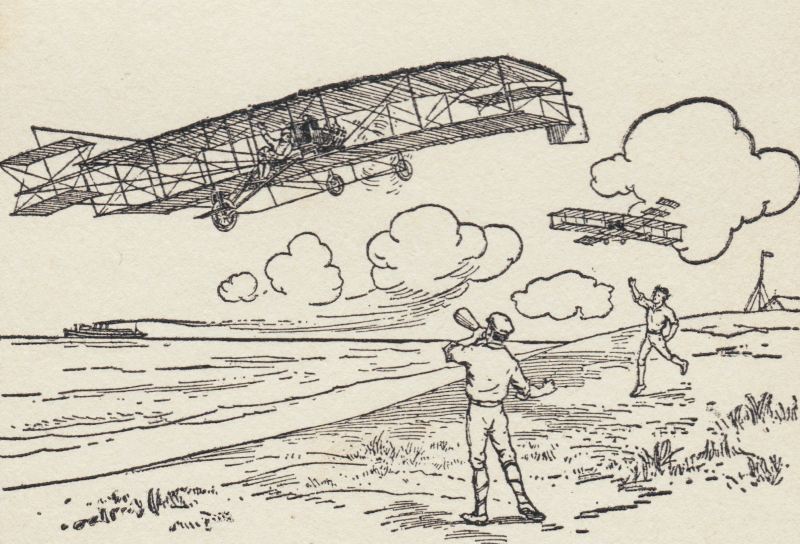
Two aeroplanes lay in a green basin in the heart
of the Rocky mountains. To the east of the basin
lay a slope of half a mile or more. At the top of
the slope stretched a summit not more than half
an acre in extent. Thirty miles away lifted the
snowy peaks of the Continental Divide. To the
west a broken country stretched to the Pacific.
The flying machines lying in the valley were the
Louise and the Bertha. They had arrived from
New York city that day, and the aviators, weary
from their long journey, were lying about a great
fire of dry jack pines and spruce. Thick porterhouse
steaks, brought in from Spokane, were broiling
over a nest of coals, and a great coffee-pot was
sending forth its fragrance on the evening air.
4Those who have read the previous books of
this series will scarcely need an introduction to
Ben Whitcomb, Jimmie Stuart, or Carl Nichols.
Sturdy, adventurous lads of seventeen, they had entered
the employ of Louis Havens, the noted millionaire
aviator, a few months before, and under
his direction had visited the mountains of Mexico,
Southern California and Peru. While on their
Peruvian trip they had assisted greatly in the capture
of a cashier who had stolen several million
dollars from a New York trust company. This incident
had led to their visit to British Columbia.
On the very night of their return from Peru, Mr.
Havens had suggested that they enter the service of
the federal government and assist in the capture of a
group of mail-order outlaws who were believed to
have caused the abduction of a post-office inspector
who had long been investigating their peculiar
methods of doing business.
Although Mr. Havens had not at that time given
the boys the full details of the case, they had at once
joyfully accepted the mission and almost immediately
taken their departure for the Pacific coast.
It was believed at the time of their departure that
the inspector who had been abducted had been taken
to the mountains of British Columbia for safekeeping.
Just how this information had reached the
secret service department no one outside of the
private office of the chief knew.
5All the papers collected by the inspector, many of
them of great importance as supplying convincing
proof against the fraudulent mail-order operators,
had been removed from the inspector’s office at the
time of his abduction. The documents, of course,
could not be replaced.
The boys had traveled directly from New York
to a point in the Rocky mountains not far north of
Crow’s Nest, where they had crossed the great
range. So far as practicable they had traveled
nights and at a low altitude.
Naturally the passage of two large flying machines
over the country had attracted attention, but the
boys had kept away from cities so far as possible,
and it was believed that no one connected with the
group of mail-order operators had any intimation
of the purpose of the trip.
For a portion of the distance the boys had been
accompanied on the trip by Mr. Havens, riding the
Ann, probably the largest and fastest aeroplane ever
constructed. The millionaire aviator, however, had
halted at Denver for the purpose of receiving definite
instructions from the secret service department
at Washington, while the boys had proceeded on
their way. His arrival was momentarily expected.
While the steak broiled and the coffee bubbled
the three boys sat looking over the great slope above.
They spoke little for a time. The scene was so
grand, so near to the very heart of nature, that all
the little things of life seemed inconsequential. For
6a space they forgot the mighty skyscrapers and
canyons of New York and the level prairies over
which they had journeyed. The mountain scene
dominated everything in their minds.
Presently Ben Whitcomb, brown-eyed, athletic,
and rather inclined at times to take little troubles to
heart, sprang to his feet and pointed to the north.
The others were at his side in a moment.
“Look there!” he said passing a field-glass to
Jimmie.
Jimmie, red-headed, freckle-faced and shorter in
stature than his companion, looked through the glass
for a moment and passed it on to Carl.
“Is that an elk?” Jimmie asked in a moment.
“That’s what it is!” answered Ben. “It’s a
full-grown bull elk!”
Carl, blue-eyed, broad of shoulders, and always
ready to meet an emergency with a joke, handed the
glass back to Ben and hastened to the broiling
steaks.
Somewhat farther up on the slope of the basin
where the green timber halted, crowded down by
the rock, an elk walked out into the middle of an
especially inviting patch of grass and looked about.
He carried a good pair of antlers and looked big
and beautiful. For about five minutes he grazed on
the tender grass then marched to the edge of the
basin and browsed on green branches. Finally he
vanished in the thick green timber, and was not seen
again.
7“Cripes!” exclaimed Jimmie. “Wouldn’t that
be a sight for the great White Way? He’d look
fine down at Forty-second street, wouldn’t he?”
“More than there are in all these mountains,”
Ben suggested.
Directly Ben took the steak and coffee from the
fire and Jimmie and Carl brought dishes and knives
and forks from the flying machines. Then they
spread a white table cloth on the turf not far from
the fire and laid out their meal. Besides the meat
and coffee there was plenty of bread, canned beans
and tomatoes.
“I’m going hunting to-morrow!” Jimmie declared.
“I’d like to know what’s the use of paying
fifty dollars apiece for a hunting license and then
bringing beefsteak in from Spokane.”
Ben took out one of the non-resident hunting
licenses and read it over carefully.
“This gives me a right,” he said, “to slay three
mountain goats; three mountain sheep rams; three
deer; one bull moose, and all the grizzly bears I
can come up with.”
“Are they all good to eat?” demanded Carl.
“They’re all good to eat in a way,” replied Ben,
“but I don’t think the people hereabouts feast very
much on mountain sheep, or grizzly bears either,
when they can get anything else.”
8“We ate bear in southern California!” cried
Jimmie.
“Yes, and it was all right, too!” Carl declared.
“What’s the matter of going out hunting to-night?”
Jimmie asked in a moment. “Then we’ll
be sure to have something for breakfast.”
“I think we’d better remain in camp to-night,”
Ben replied. “We’ll put up our oiled silk shelter-tents,
and get the blankets and pillows out of the
flying machines, and make ourselves comfortable
right here until Mr. Havens comes. He may not
be here for two or three days.”
“But he said he wouldn’t be ten hours behind
us!” argued Carl.
“When a man’s doing business by wire with the
secret service department at Washington,” Ben explained,
“he doesn’t know whether he’ll be ten
hours or ten days finding out what he wants to
know!”
“Why didn’t he find out before he left New
York?” asked Jimmie.
“He did find out all they knew regarding the
whereabouts of post-office inspector Larry Colleton
before we left New York!” answered Ben. “He
stopped at Denver to find out if anything new had
developed.”
9“Are you sure this is the basin he told us to
camp in?” asked Carl.
“Certain sure!” answered Ben. “He told us to
cross the divide at the Crow’s Nest and keep on
north between the Elk river and the mountains
until we came to a large grassy valley.”
“Then this is the place all right!” Carl agreed.
After supper the boys set up their shelter-tents
and prepared to pass a comfortable night. They
had spent nearly two weeks crossing the continent,
and had been in the air most of the nights, so they
looked forward to a long sleep with pleasant
anticipations.
While the boys were putting the finishing touches
on the bed in one of the shelter-tents, a great rattling
of stones was heard and in a moment rubble from
the size of a marble to that of an apple came rattling
down the long slope to the east. Startled by the
unexpected shower, which pelted about the camp
like hailstones in a northern blizzard, the lads rushed
from the tent to ascertain the cause of the sudden
commotion.
Twenty rods up the mountain they saw what appeared
to be the body of a great grizzly bear half-sliding,
half-tumbling toward the valley. At times
the lumbering animal retarded his fall by clinging
with his claws to the uncertain slope. Again, he
rolled over and over for several yards, until his
claws secured another hold. The beast was uttering
10savage growls as he came down, and every bump
he received appeared to bring forth snarls more
vicious than those which had gone before.
“Cripes!” exclaimed Jimmie. “Look who’s
here!”
“He’ll be here in a minute, plumb on top of the
tent!” Carl declared.
“Then why don’t you do something to head him
off?” asked Jimmie.
“Yes,” the other argued, “I’d like to get in front
of a ton of bear meat coming down a mountain at
the rate of forty miles an hour!”
It was fortunate for the boys that the descent of
the bear was checked for a little by a narrow shelf
which ran along the edge of the slope close to the
bottom. Here the great body landed with a thud
which knocked out what little breath remained.
“That saved our tents and flying machines, I
reckon!” cried Ben, as the bear tipped from the
shelf and landed in the grass only a few feet from
the Louise.
“He certainly would have smashed something if
he had gone on at the clip he was going when we
first saw him!” agreed Carl.
“Speaking about going hunting to-night or to-morrow!”
laughed Ben, “it strikes me that we
don’t have to go hunting in this philanthropic country.
Fresh meat seems to rain down from the
skies!”
11The three boys now advanced to the side of the
animal and looked him over. He was not quite
dead, but it was evident that he had received injuries
from which he could not recover.
“We may as well put him out of his trouble,”
suggested Ben, drawing an automatic revolver.
“He made a fight for life and lost!”
“Wait a minute!” exclaimed Jimmie, standing
now at the bear’s head, “here’s a fresh bullet wound
now!”
“Do you suppose that’s what made him fall?”
asked Ben.
“Of course!” returned Jimmie. “He was up on
the mountain and some one shot him, and that’s
why he came tumbling down in that ridiculous way.”
“Is the wound still bleeding?” asked Carl.
“Still bleeding!” replied Jimmie. “It looks like
a wound about five minutes’ old. The bullet is
somewhere inside the grizzly’s head, and I don’t believe
he was in his right mind when he was sticking
his claws into the rocks on the way down!”
The three boys looked at each other with questioning
glances.
“Ask it!” grinned Jimmie.
“Ask it yourself!” Carl exclaimed.
“I’ll ask it!” Ben said with a grave face. “Who
fired that shot?”
“The answer is ‘Yes’, so far as I know!”
laughed Jimmie.
12“No foolishness now!” Ben continued. “Some
one fired that shot, and that means that some one is
prowling around our camp!”
“The man who fired the shot,” suggested Carl,
“may be over on the other side of the mountain!”
“Then he’d be more than half a mile away!”
scoffed Jimmie.
“That’s a fact!” Carl admitted. “And, besides,”
the lad went on, “a man high up on the mountain
wouldn’t be apt to shoot game lower down, unless
he wanted a good chase after it.”
“And all this indicates,” Ben said, “that the man
who did the shooting is somewhere near this camp.
Also it indicates that he has a Maxim silencer on
his gun, and that’s a thing natives hereabouts don’t
have. Every time we go out on a trip we seem to
bunt into a mystery first thing, and we’ve got one
now, all right!”
“I wish Mr. Havens would come!” Carl cut in.
“It may be that some one out here knows what
we’re up to and intends to make trouble.”
While the boys talked a shout was heard in the
distance, and two husky, roughly-dressed men made
their appearance, heading directly for the camp-fire.
The boys laid their hands on their automatics.
CHAPTER II. A WOBBLING AEROPLANE.
13
The boys stepped back from the bear as the men
came up. It was growing dusk now, and as the
men drew nearer their faces were seen only by the
dancing flames of the fire. They were not prepossessing
faces, and the boys wondered if it was the
illumination which produced the shifty and suspicious
glances they caught.
The two bent over the bear for an instant, and
then one aimed his rifle slowly and fired a bullet
into the animal’s head. No report followed the
shot, and then it was observed that the weapon
carried a Maxim silencer. This doubtless accounted
for the fact that the shot which had brought the
bear down had not been heard at the camp.
After talking together in whispers for a moment,
as the acrid smell of powder drifted out into the
sweet air of the valley, the men turned questioning
looks toward the boys. From the youthful faces
their eyes soon roved to the two aeroplanes not far
away.
14There was more whispered talk, and then the
two stepped over to the Louise and began a careful
and rather impertinent inspection of the motors.
The boys looked on angrily but said nothing.
“Rather fine machines you have there,” one of
the fellows said, after the deliberate examination
had been completed.
“We think so!” Ben answered shortly.
“Where are you from?” asked the other intruder.
Ben gave Jimmie and Carl a sly nudge to remain
silent and answered the question in a manner which,
while the exact truth, did not reveal the starting
place.
“Denver,” he said.
The fellow bent down and read the names of the
machines from little silver plates screwed to the
frames.
“The Louise and the Bertha,” he said. “It appears
to me that I have heard something of these
aeroplanes before.”
“The names are common enough,” Ben answered.
“The machines I refer to,” the visitor went on,
“belong in New York. Are you sure you didn’t
bring these machines from a hangar on Long
Island?”
Jimmie could restrain himself no longer. From
the first he had felt a feeling of aversion for the
men, and he had inwardly resented not only the
15question asked but the impudent and uncalled-for
examination of the aeroplanes. In spite of a warning
hand from Ben he blurted out:
“What do you care where we came from?”
The two intruders eyed the boy sharply for a
moment, as if trying to look him out of countenance,
and then one of them said:
“None of your lip, now, youngster!”
“Well!” exclaimed Jimmie. “You’ve got your
nerve with you!”
The man who had spoken before seemed about to
make an angry reply, but his companion drew him
away, and again they talked together in whispers.
“What are you fellows doing here, anyhow?”
Jimmie demanded. “If you think you’re going to
work the third degree on us, you’ve got another
think coming! You’re too fresh, anyway!”
Presently the men turned back to the boys again,
and the light of the fire on their bearded faces
showed that they were about to adopt a new course
of conduct. The fellow who spoke smiled as he did
so.
“I can’t blame you for resenting our supposedly
unwarranted interference,” he said. “We should
have informed you at first that we are in the employ
of the Canadian government as mounted policemen.”
“Where’s your horses?” demanded Jimmie.
“At the other end of the valley.”
16“Where’s your uniforms?”
“We rarely wear uniforms in rough mountain
work.”
The fellow answered the two questions with apparent
frankness, but there was a set expression on
his face which showed that he was restraining a
naturally vicious temper by great effort.
Ben now stepped forward and extended a hand
in greeting.
“We’re glad to see you, I’m sure!” he said.
“Still, I hardly think you will blame us for resenting
apparently impertinent questions.”
“That’s all right, boy!” replied the other, trying
his best to bring a conciliatory expression to his
sullen face. “It’s part of our duty, you understand,
to visit camps in the mountains and make
inquiries as to the intentions of strangers.”
“We understand that, of course,” Ben answered.
“We are willing to answer any questions you care
to ask, now that we know who you are.”
“I hope you’ll answer my first question in a
manner entirely satisfactory to myself!” laughed
the other.
“I shall try,” answered Ben, “what is it?”
“Have you any coffee left?”
“You bet we have!” replied the boy. “And if
you’ll sit down here by the fire, we’ll make you a
quart inside of ten minutes.”
17Jimmie turned away to the provision box of the
Louise to bring out fresh coffee with apparent willingness,
but both his companions saw an angry expression
on his face.
Carl followed him back to the aeroplane and
whispered as they bent over the coffee sack together:
“You don’t like ’em, eh?”
“They’re snakes!” was the reply.
“But they belong to the mounted police!”
“I don’t believe it!”
“Anyway,” warned Carl, “you’ve got to keep
a civil tongue in your head and not let them know
that you think they’re lying.”
“You don’t believe that mounted police story
yourself!” declared Jimmie. “They don’t look like
mounted policemen, either!”
“I hardly know what to believe,” Carl replied,
“but I’ve got sense enough not to let them know
that I’m still guessing.”
Jimmie returned to the fire with the coffee and
sat down on the grass not far from the visitors.
While Ben prepared supper one of the men walked
out to the carcass of the grizzly and began removing
the hide.
Carl rushed up to his side and stood looking
down at the clumsy manner in which the fellow was
operating.
“Say,” the boy proposed in a moment, “why
can’t we all have bear steak for supper? We boys
had supper not long ago, but I think I could eat a
bear steak right now!”
18The man looked up with a puzzled expression.
“Bear steak for supper?” he repeated. “You
don’t eat bear meat, do you?”
“Would a duck take to the water?” asked Carl.
“Of course we eat bear meat! Sometimes it’s a
little tough, unless you know exactly how to cook it,
but I can broil a bear steak so it’ll melt in your
mouth!”
“Then do so by all means!” the visitor answered.
Carl removed several tender steaks, took them
back to the fire and then called Jimmie to one side.
“You’re all right, kiddo,” he said, as the two
seated themselves in the shadows some distance
from the blaze.
“Have you just found that out?” demanded
Jimmie.
“I mean about those imitation mounted policemen,”
Carl went on. “They’re no more mounted
policemen than I am!”
“Then they’re a long ways from it!” Jimmie
laughed. “But why this sudden conversion to my
view of the case?”
“They don’t know about eating bear meat!” was
the scornful reply. “One of them just told me
that he didn’t know that they ever ate bear steak!”
“That does settle it!” cried Jimmie.
19“Of course, it settles it!” agreed Carl. “And
now the question,” he continued, “is this: What
are they doing here, and why are they posing as
mounted policemen? You don’t suppose they’ve
got word from New York, do you?”
“Word from New York about what?”
“About our being out looking for the post-office
inspector the mail-order brigands abducted not long
ago.”
“Of course not!” was the reply. “These fellows
are just plain mountain bums! They came
here principally to get supper!”
“Or to steal the machines!” suggested Carl.
“We’ll see that they don’t steal the machines!”
Jimmie declared.
“Well, I wish Mr. Havens would come,” Carl
put in, with rather a longing expression in his voice.
“We don’t know anything about the case we’re
handling, and we don’t know whether we’re going
to remain in this camp an hour or a month. For
all we know the men we are trying to find may be in
Mexico before this!”
“If they’re in Mexico,” Jimmie suggested, “the
United States government can go chase itself for
all of me. If you don’t remember what a beautiful
time we had in Mexico, I do, and I don’t want any
more of it!”
Those who have read the previous volumes of
this series will doubtless remember the adventures
of the Flying Machine Boys at the burning mountain.
20During that trip, it will be understood, they
suffered the loss of some of their machines, and
Jimmie came near meeting his death in a mountain
lake known as the Devil’s Pool.
“I’m going wherever Mr. Havens sends me,”
Carl answered, “and I’m going to get all the fun
out of it there is to get. What’s puzzling me now is
to know exactly what we ought to do with these
bums.”
“Aw, we can’t do anything with them,” Jimmie
grunted. “We’ve just got to feed them and see
them hanging around here, trying to steal our
machines, and sit peaceful, like a wooden Indian in
front of a Bowery cigar store. It makes me sick!”
However, the boys were not called upon to take
action of any kind at that time. Ben broiled bear
steak enough for the whole party, made some excellent
coffee, and brought out a couple of loaves of
bread. At the conclusion of this second meal, at
least on the part of the boys, the two intruders
arose, threw their rifles over their shoulders, and
turned away. However, one of them stepped back
in a moment.
“We haven’t seen you do any shooting yet,” he
said with a smile on his face which Ben regarded as
most insincere, “but we don’t know when you will
be hunting big game, so you may as well show us
your licenses.”
21“There!” Jimmie whispered to Carl as Ben produced
the three licenses from an inside pocket.
“They’ve saved their important question for the
last moment!”
“What do you mean by that?” asked Carl.
“Why, those fellows are not mounted policemen!”
the boy answered.
“We had made up our minds to that before!”
“Then why should they want to see our
licenses?”
“I know!” exclaimed Carl. “I know just why
they want to see our licenses! They want to get
our names!”
“That’s it!” Jimmie answered. “They never
asked to see the licenses in order to make good
their bluff about being officers!”
After examining the papers the two visitors left
the camp and proceeded down the valley to the
west. Upon their departure the boys gathered
closer about the fire and seriously discussed the
situation.
At first Ben was inclined to argue that the men
were actually Canadian officials, but Jimmie and
Carl soon reasoned him out of this.
“Why,” Jimmie said, “a mounted policeman
would know how to skin a bear without cutting the
hide full of holes, and he’d also know that bear
steak is considered quite a luxury in British
Columbia. They’re frauds all right,” and this view
of the case was finally accepted by all.
22Throughout the evening the boys kept their eyes
open for the return of the unwelcome guests, but
nothing was seen of them. At ten o’clock, when the
lads were thinking of drawing lots to see who
should remain on guard through the night, Jimmie
caught sight of a strong light far up in the sky.
Ben had his field-glass out in a moment.
“That’s the Ann, all right,” he decided after a
long inspection. “There’s no other aeroplane in
the world carries a light like that!”
“I’m glad Mr. Havens is coming,” Jimmie said
with a sigh of relief.
“I said it was the Ann!” Ben returned after
another long look. “I didn’t say Mr. Havens was
flying her! It seems to me that the man on board
doesn’t know as much about the aviation game as
Mr. Havens does. She’s wobbling about something
frightful!”
CHAPTER III. JIMMIE’S DARING FEAT.
23
In ten minutes all doubts as to the identity of the
aviator were dissipated by a signal from the sky
which the boys all understood. Besides informing
the boys of his presence, the signal also conveyed
the intelligence that he was in need of assistance.
“I wish I had a ladder long enough to reach
him!” Jimmie grumbled.
“We’ve got a ladder long enough to reach him!”
insisted Carl.
Almost before the words were out of his chum’s
mouth, Jimmie was whirling the wheels of the
Louise down the valley so as to get a good running
ground, the machine having been drawn close to the
fire after lighting. Understanding the boy’s purpose,
Carl lent a hand, and the aeroplane was soon
facing a clear field.
“What are you boys going to do?” asked Ben.
“We’re going up in the Louise to see what we
can do for Mr. Havens!” Jimmie answered.
“Didn’t he say he needed help?”
24“You can’t help him after you get up there!”
declared Ben.
“We can tell better about that after we get to
him.”
“All right, go it!” replied the other. “I’ll remain
here and watch the Bertha and the camp while
you’re gone. But look here,” he continued, “if Mr.
Havens is in bad shape, don’t either one of you boys
try to shift over to the Ann. If you do, you’ll
break your neck.”
The next moment the Louise was in the air, her
lights burning brilliantly. The Ann was still approaching,
but staggering as if the aviator had lost
all control. Below the boys saw Ben piling dry pine
on the fire so as to provide a broadly-lighted landing-place
for the oncoming machine.
“I don’t know what we’re going to do when we
get up there,” Jimmie shouted in Carl’s ear, “but
there’s one thing sure, and that is that if we don’t
do something Mr. Havens will soon go crashing to
the ground!”
The boys were now obliged to give over conversation,
for the motors were in swift motion and the
roar of an express train could hardly have been
heard above the sparking.
When at last they came close to the Ann and
swung about so as to move with her, they saw Mr.
Havens sitting limply in the aviator’s seat. His
chin was lowered upon his breast, and he appeared
25to be too weak or too dazed in mind to look up as the
Louise swept past him, whirled and moved along
directly above him.
The boys saw that the great machine was rapidly
getting beyond his control. Had he understood the
nature of the ground below, he might have shut off
his motors and volplaned down, but they understood,
of course, that the dark surface below was unknown
territory to him.
For some reason, probably because the disabled
aviator had realized that he was fast reaching his
objective point and shut the motors down to half
power, the Ann was not making good speed. The
Louise slowed down so as to keep exact step with
her and Jimmie bent over in his seat and looked past
the edge of the upper plane to the framework and
propeller of the Ann. Directly he sent the Louise
faster for a second and looked under the edge of
the Ann’s upper wing to the vacant seat at the left
of the aviator.
“Do you think,” he shrilled into Carl’s ear, “that
I could get down into that seat?”
“Of course you can’t!” answered Carl.
“I could if I had a rope!” insisted Jimmie.
“There’s a rope in the box under your seat,”
Carl replied, “but there’s no need of your attempting
suicide!”
26“Now, look here!” Jimmie argued, speaking
very slowly and shouting to the full capacity of his
lungs in order to make his chum hear his words, “if
you can hold this machine steadily above the Ann,
without varying half an inch in her pace, I can drop
past the upper plane of the lower machine, light on
the framework, and climb into that seat.”
“No one ever heard of such a thing being done!”
declared Carl.
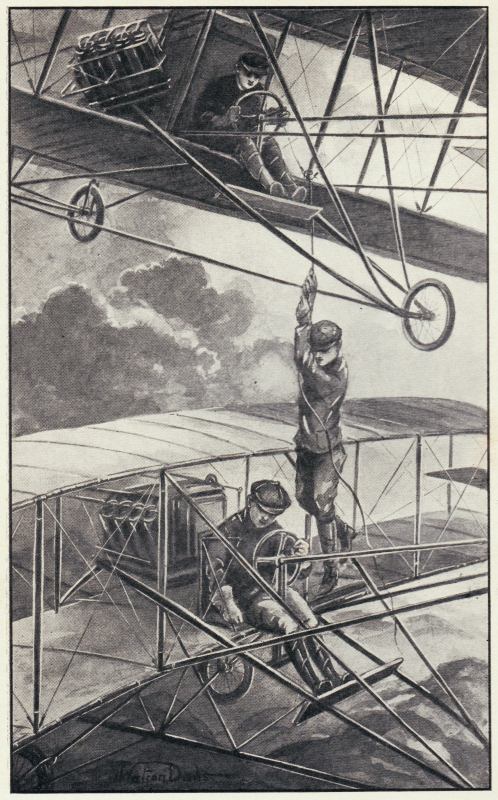
Before the words were out of Carl’s mouth,
Jimmie had the rope in his hands. He fastened it
securely to the framework of the Louise and
dropped one end down.
“Now,” he called to Carl, “unless you hold the
Louise exactly right, you’ll get the rope tangled in
the Ann’s propeller, and then it will be all up with
all of us!”
The boy’s face was pale as death as, motioning
Carl to shift his weight as much as possible so as to
prevent the Louise swaying when he changed his
position, the boy took hold of the rope and lowered
himself.
In a second he felt his body brushing against the
framework of the Ann’s top wing. Then the rope
began twisting and untwisting under his weight,
and he whirled round and round like a top, until he
became possessed by a feeling of dizziness.
He could see the ground, red with firelight, where
the tents were and nothing else. He sensed that
both machines were passing over the camp. At
last, after what seemed to him an eternity, the twisting
27rope brought him face to the vacant seat and to
the disabled aviator, whose hands were limply touching
the levers.
When at last the boy’s feet touched the framework
and he let go of the rope to cling to the edge
of the plane, it seemed that the swaying of the
machine must certainly throw him to the ground.
However, he steadied himself for an instant,
lowered himself at the knees and half fell forward
clutching the seat when his outstretched hands came
to it.
For a moment it did not seem possible that he was
ever to recover his faculties again. Everything was
in a whirl. The stars in the sky, the red light of
the camp-fire on the cliff to the east, the dark bulk
of the mountains farther away, all seemed mixed in
a great jumble, in which nothing was distinct and
everything seemed to be mixed with everything else.
When his mind cleared he saw that Mr. Havens’
hands were dropping from the levers. Another instant
of indecision or inactivity would have brought
death to them both. He seized the levers, and the
Ann swung upward again, steady as the hands on
the dial under his confident touch.
The rope which he had used still hung down from
the Louise and, reaching forward, he gave it several
quick jerks to indicate that he was safe. Then he
saw the Louise shoot ahead, and knew that Carl was
looking back toward him. The rope had been
28drawn up as soon as his signals had been received.
The warning against permitting it to become
entangled in the propellers of the Ann had been
remembered by Carl.
Both machines were now some distance west of
the camp-fire, but the boys came slowly around and
dropped. During the last few yards of the slanting
journey through the dark air, Jimmie was obliged
to steady Mr. Havens in his seat. When at last
the strain was over and the great flying machines
lay on the rich grass below, the millionaire aviator
fairly fell from his seat.
When Carl and Ben came forward to greet
Jimmie, their faces were as white as snow. Their
hands trembled as they extended them to the boy.
“He would do it!” Carl exclaimed. “I tried to
get him not to!”
“Some one had to do it!” declared Jimmie, pointing
significantly to the huddled figure on the ground
by the side of the Ann.
“It’s a wonder you didn’t kill yourself and Mr.
Havens and Carl also,” exclaimed Ben. “Why,
look here, boys,” he went on with a trembling voice,
“if that rope had swung out a few inches farther,
you would have been ground to pieces in the propellers,
and the Ann would have dropped to the
ground like a stone! The rope you held would have
drawn the Louise down with you! It was an awful
risk to take!”
29“If I hadn’t taken it,” Jimmie answered, “Mr.
Havens would have fallen from his seat. His hands
were dropping from the levers when I reached his
side. Five seconds more and he would have gone
down.”
“In all the history of aviation,” Ben declared,
“nothing of that kind was ever done before! The
wildest imagination cannot conceive of a person
leaving one machine and taking a position on another
while in the air! It is an unheard-of thing.”
“Well, it’s been done once!” declared Jimmie.
“And it may be done again. And now, if you’ve
got all the kinks out of your system, perhaps you’d
better help me take Mr. Havens into one of the
tents.”
“I can’t lift a pound!” declared Carl. “I
thought for a second that Jimmie had been obliged
to let go of the rope and drop!”
Ben and Jimmie lifted the millionaire aviator,
now almost unconscious, and carried him into one
of the shelter-tents. His face was very pale and
his breathing was uncertain.
“I don’t see what’s the matter with him,” Jimmie
exclaimed after examining the man’s head and
breast. “There is no wound here that I can find!”
Then Ben pointed to the aviator’s feet.
“Strange we didn’t notice those before!” he
said.
30“What’s the matter?” demanded Jimmie with a
shudder. “Have his feet been cut off?”
The aviator wore no shoes, and his feet were
closely wrapped in bandages which had evidently
been made from one of the blankets carried in the
store-box of the Ann. The bandages were stiff
with congealed blood.
Ben began to remove the cords which held the
bandages in place, but Jimmie motioned him away.
“We’ll have to get hot water before we can get
those off!” the boy said. “We’ll need plenty of hot
water, anyway, so you’d better go and tell Carl to
put on the big kettle.”
While Ben was gone, Mr. Havens opened his
eyes. He glanced around the tent and smiled when
his eyes encountered those of his companions.
“Did I fall?” he asked faintly.
“I should say not!” was the reply. “I guess if
you’d had a tumble out of the air, you wouldn’t be
lying here in this tent, able to talk, would you?
You’d be all smashed up on the rocks!”
“I felt myself falling!” insisted the aviator.
“That was after the machine landed,” Jimmie
explained.
“Did some one get into the seat with me?” the
voice went on weakly.
“Why, sure!” replied Jimmie. “I dropped over
into the seat and we came down together. Don’t
you remember that?”
31“I do not!” smiled the aviator.
“We saw something was the matter with you,”
Jimmie went on, “and so Carl and I went up to see
what caused the Ann to reel along like a drunken
sailor. We got there just in time!”
“I was weak from loss of blood,” replied Mr.
Havens. “I camped last night in a valley occupied
by hosts of yellow-haired porcupines.”
“I’ve heard of ’em,” Jimmie grinned.
“In the night,” the injured man went on, “I got
out of my sleeping bag to mend the fire and stepped
on a whole host of the fellows, cutting my feet into
ribbons, almost.”
“Wouldn’t they get out of the way?” asked the
boy.
“They never get out of the way!” was the
answer. “Instead, they will walk in a man’s path,
like a pet kitten, and refuse to turn aside.”
“Did you get the quills all out of your feet?”
“I don’t know whether I did or not. They bled
terribly, and I am now in great pain with them.
You boys will have to find out about that later on!
I’m too tired now to talk.”
Ben now brought a kettle of blood-warm water
while Carl appeared with a cup of strong coffee.
After the aviator had swallowed the coffee, the
bandages were removed and his feet carefully examined.
There were many quills still in the flesh,
they having worked in instead of out, as is usual
32in such cases. These had caused the bleeding to
continue, and this in a measure accounted for Mr.
Havens’ weakened condition.
By midnight the aviator was able to sit up and
listen to the story of the two visitors.
“I quite agree with you,” he said, after Ben had
concluded the recital, “there is no doubt in my mind
that the men are simply mountain bums. And I’m
afraid that we’ll have trouble with them in future.
These machines must be guarded night and day!”
“How long are we going to stay in this blooming
old valley?” asked Jimmie. “I’d rather be sailing
over the mountains!”
“You can go sailing over the mountains to-night
if you want to,” Carl chuckled, pointing, “there
seems to be a beacon fire waiting for you!”
CHAPTER IV. THE DISAPPEARANCE OF COLLETON.
33
“I’m glad the fellows took the trouble of building
a fire of their own instead of wanting to lounge
around ours all night,” Jimmie observed, as the boys
looked at the leaping flames toward the north end
of the slope. “I should think they’d freeze up
there!”
“I hope they do!” cried Carl.
“I wish we had some way of finding out what
they are doing here,” Ben said. “They don’t look
like mountain men to me.”
“There are probably a great many such characters
in the mountains,” Mr. Havens explained.
“Perhaps they’ll let us alone if we let them alone.”
“Is there any chance of their being here to interfere
with our work?” asked Carl. “It really seems
that way to me.”
“I don’t think so,” the millionaire aviator replied.
34“What did you learn at Denver?” asked Ben.
“Was there any indication in the messages received
from Washington that the mail-order frauds were
turning their attention to the west?”
“Not a word!” replied Mr. Havens. “We have
a clear field here, and all we’ve got to do is to locate
this Larry Colleton. I shall probably be laid up with
sore feet for a number of days, but that won’t
prevent you boys flying over the country in the
machines looking for camps.”
“Huh!” grinned Jimmie. “They won’t keep
Colleton in no camp! They’ll keep him in some
damp old hole in the ground.”
“I presume that’s right, too,” Mr. Havens replied.
“But you boys mustn’t look for camps
entirely. Whenever you see people moving about,
it’s up to you to investigate, find out who they are
and where they are stopping. You’ll find that all
this will keep you busy.”
“We’re likely to be kept busy if there are a lot
of tramps in the hills!” Ben answered, “for the
reason that it may take two or three days to chase
down each party we discover.”
“I haven’t told you much about the case yet,”
Mr. Havens continued, “and I may as well do so
now. About six months ago, letters began coming
to the post-office department at Washington complaining
that a certain patent medicine concern
which was advertising an alleged remedy, Kuro,
was defrauding its customers by sending about one
cent’s worth of quinine and water in return for two
dollars in money.”
35“Keen, level-headed business men!” exclaimed
Jimmie.
“Larry Colleton, one of the best inspectors in
the department, was given the case. For a long
time, after the investigation began, this Kuro company
manufactured a remedy which really worked
some of the cures described in the advertising. This
was expensive, however, and at times the shipments
fell back to the one-cent bottle of quinine water.”
“More thrift!” laughed Ben.
“Another fraud-charge was that the Kuro company
often failed to make any shipment whatever
in return for money received. Colleton bought hundreds
of bottles of their remedy, but the difficult
point was to establish the fact that the company was
not at the time of the investigation manufacturing
the honest medicine. The officers of the company
claimed that they were perfecting their medicine
every day, and admitted that some of the bottles
sent out at first were not what they should have
been.”
“Why didn’t he pinch the whole bunch?” demanded
Jimmie.
“He did!” answered Mr. Havens. “But time
after time they escaped punishment by being discharged
on examination by United States district
court commissioners, or by having their cases flatly
turned down by men employed in the laboratories at
Washington.”
36Mr. Havens was about to continue when Ben
motioned him to look in the direction of the blaze,
still showing on a shelf of the slope to the north.
The fire was burning green.
“What does that mean?” the boy asked.
“It means that they are talking to some person
on the other side of the valley or in the valley,” Mr.
Havens answered. “It struck me, when the fire
was first pointed out, that no man in his right mind
would be apt to set up a camp in that exposed position.”
“Just before I called your attention to the fire,”
Ben remarked, “it was showing red. There, you
see,” he added, in a moment, “it is turning red right
now! Of course the lights mean something to some
one.”
“That busts your theory about the fellows being
mountain tramps!” exclaimed Jimmie. “Such
wouldn’t be carrying red and green fire and rifles
with Maxim silencers!”
“They may be mounted policemen after all!”
suggested Mr. Havens.
“Not on your whiskers!” exclaimed Carl. “Do
you think mounted policemen wouldn’t know how to
skin a bear, or know how to broil a bear steak?
You just bet your life these fellows know more
about riding on the elevated or in the subway than
they do about traveling on horseback!”
37“Well,” Mr. Havens went on, “one of you boys
watch the lights and the others listen to the story
of how the crooks got Colleton. It may be necessary
in the future that you should know exactly how
the trick was turned. After a long investigation,
and after bribing several men in the factory where
the alleged remedy was manufactured, Mr. Colleton
secured the exact formula in use during the current
week. He also secured a long list of names of
persons to whom the bogus remedy manufactured
that week had been shipped.”
“Then, why didn’t he drop down on the concern?”
asked Carl.
“He did!” was the answer. “He arrested the
officers of the company and subpœnaed scores of
witnesses. He also secured proof that men in the
employ of the government had been bribed by the
Kuro concern to retard the work of the inspector
and to assist in the destruction of any proof submitted
to the commissioner by him.”
“Why didn’t you say that before?” asked
Jimmie. “If you’d just said that Colleton was
fighting the department at Washington as well as
the patent medicine concern, we would have understood
what kind of a case we were getting into.”
38“Well, you know it now!” laughed Mr. Havens.
“At last,” he continued, “Colleton had his case
ready for the grand jury, the district commissioner
having placed the respondents under heavy bail to
await such action.”
“And what happened then?” asked Carl.
“He lost his proof and he lost himself,” smiled
the aviator. “Colleton expected a long fight before
the grand jury, a fight in the district court, a fight
in the circuit court, a fight in the court of appeals,
and a final fight before the United States Supreme
court, for he knew that the Kuro people had plenty
of money and the kind of influence which counts in
an emergency.”
“And then what happened?”
“Colleton knew that he had a legal fight on his
hands, but he never suspected that he had a personal
fight. One day he disappeared from his office in
the post-office department at Washington, and his
proof disappeared with him. He has never been
seen by his friends since that day.”
“And now we’ve got to find him!” exclaimed
Jimmie.
“That’s what we’ve got to do!” echoed Carl.
“But, I don’t understand how they got him out of
his own room, and got his proof out of the building
without attracting attention!” Ben suggested.
“They must have had several operatives at work.”
“They certainly did!” was the reply. “Colleton
was sitting in his office at three:fifteen one Monday
afternoon. The safe in which his papers were kept
39was locked. The desk in which his memoranda were
stored was also locked. When last seen sitting at
his desk, he was making memoranda concerning a
case not at all connected with the Kuro matter.
These papers were not taken.”
“That was bad editing!” Ben laughed. “They
should have taken all the papers in sight in order
not to disclose the real object of the robbery. The
rascals slipped a cog there!”
“The first error in the whole case,” Mr. Havens
went on. “Only for the fact that Kuro papers
were taken exclusively, it might have been claimed
that the respondents in some of the other criminal
cases being handled by Colleton had committed the
outrage.”
“Where did Colleton go when he left his office?”
asked Ben.
“That’s exactly what we don’t know.”
“Who saw him leave his office?”
“No one.”
“Well, then, who saw any one enter his office?”
“No one.”
“Well,” laughed Ben, “how could Colleton get
out of his office without being seen? Perhaps he
went out unobserved and took the proof with him!
You haven’t said whether the safe and desk were
opened.”
“They were opened,” was the reply, “by some
one knowing the combination to the safe, and some
one having a key to the desk. All the proof collected
by Colleton disappeared that day.”
40“And the patent medicine men finally got up to
his price!” grinned Jimmie. “I guess it’s the old
story!”
“That’s what makes it so provoking,” said Mr.
Havens, impatiently. “A good many people in
Washington are saying the same thing. It is unjust
to the inspector and very annoying to his friends.”
“And no one went into his office that afternoon?”
asked Carl.
“Not that we know of.”
“And no one went near his office door?” asked
Jimmie.
“I didn’t say that!” replied Mr. Havens. “His
office door opens on a wide corridor, at that time
being used as desk space by an overflow of clerks.
At three:ten that afternoon two men stopped at
Colleton’s door, but did not enter.”
“How do you know they didn’t enter?” Carl
broke in.
“No one saw them enter or come out. No one
heard the door open or close. One of the men, a
heavily-built, bearded fellow, seemed to be urging
the other to enter Colleton’s room. The man who
was being urged was younger, thinner, and appeared
to be greatly excited.”
“Were they the only men seen at that door about
that time?” asked Ben.
41“So it is said,” was the reply.
“And Colleton was at his desk just before the
men were seen at his door?” asked Jimmie.
“Five minutes before!”
“And the person who entered his room after the
two men departed found it vacant?”
“That’s the idea exactly!”
“Did you say the young thin man was excited?”
“Perhaps excited is not the correct word,” was
Mr. Havens’ reply. “He seemed to be dazed with
fear. The clerk sitting near the door received the
idea that the man had nerved himself up to the point
of confessing a crime or a dereliction of duty, and
had lost his courage when he reached the door of
the inspector’s room.”
“Did this young man look like Colleton?” asked
Ben.
“Not at all. Colleton wore a light moustache
only. This man wore a full beard. Colleton’s eyes
are bright, snappy, far-seeing. This man’s eyes
looked dull and lifeless under the glasses he wore.
Colleton is straight, alert, confident. This man
dragged his feet as he walked and his shoulders
hunched together.”
“Where did the two men go after they left
Colleton’s door?” asked Ben. “Did no one watch
them?”
“No further attention was paid to them.”
42“Would any of the clerks in the corridor know
the big fellow again?”
“I don’t think so. I don’t think they paid enough
attention to know whether his eyes were blue or
black or brown.”
“Then they didn’t notice the other fellow very
particularly, did they?”
“No, in fact, except for his dazed and dejected
manner and his odd dress they probably wouldn’t
have noticed the young man particularly. But why
are you asking these questions,” Mr. Havens answered
with a laugh. “Are you boys going to
solve, off-hand, a mystery over which Washington
detectives have been puzzling for many weeks?”
“No,” Ben answered, “but I know when Colleton
left his room.”
CHAPTER V. A MIDNIGHT FLIGHT.
43
“Then you know more about the case than the
detectives at Washington!” smiled Mr. Havens.
“When do you think he left his room?”
“I don’t think, I know!”
“Well, get it out of your system!” exclaimed
Jimmie.
“He left his room,” Ben chuckled, “about one
second before those two men appeared in the corridor
outside his door!”
“I suppose you happened to be coming out of
another office, just across the corridor, and happened
to see him coming out, didn’t you?” jeered
Carl. “You always were the wise little boy!”
“Now, look here,” Ben said, more seriously, “me
for the Brainy Bowers act in this little play. In
time the truth of the matter will be known, and
when that time comes you just remember your
Uncle Dudley’s forecast.”
“You haven’t made any forecast yet!”
44“I’ll make a guess then,” Ben answered. “I’ll
just call it a guess. I’ll guess that Colleton came
out of his room with the big man, and that he was
doped stiff, and that he had the proofs in his inside
pocket, and that the big man got him away under
the eyes of a dozen clerks, and probably passed a
score of detectives before he got out of the building.”
“But look here,” Mr. Havens began.
“Please, Mr. Havens,” Jimmie broke in, “don’t
wake him up. Let him go on dreaming! He’ll feel
all the better for it in the morning!”
“I don’t care what you say!” Ben argued. “The
big man took Colleton out of his room. If you
want to know whom to look for in this case, just
you look for the big man. And if you want to get
a sure case against him, find some one of the clerks
who can identify him as the man who stood at
Colleton’s door that afternoon.”
“I half believe you are right!” Havens declared.
“It listens good to me,” Jimmie agreed.
“I want to withdraw everything I said against
the theory,” Carl cut in.
“Look here!” Ben said rather excitedly.
“Those fellows who claimed to be mounted policemen
are both big men, and they both wear full
beards. Now it seems to me that the man who took
Colleton out of his office would be the man to keep
him under duress until the excitement of the case
dies down.”
45“For the love of Mike!” Jimmie exclaimed.
“Don’t go to materializing the man with the alfalfa
on his face right here in the mountains.”
“That’s the man we’re looking for,” suggested
Ben.
“Well, let’s don’t find him until we’ve had a
little more fun flying over British Columbia!”
“Say, Mr. Havens,” Ben proposed. “You ought
to send word to Washington to have one or two of
the most intelligent of those clerks sent out here.
When we get the man with the full beard we’ll want
some one to tell us whether we’re right or not.”
“I’ll do that the first time I reach a telegraph
office,” the aviator replied. “That ought to have
been thought of long ago.”
“It strikes me that you won’t get to a telegraph
office very soon!” laughed Jimmie. “You’ll have
a mess of feet that look like bread dough by morning!
Those porcupine quills often poison as well as
wound.”
“Well, you boys can send the message then,” returned
Mr. Havens.
“And you can watch camp!” laughed Carl.
“I’m afraid that’s what I’ll have to do.”
“What has been done with the case against the
Kuro company?” Ben asked after a short silence.
“Still pending in the courts. Of course, the
government can’t proceed to trial in the absence of
inspector Colleton.”
46“Then if Colleton should be murdered, the case
might never be tried?”
“It certainly never would be tried!”
“Then we’ve got to get a move on!” cried
Jimmie. “If these fellows know that special effort
is being made to locate him, they won’t take any
chances. The nearer we get to Colleton, the nearer
he will be to his death. At least that’s the way I
look at it.”
“That’s the way it looks to me, too,” Ben agreed.
Carl now caught Jimmie by the arm and pointed
to the fire burning on the mountain to the north.
“It burns green now,” he said.
While they looked the flame turned red again.
“I wouldn’t mind going over there to-night!”
Jimmie declared.
“Then let’s go,” advised Carl.
“Huh! I didn’t say anything about your
going!”
“You know very well you always have to have
me with you,” Carl chuckled. “You get into
trouble when you go alone.”
“Here,” Ben called from the tent where Mr.
Havens lay, “what are you boys planning now?
No one leaves the camp to-night, understand!”
“Of course not,” grinned Jimmie.
“I should say not!” echoed Carl.
47“Now, this is on the level,” Ben argued. “If
you boys are planning anything for to-night, you
want to quit it, right now! If those fellows around
that other fire are watching us, you couldn’t do a
thing that would please them more than to wander
off in the darkness.”
“Who said anything about wandering off in the
darkness?” demanded Jimmie. “You’re always
seeing things that are not present.”
“Anyway,” Carl said with a yawn, “it’s time we
were all in bed!”
“I’ll watch to-night,” Ben proposed, with a
significant glance in the direction of the aviator.
“And look here,” Jimmie suggested, “suppose
you keep a record of the changes of color over on
the mountain. I believe those people are saying
something with those green and red lights!”
“All right,” Ben replied, “I’ll do that.”
“I don’t suppose I’ll sleep very much to-night,
anyway,” Mr. Havens said, after a pause, “so you
may as well go to bed, every one of you, and I’ll
wake you if anything unusual occurs.”
“I think I’d better keep awake,” Ben insisted.
Jimmie and Carl stepped to one side, ostensibly
in search of dry pine for use during the night, but
really to discuss this unexpected opposition to the
excursion they had planned.
“We can’t go if they make such a noise about
it!” Carl complained.
“Sure we can!” returned Jimmie.
“I don’t know how!” Carl grumbled.
48“I can fix up a scheme to get away in the machine
with the advice and consent of the multitude,”
laughed the other.
“In your mind!” returned Carl.
“Watch me!” advised Jimmie.
The boys went back to the camp-fire and stood
for some moments watching the changing lights on
the mountain.
“I’d like to know if some one is really talking
back to that fellow,” Jimmie said, turning to Mr.
Havens.
“I presume some one is answering the signals,”
the millionaire answered, “only we can’t see the
answers given.”
“Perhaps we could learn what they’re saying if
we could see the answers. They may be talking in
a code we could get next to.”
“Well, you don’t see anything that looks like a
return signal, do you?” asked Ben. “They’ll take
good care that we don’t see both ends of the conversation.”
“Look here,” proposed Jimmie, “why don’t we
send Ben up in a machine to look over the landscape.
The return signals may come from some
point not to be seen from this end of the valley.”
“That’s the idea!” exclaimed Carl, understanding
in a minute why his chum had suggested that
Ben make the midnight flight.
“Not for me!” answered Ben. “I don’t care
about going up into the sky refrigerator this time
of night!”
49“Then you go, Carl,” Jimmie said turning to the
other.
“Not so you could notice it!” Carl declared.
“All right!” Jimmie said with an injured air.
“I made one exhausting flight to-night and I suppose
I could make another. We certainly ought to
know whether those people are signaling to others
in the mountains. Don’t you think so, Mr. Havens?”
he added turning to the millionaire.
“It would enable us to understand the situation
better,” was the reply.
“Then I’ll go,” Jimmie said, putting on an unwilling
manner. “I’ll go up far enough to see
what’s doing and come right back. While I’m gone
you fellows get up a supper. It’s most daylight and
we haven’t had anything to eat since last night.”
“You had only two suppers last night!” Ben
laughed.
“I don’t care if I had nine,” Jimmie answered,
“I’m hungry just the same, and when I come back
from my little trip, I’ll be about famished!”
“I guess I’ll go with you,” suggested Carl.
“No, you don’t,” declared Jimmie, with a sly
wink. “You wouldn’t go when I wanted you to,
and now you can’t go with me!”
“Do you think they ought to go, Mr. Havens?”
asked Ben.
50“If they can go without getting into any scrape,
yes!”
“But they’ll be sure to get into trouble,” Ben
complained.
“Trouble yourself!” cried Jimmie. “I guess we
can swing around this little old valley without it
being necessary for you to send out a relief expedition!
You act like I never saw a flying machine
before!”
“Perhaps they’ll be good to-night,” Mr. Havens
laughed.
The millionaire saw how set the boys were on
taking the trip in the aeroplane. He rather suspected
that Jimmie had mapped out the exact course
to be pursued in getting permission, and laughed at
the tact displayed by the little fellow. He remembered,
however, the great risk the boy had taken in
order to be of service to him that very night, and so
decided in his favor.
“Do I go?” demanded Carl.
“Well, come along if you want to,” Jimmie answered,
with apparent reluctance. “If you break
your neck, don’t blame me!”
The boys passed out of the circle of light about
the fire and drew the Louise out to level ground.
Jimmie could hear his chum chuckling softly as
they pushed and pulled together.
“Didn’t I tell you I could fix it up all right?”
the boy asked.
51“You’re the foxy little kid!” exclaimed Carl.
“What are we going to do when we get up in the
air?” he continued.
“We’re going to circle the valley,” Jimmie answered,
“and see if we can catch sight of another
camp-fire. Then we’re going to climb up until we
can look over the ridges in this vicinity. If there
is a collection of mail-order pirates anywhere in
this country we want to know it to-night.”
“Then we want to put on lots of warm clothing,”
Carl suggested, “and take automatics and searchlights
with us.”
“Of course!” answered Jimmie. “We want to
go prepared for zero weather. It’s always cold up
on the top of the Continental Divide!”
“And that’s all you’re going to do?” asked Carl.
“Just fly around the camp and locate the other
camp-fires and then go to bed?”
“Well, of course,” Jimmie said hesitatingly, “if
we find a camp that looks in any way suspicious, we
ought to investigate it a little. We can’t get very
close with the motors, you know, without attracting
a whole lot of attention, so we may have to land
and sneak up to find out what’s going on. We can’t
learn much by sailing a thousand feet over a
camp!”
“That’s just what I thought!” laughed Carl.
“Just as quick as you get away in a machine you
want to take a lot of risks that no one else would
think of taking.”
52Jimmie’s only reply was a confident chuckle, and
the boys were soon in the air. As the pneumatic
tires left the ground Ben waved them “Good-bye”
and shouted for them to be careful if they couldn’t
be good.
In ten minutes the Louise was over the camp-fire,
which had been observed all night. Nothing was to
be seen but the springing flames. There was no
human being in sight.
“Well,” Jimmie said, as they circled the spot for
the second time and darted away to the east, “we’ll
have to light and creep up!”
CHAPTER VI. THE LOSS OF THE LOUISE.
53
“I’d like to see you find a place where you can
land,” Carl shouted in his chum’s ear. “There’s
nothing here but ridges and canyons, and rocks and
rivers at the bottom!”
“Oh, we can find a place all right,” Jimmie answered.
It was some time before the boy found a spot
which appeared to be in any way suitable for a landing.
This was some distance to the east of the
ridge which shut in the valley. The shelf he selected
was rather high up, and that suited his purpose
well, for, as he explained to Carl, they would have
less mountain to climb in order to get a look into
the camp.
The aeroplane landed with a bump which nearly
threw the boys out of their seats, and when Jimmie
sprang off and looked about he saw that one of the
wheels was actually whirling round and round in
the air, having passed off the rock. Below, five
hundred feet down, the murmur of running water
could be heard.
54“Gee-whiz!” exclaimed Carl, when the position
of the wheel was pointed out to him. “That was
a close call! If the other wheel had run two feet
farther, we’d have been dumped into the canyon.”
“But it didn’t run two feet farther!” Jimmie insisted.
“I never saw any advantage in raising a
mess of ifs,” he went on. “If the sun should drop
down some night, the world would drop, too. But
it doesn’t, so what’s the use?”
“What next?” asked Carl.
“You stay here and watch the machine and I’ll
sneak over the ridge and crawl down to the camp.
I’m curious to know why those fellows are showing
those colored lights.”
“If you get too close to them, you may find out
things that won’t do you any good.”
“Don’t croak!” advised Jimmie. “I’ll just go
down there and see how many there are in the
camp, and what they’re doing, and what they’re saying,
and come right back!”
“I’ve got a picture of your doing that! Now
look here,” Carl went on, “you want to remember
that I’m staying here by this machine in zero
weather, or worse, so you don’t want to go poking
about until daylight. My fingers are frozen stiff
now!”
“Run up and down and keep warm, little one!”
laughed Jimmie.
55Before Carl could reply the boy was off, scrambling
up the rocky face of the slope which led to
the summit. It was stinging cold, and the boy
needed all the exercise he was getting in order to
keep his blood in circulation. Although not on the
main ridge of the Great Divide, the boy was pretty
high up.
Before he came to a position from which the
valley to the west might be seen, Jimmie found that
he was wading in snow. There was no moon, but
stars shone down from a clear sky.
When he reached the crest he saw the camp-fire
two or three hundred feet below, built on a shelf of
rock which seemed to afford no protection whatever
from the cold winds swirling around the
peaks.
“I don’t believe that’s any camp at all!” the
boy mused. “It’s just a signal station, and the
operator is probably wrapped up in fur overcoats
a foot thick. I guess about all I can do here,” he
went on, “is to see if there is another fire in sight.”
The western slope of the ridge was much steeper
than the one he had already ascended, so at times
the lad approached the hostile camp-fire a great deal
faster than he wanted to. He tried to proceed cautiously,
without making any noise, but now and then
when his feet slipped and he rolled half a dozen
paces, to be caught at last by a little crevice or a
narrow shelf, small rocks became dislodged and
went thundering down.
56“Might just as well take a band,” Jimmie mused
disgustedly.
When the boy came to within a few yards of the
fire he saw that only one figure was in sight. As
he had predicted he would be, the lone guardian of
the fire was well bundled up in furs. If the motors
had attracted his attention his manner gave no indication
of the fact.
“Looks like a wooden Indian,” chuckled Jimmie.
There was no place for the boy to secrete himself
in the vicinity of the fire, so he crouched down on
the slope and looked over the landscape beyond. He
could see his own camp-fire quite distinctly, but no
other light was in sight for several moments.
Then what seemed like the blood-red light of an
early August moon showed on a level of rock far
off on the west side of the valley.
“They’re burning red fire over there, too,” he
mused as the situation became clearer in his mind.
The boy climbed back up the slope for a few yards
and looked again, but the fire itself was not in
sight and only the reflection showed on a slender
surface of rock beyond. While he looked the color
changed to green, which showed indistinctly under
the stars.
From his new position Jimmie could see his own
camp to better advantage than from the one lower
down. He sat watching it for some moments, wondering
why Ben was moving around the blaze so actively
and why Mr. Havens had left the tent.
57There certainly were two figures outlined against
the blaze. The lad studied the puzzle intently for
a moment and then started back. He understood
that it would be of no use for him to try to get
nearer to the fire below. The man on watch there
would be conscious of his approach before he was
within a hundred feet.
From the ridge the boy looked back to his camp
again. There were now four figures outlined
against the blaze, and all appeared to be moving
about as if acting under great excitement.
Jimmie tried his best to discover whether any of
the figures were those of Mr. Havens and Ben, but
the distance was too great. He could only see the
figures moving about. As he looked and studied
over the proposition he blamed himself for not
bringing his field-glass, but his self-reproach was,
of course, unavailing.
Knowing that he ought to be making his way
back to the camp, the boy still remained gazing
downward as if fascinated. He had no reason to
believe that the visitors he saw were at the camp
with friendly intent. He knew that his friends
might be in great danger. Still, he sat and watched
the fire like one dazed.
58There had been no sound of motors, yet the intruders
at the camp had penetrated the valley since
nightfall. Or had they been hiding there at the
time the boys landed? While the boy puzzled over
the situation a mass of rocks left the summit not
far to the north and went racing down the slope,
making sufficient noise, as Jimmie believed, to incite
a riot a hundred miles away!
“Now there’s some one sleuthing in that direction,”
the boy mused. “Of course, he was at the
camp-fire when he heard the motors and ducked.
Now he’s up there watching me, I presume.”
The lad turned toward the snow-capped summit
once more, resolved to get away to his own camp as
soon as possible. When he reached the top the clatter
of motors came to his ears. He looked down in
dismay to see the Louise lifting into the air.
“Now, what’s that fool Carl doing?” he muttered.
The aeroplane left the shelf with a little dip over
the precipice and struck out for the west, passing
nearly over the wondering boy’s head. The acetylene
lamp which had been arranged on the forward
framework was burning brightly, and Jimmie
could see that both seats were occupied. The lamp
had been turned low just before his departure.
The boy paused at the summit and looked back
into the valley. There was no need now for him
to cross to the eastern slope. He had no doubt that
the Louise had been stolen, and that Carl was driving
her away under duress. In order to reach the
camp he would be obliged to pass down the steep
slope which led to the bottom of the valley.
59Blaming himself for leaving the machine even for
a moment, yet by no means disheartened at the calamity
which had overtaken him, the boy turned his
face to the south resolved to pass along the broken
summit until he had passed the vicinity of the
camp below and then work his way diagonally down
the slope. As he took his first step downward he
heard a voice softly calling his name.
“Jimmie!” the voice said. “Hello, Jimmie.”
Jimmie stopped and looked back. A figure was
approaching him from the north, crouching down
close to the slope of the rocks.
“Carl!” he called. “Is that you?”
“Sure!” was the reply. “I thought you had
gone off in the machine.”
“Then you went away and left her, did you?”
demanded Jimmie.
“Of course I did. I wanted to see what was
going on!”
“Did you see the people who took the machine
away?” asked Jimmie.
“I saw two figures—no faces,” was the reply.
“Well,” Jimmie grunted, “we’ve got a nice
little walk back to camp!”
“I hope we don’t freeze to death on the way
down,” Carl cut in.
The boys walked steadily for a few moments, and
then Jimmie stopped and regarded his companion
with a questioning look.
60“Are you game?” he finally asked.
“I’m game!” Carl answered. “We’ve lost the
machine, and it doesn’t make any difference what
happens now.”
“That’s the way I look at it!” Jimmie returned.
“What do you want to do?”
“Now, look here,” Jimmie explained. “There’s
only one person at the fire from which the signals
were sent. He sits there like a wooden Indian,
probably three-fourths asleep. The two men who
went away on the Louise probably left the camp
about the time we left the machine and went over
the ridge to seize it. Now, suppose we go down
there where that fellow sits alone and hold him
up!”
“Hold him up for what?” chuckled Carl, immensely
pleased at the idea.
“Information!” answered Jimmie.
“Yes, and I suppose you’d believe anything he
told you, wouldn’t you?”
“Indeed, I wouldn’t! But, by going to the camp,
we can doubtless learn something regarding the
situation.”
Carl hesitated a moment and then asked:
“Did you see our camp from where you lay?”
Jimmie nodded.
61“So you saw the commotion down there, too,
did you?” he asked.
“Yes,” answered Carl, “and I’m for getting
down there just as quick as possible. I’m so scared
about what I saw around our fire that I’m not thinking
very seriously of the loss of the Louise.”
In a moment the boys came out of a slight wrinkle
which they had been traveling and looked down
on the camp they had left not long before. Four
figures were still moving in front of the blaze.
“Now, don’t you think we ought to hustle down
there?” demanded Carl. “If we get down there
without being discovered and find out that something
is wrong, we can plug every one of those
ginks in the back of the head before they know
we’re within a mile of them.”
“That wouldn’t help much,” Jimmie answered.
“We might drive those fellows away, if we were
lucky enough to do so, but others might take their
places. I’m stuck on finding out what they want
and how they expect to get it. That’s the thing
that will count.”
“Then run along and ask them,” Carl suggested,
with an impatience which was not usual with the
boy.
“Honest, now,” Jimmie said in a conciliatory
tone, “I believe we can go down to this hostile
camp and hold that fellow up for information. If
we get it, we will know just what to do when we
get to our own camp.”
62“If we ever get there!”
“Are you going?” asked Jimmie.
“Sure, I’m going!” was the reply. “I’m game
to go anywhere you’ll go. And we can’t get down
there too quick, either.”
The boys started down the declivity and then
halted abruptly. The Louise was swinging back to
the east, and seemed about to settle down upon the
shelf where the alien camp had been pitched.
“That’s good!” Jimmie chuckled. “If they
bring that machine down here, I can give a good
guess as to who will take it away.”
CHAPTER VII. THREE HUNGRY MEN.
63
After the departure of Jimmie and Carl, Ben
sat in the shelter-tent by the side of the injured man
until he was half asleep. Mr. Havens had fallen
into a light slumber, and there was no one to talk
to. He finally arose and walked out to the fire,
looking about for some sign of the flying machine
as he did so.
The Louise was not in sight, being at that time
beyond the ridge to the east, but the boy saw something
which contributed wonderfully to his wakefulness.
A great mountain rat was creeping out of
the long grass toward the spot where the refuse of
the meals which had been served offered a tempting
repast.
As much to keep awake as anything else, he
watched the nimble-footed, sharp-eyed rodent advancing
inch by inch toward its supper. Whenever
he moved a hand or foot the rat darted back and
was lost to view. While he watched, Mr. Havens
called softly from the tent.
64“Shoot all the rats you see, Ben,” the aviator
said. “If he gets a bellyful here every rat in the
Rocky mountains will know it before daybreak.
We may stay here several days, and can’t afford to
fight rats every hour of the day and night!”
Ben drew his revolver and when the rat appeared
again, fired. He missed at the first shot and fired
again and again, until the rodent lay dead halfway
between his hiding-place and the tempting bait.
“That looks wicked to me,” Ben declared as he
reloaded his automatic.
“Self-preservation, you know,” Mr. Havens explained.
“The rats would eat us alive in less than
a week if we let one get away well-fed.”
Ben went back to the tent and sat down, but, at
the suggestion of the aviator, left almost immediately
to bury the body of the rat and the garbage
which had drawn him to the camp. While engaged
in this occupation, he heard a call from the grass to
the south.
“Don’t shoot!” the voice said, in what seemed
to be a tremor of alarm.
Ben sprang back to the tent and lifted his automatic
from the blanket where he had laid it. Mr.
Havens motioned toward another weapon and Ben
placed it in his hand. Then the two stood waiting.
“Don’t shoot!” the voice from the darkness repeated.
“We mean you no harm! We are lost in
the mountains!”
65“Who are you?” asked Ben, as footsteps advanced
and three figures became distinguishable under
the light of the fire.
“Campers who have lost our way,” was the answer.
The three men came on until their faces as well
as their figures were under the glow of the blaze.
They held their hands out to show that they were
not carrying weapons.
“The shots you heard were directed at a mountain
rat,” Ben explained, as the men came up to
where he stood.
The men revealed by the light of the camp-fire
appeared at first sight to be entirely unfamiliar
with the usages of the mountains. They were
dressed in tailor-made clothes of good material, but
their faces were blackened by smoke and bore scraggly
beards of a week’s growth.
“Beg pardon,” one of the men said briskly as he
stepped closer to the fire. “Our intrusion is entirely
unpremeditated.”
“We left our camp early this morning,” another
member of the little group cut in, “and lost our
way. We have been chased by grizzlies and have
fallen into gulches and canyons until we are about
used up.”
“You are hungry?” asked Ben.
66“Hungry?” repeated one of the visitors. “I
never was so hungry in my life. To tell the truth,
we never expected to see a camp-fire or a square
meal again. Of all the blasted countries on the
face of the earth, this mountain district of British
Columbia takes the lead!”
“Where’s your camp?” asked Ben.
“I wish I knew,” answered one of the others.
“We came in here a week ago for a month’s shooting
and we’ve been trying to keep track of our camp
ever since. It seems to me that it shifts about from
point to point whenever we leave it!”
“Now, look here, Dick,” one of the other men
interrupted, “Steve and I know what kind of a
liar you are, but this stranger doesn’t. First thing
you know, you’ll give him the impression that we’re
all candidates for the foolish house. If you want
to draw on your imagination, jest tell him how
hungry you are.”
“I’m so hungry,” Dick answered, “that I could
eat grass like the old king who was turned out to
pasture a good many hundred years ago. I’ve been
thinking for several hours of slicing down a couple
of these peaks and making a grass sandwich. I
should have done it, too, only I was afraid of finding
a nest of rattlers in the grass.”
“Well,” Ben said with a chuckle at the fellow’s
exaggeration, “if you want a fine bear steak, you
can get one at the foot of the slope. A grizzly
dropped down from the upper regions late this
afternoon and we’ve been feeding off him ever
since.”
67“Is the meat good yet?” asked Dick.
“I think so,” replied Ben. “You can tell by
bringing in a few slices and putting them over the
coals to broil.”
“As a rule,” Dick went on, “I don’t eat meat of
any kind, but to-night I think I could handle a
couple of steaks cut off a horse.”
Without waiting for any more explanations the
two men who had been called Steve and Joe hastened
out to the carcass of the grizzly and soon returned
with large slices of bear steak. Ben brought
the broiler out of one of the tents and the men set
to work cooking their suppers. They seemed rather
handy at the task for city men.
While the steak was cooking, Ben made an extra
large and extra strong supply of coffee and brought
out tin dishes from the box where they kept their
table furniture. The visitors eyed preparations for
supper eagerly. Now and then one of them turned
his eyes in the direction of the aeroplanes but made
no comment.
“My, but that steak smells good!” exclaimed
Dick. “I don’t believe I can wait for it to cook
through, Joe,” he added, “so you just smoke up a
piece, giving an imitation of a restaurant steak, and
I’ll eat it raw.”
68“It won’t be long now,” Joe answered with a
laugh.
“Long?” repeated the other. “A quarter of a
second seems longer to me now than all the time
that has elapsed since Noah marched his menagerie
out of the ark!”
“How long have you been in the valley?” asked
Ben.
“All night, I think,” Dick replied. “We saw the
slope on the east and mistook it for the one at the
foot of which our camp is situated. The farther
we walked the farther the cliff looked to be. Honest,”
the man went on, with a whimsical smile, “I
believe the cliff can travel faster than we can. Most
remarkable country, this!”
Long before the steaks were thoroughly cooked
the men fell to, eating like persons who had been
deprived of food for many days.
“You’re the second party of hungry men we met
to-night,” Ben said.
The three looked up instantly with something
more than interest showing in their faces. Then,
as if by common consent they turned toward the
aeroplanes.
“Who are the others?” asked Dick.
“I don’t know,” replied Ben. “They were husky-looking
fellows who claimed to be mounted policemen.
One of them killed the bear.”
“Those are the fellows!” Dick exclaimed.
69“You’ve seen them, have you?”
“Not to-day,” Dick replied. “Yesterday, two
men answering the description came to our camp
and asked all sorts of questions about the object of
our visit. They asked where we came from, and
how long we were going to stay, and if we had
seen other strangers in the mountains.”
“Did they claim to belong to the mounted police?”
“They did not, but they appeared so everlastingly
curious to know all about us that somehow I
got the idea that they did belong to the Canadian
force. They were hungry when they came to our
camp, too.”
“Did they say anything about aeroplanes?”
asked Ben.
“Not a word!” was the reply.
“And, look here,” Dick observed, cutting an extra
large piece of steak from the slice which lay on
his plate, “I think I saw the camp-fire of our visitors
to-night. It’s up on the slope to the north.”
“You don’t suppose they’re train robbers, do
you?” asked Steve, rather excitedly. “I have
heard,” he continued, “that train robbers and other
criminals come here to hide away from officers of
the law.”
“I’ve been guessing about them ever since they
were here,” Ben replied.
70“If I thought they were train robbers,” Dick
put in, “I’d take a jump for the nearest railroad
without waiting for daylight! If you want to scare
me stiff, just mention train robbers or grizzly bears!
After those fellows left our tent yesterday, I was so
frightened that I couldn’t eat more than half a supper.
Honest,” he continued, “if I had seen this
bear come tumbling down the slope, I would have
let out a yell that would have alarmed the people at
Spokane!”
“You’re a great coward, if we leave it to you,”
laughed Joe.
Dick grunted and applied himself with greater
energy to the bear steak.
After the men had eaten their fill Dick moved
over to the machines. He stood for some moments
by the Ann without touching her and then walked
back to the fire. His companions looked at him inquiringly.
“That’s a pretty good machine you have there,”
he said. “Did you bring it over the mountains?”
“Yes,” answered Ben, “we brought in three
aeroplanes. Two of our boys are out now with the
third one.”
“That’s a fact,” Dick exclaimed as the clamor of
motors came through the still air. “And they’re
doing a pretty good job, flying in the night, at that!
Looks as if they understood the game!”
The Louise lifted above the spot where the colored
lights had been displayed and whirled straight
across the valley.
71“What’s she going off in that direction for?”
asked Dick. “Did you notice that she came from
the camp I mentioned a short time ago?”
“I did notice that,” answered Ben, “and I’m wondering
why.”
The Louise swept along at amazing speed and
was soon lost to sight behind the summit to the
west. Ben arose and entered the tent where Mr.
Havens lay.
“You saw the Louise?” the boy asked.
“Are you sure that was the Louise?”
“There’s no doubt of it,” Ben replied. “The
ordinary aeroplane doesn’t carry a light like that.
It’s the Louise, all right, and I was wondering what
the boys are going toward the coast for.”
“I wish I knew that the boys are in charge of
her,” Mr. Havens said, after a moment’s thought.
“I’m always afraid something will happen when
those boys get off together. If I hadn’t walked all
over those porcupines last night, I’d mount the Ann
and make an investigation.”
“If you think it’s safe for you to remain here
with these visitors,” Ben suggested, “I’ll go up in
one of the machines and see what they’re doing.
I’m rather nervous over the matter myself.”
72“I heard the talk going on by the fire,” the aviator
explained, “and my impression is that these
men are all right. Still, it’s rather a risky thing to
do, to leave the camp and one machine in the custody
of a man incapable of defending them.”
“Perhaps we’d better wait a short time and see
if the Louise doesn’t return. I don’t like to take
chances,” added Ben.
Presently the three visitors were invited into the
tent where Mr. Havens lay and the four talked together
for some minutes, then the aviator beckoned
to Ben and whispered in his ear.
“I think it’s all right for you to take the
Ann out. These men seem to be honest fellows.
They’re from Chicago, and know as little about
mountain work as a cat that has lived all its life in
Gamblers’ alley.”
This was exactly according to Ben’s inclinations,
and the boy lost no time in getting the Ann ready
for the air. The three visitors came out to assist,
and when Ben took his seat Dick suggested significantly
that he had never had the pleasure of riding
in a flying machine.
“Jump in then,” Ben said with a smile. “I’ll
show you how it seems to fly over mountains in the
night.”
At that moment the Louise lifted over the valley
once more.
CHAPTER VIII. “HOME OF THE FORTY THIEVES.”
73
Jimmie and Carl were now in a shallow wrinkle
or gully which reached from the summit of the
mountain to the shelf upon which the mysterious
camp-fire had been seen. From their position they
could not secure a view of their own camp, which
was much lower down.
They could see the fire from which the mysterious
signals had been given, and also the Louise winging
her way toward them, but they could not see the
Ann lifting under the stars. She was still much
too low for that.
The increasing clatter of the approaching motors
of the stolen machine, now not far away, effectually
drowned the noise made by the Ann. In fact
the sparking of the oncoming machine made conversation
on the part of the boys rather difficult,
obliging them to almost shout into each other’s ears
when conferring together.
74It was decidedly uncomfortable for the boys in
the gully. A chill wind blew down from the snow-capped
tops. They were glad that they had brought
their warmest clothing, and only wished they had
more of it.
“I wish we knew exactly where the fellows intend
to land,” Jimmie said as the boys paused in
their progress toward the camp-fire.
“Yes,” Carl answered, shouting until he was
red in the face, “we ought to be right on the spot
in order to give them an appropriate reception.”
“They’ve got their nerve, anyway!” Jimmie exclaimed.
“They steal our machine and then they
bring it right back!”
“Perhaps they just borrowed it for a joy-ride!”
chuckled Carl.
“These fellows don’t look like joy-riders,” Jimmie
argued. “They look like men who are here
for some definite purpose.”
“They must think they’ve got us backed off the
board,” Carl suggested, “or they wouldn’t think of
bringing the machine back to the place from which
they stole it.”
The Louise came steadily on, flying rather close
to the ground. As it came nearer the boys saw that
the seats were occupied by three men.
“That accounts for their keeping in the heavy air
next to the ground,” Jimmie explained. “I don’t
believe they can make the summit with that load!
They must have thrown off a lot of supplies in
order to coax the old machine into carrying three.”
75The machine passed over the camp-fire and proceeded
toward the summit, passing almost directly
over the boys as they crouched down in the gully.
This gully was little better than a wrinkle on the
slope of the mountain. It began at the summit and
terminated at the shelf where the camp-fire had
been built. At some distant day a great boulder or
a glacier had started at the top and cut this trail
to the shelf.
The sides of the gully were quite steep; in fact,
almost perpendicular in places. Only at rare intervals
were the walls in such shape as to render egress
possible. Wherever the rocks were nearly perpendicular
there were little shallow caves half-concealed
under beetling crags.
It seemed an ideal place for unlawful operations,
and the boys wondered, as they sat waiting for some
indication of the purpose of the men in the machine,
whether they had not come upon one of the resorts
of men who make a business of smuggling whiskey
across the border.
Presently the Louise disappeared from view, and
in a short time following the vanishing of the lights
the sparking of the motors ceased.
“It strikes me,” Jimmie said, speaking lower
now, “that the old machine has landed on the shelf
where we left her. Now, what do you think the
thieves mean by such conduct? I think if I stole
an aeroplane, or a cow, or a bulldog, I’d keep it
away from the vicinity of the owner.”
76“Aw, they think they’ve got a couple of boys to
deal with,” Carl answered. “But they’ll find we’ve
got good automatics and know how to use them if
they get gay with us.”
“I’d like to go on a trip before I die,” Jimmie
grumbled, “where I wouldn’t have to carry an
automatic in my hand every minute of the time day
and night! We butted into shooters in Mexico, in
southern California, and in Peru, and now we’ve
got into the game here.”
“I don’t like the automatic incidents myself,”
chuckled Carl. “Whenever I pick up a book, now,
and catch the hero drawing a pistol and pointing
with deliberate aim, I chuck the story into the garbage
box.”
The boys did not dare advance to the camp-fire,
now, for should they do so their figures would be
plainly discernible from the summit, to which the
men from the Louise would undoubtedly make
their way. Before long, exclamations of annoyance
were heard far up the gully, and now and then
a sharp, round light made its appearance.
“That’s one of the electrics they stole from the
Louise!” exclaimed Carl. “And they’re coming
down here, too,” he went on, “right into this
gully!”
“Yes,” Jimmie answered, “and there are two
at the fire now, instead of one. Reckon the other
must have been asleep.”
77“They’re coming up the gully!” exclaimed Carl.
“And the others are coming down!”
“It’s a blooming trap!” Carl cried. “They knew
we’d make for the camp-fire when they stole our
machine. They knew we’d be so cold on the shelf
near the summit that we’d freeze to death if we
didn’t. So they waited until we got into the trap
and started out from both ends to meet us. No
wonder they brought the machine back to the old
place with a combination like that working!”
“We might hide in one of these openings between
the rocks,” Jimmie suggested. “They probably
know every one of ’em as well as we know
every burr and bolt in the Louise, but even if they
do it will take them a long time to find which one
we’re hiding in.”
They could see the two men who had left the fire
scrambling up the gully, still some distance away.
The men who were coming down were faintly outlined
against the brilliant sky, and occasionally
against the white surface of the summit. This
party was also some distance away.
The boys searched about industriously for a hiding-place,
rejecting several breaks in the rocks as
being too shallow, and finally came to a cavern
which seemed to extend a considerable distance
under the slope.
78“I’d like to know what kind of a hole this is,”
Carl whispered as the two moved backward in
absolute darkness.
“I brought my searchlight from the machine,”
Jimmie whispered back, “and when we get in a
little farther, so the light won’t be seen from outside,
I’ll turn it loose.”
“You’d better do it now!” urged Carl. “When
they get exactly in front they can see the light, no
matter how much we try to shield it.”
“That’s a good idea, too!” Jimmie declared.
When the light was turned on it revealed a
cavern at least twenty feet in width, extending back
farther than the finger of light reached. The floor
was level and smooth, apparently worn so by the
passing of feet, and the walls held many shelves
and openings, undoubtedly made by the hand of
man.
“You see,” Jimmie whispered, “we’ve struck
a robbers’ den, all right.”
“Had we better go in farther?” asked Carl.
“Of course!” answered Jimmie. “We’ll go in
as far as we can. They’ll search the place, of
course, and probably capture us in the end, but we’ll
find out all we can about their nest before they get
hold of us.”
“That’s a bet!” exclaimed Carl.
79For a moment the boys argued as to whether
they ought to visit the entrance before passing
farther in, in order to ascertain exactly what the
others were doing, but they finally decided not to do
so. Had they followed Jimmie’s suggestion and
looked out, they would have seen the Ann hovering
over the valley just beyond the shelf where the
camp-fire blazed.
The boys did not understand as they passed in
why they were not followed by the others without
loss of time. As the minutes passed and no lights
or footsteps came from the entrance, they grew
bolder and advanced by the light of the electric.
Had the boys known that the Ann was hovering
over the scene they would have understood why
their pursuers were too much interested to give
them much of their attention at that time.
Perhaps fifty paces from the entrance the cavern
was divided into two sections by a wall of rock
which sprang up almost exactly in the center. The
boys entered the one at the right and soon came
upon a collection of barrels, casks and boxes.
“This must be the home of the Forty Thieves,”
chuckled Jimmie.
“Yes,” Carl answered, “and we’re likely to meet
old Ali Baba at any minute! I wish we could put
the old rascal into a stone jar and fill it with boiling
oil,” the boy added with a grin.
“I guess we’ll be the boilees of anything of that
kind takes place here to-night,” Jimmie argued.
“They’ll simply be red-headed when they find out
that we’ve penetrated their treasure cave.”
80“We’re always butting into something that
makes our death desirable,” complained Carl.
“Don’t you hear those fellows coming in?”
“I don’t hear anything, do you?”
“Not a thing!”
“They don’t have to come in here after us, anyway!”
Jimmie argued. “They can just sit by the
entrance with a little automatic and catch us when
we get starved out!”
“Perhaps there’s something in here in the way of
provisions,” suggested Carl. “If there is, it’ll take
them a long time to freeze us out. And while
they’re doing it, the boys will come up to investigate
and get us out. Let’s look and see what there is
here.”
Jimmie turned his electric on one of the casks
and read the letters burned into the head.
“Whiskey!” he said turning up his nose in disgust.
“But they must have provisions here if they keep
a bonded warehouse like this,” urged Carl. “Let’s
keep looking.”
A long search revealed nothing more substantial
than whiskey, brandy and liquors of various kinds.
The boys sat down on a barrel and discussed the
situation soberly.
81“What a snap this would be for some of the
hoboes we meet on the Bowery occasionally,”
snickered Carl, after the possibilities of escape had
been thoroughly gone over. “You take a real
native-born Boweryite and he’d feel insulted if you
suggested that he ought to get out.”
“Well, I don’t see any sustenance in whiskey!”
Jimmie answered, gloomily, “and I think we’d
better be moving up toward the front in order to
watch our chance to sneak out.”
“Say,” Carl suggested in a moment, “how’d you
like to get another look at those husky fellows who
contributed the bear to our supper?”
“I don’t care about meeting them just at this
time!” Jimmie replied.
“But see here,” Carl continued. “You remember
what Mr. Havens said about the two men who
were seen at Colleton’s office door in the Washington
building. You remember the big fellow with
the spinach on his map, don’t you?”
“I remember what he said about him.”
“Well, as has already been surmised, that big
fellow is keeping company with Colleton. The man
who got the inspector away from his desk is still
keeping track of him, you may be sure of that!”
“And you think one of the men we saw at our
camp may be the identical person, eh?” questioned
Jimmie.
“Oh, it’s only a guess,” Carl answered, “but one
of them may be the man who got Colleton out of
the building, just the same.”
82“We don’t know that Colleton was taken out of
the building by the big man!” declared Jimmie.
“Ben insists that the slim man at the office door
was Colleton, drugged and disguised, but it’s no
sure thing that he’s right! I think he is, but he
may be mistaken for all that!”
“Wouldn’t it be a snap if we could seize one of
those big fellows and have him turn out to be the
right one? We’d take him down to the camp and
put him through the third degree, and then he’d
tell us where Colleton is hidden, and where the
stolen proofs are, and who hired him to do the
job, and a whole lot of other stuff calculated to put
the mail-order thieves in bad with the jury.”
“Wake up, boy, wake up!”
“Aw, let me dream. And then,” he went on,
“we could go to Washington and get the reward
and bring it back to New York in bags and
barrels——”
“Cut it out,” whispered Jimmie. “There’s some
one moving just behind us! Wouldn’t it be a joke
on us if many of these barrels should contain
brigands instead of brandy?”
CHAPTER IX. THE VOYAGE OF THE ANN.
83
“I wouldn’t call that much of a joke!” Carl
replied. “Turn out the light and perhaps they
won’t see us!”
“What’s the use?” the boy answered. “They’ve
seen our light before this, and they’ve heard us
talking.”
“That’s right, kiddo!” a voice said in the darkness.
“We’ve seen your light and we’ve heard
you talking. Now, if you’ll lay your revolvers on
the head of the barrel where you are standing,
you’ll save us mussing up the floor.”
“You win!” exclaimed Jimmie.
The boys deposited their automatics on the barrel
and stood waiting for the speaker to advance out
of the darkness. When at last he made his appearance
the boys noted that he was exactly the
type of the man who had visited the camp on the
previous day.
“We didn’t expect company here to-night!” the
fellow said, taking the electric from Jimmie’s hand
and directing the circle of light on the boy’s face.
“Why didn’t you send in your cards?”
84“Wasn’t any one to take them in!” grinned
Carl.
The big fellow chuckled softly to himself and
pointed to two casks not far away. Following the
motion the boys seated themselves.
“Where are your machines?” was asked.
“Say,” Jimmie broke in without answering the
question. “Are you the man who shot the bear
yesterday?”
“I’m the man who shot the bear!” was the
reply.
“I thought so!” answered the boy.
“You didn’t tell me where you left the machines,”
insisted the other.
Jimmie explained that two were at the camp and
one somewhere near the peak unless the thieves had
again removed it.
“What did you boys come over here for?” was
the next question.
“To look up the red and green signals.”
The captor laughed softly to himself for a moment
and then asked:
“Did you look them up?”
“We didn’t get a chance!” was the reply.
“What did you come into the country for?”
asked the captor.
“To have a good time hunting.”
85“You said something like that yesterday,” the
man continued, “but I didn’t believe it! I’ve less
reason to believe in the truth of it now! Boys out
on hunting trips don’t travel in expensive aeroplanes,
nor do they wander about in the night, trying
to read signals not intended for them to understand.
You’ll have to come again, boys!” he added.
“That’s all there is to it!” Jimmie returned.
“We came here hunting.”
“For smuggled goods?” asked the other with a
laugh.
“Never heard of smuggled goods in this section
of the country!”
“I’m sorry you blundered in here, lads,” the man
said, after a short silence. “You’ve made us a lot
of trouble. We’ve got to do one of two things.
Either get rid of you boys for good and all, or
change our entire system of operation.”
“I should advise the change!” grinned Jimmie.
“Look here!” Carl demanded whimsically, resolved
to mislead the man if it were possible to do
so, “can you give us a line on a country where
there’s nothing but mountains and rivers and blue
sky? This is the fourth mountain trip we’ve made,
and every time we’ve run into a lot of people where
none were supposed to exist.”
“That’s right!” Jimmie cut in. “When we
landed in the valley we thought we’d have the whole
place to ourselves. Then you come along and rolled
86the bear down on us, and asked a lot of impertinent
questions. Then three men steal our aeroplane so
we can’t return to camp from our midnight joy-ride.
Then we see two men in front of a fire and hear
others coming down the gully. How many people
are there around here, anyway?”
“Quite a few!” laughed the captor. “In fact,”
he went on, “I don’t think you can find any spot
on the American continent where you won’t find
more or less human beings.”
“What are you going to do with us?” asked
Carl.
“Tell you what,” Jimmie cut in before the man
could answer the question, “if you’ll get the Louise
away from the thieves and go back to camp with us,
we’ll cook you the biggest bear steak you ever saw,
and cook you a cup of coffee that will hold up an
iron wedge!”
“If you only hadn’t entered this storehouse,”
the man said thoughtfully, “your proposition might
be worthy of consideration.”
“We’ll never say a word about the smuggled
goods,” said Carl.
The man seemed inclined to consider this statement,
but in a moment the two figures who had
been seen before the fire came into the cavern on a
run. They conferred with the big fellow for a few
moments and then went out.
87“Now, boys,” said the man, who appeared to be
custodian of the cavern, “there’s trouble outside,
and we’ve got to take you into the other arm of
the cavern and make sure that you don’t get away
from us.”
“I don’t know who could be making you trouble,”
Jimmie retorted. “You mounted police fellows
seem to have everything your own way up in this
country. Only,” he went on with a whimsical smile,
“I never knew that mounted policemen stood guard
over caves full of smuggled whiskey.”
“That story about being mounted policemen did
sound rather thin, didn’t it?” asked the fellow.
“It was too thin for us to take stock in,” replied
Carl.
“Well, come on, boys!” the captor said. “We
may as well be moving back to your private suite.
You’ll be well taken care of for the next few days.
You fed me well and I’ll feed you well!”
“Are our friends outside?” asked Jimmie.
“That’s just it!” cried Carl. “I thought a short
time ago that I heard the motors of the Ann.”
“The sparking you heard probably came from
the Louise,” suggested the man. “All motors sing
the same song.”
“Not much!” exclaimed Carl. “I can recognize
the song of the Ann as far as I can hear it!”
“Well, come on!” the man exclaimed rather
gruffly, “I’ve got to get you boys out of sight!
You’ll be safer farther in, anyway, for there may
be shooting. I’ll see you a little later on.”
88The boys were conducted to a low, tunnel-like
place leading out of the south arm of the cavern.
It was not a desirable apartment, by any means, but
the boys stepped inside without expressing the disgust
they felt. The walls were damp as if underground
springs existed not far away.
“Now,” the big fellow said, “I’m going to leave
a man here to guard you boys. You’ll find he’s
a pretty good sort of a chap, if you don’t try any
funny business with him. If you try to get away,
you’ll probably make the acquaintance of a clip of
bullets!”
The guard referred to made his appearance in a
moment. The boys saw little except his face by the
flashlight, and they were not at all pleased with that.
He motioned them farther back and sat down at the
entrance.
“Cripes!” whispered Jimmie. “He looks like
he’d been eating something that had caused a misery
in his tummy!”
“Looks mad enough to bite nails!” agreed Carl.
The guard, sitting with the finger of light from
the electric pointing down the passage, turned it
for an instant on the boys’ faces and favored them
with a most malignant scowl.
“Keep still, now, you fellows,” he demanded.
“All right,” laughed Jimmie, “we’ll be good!”
89“I know what’s the matter with that fellow!”
Carl declared in a moment. “He’s got a hangover!
He was probably spiflicated last night, and
he’ll be picking bumble-bees out of the wall in a
minute if he don’t get a couple of drinks. Do you
see anything significant in that, kid?” he added giving
his chum a nudge with his elbow.
“He’s a tank, all right!” Jimmie agreed. “And
he’ll be looking for the joy water in about ten
minutes. When he gets good and gay, we’ll make
a sneak! What do you think of our being down
here in a hole like this, anyhow, when we came out
to ride on flying machines?” the boy added, in a
tone of disgust. “It’s just rotten, that’s what it
is!”
“And we’ll get the razzle-dazzle from Ben, too!”
complained Carl.
“Do you really think it was the Ann’s motors
you heard?” asked Jimmie, in a moment. “If
the boys are up in the machine, they ought to soon
find out what’s going on here.”
“If Ben is up in the machine, you mean. Mr.
Havens isn’t able to take a trip in the air and won’t
be for several days.”
“That’s a fact,” Jimmie answered gravely, “and
I’m afraid Ben can’t do very much alone.”
In ten minutes the boys heard footsteps proceeding
stealthily down the cavern. The searchlight
still showed at the entrance to the dungeon-like
90place where the boys sat, but Jimmie seemed to
think its round eye remained too steadily on one
point.
“Look here,” he said in a whisper to Carl, “this
lovely guard of ours has propped up the electric so
as to make us think he’s holding it and gone out
after some of the funny stuff in the barrels!”
“Then we don’t need any one to tell us what to
do!” Carl answered.
The boys moved forward and looked out into
the passage. The electric was propped against the
wall and the retreating figure of the guard could
be seen at the point where the cavern was divided
by the wall of rock.
“Put out the light and we’ll sneak along!”
whispered Carl.
“Nix!” answered Jimmie. “We’ve got to let
it burn until he turns into the passage where the
whiskey is. If he sees there’s no light where he
left one, he’ll come chasing back on the run.”
Directly the man turned into the north passage
and then Jimmie shut off the light. Together the
boys moved softly toward the entrance. They
passed the junction of the two corridors with extreme
caution for they had no means of knowing
how far into the interior the guard had wandered.
When they came nearer to the entrance they saw
a mist of daylight. They moved faster now, for
they knew very well that their figures were outlined
91against the dawn. Should the guard suddenly
make his appearance he would not need to travel
back to the dungeon in order to inform himself of
their escape.
“Do you hear the motors of the Ann now?”
whispered Jimmie.
“Not a sound!” was the answer.
“If we only had our automatics,” Jimmie wailed,
“we could step out into the gully with some confidence.”
“I don’t believe there’s any one out there!”
declared Carl.
The boys, however, were not permitted to remain
long in doubt as to the situation in the gully outside
the cavern. While they waited the guard came
running down the cavern shooting wildly as he
advanced.
“Me for daylight!” shouted Jimmie.
When the lads reached the gully, they saw the
Ann hovering over the mountainside. Her planes
glistened in the sunlight, and she seemed to the
anxious boys to represent everything that was desirable,
freedom, breakfast, and the chance to
sleep!
While they looked, however, the aeroplane shot
away toward the valley. A moment later the
Louise rose over the summit to the east and followed.
92The report of a revolver brought the boys’ eyes
back to earth again and they saw three men rushing
down the gully toward the camp-fire, which still
blazed dimly in the light of the morning sun. As
they came nearer to the boys, they leveled their
weapons as if determined to prevent further escape.
Then additional shots came from somewhere. The
boys hardly realized the exact location of the
shooters, and two of the men crumpled down and
rolled along the bottom of the gully.
The third man threw up his hands and faced
about. The two aeroplanes again circled over the
gully and the boys saw Ben looking down from the
seat of the Ann. They could not distinguish the
face or figure of the aviator on the Louise for she
was now making for the summit.
What followed took place so unexpectedly and
with such rapidity that the boys hardly knew what
was going on until three men sprang out of a
shallow depression on the east side of the gully and
moved toward the burly fellow who had been their
captor a short time before.
They saw one of the men slip a pair of handcuffs
over the wrists of the man they had talked
with in the whiskey cavern and point toward the
summit, over which the aeroplanes were now moving.
CHAPTER X. AN UNEXPECTED HAPPENING.
93
“Hit me a clip on the wrist and wake me up!”
exclaimed Jimmie.
The three men were entire strangers to the boys,
and yet they appeared to be friendly. They had
expected only hostile meetings in the gully. The
men smiled at the evident surprise of the boys and
pushed the burly prisoner on in advance.
“Who rubbed the lamp?” asked Carl, as he
clambered laboriously up toward the summit. “I
never saw anything exactly like this!”
“Say, Mr. Policeman,” Jimmie called out to a
man in citizen’s dress whose smutty face disclosed
a week’s growth of beard, “me friend here wants
to know who rubbed the lamp for this last scene.”
“You’ll find out when you get to the top of the
summit,” replied the other. “You’ll find friends
up there!”
“This comes out of a dream-book, all right!”
Jimmie declared.
“Say,” Carl exclaimed, “can’t we go back into
the cavern and get our automatics? They’re perfectly
good guns!”
94“I’ve got your guns, boys!” said the prisoner.
“I thought I might get a chance to use them, but
it seems I didn’t. I didn’t expect to meet Dick
Sherman in this neck of the woods.”
“Dick Sherman?” repeated Jimmie.
“Is that the Canadian revenue officer we’ve heard
so much about?” asked Carl. “I wouldn’t mind
meeting Dick Sherman.”
“Well, there he is!” snarled the prisoner pointing
to the man who had spoken to the boys before,
the man who had so used his imagination at the
camp sometime before!
The party toiled on up the gully until they reached
the snowy summit. Off to the east they saw the
great planes of the Ann tilting in the morning sunlight.
Just beyond her, and veering to the south,
raced the Louise. While the three men started
down the declivity with their prisoner the boys
stood at the cold summit and watched the two
machines.
“That’s a race all right!” Jimmie exclaimed.
“Of course!” answered Carl. “Ben is chasing
up the fellow who stole the Louise. I’d just like
to know how the kid got wise to the fact that we
needed help, and how these three men happened to
come here just in the nick of time.”
95“I presume it will all be explained before many
hours,” Jimmie answered. “What I’m most interested
in now is this race. Suppose Ben catches the
Louise. How’s he going to get the machine down
without shooting the aviator? And that wouldn’t
be good for the machine!”
“He’s got some scheme on foot,” Carl answered.
“Just watch him whirl around the Louise. There!
Now, don’t you see he’s got the other aviator
buffaloed? I’ll bet he’s holding a gun on him!”
The two machines came back side by side. The
Ann landed on the ledge and the two boys were
hustled into the seat by the side of their chum who
sat grinning at their bewildered faces.
Before they could ask any questions the Ann
shot away and in an incredibly short space of time
Jimmie and Carl were landed by their own fire!
“Get a move on, now!” Ben cried, as he again
sprang into the seat of the aeroplane. “Mr. Havens
will be wanting breakfast, and I’ve got a date with
Dick Sherman!”
The boys stood watching the Ann lift into the
air and make toward the summit. Their faces expressed
both wonder and impatience.
“Now, what do you think of that?” demanded
Jimmie.
“This is one of the mysteries you read about in
books but never see in real life!” laughed Carl.
“I wish we’d choked the story out of Ben. He’s
laughing in his sleeve this minute, I know he is!”
96“Boys!” Mr. Havens called from the tent.
Jimmie and Carl hastened forward and looked
in.
“Perhaps you can tell us what’s been going on
here?” asked Jimmie.
“If you’ll go and fix up a big breakfast, I’ll tell
you all about it!” laughed the millionaire.
“We’ll cook you some steak,” replied Carl, “and
make you some coffee.”
“I think,” smiled the millionaire, “that you’d
better bury that bear.”
The boys made an onslaught on the store boxes,
which had been brought from the aeroplanes to the
vicinity of the fire, and soon had ham and eggs frying
over the ruddy coals. Potatoes were boiling in
a great kettle before many minutes, and coffee was
bubbling not far away.
Jimmie snatched a loaf of bread from the box
and began eating, while Carl opened a tin of pork
and beans and began searching for a spoon.
“Hungry, boys?” asked Mr. Havens.
“Hungry?” repeated Jimmie. “We’ve been
frozen to death, and shot to death, and held captive
in a mountain dungeon, and had several other disagreeable
things happen to us, but the worst of the
whole business is that we haven’t had anything to
eat since last night!”
“Tell us what’s been going on,” requested Carl.
97“After you went away,” Mr. Havens began,
“three men came into camp declaring that they had
been lost in the mountains. Ben prepared supper
for them and then proposed going out after the
Louise. At the last moment one of the men sprang
into the seat beside him and they went away together.
“The next I knew Ben came swinging back in
the Ann alone. He talked with the two men who
had been left here for a moment and then they all
went away together, flying like mad in the aeroplane.”
“Didn’t Ben explain the situation to you?” asked
Jimmie.
“He said that the three men who had represented
themselves as hunters lost in the hills were Canadian
revenue officers in search of smuggled whiskey, and
that their leader, the man who had gone away with
him, was the famous Dick Sherman.
“He said, too, that Sherman had discovered a
nest of outlaws and a cavern which he believed to
be the storehouse of the gang. At that time we
knew little regarding the whereabouts of the two
rattle-brained boys who had gone away in the
Louise.”
“They stole it while we were watching the camp-fire,”
Jimmie explained in a hesitating way.
“What’s Ben gone back for, now?” asked Carl.
“I suspect from what he said to me,” laughed
Mr. Havens, “that he’s gone back after the revenue
officers and the prisoners.”
98“Then perhaps I’d better be getting more breakfast
ready,” suggested Carl. “We’ll be running a
hotel next, just like we always do when we get out
into the mountains.”
In less than an hour the Ann and Louise lay on
level ground near the fire, two prisoners sat handcuffed
together not far away, and the three revenue
officers were enjoying a plentiful breakfast supplied
by the lads. Ben and Jimmie sat with Mr. Havens
in his tent.
“There goes my dream!” exclaimed Ben pointing
to the two prisoners.
“I don’t understand,” said Mr. Havens.
“Why, I had it all doped out that the men Dick
Sherman captured were the men who abducted
Colleton.”
“That’s just the way I had it figured!” exclaimed
Jimmie.
“And now they turn out to be just whiskey
smugglers!” exclaimed Ben in disgust. “They
probably never saw Washington, nor heard of
Colleton, nor even read one of the lying advertisements
of the Kuro company.”
“We’ve been through a rotten bad night,”
Jimmie agreed, “without getting anywhere! Say,
Ben,” he added, “how did you induce the aviator
on the Louise to swing back to the landing and give
himself up?”
99“I got the drop on him!” laughed Ben.
“But didn’t he have just as good a chance to get
the drop on you?”
“He emptied his automatic before I did mine,”
was the modest reply.
“Did you look after the men who were shot in
the gulch?” Carl inquired in a moment.
“When I made the last trip,” Ben explained, “I
found a drunken man sitting by the fire. He said
the men were dead and that he would give them
burial.”
“What’s this Sherman fellow going to do now?”
asked Jimmie.
“He’s going to try to get this smuggled whiskey
into a government warehouse somewhere,” answered
Mr. Havens. “I don’t know just how he’ll
do it, but it’s got to be done.”
“What do we get out of it?” asked Jimmie.
“You’re the merry little savings bank boy!”
laughed Ben.
“I didn’t mean money!” retorted Jimmie scornfully.
“What I meant was how does all this
smuggled whiskey business help us find this post-office
inspector?”
“It doesn’t,” replied Ben. “Ask something
hard.”
“You don’t know that yet,” advised Mr. Havens.
100“Come to think of it, of course we don’t!” cried
Ben. “The abductors would be apt to bring
Colleton into just such a hole as this, wouldn’t
they? The outlaws would, in a measure, protect
them from hunters, who are said to give a wide
berth to any region known to contain outlaws.”
“Well,” Jimmie cut in in a moment, “I’m going
to go and get Carl, and romp merrily off to the hay.
We didn’t have any sleep last night and I guess
we can get in a few lines of slumber to pretty good
purpose.”
“Then you’ll be ready for another crazy midnight
trip,” smiled Ben.
“I guess it wasn’t so very crazy after all,” replied
Jimmie. “If we hadn’t gone out to look into
those signals, the smugglers wouldn’t have been
captured.”
“Have it your own way,” laughed Ben.
Jimmie and Carl went away to the other tent and
were soon sound asleep. When they lay down the
camp-fire was surrounded by the revenue officers
and prisoners. Ben was making arrangements to
sleep on a roll of blankets in the Havens’ tent.
When they awoke, twilight was settling over the
valley and Ben was rolling them about on their
blankets.
“Get up!” the boy said. “You’ve slept all
day!”
Jimmie sat up and rubbed his eyes. Carl aimed
a kick at the boy who had aroused him and then
lay back on the blankets.
101“Where are the others?” asked Jimmie tumbling
out of the tent.
“They went away in the machines,” answered
Ben.
“You never let them take the Ann and the
Louise!” almost shouted Jimmie. “They’ll be sure
to break ’em!”
“Don’t get excited, now,” laughed Ben. “I took
them over the ridge in the Ann and came back more
than an hour ago. Since then I’ve been getting
supper and helping Mr. Havens fix up his porcupine
feet.”
“Can he walk yet?” asked Jimmie sleepily.
“He won’t be able to walk for a week!” was the
reply.
“Say,” Jimmie said to Ben in a moment, as
they approached the fire, “did you see that pirate
with the package when you went back after the
prisoners?”
“Of course, I saw him!” answered Ben.
“What was he talking about?”
“I don’t know what he was trying to say,”
replied Ben, “but I got the impression that before
long he would be umpiring a fight between a green
rattlesnake and a pink lion with a red tail.”
“It’s a wonder this Dick Sheman left him there
alone with all that whiskey,” commented Jimmie.
“If he had my disposition, he’d set fire to the whole
bunch of it!”
102“Sherman won him over to the side of law and
order,” laughed Ben, “by promising him immunity
and a position in the government service. He’ll
be there when they came back for the whiskey, all
right. Sherman seemed to know something about
the fellow. At least, he told me that Crooked
Terry, as they call him, has been in crooked games
all his life. He told me, too, that the old fellow
knows this country better than any person in the
world. He’s got a map of it in his head.”
“That’s just what I wanted to know!” cried
Jimmie. “If you don’t mind, Ben,” he added with
a sly wink, “we’ll go up there to-night and get a
copy of that map! I’ll just bet you,” he went on,
“that our little scrap with the smugglers will get us
somewhere in the game we’re playing, after all!
What do you think about it?”
“That seems to me to be the very thing to do!”
replied Ben. “If Crooked Terry knows all about
this country, he’s the man we’ve got to do business
with. If we find Colleton, we’ve got to know where
to look!”
CHAPTER XI. JIMMIE OPENS HIS DREAM-BOOK.
103
“Now, don’t be too sure about finding Colleton
in British Columbia,” Mr. Havens warned, when
the boys consulted him regarding the point they had
been discussing. “We are out here on the faintest
kind of a hint, and it is just possible that the hint
was contributed by friends of the mail-order people
in order to draw our attention from the real point
of interest. Such things are often done.”
“I don’t believe the secret service department
would send us on such a journey because of a mere
hint,” Ben argued. “There’s something back of it
all that we don’t know anything about!”
“I have an idea that we know nearly as much as
the department does,” smiled Mr. Havens, “except
in one regard. We don’t know where the hint came
from and they do. We never shall know!”
“Is there a record anywhere which shows how
the two men were dressed? Meaning, of course,
the two men who were seen in the corridor in front
of Colleton’s door?” asked Ben.
104“One of the girls working at a desk not far
from the door is on record as saying that the heavy
man was dressed entirely in brown, including hat
and gaiters, and that the slender man was dressed
in a sporty coat with large checks, and a pocket or
roller felt hat. He wore a wing collar, a hard-bosomed
shirt, and a red necktie.”
“Quite a sporty looking guy!” laughed Jimmie.
“Did any one ever see Colleton dressed like
that?” asked Ben.
“Colleton was very particular about his wardrobe,”
replied Mr. Havens. “On the day in question,
he wore a neat suit of blue serge, a new derby
hat, and a soft silk shirt with a Byronic collar. His
tie was a mixture of white and blue. Half a dozen
girls remembered exactly how he looked as he
stepped into his office that morning.”
“Now, look here,” Ben chuckled, “if Colleton
was to be abducted, and a man was to do the disguise
stunt for him, wouldn’t the villain of the play
attempt to make the disguise a strong contrast to
the usual dress of the victim? Colleton was quiet
and refined in his dress, as you describe it, and it
seems to me that a disguise intended for him would
naturally partake of the sporty style.”
“That’s good argument, Ben!” Mr. Havens answered.
“That’s only plain common-sense,” laughed the
boy.
105“Gee!” exclaimed Jimmie, turning to Ben.
“I’m going to write a detective story about you
some day, and have it printed in one of the leading
magazines on the back page next to the soap
advertisements!”
“Now, here’s another point,” Ben went on.
“The man who went to Colleton’s room that day
to take him away carried the articles he used in
disguising the man there with him. Now, here’s the
question: What was done with the coat, and hat,
and shirt, and tie usually worn by Colleton?”
“That’s easy!” Jimmie laughed. “The villain
carried the coat and hat away with him, and put on
a starched shirt or a dickey over the silk one. The
correct course for the fellow to take would be to
fasten a dickey around Colleton’s neck, showing a
false front, a wing collar, and a red tie. That
would be the easiest way to do the job!”
“Go on!” laughed the millionaire. “I like to
hear you boys talk.”
“Now, what I want to know is this,” Ben went
on, “has any effort been made to find the coat and
hat Colleton wore that morning?”
“I don’t think so,” replied Mr. Havens. “It is
my opinion, however,” the aviator went on, “that
the villain, as you call him, would take the coat
and hat with him.”
“Did he carry a hand-bag when seen at the
door?” asked Jimmie.
106“Come to think of it, he did not!” was the
reply.
“There you are!” exclaimed Ben. “You’ve all
regarded my theory of the case as possible, but imaginative.
Now, let me ask you a question, Mr.
Havens. If the coat and hat should be found in or
about that room in the post-office building the finding
would establish our theory of the case, wouldn’t
it?”
“It certainly would!” was the answer.
“Well, then,” Ben continued, “I want you to
find out at the earliest possible moment whether the
coat and hat are hidden in that apartment.”
“They might have been thrown out of the
window!” suggested Jimmie.
“Hardly,” Mr. Havens suggested. “Colleton
had an inside room. Anything thrown out of his
window would land on the skylight which arches
over the mail division on the ground floor. The
coat and hat would have been discovered within
five minutes, and even if they chanced to be overlooked
during that day, they would have been discovered
by the sweepers the next morning.”
“That’s just what I wanted to know!” Ben
laughed.
“Now, if the garments are not in the room, they
must have been carried away!” Jimmie cut in.
“Perhaps the villain put them under his clothes.
That’s an old trick with criminals.”
107“Just one more question,” Ben began as Mr.
Havens nodded for him to proceed. “How did the
villain get the papers out of the locked drawer of
the desk and the closed safe?”
“That’s another mystery,” Mr. Havens continued.
“Don’t you think he buffaloed Colleton after he
drugged him and forced him to open the safe and
the desk and take the papers out?”
“That is very probable,” was the reply.
“In that case,” Ben went on, “where would the
villain naturally throw the coat and hat?”
“In the safe!” shouted Jimmie springing to
his feet. “Has the safe been opened yet, Mr.
Havens?” the boy continued.
“An expert was at work on it when I left New
York,” was the reply.
“Well, when they get it open,” Ben asserted
confidently, “they’ll find Colleton’s hat and coat
inside.”
“Say, but it’s easy to solve this case as long as we
establish all the facts to suit ourselves!” laughed
Jimmie.
“I believe this little thinking machine,” said Mr.
Havens nodding to Ben, “really has the right view
of it!”
“He thinks so, too,” grinned Jimmie wrinkling
his freckled nose.
“Yes, and so do you!” declared Ben.
108“If you know all about the case, then,” Jimmie
went on, “why don’t you tell us how this burly
ruffian got Colleton out of Washington? Mr.
Havens says the alarm was given within half an
hour of the disappearance of the inspector. It
seems to me that the cops might have dragged in
a hundred sporty looking men with red neckties and
slouch hats for the inspector’s friends to look over
for the purpose of identification.”
“If you talk with the Washington officials to-night,”
Mr. Havens said, “they will insist that the
two men who were seen at the door of Mr. Colleton’s
room had nothing to do with the disappearance
of the inspector.”
“Has the theory ever been advanced that the
thin, doped-looking fellow might have been Colleton?”
asked Ben.
“Not until advanced by you that I know of!”
“So they didn’t look for the man in the sporty
coat and red tie?”
“I am certain that they did not.”
“Well,” reiterated Ben, “when they find him,
they’ll find Colleton!”
“Now, go on and tell us how they got the inspector
out of Washington,” said Jimmie, with a
provoking wink in the direction of Mr. Havens.
“You can answer that question yourself, Jimmie,”
replied Ben.
109“Of course I can!” answered the boy. “They
had a taxi at the Eleventh street entrance with a
man inside. From the building they drove directly
to the Union station. There they took a stateroom
for Frisco. I don’t know what time the train left,
because I haven’t got any railroad time-table in my
dream-book, but I can tell you what they did after
they got to the depot,” he added with a sly wink at
the millionaire.
“Go to it!” laughed Ben. “This beats the
Arabian Nights!”
“When they got to the depot they found the
stateroom already engaged on a train leaving that
night for the Pacific coast. They stripped the
inspector, put him in pajamas and tucked him into
bed.”
“What’d they do that for?” asked Ben.
“So they could tell the porter not to be intruding
into the room and waking a sick man!” said
Jimmie. “So they could give a good excuse for
having meals sent in to the inspector.”
“Go on,” grinned Ben, “turn another page of
your dream-book and see what you find there.”
“On the way across the continent,” Jimmie
chuckled, “they kept the inspector under the influence
of dope sixteen hours and a half out of
the twenty-four. The other seven hours and a half
they devoted to the third degree. You see, the
spirit of the little Indian maiden which now controls
me,” the boy grinned, “whispers in my ear
that they offered him a good many thousand dollars
if he’d quit the game.”
110“Jimmie,” Ben said with a superior look, “if
you keep on exercising your imagination you’re
likely to bring up in the back room on the top floor
of the foolish house!”
“All right!” laughed Jimmie. “You just see
if they didn’t get him out of Washington in that
way!”
“Suppose you look in your dream-book again,”
smiled Mr. Havens, “and tell us what became of
the sporty coat, the dickey and red tie, and also the
slouch hat. Also the beard! The slender man
wore a beard!”
“I don’t have to look in the dream-book to find
that,” replied the boy. “The villains dumped the
stuff into the first river they came to.”
“There’s been nothing like this since The Sign
of the Four was written,” laughed Mr. Havens.
“You boys would consider yourselves abused if it
should be discovered that Colleton disguised himself
and disappeared because he had decided, for
financial reasons, not to appear against the mail-order
people.”
“Sure we would!” declared Jimmie.
“Or if it should be discovered that he walked
out of his office unattended that day and was
abducted from the buffet of the Raleigh Hotel.
That would twist your theory some, wouldn’t it?”
111“Oh, yes,” laughed Jimmie. “If a shovel-nosed
pike from the Potomac river should crawl into a
back yard and set up life as a hen, that would be remarkable,
too, wouldn’t it?”
“That’s right!” Mr. Havens advised. “Stick
to your theories. I half believe they are right!”
“Now, about this proposed visit to Crooked
Terry,” asked Jimmie. “Do you think we’d better
take the Louise out and have a talk with him to-night?”
“Keep on, Jimmie!” Ben grinned. “You’ve
landed Colleton in a stateroom on the Pacific coast,
so what’s the use of looking for him in a smugglers’
den on the Continental Divide?”
“I didn’t say what they did with him after they
got him to the coast!” Jimmie replied. “My
private opinion is that they brought him up here
and hid him! They wouldn’t check him for safekeeping
with the smugglers, would they? Of course
they wouldn’t, but Crooked Terry might know of
some likely hiding-place in this section!”
“It won’t do any harm to go and talk with the
fellow, anyhow,” Ben suggested. “We can fly up
there to the camp, get what information he possesses
and be back in a couple of hours.”
Leaving Carl to his slumbers, the boys prepared
a hasty supper for themselves and Mr. Havens and
started away in the Louise.
The night was clear and they had no difficulty
in making their way to the landing which they had
discovered on the previous night.
112“I don’t think we ought to leave this machine
alone,” Ben said as he alighted. “Why don’t you
go up again and fly about until I signal with my
electric for you to come down?” he asked Jimmie.
“I’d like to talk with this old boozer,” Jimmie
argued.
“Well, one must stay with the machine!” Ben
insisted. “If it’s all the same to you, I’ll talk with
this Crooked Terry and you come down when I
signal.”
“You’re on!” declared the boy. “I’ll fly over
the summit and watch you rolling down the gully.”
When Ben reached the place where the fire had
blazed on the previous night, he was surprised to
see a bed of coals remaining. Drawing nearer, and
flashing his light he saw a well-dressed young man
lying unconscious on the shelf, his silk hat scorching
on the embers, and a small traveling-bag blistering
under the heat. Over the figure, knife in hand,
stood Terry.
CHAPTER XII. THE ENGLISHMAN’S BAG.
113
Terry lifted the hand holding the knife as Ben
approached. Doubting if the drunken man would
heed his words, and realizing that it would be impossible
to reach his side in time to prevent the
meditated crime, the boy fired at the uplifted arm.
Instead of finding a lodging in flesh and muscle the
bullet struck the blade of the knife and broke it off
short at the handle.
His hand and arm temporarily paralyzed by the
force of the impact, Terry caught hold of his wrist
with his left hand and looked about with a snarl
on his bloated face.
When Ben stepped within the circle of light about
the fire he drew back still, clutching his benumbed
wrist.
“What’d you do that for?” he demanded.
“I didn’t want you to kill the man,” replied
Ben. “Who is he, and where did he come from?”
“He butted in!” answered Terry shortly. “He
wanted to take my provisions and my drink by
force. He was too fresh, and I knocked him down.
I guess he isn’t hurt much.”
114“How’d he get here?” asked Ben.
“I don’t know, and I don’t care!” was the
sullen reply. “I might ask the same about you.
What do you want here, anyway?”
“Dick Sherman sent me!” was the reply.
“All right,” answered the other. “I know Dick
Sherman. He’s good people! Why didn’t he come
himself?”
“He’ll be here to-morrow,” replied Ben, drawing
slightly on his imagination. “He’ll tell you all
about it then.”
Ben was angry at the impertinent manner of the
fellow, but he understood that he was there to
placate him if possible, so he refrained from further
conversation at that time. Turning to the man
lying by the fire, he lifted him in his arms and
carried him to a more comfortable position.
“If you’ll fetch me some whiskey,” he said, “I’ll
bring this man back to life. I guess the fellow
needs something to eat more than anything else!”
Grumbling that he had no liquor to give away,
Terry reluctantly produced a flask from his pocket,
and Ben applied the same to the mouth of the unconscious
man. He opened his eyes and tried to sit
up as the fiery liquid scorched his throat.
“I say, don’t do that, you know!” he gasped.
“That’s for your own good!” Ben chuckled.
115“But, I say, you know, the blawsted thing is
burning clear down to me boots, don’t ye know!”
“I’m glad of that,” Ben grinned. “It seems to
be having the desired effect! How’d you like to
have something to eat about now?”
“I’m that hungry,” was the answer, “that I
could eat a cat, don’t ye know! I’ve been long
without food or drink.”
Ben turned to Terry to ask if anything in the line
of provisions could be had there, but the fellow
was seen wandering off in the direction of the
cavern. After assisting the stranger to an easier
position, Ben followed on after the guardian of the
smuggled goods.
When he reached the cavern he found Terry lying
flat on his face an empty whiskey flask in his hand.
Kicks and cuffs did no good whatever, so the boy
was obliged to leave him there to sleep off his
debauch. When he went back to the fire he found
the stranger retrieving his silk hat and hand-bag.
He appeared much annoyed at the condition of
both!
“The bloomin’ idiot!” he cried, “burned me
luggage and mutilated me hat! Do you happen to
know,” he went on with a pleading expression,
“how one can get out of this blawsted country?”
“If you can walk about half a mile up and down
hill,” Ben returned, “I can take you out in a flying
machine.”
116The stranger eyed Ben dubiously.
“You’re a school-boy,” he said. “You can’t run
a flying machine!”
“Do you want to go?” asked Ben impatiently.
The stranger admitted that he wanted to go, but
still expressed doubts as to Ben’s ability to handle
an aeroplane.
“All right, stay here if you want to,” Ben said.
“But perhaps you’d better tell me your name so I
can make a report to your friends if I’m asked any
questions.”
“My name,” answered the other, “is Claude
Mercer DuBois, and I’m from London, England.
I came to this blawsted country after big game and
I’ve been made game of myself.”
“Well, Claude Mercer DuBois,” Ben went on
with a grin, “if you want to get down to camp
where you can get plenty to eat and drink, you’d
better be hiking toward the machine. I came up
here to talk with Terry, but he’s pickled and I can’t
get any satisfaction out of him so I’ll have to come
back some other time.”
It took a long time for Claude Mercer DuBois
to climb the steep gully, wade through the snow on
the summit, and pass down to the landing where the
Louise was expected to pick the two up. The
journey was completed at length, however, and soon
Ben saw the aeroplane off to the south. He
signaled with his electric and directly the machine
dropped down almost at the feet of the disgusted
Englishman.
117“I say,” he said, “this is quite remarkable, you
know. Here I find school-boys running machines
our army officers fail to handle.”
“We do a good many things on this side of the
pond,” laughed Ben, “which you Englishmen will
never be able to accomplish!”
“If you want to get down to our camp, hop in,”
Jimmie urged.
As the Englishman took his seat, Jimmie leaned
over and whispered in the ear of his chum:
“Where did you find it, and what are you going
to do with it?”
“Just at present,” Ben answered, “I’m a life
saving station. I’m taking this fellow down where
he can get something to eat and drink. There’s no
telling how long he’s been wandering about the
mountains, but there’s no doubt that he’s about all
in!”
Ben handed DuBois his bag and climbed into the
seat with Jimmie. When the machine was well
under way, cutting the freezing air of the mountaintop
like a knife, the Englishman began begging to
be lowered to the earth. He actually trembled
every time the machine tipped in a current of air.
Once or twice Ben steadied him with his hand.
118“Let me out!” DuBois pleaded, his voice rising
shrill above the din of the motors. “If I fall when
I’m walking, don’t you know,” he went on, “I’m
there on the ground, but if I fall when I’m riding
on one of these blawsted airships, I’m there in the
ground, don’t you know!”
“You’ll be all right as soon as you get your
second wind!” exclaimed Ben. “It’s always a
little shock at first!”
“Me second wind?” demanded the Englishman.
“I got more than me second wind climbing the slope
when I saw the embers of the fire you picked me
out of.”
“Well, you’ll soon be at the camp,” Ben consoled,
“and then you can tell us the story of your
life if you want to.”
Carl and Mr. Havens were rather astonished at
seeing the boys return with another stranger, a man
who appeared to be both weak and discouraged.
“Now, I wonder what bush they picked that off
from?” asked Carl as DuBois almost fell out of the
seat. “Looks to me like they went and picked it
before it was ripe.”
“I never saw anything like it,” replied Mr.
Havens. “You boys find strangers at every turn
of the road. You’ll go above clouds some day and
find a couple of boys sitting on a fog bank!”
“Come, get a move on, here!” cried Ben, giving
DuBois a seat on a blanket by the fire. “My
friend is hungry and wants a few dozen eggs and
about a quart of coffee!”
119As Ben spoke he lifted the hand-bag from the
place where it had fallen and started toward the
tent with it.
“Here, you cawn’t take that away, don’t you
know,” DuBois exclaimed. “That’s me luggage!”
“All right, wear it for a watch-charm if you
want to,” Ben declared, throwing the hand-bag
down by the Englishman’s side.
In the meantime Jimmie and Carl busied themselves
preparing a meal for the wanderer. When
it was quite ready he insisted on going to the stream
which ran through the valley not far away and
bathing his hands and face in the clear water.
When he returned he took the key to the hand-bag
from his pocket and threw back the bolt.
“There’s a bawth towel in here,” he said in a
moment, “and I’ll be obliged to use it until I get
to me boxes, don’t ye know! Do you think,” he
went on with a wistful look, “that we’ll soon come
to a place where I can get me morning tub?”
“You can get a tub in the brook!” laughed
Jimmie. “There’s plenty of rattlesnakes and
lizards along the edges of the stream, but after you
get out into the middle you won’t find anything
more dangerous than alligators!”
“Don’t ye know,” grinned the Englishman, “I
think you’re spoofing me!”
120“He’s great fun, ain’t he?” whispered Jimmie,
as DuBois shot back the bolt and opened his hand-bag.
He took out first a comb, a brush, and a
hand mirror. Then followed a bath towel of
goodly size.
“And me ’andkerchiefs,” mused the Englishman.
“I don’t see anything of the blawsted ’andkerchiefs!”
He kept digging away at the hand-bag, drawing
out one article after another, until at last he came
to a garment which brought something more than
surprise and excitement to the faces of the boys.
It was a sporty sack coat, the pattern being according
to latest Bowery cut, the material coarse, and
the markings of the cloth loud in the extreme.
DuBois poked the coat over and over on the
ground with one disdainful finger. He seemed surprised
at finding it in his bag.
“Now, where did you come from?” he asked,
addressing the garment.
“Holy Mackinaw!” exclaimed Jimmie. “Don’t
you know where you got the coat? You surely
must know where you got it!”
“I got it out of the bag!” was the answer.
“But who put it in the bag?” demanded Ben.
“Believe me,” replied the Englishman, “I never
saw the blawsted thing before this minute! It’s
the most unaccountable thing, don’t you know!”
“Go on!” advised Jimmie. “Go on digging
into the bag and see what else you find. You might
find a bushel of pearls!”
121While the Englishman continued his investigation
of the bag, Jimmie nudged Ben in the side and
whispered, pointing at the coat:
“That’s just about the kind of a garment the
doped man wore out of Colleton’s room, isn’t it?”
“You just wait a minute!” exclaimed Ben. “I
want to know how that Englishman got hold of
that coat!”
The next moment the boys’ amazement changed
to actual unbelief in the accuracy of their vision.
DuBois drew from the bag a false beard, and a
crumpled white dickey topped by a wing collar and
a sporty red tie.
“Say!” Ben exclaimed. “You’ve got to tell us
where you got that bag! We want to know where
that coat, those whiskers, and that dickey came
from!”
“That’s what I want to know meself!” exclaimed
the Englishman.
“That’s your bag, isn’t it?” demanded Carl.
“It’s my bag, right enough, don’t you know, but
I never saw these things before! Some one must
have stuffed them in!”
“Come on in here and tell us where you got the
bag, and who packed it, and how many hands it has
passed through since you owned it,” suggested Ben,
leading the way to Mr. Havens’ tent.
With the sporty coat, the beard, and dickey lying
on the blanket at his side, Mr. Havens turned to
Jimmie with a sly smile.
122“Was it you,” he asked, “who told us just how
the villains in the Kuro case disposed of the disguise,
or was it Ben?”
“You just wait,” Jimmie exclaimed. “Let’s
find out about this hand-bag before we reach any
conclusions.”
“Well,” the Englishman began, seeing that an
explanation was expected, “I bought this hand-bag
of a Pullman porter on a limited train which left
Washington for San Francisco three weeks ago. I
lost me own bag with most of me toilet articles out
of the window, and the porter sold me this for a
sovereign. He didn’t tell me that it had anything
in it.”
“Where’d the porter get it?” asked Jimmie.
“He didn’t say, don’t you know.”
“Where was the train when you bought the
bag?”
“Nearing the Pacific coast.”
“I presume,” Mr. Havens suggested, “that you
occupied a stateroom on that Pullman train? You
never traveled in the day-coach!”
“The stateroom in my car was occupied by a
sick man!” was the reply.
Jimmie bounded into the air with a loud whoop.
“Talk about dream-books!” he cried. “I’m
going to get out a new edition with my name on the
title page. This sick man didn’t appear during the
trip, did he?” he asked of the Englishman.
123“He did not!” was the reply. “And no one on
board the train saw him except the man who had
charge of him.”
Jimmie gave another whoop and sat down flat
on the ground.
“And you lost your bag, and bought one of the
porter, and he brought you this? That’s all there
is to it, is it?”
“What’s the mystery about the garments in the
bag?” asked the Englishman without answering the
question.
“Look here,” Ben explained, “if we should climb
that peak to the east at sunrise to-morrow morning,
and find Noah’s ark resting there, with all the
animals wearing white aprons and cooking breakfasts
for each other, and Noah listening to a talking
machine which was invented only last year, that
wouldn’t be any stranger than is the appearance of
that coat, those whiskers, and the dickey in this
camp!”
The Englishman eyed the boy as if rather inclined
to doubt his sanity.
“I don’t understand what you’re talking about,
don’t you know,” he said.
Before Ben could make any explanation, Carl,
who had passed out of the tent to look after the
supper, came rushing in, declaring that a strange
flying machine was hovering over the valley.
124“She’s headed toward the shelf where the signals
were shown last night,” the boy added, “and she’s
making signals of some kind herself!”
“Perhaps they’ve got Colleton up in the air!”
grinned Jimmie.
CHAPTER XIII. A RACE IN THE AIR.
125
“Don’t read any more chapters from your
dream-book!” warned Ben. “We’ve materialized
the coat, the whiskers, the dickey, the wing collar,
the red tie, and the felt hat Colleton wore away
from his office that day, and I think that’s about
enough!”
“Materialized ’em through three thousand miles
of space, at that!” laughed Jimmie. “If we could
materialize Colleton as easily, we might have a little
time for hunting on this trip.”
The aeroplane which had been reported by Carl
was still quite a distance to the west. It carried
a light which appeared not much larger than a
good-sized planet from where the boys stood. The
hum of the motors sounded faintly from the distance.
“It’s pears to potatoes,” exclaimed Carl, “that
she’s going up to that old camp!”
“If she does, she’ll find a man drunk in the
cavern, and that’s all!”
126“And a lot of whiskey and brandy!” suggested
Jimmie.
The aeroplane moved slowly to the north and
west, and presently the boys were able to see something
more than the dancing light.
“She’s going to the old camp all right!” Ben
announced, after looking at the machine through his
field-glass for some minutes. “At least, she is
headed in that direction now.”
“And why shouldn’t she be going to the camp?”
asked the Englishman.
“Because only two classes of people are now
much interested in that locality!” cried Ben. “The
class most interested is the criminal class. The
other is the official class. I have a notion that the
criminals are pretty well disposed of to-night,” the
boy continued, “and it isn’t time for the officers to
return. Besides,” he went on, “they wouldn’t be
apt to return in an aeroplane.”
“I’ll tell you how we can soon find out all about
it!” suggested Jimmie. “I know how we can find
out all about that machine!”
“No, you don’t,” laughed Mr. Havens. “You
don’t get away in any machine to-night! It spells
trouble when you get away after dark!”
“Je-rusalem!” exclaimed Jimmie, in a disgusted
tone. “I might have known I’d need my knitting
when I came out on this trip! If I listened to all
the advice I get from you fellows, I’d sit down here
127and knit myself a pair of socks, or a cream-colored
necktie, just like a perfect little lady. What’s the
matter with a game of checkers? Wouldn’t that be
too exciting for you?” he added, with a grin.
“I don’t think there’s been any lack of excitement
up to date,” laughed Mr. Havens.
“Say,” Ben exclaimed, directly, “we really
ought to go and see what that Crooked Terry is
doing. You know I set out once to get a duplicate
copy of the map of this country which he is supposed
to carry in his head.”
“Is this a conspiracy to get away from camp
again?” demanded the millionaire. “Do you want
to leave me here alone all the time?”
“We’ll leave Carl and Mr. Claude Mercer Du Bois
to keep you company,” suggested Jimmie.
“If you don’t mind,” the Englishman cut in,
“I’d like to have me dinner now, don’t you know.”
“I’ll bet it’s all scorched to coals!” cried Carl,
rushing to the fire.
In a moment he called back that the ham and
eggs and coffee were just as they should be, and
the Englishman was soon eating heartily.
The strange aeroplane was still in sight. In fact
a great deal closer than when it had first been discovered.
It was now over the center of the valley,
still pointing toward the shelf from which the
signals had been given the night before.
While the boys watched and waited, undecided as
to the correct course to pursue, the machine passed
over the snow-tipped summit and disappeared.
128“Some aviator out for a view of the mountains,
probably,” Mr. Havens suggested. “He seems to
be keeping on his way pretty well.”
“I’ve got a hunch,” Jimmie insisted, “that that
aeroplane has something to do with this Kuro
case!”
“Aw, cut out the dream-book!” advised Ben.
“Didn’t my dreams come true?” demanded the
boy.
“You’ll have to show me!” declared Carl.
“Don’t you suppose there’s more than one false
beard, more than one sporty coat, and more than
one dickey with wing collars and a red necktie in
the world?”
Jimmie ran out to the Louise, showing by his
manner that he considered the question too trivial
to be answered.
“Come on, Ben,” he called. “We’ll go up high
enough to see where that aeroplane went. If she’s
still on her way east, we’ll come down and go to
bed, like good little boys. If she’s hovering around
the other side of the summit, we’ll catch the aviator
and put him through the third degree. We’ll have
a good ride, anyway!”
No further objections were offered, and the
Louise was soon in the air. The boys kept her down
so that her lights could not be seen from the other
129side of the ridge until they came to the vicinity of
the gully, then they lifted suddenly and crossed the
summit, shivering in the icy air of the mountaintop.
The aeroplane lay just below on the ledge which
had been occupied by the Louise on the previous
night.
Three lights were in sight. The lamp on the forward
framework of the machine was burning
brightly, and two men were walking along the ledge
with electric searchlights in their hands. They did
not appear to be surprised at the appearance of the
Louise.
“I wonder what they’ve lost,” said Jimmie, his
teeth fairly chattering with the cold. “Suppose we
go down and ask.”
Ben circled the Louise into the warmer air of
the valley on the other side of the summit, and then
moved slowly to the west.
As he did so, the strange aeroplane leaped into the
air and darted off to the south. She seemed to be a
speedy machine, for she swept away from the
Louise with wonderful ease.
“You just wait till I get turned around and get
the motors on,” Ben muttered, “and I’ll show you
that we can go some!”
The stranger was some distance in the lead before
the Louise was well under way. After that it
seemed to the boys that they gained, although very
slowly. The machines both kept as low down as
possible and ran to the full power of their motors.
130The rush of wind and the clatter of the motors
effectually checked verbal communication, but Jimmie
pointed significantly to the machine ahead and
then nodded determinedly.
“Let her go,” muttered Jimmie under his breath.
“We had a race something like this in Old Mexico,
and the other machine brought up in the Pacific
ocean. That was a race that ought to have been
written up!”
In the meantime, those watching from the camp
saw the strange aeroplane dart swiftly over the
ridge and head into the succession of valleys running
to the west of the range. A few moments later
she was followed by the Louise.
“I’d like to know what those crazy boys are
doing!” exclaimed Mr. Havens, rather impatiently.
“They’re trying to catch that machine!” laughed
Carl.
“But why should they take the chance of an
accident by running at such speed in the night-time?”
asked the millionaire. “There are holes in
the air just as there are holes in the surface of the
earth, and the first thing they know they’ll drop
down about a thousand feet and tip over! It’s a
risky proposition!”
“That’s what it is!” returned Carl shaking his
head gravely. “It’s a risky proposition, and if you
say the word I’ll jump on the Ann and go and tell
them to come back!”
131The aviator laughed at the innocent manner of
the boy, and the Englishman regarded the two with
a stare of wonder.
“I never saw anything like it, don’t you know!”
the latter said.
“You’re likely to see something like it several
times before you get out of the mountains!”
laughed Carl. “Say, Mr. Havens,” the boy went on,
“we don’t want that strange machine to come here
and beat us in a race, do we? I don’t think the
Louise is making much of a show, and so, if you
don’t mind, I’ll take out the Ann and run ’em both
down. It would be a lovely race!”
“I wouldn’t mind going with the lad, don’t you
know!” exclaimed DuBois showing great excitement.
“If you do go,” replied Mr. Havens, “you’ll get
fined a year’s salary if you don’t catch both
machines!”
“Oh, I’ll catch ’em all right!” Carl exclaimed.
“The Ann can run around both those old ice
wagons, and then have plenty of time to spare!”
“The Ann can beat any aeroplane that was ever
built!” replied Mr. Havens. “She was built for a
record-breaker.”
132To tell the truth, the aviator was not exactly
pleased at the idea of remaining alone in the camp
while the two engaged in the race, but the sporting
strain was strong in the man’s blood, and he was
proud of his matchless machine, so he consented,
principally because he wanted the Ann to win in a
race which promised to be a hot one!
“I wish the other machines would keep in sight
so I could watch the struggle,” he said as Carl
sprang toward the Ann.
“Do you know,” the Englishman observed, “I
rather like the spirit of the lad!”
“He’s all right,” replied the millionaire. “But,”
he added, “I didn’t think you had the courage to
get into such a game.”
“To tell you the truth,” DuBois replied, “I was
tolerably well frightened during my ride here, but I
think I can now trust myself in any place that lad
is willing to go.”
Mr. Havens saw the Ann rise swiftly into the
air; rise to a height which must have chilled the
blood of those on board, and then flash off to the
south. The two aeroplanes were still in view although
their lights showed dimly.
From his position in the tent the aviator could
not determine whether or not the Louise was gaining.
He saw that the great light of the Ann was
rapidly closing the gap between the nearest lamp
and herself, and had no doubt of the outcome of the
race.
133While he gazed one of the lights ahead dropped.
Without knowing which machine had fallen, he
crept to a corner of the tent on his hands and knees
and brought out a night glass.
CHAPTER XIV. THE END OF THE FLIGHT.
134
When the Ann rose above the valley Carl saw
the Louise some distance to the south. The strange
machine was still in the lead, but the boys appeared
to be gaining on her. Both were going fast.
The sky was now tolerably clear, although a brisk
wind driving in from the west was bringing fleecy
clouds from the Pacific coast. There would be a
moon sometime between midnight and morning, but
the prospects were that there would be a bank of
driving clouds stretched over the earth before she
showed herself.
The Englishman, unfamiliar with aeroplaning,
began asking questions of the boy as soon as they
were in the air, but, as the racing of the motors
and the rush of the air drowned his voice, he soon
lapsed into silence and contented himself with such
views of the distant summit as he could secure.
Several times he flung out an arm—including the
shining stars, the drifting clouds, the wide stretch
135of mountain and valley in the sweep of it—and
Carl understood that he was saying in the only
language available there how much he loved the wild
beauty and the majesty of it all.
After a time the strange aeroplane began to seek
the higher levels. She climbed up, up, up until the
summit showed white and sparkling under her flying
planes.
Carl saw the Louise following the stranger into
the snow zone and wondered at it. To the boy it
seemed that the distance traveled upward might
better be gained in level flight. Every unnecessary
foot of altitude seemed to him to be a foot lost in
the race.
“Ben doesn’t have to follow the stranger in the
air,” he mused as he shot the Ann ahead on the
same level he had been traveling. “All he has to
do in order to overtake her is to keep her in sight
and go faster than she does. He lost several yards
by following her up to the summit.”
After a time the stranger changed her tactics
turning to the west and seeking the valley again.
The Louise followed in her wake as before and
seemed to be gaining. The Ann was traveling much
faster than either of the others and would soon be
within striking distance.
That was a mad race under the stars. The
stranger seemed to develop new speed possibilities
as she swept along. The Louise appeared to be
losing ground. The Ann swept forward relentlessly
and was soon close to the rear machine.
136Then a remarkable thing happened. The aeroplane
in advance dropped like a plummet. It seemed
to Carl, watching her light eagerly from his seat on
the Ann, that she ceased her forward motion and
lost her buoyancy at the same moment. He could
not, of course, see the bulk of the machine but he
could see her light.
The light seemed to be down to the surface of
the earth in a minute. The Louise, following on,
dropped, too. To the watching boy the falling of
the two aeroplanes seemed as if they had dropped
over a precipice.
Although not a very old or experienced aviator,
Carl sensed what had taken place. The machines
had dropped into a hole in the air! As is well-known
to those conversant with the navigation of
the air, there are actually “holes” in the atmosphere—holes
into which machines drop as they
would drop into a pit on the surface of the earth.
There are also cross currents which tug at the planes
in a wholly unaccountable manner.
These holes in the air result, of course, from conditions
of temperature. They are dreaded by all
aviators, and one of the first things taught in schools
of aviation is to keep such control of his machine
as will enable him to handle her successfully when
such pitfalls and cross currents are encountered.
137Carl had learned this lesson well under the tuition
of Mr. Havens, and his first act when the Louise
fell was to shift the Ann far away to the north of
the place of descent.
He dropped down, too, in a moment in order to
see what had happened to the other machines. The
stranger lay a wreck in a rocky valley below and
the Louise, some distance in the rear, was fluttering
down. It seemed to Carl that some of her guy
wires had been broken during the strain of the fall,
and that she was almost beyond control of his chum.
Circling about the wrecked machine and the one
which appeared to be in danger of being wrecked,
Carl dropped lower and lower until at last his light
disclosed a level bank at the side of a stream where
he believed a landing might be effected.
By this time the Louise lay on the ground. He
could not tell whether she had fallen with a crash
or had gradually settled down. However, her lights
were still burning, and he could see one of the boys
moving about. The lights of the other machine
were out.
The Ann came very near tipping over into the
stream as Carl landed and a growth of bushes at
the water’s edge scraped the ends of the planes
cruelly as she settled down. Without stopping to
inspect any damage that might have been done to
the aeroplane, Carl dashed over to the Louise.
138The boys were at that moment leaving their
machine, turning their footsteps in the direction of
the stranger. It was quite dark in the valley, as the
timber line extended far up on the easy slope, and
the boys were using their electrics as they moved
along.
“Are you boys all right?” asked Carl, as he came
panting to their side. “I thought I heard one of
you groaning!”
“We’re all right!” exclaimed Jimmie. “The
Louise strained her guy wires when we struck that
hole in the air, but we managed to flutter down.
Except for the broken guy wires the machine is as
good as ever she was. We can fix the guy wires
right here!”
“But the other machine fell!” Ben added.
“When she went into the hole the driver wasn’t
attending to his business, so she twisted sideways
and turned turtle a hundred feet from the ground.
We’re going over there now to see if the man is
dead.”
“This ends my after-dark journeys in the air!”
declared Carl.
“There’s no sense in it!” added Ben.
DuBois, the Englishman, now came stumbling
through the darkness and paused in the circle of
light made by the electrics. He was still shivering
with cold, although the Ann had not mounted to a
high level.
“What’s the bloody trouble?” he asked.
139“You’re right about the trouble being a bloody
one!” Jimmie replied. “The man we were chasing
wrecked his machine.”
DuBois looked the Louise over critically.
“This one fell, too, don’t you know,” he said.
“Oh, we always come down like that!” declared
Jimmie.
The Englishman stood leaning against the Louise
when the boys left for the wrecked machine. It
was all new to him, but he seemed to be taking in
the situation slowly.
When the boys reached the wreck the aviator
who had driven the machine lay on the ground, a
dozen or more feet away from the seat he had
occupied. He appeared to be quite dead. The body
had the appearance of having fallen free of the
machine some distance up in the air and crushed
down upon the soft grass of the valley.
Ben stooped over the still figure for a moment
and then turned to his chums with a queer look on
his face.
“Do you remember the heavy man in brown who
stood in the corridor at the door of Colleton’s
room?” he asked.
“We certainly do!” answered Jimmie. “I’ve
been thinking about that husky man in brown ever
since Mr. Havens told us the story.”
“What brings that to your mind now?” asked
Carl.
140“Look at this body!” answered Ben. “Look at
the heavily-bearded face. Look at the brown suit.
Look at the refined and yet business-like makeup of
the man. Even in death he seems domineering and
forceful.”
“That man was no aviator!” Jimmie exclaimed.
“His handling of the machine showed that!”
Carl put in.
“And do you think?” asked Jimmie in a moment,
“that——”
The boy was interrupted by the sudden appearance
of the Englishman, who came out of the darkness
with his hands pushed far into his pockets and
his teeth rattling with the cold. The boys stepped
aside as he drew near the body on the ground and
waited for him to speak.
“Don’t you remember,” Jimmie whispered to
Ben, “that DuBois bought that hand-bag of a
porter on the Pullman-car which carried a sick man
in a private stateroom across the continent?”
“What’s that got to do with it?” demanded Carl.
“Wait a moment!” advised Jimmie. “Watch
the Englishman’s face to see if he recognizes the
dead man.”
“Is this another page out of your dream-book?”
asked Carl.
“How do we know” demanded Jimmie impatiently,
“that DuBois didn’t see a score of times
on that trip the man who occupied the stateroom
with the man who was sick?”
141“Oh, I see!” Carl said. “You think this man
lying here dead is the man who stood at the corridor
door that day?”
“I didn’t say so!” whispered Jimmie. “I said
to watch for some sign of recognition in the
Englishman’s face.”
The Englishman bent over the dead man, searching
outline of face and figure under the dim light
of the stars. The boys heard a little exclamation of
impatience, and then DuBois motioned to Ben to
advance his searchlight so as to bring the dead face
under its rays.
Ben did so immediately and the Englishman stood
for what seemed to be a long time looking downward
with a puzzled face. He brought his hand to
his brow several times as if seeking to urge his slow
brain into action and finally turned away without
saying a word.
“That was a bad fall!” Ben said, seeking to
engage the Englishman in conversation. “We came
near lying where he does this minute.”
“A bad fall!” repeated the Englishman. “Do
you know who the man is?”
“Never saw him before to-night!” replied Ben.
“You might look in his pockets, don’t you
know!” suggested DuBois.
142“That’s a good suggestion!” cried Jimmie who
had been listening to the conversation. “I’ll see
what I can find right now, if you’ll hold the light,
Carl,” he added.
Carl advanced with the light and a thorough
search was made of the dead man’s clothing. The
pockets were entirely empty save for a watch, a
pocket-knife, a fountain pen and a collapsible tube
of adhesive material. The underclothing, shirt,
collar and cuffs were new and bore no name or
laundry mark. The collar of the coat bore the
trade mark of a well-known firm of manufacturers
dealing only in ready-to-wear clothing. On the inside
of the right sleeve was the union label of the
garment workers. The serial number of the label
was blurred and could not be read.
Ben opened the watch case eagerly but found no
initials on the inside. There was nothing whatever
about the man to give information as to his name,
occupation, or place of residence. That he had been
a business man and not a professional aviator was
clear to the boys but their information went no
farther.
The Englishman stood by while the articles taken
from the dead man accumulated on the grass but
said nothing. Now and then he stepped closer and
looked down into the white face.
143“Don’t you know,” he said presently, “I think
I’ve seen that man before!”
Jimmie nudged Carl impulsively but said nothing.
“You might have seen him in Washington,” suggested
Ben.
“No,” answered the Englishman. “The man is
not associated in my mind with anything that took
place in your capital city.”
“On the boat coming over?” suggested Carl
with a wink at Jimmie.
“No-o,” hesitated the Englishman. “I can’t associate
that face with anything on board the
steamer. It might have been on the train coming
across the continent,” he went on in a musing tone.
“It might have been in the Pullman on the way
over.”
“If your recollection is so indistinct,” Jimmie put
in, “it must be because you didn’t see much of him
on the train. Perhaps he remained in his stateroom
most of the time.”
“That’s clever of you, don’t you know!” the
Englishman drawled. “Your suggestion of the
stateroom brings it all back. This dead man, don’t
you know, often passed in and out of the stateroom
144door and we noticed his goings and comings because
he never permitted any one to see inside the
door, don’t you know.”
“Did the man lose anything on the train?” asked
Jimmie.
“Yes, he told the porter he had lost his bag.”
CHAPTER XV. THE MAN IN THE STATEROOM.
145
“Did he make much of a row about it?” asked
Jimmie.
“No,” was the answer, “because the porter convinced
him that it had accidentally fallen from the
vestibule during a short stop in one of the passes.
The fellow seemed glad to know that it was gone!”
“How could it get lost from the vestibule?”
“The fellow admitted leaving it somewhere outside
the stateroom after taking it to the toilet with
him.”
“Did it ever occur to you,” asked Jimmie, “that
you bought the hand-bag the porter stole from the
man lying here dead?”
“That’s a queer suggestion, don’t you know!”
said the Englishman.
“Well, how did the porter come to have the bag
to sell if he hadn’t picked it up somewhere on the
train?”
“That’s a clever question!” asserted the Englishman.
“But look here,” he went on, “why should
a man like this one have a false shirt front and a
false beard in his luggage?”
146“I think I could tell you why if I tried very
hard,” answered Jimmie, “but we’d better pass that
up for the present.”
“Yes,” Ben said, “I think we’d better give this
man decent burial, repair the Louise as far as possible,
and start back to camp.”
“I don’t see how we’re going to open a grave,”
Carl said.
“We can make a shallow one, I guess,” Ben answered,
“and then use plenty of stones for covering.
Of course we’ll notify the mounted police as
soon as we get to a station, and they will undoubtedly
take the body out. Somewhere, undoubtedly,
this man had relatives and friends, and
they ought to know the manner of his death.”
It was not very difficult making a shallow grave
in the soft soil, although the boys had no suitable
tools to work with. When at last the body was
wrapped in a canvas shroud, composed of material
taken from the planes of the wrecked machine, and
laid into the grave it was covered to a considerable
height with heavy rocks taken from the slope.
This task completed, the boys took guy wires from
the now useless aeroplane and repaired the breakage
on the Louise. The tanks of the Louise being about
half empty, the gasoline was drawn from the disabled
motors of the wreck and added to the supply.
147“It seems lonesome, don’t you know,” the
Englishman said, as he took his seat on the Ann,
“to go away and leave that poor fellow all alone
in the valley, with no companionship save that of
the stars and the wind!”
“It gives me a shiver to think of it!” declared
Ben.
“Well,” Jimmie said in a tone far more serious
than was usual with the boy, “every step he has
taken since his birth has tended to this place. A
million years ago, it was decreed that he should lie
here, and that’s all there is of it!”
“Quite true, quite true!” agreed the Englishman.
“Aw, you can’t make me believe a man’s life is
mapped out for him like that!” declared Carl. “I
guess a fellow has some show!”
When the boys reached the camp the eastern sky
was ruddy with the approach of sunrise, and Mr.
Havens sat well wrapped in blankets before the fire.
His face was pale and showed suffering.
“I thought you’d never come back!” he said.
“I saw one of the machines drop, but I couldn’t for
the life of me tell which one it was.”
“Two of them dropped,” Ben explained, and in a
short time the story of the adventures of the night
was told.
148“It seems wonderful,” Mr. Havens said, “that
we should drop into a region, almost by accident,
whither so many things connected with the Kuro
case were tending. When the Englishman brought
the bag, I thought that the most remarkable occurrence
in the world. But now the man who stood in
the corridor at Colleton’s door seems to lie over
yonder in the valley. It seems like a chapter out of
a fairy book!”
“Why, it’s all simple enough!” Jimmie argued.
“In fact, it’s the most commonplace thing in the
world. This big man stripped Colleton of his disguise
in the stateroom and put the articles into the
bag, intending to throw it off the train the first time
he got a chance. He set the bag out into the
corridor or the vestibule so it would be handy when
the right time came and the porter stole it.”
“Is this a new edition of the dream-book?”
asked Carl.
“Then DuBois lost his hand-bag, and asked the
porter to provide him one. For all we know the
man just killed may have stolen the Englishman’s
bag for his own use. Anyway the porter brought
DuBois the bag he stole from the man who has just
been killed.”
“Go on!” advised Ben with a grin.
“The porter neglected to remove the contents of
the bag, and so the articles used in the disguise of
Colleton come into the possession of the purchaser.
The Englishman sets out on a hunting trip in the
Rocky mountains, strays away from his companions,
and turns up at the smugglers’ place with
the bag in his hands.”
149“You’re only relating the obvious now,” Ben
criticised.
“And then,” Jimmie went on, “the big man
brings Colleton into some hiding-place in the mountains,
using an aeroplane as a means of communication
with the cities. His machine is spied by boys
who think their own machines can go some and the
race follows. The big man drops his aeroplane into
a hole in the air and is killed. The Englishman who
bought the stolen bag, recognizes him as the man
in charge of the sick man in the stateroom. Now,
if that isn’t all perfectly simple, I don’t know what
is!”
“You take it for granted that Colleton is hidden
in this vicinity, then?” asked Ben.
“If he wasn’t, the big man wouldn’t have shown
up here!”
“When the big man came in and landed his aeroplane
on the other side of the ridge,” Ben suggested,
“he brought two men with him. When we went
up in the Louise we saw two men walking about
the ledge with lanterns in their hands.”
“One of them may be Colleton!” shouted Carl.
“I don’t know about that,” Jimmie went on,
“but I’ll tell you there’s some connection between
the bunch that stole Colleton and the bunch the
Canadian officers arrested for smuggling whiskey
150over the Canadian border. I don’t believe the red
and green signals we saw night before last were
entirely for the benefit of the smugglers. I’ll bet
the big man who was killed because he didn’t know
how to bring a machine out of an air-hole knew the
language of those red and green lights!”
Mr. Havens was assisted back to his tent, and the
boys busied themselves getting breakfast. The
Englishman wandered about the camp for a long
time without speaking. It seemed to the boys that
he was studying over the events of the night.
Jimmie even suggested to Carl that the Englishman
might be searching his memory for some
incident connected with the journey across the continent
which would place him in the possession of
additional information concerning the man who had
been killed.
When breakfast was ready, the Englishman took
his seat by the white cloth spread on the grass but
ate sparingly.
“Have you lost your appetite?” asked Carl.
“That was quite a shock, don’t you know!” was
the answer.
“Are you sure the man we buried is the man who
occupied the stateroom on the Pullman-car with the
sick man?” asked Ben.
“Quite sure!” was the slow reply.
“Did you notice him talking with any one in the
car?” asked Jimmie.
151“Indeed he was quite intimate with one of the
travelers,” the Englishman replied. “They went
to the smoking room together and played cards frequently.
They were quite chummy, don’t you
know.”
“Would you know this second man if you saw
him again?”
“Why, of course,” answered the Englishman.
“This second man, Neil Howell, is the gentleman
who formed the hunting party I joined at San
Francisco. He was quite anxious for me to go with
him, don’t you know.”
“When did you leave your party?” asked Ben.
“Early yesterday morning,” was the reply. “I
wandered about in the mountains until I came to
the camp-fire where I was found.”
“Could you make your way to your camp now?”
asked Jimmie.
The Englishman shook his head.
“It is in some of the wrinkles of the mountains,”
he said, “but I couldn’t even make up my mind
which way to set out if I started to find it.”
“Your sense of direction must be deficient!” suggested
Carl.
“It must be!” was the answer. “You see,” he
went on, “I wandered around this way and that, so
long that I couldn’t tell whether my camp was east,
west, north or south. During the last few hours
of my wandering I was half dazed with hunger
and fatigue, so there is little hope of my being
able to locate the camp of my friends.”
152“Well, we can find it all right!” Jimmie declared.
“I can take you up in the machine after we
get done breakfast, and after we get last night’s
kinks out of our systems, and we can find your camp
if it’s anywhere within a thousand miles.”
The Englishman appeared thoughtful for some
moments before making any reply. Jimmie nudged
Carl and whispered:
“Look here, Cully, I don’t believe he wants to
find that camp again! I don’t believe he wants to go
back!”
“Yes,” returned Carl, “the quiet, peaceful, uneventful
life we are leading seems to appeal to
him!”
“We may be able to find the camp,” the Englishman
said after a pause, “but really, you know,” he
went on, “I wouldn’t want to take another ride in
the air to-day!”
“Oh, we can go to-morrow just as well,” laughed
Jimmie.
After breakfast the boys advised the Englishman
to spend most of the day in sleep. They had had
another hard night, and were in need of rest themselves.
It was a warm, sunny day, and the lads,
well wrapped in blankets, slept until almost noon.
After they awoke and prepared dinner, Mr. Havens
noticed Carl and Jimmie looking longingly in the
direction of the machines.
153“What’s on now, boys?” he asked.
“I want to find the answers to two questions,”
Jimmie replied.
“Where are the answers?” asked the aviator.
“In the air,” grinned the boy.
“What are the questions?” continued Mr.
Havens.
“The first one is this: Who are the men the
dead man brought in with him last night?”
“And the other one?”
“Where is the Englishman’s camp?”
“Two very pertinent questions!” suggested Mr.
Havens.
“There’s another question,” Jimmie continued,
“that I want the answer to, but I don’t see how
I’m going to get it right away.”
“Perhaps I can answer it!”
“I’ll give you a try at it,” Jimmie laughed.
“Well, what is it?”
“Did the Englishman accidentally lose his camp
or did he lose it on purpose? Can you answer that
question?”
“I’ve been watching the Englishman for some
time,” the aviator replied, “and I think I can give
you the answer. He left it on purpose!”
“I noticed,” Jimmie said, “that he didn’t seem
very anxious about my helping him find it!”
154“Well, whether he wants to find it or not,” Mr.
Havens continued, “I must insist on you boys locating
it!”
“You want to know about this man Neil
Howell!” laughed Jimmie. “Perhaps you have
a notion that by finding him we can get track of the
dead man’s associates. You want to know why he
induced DuBois to make the mountain trip. In
fact, there’s a whole lot of things you want to know
about Neil Howell.”
“That’s just the idea,” Mr. Havens replied.
“I’m certain that DuBois left the camp voluntarily.
There might have been a quarrel, for all I know.
I half believe, also,” he continued, “that the Englishman
knew what the bag contained when he left
camp with it.”
“I don’t know about that,” Jimmie replied, “but
I do know that a man going out for a walk in the
mountains wouldn’t be apt to carry a hand-bag with
him if he intended to return.”
CHAPTER XVI. STILL ANOTHER GUEST.
155
“You bet he wouldn’t!” declared Carl, who had
come into the tent during the progress of the conversation.
“He’d be more apt to carry a gun!
What did he want to lug his toilet articles away
for?”
“Perhaps he wanted to get that bag out of
camp!” suggested Jimmie.
“What’s the answer to that?” asked Carl.
“Suppose this Neil Howell recognized that bag
as one formerly owned by the man he played cards
with?”
“That’s another dream!” Carl laughed.
“Anyhow,” Jimmie said, “I’m going up in the
Louise and find that camp!”
“And I’m going with you,” Carl grinned.
“Can’t I go anywhere without one of you boys
tagging along?” demanded Jimmie in mock anger.
“It’s a shame for you to say such things!” declared
Carl. “After the number of times we’ve
saved your life!”
156“All right!” laughed Jimmie. “Come along if
you want to!”
“If I were you,” Mr. Havens advised, “I
wouldn’t try to land near the camp if you succeed
in locating it. The song of the motors can be heard
a long way off, you know, and the campers will be
sure to know that an aeroplane is in the vicinity.”
“That’s a good idea!” Carl agreed. “We ought
to find the camp and sail over it, and around it, and
then duck away as if we belong out on the Pacific
coast somewhere. Then we can go back on foot, if
it isn’t too far away, and see what sort of a crowd
the Englishman traveled with.”
“That’s my idea of the situation,” Mr. Havens
said.
“And we ought not to say anything to the Englishman
about where we’re going!” Jimmie suggested.
“Because he’ll be eager to know what
we find out, and may decide not to remain with us
at all after we discover why he left his companions.”
“We don’t know that he hasn’t told the absolute
truth about his departure from camp,” Mr. Havens
suggested, “but it will do no harm to work on the
theory that a man merely in quest of mountain adventure
157would not leave his camp carrying a hand-bag.
As Carl says, he’d be more likely to carry a
gun!”
Ben came into the tent and stood listening to the
conversation. He agreed with the others that there
was something queer about the Englishman’s sudden
appearance with the hand-bag, but said that the fellow
had really possessed a gun when he reached the
fire where he had been found.
“He told me,” Ben went on, “that Crooked
Terry had taken his gun and other articles, including
his money, from his person.”
“Why didn’t you snatch Crooked Terry bald-headed
and make him give ’em up?” asked Jimmie.
“Because DuBois didn’t tell me about his being
robbed until after we had left the crook asleep in
the cavern. I think, by the way,” Ben continued,
“that I’d better go up to the smugglers’ den to-day
and see what I can learn regarding those two men.”
“Is this a conspiracy to leave me all alone in the
camp again?” asked Mr. Havens. “I’m getting
about enough of solitude.”
“Why, there’s the Englishman,” suggested
Jimmie.
“Don’t you ever think he won’t want to go, too,”
Ben laughed. “He’s the craziest man about flying
machines I ever saw.”
158“But early this morning,” Jimmie argued, “he
said that he didn’t care about going into the sky
again to-day.”
“Perhaps that’s because you suggested hunting
up his camp,” laughed Ben. “Somehow he don’t
seem to want to find that camp.”
“Suppose,” suggested Mr. Havens, “you boys
go in relays. Let Jimmie and Carl go and look up
the camp first, and after they return Ben and DuBois
can visit the smugglers’ camp.”
“That’s all right,” Ben exclaimed. “I’ll remain
here until Jimmie and Carl return, if they’re not
gone too long!”
“Did you see anything of intruders while we
were gone?” asked Jimmie turning to Mr. Havens.
“Why,” replied the aviator, “I did see a man
looking toward the camp from the valley to the
north, but no attempt to molest me was made.”
“So that’s why you don’t want to be left alone!”
laughed Jimmie. “You think perhaps those fellows
are hanging around here yet!”
“They may be, at that!” Carl suggested.
159“We have the faculty of getting into a storm
center,” Jimmie complained. “We get a collection
of humanity around every camp we make! If we
should go and make a camp on top of the Woolworth
building, in little old New York, people would
be making a hop-skip-and-jump from the sidewalk
and inviting themselves to dinner!”
“Well, go on out and stir up another mess of
visitors,” laughed Mr. Havens. “And when you
find this camp,” he added, “don’t land anywhere
near it and try to creep in on the campers. All
you’ve got to do is to come back and tell us where it
is!”
“All right!” laughed Jimmie. “I’ll make a map
of the country so any one can find it.”
The two boys were soon away in the Louise, and
then Ben and the Englishman went to Mr. Havens’
tent to further talk over the situation. The millionaire
was very much inclined to ask the Englishman
just why he had left his camp, but finally decided
not to do so.
DuBois was very thoughtful and not inclined to
join in the conversation. More than once they saw
him step to the flap of the tent and look out over
the valley. On such occasions he seemed nervous
and anxious.
160“Are you expecting company?” Ben asked after
one of these visits.
“I heard some talk about people watching the
camp, don’t you know,” the Englishman replied,
“and it rawther got on me mind!”
“There won’t any one come here in the daytime,”
Ben urged.
“Did you see the faces of the men who came this
morning?” asked the boy turning to Mr. Havens.
“I didn’t say that I saw men,” smiled the aviator.
“I said that I thought I saw a man looking toward
the camp.”
“Did you see his face?” insisted the Englishman.
“I did not!” was the reply.
“Can you describe him in any way?”
“I’m afraid not!”
The Englishman walked to the flap of the tent
again and looked out.
“For instance,” he said looking back into the
tent, “was the general appearance of the fellow anything
like the general appearance of the man who is
approaching the fire from the other side?”
161The aviator gave a quick start of surprise and
Ben sprang to his feet and walked out to the fire,
closely followed by the Englishman. The man approaching
from the south was evidently not a mountaineer.
He was remarkably well-dressed, although
his garments showed contact with mountain thickets,
and his walk was unsteady and like that of
one unfamiliar with rough ground. He wore a
derby hat, a silk tie, and a gold watch-chain traversed
his vest from left to right. He was, in fact,
about the cut of a man one would expect to meet in
the business district of New York.
Instead of watching the visitor, Ben turned his
eyes toward the Englishman, determined to see if
any signs of recognition showed on the face of the
latter. His first impression was that this man had
in some way found his way there from the camp
which the Englishman had deserted.
DuBois’ face expressed only curiosity and surprise
as the visitor came closer to the fire. Ben
turned to the newcomer.
“Good-afternoon!” he said.
“Same to you!” replied the other. “You can’t
understand,” he added with a faint smile, “how
glad I am to see once more a face that reminds me
of civilization.”
162“That’s me!” laughed Ben winking at the Englishman.
“That’s both of you, and the man in the tent,
too!” laughed the other. “I’ve been wandering
around this everlasting, eternal, Providence-forsaken
valley for three or four days, living on ground
squirrels and seeking to become intoxicated on river
water.”
“Did you lose your camp, too?” asked Ben with
a chuckle.
“I never had any camp in this country!” was the
reply. “I came in by way of Crow’s Nest, with a
pack of provisions on my back, looking for land
worth squatting on. I ate my provisions the first
week, lost my way the second, and traveled on my
nerve the third.”
“Did it make good going?” asked Ben with a
grin.
“Fairly good!” was the reply. “You see,” he
went on, “I had a couple of automatic guns and
plenty of cartridges, so I’d shoot red ground squirrels
when ever I got hungry and build a fire in
among the tall trees and cook ’em. Then I’d go to
sleep by the fire and wake up that night, or the next
morning, or the day after the next morning, or any
old time. And that’s the kind of an existence I’ve
been having.”
163“That’s the wild, free life, all right!” Ben
agreed.
“I’ve been chased by bears, and kept awake at
night by lynxes, and wolverines, until it seems to
me as if I had butted into the Central Park Zoo!
And right this minute,” he added, looking around
the camp with wistful eyes, “I’m about as hungry
as a human being can be and stand on his feet. I
haven’t had a drop of coffee for a month!”
“I was waiting for that!” Ben grinned as he
moved toward the coffee-pot and provision box.
“Everybody that comes here is hungry! I’ve got
so I make a break for the coffee-pot and the grub
the minute I see a stranger approaching.”
“I’m glad you’ve got the habit,” laughed the
other. “I’ve butted into camps in this country before
now where a man wasn’t welcome to take a
second breath out of the atmosphere!”
“Recently?” asked Ben.
“Why, only three or four days ago,” the stranger
answered, “I struck a camp where they had tons
and tons of provisions, and they wouldn’t give me
the second meal! Yes, sir, they fired me out after
I’d had a few egg sandwiches and a cup of coffee
substitute.”
164“How long ago was this?” asked Ben, glancing
quietly at the Englishman.
“Three or four days ago!” was the answer.
“I’ve been traveling nights to keep warm, and to
keep out of the clutches of the wild animals, and
sleeping days so long that I’ve lost all track of time.
It may have been three days ago and it may have
been four days ago.”
“Can you give me the direction of this camp?”
asked the Englishman. “I’d like to know something
about the fellows there, if you don’t mind.”
“Oh, I don’t know which way it is from here.
I couldn’t find it if I wanted to, and I’ll give you a
straight tip right now that I don’t want to! Just
for company’s sake, understand, I tried to get a
night’s sleep within sight of their camp-fire. I
rolled myself in a blanket and was just dreaming
that I was eating a porterhouse steak at Sherry’s,
when the midnight concert at the camp began. I
guess they were all good and drunk before morning.”
“Do you know,” began the Englishman, “that
I half believe that you found the camp I belonged
in!”
165“If you were in the camp when I tried to sleep
near it,” the stranger went on, “you probably got a
good souse before morning.”
The Englishman turned away to the tent, and
Ben busied himself in preparing dinner for the
stranger who gave his name as Martin Sprague.
“I see,” Sprague went on, while the dinner
cooked, “that you boys have a couple of fine flying
machines. Was that your machine that lit out over
the valley a short time ago? When I saw that machine,
I said there must be a camp in this side of the
valley, so I followed my nose and here I am.”
After a time, Ben placed a substantial meal before
Sprague and then, to an answer to a gesture
from the Englishman, hastened back to the tent.
“Do you know,” DuBois said, as the two stood
together at the flap, “that fellow who just came in
was with Neil Howell in San Francisco! I saw the
two together there often. If he went to our camp,
he found Neil Howell there, and he received no such
treatment as he reports.”
“Then you think the fellow’s a fraud, do you?”
asked Ben.
166“I don’t know about that!” the Englishman replied,
“but I do know that he is trying to deceive
you, and my private opinion is that he came to this
camp for a purpose, and with the consent of Neil
Howell.”
CHAPTER XVII. CARL GETS INTO TROUBLE.
167
The sun shone warm on the planes of the
Louise as Jimmie and Carl sailed over the broken
country to the west of the camp. They passed
a ridge so high that the timber line broke a
couple of hundred feet below the summit, and then
dropped, shivering, into a depression wider but
not so green as the one in which their tents
stood.
The boys were taking their time, and, in the low
altitude of the valley, conversation was possible as
they moved along, looking to right and left for some
sign of a camp.
“The Englishman’s friends ought not to be
much farther away,” suggested Carl, after an hour.
“We are at least fifteen miles from our tents already.”
“Yes,” agreed Jimmie, “the ridge we crossed
takes up a good deal of room. If they are not in
this wrinkle, they may be in the next one.”
168“Wrinkle is exactly the word,” Carl grinned.
“This country looks as if some one had taken a
level plain and crowded it together until the surface
broke into seams and crags. It makes me think
of the undulating surface of an old boot!”
The boys traversed the valley from north to
south but saw no indications of tents or camp-fires.
The ridge to the west ran out at the north end of the
valley, and the boys turned there, preferring not to
ascend into the cold air again unless it became necessary.
The valley in which they now found themselves
ran in a northeasterly direction and broke into a
canyon at the end farthest to the east and north.
The boys turned as they swung around the point of
rock and whirled along the new depression. Presently
Carl caught his chum by the arm and handed
him the field-glass with which he had been looking
over the country. Jimmie used the glass for a moment
and then turned back to Carl with a pleased
look on his freckled face.
“You know what that is, don’t you?” he asked.
“Sure!” Carl answered.
169“That’s the north end of our own valley, we
see,” Jimmie went on, “and the shelf we have just
come in sight of is the one from which the red and
green signals were shown night before last.”
“That’s right!” grinned Carl.
“Then, don’t you see,” Jimmie went on, “the
signals were made for the benefit of some one in
this valley.”
“That’s the idea!” Carl chuckled.
“Now, suppose we find the tent the Englishman
left in this vicinity,” the boy went on, “what would
that mean?”
“It would suggest to me,” Carl replied, “that
the signals were made for the benefit of some one
in that camp.”
“Right-o!” replied Jimmie.
“But where is this blooming camp?” Carl
asked.
“We’ll find it here somewhere!” Jimmie answered,
confidently.
Directly the boys came to a canyon which opened
at the west of the valley and led to a grassy plateau
higher up. At some distant time the place now occupied
by the plateau had doubtless been an enlargement
and extension of the canyon. However, as
170the years passed, the rocks had crumbled under the
action of water until the great dent had become
filled.
One look to the left as the boys moved slowly
past the mouth of the canyon was sufficient. A
fire was blazing high in the center of the plateau and
half a dozen tents were scattered about. On every
side the walls of rock came down to the green grass
which lay like a carpet over the floor of the plateau.
Here and there the boys saw dark openings in
the walls, similar to the one they had observed at
the smugglers’ camp.
“Those old rocks,” Jimmie commented, “are
honeycombed with caves, and it’s a hundred to one
that those hunters are obliged to keep things moving
nights in order to drive away wild animals.”
“From all accounts,” Carl agreed, “wild animals
don’t stand much show with that bunch!”
“Of course, they’ve seen us,” Jimmie observed
as the aeroplane shot by the canyon and the tents
were no longer in sight. “If they’re not asleep
they know we’re here. Now, what’s the best thing
to do?”
“Walk right along just like we never noticed
them!” replied Carl.
171“Perhaps,” Jimmie suggested, “they’re looking
for an aeroplane to put in an appearance.”
“Do you mean to say that they knew something
of the machine that was wrecked over to the south
last night?”
“That’s what!” replied Jimmie.
“I don’t believe it!” Carl answered. “That supposition
connects the San Francisco hunters with
the Kuro gang, and I can’t believe that to be a
fact!”
“How far do you suppose that canyon is from
our camp?” asked Jimmie.
“Probably twenty miles!” suggested Carl.
“That’s a good guess,” Jimmie agreed. “Now,
look here,” he went on, “if you think I’m going
back to camp and leave the machine and then hike
twenty miles to investigate that camp, you’ve got
another think coming!”
“That’s what you promised to do!”
“Not on your life!” replied Jimmie. “That’s
what Havens told me to do! But then, you know,”
he added with a laugh, “Havens had no idea at the
time he gave the advice that we’d find the camp so
far away. He probably thought we’d run across
it within easy walking distance of our own tents.
Isn’t that the way you look at it?”
172“Sure!” replied Carl, glad of any excuse for
landing.
“Then, I’ll tell you what we’ll do!” Jimmie
argued. “We’ll fly straight over the ridge under
which the camp nestles, slow down gradually, so
our motors will sound like they were getting farther
away every moment, and then land. We ought
to be able to climb back to the top of the ridge in a
few minutes and look down into the camp.”
“Aw, what’s the good of just looking down into
it?” demanded Carl. “We ought to get near
enough so we can see and hear what’s going on!”
“I don’t care how near we get to it!” grinned
Jimmie.
The plan suggested by the boy, reckless as it was,
was carried out. The Louise found a resting-place
to the west of the ridge and the boys sat down to
consider future movements.
“Honest, now,” Jimmie said, looking up at the
fairly easy slope which led to the summit lying between
the aeroplane and the camp, “one of us
ought to stay by the machine!”
173“All right!” Carl agreed. “You remain here
and I’ll hike down and see what I can find out.
But, look here,” the lad continued, “you mustn’t
go prowling around! You mustn’t leave the machine!
I may come back on the jump, and want to
get into the air in about a quarter of a second!”
“Huh!” grinned Jimmie. “You went off and
left the machine when you were on guard near the
smugglers’ camp. I wouldn’t talk about prowling
around, if I were you!”
“This is different!” urged Carl. “When I left
the machine then I didn’t know that there were a
lot of mountain brigands ready to grab it.”
“All right!” Jimmie acquiesced. “I’ll stay here
by the machine for an hour. If you don’t come back
by that time, I’ll come after you.”
“Yes, you’ll come after me!” cried Carl.
“You’d better stay where you are! How would
you know where to look for me in that mess over
on the other side?”
“If you don’t come back in an hour,” repeated
Jimmie, “I’ll come after you! In an hour it will
be time to leave for home.”
Carl went away up the slope, climbing swiftly,
and soon disappeared from view. Jimmie threw
himself down on the ground close to the framework
of the Louise, in a measure protected from view by
the planes.
174“Gee!” mused the boy. “It’s lonesome, waiting
like this. Next time we go out on a scouting expedition,
we’ll bring some one along to stand guard.
This waiting makes me tired.”
But the period of waiting was destined to be a
short one. Hardly had Carl disappeared over the
summit of the ridge when three figures appeared
there, sharply outlined against the sky. Jimmie
crawled closer under the planes and lay perfectly
still for some moments.
He saw the men pointing toward the aeroplane,
heard them shouting to some one on the other side.
Then they came on down the slope, half-running,
half-sliding in their haste.
“Now, that’s a nice thing!” the boy mused.
“They are probably wise to what we were up to,
and stood ready to make a run as soon as we landed.
I wish I knew whether Carl butted into them or
whether he got away.”
All doubt regarding the matter was settled the
next moment, for Carl appeared on the summit, accompanied
by three husky-looking men. The men
beckoned to Jimmie and called out to those who
175were running down the slope. It was clear that
they were inviting him to remain where he was until
the others came up.
Jimmie could not see the face of his chum, of
course, the distance being too great. In fact, he only
knew that it was Carl because of his being smaller
than the others. He could, however, distinguish
motions made by the boy, and these motions commanded
him, as plainly as words could have done,
to get the Louise away before the arrival of the men
who were descending the slope.
Unwilling to leave his chum without knowing
more of the situation, Jimmie hesitated. As he
did so, he saw Carl drawn violently over the ridge.
The last movement he saw was made by the boy’s
outstretched arms, commanding him to take the
Louise into the air as soon as possible!
He hesitated no longer but sprang to the seat and
set the motors in motion. The machine lifted
clumsily, for the landing had not been a smooth
one, but finally got her into the air, not more than
a score of feet distant from the men who were
rushing down upon her.
176The boy anticipated a serious time in getting
away, but, although the men below flourished revolvers
threateningly, no bullets were fired. He
brought the machine around to the east in a moment
and swept over the heads of the men below. The
group remained at the summit as he passed over,
swinging down over the camp.
There was naturally great excitement below, and
the boy would have enjoyed the situation immensely
if he had been sure of the safety of his chum. The
occupants of the camp rushed out of their tents and
threw their hands and voices into the air as he
moved along, only a few yards above their heads.
Again weapons were displayed but no shots came.
The boy circled the camp twice, but was unable
to catch sight of Carl. Realizing that the boy had
undoubtedly been taken to one of the tents, he
turned the machine down the gorge to the valley
and swept straight on toward the shelf of rock
from which the red and green signals had been
shown on the first night of their arrival in that
vicinity.
By keeping to this route he was not obliged to ascend
to the summit in order to leave the valley
where the hunters’ camp was situated. When he
came closer to the shelf of rock where the signal
fire had burned, he saw three men standing in plain
view.
177“I reckon the whole population of British Columbia
is centering in these hills,” the boy mused.
“There must have been a dozen or more people in
the hunters’ camp when I passed over it not long
ago, and now here’s three more probably belonging
to the same crowd.”
When the boy came within a few paces of the
rock he whirled away to the south, not caring to
seek a landing on the other side of the snowy ridge.
As the machine lifted he saw two more men in the
gorge or canyon which led from the summit down
to the shelf.
“If the men who abducted Colleton and brought
him into this country sought a location filled with
peace and solitude, they will probably get out of it
at the earliest moment,” Jimmie mused.
As the boy turned on full speed in the direction
of his camp he caught sight of an object which
caused him to hesitate and then set out in a circling
tour of the valley.
What he saw was the plane of a flying machine
lifting above the top of the ridge to the east.
CHAPTER XVIII. THE MYSTERIOUS SIGNALS.
178
When Carl reached the top of the slope lying between
the spot where the Louise had landed and
the camp occupied by the hunters, he found himself
confronted by two men who were climbing up
from the tents below.
The men addressed him civilly, asking about the
aeroplane which had just passed over the camp, and
suggesting that the two boys join them at dinner.
They were well-dressed, pleasant-appearing fellows,
evidently products of city life.
“I don’t think we can accept of your hospitality
to-night,” the boy answered, “because we can’t both
leave the machine at the same time. And besides,”
he went on, “it will soon be sundown, and we
ought to be getting back to our friends.”
179“Why, we’ll send a man over to watch the machine,”
one of the hunters argued. “Or, better
still,” he continued, “you can bring the machine
right into the camp. So far as I’m concerned, I
wish your friends were with you. New faces are
always welcome in a mountain camp.”
Seeing how insistent the men were, Carl determined
to bring the interview to a close immediately,
and turned back up the westward slope which he
had started to descend.
“Just thought we’d call for a minute,” he said.
“If you don’t mind, we’ll come over early in the
day before long and have a good visit.”
The two men who were now joined by a third
followed the lad back to the summit arguing all the
way that he ought not to take his departure so
soon. When the Louise came into view they began
beckoning and calling to Jimmie, as the reader
already knows, and also shouting to those in the
camp below.
“Tell your friend to come on up!” argued one
of the men. “You may as well cross the ridge at
this point as farther up. We’d like to have a look
at your machine. Besides, you really must have a
cup of coffee with us before you go away. We
can’t lose our guests so soon.”
180During this conversation the men had been beckoning
to Jimmie, inviting him by gestures to bring
his machine to camp. Seeing that the men were
not inclined to let him depart at that time, the boy
began signaling to Jimmie to get away in the Louise
before the men got to her.
“Here, kid!” shouted the man who had been doing
most of the talking, “don’t do that. He’ll
think you want him to go away and leave you
here.”
“I want him to get the machine away all right!”
Carl answered.
“You’re an obstinate little rascal!” replied the
man. “Here, Bob,” he added, turning to one of
the others, “take this kid down to the camp and
keep him there until I return.”
It was at this point that the men came chasing
down the slope and Jimmie got away in the machine.
Carl saw the aeroplane gliding over the
camp with a great deal of satisfaction. He had
been forced into one of the tents near the great
fire, but could see the airship distinctly through the
opening in front. Directly the man he had talked
with on the summit entered the tent and sat down by
the boy’s side.
181“My name is Frank Harris,” he said abruptly,
“what’s yours?”
“Carl Nichols,” the boy replied, with a grin
which brought a smile to the other’s face. “What
do you want to know that for?”
“Where are you from?” was the next question.
“The Big Puddle,” replied Carl.
“Meaning New York?”
“Sure,” answered Carl, “there’s only one big
puddle in the world.”
“What became of the flying machine you boys
were chasing the other night?” asked Harris after
a moment’s reflection.
“She dropped into a hole in the air and the
aviator was killed,” replied the boy gravely.
Harris sprang to his feet with a muffled oath
and paced up and down in front of the tent for
some time without speaking. When he returned to
the boy’s side his face wore an expression blended
between suspicion and dismay. Carl remained
silent until the man spoke again.
“Is that right?” Harris asked. “Are you telling
me the truth?”
182“Sure, I’m telling you the truth!” replied the
boy. “The aviator fell into a hole in the air and
didn’t know how to get out of it. We made a
shallow grave and piled about a ton of rock on top
of it. If you want to get the body we’ll show you
where it is any time.”
“Do you know,” Harris began rather angrily,
“I hardly believe this story about the man falling
into a hole in the air! Are you sure he didn’t come
to his death as the result of a conflict with some
member of your party?”
“You don’t think we murdered him, do you?”
demanded Carl.
“Oh, I didn’t say that!” Harris hastened to
say. “I only want you to understand that the matter
isn’t yet settled in my mind. What about the
machine which you say was wrecked?”
“So far as I know,” answered the boy, “it still
lies where it fell, and just as it fell, except that we
removed some guy wires to strengthen our own
machine. I don’t think the motors can be used
again. We used the canvas of the planes for a
winding sheet, and brought away the gasoline.”
“We’ll get the poor fellow out to-morrow!”
Harris promised, “and send the body east to his
friends.”
“You knew him, then?” asked Carl.
183Harris hesitated, colored a trifle, and began a
busy pacing of the ground in front of the tent
again.
“I reckon he sees that he’s made a mistake in
claiming any knowledge of that fellow!” the boy
mused with a quiet chuckle.
“What was it you asked?” inquired Harris,
pausing in front of the tent. “Oh, I remember,”
he went on, “you wanted to know if we knew this
aviator who was killed in the race with you.”
“Why, yes,” Carl replied. “You seemed to
know where he lived and who his friends were. I
thought perhaps you might know all about him.”
“We know nothing whatever about him!” replied
Harris, rather angrily. “He landed at our
camp the day before the accident and visited with
us a long time. He seemed to be a very pleasant
and intelligent man. So far as his friends are concerned,
we know nothing about them. When I remarked
that we would forward the body, I did so
under the supposition that papers in his possession
would inform us as to his name and residence.”
“I see,” replied Carl with a knowing smile which
the other was not slow in understanding. “How
did you people come to know about the race?”
184“Why, one of our men was up on the summit
when the race began and saw the aeroplanes flying
south. We know nothing further than that!”
“I’m sorry for what took place,” Carl said, “but
the man was sailing over our camp in a suspicious
manner, and we thought we’d find out what he
wanted. As a matter of fact, he needn’t have run
away when our machine took after him. There
was no need of that.”
The fact was, as the reader well understands,
that the dead aviator had not been circling the boys’
camp at all. The race, as Carl well knew, had
started in the vicinity of the smugglers’ cave where
the Louise had taken up the chase. The boy made
the above statement half expecting that Harris
would contradict him, and so show some further
knowledge of the race and the man who had been
killed.
Harris looked suspiciously at the boy for a moment,
half-opening his lips to speak, but finally decided
to remain silent.
“There’s another thing I want to ask you about,”
he went on after a moment. “You have a young
Englishman named DuBois in your camp.”
“How did you know that?” asked Carl.
185“Why,” was the rather embarrassed reply, “our
boys are traveling over the country in search of
game, and we naturally know what’s going on
around us! Besides, we know something about
that Englishman. When he left us, we had a notion
that he would go to some nearby camp.”
“If he tells the truth,” Carl replied, “our camp
hadn’t been pitched when he left yours.”
“It is my impression,” Harris answered, “that
DuBois reached your camp on the evening of the
day he left ours. Did he have a valuable looking
burro with him when he came to you?”
“He was on foot,” replied Carl, “and we saw
nothing of anything like a burro. He appeared to
be completely exhausted with walking.”
“That was a bit of acting on his part! When he
left us he took with him a burro worth at least two
hundred dollars. Large sums of money also disappeared
from the tents that same morning. The
boys learned to-day that he was at your camp and
they’re going over to get him.”
“Will they take him to prison?” asked Carl
wonderingly.
“I’m afraid not!” was the significant reply.
“What then?”
186“Justice is mighty slow and terribly uncertain in
this country,” Harris answered. “In fact,” he continued,
“there’s only one judge who tries cases to
the liking of the people.”
“You mean Judge Lynch!” suggested Carl.
“That’s his name,” laughed Harris heartlessly.
“You don’t mean to say that they’d lynch DuBois
without giving him a hearing?” demanded the
boy.
“I’m afraid they would!” was the reply.
“You don’t approve of such outrages, do you?”
“Certainly not!”
“Then, why don’t you send some one over to the
camp to warn DuBois? Or send an officer who
might take him to Field and turn him over to the
law? That would be the right thing to do!”
“I’ve been thinking of doing that!” replied
Harris. “I wish your friend had remained with
the machine. Then we could have sent an officer
over to-night.”
“He might have remained if you people hadn’t
made such a rush for him!” laughed Carl. “You
frightened him away.”
187“You’re a pair of bright boys!” laughed Harris.
“I wish I could find a young fellow just like you to
put into my Wall street office. If you showed the
same courage and resourcefulness there that you do
in the mountains, you’d be apt to make the money-kings
sit up and take notice in a few years. Such
young men are needed in New York!”
“I don’t think I’d care to enter on a Wall street
career,” Carl replied, not at all deceived by the
gilded bait so cunningly extended.
“Think it over,” continued Harris. “You may
change your mind after you leave the mountains.
It’s a fine opening for you!”
The lad promised to consider the proposition
seriously, and Harris went away. He returned in
a few moments with a bountiful supper, which he
shared with the boy. All through the meal he continued
his questions regarding the race, the Englishman,
and the purpose of the boys in visiting that
section of British Columbia.
Carl answered the questions truthfully whenever
he could. He understood, however, that the attitude
of the man who seemed to be so friendly was absolutely
hostile. After supper Harris went away
and Carl sat in the door of the tent watching for the
return of the flying machine. He rather expected
that Jimmie would return with one of the boys in
order to find out the exact situation.
188The tent in which he had been placed faced the
south and was directly in front of the fire. As
darkness fell he saw members of the party gathering
about the blaze with tin cans in their hands.
“Now,” he mused, “I wonder what they’re going
to do. Looks like they might about to warm
up lobster or canned roast beef for supper.”
When it became quite dark in the valley the boy
was amazed at seeing one of the men pour a powder
from one of the cans into a long-handled shovel and
drop it from there into the fire. The blaze flared up
as red as a police danger-signal.
Carl came nearer to the flap of the tent and looked
out to the north and east. Greatly to his astonishment
he saw a green flame on the shelf of rock
which cut the mountainside at the foot of the canyon
in which lay the smugglers’ cave.
When the red light in front of his tent died down
it was succeeded by a green flame. A glance at
the distant shelf at that instant revealed a red one.
The boy drew back into the tent with a soft chuckle.
189“I guess we didn’t dope it out correctly when
we figured that the signals on the shelf were not intended
entirely for whiskey smugglers,” he said.
“It seems to me that these hunters who talked about
Wall street and money-kings are pretty thick with
the outlaws!”
CHAPTER XIX. A SURPRISE FOR JIMMIE.
190
When Jimmie saw the planes of the flying machine
on the east side of the summit he dodged
away in order that the aviator still below the line
of the ridge might not catch sight of the Louise
until he was himself well in the air. The boy
wanted to know, before coming to close quarters,
whether this machine was a new one in that vicinity,
and whether the man in charge was in sympathy
with those on the shelf below.
As soon as the aeroplane came into full view,
however, the boy chuckled and swung close over.
It was the Bertha, and Ben occupied the aviator’s
seat. Jimmie pointed toward the men on the shelf,
asking mutely whether he ought to land, and Ben
shook his head warningly.
191Rather to the disappointment of Jimmie, Ben
speeded the Bertha toward the valley instead of
circling the gully and the shelf where the men stood.
However, he was somewhat mollified when he saw
Ben seeking a landing-place. In a very short time
the two machines lay side by side on the grass, and
the boys were conferring together.
Twilight was falling fast, and the light of the
fire on the shelf brought the scene there into distinct
view. The boys were not so far away that they
could not recognize one face and figure standing by
the fire.
At first Jimmie could hardly believe that he saw
aright, but in a moment his impression was confirmed
by his chum.
“What’s DuBois doing with those men?”
Jimmie asked.
“He’s trying to get away!” was the reply.
“Who are the men?” asked Jimmie.
“They’re from Neil Howell’s hunting camp.”
“I thought so!” replied Jimmie. “But what do
they want of DuBois?”
“They’ve got him under arrest!” replied Ben.
“That’s a nice thing, too! What have they got
him under arrest for?”
“They claim that he stole a horse or a mule or a
burro and a lot of money from their tent.”
192“You don’t believe it, do you?” asked Jimmie.
“I certainly do not!”
“What are they going to do with him?”
“They’re going to take him back to their camp.
One of the men said they’d probably lynch him
when they got him there.”
“Did they get him out of our camp?” asked the
boy.
“No,” answered Ben, “I’m the one that’s to
blame for his being in his present predicament. I
set out in the Bertha to see what was going on at
the smugglers’ camp, and let him go with me.
When we landed those fellows came rushing out
with guns in their hands and grabbed the Englishman.
I had a gun with me, but of course I couldn’t
do anything against three husky men like the hunters.”
“And that leaves Mr. Havens alone, of course!”
Jimmie said.
“He thought we’d better go before dark,” Ben
explained. “And now,” he continued, “what have
you done with Carl?”
Jimmie explained what had taken place at the
hunters’ camp, and the two boys looked into each
other’s faces with no little anxiety showing in their
eyes. Ben was first to speak.
193“What did they geezle him for?” he asked.
“I couldn’t imagine at the time,” Jimmie answered,
“but I think I see through the scheme now.
When DuBois left their camp and came to ours
they naturally understood that he would tell us all
he knew about what was going on at the place he
had just left.”
“There wasn’t much to tell,” suggested
Ben.
“We don’t know whether there was or not!”
answered Jimmie. “That Englishman hasn’t told
us all he knows about the doings there by any
means! He probably knew about the signals. That
is, if they had been in action on previous nights,
and he probably knew whether the aviator who was
killed had made any visits to the hunters. You
probably noticed how thoughtful DuBois looked
when we told him that the aviator was dead and
that there were no identifying marks or papers
about him.”
“Of course I noticed that!” Ben said.
194“I don’t believe the Englishman told us half he
knows about that bunch,” Jimmie declared, “and
it’s my private opinion that he never stole a thing at
that camp! I guess when we know the truth about
the matter, we’ll find that he knows too much about
those fellows, and that’s why they want to get hold
of him!”
“You still believe in the Englishman, do you?”
laughed Ben.
“You bet I do!” answered Jimmie. “And I
just believe they got him into the mountains because
they suspected he knew what was going on in that
Pullman stateroom. If you leave it to me, some of
the hunters over there are mixed up in the abduction
of Colleton!”
“That would be too good to be true!” exclaimed
Ben.
“Why would it,” demanded Jimmie.
“Because it’s a long step in the game we’re playing
to find the men who actually took part in the
plot against Colleton. If we have found them in
that bunch over there, we’ve made mighty good
progress!”
“Well, when it all comes out at the end,” Jimmie
insisted, “you’ll find that some of those fellows are
in the deal, all right! And you’ll find that they got
DuBois out into the mountains for the reasons I
195have already given. They doubtless expected they
could keep him with them until the whole thing
blew over. But he ran away for some reasons of
his own and they’re afraid he’ll talk!”
“You’re the wise little Sherlocko!” laughed
Ben.
Jimmie arose, seized his chum by the shoulders,
whirled him around so that his face looked out toward
the shelf of rock, and gave him a playful
punch in the back.
“I’m the wise little Sherlocko, am I?” he demanded.
“If you think I’m not right, just look
there.”
“What does it mean?” asked Ben as red and
green signals alternated from the blaze at the foot
of the gully.
“It means that the hunters who have grabbed
DuBois are communicating with the same sort of
signals we saw before with the men in Neil Howell’s
camp!”
“Perhaps they are explaining that they’ve captured
DuBois.”
“I don’t care what they’re explaining,” Jimmie
exclaimed impatiently. “What I’m trying to get
through your thick head is the fact that they’re
196using the same kind of signals the smugglers used.
They are also using the red and green fire the smugglers
carried to their rendezvous.”
“I understand!” Ben exclaimed. “That establishes
the connection, all right! Now, what are we
going to do about it?”
“You got DuBois into that mess,” Jimmie
grinned, “and it’s up to you to get him out. It’s a
wonder they ever let you get away with your machine
after grabbing him! They overlooked a bet,
there.”
“They didn’t want me to get away with it,” Ben
answered modestly. “In fact,” he continued,
“they placed a man down there to see that I didn’t
get away with it. While they were busy putting
DuBois through the third degree, I slipped down to
the machine and caught the guard when he wasn’t
looking. Then I got away with the Bertha.”
“Caught him when he wasn’t looking, did
you?” chuckled Jimmie. “What did you do to
him?”
“I bumped him on the coco with the butt of my
automatic!” was the reply. “I guess probably he’s
laying on the ground there yet!”
197“You’re the wise little sleuth, too!” laughed
Jimmie. “And now,” he continued, “have you any
idea how we’re going to wedge our way into that
mess of pirates and cut out DuBois?”
“I haven’t an idea in my head!” answered Ben.
“And I think we’d better go back to camp and talk
to Mr. Havens about it. Probably he’ll know what
to do!”
“He ought to be consulted in the matter anyway,”
said Jimmie.
“Yes, and by the time we get done talking with
Mr. Havens those outlaws will have DuBois halfway
over to their camp,” grumbled Ben.
“Well, you proposed talking with Mr. Havens
yourself!”
“Yes, but I didn’t think that time was an important
element in this case just now. Do you think
you can climb that slope and get up to the place
where those fellows are without being seen?”
“We can climb the slope all right!” Jimmie answered.
“And we ought to do it without being seen,”
Ben went on, “because it’s going to be darker than
a stack of black cats.”
“What’ll we do when we get there?” asked
Jimmie.
198“We’ll have to settle that question on the
ground!” answered Ben.
“Look here!” cried Jimmie. “I’ve got a
hunch!”
“What’s the answer?” asked Ben.
“When we sneak up the slope, we’ll make for the
place where the whiskey is stored. If Crooked
Terry is there at all he’ll be drunk, and we’ll talk
immunity, and a lot of other stuff to him, until he
thinks we’re there to save him from a life sentence
in the penitentiary. That will give us the run of
the cavern, and we ought to be able to sneak out at
some time during the night and get DuBois away.”
“If they leave him there all night!” Ben replied.
“There’s no danger of their making a hike to
the hunters’ camp in the darkness,” Jimmie replied.
“Those fellows are not mountain men, and they’d
break their necks before they had gone halfway
down the slope.”
“I guess you’re right,” Ben answered, “and I
don’t think we’ll have much trouble making a sneak
into the cavern. The only thing about the plan that
doesn’t look good to me is the fact that we must
leave our machines here alone in the valley. I
don’t like that!”
199“Unless a grizzly bear or a wolverine should
take a notion to go out on a midnight joy-ride,”
Jimmie declared, “no one will disturb the machines.
Of course it would be safer if we had some one
here to watch them, but we haven’t, and we’ve got
to do the next best thing. However, I think they’re
safe enough.”
Extinguishing all the lights and emptying the
store boxes of automatics, cartridges, and searchlights,
the boys pushed and pulled the machines into
as secluded a place as they could find and started
up the slope.
It was very dark and they dare not use their
electrics, so they were obliged to proceed slowly
until they came to the smooth ascent which led directly
to the shelf. Then, although the climbing was
arduous, they proceeded more rapidly.
When they came close to the fire they saw three
men standing by the blaze. DuBois was not there.
The supposition, of course, was that they had
stowed him away in some secure hole in the cavern
from which it would not be possible for him to escape.
200“It’s dollars to dill pickles,” whispered Jimmie
as they softly skirted the fire and crept up the gully,
“that the Englishman has been left in the charge of
that old crook. If that’s the case, we ought to be
able to get him without much trouble if we don’t
send an avalanche of stones down this gully before
we get to the top.”
The gully presented no avalanche of stones to
send down. It was quite evident, even in the darkness,
that the rough trail had been used enough recently
to clear the way of anything which might go
rolling and tumbling to the bottom. When the boys
came to the mouth of the cavern they saw the crook
sitting with his back against one of the walls, an
automatic in his hand. He recognized them instantly
as they came up, and seemed glad of their
company.
It will be remembered that he had been promised
immunity by Dick Sherman, the mounted policeman,
and that the boys had been associated with the
officers. In fact, the fellow cast an inquiring glance
down the gully as the boys appeared as if he expected
to see the officers following along behind
them. It did not take the lads long to convince the
half-drunken crook that he ought to produce the
Englishman. Believing that any favors shown the
boys would be appreciated by the man whom he expected
201to save him from a long imprisonment, Terry
retired into the cavern and soon returned with
DuBois.
“They’ll crack me crust when they find he’s
gone!” Terry said as the boys and the Englishman
started away together.
“Then perhaps you’d better come with us,” suggested
DuBois. “You’ll be safer at the boys’ camp
than here, I’m sure!”
The crook agreed to this and the four got away
without any difficulty whatever. In an hour they
were at the camp.
CHAPTER XX. THE SECRET HIDING-PLACE.
202
When the two machines reached the camp they
found Mr. Havens very anxious over the long delay.
“I thought I had lost you all this time!” the
aviator said. “I had company for a time, but he’s
gone now.”
“You came very near losing me, don’t you
know!” DuBois exclaimed.
“And I did lose Carl!” Jimmie confessed.
“And I came near losing the Louise!” Ben
added.
“And Terry here,” Jimmie cried pushing the
crook forward, “lost his stock of wet goods when
he left the cave!”
Terry, who had been very nervous during the
ride through the air, and who now lay sprawled out
on the ground as if he never intended to leave solid
203earth again, gravely took two pint bottles filled with
brandy from his pockets and set them out on the
grass at his side. Then he rolled over and took a
bottle of whiskey from another pocket. This he
ranged with the others standing them all in a row
so that the firelight gave their contents deep ruby
tints.
“It’s a cold day when I get left for a drink!” he
exclaimed, with a cunning leer, as he pointed to the
three bottles.
After the boys had related their adventures they
proceeded to cook supper, and while this was being
consumed they discussed the situation at the camp
which DuBois had deserted.
“What’s the idea of accusing you of stealing that
burro?” asked Jimmie turning to the Englishman.
“That’s a beastly shame, don’t you know!” exclaimed
DuBois.
“You didn’t steal the burro, of course?” asked
Mr. Havens.
“Look here!” exclaimed the Englishman. “Do
I look like a person who would be apt to steal a
mountain burro?”
“You certainly do not!” replied the aviator.
“Of course, it’s a frame-up!” declared Jimmie.
204“What’s a frame-up?” asked DuBois innocently.
“When a man’s jobbed,” answered Jimmie,
“they call it a frame-up!”
This explanation was no explanation at all to the
Englishman, and so the boys explained that in their
opinion, the hunters were, for reasons of their own,
trying to send an innocent man to prison or cause
him to be lynched. When at last DuBois understood
he nodded his head vigorously.
“That’s the idea, don’t you know!” he said.
“It’s a frame-up, and they want to job me! I’ll remember
those terms, don’t you know!”
“Why?” asked Mr. Havens. “Why should they
want to job you?”
“They think I know too much!”
“If you do,” cried Jimmie, “you haven’t told it
to us!”
“Besides,” DuBois continued, “this Neil Howell
caught sight of me bag one day, don’t you know.”
“Now, it’s all as clear as mud!” cried Jimmie.
“I know all about it now! You ran away to escape
being robbed of the bag!”
“Something like that, don’t you know!”
“I guess if you hadn’t run away,” Ben put in,
“you would have been dropped down a precipice
some dark night!”
205“Do you know,” asked DuBois innocently, “that
that is just the way I figured it out?”
“Well, you figured it out right,” Mr. Havens answered.
“What will they be apt to do with Carl?” questioned
Jimmie.
“They won’t be apt to injure him,” DuBois replied.
“They’ll get all the information they can
from the lad and turn him loose just before they
get ready to leave the country.”
“You think they’ll leave the country right
away?” asked Mr. Havens.
“I think they will!” was the answer.
“You remember the sick man in the stateroom?”
asked Jimmie.
“I never saw him, don’t you know.”
“You suspected there was something mysterious
about the manner in which he was being carried
across the continent, didn’t you?”
“Indeed, I did!” was the reply.
“Did you know at that time, or have you
learned since, that a post-office inspector named
Colleton had been abducted from the post-office
building in Washington?” continued the boy.
206“I read about it in the papers at San Francisco.”
“Did you see in the newspapers in San Francisco
a description of the younger man who stood in the
corridor at the door of Colleton’s room?”
“I think I did!” answered DuBois.
“When you found the sporty coat, the false
beard, and the dickey with the wing collar and the
red tie, and the hat in the valise you bought of the
porter, did that remind you of anything?”
The Englishman nodded and waited eagerly for
the boy to go on.
“You knew those things were in the valise you
bought before you came to our camp, didn’t you?”
asked Ben.
“Indeed, I did,” was the reply, “although I tried
to make you boys believe that I had then discovered
them for the first time.”
“I understand,” Jimmie said, “and I think,” he
went on, “that I understand your motive in telling
that little white lie at that time. You wanted to
see what effect the production of the articles would
have on us, didn’t you? You suspected that we
were here on some mission connected with the disappearance
of Colleton, but you weren’t sure!”
207“That’s exactly right, don’t you know.”
“And you knew that if we were on such a mission,
the appearance of the articles in our camp
would create a sensation!”
“Very cleverly stated, don’t you know!”
“Isn’t Jimmie the cute little Sherlocko, though?”
asked Ben winking at Mr. Havens.
“I’m going to get that kid a job on the New
York police force!” laughed the millionaire aviator.
“Don’t you do it!” advised Ben. “Let the boy
lead a respectable life as long as he can!”
“Before you came here,” Jimmie asked turning
to the Englishman, “you doubtless understood the
motive of this man Howell in getting you away on
the hunting trip. You understood that he wanted
to keep you out of sight for a while?”
“Yes, I understood all that!”
“And now here’s the big question!” grinned
Jimmie. “As the attorney for the defense says in
the criminal courts, I want you to consider well before
you answer. Do you know whether Colleton
was brought into this country or not?”
“I haven’t the slightest idea, don’t you know!”
208“You believe with us that the man who was
killed in the race was the man who left the post-office
building with Colleton, and that Colleton was
disguised in the articles you now have in your
valise?”
“I think that’s quite plain,” answered the Englishman.
“But you don’t know whether Colleton was left
in San Francisco, or sent out on a voyage across
the Pacific, or brought into British Columbia.”
“There has never been a hint of Colleton in the
camp, so far as I know. In fact,” he went on, “the
men in the camp, as a rule, are business men who
know nothing about the abduction of Colleton or
the motive of Howell in bringing me here. That is
the reason why I say that your chum will not be
injured in the camp.”
“I’m glad to know that they’re not all crooks!”
Mr. Havens declared.
“At the time of the abduction of Colleton, don’t
you know,” the Englishman went on, “according
to the reports in the newspaper, several valuable
documents were taken from his office.”
“Some very important documents,” Mr. Havens
commented.
209DuBois arose and walked swiftly to the tent to
which he had been assigned. In a moment he reappeared
with the bag in his hand. He took the
articles it contained out one by one and laid them
carefully on the grass. His own possessions made
a small heap, but the sporty coat, the false beard,
the hat, and the dickey with the wing collar and the
red tie made quite a pile.
“Did we miss something on the first search?”
asked Jimmie.
“You didn’t make any search at all, don’t you
know,” replied the Englishman. “You didn’t look
through the bag.”
The articles being all removed, he opened the
mouth of the bag to its full width and drew out a
false bottom. Under the bottom lay several folded
papers which he proceeded to remove one by one.
“I can smell iodoform now, can’t you?” asked
Jimmie.
“What do you mean by that?” demanded the
Englishman.
“Didn’t they use iodoform in the private stateroom
where the sick man was?”
“How did you come to know that?” asked the
Englishman.
210“Smell of the papers!” advised Jimmie. “They
used iodoform in the stateroom, and these papers
were opened and examined there! Do you begin
to see daylight?”
“Do you know why they used iodoform in the
stateroom?” asked Mr. Havens. “Is it possible
that they wounded Colleton and found the use of
the drug necessary?”
“I don’t know about that,” DuBois answered,
“but I do remember now that there was a smell of
iodoform whenever the man in brown opened the
stateroom door.”
“Now, let’s see the papers,” Mr. Havens suggested.
Jimmie got one look at the documents as they
were being passed to the aviator and jumped about
four feet into the air!
“That’s pretty poor, I guess!” he shouted.
“What is it?” asked Ben.
“Looks to me like the papers stolen from Colleton’s
office!”
The aviator took the papers into his hand and
examined them intently for a moment. Then he
turned to Jimmie with a smile.
“You’re right!” he said. “These are the papers
described in my instructions! And they’re all
here—every one!”
211“Look here!” chuckled Jimmie. “If some guy
should come down to New York some day and steal
the Singer building, and you should be sent out to
find it, and should get into a submarine and dive
down to the bottom of the China sea, you’d find the
Singer building right there waiting for us to come
and get it!”
“That’s the kind of luck we’ve had in this case!”
admitted Mr. Havens.
“Luck?” repeated Jimmie. “There ain’t any
luck about it! We’ve just loafed around camp, and
taken joy-rides in flying machines, and the other
fellows have brought all the goods to us.”
“It strikes me,” Mr. Havens suggested, “that
we ought to get rid of Mr. DuBois and his hand-bag
just about as soon as possible. I have no doubt that
the fellows over in the other camp recognized the
hand-bag lost by the man in brown.”
“And that means that they’ll knock DuBois’ head
off if they get a chance!” Jimmie cut in.
“It means that they’ll murder every person in
this camp,” Mr. Havens continued, “rather than
permit the papers in the bottom of that bag to get
back to Washington. Mr. DuBois ought not to
remain here another hour!”
212“What’s the answer?” asked Jimmie.
“How far is it to the nearest railway point?”
asked the aviator.
“Field is not more than a couple of hours’ ride
away,” replied Ben.
“Let me take him there to-night and dump him
on board a train for the east, bag and all!” exclaimed
Jimmie.
“That’s what I was about to suggest,” Mr. Havens
answered.
“But, look here!” interrupted the Englishman.
“I’d rather stay and see the bloody game to the
finish, don’t you know!”
“I don’t blame you for not wanting to run away,”
Ben declared.
“Think it over,” the aviator suggested. “At
least the bag and its contents must be taken out of
the camp to-night. Mr. DuBois can go out with it
if he wants to.”
It was decided that the Englishman should accompany
Ben out to Field and make up his mind
on the journey whether he would return to the
camp.
213They started away immediately, Ben promising
to be back before daylight. When he returned just
before sunrise DuBois was with him and he bore
an astonishing piece of information.
“Here’s another extract from my dream-book!”
exclaimed Jimmie.
CHAPTER XXI. THE BOY AND THE BEAR.
214
Carl slept little that night. The man who had
given his name as Frank Harris occupied the tent
with him and the two talked until a very late hour.
The boy saw from the first that his inquisitor was
trying to obtain all the information in his possession
regarding the purpose of the Flying Machine Boys
in visiting British Columbia.
It is needless to say that no mention was made
of the Colleton case. Carl knew that the fellow was
talking round and round the subject, but he did not
see fit to swallow the bait and mention the name of
the abducted post-office inspector.
Harris talked a great deal about Wall street and
the chances for young boys there, and repeatedly
suggested that Carl and Jimmie join his office force.
The boy understood what this all meant, and did
not “fall for the fly,” as Jimmie might have expressed
it.
215“I’d like to know how I’m ever going to get back
to our camp,” Carl said, as Harris mentioned the
possibility of his return the next day.
“Why,” Harris replied, in apparent amazement
at the remark, “one of your friends will come
after you in a flying machine, I suppose!”
“I don’t know whether they will or not!” answered
Carl. “You fellows scared Jimmie away
so he won’t be likely to return right off.”
“He needn’t have been afraid,” Harris laughed.
“We wanted to entertain the two of you, and, besides,
some of the fellows wanted to take a look at
the machine!”
“And you wanted to know all about the Englishman,
too, didn’t you?” chuckled Carl.
“Oh, we’ll capture the Englishman without much
trouble,” Harris replied. “As I told you before,
we have men out after him.”
“I should think you fellows would be afraid
of the smugglers!” Carl suggested. “I’ve heard
stories about smugglers being in this country!”
“What kind of smugglers?” asked Harris.
“Whiskey smugglers!”
216“Oh, they’re a cheap lot!” declared Harris.
“They wouldn’t dare molest a party of gentlemen
out on a hunting trip!”
“Had you heard anything about smugglers being
here?” asked Carl.
“Certainly not!” was the reply.
Carl chuckled to himself softly in the darkness
of the tent. The red and green signals had, of
course, informed him that this party of alleged
gentlemen was holding communication with some
one on the shelf which had been occupied by the
smugglers, and also holding communication with
the same signals which had been used from the
smugglers’ fire.
Naturally the boy was anxious for the safety of
Mr. Havens, temporarily unable to defend himself
in case of attack, and his chums. When daylight
came he moved out of the tent hoping to be able
to get away on foot without attracting attention.
In a moment he was undeceived as to this, for a
burly fellow who was rebuilding the fire motioned
him back to the tent with an oath. The attitude of
the guard disclosed the hostility of the whole
camp, notwithstanding the insincere conversation of
Harris.
217After breakfast Harris beckoned to the boy and
the two proceeded up the plateau to the steep ascent
which led to the summit of the ridge.
There Harris paused and drawing forth a field-glass
looked intently in the direction of the shelf
at the foot of the gully.
“Friends over there?” asked Carl knowing very
well what the man was looking for.
“Why, some of our fellows who went out in
search of the Englishman may have brought up
over there!” Harris replied in a hesitating way.
“Can you see any of them?” asked the boy.
“I see people moving about on the ledge over
there!”
“But you can’t tell who they are?” asked Carl.
“Hardly,” was the reply. “The distance is too
great.”
Harris leveled his glass at the distant ledge once
more, and seeing him thus occupied the boy crept
down the incline to the west of the slope, and disappeared
in a narrow and rather dismal-looking
opening in the cliff.
At first he passed only a yard or so into what
appeared to be a rather deep cavern. He knew that
his flight would be instantly discovered and had a
curiosity to know which direction the pursuit would
take.
218Directly he heard Harris calling out:
“Hello, kid!”
Carl crept farther into the crevice.
“There’s no use in your hiding,” Carl heard the
man say. “Even if you should get away now,
you’d starve to death in the hills!”
Directly Carl heard footsteps scrambling down
the slope, and knew that Harris was not many feet
away from his hiding-place.
Had he been armed the fellow’s life might have
been in danger at that time, but his automatic had
been removed as soon as he had been taken to the
tent. However, a small pocket electric searchlight
had not been discovered when the careless search
of his clothing had been made.
Harris came on grumbling and swearing, and the
boy thought best to move farther back into the
cavern. The chamber into which he made his way
grew wider as he advanced. It seemed to be one of
the caverns formed by the action of water washing
out soft strata of rock.
Looking back he saw the figure of his pursuer
darken the entrance, and so stumbled on blindly in
the darkness, his hands brushing against one side
of the cavern as he advanced.
219For all the boy knew there might be breaks in
the fairly level floor of the cave. He well knew
that subterranean streams often cut through the
floors of such caverns. To fall into such a stream
meant death, but he dare not expose even the tiny
light of his electric, so he kept on in the darkness,
feeling his way as best he could.
Directly he heard Harris calling from the
entrance, using persuasive language at first, and declaring
that the boy would be immediately returned
to his own camp if he gave up his mad attempt
to make his way back on foot. Carl crouched
closer against the wall and remained silent. He
knew from the sounds coming from the entrance
that Harris was creeping into the cavern. He had
just decided to press on farther in spite of the
danger when a blood-curdling growl and a rattling
of strong claws on rocks came to his ears.
Carl declares to this day that his hair rose so
swiftly at the sound of that growl that half of it
was pulled out by the roots!
He had no weapon with which to defend himself,
and to flash his light into the eyes of the brute would
be to betray his presence to his pursuer.
220Once possessed of the knowledge of his whereabouts,
it would not be necessary for Harris to
follow on into the cavern. He would only have
to wait at the entrance for the boy to make his way
out.
In a moment the boy realized that the bear was
passing the spot where he stood. He could hardly
believe his senses when he heard the clatter of claws
on the floor and saw the black bulk of the animal
obstructing the narrow shaft of light creeping in
from the slope.
Before long he knew by the exclamations of
alarm and the hasty pounding of feet that Harris
was making his way out of the cavern. Remembering
the long, narrow passage through which he had
made his way before coming to the chamber, Carl
followed the animal toward the entrance and, as
soon as the sound of Harris’ flight had vanished,
turned on his light.
The bear was in the narrow passage. His great
bulk almost shut out the daylight. He gave a great
snarl as Carl approached from behind and turned
his head to one side, but the passage was not wide
221enough for him to turn around. He must either
pass out and come in head first or back up to where
the subterranean place widened.
For a time the bear seemed undecided as to what
he ought to do. He growled fiercely at the boy, but
could not reach him. He moved toward the slope
occasionally, but always hesitated before pushing
his nose into the daylight. From this the boy
argued that Harris stood near the entrance, and the
bear was afraid to attack him.
Carl took out his pocket-knife and stationed himself
at the end of the narrow passage.
“He can’t eat me with his hind legs!” he grinned,
“and if he tries to back I’ll give him a few slashes
that will send him out into the open.”
The bear tried to back and didn’t like it. He
rushed toward the entrance again snarling angrily,
but, evidently sensing danger there, drew back once
more.
“Drive the brute out, kid!” advised Harris from
the outside.
“He’ll bite you if I do!” chuckled Carl.
“No, he won’t; I’ve got a gun ready for him!”
“You go on away,” Carl suggested, “and I’ll
come out.”
222“The bear will escape if I go too far away.”
“Aw, let him get away if he wants to!”
“And let you get away, too, I suppose?” suggested
Harris.
“Why not?” asked Carl.
“Because we want information which we believe
to be in your possession!” replied Harris.
“You pumped me dry last night!” insisted the
boy.
“Come, hurry up,” advised Harris. “Give the
bear a couple of pokes and drive him out! I’ll take
care of him, and you, too,” he added under his
breath.
The last part of the sentence was not intended
to be overheard by the boy, but his quick ears caught
the words. He knew that the present situation
could not long continue, but was hoping all the time
that some one would come to his assistance.
Men from the camp below now began gathering
about the entrance to the cavern, and many
observations intended to be humorous were passed
to and fro as they grouped about.
“Are you coming out?” demanded Harris
directly.
“No,” answered Carl.
“Then we’ll come in and get you!”
“The bear’ll bite you if you come in here!” answered
Carl.
223The men stood talking outside for a long time.
The bear did not back up against the boy again, and
so received no more wounds. The beast was, however,
evidently growing more savage every moment.
It seemed to Carl that he must soon rush out of the
cavern and attack the men in front.
After a long time a succession of whines came
from the rear, and Carl knew that the crisis was at
hand. It was plain now that he had entered a bear
home which was abundantly supplied with babies.
When the cubs lifted their voices in protest
against the absence of their mother, the animal in
the narrow passage began to back again. The men
outside apparently knew what was taking place, for
the opening was darkened by a sturdy figure as the
animal pressed back to where Carl stood. The boy
hesitated for a long time trying to decide upon the
best course to pursue.
He did not relish the idea of wounding the
mother bear with his knife, but still less did he like
the notion of himself being wounded by the sharp
teeth and claws of the animal. He knew that if he
could keep the bear in the narrow passage his
pursuers could not enter, but at the same time he
understood that this situation could not long endure.
“I wonder if the old lady would overlook me
long enough to get to her babies if I should let her
pass?” mused the boy.
224The lad was not called upon to answer that question,
for while he hesitated a shout came from the
outside, and the man who had been creeping in
withdrew, his bulky body giving place to a slant
of sunshine.
“They’ve got the machine!” he heard some one
saying.
“I don’t believe it!” another voice declared.
“If you see a machine it isn’t one of the three belonging
to the boys.”
“I don’t know who it belongs to,” the first
speaker insisted, “but I know there’s a machine
coming this way from the shelf of rock!”
“Perhaps they have captured a machine and they
are bringing that blasted Englishman over,” still
another voice cut in.
At that moment the desperate bear in the passage
charged.
CHAPTER XXII. THE DOG IN THE CAVERN.
225
When Ben returned with DuBois, Mr. Havens
regarded the Englishman quizzically for a moment
before speaking.
“I didn’t expect you to return at this time,”
he said.
“I couldn’t have kept him away with a cannon,”
Ben cut in. “You see,” the boy continued, “when
we got to Field, I had to get a whole lot of folks
out of bed. The clatter of the motors had already
awakened about half the town, and I had to wake
up the rest.”
“I don’t see why!” said Mr. Havens.
“Well,” Ben explained, “I had to wake up the
express agent to get the hand-bag nailed up in a
peach of a hard wood box, and locked up in his
safe. Then I had to wake up a couple of men to
induce the telegraph operator to come to his office.
He said he wanted to sleep.”
“Why didn’t you let him sleep?” asked Mr.
Havens.
226“I did let him sleep, after I kicked his window in,
until I got the two husky men from a miners’ camp
to pull him out of bed.”
“You must have made quite a sensation in that
little burg.”
“Don’t you know,” cut in the Englishman, “I
never felt so conspicuous in all me life.”
“We were conspicuous, all right!” laughed Ben.
“Well,” he continued, “the operator bucked on
working the wire after we got into the office, but
after DuBois held a private conversation with him
in the corner he set to work like he enjoyed being
waked up nights.”
“How much did you give him, Mr. DuBois?”
asked Jimmie.
The Englishman made no reply, and Mr. Havens
went on with his questions.
“Why did you want to get him to the telegraph
office?”
“Well,” began Ben, “you remember when we
were talking about the disguise, the dickey, the
sporty coat and false beard and all that? This
little Jimmie had the nerve to say that the abductor
buffaloed Colleton into opening the safe and taking
out the papers.”
“And I’ll stick to that, too!” declared Jimmie.
“And the rascal said, too,” Ben went on, “that
when Colleton opened the safe, the brigand shut the
discarded clothing into it!”
227“And I’ll stand by that, too!” declared Jimmie.
“They searched the room, didn’t they? They
didn’t find the articles of clothing, did they? Well,
then, they must have been put in the safe!”
“That’s a poor deduction!” declared Ben.
“Well, you go on and tell what you telegraphed
to Washington about,” Jimmie insisted. “Tell the
truth, now!”
“I didn’t say I telegraphed to Washington,” Ben
insisted.
“But you did, though, didn’t you?”
“Look here,” Ben exclaimed. “If you’re going
to tell this story, you just go right ahead and tell it.
You’re always butting in!”
“All right!” grinned Jimmie with a wink at Mr.
Havens. “I can go ahead and tell it. I know what
you telegraphed to Washington for, and I know
what you found out!”
“Go on and tell it, then!”
“You telegraphed to Washington in Mr. Havens’
name, and asked if there were any new developments
in the Colleton case.”
“That’s right,” admitted Ben.
“The people at Washington had to get some one
out of bed, and the person they got out of bed had
to find out whether you were alive or dead, and
whether they had a right to tell you what you
wanted to know, and unwind a lot of red tape, and
then you got the information you sought!”
228“What’s the use of sparring for wind?” demanded
Ben. “Why don’t you go on and tell
about it?”
“You just wait until I turn over another leaf
of my dream-book and I’ll tell you all about it.
That is, I could tell you all about it if I wanted to,
but I ain’t going to.”
Ben was shaking with laughter and the sober-faced
Englishman was actually smiling.
“If I wanted to,” continued Jimmie, “I could
tell you that the man at Washington wired that the
safe in Colleton’s office had at last been opened by
an expert. I could also tell you that he admitted
that the coat and hat of the post-office inspector
were found in the safe. I could also tell you that
there began to be a faint suspicion in Washington
that Colleton had walked out of his office with the
man in brown and had been carried out of the city
in the private stateroom of a Pullman-car. But
look here,” the boy continued with a very annoying
grin, “you’ve been making so much fun of my
dream-book lately that I’m not going to tell you a
thing about it!”
“Is that the correct story, Mr. DuBois?” asked
Havens.
“That comes very near to being the correct story,
don’t you know!” the Englishman replied.
“Is it?” demanded Jimmie, fairly dancing up
and down.
229“That’s the story they told,” Ben admitted.
“Say,” Jimmie shouted, “when I get back to
New York, I’m going to open an office for the
purpose of disclosing the future, and I’m going to
write a new dream-book, and guarantee all the
dreams on an extra payment of five dollars per!”
“Look here, kid,” demanded Ben, “how the
dickens did you ever dream this all out?”
“No dream about it!” argued Jimmie. “Colleton
had to get out of his room, and he couldn’t
go up through the ceiling or down through the
floor. He had to pass out of the door. Anybody
with the sense of geese ought to know that the two
men seen in the corridor had just passed out of
Colleton’s room. It’s the only solution there is to
the mystery!”
“Oh, it all looks easy now as soon as we get
as far as the hindsight!” said Ben.
“Well,” Jimmie laughed, “I’ve done a lot of
guessing in this case, and I’m glad I guessed one
proposition correctly. I was just certain that
Colleton’s clothing would be found in the safe, but
still I was a little leary when Ben came back with
his story that he had been using the wire. You see,
I understood without his saying so that he’d been
talking with Washington.”
“Well,” Mr. Havens said after a moment’s
thought, “we’ve got the papers, and we’ve got the
disguise, but we haven’t got Colleton. In fact,
we’re no nearer getting hold of him than we were
the first day we took the case!”
230“Don’t you ever think that!” declared Jimmie.
“We’ve connected Colleton with a number of people
who might have had a hand in his abduction. If
this work hasn’t brought us to the man himself, it
has put us in position to find out where he is.”
“But the man who actually took the inspector
from his office is dead!” Mr. Havens argued.
“We can’t bring the dead to life, and it may be
that no other person on earth knew of the personality
of the men back of the whole plot.”
“What’s the matter with this Neil Howell?”
asked Jimmie.
“That is only a faint clue!” declared Mr.
Havens.
“Anyway,” insisted Jimmie, “we’re on the right
track, and I’m tickled to think that we struck
British Columbia!”
“I wonder if Carl is?” asked Ben with a sudden
drawing down of his face. “I hope the boy will
soon show up!”
“They won’t permit him to leave their camp,
don’t you know,” the Englishman interposed, “until
they find out more about the exact situation of
affairs. The decent fellows in the camp won’t
stand for his being abused, but he won’t be permitted
to depart.”
231“Aw, what right have they got to go and tie a
chum of ours up?” demanded Jimmie. “They’re
a lot of fresh guys anyway, and they called me a
lot of names just because they couldn’t get their
hands on the machine. I wish I’d ’a’ had a hot
water hose. I’d ’a’ cooked their skins good and
plenty! They’re too fresh!”
“Second the motion!” cried Ben. “Why ain’t
we on our way to Carl instead of loafing before this
fire?”
“We’ll be on our way there quick enough if Carl
doesn’t show up pretty soon!” declared Jimmie.
Crooked Terry, who had been sleeping behind one
of the tents, now came staggering up to the fire and
stood weaving back and forth as if he had some
unpleasant communication.
“Look here, you fellows,” he said in a moment,
speaking in the husky tone common to tipplers, “I
forgot something! I’ve got to go back to the
cavern!”
“You might have brought another bottle with
you, then,” laughed Jimmie.
Terry meandered deliberately to the rear of the
tent and returned in a moment with two full bottles
of liquor, which he held out to the boys with a
sly wink.
“I don’t want to go back after whiskey!” he
said. “I’m stinting myself to a bottle a day for
two days. I’m going to swear off! I never got
into trouble when I was sober. The minute I get
drunk I go and do the very thing I ought not to
do. Therefore, I’m going to swear off!”
232“Going to keep sober, are you?” asked Jimmie.
“You know it!”
“I’ve got a picture of your keeping sober!” Ben
laughed.
“You don’t know what you’ve talking about,
kid!” Terry continued. “It’s easy enough to keep
sober if you can get sober to start with. It won’t
be any trouble for me to keep on the water wagon
after I get the booze out of my system!”
“You haven’t told us what you’ve got to go
back to the cavern for,” Mr. Havens reminded him.
“Well,” Terry began, dropping his glance to the
ground, “the fact of the matter is that I left a—a—a—dog
fastened up in a hole in the wall back there,
and he’ll starve to death if I don’t go back.”
“What’d you go and do that for?” demanded
Jimmie. “Why didn’t you let him out before you
came away?”
“When we came away,” Terry replied with a
ferocious wink, “we wasn’t thinking about dogs
packed away in holes in the walls! I was fuller
than a goat, anyway, and I wouldn’t have thought
of—of—this dog if I’d been walking away under
a peaceful summer sky with no danger in sight.”
“Perhaps the fellows we left on the shelf will
find the dog and feed him,” suggested Mr. Havens.
“No, they won’t find him!” declared Terry.
“When I hide a dog, they don’t everybody come
along and find him!”
233“If you fellows’ll fix up a nice breakfast for the
dog and take me up in the machine, I’ll go and feed
him!”
“What should you say this imprisoned animal
would like for breakfast?” asked Jimmie.
“Well,” Terry went on with another elaborate
wink, “I have an idea this dog would like some
broiled ham, and some fried eggs, and some German
potatoes, and some bread and butter, and a quart
or two of coffee. You see,” he went on, “this dog
didn’t have any supper last night, on account of
my getting a skate on, and he hasn’t had any breakfast
this morning because I eloped from the whiskey
den last night, and he’ll be pretty hungry.”
Jimmie caught the crook by the arm and led him
away to the other side of the fire, winking in the
direction of the others as he did so.
“Tell it to me!” the boy said.
“All right!” Terry remarked. “Tell me what to
tell to you!”
“Tell me who’s hidden in the cavern!”
“There’s a dog hidden in the cavern.”
“Only a dog?” demanded the boy.
“A dog,” repeated Terry. “I said a dog!”
“If we go with you with the breakfast in the
machine,” Jimmie asked, “will you tell us all about
how the dog came to be hidden in the cavern and
who helped hide him there?”
234“It ain’t no secret about hiding the dog!” replied
Terry.
“Just the same,” Jimmie replied, “I’ve got a
hunch that no dog is due for such a breakfast as
you’ve ordered.”
CHAPTER XXIII. ARRESTS ARE MADE.
235
There was a tremendous din in the cavern as the
bear shot out of the opening. The wailing of the
cubs at the rear, the volley of rifle shots at the
front, and the smell of powder smoke confused
Carl for a moment. Then he crept forward to the
entrance, almost entirely concealed by the smoke,
and looked out into the brilliant sunlight.
The bear lay dead on the slope, but the men
gathered about her were not congratulating themselves
on their victory, or, in fact, paying any attention
to the vanquished enemy. Their eyes were
fixed on an aeroplane which was speeding in from
the west, evidently heading for the summit just
above the camp.
“That’s not one of the machines belonging to
the boys,” Carl heard some one say.
“I thought,” another man complained, “that
we were getting out of the zone of civilization when
we struck British Columbia.”
236“I thought so, too,” another voice said, “but
we’re running up against impertinent Britishers,
and flying machines, and many other nuisances
which belong entirely on the paved streets and in
the air above the town.”
The machine was now so close to the group, and
also to the entrance to the cavern, that the rattle
of the motors well-nigh drowned the sound of conversation.
Still, directly, Carl heard some one
shout that there were three men on the machine,
and that one of them was Dick Sherman, the chief
of the mounted police of that district.
The boy uttered a sigh of relief and moved out
of the cavern to be greeted with shouts of laughter
and many alleged jokes.
“How do you like living with the bears?” one of
the hunters demanded.
“Bears are all right!” replied Carl. “There’re
about a dozen baby bears in there! They seem to
be cute little fellows, with good voices.”
“What do you say, boys; say we all take a baby
bear home with us!” asked one of the hunters.
The question was greeted with applause, and
half a dozen men immediately made a dash for the
cavern. Before long two came out carrying cubs,
probably from four to eight weeks of age.
“Where are the others?” asked Carl. “Why
didn’t you all get one?”
“There were only two!” was the answer.
237“Only two!” repeated Carl. “They made noise
enough for two hundred! I thought all the forty
bears who came out of the wilderness and devoured
the two children were on deck!”
“I guess you’re mixed in your Sunday school
lesson!” one of the men remarked.
“Perhaps,” Carl admitted. “It might have been
two bears and forty children. I don’t know. What
I intended to convey was the idea that there was
noise enough in there to represent a thousand bear
cubs.”
The aeroplane, sailing very low, now passed
almost through the group of men, and Dick Sherman
waved a hand in greeting at the boy.
“Do you know him?” asked one of the hunters
turning to Carl.
“Sure I know him!” answered Carl. “I got
him a supper down at our camp which put two
inches of fat on his ribs.”
“Then if you know him well,” the hunter went
on, “tell him, for the love of Mike, to quit nosing
around our camp looking for some criminal who is
probably in Washington, D. C.”
“Has he been watching your camp?” asked Carl
in wonder.
“He certainly has!” was the reply. “He’s been
nosing about here, at times, ever since we came
in! What do you think he wants now?”
“I think he came after me!” replied Carl.
238The aeroplane was now seen to land on the level
space between the tents on the plateau, and Sherman
and his two companions left their seats and approached
a group of men standing by the fire.
One of the men, Carl saw, was Neil Howell, and
the other was the burly fellow who had ordered him
into his tent that morning. At that time the boy
did not know Howell by sight, although he had
often heard his name spoken there. It was only
after a time that he learned who the second man
was. Before the boy and those with him reached
the tents, they saw a gleam of steel and the suddenness
with which handcuffs were clasped on the
wrists of Howell and his burly companion almost
took their breath away. The men gazed at each
other inquiringly.
“Do you know what it means?” one of them
asked Carl.
“I haven’t the least idea!” was the answer.
“Why, that’s Neil Howell, the noted Wall street
operator! I don’t understand what he’s placed
under arrest for!” one of the men declared.
“I presume Dick Sherman knows what he’s
doing!” Carl suggested.
“I don’t doubt that!” the man replied.
The three officers were now walking swiftly
about the camp in opposite directions, evidently
searching for some one not in view. A hunter
standing by the boy’s side glanced his eye over the
group.
239“It must be Frank Harris they want,” he said.
“He’s the only one that isn’t here.”
“Frank Harris went down the slope to the west
not long ago!” another said. “I guess he’s looking
for another bear cub.”
But if Frank Harris was indeed looking for the
third bear cub his search must have been a long one,
for neither then nor at any other time did any
member of the hunting party set eyes upon him
again. Secret service men are looking for him to
this day. How he got out of the wilderness no one
knows, but get out he did, and out of the country,
too, for that matter.
After concluding the search, Dick Sherman came
to where Carl was standing by the machine.
“Where’s that Englishman of yours?” he asked.
“Do you want the Englishman, too?” demanded
the boy.
“Of course I want the Englishman!” replied
the officer. “Do you think I’d be apt to find him
over at your camp?”
“I haven’t a doubt of it!” answered Carl. “Although
I haven’t been to the camp since yesterday.
This man Howell and his chums were so stuck on
my sweet society that they kept me here all
night!”
“I’d keep you here about fifteen minutes if I had
my way now!” Howell muttered.
“He thinks you sent out information which led
to his arrest!” commented one of the hunters.
“He’ll get even with you yet!”
240“I didn’t have any information to send out!”
declared Carl.
“Then who did send it out?” shouted Howell.
“You can search me!” Carl replied.
Dick Sherman looked over to one of his deputies
with a smile but said nothing. He merely ordered
the two prisoners on to the machine and prepared
to take to the air.
“I’ll take these fellows over to your camp,” he
said to Carl, “and send one of the boys back after
you and my deputies. They can come with one of
your machines, and this one of mine, and bring the
whole crowd at one trip.”
“All right,” laughed Carl, “I’ll be mighty glad
to get back to that good old camp again! You see,”
he explained, “when we get out on a trip of this
kind, we usually pitch our tents and then go off
and leave them. I haven’t slept there one night
since we built the first camp-fire!”
“How long will it take?” asked one of the
hunters.
“Probably an hour each way,” was the reply.
“Well, we’ll see that the boy is taken good care
of while you’re gone!” the hunter said with a smile.
“And when you get settled down to conversation
with this kid,” suggested another hunter, “you just
ask him to tell the story about the two bear cubs in
the cavern. He’s a nervy little fellow!”
241In something less than two hours, two machines
came sailing over the valley, making for the plateau.
When at last they landed, Carl was greatly surprised
at seeing Mr. Havens seated on the Ann. Dick
Sherman was riding his own machine.
“I thought you couldn’t get out of bed!” shouted
Carl to the millionaire.
“I’m fit to ride a thousand miles to-day,” smiled
the millionaire, “but I don’t think I could walk
ten feet to save my life!”
“When I got over to your camp,” Dick Sherman
explained, “I found Mr. Havens alone. He says
you boys have left him alone every minute of the
time since the camp was built.”
“Not quite so bad as that,” laughed the aviator.
“It’s pretty near as bad as that,” Carl admitted.
“When I got over to the camp,” the official went
on, “Mr. Havens told me that the others had gone
to the smugglers’ cavern. There’s something queer
going on over there,” the official continued, “but
Mr. Havens wouldn’t tell me what it is. He said
for me to tie my prisoners up good and safe and
come along with him, if I wanted to find out what
was doing.”
“I hope you tied ’em up good and safe!” Carl
suggested.
“They’re safe enough!” replied Mr. Havens.
242Carl now stepped into the Ann with Mr. Havens
and the two, after bidding good-bye to the friendly
hunters, shot away down the valley toward the
smugglers’ cavern, closely followed by the official
machine and the three officers.
As soon as the machines departed the hunters
set about breaking camp, as they had decided to
leave that night.
“Ever since we’ve been here,” one of them declared,
“we’ve been heels over head in trouble.
Who introduced us to this Neil Howell and Frank
Harris, anyway?”
“I’ll be blessed if I remember,” another answered.
“The first time I saw Harris he came to
us in company with the Englishman and asked me
to join in a hunting trip.”
“By the way, where is the Englishman?” asked
the other.
“That’s one of the mysteries of the camp,” the
first speaker replied. “He disappeared most unexpectedly
one morning and Howell and Harris both
began calling him a thief and telling what he’d
stolen.”
“I heard that story about his stealing a burro and
a lot of money,” said the other, “but I never believed
it.”
“No one believes it!” was the reply and the
hunters standing about quickly assented.
243“And here’s another thing I never understood
about this camp,” another declared, “and that’s the
red and green signals we’ve seen in the fire nights.
What did they mean?”
“Harris and Howell said they were sending
beacons to a friendly camp across the valley,” one
of them answered, “but I never believed that. Who
knows what Howell and Chubby were arrested
for?”
No one knew at that time, and no one suspected,
until they read the sensational stories of the Colleton
case in the San Francisco newspapers.
At sundown the men had their mules brought in
from pasture and given a feed of oats preparatory
to the work of the next day.
They went to sleep with their belongings all
made up into neat bundles, and by sunrise they were
away, headed for the nearest town on the Canadian
Pacific line.
CHAPTER XXIV. CONCLUSION.
244
“You’re sure that’s a dog in the cavern?” demanded
Ben as the three crossed the summit and
entered the gully, after leaving their machine on the
shelf to the east.
“Sure it’s a dog in the cavern!” insisted Terry.
“And look here,” he went on, glancing keenly
about, “there’s two fellows hanging around here
somewhere. They’re the chaps who set me to
watching the Englishman early last night. They
claim to be connected with the business men who
are hunting over on the other side of the valley, but
I guess they are just plain mountain hoboes who
have been hired to do the dirty work for the sportsmen.”
“I don’t see them anywhere around!” Ben
suggested.
“I don’t think they’re here, don’t you know!”
DuBois put in, looking far down the gully. “You
see,” he continued, “the camp-fire has gone out,
and there hasn’t been any breakfast cooked here
this morning.”
245“They probably made a sneak after you got
away,” Ben replied. “They knew they wouldn’t
get any money for what they did after that, so they
probably took to their heels.”
“They may be watching around, don’t you
know,” the Englishman insisted. “I don’t like the
idea of hanging around here without knowing
whether they are watching us from some of these
bloody rocks.”
The three hunted faithfully for a long time,
notwithstanding the fact that Terry was constantly
complaining that the dog would be almost starved
to death. At last, however, they gave over the
quest and moved on to the entrance to the cavern.
Just before they entered, Ben caught the Englishman
by the shoulder and faced him around toward
the valley.
“Look who’s here!” he said.
What they both saw was the Ann and a strange
aeroplane moving swiftly in their direction.
“I guess Mr. Havens is moving the whole camp
over!” Ben suggested. “And I haven’t got a word
to say against it if he is! It’s rotten the way we’ve
left him alone.”
“I think that’s Mr. Havens in the Ann!” declared
Jimmie handing the field-glass to Ben. “And
I think that’s Carl with him!”
Ben inspected the approaching flying machines
through the glass and declared that Mr. Havens and
Carl were on board the Ann, and that Dick Sherman
and two unknown men were on the strange machine.
246“I’d like to know what they’re coming here
for!” Jimmie exclaimed. “Just as we get the
thing all ready to make a home run, and get a
hungry dog out of a hole in a wall, they come
butting in to split the glory!”
“And the reward!” added Ben with a grin.
“I don’t know where the machines can land,
don’t you know!” suggested DuBois.
The aviators, however, found landing-places.
Mr. Havens lighting on the shelf where the fire had
been, and Dick Sherman coming to earth close beside
the machine Ben had brought.
In a short time the two parties met almost
directly in front of the cavern. To the surprise
of the other members of the party, Dick Sherman
called the Englishman aside and spoke to him
earnestly for a few moments. At the conclusion
of the conversation, the Englishman’s face fairly
beamed with good nature.
“I’d like to know what’s coming off here!” cried
Jimmie.
“That’s what I’d like to know,” put in Terry
tipsily. “Here we’ve got a perfectly good breakfast
in this basket getting cold, and I don’t know
what that dog’ll say when we give him a frosty
meal! I wish now that I’d gone and fed him while
you boys were hunting for those two outlaws you
didn’t find!”
247“What do you think, Mr. DuBois,” Carl broke
in. “Dick Sherman arrested Neil Howell and
Chubby over there at the hunters’ camp and left
them handcuffed and tied up in one of our tents.”
“Yes, he was just telling me about that, don’t
you know,” replied the Englishman.
“Well, how the old scratch did he get any information
against them?” demanded Ben. “If
he’s got them under arrest for complicity in the
abduction of inspector Colleton, why doesn’t he say
so?”
“Suppose they are implicated in the abduction
case,” demanded Carl, “how did Officer Sherman
come to know anything about it? He hasn’t been
working on the case.”
Ben broke into a shout of laughter, and Terry,
who was beginning to think the breakfast never
would be needed, turned hastily into the cavern.
“Look here,” Ben said in a moment, “I didn’t
tell you boys everything that took place at Field
last night. After I got done telegraphing, Mr.
DuBois took the wire and held a long conversation
with Officer Sherman. How he found Sherman I
don’t know, but the operator seemed to help a lot,
after Mr. DuBois gave him a roll of bills that would
choke a cow, and in the end they routed out the
officer, and the arrest of Howell and Chubby is the
result of that conference.”
248“Oh, come, don’t you know!” pleaded the
Englishman. “I only told Mr. Sherman what I
suspected. You see this man Howell appeared to
recognize that bag, and his manner showed me that
he was in cahoots with the man in brown who was
killed in the race.”
“Come on, come on!” yelled Terry. “I’ve got
a patient in here starving to death!”
“We really ought to hurry,” advised Ben. “I’m
afraid we’ve been too full of our own schemes to
appreciate the exact situation.”
“Come along, then,” advised Terry.
The whole party, save Mr. Havens, trooped into
the cavern and turned to the left when they came
to the rock which split the subterranean place into
two chambers. Keeping straight on, illuminating
the cavern with their searchlights as they went, they
came to an opening in the south wall which had
been temporarily barricaded with rocks and timbers.
When Ben held the searchlight to the small opening
between the top timber and the roof of the
chamber a pale and frightened face looked out.
“Hello, Colleton!” exclaimed Ben.
“Thank God!” was all the imprisoned man said.
In a short time the barricade was down and the
inspector, safe and sound, was out in the open air,
talking earnestly with Mr. Havens who, of course,
had not entered the cavern.
“I never expected to see the light of day again!”
the inspector said in a trembling voice.
249“Now, don’t begin to tell us the story of your
life,” warned old Terry, advancing with the basket
of provisions. “You eat this good breakfast!”
“But, look here, Terry,” Jimmie grinned. “You
said you wanted that breakfast for a dog!”
“Sure!” exclaimed the old crook. “I forgot all
about the dog!”
He raced back into the cavern and soon returned
carrying a little puppy in his arms.
“He was asleep when you brought me out!”
Colleton explained. “I forgot all about him. He’s
been a great deal of comfort to me!”
“Do you mean to say, Terry, that you ordered
all that breakfast for that little puppy?” demanded
Jimmie.
“Well,” replied the old crook, “I really wanted
the breakfast for the dog, but I didn’t know but the
man might eat part of it! You see,” he continued,
“I promised the outlaws that I wouldn’t tell where
this man,” pointing to Colleton, “was, and I
promised that I wouldn’t lead any one to him, so I
had to keep my word, don’t you see?”
“But you did tell us where he was and you did
lead us to him!” laughed Jimmie.
“No, I didn’t,” argued Terry, “I told you where
there was a hungry little puppy, and I took you to
where he was. Of course, if you discovered the man
when we went to feed the puppy, I’m not to blame
for that.”
250“You’re an old fraud, Terry!” cried Jimmie.
“Yes, he’s an old fraud,” laughed Dick Sherman,
“but I’m going to see that he gets out of this little
scrape and leads a decent life. He’ll be all right
if he only quits the booze act.”
“I’ve quit now!” insisted Terry. “I’ve limited
myself to two pint bottles a day!”
“Well,” Mr. Havens said, “so far as I can see,
the case is closed. The man who abducted Colleton
is dead. Two of the men who assisted in his
abduction are under arrest, and the proof which
points to the Kuro mail-order company as the
principal in the crime is complete. All that remains
for us to do is to see that the prisoners get to
Washington and that the proof is placed before the
grand jury. That will close the case so far as we
are concerned.”
“Then,” said Jimmie with a sly grin, “I move
we stay in the mountains a couple of weeks and
have a little fun before we go to Washington.”
“That would please me!” replied Dick Sherman,
“but I’ve got to get busy getting this whiskey out,
and looking up proof against the smugglers now
under arrest.”
All the others returned to the old camp, from
which the prisoners were taken that night by the
officer, and a great feast was spread in honor of the
victory which had been gained.
251The boys hunted game, fished in the clear mountain
streams, and sailed over valley and mountain
in their aeroplanes for two glorious weeks and then
returned to New York.
When they reached the big city, the Colleton case
was entirely disposed of. Howell and Chubby had
pleaded guilty and received long sentences, and the
members of the fraudulent mail-order company had
been convicted and sentenced to ten years each.
The large reward which had been offered for the
discovery of Colleton and the arrest of the perpetrators
of the outrage was paid to Mr. Havens,
according to his previous bargain with the secret
service department. In time, of course, the most
of the cash found its way into the hands of the
three boys.
When Colleton came to relate the story of his
abduction it was discovered that Ben and Jimmie
had actually reasoned out the events practically as
they had taken place. The inspector had been
drugged in his office by a cigar, disguised there,
forced to open the safe and desk and bring out the
papers, and had been taken across the continent
in a Pullman stateroom as stated. He remembered
little or nothing after opening the safe in his own
office in Washington until he found himself in the
smugglers’ cavern, having been kept under the influence
of opiates during all that time. To this day
Colleton occasionally asks Jimmie if every one of
the excerpts from his “dream-book” come true.
252The Englishman remained for some months in
New York, the guest of Mr. Havens at the hangar
on Long Island, and on many occasions he was
asked to tell the story of the mysterious hand-bag
bought of the porter on the Pullman train, and to
relate in full the adventures of the bag and its contents
until the day the disguise and the documents
it had contained landed a prominent and wealthy
mail-order firm in the penitentiary, and Mr. Havens
was often called upon to relate the events leading
up to the Capture in the Air.
THE END.
The Boy Spies Series
These stories are based on important historical
events, scenes wherein boys are
prominent characters being selected. They
are the romance of history, vigorously told,
with careful fidelity to picturing the home
life and accurate in every particular wherein
mention is made of movement of troops,
or the doings of noted persons.
THE BOY SPIES WITH LAFAYETTE. The story of how
two boys joined the Continental Army.
By James Otis. Cloth. Price 60 cents.
THE BOY SPIES ON CHESAPEAKE BAY. The story
of two young spies under Commodore Barney.
By James Otis. Cloth. Price 60 cents.
THE BOY SPIES WITH THE REGULATORS. The story
of how the boys assisted the Carolina Patriots to drive
the British from that State.
By James Otis. Cloth. Price 60 cents.
THE BOY SPIES WITH THE SWAMP FOX. The story
of General Marion and his young spies.
By James Otis. Cloth. Price 60 cents.
THE BOY SPIES AT YORKTOWN. The story of how
the spies helped General Lafayette in the Siege of Yorktown.
By James Otis. Cloth. Price 60 cents.
THE BOY SPIES OF PHILADELPHIA. The story of
how the young spies helped the Continental Army at
Valley Forge.
By James Otis. Cloth. Price 60 cents.
THE BOY SPIES AT FORT GRISWOLD. The story of
the part they took in its brave defense.
By William P. Chipman. Cloth. Price 60 cents.
THE BOY SPIES OF OLD NEW YORK. The story of
how the young spies prevented the capture of General
Washington.
By James Otis. Cloth. Price 60 cents.
For sale by all booksellers, or sent postpaid on receipt of
price by the publishers,
A. L. BURT COMPANY, 52-58 Duane St., New York.
The Navy Boys Series
These stories are based on important historical
naval events, scenes wherein boys
are prominent characters being selected.
They are the romance of history, vigorously
told, with careful fidelity to picturing the
life on ship-board, and accurate in every
particular wherein mention is made of
movement of vessels or the doings of noted
persons.
THE NAVY BOYS’ CRUISE WITH PAUL JONES. A
boys’ story of a cruise with the Great Commodore in
1776.
By James Otis. Cloth. Price 60 cents.
THE NAVY BOYS ON LAKE ONTARIO. The story of
two boys and their adventures in the war of 1812.
By James Otis. Cloth. Price 60 cents.
THE NAVY BOYS’ CRUISE ON THE PICKERING. A
boy’s story of privateering in 1780.
By James Otis. Cloth. Price 60 cents.
THE NAVY BOYS IN NEW YORK BAY. A story of
three boys who took command of the schooner “The
Laughing Mary,” the first vessel of the American Navy.
By James Otis. Cloth. Price 60 cents.
THE NAVY BOYS IN THE TRACK OF THE ENEMY.
The story of a remarkable cruise with the Sloop of War
“Providence” and the Frigate “Alfred.”
By William P. Chipman. Cloth. Price 60 cents.
THE NAVY BOYS’ DARING CAPTURE. The story of
how the navy boys helped to capture the British Cutter
“Margaretta,” in 1775.
By William P. Chipman. Cloth. Price 60 cents.
THE NAVY BOYS’ CRUISE TO THE BAHAMAS. The
adventures of two Yankee Middies with the first cruise
of an American Squadron in 1775.
By William P. Chipman. Cloth. Price 60 cents.
THE NAVY BOYS’ CRUISE WITH COLUMBUS. The
adventures of two boys who sailed with the great Admiral
in his discovery of America.
By Frederick A. Ober. Cloth. Price 60 cents.
For sale by all booksellers, or sent postpaid on receipt of
price by the publishers,
A. L. BURT COMPANY, 52-58 Duane St., New York.
The Boy Chums Series
By WILMER M. ELY
Handsome Cloth Binding. Price, 60 Cents
Per Volume.
In this series of remarkable stories by Wilmer M.
Ely are described the adventures of two boy chums—Charley
West and Walter Hazard—in the great
swamps of interior Florida and among the cays off the
Florida Coast, and through the Bahama Islands. These
are real, live boys, and their experiences are well
worth following. If you read one book you will surely
be anxious for those that are to follow.
THE BOY CHUMS ON INDIAN RIVER, or The Boy
Partners of the Schooner “Orphan.”
In this story Charley West and Walter Hazard meet deadly
rattlesnakes; have a battle with a wild panther; are
attacked by outlaws; their boat is towed by a swordfish;
they are shipwrecked by a monster manatee fish, and
pass safely through many exciting scenes of danger.
THE BOY CHUMS ON HAUNTED ISLAND, or Hunting
for Pearls in the Bahama Islands.
This book tells the story of the boy chums, Charley
West and Walter Hazard, whose adventures on the
schooner “Eager Quest,” hunting for pearls among
the Bahama Islands, are fully recorded. Their
hairbreadth escapes from the treacherous quicksands
and dangerous water spouts; how they lost their
vessel and were cast away on a lonely island, and their
escape therefrom are fully told.
THE BOY CHUMS IN THE FOREST, or Hunting for
Plume Birds in the Florida Everglades.
The story of the boy chums hunting the blue herons
and the pink and white egrets for their plumes in the forests of Florida is full of danger
and excitement. How the chums encountered the Indians; their battles with
the escaped convicts; their fight with the wild boars and alligators are
fully told.
THE BOY CHUMS’ PERILOUS CRUISE, or Searching
for Wreckage on the Florida Coast.
This story of the boy chums’ adventures on and off the Florida Coast
describes many scenes of daring and adventure, in hunting for ships
stranded and cargoes washed ashore. The boy chums passed through many
exciting scenes, on shore and island; and the loss of their vessel,
the “Eager Quest,” they will long remember.
THE BOY CHUMS IN THE GULF OF MEXICO, or a
Dangerous Cruise with the Greek Spongers.
This story of the boy chums, Charley West and Walter Hazard, hunting
for sponges, is filled with many adventures. The dangers of gathering
sponges are fully described; the chums meet with sharks and alligators;
and they are cast away on a desert island. Their rescue and arrival home
make a most interesting story.
For sale by all booksellers, or sent postpaid on receipt of
price by the publishers,
A. L. BURT COMPANY, 52-58 Duane St., New York.
The Boy Scout Series
By HERBERT CARTER
New stories of Camp Life, telling the wonderful
and thrilling adventures of the Boys of the
Silver Fox Patrol. Handsome Cloth Bindings.
PRICE, 60 CENTS PER VOLUME
THE BOY SCOUTS FIRST CAMP FIRE; or,
Scouting with the Silver Fox Patrol.
This book, every up-to-date Boy Scout will want to read. It is brimming over
with thrilling adventure, woods lore and the story of the wonderful experiences
that befell the Cranford troop of Boy Scouts when spending a part of their vacation
in the wilderness. The story is clean and wholesome in tone, yet with not a dull
line from cover to cover.
THE BOY SCOUTS IN THE BLUE RIDGE; or, Marooned
Among the Moonshiners.
Those lads who have read The Boy Scouts First Camp Fire and followed the
fortunes of Thad Brewster, the Young Patrol leader, will be delighted to read this
story. It tells of the strange and mysterious adventures that happened to the
Patrol in their trip through the “mountains of the sky” in the Moonshiners’
Paradise of the old Tar Heel State, North Carolina. When you start to read you
will not lay the book down until the last word has been reached.
THE BOY SCOUTS ON THE TRAIL; or, Scouting through
the Big Game Country.
In this story the Boy Scouts once more find themselves in camp and following
the trail. The story recites the many adventures that befell the members of the
Silver Fox Patrol with wild animals of the forest trails, as well as the desperate
men who had sought a refuge in this lonely country, making most delightful reading
for every lad who has red blood in his veins. This is a story which every boy
will be glad to read and recommend to his chums.
THE BOY SCOUTS IN THE MAINE WOODS; or, The New
Test for the Silver Fox Patrol.
In the rough field of experience the tenderfoots and greenhorns of the Silver
Fox Patrol are fast learning to take care of themselves when abroad. Many of
the secrets of the woods, usually known only to old hunters and trappers, are laid
bare to the eyes of the reader. Thad and his chums have a wonderful experience
when they are employed by the State of Maine to act as Fire Wardens, since every
year terrible conflagrations sweep through the pine forests, doing great damage.
THE BOY SCOUTS THROUGH THE BIG TIMBER; or, The
Search for the Lost Tenderfoot.
A serious calamity threatens the Silver Fox Patrol when on one of their
vacation trips to the wonderland of the great Northwest. How apparent disaster
is bravely met and overcome by Thad and his friends, forms the main theme of
the story, which abounds in plenty of humor, rollicking situations, hairbreadth
escapes and thrilling adventures, such as all boys like to read about. If you ever
dream of camping out in the woods, here you may learn how to do it.
THE BOY SCOUTS IN THE ROCKIES; or, The Secret of
The Hidden Silver Mine.
By this time the boys of the Silver Fox Patrol have learned through experience
how to rough it upon a long hike. Their last tour takes them into the wildest region
of the great Rocky Mountains, and here they meet with many strange adventures
that severely test their grit, as well as their ability to grapple with emergencies.
This is one of the most interesting of the stories in the Boy Scout Series,—the
experiences of Thad Brewster and his Cranford troop abounds in plenty of humor,
and hairbreadth escapes.
For sale by all booksellers, or sent postpaid on receipt of
price by the publishers,
A. L. BURT COMPANY, 52-58 Duane Street, New York.
Transcriber’s Notes:
Punctuation has been standardized. Minor spelling and typographic errors
have been corrected silently,
except as noted below.
On page 24, the line "All right, go it!" has been left as is,
although it is possible it should be "All right, got it".
On "The Boy Scout Series" ad page, the last two lines have
been reformatted to match the other ad pages.