The Project Gutenberg eBook, The Flying Machine Boys on Duty, by Frank
Walton
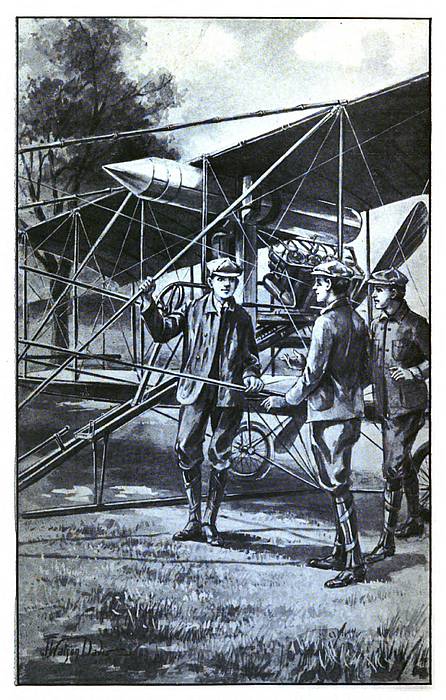
Descending from his seat, the aviator was greeted by two boys not far from his own age. The Flying Machine Boys on Duty.Page 4.
OR
The Clue Above the Clouds
By FRANK WALTON
AUTHOR OF
“The Flying Machine Boys on Secret Service”
“The Flying Machine Boys in the Wilds”
“The Flying Machine Boys in Mexico”
A. L. BURT COMPANY
NEW YORK.
Copyright 1913
By A. L. Burt Company
THE FLYING MACHINE BOYS ON DUTY
[3]THE FLYING MACHINE BOYS
ON DUTY
ABOVE NEW YORK BAY.
An aviator, swinging northward in a June twilight,
found himself constantly annoyed by the
driver of a machine whose only motive in life
seemed to be to get in the way. Turn as he might to
right or left, sail high or low, the obstinate and impertinent
pursuer was always at hand to threaten
him.
To the west, lay Bedloe’s island, showing the
Statue of Liberty, ruddy in the sunlight. To the
east, Governor’s island presented the battlements of
Fort Columbus and Castle William. To the north,
or to the northeast, to be more exact, lay Battery
park, a smear of green at the lower end of Manhattan
island.
[4]For a time people on ferryboats traversing New
York bay looked upward in momentary expectation
of a battle in the air. Then the two flying machines
passed north along the line of Broadway, crossed
over Bronx park, and came to the vicinity of Pelham
bay, in Westchester county.
Here the aviator who had shown such pugnacity
in his dashes and swirls at the other, and who had
been repulsed only by the finest skill and tact,
wheeled straight to the west and was soon lost to
sight in the gathering darkness.
For a moment it seemed that the aviator who had
thus far acted only on the defensive was about to
become the aggressor and follow in the wake of his
persecutor. In fact, he was about to swing away in
pursuit when the ringing of a bell at a hangar below
attracted his attention. Then, with a frown
showing on a boyish face, he swung to the north a
short distance and volplaned to a level space in front
of the hangar.
Descending from his seat, the aviator was greeted,
rather anxiously it seemed, by two boys not far
from his own age. Very little was said until the
flying machine had been run into the great shed, and
then the three turned away to a rather elaborate
office building which stood in a grove of trees at
the entrance to the grounds.
A chill wind was blowing off Long Island sound,
and the boys found a grate fire burning brightly in
a private room at the rear of the structure. They
seated themselves before the leaping flames and
looked expectantly into each other’s faces for a
moment before speaking.
[5]Those who have read the opening volume of this
series will need little introduction to James Stuart,
Ben Whitcomb and Carl Nichols. Street boys of
sixteen, they had, some months before, met Louis
Havens, the famous millionaire aviator, and accompanied
him on a trip to Mexico which had brought
both fame and fortune to every member of the
party.
On their return to New York from the “Burning
Mountain” the boys had planned a course in
college, but, at the request of Mr. Havens, they had
promised to undertake a daring commission from
the New York chief of police. A short time before
their return to the city the night-watchman of the
Buyers’ Bank had been murdered, the monster safe
dynamited, and thousands of dollars in currency and
securities taken.
It was believed by the chief of police that the
burglars—two of the craftiest and most desperate
criminals on the continent—were in hiding in the
wild and mountainous region south of Monterey
bay, on the Pacific coast.
On the theory that the Flying Machine Boys
would be able to visit every nook and corner of the
region where the criminals were supposed to be,
with comparative ease, in their new and up-to-date
machines, and, also, that the appearance of the lads
[6]in that section would not be apt to arouse the suspicions
of the hunted men, the chief of police had
proposed the journey to Havens, and he had induced
the boys to accept the almost princely offer
made by the official.
On account of the hazardous nature of the proposed
trip, and because of the long distances to be
traveled, special attention had been given to the
Louise and the Bertha, the two aeroplanes ordered
made by the boys immediately upon their arrival at
New York. These machines had been completed
the previous day, and the trip over New York bay
made by Jimmie Stuart that afternoon had been the
first tryout for the Louise, a very strong aeroplane,
capable of carrying, when necessity required, two
passengers and at least a hundred pounds of camp
equipage and provisions.
“Who’s your friend?” asked Carl Nichols, short,
fat, blue of eyes and pink of skin, as the three boys
sat before the open grate fire in the private room in
the office building at Havens’ hangar.
“He’s no friend of mine!” Jimmie Stuart, red-headed
and freckled-faced, declared. “He picked
me up down on the Jersey coast and did his best to
get me into a mix-up. I dodged him all the way to
Bronx park because, you see, I was not quite sure
of my machine.”
[7]“Did you get a good look at the fellow?” asked
Ben Whitcomb, grave-faced, athletic, and inclined
to worry over troubles which had not yet materialized.
“It looked to me as if you might have slapped
his face, he was so near to you when you passed
over Battery park.”
“Oh, yes!” Jimmie answered. “I got a view
of his face from almost every angle! He’s a low-browed
brute, with ears like wings, and a hunch in
his shoulders which makes you think of one of the
muckers at Croton dam.”
“He certainly can run a machine, though!” Carl
Nichols declared, “and he has an aeroplane that can
go some, too!”
“But what’s the idea?” asked Ben. “Why
should he be chasing you around in that impudent
way?”
“I’ve got a notion,” Jimmie replied, “that he
wanted to try out the Louise. He resorted to every
trick known to airmen to induce me to make some
kind of an error in handling the machine. He’s an
expert himself, and he evidently wanted to know
whether I am capable of operating a peach of a flying-machine
like the Louise.”
“I don’t believe it was just idle curiosity that
made the fellow stick to you in that way,” Carl interrupted.
“I’ve been thinking that the purpose of
our trip to the Pacific coast may have become known
to friends of Phillips and Mendosa, the men who
are believed to have dynamited the safe of the
Buyers’ Bank and murdered the night-watchman.
The crooks may have men on guard here!”
[8]“That seems hardly probable,” Ben suggested.
“The police have a pretty good case against Phillips
and Mendosa, and, so far as my knowledge goes, a
crook who stands in the shadow of the electric chair
has few friends willing to interest themselves in his
behalf.”
“Yes, but look here,” Jimmie argued, “Phillips
and Mendosa lifted thousands of dollars in currency.
So far as the officers know they still have
the entire proceeds of the robbery in their possession.
Even murderers with so many dollars in their
possession are not likely to lack capable friends.”
“I guess that’s right,” Carl put in, “and the two
murderers will of course scatter money like water in
order to keep out of the clutches of the law!”
“Yes,” Ben suggested, “the clues point so directly
to Phillips and Mendosa that they would naturally
spend every dollar they stole in order to keep
away from the New York officers.”
While the boys talked, the door to the private
office opened softly. Mr. Havens stood for a moment
on the threshold and then stepped up to the
fire. The young man was tall, slender and supple,
with a dusky complexion and black hair and eyes.
He was twenty-four years of age, but looked much
younger. The millions he possessed had been inherited
from his father, and instead of spending
them along the Great White Way, he was devoting
his entire attention to aviation.
[9]“What’s the argument, boys?” he asked, standing
before the grate with a smile on his face. “Machines
working all right?”
“Finely!” replied Jimmie. “I had a fine ride
over the bay this afternoon. The Louise motor
runs like a watch!”
“I saw you from Battery park,” Havens answered.
“Then you must have seen the gink chasing me
up?” Jimmie asked, tentatively.
“I noticed that,” Havens replied. “What was
the occasion of it?”
“That’s just what we were discussing,” Jimmie
said.
“And we had about concluded,” Ben interrupted,
“that our plans regarding the visit to the Pacific
coast must have leaked out.”
“That doesn’t seem possible!” exclaimed
Havens. “Why,” he went on, “even the intimates
of the chief of police at headquarters know nothing
whatever of the matter. There must be some other
explanation of what took place this afternoon.”
“I have known crooks to have friends among the
men higher up!” laughed Jimmie. “It may be
so in this case.”
[10]“There is one sure thing about it,” Havens went
on, “and that is that if any hint regarding your
proposed trip in quest of the murderers has by any
chance become known to the friends of the crooks,
the exact tactics shown this afternoon would be
likely to be resorted to.”
“Yes,” Ben agreed, “it does seem that the first
thing the crooks would do would be to prevent our
departure for the Pacific Coast. A group of flying
machine boys certainly represents a new element in
secret service work! We must watch our machines
after this!”
“If the fresh aviator really belongs to the crowd
of crooks connected with the murderers,” Carl broke
in, “we’ll hear from him again. He’ll follow us to
the coast! He wouldn’t cease his efforts after chasing
the Louise up New York bay.”
“He will have to chase us up if he continues his
surveillance, for he won’t have long to spy on us
here,” Jimmie declared. “We’re to leave for the
Pacific coast day after to-morrow, as I understand
it!”
“How about to-night?” asked Havens.
The boys sprang to their feet excitedly.
“To-night!” shouted Carl. “That will be
fine!”
“That appears to me to be a good way of dodging
trouble,” Ben acknowledged.
“I’d like to go to-night, all right,” Jimmie broke
in, “but I’d like to form the acquaintance of that
impudent aviator before I go!”
[11]“I have an idea that you’ll meet him before you
reach Monterey bay!” Havens replied. “You
would know him again?” he asked.
“Of course!” replied the boy. “He’s a low-browed
brute with wing ears and a hunch in his
shoulders. I’d know him anywhere.”
“Do you really think he’ll chase us up?” asked
Carl hopefully.
“I certainly do!” answered Havens.
“That will be great!” exclaimed Jimmie. “A
flying machine race across the continent surely appeals
to me. Are you going along with us, Mr.
Havens?” he asked, then.
“I hope so,” was the reply, “although I’m not
quite sure of getting through with several business
deals now under way. However,” he went on, “you
boys can go on with the Louise and the Bertha to-night,
and I can catch you somewhere on the way
over with the Mary Ann.”
“Not me!” Jimmie laughed. “You can’t catch
me with the Mary Ann as long as I’m on board the
Louise!”
“We’ll decide that point on the way across!”
Havens replied.
“Well,” Ben suggested, “if we’re going to start
to-night, we ought to be getting our camp equipment
ready.”
[12]“Aw, never mind the camp equipment!” exclaimed
Jimmie. “We don’t want to carry a load
of stuff across the continent. We can carry one light
silk tent, like we had in Mexico, and a few provisions,
and buy all the mountain outfit after we get
in Monterey.”
“That listens good to me!” Carl put in. “If
Mr. Havens is going to race us for three thousand
miles in the Mary Ann, we don’t want to carry much
excess baggage.”
“How soon can you get ready, boys?” asked
Havens. “My idea is,” he went on, “that you
ought to get out of the hangar as soon as possible.
We may be over-anxious regarding the matter, but
it is my belief that you’ll be followed unless you get
away secretly. Now, you boys all go to bed in the
bunks in the hangar and I’ll attend to the details.
When the tent and provisions are on board, with
plenty of gasoline, I’ll let you know. Then you can
get away at once.”
The boys objected to going to bed, declaring that
they were too excited to sleep, but at last, in deference
to the wishes of Mr. Havens, they sought their
bunks. An hour later Jimmie awoke to a sense of
suffocation. Ben and Carl were sleeping soundly
not far away and the great shed was very still.
As the boy sat up and sniffed the air a burst of
flame showed at the front, sweeping fast toward
the Louise and the Bertha.
CHAPTER II.
[13]
A SHOT IN THE NIGHT.
There was a fairly efficient fire department at the
Havens’ hangar, and by the time Jimmie was out of
his bunk, rolling his chums out on the floor, two
streams of water were playing upon the flames.
Contrary to the expectation of the incendiaries,
there had been several workmen busy about the
office building packing provisions into the smallest
space possible and tying oiled silk tents and clothing
for transportation on the flying machines. Consequently
when the fire burst out at the hangar there
was little delay in getting out the firemen.
There were thousands of dollars’ worth of property
in and about the office building and hangar,
and Mr. Havens not only maintained an efficient
corps of fire fighters but also kept his possessions
there well insured. The fire was extinguished before
any damage had been done except to one wall
of the hangar.
[14]After the danger was entirely over Mr. Havens
and the three boys gathered in the private room of
the office building for the purpose of discussing the
situation. It was easy to see that the boys were all
greatly excited, and that Mr. Havens was decidedly
angry.
“You see how it is, boys,” the latter said, “you’ll
have to fight the Phillips and Mendosa gang from
now until the two murderers are placed in the electric
chair. I fully believe that it was the intention
of their accomplices to not only destroy the aeroplanes
but to cause your death. It is a desperate
gang to battle with.”
While the boys talked, laying plans for their
guidance while journeying across the continent,
Hilton, one of the night-watchmen, knocked softly
on the door and then looked in with a frightened
face.
“What is it?” asked Havens.
“I presume, sir,” the night-watchman answered,
“that you heard the shot? It might have been
heard a mile, I think, sir.”
“We heard nothing of the kind,” replied Mr.
Havens, rather anxiously. “Tell us something
about it.”
[15]“It was just after the fire was extinguished,”
Hilton replied. “We were standing by the door of
the little fire-apparatus house when we saw a man
sneaking through the shrubbery to the west of the
hangar. He turned and ran the minute he saw that
he was discovered, but we caught him—a measly
little dried up kind of a man, with a face like a
monkey.”
“Where is he now?” asked Havens.
“Why, that’s what I came in to tell you about,”
Hilton continued, fumbling with his hat, which he
held in front of him with both hands. “When we
caught him, we took him back to the engine-house
and began asking him questions, believing, of course,
that it was he who had made all the trouble.”
“And what did he say?” demanded Havens, excitedly.
For a moment it seemed that the solution of the
fire mystery was at hand. It was probable that the
man caught sneaking about the hangar had either
been responsible for the blaze or had witnessed the
act of incendiarism. They all waited anxiously for
Hilton’s reply.
[16]“Well, sir,” continued the night-watchman, “we
stood him up agin’ the wall by the engine-house
door and tried to frighten him into answering our
questions. He was scared all right!”
“But what did he say?” repeated Havens, impatiently.
“He didn’t say anything,” was the reply, “and
I’ll tell you why he didn’t say anything. He was
under the strong light of the electric in the ceiling
of the engine-house. We were all gathered about
him, but none of us stood in front. Before he could
say a word in answer to our questions, a shot came
from out of the darkness and he just crumpled down
on the floor. We thought he was dead.”
“Did one of my men shoot him?” asked Havens,
angrily.
“No, sir,” replied Hilton. “Your men were all
gathered in the engine-house. The shot came from
a point south of the hangar.”
“Is the man dead?”
“That’s what we can’t exactly make out, sir,” the
night-watchman answered. “He lies perfectly still,
but sometimes we think we can detect a flutter of
breath at his lips. No, sir, you may be sure that
none of your men shot the fellow.”
“Who did shoot him, then?” demanded Jimmie,
excitedly.
[17]“Wait a moment,” said Havens addressing the
night-watchman. “Don’t offer any theories. Tell
us the facts in the case, and then go and see that the
man is not permitted to escape.”
“I have told you all I know, sir,” answered Hilton.
“It’s just as I tell you. He was in the strong
light near the engine-room door, and a shot came
out of the darkness and he dropped. Your men
were all in the engine-room at the time it happened.”
“That’s all!” Havens said, abruptly. “See that
the fellow is given every attention, and also that he
does not escape. Perhaps you would better summon
a surgeon. Use the ’phone in the engine-house.”
Hilton bowed and turned away, grumbling that
workmen were always blamed for everything that
took place, whether they were guilty or not. Mr.
Havens and the boys sat watching each other with
astonishment showing in their eyes for at least a
minute after the departure of the night-watchman.
Havens was the first to speak.
“What do you make of that, boys?” he asked.
“It seems to me to be a problem easy of solution,”
Ben answered. “The men who planned the destruction
of the building and the death of those
sleeping in it employed this man to do their dirty
[18]work. He set fire to the building, but didn’t get
away in time. The captured man is undoubtedly a
fellow not to be trusted, so the chief incendiary
shot him in order to close his lips.”
“It strikes me,” Mr. Havens said, with a laugh,
“that you ought to make a pretty good detective.
In my opinion, you have grasped the situation exactly.”
“Oh, Ben is the only original Sherlock Holmes,”
laughed Jimmie. “Give him a piece of rock and a
blade of grass and he’ll tell you how the world was
made! He’s got the deduction stunt down to
cases!”
“You bet he has!” laughed Carl. “Don’t you
remember how he figured out the Devil’s Pool down
in Mexico?”
“I guess you all had a hand in that Devil’s Pool
proposition,” laughed Ben. “But, honest, now,” he
continued, “don’t you think the man was shot in
order to prevent his snitching on his friends?”
“He certainly was!” answered Mr. Havens.
“And now,” he continued, rising from his chair and
moving toward the door, “it remains for us to determine
whether he is dead. If he is dead, that settles
the matter so far as we’re concerned. If he
isn’t, he may be induced by the use of the third
degree to betray his accomplices.”
[19]“Huh!” laughed Jimmie. “I wouldn’t put a
sheep-stealing dog through the third degree! They
tried it on me once,” he continued, “when they
found me sleeping in a dry goods box in an alley
near where a burglary had been committed. They
kept me without sleep or food for two days and two
nights, though they had all I knew about the case
the first minute.”
“You’re right about the cops,” Carl laughed.
“When I write a book descriptive of the criminal
classes in the United States, I’m going to give the
police the place of honor in the book. If anybody
should ask you, you just say that the leading criminal
class in the United States revolves around
police headquarters.”
Havens smiled at the natural enmity of street boys
for the police and opened the door. As he did so
Hilton again made his appearance in the outer
office.
“The surgeon will be here directly,” he reported.
“How’s the patient?” asked Havens.
[20]“Still unconscious,” was the reply, “though he
seems to be breathing a little easier. He’s bleeding
pretty badly, though.”
“You remain here and watch the office until we
come back,” directed Havens, and in company with
the three boys he turned toward the building where
the fire-fighting apparatus was stored.
When they reached the place they found the figure
of an undersized, wrinkled-faced man of fifty
or more lying on the brick floor of the room. There
was a pool of blood in view, and a wound in the
head showed its source.
Half a dozen men were gathered about the still
figure, all looking excited and anxious. Havens bent
down and lifted the head from the floor.
“That wound,” he decided, “is by no means a
fatal one. In fact, I can’t understand why he should
lie for such a long time in this condition. The bullet
merely cut the scalp, it seems to me. Any of
you people ever see him before?” he asked in a moment.
The men shook their heads.
“Have you examined his clothing for marks of
identification?” asked Havens, then. “He may
have letters or something about him which will disclose
his name and address.”
[21]“No, sir,” one of the men answered. “We never
thought of that. At least,” he went on with a
shamefaced grin, “I thought of it just as you came
in but, to tell you the truth, I didn’t care to touch
him.”
Jimmie bent down and ran his fingers hastily
through the pockets in the clothing of the unconscious
man.
“Not a thing!” he said presently. “Not even a
lead pencil or a pocket knife! The fellow probably
left his card case at home,” he added with a chuckle.
“We’ll have to get his number in some other way.”
While they stood talking at the door of the engine-house,
a surgeon residing at a village not far
away came hastily into the circle of light. After
speaking most respectfully to the millionaire and
nodding carelessly to the boys, he proceeded to make
an examination of the injured man. Havens and
the lads stood by waiting anxiously for his decision.
If the man was really likely to die from his
wound, that would end all hope of learning from
him the names of those associated with him in the
crime. If the fellow would soon recover, then a
clue to the whole chain forged by the friends of the
murderers for the destruction of the boys might be
discovered.
[22]“Well?” asked Havens as the surgeon lifted his
face in a moment.
Instead of answering directly, the surgeon sniffed
the air.
“You’ve had a fire here?” he questioned.
“Never mind the fire now,” said Havens, impatiently.
“Give me your opinion of this man’s
condition. Is his wound fatal?”
“It is my duty,” said the surgeon, with assumed
dignity, “to report this case to the police instantly.
But,” he continued, with a subservient bow in the
direction of the millionaire, “I’ll give you all the
information I can before sending word to the county
authorities.”
“Holy smoke!” shouted Jimmie. “Why don’t
you give it, then?”
“Yes, why don’t you give it?” added Carl.
“What are you waiting for?”
The surgeon regarded the two boys with a glance
cold enough to crack the lenses in his eye glasses
and turned back to the millionaire.
[23]“The man is not fatally injured,” he announced,
with a great deal of added dignity. “In fact, I
can’t understand why he lies so long in this condition.
It can be accounted for, however, on the
theory that the bullet in passing along the surface
of the skull drove a splinter of bone into the brain.
In that case, no recovery can reasonably be expected
until after a delicate operation has been
performed.”
“Well,” Havens decided in a moment, “do you
know where there is a hospital to which the man
may be taken immediately?”
“There are plenty in New York city, of course,”
suggested the surgeon.
“But,” returned Havens, “I don’t want him
taken to New York city, or even placed in the custody
of the officers of Westchester county. My desire
is that you have him placed in a private hospital
and make him your special charge until you
receive different instructions. I have reasons of my
own, of course, for taking this course, all of which
you shall know in due time. Will you do it?”
The surgeon replied that he should be most happy
to oblige the millionaire, and in a short time the
wounded man was reposing on a cot in a private
room in a private hospital not far from Long Island
sound.
[24]“And now, boys,” Mr. Havens said after a short
time, “the machines are packed, it only remains for
you to take your seats and beat the friends of
Phillips and Mendosa to the Pacific coast.”
CHAPTER III.
[25]
A MYSTERIOUS DISAPPEARANCE.
“We can beat ’em to the Pacific coast, all right!”
Jimmie laughed. “Look here,” he went on, pointing
to the Louise, now being run out of the hangar
by the workmen. “There’s a flying machine that’s
going to be a world-beater. I ran fifty miles an hour
this afternoon, and didn’t put on full power, at that!
She’s a bird, is Louise!”
“It isn’t always the speed that counts in a flying
machine,” smiled Havens. “The perfect flying machine
is one that is constructed for endurance—one
which will fly for days and nights without breaking
down—one which can be trusted in the air as you
trust a faithful horse on a country road.”
“Well,” laughed Jimmie, “I think the Louise has
had plenty of endurance tests, that is so far as her
separate parts are concerned. Every piece in her,
down to the last screw, has been tested time and
again, and the run yesterday afternoon showed that
she worked like a full-jeweled watch.”
[26]“And what about the Bertha,” laughed Havens,
turning to Ben.
“Aw, the Bertha isn’t in it with the Louise!”
shouted Jimmie. “I’ll race the Bertha to Monterey
bay for a thousand dollars,” he added with a grin.
“And I’ll win the money, too.”
“That will never do, boys,” Havens advised.
“You’ve got to keep together and work together
all the way across.”
“And now,” asked Ben, as they all turned toward
the machines, glistening now in the brilliant moonlight,
“where are we going to land?”
“I’m afraid I haven’t explained the details of the
trip as thoroughly as I should,” answered Havens,
“for the reason that I expected to go with you from
the start. However, I’ll be along before you get
to the Mississippi river and post you fully.”
“But suppose anything should happen that you
should be delayed,” suggested Jimmie. “What
then?”
“Well,” Havens went on, “south of the bay of
Monterey, in Southern California, close to the
Pacific coast, lies the Sierra de Santa Lucia mountains.
On one side the rock runs almost vertically
[27]to the ocean, from three to five thousand feet below.
On the other side there is a slope of oak and pine
and sycamore to a great canyon which stretches
between the mountains and the foothills to the line
of the Southern Pacific railroad, sixty or seventy
miles away.
“This is said by men whom I have consulted to
be the wildest and most lawless region in all California.
There is a government reservation there,
but the forest rangers have hard work keeping
fires out of the forest and cattle off the slopes.
“It is believed that Phillips and Mendosa sought
this region immediately after the burglary in New
York. In fact, the chief of police reports that they
are known to have left San Francisco in a steamer
bound south ten days after the commission of the
crime.
“Now,” Havens continued, “these men are beyond
the reach of telegraphic or mail service. They
can be warned of the approach of officers only by
messenger from Monterey, or by messengers sent
through the gulches across from the Southern Pacific
line.
[28]“This situation compels us to beat the aeroplane
we saw yesterday afternoon to the Pacific
coast,” Havens explained.
“But,” interposed Jimmie, “the murderers’
friends might telegraph to Monterey, or to some
point on the railroad, and a messenger might be
despatched into the mountains. An arrangement of
this sort would certainly inform the murderers in
advance of our coming.”
“But there is the danger of discovery if messages
and messengers are resorted to,” Havens continued.
“Besides, it is very doubtful if accomplices
have been stationed at any station in the vicinity
of the mountains. It is more than likely that
Phillips and Mendosa entered that wild region with
the intention of cutting themselves off from all
human kind, leaving friends in New York to look
out for their interests here.”
“Then,” laughed Jimmie, “let Phillips and Mendosa
watch out for a freckled-faced boy with red
hair, for he’s going to cross their life line the first
thing they know!”
“Why don’t you put out a sign and tell fortunes?”
asked Carl, with a grin. “You ought to
be able to do that!”
[29]“Ain’t I telling the fortunes of these two murderers
now?” demanded Jimmie. “The clairvoyants
tell you to look out for tall, dark complected
men with fierce eyes, if you go to them, and I’m telling
these outlaws to look out for a freckled-faced
boy with red hair who’s going to get their number
directly.”
“Now there’s one more thing I want to tell
you for your information in case my departure
should be delayed,” Havens went on. “It appears
that this man Mendosa is a sort of a crank in the
matter of diamonds. He is known to possess several
stones of considerable value, in addition to
small trinkets set with the precious stones. On the
morning following the robbery and murder, a small
diamond and a tiny, triangular piece of gold were
found on the rug in front of the office desk which
the burglars cheekily used during the examination
of the securities.
“It is believed by the officers that this stone and
this piece of gold became detached from a ring
worn by Mendosa on that night. The stone looks
like one of a cluster, and the triangular piece of
gold is unquestionably part of a claw originally used
to keep the diamonds in the setting. These two
constitute the only clues.”
[30]“Are you going to take them with you?” asked
Jimmie.
“Certainly,” replied Havens.
“Then you want to hustle along with them,”
laughed Carl, “for we’re going to sail right out
of the air and light down on top of the two murderers!
So we’ll need the stone and the triangular
piece of gold for comparison. We’re going to do
this up quick!”
“And now, one last word,” the millionaire concluded.
“In case I should not reach you before
you gain the Pacific coast, my advice is that you
approach the mountains from the east during the
night time. Then you ought to land on one of the
high summits and work out from that point, using
your flying machines only for long distance work.”
“Of course,” laughed Ben, “we can’t go sailing
over the mountains with our machines in broad
daylight, whistling for the outlaws to come out of
their hiding-places and be taken back to electric
chairs in New York!”
“No, there’ll be quite a lot of mountain climbing,”
advised Havens. “And now,” he continued,
“that everything is understood and the provisions
and tents are snugly packed on the flying machines,
[31]you would better be on your way. It is quite possible
that the aviator who chased Jimmie up New
York bay yesterday afternoon headed for the west
immediately after leaving this vicinity.”
“In that case, we’ll have to catch him!” Jimmie
grinned.
“If we can!” Carl exclaimed.
“Aw, of course we can!” Jimmie returned.
“How fast ought we to travel?” asked Ben of
Mr. Havens.
“I think,” returned the millionaire, “that you
ought to travel about fifty miles an hour for sixteen
hours a day. That will give you eight hundred
or a thousand miles a day, and also eight hours each
night for sleep. That ought to be enough.”
The boys all insisted that that would be more
than enough, and moved toward their machines.
“Wait a minute!” Ben cried, as he climbed into
the seat on the Bertha, “who’s going to ride with
me?”
“You’ve got most of the equipage and provisions,”
Havens suggested. “You know,” the millionaire
continued, “that we couldn’t trust Jimmie
with the provisions! He’d be stopping in the top
of every tall tree to take a snack, and that would
never answer!”
[32]“And you know, too,” Carl put in, “that we
never could trust Jimmie alone in a flying machine!
That’s why it’s been planned that I ride with him.”
“All right, you fellows,” grinned Jimmie, “I’ll
show you who makes the winning in this murder
case! Great Scott!” he added with a wrinkling of
the nose, “isn’t this a wonder? Who’d ever think
of sending us boys off into the mountains to do
secret service work?”
Havens took out a pencil and began figuring on
the back of a letter taken from a pocket.
“According to this schedule,” he said in a moment,
“you boys ought to reach the bay of Monterey
in four or five days. This is Monday. By Saturday
morning, then, you ought to have your machines
stowed away in one of the gorges facing the
Pacific ocean. Can you do it?”
“You bet we can do it!” declared Jimmie.
“And when you need provisions,” Havens advised,
“get one of the machines out at night and
proceed to Monterey, but don’t take the aeroplanes
into the town; don’t attract any attention if you
can avoid it.”
[33]“Where’re you going to meet us?” asked Ben.
“Probably at St. Louis,” was the reply. “At
the post-office. Look for me there when you arrive.”
In a moment the purr of the motors cut the air.
The machines ran swiftly, steadily, down the field
and swept upward. Havens stood watching them
for a long time. The planes glistened like silver in
the moonlight, and the song of the motors came to
his ears like sweet music. The millionaire loved a
flying machine as track-men love a swift and beautiful
horse. He finally turned away to find a uniformed
messenger boy standing by his side, presenting
a yellow envelope.
“What is it, kid?” he asked.
“Message from the hospital,” was the answer.
“Who sent it?” asked the millionaire, taking the
envelope into his hands and tearing off the end.
“The night matron,” was the reply. “She said
I had to hump myself.”
“That’s wrong!” laughed Havens. “She
shouldn’t expect a messenger boy to hump himself!
In fact,” he went on, whimsically, “the only time
a messenger boy is permitted to make haste is when
he is on his way to a baseball game. That’s right,
sonny!” he continued.
[34]The boy grinned and made trenches in the smooth
earth of the field with the toe of a broken shoe.
Havens glanced casually at the message at first,
thinking that perhaps the surgeon might have taken
it into his head to report progress in the case
of the man so recently placed in his charge. He
knew very well that the surgeon would manage to
prevent the escape of the prisoner should he regain
consciousness, so he had put that phase of the case
entirely from his mind. However, his eyes widened
and an exclamation of astonishment came from
his lips as he read the note which had been written
by the night matron, and not by the surgeon at
all.
“Mason, the injured man recently sent here on
your order,” the note read, “has most mysteriously
disappeared from the hospital. Doctor Bolt, the
surgeon detailed, at your request, to take charge
of the case, decided to watch the man for the night,
and so my attendants were withdrawn. The surgeon
must have fallen asleep, for in half an hour’s
time he came running to my door shouting that
Mason had escaped. As soon as possible I visited
the room from which the man had disappeared and
found the window sash raised.
[35]“There were many footprints in the soft earth
under the window—the footprints of men in coarse
shoes—and a smear of blood on the window casing
disclosed the fact that the injured man had been
drawn through the opening. It is quite evident to
me, therefore, that the man was carried from the
room by some one interested in the case, to which
Doctor Bolt only indirectly referred when talking
with me. Your presence at the hospital is earnestly
requested.”
The note was signed, as stated, by the night
matron. Scarcely had Havens finished the reading
of it when he heard some one stumbling through
the darkness, and the next moment Surgeon Bolt,
looking crestfallen and excited, stood before him,
like a schoolboy anticipating censure.
“Well?” asked Havens rather angrily.
“It’s the strangest thing I ever saw!” exclaimed
the surgeon. “Mindful of your interest in
the man, I decided not to trust him to the care of
any of the hospital attendants to-night. After doing
what I could for him, I sat down by the side
of his bed to read and smoke. My mind was never
clearer or farther from drowsiness than it was at
that time.”
[36]“Yes,” Havens said, in a sarcastic tone, “the result
seems to indicate that you were wide awake!”
“I tell you,” almost shouted Bolt, “that I was
stupefied by the injection of chloroform or some
other anesthetic into the room!”
“How could that be possible?” demanded
Havens.
“I don’t know!” wailed Bolt. “I certainly do
not know! The window was closed when I looked
at it last, just before I became unconscious. When
I came to my senses to find the bed empty, a cold
wind was blowing on my face. That is undoubtedly
what awakened me. Only for that I might
have slept myself to death!”
While the two talked together a watchman from
the office building approached and informed Havens
that a lady was waiting there to see him.
“That, probably,” suggested Bolt, “is the night
matron from the hospital. She was making investigations
when I left, and promised to come here
at once on the discovery of anything new in the
case.”
[37]Havens hastened to the office building and there,
as the surgeon had predicted, found the night
matron waiting for him.
“I can’t understand,” she said addressing the
millionaire abruptly, without waiting for him to
speak, “what is going on at the hospital to-night!
Immediately after the departure of Doctor Bolt I
sent word for every person, man or woman, connected
with my service to appear in the reception
room. In five minutes’ time I discovered that two
men employed only three days ago were not present.
“After waiting a few moments for their appearance,
I sent a messenger to their rooms. They were
not there! Their beds had not been slept in, and
every article of wearing apparel belonging to them
had been taken from their closets.”
“One question,” Doctor Bolt said, addressing
the matron. “Was any one on watch outside the
door of the room in which I was so mysteriously
put to sleep?”
“There was no one on watch there,” was the
reply.
[38]“Then,” declared Bolt, “the two attendants
who have disappeared injected the anesthetic I have
already referred to through the keyhole of the door.
After I became unconscious they entered and removed
the prisoner. It is all the fault of the hospital!”
The night matron turned up her nose at the surgeon.
CHAPTER IV.
[39]
THE DIGNITY OF THE LAW.
The two flying machines, the Louise, with Jimmie
and Carl on board, and the Bertha, with Ben
in charge, flew swiftly over the great city, lying before
them with its lights stretching out like strings
of beads, crossed the North river with its fleets of
vessels, and passed on over New Jersey, heading directly
for the west.
At first Jimmie and Carl tried to carry on a conversation,
but the snapping of the motors and the
rush of the wind in their faces effectually prevented
anything of the kind. The moon was well down in
the west, yet its light lay over the landscape below
in a silvery radiance.
Now and then as they swept over a city or a
cluster of houses far out on a country road, lights
flashed about, and voices were heard calling from
below. Ignoring all invitations to descend and explain
their presence there, the boys swept on steadily
until the moon disappeared under the rim of
the sky.
[40]At first there was the light of the stars, but this
was soon shut out by a bank of clouds moving in
from the ocean. By this time the boys were perhaps
two hundred miles from New York. They
were anxious to be on their way, yet the country
was entirely new to them, and they knew that a
chain of hills extended across the interior farther
on, so at last Ben, who was in the lead, decided to
drop down and make inquiries as to the country to
the west.
Of course the boys might have lifted their machines
higher into the air and proceeded on their
course regardless of any undulations of the surface,
but they were still comparatively new in the
business of handling machines, and did not care to
take high risks in the darkness.
Jimmie followed Ben’s lead, and the two machines
groped their way along a tolerably smooth
country road and finally came to a stop only a few
feet from a rough and weather-beaten barn which
stood close to the side of the road.
[41]The clatter of the motors almost immediately
brought two husky farmers into the illumination
caused by the aeroplane lamps.
“What you doing here?” one of the men asked.
“Came down to rest our wings,” Jimmie replied,
saucily.
“Where you from?” asked the other farmer.
“New York,” answered Jimmie.
“We’re carrying government despatches to
Japan,” Carl added, with a grin. “We’re in the
secret service!”
Ben gave the two boys a jab in the back, warning
them to be more civil, and, stepping forward,
began asking questions of the farmer regarding the
country to the west. The two men looked at each
other suspiciously.
“Is this him?” one of them asked.
The other shook his head.
“Might be, though!” insisted the first speaker.
“No,” replied the other, “this is not the man!”
Ben looked at his chums significantly for a moment.
He was thinking that the farmers might be
referring to an aviator who had passed that way not
long before. He was thinking, too, that that aviator
might be the identical one who had started out
to beat the Louise and the Bertha to the Pacific
coast.
[42]“When did you boys leave New York?” one
of the men asked, in a moment.
“About midnight,” was the reply.
“And you’ve come two hundred miles in three
hours?” asked the man, incredulously. “I don’t
believe it!”
“Our machines,” Ben answered, very civilly indeed,
“are capable of making the distance in two
hours.”
“Well,” the farmer went on, “the other fellow
said he left New York about dark, and he didn’t
get here until something like an hour ago. He lit
right about where you are now.”
“Where is he now?” asked Ben.
“Why, he went on just as soon as he tinkered up
his machine.”
The boys glanced at each other significantly, and
then Ben asked:
“What kind of a looking man was he?”
“He looked like a pickpocket!” burst out the
farmer, “with his little black face, and big ears,
and hunched up shoulders. And he was, I guess,”
he continued, “for we heard him sneaking around
the barn before we came out of the house.”
[43]“What did he say for himself?” asked Ben,
now satisfied that the man described was the one
who had pursued the Louise on the previous afternoon.
The two farmers looked at each other a moment
and broke into hearty laughter. The boys regarded
them in wonder.
“He said,” one of the men explained, in a moment,
“that he was a messenger of the government,
taking despatches to the Pacific coast. If he didn’t
say almost the same thing you said, you may have
my head for a pumpkin.”
“And that,” added the other man, “is what
makes us suspect that you chaps are in cahoots.
Mighty funny about you fellows both landing down
here by our barn, and both telling the same story!
I’m a constable,” he went on, “and I’ve a good
mind to arrest you all and take you before the
squire as suspicious persons. I really ought to.”
“What are we doing that looks suspicious?”
demanded Jimmie.
[44]“You’re wandering about in the night time in
them consarned contraptions!” declared the other.
“That looks suspicious!”
Daylight was now showing in the east, and the
sun would be up in a little more than an hour. The
boys were positive, from information received from
the farmer, that the aviator who had made his appearance
on New York bay the previous afternoon
was only an hour or so in advance of them. By
following on at once they might be able to pass him.
It was their intention now to wheel farther to
the south, and so keep out of the path taken by the
other. It was their idea to reach the coast, if possible,
without the man who was winging his way
toward the murderers knowing anything about
it.
Of course the fellow would suspect. There was
no doubt that he fully understood that the Louise
and the Bertha were to be used in a race to the Pacific.
Had he been entirely ignorant regarding the
plans of the boys, he would never have found it
necessary to follow the Louise over New York bay
and Manhattan island for the purpose of ascertaining
her capability as a flier.
[45]“Well,” Jimmie said, after a moment, “We may
as well be on our way. We stopped here because
we were afraid of butting into some wrinkle in the
old earth if we proceeded in the darkness.”
“I don’t know about letting you go on!” broke
in the constable.
There was greed in the man’s eyes. There was
also an assumption of official severity as he glanced
over the three youngsters. The machines were
standing in the middle of a fairly smooth road running
directly east and west.
To the right of the thoroughfare stood the
shabby barns referred to before. To the left ran
a ditch which had been cut through a bit of swamp
lying on the other side of the road. As the farmer
concluded his threatening sentence, Jimmie and
Carl sprang to the Louise and pressed the button
which set the motors in motion. For a moment
the farmers were too dazed to do more than follow
the swiftly departing machine with their eyes.
When they did recover their understanding of
the situation, they both sprang at Ben in order to
prevent his departure. This, doubtless, on the
theory that one boy was better than none. If they
couldn’t get three prisoners, they did not intend to
lose the opportunity of taking one.
[46]In carrying out this resolve, the men made a
serious mistake in not seizing the machine. Had
they thrown their muscular arms across the planes
at one end it would have been impossible for the
machine to have proceeded down the road in a
straight course.
Instead of doing this, they both made an effort
to seize Ben. Now Ben had been in many a rough-and-tumble
skirmish on the lower East Side, and
knew how to protect himself against such clumsy
assaults. One of the farmers cut a circle over the
shoulder of the boy as he fell from a hip-lock, and
the other went down from as neat a jolt on the jaw,
as was ever delivered in the prize ring.
While this remarkable contest was in progress,
Jimmie was whirling the machine, he had mounted,
into the air. When he saw one of the farmers
land in the ditch he came swiftly about with a jeer
of defiance and thrust an insulting face toward the
ground.
“Say, you feller!” he shouted. “That’s Billy
Burley, the Bruiser. Don’t you go to getting into
a mix-up with him!”
The man who had tumbled into the soft muck
of the trench clambered slowly out and shook his
fist at the freckled, scornful face bent above him.
[47]“I’ll show you!” he shouted. “I’ll show you!”
By this time Ben had taken possession of the
Bertha, and the motors were clattering down the
road. In a second almost the flying machine was
in the air, and the boys were off on their journey,
leaving the two farmers chasing down the road
after them, shouting and waving pitchforks desperately
in the air.
It was now almost broad daylight, and the boys
sent their machines up so as to attract as little attention
as possible from the country below. A few
miles from the scene of their encounter they shot
off straight to the south, resolved to reach the
Pacific coast by way of Kansas and lower California.
It seemed to them that the aviator who had
preceded them had purposely lingered in order
that they might come up with him. This looked
like trouble.
If it meant anything at all, it meant that if possible
they were to be interfered with on their way
across the continent. This prospect was not at all
to their liking. They wanted to the get to the Pacific
coast as soon as possible and begin the quest
in the mountains.
[48]Shortly after five o’clock they saw the city of
Baltimore stretched out below them. Deciding that
it would be much better to land some distance from
the city and prepare breakfast out in the open country
than to attract universal attention by dropping
down in the city, Ben volplaned down on a macadamized
highway some distance out of the town.
Jimmie followed his example at once, and before
long a small alcohol stove was in action, sending
the fragrance of bubbling coffee out into the fresh
morning air. Even at that early hour half a dozen
loungers gathered about the machines, gazing with
wondering eyes at the youthful aviators.
The boys explained the object of their journey in
the first words which came to their lips, which, it
is unnecessary to state, were highly imaginative,
and the loungers stood about watching the boys eat
and drink and asking questions concerning the
mechanism of the motors.
After eating and inspecting the machines the boys
started away again. At the time of their departure
there was at least half a hundred people standing
around, hands in pockets, mouths half open.
The boys passed over Washington in a short time
and glanced down at the great dome of the capitol
and at the towering shaft of the Washington monument.
The machines, however, were going at a
swift pace, and the many points of interest at the
capital of the nation soon faded from view.
[49]About every two hours all through the day and
early evening the boys came to the surface at some
convenient point and rested and examined their machines.
The motors were working splendidly, and
the lads were certain that if it should become necessary
they could make five hundred miles without
a halt. This was at least encouraging.
When night fell they found themselves not far
from St. Louis. They dropped down in a lonely
field about sunset and built a roaring camp-fire.
There was not a house in sight, and the field where
the machines lay was surrounded by a fringe of
small trees. Ten or fifteen miles to the west rolled
the Mississippi river and beyond lay the paved
streets of St. Louis, where they were to meet
Havens.
The day’s journey had been a most successful
one. Jimmie was certain that at times the Louise
had traveled at the rate of a hundred miles an hour.
There had been no accidents of any kind.
[50]“From New York to the Mississippi in one day
appears to me to be going some!” declared Jimmie,
“and I never was so tired in my life. We can’t go
on to-night if we are to meet Havens in St. Louis
to-morrow, and so I’m going to get out one of the
oiled silk shelter tents and go to bed.”
While the boys planned a long night’s rest the
whirr of motors came dully from the sky off to
the north.
CHAPTER V.
[51]
A CHANGE OF SCENE.
“What we ought to do now,” Doctor Bolt declared,
as the night matron, indignant chin in air,
turned toward the door of the private room, “is to
notify the officers of Westchester county.”
“I don’t see the necessity for that,” Havens replied.
“One may as well look for a pearl in a train-load
of oysters as to look for that fellow in Westchester
county to-night. Depend upon it, the men
who sought employment at the hospital a few days
ago were sent here because the hospital happened
to be near my home.”
The night matron shrugged her shoulders and
passed a scornful glance at the surgeon. The surgeon
turned angrily away.
“That relieves me of a great responsibility,” she
said. “Ordinarily one becomes responsible for the
actions of employes, but when men are sent into
your service by a criminal gang for a criminal purpose,
responsibility ought to end there.”
[52]“I don’t agree with your reasoning at all!” declared
the surgeon. “One should know better than
to employ strangers in positions of trust.”
“And when,” continued the night matron, glaring
at the surgeon, “a country doctor takes it upon
himself to override the rules of a hospital and keeps
watch beside a patient to the exclusion of the
regular attendants, one certainly should not be held
accountable for the safety of that patient. And
that’s all I have to say,” she added.
“Settle the responsibility as you will,” Havens
broke in. “I have nothing to do with that. What
I want now is a promise from each of you that nothing
whatever shall be said regarding the matter
until private detectives shall have an opportunity to
recapture the escaped prisoner.”
“But why the secrecy?” asked the night matron.
“It is my duty as a surgeon to report the entire
matter to the police,” shouted Bolt. “I shall do so
at once.”
Havens argued with the two for a long time, and
finally secured a promise that nothing would be said
either of the capture or the escape for three days.
[53]The millionaire’s idea was to get the prisoner into
his own hands if possible. He knew that the fellow
would have a hundred chances of escaping without
ever revealing the story of the crime he had committed
that night with the police, where he would
have not one if guarded by private detectives.
He was well satisfied from the incidents of the
night that some person high up in the councils of
the police department had leaked in the matter of
the employment of the boys on the murder case. He
believed, too, that the same influence which had
been able to secure the carefully guarded information
would be powerful enough to protect the
escaped prisoner in case he should regain consciousness
and, on promise of immunity, threaten to disclose
the names of his accomplices in the incendiary
act.
After exacting the promise from the surgeon and
the night matron, Havens ordered every workman
about the place to remain on guard until morning
and, calling his chauffeur, departed for New York
in a high-powered touring car. Worn out with the
anxiety and exertions of the night, he fell asleep on
the soft cushions of the machine, and awoke only
when the chauffeur shook him gently by the shoulder
and announced that they were at the Grand Central
station.
[54]“And I’d like to ask you a question, sir,” the
chauffeur said, as Havens stepped out of the car.
“It’s about what took place on the way down.”
“What took place on the way down!” laughed
the young millionaire. “It has all been a blank to
me. I must have slept very soundly.”
“Indeed you did, sir,” replied the chauffeur, “and
that’s why I didn’t wake you. You seemed to need
the sleep very much, sir.”
“Well, tell me what happened?” Havens said
impatiently.
“Why, sir,” the chauffeur went on, “a big car
picked us up half a mile this side of the hangar and
followed on down to within three blocks of this
place. When I drove fast, they drove fast; when I
slowed up, they slowed up, too. Very strange, sir.”
“Why didn’t you investigate?” asked Havens
angrily.
“You see that marble column at the corner of the
building,” declared the chauffeur, pointing. “Well,
I stopped once to ask questions of the chauffeur in
the other car, and that marble column I’m pointing
out, sir, would be just as communicative as that
other chauffeur was. He only grunted when I asked
questions and kept right on as before.”
[55]Havens thanked the man for the information and
went on about the business which had brought him
to the city. He was busy all day with lawyers and
brokers and real estate managers, and was very tired
and sleepy when night fell. It had been his intention
to take an afternoon train for St. Louis, but his business
had not permitted of so sudden a departure
from the city.
He regretted extremely that he had not arranged
with the boys to wire their address in the Missouri
city. However, he thought, the boys would wait at
least twenty-four hours at the point selected, and
this delay would enable him to overtake them by
train at Denver. He was positive that he could do
so if he could catch the Overland Limited at
Chicago.
Eight o’clock found him sound asleep in the stateroom
of a Pullman car due to start for the west in
an hour. He was so tired that the noises of the
station; the arrival and departure of trains; the calls
of the train starters; the rattling of the couplings
under vestibules, soon died away into a dull blur,
and then he passed into a dreamless sleep.
[56]His last memory was of a powerful light shining
through a slender crack in the drawn blind of a
stateroom window. When he awoke again the
slender finger of light had become a deep red glow
the size of a pail, and the perfumed air of the stateroom
had, somehow, taken on the close and unsavory
smell of a riverside basement.
Havens made an effort to lift his hands to his
head, but found that he was unable to do so. The
great red light was staring viciously into his smarting
eyes so he closed them, turned his head aside,
and lay for a moment in silent thought.
He had no idea as to where he was, or how, or
how long ago he had been transported to that
villainous place. He knew that violence had been
used, for there was a trickle of moisture on his forehead
which could not be the result of heat or exertion.
There was a smart there, too, and so the
moisture must be blood.
The air was thick and damp, bearing the odor of
long confinement in filthy quarters. Opening his
eyes, directly, he saw that the walls were dark, but
not with paint or paper. They were stained with
the mold and unsavory accumulations of many
years.
[57]The light which shone in his face came from an
electric contrivance which seemed at that moment to
be a long distance off. Finally, after much study
and many smarting examinations, he saw that it was
a light nodding and swaying on a mast, and that it
shone through the dirty panes of a window before
entering the gloom where he lay.
It was plain to the millionaire, then, that, in some
mysterious manner, he had been taken from the
stateroom and conveyed to one of the disreputable
resorts on the river front. He had no idea as to
whether he was looking out on the East river or the
North river. All he knew was that his hands and
feet were tied; that his head ached furiously, and
that his lips and tongue were parched with thirst.
In a moment he heard a door open and then an old
woman, toothless and shrunken of shoulders, stood
before him, bearing in her hand a smoking kerosene
lamp.
“Well, dearie,” she said with a wicked leer in her
watery old eyes.
Havens indicated by motions of his lips and
tongue that he needed a drink of water. The old
woman had undoubtedly been prepared for this, for
she drew a flask of spirits from a capacious pocket
in her clothing and held it exultantly before the eyes
of the captive.
[58]Havens shook his head.
“It will give you strength,” pleaded the hag.
“Strength for what you’ve got to endure. Better
take a drop or two!”
In a moment the young millionaire managed to
say that he wanted water, and the old hag, with the
air of one who considered that a weak-minded man
was turning away a blessed boon, restored the bottle
to her pocket and brought water in as filthy a tin
cup as Havens had ever set eyes on.
The woman eyed him curiously as she held the
cup to his lips.
After draining the cup Havens found strength to
ask:
“How did I come here?”
“The boys brought you,” was the reply.
“The boys?” repeated Havens. “What boys?”
“The boys always will be having their sport!”
the old woman answered indefinitely. “Very bad
boys, I’m sure.”
“Why?” demanded the millionaire.
[59]“Oh, my, oh, my!” exclaimed the old hag.
“You mustn’t ask so many questions. I’m not here
to answer questions.”
“How much do they want?” demanded Havens,
coming at once to the point, as there was no doubt
whatever in his mind that he had been abducted
purely as a financial speculation. “How much?”
The old hag shook her head gravely.
“After a few days,” she said, “the boys will
listen to talk of money. Just now,” she went on,
“your society is what they desire.”
Then, for the first time since his rude awakening,
the events of the night before flashed across the
brain of the millionaire. He remembered the pursuit
of the Louise, the act of arson at the hangar,
the shooting of the stranger, and the escape from
the hospital. To his mind, also, came with double
force and meaning of the story the chauffeur had
told of the pursuing car. With all these memories
in his mind he had little difficulty in associating his
present situation with the efforts which had been
made to prevent the departure of the boys for the
Pacific coast.
“How long do you intend to keep me here?” he
asked in a moment.
Again the old woman shook her head.
[60]“I’ll give you ten thousand dollars,” he said, “if
you’ll set me down at the Grand Central station in
an hour.”
“Not near enough, dearie,” the old hag replied,
a greedy gleam coming into her watery eyes. “Not
near enough, dearie!”
“Twenty thousand!” exclaimed Havens.
The old woman glanced about the apartment
cautiously.
CHAPTER VI.
[61]
A SMALL EXPLOSION.
“Now,” suggested Ben as the purr of the motors
came softly on the evening air, “do you suppose
Havens has really caught up with us?”
“Impossible!” cried Jimmie, “we’ve stopped a
good many times on the route, but he couldn’t overtake
us, for all that, for the reason that he wouldn’t
leave New York before afternoon. According to
that we would have at least ten hours the start of
him.”
“That’s right!” Ben agreed. “Perhaps the
motors we hear belong to the flying machine of some
sport out for a twilight ride. There are a good
many aeroplanes passing between St. Louis and the
east at this time of the year. We may hear other
machines before morning.”
“Suppose,” Carl suggested, with a startled expression
in his eyes, “that the clatter in the sky is
caused by the flying machine operated by the fellow
who chased Jimmie up New York bay?”
[62]“Then that would mean trouble,” Jimmie
grinned. “But, say!” he went on in a moment. “I
wouldn’t mind meeting that fellow where the going
was good. I’d show him that his machine is a back
number.”
The boys searched the sky eagerly for a light
which would indicate the position of the aeroplane.
After a long time they saw a faint gleam almost
directly overhead. The airship seemed to be descending.
“I wish we hadn’t built this fire,” Ben suggested.
“Suppose we put it out!” Carl advised.
“No use now,” Ben put in. “The fellow knows
exactly where we are. Besides,” he went on, “if we
should attempt to leave our present location, the
clatter of the motors would show him exactly where
we landed.”
“Then all we’ve got to do,” Jimmie explained,
“is to remain right here and watch our machines all
night. That’s what I call a downright shame!”
“We don’t have to all watch at the same time,”
Ben advised. “You boys go to sleep after we get
our supper and I’ll stick around until midnight.
[63]Then one of you can go on guard until four in the
morning and the other watch until we get ready to
leave.”
“That’s about the way we’ll have to do it,”
Jimmie responded, “only,” he went on, “if the
fellow makes his appearance at the camp and tries
any funny business, the one on watch must wake
the rest of us.”
This being agreed to, the boys ate a hearty supper
and Jimmie and Carl crawled into a hastily set up
shelter-tent and were soon sound asleep. Ben did
not remain by the camp-fire after that. Instead, he
took a position beyond the circle of light, from
which the machines were in full view, and watched
and listened for the appearance of the mysterious
aviator.
Directly the whirr of the motors came louder, and
the boy saw the bulk of an aeroplane outlined against
the field of stars above.
It was quite evident that the stranger was seeking
a place to land, and Ben, resolving to take the
initiative, hastened out into the field swinging an
electric searchlight.
[64]“Now,” he thought, “we’ll see if this fellow
wants to meet us face to face, or whether he wants
to sneak about in the darkness in order to work mischief
to our machines.”
After the boy had waved his searchlight for a
moment a shout came from above, and a machine
every bit as large and as finely finished as the Louise
came volplaning down to the field.
The rubber-tired wheels had scarcely ceased revolving
in the soft earth when Ben stood by the side
of the machine, from which a man of about thirty
years—a tall, slender man, with very blue eyes and a
very blond head—was alighting.
“Hello, son!” the man exclaimed, as he came up
to where the boy was standing, “are you out on a
trip for your health, too?”
“That’s about the size of it,” answered Ben.
“Where from?” was the next question asked.
“New York city,” was the reply.
“Good old town!” exclaimed the stranger, walking
toward the fire as if inclined to make himself
quite at home.
“You bet it is!” answered Ben, following along
close by his side and watching his every move with
suspicion.
[65]The boy regretted now that he had not awakened
his chums before giving the signal to the stranger.
There was no knowing what the man might attempt
to do. Ben did not fear physical violence for he considered
himself more than a match for the intruder.
But he knew that a stick of dynamite or some other
destructive explosive tossed into the mechanism of
the machines would render them absolutely useless.
For this reason he watched the visitor closely,
never taking his eyes from the rather large and
ham-like hands which swung pendulously at his
sides. The stranger did not appear to notice the attention
he was receiving.
“What I came down for,” he said as he approached
the camp-fire and stood warming his hands
before the blaze, “was to ask questions.”
He smiled brightly as he spoke and gave a searching
glance at the shelter-tent where Jimmie and Carl
were sleeping.
“It’s easy enough to ask questions,” suggested
Ben.
“Easier than to get them answered,” responded
the other. “I found that out this afternoon.”
Ben eyed the stranger in wonder but asked no
questions.
[66]“About the middle of the afternoon,” the man
went on, “I came upon a machine lying in a little
dell back in Indiana. I shot down with something
like the nerve I exercised in visiting you, and began
talking with the aviator. He certainly was about
the most insignificant looking specimen of humanity
I ever saw.”
“Wait a minute,” smiled Ben. “He had a small,
weazened face, large, wing-like ears, and hunchy
shoulders—shoulders which give one the impression
that he has spent the most of his life at the end of
a mucker’s shovel in the subway. Is that a good
description?”
“A better one than I could have given!” answered
the stranger. “You must have seen him
somewhere. I hope your experience with him was
not so unfortunate as mine.”
“He made you trouble, did he?” asked Ben.
“He stole a pocketful of spark plugs,” was the
reply.
“Yet you seem to be traveling all right,” suggested
the boy.
“Oh, he didn’t get all I had,” was the answer.
“I volplaned down to him, and he invited me to partake
of a lunch he was serving himself on the grass.
Just for form’s sake, I sat down with him. Then
he began asking questions. He wanted to know
[67]where I came from, if I had seen any other machines
in the air that afternoon, and if I had heard
anything of two aeroplanes starting out on a journey
across continent to the Pacific coast. After a
time his questions became personal.”
“And you answered them, I suppose!” laughed
the boy.
“No, I didn’t,” returned the stranger. “I closed
up like a clam in a short time, and then he arose
and, without my permission, began examining my
machine. To make a long story short, he got the
spark plugs out of a box under the seat without my
knowing it. I never discovered the loss until I was
some distance away.”
“You left him there in the dell you speak of?”
asked Ben.
“Yes, I left him there in a little hollow between
two hills.”
“Why didn’t you go back after you had discovered
your loss?” asked Ben, suspiciously. “You
might have caught him if you had gone back.”
The firelight was uncertain, and the visitor’s face
was turned half away, but Ben was almost certain
that he saw the red blood mounting to his temples.
The man also seemed embarrassed by the question.
[68]“I did go back,” he answered after a moment’s
hesitation, “but the fellow had disappeared. I
thought this might be his fire.”
There was a short silence, during which Ben
poked aimlessly at the burning brands and the
stranger looked critically around the camp. In a
moment, with a complimentary remark regarding
the Louise and the Bertha, the intruder arose from
the ground where he had been sitting and walked
carelessly toward the machines. Ben followed him,
watching every movement as if his life depended
upon the scrutiny.
The two machines stood quite close together, and
as the stranger approached them Ben stepped a
pace in advance and whirled about. The stranger
started back with an exclamation of surprise.
“We don’t permit strangers to inspect our aeroplanes,”
Ben said.
“Pardon me,” the other smiled, “I really didn’t
mean any harm. It is quite natural that one should
desire to inspect a beautiful machine.”
The stranger kept pushing on, and at last brought
his thin body into contact with the boy’s sturdy
one. There was no doubt in the mind of the boy
now that the fellow was there for mischief. He
[69]struck out swiftly from the shoulder, but the intruder
dodged the blow neatly and, taking a package
from the right-hand pocket of his coat, hurled
it toward the aeroplanes. Ben’s clenched fist caught
the other’s arm as the throw was released, and the
missile, whatever it was, went wide of the mark.
Ben saw the glitter of a shining surface in the
firelight, and the next instant an explosion which
seemed to shake the earth sounded in his ears.
Without waiting to see the effect of the explosion,
the stranger faced about and ran at full speed
toward the spot where he had left his aeroplane.
Ben followed him a few paces and then, deciding
that it would be unsafe to leave the machines, turned
back toward the camp-fire to see Jimmie and Carl
come tumbling out of the shelter tent, rubbing their
sleepy eyes. What Ben feared was that a second
person had landed from the stranger’s machine before
it had shown above the camp-fire.
“What’s coming off here?” demanded Jimmie.
“Gee!” exclaimed Carl, “I thought that was the
crack of doom!”
“Get down to the machines, quick, you boys!”
Ben cried out. “There may be some one trying to
work them an injury.”
[70]The two boys darted away, stopping only to secure
electric flashlights, and were soon seen examining
the aeroplanes. Ben waited a moment for
some indications that the boys had met with a
lurking enemy, and then started away in pursuit of
the treacherous aviator.
He was not in time, however, to stop the fellow
before his machine launched into the air. As his
aeroplane rose, Ben saw that he swung his face for
an instant toward the camp. For only a moment
the light of the fire shone on the face so turned back.
Ben thought he had never seen a more villainous
expression on any human countenance.
The boy returned to the machines and joined his
chums with an angry scowl on his face. He was
angry at himself for having for a minute regarded
the stranger in a friendly spirit.
“Where’s the artillery?” asked Jimmie, flashing
his light about the aeroplanes. “I thought I
heard cannonading.”
As briefly as possible, Ben explained what had
taken place, and the three walked over to the spot
where the missile had struck and exploded. There
was a great hole in the ground, and tiny fragments
of a tin can lay scattered about, lying at some distance
from the hole.
[71]“Nitroglycerine!” exclaimed Ben, picking up
one of the fragments.
“That only goes to show,” Jimmie answered,
wrinkling his freckled nose, “that this trip of ours
is not at all like a Sunday School picnic. I wish
we had caught him before he mounted his machine,”
he went on. “I’d like to fill him so full of holes
that he could go away and play that he was a Swiss
cheese.”
There was very little sleep in the camp that night.
The boys were away at daylight, and a couple of
hours later saw the machines snugly tucked away in
a hangar not far from the aviation field near Forest
Park.
They waited about the post-office, taking turns
watching at the general delivery window, until
nearly noon but, as the reader well understands,
Havens did not make his appearance. Their vigil
during the afternoon produced no better results.
Toward evening they tried to reach Havens by
wire in New York, but their dispatches met with
no response for a long time. At last a message
came from the millionaire’s private office at the
hangar in Westchester county.
[72]It was very brief, and gave only the information
that Havens had taken a stateroom for St. Louis
the previous evening, and that he had mysteriously
disappeared before the train had left the city.
“That’s a knock-out!” exclaimed Jimmie.
“And now,” asked Ben with a puzzled look,
“shall we go back to New York and help find
Havens, or shall we cross the continent in quest of
the burglars?”
CHAPTER VII.
[73]
THE SIGNAL FIRE.
“I’ll tell you what it is,” Jimmie said, as the
boys sat in a little restaurant on Fourth street, discussing
the situation, “if we turn back to New York
now, we’ll be off the beat. Havens told us to go
out to Monterey, didn’t he?”
“He certainly did!” answered Carl.
“Well then,” continued Jimmie, “we ought to go
on to Monterey. Look here, kids,” he went on,
“we don’t know what took place in New York
after we left. We don’t know that Havens didn’t
disappear from that stateroom for the sole purpose
of getting out of the way of the fellows who tried
to burn his hangar. What do you think of that
idea?”
“It appears to me to be a sound one,” Ben responded.
“Mr. Havens may have met with members
of the gang we are fighting. In that case it
[74]would be nothing strange if he managed a mysterious
disappearance for his own protection.
Would it, now?”
And so, after canvassing the subject thoroughly,
the boys decided to go on to the Pacific coast. It
was decided, too, that they should leave that very
night and travel at an altitude which would render
collisions with uplifting summits impossible. They
were on their way in an hour from the time the decision
was reached.
The boys speak to-day with reverence when referring
to that all-night ride. At first the clouds
hung low, and they seemed sailing through great
fields of mist with neither top nor bottom. Then a
brisk wind scattered the moisture in the air, and
they sailed for a time under the stars. Later, there
was a moon, and under its light they sailed lower,
watching with excited interest the lights in the towns
they passed, the shimmer on the water they crossed,
and the incomparable light reflecting on the smooth
green leaves of the forests they shot by.
At daylight they came down on an eminence
from which the landscape for miles around could be
seen. Below the slope of the hill lay a verdant valley
in which nestled a small settlement. At the summit
where the machines lay there were great wide
stretches indicating the action of waves at some far-distant,
prehistoric time.
[75]The boys were well-nigh exhausted with their
long ride. As is well known, the endurance record
is not much longer than the time the boys had spent
in the air. Besides being cramped in limb and heavy
from lack of sleep, the boys shivered because of the
altitude at which they had traveled.
When the sun rose it shone with generous warmth
upon the ridge where the boys lay, and they basked
in its light with many expressions of joy.
“Here’s the place where we sleep!” exclaimed
Carl. “We can watch the sky and the surface of
the earth for miles around,” he added, “and can
finish any ordinary sized nap in peace.”
“I’ll watch,” promised Ben.
“You’ll not!” exclaimed Jimmie. “You watched
night before last.”
“And came near getting the machines blown up,
too,” Ben commented.
It was finally arranged that Jimmie and Carl
should remain awake for a couple of hours each,
after which a hasty breakfast was prepared and the
boys settled down for a long rest. Ben and Jimmie
[76]were soon asleep, and Carl, sitting on the ground
near the Louise was feeling like going to bed himself
when a small red head was poked over the edge
of the summit and a shrill voice cried out:
“Hello, Mister!”
“Hello, yourself!” answered Carl.
The boy, a mite of a fellow not more than ten
years of age, fully as freckled-faced and as red-headed
as Jimmie, now approached the aeroplanes
cautiously, his wide mouth breaking into a grin as
he advanced.
“Them your machines?” he asked, pointing with
a dirty finger.
“Sure they are!” answered Carl. “Ever see
one before?”
The boy shook his head while his eyes sparkled
with excitement.
“Give me a ride!” he demanded.
“Not yet,” replied Carl with a laugh. “We’re
going to remain here for some little time.”
“If I stay, can I go with you?” the boy asked.
“I should say not!” replied Carl. “What
would your folks say if we should take you away in
a flying machine?”
“I ain’t got no folks!” was the reply.
[77]“Where do you live?”
The boy pointed down toward the little settlement
in the valley.
“Do your parents live there, too?” asked Carl.
“I done told you I ain’t got no folks!” insisted
the youngster.
“Well, where do you sleep and get your eatings,
then?” demanded Carl.
“Sleep in barns!” was the reply. “And don’t
get many eatings. That’s what makes me so little
and thin!”
“Do they sell gasoline down there?” asked Carl.
“Yessir!” was the short reply.
“Well, I’ll tell you what I’ll do,” Carl proposed.
“If you’ll go back to the store where they sell it,
and get the boss to bring us a sixty gallon barrel, I’ll
give you a dollar.”
“Quit your kiddin’!” exclaimed the boy.
“Sure, I’ll give you a dollar,” promised Carl,
“and I’ll give it to you in advance. Can they get up
on this hog’s-back with a wagon?” he added.
“They sure can,” was the reply. “There’s a road
that climbs the hill out of the valley, and I guess
they can gee-haw their old delivery wagon along
the ridge, all right.”
[78]“Well, go on, now,” Carl exclaimed. “Go on
and order the gasoline.”
“Where’s the dollar?” demanded the youngster.
Carl tossed him a silver dollar with a laugh, and
saw the boy’s bare feet twinkle as he disappeared
down the slope. As a matter of fact, he had little
hope of ever seeing the boy again, or of having the
message delivered. Still, the little fellow looked so
ragged, and forlorn, and hungry, that he would
have given him the dollar if he had known that the
boy would neither deliver the message nor return.
In an hour or so, however, the boy poked his red
head over the summit again and came bounding up
to where Carl sat.
“It’s coming!” he cried. “The wagon left the
store at the same time I did, and I beat ’em to it!
Say,” he added with a chuckle, “the driver made an
awful row about coming along this ridge, and I told
him you’d be apt to give him a dollar extra. Goin’
to do it?”
“Of course!” laughed Carl. “Anything you say
goes. For the time being, you are the purchasing
agent for this outfit.”
[79]When at last the delivery wagon with the barrel
of gasoline came bumping along the surface of the
hill, the driver leading the horse, the boy began a
knowing inspection of the flying machines, as if determined
to give the delivery boy the impression
that he had already become a member in good standing
of the party. This was very amusing to Carl.
The driver unloaded the barrel of gasoline, received
his pay and his tip and then stood with his
hands on his hips surveying the two aeroplanes
critically.
“There’s one of them things lying busted on the
other side of town,” he said directly.
“Some one have an accident?” asked Carl.
“I dunno,” was the reply. “Sol Stevens drove
in to sell his hogs, a little while ago, and he said he
saw one o’ them busted airships lyin’ busted by the
road out near the Run.”
“How far is that from here?” asked Carl.
The delivery boy looked over the landscape, as if
estimating distances, and at the same time establishing
his own importance, and answered that it was
not far from ten miles.
Ben and Jimmie, awakened by the rattle of the
rickety wagon wheels, now came out of the shelter
tent and joined in the conversation. They looked
curiously at the boy for a moment, and then turned
their attention to the driver, listening intently to his
repetition of the brief story of the wrecked aeroplane.
[80]“Well,” the driver said presently, beckoning to
the boy, “we may as well be going, Kit.”
“I’m going with the machines!” answered the
boy.
Ben and Jimmie looked from Kit to Carl but said
nothing.
“Ain’t I going with the machines?” demanded
the youngster of Carl.
“What would your folks say?” demanded Ben.
“Huh!” said the delivery boy. “He hain’t got
no folks. He just sleeps around and gets his meals
wherever he can.”
“I sent him after the gasoline,” Carl explained,
“and paid him in advance. He came back all right.”
“Did you think I wouldn’t come back?” asked
Kit, indignantly.
Before the question was answered, Jimmie pulled
Ben lustily by the sleeve. Carl saw what was in the
boy’s mind and remained silent.
“Come on, let’s take him!” Jimmie urged.
“He’s all right.”
[81]“I’m willing,” replied Ben. “In fact, I’m getting
tired of riding alone in the Bertha. The little
fellow will be good company.”
The delivery boy departed quickly, and Kit at
once began making himself useful, assisting Jimmie
in the preparation of dinner.
“Don’t you ever think I can’t cook!” Kit exclaimed,
as he sat by the fire watching the skillet of
ham and eggs. “Don’t you think I don’t know
how to get up a square meal. I’ve helped cook
lunches many a time.”
“Perhaps we’d better make you chef of the expedition!”
laughed Ben.
There seemed to be something on the boy’s mind
as he gave his attention to potatoes roasting in the
hot ashes, and after a time he turned to Carl with
a puzzled face. His brows were puckered as he
asked:
“Why didn’t you ask the delivery boy about
that smashed machine?”
“I did ask him about it,” replied Carl. “You
heard me.”
“Well you didn’t ask him about the man that got
smashed up in it,” continued Kit. “The man who
got smashed up in it,” the boy went on, “hid in
Robinson’s barn, where I slept last night, and lay
[82]groaning and whining with a broken arm so that he
kept me awake. This morning, when he saw me,
he gave me a dollar to get a doctor there without
telling anybody, and I went and got Doctor Sloan.
I promised not to say a word about it, but you boys
have been mighty good to me, and I think you ought
to know.”
“What kind of a looking fellow is he?” asked
Carl.
“A monkey-looking fellow, with hunched shoulders
and ears like cabbage leaves,” replied the boy.
“He don’t look good to me.”
The boys heard the description of the wrecked
aviator with undisguised pleasure. At least one of
their pursuers had been put out of the running, for
the time being. This, they thought, increased their
chances of reaching the Pacific coast in advance of
any friends of the outlaws.
“Where did the man go after Doctor Sloan set
his arm?” asked Ben.
“He said he was going to the nearest railway
station and return to Denver,” was the reply.
“Machine quite busted up?” asked Jimmie.
[83]“That’s what he told the doctor,” replied Kit.
“He swore awfully while he was talking about it.
And look here,” the boy went on, “after he left I
picked up a letter which fell from a pocket of his
coat when he took it off to have his arm set.”
The boy presented a yellow envelope, sealed but
not stamped, as he spoke. Ben took the letter and,
without any compunctions of conscience whatever,
opened it. It contained a sheet of paper, blank with
the exception of four words. Ben studied the writing
for a moment and passed the sheet to Jimmie.
The boy in turn handed it to Carl.
“At Two Sisters canyon!” Carl read.
“Now what does that mean?” asked Jimmie.
“Why, you boy,” Carl explained, “it means that
this busted aviator was headed for a canyon in the
mountains known as the Two Sisters. Do you get
that? What else would he have this letter for?”
“That’s the first bit of luck we’ve struck since
we started out on this journey!” declared Ben. “I
guess, Kit,” he went on, “that you must be a
mascot. What do you know about that?”
“Oh, I’m a mascot all right!” grinned the
youngster.
When the boys started away to the west again
Kit occupied a seat on the Bertha. Satisfied that
they had distanced at least one of their pursuers,
[84]and encouraged by the thought that their way might
now be clear, the boys made few stops of any length
on their way to the Pacific.
Three days later Sierra de Santa Lucia loomed up
before them. It was then twilight, and against the
darkness rose the flames of a signal fire!
CHAPTER VIII.
[85]
THE LOSS OF A BOY!
“They seem to be celebrating our arrival,” Ben
said, looking down on the signal fire with a grin,
“only I don’t hear any bands,” he continued, as the
flames streamed up and cast a red light over the
waters of the Pacific ocean.
“That’s about the strangest proposition I ever
came across,” Carl said, looking down on the dark
canyons, laying like black lines in a drawing, on the
landscape below. “I’d like to know what it means.”
“Don’t you ever think,” Jimmie went on, “that
Phillips and Mendoza have anything to do with that
fire! That beacon light was put there for some purpose
by an entirely different set of outlaws.”
“But why ‘outlaws’?” asked Carl. “The people
we see about the fire may be fishermen, and
there are lime quarries and kilns somewhere in this
section, and these men may be signaling to
schooners.”
[86]Below the aeroplanes lay a great peak extending
four thousand feet above the level of the sea. To
the west the Pacific beat fiercely against its side.
To the south the Sierra raised its lofty crags, apparently,
straight out of the ocean. To the north a
succession of summits lifted above the range. Off
to the east lay a faint trail connecting, by devious
turns and twists through the mountain wilderness,
with the Southern Pacific railroad.
The beacon fire rose straight from a headland
which jutted for some distance out into the ocean.
The beat of the waves against the breakers at the
foot of the headland came dimly up to the boys like
the stir and rustle of a crowded street.
There had been a fog, but it was lifting now, and
here and there traces of green might be seen wherever
the flames revealed the surface of the ground.
After a time Ben turned back with the Bertha and
signaled to the others to help in the search for a
safe landing-place.
This was by no means an easy task, as it was deep
twilight now on the lower stretches of the mountain,
and most of the canyons seemed mere yawning
pits whose open mouths gaped eagerly for the prey
in the air.
The boys turned to north and south in their machines
and, sailing low, scrutinized the dim country
in the hope of discovering some level spot where the
flying machines could be brought to the ground with
safety.
[87]At last, perhaps two miles to the south of the
headland, where the beacon light still sent its red
flames into the air, Ben came upon a canyon or gully
which had evidently once been the bed of a rushing
mountain torrent. The wash of water from the
steep surfaces, however, had, in distant years, filled
the narrow slit between the summits with fine white
sand.
It was by no means a large place, but was quite
sufficient for the purpose. Ben felt his way carefully
down, dropping into what seemed to him to be
a fathomless pit between peaks until the white, hard
floor below came faintly into view. After examining
the place as thoroughly as possible with an
electric searchlight, he volplaned down, much to
Kit’s amazement, and soon had the satisfaction of
feeling the rubber-tired wheels beneath the machine
running evenly over a smooth surface.
It had been a great risk, however, this dropping
down into the darkness between two mountain peaks,
and Ben was not certain, even after landing, that
he had done the correct thing. His light showed a
level surface for only a short distance. The opening
of the canyon faced the Pacific. To left and
right were almost perpendicular walls. To the east
a great crag was worn far under a shelving side by
the action of the waves which at some distant time
must have forced their way through the split in the
mountains.
[88]One thing which troubled the boy not a little was
the question as to whether the space into which he
had brought his flying machine was sufficient in size
for both the Bertha and the Louise. They might be
packed into the canyon, without doubt, but there was
always the matter of room for the flight outward.
Still, the place was ideal in that it appeared to be
secure from observation from any position except
the open sea.
The mountain summits to the north and south
seemed entirely inaccessible, while the crag to the
east, under which the cave-like excavation showed,
looked more like the sharp blade of an upturned
knife at the top than a surface capable of being ascended.
Ben waved his light back and forth, indicating
to Jimmie and Carl that they should approach the
canyon cautiously and from the east. He held an
eye of flame to the summit of the crag to show that
the drop must not come too suddenly in that direction.
His idea, of course, was to bring the Louise in
so that her outward flight would be toward the sea.
His own machine had come in from the west, and
he knew that it would have to be lifted and wheeled
about before she could be sent into the air.
Besides offering a comparatively safe hiding-place
for the machines, the canyon also seemed to offer
protection from the weather for the boys. Ben did
not fully investigate the excavations under the crag
[89]at that time, but he knew that the soft lime-rock had
been washed away to a considerable extent, and that
the face of the cliff was honeycombed with small
caves.
Jimmie circled about the canyon for a moment,
caught sight of the crag under the flashlight, and
passed its sharp edge with only a foot to spare. In
a moment more, directed by the light in Ben’s hand,
he drove the Louise along the hard floor until she
stood at rest by the side of the Bertha.
Jimmie and Carl hastened to make themselves acquainted
with the situation in the canyon by means
of their electric searchlights. They ran here and
there glancing up at the almost vertical walls to the
north and south and throwing long fingers of light
into the depressions in the crag. By this time Kit
was asleep on the sand!
“Looks like one of the East-Side apartment
houses,” grinned Jimmie, flashing his light upward.
“See, there’s a row of windows, and there’s something
that looks like a fire-escape!”
“Your row of windows,” laughed Ben, “consists
of holes where lime-rocks have been worn away
by the action of the water, and your fire-escape is
only a long seam in the granite, with frequent cross
sections.”
“Aw, what’s the use of busting up illusions,”
asked Jimmie. “I was having a pleasant dream of
the East Side. And the East Side made me think
[90]of the little old restaurant on Fourteenth street, near
Tammany Hall. And the thought of the restaurant
reminded me that I hadn’t had anything to eat since
noon. Why didn’t you let me dream?”
“Any old time, it takes Tammany Hall, and
Fourteenth street, and a fire-escape on a rock, to
make Jimmie remember that he’s hungry!” laughed
Carl.
“Well, if you’re hungry,” Ben suggested, “why
don’t you go on and get supper? You’re the cook
to-day, anyway.”
“Is it safe to build a fire?” asked Carl.
Ben shook his head and pointed to the walls on
either side.
“The flame might not be seen,” he said, “but the
reflection might, so I presume we’d better do our
cooking on the alcohol stove.”
“Jerusalem!” exclaimed Jimmie. “I don’t want
any cafeteria, Y. M. C. A., luncheon to-night. I
want to get out about a dozen cans of beans, and
tinned roast beef, and four or five pounds of ham,
and a couple dozen eggs, and have a square meal.
We’ve been sailing over the country for five or six
days now eating wind sandwiches and drinking
brook water.”
“Perhaps,” Carl observed pointing to the openings
to the east, “we can find a place in there where
a fire may safely be built.”
[91]“Where’s your wood?” asked Ben.
“There’s always driftwood in a place like this,”
Jimmie asserted. “There’s always trees falling
down from the timber line and rotting in the canyons.
I’ll find wood, all right, if we can find a place
where it’s safe to build a fire,” he added with a
chuckle of delight at the thought of a large meal.
“What I need right now is plenty of sustenance!”
“Go to it!” laughed Ben. “Mr. Havens advised
us to camp out in some spot about like this, and
make excursions over the mountains in search of
Phillips and Mendosa, so I don’t see why we’ll have
to move our camp at all. Therefore, a neat little
kitchen won’t come amiss.”
Jimmie started for the cliff with a chuckle. For
some minutes his flashlight was seen dodging in and
out of the water-worn caverns, and then it disappeared
entirely. Carl, who was gathering driftwood,
paused at Ben’s side and pointed toward the
spot where Jimmie’s light had last been seen. His
face was a trifle anxious as he said:
“You don’t suppose he’s gone and got into
trouble, do you?”
“My guess is that he has found a deep cavern,”
said Ben.
“I hope so,” Carl answered. “Say!” the boy
went on, in a moment, “your speaking of Mr.
Havens just now reminded me of the fact that he
[92]hasn’t communicated with us in any way since we
started. I’m getting worried about that man! He
might have overtaken us by fast train if he had seen
fit to do so, but he didn’t.”
“I don’t see how he could have communicated
with us in any way,” replied Ben. “We have never
left an address, and always his people at the hangar
declared in answer to our messages that he had
not been heard from since the night he had so
mysteriously left the stateroom of the Pullman
car. They’re getting anxious about him in New
York.”
“There’s one thing,” Carl went on, “and that is
that the only clue which connects Mendosa and
Phillips with the burglary of the Buyers’ Bank, and
with the murder of the night-watchman, is in the
possession of Mr. Havens. We can’t do very much
until Havens comes.”
“We can locate the men, can’t we?” asked Ben.
“So far as the clue is concerned, that will be needed
only at the trial. What the New York chief of
police wants is for us to locate the murderers and
turn our information over to the California officers.”
“Anyway,” Carl insisted, “Mr. Havens was
carrying a stone and a gold claw broken from a ring
believed to have been worn by Mendosa on the
night of the murder. The outlaws would go a long
ways in order to secure possession of those articles.
I’m getting frightened over Havens’ absence.”
[93]“Suppose Mendosa should destroy the ring?”
asked Ben. “That would render the clue valueless,
wouldn’t it?”
“Indeed it wouldn’t!” answered Carl. “Mendosa
is well-known to the police, and that ring was
as well known to New York detectives as was the
man’s face. I understand, too, that there are witnesses
who saw Mendosa on the day following the
burglary who noticed that one stone had disappeared
from the ring, and that a claw had been broken off.
Besides,” continued Carl, “Mendosa wouldn’t destroy
that ring, or sell it, or give it away. He would
lay it aside in some secure place until he could have
the damage repaired. Mendosa is said to be foolish
in the head like a fox!”
“You’re some detective, I reckon!” laughed Ben.
“What you ought to do is to connect with some
newspaper reporter and write stories for the magazines.
Perhaps you could get one printed!”
“All right,” grinned Carl, “you can’t figure it out
any other way. If the right steps are taken, and the
stone and the claw are not stolen from Havens by
agents of the outlaws, that ring will eventually convict
the murderers of the night-watchman!”
The boys talked for some moments, sitting on the
hard, white sand at the side of the machines. They
had collected quite a quantity of dry driftwood, and
were now waiting for Jimmie to return from his excursion
in search of a safe and convenient cook-room.
[94]“Look here, Ben,” Carl said in a moment, “we
don’t want to go away and leave the machines, not
even for a minute, not even if we are in a lonely
spot, but some one ought to go and look for Jimmie.
You know there’s a lot of places a boy might fall
into in these mountain caverns!”
“All right,” Ben said, rising from the ground,
“I’ll go and wake Kit. He was so sleepy when I
brought the Bertha down that I lifted him out of
the seat and laid him away against a wall! I don’t
think he ever knew when I took him off the machine.
I’ll give him a searchlight and send him to
look after Jimmie.”
“Where did you put him?” asked Carl, “I’ll go
and wake him up.”
“On a bed of nice hard, white sand close to the
south wall,” replied Ben. “There’s an old coat
which I had to wrap around my shoulders in the
higher altitudes under his head. Bring that along,
too; we’ll need it later.”
Carl went away whistling with his hands in his
pockets, taking great breaths of fresh mountain air
into his lungs, and believing that he was about the
happiest boy on the face of the earth. It was all
so different from the crowded streets of New York!
In a moment Ben heard him calling.
[95]“You must have mislaid him!” the boy said.
“Here’s the coat, but the kid isn’t here! It looks
like there’d been a scrap here on the sand. Perhaps
a mountain lion carried him off.”
Ben sprang to his feet and rushed out to Carl.
CHAPTER IX.
[96]
JUST A CLEVER GAME.
When the old hag glanced cautiously about the
disreputable apartment, Havens began to hope that
the bribe of twenty thousand dollars which he had
offered her might secure his release. It seemed to
him that the old woman was strongly tempted to
accept the money.
“You can do it easy enough,” the young millionaire
said, as the woman helped herself to a drink of
liquor and restored the bottle to a pocket. “You
can get me out of here without danger to yourself,
and then you can disappear with the money. No
one will ever know.”
Havens had been born and reared in New York.
Well he knew the law of club and fang which governed
the underworld on the East Side. He knew
that death follows betrayal as surely as night follows
day. He understood that the old woman was
taking long chances in even considering his release.
“It ain’t enough!” the hag declared in a moment,
her vicious eyes showing both greed and terror.
“It ain’t enough for a poor old woman like
me. I’d have to leave New York forever!”
[97]“I don’t doubt it!” Havens replied. “Still,” he
went on, “judging from appearances, your life here
hasn’t been one to be much mourned. You haven’t
had many of the comforts of life,” he continued,
“and possibly none of its pleasures.”
“I’m an old, old woman to leave the East Side,”
wailed the hag. “Besides,” she went on, “how do
I know that you would play fair with me? Once
out of this place, you’d be likely to hand me over to
the police instead of handing the money over to me!
I don’t think I can trust you!”
“Tell me this,” asked Havens, “by whose orders
was I brought here?”
The old woman hesitated and then shook her
head.
“Tim brought you here,” she said in a moment,
“and that’s all I know about it. He told me to keep
you safe and sound.”
“Who’s Tim?” asked Havens.
“One of the boys,” was the indefinite reply.
“What else did he say?” asked Havens.
“Not much!” was the sullen reply. “Nothing
at all!”
The hag was becoming more reticent now. She
appealed for consolation to her bottle at regular
intervals, and finally drew out a black old clay pipe,
filled it by poking a scrawny finger into the bowl,
[98]and sat down on the edge of the bunk upon which
Havens lay to send the rank fumes of villainous,
adulterated tobacco into the already nauseating air
of the room.
“How long are they going to keep me?” asked
the millionaire.
The hag mumbled over her pipe stem and shook
her head silently.
“Now let me give you my last offer,” Havens
went on. “If you’ll get me out of this place without
any further inconvenience to myself, I’ll go directly
to a bank and get you twenty-five thousand dollars!
You may go with me if you like, after making
yourself presentable.”
The old woman hesitated, mumbling over her
bottle and her pipe for what seemed to Havens to
be a long time. Once or twice he was on the point
of asking her if his abduction had been brought
about by friends of Phillips and Mendosa.
However, he was uncertain as to the wisdom of
this, for he was in doubt as to whether the old woman
knew anything concerning the interest which
had brought him into his present unpleasant situation,
so he remained silent on that point.
He knew very well that if the old woman did not
already know that she was serving the interests of
the murderers in keeping him there, her terror of
punishment for any assistance she might give him
would be increased tenfold. For years the Phillips
[99]and Mendosa gang had ruled the East Side, not exactly
with a rod of iron, but with revolvers and
bung-starters. He knew that the very mention of
the gang would bring additional horror to the old
woman’s mind.
“I believe,” the old woman said, in a moment,
“that you really would do it, dearie. I really believe
you would!”
“I surely would!” replied Havens. “I have
many business interests at stake, and might lose
much more than twenty-five thousand dollars by remaining
in this place, to say nothing of the objectionable
features of the apartment. I’ll play fair
with you, mother.”
At the word “mother” the old woman turned her
rheumy eyes toward the captive and let them rest
upon his face in earnest amazement.
“That’s what I’m called here,” she said in a moment,
“they all call me ‘mother’ in this place.
How did you know?”
“You seemed to me to deserve the title,” answered
Havens.
No more was said for some moments, then the
old woman arose and went to the window, through
which the red light still shone from the vessel’s
mast, and looked out. She shook her head vigorously
as she turned back.
“Can you swim?” she said.
“I certainly can,” answered Havens.
[100]“And climb up the side of a vessel on a rope?”
“That is an old trick of mine.”
“And you can strike a hard blow?” she then
asked.
“I am noted among my friends as having the
punch,” answered Havens with a slight smile.
“Then,” said the old woman, “I want you to
saw the cords from your wrists over a nail in the
wall until they come apart. Then I want you to
strike me a knock-out blow on the head, cut the
cords on your ankles, make your way through this
window, and cross the street to the pier. Then you
must drop into the water, softly so as not to attract
the attention of the police, and climb a rope
leading to the deck of the vessel showing the red
light. Do you understand all this?”
“Perfectly!” replied Havens.
“And after you are aboard the vessel,” the old
woman went on, “you must pretend to have fallen
into the water by mistake. You are never to mention
being in this apartment at all. When they put
you ashore, go on about your business until you receive
a note from me. Then we can settle the matter
of the money. It will be signed ‘Mother DeMott’.”
“That’s all very well,” Havens remarked, sawing
away at the cords on his wrists, “but I can’t give
the blow you ask for, mother.”
[101]“If you don’t,” the old woman insisted, “I shall
be murdered before morning!”
“I’ll compromise by tying you up,” Havens said.
“I’ll tie you good and tight, and put a handkerchief
over your mouth, and they will never suspect.”
The young millionaire thought he detected a
queer smile on the face of the old lady as he tied the
cords with which he had been bound about her
withered old wrists and ankles!
The window was not barred or protected in any
way, so the sash was easily lifted. It opened to a
paved street, the bottom of the sash running on a
level with the stones, for the apartment in which he
had been confined was a half basement. It was
perhaps two o’clock in the morning, and only the
skulkers of the night were abroad.
Here and there men slouched by with their chins
low down on their breasts and their greasy hats
hiding furtive eyes. Now and then a policeman,
swinging a heavy night-stick, passed along the
street, mumbling imprecations at the waifs who refused
to go to bed for the very good reason that
they had no beds to go to!
Havens passed out of the window unobserved.
He saw a man standing at the entrance to a sailor’s
boarding house, next door, and there were several
moving about at the head of the pier. However, no
one seemed to pay any attention to him as he crossed
the street and sat down on the pier with his legs
hanging over the side.
[102]While he waited for those nearest to him to go
about their business, if they had any to go to, the
man standing in the boarding-house door, lit a cigar
and waved the still flaming match up and down in
the quiet air, as if for the purpose of extinguishing
the flame.
At that time Havens thought nothing at all of the
incident, but later on he remembered with self-reproach
that he ought to have been warned by it.
Presently he dropped into the chill waters of the
river and struck out for the boat, not very far away,
which displayed the red light from the mast. Not
one rope, but a dozen hung from the chains at the
prow, and the millionaire had little difficulty in making
his way to the deck.
For a moment he saw no one about the vessel,
then a bushy head was lifted above a hatchway and
a pair of surly eyes turned toward the intruder.
Havens stepped forward and spoke.
“Good-evening,” he said in his best society
manner.
The head was followed out of the hatchway by
a short, broad, hulking figure. The face of the man
was short and broad like his body. The jaw, which
was set like that of a bulldog, was outlined against
a rim of red whiskers growing down on his neck.
[103]“What do you want?” the fellow demanded in
an angry tone.
“Why,” Havens replied, “I was mooning about
the pier and fell into the river. I shall want to be
set ashore presently.”
“You’ll go ashore the way you came on board!”
The man flashed ugly eyes at the millionaire.
Havens felt the necessity at that time of propitiating
the man, for the reason that he wanted to remain
hidden on board the vessel until daylight. He believed
that a search all through that section would
be made for him as soon as his escape had been discovered.
He knew, too, that the attempt to pass
through that section of the city in the middle of the
night would be dangerous to any person having the
appearance of wealth.
“Well,” Havens said, presently, “I’d like a drink
of water, if you have such a thing on board, and I’m
willing to pay liberally for your trouble.”
“Water cold, eh?” snarled the other.
“Decidedly,” answered Havens with a slight
shiver.
The man, who appeared to be master of the vessel,
which was a small coast-wise trading schooner,
walked to the rail and looked out over the street
Havens had so recently crossed.
While standing there he took a foul old briar pipe
from his pocket, filled it with cut plug tobacco, and
touched a match to the ill-smelling heap. Havens
[104]noticed that as he did so he shook the match viciously
in the air, as if trying to extinguish the
flame.
Again the millionaire was entirely deceived by the
apparently innocent action. Feeling comparatively
at peace with himself, he stood waiting for the
captain’s decision.
Presently the squat of a man returned to where
the millionaire was standing and pointed toward the
hatchway.
“I wouldn’t send a cat ashore if he was wet and
thirsty,” commented the captain. “If you’ll step
down the hatchway, I’ll give you something to offset
the chill of the water.”
Havens followed the pointing finger, and soon
stood in a small cabin which lay completely under
the one deck of the schooner. It was a large room,
evidently long used for the storage of such goods as
the vessel carried, but one corner was partitioned off
by a screen, and here a faded and worn rug, a
broken couch, a table, and a couple of chairs proclaimed
the home of the master of the craft.
Havens took one of the chairs and waited for his
host to speak. A clock on the wall showed the hour
of half-past two.
Directly the captain opened a cupboard and
brought forth a bottle of spirits and two glasses.
“Help yourself!” he said to Havens.
[105]Now Havens had not the slightest notion of taking
a drink of liquor. He was a total abstainer, and
even had he been in the habit of using intoxicating
liquors, he would never have indulged under such
circumstances. His watch and money had been
taken from him before he had regained consciousness,
but his general appearance was that of a man
who would be apt to pay roundly for his release in
case he was temporarily removed from the society
of his friends.
However, he poured out a small portion of whiskey
and waited for an opportunity to toss it away.
The captain of the schooner eyed him maliciously,
his undershot jaw set like that of a bulldog.
“So you don’t drink, eh?” the captain said, with
a snarl.
“You may be mistaken!” answered Havens.
“Sometimes I do.”
“Mistaken, yourself!” shouted the captain.
“You thought you’d bribed Mother DeMott, didn’t
you? You thought you’d be dropping off the Nancy
in the morning and turning us all over to the police,
didn’t you?”
Havens eyed the man for a moment, too dazed
to speak.
“In the morning,” the captain sneered, “we set
sail for South America with one very prominent
passenger on board.”
CHAPTER X.
[106]
A QUEER DISCOVERY.
When Ben reached the place where he had left
Kit asleep, Carl stood with a searchlight in his
hand, examining footprints on the ground.
“He wandered away, of course!” Carl said.
“He must have done so,” was the puzzled reply.
“Because,” Carl went on, “there was no one here
to lug him off.”
“That’s the supposition!” replied Ben anxiously.
“But why should the little customer sneak off
without saying a word to us?” demanded Carl.
“That isn’t at all like him!”
“Perhaps he saw Jimmie’s light in the cavern
and went in there,” suggested Ben. “He’s an inquisitive
little chap.”
The boys went to the western extremity of the
canyon and looked down an almost perpendicular
wall, nearly a thousand feet in height, to the surging
waters of the Pacific ocean. They looked up
the vertical walls to the summits outlined against
the stars. They threw their lights over the crags
at the head of the canyon.
[107]“He’s still in here somewhere!” Ben asserted.
“I don’t believe any one could get out without using
a flying machine!”
“Of course, he’s here!” Carl answered.
The boys walked closer to the face of the crag
and turned their lights on the broken walls.
“It would be just like him to follow Jimmie in
there,” Carl observed.
“Sure it would!” replied Ben.
“But what gets me,” Carl went on, “is that he
went away without asking for anything to eat!
The kid is second only to Jimmie in the capacity
of his stomach. He’s always hungry, especially
after a short sleep.”
“It is a wonder he didn’t demand a square meal,
as Jimmie calls it, before wandering away,” Ben
admitted.
“Here’s an opening which seems to be the only
one Jimmie could enter far enough to shut the light
of his electric from the canyon,” Carl said, in a
moment. “If you’ll go back to the machines, I’ll
go on in and get Jimmie. I may find Kit with him,
you know.”
“I don’t think there’s any doubt of it,” Ben answered
hopefully, at the same moment knowing
very well that there might be a good deal of doubt
about finding the boy in the cavern.
[108]To tell the truth, Ben at that time felt a premonition
of approaching evil which he could by no
means resist. It seemed to him impossible that Kit
could have wandered out of the canyon.
The only solution of the mystery which came to
his mind lay in the recognition of the fact that the
canyon had been occupied by some one—perhaps by
the murderers themselves—at the moment of his
entrance.
He disliked very much to give way to this reasoning,
but saw no way out of it. The disappearance
of both Jimmie and Kit led him to believe that
whoever had occupied the canyon at the time of his
arrival—if any one had—had represented a hostile
interest.
“Suppose,” he proposed to Carl, “that you
hurry to the machines while I go into the cavern.
Or you might, if you see fit, pass in a short distance
with me and stand where you can watch the
machines, and at the same time follow my course
into the underground passage.”
“That’s the idea!” cried Carl.
Ten feet in the passage turned abruptly to the
north and there the boys drew up. Ben pointed
straight ahead.
“There’s a light!” he said.
Carl glanced eagerly in the direction indicated
but saw nothing.
“A ghost light!” he laughed.
[109]“No, but there is an illumination!” insisted Ben.
“Point it out, then,” chuckled Carl. “It is as
dark in there as a stack of black cats!”
Ben looked amazed for an instant and then
started forward.
“I did see a light!” he insisted.
Carl laughed and stood at the angle of the passage
where he could see the machines, lighted by
one small acetylene lamp, and also follow the progress
of his chum into the interior.
“Perhaps you did see a light,” he called after
the boy, “but if you did it got out of sight handily.”
Directly Ben turned in the passage and waved
his light to attract Carl’s attention.
“There’s another turn here,” he said.
“Shall I come on in?” asked Carl.
“Watch the machines!” was the answer that
came back.
Still standing where he could see any light or
hear any noise proceeding from the cavern, Carl
kept his eyes fixed on the machines, rather dimly
outlined by the rays of the single lamp.
He had remained in this position only a short
time when a cry of alarm came from the passage
down which Ben had proceeded.
Swinging his light and answering the call by a
shrill whistle, the boy rushed forward.
[110]At the turning point he saw Ben, Jimmie and Kit
standing huddled about a figure lying on the stone
floor of the cavern.
Seeing his light, they beckoned him to approach.
“You see,” Jimmie said with a chuckle as Carl
came up, “that we can’t visit any part of the world,
in the air or underground, that doesn’t yield an adventure.
Look what I found here!”
“What is it?” asked Carl, bending forward.
“Chinaman!” was the short answer.
The boys stood looking into each other’s faces
with wondering glances for a moment, and then
Ben bent closer over the figure lying on the stone
floor.
“He’s still alive!” he said, in a moment.
“And tied up like a chicken!” Jimmie added,
pointing to the cords which bound the Chinaman’s
wrists and ankles.
“Any old time we don’t go and find some one
tied up!” Carl laughed.
“Where did you find him, Jimmie?” asked Carl.
“Wait a moment, boys!” Ben advised. “We’d
better get back to the machines before listening to
any long stories.”
“And I was just thinking,” Jimmie cut in, “that
I haven’t had any supper! I’m just about starved
to death!”
“Perhaps that’s what’s the matter with the
Chinaman,” observed Carl.
[111]“Anyway, we’d better carry him out to the machines
and see how he acts when presented with a
square meal,” advised Ben.
“That’s all right!” Jimmie declared. “It’s all
right to rescue the perishing, and all that, but if
some forest ranger should come along here and
find us mixed up with a Chinaman, we’d all be
pinched!”
“Do they smuggle on this coast?” asked Carl.
“Of course they do!” replied Jimmie scornfully.
“Smuggle what?”
“Chinks and opium!”
“Then I see myself owning the Night and Day
bank when I get back to New York!” Carl exclaimed.
“There’s a government reward for the
capture of men who run in Chinks and smuggle
opium!”
“Well, we may as well be getting back to the
machines,” urged Ben. “I’ll run on ahead and see
if they’re all right, and you boys may bring the
Chinaman along if you think best.”
“We’ll bring him along all right!” Jimmie answered.
“We can’t leave him lying here unconscious.”
Ben found that the machines had not been molested,
and in a short time his chums returned
carrying the light form of the Chinaman with
them.
[112]The Celestial had regained consciousness and sat
gazing about with inquisitive eyes as soon as placed
on the ground.
“Who trussed you up?” asked Jimmie.
The Chinaman shook his head until his queue
rattled about like a rope’s end in the wind.
“He can’t talk United States,” Carl explained.
“What are we going to do with him?” asked
Jimmie.
“Keep him to do our laundry work!” chuckled
Kit.
“What do you know about laundry work?”
asked Ben turning to the boy.
“I used to work in the laundry,” returned Kit.
“I had to do all the hard work and the big fat girls
got all the money.”
“Are you going to build a fire in that Devil’s
Kitchen we discovered?” asked Ben of Jimmie, as
the boy began bringing out provisions.
“I should say not!”
“Then we can’t have any square meals!” Carl
exclaimed.
“What did you see in there?” asked Ben.
“When I first went in,” Jimmie explained, “I
got a whiff which made me think of Pell street, in
little old New York. It was opium, all right, and
I began to understand what I’d stumbled into.”
“Could you see a light?” asked Ben.
[113]“No light! There was only the smell and a
jabber which sounded to me like the chin-chin in
the back room of a laundry on Doyers street.”
“Then there are more Chinamen in there?” exclaimed
Ben.
“There were more in there!” replied Jimmie.
“Where did they go?” asked Carl.
Kit sat back against Ben’s leg and let out a roar
of laughter which for a moment prevented the question
being answered.
“Ask Kit!” Jimmie suggested.
“If you leave it to me,” Kit went on, still half
choking with laughter, “they slid into the ragged
little slashes between the rocks! One minute they
were scampering along in their soft slippers, and
the next they were out of sight just like they had
gone up in smoke.”
“I guess we’ve struck it!” Jimmie said in a moment.
“Don’t we always strike it?” asked Carl.
“You bet we do!” returned Jimmie. “But we
never struck a nest of Chinks before! What do
you suppose they’re doing here, anyway?”
“Waiting to get into Frisco,” answered Ben.
“They pay from four to eight hundred dollars
apiece for being smuggled into the country.”
Jimmie sprang to his feet, almost overturning a
can of tomatoes from which he had been feeding.
“But how did they get here?” insisted Carl.
[114]“I know!” cried Jimmie all excitement. “I
know all about it?”
“Wise little boy!” laughed Ben.
“Now you just hold on!” Jimmie continued.
“You just wait until I unload a little of Solomon’s
wisdom on you boys.”
“Go ahead,” grinned Ben.
“You remember the light we saw when we came
to the coast line?” Jimmie demanded.
“Of course,” answered Carl.
“Well,” Jimmie went on, “that beacon was put
there for the purpose of directing some schooner
loaded with Chinks to this place. Now what do
you think of us stumbling right into a mess like
that?”
“I guess that’s right,” mused Ben. “The fire
was built on a headland to direct smugglers in.
Now, I wonder why we didn’t think of that before
and get farther away?”
“But we are at least two miles away from the
headland!” suggested Carl.
“Of course,” Ben returned, “for there is no
cove where a vessel might cast anchor along this
rocky wall. The Chinks are undoubtedly unloaded
near the headland where we saw the fire and brought
here to be kept until they can be set into the country.”
[115]“That’s all right!” exclaimed Jimmie. “That’s
all right, so far as it goes, but what about our finding
this fellow all tied up?”
“That’s a thing no fellow can find out!” grinned
Carl.
“When I followed Jimmie into the cave,” Kit
replied, “there wasn’t no Chinaman lying where
this fellow was found.”
“We can’t solve the mystery if we talk here all
night,” Ben observed, directly, “so we’d better get
our suppers and make up our minds what we’re
going to do through the night.”
“I want to sleep!” cried Jimmie and this sentiment
was echoed by all the others.
“This is a nice, quiet place to sleep,” Ben said,
in a sarcastic tone, “especially,” he added, “as
there’s another beacon fire burning not far south of
us. If you look closely, you’ll see its reflection
lighting up the north wall of the canyon!”
CHAPTER XI.
[116]
A DANGEROUS GAME.
“I’ll tell you my idea of the situation in about
one minute!” Jimmie broke in. “If you follow
my advice, you’ll get into the aeroplanes and get
away from this old smuggler’s den. I want to get
somewhere where I can lay down and sleep, and
get up and eat, and go back and sleep, and get up
and eat again, without being interrupted!”
“Does the young man express the sentiments of
the meeting?” asked Carl with a laugh.
“He expresses mine!” answered Kit.
“And mine, too,” replied Ben, “only——”
“Only, what?” demanded Jimmie.
“Only it strikes me,” Ben continued, “that
we’ve stumbled on a streak of luck.”
“I don’t see how!” Jimmie argued.
“Look here,” explained Ben, “if Phillips and
Mendoza are in this vicinity they are familiar with
the stir of outlaw life about this place. It is quite
probable that they know exactly what is going on,
and it is also quite probable that they have not
made their presence here known to the smugglers.”
[117]“Do you get the idea?” asked Carl turning to
Jimmie. “I’ll tell you right now that I don’t.”
“So, you see,” Ben went on with a tolerant
smile, “the outlaws will credit any rumpus that
takes place here to the smugglers.”
“That’s all right, so far as we’re concerned,” replied
Jimmie, “but what will the smugglers say to
our nesting down here and cuddling up to them?”
“I can answer that question!” Carl cut in.
“The first time we leave camp they’ll smash our
machines and consume our provisions!”
“I’m not so sure about that,” Ben mused. “I
have an idea that they’ll just naturally get their
imported Chinamen out of the way and abandon
the camp!”
“That beacon fire to the south may be shouting
a warning to the skies right now!” Jimmie exclaimed.
“They may be sending a mob up here,
right now, to steal our machines and give us decent
burial.”
“I wish Mr. Havens could drop out of the sky
just about now!” suggested Carl. “Perhaps he
could tell us what we ought to do.”
“I think I know what we ought to do now,” Ben
interrupted. “We ought to go down to the end of
the canyon and see if there are any steamers gathering
about that beacon light. We wouldn’t exactly
like to have a mob of cutthroats rushing in here
with another cargo of Chinks.”
[118]“That’s a fact!” Carl agreed. “We ought to
be finding out what that beacon means!”
The boys walked down to the end of the canyon
and looked almost straight below into the tumbling
surf of the Pacific ocean. The second beacon was
on a headland a little more than a quarter of a
mile to the south.
Its flames leaped high in the comparatively still
air, and a wide area of mountain and sea was disclosed.
Standing out a short distance, pitching
heavily in the swell of the ocean, lay two coast
steamers of fair size.
“There they are!” Carl exclaimed. “Just
watch, and you’ll see boats loaded with Chinks making
their way to some cove in the coast not far distant.”
“Well, what are we going to do?” asked Ben.
“We just can’t stay here!” shouted Carl.
“Of course not!” Jimmie added.
“What about it, Kit?” Ben asked, turning to
the boy with a laugh.
“I don’t care where you take me, so long as
there’s something to eat there!” the lad answered.
After a long consultation, it was decided to take
the machines out of the canyon that night. The
boys knew that in time the unlawful acts of the
smugglers would bring them to punishment. Their
arrest might take place within one day, or within
one year, but, whenever it was, the lads decided
[119]that they could not afford to be in any way implicated
by knowledge of the smuggling, or by being
in a position to be suspected of knowing more than
they really did.
After a hastily-eaten supper, the boys ran the
Bertha around so as to face the sea and stowed on
board of her the packages of provisions which had
been removed and opened.
This done, Ben ran both machines back to the
crag and paced the distance to the abrupt drop into
the sea.
“How far is it?” asked Jimmie.
“Something less than a hundred paces!” was the
reply.
“The machines will rise in that distance, all
right!” Carl cut in.
“If they do, it’s all right,” Ben answered, “and
if they don’t, we’ll all be dumped into the Pacific
ocean.”
“Well,” chuckled Jimmie, “we came clear
across the continent to get to the Pacific ocean,
didn’t we?”
“Couldn’t we swim out?” asked Kit innocently.
“Probably,” grinned Carl, “with a surf washing
twenty feet up on the rocks! Why,” he continued,
“there wouldn’t be enough of us left in a
minute to wad a gun.”
[120]“The Louise will make it all right!” Jimmie insisted.
“I’ve pulled her into the air in less than two
hundred feet!”
“The Bertha can make anything the Louise can,”
Ben answered rather impatiently. “I’ll go first
with Kit and see what the prospects are,” he continued.
“If I’m not killed, you can follow.”
Kit shivered as he stepped into the seat.
“I wish right now,” he grumbled, “that I was
asleep in Robinson’s barn.”
“Steady now, hold her right!” Jimmie called
out, as Ben pressed the starter and the wheels under
the aeroplane began to revolve. “Hold her tight
and steady, and push on the bottom of the seat when
you get over the ocean. If you drop, whistle!”
“Cut it out, you little idiot!” stormed Carl.
“That’s no fool of a trick Ben’s trying to do! The
air massed before and under the machine as it
moves along over the ground will push over the precipice,
and then the aeroplane will shoot downward,
no matter if the wheels do leave the surface before
she comes to the edge.”
“That will be all right, if she comes up again!”
Jimmie grinned.
“Perhaps you wouldn’t feel so merry over the
proposition if you were going in the first machine,”
Carl said, impatiently.
“Huh!” grunted Jimmie with an exasperating
smile, “we’ve got to go over the precipice, too,
haven’t we?”
[121]The Bertha wheeled slowly and steadily down
the slight incline toward the line of demarcation between
the white sand and the open air, the Pacific
pounding upon the rocks a thousand feet below.
Watching the flying machine at the critical moment,
Jimmie’s red hair almost lifted his cap from his
head as the great planes swept for a moment below
the level of the canyon floor.
The planes rose again in a second, however, and
lifted almost instantly into the red light of the
beacon fire gleaming from the headland below. It
seemed to the anxious boys that she must drop
down again, but, instead, the planes lifted higher
and higher until she sailed like a bird out of the
limited circle of illumination.
“Now for it, Carl!” shouted Jimmie, and together
they sprang to their seats and started the
Louise.
Notwithstanding the fact that the Bertha had
made the trip into the air in safety, the young
aviators felt shivers navigating their backs as they
dropped down at the edge of the precipice.
For an instant it seemed as if the motors would
never lift the planes in time to prevent a tumble into
the ocean, but at last the Louise leaped upward and
onward, past the light of the signal fire, and into
the semi-darkness which lay over the scenery.
[122]By this time Ben was some distance away with
the Bertha. Jimmie turned the Louise in his direction
and the two flying machines were soon side
by side. For a moment the boys tried to converse
together, but the clatter of the motors and the rush
of air prevented the spoken words from reaching
the ears of the others.
Failing to communicate to Jimmie and Carl the
thing which was on his mind, Ben lifted a hand and
quickly pointed to the north.
The headland in that direction still flamed red
with the signal which had been observed at twilight.
Although the distance was nearly two miles, the
boys saw that people were moving about the fire.
Straight west from the headland a second schooner
lay rocking on the pulse of the waves.
“It’s a wonder the government wouldn’t send
gunboats down here!” shouted Jimmie in his
chum’s ear. “It’s bananas to beams that both those
steamers are carrying contraband goods in the
shape of Chinks and opium.”
“They can carry anything they like, so long as
they let us alone!” Carl answered back.
For a time both machines passed straight out to
the west, rising slightly as they advanced. Then
Ben turned away to the south, evidently with the
intention of passing above the deck of the steamer
which lay in front of the second beacon.
[123]Jimmie, of course, followed his example, and directly
both flying machines dipped down to within
a hundred yards of the deck. There was no longer
any doubt concerning the mission of the vessel. At
least a score of Chinamen were in sight.
The appearance of the flying machines naturally
created great excitement on the deck below. Hairy-faced
sailors shook their fists violently upward, and
the Chinamen were driven like cattle into a hatchway
and passed out of sight.
“We haven’t got a line on the bank burglars
yet!” Jimmie shouted into Carl’s ear, “but we’ve
butted in on a mighty prosperous game just the
same!”
Ben, of course, was beyond the reach of his
chum’s voice, but he expressed his acknowledgment
of the situation by turning in his seat and waving
an arm in the direction of the Louise.
As soon as the two aeroplanes passed beyond the
beacon on the headland, they turned to the sea again
and moved out some distance from the shore. It
was the intention, of course, to pass down the coast
in quest of another landing-place, and they swung
out to sea in order that their movements might not
be observed in case they were watched from the
mountain.
Perhaps three miles from the second beacon and
schooner they turned sharply to the east and lifted
to an altitude sufficient to enable them to cross the
line of summits which guarded the coast.
[124]They proceeded in this direction for a short time
passing over what seemed to them to be the highest
peak of the Sierra de Santa Lucia, and then
dropped down into what appeared, in the dim light
of the stars, to be a round bowl of a valley between
two parallel ridges.
It was desperate and creepy work, settling down
to earth, but the usual luck of the boys prevailed,
and before long they found themselves in a grassy
valley some two thousand feet below the summit.
They all shivered as they stepped out of their seats
and gathered in a group.
“What did you see when you crossed the summit?”
asked Ben, turning to Jimmie. “Anything
particular attract your attention?”
“To tell you the truth,” the boy replied, “I was
so frightened, and so busy following your lead, that
I saw only the neck-breaking places below and the
stars above.”
“Well,” Ben went on, “if you had taken a good
look to the north, you would have seen a flying machine
hovering over the headland where we saw the
first signal.”
“A flying machine?” repeated Carl.
“That’s what I said!” insisted Ben.
“And that means,” Jimmie argued, “that the
blond brute who tried to blow up our aeroplanes
not far from St. Louis reached the ocean about the
time of our arrival.”
“That’s the way it looks to me,” Ben agreed.
[125]“Have you any idea he saw us?” asked Carl.
“I’ve been thinking about that,” Ben answered,
“and I can’t quite make up my mind. You see,” he
went on, “it’s just this way: If he crossed the
range while our machines were reflecting the light
of the lower beacon, he undoubtedly saw us. If he
crossed after we passed out to sea and turned back
to the east, he probably doesn’t know that we’re
here.”
“He’ll find out quick enough!” suggested Carl.
“How?” asked Jimmie.
“Why, the fellows who were sneaking the
Chinamen across the Mexican border will tell him
all right!” was the answer.
“Don’t you ever think they’ll tell him,” Ben
broke in. “He won’t give them a chance to tell
him anything! He’ll dodge them as if they had the
small-pox.”
“That’s about right,” Jimmie agreed. “He’ll
head straight for Phillips and Mendosa and tell
them that there’s a red-headed boy who will cross
their life-lines in about twenty-four hours!”
“I hope he doesn’t know where to find them!”
Ben observed.
“He probably does,” Ben suggested.
“Say,” cried Jimmie dancing about on his toes,
“I don’t believe he knows where they are any more
than we do—nor half so much.”
“What’s the answer?” asked Ben.
[126]“Do you remember the note Kit found in the
barn where that monkey-faced aviator had his arm
set?” asked Jimmie.
“That’s a fact!” exclaimed Ben. “Who’s got
the note now?”
“I have!” shouted Jimmie. “I have it at this
moment secreted about my person, but it isn’t necessary
for me to read it again to tell what it says.
It gives an address and the address is Two Sisters
canyon.”
“This blond cruiser may have a copy of it,” suggested
Carl.
“Of course, he may,” returned Jimmie, “but I
don’t believe it. This monkey-faced fellow seems
to me to be the big squeeze in this game, and thieves
don’t trust each other a little bit.”
While the boys talked, the aeroplane which had
been observed in the light of the north beacon came
sailing over the summit to the west and dipped
down toward the surface only a short distance away
from where the boys were sitting.
“There!” Ben observed, “he either saw and
followed us, or he knows where Two Sisters canyon
is and is heading for it.”
“As the Bureau of Forecasts would say,”
chuckled Jimmie, “threatening weather may be expected
about this time.”
“It looks to me like I never would get any more
sleep!” wailed Kit.
CHAPTER XII.
[127]
THE FIGHT IN THE CABIN.
“It strikes me,” Havens observed, as he sat at
the little table in the screened-off corner of the
Nancy’s cabin, gazing at the brutal features of Captain
DeMott, the son of the old hag who had so deceived
him. “It strikes me,” he repeated, “that
you people have some strong motive for getting me
out of the way.”
“Sartin, sure,” answered Captain DeMott.
“I must give you credit for capable management,”
Havens went on, with a smile. “How did
you ever get me out of the stateroom?”
DeMott chuckled, shaking his broad shoulders,
but did not answer the question. Then his wicked
face hardened.
“Fishing for millionaires in New York,” he
commented, “is about the surest and safest sport
a-going at this time.”
The old fellow poured himself a liberal portion
of whiskey from the bottle and drank it greedily,
smacking his lips heartily.
[128]“We had trouble getting you to the house,” he
finally said, “and were afraid to carry you from
there on board the Nancy. So the old woman says
to me that if we would leave you to her care for a
short time, she’d send you into the cabin of this
here vessel of your own accord.”
“Very cleverly done!” commented Havens.
The man took another drink out of the bottle
and refilled his foul briar pipe. Havens sat in
a brown study during the latter operation. Captain
DeMott seemed to be the only person besides
himself on board the boat, and he was wondering
if it would be possible to overcome the fellow and
secure his freedom.
Once out of the boat and into the river, he would
be safe from pursuit, for a police barge would undoubtedly
spring into motion at the splash.
Desperate as the situation was, the young millionaire
decided that he ought at least to make the
attempt.
Presently DeMott, probably entering upon a
small celebration in honor of an adventure so
craftily carried out, stepped to the cupboard and
brought forth another bottle of liquor.
“You needn’t mind inspecting the fastenings of
the hatch or the windows,” leered the captain as
he seated himself again. “I saw you doing of it
while I was at the cupboard, so I’ll tell you for
your own information that the hatch is locked down
hard and fast, and that the windows are likewise
fastened.”
[129]Havens smiled grimly but made no reply.
“Likewise,” continued the captain, his voice
growing slightly unsteady, “I hold in these here
pockets of mine two automatic revolvers which I
have a habit of using in case anything unpleasant
turns up.”
“I presume,” Havens said after a time, “that
the offer I made to Mother DeMott would be rejected
by you.”
“I haven’t seen Mother DeMott,” was the answer.
“I offered her twenty-five thousand dollars,”
said Havens.
“That is a tidy sum, too,” the captain mumbled.
“And yet,” he went on, “what would twenty-five
thousand bucks amount to if one got a knife in his
back for the taking of ’em?”
“You seem to be connected with a cheerful sort
of a gang,” Havens suggested. “I don’t think
I’d like such associates.”
“It’s a gang that meets treachery with cold
steel!” said the captain savagely. “Always cold
steel for traitors!”
“I’ve heard,” Havens observed in a moment,
“that Phillips and Mendoza regard human life very
lightly.”
Captain DeMott sprang to his feet with an oath.
[130]“I said nothing about Phillips and Mendoza,” he
shouted, shaking his fist in the millionaire’s face.
“I never saw either one of them!”
Notwithstanding the emphatic denial of the captain,
Havens knew then where to look for accessories
after the fact in the case of the two murderers.
There was no longer any doubt as to the
interest which had connived at his abduction.
The clock on the cabin wall denoted the hour of
three, and Havens knew that whatever was done
must be done at once.
With the morning others would undoubtedly
make their appearance on board the Nancy, and
then escape would be practically impossible. The
captain sat at the table for some moments, now, in
gloomy silence, occasionally lifting a pair of bloodshot
eyes to the face of his captive. At last, however,
the millionaire’s opportunity came.
DeMott, swinging sullenly about in his swivel
chair, brought his broad back against the edge of
the table, on the other side of which Havens sat.
Havens lifted suddenly in his chair, seized the
brawny neck with both muscular hands and drew
the fellow back upon the table. The furniture was
old and creaky, but it held under the added weight.
DeMott naturally threw his great hands to his
throat to remove the pressure which was shutting
the air out of his lungs, but Havens held fast.
[131]The man struggled fiercely, desperately, but the
nervous fingers never left his throat. Finally the
captain managed to throw himself to the floor, and
then he almost succeeded in gripping the throat of
his opponent. But Havens was an athlete, and an
expert at the wrestling game, so the fellow’s effort
failed of success.
After what seemed to the millionaire to be an
infinite number of hours, DeMott lay unconscious
on the cabin floor. Possessing himself of one of
the fallen man’s automatic revolvers, Havens
looked about for the key to the cabin hatch. It was
not in the captain’s pocket, but he found it in a
drawer of the desk.
When he opened the hatch there was a pearly
light in the east, and already the river was astir
with moving craft. After a moment’s thought, he
got softly into the water and moved toward the
pier. He heard a shout and saw a police boat moving
toward him.
Uttering a cry for assistance, he remained stationary
until he was picked up by the guardians of
the river. Very fortunately the man in charge of
the squad was an intelligent and observing officer
of long experience in river work. He knew the
shady reputation of the Nancy, and remembered,
also, that her captain was in great demand at Sing
Sing, from which place he had taken his departure
without the formality of a permit. This being the
case, Havens had little difficulty in explaining the
situation. He was permitted to depart after disclosing
his identity.
[132]When he turned back to the pier and looked at
the Nancy in the growing light of day, he saw half
a dozen blue-coated officials swarming over the
sides. Shivering from his bath in the river, faint
from the excitement and exertion of the night, the
millionaire waited at the head of the pier on the
chance of seeing a taxicab.
None appeared, however, and he was obliged to
walk some distance before seeing one of the nighthawks
which prowl the streets of New York between
midnight and morning. Without stopping a
moment for refreshment, he ordered the chauffeur
to drive with all speed to his city garage. His own
chauffeur was awakened with difficulty, but finally
the journey to the hangar in Westchester county
was fairly begun.
In five minutes after the arrival of the master the
whole place was illuminated and a dozen men were
at work.
“Look here, Hilton,” Havens said to the night-watchman,
“I want the Ann put in shape for a
long journey, and I want the trick turned in less
than an hour. I want provisions and gasoline sufficient
for two days, and I don’t want a word spoken
concerning the departure of the flying machine.
Do you understand?”
“Yes, sir,” answered Hilton.
[133]“If any of the people ask about the departure of
the Ann,” the millionaire went on, “tell them that
she has gone out on a trial trip. They will presume,
of course, that she was taken out by an aviator.”
“Yes, sir,” replied Hilton.
“And, another thing,” commanded Havens, “if
any telegrams arrive here for me, the reply is to be
made that I took a sleeper for the west last night.
It may be also said if the messages are pressing that
I unaccountably left the sleeper before the departure
of the train, and since that time have not been
seen.”
“You expect telegrams, sir?” asked Hilton.
“There may be several,” answered the millionaire.
In an hour, as per orders, the Ann was ready for
flight, fully provisioned for a long voyage and with
tanks well loaded with gasoline. After giving Hilton
positive instructions to inform his secretary
that all inquiries should be answered as stated
above, Havens stepped into the seat and whirled
away.
At that hour, it will be remembered, the boys
were watching their machines in the open field a
short distance east of the Mississippi river. All
that day, while the lads waited in and about the
St. Louis post-office, telegraphing to the hangar at
frequent intervals, the millionaire was speeding
swiftly in their direction. At the Forest Park
hangar Havens secured his first news of the
boys.
[134]However, the superintendent knew nothing whatever
of the destination of the Louise and the Bertha.
The boys, he reported, had been non-communicative.
The millionaire, however, was glad
to learn that the lads had proceeded thus far on
their way without serious accident. After filling his
tanks and taking a short rest at one of the leading
hotels, Havens continued his way.
As will be seen by the reader, he was only a
short distance in the rear of the Louise and the
Bertha. The Ann was a much more powerful machine
than either of the ones owned by the boys,
and Havens was noted for his reckless driving, so
it is quite possible that he would have caught a
glimpse of the two flying machines at some stage of
the journey if the latter had kept farther to the
north as had been agreed upon.
As Havens swept rapidly over the country he
was more than satisfied with the steps he had taken
to prevent pursuit. But he was out of touch with
the boys as well as with his business associates!
He still considered the situation a desirable one for
the reason that he was also out of touch with the
mercenaries who had given him such a bad night
on the water front!
[135]And so, flying swiftly, stopping only to rest for
a few hours at time, and for gasoline and provisions,
Havens crossed the continent in his powerful
machine, and, one morning, caught sight of the
pretty little city of Monterey, nestling on the border
of the bay of the same name. His next task
would be to locate the Louise and the Bertha.
CHAPTER XIII.
[136]
IN RANGER UNIFORM.
“Speaking about sleep,” Ben observed, as Kit
made the remark that he never expected to get any
more, “reminds me that we can’t go on like this
forever. It will soon be daylight, now, and the
chances are that the fellow in the other flying machine
will lie low for a time for the same reason
that we shall. In other words, he won’t want to
attract undue attention by hovering over the mountains
in plain sight of forest rangers and tourists.”
“That’s a mighty pleasant conclusion!” laughed
Jimmie. “It means that all we’ve got to do now is
to leave one man to guard the machines and sleep
all day!”
“I’ll do the watching stunt,” offered Kit. “I had
a great sleep back there in the other canyon.”
“You might have had a longer one if you hadn’t
followed Jimmie into the cavern,” suggested Carl.
[137]“Well,” replied Kit, “you fellows made so much
noise that I couldn’t sleep, and I saw Jimmie’s light
disappearing in the cave, and so I just naturally
sneaked in after him! I got there just in time, too,”
he went on, “for I believe those Chinks would have
devoured Jimmie if they hadn’t seen some one else
coming!”
“Speaking of Chinks,” laughed Carl, “I wonder
what that Chink thought when he saw us heading
our machines directly for the precipice.”
“It’s a good bet that he didn’t stop long enough
to think,” Ben suggested. “The chances are that
he flew back to his companions in the cave at a pace
that set his pigtail straight out in the air.”
“You found him tied up, didn’t you?” asked
Ben.
“We sure did,” replied Kit.
“Then why should he go back to the people who
served him a trick like that?” asked Ben.
“That’s a fact,” Jimmie replied, “I never thought
of that.”
“Now, I’d give a dollar to know what they were
doing to him, anyway,” Carl put in. “I can’t
understand why they should tie up one of their own
crowd in that way.”
“He was a queer-looking fellow,” suggested Kit.
“Just washee-washee!” Jimmie insisted.
“Well,” Kit went on, “when I held the light in
his face and bent down over him, it seemed to me
that he drew a grin that meant something more
than amazement. And, then, did you notice how he
chuckled when we turned him loose?”
[138]“I only noticed that he smelled like a Chinese
laundry!” Jimmie answered. “I never did like a
Chink.”
“Now, if we sit around here talking all day, we
won’t any of us get any sleep,” Carl exclaimed, after
a while. “We’ll give Jimmie a chance to get up
one of his square meals, and then all flop in this
nice soft grass and wake up when we hear the sun
going down.”
“That’ll suit me!” Kit said. “I wouldn’t sleep
if I had a chance! You fellows go to it, and I’ll
watch the machines.”
The breakfast was not so elaborate as the boys
desired, but there was plenty of it, and in a short
time the three were stretched out on the grass
sound asleep, their faces protected by a rude awning
hastily constructed out of a shelter tent.
Kit wandered about the little valley aimlessly for
a long time. The whole situation was new to him,
and he was filled with wonder at the things he had
seen since leaving the little settlement where the
boys had found him.
The valley where the flying machines had landed
has been called a little bowl between two parallel
ridges. The word bowl describes it exactly.
[139]It was as round as if dug out by the hand of man.
The bottom was covered with lush grass, and
through the center a small stream trickled from
ridge to ridge. Where the rivulet started and
where it ended no one knew. For years the valley
had been known as the Place of the Lost Brook.
The sides were heavily timbered to the very summits
which shut in the bowl. Through some freak
of nature, however, there was no undergrowth or
trees at the very bottom. Perhaps the soil, being a
wash from the rocks around in prehistoric days, provided
only sufficient nourishment for the grass which
grew there.
After walking around the grassy bowl, and crossing
the stream at least a dozen times, Kit turned his
face toward the wooded slope to the west. He was
soon in the heart of a forest, the trees of which
interlaced their boughs far above his head. The sun
shone warmly on the softly swaying tops, and there
was a stir of insect life in the air. He knew that
the summit of the ridge he was climbing was merely
a convex wrinkle in the side of the lofty mountains.
His idea as he climbed steadily upward, always
keeping his eye on the little valley where the machines
lay, was to reach the top and look into the
next canyon in the hope of seeing the flying machine
which had been observed during the dark hours of
the night. Wearied from his long climb, he finally
sat down and leaned against the bole of a sprawling
sycamore tree.
[140]Birds were winging their way among the branches
of the trees, and the drone of insect life was in his
ears. In fact, the boy would have been asleep in
another moment if an unexpected thing had not
occurred.
The bushes directly in front of him parted, and,
with a grunt like that of an overfed hog, a gigantic
grizzly bear lumbered into the little clearing under
the boughs of the tree.
Kit had never seen a grizzly bear before. In
fact, his knowledge concerning all wild animals was
limited. At that moment, however, instinct told
him that the bear was not friendly to his species.
At first it seemed that the animal was equally
surprised with the boy, for he drew hastily back,
his pig-like eyes glaring viciously.
The fellow was evidently not very hungry, but at
the same time he did not propose to overlook a
feast of boy. The next thing Kit saw was a figure
advancing toward him on a pair of hind legs which
seemed to him to be larger than the trunk of the
tree against which he leaned.
With a shout which he now declares must have
been heard in San Francisco, he sprang for an
overhanging limb and drew himself up. A person
less agile and, perhaps, less frightened, would have
been unable to escape the sweep of the bear’s paw
which followed his spring.
[141]The bough bent low under the weight of the boy,
but he seized another just above it, and in a short
time was walking up the tree like one passing from
one rung of a ladder to another. Bruin sat down
under the sheltering branches, evidently intending
to remain there until his dinner should be served.
Kit looked down upon him scornfully.
“Come on up, bear!” he shouted.
Bruin growled out a refusal.
“Look here, bear,” Kit explained, talking to the
animal as if he understood every word that was
said, “you ought to go on your way immediately,
for I have two flying machines to watch, and consequently
have no time to visit with you. Go on
away, now!”
Bruin uttered a series of vicious growls at the
sound of the boy’s voice, but refused to honor the
request.
“I’m in a nice box, now!” wailed Kit. “If I
only had a gun, I could fill this wild animal full of
lead, but I haven’t got any gun, and I guess I’ve got
to stay here until some of the boys wake up and
come to the rescue. I’m in a bad fix!”
The bear did not seem to agree with the boy in his
estimate of the situation, for he appeared to be contented
as he shambled around under the tree, looking
up into the branches with greedy eyes.
“Now,” thought Kit after the situation had held
for at least half an hour, “I wonder how I’m going
to shake this brute. If I let out a yell, people we
[142]don’t want to know anything about our presence
here may follow the sound of my voice and make
trouble with the machines before the boys get up.”
An hour passed and the bear showed no signs of
impatience.
“If I had a good round rock about the size of a
hen’s egg,” declared Kit, “I believe I could raise a
welt on his nose that would put him on a fluid diet
for a month! But I haven’t got any rock, and I
haven’t got any gun,” wailed the boy. “All I’ve
got left is my voice, and I’m going to use that right
now!”
In accordance with this decision, Kit threw back
his chest and let out a shout which, as he believed,
must have been heard far beyond the camp. Indeed
it was heard at a point more distant than the
place where the machines were standing. The boy
listened in suspense for an answer to his call, and
was soon gratified to see a motion in the undergrowth
to the right.
“Hello!” a voice cried in a moment.
“Look out!” Kit answered. “There’s about a
ton of bear under this tree! He’s waiting for his
dinner!”
Bruin sniffed in the direction of the newcomer,
but continued to give the most of his attention to
the tree and the boy it held.
“Why don’t you shoot him?”
“Got no gun!”
[143]“Jump down and run, then,” suggested the other.
“Not me!” replied Kit.
Almost before the words were out of his mouth,
the whizz of a bullet cut the air, and the bear
dropped, floundering and gasping, to the ground.
“You can come down now!” said the stranger.
“Holy Smoke!” shouted Kit. “How did you
shoot that bear without firing a gun? Is he really
dead?”
“He’s as dead as he ever will be!” was the
reply.
“Did you throw something at him?” asked Kit,
still wondering.
The boy heard a chuckle in the bushes but saw no
one.
“I have a silencer on my gun,” the voice said directly.
“I don’t care to advertise every bullet I
send out.”
The boy dropped down from the tree and stood
for a moment over the bear, still twitching spasmodically,
but undoubtedly dead.
Then a man in the uniform of a forest ranger
stepped out and looked the boy over curiously.
“You’re a little mite of a fellow to be in a mix-up
like this,” the ranger said. “Where are your
friends?”
“Down in the valley,” replied the boy. “We
came across in flying machines and we’re taking a
little rest.”
[144]“Rather a dangerous locality to take a little rest
in,” smiled the other. “You ought not to remain
here long.”
“Why don’t you go down and talk to the boys?”
asked Kit. “I left them asleep by the machines.”
“Well,” the visitor said, after a moment’s hesitation,
“I may give you a call this evening, if you are
still in the valley. Just now I have an important
engagement.”
“We’ll be glad to see you,” replied Kit.
“So you came over in flying machines, did you?”
asked the man in ranger’s uniform.
“That’s what we did,” replied the boy.
“What do you call the machines?” asked the
other.
“The Louise and the Bertha.”
“From New York, eh?”
“Yes, from New York,” replied the unsuspecting
boy.
“Well,” said the man after a moment’s thought,
“I’ll probably call on your friends to-night. I never
fail to have a good time in the company of flying
machine boys. By the way,” he added as he turned
away, “have you seen anything of a third machine
in this vicinity?”
As the man spoke he lifted his left hand to brush
a twig out of his path and Kit saw that the little
finger was missing at the first joint.
[145]“No,” the boy replied in a moment, making a
mental note of the crippled hand. “I don’t think
there’s any other machine here.”
For the first time during that interview the boy
realized that he had been talking too much. Therefore,
he denied any knowledge of the aeroplane
which had crossed the mountains during the night.
The ranger departed, and Kit hastened to the
camp to find the boys awake and anxious concerning
his absence. Of course he was all excitement
over the encounter with the bear, but he told of
his conversation with the ranger hesitatingly, for
he disliked to admit that he had been too talkative
with an entire stranger. He explained the good
turn the ranger had served him and added that they
might have company that night.
“Forest ranger, is he?” asked Ben as the boy
concluded his story.
“He wore a ranger’s uniform, anyway!” replied
Kit.
“And he asked you all about us, didn’t he?”
Jimmie quizzed.
“Why, he asked a few questions, yes.”
“And you told him all about our coming from
New York, and the names of our machines, and
everything else you could think of, didn’t you?”
questioned Carl. “You were so glad he saved your
life that you told him all you knew?”
[146]“I told him about New York, and about the
machines,” was the hesitating reply. “He didn’t
seem to care much about details.”
“What sort of a looking man is he?” asked
Ben.
“Oh, he looks all right,” Kit replied. “I couldn’t
describe him. When he lifted his left hand I saw
that the little finger was off at the first joint. That’s
all I know about him.”
“That’s enough!” Ben exclaimed. “We don’t
have to know any more about him! Phillips has
a frank, pleasant manner, and his little finger on
the left hand is off at the first joint, too, but perhaps
that is only a coincidence!” he added with
a scornful smile.
Kit actually turned pale under all his freckles.
“Is that one of the men you boys have been telling
me about?” he asked.
“I haven’t a doubt of it!” replied Ben.
Kit, very much ashamed of himself, crawled
under the shelter-tent where the boys had been
sleeping and refused to be comforted.
“It’s just this way, boys,” Ben said as they stood
looking into each other’s faces, questioningly. “It
looks like we’ll have to get out of this cosy little
valley right away.”
[147]“Phillips doesn’t know what we’re here for yet,
because he was inquiring for the third flying machine,”
Jimmie replied. “If he wants to come to
the camp to-night, let him trot right along. If he
isn’t warned in time we may be able to tie him up
like a pig for market.”
CHAPTER XIV.
[148]
A GAME OF TAG STARTED.
Carl walked over to where Kit lay under the
shelter-tent and, seizing him by one leg, drew him
forth into the sunlight.
“It’s all right, Kit!” he exclaimed. “We’ve
decided that you did a mighty good thing in locating
Phillips. We know where he is now, and so
it will be all the easier to catch him.”
Kit rubbed his eyes sheepishly.
“I thought I’d given the whole snap away,” he
said.
“You couldn’t have done a better job,” Carl insisted.
“You see it’s this way,” he continued.
“Phillips and Mendoza are still unaware that they
have been followed to this locality. At least, we
judge so because this alleged ranger asked you concerning
a third machine.”
“I begin to understand,” said Kit brightening.
[149]“This third machine,” continued Carl, “is evidently
operated by the man who tried to destroy
the Louise and the Bertha near St. Louis. He
came on from New York, the way we have it figured
out, to warn the two murderers of the steps
which were being taken for their capture.”
“And we beat him to it!” cried Kit exultantly.
“Yes, we beat him to it,” replied Carl. “And
here’s another reason,” the boy went on, “why we
think the outlaws have not yet communicated with
the messenger sent on from the east.
“If Phillips had known all the messenger will
be able to tell him when they meet, he never would
have shown himself to you.”
“Jiminy!” exclaimed Kit. “Then I’d be up in
that bear tree yet!”
“You might be!” grinned Carl. “Anyhow, you
did a good job in locating the outlaws for us. We
know now that they’re in this section, and that is a
whole lot.”
“Then we must be somewhere near Two Sisters
canyon?” asked Kit.
Carl replied that he believed that they must be,
and Kit tumbled back into the shelter-tent in a
more cheerful frame of mind.
“There’s one thing about this situation that I’m
not at all pleased with,” Ben remarked, as the boys
began working over their machines, oiling, polishing
and giving them a more respectable appearance
generally. “We saw this third machine cross the
range and settle down somewhere off to the south.
[150]My idea is that it can’t be very far away at this
time, and I’m wondering whether the outlaw who
talked with Kit won’t find it before night.”
“You bet he will!” exclaimed Jimmie. “That
blond aviator who tried to blow up our machines
will find some way of letting the murderers know
that he has news for them.”
“Then why don’t we go and drive this blond
aviator away?” asked Carl.
“I’d like to know how we can do that?” asked
Jimmie.
“We might get up in the air and drop a few
sticks of dynamite down on him!” suggested Carl.
“You know we always carry dynamite in small
quantities. He ought to be blown off the earth,
anyway!”
“There’s no doubt about that,” Ben cut in, “but
we ought not to be the ones to do it.”
“Well, we ought to do something!” insisted Jimmie.
“If that blond brute gets to Phillips and
Mendosa, we may as well trek back to little old
New York! We never can find them in all this
mess of hills if they know we’re doing the detective
stunt.”
The boys discussed the problem for a long time
without reaching any decision. At last Ben and
Carl went to the shelter-tent and fell asleep. There
had been very few hours of uninterrupted rest
since leaving New York, and the boys were really
“about all in” as Carl expressed it.
[151]Jimmie, thus left alone, climbed into one of the
seats of the Louise and sat for a long time in deep
thought, his freckled chin resting heavily in the
palm of his right hand.
“I don’t know what the boys would say,” the lad
finally mused, “but I’ve a great notion to try it!”
He leaped to the ground and began a careful inspection
of the Louise, looking to every detail of
the mechanism.
“I wish I knew whether he would or not,” the
boy thought, a slight smile coming to his face. “I
just wish I knew whether he’d be fool enough to do
it.”
Next, Jimmie went to the convenience box under
the seat and drew out two automatic revolvers and
a searchlight. He saw that the light was in good
working order and that the revolvers were loaded.
After that he drew on a belt stuffed with cartridges
and again took his place on the seat of the machine.
Looking about cautiously, almost furtively, at the
shelter tent and the Bertha, he saw Kit making his
way toward him.
“Come on, Kit!” Jimmie called out softly, so as
not to waken the others. “I was just wishing you’d
wake up. I want you to be a good little boy, now,
and watch the camp, and not associate with any
more grizzly bears until I come back.”
[152]Kit looked into the boy’s face questioningly.
“And another thing,” Jimmie went on, “when
Ben and Carl wake up, advise them to go out and
get a haunch of bear. You can show them where
it is. Bear steak sounds mighty good to me! Only
for our excitement over the discovery you made, I
would have been out there long ago.”
“Where are you going?” asked Kit.
“Why,” replied Jimmie, “I’m just going out to
exercise my horse. She seems to be getting a little
lame standing in the stable.”
“Why can’t I go?” asked Kit.
“You’ll have to watch the camp,” Jimmie answered.
Kit stood by the machine when Jimmie pressed
the starter. Instead of dropping back and clearing
away, the lad bounded nimbly into the seat and
looked up at Jimmie with a twisted smile on his
face. By this time the Louise was well under motion,
the wheels humming softly over the grass of
the green bowl in which she lay.
“Jump!” cried Jimmie. “You’ve got to watch
the camp, you know!”
Kit hung on tighter. The wheels of the aeroplane
left the earth and the propellers whirled softly
in the upper air.
[153]“Now you’ve gone and done it!” Jimmie exclaimed
half-angrily. “Now I’ve got to turn back
and let you out!”
“I’m going with you!” insisted Kit.
“You’re likely to get your neck broken!” advised
Jimmie.
“I guess I can stand it if you can!” responded
the boy. “Anyway, my neck is long enough to tie.”
Jimmie remained thoughtful for a moment, and
then turned to his chum.
“Come to think of it,” he said, “I guess I would
better take you along. You always do seem to blunder
into the right procession. You located the outlaws
for us, and now you’re going out to be the
candy boy in the sleuth game. You’re all right,
Kit!”
“What are you going to do?” demanded the
boy.
“Look here,” Jimmie declared. “We came out
here to do some flying machine stunts, didn’t we?”
“That’s the idea!” answered Kit.
“Well, we haven’t done any stunts yet,” Jimmie
went on. “We just plugged across the continent,
half asleep all the time, like an old horse pulling a
cross-town car in New York. We’ve exercised our
machines good and plenty, but we haven’t had any
real lively fun yet.”
“It’s kept us awake, anyhow,” suggested Kit.
[154]“Well,” Jimmie went on, “the machine that followed
us from New York is in one of the canyons
over to the south. You remember that we saw it
settling down in the darkness.”
“And it isn’t very far away, either,” suggested
Kit.
“That’s the idea!” returned Jimmie. “It is so
near at hand that this imitation ranger you saw is
likely to find it at any minute. If he does, it’s all
off with us!”
“So you’re going to bump into this crooked
aviator yourself?” asked Kit.
“I aim to keep him busy all day!” Jimmie answered.
“Up in the air, I presume?” queried Kit.
“Exactly,” replied Jimmie.
“Then I ought to have stayed behind to watch
the camp,” Kit mused, regretfully. “The boys may
sleep for hours, and some one may wreck or steal
the Bertha. You see,” the boy continued, “I
thought you were only out for a short spin, so I
had the nerve to jump aboard.”
“It’s all right to have company,” laughed Jimmie,
“and now,” he added, turning on more power,
“we’ll have to quit talking, for I’m going to give
the motor a tip to get a move on, and her conversation
will drown anything we have to say. But
before I do this,” the boy went on, “I want to pass
you this automatic revolver, and tell you that if anything
happens to me I want you to catch hold of the
steering apparatus as you’ve been taught and keep
going toward the camp.”
[155]“I couldn’t run a machine on a bet!” replied Kit
sorrowfully.
Jimmie laughed and turned on full speed. Just
as the Louise swung over the edge of the cup which
formed the round valley below, the boy saw Ben and
Carl, doubtless awakened by the starting of the
motors, rush out of the shelter-tent and wave toward
them. It was evident that the two boys left
in camp did not think much of Jimmie’s unannounced
excursion into the air, for their greeting
seemed to be more of a command to return than
anything else.
A mile away, Jimmie slowed down and, with a
field glass, began a close examination of every
gully, canyon, and valley which he passed. Finally
the glistening planes of an aeroplane came to view,
lying on a level stretch of rock only a short distance
from the main ridge.
“Here we are, now!” thought the boy. “Here’s
the other machine! Now, if I can only coax him
out of his nest, and keep him amused through the
day, I’d like to know how he’s going to get time to
deliver the message sent by the underworld of New
York to Phillips and Mendosa?”
As the boy slowed down again, he saw a figure
running wildly around the aeroplane below. He
circled the little shelf, dropping lower at each swing.
[156]Presently he darted away, as if satisfied with his
scrutiny, and the machine below lifted instantly and
gave chase.
“And here,” mused Jimmie with a grin, “you’ll
see the liveliest game of tag ever pulled off in the
air!”
CHAPTER XV.
[157]
A CRIPPLED AEROPLANE.
Left together in the camp, astonished and angry
at the sudden departure of Jimmie, Ben and Carl
saw the Louise disappearing with varying emotions.
“Now what did he do that for?” demanded Carl.
“He’s always up to some mischief!” growled
Ben.
“Well, if he’s going sailing around over the
mountains in broad daylight,” Carl suggested, “we
may as well go up to San Francisco and bring down
a band. A brass band wouldn’t give us any more
prominence in the community, and it might be more
amusing.”
“Oh, the boy always has some fairly good reason
for what he does,” defended Ben, chuckling inwardly
at the daring of his chum, “but I wish he’d
tell us a little more about his plans before he
makes such breaks. It would take the strain off a
little!” he added.
From the valley in which the Bertha lay the boys
could not, of course, see what was taking place until
the Louise was high up above the lower summits,
with the third aeroplane in full pursuit.
[158]“Now, what do you think of that?” demanded
Carl. “That fool boy has found the crook’s machine,
and the chances are that he’ll be sorry he did
it before the day is over!”
“Oh, well,” Ben replied, “we’ll have to wait and
see what comes of this absurd trip. Perhaps we’d
better be getting something to eat, so as to be ready
for a flight if the boy should need assistance.”
While the two were eating a hastily prepared
meal, an exclamation of astonishment came from
the vicinity of the Bertha, and they both sprang to
their feet and chased off in that direction.
At first no one could be seen, then a figure crawled
slowly out from under the planes and stood upright.
“The Chink!” exclaimed Ben.
“Now, I wonder how he found his way here?”
Carl questioned.
“That’s the fellow we released from captivity
over at the first stopping-place, isn’t it?” asked
Ben.
“You may search me!” replied Carl. “Negroes
and horses and Chinamen all look alike, so far as
I’m concerned.”
“Me savvee you!” exclaimed the Chinaman, in
most outrageous pidgin English. “Me savvee you,
alle same.”
[159]“Where’d you come from?” demanded Ben impatiently.
The Chinaman put a finger to his lips and looked
puzzled.
“No can do!” he said.
“Look here!” Ben exclaimed. “How did you
ever find this place, anyway? If a Chink fresh
from the odorous Orient can walk in on us like
this, I’d like to know what an outlaw who really
meant business could do!”
“No can do!” repeated the Chinaman.
“You’re the fellow we found tied up, aren’t
you?” asked Carl.
“Me savvee you!” was the only reply, the words
being accompanied by a foolish grin. “Me savvee
you, alle same.”
Ben pointed to the provisions spread on a cloth
lying on the turf.
“Hungry?” he asked. “You seem to me to
look rather lank!”
“I bet you don’t shake your head at that, and
chatter out that everlasting ‘No can do’,” Carl
laughed. “Fall to, friend!” he added.
The Chinaman quickly accepted this invitation,
and was soon devouring bread and butter, tinned
meats, and vegetables, as if he had eaten nothing before
for a week. The boys watched laughingly.
[160]“We’re next to you!” Carl cried. “You came
to visit on purpose to get a good feed! Look here!”
he added as the Chinaman looked up with a submissive
grin, “what did those fellows tie you up
for?”
“No can do!” answered the Chinaman. “No
can do.”
“Go to it!” exclaimed Ben. “Put a couple of
pounds of groceries under your belt at our expense
and then you may be able to talk United
States.”
“No can do,” was the only answer received to
this suggestion.
Watching the man critically as he ate the provisions
with all the gusto of one near to the point of
starvation, Ben thought he saw indications of a
different sort of a life in his manner of handling
his food.
The fellow’s face expressed only stupidity. His
eyes were dull and staring, but the manner in which
he brought the food to his mouth was not that of
a man who had been trained to eat with chopsticks.
In a moment Ben drew his chum to one side.
“There’s something strange about that Chink,”
he said, when they were out of hearing of their
strange guest. “He’s not as stupid or as ignorant
as he would have us believe. And he never
stumbled on us by chance, either! How does the
idea strike you?”
[161]“There is no doubt in my mind that the fellow
is disguised in manner and speech if not in person,”
Carl replied. “For all we know, he may be
one of the leaders of the smuggling gang.”
“Then why should the bunch we found in the
cavern tie him up?” asked Ben. “You remember
the shape in which he was found?”
“I guess we’ll have to decide that we don’t know
anything about it!” Carl replied. “We only know
that we stirred up a nest of Chinamen, and that
they ran away from us like rats. We don’t know
where they went to either, although we may have
time to find out later on.”
“We might have learned something more concerning
the combination right there,” Ben grumbled,
“only for the second beacon light and the schooner.
Of course we couldn’t remain there with a new
bunch of smuggled Celestials swarming about our
ears.”
“We don’t know yet whether that schooner
landed any Chinamen or not!” suggested Carl.
“We had to duck away so fast that we couldn’t
see what took place. I wish we’d kept in the air
long enough to find out!”
“I don’t wish anything of the kind!” Ben declared.
“Daylight was coming on and Mr. Havens
told us to keep out of the air except during the
night. After we round up Phillips and Mendoza,
we may take a throw at the smugglers.”
[162]“Perhaps Jimmie has gone over to the coast
now,” suggested Carl.
“Much good it will do him!” grumbled Ben,
“with that outlaw machine chasing him up! I’m
afraid the boy has got us into serious trouble,” he
added, “though I’m sure he meant everything for
the best!”
During this conversation the strange visitor had
been busy with the provisions. He now drew back
and regarded his hosts through half-open eyes.
The two boys approached the place where he sat.
“Me savvee you, alle same!” the Chinaman said.
As he spoke he drew one yellow finger across
a wrist and an ankle, thus indicating that he remembered
them as friends because they had released
him. Then he arose to his feet and looked about.
“Savvee him,” he exclaimed pointing to the
Bertha. “Savvee mate, alle same!”
The Chinaman pointed straight to the east as he
spoke.
“Do you mean,” asked Ben, “that you saw a
machine like that in that direction? How long
ago was it?”
“No can do!” replied the Chinaman shaking
his head vigorously.
“I believe he understands well enough,” exclaimed
Carl. “I believe he knows what we’re
talking about!”
[163]The Chinaman gazed stupidly from one boy to the
other and then turned away. The lads gazed after
him in amazement.
“Where are you going?” asked Ben, and the
Chinaman turned back.
“Savvee you, alle same!” he replied and pointed
off to the north. “Savvee you, alle same,” he
repeated. “No can do.”
“Go to it!” shouted Carl. “Trot along and
play you’re in a Chinese laundry on Pell street.
We love to see you eat, but we don’t like the exuberance
of your conversation!”
In ten minutes’ time the Chinaman, climbing the
steep dip of the bowl toward the north, disappeared
from view in a thicket.
“Well, of all the consarned, everlasting, inscrutable
combinations I ever saw in my life!” exclaimed
Carl, “this combination of Chinaman and
ignorance and hunger is about the worst! Now,
what do you suppose he came in here for, and
then went away in broad daylight?”
“He probably came here to fill up!” answered
Ben.
“What do you understand he meant by pointing
to the Bertha and then pointing east? It
seemed to me that he wanted to inform us that he
had seen a machine like that in that direction.”
[164]“It might have been the outlaw machine now
chasing Jimmie,” suggested Ben. “He might have
seen it before it passed over to the coast. It’s a
wonder to me that he wouldn’t get out of the country
after being trussed up by his own people.”
“It’s just one of the mysteries of the case,”
laughed Carl. “We don’t know anything about
the Chinaman, or of Jimmie’s motive in going
away, or of the smugglers!”
The boys gathered up the remnants of the meal
and sat down to wait for the return of their chum.
They had remained seated only a short time when
Carl called the other’s attention to the glistening
planes of a flying machine away to the north and
east.
“There’s the Chink’s machine!” he exclaimed.
Both boys sprang to their feet and Ben rushed
to the Bertha for a field glass. He looked steadily
at the machine for a moment before speaking, then
he handed the glass to Carl.
“That’s certainly one of the largest aeroplanes
I ever saw!” he cried. “I’ve seen big ones, but
I never saw anything like that before! What do
you make of it?” he continued as Carl lowered the
glass.
“I’ve been thinking,” the latter replied, “that
it might be the Ann!”
“If it is,” Ben answered, “she will miss us, for
there she goes straight off toward San Francisco.
She’ll miss us sure!”
[165]“Why don’t we get up in the air and chase her
up?” asked Carl.
“I was just thinking of that,” answered Ben,
“but, you see, there’s Jimmie and Kit away, and
they’d never be able to find us!”
“Don’t you ever think they won’t be able to find
us!” exclaimed Carl. “You can’t hide a flying
machine the size of the Bertha by taking it up in
the air. First thing we know,” he continued, “we’ll
have all four machines bunched. And then there’s
likely to be a mix-up!”
“Well,” Ben said, “if we’re going to start after
that flying machine, we may as well be getting under
way.”
As will be remembered, the Bertha had been overhauled
early that very morning, and now it took
only a moment to get her into the air. When she
came to the lip of the valley the boys saw the large
aeroplane sailing northward at great speed. Before
Ben put on full power he turned to Carl with an
anxious look on his face.
“I shall have all I can attend to at the levers,”
he said, “so you’ll have to keep watch for Jimmie
and his outlaw escort. Keep your eye on the sky
every minute of the time, and if you see two flying
machines doing a Marathon, just give me a poke
in the ribs with your elbow.”
Carl nodded and Ben put on full speed, after
which conversation was, of course, impossible.
[166]The machine ahead was going at terrific speed,
and the Bertha for a time had all she could do to
keep in sight of her. At that time it was not a question
of overhauling their quarry. The plucky little
Bertha, however, clung tightly to the chase, and
Ben saw crags, canyons, shelves of rock, and grassy
valleys go whirling under his feet as one watches a
swiftly flying landscape from the window of a
mile-a-minute train.
All through the exciting flight Carl kept his glass
in use. He searched the sea, now plainly visible to
the west, the green landscape to the east, and the
rocky summits to the north and south but for a
long time, caught no glimpse of what he sought.
After the chase had continued a couple of hours
the boys felt the machine sinking beneath them.
They both knew that there could be no good reason
for this, as everything had been in working order
only a short time before.
Ben examined the mechanism as carefully as he
could from his seat and Carl glanced apprehensively
at the tanks. Their judgment told them that everything
about the flying machine was exactly as it
should be, and yet she kept dropping down without
any apparent reason.
Straight ahead was a level summit comparatively
clear of rocks. Realizing that something
must be done at once, Ben shut off the motors and
volplaned down. The machine sank faster and
faster, and the boys looked at each other with
frightened eyes.
[167]It seemed as if the machine must fall short of the
summit!
CHAPTER XVI.
[168]
THE INSIDE OF A JAIL.
As has been said, it was morning when Havens
caught sight of the pretty little city of Monterey on
the Pacific coast. He had traveled steadily all
night, and was very tired, so he decided to drop
down near the town and rest during the day. Remembering
the instructions he had given to the
boys, he had no thought of seeing either the Louise
or the Bertha in the air at that time.
The young millionaire had made a very swift
flight across the continent. It will be remembered
that he had left New York city something like
twenty-four hours after the departure of the boys.
The Bertha and the Louise had spent fully twenty-four
hours at St. Louis waiting for some news of
the Ann. On the morning when Havens alighted
a short distance from Monterey, the Flying Machine
Boys had been on the coast something like
twelve hours. It will be understood, therefore, that
the Ann had followed not far behind the Louise
and Bertha.
[169]While the young millionaire was sleeping at a
neat hotel, after breakfast and a refreshing bath,
Ben and his chums were discussing the situation in
the little grass bowl into which they had dropped
the machines during the dark hours.
Before leaving the Ann, Havens had, as he
thought, taken extra precautions for her safety.
He had landed on a level surface in the outskirts
of the town, and had employed the man in charge
of the local garage to supply him with gasoline and
at the same time station guards about the machine.
While Havens slept a man who gave every indication
of having traveled over a long distance in
a short time dashed into the hotel office and up
to the counter. The clerk eyed him coolly, as became
a clerk having a proper respect for his own
dignity.
“Havens!” panted the man. “Is Mr. Havens
here?”
“He is!” replied the clerk, readjusting the diamond
pin in his neck-scarf. “What do you want
of Mr. Havens?”
“I want to see him!” was the panting reply.
“He left orders not to be disturbed!” growled
the clerk.
“But he told me to let him know if anything
happened to his machine!” insisted the other.
“Will you send for him?”
“I will not!” answered the clerk impudently.
[170]“Then I shall have to go to his room!”
“I shall see that you don’t!” snarled the young
man behind the counter.
“It’s a serious matter!” almost shouted the man
in front of the desk.
“Write out a message, explaining your errand,”
commanded the clerk, “and I’ll have a boy take it
to his room!”
The panting man reached calmly and deliberately
over the counter, seized the obstreperous clerk by
the collar of his coat, and dragged him over the
obstruction. There he gave him such a shaking as
a dog might have given a rat, pitched him headlong
to the floor, and gaily mounted the stairs, taking
three at a jump.
When he reached the top step the hall was ringing
with his great bass voice, and a little crowd
was gathering below.
“Havens! Havens! Havens!” called the man
who had assaulted the clerk.
It was not necessary for him to call many times,
for the door of the millionaire’s room opened almost
instantly and his tired face looked out on
the man who was creating the disturbance.
“I thought I’d never get to you, Mr. Havens!”
declared the intruder.
“You must have important information!” smiled
the millionaire.
[171]“I think,” the other went on, “that before we
stop to discuss possibilities, you’d better get your
clothing on and make a break for the field where
you left the airship!”
In an instant Havens stood by the little heap of
clothing he had discarded not so very long before,
and he was soon dressed and ready for the street.
Then he turned to the red-faced man at his side.
“What is it?” he asked.
“Rough-house!” was the reply.
“At the flying machine?” asked Havens.
“Yes,” was the disgusted reply. “There’s a
man there claiming the machine as stolen property,
and there’s a crowd of yaps ready to back him up.
When I left, the two men I hired were standing
them off with loaded guns, but I don’t know how
long they can hold the fort,” he added with a smile.
“It looked pretty serious when I left.”
For a moment Havens was almost dazed by the
information. It meant that word of his departure,
and of that of the boys, had at last reached the
friends of Phillips and Mendoza on the Pacific
coast. In some manner the nature of his mission
was known there at Monterey, and the friends of
the two outlaws were already busy.
“The first to do,” Havens suggested, as they
passed down the stairway, “is to notify the officers.”
[172]“The fellow who claims the machine insists that
he is acting for the officers,” answered Stroup, the
garage man.
“Well,” continued Havens, “we’ll have to take
the sheriff and the chief of police out there, and
find out whether he does represent the officers or
not. We can soon settle his case.”
“I’m afraid,” Stroup replied hesitatingly, “that
we won’t find any machine there when we get back.
It was just a riot!” he continued angrily.
“The machine not there!” shouted Havens leaping
for the door.
When he reached the porch in front of the little
hotel he missed Stroup and looked back. The garage
man stood in front of the clerk and the house
detective who were attempting to place him under
arrest for the assault recently committed.
Enraged at the delay the young man hastened
back into the hotel office.
“What’s the trouble here?” he demanded.
The whiskey-faced man standing beside the clerk
tapped a brass badge on the lapel of his coat significantly.
“I’m the house detective!” he declared.
“Glad to know you!” answered Havens.
“What’s up?”
“I’m arresting this man for assault and battery,
and for resisting an officer. He’s committed an
outrageous attack on the clerk.”
[173]Stroup passed an inquiring glance at the millionaire,
and Havens quietly amused yet still anxious,
gave a slight nod.
The next instant the maul-like fist of the garage
man shot out with lightning rapidity, and the clerk
and the house detective tumbled over on the floor.
Before the clerk could straighten his necktie, or
the house detective staunch the flow of blood from
his nose, Havens and Stroup were well out of the
house and on their way toward the threatened flying
machine, both looking rather sober.
As luck would have it, the hotel ’bus was just
backing up to the walk a short distance away, and
the two fugitives immediately boarded her.
“Drive to the aeroplane!” shouted Stroup.
“Isn’t that rather indefinite?” asked Havens.
“We can’t afford to lose any time, you know.”
“Every man, woman, and child in town knows
where the flying machine is long before this!” answered
the driver with a smile. “I’ve sent three
loads out there this morning now,” he added.
As the ’bus lumbered away, half a dozen excited
individuals dashed out of the hotel door and
shouted for the driver to draw up. For a moment
the fellow hesitated and then began pulling on the
reins.
“Get a move on! Get a move on!” shouted
Stroup.
“But there seems to be other passengers,” argued
the driver.
[174]Havens hastily drew a ten-dollar bank-note from
his pocket and thrust it through the little opening
to the driver.
“I’ll charter the ’bus for the trip!” he said with
a smile. “Now run away from the whole bunch.”
“Are you the owner of the machine?” asked the
fellow.
“He certainly is!” answered Stroup. “Go
faster!”
“I’ll do that,” agreed the driver, “because I
think there’s something doing out there.”
As the lumbering old vehicle drew away, lurching
from side to side as the horses ran at full speed,
the crowd forming in front of the hotel took to
the middle of the street and followed on in hot
pursuit, shouting at the top of their lungs. Stroup
eyed the procession grimly.
“At any rate,” he said, “we’re taking the right
course to bring all the officers in the city to the
field where the machine lies.”
“I hope they’ll get there before any mischief is
done,” said Havens. “But look here,” he went on,
“what was the trouble at the hotel? What was that
fellow arresting you for?”
“Why, he wouldn’t let me up to your room,” explained
Stroup, “and I shook him up a little. It
is funny, the way his bones rattled as I dumped him
over in a corner of the room.”
[175]“You’ll probably have a fine to pay,” Havens
suggested, “but I’ll see that it doesn’t cost you anything.”
“It’s worth a ten-dollar note to get your clutches
on a puppy like that!” said Stroup angrily. “He
knew very well that my business was important, for
he had heard talk about trouble at the machine, and
yet he wanted to show his own importance at your
expense.”
As the ’bus rolled and swayed down the street,
it was followed by a motley procession of hacks,
delivery wagons, and private carriages. When at
last the aviator came in sight of the field where his
machine had been left he saw that it still lay on
the ground.
“It’s there yet, all right!” shouted Stroup. “I
guess we didn’t get here any too soon, however!”
Those at the machine, the ones endeavoring to
remove it under a fraudulent process of law, saw
the long line of vehicles trailing up the street with
the hotel ’bus at the head. Havens saw the crowd
parting and running in different directions, and
then the Ann lifted slowly into the air.
At that moment Stroup was by far the more excited
man of the two. He opened the ’bus door and
stood on the steps outside, waving one hand frantically,
his face glowing with excitement.
“Stop her, stop her!” he shouted.
[176]The only answer which came was a cheer from
the mob gathered below the now swiftly ascending
aeroplane.
When at last the ’bus reached the spot where the
flying machine had lain, it was at once surrounded
by a crowd of curious and impertinent spectators.
Havens sprang to the ground and opened a conversation
with the first man he saw.
“I understand that the man who took the machine
claims to be an officer,” he said. “Will you
point him out to me?”
“I am the officer!” said the fellow sticking out
his chest.
“Where are your papers?” demanded Havens.
“A man don’t need no papers,” was the insulting
reply, “in order to take possession of stolen
property, wherever he can find it!”
Stroup now pushed his way through the crowd to
Havens’ side and looked the fellow over with
threatening eyes.
“Talk civil!” he advised in a moment.
“Now, Stroup,” said the officer, “don’t you go
to butting into this!”
“That’s the man who let the thieves take my machine!”
said Havens with suppressed passion.
“That’s too bad,” exclaimed Stroup moving
nearer to the officer.
Before Havens could lift a finger or say a word
to prevent, Stroup shot out a great fist which landed
squarely between the eyes of the officer. The fellow
went down in a huddle on the ground, but the
[177]next moment the posse he had gathered in order to
back him in taking possession of the machine gathered
about Havens and Stroup.
“Here, here!” shouted a man in uniform pushing
through the crowd. “I arrest both of you fellows!”
“It strikes me,” Havens smiled, “that that really
is the best way out of it. This mob begins to look
ugly.”
The two men willingly entered the ’bus with the
officer and were hastily driven to the city prison.
When at last the door was closed and locked against
them, Havens turned to Stroup.
“Well,” he said, “for all long-distance, ready-for-action
bruisers I ever saw, you certainly take
the cake! You’ve assaulted three men and got us
both locked up! And yet,” he added, “I rather
like it!”
Stroup blushed and grinned and said not a word.
CHAPTER XVII.
[178]
A MESSAGE FROM THE SKY.
For a time it looked as if the Bertha must fall
far short of the summit and drop to the jagged
rocks below. There was nothing whatever the boys
could do. The song of the motors had almost
ceased, and they understood that through some mischance
the gasoline tank had become empty. The
situation was a critical one.
The angle at which the flying machine was descending,
however, included the summit to which
the boys were directing her. In a few moments she
landed at the top, and almost rolled down the opposite
slope before the momentum could be checked.
Ben instantly ran to the tanks and found them
empty. He called to Carl, and the two made a close
examination of other portions of the machine.
There was nothing wrong anywhere except that the
tanks were dry!
Ben pointed to the drain cock at the bottom and
found that it had been turned about half-way.
That explained the situation.
[179]“What surprises me,” he said, “is that we never
noticed the leak. Why, we should have been able
to smell the wasting gasoline before we left the
camp. I don’t understand why we didn’t.”
“That’s easy,” explained Carl. “We were cleaning
up the machines this morning, oiling and shifting
a little gasoline from one car to the other, and
so we never noted the additional evaporation.”
“I’m sure I never turned that cock when I was
working over the machine!” declared Ben. “And
I think I’m the only one who worked around the
tanks.”
“Look here,” exclaimed Carl, a sudden suspicion
coming into his face, “you remember the Chinaman
who came out from under the planes and consumed
about a dollar’s worth of groceries!”
Ben stared at his chum for a moment and then
dropped down on the ground. His face was hard
and set.
“That’s it!” he cried angrily. “That’s just it!
The Chink ran our perfectly good gasoline into the
ground and then sat down at our hospitable board.
I only wish I had him here right by the pigtail!”
“In that case,” suggested Carl, “I don’t think
he’d want another square meal in about three
months. His greatest need would be a hospital.”
“There’s no doubt of that!” replied Ben.
“Why, it was actually murder to do what that
fellow did! I had an idea while he was eating that
[180]he didn’t act exactly like a man accustomed to eating
with chopsticks. I’ve seen men at Sherry’s
who didn’t have any better table manners than he
had. That fellow was a fraud!”
While the boys were exclaiming over the loss of
their gasoline and wondering how they were ever
going to get the Bertha out of the position in which
she now lay, Carl threw a cushion from one of the
seats and sat down upon it, with the remark that it
made the rock some softer.
Ben stepped forward and drew a folded slip of
paper from the under side of the cushion and held
it up.
“Did you leave that there?” he asked.
Carl shook his head wonderingly.
“Of course not,” he replied. “I don’t drop
any letters in the post-office when I can communicate
verbally with the man I want to advise with.
Perhaps Jimmie or Kit left it there.”
“Well, the way to find out about it is to open
it,” suggested Ben, “so here goes! There certainly
isn’t much of it.”
The boy opened the note and read aloud for the
benefit of his chum, who stood by eager-eyed and
excited.
“‘Don’t leave this place with the machine. The
gasoline is out, or nearly so.’”
“Is it written in Chinese?” asked Carl with a
frown.
[181]“Chinese, nothing!” exclaimed Ben. “It’s good
honest English, and written in a pretty good hand
at that!”
“Then that Chink wasn’t a Chink at all!” cried
Carl.
“There are Chinamen who can read and write
English,” suggested Ben.
“But this fellow pretended that he couldn’t even
understand English.”
“I’d give a heap to know something about this
puzzle,” Ben declared. “We find this fellow tied
up in a smugglers’ cave one night, and the next
morning we find him snooping about our camp, consuming
our provisions and wasting our gasoline.
That was a treacherous trick for him to play on
us! I hope we’ll come across him some other day.”
“The question before the house right now,” Carl
explained, “is how we’re going to get off this bald-headed
old peak. We might be able to tumble down
into one of the valleys below, but we wouldn’t be
any better off there than we are here. Besides,”
he went on, “our making our way down wouldn’t
help us any with the machine.”
“If Jimmie would only show up with the Louise,
now, we might borrow enough gasoline to get us
back to level ground again. And still,” Ben went
on, “we wouldn’t have fuel enough to do much racing
until the tanks were filled. It’s a rotten scrape
we’re in, and that’s no fairy tale.”
[182]“Here’s a problem for you to solve when you
get through with all the others,” grinned Carl. “I
want you to tell me why that Chink wasted our
gasoline, and then warned us not to use the machine.”
“I give it up!” declared Ben. “There’s no use
of trying to guess it out! It’s just another little old
mystery!”
“And why did he pretend that he couldn’t understand
English?” persisted Carl. “Was that in
order that he might hear what we were talking about
without our suspecting that he was listening with
the intention of betraying us? It seems to me that
that must be it.”
“I tell you I don’t know!” almost shouted Ben,
“and I’m not going to puzzle over the matter any
longer. Here we are up on a bald old peak without
any show of ever getting our machine down to
the ground again, and that’s enough for me to
brood over for the time being.”
“This is a beautiful view from this mountain!”
suggested Carl, with a grin. “Note the sunlight
on the valleys below.”
“Aw, dry up!” cried Ben. “What’s the use of
rubbing it in?”
“But,” urged Carl, “just think of the situation
Noah was in when he landed his Ark on top of
a mountain!”
[183]Ben threw a pebble at his chum and turned moodily
away.
“I wouldn’t have your disposition for a barrel of
gasoline!” laughed Carl.
“I wish I could trade my disposition for a barrel
of gasoline,” grinned Ben. “That might help
some.”
“Well,” Carl said rather excitedly, in a moment,
“you may keep your precious disposition, for here
comes our barrel of gasoline!”
“You must have been reading a dream book!”
exclaimed Ben.
“Honest!” shouted Carl. “If you’ll take a
squint up there to the north, you’ll see the Ann
come poking back! If you don’t believe that is
the Ann with Havens on board, just observe the
signals in sight.”
“I guess that’s the Ann all right,” Ben returned.
“I hope she’s got full tanks of fuel. We need a
lot right now.”
The great flying machine came winging south
at a great rate of speed, and finally, after circling
the peak several times, volplaned down to the
Bertha. The boys sprang forward to greet Havens,
but drew back in a moment for the aviator was a
man they had never seen before.
[184]The machine was the Ann, sure enough but she
was in the hands of two men who were total
strangers to the boys. They were slender, dark
fellows, with oblong eyes and low foreheads.
“The Bertha?” asked one of the men in almost
perfect English, stepping close to the machine.
“You seem to have met with an accident.”
“It’s the Bertha all right,” Ben answered, “and
we’re out of gasoline.”
“And where is the Louise?” asked the other.
“Off on a scout somewhere,” was the indefinite
reply.
“That’s unfortunate,” the other began, “for we
are instructed by Mr. Havens to notify you all to
turn back to New York at once.”
“What’s the meaning of that?” demanded Carl.
“Mr. Havens didn’t take me into his confidence
to any great extent,” was the reply, “but I understood
from what he said that you were no longer
needed in this section. Is there any way you can
signal to the Louise?”
Now Ben did not believe the man to be speaking
the truth. In the first place, Havens would never
have sent an entire stranger in the Ann. In the second
place, Phillips, one of the murderers, had been
seen at liberty in that district that very morning, so
the hunt was still on!
The natural result of this reasoning was the belief
on the part of the boy that the Ann had been
stolen.
[185]“We have no means of reaching the Louise,”
Ben replied after studying the matter over for a
moment. “In fact Jimmie went away with her
without our knowledge or consent. We don’t know
where he is.”
While answering in this manner, a third reason
for disbelieving the statement of the Japanese, for
such the men appeared to be, was that Jimmie had
been chased desperately by the machine which they
had seen on the coast during the night. The boy
drew away suspiciously.
“If you don’t mind,” the Japanese said then,
“we’ll loan you gasoline enough to keep you in
motion until the tanks can be filled.”
“That’s just what I was about to propose!” exclaimed
Ben.
“Where are you going in the Ann?” asked
Carl.
“After fitting you out,” was the reply, “we are
going to find the other machine, deliver our message,
and turn back east.”
“Supply us with fuel,” Ben suggested, “and
we’ll go with you in search of Jimmie. Perhaps
we can help you find him.”
The two men who had arrived in the Ann conferred
together for a few moments, and then one
of them began supplying the tanks of the Bertha
with gasoline. The boys stood by in a brown study
as to what they ought to do next. The Japanese
eyed them keenly.
[186]“We want to stay right by the machine, so they
won’t hop up and run away!” Carl whispered to
Ben.
“If they do, I’ll send a bullet after them!” Ben
whispered back.
While the boys talked at one side of the Bertha
and the two Japs engaged in conversation on the
other side, an aeroplane shot into view, coming
swiftly from the west.
“I guess that’s Jimmie now,” suggested Ben
turning to the Japs. “In that case you can deliver
your message, and we’ll all go east together.”
As the reader will understand it was by no means
the intention of the boys to follow the instructions
given by the Japs. They had been supplied with
gasoline enough to last for several hours, and their
purpose now was to get out of the company of the
strangers as soon as possible.
There was an indefinite resolve at the back of
Ben’s brain to get out of the company of the Japs
by leaving them stranded on the summit! It was
a daring thought, but the boy was actually considering
the possibility of getting away in the Ann
while Carl navigated the Bertha.
If the aeroplane now approaching proved to be
the Louise, he thought, the trick might be turned
with the assistance of Jimmie and Kit.
Presently Carl leaned forward and whispered in
his chum’s ear:
[187]“That isn’t the Louise by a long shot!”
“How do you know?” demanded Ben.
“Because of the way she carries herself,” returned
Carl, speaking in a low whisper, thereby
bringing two pair of suspicious eyes in his direction.
“That’s what we call the third machine!” he
added.
“You can run the Ann, can’t you?” asked Ben.
“You bet I can!” was the reply.
“Then get ready to make a jump for the seat!”
whispered Ben. “We’ve just got to recover the
stolen machine and get away from these Japs. And
we’ve got to do it before that other machine gets
here, too,” he went on, “because it’s pears to pumpkins
that the man aboard of her is the blond brute
who tried to blow up the Louise and the Bertha
near St. Louis!”
“I’d like to know where Havens is!” whispered
Carl.
“We haven’t got time to consider that,” suggested
Ben. “When that aeroplane gets a little closer,
these two fellows will be watching her and perhaps
signaling. That will be the time for us to act.
Jump on the Ann and press the button and I’ll do
the same with the Bertha. We may get dumped
down the mountainside, or we may catch a couple
of bullets, but anything is better than being tricked
by these Japs and losing our machine and Havens’,
too! Watch for the chance.”
[188]The moment for action came almost immediately.
The Japs ran to the edge of the level space and
flung their arms wildly into the air. At the same
instant, the boys sprang to seats on the two machines
and pushed the levers which controlled the
starters.
CHAPTER XVIII.
[189]
THE RACE.
Jimmie’s game of tag developed into such a flying
machine race as has rarely been witnessed.
The machines were in superb condition, and each
aviator was determined to end the contest satisfactorily
to himself. The driver of the third machine
sought only the capture or destruction of the
Louise.
On the other hand, Jimmie’s only motive was,
as he had expressed himself to Kit before leaving,
to keep his opponent amused so that he might not
communicate to the outlaws any information concerning
the net which had been set for their capture.
The fact that the third machine followed the
Louise so savagely, so persistently, convinced the
boys that the driver had not as yet communicated
with Phillips or Mendosa. In fact, one question
asked by Phillips of Kit that morning demonstrated
that the outlaws had not yet been found.
Jimmie headed at first straight for the ocean.
There was exhilaration in the swift passage over
the white-capped waves below. He swung over the
headland from which the first signal light had been
seen on the previous evening.
[190]Then he turned straight south and passed the
second promontory. He saw that the schooner
which had been seen the night before still lay at
anchor, and that her deck was crowded with humanity.
“Chinks!” he thought. “Waiting to be taken
to the land of promise!”
The same thought occurred to Kit, and the boy
pointed downward as they cut the air above the
deck.
“Smugglers!” the boy said.
Jimmie heard the word only faintly and nodded.
Back from the ocean, they swung almost to the
right of way of the Southern Pacific railroad. Below
them opened great gorges in which a city
might be hidden. There were immense forests
which seemed of sufficient size to furnish a world
in fuel for a thousand years. Here and there small
rivulets trickled down the rugged mountainsides and
joined larger streams, trailing off into the interior.
It was like viewing a magic panorama.
The exciting race continued until long after
noon. The Louise was by far the swifter machine
of the two, and so the pursuer was obliged to resort
to every trick known to aviators in order to
keep her in view.
The strain on the rear aeroplane was much greater
than that on the Louise. The result of this was
that the latter machine lasted longer in the swift
[191]competition. About the middle of the afternoon,
she began moving away from her pursuer and soon
lost sight of her entirely.
Then Jimmie, after dropping down behind a
summit, reduced speed in order to exchange ideas
with his companion.
“Did you see where she went, Kit?” he asked.
“She just lagged behind!” was the reply.
“There may be some trick about it!” suggested
Jimmie.
“If you leave it to me,” Kit went on, “there’s
something the matter with her spark plug. I noticed
her limping along half an hour before we lost
sight of her.”
“In that case,” Jimmie explained, “he’ll have to
make a landing in order to repair the damage, and,
if he hasn’t got an extra plug with him, he can’t repair
it at all.”
“What does the situation suggest to you?”
asked Kit with a laugh.
“Dinner-time!” replied Jimmie.
“That’s the idea!” Kit responded.
“And we may as well go over into the valley we
left this morning,” Jimmie went on, “because the
boys will be wondering what has become of us.”
“It was a bad thing to do, running off like that!”
exclaimed Kit.
[192]“Well,” Jimmie retorted, “we had to keep that
other fellow amused, didn’t we? That was one of
the outlaws we’re after who was walking around
in a forest ranger’s uniform, within a mile or two
of where the fellow lay, and there was the possibility
that he would blunder on the machine and
spoil our game. We just had to get the aeroplane
away.”
“Of course the outlaw saw the chase,” suggested
Kit.
“I don’t doubt it,” answered Jimmie.
Flying low so as not to be seen unless the pursuer
should rise at a great altitude, Jimmie made
his way to the little green bowl of a valley which
had been deserted by Ben and Carl only a short
time before.
Scarcely believing his senses, the boy brought the
Louise to the ground and anxiously looked for some
message, for it seemed highly improbable to him
that the boys would have gone away without indicating
their destination. Of course he found nothing
of the kind.
The only thing discovered about the little camp
which in any way accounted for the absence of the
Bertha was quite a large heap of table scraps.
Jimmie pointed to the pile with a grin.
“They’ve had to go out after grub,” he explained.
“I’ll just bet they had company for dinner and ate
up everything we had. Then they went off to some
little town on the Southern Pacific railroad to buy
provisions. Wonder they wouldn’t leave some
word!” he added impatiently.
[193]“Leave some word just like you did!” taunted
Kit.
“Well,” Jimmie said in an apologetic tone, “I
expected to be back right off and I didn’t want to
wake them up!”
“Perhaps they expected to be back right off,
too!” laughed Kit.
“I’ll just tell you what I’m going to do right
now!” Jimmie exclaimed. “I’m going up in the
woods and get a bear steak. The meat will be all
right yet, won’t it?”
“I should say not!” replied Kit. “I know
enough about hunting to know that that bear meat
will be smelling like a slaughter house right now!”
“Anyhow,” Jimmie insisted, “I’m going up and
see about it!”
Leaving Kit sitting by the machine, the boy
hastened up to the place where the bear had been
shot and stopped beside a heap of fur which lay on
the ground at the foot of the tree. He gave the
bearskin a little kick with his foot and then turned
his eyes in the direction of the thicket. There was
no sign of the carcass. The skin had been deftly
removed, and nothing but such parts as were uneatable
remained.
Mournfully pressing his hands to the waistband
of his trousers, the boy set his face toward the camp
and sat down by Kit without a word.
[194]“Where’s your bear meat?” asked Kit with a
grin. “Why didn’t you bring back a lot of it?
You didn’t eat it raw, did you?”
“It’s gone!” answered Jimmie.
“Gone stale?” asked Kit.
“Gone away!” grunted the other.
“Well, who took it away?”
“Search me,” was the answer. “There’s about
a ton of perfectly good bear meat all gone to
waste!” he continued.
While the boys discussed the chances of the meat
having been taken care of by their chums, the thicket
on the east wall of the bowl opened and the man
Kit had seen in the morning appeared. He approached
the camp openly and frankly, extending
in one hand a great slice of bear meat. Before he
reached the place where the boys sat gazing with
surprised glances in his direction, the thicket parted
again and a taller, slighter, darker man made his
appearance.
The man in the uniform of a forest ranger
stooped for a moment, spoke to the other in low
tones, and then the two came on together. As
Jimmie afterwards described the situation, you
could have knocked his head off with a match at
that moment. Kit was equally excited, and Jimmie
declares to this day that the boy turned the color
of milk.
[195]The boys knew who their guests were. One was
Phillips and one was Mendosa! These were the
outlaws they had journeyed across the continent in
the currents of the air to bring to punishment!
If speech had been required of the two lads at
that moment it would have been impossible for them
to respond. The faces of the outlaws, however,
were friendly, and directly the nerve of the boys
began to assert itself. Jimmie half arose and then
dropped back again.
“Never mind getting up,” Phillips said. “I saw
you up in the thicket a few moments ago, looking
after the bear I killed this morning. You seemed
to me to be hungry for steak, and so I brought you
down a few pounds.”
“That’s mighty good of you!” Jimmie managed
to say.
“Oh, we couldn’t eat a whole bear!” laughed
Mendosa.
“I think I could, right this minute,” Jimmie
responded, more courageously. “I’ve been out all
day in the Louise, and I’m so empty that I’d collapse
if it wasn’t for the wind I brought down with
me.”
“I see no reason why you shouldn’t eat, then,”
Phillips answered. “You can build a fire and have
this steak broiling in a very short time.”
“Will you stay and help us eat it?” asked
Jimmie.
Phillips glanced toward Mendoza, and the latter
nodded.
[196]“We shall be glad to,” answered the outlaw.
“But where are the others?” he went on. “I
thought there were four of you and two machines.”
“The others have gone out for exercise!”
laughed Kit.
Jimmie’s one purpose now was to keep the outlaws
in his company until the return of his chums.
They were desperate men, and he had no notion of
attempting their capture with only Kit to help.
It goes without saying, then, that he was remarkably
slow in gathering fuel for the fire, remarkably
slow in broiling the steak, and slower
still in preparing the coffee. It seemed to him that
the outlaws regarded his dilatory movements impatiently.
The boy rightly concluded that they were about
half starved for a warm meal. Hiding for days
as they had been in the mountains, it was more
than probable that they had not risked their liberty
by building a fire.
While the steak was broiling, an idea came to
Jimmie which he was not slow to carry out. Glancing
at the ranger uniform of Phillips, he asked quite
innocently:
“Are you after the fake ranger, too?”
Phillips remained perfectly calm, but Mendosa
gave a quick start.
“What do you mean by that?” the former asked,
easily.
[197]“Why,” Jimmie answered, drawing extensively
on his imagination, “we met a flying machine man
when we went out this morning and he chased us.”
“I saw something of the race,” Phillips smiled.
“I was just going to ask you about that. Why did
he chase you?”
“I guess he thought we were trespassing on government
land,” the boy replied. “After he overtook
us he asked all sorts of questions about the
people we had met in the mountains. After a while,
he said that he was the chief ranger from San
Francisco, and that he was here in search of men
who are making trouble for the government by pretending
to be rangers. He said he had other machines
coming, and that the district would be patrolled
until the frauds were arrested.”
Phillips and Mendoza exchanged significant
glances.
“Yes,” the former said, “I had advices three
days ago that the man was coming. That’s why I
asked the little fellow this morning if he had seen a
third machine. I hoped to see the chief ranger before
night.”
Jimmie was so full of amusement at the ease with
which Phillips had fallen for the manufactured
story that it was with difficulty that he restrained
a chuckle. The success of the story surprised him
not a little.
[198]He believed now that the outlaws would shun
any man who might approach them in an aeroplane,
and that the chance for a meeting between the outlaws
and their allies was now nothing at all.
“Yes,” Jimmie said shortly, keeping his face
straight by a great effort, “the chief said he expected
to meet every ranger in the forest within a
day or two. If you go a few miles farther south
you may run across him to-night. He said he had
failed to find any one in this region, and would not
return here for a couple of days.”
“Oh, my, oh, my!” thought Kit, walking away
from the fire in order to conceal his amusement,
“if Jimmie isn’t fixing it so the outlaws will hang
right around here until we can get help.”
Phillips and Mendosa conversed together for a
long time in low tones and then the former said:
“We are pretty tired, so we won’t tramp after
the chief to-night. To-morrow, if you have no objections,
we’d like to have you take to the air and
locate him for us. We’ll camp here to-night.”
“That’ll be all right,” Jimmie answered, with
apparent frankness, but his thought at the moment
was that between that time and morning the outlaws
would attempt to steal the Louise and get
away.
Perhaps, also he might be forced to serve them
as aviator!
CHAPTER XIX.
[199]
A SHORT TERM IN JAIL.
If the truth must be told, both Ben and Carl experienced
a sudden lifting of the hair as the Ann
and the Bertha plunged toward the precipice hanging
below the summit. It seemed for a time as if
the wheels would never lift, but finally, at the last
instant, they did so, and the level surface of rock
was left below. The Japs who had been so neatly
tricked seemed to the boys to be running around in
circles and shooting useless bullets into the air up
to the time the flying machine to which they had
beckoned reached their side.
The third machine, however, did not remain long
on the summit. The Japs, and the aviator conferred
together for only a moment, and then, with the Japs
watching, the planes were in the air again in swift
pursuit of the Ann and the Bertha.
From the very first the boys saw that the pursuing
machine was by no means fit for the race. In
fact, she limped along at a pace not calculated to
hold her own with a very ordinary aeroplane while
both the Bertha and the Ann were very speedy
machines.
[200]Under these conditions the race could end in only
one way. The Ann and Bertha passed swiftly toward
Monterey, while the third machine returned
to the summit where the two Japs had been left,
to take them off, one at a time. The last the boys
saw of her at that time she was settling limply down
as if injured in a vital spot.
After the pursuit had ceased the boys dropped
their machines to a government roadway which
showed through the timber in a valley below. The
gasoline supplied by the Japs to the Bertha was insufficient
for a long run, and the idea in dropping
down was to transfer fuel from the tanks of the
Ann. Besides, the boys thought it best to consult
together.
“The good old Ann!” shouted Carl, patting the
great aeroplane as he would have petted a dog.
“I wish you could tell us exactly what has taken
place in your vicinity since we last saw you in Westchester
county,” said Ben, petting the Ann.
“I reckon she’d have some story to tell,” Carl
suggested.
“You bet she would!” declared Ben. “The
chances are that Mr. Havens started away from
New York with her, and got sidetracked in some
way,” he went on. “I hope he hasn’t been seriously
injured.”
[201]“I think we ought to go to Monterey,” Carl suggested,
“and find out if there is any story going
round of a lost aviator. If anything serious has
taken place in this part of the country, we’ll certainly
learn all about it there. Besides,” he went on, “we
ought to buy more gasoline, and I want to eat. It
seems to me something like a hundred years since
I sat down to a square meal in a hotel or restaurant.”
“And we have to buy provisions for the other
boys, too,” Ben agreed.
While the boys talked over the situation a man in
the uniform of a forest ranger, mounted on a little
brown pony, came galloping down the road. He
drew up when he saw the machines blocking the
highway and called out:
“Hello, strangers! It’s a wonder you wouldn’t
take possession of the whole road! How long have
you been in this part of the country?”
“Just lit!” answered Ben. “Come on in,” he
added with a chuckle. “We’ll make way for you.
We don’t own this road.”
Indeed it was necessary to shift the great planes
of the Ann before the ranger could ride up to where
the boys stood.
“You’ve got some fine machines there!” the
ranger commented.
“You bet we have!” answered Ben.
[202]“Are those the machines that have been racing
about in the air all day?” asked the ranger.
“We haven’t been in the air all day,” replied
Carl, “but I reckon the Bertha and the Ann have
been doing considerable flying.”
“And there’s been something of a ruction over
at Monterey about a machine, too,” said the ranger.
The boys were all attention in an instant.
“Whose machine was it?” asked Carl.
“That’s what they don’t know,” answered the
ranger. “A man who claimed to come from New
York dropped in a big machine early this morning
and went to bed at a hotel. In an hour or two a
couple of Japs claimed the machine and induced
an officer to help them get it away.”
“Did you hear any of the names?” asked Ben.
“Havens, the man’s name was,” replied the
ranger.
“Well,” Ben said, “that’s the name of the man
who owns this big machine.”
“Where is Havens now?” asked Carl.
“My informant stated that he was in jail!” replied
the ranger.
“Jail?” demanded Ben. “What for?”
“It seems that this man Havens and a friend of
his beat up a deputy sheriff, and the hotel detective,
and shook up a hotel clerk like a rat.”
“Then why didn’t they give him a chance to pay
a fine and let him go?” demanded Carl.
[203]“Perhaps he hasn’t got money enough with him
to pay the fines which may be imposed.”
“Money enough with him!” shouted Carl scornfully.
“Louis Havens could buy the whole town of
Monterey, and then have money enough left to
make your state debt look like thirty cents!”
“Is this Havens the noted millionaire aviator?”
asked the ranger.
“That’s the man!” Carl declared. “And he’ll
do something to those folks back there in Monterey
before he gets done with them, too!”
“I hope he will!” replied the ranger heartily.
The boys now turned their attention to the machines,
and were soon ready for flight.
“Where are you going?” asked the ranger.
“Where should we be going but to Monterey?”
asked Carl.
“Look here, boys,” the ranger began, “my name
is Gilmore. I’m chief ranger of this district, and
I know the officers at Monterey are not the kind of
people you seem to think they are. Now, if you
don’t mind carrying me, I’ll leave my pony in a little
shack over the hill and go with you to Monterey.”
“Will you?” shouted Ben eagerly.
“That’ll be fine!” declared Carl.
“Of course you can get Havens out of jail?”
asked Ben.
[204]“Of course I can,” replied Gilmore. “Unless
there is a charge of murder or some other felony
against the man, something which will require the
action of the county court, I can get him out of
that country pen in about three minutes.”
“If you do,” laughed Carl, “Havens will fix you
up all right! He’s got a pull with the department
at Washington, and he never forgets a friend.”
Gilmore rode his horse away to the little shack
which he had mentioned and then hastened back to
the Ann. In five minutes all were aboard, Gilmore
riding on the Havens’ machine with Ben.
“Can you drive an aeroplane?” asked Ben.
“I surely can,” answered Gilmore, almost
screaming the answer in the boy’s ear. “I had a
year’s experience at the game.”
Ben nodded in appreciation of the information
and turned on full speed, traveling in the direction
of Monterey.
An hour later the Ann, accompanied by the
Bertha, settled down on the field at Monterey from
which she had been so lawlessly abducted that very
morning. It was evident that the town was still
excited over the incidents of the day, for the minute
the flying machines appeared in the sky there was a
rush for the open field.
Among the first to approach Gilmore and the boys
as they stepped from the machines was the red-faced
deputy sheriff who had received Stroup’s
fistic attention earlier in the day. He approached
the boys swaggeringly but hesitated a moment when
he saw Gilmore’s uniform. However, he kept his
ground and glared at the boys angrily.
[205]“Where did you get this machine?” he demanded,
pointing to the Ann.
“Where did you get those black eyes and that
red nose?” returned Carl. “You look as if somebody
had been taking a punch at you!”
The deputy stroked the injured members sympathetically
and took a step toward the boy. Gilmore
blocked his passage.
“Perhaps you can tell me!” shouted the deputy.
“Tell you what?” asked Gilmore.
“Where these school-boys got this machine.
Only a few hours ago I delivered it to the owners
from whom it had been stolen.”
“Yes, you did!” replied Ben. “You delivered
it to a couple of thieving Japs! That’s what you
did!”
“Where is the owner of the machine now?”
asked Gilmore.
“You ought to know if you got the machine of
him,” returned the deputy.
“I refer to the man who brought the machine to
town,” said Gilmore, coolly. “I asked about Louis
Havens, the millionaire aviator.”
The deputy swung his fists wildly in the air and
his face became, if possible, redder than before.
[206]“You can’t fool me with any stories about millionaire
aviators!” he shouted. “The ruffian who
assaulted me and brought a stolen aeroplane to
town is in jail, where he ought to be.”
“Did Havens assault you?” asked the ranger.
“He caused it to be done,” was the hot answer.
“I saw him wink at the man, and then the man
struck me on the nose.”
“And you’ve got a peach of a nose at that!”
laughed Carl.
The deputy grabbed at the boy, but Gilmore stood
in the way.
“If I had a nose like that,” yelled Ben, “I’d go
off and sit in the dark and let it rest.”
“Do you know these fresh boys, Mr. Gilmore?”
asked the deputy.
“They came from New York with Louis
Havens,” was the reply.
“I don’t believe that man we’ve got in jail is
Louis Havens at all!” yelled the deputy.
“Who is in jail with him?” asked Ben.
“Stroup the garage man,” was the reply. “He’s
got four cases of assault and battery against him,
and the man you call Havens is charged with stealing
this machine.”
Just then a muscular, determined-looking man,
trousers in boots and wearing a cowboy hat, approached
the group, now continually increasing in
size.
[207]“The sight of you sure is good for sore eyes!”
returned the sheriff shaking Gilmore warmly by the
hand.
After the two officers had exchanged greetings
and talked for a few moments in low tones, the
sheriff turned to his deputy.
“Pass over your badge and gun!” he said.
“I acted entirely within my rights,” whined the
other, doing as requested.
“You acted like a fool!” replied the sheriff.
“You’ve rendered your bondsmen and myself liable
to heavy damages for your fool actions this morning.
How much did the Japs give you for what you
did for them?”
The deputy mumbled out some indistinct reply
and turned away, followed by the jeers of the
crowd.
“That settles that part of the case,” said Sheriff
Chase with a smile. “Now I’ll deputize half a
dozen trusty men to look after the machines while
we go and have a talk with Havens.”
Half an hour later Havens and Stroup, trying
to make the best of prison life by repeating their
experiences of the morning, saw Ben and Carl come
running toward the grated window.
“Ah, there!” Ben shouted seizing an upright
bar in each hand and pressing his nose in between
the two. “I always had my suspicions about you,
Mr. Havens!”
[208]“Doesn’t he look handsome in there!” shouted
Carl, putting his hands on Ben’s shoulders and
leaping up so as to get a better view.
“Glad to see you, you little rascals,” said Havens.
“Have you got a ship I can ride in?” he asked.
“I’ve gone and lost the Ann!”
“And we’ve found it!” yelled Ben. “And
here’s Sheriff Chase and Ranger Gilmore who’ll
have you out of there in about a minute.”
In less than half an hour the details of release
were all completed, although Havens found it necessary
to pay three pretty stiff fines for Stroup.
However, the sheriff immediately appointed the
garage man as deputy in place of the one removed,
so his standing in the community was not at all
injured by the experiences of the morning.
“And now,” Ben said as they walked away toward
the Ann, “we’ve still got troubles of our own!
Jimmie and Kit are lost in the air somewhere, and
the outlaws are after them—hot blocks.”
CHAPTER XX.
[209]
STEALING AN AEROPLANE.
After a long time Jimmie had his bear steak,
potatoes and coffee set before the men whom he believed
to be the burglars who had been chased
across the continent. The two sat down and ate
with an appetite, while the boys were not at all
slow in consuming large sections of bear.
“This is a queer world, ain’t it?” laughed Kit
after disposing of a large steak. “Mighty queer
world, ain’t it!”
“What’s the Solomon, now?” asked Jimmie,
while Phillips and Mendosa looked up interestedly.
“Well,” the boy answered, “not so very long ago
this bear was sitting under a Sycamore tree thinking
what a nice boy steak he was going to have for
dinner. Now, I’m sitting out here by a cosy little
fire thinking what a nice bear steak I’ve just had for
dinner.”
“I don’t think the bear had much of a chance
of getting his boy dinner,” Phillips suggested.
“Your friends would have rescued you in a short
time if I had not put in my appearance.”
[210]“Anyhow,” Kit went on, with boyish gravity,
notwithstanding the twinkle in his eyes, “the bear
and I have buried all hard feelings. At least I’ve
buried about two pounds of it right now.”
During the remainder of the afternoon the two
guests devoted most of their time to talking to each
other in low asides, and to asking questions of the
two boys. They wanted to know exactly what the
aviator had said regarding the chief ranger, and
especially what had been said concerning a stay of
two or three days farther south.
It was very plain to Jimmie that the outlaws had
not as yet been communicated with by either one of
the two desperadoes sent on from New York. In
fact, the pursuers seemed to have had uncommonly
hard luck.
The one referred to by the boys as the monkey-faced
man, the one who had chased Jimmie up New
York bay, had smashed his machine and broken his
arm, so he was entirely out of the race before
reaching the Rocky Mountains.
The other aviator, the one described as the blond
brute, had made successful progress across the continent
only to have his motor go wrong during the
chase of the afternoon. Jimmie was not much inclined
to throw bouquets at himself, but he chuckled
at the thought that only for his success in keeping
[211]the blond aviator amused the two outlaws might at
that moment have been beyond the reach of the
officers.
“And here they sit,” Jimmie chuckled to himself,
“waiting for Ben and Carl to come back, or
waiting for some officer to drop down and give
them the pinch!”
There is an old saying that one must not count
chickens before they are hatched, which Jimmie
at that moment seemed to have overlooked. While
he was complimenting himself on coaxing the outlaws
into their present danger, the outlaws themselves
were conferring as to what advantage they
could take of the situation in which they found
themselves.
“It’s just this way,” Mendosa was saying in a
low tone to Phillips. “The whole country is astir
over the smuggling going on, and will be full of
officers in no time. Even if the police do not come
here to get us, it is not improbable that they will
blunder into our camp some night and lug us away
as suspicious characters.”
“What ought we to do then?” asked Phillips.
“We ought to get out,” Mendosa replied.
“Why, even the forest rangers are coming down
here looking for you. I never did think it was
good sense for you to wear that uniform.”
“Now don’t kick!” snarled Phillips.
[212]“It’s enough to make a man kick!” Mendosa
declared. “Here we thought we had a neat little
home for the next three months, with no one aware
of our presence here, and no danger of going hungry.
But just look what we’re up against at
this moment! I wish we could get one of the
steamers that come up here with smuggled Chinks.”
“Much good that would do!” sneered Phillips.
“That’s what you say to all my suggestions,”
Mendosa snarled.
“Then talk sense!” demanded Phillips.
“How’s this for sense, then?” asked Mendosa.
“Suppose we disappear in that flying machine as
soon as it gets dark.”
“Can you run it?” asked Phillips, scornfully.
“Of course not!” was the answer. “I can run
a faro lay-out, but I can’t run an aeroplane.”
“Then where is the sense in the suggestion?”
“The boy can run it!” declared Mendoza.
“Yes, but will he?”
“Will he?” repeated Mendoza. “Let me get a
knife next to his ribs and he’ll do anything I tell
him to do!”
“But will the machine carry us two and the
boys?”
“The boys?” scorned Mendoza. “We don’t
have to take both boys with us! We can cut the
kid’s throat and leave him in the bushes!”
“I wouldn’t like to do that,” Phillips said, hesitatingly.
[213]“You wouldn’t, eh?” demanded Mendoza.
“Who struck the watchman?”
“I didn’t!” replied Phillips.
“Yes, you did!” sneered the other. “Now, I’ll
tell you what we’ll do,” he went on. “Just as soon
as it becomes dark, we’ll settle the kid’s case and
mount the machine with the other one. There are
only two seats, but I’ll hold him in my lap, so I can
embroider his back with my knife if he don’t do exactly
as I tell him to. After he gets us out of the
country, way down into lower California, we’ll
drop the machine, boy and all into the ocean.”
“I’m a burglar but not a murderer!” insisted
Phillips.
“Unless we do something,” Mendoza exclaimed,
“you won’t be either a burglar or a murderer.
You’ll be a corpse. For my part, I have no inclinations
toward New York and the electric chair.”
“It may not be necessary for us to injure the
boy,” Phillips suggested.
“May not be necessary?” repeated Mendoza.
“If we go away and leave the kid here, he’ll chase
over the hills until he finds some one to tell what
we’ve done and which way we’ve gone. If we
leave this boy, Jimmie, flying about in his machine,
he’ll never rest until he tells the officers where he
left us, and all about us. In order to protect ourselves,
we’ve got to keep them quiet. Are you going
to weaken now?”
[214]“I’ll do whatever is necessary when the time
comes,” replied Phillips.
Mendoza seemed satisfied with this, and the two
men walked back to the fire and, notwithstanding
the treachery in their hearts, engaged in friendly
conversation with the boys.
Between that time and dark they brought out
their bear steak again and clumsily broiled great
slices over the fire. They also cut large quantities
of bread into slices and made sandwiches. They
even made large quantities of coffee and bottled it
up in milk jars with patent tops in which the boys
had brought a supply of the lacteal fluid.
The boys regarded them curiously as these liberties
were taken with their provisions, but Phillips
explained that he had many miles to travel during
the next two days, and would not be within reach
of his base of supplies. Mendoza was not so careful
to quiet the suspicions of the lads, and his
brusqueness was one of the things which put them
on their guard.
“Those fellows are getting ready to jump out!”
Jimmie insisted as he walked away from the fire
with his chum.
“Well, we can’t help it if they do start away!”
Kit responded.
“We might shoot,” Jimmie went on, “but that
is a game two can play at, and it might not be a
profitable one for us.”
[215]“I wouldn’t like to do that, anyway,” said Kit.
“I’ve got a notion,” Jimmie went on, “that
these fellows want to get away in the machine to-night.
They probably believe the story I told about
the chief ranger, but, still, they doubtless want to
beat it while the beating is good.”
“I don’t believe they can run the machine,” argued
Kit.
“I don’t believe they can, either,” answered
Jimmie. “But they know that I can,” he added
significantly.
“They wouldn’t take you along!” Kit replied.
“They would take me along while they could use
me,” answered Jimmie, “and that would be the last
of yours truly. Those fellows are cold-blooded
murderers! I wish the other boys would come!”
“I’m afraid something has happened to them,”
Kit replied soberly.
Twilight fell as the outlaws planned murder and
the boys planned capture. As the latest finger of
light touched a summit to the southwest an aeroplane
was seen slowly moving toward the valley.
It was plain even to the outlaws that she was seriously
crippled. As for the boys, they watched her
interestedly until a mass of clouds from the ocean
settled down over the mountain top and shut her
from view.
“That’s the fellow that give us the run to-day!”
laughed Jimmie.
[216]“You mean the man who told you about the
chief ranger?” asked Phillips.
“The same,” answered the boy noticing at the
same time with deep satisfaction the alarm in the
other’s face.
“He couldn’t give any one a chase now,” Kit
exclaimed. “Because he’s limping along like an old
woman with a crutch!”
“He’s probably got a poor spark plug,” Jimmie
commented.
There were a good many furtive glances passed
by both parties as the outlaws began to prepare for
the night. They were given a shelter-tent by
Jimmie, and saw fit to place it within a short distance
of the Louise. The tent to be occupied by
the boys was put up not far away. More wood was
put on the fire as the darkness grew. The outlaws
understood that they would need light in order to
execute the wicked purpose in hand.
Jimmie and Kit promised each other that they
would not close their eyes in slumber even for a
minute, but the day had been a hard one and presently
Jimmie dozed off. Kit was still awake, but
was inclined to let his chum sleep as long as he
could keep his own eyes open.
“There’s no use in both of us keeping awake,”
the small boy thought. “I can just as well watch
those fellows. Anyway, if Jimmie has the situation
sized up correctly, they won’t go away without
letting us know,” he continued with a grim
smile.
[217]This reasoning was all very well on the part of
the boy, but in five minutes he was sound asleep
himself.
It was ten o’clock before the outlaws emerged
stealthily from their tent. There was no moon as
yet, although there would be one later on, but the
light of the stars was quite sufficient for them to
look over the entire valley in which the Louise lay.
Once beyond the circle of fire they could see quite
distinctly up to the rim of the thicket at the sides
of the bowl. They conferred together for a moment,
and then Mendoza crouched down on the
ground, drawing Phillips with him and drew a
revolver.
“What is it?” asked Phillips.
“There, at the edge of the thicket!” replied
Mendoza. “There is some one creeping along the
ground!”
“It’s a dream!” declared Phillips.
At that moment the figure of a man left the underbrush
and crept cautiously down toward the fire.
The outlaws secreted themselves in the shadows and
watched him. He hesitated for a moment, just at
the rim of the firelight, apparently listening for
some indication of wakefulness in the tents, then he
moved straight to the collection of provisions which
had been prepared, and a portion of which had
been left in view.
[218]“Guess it’s some hungry tramp,” suggested
Phillips.
“Is it?” replied Mendoza. “Just look again!
That’s Graybill from New York. Look at the big
shoulders and the blond head of him!”
As Mendoza ceased speaking he gave a low
whistle which the approaching man seemed to
understand, for he straightened out of his stooping
position and approached the provisions with confidence.
In a moment he was greedily devouring
meat sandwiches and drinking cold coffee, while
Phillips and Mendoza were explaining the situation
to him.
“Who’s in the shelter-tents?” he asked in a moment,
and Phillips explained. “They’re nervy little
foxes!” was Graybill’s only comment.
The three men talked together for perhaps ten
minutes, during which the provisions were being
stored away on the Louise. Graybill stood looking
inquiringly into the air most of the time, while his
companions were so occupied.
“It may be a bad night,” he said after a while,
“and yet it may be a good one; but I’m willing to
take the risk if you are. As I’ve told you, my machine
is pretty well smashed, but I think the Louise
will carry us all if we take good care of her.”
“She’s got to carry us all!” insisted Mendoza.
[219]Graybill walked cautiously over to the shelter-tent
where Jimmie and Kit were still sound asleep
and looked in at the sleeping boys with a smile on
his hard face.
“The little scamps!” he exclaimed. “They’re
hardly larger than peanuts, yet they gave me a run
to-day that many a trained aviator wouldn’t be able
to manage.”
“Mendoza was thinking of quieting the boys for
good and all before leaving,” Phillips suggested,
rather suspecting what the answer of the aviator
would be.
“Nothing doing!” said Graybill. “If he
touches the boys, I’ll duck him into the first canyon
we come to. They’re gritty little chaps, and I’m
not going to see them harmed!”
“I knew what your decision would be,” said
Phillips, “and that’s why I mentioned the matter
to you. I don’t want to see the boys injured.”
“They won’t be!” declared Graybill.
Mendoza now approached the two, declaring that
the provisions were all packed on the Louise, and
that they were ready to take their departure.
“All we’ve got to do now,” he went on, “is to
fix these boys so they won’t run out and tell tales
after we’re gone!”
“Nothing doing!” exclaimed Graybill, and
Mendoza turned away sullenly.
[220]A few moments later, when Jimmie and Kit were
awakened by the clatter of the Louise’s motors,
they crawled sleepily out of their shelter-tent and
looked up into the starry sky.
“That’s a joke on us!” Jimmie said.
“Yes,” Kit admitted. “We didn’t understand
that they could operate the machine themselves, so
we went to sleep. Now we’ve lost the murderers
and what’s worse, we have lost the Louise!”
“And the Bertha,” added Jimmie, “and Ben,
and Carl, and Mr. Havens, and the whole bunch!”
CHAPTER XXI.
[221]
STROUP’S INSTRUCTIONS.
“How comes it that Jimmie and Kit are lost in
the air?” asked Havens, as, accompanied by the
sheriff and the forest ranger, Gilmore, the boys
walked away from the jail.
“It’s the most unaccountable thing!” Ben exclaimed
almost impatiently. “We left Jimmie to
watch the machines while we slept, and the first
thing we knew he was up in the air, and Kit with
him.”
“He may have returned to the camp by this
time,” suggested Havens.
“If he has, I hope he’ll guard the Louise better
than we guarded the Bertha!” Carl put in.
“What happened to the Bertha?” the millionaire
asked.
Then Ben told the story of the visit of the Chinaman
who had wasted their gasoline and eaten their
provisions so ravenously. He also told the story of
the landing on the summit, and of the visit of the
two Japs in the Ann. Havens looked grave.
[222]“Those Japs,” he exclaimed, “must have come
directly on from New York to Monterey. They are
well-known East Side crooks, and are using their
old tactics here.”
“Well, they probably went away after Phillips
and Mendoza in that limping old machine,” Carl
said. “They can’t go far.”
Gilmore and Sheriff Chase, who had listened intently
to the conversation, now began asking questions.
“You spoke of a Chinaman coming to your
tent,” Gilmore began, “as if Mr. Havens already
knew of the existence of such a party. What about
that? When and where did you first see this
Chinaman?” he added turning to Ben. “Tell me
all about it.”
At this time the little party was directly in front
of the hotel where Stroup had exhibited his
muscular ability. As Ben explained about the first
stopping-place, the two beacons, the schooner, the
caves, and the swarm of Celestials, Gilmore drew
him into the hotel and into the smoking room.
Here he seated the entire party notwithstanding the
frowns of the clerk, and closed and locked the door.
“Do you know,” he asked, after a moment’s
thought, “that you boys have made a discovery
which is likely to bring you a large amount of
money?”
[223]“I guess they can use it, all right,” laughed
Havens. “They want a new flying machine every
time they see a new model!”
“Tell us about it?” asked Ben eagerly.
“Well,” Gilmore went on, “we have been after
those Chink smugglers a long time. The beacons
have been observed night after night, and schooners
have long been known to visit Monterey bay during
the dark hours, but,” he went on, “we have searched
the coast for a hundred miles and never found anything
like the canyon you blundered into the first
night of your arrival.”
“And we found it in the dark!” laughed Carl.
“Cheer up!” exclaimed Gilmore. “My men
couldn’t find it in the day-time.”
“Well, you know where to get the Chinks now!”
the sheriff broke in.
“But how about this Chink we were talking
about?” asked Ben. “We found him tied up like
a side roast of beef. We turned him loose, of
course, and then he comes and serves us a dirty
trick like that!”
Gilmore sat back in his chair and laughed
heartily.
“That Chinaman,” he said after a time, “is not
a Chinaman at all! That’s Sloan, the Washington
secret service man!”
“But he looks like a Chink!” insisted Carl.
“Certainly,” answered Gilmore. “That’s why
he has been assigned to this class of work.”
[224]“Can he talk like a Chink?” asked Ben.
“As natural as life!” was the reply.
“Well, he don’t know much English,” grinned
Ben, “if you leave it to me. All he said was
‘Savvy you, alle same’ and ‘No can do!’”
Again Gilmore broke into a roar of laughter.
“That’s one of his old tricks,” he said. “He’s
so stuck on his make-up and his pidgin English that
he seeks to keep up the deception when there’s no
need of it.”
“Then we ought to know why they tied him
up!” Ben declared.
“It’s easy enough to guess,” Gilmore answered.
“He tried to play in with the crowd of smugglers
and Chinks, and was detected and tied up.”
This from the sheriff, who was making notes in
a memorandum book as the talk went on:
“It’s a wonder they didn’t kill him!”
“They probably would have killed him in a very
short time,” Gilmore replied to the sheriff, “if the
boys hadn’t put in an appearance.”
“Then we saved one life, anyway!” laughed
Carl.
“But why did he come and waste our gasoline?”
demanded Ben.
“I can’t answer that,” replied Gilmore. “You
probably will see him before you get out of the
country, and then you can get the explanation from
him. He’ll tell you, easy enough.”
[225]“I think I can give a pretty good guess at it
right now,” the sheriff broke in. “Sloan possibly
had his own idea as to what the boys were here for,
and that idea was undoubtedly incorrect.”
“I’ve got it now!” cried Carl. “I know all
about it!”
“You’re the wise boy!” laughed Ben. “Go on
and tell it.”
“Why, don’t you see,” Carl went on, “Sloan
suspected us of coming here to butt in on his game
with the smugglers? He saw us in the cavern, and
of course believed that we were there working for
the immense rewards offered for the criminals.
He wanted to head us off!”
“That may be right,” replied Gilmore. “The
fellow is mercenary enough, when it comes down to
cases. Well,” the forest ranger went on, “what
else could the fellow think? He saw you there in
the cave, and knew that you knew the use it was
being put to. The only way that he could figure it
out was that you were there to interfere with a
game which he had almost won by playing a lone
hand.”
“And so he dumped our gasoline to keep us from
flying back to the canyon or flying over to Monterey
to tell what we’d discovered!” suggested Carl.
“That is undoubtedly correct,” Gilmore admitted,
“and if the Louise had been there, he doubtless
would have crippled her, too.”
[226]“And now,” laughed Havens, “that you have
the whole thing settled, without Sloan knowing anything
about it, perhaps we’d better go somewhere
and have dinner, or supper, or whatever you may
call it.”
“We probably can’t get anything here at this
time of day,” the sheriff interposed, “but I know
of a restaurant down the street where we can get
anything from a lobster to an elephant’s ear.”
“I don’t care about spending any money in this
place, anyway,” said Havens. “Say, Sheriff,” he
went on, “I want to leave with you a little present
for your new deputy Stroup. Will you deliver it to
him just as I hand it to you without one word of
explanation?”
“Surely,” replied the official.
Havens took a note-book from his pocket, tore
out a blank leaf, wrote three words on it and signed
his name. Then he took a bank-note of the denomination
of one thousand dollars from his
pocket, folded it up in the paper, stuffed the whole
into a hotel envelope which he sealed and passed it
over to the sheriff, who took it with evident amazement.
“You don’t do things by halves,” the official
observed.
[227]“I try to do things according to my means,”
replied Havens. “I should have missed a lot of
satisfaction this morning if Stroup hadn’t shown
up with his capable fists!”
“What did you write on the sheet of paper?”
asked Carl.
Havens looked at the sheriff and the forest
ranger with a smile.
“You won’t arrest me for inciting a riot, will
you?” he asked.
“You’ve already paid too many fines in this
town,” laughed the sheriff.
“Well, under promise of immunity, then,”
Havens went on, “the words were ‘Hit him again.’
How does that strike you?”
“If you had showed the paper to me before you
sealed it up,” the sheriff laughed, “I would have
added my name to yours at the bottom of the instructions.”
“Do you really think he will hit him again?”
asked Carl.
“Hit him again?” repeated the sheriff, “He’ll
hit the clerk, and the ex-deputy, and the house detective,
until he drives them out of town, and pay
his fine out of the thousand dollars.”
“Don’t you let him do that,” advised Havens.
“If he just gives each of them a good licking once,
that’ll be sufficient. There are too many fresh hotel
clerks and deputy sheriffs in the world, also house
detectives, and if he reduced the list by three, that’ll
be enough.”
[228]“Holy Smoke!” shouted Carl rising to his feet
and making for the door. “Are we going to talk
here all day without anything to eat?”
“I’m so empty right now,” Ben decided, “that
you could hold a Salvation Army meeting in my
system. Where’s this restaurant where you can get
an elephant’s ear?”
“I’ll lead you to it,” laughed the sheriff, “and
while we’re eating, we can lay plans for the capture
of that gang of smugglers.”
“We didn’t come here after smugglers,” suggested
Ben.
“Not so you could notice it,” Carl went on.
“We came here to find the burglars of the Buyers’
Bank in New York. We haven’t found them yet.”
“But we know pretty well where they are,” Ben
insisted. “Kit saw Phillips in the woods this morning,
dressed in a ranger’s uniform.”
The story of the bear was new to Havens and the
officers, and they enjoyed its relation immensely.
Both boys smacked their lips at thought of the bear
steak they didn’t get.
“We can get the outlaws with little trouble now,”
Gilmore said, after a moment’s reflection. “I’ve
got men enough in this vicinity to put a line all
around the hills. So long as we know they are here,
we are all right.”
[229]“After we eat dinner,” Ben suggested, “perhaps
we’d better go back to the green bowl and look up
Jimmie and Kit. There’s no knowing what they
may have discovered during the day.”
“That’s the idea!” exclaimed Havens. “And
now for a good feed.”
Before the meal at the restaurant was finished an
interruption which materially changed the plans of
the whole party, took place. It was Sloan, the
secret service man, who blundered into the party
with a broken head who sidetracked the old plans.
CHAPTER XXII.
[230]
UNDER THE MOONLIGHT.
“Now there goes the loss of a lot of endeavor!”
Jimmie exclaimed, as the Louise lifted into the air.
“What’s the answer?” asked Kit with a grin.
“Do you know who’s aboard of that machine?”
Jimmie demanded in a sarcastic tone.
“And do you know who’s doing the aviation
stunt?” continued Jimmie.
“Answer in two weeks!” replied the boy with
a snicker.
“Well, I’ll tell you who it is,” almost shouted
Jimmie. “It’s probably that blond brute we spent
so much time amusing to-day.”
“How do you know that, Mr. Sherlock
Holmes?” asked Kit.
“Didn’t we see his machine staggering over the
summit some time ago?” demanded Jimmie. “You
know we did.”
[231]“But that was a long ways from here,” Kit
advised.
“Oh, what’s the use?” exclaimed Jimmie. “His
machine fluttered down into some hole not far away
from here, and he saw our fire and came forward
to get something to eat.”
“I half believe you’re right,” Kit admitted.
“Of course, I’m right!” insisted Jimmie. “The
blond brute is the only aviator in this section that
I know of who would have taken the outlaws away.
That’s the duck, all right.”
“Then we lose?” asked Kit.
“We lose if the outlaws are sharp enough to get
away before morning,” Jimmie went on. “They
certainly know now what we’re here for.”
“Yes, and the information we’ve been trying to
keep from them all this time is now in their possession,”
added Jimmie in a disgusted tone.
“It’s a good thing they didn’t have it before they
left us asleep in the shelter tent,” Kit suggested.
“Why do you say that?” asked Jimmie.
“Because, if they had known, we wouldn’t be
here now.”
“What next?” asked Kit in a minute. “What
are we going to do about it? We ought to do
something right away.”
“I suggest,” Jimmie answered, “that we take
our searchlights and our guns and go out and find
that third machine.”
[232]“And chase up the outlaws?” demanded Kit.
“That’s the idea,” Jimmie answered.
“Chase the Louise in that slow old ice wagon
that we went by this afternoon like it was
anchored?” demanded the boy.
“The machine is all right if properly handled,”
Jimmie insisted.
“But you saw how it staggered around the summit,”
argued Kit. “I don’t want to trust my bones
in any such old contraption.”
“It’s oranges to oats,” Jimmie exclaimed, “that
a new spark plug will put that machine in pretty
good shape. Of course we can’t hope to keep
up with the Louise on a long chase, but I don’t believe
there’ll be any long chase to-night. The outlaws
will settle down in some nook and remain there
until morning. All we’ll have to do to-night will
be to locate them. We ought to be able to do that.”
“Say,” said Kit with a grin, “I wish you’d
find an air boat somewhere and row me back to
Robinson’s barn. I used to have a good flop now
and then when I lived there, but since I’ve been
with you boys, it’s been a night and day job.”
“You’re getting fat over it,” Jimmie insisted.
“Sailing up in the air after a bunch like that
won’t put fat on any one’s ribs,” Kit continued.
“They’ll see our lights, and we might as well try
to sleuth out a moonshiner with a brass band.”
[233]“Come on, you little monkey,” urged Jimmie.
“We’ll go and find the machine anyhow. We’ll see
what shape she’s in before we decide.”
Throwing more wood on the fire in order to
illuminate the bowl as much as possible, the boys
started away. Before they had proceeded far a
glimmer of light in a thicket almost at the lip of
the bowl attracted their attention. It was a very
brilliant light, but seemed to be shining through a
small aperture.
“Acetylene!” exclaimed Jimmie as the boys
drew nearer. “That’s the acetylene lamp on that
old machine. Our blond friend forgot to turn it
off. Now wasn’t that kind of him!”
“I guess he was about all in,” Kit advised.
“We gave him a mighty swift chase, and he seems
to have kept in the air a long time after we quit.
They probably fed him up on some of our good
provisions so he felt better before he went away.”
“Of course they did!” laughed Jimmie. “Did
you notice how those fellows laid into our bread
and butter?”
Jimmie began a systematic examination of the
machine. He found the gasoline tanks nearly full,
which indicated that the blond aviator had traveled
to some filling station after the conclusion of the
race.
So far as Jimmie could see, the aeroplane was in
perfect condition except that the spark plugs were
badly worn and cracked.
[234]“Can we use them?” asked Kit. “The spark
plugs, I mean.”
“They’re no good,” replied Jimmie, “but we’ve
got plenty at the camp. Ben wanted to keep them
stored in the boxes under the seats, but I sneaked
some out when we landed in the green bowl and put
them away by the pile of tenting. Good thing I
did, too.”
“If you hadn’t, they would be on board the
Louise right now,” Kit said, “and we would be
without any.”
“You chase back to camp and bring the plugs,”
Jimmie directed, “and I’ll stay here and look the
machine over once more. Hurry back, for we want
to get up in the air in time to see the lights of the
Louise.”
“They must be pretty far away by this time,”
suggested Kit.
“Yes, we can go up far enough to see for fifty
miles on each side!” Jimmie said. “They can’t be
fifty miles away by this time.”
Kit hastened away to the camp, and soon returned
with the spark plugs. In a very short time
the machine was pulled out of the little depression
in which the wheels lay and drawn down to a level
which would permit of a flight. It was by no means
as large as either the Louise or the Bertha but a
strong aeroplane for all that.
[235]“Now,” Jimmie suggested. “We ought to go
and see if there’s anything left to eat here, and take
it away with us if there is.”
“You can’t get the smell of that bear steak out
of your nostrils, can you?” laughed Kit.
“But just think who gave it to us?” Jimmie
grinned.
After packing away provisions enough for a
meal or two the boys put the machine into the air
and lifted slowly out of the bowl.
The air was comparatively still, and a mass of
clouds hung low over the mountains. Looking out
into the darkness, the boys could see no sign of
light anywhere. Their own lights were sheltered
as much as possible, but they knew that they might
be seen a great distance. Kit proposed putting out
the acetylene lights entirely, but Jimmie insisted
that it was so dark they might bump into a mountain
without seeing it!
“Much good that short space of light would do
us,” Kit replied. “We’d be into the rocks almost
before the light struck them.”
“Then we’ll go slower and higher up,” Jimmie
declared.
The machine continued to rise until a faint
radiance began to seep through the heavy clouds
with which the boys were surrounded. In another
minute the stars shone down upon them, and the
field of mist lay far below.
[236]Jimmie had frequently looked out upon such
scenes before, but to Kit it was all very wonderful.
The clouds below looked like waves rolling and
tossing on a summer sea. As far as the eye could
reach there were only the white undulations which
shut out the light of the stars from below.
The boys were going very slowly now, lifting
with every yard traveled and watching intently for
the lights of the Louise.
Presently they came to a break in the field of
clouds below and looked down upon the surging
waters of the Pacific ocean. They had no idea that
they were so far to the west, but Jimmie took
advantage of the incident to look down upon the
southern promontory off which the schooner had
stood on the previous night.
The beacon was still there and the schooner was
still there. In a moment the clouds closed in again
and the boys moved away to the east.
The boys circled about for an hour or more, and
then, weary of remaining so long in one position,
dropped down to a peak which, far above the
clouds, glimmered in the light of the rising moon.
“We can see from here just as well as from the
seats,” Kit suggested, “and we may as well get all
the rest we can.”
“I’ve got an idea,” Jimmie answered, “that we
ought to go to the south, but I’m going to break this
for once and stay right here. We’re not far from
the home of the smugglers, and, on the theory that
thieves flock together, our outlaws ought to be in
the vicinity.”
[237]“That suits me,” Kit answered. “I’m dead
tired.”
“If we hadn’t gone to sleep to-night,” mourned
Jimmie, “We wouldn’t be here now. That nap
just spoiled everything.”
“What could we have done if we had remained
awake?” Kit demanded. “When that blond brute
arrived, we’d have got our heads knocked off and
that’s about all.”
“In just a little while now,” Jimmie declared,
“I’m going to trail over to Monterey and see if I
can find any trace of Mr. Havens or the boys. It’s
just rotten the way Ben and Carl are staying
away!”
As soon as the boy finished speaking, Kit grabbed
him by the arm and pointed to the west.
“There’s your light!” he said.
The light referred to sat on a peak some distance
to the west, very near to the sheer descent into the
Pacific, in fact, and was slightly lower than the one
upon which the boys had rested. It was, however,
above the clouds and the moon, pushing her way
through the mists, shone full upon the shining
planes of a flying machine.
Only one artificial light was in sight, and that
appeared to come from the aeroplane lamp stationed
just above the seats.
[238]“That’s the Louise, all right enough!” exclaimed
Jimmie. “Now I wonder what they are staying
there for! It seems to me that they ought to be
getting out of this country just as fast as gasoline
can carry them.”
“There’s something exciting going on over
there!” Kit exclaimed.
CHAPTER XXIII.
[239]
A LOOK AT THE BOWL.
The interruption which came at the restaurant
during the meal Ben and Carl were having with Mr.
Havens and the two officers, was, to the boys at
least, a most astonishing one.
When Sloan entered the restaurant, his head
wrapped in a great bandage, the boys, of course,
recognized him as the man who had played the
part of a Chinaman so cleverly. After the explanations
made by the two officers, Sloan would have
been recognized in any event, but the boys would
have known him if they had had no information on
the subject.
His resemblance to a Chinaman was, indeed,
striking. Indeed, it was claimed by many who knew
and disliked him that he really was a Chinaman.
As he entered the restaurant Sloan beckoned to
Gilmore, and the two conferred together a short
time at a separate table.
[240]The boys saw that Gilmore was very much interested
in the revelations being made by Sloan, and
they also saw that the detective was very weak.
By the time the conference was ended the meal
had been completed, and Gilmore returned to his
friends while Sloan hastened away in the care of a
deputy sheriff who had been summoned to the
restaurant.
“This visit appears to make a change of plan
necessary,” Gilmore said, as the five walked away
from the restaurant. “We have some talking to
do, so we may as well go to my office, where we can
talk without danger of being overheard.”
All were, of course, very anxious to know the
result of the interview between the chief ranger
and the detective, but they asked no questions, and
Gilmore said nothing until they were seated in the
private office of a suite of rooms set aside for the
sheriff.
“As you all saw,” Gilmore began, “Sloan is all
in. He was attacked by a number of smugglers not
very long ago and barely escaped with his life.”
“Served him right!” muttered Ben. “He’s the
guy that spilled our gasoline! I wish they’d beaten
him up more.”
“Now,” continued Gilmore, “the story told by
you boys concerning the smugglers’ headquarters
was repeated to me by Sloan with only a few variations.
He has located the place where the Chinks
are hidden until they can be safely run into the
[241]cities, and has spotted several of the leaders, including
the captain of one of the schooners which
frequently appears off the south beacon.”
“We came pretty near doing all that!” Carl
laughed.
“Now, what he wants us to do,” Gilmore continued,
“is to station a force of men around a summit
from which all that goes on below may be
watched. He says that if we reach the place between
midnight and morning we will see Chinks
rowed ashore from the schooner and passed into the
caves the boys penetrated.”
“That listens good to me!” said the sheriff.
“I’ve long been aching to get my hands on those
smugglers!”
“He says, too,” continued Gilmore, “that large
quantities of opium are stored in the caves. He
wants me to take a force large enough to surround
the whole district and do the job at one blow.”
“Do you think that a good idea?” asked the
sheriff.
“I do not!” was Gilmore’s reply. “In the first
place, we can’t get men in there to-night. In the
next place, if we could, we couldn’t station them
without alarming the outlaws.”
“That’s just my idea,” the sheriff said.
“Perhaps,” Mr. Havens suggested, “we might
reach that point in the airships. It isn’t a very
long journey, according to what Ben says.”
[242]“That’s just what I was about to suggest,”
Gilmore explained. “How many people will the
two ships you have here carry?”
“They will carry six, on a pinch,” was the reply.
“The small persons would, of course, have to travel
on the Bertha.”
Havens stepped to the window and looked out.
“We were thinking of looking up Jimmie and
Kit,” he said, “but it’s getting dark now, and we
never could find them in this tangle of hills unless
they were up in the air with lights burning.”
“I’ll tell you what we can do,” Ben observed.
“The sheriff and the ranger can go in the Ann
with you, Mr. Havens, and Carl and I can switch
around over the place where we had our camp and
see if there are any signs of the boys.”
“That will do nicely,” Mr. Havens replied.
“Now, see here,” the sheriff interrupted.
“There are only two of you boys, both light
weights, and the machine, you say, will carry three.
Is that right? Why not take Stroup along with
us?”
“Sure!” Ben exclaimed. “I’d like to have that
fellow go with us. I’ve heard what he did to three
people here to-day, and I think he’d prove a pretty
good friend in a hot scrap!”
“I’ll send out for him,” the sheriff promised,
“and in the meantime, we’ll all keep pretty close in
the office.”
[243]“That’s a good idea,” suggested Gilmore.
“There’s no knowing how many friends the
smugglers have in this town. I would suggest,
however,” he went on, “that some one go out and
look over the two machines.”
“The machines are all right,” the sheriff assured
the others. “There are six deputies out there now
in charge of Stroup, and he sent in a report not
long ago. The crowd has been hustled off the field,
and everything out there is as quiet as a prohibition
convention.”
“What time ought we to start?” asked Ben,
like all boys, eager to be away. “I’m actually
getting anxious to be off.”
“We can make the distance in half an hour, if we
are obliged to,” replied Havens, “unless I’m greatly
mistaken in the location of the promontory. So we
ought not to leave here until about midnight.”
“It will be dark as a stack of black cats!” exclaimed
Carl looking out of the window at the sky.
“There’s plenty of room above the clouds!”
smiled Havens.
“Never thought of that!” exclaimed Ben. “We
were above the clouds in Mexico once, but that
seems a long time ago now.”
“And there will be a moon about midnight, too,”
Gilmore explained, “so we can see everything above
the clouds quite distinctly.”
[244]“Huh!” grinned Carl, “we can’t look through
the clouds at the schooner and the Chinks, can
we?”
“Hardly!” laughed Gilmore. “Still, the cloudy
night will help us in this way—we can travel above
the clouds and not be observed from below. That
will help some.”
“And I presume that we can crawl down the
incline and get a glimpse of what’s going on below,”
the sheriff suggested. “At least, I’m willing
to try. The time to make the arrests is right now.”
“Perhaps we ought to start a short time before
the Ann leaves the place,” Ben suggested, “because
we’ll have quite a few miles farther to travel if we
circle over to look after Jimmie and Kit.”
“That’s very true,” Havens replied. “Are you
sure that you know where the summit which has
been mentioned is?” he added.
“If it’s the summit directly east of the south
headland where we saw the light, I know exactly
where it is,” answered Ben. “There are two peaks
there, and the one to the east and north is a trifle
higher than the one referred to now.”
“That’s exactly correct,” announced Gilmore.
“The two peaks separate a great chasm in the
range which is known as Two Sisters canyon.”
Ben sprang to his feet and drew a bit of white
paper from a pocket.
[245]“Look here!” he shouted, “This paper was
taken from the monkey-faced man who chased Jimmie
up New York bay! The fellow smashed his
machine and lay with a broken arm in Robinson’s
barn, away back east, until Kit found a doctor to
fix him up. This paper, enclosed in an envelope,
fell from his pocket when his coat was removed.”
“Read it!” exclaimed Gilmore excitedly.
“It isn’t much to read,” Ben explained. “All it
says is: ‘In Two Sisters Canyon’.”
“There you are!” cried Carl, hopping about in
his enthusiasm. “That paper makes a date, not for
the meeting with the outlaws but for the meeting of
the men who traveled from New York to warn
them of their danger, and get them out of the country.”
“That’s just the idea!” the sheriff said with a
laugh. “Are all your New York boys like these?”
he added with a smile turning to Havens.
“I’m afraid not,” was the laughing reply. “The
wits of these boys were sharpened in the streets of
the East Side.”
Shortly after midnight Ben and Carl, accompanied
by Stroup, departed in the Bertha for the
valley where the Louise had been left. The clouds
were thinning a little, and the darkness was not so
intense as it had been earlier in the evening. Stroup
knew every inch of the way, and so the machine
made good progress until it came over the little
green bowl which had been the scene of so many
adventures.
[246]“There’s no light there!” Ben said, with a
sigh, as they passed the lip of the pit. “I don’t believe
there’s any one here.”
“There’s just a little flicker of light,” Stroup declared.
“And it looks to me like the embers of a
camp-fire.”
“We didn’t have any fire!” Ben explained.
“Then Jimmie and Kit must have returned,”
Carl put in. “They may be there yet. Of course
we’re going down to see?”
“That’s what we came here for,” Stroup answered.
“Only be careful, boy, how you bring her
down!”
Ben smiled at the big deputy’s timidity, and
brought the machine to within a few feet of the embers
which had been left by the fire built to cook the
outlaws’ steak.
As Kit and Jimmie had left the camp two or three
hours previous in the machine they had repaired, of
course no one was seen about the place. Ben and
Carl ran eagerly over the surface of the green bowl
with their flashlights, but no trace of their chums
could be found. Even the shelter tents had been
taken away by the boys.
Discouraged at last, the boys returned to the machine,
and the three mounted upward through the
clouds, now thinning fast. The moon was rising,
too, laying a silver floor over the upper surface of
the moving clouds.
[247]“Now there’s the peak!” Ben said, pointing.
“And there’s an aeroplane on it, too! And also a
scrap!”
CHAPTER XXIV.
[248]
THE CLUE ABOVE THE CLOUDS.
“I’ll tell you what I think,” Jimmie exclaimed
as the boys gazed toward the peak. “I believe that
gink had busted up the Louise, not knowing how to
run her, and that they’ve abandoned her there.”
“Wouldn’t it be a joke if we could sail over and
pick her up again?” asked Kit with a grin.
“Sure it would!” answered Jimmie. “Suppose
we try it.”
In a moment the impulsive and foolhardy boys
were starting the machine along an incline with the
motors going at full speed. When she lifted it was
within a few rods of the opposite peak.
Naturally the boys scrutinized the summit before
them very closely, as there was still time to lift again
should anything like peril appear. However, everything
seemed quiet and peaceful below.
Not a moving figure was to be seen. The one
light of the Louise burned dimly and appeared to
be cloaked with a covering which did not quite perform
its duty.
[249]“It’s all right!” Jimmie shouted to his companion.
“We’ll land close to the Louise, and you
jump down the first thing and see if she’s fit to run.
If she is, you climb aboard and push the starter. If
she isn’t, you jump back into your seat and I’ll duck
away.”
The next minute the wheels of the flying machine
were rolling over the rough surface of the summit.
Kit sprang out as directed, but Jimmie retained his
seat. The instant the boy struck the ground a
sharp cry of terror reached Jimmie’s ears, and he
also prepared for a spring.
His idea was that his chum had been seized by
some one lying in wait beside the machine, and that
his assistance would enable the boy to get back into
his seat without injury.
However, before Jimmie could execute his purpose,
a rope was thrown over his head and shoulders
from behind, and he was dragged from the
machine. Then, as if in a daze, he saw gathered
about him three figures that he knew.
Phillips, Mendoza and the blond aviator were
gazing down upon him with triumph in their faces!
Behind them stood two slighter men, resembling
Japanese, and behind them, in turn, quite a collection
of Chinamen.
“Brought my machine back, did you?” asked the
blond man.
“Yes,” replied Jimmie struggling with the rope
that held his arms to his sides. “I thought you
might need it.”
[250]“That’s nice!” smiled the aviator.
“And so you are the boys who left New York to
capture Phillips and myself are you?” demanded
Mendoza thrusting a savage face toward Jimmie.
“We came out here to try something in that
line,” replied the boy.
“If I had known that, you would still be sleeping
in the shelter-tent,” the ruffian said with a significant
glance.
At this moment one of the Japs turned to Phillips
and asked:
“How many more Chinks are there in Two Sisters
canyon?”
Jimmie gave a quick start and turned to Kit:
“Does that make you think of Robinson’s
barn?” he asked.
“Sure it does!” replied Kit. “It makes me
think of the note I found there. I suppose that’s
Two Sisters canyon that we just crossed.”
“Your suppose is all right, kid!” laughed the
blond man.
“How many more Chinks did you say there were
in Two Sisters canyon?” repeated the Jap.
“I don’t know,” replied Phillips. “We have
nothing to do with the smuggling end of this game.
We have known ever since we reached this part of
the country that smuggling was going on, but we
[251]have kept away from those engaged in it. How
many Chinks were here when you landed from the
crippled machine this afternoon?”
“I don’t know,” was the Jap’s reply. “When the
machine failed us here and the aviator went away to
secure a spark plug from the boys, if possible, the
smugglers came up and told us a long story about
getting the Chinks out to-night, and they have been
about here ever since. I don’t know why they happened
to select this peak for their operations just
now.”
“I’ll tell you,” said a rough-bearded man, approaching
where the two stood. “We selected this
peak because in this kind of weather it is always
above the clouds, and because the country below is
being raked over with a fine-toothed comb by the
rangers. Under the circumstances, it appeared to
me that the best thing we could do was to hide the
fellows high up in the air.”
“I understand now,” the Jap replied. “And you
say the officers are below?” he questioned. “Aiming
for this peak, perhaps?”
“They certainly are!” replied the smuggler.
“Listen a moment and you’ll hear shooting!”
In the short silence which followed the report of
firearms could be heard from below. The smuggler
darted away, closely followed by the blond aviator,
and the two Japs and Phillips and Mendoza began
looking about for hiding-places in case a rush
[252]should be made for the summit. They found hiding-places,
at last, at the edge of the canyon which
lay between the two peaks. Kit, forgotten in the
sudden excitement, hastily released Jimmie from
the rope which held him, and the two boys prepared
to mount their machines.
Shouts and cries of anger and alarm were now
heard coming up from the slope, still veiled by the
clouds, and the boys were under the impression that
they might be able to get the aeroplanes away before
the summit became a battle-ground. Just as
they were about to spring into the seats, however, a
sharp cry came from the place where the four men
had hidden, and the next moment a storm of bullets
swept down from above!
“Je—rusalem!” shouted Jimmie, stepping out
and throwing his arms up in token of surrender.
“That’s the Ann, and she must be loaded with pirates!
Quit shooting!” he yelled at the top of his
voice.
Kit was not slow in following the example of his
friend, and then the outlaws and the Japs rushed
from their hiding-places and also held up their
hands in token of submission.
The next instant the powerful aeroplane, Ann,
swept down upon the surface with a force which
almost sent her off on the other side! The sheriff,
the ranger and Havens sprang from their seats with
revolvers in their hands, and by this time Jimmie
and Kit had their own weapons out.
[253]Almost before the four men could catch their
breath, they were handcuffed by the sheriff.
“And that,” exclaimed Havens, “is about the
neatest and slickest capture I ever heard of!”
“If you fellows hadn’t mixed up with the smugglers,”
the sheriff said to Phillips, “you might have
chased about here a good many more days yet without
being taken.”
“We didn’t mix up with the smugglers!”
growled Phillips. “They mixed up with us!”
By this time the firing below had in a measure
ceased, and Gilmore hastened down a break in the
clouds which looked to those above almost like a
trap door into a dark basement. He returned in a
few moments with a smile on his face.
“The boys we sent to make the attack from below,”
he said, “have captured a score of Chinamen
and all the smugglers, including a blond aviator
who says he came from New York.”
“Well, boys,” Mr. Havens said with a smile,
“we may as well get the machines ready for a visit
to Westchester county. It appears to me that the
case is closed. The sheriff will, of course, attend to
the extradition proceedings and deliver the prisoners
over to the New York officers. Our work is
finished.”
[254]If looks of rage and hate could kill, then Havens
would certainly have been murdered at that instant,
for the four prisoners glared at him as if holding
him responsible for all their troubles.
“For your information, boys,” Havens said,
“I’ll tell you that the DeMotts and their crowd of
abductors and river thieves have all been captured
since the night they entertained me on board the
Nancy.”
“You’ve got nothing against us after you get us
to New York!” Mendosa declared. “You can’t
prove anything!”
This remark seemed to bring an idea to the mind
of the fellow, for he began cautiously feeling about
in his vest pockets with his manacled hands.
Watching him closely, Ben saw Mendoza take
something from his left-hand vest pocket, drop it
to the ground and move forward to crush it under
his foot. The boy sprang forward and rescued the
object, which was wrapped in thin tissue paper.
The boy tore the paper away and held a diamond
ring with four small diamond settings showing.
There was a place for the fifth setting, but it was
empty. Havens took the ring into his hand and
examined it carefully. Then he faced Mendoza
with a smile.
“No proof against you?” he exclaimed. “This
is the ring you wore on the night you burglarized
the Buyers’ Bank and murdered the watchman. All
the criminal officers in New York know the ring as
well as they know your ugly face.”
[255]“And what has the ring to do with it?” demanded
the prisoner.
“And here,” Havens continued taking a slender
roll of tissue paper from his pocket, “are the stone
and the gold claw broken from the ring on the night
of the robbery and murder. They were found by
the police on the rug in front of the desk in the
bank where you divided the stolen securities. And
so,” continued the millionaire, “you are convicted
at last by the Clue Above the Clouds!”
For the purposes of this narrative the famous
murder case closed there. It is of little interest to
explain how the Flying Machine Boys returned to
New York, or how they received a goodly portion
of the reward offered for the capture of the smugglers.
In fact, the boys were so busy planning another
trip that they nearly lost interest in the murder
case as soon as they reached Havens’ hangar in
Westchester county!
They appeared as witnesses at the trial of the
man who had been shot on the night the destruction
of the hangar was attempted, and were well satisfied
when he received a sentence of five years at Sing
Sing.
[256]The man’s confession revealed the names of the
New York parties who had been concerned in the
attempt to prevent the Flying Machine Boys from
departing on their mission to the Pacific coast.
These criminals were all arrested and punished
with the DeMott gang, and, after the electrocution
of Phillips and Mendoza, the famous criminal
combination was heard of no more.
With all the cases settled, the boys pushed their
arrangements for another trip in their machines.
Kit, of course, assisted in all the preliminaries, and
the boys often declared that the finding of him was
worth the trip to the Pacific!
The next adventures of the boys will be recorded
in the next volume of this series entitled:
“The Flying Machine Boys in the Wilds; or, the
Mystery of the Andes.”
Transcriber’s Note:
The cover image was created by the transcriber and is placed in the public domain.
Punctuation has been standardized. Minor spelling and typographic errors
have been corrected silently,
and hyphenated words have been retained as they appear in the original text.
Alternate spellings of “Mendoza” versus “Mendosa” for the same character occur
throughout the book, and have been left as found.