The Flying Machine Boys were camping under
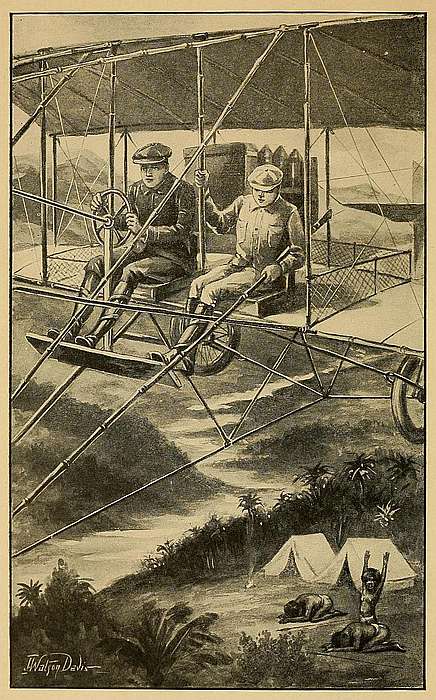
the equator. The Louise and the Bertha, the splendid
aeroplanes in which the lads had visited California
and Mexico, lay on a great plateau some
fifteen thousand feet above the level of the Pacific
ocean, and two thin tents of light oiled-silk stood
not far away.
Ben Whitcomb and Jimmie Stuart sat at the entrance
of one of the tents shivering with cold, while
Glenn Richards and Carl Nichols, in the interest of
increased warmth, chased each other around a miserable
little apology for a fire which alternately
blazed and smoldered near the aeroplanes.
“I begin to understand now how those who freeze
to death must suffer!” declared Ben, his teeth chattering
like the “bones” of an end-man in a minstrel
show.
4“You give me a pain!” grinned Jimmie. “Here
we are almost exactly under the equator, and yet
you talk of being cold!”
The boy’s lips were blue and he swung his arms
about his body in the hope of getting a livelier circulation
of blood as he spoke.
“Under the equator!” scoffed Ben. “Better
say ‘under the Arctic circle!’ What are we camping
here for, anyway?” he added impatiently,
springing to his feet. “Why not drop down into
a region where the equator isn’t covered with ice a
foot thick?”
“You wanted to pass a night up here!” laughed
Carl, stopping in front of the two boys, his eyes
dancing with mischief, his cheeks flushed from exercise.
“You told us how you wanted to breathe
the cool, sweet air of the hills! Now breathe it!”
“The cool, sweet air of the hills,” Ben retorted,
“reminds me of the atmosphere of the big refrigerator
at home.”
Glenn Richards now joined the little group and
stood laughing at the disgusted expression on the
face of his chum.
“Didn’t I tell you,” he exclaimed, “that Ecuador
is the land of contradictions? When you come
here, you bring a peck or two of quinine tablets,
a bundle or two of mosquito netting, and a couple
of bales of fans. You bring your summer clothing,
and don’t expect to wear much of that. Then you
go on a trip up-country and freeze to death where
the ice is about nine thousand feet thick!”
5“I know where all the heat goes!” Jimmie declared.
“It pours out of those big peaks you see
off there. How do you suppose the earth is going
to keep any warmth in it when it is all running out
at volcanoes?”
The boys were, perhaps, twenty miles north of
Quito, almost exactly under the equator. From the
plateau on which they were encamped several ancient
volcanoes were in plain view.
“Huh! I guess the volcanoes we see are about
burned out!” Carl declared. “At any rate, I don’t
hear of their filling in any valleys with lava.”
“I guess about all they do now is to smoke,” Ben
suggested.
“And that’s a bad habit, too!” Glenn Richards
grinned.
“Now, I’ll tell you what we’d better do, boys,”
Glenn said, after glancing disapprovingly at the
small fire. “We’d better hop on the machines and
drop down about ten thousand feet. I’ve got
enough of this high mountain business.”
“All right!” Jimmie returned. “You know
what you said about wanting experiences which
were out of the way. If you think you’ve got one
here, we’ll slide down to the green grass.”
6It was late in November and the hot, dry season
of the South American continent was on. Far below
the boys could see the dark green of luxuriant
vegetation, while all around them lay the bare brown
peaks of lofty plateaus and lifting mountain cones.
As it was somewhere near the middle of the
afternoon, the boys lost no time in packing their
camp equipage and provisions on the aeroplanes.
In order to find a suitable place for a camp lower
down they might be obliged to traverse considerable
country.
In describing this part of the continent a traveler
once crumpled a sheet of paper in his hand and
tossed it on the table, saying to a friend as he did
so that that was an outline map of the northern part
of South America. There were many gorges and
plateaus, but only a few spots where aeroplanes
might land with safety.
After quite a long flight, during which the machines
soared around cliffs and slid into valleys and
gorges, the boys found a green valley watered by
the Esmeraldas river. Here they dropped down,
and the shelter-tents were soon ready for occupancy.
“I suppose,” Carl grumbled as provisions were
taken from the flying machines and brought to the
vicinity of the fire, “that we’ll have to fight thousands
of kinds of crawling and creeping things before
morning!”
“Well,” Jimmie laughed, “you wouldn’t stay up
there where the flying and creeping things don’t
live!”
7“My private opinion,” declared Glenn, “is that
we ought to spend most of our time in the air! I
wish we could sleep on the machines!”
“Where are we going, anyhow?” demanded
Jimmie.
“We’re going to follow the backbone of the
South American continent clear to Cape Horn!”
replied Ben. “That is, if our flying machines and
our tempers hold out!”
“I have an idea,” Glenn said, “that we’ll spend
most of the time in Peru, which is probably the
oldest country in the world so far as civilization is
concerned.”
“That’s another dream!” exclaimed Carl.
“Look here,” Glenn exclaimed, “there are still
temples and palaces in Peru which date back beyond
the remotest reach of tradition. The earliest Incas
believed that many of the fortresses, castles and
temples which they found there were formed by
the gods when the world was made.”
“That’s going back a long ways!” laughed
Jimmie.
“There’s a lake in Peru called Titicaca on an
island in the middle of which lies an ancient palace
and many other structures,” Glenn went on.
“Gathered about it are the remains of a civilization
that was old when the people of Europe consisted of
a group of semi-heathen tribes wandering from
place to place. There are palaces surpassing anything
to be seen on the Rhine, and castles which had
fallen into decay before civilization began at the
mouth of the Nile.”
8“Go to it!” laughed Carl. “Make it good and
old while you’re about it!”
“On the island of Titicaca,” continued Glenn,
“are marvels in architecture which make the wonders
of Egypt look like thirty cents! There are
massive fortifications perched on the sides of almost
perpendicular cliffs, and even to-day there are
large stones carefully balanced on the verge of precipices,
ready to be pushed off at a moment’s notice
and sent crashing down on the legions of an
attacking foe.”
“Those old fellows must have been fighters!”
commented Ben.
“They were fighters, all right!” Glenn went on.
“They ruled all that part of the world until the
Spaniards came. They were very superstitious,
the sun being an object of worship. The Temple
of the Sun, on the island of Titicaca, was one of the
most magnificent structures ever erected. Outside
and inside the walls were lined with gold and precious
stones. The temple was the pride of the Incas,
but it was stripped of its rich covering by the
Spaniards. The walls were torn down and rifled,
and the sacred sun was seized and gambled for by
the covetous invaders. Nothing that could be
converted into money was overlooked. And since
that time the Incas have become one of the lowest
races on the face of the earth.”
9“I suppose we shall be able to inspect a lot of
these old temples?” asked Carl.
“Undoubtedly!” Glenn answered. “Some of
them are deserted; some are occupied by native
Indians, and some are said to be frequented by the
spirits of those who erected them.”
“Gee! That sounds good to me!” exclaimed
Jimmie.
“A haunted temple might help some!” Carl exclaimed.
“There really is a temple down on Lake
Titicaca!” declared Glenn, “which even Europeans
declare to be inhabited by the Evil One.”
“That’s where I’m headed for!” declared
Jimmie. “Any old time you show me a mystery
you’ll see me on the job!”
“There’s a mystery there, all right!” Glenn insisted.
“The temple stands on a winding arm of
the lake, and is entirely surrounded by broken
country. So difficult is it of access that for years
no one attempted to visit it. Then, a few years ago,
a party of Englishmen made their way to the ruins
and found themselves in an atmosphere of mystery
almost resembling magic.”
“What did they see?” asked Ben.
10“I don’t remember exactly what they all saw,”
Glenn answered. “Their stories do not agree!
Some saw figures in white—the long flowing robes
of priests—some saw strange lights suspended in
the air; some heard the most mournful and terrifying
sounds.”
“And these Englishmen were supposed to be
people of average intelligence?” asked Ben.
“There were scientists in the party!” was the
reply.
“There is no such word as ghost in the dictionary
of the scientist!” laughed Carl.
“Following the stories told by the visitors,”
Glenn went on, “a number of people visited the
vicinity of the temple, and all came away with tales
more vivid and more imaginative than those of the
scientists. For two years now the place has been
left entirely alone.”
“We might go there and camp!” suggested Carl.
“I move we take a look at it!” Jimmie cut in.
“We can fly down on the roof and get away before
the goblins get us.”
“I’m game for anything you boys decide on,”
Glenn declared, “but my private opinion is that it will
be only a waste of time for us to pay much attention
to the haunted temple!”
“The ghosts wouldn’t like us if we should leave
their country without making a formal call!”
laughed Carl.
11“Who’s going to get supper?” asked Jimmie in a
moment. “I feel like I could eat one of the wild
beasts which are said to flourish in this region!”
“There isn’t much supper to get!” replied Ben,
with, a laugh. “All we have is a couple of pounds
of ham, a few eggs, and a lot of tinned provisions.
There’s the river down there. Why don’t one of
you boys go and catch a fish?”
“Aw, I don’t believe there’s any fish in that
river!” grinned Jimmie. “If there are fish there,
they’ll be tough eating for they must be acrobats!”
“Why acrobats?” asked Glenn.
“Because they must stand on their heads and
turn handsprings in order to get something to eat in
that swift water!”
“I believe we can get a fish for supper, just the
same!” insisted Carl, “and I’m going to get out a
line and an imitation minnow and go try!”
“May the luck of the hungry fisherman go with
you!” laughed Ben.
“He’ll have better company than that!” Jimmie
grinned. “I’m going along myself!”
While Glenn and Ben arranged the camp for the
night Jimmie and Carl started away down the slope
leading to the river. Directly in front of the tents
the bank was clear of undergrowth, and covered
with grass almost waist high. Lower down, however,
to the west, was a great thicket which seemed
to extend for miles. The opposite shore of the
stream was heavily wooded for some distance up.
Above, the timber line showed the bare, brown
slopes of mountains.
12When the two boys reached the bank of the
stream the prospects were not attractive, the water
being broken into rapids and falls by jagged rocks
which occupied the bed of the river at this point.
To the west, however, where the stream entered
the forest, the surface of the water appeared to be
unbroken, so the lads made their way in that direction.
In a few minutes their lines were out and
almost instantly sharp twitches at the hooks informed
the boys that they were not fishing in barren
waters.
But before the first fish was landed an exciting
interruption occurred.
CHAPTER II. WHAT THE FISHERMEN CAUGHT.
13
Seated with his back to the thicket, Jimmie heard
a rustle and turned about expecting to see one of
his chums.
Instead, he saw the ugly, vicious face of an
Ecuadorian savage. While he looked, the fellow
was joined by another, equally repulsive and equally
naked. During that first moment of amazement
Jimmie dropped his fish pole and it went
bobbing down the river.
“Carl!” he said, in a low whisper.
The boy shouted back from lower down the
stream.
“Got a fish?”
“Come up and see!” cried Jimmie.
Carl came panting through the undergrowth, and
Jimmie pointed with a hand which was not quite
steady at the two figures in the underbrush just
back of him.
“Look what I’ve found!” he whispered.
14“Did you call me up to give me my share?”
asked Carl. “If you did, I don’t want it! You’re
welcome to everything you find in that line!”
“Gee!” Jimmie exclaimed. “I wish we were
back by the machines!”
“I wish so, too!” Carl put in. “I wonder why
they stand there looking at us in that way.”
“Maybe they’re out after supper, too!” remarked
Jimmie.
“Do they eat folks?” asked Carl.
“The savages who come over from the Amazon
valley eat folks,” Jimmie answered, “and those
fellows look as if they came from that neighborhood.”
“Let’s start on up toward camp and see if they
will interfere!” suggested Carl.
“Have you got a gun with you?” asked Jimmie.
“Of course not!” was the reply. “I didn’t come
out to shoot fish!”
“And I left mine at the camp, too!” Jimmie
complained. “I’ll never do it again!”
“Well, let’s make a start and see what comes of
it!” suggested Carl.
As the boys moved away the savages, men of
medium height but apparently very strong and
supple, lifted naked arms in gestures which commanded
them to remain where they were.
“I wonder if they’ve got guns?” questioned
Jimmie.
15“They’ve got little short spears!” answered
Carl. “I saw one in that fellow’s hand.”
“And I suppose they’re poisoned, too!” Jimmie
asserted.
The two savages now advanced from the thicket
and stood threateningly before the two boys. Except
for breech-clouts, which seemed to be woven of
some sort of fiber, the men were naked. In color
they were almost as dark as the negro of Africa.
Their features seemed to be a cross between the
tribes of Asia and Africa. They were armed with
short spears which they flourished with many
hostile gestures.
“Good-evening!” Jimmie said.
The savages conversed together in a dialect which
seemed to the boys to resemble a confidential conversation
between two hogs, and then pointed down
the river.
“Here’s where we get abducted!” Carl exclaimed.
“You needn’t get funny about it!” Jimmie expostulated.
“This is no joke!”
“Anyhow,” Carl went on, “the ginks don’t know
anything about good manners. They never answered
your salutation!”
The savages were still uttering what appeared
to be wordless commands, and, as they continued
to point down the river, very reluctantly the boys
started in that direction.
16“I wonder if the brutes have captured the camp,
too?” queried Jimmie.
“Oh, I suppose so!” Carl answered. “These
fellows travel in droves, like wild hogs, and I guess
we lit right in the middle of a large tribe.”
In spite of the impatience expressed by the
gestures of their captors, the boys proceeded very
slowly. As they walked they listened for some
indication of trouble at the camp. They knew that
Glenn and Ben were well armed, and that they
would not submit to capture without first putting
up a spirited defence.
“We haven’t heard any shooting yet,” Jimmie
said in a moment.
“I don’t believe there’s any use of our being
lugged off in this style!” Carl advised. “We ought
to be able to break away from these brutes and get
back to camp. The boys there are all right up to
this time, for we haven’t heard any fighting, and the
four of us ought to be able to induce these two
savages to beat it!”
“If we can only get back to the flying machines,”
Jimmie suggested, “we can get away, all right. I
believe these fellows would drop dead if they saw
the Louise or the Bertha slanting up into the air!”
“Well, then, let’s make a break!” Carl advised.
“All right!” Jimmie replied. “When we get to
the next jungle where the bushes are so thick they
can’t throw a spear very far, you duck one way and
I’ll duck the other, and we’ll both make for the
camp.”
17The boys knew very well that they were in a
perilous situation. The savages were more familiar
with travel through underbrush than themselves.
Besides, they would undoubtedly be able to make
better time than boys reared on city streets. In
addition to all this, the spears they carried might
carry death on every tip.
However, to remain seemed fully as dangerous
as to attempt to escape. So when they came to a
particularly dense bit of jungle the boys darted
away. As they did so Jimmie felt a spear whiz
within an inch of his head, and Carl felt the push
of one as it entered his sleeve. Dodging swiftly
this way and that, uttering cries designed to bring
their chums to their assistance, the boys forced their
way through the undergrowth some distance in advance
of their pursuers.
Every moment they expected to feel the sting of
a spear, or to be seized from behind by a brown,
muscular hand. After all it was their voices and
not their ability as runners which brought about
their rescue.
Hearing the cries of their chums, Ben and Glenn
sprang for their guns and, walking swiftly toward
the river, began firing, both for the purpose of
directing the boys toward the camp and with the
added purpose of frightening away any hostile
18element, either human or animal, walking on four
legs or on two. Panting, and scarcely believing in
their own good fortune, Jimmie and Carl presently
came to where their chums stood not far from the
machines. Both boys dropped down in the long
grass the instant they felt themselves under the
protection of the automatics in the hands of their
friends.
To say that Glenn and Ben were surprised at the
sudden appearance of their chums only feebly expresses
the situation. The savages had not followed
the boys into the open plaza where the grass grew,
and so there was no physical explanation of the
incident.
“What’s doing?” demanded Glenn.
“You must be running for exercise!” Ben put in.
“For the love of Mike!” exclaimed Jimmie,
panting and holding his hands to his sides. “Get
back to the machines and throw the truck on board!
These woods are full of head-hunters!”
“What did you see?” asked Ben.
“Savages!” answered Jimmie.
“They got us, too!” Carl put in.
“They did?” demanded Glenn. “Then how did
you get away?”
“Ran away!” answered Jimmie scornfully.
“You don’t suppose we flew, do you? I guess
we’ve been going some!”
19“Where are the savages now?” demanded
Glenn.
“I don’t know!” Jimmie answered. “I don’t
want to know where they are. I want to know
where they ain’t!”
“Come on!” Carl urged. “Let’s get back to
the machines!”
Glenn and Ben did not seem to take the incident
as seriously as did their chums. In fact, they were
rather inclined to make facetious remarks about
little boys being frightened at black men in the
woods. Ben was even in favor of advancing into
the thicket on a tour of investigation, but Jimmie
argued him out of the idea.
“They’re savages, all right!” the latter insisted.
“They’re naked, and they’re armed with spears.
Look to me like head-hunters from the Amazon
valley! If you go into the thicket you’re likely to
get a couple of spears into your frame!”
“Then I won’t go!” Ben grinned.
“Come on,” urged Carl, “it’s getting dark, so
we’d better be getting back to camp! Perhaps the
niggers have beaten us to it already!”
“I guess the two you saw are about the only ones
in the vicinity,” answered Glenn.
“You’d feel pretty cheap, wouldn’t you, if you’d
get back to camp and find that the savages had
taken possession?” demanded Jimmie.
20Thus urged, Glenn and Ben finally abandoned
the idea of advancing into the forest. Instead, they
turned their faces toward the camp, and all four boys
advanced with ever-increasing speed as they neared
the spot where the aeroplanes and the tents had
been left.
About the first thing they saw as they came
within sight of the broad planes of the flying
machines was a naked savage inspecting the motors.
He stood like a statue before the machine for an
instant and then glided away. They saw him turn
about as he came to a cluster of underbrush, beckon
silently to some one, apparently on the other side
of the camp, and then disappear.
“And that means,” Glenn whispered, “that the
woods are full of ’em!”
“Oh, no,” jeered Jimmie, “the two we saw are
the only ones there are in the woods! I guess you’ll
think there is something in the story we told about
being captured and abducted!”
The short tropical twilight had now entirely
passed away. It seemed to the boys as if a curtain
had been drawn between themselves and the tents
and flying machines which had been so plainly in
view a moment before. There was only the glimmer
of the small camp-fire to direct them to their camp.
“Who’s got a searchlight?” asked Glenn.
“I have!” replied Ben. “I never leave the camp
without one!”
21“Then use it!” advised Glenn, “and we will
make for the machines.”
“Don’t you do it!” advised Jimmie. “They’ll
throw spears at us!”
“Well, we’ve got to have a light in order to get
the machines away!” declared Carl. “Perhaps the
niggers will run when they see the illumination.
The light of a searchlight at a distance, you know,
doesn’t look like anything human or divine!”
It was finally decided to advance as cautiously and
silently as possible to the camp and spring at once to
the machines.
“We’ll never be clear of these savages until we
get up in the air!” declared Ben.
“But that will leave our tents and our provisions,
and about everything we have except the machines,
behind!” wailed Carl.
“It won’t leave all the provisions behind!” declared
Jimmie. “I’ll snatch beans and bread if I
get killed doing it!”
During their progress to the camp the boys neither
saw nor heard anything whatever of the savages.
They found the fire burning brightly and the provisions
which had been set out for supper just as they
had been left. The machines had not been molested.
In fact, the statue-like savage they had observed
examining the flying machine now seemed to have
come out of a dream and retreated to his world of
shadows again.
22“Perhaps it won’t be necessary to leave here to-night,”
Glenn suggested.
“I don’t think it’s safe to remain,” Ben contended.
“You boys may stay if you want to!” Jimmie
exclaimed. “But Carl and I have had enough of
this neck of the woods. We’ll take the Louise and
fly over to Quito, and you can find us there when
you get ready to move on. You boys certainly take
the cake for not knowing what’s good for you!” he
added with a grin.
“Oh, well, perhaps we’d all better go!” Glenn
advised. “I don’t see anything nourishing in this
part of the country, anyway. If you boys had only
brought home a couple of fish it might have been
different. I’m of the opinion that a square meal at
Quito wouldn’t come amiss just now.”
“It’s so blooming dark I don’t know whether we
can find the town or not,” suggested Carl.
“Oh, we can find it all right!” insisted Ben.
“If the savages let us!” exclaimed Jimmie excitedly.
CHAPTER III. A MASTERLY RETREAT.
23
“I don’t see any savages!” replied Glenn.
“Can’t you hear them?” demanded Jimmie.
“I think I can smell something!” Carl exclaimed.
“Don’t get gay, now!” Jimmie answered.
“This is no funny business! If you’ll listen, you’ll
hear the snakes creeping through the grass.”
The boys listened intently for an instant and then,
without looking into the tents, sprang toward the
machines. It seemed for a moment as if a thousand
voices were shouting at them. They seemed
to be in the center of a circle of men who were
all practicing a different style of war-whoop.
To this day the boys assert that it was the whirling
of the electric searchlights which kept the
savages from advancing upon them. At any rate,
for a time, the unseen visitors contented themselves
with verbal demonstrations.
“We’ll have to jump out on the machines!”
advised Glenn. “We can’t fight a whole army!”
24“Why, there’s only two!” Jimmie taunted.
“You said yourself that we saw all the black men
there were in this neighborhood!”
“Aw, keep still,” Ben cried. “We haven’t got
time to listen to you boys joke each other! Come
on, Jimmie! You and I for the Louise!”
It was now very dark, for banks of clouds lay
low in the valley, but the boys knew that the
machines were situated so as to run smoothly until
the propellers and the planes brought them into the
air. They had provided for that on landing.
With a chorus of savage yells still ringing in their
ears, the boys leaped into their seats, still swinging
their searchlights frantically as their only means of
protection, and pressed the starters. The machines
ran ahead smoothly for an instant then lifted.
The next minute there was absolute silence below.
The boys were certain that if they could have looked
down upon the savages who had been so threatening
a moment before they would have seen them on
their knees with their faces pressed to the ground.
“They’ll talk about this night for a thousand
years!” Jimmie screamed in Ben’s ear as the Louise
swept into and through a stratum of cloud.
“They’ll send it down to future generations in
legends of magic.”
“Little do we care what they think of us after
we get out of their clutches!” Ben called back. “It
seems like a miracle, our getting away at all!”
25“Do you really think they are head-hunters?”
shouted Jimmie.
“You saw more of them than I did,” Ben
answered.
After passing through the clouds the starlight
showed the way, and in a very short time the lights
of Quito were seen glittering twenty miles or so to
the south.
“What are we going to do when we get to the
town?” shouted Jimmie.
“Hire some one to watch the machines and get a
square meal!” Ben replied. “And buy new tents
and provisions and everything of that kind!” he
went on. “I suppose those savages will have a fine
time devouring our perfectly good food.”
“And they’ll probably use the oiled-silk tents
for clothing!” laughed Jimmie. “I wonder if we
can buy more at Quito.”
“Of course we can!” replied Ben. “Quito has
a hundred thousand inhabitants, and there are plenty
of European places of business there!”
The Bertha with Glenn and Carl on board was
some distance in advance, and directly the boys on
the Louise saw the leading machine swing about
in a circle and then gradually drop to the ground.
Ben, who was driving the Louise, adopted the same
tactics, and very soon the two flying machines lay
together in an open field, perhaps a mile distant
from Quito, the capital of Ecuador, the city known
throughout the world as the “City of Eternal
Spring.”
26It was dark at the ground level, there being only
the light of the stars, faintly seen through drifting
masses of clouds, many hundred feet higher here
than those which had nestled over the valley.
“What next?” asked Carl as the four boys
leaped from their seats and gathered in a little
group.
“Supper next!” shouted Jimmie.
“But we can’t all leave the machines!” declared
Glenn.
“Don’t you ever worry about the machines being
left alone!” asserted Ben. “Our lights will bring
about a thousand people out here within the next ten
minutes. Dark as it is, our machines were undoubtedly
seen before we landed, and there’ll soon
be an army here asking questions. We’ll have little
trouble in finding English-speaking people in the
mob.”
“I guess that’s right!” Jimmie agreed. “Here
comes the gang right now!”
A jumble of English, Spanish and French was
now heard, and directly a dozen or more figures
were seen advancing across the field to where the
flying machines had landed.
“There’s some one talking United States, all
right!” Jimmie declared.
27Directly the visitors came up to where the boys
were standing and began gazing about, some impudently,
some curiously and some threateningly.
“Keep your hands off the machines!” Glenn
warned, as a dusky native began handling the levers.
The fellow turned about and regarded the boy
with an impudent stare. He said something in
Spanish which Glenn did not understand, and then
walked away to a group of natives who were whispering
suspiciously together.
“Where are you from?” asked a voice in English
as Glenn examined the levers to see that nothing
had been removed or displaced.
“Gee!” exclaimed Jimmie. “That United
States talk sounds good to me!”
The man who had spoken now turned to Jimmie
and repeated his question.
“Where do you boys come from?”
“New York,” Jimmie replied.
“And you came across the Isthmus of Panama?”
was the next question.
“Sure we did!” answered the boy.
“Well,” the stranger said, “my name is Bixby,
Jim Bixby, and I’ve been looking for you for two
days.”
“Is that so?” asked Jimmie incredulously.
“You see,” Bixby went on, “I am a dealer in
automobile supplies, probably the only one doing a
large business in this part of the country. Some
days ago I received a telegram from Louis Havens,
28the millionaire aviator, saying that four pupils of
his were coming this way, and advising me to take
good care of you.”
“Where did Mr. Havens wire from?” asked
Jimmie.
“First from New York,” was the reply, “and
then from New Orleans. It seems that he started
away from New York on the day following your departure,
and that he has been having trouble with
the Ann all the way down. His last telegram instructed
me to ask you to wait here until his arrival.
He ought to be here sometime to-morrow.”
“That’ll be fine!” exclaimed Jimmie.
“And now,” Bixby went on, “you’ll have to
employ two or three fellows to watch your machines
for the night. The natives would carry them away
piecemeal if you left them here unguarded.”
“Perhaps you can pick out two or three trusty
men,” suggested Glenn.
“I have had three men in mind ever since I received
my first message from Mr. Havens!” replied
Bixby. “When your machine was sighted in
the air not long ago, I ’phoned to their houses and
they will undoubtedly be here before long.”
“How’ll they know where to come?” asked
Jimmie.
“Don’t you think that half the people in Quito
don’t know where these wonders of the air
lighted!” Bixby laughed. “The news went over
29the city like lightning when your planes showed.
Your lights, of course, revealed your exact whereabouts
to those on this side of the town, and telephones
and messenger boys have done the rest.”
While the boys talked with this very welcome
and friendly visitor, the clamor of an automobile
was heard, and directly two great acetylene eyes
left the highway and turned, bumping and swaying,
into the field.
“There will be damages to pay for mussing up
this grass!” Carl suggested, as a fresh crowd of
sight-seers followed the machine into the enclosure.
“Of course,” replied Bixby, “and they’ll try to
make you pay ten times what the damage really
amounts to. But you leave all that to me. I can
handle these fellows better than you can!”
“We shall be glad to have you do so!” Glenn
replied.
In a moment the automobile ran up to the planes
and stopped. Of the four men it contained, three
alighted and approached Bixby.
“These are the guards,” the latter said turning
to the boys.
The men, who seemed both willing and efficient,
drew a long rope and several steel stakes from the
automobile and began enclosing the machines with
the same. As the rope was strung out, the constantly
increasing crowd was pushed back beyond
the circle.
30“Won’t they make trouble for the guards during
the night?” asked Ben.
“I think not,” was the reply. “I have already
arranged for a number of native policemen to assist
these men.”
“Gee!” exclaimed Carl, “I guess Mr. Havens
picked out the right man!”
“How did he know we were going to stop at
Quito?” asked Ben.
“He didn’t know!” replied Bixby. “But he
surmised that you’d be obliged to land here in order
to fill your fuel tanks.”
“Well, we didn’t come here for that purpose,”
laughed Glenn. “We came here because the savages
chased us out of a cute little valley about twenty
miles away!”
“It’s a wonder you got away at all if they saw
you!” said Bixby.
“I guess they didn’t seem to understand about
our motors getting into the air!” laughed Jimmie.
“The minute the wheel left the ground their war-cries
ceased.”
“It’s a wonder you were permitted to get to the
machines at all if they caught you away from
them!” said Bixby.
“Aw, we always have the luck of the Irish,”
Jimmie replied. “The shooting and the display of
electric searchlights kept them away until we got
into the seats and our way of ascending into the
sky did the rest.”
31“You are very lucky boys!” insisted Bixby.
“It’s nice to hear you say so!” Ben answered,
“because we’re going to follow this line of mountains
down to Cape Horn, and visit every ruined
temple on the route that has a ghost on its visiting
list.”
“If you’ll listen to the stories you hear in the
cities,” laughed Bixby, “you’ll visit a good many
ruined temples.”
“Glenn was telling us about a temple down on
Lake Titicaca,” Ben replied. “He says that figures
in flowing white robes appear in the night-time,
and are seen by the light that emanates from their
own figures! He says, too, that there are illuminations
of red, and green, and yellow, which come
from no determinable source, and that there are
noises which come out of the clear air unaccounted
for!”
“There is such a temple, isn’t there, Mr.
Bixby?” asked Glenn.
“There is a temple about which such stories are
told,” laughed Bixby. “Are you boys thinking of
going there?”
“Sure thing, we’re going there!” asserted
Jimmie.
32During this conversation the three men who had
been employed by Bixby to guard the flying
machine during the night had been standing by in
listening attitudes. When the haunted temple and
the proposed visit of the boys to it was mentioned,
one of them whose name had been given as Doran,
touched Jimmie lightly on the shoulder.
“Are you really going to that haunted temple?”
he asked.
Jimmie nodded, and in a short time the four boys
and Bixby left for the city in the automobile. As
they entered the machine Jimmie thought that he
caught a hostile expression on Doran’s face, but the
impression was so faint that he said nothing of the
matter to his chums.
In an hour’s time Bixby and the four boys were
seated at dinner in the dining-room of a hotel which
might have been on Broadway, so perfect were its
appointments.
“Now let me give you a little advice,” Bixby
said, after the incidents of the journey had been
discussed. “Never talk about prospective visits to
ruined temples in South America. There is a general
belief that every person who visits a ruin is in
quest of gold, and many a man who set out to
gratify his own curiosity has never been heard of
again!”
CHAPTER IV. PLANNING A MIDNIGHT RIDE.
33
“If the people of the country believe there is
gold in the temples said to be haunted,” Glenn asked,
“why don’t they hunt for it themselves, without
waiting for others to come down and give them a
tip?”
“Generally speaking,” replied Bixby, “every
ruin in Peru has been searched time and again by
natives. Millions of treasure has been found, but
there is still the notion, which seems to have been
born into every native of South America, that untold
stores of gold, silver and precious stones are still
concealed in the ruined temples.”
“What I can’t understand is this,” Glenn declared.
“Why should these natives, having every
facility for investigation, follow the lead of
strangers who come here mostly for pleasure?”
34“I can’t understand that part of it myself,”
Bixby replied, “except on the theory that the natives
ascribe supernatural powers to foreigners. Even
the most intelligent natives who do not believe in
the magic of Europeans, watch them closely when
they visit ruins, doubtless on the theory that in some
way the visitors have become posted as to the location
of treasure.”
“Well,” Ben observed, “they can’t make much
trouble for us, because we can light down on a
temple, run through it before the natives can get
within speaking distance, and fly away again.”
“All the same,” Bixby insisted, “I wouldn’t talk
very much about visiting ruins of any kind. And
here’s another thing,” he went on, “there are stories
afloat in Peru that fugitives from justice sometimes
hide in these ruins. And so, you see,” he added
with a laugh, “you are likely to place yourself in
bad company in the minds of the natives by being
too inquisitive about the methods of the ancient
Incas.”
“All right,” Glenn finally promised, “we’ll be
careful about mentioning ruins in the future.”
After dinner the boys went to Bixby’s place of
business and ordered gasoline enough to fill the
tanks. They also ordered an extra supply of
gasoline, which was to be stored in an auxiliary
container of rubber made for that purpose.
35“Now about tents and provisions?” asked Bixby.
“Confound those savages!” exclaimed Jimmie.
“We carried those oiled-silk shelter-tents safely
through two long journeys in the mountains of
California and Mexico, and now we have to turn
them over to a lot of savages in Ecuador! I believe
we could have frightened the brutes away by doing
a little shooting! Anyway, I wish we’d tried it!”
“Not for mine!” exclaimed Carl. “I don’t want
to go through the country killing people, even if
they are South American savages.”
“I may be able to get you a supply of oiled-silk
in Quito,” Bixby suggested, “but I am not certain.
It is very expensive, you understand, of course, and
rather scarce.”
“The expense is all right,” replied Glenn, “but
we felt a sort of sentimental attachment for those
old shelter-tents. We can get all the provisions we
need here, of course?” he added.
“Certainly,” was the reply.
“Look here!” Jimmie cut in. “What time will
there be a moon to-night?”
36“Probably about one o’clock,” was the reply.
“By that time, however, you ought all to be sound
asleep in your beds.”
“What’s the idea, Jimmie?” asked Carl.
The boys all saw by the quickening expressions
in the two boys’ faces that they had arrived at an
understanding as to the importance of moonlight on
that particular night.
“Why, I thought—” began Jimmie. “I just
thought it might not do any harm to run back to that
peaceful little glade to see if the tents really have
been removed or destroyed!”
“Impossible!” advised Bixby. “The tents may
remain just where you left them, but, even if they
are there, you may have no chance of securing them.
It is a risky proposition!”
“What do you mean?” asked Ben.
“I mean that the superstition of the savages may
restrain them from laying hands on the tents and
provisions you left,” replied Bixby, “but, at the
same time,” he continued, “they may watch the old
camp for days in the hope of your return.”
“What’s the idea?” asked Glenn.
“Do they want to eat us?” asked Jimmie.
37“Some of the wild tribes living near the head
waters of the Amazon,” Bixby explained, “are
crazy over the capture of white men. They are said
to march them back to their own country in state,
and to inaugurate long festivals in honor of the
victory. And during the entire festival,” Bixby
went on, “the white prisoners are subjected to
tortures of the most brutal description!”
“Say,” giggled Jimmie, giving Carl a dig in the
ribs with his elbow, “let’s take the train for
Guayaquil to-morrow morning! I don’t think it’s
right for us to take chances on the savages having
all the fun!”
“As between taking the first train for Guayaquil
and taking a trip through the air to the old camp
to-night,” Bixby laughed, “I certainly advise in
favor of the former.”
“Aw, that’s all talk,” Ben explained, as Bixby,
after promising to look about in the morning for
oiled-silk and provisions, locked his place of business
and started toward the hotel with the boys.
“What do you say to it, Carl?” Jimmie asked,
as the two fell in behind the others.
“I’m game!” replied Carl.
“Then I’ll tell you what we’ll do!” Jimmie explained.
“You and I will get a room together and
remain up until moonrise. If the sky is clear of
38clouds at that time, and promises to remain so until
morning, we’ll load ourselves down with all the
guns we can get hold of and fly out to the old camp.
It’ll be a fine ride, anyway!”
“Pretty chilly, though, in high altitudes at this
time of night,” suggested Carl. “I’m most frozen
now!”
“So’m I,” Jimmie replied, “and I’ll tell you what
we’ll do! When we start away we’ll swipe blankets
off the bed. I guess they’ll keep us warm.”
“Well, we’ll have to keep Glenn and Ben from
knowing anything about the old trip,” Carl suggested.
“Of course they couldn’t prevent us going,
but they’d put up a kick that would make it unpleasant.”
“Indeed they would!” answered Jimmie. “But,
at the same time, they’d go themselves if they’d got
hold of the idea first. I suggested it, you know,
and that’s one reason why they would reject it.”
Arrived at the hotel, Jimmie and Carl had no
difficulty in getting a double room, although their
chums looked rather suspiciously at them as they all
entered the elevator.
39“Now,” said Ben, “don’t you boys get into any
mischief to-night. Quito isn’t a town for foreigners
to explore during the dark hours!”
“I’m too sleepy to think of any midnight adventures!”
cried Jimmie with a wink and a yawn.
“Me, too!” declared Carl. “I’ll be asleep in
about two minutes!”
It was about ten o’clock when the boys found
themselves alone in a large room which faced one
of the leading thoroughfares of the capital city.
Quito is well lighted by electricity, and nearly all the
conveniences of a city of the same size in the United
States are there to be had.
The street below the room occupied by the two
boys was brilliantly lighted until midnight, and the
lads sat at a window looking out on the strange and
to them unusual scene. When the lights which
flashed from business signs and private offices were
extinguished, the thoroughfare grew darker, and
then the boys began seriously to plan their proposed
excursion.
“What we want to do,” Jimmie suggested, “is
to get out of the hotel without being discovered and
make our way to a back street where a cab can be
ordered. It is a mile to the field where the machines
were left, and we don’t want to lose any time.”
40Before leaving the room the boys saw that their
automatic revolvers and searchlights were in good
order. They also made neat packages of the woolen
blankets which they found on the bed and carried
them away.
“Now,” said Jimmie as they reached a side street
and passed swiftly along in the shadow of a row
of tall buildings, “we’ve got to get into a cab
without attracting any attention, for we’ve stolen
the hotel’s blankets, and we can’t talk Spanish, and
if a cop should seize us we’d have a good many explanations
to make.”
“I don’t think it’s good sense to take the
blankets,” Carl objected.
“Aw, you’ll think so when we get a couple of
thousand feet up in the air on the Louise!” laughed
Jimmie.
After walking perhaps ten minutes, the boys came
upon a creaking old cab drawn by a couple of the
sorriest-looking horses they had ever seen. The
driver, who sat half asleep on the seat, jumped down
to the pavement and eyed the boys suspiciously as
they requested to be taken out to where the machines
had been left.
41The lads were expecting a long tussle between the
English and the Spanish languages, but the cabman
surprised them by answering their request in excellent
English.
“So?” exclaimed Jimmie. “You talk United
States, too, do you? Where did you come from?”
“You want to go out to the machines, do you?”
asked the cabman, without appearing to notice the
question.
“That’s where we want to go!” replied Carl.
“What for?” asked the cabman.
“None of your business!” replied Jimmie.
“I’ve been out there once to-night!” said the
cabman, “and the party I drew beat me out of my
fare.”
“That’s got nothing to do with us!” replied
Carl.
“It’ll cost you ten dollars!” growled the cabman.
“Say, look here!” Jimmie exclaimed. “You’re
a bigger robber than the New York cabmen! It’s
only a mile to the field, and we’ll walk just to show
you that we don’t have to use your rickety old cab.”
With a snarl and a frown the cabman climbed
back up on his seat and gave every appearance of
dropping into sound slumber.
42“Now what do you think of that for a thief?”
asked Carl, as the boys hastened away toward the
field. “I’d walk ten miles before I’d give that fellow
a quarter!”
“We’ve got plenty of time,” Jimmie answered.
“The moon won’t be up for an hour yet. Perhaps
we’d better walk up anyway, for then we can enter
the field quietly and see what’s going on.”
On the way out the lads met several parties returning
from the field, and when they reached the
opening in the fence they saw that many curious
persons were still present. There were at least half
a dozen vehicles of different kinds gathered close
about the roped-off circle.
“Say,” Carl exclaimed as the boys passed into
the field, “look at that old rattletrap on the right.
Isn’t that the same vehicle the cabman pretended
to go asleep on as we came away?”
“Sure it is!” answered Jimmie. “I don’t remember
the appearance of the cab so well, but I
know just how the horses looked.”
“He must have found a ten-dollar fare out
here!” Carl suggested.
43“Yes, and he must have come out by a roundabout
way in order to prevent our seeing him. Now
what do you think he did that for? Why should
he care whether we see him or not?”
As the boy asked the question the rig which they
had been discussing was driven slowly away, not
in the direction of the road, but toward the back end
of the field.
“Something mighty funny going on here!”
Jimmie declared. “I guess it’s a good thing we
came out.”
When the boys came up to where the machines
were lying, Doran was the first one to approach.
“Little nervous about your machines, eh?” he
asked.
“Rather,” replied Jimmie. “We came out with
the idea of taking a short trip to see if they still
are in working order.”
“Well,” Doran said with a scowl, “of course
you know that you can’t take the machines out without
an order from Mr. Bixby!”
CHAPTER V. A WAIF AND A STRAY.
44
“Bixby doesn’t own these machines!” exclaimed
Carl angrily.
“Who does own them?” demanded Doran.
“We four boys own them!” was the reply.
“Well, you’ve got to show me!” insisted Doran,
insolently.
“I’ll tell you what we’ll do!” Jimmie announced.
“We’ll go right back to Bixby and put you off the
job!”
“Go as far as you like,” answered Doran. “I
was put here to guard these machines and I intend
to do it. You can’t bluff me!”
While the boys stood talking with the impertinent
guard they saw two figures moving stealthily about
the aeroplanes. Jimmie hastened over to the Louise
and saw a man fumbling in the tool-box.
“What are you doing here?” demanded the boy.
45The intruder turned a startled face for an instant
and then darted away, taking the direction the
cab had taken.
Carl and Doran now came running up and Jimmie
turned to the latter.
“Nice old guard you are!” he almost shouted.
“Here you stand talking with us while men are
sneaking around the machines!”
“Was there some one here?” asked Doran in
assumed amazement.
“There surely was!” replied Jimmie. “Where
are the other guards?”
“Why,” replied Doran hesitatingly, “they got
tired of standing around doing nothing and went
home. It’s pretty dull out here.”
“Well,” Jimmie answered, “I’m going to see if
this machine has been tampered with! Get up on
one of the seats, Carl,” he said with a wink, “and
we’ll soon find out if any of the fastenings have been
loosened.”
The boy was permitted to follow instructions
without any opposition or comment from Doran,
and in a moment Jimmie was in the other seat with
the wheels in motion.
46Seeing too late the trick which had been played
upon him, Doran uttered an exclamation of anger
and sprang for one of the planes. His fingers just
scraped the edge of the wing as the machine, gathering
momentum every instant, lifted from the ground,
and he fell flat.
He arose instantly to shake a threatening fist at
the disappearing aeroplane. Jimmie turned back
with a grin on his freckled face.
“Catch on behind,” he said, “and I’ll give you a
ride!”
“Did you see some one fumbling around the
machine?” asked Carl, as Jimmie slowed the motors
down a trifle in order to give a chance for conversation.
“Sure, I did!” was the reply. “He ducked
away when he saw me coming, and ran away into
the field in the direction taken by the cab.”
“Gee!” exclaimed Carl. “Do you think the
cabman brought that man out to work some mischief
with the flying machines?”
“I don’t think much about it,” Jimmie answered,
“because I don’t know much about it! He might
have done something to the machine which will
cause us to take a drop in the air directly, but I don’t
think so. Anyhow, it’s running smoothly now.”
“Still we’re taking chances!” insisted Carl.
47The moon now stood well up in the eastern sky,
a round, red ball of fire which looked to the lads
large enough to shadow half the sky a little later
on. Below, the surface of the earth was clearly
revealed in its light.
“We’ll have to hurry!” Carl suggested, “if we
get back to the hotel before daylight, so I’ll quit
talking and you turn on more power.”
“I may not be able to find this blooming old
valley where we left the tents,” Jimmie grumbled.
“If you remember, son, we left that locality in
something of a hurry!”
“I certainly remember something which looked
to me like a jungle scene in a comic opera!” grinned
Carl. “And the noise sounded not unlike some of
the choruses I have heard in little old New York!”
Jimmie drove straight north for an hour, and
then began circling to left and right in search of the
little valley from which they had fled so precipitously.
At last the gleam of running water
caught his eyes and he began volplaning down.
“Are you sure that’s the place?” asked Carl,
almost screaming the words into Jimmie’s ears.
“I don’t see any tents down there, do you?”
48“I see something that looks like a tent,” Jimmie
answered. “We are so high up now that we
couldn’t distinguish one of them anyhow.”
As the aeroplane drove nearer to the earth, a
blaze flared up from below. In its red light they
saw the two shelter-tents standing in exactly the
same position in which they had been left.
“There!” cried Jimmie. “I had an idea we’d
find them!”
“But look at the fire!” cautioned Carl. “There’s
some one there keeping up that blaze!”
“That’s a funny proposition, too!” exclaimed
Jimmie. “It doesn’t seem as if the savages would
remain on the ground after our departure.”
“And it doesn’t seem as if they would go away
without taking everything they could carry with
them, either!” laughed Carl.
“We can’t guess it out up here,” Jimmie argued.
“We may as well light and find out what it means.
Have your guns ready, and shoot the first savage
who comes within range.”
When the rubber-tired wheels of the machine
struck the ground which they had occupied only a
short time before, the boys found a great surprise
awaiting them. As if awakened from slumber by
the clatter of the motors, a figure dressed in nondescript
European costume arose from the fire,
yawning and rubbing his eyes, and advanced to meet
them.
49It was the figure of a young man of perhaps eighteen,
though the ragged and soiled clothing he wore,
the unwashed face, the long hair, made it difficult
for one to give any accurate estimate as to the years
of his life. He certainly looked like a tramp, but
he came forward with an air of assurance which
could not have been improved upon by a millionaire
hotel-keeper, or a haughty three-dollar-a-week
clerk in a ten-cent store.
“Je-rusalem!” exclaimed Jimmie. “Now
what do you think of this?”
“I saw him first!” declared Carl.
“All right, you may have him!”
The intruder came forward and stood for a moment
without speaking, regarding the boys curiously
in the meantime.
“Well,” Jimmie said in a moment, “what about
it?”
“I thought you’d be back,” said the other.
“Where are the savages?” asked Carl. “Didn’t
you bump into a war party here?”
The stranger smiled and pointed to the tents.
50“I am a truthful man,” he said. “I wouldn’t
tell a lie for a dollar. I might tell six for five dollars,
but I wouldn’t tell one lie for any small sum.
My name is Sam Weller, and I’m a tramp.”
“That’s no lie!” exclaimed Jimmie. “Unless
appearances are deceiving!”
“Perhaps,” Carl suggested, “we’d better be
getting out of here. The natives may return.”
“As soon as you have given me time to relate
a chapter of my life,” Sam Weller continued,
“you’ll understand why the savages won’t be back
here to-night.”
“Go on!” Jimmie grunted. “Tell us the story
of your life, beginning with the poor but dishonest
parents and the statement that you were never
understood when you were a baby!”
“This chapter of my life,” Sam went on, without
seeming to notice the interruption, “begins shortly
after sunset of the evening just passed.”
“Go ahead!” Carl exclaimed. “Get a move
on!”
“While walking leisurely from the Isthmus of
Panama to Cape Horn,” Sam began, “I saw your
two flying machines drop down into this valley.
At that time,” he continued, “I was in need of
51sustenance. I am happy to state, however,” he
added with a significant look in the direction of
half a dozen empty tin cans, “that at the present
moment I feel no such need. For the present I am
well supplied.”
“Holy Mackerel!” exclaimed Carl. “But you’ve
got your nerve.”
“My nerve is my fortune!” replied Sam
whimsically. “But, to continue my narrative,”
he went on. “It seemed to me a dispensation of
providence in my favor when you boys landed in
the valley. In my mind’s eye, I saw plenty to eat
and unexceptionable companionship. You were so
thoroughly interested in landing that I thought it
advisable to wait for a more receptive mood in which
to present my petition for—for—well, not to put
too fine a point upon it, as Micawber would say—for
grub.”
“Say!” laughed Carl. “It’s a sure thing you’ve
panhandled in every state in the union.”
Sam smiled grimly but continued without comment.
“So I hid myself back there in the tall grass and
waited for you to get supper. Don’t you see,” he
went on, “that when a boy’s hungry he doesn’t
52radiate that sympathy for the unfortunate which
naturally comes with a full stomach. Therefore, I
waited for you boys to eat your supper before I
asked for mine.”
“You’re all right, anyhow!” shouted Jimmie.
“But it seems that your meal was long-delayed,”
Sam went on, with a little shrug of disgust. “I lay
there in the long grass and waited, hoping against
hope. Then you two went after fish. Then in a
short time I heard cries of terror and supplication.
Then your two friends rushed out to your assistance.
Then, being entirely under the influence of hunger
and not responsible for my acts, I crawled into one
of the tents and began helping myself to the provisions.”
“And you were there when the savages flocked
down upon us?” asked Carl. “You saw what took
place after that?”
“I was there and I saw,” was the reply. “When
you boys came running back to the machines I stood
ready to defend you with my life and two automatic
revolvers which I had found while searching through
the provisions. When you sprang into the machines
and slipped away, leaving the savages still hungry, I
felt that my last hour had come. However, I clung
to the guns and a can of a superior brand of beans
put up at Battle Creek, Michigan.”
53“How did you come out with the Indians?”
asked Carl. “Did you tell them the story of your
life?”
“Hardly!” was the laughing reply. “I appeared
at the door of the tent in a chastened mood,
it is true, ready for peace or war, but when I saw
the savages lying upon their hands and elbows, faces
bowed to the tall grass, I reached the conclusion
that I had them—well Buffaloed!”
“The machines did it?” asked Jimmie.
“The machines did it!” replied Sam. “The
Indians bowed their heads for a long time, and then
gazed in awe at the disappearing aeroplanes. As I
said a moment ago, they were Buffaloed. When
they saw me standing at the door of the tent, they
looked about for another machine. So did I for a
matter of fact, for I thought I needed one just about
then!”
“Can you run a machine?” asked Carl.
“Sure I can run a machine!” was the reply.
“I can run anything from a railroad train to a
race with a township constable. Well, when the
machines disappeared, the savages vanished. Not a
54thing about the camp was touched. I appointed myself
custodian, and decided to remain here until you
came back after your tents.”
“Then where are you going?” asked Carl.
“With your permission, I will place three days’
provisions under my belt and be on my way.”
“Not three days’ supplies all at once?” questioned
Jimmie.
“All at once!” replied Sam.
The two boys consulted together for a moment,
and then Jimmie said:
“If you’ll help us pack the tents and provisions
on the machine, we’ll take you back to Quito with
us. That is, if the Louise will carry so much weight.
I think she will, but ain’t sure.”
“It surely will be a treat to ride in the air
again!” declared the tramp. “It has been a long
time since Louis Havens kicked me out of his
hangar on Long Island for getting intoxicated and
filling one of the tanks with beer instead of gasoline.”
The boys smiled at each other significantly, for
they well remembered Mr. Havens’ story of the
tramp’s rather humorous experience at the Long
Island establishment. However, they said nothing
to Sam of this.
55“And, in the meantime,” the tramp said, pointing
upward, “we may as well wait here until we ascertain
what that other machine is doing in the air
at this time of night!”
CHAPTER VI. AUTOMOBILE VS. AEROPLANE.
56
Shortly after midnight Ben was awakened by a
noise which seemed to come from the door of his
room. Half asleep as he was, it came to his consciousness
like the sparkling of a motor. There
was the same sharp tick, tick, tick, with regular
pauses between.
As he sat up in bed and listened, however, the
sounds resolved themselves into the rattle of one
metal against another. In a minute he knew that
some one unfamiliar with the lock of his door was
moving the stem of a key against the metal plate
which surrounded the key-hole.
Then he heard the bolt shoot back and the door
opened. There was an electric switch on the wall
within reach of his hand, and in a second the room
was flooded with light. The person who stood in
the center of the floor, halfway between the doorway
and the bed, was an entire stranger to the boy.
57He was dressed in clothing which would not have
been rejected by the head waiter of one of the lobster
palaces on Broadway, and his manner was
pleasing and friendly.
He smiled and dropped into a chair, holding out
both hands when he saw Ben’s eyes traveling from
himself to an automatic revolver which lay on a
stand at the head of the bed.
“Of course,” he said, then, as Ben sat down on
the edge of the bed, “you want to know what I’m
doing here.”
“Naturally!” replied the boy.
The man, who appeared to be somewhere near the
age of twenty-five, drew a yellow envelope from his
pocket and tossed it over to Ben.
“I am manager at the Quito telegraph office!”
he said. “And I received this despatch for you
just before twelve o’clock. In addition to this I
received a personal message from Mr. Havens.
Read your message and then I will show you
mine!”
Ben opened the envelope and read:
58“Be sure and wait for me at the point where this
message is delivered. Complications which can only
be explained in person!”
The manager then passed his own despatch over
to the boy. It read as follows:
“Mr. Charles Mellen, Manager: Spare no expense
in the delivery of the message to Ben Whitcomb.
If necessary, wire all stations on your circuit
for information regarding aeroplanes. If
Whitcomb is at Quito, kindly deliver this message
in person, and warn him to be on the watch for
trouble. I hope to reach your town within twenty-four
hours.”
“Now for an explanation regarding my surreptitious
entrance into your sleeping room,” Mellen
went on. “My room is next to yours, and in order
not to awaken other sleepers, and at the same time
make certain that you understood the situation
thoroughly, I tried my hand at burglary.”
“I am glad you did!” replied Ben. “For if there
is anything serious in the air it is quite important
that no stir be created in the hotel at this hour of
the night.”
“That was just my idea!” Mellen answered. “I
knew that if I asked the clerk to send a page to
your room every person in the hotel would know all
59about the midnight visit in the morning. So far as
I know, understand, the complications hinted at by
Mr. Havens may have had their origin in Quito—perhaps
in this very hotel.”
“It was very thoughtful of you,” answered Ben.
“You know Mr. Havens personally?” he asked
then.
“Certainly!” was the reply. “He is a heavy
stock-holder in the company I represent; and it was
partly through his influence that I secured my present
position.”
“After all,” smiled Ben, “this is a small world,
isn’t it? The idea of finding a friend of a friend
up near the roof of the world!”
“Yes, it’s a small world,” replied Mellen. “Now
tell me this,” he went on, “have you any idea as to
what Mr. Havens refers in his two rather mysterious
messages?”
“Not the slightest!” was the reply.
“I wish we knew where to find Havens at this
time,” mused Mellen.
“I don’t think it will be possible to reach him
until he wires again,” Ben answered, “because, unless
I am greatly mistaken, he is somewhere between
New Orleans and this point in his airship, the Ann.”
60“I gathered as much from his messages to
Bixby,” replied Mellen. “You see,” the manager
went on, “I got in touch with Havens to-night
through the despatches he sent to Bixby yesterday,
I say ‘yesterday’ because it is now ‘to-morrow’,”
he added with a smile.
“Then you knew we were here?” asked Ben.
“That is,” he corrected himself, “you knew Bixby
was expecting us?”
“When Bixby left you at the hotel,” Mellen
laughed, “he came direct to the telegraph office, so
you see I knew all about it before I burglarized your
room.”
“Bixby strikes me as being a very straightforward
kind of a man,” Ben suggested. “I rather
like his appearance.”
“He’s all right!” replied Mellen.
“And now,” Ben continued, “I’d like to have you
remain here a short time until I can call the other
boys and get a general expression of opinion.”
“Of course you’ll wait for Mr. Havens?” suggested
Mellen.
“Of course,” answered Ben. “However,” he
continued, “I’d like to have the other members of
the party talk this matter over with you. To tell
the truth, I’m all at sea over this suggestion of
trouble.”
61“I shall be pleased to meet the other members of
your party,” replied Mellen. “I have already heard
something of them through my correspondence with
Mr. Havens.”
Ben drew on his clothes and hurried to Glenn’s
room. The boy was awake and opened the door at
the first light knock. Ben merely told him to go to
the room where Mr. Mellen had been left and passed
on to the apartment which had been taken by Jimmie
and Carl.
He knocked softly on the door several times but
received no answer. Believing that the boys were
sound asleep he tried the door, and to his great surprise
found that it was unlocked.
As the reader will understand, he found the room
unoccupied. The bed had not been disturbed except
that some of the upper blankets were missing.
He hastened back to his own room, where he
found Glenn and Mellen engaged in conversation.
Both looked very blank when informed of the disappearance
of Jimmie and Carl.
“What do you make of it?” asked Mellen.
62“I don’t know what to make of it!” replied
Glenn.
“I think I can explain it!” Ben cried, walking
nervously up and down the room. “Don’t you remember,
Glenn,” he went on, “that Jimmie and
Carl suggested the advisability of going back to the
old camp after moonrise and getting the valuable
tents, arms and provisions we left there?”
“Sure I remember that!” answered Glenn.
“But do you really think they had the nerve to try
a scheme like that?”
“I haven’t the least doubt of it!” declared Ben.
“It’s just one of their tricks,” agreed Glenn.
“They must be rather lively young fellows!”
suggested Mellen.
“They certainly are!” answered Ben. “And now
the question is this,” he continued, “what ought we
to do?”
“I’m afraid they’ll get into trouble,” Glenn suggested.
“It was a foolhardy thing to do!” Mellen declared.
“The idea of their going back into the
heart of that savage tribe is certainly preposterous!
I’m afraid they’re already in trouble.”
63“Perhaps we ought to get the Bertha and take a
trip out there!” suggested Glenn. “They may be
in need of assistance.”
“That’s just my idea!” Ben agreed.
“It seems to me that the suggested course is the
correct one to pursue,” Mellen said.
“Perhaps we can get to the field before they
leave for the valley,” Ben interposed. “They
spoke of going after the moon came up, and that
was only a short time ago.”
“Well,” said Mellen, “the quicker we act the
more certain we shall be of success. You boys get
downstairs, if you can, without attracting much attention,
and I’ll go out and get a carriage.”
“Will you go with us to the field?” asked Ben.
“I should be glad to,” was the reply.
When the boys reached the corner of the next
cross street, in ten minutes’ time, they found Mellen
waiting for them with a high-power automobile.
He was already in the seat with the chauffeur.
“I captured a machine belonging to a friend of
mine,” he said, with a smile, “and so we shall be
able to make quick time.”
As soon as the party came within sight of the field
they saw that something unusual was taking place
there, for people were massing from different parts
64of the plain to a common center, and people standing
in the highway, evidently about to seek their
homes, turned and ran back.
“Can you see the flying machines?” asked Ben.
“I can see one of them!” answered Mellen in the
front seat. “And it seems to be mounting into the
air!”
“I guess the little rascals have got off in spite of
us!” declared Ben. “Perhaps we’d better hold up
a minute and follow the direction it takes. It may
not head for the valley.”
“It’s heading for the valley, all right!” Glenn
exclaimed.
“Yes, and there’s something going on in the field
below,” Mellen declared. “There are people running
about, evidently in great excitement, and the
second machine is being pushed forward.”
“Do you think the little rascals have taken a machine
apiece?” demanded Ben. “There’s no knowing
what they will do!”
“No, I don’t,” replied Glenn. “They’d be sure
to stick together.”
“Then we’d better hustle up and find who’s taking
out the second machine!” exclaimed Ben.
“This does look like trouble, doesn’t it?”
65“Oh, it may be all right,” smiled Mellen. “The
boys may have taken a machine apiece.”
When the party reached the field the second flying
machine was some distance away. The driver,
however, seemed to be wavering about in the air as
if uncertain of his control of the levers. Once or
twice in an uncertain current of air the Bertha came
near dropping to the ground. In time, however, he
gained better control.
One of the native policemen secured by Bixby
rushed up to the automobile as it came to a stop.
He recognized Mellen in the car and addressed him
in Spanish, speaking as if laboring under great excitement.
The boys listened to the conversation very impatiently,
noting with no little apprehension the look
of anxiety growing on the face of the manager as
he listened to the story of the policeman. At length
Mellen turned to the boys and began translating
what he had heard.
The story told by the policeman was virtually the
story told in the last chapter, with the exception that
it included the departure of Doran and another in
pursuit of the Louise.
66“The policeman,” Mellen went on, “is of the
opinion that Doran means mischief. He declares
that he rather forced himself on Bixby, and was
instrumental in securing the absence of the two
Englishmen who were to assist him in guarding the
aeroplanes.”
“It seems that the trouble arrived shortly after
the Havens’ telegram,” suggested Ben. “I wish
I knew what it meant.”
“No one this side of Kingdom Come knows!”
declared Glenn. “That is, no one save Mr.
Havens,” he added. “Anyway, it’s trouble!”
“How far is it to that valley?” asked Mellen.
“At least twenty miles!” replied Ben.
“Would it be possible to reach it in this machine?”
“I can’t answer that question,” replied Ben, “because
it was dark when we came over the ground.
It seems, however, to be all up hill and down on the
way there. I don’t think the machine could make
the trip.”
“I’ve a great notion to try it!” declared Mellen.
“Anyway,” he went on, “we can tour along in that
direction. The man in charge of the last aeroplane
doesn’t seem to be next to his job and he may get a
tumble.”
67“And if he does,” cried Ben, “we’ll give him a
lift, patch up the machine, and start over to the old
camp!”
And so, with the two machines in the air, the automobile
went roaring and panting over the rough
mountain trails in the direction of the valley! Occasionally
the occupants saw the last machine but
not often!
CHAPTER VII. A PAIR OF PLANS.
68
“That other machine,” Jimmie observed glancing
hastily in the direction pointed out by Sam,
“looks to me like the Bertha.”
“Can you identify an aeroplane at that distance
in the night-time?” asked Sam. “I’m sure I
couldn’t do anything of the kind!”
“I don’t know as I can express it,” Jimmie replied,
“but to me every flying machine has a method
and manner of its own. There is something in the
way an aeroplane carries itself in the sky which
reminds me somewhat of the manner of a man in
walking. In the case of the man, you know who it
is long before you can see his face, and in the case
of the flying machine, you know her long before the
details of construction are in view. I’m sure that
is the Bertha!”
69“It is the Bertha, all right!” Carl cut in. “And
she isn’t being handled by one of our boys, either!”
“It isn’t possible, is it, that that fellow Doran
found the nerve to chase us up?” asked Jimmie.
“If he did, he’s a poor aviator, all right!”
“It’s a wonder to me he doesn’t tip the machine
over,” Sam suggested.
“He may tip it over yet!” exclaimed Carl.
“Just see, how it sways and sags every time it
comes to one of the little currents of air sweeping
out of the gorges. I anticipate a quick tumble
there!”
“That’s a nice thing,” exclaimed Jimmie, “for
some one to steal the machine and break it up! If
the Bertha goes to pieces now, we’ll have to delay
our trip until another aeroplane can be bought, and
the chances are that we can never buy one as reliable
as the Bertha.”
“She isn’t smashed yet!” grinned the tramp.
“She’s headed straight for the camp now, and may
get here safely. The aviator seems to understand
how to control the levers, but he doesn’t know how
to meet air currents. If he had known the country
well enough, he might have followed an almost direct
river level to this point.”
70“We didn’t know enough to do that!” Carl exclaimed.
“We came over mountains, gorges, and
all kinds of dangerous precipices.”
“That was unnecessary,” laughed the tramp, still
keeping his eyes fixed on the slowly-approaching
flying machine. “The south branch of the Esmeraldas
river rises in the volcano country somewhere
south of Quito. The east branch of the
same river rises something like a hundred miles
east and north of Quito. These two branches meet
down there in front of the camp. You can almost
see the junction from here.”
“Could a boat sail down either branch of the
river?” asked Carl.
“I don’t know about that,” was the reply, “but
there must be a continuous valley from Quito to
the junction. If yonder aviator had followed that,
or if you had followed it, there would have been no
trouble with gorge winds or gusty drafts circling
around mountain tops.”
“Is there a road through the valley?” asked
Jimmie. “A wagon road, I mean. It seems that
there ought to be.”
71“There are a succession of rough trails used by
teamsters,” was the reply. “I came down that way
myself. The trails climb over ridges and dip down
into canyons, but it seems to me that the roadbed
is remarkably smooth. In fact, there seems to be
a notion in the minds of the natives that a very
important commercial highway followed the line
of the river a good many centuries ago. I don’t
know whether this is correct or not, but I do know
that the highway is virtually unknown to most of
the people living at Quito. I blundered on it by
mistake.”
“We’ll go back that way,” Carl suggested, “and,
as we can fly low down, there will be no risk in
taking you along with us.”
The flying machine which had been discovered
approaching the camp a few minutes before was
now near enough so that two figures could be
distinguished on the seats. The machine was still
reeling uncertainly, the aviator undoubtedly seeking
a place to land.
“You see,” Carl explained, “the fellow is a
stranger so far as this camp is concerned. If he
had ever been here before, he would now know exactly
what to do. Either Ben or Glenn could lay
the machine within six inches of the Louise without
half trying.”
72“Then you are certain that it is not one of your
friends in control of the aeroplane?” asked Sam.
“I am sure of that!” replied Jimmie. “Neither
one of the boys would handle a machine the way
that one is being handled.”
“When she gets a little nearer we can tell whether
that man Doran is on board or not,” suggested
Carl rather anxiously.
“If you are certain that the machine has been
stolen from the field where she was left,” Sam
went on, “you ought to decide without delay what
course to take when she lands. The man having
her in charge may have followed you here with
hostile intentions.”
“That’s very true!” Carl agreed.
“We have two automatics apiece,” Jimmie
grinned, “and we know how to use them, so we’ll
be able to take care of ourselves, whatever happens!”
“And I have two which I found lying with the
provision packages in one of the tents,” said Sam.
“Perhaps I shall be able now to pay for my dinner.
I’m always glad to do that whenever I can.”
73The oncoming machine was now circling over
the valley, and it seemed that a landing would be
made in a few minutes. The boys moved back to
where the Louise lay, then stood waiting and watching
anxiously.
“Do you think the men on the machine saw
you?” asked Jimmie, in a moment, turning to Sam.
“It doesn’t seem possible that they did!”
“Certainly not!” answered Sam. “You must
remember that it is dark down here, and that they
are virtually looking into a black hole in the hills.
The way they approach the valley indicates that.
Only for the remnants of the fire, I don’t believe
they could have found the valley at all!”
“Perhaps they haven’t seen us, either!” Carl
suggested.
“I don’t think they have,” Sam answered.
“Then I’ll tell you what we’ll do!” Jimmie exclaimed.
“We’ll scatter and hide in three different
places, in three different directions. Then, when
they land, we’ll perform the Jesse James act and
order them to throw up their hands! With six
automatics pointing in their direction, they’ll probably
obey orders without argument.”
“I should think they would!” laughed Carl.
“What’s the idea after that?” Sam questioned.
74“I don’t know,” Jimmie returned. “Anyway,
we’ll get the machine and leave them to walk back
to Quito. By the time they have accomplished
that stunt, we’ll be on our way to the haunted
temples of Peru. I’m getting sick of this old country,
anyway.”
Bending low in the darkness so as to avoid being
seen from above, the three scattered, in accordance
with this arrangement, and lay, securely hidden,
in the tall grass when the Bertha came wavering
down. Owing to the inexperience of the aviator,
she struck the earth with a good deal of a bump,
and exclamations of rage were heard from the seats
when the motors were switched into silence.
“This must be the place,” Jimmie heard one of
the men saying, as the two leaped to the ground.
“There’s been a fire here not long ago, and there
are the tents, just as described by the boys.”
“Yes,” another voice said, “and there is the
Louise back in the shadows. It’s a wonder we
didn’t see her before.”
“But where are the boys?” the first speaker
said.
75“We don’t care where the boys are,” a voice
which Jimmie recognized as that of Doran exclaimed.
“The boys can do nothing without these
machines. It seems a pity to break them up.”
“We won’t break them up until we have to!”
the other declared.
“I was thinking of that,” Doran answered.
“Suppose we pack up the tents and provisions and
such other things as we can use and take everything
away into some valley where we can hide the
machines and all the rest until this little excitement
blows over.”
“That’s just the idea!” the other answered.
“When things quiet down a little we can get a
good big price for these machines.”
“And in the meantime,” Doran continued,
“we’ll have to catch the boys if they interfere with
our work. If they don’t, we’ll just pack up the
stuff and fly away in the machines.”
“And the two lads at Quito?” asked the other.
“Oh,” Doran replied with a coarse laugh, “it
will take them three or four days to find out where
their friends are, and a couple of weeks more to
get new machines, and by that time everything will
be all lovely down in Peru. It seems to be working
out all right!”
76Jimmie felt the touch of a hand upon his shoulder
and in a moment, Carl whispered in his ear:
“Do you mind the beautiful little plans they’re
laying?” the boy asked.
“Cunning little plans, so far as we’re concerned!”
whispered Jimmie.
“What do they mean by everything being lovely
down in Peru after a couple of weeks?” asked
Carl. “That sounds mysterious!”
“You may search me!” answered Jimmie. “It
looks to me, though, as if the trouble started here
might be merely the advance agent of the trouble
supposed to exist across the Peruvian boundary.”
“I suppose,” Carl went on, “that we’re going to
lie right here and let them pack up our stuff and
fly away in our machines?”
“Yes, we are!” replied Jimmie. “What we’re
going to do is to give those fellows a little healthy
exercise walking back to Quito.”
Directly Doran and his companion found a
few sticks of dry wood which had been brought in
by the boys and began building up the fire, for the
double purpose of warmth and light. Then they
both began tumbling the tinned goods out of the
tents and rolling the blankets which the boys had
used for bedding.
77“Ain’t it about time to call a halt?” asked
Jimmie.
“It certainly is!” Carl answered. “I wonder
where our friend Sam is by this time? He wouldn’t
light out and leave us, would he?”
“I don’t think he would,” was the reply. “I
have a notion that this mix-up is just about to his
taste!”
Just as Jimmie was about to show himself, revolvers
in hand, preparatory to sailing away in the
machines and leaving the intruders with their hands
held well up, a murmur which seemed to come from
a myriad of human voices vibrated on the air and
the tall grass all about the place where the tents
had been pitched seemed to be imbued with life.
“Savages!” exclaimed Jimmie.
“Gee!” whispered Carl, excitedly. “This location
seems to be attracting attention to-night!
What are we going to do?”
“If those outlaws were away,” explained Jimmie,
“we’d know well enough what we ought to do!
We’d make a rush for the machines and get aboard,
just as we did before.”
78“I wonder if Doran and his companion will have
sense enough to try that?” asked Carl. “If they
do, we’ll have to stop them, for we can’t lose the
machines. They ought to be shot, anyway.”
While the boys whispered together the savages,
evidently in large numbers, crept toward the aeroplanes
in an ever-narrowing circle. As luck would
have it, the place where Jimmie and Carl were hidden
was permitted by the savages to make a break
in the circle because of the depression in which they
lay, their heads on a level with the surface of the
earth.
The savages swept almost over them, and in a
moment, by lifting their heads above the grass in
the rear of the dusky line, they saw the attacking
party swarming around the tents and the machines.
Doran and his companion were seized, disarmed,
and tied up with stout fiber woven from the bark
of a tree. Directly a scouting party brought Sam
into the group.
The tramp had apparently surrendered without
any attempt at defence, and the boys wondered a
little at that until they found themselves facing
lithe spears which waved significantly to and fro
within six inches of their heads! Then they, too,
79laid down their automatics, for they understood
very well that there was horrible death in the
poisoned shafts.
They, too, were marched to the center of the
group, now gathered about the machines. Doran
and his companion gazed at them with terror showing
in their faces, and the tramp seemed to consider
the situation as too serious for comment. He
moved closer to the two boys, but was almost immediately
forced back by the savages.
In a moment the war chants and ejaculations of
victory died out while two savages who seemed to
be in charge of the party spoke together.
During this silence, tense with excitement, the
distant chug, chug, chug of motors beat the air.
The boys looked aloft for an aeroplane, yet did not
understand how one could possibly be there!
CHAPTER VIII. A SPRING FOR LIBERTY.
80
The savages heard the clamor of the motors,
too, and turned quick faces of alarm toward their
white prisoners, as if they alone could explain what
was coming to pass. Doran and his companion,
also, turned questioning glances toward the two
boys, while a slow smile of comprehension flitted
over the face of the tramp.
As the welcome sounds came nearer the savages
gathered closer and moved a short distance toward
the thicket, their spears extended as if to repel attack.
Sam now approached the two boys without
opposition.
“Do you know what that is?” he asked with a
positive grin.
“Sounds like an aeroplane!” suggested Jimmie.
“Or like an automobile!” Carl put in.
“Aw, how could an automobile get up here?”
demanded Jimmie.
81“Don’t you remember the river road Sam was
telling us about not long ago?” asked Carl. “I
guess an automobile could run along that, all
right!”
“Is that so?” asked Jimmie turning to Sam.
“A superior machine driven by a superior chauffeur
might,” was the reply. “Anyway, that’s a
motor-car coming, and there’s no other way to get
in here. We’ll see the lights in a moment.”
“Gee!” Jimmie exclaimed. “Do you think our
friends chased the men who stole the Bertha up in
a high-power automobile?”
“That’s just what I do think!” exclaimed Carl.
“And that is undoubtedly the fact,” Sam agreed.
Doran and his companion seemed to share in
the pleasant anticipations the boys were now sensing,
for they approached them in a friendly manner
and began asking questions regarding the oncoming
machine.
The savages were still drawing farther away,
and Sam occupied his time during the next moment
in finding his way back to the tents and procuring
another automatic revolver which had not been
discovered by the outlaws. He held it so that
82the two boys caught sight of the brown barrel
and nodded significantly toward Doran and his
friend.
“He doesn’t mean to let them get away,” said
Jimmie to Carl, in a low aside. “He seems to be
next to his job!”
The savages, with their eyes fixed upon the jungle
near the river bank, kept crowding farther away
from the machines. The clamor of the motors
came louder every instant, and directly two powerful
acetylene lamps looked out of the tall grass
like great blazing eyes.
The savages no longer hesitated as to how to
meet this new situation. They dropped their spears
and whatever else they had in their hands and
broke for the thicket, uttering such cries of fright
and terror as the boys had never imagined could
issue forth from human lips. Doran and his companion
sprang for the machines as the savages
disappeared.
When Ben, Glenn and Mellen came bumping up
in the automobile, a minute later, they saw the two
fellows standing by the side of the Louise with
their hands held high in the air. Before them stood
Sam with a threatening revolver pushed to within
six inches of their faces.
83“Jerusalem!” exclaimed Ben, springing from the
machine. “This looks like a scene in one of the
fierce old dramas they used to put on at the Bowery
theater! Are those the men who stole the Bertha?”
he added nodding toward the two whose arms were
still held out.
“They came here in the Bertha!” replied Carl.
“Mr. Mellen,” began Doran, “you know me well
enough to know that I wouldn’t get mixed up in
any such thieving scrape! These two boys came to
the field and ran away with the Louise. I had
orders not to let any one take the machines away,
so I followed them in the Bertha.”
“And he merely employed me to go with him!”
the other fellow cut in.
“They stole the machine!” insisted Jimmie.
“I heard them talking about leaving us here to
walk back to Quito and hiding the machines in
some mountain valley until the search for them had
died out. They were even packing up our provisions
and tents to take with them when the savages
came up!”
84“So those were savages who took to the tall
timber?” asked Glenn.
“The same kind of people who drove us out of
the valley,” answered Jimmie. “They had the
whole bunch pinched when your machine came
dancing merrily out of the woods!”
“And the way the niggers took to the tall timber
was a caution!” exclaimed Carl. “They must
be going yet!”
“Mr. Mellen,” broke in Doran, “I insist on
being released from this ridiculous position. I ask
you to order this tramp to remove his revolver.
I am not used to such indignities.”
“He is not subject to my orders,” replied Mellen.
The tramp looked at Doran with a humorous
smile on his face.
“I don’t understand,” he said, “how you managed
to reach this place in a road machine. It must
have been awful going!”
“It certainly was!” answered Mellen. “Many
a time I thought the machine incapable of making
the grades, and on various occasions we nearly
dropped over precipices.”
85“I never was so scared in my life!” declared
Ben.
“Riding an aeroplane is a picture of peace and
safety in comparison to such a whirl as that!”
declared Glenn. “I hung on with my toes most
of the way! And,” he added, with a grin, “I saw
Ben getting ready to jump several times.”
“We went so fast I couldn’t jump!” declared
Ben.
“I must congratulate you on the trip,” Sam cut
in in a manner intended to be friendly. “I don’t
think any motor-car ever passed over that river
trail before! You certainly have blazed the way
for others!”
“Tell it to the chauffeur!” laughed Mellen.
“And now, boys,” he went on, “seeing you have
rescued your precious oiled-silk shelter-tents, we
may as well be getting back to the city.”
“I want to travel back in the Bertha!” exclaimed
Ben.
“And so do I!” Glenn cut in. “No more of
that river ride for me!”
“That leaves me to the full command of the
motor-car!” laughed Mellen. “I think one of you
boys, at least, might ride back with me.”
86“Why, if the boys take the machines,” Doran
put in, “there’s nothing for us to do but ride back
in the motor-car.”
“You’ll walk so far as I’m concerned!” exclaimed
Mellen.
“Then I’ll act as first mate of the roadster,”
suggested Sam, whereat Mellen looked at the boys
inquiringly.
“He’s all right!” Jimmie exclaimed. “We
found him here acting as custodian of the camp,”
he continued with a grin. “And you can see for
yourself how he pinched these two thieves.”
“Be careful boy!” almost shouted Doran.
“You’ll have to answer for every word you say
against me!”
“I said ‘thieves’!” insisted Jimmie. “I overheard
what you said before the savages came up.
You were going to make us walk back to Quito,
and now we’ll give you a dose of your own medicine.
You’re the rascals that’ll do the walking.”
Mellen called the boys aside and, after learning
exactly what had taken place, both at the field and
at the camp, fully agreed that the men ought to be
obliged to walk back to Quito.
87“It will teach them a lesson,” he said, “and, besides,
it will keep them out of mischief for at least
twenty-four hours!”
“Now,” Ben said, “Jimmie and I will go back
in the Louise, and Glenn and Carl can take the
Bertha. You, Mr. Mellen, and Sam can return in
the automobile, and we’ll fly just above you along
the river trail. If you tumble over a precipice,”
he added, with a smile, “we may be able to pick
you up, or you may be able to help us!”
“There is one thing about it,” Carl suggested,
“and that is that we won’t have to use the flying
machines for freight wagons. The automobile can
carry the tents and provisions and everything of
that sort back to Quito. That will make it easier
for us to duck about and watch the course of the
automobile. You may need watching, you know,”
he added turning to Mellen. “Especially,” he continued,
“if you have Sam Weller with you!”
The boys mounted the machines and were soon
in the air, while Mellen and Sam entered the motor-car,
the latter keeping Doran and his companion
covered with an automatic revolver until the car
was ready to start. Both men sprang forward as
the wheels began to revolve.
88“Are you really going away and leave us to
walk to Quito?” demanded Doran. “The savages
will be here in an hour after you leave!”
This was an argument which Mellen could not
resist. It was perfectly clear that the men would
be murdered by the Indians if left there alone.
“Perhaps,” he said, after some hesitation, “we’d
better carry you far enough to get you out of the
Indian country.”
“Only five miles!” pleaded Doran.
“Jump in!” replied the manager.
The two men thanked Mellen effusively, but
there was a crafty, scheming look in Doran’s eyes
which told plainly enough that he intended to take
advantage of the kindness of the manager at the
very first opportunity.
Sam saw the evil expression and placed the automatic
within easy reach of his hand. Doran saw
the movement and snarled out an oath.
“There’s no need for you to make any gun-play!”
he scowled.
“When I see a snake,” declared Sam, “I don’t
take any chances on being bitten! I know pretty
well the kind of a sneak you are.”
89“Look here!” exclaimed Doran, appealing to
Mellen, “why don’t you take us back to Quito and
make complaint against us for stealing the machine?
It seems to me that that is the correct thing
for you to do!”
Mellen considered this proposition gravely for
a moment. He believed now that Doran was in
some way mixed up in a conspiracy against the
boys. When considered in connection with Mr.
Havens’ telegrams to Ben and himself, the actions
of the two men seemed significant. In fact, the
manager believed that the trouble referred to in Mr.
Havens’ messages had already made its appearance,
guided by the hand of Doran!
It seemed to him that the man’s plea was entirely
reasonable, and yet he understood that the
fellows ought to be kept out of Quito as long as
possible. Even in jail, held only on a charge of
grand larceny, Doran would have little difficulty
in securing a lawyer and communicating with such
other desperadoes as might be concerned in the
conspiracy.
“The savages,” Doran went on, pleadingly, “are
scattered all through this country, from the Colombia
boundary line to Peru. It would be plain
murder to leave us here at this time!”
“I half believe the man is right!” Sam agreed.
90“You know I am right!” insisted Doran.
The matter was one which Mellen hesitated to
decide. He believed that, by taking Doran to
Quito, he would place the boys in some unknown
peril; and he believed, too, that by leaving the two
men in the mountains he might be contributing to
their murder.
“What do you think about it?” he asked, turning
to Sam.
“I wouldn’t turn a thieving dog over to those
savages!” was the reply.
“No civilized human being would!” Doran exclaimed.
“Very well,” Mellen replied. “I’ll take you
to the police office at Quito and ask to have you
locked up on a charge of grand larceny.”
“That will be satisfactory,” answered Doran.
While entirely satisfied with the decision which
had been reached, both Mellen and Sam did not
fully trust the two prisoners. They believed that at
some time during the return trip an attempt at escape
would be made. The two pretended to be
very much interested in the aeroplanes, which were
almost constantly in sight, yet Mellen saw that they
inspected the trail eagerly as if looking for some
soft place to land.
91Believing that the men would attempt to leave
the motor-car only when within a short distance of
Quito, the two did not watch them as closely as
they might have done. The attempt came when the
car had covered only about half the distance between
the camp and the city.
The chauffeur was coasting down a very steep
declivity with the brakes well in hand and Mellen
and Sam were clinging tightly to the sides of the
machine when Doran sprang to his feet and leaped.
His companion attempted to follow his example,
but Sam’s hand was laid upon his shoulder at that
instant, and the two tumbled into the bottom of the
car. The struggle there was of short duration,
for Sam was a muscular fellow and the other combatant
was not inclined to put up much of a fight.
Mellen watched the struggle with a smile.
It was impossible to stop the car on the steep
grade, and so Mellen and Sam were obliged to
remain inactive while Doran struggled to his feet
and shook his fist at the car uttering as he did so
threats of vengeance.
CHAPTER IX. A FINE CURTAIN-RAISER.
92
The sun was rising over the mountains when
the flying machines and the motor-car reached the
field where the boys had landed the night before.
After the escape of Doran, the aeroplanes had
searched the hills and gorges for the fugitive, but
had found no trace of him observable from the sky.
After seeing that the machines were placed in
charge of capable and loyal officers, the boys entered
the car with Mellen and were driven to the
hotel. When they reached the entrance they found
a little crowd assembled in the lobby.
Messengers from the telegraph office were passing
out and in, and the clerk seemed to be answering
a good many questions by ’phone. Mellen
stopped at the office counter while the boys took the
elevator for their rooms unobserved by the clerk
in the office.
93“There’s something strange going on here!”
the clerk exclaimed, as Mr. Mellen stepped up.
“We have a sheaf of telegrams for you, and a
lot more for those boys who came here last night.”
“Well,” smiled the manager, “you may as well
deliver them.”
“Deliver them?” repeated the clerk. “How
are we going to deliver them? You can receipt
now for the ones which belong to you,” he went on,
“but what are we going to do with those directed
to the boys?”
“Why, deliver them!” answered Mellen.
“But the boys left the hotel last night!” replied
the clerk angrily. “Without paying their bills!”
“But they are in their rooms now,” Mellen assured
the clerk.
“And they stole woolen blankets off the bed,
too!” the clerk almost shouted. “I ought to have
them all arrested!”
As the clerk uttered the words in a loud tone a
slender, black-eyed man who seemed to Mellen to
move about the corridor with the sinuous undulations
of a snake, stepped up to the desk.
“So the fugitives have returned?” he asked.
“Shall I arrest them at once? You have made the
charge, you know!”
94“You will find the blankets in the boys’ room,”
advised Mellen. “They took them because they
had a long, cold ride before them.”
“It is policy to restore stolen goods after discovery!”
snarled the man who had asked instructions
of the clerk, and who occupied the very honorable
position of house detective.
“Look here, Gomez!” exclaimed Mellen. “You
keep out of this! The boys had a right to use the
blankets outside of the hotel as well as inside.”
“I shall do as the clerk says!” snarled the detective.
“Oh, I suppose we’ll have to let it go if
they’ve brought the blankets back!” replied the
clerk, reluctantly.
Gomez turned away with a sullen frown on his
face, and Mellen saw that he had made an enemy
of the fellow.
“These boys are your friends?” asked the clerk
of Mellen.
“I never saw them until last night,” was the
reply, “but I know that they belong to the party
of which Louis Havens, the millionaire aviator, is
the head. I presume the telegrams waiting for me
here are from Mr. Havens, who expects to be here
within twenty-four hours.”
95“Not Louis Havens, the great explorer?” asked
the clerk.
“The same,” answered Mellen, “and if you’ve
anything more to say about the boys, say it to him.”
Taking the telegrams from the clerk, Mellen
went back to the machine and, after leaving the
prisoner with the police, hastened to Ben’s room,
where the other boys were assembled. As he had
supposed, the messages were all from Mr. Havens,
and all were repetitions of the warning which had
been sent the previous night.
“I don’t understand what it means!” Ben said
after the messages had been read and discussed.
“But it is a sure thing that Mr. Havens knows
what he is talking about.”
“I think we’d all better go and get a square meal
and go to bed!” Jimmie observed, rubbing his
eyes. “The next time I get up in the night to take
a twenty-mile ride in the air, I won’t.”
“That’s very good sense,” Mellen agreed.
“These telegrams, as you see, state that Mr.
Havens cannot possibly reach Quito until some
time to-night.”
96“Then we can have a good sleep!” Carl agreed.
“And sit up all night again if we want to.”
“It hasn’t been such a bad night!” Ben observed.
“If we had only kept Doran, everything
would be in pretty good shape now.”
“What did the chief of police say when you
turned the other gink over to him?” asked Carl.
“He locked him up, didn’t he?”
“Yes, he locked him up!” answered Mellen.
“But, before I left the station, I saw the fellow
at the ’phone and I presume he is out on bail by
this time. The police have no recourse if bail is
offered.”
“Then I’ll tell you what you do!” advised Ben.
“If he is admitted to bail, you hire a private detective
and have him watched. He is sure to meet
with Doran before very long. He may go to the
hills to consult with him, or Doran may come to
the city, but the two fellows are certain to come
together! Then Doran can be arrested.”
“That’s a good idea,” Mellen answered, “and
I’ll attend to the matter as soon as I get back to my
office. Now, we’ll all go down to a restaurant and
have breakfast. I’m hungry myself just now.”
“What’s the matter with the hotel?” asked Ben.
97Mellen did not care to explain to the boys exactly
what had taken place down stairs, but he felt that
they would be treated with suspicion as long as
they remained there, so he decided to ask them to
change their quarters as soon as they returned
from breakfast.
Making the reply that the morning table d’hote
at the hotel was not suitable for hungry boys who
had been up all night, Mellen went with the lads
to a first-class restaurant. After breakfast he suggested
a change of hotels, saying only that they
had already attracted too much attention at the
one where they were stopping, and the boys agreed
without argument. It took only a short time to
locate in the new quarters, and the boys were soon
sound asleep.
When Ben awoke, some one was knocking at
his door, and directly he heard a low chuckle which
betrayed the presence of Jimmie in the corridor.
“Get a move on!” the latter shouted.
“What’s up?” asked Ben.
“Time’s up!” replied Jimmie.
“Open up!” almost yelled Carl.
98Ben sprang out of bed, half-dressed himself, and
opened the door. The first face he saw was that
of Mr. Havens, who looked dusty and tired as if
from a long journey.
As may be imagined, the greetings between the
two were very cordial. In a moment the boys all
flocked into Ben’s room, where Mr. Havens was
advised to freshen up in the bath before entering
upon the business in hand.
“You must have had a merry old time with the
Ann,” laughed Ben.
“Never saw anything like it!” exclaimed Mr.
Havens.
“Did she break down?”
“Half a dozen times!”
“Perhaps there was some good reason for it,”
suggested Glenn, significantly.
“Indeed there was!” answered Mr. Havens.
“Couldn’t you catch him?” asked Jimmie.
“I could not!” was the reply.
While the millionaire remained in the bath-room,
the boys discussed all manner of surmises
concerning the accidents which had happened to the
Ann. They had not yet heard a word of explanation
from Mr. Havens concerning the warnings of
trouble which had been received by wire, but they
understood that the interferences to the big aeroplane
were only part of the general trouble scheme
which seemed to have broken loose the night before.
Finally they all gave up the problem.
99“We don’t know anything about it!” exclaimed
Jimmie. “And we won’t know anything about it
until Mr. Havens gets cleaned up and tells us, so
we may as well talk about hens, or white bulldogs,
until he gets ready to open up. By the way,” the
boy continued, “where is Sam?”
“Mellen took him down to get him into decent
clothes,” Ben answered.
“Is he coming back here?” asked Jimmie. “I
rather like that fellow.”
“Of course he’s coming back!” Ben replied.
“He’s hasn’t got any other place to go! He’s flat
broke and hungry.”
“I thought perhaps he wouldn’t like to meet
Mr. Havens,” Jimmie commented, with a wink at
Carl.
“And why not?” asked Ben, somewhat amazed.
Then the story of Sam Weller’s previous employment
at the hangar on Long Island came out.
The boys all declared that they wanted to be present
when Sam met his former employer!
100“I don’t care what you say about Sam!” Jimmie declared,
after the boys had finished their discussion
of the Long Island incident. “I like him just the
same! There’s a kind of a free and easy impudence
about him that gets me. I hope he’ll stay
with us!”
“He might ride with Mr. Havens in the Ann!”
laughed Carl.
“Well, I don’t believe Mr. Havens would object,
at that!” declared Jimmie.
“Certainly he wouldn’t object!” replied the
millionaire, coming out of the bath-room door with
a smile on his face. “And so Sam Weller showed
up here, did he?” he asked as he seated himself.
“The boy is a first-class aviator, but he used to get
his little finger up above his nose too often, so I
had to let him go. Did he tell any of you boys how
he happened to drift into this section?”
“He told me,” Jimmie replied, “that he was
making a leisurely trip from the Isthmus of
Panama to Cape Horn. He looked the part, too,
for I guess he hadn’t had a square meal for several
decades, and his clothes looked as if they had
been collected out of a rag-bag!”
“He’s a resourceful chap!” Mr. Havens continued.
“He’s a first-class aviator, as I said, in
every way, except that he is not dependable, and
that of course spoils everything.”
101“He’s got the nerve!” Carl observed.
“He certainly has!” agreed Jimmie.
“Well,” Mr. Havens said in a moment, “if you
boys like Sam, we’ll take him along. We have
room for one more in the party.”
“And that brings us down to business!” exclaimed
Jimmie. “Right here,” he went on, “is
where we want you to turn on the spot light.
We’ve had so many telegrams referring to trouble
that we’re beginning to think that Trouble is our
middle name!”
“Perhaps we would better wait until Mellen and
Sam return,” suggested Mr. Havens. “That will
save telling the story two or three times.”
“Is Sam Weller really his name?” asked Jimmie.
“I don’t think so,” answered Havens. “I think
it is merely a name he selected out of the Pickwick
Papers. While in my employ on Long Island several
people who knew him by another name called
to visit with him. Now and then I questioned these
visitors, but secured little information.”
102“Perhaps he’s a Pittsburg Millionaire or a Grand
Duke in disguise!” suggested Carl. “And again,”
the boy went on, “he may be merely the black
sheep in some very fine family.”
“There’s something a little strange about the
boy,” Mr. Havens agreed, “but I have never felt
myself called upon to examine into his antecedents.”
“Here he comes now!” cried Carl. “With a
new suit of clothes on his back and a smile lying
like a benediction all over his clean shave!”
The boys were glad to see that the millionaire
greeted Sam as an old friend. For his part, Sam
extended his hand to his former employer and
answered questions as if he had left his employ
with strong personal letters of recommendation to
every crowned head in the world!
“And now for the story,” Mellen said after all
were seated.
“And when you speak of trouble,” Jimmie broke
in, “always spell it with a big ‘T’, for that’s the
way it opened out on us!”
“I’m going to begin right at the beginning,” Mr.
Havens said, with a smile, “and the beginning begins
two years ago.”
103“Gee!” exclaimed Jimmie. “That’s a long
time for trouble to lie in wait before jumping out
at a fellow!”
“In fact,” Mr. Havens went on, “the case we
have now been dumped into, heels over head,
started in New York City two years ago, when
Milo Redfern, cashier of the Invincible Trust Company,
left the city with a half million dollars belonging
to the depositors.”
“That’s a good curtain lifter!” exclaimed Carl.
“When you open a drama with a thief and a half
million dollars, you’ve started something!”
CHAPTER X. WHERE THE TROUBLE BEGAN.
104
“When Redfern disappeared,” Mr. Havens
went on, “we employed the best detective talent in
America to discover his whereabouts and bring him
back. The best detective talent in America failed.”
“That ain’t the way they put it in stories!” Carl
cut in.
“We spent over a hundred thousand dollars
trying to bring the thief to punishment, and all we
had to show for this expenditure at the end of the
year was a badly spelled letter written—at least
mailed—on the lower East Side in New York, conveying
the information that Redfern was hiding
somewhere in the mountains of Peru.”
“There you go!” exclaimed Ben. “The last
time we went out on a little excursion through the
atmosphere, we got mixed up with a New York
murder case, and also with Chinese smugglers, and
now it seems that we’ve got an embezzlement case
to handle.”
105“Embezzlement case looks good to me!”
shouted Jimmie.
“Hiding in the mountains of Peru?” repeated
Sam. “Now I wonder if a man hiding in the
mountains of Peru has loyal friends or well-paid
agents in the city of Quito.”
“There!” exclaimed Mr. Havens. “Sam has
hit the nail on the head the first crack. I never
even told the boys when they left New York that
they were bound for Peru on a mission in which I
was greatly interested. I thought that perhaps
they would get along better and have a merrier time
if they were not loaded down with official business.”
“That wouldn’t have made any difference!” announced
Carl. “We’d have gone right along having
as much fun as if we were in our right minds!”
“When I started away from the hangar in the
Ann,” Mr. Havens continued, with a smile at the
interruption, “I soon saw that some one in New
York was interested in my remaining away from
Peru.”
106“Redfern’s friends of course!” suggested
Mellen.
“Exactly!” replied the millionaire.
“And Redfern’s friends appeared on the scene
last night, too,” Jimmie decided. “And they managed
to make quite a hit on their first appearance,
too,” he continued. “And this man Doran is at
present ready for another engagement if you
please. He’s a foxy chap!”
“I’m sorry he got away!” Mellen observed.
“Yes, it’s too bad,” Mr. Havens agreed, “but,
in any event, we couldn’t have kept him in prison
here isolated from his friends.”
“There’s one good thing about it,” Ben observed,
“and that is that we’ve already set a trap
to catch him.”
“How’s that?” asked the millionaire.
“Mr. Mellen has employed a detective to follow
Doran’s companion on the theory that sometime,
somewhere, the two will get together again.”
“That’s a very good idea!” Mr. Havens declared.
“Now about this man Redfern,” Mr. Mellen
went on. “Is he believed to be still in the mountains
of Peru?”
107“I have at least one very good reason for supposing
so,” answered the millionaire. “Yes, I
think he is still there.”
“Give us the good reason!” exclaimed Carl.
“I guess we want to know how to size things up
as we go along!”
“The very good reason is this,” replied Mr.
Havens with a smile, “the minute we started in
our airships for the mountains of Peru, obstacles
began to gather in our way. The friends or accomplices
of Redfern began to flutter the instant
we headed toward Peru.”
“That strikes me as being a good and sufficient
reason for believing that he is still there!” Mellen
commented.
“Yes, I think it is!” replied the millionaire.
“And it is an especially good reason,” he went on,
“when you understand that all our previous plans
and schemes for Redfern’s capture have never
evoked the slightest resistance.”
“Then the embezzler is in Peru, all right, all
right!” laughed Carl.
“But Peru is a very large country,” suggested
Mr. Havens.
108“There’s a good deal of land in the country,”
agreed Jimmie. “When you come to measure the
soil that stands up on end, I guess you’d find Peru
about as large as the United States of America!”
“What are the prospects?” asked Mellen.
“What I mean,” he continued, “is this: Can you
put your finger on any one spot on the map of Peru
and say—look there first for Redfern.”
“Yes,” replied Mr. Havens, “I think I can. If
you ask me to do it, I’ll just cover Lake Titicaca
with my thumb and tell you to pull Redfern out
of the water as soon as you get to that part of old
Incaland!”
“Je-rusalem!” exclaimed Jimmie. “And that
takes us right down to the haunted temple!”
“What kind of a lake is this Titicaca?” asked
Glenn.
“Don’t you ever read anything except base-ball
stories and police court records?” asked Ben,
turning to his friend. “Before I was seven years
old I knew that Lake Titicaca is larger than Lake
Erie; that it is five inches higher in the summer
than in the winter, and that the longer you keep
a piece of iron or steel in it the brighter it will
become.”
“Is it a fact that the waters of this lake do not
rust metal?” asked Mellen. “That seems to me
to be a peculiar circumstance.”
“I have often heard it stated as a fact,” replied
Mr. Havens.
109“Ask any one who knows, if you won’t believe
me,” Ben went on with a provoking smile. “It is
said that Lake Titicaca represents the oldest civilization
in the world. There are temples built of
stones larger than those used in the pyramids of
Egypt. The stones have remained in position after
a century because of the nicety with which they
are fitted together. It is said to be impossible to
drive the finest needle between the seams of the
walls composed of granite rocks.”
“But what did they want to build such temples
and fortresses for?” demanded Jimmie. “Why
didn’t they spend more time playing base-ball?”
“You’re a nut on base-ball!” laughed Ben.
“The temples which exist to-day were there
when the Incas settled the country,” the boy continued.
“They knew no more of their origin than
we do at this time!”
“They may be a million years old!” exclaimed
Carl.
“Perhaps that’s as good a guess as any,” replied
Ben. “We don’t know how old they are, and never
shall know.”
“Isn’t it a little remarkable,” said Mellen, “that
an act of embezzlement committed in New York
City more than two years ago should lead to a visit
to ruined temples in Peru?”
110“Now about this Lake Titicaca, about which
Ben has given us a bit of history,” Mr. Havens
said, after replying briefly to Mellen’s question.
“We have every reason to believe that Redfern has
been living in some of the ancient structures bordering
the lake.”
“Did you ever try to unearth the East Side person
who wrote the letter you have just referred
to?” asked Ben.
“We have spent thousands of dollars in quest
of that person,” replied the millionaire, “and all
to no purpose.”
“And what do we do to-morrow?” asked Jimmie,
breaking into the conversation in true boy-fashion.
“Why, we’re going to start for Peru!” cried
Carl.
“And the haunted temples!” laughed Ben.
“Honest, boys,” he went on, “I don’t believe there’s
anything in this haunted temple yarn. There may
be temples which are being guarded from the ravages
of the superstitious by interested persons who
occasionally play the ghost, but so far as any supernatural
manifestations are concerned the idea is
ridiculous.”
“Don’t you ever say anything like that in the
vicinity of Lake Titicaca,” Mellen suggested. “If
you do, the natives will suddenly discover that you
are robbers, bent on plunder, and some night, your
bodies may find a resting-place at the bottom of the
lake.”
111“Do they really believe the temples to be
haunted?” asked Glenn.
“There are people in whose interest the superstition
is kept up,” replied Ben. “These interested
people would doubtless gladly perform the stunt just
suggested by Mellen.”
“I think I’ve got the combination now!” Jimmie
laughed. “See if I’m right. The temples still hold
stores of gold, and those searching for the treasure
are keeping adventurous people away by making the
ghost walk.”
“That’s the idea!” Ben replied.
“And, look here!” Sam broke in. “Why
shouldn’t this man Redfern have a choice collection
of ghosts of his own?”
“That’s an idea, too,” Mr. Havens remarked.
“I’ll bet he has!” Jimmie insisted.
“Then we’ll examine the homes of the ghosts
first,” grinned Jimmie. “We’ll walk up to the
portal and say: ‘Mr. Ghost, if you’ll materialize
Redfern, we’ll give you half of the reward offered
for him by the trust company.’ That ought to
bring him, don’t you think?”
“And here’s another idea,” Sam interrupted.
“If Redfern has ghosts in the temple in which he is
hiding—if he really is hiding in a Peruvian temple—his
ghosts will be the most active ghosts on the job.
In other words, we’ll hear more about his haunted
temple than any other haunted temple in all Peru.
His ghosts will be in a constant state of eruption!”
112“And that’s another good idea,” suggested Mr.
Havens.
“Oh, Sam is wise all right,” Jimmie went on.
“I knew that the minute he told me about unearthing
the provisions in the tent before he knew
whether the savages were coming back!”
“Gentlemen,” began Sam, with one of his smooth
smiles, “I was so hungry that I didn’t much care
whether the savages came back or not. It appeared
to me then that the last morsel of food that had
passed my lips had exhausted itself at a period
farther away than the birth of Adam!”
“You must have been good and hungry!”
laughed Mellen.
“What did you wander off into that country
for?” asked Jimmie. “You might have known
better.”
“I couldn’t remain in the Canal Zone,” replied
Sam, “because no one would give me a job. Everybody
seemed to want to talk to me for my own
good. Even the chief in charge of the Gatun dam
contract told me——”
“Do you know the chief in charge of the Gatun
dam contract?” asked Havens, casually. “You
spoke of him a moment ago as if you had met him
personally.”
113“Well, you see,” Sam went on, hesitatingly, “you
see I just happened to——”
The confusion of the young man was so great
that no further questions were asked of him at that
time, but all understood that he had inadvertently
lifted a curtain which revealed previous acquaintance
with men like the chief in charge of the Gatun
dam. The boy certainly was a mystery, and they
all decided to learn the truth about him before parting
company.
“Well,” Mr. Havens said, breaking a rather oppressive
silence, “are we all ready for the roof of
the world to-morrow?”
“You bet we’re all ready!” cried Jimmie.
“I’m ready right now!” exclaimed Carl.
“Will you go with us, Sam?” asked Mr. Havens.
“I should be glad to!” was the reply.
No more was said on the subject at that time,
yet all saw by the expression on the tramp’s face
how grateful he was for this new chance in life
which Mr. Havens had given him.
“Jerusalem!” exclaimed Jimmie in a moment,
jumping to his feet and rushing toward the door.
“I’ve forgotten something!”
“Something important?” asked Ben.
“Important? I should say so!” replied Jimmie.
“I forgot to eat my dinner, and I haven’t had any
supper yet!”
“How did you come to do it?” asked Mellen.
114“I didn’t wake up!” was the reply. “And now,”
the boy went on, “you see I’ve got to go and eat
two meals all at once.”
“I’ll eat one of them for you,” suggested Sam.
“And I’ll eat the other!” volunteered Ben.
“Yes you will,” grinned Jimmie. “I don’t need
any help when it comes to supplying the region
under my belt with provisions.”
The boys hustled away to the dining-room, it
being then about seven o’clock, while Mr. Havens
and Mellen hastened back to the manager’s office.
Passing through the public lobby, the manager entered
his private room and opened a sheaf of telegrams
lying on the table.
One of the messages was for Mr. Havens. He
read it carefully, twice over, and then turned a
startled face toward the manager.
CHAPTER XI. UNDER TROPICAL STARS.
115
The manager glanced at the millionaire’s startled
face for a moment and then asked, his voice showing
sympathy rather than curiosity:
“Unpleasant news, Mr. Havens?”
“Decidedly so!” was the reply.
The millionaire studied over the telegram for a
moment and then laid it down in front of the
manager.
“Read it!” he said.
The message was brief and ran as follows:
“Ralph Hubbard murdered last night! Private
key to deposit box A missing from his desk!”
“Except for the information that some one has
been murdered,” Mellen said, restoring the telegram
to its owner, “this means little or nothing to me.
I don’t think I ever knew Ralph Hubbard!”
“Ralph Hubbard,” replied the millionaire gravely,
“was my private secretary at the office of the Invincible
Trust Company, New York. All the papers
116and information collected concerning the search for
Milo Redfern passed through his hands. In fact,
the letter purporting to have been written and mailed
on the lower East Side of New York was addressed
to him personally, but in my care.”
“And deposit box A?” asked Mellen. “Pardon
me,” he added in a moment, “I don’t seek to pry
into your private affairs, but the passing of the
telegram to me seemed to indicate a desire on your
part to take me into your confidence in this matter.”
“Deposit box A,” replied the millionaire, “contained
every particle of information we possess concerning
the whereabouts of Milo Redfern.”
“I see!” replied Mellen. “I see exactly why you
consider the murder and robbery so critically important
at this time.”
“I have not only lost my friend,” Mr. Havens declared,
“but it seems to me at this time that I have
also lost all chance of bringing Redfern to punishment.”
“I’m sorry,” consoled Mellen.
“I don’t know what to do now,” the millionaire
exclaimed. “With the information contained in
deposit box A in their possession, the associates of
Redfern may easily frustrate any move we may
make in Peru.”
“So it seems!” mused Mellen. “But this man
Redfern is still a person of considerable importance!
Men who have passed out of the range of human
activities seldom have power to compel the murder
of an enemy many hundreds of miles away.”
117“I have always believed,” Mr. Havens continued,
“that the money embezzled by Redfern was largely
used in building up an institution which seeks to
rival the Invincible Trust Company.”
“In that case,” the manager declared, “the whole
power and influence of this alleged rival would be
directed toward the continued absence from New
York of Redfern.”
“Exactly!” the millionaire answered.
“Then why not look in New York first?” asked
Mellen.
“Until we started away on this trip,” was the
reply, “we had nothing to indicate that the real
clew to the mystery lay in New York.”
“Did deposit box A contain papers connecting
Redfern’s embezzlement with any of the officials
of the new trust company?” asked the manager.
“Certainly!” was the reply.
The manager gave a low whistle of amazement
and turned to his own telegrams. The millionaire
sat brooding in his chair for a moment and then
left the room. At the door of the building, he met
Sam Weller.
“Mr. Havens,” the young man said, drawing the
millionaire aside, “I want permission to use one of
your machines for a short time to-night.”
“Granted!” replied Mr. Havens with a smile.
118“I’ve got an idea,” Sam continued, “that I can
pick up valuable information between now and
morning. I may have to make a long flight, and so
I’d like to take one of the boys with me if you do
not object.”
“They’ll all want to go,” suggested the millionaire.
“I know that,” laughed Sam, “and they’ve been
asleep all day, and will be prowling around asking
questions while I’m getting ready to leave. I don’t
exactly know how I’m going to get rid of them.”
“Which machine do you want?” asked Mr.
Havens.
“The Ann, sir, if it’s all the same to you.”
“You’re quite welcome to her,” the millionaire
returned.
“Well, then, with your permission,” continued
Sam, “I’ll smuggle Jimmie out to the field and we’ll
be on our way. The machine has plenty of gasoline
on board, I take it, and is perfect in other ways?”
“I believe her to be in perfect condition, and
well supplied with fuel,” was the answer. “She’s
the fastest machine in the world right now.”
Sam started away, looking anything but a tramp
in his new clothes, but turned back in a moment and
faced his employer.
“If we shouldn’t be back by morning,” he
said, then, “don’t do any worrying on our account.
Start south in your machines and you’ll be certain
119to pick us up somewhere between Quito and Lake
Titicaca. If you don’t pick us up within a day or
two,” the boy continued in a hesitating tone, “you’ll
find a letter addressed to yourself at the local post-office.”
“Look here, Sam,” suggested Mr. Havens,
“why don’t you tell me a little more about yourself
and your people?”
“Sometime, perhaps, but not now,” was the reply.
“The letter, you understand,” he continued,
“is not to be opened until you have reasonable proof
of my death.”
“I understand!” the millionaire answered.
“But here’s another thing,” he added, “you say
that we may find you between Quito and Lake Titicaca.
Are you acquainted with that region?”
“Well, I know something about it!” replied Sam.
“You see,” he continued, “when I left your employ
in the disgraceful manner which will at once
occur to you, I explained to Old Civilization that
she might go and hang herself for all of me. I
ducked into the wilderness, and since that time I’ve
spent many weeks along what is known as the roof
of the world in Peru.”
“I wish you luck in your undertaking!” Mr.
Havens said as the young man turned away, “and
the only advice I give you at parting is that you
take good care of yourself and Jimmie and enter
upon no unnecessary risks!”
120“That’s good advice, too!” smiled Sam, and the
two parted with a warm clasp of the hands.
After leaving the millionaire aviator at the telegraph
office, Sam hastened to the hotel where the
boys were quartered and called Jimmie out of the
little group in Ben’s room. They talked for some
moments in the corridor, and then Jimmie thrust his
head in at the half-open door long enough to announce
that he was going out with Sam to view the
city. The boys were all on their feet in an instant.
“Me, too!” shouted Ben.
“You can’t lose me!” cried Carl.
Glenn was at the door ready for departure with
the others.
“No, no!” said Sam shaking his head. “Jimmie
and I are just going out for a little stroll. Unfortunately
I can take only one person besides myself
into some of the places where I am going.”
The boys shut the door with a bang, leaving Carl
on the outside. The lad turned the knob of the
door and opened and closed it to give the impression
that he, too, had returned to the apartment. Then
he moved softly down the corridor and, still keeping
out of sight, followed Sam and Jimmie out in the
direction of the field where the machines had been
left.
The two conversed eagerly, sometimes excitedly
during the walk, but of course, Carl could hear nothing
of what was being said. There was quite a
121crowd assembled around the machines, and so Carl
had little difficulty in keeping out of sight as he
stepped close to the Ann. After talking for a moment
or two with one of the officers in charge of the
machines, Sam and Jimmie leaped into the seats and
pushed the starter.
As they did so Jimmie felt a clutch at his shoulders,
and then a light body settled itself in the
rather large seat beside him.
“You thought you’d get away, didn’t you?”
grinned Carl.
“Look here!” shouted Jimmie as the powerful
machine swept across the field and lifted into the
air, “you can’t go with us!”
“Oh, I can’t?” mocked Carl. “I don’t know
how you’re going to put me off! You don’t want to
stop the machine now, of course!”
“But, see here!” insisted Jimmie, “we’re going
on a dangerous mission! We’re likely to butt into
all kinds of trouble. And, besides,” he continued,
“Sam has provisions for only two. You’ll have to
go hungry if you travel with us. We’ve only five or
six meals with us!”
“So you’re planning a long trip, eh?” scoffed
Carl. “What will the boys say about your running
off in this style?”
“Oh, keep still!” replied Jimmie. “We’re going
off on a mission for Mr. Havens! You never
should have butted in!”
122“Oh, let him go!” laughed Sam, as the clamor of
the motors gradually made conversation impossible.
“Perhaps he’ll freeze to death and drop off before
long. I guess we’ve got food enough!”
There was no moon in the sky as yet, but the tropical
stars looked down with surprising brilliancy.
The country below lay spread out like a great map.
As the lights of Quito faded away in the distance,
dark mountain gorges which looked like giant gashes
in the face of mother earth, mountain cones which
seemed to seek companionship with the stars themselves,
and fertile valleys green because of the presence
of mountain streams, swept by sharply and with
the rapidity of scenes in a motion-picture house.
As had been said, the Ann had been constructed
for the private use of the millionaire aviator, and
was considered by experts to be the strongest and
swiftest aeroplane in the world. On previous tests
she had frequently made as high as one hundred
miles an hour on long trips. The motion of the
monster machine in the air was so stable that the
millionaire had often taken prizes for endurance
which entitled him to medals for uninterrupted
flights.
Jimmie declares to this day that the fastest express
train which ever traveled over the gradeless
lines of mother earth had nothing whatever on the
flight of the Ann that night! Although Sam kept
the machine down whenever possible, there were
places where high altitudes were reached in crossing
cone summits and mountain chains.
123At such times the temperature was so low that the
boys shivered in their seat, and more than once
Jimmie and Carl protested by signs and gestures
against such high sailing.
At two o’clock when the moon rose, bringing
every detail of the country into bold relief, Sam circled
over a green valley and finally brought the aeroplane
down to a rest hardly more than four thousand
feet above sea-level. It was warm here, of
course, and the two boys almost dropped from their
seat as the fragrant air of the grass-grown valley
reached their nostrils. While Sam busied himself
with the running gear of the flying machine, Jimmie
and Carl sprawled out on the lush grass and compared
notes. The moonlight struck the valley so as
to illuminate its western rim while the eastern surface
where the machine lay was still heavy in
shadows.
“Jiminy!” exclaimed Jimmie, lifting himself on
one elbow and gazing at the wrinkled cones standing
all around the valley. “I wonder how Sam
ever managed to drop into this cosy little nest without
breaking all our necks.”
Sam, who seemed to be unaffected by the cold and
the strain of the long flight, stood, oil-can in hand,
when the question was asked. In a moment he
walked over to where the boys lay.
124“I can tell you about that,” he said with a smile.
“Not long ago I had a job running an old ice-wagon
of an aeroplane over this country for a naturalist.
We passed this spot several times, and at last came
back here for a rest. Not to put too fine a point
upon it, as Micawber would say, we remained here
so long that I became thoroughly acquainted with
the country. It is a lonesome little valley, but a
pleasant one.”
“Well, what did we come here for?” asked Carl,
in a moment, “and how far are we from Quito?
Seems like a thousand miles!”
“We are something like four hundred miles from
the capital city of Ecuador,” Sam replied, “and the
reason why we landed here will be disclosed when
you chase yourselves along the valley and turn to
the right around the first cliff and come face to face
with the cunningest little lake you ever saw, also
the haunted temple which stands there!”
CHAPTER XII. THE HAUNTED TEMPLE.
125
“A haunted temple?” echoed Jimmie. “I
thought the haunted temples were a lot farther
south.”
“There are haunted temples all over Peru, if you
leave it to the natives,” answered Sam. “Whenever
there is a reason for keeping strangers away from
such ruins as we are about to visit, the ghosts come
forth at night in white robes and wave weird lights
above skeleton faces.”
“Quit it!” cried Carl. “I’ve got the creeps running
up and down my back right now! Bring me
my haunted temples by daylight!”
“Yes,” scorned Jimmie, “we’ll bring you a little
pet ghost in a suit-case. That would be about your
size!”
“Honest,” grinned the boy, “I’m scared half to
death.”
“What’s the specialty of the ghosts who inhabit
this ruined temple?” asked Jimmie. “Can’t you
give us some idea of their antics?”
126“If I remember correctly,” Sam replied, with a
laugh, “the specialty of the spirits to whom I am
about to introduce you consists of low, soft music.
How does that suit?”
“I tell you to quit it!” cried Carl.
“After I prepare the aeroplane for another run,”
Sam went on, with a grin, “I’ll take you around to
the temple, if you like.”
“Mother of Moses!” cried Carl. “My hair’s all
on end now; and I won’t dare look into a mirror in
the morning for fear I’ll find it turned white.”
“There’s a strange feeling in my system, too!”
Jimmie declared, “but I think it comes from a lack
of sustenance.”
“Jimmie,” declared Carl reproachfully, “I believe
you would pick the pocket of a wailing ghost
of a ham sandwich, if he had such a thing about
him!”
“Sure I would!” answered the boy. “What
would a ghost want of a ham sandwich? In those
old days the people didn’t eat pork anyway. If you
read the history of those days, you’ll find no mention
of the wriggly little worms which come out of pigs
and made trouble for the human race.”
“Well, if you’re ready now,” Sam broke in,
“we’ll take a walk around the corner of the cliff and
see if the ghosts are keeping open house to-night.”
“You really don’t believe in these ghosts, do
you?” asked Jimmie.
127“I do not!” was the reply.
“There ain’t no such animal, is there?” asked
Carl.
“I have never witnessed any ‘supernatural’
things,” Sam answered, “which could not be traced
eventually to some human agency. Usually to some
interested human agency.”
“Well,” grinned Carl, “if there ain’t any ghosts
at this ruined temple, what’s the use of my going
there to see them?”
“You may remain and watch the machine if you
care to,” Sam replied. “While we are supposed to
be in a valley rarely frequented by human kind, it
may be just as well to leave some one on guard.
For instance,” the young man went on, “a jaguar
might come along and eat up the motors!”
“Jaguars?” exclaimed Carl. “Are they the
leopard-like animals that chase wild horses off the
pampas of Brazil, and devour men whenever they
get particularly hungry?”
“The same!” smiled Sam.
“Then I want to see the ghosts!” exclaimed
Carl.
“Come along, then,” advised Sam.
“If you didn’t know Carl right well,” Jimmie explained,
as they walked along, “you’d really think
he’d tremble at the sight of a ghost or a wild animal,
but he’s the most reckless little idiot in the
whole bunch! He’ll talk about being afraid, and
then he’ll go and do things that any boy in his right
mind ought not to think of doing.”
128“I had an idea that that was about the size of
it!” smiled Sam.
Presently the party turned the angle of the cliff
and came upon a placid little mountain lake which
lay glistening under the moonlight.
“Now, where’s your ruined temple?” asked Carl.
“At the southern end of the lake,” was the reply.
“I see it!” cried Jimmie. “There’s a great white
stone that might have formed part of a tower at one
time, and below it is an opening which looks like
an entrance to the New York subway with the lights
turned off.”
The old temple at the head of the lake had frequently
been visited by scientists and many descriptions
of it had been written. It stood boldly out on
a headland which extended into the clear waters,
and had evidently at one time been surrounded by
gardens.
“I don’t see anything very mysterious about
that!” Carl remarked. “It looks to me as if contractors
had torn down a cheap old building in
order to erect a skyscraper on the site, and then
been pulled off the job.”
“Wait until you get to it!” warned Jimmie.
“I’m listening right now for the low, soft
music!” laughed Carl.
129“Does any one live there?” asked Jimmie in a
moment.
“As the place is thought by the natives to be
haunted,” Sam answered, “the probability is that no
one has set foot inside the place since the naturalist
and myself explored its ruined corridors several
weeks ago.”
The boys passed farther on toward the temple,
and at last paused on the north side of a little arm of
the lake which would necessitate a wide detour to
the right.
From the spot where they stood, the walls of the
temple glittered as if at sometime in the distant past
they had been ornamented with designs in silver and
gold. The soft wind of the valley sighed through
the openings mournfully, and it required no vigorous
exercise of the imagination to turn the sounds into
man-made music.
The boys looked at each other significantly.
“Come on, Jimmie,” Carl shouted. “Let’s go
and get a front seat. The concert is just about to
begin!”
“There is no hurry!” Jimmy answered.
While the three stood viewing the scene, one
which never passed from their memory, a tall,
stately figure passed out of the entrance to the old
temple and moved with dignified leisure toward the
margin of the lake.
“Now, who’s that?” demanded Carl.
130“The names of the characters appear on the program
in the order of their entrance!” suggested
Jimmie.
“Honest, boys,” Sam whispered, “I think you
fellows deserve a medal apiece. Instead of being
awed and frightened, standing as you do in the
presence of the old temple, and seeing, as you do,
the mysterious figure moving about, one would
think you were occupying seats at a minstrel
show!”
“You said yourself,” insisted Jimmie, “that there
wasn’t any such thing as ghosts.”
“That’s right,” exclaimed Carl. “What’s the
use of getting scared at something that doesn’t
exist?”
“The only question in my mind at the present
time,” Jimmie went on, with a grin, “is just this:
Is that fellow over there carrying a gun?”
While the boys talked in whispers, Sam had been
moving slowly to the west so as to circle the little
cove which separated him from the temple.
In a moment the boys saw him beckoning them to
him and pointing toward the ruins opposite.
The figure which had been before observed was
now standing close to the lip of the lake, waving
his hands aloft, as if in adoration or supplication.
This posture lasted only a second and then the figure
disappeared as if by magic.
131There were the smooth waters of the lake with
the ruined temple for a background. There were
the moonbeams bringing every detail of the scene
into strong relief. Nothing had changed, except
that the person who a moment before had stood in
full view had disappeared as if the earth had opened
at his feet.
“Now what do you think of that?” demanded
Jimmie.
“Say,” chuckled Carl, “do you think that fellow
is custodian of the temple, and has to do that stunt
every night, the same as a watchman in New York
has to turn a key in a clock every hour?”
Jimmie nudged his chum in the ribs in appreciation
of the observation, and then stood silent, his
eyes fixed on the broken tower across the cove.
While he looked a red light burned for an instant
at the apex of the old tower, and in an instant was
followed by a blue light farther up on the cliff.
The boys remained silent, wondering.
“You didn’t answer my question,” Carl insisted,
in a moment. “Do you think they pull off this stunt
here every night?”
“Oh, keep still!” exclaimed Jimmie. “They
don’t have to pull it off every night. They only put
the play on when there’s an audience.”
“An audience?” repeated Carl. “How do they
know they’ve got an audience?”
132“Chump!” replied Jimmie scornfully. “Do you
think any one can sail an aeroplane like the Ann
over this country without its being seen? Of course
they know they’ve got an audience.”
By this time the boys had advanced to the place
where Sam was standing. They found that young
man very much interested in the proceedings, and
also very much inclined to silence.
“Did you see anything like that when you were
here before?” asked Jimmie. “Did they put the
same kind of a show on for you?”
Sam shook his head gravely.
“Well, come on!” Carl cried. “Let’s chase
around the cove and get those front seats you spoke
about.”
“Wait, boys!” Sam started to say, but before the
words were well out of his mouth the two lads were
running helter-skelter along the hard white beach
which circled the western side of the cove.
“Come back!” he called to them softly. “It
isn’t safe.”
The boys heard the words but paid no heed, so
Sam followed swiftly on in pursuit. He came up
with them only after they had reached the very
steps which had at some distant time formed an imposing
entrance to a sacred temple.
“What are you going to do?” he demanded.
“We’re going inside!” replied Carl. “What do
you think we came here for? I guess we’ve got to
see the inside.”
133“Don’t take any unnecessary risks!” advised
Sam.
“What’d you bring us here for?” asked Carl.
“Oh, come on!” exclaimed Jimmie. “Let’s all
go in together!”
Sam hesitated, but the boys seized him by the
arms and almost forced him along. In a moment,
however, he was as eager as the others.
“Do you mean to say,” asked Jimmie, as they
paused for a moment on a broad stone slab which
lay before the portal of the ruined temple, “that you
went inside on your former visit?”
“I certainly did!” was the reply.
“Then why are you backing up now?” asked
Carl.
“On my previous visit,” Sam explained, standing
with his back against the western wall of the
entrance, “there were no such demonstrations as we
have seen to-night. Now think that over, kiddies,
and tell me what it means. It’s mighty puzzling to
me!”
“Oh, we’ve got the answer to that!” exclaimed
Jimmie. “Did you come here in an aeroplane, or
did you walk in?”
“We came in on an aeroplane, early in the morning,”
was the reply.
“That’s the answer!” exclaimed Jimmie. “The
people who are operating these ghost stunts did not
know you were coming because they saw no lights
134in the sky. Now we came down with a noise like
an express train and a great big acetylene lamp
burning full blast. Don’t you see?”
“That’s the idea!” Carl cried. “The actors and
stage hands all disappeared as soon as you showed
around the angle of the cliff.”
“But why should they go through what you call
their stunts at this time, and not on the occasion of
my former visit?” asked Sam.
“I’ll tell you,” replied Jimmie wrinkling his
freckled nose, “there’s some one who is interested
in the case which called us to Peru doing those
stunts.”
“In that case,” Sam declared, “they have a
definite reason for keeping us out of this particular
ruin!”
“That’s the idea!” exclaimed Jimmie. “So far
as we know, this man Redfern or some of his associates
may be masquerading as ghosts.”
“I came to this temple to-night,” explained Sam,
“thinking that perhaps this might be one of the way
stations on the road to Lake Titicaca.”
“You have guessed it!” exclaimed Jimmie.
“The men who have been sent south to warn Redfern
are doing their first stunts here!”
“And that,” said Sam, “makes our position a
dangerous one!”
CHAPTER XIII. THE CLOSING OF A DOOR.
135
“I wonder if they expect to scare us out of the
country by such demonstrations as that?” scoffed
Carl.
“There is, doubtless, some reason for this demonstration,”
Sam observed, thoughtfully, “other
than the general motive to put us in terror of
haunted temples, but just now I can’t see what it
is.”
“Redfern may be hiding in there!” suggested
Jimmie, with a wink.
“Go on!” exclaimed Carl. “Didn’t Mr. Havens
say that Redfern was in the vicinity of Lake Titicaca?
How could he be here, then?”
“Mr. Havens only said that Redfern was believed
to be in the vicinity of Lake Titicaca,” Sam corrected.
“Then they don’t even know where he is!” exclaimed
Carl.
“Of course they don’t,” laughed Sam. “If they
did, they’d go there and get him. That’s an easy
one to answer!”
136“Well, if Redfern isn’t in that ruin,” Jimmie declared,
“then his own friends don’t know where
he is!”
“Yes, it seems to me,” Sam agreed, “that the
men who are trying to reach him are as much at sea
as we are regarding his exact location.”
“If they wasn’t,” Jimmie declared, “they
wouldn’t be staging such plays as that on general
principles!”
“Well!” exclaimed Carl. “Here we stand talking
as if we had positive information that the Redfern
gang is putting on those stunts, while, as a
matter of fact, we don’t know whether they are or
not!”
“And that’s a fact, too!” said Jimmie. “The
people in there may be ignorant of the fact that a
man named Redfern ever existed.”
“But the chances are that the Redfern bunch is
doing the work all the same!” insisted Sam.
“The only way to find out is to go on in and
see!” declared Carl.
“Well, come on, then!” exclaimed Jimmie.
The two boys darted in together, leaving Sam
standing alone for an instant. He saw the illumination
thrown on the interior walls by their searchlights
and lost no time in following on after them.
The place was absolutely silent. There was not
even the sound of bird’s call or wing. The moonlight,
filtering in through a break in what had once
been a granite roof, showed bare white walls with
little heaps of debris in the corners.
137“It seems to me,” Sam said, as he looked around,
“that the ghosts have chosen a very uncomfortable
home.”
“There must be other rooms,” suggested Carl.
“There are two which still retain the appearance
of apartments as originally constructed,” replied
Sam, “one to the right, and one to the left. There
seems, also, to have been an extension at the rear,
but that is merely a heap of hewn stones at this
time.”
As the young man ceased speaking the two boys
darted through an opening in the west wall, swinging
their flashlights about as they advanced into
what seemed to be a stone-walled chamber of fair
size. Following close behind, Sam saw the lads directing
the rays of their electrics upon a series of
bunks standing against the west wall. The sleeping
places were well provided with pillows and blankets,
and seemed to have been very recently occupied.
Sam stepped closer and bent over one of the bunks.
“Now, what do you think about ghosts and ghost
lights?” asked Jimmie.
“These ghosts,” Carl cut in, “seem to have a very
good idea as to what constitutes comfort.”
“Three beds!” exclaimed Jimmie, flashing his
light along the wall. “And that must mean three
ghosts!”
138Sam proceeded to a corner of the room as yet uninvestigated
and was not much surprised when the
round eye of his electric revealed a rough table,
made of wooden planks, bearing dishes and remnants
of food. He called at once to the boys and
they gathered about him.
“Also,” Carl chuckled, “the three ghosts do not
live entirely upon spiritual food. See there,” he
continued, “they’ve had some kind of a stew,
probably made out of game shot in the mountains.”
“And they’ve been making baking powder biscuit,
too!” Carl added.
“I don’t suppose it would be safe to sample that
stew?” Jimmie asked questioningly. “It looks
good enough to eat!”
“Not for me!” declared Carl.
While the boys were examining the table and
passing comment on the articles it held, Sam moved
softly to the doorway by which they had entered and
looked out into the corridor. Looking from the interior
out to the moonlit lake beyond, the place lost
somewhat of the dreary appearance it had shown
when viewed under the searchlights. The walls
were of white marble, as was the floor, and great
slashes in the slabs showed that at one time they had
been profusely ornamented with designs in metal,
probably in gold and silver.
139The moonlight, filtering through the broken roof,
disclosed a depression in the floor in a back corner.
This, Sam reasoned, had undoubtedly held the
waters of the fountain hundreds of years before.
Directly across from the doorway in which he stood
he saw another break in the wall.
On a previous visit this opening, which had
once been a doorway, had been entirely unobstructed.
Now a wall of granite blocks lay in the
interior of the apartment, just inside the opening.
It seemed to the young man from where he stood
that there might still be means of entrance by passing
between this newly-built wall and the inner surface
of the chamber.
Thinking that he would investigate the matter
more fully in the future, Sam turned back to where
the boys were standing, still commenting on the prepared
food lying on the table. As he turned back a
low, heavy grumble agitated the air of the apartment.
The boys turned quickly, and the three stood not
far from the opening in listening attitudes. The
sound increased in volume as the moments passed.
At first it seemed like the heavy vibrations of throat
cords, either human or animal. Then it lifted into
something like a shrill appeal, which resembled nothing
so much as the scream of a woman in deadly
peril. Involuntarily the boys stepped closer to the
corridor.
“What do you make of it?” whispered Jimmie.
“Ghosts!” chuckled Carl.
140“Some day,” Jimmie suggested, in a graver tone
than usual, “you’ll be punished for your verbal
treatment of ghosts! I don’t believe there’s anything
on the face of the earth you won’t make fun of.
How do we know that spirits don’t come back to
earth?”
“They may, for all I know,” replied Carl. “I’m
not trying to decide the question, or to make light
of it, either, but when I see the lot of cheap imitations
like we’ve been put against to-night, I just
have to express my opinion.”
“They’re cheap imitations, all right!” decided
Jimmie.
“Cheap?” repeated Carl. “Flowing robes, and
disappearing figures, and mysterious lights, and
weird sounds! Why, a fellow couldn’t work off
such manifestations as we’ve seen to-night on the
most superstitious residents of the lower West Side
in the City of New York, and they’ll stand for almost
anything!”
“It strikes me,” Sam, who had been listening to
the conversation with an amused smile, declared,
“that the sounds we are listening to now may hardly
be classified as wailing!”
“Now, listen,” Carl suggested, “and we’ll see if
we can analyze it.”
At that moment the sound ceased.
The place seemed more silent than before because
of the sudden cessation.
141“It doesn’t want to be analyzed!” chuckled Carl.
“Come on,” Jimmie urged, “let’s go and see
what made it!”
“I think you’ll have to find out where it came
from first!” said Carl.
“It came from the opening across the second
apartment,” explained Sam. “I had little difficulty
in locating it.”
“That doesn’t look to me like much of an opening,”
argued Carl.
“The stones you see,” explained Sam, “are not
laid in the entrance from side to side. They are
built up back of the entrance, and my idea is that
there must be a passage-way between them and the
interior walls of the room. That wall, by the way,
has been constructed since my previous visit. So
you see,” he added, turning to Carl, “the ghosts in
this neck of the woods build walls as well as make
baking powder biscuits.”
“Well, that’s a funny place to build a wall!” Carl
asserted.
“Perhaps the builders don’t like the idea of their
red and blue lights and ghostly apparatus being exposed
to the gaze of the vulgar public,” suggested
Jimmie. “That room is probably the apartment
behind the scenes where the thunder comes from,
and where some poor fellow of a supe is set to holding
up the moon!”
142“Well, why don’t we go and find out about it?”
urged Carl.
“Wait until I take a look on the outside,” Sam
requested. “The man in the long white robe may
be rising out of the lake by this time. I don’t know,”
he continued, “but that we have done a foolish
thing in remaining here as we have, leaving the
aeroplane unguarded.”
“Perhaps I’d better run around the cliff and see
if it’s all right!” suggested Carl. “I’ll be back in
a minute.”
“No,” Sam argued, “you two remain here at the
main entrance and I’ll go and see about the machine.
Perhaps,” he warned, “you’d better remain
right here, and not attempt to investigate that closed
apartment until I return. I shan’t be gone very
long.”
“Oh, of course,” replied Jimmie, “we’ll be good
little boys and stand right here and wait for you to
come back—not!”
Carl chuckled as the two watched the young man
disappear around the angle of the cliff.
“Before he gets back,” the boy said, “we’ll know
all about that room, won’t we? Say,” he went on
in a moment, “I think this haunted temple business
is about the biggest fraud that was ever staged. If
people only knew enough to spot an impostor when
they saw one, there wouldn’t be prisons enough in
the world to hold the rascals.”
143“You tell that to Sam to-night,” laughed Jimmie.
“He likes these moralizing stunts. Are you going
in right now?”
By way of reply Carl stepped into the arch between
the two walls and turned to the right into a
passage barely more than a foot in width. Jimmie
followed his example, but turned to the left. There
the way was blocked by a granite boulder which
reached from the floor to the roof itself.
“Nothing doing here!” he called back to Carl.
“I’ve found the way!” the latter answered.
“Come along in! We’ll be behind the scenes in
about a minute.”
The passage was not more than a couple of yards
in length and gave on an open chamber which
seemed, under the light of the electrics, to be somewhat
larger than the one where the conveniences of
living had been found. The faint illumination produced
by the flashlights, of course revealed only a
small portion of it at a time.
While the boys stood at the end of the narrow
passage, studying the interior as best they might
under the circumstances, a sound which came like
the fall of a heavy footstep in the corridor outside
reached their ears.
“There’s Sam!” Carl exclaimed. “We’ll leave
him at the entrance and go in. There’s a strange
smell here, eh?”
144“Smells like a wild animal show!” declared
Jimmie.
Other footsteps were now heard in the corridor,
and Jimmie turned back to speak with Sam. Carl
caught him by the shoulders.
“That’s Sam all right enough!” the latter exclaimed.
“Don’t go away right now, anyhow.”
“What’s doing?” asked Jimmie.
“There’s a light back there!” was the reply, “and
some one is moving around. Can’t you hear the
footsteps on the hard stone floor?”
“Mighty soft footsteps!” suggested Jimmie.
“Well, I’m going to know exactly what they
are!” declared Carl.
“Well, why don’t you go on, then?” demanded
Jimmie.
The two boys stepped forward, walking in the
shaft of light proceeding from their electrics. Once
entirely clear of the passage, they kept straight
ahead along the wall and turned the lights toward
the center of the apartment, which seemed darker
and drearier than the one recently visited.
Besides the smell of mold and a confined atmosphere
there was an odor which dimly brought back
to the minds of the boys previous visits to the homes
of captive animals at the Central Park zoo.
“Here!” cried Jimmie directly, “there’s a door
just closed behind us!”
CHAPTER XIV. THE INDIANS HELP SOME!
145
When Sam Weller turned the corner of the cliff
and looked out at the spot where the Ann had been
left, his first impression was that the machine had
been removed from the valley.
He stood for a moment in uncertainty and then,
regretting sincerely that he had remained so long
away, cautiously moved along, keeping as close as
possible to the wall of the cliff. In a moment he
saw the planes of the Ann glistening in the moonlight
at least a hundred yards from the place where
she had been left.
Realizing the presence of hostile interests, he
walked on toward the planes, hoping to be able to
get within striking distance before being discovered.
There was no one in sight in the immediate vicinity
of the Ann, and yet she was certainly moving slowly
over the ground.
The inference the young man drew from this was
that persons unfamiliar with flying machines had
invaded the valley during his absence. Not being
146able to get the machine into the air, they were, apparently,
so far as he could see, rolling it away on
its rubber-tired wheels. The progress was not
rapid, but was directed toward a thicket which lay
at the west end of the valley.
“That means,” the young man mused, “that
they’re trying to steal the machine! It is evident,”
he went on, “that they are apprehensive of discovery,
for they manage to keep themselves out of
sight.”
Realizing that it would be impossible for him to
pass through the open moonlight without being observed
by those responsible for the erratic motions
of the Ann, the young man remained standing perfectly
still in a deep shadow against the face of the
cliff.
The Ann moved on toward the thicket, and presently
reached the shelter of trees growing there.
In a moment she was entirely hidden from view.
“Now,” thought Sam, “the people who have
been kind enough to change the position of the machine
will doubtless show themselves in the moonlight.”
In this supposition he was not mistaken, for in a
moment two men dressed in European garments
emerged from the shadows of the grove and took
their way across the valley, walking through the
moonlight boldly and with no pretense of concealment.
147Sam scrutinized the fellows carefully, but could
not remember that he had ever seen either of them
before. They were dusky, supple chaps, evidently
of Spanish descent. As they walked they talked
together in English, and occasionally pointed to the
angle of the cliff around which the young man had
recently passed.
A chattering of excited voices at the edge of the
grove now called Sam’s attention in that direction,
and he saw at least half a dozen figures, apparently
those of native Indians, squatting on the ground at
the very edge of the thicket.
“And now,” mused Sam, as the men stopped not
far away and entered into what seemed to him to
be an excited argument, “I’d like to know how
these people learned of the revival of the hunt for
Redfern! It isn’t so very many days since Havens’
expedition was planned in New York, and this valley
is a good many hundred miles away from that
merry old town.”
Entirely at a loss to account for the manner in
which information of this new phase of the search
had reached a point in the wilds of Peru almost as
soon as the record-breaking aeroplane could have
carried the news, the young man gave up the problem
for the time being and devoted his entire attention
to the two men in European dress.
148“I tell you they are in the temple,” one of the
men said speaking in a corrupt dialect of the English
language which it is useless to attempt to reproduce.
“They are in the temple at this minute!”
“Don’t be too sure of that, Felix!” the other
said.
“And what is more,” the man who had been
called Felix went on, “they will never leave the
temple alive!”
“And so fails the great expedition!” chuckled
the second speaker.
“When we are certain that what must be has
actually taken place,” Felix went on, “I’ll hide the
flying machine in a safer place, pay you as agreed,
and make my way back to Quito. Does that satisfy
you?”
“I shall be satisfied when I have the feeling
of the gold of the Gringoes!” was the reply.
Sam caught his breath sharply as he listened to
the conversation.
“There was some trap in the temple, then,” he
mused, “designed to get us out of the way. I
should have known that,” he went on, bitterly,
“and should never have left the boys alone there!”
The two men advanced nearer to the angle of
the cliff and seemed to be waiting the approach of
some one from the other side.
“And Miguel?” asked Felix. “Why is he not
here?”
“Can you trust him?” he added, in a moment.
149“With my own life!”
“The Gringoes are clever!” warned Felix.
“But see!” exclaimed the other. “The grated
door! The hosts ready to welcome! There surely
can be no mistake.”
The men lapsed into silence and stood listening.
Sam began to hope that their plans had indeed
gone wrong.
For a moment he was uncertain as to what he
ought to do. He believed that in the absence of
the two leaders he might be able to get the Ann
into the air and so bring assistance to the boys.
And yet, he could not put aside the impression that
immediate assistance was the only sort which could
ever be of any benefit to the two lads!
“If they are in some trap in the temple,” he soliloquized,
“the thing to do is to get to them as
soon as possible, even if we do lose the machine,
which, after all, is not certain.”
“The flying machine,” the man who had been
called Felix was now heard to say, “is of great
value. It would bring a fortune in London.”
“But how are you to get it out of this district
just at this time?” asked the other. “How to get
it out without discovery?”
“Fly it out!”
“Can you fly it out?” asked the other in a
sarcastic tone.
150“There are plenty who can!” replied Felix,
somewhat angrily. “But it is not to be taken out
at present,” he went on. “To lift it in the air now
would be to notify every Gringo from Quito to
Lima that the prize machine of the New York Millionaire,
having been stolen, is in this part of the
country.”
“That is very true,” replied the other.
“Hence, I have hidden it,” Felix went on.
“And the savages? Are they safe?” was the
next question.
“As safe as such people usually are!” was the
answer.
As Sam Weller listened, his mind was busily
considering one expedient after another, plan after
plan, which presented the least particle of hope for
the release of the boys. From the conversation he
had overheard he understood that the machine
would not be removed for a number of days—until,
in fact, the hue and cry over its loss had died
out.
This, at least, lightened the difficulties to some extent.
He could devote his entire attention to the
situation at the temple without thought of the valuable
aeroplane, but how to get to the temple with
those two ruffians in the way! Only for the savage
associates in the background, it is probable that he
would have opened fire on the two schemers.
151They were deliberately planning murder. That
was a sufficient reason, to his mind, to bring about
decisive action on his part. However, the savages
were there, just at the edge of the forest, and an
attack on the two leaders would undoubtedly bring
them into action. Of course it was not advisable
for him to undertake a contest involving life and
death with such odds against him.
The two men were still standing at the angle of
the cliff.
Only for the brilliant moonlight, Sam believed
that he might elude their vigilance and so make his
way to the temple. But there was not a cloud in
the sky, and the illumination seemed to grow
stronger every moment as the moon passed over
to the west.
At last the very thing the young man had hoped
for in vain took place. A jumble of excited voices
came from the thicket, and the men who were
watching turned instantly in that direction. As
they looked, the sound of blows and cries of pain
came from the jungle.
“Those brutes will be eating each other alive
next!” exclaimed Felix.
“That is so!” answered the other. “I warned
you!”
“Suppose you go back and see what’s wrong?”
suggested Felix.
“I have no influence over the savages,” was the
reply, “and besides, the temple must be watched.”
152With an exclamation of anger Felix started away
in the direction of the forest. It was evident that
he had his work cut out for him there, for the savages
were fighting desperately, and his approach did
not appear to terminate the engagement.
The man left at the angle of the cliff to watch
and wait for news from the temple moved farther
around the bend and stood leaning against the cliff,
listening. Sam moved softly up behind him. The
rattling of a pebble betrayed the young man’s presence,
and his hands upon the throat of the other
alone prevented an outcry which would have
brought Felix, and perhaps several of the savages,
to the scene.
It was a desperate, wordless, almost noiseless,
struggle that ensued. The young man’s muscles,
thanks to months of mountain exercise and freedom
from stimulants and narcotics, were hard as iron,
while those of his opponent seemed flabby and out
of condition, doubtless because of too soft living
in the immediate past.
The contest, therefore, was not of long duration.
Realizing that he was about to lapse into unconsciousness,
Sam’s opponent threw out his hands
in token of surrender. The young man deftly
searched the fellow’s person for weapons and then
drew him to his feet.
“Now,” he said, presenting his automatic to the
fellow’s breast, “if you utter a word or signal calculated
to bring you help, that help will come too
153late, even if it is only one instant away. At the
first sound or indication of resistance, I’ll put half
a clip of bullets through your heart!”
“You have the victory!” exclaimed the other
sullenly.
“Move along toward the temple!” demanded
Sam.
“It is not for me to go there!” was the reply.
“And I’ll walk along behind you,” Sam went
on, “and see that you have a ballast of bullets if
any treachery is attempted.”
“It is forbidden me to go to the temple to-night,”
the other answered, “but, under the circumstances,
I go!”
Fearful that Felix might return at any moment,
or that the savages, enraged beyond control, might
break away in the direction of the temple, Sam
pushed the fellow along as rapidly as possible, and
the two soon came to the great entrance of that
which, centuries before, had been a sacred edifice.
The fellow shuddered as he stepped into the musty
interior.
“It is not for me to enter!” he said.
“And now,” Sam began, motioning his captive
toward the chamber where the bunks and provisions
had been discovered, “tell me about this trap which
was set to-night for my chums.”
“I know nothing!” was the answer.
154“That is false,” replied Sam. “I overheard the
conversation you had with Felix before the outbreak
of the savages.”
“I know nothing!” insisted the other.
“Now, let me tell you this,” Sam said, flashing
his automatic back and forth under the shaft of
light which now fell almost directly upon the two,
“my friends may be in deadly peril at this time.
It may be that one instant’s hesitation on your part
will bring them to death.”
The fellow shrugged his shoulders impudently
and threw out his hands. Sam saw that he was
watching the great entrance carefully, and became
suspicious that some indication of the approach of
Felix had been observed.
“I have no time to waste in arguments,” Sam
went on excitedly. “The trap you have set for my
friends may be taking their lives at this moment.
I will give you thirty seconds in which to reveal
to me their whereabouts, and to inform me as to
the correct course to take in order to protect them.”
The fellow started back and fixed his eyes again
on the entrance, and Sam, following his example,
saw something which sent the blood rushing to his
heart.
Outlined on the white stone was the shadow of a
human being!
Although not in sight, either an enemy or a friend
was at hand!
CHAPTER XV. A QUESTION OF MARKSMANSHIP.
155
“Door?” repeated Carl, in reply to his chum’s
exclamation. “There’s no door here!”
“But there is!” insisted Jimmie. “I heard the
rattle of iron against granite only a moment ago!”
As the boy spoke he turned his flashlight back
to the narrow passage and then, catching his chum
by the arm, pointed with a hand which was not
altogether steady to an iron grating which had
swung or dropped from some point unknown into
a position which effectually barred their return to
the outer air! The bars of the gate, for it was little
else, were not brown and rusty but bright and
apparently new.
“That’s a new feature of the establishment,”
Jimmie asserted. “That gate hasn’t been long exposed
to this damp air!”
“I don’t care how long it hasn’t been here!” Carl
said, rather crossly. “What I want to know is how
long is it going to remain there?”
“I hope it will let us out before dinner time,”
suggested Jimmie.
156“Away, you and your appetite!” exclaimed Carl.
“I suppose you think this is some sort of a joke.
You make me tired!”
“And the fact that we couldn’t get out if we
wanted to,” Jimmie grinned, “makes me hungry!”
“Cut it out!” cried Carl. “The thing for us to
do now is to find some way of getting by that man-made
obstruction.”
“Man-made is all right!” agreed Jimmie. “It
is perfectly clear, now, isn’t it, that the supernatural
had nothing to do with the demonstrations we
have seen here!”
“I thought you understood that before!” cried
Carl, impatiently.
Jimmie, who stood nearest to the gate, now laid
a hand upon one of the upright bars and brought
his whole strength to bear. The obstruction rattled
slightly but remained firm.
“Can’t move it!” the boy said. “We may have
to tear the wall down!”
“And the man who swung the gate into position?”
questioned Carl. “What do you think he’ll
be doing while we’re pulling down that heap of
stones? You’ve got to think of something better
than that, my son!”
“Anyway,” Jimmie said, hopefully, “Sam is on
the outside, and he’ll soon find out that we’ve been
caught in a trap.”
157“I don’t want to pose as a prophet of evil, or
anything like that,” Carl went on, “but it’s just possible
that he may have been caught in a trap, too.
Anyway, it’s up to us to go ahead and get out, if
we can, without any reference to assistance from
the outside.”
“Go ahead, then!” Jimmie exclaimed. “I’m
in with anything you propose!”
The boys now exerted their united strength on
the bars of the gate, but all to no purpose. So far
as they could determine, the iron contrivance had
been dropped down from above into grooves in the
stone-work on either side. The bars were an inch
or more in thickness, and firmly enclosed in parallel
beams of small size which crossed them at regular
intervals.
Seeing the condition of affairs, Jimmie suggested:
“Perhaps we can push it up!”
“Anything is worth trying!” replied Carl.
But the gate was too firmly in place to be moved,
even a fraction of an inch, by their joint efforts.
“Now, see here,” Jimmie said, after a short and
almost painful silence, “there’s no knowing how
long we may be held in this confounded old dungeon.
We’ll need light as long as we’re here, so I
suggest that we use only one flashlight at a time.”
“That will help some!” answered Carl, extinguishing
his electric.
158Jimmie threw his light along the walls of the
chamber and over the floor. There appeared to be
no break of any kind in the white marble which
shut in the apartment, except at one point in a distant
corner, where a slab had been removed.
“Perhaps,” suggested Carl, “the hole in the
corner is exactly the thing we’re looking for.”
“It strikes me,” said Jimmie, “that one of us
saw a light in that corner not long ago. I don’t remember
whether you called my attention to it, or
whether I saw it first, but I remember that we
talked about a light in the apartment as we looked
in.”
“Perhaps we’d better watch the hole a few
minutes before moving over to it,” suggested Carl.
“The place it leads to may hold a group of savages,
or a couple of renegades, sent on here to make
trouble for casual visitors.”
“Casual visitors!” repeated Jimmie. “That
doesn’t go with me! You know, and I know, that
this stage was set for our personal benefit! How
the Redfern bunch got the men in here so quickly,
or how they got the information into this topsy-turvy
old country, is another question.”
“I presume you are right,” Carl agreed. “In
some particulars,” the boy went on, “this seems
to me to be a situation somewhat similar to our experiences
in the California mountains.”
“Right you are!” cried Jimmie.
159The circle of light from the electric illuminated
the corner where the break in the wall had been
observed only faintly. Determined to discover
everything possible regarding what might be an exit
from the apartment, Jimmie kept his light fixed
steadily on that corner.
In a couple of minutes Carl caught the boy by
the arm and pointed along the finger of light.
“Hold it steadier now,” he said. “I saw a movement
there just now.”
“What kind of a movement?” asked the other.
“Looked like a ball of fire.”
“It may be the cat!” suggested Jimmie.
“Quit your foolishness!” advised Carl impatiently.
“This is a serious situation, and there’s
no time for any grandstanding!”
“A ball of fire!” repeated Jimmie scornfully.
“What would a ball of fire be doing there?”
“What would a blue ball of fire be doing on the
roof?” asked Carl, reprovingly. “Yet we saw one
there, didn’t we?”
Although Jimmie was inclined to treat the situation
as lightly as possible, he knew very well that
the peril was considerable. Like a good many other
boys in a trying situation, he was usually inclined to
keep his unpleasant mental processes to himself.
He now engaged in what seemed to Carl to be trivial
conversation, yet the desperate situation was no
less firmly impressed upon his mind.
160The boys waited for some moments before speaking
again, listening and watching for the reappearance
of the object which had attracted their attention.
“There!” Carl cried in a moment. “Move
your light a little to the left. I’m sure I saw a flash
of color pass the opening.”
“I saw that too!” Jimmie agreed. “Now what
do you think it can be?”
In a moment there was no longer doubt regarding
the presence at the opening which was being
watched so closely. The deep vocal vibrations
which had been noticed from the other chamber
seemed to shake the very wall against which the
boy stood. As before, it was followed in a moment
by the piercing, lifting cry which on the first
occasion had suggested the appeal of a woman in
agony or terror.
The boys stood motionless, grasping each other
by the hand, and so each seeking the sympathy and
support of the other, until the weird sound died out.
“And that,” said Jimmie in a moment, “is no
ghost!”
“Ghost?” repeated Carl scornfully. “You may
as well talk about a ghost making that gate and
setting it against us!”
“Anyway,” Jimmie replied, “the wail left an
odor of sulphur in the air!”
161“Yes,” answered Carl, “and the sulphur you
speak of is a sulphur which comes from the dens of
wild beasts! Now do you know what we’re up
against?”
“Mountain lions!” exclaimed Jimmie.
“Jaguars!” answered Carl.
“I hope they’re locked in!” suggested Jimmie.
“Can you see anything that looks like a grate
before that opening?” asked Carl. “I’m sure I
can’t.”
“Nothing doing in that direction!” was the reply.
At regular intervals, now, a great, lithe, crouching
body could be seen moving back and forth at
the opening, and now and then a cat-like head was
pushed into the room! At such times the eyes of
the animal, whatever it was, shone like balls of red
fire in the reflection of the electric light. Although
naturally resourceful and courageous, the two boys
actually abandoned hope of ever getting out of the
place alive!
“I wonder how many wild animals there are in
there?” asked Carl in a moment. “It seems to me
that I have seen two separate figures.”
“There may be a dozen for all we know,” Jimmie
returned. “Gee!” he exclaimed, reverting to
his habit of concealing serious thoughts by lightly
spoken words, “Daniel in the lion’s den had nothing
on us!”
162“How many shots have you in your automatic?”
asked Carl, drawing his own from his pocket.
“We’ll have to do some shooting, probably.”
“Why, I have a full clip of cartridges,” Jimmie
answered.
“But have you?” insisted Carl.
“Why, surely, I have!” returned Jimmie.
“Don’t you remember we filled our guns night before
last and never——”
“I thought so!” exclaimed Carl, ruefully. “We
put in fresh clips night before last, and exploded
eight or nine cartridges apiece on the return trip
to Quito. Now, how many bullets do you think
you have available? One or two?”
“I don’t know!” replied Jimmie, and there was
almost a sob in his voice as he spoke. “I presume
I have only one.”
“Perhaps the electric light may keep the brutes
away,” said Carl hopefully. “You know wild animals
are afraid of fire.”
“Yes, it may,” replied Jimmie, “but it strikes
me that our little torches will soon become insufficient
protectors. Those are jaguars out there, I
suppose you know. And they creep up to camp-fires
and steal savage children almost out of their
mothers’ arms!”
“Where do you suppose Sam is by this time?”
asked Carl, in a moment, as the cat-like head appeared
for the fourth or fifth time at the opening.
163“I’m afraid Sam couldn’t get in here in time
to do us any good even if he stood in the corridor
outside!” was the reply. “Whatever is done,
we’ve got to do ourselves.”
“And that brings us down to a case of shooting!”
Carl declared.
“It’s only a question of time,” Jimmie went on,
“when the jaguars will become hungry enough to
attack us. When they get into the opening, full
under the light of the electric, we’ll shoot.”
“I’ll hold the light,” Carl argued, “and you do
the shooting. You’re a better marksman than I
am, you know! When your last cartridge is gone,
I’ll hand you my gun and you can empty that. If
there’s only two animals and you are lucky with
your aim, we may escape with our lives so far as
this one danger is concerned. How we are to make
our escape after that is another matter.”
“If there are more than two jaguars,” Jimmie
answered, “or if I’m unlucky enough to injure
one without inflicting a fatal wound, it will be
good-bye to the good old flying machines.”
“That’s about the size of it!” Carl agreed.
All this conversation had occurred, of course, at
intervals, whenever the boys found the heart to put
their hopes and plans into words. It seemed to
them that they had already spent hours in the desperate
situation in which they found themselves.
The periods of silence, however, had been briefer
than they thought, and the time between the departure
of Sam and that moment was not much
more than half an hour.
164“There are two heads now!” Jimmie said, after
a time, “and they’re coming out! Hold your light
steady when they reach the center of the room. I
can’t afford to miss my aim.”
“Is your arm steady?” almost whispered Carl.
“Never better!” answered Jimmie.
Four powerful, hungry, jaguars, instead of two,
crept out of the opening! Jimmie tried to cheer
his companion with the whispered hope that there
might possibly be bullets enough for them all, and
raised his weapon. Two shots came in quick succession,
and two jaguars crumpled down on the
floor. Nothing daunted, the other brutes came
on, and Jimmie seized Carl’s automatic. The only
question now was this:
How many bullets did the gun hold?
CHAPTER XVI. BESIEGED IN THE TEMPLE.
165
As Sam watched the shadow cast by the moonlight
on the marble slab at the entrance, his prisoner
turned sharply about and lifted a hand as if to
shield himself from attack.
“A savage!” he exclaimed in a terrified whisper.
It seemed to Sam Weller at that moment that
no word had ever sounded more musically in his
ears. The expression told him that a third element
had entered into the situation. He believed from
recent experiences that the savages who had been
seen at the edge of the forest were not exactly
friendly to the two white men. Whether or not
they would come to his assistance was an open question,
but at least there was a chance of their creating
a diversion in his favor.
“How do you know the shadow is that of a
savage?” asked Sam.
166The prisoner pointed to the wide doorway and
crowded back behind his captor. There, plainly
revealed in the moonlight, were the figures of two
brawny native Indians! Felix was approaching
the entrance with a confident step, and the two
watchers saw him stop for an instant and address
a few words to one of the Indians. The next moment
the smile on the fellow’s face shifted to a set
expression of terror.
Before he could utter another word, he received
a blow on the head which stretched him senseless
on the smooth marble. Then a succession of threatening
cries came from the angle of the cliff, and
half a dozen Indians swarmed up to where the unconscious
man lay!
The prisoner now crouched behind his captor,
his body trembling with fear, his lips uttering
almost incoherent appeals for protection.
The savages glanced curiously into the temple
for a moment and drew their spears and bludgeons.
Sam turned his eyes away with a shudder. He
heard blows and low hisses of enmity, but there
came no outcry.
When he looked again the moonlight showed a
dark splotch on the white marble, and that alone!
The Indians and their victim had disappeared.
“Mother of Mercy!” shouted the prisoner in a
faltering tone.
“Where did they take him?” asked Sam.
167The prisoner shuddered and made no reply. The
mute answer, however, was sufficient. The young
man understood that Felix had been murdered by
the savages within sound of his voice.
“Why?” he asked the trembling prisoner.
“Because,” was the hesitating answer, “they believe
that only evil spirits come out of the sky in
the night-time.”
Sam remembered of his own arrival and that of
his friends, and congratulated himself and them
that the savages had not been present to witness
the event.
“And they think he came in the machine?”
asked Sam.
The prisoner shuddered and covered his face with
his hands.
“And now,” demanded Sam, “in order to save
your own life, will you tell me what I want to
know?”
The old sullen look returned to the eyes of the
captive. Perhaps he was thinking of the great reward
he might yet receive from his distant employers
if he could escape and satisfy them that
the boys had perished in the trap set for them. At
any rate he refused to answer at that time. In fact
his hesitation was a brief one, for while Sam
waited, a finger upon the trigger of his automatic,
two shots came from the direction of the chamber
across the corridor, and the acrid smell of gunpowder
came to his nostrils.
168The prisoner gasped and opened his lips. It was
undoubtedly his belief at that time that all his hopes
of making a favorable report to his employers had
vanished. The shots, he understood, indicated resistance;
perhaps successful resistance.
“Yes,” he said hurriedly, his knees almost giving
way under the weight of his shaking body. “Yes,
I’ll tell you where your friends are.”
He hesitated and pointed toward the opposite
entrance.
“In there!” he cried. “Felix caused them to be
thrown to the beasts!”
The young man seized the prisoner fiercely by
the throat.
“Show me the way!” he demanded.
The captive still pointed to the masked entrance
across the corridor and Sam drew him along, almost
by main force. When they came to the narrow
passage at the eastern end of which the barred gate
stood, they saw a finger of light directed into the
interior of the apartment.
While they looked, Sam scarcely knowing what
course to pursue, two more shots sounded from
within, and the odor of burned powder became
almost unbearable. Sam threw himself against the
iron gate and shouted out:
“Jimmie! Carl!”
“Here!” cried a voice out of the smoke.
“Come to the gate with your gun. I missed the
last shot, and Carl is down!”
169Still pushing the prisoner ahead of him, Sam
crowded through the narrow passage and stood
looking over the fellow’s shoulder into the smoke-scented
room beyond. His electric light showed
Jimmie standing with his back against the gate, his
feet pushed out to protect the figure of Carl, lying
on the floor against the bars. The searchlight in
the boy’s hand was waving rhythmically in the direction
of a pair of gleaming eyes which looked out
of the darkness.
“My gun is empty!” Jimmie almost whispered.
“I’ll hold the light straight in his eyes, and you
shoot through the bars.”
Sam forced the captive down on the corridor,
where he would be out of the way and still secure
from escape, and fired two shots at the blood-mad
eyes inside. The great beast fell to the floor
instantly and lay still for a small fraction of a second
then leaped to his feet again.
With jaws wide open and fangs showing threateningly,
he sprang toward Jimmie, but another shot
from Sam’s automatic finished the work the others
had begun. Jimmie sank to the floor like one bereft
of strength.
“Get us out!” he said in a weak voice. “Open
the door and get us out! One of the jaguars caught
hold of Carl, and I thought I heard the crunching
of bones. The boy may be dead for all I know.”
170Sam applied his great strength to the barred
gate, but it only shook mockingly under his straining
hands. Then he turned his face downward to
where his prisoner lay cowering upon the floor.
“Can you open this gate?” he asked.
Once more the fellow’s face became stubborn.
“Felix had the key!” he exclaimed.
“All right!” cried Sam. “We’ll send you out
to Felix to get it!”
He seized the captive by the collar as he spoke
and dragged him, not too gently, through the narrow
passage and out into the main corridor. Once
there he continued to force him toward the entrance.
The moon was now low in the west and
shadows here and there specked the little plaza
in front of the temple. In addition to the moonlight
there was a tint of gray in the sky which told
of approaching day.
The prisoner faced the weird scene with an expression
of absolute terror. He almost fought his
way back into the temple.
“Your choice!” exclaimed Sam. “The key to
the gate or you return to the savages!”
The fellow dropped to his knees and clung to his
captor.
“I have the key to the gate!” he declared. “But
I am not permitted to surrender it. You must take
it from me.”
“You’re loyal to some one, anyhow!” exclaimed
Sam, beginning a search of the fellow’s pockets.
171At last the key was found, and Sam hurried away
with it. He knew then that there would be no
further necessity for guarding the prisoner at that
time. The fact that the hostile savages were
abroad and that he was without weapons would
preclude any attempt at escape.
At first the young man found it difficult to locate
the lock to which the key belonged. At last he
found it, however, and in a moment Jimmie crept
out of the chamber, trying his best to carry Carl in
his arms.
“Here!” cried Sam. “Let me take the boy.
Are you hurt yourself?” he added as Jimmie
leaned against the wall.
“I think,” Jimmie answered, “one of the brutes
gave me a nip in the leg, but I can walk all right.”
Sam carried Carl to the center of the corridor
and laid him down on the marble floor. A quick
examination showed rather a bad wound on the
left shoulder from which considerable blood must
have escaped.
“He’ll be all right as soon as he regains his
strength!” the young man cried. “And now, Jimmie,”
he went on, “let’s see about your wound.”
“It’s only a scratch,” the boy replied, “but it
bled like fury, and I think that’s what makes me so
weak. Did we get all the jaguars?” he added,
with a wan smile. “I don’t seem to remember
much about the last two or three minutes.”
172“Every last one of them!” answered Sam
cheerfully.
While Sam was binding Carl’s wound the boy
opened his eyes and looked about the apartment
whimsically.
“We seem to be alive yet,” he said, rolling his
eyes so as to include Jimmie in his line of vision.
“I guess Jimmie was right when he said that Daniel
in the lions’ den was nothing to this.”
“But when they took Daniel out of the lions’
den,” cut in Jimmie, “they brought him to a place
where there was something doing in the way of
sustenance! What about that?”
“Cut it out!” replied Carl feebly.
“But, honestly,” Jimmie exclaimed, “I never
was so hungry in my life!”
The captive looked at the two boys with amazement
mixed with admiration in his eyes.
“And they’re just out of the jaws of death!”
he exclaimed.
“Is that the greaser that put us into the den of
lions?” asked Carl, pointing to the prisoner.
“No, no!” shouted the trembling man. “I am
only the animal keeper! Felix laid the plans for
your murder.”
“The keeper of what?” asked Sam.
“Of the wild animals!” was the reply. “I
catch them here for the American shows. And now
they are killed!” he complained.
173“So that contraption, the masked entrance, the
iron gate, and all that, was arranged to hold wild
animals in captivity until they could be transferred
to the coast?” asked Sam.
“Exactly!” answered the prisoner. “The natives
helped me catch the jaguars and I kept them
for a large payment. Then, yesterday, a runner
told me that a strange white man sought my presence
in the forest at the top of the valley. It was
Felix. I met him there, and he arranged with me
for the use of the wild-animal cage for only one
night.”
“And you knew the use to which he intended to
put it?” asked Sam angrily. “You knew that
he meant murder?”
“I did not!” was the reply. “He told Miguel
what to do if any of you entered and did not tell
me. I was not to enter the temple to-night!”
“And where’s Miguel?” demanded the young
man.
The captive pointed to the broken roof of the temple.
“Miguel remained here,” he said, “to let down
the gate to the passage and lift the grate which kept
the jaguars in their den.”
“Do you think he’s up there now?” asked Jimmie.
“I’d like to see this person called Miguel.
I have a few words to say to him.”
174“No, indeed!” answered the prisoner. “Miguel
is a coward. He probably took to his heels when
the shots were fired.”
The prisoner, who gave his name as Pedro, insisted
that he knew nothing whatever of the purpose
of the man who secured his assistance in the
desperate game which had just been played. He
declared that Felix seemed to understand perfectly
that Gringoes would soon arrive in flying machines.
He said that the machines were to be wrecked, and
the occupants turned loose in the mountains.
It was Pedro’s idea that two, and perhaps three,
flying machines were expected. He said that Felix
had no definite idea as to when they would arrive.
He only knew that he had been stationed there to
do what he could to intercept the progress of those
on the machines. He said that the machines had
been seen from a distance, and that Felix and
himself had watched the descent into the valley
from a secure position in the forest. They had remained
in the forest until the Gringoes had left for
the temple, and had then set about examining the
machine.
While examining the machine the savages had
approached and had naturally received the impression
that Felix was the Gringo who had descended
in the aeroplane. He knew some of the Indians,
he said.
175The Indians, he said, were very superstitious,
and believed that flying machines brought death and
disaster to any country they visited. By making
them trifling presents he, himself, had succeeded in
keeping on good terms with them until the machine
had descended and been hidden in the forest.
“But,” the prisoner added with a significant
shrug of his shoulders, “when we walked in the
direction of the temple the Indians suspected that
Felix had come to visit the evil spirits they believed
to dwell there and so got beyond control. They
would kill me now as they killed him!”
“Do the Indians never attack the temple?” asked
Sam.
“Perhaps,” Pedro observed, with a sly smile,
“you saw the figure in flowing robes and the red
and blue lights!”
“We certainly did!” answered Sam.
“While the animals are being collected and held
in captivity here,” Pedro continued, “it is necessary
to do such things in order to keep the savages
away. Miguel wears the flowing robes, and drops
into the narrow entrance to an old passage when
he finds it necessary to disappear. The Indians will
never actually enter the temple, though they may
besiege it.”
“There goes your ghost story!” Carl interrupted.
“Why,” he added, “it’s about the most
commonplace thing I ever heard of! The haunted
temple is just headquarters for the agents of an
American menagerie!”
176“And all this brings up the old questions,” Jimmie
said. “How did the Redfern bunch know
that any one of our airships would show up here?
How did they secure the presence of an agent so
far in the interior in so short a time? I think I’ve
asked these questions before!” he added, grinning.
“But I have no recollection of their ever having
been answered,” said Sam.
“Say,” questioned Jimmie, with a wink at Carl,
“how long is this seance going to last without
food? I’d like to know if we’re never going to
have another breakfast.”
“There’s something to eat in the provision boxes
of the Ann,” Sam replied hopefully.
“Yes,” said Jimmie sorrowfully, “and there’s a
bunch of angry savages between us and the grub
on board the Ann! If you look out the door, you’ll
see the brutes inviting us to come out and be
cooked!”
The prisoner threw a startled glance outside and
ran to the back of the temple, declaring that the
savages were besieging the temple, and that it might
be necessary for them to lock themselves in the
chamber for days with the slain jaguars!
Jimmie rubbed his stomach and groaned!
CHAPTER XVII. THE LOST TELEGRAMS.
177
On the morning following the departure of Sam
and the boys, Mr. Havens was awakened by laughing
voices in the corridor outside his door. His
first impression was that Sam and Jimmie had returned
from their midnight excursion in the Ann.
He arose and, after dressing hastily, opened the
door, thinking that the adventures of the night
must have been very amusing indeed to leave such
a hang-over of merriment for the morning.
When he saw Ben and Glenn standing in the hall
he confessed to a feeling of disappointment, but invited
the lads inside without showing it.
“You are out early,” he said as the boys, still
laughing, dropped into chairs. “What’s the occasion
of the comedy?”
“We’ve been out to the field,” replied Ben, “and
we’re laughing to think how Carl bested Sam and
Jimmie last night.”
“What about it?” asked the millionaire.
178“Why,” Ben continued, “it seems that Sam and
Jimmie planned a moonlight ride in the Ann all by
themselves. Carl got next to their scheme and
bounced into the seat with Jimmie just as the
machine swung into the air. I’ll bet Jimmie was
good and provoked about that!”
“What time did the Ann return?” asked
Havens.
“Return?” repeated Ben. “She hasn’t returned
yet.”
The millionaire turned from the mirror in which
he was completing the details of his toilet and faced
the boys with a startled look in his eyes. The boys
ceased laughing and regarded him curiously.
“Are you sure the boys haven’t returned?” Mr.
Havens asked.
“Anyhow,” Glenn replied, “the Ann hasn’t
come back!”
“Did they tell you where they were going?”
asked Ben.
“They did not,” was the reply. “Sam said that
he thought he might be able to pick up valuable information
and asked for the use of the Ann and
the company of Jimmie. That’s all he said to me
concerning the moonlight ride he proposed.”
In bringing his mind back to the conversation
with Sam on the previous night, Mr. Havens could
not avoid a feeling of anxiety as he considered the
significant words of the young man and the information
concerning the sealed letter to be opened
179only in case of his death. He said nothing of this
to the boys, however, but continued the conversation
as if no apprehension dwelt in his mind regarding
the safety of the lads.
“If they only went out for a short ride by moonlight,”
Glenn suggested, in a moment, “they ought
to have returned before daylight.”
“You can never tell what scrape that boy Jimmie
will get into!” laughed Ben. “He’s the hoodoo of
the party and the mascot combined! He gets us
into all kinds of scrapes, but he usually makes good
by getting us out of the scrapes we get ourselves
into.”
“Oh, they’ll be back directly,” the millionaire
remarked, although deep down in his consciousness
was a growing belief that something serious had
happened to the lads.
He, however, did his best to conceal the anxiety
he felt from Ben and his companion.
Directly the three went down to breakfast together,
and while the meal was in progress a report
came from the field where the machines had been
left that numerous telegrams addressed to Mr.
Havens had been delivered there. The millionaire
looked puzzled at the information.
“I left positive orders at the telegraph office,”
he said, “to have all my messages delivered here.
Did one of the men out there receipt for them? If
so, perhaps one of you boys would better chase out
and bring them in,” he added turning to his companions
at the table.
180The messenger replied that the messages had been
receipted for, and that he had offered to bring them
in, but that the man in charge had refused to turn
them over to him. He seemed annoyed at the fact.
“All right,” Mr. Havens replied, “Ben will go
out to the field with you and bring the messages in.
And,” he added, as the messenger turned away,
“kindly notify me the instant the Ann arrives.”
The messenger bowed and started away, accompanied
by Ben.
“I don’t understand about the telegrams having
been sent to the field,” Mr. Havens went on, as
the two left the breakfast table and sauntered into
the lobby of the hotel. “I left positive instructions
with Mr. Mellen to have all messages delivered
here. I also left instructions with the clerk to send
any messages to my room, no matter what time
they came. The instructions were very explicit.”
“Oh, you know how things get balled up in
telegraph offices, and messenger offices, and post-offices!”
grinned Glenn. “Probably Mr. Mellen
left the office early in the evening, and the man in
charge got lazy, or indifferent, or forgetful, and
sent the messages to the wrong place.”
While the two talked together, Mr. Mellen
strolled into the hotel and approached the corner of
the lobby where they sat.
181“Good-morning!” he said taking a chair at their
side. “Anything new concerning the southern
trip?”
“Not a thing!” replied Mr. Havens. “Sam
went out in the Ann, for a short run last night, and
we’re only waiting for his return in order to continue
our journey. We expect to be away by noon.”
“I hope I shall hear from you often,” the
manager said.
“By the way,” the millionaire remarked, “what
about the telegrams which were sent out to the field
last night?”
“No telegrams for you were sent out to the field
last night!” was the reply. “The telegrams
directed to you are now at the hotel desk, unless
you have called for them.”
“But a messenger from the field reports that
several telegrams for me were received there. I
don’t understand this at all.”
“They certainly did not come from our office!”
was the reply.
The millionaire arose hastily and approached the
desk just as the clerk was drawing a number of
telegrams from his letter-box.
“I left orders to have these taken to your room
as soon as they arrived,” the clerk explained, “but
it seems that the night man chucked them into your
letter-box and forgot all about them.”
182Mr. Havens took the telegrams into his hand and
returned to the corner of the lobby where he had
been seated with Mellen and Glenn.
“There seems to be a hoodoo in the air concerning
my telegrams,” he said with a smile, as he
began opening the envelopes. “The messages which
came last night were not delivered to my room, but
were left lying in my letter-box until just now. In
future, please instruct your messengers,” he said to
the manager, “to bring my telegrams directly to
my room—that is,” he added, “if I remain in town
and any more telegrams are received for me.”
“I’ll see that you get them directly they are received,”
replied the manager, impatiently. “If the
hotel clerk objects to the boy going to your room
in the night-time, I’ll tell him to draw a gun on
him!” he added with a laugh. “Are the delayed
telegrams important ones?”
“They are in code!” replied the millionaire.
“I’m afraid I’ll have to go to my room and get the
code sheet.”
Mr. Havens disappeared up the elevator, and
Mellen and Glenn talked of aviation, and canoeing,
and base-ball, and the dozen and one things in which
men and boys are interested, for half an hour.
Then the millionaire appeared in the lobby beckoning
them toward the elevator.
Mr. Mellen observed that the millionaire was
greatly excited as he motioned them into his suite
of rooms and pointed to chairs. The telegrams
183which he had received were lying open on a table
near the window and the code sheet and code
translations were not far away.
Before the millionaire could open the conversation
Ben came bounding into the room without
knocking. His face was flushed with running, and
his breath came in short gasps. As he turned to
close the door he shook a clenched fist threateningly
in the direction of the elevator.
“That fool operator,” he declared, “left me
standing in the corridor below while he took one of
the maids up to the ’steenth floor, and I ran all the
way up the stairs! I’ll get him good sometime!”
“Did you bring the telegrams?” asked the
millionaire with a smile.
“Say, look here!” Ben exclaimed dropping into
a chair beside the table. “I’d like to know what’s
coming off!”
Mr. Havens and his companions regarded the
boy critically for a moment and then the millionaire
asked:
“What’s broke loose now?”
“Well,” Ben went on, “I went out to the field
and the man there said he’d get the telegrams in a
minute. I stood around looking over the Louise
and Bertha, and asking questions about what Sam
said when he went away on the Ann, until I got
tired of waiting, then I chased up to where this
fellow stood and he said he’d go right off and get
the messages.”
184“Why didn’t you hand him one?” laughed
Glenn.
“I wanted to,” Ben answered. “If I’d had him
down in the old seventeenth ward in the little old
city of New York, I’d have set the bunch on him.
Well, after a while, he poked away to the little
shelter-tent the men put up to sleep in last night and
rustled around among the straw and blankets and
came back and said he couldn’t find the messages.”
The millionaire and the manager exchanged
significant glances.
“He told me,” Ben went on, “that the telegrams
had been receipted for and hidden under a blanket,
to be delivered early in the morning. Said he
guessed some one must have stolen them, or mislaid
them, but didn’t seem to think the matter very important.”
The millionaire pointed to the open messages
lying on the table.
“How many telegrams came for me last night?”
he asked.
“Eight,” was the reply.
“And there are eight here,” the millionaire went
on.
“And that means——”
185“And that means,” the millionaire said, interrupting
the manager, “that the telegrams delivered on
the field last night were either duplicates of these
cipher despatches or fake messages!”
“That’s just what I was going to remark,” said
Mellen.
“Has the Ann returned?” asked Glenn of Ben.
“Not yet,” was the reply.
“Suppose we take one of the other machines and
go up and look for her?”
“We’ll discuss that later on, boys,” the millionaire
interrupted.
“I would give a considerable to know,” the
manager observed, in a moment, “just who handled
the messages which were left at the hotel counter
last night. And I’m going to do my best to find
out!” he added.
“That ought to be a perfectly simple matter,”
suggested Mr. Havens.
“In New York, yes! In Quito, no!” answered
the manager. “A good many of the natives who
are in clerical positions here are crooked enough to
live in a corkscrew. They’ll do almost anything for
money.”
“That’s the idea I had already formed of the
people,” Ben cut in.
“Besides,” the manager continued, “the chances
are that the night clerk tumbled down on a sofa
somewhere in the lobby and slept most of the night,
leaving bell-boys and subordinates to run the hotel.”
186“In that event,” Mr. Havens said, “the telegrams
might have been handled by half a dozen
different people.”
“I’m afraid so!” replied the manager.
“But the code!” suggested Ben. “They couldn’t
read them!”
“But they might copy them for some one who
could!” argued the manager. “And the copies
might have been sent out to the field for the express
purpose of having them stolen,” he went on with an
anxious look on his face. “Are they very important?”
he asked of the millionaire.
“Very much so,” was the answer. “In fact,
they are code copies of private papers taken from
deposit box A, showing the plans made in New
York for the South American aeroplane journey.”
“And showing stops and places to look through
and all that?” asked Ben. “If that’s the kind of
information the telegrams contained, I guess the
Redfern bunch in this vicinity are pretty well
posted about this time!”
“I’m afraid so,” the millionaire replied gloomily.
“Well,” he continued in a moment, “we may as
well get ready for our journey. I remember now,”
he said casually, “that Sam said last night that we
ought to proceed on our way without reference to
him this morning. His idea then was that we would
come up with him somewhere between Quito and
Lake Titicaca. So we may as well be moving, and
leave the investigation of the fraudulent or copied
telegrams to Mr. Mellen.”
187“Funny thing for them to go chasing off in that
way!” declared Ben.
But no one guessed the future as the aeroplanes
started southward!
CHAPTER XVIII. JIMMIE’S AWFUL HUNGER.
188
“You say,” Sam asked, as Pedro crouched in the
corner of the temple where the old fountain basin
had been, “that the Indians will never actually
attack the temple?”
“They never have,” replied Pedro, his teeth
chattering in terror. “Since I have been stationed
here to feed and care for the wild animals in
captivity, I have known them to utter threats, but
until to-night, so far as I know, none of them ever
placed a foot on the temple steps.”
“They did it to-night, all right!” Jimmie declared.
“Felix could tell us about that if they had left
enough of his frame to utter a sound!” Carl put in.
The boys were both weak from loss of blood, but
their injuries were not of a character to render them
incapable of moving about.
“What I’m afraid of,” Pedro went on, “is that
they’ll surround the temple and try to starve us into
submission.”
189“Jerusalem!” cried Jimmie. “That doesn’t
sound good to me. I’m so hungry now I could eat
one of those jaguars raw!”
“But they are not fit to eat!” exclaimed Pedro.
“They wanted to eat us, didn’t they?” demanded
Jimmie. “I guess turn and turn about is fair
play!”
“Is there no secret way out of this place?”
asked Sam, as the howls of the savages became
more imperative.
Pedro shook his head doubtfully. There were
rumors, he said, of secret passages, but he had never
been able to discover them. For his own part, he
did not believe they existed.
“What sort of a hole is that den the jaguars
came out of?” asked Jimmie. “It looks like it
might extend a long way into the earth.”
“No,” answered Pedro, “it is only a subterranean
room, used a thousand years ago by the
priests who performed at the broken altar you see
beyond the fountain. When the Gringoes came
with their proposition to hold wild animals here
until they could be taken out to Caxamarca, and
thence down the railroad to the coast, they examined
the walls of the chamber closely, but found
no opening by which the wild beasts might escape.
Therefore, I say, there is no passage leading from
that chamber.”
190“From the looks of things,” Carl said, glancing
out at the Indians, now swarming by the score on
the level plateau between the front of the ruined
temple and the lake, “we’ll have plenty of time to
investigate this old temple before we get out of it.”
“How are we going to investigate anything when
we’re hungry?” demanded Jimmie. “I can’t even
think when I’m hungry.”
“Take away Jimmie’s appetite,” grinned Carl,
“and there wouldn’t be enough left of him to fill
an ounce bottle!”
Pedro still sat in the basin of the old fountain,
rocking his body back and forth and wailing in a
mixture of Spanish and English that he was the
most unfortunate man who ever drew the breath of
life.
“The animal industry,” he wailed, “is ruined.
No more will the hunters of wild beasts bring them
to this place for safe keeping. No more will the
Indians assist in their capture. No more will the
gold of the Gringo kiss my palm. The ships came
out of the sky and brought ruin. Right the Indians
are when they declare that the men who fly bring
only disease and disaster!” he continued, with an
angry glance directed at the boys.
“Cheer up!” laughed Jimmie. “Cheer up, old
top, and remember that the worst is yet to come!
Say!” the boy added in a moment. “How would
it do to step out to the entrance and shoot a couple
of those noisy savages?”
191“I never learned how to shoot with an empty
gun!” Carl said scornfully.
“How many cartridges have you in your gun?”
asked Jimmie of Sam.
“About six,” was the reply. “I used two out
of the clip on the jaguars and two were fired on the
ride to Quito.”
“And that’s all the ammunition we’ve got, is it?”
demanded Carl.
“That’s all we’ve got here!” answered Sam.
“There’s plenty more at the machine if the Indians
haven’t taken possession of it.”
“Little good that does us!” growled Jimmie.
“You couldn’t eat ’em!” laughed Carl.
“But I’ll tell you what I could do!” insisted
Jimmie. “If we had plenty of ammunition, I could
make a sneak outside and bring in game enough to
keep us eating for a month.”
“You know what always happens to you when
you go out after something to eat!” laughed Carl.
“You always get into trouble!”
“But I always get back, don’t I?” demanded
Jimmie. “I guess the time will come, before long,
when you’ll be glad to see me starting out for some
kind of game! We’re not going to remain quietly
here and starve.”
“That looks like going out hunting,” said Sam,
pointing to the savages outside. “Those fellows
might have something to say about it.”
192It was now broad daylight. The early sunshine
lay like a mist of gold over the tops of the distant
peaks, and birds were cutting the clear, sweet air
with their sharp cries. Many of the Indians outside
being sun worshipers, the boys saw them still
on their knees with hands and face uplifted to the
sunrise.
The air in the valley was growing warmer every
minute. By noon, when the sun would look almost
vertically down, it promised to be very hot, as the
mountains shut out the breeze.
“I don’t think it will be necessary to look for
game,” Sam went on in a moment, “for the reason
that the Louise and Bertha, ought to be here soon
after sunset. It may possibly take them a little
longer than that to cover the distance, as they do not
sail so fast as the Ann, but at least they should
be here before to-morrow morning. Then you’ll see
the savages scatter!” he added with a smile. “And
you’ll see Jimmie eat, too!”
“Don’t mention it!” cried the boy.
“Yes,” Carl suggested, “but won’t Mr. Havens
and the boys remain in Quito two or three days
waiting for us to come back?”
“I think not,” was the reply. “I arranged with
Mr. Havens to pick us up somewhere between Quito
and Lake Titicaca in case we did not return before
morning. I have an idea that they’ll start out sometime
during the forenoon—say ten o’clock—and
reach this point, at the latest, by midnight.”
193“They can’t begin to sail as fast as we did!”
suggested Carl.
“If they make forty miles an hour,” Sam explained,
“and stop only three or four times to rest,
they can get here before midnight, all right!”
“Gee! That’s a long time to go without eating!”
cried Jimmie. “And, even at that,” he went on in
a moment, “they may shoot over us like a couple
of express trains, and go on south without ever
knowing we are here.”
Sam turned to Pedro with an inquiring look on
his face.
“Where is Miguel?” he asked.
Pedro shook his head mournfully.
“Gone!” he said.
“Well, then,” Sam went on, “what about the
red and blue lights? Can you stage that little drama
for us to-night?”
“What is stage?” demanded Pedro. “I don’t
know what you mean.”
“Chestnuts!” exclaimed Jimmie impatiently.
“He wants to know if you can work the lights as
Miguel did. He wants to know if you can keep the
lights burning to-night in order to attract the attention
of people who are coming to drive the Indians
away. Do you get it?”
194Pedro’s face brightened perceptibly.
“Coming to drive the Indians away?” he repeated.
“Yes, I can burn the lights. They shall
burn from the going down of the sun. Also,” he
added with a hopeful expression on his face, “the
Indians may see the lights and disappear again in
the forest.”
“Yes, they will!” laughed Carl.
“Let him think so if he wants to,” cautioned
Jimmie. “He’ll take better care of the lights if he
thinks that will in any way add to the possibility of
release. But midnight!” the boy went on. “Think
of all that time without anything to eat! Say,” he
whispered to Carl, in a soft aside, “if you can get
Sam asleep sometime during the day and get the
gun away from him, I’m going to make a break for
the tall timber and bring in a deer, or a brace of
rabbits, or something of that kind. There’s plenty
of cooking utensils in that other chamber and plenty
of dishes, so we can have a mountain stew with
very little trouble if we can only get the meat to
put into it.”
“And there’s the stew they left,” suggested Carl.
“Not for me!” Jimmie answered. “I’m not
going to take any chances on being poisoned. I’d
rather build a fire on that dizzy old hearth they
used, and broil a steak from one of the jaguars than
eat that stew—or anything they left for that
matter.”
195“I don’t believe you can get out into the hills,”
objected Carl.
“I can try,” Jimmie suggested, “if I can only
get that gun away from Sam. He wouldn’t let me
go. You know that very well! Look here,” he
went on, “suppose I fix up in the long, flowing robe,
and dig up the wigs and things Miguel must have
worn, and walk in a dignified manner between the
ranks of the Indians? What do you know about
that?”
“That would probably be all right,” Carl answered,
“until you began shooting game, and then
they’d just naturally put you into a stew. They
know very well that gods in white robes don’t have
to kill game in order to sustain life.”
“Oh, why didn’t you let me dream?” demanded
Jimmie. “I was just figuring how I could get
about four gallons of stew.”
Abandoning the cherished hope of getting out
into the forest for the time being, Jimmie now approached
Pedro and began asking him questions
concerning his own stock of provisions.
“According to your own account,” the boy said,
“you’ve been living here right along for some
weeks, taking care of the wild animals as the collectors
brought them in. Now you must have
plenty of provisions stored away somewhere. Dig
’em up!”
196Pedro declared that there were no provisions at
all about the place, adding that everything had been
consumed the previous day except the remnants left
in the living chamber. He said, however, that he
expected provisions to be brought in by his two
companions within two days. In the meantime, he
had arranged on such wild game as he could bring
down.
Abandoning another hope, Jimmie passed through
the narrow passage and into the chamber where he
had come so near to death. The round eye of his
searchlight revealed the jaguars still lying on the
marble floor.
The roof above this chamber appeared to be comparatively
whole, yet here and there the warm sunlight
streamed in through minute crevices between
the slabs. The boy crossed the chamber, not without
a little shiver of terror at the thought of the
dangers he had met there, and peered into the mouth
of the den from which the wild beasts had made
their appearance.
The odor emanating from the room beyond was
not at all pleasant, but, resolving to see for himself
what the place contained, he pushed on and soon
stood in a subterranean room hardly more than
twelve feet square. There were six steps leading
down into the chamber, and these seemed to the
boy to be worn and polished smooth as if from long
use.
197“It’s a bet!” the lad chuckled, as he crawled
through the opening and slid cautiously down the
steps, “that this stairway was used a hundred times
a day while the old priests lived here. In that case,”
he argued, “there must have been some reason for
constant use of the room. And all this,” he went
on, “leads me to the conclusion that the old fellows
had a secret way out of the temple and that it opens
from this very room.”
While the boy stood at the bottom of the steps
flashing his light around the confined space, Carl’s
figure appeared into the opening above.
“What have you found?” the latter asked.
“Nothing yet but bad air and stone walls!” replied
Jimmie.
“What are you looking for?” was the next question.
“A way out!” answered Jimmie.
Carl came down the steps and the two boys examined
the chamber carefully for some evidence of
a hidden exit. They were about to abandon the
quest when Jimmie struck the handle of his pocket
knife, which he had been using in the investigation,
against a stone which gave back a hollow sound.
Carl rushed to his side instantly.
“Here you are!” Jimmie cried. “There’s a hole
back of that stone. If we can only get it out, we’ll
kiss the savages ‘good-bye’ and get back to the Ann
in quick time.”
198The boys pried and pounded at the stone until
at last it gave way under pressure and fell backward
with a crash.
“There!” Jimmie shouted. “I knew it!”
CHAPTER XIX. WHERE THE PASSAGE ENDED.
199
“Yes, you knew it all right!” Carl exclaimed,
as the boy stood looking into the dark passage
revealed by the falling of the stone. “You always
know a lot of things just after they occur!”
“Anyway,” Jimmie answered with a grin, “I
knew there ought to be a secret passage somewhere.
Where do you suppose the old thing leads to?”
“For one thing,” Carl answered, “it probably
leads under the great stone slab in front of the
entrance, because when Miguel, the foxy boy with
the red and blue lights, disappeared he went down
into the ground right there. And I’ll bet,” he
went on, “that it runs out to the rocky elevation to
the west and connects with the forest near where
the machine is.”
“Those old chaps must have burrowed like
rabbits!” declared Jimmie.
“Don’t you think the men who operated the
temples ever carried the stones which weigh a hundred
tons or cut passages through solid rocks!”
200Carl declared. “They worked the Indians for all
that part of the game, just as the Egyptians worked
the Hebrews on the lower Nile.”
“Well, the only way to find out where it goes,”
Jimmie suggested, “is to follow it. We can’t stand
here and guess it out.”
“Indeed we can’t,” agreed Carl. “I’ll go on
down the incline and you follow along. Looks
pretty slippery here, so we’d better keep close together.
I don’t suppose we can put the stone back,”
he added with a parting glance into the chamber.
“What would we want to put it back for?” demanded
Jimmie.
“How do we know who will be snooping around
here while we are under ground?” Carl asked impatiently.
“If some one should come along here
and stuff the stone back into the hole and we
shouldn’t be able to find any exit, we’d be in a nice
little tight box, wouldn’t we?”
“Well, if we can’t lift it back into the hole,”
Jimmie argued, “I guess we can push it along in
front of us. This incline seems slippery enough to
pass it along like a sleighload of girls on a snowy
hill.”
The boys concentrated their strength, which was
not very great at that time because of their wounds,
on the stone and were soon gratified to see it sliding
swiftly out of sight along a dark incline.
“I wonder what Sam will say?” asked Jimmie.
201“He won’t know anything about it!” Carl declared.
“Oh, yes, he will!” asserted Jimmie, “he’ll be
looking around before we’ve been absent ten minutes.
Perhaps we’d ought to go back and tell him
what we’ve found, and what we’re going to do.”
“Then he’d want to go with us,” Carl suggested,
“and that would leave the savages to sneak into the
temple whenever they find the nerve to do so, and
also leave Pedro to work any old tricks he saw fit.
Besides,” the boy went on, “we won’t be gone more
than ten minutes.”
“You’re always making a sneak on somebody,”
grinned Jimmie. “You had to go and climb up on
our machine last night, and get mixed up in all this
trouble. You’re always doing something of the
kind!”
“I guess you’re glad I stuck around, ain’t you?”
laughed Carl. “You’d ’a’ had a nice time in that
den of lions without my gun, eh?”
“Well, get a move on!” laughed Jimmie. “And
hang on to the walls as you go ahead. This floor
looks like one of the chutes under the newspaper
offices in New York. And hold your light straight
ahead.”
The incline extended only a few yards. Arrived
at the bottom, the boys estimated that the top of
the six-foot passage was not more than a couple of
yards from the surface of the earth. Much to their
surprise they found the air in the place remarkably
pure.
202At the bottom of the incline the passage turned
away to the north for a few paces, then struck out
west. From this angle the boys could see little
fingers of light which probably penetrated into the
passage from crevices in the steps of the temple.
Gaining the front of the old structure, they saw
that one of the stones just below the steps was hung
on a rude though perfectly reliable hinge, and that
a steel rod attached to it operated a mechanism
which placed the slab entirely under the control of
any one mounting the steps, if acquainted with the
secret of the door.
“Here’s where Miguel drops down!” laughed
Jimmie, his searchlight prying into the details of
the cunning device. “Well, well!” he went on,
“those old Incas certainly took good care of their
precious carcasses. It’s a pity they couldn’t have
coaxed the Spaniards into some of their secret
passages and then sealed them up!”
The passage ran on to the west after passing the
temple for some distance, and then turned abruptly
to the north. The lights showed a long, tunnel-like
place, apparently cut in the solid rock.
“I wonder if this tunnel leads to the woods we
saw at the west of the cove,” Carl asked. “I hope
it does!” he added, “for then we can get to the
machine and get something to eat and get some
203ammunition and,” he added hopefully, “we may
be able to get away in the jolly old Ann and leave
the Indians watching an empty temple.”
“Do you suppose Miguel came into this passage
when he dropped out of sight in front of the
temple?” asked Jimmie.
“Of course, he did!”
“Then where did he go?”
“Why, back into the temple.”
“Through the den of lions? I guess not!”
“That’s a fact!” exclaimed Carl. “He wouldn’t
go through the den of lions, would he? And he
never could have traveled this passage to the end
and hiked back over the country in time to drop the
gate and lift the bars in front of the den! It was
Miguel that did that, wasn’t it?” the boy added,
turning enquiringly to his chum. “It must have
been for there was no one else there.”
“What are you getting at?” asked Jimmie.
“This,” replied Carl. “There must be a passage
leading from this one back into the temple on the
west side. It may enter the room where the bunks
are, or it may come into the corridor back by the
fountain, but there’s one somewhere all right.”
“You’re the wise little boy!” laughed Jimmie.
“Let’s go and see.”
The boys returned to the trap-like slab in front
of the temple and from that point examined every
inch of the south wall for a long distance. Finally
204a push on a stone brought forth a grinding noise,
and then a passage similar to that discovered in the
den was revealed.
“There you are!” said Carl. “There’s the passage
that leads to the west side of the temple. Shall
we go on in and give Sam and Pedro the merry ha,
ha? Mighty funny,” he added, without waiting for
his question to be answered, “that all these trap
doors are so easily found and work so readily.
They’re just about as easy to manipulate as one of
the foolish houses we see on the stage. It’s no trick
to operate them at all.”
“Well,” Jimmie argued, “these passages and
traps are doubtless used every day by a man who
don’t take any precautions about keeping them
hidden. I presume Miguel is the only person here
who knows of their existence, and he just slams
around in them sort of careless-like.”
“That’s the answer!” replied Carl. “Let’s chase
along and see where the tunnel ends, and then get
back to Sam. He may be crying his eyes out for
our polite society right now!”
The boys followed the tunnel for what seemed to
them to be a long distance. At length they came to
a turn from which a mist of daylight could be seen.
In five minutes more they stood looking out into the
forest.
205The entrance to the passage was concealed only
by carelessly heaped-up rocks, between the interstices
of which grew creeping vines and brambles.
Looking from the forest side, the place resembled
a heap of rocks, probably inhabited by all manner
of creeping things and covered over with vines.
As the boys peered out between the vines,
Jimmie nudged his chum in the side and whispered
as he pointed straight out:
“There’s the Ann.”
“But that isn’t where we left her!” argued Carl.
“Well, it’s the Ann, just the same, isn’t it?”
“I suppose so,” was the reply. “I presume,” the
boy went on, “the Indians moved it to the place
where it now is.”
“Don’t you ever think they did!” answered
Jimmie. “The Indians wouldn’t touch it with a
pair of tongs! Felix and Pedro probably moved it,
the idea being to hide it from view.”
“I guess that’s right!” Carl agreed. “I’m going
out,” he continued, in a moment, “and see if I can
find any savages. You lie low till I get back. I
won’t be gone very long.”
“What you mean,” Jimmie grinned, “is that
you’re going out to see if you won’t find any
savages. That is,” he went on, “you think of going
out. As a matter of fact, I’m the one that’s going
out, because the wild beasts chewed you up proper,
and they didn’t hurt me at all.”
206The boy crowded past Carl as he spoke and
dodged out into the forest. Carl waited impatiently
for ten minutes and was on the point of going in
quest of the boy when Jimmie came leisurely up to
the curtain of vines which hid the passage and
looked in with a grin on his freckled face.
“Come on out,” he said, “the air is fine!”
“Any savages?” asked Carl.
“Not a savage!”
“Anything to eat?” demanded the boy.
“Bales of it!” answered Jimmie. “The savages
never touched the Ann.”
Carl crept out of the opening and made his way
to where Jimmie sat flat on the bole of a fallen tree
eating ham sandwiches.
“Are there any left?” he asked.
“Half a bushel!”
“Then perhaps the others stand some chance of
getting one or two.”
“There’s more than we can all eat before to-morrow
morning,” Jimmie answered. “And if the
relief train doesn’t come before that time we’ll
mount the Ann and glide away.”
While the boys sat eating their sandwiches and
enjoying the clear sweet air of the morning, there
came an especially savage chorus of yells from the
direction of the temple.
“The Indians seem to be a mighty enthusiastic
race!” declared Jimmie. “Suppose we go to the
Ann, grab the provisions, and go back to the temple
just to see what they’re amusing themselves with
now!”
207This suggestion meeting with favor, the boys proceeded
to the aeroplane which was only a short distance
away and loaded themselves down with provisions
and cartridges. During their journey they
saw not the slightest indications of the Indians. It
was quite evident that they were all occupied with
the siege of the temple.
On leaving the entrance, the boys restored the
vines so far as possible to their original condition
and filled their automatics with cartridges.
“No one will ever catch me without cartridges
again,” Carl declared as he patted his weapon.
“The idea of getting into a den of lions with only
four shots between us and destruction!”
“Well, hurry up!” cried Jimmie. “I know
from the accent the Indians placed on the last
syllable that there’s something doing at the temple.
And Sam, you know, hasn’t got many cartridges.”
“I wouldn’t run very fast,” declared Carl, “if I
knew that the Indians had captured Miguel. That’s
the ruffian who shut us into the den of lions!”
When the boys came to the passage opening from
the tunnel on the west of the temple, they turned
into it and proceeded a few yards south. Here they
found an opening which led undoubtedly directly
to the rear of the corridor in the vicinity of the
fountain.
208The stone which had in past years concealed the
mouth of this passage had evidently not been used
for a long time, for it lay broken into fragments on
the stone floor.
When the boys came to the end of the passage,
they saw by the slices of light which lay between
the stones that they were facing the corridor from
the rear. They knew well enough that somewhere
in that vicinity was a door opening into the temple,
but for some moments they could not find it. At
last Jimmie, prying into a crack with his knife,
struck a piece of metal and the stone dropped backward.
He was about to crawl through into the corridor
when Carl caught him by one leg and held him back.
It took the lad only an instant to comprehend what
was going on. A horde of savages was crowding
up the steps and into the temple itself, and Sam
stood in the middle of the corridor with a smoking
weapon in his hand.
As the boys looked he threw the automatic into
the faces of the onrushing crowd as if its usefulness
had departed.
CHAPTER XX. THE SAVAGES MAKE MORE TROUBLE.
209
“Pedro said the savages wouldn’t dare enter the
temple!” declared Jimmie as he drew back.
Without stopping to comment on the situation,
Carl called out:
“Drop, Sam, drop!”
The young man whirled about, saw the opening
in the rear wall, saw the brown barrels of the automatics,
and instantly dropped to the floor. The
Indians advanced no farther, for in less time than
it takes to say the words a rain of bullets struck
into their ranks. Half a dozen fell to the floor and
the others retreated, sneaking back in a minute,
however, to remove the bodies of their dead and
wounded companions.
The boys did not fire while this duty was being
performed.
In a minute from the time of the opening of the
stone panel in the wall there was not a savage in
sight. Only for the smears of blood on the white
marble floor, and on the steps outside, no one would
210have imagined that so great a tragedy had been enacted
there only a few moments before. Sam rose
slowly to his feet and stood by the boys as they
crawled out of the narrow opening just above the
basin of the fountain.
“I’m glad to see you, kids,” he said, in a matter-of-fact
tone, although his face was white to the
lips. “You came just in time!”
“We usually do arrive on schedule,” Jimmie
grinned, trying to make as little as possible of the
rescue.
“You did this time at any rate!” replied Sam.
“But, look here,” he went on, glancing at the automatics
in their hands, “I thought the ammunition
was all used up in the den of lions.”
“We got some more!” laughed Carl.
“More—where?”
“At the Ann!”
Sam leaned back against the wall, a picture of
amazement.
“You haven’t been out to the Ann have you?”
he asked.
For reply Jimmie drew a great package of sandwiches
and another of cartridges out of the opening
in the wall.
“We haven’t, eh?” he laughed.
“That certainly looks like it!” declared Sam.
211The boys briefly related the story of their visit to
the aeroplane while Sam busied himself with the
sandwiches, and then they loaded the three automatics
and distributed the remaining clips about
their persons.
“And now what?” asked Carl, after the completion
of the recital.
“Are we going to take the Ann and slip away
from these worshipers of the Sun?” asked Jimmie.
“We can do it all right!”
“I don’t know about that,” argued Sam. “You
drove them away from the temple, and the chances
are that they will return to the forest and will remain
there until they get the courage to make another
attack on us.”
“It won’t take long to go and find out whether
they are in the forest or not!” Carl declared.
“Perhaps,” Sam suggested, “we’d better wait
here for the others to come up. They ought to be
here to-night.”
“If it’s a sure thing that we can let them know
where we are,” Carl agreed, “that might be all
right.”
“What’s the matter with the red and blue
lights?” asked Jimmie.
“By the way,” Carl inquired looking about the
place, “where is Pedro?”
“He took to his heels when the savages made the
rush.”
“Which way did he go?” asked Jimmie.
212“I think he went in the direction of that little
menagerie you boys found last night!” replied Sam.
“Then I’ll bet he knows where the tunnel is!”
Carl shouted, dashing away. “I’ll bet he’s lit out
for the purpose of bringing a lot of his conspirators
in here to do us up!”
Jimmie followed his chum, and the two searched
the entire system of tunnels known to them without
discovering any trace of the missing man.
“That’s a nice thing!” Jimmie declared. “We
probably passed him somewhere on our way back
to the temple. By this time he’s off over the hills,
making signals for some one to come and help put
us to the bad.”
“I’m afraid you’re right!” replied Sam.
The boys ate their sandwiches and discussed plans
and prospects, listening in the meantime for indications
of the two missing men. Several times they
thought they heard soft footsteps in the apartments
opening from the corridor, but in each case investigation
revealed nothing.
It was a long afternoon, but finally the sun disappeared
over the ridge to the west of the little lake
and the boys began considering the advisability of
making ready to signal to the Louise and Bertha.
“They will surely be here?” said Carl hopefully.
“I am certain of it!” answered Sam.
213“Then we’d better be getting something on top
of the temple to make a light,” advised Jimmie. “If
I had Miguel by the neck, he’d bring out his red and
blue lights before he took another breath!” he
added.
“Perhaps we can find the lights,” suggested Sam.
This idea being very much to the point, the boys
scattered themselves over the three apartments and
searched diligently for the lamps or candles which
had been used by Miguel on the previous night.
“Nothing doing!” Jimmie declared, returning
to the corridor.
“Nothing doing!” echoed Carl, coming in from
the other way.
Sam joined the group in a moment looking very
much discouraged.
“Boys,” he said, “I’ve been broke in nearly all
the large cities on both Western continents. I’ve
been kicked out of lodging houses, and I’ve walked
hundreds of miles with broken shoes and little to
eat, but of all the everlasting, consarned, ridiculous,
propositions I ever butted up against, this is the
worst!”
The boys chuckled softly but made no reply.
“We know well enough,” he went on, “that
there are rockets, or lamps, or torches, or candles,
enough hidden about this place to signal all the
transcontinental trains in the world but we can’t find
enough of them to flag a hand-car on an uphill
grade!”
214“What’s the matter with the searchlights?”
asked Jimmie.
“Not sufficiently strong!”
Without any explanation, Jimmie darted away
from the group and began a tour of the temple.
First he walked along the walls of the corridor then
darted to the other room, then out on the steps in
front.
“His trouble has turned his head!” jeered Carl.
“Look here, you fellows!” Jimmie answered
darting back into the temple. “There’s a great
white rock on the cliff back of the temple. It looks
like one of these memorial stones aldermen put
their names on when they build a city hall. All we
have to do to signal the aeroplanes is to put red
caps over our searchlights and turn them on that
cliff. They will make a circle of fire there that will
look like the round, red face of a harvest moon.”
“That’s right!” agreed Carl.
“A very good idea!” Sam added.
“I’ve been trying to find a way to get up on the
roof,” Jimmie continued, “but can’t find one. You
see,” he went on, “we can operate our searchlights
better from the top of the temple.”
“We’ll have to find a way to get up there!” Sam
insisted.
“Unless we can make the illumination on the
cliff through the hole in the roof,” Jimmie proposed.
215“And that’s another good proposition!” Sam
agreed.
“And so,” laughed Carl, “the stage is set and
the actors are in the wings, and I’m going to crawl
into one of the bunks in the west room and go to
sleep.”
“You go, too, Jimmie,” Sam advised. “I’ll
wake you up if anything happens. I can get my
rest later on.”
The boys were not slow in accepting the invitation,
and in a very short time were sound asleep. It
would be time for the Bertha and Louise to show
directly, and so Sam placed the red caps over the
lamps of two of the electrics and sat where he could
throw the rays through the break in the roof. Curious
to know if the result was exactly as he anticipated,
he finally propped one of the lights in position
on the floor and went out to the entrance to
look up at the rock.
As he stepped out on the smooth slab of marble
in front of the entrance something whizzed within
an inch of his head and dropped with a crash on
the stones below. Without stopping to investigate
the young man dodged into the temple again and
looked out.
“Now, I wonder,” he thought, as he lifted the
electric so that its red light struck the smooth face
of the rock above more directly, “whether that
kind remembrance was from our esteemed friends
Pedro and Miguel, or whether it came from the
Indians.”
216He listened intently for a moment and presently
heard the sound of shuffling feet from above. It
was apparent that the remainder of the evening was
not to be as peaceful and quiet as he had anticipated.
Realizing that the hostile person or persons on
the roof might in a moment begin dropping their
rocks down to the floor of the corridor, he passed
hastily into the west chamber and stood by the doorway
looking out.
This interference, he understood, would effectually
prevent any illumination of the white rock
calculated to serve as a signal to Mr. Havens and
the boys. Some other means of attracting their attention
must be devised. The corridor lay dim in
the faint light of the stars which came through the
break in the roof, and he threw the light of his electric
up and down the stone floor in order to make
sure that the enemy was not actually creeping into
the temple from the entrance.
While he stood flashing the light about he almost
uttered an exclamation of fright as a grating sound
in the vicinity of the fountain came to his ears.
He cast his light in that direction and saw the stone
which had been replaced by the boys retreating
slowly into the wall.
217Then a dusky face looked out of the opening,
and, without considering the ultimate consequences
of his act, he fired full at the threatening eyes which
were searching the interior. There was a groan, a
fall, and the stone moved back to its former position.
He turned to awaken Jimmie and Carl but the
sound of the shot had already accomplished that,
and the boys were standing in the middle of the
floor with automatics in their hands.
“What’s coming off?” asked Jimmie.
“Was that thunder?” demanded Carl.
“Thunder don’t smell like that,” suggested Jimmie,
sniffing at the powder smoke. “I guess Sam
has been having company.”
“Right you are,” said Sam, doing his best to
keep the note of apprehension out of his voice.
“Our friends are now occupying the tunnel you told
me about. At least one of them was, not long ago.”
“Now, see here,” Jimmie broke in, “I’m getting
tired of this hide-and-seek business around this
blooming old ruin. We came out to sail in the air,
and not crawl like snakes through underground passages.”
“What’s the answer?” asked Carl.
“According to Sam’s story,” Jimmie went on,
“we won’t be able to signal our friends with our
red lights to-night. In that case, they’re likely to
fly by, on their way south, without discovering our
whereabouts.”
218“And so you want to go back to the machine,
eh?” Sam questioned.
“That’s the idea,” answered Jimmie. “I want
to get up into God’s free air again, where I can see
the stars, and the snow caps on the mountains! I
want to build a roaring old fire on some shelf of
rock and build up a stew big enough for a regiment
of state troops! Then I want to roll up in a blanket
and sleep for about a week.”
“That’s me, too!” declared Carl.
“It may not be possible to get to the machine,”
suggested Sam.
“I’ll let you know in about five minutes!” exclaimed
Jimmie darting recklessly across the corridor
and into the chamber which had by mutual
consent been named the den of lions.
Sam called to him to return but the boy paid no
heed to the warning.
“Come on!” Carl urged the next moment.
“We’ve got to go with him.”
Sam seized a package of sandwiches which lay on
the roughly constructed table and darted with the
boy across the corridor, through the east chamber,
into the subterranean one, and passed into the tunnel,
the entrance to which, it will be remembered,
had been left open.
Some distance down in the darkness, probably
where the passage swung away to the north, they
saw a glimmer of light. Directly they heard Jimmie’s
voice calling softly through the odorous darkness.
219“Come on!” he whispered. “We may as well
get out to the woods and see what’s doing there.”
The two half-walked, half-stumbled, down the
slippery incline and joined Jimmie at the bottom.
“Now we want to look out,” the boy said as they
came to the angle which faced the west. “There
may be some of those rude persons in the tunnel
ahead of us.”
Not caring to proceed in the darkness, they kept
their lights burning as they advanced. When they
came to the cross passage which led to the rear of
the corridor they listened for an instant and thought
they detected a low murmur of voices in the distance.
“Let’s investigate!” suggested Carl.
“Investigate nothing!” replied Jimmie. “Let’s
move for the machine and the level of the stars.
If the savages are there, we’ll chase ’em out.”
But the savages were not there. When the three
came to the curtain of vines which concealed the
entrance to the passage, the forest seemed as still
as it had been on the day of creation.
They moved out of the tangle and crept forward
to the aeroplane, their lights now out entirely, and
their automatics ready for use. They were soon at
the side of the machine.
220After as good an examination as could possibly
be made in the semi-darkness, Sam declared that
nothing had been molested, and that the Ann was,
apparently, in as good condition for flight as it had
been at the moment of landing.
“Why didn’t we do this in the afternoon, while
the niggers were out of sight?” asked Carl in disgust.
“Sam said we couldn’t!” grinned Jimmie.
“Anyhow,” Sam declared, “we’re going to see
right now whether we can or not. We’ll have to
push the old bird out into a clear place first,
though!”
Here the talk was interrupted by a chorus of
savage shouts.
CHAPTER XXI. THE MYSTERY OF THE ANDES.
221
The Louise and the Bertha left the field near
Quito amid the shouts of a vast crowd which gathered
in the early part of the day. As the aeroplanes
sailed majestically into the air, Mr. Havens saw
Mellen sitting in a motor-car waving a white handkerchief
in farewell.
The millionaire and Ben rode in the Louise,
while Glenn followed in the Bertha. For a few
moments the clatter of the motors precluded conversation,
then the aviator slowed down a trifle and
asked his companion:
“Was anything seen of Doran to-day?”
Ben shook his head.
“I half believe,” Mr. Havens continued, “that
the code despatches were stolen by him last night
from the hotel, copied, and the copies sent out to
the field to be delivered to some one of the conspirators.”
“But no one could translate them,” suggested
Ben.
222“I’m not so sure of that,” was the reply. “The
code is by no means a new one. I have often reproached
myself for not changing it after Redfern
disappeared with the money.”
“If it’s the same code you used then,” Ben argued,
“you may be sure there is some one of the
conspirators who can do the translating. Why,” he
went on, “there must be. They wouldn’t have
stolen code despatches unless they knew how to read
them.”
“In that case,” smiled Mr. Havens grimly, “they
have actually secured the information they desire
from the men they are fighting.”
“Were the messages important?” asked Ben.
“Duplicates of papers contained in deposit box
A,” was the answer.
“What can they learn from them?”
“The route mapped out for our journey south!”
was the reply. “Including the names of places
where Redfern may be in hiding.”
“And so they’ll be apt to guard all those points?”
asked Ben.
As the reader will understand, one point, that at
the ruined temple, had been very well guarded indeed!
“Yes,” replied the millionaire. “They are likely
to look out for us at all the places mentioned in the
code despatches.”
223Ben gave a low whistle of dismay, and directly
the motors were pushing the machine forward at the
rate of fifty or more miles an hour.
The aviators stopped on a level plateau about the
middle of the afternoon to prepare dinner, and then
swept on again. At nightfall, they were in the vicinity
of a summit which lifted like a cone from a
circular shelf of rock which almost completely surrounded
it.
The millionaire aviator encircled the peak and
finally decided that a landing might be made with
safety. He dropped the Louise down very slowly
and was gratified to find that there would be little
difficulty in finding a resting-place below. As soon
as he landed he turned his eyes toward the Bertha,
still circling above.
The machine seemed to be coming steadily toward
the shelf, but as he looked the great planes
wavered and tipped, and when the aeroplane actually
landed it was with a crash which threw Glenn
from his seat and brought about a great rattling of
machinery.
Glenn arose from the rock wiping blood from his
face.
“I’m afraid that’s the end of the Bertha!” he
exclaimed.
“I hope not,” replied Ben. “I think a lot of
that old machine.”
224Mr. Havens, after learning that Glenn’s injuries
were not serious, hastened over to the aeroplane and
began a careful examination of the motors.
“I think,” he said in a serious tone, “that the
threads on one of the turn-buckles on one of the
guy wires stripped so as to render the planes unmanageable.”
“They were unmanageable, all right!” Glenn
said, rubbing the sore spots on his knees.
“Can we fix it right here?” Ben asked.
“That depends on whether we have a supply of
turn-buckles,” replied Havens. “They certainly
ought to be in stock somewhere.”
“Glory be!” cried Glenn. “We sure have plenty
of turn-buckles!”
“Get one out, then,” the millionaire directed,
“and we’ll see what we can do with it.”
The boys hunted everywhere in the tool boxes of
both machines without finding what they sought.
“I know where they are!” said Glenn glumly in
a moment.
“Then get one out!” advised Ben.
“They’re on the Ann!” explained Glenn. “If
you remember we put the spark plugs and a few
other things of that sort on the Louise and put the
turn-buckles on the Ann.”
“Now, you wait a minute,” Mr. Havens advised.
“Perhaps I can use the old turn-buckle on the sharp
threads of the Louise and put the one which belongs
there in the place of this worn one. Sometimes a
transfer of that kind can be made to work in emergencies.”
225“That’ll be fine!” exclaimed Ben. “I remember
seeing that tried myself. I’ll hold the light
while you take the buckle off the Louise.”
Ben turned his flashlight on the guy wires and
the aviator began turning the buckle. The wires
were very taut, and when the last thread was reached
one of them sprang away so violently that the turn-buckle
was knocked from his hand. The next moment
they heard it rattling in the gorge below.
Mr. Havens sat flat down on the shelf of rocks
and looked at the parted wires hopelessly. The boys
had nothing to say.
“Well,” the millionaire said presently, “I guess
we’re in for a good long cold night up in the sky.”
“Did you ever see such rotten luck?” demanded
Glenn.
“Cheer up!” cried Ben. “We’ll find some way
out of it.”
“Have you got any fish-lines, boys?” asked the
aviator.
“You bet I have!” replied Ben. “You wouldn’t
catch me off on a flying-machine trip without a fish-line.
We’re going to have some fish before we get
off the Andes.”
“Well,” said Mr. Havens, “pass it over and I’ll
see if I can fasten these wires together with strong
cord and tighten them up with a twister.”
226“Why not?” asked Ben.
“I’ve seen things of that kind done often
enough!” declared Glenn.
“And, besides,” Glenn added, “we may be able
to use the worn turn-buckle on the Louise and go
after repairs, leaving the Bertha here.”
“I don’t like to do that!” objected the millionaire
aviator. “I believe we can arrange to take
both machines out with us.”
But it was not such an easy matter fastening the
cords and arranging the twister as had been anticipated.
They all worked over the problem for
an hour or more without finding any method of
preventing the fish-line from breaking when the
twister was applied. When drawn so tight that it
was impossible to slip, the eyes showed a disposition
to cut the strands.
At last they decided that it would be unsafe to
use the Bertha in that condition and turned to the
Louise with the worn turn-buckle.
To their dismay they found that the threads
were worn so that it would be unsafe to trust
themselves in the air with any temporary expedient
which might be used to strengthen the connection.
“This brings us back to the old proposition of
a night under the clouds!” the millionaire said.
“Or above the clouds,” Ben added, “if this fog
keeps coming.”
227Leaving the millionaire still studying over the
needed repairs, Ben and his chum followed the circular
cliff for some distance until they came to the
east side of the cone. They stood looking over
the landscape for a moment and then turned back
to the machines silently and with grave faces.
“Have you got plenty of ammunition, Mr.
Havens?” Ben asked.
“I think so,” was the reply.
“That’s good!” answered Ben.
“Why the question?” Mr. Havens asked, with
a surprised look.
“Because,” Ben replied, “there’s a lot of Peruvian
miners down on a lower shelf of this cone
and they’re drunk.”
“Well, they can’t get up here, can they?” asked
Mr. Havens.
“They’re making a stab at it!” answered Ben.
“There seems to be a strike or something of
that sort on down there,” Glenn explained, “and
it looks as if the fellows wanted to get up here and
take possession of the aeroplanes.”
“Perhaps we can talk them out of it!” smiled
the millionaire.
“I’m afraid we’ll have to do something more
than talk,” Glenn answered.
The three now went to the east side of the cone
and looked down. There was a gully leading from
the shelf to a plateau below. At some past time
this gully had evidently been the bed of a running
228mountain stream. On the plateau below were
excavations and various pieces of crude mining
machinery.
Between the excavations and the bottom of the
gully at least a hundred men were racing for the
cut, which seemed to offer an easy mode of access
to the shelf where the flying machines lay.
“We’ll have to stand here and keep them back!”
Mr. Havens decided.
“I don’t believe we can keep them back,” Glenn
answered, “for there may be other places similar
to this. Those miners can almost climb a vertical
wall.”
The voices of the miners could now be distinctly
heard, and at least three or four of them
were speaking in English.
“Keep back!” Mr. Havens warned as they came
nearer.
His words were greeted by a howl of derision.
“Perhaps,” Mr. Havens said in a moment, “one
of you would better go back to the machines and see
if there is danger from another point.”
Ben started away, but paused and took his friend
by the arm.
“What do you think of that?” he demanded,
pointing away to the south.
Mr. Havens grasped the boy’s hand and in the
excitement of the moment shook it vigorously.
229“I think,” he answered, “that those are the
lights of the Ann, and that we’ll soon have all the
turn-buckles we want.”
The prophesy was soon verified. The Ann landed
with very little difficulty, and the boys were soon
out on the ledge.
The miners drew back grumbling and soon disappeared
in the excavations below.
As may well be imagined the greetings which
passed between the two parties were frank and
heartfelt. The repair box of the Ann was well supplied
with turn-buckles, and in a very short time
the three machines were on their way to the south.
Mr. Havens and Sam sat together on the Ann,
and during the long hours after midnight while the
machines purred softly through the chill air of the
mountains, the millionaire was informed of all that
had taken place at the ruined temple.
“And that ruined temple you have described,”
Mr. Havens said, with a smile, “is in reality one
of the underground stations on the way to the Mystery
of the Andes at Lake Titicaca.”
“And why?” asked Sam, “do they call any
special point down there the mystery of the Andes?
There are plenty of mysteries in these tough old
mountain ranges!” he added with a smile.
“But this is a particularly mysterious kind of a
mystery,” replied Mr. Havens. “I’ll tell you all
about it some other time.”
CHAPTER XXII. TWO RUNAWAY BOYS!
230
A great camp-fire blazed in one of the numerous
valleys which nestle in the Andes to the east of
Lake Titicaca. The three flying machines, the Ann,
the Louise and the Bertha, lay just outside the
circle of illumination. It was the evening of the
fourth day after the incidents recorded in the last
chapter.
The Flying Machine Boys had traveled at good
speed, yet with frequent rests, from the mountain
cone above the Peruvian mines to the little valley
in which the machines now lay.
Jimmie and Carl, well wrapped in blankets, were
lying with their feet extended toward the blaze,
while Glenn was broiling venison steak at one corner
of the great fire, and, also, as he frequently explained,
broiling his face to a lobster finish while
he turned the steaks about in order to get the exact
finish.
The millionaire aviator and Sam sat some distance
away discussing prospects and plans for the
next day. While they talked an Indian accompanied
by Ben came slowly out of the shadows at
the eastern edge of the valley and approached the
fire.
231“Have you discovered the Mystery of the
Andes?” asked Havens with a laugh as the two
came up.
“We certainly have discovered the Mystery of
the Andes!” cried Ben excitedly. “But we haven’t
discovered the mystery of the mystery!”
“Come again!” shouted Jimmie springing to his
feet.
“You see,” Ben went on, “Toluca took me to a
point on the cliff to the south from which the ghost
lights of the mysterious fortress can be seen, but
we don’t know any more about the origin of the
lights than we did before we saw them.”
“Then there really are lights?” asked Carl.
“There certainly are!” replied Ben.
“What kind of an old shop, is it?” asked Jimmie.
“It’s one of the old-time fortresses,” replied
Ben. “It is built on a steep mountainside and
guards a pass between this valley and one beyond.
It looks as if it might have been a rather formidable
fortress a few hundred years ago, but now a shot
from a modern gun would send the battlements
flying into the valley.”
“But why the lights?” demanded Jimmie.
“That’s the mystery!” Ben answered. “They’re
ghost lights!”
232“Up to within a few months,” Mr. Havens began,
“this fortress has never attracted much attention.
It is said to be rather a large fortification,
and some of the apartments are said to extend under
the cliff, in the same manner as many of the gun
rooms on Gibraltar extend into the interior of that
solid old rock.”
“More subterranean passages!” groaned Jimmie.
“I never want to see or hear of one again. Ever
since that experience at the alleged temple they will
always smell of wild animals and powder smoke.”
“A few months ago,” the millionaire aviator
continued, smiling tolerantly at the boy, “ghostly
lights began making their appearance in the vicinity
of the fort. American scientists who were in this
part of the country at that time made a careful investigation
of the demonstrations, and reported that
the illuminations existed only in the imaginations
of the natives. And yet, it is certain that the scientists
were mistaken.”
“More bunk!” exclaimed Carl.
“At first,” Mr. Havens went on, “the natives
kept religiously away from the old fort, but now
they seem to be willing to gather in its vicinity and
worship at the strange fires which glow from the
ruined battlements. It is strange combination, and
that’s a fact.”
“How long have these lights been showing?”
asked Sam.
233“Perhaps six months,” was the reply.
The young man regarded his employer significantly.
“I apprehend,” he said, “that you know exactly
what that means.”
“I think I do!” was the reply.
“Put us wise to it!” exclaimed Jimmie.
“Perhaps,” smiled the millionaire, “I would better
satisfy myself as to the truth of my theory before
I say anything more about it.”
“All right,” replied the boy with the air of a
much-abused person, “then I’ll go back to my
blanket and sleep for the rest of my three weeks!”
“If you do,” Glenn cut in, “you’ll miss one of
these venison steaks.”
Jimmie was back on his feet in a minute.
“Lead me to it!” he cried.
The boys still declare that that was the most satisfying
meal of which they ever partook. The
broiled steaks were excellent, and the tinned goods
which had been purchased at one of the small Peruvian
mining towns on the way down, were fresh
and sweet.
As may be understood without extended description,
the work of washing the dishes and cleaning
up after the meal was not long extended!
In an hour every member of the party except
Toluca was sound asleep. The Indian had been engaged
on the recommendation of an acquaintance at
234one of the towns on the line of the interior railroad,
and was entirely trustworthy. He now sat
just outside the circle of light, gazing with rapt attention
in the direction of the fortress which for
some time past had been known as the Mystery of
the Andes.
A couple of hours passed, and then Ben rolled
over to where Jimmie lay asleep, his feet toasting at
the fire, his head almost entirely covered by his
blanket.
“Wake up, sleepy-head!” Ben whispered.
Jimmie stirred uneasily in his slumber and half
opened his eyes.
“Go on away!” he whispered.
“But look here!” Ben insisted. “I’ve got something
to tell you!”
Toluca arose and walked over to where the two
boys were sitting.
“Look here!” Ben went on. “Here’s Toluca
now, and I’ll leave it to him if every word I say
isn’t true. He can’t talk much United States, but
he can nod when I make a hit. Can’t you, Toluca?”
The Indian nodded and Ben went on:
“Between this valley,” the boy explained, “and
the face of the mountain against which the fort
sticks like a porous plaster is another valley.
Through this second valley runs a ripping, roaring,
foaming, mountain stream which almost washes
the face of the cliff against which the fortress
235stands. This stream, you understand, is one of the
original defences, as it cuts off approach from the
north.”
“I understand,” said Jimmie sleepily.
“Now, the only way to reach this alleged mystery
of the Andes from this direction seems to be
to sail over this valley in one of the machines and
drop down on the cliff at the rear.”
“But is there a safe landing there?” asked the
boy.
“Toluca says there is!”
“Has he been there?” asked Jimmie.
“Of course he has!” answered Ben. “He
doesn’t believe in the Inca superstitions about
ghostly lights and all that.”
“Then why don’t we take one of the machines
and go over there?” demanded Jimmie. “That
would be fun!”
“That’s just what I came to talk with you
about?”
“I’m game for it!” the boy asserted.
“As a matter of fact,” Ben explained as the boys
arose and softly approached the Louise, “the only
other known way of reaching the fortress is by a
long climb which occupies about two days. Of
course,” he went on, “the old fellows selected the
most desirable position for defence when they built
the fort. That is,” he added, “unless we reach it
by the air route.”
236“The air line,” giggled Jimmie, “is the line we’re
patronizing to-night.”
“Of course!” Ben answered. “All previous explorers,
it seems, have approached the place on foot,
and by the winding ledges and paths leading to it.
Now, naturally, the people who are engineering the
ghost lights and all that sort of thing there see the
fellows coming and get the apparatus out of sight
before the visitors arrive.”
“Does Mr. Havens know all about this?” asked
Jimmie.
“You’re dense, my son!” whispered Ben.
“We’ve come all this way to light down on the
fortress in the night-time without giving warning
of our approach. That’s why we came here in the
flying machines.”
“He thinks Redfern is here?” asked Jimmie.
“He thinks this is a good place to look for him!”
was the reply.
“Then we’ll beat him to it!” Jimmie chuckled.
Toluca seemed to understand what the boys were
about to do and smiled grimly as the machine lifted
from the ground and whirled softly away. As the
Louise left the valley, Mr. Havens and Sam turned
lazily in their blankets, doubtless disturbed by the
sound of the motors, but, all being quiet about the
camp, soon composed themselves to slumber again.
237“Now, we’ll have to go slowly!” Ben exclaimed
as the machine lifted so that the lights of the distant
mystery came into view, “for the reason that we
mustn’t make too much noise. Besides,” he went
on, “we’ve got to switch off to the east, cut a wide
circle around the crags, and come down on the old
fort from the south.”
“And when we get there?” asked Jimmie.
“Why,” replied Ben, “we’re going to land and
sneak into the fort! That’s what we’re going
for!”
“I hope we won’t tumble into a lot of jaguars,
and savages, and half-breed Spaniards!” exclaimed
Jimmie.
“Oh, we’re just going to look now,” Ben answered,
“and when we find out what’s going on
there we’re coming back and let Mr. Havens do the
rest. We wouldn’t like to take all the glory away
from him.”
Following this plan, the boys sent the machine
softly away to the east, flying without lights, and
at as low altitude as possible, until they were some
distance away from the camp. Then they turned
to the south.
In an hour the fortress showed to the north, or at
least the summit under which it lay did.
“There’s the landing-place just east of that
cliff,” Ben exclaimed, as he swung still lower down.
“I’ll see if I can hit it.”
238The Louise took kindly to the landing, and in ten
minutes more the boys were moving cautiously in
the direction of the old fort, now lying dark and
silent under the starlight. It seemed to Jimmie
that his heart was in his throat as the possible solution
of the mystery of the Andes drew near!
CHAPTER XXIII. TWO RUNAWAY AVIATORS!
239
Half an hour after the departure of the Louise,
Sam awoke with a start and moved over to where
the millionaire aviator was sleeping.
“Time to be moving!” he whispered in his ear.
Mr. Havens yawned, stretched himself, and
threw his blanket aside.
“I don’t know,” he said with a smile, “but we’re
doing wrong in taking all the credit of this game.
The boys have done good work ever since leaving
New York, and my conscience rather pricks me at
the thought of leaving them out of the closing
act.”
“Well,” Sam answered, “the boys are certainly
made of the right material, if they are just a
little too much inclined to take unnecessary risks.
I wouldn’t mind having them along, but, really,
there’s no knowing what one of them might do.”
“Very well,” replied Mr. Havens, “we’ll get
underway in the Ann and land on top of the fortress
before the occupants of that musty old fortification
know that we are in the air.”
240“That’s the talk!” Sam agreed. “We’ll make
a wide circuit to the west and come up on that side
of the summit which rises above the fort. I’m certain,
from what I saw this afternoon, that there is
a good landing-place there. Most of these Peruvian
mountain chains,” he went on, “are plentifully supplied
with good landings, as the shelves and ledges
which lie like terraces on the crags were formerly
used as highways and trails by the people who lived
here hundreds of years ago.”
“We must be very careful in getting away from
the camp,” Mr. Havens suggested. “We don’t
want the boys to suspect that we are going off on a
little adventure of our own.”
“Very well,” replied the other, “I’ll creep over
in the shadows and push the Ann down the valley
so softly that they’ll never know what’s taken place.
If you walk down a couple of hundred yards, I’ll
pick you up. Then we’ll be away without disturbing
any one.”
So eager were the two to leave the camp without
their intentions being discovered by the others, that
they did not stop to see whether all the three machines
were still in place. The Ann stood farthest
to the east, next to the Bertha, and Sam crept in between
the two aeroplanes and began working the
Ann slowly along the grassy sward.
241Had he lifted his head for a moment and looked
to the rear, he must have seen that only the Bertha
lay behind him. Had he investigated the two rolls
of blankets lying near the fire, he would have seen
that they covered no sleeping forms!
But none of these precautions were taken. The
Ann moved noiselessly down the valley to where
Mr. Havens awaited her and was sent into the air.
The rattle of the motors seemed to the two men to
be loud enough to bring any one within ten miles
out of a sound sleep, but they saw no movements
below, and soon passed out of sight.
Wheeling sharply off to the west, they circled
cliffs, gorges and grassy valleys for an hour until
they came to the western slope of the mountain
which held the fortress. It will be remembered
that the Louise had circled to the east.
“And now,” Mr. Havens said as he slowed down,
“if we find a landing-place here, even moderately
secure, down we go. If I don’t, I’ll shoot up again
and land squarely on top of the fort.”
“I don’t believe it’s got any roof to land on!”
smiled Sam.
“Yes, it has!” replied Mr. Havens. “I’ve had
the old fraud investigated. I know quite a lot
about her!”
“You have had her investigated?” asked Sam,
in amazement.
“You know very well,” the millionaire went on,
“that we have long suspected Redfern to be hiding
in this part of Peru. I can’t tell you now how we
secured all the information we possess on the subject.
It would take too much time.
242“However, it is enough to say that by watching
the mails and sending out messengers we have connected
the rival trust company of which you have
heard me speak with mysterious correspondents in
Peru. The work has been long, but rather satisfying.”
“Why,” Sam declared, “I thought this expedition
was a good deal of a guess! I hadn’t any idea
you knew so much about this country.”
“We know more about it than is generally believed,”
was the answer. “Deposit box A, which
was robbed on the night Ralph Hubbard was murdered,
contained, as I have said, all the information
we possessed regarding this case. When the papers
were stolen I felt like giving up the quest, but the
code telegrams cheered me up a bit, especially when
they were stolen.”
“I don’t see anything cheerful in having the despatches
stolen.”
“It placed the information I possessed in the
hands of my enemies, of course,” the other went on,
“but at the same time it set them to watching the
points we had in a way investigated, and which they
now understood that we intended to visit.”
“I don’t quite get you!” Sam said.
243“You had an illustration of that at the haunted
temple,” Mr. Havens continued. “The Redfern
group knew that that place was on my list. By
some quick movement, understood at this time only
by themselves, they sent a man there to corrupt the
custodian of the captive animals. You know what
took place then. Only for courage and good sense,
the machines would have been destroyed.”
“The savages unwittingly helped some!” suggested
Sam.
“Yes, everything seemed to work to your advantage,”
Mr. Havens continued. “At the mines,
now,” he continued, “we helped ourselves out of
the trap set for us.”
“You don’t think the miners, too, were working
under instructions?” asked Sam. “That seems
impossible!”
“This rival trust company,” Mr. Havens went
on, “has agents in every part of the world. In
Peru as elsewhere; especially in Peru. It is my belief
that not only the men of the mine we came upon,
but the men of every other mine along the Andes,
were under instructions to look out for, and, under
some pretense, destroy any flying machines which
made their appearance.”
“They are nervy fighters, anyway, if this is
true!” Sam said.
“They certainly are, and for the very good reason
that the arrest and conviction of Redfern would
place stripes on half a dozen of the directors of the
new company. As you have heard me say before,
244the proof is almost positive that the money embezzled
from us was placed in this new company.
Redfern is a sneak, and will confess everything to
protect himself. Hence, the interest of the trust
company in keeping him out of sight.”
“Well, I hope he won’t get out of sight after to-night,”
suggested Sam. “I hope we’ll have him
good and tight before morning.”
“I firmly believe that he will be taken to-night!”
was the reply.
The machine was now only a short distance above
the ledge upon which the aviator aimed to land.
Even in the dim light they could see a level stretch
of rock, and the Ann was soon resting easily within
a short distance of the fort, now hidden only by an
angle of the cliff.
Presently the two moved forward together and
looked around the base of the cliff. The fort lay
dark and silent in the night. So far as appearances
were concerned, there had never been any lights
displayed from her battlements during the long
years which had passed away since her construction!
There was only a very narrow ledge between the
northern wall of the fort and the precipice which
struck straight down into the valley, three hundred
feet below. In order to reach the interior of the
fortification from the position they occupied, it
would be necessary for Havens and his companion
to pass along this ledge and creep into an opening
which faced the valley.
245At regular intervals on the outer edge of this
ledge were balanced great boulders, placed there in
prehistoric times for use in case an attempt should
be made to scale the precipice. A single one of these
rocks, if cast down at the right moment, might have
annihilated an army.
The two men passed along the ledge gingerly, for
they understood that a slight push would send one
of these boulders crashing down. At last they
came to what seemed to be an entrance into the heart
of the fortress. There were no lights in sight as
they looked in. The place seemed utterly void of
human life.
Sam crept in first and waited for his companion
to follow. Mr. Havens sprang at the ledge of the
opening, which was some feet above the level of the
shelf on which he stood, and lifted himself by his
arms. As he did so a fragment of rock under one
hand gave way and he dropped back.
In saving himself he threw out both feet and
reached for a crevice in the wall. This would have
been an entirely safe procedure if his feet had not
come with full force against one of the boulders
overlooking the valley.
He felt the stone move under the pressure, and
the next instant, with a noise like the discharge of
a battery of artillery, the great boulder crashed
246down the almost perpendicular face of the precipice
and was shattered into a thousand fragments on a
rock which lay at the verge of the stream below.
With a soft cry of alarm, Sam bent over the
ledge which protected the opening and seized his
employer by the collar. It was quick and desperate
work then, for it was certain that every person
within a circuit of many miles had heard the fall
of the boulder.
Doubtless in less than a minute the occupants of
the fortress—if such there were—would be on their
feet ready to contest the entrance of the midnight
visitors.
“We’ve got to get into some quiet nook mighty
quick,” Sam whispered in Mr. Havens’ ear as the
latter was drawn through the opening. “I guess
the ringing of that old door-bell will bring the ghost
out in a hurry!”
The two crouched in an angle of the wall at the
front interior of the place and listened. Directly
a light flashed out at the rear of what seemed to the
watchers to be an apartment a hundred yards in
length. Then footsteps came down the stone floor
and a powerful arc light filled every crevice and
angle of the great apartment with its white rays.
There was no need to attempt further concealment.
The two sprang forward, reaching for their
automatics, as three men with weapons pointing towards
them advanced under the light.
247“I guess,” Sam whispered, “that this means a
show-down.”
“There’s no getting out of that!” whispered
Havens. “We have reached the end of the journey,
for the man in the middle is Redfern!”
CHAPTER XXIV. THE END OF THE MYSTERY.
248
As Redfern and his two companions advanced
down the apartment, their revolvers leveled, Havens
and Sam dropped their hands away from their
automatics.
“Hardly quick enough, Havens,” Redfern said,
advancing with a wicked smile on his face. “To
tell you the truth, old fellow, we have been looking
for you for a couple of days!”
“I’ve been looking for you longer than that!”
replied Mr. Havens.
“Well,” Redfern said with a leer, “it seems that
we have both met our heart’s desire. How are your
friends?”
“Sound asleep and perfectly happy,” replied the
millionaire.
“You mean that they were asleep when you left
them.”
“Certainly!”
249“Fearful that they might oversleep themselves,”
Redfern went on, “I sent my friends to awake
them. They may be here at any moment now. I expect
to hold quite a reception to-night.”
Laying his automatic down on the floor, Havens
walked deliberately to a great easy-chair which
stood not far away and sat down. No one would
judge from the manner of the man that he was not
resting himself in one of his own cosy rooms at his
New York hotel. Sam was not slow in following
the example of his employer. Redfern frowned
slightly at the nonchalance of the man.
“You make yourself at home!” he said.
“I have a notion,” replied Mr. Havens, “that I
paid for most of this furniture. I think I have a
right to use it.”
“Look here, Havens,” Redfern said, “you have
no possible show of getting out of this place alive
unless you come to terms with me.”
“From the lips of any other man in the world I
might believe the statement,” Mr. Havens replied.
“But you, Redfern, have proven yourself to be such
a consummate liar that I don’t believe a word you
say.”
“Then you’re not open to compromise?”
Havens shook his head.
250There was now a sound of voices in what seemed
to be a corridor back of the great apartment, and in
a moment Glenn and Carl were pushed into the
room, their wrists bound tightly together, their eyes
blinking under the strong electric light. Both boys
were almost sobbing with rage and shame.
“They jumped on us while we were asleep!”
cried Carl.
Redfern went to the back of the room and looked
out into the passage.
“Where are the others?” he asked of some one
who was not in sight.
“These boys were the only ones remaining in
camp,” was the reply.
“Redfern,” said Havens, as coolly as if he had
been sitting at his own desk in the office of the Invincible
Trust Company, “will you tell me how you
managed to get these boys here so quickly?”
“Not the slightest objection in the world,” was
the reply. “There is a secret stairway up the cliff.
You took a long way to get here in that clumsy old
machine.”
“Thank you!” said Mr. Havens.
“Now, if you don’t mind,” Redfern said, “we’ll
introduce you to your new quarters. They are not
as luxurious as those you occupy in New York, but
I imagine they will serve your purpose until you are
ready to come to terms.”
251He pointed toward the two prisoners, and the
men by his side advanced with cords in their hands.
Havens extended his wrists with a smile on his face
and Sam did likewise.
“You’re good sports,” cried Redfern. “It’s a
pity we can’t come to terms!”
“Never mind that!” replied Havens. “Go on
with your program.”
Redfern walked back to the corridor and the
prisoners heard him dismissing some one for the
night.
“You may go to bed now,” he said. “Your
work has been well done. The two men with me
will care for the prisoners.”
The party passed down a stone corridor to the
door of a room which had evidently been used as a
fortress dungeon in times past. Redfern turned a
great key in the lock and motioned the prisoners
inside.
At that moment he stood facing the prisoners
with the two others at his sides, all looking inquiringly
into the faces of those who were taking
their defeat so easily.
As Redfern swung his hand toward the open
door he felt something cold pressing against his
neck. He turned about to face an automatic revolver
held in the hands of Ben Whitcomb! His
two accomplices moved forward a pace in defense,
but drew back when they saw the automatic in
Jimmie’s hand within a foot of their breasts.
252“And now,” said Mr. Havens, as coolly as if the
situation was being put on in a New York parlor,
“you three men will please step inside.”
“I’m a game loser, too!” exclaimed Redfern.
In a moment the door was closed and locked and
the cords were cut from the hands of the four
prisoners.
“Good!” said Jimmie. “I don’t know what
you fellows would do without me. I’m always getting
you out of scrapes!”
What was said after that need not be repeated
here. It is enough to say that Mr. Havens
thoroughly appreciated the service which had been
rendered.
“The game is played to the end, boys,” he said
in a moment. “The only thing that remains to be
done is to get Redfern down the secret stairway to
the machines. The others we care nothing about.”
“I know where that secret stairway is,”
Ben said. “While we were sneaking around here
in the darkness, a fellow came climbing up the
stairs, grunting as though he had reached the top
of the Washington monument.”
“Where were the others put to bed?” asked
Sam. “We heard Redfern dismiss them for the
night. Did you see where they went?”
“Sure!” replied Jimmie. “They’re in a room
opening from this corridor a little farther down.”
Mr. Havens took the key from the lock of the
door before him and handed it to Jimmie.
253“See if you can lock them in with this,” he said.
The boy returned in a moment with a grin on his
face.
“They are locked in!” he said.
“Are there any others here?” asked Havens.
Jimmie shook his head.
“They all go away at night,” he declared, “after
they turn out the ghost lights. Redfern it seems
keeps only those two with him for company. Their
friends will unlock them in the morning.”
Mr. Havens opened the door and called out to
Redfern, who immediately appeared in the opening.
“Search his pockets and tie his hands,” the millionaire
said, turning to Sam. “You know what
this means, Redfern?” he added to the prisoner.
“It means Sing Sing,” was the sullen reply,
“but there are plenty of others who will keep me
company.”
“That’s the idea!” cried Havens. “That’s just
why I came here! I want the officials of the new
trust company more than I want you.”
“You’ll get them if I have my way about it!”
was the reply.
An hour later the Ann and the Louise dropped
down in the green valley by the camp-fire. Redfern
was sullen at first, but before the start which was
made soon after sunrise he related to Havens the
complete story of his embezzlement and his accomplices.
He told of the schemes which had been resorted
to by the officials of the new trust company
to keep him out of the United States, and to keep
Havens from reaching him.
254The Flying Machine Boys parted with Havens
at Quito, the millionaire aviator going straight to
Panama with his prisoner, while the boys camped
and hunted and fished in the Andes for two weeks
before returning to New York.
It had been the intention of the lads to bring
Doran and some of the others at Quito to punishment,
but it was finally decided that the victory had
been so complete that they could afford to forgive
their minor enemies. They had been only pawns
in the hands of a great corporation.
“The one fake thing about this whole proposition,”
Jimmie said as the boys landed in New York,
sunburned and happy, “is that alleged Mystery of
the Andes! It was too commonplace—just a dynamo
in a subterranean mountain stream, and electric
lights! Say,” he added, with one of his
inimitable grins, “electricity makes pretty good
ghost lights, though!”
“Redfern revealed his residence by trying to conceal
it!” declared Ben. “That is the usual way.
Still,” he went on, “the Mystery was some mystery
for a long time! It must have cost a lot to set the
stage for it.”
The next day Mr. Havens called to visit the boys
at their hotel.
255“While you were loafing in the mountains,” he
said, after greetings had been exchanged, “the
murderer of Hubbard confessed and was sentenced
to die in the electric chair. Redfern and half a
dozen directors of the new trust company have been
given long sentences at Sing Sing.”
“There are associates that ought to go, too!”
Jimmie cried.
“We’re not going to prosecute them,” Mr.
Havens answered. “But this is not to the point.
The Federal Government wants you boys to undertake
a little mission for the Secret Service men.
You see,” he went on, “you boys made quite a hit
in that Peruvian job.”
“Will Sam go?” asked Ben.
“Sam is Sam no longer,” replied Mr. Havens,
with a laugh. “He is now Warren P. King, son
of the banker! What do you think of that?”
“Then what was he doing playing the tramp?”
asked Carl.
“Oh, he quarreled with his father, and it was
the old story, but it is all smooth sailing for him
now. He may go with you, but his father naturally
wants him at home for a spell.”
“Where are we to go?” asked Ben.
“I’ll tell you that later,” was the reply. “Will
you go?”
256The boys danced around the room and declared
that they were ready to start that moment. The
story of their adventures on the trip will be found
in the next volume of this series, entitled:
“The Flying Machine Boys on Secret Service;
or, the Capture in the Air!”
THE END.
Transcriber’s Notes:
Table of contents added by the transcriber.
Minor spelling, punctuation and typographic errors were corrected silently,
except as noted below. Hyphenated words have been retained as
they appear in the original text.
On page 3, "smoldered" was left as is (rather than changed to "smouldered"),
as both spellings were used in the time period.
On page 99, "say" was added to "I don't care what you about Sam".
On page 197, "good-by" was changed to "good-bye" to be consistent with
other usage in the book.