Perhaps they call them "parlor" cars because
they bear so little resemblance to the traditional
parlor—a word and a room now sadly out of
style. In reality they are ordinary cars with two
rows of swivel seats down the center; seats supposed
to pivot in every direction unless their
action is impeded by the passenger's hand baggage,
which the porter promptly piles around the
chairs, leaving one barely room to place his feet
and no chance at all to swing the seat. Thus imprisoned,
you ride thoughtfully on your way, wondering
if the exclusive "parlor car" is really
worth the extra fee.
However, those going to San Diego, in the
Southland of California, are obliged to choose
between plebeian coaches and the so-called "parlor"
outfit, and on a mild, sunny morning in February
the San Diego train rolled out of the Los
Angeles depot with every swivel seat in the car
de luxe occupied by a passenger.
They were a mixed assemblage, mostly tourists
bound for Colorado, yet quite unknown to one
another; or, at least, not on speaking terms.
There was a Spanish-looking gentleman in white;
two prim, elderly damsels in black; a mamma with
three subdued children and a maid, and a fat
man who read a book and scowled at every neighbor
who ventured a remark louder than a whisper.
Forward in the car the first three seats were
taken by a party from New York, and this little
group of travelers attracted more than one curious
glance.
"That," murmured one of the prim ladies to
the other, "is Madeline Dentry, the famous heiress.
No one knows how many millions she has
just inherited, but she is said to be one of the richest
girls in America. The stout lady is her chaperon;
I believe—she's a distant relative—an aunt,
or something—and the thin, nervous man, the
stout lady's husband, is Madeline Dentry's financial
manager."
"I know," replied the other, nodding; "he used
to be her guardian before she came of legal age,
a month or so ago. His name is Tupper—Martin
J. Tupper—and I'm told he is well connected."
"He is, indeed, to have the handling of Madeline's
millions."
"I mean in a family way. The Dentrys were
nobodies, you know, until Madeline's father cornered
the mica mines of the world and made his
millions; but the Tuppers were a grand old Baltimore
family in the days of Washington, always
poor as poverty and eminently aristocratic."
"Do you know the Tuppers?"
"I have never met them. I strongly disapprove
of their close association with Miss Dentry—a
fly-away miss who kept Bryn Mawr in a turmoil
while she was a student there, and is now
making an absurd use of her money."
"In what way?"
"Haven't you heard? She has purchased Lord
Tweedmonk's magnificent yacht, and has had it
taken to San Diego harbor. I was told by the
bell boy at the Los Angeles Hotel—bell boys are
singularly well-informed, I have observed—that
Madeline Dentry is to take her new yacht on a
cruise to Hawaii and Japan. She is probably
now on her way to see her extravagant and foolish
plaything."
"Dreadful!" said the other, with a shudder.
"I wonder how anyone can squander a fortune
on a yacht when all those poor heathens are
starving in China. What a pity the girl has no
mother to guide her!"
"Tell me about the beautiful girl seated next
to Madeline."
"I do not know who she is. Some stranger to
the rich young lady, I imagine. They're not
speaking. Yes, she is really beautiful, that girl.
Her eyes are wonderful, and her coloring perfect."
"And she seems so modest and diffident."
"Evidence of good breeding, whoever she may
be; quite the opposite of Madeline Dentry, whose
people have always been rapid and rude."
The fat gentleman was now glaring at the old
ladies so ferociously that they became awed and
relapsed into silence. The others in the car seemed
moodily reserved. Mr. Martin J. Tupper read a
newspaper. His stolid wife, seated beside him,
closed her eyes and napped. Madeline Dentry,
abandoning a book that was not interesting,
turned a casual glance upon her neighbor in the
next chair—the beautiful girl who had won the
approval of the two old maids. Madeline herself
had a piquant, attractive countenance, but her
neighbor was gazing dreamily out of the window
and seemed not to have noticed her. In this listless
attitude she might be inspected at leisure,
and Madeline was astonished at the perfect profile,
the sheen of her magnificent hair, the rich
warm tintings of a skin innocent of powders or
cosmetics. Critically the rich young lady glanced
at the girl's attire. It was exceedingly simple
but of costly material. She wore no jewels or
ornaments, nor did she need them to enhance her
attractiveness.
Perhaps feeling herself under observation, the
girl slowly turned her head until her eyes met
those of Madeline. They were gloriously blue
eyes, calm and intelligent, wide open and fearless.
Yet with a faint smile she quickly withdrew them
before Madeline's earnest gaze.
"Will you have a chocolate?"
"Thank you."
The strong hand with its well-shaped fingers
did not fumble in Madeline's box of bonbons. She
took a chocolate, smiled again, and with a half
shy glance into her neighbor's face proceeded to
nibble the confection.
Madeline was charmed.
"Are you traveling alone?" she asked.
"Yes. I am to meet my brother and—some
friends—in San Diego."
"I am Miss Dentry—Madeline Dentry. My
home is in New York."
"And mine is in Los Angeles. I am not straying
very far away, you see."
Madeline was piqued that her hint was disregarded.
"And your name!" she asked sweetly.
The girl hesitated an instant. Then she said:
"I am Miss Kane."
Mr. Tupper looked up from his newspaper.
"Kane?" he repeated. "Bless me! That's the
name of the Flying Girl."
"So it is," admitted Miss Kane, with a little
laugh.
"But flying is not in your line, I imagine," said
Madeline, admiring anew the dainty personality
of her chance acquaintance.
"At present our train is dragging, rather than
flying," was the merry response.
Mr. Tupper was interested. He carefully folded
his paper and joined in the conversation.
"The idea of any girl attempting to do stunts
in the air!" he remarked disdainfully. "Your
namesake, Miss Kane, deserves to break her venturesome,
unmaidenly neck—as she probably will,
in the near future."
"Nonsense, Uncle!" cried Madeline; "Orissa
Kane, so far as I've read of her—and I've read
everything I could find—is not at all unmaidenly.
She's venturesome, if you like, and manages an
aëroplane better than many of the bird-men can;
but I see nothing more unwomanly in flying than
in running an automobile, and you know I do that
to perfection. This Flying Girl, as she is called,
is famous all over America for her daring, her
coolness in emergencies and her exceptional skill.
I want to see her fly, while I'm out here, for I
understand there's to be an aviation meet of some
sort in San Diego next week, and that Orissa
Kane is engaged to take part in it."
"Flying is good sport, I admit," said Mr. Tupper,
"but it would give me the shivers to see a
girl attempt it. And, once a machine is in the air,
you can't tell whether a man or woman is flying it;
they all look alike to the watcher below. Don't
go to this aviation meet, Madeline; you've seen
girls fly. There was Miss Moissant, at Garden
City——"
"She barely got off the ground," said Miss
Dentry.
"And there was Blanche Scott——"
"They're all imitators of Orissa Kane!" declared
Madeline impatiently. "There's only one
real Flying Girl, Uncle, and if she's on the program
at the San Diego meet I'm going to see her."
"You'll be disappointed," averred the gentleman.
"She's a native of these parts, they say;
I presume some big-boned, masculine, orange-picking
female——"
"Wrong again, sir! The reporters all rave
about her. They say she has a charming personality,
is lovely and sweet and modest and—and——"
She paused, her eyes dilating a little
as she marked the red flush creeping over Miss
Kane's neck and face. Then Madeline drew in
her breath sharply and cast a warning glance at
her uncle.
Mr. Tupper, however, was obtuse. He knew
nothing of Madeline's suspicions.
"Have you ever seen this dare-devil namesake
of yours, Miss Kane?" he asked indifferently.
"Yes, sir," she answered in a quiet tone.
"And what did you think of her?"
Madeline was powerless to stop him. Miss
Kane, however, looked at her questioner with candid
eyes, a frank smile upon her beautiful face.
"She has a fine aëroplane," was her reply.
"Her brother invented it, you know. It's the
Kane Aircraft, the safest and speediest yet made,
and Stephen Kane has taught his sister how to
handle it. That she flies his Aircraft successfully
is due, I am sure, to her brother's genius; not to
any especial merit of her own."
Mr. Tupper was staring now, and beginning to
think. He remembered reading a similar assertion
attributed to Orissa Kane, the Flying Girl,
who always insisted on crediting her brother with
whatever success she achieved. Perhaps this girl
had read it, too; or, perhaps——
He began to "put two and two together."
Southern California was the favorite haunt of the
Flying Girl; there was to be an aviation meet presently
at San Diego; and on this train, bound for
San Diego, was riding a certain Miss Kane who
answered to Madeline's description of the aërial
heroine—a description he now remembered to
have often read himself. Uncertain what to say,
he asked haltingly:
"Do you call it 'aviatrix' or 'aviatrice'? The
feminine of 'aviator,' you know."
"I should say 'aviatress,' now that you appeal
to me," was the laughing reply. "Some of the
newspaper men, who love to coin new words, have
tried to saddle 'aviatrice' on the girl aviator, and
the French have dubbed her 'aviatrix' without
rhyme or reason. It seems to me that if 'seamstress,'
'governess' or 'hostess' is proper, 'aviatress'
is also correct and, moreover, it is thoroughly
American. But in—in the profession—on
the aviation field—they call themselves 'aviators,'
whether men or women, just as an author is always
an 'author,' regardless of sex."
Mr. Tupper had made up his mind, by this time.
He reasoned that a girl who talked so professionally
of aviation terms must be something more
than a novice, and straggled to remember if he
had inadvertently said anything to annoy or
humiliate Miss Kane. For, if the little maid so
demurely seated before him was indeed the famous
Flying Girl, the gentleman admitted he had good
reason to admire her. Madeline was watching
his embarrassment with an expression of amusement,
but would not help him out of his dilemma.
So Mr. Tupper went straight to the heart of the
misunderstanding, as perhaps was best under the
circumstances.
"Your first name is Orissa?" he inquired,
gently.
"It is, sir."
"Won't you have another chocolate!" asked
Madeline.
Orissa took another chocolate, reflecting how
impossible it seemed to hide her identity, even
from utter strangers. Not that she regretted, in
any way, the celebrity she had gained by flying
her brother Stephen's Aircraft, but it would have
been so nice to have ridden to-day with these
pleasant people without listening to the perfunctory
words of praise and adulation so persistently
lavished upon her since she had acquired fame.
"I knew Cumberford some years ago," continued
Mr. Tupper, rather aimlessly. "Cumberford's
your manager, I believe!"
"Yes, sir; and my brother's partner."
"Good chap, Cumberford. Had a queer daughter,
I remember; an impossible child, with the
airs of a princess and the eyes of a sorceress.
She's grown up, by this time, I suppose."
Miss Kane smiled.
"Sybil Cumberford is my best chum," she
replied. "The description still applies, so far as
the airs and eyes are concerned; but the child is
a young lady now, and a very lovable young lady,
her friends think."
"Doubtless, doubtless," Mr. Tupper said
hastily. "If Cumberford is in San Diego I shall
be glad to renew our acquaintance."
"You are bound for Coronado, I suppose,"
remarked Orissa, to change the subject.
"Only for a few days' stay," Madeline
answered. "Then we expect to make a sea
voyage to Honolulu."
"That will be delightful," said the girl. "I've
lived many years on the shores of the Pacific, but
have never made a voyage farther to sea than
Catalina. I'm told Honolulu is a fascinating
place; but it needs be to draw one away from
Coronado."
"You like Coronado, then?"
"All this South Country is a real paradise,"
declared Orissa. "I have had opportunity to compare
it with other parts of America, and love it
better after each comparison. But I am ignorant
of foreign countries, and can only say that if they
excel Southern California they are too good for
humans to live in and ought to be sacred to the
fairies."
Madeline laughed gayly.
"I know you now!" she exclaimed; "you are
what is called out here a 'booster.' But from my
limited experience in your earthly paradise I cannot
blame you."
"Yes, we are all 'boosters,'" asserted the
younger girl, "and I'm positive you will join our
ranks presently. I love this country especially
because one can fly here winter and summer."
"You are fond of flying?"
"Yes. At first I didn't care very much for it,
but it grows on one until its fascinations are irresistible.
I have the most glorious sense of freedom
when I'm in the air—way up, where I love
best to be—but during my recent exhibitions in
the East I nearly froze making the high flights. It
is a little cold even here when you are half a mile
up, but it is by no means unbearable."
"They call you a 'dare-devil,' in the newspapers,"
remarked Mr. Tupper, eyeing her
reflectively; "but I can scarcely believe one so—so
young and—and—girlish has ventured to do
all the foolish aërial tricks you are credited with."
Mrs. Tupper had by this time opened her eyes
and was now listening in amazement.
"Yes," she added, reprovingly, "all those spiral
dips and volplaning and—and—figure-eights are
more suited to a circus performer than to a young
girl, it seems to me."
This lady's face persistently wore a bland and
unmeaning smile, which had been so carefully cultivated
in her youth that it had become habitual
and wreathed her chubby features even when she
was asleep, giving one the impression that she
wore a mask. Now her stern eyes belied the
smirk of her face, but Orissa merely smiled.
"I am not a 'dare-devil,' I assure you," she
said, addressing Mr. Tupper rather than his wife.
"I know the newspapers call me that, and compare
me with the witch on a broomstick; but in
truth I am as calculating and cold as any aviator
in America. Everything I do is figured out with
mathematical precision and I never take a single
chance that I can foresee. I know the air currents,
and all their whims and peculiarities, and
how to counteract them. What may seem to the
spectators to be daring, and even desperate, is
often the safest mode of flying, provided you
understand your machine and the conditions of
the air. To volplane from a height of five or ten
thousand feet, for example, is safer than from a
slight elevation, for the further you drop the better
air-cushion is formed under your planes, and
you ride as gently as when suspended from a
parachute."
Madeline was listening eagerly.
"Are you afraid?" she asked.
"Afraid? Why should I be, with my brother's
wonderful engine at my back and perfect control
of every part of my machine?"
"Suppose the engine should some time fail
you?"
"Then I would volplane to the ground."
"And if the planes, or braces, or fastenings
break?"
"No fear of that. The Kane Aircraft is strong
enough for any aërial purpose and I examine
every brace and strut before I start my fight—merely
to satisfy myself they have not been
maliciously tampered with."
Then Madeline sprung her important question:
"Do you ever take a passenger?"
Orissa regarded Miss Dentry with a whimsical
smile.
"Sometimes," she said. "Do you imagine you
would like to fly?"
"No—no, indeed!" cried Mr. Tupper in a horrified
voice, and Mrs. Tupper echoed; "How
absurd!" But Madeline answered quietly:
"If you could manage to take me I am sure I
would enjoy the experience."
"I will consider it and let you know later," said
the Flying Girl, thoughtfully. "My chum, Sybil
Cumberford, has made several short flights with
me; but Sybil's head is perfectly balanced and no
altitude affects it. Often those who believe they
would enjoy flying become terrified once they are
in the air."
"Nothing could terrify Madeline, I am sure,"
asserted Mrs. Tupper, in a rasping voice; "but
she is too important a personage to risk her life
foolishly. I shall insist that she at once abandon
the preposterous idea. Abandon it, Madeline! I
thought your new yacht a venturesome thing to
indulge in, but flying is far, far worse."
"Oh; have you a yacht?" inquired Orissa, turning
eagerly to the other girl.
"Yes; the Salvador. It is now lying in San
Diego harbor. I've not seen my new craft as
yet, but intend it shall take us to Honolulu and
perhaps to Japan."
"How delightful," cried Orissa, with enthusiasm.
"Would you like to join our party?"
"Oh, thank you; I couldn't," quite regretfully;
"I am too busy just now advancing the fortunes
of my brother Stephen, who is really the most
clever inventor of aëroplanes in the world. Don't
smile, please; he is, indeed! The world may not
admit it as yet, but it soon will. Have you heard
of his latest contrivance? It is a Hydro-Aircraft,
and its engines propel it equally as well on water
as on land."
"Then it beats my yacht," said Madeline,
smiling.
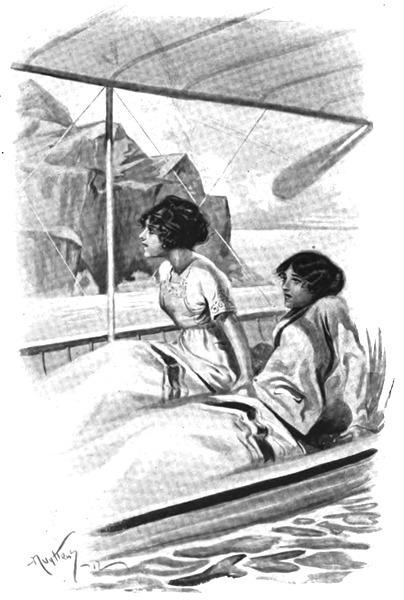
"It is more adaptable—more versatile—to be
sure," said Orissa. "Stephen has just completed
his first Hydro-Aircraft, and while I am in San
Diego I shall test it and make a long trip over the
Pacific Ocean to exploit its powers. Such a
machine would not take the place of a yacht, you
know, and the motor boat attachment is merely
a safety device to allow one to fly over water as
well as over land. Then, if you are obliged to
descend, your aircraft becomes a motor boat
and the engines propel it to the shore."
"Does your brother use the Gnome engines?"
inquired Mr. Tupper.
"No; Stephen makes his own engines, which I
think are better than any others," answered Miss
Kane.
By the time the train drew into the station at
San Diego, Madeline Dentry and her companions,
the Tuppers, knew considerably more of aëroplanes
than the average layman, for Orissa Kane
enjoyed explaining the various machines and,
young and unassuming as she appeared, understood
every minute detail of their manufacture.
She had been her brother's assistant and companion
from the time of his first experiments and
intelligently followed the creation and development
of the now famous Kane Aircraft.
At the depot a large crowd was in waiting, not
gathered to meet the great heiress, Madeline
Dentry, but the quiet slip of a girl whose name
was on every tongue and whose marvelous skill
as a bird-maid had aroused the admiration of
every person interested in aërial sports. On the
billboards were glaring posters of "The Flying
Girl," the chief attraction of the coming aviation
meet, and the news of her expected arrival had
drawn many curious inhabitants of the Sunshine
City to the depot, as well as the friends
congregated to greet her.
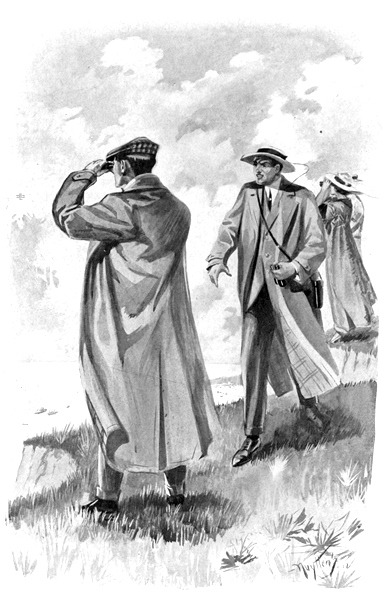
First of all a tall, fine looking fellow, who limped
slightly, sprang forward to meet Orissa at the
car steps and gave her a kiss and a hug. This was
Stephen Kane, the airship inventor, and close
behind him stood a grizzled gentleman in a long
gray coat and jaunty Scotch cap. It was Mr.
Cumberford, the "angel" and manager of the
youthful Kanes, the man whose vast wealth had
financed the Kane Aircraft and enabled the boy
and girl to carry out their ambitious plans. This
strange man had neither ambition to acquire more
money nor to secure fame by undertaking to pilot
the Aircraft to success; as he stood here, his bored
expression, in sharp contrast to the shrewd gray
eyes that twinkled behind his spectacles, clearly
indicated this fact; but a little kindness had won
him to befriend the young people and he had
rendered them staunch support.
On Mr. Cumberford's arm was a slender girl
dressed all in black, the nodding sable plumes of
whose broad hat nearly hid Orissa from view as
the two girls exchanged a kiss. Sybil Cumberford
had no claim to beauty except for her dark
eyes—so fathomless and mysterious that they
awed all but her most intimate friends, and
puzzled even them.
And now an awkward young fellow—six feet
three and built like an athlete—slouched bashfully
forward and gripped Orissa Kane's outstretched
hand. Here was the press agent of the Kane-Cumberford
alliance, Mr. H. Chesterton Radley-Todd;
a most astonishing youth who impressed
strangers as being a dummy and his friends as the
possessor of a rarely keen intellect. Orissa smiled
at him; there was something humorous about
Radley-Todd's loose-jointed, unwieldy personality.
Then she took her brother's arm and
passed through the eager, admiring throng to the
automobile in waiting.
Beside Mr. Cumberford's car stood a handsome
equipage that had been sent for Miss Dentry's
party, and as Orissa nodded to her recent
acquaintances Sybil Cumberford inquired:
"Who is that girl?"
"A Miss Dentry, of New York, with whom I
exchanged some remarks on the train. She has
a yacht in the bay here."
"Oh, yes; I've heard all about her," returned
Sybil, indifferently. "She's dreadfully rich; rather
snubbed New York society, which was eager to
idolize her—says she's too young for the weary,
heart-breaking grind—and indulges in such
remarkable fancies that she's getting herself
talked about. I hope you didn't encourage her
advances, Orissa?"
"I fear I did," was the laughing reply; "but
she seemed very nice and agreeable—for a rich
girl. Tell me, Steve," she added, turning to her
brother, "what news of the Hydro-Aircraft?"
"It's great, Orissa! I put the finishing touches
on it night before last, and yesterday Mr. Cumberford
and I took a trial spin in it. It carries
two beautifully," he exclaimed, his eyes sparkling
with enthusiasm.
"Did you go over the water?" asked Orissa.
"Nearly half a mile. Then we dropped and let
the engine paddle us home. Of all the hydro-aëroplanes
yet invented, Ris, mine will do the most
stunts and do them with greater ease."
They were rolling swiftly toward the ferry now,
bound for the Hotel del Coronado, a rambling pile
of Spanish architecture that dominates the farther
side of San Diego Bay. Presently the car
took its place in the line of vehicles on the ferry
and Mr. Cumberford, who was driving, shut off
the power and turned to Orissa.
"You are advertised to exhibit the new Hydro-Aircraft
the first day of the meet—that's Monday,"
he announced. "Do you think you can master
the mechanism by that time?"
"Is it the same old engine, Steve?" she
inquired.
"Exactly the same, except that I've altered the
controlling levers, to make them handy both
in the air and on water, and balanced the
weight a little differently, to allow for the boat
attachment."
"How did you do that?"
"Placed the gasoline tanks in the rear. That
makes the engine feed from the back, instead of
from directly overhead, you see."
Orissa nodded.
"I think I can manage it, Mr. Cumberford," she
decided. "Will Steve go with me on Monday?"
"Why—no," returned the manager, a trifle
embarrassed. "Our fool press agent had an idea
the event would be more interesting if two girls
made the flight out to sea, and the trip back by
boat. Sybil has been crazy to go, and so I let
Chesty Todd have his own way."
"You see, Miss Kane," added Mr. H. Chesterton
Radley-Todd, who was seated beside Mr. Cumberford,
while Stephen and the two girls rode
behind, "the management of the meet couldn't
get another aviatress to take part, because you
had been engaged to fly. The other air-maids are
all jealous of your reputation and popularity, I
guess, so the management was in despair. The
dear public is daffy, just now, to watch a female
risk her precious life; it's more thrilling than
when a male ventures it. So, as they're paying
us pretty big money, and Miss Cumberford was
anxious to go, I—er—er—I——"
"It is quite satisfactory to me," announced
Orissa quietly. "I shall enjoy having Sybil with
me."
"I knew you wouldn't object," said Sybil.
"The only thing I don't like about it," observed
Stephen, reflectively, "is the fact that you have
never yet seen my Hydro-Aircraft. It's safe
enough, either on land or water; but if the thing
balks—as new inventions sometimes do—there
will be no one aboard to help you remedy the
fault, and the invention is likely to get a black
eye."
"Give me a tool bag and I'll do as well as
any mechanician," responded Orissa, confidently.
"And your Hy is not going to balk, Steve, for
I shall know as much about it as you do by
Monday."