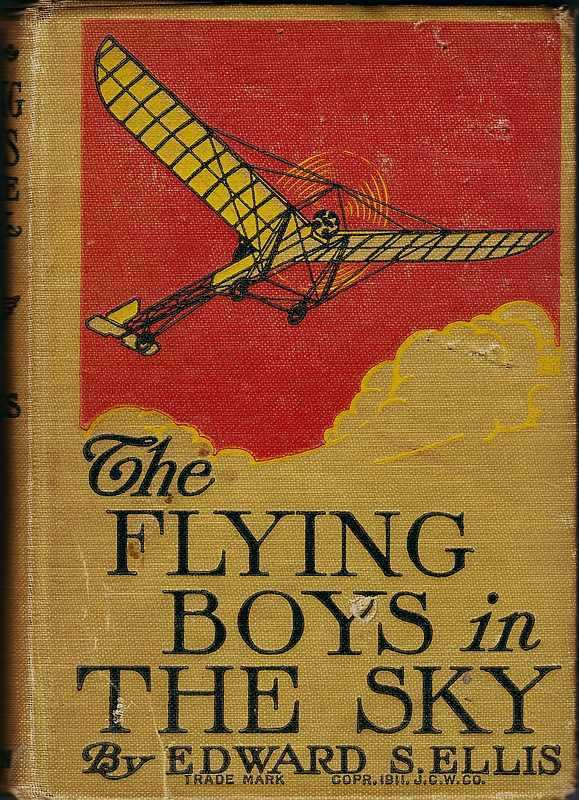
THE FLYING BOYS IN THE SKY — CHAPTER I. LEARNING TO FLY.
THE FLYING BOYS SERIES
THE FLYING BOYS SERIES
Timely and fascinating stories of adventure
in the air, accurate in detail and intensely
interesting in narration.
—BY—
EDWARD S. ELLIS
First Volume
THE FLYING BOYS IN THE SKY
Second Volume
THE FLYING BOYS TO THE RESCUE
The Flying Boys Series is bound in
uniform style of cloth with side and back
stamped with new and appropriate design
in colors. Illustrated by Edwin J. Prittie.
Price, single volume $0.60
Price, per set of two volumes, in attractive box $1.20
One mild summer morning in 1910, Ostrom
Sperbeck, a professional aviator, stood on
the edge of a broad meadow belonging to
the merchant, Gabriel Hamilton, closely watching
the actions of Harvey Hamilton, the seventeen-year-old
son of his friend, to whom the lithe,
smooth-faced German was giving his first lessons
in flying an aeroplane.
It was on the return voyage from Naples to
New York of the Italian steamer Duca degli
Abruzzi, that Mr. Hamilton and his boy made the
acquaintance of the genial foreigner, who was
on his way to the United States to take part as a
competitor in several of the advertised meets in
different parts of the country. The acquaintance
10thus begun ripened into a strong friendship and
the Professor became the guest of the merchant,
who was a commuter between his country residence
and the metropolis.
The youth, like thousands of American boys, was
keenly interested in the art of flying in the air, and
the Professor was glad to undertake to give him
instruction. The two went by train to Garden
City, Long Island, where the elder found his new
Farman biplane awaiting his arrival. Harvey
mounted to the aluminum seat in front of the gasoline
tank and engine, while his conductor placed
himself a little below him in front, where his limbs
had free play. The machine was pointed to the
southwest and Harvey enjoyed to the full his first
ride above the earth. His attention was divided
between the wonderful moving panorama below
and studying every action of the expert, who was
as much at home on his elevated perch as when
seated in the smoking room of the Duca degli
Abruzzi, chatting with his friends. He noted the
movements of the feet which controlled the vertical
rudder at the rear, and the lever beside which
the Professor sat and elevated or depressed the
horizontal rudder on the outrigger in front, thus
directing the ascent and descent of the machine.
11A thrilling surprise awaited Harvey when, after
two stops on the way for renewing the gasoline and
oil, they reached the merchant’s home. Professor
Sperbeck wished to make a preliminary tour
through the country which he had now visited for
the first time, and he left his order at Garden City
for the construction of a new biplane. The one
that had been finished was sold to Mr. Hamilton,
who made a birthday present of it to his son, it
being a question as to who was the more pleased,
Harvey or his parent.
Omitting other preliminaries for the present,
let us return to the smooth, sloping meadow where
under the eye of the German expert, the young
aviator was receiving his first instruction in the
fascinating diversion.
“I know that you did not let an action of mine
elude you,” said the Professor, “and you feel that
you understand pretty much all.”
Standing by the biplane, the smiling Harvey
nodded his head.
“I have a dim suspicion in that direction.”
“You can never make yourself an aviator without
self-confidence, but you may have too much
of it. In that case you become reckless and bad
results are certain to follow. Nor can you learn
by simply observing the conduct of another. You
have a motto in your country about experience.”
12“It is Benjamin Franklin’s,—‘Experience keeps
a dear school but fools will learn in no other,’”
said Harvey, atremble with eagerness.
“Quite true; well, if you please, you may seat
yourself.”
The lad stepped forward and sat down, his feet
resting on the cross lever below, while he grasped
the upright control lever on his right.
“Suppose you wish to leave the ground and
mount into the air?”
“I pull this lever back; the motion turns up
the horizontal rudder out there in front and the
auxiliary elevating rudder in the rear; when I
have gone as high as I wish, I hold the rudder
level, and when I wish to descend, I dip it downward.”
“Nothing could be more simple; and when you
desire to change your direction to the right or
left?”
“I work this lever with my feet, as we do in
tobogganing.”
“You have two smaller levers on the left.”
“They control the spark and throttle.”
“We won’t enter further into the construction
of the machine at present. I am sure you were
born to be a successful aviator.”
13The quiet assurance of these words vastly
strengthened the confidence of Harvey Hamilton.
He knew the Professor believed what he said, and
who could be more capable of correct judgment?
Then, as if fearing he had infused too much courage
into the youth, the instructor added:
“So far everything seems easy and simple. We
were fortunate on our way here, in having the
most favorable weather conditions, but you are
sure sooner or later to run into complex conditions.
Columns of cold air are forever pressing downward
and warm ones pushing upward. This constant
conflict creates air holes and all sorts of twists and
gyrations that play the mischief with aviators,
unless they know all about them.
“You have seated yourself, but don’t try to
start till I give the word. I wish first to put you
through a little drill. I shall call certain conditions
and you must do the right thing on the instant.
Are you ready?”
“Fire away,” replied Harvey, on edge in his
expectancy.
“Ascend!”
Like a flash the youth pulled the control lever
back.
“Too far; lessen the angle.”
He promptly obeyed.
“Volplane!”
14Harvey pushed the lever forward, but not too
far.
“Quite well; go to the right.”
The youth started to shift the rear rudder with
his feet and smiled.
“That is hard work.”
“Why?”
“Because of the gyroscopic action of the propeller;
it is much better to turn to the left, though
I suppose one can manage a long turn to the
right.”
“The Wright brothers have no trouble in swinging
that way.”
“Because they use two propellers, revolving in
opposite directions, thus neutralizing that gyroscope
business.”
“You are tipping to the left!” shouted the Professor.
On the instant the aviator swung the control
lever to the right.
“You are caught in a fierce tempest.”
Since Harvey could not well make the right
evolution he replied:
“I should dive into it.”
“That’s right; never run away from a maelstrom.
I suppose you feel competent to make a
voyage through the air?”
15“I don’t see why I cannot,” replied Harvey;
“I studied everything you did on our way from
Garden City and I think I know what to do in any
emergency.”
“Admitting that that is possible—which it
isn’t—it is all-important that before you leave
the earth you should get acquainted with your
machine.”
“Ask me about its parts and see whether I am
not.”
“That isn’t what I mean; you got that information
from the answers to my inquiries at the factory
at Garden City, which I asked for your benefit.
You must be as familiar with the aeroplane as with
your pony which you have ridden for years and
feel as much at home in your seat as if you had
occupied it for months. It will take time to
acquire that knowledge.”
“I am at home now,” replied Harvey, who
could not help thinking his friend was over-cautious.
“Your danger is of having too much self-confidence.
Remember and do exactly what I tell
you to do and nothing else.”
The pupil assured his instructor of the strictest
obedience.
“Very well.”
16The Professor stepped to the rear, grasped a
blade of the propeller and gave it a vigorous swing.
That set the motor going with its deafening racket,
but it was so throttled that the machine stood still
for a minute or two, Sperbeck holding back all he
could with one hand until the pressure became
too great to resist. Then the aeroplane began
moving forward, with fast increasing speed.
When it had traveled a hundred yards, Harvey
grasped the lever ready to point the front rudder
upward upon receiving the order from the Professor.
The noise of the motor would have
drowned the loudest voice, and the youth kept
glancing around for the expected signal. But it
was not made. Instead, the Professor motioned
with one hand for him to circle to the left. Harvey
was disappointed but did not hesitate for an instant.
He came lumbering and lurching over the sward,
and, shutting off the motor, halted a few paces in
front of his instructor, who had lighted a cigarette.
“It is best to cut grass for two or three days,”
explained the teacher.
“It surely will not take that long,” replied
Harvey in dismay.
“I trust not, but no ascent will be attempted
to-day.”
Harvey forced himself to smile, though he made
a comical grimace.
17“Put me through the paces; I’m bound to
learn this business or break a trace.”
Several spectators had gathered on the edge of
the field and were watching the actions of the two
with the aeroplane. They would have come nearer
had not Harvey warned them by a gesture not
to do so. He did not mind their enjoying the
sight, for they could do that when a little way off
as well as if closer, but they were likely to get in
his way, and hinder matters.
Again and again the biplane went awkwardly
forward on its three small wheels with their rubber
tires. The field contained ten or twelve acres,
thus giving plenty of space for maneuvering.
Once he came within a hair of running into the
fence, because as it seemed to him the machine
did not respond with its usual promptness, but
he showed rapid improvement and the Professor
complimented him on his success.
“I’m playing the part of a navigator of a prairie
schooner,” said the youth, “though they are
drawn by animals instead of being propelled by
wind. I suppose, Professor, that before the summer
is over you will let me try my wings?”
“That depends upon how well you get on with
your first lessons.”
CHAPTER II. BOHUNKUS JOHNSON.
18
Suddenly a shout came from the edge of the
field, and a negro lad vaulted over the fence
and ran toward the couple. As he drew near
he called:
“Why didn’t yo’ tole me ’bout dis, Harv?”
“I did call at your house for you, but Mr.
Hartley said you were asleep.”
“What ob dat? Why didn’t yo’ frow a brick
fru de winder and woke me up? Gee! What hab
yo’ been trying to do, Harv?”
The newcomer was about the same age as Harvey
Hamilton, but taller, broader and larger every
way. He was the “bound boy” of a neighbor and
had been a playmate of the white youth from early
childhood. He was as much interested in aviation
as Harvey, and had been trying to build an air
machine for himself, or rather helping his friend
to construct one, but their failure was so discouraging
that they gave it up. What was the
sense of attempting such a task when Mr. Hamilton
stepped in and bought one of the best of aeroplanes
for his son?
19Professor Sperbeck had met Bohunkus Johnson,
being first attracted by his odd name and then by
the willingness and good nature of the colored
youth. Bunk, as he was generally called by his
acquaintances, was much disappointed because
he had not been present earlier, but no one was
to blame except himself. Shoving his hands in
his pockets, he walked about the aeroplane, which
he had admired upon its arrival, inspecting and
trying to understand its workings.
“Hab yo’ flowed?” he asked, abruptly halting
and looking at Harvey who retained his seat.
“Not yet.”
“Why doan’ yo’ do so? What’s de use ob
fooling round here?”
“Professor Sperbeck thinks I should learn more
before leaving the ground. How would you like
to try your hand?”
Bohunkus took off his cap and scratched his head.
“I guess I’ll watch yo’ frow flipflaps awhile.”
Harvey turned to the Professor, who shook his
head.
“You don’t wish to smash the biplane so soon.
You will have enough tumbles without his help.
If you are ready you may try it again.”
20By this time Harvey had become somewhat
accustomed to the sensitiveness of the machine.
It required slighter movements of the lever than
he had supposed and the response was sometimes
quicker than he expected. He understood what
his instructor meant by insisting that an aviator
should become familiar with his machine.
Bohunkus was asked to hold the rear of the
aeroplane until the revolving propeller acquired
more velocity. The dusky youth buried his
heels in the dirt and held the framework with
might and main. The pull rapidly increased,
while he put forth all his strength, which was
considerable. The Professor gave no help, but
trying to keep his face straight, watched things.
Despite all he could do, Bunk was compelled to
yield a few inches. He still resisted desperately,
but while he could not add to his power, the
uproarious motor fast did so. Suddenly it made a
bound forward, and Bunk sprawled on his face,
with his cap flying off. His hold had slipped and
the machine shot forward with a speed far greater
than any one of the three could have reached.
“Hang de ole thing!” exclaimed Bunk, climbing
to his feet and brushing the dust from his clothes;
“what’s de use ob it yanking a feller like dat?”
The roaring motor was too near for either of his
friends to understand his words, but it was easy to
imagine their substance.
21When Harvey had completed his circuit of the
field, Bunk asked that he might try his hand. He
certainly was not lacking in assurance, but the
Professor would not consent.
“You might do well, but the chances are you
would not. You will get your chance after a
time. You may ride with Harvey if you wish.”
With some hesitation, Bunk climbed into the
seat behind his friend.
“Am yo’ gwine to go up?” he asked.
“Not at present. Why do you wish to know?”
“So I can jump if yo’ don’t manage things
right.”
He grasped one of the supports on either side
and braced himself. Naturally he was timid, but
it did not seem to him there could be much danger
so long as they remained on the ground. Half
way round the field, his self-confidence returned,
and his dark face was lighted with a broad grin as
the machine came to a stop near where the Professor
was waiting.
“Why can’t yo’ fly fru de air by staying on
de ground?” was the next bright question of
Bohunkus; “dat would be as nice as habin’
Christmas come on de fourth ob July, so yo’ could
slide down hill barefoot.”
22“Suppose I relieve you for awhile,” suggested
the instructor. Harvey sprang to the ground and
Mr. Sperbeck took his place, indicating, when
Bohunkus started to leave his seat, that he should
remain.
A few minutes later, the negro received the shock
of his life. The Professor allowed the aeroplane to
rush over the ground until its speed must have been
forty miles an hour. Then he pulled back the lever
and it instantly began mounting into the air.
Bohunkus did not comprehend what was going on
until he was fifty feet aloft and still ascending.
He threw his head to one side and stared at the
ground, which appeared to be rushing away from
him with dizzying swiftness. For an instant he
meditated leaping overboard and catching the
earth before it got beyond his reach. He partly
rose to his feet, but the distance was too great.
He called to the Professor:
“Stop! I doan’ feel well; let me git down.
What’s de use ob such foolishness?”
But there was too much uproar for the aviator
to hear, and had he caught the words he would
have given no attention. Bohunkus in his affright
glanced across the field to where Harvey Hamilton
was standing with his gaze on the machine.
Harvey waved his hand and the simple act did
much to bring back the courage of the negro.
23“I guess I can stand it as well as him,” was his
reflection; “so go ahead.”
The course of Professor Sperbeck might well
give the youth a calmness which he could not have
felt in other circumstances. He skimmed several
miles over the country, rising five or six hundred
feet in the air, and attaining a velocity of fifty
miles an hour. He had been pleased with the
aeroplane on the ride from Garden City, and was
still more pleased upon trying it out again. It
seemed to have gained a steadiness and sureness
which it lacked before.
As has been said, the real test of an aviator’s
skill is not in sailing through the air where all is
tranquil, but in starting and in landing. Professor
Sperbeck had left the ground without the least
difficulty and he now came down with the grace
and lightness of a bird.
In the afternoon Harvey Hamilton resumed
his lessons, the instructor complimenting his
proficiency.
“If the conditions are favorable to-morrow, we
shall leave the ground with you at the helm,” he
assured his pupil, when they gave over the attempts
for the day. At the side of the field nearest the
house, Mr. Hamilton had had a hangar built into
which the aeroplane was run and the door carefully
24locked. It was natural that the neighbors should
show much curiosity in the contrivance, and there
was no saying what mischief they might do.
Bohunkus felt so much concern on this point that
he came over to his friend’s home after the evening
meal and joined them on the porch, where Mr.
Hamilton was also seated.
“I think,” said Bunk, “that we hadn’t oughter
leave dat airyplane by itself.”
“We haven’t,” replied Harvey; “the building
is strong and the door locked.”
“But some folks mought bust off de lock and
run off wid it; some ob dem people am mighty
jealous ob me and yo’, Harv.”
“They are all good friends of ours,” remarked
the merchant; “I’m sure nothing is to be feared
from them.”
“I hopes not, but I feels oneasy.”
“What would you suggest?”
“Dat some one keeps watch all night.”
“Suppose you do it?”
“I’ll take my turn wid Harv.”
“Very well; when the night is a little farther
along, Bunk, you may go out there and stand
guard till say about midnight; then come to the
house and wake up Harvey, and he will take his
turn at playing sentinel.”
25“That soots me,” Bunk was quick to say,
knowing it would be much easier to keep awake
during the first half of the night. So, while the
others chatted as the evening wore on, the colored
youth rose, yawned, stretched his arms and
announced that he would go to his home not far
off, tell Mr. Hartley and his wife of the arrangement
and then assume his duties at the hangar.
Although he saw no call for all this extra care,
Harvey was quite willing to divide the duty with
his colored friend, but he meant that Bunk should
come to the house and rouse him, for he could not
be expected to stay awake. However, the young
aviator dreamed so much of flying through the air,
and was so absorbed with the entrancing scheme,
that he was the first one to wake in his home.
He sprang out of bed, as the sun was creeping up
the horizon, and lost no time in hurrying out to
the hangar to learn why Bohunkus had not called
him, though he held a strong suspicion of the
real reason.
As Harvey sped around the corner of the low,
flat structure, the first object upon which his eyes
rested was Bohunkus, stretched out on his back,
his mouth open, and breathing loudly, as no doubt
he had been doing through most of the night.
Harvey left him lying where he was, and rejoined
his folks with the story of what he had seen.
26An hour later, Professor Sperbeck, accompanied
by the merchant and Harvey, walked to the
hangar to resume the instruction of the previous
day. In the interval, Bohunkus had awakened
and gone for his breakfast. He said nothing of
his remissness and his friends did not refer to it,
since they had more serious matters to hold their
attention.
Mr. Hamilton was much pleased with the proficiency
shown by his son, but did not stay long,
since important business called him to the city.
The day was a busy one for the young aviator,
who was allowed to make a flight in the afternoon
with the watchful Professor seated behind him.
He had very few suggestions to make.
When Harvey came down to earth, he bumped
rather energetically, but no harm was done, and
on the third trial no criticism was made. Two
more days were spent in practice and then the
instructor said:
“You are prepared to make as long a voyage
through the air as you wish, and without any
assistance from me.”
CHAPTER III. THE AEROPLANE IN A RACE.
27
The barograph showed that the aeroplane was
more than nine hundred feet above the
earth and the anemometer, or small wind
wheel, indicated that the speed was forty-odd
miles an hour, with the propeller making a
thousand revolutions a minute. It was capable of
increasing that rate by twenty per cent. and the
aviator was gradually forcing it to do so.
The youth who sat in front, with the long control
lever in his right hand, was our friend
Harvey Hamilton, who, under the instruction of
Professor Ostrom Sperbeck, the German aviator,
had become so expert that he felt equal to any
emergency that was likely to occur during his
aerial excursions. The small levers on his left,
governed as we remember the spark and throttle,
while the vertical rudders were operated by the
feet. So long as the heavens remained calm or
only moderate breezes were encountered, everything
would go as smoothly as if he were treading
firm ground, but there was no saying what
troubles were likely to arise,—some of them with
the suddenness of a bolt from the blue.
28Harvey had his back to the tank, which held
ten gallons of gasoline, or petrol as it is called
on the other side of the ocean, and two gallons
of oil, one being as indispensable as the other.
In the aluminum seat just in front of the tank
was Harvey’s passenger, the support being adjustable
and capable of carrying two persons without
threatening the center of gravity, provided care
was used. This passenger has already been introduced
to you under the name of Bohunkus Johnson,
who was the bound boy of a neighboring
farmer, Mr. Cecil Hartley. He was a favorite
with his easy-going master, who sent him to the
district school during winter and let him do about
as he pleased at other times. He had picked up
the simplest rudiments of a primary education and
with the expenditure of a good deal of labor could
write, though he scorned to pay any attention to
so unimportant a matter as spelling.
Bunk and Harvey being of the same age, were
playmates from earliest childhood. The fact that
they were of different races had no effect upon
their mutual regard. Being the son of a wealthy
merchant, the white youth was able to do many
favors for his dusky comrade, who, bigger and
stronger, would have risked his life at any time
for him.
29Although this particular flight was made on a
sultry summer afternoon, each lad wore thick
clothing and a cap specially made for aviators,
as a protection against wind and cold. The
first intention of Harvey was to climb high
enough in the sky to establish a record for himself
that would make all other rivals green with
envy.
But not yet. There was too much fascination
in coddling to the earth, where the wonderful
varied panorama was ever changing, and always
of entrancing novelty and beauty.
Bohunkus having little to do except use his eyes
enjoyed the visual feast to the full. At the beginning
he studied the action of Harvey, seated at his
feet, having in view that thrilling hour when he
would be permitted to handle the levers and guide
the airship through space himself.
“I can do it as well as him,” he said to himself;
“de machine sets on its three little wheels wid dere
rubber tires, and de propeller am started so fast
dat yo’ can’t see de paddles spin round; den dem
dat am holding de same lets go and it runs ’bout
fifty yards, like lightnin’; den Harvey pulls de big
lever back and dat flat rudder out front am turned
upward and de ting springs into de air like a scared
bird and dere yo’ am!”
30As Bohunkus sat he grasped a bit of the framework
on his right and a corresponding support on
his left. This was not always necessary, for it
was smooth sailing, but, as has been intimated,
there was no saying when a sudden squall or
invisible pocket or hole in the wind would shake
things up, and force one to hold on for dear life.
He leaned slightly forward and looked down at the
world sweeping under him. They were skimming
over a village, numbering barely a score of buildings,
the only noticeable one being the white church
with its tapering spire pointing toward the realm
to which erring men were directed. Just beyond
the dusty winding road disappeared into a wood a
mile in extent, emerging on the other side and
weaving through the open country until it could no
longer be traced.
The river far to the left suggested a ribbon of
silver, so small that several tiny sails creeping over
it appeared to be standing still. To the right and
front a large city was coming into clearer view.
The spires, skyscrapers and tall buildings were a
vast jumble in which he could identify nothing.
He did not attempt even to guess the name of the
place.
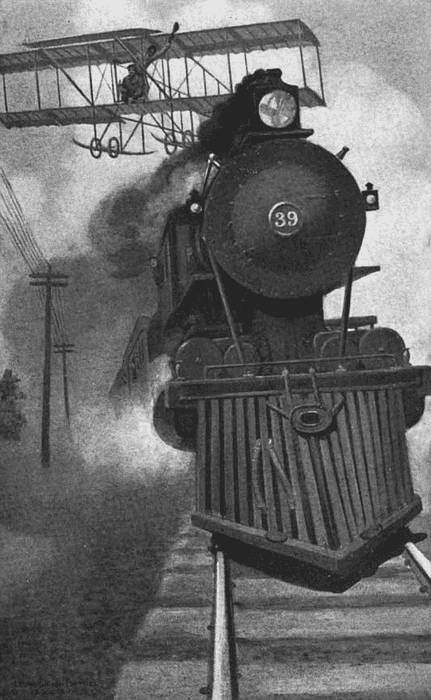
31A railway train was just leaving the village below
them on its way to the city in the distance. The
youths saw the white puff of steam from the whistle,
which signalled its starting, and the black belchings
of smoke came faster and faster as the engine
rapidly gained headway. Harvey slightly advanced
the lever and the aeroplane began descending a
little way in front of the train. The contestants in
this novel race should be nearer each other to
prevent any mistake and make the contest more
exhilarating.
Two hundred feet from the ground, Harvey
pulled back the lever and the flat rudder on the
front outrigger became horizontal. The downward
dip of the machine ceased and with a graceful
curve glided forward on a level course. No professional
could have executed the maneuver
with more precision. Harvey during these few
moments decreased the revolutions of the propeller
so as not to draw away from the locomotive. The
race should be a fair one, even if the result was not
in doubt.
This lagging caused the biplane to fall somewhat
to the rear and gave the train time to hit up
its pace. The engineer and fireman had caught
sight of the machine some minutes before, and
eagerly accepted the challenge. Both were leaning
32out of the cab windows and the engineer waved his
hand at the contestant aloft. The fireman swung
his greasy cap and shouted something which of
course the youths were unable to catch. The
passengers had learned what was in the wind, and
crowded the platforms and thrust their heads from
the windows, all saluting the aviator and intensely
interested in the struggle for mastery.
Harvey was too occupied with the machine to
give much attention to anything else. He knew he
could rely upon Bohunkus for all that was due in
that line. The dusky youth was so wrought up that
he came startlingly near unseating himself more
than once. He leaned far over, circled his cap about
his head and shouted and whooped and kicked out
his feet with delight. The laughing passengers
who stared into the sky, saw the black face with its
dancing eyes, bisected by an enormous grin, which
displayed the rows of perfect even teeth, and all
learned what a perfectly happy African looks like.
Jim Halpine, the engineer, said grimly to his
fireman:
“I’ve heard about their flying faster than
anything can travel over the ground, but I’ll teach
that fellow a lesson. Old 39 can make a mile a
minute as easy as rolling off a log; watch me walk
away from him.”
33He “linked her up” by drawing the reversing
lever back until it stood nearly on the center and
dropped the catch in place. Then the puffs came
faster and faster, and not so loud, and 39 rapidly
rose to her best pace. Having done all he could
in that direction, Jim kept his left hand on the
throttle lever, and divided his attention between
peering out at the track in front and glancing
upward at the curious contrivance that was coursing
through the air just above him. The fact that
it was creeping up caused no misgiving, for that
was manifestly due to the fact that he himself had
not yet acquired full headway.
Harvey meant to get all the fun possible out of
the race. He was certain he could beat the engine,
but to do so “off the reel” would spoil the enjoyment.
He would dally for a time and when defeat
seemed impending, would dart ahead—always
provided he should be able to do so.
The locomotive had a straight away run of
seven or eight miles, when it would have to slow
down for the city it was approaching. The race
therefore must be decided within the next ten
minutes.
Harvey Hamilton played his part well. The
engine and train being directly under him, his
view of them was perfect without detracting from
34the necessary attention to his biplane. He was
just behind the last car when he knew from the
appearance of things that the engineer had struck
his highest pace. The youth speeded up the
motor so as slightly to add to the propeller’s
revolutions, but he showed no gain in swiftness.
He was only holding his place.
The shouting passengers shouted still more,
if that could be possible, and called all sorts of
tantalizing cries:
“Throw down your rope and we’ll give you a
tow.” “Get out and run alongside of us!” “You
ain’t racing with a cow.” “We’re going some!”
Such and similar were the good-natured taunts,
which produced no effect upon the aviators for
they did not hear them. The most exasperating
gesture was that of Jim Halpine the engineer, who
leaned far out of his cab and gently beckoned to
the youths to come forward and keep him company.
The fireman stood between the cab and tender and
imitated his chief.
Harvey Hamilton seemed to see and hear them
not. Bending far over with the lever grasped,
he acted as if trying to add to his speed by the pose,
as a person in his situation will sometimes do
unconsciously. His face was drawn, as if with
tense anxiety, and there was not the shadow of
a smile upon it. All the same he was chuckling
inwardly.
35Bohunkus Johnson was almost beside himself.
At first he did not doubt that a crushing triumph
would speedily come to him and his companion,
but as the seconds flew by and there was no gain
upon the train thundering over the rails, a pang of
doubt crept over him.
“Go it, Harv! Put on more steam! What’s
de matter wid yo’?” he shouted, swinging his arms
and hitching forward as if to add an impulse to
their progress. “If yo’ lose dis race I’ll jump
overboard and swim to land. Dem folks see me
blushing now!”
Less than a minute later, the African shouted to
unhearing ears:
“Glory be! Dat’s de talk! Now we’ve got ’em!”
The aeroplane was overtaking the train.
Though the gain was slow it was unmistakable.
CHAPTER IV. TRYING FOR ALTITUDE.
36
Ah, but Harvey Hamilton was sly. He began
slowly creeping up until his machine
was directly over the rear passenger coach,
there being three beside the express car. Had
he dropped a stone from his perch, it would have
fallen upon the roof of the last one. The exultant
expression on the myriad of faces took on a tint
of anxiety. The fireman yanked open the door
of the fire-box and shoveled in coal. No need of
that, for 39 was already blowing off, even when
running at so high speed. Jim Halpine had drawn
over the long reversing lever till it stood within
a few inches of perpendicular and another shift
would have choked the engine.
The young aviator held his place for a brief
while and then began gradually drifting back
again. Bohunkus Johnson groaned.
“Confound it! what’s de use ob trying to be
good?” he wailed; “dem folks will grin dere
heads off. Harv! make tings hum!”
37Heedless of him, Harvey was carrying out his
own scheme. He saw that the game was his and
he was playing with the locomotive. When
gaining on it, the airship was not doing its best,
and his slight retrogression was in order to make
his victory more impressive. Each contestant
was going fully sixty miles an hour. No. 39 could
do no more, but the aeroplane had not yet extended
herself. She now proceeded to do so, inasmuch
as in the circumstances the struggle must soon
terminate.
Having dropped well to the rear again, Harvey
called upon the motor to do its best. Its humming
took on the character of a musical tone, and the
propeller spun around, twelve hundred revolutions
to the minute. The keenest eye could detect
nothing of the ends of the blades, and only faintly
discern them nearer the shaft, as if they were so
much mist.
And then the biplane forged bravely ahead.
She moved steadily along over the roofs of the cars,
one after the other, and pulled away from the
engine whose ponderous drivers appeared to be
spinning around with the dizzying swiftness of the
propeller overhead. Jim Halpine was utilizing
every ounce of power, but could do no more, for
he was already doing his best. It humiliated
him to be thus left behind, but there was no help
for it. In his chagrin he tried a little trick which
38deceived no one, not even the two victors. Pretending
he detected something amiss on the rails,
he emitted a couple of blasts from his whistle
and shut off steam. It looked as if he was actuated
by prudence, but the obstruction was imaginary.
Most of the passengers like true sportsmen
cheered the winner. Even the grinning fireman
circled his cap again about his tousled head, but
the engineer was glum and acted as if the only
thing in the world of interest to him was the rails
stretching away in front. What did he care for
airships bobbing overhead? They were only
toys and could never amount to anything in the
economy of life.
As for Bohunkus Johnson he could not contain
himself. Harvey remained as calm as a veteran,
and gave no attention to anything except his
machine, but his companion stood up in the hurricane
at the imminent risk of playing the mischief
with the aeroplane’s center of gravity, waved his
cap and furiously beckoned the engineer not to
lag behind. His thick lips could be seen contorting
themselves and evidently he was saying
something. Had the laughing passengers been
able to catch his words—which they were not—they
would have heard something like the following:
39“Why doan’ yo’ trabel? Yo’s only walking;
we ain’t half trying; can’t yo’ put on more steam
and make us show what we can do? I’m plum
disgusted wid yo’.”
Harvey Hamilton did not speak. He was
“letting out” the machine. He meant to learn
what it could do. When several hundred yards
ahead of the train, he lifted the lip of the rudder
in front, and the structure glided upward until
he was a quarter of a mile above the earth. Even
then Bohunkus behaved so extravagantly that the
aviator turned his head and motioned to him to
cease.
“Can’t doot, Harv! My mouf am so wide open
dat it’ll take me a good while to bring my jaws
togeder agin, and I’m ready to tumble out head
fust.”
By and by the colored youth toned down
enough to resume his seat and check his explosions
of delight, though he looked around and waved
his hand several times at the train which was now
so far to the rear that his action was not understood.
“Gee! but it’s getting cold!” he exclaimed
some minutes later, with a shiver. He buttoned
his thick coat to the chin, donned his mittens,
and wondered what it all meant. He had never
understood, though he had been told more than
40once, that temperature decreases with increasing
altitude. He had objected to donning such thick
garments when about to start on their flight, but
Harvey was the boss and insisted.
Bohunkus’s next surprise came when he looked
between his feet. They were directly over the
city noticed some time before, but the buildings
were shrunken and mixed together in a way that
even he understood.
The anemometer suspended at the side of Harvey
Hamilton showed that the aeroplane was
coursing through the air at the rate of not quite a
mile a minute. With the low temperature caused
by the altitude, the wind created in the still atmosphere
cut the faces of the two like a knife, and even
penetrated their thick clothing. Bohunkus
turned up his coat collar, and drew his cap over
his ears, but his feet ached. He hoped the aviator
would soon strike milder weather, though the
colored youth did not know whether it was to
be sought for above or below.
“If it gits colder as yo’ go up,” he reflected
between his chattering teeth, “it must be orful
cold when yo’ reach heben; I remember now dat
I was tole something ’bout dat, but I thought dey
was fooling me.”
41The front rudder still sloped upward, and
Harvey showed no intention of dropping lower or
even of maintaining the level already reached. He
and his companion had started on a week or ten
days’ outing, and it struck him that now was as
good a time as he was likely to have for making
a notable record.
So the propeller kept humming and they continued
to climb. A glance at the barograph by
his side showed that he had reached five thousand
feet; to this he added another thousand, then
another, and he felt a thrill when the indicator
made known he was close to nine thousand.
Although, as you may know, several aviators
have mounted almost two miles, none had done so
at the time of which I am now speaking. Harvey
was near the limit, and he had but to persevere
a little longer to achieve a grand triumph. But
the cold was becoming almost unbearable. In
the hope of moderating the piercing chill, he
lessened his speed, but was not sensible of much
improvement.
His unremitting attention was not needed and
he turned his head and looked at Bohunkus.
The sight made him laugh. The negro had not
only drawn his upturned collar about his ears,
with his cap sunk low over them, and his mittened
hands shoved into his pockets, but he had shrunk
42within himself to that degree that only his staring
eyes and the tip of his nose were visible. He
was hunched together, and gave one of the best
imitations imaginable of a young man freezing
to death.
“I know his race doesn’t like cold weather,
but it won’t hurt him,” reflected Harvey with
another look at his barograph. To his astonishment,
he had made no perceptible gain during
the last several minutes. He turned on full power
and kept the forward rudder inclined upward.
He waited awhile before examining the instrument
again. So far as it could indicate he was not a
foot higher than before.
He was mystified. What could it mean? With
the propeller revolving more than a thousand times
a minute, he ought to have risen a half mile higher.
“I never heard of anything like it; the explanation
is beyond me.”
With a thrill of misgiving, he glanced at the
different parts of the machine. There were the
two slightly curving wings, measuring thirty-five
feet from tip to tip; the horizontal rudder on the
front outrigger responded easily to the levers,
as he proved by test; the ailerons or wing tips,
one above the other, worked simultaneously
and with the same ease; the ash which formed the
43foundation of the engine, the whitewood of the
ribs, and the sprucewood of most of the structure,
all scraped and highly varnished, did not show
the least flaw. The rigidity which is indispensable
in the framework was maintained throughout.
The rubberized linen covering of the wings was
taut and as smooth as silk, and the eye could not
detect the slightest wire or thing out of gear.
“Professor Sperbeck never told me anything
of this, though if he were here, he would understand
it. I wonder whether we have climbed
any farther.”
Another inspection of the instrument failed to
show that the biplane had ascended an inch.
“Can it be that our height has anything to do
with it——”
Harvey Hamilton uttered an exclamation. The
mystery was solved. The aeroplane had risen
so high that the rarefied air refused to lift it farther.
The propeller was whirling at its utmost velocity,
but the cold, thin atmosphere could sustain no
more. It was impossible, situated as he was,
to go any higher.
“If Bohunkus wasn’t with me, I could rise a
half mile or more, but there’s no use of trying it
now. Some time I’ll do it alone.”
44The limit marked was a trifle under nine thousand
feet. It was a notable exploit, but, as we
know, it has been surpassed by other aeroplanes,
and more than doubled by aeronauts.
Another fact flashed upon Harvey: it was two
hours since he and his companion had started
on the flight that was destined to be a memorable
one, and they were a hundred miles from home.
There could be only a small amount of gasoline
left in the tank, and it would be impossible to
return without procuring more. Prudence urged
that he should lose no time in doing so. He
slowly advanced the control lever, the front rudder
dipped downward and he began approaching
the earth. Some minutes must pass before they
should feel the pleasant change of temperature,
but it could not be long delayed.
In the midst of his pleasant anticipations,
Harvey was startled by a shriek from Bohunkus:
“We’s gone, Harv!” he shouted; “nuffin can
sabe us!”
CHAPTER V. A WOODLAND EXPERT.
45
The aeroplane was caught in a furious snow
squall. While descending it ran into the
swirling tumult which in an instant enveloped
it like a blanket, the myriads of particles
filling the air so thickly that the terrified Bohunkus
could not see the ailerons and even the aviator was
partly shrouded from sight. Harvey Hamilton
was faintly visible as he leaned over and manipulated
the levers. Not only was the snow everywhere,
but the machine itself was rocking like a
ship laboring in a storm. It tipped so fearfully
that the negro believed it was about to capsize
and tumble them out. He shrieked in his terror,
and held fast for life.
Harvey paid no heed to him. He had enough
to engage his skill and wits. He recalled that
Professor Sperbeck had told him what to do when
caught in one of those elemental outbursts. Instead
of running away from it, he headed for its
center, so far as he could locate it, as the navigator
does when gripped by the typhoon of the Indian
Ocean.
46Within five minutes of the aerial explosion, as
it may be called, the biplane was sailing in the
same calm as before. The sun was shining low
in the sky and all was as serene as the mildest
summer day that ever soothed earth and heavens.
The gust had come and gone so quickly that it
seemed like some frightful nightmare. The youths
might have doubted the evidence of their senses,
but for the reminder of the snowflakes on the
wings, different parts of the machine and their
clothing. They had entered so balmy a temperature,
however, that the particles soon dissolved
and left only a slight moisture behind them.
“Wal, if dat don’t beat all creation,” mused
Bohunkus; “de fust ting I knowed I didn’t
know anyting and de next dat I knowed wasn’t
anyting. Wonder if Harv seed dat yell I let out
when dat rumpus hit me on de side ob my head.”
The aviator acted as if unaware of the dusky
youth’s presence. Knowing the gasoline was
nearly gone, he centered his thoughts upon making
a landing. To his astonishment he saw an immense
forest below him, many miles in extent.
This seemed remarkable in view of the fact that
only a short time before he had sailed over a large
city, which could not be far to the south. He
would have turned about and made for it, knowing
47he could renew his supply of fuel there, and find
accommodations for himself and companion.
But the fluid was lower than he had supposed.
It would not carry him thither and he must volplane,
or glide to earth, the best he could.
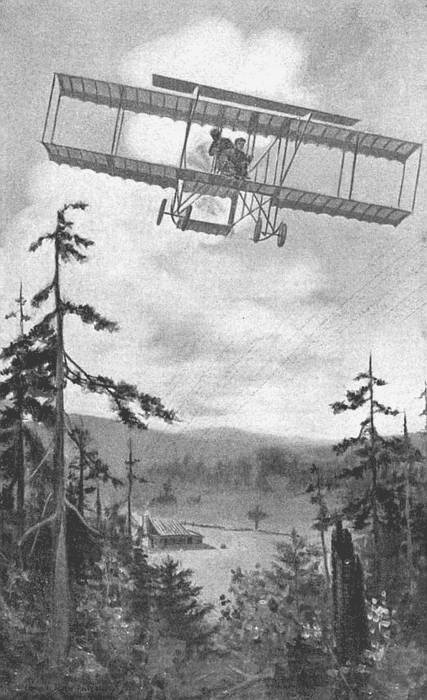
It need not be said that a stretch of woods is the
worst place in the world for an aeroplane to descend
to the earth. In fact it is impossible to land
without wrecking the apparatus and endangering
the lives of those it is carrying.
The keen eyes of the youth were scanning the
ground below when to his surprise he caught
sight of a village of considerable size to the westward.
Why he had not observed it before passed
his comprehension. It was barely two miles
distant and he was wondering whether he had
enough gasoline left to carry him over the woods
to the broken country beyond when he made a
second and pleasing discovery. A short distance
ahead an open space in the forest showed,—one
of those natural breaks that are occasionally seen
in wide stretches of wilderness. It was several
acres in extent and seemed at that altitude to be
free of stumps and covered with a sparse growth
of dry grass, so level that it formed an ideal landing
place. He did not hesitate to make use of it.
48Now when an aeroplane comes down to earth,
the greatest care is necessary to avoid descending
too suddenly. A violent bump is likely to injure
the small wheels beneath or the machine itself.
The aviator therefore oscillates downward somewhat
after the manner of a pendulum. When
near the ground, he shifts his steering gear so that
the machine glides sideways for a little way.
Then he circles about or takes a zig-zag course,
until it is safe to shut off power and alight. As our
old friend Darius Green said, the danger is not so
much in rising and sailing through the sky as it is
in ’lighting.
Harvey Hamilton displayed fine skill, seesawing
back and forth until at the right moment the three
small wheels touched the ground, the machine
under the slight momentum ran forward for two
or three rods, and then came to a standstill. A
perfect landing had been effected.
“Gee, but dat’s what I call splendacious!”
exclaimed Bohunkus; “it’s jest de way I’d done
it myself.”
The aviator leaped lightly from his seat, and his
companion did so more deliberately. He yawned
and stretched his arms over his head. Harvey gave
him no attention until he had examined the different
parts of the machine and found them in order.
Then he looked gravely at the African and asked:
49“Didn’t I hear you make some remark at the
moment we dived into that snow squall?”
“P’raps yo’ did, for de weather was so funny
dat it war nat’ral dat I should indulge in some
obserwation inasmuch as to de same.”
“But why use so loud tones?”
“Dat was necessumsary on ’count ob de prewailing
disturbance ob de atmospheric air wat was
surrounding us.”
“I’m glad to hear your explanation, but it
sounded to me as if you were scared.”
“Me scared! Yo’ hurts my feelings, Harv;
but I say, ain’t yo’ gwine to tie de machine fast?”
“What for?”
“To keep it from running away.”
“It won’t do that unless some one runs away
with it; but, Bunk, we can’t do any more flying till
we get some gasoline and oil, and it doesn’t look
to me as if there is much chance of buying any in
these parts.”
“Mebbe we can git it ober dere.”
“Where?”
“At dat house jest behind yo’.”
Harvey turned about and met another surprise,
for on the farther edge of the natural clearing
stood a dilapidated log dwelling, with portions of
several outbuildings visible around and beyond it.
50“I must be going blind!” was his exclamation;
“I came near passing this spot without seeing it
and never noticed that house.”
But the young man was hardly just to himself.
In his concentration of attention upon a landing
place, he had given heed to nothing else, and the
descent engaged his utmost care until it was
finished. It was different with his companion,
who had more freedom of vision. Moreover, the
primitive structure which the aviator now saw
for the first time was so enclosed by trees that it
was hardly noticeable from above.
No fence was visible, but a small, tumble-down
porch was in front of the broad door, which was
open and showed a short, dumpy woman, slovenly
dressed and filling all of the space except that
which was above her head, because of her short
stature. Her husband, scrawny, stoop-shouldered,
without coat, waistcoat or necktie, wearing a
straw hat whose rim pointed straight upward at
the back and almost straight downward in front,
with a yellow tuft of whiskers on his receding chin,
and a set of big projecting teeth, was slouching
toward the two young men, as if impelled
by a curiosity natural in the circumstances. The
thumb of each hand was thrust behind a suspender
button in front, and it was evident that he felt
51some distrust until Harvey Hamilton’s genial
“Good afternoon!” greeted him. His trousers
were tucked in the tops of his thick boots, which
now moved a little faster, but came to a stop
several paces off, as if the owner was still timid.
“How’r you?” he asked with a nod, in response
to Harvey’s salutation; “what sort of thing might
you be calling that? Is it an aeroplane?”
“That’s its name; you have heard of them.”
“I’ve read about them in the newspapers and
studied pictures of the blamed things, but yours
is the first one I ever laid eyes on.”
Despite the uncouth manner of the man, it was
evident that he possessed considerable intelligence.
He stepped closer and made inquiries about the
machine, its different parts and their functions,
and finally remarked:
“It’s coming, sure.”
“What do you refer to?” asked Harvey.
“The day when those things will be as common
as automobiles and bicycles. If I don’t
peg out in the next ten years, I expect to own one
myself.”
“I certainly hope so, for you will get great
pleasure from it.”
“Not to mention a broken neck or arm or leg,”
he remarked with a chuckle. “Now I suppose
you call this contrivance a biplane because it has
double wings?”
52“That is the reason.”
“And it seems to me,” he added, turning his
head to one side and squinting, “the length is a
little greater from the nose of the forward rudder
to the end of the tail than between the wing
tips?”
“You are correct again; there is a difference of
about two feet.”
“The wings are curved a bit; I have read that
that shape is better than the flat form to support
you in air.”
“Experiments have proved it so.”
“And this stuff,” he continued, touching his
forefinger to the taut covering of one of the wings,
“is rubberized linen?”
“It is with our machine, though some aviators
prefer other material.”
“Spruce seems to be the chief wood in your
biplane.”
“Because of its lightness and strength.”
“The horizontal rudder in front must be used
in ascending and descending and the two vertical
ones at the rear for steering your course. I should
judge,” he said, scrutinizing the motor, “that
your engine has about sixty-horse power.”
53“You hit it exactly; I am astonished by your
knowledge.”
“It all comes from remembering what I read.
And the wing tips are the ailerons, and the engine
weighs about three hundred pounds.”
“A trifle less, the whole weight of the aeroplane
being eight hundred pounds.”
“Your propeller is made of black walnut, and
has eight laminations, and when under full headway
revolves more than a thousand times a
minute.”
“See here,” said Harvey; “don’t say you
haven’t examined aeroplanes before.”
“As I told you, I never saw one until now, but
what’s the use of reading anything unless you keep
it in your memory? That’s my principle.”
CHAPTER VI. WORKING FOR DINNER.
54
Further conversation justified the astonishment
of Harvey Hamilton. The countryman,
who gave his name as Abisha
Wharton, showed a knowledge of aviation and
heavier-than-air machines such as few amateurs
possess. In the midst of his bright remarks he
abruptly checked himself.
“What time is it?”
Harvey glanced at the little watch on his wrist.
“Twenty minutes of six.”
“You two will take supper with me.”
Bohunkus Johnson, who had been silently
listening while the three were standing, heaved
an enormous sigh.
“Dat’s what I’se been waitin’ to hear mentioned
eber since we landed; yas, we’ll take supper wid
yo’; I neber was so hungry in my life.”
“I appreciate your kindness, which I accept on
condition that we pay you or your wife for it.
We have started on an outing, and that is our
rule.”
55“I didn’t have that in mind when I spoke, but
if you insist on giving the old lady a little tip, we
sha’n’t quarrel; leastways I know she won’t.”
“That is settled then. Now I should like to
hire you to do me a favor. I don’t suppose you
keep gasoline in your home?”
“Never had a drop; we use only candles and
such light as the fire on the hearth gives.”
“How near is there a store where we can buy
the stuff?”
“I suppose Peters has it, for he sells everything
from a toothpick to a folding bed. He keeps the
main store at Darbytown, two miles away. I
drive there nearly every day.”
“Will you do so now, and buy me ten gallons
of gasoline and two gallons of cylinder oil?”
“I don’t see why I shouldn’t; certainly I’ll do it.
Do you want it right off?”
“Can you go to town and back before dark?”
“My horse isn’t noted for his swiftness,” replied
Abisha with a grin, “but I can come purty nigh
making it, if I start now.”
“Dat’s a good idee; while yo’s gone, Harv and
me can put ourselves outside ob dat supper dat
yo’ remarked about.”
Harvey’s first thought was to accompany his
new friend to the village, but when he saw the
rickety animal and the dilapidated wagon to
56which he was soon harnessed, he forebore out of
consideration for the brute. Besides, it looked as
if he was likely to fail with the task. Accordingly,
our young friend handed a five-dollar bill to his
host and repeated his instructions. Then he
and Bohunkus sauntered to the rude porch,
where Mrs. Wharton came forth at the call
of her husband, and was introduced to the
visitors, whose names were given by Harvey. She
promised that the evening meal should suit
them and passed inside to look after its preparation.
The winding wagon road was well marked, and
Abisha Wharton, seated in the front of his rattling
vehicle, struck his bony horse so smart a blow that
the animal broke into a loping trot, and speedily
passed from sight among the trees in the direction
of Darbytown. Harvey and Bohunkus, having
nothing to hold their attention, strolled to the woodpile
and sat down on one of the small logs lying there,
awaiting cutting into proper length and size for the
old-fashioned stove in the kitchen. A few minutes
later the wife came out and gathered all that was
ready for use. As she straightened up, she remarked
with a sniff:
“That Abisha Wharton is too lazy ever to cut
’nough wood to last a day; all he keers about is to
smoke his pipe, or fish, or read his papers and
books.”
57When she had gone in, Harvey said to his
companion:
“We haven’t anything to do for an hour or so;
let’s make ourselves useful.”
“I’m agreeable,” replied Bohunkus, lifting one
of the heavy pieces and depositing it in the two
X’s which formed the wood horse. The saw lay
near and was fairly sharp. The colored youth
was powerful and had good wind. He bent to
work with a vigor that soon severed the piece in
the middle. He immediately picked up another
to subject it to the same process, while Harvey
swung the rather dull axe and split the wood for
the stove. It was all clean white hickory, with so
straight a grain that a slight blow caused it to
break apart. The work was light and Harvey
offered to relieve his companion at the saw.
“Don’t bodder me; dis am fun; besides,” added
Bohunkus, “I cac’late to make it up when I git
at de supper table; I tell yo’, Harv, yo’ll hab to gib
dat lady a big tip.”
“I certainly shall if I wish to save her from
losing on you.”
58For nearly an hour the two wrought without
stopping to rest. By that time, most of the wood
was cut and heaped into a sightly pile. The odor
of the hickory was fragrant, and it made a pretty
sight, besides which we all know that it has hardly
a superior for fuel, unless it be applewood.
By and by the woman of the house came to the
door and looked at the two boys. She was delighted,
for she saw enough wood ready cut for the
stove to last her for a week at least. Bohunkus was
bending over the saw horse with one knee on the
stick, while a tiny stream of grains shot out above
and below, keeping time with the motion of the
implement, and Harvey swung the axe aloft with
an effect that kept the respective tasks equal.
Gazing at them for a moment, the housewife
called:
“Supper’s waiting!”
“So am I!” replied Bohunkus, who, having a
stick partly sawn in two worked with such energy
that the projecting end quickly fell to the ground.
Harvey would not allow him to leave until the
pieces were split and piled upon the others.
“Now let us each carry in an armful.”
They loaded themselves, and Harvey led the way
into the house, where the smiling woman directed
them to the kitchen. There being no box they
dumped the wood upon the floor, then seated
themselves at the table, and she waited upon them.
59Despite her untidy appearance, Mrs. Wharton
gave them an abundant and well-cooked meal, to
which it need not be said both did justice. They
were blessed with good appetites, Bohunkus
especially being noted at home for his capacity in
that line. They pleased the hostess by their compliments,
but more so by their enjoyment of the meal.
It was a mild, balmy night, and at the suggestion
of the woman they carried their stools outside and
sat in front of the house and on the edge of the
clearing, to await the return of the master of the
household. Sooner than they expected, they heard
the rattle of the wheels and the sound of his voice,
as he urged his tired animal onward. It took but
a few minutes for him to unfasten, water and lead
him to the stable. Then the man came forward
and greeted his friends.
“How did you make out?” asked Harvey.
“I got what I went after, of course; the gasoline
and oil are in the wagon, and there’s about three
dollars coming to you.”
“Which you will keep,” replied Harvey.
“We have finished an excellent meal and shall
wait here for you if you don’t mind.”
“I’m agreeable to anything,” remarked the
man, as he slouched inside, where by the light of
a candle he ate the evening meal with his wife.
60Our friends could not help hearing what she said,
for she had a sharp voice and spoke in a high key.
She berated him for his shiftlessness and declared he
ought to be ashamed to allow two strangers to saw
and split the wood which had too long awaited his
attention. She made other observations that it is
not worth while to repeat, but evidently the man
was used to nagging, for it did not affect his
appetite and he only grunted now and then by way
of reply or to signify that he heard.
When Abisha brought out his chair and lighted
his corncob pipe, it was fully dark. The night
was without a moon, and the sky had so clouded
that only here and there a twinkling star showed.
“Do you ever fly at night?” asked their host.
“We have never done so,” replied Harvey,
“because there is nothing to be gained and it is
dangerous.”
“Why dangerous?”
“We can’t carry enough gasoline to keep us in
the air more than two hours, and it is a risky thing
to land in the darkness. If I hadn’t caught sight
of this open space, it would have gone hard with
us even when the sun was shining.”
“It’s a wonderful discovery,” repeated Wharton,
as if speaking with himself, “but a lot of improvements
will have to be made. One of them is to
61carry more gasoline or find some stuff that will
serve better. How long has anyone been able to
sail with an aeroplane without landing?”
“I believe the record is something like five
hours.”
“In two or three years or less time, they will
keep aloft for a day or more. They’ll have to do
it in order to cross the Atlantic.”
“There is little prospect of ever doing that.”
“Wellman tried it in a balloon, but was not able
to make more than a start.”
“I agree with you that the day is not distant
when the Atlantic will be crossed as regularly by
heavier-than-air machines as it is by the Mauretania
and Lusitania, but in the meantime we have
got to make many improvements; that of carrying
enough fuel being the most important.”
At this point Bohunkus felt that an observation
was due from him.
“Humph! it’s easy ’nough to fix dat.”
“How?”
“Hab reg’lar gasumline stations all de way
’cross de ocean, so dat anyone can stop and load
up when he wants to.”
“How would you keep the stations in place?”
gravely inquired Wharton.
“Anchor ’em, ob course.”
62“But the ocean is several miles in depth in
many portions.”
“What ob dat? Can’t you make chains or
ropes dat long? Seems to me some folks is mighty
dumb.”
“I’ve noticed that myself,” remarked the host
without a smile. Failing to catch the drift of his
comment, Bohunkus held his peace for the next
few minutes, but in the middle of a remark by
his companion, he suddenly leaped to his feet with
the gasping question:
“What’s dat?”
CHAPTER VII. THE DRAGON OF THE SKIES.
63
The others had seen the same object which
so startled Bohunkus. Several hundred
feet up in the air and slightly to the north,
the gleam of a red light showed. It was moving
slowly in the direction of the three, all of whom
were standing and studying it with wondering
curiosity. It was as if some aerial wanderer was
flourishing a danger lantern through the realms
of space.
“What can it be?” asked Abisha Wharton in
an awed voice.
Not knowing the proper answer, Harvey Hamilton
held his peace, but Bohunkus had an explanation
ready.
“It am de comet!” he exclaimed, having in
mind the celestial visitor named in honor of Halley
the astronomer, over which the world had been
stirred a short time before; “it hab broke loose
and is gwine to hit de airth; we’d better dodge.”
And he plunged into the house, where the wife
had lighted a candle and set it on the table in the
front room. The others left him to his own devices
while they kept their eyes on the mysterious
visitant to the upper world.
64They saw that the light was moving in a circle
a hundred feet in diameter, and gradually descending.
Whatever connection anything else had with
it was invisible in the gloom. If the peculiar
motion continued, it must come down in the clearing
where Harvey’s biplane had settled to rest some
time before.
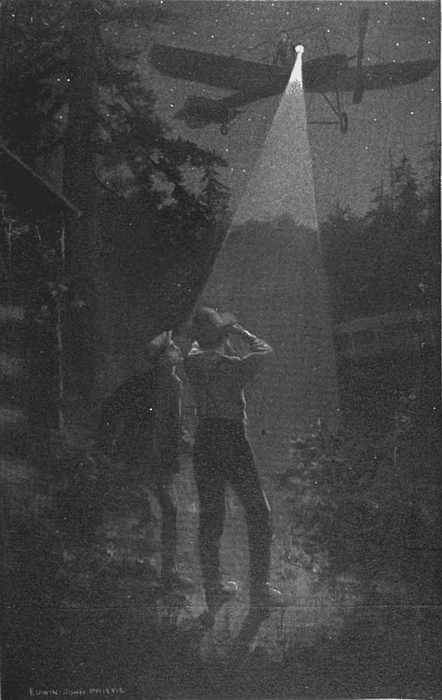
Suddenly a fanlike stream of light shot out from
a point directly above the crimson glow. It
darted here and there, whisked over the small
plain, flitted above the treetops and then flashed
into the faces of the two persons who were standing
side by side.
“It’s another aeroplane!” cried Harvey; “it
carries a searchlight and the man is hunting a spot
to land.”
At this juncture, Bohunkus’s curiosity got the
better of him. He came timidly to the open door
and peeped out.
“Hab it struck yet?” he asked; “it’ll be
mighty bad when it swipes yo’ alongside de head.
Better come in here——”
At that instant the blinding ray hit the dusky
youth in the face, and with another gasp of affright,
he dashed to the farthest corner of the room,
where he cowered in trembling expectancy.
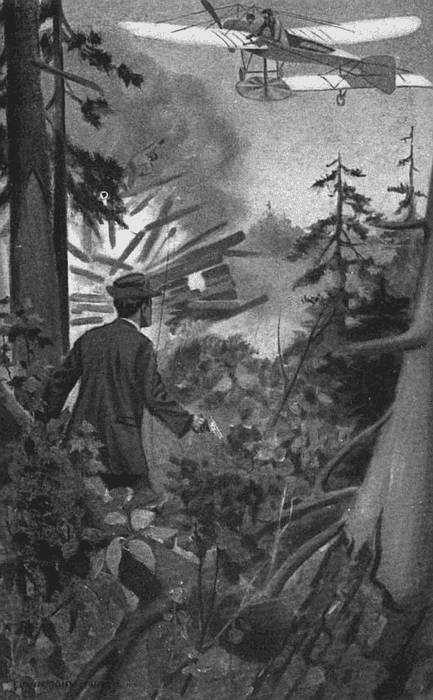
A Fanlike Stream of Light Shot Out.
65The couple outside were too much absorbed
in what they saw to give heed to him.
“You’re right,” said Wharton; “it’s an aeroplane
and the aviator means to alight.”
The searchlight continued darting here and
there, but the spreading glow finally settled upon
the ground near where the biplane stood silent
and motionless.
“It is unaccountable that it makes no noise.
Look!”
The aviator now demonstrated that he was an
expert in the management of his machine. He
oscillated downward, zig-zagging to the right and
left, until he gently touched the earth and the
wheels running a short distance settled to rest.
The searchlight flitted toward different points
several times and then was abruptly extinguished.
Harvey and Wharton walked across the ground
toward the machine. Before they reached it, they
made out the dim forms of a monoplane and a
man standing beside it. To the youth he was the
tallest and slimmest person he had ever seen. His
stature must have been six and a half feet and in
common language he was as thin as a rail. He had
observed the approach of the two and silently
awaited them.
66“Good evening!” saluted Harvey, who was
slightly in advance of his companion.
“How do you do, sir?”
The voice would have won an engagement for
the owner as the basso profundo in an opera troupe.
It was like the muttering of thunder, and as Abisha
Wharton expressed it, seemed to come from his
shoes.
Since Wharton left it to his young friend to do
the honors, Harvey, pausing a few paces away,
exerted himself to play the host.
“I see that your machine is a monoplane; you
seem to have it under good control.”
“Why shouldn’t I? I made every part of it.”
“Even to the searchlight?”
“Of course; is that biplane yours?”
“It is; we landed several hours ago, having
been kindly furnished a meal and lodgings for the
night. I presume you will keep us company;
my friend here, I am sure, will be glad to do what
he can for you.”
“Kerrect,” added Wharton; “you’re as welcome
as the flowers in spring.”
“Don’t you travel by night?” asked the visitor,
ignoring the invitation.
“Not when I can avoid it; it is too risky to land
in the darkness.”
67“Night is the favorite period with me.”
“But you can’t keep in the air all the time.”
“What do you know about it, young man?”
asked the other in his sepulchral tones; “I don’t
expect to make a landing till after sunrise to-morrow.”
“I never heard of such a thing.”
“There are lots of things you never heard of;
I built this monoplane, without help from any one;
it embodies a number of new principles, one of
which is the ability to keep in the air for twelve
hours without renewing the gasoline; I mix a
certain chemical with that fluid which increases
its power tenfold; I shall not rest until it is multiplied
a hundred times.”
“You have an invention that will make you
wealthier than Carnegie or Rockefeller.”
“I’m not seeking wealth,” said the other
sourly, as if not pleased with the suggestion;
“there are better things in life than riches.”
“All the same, it’s mighty pleasant to have
them,” replied Harvey, nettled as much by the
manner as by the words of the stranger.
“See here,” interposed the hospitable Wharton;
“we are keeping you standing——”
“There is no compulsion about it, sir; I am
doing what pleases me best.”
68“Will you walk into my house and have something
to eat? There isn’t much style about us,
but my wife will give you a good cup of coffee and
some corn bread and fried chicken.”
“I’ll go to your house, but I’ll not eat for I’m
not hungry.”
Wharton led the way to the porch. Harvey,
who was curious to learn more of this strange
individual, deftly placed his chair so that the
rays from the candle fell through the open window
upon him. In obedience to the youth’s order,
Bohunkus brought out a fourth stool, so that all
were seated, the woman of the house remaining
inside and attending to her duties, as if she felt
no interest in what was going on.
The negro sat close to his companion and
huskily whispered:
“Am he de feller dat rid down on de comet?”
“Bunk, the best thing you can do is to keep
still and listen; our conversation is likely to be
above your head.”
“Jest like de comet; all right; I ain’t saying
nuffin.”
A part of the yellow rays touched Harvey, and
the stranger turned and scrutinized him as if
impelled by curiosity similar to that of the youth.
The movement revealed the visitor’s face plainly,
69and it may be said it was in keeping with the
impression he had already made. He wore a
motorman’s cap, and a long, linen duster, buttoned
to the chin and reaching downward to his slim
tan shoes. What clothing was within this envelope
was out of sight.
The face was long and covered with a grizzled
beard that reached well down on his breast. He
had removed his buckskin gloves, crossed his legs,
and placed one of the hand coverings in his lap,
while he loosely grasped the other and idly flipped
the first with it as he talked.
But his eyes were the most striking feature of the
remarkable man. They were overhung by shaggy
brows, were of a piercing black color, and glowed
as if with fire. Their startling glare caused a
sudden suspicion in the mind of Harvey Hamilton
that the man was partially insane. At least,
he must be the curious individual best described
by the word “crank,” one whom much study and
research had made mad. As is well known, such
a person often succeeds in hiding his affliction
from his friends, or gains the reputation of being
simply eccentric.
“What is your name and why are you
here?” he abruptly asked, still looking in the
face of Harvey, who said he lived at Mootsport,
something more than a hundred miles
distant.
70“I have started on an outing with my colored
friend, without any particular destination in view;
when we have had enough sport, we shall
return. Who are you?” queried the youth,
feeling warranted in asking a few equally pointed
questions.
“My name is Milo Morgan; I have no special
home, but stop where the notion takes me; my
business is invention, as it relates to the aeroplane.”
“May I ask what improvements you have
made, Professor?”
He hesitated a moment as if uncertain what
to reply.
“Not half as many as I am sure of making in
the near future. The rigging of a searchlight
cannot be called an invention, for it has long been
in common use on warships and others, and all
aeroplanes are supplied with electricity. I have
rigged up a wireless telegraph, so as to pick out
messages from the air; I have succeeded in compounding
a fluid which as I told you is ten times
stronger than gasoline; I run without noise, and
my uplifter will carry me vertically upward, as
high as I care to go.”
71“I should think you were blamed near the
limit,” suggested Abisha Wharton, profoundly
interested in what the Professor was saying.
“I have only begun; and I intend to justify the
name of my monoplane.”
“I didn’t hear it.”
“Because I haven’t spoken it, but when you
have a daylight view of my machine you will see
the name painted on the under side of the wings,
‘The Dragon of the Skies.’”
This was said with so much solemnity that
Harvey had hard work to hide his smile. He no
longer doubted that he was talking with a crank.
“Do you mind telling me what is the great
object you have in view?”
“It is to build a machine that will keep afloat
and travel at an average speed of sixty miles an
hour,—probably greater. That will enable me
to cross the Atlantic in a little more than two days
and I shall have no difficulty in sailing to Asia
or Africa.”
CHAPTER VIII. THE PROFESSOR TALKS ON AVIATION.
72
The last remark of Professor Morgan threw
Bohunkus Johnson into a state of excitement.
He had obeyed Harvey and remained
mute during the conversation, but he
now addressed the visitor directly:
“Did yo’ say Afriky, boss?”
The man looked in his direction and nodded
his head.
“That’s what I said, sir.”
“Dat’s where my fader libs.”
Harvey felt it his duty to explain:
“My colored friend claims to be the son of a
distinguished African chief, whom he hopes to
visit some day.”
“What is the name of the chief?” asked the
Professor.
“His given name is the same as his; the full
name is Bohunkus Foozleum.”
“I can’t say I ever heard of him,” remarked the
Professor without cracking a smile.
“I sent him a letter a month ago, in de care ob
Colonel Roosevelt and it’s ’bout time I got an
answer. I’m sure de Colonel will call on him
while he’s hunting in Afriky.”
73“Well, when my machine is perfected, I’ll take
you with me and it sha’n’t cost you a penny,” said
Professor Morgan.
Bohunkus chuckled with delight and settled
down to listen. The visitor now ignored him and
addressed the others.
“Aviation is the theme that fills nearly all
minds and it is daily growing in importance.
The possibilities are boundless; it will revolutionize
travel, social life and the methods of warfare.
It will render the destruction of life and
property so appallingly easy that no nation will
dare array itself against another. You and I are
likely to see that day when:—
“‘The war drum throbs no longer and the battle flags are furled
O’er the parliament of nations, o’er a reunited world.’
“We can remember the universality of the
bicycle; then came, and it stays with us, the
automobile, and now it is the aeroplane. The day
is near when there will be numberless routes
established between cities and countries and when
74the ocean will be crossed east and west by a procession
of heavier-than-air machines, and every
family will have its hangar and its occupant
awaiting the wish of the owner.”
The Professor showed a disposition to quiz the
young aviator, who met him as best he could,
though sensible of his lack of knowledge as compared
with one who had given so much thought
and experimentation to it.
“Naturally,” said he, “men’s first ideas were
of using wings as birds do, but it would take a
Samson or a Hercules to put forth the necessary
strength. But it has been tried times without
number. I think the ancient Greeks wove many
romantic tales of aerial flights—”
The Professor paused and Harvey accepted
the invitation:
“Such as Daedalus and Icarus, who were said
to have flown to the sun and back again. The
Greek Achytus made a dove of wood, driven by
heated air, and one of his countrymen constructed
a brass fly which kept above the ground for some
minutes.”
“Do you recall what aviator first came to grief?”
“‘Simon the Magician,’ who during the reign
of the emperor Nero made a short flight before a
Roman crowd but tumbled to death, as did a
good many during the Middle Ages.”
75“The Chinese were centuries ahead of the rest
of the world in the use of the mariner’s compass,
printing, gunpowder and the flying of kites.
There are authentic records of balloon flights in
the fourteenth century, and a hundred years later
discoveries were made of which present aviators
have taken advantage. You have learned that
although America was visited a thousand years
ago and even earlier by white men, the glory of
the discovery is given to Christopher Columbus.
So the credit of the first real step in aviation
belongs to two Frenchmen. Can you help me to
recall their names?”
“I don’t think you need any help,” laughed
Harvey, who saw the drift of his friend’s quizzing,
“but the men you have in mind were Joseph
and Etienne Montgolfier, who lived at Annonay,
about forty miles from Lyons.”
“What was their idea of aerostation?”
“They learned from many experiments that a
light globe filled with hot air will rise because its
weight is less than the surrounding atmosphere,
just as a cork or bit of pine comes to the surface
of water. They made a globular ball, thirty-five
feet in diameter, of varnished silk, and in June,
1783, in the presence of an immense crowd at
Annonay built a fire under the mouth on the
76lower side. Soon after when the ropes were
loosened, the balloon mounted upward for more
than a mile, then was carried to one side by a
current of air and as the vapor within cooled, came
gently down to earth again.
“The incident caused a sensation and Paris
subscribed money for manufacturing hydrogen,
a very buoyant gas to take the place of hot air.
The brothers sent up such a balloon in Paris in
the latter part of August. It sailed aloft for half
a mile, finally drifted out of sight and came down
fifteen miles from the starting point.”
“Did it carry any passenger?” asked the Professor.
“No; the time had not come for that venture, but
soon after the brothers sent up a second hot air
balloon at Versailles, in the presence of the king
and queen. A wicker cage was suspended below
and in it were a duck, a rooster and a sheep, all
of which showed less excitement than the cheering
thousands. It rose about a fourth of a mile, and
eight minutes after leaving the ground descended
two miles away.”
“Who was the first man to go up in a balloon?”
asked Abisha Wharton.
“I don’t remember his name; can you tell me,
Professor?”
77“Pilatre de Rozier, whose ascent was made on
the 15th of October, 1783, in an oval balloon constructed
by the Montgolfiers. It was not quite
fifty feet in diameter and half again as high. A
circular wicker basket was suspended beneath,
and under the neck of the balloon in the center
was an iron grate or brazier supported by chains,
the whole structure weighing sixteen hundred
pounds. M. de Rozier fed the flames with straw
and wood and thus kept the air sufficiently heated
to lift him eighty-four feet, where held by ropes,
the balloon remained suspended for four and
a half minutes and then gently came back to
earth.
“This incident blazed the way for successful
aerostation. M. de Rozier accomplished higher
and more durable ascents and occasionally took
a passenger with him. We must remember,
however, that in all these instances, the balloon
was restrained by ropes and could not wander
off. The aeronauts chafed under such restriction,
and on November 21, 1783, M. de Rozier
and the Marquis d’Arlandes cut loose from
the earth in front of a royal palace in the Bois
de Boulogne, it being the first time such a thing
was ever done. The ascent lasted not quite
half an hour, when the aeronauts came safely
down in a field five miles distant from the starting
point.” [1]
1. 78It is well to bear the following distinctions in mind:
aerostation is the art of flying in a balloon; when the balloon
is equipped with motor and propellers so as to be navigable,
it is dirigible; an aerocar is any kind of a flying machine; an
aeronaut is any one who navigates the air in a balloon; an
aeroplane is a flying machine which is heavier than air; a
monoplane is a one-planed and a biplane a two-planed flying
machine; a triplane consists of three superposed planes; a
quadruplane of four planes; airmen are either aeronauts or
aviators; aviation is the art of flying in an aeroplane and
an aviator is one who so flies; aeronef is an aeroplane as
defined by International Congress; a hangar corresponds to
a garage for an automobile; ornithopter is a heavier-than-air
machine, with wings upon which it depends for support
and propulsion; petrol is the European name for gasoline.
CHAPTER IX. THE PROFESSOR TALKS ON AVIATION (Continued.)
79
Professor Morgan continued: “Thus
far the aeronauts had used hot air with
which to make their ascents, but the fire
under the balloon was always dangerous and more
than one fatal accident resulted therefrom. Hydrogen
gas was far better, but more costly. Public
subscriptions enabled two brothers named Robert,
assisted by M. Charles, to construct a spherical balloon,
twenty-eight feet in diameter, the silk envelope
being covered with varnish, and the upper half
inclosed in a network which supported a hoop
that encircled the middle of the sphere. A boat-like
structure dangled a few feet below the mouth,
and was attached to the hoop, while a safety valve
at the apex prevented bursting through expansion
of the gas as the balloon climbed the sky.
“This structure was inflated with hydrogen gas
in the Garden of the Tuileries, Paris, on the first
of December, 1783. M. Charles and one of the
Roberts seated themselves in the car, provided
with extra clothing, provisions, sand bags for
ballast, a barometer and a thermometer, and gave
80the word to let go. The balloon soared swiftly,
the aeronauts waving hands and hats in response
to the cheers of the multitudes below. The ascent
was a success in every respect. Having drifted
thirty miles from Paris, the balloon safely descended
near Nesle. There was so much gas left
that the enthusiastic M. Charles decided to go up
again, after parting with his companion. He
climbed nine thousand feet and then by the dexterous
use of his ballast came to earth again without
the least jar.
“The impulse thus given to ballooning spread
to other countries and it would be idle to attempt
any record of their efforts. It may be said that for
nearly a hundred years little or no progress was
made in aerostation. Then came the second stage,
the construction of dirigible or manageable balloons.
All the structures which had hitherto left
the earth were wholly under control of air currents,
as much as a chip of wood is under the control of
the stream into which it is flung. People began to
experiment with a view of directing the course of
the ships of the sky. While it was impossible to
make headway against a gale or strong wind, it
seemed that the aeronaut ought to be able to overcome
a moderate breeze. The first attempt was
by means of oars and a rudder, but nothing was
81accomplished until 1852, when Giffard used a
small engine, but the difficulty of constructing a
light motor of sufficient power checked all progress
for awhile. It could not do so for long, however,
as the inventive genius of mankind was at work
and would not pause until satisfied. One of
Giffard’s stupendous ideas was a balloon more than
a third of a mile long with an engine weighing
thirty tons, but the magnitude and expense involved
were too vast to be considered.
“It would be tedious to follow the various steps
in dirigible ballooning. It was not until 1882,
that the Tissandier brothers, Gilbert and Albert—Frenchmen—built
a dirigible cigar-shaped balloon
substantially on the old lines, but it could not be
made to travel more than five miles an hour in a
dead calm, and was helpless in a moderate wind.
None the less their attempts marked an epoch, for
they introduced an electric motor. The ‘La
France,’ when constructed some time later, was a
hundred and sixty-five feet long, twenty-seven feet
at its greatest diameter, and had a capacity of
sixty-six thousand cubic feet. Many changes
and improvements followed and an ascent was
made in August, 1884, during which the balloon
traveled two and a half miles, turned round and
came back in the face of a gentle breeze to its
82starting point, the whole time in the air being less
than half an hour. This was the first exploit of
that nature.
“But,” added the Professor, “I am talking too
much about dirigible ballooning, for our chief
interest does not lie there. I am sure you have
read of the Schwartz aluminum dirigible; Santos-Dumont
and his brilliant performances with his
fourteen airships; Roze’s double airship, and Count
Zeppelin’s splendid successes with his colossal
dirigibles.
“We have dealt only with structures that were
lighter than air. The wonderful field that has
opened before us and into which thousands are
crowding, with every day bringing new and startling
achievements, is that of the heavier-than-air
machines. In other words, we have learned to
become air men and to fly as the birds fly.
“Success was sure to come sooner or later, and
when it did come every one wondered why it was
so late, since the principles are so simple that a
child can understand them. Otto Lilienthal, after
long study and experimentation, published in
Berlin in 1889, as one of the results of his labors,
the discovery that arched surfaces driven against
the wind have a strong tendency to rise. Then he
demonstrated by personal experiments that a
83beginning must be made by ‘gliding’ through the
air in order to learn to balance one’s self. He
piled up a lot of dirt fifty feet high, and from its
summit made a number of starts, succeeding so
well that he tried a small motor to help flap his
wings. Sad to say, an error of adjustment caused
the machine to turn over in August, 1896, and he
was killed.
“Percy S. Pilcher of England experimented
for several years along the same lines and used
the method of a kite by employing men to run with
a rope against the wind, but he was destined to
become another martyr, for he was fatally injured
one day by a fall. Chanute and Herring of
Chicago taught us a good deal about gliders.
Herring used a motor driven by compressed air
and had two plane surfaces for his apparatus,
but his motor was too weak to sustain him for
more than a few minutes.”
“Professor,” said Wharton, “I have often
heard of the Hargrave kite; why do folks call it that
name?”
“You mean the box pattern, made of calico
stretched over redwood frames. They are the
invention of Lawrence Hargrave of Sydney,
Australia. He attached a sling seat to one and
connected three above it. A brisk wind showed
84a lift of more than two hundred pounds, and he
made a number of ascents, the kites preserving
their stability most satisfactorily.
“Of course you do not need to be told anything
about Orville and Wilbur Wright of Dayton,
Ohio. These plucky and persevering fellows experimented
for years in the effort to overcome obstacles
that had baffled inventors for centuries. Among
the problems they solved were whether stability
is most effectively gained by shifting the center
of gravity, or by a special steering device, and
what the power of a rudder is when fixed in front
of a machine. They decided that in gliding
experiments it is best for the aviator to lie in a
horizontal position; that a vertical rudder in the
rear of a machine is preferable in order to turn to
the right or left, and a horizontal rudder or small
plane in front is the most effective device for
guiding the aeroplane up or down.”
The Professor was in the middle of his interesting
talk, when he abruptly paused and came to
his feet.
“I’ve stayed longer than I intended,” said he;
“I must bid you good night. If it won’t be too
much trouble to your wife I shall be glad to drink
a cup of coffee.”
“No trouble at all,” replied Abisha Wharton
springing from his stool; “won’t you eat something?”
85“I don’t need it.”
The three walked through the open door into
the larger room where the wife was sitting. Bohunkus
was leaning back against the front of
the house sound asleep, as he had been for some
minutes. No one disturbed him. The woman
had heard the words of the visitor, and quickly
brought in a big coffee pot from which she poured
a brimming cup, placing some milk and sugar
on the table. The Professor had not yet thanked
any one for the proffers made him and he did not
do so now, but standing erect, with his cap
almost touching the ceiling, he drank, smacked
his thin lips and remarked that the refreshment
was good.
Standing thus clearly disclosed in the candle-light,
the Professor impressed Harvey Hamilton
more than before. He was as straight as an arrow
and his piercing black eyes had a gleam that must
have possessed hypnotic power. In fact the
woman showed so much restlessness under his
glances that she made a pretext for leaving the
room and remained out of sight until he departed.
He did not offer to pay his host and still forgot
to acknowledge by word the kindnesses shown him.
86Harvey and Abisha accompanied him on his
brief walk across the little plain to where his
machine was waiting. Without any preliminaries
such as testing the wires, levers, framework and
different parts of the apparatus, he seated himself.
“Now,” he said in his thunderous bass, “note
the action of my uplifter.”
This contrivance was simply a horizontal propeller
under the machine, which being set revolving
with great rapidity hoisted it gently from the
ground and as straight upward as a cannon shot
fired at the zenith. It was easy to understand the
principle of the action, but not of some of the other
performances of the eccentric inventor. When
the aerocar was well off the earth, the regular
propeller in front began work and the uplifter
became motionless.
All this time only a faint humming noise was
noticeable, but in a few minutes that became
inaudible. Professor Morgan was swallowed up
in the darkness and speedily vanished, for he made
no use of his searchlight. He must have been
half a mile to the northward when he let off a
rocket. Ordinary prudence on account of sparks
probably caused him to send it sideways. It
formed a striking picture,—this germination as it
were of a blazing object in mid air, which shot
87away with arrowy swiftness in a graceful parabola
that curved downward, and when about half way
to the ground burst into a myriad of dazzling
sparks of different hues that were quickly lost in
the gloom.
The two spectators waited and gazed in silence,
but saw nothing more and returned to their
seats in front of the cabin.
“Strange man,” said Harvey, “I wonder
whether we shall ever see him again.”
“I don’t think there is much chance of my
meeting him, but you may bump against him
some time when you are cruising overhead.”
“That seems hardly likely, for the field is too
big.”
And yet Harvey Hamilton and Professor Milo
Morgan were destined to meet sooner than either
suspected and in circumstances of which neither
could have dreamed.
Wharton refilled his corncob pipe and puffed
with deliberate enjoyment.
“What do you think of him, Mr. Hamilton?”
he finally asked.
“He’s wonderfully well informed about aviation,
but is cranky.”
“He’s more than that.”
“What do you mean?”
88“He’s plumb crazy.”
“You wouldn’t think so from his conversation;
no one can talk better than he.”
“But his eyes! They gave him dead away;
I’m glad he didn’t stay all night.”
“What difference could that make?”
“More’n likely he would have got up and
killed us all while we were asleep.”
Harvey laughed.
“While he isn’t the sort of companion I should
fancy, I’m sure he is not that kind of a lunatic.
The chances are that he will lose his life through
some of his experiments in aviation, the same as
those we talked about.”
“Shall we say anything to Bohunkus about
the man being off his base?” asked Wharton,
as if in doubt regarding his duty in the circumstances.
“It isn’t worth while; nothing can be gained by
doing so.”
And in reaching this decision, Harvey Hamilton
made a grand mistake, as he was fated to learn
before many days. It would have been a fortunate
thing, too, had the colored youth kept awake
during this chat, but it was not so to be.
89As the night advanced, the host told his guest
he was at liberty to retire whenever agreeable.
The couple had a sleeping room upstairs, and not
being well provided for company, a blanket was
spread on the floor in the lower front room.
Bohunkus was still unconscious, his cap having
fallen at his feet. Harvey reached over and
shook his shoulder.
“Come, Bunk, it’s time to go to bed—excuse
me!”
Although the action was gentle, it destroyed the
sleeper’s center of gravity, and he and the stool
tumbled over on the floor. Even then, he was
only partially awakened and mumbled a wish
that folks would stay on their own side of the bed,
as he climbed unsteadily to his feet.
The weather was so mild that there was no
discomfort in occupying a room whose windows
and door were open. With the aid of the candle,
Bohunkus stumbled to the blanket in the corner,
pitched down upon it and the next minute was
slumbering as soundly as when his stool tipped
over with him. He and Harvey had laid aside
their heavy coats before they sawed and split
the supply of wood, and the single blanket gave
them all the protection they needed. Thus the
two lay down to pleasant dreams.
CHAPTER X. THE FLYING BOYS CONTINUE THEIR JOURNEY.
90
The morning dawned clear, mild and bright.
Harvey and Bohunkus were astir at an
early hour and filled the tank with gasoline
and replenished the supply of oil. An examination
of the aeroplane was made and every wire,
brace, lever and appurtenance found, so far as
could be judged, in perfect condition. The two
went back to the house where an excellent meal
was awaiting them. Harvey slipped so liberal a fee
into the hands of the woman that she was delighted
and showed it to her husband, who grinned appreciatively.
It may be said that he earned the extra
pay through a valuable suggestion to the aviator,—one
that was effective and so simple that
it was strange it had not been thought of before.
“You tell me,” said Abisha, “that when one of
them things is ready to start on its flight, you hold
it until the propeller has got its grip and then let it
go with a jump.”
“Something like that is the practice.”
“When there’s only two of you, how do you
manage it?”
91“The only way is to start the thing, with Bunk
in his seat; I run alongside for a few steps and
spring into my seat.”
“You might slip and let the aeroplane get away
from you. Then Bunk would be thrown out on
his head.”
“He wouldn’t be hurt if he landed that way,”
replied Harvey with a laugh, “but he might alight
on his shins and that would be bad.”
“Let me show you a better plan.”
Abisha strode to the woodpile and came back
with a long, strong stick. He set one end in the
ground, with the upper inclined against the footboard.
The prop thus gained held the biplane
immovable before a strong push.
“Let her shove all she wants to,” explained the
man, “and when you’re ready, kick the stick aside.”
“The scheme could not be better,” said Harvey
admiringly, as he made sure that the point in
contact with the machine could not injure it. He
seated himself and Abisha swung the propeller
around; the engine instantly responded with its
deafening roar and a powerful thrust was exerted
against the prop. In a few minutes, the youth
leaned over, grasped the stick and swung it aside.
The machine made a bound like a runner starting
on a race, spun over the ground for a hundred feet
92or more, and then in obedience to the upturned
rudder in front, leaped clear of the ground. She
was off.
Harvey glanced back. In the door was the
smiling housewife, with her husband on the spot
where he stood when the flight began. He waved
his hand in salutation and the two aviators responded.
This is a good place in which to give the explanation
that must be made in order to understand how
it came about that these two youths were so far
from home, and engaged upon the outing that was
destined to prove the most memorable in the life at
least of one of them.
Harvey Hamilton was the son of a wealthy
merchant, whose business took him to New York
every week-day morning. The youth was preparing
to enter Princeton University, and his elder
brother Dick was a student in Yale. In the
beginning of the summer the family separated,
each member indulging his or her taste in the way
of vacation, with the parent glad to pay the bills.
The mother and daughter Mildred went to the
White Mountains, Dick to the Adirondacks with
a party of students, while Harvey and his father
took a jaunt through a part of Europe, sailing
home from Naples on the Duca degli Abruzzi.
93Wife and daughter, knowing when they were due,
were at home to meet them. Dick was still in the
mountains, from which he wrote the most glowing
accounts of his life in camp and conquests of the
gamy trout that are still to be found in the cool
streams.
On the homeward passage, Harvey and his
father were lucky enough to meet the noted German
aviator, Ostrom Sperbeck, of whom we have
heard already.
Mr. Hamilton explained to the Professor that
his son Harvey with the assistance of the colored
youth, who was “bound out” to a neighbor, were
at work on an aeroplane with which they hoped to
fly, but the Professor warned them against it.
“It is too dangerous; some of the best aviators
have lost their lives and you know that one of the
Wright brothers came within a hair of being killed.
Encourage your son, if you wish, in the sport, for
those who are boys to-day are the ones that will
make the greatest discoveries and advances in
aviation, but do not let him take any risks that can
be avoided. Buy him a first-class machine and
forbid him to use any other.”
Mr. Hamilton was impressed with the advice
and acted upon it.
94Bohunkus Johnson was as ardent as his young
friend, but, lacking his mental brightness, was not
given charge of the aeroplane, though promised a
chance of trying his hand later on.
So much having been told, it will be understood
how on a pleasant summer day, Harvey and
Bohunkus started on their outing, with permission
to be gone several weeks, though their expectation
was to return in the course of ten days or so.
Several facts will be borne in mind. Nothing
not deemed absolutely necessary was taken with the
aviators. Inasmuch as they could not stay more
than two hours in the air, without replenishing
their supply of fuel, they carried no food, nor were
any weapons taken along, for it was not probable
they would ever need anything of the kind. Although
Harvey headed toward a spur of the Alleghany
Mountains, with the object of relieving what
promised to become a monotonous experience at
times, it did not seem possible that they would ever
run into personal danger from that cause. He
carried a pair of binoculars held by a strap over
one shoulder, for such an instrument was likely to
prove useful in their voyages through the air.
Harvey ascended for a fourth of a mile, and
Bohunkus shuddered at the thought of plunging
again into the arctic regions, but his friend lowered
the front rudder and they skimmed away on a
95level. The view was as entrancing as ever, with
cities, towns, villages, scattered houses, stretches
of wood and cultivated country, winding streams,
puffing engines pulling trains that looked like insignificant
toys, and the gleam of what seemed to be
a lake of several miles area in the distance. The
wanderer through the finest picture galleries in
Europe can become sated with the numberless
master-pieces, and wonderful as was the unfolding
panorama, the youths grew tired of its splendid
sameness. When they gazed at the earth it was
without any clear impression of what they saw.
Far to the westward loomed a mountain, the
outlines showing a dim blue haze against the
summer sky. Harvey had fixed the elevation in
his mind before leaving home and, it was his
intention to sail over the summit into the more
unsettled country beyond. As near as he could
judge the range was about twenty miles distant.
“I can easily make it in an hour,” he reflected,
“and not hurry.”
He was traveling at a moderate pace, for he did
not like to impose a strain upon the machine by
pressing it to the limit. There was no call for
hurry, and after clearing the elevation he could
land at some town and buy what gasoline he
needed. He shifted the course of the aeroplane
96slightly, and descended until within two or three
hundred feet of the earth. There were no tall
buildings to be avoided, and none of the trees that
showed were lofty enough to interfere. Bohunkus
sat in his usual seat, idly grasping the supports,
for the progress was so smooth that he might have
folded his arms without risk, always provided the
aeroplane did not collide with any of the fierce
aerial gyrations, which are so dangerous to aviators,
because being invisible, no precaution can be
taken against them.
Harvey slackened his speed still more, and
coursed easily forward, crossed a winding creek,
and was skimming toward a moderate stretch of
woods, when he noticed a man standing on the
margin and watching the aeroplane. The fact
that he held a gun in one hand did not concern the
youth, who, prompted by the spirit of mischief
natural in one of his years, dropped still lower and
headed for the man, as if he meant to crash into
him.
The stranger, instead of turning about and
dashing into the wood where he would have been
safe from pursuit, suddenly raised his double-barreled
shot gun and let fly with both charges.
Nothing of the kind had been dreamed of, either
by Harvey or his companion, and they were
97startled indeed when they heard the shot rattle
through the wires and framework of the machine.
One of the pellets nipped the cheek of Harvey
and Bohunkus yelled,
“I’m shot all to pieces, Harv!”
Harvey turned his head in affright, but saw no
evidence that the other had been harmed in the
least. The man, seeing that his hasty aim had
been ineffective, began hastily to reload his weapon
with the evident purpose of doing execution next
time.
CHAPTER XI. FIRED ON.
98
Bohunkus Johnson was never so angry
in his life and the resentment of Harvey
Hamilton was equally intense. That a man
should deliberately shoot at their machine without
provocation more than a bit of harmless mischief,
was beyond bearing. The colored youth stood
up and shouted to his friend:
“I’m gwine to jump! I’ll teach him sumfin!”
“Wait one moment,” replied Harvey, as he
shut off power and hastily dropped to earth.
His momentum carried him several rods beyond
the young man, who was still busy reloading his
gun. Fortunately for our friends it was of the old-fashioned
muzzle pattern, and required more
time than the modern weapon. He roared with
an oath:
“I’ll larn you better than to go skyugling over
the country and trying to scare folks to death.
Jes’ wait till I git my gun loaded agin!”
But neither Harvey nor Bohunkus had any
intention of waiting. Before the machine came
to a rest, the colored youth leaped to the ground
and broke into a run for the man, who held his
position.
99“Yo’s gwine to larn me something, am yo’?
Wal, dis am de time to begin!”
“Sail into him, Bunk!” shouted Harvey, “and
if you need any help, I’ll give it!”
“All yo’ got to do am to keep out ob dis bus’ness;
I’m running dis funeral,” replied the African,
without shifting his gaze from the young farmer,
who could not have been much older than Bohunkus.
Not once did the latter check his pace,
but dashed at full speed at the man. The instant
he was within reach, he landed a blow that sent
the other spinning backward, with his feet pointing
upward and the weapon hurled from his grasp.
It was not a knockout, however, and the fellow
was game. He bounded up again as if made of
rubber, and charged in turn upon his assailant.
Bohunkus had little “science,” but he had been
in many bouts, and was as strong as a bull. He
braced himself to receive the attack, which came
the next instant. A clenched fist landed on his
jaw with a force that nearly carried him off his
feet, and then the two went at it hammer and
tongs, with no apparent advantage at first on
either side.
100Harvey, seeing that his machine was unharmed,
watched the fight. Nothing would have suited
him better than to take Bunk’s place, for he had
been taught boxing by a professional and he knew,
though he might not have been so big or strong as
his comrade, that he could readily vanquish the
awkward but powerful fighter. Coolness, straight
hitting and skilful parrying would do the business.
He did not mean to stand idly by and see Bunk
maltreated, but it would not be sportsmanlike to
break in unless to stop the struggle.
The countryman was tough and wiry, and it is
doubtful how the fight would have ended had it
depended upon fists alone, but in one respect
Bunk was much the other’s superior. He was
known as the best wrestler in the neighborhood of
his home. When nearly a score of blows had
been exchanged, the negro rushed in, grasped his
antagonist about the waist, lifted him clear of the
ground, and flung him on his back with a violence
that it seemed must have jarred his teeth. Before
he could spring to his feet again, Bunk was across
his chest and evening up things in the most
impressive style that can be imagined.
Suddenly the victim shouted at the top of his
voice:
“Bill! Sam! Dick! Tom! Hurry up and part
us afore we kill each other!”
101This was a strange appeal and puzzled Harvey,
who was disposed to think it was simply a bluff.
The victim was too proud to beg for mercy, and
tried to scare off his assailant. Harvey stepped
forward, picked up the partially loaded gun from
the ground, and with several quick stamps of his
shoe so broke the two hammers that the weapon
became useless for the time.
“That will prevent his using it against us,”
was the thought of our young friend, who again
turned his attention to the combatants on the
ground.
“Don’t be too hard on him, Bunk; I guess he’s
had enough.”
“Why doan’ he holler ‘’nough!’ den? dat’s what
I’m waitin’ fur.”
The victim had ceased his outcries, and was
desperately trying to writhe free and roll off the
burden, but his master couldn’t be shaken from
his perch.
“Why doan’ yo’ holler like a gemman oughter
do when he’s had ’nough? Holloa!”
When Harvey Hamilton thought the fellow was
merely bluffing by his calls for help, he made a
mistake. From out of the wood came running a
man larger and older than any one of the three,
102and he was followed by a second, third and fourth,—all
full grown, massive, muscular and each with
fire in his eye. They had heard the cry of their
comrade in extremity and made haste to come to
his help.
Their arrival caused a change of program.
Much as I like Bohunkus Johnson (and I trust that
you, too, share the feeling), I am obliged to confess
that like many of his race he had a tinge of
yellow in his composition. So long as he held the
upper hand, or so long as the fight was in doubt,
he displayed courage, but the arrival of reinforcements
threw him into a panic. He whisked off
the prostrate figure, leaped to his feet and dashed
at his highest speed into the woods. He ran
like a person whose life was in danger, and the
young man who had suffered at his hands sped
after him, breathing threatenings and slaughter.
The new arrivals, who had been referred to as
Bill, Sam, Dick and Tom, were evidently young
farmers, none more than twenty-five years old.
They had sturdy frames and could have given
a good account of themselves in a physical struggle.
They must have been mystified by what they saw,
for the one who had dashed off in pursuit of
Bohunkus had not paused to make explanation.
103One fact was a vast relief to Harvey Hamilton:
none of them carried a weapon, though it may be
thought the quartet did not need anything of
the kind in order to work their will with the slim
active youth. The latter, with a quickness of
resource which would have done credit to one
older than himself, picked up the discarded shotgun
at his feet, covering the lock as he did so with
one hand in order to hide the harm it had suffered.
So long as the others believed it sound and loaded,
he could command the situation.
“Say, you,” said the tallest of the quartette in
a loud voice, “what’s the meaning of this row?
We don’t exactly git the hang of things.”
Facing the group and with his back toward the
biplane, Harvey answered:
“Your friend had a misunderstanding with my
friend, and it doesn’t seem to be settled yet,
though it looks as if yours had the advantage.”
“What was the quarrel about?”
“Your friend—”
“That’s Herb,” interrupted the other speaker.
“Herb fired his gun at us without any cause.”
“Yes; we heerd it; if he didn’t have any cause,
what was the reason he took a shot at you?”
“Pure cussedness is all I can think of.”
“Didn’t he hit either of you?”
“He grazed my face; we came down to ask
an explanation, and my colored companion was
giving him a good pummeling, when you came
up and scared him away.”
104“I take it, stranger, that that contraption over
there is one of them infarnal flying machines.”
“It is a flying machine, but there’s nothing
infernal about it.”
“Folks hain’t no bus’ness to cavort round the
country in them.”
“I don’t see why they haven’t; we are not
injuring you or any one else.”
“Boys,” said the speaker, turning to his companions
who were standing near and listening to
the conversation; “the best thing we can do is to
rip the blamed thing to slathers. What do you
say?”
“Them’s our sentiments,” replied one while
the three nodded.
“Come on then; it won’t take us long to make
kindling wood of it.”
He took a step forward, and then stopped.
Harvey had leveled the gun.
“The first one that lays a hand on my aeroplane
must be prepared to have daylight let through
him.”
It was a staggering threat, but in the trying
moment, Harvey Hamilton could not help reflecting
that the weapon was not only injured, but unloaded.
He would be in a sorry situation should
they learn the truth.
105The strained situation could not last, and he
slowly backed toward the machine, holding the
weapon in front, ready to be raised again to a
level should it become necessary.
“Four of you are rather too much for me,”
he said with a grim smile.
“Hooh! One of us could lay you out as easy
as rolling off a log.”
“I am willing to take you one at a time, but
I know that as soon as I get the best of him the
rest of you will pitch in and do me up.”
It was “Bill” who was talking for the four.
He grinned and with a snort replied:
“I’d ax nothing better than one crack at you,
but there ain’t no show with that loaded gun in
your hands; nobody but a coward would use
that.”
“Then you may consider me a coward, for I
am on to your tricks.”
By this time Harvey had reached his machine,
but the problem remained as to how he could
seat himself and start the motor without inviting
an attack that must overwhelm him and wreck
his property. He stood for a minute undecided,
while his enemies, less than a dozen paces away,
were on the alert for a chance to seize any advantage
that offered.
106Suddenly the young aviator stepped into his seat,
but, standing upright, faced about and confronted
them still with gun in hand. They showed an
ugly disposition at the prospect of his eluding them,
but seemingly there was no way to prevent it.
“If you would like a closer view,” Harvey said,
“I have no objection, but you must come one at a
time. You may do so first.”
He indicated Bill, who hesitated:
“No shenanigan!”
“Nothing of the kind, I promise you.”
After a moment’s pause, he gingerly approached,
but showed he was not wholly free from misgiving.
“What do you think of that big wheel?” asked
Harvey.
“Hooh! seems to be made of black walnut,”
replied the other, laying a hand on one of the propeller
blades.
“So it is; have you enough muscle to turn it
round?”
“That’s dead easy,” replied Bill, grasping one
of the arms and whirling it about with double the
force that was necessary.
CHAPTER XII. PEACEFUL OVERTURES FAIL.
107
The revolution of the propeller of course
started the engine, with such a terrific
outburst of noise that Bill instinctively
drew back a pace or two. In an instant the blades
were spinning round with tremendous velocity,
and the aeroplane began moving over the ground
with fast increasing speed.
The sight roused Bill, who dashed forward to
intercept it. He had almost reached the machine
when it bounded upward and glided beyond his
grasp. The delighted Harvey tossed the gun toward
him, and in a rage at his slip Bill snatched
the weapon from the ground and shouted:
“Stop or I’ll shoot!”
His action and movement of the lips told the
young aviator the substance of the threat, and with
a tantalizing gesture he called back:
“Shoot and be hanged!”
Bill was in a savage mood and brought the gun
to his shoulder. He aimed carefully, and with the
brief distance between the two could hardly have
missed had the weapon been in order; but we
108recall that the hammers were broken, to say nothing
of the lack of a full charge in the barrels. Either
would have been sufficient to save the fleeing
aviator, who having set the machine going, looked
round to watch his enemy.
He saw him suddenly lower the gun and then
fling it angrily to the ground. No doubt his
chagrin was intensified by the remembrance of the
chance he had let pass when the youth was really
at his mercy. He shook his fist at Harvey, who
was now a hundred feet above the ground and
going at moderate speed.
In that hurried scrutiny, however, the aviator
made a disquieting discovery. Two of the remaining
young men were invisible. Doubtless they
had dived into the wood in pursuit of the panic-stricken
Bohunkus, who of necessity was left in a
most dangerous situation. Harvey had been
compelled to desert him for the time, though he was
the last person in the world to abandon a friend
in trouble. How to save him from the vengeance
of the baffled party was a serious question.
“If there were only one chasing him,” thought
Harvey, “I shouldn’t care a fig, for Bunk has
already proved himself his master, but he will be
helpless against four or even two, and it looks as
if he will have three at least to fight.”
109The problem was a puzzling one. The flight
of the colored lad was so sudden that he and Harvey
had not been able to exchange a word. A few
sentences would have effected an understanding.
His friend would have told him to make his way
to the nearest town and there wait until he could
hunt him out and take him aboard again. Moreover,
among Bunk’s accomplishments was a
remarkable fleetness of foot. He could have continued
his flight through the wood into the open
country and gained enough advantage to offer
Harvey the opportunity of picking him up before
his enemies interfered.
But it was useless to speculate, since all this was
out of the question. Having ascended some three
hundred feet, Harvey began slowly circling around,
with just enough speed to hold the elevation. He
returned so as to hover directly over the head of
Bill, who still stood alone on the edge of the wood
closely watching him. Thus the situation remained
for several minutes, during which Harvey
Hamilton met with one of the narrowest escapes
of his life.
Feeling that in one respect the countrymen were
the masters, he decided to express to Bill, who was
evidently the leader of the quartet his willingness
to apologize, pay for the injured gun, and leave a
110liberal tip for Herb, the only one who had suffered
during the singular meeting; and then descend,
take Bunk aboard and bid good-bye to the inhospitable
country.
The objection to the plan was the probability of
treachery on the part of Bill and his companions.
All had shown an ugly disposition and so much
resentment that it was more than likely they would
break the agreement, and at least destroy the
aeroplane so utterly as to place it beyond repair.
It was this misgiving that caused Harvey to
hesitate. He circled several times—always to the
left—gradually descending, and kept watch of the
solitary figure below him. Finally, having made
his decision, he leaned over the side of the aeroplane
and shouted as he slowed down the motor:
“Say, Bill, what’s the use of our quarreling?”
Bill did not attempt to answer the conundrum.
“If I do the fair thing, will you call it off?”
“What do you mean by the fair thing?” demanded
the surly young man.
“I broke that gun and will pay you for it; I’ll
give you ten dollars to hand to Herb, though I
don’t see why he should get anything.”
Bill was silent a minute, as if turning the proposition
over in his mind. Finally he glared upward
and uttered the one query:
111“Wal?”
“When I have done that, I shall take my colored
friend aboard and have the honor of bidding you
good day until we meet again.”
This was a clear proposal and could not fail to
impress Bill favorably, no matter whether he
meant to “tote fair” or not. Bill didn’t seem able
to think of any objection or to suggest an amendment.
“All right,” he shouted back; “I’ll do it.”
Harvey meant there should be no room for a
misunderstanding.
“I am to come down to the ground, hand you
ten dollars as a salve—”
“I guess Herb will need some salve for that face
of his,” grimly interjected Bill.
“And another ten dollars to pay for the damages
to the gun. That will make everything right
between us and none of you will interfere further.”
“I’m agreeable; hurry down.”
It was at this juncture that Harvey Hamilton
received warning of a frightful peril that in another
moment would have caught him inextricably. He
had started to volplane to the ground, when an
impulse caused him to turn his head sufficiently to
glance at the man with whom he had just made his
agreement. In that passing glimpse, Harvey saw a
hand reach from behind the trunk of a large oak
at the back of Bill and exchange guns with him.
112It was done in a twinkling, only the arm holding
the weapon and the corner of the fellow’s face
showing for an instant, during which he placed in
the grasp of Bill a loaded piece and relieved him of
the useless one.
There could be no mistake as to the meaning
of the sinister action: Bill intended to play false.
He would secure the money promised, and quite
likely rob Harvey of all that remained, would
wreck the aeroplane and shamefully maltreat both
youths. But for this discovery, Harvey would
have walked into the lion’s den the next moment,
but with that coolness which was one of his most
striking traits, he began edging away and upward,
as if it were a part of his plan of manipulating the
descent. If Bill chose to use his gun, he was near
enough to make only a single shot necessary, and
Harvey’s object was to get beyond range, before
revealing his purpose.
“What are you doing?” called Bill, handling his
weapon threateningly.
“I want to make sure the machinery is working
right; it will take only a minute.”
Bill was partly satisfied, but had no excuse for
objecting.
113The circling grew wider, until the right height
was attained, when Harvey headed toward the
dim range of mountains in the distance, with a
speed of at least fifty miles an hour. Only a few
seconds were needed to place him far beyond range.
Checking his motor for an instant so as to permit
his voice to be heard, he called to Bill:
“I don’t like the looks of that new gun in your
hand; don’t expect me before to-morrow or some
day next week.”
In his impotent rage, Bill brought his weapon to
his shoulder, took quick aim and discharged both
barrels. It was a foolish thing to do, for not one
of the shots carried to the aeroplane, all being dissipated
long before they could reach it.
Clever as had been the strategy of Harvey, the
grave problem remained as to how he was to
extricate Bohunkus Johnson from his dangerous
situation. Disappointed in capturing the aviator
and his machine, the party were quite sure to turn
their rage against the colored youth, unless by his
superior fleetness he could elude the whole party.
Harvey’s altitude gave him a clear view of the
patch of woods, which was perhaps a third of a
mile in width and double that length. It was the
season of the year when the foliage was at its full,
and if Bunk gained a fair start he ought to have
no trouble in hiding himself from his enemies; but
how were he and his friend to come together again?
114“It is as hard to decide as it is to figure out why
that man behind the oak with his loaded gun did
not keep hidden till I came within reach, and then
open on me without giving away his scheme as he
did; that would have cooked my goose, though they
may have felt doubt of getting hands on the
machine if they fired before it touched ground.”
Without climbing higher, Harvey circled about
the woods, scanning the green depths below for
some signal from his comrade. Bill and his companion
had passed from sight, so that the five
were somewhere in the depths of the forest. The
aviator glided along the sky over the tree tops
without catching a glimpse of anything to give
hope. Then he passed a little way beyond the
western end and circled about again. He saw
a farm house a mile distant, and unless hope presented
itself in some form very soon, he determined
to go thither in quest of help against the lawless
young men.
What was that which suddenly caught his
roving eye? On the margin of the wood something
flitted for a moment like a bird hopping from
one branch to another. He would have believed
it was such, had it not been so near the ground.
115Whisking his binoculars from his shoulder, he
scanned the object. His heart thrilled when he
recognized a cap swung by a person standing
behind the trunk of a large tree.
“It’s Bunk!” exclaimed the delighted youth;
“his foes are so near that he daresn’t show himself.”
Harvey was quick to make up his mind. Shutting
off power for a moment he called in his clear,
ringing voice:
“Wait where you are, Bunk! I’ll be back in a
minute or two; don’t leave till I give the word and
then come a-running.”
The cap was waved again and Harvey fancied he
saw the corner of the negro’s countenance as he
peered round the trunk.
The fear of the aviator was that the five men
who were sure to be watching his movements,
knowing he was trying to save his colored companion,
would have their attention drawn to the
spot over which the aeroplane was hovering.
There was the danger that they had heard his call
and would act on the hint, but the risk had to be
taken.
Harvey next shifted to the opposite side of the
wood, where he dallied back and forth for half an
hour, as if trying to fix upon a good landing place.
116He knew he was under the eyes of the angered
countrymen, but was certain he had drawn them
to that side of the forest, where they were so far
from Bohunkus that it would take considerable
time for them to return to his neighborhood.
Suddenly the aeroplane darted off like a swallow,
skimming over the trees, at the spot selected.
“Quick, Bunk! Don’t lose a second! Jump
aboard!”
Out of the wood dashed a young man and ran
straight for the machine at headlong speed, but
he was not Bohunkus Johnson!
CHAPTER XIII. SCIENCE WINS.
117
Clever as was Harvey Hamilton, and skilfully
as he had played the game, he was
outwitted at last, for the individual who
rushed toward him was his enemy Bill, and he
carried a loaded gun.
Not only that, but after him hurried one, two,
three, four others, ready to back up their leader.
One of them carried a deadly weapon. Bohunkus
Johnson was nowhere in sight.
No wonder the young aviator was dumfounded
for the moment. He was still seated, with his
hands grasping the levers, but he was too wise to
try to flee, with that gun commanding him and the
holder of it in the mood to use it. In a twinkling,
the grinning Bill was at his side and laid his free
hand upon one of the propeller blades.
“Shall I start the thing humming agin?” he
asked with grim irony.
Harvey’s wits flashed back to him.
“Wait till I do my part,” he replied, as if the
slightest misunderstanding had not come between
them.
118As he spoke, he stepped on the ground and drew
out his pocket book, while the five stood expectantly
around, all not understanding what the
action meant.
“I was so afraid we might have some accident
with that gun,” he remarked, observing the
damaged weapon in the hands of one of the party;
“that I broke the hammers; you can get them
fixed at a gunsmith’s for a dollar, so I guess that
will about make it right.”
With which he handed a ten-dollar bill to Bill,
who crumpled it up and shoved it into his pocket,
without a word of acknowledgment.
The situation was delicate to the last degree.
A few feet away stood Herb, whose homely face
spoke eloquently of the scrimmage through which
he had passed. One eye was closed, the upper
lip was swollen to twice its usual size, and the
cheeks were bruised, to say nothing of the rent
shirt, with more than one crimson stain showing
upon it. To offer to settle the matter by handing
the sufferer money was like adding insult to
injury, though the majority of mankind have
little trouble in swallowing offenses of that
nature.
No one could have met the point more tactfully.
119“Herb,” said Harvey, stepping toward him;
“you and my colored man had a run-in and the
last I saw of him he was going for life.”
“You bet he was!” said the other; “it’s blamed
lucky for him he run so fast I couldn’t ketch him;
if I’d done so there would have been a dead nigger
in these parts.”
Harvey hid the pleasure that this reply gave him.
Bunk had escaped from his foe and was safe
somewhere.
“He got me foul,” Herb added, feeling that some
explanation was due his fellows who had seen him
in his humiliating situation; “but I throwed him
off and then he took to his heels.”
Herb added several sulphurous exclamations
which it isn’t necessary to place on record.
“I saw him running, but I notice that he
managed to injure your clothes and it is no more
than right that the damage should be taken out
of his wages. Will this make it square?”
When Herb saw the size of the bill handed to
him his little gray eyes—or rather one of them—sparkled
with greed. But the three who had not
been thus remembered were angered.
“Say, boss, you seem to have a purty good wad
there; ’spose you hand out a few more of the long
green.”
120This suggestive remark was made by the
scowling scamp who answered to the name of
Sam. As if there should be no doubt of his
meaning, Bill took it upon himself to add:
“That’s right; you don’t need any money when
you’ve got that sky wagon to tote you about. So
fork over.”
Harvey’s face flushed, but holding his anger
under control, he said to Bill:
“The agreement between us was that if I handed
this money to you, my colored friend was to
rejoin me and neither he nor I nor the machine
be molested.”
“How can the moke jine you when he’s run off?”
asked Herb.
“We’ll waive that point, but you are not to injure
my machine nor expect any more money from me.”
“Do you mean to say you won’t give it?”
demanded Bill truculently.
“I’ll die first; I didn’t know you were a gang
of cowards as well as scoundrels.”
“Who’re you calling a coward?” growled Bill,
his sunburned face flushing an angrier red.
“Every one of you! Five against one; you
wouldn’t dare attack me singly.”
“I wouldn’t, hooh? Boys,” added the bully,
addressing his companions, “this lily is my game.
You don’t have any put here. Understand?”
121They sourly nodded, though little or no reliance
could be placed on any promise they might make.
“Will you agree to fight me alone?” asked
Harvey.
“Of course; that suits me down to the ground.”
“And the rest are not to mix in, no matter what
happens?”
“Hain’t I told you that? What ails you?”
“That suits me,” replied Harvey, who coolly
took off his coat and flung it across the footrest
of the aeroplane. If anything like fair play was
shown him, he had no fear of the result, for though
his antagonist was taller and possibly stronger, he
knew nothing of the science of boxing. Having
doffed his outer garment, Harvey proceeded in the
same deliberate fashion to roll up his sleeves.
Then he poised his right fist a few inches in front
of his chest and diagonally across it, with the left
extended toward his antagonist. The left foot
was advanced so that the weight of his body
rested on the right leg, so balanced that he could
leap forward or backward as might suddenly
become necessary. His handsome face was a
shade paler, and he compressed his lips as he said
in a quiet even voice:
“I’m ready!”
122The prospect of a fight between two men or
even boys is always sure to interest the spectators
no matter who they may be. Every one of the
five men was in a state of delighted expectation, for
not an individual felt the faintest doubt that the
dandified youth was about to undergo the beating
of his life. The four were ready to promise they
would remain neutral, for they could not believe
a possibility existed of their champion needing
help.
As for Bill himself, he chuckled, for he dearly
loved a fight and he felt venomous toward this
intruder, because he seemed to be rich and had
lately played a humiliating trick upon him. He
handed his gun to Dick, but did not remove his
coat, because he did not happen to be wearing any.
He made a motion with each hand in turn, as if
to shove the bands of his shirt toward the elbow,
but he merely tightened them. He did indulge,
however, in a little act that is generally peculiar
to a countryman. He spat on his horny palms
and rubbed them together.
Harvey saw from the first that though Bill
might be a powerful man, he lacked even a rudimentary
knowledge of boxing. He held his fists
in front, but they were well down, separated
by a wide space, and when he drew near enough
to deliver a blow, his feet were side by side. While
Harvey Hamilton’s pose was an ideal one, that of
Bill was the opposite.
123In contests of this nature, the sympathies of
the reader are naturally with the “gentleman,”
and the story teller generally arranges that he shall
be the victor, though in real life it is not likely
to happen that way. Had the elder undergone
the training of the younger, he assuredly would have
beaten him to a “frazzle,” but it was that one
thing lacking which proved the undoing of Bill.
His awkward advance upon the youth gave the
latter the opening he was waiting for, and coolly,
promptly and fiercely he seized the advantage.
Bill lunged out terrifically, but the blow was a
round one and being cleverly parried, swished in
front of Harvey’s face. In the same instant his
opponent made a single bound forward, so as to
throw the weight of his body into the straight,
lightning-like thrust of the left fist, which crashed
against Bill’s receding chin with the force of a
mule’s kick. He went over on his back, completely
knocked out and with no more sense than a log
of wood. It may be said that the fight was ended
before it fairly began.
Harvey knew some seconds must pass before
Bill would be able to climb to his feet. He shifted
front in a flash and said:
124“I’m waiting for the next.”
He still held his arms in position and danced
deftly about as if impatient over the slight delay
in their attack. But their hesitation was due
more to bewilderment than fear, though the sight
of the motionless form stretched on the ground told
its own story.
It would be thought that the courage shown by
the young pugilist would have appealed to the
manhood of the others, but, sad to say, they had
no manhood to which appeal could be made. The
one known as Dick shouted:
“Are we going to stand that, boys? Didn’t
you see him hit Bill? He hit him foul! Let’s
lay him out!”
Harvey braved himself for the shameless attack,
determined to make their victory cost them dear.
He knew that more than one would suffer, but a
pang shot through him when Dick called out:
“Let’s smash that old thing to flinders first and
then serve him the same way.”
“That’s the idee!” answered Sam; “we’ll make
one job of it!”
And they charged together to carry out their
cowardly threat.
CHAPTER XIV. MILO MORGAN SAVES THE DAY.
125
As straight downward as if fired from the
zenith, a tiny missile shot through the air
so swiftly that no one saw it. It struck
the ground directly in front of the four men and
burst with a deafening report. In the same
second, another followed the first, landing just
behind the group with the same terrifying explosion.
All saw the flash, the smoke and the flying particles.
Then a third and fourth followed with similar
results. Succeeding the fire and crash a voice
rang out:
“Run for your lives! Take to the woods or you
are dead men!”
The command, which sounded as if it came from
heaven, acted like an electric shock upon the four
young men, who with gasps of dismay dived in
among the trees with such headlong panic that
two dropped their hats, and the others stumbled,
crawling forward and scrambling to their feet
as best they could.
126The bewildered Harvey might have done the
same, for it seemed the only way of escaping a
frightful death, had he not fancied there was a
familiar note in the deep bass voice. When he
looked aloft, the strange occurrence was explained.
Balanced directly overhead and not more than a
hundred feet high, floated a monoplane. A slim
man more than six feet tall and clothed in a long
flapping duster was standing erect with a small,
oblong object in his hand to which he had just
applied a match. He let it hiss for a moment, and
then tossed it away so that it fell only a few feet
from where Harvey stood.
“Don’t be scared,” he called; “I’m just practicing
how to drop a bomb on the deck of a vessel;
these things make a loud noise but nothing more.”
As the delighted youth stared upward, he saw
painted in glaring letters on the under side of the
single plane the words:
“The Dragon of the Skies.”
“Aren’t you coming down to call?” asked
Harvey. “No one could be so welcome as you.”
“So I judged from the way things looked; I
have been up here some time watching matters.
You keeled over that brute beautifully.”
“He is showing signs of revival.”
“Stand a little out of the way and watch me
help revive him.”
127Harvey, relieved beyond expression by the happy
turn of affairs, sprang several paces aside and
watched his friend aloft. He was still standing
erect, balanced so perfectly in the calm that he did
not have to steady himself. The missiles which he
had flung to the earth were simply giant firecrackers,
some six inches long and more than an
inch in diameter. He knew when he lighted the
powder-soaked string which served as a fuse how
many seconds it would require to reach the powder
within. It has been shown how accurate he was
in his calculations.
Harvey saw the flicker of the smoking match as
it was touched to the short dangling twist of fuse
attached to the cracker which he held in his left
hand beside his waist, while with one eye closed
he squinted along the red tube as if aiming a
gun. Then he parted his thumb and forefinger
and the cracker tumbled downward end over
end, and either through extraordinary skill or by
good luck dropped upon the chest of Bill and
burst with terrific force and deafening noise.
It certainly “revived” the man, for with a howl
he leaped to his feet and plunged in among the
trees in the wildest panic conceivable. A fifty-pound
bombshell would have caused more damage
but could not have created greater terror.
128Harvey in the reaction of his spirits leaned
against his biplane to keep from falling through
excessive mirth. He had never seen anything so
funny in his life. In the midst of his merriment,
Professor Milo Morgan called down:
“I must be off; good-bye; better not bother with
such folks as these.”
“But, Professor, won’t you make me a call?”
“Haven’t time; other matters are awaiting me.”
“Can you tell me anything about Bohunkus?”
“He’s round on the other side of the wood, waiting
for you.”
As he spoke, the elongated aviator extended
one arm, so that no doubt was left of the direction
meant. Then he resumed his seat, and the Dragon
of the Skies darted into space like an eagle
diving from his mountain perch.
Harvey noticed again that swiftly as the man
was speeding, his monoplane seemed to emit no
noise whatever. It was certainly a remarkable
muffler that enabled him to do this, and it
explained why none of the party below had any
inkling of the crank’s proximity until he made it
known in the startling manner described. Moreover
his uplifter held him sustained without motion,
as we sometimes see a bird hovering over the ocean
and preparing to dart downward for its prey.
129“He has made enough inventions already to give
him riches beyond estimate, but the fact seems to
be the last to enter his head.”
But Harvey could not forget his dusky comrade.
Professor Morgan had told where he could be
found, provided he had not gone elsewhere in
the meantime. The five young men with whom
the couple had had their affray were still capable
of making trouble. It was possible that when they
found none was harmed, they would return to
look into matters. The minutes were too valuable
to be wasted.
Although the aeroplane had been exposed to
danger it had suffered no injury. Instead of
procuring a brake, in the form of a prop from the
nearby wood, with which to hold the machine
until momentum was gathered, the young aviator
whirled the propeller about, stepped into his seat
and grasped the control. The motor started at
once and sent out its deafening racket. The
little rubber-tired wheels began slowly turning and
sped swiftly across the open space. Harvey waited
until he was going very fast, when he drew back
the handle and in the same instant felt he was
traveling on nothing. Upward and outward he
shot to a height of three hundred feet, when he
circled about and came back over the wood, beyond
which he glided to the other side.
130It was there he ought to find Bohunkus. Slowing
his progress as much as he could and still
remain aloft, he scanned the earth in quest of the
colored youth. There was the stretch of woodland,
meadow and sparsely cultivated ground, with
the small dwelling in the distance, the landscape
being crossed by a winding creek which skirted the
forest and lost itself far to the eastward.
But Bohunkus Johnson was nowhere to be seen.
“Likely enough he has started off on a run again
with nobody chasing him and may not look behind
until he has gone several miles. It would
serve him right if I left him to get home the best
he can. He has enough money to pay his way
and—.”
Harvey’s eye rested on a large maple lying on
the edge of the wood. It had fallen recently, for
the foliage of the abundant limbs was still green.
The trunk, which must have been two feet in diameter
at the base, showed no branches for several
yards, but was held a little above the ground by
the sturdy and bent limbs upon which the greater
weight was resting.
There was no particular reason why this object
should interest Harvey, but it did, and he scrutinized
it closely, as he slowly sailed past. Something
moved, but so vaguely that he could not
131identify it. The object appeared to be under the
log in the open space between it and the ground
upon which it was supported. The distance was
so trifling that Harvey did not call his binoculars
into use.
The top of a person’s head, without a cap or
covering except a mass of black wool, and a pair
of staring eyes, showed over the top of the log.
Their owner was watching the biplane, as if uncertain
of its identity. Had the individual remained
stationary, he would have come into clear
view, as Harvey glided beyond him, but before
that could take place, he ducked under the maple,
whisked beneath, and raising his head, again
peered over the trunk from the other side. He did
not speak, but evidently was mystified and undecided
what to do.
The amused Harvey curved about and then
volplaned to the ground within fifty paces of the
fallen tree. As he did so, he saw Bohunkus
standing erect and grinning at him. He had
donned his cap and was delighted.
“Did I scare yo’?” he asked, going forward to
meet his friend.
“Scare me? How could you do that?”
“I knowed it was yo’ all de time; I thought I’d
have a little fun wid yo’.”
132“What were you doing behind that log, Bunk?”
“Nuffin; I felt sorter tired and laid down to rest
till yo’ come along; I was getting out ob patience
wid yo’; what made yo’ so late?”
“I have been looking for you; those were queer
performances on your part.”
“What oblusions am yo’ obluding to, Harv?”
“You gave that fellow the best thumping he ever
had, and then jumped up and ran off like a big
coward.”
“Didn’t run away from nobody; it was dem
’leben fellers wid dere loaded guns dat was a
chasing me like all creation; wouldn’t yo’ run
yo’self?”
“Certainly, if I had been attacked by such a
force, but I stayed behind and entertained the other
four and there was only the one that troubled you.
What became of that fellow who tried so hard to
overtake you?”
“He’s dead,” was the solemn answer of Bunk.
“What killed him?”
“Me,” was the unblushing response; “I kept
running till I got him away from de oder nine, so
dey couldn’t help him; den I whirled about and
lammed him so hard dat it was de last ob him;
he’ll neber insult any ’spectable colored gemman
agin.”
133“Well, Bunk, I am afraid you will have to do
your job over, for I saw him only a little while ago.
He may be near at hand this minute.”
And Harvey glanced around as if alarmed by
the probability of such a thing.
“Being dat am de way things stand, hadn’t we
better emigrate, Harv?”
CHAPTER XV. UNCLE TOMMY.
134
Like a sensible young man, Harvey Hamilton
had made a study of his itinerary before
leaving home. Allowing himself a margin
of several days, he expected to rejoin his friends at
the end of a fortnight. If all went well he would
do so earlier, while there was always the possibility
that he might be absent still longer.
He knew that the little town nestling several
miles to the left was Darmore. It was at the base
of a spur of the Alleghanies toward which he had
been working his way from the first. His wish
was to pass beyond the thickly settled districts.
Nothing palls sooner upon an aviator than the
endless succession of towns, villages, cultivated
sections and monotonous scenery. While there
must be a certain sameness in the expanses of forest
there was always the chance of adventure which a
normal youngster craves as he does his meals when
hungry.
Harvey had meditated going to Darmore to
renew his supply of fuel, but recalled that after
passing the mountain ridge, another and larger
135town lay some miles away in the broad forest
valley. He had enough gasoline to carry him
thither and he decided to make the trip. He followed
his general rule of not rising far above the
altitude necessary to clear the tallest trees and
elevations. Thus, viewed far from the rear, the
aeroplane suggested that it was climbing the mountain
side by resting upon and sailing over the billowy
sea of foliage.
The summit proper was no more than two or
three hundred yards in height, and having cleared it
the young aviator mounted higher than before in
order to secure a comprehensive view of the surrounding
country and learn how correct his impressions
were.
He was vastly pleased. Almost in a direct line
and not far away lay Chesterton, a town of several
thousand population and in the midst of a thriving
section of the country. He traced the winding
highways, the scattered farm houses, the broad,
cultivated fields, the signs of busy life everywhere,
and the enormous wealth of forest which continued
up the farther slope, crowned the top of the ridge
and stretched down the incline beyond.
The noisy motor in the sky and the queer looking
object which seemed to be advancing sideways
and at a rapid pace, drew attention wherever it was
136seen. Farmers riding over the dusty roads
stopped their teams and stared aloft until they got
kinks in their necks; men and women climbed to
the roofs of their houses, as if the slight decrease of
distance would help them, and breathlessly studied
the strange sight, some of the spectators with the
aid of spy-glasses; groups gathered on lawns,
porches and in front of their homes; every window
of a passenger train, to say nothing of the platforms,
was wedged with curious observers, while
several white puffs which shot upward from the
steam whistle showed that the engineer was
sending out a salutation to the aerial wanderer who
could not hear it. Everybody had read of aeroplanes
and seen pictures of them, but this was the
first time the real thing had sailed into their sea
of vision and no picture can stir like the actuality
itself.
Two men, one of them carrying a gun, were
walking over the high road, a little way to the
right, and probably two hundred yards from the
aeroplane. They had stopped and were surveying
the strange object overhead. One of them
abruptly raised his weapon and the little faint
blue puff showed he had used the machine as his
target. Instead of a shotgun the fellow fired a
rifle. It was impossible of course to hear the
137report, but the sudden appearance of a small
white spot on the framework of the upper wing,
showed where the bullet had nipped off a splinter.
Strange that so many people cannot observe a
curious object without yearning to shoot it.
Harvey looked around at Bohunkus, and by a
nod and the expression of his face asked whether
he wished to be set down that he might properly
chastise the scamp. The colored youth shook his
head. He had gone through enough in that line
to satisfy him. Harvey shied off and speedily
passed beyond range. The fellow did not try a
second shot.
Thus far the weather had been ideal, but a
disagreeable change threatened. The sun was
hidden by clouds, which increased in density and
number, and the air became so chilly that both
shivered. Harvey headed for Chesterton, for it
was evident that soon all pleasure in aerial sailing
would be ended for the time.
The approach of the aeroplane roused the usual
excitement in the little country town, and when
Harvey descended in an open space near the collection
of houses, half a hundred people rushed
thither to greet and give him whatever help he
needed. He aimed to make a graceful landing so
as properly to impress the spectators, but he got
138another reminder of the astonishing sensitiveness
of the aeroplane, which must be handled far
differently from an automobile. He was not
quick enough in shifting the lever and hit the
ground with so violent a bump that Bohunkus,
who was not expecting anything of the kind, was
thrown headlong from his perch and landed in
a sitting posture with so loud a grunt that the
onlookers laughed.
“What’s de matter wid yo’?” he asked angrily;
“dat’s de right way to come down in an airyplane.
Hab yo’ any ’bjections?”
“It’s the way you land,” replied one of the men,
“because you don’t know any better.”
Bohunkus would have been glad to make a
scathing retort, but was unable to think of one.
So he said in the way of reproof to his companion:
“De next time yo’s gwine to try to knock a hole
fru de airth, let me know so I can jump.”
“It will do you as much good to jump afterward
as before. It looks to me as if a storm is coming,
Bunk, and we must get the machine under shelter.”
The pleasant feature about the situation was that
the crowd which had gathered and continued to
gather was a friendly one. No one spoke an ill-natured
word and all were eager to help in every
way possible.
139When Harvey stood on the ground, facing the
group, he asked:
“Are we going to have a rain?”
“He’s the man that’ll tell you all about the
weather for a week to come and hit it every
time.”
The one who spoke pointed to an old farmer, without
coat or waistcoat, with a ragged straw hat, chin
whiskers and bent shoulders, who was chewing
tobacco after the manner of a cow masticating
her cud.
“How is it, Uncle Tommy?” asked the man
who had just spoken.
The old fellow, still chewing, looked up at the
sky and then around the heavens, squinting one
eye as he carefully studied the signs.
“It’ll rain like all creation inside of a couple of
hours; then it’ll hold up a little while and bime by
start in agin and drizzle all night.”
“How about to-morrow?” asked Harvey.
“It’ll be bright and clear, but a little cooler
than to-day.”
“Tell the young gentleman how the rest of the
week will be,” insisted his neighbor.
“The next three days will be clear and rayther
warmish; I won’t say anything beyond that this
afternoon, but if ye wanter know, I’ll obleege ye
to-morrer when I’ve had a snifter and my breakfast.”
140“I am much obliged; you have told me what
I wanted to know. I shall need shelter for this
aeroplane; can any of you gentlemen help me?”
There was less difficulty than Harvey anticipated.
Chesterton had a single large hotel or tavern as
the townspeople called it, with the usual rows of
sheds for the convenience of countrymen when
they drove in from the neighborhood. With the
help of several bystanders the machine was shoved
over the road and through the alley—where much
care was necessary to save the wings from injury—to
the sheds at the rear. There, after some delicate
maneuvering, the machine was worked into the
shelter at the corner, where a fair hangar was
secured.
“Here we stay till the weather clears,” said
Harvey to Bunk, as they strolled into the hotel to
get their dinner, for which each had a keen
appetite.
Where all showed so hospitable a disposition,
Harvey felt little fear of any harm to the aeroplane,
though Bohunkus strolled out once or twice to
make sure everything was right. After the meal
the young aviator seated himself in the utility room,
as it may be called. This was connected by a door
141that was always open with the bar, and was
intended for the convenience of those who wished
something a little less public. It was provided
with several chairs, a round table standing in the
middle of the apartment, and had a sanded floor
and a few cheap sporting prints on the walls. A
half dozen men were seated around, most of them
with feet elevated on other chairs or the window
sills, while they gossiped of the affairs of the
neighborhood. They showed little interest in
Harvey and Bunk. The former obtained pen,
paper and ink from the landlord and spent a part
of the afternoon in writing to his parents and to
brother Dick in the Adirondacks. He named a
town in advance which he expected to reach at
the end of a week, as the proper one to which to
address their replies. This duty attended to,
Harvey looked at Bunk, whose cap had fallen on
the floor as he leaned back in his chair and slept.
There was no prejudice so far as yet shown against
his race in that section and he was not annoyed
by any one.
Recalling the words of the old weather prophet,
Harvey went out on the long covered porch in front
of the hotel. The two hours had passed and the
rain was coming down in torrents. Then, just as
the venerable farmer had said would be the case,
it slackened, with the promise of renewal before
nightfall.
142“Some of those old fellows can beat the government
every time,” reflected Harvey; “I shall
believe Uncle Tommy until I see the proof of his
mistake. Well, I declare!”
It happened at that moment that Harvey
Hamilton was the only person on the porch, where
several wooden chairs awaited occupants. Here
and there a man or woman could be seen hurrying
along the sloppy street, all eager to reach home or
shelter. The youth’s exclamation was caused by
sight of an unusually tall man, in a long, flapping
linen duster, striding forward on the same side as
the tavern, so that he passed within a dozen paces
of where the astonished youth stared wonderingly
at him, for, without his distinctive attire, the long
grizzled beard and glowing black eyes identified
him at once.
“How are you, Professor?” called Harvey;
“I’m mighty glad to see you again.”
The individual upon being hailed looked at the
young man as if he had never seen him before,
and then, without the slightest sign of recognition,
stalked up the street and out of sight.
CHAPTER XVI. A MYSTERIOUS COMMUNICATION.
143
Harvey Hamilton stood speechless.
When he spoke to Professor Morgan, they
were no more than a rod apart, with only
the broad open space in front of the hotel between
them. Upon hearing himself addressed, the man
had looked straight into the face of the lad and
then, as already said, passed on without the
faintest sign of recognition.
A more direct snub cannot be imagined, and yet
it was not in the nature of a snub. Nothing had
occurred that could justify so marked a slight.
The humiliation which Harvey felt for a few
seconds quickly passed away.
“He must have been too absorbed in reverie
to see me, and yet that can’t be possible, for he
showed that he heard me call him by his title.”
By and by the young aviator reached the only
conclusion that seemed reasonable.
“He is a crank in every sense of the word; he is
as crazy as a June bug; he was friendly enough
last night and this forenoon, and now he is in a
different mood. Well, I shall always feel grateful
144for the good turn he did me. If we meet again, he
may be in a more genial frame of mind; at least
I hope so.”
The downpour was increasing and the air had
become so chilly that Harvey passed inside to the
sitting-room. The same number of men were
present as before, smoking, chewing and gossiping.
He glanced into their countenances, as he moved
his chair beside the sleeping Bohunkus Johnson,
prepared to pass the dismal hours as best he could
without finding any reading matter in the form of
books or newspapers. He had registered before
dinner and engaged a room for himself and another
for his companion. His letters were given to the
landlord, who promised to send them to the post
office in time for the afternoon’s mail.
Somehow or other, there was one man among
the group in whom Harvey felt a slight interest,
though he attributed the fact to the lack of anything
else to engage his mind. This individual
was standing at the desk, when Harvey came from
the outside, studying the dog-eared register, as if
he too was guided by some idle impulse. He
glanced at the newcomer and followed him into
the larger room, where he lighted a cigar and took
a seat against the other wall.
145He was of slight frame, in middle life, dressed in
a gray business suit, with clean shaven face, a thin
sharp nose, good teeth and keen blue eyes. He
was alert of manner, and might well have been a
drummer held in town for a brief while against his
will. When Harvey glanced at him again he
quickly averted his eyes. Apparently he did not
wish to be detected in the act and he came within
a hair of succeeding in his attempt. He gazed in
an absent way through the door leading to the
bar-room and smoked his cigar like a man who
thoroughly enjoyed the weed.
Being in an idle mood, Harvey twisted the
corner of his handkerchief into a tight spiral,
making the end quite stiff and pointed, and, leaning
forward, began drawing it back and forth
against the base of the sleeping Bohunkus Johnson’s
nose. Immediately every other person in the
room began watching the proceedings.
For a little while the negro slept on undisturbed.
Then he suddenly crinkled his broad, flat nose
and flipped his hand at the fly or mosquito that
was supposed to be tickling him. The spectators
grinned, and Harvey waited till Bunk was slumbering
as heavily as before. Then he resumed his
role of Tantalus. This time he tickled so energetically
that Bunk struck impatiently at his
tormentor and banged the top of the chair a
146vigorous blow—so vigorous indeed that several
of the men snickered and the dusky youth opened
his eyes and raised his head, as wide awake as
ever in his life.
“Think yo’s smart, doan’ yo’?” he growled,
donning the cap that had fallen to the floor and
shaking himself together.
“The next thing, Bunk, you’ll fall asleep in the
biplane and tumble out head first.”
“I doan’ see dat it’ll make any difference to yo’
if I do,” replied the other, nettled by the general
laughter more than by the manner of his awaking.
“It won’t, but it will to you. If you want to
sleep all the time go to your room.”
Bohunkus mumbled something, shifted his
position, sank down in his chair until he seemed
to be sitting on the upper part of his spine, and
in a few minutes was nodding again. Harvey
molested him no further, but looking up discovered
by a furtive glance that the thin young man
in gray had been studying him for an indefinite
time, though quick to shift his gaze as before.
Harvey drew his note-book from his pocket, and,
bringing his chair to the table, began making
sketches with his pencil, wholly from imagination.
The stranger, a little while later, drew up his seat
opposite and busied himself in the same way.
Thus the situation remained for perhaps ten
minutes.
147Suddenly a pellet of paper the size of a dime
was flipped across the brief space and fell upon
the page that was covered with Harvey’s tracings.
He knew it came from the man on the other side
of the table, and he understood it was meant to be
secret. It was an extraordinary way by which to
communicate with him, when it would have been
easy to speak one or two words in so guarded tones
that they could not be overheard. But the man
must have had his reasons, which would appear
later.
With that quickness of resource that has been
shown to be a marked trait of Harvey Hamilton,
he did a bright thing. Without betraying any
haste or interest, he picked up the tiny wad and
slipped it into his waistcoat pocket. He did not
even look at the stranger, but nodded his head,
keeping his eyes on his note-book. A minute later
the man rose from his chair and sauntered into
the bar-room, turning off to one side so as to be
out of sight of the youth had he looked for him
while still in his seat, which he did not.
It was with curious emotions that Harvey saw
he was called upon to play a peculiar role. He had
been given a written communication in such a
148manner as to make it certain the sender wished no
other person to know what had taken place. The
youth must read the message, but do so secretly.
To untwist the bit and examine it while in the
sitting-room would betray everything. Only one
course remained.
It was not yet dark, for it will be remembered it
was summer time, but stepping to the bar, behind
which the landlord was standing serving a customer,
Harvey asked for the key to his room. It
was handed to him from a nail and he was directed
to ascend the stairs to the upper hall, along which
he was to walk until he saw the number “34” on
the door.
As Harvey started to follow directions, he
glanced about the bar-room, in which there were
six or eight persons, but the author of the mysterious
message was not among them. He was
standing on the porch outside, and looked for an
instant through the window at Harvey, but no
sign or signal was exchanged between them.
Not until he had entered his room and locked
the door did Harvey unroll the paper pellet, and,
standing by the window where the light was good,
read the following words:
“I shall knock at your door at nine o’clock this
evening. Keep your colored servant out of the
way. I have something important to say to you.
When we meet outside of your room neither must
show that he has ever met the other. Don’t
fail me.
S. P.”
149After the perplexity caused by these curious
sentences, Harvey Hamilton’s feeling was that of
amusement.
“I have come to Chesterton in my aeroplane,
and dived head first into one of the most tremendous
mysteries that ever was. Bunk and I set out
to find adventure and it looks as if we had struck
it rich. But what the mischief can it all
mean?”
Try as hard as he might, he could not take the
matter as seriously as it seemed to him he ought to
do. The time was well on in the twentieth century,
he was in one of the most civilized sections of the
Union, and things as a rule were conducted in
accordance with law. Surely “S. P.” was not
hinting at murder, or burglary, or incendiarism,
or any other heinous crime.
“What is he driving at and who is he?”
Harvey Hamilton would not have been a bright,
high-spirited youth of seventeen years had he not
been stirred by the curious communication that
had been delivered so oddly to him. He speculated
and theorized, and the more he did so the more he
was puzzled.
150“Some folks like to be mysterious,” he said,
“and the less cause they have for being so the
more secret they are. Why didn’t ‘S. P.’, whoever
he is, drop me a word, which he could have
done without it being noticed by any one else?
“It must have been there was another person
in the room that he was afraid would become
suspicious, but I have no idea who he was. It is
odd that this fellow is the only one who interested
me.
“What can his business be with me? I was
never in this part of the world before and haven’t
had anything to do with the people here, nor
anywhere in the neighborhood, except those
young men this forenoon. It can’t have any
relation to them, for they have not had time to
reach Chesterton since our run-in.”
“How about Professor Morgan?” Harvey
asked himself with a start. “I know he is in town
and didn’t show any pleasure when I recognized
him. Can it be that he and ‘S. P.’ have anything
between them in which I am concerned?”
He sat for a long time turning over the perplexing
subject in his mind, with the only result of
becoming more befogged.
151“Pshaw! what’s the use?” he exclaimed impatiently,
as he came to his feet and donned his
cap; “it is nearly night and I have to wait but a
few hours, when he will make everything clear.
So here goes.”
He locked his door behind him and started
down the long hall. At the head of the stairs,
whom should he meet but the alert looking man
in gray? Harvey was about to suggest that they
return to his room together and have their conference,
but the other did not seem to see him;
and recalling the warning, the youth passed down
the steps as if he had encountered an utter stranger.
The latter did not show up at the supper table and
Harvey was relieved, for it would have been some
embarrassment to him. It may have been the
man’s knowledge of this fact that caused him to
keep out of the way.
Time passed slowly. When Harvey looked at
his watch and saw that it lacked fifteen minutes
of the time appointed, he started for his room.
Bohunkus had already gone up stairs. When he
bade his friend good night, he said to him:
“I need sleep, Bunk, so stay in your room till I
call you in the morning.”
“All right; I hain’t no ’bjection; I sha’n’t get
up till yo’ bang on my door.”
CHAPTER XVII. CALLED TO THE RESCUE.
152
Harvey Hamilton struck a match, after
he had unlocked the door of his room and
stepped inside. He lighted the gas and
seated himself beside the stand in front of the
mirror, to wait the brief interval. He continually
glanced at his watch and twice held it to his ear
to make sure it had not stopped. At three
minutes to nine, he slipped it into his pocket,
leaned back and listened.
“I shall soon hear his footstep,” was his
thought; “everything is so still that if he comes
in his stocking feet it will be perceptible on the
bare floor——”
But, though the listening youth had not caught
the slightest noise, he now heard a gentle tap, tap.
He stepped hastily across the room and drew the
door open. The gas light in the apartment
showed the man in gray wrapped in the fainter
illumination of the hall around and behind him.
He did not speak until he had stepped inside.
Then in the lowest and softest of voices he said:
153“If you don’t mind,” gently turning the key
in the closed door, and stepping forward so as to be
as far as possible from the threshold. As if still
uneasy, he glanced under the bed as his head
came on a level with the post. Then he rose and
peeped into the closet, where nothing hung but
the outer coat of the rightful occupant.
“You will excuse me, Harvey, but I must make
sure we are alone,” said the man apologetically.
The host felt a touch of surprise at being addressed
by his given name, but smiled as he also
seated himself, with only the width of the little
stand in the middle of the room between them.
“You need have no misgivings, sir; we are as
much alone as if we were a mile high in my
aeroplane.”
Asking permission, the guest lighted a cigar
and hitched as near as he could to the young man.
“You were surprised to receive that note from
me?”
“My surprise was due as much to the style of
delivery as to its contents. Why didn’t you use
your tongue instead of your pencil?”
“Two men in the room were watching me.”
“Didn’t they see you flip the paper?”
“No; without looking directly at them I knew
when their heads were turned and they were
occupied with that dispute in the bar-room. Then
154it was that the bit of paper which I was holding
and awaiting my chance, dropped on the page of
your note-book. Had I spoken, they would have
heard me, though they might not have understood
the words, but no sound was made by the tiny
missive.”
“It would have been natural for me to betray
you by my surprise, and to open the fragment and
read it at the time their attention came back to the
room in which we were all sitting.”
“I knew you were not that kind of a young man.”
The compliment did not wholly please Harvey.
“How could you know that? What means had
you of learning anything about me? I noticed
that you know my first name.”
“The hotel register told me that you are Harvey
Hamilton, from Mootsport, New Jersey; a little
study of you when you did not suspect what I was
doing imparted the rest. We detectives become
skilful in reading character.”
“So you are a detective?” said Harvey in surprise,
such a thought never having come to him
until this announcement was made.
“That is my profession, but you are the only
person in Chesterton who suspects anything of the
kind.”
155“You mean you believe so, but, brilliant as are
detectives—that is some of them—they occasionally
make mistakes.”
“They would not be human if they did not.”
“But some blunder less than others. You
signed your note with your initials, ‘S. P.’ I have
some curiosity to know what they stand for.”
“The hotel register would have told you.”
“But I had not enough interest to look; I feel
different now.”
“You may call me Simmons Pendar.”
“Knowing at the same time that it is not your
real name.”
“But will serve as well as any other.”
“I am sure I have no objection; well, Mr. Simmons
Pendar, I am in my room to keep the appointment
you requested. I await your pleasure.”
It may be said that the professional detective,
as he announced himself, was somewhat surprised
by his reception. He supposed that his host—inasmuch
as he was only a boy—would be markedly
impressed when he learned the profession of his
caller, but he seemed almost indifferent. Pendar
was pleased, for it helped to confirm the opinion
he had formed of the mental acuteness of the lad.
“I have no intention of assuming the mysterious,
Harvey, as some people are fond of doing. Since
I have told you I am a detective, you naturally
wonder what possible business I can have with
you.”
156“You guessed right the first time.”
“I assume that you are willing to aid me in the
cause of justice.”
“You have no right to assume that, for our ideas
of justice, as you term it, may differ.”
The visitor laughed, but without the least noise.
“Well said! But I am sure we shall agree in this
business.”
“That remains to be seen.” And Harvey continued
his attitude of close attention. Detective
Pendar came to the point with a rush:
“Some weeks ago Grace Hastings, the five-year-old
daughter of the wealthy Mr. and Mrs. Horace
Hastings, of Philadelphia, was stolen by members
of the Italian Black Hand, who hold her for a
heavy ransom. Perhaps you read the account?”
“I did,” replied Harvey, compressing his lips
as his eyes flashed; “I was never so angered in my
life. This kidnapping business has become so
common during the last few years that I should like
to help in burning some of the Mafia and Black
Hand devils at the stake. There’s more excuse
for such punishment than for burning those black
imps in the South.”
157The youth was so wrought up that he bounded
to his feet and paced rapidly up and down the
room. His caller coolly watched him and remained
silent. The result of his revelation was
what he wished it to be. The leaven was working.
When Harvey became calmer, he resumed his seat,
but his white face betrayed his tense emotion.
“Would you like to help to rescue the little girl
and bring the scoundrels to justice?”
“I would give anything in the world for the
chance.”
“You have it!”
“What do you mean?” demanded Harvey,
bounding to his feet again.
“Just what I said; pull yourself together and
listen.”
“Don’t keep me waiting.”
“You are making an excursion through the air
with your aeroplane; this fact gives you an advantage
which may prove a deciding one. I need not
dwell on the grief of the parents of the little one,
which is worse than death itself could cause.
They will give any amount of money to recover
their only child from the grip of those wretches.
They have employed many detectives in searching
for her; I have been doing nothing else for six
weeks.”
158“Why don’t they pay the ransom? That has
been done in other cases, with the result of recovering
the stolen one.”
“The father wished to pay the demand as soon
as it came to him, but somebody or something has
convinced him that it will prove only the first of
other demands still more exorbitant, with the
recovery of the child much in doubt.”
“Has no clue been obtained as to the whereabouts
of the little girl?”
“There’s been no end of clues, but they lead
nowhere. The mother in her frantic grief insists
that her husband shall pay the price without
more delay, and I believe he will not hold out much
longer, satisfied that it is the only hope left to him.”
“But how can I give any help with my aeroplane?”
“I have reason to think the gang has its headquarters
not many miles from this place.”
Harvey looked his astonishment.
“If that is true, what prevents you from running
them down?”
“An almost insurmountable difficulty faces me.
I am the only searcher who holds this theory, as
I am the only one who has reason for it. But it
is diamond cut diamond. These miscreants are
alert, shrewd and cunning to the last degree.
They have their watchers out, and upon the first
159sign of danger they will signal the others, who will
make a lightning change of base, taking the child
with them.”
“Have you any idea of the spot where they are?”
“Only that it is several miles away, in the depth
of the forest which covers so large an extent of
this mountainous country.”
“Then why in heaven’s name don’t you and a
posse rush them?” asked Harvey, impatient with
what seemed the dilatoriness of the officer.
“No one man nor a dozen men could find their
way over the faint trails in time to surprise the
gang. They keep lookouts on duty day and night.
There isn’t a stranger who comes to Chesterton
that is not watched. Two of their men are in the
hotel this minute; they have had you and even
your stupid colored youth under scrutiny.”
“Have they any suspicion of me?” asked Harvey
with a grim smile.
“No; for you are too young and your actions are
too open.”
“How about yourself?”
“I am hopeful that they are in the dark regarding
me, though I am not positive; I am playing the
role of a drummer for a hardware firm in New
York. I have taken quite a number of orders, and
all the time have been on the watch for a chance
160to go upon an exploring expedition through the
surrounding wilderness. You understand the
delicacy of my situation. A single attempt in
that line, even if immediately abandoned, will
give me away and end all possibility of my accomplishing
any good. Still, I had made up my mind
that the essay would have to be made, with all the
chances against success, or I must abandon the
business altogether. Your coming has raised the
hope that you can aid me.”
CHAPTER XVIII. PLANNING THE SEARCH.
161
Harvey Hamilton was about to speak
when Detective Pendar raised a warning
hand.
“Sh!” he whispered; “some one is in the hall.”
The youth listened intently, but could not detect
so much as the “shadow of a sound.” None the
less, his guest was right.
“He has gone by; listen!”
The faintest possible noise, as if made by some
one opening and closing a door with the extremest
caution, came to their ears.
“It’s one of them,” remarked the detective,
in the same almost inaudible tone; “let’s sit as
near together as we can, and not raise our voices
above a whisper. I allowed you to do so a few
minutes ago, because there were no listeners.”
“Are those two watchers as you call them staying
at the hotel?”
“They occupy the fourth room beyond.”
“And my negro lad has the third.”
“And I the second; so we are all neighbors.”
162“How will you manage to leave without detection?”
“I am used to that kind of business,” replied
Pendar with a smile; “give it no thought. Let us
return to the matter in which you are as much
interested as I. My proposal is that in sailing
over the surrounding country, you scrutinize it, so
far as your keen vision, assisted by your binoculars,
will permit, in search of the headquarters of this
gang.”
“How shall I recognize the place if I see it?”
“You will have to follow the law of probabilities.
The woods are uninhabited, except in the
eastern part—that is, in this direction. If you
observe any old house or cabin that shows evidence
of being occupied, probably it’s the place for
which we are looking. Locate it definitely, and
then we shall have something upon which to act.
As soon as you report to me, I’ll move with all the
vigor and common sense at my command.”
Here was the proposal as clearly as it could be
put. Harvey nodded his head several times and
compressed his lips, as does one who is in deadly
earnest.
“Heaven grant that I shall be able to do something.”
163“Then I was not wrong in assuming you were
interested in the cause of justice?” remarked
Detective Pendar.
“Not by a large majority.”
“Whoever has a hand in restoring the little girl
to her parents will receive a munificent reward.
Perhaps this fact may be of interest to you.”
“None whatever. Now that I shall undertake
the task, we must have an understanding; suppose
I discover such a place as you mention, while
cruising aloft, how am I to communicate with you
without drawing suspicion to myself?”
“There will be no trouble in that. You can
return to the hotel, as will be quite natural for you
to do, take a room under some pretense such as not
feeling well, and I shall get to you without much
delay. That done it will not be long before we
formulate a plan of action.”
“Will my negro prove any handicap to me?”
“On the contrary, I am hoping he will be of
help.”
“In what way?”
“It is impossible for him to be secretive or
cunning; he is so open that his honesty speaks for
itself; no one can doubt that you and he are on a
little outing, with no purpose except enjoyment.”
“You have gauged his character correctly.”
“As I did yours.”
164“Don’t be too certain of that; you were correct
at least in believing you would enlist my efforts in
your work.”
“When will you be ready to begin?”
“To-morrow morning,—provided the weather
proves as clear as that old farmer declared it
would be.”
“I heard his prophecy; his neighbors believe
him infallible; I think you can count on favoring
conditions. Bear in mind that your task is simple.
You cannot halt and rest in the air, because you
have to travel rapidly to sustain yourself, but you
see the enormous advantages your position gives
you. Wherever a house, even the smallest one,
stands in the woods, the roof or some part of it
must be visible from above. The abductors of the
child will treat her well so long as there is a prospect
of obtaining the ransom, for it is to their
interest to do so. There must be cooking done
in the dwelling, and the smoke will show; washing
and other things are necessary,—all of which you
can learn without the aid of glasses from a perch
of several hundred feet. Are you acquainted with
an aviator known as Professor Morgan?”
The abrupt question startled the youth.
“I met him last night and again this forenoon.
He is a crank.”
165“Rather; his mind is unbalanced, but for all
that it is a brilliant intellect which has been
knocked topsy-turvy by studying out inventions in
aviation.”
“And he has made some wonderful ones. He
told me he had discovered a chemical which mixed
with gasoline will keep him in the air for twelve
hours, and he is confident that he will soon double
and triple its effectiveness. He has already
learned how to sustain his machine for some time
motionless.”
“Have you seen him do it?”
“I have,” and Harvey related the incident of the
Professor dropping the giant crackers among the
group on the edge of the wood.
“It is a most extraordinary achievement. I
suppose he has managed to secure in some way
the action of supports which operate like the wings
of a bird, when he holds himself stationary in the
sky.”
“Furthermore, he runs his machine without
noise, which is another feat that no one else has
been able to attain. It seems to me also that his
‘Dragon of the Skies,’ as he has named it, can
travel faster than the swiftest eagle.”
166It was in the mind of Harvey to ask the detective
how he came to form the acquaintance of
Professor Morgan and to inquire whether he knew
the crank was in Chesterton at that moment, or
had been there during the afternoon; but, as the
caller did not volunteer the information, the youth
forbore questioning him.
“We shall not forget that whenever and wherever
we meet outside of this room, it will be as strangers.
If you wish to speak to me on anything, you will
take off your cap and scratch your head. If I see
that, I shall accept it as notice that you have something
important to say. As soon as you can do
so without attracting notice you will go to your
room. When the coast becomes clear I shall
follow you, but prudence may require me to delay
doing so for an hour or for several hours.”
At that moment both were startled by a loud
knock on the door. On the instant, Detective
Pendar whispered:
“Make believe you are asleep.”
Waiting, therefore, until the summons had been
twice repeated, Harvey asked mumblingly:
“Who’s there?”
“It’s me, Bunk.”
“What do you want?”
“Didn’t yo’ tole me dat I warn’t to bodder yo’
and yo’ would call me in de morning?”
“Of course I did; what’s the matter with you?”
167“I woke up a little while ago and couldn’t
disremember for suah what it was yo’ tole me, so I
slipped to yo’ door to find out. Dat’s all; good
night!”
And his heavy tread sounded along the hall
to his door through which he passed. The
colored youth had slept so much during the day
that he needed little more refreshment of that
nature.
“What do you think of that for stupidity?”
asked Harvey.
“I am not surprised. I do not recall that I
have anything more to say. Will you be good
enough to glance up and down the hall in search
of anything suspicious?”
The detective himself noiselessly opened the
door. Harvey stepped outside and stood listening
and gazing toward the rear through the dimly
lighted avenue, that being the direction in which
the rooms referred to were situated.
“I cannot see or hear anything——”
Turning to face the man whom he addressed,
and whom he supposed to be standing directly
behind him, Harvey saw nobody. The room
was empty. The amazed youth looked the
other way, where the stairs lay. He was barely
in time to catch a glimpse of his caller in gray as
he turned the short corner and disappeared down
the steps like a gliding shadow.
168“That beats everything,” remarked the wondering
young aviator, who now locked his door and
prepared for bed.
It was a long time, however, after he turned off
the light and stretched out on the soft mattress
before he was able to woo slumber. Now that the
detective had recalled the kidnapping of the
Hastings child in Philadelphia, many minor
particulars came back to the youth. All these
helped to stir his feelings, until he longed for the
morning when he could begin his work of bringing
the unspeakable miscreants to justice. He comprehended
vividly the anguish of those stricken
hearts in their luxurious home, and shuddered to
think that his own sister Mildred might have been
the stolen child.
With his thoughts flitting with lightning rapidity
from one subject to another, Harvey regretted
that he had not questioned the officer about
Professor Morgan. It would be interesting to
learn how the two had become acquainted.
“I wonder,” added our young friend, following
one of his innumerable whimsies, “whether the
Professor is on this job too. He seems to be
lingering in these parts, and he certainly has
169advantages which can never be mine. Perhaps
when I called to him, he feared it would complicate
matters if I was allowed to mix in. What’s
the use of guessing?” he exclaimed impatiently,
as he flung himself on his side and tried for the
twentieth time to coax gentle slumber to come
to him.
The coquettish goddess consented after a time,
though the hour was past midnight when the
youth closed his eyes. Such being the situation,
it is not strange that Bohunkus Johnson was the
first out of bed in the morning, and down stairs.
He was thinking of the aeroplane and fearful that
it had been molested during the night.
“I orter watched it agin,” was his thought as
he dashed out of doors.
A few minutes later, Harvey Hamilton was
startled by footsteps rushing along the hall,
followed by a furious thumping on his door.
“Git up, Harv, quick!” he shouted; “somebody
has busted de airyplane all to flinders!”
CHAPTER XIX. THE AEROPLANE DESTROYED.
170
With one bound Harvey Hamilton leaped
out of bed and jerked open the door.
Bohunkus Johnson stood before him,
atremble with excitement.
“What is it you say?” demanded the young
aviator.
“De airyplane am smashed all to bits! It am
kindling wood and nuffin else!” replied the dusky
lad, who staggered into the room and dropped into
a chair, so overcome that he was barely able to
stand.
Never did Harvey dress so quickly. While
flinging on his garments, his tongue was busy.
“Have you any idea who did it?”
“Gee! I wish I had! I’d sarve him de same
way!”
“Is any one near it?”
“Not a soul; dat is dere wa’n’t anyone when I
snoke out dere and took a look. Ain’t it too bad,
Harv? We’ll have to walk home.”
“We can ride in the cars; that isn’t worth
thinking about.”
171Talking in an aimless way, the youths a minute
later ran along the hall, skittered down stairs and
dashed out to the sheds at the rear of the hotel.
The landlord, who was alone in the bar-room,
stared wonderingly at them as they shot through
the door, but asked no questions.
Bohunkus had scarcely exaggerated in his
story. No aeroplane that gave out in the upper
regions and slanted downward to rocky earth
was ever more utterly wrecked. One or more
persons had evidently used a heavy axe to work
the destruction. Both wings had been smashed,
fully two-thirds of the ribs being splintered; the
lever handles were broken and even the two blades
of the propeller had been shattered. The machine
had been hacked in other places. The engine,
carbureter and magneto were about all that
remained intact, and even they showed dents and
bruises as if attempts had been made to destroy
them.
Harvey walked sadly around the ruin and
viewed it from every angle. His face was pale,
for his indignation was stirred to the profoundest
depths. He said nothing until his companion
asked:
“Who’d you think done it?”
172“I have no more idea than the man in the moon.
There may have been only one person, or there
may have been half a dozen. Ah, if I knew!”
Several men straggled into the open yard and
to the shed where they gathered about the two
youths. Harvey looked around and saw there
were six, with others coming into sight. Somehow
or other the news of such outrages seems to travel
by a system of wireless telegraphy of their own.
In a short time a score of spectators were gathered,
all asking questions and making remarks.
The thought struck Harvey that among this
group were probably the criminals. He looked
into their faces and compressing his lips said:
“I’ll give a hundred dollars to learn what
scoundrel did this.”
A tall, stoop-shouldered young man shook his
head.
“Whoever he was he oughter be lynched and
I’d like to help do it.”
The suspicion entered the mind of the young
aviator that it was not at all unlikely that the
speaker was the guilty one. With him might
have been joined others and Harvey studied their
faces in the hope of gaining a clue, but in vain.
Knowing his father would back his action he said:
173“That was done by some person in Chesterton;
you know the people better than I do; if you
would like to earn two hundred dollars find who
he or they were.”
Something in the nature of a reaction came over
our young friend. Ashamed of his weakness,
he turned his back on the group, walked rapidly
to the hotel and went to his room. And it must
be confessed that when he reached that, he sat
down in his chair, covered his face with his hands
and sobbed as if his heart were broken. Bohunkus,
who was at his heels, faced him in another chair,
and unable to think of anything appropriate for
the occasion, held his peace, frequently crossing
and uncrossing his beam-like legs, clenching his
fists and sighing. He yearned to do something,
but couldn’t decide what it should be.
Harvey’s outburst lasted only a brief while.
He washed his face and deliberately completed
his toilet.
“There’s no use of crying over spilt milk,
Bunk,” he remarked calmly; “let’s go down to
breakfast.”
“I knowed dere was something I’d forgot,—and
dat’s it. Seems to me I’m allers hungry,
Harv.”
“I have thought that a good many times.”
174“I’ll tell you what we’ll do, so’s to git rewenge
on ’em.”
“What’s that?” asked Harvey, who, as is sometimes
the case in mental stress, felt an almost
morbid interest in trifles.
“Let’s eat up eberything in de house, so de rest
ob de people will starve to def; de willain dat done
dat will be among ’em and dat’s de way we’ll get
eben wid him.”
“You might be able, Bunk, to carry out your
plan, but I couldn’t give you much help. Come
on and I’ll try to think out what is the best thing
to do.”
The second descent of the boys was a contrast
to their first. They showed little or no trace of
agitation, as they walked into the dining-room and
sat down at the long table where three other guests
had preceded them. Harvey was so disturbed
that he ate only a few mouthfuls, but hardly less
than an earthquake would have affected the
appetite of his companion.
In turning over in his mind the all-absorbing
question, Harvey Hamilton could think of only
one explanation. He believed the destruction of
his aeroplane was due to simple wantonness, for
many a man and boy do mischief just because it
is mischief and they know such action is wrong on
175their part. It was impossible that he should have
an enemy in this country town. It might be the
guilty one or ones were actuated by an unreasoning
jealousy or a superstitious belief that the strange
machine was likely to inflict evil upon the community.
Something like this we say was his theory, though
he was not entirely rid of a vague belief that some
other cause might exist. This was an occasion
when he needed the aid of the detective, Simmons
Pendar, who was not in the dining-room nor had
he seen him about the hotel. In the hope of discovering
his friend Harvey strolled into the sitting-room
and took the seat he had occupied the day
before. The man in gray was invisible, as were
the two foreign looking individuals who were
under suspicion by the officer.
The question which the young aviator was
asking himself was as to the right course for him
to follow. Deprived in this summary fashion of
his air machine, he was without power of giving
Pendar any help in his attempt to recover little
Grace Hastings from the kidnappers. Any essay
on his part in that direction, now that he was confined
to earth, was sure to hinder more than
to aid.
176He was still in a maze of perplexity when
Bohunkus came ponderously to his feet and
started through the door connecting with the hall
which led up stairs. Harvey naturally looked
up to learn why he did so. With the door drawn
back and the negro in the act of stepping across
the threshold, he turned his head, grinned and
winked at his friend. Then he passed out,
closing the door behind him, and the mystified
Harvey heard his muffled footsteps along the hall
and ascending the stairs.
“What can he be driving at?” Harvey asked
himself; “that wink looked as if it was an invitation
for me to follow him.”
Thus early in the day the two were the only ones
in the sitting-room, so that no one could have
noticed the action of the two. Nor is it easy to
understand why Bohunkus should have relied upon
a wink of the eye, when it was as easy and would
have been much clearer had he used his gift of
speech; but we know how fond his race are of
mystery.
When Harvey reached the top of the stairs,
where the view was unobstructed along the hall,
he saw Bunk standing at his door, as if waiting
for him. The space between the two was such
that this time the dusky youth instead of winking
flirted his head. Then he stepped into Harvey’s
room and stood just beyond the partially open
door and awaited his friend.
177Harvey did not forget that they were near the
apartment of Detective Pendar as well as that of
the suspected parties, and while moving along the
passage way he did his utmost in the way of
looking and listening. He made no attempt to
soften the noise of his footsteps, for that of itself
would have betrayed him. He strode forward
and through the doors and stood beside the waiting
Bohunkus, who stealthily turned the key in the
lock. Then he beckoned to Harvey to bring his
chair and place it alongside the one in which the
African softly seated himself on the far side of the
room.
By this time the white youth was beginning to
lose patience.
“What is the matter with you, Bunk?”
“Sh! not so loud,” replied the other, placing a
forefinger against his bulbous lips.
“Use a little common sense if you have such
a thing about you. If you don’t speak out and
explain things, you must get out of my room.”
“All right den; Harv, I know who smashed yo’
airyplane!”
“You do! Why didn’t you tell me before?”
“Wanted to break it to yo’ gentle like.”
178“Who was it?” demanded the astounded youth.
“Perfesser Morgan!”
Harvey stared in amazement for a moment
and then asked:
“How do you know it was he who did it?”
“I seed him!”
“Are you crazy or only a fool, Bunk? Explain
yourself. Do you mean to tell me that you saw
Professor Morgan destroy my aeroplane?”
“Didn’t perzactly see him doot, but I seed
’nough.”
“How much did you see?”
“When I fust went out ob de hotel and round
de corner in de yard by de sheds I seed a tall
man, wid his long linen duster, slip fru dat place
where two boards had been ripped off. Jes’ as
he was slipping fru, he turned and looked at me;
dere was de long part-gray whiskers and de black
debilish eyes. Oh, it war him and no mistake,
Harv,” added Bohunkus with an air of finality.
CHAPTER XX. A PUZZLING TELEGRAM.
179
Harvey Hamilton was astounded. In
all his imaginings he had never dreamed
of this explanation of the destruction of
his aeroplane. One admirable trait of the thick-witted
Bohunkus Johnson was his truthfulness.
His friend knew he was not trying to deceive him
and what he had told could be accepted as fact.
“Why did you wait so long, Bunk, before telling
me this story?”
“Wal, Harv, I didn’t want to ’bleve it myself; I
didn’t at first,—dat is, I didn’t think de Perfesser
was as mean as all dat, but it was him and no
mistake.”
“I am sure you are right, though I can’t understand
why he should do such a thing.”
“Guess he war jealous ob us.”
“Possibly so, but even then it is hard to understand.”
Harvey still refrained from giving the obvious
explanation that presented itself. A man who
is mentally unbalanced cannot be held accountable
for his acts. It was impossible to feel the
180resentment toward Professor Morgan which he
would have felt had the man been in his right
mind. Harvey sighed.
“Only one thing remains for us to do, Bunk.”
“What is that?”
“Go home and give up our outing. Hist!
some one is coming.”
Footsteps were heard ascending the stairs.
Whoever the person was, he came with deliberate
tread along the hall, and halting in front of the
door, knocked smartly. Harvey sprang to his
feet and opened. The landlord stood before him.
“Here’s a telegram for you; I signed; nothing
to pay.”
The wondering youth accepted the yellow
envelope and tore it open. He read:
“Go to Groveton and wait. You will learn
something to your advantage.”
“Gabriel Hamilton.”
The message was dated at his father’s place of
business in New York, and as shown was signed
by him.
“There is no answer,” said Harvey to the
waiting landlord, who departed.
181“This is beyond me,” he remarked after
reading the telegram to Bohunkus, who of course
was as much mystified as his companion. “Why
we should go to Groveton and what is there that
can be of advantage to me, is a greater puzzle
than the wrecking of the aeroplane.”
“What am yo’ gwine to do, Harv?”
“Obey orders. Come on.”
The two traveled with so light baggage that they
had only to fling their extra coats over their arms,
the few minor articles being in their pockets, and
descend the stairs. Harvey paid his bill and
explained that he had been called suddenly away
by the telegram from his father, but it was possible
he might return. The landlord expressed his
sympathy for the loss of the aeroplane and promised
to do all he could to find out who the criminals
were.
“Don’t bother,” said Harvey airily, “it’s lucky
it didn’t happen when we were a mile or two up in
the sky.”
“I understand that you will pay a reward of two
hundred dollars for the detection of the scamps?”
“Yes, the offer stands,” replied Harvey, confident
that the really guilty individual would never
be discovered. “You have my address on your
register; if you learn anything, write or telegraph
me. By the way, how far is Groveton from here?”
“Twelve miles by railroad.”
182“Is it much of a town?”
“Not quite as big as Chesterton.”
“What time can we leave for the place?”
The landlord glanced at the clock behind him.
“If you walk briskly you can catch the next
train.”
Harvey engaged the man to take care of the
remains of the aeroplane during his absence, and
having been directed as to the right course, the
two hurried along the single street and turned off
to the station on their right. They were just in
time to buy tickets and take their seats. Their
course was to the westward, which was the direction
of the wide valley between the mountainous
ridges. Twenty minutes later they stepped out
on the platform and inquired the name of the
nearest hotel. As in the town they had just left,
there was only one hostelry, the Rawlins Hotel,
to which they made their way.
Wondering and perplexed to the last degree,
Harvey entered the place of board and lodging.
He explained that he did not know how long he
would stay, and as it was only the middle of the
forenoon, he did not register, saying he would do
so at noon, in the event of his remaining that long.
183The day was so pleasant—the prophecy of the
weather prophet having been fulfilled to the letter—that
they sat down on the long bench which ran
along the front of the hotel, and waited for whatever
might turn up.
“If any one is to meet me, he would come here,”
reflected Harvey; “I can’t imagine who he is or
what news he will bring, but I shall learn in due
time.”
A half hour later, while the two were seated side
by side, occasionally making a guess as to what it
all meant, which guess both knew was wide of the
mark, Bohunkus said:
“Seems to me dem folks out dere am looking at
something.”
Excitement was fast spreading through the town.
Groups stood on the corners, halted in the middle
of the street and at every coign of advantage. All
were peering into the sky, where some object
attracted their attention. Naturally Harvey and
Bohunkus rose from their seats and passed out to
the front where their view was clear.
“Gee! it am anoder airyplane!” exclaimed the
negro.
“You are right; they seem to be growing plentiful
in this part of the world.”
“Wonder if it am de Perfesser.”
184Harvey whipped his binoculars around and
leveled them at the object, whose outstretched
wings identified it as one of the most modern ships
of the air. A brief scrutiny showed that it was not
the extraordinary invention of that extraordinary
man who had crossed their path more than once.
It was a biplane, and though still a considerable
distance away the noise of its motor was audible.
It was traveling fast and heading for the little
town of Groveton.
It was evident that whoever was guiding the
aerial craft was an expert. Harvey saw that it
carried only the operator, who described a large
circle over the town at a height of nearly a thousand
feet and then began descending.
“He’s gwine to land here!” exclaimed Bunk.
“And has picked out his spot,” added Harvey.
Such proved to be the fact. There was a broad,
open space in front of the Rawlins House, where a
large number of teams could find room, the area
being such as to offer an ideal spot for the landing
of an aeroplane. The aviator, who was now seen
to be a youth not much if any older than Harvey
himself, guided his machine with consummate
skill, and lightly touched the ground within fifty
feet of where our young friends and half a hundred
others were standing. The aeroplane ran a few
yards on its wheels, and then came to a halt. The
young man stepped lightly to the ground and
smilingly greeted the crowd. His next words
were:
185“I am looking for Harvey Hamilton and his
colored companion.”
“Dat’s us,” whispered the startled Bohunkus.
Harvey stepped forward.
“That is my name; what do you wish with me?”
“I have orders to hand over this biplane to you.”
“To me!” repeated Harvey, who felt as if
wonders would never cease; “why to me?”
“Your father, Mr. Gabriel Hamilton, ordered
it by telegraph to be sent here this morning. I
understand your machine has been wrecked.”
“It has, but how did you learn it?”
The handsome youth smiled as he offered his
hand.
“I am Paul Mitchell, from Garden City; we
received a telegram from your father this morning
asking us to send a biplane to you at once, as
yours had been knocked out of commission. We
happened to have one ready and I started right off
and have made pretty good time to this spot in
Pennsylvania.”
“I should say you had, for it is several hundred
miles from Long Island; but how in the name of
the seven wonders did father come to know of
my mishap?”
186Young Mitchell laughed.
“He gave no explanation, but some one must
have told him.”
“Who could it have been?”
“I give it up.”
“Were you asked to come to Groveton?”
“No; Chesterton was given as the place where
your misfortune overtook you. Since I did not
know the particulars, our folks thought it best I
should meet you at some point not far from there.
In replying to your father’s telegram, I stated this,
which explains why he repeated the name to you.”
“But not where he got his knowledge.”
“Let that question go till you meet him, when
he will make it clear. What caused the breakage
of your machine?”
“Somebody chopped it up; it was done in spite.”
“Did you catch the scoundrel?”
“Catch him! no; nobody knows where he is.”
“Well, such things happen and it is all a part of
the game. Suppose we go to Chesterton, and have
a look at the remains; there must be some salvage
which I can ship to the factory. How about the
engine?”
“It is battered, but must be worth repairing.”
“If you and your friend will seat yourselves,
I shall have you there in a jiffy.”
187Bohunkus and Harvey climbed into the seat and
adjusted themselves. Young Mitchell examined
the different parts of the biplane, which was an
almost exact replica of the one that had been
wrecked, and then took charge of the business.
At his request one of the bystanders swung the
blades of the propeller around so as to start the
motor, and several held on until the tugging
almost drew them off their feet. Then they let go,
and away sailed the second machine for Chesterton.
CHAPTER XXI. BEGINNING THE SEARCH.
188
There certainly had been lively work, for
within six hours after the discovery of the
destroyed aeroplane, a message had been
sent from New York to Garden City, Long Island,
a machine despatched from that point to the little
town among the Alleghanies in eastern Pennsylvania,
and an aerial ship had sailed across the
State of New Jersey to the destination more than
two hundred miles from its starting point. When
and by what means the merchant had learned
of the straits of his son could not as yet be guessed,
but the news must have been waiting when he
reached his office in the city, since young Mitchell
said it was received at the factory between eight
and nine o’clock that morning. The flight to
Groveton was made in about four hours, with a
brief halt on the way to replenish the supply of
gasoline. Traveling at the rate of fifty miles an
hour and sometimes faster was surely “going
some.”
189As Mitchell afterward explained, he had visited
the section twice, and was familiar with it. He
lost no time, therefore, in groping, but recognized
rivers, cities, towns, and the general conformation
of the country over which he glided, and identified
Groveton long before any one there dreamed he
intended to make a call.
Harvey glanced at the little watch on his wrist,
and noted the exact time of starting. Eleven minutes
later to the second, he volplaned into the open
space in front of the hotel. Although the distance
passed was less than by rail, he must have averaged
nearly if not quite a mile a minute.
The lesson of the “accident” to the other machine
was not lost upon the two young men. It
was hardly to be supposed that any one would try
to harm the new one, but Bohunkus was ordered
to stay with it and see that all hands were kept off.
“Yo’ bet I will,” he replied, fully alive to his
duty; “de fust chap dat lays an onkind hand on
dis pet will git broke in ’leben pieces and den flung
ober de fence.”
Several idlers were gaping at the fractured
aeroplane huddled in the wagon sheds of the hotel.
Mitchell quickly finished his examination.
“The man or men who did that,” he said in a
low voice to Harvey, “showed the devil’s own spite.
It looks as if the scoundrel was crazy.”
190Harvey glanced at his companion. Did he
suspect the truth? His looks and manner, however,
showed that he was not thinking of Professor
Morgan. The remark was a natural one, under the
circumstances. Harvey was not disposed to reveal
anything, since he saw no good to be accomplished
thereby, while an unpleasant situation might
develop.
“You can save something out of the wreck?”
remarked the owner inquiringly.
“Considerable; I shall ship what’s worth while
to the factory at Garden City, and in a few weeks
you will have a new machine as good as ever.”
“The greater part of it will have to be new,”
commented Harvey.
“That being so, you can return this one in
exchange, if you wish.”
“Is there any way, Mitchell, in which I can
serve you?”
“None; I shall have what is left of the machine
gathered up, as I said, and sent to the factory;
that will take the remainder of the day, when I
shall follow in the train. Meanwhile you are
not called upon to lose any part of your vacation.
There is no perceptible difference between the
two biplanes, so you don’t need any help from me.”
191The youths walked back to where a small group
remained staring at the biplane in which Bohunkus
Johnson was still seated, as alert as a watch dog.
As the couple approached, the negro crooked
his stubby forefinger to his friend, who went forward.
“What is it, Bunk?”
“Yo’s forgot something.”
“What is that?”
“It’s ’bout dinner time.”
The colored youth meant to whisper, but his
husky aspiration carried as far as if he had spoken
in a loud tone.
“He is right,” remarked Mitchell; “let us
have dinner together.”
The old fellow who served the hotel as hostler
was hired to stay by the machine and to keep every
other person at a distance, while the three went in
to their meal.
During these minutes, Harvey was on the watch
for a sight of Detective Pendar. He much wanted
to have a few words with him, but was puzzled
how to bring it about. Harvey had given up his
room, so he could not signal to the officer to follow
him thither and there was no understanding as to
how they should otherwise meet.
Pendar, however, remained invisible until Bohunkus
had perched himself in the seat in front of
the tank, and Harvey had his hands on the levers.
192Mitchell stepped to the rear to give a swing to
the propeller blades. The machine was pointed
to the left, where the highway showed quite a
sharp slope downward, of which the young aviator
meant to take advantage.
At this crisis, when twenty pairs of eyes were upon
the party, Harvey heard an odd sounding cough.
He looked around and saw a man standing on the
porch above the other spectators. It was Detective
Pendar, who was looking keenly at Harvey.
As their eyes met the former rubbed his smooth
chin thoughtfully and winked once, but made no
other sign that he recognized the youth.
“Now what does he mean by that?” Harvey
asked himself; “a wink may signify one of a score
of things.” As the only reply he could make,
he winked in return. A dozen of the group might
have accepted it as meant for him, but, if so, he
must have been equally puzzled with the author
of the signal, who a minute later was scooting
through the air and steadily rising.
Harvey had decided to carry out so far as he
could the programme agreed upon the day before
by him and Pendar. The only change was that
caused by the enforced delay. Instead of making
his search in the forenoon, it now would have to
be done in the afternoon. He shot upward, until
193barely five hundred feet above the earth, and then
headed westward over the long stretch of forest of
which mention has been made. It was advisable
that he should keep as near the ground as practical,
since his view would thereby be improved.
Bohunkus Johnson was still in the dark on two
points: he had no conception of the serious business
upon which his companion was engaged,
knowing nothing of the kidnapped child, and,
though certain in his own mind that Professor
Morgan was the man who had wrecked the aeroplane,
he had never suspected that he was insane.
Ignorance on the former point was a good thing,
but as regards the latter it proved a serious mistake,
as has been intimated in another place.
It need not be said that a heavier-than-air
machine must progress rapidly in order to sustain
itself aloft. When such motion stops, through
breakage, accident or the will of the aviator, an
aeroplane obeys the law of gravity and comes to
the ground. It does not fall, as is the case with a
balloon.
It would never do to withdraw care from the
machine, which worked with perfect smoothness,
but having headed westward and struck as moderate
a gait as was practical, Harvey Hamilton gave
all the attention possible to the country under his
194feet. He noted the wide expanse of forest in
its exuberant foliage, a flashing stream of water and
the foam of a tumbling cascade on the slope of the
farther ridge. In the other direction wound the
railway line over which he and Bunk had ridden
earlier in the day. The sky was clear and sunshiny
with a rift of fleecy clouds in advance, but
at so great an elevation that no inconvenience was
to be feared from them. The town of Groveton
was so distinctly seen that he recognized several
of the buildings, including the hotel, which he had
observed on his brief visit. Far away in the
radiant horizon the steeples and tall buildings
of a city showed, but it was all strange to him.
He could identify nothing beyond that which has
been named.
Harvey had sailed probably three or four miles
from Chesterton when he was thrilled by a sight
that roused instant hope. In the midst of the
wood, an open space several acres in extent was
crossed by a stream of considerable size, on its
winding way to the distant Delaware. In the
center of this clearing stood a log cabin, which
recalled that of Abisha Wharton where Harvey
and Bunk had spent a night after leaving home on
their outing. The land showed slight signs of
cultivation, but from the stone chimney running up
the outside of the decayed structure, he traced a
faint blue spiral of smoke.
In the Center Stood a Log Cabin.
195“That shows somebody lives there,” was
Harvey’s thought; “from what Pendar told me
I believe it’s the very place where the kidnappers
are holding the child a prisoner.”
He leaned far over and scrutinized the picture
as he swept over it. What he longed to see was
the little girl running about or playing in front of
the cabin, or one or more of her captors. It would
seem that the loud throbbing of his motor ought
to have attracted the attention of the occupants,
but it did not do so, and the spot speedily
glided from sight. When Harvey twisted his
neck, however, in the effort to see more, he noticed
that Bunk had also turned and was attentively
studying the picture. Conversation in such circumstances
was impossible, but Harvey hoped
his companion had discovered something—a supposition
which he was certain to remember when
the time came for a halt in their flight.
Had our young friend followed his inclination,
he would have circled around and returned over
the cabin, in order to inspect it further, but that
most likely would have roused the suspicion of
the abductors, and the moment they believed an
aeroplane had been impressed into the service
196against them, that moment the usefulness of the
contrivance would be ended. He could remember
the location clearly, and would give the detective
all the directions he needed.
“I didn’t see any wagon road or trails, but there
must be one path at least which connects the
house with the outer world. Those men have a
source of supplies and they can’t help leaving
footprints.”
As Harvey reasoned out the problem, the
solution was simplified. Simmons Pendar was
confident that the hiding place was somewhere in
the stretch of wilderness, but to search for it
would prove fatal. The effort was certain of
discovery by the watchful guards. Now, however,
since the exact location of the cabin seemed to
have been found, a speedy approach ought to be
within the detective’s power. The near future
must answer the question.
CHAPTER XXII. IN DANGER OF COLLISION.
197
The cabin in the clearing being no longer in
Harvey Hamilton’s field of vision, he gave
his attention to the management of his
aeroplane. In order to avoid so far as possible
arousing suspicion, he made a sweeping bend to
the northward, with a view of passing over the
ridge and then returning to Chesterton from the
east. By following this course, he would make it
impossible for the tenants of the log cabin to see
him, and thus render distrust on their part out of
the question.
It was important that he should remain over
night in Chesterton, in order to report to Detective
Pendar and receive instructions from him. The
youth was morbidly sensitive about offending the
gentleman, or doing anything that could interfere
with the success of the extraordinary enterprise
in which he was engaged.
Harvey had changed the course of the machine
and lifted the edge of his front rudder in order to
make sure of clearing the top of the ridge, when
Bohunkus touched him smartly with the toe of
198his shoe. The aviator turned his head to learn
the cause, and the dusky youth with staring eyes
pointed to the northwest, that is somewhat to the
left of the course they were following. Looking
in that direction, Harvey to his astonishment saw
an aeroplane no more than a mile distant. With
a minute or two at his disposal, he brought his
binoculars into play.
The first glance told him an amazing fact.
“As sure as I’m alive, it’s the Dragon of the
Skies! Professor Morgan is coming this way too!
I’ll be neighborly and meet him.”
The vertical rudder at the rear was shifted, and
the two machines the next moment were so headed
that a collision threatened unless one changed
its course.
Bohunkus kicked the shoulder of his friend
again. His dark face revealed his terror.
“He’s gwine to smash dis locumotive! What’ll
’come ob us?”
Of course not a syllable of these words could be
heard in the thunderous throbbing of the motor,
but the expression of Bunk’s face and the vigorous
contortions of his lips made his meaning clear.
It occurred to Harvey that there might be cause
for his companion’s alarm. There is no accounting
for the whimsies of a crank, and, having
199destroyed one aeroplane, what more likely than
that he should wreak his fury upon another,
particularly when it was handled by the owner of
the former?
Harvey’s first inclination was to shift his course
again and run away from the Professor, but he
reflected that if he did so, he would invite pursuit,
and speedy as was the new machine it was certain
the Dragon of the Skies was speedier. An
inventor who was able to construct an “uplifter”
that would hold his monoplane as stationary as
a bird waiting for sight of the fish far below
before making its dive, or could muffle his motor
into noiselessness without lessening its power, was
sure, beside doing all this, to acquire a speed that
no rival could equal.
It was better to put a bold face on the situation,
and paying no heed, therefore, to the gestures and
mute shouts of his companion, Harvey headed
for the monoplane, which approached with the
speed and accuracy of an arrow.
Less than two hundred yards separated the two
when Professor Morgan veered to the right, curving
so far that his course shifted to a right angle of the
other machine, toward which he turned broadside.
200There sat the strange man in plain view, his
feet on the cross-piece below, his hands resting on
the upright levers, between which he sat bolt
upright, with his linen duster buttoned from chin
to ankles, his cap drawn low, while those blazing
black eyes above his grizzled beard suggested an
owl peering through a thicket and were turned
full upon the two youths in the biplane.
Harvey waved his hand in salutation, but the
Professor did not seem to see him or Bunk. He
glided past, and when he had shot beyond a point
opposite, turned his head so as to look directly
in front. Harvey gave him no further notice, for
he was now so near the ridge that all his skill was
needed to direct his aeroplane.
Bohunkus was not yet free from his shivering
fear, and kept his eye upon the dreaded Professor.
“I know what de willain am up to,” he reflected;
“he’s only makin’ b’lieve dat he’s gwine to lebe
us. He’ll snoke round behind and de fust thing
we know will be when dat rudder out in front
jams into us, slides under me, lifts me out ob dis
seat and pitches me head fust down among dem
treetops.”
But the form of the Dragon of the Skies grew
smaller and fainter until the aching eyes of the
negro could see it no longer. By that time the
watcher concluded that nothing for the present
was to be feared from the eccentric individual.
201“But we hain’t done wid him yit,” said Bunk;
“he’s got his eye on us, for if he hadn’t why am he
hangin’ round de country, bobbin’ up when we
ain’t lookin’ fur him? He’ll find out where we’re
gwine to stay to-night and den he’ll get a new axe
as big as de side ob a house and smash dis machine
wuss dan de oder. De Perfesser am mighty sly
and I doan’ like him; I wish he’d take a shine to
some oder part ob de world.”
Having surmounted the ridge, Harvey sailed ten
or more miles to the northward and descended at
a town containing probably ten thousand population.
There he renewed his supply of gasoline and
oil, and halted for an hour or so, when he was prepared
to return to Chesterton. While he and
Bohunkus were seated apart from the others at the
hotel, the colored youth gave voice to his dissatisfaction.
“What’s de use ob hangin’ round dis part ob de
country, Harv? How many times do yo’ expect
to go to Chesterton?”
“I have some business there to attend to.
When that is finished, we can travel as far as you
wish in any direction.”
“Why can’t we go to Afriky?” was the astounding
question.
Harvey laughed.
202“Why, Bunk, that is thousands of miles off.
We should have to cross the Atlantic Ocean.”
“What’s to hender doing dat?”
“You know we have to renew our supply of
gasoline and oil every few hours. Can you tell
me how it is possible to do it when hundreds of
miles from land? We spoke of this before.”
“Don’t de ships and steamboats carry de stuff?”
“If we could count upon meeting one of them
when needed, we might get on, but when father and
I crossed the ocean, we passed days at a time without
seeing a sail.”
“Hang a boat on to de bottom of dis keer and
paddle till we run agin a ship.”
“Drive that wild idea out of your head, Bunk.
I don’t doubt that you and I shall live to see the day
when aeroplanes will make regular trips between the
continents, but we must wait till that time comes.”
“Doan’ yo’ spose Perfesser Morgan can doot?”
“He has made so many wonderful inventions,
he may be the first to succeed. When he does,
we shall hear of it.”
Bohunkus was silent for a minute or so. If his
friend had imagined what wild freak had entered
the lad’s brain, he would have made all haste to
root it out, but unfortunately he did not dream of
anything of the kind.
203The next query of Bunk was more startling to
Harvey than anything that had gone before.
“Harv, did yo’ see dat little girl?”
“What do you mean?” demanded the other
sharply.
“When we was sailing ober dem woods, after
we’d left Chesterton.”
“I saw no little girl; did you?”
“Sartinously; yo’ doan’ forgot dat cabin down
among the trees where a small creek runs in front
ob it.”
This was unquestionably the place in which
Harvey had been so much interested. He had
not observed a living person near it, while his
dusky companion had seen the very person that
was in many minds.
“I saw the old house and the smoke coming out
of the chimney, but did not catch sight of a man,
woman or child. Tell me how it was with you.”
“Nuffin ’ticular; we’d got a little way beyont
and you wasn’t looking back when I took a notion
to turn my head. Dere warn’t any man or woman
in sight, but a little gal was standin’ in front ob
de door, a wavin’ her handkerchief at me. I took
off my cap and swinged it at her, but we was too
fur off and de ingine made too much noise for us
to hold a conwersation.”
204“This is very interesting, Bunk.”
Remembering the instructions of Detective
Pendar, Harvey gave no hint of why he felt so
much concern over what had just been told him.
The slow wits of Bohunkus were likely to cause
trouble and probably defeat the delicate plans
which the officer of the law had in mind. What
the colored youth had told removed the last vestige
of doubt from the young aviator as to the identity
of the cabin of which he had caught a passing
glimpse. He felt certain that the little girl whom
Bohunkus saw and with whom he exchanged salutations
was Grace Hastings, kidnapped weeks
before, and for whose recovery her father was
spending a fortune. Harvey knew the exact spot
where she was a prisoner and could direct the
detective unerringly to it. He was eager to do so,
for his heart was enlisted in the sacred task.
In his desire to do something effective, Harvey
was on the point of setting out again with his
aeroplane and taking a course that would lead him
over the cabin in the clearing. He wished to gain
another view of it, and particularly of the child
whose absence had plunged her parents in anguish
more poignant than if they had looked upon her
pale innocent face in death.
205But the youth was impressed with the necessity
of using the utmost care with every step he took.
If he sailed over the cabin again, the fact was
likely to be noticed by the men in the structure.
If they had not already observed the aeroplane,
they had learned of its flight from the chatter of
the young captive, and should it return within a
few hours would mean something out of the
ordinary. It would cause a change of quarters at
once and place the recovery of the child beyond
attainment.
“There is only one safe thing for me to do,”
was his decision; “I must take so roundabout
course to Chesterton that no one in the cabin will
know of it. I shall wait in the town till I can have
a talk with Pendar. I have done all he asked of me
and from this point forward, under heaven everything
depends upon him.”
CHAPTER XXIII. THE CABIN IN THE WOODS.
206
Twilight had come when Harvey Hamilton,
with Bohunkus Johnson seated behind
him, descended in the same spot in Chesterton
that he had used upon his disastrous visit
of the night before. A similar crowd greeted him,
and he hired several of their number to drag the
aeroplane to the primitive hangar in which the
wrecked one had been sheltered.
He learned that Paul Mitchell had shipped the
engine and other valuable parts to Garden City,
while the shattered framework had been piled to
one side to serve as kindling wood for the hotel.
Thus vanished one aeroplane to be succeeded
speedily by another. Harvey announced that
he intended to stay until the morrow. He
first engaged two reliable men, upon the recommendation
of the landlord, to stay by the
machine all night, with instructions to challenge
any one who approached and to shoot if
necessary.
207“We’ll likely shoot first and challenge afterward,”
remarked one with a grin; “I only hope the
same fellow will try his hand on this that splintered
t’other one.”
Nine guests were at supper, that being the name
of the meal which was served at the close of the
day. One of them was Simmons Pendar, who
hardly glanced in the direction of Harvey Hamilton
seated opposite. The youth made no attempt
to catch his eye, though aware that the detective
glanced at him several times. When certain the
action would be observed, the young aviator
committed a breach of decorum by deliberately
scratching his head with one hand. While this
was not the precise telegram that had been agreed
upon the night before, it was sufficiently to the
point, and Harvey was confident it had accomplished
its purpose.
The two lads lingered at the table after Pendar
and most of the others had left the dining hall.
Then they strolled outside on the porch, where by
that time the full moon was shining in an unclouded
sky. The air was so balmy and soft that
few lingered indoors. The gas had been lighted
in the sitting-room to which Harvey sauntered, and
mosquitoes and other insects hovered in the glare.
Three men were seated in lounging positions, one
smoking a cigarette, while the others nodded as if
yielding to drowsiness. Harvey identified two
208as having been present when the bit of paper was
flipped upon the pad he was using for his crude
sketches. The three looked like drummers, but
a couple were distinctively foreign in appearance.
One had a black curled mustache, with eyes and
hair of midnight hue, a second was almost as dark,
while the third was an unmistakable blond.
They appeared to be unacquainted with one another,
but Harvey was almost certain that two if not
the three were the men who were watching Pendar
while he in turn was keeping them under scrutiny.
The officer, however, was nowhere to be seen and
the youth did not think it prudent to make any
search for him.
“I think I’ll go to my room,” he remarked,
rising to his feet with a yawn; “we have had a
pretty strenuous day and shall want to leave early
to-morrow.”
“All right,” grunted Bohunkus; “I feels sorter
sleepy myself, and if dese blamed ’skeeters don’t
lebe me alone I’ll tumble into bed likewise.”
As Harvey passed out of the door, he carelessly
lifted his cap and scratched his head, thus making
the full signal previously arranged. He still
failed to see the detective and doubted whether
he was near.
209The youth did not light the gas in his room,
though he lacked the pretext of wishing to keep
out the insects, since each window was furnished
with a screen. He sat down and listened.
Fifteen minutes later, without the slightest
preliminary warning, a soft, almost inaudible
tap sounded on the door. He drew it noiselessly
inward, and recognized the form of Detective
Pendar against the soft yellow background.
Neither spoke at first. The caller shoved the
door shut and with extreme care turned the key.
Then he whispered:
“Let’s take the other side of the room.”
Carrying their chairs thither they placed them
side by side. Enough illumination came through
the transom for them dimly to discern each other.
“You caught on at the table?” remarked
Harvey inquiringly.
“Of course; I noticed your signal, too, when
you walked out of the sitting-room.”
“Where were you?”
“On the porch, with my eyes on you. I knew
you wished to speak with me, but I preferred first
to receive your notice.”
“I caught your wink to-day when about to
start off with my new machine, but I couldn’t
guess what you meant.”
210“I meant nothing except to wish you good
luck; of course I was aware what you had set out
to do and I shall be glad to know what success
you met.”
“Far better than I expected; I found the place.”
“You mean where the little girl is held a prisoner?”
“Yes.”
Harvey was surprised that the detective did not
show excitement over the news. He remained
cool and deliberate and spoke in low-toned words
as before.
“Then you saw the child?”
“No, but I sailed over the house.”
“How do you know the child is there?”
“Bohunkus, my colored companion, saw
her just after we had passed and waved his
cap in reply to her salutation with her handkerchief.”
“Did he see any of the men?”
“No; they kept out of sight, at least so long
as we could have seen them.”
“How did your boy describe the girl?”
“He didn’t describe her,” replied Harvey, a
bit chagrined over the pointed questions, “except
to say she was a little girl.”
“Didn’t tell how she was dressed or how old
she appeared to be? The last might have been
hard to answer, but he should have noticed her
apparel.”
211“Probably he did, but I did not think of asking
him.”
“It was hardly necessary,” remarked the
detective, as if regretting his incisive queries.
“Now, if you will be good enough to locate the
spot I shall be infinitely obliged.”
Harvey was able to do this with so much
accuracy that his friend complimented him.
“You have done remarkably well; if we succeed
in restoring the child to her parents, much of
the credit will be due you. I know the exact spot
and can go to it without trouble.”
“Will you do so?”
“I shall make the effort, but I am in a delicate
situation. You noticed those three men in the
sitting-room when you were there a little while ago.
Two are members of the Black Hand and are
acting as scouts.”
“I set down all three as being such.”
“The blond has nothing to do with the others.
He is a genuine commercial traveler for a Philadelphia
clothing house and will leave to-morrow.
It is the others who belong to the worst gang
in the country.”
“Do you think they have any suspicion of me?”
212Detective Pendar chuckled softly.
“Why should they? You have not given the
first cause.”
“But they suspect you?”
“I can say I have reason to hope not; I have
behaved so well and sold so much hardware stuff
in this town that they ought to believe I am what
I pretend to be.”
“What further help can I give you, Mr. Pendar?”
“None, so far as I see at this moment. But
you mustn’t minimize your share; the location of
the prison is a great and invaluable exploit of
itself.”
“What will you next do?”
“It is impossible to say, so much depends upon
circumstances as they develop.”
This answer was so vague that it reminded
Harvey he was asking questions which he had not
the right to ask. The man before him was a
professional detective, whose calling required him
to be secretive. While such persons often reveal
their secrets in stories, they are the last ones in the
world to do so in real life.
“I need not remind you,” he continued, “not
to drop a hint of these matters to your colored
companion.”
213“I shall not forget your warning on that point.
He means well, but in some respects he is as stupid
as a child of five years. What do you think?”
asked Harvey with a light laugh, “he asked me
to start with him and the aeroplane for Africa to
call on his father, Chief Bohunkus Foozleum.”
“He may make the journey yet,” was the
remarkable response of the detective.
“Do you think it possible?”
“Not yet, but it isn’t safe to declare anything
impossible in our twentieth century. This navigation
of the air will make miraculous advancements
in the next ten years. Well,” abruptly
added the caller, “if the coast is clear, I must bid
you good night.”
“When shall I see you again?” asked Harvey.
“Will you return to Chesterton to-morrow?”
“Is it advisable?”
“I see no objection to your doing so. If you
do, and I am here, we may signal each other as
before. I’ll raise my hat and scratch my head as
notice that I wish to have a talk with you in your
room, and you will do the same with me if necessary.
Please keep your seat.”
Harvey saw the dim figure move across the room
like a shadow. Pendar waited two or three minutes
with his hand on the knob, as if he had heard
214something, though the listening youth did not
detect the slightest sound. Then the door opened
as noiselessly as before and he vanished into the
hall, leaving the same dead quiet behind him.
Harvey waited some time before preparing for
bed. Then he gave expression to his impatience
with himself:
“He got everything I knew about this business
from me, and I didn’t worm a single fact from
him. I meant to ask his opinion of the wrecking
of my machine, how father learned so early of it,
what course Pendar means to follow, and lots of
other things, but I know no more than before he
came into the room. There’s one thing certain,
he understands his business through and through,
and I don’t know the a-b-c of it.”
CHAPTER XXIV. ON THE TRAIL OF THE BLACK HANDERS.
215
Simmons Pendar had the reputation of
being one of the best officers in the detective
service. Several of his exploits proved that
he possessed a brilliant mind, was quick in reading
the vaguest clues and marvelously successful in
following them up. It is not my purpose to
explain by what subtle means he convinced himself
that the kidnappers of little Grace Hastings had
their headquarters in the extensive wilderness to
the westward of the country town of Chesterton.
Had he confessed the truth he would have admitted
that a trifling occurrence, one of those insignificant
incidents which figure oftener than is believed in
important matters, gave him the key. Being
human like the rest of us, he made his mistakes
now and then, but felt absolutely sure he had not
blundered in the present instance.
Pendar shared his secret with no one. The
surety of a magnificent money reward, the glory of
succeeding where others of his profession had
failed, and his deep sympathy with the victims of
216the unspeakable cruelty, inspired him to do everything
in his power to right one of the most diabolical
wrongs to which society has been forced to
submit in these later days.
It may be said that the greatest difficulty of all
confronted the detective when he had thus located
the miscreants. The letters which they sent at
intervals to the afflicted family were accompanied
by terrifying threats and the demand for an
increase of the ransom rose until it reached the
stupendous total of fifty thousand dollars. To
prevent the criminals from carrying out their
threats of vengeance, cunning attempts were made
to convince them that the father was doing all he
could to comply with their terms. The difficulty
of transferring so large a sum made the delay seem
reasonable if not unavoidable. In one instance,
a large package of genuine bills was placed where
directed, but unfortunately for the success of the
scheme two carefully disguised detectives were
hidden in the vicinity. They were certain they
had managed the affair so skilfully that they were
not suspected, but the claimants did not go forward
and a day later a letter reached Mr. Hastings
telling him the trick had been detected and one
more repetition of anything of that nature would
close all dealings between them, with the certainty
that they would never see their child again. A
217last chance was offered him. He was to place
the money in large unmarked bills inside of a
traveling bag and throw it off from the rear of the
midnight train on a date named, two miles west of
Chesterton, at a point indicated so clearly by a pile
of towering rocks that no mistake could be made.
A failure to comply with this proposal would end all
dealings between the kidnappers and the parent.
The night fixed upon was the one succeeding the
talk which Detective Pendar held with Harvey
Hamilton as related in the preceding chapter.
Thus the crisis was at hand,—so near indeed that
Pendar had with him the bag and its enormously
valuable contents, prepared to carry out, if it
could not be avoided, the plan of the miscreants.
He had promised that if success was not reached
by him before the hour set, he would throw off the
money at the point named. Mr. Hastings assured
him that if he did not make such a pledge, he
himself would do so. He could not suffer the
torture any longer, and his wife was already at
death’s door under the pressure of the grief that
was crushing her to the dust.
These frightful letters were mailed from different
points, the first reaching the family from a substation
in Philadelphia. The last was postmarked
at Chesterton, as if the senders wished it to be
known they were near the spot where the deal was
to be consummated.
218A test of Detective Pendar’s acumen came in
the same hour that he reached the town on the
train. At the hotel he quickly fixed upon the two
Italians who were registered under the names of
Amasi Catozzi and Giuseppe Caprioni, and who
spent most of their time in smoking cigarettes and
lounging in the sitting-room or on the front porch.
Pendar, as has been stated, assumed the character
of a commercial traveler for a hardware house,
and with no unnecessary delay entered energetically
upon his duties. Like a true artist he did not
over-do his part, and it is no small proof of his
ability to say that he succeeded where almost any
other one would have failed. The alert Italians
agreed that he was what he represented himself
to be, though they by no means relaxed their
vigilance.
A point had been reached in the delicate business
where a mistake was certain to be fatal. The
detective must succeed or fail disastrously. Convinced
that the child was held at some point in the
adjoining forest, she must be rescued, if rescued at
all, by a rush,—a charge, as might be said, that
would scatter the wretches in such headlong flight
as to compel them to abandon their little prisoner,
whom they would not be likely to harm, since their
own peril would be increased thereby.
219It will be seen, however, that to carry out this
coup, the officer must know the exact spot to
assail. He could not spend hours in groping
through the wood in search of the place, with the
certain result that the abductors would take
alarm and carry their captive to a secure refuge.
Such was the situation when the arrival of
Harvey Hamilton in his aeroplane gave an unexpected
turn to affairs. The plan of an aerial hunt
for the kidnappers had never occurred to the
detective until it forced itself upon him. Here was
the means thrust into his hands, and it has been
shown how he turned it to account, or, more properly,
how he tried to turn it to account, for its
success was alarmingly problematical.
The bag with its treasure was deposited in the
big safe at the hotel, no one suspecting its contents.
Before this time Pendar had reached the pleasing
certainty that the two Italians felt no suspicion of
him. When he strolled down the long, broad
street, smoking a cigar, and now and then halting
to look into the store windows, neither of the men
shadowed him, as they had done earlier in his
visit to Chesterton. The couple were warranted
in believing that since Mr. Pendar was all he
220claimed to be and there were no other suspicious
characters in town, they had nothing to fear, the
game was still their own.
Thus matters stood when the detective reached
the end of the street, and still leisurely walking,
passed into the open country. It will be remembered
that the moon was near its full and the sky
was still unclouded. It was all-important at this
point that the kidnappers should not have their
attention drawn to him. A scrutiny of the road
to the rear removed all doubt on that point.
“It was a pretty hard job,” he reflected, “but
I have thrown them off the scent and that’s a big
thing at this stage of the game.”
He had passed over the road several times in a
carriage on business trips to nearby towns, and
was familiar with the forest as viewed from the
highway. He knew the precise spot where a path
turned in among the trees, which presumably led
to the cabin where Bohunkus Johnson had seen
the little girl.
Under the shadow of the foliage at the roadside,
Pendar stood for fifteen minutes scrutinizing every
point in his field of vision. His heart gave a
quicker throb when, while looking in the opposite
direction from the town, he discerned the dim
outlines of a man coming toward him. Pendar
whisked back among the shadows, where he could
not be seen by the individual approaching.
221Whether he was Catozzi or Caprioni remained
to be learned. If either of them, the meaning was
sinister. From his concealment the watcher
observed that the stranger was smoking a pipe.
Moreover, he was bulky of frame, stooped with age
and had a slouching gait. All this might have
been assumed by a young man, but he would fling
aside such disguises when believing he was under
the eye of no one.
The man passed within ten feet of where Pendar
stood behind the trunk of a maple, and in the vivid
moonlight the watcher plainly saw the other’s
profile. The snub nose and retreating chin could
not belong to either of the Italians, and this being
the fact, the detective had no cause to give the
stranger further thought.
The point at which Pendar had stopped was
where the path turned into the wood. As nearly
as he could judge from the account of Harvey
Hamilton, he had about a mile to walk in order
to reach the headquarters of the kidnappers,
though if the path were winding in its course the
distance might be greater. He set out without
delay.
222It being the summer time, the foliage excluded
most of the moonlight and his journey was mainly
in darkness, relieved at intervals by spaces where
the moonbeams partly penetrated. Even with
such occasional help, his progress would have been
difficult had he not possessed the skill of an American
Indian in threading his way through a trackless
forest. No one was ever gifted with keener
eyesight or hearing, and he used the two senses to
the utmost. He was liable to meet a stranger or
to be shadowed by someone. Thus the front and
rear had to be guarded. Above all things, he
must avoid being discovered while traversing the
path, where for most of the way he had to depend
upon his sense of feeling. No stronger proof of his
subtle woodcraft could be asked than the fact that
he never once strayed from his course. He could
not have advanced more smoothly had the sun
been shining.
While doing this it was his practice to stop at
intervals and listen. He reasoned that if some one
was approaching from the front, he would not use
the extreme caution of an enemy who was following
him, for the latter would know of his presence,
while an individual coming toward him would not.
The detective had traversed one-half the distance,
when in the moonlight he saw a small stream,
not more than a rivulet in fact, which wound
223across the path from the trees on the left and disappeared
among those on the right. It was at
the bottom of a slight declivity, where a small
area was shown in the moonlight. He reflected
that if anyone was near, he would see him as he
crossed the illuminated space. This could be
averted by turning into the wood on either hand,
but listening revealed nothing except the faint
rustling of the night breeze among the branches.
With little hesitation, therefore, he leaped lightly
across, hurried up the gentle slope and plunged
into the gloom on the other side.
He had gone less than a dozen rods when he
abruptly paused, turned his head and listened
intently. A minute or two were enough.
“Someone is following me,” was his conclusion.
CHAPTER XXV. A FALSE CLUE.
224
Detective Pendar instantly whisked
out of the path, among the undergrowth
and under the trees, where he was invisible
to one a foot away. He had heard a faint footfall
and the sound was repeated more distinctly when
some one leaped across the rivulet and came up
the gentle declivity. The officer had gone beyond
sight of this open space and the point where the
stranger must pass him was shrouded in darkness.
The watcher would have willed it otherwise, for
it was important that he should gain a glimpse of
the other, but time did not permit, since Pendar
could not know how far he would have to hurry
over the trail in order to reach such a favorable
spot. The trunk of the tree beside which he stood
was no more motionless than he. The straining
vision saw nothing, but the keen sense of hearing
located the stranger as clearly as if at high noon.
He passed by like one who had no thought of
hiding his progress and the soft footsteps speedily
died out.
225Before they did so, the officer was back in the
path and stealing after him. Fear of detection
caused the detective to linger farther in the rear
than he wished, but if he erred at all, it was
wise that it should be on the side of prudence.
Because of the fact named, Pendar lost several
chances of getting a sight of the man. The
pursuer had decided to wait until the cabin was
reached.
That was sooner than he expected, for when he
thought he was a considerable way from it he
came upon the clearing which had been described
to him by Harvey Hamilton. One annoying part
of the discovery was that he had lingered too long,
for the individual passed through the door in the
same moment that Pendar recognized his location.
That which he saw told nothing of the form that
crossed the threshold and was hidden by the closing
of the door.
“Well, here I am,” was the thought of our
friend, “and I must decide what to do next.”
It might have occurred to any one in his situation,
that, inasmuch as he had definitely located
the kidnappers, he should hasten back to Chesterton,
summon several plucky men whom he had
mentally selected two days before, and rush the
place, showing scant mercy to the two Italians in
town if they ventured to interfere.
226But had he discovered the headquarters of the
gang?
This question Simmons Pendar asked himself
while standing on the edge of the clearing, and
staring at the faintly outlined cabin on the other
side. Although scarcely a shadow of doubt
remained, he felt that that shadow must be removed.
He would make further investigation
before returning to the hotel.
It was comparatively early in the evening.
There were not enough moon-rays to show the
face of his watch, but it could not be ten o’clock.
A light was burning within the structure, whose
interior was hidden by a curtain drawn across each
of the two windows,—one on either side of the
door. All was silent, and the peering eyes detected
no sign of life on the outside.
It was not to be supposed that the abductors
of little Grace Hastings would maintain a guard at
the cabin itself. Their pickets were at a distance,
and unless they gave timely notice of the approach
of danger, it would be fatal to the plans of the
criminals.
“I wonder whether they keep a dog,” was the
thought which held the watcher motionless for a
little while; “if they do, he’ll play the mischief
with me.”
227Could he have been assured that a canine was
on watch, the detective would not have dared to go
a step nearer the dwelling, but would have made
all haste to Chesterton and arranged for his raid,
since discovery at this stage of the game would be
the end of hope.
“It strikes me that if they have a dog on guard,
he ought to have discovered me by this time—Thunderation!
there he comes now!”
A canine as large as a wolf came trotting across
the clearing, heading directly for Simmons Pendar.
It was useless to run, for the terrible brute would
have been at his heels in an instant. He laid his
hand on his revolver.
“If he attacks, I’ll shoot him and then the fat
will be in the fire.”
While the dog was several paces away and after
Pendar had drawn his weapon from his hip pocket,
he spoke in soothing tones to him. The animal
did not bark or growl, but seemed to be pleased
by his friendly greeting. He came on, and the
man never used his persuasive powers more skilfully.
He called him all the pet names he could
think of, and when the brute was within reach,
reached out and patted his head.
228To his pleased astonishment, he completely won
the good will of the dog, which wagged his bushy
tail so energetically that it swayed his haunches.
He whined, snuffed about the man’s knees, and
then abruptly raised one of his big paws, which
the eavesdropper was instant to seize and shake.
“Bully for you!” exclaimed Pendar in a guarded
voice; “I don’t know that your owner would be
pleased with your performance, but I’m mighty
sure I am.”
He petted him a few minutes longer, when the
canine turned about and trotted back to the house.
There he scratched upon the door and whined
until it was opened from within and he passed out
of sight.
“Considered from my point of view,” said the
detective grimly, “that dog is a model guardian of
a house, but those who expect vigilance from him
probably hold a different opinion.”
Nothing could be gained by remaining where he
was, for all he could see was the shadowy outline
of a tumble-down log cabin and a few scattered
outbuildings. It was necessary to gain a look at
the interior. The cheap faded curtains at the
front windows shut out any view, but he was hopeful
of success from the rear. He made a careful
circuit of the building, keeping at a goodly distance
until he reached a point opposite to that
which he had first held. Then he began stealing
229forward. Before doing so, he noticed that neither
of the rear windows possessed anything in the
nature of a curtain. He had only to come close
to them to see everything in the room where the
light was burning.
Now that the dog was out of the way, even with
his friendly disposition, the detective felt no
apprehension, unless there might be some one on
guard—a thing improbable—or a member of the
company should draw near from the direction
followed by himself.
The yellow rays of a tallow candle, aided by the
moonlight, which had partial sway on this side
of the cabin, made the task easy for Pendar. He
crept steadily forward until under one of the
windows, when he rose to his feet, just far enough
to peer over the sill. Even before doing so, he
was troubled by a misgiving. Something in all
this experience was out of keeping with the
character of a band of kidnappers.
The detective’s position could not have been
more favorable, for the face of no one was turned
toward the window, where he might have been
discovered. What he saw was this:
Evidently the evening meal had been kept
waiting to so late an hour in order to accommodate
the last arrival, who was an old man, seated at the
230head of a plain deal table without cover, and with
only several of the plainest dishes of food. Opposite
at the farther end, sat the wife, a bulky, gray-haired,
slatternly woman, presiding over the teapot
and a few of the minor articles of food. The
huge dog was sleeping on the floor near the hearth.
On the side of the table, with her back toward the
wall, sat a little girl, probably five or six years
old, eating from a bowl of bread and milk. She
was continually chattering, so that her profile was
often shown to Pendar, whose heart sank within
him upon the first good look at her features.
She was not Grace Hastings. The detective
carried a cabinet picture of the stolen child with
whose face he was as familiar as with that of his
own child. It showed a chubby, comely little
girl, with abundant curly hair, almost black.
The one before him had straight, scant yellow
hair and her face was thin, as if from recent illness.
It would be hard to picture two children of tender
years so different in appearance.
Something in the looks of the head of the family
was familiar, and it took the officer but a few
moments to identify him. You will recall Uncle
Tommy, the famous local prophet, who told
Harvey Hamilton what kind of weather to expect,
when he descended at Chesterton. The man was
Uncle Tommy and the others were his wife and
child, or possibly a grandchild.
231Detective Pendar gave utterance to a forceful
exclamation, for he was filled with rage and
chagrin. He would have made affidavit a few
minutes before, and at any time after his talk with
the young aviator, that he had located the headquarters
of the gang of kidnappers, with the
recovery of the stolen child only a question of a
few hours.
He had failed utterly. He had reconnoitered
the home of a plain, simple-minded inhabitant,
who lived in poverty in this cabin, and was as
innocent of stealing a child as Harvey Hamilton
himself.
A faint hope held Pendar where he was for a
brief while longer. It might be that the abductors
had made their home in this cabin, whose owner
and wife were under their domination and employ.
But brief reflection showed the officer that no
supposition could be more preposterous. He
backed from the window, careless now whether
discovered or not, threaded his course to the trail
over which he had come with so much care, and
started on his return to Chesterton.
232“Josh Billings once said it is so easy for a man
to be a fool that he can do so without knowing it.
The difference in my case is that I know it; I’m
mighty glad that none of the boys will ever hear
of it.”
Bitter as were his reflections they brightened as
he strode over the trail, to the highway leading to
the hotel. Something like hope returned to him.
“I have reason to believe that the gang is somewhere
in that big stretch of woods. Young
Hamilton mistook the building, which can’t be
far off. I have learned enough to be sure on that
point.”
But there was no escaping the terrifying truth
that the time which remained for him to work out
any scheme he might formulate was reduced to
hours instead of days. If by midnight of the next
day he was still confronted by failure, he was
pledged to board the westward bound train with
his bag containing fifty thousand dollars, and to
throw it off at a point that had been so clearly
described that there could be no mistaking it.
“It looks as if that is all that’s left,” he muttered
in the bitterness of spirit, “it’s an infernal shame,
but I see little hope of any other issue.”
CHAPTER XXVI. THE SEARCH RENEWED.
233
Harvey Hamilton was in the middle of
an odd dream, in which a big Irishman was
swinging a tremendous hammer and bringing
it down on the top of his head with every stroke.
The sentiment of wonder is always absent in the
visions which come to us in sleep, no matter how
incongruous they may be, but the youth came
very near feeling surprised at the thickness of a
skull that could withstand so terrific attacks.
By and by the slumber lifted and Harvey’s
senses came back. He was wide awake and
conscious that some one was tapping gently
outside. He sprang out of bed and turned the
key. As if automatically, the door swung inward
and revealed Detective Pendar in the dim gaslight.
He stepped within and secured the lock
behind him.
“Sh!” he whispered; “I don’t think either of
those men is in his room, but we cannot be too
careful.”
234The night was so sultry that Harvey did not
dress, but sat down on the edge of the bed, his
caller doing the same, near enough to be touched
with the outstretched hand. The time had come
for the officer to tell more than was his rule in
circumstances of a critical nature.
“How did you succeed?” asked the younger.
“It’s a fizzle so far,” was the reply; “I have
inspected that cabin in the woods, where you and
I thought the little girl was held a prisoner, but
she is not there now and never has been there.”
And then he told his story to the astonished and
disappointed listener.
“Understand, no blame attaches to you,” the
detective hastened to add; “your mistake was
natural and I could have made it as readily as
you.”
This was not strictly true. The picture which
Bunk Johnson viewed from the biplane would
have been analyzed to the point of disclosing the
truth, had Pendar been the one who saw it.
“Then I suppose, you will give up the hunt?”
“By no means, but it must end one way or
another before we are twenty-four hours older.”
This assertion opened the way for the startling
revelation that if Grace Hastings was not recovered
before the ensuing midnight, the ransom
would be paid by the officer, who had it waiting
in the safe of the hotel below stairs.
235“Although you mistook the place where the
gang are holding her,” added the man, “you came
near it. Did either you or your colored friend
notice any other house in the woods when you
were sailing over them?”
“I gave my attention to the management of the
aeroplane after observing the cabin, and could
easily have passed several dwellings without seeing
them. Bunk spoke of no other, though it is
possible he saw one.”
“I have information which cannot be questioned
that the spot we are looking for is not
far from the home of Uncle Tommy Waters the
weather prophet. Had my investigation been
made by daylight, I should have pushed it farther,
but I was helpless at night. You will have to
make another search as soon as it is daylight.”
“I am eager to do what I can, but you must tell
me how.”
“Is your negro capable of running your aeroplane?”
“He can when the conditions are favorable,
as they promise to be to-morrow; I shouldn’t be
willing to trust him otherwise.”
“Good! let him handle the levers then, while
you occupy the aluminum chair and give your
efforts to spying out the land.”
236“Shall we follow the same course as before?”
“Substantially so; he will keep the speed just
high enough to sustain you at an altitude of say
five hundred feet. You understand that the closer
you are to the ground, the narrower is your field
of vision, so you will keep far enough aloft to gain
an extended survey, and yet not so high that you
will lose distinctness of view. I notice that you
carry a field glass.”
“Yes; it is of German make and the best in the
world; our government sells them only to its army
and navy officers; mine belongs to one who is a
relative, and who has loaned the instrument to me
for life, I making a suitable money acknowledgment
therefor.”
This pleasant little fictional arrangement explains
how it is that some of these fine instruments
are in the hands of civilians.
“You are not likely to need the glasses on this
trip.”
“Hardly; the heights from which I am to make
the search are so moderate that my eyes will require
no help.”
“Then will you loan them to me?”
“With pleasure.”
The detective explained the use to which he
expected to put the binoculars.
237“I shall take a position that will give me an
extended survey over the woods without drawing
notice to myself, and after you are fairly started
on your aerial voyage, I do not intend to lose sight
of you.”
“If I discover the place you have in mind, how
shall I let you know it?”
“By signal.”
“They will be likely to see it.”
“Not likely but certain; therefore the message
must be of a nature that will not rouse suspicion
on their part.”
Harvey could not forbear asking an explanation
at this point.
“You said that if your visit to the cabin had been
made by daylight, you would have gone farther.
Why not do so in the morning?”
“I should if time permitted. You understand
that without your aid I should have to make a
hunt through the woods. This would not only
consume time but would surely be discovered by
some of the gang on the lookout. That is why I
have refrained and waited for an opportunity to
present itself. When you locate the exact spot—and
I am sure you will do so—I can go straight
to it.”
“Will you not be watched?”
238“Quite likely, but I can push on in spite of that.
Let us get back to the important point of how you
are to let me know of your success. The simplest
thing is—I’m blessed if I know,” said the detective,
after slight hesitation, with a laugh; “help me
out.”
That which at first seemed an insignificant
matter threatened to become insurmountable.
Pendar’s first suggestion was that when Harvey
made his discovery he should swing his cap over
his head, but such a signal would be instantly
noticed by the kidnappers, who would accept it
as a menace.
“Suppose I tell Bunk to swoop downward as if
about to make a landing.”
“That would be fully as bad, for the scoundrels
would think it was meant to gain a clearer view
of them.”
“If we sail upward?”
“That’s it! They can give no meaning to such
a manœuver. When you are sure of what you see,
direct your servant to go upward at the sharpest
angle possible. I shall be the only one who will
know what the movement means.”
“It seems to me,” added the youth thoughtfully,
“that those two Italians who are stopping at the
hotel must begin to suspect you.”
239“Not as yet; I count myself fortunate that I
have thrown them off the scent completely. There
is no doubt of that, though it looks as if there will
be a waking up before to-morrow night.”
“You have played your part with skill, Mr.
Pendar.”
“I’ll not deny that I feel some pride over
my work thus far; but, all the same, I have
as yet accomplished nothing, and it is by
no means certain that I shall do anything
more than pay a set of criminals fifty thousand
dollars to give back the child they have
stolen.”
At this point Harvey recalled the other matters
that had slipped his mind during his previous talk
with the detective.
“You know, Mr. Pendar, that since Bunk and
I started on our little sail through the upper regions,
we have several times run across a curious character
called Professor Milo Morgan.”
“I know him well; he is a crank of the first
order.”
“He was friendly at first and did me a great
favor when I was in danger of being mobbed, but
it is hard to forgive one of his acts.”
“What was that?”
240“Wrecking my aeroplane, by chopping and
battering it to pieces when it was housed under
the sheds of this hotel.”
The detective rose from the side of the bed and
stood upright in the gloom in front of his young
friend.
“What in the name of the seven wonders put
that fancy into your head?”
“Why,” replied Harvey hesitatingly, not expecting
such an implied contradiction; “it couldn’t
have been any one else.”
“Well, it was some one else; Professor Morgan
had no more to do with destroying your biplane
than King George V.”
The amazed Harvey stared in astonishment.
“Bunk saw him sneaking out of the back of the
shed early in the morning, when he went to look
at the machine.”
“Did the Professor have an axe or hatchet in his
hand?”
“I believe not.”
“Having told you what he did not do, can you
now form an idea of what he did do?”
“I suppose he went off in that marvelous monoplane
of his.”
“But previous to that?”
“I haven’t the remotest idea.”
241“He went to the telegraph office as soon as it was
open, and sent your father a long message, giving
the particulars of your misfortune. Your father,
like the good fellow he is, immediately ordered a
new machine, which reached you this morning.”
“I am amazed and gratified,” replied Harvey;
“the first chance I have I shall apologize to Professor
Morgan.”
“Don’t do that.”
“Why not?”
“He will know that you have been idiot enough
to suspect him.”
“But, Mr. Pendar, do you know who did destroy
my machine?”
“Don’t you?”
“I have no suspicion.”
“Well, I shall leave you to solve one of the
simplest problems that was ever submitted to a
ten-year old child. I was so certain you knew the
truth at once, that I didn’t think it worth while
to make any reference to it when we next spoke
together.”
CHAPTER XXVII. BOHUNKUS AT THE LEVERS.
242
Fortunately for Detective Pendar, the
room which he occupied at the hotel in
Chesterton gave him a view of the immense
forest to the westward, over which Harvey Hamilton’s
aeroplane was to sail in its search for the
headquarters of the men who had kidnapped little
Grace Hastings.
The keen-witted officer was right in his belief
that he had diverted suspicion from himself, but
how long this favorable situation would continue
was problematical to the last degree. It seemed
impossible to make any effective move without
betraying his real character, as well as the business
that had brought him to this little country town
in eastern Pennsylvania.
Pendar easily learned one fact: neither Catozzi
nor Caprioni had occupied their room the previous
night, nor did they show up in the morning at the
hotel. His theory was that the couple had gone to
the retreat in the woods, where they were likely to
stay until the ransom was paid for the child. The
nearness of the crisis made this reasoning plausible.
243It followed, therefore, that at the time the detective
was threading his way through the gloomy labyrinths,
they were doing the same, though over a
different course. They and he must have been
near each other some time during the night, but
it was well he saw nothing of them. While it may
be difficult for one person to shadow another in
certain circumstances, an Apache warrior could
not have trailed two vigilant kidnappers, when
they were alert against such a betrayal. The
chances would have been in favor of the detective
himself being discovered and all his schemes
brought to naught.
In his exceeding caution, he continued to meet
the two youths as if they were strangers. When
the time came for the starting of the aeroplane,
Pendar did not join the gaping crowd, but stayed
in his room on the upper floor, awaiting the call
to use his field glass. He heard the deafening
roar of the motor, and a minute later saw the odd
looking structure climb from the open space into
the upper regions, and sail away to the westward.
He saw Bohunkus Johnson, the proudest youth in
the whole country, seated in front, with his hands
upon the levers, behind him was Harvey Hamilton
with a sharp eye upon his movements.
244Detective Pendar saw the aeroplane slant upward
and travel at a rapid pace. It was not
necessary to employ his glasses, and he watched
the flight of the machine until it was nearly a half
mile away. Then he brought the instrument to
his eyes, carefully adjusted the focal distance and
did not allow anything to escape his searching
vision. His first sensation was pleased surprise
over the excellence of the instrument. Every
outline of the aeroplane came out clear and sharp,
and it seemed as if the two youths were near
enough for them to hear him if he spoke in a conversational
tone. He noticed that the negro
continued to sit straight, as if under the eyes of the
crowd that had seen him leave Chesterton, but
Harvey Hamilton was leaning slightly forward,
like one studying every feature of the landscape
sweeping under him.
The several days which the detective had spent
in the neighborhood had given him a good knowledge
of its topography. He was quick, therefore,
to observe that the aeroplane was following a
course well to the north of its former one. This
was prudent on the part of the young aviator, for
it gave him new view instead of the old one which
could serve him no further. He was approaching
the ridge over which he had sailed the previous
day.
245As the distance between the watcher and the
aeroplane rapidly increased, the detective almost
held his breath. He was leaning against the window
sill in order to make his posture firm and
prevent the slightest wavering of the instrument.
With one hand he occasionally turned the little
cogged wheel in front so as to keep the focus right,
and not allow the slightest detail to escape him.
“He is as far to the west as Uncle Tommy’s
house, but a half mile north of that. This will
show him all he needs to see in that direction.”
The watcher’s heart began to misgive him, for
the machine was fast receding, and though Harvey
must be intently watching he failed to make any
sign. Even with the power of the field glass, the
great bird with its spreading wings began to flicker,
and Pendar was no longer able to clearly make
out the forms of the youths seated therein.
Suddenly the aeroplane flickered, became indistinct
and the nearer margin of the woods shut
it from sight.
“Another failure!” muttered the watcher bitterly.
“I may as well get ready to hand over that
fortune to as vile a gang as was ever disgorged from
the mountains of Sicily.”
246The upper sash was lowered that he might obtain
an unobstructed view of the soft tinted sky beyond.
He took care to stand far enough back in the room
to be out of sight of any persons in the street below.
If either of the Italians had returned, he did not
mean they should learn how he was spending the
minutes.
“I did not provide last night what young Hamilton
should do if he failed to make the discovery on
his first, or rather second voyage over the woods.
It will be risky for him to come back, but it may
look as if he were on a little trial trip with his
negro and wished to return so as to take charge
himself. If he does that he will take a course
to the south of his first trip, and, by Jove! there
he comes!”
It gave the detective an expectant thrill to see the
ship of the sky swim into his field of vision and
head directly toward him. Harvey Hamilton was
following the plan which had presented itself to the
man. The first flight disclosed the home of Uncle
Tommy Waters the weather prophet; the second
revealed nothing, and the third, well to the south,
must tell the tale. The crisis was at hand.
The officer did not call his field glass into play.
The aeroplane was not only plainly visible, but was
becoming more vivid every minute. Its elevation
was five or six hundred feet, and the watcher
breathlessly waited for the sudden shift that was
247to proclaim the discovery. The machine skimmed
through the air without deviation, like a stone when
it first leaves the sling, and then the abrupt shift
came.
But to Pendar’s consternation the aeroplane instead
of shooting upward dived toward the ground!
He snatched the glasses to his eyes. By their
aid he saw Harvey Hamilton leaning forward and
gesticulating excitedly to Bohunkus Johnson.
The deafening racket of the engine rendered his
voice useless, but he managed to make his wishes
known. In desperate need he might reach the
levers, and if anything had gone wrong with the
machine this would have been done. But it was
quickly evident that there had been a misunderstanding
between the two. Bohunkus must have
thought Harvey meant him to approach the earth,
though it was impossible to land unless some open
space presented itself. The dipping of the forward
rudder brought the biplane half way down
before the controller comprehended what was
expected of him. Then he pointed the horizontal
plane upward at so great an angle that the ascent
became startlingly rapid.
Even in the extremity of anxiety, Detective
Pendar could not repress a smile at the sight which
the glass revealed. The head of Bunk kept flitting
248back and forth, in his efforts to handle the machine
and to learn what Harvey was trying to tell him.
Pendar saw the young aviator shake his fist
angrily, and once he seemed on the point of cuffing
the heavy-witted youth for his stupidity. For a
minute or two the aeroplane wavered and swayed
to that degree that it seemed on the point of capsizing,
but Bohunkus gradually regained control,
and began his manœuvers to land in the open space
from which he had ascended. He made a mess
of it, the wheels striking the ground so hard that
both the boys came within a hair of pitching out.
Then the biplane banged over the road, coming
to a halt barely in time to escape a disastrous
collision with a telegraph pole.
“The next time you want to try your hand,”
said the angry Harvey, “I’ll put you in charge of
a clam wagon.”
Bohunkus Johnson and Harvey Hamilton having
been playmates from young childhood, had
indulged in the usual number of “spats” natural
to such a relation. They were fond of each
other and the colored youth as a rule accepted
the criticisms of his friend with good nature; but
in the present instance the reproof given him was
made in the presence of fully a score of men and
boys and was heard by all of them. Several
249grinned, and had not nature made it impossible,
Bunk would have flushed with resentment.
As it was, he could not accept the slur with
meekness.
“I done as well as yo’ could yo’self. Yo’ told
me of I seed a cabin I was to shoot down and
knock de chimbly off, and den when I started to
do so, yo’ let out a howl dat nearly knocked my cap
off. De next time yo’ can ’tend to things yo’self.”
“You may be mighty sure I shall; the wonder
is that you didn’t smash this machine worse than
the other one.”
“I wouldn’t keer if I did,” replied Bunk, stepping
from his seat and striding off. He paused
long enough to call back:
“I’m done trabeling wid yo’; I like to hab folks
’preciate what’s done for ’em, which is what yo’
never did.”
“The best thing you can do, Bunk, is to sail for
Africa and make a visit to Chief Foozleum.”
Harvey laughed when he made this remark,
for he never could feel angry for more than a few
minutes with the faithful fellow, and he knew his
resentment would soon cool. It did not occur to
him that the colored youth’s grievance was due to
the tantalizing enjoyment of the auditors. Had
they been elsewhere, he would have brushed the
criticism aside like so much thistle down, but he
could not stand the ridicule of strangers.
250“Dat’s what I’ll do,” replied Bunk in response
to the absurd counsel of the other.
“All right; bring me back an elephant.”
Bunk had learned that in a verbal duel with
Harvey he was always sure to get the worst of it,
and he did not venture any reply to the last
remark. With an angry sniff he stalked to the
porch, dropped into one of the chairs there,
crossed his legs and scowlingly watched the
actions of his old friend.
Little did Harvey Hamilton dream what the
result would be of this brief and somewhat hot
exchange of words.
Convinced that the angry fellow would speedily
regain his natural good humor, Harvey gave him
no further thought. He made a careful examination
of his aeroplane, and was relieved to find, so
far as he could discover, that it had suffered no
harm and was as good as ever.
He was anxious now to meet Detective Pendar,
for he had important news for him, but the man
was nowhere in sight nor could the youth tell
where to look for him.
CHAPTER XXVIII. FIRED ON BY THE KIDNAPPERS.
251
When glancing around in quest of Detective
Pendar, Harvey Hamilton failed to look
behind him. Some one touched his
shoulder, as he stood beside his aeroplane. Glancing
back, there was his man.
The time for them to be strangers to each other
had passed. Pendar asked crisply:
“How did you make out?”
“I found the spot.”
“Certain there is no mistake about it?”
“I saw the little girl herself; we have located
her.”
“Can you take me thither?”
“Yes, but I can’t land; there isn’t enough
space.”
“Let me down in front of Uncle Tommy’s
home; it isn’t far off.”
“All right; take your seat; I’ll have you there
in a jiffy. I didn’t see either of those men.”
“There’s one of them now on the edge of the
crowd, toward the porch of the hotel.”
252While the detective was seating himself, the
young aviator looked in the direction indicated.
The Italian, Amasi Catozzi, was standing a little
apart from the others, watching the couple as a
cat watches a mouse which she expects to come
within reach of her claws the next moment.
Dressed in a gray, natty suit and slouch hat, he
kept his hands in the pockets of his coat, which was
buttoned to his gaudy necktie.
The hurried words between the man and boy
must have told the truth to the Black Hander.
The individual whom he had accepted as a commercial
traveler was a professional detective,
whose search for the kidnapped child had brought
him to this country town and very near the spot
where she was held a prisoner. He must have
believed, too, that the aeroplane had come thither,
not accidentally, but to play an assigned part in
the drama. The prospect of the whole daring
scheme being brought to naught filled the miscreant
with unrestrainable rage. He stood for a
moment like a statue, his swarthy face aflame with
passion. Then he took several hasty steps forward
as if to interfere. The propeller of the
biplane was revolving faster and faster, and it
began gliding down the moderate slope, preparatory
to leaping upward from the earth. Harvey,
with hands and feet busy, gave his whole attention
253to the task, but the shrewd Pendar rightly suspected
they were not yet through with the wretch
who strode toward them.
The machine was in the act of leaving the ground
when Catozzi’s right hand was jerked out of his
coat pocket. Leveling a revolver, he blazed
away twice in rapid succession at the detective.
The latter had turned in his seat so as to face him,
and was barely a second behind him in returning
the shot.
The couple were not fifty feet apart when this
interchange took place. The Italian was an
expert with firearms and had he not been incited
by so consuming a passion, he assuredly would
have got his man. He missed by a hair’s breadth,
but the cool Simmons Pendar did better. He saw
his enemy’s body twitch, the Italian staggered
backward a couple of paces, and the pistol dropped
from his grasp.
The detective knew, however, that he had only
winged him. In truth he had not tried to kill
but only to wound, and he succeeded. In that
moment Pendar, who generally held himself well
in hand, felt such a thrill of anger that he determined
to end the wretch’s power for evil forever.
He sighted his weapon with the utmost care, and
had the conditions been favorable, he assuredly
254would have scored a “bull’s eye,” but it must be
remembered that the aeroplane was in action, and
already in the air, heading westward and going at
a speed of thirty or forty miles an hour.
Moreover, Bohunkus Johnson at this point got
into the game. He had seated himself, as we
remember, on the porch and was sulking over the
reproof of Harvey Hamilton. Now when he saw
him going off without him, he sprang to his feet;
leaped down the few steps, dashed forward and
shouted:
“Hold on, Harv! Yo’ve forgot something!”
But his friend could not wait for him. In the
racket made by the motor, he heard nothing, and,
if he had caught the words he would have paid
no heed. Far more weighty matters claimed his
undivided efforts. The action of the colored youth,
however, brought him in direct line with the
Italian, and the fast receding detective dared
not fire because of the danger of hitting the
negro or some member of the group of staring
spectators.
The incidents described took so brief a time that
no one who witnessed them understood what had
taken place until all was ended. Certainly they
could not have dreamed of its meaning. Why
the drummer seated behind the young aviator
255should turn about and exchange shots with
another man who seemed also to be a drummer,
was more than any person could figure out, unless
he laid it to bitter business rivalry.
Conversation between Harvey Hamilton and
Detective Pendar was impossible, nor was it necessary.
The few sentences spoken were sufficient,
though had there been the opportunity, the man
would have asked for more particulars. Although
on this warm summer day he wore no top coat, he
carried two pairs of patent handcuffs, and his
weapon still held four charges, which no man in
the world better knew how to utilize. He would
have been very glad to stand up in front of the
raging Catozzi with both their revolvers cracking
and only a few paces between them, but the time
had not yet come for a duel of that kind. He
gave his intensest attention to what was before
him while Harvey Hamilton was equally resolute
with his duty.
Catozzi was not hit so hard as he thought when
the twinge first thrilled his shoulder. The bullet
of the detective inflicted only a flesh wound, and
the man rallied instantly from the shock. He
recovered his weapon and for a minute watched
the aeroplane speeding away like an enormous
bird. Then he noted that its line of flight was
directly over the spot. Not a vestige of doubt
remained as to what this meant.
256The landlord had come out on the porch during
the stirring incidents and now approached the
Italian.
“What the mischief did that man mean by
shooting at you? Did he hurt you bad?”
“No, no, no,” replied Catozzi, who despite the
fact that a crimson stain was beginning to show
on his upper arm angrily added:
“I am not hurt; don’t bother me.”
He set off down the street, taking the direction
followed by the detective the night before. He
walked fast until he reached the beginning of the
path which led to the home of the ancient weather
prophet. There he turned off and his pace
became almost a run. He needed no one to tell
him the desperate need of haste.
He had gone only half way when he left the main
path and followed a faintly marked trail,—so
dimly indicated indeed that any person not keen
sighted or looking for something of the kind would
have missed it altogether.
Meanwhile Harvey Hamilton was attending
strictly to business. Directly south of the tumble-down
home of Uncle Tommy Waters, and less
than an eighth of a mile away, stood a smaller and
257more dilapidated cabin, with no signs of cultivation
about it. It seemed wedged among a mass
of rocks and stones, which formed a part of
the structure. One side was wholly composed
of rocks. Surveying the miserable shanty, one
would have concluded that it had never been used
as a permanent dwelling, but might have been
flung into shape by a party of hunters who, visiting
that section, had aimed to provide against sudden
storm and preferred to sleep there rather than at
any house or in the town.
When the aeroplane was skimming over this
unattractive spot, Harvey turned his head and,
meeting the glance of the detective, nodded. The
gesture said: “That’s the place,” and the answering
nod indicated that the man understood.
What it was that had told the young aviator the
startling truth was more than his companion could
guess, for, search as he might, he could not detect
the first sign of life below them. There was the
gray pile of boards and rails, which looked as if
they had been tossed among the boulders by a
cyclone, but nothing else met the eye. All the
same, the youth had not been mistaken.
Had not the interest of the two been centered
upon what was beneath them, they would have
made an interesting discovery. Less than a mile
258distant, a monoplane, as close to the earth as their
own, was bearing down upon them. One glance
would have made known to our friends that it
was the well remembered Dragon of the Skies.
There could be no doubt that its owner, Professor
Milo Morgan, was on his way to take part in the
game. But that interesting fact was not learned
until a brief while later.
Having shown his companion the cabin he had
sought so long, Harvey Hamilton shot beyond it,
and circled about until over the clearing in front
of Uncle Tommy Waters’ home, when he began
descending by means of the spiral, that picturesque
and graceful manœuver, always attended
with peril, as was shown on the last day of the
year 1910, when the daring aviator Arch Hoxsey
was killed at Los Angeles and John B. Moisant
met his death at New Orleans.
It will be remembered that the biplane was at
an elevation of not more than five hundred feet
when he began to volplane. The forenoon was
clear, and radiant with sunshine. There was no
breeze except that which was caused by the motion
of the aeroplane. Harvey had excellent control,
and was confident of coming down at the spot
selected, when, without the slightest warning, he
was caught in the fierce grip of an eddy, whirlpool
259or pocket, or whatever it might be called, and
tossed about as if he were a feather. The ailerons
fluttered and the machine lurched like a mortally
wounded bird, frantically trying to hold its place
in the air. Recalling the instructions of Professor
Sperbeck, Harvey did not run away from the
startling flurry, but plunged straight into it. It
was another illustration of the peril to which all
aviators are exposed, of being caught at any
unexpected moment by the currents that must
always be invisible.
Harvey braced himself, hoping that a few
seconds would carry him across the zone of
danger, and came within a hair of pitching from
his seat. The wabbling machine suddenly tilted
upward, and stood almost vertical. The escape
of Detective Pendar was equally narrow. Although
he gripped the supports with both hands,
it seemed to him that for one terrible moment he
hung by them alone, with his legs dangling in midair.
He was certain the aeroplane was capsizing,
and he could only wait for the end of all things.
Gladly would he have given the whole reward,
which dazzled his vision, for the privilege of feeling
the solid earth under his feet.
CHAPTER XXIX. RETRIBUTION.
260
Their frightful peril lasted only a few seconds.
Although the machine still swayed
like a ship laboring among surges, it struck
more tranquil air, and with its graceful spiral
motion lightly touched the ground, ran to the edge
of the clearing and stopped with its front rigger
within a few feet of a huge oak on the edge of the
open space.
It was still spinning forward when Detective
Pendar leaped from his seat, and without a word
to Harvey Hamilton, who, of course, had shut off
the motor, dashed away on a run through the
wood, making for the spot among the rocks where
the pile of lumber and rails disclosed the headquarters
of the kidnapping gang. He had not
yet seen one of them, but knew they whom he
sought were there.
Before he reached the spot he caught sight
through the treetops of the monoplane of Professor
Morgan heading for the same point. Recognizing
him he uttered an impatient exclamation.
“He’s going to mix in and spoil everything.”
261As easily and noiselessly as a soaring eagle, the
circling machine came to a rest directly over the
ramshackle structure. The wonderful “uplifter”
was spinning under the monoplane and held it
motionless over the exact spot, at a height of barely
a hundred feet.
Detective Pendar in a frenzy of excitement leaped
into the scant open space, where he was in sight
of the aviator, who, as he had done in a former
instance, stood erect, with a large oblong object in
his hand to which he was about to apply a lighted
match. Reading his purpose, Pendar shouted:
“Don’t do that! You’ll kill the little girl!”
Professor Morgan did not seem to hear him, or,
if he did, paid no attention.
“Don’t, Professor! You will kill the child!”
The man now called down from his elevation:
“Don’t be alarmed! She is not there!”
“I know she is,” insisted Pendar, drawing his
revolver. “If you drop that bomb I’ll shoot
you!”
The tall, ungainly figure remained upright.
He had lighted the fuse which was spitting flame.
He still held it in his hand and was carefully
sighting with the purpose of making it fall where
he wished.
262“I tell you the girl is not there, but the men are!
Put up that pistol or I’ll throw the bomb at you
and send you to kingdom come with them!”
The naturally cool-headed detective was beside
himself. The calm assurance of the crank overhead
stayed his hand. He did not know what to
do and therefore did nothing.
“Stand back!” warned the aviator; “or you’ll
catch it too!”
The words were yet in his mouth, when an object
eight or ten inches in length, two or three inches
in diameter and of a dull gray color, left his hand
and dived downward. The fuse was smoking
and the bomb turned end over end several times
before it alighted on the warped boards which
served for a roof to the structure. It lay there for
a brief interval, during which it jerked to the right
and left, as a spurting hose will do when no one
is holding it, then it toppled over and dropped
through a gap in the boards.
The next instant there was muffled, thunderous
report, and rocks, rails and splintered wood flew
in every direction, as if from the mouth of Vesuvius.
The bomb had exploded with terrific force, and a
noise that stunned the spectator, who caught a
glimpse of something resembling a huge bird
which darted toward him. A rail, as if fired from
a modern siege gun, whizzed within a few
inches of his head and skittered among the branches
behind him.
The Bomb Had Exploded With Terrific Force.
263In those terrifying moments the detective saw
another sight,—one that held him dumfounded for
a brief interval. Among the flying debris was the
form of a man, which shot upward for fifty feet,
turning over, passed above the head of Pendar and
fell among the trees, where it lay still and motionless.
A second man came rolling like a log rushing
down hill and settled to rest a few paces in front
of the shocked spectator. His clothing was on
fire in a dozen places. Rousing himself, the officer
snatched off his coat, and hurriedly wrapped it
about the wretch, who lay still, moaning with
pain.
But in the midst of the fearful scene, Simmons
Pendar glanced around in quest of that which he
dreaded to see above everything else in the world.
Harvey Hamilton had identified the stolen child
and how could she escape that awful explosion?
But she was not to be seen, and with relief unspeakable
he decided that Professor Morgan was
truthful in his declaration. Paying no heed for the
moment to the man at his feet, the detective
looked upward and shouted:
“Where is she?”
264There was no reply, for Professor Morgan was
not there, or at least was beyond hearing or replying
to the question. Having accomplished that
which he had in mind to do, he had set his silent
machine again in motion, and was fast vanishing
in the direction of the town of Chesterton.
Relieved of his great fear, Pendar stooped over
the form at his feet. To his amazement the man
seemed to have suffered only trifling injuries.
The enwrapping of the coat had put out the incipient
flames and the fellow came as easily to his
feet as if rising from sleep. He said something
to the detective in his own language, which was
not understood. Pendar reached out and taking
his scorched garment quietly put it on himself,
but in the act of doing so he gave proof of his professional
deftness by slipping a pair of handcuffs
on his prisoner before he suspected the trick. He
struggled desperately to free himself, and unable to
do so, tried to strike his captor with the irons which
clasped his wrists. But all that remained possible
was to try to run away, and the detective was
prepared to defeat an attempt of that nature.
That the fellow understood English became
clear the next minute, when Pendar drew his
revolver from his hip pocket and addressed him:
“If you try to run off I’ll shoot you!”
265“Me no run off,” replied the man, cowering
with fear. Probably his meekness was pretense
with a view of gaining an advantage over his captor.
“Where is that little girl you stole from her
home in Philadelphia?”
The prisoner shrugged his shoulders and shook
his head:
“Me no understand.”
“Yes, you do; answer before I fire!”
And the weapon was leveled with the muzzle
within a few inches of the man’s face, which was
contorted by terror.
“Don’t know,” he hastened to say.
Detective Pendar was enraged enough to shoot
him. With a dreadful sinking of hope the officer
asked himself whether there was to be a miscarriage
of justice after all. Grace Hastings was
neither within the shanty nor anywhere near it
when Professor Morgan blew it up with his bomb.
Could it be that the abductors had discovered
their danger before that time and removed the
little one to a safe retreat, or could it be——
He dared not finish the question. One thing
was clear: the negotiations that had been carried
on for so many days were now ended, and could
never be renewed. The friends of the child had
proved their determination not to pay the ransom
demanded, and no more communication could be
held between them and the kidnappers.
266Humanity seemed to demand that attention
should be given to him who was hurled among the
trees in the rear by the explosion; but in the intensity
of his chagrin and wrath, Detective Pendar
decided that, as he was already past help, time
would be wasted upon him. Although the garments
of the prisoner showed faint wisps of smoke
here and there, the fire was gradually dying out and
he was in no danger from that cause. His captor
compressed his lips with the resolution to force
the truth from the wretch. Surely he could throw
light upon the disappearance of the child, and the
detective was resolute in his purpose of forcing
him to do so.
“What is your name?” was the first question
of the master of the situation, who, noticing the
other’s shrug and hesitation, added: “You needn’t
pretend you don’t understand me. What is your
name, I repeat?”
“Alessandro Pierotti,” was the answer.
“Who was the man that was blown into the wood
behind me?”
“Giuseppe Caprioni.”
267To test the truthfulness of the fellow Detective
Pendar now demanded the name of the other
member of the group that had loitered during the
last few days about the hotel in Chesterton. Pierotti
gave it correctly, and his questioner was convinced
that all were right.
“That makes three. Who were the others
connected with you?”
“No more,—that all.”
The detective did not believe this, aware as he
was of the fearful penalties that are visited by
members of the Black Hand upon those who betray
their associates. He wondered in fact why Pierotti
had not tried to deceive him as to the names. It
may have been because he believed the truth was
at the command of this captor. That others were
connected with his crime was a certainty, but this
was not the time nor place in which to probe the
matter.
“How long did you have the little girl in this
part of the country?”
The frightened prisoner wrinkled his brow in
thought.
“A week,—almost—not quite.”
“Where is she now?”
“Went off—she play—she soon come back.”
This statement was perplexing and Pendar did
not understand it.
“When did she go?”
268“One—two—tree hour; she soon come back,”
he repeated.
“Who went with her?”
“No one—she go with herself; she not go far.”
“Which way?”
Pierotti pointed in the direction of the cabin of
Uncle Tommy Waters. The path which has been
mentioned as dimly marked, took another course
before joining the main trail which branched off
from the highway a little way out from Chesterton.
While it seemed improbable that a captive like
Grace Hastings would have been permitted anything
in the nature of freedom at so critical a time,
the detective decided to act upon the statement.
“Lead the way, Pierotti; I shall walk behind
you; if you try to slip off, or I find you have deceived
me, look out!”
CHAPTER XXX. THE RESCUE.
269
Harvey Hamilton was anything but
pleased over the actions of Detective
Pendar in dashing off as he did without a
word of explanation. He expected to accompany
him, and would have followed but through fear of
offending his friend. The youth could not forget
that he possessed nothing in the nature of a
weapon and was more likely to prove a hindrance
rather than a help to the officer.
“He is a brave man,—a reckless one,” he
reflected, “thus to rush upon a desperate gang
who are armed and will stop at no crime. Hello!
what does that mean?”
He had stepped down from his seat and glanced
over his machine, when chancing to look up in
the sky he recognized the monoplane of Professor
Morgan, already near the spot where the young
aviator had seen the ruined shanty not long before,
with the little girl playing in front of it.
The discovery that the odd character had not
wrecked his first machine, but had been the means
of his securing a second with remarkable promptness,
changed the resentment of the youth to the
270kindliest feelings toward the man. He watched
the actions with fascinated interest, for the distance
was so slight that everything was visible. It has
been said that one of the achievements of Professor
Morgan was the knack of running his monoplane
with scarcely any perceptible noise. A misty,
whirring object under his perch showed that the
“uplifter” was doing its effective work and holding
the machine motionless over the place desired.
It was far enough for the intervening forest to
muffle the voices of the airman and the detective,
who tried desperately to prevent his dropping the
bomb which wrought such frightful havoc. In the
flurry of the occasion, Harvey had not recovered
his field glass from his friend, an oversight which
he regretted, for it would have helped greatly in
learning precisely what the Professor was doing.
But his unaided eyes told him enough to suggest
a shrewd guess.
“He is going to launch a bomb, and if he does,
it won’t be a giant cracker, which gave those
young men such a big scare the other day.”
A minute later came the tremendous report, and
Harvey felt the ground tremble. A mass of smoke
and flying fragments rose over the spot where the
shanty had stood.
271“He has blown up the building and every one
in it!” gasped the startled youth. “I wonder
whether the child has been hurt; Pendar can take
care of himself.”
Harvey hesitated whether to run to the spot,
and had made up his mind to do so, when he was
checked by an incident that in its way was as
startling as the explosion.
It will be remembered that he had brought
his aeroplane to rest in the large clearing in front of
the humble home of Uncle Tommy Waters, the
weather prophet. Had the circumstances been
different, he would have given attention to the
house and its occupants, but the thrilling incidents
in course of happening elsewhere kept his eyes
turned in the opposite direction, and the cabin
might as well have been a hundred miles distant
for all he knew of it for the time.
That which caught his attention with the suddenness
of a snap of a whip in his ear and caused
him to whirl the other way was a childish voice:
“Oh, isn’t that a funny thing?”
Harvey Hamilton was struck speechless for a
moment by the sight that greeted his eyes. Two
little girls, one freckled, homely, and poorly dressed,
the other pretty, with clustering curls and in fine
clothes, stood side by side, no more than a dozen
272paces distant, staring wonderingly at him and the
aeroplane. The third member of the group was
an immense shaggy dog as black as midnight,
which stood wagging his tail as if pleased with
what he saw. In the door of the cabin behind
them was the pudgy wife of Uncle Tommy, also
staring and seemingly at a loss to comprehend
the strange doings and sights. Uncle Tommy
was not visible, having gone to Chesterton
earlier in the day, with the time of his return
uncertain.
Harvey beckoned the children to draw near.
With some timidity they did so, the dog following
as if to see that no harm befell either. The two
halted a few steps away and smiled, the homely
one with her forefinger between her lips and her
head to one side. Her companion showed no
embarrassment.
“Your name is Grace Hastings, isn’t it?” asked
the young aviator, in a kindly voice and with a
rapidly beating heart.
“Yes,—what’s your name?” she asked with
winsome confidence.
“Harvey Hamilton; wouldn’t you like to go
home to mamma?”
“Oh, yes indeed; won’t you——”
She suddenly broke down and sobbed.
273“There, my dear; you mustn’t cry, for we are
going to take you home just as soon as we can;
your papa and mamma want to see you badly and
they shall not be kept waiting; won’t you come
closer?”
“May Peggy come too?” she asked with a
smile, though the tears still wetted her plump
cheeks.
“Certainly, for I know Peggy is a good girl.”
“Yes, she is, and we love each other, don’t we,
Peggy?”
Grace looked at her companion for reply, and
she nodded her head six or seven times but did
not speak. The two advanced and Harvey took
each by the hand.
“How long have you and Peggy known each
other?” asked Harvey of Grace.
“This is the first time the bad folks would let
me go to see her,” was the reply.
The youth read the full meaning of these words.
The kidnappers had kept the little one a close
prisoner from the first. For the sake of her
health, they probably allowed her to play at times
near the shanty, as she was doing when he first
saw her, but as the time of her captivity, as they
viewed it, was shortened to a few hours, they
yielded to her wish to walk the little way through
274the woods to her neighbor. She would be within
quick reach, and besides, had promised to come
back after a brief absence. What she might
reveal while playing with Peggy Waters could not
bring any risk of her loss to her captors. These
facts, which became known afterward, showed
that the flight of Harvey Hamilton’s aeroplane on
its first sweep over the ramshackle structure had
not roused any distrust on the part of the two
abductors there, who kept out of sight while the
biplane was near.
The young man was stirred by the sight of the
child standing before him, and chattering in her
innocent way. Despite what had just occurred
and the certainty that Professor Morgan had
played havoc with the miscreants, the youth was
uneasy. Some of the gang might have escaped
and started upon other mischief. Grace was too
much exposed to their evil intentions.
“Let us go into the house,” said Harvey, taking
each child by the hand and walking toward the
dumpy woman who still filled the door of the cabin,
staring as if she failed to understand what had
taken place.
“Good morning,” saluted Harvey; “if you
don’t mind we will go inside and sit down for a
little while.”
275“I’m sure you’re welcome,” replied the housewife,
stepping back to give room. “It seems to
me there’s been queer goings on around here.
What made that awful noise I heerd a little while
ago?”
“A friend of mine blew up the shanty where
several villains were holding this little girl a
prisoner.”
“La sakes! You don’t say so; did you ever
hear of sich carryings on?”
She stood with her arms akimbo and stared at
her caller, who had seated himself near the open
door, where he could see his aeroplane and whatever
might appear in the clearing. Grace and
Peggy sat farther back, whispering and chuckling
together, as new acquaintances do who have no
idea of the fearful meaning of what is going on
around them.
“Where is Uncle Tommy?” asked Harvey of
the wife.
“He went to town two hours ago. You know,”
she added with natural pride, “that all the folks
depends on him to know what kind of weather
we’re going to have, and he’s gone to Chesterton
to tell ’em.”
“I have heard of his reputation as a weather
prophet.”
276At this juncture, Grace rose abruptly from her
chair and asked Harvey:
“How long have I been here?”
“Not knowing when you came I can’t tell
exactly, Grace, but I am sure it is only a short
time.”
“I promised Alessandro I wouldn’t stay long
and I must be going.”
“Wait a little while; he won’t care—.”
“There he comes for me now! He will be
angry and beat me,” she exclaimed, standing beside
her young friend and looking out of the door
in a tremor of alarm.
Sure enough, the miscreant had come into plain
sight. He was walking with bowed head and his
hands behind him, as if the wrists were fastened
together, and only one or two paces to the rear
strode Detective Simmons Pendar, with a revolver
ready for instant use. The picture told its own
story.
“Stay where you are,” said Harvey, laying a
gentle hand on the shoulder of Grace Hastings;
“Alessandro sha’n’t hurt you.”
With this assurance, the youth went down the
few steps and advanced to meet his friend.
“I don’t admire his looks,” he remarked with a
smile as he glanced at the swarthy, scowling face.
277“He’s as ugly as he looks,” replied the detective.
“Is he the only one?”
“Professor Morgan’s bomb sent one flying
among the trees, where he will stay until carried
away. And that is Grace Hastings?” said the
officer, with a radiant face, as he looked at the
winsome countenance in the doorway.
“She told me that that is her name, and I think
she ought to know; but what do you mean to do
with this fellow?”
“I have been thinking. You know there were
three of them; I exchanged shots with Catozzi
when we were starting with your aeroplane. I
am anxious to capture him, but he was left at
Chesterton, where he will probably wait till he
receives more news.”
“You can march this one ahead of you to the
town and have him locked up.”
The face of the detective became grave. He
shook his head.
“I am afraid that if I do that, and the truth
becomes known, as it surely will be, the people will
lynch him.”
“Who cares if they do?” asked Harvey; “it
will serve him right.”
“He and the others deserve it, but the law
should deal with them. I have a better plan.”
CHAPTER XXXI. LYNCH LAW.
278
During this brief conversation between
Harvey Hamilton and Detective Pendar,
the prisoner stood slightly to one side with
his bare head bent and his face looking like that
of some baffled imp of darkness. Not only had
he lost his pistol and stiletto, but his hands were
useless to him. The weapons seemed not to have
been on his person at the moment of the explosion,
for his captor had seen nothing of them.
Pendar looked at the woman.
“Have you a clothesline?”
“Of course I have, and I need it too,” was the
reply.
“Let me have it and I’ll pay you enough to buy
three new ones.”
“That sounds sensible; what do you want to do
with it?” asked Mrs. Waters, pleased with the
chance of driving a good bargain.
“I wish to bind this scamp so fast that he will
never be able to free himself.”
279“‘Cording to what you tell me you oughter put
it round his neck; I’ll give you all the help I can;
yes, you can have the rope,” and she walked into
the kitchen to bring the article, which, although
knotted in several places, must have been fifty feet
long.
“In there!” commanded the detective, motioning
to Pierotti, who slouched through the door, the
frightened little girl backing away and staring at
him. Sullen, revengeful, but helpless, the Latin
submitted to every indignity unresistingly. Pendar
was an adept at such work and wound the rope
in and out and around, again and again until
every foot of it had been utilized, and the prisoner
was bound so effectually that had he been one of
the famous Davenport brothers he would have
been unable to loosen his bonds.
“Now, Mrs. Waters,” said the officer when he
had completed his work, “you needn’t have any
fear of him.”
“Fear of him!” repeated the woman with a sniff;
“do you think the like of him could scare me? Do
you see that poker?” she asked, pointing to the iron
rod with the curved end leaning against the wall
of the fireplace; “if he dares so much as open his
mouth to speak to me, I’ll break it over his head.”
“A sensible idea!” exclaimed Harvey Hamilton;
“don’t forget it, and I hope he will give you an
excuse for doing what you have in mind.”
280Man and youth stepped outside, where the latter
waited for his friend to make clear his intentions.
“The thing I am most anxious to do,” said the
detective, “is to reach the nearest telegraph office
as quickly as I can, that I may send a message to
Horace Hastings and his wife with the news that
will raise them from the depths of despair to perfect
happiness.”
“It will take us only a few minutes to reach
Chesterton with the aeroplane.”
“True, and we can carry the little girl with us.
Besides, I sha’n’t be satisfied until I have the
nippers on the one still at large. Let us be off,
for you have no idea how eager I am to send the
tidings to the parents of Grace.”
When the little one learned that she was about
to be taken home to see her papa and mamma, she
clapped her hands and danced with joy. She
kissed Peggy good-bye, made the child promise to
come and see her in her home in the distant city
and then told Mr. Pendar she was ready.
Naturally she was timid when informed that she
was to take a ride with the big bird, and she clung
to her protector, who carefully adjusted himself
with her in his lap. She promised not to stir or
even speak while on the way. Harvey had headed
his machine toward the longest stretch of open
281ground, and set the propeller revolving. Then
he dashed forward, sprang into place and grasped
the levers. The biplane was already moving at a
rapidly accelerated pace over the withered grass,
and at the proper point rose clear and sailed away
to the eastward. The tiny passenger stared and
tried to hold her breath when she realized that she
was far above the treetops, but she gave not the
slightest trouble to her friends.
The distance to Chesterton was so brief that it
seemed our friends had hardly left the earth when
they began coming down again. An easy landing
was made in the open space in front of the hotel and
Pendar lifted Grace out.
“Now you will go with me,” he said, grasping
her hand and hurrying down the main street to
the telegraph office, which was several blocks from
the hotel. “Harvey, you will look after your
machine and I shall soon rejoin you.”
It would be hard to describe the blissful joy
with which the detective seized one of the yellow
telegraph blanks and wrote these words, addressed
to Horace Hastings:
282“I have Grace with me, perfectly well and unharmed.
She asks me to give her love to papa
and mamma and to say that she is coming home
just as quickly as she can. As I shall be needed
here for some time yet, perhaps you would
better come for her. One of the kidnappers is
dead, one a prisoner, and I hope soon to have the
third.”
“Pendar.”
Brief as was the absence of the detective from
the hotel, the interval had been sufficient for a
terrifying situation to develop. A larger crowd
than usual gathered at sight of the little girl
sitting on the lap of the man supposed to be
a commercial traveler, and when the two hurried
down the street, there were eager inquiries as
to what it meant. An instinctive feeling of
caution led Harvey to make evasive answers,
for he feared to tell the truth to the excited
crowd; but he could not falsify and was
pressed so hard that he was literally forced
to give the facts. The little girl, who had
walked down the street with the supposed commercial
traveler, was Grace Hastings, kidnapped
some time before in Philadelphia, and the man
who had her in charge was one of the most famous
detectives in the country.
The story sounded so incredible that for a
minute or two it was not believed. Every
member of the group had read of the unspeakable
crime, and their feelings were stirred to
283the depths. Parents especially were insistent
that no punishment was too severe for the authors
of the cruel wrong.
“And one of them was that fellow who fired his
pistol at the detective when he was starting off
with you in your flying machine?” demanded a
red-faced listener.
Harvey nodded.
“He was; where is he now?”
“Yes; where is he?”
A dozen glanced in different directions. Could
they have laid hands on the miscreant his
life would not have been worth a moment’s
purchase.
“I saw him hurrying down the street, right after
the flying machine left,” explained a large boy
on the edge of the crowd.
“Where was he going?” demanded the first
speaker.
“I didn’t ask him and I don’t ’spose he’d told
if I had.”
“But you’ve got one of ’em?” said another man
to Harvey.
“Yes; one was killed by the explosion, but the
other wasn’t hurt to any extent.”
“Where is he?”
284“Safely bound in the house of Uncle Tommy
Waters.”
Uncle Tommy was in the group, somewhat
back, chewing hard and listening to the absorbing
relation. He had not yet spoken, but did not
allow a word to escape him. The instant the last
remark was made, he stopped chewing, pushed
nearer the young aviator and asked:
“Did you say he’s in my house?”
“Yes, bound fast in a chair and under the watchful
eye of your wife.”
“Do you mean to tell me that consarned critter
is a-settin’ in my parlor this minute and talking
love to Betsey?” roared the wrathful Uncle
Tommy, in a still higher voice.
“I don’t think he is trying to make love to your
wife; if he does, she has the poker at hand and she
told me she would use it if he gave her the least
excuse.”
The weather prophet boiled over. Ignoring the
youth who had given the infuriating news, he
addressed the crowd:
“Do you hear that, folks? That limb of Satan
is a-settin’ in my front parlor and Betsey hasn’t
any one with her! It’s the most outrageous outrage
that was ever outraged. Do you ’spose I’m
goin’ to stand it?”
285“What will you do about it?” asked a neighbor
tauntingly.
“What will I do ’bout it? I’ll show him. He’s
one of the varmints that stole that sweet innercent
child. Let’s lynch him!”
The proposal struck fire on the instant. Nothing
is so excitable as an American crowd, and an
impetuous leader can do anything with it. A
dozen voices shouted:
“That’s it! lynch him! lynch him! come on,
boys! we’re together in this.”
The last words were uttered by a tall, middle-aged
farmer without coat or vest. He had a clear,
ringing voice, as if born to command. In a twinkling
he was at the head of the swarm which was
increasing in numbers every minute, with every
one ardent to carry out the startling proposal first
made by Uncle Tommy Waters.
Harvey Hamilton was alarmed. It has been
shown that he had not a shadow of sympathy for
the criminal, who was bound in the cabin of the
weather prophet, but he knew the detective’s
sentiments. He had left the prisoner behind in
order to save him from the very fate that now
threatened, and which had been precipitated by
the truth the youth saw no way of holding back
from them.
286Standing beside his silent machine, Harvey
shouted:
“You mustn’t do that! It is contrary to law;
the courts will punish him; leave him to
them!”
“Yes,” sneered the leader, halting long enough
to exchange a few words; “he won’t be in jail
more than three months when he’ll be pardoned
or they’ll let him out on parole; it’ll cost money
to convict him and we’ll save the State the
expense.”
“You are mistaken; there is too much resentment
over this Black Hand business to show any
mercy to the criminals.”
“That’s what’s the matter with this crowd; come
on, boys!”
The mob was moving off, when Detective
Pendar, still holding the hand of Grace Hastings,
came hurrying from the street to the front of the
hotel. He read the meaning of what he heard and
saw, and raised his hand for attention.
“I appreciate your feelings, my friends, but you
mustn’t stain the fair name of Pennsylvania by
such an illegal deed as you have in mind. The
law will punish these men. Here is the little
child, and you can see she has not been harmed
in the least.”
287It was an unfortunate appeal. The sight of the
frightened girl and the knowledge that she was
the victim of a most cruel wrong, roused the fury
of the men to a white heat. The protesting detective
was swept aside like chaff, and the whole party
broke into a run for the home of Uncle Tommy
Waters, with the weather prophet himself in the
lead.
CHAPTER XXXII. MYSTERIES ARE EXPLAINED.
288
If the wrathful Uncle Tommy Waters could
have looked in upon his home at the time
Harvey Hamilton was telling his story, he
would have seen there was no ground for misgiving
so far as the partner of his joys was concerned.
A muscular woman, with a big iron poker in
hand, a massive dog nosing about the house and
ready at instant call, surely had little to fear from
a man whose wrists were encircled by steel bracelets
and who was swathed like a mummy in a
network of rope, no matter how sinister his mood
might be. She, too, had heard from her husband
the story of the kidnapping of little Grace Hastings,
and having a child of her own of about the same
age, she gave it as her honest opinion that every
one of the criminals should be burned at the stake,
thrown head first into a well, tumbled over the
highest precipice in the world, and then left to
perish with cold in the region discovered by Commander
Peary and not discovered by Dr. Cook.
When she found herself alone with the horrible
villain, she told Peggy to go outside and play
with the dog, while she had a little talk with the
prisoner.
289She seated herself a couple of paces in front of
him, and looking piercingly into his glittering
black eyes, demanded in a low, ominous voice:
“Now, what do you think of yourself? Don’t
speak a word or I’ll bang you with this poker,”
and she raised the stiff rod threateningly.
Understanding what was said to him, the prisoner
prudently held his peace.
“I asked you what you thought of yourself.
What oughter be done with a scamp that steals a
little child from its father and mother? Hanging
is too good for him. Ain’t you ashamed? Look
out! Don’t you dare open your mouth!”
And again the primitive weapon was brandished
close to the captive’s crown, whose shaggy wealth
of hair could not have shielded it had the poker
descended.
“You ask me what I think,” finally blurted
Pierotti in desperation; “you say you strike if I
open mouth; I think you are mighty big fool,—that’s
what I think—now you know.”
As the Italian sat he faced the open door, toward
which the back of the woman was turned.
While striving to grasp the meaning of the broken
sentences, she saw from the expression of the
290impish countenance that he was looking at some
one behind her. She whirled about, and almost
fell from her chair, for standing in the doorway
was a second member of the Black Hand, in the
person of Amasi Catozzi, who had been slightly
wounded by the revolver of Detective Pendar.
This criminal, quick to read the meaning of the
departure of the officer with the young aviator,
in an outburst of uncontrollable passion fired at
him, and then made all haste to the headquarters
in the woods, whither his companion had preceded
him. He was still running when the explosion
told its horrifying story. He knew what
had taken place as well as if he had been an eyewitness,
with the exception of the personal results
to his two associates. With a raging chagrin
which no one can comprehend, he saw that the
princely ransom which he had felt in the itching
palm of his hand had slipped away forever. All
that remained to him was to save his own neck,
as well as that of the survivors, if so be there were
any, provided he could bring about such a consummation
without adding to his own peril.
Skilfully keeping out of sight in the wood, he
saw Alessandro Pierotti handcuffed and driven to
the cabin as a prisoner. Catozzi would have felt
a gleeful delight in shooting the man with whom
291he had already exchanged shots, but to do that
would have intensified his own danger, since it
would have added ardor to the efforts to run him
to earth. The certain result of such disaster
would be a verdict of murder, when kidnapping
at most involved only a sentence to a long term
of imprisonment, with the cheering prospect of a
speedy pardon in the background, or a release
upon parole, and the opportunity to resume his
atrocious misdeeds. Consequently, Catozzi did
not interfere during the first part of the proceedings.
As stealthily as a red Indian he peered out from
the depth of the forest. Waiting until the detective
and child accompanied the young aviator in his
flight to Chesterton and were gone long enough
for him to feel no fear of their return, he went
forward and presented himself in the door while
the pointed and somewhat one-sided conversation
was going on between Mrs. Waters and the bound
prisoner in the chair.
It would have pleased the new arrival to give
the woman her final quietus, but he was restrained
by the same knowledge that stayed his hand when
he might have shot Simmons Pendar. She was so
terrified that she could only stare in a daze at
Catozzi, with a limp grasp upon the simple
292weapon in her hand. She would have begged for
mercy had she not quickly seen that it was not
necessary. The Italian merely glanced at her, and
striding forward to the chair, speedily cut the
thongs and the prisoner rose to his feet. The
loosening of the handcuffs would require more
time and could wait. The two talked briefly in
their own language. Pierotti indulged in the
luxury of a hideous grimace at the woman as he
was following his companion out of the door and
across the clearing to the forest, into which they
plunged and were immediately lost to sight.
This explanation will make clear the disappointment
of the mob which swarmed out of the wood
soon afterward, with the panting Uncle Tommy
still at the head, and the worried detective beside
him. He had turned over the care of Grace
Hastings to Harvey Hamilton, who remained
behind at Chesterton. In his flurry and eagerness
Uncle Tommy caught the toe of his boot at the
threshold and sprawled on his hands and knees
into the “parlor” of his residence.
“Is my lamb safe?” he asked, scrambling to
his feet and gazing at the pudgy figure still seated
and maintaining a somewhat stronger grip upon
the poker.
293“You old simpleton! Why don’t you clean
your boots?” was the loving response of his life
partner, who quickly regained her natural disposition
when she saw that all danger had gone by.
Her story was quickly told. The disappointment
to all, except the detective, was keen, and his
feelings were solely due to his respect for law and
order. Uncle Tommy was asked whether his dog
could not take the scent of the two fugitives and run
them down, but the weather prophet replied that
the canine wasn’t worth a shoestring for such work.
“You never will be able to find the couple in
the woods,” said Pendar; “there are too many
hiding places; they can dodge you for weeks; the
only course is for us to return to Chesterton at
once, and for me to telegraph to all the surrounding
towns, asking the authorities to be on the
lookout for them. They will have to leave the
woods sooner or later and there is a fair chance of
catching both.”
He added in a lower voice:
“What is left of one of them lies a little way
from here; the body must not be neglected.”
The announcement caused a striking change in
the moods of all. Three of the men walked forth
with the detective and viewed all that remained of
the Black Hander. One of them carried a blanket
which was tenderly laid over the body.
294“It is best not to remove it until the coroner
has given permission,” explained the officer;
“since there has been a death he must make an
investigation.”
The party straggled back to town, Uncle Tommy
being the only one who stayed behind. Detective
Pendar having decided upon his course acted
promptly. When he entered the telegraph office
he found a long message from Mr. Hastings
awaiting him. It was so fervent in its expressions
of gratitude that the eyes of the detective filled
and he could not command his voice for some
minutes. The telegram contained a loving message
to the child, and the assurance that the
father would start for Chesterton at once to
bring her home.
Pendar sent notices to all the nearby towns and
to the large cities, doing his work so thoroughly
that he said to himself as he lighted a cigar and
leaned back in his chair:
“If those two fellows can break through the net
that I have spread round them, they will almost
deserve to get away. They may keep in hiding for
several days, but sooner or later they will be
gathered in.”
295Harvey Hamilton proposed to carry Grace in
his aeroplane to Philadelphia, confident that by
starting early the next morning he could reach
her home by noon, but his friend showed him the
folly of anything of that nature. She was unaccustomed
to riding in the air, and an accident was
more than likely. Moreover, her father was due
in Chesterton on the afternoon of the morrow.
“The child has already passed through too
much to incur any more danger from which it is
possible to save her. And that reminds me,
Harvey,” added the detective with a smile, “you
have decided by this time who it was that chopped
up your aeroplane.”
“It must have been Catozzi and Caprioni.”
“Beyond a doubt.”
“Why did they do it?”
“They may have seen a possible danger in the
presence of a machine like that in the neighborhood
of Chesterton and decided to put it out of commission.”
“Why didn’t they do the same with my second?”
“It would have involved a great deal more
risk, and could have accomplished little or nothing
for them. Besides, we mustn’t forget the element
of unadulterated cussedness that actuates so many
members of mankind. Professor Morgan took
a fancy to inspect your machine at close range
without the chance of meeting you, and so he
296made a visit early in the morning, only to find it
smashed to everlasting smithereens. He left,
your colored boy being just in time to gain a
glimpse of him, and straightway telegraphed your
father, and you know what followed.”
This part of my story may be summed up in a
few sentences. On the morrow the coroner
entered into an official investigation, as in duty
bound, of the death of the Italian supposed to be
Giuseppe Caprioni, blown up by the explosion of
a bomb. The testimony of Professor Milo Morgan
was much needed, but he had departed no
one knew whither, and that of Simmons Pendar
supplied its place. The verdict was in accordance
with the facts, so far as they could be ascertained,
and the body was buried in Potter’s Field.
The next day the gratifying intelligence came
that both Catozzi and Pierotti had been captured
in Groveton, only twelve miles from Chesterton.
Driven out by hunger they had applied at a house
for food, and were quickly arrested. They were
tried, found guilty and sentenced to the longest
terms possible in State Prison, where it is to be
hoped they will spend the remainder of their days.
Horace Hastings reached Chesterton by special
train earlier than was expected and took his child
home with him.
CHAPTER XXXIII. WHERE IS BOHUNKUS?
297
Harvey Hamilton stayed in Chesterton
till the close of the incidents just narrated.
His interest was so stirred that he had no
wish to leave before their conclusion. During the
hours of waiting, he made several short flights in
his aeroplane, and when he and Detective Pendar
were called upon to give their evidence the flying
machine was convenient. In addition, he gave
several of the townsmen the most thrilling experiences
of their lives. He invited Uncle Tommy
Waters to accompany him on an aerial excursion,
but a million dollars would not have tempted the
old gentleman to take his feet off the firm earth.
A seemingly small matter gave the young
aviator anxiety. Upon his return from the explosion
of the shanty, he expected to find Bohunkus
Johnson either sitting on the porch of the hotel
or strolling about the town. Although the colored
youth was offended by the brusque reproof of
Harvey, it was not his nature to hold a grudge, and
his friend was prepared to meet him half way
298and apologize for his hasty words, but no Bohunkus
showed up. The night passed without his
appearance. Harvey went to his room in the
early morning only to find that his bed had not
been occupied.
“He has gone home,” was the conclusion of the
youth. “If he wishes to pout I shall not interfere,
but he ought to have left some word for me.”
While waiting in Chesterton, Harvey wrote a
letter to his father, giving a full account of the
recovery of little Grace Hastings, her restoration
to her parents and the capture of the two surviving
members of the Black Hand, which, as has
been stated, was duly followed by their sentence
to long terms in the penitentiary. This letter was
crossed by one from his father, which confirmed
the explanation made by Mr. Pendar of the
wrecking of the first aeroplane. He had received
quick notice of the misfortune from Professor
Morgan, and sympathizing with his son had
provided him with a second flying machine in
record time. When a young man who took an
aerial ride with Harvey told him he had seen the
two supposed commercial travelers in the vicinity
of the hotel sheds at daylight of the eventful
morning, the last shadow of doubt was removed
as to the identity of the offenders.
299Mr. Hastings paid over the entire reward to
Simmons Pendar, who would have insisted that
one-half of the large sum should go to Harvey
Hamilton, had the latter not notified him that any
such proposition would be accepted as an insult.
Despite a feeling of vexation, Harvey became
so concerned over Bohunkus that he finally
telegraphed to Mr. Cecil Hartley, the farmer to
whom the colored boy had been bound years
before, and asked whether he was at home. The
reply was that he had not been seen since he left in
the aeroplane with Harvey. This was disquieting
news and the youth did not know what to make of
it. Had not Detective Pendar been absent just
then he would have applied to him for counsel.
Enlightenment, however, came from an unexpected
quarter.
It was on the evening of the second day, after
the guests at the hotel had eaten supper and left
the dining-room, that the landlord came out and
sat down near Harvey, who occupied a chair at
the farther end of the porch. The boniface was
chuckling as if in good humor over something.
Harvey wondered what it could be.
“You ain’t worrying about that darkey of
yours?” was the first question.
300“I am not worried so much as I am curious,”
replied the youth; “he took offense the other day
because I reproved him for an act of stupidity,
but it is not his nature to sulk so long. I thought
he had gone home, but learned a short while ago
that he hasn’t been there.”
“Oh, no; he’s a long way from home by this
time.”
“Do you know where he is?” asked the startled
Harvey.
“Not precisely, but I reckon I can make a good
guess.”
“Please do so.”
“You remember that after that queer crank
that they call Professor Morgan had blowed up
the headquarters of them kidnappers, he did not
stay in them parts.”
“No; I noticed he headed for Chesterton.”
“That’s where he came; he landed in the
shed yard near the spot where your machine was
smashed and had hardly touched the airth when
that darkey of yours was there and the two begun
talking together mighty earnest.”
“Do you know what it was about?” asked
Harvey, in whose mind a sudden suspicion had
formed.
“I don’t know what was said at first, ’cause
they was too fur off for me to hear, but they hadn’t
been talking more’n five minutes—maybe not
301that long—when they walked up on the porch and
sot down. I was standing a few feet from them
looking out at the things which was beginning to
hum, so I heard about all that was said. What
do you ’spose it was about?”
“I can make a guess, but I prefer you should
tell me.”
“That darkey said something about his father
that was a famous chief in Africa that he’d like
to visit, and he asked the Professor if he couldn’t
take him there. The Professor said nothing in
the world was easier, though he wasn’t sure his
machine was quite ready, but it would be very
soon. He had made a lot of wonderful inventions
and had figured out things so he could keep afloat
in the air for nigh twenty-four hours. They would
have to do better than that to cross the Atlantic
Ocean, but he hadn’t any doubt he would soon
have matters settled so there would be no trouble.
As near as I could make out, the Professor invited
him to go along and stay with him while he finished
some experiments and got things fixed so he could
remain aloft for two or three weeks, without taking
aboard any new ile.”
“And Bohunkus agreed to that!” exclaimed
Harvey.
302“If that is the darkey’s name, he jumped at the
chance. The Professor’s idea was to wait at the
hotel here for two or three days, till matters sort
of quieted down, but the African insisted they
should start at once.”
“That perhaps was natural, but did he give any
reasons for his haste?”
The landlord chuckled again.
“He said it was on your account; you was
always interfering with his affairs, and you’d be
sure to make objections; you meant well, but you
didn’t know much and they would have trouble
with you if they didn’t leave before you got back.
I hope you ain’t offended with the words I’m
telling you.”
“Offended!” repeated Harvey, “that good-hearted
fellow couldn’t offend me; I only feel concern
because he has placed himself in the hands
of a lunatic.”
“That’s the Professor and no mistake. Well,
the darkey had it all his own way. Not long after,
they walked out to the shed yards and shot away
in that outlandish machine that doesn’t make any
noise and travels like a greased streak of lightning.
Before they started, the Professor told the darkey
he must not write any letter of explanation to you.”
“Did he do so?”
303“He didn’t think of it at first, but the Professor
had reminded him, so he went to his own room
and wrote without his knowledge.”
“What did he do with the letter?”
“Gave it to me.”
“And why didn’t you hand it to me?” asked
Harvey.
“‘Cause I had to promise I wouldn’t till this
evening after supper. The darkey explained
that if you got it too soon, you’d butt in and upset
things and he didn’t mean to have anything like
that. Here’s the letter.”
And the landlord drew a missive from his inner
coat pocket and handed it to Harvey, remarking
as he did so:
“I had a mind to give it to you as soon as you
and the detective got back, for I didn’t feel right
about that outlandish scheme of the Professor, but
I had made my promise and stuck to it.”
Excusing himself, Harvey Hamilton walked
into the writing-room, and under the glare of the
gaslight unfolded a sheet of paper which was not
inclosed in an envelope. He recognized the scrawling
hand that had written his name on the outside
and read the following amazing communication.
The only liberty I have taken with it is in the way
of punctuation, in order to help make clear the
meaning:
304“Deer Harv:
“doan’ think ime mad at U, coz I aint,—its all
right; I think a bully lot of U. Me and the purfesser
start 2 day for Afriky to make a vizzit to
my dad, the grate cheef Foozleum, when i cum
back, ile bring U a nelefunt that we’ll hang in a
nett under the masheen. I meen to fetch a graff
2 [several other spellings of this difficult word were
crossed out], as we can cut a hole in the top of the
dragging of the Skize and let his head stick thru;
doan’ try to foller us, ’cause U can’t carry nuff
ighl to keep the steem agoing no more,—with
luv.
Bunk.”
Harvey smiled at this phonetic system run mad.
Then an expression of worriment clouded his
countenance.
“Poor Bunk! You don’t know what you are
doing. You have gone into a danger from which
heaven alone can save you; but I shall do all I can
without wasting an hour, though I fear it is too late.”
And what Harvey Hamilton did and all that
befell Bohunkus Johnson in his aerial flight with
Professor Morgan will be told in
“THE FLYING BOYS TO THE RESCUE.”
Transcriber's Notes:
Punctuation has been standardized. Minor spelling and typographic errors have been
corrected silently,
except as noted below. Hyphenated words have been retained as
they appear in the original text.
Alternate spellings of "anyone" and "any one" have been left as is in the text.
Alternate spellings of "manœuver" and "maneuver" have been left as is in the text.