A PARABLE ON THE POWER OF BEAUTY.
The audience at a parlor lecture in a Beacon
Street drawing room is apt to be rather intense
and rapt in its attention, and discreet in its enthusiasm,
with the emphasis of discernment
which subdued, well-bred applause confers. At
Mrs. Reginald Beveridge Vincent’s this is always
particularly noticeable, for Mrs. Vincent is one
of the social law givers of the “smart” set, and
her rooms on these occasions are thronged with
all sorts of ambitious social strugglers, who pay
insidious homage to their hostess in their admiration
of the idols for whom she stands sponsor.
There are all sorts of people here, and
among them many of the great army of the
small celebrities, who are somewhat more distinguished
than prosperous, and who would fain
pass from the appreciation of imaginative literature
to the serious consideration of dining. The
fact is, the socially nebulous, who rebel against
their birth’s invidious bar and strive to get out of
the obscurity of the mass of humanity, are really
the backbone of the enthusiasm for letters in
fashionable society. These rather dubious folk,
with no redeeming big bank account, are spurred
by ambition to attach themselves to some sort of
superiority—the superiority not always inherently
residing in them; and so literature becomes
their easy spoil. They constitute the
one stable element in all literary gatherings out
of Grub Street; and even Mrs. Vincent, with all
her social prestige, could not dispense with them.
And so they come, and dream of passing the
rubicon, and so on to more important functions.
There are many who are considered good enough
and worthy to sit at a feast of reason and a flow
of soul, who would never be deemed eligible for
the holier function of stuffing with baked meats
and wines. These literary afternoons, it may be
noted, for the benefit of the ambitious, serve an
incidental purpose as a sort of preliminary investigation
into the character, standing and desirability
of new acquaintances. Many are called
to the feast of literature—but few are chosen to
break bread at dinner. But the success of parlor
lectures, at the most dispiriting hour of the
afternoon in winter when the city streets are
sunless and melancholy and depressing, depends
almost entirely upon the lure of social hopes,
that influence the more or less obscure to give
up the comfort of their mediocre leisure to swell
the triumph of those who secure the glory of
the passing show of life. The woman who
wants to shine as a patron of the fine arts must
not neglect these mixed social elements, or her
rooms will be empty. Exemplary activity in
church politics and an interest in letters, are the
humble beginnings, the corduroy roads, as it
were, of many who ultimately shine with more
certain lustre as leaders of the german. Therefore,
every wise blue stocking is affable and accessible
to the crowd of dubious persons whose
admirations may be depended upon—unless hope
burns stronger in some other quarter. One
thing is certain: the grand dames of the upper
social heavens are not to be depended upon when
literature or philosophy is the only attraction
offered, even when a grand dame is herself holding
the reception. There are so many petty
jealousies, and so many rival courts; and, moreover,
the grand dames have so many questions
of social diplomacy to occupy them—men, for
instance (nice, eligible men are scarce); consequently
they do not often come under the spell
of the literary impressario, who gains a precarious
subsistence in the lap of luxury; and, besides,
the afternoon is the meridian of the shopping
fever.
The large drawing room was crowded on this
particular afternoon, and Mrs. Vincent was in
high feather, for she had secured the new poet
of the season, Mr. Blanco Winterbourne, to give
his lecture on “Ideals of Beauty in Modern
Life.” This was in itself a victory. Winterbourne
was a brand new poet, who had dropped
straight from the skies and been immediately
accepted in London, so that he had all the freshness
and glamour of a debutante, and his reputation
being still in the making in the inner circles
of society, the gold dust was still upon his wings,
unbrushed and untarnished by the chill after-thoughts
of envious Grub Street criticism.
Everybody sat in an attitude of rare rapture,
and every time the lecturer uttered some especially
well sounding and uplifting sentiment, and
paused a moment for the rapid click of eyes,
some fine idealist in the group would fix the
hostess’s wandering glance with a gleam of appreciation.
This was intended to isolate him in
her memory as a man of discernment and culture
worthy of remembrance in the Elysian domain
of dining. There is indeed something almost
pathetic in this intense concentration of mind,
this painful anxiety of appreciation, which is so
evidently the tribute to the hostess and not to
the new genius himself. Only so much rapture
goes to the lecturer as appearances demand.
The glory of the occasion belongs to the patron;
for skill and talent are largely a matter of labor
and discipline, whereas the recognition of excellence
is the quick flash of pure intellect, genius!
But the audience is charitable enough, and the
most terrible ordeal for the lecturer, fresh from
Parnassus or Grub Street, is the pervasive and
distracting rustling and swishing of silken skirts—a
sound that is the most tangible symbol of
women’s potent whims in the sensuous consciousness
of man.
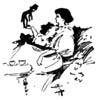
There was one exception to the general air of
complete absorption and satisfaction, and this
was a queer, oval cynical face, half in the light
of the waning day, and half in the shadow of
the curtains. It belonged to a young man, who
leaned half forward in a rigid, high-backed chair,
and alternately glanced curiously from face to
face in the audience, and then turned completely
about and looked out across the bare tree-tops
of the Common. A look of weariness, and even
of contempt, crept about his eyes and mouth, as
certain high-flown phrases reached his ears.
Here is a bit of rapid rhetoric that evoked the
applause of the company, and made him only
curl his lip. “The dominion of beauty obtains
forever in the human heart, and so long as this
is so, no class nor humanity at large can be
utterly bad; for the discernment of beauty involves
the recognition of moral feeling. All
permanent beauty is essentially moral and is
sure of ready acceptance, especially among
women, in whom the religious instinct is
strongest. Modern life can never annihilate
this innate and instinctive perception of intellectual
nobility and pure beauty. Nay, since
the form is the body of the soul, the finest type
of pure physical beauty will always rightly command
our admiration. It breaks through all
creeds and castes, and holds the race in unity of
feeling and thought.”
The lecture closed in a culminating clapping
of hands, and the guests all moved forward to
congratulate the lecturer and the patron. The
young man turned and studied the different
groups with an amused smile.
A lady, who had been watching the young
man’s mocking comment on the scene in the
changing expression of his eyes and pursed lips,
suddenly arose from a divan in the angle of the
room, and crossed over to where he sat in the
afternoon twilight.
She stopped him from arising with a gesture,
and sank down into a seat beside him.
“You do not seem particularly pleased with
Mr. Blanco Winterbourne’s lecture?”
“Well, it doesn’t interest me, because you
see I come into contact with life as it really is.
I have heard all this cant about the beauty of
purity and character before so many times, but
when I see beauty of character in life I find it
always taken advantage of. And as for the dignity
of physical beauty, I need scarcely tell one
of your sex the difference between a beauty in
rags and a beauty in silks.”
“Oh, but I protest, that although the world
is gross, and the half of us are mere Mammon
worshippers, there is an instinct of delight, and
irresistible attraction for us, especially for we
women, in sheer beauty without any trappings
of finery.”
“Ah, indeed; that sounds like the magnanimity
of humanity, universally asserted by popular
moralists. But your sex is really the least
amenable, as I could easily prove to you.”
“Then prove it.”
“I will, if you can put on your hat and coat
and come at once.”
“Well, I’m in a blaze of curiosity for the adventure.”
As they crossed Beacon Street a beggar boy
stepped up to them, and in piping tones of want
asked the lady for alms. She glanced for a moment
into his face with a blank look of negation
on her own, and with a sort of comprehensive
intake of his dirt and rags she gathered her
skirts about her and passed through the turnpike
and down the steps to the Common. But
her companion lingered behind, and presently
joined her, half dragging the boy by his tattered
sleeve.
“Come here, Miss Lorillard, and look at the
boy. I want to know if this isn’t beauty?”
She turned and looked into the boy’s face, as
her companion held it up to the light between
his two hands. The extraordinary and perfect
beauty of his features seized upon her in a sort
of wonderment. Where had she ever seen such
a face before?—And her memory swept through
the galleries of Europe. In none of them. How
was it she had not noticed it at first? The dirt?
It was incomparable—it seemed superhuman in
its sweetness and beauty, its appeal, and its glow
of divinity. God’s hand was plainly set in that
face.
“This is the boy,” said the young man, laconically,
watching her expression. “Come
along.”
And linking his arm in that of the ragged
youngster, the trio sauntered along with the
fashionable throng coming out of the matinees.
“Get out of my way, you ugly little sweep,”
said one woman, elbowing the boy off the pavement;
and the men pushed him hither and
thither. The fashionable women looked right
through the ragged urchin and his evidently dubious
companions, as if they were glass, and their
gaze seemed to bite like frost. Not one woman
remarked the surpassing loveliness of the boy’s
perfect face.
At the corner of the Common the young man
sent the boy about his business.
“Who is he, and what does all this mean?”
“That is Adonis—the one-time victor of
Venus. He fell upon evil days when clothes
made the king, and rags the knave.”
Walter Blackburn Harte.